AB 2305: Public employment: collective bargaining: peace officers.
- Session Year: 2017-2018
- House: Assembly
- Latest Version Date: 2018-08-29
Existing law establishes the Public Employment Relations Board (PERB) in state government as a means of resolving disputes and enforcing the statutory duties and rights of employers and employees under the Educational Employment Relations Act, the Higher Education Employer-Employee Relations Act, the Ralph C. Dills Act, and the Meyers-Milias-Brown Act. Existing law includes within PERBs jurisdiction resolving disputes alleging violation of rules and regulations adopted by a public agency, as defined, concerning unit determinations, representations, recognition, and elections, as specified.
Existing law requires bargaining unit determinations and representation elections to be determined and processed in accordance with rules adopted by a public agency, as specified. Existing law requires, in a representation election, a majority of the votes cast by the employees in the appropriate bargaining unit.
Existing law requires PERB to enforce and apply rules adopted by a public agency concerning unit determinations, representation, recognition, and elections. Existing law also requires specified complaints to be processed as an unfair practice charge by PERB.
Existing law does not apply the above provisions to persons who are peace officers, as defined. Existing law excepts employers and employees under the jurisdiction of the employee relations commissions in the County of Los Angeles and the City of Los Angeles from the application of the above provisions.
This bill would specify that these provisions do not apply to disputes between a public agency and persons who are peace officers, but do apply to disputes between a public agency and peace officer employee organizations, regardless of whether the charging party or responding party is the individual peace officer, the peace officer employee organization, or the public agency.
Existing law establishes the Public Employment Relations Board (PERB) in state government as a means of resolving disputes and enforcing the statutory duties and rights of employers and employees under the Educational Employment Relations Act, the Higher Education Employer-Employee Relations Act, the Ralph C. Dills Act, and the Meyers-Milias-Brown Act. Existing law includes within PERBs jurisdiction resolving disputes alleging violation of rules and regulations adopted by a public agency, as defined, concerning unit determinations, representations, recognition, and elections, as specified.
Existing law requires bargaining unit determinations and representation elections to be determined and processed in accordance with rules adopted by a public agency, as specified. Existing law requires, in a representation election, a majority of the votes cast by the employees in the appropriate bargaining unit.
Existing law requires PERB to enforce and apply rules adopted by a public agency concerning unit determinations, representation, recognition, and elections. Existing law also requires specified complaints to be processed as an unfair practice charge by PERB.
Existing law does not apply the above provisions to persons who are peace officers, as defined. Existing law excepts employers and employees under the jurisdiction of the employee relations commissions in the City and County of Los Angeles from the application of the above provisions.
This bill would specify that these provisions do not apply to disputes between a public agency and persons who are peace officers, but do apply to disputes between a public agency and peace officer employee organizations but do not apply to employers and employees under the jurisdiction of the employee relations commission established by, and in effect for, the County of Los Angeles and the City of Los Angeles, as specified. organizations, regardless of whether the charging party or responding party is the individual peace officer, the peace officer employee organization, or the public agency.
Existing law establishes the Public Employment Relations Board (PERB) in state government as a means of resolving disputes and enforcing the statutory duties and rights of employers and employees under the Educational Employment Relations Act, the Higher Education Employer-Employee Relations Act, the Ralph C. Dills Act, and the Meyers-Milias-Brown Act. Existing law includes within PERBs jurisdiction resolving disputes alleging violation of rules and regulations adopted by a public agency, as defined, concerning unit determinations, representations, recognition, and elections, as specified.
Existing law requires bargaining unit determinations and representation elections to be determined and processed in accordance with rules adopted by a public agency, as specified. Existing law requires, in a representation election, a majority of the votes cast by the employees in the appropriate bargaining unit.
Existing law requires PERB to enforce and apply rules adopted by a public agency concerning unit determinations, representation, recognition, and elections. Existing law also requires specified complaints to be processed as an unfair practice charge by PERB.
Existing law does not apply the above provisions to persons who are peace officers, as defined.
This bill would instead specify that the exemption from these provisions does not apply to peace officer employee organizations and employers and employees under the jurisdiction of the employee relations commission established by, and in effect for, the County of Los Angeles and the City of Los Angeles, as specified. apply to peace officer employee organizations but do not apply to employers and employees under the jurisdiction of the employee relations commission established by, and in effect for, the County of Los Angeles and the City of Los Angeles, as specified.
Existing law establishes the Public Employment Relations Board (PERB) in state government as a means of resolving disputes and enforcing the statutory duties and rights of employers and employees under the Educational Employment Relations Act, the Higher Education Employer-Employee Relations Act, the Ralph C. Dills Act, and the Meyers-Milias-Brown Act. Existing law includes within PERBs jurisdiction resolving disputes alleging violation of rules and regulations adopted by a public agency, as defined, concerning unit determinations, representations, recognition, and elections, as specified.
Existing law requires bargaining unit determinations and representation elections to be determined and processed in accordance with rules adopted by a public agency, as specified. Existing law requires, in a representation election, a majority of the votes cast by the employees in the appropriate bargaining unit.
Existing law requires PERB to enforce and apply rules adopted by a public agency concerning unit determinations, representation, recognition, and elections. Existing law also requires specified complaints to be processed as an unfair practice charge by PERB.
Existing law does not apply the above provisions to persons who are peace officers, as defined.
This bill would instead specify that the exemption from these provisions does not apply to peace officer employee organizations and employers and employees under the jurisdiction of the employee relations commission established by, and in effect for, the County of Los Angeles and the City of Los Angeles, as specified.
Existing law, the Meyers-Milias-Brown Act, authorizes local public employees, as defined, to form, join, and participate in the activities of employee organizations of their own choosing to represent themselves on matters of employer-employee relations. Existing law also grants these public employees the right to refuse to join or participate in those activities and to represent themselves individually in their employment relations. This bill would make nonsubstantive changes to these provisions.Existing law, the Meyers-Milias-Brown Act, authorizes local public employees, as defined, to form, join, and participate in the activities of employee organizations of their own choosing to represent themselves on matters of employer-employee relations. Existing law also grants these public employees the right to refuse to join or participate in those activities and to represent themselves individually in their employment relations.
This bill would make nonsubstantive changes to these provisions.
(a)The changes made to Sections 3501, 3507.1, and 3509 by Chapter 901 of the Statutes of 2000 shall not apply to disputes between a public agency and persons who are peace officers as defined in Section 830.1 of the Penal Code, but shall apply to disputes between a public agency and peace officer employee organizations. This section shall apply regardless of whether the charging party or responding party is the individual peace officer, the peace officer employee organization, or the public agency.
(b)This section does not apply to employers and employees under the jurisdiction of the employee relations commission established by, and in effect for, the County of Los Angeles and the City of Los Angeles, and does not affect the authority of those commissions provided by subdivision (d) of Section 3509.
(a)The changes made to Sections 3501, 3507.1, and 3509 of the Government Code by legislation enacted during the 19992000 Regular Session of the Legislature by Chapter 901 of the Statutes of 2000 shall not apply to persons who are peace officers as defined in Section 830.1 of the Penal Code. Code, but shall apply to peace officer employee organizations.
(b)This section does not apply to employers and employees under the jurisdiction of the employee relations commission established by, and in effect for, the County of Los Angeles and the City of Los Angeles, and does not affect the authority of those commissions provided by subdivision (d) of Section 3509.
SECTION 1.Section 3511 of the Government Code is amended to read:3511.(a)The changes made to Sections 3501, 3507.1, and 3509 by Chapter 901 of the Statutes of 2000 shall not apply to peace officer employee organizations.(b)This section does not apply to employers and employees under the jurisdiction of the employee relations commission established by, and in effect for, the County of Los Angeles and the City of Los Angeles, and does not affect the authority of those commissions provided by subdivision (d) of Section 3509.(a)The changes made to Sections 3501, 3507.1, and 3509 of the Government Code by shall not apply to persons who are peace officers as defined in Section 830.1 of the Penal Code. by Chapter 901 of the Statutes of 2000 shall not apply to peace officer employee organizations.
(b)This section does not apply to employers and employees under the jurisdiction of the employee relations commission established by, and in effect for, the County of Los Angeles and the City of Los Angeles, and does not affect the authority of those commissions provided by subdivision (d) of Section 3509.
SECTION 1.Section 3502 of the Government Code is amended to read:3502.Except as otherwise provided by the Legislature, public employees shall have the right to form, join, and participate in the activities of employee organizations of their own choosing for the purpose of representation on all matters of employer-employee relations. Public employees also shall have the right to refuse to join or participate in the activities of employee organizations and shall have the right to represent themselves individually in their employment relations with their public agencies.Except as otherwise provided by the Legislature, public employees shall have the right to form, join, and participate in the activities of employee organizations of their own choosing for the purpose of representation on all matters of employer-employee relations. Public employees also shall have the right to refuse to join or participate in the activities of employee organizations and shall have the right to represent themselves individually in their employment relations with the their public agency. agencies.
|
Date
|
Status
|
|---|---|
| Sep 28, 2018 | Vetoed by Governor. |
| Sep 5, 2018 | Enrolled and presented to the Governor at 3 p.m. |
| Aug 27, 2018 | Senate amendments concurred in. To Engrossing and Enrolling. |
| Aug 22, 2018 | In Assembly. Concurrence in Senate amendments pending. May be considered on or after August 24 pursuant to Assembly Rule 77. |
| Aug 22, 2018 | Read third time. Passed. Ordered to the Assembly. |
| Aug 20, 2018 | Read second time. Ordered to third reading. |
| Aug 17, 2018 | From committee: Amend, and do pass as amended. (Ayes 5. Noes 1.) (August 16). |
| Aug 6, 2018 | In committee: Referred to APPR. suspense file. |
| Jun 26, 2018 | From committee: Do pass and re-refer to Com. on APPR. (Ayes 3. Noes 2.) (June 25). Re-referred to Com. on APPR. |
| Jun 7, 2018 | Referred to Com. on P.E. & R. |
| May 30, 2018 | In Senate. Read first time. To Com. on RLS. for assignment. |
| May 29, 2018 | Read third time. Passed. Ordered to the Senate. |
| May 25, 2018 | From committee: Do pass. (Ayes 13. Noes 2.) (May 25). |
| May 2, 2018 | In committee: Set, first hearing. Referred to APPR. suspense file. |
| Apr 18, 2018 | From committee: Do pass and re-refer to Com. on APPR. (Ayes 5. Noes 0.) (April 18). Re-referred to Com. on APPR. |
| Apr 4, 2018 | Re-referred to Com. on P.E., R., & S.S. |
| Apr 3, 2018 | From committee chair, with author's amendments: Amend, and re-refer to Com. on P.E., R., & S.S. Read second time and amended. |
| Apr 2, 2018 | Re-referred to Com. on P.E., R., & S.S. |
| Mar 23, 2018 | From committee chair, with author's amendments: Amend, and re-refer to Com. on P.E., R., & S.S. Read second time and amended. |
| Mar 22, 2018 | Referred to Com. on P.E., R., & S.S. |
| Feb 14, 2018 | From printer. May be heard in committee March 16. |
| Feb 13, 2018 | Read first time. To print. |
|
Date
|
Description
|
Location
|
Votes
|
|
|---|---|---|---|---|
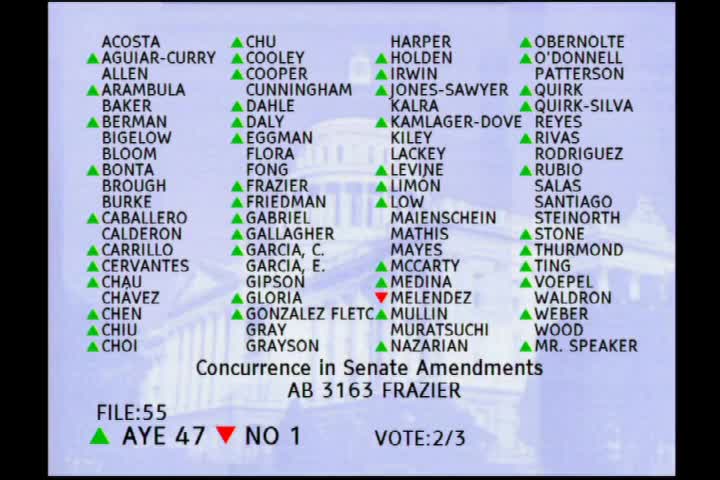
| Aug 27, 2018 | AB 2305 RODRIGUEZ Concurrence in Senate Amendments | Assembly Floor |
Passed |
|
| Aug 22, 2018 | Assembly 3rd Reading AB2305 Rodriguez By Pan | Senate Floor |
Passed |
|
| Aug 16, 2018 | Do pass as amended | Senate Standing Committee on Appropriations |
Passed |
|
| Aug 6, 2018 | Placed on suspense file | Senate Standing Committee on Appropriations |
Passed |
|
| Jun 25, 2018 | Do pass, but first be re-referred to the Committee on [Appropriations] | Senate Standing Committee on Public Employment and Retirement |
Passed |
|
| May 29, 2018 | AB 2305 RODRIGUEZ Assembly Third Reading | Assembly Floor |
Passed |
|
| May 25, 2018 | Do pass. | Assembly Standing Committee on Appropriations |
Passed |
|
| Apr 18, 2018 | Do pass and be re-referred to the Committee on [Appropriations] | Assembly Standing Committee on Public Employees, Retirement, and Social Security |
Passed |
This list shows positions taken on this bill by organizations on the date displayed, which is linked to the original source.
Positions by individuals are not included.
|
Organization
|
Position
|
Date
|
|---|---|---|
| American Federation of State Municipal Employees | * Support | Apr 18, 2018 |
| Association Of Orange County Deputy Sheriffs | ** Support | Aug 20, 2018 |
| California Statewide Law Enforcement Association | ** Support | Aug 20, 2018 |
| California Teamsters Public Affairs Council | ** Support | Aug 20, 2018 |
| Fraternal Order of Police | ** Support | Aug 20, 2018 |
| Long Beach Police Officers Association | ** Support | Aug 20, 2018 |
| Riverside Sheriffs' Association | * Support | Apr 18, 2018 |
| Sacramento County Deputy Sheriffs' Association | ** Support | Aug 20, 2018 |
GOVERNOR'S VETO
GV Bill Id:AB 2305
Author:(Rodriguez)
As Enrolled Ver:September 5, 2018
2/3 vote
ASSEMBLY: | 59-8 | (May 29, 2018) | SENATE: | 31-4 | (August 22, 2018) |
ASSEMBLY: | 64-9 | (August 27, 2018) |
|
|
Original Committee Reference: P.E.,R., & S.S.
SUMMARY: Expands the jurisdiction of the Public Employment Relations Board (PERB) to include disputes between public agencies and peace officer employee organizations other than those employers and employees under the jurisdiction of employee relations commissions for the City and County of Los Angeles. Disputes between public agencies and individual peace officers would remain outside of the jurisdiction of the PERB.
The Senate amendments:
- Provide that this measure does not apply to labor disputes between a public agency employer and individuals who are peace officers, but does apply to disputes between a public agency employer and peace officer employee organizations, regardless of whether the charging or responding party is an individual peace officer, peace officer employee organization, or the public agency employer.
- Maintain the existing exception for labor relations between the City and County of Los Angeles and their respective employees since those labor relations are administered by local employee relations boards.
EXISTING LAW:
- Establishes the Meyers-Milias-Brown Act, Educational Employer-Employee Relations Act, Ralph C. Dills Act, and Higher Education Employer-Employee Relations Act which are statutory frameworks that provide for public employer-employee relations for local public agencies, schools (K-12) and community colleges, the state, and the University of California, California State University, and Hastings College of Law, respectively. These statutes provide for a reasonable method of resolving disputes regarding wages, hours, and other terms and conditions of employment between the local public employer and recognized public employee organizations or their exclusive representatives.
- Establishes PERB, a quasi-judicial agency that oversees public sector collective bargaining in California and administers certain collective bargaining statutes to ensure consistent implementation and application. The PERB also adjudicates disputes between the parties subject to them.
- Establishes local, alternative labor relations boards for the City and County of Los Angeles, respectively.
- Excludes from the jurisdiction of the PERB, applicability of certain provisions related to peace officers.
FISCAL EFFECT: According to the Senate Appropriations Committee analysis, PERB indicates that it would incur annual costs of $1.7 million to $2 million to implement the provisions of the bill (General Fund).
COMMENTS: According to the author, "[t]his bill will codify an existing PERB decision (Santa Clara County Correctional Peace Officers Association v. County of Santa Clara PERB Decision No. 2431-M) which provides that PERB has jurisdiction over claims brought by Peace Officer Employee Organizations, and will create certainty for peace officer employee organizations [throughout the state] by codifying this PERB decision."
Over the years, the Legislature has expanded the Board's jurisdiction, but the necessary funding for the increased workload has not kept pace. This has resulted in significant backlogs at the Board – both labor and employers have complained about this problem. This Administration has recently increased the Board's funding to help correct this problem. The Board's jurisdiction should not be expanded again until the Board's ability to handle its previously expanded caseload is established.
Analysis Prepared by: Michael Bolden / P.E.,R., & S.S. / (916) 319-3957 FN: 0005297
CONCURRENCE IN SENATE AMENDMENTS
CSA1 Bill Id:AB 2305
Author:(Rodriguez)
As Amended Ver:August 17, 2018
Majority vote
ASSEMBLY: | 59-8 | (May 29, 2018) | SENATE: | 31-4 | (August 22, 2018) |
Original Committee Reference: P.E.,R., & S.S.
SUMMARY: Expands the jurisdiction of the Public Employment Relations Board (PERB) to include disputes between public agencies and peace officer employee organizations other than those employers and employees under the jurisdiction of employee relations commissions for the City and County of Los Angeles. Disputes between public agencies and individual peace officers would remain outside of the jurisdiction of the PERB.
The Senate amendments:
- Provide that this measure does not apply to labor disputes between a public agency employer and individuals who are peace officers, but does apply to disputes between a public agency employer and peace officer employee organizations, regardless of whether the charging or responding party is an individual peace officer, peace officer employee organization, or the public agency employer.
- Maintain the existing exception for labor relations between the City and County of Los and their respective employees since those labor relations are administered by local employee relations boards.
EXISTING LAW:
- Establishes the Meyers-Milias-Brown Act, Educational Employer-Employee Relations Act, Ralph C. Dills Act, and Higher Education Employer-Employee Relations Act which are statutory frameworks that provide for public employer-employee relations for local public agencies, schools (K-12) and community colleges, the state, and the University of California, California State University, and Hastings College of Law, respectively. These statutes provide for a reasonable method of resolving disputes regarding wages, hours, and other terms and conditions of employment between the local public employer and recognized public employee organizations or their exclusive representatives.
- Establishes PERB, a quasi-judicial agency that oversees public sector collective bargaining in California and administers certain collective bargaining statutes to ensure consistent implementation and application. The PERB also adjudicates disputes between the parties subject to them.
- Establishes local, alternative labor relations boards for the City and County of Los Angeles, respectively.
- Excludes from the jurisdiction of the PERB, applicability of certain provisions related to peace officers.
FISCAL EFFECT: According to the Senate Appropriations Committee analysis, PERB indicates that it would incur annual costs of $1.7 million to $2 million to implement the provisions of the bill (General Fund).
COMMENTS: According to the author, "[t"his bill will codify an existing PERB decision (Santa Clara County Correctional Peace Officers Association v. County of Santa Clara PERB Decision No. 2431-M) which provides that PERB has jurisdiction over claims brought by Peace Officer Employee Organizations, and will create certainty for peace officer employee organizations [throughout the state] by codifying this PERB decision."
Analysis Prepared by: Michael Bolden / P.E.,R., & S.S. / (916) 319-3957 FN: 0004481
Office of Senate Floor Analyses (916) 651-1520 Fax: (916) 327-4478 | AB |
THIRD READING
Bill No: AB 2305
:
SENATE PUBLIC EMP. & RET. COMMITTEE: 3-2, 6/25/18
AYES: Pan, Leyva, Portantino
NOES: Morrell, Moorlach
SENATE APPROPRIATIONS COMMITTEE: 5-1, 8/16/18
AYES: Portantino, Beall, Bradford, Hill, Wiener
NOES: Nielsen
NO VOTE RECORDED: Bates
ASSEMBLY FLOOR: 59-8, 5/29/18 - See last page for vote
SUBJECT: Public employment: collective bargaining: peace officers
SOURCE: Association of Orange County Deputy Sheriffs
DIGEST:
This bill expands the jurisdiction of the Public Employment Relations Board (PERB) to disputes between public agencies and peace officer employee organizations other than those employers and employees under the jurisdiction of employee relations commissions for the County and City of Los Angeles. Disputes between public agencies and individual peace officers would remain outside of PERB’s jurisdiction.
ANALYSIS:
Existing law:
- Establishes the Meyers-Milias-Brown Act, Educational Employer-Employee Relations Act, Ralph C. Dills Act, and Higher Education Employer-Employee Relations Act which are statutory frameworks that provide for public employer-employee relations for local public agencies, schools (K-12) and community colleges, the State, and the University of California, California State University, and Hastings College of Law, respectively. These statutes provide for a reasonable method of resolving disputes regarding wages, hours, and other terms and conditions of employment between the local public employer and recognized public employee organizations or their exclusive representatives.
- Establishes PERB, a quasi-judicial agency which oversees public sector collective bargaining in California and administers specified collective bargaining statutes to ensure their consistent implementation and application. PERB also adjudicates disputes between the parties subject to them.
- Establishes local, alternative labor relations boards for the City and County of Los Angeles respectively.
- Excludes from PERB's jurisdiction, applicability of certain provisions related to persons who are peace officers.
This bill revises the existing exception for the application of PERB jurisdiction to labor relation disputes between public employers and persons who are peace officers, as follows:
- Maintains the existing rule that disputes between public agencies and persons who are peace officers are not under PERB jurisdiction.
- Provides that disputes between public agencies and peace officer employee organizations are subject to PERB jurisdiction.
- Carries forward an existing exception for labor relations between Los Angeles City and Los Angeles County and their respective employees since those labor relations are governed by local employee relations boards.
Comments
Applying Chapter 901, Statutes of 2000 to Peace Officer Employee Organizations
Chapter 901, Statutes of 2000, transferred jurisdiction of specified public employer-employee labor relations from the court system to PERB. However, language in the legislation made its provisions inapplicable to labor relations between public employers and persons who are peace officers as defined in Section 830.1 of the Penal Code. In addition to disputes regarding unfair labor practices, provisions addressing agency shop agreements, and recission of agency shop agreements were also part of the legislation.
AB 2305 applies Chapter 901 provisions, i.e., PERB jurisdiction, to peace officer employee organizations.
Codifying PERB Decision?
In Santa Clara County Correctional Peace Officers Association v. County of Santa Clara PERB Decision No. 2431-M, PERB asserted it jurisdiction over disputes involving peace officers when a union brought claims against an employer where the union represented mixed units of the employer’s peace officer employees and employees who were not peace officers. PERB declared, “By issuance of this decision, we make explicit PERB' s authority to hear charges, such as the present one, that are brought by employee organizations, including employee organizations representing or seeking to represent units including persons who are peace officers.”
According to the author, this bill merely codifies this decision. However, PERB’s decision to exercise jurisdiction is grounded in the fact that the employee organization represented mixed units of employees. This bill seems to go a step further and extend PERB jurisdiction to peace officer unions consisting exclusively of peace officers.
Pyrrhic Victories Defending Bargaining Agreements
According to the sponsor, often its members will avoid submitting labor claims, unfair labor practices, and breaches of contract complaints to superior court because costs are prohibitive in comparison to the economic gain from enforcing the members’ rights under the contract.
For example, in the PERB case which this bill seeks to codify, the dispute at issue concerned reimbursement for training tuition fees whose amounts ranged from $45.00 - $250.00 and a pool of funds for reimbursement totaling $15,000 annually. Employee associations forced to defend employee rights related to non-economic issues or of de minimis economic value through litigation damage the economic position of the associations and add to ill will in labor relations in contravention to the purpose of the state’s public labor relations laws. Clarifying that peace officer employee associations can avail themselves of PERB to bring their labor complaints will help address these conflicts and strengthen the integrity of the bargaining process by ensuring contracts are enforced.
Related/Prior Legislation
AB 2886 (Daly, 2018), currently on the Senate Floor, transfers jurisdiction over the adjudication of unfair labor practices for the Orange County Transportation Authority and San Joaquin Regional Transit District from the judicial system to PERB.
AB 3034 (Low, 2018), currently on the Senate Floor, amends the Public Utilities Code to place supervisory, professional, and technical employee units of the San Francisco Bay Area Rapid Transit District under the MMBA to grant them certain statutory rights related to the employer-employee relationship, and bring them under the jurisdiction of PERB.
AB 530 (Cooper, 2017) would have expanded PERB’s jurisdiction to include Penal Code Section 830 peace officers; authorized a peace officer or labor union representing these peace officers to bring certain actions in court; and, excluded employers and employees of the City and County of Los Angeles from its provisions. The bill was vetoed by the Governor with the following message:
This bill authorizes peace officers to bring unfair practice charges to the Public Employment Relations Board while preserving their existing right to directly petition a superior court for injunctive relief.
No other group has both of these rights and I'm unconvinced that providing such a unique procedure is warranted.
FISCAL EFFECT: Appropriation: Fiscal Com.: Local:
According to the Senate Appropriations Committee, PERB indicates that it would incur annual costs of up to $1 million to implement the provisions of this bill (General Fund).
Association of Orange County Deputy Sheriffs (source)
California Statewide Law Enforcement Association
California Teamsters Public Affairs Council
Fraternal Order of Police
Long Beach Police Officers Association
Sacramento County Deputy Sheriffs’ Association
OPPOSITION: (Verified 8/17/18)
None received
ARGUMENTS IN SUPPORT: According to the California Statewide Law Enforcement Association, “Currently, any labor dispute involving a peace officer union goes to Superior Court, rather than the less costly and more efficient process through PERB. In many instances, our members have opted out of sending labor claims, including unfair practices and breaches of contract, to court because of how cost-prohibitive it can be on an officer. Allowing PERB to handle all labor disputes for peace officers also allows smaller peace officer unions the ability to defend themselves against bad faith bargaining. Further, keeping all recognized public employee organizations under the jurisdiction of PERB, who has experience and deep understanding about labor disputes and contracts, is good public policy.”
ASSEMBLY FLOOR: 59-8, 5/29/18
AYES: Acosta, Aguiar-Curry, Berman, Bigelow, Bloom, Bonta, Burke, Caballero, Calderon, Carrillo, Cervantes, Chau, Chávez, Chiu, Chu, Cooley, Cooper, Cunningham, Daly, Eggman, Frazier, Friedman, Cristina Garcia, Eduardo Garcia, Gipson, Gloria, Gonzalez Fletcher, Gray, Grayson, Holden, Irwin, Jones-Sawyer, Kalra, Kamlager-Dove, Lackey, Levine, Limón, Low, Maienschein, McCarty, Medina, Mullin, Muratsuchi, Nazarian, O'Donnell, Quirk, Quirk-Silva, Reyes, Rodriguez, Rubio, Salas, Santiago, Mark Stone, Thurmond, Ting, Waldron, Weber, Wood, Rendon
NOES: Baker, Brough, Chen, Choi, Dahle, Harper, Melendez, Obernolte
NO VOTE RECORDED: Travis Allen, Arambula, Flora, Fong, Gallagher, Kiley, Mathis, Mayes, Patterson, Steinorth, Voepel
8/20/18 9:50:25
**** END ****
SENATE COMMITTEE ON
Senator Anthony Portantino, Chair
2017 - 2018 Regular Session
AB 2305 (Rodriguez) - Public employment: collective bargaining: peace officers
Version: | Policy Vote: |
Urgency: | Mandate: |
Hearing Date: | Consultant: |
Bill Summary:
AB 2305 would expand the jurisdiction of the Public Employment Relations Board (PERB) to peace officer employee organizations, but exclude employers and employees under the jurisdiction of employee relations commissions for the County and City of Los Angeles.
*********** ANALYSIS ADDENDUM – SUSPENSE FILE ***********
The following information is revised to reflect amendments
adopted by the committee on August 16, 2018
Fiscal Impact:
PERB indicates that it would incur annual costs of up to $1 million to implement the provisions of the bill (General Fund).
Author Amendments:
Specify that the bill would not apply to disputes between a public agency and persons who are peace officers, but do apply to disputes between a public agency and peace officer employee organizations, regardless of whether the charging party or responding party is the individual peace officer, the peace office employee organization, or the public agency.
-- END --
SENATE COMMITTEE ON
Senator Anthony Portantino, Chair
2017 - 2018 Regular Session
AB 2305 (Rodriguez) - Public employment: collective bargaining: peace officers
Version: | Policy Vote: |
Urgency: | Mandate: |
Hearing Date: | Consultant: |
This bill meets the criteria for referral to the Suspense File.
Bill Summary:
AB 2305 would expand the jurisdiction of the Public Employment Relations Board (PERB) to peace officer employee organizations, but exclude employers and employees under the jurisdiction of employee relations commissions for the County and City of Los Angeles.
Fiscal Impact:
PERB indicates that it would incur annual costs of $1.7 million to $2 million to implement the provisions of the bill (General Fund).
Background:
PERB is a quasi-judicial agency that oversees public sector collective bargaining in the State. Its major functions involve the evaluation and adjudication of unfair practice charges filed, and the administration of the collective bargaining process through which employees select organizations to represent them in their labor relations with their employer.
Covered employees may file an unfair practice charge with PERB within six months of the alleged unfair practice. Once the charge has been properly filed, a Board agent reviews it to determine if a complaint should be issued, or dismisses it if there is insufficient factual evidence. A dismissal may be appealed. If a complaint is filed, the case proceeds to an informal settlement conference, or may proceed to a formal hearing conducted by an administrative law judge if no settlement can be reached.
The County of Los Angeles and the City of Los Angeles are both currently exempted from PERB’s authority, as labor relations are conducted through the Los Angeles County Employee Relations Commission (ERCOM) and the City of Los Angeles Employee Relations Board (ERB).
Proposed Law:
This bill would (1) revise the existing exception for the application of PERB jurisdiction to labor relation disputes between public employers and persons who are peace officers, and (2) clarify that while those disputes with persons who are peace officers are not under PERB jurisdiction, public employer labor relations disputes, as specified, with peace officer employee organizations are subject to PERB jurisdiction. Additionally, it would carry forward an existing exception or labor relations between Los Angeles City and Los Angeles County and their respective employees since those labor relations are governed by local employee relations boards.
Related Legislation:
- This measure is one of three bills currently pending in this Committee that would expand the jurisdiction of PERB. AB 2886 (Daly) would transfer jurisdiction over the adjudication of unfair labor practices for the Orange County Transportation Authority and the San Joaquin Regional Transition District from the judicial system to PERB. AB 3034 (Low) would expand PERB’s jurisdiction to include supervisory, professional, and technical employee units of the San Francisco Bay Area Rapid Transit (BART) District.
- AB 530 (Cooper, 2017) would have (1) expanded PERB’s jurisdiction to include Penal Code Section 830 peace officers, (2) authorized a peace officer or labor union representing these peace officers to bring certain actions in court, and (3) excluded employers and employees of the City and County of Los Angeles from its provisions. The bill was vetoed by the Governor.
Staff Comments:
PERB estimates that the newly affected peace officer units would generate around 180 to 200 disputes subject to its jurisdiction. Accordingly, it would require increased resources of $1.7 to $2 million dollars annually for regional attorneys, administrative law judges, Board counsel, support staff, and operating expenses.
-- END --
SENATE COMMITTEE ON
PUBLIC EMPLOYMENT AND RETIREMENT
Dr. Richard Pan, Chair
2017 - 2018 Regular
Bill No: AB 2305 Hearing Date: 6/25/18
Author: | Rodriguez | ||
Version: | 4/3/18 As amended | ||
Urgency: | No | Fiscal: | Yes |
Consultant: | Glenn Miles | ||
Subject: Public employment: collective bargaining: peace officers.
SOURCE: Association of Orange County Deputy Sheriffs
ASSEMBLY VOTES:
Assembly Floor: | 59 - 8 |
Assembly Appropriations Committee: | 13 - 2 |
Assembly Public Employees, Retirement, and Social Security Committee: | 5 - 0 |
DIGEST: Revises the existing exception for the application of Public Employment Relations Board (PERB) jurisdiction to labor relation disputes between public employers and persons who are peace officers and clarifies that while those disputes with persons who are peace officers are not under PERB jurisdiction, public employer labor relations disputes, as specified, with peace officer employee organizations are subject to PERB jurisdiction. The bill maintains Los Angeles City and County’s exception to PERB jurisdiction and application of their respective labor relations boards.
ANALYSIS:
Existing law:
- Establishes the Meyers-Milias-Brown Act, Educational Employer-Employee Relations Act, Ralph C. Dills Act, and Higher Education Employer-Employee Relations Act which are statutory frameworks that provide for public employer-employee relations for local public agencies, schools (K-12) and community colleges, the State, and the University of California, California State University, and Hastings College of Law, respectively. These statutes provide for a reasonable method of resolving disputes regarding wages, hours, and other terms and conditions of employment between the local public employer and recognized public employee organizations or their exclusive representatives.
- Establishes PERB, a quasi-judicial agency which oversees public sector collective bargaining in California and administers specified collective bargaining statutes to ensure their consistent implementation and application. PERB also adjudicates disputes between the parties subject to them.
- Establishes local, alternative labor relations boards for the City and County of Los Angeles respectively.
- Excludes from PERB's jurisdiction, applicability of certain provisions related to peace officers.
This bill:
- Revises the existing exception for the application of PERB jurisdiction to labor relation disputes between public employers and persons who are peace officers and clarifies that while those disputes with persons who are peace officers are not under PERB jurisdiction, public employer labor relations disputes, as specified, with peace officer employee organizations are subject to PERB jurisdiction.
- Carries forward an existing exception or labor relations between Los Angeles City and Los Angeles County and their respective employees since those labor relations are governed by local employee relations boards.
Background
Codifying PERB Decision
According to the author, this bill will codify an existing PERB decision (Santa Clara County Correctional Peace Officers Association v. County of Santa Clara PERB Decision No. 2431-M) that provides that PERB has jurisdiction over claims brought by Peace Officer Employee Organizations. Also according to the author, this bill will create certainty for Peace Officer Employee Organizations all over the State of California by codifying this PERB decision.
Pyrrhic Victories Defending Bargaining Agreements
According to the sponsor, often its members will avoid submitting labor claims, unfair labor practices, and breaches of contract complaints to superior court because costs are prohibitive in comparison to the economic gain from enforcing the members’ rights under the contract.
For example, in the PERB case which this bill seeks to codify, the dispute at issue concerned reimbursement for training tuition fees whose amounts ranged from $45.00 - $250.00 and a pool of funds for reimbursement totaling $15,000 annually. Employee associations forced to defend employee rights related to non-economic issues or of de minimis economic value through litigation damage the economic position of the associations and add to ill will in labor relations in contravention to the purpose of the state’s public labor relations laws. Clarifying that peace officer employee associations can avail themselves of PERB to bring their labor complaints will help address these conflicts and strengthen the integrity of the bargaining process by ensuring contracts are enforced.
Applying Chapter 901, Statutes of 2000 to Peace Officer Employee Organizations
Chapter 901, Statutes of 2000, transferred jurisdiction of specified public employer - employee labor relations from the court system to PERB. However, language in the legislation made its provisions inapplicable to labor relations between public employers and persons who are peace officers as defined in Section 830.1 of the Penal Code. In addition to disputes regarding unfair labor practices, provisions addressing agency shop agreements, and recission of agency shop agreements were also part of the legislation. AB 2305 would clarify that these provisions would presumably now apply to peace officer employee organizations.
Related/Prior Legislation
AB 530 (Cooper, 2017), vetoed by the Governor, would have expanded PERB’s jurisdiction to include Penal Code Section 830 peace officers; authorized a peace officer or labor union representing these peace officers to bring certain actions in court; and, exclude employers and employees of the City and County of Los Angeles from its provisions.
According to the Governor’s Veto Message:
I am returning Assembly Bill 530 without my signature.
This bill authorizes peace officers to bring unfair practice charges to the Public Employment Relations Board while preserving their existing right to directly petition a superior court for injunctive relief.
No other group has both of these rights and I'm unconvinced that providing such a unique procedure is warranted.
Sincerely,
Edmund G. Brown Jr.
Assembly Bill 2886 (Daly, 2018),currently in Senate Judiciary committee, would transfer jurisdiction over the adjudication of unfair labor practices for the Orange County Transportation Authority and San Joaquin Regional Transit District from the judicial system to PERB.
Assembly Bill 3034 (Low, 2018), currently in Senate Public Employment and Retirement Committee, would amend the Public Utilities Code to place supervisory, professional, and technical employee units of the San Francisco Bay Area Rapid Transit District (BART) under the MMBA to grant them certain statutory rights related to the employer-employee relationship, and bring them under the jurisdiction of PERB.
FISCAL EFFECT: Appropriation: No Fiscal Com.: Yes Local: No
According to Assembly Appropriations Committee, Significant annual General Fund costs to PERB in the range of $600,000 to $1 million as a result of additional new disputes subject to the jurisdiction of PERB.
SUPPORT:
Association of Orange County Deputy Sheriffs (source)
California Statewide Law Enforcement Association
California Teamsters Public Affairs Council
Fraternal Order of Police
Long Beach Police Officers Association
Sacramento County Deputy Sheriffs’ Association
OPPOSITION:
None received.
ARGUMENTS IN SUPPORT: According to the sponsor,
Currently, any labor dispute involving a peace officer union goes to Superior Court, rather than the less costly and more efficient process through PERB. In many instances, our members have opted out of sending labor claims, including unfair practices and breaches of contract, to court because of how cost-prohibitive it can be on an officer. Allowing PERB to handle all labor disputes for peace officers also allows smaller peace officer unions the ability to defend themselves against bad faith bargaining. Further, keeping all recognized public employee organizations under the jurisdiction of PERB, who has experience and deep understanding about labor disputes and contracts, is good public policy.
ASSEMBLY THIRD READING
ATR Bill Id:AB 2305
Author:(Rodriguez)
As Amended Ver:April 3, 2018
Majority vote
Committee | Votes | Ayes | Noes |
Public Employees | 5-0 | Rodriguez, Cervantes, Cooley, Cooper, O'Donnell | |
Appropriations | 13-2 | Gonzalez Fletcher, Bigelow, Bloom, Bonta, Calderon, Carrillo, Chau, Eggman, Friedman, Eduardo Garcia, Nazarian, Quirk, Reyes | Gallagher, Obernolte |
SUMMARY: Expands the jurisdiction of the Public Employment Relations Board (PERB) specifically related to peace officer employee organizations, and excludes employers and employees under the jurisdiction of employee relations commissions for the County and City of Los Angeles.
This bill also provides that changes made to certain provisions in the Meyers-Milias-Brown Act relating to local public agency employers and employees by SB 739 (Solis), Chapter 901, Statutes of 2000, do not apply to individuals who are peace officers, as defined in Section 830.1 of the Penal Code.
EXISTING LAW:
- Establishes the Meyers-Milias-Brown Act, Educational Employer-Employee Relations Act, Ralph C. Dills Act, and Higher Education Employer-Employee Relations Act which are statutory frameworks that provide for public employer-employee relations for local public agencies, schools (K-12) and community colleges, the State, and the University of California, California State University, and Hastings College of Law, respectively.
These statutes provide for a reasonable method of resolving disputes regarding wages, hours, and other terms and conditions of employment between the local public employer and recognized public employee organizations or their exclusive representatives.
- Delegates jurisdiction over the public employer-employee relationship to the PERB and charges the PERB with resolving disputes and enforcing the statutory duties and rights of state and local public agency employers and employee organizations, but provides the City and County of Los Angeles a local alternative to the PERB's oversight.
- Excludes from the PERB's jurisdiction, applicability of certain provisions related to peace officers.
FISCAL EFFECT: According to the Assembly Appropriations Committee, this bill would result in "significant annual General Fund costs to the PERB in excess of $265,000 as a result of additional new disputes subject to the jurisdiction of the PERB."
Analysis Prepared by: Michael Bolden / P.E.,R., & S.S. / (916) 319-3957 FN: 0003135
Date of Hearing: May 2, 2018
ASSEMBLY COMMITTEE ON APPROPRIATIONS
Lorena Gonzalez Fletcher, Chair
ABPCA Bill Id:AB 2305
Author:(Rodriguez) – As Amended Ver:April 3, 2018
Policy Committee: | Public Employees, Retirement, and Social Security | Vote: | 5 - 0 |
|
| ||
|
|
Urgency: No State Mandated Local Program: No Reimbursable: No
SUMMARY:
This bill expands the jurisdiction of the Public Employment Relations Board (PERB) to peace officer employee organizations, and excludes employers and employees under the jurisdiction of employee relations commissions for the County and City of Los Angeles.
FISCAL EFFECT:
Significant annual General Fund costs to PERB in the range of $600,000 to $1 million as a result of additional new disputes subject to the jurisdiction of PERB.
COMMENTS:
- Purpose. According to supporters, it is costly and inefficient to address labor disputes involving peace officers through the judicial system. As a result, members have opted out of filing labor claims, including unfair labor practices and breach of contract. AB 2305 expands the jurisdiction of PERB to include such claims, which supporters argue will allow smaller peace officer unions the ability to defends themselves against bad-faith bargaining.
- PERB and case backlog. PERB oversees public sector collective bargaining in California. Its major functions involve the evaluation and adjudication of unfair practice charges and the administration of the collective bargaining process.
Over the years, PERB’s jurisdiction has expanded, resulting in a backlog of cases. In April 2017, PERB began a Case Processing Efficiency Initiative to improve and streamline internal processes. In February 2018, PERB released a report that listed possible efficiencies and administrative changes to prioritize and expedite cases.
- Related legislation. AB 2305 is one of three bills pending in this committee that expand PERB’s jurisdiction. AB 2886 (Daly) transfers jurisdiction over the adjudication of unfair labor practices for the Orange County Transportation Authority and the San Joaquin Regional Transition District from the judicial system to PERB. AB 3034 (Low) expands PERB’s jurisdiction to include supervisory, professional, and technical employee units of the San Francisco Bay Area Rapid Transit (BART) District.
- Recent legislation. AB 530 (Cooper), of the 2017-18 Legislative Session, expands jurisdiction of PERB to include certain peace officers. AB 530 was vetoed by the governor because the existing rights of peace officers to directly petition a superior court for injunctive relief, a dual procedure not afforded to any other group.
Analysis Prepared by: Luke Reidenbach / APPR. / (916) 319-2081
Date of Hearing: April 18, 2018
ASSEMBLY COMMITTEE ON PUBLIC EMPLOYEES, RETIREMENT, AND SOCIAL SECURITY
Freddie Rodriguez, Chair
ABPCA Bill Id:AB 2305 (
Author:Rodriguez) – As Amended Ver:April 3, 2018
SUBJECT: Public employment: collective bargaining: peace officers
SUMMARY: Expands the jurisdiction of the Public Employment Relations Board (PERB), as specified, related to peace officer employee organizations, and excludes employers and employees under the jurisdiction of employee relations commissions for the County and City of Los Angeles, as specified.
EXISTING LAW:
- Establishes the Meyers-Milias-Brown Act, Educational Employer-Employee Relations Act, Ralph C. Dills Act, and Higher Education Employer-Employee Relations Act which are statutory frameworks that provides for public employer-employee relations for local public agencies, schools (K-12) and community colleges, state, and the University of California, California State University, and Hastings College of Law, respectively.
These statues provide for a reasonable method of resolving disputes regarding wages, hours, and other terms and conditions of employment between the local public employer and recognized public employee organizations or their exclusive representatives.
- Delegates jurisdiction over the public employer-employee relationship to the PERB and charges PERB with resolving disputes and enforcing the statutory duties and rights of state and local public agency employers and employee organizations, but provides the City and County of Los Angeles a local alternative to the PERB’s oversight.
- Excludes from the PERB’s jurisdiction, applicability of certain provisions related to peace officers.
FISCAL EFFECT: Unknown. This bill has been keyed fiscal by Legislative Counsel.
COMMENTS:
1) Comments by Supporters
Supporters generally state that labor disputes involving a peace officers go to Superior Court which is costly and less efficient than the PERB. They also express that, “[i]n many instances, our members have opted out of sending labor claims, including unfair practices and breaches of contract, to court because of how cost-prohibitive it can be to an officer. Allowing the PERB to handle all labor disputes for peace officers also allows smaller peace officer unions the ability to defend themselves against bad faith bargaining. Further, keeping all recognized public employee organizations under the jurisdiction of the PERB, who has experience and deep understanding about labor disputes and contracts, is good public policy.”
2) Related/Prior Legislation
Assembly Bill 530 (Cooper, 2017) would have expanded the jurisdiction of the PERB similar to the current measure, among other provisions. This bill was vetoed by the Governor because the bill also preserved the existing right of peace officers to directly petition a superior court for injunctive relief – a dual procedure not afforded to any other group.
Assembly Bill 2886 (Daly) would transfer jurisdiction over the adjudication of unfair labor practices for the Orange County Transportation Authority and San Joaquin Regional Transit District from the judicial system to the PERB. This bill is currently pending in the Assembly Committee on Public Employees, Retirement, and Social Security.
Assembly Bill 3034 (Low) would amend the Public Utilities Code by placing supervisory, professional, and technical employees units of the San Francisco Bay Area Rapid Transit District (BART) under the MMBA; thereby granting them certain statutory rights related to the employer-employee relationship, and bringing them under the jurisdiction of the PERB. This bill is currently pending in the Assembly Committee on Public Employees, Retirement, and Social Security.
REGISTERED SUPPORT / OPPOSITION:
Support
Association of Orange County Deputy Sheriffs
California Statewide Law Enforcement Association
Fraternal Order of Police
Long Beach Police Officers Association
Sacramento County Deputy Sheriffs’ Association
Opposition
None on file.
Analysis Prepared by: Michael Bolden / P.E.,R., & S.S. / (916) 319-3957

Bill Author

Bill Co-Author(s):