AB 2333: Office of Emergency Services: behavioral health response.
- Session Year: 2017-2018
- House: Assembly
- Latest Version Date: 2018-07-02
The California Emergency Services Act establishes the Office of Emergency Services within the Governors office under the supervision of the Director of Emergency Services and makes the office responsible for the states emergency and disaster response services for natural, technological, or manmade disasters and emergencies. Existing law authorizes the Governor, or the director when the governor is inaccessible, to proclaim a state of emergency under specified circumstances.
This bill would establish a behavioral health deputy director within the Office of Emergency Services to ensure individuals have access to necessary mental and behavioral health services and supports in the aftermath of a natural disaster or declaration of a state of emergency and would require the deputy director to collaborate with the Director of Health Care Services to coordinate the delivery of trauma-related support to individuals affected by a natural disaster or state of emergency. The bill would require the Director of Health Care Services, in collaboration with the Office of Emergency Services, to immediately request necessary federal and state waivers to ensure the provision of health care services, as specified, during a natural disaster or declared state of emergency.
The California Emergency Services Act establishes the Office of Emergency Services within the Governors office under the supervision of the Director of Emergency Services and makes the office responsible for the states emergency and disaster response services for natural, technological, or manmade disasters and emergencies. Existing law authorizes the Governor, or the director when the governor is inaccessible, to proclaim a state of emergency under specified circumstances.
This bill would declare the intent of the Legislature to enact legislation that would bolster the mental health response from the Office of Emergency Services during a natural disaster or state declared emergency. The This bill would establish a mental behavioral health deputy director within the office Office of Emergency Services to ensure individuals have access to necessary mental and behavioral health services and supports in the aftermath of a natural disaster or declaration of a state of emergency and would require the deputy director to collaborate with the Director of Health Care Services to coordinate the delivery of trauma-related support to individuals affected by a natural disaster or state of emergency. The bill would require the Director of Health Care Services, in collaboration with the Office of Emergency Services, to immediately request necessary federal and state waivers to ensure the provision of health care services, as specified, during a natural disaster or declared state of emergency.
The California Emergency Services Act establishes the Office of Emergency Services within the Governors office under the supervision of the Director of Emergency Services and makes the office responsible for the states emergency and disaster response services for natural, technological, or manmade disasters and emergencies. Existing law authorizes the Governor, or the director when the governor is inaccessible, to proclaim a state of emergency under specified circumstances.
This bill would declare the intent of the Legislature to enact legislation that would bolster the mental health response from the Office of Emergency Services during a natural disaster or state declared emergency. The bill would establish a mental health deputy director within the office to ensure individuals have access to necessary mental health services and supports in the aftermath of a natural disaster or declaration of a state of emergency and would require the deputy director to collaborate with the Director of Health Care Services to coordinate the delivery of trauma-related support to individuals affected by a natural disaster or state of emergency.
The California Emergency Services Act establishes the Office of Emergency Services within the Governors office under the supervision of the Director of Emergency Services and makes the office responsible for the states emergency and disaster response services for natural, technological, or manmade disasters and emergencies. Existing law authorizes the Governor, or the director when the governor is inaccessible, to proclaim a state of emergency under specified circumstances.
This bill would declare the intent of the Legislature to enact legislation that would bolster the mental health response from the Office of Emergency Services during a state declared emergency.
(a)The office shall establish a behavioral health deputy director to ensure individuals have access to necessary mental and behavioral health services and supports in the aftermath of a natural disaster or declaration of a state of emergency.
(b)The deputy director shall collaborate with the Director of Health Care Services to coordinate the delivery of trauma-related support to individuals affected by a natural disaster or state of emergency. The deputy directors responsibilities may include, but shall not be limited to, the following:
(1)Coordinating local behavioral health professionals to provide access to behavioral health services in the aftermath of a natural disaster or declaration of a state of emergency, including ensuring those behavioral health professionals are properly licensed.
(2)Ensuring the availability of trauma specialists to train the appropriate local emergency response staff in the aftermath of a natural disaster or declaration of a state of emergency.
SEC. 2.Section 8587.15 is added to the Government Code, to read:8587.15.The Director of Health Care Services, in coordination with the office, shall immediately request necessary federal and state waivers to ensure the provision of health care services to individuals in an impacted area during a natural disaster or declared state of emergency.
(a)The office shall establish a mental behavioral health deputy director to ensure individuals have access to necessary mental and behavioral health services and supports in the aftermath of a natural disaster or declaration of a state of emergency.
(b)The deputy director shall collaborate with the Director of Health Care Services to coordinate the delivery of trauma-related support to individuals affected by a natural disaster or state of emergency. The deputy directors responsibilities may include, but shall not be limited to, the following:
(1)Coordinating local behavioral health professionals to provide access to behavioral health services in the aftermath of a natural disaster or declaration of a state of emergency, including ensuring those behavioral health professionals are properly licensed.
(2)Ensuring the availability of trauma specialists to train the appropriate local emergency response staff in the aftermath of a natural disaster or declaration of a state of emergency.
SEC. 2.Section 8587.15 is added to the Government Code, to read:8587.15.The Director of Health Care Services, in coordination with the office, shall immediately request necessary federal and state waivers to ensure the provision of health care services to individuals in an impacted area during a natural disaster or declared state of emergency.
It is the intent of the Legislature to enact legislation that would bolster the mental health response from the Office of Emergency Services during a natural disaster or state declared emergency.
SEC. 2.Section 8587.13 is added to the Government Code, to read:8587.13.(a)The office shall establish a mental health deputy director to ensure individuals have access to necessary mental health services and supports in the aftermath of a natural disaster or declaration of a state of emergency.
(b)The deputy director shall collaborate with the Director of Health Care Services to coordinate the delivery of trauma-related support to individuals affected by a natural disaster or state of emergency.
It is the intent of the Legislature to enact legislation that would bolster the mental health response from the Office of Emergency Services during a state declared emergency.
|
Date
|
Status
|
|---|---|
| Aug 16, 2018 | In committee: Held under submission. |
| Aug 6, 2018 | In committee: Referred to APPR. suspense file. |
| Jul 2, 2018 | Read second time and amended. Re-referred to Com. on APPR. |
| Jun 28, 2018 | From committee: Amend, and do pass as amended and re-refer to Com. on APPR. with recommendation: To Consent Calendar. (Ayes 9. Noes 0.) (June 27). |
| Jun 12, 2018 | From committee: Do pass and re-refer to Com. on HEALTH. (Ayes 10. Noes 0.) (June 12). Re-referred to Com. on HEALTH. |
| Jun 7, 2018 | Referred to Coms. on G.O. and HEALTH. |
| May 30, 2018 | In Senate. Read first time. To Com. on RLS. for assignment. |
| May 29, 2018 | Read third time. Passed. Ordered to the Senate. |
| May 25, 2018 | From committee: Do pass. (Ayes 16. Noes 0.) (May 25). |
| May 9, 2018 | In committee: Set, first hearing. Referred to APPR. suspense file. |
| Apr 25, 2018 | From committee: Do pass and re-refer to Com. on APPR. (Ayes 15. Noes 0.) (April 24). Re-referred to Com. on APPR. |
| Apr 19, 2018 | From committee: Do pass and re-refer to Com. on HEALTH. (Ayes 21. Noes 0.) (April 18). Re-referred to Com. on HEALTH. |
| Apr 4, 2018 | Re-referred to Com. on G.O. |
| Apr 3, 2018 | From committee chair, with author's amendments: Amend, and re-refer to Com. on G.O. Read second time and amended. |
| Mar 21, 2018 | Re-referred to Com. on G.O. |
| Mar 20, 2018 | From committee chair, with author's amendments: Amend, and re-refer to Com. on G.O. Read second time and amended. |
| Mar 19, 2018 | Referred to Coms. on G.O. and HEALTH. |
| Feb 14, 2018 | From printer. May be heard in committee March 16. |
| Feb 13, 2018 | Read first time. To print. |
|
Date
|
Description
|
Location
|
Votes
|
|
|---|---|---|---|---|
| Aug 6, 2018 | Placed on suspense file | Senate Standing Committee on Appropriations |
Passed |
|
| Jun 27, 2018 | Do pass as amended, but first amend, and re-refer to the Committee on [Appropriations] with the recommendation: To Consent Calendar | Senate Standing Committee on Health |
Passed |
|
| Jun 12, 2018 | Do pass, but first be re-referred to the Committee on [Health] | Senate Standing Committee on Governmental Organization |
Passed |
|
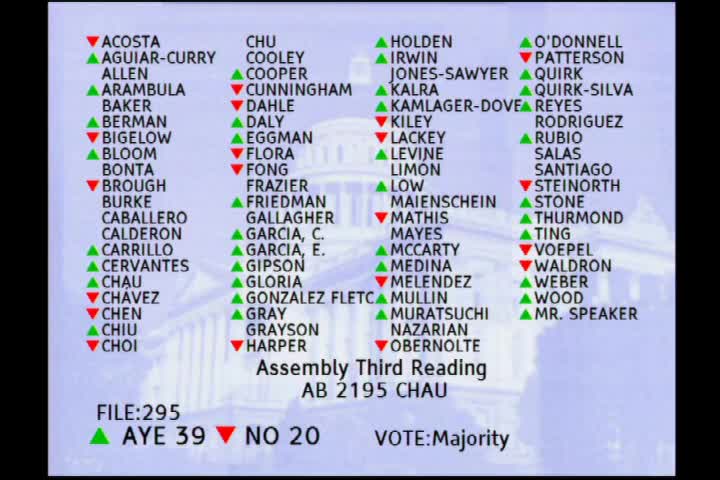
| May 29, 2018 | AB 2333 WOOD Assembly Third Reading | Assembly Floor |
Passed |
|
| May 25, 2018 | Do pass. | Assembly Standing Committee on Appropriations |
Passed |
|
| Apr 24, 2018 | Do pass and be re-referred to the Committee on [Appropriations] | Assembly Standing Committee on Health |
Passed |
|
| Apr 18, 2018 | Do pass and be re-referred to the Committee on [Health] | Assembly Standing Committee on Governmental Organization |
Passed |
This list shows positions taken on this bill by organizations on the date displayed, which is linked to the original source.
Positions by individuals are not included.
|
Organization
|
Position
|
Date
|
|---|---|---|
| California Association Of Marriage And Family Therapists | * Support | Apr 18, 2018 |
| California Council Of Community Behavioral Health Agencies | ** Support | Jun 25, 2018 |
| California Health + Advocates | * Support | Apr 18, 2018 |
| County Behavioral Health Directors Association of California | ** Support | Jun 25, 2018 |
| Disability Rights California | ** Support | Jun 25, 2018 |
| National Association of Social Workers | ** Support | Jun 25, 2018 |
| National Association Of Social Workers, California Chapter | ** Support | Jun 11, 2018 |
| Providence St. Joseph Health | ** Support | Jun 25, 2018 |
| San Bernardino County Behavioral Health | * Indeterminate | Jun 12, 2018 |
| The Steinberg Institute | ** Support | Jun 25, 2018 |
SENATE COMMITTEE ON
Senator Anthony Portantino, Chair
2017 - 2018 Regular Session
AB 2333 (Wood) - Office of Emergency Services: behavioral health response
Version: | Policy Vote: |
Urgency: | Mandate: |
Hearing Date: | Consultant: |
This bill meets the criteria for referral to the Suspense File.
Bill Summary:
AB 2333 would require the Governor’s Office of Emergency Services (Cal OES) to establish a behavioral health deputy director to ensure individuals have access to necessary mental and behavioral health services and supports in the aftermath of a natural disaster or declaration of a state emergency.
Fiscal Impact:
- Cal OES would incur ongoing costs of approximately $800,000 annually for a Deputy Director position and additional support staff. This would include administrative and travel costs to manage staff, to coordinate across Cal OES’s three administrative regions, to collaborate with the Director of Health Care Services, for program integration with county mental health offices, and to direct recruitment and training of local behavioral health professionals. (GF)
- The Department of Health Care Services (DHCS) would likely not incur additional costs as DHCS can already perform such waiver requests.
Background:
Cal OES is responsible for the coordination of overall state agency response to disaster and is structured to mirror the national emergency management structure. Cal OES is also responsible for development of the State Emergency Plan (SEP) which is a management document intended to be read and understood before an emergency occurs. The SEP is designed to outline the activities of all California jurisdictions within a statewide emergency management system and embraces the capabilities and resources in the broader emergency management community.
The U.S. Department of Health and Human Services (HHS) notes that following an emergency event, it is common for individuals and families in and around the affected region to experience distress and anxiety about safety, health, and recover. Previous exposure to large scale events may place residents and responders who experience a new disaster at greater risk for adverse stress reactions. Additionally, residents of disaster affected areas may be displaced, living in temporary emergency shelters, and separated from their usual support systems.
When the President declares a disaster or emergency under the Stafford Act or National Emergencies Act, and the HHS Secretary declares a public health emergency, the Secretary is authorized to take certain actions in addition to his or her regular authorities. For example, he or she may temporarily waive or modify certain Medicare, Medicaid, and CHIP requirements to ensure that sufficient health care items and services are available to meet the needs of individuals enrolled in those program in the emergency area and time periods that providers who provide such services in good faith can be reimbursed and exempted from sanctions. California received a waiver as a result of the consequences of the 2017 wildfires. The Centers for Medicare and Medicaid Services allowed DHCS to enroll health care providers in its Medi-Cal program without a required federal fee, background check, and without meeting federal in-state licensure requirements.
Proposed Law:
This bill would require Cal OES to establish a behavioral health deputy director to ensure individuals have access to necessary mental and behavioral health services and supports in the aftermath of a natural disaster or declaration of a state of emergency. The deputy director would be required to collaborate with the Director of DHCS to coordinate the delivery of trauma-related support to individuals affected by a natural disaster or state of emergency, including, but not limited to coordinating local behavioral health professionals to provide access to behavioral health services and ensuring the availability of trauma specialists to train the appropriate local emergency response staff. Additionally, this bill would require DHCS, in coordination with Cal OES, to immediately request necessary federal waivers to ensure the provision of health care services to individuals in an impacted area during a natural disaster or declared state of emergency.
Related Legislation:
AB 2576 (Aguiar-Curry, 2018) among other things, would require specified services to be Medi-Cal reimbursable during a state of emergency, including telephone services. Permits the Governor, during a state of emergency, to direct all state agencies to utilize, employ, and direct state personnel, equipment, and facilities for the performance of any and all activities designed to allow community clinics and health centers to provide and receive reimbursement for services provided during or immediately following the emergency. It is pending in the Senate Appropriations Committee.
-- END --
SENATE COMMITTEE ON HEALTH
Senator Dr. Richard Pan, Chair
BILL NO: AB 2333
AUTHOR: | Wood | ||
VERSION: | April 3, 2018 | ||
HEARING DATE: | June 27, 2018 | ||
CONSULTANT: | Scott Bain | ||
SUBJECT: Office of Emergency Services: behavioral health response
SUMMARY:
- Requires the Office of Emergency Services (Cal OES) to establish a behavioral health deputy director to ensure individuals have access to necessary mental and behavioral health services and supports in the aftermath of a natural disaster or declaration of a state of emergency. Requires the director of the Department of Health Care Services, in coordination with Cal OES, to immediately request necessary federal and state waivers to ensure the provision of health care services to individuals in an impacted area during a natural disaster or declared state of emergency.
Existing law:
- Establishes in state government, within the office of the Governor, Cal OES. Requires Cal OES to be under the supervision of the Director of Emergency Services, who has all rights and powers of a head of an office and is referred to as the Director of Emergency Services. [GOV §8585]
- Requires Cal OES to be responsible for the state’s emergency and disaster response services for natural, technological, or man-made disasters and emergencies, including responsibility for activities necessary to prevent, respond to, recover from, and mitigate the effects of emergencies and disasters to people and property. [GOV §8585]
- Authorizes the Governor to make, amend, and rescind orders and regulations necessary to carry out the provisions of the California Emergency Services Act, requires the orders and regulations to have the force and effect of law, and requires orders and regulations, or amendments or rescissions to orders and regulations, issued during a state of war emergency or state of emergency to be in writing and to take effect immediately upon their issuance.
[GC §8567] - Authorizes the Governor, during a state of war emergency or a state of emergency, to suspend any regulatory statute, or statute prescribing the procedure for conduct of state business, or the orders, rules, or regulations of any state agency, where the Governor determines and declares that strict compliance with any statute, order, rule, or regulation would in any way prevent, hinder, or delay the mitigation of the effects of the emergency. [GC §8571]
- Authorizes, under federal law, the Secretary of Health and Human Services (HHS) Agency to temporarily waive or modify the application of, with respect to health care items and services furnished by a health care provider in any emergency area during any portion of an emergency period, including the requirements of Medicare, Medicaid and the Children’s Health Insurance Program (CHIP), or any regulation thereunder pertaining to conditions of participation or other certification requirements for an individual health care provider or types of providers, program participation and similar requirements for an individual health care provider or types of providers, pre-approval requirements, and requirements that physicians and other health care professionals be licensed in the state in which they provide such services, if they have equivalent licensing in another state and are not affirmatively excluded from practice in that state or in any state, a part of which is included in the emergency area. [42 U.S.C. §1320b-5]
- Establishes the Medi-Cal program, administered by the Department of Health Care Services (DHCS), under which low income individuals are eligible for medical coverage. [WIC §14000, et seq.]
This bill:
- Requires Cal OES to establish a behavioral health deputy director to ensure individuals have access to necessary mental and behavioral health services and supports in the aftermath of a natural disaster or declaration of a state of emergency.
- Requires the deputy director to collaborate with the Director of DHCS to coordinate the delivery of trauma-related support to individuals affected by a natural disaster or state of emergency.
- Permits the deputy director’s responsibilities to include, but not be limited to, the following:
- Coordinating local behavioral health professionals to provide access to behavioral health services in the aftermath of a natural disaster or declaration of a state of emergency, including ensuring those behavioral health professionals are properly licensed; and,
- Ensuring the availability of trauma specialists to train the appropriate local emergency response staff in the aftermath of a natural disaster or declaration of a state of emergency.
- Requires the DHCS Director, in coordination with OES, to immediately request necessary federal and state waivers to ensure the provision of health care services to individuals in an impacted area during a natural disaster or declared state of emergency.
FISCAL EFFECT:
According to the Assembly Appropriations Committee, this bill contains ongoing staffing costs in excess of $750,000 General Fund for Cal OES to hire and retain a behavioral health deputy director and additional support staff. While this bill requires Cal OES to hire only a deputy director, the required outreach and coordination with DHCS and local health professionals will likely require take additional staff members to coordinate work across Cal OES' three administrative regions.
PRIOR VOTES:
Assembly Floor: | 77 - 0 |
Assembly Appropriations Committee: | 16 - 0 |
Assembly Governmental Organization Committee: | 21 - 0 |
COMMENTS:
- Author’s statement. According to the author, the wildfires that raged through California in late 2017 caused historic levels of damage and devastation. This quick and sudden firestorm led the Governor to declare a state of emergency in several counties. In total, wildfires burned over 1.2 million acres of land, damaging or destroying over 32,000 homes, 4,300 businesses, and killing 46 people. The wildfires left entire communities traumatized with both immediate and long term impacts on my constituents. In addition to an increase in need for mental health professionals after a traumatic event, there is a strong link between substance use issues and the experience of a traumatic event, such as a disaster. In the past decade, we have experienced an increase in the number of disasters, both natural and human-caused, leading to an even greater risk of substance use issues in affected communities. This bill will ensure that, during and immediately after a natural disaster or declaration of a state of emergency, people affected by the disaster have critically needed access to mental and behavioral health professionals.
- Cal OES. Cal OES is responsible for the coordination of overall state agency response to disasters. Cal OES is structured to mirror the national emergency management structure. CalOES currently has a director (54 permanent positions) and four deputy directors with responsibility over planning and preparedness (95 positions), response and recovery operations (219 positions), logistics and management (432 positions), and finance and administration (200 positions).
- Mental and behavioral health services during emergencies. HHS states that following an emergency event, it is common for individuals and families in and around the affected region to experience distress and anxiety about safety, health, and recovery. Previous exposure to large scale events, such as a severe hurricane or flood, may place residents and responders who experience a new disaster at greater risk for adverse stress reactions. People may display symptoms and reactions such as:
- Emotional symptoms such as irritability or excessive sadness;
- Cognitive dysfunction such as difficulty making decisions or following directions;
- Physical symptoms such as headache, stomach pain, or difficulty breathing;
- Behavioral reactions such as consuming more alcohol or interpersonal conflict;
- Failure to adhere to needed physical or psychiatric medication needs; and,
- Other factors that can influence how people respond to disaster.
For example residents of disaster affected areas may be displaced, living in temporary emergency shelters, and separated from their usual support systems. These circumstances may make it difficult to learn the status of recovery efforts or to find out the condition of friends, family members, and communities, and, the exposure of disaster responders and volunteers to widespread destruction, the injury or death of others, or to hazardous materials may result in distress or a need for support.
- Section 1135 of the Social Security Act. When the President declares a disaster or emergency under the Stafford Act or National Emergencies Act and the HHS Secretary declares a public health emergency under Section 319 of the Public Health Service Act, the Secretary is authorized to take certain actions in addition to his/her regular authorities. For example, under Section 1135 of the Social Security Act, he or she may temporarily waive or modify certain Medicare, Medicaid, and CHIP requirements to ensure that sufficient health care items and services are available to meet the needs of individuals enrolled in those programs in the emergency area and time periods, and that providers who provide such services in good faith can be reimbursed and exempted from sanctions (absent any determination of fraud or abuse). California received a Section 1135 waiver as a result of the consequences of the wildfires in California beginning on December 4, 2017. CMS allowed DHCS to enroll health care providers in its Medi-Cal program without a required federal fee, background check and without meeting federal in-state licensure requirements. In addition, CMS allowed California to temporarily cease revalidation of providers who are located in California or are otherwise directly impacted by the disaster. California’s Section 1135 waiver and modifications became effective on October 17, 2017, and were retroactive to October 8, 2017.
- Double referral. This bill was heard in the Senate Governmental Organization Committee on June 12, 2018, and passed with a 10-0 vote.
- Related legislation. AB 2576 (Aguiar-Curry) prohibits face-to-face contact or a patient’s physical presence on the premises from being required for services provided by an enrolled community clinic to a Medi-Cal beneficiary during a state of emergency, or for 90 calendar days after the conclusion of the state of emergency, unless extended by the Governor. Requires specified services to be Medi-Cal reimbursable during a state of emergency, including telephone services. Permits the Governor, during a state of emergency, to direct all state agencies to utilize, employ, and direct state personnel, equipment, and facilities for the performance of any and all activities designed to allow community clinics and health centers to provide and receive reimbursement for services provided during or immediately following the emergency. AB 2576 passed the Senate Health Committee by a vote of 9-0 on June 20, 2018.
- Prior legislation. AB 289 (Gray, Chapter 289, Statutes of 2017) required OES to update the State Emergency Plan (SEP) on or before January 1, 2019, and every five years thereafter.
AB 2311 (Brown, Chapter 520, Statutes of 2016) required each county to integrate access and functional needs of people with disabilities into its emergency plan.
AB 918 (Cooley, Chapter 187, Statutes of 2013) required OES, on or before July 31, 2015, to update the SEP to include proposed best practices for local governments and nongovernmental entities to use to mobilize and evacuate people with disabilities and others with access and functional needs during an emergency or natural disaster.
AB 1317 (Frazier, Chapter 352, Statutes of 2013) enacted statutory changes to make conforming name changes to properly reflect the assignment and reorganization of the functions of state government among the newly established executive entities and officers.
SB 1451 (Kehoe, Chapter 600, Statutes of 2006) required OES to ensure that members of the disabled community are represented on all pertinent emergency preparedness committees.
- Support. This bill is sponsored by the Steinberg Institute, which states that this bill would create a position at OES to coordinate mental health services following a natural disaster or state of emergency. This bill would ensure mental health support takes its place alongside food, shelter, and medical care as authorities help a community recover. The sponsor states that this bill will provide a necessary coordinated mental health response, an essential element to disaster response, and an additional level of expertise to respond to disasters and emergencies, over and above the routine missions of the mental health departments.
- Amendment. This bill requires the DHCS Director to immediately request necessary federal and state waivers to ensure the provision of health care services to individuals in an impacted area during a natural disaster or declared state of emergency. Following discussions between committee staff and the author’s office regarding this language, the author is proposing an amendment to delete “state waivers” as follows (page 3, lines 1-5):
85817.15. The Director of Health Care Services, in coordination with the office, shall immediately request necessary federal and state waivers to ensure the provision of health care services to individuals in an impacted area during a natural disaster or declared state of emergency.
SUPPORT AND OPPOSITION:
Support: The Steinberg Institute (sponsor)
California Council of Community Behavioral Health Agencies
County Behavioral Health Directors Association of California
Disability Rights California
National Association of Social Workers
Providence St. Joseph Health
Oppose: None received
-- END --
SENATE COMMITTEE ON GOVERNMENTAL ORGANIZATION
Senator Bill Dodd
Chair
2017 - 2018 Regular
Bill No: 2333 Hearing Date: 6/12/2018
Author: | |||
Version: | 4/3/2018 Amended | ||
Urgency: | No | Fiscal: | Yes |
Consultant: | Brian Duke | ||
SUBJECT: Office of Emergency Services: behavioral health response
DIGEST: This bill requires the Governor’s Office of Emergency Services (OES) to establish a behavioral health deputy director to ensure individuals have access to necessary mental and behavioral health services and supports in the aftermath of a natural disaster or declaration of a state of emergency.
ANALYSIS:
Existing law:
- The California Emergency Services Act established the Office of Emergency Services (OES) within the office of the Governor, under the supervision of the Director of Emergency Services (Director).
- Provides that OES is responsible for the state’s emergency and disaster response services for natural, technological, or manmade disasters and emergencies.
- Prescribes a process for the declaration of a local emergency and permits a local emergency to be proclaimed only by the governing body of a city or county or by an official designated by ordinance adopted by that governing body.
- Requires the Governor to coordinate the preparation of plans and programs for the mitigation of the effects of an emergency by the political subdivisions of the State of California, such plans and programs to be integrated into and coordinated with the State Emergency Plan (SEP), and the plans and programs of the federal government and of other states to the fullest possible extent.
- Requires the Director to appoint representatives of the disabled community to serve on the evacuation, sheltering, communication, recovery, and other pertinent Standardized Emergency Management System committees.
- Establishes the Medi-Cal Program, administered by the Department of Health Care Services (DHCS), through which eligible low-income individuals receive health care and mental health services.
This bill:
- Requires OES to establish a behavioral health deputy director to ensure individuals have access to necessary mental and behavioral health services and supports in the aftermath of a natural disaster or declaration of a state of emergency.
- Requires the deputy director to collaborate with the Director of DHCS to coordinate the delivery of trauma-related support to individuals affected by a natural disaster or state of emergency.
- Provides that the deputy director’s responsibilities may include, but shall not be limited to, the following:
- Coordinating local behavioral health professionals to provide access to behavioral health services in the aftermath of a natural disaster or declaration of a state of emergency, including ensuring those behavioral health professionals are properly licensed.
- Ensuring the availability of trauma specialists to train the appropriate local emergency response staff in the aftermath of a natural disaster or declaration of a state of emergency.
- Requires the Director of DHCS, in coordination with OES, to immediately request necessary federal and state waivers to ensure the provision of health care services to individuals in an impacted area during a natural disaster or declared state of emergency.
Background
Purpose of the bill. According to the author, “the wildfires that raged through California in late 2017 caused historic levels of damage and devastation. This quick and sudden firestorm led the Governor to declare a state of emergency in several counties. In total, wildfires burned over 1.2 million acres of land, damaging or destroying over 32,000 homes, 4,300 businesses, and killing 46 people. The wildfires left entire communities traumatized with both immediate and long term impacts on my constituents.”
Further, the author states that “in addition to an increase in need for mental health professionals after a traumatic event, there is a strong link between substance use issues and the experience of a traumatic event, such as a disaster. In the past decade, we have experienced an increase in the number of disasters, both natural and human-caused, leading to an even greater risk of substance use issues in affected communities. This bill will ensure that during and immediately after a natural disaster or declaration of a state of emergency, people affected by the disaster have critically needed access to mental and behavioral health professionals.”
Office of Emergency Services. In 2009, the Legislature merged the powers, purposes, and responsibilities of the former OES with those of the Office of Homeland Security (OHS) into the newly- created California Emergency Management Agency (CalEMA). On July 1, 2013, Governor Edmund G. Brown Jr.’s Reorganization Plan #2 eliminated CalEMA and restored it to the Governor’s Office, renaming it the California Governor’s Office of Emergency Services (OES), and merging it with the Office of Public Safety Communications. Today, OES is responsible for overseeing and coordinating emergency preparedness, response, recovery and homeland security activities within the state, which includes the development of the SEP.
State Emergency Plan. The SEP is a management document intended to be read and understood before an emergency occurs. It is designed to outline the activities of all California jurisdictions within a statewide emergency management system and it embraces the capabilities and resources in the broader emergency management community that includes individuals, businesses, non-governmental organizations, tribal governments, other states, federal government and international assistance.
Mental and behavioral health services during emergencies. The United States Department of Health and Human Services notes that following an emergency event, it is common for individuals and families in and around the affected region to experience distress and anxiety about safety, health, and recovery. Previous exposure to large scale events, such as a severe hurricane or flood, may place residents and responders who experience a new disaster at greater risk for adverse stress reactions.
People may display symptoms and reactions such as: emotional symptoms such as irritability or excessive sadness; cognitive dysfunction such as difficulty making decisions or following directions; physical symptoms such as headache, stomach pain, or difficulty breathing; behavioral reactions such as consuming more alcohol or interpersonal conflict; and, failure to adhere to needed physical or psychiatric medication needs.
Other factors that can influence how people respond to disaster include: residents of disaster affected areas may be displaced, living in temporary emergency shelters, and separated from their usual support systems; circumstances may make it difficult to learn the status of recovery efforts or to find out the condition of friends, family members, and communities; and, the exposure of disaster responders and volunteers to widespread destruction, the injury or death of others, or to hazardous materials may result in distress or a need for support.
Natural disasters, terrorist attacks, and other emergencies of the last several years, as well as the growing research on the impacts of these events, have highlighted the need for behavioral health capabilities. Research shows a link between exposure to trauma and the onset of other health care needs immediately following an emergency event and often for many years after. Studies correlate trauma with later cardiovascular, musculoskeletal, and neurological illness, as well as psychiatric diagnoses such as Post-Traumatic Stress Disorder, anxiety, depression, and substance abuse disorders. Costs associated with the treatment of those problems also increase. Behavioral health professionals trained in disaster response often work in shelters, medical and psychiatric facilities, or may engage in outreach and educational activities in communities to facilitate the resiliency and recovery of survivors and responders.
Specifically, the author cites the recent devastating fires in Sonoma County, after which calls to the County’s Mental health Department doubled, including many first-time callers. The author states that Sonoma County officials are bracing for what could be an unprecedented wave of mental health care issues stemming from the disaster and its ongoing aftermath.
Prior/Related Legislation
AB 289 (Gray, Chapter 289, Statutes of 2017) required OES to update the SEP on or before January 1, 2019, and every five years thereafter.
SB 532 (Dodd, 2017) would add “cyberterrorism” to the list of conditions that are named in the California Emergency Services Act that may be cited to support the proclamation of a state of emergency or local emergency. (Pending in the Assembly Governmental Organization Committee)
AB 2311 (Brown, Chapter 520, Statutes of 2016) required each county to integrate access and functional needs of people with disabilities into its emergency plan.
AB 918 (Cooley, Chapter 187, Statutes of 2013) required OES, on or before July 31, 2015, to update the State Emergency Plan to include proposed best practices for local governments and nongovernmental entities to use to mobilize and evacuate people with disabilities and others with access and functional needs during an emergency or natural disaster.
AB 1317 (Frazier, Chapter 352, Statutes of 2013) enacted statutory changes to make conforming name changes to properly reflect the assignment and reorganization of the functions of state government among the newly established executive entities and officers.
SB 1451 (Kehoe, Chapter 600, Statutes of 2006) required OES to ensure that members of the disabled community are represented on all pertinent emergency preparedness committees.
FISCAL EFFECT: Appropriation: Fiscal Com.: Local:
SUPPORT:
Steinberg Institute (Source)
Disability Rights California
National Association of Social Workers, California Chapter
OPPOSITION:
None received
ARGUMENTS IN SUPPORT: In support of the bill, the Steinberg Institute writes that, “AB 2333 would create a position at the State Office of Emergency Services to coordinate mental health services following a natural disaster or state of emergency. It would ensure mental health support takes its place alongside food, shelter, and medical care as authorities help a community recover. We strongly believe that AB 2333 will provide a necessary coordinated mental health response, an essential element to disaster response, and an additional level of expertise to respond to disasters and emergencies, over and above the routine missions of the mental health departments.”
DUAL REFERRAL: Health Committee
ASSEMBLY THIRD READING
ATR Bill Id:
Author:(Wood)
As Amended Ver:April 3, 2018
Majority vote
Committee | Votes | Ayes | Noes |
Governmental Organization | 21-0 | Gray, Bigelow, Acosta, Aguiar-Curry, Berman, Bonta, Cooley, Cooper, Daly, Gallagher, Eduardo Garcia, Gipson, Gloria, Jones-Sawyer, Kiley, Lackey, Levine, Low, Rubio, Salas, Waldron | |
Health | 15-0 | Wood, Mayes, Aguiar-Curry, Bigelow, Bonta, Burke, Carrillo, Flora, Limón, McCarty, Nazarian, Rodriguez, Santiago, Thurmond, Waldron | |
Appropriations | 16-0 | Gonzalez Fletcher, Bigelow, Bloom, Bonta, Calderon, Carrillo, Chau, Eggman, Fong, Friedman, Gallagher, Eduardo Garcia, Nazarian, Obernolte, Quirk, Reyes |
|
SUMMARY: Requires the Governor's Office of Emergency Services (Cal OES) to establish behavioral health deputy director (deputy director) to ensure individuals have access to necessary mental and behavioral health services in the aftermath of a natural disaster or declaration of a state of emergency. Specifically, this bill:
- Requires the deputy director to collaborate with the Director of Health Care Services to coordinate the delivery of trauma-related support to individuals affected by a natural disaster or state of emergency.
- Establishes the deputy director’s responsibilities to include the following:
- Coordinating local behavioral health professionals to provide access to behavioral health services in the aftermath of a natural disaster or declaration of a state of emergency, including ensuring those behavioral health professionals are properly licensed.
- Ensuring the availability of trauma specialists to train the appropriate local emergency response staff in the aftermath of a natural disaster or declaration of a state of emergency.
- Requires the Director of Health Services, in coordination with Cal OES, request necessary federal and state waivers to ensure the provision of health care services to individuals in an impacted area during a natural disaster or declared state of emergency.
EXISTING LAW:
- Establishes CalOES by the Governor's Reorganization Plan No.2, operative July 1, 2013.
- Requires CalOES to perform a variety of duties with respect to specified emergency preparedness, mitigation, and response activities in the state, including emergency medical services.
- Specifies that the State Emergency Plan (SEP) shall be in effect in each political subdivision of the state, and the governing body of each political subdivision shall take such action as may be necessary to carry out the provisions thereof.
- Requires the Governor to coordinate SEP and those programs necessary to mitigate the effects of an emergency.
- Requires the Governor to coordinate the preparation of plans and programs for the mitigation of the effects of an emergency by the political subdivisions of the State of California, such plans and programs to be integrated into and coordinated with the State Emergency Plan and the plans and programs of the federal government and of other states to the fullest possible extent.
- Requires the director of CalOES to appoint representatives of the disabled community to serve on the evacuation, sheltering, communication, recovery, and other pertinent Standardized Emergency Management System (SEMS) committees. Representatives of the disabled community shall, to the extent practicable, be from the following groups:
- Persons who are blind or visually impaired.
- Persons with sensory or cognitive disabilities.
- Persons with physical disabilities.
- Requires CalOES, within the SEMS structure, to ensure, to the extent practicable, that the needs of the disabled community are met by ensuring all committee recommendations regarding preparedness, planning, and procedures relating to emergencies include the needs of people with disabilities.
FISCAL EFFECT: According to the Assembly Appropriations Committee, this bill contains ongoing staffing costs in excess of $750,000 General Fund for Cal OES to hire and retain a behavioral health deputy director and additional support staff. While AB 2333 requires Cal OES to hire only a deputy director, the required outreach and coordination with DHCS and local health professionals will likely require take additional staff members to coordinate work across Cal OES' three administrative regions.
COMMENTS:
Purpose of the bill: According to the author: "The wildfires that raged through California in late 2017 caused historic levels of damage and devastation. This quick and sudden firestorm led the Governor to declare a state of emergency in several counties. In total, wildfires burned over 1.2 million acres of land, damaging or destroying over 32,000 homes, 4,300 businesses, and killing 46 people. The wildfires left entire communities traumatized with both immediate and long term impacts on my constituents. In addition to an increase in need for mental health professionals after a traumatic event, there is a strong link between substance use issues and the experience of a traumatic event, such as a disaster. In the past decade, we have experienced an increase in the number of disasters, both natural and human-caused, leading to an even greater risk of substance use issues in affected communities. This bill will ensure that during and immediately after a natural disaster or declaration of a state of emergency, people affected by the disaster have critically needed access to mental and behavioral health professionals."
Background: In 2009, the California Legislature merged the powers, purposes, and responsibilities of the former Cal OES with those of the Office of Homeland Security (OHS) into the newly- created California Emergency Management Agency (CalEMA).On July 1, 2013, Governor Edmund G. Brown Jr.'s Reorganization Plan #2 eliminated CalEMA and restored it to the Governor's Office, renaming it the California Governor's Office of Emergency Services (CalOES), and merging it with the Office of Public Safety Communications. Today, Cal OES is responsible for overseeing and coordinating emergency preparedness, response, recovery and homeland security activities within the state, which includes the development of the State of California Emergency Plan (SEP).
State Emergency Plan: The SEP is a management document intended to be read and understood before an emergency occurs. It is designed to outline the activities of all California jurisdictions within a statewide emergency management system and it embraces the capabilities and resources in the broader emergency management community that includes individuals, businesses, non-governmental organizations, tribal governments, other states, federal government and international assistance.
The concepts presented in the SEP emphasize mitigation programs to reduce the vulnerabilities to disaster and preparedness activities to ensure the capabilities and resources are available for an effective response. To assist communities and governments to recover from the disaster, the plan outlines programs that promote a return to normalcy.
The SEP provides a consistent, statewide framework to enable state, local, tribal governments, federal government and the private sector to work together to mitigate, prepare for, respond to and recover from the effects of emergencies regardless of cause, size, location, or complexity. In accordance with the California Emergency Services Act (CESA), the plan is in effect at all times and applies to all levels of state government and its political subdivisions.
The plan incorporates and complies with the principles and requirements found in federal and state laws, regulations and guidelines. It is intended to conform to the requirements of California's Standardized Emergency Management System (SEMS), the National Incident Management System (NIMS) and be consistent with federal emergency planning concepts such as the National Response Framework (NRF) and catastrophic concept of operations (CONOPS) documents developed jointly by the Federal Emergency Management Agency (FEMA) Region IX and the State.
Functional Annexes: The SEP implements California Emergency Support Function (CA-ESF) working groups, which develop functional annexes to describe discipline-specific goals, objectives, operational concepts, capabilities, organizational structures and related policies and procedures. The functional annexes developed separately from the basic plan and reference existing agency and department plans and procedures. There 18 CA-ESFs ranging from Fire and Rescue to Cybersecurity. A single state agency is assigned to lead each CA-ESF based on its authorities, resources and capabilities. Each CA-ESF member agency is responsible to assist in coordinating the state's response to emergencies, including provision of mutual aid and the allocation of essential supplies and resources.
The California Health and Human Services Agency (CHHS) is the Lead Agency/Department for
California Emergency Support Function 8 (ESF 8) – "Public Health and Medical". The mission of ESF 8 is to strengthen collaboration and coordination among public health, environmental health and medical stakeholders that have the legal authorities, resources and capabilities to support local jurisdictions during emergencies that affect public health, environmental health and/or medical services, and by so doing, save lives, protect health and safety, and preserve the environment.
ESF 8 stakeholders (local and state) are involved in a wide spectrum of activities involving public health, environmental health, emergency medical services and health care delivery. Specifically, CHHS and its stakeholders under EF 8 are responsible for patient care, which activities include: 1) At Risk Populations/Persons with Access and Functional Needs; 2) Mental/Behavioral Health; 3) Emergency Licensure and Resolution of Licensing Issues; 4) Medical Shelters and Medical Support to General Population Shelters; and 5) Medical Surge, including Facility Expansion and Government Authorized Alternate Care Sites.
As noted above, ESF 8 does include mental and behavioral health as part of its coordinating activities; however, it does designate which state entity is the lead in that area. This bill would establish a deputy director within Cal OES to be the lead on coordinating mental and behavioral health services in the aftermath of a natural disaster or declaration of a state of emergency.
Analysis Prepared by: Kenton Stanhope / G.O. / (916) 319-2531 FN: 0003190
Date of Hearing: May 9, 2018
ASSEMBLY COMMITTEE ON APPROPRIATIONS
Lorena Gonzalez Fletcher, Chair
ABPCA Bill Id:AB 2333
Author:(Wood) – As Amended Ver:April 3, 2018
Policy Committee: | Governmental Organization | Vote: | 21 - 0 |
Health | 15 - 0 | ||
|
|
Urgency: No State Mandated Local Program: No Reimbursable: No
SUMMARY:
This bill establishes a behavioral health deputy director within the California Office of Emergency Services (Cal OES), who must coordinate with the Department of Health Care Services (DHCS) on the delivery of trauma-related support to individuals affected by a natural disaster or states of emergency. The bill also requires DHCS to immediately request necessary federal and state waivers to ensure individuals receive health care services during an emergency.
FISCAL EFFECT:
Ongoing staffing costs in excess of $750,000 General Fund for Cal OES to hire and retain a behavioral health deputy director and additional support staff. While AB 2333 requires Cal OES to hire only a deputy director, the required outreach and coordination with DHCS and local health professionals will likely require take additional staff members to coordinate work across Cal OES’ three administrative regions.
COMMENTS:
- Purpose. The 2017 California wildfire season burned over 1.2 million acres of land and damaged or destroyed over 32,000 homes and 4,300 businesses. The author notes that these wildfires left entire communities traumatized with both immediate and long-term impacts on residents. According to supporters, AB 2333 coordinates mental health response during states of emergencies and natural disasters. The author argues that this increased coordination will help ensure that people affected by a disaster have the needed access to mental and behavioral health professionals.
- California Department of Public Health (CDPH) Emergency Preparedness Office (EPO). The EPO oversees statewide public health disaster planning and distributes and oversees funds to local health departments for disaster planning. The EPO also operates the California Health Alert Network, which is the official state public health alert and notification program.
- Waivers. During an emergency, federal and state agencies may waive program or legal requirements to ensure the delivery of key services to affected residents. For example, the U.S. Department of Health and Human Services (HHS) may grant an 1135 Waiver, which temporarily waives or modifies certain Medicare, Medicaid, and Children’s Health Insurance Program requirements. Examples of the types of requirements that may be modified include the conditions on participating in a program, licensing requirements, or preapproval requirements. In December 2017, HHS granted a section 1135 waiver to DHCS related to the California wildfires.
Analysis Prepared by: Luke Reidenbach / APPR. / (916) 319-2081
Date of Hearing: April 24, 2018
ASSEMBLY COMMITTEE ON HEALTH
Jim Wood, Chair
ABPCA Bill Id:AB 2333
Author:(Wood) – As Amended Ver:April 3, 2018
SUBJECT: Office of Emergency Services: behavioral health response.
SUMMARY: Establishes a behavioral health deputy director (deputy director) within the Office of Emergency Services (OES) to ensure individuals have access to necessary mental and behavioral health services and supports in the aftermath of a natural disaster or declaration of a state of emergency. Specifically, this bill:
- Requires the deputy director to collaborate with the Department of Health Care Services (DHCS) to coordinate the delivery of trauma-related support to individuals affected by a natural disaster or state of emergency. Specifies the deputy director's responsibilities to include, but not be limited to, the following:
- The coordination of local behavioral health professional to provide access to behavioral health services in the aftermath of a natural disaster or declaration of a state of emergency, including ensuring that those behavioral health professionals are properly licensed; and,
- Ensuring the availability of trauma specialists for the purpose of training the appropriate local emergency response staff in the aftermath of a natural disaster or declaration of a state of emergency
- Requires the Director of DHCS, in coordination with OES, to immediately request any necessary federal and state waivers to ensure the provision of health care services for individuals in an impacted area during a state declared emergency or natural disaster.
EXISTING LAW:
- Establishes the Medi-Cal Program, administered by DHCS, through which eligible low-income individuals receive health care and mental health services.
- Establishes the OES by the Governor's Reorganization Plan No.2, operative on July 1, 2013.
- Requires the OES to perform a variety of duties with respect to specified emergency preparedness, mitigation, and response activities in the state, including emergency medical services.
- Requires the State Emergency Plan (SEP) to be in effect in each political subdivision of the state, and the governing body of each political subdivision shall take such action as may be necessary to carry out the provisions of the state plan.
- Requires the Governor to coordinate the SEP and those programs necessary to mitigate the effects of an emergency.
FISCAL EFFECT: This bill has not yet been analyzed by a fiscal committee.
COMMENTS:
- PURPOSE OF THIS BILL. According to the author, the wildfires that raged through California in late 2017 caused historic levels of damage and devastation. This quick and sudden firestorm led the Governor to declare a state of emergency in several counties. In total, wildfires burned more than1.2 million acres of land, damaging or destroying more than 32,000 homes, 4,300 businesses, and killing 46 people. The wildfires left entire communities traumatized with both immediate and long-term impacts. In addition to an increased need for mental health professionals after a traumatic event, there is a strong link between substance use issues and the experience of a traumatic event, such as a disaster. In the past decade, we have experienced an increase in the number of disasters, both natural and human-caused, leading to an even greater risk of substance use issues in affected communities. This bill will ensure that during and immediately after a natural disaster or declaration of a state of emergency, people affected by a disaster have critically needed access to mental and behavioral health professionals.
- BACKGROUND.
- California Department of Public Health (CDPH) Emergency Preparedness Office (EPO). The EPO coordinates overall planning and preparedness efforts for CDPH. The EPO plans and executes the following activities to prepare Californians for public health emergencies:
- Coordinates planning for the Strategic National Stockpile;
- Maintains and manages the Medical and Health Coordination Center;
- Oversees statewide public health disaster planning;
- Distributes and oversees funds to local health departments for disaster planning;
- Operates and maintains the California Health Alert Network; and,
- Collaborates with partners to develop the Statewide Medical and Health Exercise.
- California Department of Public Health (CDPH) Emergency Preparedness Office (EPO). The EPO coordinates overall planning and preparedness efforts for CDPH. The EPO plans and executes the following activities to prepare Californians for public health emergencies:
The EPO coordinates functions related to Risk Communication and Professional Training; Planning and Response; Policy and Coordination; Program Administration; 24-hour Duty Officer Program; Web and Geographic Information Systems. EPO has developed the disaster planning website, Be Prepared California to assist Californians in understanding and preparing for catastrophic threats to public health
- OES. In 2009, the California Legislature merged the powers, purposes, and responsibilities of the former Cal OES with those of the Office of Homeland Security (OHS) into the newly- created California Emergency Management Agency (CalEMA). On July 1, 2013, Governor Edmund G. Brown Jr.’s Reorganization Plan Number 2 eliminated CalEMA and restored it to the Governor’s Office, renaming it the California Governor’s OES, and merging it with the Office of Public Safety Communications. Today, OES is responsible for overseeing and coordinating emergency preparedness, response, recovery and homeland security activities within the state, which includes the development of the SEP.
- SEP. The SEP is a management document intended to be read and understood before an emergency occurs. It is designed to outline the activities of all California jurisdictions within a statewide emergency management system and it embraces the capabilities and resources in the broader emergency management community that includes individuals, businesses, nongovernmental organizations, tribal governments, other states, federal government, and international assistance.
The SEP implements California Emergency Support Function (CA-ESF) working groups, which develop functional annexes to describe discipline-specific goals, objectives, operational concepts, capabilities, organizational structures, and related policies and procedures. There are 18 CA-ESFs ranging from Fire and Rescue to Cybersecurity. A single state agency is assigned to lead each CA-ESF based on its authorities, resources and capabilities. Each CA-ESF member agency is responsible to assist in coordinating the state’s response to emergencies, including provision of mutual aid and the allocation of essential supplies and resources.
The California Health and Human Services Agency is the Lead Agency/Department for California Emergency Support Function 8 (ESF 8) – "Public Health and Medical." The mission of ESF 8 is to strengthen collaboration and coordination among public health, environmental health, and medical stakeholders that have the legal authorities, resources, and capabilities to support local jurisdictions during emergencies that affect public health, environmental health and/or medical services, to save lives, protect health and safety, and preserve the environment.
- Mental and Behavioral Health Services During Emergencies. The United States Department of Health and Human Services notes that following an emergency event, it is common for individuals and families in and around the affected region to experience distress and anxiety about safety, health, and recovery. Previous exposure to large scale events, such as a severe hurricane or flood, may place residents and responders who experience a new disaster at greater risk for adverse stress reactions. People may display symptoms and reactions such as:
- Emotional symptoms such as irritability or excessive sadness;
- Cognitive dysfunction such as difficulty making decisions or following directions;
- Physical symptoms such as headache, stomach pain, or difficulty breathing;
- Behavioral reactions such as consuming more alcohol or interpersonal conflict; and,
- Failure to adhere to needed physical or psychiatric medication needs,
- Mental and Behavioral Health Services During Emergencies. The United States Department of Health and Human Services notes that following an emergency event, it is common for individuals and families in and around the affected region to experience distress and anxiety about safety, health, and recovery. Previous exposure to large scale events, such as a severe hurricane or flood, may place residents and responders who experience a new disaster at greater risk for adverse stress reactions. People may display symptoms and reactions such as:
Other factors that can influence how people respond to disaster include:
- Residents of disaster affected areas may be displaced, living in temporary emergency shelters, and separated from their usual support systems;
- Circumstances may make it difficult to learn the status of recovery efforts or to find out the condition of friends, family members, and communities; and,
- The exposure of disaster responders and volunteers to widespread destruction, the injury or death of others, or to hazardous materials may result in distress or a need for support.
Natural disasters, terrorist attacks, and other emergencies of the last several years, as well as the growing research on the impacts of these events, have highlighted the need for behavioral health capabilities. Research shows a link between exposure to trauma and the onset of other health care needs immediately following an emergency event and often for many years after. Studies correlate trauma with later cardiovascular, musculoskeletal, and neurological illness, as well as psychiatric diagnoses such as Post-Traumatic Stress Disorder, anxiety, depression, and substance abuse disorders. Costs associated with the treatment of those problems also increase. Behavioral health professionals trained in disaster response often work in shelters, medical and psychiatric facilities, or may engage in outreach and educational activities in communities to facilitate the resiliency and recovery of survivors and responders by:
- Providing psycho-education and information on physical and environmental hazards;
- Engaging in supportive listening;
- Screening individuals who are at greater risk for longer-term adverse reactions; and,
- Ensuring referral to appropriate medical, psychological, or tangible services.
- SUPPORT. The Steinberg Institute, sponsors of the bill, states that this bill would create a position at OES to coordinate mental health services following a natural disaster or state of emergency. This bill would ensure mental health support takes its place alongside food, shelter, and medical care as authorities help a community recover. The sponsors state that this bill will provide a necessary coordinated mental health response, an essential element to disaster response, and an additional level of expertise to respond to disasters and emergencies, over and above the routine missions of the mental health departments.
- DOUBLE REFERRALL. This bill was double-referred to the Assembly Governmental Organization Committee, where it was heard on April 18, 2018 and passed unanimously 21-0.
REGISTERED SUPPORT / OPPOSITION:
Support
The Steinberg Institute (sponsor)
California Council of Community Behavioral Health Agencies
Disability Rights California
National Association of Social Workers
Providence St. Joseph Health
Opposition
None on file.
Analysis Prepared by: Paula Villescaz / HEALTH / (916) 319-2097
Date of Hearing: April 18, 2018
ASSEMBLY COMMITTEE ON GOVERNMENTAL ORGANIZATION
Adam Gray, Chair
ABPCA Bill Id:AB 2333 (
Author:Wood) – As Amended Ver:April 3, 2018
SUBJECT: Office of Emergency Services: behavioral health response
SUMMARY: Requires the Governor’s Office of Emergency Services (Cal OES) to establish behavioral health deputy director (deputy director) to ensure individuals have access to necessary mental and behavioral health services in the aftermath of a natural disaster or declaration of a state of emergency. Specifically, this bill:
- Requires the deputy director to collaborate with the Director of Health Care Services to coordinate the delivery of trauma-related support to individuals affected by a natural disaster or state of emergency.
- Establishes the deputy director’s responsibilities to include the following:
- Coordinating local behavioral health professionals to provide access to behavioral health services in the aftermath of a natural disaster or declaration of a state of emergency, including ensuring those behavioral health professionals are properly licensed.
- Ensuring the availability of trauma specialists to train the appropriate local emergency response staff in the aftermath of a natural disaster or declaration of a state of emergency.
- Requires the Director of Health Services, in coordination with Cal OES, request necessary federal and state waivers to ensure the provision of health care services to individuals in an impacted area during a natural disaster or declared state of emergency.
EXISTING LAW:
- Establishes CalOES by the Governor's Reorganization Plan No.2, operative July 1, 2013.
- Requires CalOES to perform a variety of duties with respect to specified emergency preparedness, mitigation, and response activities in the state, including emergency medical services.
- Specifies that the State Emergency Plan (SEP) shall be in effect in each political subdivision of the state, and the governing body of each political subdivision shall take such action as may be necessary to carry out the provisions thereof.
- Requires the Governor to coordinate SEP and those programs necessary to mitigate the effects of an emergency.
- Requires the Governor to coordinate the preparation of plans and programs for the mitigation of the effects of an emergency by the political subdivisions of the State of California, such plans and programs to be integrated into and coordinated with the State Emergency Plan and the plans and programs of the federal government and of other states to the fullest possible extent.
- Requires the director of CalOES to appoint representatives of the disabled community to serve on the evacuation, sheltering, communication, recovery, and other pertinent Standardized Emergency Management System (SEMS) committees. Representatives of the disabled community shall, to the extent practicable, be from the following groups:
- Persons who are blind or visually impaired.
- Persons with sensory or cognitive disabilities.
- Persons with physical disabilities.
- Requires CalOES, within the SEMS structure, to ensure, to the extent practicable, that the needs of the disabled community are met by ensuring all committee recommendations regarding preparedness, planning, and procedures relating to emergencies include the needs of people with disabilities.
FISCAL EFFECT: Unknown
COMMENTS:
Purpose of the bill: According to the author: “The wildfires that raged through California in late 2017 caused historic levels of damage and devastation. This quick and sudden firestorm led the Governor to declare a state of emergency in several counties. In total, wildfires burned over 1.2 million acres of land, damaging or destroying over 32,000 homes, 4,300 businesses, and killing 46 people. The wildfires left entire communities traumatized with both immediate and long term impacts on my constituents. In addition to an increase in need for mental health professionals after a traumatic event, there is a strong link between substance use issues and the experience of a traumatic event, such as a disaster. In the past decade, we have experienced an increase in the number of disasters, both natural and human-caused, leading to an even greater risk of substance use issues in affected communities. This bill will ensure that during and immediately after a natural disaster or declaration of a state of emergency, people affected by the disaster have critically needed access to mental and behavioral health professionals.”
Background: In 2009, the California Legislature merged the powers, purposes, and responsibilities of the former Cal OES with those of the Office of Homeland Security (OHS) into the newly- created California Emergency Management Agency (CalEMA).On July 1, 2013, Governor Edmund G. Brown Jr.’s Reorganization Plan #2 eliminated CalEMA and restored it to the Governor’s Office, renaming it the California Governor’s Office of Emergency Services (CalOES), and merging it with the Office of Public Safety Communications. Today, Cal OES is responsible for overseeing and coordinating emergency preparedness, response, recovery and homeland security activities within the state, which includes the development of the State of California Emergency Plan (SEP).
State Emergency Plan: The SEP is a management document intended to be read and understood before an emergency occurs. It is designed to outline the activities of all California jurisdictions within a statewide emergency management system and it embraces the capabilities and resources in the broader emergency management community that includes individuals, businesses, non-governmental organizations, tribal governments, other states, federal government and international assistance.
The concepts presented in the SEP emphasize mitigation programs to reduce the vulnerabilities to disaster and preparedness activities to ensure the capabilities and resources are available for an effective response. To assist communities and governments to recover from the disaster, the plan outlines programs that promote a return to normalcy.
The SEP provides a consistent, statewide framework to enable state, local, tribal governments, federal government and the private sector to work together to mitigate, prepare for, respond to and recover from the effects of emergencies regardless of cause, size, location, or complexity. In accordance with the California Emergency Services Act (CESA), the plan is in effect at all times and applies to all levels of state government and its political subdivisions.
The plan incorporates and complies with the principles and requirements found in federal and state laws, regulations and guidelines. It is intended to conform to the requirements of California’s Standardized Emergency Management System (SEMS), the National Incident Management System (NIMS) and be consistent with federal emergency planning concepts such as the National Response Framework (NRF) and catastrophic concept of operations (CONOPS) documents developed jointly by the Federal Emergency Management Agency (FEMA) Region IX and the State.
Functional Annexes: The SEP implements California Emergency Support Function (CA-ESF) working groups, which develop functional annexes to describe discipline-specific goals, objectives, operational concepts, capabilities, organizational structures and related policies and procedures. The functional annexes developed separately from the basic plan and reference existing agency and department plans and procedures. There 18 CA-ESFs ranging from Fire and Rescue to Cybersecurity. A single state agency is assigned to lead each CA-ESF based on its authorities, resources and capabilities. Each CA-ESF member agency is responsible to assist in coordinating the state’s response to emergencies, including provision of mutual aid and the allocation of essential supplies and resources.
The California Health and Human Services Agency (CHHS) is the Lead Agency/Department for
California Emergency Support Function 8 (ESF 8) – “Public Health and Medical”. The mission of ESF 8 is to strengthen collaboration and coordination among public health, environmental health and medical stakeholders that have the legal authorities, resources and capabilities to support local jurisdictions during emergencies that affect public health, environmental health and/or medical services, and by so doing, save lives, protect health and safety, and preserve the environment.
ESF 8 stakeholders (local and state) are involved in a wide spectrum of activities involving public health, environmental health, emergency medical services and health care delivery. Specifically, CHHS and its stakeholders under EF 8 are responsible for patient care, which activities include: 1) At Risk Populations/Persons with Access and Functional Needs; 2) Mental/Behavioral Health; 3) Emergency Licensure and Resolution of Licensing Issues; 4) Medical Shelters and Medical Support to General Population Shelters; and 5) Medical Surge, including Facility Expansion and Government Authorized Alternate Care Sites.
As noted above, ESF 8 does include mental and behavioral health as part of its coordinating activities; however, it does designate which state entity is the lead in that area. This bill would establish a deputy director within Cal OES to be the lead on coordinating mental and behavioral health services in the aftermath of a natural disaster or declaration of a state of emergency.
Support: The Steinberg Institute writes in support: “AB 2333 would create a position at Cal OES to coordinate mental health services following a natural disaster or state of emergency. It would ensure mental health support takes its place alongside food, shelter, and medical care as authorities help a community recover. We strongly believe that AB 2333 will provide a necessary coordinated mental health response, an essential element to disaster response, and an additional level of expertise to respond to disasters and emergencies, over and above the routine missions of the mental health departments.”
Double-Referral: This bill is double-referred to the Assembly Health Committee, where it will be heard if passed by this Committee.
REGISTERED SUPPORT / OPPOSITION:
Support
The Steinberg Institute (sponsor)
California Council of Community Behavioral Health Agencies
Disability Rights California
National Association of Social Workers
Providence St. Joseph Health
Opposition
None on file
Analysis Prepared by: Kenton Stanhope / G.O. / (916) 319-2531
Discussed in Hearing
 1H
Senate Standing Committee on Appropriations
 5MIN
Senate Standing Committee on Governmental Organization
 1MIN
Assembly Floor
 3MIN
Assembly Standing Committee on Governmental Organization
Bill Author

Bill Co-Author(s):