AB 239: California Environmental Quality Act: urbanized areas.
- Session Year: 2017-2018
- House: Assembly
- Latest Version Date: 2017-01-30
The California Environmental Quality Act (CEQA) requires a lead agency, as defined, to prepare, or cause to be prepared, and certify the completion of, an environmental impact report on a project that it proposes to carry out or approve that may have a significant effect on the environment or to adopt a negative declaration if it finds that the project will not have that effect. CEQA also requires a lead agency to prepare a mitigated negative declaration for a project that may have a significant effect on the environment if revisions in the project would avoid or mitigate that effect and there is no substantial evidence that the project, as revised, would have a significant effect on the environment. CEQA defines the terms urban area and urbanized area to mean, among other things, an unincorporated area that is completely surrounded by one or more incorporated cities and the population density of the unincorporated area at least equals the population density of the surrounding city or cities.
This bill would instead specify that the population density of the unincorporated area be at least 1,000 persons per square mile.
Urbanized area means either of the following:
(a)An incorporated city that meets either of the following criteria:
(1)Has a population of at least 100,000 persons.
(2)Has a population of less than 100,000 persons if the population of that city and not more than two contiguous incorporated cities combined equals at least 100,000 persons.
(b)An unincorporated area that satisfies the criteria in both paragraph paragraphs (1) and (2) of the following criteria: (2):
(1)Is either of the following:
(A)Completely surrounded by one or more incorporated cities, and both of the following criteria are met:
(i)The population of the unincorporated area and the population of the surrounding incorporated city or cities equals not less than 100,000 persons.
(ii)The population density of the unincorporated area at least equals the population density of the surrounding city or cities. 1,000 person per square mile.
(B)Located within an urban growth boundary and has an existing residential population of at least 5,000 persons per square mile. For purposes of this subparagraph, an urban growth boundary means a provision of a locally adopted general plan that allows urban uses on one side of the boundary and prohibits urban uses on the other side.
(2)The board of supervisors with jurisdiction over the unincorporated area has previously taken both of the following actions:
(A)Issued a finding that the general plan, zoning ordinance, and related policies and programs applicable to the unincorporated area are consistent with principles that encourage compact development in a manner that does both of the following:
(i)Promotes efficient transportation systems, economic growth, affordable housing, energy efficiency, and an appropriate balance of jobs and housing.
(ii)Protects the environment, open space, and agricultural areas.
(B)Submitted a draft finding to the Office of Planning and Research at least 30 days prior to issuing a final finding, and allowed the office 30 days to submit comments on the draft findings to the board of supervisors.
SEC. 2.Section 21094.5 of the Public Resources Code is amended to read:21094.5.(a)(1)If an environmental impact report was certified for a planning level decision of a city or county, the application of this division to the approval of an infill project shall be limited to the effects on the environment that (A) are specific to the project or to the project site and were not addressed as significant effects in the prior environmental impact report or (B) substantial new information shows the effects will be more significant than described in the prior environmental impact report. A lead agencys determination pursuant to this section shall be supported by substantial evidence.
(2)An effect of a project upon the environment shall not be considered a specific effect of the project or a significant effect that was not considered significant in a prior environmental impact report, or an effect that is more significant than was described in the prior environmental impact report if uniformly applicable development policies or standards adopted by the city, county, or the lead agency, would apply to the project and the lead agency makes a finding, based upon substantial evidence, that the development policies or standards will substantially mitigate that effect.
(b)If an infill project would result in significant effects that are specific to the project or the project site, or if the significant effects of the infill project were not addressed in the prior environmental impact report, or are more significant than the effects addressed in the prior environmental impact report, and if a mitigated negative declaration or a sustainable communities environmental assessment could not be otherwise adopted, an environmental impact report prepared for the project analyzing those effects shall be limited as follows:
(1)Alternative locations, densities, and building intensities to the project need not be considered.
(2)Growth inducing impacts of the project need not be considered.
(c)This section applies to an infill project that satisfies both of the following:
(1)The project satisfies any of the following:
(A)Is consistent with the general use designation, density, building intensity, and applicable policies specified for the project area in either a sustainable communities strategy or an alternative planning strategy for which the State Air Resources Board, pursuant to subparagraph (H) of paragraph (2) of subdivision (b) of Section 65080 of the Government Code, has accepted a metropolitan planning organizations determination that the sustainable communities strategy or the alternative planning strategy would, if implemented, achieve the greenhouse gas emission reduction targets.
(B)Consists of a small walkable community project located in an area designated by a city for that purpose.
(C)Is located within the boundaries of a metropolitan planning organization that has not yet adopted a sustainable communities strategy or alternative planning strategy, and the project has a residential density of at least 20 units per acre or a floor area ratio of at least 0.75.
(2)Satisfies all applicable statewide performance standards contained in the guidelines adopted pursuant to Section 21094.5.5.
(d)This section applies after the Secretary of the Natural Resources Agency adopts and certifies the guidelines establishing statewide standards pursuant to Section 21094.5.5.
(e)For the purposes of this section, the following terms mean the following:
(1)Infill project means a project that meets the following conditions:
(A)Consists of any one, or combination, of the following uses:
(i)Residential.
(ii)Retail or commercial, where no more than one-half of the project area is used for parking.
(iii)A transit station.
(iv)A school.
(v)A public office building.
(B)Is located within an urban area on a site that has been previously developed, or on a vacant site where at least 75 percent of the perimeter of the site adjoins, or is separated only by an improved public right-of-way from, parcels that are developed with qualified urban uses.
(2)Planning level decision means the enactment or amendment of a general plan, community plan, specific plan, or zoning code.
(3)Prior environmental impact report means the environmental impact report certified for a planning level decision, as supplemented by any subsequent or supplemental environmental impact reports, negative declarations, or addenda to those documents.
(4)Small walkable community project means a project that is in an incorporated city, which is not within the boundary of a metropolitan planning organization and that satisfies the following requirements:
(A)Has a project area of approximately one-quarter mile diameter of contiguous land completely within the existing incorporated boundaries of the city.
(B)Has a project area that includes a residential area adjacent to a retail downtown area.
(C)The project has a density of at least eight dwelling units per acre or a floor area ratio for retail or commercial use of not less than 0.50.
(5)Urban area includes either an incorporated city or an unincorporated area that is completely surrounded by one or more incorporated cities that meets both of the following criteria:
(A)The population of the unincorporated area and the population of the surrounding incorporated cities equal a population of 100,000 or more.
(B)The population density of the unincorporated area is equal to, or greater than, the population density of the surrounding cities. 1,000 persons per square mile.
|
Date
|
Status
|
|---|---|
| Feb 1, 2018 | From committee: Filed with the Chief Clerk pursuant to Joint Rule 56. |
| Jan 31, 2018 | Died pursuant to Art. IV, Sec. 10(c) of the Constitution. |
| Apr 24, 2017 | In committee: Set, first hearing. Failed passage. Reconsideration granted. |
| Feb 6, 2017 | Referred to Com. on NAT. RES. |
| Jan 31, 2017 | From printer. May be heard in committee March 2. |
| Jan 30, 2017 | Read first time. To print. |
|
Date
|
Description
|
Location
|
Votes
|
|
|---|---|---|---|---|
| Apr 24, 2017 | Reconsideration. | Assembly Standing Committee on Natural Resources |
Passed |
|
| Apr 24, 2017 | Do pass. | Assembly Standing Committee on Natural Resources |
Failed |
This list shows positions taken on this bill by organizations on the date displayed, which is linked to the original source.
Positions by individuals are not included.
|
Organization
|
Position
|
Date
|
|---|---|---|
| California Association Of Realtors | ** Support | Apr 21, 2017 |
| California Chamber Of Commerce | ** Support | Apr 21, 2017 |
| California Housing Consortium | ** Support | Apr 21, 2017 |
| California League Of Conservation Voters | ** Against | Apr 21, 2017 |
| California State Association Of Counties | ** Support | Apr 21, 2017 |
| County Of Los Angeles | * Support | Apr 24, 2017 |
| Los Angeles County Board of Supervisors | ** Support | Apr 21, 2017 |
| Rural County Representatives of California | ** Support | Apr 21, 2017 |
| Sierra Club California | ** Against | Apr 21, 2017 |
| Urban Counties of California | ** Support | Apr 21, 2017 |
Date of Hearing: April 24, 2017
ASSEMBLY COMMITTEE ON NATURAL RESOURCES
Cristina Garcia, Chair
ABPCA Bill Id:AB 239 (
Author:Ridley-Thomas) – As Introduced Ver:January 30, 2017
SUBJECT: California Environmental Quality Act: urbanized areas
SUMMARY: Reduces the population density required for an unincorporated area to be considered an "urbanized area" to 1,000 persons per square mile for purposes of qualifying for exemptions from the California Environmental Quality Act (CEQA).
EXISTING LAW:
- CEQA requires lead agencies with the principal responsibility for carrying out or approving a proposed project to prepare a negative declaration, mitigated negative declaration, or environmental impact report (EIR) for this action, unless the project is exempt from CEQA. (CEQA includes various statutory exemptions, as well as categorical exemptions in the CEQA Guidelines.)
- CEQA defines "urbanized area" as an individual city, or up to three contiguous cities combined, with a population of at least 100,000 persons. Urbanized area may also include an unincorporated area that is completely surrounded by one or more cities, if the combined population is at least 100,000 and the population density of the unincorporated area at least equals the population density of the surrounding city or cities.
- CEQA includes the following statutory exemptions and streamlining provisions for projects in "urbanized areas":
- Exempts affordable housing projects not more than 100 units on a site not more than 5 acres in size.
- Exempts infill housing projects not more than 100 units on a site not more than 4 acres in size which is within one-half mile of a major transit stop.
- Establishes abbreviated CEQA review procedures for specified infill projects, where only specific or more significant effects on the environment which were not addressed in a prior planning-level EIR need be addressed. An EIR for such a project need not consider alternative locations, densities, and building intensities or growth-inducing impacts. Infill projects may include residential, retail, commercial, transit station, school, or public office building projects located within an urban area.
- Exempts specified residential infill projects from conducting traffic analysis.
- Exempts a bicycle transportation plan for restriping of streets and highways, bicycle parking and storage, signal timing, and related signage.
- Exempts a bicycle lane project that is consistent with a local bicycle transportation plan.
THIS BILL reduces the population density required for an unincorporated area to be considered an "urbanized area" to 1,000 persons per square mile for purposes of qualifying for the above exemptions and streamlining provisions.
FISCAL EFFECT: Non-fiscal
COMMENTS:
- Background. CEQA provides a process for evaluating the environmental effects of applicable projects undertaken or approved by public agencies. If a project is not exempt from CEQA, an initial study is prepared to determine whether the project may have a significant effect on the environment. If the initial study shows that the project would not have a significant effect on the environment, the lead agency must prepare a negative declaration. If the initial study shows that the project may have a significant effect, the lead agency must prepare an EIR.
Generally, an EIR must accurately describe the proposed project, identify and analyze each significant environmental impact expected to result from the proposed project, identify mitigation measures to reduce those impacts to the extent feasible, and evaluate a range of reasonable alternatives to the proposed project. Prior to approving any project that has received environmental review, an agency must make certain findings. If mitigation measures are required or incorporated into a project, the agency must adopt a reporting or monitoring program to ensure compliance with those measures.
CEQA includes various statutory exemptions, as well as categorical exemptions in the CEQA Guidelines. SB 1925 (2002) established CEQA exemptions for certain residential projects providing affordable urban or agricultural housing, or located on an infill site within an urbanized area, and meeting specified unit and acreage criteria. Since SB 1925, additional legislation has provided CEQA exemptions and streamlining for residential (not specific to, but including, affordable housing) and certain other projects in infill areas. SB 375 (2008) provided a CEQA exemption for a narrow set of eligible residential projects in infill areas adjacent to transit. SB 226 (2011) provided abbreviated CEQA review procedures for a broader set of urban infill projects, including retail, commercial, and public buildings. SB 743 (2013) established a new exemption for residential, mixed-use, and "employment center" projects located within one-half mile of a major transit stop, if the project is consistent with an adopted specific plan and specified elements of a SB 375 strategy. SB 743 also required Office of Planning and Research to propose revisions to the CEQA Guidelines for transportation impacts to better support infill development.
The definition of "urbanized area" was added to CEQA by SB 1925. The definition is not strictly limited to cities, but unincorporated areas must be surrounded by cities and be at least as dense as the surrounding cities. These provisions prevent the use of exemptions for "sprawl" projects on greenfield sites and/or in relatively sparsely populated unincorporated areas.
- Author's statement:
Existing law renders certain CEQA streamlining provisions inapplicable to unincorporated areas of Los Angeles County because of “population density” thresholds. By amending the definition of “urban area” or “urbanized area” in the CEQA streamlining statutes to specify a minimum population density thresholds for unincorporated areas (i.e., 1,000 persons per square mile), which would allow for sorely needed residential infill housing development of unincorporated areas of Los Angeles County that would otherwise not qualify for said development.
- 1,000 persons per square mile is not an urban population density. A community with a population density of 1,000 persons per square mile does not seem to meet any common definition of urban, and may be relatively rural compared to surrounding cities of 100,000 or more. For example, listed below are population densities of selected according to 2010 U.S. Census data:
- Sacramento 4,660
- Bell Gardens 17,081
- Stockton 4,505
- Torrance 7,076
- Monterey Park 7,794
- Angels Camp 1,055
- Related legislation. AB 1404 (Berman) expands the application of the CEQA categorical exemption for infill development projects within cities to include unincorporated areas. AB 1404 is pending in the Assembly Appropriations Committee.
REGISTERED SUPPORT / OPPOSITION:
Support
Los Angeles County Board of Supervisors (Sponsor)
California Association of Realtors
California Chamber of Commerce
California Housing Consortium
California State Association of Counties
Los Angeles-Ventura Chapter of the Building Industry Association of Southern California, Inc.
Rural County Representatives of California
Urban Counties of California
Opposition
California League of Conservation Voters
Sierra Club California
Analysis Prepared by: Lawrence Lingbloom / NAT. RES. /
Discussed in Hearing
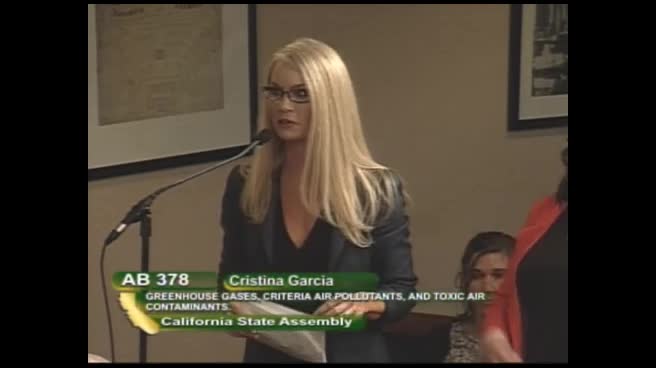 20MIN
Assembly Standing Committee on Natural Resources
Bill Author

Bill Co-Author(s):