AB 2496: Janitorial employees: employment status: burden of proof.
- Session Year: 2017-2018
- House: Assembly
- Latest Version Date: 2018-08-10
(1)Existing law creates a rebuttable presumption that a worker performing services for which a license is required under specified statutes, is an employee rather than an independent contractor. Existing law provides specified criteria to determine whether the worker is an employee or an independent contractor.
Existing law requires property service employers to register with the Division of Labor Standards Enforcement and to provide, among other things, recordkeeping and training for their employees, as specified.
This bill would provide that a property service employer would be subject to the rebuttable presumption provisions that its workers are employees rather than independent contractors.
(2)Existing law requires employers to withhold tax and make contribution amounts with respect to unemployment insurance, disability insurance, employee training funding, and personal income tax from the wages paid to their employees. Existing law, with specified exceptions, requires that the determination of the employer-employee relationship be made pursuant to common law principles. Existing law defines employee for those purposes to include, among other individuals, an individual who is the employee of a person who holds a contractors license or who is required to obtain a contractors license, as specified.
This bill would also define the term employee for purposes of those provisions to additionally include the employee of a person who holds a registration as a property service employer or a person who is required to hold that registration.
Because this bill would expand the categories of people who would receive benefits from, and deposit additional moneys, into the Unemployment Fund, a continuously appropriated fund, the bill would make an appropriation.
(1)Existing law creates a rebuttable presumption that a worker performing services for which a license is required under specified statutes, is an employee rather than an independent contractor. Existing law provides specified criteria to determine whether the worker is an employee or an independent contractor.
Existing law requires property service employers to register with the Division of Labor Standards Enforcement and to provide, among other things, recordkeeping and training for their employees, as specified.
This bill would provide that a property service employer would be subject to the rebuttable presumption provisions that its workers are employees rather than independent contractors.
(2)For purposes of unemployment insurance provisions, the term employee is defined to include, among other things, an employee of a person who holds a contractors license or who is required to obtain a contractors license, as specified.(2)Existing law requires employers to withhold tax and make contribution amounts with respect to unemployment insurance, disability insurance, employee training funding, and personal income tax from the wages paid to their employees. Existing law, with specified exceptions, requires that the determination of the employer-employee relationship be made pursuant to common law principles. Existing law defines employee for those purposes to include, among other individuals, an individual who is the employee of a person who holds a contractors license or who is required to obtain a contractors license, as specified.
This bill would also define the term employee for purposes of unemployment insurance those provisions to additionally include the employee of a person who holds a registration as a property service employer or a person who is required to hold that registration.
Because this bill would expand the categories of people who would receive benefits from, and deposit additional moneys, into the Unemployment Fund, a continuously appropriated fund, the bill would make an appropriation.
(1)Existing law creates a rebuttable presumption that a worker performing services for which a license is required under specified statutes, is an employee rather than an independent contractor. Existing law provides specified criteria to determine whether the worker is an employee or an independent contractor.
Existing law requires property service employers to register with the Division of Labor Standards Enforcement and to provide, among other things, recordkeeping and training for their employees, as specified.
This bill would provide that a property service employer would be subject to the rebuttable presumption provisions that its workers are employees rather than independent contractors.
(2)For purposes of unemployment insurance provisions, the term employee is defined to include, among other things, an employee of a person who holds a contractors license or who is required to obtain a contractors license, as specified.
This bill would also define the term employee for purposes of unemployment insurance provisions to include the employee of a person who holds a registration as a property service employer or a person who is required to hold that registration.
(a)There is a rebuttable presumption affecting the burden of proof that a worker performing services for which a license is required pursuant to Chapter 9 (commencing with Section 7000) of Division 3 of the Business and Professions Code, or for which a registration is required pursuant to Part 4.2 (commencing with Section 1420) of Division 2 of this code, or who is performing such services for a person who is required to obtain such a license or registration, is an employee rather than an independent contractor. Proof of independent contractor status includes satisfactory proof of these factors:
(1)That the individual has the right to control and discretion as to the manner of performance of the contract for services in that the result of the work and not the means by which it is accomplished is the primary factor bargained for.
(2)That the individual is customarily engaged in an independently established business.
(3)That the individuals independent contractor status is bona fide and not a subterfuge to avoid employee status. A bona fide independent contractor status is further evidenced by the presence of cumulative factors such as substantial investment other than personal services in the business, holding out to be in business for oneself, bargaining for a contract to complete a specific project for compensation by project rather than by time, control over the time and place the work is performed, supplying the tools or instrumentalities used in the work other than tools and instrumentalities normally and customarily provided by employees, hiring employees, performing work that is not ordinarily in the course of the principals work, performing work that requires a particular skill, holding a license pursuant to the Business and Professions Code or a registration pursuant to Part 4.2 (commencing with Section 1420) of Division 2 of this code, the intent by the parties that the work relationship is of an independent contractor status, or that the relationship is not severable or terminable at will by the principal but gives rise to an action for breach of contract.
(b)(1)In addition to the factors contained in paragraphs (1), (2), and (3) of subdivision (a), any person performing any function or activity for which a license is required pursuant to Chapter 9 (commencing with Section 7000) of Division 3 of the Business and Professions Code shall hold a valid contractors license as a condition of having independent contractor status.
(2)In addition to the factors contained in paragraphs (1), (2), and (3) of subdivision (a), any person performing any function or activity for which registration is required pursuant to Part 4.2 (commencing with Section 1420) of Division 2 of this code shall hold a valid registration as a condition of having independent contractor status.
(c)For purposes of workers compensation law, this presumption is a supplement to the existing statutory definitions of employee and independent contractor, and is not intended to lessen the coverage of employees under Division 4 and Division 5.
SEC. 2.Section 621.6 is added to the Unemployment Insurance Code, to read:621.6.(a)Employee also means any individual who is an employee, pursuant to Section 2750.5 of the Labor Code, of a person who holds a valid registration pursuant to Part 4.2 (commencing with Section 1420) of Division 2 of the Labor Code.
(b)When subdivision (a) does not apply, employee shall also mean any individual who is an employee, pursuant to Section 2750.5 of the Labor Code, of a person for whom registration is required pursuant to Part 4.2 (commencing with Section 1420) of Division 2 of the Labor Code.
SEC. 3.Section 13004.7 is added to the Unemployment Insurance Code, to read:13004.7.(a)Employee also means any individual who is an employee, pursuant to Section 2750.5 of the Labor Code, of a person who holds a valid registration pursuant to Part 4.2 (commencing with Section 1420) of Division 2 of the Labor Code.
(b)When subdivision (a) does not apply, employee shall also mean any individual who is an employee, pursuant to Section 2750.5 of the Labor Code, of a person for whom registration is required pursuant to Part 4.2 (commencing with Section 1420) of Division 2 of the Labor Code.
(a)There is a rebuttable presumption affecting the burden of proof that a worker performing services for which a license is required pursuant to Chapter 9 (commencing with Section 7000) of Division 3 of the Business and Professions Code, or for which a registration is required pursuant to Part 4.2 (commencing with Section 1420) of Division 2 of this code, or who is performing such services for a person who is required to obtain such a license or registration, is an employee rather than an independent contractor. Proof of independent contractor status includes satisfactory proof of these factors:
(a)(1)That the individual has the right to control and discretion as to the manner of performance of the contract for services in that the result of the work and not the means by which it is accomplished is the primary factor bargained for.
(b)(2)That the individual is customarily engaged in an independently established business.
(c)(3)That the individuals independent contractor status is bona fide and not a subterfuge to avoid employee status. A bona fide independent contractor status is further evidenced by the presence of cumulative factors such as substantial investment other than personal services in the business, holding out to be in business for oneself, bargaining for a contract to complete a specific project for compensation by project rather than by time, control over the time and place the work is performed, supplying the tools or instrumentalities used in the work other than tools and instrumentalities normally and customarily provided by employees, hiring employees, performing work that is not ordinarily in the course of the principals work, performing work that requires a particular skill, holding a license pursuant to the Business and Professions Code, Code or a registration pursuant to Part 4.2 (commencing with Section 1420) of Division 2 of this code, the intent by the parties that the work relationship is of an independent contractor status, or that the relationship is not severable or terminable at will by the principal but gives rise to an action for breach of contract.
In(b)(1)In addition to the factors contained in subdivisions (a), (b), and (c), paragraphs (1), (2), and (3) of subdivision (a), any person performing any function or activity for which a license is required pursuant to Chapter 9 (commencing with Section 7000) of Division 3 of the Business and Professions Code shall hold a valid contractors license as a condition of having independent contractor status.
(2)In addition to the factors contained in paragraphs (1), (2), and (3) of subdivision (a), any person performing any function or activity for which registration is required pursuant to Part 4.2 (commencing with Section 1420) of Division 2 of this code shall hold a valid registration as a condition of having independent contractor status.
For(c)For purposes of workers compensation law, this presumption is a supplement to the existing statutory definitions of employee and independent contractor, and is not intended to lessen the coverage of employees under Division 4 and Division 5.
SEC. 2.Section 621.6 is added to the Unemployment Insurance Code, to read:621.6.(a)Employee also means any individual who is an employee, pursuant to Section 2750.5 of the Labor Code, of a person who holds a valid registration pursuant to Part 4.2 (commencing with Section 1420) of Division 2 of the Labor Code.
(b)When subdivision (a) does not apply, employee shall also mean any individual who is an employee, pursuant to Section 2750.5 of the Labor Code, of a person for whom registration is required pursuant to Part 4.2 (commencing with Section 1420) of Division 2 of the Labor Code.
|
Date
|
Status
|
|---|---|
| Sep 23, 2018 | Vetoed by Governor. |
| Sep 4, 2018 | Enrolled and presented to the Governor at 3 p.m. |
| Aug 24, 2018 | Returned by the Governor at the request of the Assembly. |
| Aug 14, 2018 | Enrolled and presented to the Governor at 4 p.m. |
| Aug 9, 2018 | In Assembly. Ordered to Engrossing and Enrolling. |
| Aug 9, 2018 | Read third time. Passed. Ordered to the Assembly. |
| Aug 7, 2018 | Read second time. Ordered to third reading. |
| Aug 6, 2018 | From committee: Be ordered to second reading pursuant to Senate Rule 28.8. |
| Jun 27, 2018 | From committee: Do pass and re-refer to Com. on APPR. (Ayes 5. Noes 1.) (June 26). Re-referred to Com. on APPR. |
| Jun 13, 2018 | From committee: Do pass and re-refer to Com. on JUD. (Ayes 5. Noes 0.) (June 13). Re-referred to Com. on JUD. |
| May 30, 2018 | Referred to Coms. on L. & I.R. and JUD. |
| May 22, 2018 | In Senate. Read first time. To Com. on RLS. for assignment. |
| May 21, 2018 | Read third time. Passed. Ordered to the Senate. |
| May 17, 2018 | Read second time. Ordered to third reading. |
| May 16, 2018 | From committee: Do pass. (Ayes 12. Noes 4.) (May 16). |
| Apr 26, 2018 | Re-referred to Com. on APPR. |
| Apr 25, 2018 | From committee chair, with author's amendments: Amend, and re-refer to Com. on APPR. Read second time and amended. |
| Apr 17, 2018 | From committee: Do pass and re-refer to Com. on APPR. (Ayes 9. Noes 1.) (April 17). Re-referred to Com. on APPR. |
| Apr 12, 2018 | From committee: Do pass and re-refer to Com. on JUD. (Ayes 7. Noes 0.) (April 11). Re-referred to Com. on JUD. |
| Mar 8, 2018 | Referred to Coms. on L. & E. and JUD. |
| Feb 15, 2018 | From printer. May be heard in committee March 17. |
| Feb 14, 2018 | Read first time. To print. |
|
Date
|
Description
|
Location
|
Votes
|
|
|---|---|---|---|---|
| Aug 9, 2018 | Assembly 3rd Reading AB2496 Gonzalez Fletcher et al. By Skinner | Senate Floor |
Passed |
|
| Jun 26, 2018 | Do pass, but first be re-referred to the Committee on [Appropriations] | Senate Standing Committee on Judiciary |
Passed |
|
| Jun 13, 2018 | Do pass, but first be re-referred to the Committee on [Judiciary] | Senate Standing Committee on Labor and Industrial Relations |
Passed |
|
| May 21, 2018 | AB 2496 GONZALEZ FLETCHER Assembly Third Reading | Assembly Floor |
Passed |
|
| May 16, 2018 | Do pass. | Assembly Standing Committee on Appropriations |
Passed |
|
| Apr 17, 2018 | Do pass and be re-referred to the Committee on [Appropriations] | Assembly Standing Committee on Judiciary |
Passed |
|
| Apr 11, 2018 | Do pass and be re-referred to the Committee on [Judiciary] | Assembly Standing Committee on Labor and Employment |
Passed |
This list shows positions taken on this bill by organizations on the date displayed, which is linked to the original source.
Positions by individuals are not included.
|
Organization
|
Position
|
Date
|
|---|---|---|
| Alameda County | * Support | Apr 11, 2018 |
| Alameda County District Attorney, Nancy O'Malley | ** Support | Aug 8, 2018 |
| Alameda County Office Of The District Attorney | ** Support | Apr 13, 2018 |
| California District Attorneys Association | ** Support | Aug 8, 2018 |
| California Employment Lawyers Association | ** Support | Aug 8, 2018 |
| California Immigrant Policy Center | * Support | Apr 17, 2018 |
| California Labor Federation, Afl-Cio | ** Support | Aug 8, 2018 |
| California Teamsters | * Support | Jun 26, 2018 |
| SCLU California | * Support | Apr 11, 2018 |
GOVERNOR'S VETO
GV Bill Id:AB 2496
Author:(Gonzalez Fletcher)
As Enrolled Ver:September 4, 2018
2/3 vote
Committee | Votes | Ayes | Noes |
Labor | 7-0 | Thurmond, Flora, Gonzalez Fletcher, Jones-Sawyer, Kalra, McCarty, Melendez | |
Judiciary | 9-1 | Mark Stone, Cunningham, Chau, Chiu, Gonzalez Fletcher, Holden, Kalra, Maienschein, Reyes | Kiley |
Appropriations | 12-4 | Gonzalez Fletcher, Bloom, Bonta, Calderon, Carrillo, Chau, Eggman, Friedman, Eduardo Garcia, Nazarian, Quirk, Reyes | Bigelow, Brough, Gallagher, Obernolte |
ASSEMBLY: | 57-7 | (May 21, 2018) | SENATE: | 28-4 | (August 9, 2018) |
SUMMARY: Creates a rebuttable presumption that a person employed by a registered janitorial service is an "employee" of the registered janitorial service, rather than an "independent contractor," for purposes of the Labor Code and Unemployment Insurance Code. Specifically, this bill:
- Provides that a property service employer would be subject to the rebuttable presumption that its workers are employees rather than independent contractors.
- Defines the term "employee" for purposes of unemployment insurance, disability insurance, employee training funding, and withholding personal income tax from the wages paid to additionally include the employee of a person who holds a registration as a property service employer or the employee of a person who is required to hold that registration.
EXISTING LAW:
- Creates a rebuttable presumption that a worker performing services, for which a license is required under specified statues, is an employee rather than an independent contractor.
- Provides specified criteria to determine whether the worker is an employee or an independent contractor
- Requires property service employers to register with the Division of Labor Standards Enforcement (DLSE) and to provide, among other things, recordkeeping and training for their employees, as specified.
- Defines "employee" for purposes of unemployment insurance to include, among other things an employee of a person who holds a contractor's license or who is required to obtain a contractor's license as specified.
- Requires employers to withhold tax and make contribution amounts with respect to unemployment insurance, disability insurance, employee training funding, and personal income tax from the wages paid to their employees.
- Requires, with specified exceptions, that the determination of the employer-employee relationship be made pursuant to common law principles.
- Defines "employee" for those purposes to include, among other individuals, an individual who is the employee of a person who holds a contractor's license or who is required to obtain a contractor's license, as specified.
FISCAL EFFECT: According to the Assembly Appropriations Committee, minimal state costs.
COMMENTS: According to the author, "California attracts a high rate of both labor and sex trafficking due to its strong economy, large immigrant communities, and close proximity to the US/Mexico border. A 2012 study also found that most cases of forced labor involve migrant workers in economic sectors such as agriculture, construction, factories, restaurants, and hotels." The author asserts, "Despite efforts to curtail abuse against property service workers, it is well documented that numerous unscrupulous businesses prey on migrant labor workers for this industry by offering them long hours with little-to-no pay. These workers, many of whom are trafficked to this country illegally, are also coerced into indentured labor and trapped in jobs in which employers have complete control over most aspects of their lives. Labor traffickers lure workers by making false promises, such as offering high pay, education, or travel opportunities. Once the worker agrees to the job, they are instead greeted with lies and horrible treatment. Sadly, many victims are unable to leave the property services industry due to not having other sources of income or other personal reasons. Employers further victimize these workers by withholding many of the rights they deserve, and they do this via misclassifying these workers as independent contractors rather than employees. Doing so results in the employer being free from arduous legal obligations pertaining to California's wage and hour laws, anti-discrimination laws, as well as state and federal safety regulations. Additionally, this misclassification prevents employers from being responsible to pay overtime, workers' compensation, or a number of other benefits."
Alameda County District Attorney Nancy O'Malley, who is the sponsor of this legislation, writes, "This bill would strengthen the enforcement mechanisms of worker protection regulations in the janitorial industry. Currently, these domestic service workers are too easily categorized as independent contractors when in fact they do the work of employees, thereby evading many of the worker protections granted to employees, especially unemployment and disability insurance, and workers' compensation protections."
The California Immigrant Policy Center writes in support that, "Immigrant workers in the property service industry hold the highest rates of labor trafficking or forced labor, including migrant workers in agriculture, construction, factories, restaurants and hotels."
There is no known opposition to this bill.
This bill would establish in statute the presumption that persons who perform services for janitorial employers are employees rather than independent contractors.
I share the Author's concern about protecting the most vulnerable workers as well as the general concern about providing clarity regarding worker classification. The California Supreme Court recently issued a significant decision establishing a new test to determine whether a worker is properly classified as an employee or an independent contractor, Dynamex Operations West, Inc. v. Superior Court (2018) 4 Cal.5th 903. The Administration and the Legislature are still reviewing this decision and any statutory changes to such tests would be premature.
Analysis Prepared by: Jennifer Richard / L. & E. / (916) 319-2091 FN: 0005273
Office of Senate Floor Analyses (916) 651-1520 Fax: (916) 327-4478 | AB |
THIRD READING
Bill No: AB 2496
:
SENATE LABOR & IND. REL. COMMITTEE: 5-0, 6/13/18
AYES: Lara, Stone, Jackson, Mitchell, Wieckowski
SENATE JUDICIARY COMMITTEE: 5-1, 6/26/18
AYES: Jackson, Hertzberg, Monning, Stern, Wieckowski
NOES: Anderson
NO VOTE RECORDED: Moorlach
SENATE APPROPRIATIONS COMMITTEE: Senate Rule 28.8
ASSEMBLY FLOOR: 57-7, 5/21/18 - See last page for vote
SOURCE: Alameda County District Attorney, Nancy O’Malley
DIGEST:
This bill creates a rebuttable presumption that a worker in the janitorial field is an employee, and therefore is due the same protections and privileges as other employees.
Existing law:
- Establishes a comprehensive set of protections for employees, including a time-sure minimum wage, meal and rest periods, workers’ compensation coverage in the event of an industrial injury, sick leave, disability insurance (DI) in the event of a non-industrial disability, paid family leave, and unemployment insurance (UI).
(Labor Code §§201, 226.7, 246, 512, 1182.12, & 3600 and UI Code §§1251 & 2601) - Provides that there is a rebuttable presumption that a worker performing services for which a contractor’s license is required, or who is performing such services for a person who is required to obtain such a license, is an employee rather than an independent contractor. (Labor Code §2750.5)
- Provides that in order to rebut the presumption described above, an employer must prove the following:
- That the individual has the right to control and discretion as to the manner of performance of the contract for services in that the result of the work and not the means by which it is accomplished is the primary factor;
- That the individual is customarily engaged in an independently established business.
- That the individual’s independent contractor status is bona fide and not a subterfuge to avoid employee status. A bona fide independent contractor status is further evidenced by the presence of cumulative factors, which includes substantial investment other than personal services in the business, holding out to be in business for oneself, and bargaining for a contract to complete a specific project for compensation by project rather than by time.
(Labor Code §2750.5)
- Requires that an individual holds a valid contractor’s license as a condition of having independent contractor status.
- Requires that any entity or individual who contracts, subcontracts, or creates franchise arrangements to provide janitorial services must register with the Division of Labor Standards Enforcement (DLSE) on an annual basis. The DLSE is prohibited from registering a janitorial contractor unless they have met specified conditions, including payment of all unpaid wages or judgments. (Labor Code §§1420-1429)
This bill:
- Adds janitorial workers employed by a janitorial contractor to the existing rebuttable presumption of being an employee, rather than an independent contractor.
- Requires an individual to hold a valid janitorial registration as a condition of having independent contractor status.
- Defines, explicitly, for the purposes of UI benefits, DI benefits, and paid family leave, an employee of a registered janitorial contractor as eligible for benefits and necessary payroll tax withholding.
Comments
Independent Contractors, Borello, and Dynamex
The cornerstone of Labor Law is the employer-employee relationship. Specifically, the employer-employee relationship is a social contract: the employer provides wages and benefits (some legally required) to the employee, in return for the employee’s labor, time, and intellectual and/or physical product. The legal roots of this relationship go back to Medieval England, yet are durable enough to shape our current world.
In the past 30 years, this relationship has been put under pressure and strain due to the increasing utilization of independent contractors. For employers who lawfully utilize independent contractors, it allows a business to utilize the services of a skilled individual for specific tasks. The employer trades control over the working conditions for being released from many of the primary obligations of being an employer, including paying overtime, remitting payroll taxes, securing workers’ compensation coverage, and ensuring a healthy and safe work environment.
This creates a tremendous incentive for employers to misclassify their employees and illegally avoid paying the cost of benefits. This amounts to a cost-shift from an employer to the employee specifically and, in the case of particularly egregious examples, the people of California generally in the form of increased safety net spending. And it may be a growing issue: according to a 2016 study conducted by Alan Krueger, the number of workers classified as independent contractors rose 30% from 2005 to 2015.
In short, misclassification impacts all Californians, not just the Californians who are misclassified, and may be getting worse, rather than better.
This challenge was further exacerbated because the primary court precedent was less than precise on who was and who was not an independent contractor. Specifically, in S. G. Borello & Sons, Inc. v Dept. of Industrial Relations (1989) 48 Cal.3d 341, the California Supreme Court created an 11-point “economic realities” test on if someone could lawfully be considered an independent contractor. Outside of particularly clear-cut or egregious situations, this made determining who was or was not an independent contractor complicated, expensive, and prone to litigation. This created considerable frustration for both worker and employer stakeholders.
However, this period of considerable confusion appears to be drawing to a close. Earlier this year, the California Supreme Court revisited the independent contractor issue in Dynamex Operations West v. Superior Court (2018). Under Dynamex, the test for if a worker is an independent contractor or an employee is greatly simplified to a three-prong test:
(A) The worker is free from the control and direction of the hirer in connection with the performance of the work, both under the contract for the performance of such work and in fact;
(B) The worker performs work that is outside the usual course of the hiring entity’s business; and
(C) The worker is customarily engaged in an independently established trade, occupation, or business of the same nature as the work performed for the hiring entity.
Like Dynamex, AB 2496 creates a three prong test for who is and is not an independent contractor in the janitorial industry. Noting that the Dynamex three-prong test is very similar to the three prong test found under AB 2496, this bill fits within existing law and will likely serve to limit litigation in the janitorial industry while other industries struggle with the practical applicability of the “ABC” test.
Related/Prior Legislation
AB 1897 (Hernandez, Chapter 728, Statutes of 2014) required client employers that obtain workers from third party labor contractors to share liability for certain labor violations such as failure to pay wages and workers’ compensation.
FISCAL EFFECT: Appropriation: Fiscal Com.: Local:
Alameda County District Attorney, Nancy O’Malley (source)
California District Attorneys Association
California Employment Lawyers Association
California Labor Federation, AFL-CIO
None received
ARGUMENTS IN SUPPORT: The California Employment Lawyers Association writes in support, arguing:
“Many of our attorneys represent workers in low-wage industries and find that these workers, especially those who are undocumented, are particularly vulnerable to wage-theft and other workplace abuse and misconduct. Despite efforts to curtail abuse against property service workers, it is well documented that numerous unscrupulous businesses prey on migrant labor workers for this industry by offering them long hours with little-to-no pay.
“One of the most common strategies employers use to try to get around basic labor law requirements, is to misclassify employees as independent contractors, rather than employees. This allows employers to evade California’s strong wage and hour laws, anti-discrimination laws, as well as state and federal safety regulations. Additionally, this misclassification prevents employers from being responsible to pay overtime, workers' compensation or a number of other benefits.
“This kind of abuse is particularly prevalent in California, which attracts a high rate of both labor and sex trafficking due to its strong economy, large immigrant communities, and close proximity to the U.S./Mexico border. A 2012 study conducted by San Diego State University found that the rates of labor trafficking of immigrant workers in the property service industry were among the highest of any industry. The study also found that most cases of forced labor involve migrant workers in economic sectors, such as agriculture, construction, factories, restaurants, and hotels.
“… Labor Code Section 2750.5 was enacted to ensure that construction workers are not misclassified as independent contractors.… AB 2496 protects the rights of property service workers by also including them under the same Labor Code section. For these reasons, we support AB 2496 and thank you for your leadership on this very important issue.”
ASSEMBLY FLOOR: 57-7, 5/21/18
AYES: Acosta, Aguiar-Curry, Arambula, Baker, Berman, Bloom, Bonta, Burke, Caballero, Calderon, Carrillo, Cervantes, Chau, Chávez, Chiu, Chu, Cooley, Cunningham, Daly, Flora, Frazier, Friedman, Gipson, Gloria, Gonzalez Fletcher, Grayson, Holden, Irwin, Jones-Sawyer, Kalra, Kamlager-Dove, Lackey, Levine, Low, Maienschein, McCarty, Medina, Melendez, Mullin, Muratsuchi, Nazarian, O'Donnell, Quirk, Quirk-Silva, Reyes, Rodriguez, Rubio, Salas, Santiago, Mark Stone, Thurmond, Ting, Voepel, Waldron, Weber, Wood, Rendon
NOES: Travis Allen, Brough, Choi, Gallagher, Harper, Kiley, Obernolte
NO VOTE RECORDED: Bigelow, Chen, Cooper, Dahle, Eggman, Fong, Cristina Garcia, Eduardo Garcia, Gray, Limón, Mathis, Mayes, Patterson, Steinorth
8/8/18 16:00:33
**** END ****
Senator Hannah-Beth Jackson, Chair
2017-2018 Regular Session
Bill No: AB 2496 (Author:Gonzalez Fletcher)
Version: April 25, 2018
Hearing Date: June 26, 2018
Fiscal: Yes
Urgency: No
Consultant: TSG
SUBJECT
Janitorial employees: employment status: burden of proof
DESCRIPTION
Employees enjoy some workplace rights and benefits that independent contractors do not. Existing law creates a rebuttable presumption that a person performing construction work is an employee, not an independent contractor. This bill would extend that same rebuttable presumption to people performing janitorial work.
BACKGROUND
Workers who provide their services to others fall, legally speaking, into one of two camps: independent contractors or employees. Those who operate as their own businesses, who set their own schedules, utilize their own tools, bring their own materials, have specialized skills, and are paid to produce a specified result, rather than for their time, are generally considered independent contractors. (Lab. Code Secs. 2750.5, 3353.) Those who are hired on a long-term or indefinite basis, who must appear at work when the boss says so, who are paid for their time rather than by the project, and to whom the tools and materials to accomplish the job are provided, are generally considered employees. (Borello v. Dept. of Indus. Relations (1989) 48 Cal.3d 341, 350.)
The line between who is an independent contractor and who is an employee is not always crystal clear, however. Frequently, jobs have some characteristics of independent contractor status and some characteristics of employee status. For example, controversy arose over how to categorize taxi drivers who leased their cabs, set their own hours, and paid for their own gas, but had to follow company rules regarding dress, annual classroom education, forms of payment, and advertising. (NLRB v. Friendly Cab Co. (9th Cir. 2008) 512 F.3d 1090.) With the recent surge in the “gig” economy, fueled by online platforms matching those willing to perform discrete tasks those offering to pay for it, the legal line between employees and independent contractors has taken on increased significance.
The California Supreme Court recently revisited this area of the law. In Dynamex Operations West v. Superior Court (2018) 4 Cal.5th 903, the state high court articulated a new, somewhat streamlined version of what had previously been a lengthy list of factors to be used in determining whether a worker is an independent contractor or an employee. Under the new test, courts must inquire whether: (a) the worker is free from the control and direction of the hirer in connection with the performance of the work, both under the contract for the performance of such work and in fact; (b) the worker performs work that is outside the usual course of the hiring entity’s business; and (c) the worker is customarily engaged in an independently established trade, occupation, or business of the same nature as the work performed for the hiring entity. (Id. at 956-7.) Although the new test is simpler, the precise dividing line between employee and independent contractor will likely remain difficult to find for any particular job.
There is a lot at stake in these gray areas. Employees have long been entitled to certain workplace protections under California and federal law. For example, employees must be paid at least the minimum wage, they are due overtime wages for working long hours, they generally cannot be forced to pay for the equipment they need to do the job, they must be covered by workers’ compensation in the case they suffer injury in the workplace, and they are entitled to state unemployment and disability insurance coverage, for which employers must pay their share. It is also more difficult for independent contractors to organize for better terms and conditions. Independent contractors are not covered by the National Labor Relations Act (see 20 U.S.C. 152(3)) and, since they are what amount to individual small businesses, they could even be seen as colluding in violation of anti-trust laws if they do try to organize.
Given what is at stake and the fact that the line between independent contractor and employee can be hazy, it is perhaps not surprising that employees frequently get misclassified as independent contractors. While California law presumes that workers are employees and places the burden on the hiring entity to show that they are not (Lab. Code Sec. 3357), the financial benefits to a company of having a labor force consisting of independent contractors creates a strong incentive for companies to push the envelope and, in the case of bad actors, simply to cheat.
Not surprisingly, misclassification has been a particular problem in industries in which the workforce is especially vulnerable. Low-wage workers dependent on keeping a job to sustain their families and immigrant workers that can be blackmailed through threats to call immigration enforcement are, for those very reasons, often among those who get misclassified. The construction industry and the janitorial industry are among those where misclassification is notoriously endemic.
Responding to this problem in the context of the construction industry, in 1978, the California Legislature enacted AB 3429 (Lockyer, Ch. 1246, Stats. 1978) which created a rebuttable presumption that construction workers are employees and entitled to the benefits and protections that come with that status. (Lab. Code Sec. 2750.5.) Moreover, the bill established that, to perform construction work and claim independent contractor status, a person must have a contractor’s license. This bill would extend this same legal framework to people working in the janitorial sector.
This bill passed out of the Senate Committee on Labor and Industrial Relations by a vote of 5 to 0.
CHANGES TO EXISTING LAW
Existing law defines “independent contractor” to mean any person who renders service for a specified recompense for a specified result, under the control of his principal as to the result of his work only and not as to the means by which such result is accomplished. (Lab. Code Sec. 3353.)
Existing law provides that any person rendering service for another, other than as an independent contractor, or unless expressly excluded herein, is presumed to be an employee. (Lab. Code Sec. 3357.)
Existing law establishes a comprehensive set of protections for employees, including a time-sure minimum wage, meal and rest periods, workers’ compensation coverage in the event of an industrial injury, sick leave, disability insurance (DI) in the event of a non-industrial disability, paid family leave, and unemployment insurance (UI).
(Lab. Code Secs. 201, 226.7, 246, 512, 1182.12, and 3600, and Unemp. Ins. Code Secs. 1251 and 2601.)
Existing law provides that there is a rebuttable presumption affecting the burden of proof that a worker performing services for a licensed building contractor is an employee rather than an independent contractor. (Lab. Code Sec. 2750.5.)
Existing law specifies that, in the case of a worker performing services for a licensed building contractor, to overcome the rebuttable presumption that the worker is an employee, a defendant must prove the following factors:
- that the individual has the right to control and discretion as to the manner of performance of the contract for services in that the result of the work, and not the means by which it is done, is the primary factor bargained for;
- that the individual is customarily engaged in an independently established business; and
- that the individual’s independent contractor status is bona fide and not a subterfuge to avoid employee status. (Lab. Code Sec. 2750.5(a).)
Existing law establishes that, in the case of a worker performing services for a licensed building contractor, any person performing any function or activity for which a building contractor’s license is required shall hold a valid contractor’s license as a condition of having independent contractor status. (Lab. Code Sec. 2750.5(b).)
Existing law requires property services (janitorial) employers to register with the Division of Labor Standards Enforcement (DLSE). In addition to registration, the Act requires sexual harassment and violence prevention training for janitorial workers; allows DLSE to refuse to renew the license of an employer who owes back wages; and assesses civil penalties for violations of the Act. (Lab. Code Sec. 1420 et seq.)
Existing law establishes the Displaced Janitor Opportunity Act, which requires that a successor contractor retains employment of the predecessor contractor’s employees for a sixty-day transition period. (Lab. Code Secs. 1060 to 1065.)
This bill would create a rebuttable presumption affecting the burden of proof that a worker performing services for a registered janitorial service is an employee rather than an independent contractor.
This bill would specify that, in the case of a worker performing services for a registered janitorial service, proof of independent contractor status includes satisfactory proof of the following factors:
- that the individual has control and discretion as to the manner of performance of the contract for services in that the result of the work, and not the means by which it is done, is the primary factor bargained for;
- that the individual is customarily engaged in an independently established business; and
- that the individual’s independent contractor status is bona fide and not a subterfuge to avoid employee status.
This bill would establish that any person performing any function or activity for which a property service employer’s license is required shall hold a valid license as a condition of having independent contractor status.
This bill defines the term “employee” for purposes of the Unemployment Insurance Code to mean, consistent with the provisions above, a person who performs services for a registered janitorial service.
COMMENT
1. Stated need for the bill
According to the author:
California attracts a high rate of both labor and sex trafficking due to its strong economy, large immigrant communities, and close proximity to the US/Mexico border. A 2012 study also found that most cases of forced labor involve migrant workers in economic sectors such as agriculture, construction, factories, restaurants, and hotels. […] Despite efforts to curtail abuse against property service workers, it is well documented that numerous unscrupulous businesses prey on migrant labor workers for this industry by offering them long hours with little-to-no pay. These workers, many of whom are trafficked to this country illegally, are also coerced into indentured labor and trapped in jobs in which employers have complete control over most aspects of their lives. Labor traffickers lure workers by making false promises, such as offering high pay, education, or travel opportunities. Once the worker agrees to the job, they are instead greeted with lies and horrible treatment. Sadly, many victims are unable to leave the property services industry due to not having other sources of income or other personal reasons. Employers further victimize these workers by withholding many of the rights they deserve, and they do this via misclassifying these workers as independent contractors rather than employees. Doing so results in the employer being free from arduous legal obligations pertaining to California’s wage and hour laws, anti-discrimination laws, as well as state and federal safety regulations. Additionally, this misclassification prevents employers from being responsible to pay overtime, workers’ compensation, or a number of other benefits.
As sponsor of the bill, Alameda County District Attorney Nancy O’Malley writes:
This bill would strengthen the enforcement mechanisms of worker protection regulations in the janitorial industry. Currently, these domestic service workers are too easily categorized as independent contractors when in fact they do the work of employees, thereby evading many of the worker protections granted to employees, especially unemployment and disability insurance, and workers’ compensation protections.
In support of the bill, the California Immigrant Policy Center writes:
Immigrant workers in the property service industry hold the highest rates of labor trafficking or forced labor, including migrant workers in agriculture, construction, factories, restaurants and hotels.
2. Comparison between the bill and the new Dynamex test
As mentioned in the Background to this analysis, the California Supreme Court recently issued a revised legal test for distinguishing between independent contractors and employees. (Dynamex Operations W. v. Superior Court (2018) 4 Cal.5th 903.) That revised test consists of three parts (sometimes known as the “ABC” test). The elements of that test are quite similar, in many ways, to the three factors that this bill would require someone working in the janitorial sector to show in order to prove independent contractor status.
First, both the bill and the Dynamex test require a showing that the worker, not the hirer, has control and discretion over performance of the work, though the Dynamex test also explicitly insists that control must be reflected both in the contract and in practice. Second, both the bill and the Dynamex test require that the worker seeking to prove independent contractor status demonstrate that the worker customarily engages in an independently established trade, occupation, or business. Here again, however, the Dynamex test goes a bit further, requiring that the independent contractor’s independent business be of the same nature as the work performed for the hiring entity. Third, the Dynamex test requires a worker to be performing work outside the usual course of the hiring entity’s business in order to prove independent contractor status. The third factor that this bill would focus on is whether the worker’s independent contractor status is “bona fide.”
The most significant difference between the Dynamex test and the test that would apply to janitorial workers under the terms of this bill is that, to qualify as an independent contractor as a person performing janitorial work for someone else, the worker would have to have to be registered with the Division of Labor Standards Enforcement’s (DLSE’s) program for janitorial contractors. Among other things, that program obligates registrants to conduct sexual harassment prevention trainings and not to have outstanding judgments for unpaid wages. (See Lab. Code Secs. 1420 to 1429.) As the Dynamex test applies more broadly than just the janitorial sector, it does not include any such registration requirement.
This comparison reveals that the provisions of this bill do not fall far from what would be generally applicable law in this area regardless, with the key exception that this bill would require janitorial workers to register with the DLSE’s janitorial contractor program in order to be able to claim independent contractor status.
Support: California District Attorneys Association; California Employment Lawyers Association; California Immigrant Policy Center; California Labor Federation, SEIU; Worksafe
Opposition: None known
HISTORY
Source: Alameda County Office of the District Attorney, Nancy O’Malley
Related Pending Legislation:
AB 2079 (Gonzalez-Fletcher, 2018) would make a number of modifications to the janitorial contractor registration program at the Division of Labor Standards Enforcement. Specifically, the bill would: (1) prohibit registration of any applicant unless that applicant submits a complete list of subcontractors and franchisees working under the applicant as well as how many employees they have; (2) codify a sexual harassment prevention peer training program; and (3) prohibit registration of any applicant with an outstanding judgment for a violation of the Fair Employment and Housing Act. AB 2079 is currently pending consideration before the Senate Committee on Appropriations.
Prior Legislation:
AB 1978 (Gonzalez-Fletcher, Chap. 373, Stats. 2016), which created the Property Service Employee Protection Act (or Act). The Act established a registration process for janitorial service companies, imposed certain training and other requirements on those companies, and assessed civil penalties for any violation. That bill was prompted, in part, by concerns that janitorial workers, many of whom are immigrants, are particularly vulnerable to sexual harassment, exploitation, and human trafficking.
AB 3429 (Lockyer, Ch. 1246, Stats. 1978) created a rebuttable presumption, in the case of workers performing services for which a contracting license is ordinarily required, that the worker is an employee, not an independent contractor.
Prior Vote:
Assembly Floor (Ayes 57, Noes 7)
Assembly Appropriations Committee (Ayes 12, Noes 4)
Assembly Judiciary Committee (Ayes 9, Noes 1)
Assembly Labor and Employment Committee (Ayes 7, Noes 0)
**************
SENATE COMMITTEE ON LABOR AND INDUSTRIAL RELATIONS
Senator Ricardo Lara, Chair
2017 - 2018 Regular
Bill No: AB 2496 Hearing Date: June 13, 2018
Author: | Gonzalez Fletcher | ||
Version: | April 25, 2018 | ||
Urgency: | No | Fiscal: | Yes |
Consultant: | Gideon L. Baum | ||
Subject: Janitorial employees: employment status: burden of proof
KEY ISSUE
Should the Legislature create a rebuttable presumption that a worker in the janitorial field is an employee, and therefore is due the same protections and privileges as other employees?
ANALYSIS
Existing law:
- Establishes a comprehensive set of protections for employees, including a time-sure minimum wage, meal and rest periods, workers’ compensation coverage in the event of an industrial injury, sick leave, disability insurance (DI) in the event of a non-industrial disability, paid family leave, and unemployment insurance (UI).
(Labor Code §§201, 226.7, 246, 512, 1182.12, & 3600 and UI Code §§1251 & 2601) - Provides that there is a rebuttable presumption that a worker performing services for which a contractor’s license is required, or who is performing such services for a person who is required to obtain such a license, is an employee rather than an independent contractor. (Labor Code §2750.5)
- In order to rebut the presumption described above, an employer must prove the following:
- That the individual has the right to control and discretion as to the manner of performance of the contract for services in that the result of the work and not the means by which it is accomplished is the primary factor;
- That the individual is customarily engaged in an independently established business.
- That the individual’s independent contractor status is bona fide and not a subterfuge to avoid employee status. A bona fide independent contractor status is further evidenced by the presence of cumulative factors, which includes substantial investment other than personal services in the business, holding out to be in business for oneself, and bargaining for a contract to complete a specific project for compensation by project rather than by time.
(Labor Code §2750.5) - Requires that an individual holds a valid contractor’s license as a condition of having independent contractor status.
- Requires that any entity or individual who contracts, subcontracts, or creates franchise arrangements to provide janitorial services must register with the Division of Labor Standards Enforcement (DLSE) on an annual basis. The DLSE is prohibited from registering a janitorial contractor unless they have met specified conditions, including payment of all unpaid wages or judgments. (Labor Code §§1420-1429)
This bill:
- Adds janitorial workers employed by a janitorial contractor to the existing rebuttable presumption of being an employee, rather than an independent contractor.
- Requires an individual to hold a valid janitorial registration as a condition of having independent contractor status.
- Explicitly defines, for the purposes of UI benefits, DI benefits, and paid family leave, an employee of a registered janitorial contractor as eligible for benefits and necessary payroll tax withholding.
COMMENTS
1. Independent Contractors, Borello, and Dynamex:
The cornerstone of Labor Law is the employer-employee relationship. Specifically, the employer-employee relationship is a social contract: the employer provides wages and benefits (some legally required) to the employee, in return for the employee’s labor, time, and intellectual and/or physical product. The legal roots of this relationship go back to Medieval England, yet are durable enough to shape our current world.
In the past 30 years, this relationship has been put under pressure and strain due to the increasing utilization of independent contractors. For employers who lawfully utilize independent contractors, it allows a business to utilize the services of a skilled individual for specific tasks. The employer trades control over the working conditions for being released from many of the primary obligations of being an employer, including paying overtime, remitting payroll taxes, securing workers’ compensation coverage, and ensuring a healthy and safe work environment.
This creates a tremendous incentive for employers to misclassify their employees and illegally avoid paying the cost of benefits. This amounts to a cost-shift from an employer to the employee specifically and, in the case of particularly egregious examples, the people of California generally in the form of increased safety net spending. And it may be a growing issue: according to a 2016 study conducted by Alan Krueger, the number of workers classified as independent contractors rose 30% from 2005 to 2015.
In short, misclassification impacts all Californians, not just the Californians who are misclassified, and may be getting worse, rather than better.
This challenge was further exacerbated because the primary court precedent was less than precise on who was and who was not an independent contractor. Specifically, in S. G. Borello & Sons, Inc. v Dept. of Industrial Relations (1989) 48 Cal.3d 341, the California Supreme Court created an 11 point “economic realities” test on if someone could lawfully be considered an independent contractor. Outside of particularly clear-cut or egregious situations, this made determining who was or was not an independent contractor complicated, expensive, and prone to litigation. This created considerable frustration for both worker and employer stakeholders.
However, this period of considerable confusion appears to be drawing to a close. Earlier this year, the California Supreme Court revisited the independent contractor issue in Dynamex Operations West v. Superior Court (2018). Under Dynamex, the test for if a worker is an independent contractor or an employee is greatly simplified to a three prong test:
(A) The worker is free from the control and direction of the hirer in connection with the performance of the work, both under the contract for the performance of such work and in fact;
(B) The worker performs work that is outside the usual course of the hiring entity’s business; and
(C) The worker is customarily engaged in an independently established trade, occupation, or business of the same nature as the work performed for the hiring entity.
Like Dynamex, AB 2496 creates a three prong test for who is and is not an independent contractor in the janitorial industry. Noting that the Dynamex three prong test is very similar to the three prong test found under AB 2496, this bill fits within existing law and will likely serve to limit litigation in the janitorial industry while other industries struggle with the practical applicability of the “ABC” test.
2. Proponent Arguments:
The California Employment Lawyers Association (CELA) writes in support, arguing:
“Many of our attorneys represent workers in low-wage industries and find that these workers, especially those who are undocumented, are particularly vulnerable to wage-theft and other workplace abuse and misconduct. Despite efforts to curtail abuse against property service workers, it is well documented that numerous unscrupulous businesses prey on migrant labor workers for this industry by offering them long hours with little-to-no pay.
One of the most common strategies employers use to try to get around basic labor law requirements, is to misclassify employees as independent contractors, rather than employees. This allows employers to evade California’s strong wage and hour laws, anti-discrimination laws, as well as state and federal safety regulations. Additionally, this misclassification prevents employers from being responsible to pay overtime, workers' compensation or a number of other benefits.
This kind of abuse is particularly prevalent in California, which attracts a high rate of both labor and sex trafficking due to its strong economy, large immigrant communities, and close proximity to the U.S./Mexico border. A 2012 study conducted by San Diego State University found that the rates of labor trafficking of immigrant workers in the property service industry were among the highest of any industry. The study also found that most cases of forced labor involve migrant workers in economic sectors, such as agriculture, construction, factories, restaurants, and hotels.
… Labor Code Section 2750.5 was enacted to ensure that construction workers are not misclassified as independent contractors.… AB 2496 protects the rights of property service workers by also including them under the same Labor Code section. For these reasons, we support AB 2496 and thank you for your leadership on this very important issue.”
3. Opponent Arguments:
None on file.
4. Double Referral:
This bill has been double referred and, if approved by this committee, it will be sent to the Senate Judiciary Committee for a hearing.
5. Prior Legislation:
AB 1897 (Hernandez), Chapter 728, Statutes of 2014, requires client employers that obtain workers from third party labor contractors to share liability for certain labor violations such as failure to pay wages and workers’ compensation.
SUPPORT
Alameda County District Attorney, Nancy O’Malley (Sponsor)
California District Attorneys Association
California Employment Lawyers Association
California Labor Federation, AFL-CIO
OPPOSITION
-- END --
ASSEMBLY THIRD READING
ATR Bill Id:AB 2496
Author:(Gonzalez Fletcher)
As Amended Ver:April 25, 2018
Majority vote
Committee | Votes | Ayes | Noes |
Labor | 7-0 | Thurmond, Flora, Gonzalez Fletcher, Jones-Sawyer, Kalra, McCarty, Melendez | |
Judiciary | 9-1 | Mark Stone, Cunningham, Chau, Chiu, Gonzalez Fletcher, Holden, Kalra, Maienschein, Reyes | Kiley |
Appropriations | 12-4 | Gonzalez Fletcher, Bloom, Bonta, Calderon, Carrillo, Chau, Eggman, Friedman, Eduardo Garcia, Nazarian, Quirk, Reyes | Bigelow, Brough, Gallagher, Obernolte |
SUMMARY: Creates a rebuttable presumption that a person employed by a registered janitorial service is an "employee" of the registered janitorial service, rather than an "independent contractor," for purposes of the Labor Code and Unemployment Insurance Code. Specifically, this bill:
- Provides that a property service employer would be subject to the rebuttable presumption that its workers are employees rather than independent contractors.
- Defines the term "employee" for purposes of unemployment insurance, disability insurance, employee training funding, and withholding personal income tax from the wages paid to additionally include the employee of a person who holds a registration as a property service employer or the employee of a person who is required to hold that registration.
EXISTING LAW:
- Creates a rebuttable presumption that a worker performing services, for which a license is required under specified statues, is an employee rather than an independent contractor.
- Provides specified criteria to determine whether the worker is an employee or an independent contractor
- Requires property service employers to register with the Division of Labor Standards Enforcement (DLSE) and to provide, among other things, recordkeeping and training for their employees, as specified.
- Defines "employee" for purposes of unemployment insurance to include, among other things an employee of a person who holds a contractor's license or who is required to obtain a contractor's license as specified.
- Requires employers to withhold tax and make contribution amounts with respect to unemployment insurance, disability insurance, employee training funding, and personal income tax from the wages paid to their employees.
- Requires, with specified exceptions, that the determination of the employer-employee relationship be made pursuant to common law principles.
- Defines "employee" for those purposes to include, among other individuals, an individual who is the employee of a person who holds a contractor's license or who is required to obtain a contractor's license, as specified.
FISCAL EFFECT: According to the Assembly Appropriations Committee, minimal state costs.
COMMENTS: According to the author, "California attracts a high rate of both labor and sex trafficking due to its strong economy, large immigrant communities, and close proximity to the US/Mexico border. A 2012 study also found that most cases of forced labor involve migrant workers in economic sectors such as agriculture, construction, factories, restaurants, and hotels." The author asserts, "Despite efforts to curtail abuse against property service workers, it is well documented that numerous unscrupulous businesses prey on migrant labor workers for this industry by offering them long hours with little-to-no pay. These workers, many of whom are trafficked to this country illegally, are also coerced into indentured labor and trapped in jobs in which employers have complete control over most aspects of their lives. Labor traffickers lure workers by making false promises, such as offering high pay, education, or travel opportunities. Once the worker agrees to the job, they are instead greeted with lies and horrible treatment. Sadly, many victims are unable to leave the property services industry due to not having other sources of income or other personal reasons. Employers further victimize these workers by withholding many of the rights they deserve, and they do this via misclassifying these workers as independent contractors rather than employees. Doing so results in the employer being free from arduous legal obligations pertaining to California's wage and hour laws, anti-discrimination laws, as well as state and federal safety regulations. Additionally, this misclassification prevents employers from being responsible to pay overtime, workers' compensation, or a number of other benefits."
Alameda County District Attorney Nancy O'Malley, who is the sponsor of this legislation, writes, "This bill would strengthen the enforcement mechanisms of worker protection regulations in the janitorial industry. Currently, these domestic service workers are too easily categorized as independent contractors when in fact they do the work of employees, thereby evading many of the worker protections granted to employees, especially unemployment and disability insurance, and workers' compensation protections."
The California Immigrant Policy Center writes in support that, "Immigrant workers in the property service industry hold the highest rates of labor trafficking or forced labor, including migrant workers in agriculture, construction, factories, restaurants and hotels."
There is no known opposition to this bill.
Analysis Prepared by: Jennifer Richard / L. & E. / (916) 319-2091 FN: 0002943
Date of Hearing: May 16, 2018
ASSEMBLY COMMITTEE ON APPROPRIATIONS
Lorena Gonzalez Fletcher, Chair
ABPCA Bill Id:AB 2496
Author:(Gonzalez Fletcher) – As Amended Ver:April 25, 2018
Policy Committee: | Labor and Employment | Vote: | 7 - 0 |
Judiciary | 9 - 1 | ||
|
|
Urgency: No State Mandated Local Program: No Reimbursable: No
SUMMARY:
This bill creates a rebuttable presumption that a person employed by a registered janitorial service is an "employee" of the registered janitorial service, rather than an "independent contractor," for purposes of the Labor Code and Unemployment Insurance Code.
FISCAL EFFECT:
Minimal state costs.
COMMENTS:
- Construction industry and employees. Under existing law, there is a rebuttable presumption that a worker who performs services requiring a contractor’s license is an employee. The worker may be classified as an independent contractor if there is proof that: a) the individual directs and controls how the services contracted for are accomplished; b) the individual is engaged in an independently established business; and c) the individual’s independent contractor status is bona fide and a not a subterfuge to avoid employee status. Practically, these requirements mean, without a valid contractor’s license, a person who performs services in the construction trade is an employee of the contractor who holds the license.
- Purpose. Some employers improperly classify their employees as independent contractors to avoid paying payroll taxes, the minimum wage or overtime, complying with other wage and hour law requirements such as providing meal periods and rest breaks, or reimbursing their workers for business expenses incurred in performing their jobs. According to supporters, AB 2496 will protect workers from employers who misclassify employees as independent contractors to evade basic worker protections. It does this by amending existing law related to a similar rebuttable presumption for construction workers.
- ABC test. On April 30, 2018, the California Supreme Court issued an opinion clarifying the standard for determining whether a worker should be classified as an independent contractor or an employee. The court held that an entity must establish three factors (also known as the “ABC test”) to determine whether a worker is an independent contractor: a) a worker is free from control and direction of the hiring entity in connection with the performance of the work; b) the worker performs work that is outside the usual course of the hiring entity’s business; and c) the worker is primarily engaged in an independently established trade, occupation, or business of the same nature as the work performed.
- Recent legislation. AB 1978 (Gonzalez), Chapter 373, Statutes of 2016, created a registration process for janitorial employers, among other provisions. Under AB 2496, there is a rebuttable presumption that a person employed by a janitorial service registered under AB 1978’s registration process is an employee and not an independent contractor.
Analysis Prepared by: Luke Reidenbach / APPR. / (916) 319-2081
Date of Hearing: April 17, 2018
ASSEMBLY COMMITTEE ON JUDICIARY
Mark Stone, Chair
ABPCA Bill Id:AB 2496
Author:(Gonzalez Fletcher) – As Introduced Ver:February 14, 2018
SUBJECT: Janitorial employees: employment status: burden of proof
KEY ISSUE: Should there be a rebuttable presumption that janitorial workers employed by a registered Janitorial service are "employees," rather than "independent contractors," for purposes of the Labor Code and the unemployment Insurance Code?
SYNOPSIS
This seemingly non-controversial bill would create a rebuttable presumption that janitorial workers employed by a registered janitorial service company are "employees" of the registered janitorial service company, rather than "independent contractors," for purposes of the Labor and the Unemployment Insurance codes. The bill amends an existing statute that creates a nearly identical rebuttable presumption for construction workers who are employed by a licensed building contractor. Whether a worker is defined as an "employee" or an "independent contractor" matters a great deal, because, as a general rule, independent contractors are not protected by state labor laws and do not benefit from unemployment, disability, or workers' compensation insurance. The problem of "misclassification" – or designating employees as independent contractors in order to evade laws protecting employees – has been addressed in prior bills before this Committee. In many cases, there is a legitimate debate about whether a person who performs some work or service has sufficient autonomy to be considered an independent contractor. However, few would dispute that a person who performs supervised labor for a registered janitorial service is an "employee," rather than an "independent contractor." The registered janitorial service, not the employees working for the service, is the contractor. Moreover, this bill does not declare that a person who performs work for a registered janitorial service could never be deemed an independent contractor; it merely creates a "rebuttable presumption" that such a worker is, in fact, an "employee." As with existing law, a party wishing to rebut this presumption may do so by showing evidence of independent contractor status as traditionally defined. The bill is sponsored by the Alameda District Attorney's Office and supported by the California Immigrant Policy Center. There is no known opposition to this sensible bill.
SUMMARY: Creates a rebuttable presumption that a person employed by a registered janitorial service is an "employee" of the registered janitorial service, rather than an "independent contractor," for purposes of the Labor Code and Unemployment Insurance Code. Specifically, this bill:
- Provides that there is a rebuttable presumption affecting the burden of proof that a worker performing services for a registered janitorial service is an employee rather than an independent contractor. Specifies that proof of independent contractor status includes satisfactory proof of the following factors:
- That the individual has control and discretion as to the manner of performance of the contract for services in that the result of the work, and not the means by which it is done, is the primary factor bargained for.
- That the individual is customarily engaged in an independently established business.
- That the individual's independent contractor status is bona fide and not a subterfuge to avoid employee status.
- In addition to the factors listed above, any person performing any function or activity for which a property service employer's license is required shall hold a valid license as a condition of having independent contractor status.
- Defines the term "employee" for purposes of the Unemployment Insurance Code to mean, consistent with the provisions above, a person who performs services for a registered janitorial service.
EXISTING LAW:
- Provides that there is a rebuttable presumption affecting the burden of proof that a worker performing services for a licensed building contractor is an employee rather than an independent contractor. Specifies that proof of independent contractor status includes satisfactory proof of the following factors:
- That the individual has the right to control and discretion as to the manner of performance of the contract for services in that the result of the work, and not the means by which it is done, is the primary factor bargained for.
- That the individual is customarily engaged in an independently established business.
- That the individual's independent contractor status is bona fide and not a subterfuge to avoid employee status. (Labor Code Section 2750.5 (a).)
- In addition to the factors listed above, any person performing any function or activity for which a building contractor's license is required shall hold a valid contractor's license as a condition of having independent contractor status. (Labor Code Section 2750.5 (b).)
- Requires property services (janitorial) employers to register with the Division of Labor Standards Enforcement (DLSE). In addition to registration, the Act requires sexual harassment and violence prevention training for janitorial workers; allows DLSE to refuse to renew the license of an employer who owes back wages; and assesses civil penalties for violations of the Act. (Labor Code Section 1420 et seq.)
- Establishes the Displaced Janitor Opportunity Act, which requires that a successor contractor retains employment of the predecessor contractor’s employees for a sixty-day transition period. (Labor Code Sections 1060 to 1065.)
FISCAL EFFECT: As currently in print this bill is keyed fiscal.
COMMENTS: This measure logically follows up on the author's important AB 1978 (Chap. 373, Stats. 2016), which created the Property Service Employee Protection Act (or Act). The Act established a registration process for janitorial service companies, imposed certain training and other requirements on those companies, and assessed civil penalties for any violation. That bill was prompted, in part, by concerns that janitorial workers, many of whom are immigrants, are particularly vulnerable to sexual harassment, exploitation, and human trafficking.
The bill now before the Committee would create a rebuttable presumption that janitorial workers employed by a registered janitorial service company are "employees" of the registered janitorial service company, rather than "independent contractors" for purposes of the Labor and Unemployment Insurance codes. The bill amends an existing statute that already creates a virtually identical rebuttable presumption for construction workers who are employed by a licensed building contractor. Whether a worker is defined as an "employee" or an "independent contractor" largely determines whether that worker is protected by state labor laws, including whether the worker will enjoy such basic protections and benefits such as workers' compensation and unemployment insurance.
This is not the first time that the issue of "misclassification" – employers designating employees as independent contractors in order to evade labor laws and regulations – has come before this Committee. In many cases, however, there is a legitimate debate about whether a person who performs some service has sufficient autonomy to be considered an independent contractor. However, few would dispute that a person who performs supervised labor for a registered janitorial service is an "employee," not an "independent contractor." The registered janitorial service itself, not the employees who work for the contractor, are not the parties to the contract and are usually not "independent" in any meaningful work-related sense.
Moreover, this bill does not automatically declare that a person employed by a registered janitorial service could never be deemed an independent contractor; it merely creates a "rebuttable presumption" that such a worker is an "employee." As with the existing law on contractors, any party wishing to rebut this presumption may do so by providing evidence of independent contractor status. This bill, consistent with existing statutory and common law, sets forth traditional factors that could be cited to support a claim of independent contractor status: that the person has control and discretion over the work performed; that the person is primarily compensated for the result of the work and not the means by which the work is performed; that the person is customarily engaged in an independently established business; and that the person's individual contractor status is bona fide and not subterfuge to avoid employee status. Bona fide status can be shown by a variety of factors, such as holding oneself out as a business; being compensated by the task performed as opposed to the number of hours performed; owning tools and equipment customarily provided by an employer; or hiring employees to assist with or perform the work. The test for finding independent contractor status is necessarily case-specific and cumulative. No one factor makes a person an independent contractor, nor does the absence of any one factor preclude classification as an independent contractor.
In addition to amending the provisions of the Labor Code to extend the contractor's rebuttable presumption to janitorial workers, this bill would also amend the Unemployment Insurance Code to define "employee" so as to include a person who would qualify as an employee under the amended Labor Code provision. This will insure that employees, when they are for all intents and purposes employees, benefit from unemployment, disability and workers' compensation insurance that is available to employees, but not independent contractors.
ARGUMENTS IN SUPPORT: The sponsor of this bill, the Alameda County Office of the District Attorney (ACDA), believes that AB 2496 will "strengthen the enforcement mechanisms of worker protection regulations in the janitorial industry." ACDA points out that categorizing janitorial workers as "independent contractors" rather than "employees" makes it too easy to evade important worker protections, "especially unemployment and disability insurance, and workers' compensation protections." Both the author and ACDA point to a 2012 study conducted in San Diego which "found that rates of labor trafficking of immigrant workers in the janitorial industry were among the highest of any industry, comparable to construction and domestic service work." By extending to janitors the same rebuttable presumption that protects construction workers from misclassification, ACDA argues that AB 2496 will "allow law enforcement to take action against unscrupulous janitorial companies [who misclassify employers as independent contractors in order] to evade basic worker protections."
REGISTERED SUPPORT / OPPOSITION:
Support
Alameda County Office of the District Attorney (sponsor)
California Immigrant Policy Center
Opposition
None on file
Analysis Prepared by: Thomas Clark / JUD. / (916) 319-2334
Date of Hearing: April 11, 2018
ASSEMBLY COMMITTEE ON LABOR AND EMPLOYMENT
Tony Thurmond, Chair
ABPCA Bill Id:AB 2496 (
Author:Gonzalez Fletcher) – As Introduced Ver:February 14, 2018
SUBJECT: Janitorial employees: employment status: burden of proof
SUMMARY:
- Provides that a property service employer would be subject to the rebuttable presumption that its workers are employees rather than independent contractors.
- Defines the term employee for purposes of unemployment insurance provisions to include the employee of a person who holds a registration as a property service employer or a person who is required to hold that registration.
EXISTING LAW:
- Creates a rebuttable presumption that a worker performing services, for which a license is required under specified statues, is an employee rather than an independent contractor.
- Provides specified criteria to determine whether the worker is an employee or an independent contractor
- Requires property service employers to register with the Division of Labor Standards Enforcement (DLSE) and to provide, among other things, recordkeeping and training for their employees, as specified.
- Defines “employee” for purposes of unemployment insurance to include, among other things an employee of a person who holds a contractor’s license or who is required to obtain a contractor’s license as specified.
FISCAL EFFECT: Unknown
COMMENTS: Note: This bill is double referred to Assembly Judiciary Committee upon passage out of this Committee.
According to the author, “California attracts a high rate of both labor and sex trafficking due to its strong economy, large immigrant communities, and close proximity to the US/Mexico border. A 2012 study also found that most cases of forced labor involve migrant workers in economic sectors such as agriculture, construction, factories, restaurants, and hotels.” The author asserts, “Despite efforts to curtail abuse against property service workers, it is well documented that numerous unscrupulous businesses prey on migrant labor workers for this industry by offering them long hours with little-to-no pay. These workers, many of whom are trafficked to this country illegally, are also coerced into indentured labor and trapped in jobs in which employers have complete control over most aspects of their lives. Labor traffickers lure workers by making false promises, such as offering high pay, education, or travel opportunities. Once the worker agrees to the job, they are instead greeted with lies and horrible treatment. Sadly, many victims are unable to leave the property services industry due to not having other sources of income or other personal reasons. Employers further victimize these workers by withholding many of the rights they deserve, and they do this via misclassifying these workers as independent contractors rather than employees. Doing so results in the employer being free from arduous legal obligations pertaining to California's wage and hour laws, anti-discrimination laws, as well as state and federal safety regulations. Additionally, this misclassification prevents employers from being responsible to pay overtime, workers' compensation, or a number of other benefits.”
Alameda County District Attorney Nancy O’Malley, who is the sponsor of this legislation, writes, “This bill would strengthen the enforcement mechanisms of worker protection regulations in the janitorial industry. Currently, these domestic service workers are too easily categorized as independent contractors when in fact they do the work of employees, thereby evading many of the worker protections granted to employees, especially unemployment and disability insurance, and workers’ compensation protections.”
The California Immigrant Policy Center writes in support that, “Immigrant workers in the property service industry hold the highest rates of labor trafficking or forced labor, including migrant workers in agriculture, construction, factories, restaurants and hotels.”
Independent Contractor vs. Employee
Some employers improperly classify their employees as independent contractors to avoid paying payroll taxes, the minimum wage or overtime, complying with other wage and hour law requirements such as providing meal periods and rest breaks, or reimbursing their workers for business expenses incurred in performing their jobs.
The state agencies most involved with the determination of independent contractor status are the Employment Development Department (EDD), which is concerned with employment-related taxes, and the DLSE, which is concerned with whether the wage, hour and workers' compensation insurance laws apply. There are other agencies, such as the Franchise Tax Board (FTB), Division of Workers' Compensation (DWC), and the Contractors State Licensing Board (CSLB), that also have regulations or requirements concerning independent contractors. Since different laws may be involved in a particular situation such as a termination of employment, it is possible that the same individual may be considered an employee for purposes of one law and an independent contractor under another law.
Under existing law, there is a rebuttable presumption that where a worker performs services that require a license pursuant to Business and Professions Code Section 7000, et seq., or performs services for a person who is required to obtain such a license, the worker is an employee and not an independent contractor for purposes of Unemployment Insurance. This bill expands that rebuttable presumption to include a worker who is performing services for a person who is required to hold a registration as a property service employer.
Previous Legislation
AB 241 (Ammiano) Statutes of 2013, Called the Domestic Workers Bill of Rights, AB 241 provided protections and regulated the wages, hours, and working conditions of domestic work employees.
AB 1978 (Gonzalez) Statutes of 2016, created a registration process for janitorial employers and requires sexual harassment and violence prevention training for janitorial workers.
REGISTERED SUPPORT / OPPOSITION:
Support
California Immigrant Policy Center
Ms. Nancy O'Malley, Alameda County District Attorney (Sponsor)
Opposition
None on file.
Analysis Prepared by: Jennifer Richard / L. & E. /
Discussed in Hearing
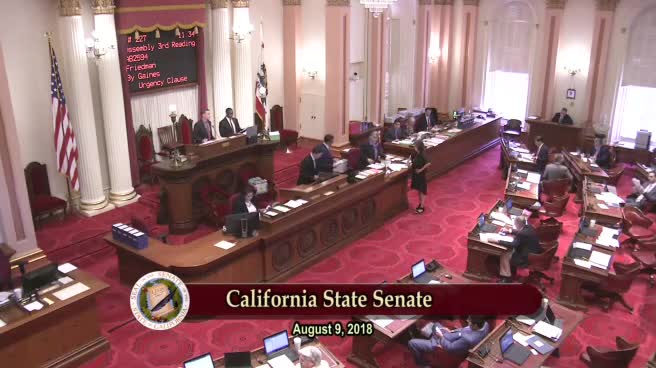 4MIN
Senate Floor
 6MIN
Senate Standing Committee on Judiciary
 6MIN
Senate Standing Committee on Labor and Industrial Relations
 1MIN
Assembly Floor
 1MIN
Assembly Standing Committee on Appropriations
 5MIN
Assembly Standing Committee on Judiciary
 8MIN
Assembly Standing Committee on Labor and Employment
Bill Author

Bill Co-Author(s):
