AB 25: Tour buses: modified tour buses.
- Session Year: 2017-2018
- House: Assembly
- Latest Version Date: 2017-09-27
Existing law defines tour bus for purposes of regulation under the Vehicle Code. Existing law requires an operator of a tour bus to use a safety belt and to report any accidents involving the tour bus to the Department of the California Highway Patrol.
This bill would provide that the definition includes a tour bus that has had its roof substantially structurally modified or removed.
The bill would authorize local authorities to adopt rules and regulations to restrict the routes or streets upon which a modified tour bus may be operated, as specified. The bill would authorize local authorities to adopt rules and regulations to prohibit the use of loudspeakers or public address systems by a modified tour bus and instead require the use of headphones or similar devices by passengers for any information or presentation provided for the passengers.
Existing law defines tour bus for purposes of regulation under the Vehicle Code. Existing law requires an operator of a tour bus to use a safety belt and to report any accidents involving the tour bus to the Department of the California Highway Patrol.
This bill would provide that the definition includes a tour bus that has had its roof substantially structurally modified or removed. The bill would require the Department of the California Highway Patrol to develop an inspection and certification program for these modified tour buses and would require any modified tour bus to be inspected and certified. The bill would authorize the removal of a modified tour bus being operated without certification and would require the department to request the suspension, cancellation, or revocation of the registration of a modified tour bus deemed to be unsafe. The bill would authorize the department to charge a fee to cover the reasonable cost of the inspection and certification.
This bill would also require the operator of a modified tour bus as described above to additionally provide a specified warning about the safety of the modified bus. The bill would authorize local authorities to adopt rules and regulations to restrict the routes or streets upon which a modified tour bus may be operated, as specified. The bill would authorize local authorities to adopt rules and regulations to prohibit the use of loudspeakers or public address systems by a modified tour bus and instead require the use of headphones or similar devices by passengers for any information or presentation provided for the passengers. The bill would require a modified tour bus to be equipped with passenger seatbelts and that the passengers wear seatbelts at all times while the bus is in operation. The bill would prohibit removal or modification of seatbelts or other safety equipment, as specified.
Because a violation of certain of the bills requirements and prohibitions would be a crime, this bill would impose a state-mandated local program.Existing law requires that the Department of the California Highway Patrol, upon determining that a tour bus operator has failed, as provided, to comply with certain Vehicle Code provisions or related regulations, recommend to the Public Utilities Commission and other authorities that certain actions be taken against the carrier.This bill would authorize the Attorney General, a district attorney, or city attorney, as specified, to make those determinations and recommendations in the case of a modified tour bus as described above.The California Constitution requires the state to reimburse local agencies and school districts for certain costs mandated by the state. Statutory provisions establish procedures for making that reimbursement.This bill would provide that no reimbursement is required by this act for a specified reason.Existing law defines tour bus for purposes of regulation under the Vehicle Code. Existing law requires an operator of a tour bus to use a safety belt and to report any accidents involving the tour bus to the Department of the California Highway Patrol.
This bill would provide that the definition includes a tour bus that has had its roof substantially structurally modified or removed, or has had other major structural modifications. removed. The bill would require the Department of the California Highway Patrol to develop an inspection and certification program for these modified tour buses and would require any modified tour bus to be inspected and certified. The bill would authorize the removal of a modified tour bus being operated without certification and would require the department to request the suspension, cancellation, or revocation of the registration of a modified tour bus deemed to be unsafe. The bill would authorize the department to charge a fee to cover the reasonable cost of the inspection and certification.
This bill would also require the operator of a modified tour bus as described above to additionally provide a specified warning about the safety of the modified bus. The bill would authorize local authorities to adopt rules and regulations to restrict the routes or streets upon which a modified tour bus may be operated, as specified. The bill would authorize local authorities to adopt rules and regulations to prohibit the use of loudspeakers or public address systems by a modified tour bus and instead require the use of headphones or similar devices by passengers for any information or presentation provided for the passengers. The bill would require a modified tour bus to be equipped with passenger seatbelts and that the passengers wear seatbelts at all times while the bus is in operation. The bill would prohibit removal or modification of seatbelts or other safety equipment, as specified.
Because a violation of certain of the bills requirements and prohibitions would be a crime, this bill would impose a state-mandated local program.
Existing law requires that the Department of the California Highway Patrol, upon determining that a tour bus operator has failed, as provided, to comply with certain Vehicle Code provisions or related regulations, recommend to the Public Utilities Commission and other authorities that certain actions be taken against the carrier.
This bill would authorize the Attorney General, a district attorney, or city attorney, as specified, to make those determinations and recommendations in the case of a modified tour bus as described above.
The California Constitution requires the state to reimburse local agencies and school districts for certain costs mandated by the state. Statutory provisions establish procedures for making that reimbursement.
This bill would provide that no reimbursement is required by this act for a specified reason.
Existing law defines tour bus for purposes of regulation under the Vehicle Code. Existing law requires an operator of a tour bus to use a safety belt and to report any accidents involving the tour bus to the Department of the California Highway Patrol.
This bill would provide that the definition includes a tour bus that has had its roof modified or removed, or has had other major structural modifications. The bill would require the Department of the California Highway Patrol to develop an inspection and certification program for these modified tour buses and would require any modified tour bus to be inspected and certified. The bill would authorize the removal of a modified tour bus being operated without certification and would require the department to request the suspension, cancellation, or revocation of the registration of a modified tour bus deemed to be unsafe. The bill would authorize the department to charge a fee to cover the reasonable cost of the inspection and certification.
This bill would also require the operator of a modified tour bus as described above to additionally provide a specified warning about the safety of the modified bus. The bill would authorize local authorities to adopt rules and regulations to restrict the routes or streets upon which a modified tour bus may be operated, as specified. The bill would authorize local authorities to adopt rules and regulations to prohibit the use of loudspeakers or public address systems by a modified tour bus and instead require the use of headphones or similar devices by passengers for any information or presentation provided for the passengers. The bill would require a modified tour bus to be equipped with passenger seatbelts and that the passengers wear seatbelts at all times while the bus is in operation. The bill would prohibit removal or modification of seatbelts or other safety equipment, as specified.
Because a violation of certain of the bills requirements and prohibitions would be a crime, this bill would impose a state-mandated local program.
Existing law requires that the Department of the California Highway Patrol, upon determining that a tour bus operator has failed, as provided, to comply with certain Vehicle Code provisions or related regulations, recommend to the Public Utilities Commission and other authorities that certain actions be taken against the carrier.
This bill would authorize the Attorney General, a district attorney, or city attorney, as specified, to make those determinations and recommendations in the case of a modified tour bus as described above.
The California Constitution requires the state to reimburse local agencies and school districts for certain costs mandated by the state. Statutory provisions establish procedures for making that reimbursement.
This bill would provide that no reimbursement is required by this act for a specified reason.
Existing law imposes various requirements on the operation of tour buses, including, among other things, a requirement that a tour bus operator use a safety belt at all times when operating the tour bus.This bill would state the intent of the Legislature to enact legislation relating to the safe operation of tour buses.Existing law imposes various requirements on the operation of tour buses, including, among other things, a requirement that a tour bus operator use a safety belt at all times when operating the tour bus.
This bill would state the intent of the Legislature to enact legislation relating to the safe operation of tour buses.
(a)Tour bus means a bus, which is operated by or for a charter-party carrier of passengers, as defined in Section 5360 of the Public Utilities Code, or a passenger stage corporation, as defined in Section 226 of the Public Utilities Code.
(b)Tour bus includes a bus described in subdivision (a) that has had its roof substantially structurally modified or removed.
SEC. 2.Section 21118 is added to the Vehicle Code, to read:21118.(a)A local authority may adopt rules and regulations by ordinance or resolution to restrict the routes or streets upon which a tour bus described in subdivision (b) of Section 612 may be operated, if the local authority determines that it is unsafe to operate those vehicles on those routes or streets.
(b)A local authority may adopt rules and regulations by ordinance or resolution to prohibit the use of loudspeakers or public address systems by a tour bus described in subdivision (b) of Section 612, and instead require the use of headphones or similar devices by passengers for any information or presentation provided for the passengers.
(a)Tour bus means a bus, which is operated by or for a charter-party carrier of passengers, as defined in Section 5360 of the Public Utilities Code, or a passenger stage corporation, as defined in Section 226 of the Public Utilities Code.
(b)Tour bus includes a bus described in subdivision (a) that has had its roof substantially structurally modified or removed.
SEC. 2.Section 21118 is added to the Vehicle Code, to read:21118.(a)Local authorities A local authority may adopt rules and regulations by ordinance or resolution to restrict the routes or streets upon which a tour bus described in subdivision (b) of Section 612 may be operated, if the local authority determines that it is unsafe to operate those vehicles on those routes or streets.
(b)Local authorities A local authority may adopt rules and regulations by ordinance or resolution to prohibit the use of loudspeakers or public address systems by a tour bus described in subdivision (b) of Section 612, and instead require the use of headphones or similar devices by passengers for any information or presentation provided for the passengers.
(a)Tour bus means a bus, which is operated by or for a charter-party carrier of passengers, as defined in Section 5360 of the Public Utilities Code, or a passenger stage corporation, as defined in Section 226 of the Public Utilities Code.
(b)Tour bus includes a bus described in subdivision (a) that has had its roof substantially structurally modified or removed.
SEC. 2.Section 2807.4 is added to the Vehicle Code, to read:2807.4.(a)No later than July 1, 2018, the Department of the California Highway Patrol shall develop and implement an inspection and certification program for tour buses described in subdivision (b) of Section 612. The department may contract with a third party with the proper engineering background to develop this program. The purpose of the inspection is to examine the structural modifications made to the vehicle to determine whether the vehicle is safe to operate.(b)A tour bus described in subdivision (b) of Section 612 shall not be operated after July 1, 2018, without having been inspected and certified as safe pursuant to this section. Any such vehicle being operated without inspection and certification after July 1, 2018, is deemed unsafe and shall be removed from the highway and placed in a storage facility at the owners expense.(c)The Department of the California Highway Patrol shall request the Department of Motor Vehicles to suspend, cancel, or revoke the registration of any tour bus described in subdivision (b) of Section 612 that is unable to be certified as safe to operate pursuant to this section.(d)The Department of the California Highway Patrol may charge a fee for the reasonable costs of the inspection and certification described in subdivision (a), including the development and implementation of the program.(e)The Department of the California Highway Patrol shall develop protocols to remove unsafe tour buses from California roads.SEC. 3.Section 12521 of the Vehicle Code is amended to read:12521.(a)An operator of a tour bus shall, at all times when operating the tour bus, do all the following:(1)Use a safety belt.(2)Report any accidents involving the tour bus to the Department of the California Highway Patrol.(b)An operator of a tour bus described in subdivision (b) of Section 612, prior to beginning a trip, shall provide a verbal notice to passengers stating the following:The National Highway Traffic Safety Administration has determined that the modifications made to this type of vehicle puts passengers at risk, and that removing the vehicles roof could affect the safety of the vehicle by reducing the level of protection provided to passengers in the event of a rollover crash.SEC. 4.SEC. 2.Section 21118 is added to the Vehicle Code, to read:21118.(a)Local authorities may adopt rules and regulations by ordinance or resolution to restrict the routes or streets upon which a tour bus described in subdivision (b) of Section 612 may be operated, if the local authority determines that it is unsafe to operate those vehicles on those routes or streets.
(b)Local authorities may adopt rules and regulations by ordinance or resolution to prohibit the use of loudspeakers or public address systems by a tour bus described in subdivision (b) of Section 612, and instead require the use of headphones or similar devices by passengers for any information or presentation provided for the passengers.
SEC. 5.Section 27318 is added to the Vehicle Code, to read:27318.(a)A tour bus described in subdivision (b) of Section 612 shall be equipped with passenger seatbelts, and passengers shall wear seatbelts at all times while the bus is in operation.(b)A person shall not remove or modify seatbelts, or any safety equipment installed by the manufacturer, from a tour bus described in subdivision (b) of Section 612.SEC. 6.Section 34505.1 of the Vehicle Code is amended to read:34505.1.(a)(1)Upon determining that a tour bus carrier or modified limousine carrier has either (A) failed to maintain any vehicle used in transportation for compensation in a safe operating condition or to comply with the Vehicle Code or with regulations contained in Title 13 of the California Code of Regulations relative to motor carrier safety, and, in the departments opinion, that failure presents an imminent danger to public safety or constitutes such a consistent failure as to justify a recommendation to the Public Utilities Commission or the United States Department of Transportation or (B) failed to enroll all drivers in the pull notice system as required by Section 1808.1, the department shall recommend to the Public Utilities Commission that the carriers operating authority be suspended, denied, or revoked, or to the United States Department of Transportation that appropriate administrative action be taken against the carriers interstate operating authority, whichever is appropriate. For purposes of this subdivision, two consecutive unsatisfactory compliance ratings for an inspected terminal assigned because the tour bus carrier or modified limousine carrier failed to comply with the periodic report requirements of Section 1808.1 or the cancellation of the carriers enrollment by the Department of Motor Vehicles for nonpayment of required fees may be determined by the department to be a consistent failure. However, when recommending denial of an application for new or renewal authority, the department need not conclude that the carriers failure presents an imminent danger to public safety or that it constitutes a consistent failure. The department need only conclude that the carriers compliance with the safety-related matters described in subparagraph (A) is sufficiently unsatisfactory to justify a recommendation for denial. The department shall retain a record, by carrier, of every recommendation made pursuant to this section.(2)In the case of a tour bus described in subdivision (b) of Section 612, the determinations and recommendations described in paragraph (1) may also be made by the Attorney General, or by a district attorney or a city attorney of the proper city, county, or city and county, as applicable.(b)Before transmitting a recommendation pursuant to subdivision (a), the department shall notify the carrier in writing of all of the following:(1)That the department has determined that the carriers safety record is unsatisfactory, furnishing a copy of any documentation or summary of any other evidence supporting the determination.(2)That the determination may result in a suspension, revocation, or denial of the carriers operating authority by the Public Utilities Commission or the United States Department of Transportation, as appropriate.(3)That the carrier may request a review of the determination by the department within five days of its receipt of the notice required under this subdivision. If a review is requested by the carrier, the department shall conduct and evaluate that review prior to transmitting any notification pursuant to subdivision (a).(c)Notwithstanding subdivision (a) or (b), upon determining during a terminal inspection or at any other time that the condition of a tour bus is such that it has multiple safety violations of a nature that operation of the tour bus could constitute an imminent danger to public safety, the department shall immediately order the tour bus out of service. The tour bus shall not be subsequently operated with passengers until all of the safety violations have been corrected and the department has verified the correction of the safety violations upon a subsequent inspection by the department of the tour bus, which shall occur within five business days of the submission of a reinspection request from the tour bus carrier to the department.SEC. 7.No reimbursement is required by this act pursuant to Section 6 of Article XIIIB of the California Constitution because the only costs that may be incurred by a local agency or school district will be incurred because this act creates a new crime or infraction, eliminates a crime or infraction, or changes the penalty for a crime or infraction, within the meaning of Section 17556 of the Government Code, or changes the definition of a crime within the meaning of Section 6 of Article XIIIB of the California Constitution.(a)Tour bus means a bus, which is operated by or for a charter-party carrier of passengers, as defined in Section 5360 of the Public Utilities Code, or a passenger stage corporation, as defined in Section 226 of the Public Utilities Code.
(b)Tour bus includes a bus described in subdivision (a) that has had its roof substantially structurally modified or removed, or has had other major structural modifications not performed by the original manufacturer. removed.
SEC. 2.Section 2807.4 is added to the Vehicle Code, to read:2807.4.(a)No later than July 1, 2018, the Department of the California Highway Patrol shall develop and implement an inspection and certification program for tour buses described in subdivision (b) of Section 612. The department may contract with a third party with the proper engineering background to develop this program. The purpose of the inspection is to examine the structural modifications made to the vehicle to determine whether the vehicle is safe to operate.
(b)A tour bus described in subdivision (b) of Section 612 shall not be operated after July 1, 2018, without having been inspected and certified as safe pursuant to this section. Any such vehicle being operated without inspection and certification after July 1, 2018, is deemed unsafe and shall be removed from the highway and placed in a storage facility at the owners expense.
(c)The Department of the California Highway Patrol shall request the Department of Motor Vehicles to suspend, cancel, or revoke the registration of any tour bus described in subdivision (b) of Section 612 that is unable to be certified as safe to operate pursuant to this section.
(d)The Department of the California Highway Patrol may charge a fee for the reasonable costs of the inspection and certification described in subdivision (a), including the development and implementation of the program.
(e)The Department of the California Highway Patrol shall develop protocols to remove unsafe tour buses from California roads.
SEC. 3.Section 12521 of the Vehicle Code is amended to read:12521.(a)An operator of a tour bus shall, at all times when operating the tour bus, do all the following:
(1)Use a safety belt.
(2)Report any accidents involving the tour bus to the Department of the California Highway Patrol.
(b)An operator of a tour bus described in subdivision (b) of Section 612, prior to beginning a trip, shall provide a verbal notice to passengers stating the following:
The National Highway Traffic Safety Administration has determined that the modifications made to this type of vehicle puts passengers at risk, and that removing the vehicles roof could affect the safety of the vehicle by reducing the level of protection provided to passengers in the event of a rollover crash.
SEC. 4.Section 21118 is added to the Vehicle Code, to read:21118.
(a)Local authorities may adopt rules and regulations by ordinance or resolution to restrict the routes or streets upon which a tour bus described in subdivision (b) of Section 612 may be operated, if the local authority determines that it is unsafe to operate those vehicles on those routes or streets.
(b)Local authorities may adopt rules and regulations by ordinance or resolution to prohibit the use of loudspeakers or public address systems by a tour bus described in subdivision (b) of Section 612, and instead require the use of headphones or similar devices by passengers for any information or presentation provided for the passengers.
SEC. 5.Section 27318 is added to the Vehicle Code, to read:27318.(a)A tour bus described in subdivision (b) of Section 612 shall be equipped with passenger seatbelts, and passengers shall wear seatbelts at all times while the bus is in operation.
(b)A person shall not remove or modify seatbelts, or any safety equipment installed by the manufacturer, from a tour bus described in subdivision (b) of Section 612.
SEC. 6.Section 34505.1 of the Vehicle Code is amended to read:34505.1.(a)(1)Upon determining that a tour bus carrier or modified limousine carrier has either (A) failed to maintain any vehicle used in transportation for compensation in a safe operating condition or to comply with the Vehicle Code or with regulations contained in Title 13 of the California Code of Regulations relative to motor carrier safety, and, in the departments opinion, that failure presents an imminent danger to public safety or constitutes such a consistent failure as to justify a recommendation to the Public Utilities Commission or the United States Department of Transportation or (B) failed to enroll all drivers in the pull notice system as required by Section 1808.1, the department shall recommend to the Public Utilities Commission that the carriers operating authority be suspended, denied, or revoked, or to the United States Department of Transportation that appropriate administrative action be taken against the carriers interstate operating authority, whichever is appropriate. For purposes of this subdivision, two consecutive unsatisfactory compliance ratings for an inspected terminal assigned because the tour bus carrier or modified limousine carrier failed to comply with the periodic report requirements of Section 1808.1 or the cancellation of the carriers enrollment by the Department of Motor Vehicles for nonpayment of required fees may be determined by the department to be a consistent failure. However, when recommending denial of an application for new or renewal authority, the department need not conclude that the carriers failure presents an imminent danger to public safety or that it constitutes a consistent failure. The department need only conclude that the carriers compliance with the safety-related matters described in subparagraph (A) is sufficiently unsatisfactory to justify a recommendation for denial. The department shall retain a record, by carrier, of every recommendation made pursuant to this section.
(2)In the case of a tour bus described in subdivision (b) of Section 612, the determinations and recommendations described in paragraph (1) may also be made by the Attorney General, or by a district attorney or a city attorney of the proper city, county, or city and county, as applicable.
(b)Before transmitting a recommendation pursuant to subdivision (a), the department shall notify the carrier in writing of all of the following:
(1)That the department has determined that the carriers safety record is unsatisfactory, furnishing a copy of any documentation or summary of any other evidence supporting the determination.
(2)That the determination may result in a suspension, revocation, or denial of the carriers operating authority by the Public Utilities Commission or the United States Department of Transportation, as appropriate.
(3)That the carrier may request a review of the determination by the department within five days of its receipt of the notice required under this subdivision. If a review is requested by the carrier, the department shall conduct and evaluate that review prior to transmitting any notification pursuant to subdivision (a).
(c)Notwithstanding subdivision (a) or (b), upon determining during a terminal inspection or at any other time that the condition of a tour bus is such that it has multiple safety violations of a nature that operation of the tour bus could constitute an imminent danger to public safety, the department shall immediately order the tour bus out of service. The tour bus shall not be subsequently operated with passengers until all of the safety violations have been corrected and the department has verified the correction of the safety violations upon a subsequent inspection by the department of the tour bus, which shall occur within five business days of the submission of a reinspection request from the tour bus carrier to the department.
SEC. 7.No reimbursement is required by this act pursuant to Section 6 of Article XIIIB of the California Constitution because the only costs that may be incurred by a local agency or school district will be incurred because this act creates a new crime or infraction, eliminates a crime or infraction, or changes the penalty for a crime or infraction, within the meaning of Section 17556 of the Government Code, or changes the definition of a crime within the meaning of Section 6 of Article XIIIB of the California Constitution.
(a)Tour bus means a bus, which is operated by or for a charter-party carrier of passengers, as defined in Section 5360 of the Public Utilities Code, or a passenger stage corporation, as defined in Section 226 of the Public Utilities Code.
(b)Tour bus includes a bus described in subdivision (a) that has had its roof modified or removed, or has had other major structural modifications not performed by the original manufacturer.
SEC. 2.Section 2807.4 is added to the Vehicle Code, to read:2807.4.(a)No later than July 1, 2018, the Department of the California Highway Patrol shall develop and implement an inspection and certification program for tour buses described in subdivision (b) of Section 612. The department may contract with a third party with the proper engineering background to develop this program. The purpose of the inspection is to examine the structural modifications made to the vehicle to determine whether the vehicle is safe to operate.
(b)A tour bus described in subdivision (b) of Section 612 shall not be operated after July 1, 2018, without having been inspected and certified as safe pursuant to this section. Any such vehicle being operated without inspection and certification after July 1, 2018, is deemed unsafe and shall be removed from the highway and placed in a storage facility at the owners expense.
(c)The Department of the California Highway Patrol shall request the Department of Motor Vehicles to suspend, cancel, or revoke the registration of any tour bus described in subdivision (b) of Section 612 that is unable to be certified as safe to operate pursuant to this section.
(d)The Department of the California Highway Patrol may charge a fee for the reasonable costs of the inspection and certification described in subdivision (a), including the development and implementation of the program.
(e)The Department of the California Highway Patrol shall develop protocols to remove unsafe tour buses from California roads.
SEC. 3.Section 12521 of the Vehicle Code is amended to read:12521.(a)An operator of a tour bus shall, at all times when operating the tour bus, do all the following:
(a)(1)Use a safety belt.
(b)(2)Report any accidents involving the tour bus to the Department of the California Highway Patrol.
(b)An operator of a tour bus described in subdivision (b) of Section 612, prior to beginning a trip, shall provide a verbal notice to passengers stating the following:
The National Highway Traffic Safety Administration has determined that the modifications made to this type of vehicle puts passengers at risk, and that removing the vehicles roof could affect the safety of the vehicle by reducing the level of protection provided to passengers in the event of a rollover crash.
SEC. 4.Section 21118 is added to the Vehicle Code, to read:21118.
(a)Local authorities may adopt rules and regulations by ordinance or resolution to restrict the routes or streets upon which a tour bus described in subdivision (b) of Section 612 may be operated, if the local authority determines that it is unsafe to operate those vehicles on those routes or streets.
(b)Local authorities may adopt rules and regulations by ordinance or resolution to prohibit the use of loudspeakers or public address systems by a tour bus described in subdivision (b) of Section 612, and instead require the use of headphones or similar devices by passengers for any information or presentation provided for the passengers.
SEC. 5.Section 27318 is added to the Vehicle Code, to read:27318.(a)A tour bus described in subdivision (b) of Section 612 shall be equipped with passenger seatbelts, and passengers shall wear seatbelts at all times while the bus is in operation.
(b)A person shall not remove or modify seatbelts, or any safety equipment installed by the manufacturer, from a tour bus described in subdivision (b) of Section 612.
SEC. 6.Section 34505.1 of the Vehicle Code is amended to read:34505.1.(a)(1)Upon determining that a tour bus carrier or modified limousine carrier has either (1) (A) failed to maintain any vehicle used in transportation for compensation in a safe operating condition or to comply with the Vehicle Code or with regulations contained in Title 13 of the California Code of Regulations relative to motor carrier safety, and, in the departments opinion, that failure presents an imminent danger to public safety or constitutes such a consistent failure as to justify a recommendation to the Public Utilities Commission or the United States Department of Transportation or (2) (B) failed to enroll all drivers in the pull notice system as required by Section 1808.1, the department shall recommend to the Public Utilities Commission that the carriers operating authority be suspended, denied, or revoked, or to the United States Department of Transportation that appropriate administrative action be taken against the carriers interstate operating authority, whichever is appropriate. For purposes of this subdivision, two consecutive unsatisfactory compliance ratings for an inspected terminal assigned because the tour bus carrier or modified limousine carrier failed to comply with the periodic report requirements of Section 1808.1 or the cancellation of the carriers enrollment by the Department of Motor Vehicles for nonpayment of required fees may be determined by the department to be a consistent failure. However, when recommending denial of an application for new or renewal authority, the department need not conclude that the carriers failure presents an imminent danger to public safety or that it constitutes a consistent failure. The department need only conclude that the carriers compliance with the safety-related matters described in paragraph (1) of subdivision (a) subparagraph (A) is sufficiently unsatisfactory to justify a recommendation for denial. The department shall retain a record, by carrier, of every recommendation made pursuant to this section.
(2)In the case of a tour bus described in subdivision (b) of Section 612, the determinations and recommendations described in paragraph (1) may also be made by the Attorney General, or by a district attorney or a city attorney of the proper city, county, or city and county, as applicable.
(b)Before transmitting a recommendation pursuant to subdivision (a), the department shall notify the carrier in writing of all of the following:
(1)That the department has determined that the carriers safety record is unsatisfactory, furnishing a copy of any documentation or summary of any other evidence supporting the determination.
(2)That the determination may result in a suspension, revocation, or denial of the carriers operating authority by the Public Utilities Commission or the United States Department of Transportation, as appropriate.
(3)That the carrier may request a review of the determination by the department within five days of its receipt of the notice required under this subdivision. If a review is requested by the carrier, the department shall conduct and evaluate that review prior to transmitting any notification pursuant to subdivision (a).
(c)Notwithstanding subdivision (a) or (b), upon determining during a terminal inspection or at any other time that the condition of a tour bus is such that it has multiple safety violations of a nature that operation of the tour bus could constitute an imminent danger to public safety, the department shall immediately order the tour bus out of service. The tour bus shall not be subsequently operated with passengers until all of the safety violations have been corrected and the department has verified the correction of the safety violations upon a subsequent inspection by the department of the tour bus, which shall occur within five business days of the submission of a reinspection request from the tour bus carrier to the department.
SEC. 7.No reimbursement is required by this act pursuant to Section 6 of Article XIIIB of the California Constitution because the only costs that may be incurred by a local agency or school district will be incurred because this act creates a new crime or infraction, eliminates a crime or infraction, or changes the penalty for a crime or infraction, within the meaning of Section 17556 of the Government Code, or changes the definition of a crime within the meaning of Section 6 of Article XIIIB of the California Constitution.
SECTION 1.It is the intent of the Legislature to enact legislation relating to the safe operation of tour buses.It is the intent of the Legislature to enact legislation relating to the safe operation of tour buses.
|
Date
|
Status
|
|---|---|
| Sep 27, 2017 | Chaptered by Secretary of State - Chapter 310, Statutes of 2017. |
| Sep 27, 2017 | Approved by the Governor. |
| Sep 13, 2017 | Enrolled and presented to the Governor at 4 p.m. |
| Sep 7, 2017 | Senate amendments concurred in. To Engrossing and Enrolling. |
| Sep 5, 2017 | In Assembly. Concurrence in Senate amendments pending. May be considered on or after September 7 pursuant to Assembly Rule 77. |
| Sep 5, 2017 | Read third time. Passed. Ordered to the Assembly. |
| Aug 30, 2017 | Read second time. Ordered to third reading. |
| Aug 29, 2017 | Read third time and amended. Ordered to second reading. |
| Jun 29, 2017 | Read second time. Ordered to third reading. |
| Jun 28, 2017 | Withdrawn from committee. |
| Jun 28, 2017 | From committee: Do pass and re-refer to Com. on E., U. & C. (Ayes 11. Noes 1.) (June 27). Re-referred to Com. on E., U. & C. |
| Jun 14, 2017 | Referred to Coms. on T. & H. and E., U. & C. |
| Jun 1, 2017 | In Senate. Read first time. To Com. on RLS. for assignment. |
| May 31, 2017 | Read third time. Passed. Ordered to the Senate. (Ayes 76. Noes 1. Page 1922.) |
| May 30, 2017 | Read second time. Ordered to third reading. |
| May 26, 2017 | From committee: Amend, and do pass as amended. (Ayes 16. Noes 0.) (May 26). |
| May 17, 2017 | In committee: Set, first hearing. Referred to APPR. suspense file. |
| May 3, 2017 | Re-referred to Com. on APPR. |
| May 2, 2017 | Read second time and amended. |
| May 1, 2017 | From committee: Amend, and do pass as amended and re-refer to Com. on APPR. (Ayes 13. Noes 0.) (April 26). |
| Mar 22, 2017 | Re-referred to Com. on C. & C. |
| Mar 21, 2017 | From committee chair, with author's amendments: Amend, and re-refer to Com. on C. & C. Read second time and amended. |
| Mar 20, 2017 | Referred to Com. on C. & C. |
| Dec 6, 2016 | From printer. May be heard in committee January 5. |
| Dec 5, 2016 | Read first time. To print. |
|
Date
|
Description
|
Location
|
Votes
|
|
|---|---|---|---|---|
| Sep 7, 2017 | AB 25 NAZARIAN Concurrence in Senate Amendments | Assembly Floor |
Passed |
|
| Sep 5, 2017 | Assembly 3rd Reading AB25 Nazarian et al. By Allen | Senate Floor |
Passed |
|
| Jun 27, 2017 | Do pass, but first be re-referred to the Committee on [Energy, Utilities and Communications] | Senate Standing Committee on Transportation and Housing |
Passed |
|
| May 31, 2017 | AB 25 NAZARIAN Assembly Third Reading | Assembly Floor |
Passed |
|
| May 26, 2017 | Do pass as amended. | Assembly Standing Committee on Appropriations |
Passed |
|
| Apr 26, 2017 | Do pass as amended and be re-referred to the Committee on [Appropriations] | Assembly Standing Committee on Communications and Conveyance |
Passed |
This list shows positions taken on this bill by organizations on the date displayed, which is linked to the original source.
Positions by individuals are not included.
|
Organization
|
Position
|
Date
|
|---|---|---|
| cahuenga pass property owners association | ** Support | Aug 30, 2017 |
| California Association Of Highway Patrolmen | ** Support | Aug 30, 2017 |
| California Bus Association | ** Support | Aug 30, 2017 |
| California Travel Association | ** Support | Aug 30, 2017 |
| City Of Los Angeles | ** Support | Aug 30, 2017 |
| Consumer Attorneys Of California | ** Support | Aug 30, 2017 |
| Consumer Federation Of California | ** Support | Aug 30, 2017 |
| david e. ryu, los angeles councilmember, 4th district | ** Support | Jun 22, 2017 |
| federation of hillside and canyon associations, inc. | ** Support | Aug 30, 2017 |
| Hollywood Hills West Neighborhood Council | ** Support | Aug 30, 2017 |
| hollywood united neighborhood council | ** Support | Aug 30, 2017 |
| Honorable David E. Ryu, Los Angeles Councilmember | ** Support | Apr 25, 2017 |
| los angeles councilmember, 4th district, david e. ryu | ** Support | Aug 30, 2017 |
| Outpost Homeowners Association | ** Support | Aug 30, 2017 |
| Visit California | * Support | Apr 26, 2017 |
CONCURRENCE IN SENATE AMENDMENTS
CSA1 Bill Id:AB 25
Author:(Nazarian)
As Amended Ver:August 29, 2017
Majority vote
ASSEMBLY: | 76-1 | (May 31, 2017) | SENATE: | 36-3 | (September 5, 2017) |
Original Committee Reference: C. & C.
SUMMARY: Authorizes a local authority to adopt rules and regulations to restrict the routes or streets upon which a tour bus may be operated and prohibit the use of loudspeakers or public address systems by tour buses.
The Senate amendments add a co-author and makes non-substantive technical changes.
EXISTING LAW:
- Defines "charter party carriers of passengers" (CPC) as every person engaged in the transportation of person by motor vehicle for compensation, whether in common or contract carriage, over any public highway in the state. (Public Utilities Code (PUC) Section 5360)
- Establishes the "Passenger Charter-Party Carriers Act," which directs the California Public Utilities Commission (CPUC) to issue permits or certificates to CPCs, investigate complaints against carriers, and cancel, revoke, or suspend permits and certificates for specific violations. (PUC Section 5381 et seq.)
- Authorizes the CPUC to regulate private carriers of passengers, including requiring public liability and property insurance, cargo insurance, knowledge of rates, documentation, timely reporting of revenues and payment fees, and take appropriate enforcement actions and other provisions, as specified. (PUC Sections 4000 to 4022)
- Prohibits the CPUC from issuing or continuing in effect any permits, certificates, or authority of a CPC or Passenger Stage Corporation (PSC) that has not submitted fees required for inspect by CHP, as specified. (PUC Section 5384.1 and Section 1042)
- Defines a "tour bus" to mean a bus, which is operated by or for a CPC or PSC. (Vehicle Code (VEH) Section 612)
- Requires an operator of a tour bus to, at all times when operating the tour bus, to a) use a safety belt, and b) report any accidents involving the tour bus to the California Highway Patrol. (VEH Section 12521)
FISCAL EFFECT: Unknown. This bill has been keyed non-fiscal by the Legislative Counsel.
COMMENTS:
- Background: California law regulates different modes of passenger transportation for compensation including taxi services, which are regulated by cities and/or counties; and PSCs and CPCs, which are regulated by the CPUC. PSCs are services that provide transportation to the general public on an individual fare basis, such as scheduled bus operators, which are buses that operate on a fixed route and scheduled services, or airport shuttles, which operate on an on-call door-to-door share the ride service. CPCs are services that charter a vehicle, on a prearranged basis, for the exclusive use of an individual or group. Charges are based on the mileage or time of use, or a combination of both. Types of CPCs include limousines, tour buses, sightseeing services, and charter and party buses.
- NBC Hollywood Tour Vans Investigation: In August 2016, NBC Los Angeles published a two part investigative report into the growing number of Hollywood celebrity tour companies. Aside from incorrect and false information regarding celebrities being presented by tour guides, the report found numerous safety violations, including structurally modified vans that had inoperative and missing seatbelts, distracted drivers, and overweight vehicles driving down prohibited streets. In addition, the investigation found tour companies operating with vehicles not permitted to operate as tour buses, permit violations, drivers with suspended licenses or without a commercial license. The increasing presence of Hollywood celebrity tour buses has become a growing nuisance for residents in certain communities.
This bill authorizes a local authority to adopt rules and regulations to restrict the routes or streets upon which a tour bus may be operated and prohibit the use of loudspeakers or public address systems by tour buses, as specified.
Analysis Prepared by: Edmond Cheung / C. & C. / (916) 319-2637 FN: 0001604
Office of Senate Floor Analyses (916) 651-1520 Fax: (916) 327-4478 | AB |
THIRD READING
Bill No: AB 25
:
SENATE TRANS. & HOUSING COMMITTEE: 11-1, 6/27/17
AYES: Beall, Cannella, Allen, Atkins, Gaines, McGuire, Mendoza, Roth, Skinner, Wieckowski, Wiener
NOES: Morrell
NO VOTE RECORDED: Bates
ASSEMBLY FLOOR: 76-1, 5/31/17 - See last page for vote
DIGEST:
This bill allows local authorities to, by ordinance or resolution, both restrict the routes that an open top tour bus may operate on and prohibit their use of loudspeakers or public address systems.
Senate Floor Amendments of 8/29/17 add Senator Allen as a coauthor and make technical changes, altering the language from “local authorities” to “a local authority” in two locations.
- Defines a “bus” as any vehicle designed, used, or maintained for carrying more than 15 persons including the driver, and as any vehicle carrying more than 10 persons, including the driver, which is used to transport persons for compensation or profit, or is used by any nonprofit organization or group.
- Defines a “tour bus” as a bus, which is operated by or for a charter-party carrier of passengers (CPC) or a passenger stage corporation (PSC), as defined in the Public Utilities Code (PUC).
- Requires an operator of a tour bus to, at all times when operating the tour bus, use a safety belt and report any accidents involving the tour bus to the California Highway Patrol (CHP).
- Defines "charter-party carrier of passengers" as every person engaged in the transportation of person by motor vehicle for compensation, whether in common or contract carriage, over any public highway in the state.
- Authorizes the California Public Utilities Commission (CPUC) to regulate private carriers of passengers, including requiring public liability and property insurance, cargo insurance, knowledge of rates, documentation, timely reporting of revenues and payment fees, and take appropriate enforcement actions and other provisions, as specified.
- Prohibits CPUC from issuing or continuing in effect any permits, certificates, or authority of a CPC or PSC that has not submitted fees required for inspection by CHP, as specified.
- Requires CHP to regulate the safe operation of specified motor trucks including tour buses, and establish regulations regarding equipment and operations.
This bill:
- Specifies that the term “tour bus” includes a bus that has had its roof substantially structurally modified or removed.
- Allows local authorities to adopt rules and regulations by ordinance or resolution to restrict the routes or streets upon which a modified, open roof tour bus may operate, if they determine that it is unsafe to do so.
- Allows local authorities to adopt rules and regulations by ordinance or resolution to prohibit the use of loudspeakers or public address systems by an open roof tour bus.
Comments
- Purpose. According to the author, “Certain rogue tour buses are turning the narrow and winding streets of Hollywood area into a danger zone. In particular, chopped open-roof buses with aggressive operators knowingly break the law by violating numerous rules of the road and potentially put passengers in life-threatening situations. AB 25 gives locals more flexibility and enforcement capabilities to curb bad actors by authorizing local jurisdictions to restrict the routes or streets upon which modified tour buses may be operated if the jurisdiction determines that it is unsafe to operate on those routes. Ultimately, this bill would increase local control and ensure the safe operation of this narrow category of vehicle while allowing the tourism industry to continue to thrive.”
- Seeing stars. Popular with tourists, open-roof bus tours of Hollywood and Beverly Hills neighborhoods provide an opportunity to see where movie stars live. However, some tour companies are operating tour buses that are, essentially, modified passenger vans that have had their roofs removed. The safety of these vehicles is questionable and has even drawn the attention of the National Highway Traffic Safety Administration (NHTSA). In August, 2016, NHTSA sent letters to open-top tour bus operators expressing concerns about the safety of their passengers and urging them to stop using them. NHTSA expressed particular concern about the safety risks in a rollover accident and noted that seat belt modifications necessitated by removing the roof may affect the overall safety of the seat belts. According to media reports, NHTSA also contacted the company suspected of making the modifications and requested that they discontinue doing so.
- NBC investigates. An NBC4 Los Angeles investigation unit studied the modified tour buses by going on over 20 tours. Their 2016 report, which brought attention to the issue, cited a host of safety concerns including modified, missing or rusted seat belts, distracted drivers on smartphones, illegal parking and jaywalking habits, drivers operating on a suspended license, non-permitted vans, and overweight vehicles operating on roads with weight limits. According to the CPUC database, a tour company mentioned in the report appears to have had their CPC sight-seeing permit revoked as of May 30, 2017, though it’s not clear exactly why.
- False stars. The investigation also found that tour guides often fabricate the information they provide regarding celebrity homes, resulting in unwanted attention for those homeowners. NBC reports that, unlike San Francisco and San Diego, Los Angeles does not have a tour guide certification program. San Francisco’s Tour Guide Guild certification requires up to 85 hours of tour guide experience, a minimum of six educational programs, and a certification exam with a written and oral component.
- Registration and licensing. The Department of Motor Vehicles (DMV) requires a motor vehicle be registered as a commercial bus if it is designed to carry more than 10 persons, including the driver, and being used to transport people for compensation or profit. DMV requires anyone operating a commercial vehicle to obtain a commercial driver license (CDL). Applications for a CDL require a recent medical report, consent for drug or alcohol blood testing, an acceptable birth date/legal presence document, Social Security Card, and application fee. Commercial drivers are required to notify their employer of any traffic conviction within 30 days and of any revocation, suspension, cancellation, or disqualification by the end of the following business day.
- Permitting. The CPUC provides permits for and regulates both CPCs and PSCs. The CPUC requires CPCs to meet a number of requirements before an operating permit or certificate is issued. These requirements include providing sufficient proof of financial responsibility, maintaining a preventative maintenance program for all vehicles, possessing a safety education and training program, and regularly checking the driving records of all persons operating vehicles used in transportation for compensation. They also require a CHP safety inspection for any vehicle seating more than 10 people, including the driver, before issuing a permit. The Transportation Enforcement Branch of the CPUC investigates carriers and issues citations and cease and desist orders for carriers in violation of the PUC. Looking at CPUC press releases over the past few years, several Hollywood tour-related companies appear to have received citations or cease and desist notices.
- CHP inspections. CPC and PSC maintenance facilities or terminals are required to be inspected at least once every 13 months by CHP. Terminal inspections include a check of maintenance, licensing, any pull notices, and the hours of service records. They also inspect a sampling of vehicles in a fleet to ensure all safety equipment is installed and functioning. CHP is also required to conduct inspections without prior notice of any tour bus operation that have a history of noncompliance with safety laws or regulations that have received unsatisfactory ratings or that have had buses ordered out of service for safety violations. If the CHP finds that a tour bus operator failed to maintain any vehicle in a safe operating condition or in compliance with specified requirements, the carrier operator may have their certificate or permit suspended, denied, or revoked by the CPUC.
- Significant amendments. This bill was amended significantly in the Assembly Appropriations Committee. A number of provisions were removed, including a requirement that the CHP develop and implement an inspection and certification program for tour buses, a prohibition on tour buses that were not inspected and certified as safe, a requirement for tour buses to be equipped with passenger seatbelts and a requirement that passengers to wear them. According to the Assembly Appropriations Committee, while CHP does conduct basic safety assessments, they do not have the equipment necessary to determine the structural integrity of such modified vehicles and do not know whether a private contractor exists to do the examinations.
- Local issue, local control. Beyond the regulations enforced by the PUC and CHP, this bill allows local authorities to restrict the routes that these modified tour buses travel on and their use of loud speakers to prevent neighborhood noise pollution. Given that this is primarily a problem in the Los Angeles area, this seems a practical solution.
Related/Prior Legislation
AB 1677 (Ting, Chapter 685, Statutes of 2016) required CHP to develop protocols for the inspection of tour buses by local agencies.
SB 247 (Lara, Chapter 705, Statutes of 2016) required a CPC engaged in charter bus transportation to ensure each vehicle operated for that purpose is equipped with specified safety features.
SB 812 (Hill, Chapter 711, Statutes of 2016) imposed additional, performance-based requirements on the inspection of tour buses.
FISCAL EFFECT: Appropriation: Fiscal Com.: Local:
Cahuenga Pass Property Owners Association
California Association of Highway Patrolmen
California Bus Association
California Travel Association
City of Los Angeles
Consumer Attorneys of California
Consumer Federation of California
Federation of Hillside and Canyon Associations, Inc.
Hollywood Hills West Neighborhood Council
Hollywood United Neighborhood Council
Los Angeles Councilmember, 4th District, David E. Ryu
Outpost Homeowners Association
OPPOSITION: (Verified 8/30/17)
None received
ARGUMENTS IN SUPPORT: This bill has received the support of numerous groups in the Los Angeles area, including the City of Los Angeles, Los Angeles Councilmember David E. Ryu, and two Hollywood neighborhood councils. Groups writing in support generally express concerns about the safety of the modified buses and claim that they also create traffic and noise.
ASSEMBLY FLOOR: 76-1, 5/31/17
AYES: Acosta, Aguiar-Curry, Travis Allen, Arambula, Baker, Berman, Bigelow, Bloom, Bocanegra, Bonta, Brough, Burke, Caballero, Calderon, Cervantes, Chau, Chen, Chiu, Chu, Cooley, Cooper, Cunningham, Dababneh, Dahle, Daly, Flora, Fong, Frazier, Friedman, Gallagher, Cristina Garcia, Eduardo Garcia, Gipson, Gloria, Gomez, Gonzalez Fletcher, Gray, Grayson, Harper, Holden, Irwin, Jones-Sawyer, Kalra, Kiley, Lackey, Levine, Limón, Low, Maienschein, Mathis, Mayes, McCarty, Medina, Mullin, Muratsuchi, Nazarian, Obernolte, O'Donnell, Patterson, Quirk, Quirk-Silva, Reyes, Ridley-Thomas, Rodriguez, Rubio, Salas, Santiago, Steinorth, Mark Stone, Thurmond, Ting, Voepel, Waldron, Weber, Wood, Rendon
NOES: Chávez
NO VOTE RECORDED: Choi, Eggman, Melendez
8/30/17 13:39:54
**** END ****
Office of Senate Floor Analyses (916) 651-1520 Fax: (916) 327-4478 | AB |
THIRD READING
Bill No: AB 25
:
SENATE TRANS. & HOUSING COMMITTEE: 11-1, 6/27/17
AYES: Beall, Cannella, Allen, Atkins, Gaines, McGuire, Mendoza, Roth, Skinner, Wieckowski, Wiener
NOES: Morrell
NO VOTE RECORDED: Bates
ASSEMBLY FLOOR: 76-1, 5/31/17 - See last page for vote
DIGEST:
This bill allows local authorities to, by ordinance or resolution, both restrict the routes that an open top tour bus may operate on and prohibit their use of loudspeakers or public address systems.
Existing law:
- Defines a “bus” as any vehicle designed, used, or maintained for carrying more than 15 persons including the driver, and as any vehicle carrying more than 10 persons, including the driver, which is used to transport persons for compensation or profit, or is used by any nonprofit organization or group.
- Defines a “tour bus” as a bus, which is operated by or for a charter-party carrier of passengers (CPC) or a passenger stage corporation (PSC), as defined in the Public Utilities Code (PUC).
- Requires an operator of a tour bus to, at all times when operating the tour bus, use a safety belt and report any accidents involving the tour bus to the California Highway Patrol (CHP).
- Defines "charter-party carrier of passengers" as every person engaged in the transportation of person by motor vehicle for compensation, whether in common or contract carriage, over any public highway in the state.
- Authorizes the California Public Utilities Commission (CPUC) to regulate private carriers of passengers, including requiring public liability and property insurance, cargo insurance, knowledge of rates, documentation, timely reporting of revenues and payment fees, and take appropriate enforcement actions and other provisions, as specified.
- Prohibits CPUC from issuing or continuing in effect any permits, certificates, or authority of a CPC or PSC that has not submitted fees required for inspection by CHP, as specified.
- Requires CHP to regulate the safe operation of specified motor trucks including tour buses, and establish regulations regarding equipment and operations.
This bill:
- Specifies that the term “tour bus” includes a bus that has had its roof substantially structurally modified or removed.
- Allows local authorities to adopt rules and regulations by ordinance or resolution to restrict the routes or streets upon which a modified, open roof tour bus may operate, if they determine that it is unsafe to do so.
- Allows local authorities to adopt rules and regulations by ordinance or resolution to prohibit the use of loudspeakers or public address systems by an open roof tour bus.
Comments
- Purpose. According to the author, “Certain rogue tour buses are turning the narrow and winding streets of Hollywood area into a danger zone. In particular, chopped open-roof buses with aggressive operators knowingly break the law by violating numerous rules of the road and potentially put passengers in life-threatening situations. AB 25 gives locals more flexibility and enforcement capabilities to curb bad actors by authorizing local jurisdictions to restrict the routes or streets upon which modified tour buses may be operated if the jurisdiction determines that it is unsafe to operate on those routes. Ultimately, this bill would increase local control and ensure the safe operation of this narrow category of vehicle while allowing the tourism industry to continue to thrive.”
- Seeing stars. Popular with tourists, open-roof bus tours of Hollywood and Beverly Hills neighborhoods provide an opportunity to see where movie stars live. However, some tour companies are operating tour buses that are, essentially, modified passenger vans that have had their roofs removed. The safety of these vehicles is questionable and has even drawn the attention of the National Highway Traffic Safety Administration (NHTSA). In August, 2016, NHTSA sent letters to open-top tour bus operators expressing concerns about the safety of their passengers and urging them to stop using them. NHTSA expressed particular concern about the safety risks in a rollover accident and noted that seat belt modifications necessitated by removing the roof may affect the overall safety of the seat belts. According to media reports, NHTSA also contacted the company suspected of making the modifications and requested that they discontinue doing so.
- NBC investigates. An NBC4 Los Angeles investigation unit studied the modified tour buses by going on over 20 tours. Their 2016 report, which brought attention to the issue, cited a host of safety concerns including modified, missing or rusted seat belts, distracted drivers on smartphones, illegal parking and jaywalking habits, drivers operating on a suspended license, non-permitted vans, and overweight vehicles operating on roads with weight limits. According to the CPUC database, a tour company mentioned in the report appears to have had their CPC sight-seeing permit revoked as of May 30, 2017, though it’s not clear exactly why.
- False stars. The investigation also found that tour guides often fabricate the information they provide regarding celebrity homes, resulting in unwanted attention for those homeowners. NBC reports that, unlike San Francisco and San Diego, Los Angeles does not have a tour guide certification program. San Francisco’s Tour Guide Guild certification requires up to 85 hours of tour guide experience, a minimum of six educational programs, and a certification exam with a written and oral component.
- Registration and licensing. The Department of Motor Vehicles (DMV) requires a motor vehicle be registered as a commercial bus if it is designed to carry more than 10 persons, including the driver, and being used to transport people for compensation or profit. DMV requires anyone operating a commercial vehicle to obtain a commercial driver license (CDL). Applications for a CDL require a recent medical report, consent for drug or alcohol blood testing, an acceptable birth date/legal presence document, Social Security Card, and application fee. Commercial drivers are required to notify their employer of any traffic conviction within 30 days and of any revocation, suspension, cancellation, or disqualification by the end of the following business day.
- Permitting. The CPUC provides permits for and regulates both CPCs and PSCs. The CPUC requires CPCs to meet a number of requirements before an operating permit or certificate is issued. These requirements include providing sufficient proof of financial responsibility, maintaining a preventative maintenance program for all vehicles, possessing a safety education and training program, and regularly checking the driving records of all persons operating vehicles used in transportation for compensation. They also require a CHP safety inspection for any vehicle seating more than 10 people, including the driver, before issuing a permit. The Transportation Enforcement Branch of the CPUC investigates carriers and issues citations and cease and desist orders for carriers in violation of the PUC. Looking at CPUC press releases over the past few years, several Hollywood tour-related companies appear to have received citations or cease and desist notices.
- CHP inspections. CPC and PSC maintenance facilities or terminals are required to be inspected at least once every 13 months by CHP. Terminal inspections include a check of maintenance, licensing, any pull notices, and the hours of service records. They also inspect a sampling of vehicles in a fleet to ensure all safety equipment is installed and functioning. CHP is also required to conduct inspections without prior notice of any tour bus operation that have a history of noncompliance with safety laws or regulations that have received unsatisfactory ratings or that have had buses ordered out of service for safety violations. If the CHP finds that a tour bus operator failed to maintain any vehicle in a safe operating condition or in compliance with specified requirements, the carrier operator may have their certificate or permit suspended, denied, or revoked by the CPUC.
- Significant amendments. This bill was amended significantly in the Assembly Appropriations Committee. A number of provisions were removed, including a requirement that the CHP develop and implement an inspection and certification program for tour buses, a prohibition on tour buses that were not inspected and certified as safe, a requirement for tour buses to be equipped with passenger seatbelts and a requirement that passengers to wear them. According to the Assembly Appropriations Committee, while CHP does conduct basic safety assessments, they do not have the equipment necessary to determine the structural integrity of such modified vehicles and do not know whether a private contractor exists to do the examinations.
- Local issue, local control. Beyond the regulations enforced by the PUC and CHP, this bill allows local authorities to restrict the routes that these modified tour buses travel on and their use of loud speakers to prevent neighborhood noise pollution. Given that this is primarily a problem in the Los Angeles area, this seems a practical solution.
Related/Prior Legislation
AB 1677 (Ting, Chapter 685, Statutes of 2016) required CHP to develop protocols for the inspection of tour buses by local agencies.
SB 247 (Lara, Chapter 705, Statutes of 2016) required a CPC engaged in charter bus transportation to ensure each vehicle operated for that purpose is equipped with specified safety features.
SB 812 (Hill, Chapter 711, Statutes of 2016) imposed additional, performance-based requirements on the inspection of tour buses.
FISCAL EFFECT: Appropriation: No Fiscal Com.: No Local: No
Cahuenga Pass Property Owners Association
California Association of Highway Patrolmen
California Bus Association
California Travel Association
City of Los Angeles
Consumer Attorneys of California
Consumer Federation of California
Federation of Hillside and Canyon Associations, Inc.
Hollywood Hills West Neighborhood Council
Hollywood United Neighborhood Council
Los Angeles Councilmember, 4th District, David E. Ryu
Outpost Homeowners Association
OPPOSITION: (Verified 6/29/17)
None received
ARGUMENTS IN SUPPORT: This bill has received the support of numerous groups in the Los Angeles area, including the City of Los Angeles, Los Angeles Councilmember David E. Ryu, and two Hollywood neighborhood councils. Groups writing in support generally express concerns about the safety of the modified buses and claim that they also create traffic and noise.
ASSEMBLY FLOOR: 76-1, 5/31/17
AYES: Acosta, Aguiar-Curry, Travis Allen, Arambula, Baker, Berman, Bigelow, Bloom, Bocanegra, Bonta, Brough, Burke, Caballero, Calderon, Cervantes, Chau, Chen, Chiu, Chu, Cooley, Cooper, Cunningham, Dababneh, Dahle, Daly, Flora, Fong, Frazier, Friedman, Gallagher, Cristina Garcia, Eduardo Garcia, Gipson, Gloria, Gomez, Gonzalez Fletcher, Gray, Grayson, Harper, Holden, Irwin, Jones-Sawyer, Kalra, Kiley, Lackey, Levine, Limón, Low, Maienschein, Mathis, Mayes, McCarty, Medina, Mullin, Muratsuchi, Nazarian, Obernolte, O'Donnell, Patterson, Quirk, Quirk-Silva, Reyes, Ridley-Thomas, Rodriguez, Rubio, Salas, Santiago, Steinorth, Mark Stone, Thurmond, Ting, Voepel, Waldron, Weber, Wood, Rendon
NOES: Chávez
NO VOTE RECORDED: Choi, Eggman, Melendez
6/30/17 10:40:04
**** END ****
SENATE COMMITTEE ON TRANSPORTATION AND HOUSING
Senator Jim Beall, Chair
2017 - 2018 Regular
Bill No: AB 25 Hearing Date: 6/27/2017
Author: | Nazarian | ||
Version: | 5/26/2017 Amended | ||
Urgency: | No | Fiscal: | No |
Consultant: | Mikel Shybut | ||
SUBJECT: Tour buses: modified tour buses.
DIGEST: This bill allows local authorities to, by ordinance or resolution, both restrict the routes that an open top tour bus may operate on and prohibit their use of loudspeakers or public address systems.
ANALYSIS:
Existing law:
- Defines a “bus” as any vehicle designed, used, or maintained for carrying more than 15 persons including the driver, and as any vehicle carrying more than 10 persons, including the driver, which is used to transport persons for compensation or profit, or is used by any nonprofit organization or group.
- Defines a “tour bus” as a bus, which is operated by or for a charter-party carrier of passengers (CPC) or a passenger stage corporation (PSC), as defined in the Public Utilities Code (PUC).
- Requires an operator of a tour bus to, at all times when operating the tour bus, use a safety belt and report any accidents involving the tour bus to the CHP.
- Defines "charter-party carrier of passengers" (CPC) as every person engaged in the transportation of person by motor vehicle for compensation, whether in common or contract carriage, over any public highway in the state.
- Authorizes CPUC to regulate private carriers of passengers, including requiring public liability and property insurance, cargo insurance, knowledge of rates, documentation, timely reporting of revenues and payment fees, and take appropriate enforcement actions and other provisions, as specified.
- Prohibits CPUC from issuing or continuing in effect any permits, certificates, or authority of a CPC or PSC that has not submitted fees required for inspection by CHP, as specified.
- Requires CHP to regulate the safe operation of specified motor trucks including tour buses, and establish regulations regarding equipment and operations.
This bill:
- Specifies that the term “tour bus” includes a bus that has had its roof substantially structurally modified or removed.
- Allows local authorities to adopt rules and regulations by ordinance or resolution to restrict the routes or streets upon which a modified, open roof tour bus may operate, if they determine that it is unsafe to do so.
- Allows local authorities to adopt rules and regulations by ordinance or resolution to prohibit the use of loudspeakers or public address systems by an open roof tour bus.
COMMENTS:
- Purpose. According to the author, “Certain rogue tour buses are turning the narrow and winding streets of Hollywood area into a danger zone. In particular, chopped open-roof buses with aggressive operators knowingly break the law by violating numerous rules of the road and potentially put passengers in life-threatening situations. AB 25 gives locals more flexibility and enforcement capabilities to curb bad actors by authorizing local jurisdictions to restrict the routes or streets upon which modified tour buses may be operated if the jurisdiction determines that it is unsafe to operate on those routes. Ultimately, this bill would increase local control and ensure the safe operation of this narrow category of vehicle while allowing the tourism industry to continue to thrive.”
- Seeing stars. Popular with tourists, open-roof bus tours of Hollywood and Beverly Hills neighborhoods provide an opportunity to see where movie stars live. However, some tour companies are operating tour buses that are, essentially, modified passenger vans that have had their roofs removed. The safety of these vehicles is questionable and has even drawn the attention of the National Highway Traffic Safety Administration (NHTSA). In August, 2016, NHTSA sent letters to open-top tour bus operators expressing concerns about the safety of their passengers and urging them to stop using them. NHTSA expressed particular concern about the safety risks in a rollover accident and noted that seat belt modifications necessitated by removing the roof may affect the overall safety of the seat belts. According to media reports, NHTSA also contacted the company suspected of making the modifications and requested that they discontinue doing so.
- NBC investigates. An NBC4 Los Angeles investigation unit studied the modified tour buses by going on over 20 tours. Their 2016 report, which brought attention to the issue, cited a host of safety concerns including modified, missing or rusted seat belts, distracted drivers on smartphones, illegal parking and jaywalking habits, drivers operating on a suspended license, non-permitted vans, and overweight vehicles operating on roads with weight limits. According to the CPUC database, a tour company mentioned in the report appears to have had their CPC sight-seeing permit revoked as of May 30, 2017, though it’s not clear why.
- False stars. The investigation also found that tour guides often fabricate the information they provide regarding celebrity homes, resulting in unwanted attention for those homeowners. NBC reports that, unlike San Francisco and San Diego, Los Angeles does not have a tour guide certification program. San Francisco’s Tour Guide Guild certification requires up to 85 hours of tour guide experience, a minimum of six educational programs, and a certification exam with a written and oral component.
- Registration and licensing. The Department of Motor Vehicles (DMV) requires a motor vehicle be registered as a commercial bus if it is designed to carry more than 10 persons, including the driver, and being used to transport people for compensation or profit. DMV requires anyone operating a commercial vehicle to obtain a commercial driver license (CDL). Applications for a CDL require a recent medical report, consent for drug or alcohol blood testing, an acceptable birth date/legal presence document, Social Security Card, and application fee. Commercial drivers are required to notify their employer of any traffic conviction within 30 days and of any revocation, suspension, cancellation, or disqualification by the end of the following business day.
- Permitting. The California Public Utilities Commission (CPUC) provides permits for and regulates both CPCs and PSCs. The CPUC requires CPCs to meet a number of requirements before an operating permit or certificate is issued. These requirements include providing sufficient proof of financial responsibility, maintaining a preventative maintenance program for all vehicles, possessing a safety education and training program, and regularly checking the driving records of all persons operating vehicles used in transportation for compensation. They also require a CHP safety inspection for any vehicle seating more than 10 people, including the driver, before issuing a permit. The Transportation Enforcement Branch (TEB) of the CPUC investigates carriers and issues citations and cease and desist orders for carriers in violation of the PUC. Looking at past CPUC press releases, some Hollywood tour companies appear to have received citations or cease and desist notices over the past few years.
- CHP inspections. CPC and PSC maintenance facilities or terminals are required to be inspected at least once every 13 months by CHP. Terminal inspections include a check of maintenance, licensing, any pull notices, and the hours of service records. They also inspect a sampling of vehicles in a fleet to ensure all safety equipment is installed and functioning. CHP is also required to conduct inspections without prior notice of any tour bus operation that have a history of noncompliance with safety laws or regulations that have received unsatisfactory ratings or that have had buses ordered out of service for safety violations. If the CHP finds that a tour bus operator failed to maintain any vehicle in a safe operating condition or in compliance with specified requirements, the carrier operator may have their certificate or permit suspended, denied, or revoked by the CPUC.
- Significant amendments. This bill was amended significantly in Assembly Appropriations. A number of provisions were removed, including a requirement that the California Highway Patrol (CHP) develop and implement an inspection and certification program for tour buses, a prohibition on tour buses that were not inspected and certified as safe, a requirement for tour buses to be equipped with passenger seatbelts and a requirement that passengers to wear them. According to Assembly Appropriations, while CHP does conduct basic safety assessments, they do not have the equipment necessary to determine the structural integrity of such modified vehicles and do not know whether a private contractor exists to do the examinations.
- Local issue, local control. Beyond the regulations enforced by the PUC and CHP, this bill allows local authorities to restrict the routes that these modified tour buses travel on and their use of loud speakers to prevent neighborhood noise pollution. Given that this is primarily a problem in the Los Angeles area, this seems a practical solution.
- Double referred. This bill is double referred to the Senate Energy, Utilities, and Communications Committee.
Related Legislation:
AB 1677 (Ting, Chapter 685 of 2016) — requires CHP to develop protocols for the inspection of tour buses by local agencies.
SB 247 (Lara, Chapter 705 of 2016) — Requires a CPC engaged in charter bus transportation to ensure each vehicle operated for that purpose is equipped with specified safety features.
SB 812 (Hill, Chapter 711 of 2016) — Imposes additional, performance-based requirements on the inspection of tour buses.
Assembly Votes:
Floor: 76-1
Appropriations: 16-0
Communications and Conveyance: 13-0
FISCAL EFFECT: Appropriation: Fiscal Com.: Local:
POSITIONS: (Communicated to the committee before noon on Wednesday,
June 21, 2017.)
SUPPORT:
Cahuenga Pass Property Owners Association
California Association of Highway Patrolmen
California Bus Association
California Travel Association
City of Los Angeles
Consumer Attorneys of California
Consumer Federation of California
David E. Ryu, Los Angeles Councilmember, 4th District
Federation of Hillside and Canyon Associations, Inc.
Hollywood Hills West Neighborhood Council
Hollywood United Neighborhood Council
Outpost Homeowners Association
OPPOSITION:
None received.
-- END --
ASSEMBLY THIRD READING
ATR Bill Id:AB 25
Author:(Nazarian)
As Amended Ver:May 26, 2017
Majority vote
Committee | Votes | Ayes | Noes |
Communications | 13-0 | Santiago, Obernolte, Bonta, Cervantes, Dababneh, Eduardo Garcia, Holden, Lackey, Low, Maienschein, Patterson, Rodriguez, Wood | |
Appropriations | 16-0 | Gonzalez Fletcher, Bigelow, Bloom, Bocanegra, Bonta, Brough, Calderon, McCarty, Quirk, Fong, Friedman, Gallagher, Eduardo Garcia, Gray, Muratsuchi, Reyes |
|
SUMMARY: Authorizes local authorities to adopt specified rules and regulations over tour buses. Specifically, this bill:
- Defines a "tour bus" to include a bus that has had its roof substantially structurally modified or removed.
- Authorizes local authorities to adopt rules and regulations to restrict the routes or streets upon which a tour bus may be operated, if the local authority determines that it is unsafe to operate those vehicles on those routes or streets.
- Authorizes local authorities to adopt rules and regulations to prohibit the use of loudspeakers or public address systems by a tour bus, and instead requires the use of headphones or similar devices by passengers for any information or presentation provided for the passengers.
FISCAL EFFECT: According to the Assembly Appropriations Committee, this bill would have negligible fiscal effect.
COMMENTS:
- Background: California law regulates different modes of passenger transportation for compensation including taxi services, which are regulated by cities and/or counties; and Passenger Stage Corporations (PSCs) and Charter Party Carriers (CPCs), which are regulated by CPUC. PSCs are services that provide transportation to the general public on an individual fare basis, such as scheduled bus operators, which are buses that operate on a fixed route and scheduled services, or airport shuttles, which operate on an on-call door-to-door share the ride service. CPCs are services that charter a vehicle, on a prearranged basis, for the exclusive use of an individual or group. Charges are based on the mileage or time of use, or a combination of both. Types of CPCs include limousines, tour buses, sightseeing services, and charter and party buses.
- NBC Hollywood Tour Vans Investigation: In August 2016, NBC Los Angeles published a two part investigative report into the growing number of Hollywood celebrity tour companies. Aside from incorrect and false information regarding celebrities being presented by tour guides, the report found numerous safety violations, including structurally modified vans that had inoperative and missing seatbelts, distracted drivers, and overweight vehicles driving down prohibited streets. In addition, the investigation found tour companies operating with vehicles not permitted to operate as tour buses, permit violations, drivers with suspended licenses or without a commercial license. The increasing presence of Hollywood celebrity tour buses has become a growing nuisance for residents in certain communities.
This bill authorizes local authorities to adopt rules and regulations to restrict the routes or streets upon which a tour bus may be operated and prohibit the use of loudspeakers or public address systems by tour buses, as specified.
Analysis Prepared by: Edmond Cheung / C. & C. / (916) 319-2637 FN: 0000678
Date of Hearing: May 17, 2017
ASSEMBLY COMMITTEE ON APPROPRIATIONS
Lorena Gonzalez Fletcher, Chair
ABPCA Bill Id:AB 25
Author:(Nazarian) – As Amended Ver:May 2, 2017
Policy Committee: | Communications and Conveyance | Vote: | 13 - 0 |
|
| ||
|
|
Urgency: No State Mandated Local Program: Yes Reimbursable: No
SUMMARY:
This bill requires the California Highway Patrol (CHP) to develop and implement an inspection and certification program for buses that have a modified or removed roof, defined as a “tour bus” in the bill. Specifically, this bill:
- Requires CHP to develop and implement a structural safety inspection and certification program for tour buses, by July 1, 2018. This bill authorizes CHP to contract with a third party with the proper engineering background to develop the specified program.
- Requires CHP to develop protocols to remove unsafe tour buses from California roads. Specifically, such buses are prohibited from operating without having been inspected and certified as safe as specified, after July 1, 2018. Any such bus lacking the required inspection and certification after July 1, 2018, is deemed unsafe and must be removed from public roadways and placed in a storage facility at the owner’s expense.
- Requires CHP to request the Department of Motor Vehicles (DMV) to suspend, cancel, or revoke the registration of any tour bus that is unable to be certified as safe to operate, as specified.
- Authorizes CHP to charge a fee for the reasonable costs of inspection and certification, including the development and implementation of the specified program.
- Authorizes the Attorney General, a district attorney, or a city attorney of the proper city, county, or city and county to recommend enforcement actions to the California Public Utilities Commission (CPUC) or the United States Department of Transportation.
FISCAL EFFECT:
- Unknown significant costs to CHP (over $150,000) from the Motor Vehicle Account (MVA) to establish the program. Costs may be recovered over time if CHP charges a fee for the inspection and certification, as authorized in this bill.
- Minor costs to DMV from the MVA for increased workload to suspend or revoke the registration of non-compliant tour buses, depending on how many such buses are found to be in violation.
COMMENTS:
- Background and Purpose. According to the author, “In response to the steady influx of visitors, the tourism industry has become a booming segment of the state’s economy. As a result, companies providing guided tours have become a staple of that industry. Some businesses, particularly in Los Angeles, are operating vehicles that have undergone significant structural modifications. For example, buses with the rooftops completely chopped off transporting tourists are commonplace throughout the city. Often times, these modifications to the roof have meant adjustments, or removal, to other vital components as well: the anchorages of seat belts, frame rails, etc. Currently, the [CHP] is unable to determine whether these tour buses with missing rooftops have compromised the structural integrity of the vehicles. Among other things, this bill will ensure the safety of passengers and drivers through the creation of an inspection program similar to the CHP’s existing inspection programs.”
- Staff Comments. This bill would require CHP to perform a structural integrity analysis of buses that have modified or removed roofs. CHP has existing programs to evaluate the safety of vehicles such as making sure tires are properly inflated with sufficient tread and making sure brakes are in good working order. However, CHP does not have the expertise or testing equipment that would likely be necessary to evaluate and certify the structural integrity of a bus that has modifications to the roof made after it was manufactured. As a result, CHP would most likely need to contract for this service. However, it is unclear to what extent this type of service is offered by the private sector and whether any such companies exist in California. Because this service may not be readily available, it possible that CHP would not be able find an entity that is suitable to contract with for structural integrity testing of tour buses. In that case, CHP could have to purchase testing equipment and hire structural engineers with experience in the structural integrity of vehicles, which would likely be costly.
Analysis Prepared by: Jessica Peters / APPR. / (916) 319-2081
Date of Hearing: April 26, 2017
ASSEMBLY COMMITTEE ON COMMUNICATIONS AND CONVEYANCE
Miguel Santiago, Chair
ABPCA Bill Id:AB 25 (
Author:Nazarian) – As Amended Ver:March 21, 2017
SUBJECT: Tour buses: modified tour buses
SUMMARY: Requires the California Highway Patrol (CHP) to develop and implement an inspection and certification program for tour buses. Specifically, this bill:
- Requires CHP to develop and implement an inspection and certification program for tour buses, by July 1, 2018.
- Authorizes CHP to contract with a third party with the proper engineering background to develop the specified program.
- Defines a “tour bus” to include buses that has had its roof modified or removed, or has had other major structural modifications not performed by the original manufacturer.
- Prohibits a tour bus from operating without having been inspected and certified as safe as specified, after July 1, 2018.
- Requires any vehicle being operated without inspection and certification after July 1, 2018, to be deemed unsafe and be removed from the highway and placed in a storage facility at the owner’s expense.
- Requires CHP to request the Department of Motor Vehicles (DMV) to suspend, cancel, or revoke the registration of any tour bus that is unable to be certified as safe to operate, as specified.
- Authorizes CHP to charge a fee for the reasonable costs of inspection and certification, including the development and implementation of the specified program.
- Requires CHP to develop protocols to remove unsafe tour buses from California roads.
- Requires an operator of a tour bus, prior to beginning a trip, to provide a specified verbal notice to passengers.
- Authorizes local authorizes to adopt rules and regulations to restrict the routes or streets upon which a tour bus may be operated, if the local authority determines that it is unsafe to operate those vehicles on those routes or streets.
- Authorizes local authorities to adopt rules and regulations to prohibit the use of loudspeakers or public address systems by a tour bus, and instead requires the use of headphones or similar devices by passengers for any information or presentation provided for the passengers.
- Requires a tour bus to be equipped with passenger seatbelts, and requires passengers to wear seatbelts at all times while the bus is in operation.
- Prohibits a person from removing or modifying seatbelts, or any safety equipment installed by the manufacturer, from a tour bus.
- Authorizes the Attorney General, a district attorney, or a city attorney of the proper city, county, or city and county to recommend enforcement actions to the California Public Utilities Commission (CPUC) or the United States Department of Transportation.
EXISTING LAW:
- Defines "charter party carriers of passengers" (CPC) as every person engaged in the transportation of person by motor vehicle for compensation, whether in common or contract carriage, over any public highway in the state. (Public Utilities Code (PUC) Section 5360)
- Defines a "passenger stage corporation" (PSC) to include every corporation or person engaged as a common carrier, for compensation, in the ownership, control, operation, or management of a passenger stage over a public highway in this state between fixed termini or over a regular route, as specified. (PUC Section 226)
- Establishes the "Passenger Charter-Party Carriers Act," which directs the CPUC to issue permits or certificates to CPCs, investigate complaints against carriers, and cancel, revoke, or suspend permits and certificates for specific violations. (PUC Section 5381 et seq.)
- Authorizes CPUC to regulate PSCs, through the issuance of a certificate, require insurance and workers compensation, and take appropriate enforcement actions and other provisions, as specified. (PUC Sections 1031 to 1045)
- Authorizes CPUC to regulate private carriers of passengers, including requiring public liability and property insurance, cargo insurance, knowledge of rates, documentation, timely reporting of revenues and payment fees, and take appropriate enforcement actions and other provisions, as specified. (PUC Sections 4000 to 4022)
- Prohibits CPUC from issuing or continuing in effect any permits, certificates, or authority of a CPC or PSC that has not submitted fees required for inspect by CHP, as specified. (PUC Section 5384.1 and Section 1042)
- Requires CHP to regulate the safe operation of specified motor trucks including tour buses, and establish regulation regarding equipment and operations. (Vehicle Code (VEH) Section 34500 et seq.)
- Authorizes a CHP officer to impound a CPC's vehicle for 30 days if the officer determines that a violation occurred while the bus driver was operating the CPC, as specified. (VEH Section 14602.9)
- Defines a “bus” as any vehicle, designed, used or maintained for carrying more than 15 persons including the driver, and any vehicle carrying more than 10 person, including the driver, which is used to transport persons for compensation or profit, or is used by any nonprofit organization or group. (VEH Section 233)
- Defines a “tour bus” to mean a bus, which is operated by or for a CPC or PSC. (VEH Section 612)
- Requires an operator of a tour bus to, at all times when operating the tour bus, to (1) use a safety belt, and (2) report any accidents involving the tour bus to the CHP. (VEH Section 12521)
FISCAL EFFECT: Unknown. This bill is keyed fiscal by the Legislative Counsel.
COMMENTS:
- Author's Statement: According to the author, “In response to the steady influx of visitors, the tourism industry has become a booming segment of the state’s economy. As a result, companies providing guided tours have become a staple of that industry. Some businesses, particularly in Los Angeles, are operating vehicles that have undergone significant structural modifications. For example, buses with the rooftops completely chopped off transporting tourists are commonplace throughout the city. Often times, these modifications to the roof have meant adjustments, or removal, to other vital components as well: the anchorages of seat belts, frame rails, etc. Currently, the [CHP] is unable to determine whether these tour buses with missing rooftops have compromised the structural integrity of the vehicles. Among other things, this bill will ensure the safety of passengers and drivers through the creation of an inspection program similar to the CHP’s existing inspection programs.”
- Background: California law regulates different modes of passenger transportation for compensation including taxi services, which are regulated by cities and/or counties; and PSCs and CPCs, which are regulated by the CPUC. PSCs are services that provide transportation to the general public on an individual fare basis, such as scheduled bus operators, which are buses that operate on a fixed route and scheduled services, or airport shuttles, which operate on an on-call door-to-door share the ride service.
CPCs are services that charter a vehicle, on a prearranged basis, for the exclusive use of an individual or group. Charges are based on the mileage or time of use, or a combination of both. The CPUC does not regulate the fees charged by CPCs. Types of CPCs include limousines, tour buses, sightseeing services, and charter and party buses.
- CPC Permits: The CPUC authorizes six types of certificates and permits for CPCs: Class A certificates allow charter service between any point in the state, such as roundtrip sightseeing service; Class B certificates allow charter service between any point within a 125 miles of the carrier's home terminal; Class C certificates are for transportation services that apply to commercial balloon operations, and commercial river rafting or skiing; Class P permits are restricted to vehicles under 15 passengers; Class S permits are for round trip sightseeing; and Class Z permits are for specialized transportation services not offered to the general public.
The CPUC requires CPCs to meet a number of requirements until an operating permit or certificate is issued. These requirements include providing sufficient proof of financial responsibility, maintaining a preventative maintenance program for all vehicles, possessing a safety education and training program, and regularly checking the driving records of all persons operating vehicles used in transportation for compensation.
- DMV Commercial Vehicles: While the CPUC regulates passenger carriers, the DMV is responsible for motor vehicle registrations, including tour buses. According to the DMV, a commercial vehicle is a type of vehicle that is: 1) used or maintained for the transportation of persons for hire, compensation, or profit, or 2) designed, used or maintained primarily for the transportation of property. Examples of commercial vehicles include, buses designed to carry more than 10 persons, when used to transport person for hire, compensation, or profit, for hire passenger vehicles such as taxi’s, rental limousines, or ambulances, and pickup trucks that meet certain weight and vehicle specifications.
- NBC Hollywood Tour Vans Investigation: In August 2016, NBC Los Angeles published a two part investigative report into the growing number of Hollywood celebrity tour companies. Aside from incorrect and false information regarding celebrities being presented by tour guides, the report found numerous safety violations, including structurally modified vans that had inoperative and missing seatbelts, distracted drivers, and overweight vehicles driving down prohibited streets. The lack of seatbelts in open top modified vans operating as tour buses, combined with a tour that generally includes numerous sudden stops is especially concerning in regards to the safety of the passengers onboard. In addition, the investigation found tour companies operating with vehicles not permitted to operate as tour buses, permit violations, drivers with suspended licenses or without a commercial license.
Current law requires tour bus operators to use seat belts and report any accidents involving the tour bus to CHP. This bill includes in the definition of a tour bus, any bus that has had its roof modified or removed, or has had other major structural modifications not performed by the original manufacturers. The bill also requires all tour buses to include seatbelts and requires passengers to wear them at all times while the bus is in operation, and prohibits anyone from removing or modifying seatbelts or any safety equipment installed by the manufacture, from a tour bus.
The author may wish to consider an amendment to tighten the definition of a tour bus to include any bus that has its roof substantially structurally modified or removed.
In addition, this bill would authorize local authorities to adopt rules and regulations to restrict the routes or streets upon which a tour bus may operate if the local authority determines that it is unsafe to operate those vehicles on those routes or streets, and prohibit the use of loudspeakers or public address systems by tour buses, as specified.
- CHP Inspections: Currently, the CPUC requires operators of buses to undergo and pass a CHP inspection before a permit or license is issued. CPCs and PSCs are required to be inspected every 13 months by CHP and every 45 days by the tour bus operators. Terminal inspections are also required, including inspections of a vehicle’s registration, the driver’s licensure, and the condition of the vehicle itself. CHP is also required to conduct inspections without prior notice of any tour bus operation that have a history of noncompliance with safety laws or regulations that have received unsatisfactory ratings or that have had buses ordered out of service for safety violations. If the CHP finds that a tour bus failed to maintain any vehicle in a safe operating conditions or in compliance with specified requirements, the carrier operator may have their certificate or permit suspended, denied, or revoked by the CPUC.
This bill requires CHP to develop and implement an inspection and certification program for tour buses, including modified tour buses, by July 1, 2018. In addition, the bill prohibits any tour bus from operating after July 1, 2018, without having been inspected and certified and requires CHP to develop protocols to remove unsafe tour buses from California roads. Furthermore, the bill requires CHP to request the DMV and CPUC to suspend, denied or revoke the registration, permit or certificate of any tour bus that is unable to be certified as safe to operate. Currently, although tour bus operators are already required to undergo and pass a CHP inspection, CHP does not specifically inspect the structural integrity of a vehicle. It is unclear whether or not CHP would have the technical expertise to do such an inspection. However, this bill would also allow CHP to contract with a third party with the proper engineering background to develop the specified inspection program.
In addition, this bill requires tour bus operators to also provide a verbal notice to passengers stating the following:
“The National Highway Traffic Safety Administration has determined that the modifications made to this type of vehicle puts passengers at risk, and that removing the vehicle’s roof could affect the safety of the vehicle by reducing the level of protection provided to passengers in the event of a rollover crash.”
It is unclear what effect providing a verbal notice will have on passenger safety if a tour bus is already required to pass the specified CHP safety inspection and certification program established under this bill.
- Suggested Amendment:
612 (b) “Tour bus” includes a bus described in subdivision (a) that has had its roof substantially structurally modified or removed, or has had other major structural modifications not performed by the original manufacturer.
- Arguments in Support: According to Los Angeles Councilmember David E. Ryu, “In the City of Los Angeles, and especially in my Council District, open air tour buses have been a consistent public safety hazard. Additionally, the levels of traffic and noise caused by these unregulated buses are out of control. The City of Los Angeles has taken steps to ameliorate this issue, including instituting weight limits, working to incentivize head phone use to reduce noise pollution, and increasing enforcement of traffic infractions. However, our efforts are not able to effectively correct this issue without state action devolving additional regulatory powers to municipalities […] [AB 25] will accomplish this goal of allowing our City, and others, to effectively regulate open air tour buses by imposing reasonable limits on how and where they can operate.”
- Prior Legislation: AB 1677 (Ting) of 2016 requires CHP to develop protocols for the inspection of tour buses by local agencies. Status: Chaptered by the Secretary of State – Chapter 685, Statutes of 2016.
SB 247 (Lara) of 2016 requires a CPC engaged in charter bus transportation to ensure each vehicle operated for that purpose is equipped with specified safety features. Status: Chaptered by the Secretary of State – Chapter 705, Statutes of 2016.
SB 812 (Hill) of 2016 imposes additional, performance-based requirements on the inspection of tour buses. Status: Chaptered by the Secretary of State – Chapter 711, Statutes of 2016.
REGISTERED SUPPORT / OPPOSITION:
Support
California Bus Association
California Travel Association
Consumer Attorneys of California
Hollywood Hills West Neighborhood Council
Honorable David E. Ryu, Los Angeles Councilmember
Outpost Homeowners Association
Opposition
None on file.
Analysis Prepared by: Edmond Cheung / C. & C. / (916) 319-2637
Discussed in Hearing
 1MIN
Assembly Floor
 2MIN
Senate Floor
 5MIN
Senate Standing Committee on Transportation and Housing
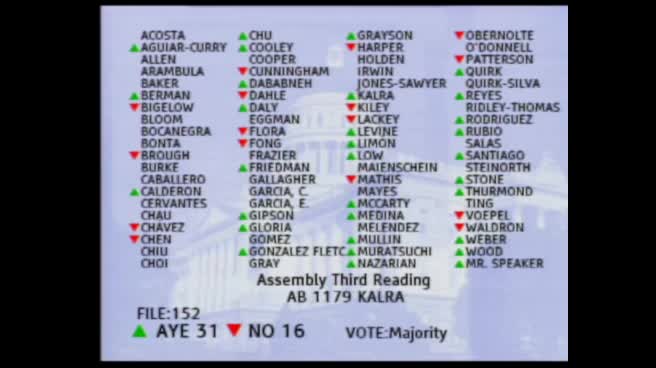 1MIN
Assembly Floor
 1H
Assembly Standing Committee on Appropriations
 18MIN
Assembly Standing Committee on Communications and Conveyance
Bill Author

Bill Co-Author(s):