AB 2560: Taxation: prison contracts: goods and services.
- Session Year: 2017-2018
- House: Assembly
- Latest Version Date: 2018-03-22
Existing law imposes various taxes, including taxes on the privilege of engaging in certain activities. The Fee Collection Procedures Law, the violation of which is a crime, provides procedures for the collection of certain fees and surcharges.
This bill, for the privilege of contracting with the Department of Corrections and Rehabilitation to provide a state prison with goods, services, or both, would impose a tax on vendors, as defined, at specified rates for the final contract price, as defined, for contracts entered into on or after January 1, 2019. The bill would not apply the tax to health care contracts or to contracts with private prison vendors. The bill would require all amounts paid, less refunds, to be deposited into the State Incarceration Prevention Fund, which this bill would establish in the State Treasury, and would continuously appropriate those moneys to the State Department of Education for preschool and after school programs for the purposes of providing services to prevent people from being incarcerated and providing early intervention programs, less the amount needed to reimburse the State Board of Equalization and the Attorney General for costs incurred in administering these provisions and maintaining a database of specified information relating to the contracts. The bill would prohibit this tax from being passed through to the state by way of higher prices for the goods or services in the contract, and would require a vendor to certify under penalty of perjury that this tax was not passed through to the state. The bill would require a vendor to pay a penalty if it fails to comply with these provisions. The bill would require the Attorney General to enforce this prohibition and would authorize the Attorney General to monitor and, if necessary, investigate any instance where a vendor has passed or attempted to pass the tax through to the state. The bill would require the State Board of Equalization to assess and collect the tax imposed by this part pursuant to the Fee Collection Procedures Law and would provide an appeals process for a person from whom the state incarceration prevention tax is determined to be due, as provided. By expanding the application of the Fee Collection Procedures Law, the violation of which is a crime, and by expanding the scope of the crime of perjury, this bill imposes a state-mandated local program.
The California Constitution requires the state to reimburse local agencies and school districts for certain costs mandated by the state. Statutory provisions establish procedures for making that reimbursement.
This bill would provide that no reimbursement is required by this act for a specified reason.
Existing law authorizes the Department of Corrections and Rehabilitation to contract for provisions, clothing, medicines, forage, fuel, and other staple supplies needed for the support of the prisons and specifies the method of awarding contracts for this purpose. This bill would state the intent of the Legislature to enact legislation to place a fee on vendors that contract for goods and services with the Department of Corrections and Rehabilitation to be used for oversight of corrections contractors and fund early education in order to reduce incarceration rates.Existing law authorizes the Department of Corrections and Rehabilitation to contract for provisions, clothing, medicines, forage, fuel, and other staple supplies needed for the support of the prisons and specifies the method of awarding contracts for this purpose.
This bill would state the intent of the Legislature to enact legislation to place a fee on vendors that contract for goods and services with the Department of Corrections and Rehabilitation to be used for oversight of corrections contractors and fund early education in order to reduce incarceration rates.
For the purposes of this part, the following terms shall have the following meanings:
(a)Department means the Department of Corrections and Rehabilitation.
(b)Final contract price means a mutually agreed upon total amount that the department pays to a vendor on completion of the contract, in accordance with contract terms and conditions and their subsequent modifications, for goods, services, or both.
(c)(1)Except as specified in paragraph (2), person means an individual, trust firm, joint stock company, business concern, corporation, including, but not limited to, a government corporation, partnership, limited liability company, and association.
(2)Person shall not include organizations that are exempt from income tax pursuant to Section 23701 of the Revenue and Taxation Code and state and local agencies.
(d)Vendor means a person who contracts with a department to provide a state prison with goods, services, or both.
53002.For contracts entered into on or after January 1, 2019, for the privilege of contracting with the department to provide a state prison with goods, services, or both, except for health care contracts and contracts with private prison vendors, a tax is hereby imposed upon all vendors as follows:
(a)Ten percent on the portion of the contract value exceeding fifty million dollars ($50,000,000).
(b)Nine percent on the portion of the contract value exceeding twenty-five million dollars ($25,000,000) and less than or equal to fifty million dollars ($50,000,000).
(c)Eight percent on the portion of the contract value exceeding ten million dollars ($10,000,000) and less than or equal to twenty-five million dollars ($25,000,000).
(d)Seven percent on the portion of the contract value exceeding five million dollars ($5,000,000) and less than or equal to ten million dollars ($10,000,000).
(e)Six percent on the portion of the contract value exceeding one million dollars ($1,000,000) and less than or equal to five million dollars ($5,000,000).
(f)There is no tax on the portion of the contract less than or equal to one million dollars ($1,000,000).
53004.(a)(1)The tax imposed pursuant to Section 53002 shall be collected annually by the board pursuant to the Fee Collection Procedures Law (Part 30 (commencing with Section 55001)). For the purposes of this part, the references in the Fee Collection Procedures Law to fee shall include the tax imposed by this part, and references to feepayer shall include any vendor.
(2)Notwithstanding the appeal provisions in the Fee Collection Procedures Law, a determination by the department that a person is required to pay the tax, or a determination by the department regarding the amount of that tax, is subject to review pursuant to Section 53006 and is not subject to a petition for redetermination by the board.
(3)(A)Notwithstanding the refund provisions in the Fee Collection Procedures Law, the board shall not accept any claim for refund that is based on the assertion that a determination by the department improperly or erroneously calculated the amount of the tax, or incorrectly determined that the person is subject to that tax, unless that determination has been set aside by the department or a court reviewing the determination of the department.
(B)If it is determined by the department or a reviewing court that a person is entitled to a refund of all or part of the state incarceration prevention tax, the vendor shall make a claim to the board pursuant to Chapter 5 (commencing with Section 55221) of Part 30 of Division 2 of the Revenue and Taxation Code.
(b)(1)On or before each January 1, the department shall annually transmit to the board the name and address of each person who is liable for the tax and the amount of the tax to be assessed. The department also shall provide the board a department contact telephone number to be printed on the bill to respond to questions about the tax.
(2)The board shall assess and collect the tax annually on or before April 1 of each year.
53005.Chapter 3.5 (commencing with Section 11340) of Part 1 of Division 3 of Title 2 of the Government Code shall not apply to any standard, criterion, procedure, determination, rule, notice, or guideline established or issued by the board or the Attorney General to implement the purposes of this part.
53006.(a)The State Incarceration Prevention Fund is hereby created in the State Treasury.
(b)The board shall transmit the payments, less refunds, to the State Treasury to be deposited into the State Incarceration Prevention Fund.
(c)Notwithstanding Section 13340 of the Government Code, all amounts deposited into the State Incarceration Prevention Fund shall be continuously appropriated without regard to fiscal years to the following:
(1)The board and the Attorney General for reimbursement of their costs for administering this part, and for administering a publicly accessible database where contractors, contract values, a summary of the contract, and annual payout for the contracts are listed.
(2)The remainder to the State Department of Education to administer grants for preschool and after school programs for the purposes of providing services to prevent people from being incarcerated and providing early intervention programs.
53008.(a)The tax imposed by this part shall not be passed through to the state by way of higher prices for the goods or services in the contract.
(b)A vendor shall certify in the contract under penalty of perjury that the tax imposed by this part was not passed through to the state by way of higher prices for the goods and services in the contract.
(c)The Attorney General shall enforce this section and may monitor and, if necessary, investigate any instance where a vendor has passed or attempted to pass the tax through to the state.
(d)Any vendor that fails to comply with this section shall pay a penalty in an amount not to exceed 1 percent of the final contract price for each instance the vendor fails to comply with this section.
2.Appeals Process53010.A person from whom the tax under this part is determined to be due may petition for a redetermination of whether this part applies to that person within 30 days after service upon him or her of a notice of determination. If a petition for redetermination is not filed within the 30-day period, the amount determined to be due becomes final at the expiration of the 30-day period.
53011.A petition for redetermination of the application of this part shall be in writing and be sent to the department or its designee. The petition shall state the specific grounds upon which the petition is founded and include supporting documentation. The petition may be amended to state additional grounds or provide additional documentation at any time prior to the date that the department issues its order or decision with regard to the petition for redetermination.
53012.If a petition for redetermination of the application of this part is filed within the 30-day period, the department shall reconsider whether the tax is due and make its decision in writing. The department may eliminate the imposition of the tax based on its determination that this part does not apply to the person who filed the petition.
53013.If a timely petition for redetermination has been filed pursuant to Section 53010, all action to collect the tax shall be stayed pending the final decision of the department pursuant to Section 53015.
53014.Notice of the decision of the department pursuant to Section 53012 shall be served on the same date to the board and the person who filed the petition.
53015.The order or decision of the department upon a petition for redetermination of the tax shall become final 30 days after service upon the petitioner of notice of its decision.
53016.The tax determined to be due by the department pursuant to this article is due and payable at the time the notice pursuant to Section 53015 becomes final, and if it is not paid when due, the penalty imposed pursuant to Section 55086 shall be applied.
53017.Written notice required by this article shall be served as follows:
(a)The notice shall be placed in a sealed envelope, with postage paid, addressed to the petitioner at his or her address as it appears in the records of the department. The giving of notice shall be deemed complete at the time of the deposit of the notice in a United States Post Office, or a mailbox, sub-post office, substation, mail chute, or other facility regularly maintained or provided by the United States Postal Service without extension of time for any reason.
(b)In lieu of mailing, a notice may be served personally by delivering it to the person to be served and service shall be deemed complete at the time of delivery. Personal service to a corporation may be made by delivery of a notice to any person designated in the Code of Civil Procedure to be served for the corporation with summons and complaint in a civil action.
53018.A dispute regarding the tax imposed by this part shall be resolved pursuant to this article only.
53019.If the department determines that a person is entitled to a refund of all or part of the tax paid pursuant to this part, the person shall make a claim to the board pursuant to Chapter 5 (commencing with Section 55221).
SEC. 2.No reimbursement is required by this act pursuant to Section 6 of Article XIIIB of the California Constitution because the only costs that may be incurred by a local agency or school district will be incurred because this act creates a new crime or infraction, eliminates a crime or infraction, or changes the penalty for a crime or infraction, within the meaning of Section 17556 of the Government Code, or changes the definition of a crime within the meaning of Section 6 of Article XIIIB of the California Constitution.
SECTION 1.It is the intent of the Legislature to enact legislation to place a fee on vendors that contract for goods and services with the Department of Corrections and Rehabilitation to be used for oversight of corrections contractors and fund early education in order to reduce incarceration rates.It is the intent of the Legislature to enact legislation to place a fee on vendors that contract for goods and services with the Department of Corrections and Rehabilitation to be used for oversight of corrections contractors and fund early education in order to reduce incarceration rates.
|
Date
|
Status
|
|---|---|
| Apr 16, 2018 | In committee: Set, first hearing. Failed passage. |
| Apr 2, 2018 | Re-referred to Com. on REV. & TAX. |
| Mar 22, 2018 | Referred to Com. on REV. & TAX. |
| Feb 16, 2018 | From printer. May be heard in committee March 18. |
| Feb 15, 2018 | Read first time. To print. |
|
Date
|
Description
|
Location
|
Votes
|
|
|---|---|---|---|---|
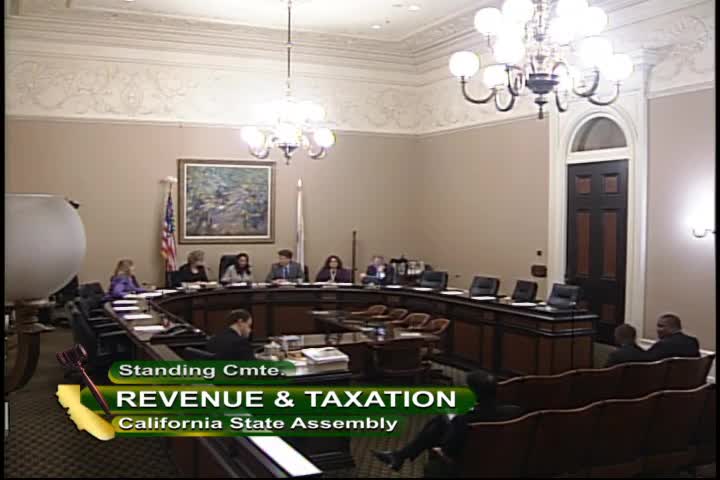
| Apr 16, 2018 | Do pass as amended and be re-referred to the Committee on [Appropriations] | Assembly Standing Committee on Revenue and Taxation |
Passed |
This list shows positions taken on this bill by organizations on the date displayed, which is linked to the original source.
Positions by individuals are not included.
|
Organization
|
Position
|
Date
|
|---|---|---|
| California Alternative Payment Program Association | * Support | Apr 16, 2018 |
| California Chamber Of Commerce | * Against | Apr 16, 2018 |
| California Federation Of Teachers | * Support | Apr 16, 2018 |
| California New Car Dealers Association | ** Against | Apr 13, 2018 |
| California Teacher's Association | * Support | Apr 16, 2018 |
| Howard Jarvis Taxpayers Association | * Against | Apr 16, 2018 |
| National Federation Of Independent Business | * Against | Apr 16, 2018 |
| Vacaville Chamber of Commerce | ** Against | Apr 13, 2018 |
Date of Hearing: April 16, 2018
ASSEMBLY COMMITTEE ON REVENUE AND TAXATION
Autumn R. Burke, Chairwoman
ABPCA Bill Id:AB 2560 (
Author:Thurmond) – As Amended Ver:March 22, 2018
2/3 vote. Fiscal committee.
SUBJECT: Taxation: prison contracts: goods and services
SUMMARY: Imposes a tax, as specified, for the privilege of contracting with the Department of Corrections and Rehabilitation to provide a state prison with goods, services, or both, except for health care contracts and contracts with a private prison vendor, and establishes the State Incarceration Prevention Fund (SIPF) for preschool and after school programs for the purposes of providing services that prevent people from being incarcerated and providing early intervention programs. Specifically, this bill:
- Imposes a tax on a "vendor," on or after January 1, 2019, for the privilege of contracting with the "department" to provide a state prison with goods, services, or both, except for health care contracts and contracts with a private prison vendor, at the following rates:
- 10% on the portion of the contract value that exceeds $50 million;
- 9% on the portion of the contract value that exceeds $25 million and less than or equal to $50 million;
- 8% on the portion of the contract value that exceeds $10 million and less than or equal to $25 million;
- 7% on the portion of the contract value that exceeds $5 million and less than or equal to $10 million;
- 6% on the portion of the contract value that exceeds $1 million and less than or equal to $5 million; and,
- 0% on the portion of the contract value that is less than or equal to $1 million.
- Establishes the SIPF in the State Treasury.
- Provides that the tax shall be collected annually by the board pursuant to the Fee Collection Procedures (FCP) Law. For purposes of the FCP Law, the fee shall include the tax and the feepayer shall include the vendor.
- Defines the "department" as the Department of Corrections and Rehabilitation.
- Defines the "final contract price" as a mutually agreed upon total amount that the "department" pays to a "vendor" on completion of the contract, in accordance with contract terms and conditions and their subsequent modification, for goods, services, or both.
- Defines a "person" as an individual, trust firm, joint stock company, business concern, corporation, including but not limited to a government corporation, partnership, limited liability company, and association. A "person" shall not include organizations that are exempt from income tax, as specified, and state and local agencies.
- Defines a "vendor" as a person who contracts with the department to provide a state prison with goods, services, or both.
- Provides that a determination by the department that a person is required to pay the tax, or a determination by the department regarding the amount of that tax, is not subject to a redetermination by the board.
- Provides that the board shall not accept any claim for refund that is based on the assertion that a determination by the department improperly or erroneously calculated the amount of the tax, or incorrectly determined that the person is subject to that tax, unless the determination has been set aside by the department or a court reviewing the determination of that department. If it is determined by the department or a reviewing court that a person is entitled to a refund of all or part of the state incarceration prevention tax, the vendor shall make a claim to the board.
- Requires, on or after January 1, the department to annually transmit to board the name and address of each person that is liable for the tax and the amount of the tax to be assessed. The department shall also provide the board with a contact number.
- Requires the board to assess and collect the tax annually on or before April 1 of each year.
- Requires the board to transmit the payments, less refunds, to the Treasury to be deposited into the SIPF.
- Provides that all amounts deposited into the SIPF will be continuously appropriated without regard to fiscal years to the board and the Attorney General (AG) for administering a publicly accessible database where contractors, contract values, a summary of the contract, and annual payout for the contracts are listed. The remaining amounts shall be appropriated to the State Department of Education to administer grants for preschool and after school programs for the purpose of providing services to prevent people from being incarcerated and providing early intervention programs.
- Prevents the tax from being passed through to the state by way of higher prices for the goods or services in the contract.
- Requires the vender to certify in the contract, under penalty of perjury, that the tax has not been passed on through to the state by way of higher prices for the goods and services in the contract.
- Allows the AG to monitor and investigate any instances where a vendor has passed or attempted to pass the tax through to the state.
- Imposes a penalty in an amount not to exceed 1% of the final contract price for each instance the vendor fails to comply with the provisions of this bill.
- Allows a person to petition for redetermination of the tax within 30 days after service upon that person of a notice of determination. If a petition for redetermination is not filed within 30 days, the amount determined to be due becomes final. The petition for redetermination must be in writing and state the specific grounds upon which the petition is founded.
- Provides that if the petition for redetermination is filed within the 30-day period, the department shall reconsider whether the tax is due and make its decision in writing. The department may eliminate the tax if it is determined that this tax does not apply to the person.
- Provides that if a petition for redetermination is filed, all action to collect the tax shall be stayed pending the final decision by the department.
- Requires that notice of the department's decision be provided to both the person and the board on the same day.
- Provides that the tax is due and payable at the time the notice becomes final, and if it is not paid when due, a penalty, as specified, shall be applied.
- Provides instructions on how to provide written notice.
- Provides that if the department determines that a refund is owed to the person, the person shall make a claim to the board.
EXISTING LAW:
- Imposes a sales tax on retailers for the privilege of selling tangible personal property (TPP), absent a specific exemption. The tax is based upon the retailer's gross receipts from TPP sales in California. Sales tax applies to a very limited number of services that are closely connected to sales of TPP, such as mandatory service charges at a restaurant.
- Imposes a complementary use tax on the storage, use, or other consumption in this state of TPP purchased from any retailer. The use tax is imposed on the purchaser, and unless the purchaser pays the use tax to a retailer registered to collect the California use tax, the purchaser remains liable for the tax, unless the use is exempted. The use tax is set at the same rate as the state's sales tax and must generally be remitted to California Department on Tax and Fee Administration (DTF).
FISCAL EFFECT: Unknown
COMMENTS:
- The author has provided the following statement in support of this bill:
For profit companies generate large profits from the incarceration of Californians by contracting with the Department of Corrections and Rehabilitation. The corrections budget has steadily increased at a rate that far outpaces investments in early education opportunities. AB 2560 reverses this trend and moves money out of the corrections budget into education. Pre-school and after school programs are shown to reduce incarceration rates and improve outcomes for participant students. AB 2560 put a serious financial commitment behind incarceration rate reduction and provides much needed public access to for-profit corrections contracting.
- Proponents state that "California spends huge amounts to incarcerate prisoners. Current active contracts between for-profit companies and the California Department of Corrections and Rehabilitation total approximately $4.5 billion. In comparison, the state spends relatively little on programs known to prevent incarceration. Investing in preschool and after school programs will reduce the school-to-prison pipeline. Attempts to invest heavily in incarceration prevention programs have been stymied by budget concerns. Without a permanent non-budgetary funding source, these efforts are unlikely to experience continued success."
- Opponents of this bill state that "[w]hile still a detrimental tax on small business, HJTA notes that this bill is narrower in application and dollar amount when compared to a similar bill, AB 2303 (Thurmond). AB 2303 which HJTA also opposes, imposes a flat ten percent rate on all vendor contracts regardless of the amount, and would also apply not only to CDCR but state prisons and the Department of General Services as well. Any revenue generated from either bill would pay for preschool and after school programs."
- Committee Staff Comments:
- What does this bill do? This bill would impose a progressive tax for the privilege of contracting with the Department of Corrections and Rehabilitation to provide a state prison with goods or services. This bill would not apply to contracts related to healthcare or private prison vendors. AB 2303 (Thurmond), a related bill, imposes a 10% tax on contracts with private prisons. The funds from this bill's tax would be deposited in a newly created SIPF. These funds would be provided to preschool and after school programs to prevent people from being incarcerated and to provide early intervention programs.
- Who pays the tax? This bill requires that none of the tax imposed on prison contracts be passed on to the state. Unfortunately, the economic incidence of the tax does not depend on who is legally obligated to pay the tax but instead depends on the price elasticity of demand and the price elasticity of supply. "Elasticity" refers to the degree to which individuals, consumers, or producers change their demand or the amount supplied in response to changes in price or income. Theoretically, the incidence of a tax would fall only on the consumer (i.e., state) if the demand for services and goods was perfectly inelastic meaning that, irrespective of the price, the quantity of services or goods purchased would be exactly the same. However, there is no such thing as a perfectly inelastic or elastic product; all markets fall between these two extremes, and ultimately the economic incidence of the tax is shared by both producers and consumers. It is, therefore, impossible to ensure that the tax imposed by this bill will not be passed on to the state. Assuming that the provisions of this bill become law, some taxpayers that supply services to prisons might cease providing those services for fear of being investigated by the AG. Alternatively, certain taxpayers may choose to pass on the tax to the state and pay the 1% penalty, which would also be shared by the state.
- Future savings: The fact that the tax will inevitably be shared by both the state and the supplier may be an acceptable consequence when one considers the possibility of reducing future incarceration rates. Studies have shown that a number of adult and juvenile justice and prevention programs have resulted in statistically significant reductions in crime and some of those programs may also render significant financial savings[1]. As an example, functional family therapy (FFT)[2] costs, on average, $2,380 per juvenile participant and can be expected to reduce recidivism rates by 18.1%, generating about $52,156 in life-cycle benefits[3]. The net present value of this juvenile justice program is expected to be $49,776 per youth. As another example, cognitive-behavioral programs[4], which cost about $107 per offender, are expected to reduce recidivism rates by 6.9% and generate about $15,469 in life-cycle benefits. The author states that similar results have been founds with preschool and afterschool programs.
- Taxing services: California charges a sales and use tax on a very small set of services - those that are essentially inseparable from sales of TPP or that are closely connected to sales of TPP, such as mandatory service charges at a restaurant. The tax imposed by this bill functions as a sales tax; although this bill does not outline the number of services that are covered by the tax, this could potentially be the first time a tax is imposed on standalone services.
- Earmarked taxes: Revenues generated by this tax are used to pay for preschool and after school programs that prevent people from being incarcerated and to provide early intervention programs. If this tax were to work as envisioned, funding for preschool and prevention programs would reduce future incarceration and recidivism rates which, in turn, would further reduce funding for these programs. In a way, this tax functions almost as a Pigouvian tax although it is unclear if the tax is meant to reduce crime, the rate of incarceration, or profits generated by companies contracting with state prisons. As noted earlier, the penalty provision in this bill may unintentionally prevent all contracts from being executed and prevent revenue from being generated to fund preschool and after school programs.
The modern criteria for tax design are guided by efficiency, equity, and simplicity. These principles tend to favor broad-based taxes to minimize economic efficiency costs and maximize simplicity[5]. Narrowly based taxes like the one proposed in this bill are not used very often; but if one is to be enacted, a direct link between the tax source and the expenditure should exist. It is true that private companies profit from contracting with state prisons, but these entities are not necessarily responsible for incarcerating individuals. These private companies do not enact sentencing guidelines nor do they necessarily engage in criminal justice policy. This bill also allocates funds to "preschool and afterschool programs for the purposes of providing services to prevent people from being incarcerated and providing early intervention programs," but most preschools and afterschool programs are not specifically designed as early intervention programs or to prevent people from being incarcerated. It may be, as the author contends, that individuals who participate in preschool and afterschool programs are less likely to be incarcerated but these programs are not specifically designed with that goal in mind. It is, therefore, unclear if a nexus exists between the wide range of industries that provide goods and services to prisons and preschool and afterschool programs, whose primary goal is to educate the public.
- Reference to board: Revenue and Taxation Code Section 20 defines “board” as the DTF, except as otherwise provided. However, this bill does not specifically reference DTF. The author may wish to amend this bill to substitute "board" with the "California Department of Tax and Fee Administration" to avoid confusion.
- Related Legislation: AB 2303 (Thurmond) imposes a 10% tax on all private, for-profit prisons for the privilege of contracting with the department to provide a state prison with goods, services, or both. The revenues generated from AB 2303 would also be deposited in a newly created SIPF. Unlike this bill, AB 2303 appears to limit the tax to private, for-profit prisons that contract with the Department of Corrections and Rehabilitations. AB 2303 will be heard by this Committee today.
- We Meet Again: AB 43 (Thurmond), would have enacted provisions similar to this bill. AB 43 was held on the Assembly Committee on Appropriations’ Suspense File.
REGISTERED SUPPORT / OPPOSITION:
Support
California Alternative Payment Program Association
California Teachers Association
Opposition
California Chamber of Commerce
California New Car Dealers Association
Howard Jarvis Taxpayers Association
National Federation of Independent Business
Vacaville Chamber of Commerce
Analysis Prepared by: Carlos Anguiano / REV. & TAX. / (916) 319-2098
Drake, E.K., Aos, S., & Miller, M.G., Evidence-based public policy options to reduce crime and criminal justice costs: Implications in Washington State. Victims and Offenders (2009).; Reynolds, A.J., & Temple, J.A., Prevention and cost-effectiveness in early intervention: A 20-year follow-up of a Child-Parent Center cohort. Minneapolis, McEvoy Lecture Series on Early Childhood and Public Policy, Humphrey Institute of Public Affairs, University of Minnesota (2006).; Cohen, M.A., & Piquero, A.R., New evidence on the monetary value of saving a high-risk youth. Journal of Quantitative Criminology (2009). ↑
FFT programs involve an FFT-trained therapist working for about three months with a youth in the juvenile justice system and his or her family with the goal of increasing the likelihood that the youth will stay out of future trouble. ↑
Life-cycle benefits are measured in terms of the taxpayer and crime victim costs that are avoided because of the reduced long-run level of criminal activity. ↑
Cognitive behavior programs are a short-term, goal-oriented psychotherapy treatment that takes a hands-on, practical approach to problem-solving with the goal of changing patterns of thinking or behavior that are behind people’s difficulties and so changing the way those people feel. ↑
Carling, Tax Earmarking: Is It Good Practice? The Center for Independent Studies (2007). ↑
Discussed in Hearing
 17MIN
Assembly Standing Committee on Revenue and Taxation
Bill Author

Bill Co-Author(s):