AB 2598: Cities and counties: ordinances: violations.
- Session Year: 2017-2018
- House: Assembly
- Latest Version Date: 2018-09-30
Existing law authorizes the legislative body of a city or a county to make, by ordinance, any violation of an ordinance subject to an administrative fine or penalty and limits the maximum fine or penalty amounts for infractions, to $100 for the first violation, $200 for a 2nd violation of the same ordinance within one year of the first violation, and $500 for each additional violation of the same ordinance within one year of the first violation. For violations of city or county building and safety codes determined to be an infraction, existing law limits the amount of the fine to $100 for a first violation, $500 for a 2nd violation of the same ordinance within one year, and $1,000 for each additional violation of the same ordinance within one year of the first violation.
The bill would, for violations of a local building and safety code determined to be an infraction, increase the amounts of the fines to $130 for a first violation, $700 for a 2nd violation of the same ordinance within one year, and $1,300 for each additional violation of the same ordinance within one year of the first violation. The bill would additionally provide for a fine of $2,500 for each additional violation of the same ordinance within 2 years of the first violation if the property is a commercial property that has an existing building at the time of the violation and the violation is of a local building and safety code that is an infraction and is due to failure by the owner to remove visible refuse or failure to prohibit unauthorized use of the property.
The bill would additionally require a city or county levying fines pursuant to these provisions to establish a process for granting a hardship waiver to reduce the amount of the fine for a second or third violation of the same ordinance or local building and safety code that is an infraction upon a showing by the responsible party that the responsible party has made a bona fide effort to comply after the first violation and that payment of the full amount of the fine would impose an undue financial burden on the responsible party.
Existing law authorizes the legislative body of a city or a county to make, by ordinance, any violation of an ordinance subject to an administrative fine or penalty and limits the maximum fine or penalty amounts for infractions, to $100 for the first violation, $200 for a 2nd violation of the same ordinance within one year of the first violation, and $500 for each additional violation of the same ordinance within one year of the first violation. For violations of city or county building and safety codes determined to be an infraction, existing law limits the amount of the fine to $100 for a first violation, $500 for a 2nd violation of the same ordinance within one year, and $1,000 for each additional violation of the same ordinance within one year of the first violation.
This bill would, for infractions, increase the amounts of the fines to $130 for a first violation, $300 for a 2nd violation of the same ordinance within one year, and $800 for each additional violation of the same ordinance within one year of the first violation. The bill would, for violations of a local building and safety code determined to be an infraction, increase the amounts of the fines to $130 for a first violation, $700 for a 2nd violation of the same ordinance within one year, and $1,300 for each additional violation of the same ordinance within one year of the first violation. The bill would additionally provide for a fine of $2,500 for each additional violation of the same ordinance within 2 years of the first violation if the property is a commercial property and the violation is of a local building and safety code that is an infraction and is due to failure by the owner to remove visible refuse or failure to prohibit unauthorized use of the property.The bill would additionally require a city or county levying these fines pursuant to these provisions to establish a process for granting a hardship waiver to reduce the amount of the fine for a second or third violation of the same ordinance or local building and safety code that is an infraction upon a showing by the responsible party that the responsible party has made a bona fide effort to comply after the first violation and that payment of the full amount of the fine would impose an undue financial burden on the responsible party.
Existing law authorizes the legislative body of a city or a county to make, by ordinance, any violation of an ordinance subject to an administrative fine or penalty and limits the maximum fine or penalty amounts for infractions, to $100 for the first violation, $200 for a 2nd violation of the same ordinance within one year of the first violation, and $500 for each additional violation of the same ordinance within one year of the first violation. For violations of city or county building and safety codes determined to be an infraction, existing law limits the amount of the fine to $100 for a first violation, $500 for a 2nd violation of the same ordinance within one year, and $1,000 for each additional violation of the same ordinance within one year of the first violation.
This bill would would, for infractions, increase the amount for a first violation to $150. the amounts of the fines to $130 for a first violation, $300 for a 2nd violation of the same ordinance within one year, and $800 for each additional violation of the same ordinance within one year of the first violation. The bill would, for violations of a local building and safety code determined to be an infraction, increase the amounts of the fines to $130 for a first violation, $700 for a 2nd violation of the same ordinance within one year, and $1,300 for each additional violation of the same ordinance within one year of the first violation. The bill would additionally provide for a fine of $2,500 for each additional violation of the same ordinance within 2 years of the first violation if the property is a commercial property and the violation is due to failure by the owner to remove visible refuse or failure to prohibit unauthorized use of the property.
The bill would additionally require a city or county levying these fines to establish a process for granting a hardship waiver to reduce the amount of the fine upon a showing by the responsible party that the responsible party has made a bona fide effort to comply after the first violation and that payment of the full amount of the fine would impose an undue financial burden on the responsible party.
Existing law authorizes the legislative body of a city to make, by ordinance, any violation of an ordinance subject to an administrative fine or penalty and limits the maximum fine or penalty amounts for infractions, to $100 for the first violation, $200 for a 2nd violation of the same ordinance within one year of the first violation, and $500 for each additional violation of the same ordinance within one year of the first violation.
This bill would increase the amount for a first violation to $150.
(a)Violation of a county ordinance is a misdemeanor unless by ordinance it is made an infraction. The violation of a county ordinance may be prosecuted by county authorities in the name of the people of the State of California, or redressed by civil action.
(b)Every violation that is an infraction is punishable by the following:
(1)A fine not exceeding one hundred dollars ($100) for a first violation.
(2)A fine not exceeding two hundred dollars ($200) for a second violation of the same ordinance within one year of the first violation.
(3)A fine not exceeding five hundred dollars ($500) for each additional violation of the same ordinance within one year of the first violation.
(c)Notwithstanding any other law, a violation of local building and safety codes that is an infraction is punishable by the following:
(1)A fine not exceeding one hundred thirty dollars ($130) for a first violation.
(2)A fine not exceeding seven hundred dollars ($700) for a second violation of the same ordinance within one year of the first violation.
(3)(A)A fine not exceeding one thousand three hundred dollars ($1,300) for each additional violation of the same ordinance within one year of the first violation.
(B)A fine not exceeding two thousand five hundred dollars ($2,500) for each additional violation of the same ordinance within two years of the first violation if the property is a commercial property that has an existing building at the time of the violation and the violation is due to failure by the owner to remove visible refuse or failure to prohibit unauthorized use of the property.
(d)A county levying a fine pursuant to paragraphs (2) and (3) of subdivisions (b) and (c) shall establish a process for granting a hardship waiver to reduce the amount of the fine upon a showing by the responsible party that the responsible party has made a bona fide effort to comply after the first violation and that payment of the full amount of the fine would impose an undue financial burden on the responsible party.
(e)(1)Notwithstanding any other law, including subdivisions (b) and (c), a violation of an event permit requirement that is an infraction is punishable by the following:
(A)A fine not exceeding one hundred fifty dollars ($150) for the first violation of an event permit requirement.
(B)A fine not exceeding seven hundred dollars ($700) for a second occurrence of the same violation of an event permit requirement by the same owner or operator within three years of the first violation.
(C)A fine not exceeding two thousand five hundred dollars ($2,500) for each additional occurrence of the same violation of an event permit requirement by the same owner or operator within three years of the first violation.
(2)(A)For purposes of this subdivision, violation of an event permit requirement means failure to obtain a permit required for a professionally organized special event on private property that is commercial in nature, or from which the owner or operator derives a commercial benefit.
(B)For purposes of this paragraph, the following definitions apply:
(i)Commercial in nature means that a primary purpose of the special event is to derive an economic benefit resulting from the holding of the event through admission charges or sales of merchandise that occur as part of the event.
(ii)Commercial benefit means any remuneration received in exchange for allowing the property on which the event occurs to be used for the event, including any remuneration that results from the rental of the property for a term of less than 31 consecutive days.
SEC. 2.Section 36900 of the Government Code is amended to read:36900.(a)Violation of a city ordinance is a misdemeanor unless by ordinance it is made an infraction. The violation of a city ordinance may be prosecuted by city authorities in the name of the people of the State of California, or redressed by civil action.
(b)Every violation determined to be an infraction is punishable by the following:
(1)A fine not exceeding one hundred dollars ($100) for a first violation.
(2)A fine not exceeding two hundred dollars ($200) for a second violation of the same ordinance within one year.
(3)A fine not exceeding five hundred dollars ($500) for each additional violation of the same ordinance within one year.
(c)Notwithstanding any other provision of law, a violation of local building and safety codes determined to be an infraction is punishable by the following:
(1)A fine not exceeding one hundred thirty dollars ($130) for a first violation.
(2)A fine not exceeding seven hundred dollars ($700) for a second violation of the same ordinance within one year.
(3)(A)A fine not exceeding one thousand three hundred dollars ($1,300) for each additional violation of the same ordinance within one year of the first violation.
(B)A fine not exceeding two thousand five hundred dollars ($2,500) for each additional violation of the same ordinance within two years of the first violation if the property is a commercial property that has an existing building at the time of the violation and the violation is due to failure by the owner to remove visible refuse or failure to prohibit unauthorized use of the property.
(d)A city levying a fine pursuant to paragraphs (2) and (3) of subdivisions (b) and (c) shall establish a process for granting a hardship waiver to reduce the amount of the fine upon a showing by the responsible party that the responsible party has made a bona fide effort to comply after the first violation and that payment of the full amount of the fine would impose an undue financial burden on the responsible party.
(a)Violation of a county ordinance is a misdemeanor unless by ordinance it is made an infraction. The violation of a county ordinance may be prosecuted by county authorities in the name of the people of the State of California, or redressed by civil action.
(b)Every violation that is an infraction is punishable by the following:
(1)A fine not exceeding one hundred thirty dollars ($130) ($100) for a first violation.
(2)A fine not exceeding three two hundred dollars ($300) ($200) for a second violation of the same ordinance within one year of the first violation.
(3)A fine not exceeding eight five hundred dollars ($800) ($500) for each additional violation of the same ordinance within one year of the first violation.
(c)Notwithstanding any other law, a violation of local building and safety codes that is an infraction is punishable by the following:
(1)A fine not exceeding one hundred thirty dollars ($130) for a first violation.
(2)A fine not exceeding seven hundred dollars ($700) for a second violation of the same ordinance within one year of the first violation.
(3)(A)A fine not exceeding one thousand three hundred dollars ($1,300) for each additional violation of the same ordinance within one year of the first violation.
(B)A fine not exceeding two thousand five hundred dollars ($2,500) for each additional violation of the same ordinance within two years of the first violation if the property is a commercial property and the violation is due to failure by the owner to remove visible refuse or failure to prohibit unauthorized use of the property.
(d)A county levying a fine pursuant to paragraphs (2) and (3) of subdivisions (b) and (c) shall establish a process for granting a hardship waiver to reduce the amount of the fine upon a showing by the responsible party that the responsible party has made a bona fide effort to comply after the first violation and that payment of the full amount of the fine would impose an undue financial burden on the responsible party.
(e)(1)Notwithstanding any other law, including subdivisions (b) and (c), a violation of an event permit requirement that is an infraction is punishable by the following:
(A)A fine not exceeding one hundred fifty dollars ($150) for the first violation of an event permit requirement.
(B)A fine not exceeding seven hundred dollars ($700) for a second occurrence of the same violation of an event permit requirement by the same owner or operator within three years of the first violation.
(C)A fine not exceeding two thousand five hundred dollars ($2,500) for each additional occurrence of the same violation of an event permit requirement by the same owner or operator within three years of the first violation.
(2)(A)For purposes of this subdivision, violation of an event permit requirement means failure to obtain a permit required for a professionally organized special event on private property that is commercial in nature, or from which the owner or operator derives a commercial benefit.
(B)For purposes of this paragraph, the following definitions apply:
(i)Commercial in nature means that a primary purpose of the special event is to derive an economic benefit resulting from the holding of the event through admission charges or sales of merchandise that occur as part of the event.
(ii)Commercial benefit means any remuneration received in exchange for allowing the property on which the event occurs to be used for the event, including any remuneration that results from the rental of the property for a term of less than 31 consecutive days.
SEC. 2.Section 36900 of the Government Code is amended to read:36900.(a)Violation of a city ordinance is a misdemeanor unless by ordinance it is made an infraction. The violation of a city ordinance may be prosecuted by city authorities in the name of the people of the State of California, or redressed by civil action.
(b)Every violation determined to be an infraction is punishable by the following:
(1)A fine not exceeding one hundred thirty dollars ($130) ($100) for a first violation.
(2)A fine not exceeding three two hundred dollars ($300) ($200) for a second violation of the same ordinance within one year.
(3)A fine not exceeding eight five hundred dollars ($800) ($500) for each additional violation of the same ordinance within one year.
(c)Notwithstanding any other provision of law, a violation of local building and safety codes determined to be an infraction is punishable by the following:
(1)A fine not exceeding one hundred thirty dollars ($130) for a first violation.
(2)A fine not exceeding seven hundred dollars ($700) for a second violation of the same ordinance within one year.
(3)(A)A fine not exceeding one thousand three hundred dollars ($1,300) for each additional violation of the same ordinance within one year of the first violation.
(B)A fine not exceeding two thousand five hundred dollars ($2,500) for each additional violation of the same ordinance within two years of the first violation if the property is a commercial property and the violation is due to failure by the owner to remove visible refuse or failure to prohibit unauthorized use of the property.
(d)A city levying a fine pursuant to paragraphs (2) and (3) of subdivisions (b) and (c) shall establish a process for granting a hardship waiver to reduce the amount of the fine upon a showing by the responsible party that the responsible party has made a bona fide effort to comply after the first violation and that payment of the full amount of the fine would impose an undue financial burden on the responsible party.
(a)Violation of a county ordinance is a misdemeanor unless by ordinance it is made an infraction. The violation of a county ordinance may be prosecuted by county authorities in the name of the people of the State of California, or redressed by civil action.
(b)Every violation that is an infraction is punishable by the following:
(1)A fine not exceeding one hundred thirty dollars ($100) ($130) for a first violation.
(2)A fine not exceeding two three hundred dollars ($200) ($300) for a second violation of the same ordinance within one year of the first violation.
(3)A fine not exceeding five eight hundred dollars ($500) ($800) for each additional violation of the same ordinance within one year of the first violation.
(c)Notwithstanding any other law, a violation of local building and safety codes that is an infraction is punishable by the following:
(1)A fine not exceeding one hundred thirty dollars ($100) ($130) for a first violation.
(2)A fine not exceeding five seven hundred dollars ($500) ($700) for a second violation of the same ordinance within one year of the first violation.
(3)(A)A fine not exceeding one thousand three hundred dollars ($1,000) ($1,300) for each additional violation of the same ordinance within one year of the first violation.
(B)A fine not exceeding two thousand five hundred dollars ($2,500) for each additional violation of the same ordinance within two years of the first violation if the property is a commercial property and the violation is due to failure by the owner to remove visible refuse or failure to prohibit unauthorized use of the property.
(d)A county levying a fine pursuant to paragraphs (2) and (3) of subdivisions (b) and (c) shall establish a process for granting a hardship waiver to reduce the amount of the fine upon a showing by the responsible party that the responsible party has made a bona fide effort to comply after the first violation and that payment of the full amount of the fine would impose an undue financial burden on the responsible party.
(d)(e)(1)Notwithstanding any other law, including subdivisions (b) and (c), a violation of an event permit requirement that is an infraction is punishable by the following:
(A)A fine not exceeding one hundred fifty dollars ($150) for the first violation of an event permit requirement.
(B)A fine not exceeding seven hundred dollars ($700) for a second occurrence of the same violation of an event permit requirement by the same owner or operator within three years of the first violation.
(C)A fine not exceeding two thousand five hundred dollars ($2,500) for each additional occurrence of the same violation of an event permit requirement by the same owner or operator within three years of the first violation.
(2)(A)For purposes of this subdivision, violation of an event permit requirement means failure to obtain a permit required for a professionally organized special event on private property that is commercial in nature, or from which the owner or operator derives a commercial benefit.
(B)For purposes of this paragraph, the following definitions apply:
(i)Commercial in nature means that a primary purpose of the special event is to derive an economic benefit resulting from the holding of the event through admission charges or sales of merchandise that occur as part of the event.
(ii)Commercial benefit means any remuneration received in exchange for allowing the property on which the event occurs to be used for the event, including any remuneration that results from the rental of the property for a term of less than 31 consecutive days.
SECTION 1.SEC. 2.Section 36900 of the Government Code is amended to read:36900.(a)Violation of a city ordinance is a misdemeanor unless by ordinance it is made an infraction. The violation of a city ordinance may be prosecuted by city authorities in the name of the people of the State of California, or redressed by civil action.
(b)Every violation determined to be an infraction is punishable by the following:
(1)A fine not exceeding one hundred fifty thirty dollars ($150) ($130) for a first violation.
(2)A fine not exceeding two three hundred dollars ($200) ($300) for a second violation of the same ordinance within one year.
(3)A fine not exceeding five eight hundred dollars ($500) ($800) for each additional violation of the same ordinance within one year.
(c)Notwithstanding any other provision of law, a violation of local building and safety codes determined to be an infraction is punishable by the following:
(1)A fine not exceeding one hundred thirty dollars ($100) ($130) for a first violation.
(2)A fine not exceeding five seven hundred dollars ($500) ($700) for a second violation of the same ordinance within one year.
(3)(A)A fine not exceeding one thousand three hundred dollars ($1,000) ($1,300) for each additional violation of the same ordinance within one year of the first violation.
(B)A fine not exceeding two thousand five hundred dollars ($2,500) for each additional violation of the same ordinance within two years of the first violation if the property is a commercial property and the violation is due to failure by the owner to remove visible refuse or failure to prohibit unauthorized use of the property.
(d)A city levying a fine pursuant to paragraphs (2) and (3) of subdivisions (b) and (c) shall establish a process for granting a hardship waiver to reduce the amount of the fine upon a showing by the responsible party that the responsible party has made a bona fide effort to comply after the first violation and that payment of the full amount of the fine would impose an undue financial burden on the responsible party.
(a)Violation of a city ordinance is a misdemeanor unless by ordinance it is made an infraction. The violation of a city ordinance may be prosecuted by city authorities in the name of the people of the State of California, or redressed by civil action.
(b)Every violation determined to be an infraction is punishable by (1) a the following:
(1)A fine not exceeding one hundred fifty dollars ($100) ($150) for a first violation; (2) a violation.
(2)A fine not exceeding two hundred dollars ($200) for a second violation of the same ordinance within one year; (3) a year.
(3)A fine not exceeding five hundred dollars ($500) for each additional violation of the same ordinance within one year.
(c)Notwithstanding any other provision of law, a violation of local building and safety codes determined to be an infraction is punishable by (1) a the following:
(1)A fine not exceeding one hundred dollars ($100) for a first violation; (2) a violation.
(2)A fine not exceeding five hundred dollars ($500) for a second violation of the same ordinance within one year; (3) a year.
(3)A fine not exceeding one thousand dollars ($1,000) for each additional violation of the same ordinance within one year of the first violation.
|
Date
|
Status
|
|---|---|
| Sep 30, 2018 | Chaptered by Secretary of State - Chapter 970, Statutes of 2018. |
| Sep 30, 2018 | Approved by the Governor. |
| Aug 28, 2018 | Enrolled and presented to the Governor at 3 p.m. |
| Aug 23, 2018 | Senate amendments concurred in. To Engrossing and Enrolling. |
| Aug 9, 2018 | In Assembly. Concurrence in Senate amendments pending. May be considered on or after August 11 pursuant to Assembly Rule 77. |
| Aug 9, 2018 | Read third time. Passed. Ordered to the Assembly. |
| Jun 21, 2018 | Read second time. Ordered to third reading. |
| Jun 20, 2018 | From committee: Do pass. (Ayes 5. Noes 1.) (June 20). |
| Jun 14, 2018 | From committee chair, with author's amendments: Amend, and re-refer to committee. Read second time, amended, and re-referred to Com. on GOV. & F. |
| Jun 7, 2018 | In committee: Set, first hearing. Hearing canceled at the request of author. |
| May 17, 2018 | Referred to Com. on GOV. & F. |
| May 3, 2018 | In Senate. Read first time. To Com. on RLS. for assignment. |
| May 3, 2018 | Read third time. Passed. Ordered to the Senate. |
| Apr 17, 2018 | Read second time. Ordered to third reading. |
| Apr 16, 2018 | Read second time and amended. Ordered returned to second reading. |
| Apr 12, 2018 | From committee: Amend, and do pass as amended. (Ayes 8. Noes 1.) (April 11). |
| Apr 2, 2018 | Re-referred to Com. on L. GOV. |
| Mar 22, 2018 | Referred to Com. on L. GOV. |
| Feb 16, 2018 | From printer. May be heard in committee March 18. |
| Feb 15, 2018 | Read first time. To print. |
|
Date
|
Description
|
Location
|
Votes
|
|
|---|---|---|---|---|
| Aug 23, 2018 | AB 2598 QUIRK Concurrence in Senate Amendments | Assembly Floor |
Passed |
|
| Aug 9, 2018 | Assembly 3rd Reading AB2598 Quirk By McGuire | Senate Floor |
Passed |
|
| Jun 20, 2018 | Do pass | Senate Standing Committee on Governance and Finance |
Passed |
|
| May 3, 2018 | AB 2598 QUIRK Assembly Third Reading | Assembly Floor |
Passed |
|
| Apr 11, 2018 | Do pass as amended. | Assembly Standing Committee on Local Government |
Passed |
This list shows positions taken on this bill by organizations on the date displayed, which is linked to the original source.
Positions by individuals are not included.
|
Organization
|
Position
|
Date
|
|---|---|---|
| American Civil Liberties Union of California | ** Against | Apr 10, 2018 |
| California Association Of Code Enforcement Officers | ** Support | Jun 22, 2018 |
| California College And University Police Chiefs Association | ** Support | Jun 22, 2018 |
| California Narcotic Officers Association | ** Support | Jun 22, 2018 |
| California Newspapers Publishers Association | * Against | Apr 18, 2018 |
| California State ASsociaiton of Counties | * Support | Apr 11, 2018 |
| City Of Martinez | ** Support | Jun 22, 2018 |
| City of Union City | ** Support | Jun 22, 2018 |
| East Bay Community Law Center | ** Against | Apr 10, 2018 |
| League Of California Cities | ** Support | Jun 22, 2018 |
| Legal Services for Prisoners with Children | ** Against | Apr 10, 2018 |
| Los Angeles County Professional Officers Association | ** Support | Jun 22, 2018 |
| Riverside County Board of Supervisors | ** Support | Jun 22, 2018 |
| The Western Center on Law and Poverty | * Indeterminate | Apr 11, 2018 |
| Unknown. | ** Against | Jun 18, 2018 |
CONCURRENCE IN SENATE AMENDMENTS
CSA1 Bill Id:AB 2598
Author:(Quirk)
As Amended Ver:June 14, 2018
Majority vote
ASSEMBLY: | 54-17 | (May 3, 2018) | SENATE: | 24-10 | (August 9, 2018) |
Original Committee Reference: L. GOV.
SUMMARY: Increases the fine amounts that counties and cities may assess for violations of their building and safety codes, and creates a new fine for specified violations of building and safety codes on commercial property.
The Senate amendments clarify that a commercial property must have an existing building at the time of violation for the new fine this bill creates for specified violations of building and safety codes on commercial property.
FISCAL EFFECT: None
COMMENTS:
- Background. A county or city may make and enforce within its limits all local, police, sanitary, and other ordinances and regulations not in conflict with general laws. This "police power" provides the right to adopt and enforce zoning regulations, as long as they do not conflict with state laws.
Current law allows counties and cities to establish ordinances, and makes violations of ordinances misdemeanors, unless by ordinance the county or city makes them infractions. The violation of an ordinance may be prosecuted by county or city authorities in the name of the people of the State of California, or redressed by civil action. Current law outlines the following fine structure for ordinance violations, and for building and safety code violations, that are determined to be infractions:
Number of violations within specified time periods | Amount of fine for ordinance violations that are infractions (last adjusted in 1983) | Amount of fine for building and safety code violations that are infractions (established in 2003) |
First violation | Fine does not exceed $100 | Fine does not exceed $100 |
Second violation within one year of first violation | Fine does not exceed $200 | Fine does not exceed $500 |
Third violation within one year of first violation | Fine does not exceed $500 | Fine does not exceed $1,000 |
The fine amounts for ordinance violations have not been adjusted since 1983. An attempt to do so was made in 2003, but the Legislature chose instead to establish the increased fine amounts for building and safety code violations. These fine amounts have not changed since then.
In addition to the fines outlined above, counties (not cities) may assess fines specifically for a violation of an event permit requirement that is an infraction. These fines are capped at $150 for a first violation, $700 for a second occurrence of the same violation by the same owner or operator within three years of the first violation, and $2,500 for each additional occurrence of the same violation by the same owner or operator within three years of the first violation. These special fines were enacted just last year, via AB 556 (Limón), Chapter 405, Statutes of 2017.
- Fines in Today's Dollars. As noted above, the fine amounts for ordinance violations have not been increased since 1983. The fine amounts for building and safety code violations were established in 2003 and have not been adjusted since then. In today's dollars, these amounts would be approximately as follows:
Number of violations within specified time periods | Amount of fine for ordinance violations (adjusted from 1983) | Amount of fine for building and safety code violations (adjusted from 2003) |
First violation | Fine does not exceed $254 | Fine does not exceed $136 |
Second violation within one year of first violation | Fine does not exceed $509 | Fine does not exceed $680 |
Third violation within one year of first violation | Fine does not exceed $1,272 | Fine does not exceed $1,360 |
- Additional Penalties Levied by the Courts. Pursuant to the Penal Code and the Government Code, additional penalties are levied on every fine, penalty or forfeiture imposed by and collected by the courts for criminal offenses. Penal Code Section 1464 levies a penalty of $10 for every $10 or fraction thereof on every fine, penalty or forfeiture imposed by and collected by the courts for criminal offenses. Penal Code Section 1465.7 requires a state surcharge of 20% to be levied on every base fine collected by the courts. Government Code Section 76000 levies an additional penalty of $7 for every $10 or fraction thereof upon every fine, penalty, or forfeiture imposed and collected by the courts for criminal offenses.
- Nuisance Abatement. Both cities and counties are allowed, via ordinance, to establish administrative procedures for abating nuisances that include the ability to recover abatement costs via special assessments and abatement liens. A public nuisance is generally defined as "Anything which is injurious to health, or is indecent, or offensive to the senses, or an obstruction to the free use of property, so as to interfere with the comfortable enjoyment of life or property by an entire community or neighborhood, or by any considerable number of persons, or unlawfully obstructs the free passage or use, in the customary manner, of any navigable lake, or river, bay, stream, canal, or basin, or any public park, square, street, or highway." In addition, a city's legislative body may declare what constitutes a nuisance via ordinance.
- Bill Summary. This bill increases the fines that counties and cities may assess for violations of their local building and safety codes, and adds a new fine for specified repeat violations of building and safety codes on commercial property.
The proposed fine structure is as follows:
Number of violations within specified time periods | Amount of fine for building and safety code violations that are infractions |
First violation | Fine does not exceed $130 |
Second violation within one year of first violation | Fine does not exceed $700 |
Subsequent violations within one year of first violation | Fine does not exceed $1,300 |
Subsequent violations within two years of first violation, if the property is a commercial property that has an existing building at the time of the violation and the violation is due to failure by the owner to remove visible refuse or failure to prohibit unauthorized use of the property | Fine does not exceed $2,500 |
A county or city levying a fine for repeat violations, as specified above, must establish a process for granting a hardship waiver to reduce the amount of the fine if the responsible party shows a bona fide effort to comply after the first violation, and demonstrates that payment of the full amount of the fine would impose an undue financial burden on the responsible party.
This bill is sponsored by the League of California Cities and the California Association of Code Enforcement Officers.
- Author's Statement. According to the author, "Cities across California are struggling with how to deal with abandoned buildings. Many have expressed frustration at the restrictions they face with respect to fines they can issue owners for failure to properly maintain their properties…In my district, there have been numerous incidences of commercial property owners refusing to properly maintain vacant properties, leading to the accumulation of debris and brake-ins. Such is the case with a building across from my district office that has been abandoned for over 20 years.
"Maximum permitted fines for local building and safety codes have not been updated in over 15 years. Additionally, in some cases, court processes to collect fines have become too onerous for cities and counties to collect. The statutory fines should be updated to at least reflect inflation, in order to enable cities and counties to effectively enforce local ordinances and building and safety codes.
"AB 2598 adjusts the fees that counties and cities may assess and collect for violations of local building and safety codes with inflation. This bill will help cities and counties hold owners accountable to their communities by maintaining property values and reducing crime and other risks to public health."
- Policy Considerations. The Legislature may wish to consider the following:
- Nuisance Abatement Procedures. As noted above, cities and counties are able to abate nuisances and hold property owners accountable for those costs via special assessments and abatement liens. The Legislature may wish to consider whether cities and counties already have the necessary authority to address the conditions that the author has cited as the impetus for this bill.
- Court Action. Existing law provides that a violation of an ordinance may be prosecuted by city or county authorities, or redressed by civil action. The Legislature may wish to consider whether this bill is needed, given these avenues of redress.
- Legislative Review. The Legislature may wish to consider adding a sunset date to allow the Legislature to revisit this bill's increased fine amounts to determine if they do, indeed, result in greater compliance with local ordinances.
- Arguments in Support. The League of California Cities, sponsor of this bill, writes, "Local ordinances and building and safety codes reflect policies adopted by communities to establish standards, resolve issues, maintain public and private property, and protect public health and safety. There must be adequate enforcement mechanisms for these laws to be effective. While existing law authorizes various levels of fines, including up to $100 for the first violation, these statutory amounts have not been updated in many years.
"Inadequate penalties can erode respect for the law. If the consequences for violating a local ordinance or building standard are deemed to be minimal then some community members will ignore the law and create inequities in its application. For instance, if an ordinance requires dry brush to be cleared for fire protection, and a property owner chooses not to do so, they could be placing the homes of their neighboring properties at risk. If one property owner allows trash and junk to build up on their property, it could attract vermin and devalue adjacent properties.
"Obviously, the appropriate level of the fines is a policy question. They need to be high enough to encourage compliance, while avoiding being overly burdensome or disproportionate on the unaware or first offenders, with more severe penalties for those that violate repeatedly. This measure would update for inflation the fine levels for repeated violations, while continuing to keep the initial fine lower…Further, the bill establishes a hardship waiver process for repeated violators who have made a bona fide effort to comply with the first violation and payment of the additional fines would create an undue financial hardship."
- Arguments in Opposition. None on file.
Analysis Prepared by: Angela Mapp / L. GOV. / (916) 319-3958 FN: 0003580
Office of Senate Floor Analyses (916) 651-1520 Fax: (916) 327-4478 | AB |
THIRD READING
Bill No: AB 2598
:
SENATE GOVERNANCE & FIN. COMMITTEE: 5-1, 6/20/18
AYES: McGuire, Beall, Hernandez, Hertzberg, Lara
NOES: Nguyen
NO VOTE RECORDED: Moorlach
ASSEMBLY FLOOR: 54-17, 5/3/18 - See last page for vote
DIGEST:
This bill increases the maximum administrative fines for violations of local building codes and safety standards.
Existing law:
- Allows counties and cities to adopt and enforce ordinances that regulate local health, safety, peace, and welfare.
- Allows, as an alternative to civil and criminal enforcement mechanisms, a local agency’s legislative body to make any violation of any of its ordinances subject to an administrative fine or penalty (SB 814, Alquist, 1995).
- Provides that a violation of a city ordinance is a misdemeanor unless by ordinance it is made an infraction. In general, every ordinance violation that is determined to be an infraction is punishable by:
- A fine not exceeding $100 for a first violation.
- A fine not exceeding $200 for a second violation of the same ordinance within one year.
- A fine not exceeding $500 for each additional violation of the same ordinance within one year.
- Establishes higher limits for a violation of local building and safety codes determined to be an infraction, punishable by:
- A fine not exceeding $100 for a first violation.
- A fine not exceeding $500 for a second violation of the same ordinance within one year.
- A fine not exceeding $1,000 for each additional violation of the same ordinance within one year.
- Allows cities to impose fines and penalties through civil or criminal proceedings. These fines and penalties are limited to $1,000 per violation and six months in prison.
This bill:
- Increases the maximum fine that a city may impose administratively for a violation of local building and safety codes, to:
- $130 for a first violation;
- $700 for a second violation of the same ordinance within one year, and;
- $1,300 for each additional violation of the same ordinance within one year or $2,500 for each additional violation of the same ordinance within two years of the first violation if the property is a commercial property that has an existing building at the time of the violation and the violation is due to the failure by the owner to remove visible refuse or failure to prohibit unauthorized use of the property.
- Requires a city or county levying any fines for a second or subsequent violation of any ordinance to establish a process for granting a hardship waiver to reduce the amount of the fine upon a showing by the responsible party that they have made a bona fide effort to comply after the first violation and that payment of the full amount of the fine would impose an undue financial burden.
- Makes technical changes.
Background
- Purpose of the bill. Local ordinances and building and safety codes reflect policies adopted by communities to establish standards, resolve issues, maintain public and private property, and protect public health and safety. In order for such laws to be effective there must be adequate enforcement mechanisms. But state law limits the fines that cities may administratively impose for violations of local building and safety codes, and these caps have not been updated since 2003. Because of inflation, the deterrent effect of these penalties has been eroded in that time, leading to nuisances and other problems that put lives at risk and reduce property values. AB 2598 helps local agencies protect the public’s health and safety by updating the maximum amount a city can fine a recalcitrant property owner for local building and safety code violations—keeping pace with inflation. At the same time, the bill also contains provisions providing local governments with discretion in how little to charge—AB 2598 simply gives them an option when stronger incentives to remedy public safety issues are needed.
- Juice. Excessive fines—especially when combined with additional fees imposed through the court process—can weigh heavily on people with limited means, while having a limited deterrent effect on those with deeper pockets. AB 2598 increases the maximum fines for violations of local building codes in an effort to encourage greater compliance, but city officials may seek the maximum fines for other reasons, without regard for the deterrent effect or the effect on the person responsible for the violation. Over the past several decades, city budgets have been squeezed by ballot measures such as Proposition 13 and Proposition 218 and new mandates from the state policymakers. Local government revenue sources are often constrained to specific purposes, leaving cities with fewer general fund resources. Fine revenues are one remaining source of funds for general activities. As such, cities may be tempted to maximize revenue from fines. For example, San Mateo has come under scrutiny for excessive fines for violations caught by red light cameras—garnering $2.4 million in 2014. In addition, local governments can impose higher fines through the courts. Are the increased fines in AB 2598 truly necessary?
Related/Prior Legislation
AB 2164 (Cooley, 2018) allows local agencies to immediately impose fines for building standard violations related to the illegal cultivation of cannabis instead of allowing a reasonable time to cure the violation.
SB 1416 (McGuire, 2018) authorizes local governments to recover nuisance abatement fines through special assessments and nuisance abatement liens.
AB 345 (Ridley-Thomas, 2017) contained substantially similar provisions increasing fines for building code violations, although it did not include the $2,500 fine and the hardship waiver when the Committee heard the bill. AB 345 was subsequently amended for an unrelated purpose.
AB 556 (Limon, Chapter 405, Statutes of 2017) increased the maximum fines for violations of county event permit ordinances where the activity is commercial in nature.
FISCAL EFFECT: Appropriation: Fiscal Com.: Local:
California Association of Code Enforcement Officers
California College and University Police Chiefs Association
California Narcotic Officers Association
City of Martinez
City of Union City
League of California Cities
Los Angeles County Professional Officers Association
Riverside County Board of Supervisors
OPPOSITION: (Verified 6/22/18)
None received
ASSEMBLY FLOOR: 54-17, 5/3/18
AYES: Aguiar-Curry, Arambula, Berman, Bloom, Bonta, Burke, Calderon, Carrillo, Cervantes, Chau, Chávez, Chiu, Chu, Cooley, Cooper, Cunningham, Daly, Eggman, Frazier, Friedman, Eduardo Garcia, Gipson, Gloria, Gonzalez Fletcher, Gray, Holden, Irwin, Jones-Sawyer, Kalra, Kamlager-Dove, Lackey, Levine, Limón, Low, Maienschein, McCarty, Medina, Mullin, Muratsuchi, Nazarian, O'Donnell, Quirk, Reyes, Rodriguez, Rubio, Salas, Santiago, Mark Stone, Thurmond, Ting, Waldron, Weber, Wood, Rendon
NOES: Acosta, Baker, Bigelow, Brough, Chen, Choi, Dahle, Gallagher, Harper, Kiley, Mathis, Mayes, Melendez, Obernolte, Patterson, Steinorth, Voepel
NO VOTE RECORDED: Travis Allen, Caballero, Flora, Fong, Cristina Garcia, Grayson, Quirk-Silva
6/22/18 14:40:22
**** END ****
SENATE COMMITTEE ON GOVERNANCE AND FINANCE
Senator Mike McGuire, Chair
2017 - 2018 Regular
Bill No: | AB 2598 | Hearing Date: | 6/20/18 |
Author: | Quirk | Tax Levy: | No |
Version: | 6/14/18 Amended | Fiscal: | No |
Consultant: | Favorini-Csorba | ||
Cities and counties: ordinances: violations
Increases the maximum administrative fines for violations of local building codes and safety standards.
Background
Local penalties for ordinance violations. As an alternative to civil and criminal enforcement mechanisms, a local agency’s legislative body can make any violation of any of its ordinances subject to an administrative fine or penalty (SB 814, Alquist, 1995). The local agency must adopt an ordinance specifying the administrative procedures that govern the imposition, enforcement, collection, and administrative review of the fines or penalties. The administrative procedures must grant a reasonable time to remedy a continuing violation before the imposition of administrative fines or penalties, when the violation pertains to building, plumbing, electrical, or other similar structural and zoning issues that do not create an immediate danger to health or safety. Within 20 days after service of a final administrative order or decision regarding administrative fines or penalties, a person contesting that final administrative order or decision may appeal in Superior Court. Local agencies must go through a civil court proceeding to collect unpaid fines and penalties.
Under state law, a violation of a local ordinance is a misdemeanor unless by ordinance it is made an infraction. In general, every ordinance violation that is determined to be an infraction is punishable by:
- A fine not exceeding $100 for a first violation.
- A fine not exceeding $200 for a second violation of the same ordinance within one year.
- A fine not exceeding $500 for each additional violation of the same ordinance within one year.
As an exception to the general limits on fines for infractions, SB 567 (Torlakson, 2003) established higher limits for a violation of local building and safety codes determined to be an infraction. These violations are punishable by:
- A fine not exceeding $100 for a first violation.
- A fine not exceeding $500 for a second violation of the same ordinance within one year.
- A fine not exceeding $1,000 for each additional violation of the same ordinance within one year.
Last year, the Legislature added a second exception to allow for increased fines for violations of event permit requirements. Specifically, AB 556 (Limon, 2017) increased the maximum fines for violations of county event permit ordinances where the activity is commercial in nature to $150 for the first violation, $700 for the second violation within 3 years, and $2,500 for the third violation within 3 years.
Cities and counties may also impose fines and penalties through civil or criminal proceedings. These fines and penalties are limited to $1,000 per violation and six months in prison.
Additional penalties. Under the Penal Code and the Government Code, additional penalties are levied on every fine, penalty, or forfeiture imposed by and collected by the courts for criminal offenses. If a city or county chooses to prosecute a violation of its ordinances through the courts, rather than its administrative procedures, these additional penalties are added to the fines for infractions or misdemeanors. These add-ons include:
- A penalty of $10 for every $10 or fraction thereof on every fine, penalty or forfeiture imposed by and collected by the courts for criminal offenses.
- A state surcharge of 20% to be levied on every base fine collected by the court.
- An additional penalty of $7 for every $10 or fraction thereof upon every fine, penalty, or forfeiture imposed and collected by the courts for criminal offenses.
Some local officials suggest that the maximum fine amounts that local governments can impose under current law are too low to encourage negligent property owners to fix building and safety code violations. To help local governments deter this kind of behavior, the League of California Cities and the California Association of Code Enforcement Officers want the Legislature to increase the maximum fines that they can impose for building ordinance violations and to allow cities and counties to include nuisance related fines in abatement liens and assessments.
Proposed Law
Assembly Bill 2598 increases the maximum fine that a city or county may impose administratively for a violation of local building and safety codes to:
- $130 for a first violation;
- $700 for a second violation of the same ordinance within one year; and
- $1,300 for each additional violation of the same ordinance within one year or $2,500 for each additional violation of the same ordinance within two years of the first violation if the property is a commercial property that has an existing building at the time of the violation and the violation is due to the failure by the owner to remove visible refuse or failure to prohibit unauthorized use of the property.
AB 2598 requires a city or county levying any fines for a second or subsequent violation of any ordinance to establish a process for granting a hardship waiver to reduce the amount of the fine upon a showing by the responsible party that they have made a bona fide effort to comply after the first violation and that payment of the full amount of the fine would impose an undue financial burden.
AB 2598 makes additional technical changes.
State Revenue Impact
No estimate.
Comments
1. Purpose of the bill. Local ordinances and building and safety codes reflect policies adopted by communities to establish standards, resolve issues, maintain public and private property, and protect public health and safety. In order for such laws to be effective there must be adequate enforcement mechanisms. But state law limits the fines that cities may administratively impose for violations of local building and safety codes, and these caps have not been updated since 2003. Because of inflation, the deterrent effect of these penalties has been eroded in that time, leading to nuisances and other problems that put lives at risk and reduce property values. AB 2598 helps local agencies protect the public’s health and safety by updating the maximum amount a city can fine a recalcitrant property owner for local building and safety code violations—keeping pace with inflation. At the same time, the bill also contains provisions providing local governments with discretion in how little to charge—AB 2598 simply gives them an option when stronger incentives to remedy public safety issues are needed.
2. Juice. Excessive fines—especially when combined with additional fees imposed through the court process—can weigh heavily on people with limited means, while having a limited deterrent effect on those with deeper pockets. AB 2598 increases the maximum fines for violations of local building codes in an effort to encourage greater compliance, but city officials may seek the maximum fines for other reasons, without regard for the deterrent effect or the effect on the person responsible for the violation. Over the past several decades, city budgets have been squeezed by ballot measures such as Proposition 13 and Proposition 218 and new mandates from the state policymakers. Local government revenue sources are often constrained to specific purposes, leaving cities with fewer general fund resources. Fine revenues are one remaining source of funds for general activities. As such, cities may be tempted to maximize revenue from fines. For example, San Mateo has come under scrutiny for excessive fines for violations caught by red light cameras—garnering $2.4 million in 2014. In addition, local governments can impose higher fines through the courts. Are the increased fines in AB 2598 truly necessary?
3. Related legislation. The Committee has considered a number of bills in recent years related to fines and fees. AB 2164 (Cooley), which the Committee will hear at its June 27th hearing, allows local agencies to immediately impose fines for building standard violations related to the illegal cultivation of cannabis instead of allowing a reasonable time to cure the violation.
SB 1416 (McGuire), which the Committee passed at its May 9th hearing on a vote of 5-0, would authorize local governments to recover nuisance abatement fines through special assessments and nuisance abatement liens. SB 1416 is currently pending in the Assembly Local Government Committee.
AB 345 (Ridley-Thomas, 2017) contained substantially similar provisions increasing fines for building code violations, although it did not include the $2,500 fine and the hardship waiver when the Committee heard the bill. AB 345 passed the Senate Governance and Finance Committee by a vote of 5-1 but was subsequently amended for an unrelated purpose.
AB 556 (Limon, 2017), which the Committee passed at its June 28th, 2017, hearing on a vote of 6-1, increased the maximum fines for violations of county event permit ordinances where the activity is commercial in nature.
AB 514 (Williams, 2015) would have increased maximum fines for violations of specified types of county ordinances to the lesser of three times the cost of the permit or $5,000 for the first violation, $10,000 for the second violation, and $15,000 for the third violation, if the local government made a finding that that fine wouldn’t impose an undue hardship and that the violation posed an unusual health or safety threat. AB 514 passed the Senate Governance and Finance Committee by a vote of 5-1 but was vetoed by the Governor with the following message:
“I am returning Assembly Bill 514 without my signature. This bill increases the maximum amount of administrative fines and penalties that counties can impose for violations of certain local ordinances. The public's health and safety is compromised when people willfully violate county ordinances. Deterring such behavior is a worthwhile goal. This bill, however, lacks the balance needed to prevent unintended consequences, especially on those with modest means and those who are unfamiliar with their local ordinances.”
Assembly Actions
Assembly Local Government Committee: 8-1
Assembly Floor: 54-17
Support and Opposition
(6/15/18)
Support: California Association of Code Enforcement Officers; California College and University Police Chiefs Association; California Narcotic Officers Association; City of Martinez; City of Union City; League of California Cities; Los Angeles County Professional Officers Association; Riverside County Board of Supervisors.
Opposition: Unknown.
-- END --
ASSEMBLY THIRD READING
ATR Bill Id:AB 2598
Author:(Quirk)
As Amended Ver:April 16, 2018
Majority vote
Committee | Votes | Ayes | Noes |
Local Government | 8-1 | Aguiar-Curry, Waldron, Bloom, Caballero, Cooley, Grayson, Lackey, Gloria | Voepel |
SUMMARY: Increases the fine amounts that counties and cities may assess for violations of their building and safety codes, and creates a new fine for specified violations of building and safety codes on commercial property. Specifically, this bill:
- Provides that a violation of local building and safety codes determined to be an infraction is punishable by the following:
- A fine not exceeding $130 for a first violation (increased from the current $100 limit);
- A fine not exceeding $700 for a second violation of the same ordinance within one year (increased from the current $500 limit);
- A fine not exceeding $1,300 for each additional violation of the same ordinance within one year of the first violation (increased from the current $1,000 limit); and,
- A fine not exceeding $2,500 for each additional violation of the same ordinance within two years of the first violation if the property is a commercial property and the violation is due to failure by the owner to remove visible refuse or failure to prohibit unauthorized use of the property.
- Requires a county or city levying a fine for repeat violations, as specified above, to establish a process for granting a hardship waiver to reduce the amount of the fine upon a showing by the responsible party that the responsible party has made a bona fide effort to comply after the first violation and that payment of the full amount of the fine would impose an undue financial burden on the responsible party.
FISCAL EFFECT: None
COMMENTS:
- Background. A county or city may make and enforce within its limits all local, police, sanitary, and other ordinances and regulations not in conflict with general laws. This "police power" provides the right to adopt and enforce zoning regulations, as long as they do not conflict with state laws.
Current law allows counties and cities to establish ordinances, and makes violations of ordinances misdemeanors, unless by ordinance the county or city makes them infractions. The violation of an ordinance may be prosecuted by county or city authorities in the name of the people of the State of California, or redressed by civil action. Current law outlines the following fine structure for ordinance violations, and for building and safety code violations, that are determined to be infractions:
Number of violations within specified time periods | Amount of fine for ordinance violations that are infractions (last adjusted in 1983) | Amount of fine for building and safety code violations that are infractions (established in 2003) |
First violation | Fine does not exceed $100 | Fine does not exceed $100 |
Second violation within one year of first violation | Fine does not exceed $200 | Fine does not exceed $500 |
Third violation within one year of first violation | Fine does not exceed $500 | Fine does not exceed $1,000 |
The fine amounts for ordinance violations have not been adjusted since 1983. An attempt to do so was made in 2003, but the Legislature chose instead to establish the increased fine amounts for building and safety code violations. These fine amounts have not changed since then.
In addition to the fines outlined above, counties (not cities) may assess fines specifically for a violation of an event permit requirement that is an infraction. These fines are capped at $150 for a first violation, $700 for a second occurrence of the same violation by the same owner or operator within three years of the first violation, and $2,500 for each additional occurrence of the same violation by the same owner or operator within three years of the first violation. These special fines were enacted just last year, via AB 556 (Limón), Chapter 405, Statutes of 2017.
- Fines in Today's Dollars. As noted above, the fine amounts for ordinance violations have not been increased since 1983. The fine amounts for building and safety code violations were established in 2003 and have not been adjusted since then. In today's dollars, these amounts would be approximately as follows:
Number of violations within specified time periods | Amount of fine for ordinance violations (adjusted from 1983) | Amount of fine for building and safety code violations (adjusted from 2003) |
First violation | Fine does not exceed $254 | Fine does not exceed $136 |
Second violation within one year of first violation | Fine does not exceed $509 | Fine does not exceed $680 |
Third violation within one year of first violation | Fine does not exceed $1,272 | Fine does not exceed $1,360 |
- Additional Penalties Levied by the Courts. Pursuant to the Penal Code and the Government Code, additional penalties are levied on every fine, penalty or forfeiture imposed by and collected by the courts for criminal offenses. Penal Code Section 1464 levies a penalty of $10 for every $10 or fraction thereof on every fine, penalty or forfeiture imposed by and collected by the courts for criminal offenses. Penal Code Section 1465.7 requires a state surcharge of 20% to be levied on every base fine collected by the courts. Government Code Section 76000 levies an additional penalty of $7 for every $10 or fraction thereof upon every fine, penalty, or forfeiture imposed and collected by the courts for criminal offenses.
- Nuisance Abatement. Both cities and counties are allowed, via ordinance, to establish administrative procedures for abating nuisances that include the ability to recover abatement costs via special assessments and abatement liens. A public nuisance is generally defined as "Anything which is injurious to health, or is indecent, or offensive to the senses, or an obstruction to the free use of property, so as to interfere with the comfortable enjoyment of life or property by an entire community or neighborhood, or by any considerable number of persons, or unlawfully obstructs the free passage or use, in the customary manner, of any navigable lake, or river, bay, stream, canal, or basin, or any public park, square, street, or highway." In addition, a city's legislative body may declare what constitutes a nuisance via ordinance.
- Bill Summary. This bill increases the fines that counties and cities may assess for violations of their local building and safety codes, and adds a new fine for specified repeat violations of building and safety codes on commercial property.
The proposed fine structure is as follows:
Number of violations within specified time periods | Amount of fine for building and safety code violations that are infractions |
First violation | Fine does not exceed $130 |
Second violation within one year of first violation | Fine does not exceed $700 |
Subsequent violations within one year of first violation | Fine does not exceed $1,300 |
Subsequent violations within two years of first violation, if the property is a commercial property and the violation is due to failure by the owner to remove visible refuse or failure to prohibit unauthorized use of the property | Fine does not exceed $2,500 |
A county or city levying a fine for repeat violations, as specified above, must establish a process for granting a hardship waiver to reduce the amount of the fine if the responsible party shows a bona fide effort to comply after the first violation, and demonstrates that payment of the full amount of the fine would impose an undue financial burden on the responsible party.
This bill is sponsored by the League of California Cities and the California Association of Code Enforcement Officers.
- Author's Statement. According to the author, "Cities across California are struggling with how to deal with abandoned buildings. Many have expressed frustration at the restrictions they face with respect to fines they can issue owners for failure to properly maintain their properties…In my district, there have been numerous incidences of commercial property owners refusing to properly maintain vacant properties, leading to the accumulation of debris and brake-ins. Such is the case with a building across from my district office that has been abandoned for over 20 years.
"Maximum permitted fines for local building and safety codes have not been updated in over 15 years. Additionally, in some cases, court processes to collect fines have become too onerous for cities and counties to collect. The statutory fines should be updated to at least reflect inflation, in order to enable cities and counties to effectively enforce local ordinances and building and safety codes.
"AB 2598 adjusts the fees that counties and cities may assess and collect for violations of local building and safety codes with inflation. This bill will help cities and counties hold owners accountable to their communities by maintaining property values and reducing crime and other risks to public health."
- Policy Considerations. The Legislature may wish to consider the following:
- Nuisance Abatement Procedures. As noted above, cities and counties are able to abate nuisances and hold property owners accountable for those costs via special assessments and abatement liens. The Legislature may wish to consider whether cities and counties already have the necessary authority to address the conditions that the author has cited as the impetus for this bill.
- Court Action. Existing law provides that a violation of an ordinance may be prosecuted by city or county authorities, or redressed by civil action. The Legislature may wish to consider whether this bill is needed, given these avenues of redress.
- Legislative Review. The Legislature may wish to consider adding a sunset date to allow the Legislature to revisit this bill's increased fine amounts to determine if they do, indeed, result in greater compliance with local ordinances.
- Previous Legislation. AB 345 (Ridley-Thomas) of 2017, would have allowed cities and counties to recover nuisance abatement fines through nuisance abatement liens and special assessments, and would have increased the maximum allowable fines for violations of city building and safety codes. AB 345 was subsequently amended to address a different subject.
AB 556 (Limón), Chapter 405, Statutes of 2017, allowed counties to assess increased fines for a violation of an event permit requirement that is an infraction as follows: a fine not exceeding $150 for the first violation; a fine not exceeding $700 for a second occurrence of the same violation by the same owner or operator within three years of the first violation; and, a fine not exceeding $2,500 for each additional occurrence of the same violation by the same owner or operator within three years of the first violation.
AB 514 (Williams) of 2015, would have allowed counties to assess larger administrative fines for specified violations of county ordinances determined to be infractions that govern building and safety, brush removal, grading, film permitting, and zoning. AB 514 was vetoed with the following message:
The public's health and safety is compromised when people willfully violate county ordinances. Deterring such behavior is a worthwhile goal. This bill, however, lacks the balance needed to prevent unintended consequences, especially on those with modest means and those who are unfamiliar with their local ordinances.
- Arguments in Support. The League of California Cities, sponsor of this bill, writes, "Local ordinances and building and safety codes reflect policies adopted by communities to establish standards, resolve issues, maintain public and private property, and protect public health and safety. There must be adequate enforcement mechanisms for these laws to be effective. While existing law authorizes various levels of fines, including up to $100 for the first violation, these statutory amounts have not been updated in many years.
"Inadequate penalties can erode respect for the law. If the consequences for violating a local ordinance or building standard are deemed to be minimal then some community members will ignore the law and create inequities in its application. For instance, if an ordinance requires dry brush to be cleared for fire protection, and a property owner chooses not to do so, they could be placing the homes of their neighboring properties at risk. If one property owner allows trash and junk to build up on their property, it could attract vermin and devalue adjacent properties.
"Obviously, the appropriate level of the fines is a policy question. They need to be high enough to encourage compliance, while avoiding being overly burdensome or disproportionate on the unaware or first offenders, with more severe penalties for those that violate repeatedly. This measure would update for inflation the fine levels for repeated violations, while continuing to keep the initial fine lower…Further, the bill establishes a hardship waiver process for repeated violators who have made a bona fide effort to comply with the first violation and payment of the additional fines would create an undue financial hardship."
- Arguments in Opposition. None on file.
Analysis Prepared by: Angela Mapp / L. GOV. / (916) 319-3958 FN: 0002699
Date of Hearing: April 11, 2018
ASSEMBLY COMMITTEE ON LOCAL GOVERNMENT
Cecilia Aguiar-Curry, Chair
ABPCA Bill Id:AB 2598 (
Author:Quirk) – As Amended Ver:March 22, 2018
SUBJECT: Cities: ordinances: violations.
SUMMARY: Increases the fine amounts that counties and cities may assess for violations
of their ordinances and building and safety codes, and creates a new fine for specified violations of building and safety codes on commercial property. Specifically, this bill:
- Provides that every violation of a county or city ordinance determined to be an infraction is punishable by the following:
- A fine not exceeding $130 for a first violation (increased from the current $100 limit);
- A fine not exceeding $300 for a second violation of the same ordinance within one year (increased from the current $200 limit); and,
- A fine not exceeding $800 for each additional violation of the same ordinance within one year (increased from the current $500 limit).
- Provides that a violation of local building and safety codes determined to be an infraction is punishable by the following:
- A fine not exceeding $130 for a first violation (increased from the current $100 limit);
- A fine not exceeding $700 for a second violation of the same ordinance within one year (increased from the current $500 limit);
- A fine not exceeding $1,300 for each additional violation of the same ordinance within one year of the first violation (increased from the current $1,000 limit); and,
- A fine not exceeding $2,500 for each additional violation of the same ordinance within two years of the first violation if the property is a commercial property and the violation is due to failure by the owner to remove visible refuse or failure to prohibit unauthorized use of the property.
- Requires a county or city levying a fine for repeat violations, as specified above, to establish a process for granting a hardship waiver to reduce the amount of the fine upon a showing by the responsible party that the responsible party has made a bona fide effort to comply after the first violation and that payment of the full amount of the fine would impose an undue financial burden on the responsible party.
EXISTING LAW:
- Allows a county or city to make and enforce within its limits all local, police, sanitary, and other ordinances and regulations not in conflict with general laws.
- Allows the legislative body of a city, county, or city and county, to collect any fee, cost,
or charge incurred in specified activities, including the abatement of public nuisances, enforcement of specified zoning ordinances, inspections and abatement of violations of the State Housing Law, inspections and abatement of violations of the California Building Standards Code, and inspections and abatement of violations related to local ordinances that implement these laws. - Limits the amount of a fee, cost, or charge described above to the actual cost incurred performing the inspections and enforcement activity, including permit fees, fines, late charges, and interest.
- Provides that violation of a county or city ordinance is a misdemeanor, unless by ordinance it is made an infraction.
- Provides that a violation of a county or city ordinance may be prosecuted by county or city authorities in the name of the people of the State of California, or redressed by civil action.
- Provides that every violation of a county or city ordinance determined to be an infraction is punishable by the following:
- A fine not exceeding $100 for a first violation;
- A fine not exceeding $200 for a second violation of the same ordinance within one year; and,
- A fine not exceeding $500 for each additional violation of the same ordinance within one year.
- Provides that a violation of local building and safety codes determined to be an infraction is punishable by the following:
- A fine not exceeding $100 for a first violation;
- A fine not exceeding $500 for a second violation of the same ordinance within one year; and,
- A fine not exceeding $1,000 for each additional violation of the same ordinance within one year of the first violation.
- Provides that a violation of a county event permit requirement that is an infraction is punishable by the following:
- A fine not exceeding $150 for the first violation;
- A fine not exceeding $700 for a second occurrence of the same violation by the same owner or operator within three years of the first violation; and,
- A fine not exceeding $2,500 for each additional occurrence of the same violation by the same owner or operator within three years of the first violation.
- Provides for an additional state penalty of $10 for every $10 or fraction thereof levied upon every fine, penalty or forfeiture imposed and collected by the courts for all criminal offenses, including all offenses, except parking offenses, involving the Vehicle Code. The money collected from the penalty is distributed in specified percentages among the Fish and Game Preservation Fund, the Restitution Fund, the Peace Officers Training Fund, the Driver Training Penalty Assessment Fund, the Corrections Training Fund, the Local Public Prosecutors and Public Defenders Training Fund, the Victim-Witness Assistance Fund, and the Traumatic Brain Injury Fund.
- Requires a state surcharge of 20% to be levied on every base fine collected by the court, to be deposited in the General Fund.
- Provides that, in each county, there shall be levied an additional penalty of $7 for every $10 or fraction thereof upon every fine, penalty, or forfeiture imposed and collected by the courts for all criminal offenses, including all offenses involving a violation of the Vehicle Code or any local ordinance adopted pursuant to the Vehicle Code, except parking offenses. The money collected shall be placed in any of the following funds if established by a County Board of Supervisors: a Courthouse Construction Fund; a Criminal Justice Facilities Construction Fund; an Automated Fingerprint Identification Fund; an Emergency Medical Services Fund; and, a DNA Identification Fund.
FISCAL EFFECT: None
COMMENTS:
- Background. A county or city may make and enforce within its limits all local, police, sanitary, and other ordinances and regulations not in conflict with general laws. This "police power" provides the right to adopt and enforce zoning regulations, as long as they do not conflict with state laws.
Current law allows counties and cities to establish ordinances, and makes violations of ordinances misdemeanors, unless by ordinance the county or city makes them infractions. The violation of an ordinance may be prosecuted by county or city authorities in the name of the people of the State of California, or redressed by civil action. Current law outlines the following fine structure for ordinance violations, and for building and safety code violations, that are determined to be infractions:
Number of violations within specified time periods | Amount of fine for ordinance violations that are infractions (last adjusted in 1983) | Amount of fine for building and safety code violations that are infractions (established in 2003) |
First violation | Fine does not exceed $100 | Fine does not exceed $100 |
Second violation within one year of first violation | Fine does not exceed $200 | Fine does not exceed $500 |
Third violation within one year of first violation | Fine does not exceed $500 | Fine does not exceed $1,000 |
The fine amounts for ordinance violations have not been adjusted since 1983. An attempt to do so was made in 2003, but the Legislature chose instead to establish the increased fine amounts for building and safety code violations. These fine amounts have not changed since then.
In addition to the fines outlined above, counties (not cities) may assess fines specifically for a violation of an event permit requirement that is an infraction. These fines are capped at $150 for a first violation, $700 for a second occurrence of the same violation by the same owner or operator within three years of the first violation, and $2,500 for each additional occurrence of the same violation by the same owner or operator within three years of the first violation. These special fines were enacted just last year, via AB 556 (Limón), Chapter 405, Statutes of 2017.
- Fines in Today's Dollars. As noted above, the fine amounts for ordinance violations have not been increased since 1983. The fine amounts for building and safety code violations were established in 2003 and have not been adjusted since then. In today's dollars, these amounts would be approximately as follows:
Number of violations within specified time periods | Amount of fine for ordinance violations (adjusted from 1983) | Amount of fine for building and safety code violations (adjusted from 2003) |
First violation | Fine does not exceed $254 | Fine does not exceed $136 |
Second violation within one year of first violation | Fine does not exceed $509 | Fine does not exceed $680 |
Third violation within one year of first violation | Fine does not exceed $1,272 | Fine does not exceed $1,360 |
- Additional Penalties Levied by the Courts. Pursuant to the Penal Code and the Government Code, additional penalties are levied on every fine, penalty or forfeiture imposed by and collected by the courts for criminal offenses. Penal Code Section 1464 levies a penalty of $10 for every $10 or fraction thereof on every fine, penalty or forfeiture imposed by and collected by the courts for criminal offenses. Penal Code Section 1465.7 requires a state surcharge of 20% to be levied on every base fine collected by the courts. Government Code Section 76000 levies an additional penalty of $7 for every $10 or fraction thereof upon every fine, penalty, or forfeiture imposed and collected by the courts for criminal offenses.
- Nuisance Abatement. Both cities and counties are allowed, via ordinance, to establish administrative procedures for abating nuisances that include the ability to recover abatement costs via special assessments and abatement liens. A public nuisance is generally defined as "Anything which is injurious to health, or is indecent, or offensive to the senses, or an obstruction to the free use of property, so as to interfere with the comfortable enjoyment of life or property by an entire community or neighborhood, or by any considerable number of persons, or unlawfully obstructs the free passage or use, in the customary manner, of any navigable lake, or river, bay, stream, canal, or basin, or any public park, square, street, or highway." In addition, a city's legislative body may declare what constitutes a nuisance via ordinance.
A city ordinance establishing a procedure for nuisance abatement and making the cost of abatement of a nuisance upon a parcel of land a special assessment against that parcel must include notice, by certified mail, to the property owner. The notice must be given at the time of imposing the assessment and must specify that the property may be sold after three years by the tax collector for unpaid delinquent assessments.
The assessment can be collected on the property tax bill, subject to the same penalties, procedures, and sale in case of delinquency as provided for ordinary municipal taxes. All laws regarding the levy, collection, and enforcement of municipal taxes apply to the special assessment. However, if the real property is sold, or becomes foreclosed, before the first installment of the taxes becomes delinquent, then the cost of abatement transfers to the unsecured tax roll for collection.
Alternatively, a city can, by ordinance, establish a procedure to collect abatement costs, including administrative costs, by a nuisance abatement lien. The ordinance must require that the owner of the parcel on which the nuisance is maintained receive notice before recording the abatement lien. If the owner cannot be served with the notice, it can be posted on the property and published in a newspaper. A nuisance abatement lien must be recorded with the county recorder and has the force, effect, and priority of a judgment lien. The lien may be foreclosed by an action brought by the city for a money judgment.
A county ordinance establishing administrative procedures for nuisance abatement must require that the owner of the parcel, and anyone known to be in possession of the parcel, receive notice of the abatement proceeding and have a hearing before the board of supervisors before the county can abate the nuisance. The county supervisors can delegate the hearing to a hearing board or a hearing officer. A county can abate a nuisance that a board of supervisors or county officer determines constitutes an immediate threat to public health or safety.
If the owner fails to pay the county’s abatement costs, the board of supervisors can order the abatement costs to be specially assessed against the parcel. The assessment can be collected on the property tax bill, subject to the same penalties, procedures, and sale in case of delinquency as for ordinary county taxes. All laws regarding the levy, collection, and enforcement of county taxes apply to the special assessment.
If a county specially assesses abatement costs against a parcel, it also can record a notice of abatement lien, which has the same effect as recording an abstract of a money judgment and the same priority as a judgment lien. If no abatement lien is recorded and the real property on which an assessment is imposed is sold, or becomes foreclosed, before the first installment of the taxes becomes delinquent, then the assessment transfers to the unsecured tax roll for collection.
- Bill Summary. This bill increases the fines that counties and cities may assess for violations of their ordinances and local building and safety codes, and adds a new fine for specified repeat violations of building and safety codes on commercial property.
The proposed fine structure is as follows:
Number of violations within specified time periods | Amount of fine for ordinance violations that are infractions | Amount of fine for building and safety code violations that are infractions |
First violation | Fine does not exceed $130 | Fine does not exceed $130 |
Second violation within one year of first violation | Fine does not exceed $300 | Fine does not exceed $700 |
Subsequent violations within one year of first violation | Fine does not exceed $800 | Fine does not exceed $1,300 |
Subsequent violations within two years of first violation, if the property is a commercial property and the violation is due to failure by the owner to remove visible refuse or failure to prohibit unauthorized use of the property | (Not applicable) | Fine does not exceed $2,500 |
A county or city levying a fine for repeat violations, as specified above, must establish a process for granting a hardship waiver to reduce the amount of the fine if the responsible party shows a bona fide effort to comply after the first violation, and demonstrates that payment of the full amount of the fine would impose an undue financial burden on the responsible party.
This bill is sponsored by the League of California Cities and the California Association of Code Enforcement Officers.
- Author's Statement. According to the author, "Cities across California are struggling with how to deal with abandoned buildings. Many have expressed frustration at the restrictions they face with respect to fines they can issue owners for failure to properly maintain their properties…In my district, there have been numerous incidences of commercial property owners refusing to properly maintain vacant properties, leading to the accumulation of debris and brake-ins. Such is the case with a building across from my district office that has been abandoned for over 20 years.
"Maximum permitted fines for local building and safety codes have not been updated in over 15 years. Additionally, in some cases, court processes to collect fines have become too onerous for cities and counties to collect. The statutory fines should be updated to at least reflect inflation, in order to enable cities and counties to effectively enforce local ordinances and building and safety codes.
"AB 2598 adjusts the fees that counties and cities may assess and collect for violations of local building and safety codes with inflation. This bill will help cities and counties hold owners accountable to their communities by maintaining property values and reducing crime and other risks to public health."
- Policy Considerations. The Committee may wish to consider the following:
- Appropriate Remedy? Proponents point to persistently blighted properties and unresponsive property owners as the impetus for this bill. Opponents have raised several concerns with the provisions of this bill that raise fine amounts for general county and city ordinances and their potential impact on disadvantaged populations (see below). The Committee may wish to consider whether increased fines for ordinances generally are likely to provide a remedy for blight, and the detrimental consequences such increases could inflict.
- Nuisance Abatement Procedures. As noted above, cities and counties are able to abate nuisances and hold property owners accountable for those costs via special assessments and abatement liens. The Committee may wish to consider whether cities and counties already have the necessary authority to address the conditions that the author has cited as the impetus for this bill.
- Court Action. Existing law provides that a violation of an ordinance may be prosecuted by city or county authorities, or redressed by civil action. The Committee may wish to consider whether this bill is needed, given these avenues of redress.
- Legislative Review. The Committee may wish to consider adding a sunset date to allow the Legislature to revisit this bill's increased fine amounts to determine if they do, indeed, result in greater compliance with local ordinances.
- Committee Amendment. The Committee may wish to amend the bill to only allow an increase of fines for building and safety codes, rather than for ordinances generally, to address some of the concerns raised above.
- Previous Legislation. AB 345 (Ridley-Thomas) of 2017, would have allowed cities and counties to recover nuisance abatement fines through nuisance abatement liens and special assessments, and would have increased the maximum allowable fines for violations of city building and safety codes. AB 345 was subsequently amended to address a different subject.
AB 556 (Limón), Chapter 405, Statutes of 2017, allowed counties to assess increased fines for a violation of an event permit requirement that is an infraction as follows: a fine not exceeding $150 for the first violation; a fine not exceeding $700 for a second occurrence of the same violation by the same owner or operator within three years of the first violation; and, a fine not exceeding $2,500 for each additional occurrence of the same violation by the same owner or operator within three years of the first violation.
AB 514 (Williams) of 2015, would have allowed counties to assess larger administrative fines for specified violations of county ordinances determined to be infractions that govern building and safety, brush removal, grading, film permitting, and zoning. AB 514 was vetoed with the following message:
"The public's health and safety is compromised when people willfully violate county ordinances. Deterring such behavior is a worthwhile goal. This bill, however, lacks the balance needed to prevent unintended consequences, especially on those with modest means and those who are unfamiliar with their local ordinances."
- Arguments in Support. The League of California Cities, sponsor of this bill, writes, "Local ordinances and building and safety codes reflect policies adopted by communities to establish standards, resolve issues, maintain public and private property, and protect public health and safety. There must be adequate enforcement mechanisms for these laws to be effective. While existing law authorizes various levels of fines, including up to $100 for the first violation, these statutory amounts have not been updated in many years.
"Inadequate penalties can erode respect for the law. If the consequences for violating a local ordinance or building standard are deemed to be minimal then some community members will ignore the law and create inequities in its application. For instance, if an ordinance requires dry brush to be cleared for fire protection, and a property owner chooses not to do so, they could be placing the homes of their neighboring properties at risk. If one property owner allows trash and junk to build up on their property, it could attract vermin and devalue adjacent properties.
"Obviously, the appropriate level of the fines is a policy question. They need to be high enough to encourage compliance, while avoiding being overly burdensome or disproportionate on the unaware or first offenders, with more severe penalties for those that violate repeatedly. This measure would update for inflation the fine levels for repeated violations, while continuing to keep the initial fine lower…Further, the bill establishes a hardship waiver process for repeated violators who have made a bona fide effort to comply with the first violation and payment of the additional fines would create an undue financial hardship."
- Arguments in Opposition. The American Civil Liberties Union of California, in opposition, states, "After extensive publicity about the problems with Ferguson, Missouri, charging its residents high municipal fines to fund its government operations, California has been in the spotlight for similar problems in cities and counties across the state. California counties already impose higher fines and fees than counties in other states. For example, the City and County of San Francisco collects more per capita in municipal fines and fees than other consolidated city-county governments in the United States.
"For the past few decades, municipal fines and fees have been on the rise in California. Since most municipal violations are adjudicated in state traffic courts, they are subject to the state’s numerous add-on fees and assessments. In 2006, a $100 base fine ticket cost $390 after the imposition of state statutory fees and assessments. Today, that same $100 base fine ticket increases to almost $500 after fees and assessments, and jumps to over $800 if a person misses the initial deadline to pay. Such fines and fees can create insurmountable financial burdens for even middle-class Californians, and further trap low-income Californians in vicious cycles of poverty. A 2016 report from the Federal Reserve system revealed that 46% of American families do not have money available to cover an unexpected expense of even $400…
"Unequal enforcement of municipal fines and fees also disproportionately impacts communities of color, and regularly occurs in the context of over-policing. Officers from the San Diego Police Department reported being instructed to enforce public safety laws more leniently in white communities than communities of color, and studies from across California show that black and Latino drivers are disproportionally pulled over more, without good reason, and disproportionately searched.
Municipal code enforcement also often targets homeless people, who can least afford high fines. People that are considered undesirable by local authorities can be cited and arrested under the municipal code for activities such as merely being in public. AB 2598 would draw these individuals into the criminal justice system, and either keep them impoverished on the street or incarcerated, rather than in housing." (citations omitted)
REGISTERED SUPPORT / OPPOSITION:
Support
League of California Cities [CO-SPONSOR]
California Association of Code Enforcement Officers [CO-SPONSOR]
Opposition
American Civil Liberties Union of California
East Bay Community Law Center
Lawyers' Committee for Civil Rights of the San Francisco Bay Area
Legal Services for Prisoners with Children
Western Center on Law and Poverty
Analysis Prepared by: Angela Mapp / L. GOV. / (916) 319-3958
Discussed in Hearing
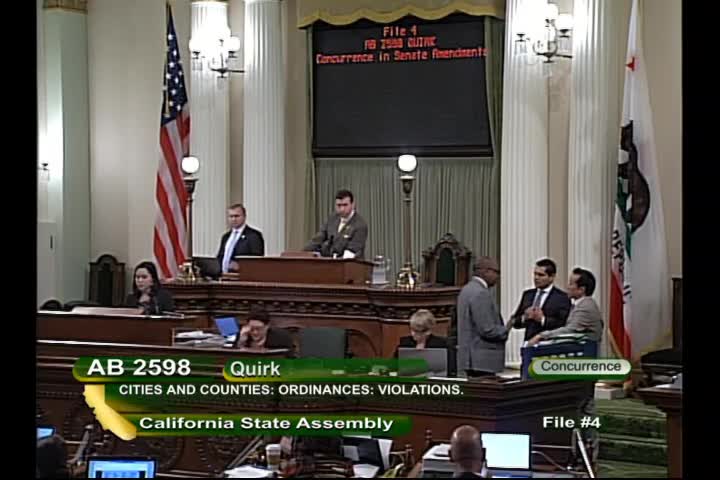 1MIN
Assembly Floor
 2MIN
Senate Floor
 2MIN
Assembly Standing Committee on Appropriations
 1MIN
Assembly Floor
 23MIN
Assembly Standing Committee on Governmental Organization
 9MIN
Assembly Standing Committee on Local Government
Bill Author

Bill Co-Author(s):