AB 2609: Teachers: California Scientist-to-Teacher Pathway Program.
- Session Year: 2017-2018
- House: Assembly
- Latest Version Date: 2018-04-12
Existing law establishes a system of public elementary and secondary schools in this state and authorizes local educational agencies throughout the state to operate schools and provide instruction to pupils in kindergarten and grades 1 to 12, inclusive. Existing law establishes the State Department of Education, under the administration of the Superintendent of Public Instruction, and assigns to the department numerous duties relating to the financing, governance, and guidance of the public elementary and secondary schools in this state.
This bill would establish the California Scientists-to-Teacher Pathway Program for the purpose of recruiting, training, supporting, and retaining qualified science, technology, engineering, and mathematics (STEM) scientists as STEM teachers in kindergarten and grades 1 to 12, inclusive, under the administration of the department, as specified. The bill would require the department, commencing with the 201819 fiscal year, to allocate a one-time grant to an institution of higher education, nonprofit public benefit corporation, county office of education, or a partnership among multiple organizations of these types, for the purposes of the program, as specified, and for subsequent fiscal years if specified conditions are met. The bill would require the department to evaluate the impacts of the program and include that information in a specified report. The bill would require its provisions to be implemented only upon the enactment of an appropriation in the annual Budget Act or another statute for its purposes.
Existing law requires the Commission on Teacher Credentialing to, among other duties, establish standards for the issuance and renewal of credentials, certificates, and permits. Existing law requires the commission to issue single subject teaching credentials in specified subjects. Existing law requires the commission to periodically review and assess the adequacy and relevance of those subjects, and report its findings and recommendations to the Legislature.This bill would instead require the commission to annually review and assess the adequacy and relevance of those subjects, and report its findings and recommendations to the Legislature.Existing law requires the Commission on Teacher Credentialing to, among other duties, establish standards for the issuance and renewal of credentials, certificates, and permits. Existing law requires the commission to issue single subject teaching credentials in specified subjects. Existing law requires the commission to periodically review and assess the adequacy and relevance of those subjects, and report its findings and recommendations to the Legislature.
This bill would instead require the commission to annually review and assess the adequacy and relevance of those subjects, and report its findings and recommendations to the Legislature.
The Legislature finds and declares all of the following:
(a)The shortage of qualified science, technology, engineering, and mathematics (STEM) teachers is at a critical level that threatens the future workforce and economic well-being of the state.
(b)The projected shortage of 33,000 STEM teachers in California over the next decade requires innovative approaches to recruitment and teacher preparation.
(c)The STEM teacher shortage in K-12 grades coincides with a critical job shortage in higher education for early career scientists, which has resulted in a large and increasing number of trained scientists remaining in insecure, poorly compensated instructor and research positions.
(d)Education experts agree that STEM scientists bring unique expertise to the classroom for teaching mathematics and science, addressing the engineering focus within the states new science standards, advancing computer science instruction, and connecting academics and careers.
(e)Major increases in pupil performance and interest in STEM subjects may be achieved by recruiting new K-12 STEM teachers from the states surplus of early career scientists.
(f)Early career scientists in sequentially structured teaching pathways are retained in teaching positions at high rates, resulting in a cost-effective solution for addressing STEM teacher shortages.
SEC. 2.Chapter 3.7 (commencing with Section 44780) is added to Part 25 of Division 3 of Title 2 of the Education Code, to read:3.7.California Scientist-to-Teacher Pathway Program44780.(a)The California Scientist-to-Teacher Pathway Program is hereby established for the purpose of recruiting, training, supporting, and retaining qualified science, technology, engineering, and mathematics (STEM) scientists as STEM teachers in kindergarten and grades 1 to 12, inclusive, (K-12). The program shall be administered by the department, and shall adhere to the minimum criteria, standards, and requirements that are applicable pursuant to Part A (commencing with Section 2101) of Title II of the federal Elementary and Secondary Education Act of 1965, as amended by the federal Every Student Succeeds Act (Public Law 114-95).
(b)(1)Commencing with the 201819 fiscal year, the department shall allocate a one-time grant to an institution of higher education, nonprofit public benefit corporation, county office of education, or a partnership among multiple organizations of these types, for the purposes of this chapter, subject to a competitive grant process.
(2)If sufficient funds provided pursuant Part A (commencing with Section 2101) of Title II of the federal Elementary and Secondary Education Act of 1965, as amended by the federal Every Student Succeeds Act (Public Law 114-95), are available in subsequent fiscal years, the department may award additional one-time grants to the grant recipient under paragraph (1) in those fiscal years.
(c)To be eligible to receive funding under this program, applicants shall have demonstrated expertise in recruiting scientists into K-12 teaching and demonstrate an ability to accomplish all of the following:
(1)Recruit STEM scientists into STEM teaching in K-12 using, but not limited to, the following approaches:
(A)Developing open education resources that are culturally responsive and can be used as outreach statewide to encourage interested STEM scientists to pursue second careers as mathematics and science teachers.
(B)Creating a successful teacher recruitment, training, support, and retention model and framework that can be disseminated and used statewide.
(C)Developing partnerships with STEM Doctor of Philosophy (Ph.D.) programs, masters programs, and university STEM departments to educate graduate students, research scientists, and postdoctoral researchers about careers in STEM teaching.
(2)Support California Scientist-to-Teacher Pathway participants to foster high rates of retention and teacher leadership using all of, but not limited to, the following approaches:
(A)Providing participants with information on the requirements for obtaining teaching credentials, how to complete those steps, how to apply to teacher preparation programs, how to apply for school district internship or residency programs, and how to access financial aid and loan forgiveness programs.
(B)Creating California Scientist-to-Teacher Pathway fellowships to support participants during their transition into the teaching profession and the completion of teacher credentialing requirements. Fellowships may be used to pay a living stipend, tuition and fees, and other costs associated with the credentialing process.
(C)Establishing mentoring relationships between program participants and experienced STEM teachers.
(D)Establishing agreements with teacher credentialing programs to facilitate timely achievement of teaching credentials by STEM scientists and placement of participants into teaching positions.
(E)Providing ongoing support and professional development for participants, including information on content-specific pedagogy and classroom management strategies, through their first year as an instructor of record in a classroom.
(3)Conduct the required evaluation of the California Scientist-to-Teacher Pathway Program pursuant to Section 44781.
44781.(a)The department shall evaluate the impacts of the California Scientist-to-Teacher Pathway Program and include that information in a report submitted on or before January 31, 2025, to the Department of Finance, the relevant policy and fiscal committees of the Legislature, and the Legislative Analyst on the outcomes of the California Scientist-to-Teacher Pathway Program. The report shall address the programs effectiveness at science, technology, engineering, and mathematics (STEM) teacher recruitment and retention and the extent to which continued support of the program would address ongoing and future shortages in STEM teachers, and shall include, but not be limited to, all of the following information:
(1)The number of STEM scientists participating in the California Scientist-to-Teacher Pathway Program and their demographic characteristics.
(2)On an annual basis, the number and demographic characteristics of STEM scientists who received their teaching credential while participating in the California Scientist-to-Teacher Pathway Program, and the schools in which they teach.
(3)Annual job placement data for STEM scientists who received their teaching credential while participating in the California Scientist-to-Teacher Pathway Program, including placement rates, subjects taught, and poverty and achievement levels of the schools of employment.
(4)The total number of STEM scientists who have been trained and retained in STEM teaching positions in kindergarten and grades 1 to 12, inclusive, through the California Scientist-to-Teacher Pathway Program.
(b)As a condition of funding, the grantee shall provide all of the information necessary to generate this report, in a form and manner as determined by the department.
44782.This chapter shall be implemented only upon the enactment of an appropriation in the annual Budget Act or another statute for these purposes.
SECTION 1.Section 44257.4 of the Education Code is amended to read:44257.4.The commission shall annually review and assess the adequacy and relevance of the subjects of teaching credentials set forth in Section 44257, and shall report its findings and recommendations to the Legislature.The commission shall periodically annually review and assess the adequacy and relevance of the subjects of teaching credentials set forth in Section 44257, and shall report its findings and recommendations to the Legislature.
|
Date
|
Status
|
|---|---|
| May 25, 2018 | In committee: Held under submission. |
| May 9, 2018 | In committee: Set, first hearing. Referred to APPR. suspense file. |
| Apr 26, 2018 | From committee: Do pass and re-refer to Com. on APPR. (Ayes 7. Noes 0.) (April 25). Re-referred to Com. on APPR. |
| Apr 16, 2018 | Re-referred to Com. on ED. |
| Apr 12, 2018 | From committee chair, with author's amendments: Amend, and re-refer to Com. on ED. Read second time and amended. |
| Apr 11, 2018 | In committee: Hearing postponed by committee. |
| Mar 8, 2018 | Referred to Com. on ED. |
| Feb 16, 2018 | From printer. May be heard in committee March 18. |
| Feb 15, 2018 | Read first time. To print. |
|
Date
|
Description
|
Location
|
Votes
|
|
|---|---|---|---|---|
| Apr 25, 2018 | Do pass and be re-referred to the Committee on [Appropriations] | Assembly Standing Committee on Education |
Passed |
This list shows positions taken on this bill by organizations on the date displayed, which is linked to the original source.
Positions by individuals are not included.
|
Organization
|
Position
|
Date
|
|---|---|---|
| Aerojet Rocketdyne Foundation | ** Support | Apr 23, 2018 |
| Alder Graduate School Of Education | ** Support | Apr 23, 2018 |
| Alliance Alice M. Baxter College-Ready High School | ** Support | Apr 23, 2018 |
| Alliance College-Ready Public Schools | ** Support | Apr 23, 2018 |
| Arthur A. Benjamin Health Professions High School | ** Support | Apr 23, 2018 |
| Bayer | ** Support | Apr 23, 2018 |
| California Science Teachers Association | * Support | Apr 25, 2018 |
| California STEM Network | ** Support | Apr 23, 2018 |
| California STEM Network | * Support | Apr 25, 2018 |
| Center For Powerful Public Schools | ** Support | Apr 23, 2018 |
| Encore STEM Teacher's Program | * Support | Apr 25, 2018 |
| Encorps Stem Teachers | ** Support | Apr 23, 2018 |
| Institute For Stem Education--California State University, East Bay | ** Support | Apr 23, 2018 |
| Los Angeles Education Corps | ** Support | Apr 23, 2018 |
| Metropolitan Education District | ** Support | Apr 23, 2018 |
| Northrop Grumman | ** Support | Apr 23, 2018 |
| Pittsburg High School | ** Support | Apr 23, 2018 |
| Project Lead The Way Inc. | * Support | Apr 25, 2018 |
| Santa Clara County Office Of Education | ** Support | Apr 23, 2018 |
| School Employers Association Of California | * Support | Apr 25, 2018 |
| Silicon Valley Career Technical Education | ** Support | Apr 23, 2018 |
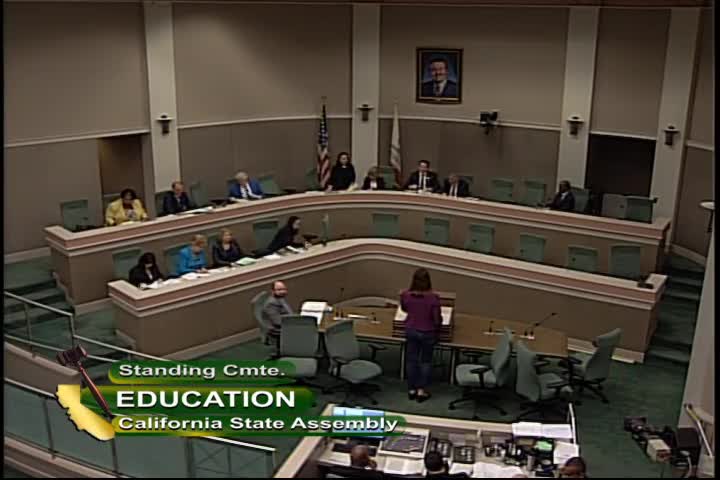
Date of Hearing: May 9, 2018
ASSEMBLY COMMITTEE ON APPROPRIATIONS
Lorena Gonzalez Fletcher, Chair
ABPCA Bill Id:AB 2609
Author:(O'Donnell) – As Amended Ver:April 12, 2018
Policy Committee: | Education | Vote: | 7 - 0 |
|
| ||
|
|
Urgency: No State Mandated Local Program: No Reimbursable: No
SUMMARY: This bill creates a program to recruit, train, support, and retain qualified scientists as K-12 STEM teachers. It requires the California Department of Education (CDE) to competitively award grants to an institution of higher education, nonprofit organization, county office of education, or a partnership among multiple organizations of these types to administer the program. It also requires the CDE to submit a report that assesses the impacts of the program by January 31, 2025.
FISCAL EFFECT:
- About $3 million in one-time federal Every Student Succeeds Act (ESSA) Part A, Title II funding for competitive grants.
- Costs of $1.1 million GF to CDE over the grant period to administer the grant and produce a report assessing the impact of the program. ($241,000 in the first year of the grant program and $217,000 in each of the following years.)
COMMENTS:
- Purpose. According to the author:
At the same time that California is struggling with a shortage in K-12 STEM teachers, it is also facing a job shortage for early career scientists who wish to teach at the college level…[This bill] creates well-defined, supported pathway for scientists to move into K-12 teaching careers.
- ESSA Title II Part A. ESSA is one of the federal government’s primary programs for funding K-12 education, providing California about $2.5 billion annually. ESSA funds seven titles, with each related to a different area of education. For example, Title I provides about $2 billion annually for low-income students and Title III provides about $150 million annually for English learners. Title II provides about $250 million annually for strategies to improve teachers and administrator quality. California uses 97% of these funds for local grants to schools to improve teacher quality and the remainder on several smaller programs, which sometimes change from year to year. In 2017-18, the state transferred $3.4 million to the University of California to work with schools to improve teacher preparation.
This bill would use about $3 million of these funds to support the proposed grants. The CDE indicates this funding likely will be available for these purposes in the 2018-19 school year.
- Related Legislation. AB 2547 (McCarty), of this session, establishes the California Teacher Corps program, subject to funding in the budget, to provide matching grants to local school districts to create or expand teacher residency programs in which the funds can be used to pay for master teacher stipends, resident stipends, tuition assistance, and the costs of mentoring and induction. This bill is currently pending on this committee’s suspense file.
Analysis Prepared by: Natasha Collins / APPR. / (916) 319-2081
Date of Hearing: April 25, 2018
ASSEMBLY COMMITTEE ON EDUCATION
Patrick O'Donnell, Chair
ABPCA Bill Id:AB 2609 (
Author:O'Donnell) – As Amended Ver:April 12, 2018
SUBJECT: Teachers: California Scientist-to-Teacher Pathway Program
SUMMARY: Establishes the California Scientist-to-Teacher Pathway Program for the purposes of recruiting, training, supporting, and retaining qualified science, technology, engineering, and mathematics (STEM) scientists as STEM teachers in kindergarten through grade 12 (K-12); requires the California Department of Education (CDE) to administer the program and to submit a report that assesses the impacts of the program to the Department of Finance, relevant policy and fiscal committees, and the Legislative Analyst’s Office (LAO) by January 31, 2025. Specifically, this bill:
- Establishes the California Scientist-to-Teacher Pathway Program and requires CDE to administer the program, for the purposes of recruiting, supporting, and retraining STEM scientists as K-12 STEM teachers.
- Requires the program to adhere to the minimum criteria, standards, and requirements that are applicable, pursuant to Part A of Title II of the federal Every Student Succeeds Act (ESSA).
- Requires CDE to fund the program by allocating, beginning in the 2018-19 fiscal year, a one-time, competitively-awarded grant to an institution of higher education (IHE), nonprofit organization, county office of education (COE), or a partnership among multiple organizations of these types.
- Specifies that CDE may continue to fund the program in subsequent years, if sufficient federal Title II, Part A funds are available.
- Requires that in order to be deemed eligible for funding, applicants demonstrate expertise in recruiting scientists into K-12 teaching and an ability to accomplish the following:
- Recruit STEM scientists into K-12 STEM teaching using, but not limited to, the following approaches:
- Developing open education resources that can be used for statewide outreach, to attract scientists into second careers as K-12 teachers.
- Creating a model for teacher recruitment, training, support, and retention that can be disseminated statewide.
- Developing partnerships with STEM Doctor of Philosophy (PhD) programs, masters programs, and university STEM departments to educate graduate students, research scientists, and postdoctoral researchers about K-12 teaching careers.
- Support California Scientist-to-Teacher Pathway Program participants, to foster high rates of retention and teacher leadership using, but not limited to, the following approaches:
- Informing participants about the process for obtaining their teaching credentials, including information on teacher preparation programs, teacher internship and residency programs, and financial aid and loan forgiveness programs.
- Creating California Scientist-to-Teacher Pathway fellowships that will support participants’ transition into K-12 teaching, by offsetting the costs of living expenses, tuition and fees, or other costs associated with the credentialing process.
- Establishing mentoring relationships between program participants and experienced STEM teachers.
- Establishing agreements with teacher credentialing programs to facilitate timely achievement of credentials and subsequent job placement for program participants.
- Providing ongoing support and professional development through participants’ first year of instruction.
- Recruit STEM scientists into K-12 STEM teaching using, but not limited to, the following approaches:
- Requires the grantee to supply CDE with all of the information that the department needs to generate a report that assesses the impacts of the California Scientist-to-Teacher Pathway Program.
- Requires CDE to submit the report to the Department of Finance, relevant policy and fiscal committees of the Legislature, and the Legislative Analyst’s Office by January 31, 2025.
- Requires the report to include, but not be limited to, the following types of information:
- The number of STEM scientists participating in the program, and their demographic characteristics.
- The number and demographic characteristics of STEM scientists who receive their teaching credentials while participating in the program, and the schools in which they teach.
- Annual job placement data for program participants, including placement rates, subjects taught, and the poverty and achievement levels of the schools in which they teach.
- The total number of participants who have been trained and retained in STEM teaching positions in K-12.
EXISTING LAW:
- Authorizes the Commission on Teacher Credentialing to issue intern credentials as an alternate route to earning a teaching credential. This credential is valid for a period of two years and authorizes the holder to teach in a self-contained classroom while completing their teacher preparation course work. Approved intern programs are sponsored by colleges, universities, school districts, or county offices of education. To qualify, an individual must possess a bachelor’s degree, satisfy the basic skills requirements, meet subject matter competence, and obtain character and identification clearance. University intern programs are cooperative teaching, counseling, school psychology, and administrative programs between a university and an employing school district that are administered by the university. District intern programs are for teachers only and are administered by employing school districts whose programs may or may not involve university course work. Completion of an intern program results in the issuance of a preliminary or clear credential (Education Code (EC) 44325, et seq.).
- Required the State Board of Education (SBE) to adopt, on or before November 30, 2013, science content standards that would replace the previous science standards (EC 60605.85).
FISCAL EFFECT: Unknown
COMMENTS:
Need for the bill. According to the author’s office: “After years of budget cuts and teacher layoffs, as well as declining enrollment in teacher preparation programs, many of California’s K-12 students now lack access to fully prepared STEM teachers. The issue is widespread and worsening: in 2017-18, about 80% of school districts reported teacher shortages and heavy reliance on hiring underprepared, under-credentialed teachers.
The STEM teacher shortage disproportionately impacts low-income families and students of color. According to the US Department of Education, such disparities threaten our “ability to close education and poverty gaps, meet the demands of a technology-driven economy, ensure national security, and maintain preeminence in scientific research and technological innovation.”
Ensuring California’s future economic success demands that we provide students with equitable access to fully prepared STEM teachers. Seven of the ten fastest growing professions are in STEM fields, and major American companies are planning to hire 1.6 million STEM-skilled employees over the next five years. In order to take advantage of these emerging opportunities, students require access to advanced STEM coursework, an important predictor of later success in STEM careers.
At the same time that California is struggling with a shortage in K-12 STEM teachers, it is also facing a job shortage for early career scientists who wish to teach at the college level. Of the nearly 5,000 STEM PhDs graduating from California’s universities each year, about half will remain in academia immediately after graduating, many of them in temporary, underpaid positions as postdoctoral researchers or adjunct instructors. Although most of these individuals seek employment as tenured faculty members, fewer than 15% of new PhDs in STEM professions find tenure-track positions within 3 years of graduation.
Only a small number of early career scientists pursue a career in K-12 teaching, even though significant percentages of PhDs across multiple disciplines—44% in math and physics, 37% in biology, 30% in earth sciences, and 27% in chemistry—have considered it. However, scientists have identified insufficient information and support as barriers to their entry into K-12 teaching. AB 2609 proposes an innovative approach for reducing the STEM teacher shortage: creating a well-defined, supported pathway for scientists to move into K-12 teaching careers.”
California’s STEM teacher shortage. Multiple reports highlight California’s ongoing teacher shortages, which are especially severe in certain subject areas, including bilingual education, special education, and STEM subjects. In a 2016 report (entitled Addressing California’s Emerging Teacher Shortage: An Analysis of Sources and Solutions), the Learning Policy Institute (LPI) summarizes the problem: “After many years of teacher layoffs in California, school districts around the state are hiring again. With the influx of new K-12 funding, districts are looking to lower student-teacher ratios and reinstate classes and programs that were reduced or eliminated during the Great Recession. However, mounting evidence indicates that teacher supply has not kept pace with the increased demand.” The report also includes the following findings:
- Enrollment in educator preparation programs has dropped by more than 70 percent over the last decade.
- In 2014-15, provisional and short-term permits—intended to help districts hire teachers on an emergency basis, when fully-prepared, credentialed candidates are unavailable—nearly tripled relative to the number issued two years previous, growing from about 850 to more than 2,400.
- The number of teachers hired on substandard permits and credentials nearly doubled in the last two years, to more than 7,700, comprising a third of all the new credentials issued in 2014-15.
- Estimated teacher hires for the 2015-16 school year increased by 25 percent from the previous year, while enrollment in teacher education programs at the University of California (UC) and California State University increased by only about 3.8 percent.
- The pipeline of prepared STEM teachers is shrinking. From 2012-16, the proportion of math and science teachers entering the field on substandard credentials or permits doubled, from 20 to 40 percent, while the number of STEM teachers entering with full credentials dropped from 3,200 to 2,200.
Limited access to STEM education negatively impacts students’ educational and economic prospects. Multiple organizations, ranging from educational advocacy groups to the National Academies of Sciences (NAS), have voiced concerns regarding the long-term impacts of the STEM teacher shortage on educational and economic outlooks, not only for individual students, but for the nation. In 2007, NAS released a report entitled Rising Above the Gathering Storm: Energizing and Employing America for a Brighter Economic Future, in which it states: “Without a flourishing scientific and engineering community, young people…will have no motivation to become the next generation of scientists and engineers who can address persistent national problems, including national and homeland security, healthcare, the provision of energy, the preservation of the environment, and the growth of the economy, including the creation of jobs. Laying a foundation for a scientifically literate workforce begins with developing outstanding K–12 teachers in science and mathematics.”
A 2016 review of STEM education studies conducted by the US Department of Education’s Institute of Education Sciences shows that access to advanced math and science courses in high school is a strong predictor for success in post-secondary STEM courses. This finding holds true for both male and female students, and across all ethnicities examined. However, certain populations, including Hispanic and African American students, take fewer high-level high school math and science courses, even though their interest levels in STEM subjects match those of their white peers.
A 2017 report by Ed Trust West shows that many of California’s high school students do not have access to advanced STEM coursework, and that inequities in access are particularly problematic for certain populations of students, including English Learners (EL). The authors state, “In California, only 58 percent of high schools…offer chemistry, 51 percent offer physics, and 7 percent offer math courses title advanced. Only 11 percent of ELs attend schools that offer the “advanced” math courses, and ELs are less likely than their non-EL peers to be enrolled in these courses when available.” Ed Trust West further states that giving EL students access to high quality STEM coursework is beneficial, not only for advancing their STEM knowledge, but for advancing development of their language skills.
Limited access to STEM education is of concern not only at the high school level, but in elementary grades as well. In 2011, WestEd, the Lawrence Hall of Science at UC Berkeley, and SRI International issued a report on elementary STEM education in California. Among their key findings: 40 percent of K-5 teachers report that their students receive 60 minutes or less of science instruction per week and only a third of elementary school teachers feel very prepared to teach science. In addition, the authors found that racial inequities in STEM knowledge are already apparent in elementary school: in 2009, the state’s fourth graders performed at the lowest level nationally on the National Assessment of Educational Progress (NAEP) science test, and fewer than 10 percent of African American and Hispanic fourth graders scored proficient, compared to 41 and 45 percent of their white and Asian peers, respectively. Altogether, these findings led the authors to conclude that “children rarely encounter high-quality science learning opportunities in California elementary schools because the conditions that would support them are rarely in place.”
Altogether, the above reports raise the question of whether today’s K-12 students are being adequately and equitably prepared to take full advantage of emerging opportunities in STEM professions. In 2012, the President’s Council of Advisors on Science and Technology stated that the United States will need 1 million more STEM professionals than the country will produce at the current rate over the next decade, if the country is to maintain its status as a global leader in science and technology.
Shortages in faculty positions push scientists with PhDs and masters into underemployment. Although job opportunities for STEM professionals are growing in many sectors of the STEM labor market, this is not the case in higher education, where long-standing faculty job shortages—particularly for tenure-track jobs, which are secure positions that generally come with employee benefits and the highest salaries obtainable in academia—drive individuals with PhDs and Masters degrees into temporary, low-paying positions. The U.S. Bureau of Labor Statistics summarizes the issue as follows: “Although the number of PhDs has been climbing steadily, the number of professor positions has remained constant in most fields...[The] majority consider a faculty research career to be an ‘extremely attractive career path.’ However, only a fortunate few go directly from graduate school to a tenure-track faculty position. In 2010, less than 15 percent of new PhDs in science, engineering, and health-related fields found tenure-track positions within 3 years of graduation. For PhDs in the life sciences, the figure was an even smaller 7.6 percent. Most who want an academic career join academia as postdocs or adjunct faculty, hoping to vie for a tenure-track faculty position in the future.”
Data released by the NSF shows that California is the nation’s most prolific producer of STEM PhDs: in 2018, California alone produced 4,953—more than 10 percent—of the nation’s STEM PhDs. The NSF’s Survey of Earned Doctorates indicates that nearly half of all 2015 PhD recipients remain in academia after graduating, although the proportion of PhDs with definite commitments for employment in academia has been going down over the past ten years.
According to the National Center for Education Statistics, between 1999 and 2016 only 1.4 percent of U.S. high school math teachers and 2.9 percent of high school science teachers had PhDs. These data suggest that effective pipelines for drawing underemployed scientists into K-12 teaching do not currently exist. UC San Francisco researchers concluded that PhDs are not moving into teaching in greater numbers because they lack access to information and support. Specifically, the authors state, “Most PhDs who are currently teaching high school science arrive at this choice in spite of, rather than because of, a good mentoring system. Quite notably, high school teaching is frequently omitted from…the many nontraditional career tracks currently being advocated for PhDs.”
In 2000, the NAS investigated the possibility of drawing STEM PhDs into K-12 teaching and concluded that, “…we are now convinced that an effort to increase the number of PhDs in schools will make a significant qualitative contribution to the improvement of science and mathematics education. We also believe that PhDs, who are trained to be inquisitive, to be creative, and to challenge established wisdom, will provide new leadership and be catalysts for change in science and mathematics education throughout their careers. We anticipate that the presence of PhDs in schools will provide an opportunity to generate new links between the K-12 system and universities and will provide a new career path for PhDs who seek to use their skills outside the traditional research setting.” A survey showed that 36 percent of STEM PhDs have considered high school teaching careers, and that respondents considered this career shift more appealing when opportunities for classroom mentorship and fellowships that provided training, placement, networking opportunities, and living stipends were available.
In 2002, the NAS released a detailed plan for creation of a “National Postdoctoral Fellowship Program” that would draw STEM PhDs into K-12 teaching. The plan called for an initial demonstration period of four years, in which a cohort of 15 fellows would be used to provide the evidence needed to expand the program. When the program became fully implemented, the NAS envisioned a fellowship program that would support 30 fellows at a cost of $2.5 million per year. The program was never funded.
The STEM teacher shortage coincides with implementation of new science standards. In 2013, the SBE adopted the Next Generation Science Standards (NGSS). In contrast to California’s previous science standards, NGSS shifts focus from having students memorize scientific information to teaching students how to think critically about core scientific ideas, how to connect key concepts across disciplines, and how to implement processes used by practicing scientists. In 2017, CDE, the California Science Teachers Association (CSTA), COEs, and several other organizations began offering multiple two-day symposia to help teachers and administrators understand the new standards and develop plans for implementation in their schools.
Supports and credentialing options that promote teacher recruitment. Traditional credentialing programs require individuals to obtain a bachelor’s degree, enter a year‑long credentialing program at an IHE, and participate in a certain number of hours of student‑teaching, usually at the end of the credentialing program. In contrast, residency and intern programs allow candidates to progress through the credentialing process while earning an income, making these programs potentially more attractive as credentialing options for candidates who wish to avoid debt accrual. According to NSF’s 2012 “Survey of Earned Doctorates,” doctorate-recipients in STEM disciplines have, on average, between $6,000 and $10,000 in debt associated with their graduate degrees. It is unclear how much additional debt these individuals retain from their undergraduate educations, although the Institute for College Access and Success found that 68% of 2015 bachelor’s degree recipients graduated with student loan debt, at an average of $30,100 per borrower. According to LPI, top-performing students are more likely to pursue a career in education when they do not have significant debt.
Teacher residencies have emerged as a particularly promising approach for supporting new teachers as they progress through the credentialing process. According to LPI, these programs, typically established through partnerships between districts and IHEs, offer recruits “strong clinical preparation specifically for the kinds of schools in which they will teach, connect new teachers to early career mentoring that will keep them in the profession, and provide financial incentives that will keep teachers in the districts that have invested in them.” Teacher residency programs do not yet appear to be widespread across the state; in 2016, LPI issued a report on 10 known teacher residency programs in California and concluded that these programs are helping to meet hiring needs in the districts they serve.
Related legislation. AB 2186 (Thurmond) of this Session appropriates $202 million from the General Fund to provide LEAs with one-time grants that would fund the following initiatives: professional learning opportunities in STEM subjects for transitional kindergarten through 8th grade (TK-8) teachers, principals, and school leaders; the development of new, or expansion of existing, locally-devised solutions to STEM teacher shortages; the development of high-quality STEM teaching and learning opportunities for pupils living in rural areas; the integration of rigorous computer science education into the academic program for students in kindergarten through 12th grade (K-12); a study of the feasibility of assessing students in science prior to 5th grade; and a survey of a subset of LEAs that would examine the amount of instructional time that all students receive in math and science.
AB 2547 (McCarty) of this Session establishes the California Teacher Corps program, subject to funding in the budget, to provide matching grants to local school districts to create or expand teacher residency programs in which the funds can be used to pay for master teacher stipends, stipends for residents, tuition assistance, and the costs of mentoring and induction.
AB 169 (O’Donnell) of this Session establishes the Golden State Teacher Grant Program to provide one-time grant funds of twenty thousand dollars ($20,000) to each student enrolled on or after January 1, 2018, in a professional preparation program leading to a preliminary teaching credential, if the student commits to working in a high-need field for four years after he or she receives a teaching credential. The bill targets teacher shortages in the following areas: bilingual education, mathematics, science, STEM, and special education.
Previous legislation. SB 436 (Allen) would have established the California STEM Professional Teaching Pathway to recruit, train, support, and retain qualified science, technology, engineering and mathematics (STEM) professionals, including military veterans, as mathematics and science teachers in California. The bill also included an unspecified and ongoing appropriation, beginning in 2017-18, for allocation to the California Center on Teaching Careers (Cal-Teach) to support the purposes of the bill. This bill was held by the author prior to hearing by this Committee.
REGISTERED SUPPORT / OPPOSITION:
Support
Aerojet Rocketdyne Foundation
Alder Graduate School of Education
Alliance Alice M. Baxter College-Ready High School
Alliance College-Ready Public Schools
Arthur A. Benjamin Health Professions High School
Bayer
California Science Teachers Association
California STEM Network
Center for Powerful Public Schools
EnCorps STEM Teachers
Institute for STEM Education—California State University, East Bay
Los Angeles Education Corps
Metropolitan Education District
Northrop Grumman
Pittsburg High School
Santa Clara County Office of Education
Silicon Valley Career Technical Education
Opposition
None on file.
Analysis Prepared by: Naomi Ondrasek / ED. / (916) 319-2087
Bill Author

Bill Co-Author(s):