AB 262: Public contracts: bid specifications: Buy Clean California Act.
- Session Year: 2017-2018
- House: Assembly
- Latest Version Date: 2017-10-15
The State Contract Act governs the bidding and award of public works contracts by specific state departments and requires an awarding department, before entering into any contract for a project, to prepare full, complete, and accurate plans and specifications and estimates of cost.
Other existing law establishes specific requirements for competitive bidding for building and improvement projects by the Regents of the University of California, including requiring the regents to prepare plans and specifications before entering into a contract for a project.
The California State University Contract Law governs contracting for building and improvement projects by the California State University and imposes specific competitive bidding requirements for the Trustees of the California State University, including requiring the trustees to prepare full, complete, and accurate plans and specifications for a project.
This bill, the Buy Clean California Act, would, by January 1, 2019, require the Department of General Services to establish, and publish in the State Contracting Manual, a maximum acceptable global warming potential for each category of eligible materials, in accordance with requirements set out in the bill. The bill, by January 1, 2022, and every 3 years thereafter, would require the department to review the maximum acceptable global warming potential for each category of eligible materials established, and would authorize the department to adjust that number downward for any eligible material to reflect industry improvements, as provided.
The bill, for specified types of contracts entered into on or after July 1, 2019, would require an awarding authority to require a successful bidder to submit a current Environmental Product Declaration, developed in accordance with specified standards, for that type of product. The bill would require an awarding authority to include in a specification for a bid for an eligible project, as defined, that the facility-specific global warming potential for any eligible materials does not exceed the maximum global warming potential for that material determined by the department in accordance with the process described above. The bill would also authorize an awarding authority to include in a specification for bids for an eligible project a facility-specific global warming potential for any eligible material that is lower than the maximum global warming potential for that material as determined by the department in accordance with the process described above. The bill would prohibit a successful bidder from installing any eligible materials on an eligible project until that bidder submits an Environmental Product Declaration to the awarding authority for that project. The bill would require an awarding authority, in carrying out its duties under the act, to strive to continuously reduce emissions over time. The bill would define awarding authority for these purposes to include state departments and entities subject to the State Contract Act, the Regents of the University of California, and the Trustees of the California State University.
The bill, by January 1, 2022, would require the department to submit a report to the Legislature on any obstacles to the implementation of this article, and the effectiveness of this article in reducing global warming potential.
The State Contract Act governs the bidding and award of public works contracts by specific state departments and requires an awarding department, before entering into any contract for a project, to prepare full, complete, and accurate plans and specifications and estimates of cost.
Other existing law establishes specific requirements for competitive bidding for building and improvement projects by the Regents of the University of California, including requiring the regents to prepare plans and specifications before entering into a contract for a project.
The California State University Contract Law governs contracting for building and improvement projects by the California State University and imposes specific competitive bidding requirements for the Trustees of the California State University, including requiring the trustees to prepare full, complete, and accurate plans and specifications for a project.
This bill, the Buy Clean California Act, would, by January 1, 2019, require the Department of General Services to establish, and publish in the State Contracting Manual, a maximum acceptable global warming potential for each category of eligible materials, in accordance with requirements set out in the bill. The bill, by January 1, 2022, and every 3 years thereafter, would require the department to review the maximum acceptable global warming potential for each category of eligible materials established, and would authorize the department to adjust that number downward for any eligible material to reflect industry improvements, as provided.
The bill, for specified types of contracts entered into on or after January July 1, 2019, would require an awarding authority to require a successful bidder to submit a current Environmental Product Declaration, developed in accordance with specified standards, for that type of product. The bill would require an awarding authority to include in a specification for a bid for an eligible project, as defined, that the facility-specific global warming potential for any eligible materials does not exceed the maximum global warming potential for that material determined by the department in accordance with the process described above. The bill would also authorize an awarding authority to include in a specification for bids for an eligible project a facility-specific global warming potential for any eligible material that is lower than the maximum global warming potential for that material as determined by the department in accordance with the process described above. The bill would prohibit a successful bidder from installing any eligible materials on an eligible project until that bidder submits an Environmental Product Declaration to the awarding authority for that project. The bill would require an awarding authority, in carrying out its duties under the act, to strive to continuously reduce emissions over time. The bill would define awarding authority for these purposes to include state departments and entities subject to the State Contract Act, the Regents of the University of California, and the Trustees of the California State University.
The bill, by January 1, 2022, would require the department to submit a report to the Legislature on any obstacles to the implementation of this article, and the effectiveness of this article in reducing global warming potential.
The State Contract Act governs the bidding and award of public works contracts by specific state departments and requires an awarding department, before entering into any contract for a project, to prepare full, complete, and accurate plans and specifications and estimates of cost.
Other existing law establishes specific requirements for competitive bidding for building and improvement projects by the Regents of the University of California, including requiring the regents to prepare plans and specifications before entering into a contract for a project.
The California State University Contract Law governs contracting for building and improvement projects by the California State University and imposes specific competitive bidding requirements for the Trustees of the California State University, including requiring the trustees to prepare full, complete, and accurate plans and specifications for a project.
This bill, the Buy Clean California Act, would, by January 1, 2019, require the Department of General Services to establish, and publish in the State Contracting Manual, a maximum acceptable global warming potential for each category of eligible materials, in accordance with requirements set out in the bill. The bill, by January 1, 2022, and every 3 years thereafter, would require the department to review the maximum acceptable global warming potential for each category of eligible materials established, and would authorize the department to adjust that number downward for any eligible material to reflect industry improvements, as provided.
The bill, for specified types of contracts entered into on or after January 1, 2019, would require an awarding authority to require a successful bidder to submit a current Environmental Product Declaration, developed in accordance with specified standards, for that type of product. The bill would require an awarding authority to include in a specification for a bid for an eligible project, as defined, that the facility-specific global warming potential for any eligible materials does not exceed the maximum global warming potential for that material determined by the department in accordance with the process described above. The bill would also authorize an awarding authority to include in a specification for bids for an eligible project a facility-specific global warming potential for any eligible material that is lower than the maximum global warming potential for that material as determined by the department in accordance with the process described above. The bill would require an awarding authority, in carrying out its duties under the act, to strive to continuously reduce emissions over time. The bill would define awarding authority for these purposes to include state departments and entities subject to the State Contract Act, the Regents of the University of California, and the Trustees of the California State University.
The bill, by January 1, 2022, would require the department to submit a report to the Legislature on any obstacles to the implementation of this article, and the effectiveness of this article in reducing global warming potential.
The State Contract Act governs the bidding and award of public works contracts by specific state departments and requires an awarding department, before entering into any contract for a project, to prepare full, complete, and accurate plans and specifications and estimates of cost. The act generally requires that an awarding department that proposes to contract a public work to award that contract pursuant to a competitive bidding process, under which bids are awarded to the lowest responsible bidder, with specified alternative bidding procedures authorized in certain cases.
Other existing law establishes specific requirements for competitive bidding for building and improvement projects by the Regents of the University of California, including generally requiring the regents to award contracts to the lowest responsible bidder. requiring the regents to prepare plans and specifications before entering into a contract for a project.
The California State University Contract Law governs contracting for building and improvement projects by the California State University and imposes specific competitive bidding requirements for the Trustees of the California State University, including the trustees to award a contract to the lowest responsible bidder. requiring the trustees to prepare full, complete, and accurate plans and specifications for a project.
This bill, the Buy Clean California Act, would, by January 1, 2019, require the Department of General Services to establish, and publish in the State Contracting Manual, a maximum acceptable global warming potential for each category of eligible materials, in accordance with requirements set out in the bill. The bill, by January 1, 2022, and every 3 years thereafter, would require the department to review the maximum acceptable global warming potential for each category of eligible materials established, and would authorize the department to adjust that number downward for any eligible material to reflect industry improvements, as provided.
The bill, for specified types of contracts entered into on or after January 1, 2019, would require an awarding authority to require a successful bidder to submit a current Environmental Product Declaration, developed in accordance with specified standards, for that type of product. The bill would require an awarding authority to include in a specification for a bid for an eligible project, as defined, that the facility-specific global warming potential for any eligible materials does not exceed the maximum global warming potential for that material determined by the department in accordance with the process described above. The bill would also authorize an awarding authority to include in a specification for bids for an eligible project a facility-specific global warming potential for any eligible material that is lower than the maximum global warming potential for that material as determined by the department in accordance with the process described above. The bill would require an awarding authority, in carrying out its duties under the act, to strive to continuously reduce emissions over time. The bill would define awarding authority for these purposes to include state departments and entities subject to the State Contract Act, the Regents of the University of California, and the Trustees of the California State University.
The bill, by January 1, 2022, would require the department to submit a report to the Legislature on any obstacles to the implementation of this article, and the effectiveness of this article in reducing global warming potential.
This bill would require an awarding department to require a prospective bidder to complete a standard form that states the cumulative amount of specified greenhouse gas emissions that were produced in the material extraction and processing, transport to the manufacturing site, and the manufacturing of eligible materials, as defined, to be used on the project, and would provide that a prospective bidder may satisfy this standard by attaching to that form an Environmental Product Declaration, developed in accordance with standards established by the International Organization of Standardization, or other similar life-cycle assessment method as provided, for that type of product. The bill would require an awarding department to use a method developed by the Department of General Services to take into account, during project bid review and award, greenhouse gas emissions of eligible materials to be used in a project, with the intent of reducing greenhouse gas emissions along the supply chain. The bill would require the Department of General Services to publish in the State Contracting Manual a method to allow an awarding department to take into account, during project bid review and award, greenhouse gas emissions of eligible materials, in accordance with certain requirements set out in the bill. The bill would authorize a contractor who is awarded a bid under these provisions to use a material supplier that was not reported in the winning bid if that supplier uses eligible materials that have the same or lower emissions than what was reported in the original bid. The bill would provide that if the supplier that was reported in a bid that was awarded under these provisions is unable to perform, the contractor who was awarded that bid shall make a good-faith effort to use a supplier that has the same or lower emissions than the original supplier reported and for a similar cost.This bill would also require an awarding department to, on or before January 1, 2019, and annually thereafter, prepare and submit to the Legislature and the Governor a report on contracts that were awarded.The bill would impose similar requirements on the Regents of the University of California and the Trustees of the California State University.The State Contract Act governs the bidding and award of public works contracts by specific state departments and requires an awarding department, before entering into any contract for a project, to prepare full, complete, and accurate plans and specifications and estimates of cost. The act generally requires that an awarding department that proposes to contract a public work to award that contract pursuant to a competitive bidding process, under which bids are awarded to the lowest responsible bidder, with specified alternative bidding procedures authorized in certain cases.
Other existing law establishes specific requirements for competitive bidding for building and improvement projects by the Regents of the University of California, including generally requiring the regents to award contracts to the lowest responsible bidder.
The California State University Contract Law governs contracting for building and improvement projects by the California State University and imposes specific competitive bidding requirements for the Trustees of the California State University, including the trustees to award a contract to the lowest responsible bidder.
This bill would require an awarding department to require a prospective bidder to complete a standard form that states the cumulative amount of specified greenhouse gas emissions that were produced in the material extraction and processing, transport to the manufacturing site, and the manufacturing of eligible materials, as defined, to be used on the project, and would provide that a prospective bidder may satisfy this standard by attaching to that form an Environmental Product Declaration, developed in accordance with standards established by the International Organization of Standardization, or other similar life-cycle assessment method as provided, for that type of product. The bill would require an awarding department, when calculating the lowest responsible bidder for purposes of public works contracts that use eligible materials, to adjust that portion of the bid on the base contract that represents the cost of the eligible materials to incorporate the value of the social cost of those materials. department to use a method developed by the Department of General Services to take into account, during project bid review and award, greenhouse gas emissions of eligible materials to be used in a project, with the intent of reducing greenhouse gas emissions along the supply chain. The bill would require the Secretary of Government Operations to establish a formula to calculate the social cost of eligible materials, in accordance with requirements set out in the bill. the Department of General Services to publish in the State Contracting Manual a method to allow an awarding department to take into account, during project bid review and award, greenhouse gas emissions of eligible materials, in accordance with certain requirements set out in the bill. The bill would authorize a contractor who is awarded a bid under these provisions to use a material supplier that was not reported in the winning bid if that supplier uses eligible materials that have the same or lower emissions than what was reported in the original bid. The bill would provide that if the supplier that was reported in a bid that was awarded under these provisions is unable to perform, the contractor who was awarded that bid shall make a good-faith effort to use a supplier that has the same or lower emissions than the original supplier reported and for a similar cost.
This bill would also require an awarding department to, on or before January 1, 2019, and annually thereafter, prepare and submit to the Legislature and the Governor a report on contracts that were awarded.
The bill would impose similar requirements on the Regents of the University of California and the Trustees of the California State University.
The State Contract Act governs the bidding and award of public works contracts by specific state departments and requires an awarding department, before entering into any contract for a project, to prepare full, complete, and accurate plans and specifications and estimates of cost. The act generally requires that an awarding department that proposes to contract a public work to award that contract pursuant to a competitive bidding process, under which bids are awarded to the lowest responsible bidder, with specified alternative bidding procedures authorized in certain cases.
Other existing law establishes specific requirements for competitive bidding for building and improvement projects by the Regents of the University of California, including generally requiring the regents to award contracts to the lowest responsible bidder.
The California State University Contract Law governs contracting for building and improvement projects by the California State University and imposes specific competitive bidding requirements for the Trustees of the California State University, including the trustees to award a contract to the lowest responsible bidder.
This bill would require an awarding department to require a prospective bidder to complete a standard form that states the cumulative amount of specified greenhouse gas emissions that were produced in the manufacturing of eligible materials, as defined, to be used on the project, and would provide that a prospective bidder may satisfy this standard by attaching to that form an Environmental Product Declaration, developed in accordance with standards established by the International Organization of Standardization, for that type of product. The bill would require an awarding department, when calculating the lowest responsible bidder for purposes of public works contracts that use eligible materials, to adjust that portion of the bid on the base contract that represents the cost of the eligible materials to incorporate the value of the social cost of those materials. The bill would require the Secretary of Government Operations to establish a formula to calculate the social cost of eligible materials, in accordance with requirements set out in the bill.
This bill would also require an awarding department to, on or before January 1, 2019, and annually thereafter, prepare and submit to the Legislature and the Governor a report on contracts that were awarded.
The bill would impose similar requirements on the Regents of the University of California and the Trustees of the California State University.
The Legislature finds and declares all the following:
(a)Climate change will have devastating global impacts.
(b)All scientific evidence points to the need for California and the world to reduce greenhouse gas emissions to avert the worst effects of climate change. Climate change impacts are already apparent in California, where scientists have determined that annual temperature increases and a long-term drought are consequences of human-induced climate change.
(c)The Legislature has committed to reduce greenhouse gases, through numerous statutes requiring regulatory and other action by public agencies. Those regulations and actions do not currently encourage public dollars for infrastructure projects to be spent in a way that is consistent with the states goals to reduce greenhouse gas emissions.
(d)Executive Order B-30-15 issued by Governor Edmund G. Brown, Jr. stipulates that State agencies shall take climate change into account in their planning and investment decisions and employ full life-cycle cost accounting to evaluate and compare infrastructure investments and alternatives. Full life cycle cost accounting in this instance also refers to accounting for the impacts across the life cycle of a product, or life cycle assessment.
(e)Great quantities of emissions are released during the manufacture and transport of products used in public infrastructure projects.
(f)California, through its extensive purchasing power, can improve environmental outcomes and accelerate necessary greenhouse gas reductions to protect public health, the environment, and conserve a livable climate by incorporating emissions information from throughout the supply chain and product life cycle into procurement decisions, and using that information to help direct expenditure.
(g)Incorporating emissions information will acknowledge those companies that have invested in emissions reduction technologies and practices. It will encourage other companies to take action to reduce emissions to become more competitive in the California bidding process.
SEC. 2.The heading of Article 5 (commencing with Section 3400) of Chapter 3 of Part 1 of Division 2 of the Public Contract Code is amended and renumbered to read:4.Preference for MaterialsSEC. 3.Article 5 (commencing with Section 3500) is added to Chapter 3 of Part 1 of Division 2 of the Public Contract Code, to read:5.Buy Clean California Act3500.This article shall be known, and may be cited, as the Buy Clean California Act.
3501.For purposes of this section:
(a)Awarding authority means any of the following:
(1)A state agency for a contract for a public works project that is subject to the State Contract Act (Chapter 1 (commencing with Section 10100) of Part 2 of Division 2).
(2)The Regents of the University of California for a contract for a public works project that is subject to Chapter 2.1 (commencing with Section 10500) of Part 2 of Division 2.
(3)The Trustees of the California State University for a contract for a public works project that is subject to the California State University Contract Law (Chapter 2.5 (commencing with Section 10700) of Part 2 of Division 2).
(b)Department means the Department of General Services.
(c)Eligible materials means any of the following:
(1)Carbon steel rebar.
(2)Flat glass.
(3)Mineral wool board insulation.
(4)Structural steel.
(d)Eligible project means a project that the awarding authority determines will require eligible materials.
(e)Greenhouse gas emissions has the same meaning as defined in subdivision (g) of Section 38505 of the Health and Safety Code.
3502.(a)By January 1, 2019, the department shall establish, and publish in the State Contracting Manual, a maximum acceptable global warming potential for each category of eligible materials in accordance with both of the following requirements:
(1)The department shall set the maximum acceptable global warming potential at the industry average of facility-specific global warming potential emissions for that material. The department shall determine the industry average by consulting nationally or internationally recognized databases of environmental product declarations.
(2)The department shall express the maximum acceptable global warming potential as a number that states the maximum acceptable facility-specific global warming potential for each category of eligible materials. The global warming potential shall be provided in a manner that is consistent with criteria in an Environmental Product Declaration.
(b)The department, by January 1, 2019, shall submit a report to the Legislature that describes the method that the department used to develop the maximum global warming potential for each category of eligible materials pursuant to subdivision (a). The report required by this subdivision shall be submitted in compliance with Section 9795 of the Government Code.
(c)By January 1, 2022, and every three years thereafter, the department shall review the maximum acceptable global warming potential for each category of eligible materials established pursuant to subdivision (a), and may adjust that number downward for any eligible material to reflect industry improvements if the department, based on the process described in paragraph (1) of subdivision (a), determines that the industry average has changed, but the department shall not adjust that number upward for any eligible material. At that time, the department shall update the State Contracting Manual to reflect that adjustment.
3503.(a)An awarding authority shall require the successful bidder for a contract described in subdivision (b) to submit a current facility-specific Environmental Product Declaration, Type III, as defined by the International Organization for Standardization (ISO) standard 14025, or similarly robust life cycle assessment methods that have uniform standards in data collection consistent with ISO standard 14025, industry acceptance, and integrity, for each eligible material proposed to be used.
(b)An awarding authority shall include in a specification for bids for an eligible project that the facility-specific global warming potential for any eligible material does not exceed the maximum acceptable global warming potential for that material determined pursuant to Section 3502. An awarding authority may include in a specification for bids for an eligible project a facility-specific global warming potential for any eligible material that is lower than the maximum acceptable global warming potential for that material determined pursuant to Section 3502.
(c)A successful bidder for a contract described in subdivision (b) shall not install any eligible materials on the project until that bidder submits a facility-specific Environmental Product Declaration for that material pursuant to subdivision (a).
(d)This section shall only apply to a contract entered into on or after July 1, 2019.
3504.In carrying out its duties under this article, an awarding authority shall strive to achieve a continuous reduction of emissions over time.
3505.The department, by January 1, 2022, shall submit a report to the Legislature on any obstacles to the implementation of this article, and the effectiveness of this article to reduce global warming potential. The report required by this section shall be submitted in compliance with Section 9795 of the Government Code.
The Legislature finds and declares all the following:
(a)Climate change will have devastating global impacts.
(b)All scientific evidence points to the need for California and the world to reduce greenhouse gas emissions to avert the worst effects of climate change. Climate change impacts are already apparent in California, where scientists have determined that annual temperature increases and a long-term drought are consequences of human-induced climate change.
(c)The Legislature has committed to reduce greenhouse gases, through numerous statutes requiring regulatory and other action by public agencies. Those regulations and actions do not currently encourage public dollars for infrastructure projects to be spent in a way that is consistent with the states goals to reduce greenhouse gas emissions.
(d)Executive Order B-30-15 issued by Governor Edmund G. Brown, Jr. stipulates that State agencies shall take climate change into account in their planning and investment decisions and employ full life-cycle cost accounting to evaluate and compare infrastructure investments and alternatives. Full life cycle cost accounting in this instance also refers to accounting for the impacts across the life cycle of a product, or life cycle assessment.
(e)Great quantities of emissions are released during the manufacture and transport of products used in public infrastructure projects.
(f)California, through its extensive purchasing power, can improve environmental outcomes and accelerate necessary greenhouse gas reductions to protect public health, the environment, and conserve a livable climate by incorporating emissions information from throughout the supply chain and product life cycle into procurement decisions, and using that information to help direct expenditure.
(g)Incorporating emissions information will acknowledge those companies that have invested in emissions reduction technologies and practices. It will encourage other companies to take action to reduce emissions to become more competitive in the California bidding process.
SEC. 2.The heading of Article 5 (commencing with Section 3400) of Chapter 3 of Part 1 of Division 2 of the Public Contract Code is amended and renumbered to read:4.Preference for MaterialsSEC. 3.Article 5 (commencing with Section 3500) is added to Chapter 3 of Part 1 of Division 2 of the Public Contract Code, to read:5.Buy Clean California Act3500.This article shall be known, and may be cited, as the Buy Clean California Act.
3501.For purposes of this section:
(a)Awarding authority means any of the following:
(1)A state agency for a contract for a public works project that is subject to the State Contract Act (Chapter 1 (commencing with Section 10100) of Part 2 of Division 2).
(2)The Regents of the University of California for a contract for a public works project that is subject to Chapter 2.1 (commencing with Section 10500) of Part 2 of Division 2.
(3)The Trustees of the California State University for a contract for a public works project that is subject to the California State University Contract Law (Chapter 2.5 (commencing with Section 10700) of Part 2 of Division 2).
(b)Department means the Department of General Services.
(c)Eligible materials means any of the following:
(1)Brass pipe and pipe fittings.(2)(1)Carbon steel rebar.
(3)(2)Flat glass.
(4)(3)Mineral wool board insulation.
(5)Steel line pipe.(6)(4)Structural steel.
(7)Structural steel pipe.(d)Eligible project means a project that the awarding authority determines will require eligible materials.
(e)Greenhouse gas emissions has the same meaning as defined in subdivision (g) of Section 38505 of the Health and Safety Code.
3502.(a)By January 1, 2019, the department shall establish, and publish in the State Contracting Manual, a maximum acceptable global warming potential for each category of eligible materials in accordance with both of the following requirements:
(1)The department shall set the maximum acceptable global warming potential at the industry average of facility-specific global warming potential emissions for that material. The department shall determine the industry average by consulting nationally or internationally recognized databases of environmental product declarations.
(2)The department shall express the maximum acceptable global warming potential as a number that states the maximum acceptable facility-specific global warming potential for each category of eligible materials. The global warming potential shall be provided in a manner that is consistent with criteria in an Environmental Product Declaration.
(b)The department, by January 1, 2019, shall submit a report to the Legislature that describes the method that the department used to develop the maximum global warming potential for each category of eligible materials pursuant to subdivision (a). The report required by this subdivision shall be submitted in compliance with Section 9795 of the Government Code.
(c)By January 1, 2022, and every three years thereafter, the department shall review the maximum acceptable global warming potential for each category of eligible materials established pursuant to subdivision (a), and may adjust that number downward for any eligible material to reflect industry improvements if the department, based on the process described in paragraph (1) of subdivision (a), determines that the industry average has changed, but the department shall not adjust that number upward for any eligible material. At that time, the department shall update the State Contracting Manual to reflect that adjustment.
3503.(a)An awarding authority shall require the successful bidder for a contract described in subdivision (b) to submit a current facility-specific Environmental Product Declaration, Type III, as defined by the International Organization for Standardization (ISO) standard 14025, or similarly robust life cycle assessment methods that have uniform standards in data collection consistent with ISO standard 14025, industry acceptance, and integrity, for each eligible material proposed to be used.
(b)An awarding authority shall include in a specification for bids for an eligible project that the facility-specific global warming potential for any eligible material does not exceed the maximum acceptable global warming potential for that material determined pursuant to Section 3502. An awarding authority may include in a specification for bids for an eligible project a facility-specific global warming potential for any eligible material that is lower than the maximum acceptable global warming potential for that material determined pursuant to Section 3502.
(c)A successful bidder for a contract described in subdivision (b) shall not install any eligible materials on the project until that bidder submits a facility-specific Environmental Product Declaration for that material pursuant to subdivision (a).
(d)This section shall only apply to a contract entered into on or after July 1, 2019.
3504.In carrying out its duties under this article, an awarding authority shall strive to achieve a continuous reduction of emissions over time.
3505.The department, by January 1, 2022, shall submit a report to the Legislature on any obstacles to the implementation of this article, and the effectiveness of this article to reduce global warming potential. The report required by this section shall be submitted in compliance with Section 9795 of the Government Code.
The Legislature finds and declares all the following:
(a)Climate change will have devastating global impacts.
(b)All scientific evidence points to the need for California and the world to reduce greenhouse gas emissions to avert the worst effects of climate change. Climate change impacts are already apparent in California, where scientists have determined that annual temperature increases and a long-term drought are consequences of human-induced climate change.
(c)The Legislature has committed to reduce greenhouse gases, through numerous statutes requiring regulatory and other action by public agencies. Those regulations and actions do not currently encourage public dollars for infrastructure projects to be spent in a way that is consistent with the states goals to reduce greenhouse gas emissions.
(d)Executive Order B-30-15 issued by Governor Edmund G. Brown, Jr. stipulates that State agencies shall take climate change into account in their planning and investment decisions and employ full life-cycle cost accounting to evaluate and compare infrastructure investments and alternatives. Full life cycle cost accounting in this instance also refers to accounting for the impacts across the life cycle of a product, or life cycle assessment.
(e)Great quantities of emissions are released during the manufacture and transport of products used in public infrastructure projects.
(f)California, through its extensive purchasing power, can improve environmental outcomes and accelerate necessary greenhouse gas reductions to protect public health, the environment, and conserve a livable climate by incorporating emissions information from throughout the supply chain and product life cycle into procurement decisions, and using that information to help direct expenditure.
(g)Incorporating emissions information will acknowledge those companies that have invested in emissions reduction technologies and practices. It will encourage other companies to take action to reduce emissions to become more competitive in the California bidding process.
SEC. 2.The heading of Article 5 (commencing with Section 3400) of Chapter 3 of Part 1 of Division 2 of the Public Contract Code is amended and renumbered to read:4.Preference for MaterialsSEC. 3.Article 5 (commencing with Section 3500) is added to Chapter 3 of Part 1 of Division 2 of the Public Contract Code, to read:5.Buy Clean California Act3500.This article shall be known, and may be cited, as the Buy Clean California Act.
3501.For purposes of this section:
(a)Awarding authority means any of the following:
(1)A state agency for a contract for a public works project that is subject to the State Contract Act (Chapter 1 (commencing with Section 10100) of Part 2 of Division 2).
(2)The Regents of the University of California for a contract for a public works project that is subject to Chapter 2.1 (commencing with Section 10500) of Part 2 of Division 2.
(3)The Trustees of the California State University for a contract for a public works project that is subject to the California State University Contract Law (Chapter 2.5 (commencing with Section 10700) of Part 2 of Division 2).
(b)Department means the Department of General Services.
(c)Eligible materials means any of the following:
(1)Brass pipe and pipe fittings.
(2)Carbon steel rebar.
(3)Flat glass.
(4)Iron pipe and pipe fittings.(5)(4)Mineral wool insulation.
(6)(5)Steel line pipe.
(7)(6)Structural steel.
(8)(7)Structural steel pipe.
(d)Eligible project means a project that the awarding authority determines will require eligible materials.
(e)Greenhouse gas emissions has the same meaning as defined in subdivision (g) of Section 38505 of the Health and Safety Code.
3502.(a)By January 1, 2019, the department shall establish, and publish in the State Contracting Manual, a maximum acceptable global warming potential for each category of eligible materials in accordance with both of the following requirements:
(1)The department shall set the maximum acceptable global warming potential at the industry average of facility-specific global warming potential emissions for that material. The department shall determine the industry average by consulting nationally or internationally recognized databases of environmental product declarations.
(2)The department shall express the maximum acceptable global warming potential as a number that states the maximum acceptable facility-specific global warming potential for each category of eligible materials. The global warming potential shall be provided in a manner that is consistent with criteria in an Environmental Product Declaration.
(b)The department, by January 1, 2019, shall submit a report to the Legislature that describes the method that the department used to develop the maximum global warming potential for each category of eligible materials pursuant to subdivision (a). The report required by this subdivision shall be submitted in compliance with Section 9795 of the Government Code.
(c)By January 1, 2022, and every three years thereafter, the department shall review the maximum acceptable global warming potential for each category of eligible materials established pursuant to subdivision (a), and may adjust that number downward for any eligible material to reflect industry improvements if the department, based on the process described in paragraph (1) of subdivision (a), determines that the industry average has changed, but the department shall not adjust that number upward for any eligible material. At that time, the department shall update the State Contracting Manual to reflect that adjustment.
3503.(a)An awarding authority shall require the successful bidder for a contract described in subdivision (b) to submit a current facility-specific Environmental Product Declaration, Type III, as defined by the International Organization for Standardization (ISO) standard 14025, or similarly robust life cycle assessment methods that have uniform standards in data collection consistent with ISO standard 14025, industry acceptance, and integrity, for each eligible material proposed to be used.
(b)An awarding authority shall include in a specification for bids for an eligible project that the facility-specific global warming potential for any eligible material does not exceed the maximum acceptable global warming potential for that material determined pursuant to Section 3502. An awarding authority may include in a specification for bids for an eligible project a facility-specific global warming potential for any eligible material that is lower than the maximum acceptable global warming potential for that material determined pursuant to Section 3502.
(c)A successful bidder for a contract described in subdivision (b) shall not install any eligible materials on the project until that bidder submits a facility-specific Environmental Product Declaration for that material pursuant to subdivision (a).
(c)(d)This section shall only apply to a contract entered into on or after January July 1, 2019.
3504.In carrying out its duties under this article, an awarding authority shall strive to achieve a continuous reduction of emissions over time.
3505.The department, by January 1, 2022, shall submit a report to the Legislature on any obstacles to the implementation of this article, and the effectiveness of this article to reduce global warming potential. The report required by this section shall be submitted in compliance with Section 9795 of the Government Code.
The Legislature finds and declares all the following:
(a)Climate change will have devastating global impacts.
(b)All scientific evidence points to the need for California and the world to reduce greenhouse gas emissions to avert the worst effects of climate change. Climate change impacts are already apparent in California, where scientists have determined that annual temperature increases and a long-term drought are consequences of human-induced climate change.
(c)The Legislature has committed to reduce greenhouse gases, through numerous statutes requiring regulatory and other action by public agencies. Those regulations and actions do not currently encourage public dollars for infrastructure projects to be spent in a way that is consistent with the states goals to reduce greenhouse gas emissions.
(d)Executive Order B-30-15 issued by Governor Edmund G. Brown, Jr. stipulates that State agencies shall take climate change into account in their planning and investment decisions and employ full life-cycle cost accounting to evaluate and compare infrastructure investments and alternatives. Full life cycle cost accounting in this instance also refers to accounting for the impacts across the life cycle of a product, or life cycle assessment.
(e)Great quantities of emissions are released during the manufacture and transport of products used in public infrastructure projects.
(f)California, through its extensive purchasing power, can improve environmental outcomes and accelerate necessary greenhouse gas reductions to protect public health, the environment, and conserve a livable climate by incorporating emissions information from throughout the supply chain and product life cycle into procurement decisions, and using that information to help direct expenditure.
(g)Incorporating emissions information will acknowledge those companies that have invested in emissions reduction technologies and practices. It will encourage other companies to take action to reduce emissions to become more competitive in the California bidding process.
SEC. 2.The heading of Article 5 (commencing with Section 3400) of Chapter 3 of Part 1 of Division 2 of the Public Contract Code is amended and renumbered to read:4.Preference for MaterialsSEC. 3.Article 5 (commencing with Section 3500) is added to Chapter 3 of Part 1 of Division 2 of the Public Contract Code, to read:5.Buy Clean California Act3500.This article shall be known, and may be cited, as the Buy Clean California Act.
3501.For purposes of this section:
(a)Awarding authority means any of the following:
(1)A state agency for a contract for a public works project that is subject to the State Contract Act (Chapter 1 (commencing with Section 10100) of Part 2 of Division 2).
(2)The Regents of the University of California for a contract for a public works project that is subject to Chapter 2.1 (commencing with Section 10500) of Part 2 of Division 2.
(3)The Trustees of the California State University for a contract for a public works project that is subject to the California State University Contract Law (Chapter 2.5 (commencing with Section 10700) of Part 2 of Division 2).
(b)Department means the Department of General Services.
(c)Eligible materials means any of the following:
(1)Brass pipe and pipe fittings.
(2)Carbon steel rebar.
(3)Concrete.(4)(3)Flat glass.
(5)(4)Iron pipe and pipe fittings.
(6)(5)Mineral wool insulation.
(7)(6)Steel line pipe.
(8)(7)Structural steel.
(9)(8)Structural steel pipe.
(d)Eligible project means a project that the awarding authority determines will require eligible materials.
(e)Greenhouse gas emissions has the same meaning as defined in subdivision (g) of Section 38505 of the Health and Safety Code.
3502.(a)By January 1, 2019, the department shall establish, and publish in the State Contracting Manual, a maximum acceptable global warming potential for each category of eligible materials in accordance with both of the following requirements:
(1)The department shall set the maximum acceptable global warming potential at the industry average of facility-specific global warming potential emissions for that material. The department shall determine the industry average by consulting nationally or internationally recognized databases of environmental product declarations.
(2)The department shall express the maximum acceptable global warming potential as a number that states the maximum acceptable facility-specific global warming potential for each category of eligible materials. The global warming potential shall be provided in a manner that is consistent with criteria in an Environmental Product Declaration.
(b)The department, by January 1, 2019, shall submit a report to the Legislature that describes the method that the department used to develop the maximum global warming potential for each category of eligible materials pursuant to subdivision (a). The report required by this subdivision shall be submitted in compliance with Section 9795 of the Government Code.
(c)By January 1, 2022, and every three years thereafter, the department shall review the maximum acceptable global warming potential for each category of eligible materials established pursuant to subdivision (a), and may adjust that number downward for any eligible material to reflect industry improvements if the department, based on the process described in paragraph (1) of subdivision (a), determines that the industry average has changed, but the department shall not adjust that number upward for any eligible material. At that time, the department shall update the State Contracting Manual to reflect that adjustment.
3503.(a)An awarding authority shall require the successful bidder for a contract described in subdivision (b) to submit a current facility-specific Environmental Product Declaration, Type III, as defined by the International Organization for Standardization (ISO) standard 14025, or similarly robust life cycle assessment methods that have uniform standards in data collection consistent with ISO standard 14025, industry acceptance, and integrity, for each eligible material proposed to be used.
(b)An awarding authority shall include in a specification for bids for an eligible project that the facility-specific global warming potential for any eligible material does not exceed the maximum acceptable global warming potential for that material determined pursuant to Section 3502. An awarding authority may include in a specification for bids for an eligible project a facility-specific global warming potential for any eligible material that is lower than the maximum acceptable global warming potential for that material determined pursuant to Section 3502.
(c)This section shall only apply to a contract entered into on or after January 1, 2019.
3504.In carrying out its duties under this article, an awarding authority shall strive to achieve a continuous reduction of emissions over time.
3505.The department, by January 1, 2022, shall submit a report to the Legislature on any obstacles to the implementation of this article, and the effectiveness of this article to reduce global warming potential. The report required by this section shall be submitted in compliance with Section 9795 of the Government Code.
The Legislature finds and declares all the following:
(a)Climate change will have devastating global impacts.
(b)All scientific evidence points to the need for California and the world to reduce greenhouse gas emissions to avert the worst effects of climate change. Climate change impacts are already apparent in California, where scientists have determined that annual temperature increases and a long-term drought are consequences of human-induced climate change.
(c)The Legislature has committed to reduce greenhouse gases, through numerous statutes requiring regulatory and other action by public agencies. Those regulations and actions do not currently encourage public dollars for infrastructure projects to be spent in a way that is consistent with the states goals to reduce greenhouse gas emissions.
(d)Executive Order B-30-15 issued by Governor Edmund G. Brown, Jr. stipulates that State agencies shall take climate change into account in their planning and investment decisions and employ full life-cycle cost accounting to evaluate and compare infrastructure investments and alternatives. Full life-cycle life cycle cost accounting in this instance also refers to accounting for the impacts across the life-cycle life cycle of a product, or life cycle assessment.
(e)Great quantities of emissions are released during the manufacture and transport of products used in public infrastructure projects.
(f)California, through its extensive purchasing power, can improve environmental outcomes and accelerate necessary greenhouse gas reductions to protect public health, the environment, and conserve a livable climate by incorporating emissions information from throughout the supply chain and product life cycle into procurement decisions, and using that information to help direct expenditure.
(g)Incorporating emissions information will acknowledge those companies that have invested in emissions reduction technologies and practices. It will encourage other companies to take action to reduce emissions to become more competitive in the California bidding process.
SEC. 2.The heading of Article 5 (commencing with Section 3400) of Chapter 3 of Part 1 of Division 2 of the Public Contract Code is amended and renumbered to read:5.4.Preference for MaterialsSEC. 3.Article 5 (commencing with Section 3500) is added to Chapter 3 of Part 1 of Division 2 of the Public Contract Code, to read:5.Buy Clean California Act3500.This article shall be known, and may be cited, as the Buy Clean California Act.
3501.For purposes of this section:
(a)Awarding authority means any of the following:
(1)A state agency for a contract for a public works project that is subject to the State Contract Act (Chapter 1 (commencing with Section 10100) of Part 2 of Division 2).
(2)The Regents of the University of California for a contract for a public works project that is subject to Chapter 2.1 (commencing with Section 10500) of Part 2 of Division 2.
(3)The Trustees of the California State University for a contract for a public works project that is subject to the California State University Contract Law (Chapter 2.5 (commencing with Section 10700) of Part 2 of Division 2).
(b)Department means the Department of General Services.
(c)Eligible materials means any of the following:
(1)Brass pipe and pipe fittings.
(2)Carbon steel rebar.
(3)Concrete.
(4)Flat glass.
(5)Iron pipe and pipe fittings.
(6)Mineral wool insulation.
(7)Steel line pipe.
(8)Structural steel.
(9)Structural steel pipe.
(d)Eligible project means a project that the awarding authority determines will require eligible materials.
(e)Greenhouse gas emissions has the same meaning as defined in subdivision (g) of Section 38505 of the Health and Safety Code.
3502.(a)By January 1, 2019, the department shall establish, and publish in the State Contracting Manual, a maximum acceptable global warming potential for each category of eligible materials in accordance with both of the following requirements:
(1)The department shall set the maximum acceptable global warming potential at the industry average of facility-specific global warming potential emissions for that material. The department shall determine the industry average by consulting nationally or internationally recognized databases of environmental product declarations.
(2)The department shall express the maximum acceptable global warming potential as a number that states the maximum acceptable facility-specific global warming potential for each category of eligible materials. The global warming potential shall be provided in a manner that is consistent with criteria in an Environmental Product Declaration.
(b)The department, by January 1, 2019, shall submit a report to the Legislature that describes the method that the department used to develop the maximum global warming potential for each category of eligible materials pursuant to subdivision (a). The report required by this subdivision shall be submitted in compliance with Section 9795 of the Government Code.
(c)By January 1, 2022, and every three years thereafter, the department shall review the maximum acceptable global warming potential for each category of eligible materials established pursuant to subdivision (a), and may adjust that number downward for any eligible material to reflect industry improvements if the department, based on the process described in paragraph (1) of subdivision (a), determines that the industry average has changed, but the department shall not adjust that number upward for any eligible material. At that time, the department shall update the State Contracting Manual to reflect that adjustment.
3503.(a)An awarding authority shall require the successful bidder for a contract described in subdivision (b) to submit a current facility-specific Environmental Product Declaration, Type III, as defined by the International Organization for Standardization (ISO) standard 14025, or similarly robust life cycle assessment methods that have uniform standards in data collection consistent with ISO standard 14025, industry acceptance, and integrity, for each eligible material proposed to be used.
(b)An awarding authority shall include in a specification for bids for an eligible project that the facility-specific global warming potential for any eligible material does not exceed the maximum acceptable global warming potential for that material determined pursuant to Section 3502. An awarding authority may include in a specification for bids for an eligible project a facility-specific global warming potential for any eligible material that is lower than the maximum acceptable global warming potential for that material determined pursuant to Section 3502.
(c)This section shall only apply to a contract entered into on or after January 1, 2019.
3504.In carrying out its duties under this article, an awarding authority shall strive to achieve a continuous reduction of emissions over time.
3505.The department, by January 1, 2022, shall submit a report to the Legislature on any obstacles to the implementation of this article, and the effectiveness of this article to reduce global warming potential. The report required by this section shall be submitted in compliance with Section 9795 of the Government Code.
SEC. 3.Section 10130 is added to the Public Contract Code, to read:10130.(a)Notwithstanding subdivision (c) of Section 10126, in awarding contracts described in Section 10170, the department shall use the method determined in subdivision (b) of this section to take into account greenhouse gas emissions of eligible materials covered in subdivision (b) of Section 10170, with the intent of reducing greenhouse gas emissions along the supply chain of projects.(b)The Department of General Services shall establish and publish in the State Contracting Manual a method to take into account, during project bid review and award, information about product greenhouse gas emissions, as disclosed on environmental product declarations provided by bidders for eligible materials covered in subdivision (b) of Section 10170.(1)The method shall include calculations of greenhouse gas emissions attributed to transportation from factory gate to job site.(2)In developing the method, the Department of General Services shall consider how a contracting department can apply a point system, discount system, or other system within the bid review process to ensure acknowledgment of benefits of bids that include manufacturers with lower-than-average greenhouse gas emissions, within the pool of bids, for the eligible material or materials.(3)In developing the method, the Department of General Services shall consider establishing a historic baseline for greenhouse gas emissions from eligible materials. The department shall also consider linking the bid review system acknowledging greenhouse gas emissions levels to performance relative to the historic baseline, with the goal to continuously reduce the levels in current and future years.(c)(1)On or before January 1, 2019, and annually thereafter, a department that awards a contract pursuant to this section shall prepare and submit to the Legislature and the Governor, as well as make available on its Internet Web site, a report that details the greenhouse gas emissions associated with those projects.(2)The report shall be submitted to the Legislature pursuant to Section 9795 of the Government Code.(d)For purposes of this section, greenhouse gas has the same meaning as provided in subdivision (g) of Section 38505 of the Health and Safety Code.(e)This section does not affect material choice or design of a project.SEC. 4.Section 10170 is added to the Public Contract Code, to read:10170.(a)If the contract involves a project that uses eligible materials listed in subdivision (b), the department shall require from all prospective bidders the completion of a standard form stating the cumulative amount of greenhouse gas emissions that were produced in the material extraction and processing, transport to the manufacturing site, and manufacturing of the eligible materials to be used on the project. A prospective bidder shall satisfy this standard by attaching to that form a current facility-specific Environmental Product Declaration, Type III, as defined by the International Organization for Standardization (ISO) standard 14025, or similarly robust life-cycle assessment methods that have uniform standards in data collection consistent with ISO standard 14025, industry acceptance, and integrity, for each eligible material proposed to be used.(b)For purposes of this section, eligible materials means concrete, flat glass, manufacture wool, aluminum, iron, brass, or steel. Two years after the date that the International Organization for Standardization, or another comparable organization using standards that are consistent with ISO standard 14025, develops a Product Category Rule for asphalt, eligible materials also includes asphalt.(c)For purposes of this section, greenhouse gas has the same meaning as provided in subdivision (g) of Section 38505 of the Health and Safety Code.(d)This section does not affect material choice or design of a project.(e)In the event a contractor chooses to not use a material supplier that was reported in a winning bid, the contractor shall use a material supplier whose environmental product declaration for the eligible materials has the same or lower emissions than the supplier reported for the materials in the original bid.(f)In the event a material supplier is unable to perform, the contractor shall make a good-faith effort to use a material supplier whose environmental product declaration for the eligible materials has the same or lower emissions than the original supplier reported and for a similar cost.SEC. 5.Section 10503.5 is added to the Public Contract Code, to read:10503.5.(a)Notwithstanding Section 10501, in awarding contracts described in Section 10504.10, the Regents of the University of California shall use the method published in the State Contracting Manual pursuant to subdivision (b) of Section 10130 to take into account, during project bid review and award, greenhouse gas emissions of eligible materials listed in subdivision (b) of Section 10504.10, with the intent of reducing greenhouse gas emissions along the supply chain of projects.(b)(1)On or before January 1, 2019, and annually thereafter, the Regents of the University of California shall prepare and submit to the Legislature and the Governor, as well as make available on its Internet Web site, a report that details the greenhouse gas emissions associated with any project that is awarded under this section.(2)The report shall be submitted to the Legislature pursuant to Section 9795 of the Government Code.(c)For purposes of this section, greenhouse gas has the same meaning as provided in subdivision (g) of Section 38505 of the Health and Safety Code.(d)This section does not affect material choice or design of a project.SEC. 6.Section 10504.10 is added to the Public Contract Code, to read:10504.10.(a)If the contract involves a project that uses eligible materials listed in subdivision (b), the Regents of the University of California shall require from all prospective bidders the completion of a standard form stating the cumulative amount of greenhouse gas emissions that were produced in the material extraction and processing, transport to the manufacturing site, and manufacturing of the eligible materials to be used on the project. A prospective bidder shall satisfy this standard by attaching to that form a current facility-specific Environmental Product Declaration, Type III, as defined by the International Organization for Standardization (ISO) standard 14025, or similarly robust life-cycle assessment methods that have uniform standards in data collection consistent with ISO standard 14025, industry acceptance, and integrity, for each eligible material proposed to be used.(b)For purposes of this section, eligible materials means concrete, flat glass, manufacture wool, aluminum, iron, brass, or steel. Two years after the date that the International Organization for Standardization, or another comparable organization using standards that are consistent with ISO standard 14025, develops a Product Category Rule for asphalt, eligible materials also includes asphalt.(c)For purposes of this section, greenhouse gas has the same meaning as provided in subdivision (g) of Section 38505 of the Health and Safety Code.(d)This section does not affect material choice or design of a project.(e)In the event a contractor chooses to not use a material supplier that was reported in a winning bid, the contractor shall use a material supplier whose environmental product declaration for the eligible materials has the same or lower emissions than the supplier reported for the materials in the original bid.(f)In the event a material supplier is unable to perform, the contractor shall make a good-faith effort to use a material supplier whose environmental product declaration for the eligible materials has the same or lower emissions than the original supplier reported and for a similar cost.SEC. 7.Section 10727 is added to the Public Contract Code, to read:10727.(a)Notwithstanding Section 10722, in awarding contracts described in Section 10768, the trustees shall use the method published in the State Contracting Manual pursuant to subdivision (b) of Section 10130 to take into account, during project bid review and award, greenhouse gas emissions of eligible materials listed in subdivision (b) of Section 10768, with the intent of reducing greenhouse gas emissions along the supply chain of projects.(b)(1)On or before January 1, 2019, and annually thereafter, the trustees shall prepare and submit to the Legislature and the Governor, as well as make available on its Internet Web site, a report that details the greenhouse gas emissions associated with any project that is awarded under this section.(2)The report shall be submitted to the Legislature pursuant to Section 9795 of the Government Code.(c)For purposes of this section, greenhouse gas has the same meaning as provided in subdivision (g) of Section 38505 of the Health and Safety Code.(d)This section does not affect material choice or design of a project.SEC. 8.Section 10768 is added to the Public Contract Code, to read:10768.(a)If the contract involves a project that uses eligible materials listed in subdivision (b), the trustees shall require from all prospective bidders the completion of a standard form stating the cumulative amount of greenhouse gas emissions that were produced in the material extraction and processing, transport to the manufacturing site, and manufacturing of the eligible materials to be used on the project. A prospective bidder shall satisfy this standard by attaching to that form a current Environmental Product Declaration, Type III, as defined by the International Organization for Standardization (ISO) standard 14025, or similarly robust life-cycle assessment methods that have uniform standards in data collection consistent with ISO standard 14025, industry acceptance, and integrity, for each eligible material proposed to be used.(b)For purposes of this section, eligible materials means concrete, flat glass, manufacture wool, or steel. Two years after the date that the International Organization for Standardization, or another comparable organization using standards that are consistent with ISO standard 14025, develops a Product Category Rule for asphalt, eligible materials also includes asphalt.(c)For purposes of this section, greenhouse gas has the same meaning as provided in subdivision (g) of Section 38505 of the Health and Safety Code.(d)This section does not affect material choice or design of a project.(e)In the event a contractor chooses to not use a material supplier that was reported in a winning bid, the contractor shall use a material supplier whose environmental product declaration for the eligible materials has the same or lower emissions than the supplier reported for the materials in the original bid.(f)In the event a material supplier is unable to perform, the contractor shall make a good-faith effort to use a material supplier whose environmental product declaration for the eligible materials has the same or lower emissions than the original supplier reported and for a similar cost.This act shall be known, and may be cited, as the Buy Clean California Act.
SECTION 1.SEC. 2.The Legislature finds and declares all the following:
(a)Climate change will have devastating global impacts.
(b)All scientific evidence points to the need for California and the world to reduce greenhouse gas emissions to avert the worst effects of climate change. Climate change impacts are already apparent in California, where scientists have determined that annual temperature increases and a long-term drought are consequences of human-induced climate change.
(c)The Legislature has committed to reduce greenhouse gases, through numerous statutes requiring regulatory and other action by public agencies. Those regulations and actions do not currently encourage public dollars for infrastructure projects to be spent in a way that is consistent with the states goals to reduce greenhouse gas emissions.
(d)Executive Order B-30-15 issued by Governor Edmund G. Brown, Jr. stipulates that State agencies shall take climate change into account in their planning and investment decisions and employ full life-cycle cost accounting to evaluate and compare infrastructure investments and alternatives. Full life-cycle cost accounting in this instance also refers to accounting for the impacts across the life-cycle of a product, or life cycle analysis. assessment.
(e)Great quantities of emissions are released during the manufacture and transport of products used in public infrastructure projects.
(f)California, through its extensive purchasing power, can improve environmental outcomes and accelerate necessary greenhouse gas reductions to protect public health, the environment, and conserve a livable climate by incorporating emissions information from throughout the supply chain and product life cycle into procurement decisions, and using that information to help direct expenditure.
(g)Incorporating emissions information will acknowledge those companies that have invested in emissions reduction technologies and practices. It will encourage other companies to take action to reduce emissions to become more competitive in the California bidding process.
SEC. 2.SEC. 3.Section 10130 is added to the Public Contract Code, to read:10130.(a)Notwithstanding subdivision (c) of Section 10126, in awarding contracts described in Section 10170, the department shall calculate the lowest bid by adjusting that portion of the bid on the base contract that represents the cost of the eligible materials listed in subdivision (b) of Section 10170 to incorporate the value of social cost of those materials. The department shall calculate the social cost by using the formula developed by the Secretary of Government Operations pursuant to subdivision (b). use the method determined in subdivision (b) of this section to take into account greenhouse gas emissions of eligible materials covered in subdivision (b) of Section 10170, with the intent of reducing greenhouse gas emissions along the supply chain of projects.
(b)The Secretary of Government Operations Department of General Services shall establish a formula to calculate the social cost of the eligible materials, as follows: and publish in the State Contracting Manual a method to take into account, during project bid review and award, information about product greenhouse gas emissions, as disclosed on environmental product declarations provided by bidders for eligible materials covered in subdivision (b) of Section 10170.
(1)The secretary shall quantify the social cost for the emission of a unit of Scope 1, Scope 2, and Scope 3 greenhouse gases in a number. In making this calculation, the secretary shall consult with the State Air Resources Board.(2)The secretary shall develop a formula to quantify the emissions associated with transporting the eligible materials from manufacturer to project site. That formula shall be calculated by multiplying the fuels used or miles transported from the manufacturing location to the project site by a standard emissions factor for fuel type or distance for the particular form of transportation used in the transportation.(3)The formula shall then take the number developed pursuant to paragraph (1) and multiply it by the amount of greenhouse gases that were emitted in the manufacturing of the materials, as listed in the Environmental Product Declaration that the prospective bidder submitted pursuant to subdivision (a) of Section 10170, and by the greenhouse gas emissions that will be produced in the transportation of those materials from the manufacturer to the project site.(1)The method shall include calculations of greenhouse gas emissions attributed to transportation from factory gate to job site.
(2)In developing the method, the Department of General Services shall consider how a contracting department can apply a point system, discount system, or other system within the bid review process to ensure acknowledgment of benefits of bids that include manufacturers with lower-than-average greenhouse gas emissions, within the pool of bids, for the eligible material or materials.
(3)In developing the method, the Department of General Services shall consider establishing a historic baseline for greenhouse gas emissions from eligible materials. The department shall also consider linking the bid review system acknowledging greenhouse gas emissions levels to performance relative to the historic baseline, with the goal to continuously reduce the levels in current and future years.
(c)(1)On or before January 1, 2019, and annually thereafter, a department that awards a contract by calculating the lowest bid pursuant to this section shall prepare and submit to the Legislature and the Governor, as well as make available on its Internet Web site, a report that details the greenhouse gas emissions associated with those projects.
(2)The report shall be submitted to the Legislature pursuant to Section 9795 of the Government Code.
(d)For purposes of this section, greenhouse gas has the same meaning as provided in subdivision (g) of Section 38505 of the Health and Safety Code. For purposes of this section, Scope 1 greenhouse gas emissions means all direct emissions; Scope 2 greenhouse gas emissions means all indirect emissions from consumption of purchased electricity, heat, or steam; and Scope 3 means other indirect emissions, such as the extraction and production of purchased materials and fuels, transport-related activities in vehicles not owned or controlled by the reporting entity, indirect emissions, such as the extraction and production of purchased materials and fuels, transport-related activities in vehicles not owned or controlled by the reporting entity, electricity-related activities not covered in Scope 2, outsourced activities, or waste disposal.
(e)This section does not affect material choice or design of a project.
SEC. 3.SEC. 4.Section 10170 is added to the Public Contract Code, to read:10170.(a)If the contract involves a project that uses eligible materials listed in subdivision (b), the department shall require from all prospective bidders the completion of a standard form stating the cumulative amount of Scope 1, Scope 2, and Scope 3 greenhouse gas emissions that were produced in the material extraction and processing, transport to the manufacturing site, and manufacturing of the eligible materials to be used on the project. A prospective bidder shall satisfy this standard by attaching to that form a current facility-specific Environmental Product Declaration, Type III, as defined by the International Standard ISO 14025, 14040, and 14044, Organization for Standardization (ISO) standard 14025, or similarly robust life-cycle assessment methods that have uniform standards in data collection consistent with ISO standard 14025, industry acceptance, and integrity, for each eligible product material proposed to be used.
(b)For purposes of this section, eligible materials means cement, concrete, flat glass, manufacture wool, aluminum, iron, brass, or steel. Beginning on January 1, 2021, or on Two years after the date that the International Organization of Standardization for Standardization, or another comparable organization using standards that are consistent with ISO standard 14025, develops an Environmental Product Declaration for asphalt, whichever is earlier, a Product Category Rule for asphalt, eligible materials also includes asphalt.
(c)For purposes of this section, greenhouse gas has the same meaning as provided in subdivision (g) of Section 38505 of the Health and Safety Code. For purposes of this section, Scope 1 greenhouse gas emissions means all direct emissions; Scope 2 greenhouse gas emissions means all indirect emissions from consumption of purchased electricity, heat, or steam; and Scope 3 means other indirect emissions, such as the extraction and production of purchased materials and fuels, transport-related activities in vehicles not owned or controlled by the reporting entity, indirect emissions, such as the extraction and production of purchased materials and fuels, transport-related activities in vehicles not owned or controlled by the reporting entity, electricity-related activities not covered in Scope 2, outsourced activities, or waste disposal.
(d)This section does not affect material choice or design of a project.
(e)In the event a contractor chooses to not use a material supplier that was reported in a winning bid, the contractor shall use a material supplier whose environmental product declaration for the eligible materials has the same or lower emissions than the supplier reported for the materials in the original bid.
(f)In the event a material supplier is unable to perform, the contractor shall make a good-faith effort to use a material supplier whose environmental product declaration for the eligible materials has the same or lower emissions than the original supplier reported and for a similar cost.
SEC. 4.SEC. 5.Section 10503.5 is added to the Public Contract Code, to read:10503.5.(a)Notwithstanding Section 10501, in awarding contracts described in Section 10504.10, the Regents of the University of California shall calculate the lowest responsible bid by adjusting that portion of the bid on the base contract that represents the cost of the eligible materials listed in subdivision (b) of Section 10504.10 to incorporate the value of the social cost of those materials. The regents shall calculate the social cost of the materials by using the formula developed by the Secretary of Government Operations pursuant to subdivision (b) of Section 10130. use the method published in the State Contracting Manual pursuant to subdivision (b) of Section 10130 to take into account, during project bid review and award, greenhouse gas emissions of eligible materials listed in subdivision (b) of Section 10504.10, with the intent of reducing greenhouse gas emissions along the supply chain of projects.
(b)(1)On or before January 1, 2019, and annually thereafter, the Regents of the University of California shall prepare and submit to the Legislature and the Governor, as well as make available on its Internet Web site, a report that details the greenhouse gas emissions associated with any project that is awarded under this section.
(2)The report shall be submitted to the Legislature pursuant to Section 9795 of the Government Code.
(c)For purposes of this section, greenhouse gas has the same meaning as provided in subdivision (g) of Section 38505 of the Health and Safety Code.
(d)This section does not affect material choice or design of a project.
SEC. 5.SEC. 6.Section 10504.10 is added to the Public Contract Code, to read:10504.10.(a)If the contract involves a project that uses eligible materials listed in subdivision (b), the Regents of the University of California shall require from all prospective bidders the completion of a standard form stating the cumulative amount of Scope 1, Scope 2, and Scope 3 greenhouse gas emissions that were produced in the material extraction and processing, transport to the manufacturing site, and manufacturing of the eligible materials to be used on the project. A prospective bidder shall satisfy this standard by attaching to that form a current facility-specific Environmental Product Declaration, Type III, as defined by the International Standard ISO 14025, 14040, and 14044, Organization for Standardization (ISO) standard 14025, or similarly robust life-cycle assessment methods that have uniform standards in data collection consistent with ISO standard 14025, industry acceptance, and integrity, for each eligible product material proposed to be used.
(b)For purposes of this section, eligible materials means cement, concrete, flat glass, manufacture wool, aluminum, iron, brass, or steel. Beginning on January 1, 2021, or on Two years after the date that the International Organization of Standardization for Standardization, or another comparable organization using standards that are consistent with ISO standard 14025, develops an Environmental Product Declaration for asphalt, whichever is earlier, a Product Category Rule for asphalt, eligible materials also includes asphalt.
(c)For purposes of this section, greenhouse gas has the same meaning as provided in subdivision (g) of Section 38505 of the Health and Safety Code. For purposes of this section, Scope 1 greenhouse gas emissions means all direct emissions; Scope 2 greenhouse gas emissions means all indirect emissions from consumption of purchased electricity, heat, or steam; and Scope 3 means other indirect emissions, such as the extraction and production of purchased materials and fuels, transport-related activities in vehicles not owned or controlled by the reporting entity, indirect emissions, such as the extraction and production of purchased materials and fuels, transport-related activities in vehicles not owned or controlled by the reporting entity, electricity-related activities not covered in Scope 2, outsourced activities, or waste disposal.
(d)This section does not affect material choice or design of a project.
(e)In the event a contractor chooses to not use a material supplier that was reported in a winning bid, the contractor shall use a material supplier whose environmental product declaration for the eligible materials has the same or lower emissions than the supplier reported for the materials in the original bid.
(f)In the event a material supplier is unable to perform, the contractor shall make a good-faith effort to use a material supplier whose environmental product declaration for the eligible materials has the same or lower emissions than the original supplier reported and for a similar cost.
SEC. 6.SEC. 7.Section 10727 is added to the Public Contract Code, to read:10727.(a)Notwithstanding Section 10722, in awarding contracts described in Section 10768, the trustees shall calculate the lowest responsible bid by adjusting that portion of the bid on the base contract that represents the cost of the eligible materials listed in subdivision (b) of Section 10768 to incorporate the value of the social cost of those materials. The trustees shall calculate the social cost of the materials by using the formula developed by the Secretary of Government Operations pursuant to subdivision (b) of Section 10130. use the method published in the State Contracting Manual pursuant to subdivision (b) of Section 10130 to take into account, during project bid review and award, greenhouse gas emissions of eligible materials listed in subdivision (b) of Section 10768, with the intent of reducing greenhouse gas emissions along the supply chain of projects.
(b)(1)On or before January 1, 2019, and annually thereafter, the trustees shall prepare and submit to the Legislature and the Governor, as well as make available on its Internet Web site, a report that details the greenhouse gas emissions associated with any project that is awarded under this section.
(2)The report shall be submitted to the Legislature pursuant to Section 9795 of the Government Code.
(c)For purposes of this section, greenhouse gas has the same meaning as provided in subdivision (g) of Section 38505 of the Health and Safety Code.
(d)This section does not affect material choice or design of a project.
SEC. 7.SEC. 8.Section 10768 is added to the Public Contract Code, to read:10768.(a)If the contract involves a project that uses eligible materials listed in subdivision (b), the trustees shall require from all prospective bidders the completion of a standard form stating the cumulative amount of Scope 1, Scope 2, and Scope 3 greenhouse gas emissions that were produced in the material extraction and processing, transport to the manufacturing site, and manufacturing of the eligible materials to be used on the project. A prospective bidder shall satisfy this standard by attaching to that form a current Environmental Product Declaration, Type III, as defined by the International Standard ISO 14025, 14040, and 14044, Organization for Standardization (ISO) standard 14025, or similarly robust life-cycle assessment methods that have uniform standards in data collection consistent with ISO standard 14025, industry acceptance, and integrity, for each eligible product material proposed to be used.
(b)For purposes of this section, eligible materials means cement, concrete, flat glass, manufacture wool, or steel. Beginning on January 1, 2021, or on Two years after the date that the International Organization of Standardization for Standardization, or another comparable organization using standards that are consistent with ISO standard 14025, develops an Environmental Product Declaration for asphalt, whichever is earlier, a Product Category Rule for asphalt, eligible materials also includes asphalt.
(c)For purposes of this section, greenhouse gas has the same meaning as provided in subdivision (g) of Section 38505 of the Health and Safety Code. For purposes of this section, Scope 1 greenhouse gas emissions means all direct emissions; Scope 2 greenhouse gas emissions means all indirect emissions from consumption of purchased electricity, heat, or steam; and Scope 3 means other indirect emissions, such as the extraction and production of purchased materials and fuels, transport-related activities in vehicles not owned or controlled by the reporting entity, indirect emissions, such as the extraction and production of purchased materials and fuels, transport-related activities in vehicles not owned or controlled by the reporting entity, electricity-related activities not covered in Scope 2, outsourced activities, or waste disposal.
(d)This section does not affect material choice or design of a project.
(e)In the event a contractor chooses to not use a material supplier that was reported in a winning bid, the contractor shall use a material supplier whose environmental product declaration for the eligible materials has the same or lower emissions than the supplier reported for the materials in the original bid.
(f)In the event a material supplier is unable to perform, the contractor shall make a good-faith effort to use a material supplier whose environmental product declaration for the eligible materials has the same or lower emissions than the original supplier reported and for a similar cost.
The Legislature finds and declares all the following:
(a)Climate change will have devastating global impacts.
(b)All scientific evidence points to the need for California and the world to reduce greenhouse gas emissions to avert the worst effects of climate change. Climate change impacts are already apparent in California, where scientists have determined that annual temperature increases and a long-term drought are consequences of human-induced climate change.
(c)The Legislature has committed to reduce greenhouse gases, through numerous statutes requiring regulatory and other action by public agencies. Those regulations and actions do not currently encourage public dollars for infrastructure projects to be spent in a way that is consistent with the states goals to reduce greenhouse gas emissions.
(d)Executive Order B-30-15 issued by Governor Edmund G. Brown, Jr. stipulates that State agencies shall take climate change into account in their planning and investment decisions and employ full life-cycle cost accounting to evaluate and compare infrastructure investments and alternatives. Full life-cycle cost accounting in this instance also refers to accounting for the impacts across the life-cycle of a product, or life cycle analysis.
(e)Great quantities of emissions are released during the manufacture and transport of products used in public infrastructure projects.
(f)California, through its extensive purchasing power, can improve environmental outcomes and accelerate necessary greenhouse gas reductions to protect public health, the environment, and conserve a livable climate by incorporating emissions information from throughout the supply chain and product life cycle into procurement decisions, and using that information to help direct expenditure.
(g)Incorporating emissions information will acknowledge those companies that have invested in emissions reduction technologies and practices. It will encourage other companies to take action to reduce emissions to become more competitive in the California bidding process.
SEC. 2.Section 10130 is added to the Public Contract Code, to read:10130.(a)Notwithstanding subdivision (c) of Section 10126, in awarding contracts described in Section 10170, the department shall calculate the lowest bid by adjusting that portion of the bid on the base contract that represents the cost of the eligible materials listed in subdivision (b) of Section 10170 to incorporate the value of social cost of those materials. The department shall calculate the social cost by using the formula developed by the Secretary of Government Operations pursuant to subdivision (b).
(b)The Secretary of Government Operations shall establish a formula to calculate the social cost of the eligible materials, as follows:
(1)The secretary shall quantify the social cost for the emission of a unit of Scope 1, Scope 2, and Scope 3 greenhouse gases in a number. In making this calculation, the secretary shall consult with the State Air Resources Board.
(2)The secretary shall develop a formula to quantify the emissions associated with transporting the eligible materials from manufacturer to project site. That formula shall be calculated by multiplying the fuels used or miles transported from the manufacturing location to the project site by a standard emissions factor for fuel type or distance for the particular form of transportation used in the transportation.
(3)The formula shall then take the number developed pursuant to paragraph (1) and multiply it by the amount of greenhouse gases that were emitted in the manufacturing of the materials, as listed in the Environmental Product Declaration that the prospective bidder submitted pursuant to subdivision (a) of Section 10170, and by the greenhouse gas emissions that will be produced in the transportation of those materials from the manufacturer to the project site.
(c)(1)On or before January 1, 2019, and annually thereafter, a department that awards a contract by calculating the lowest bid pursuant to this section shall prepare and submit to the Legislature and the Governor, as well as make available on its Internet Web site, a report that details the greenhouse gas emissions associated with those projects.
(2)The report shall be submitted to the Legislature pursuant to Section 9795 of the Government Code.
(d)For purposes of this section, greenhouse gas has the same meaning as provided in subdivision (g) of Section 38505 of the Health and Safety Code. For purposes of this section, Scope 1 greenhouse gas emissions means all direct emissions; Scope 2 greenhouse gas emissions means all indirect emissions from consumption of purchased electricity, heat, or steam; and Scope 3 means other indirect emissions, such as the extraction and production of purchased materials and fuels, transport-related activities in vehicles not owned or controlled by the reporting entity, indirect emissions, such as the extraction and production of purchased materials and fuels, transport-related activities in vehicles not owned or controlled by the reporting entity, electricity-related activities not covered in Scope 2, outsourced activities, or waste disposal.
SEC. 3.Section 10170 is added to the Public Contract Code, to read:10170.(a)If the contract involves a project that uses eligible materials listed in subdivision (b), the department shall require from all prospective bidders the completion of a standard form stating the cumulative amount of Scope 1, Scope 2, and Scope 3 greenhouse gas emissions that were produced in the manufacturing of the eligible materials to be used on the project. A prospective bidder shall satisfy this standard by attaching to that form a current Environmental Product Declaration, Type III, as defined by International Standard ISO 14025, 14040, and 14044, for each eligible product proposed to be used.
(b)For purposes of this section, eligible materials means cement, flat glass, manufacture wool, or steel. Beginning on January 1, 2021, or on the date that the International Organization of Standardization develops an Environmental Product Declaration for asphalt, whichever is earlier, eligible materials also includes asphalt.
(c)For purposes of this section, greenhouse gas has the same meaning as provided in subdivision (g) of Section 38505 of the Health and Safety Code. For purposes of this section, Scope 1 greenhouse gas emissions means all direct emissions; Scope 2 greenhouse gas emissions means all indirect emissions from consumption of purchased electricity, heat, or steam; and Scope 3 means other indirect emissions, such as the extraction and production of purchased materials and fuels, transport-related activities in vehicles not owned or controlled by the reporting entity, indirect emissions, such as the extraction and production of purchased materials and fuels, transport-related activities in vehicles not owned or controlled by the reporting entity, electricity-related activities not covered in Scope 2, outsourced activities, or waste disposal.
SEC. 4.Section 10503.5 is added to the Public Contract Code, to read:10503.5.(a)Notwithstanding Section 10501, in awarding contracts described in Section 10504.10, the Regents of the University of California shall calculate the lowest responsible bid by adjusting that portion of the bid on the base contract that represents the cost of the eligible materials listed in subdivision (b) of Section 10504.10 to incorporate the value of the social cost of those materials. The regents shall calculate the social cost of the materials by using the formula developed by the Secretary of Government Operations pursuant to subdivision (b) of Section 10130.
(b)(1)On or before January 1, 2019, and annually thereafter, the Regents of the University of California shall prepare and submit to the Legislature and the Governor, as well as make available on its Internet Web site, a report that details the greenhouse gas emissions associated with any project that is awarded under this section.
(2)The report shall be submitted to the Legislature pursuant to Section 9795 of the Government Code.
(c)For purposes of this section, greenhouse gas has the same meaning as provided in subdivision (g) of Section 38505 of the Health and Safety Code.
SEC. 5.Section 10504.10 is added to the Public Contract Code, to read:10504.10.(a)If the contract involves a project that uses eligible materials listed in subdivision (b), the Regents of the University of California shall require from all prospective bidders the completion of a standard form stating the cumulative amount of Scope 1, Scope 2, and Scope 3 greenhouse gas emissions that were produced in the manufacturing of the eligible materials to be used on the project. A prospective bidder shall satisfy this standard by attaching to that form a current Environmental Product Declaration, Type III, as defined by International Standard ISO 14025, 14040, and 14044, for each eligible product proposed to be used.
(b)For purposes of this section, eligible materials means cement, flat glass, manufacture wool, or steel. Beginning on January 1, 2021, or on the date that the International Organization of Standardization develops an Environmental Product Declaration for asphalt, whichever is earlier, eligible materials also includes asphalt.
(c)For purposes of this section, greenhouse gas has the same meaning as provided in subdivision (g) of Section 38505 of the Health and Safety Code. For purposes of this section, Scope 1 greenhouse gas emissions means all direct emissions; Scope 2 greenhouse gas emissions means all indirect emissions from consumption of purchased electricity, heat, or steam; and Scope 3 means other indirect emissions, such as the extraction and production of purchased materials and fuels, transport-related activities in vehicles not owned or controlled by the reporting entity, indirect emissions, such as the extraction and production of purchased materials and fuels, transport-related activities in vehicles not owned or controlled by the reporting entity, electricity-related activities not covered in Scope 2, outsourced activities, or waste disposal.
SEC. 6.Section 10727 is added to the Public Contract Code, to read:10727.(a)Notwithstanding Section 10722, in awarding contracts described in Section 10768, the trustees shall calculate the lowest responsible bid by adjusting that portion of the bid on the base contract that represents the cost of the eligible materials listed in subdivision (b) of Section 10768 to incorporate the value of the social cost of those materials. The trustees shall calculate the social cost of the materials by using the formula developed by the Secretary of Government Operations pursuant to subdivision (b) of Section 10130.
(b)(1)On or before January 1, 2019, and annually thereafter, the trustees shall prepare and submit to the Legislature and the Governor, as well as make available on its Internet Web site, a report that details the greenhouse gas emissions associated with any project that is awarded under this section.
(2)The report shall be submitted to the Legislature pursuant to Section 9795 of the Government Code.
(c)For purposes of this section, greenhouse gas has the same meaning as provided in subdivision (g) of Section 38505 of the Health and Safety Code.
SEC. 7.Section 10768 is added to the Public Contract Code, to read:10768.(a)If the contract involves a project that uses eligible materials listed in subdivision (b), the trustees shall require from all prospective bidders the completion of a standard form stating the cumulative amount of Scope 1, Scope 2, and Scope 3 greenhouse gas emissions that were produced in the manufacturing of the eligible materials to be used on the project. A prospective bidder shall satisfy this standard by attaching to that form a current Environmental Product Declaration, Type III, as defined by International Standard ISO 14025, 14040, and 14044, for each eligible product proposed to be used.
(b)For purposes of this section, eligible materials means cement, flat glass, manufacture wool, or steel. Beginning on January 1, 2021, or on the date that the International Organization of Standardization develops an Environmental Product Declaration for asphalt, whichever is earlier, eligible materials also includes asphalt.
(c)For purposes of this section, greenhouse gas has the same meaning as provided in subdivision (g) of Section 38505 of the Health and Safety Code. For purposes of this section, Scope 1 greenhouse gas emissions means all direct emissions; Scope 2 greenhouse gas emissions means all indirect emissions from consumption of purchased electricity, heat, or steam; and Scope 3 means other indirect emissions, such as the extraction and production of purchased materials and fuels, transport-related activities in vehicles not owned or controlled by the reporting entity, indirect emissions, such as the extraction and production of purchased materials and fuels, transport-related activities in vehicles not owned or controlled by the reporting entity, electricity-related activities not covered in Scope 2, outsourced activities, or waste disposal.
|
Date
|
Status
|
|---|---|
| Oct 15, 2017 | Chaptered by Secretary of State - Chapter 816, Statutes of 2017. |
| Oct 15, 2017 | Approved by the Governor. |
| Sep 20, 2017 | Enrolled and presented to the Governor at 4:30 p.m. |
| Sep 13, 2017 | Assembly Rule 77(a) suspended. |
| Sep 12, 2017 | In Assembly. Concurrence in Senate amendments pending. May be considered on or after September 14 pursuant to Assembly Rule 77. |
| Sep 11, 2017 | Read third time. Passed. Ordered to the Assembly. |
| Sep 5, 2017 | Read second time. Ordered to third reading. |
| Sep 1, 2017 | From committee: Do pass. (Ayes 5. Noes 2.) (September 1). |
| Aug 21, 2017 | In committee: Referred to APPR. suspense file. |
| Jul 19, 2017 | From committee chair, with author's amendments: Amend, and re-refer to committee. Read second time, amended, and re-referred to Com. on APPR. |
| Jul 13, 2017 | In committee: Set, first hearing. Hearing canceled at the request of author. |
| Jul 6, 2017 | From committee: Do pass and re-refer to Com. on APPR. (Ayes 6. Noes 1.) (July 5). Re-referred to Com. on APPR. |
| Jun 27, 2017 | From committee: Do pass and re-refer to Com. on EQ. (Ayes 11. Noes 1.) (June 27). Re-referred to Com. on EQ. |
| Jun 20, 2017 | From committee chair, with author's amendments: Amend, and re-refer to committee. Read second time, amended, and re-referred to Com. on G.O. |
| Jun 14, 2017 | Referred to Coms. on G.O. and EQ. |
| Jun 1, 2017 | In Senate. Read first time. To Com. on RLS. for assignment. |
| May 31, 2017 | Read third time. Passed. Ordered to the Senate. (Ayes 68. Noes 3. Page 1954.) |
| May 30, 2017 | Read second time and amended. Ordered returned to second reading. |
| May 26, 2017 | From committee: Amend, and do pass as amended. (Ayes 12. Noes 5.) (May 26). |
| May 24, 2017 | In committee: Set, first hearing. Referred to APPR. suspense file. |
| May 17, 2017 | In committee: Hearing postponed by committee. |
| May 11, 2017 | Re-referred to Com. on APPR. |
| May 10, 2017 | From committee chair, with author's amendments: Amend, and re-refer to Com. on APPR. Read second time and amended. |
| Apr 25, 2017 | From committee: Do pass and re-refer to Com. on APPR. (Ayes 7. Noes 1.) (April 24). Re-referred to Com. on APPR. |
| Apr 19, 2017 | In committee: Reconsideration granted. |
| Apr 17, 2017 | In committee: Hearing postponed by committee. |
| Apr 5, 2017 | In committee: Set, first hearing. Failed passage. |
| Mar 28, 2017 | Re-referred to Com. on A. & A.R. |
| Mar 27, 2017 | From committee chair, with author's amendments: Amend, and re-refer to Com. on A. & A.R. Read second time and amended. |
| Feb 13, 2017 | Referred to Coms. on A. & A.R. and NAT. RES. |
| Feb 1, 2017 | From printer. May be heard in committee March 3. |
| Jan 31, 2017 | Read first time. To print. |
|
Date
|
Description
|
Location
|
Votes
|
|
|---|---|---|---|---|
| Sep 13, 2017 | AB 262 BONTA Concurrence in Senate Amendments | Assembly Floor |
Passed |
|
| Sep 11, 2017 | Assembly 3rd Reading AB262 Bonta et al. By Galgiani | Senate Floor |
Passed |
|
| Sep 1, 2017 | Do pass | Senate Standing Committee on Appropriations |
Passed |
|
| Aug 21, 2017 | Placed on suspense file | Senate Standing Committee on Appropriations |
Passed |
|
| Jul 5, 2017 | Do pass, but first be re-referred to the Committee on [Appropriations] | Senate Standing Committee on Environmental Quality |
Passed |
|
| Jun 27, 2017 | Do pass, but first be re-referred to the Committee on [Environmental Quality] | Senate Standing Committee on Governmental Organization |
Passed |
|
| May 31, 2017 | AB 262 BONTA Assembly Third Reading | Assembly Floor |
Passed |
|
| May 26, 2017 | Do pass as amended. | Assembly Standing Committee on Appropriations |
Passed |
|
| Apr 24, 2017 | Do pass and be re-referred to the Committee on [Appropriations] | Assembly Standing Committee on Natural Resources |
Passed |
|
| Apr 19, 2017 | Do pass and be re-referred to the Committee on [Natural Resources] | Assembly Standing Committee on Accountability and Administrative Review |
Passed |
|
| Apr 5, 2017 | Do pass and be re-referred to the Committee on [Natural Resources] | Assembly Standing Committee on Accountability and Administrative Review |
Failed |
This list shows positions taken on this bill by organizations on the date displayed, which is linked to the original source.
Positions by individuals are not included.
|
Organization
|
Position
|
Date
|
|---|---|---|
| 1 individual | ** Support | Apr 21, 2017 |
| 350 bayarea | ** Support | Sep 6, 2017 |
| Air Conditioning and Refrigeration Contractors Association | ** Against | Apr 21, 2017 |
| Air Conditioning Sheet Metal Association | ** Against | Apr 21, 2017 |
| American Coalition for Environmental Solidarity | ** Support | Sep 6, 2017 |
| American Lung Association | ** Support | Sep 6, 2017 |
| asian pacific environmental justice alliance | ** Support | Sep 6, 2017 |
| Association of General Contractors | ** Against | Apr 21, 2017 |
| Atogen | * Support | Apr 24, 2017 |
| BlueGreen Alliance | ** Support | Sep 6, 2017 |
| Breathe California | ** Support | Sep 6, 2017 |
| Brief California | * Support | Apr 24, 2017 |
| Building Industry Credit Association | ** Against | Apr 21, 2017 |
| California Against Waste | ** Support | Sep 6, 2017 |
| California Asphalt Pavement Association | ** Against | Apr 21, 2017 |
| California Construction Industrial Materials Association | * Against Unless Amend | Apr 24, 2017 |
| California Environmental Justice Alliance | ** Support | Sep 6, 2017 |
| California Labor Federation | ** Support | Sep 6, 2017 |
| California League Of Conservation Voters | ** Support | Sep 6, 2017 |
| California Metals Coalition | ** Support | Sep 6, 2017 |
| California Metals Coaliton | * Support | Apr 5, 2017 |
| California Young Democrats | ** Support | Sep 6, 2017 |
| Catholic Charities of the Diocese of Stockton | ** Support | Sep 6, 2017 |
| Central Concrete Supply Company | ** Support | Sep 6, 2017 |
| Clean Water Action | ** Support | Sep 6, 2017 |
| climate earth, inc. | ** Support | Sep 6, 2017 |
| Coalition For Clean Air | ** Support | Sep 6, 2017 |
| Coalition for Safe Environment | * Support | Apr 24, 2017 |
| Communications Workers of America, District 9 | ** Support | Sep 6, 2017 |
| Construction Employers' Association | ** Against | Apr 21, 2017 |
| Environment California | ** Support | Sep 6, 2017 |
| Environmental Defense Fund | ** Support | Sep 6, 2017 |
| Filipino | ** Support | Sep 6, 2017 |
| Finishing Contractors Association Of Southern California | ** Against | Apr 21, 2017 |
| Fossil Free CA | ** Support | Sep 6, 2017 |
| Friends Of The Earth | ** Support | Sep 6, 2017 |
| Gardau Steel | * Support | Jun 27, 2017 |
| Gerdau Rancho Cucamonga | * Support | Jul 5, 2017 |
| Gerdau Steel | ** Support | Sep 6, 2017 |
| Individual | ** Support | Jul 3, 2017 |
| Local 864 | * Support | Apr 24, 2017 |
| Locally 65 | * Support | Jun 27, 2017 |
| National Council of Jewish Women, Los Angeles | ** Support | Sep 6, 2017 |
| National Electric Contractors Association | ** Against | Apr 3, 2017 |
| National Electrical Contractors Association | ** Against | Apr 21, 2017 |
| Natural Resources Defense Council | ** Support | Sep 6, 2017 |
| Northern California Allied Trades | ** Against | Apr 21, 2017 |
| Papich Construction Company, Inc. | ** Against | Apr 21, 2017 |
| Pricewaterhousecoopers LLP | * Support | Apr 24, 2017 |
| Rinker Materials Southern California Contractors Association | ** Against | Apr 21, 2017 |
| San Diego 350 | ** Support | Sep 6, 2017 |
| Service Employees International Union | ** Support | Sep 6, 2017 |
| Sierra Club California | ** Support | Sep 6, 2017 |
| Small Business California | * Support | Apr 5, 2017 |
| Spragues' Ready Mix | ** Against | Apr 21, 2017 |
| State Building and Construction Trades Council, AFL-CIO | ** Support | Sep 6, 2017 |
| Stop Waste and Natural Resources Defense Council | * Support | Jun 27, 2017 |
| StopWaste | ** Support | Sep 6, 2017 |
| The Trust For Public Land | ** Support | Jul 3, 2017 |
| Trust for Public Land | ** Support | Apr 21, 2017 |
| Union Of Concerned Scientists | ** Support | Sep 6, 2017 |
| United Contractors | ** Against | Apr 21, 2017 |
| United Food and Commercial Workers | * Support | Apr 5, 2017 |
| United Steel Workers Local 5 | * Support | Apr 5, 2017 |
| United Steelworkers | ** Support | Sep 6, 2017 |
| Voices for Progress | ** Support | Apr 21, 2017 |
| Voices For Progress Education Fund | ** Support | Sep 6, 2017 |
| Wall and Ceiling Alliance | ** Against | Apr 21, 2017 |
| Women of Steel | * Support | Apr 5, 2017 |
CONCURRENCE IN SENATE AMENDMENTS
CSA1 Bill Id:AB 262
Author:(Bonta, et al.)
As Amended Ver:July 19, 2017
Majority vote
ASSEMBLY: | 68-3 | (May 31, 2017) | SENATE: | 30-9 | (September 11, 2017) |
Original Committee Reference: A. & A.R.
SUMMARY: Requires the Department of General Services (DGS) to establish standards used in the bid process related to greenhouse gas (GHG) emissions when certain eligible materials are used in state public works projects.
The Senate amendments:
- Eliminate iron pipe and pipefittings; brass pipe and pipefittings; steel line pipes; and structural steel from the definition of "eligible materials" specified in this bill.
- Prohibit a successful bidder from installing an eligible material until the bidder submits a current environmental product declaration (EPD), as specified.
- Delay the requirement to begin submitting EPDs by six months to July 2019.
- Add coauthors and make technical changes.
EXISTING LAW generally requires the state to award bids for public works projects to the lowest responsible bidder.
FISCAL EFFECT: According to the Senate Appropriations Committee:
- One-time costs to DGS up to the hundreds of thousands of dollars to establish the maximum acceptable global warming potential for each category of eligible materials and to publish those thresholds in the State Contracting Manual. (General Fund (GF))
- Ongoing costs between $100,000 to $200,000 per year for additional workload for DGS to review and analyze EPDs submitted on public works projects that the department manages. (GF)
- Significant, ongoing costs, likely in the millions of dollars, for state departments conducting public works projects using the materials identified in this bill. This has the potential to reduce the pool of eligible materials for these projects which could lead to an increase in bid price thereby increasing project costs.
- Unknown, potentially significant costs for DGS to report to the Legislature on the method used to determine the maximum acceptable global warming potential for each category of eligible materials and on any obstacles in the implementation of the provisions of this bill and the effectiveness of these provisions in reducing global warming potential.
COMMENTS: Senate amendments limit the eligible materials subject to requirements in this bill to carbon steel rebar, flat glass, mineral wool board insulation, and structural steel. Amendments also specify that an eligible material cannot be installed until the successful bidder submits a facility-specific EPD for that material.
Analysis Prepared by: Scott Herbstman / A. & A.R. / (916) 319-3600 FN: 0001810
Office of Senate Floor Analyses (916) 651-1520 Fax: (916) 327-4478 | AB |
THIRD READING
Bill No: AB 262
:
SENATE GOVERNMENTAL ORG. COMMITTEE: 11-1, 6/27/17
AYES: Dodd, Bradford, Cannella, Gaines, Galgiani, Glazer, Hill, Hueso, Lara, Mendoza, Portantino
NOES: Vidak
NO VOTE RECORDED: Berryhill
SENATE ENVIRONMENTAL QUALITY COMMITTEE: 6-1, 7/5/17
AYES: Wieckowski, Gaines, Hill, Lara, Skinner, Stern
NOES: Stone
SENATE APPROPRIATIONS COMMITTEE: 5-2, 9/1/17
AYES: Lara, Beall, Bradford, Hill, Wiener
NOES: Bates, Nielsen
ASSEMBLY FLOOR: 68-3, 5/31/17 - See last page for vote
DIGEST: This bill requires, by January 1, 2019, the Department of General Services (DGS) to establish, and publish, in the State Contracting Manual (SCM), a maximum acceptable global warming potential (GWP) for each category of eligible materials, as specified. In addition, the bill requires a successful bidder to submit a current Environmental Product Declaration (EPD), developed in accordance with specified standards, for that type of product.
ANALYSIS:
Existing law:
- Governs, under the State Contract Act, the bidding of public works contracts by specific state departments and requires an awarding department, before entering into any contract for a project, to prepare full, complete, and accurate plans, specifications, and estimates of costs.
- Establishes specific requirements for competitive bidding for building and improvement projects by the Regents of the University of California (UC), including requiring the Regents to prepare plans and specifications before entering into a contract for a project.
- Governs, under the California State University (CSU) Contract Law, the contracting for building and improvement projects by the CSU and imposes specific competitive bidding requirements for the Trustees of the CSU, including requiring the trustees to prepare full, complete, and accurate plans and specification for a project.
- Requires the Air Resources Board, pursuant to the California Global Warming Solutions Act of 2006, to adopt statewide greenhouse gas (GHG) emissions limit equivalent to 1990 levels by 2020 and adopt regulations to achieve maximum technologically feasible and cost-effective GHG emission reductions.
This bill:
- Requires DGS, by January 1, 2019, to establish and publish in the SCM, a maximum acceptable GWP for each category of eligible materials in accordance with both of the following requirements:
- DGS shall set the maximum acceptable GWP as the industry average of facility-specific GWP emissions for that material. DGS shall determine the industry average by consulting nationally or internationally recognized databases of EPDs.
- DGS shall express the maximum acceptable GWP as a number that states the maximum acceptable facility-specific global warming potential for each category of eligible materials. The GWP shall be provided in a manner that is consistent with criteria in an EPD.
- Defines “eligible materials” to mean any of the following:
- Carbon steel rebar.
- Flat glass.
- Mineral wool board insulation.
- Structural steel.
- Defines an “eligible project” to mean a project that the awarding authority determines will require an eligible product.
- Requires DGS, by January 1, 2019, to submit a report to the Legislature that describes the method that it used to develop the maximum acceptable GWP for each category of eligible materials, as specified.
- Requires DGS, by January 1, 2022, and every three years thereafter, to review the maximum acceptable GWP for each category of eligible materials and may adjust that number downward, but not upward, for any eligible material to reflect industry improvements if DGS determines that the industry average has changed. At that time, DGS shall update the SCM to reflect the adjustment.
- Requires an awarding authority to include in a specification for a bid for an eligible project that the facility-specific GWP for any eligible materials does not exceed the maximum acceptable GWP for that material.
- Requires an awarding authority to require a successful bidder to submit a current EPD, developed in accordance with specified standards, for that type of product.
- Prohibits a successful bidder from installing any eligible materials on an eligible project until that bidder submits and EPD to the awarding authority for that project.
- Authorizes an awarding authority to include in a specification for bids for an eligible project a facility-specific GWP for any eligible material that is lower than the maximum acceptable GWP for that material.
- Requires an awarding authority, in carrying out its duties under the act, to strive to continuously reduce emissions over time.
- Defines an “awarding authority” to mean the following:
- Department of Water Resources.
- Department of Transportation.
- Department of Boating and Waterways.
- Department of Corrections and Rehabilitation.
- Military Department.
- Department of General Services.
- University of California (UC).
- California State University (CSU).
- Requires DGS, by January 1, 2022, to submit a report to the Legislature, as specified, on any obstacles to the implementation of this bill and the effectiveness of this bill to reduce GWP.
- Specifies that the provisions of this bill should only apply to a contract entered into on or after July 1, 2019.
- Makes various legislative findings pertaining to climate change.
Background
Purpose of the bill. According to the author’s office, “California has rightfully taken a lead on reducing climate change pollution and other associated air pollution. Manufacturers who are based here follow some of the most stringent pollution control requirements in the nation, if not the world. Yet when the state prepares to procure large quantities of commodities used in infrastructure, when it prepares to spend billions of dollars, there is no mechanism to recognize clean manufacturers for their investment. This bill will help advance California’s efforts to address climate change. It will create a model than can be carried to other states. It represents another powerful step toward making sure our children have a livable state and a livable planet.”
Environmental Product Declaration. An EPD is a comprehensive, internationally accepted report that documents the ways in which a product, throughout its lifecycle, affects the environment. It describes the lifecycle story of a product in a single, written report, focusing on information about a product’s environmental impact, such as global warming, ozone depletion, water pollution, ozone creation, and GHG emissions. Having an EPD for a particular material does not imply that the material is environmentally superior to alternatives, but is simply a transparent description and record of the life-cycle environmental impact of that particular product.
The goal of an EPD is to act as a tool that helps purchasers better understand a product’s sustainable qualities and environmental impact and help them with their product selection. An EPD can be used in a variety of ways, including procurement and building assessments.
The bill would require a successful bidder to submit a current EPD and prohibit a successful bidder from installing any eligible materials until the bidder submits a facility-specific EPD for that material to the awarding authority.
Global warming potentials. Greenhouse gases warm the Earth by absorbing and slowing the rate at which energy escapes to space. Different GHGs can have different effects on the warming of the Earth.
GWP is a measure of how much heat GHG traps in the Earth’s atmosphere. It was developed to allow comparisons of the global warming impacts of different gases. The larger the GWP, the more that the given gas warms the Earth compared to carbon dioxide (CO2).
This bill requires DGS to set a maximum acceptable GWP for each eligible material in this bill. The maximum acceptable GWP would be determined by DGS as the average GWP emissions for that specific material, which DGS would be required to include in the SCM and update accordingly.
Under this bill, specified state departments, the UC, and the CSU would be required to include in a specification for a bid that the GWP for any eligible material does not exceed the maximum acceptable GWP for that material. The successful bidder must then submit a current EPD for that type of material.
Related/Prior Legislation
AB 2181 (Brown, 2016) would have required specified state departments, the UC, and the CSU to evaluate the impact of GHG emissions on certain infrastructure project and incorporate GHG emissions considerations into their procurement processes. (Held in the Assembly Appropriations Suspense File)
AB 963 (Levine, 2013) would have provided a 3% bid preference on certain state contracts for bidders having a record of “environmentally preferable purchasing” as currently defined in state law. (Held in the Assembly Appropriations Suspense File)
FISCAL EFFECT: Appropriation: Fiscal Com.: Local:
According to the Senate Appropriations Committee, one-time costs to DGS of up to hundreds of thousands of dollars to establish the maximum acceptable global warming potential for each category of eligible materials and to publish those thresholds in the SCM.
Also, ongoing costs between $100,000 to $200,000 per year for additional workload for DGS to review and analyze EPDs submitted on public works projects that the department manages.
In addition, significant, ongoing costs, likely in the millions of dollars, for state departments conducting public works projects using the materials identified in this bill. This has the potential to reduce the pool of eligible materials for these projects which could lead to an increase in bid price thereby increasing project costs.
Finally, unknown, potentially significant costs for DGS to report to the Legislature on the method used to determine the maximum acceptable global warming potential for each category of eligible materials and on any obstacles in the implementation of the provisions of this bill and the effectiveness of these provisions in reducing global warming potential.
American Lung Association
Asian Pacific Environmental Justice Alliance
BlueGreen Alliance
Breathe California
California Against Waste
California Environmental Justice Alliance
California Labor Federation
California League of Conservation Voters
California Young Democrats
California Metals Coalition
Catholic Charities of the Diocese of Stockton
Central Concrete Supply Company
Clean Water Action
Climate Earth, Inc.
Coalition for Clean Air
Communications Workers of America, District 9
Environment California
Environmental Defense Fund
Gerdau Steel
Filipino/American Coalition for Environmental Solidarity
Friends of the Earth
Fossil Free CA
National Council of Jewish Women, Los Angeles
Natural Resources Defense Council
San Diego 350
Service Employees International Union
Sierra Club California
State Building and Construction Trades Council, AFL-CIO
Stopwaste
Union of Concerned Scientists
United Steelworkers
Voices for Progress Education Fund
Various Individuals
350 BayArea
None received
ARGUMENTS IN SUPPORT: According to the BlueGreen Alliance, “while California may be a climate change leader, current state contracting and procurement rules for infrastructure construction do not take into consideration the GHGs produced within the supply chain of materials used in infrastructure. The bills’ implementation will acknowledge a clean manufacturer’s investment in lower emission production and pollution control equipment, while also creating an incentive for dirtier factories to lower emissions to be more competitive.”
The California Labor Federation argues that, “despite the numerous efforts the state has made to counter climate change, California is second only to Texas as the highest climate polluting state, emitting 360 million metric tons of carbon annually. One reason is that California invests billions of dollars annually in public infrastructure and a major source of GHG emissions come from the manufacturer of materials used in those infrastructure projects. Currently, no state law requires agencies to take into account climate when evaluating bids for infrastructure. AB 262 follows in the footsteps of the U.S. Navy, CalPERS, Apple, Google, and other companies that are implementing similar Buy Clean programs to lessen the impact of their infrastructure investments on the environment.”
ASSEMBLY FLOOR: 68-3, 5/31/17
AYES: Acosta, Aguiar-Curry, Arambula, Baker, Berman, Bloom, Bocanegra, Bonta, Burke, Calderon, Cervantes, Chau, Chávez, Chiu, Chu, Cooley, Cooper, Cunningham, Dababneh, Dahle, Daly, Flora, Fong, Frazier, Friedman, Gallagher, Cristina Garcia, Eduardo Garcia, Gipson, Gloria, Gomez, Gonzalez Fletcher, Gray, Harper, Holden, Irwin, Jones-Sawyer, Kalra, Kiley, Lackey, Levine, Limón, Low, Maienschein, Mathis, McCarty, Medina, Mullin, Muratsuchi, Nazarian, O'Donnell, Quirk, Quirk-Silva, Reyes, Ridley-Thomas, Rodriguez, Rubio, Salas, Santiago, Steinorth, Mark Stone, Thurmond, Ting, Voepel, Waldron, Weber, Wood, Rendon
NOES: Travis Allen, Caballero, Grayson
NO VOTE RECORDED: Bigelow, Brough, Chen, Choi, Eggman, Mayes, Melendez, Obernolte, Patterson
9/6/17 9:25:34
**** END ****
SENATE COMMITTEE ON APPROPRIATIONS
Senator Ricardo Lara, Chair
2017 - 2018 Regular Session
AB 262 (Bonta) - Public contracts: bid specifications: Buy Clean California Act
Version: July 19, 2017 | Policy Vote: G.O. 11 - 1, E.Q. 6 - 1 |
Urgency: No | Mandate: No |
Hearing Date: August 21, 2017 | Consultant: Debra Cooper |
This bill meets the criteria for referral to the Suspense File.
Bill Summary:
AB 262 would require, by January 1, 2019, the Department of General Services (DGS) to establish, and publish in the State Contracting Manual (SCM), a maximum acceptable global warming potential (GWP) for each category of eligible materials, as specified. Additionally, this bill would require a successful bidder to submit a current Environmental Product Declaration (EPD), developed in accordance with specified standards for that type of product.
Fiscal Impact:
- One-time costs to DGS up to the hundreds of thousands of dollars to establish the maximum acceptable global warming potential for each category of eligible materials and to publish those thresholds in the State Contracting Manual. (GF)
- Ongoing costs between $100,000 to $200,000 per year for additional workload for DGS to review and analyze EPDs submitted on public works projects that the department manages. (GF)
- Significant, ongoing costs, likely in the millions of dollars, for state departments conducting public works projects using the materials identified in this bill. This has the potential to reduce the pool of eligible materials for these projects which could lead to an increase in bid price thereby increasing project costs.
- Unknown, potentially significant costs for DGS to report to the Legislature on the method used to determine the maximum acceptable global warming potential for each category of eligible materials and on any obstacles in the implementation of the provisions of this bill and the effectiveness of these provisions in reducing global warming potential.
Background:
State Contracting Manual: The State Contracting Manual (SCM) is compiled by DGS and is intended to act as a resource to persons and companies involved in California’s state contracting process. The manual provides policies, procedures, and guidelines to promote sound business decisions and practices in securing services for the state.
Greenhouse Gas (GHG) Emissions Goals: GWP is a measure of how much heat a GHG traps in the atmosphere and is used as a comparison of the global warming impacts of different gases. The California Global Warming Solutions Act of 2006 (AB 32, Núñez and Pavley, Chapter 488, Statutes of 2006) requires the Air Resources Board (ARB) to determine the 1990 statewide GHG emissions level and approve a statewide GHG emissions limit that is equivalent to that level, to be achieved by 2020. In 2015, Governor Brown issued an Executive Order to set a target of reducing statewide GHG emissions to 80% below 1990 levels by 2050 and an interim statewide GHG emissions reduction target of 40% below 1990 levels by 2030.
Environmental Product Declaration (EPD): An EPD is an independently verified and registered document that reports information about the life-cycle environmental impacts of products. An EPD is comparable to a nutrition label on food products – it is not an endorsement or disapproval of a product nor does it imply that a product is environmentally superior or inferior to others.
Proposed Law:
This bill would:
- Require DGS, by January 1, 2019, to establish, and publish in the SCM, a maximum acceptable GWP for each category of eligible materials in accordance with both of the following requirements:
- DGS would be required to set the maximum acceptable GWP as the industry average of facility-specific GWP emissions for that material and determine the industry average by consulting nationally or internationally recognized databases of EPDs;
- DGS would be required to express the maximum acceptable GWP as a number that states the maximum acceptable facility-specific global warming potential for each category of eligible materials. The GWP shall be provided in a manner that is consistent with criteria in an EPD;
- Define “eligible materials” and “eligible project”;
- Require DGS, by January 1, 2019, to submit a report to the Legislature that describes the method that it used to develop the maximum acceptable GWP for each category of eligible materials, as specified;
- Require DGS, by January 1, 2022, and every three years thereafter, to review the maximum acceptable GWP for each category of eligible materials and may adjust that number downward, but not upward, for any eligible material to reflect industry improvements if DGS determines that the industry average has changed. At that time, DGS shall update the SCM to reflect the adjustment;
- Require an awarding authority to include in a specification for a bid for an eligible project that the facility-specific GWP for any eligible materials does not exceed the maximum acceptable GWP for that material and require an awarding authority to require a successful bidder to submit a current EPD, developed in accordance with specified standards, for that type of product;
- Prohibit a successful bidder from installing any eligible materials on an eligible project until that bidder submits an EPD to the awarding authority for that project;
- Authorize an awarding authority to include in a specification for bids for an eligible project a facility-specific GWP for any eligible material that is lower than the maximum acceptable GWP for that material;
- Require an awarding authority, in carrying out its duties under the act, to strive to continuously reduce emissions over time;
- Require DGS, by January 1, 2022, to submit a report to the Legislature, as specified, on any obstacles to the implementation of this bill and the effectiveness of this bill to reduce GWP;
- Specify that the provisions of this bill should only apply to a contract entered into on or after July 1, 2019.
Related Legislation:
AB 2181 (Brown, 2016) would have required specified state departments, the University of California, and the California State University to evaluate the impact of GHG emissions on certain infrastructure project and incorporate GHG emissions considerations into their procurement processes. This bill was held in the Assembly Appropriations Committee.
AB 963 (Levine, 2013) would have provided a 3% bid preference on certain state contracts for bidders having a record of “environmentally preferable purchasing” as currently defined in state law. This bill was held in the Assembly Appropriations Committee.
AB 32 (Nuñez, Chapter 488, Statutes of 2006) enacted the Global Warming Act of 2006, which creates a statewide GHG emission limit that would reduce emissions by 25% by 2020.
AB 2160 (Lieu, Chapter 742, Statutes of 2006) required the state to identify and develop appropriate financing and project delivery mechanisms to facilitate state and private sector commercial building projects that are energy and resource efficient.
-- END --
SENATE COMMITTEE ON ENVIRONMENTAL QUALITY
Senator Wieckowski, Chair
2017 - 2018 Regular
Bill No: AB 262
Author: | Bonta, Eggman, and Steinorth | ||
Version: | 6/20/2017 | Hearing Date: | 7/5/2017 |
Urgency: | No | Fiscal: | Yes |
Consultant: | Joanne Roy | ||
SUBJECT: Public contracts: bid specifications: Buy Clean California Act.
ANALYSIS:
Existing law:
- Requires, under the California Global Warming Solutions Act of 2006 (also known as AB 32), the Air Resources Board (ARB) to determine the 1990 statewide greenhouse gas (GHG) emissions level and approve a statewide GHG emissions limit that is equivalent to that level to be achieved by 2020. (Health and Safety Code (HSC) §38500 et seq.).
- Requires ARB to ensure that statewide GHG emissions are reduced to at least 40% below the 1990 level by December 31, 2030. (HSC §38566).
- Pursuant to the State Contract Act, which governs the bidding of public works contracts by specified state agencies, requires an awarding agency, before entering into a contract for a project, to prepare full, complete, and accurate plans, specifications, and estimates of costs. (Public Contract Code §10100 et seq.).
- Requires state agencies to:
- Purchase products that contain specified minimum amounts of postconsumer recycled-content material in 11 reportable product categories: glass products; printing and writing paper; mulch, compost, and cocompost; glass products; lubricating oils; plastic products; paint; antifreeze; tires; tire-derived products; and, metal products;
- Ensure that at least 50% of the purchases in the product categories are for recycled-content products;
- Report annually to the California Department of Resources Recovery and Recycling (CalRecycle) dollars spent on recycled and non-recycled products purchased in the 11 categories; and,
- Beginning in 2020, increases the buy-recycled requirement to 75% of reportable purchases for all product categories except paint, antifreeze, and tires.
- Purchase products that contain specified minimum amounts of postconsumer recycled-content material in 11 reportable product categories: glass products; printing and writing paper; mulch, compost, and cocompost; glass products; lubricating oils; plastic products; paint; antifreeze; tires; tire-derived products; and, metal products;
This bill:
- Establishes the Buy Clean California Act.
- Requires the Department of General Services (DGS), by January 1, 2019, to establish, and publish in the State Contracting Manual (SCM), a maximum acceptable global warming potential (GWP) for each category of eligible materials in accordance with requirements, as specified.
- Defines “eligible materials” to mean any of the following:
- Brass pipe and pipe fittings.
- Carbon steel rebar.
- Flat glass.
- Mineral wool insulation.
- Steel line pipe.
- Structural steel.
- Structural steel pipe.
- Defines an “eligible project” to mean a project that the awarding authority determines will require an eligible product.
- Requires DGS, by January 1, 2022, and every three years thereafter, to review the maximum acceptable GWP for each category of eligible materials and may adjust that number downward, but not upward, for any eligible material to reflect industry improvements if DGS determines that the industry average has changed. At that time, DGS shall update the SCM to reflect the adjustment.
- Defines “awarding authority” as the following:
- A state agency for a contract for a public works project that is subject to the State Contract Act;
- The Regents of the University of California; or,
- The Trustees of the California State University.
- A state agency for a contract for a public works project that is subject to the State Contract Act;
- Requires an awarding authority to include in a specification for a bid for an eligible project that the facility-specific GWP for any eligible materials does not exceed the maximum acceptable GWP for that material.
- Requires an awarding authority to require a successful bidder to submit a current Environmental Product Declaration (EDP), developed in accordance with specified standards, for that type of product.
- Prohibits a successful bidder from installing any eligible materials on an eligible project until that bidder submits an EPD to the awarding authority for that project.
- Authorizes an awarding authority to include in a specification for bids for an eligible project a facility-specific GWP for any eligible material that is lower than the maximum acceptable GWP for that material.
- Requires that the provisions of this bill apply to a contract entered into on or after July 1, 2019.
- Requires DGS by January 1, 2019, to submit a report to the Legislature that describes the method that it used to develop the maximum acceptable GWP for each category of eligible materials, as specified.
- Makes various legislative findings pertaining to climate change.
Background
- GHG Emissions Goals. AB 32 (Núñez and Pavley, Chapter 488, Statutes of 2006), also known as the California Global Warming Solutions Act of 2006, requires ARB to determine the 1990 statewide GHG emissions level and approve a statewide GHG emissions limit that is equivalent to that level, to be achieved by 2020, and to adopt GHG emissions reductions measures by regulation.
In 2015, Governor Brown issued Executive Order B-30-15, which set a target of reducing statewide GHG emissions to 80% below 1990 levels by 2050, and an interim statewide GHG emissions reduction target of 40% below 1990 levels by 2030.
SB 32 (Pavley, Chapter 249, Statutes of 2016) codified the 2030 GHG emissions reductions target in the Governor’s Executive Order. - California Infrastructure. The investment in physical infrastructure is a core function of state government. Infrastructure and capital assets allow for the delivery of key public services and the movement of goods across the state. The Governor’s 2017 Five-Year Infrastructure Plan proposes investing $43 billion in state infrastructure over the next five years.
- Integrating climate change into infrastructure planning and investment. Governor Brown signed Executive Order (EO) B-30-15 in April 2015. The EO directs state agencies to consider climate change in all planning and investment decisions. Specifically, the EO establishes a statewide GHG emissions reduction target of 40% below 1990 levels by 2030, and reiterates the state’s commitment to long-term GHG emissions reductions.
In addition, the EO requires agencies to incorporates climate change impacts into infrastructure planning, and sets forth a series of actions to increase the state’s resilience to climate change. These include the requirement that state agencies are required to prioritize actions that both build climate preparedness and reduce GHG emissions; whenever possible, use flexible and adaptive approaches to prepare for uncertain climate impacts; protect the state’s most vulnerable populations; prioritize natural infrastructure solutions; and employ full lifecycle cost accounting in all infrastructure investments. - What is an Environmental Product Declaration (EPD)? An EPD is an independently verified and registered document that communicates transparent and comparable information about the life-cycle environmental impacts of products. EPD works similarly to a nutrition label on food products – it is not a subjective endorsement of a product and does not imply whether the product is environmentally superior to others; but rather an EPD is an objective informational statement regarding the life-cycle environmental impact.
Comments
- Purpose of Bill. According to the author:
California has rightfully taken a lead on reducing climate change pollution and other assorted air pollution. Manufacturers who are based here follow some of the most stringent pollution control requirements in the nation, if not the world. Yet when the state prepares to procure large quantities of commodities used in infrastructure, when it prepares to spend billions of dollars, there is no mechanism to recognize clean manufacturers for their investment.
This bill will require the state to procure clean materials. At the same time, it will send a signal to manufacturers around the world that if you want to compete in the California market, you’ll have to meet the standards established by the state and spelled out in the published bid specifications. This bill follows a growing trend in construction toward green building and sustainability. Manufacturers around the world are participating in third-party certified programs through which they analyze and disclose their environmental footprint, including their greenhouse gas emissions. These third-party verified certificates are called Environmental Product Declarations or EPDs.
This bill will help advance California’s efforts to address climate change. It will create a model that can be carried to other states. It represents another powerful step toward making sure our children have a livable state and a livable planet.
- Consistent with the Governor’s Infrastructure Plan. The Governor has released the 2017 California Five-Year Infrastructure Plan. The plan includes information from each agency on how climate change is being addressed within their departments. For example, the Judicial Council notes that its strategies include promoting healthy indoor environment, using environmentally friendly building materials, recycling materials during construction and demolition, and using flexible designs that anticipate future changes and enhance building longevity. Also, agencies have provided information to the Strategic Growth Council regarding how sustainability and adaptation to climate change was considered for projects in the Governor’s Budget. This bill seems consistent with the efforts made by the Administration in the Governor’s infrastructure plan.
- “Global warming potential.” “Global warming potential” is a term of art that refers to the relative emissions impacts of GHG pollutants. For example, methane is much more destructive than carbon. The term refers to the relative global warming potential between those two global warming pollutants, which may not accurately reflect the intent of this bill. Perhaps there are other terms that may better fit, such as GHG emissions per unit product, which refers to the life-cycle emissions of a product. Should this bill move forward, the author needs to work with the committee to ensure that the term used best fits the intent of this bill.
- GHG emissions expertise. This bill requires DGS to establish and publish in the SCM, a maximum acceptable GWP for each category of eligible materials, as specified. Although DGS is in charge of the SCM, it is not the expert in GHG emissions; rather, ARB has the knowledge and expertise on this issue. The Committee may wish to consider amending the bill to require DGS to consult with ARB regarding the maximum acceptable GWPs prior to being established and published in the SCM.
DOUBLE-REFERRAL:
This measure was heard in Senate Governmental Organization Committee on June 27, 2017, and passed out of committee with a vote of 11-1.
Related/Prior Legislation
AB 2181 (Brown) of 2016 would have required specified state departments, University of California, and California State University to evaluate the impact of GHG emissions on certain infrastructure projects and incorporate GHG emissions considerations into their procurement processes. AB 2181 was held in the Assembly Appropriations Committee.
AB 963 (Levine, 2013) would have provided a 3% bid preference on certain state contracts for bidders having a record of “environmentally preferable purchasing.” AB 963 was held in the Assembly Appropriations Committee.
AB 32 (Núñez and Pavley, Chapter 488, Statutes of 2006) enacted the Global Warming Solutions Act of 2006, which creates a statewide GHG emission limit that would reduce emissions by 25% by 2020.
AB 2160 (Lieu, Chapter 742, Statutes of 2006) required the state to identify and develop appropriate financing and project delivery mechanisms to facilitate state and private sector commercial building projects that are energy and resource efficient.
SOURCE:
Author
SUPPORT:
American Lung Association in California
Asian Pacific Environmental Network
BlueGreen Alliance
Breathe California
California Environmental Justice Alliance
California Labor Federation
California League of Conservation Voters
California Metals Coalition
California Young Democrats
Californians Against Waste
Catholic Charities of the Diocese of Stockton
Central Concrete Supply Co.
Clean Water Action
Climate Earth, Inc.
Coalition for Clean Air
Communications Workers of America, District 9
Environment California
Environmental Defense Fund
Filipino/American Coalition for Environmental Solidarity (FACES)
Fossil Free CA
Friends of the Earth
Gerdau Steel
National Council of Jewish Women, Los Angeles
Natural Resources Defense Council
San Diego 350 Climate Change Action
Service Employees International Union
Sierra Club California
State Building and Construction Trades Council
StopWaste
The Trust for Public Land
Union of Concerned Scientists
United Steelworkers District 12
Voices for Progress Education Fund (57 Individuals)
350 Bay Area
350 Sacramento
Individual (1)
OPPOSITION:
None received
-- END –
SENATE COMMITTEE ON GOVERNMENTAL ORGANIZATION
Senator Bill Dodd
Chair
2017 - 2018 Regular
Bill No: AB Hearing Date: 6/27/2017
Author: | Bonta, et al. | ||
Version: | Amended | ||
Urgency: | Fiscal: | ||
Consultant: | |||
SUBJECT:
DIGEST: This bill requires, by January 1, 2019, the Department of General Services (DGS) to establish, and publish, in the State Contracting Manual (SCM), a maximum acceptable global warming potential (GWP) for each category of eligible materials, as specified. In addition, the bill requires a successful bidder to submit a current Environmental Product Declaration (EPD), developed in accordance with specified standards, for that type of product.
ANALYSIS:
Existing law:
- Governs, under the State Contract Act, the bidding of public works contracts by specific state departments and requires an awarding department, before entering into any contract for a project, to prepare full, complete, and accurate plans, specifications, and estimates of costs.
- Establishes specific requirements for competitive bidding for building and improvement projects by the Regents of the University of California (UC), including requiring the Regents to prepare plans and specifications before entering into a contract for a project.
- Governs, under the California State University (CSU) Contract Law, the contracting for building and improvement projects by the CSU and imposes specific competitive bidding requirements for the Trustees of the CSU, including requiring the trustees to prepare full, complete, and accurate plans and specification for a project.
- Requires the Air Resources Board, pursuant to the California Global Warming Solutions Act of 2006, to adopt statewide greenhouse gas (GHG) emissions limit equivalent to 1990 levels by 2020 and adopt regulations to achieve maximum technologically feasible and cost-effective GHG emission reductions.
This bill:
- Requires DGS, by January 1, 2019 to establish, and publish in the SCM, a maximum acceptable GWP for each category of eligible materials in accordance with both of the following requirements:
- DGS shall set the maximum acceptable GWP as the industry average of facility-specific GWP emissions for that material. DGS shall determine the industry average by consulting nationally or internationally recognized databases of EPDs.
- DGS shall express the maximum acceptable GWP as a number that states the maximum acceptable facility-specific global warming potential for each category of eligible materials. The GWP shall be provided in a manner that is consistent with criteria in an EPD.
- Defines “eligible materials” to mean any of the following:
- Brass pipe and pipe fittings.
- Carbon steel rebar.
- Flat glass.
- Mineral wool insulation.
- Steel line pipe.
- Structural steel.
- Structural steel pipe.
- Defines an “eligible project” to mean a project that the awarding authority determines will require an eligible product.
- Requires DGS, by January 1, 2019, to submit a report to the Legislature that describes the method that it used to develop the maximum acceptable GWP for each category of eligible materials, as specified.
- Requires DGS, by January 1, 2022, and every three years thereafter, to review the maximum acceptable GWP for each category of eligible materials and may adjust that number downward, but not upward, for any eligible material to reflect industry improvements if DGS determines that the industry average has changed. At that time, DGS shall update the SCM to reflect the adjustment.
- Requires an awarding authority to include in a specification for a bid for an eligible project that the facility-specific GWP for any eligible materials does not exceed the maximum acceptable GWP for that material.
- Requires an awarding authority to require a successful bidder to submit a current EPD, developed in accordance with specified standards, for that type of product.
- Prohibits a successful bidder from installing any eligible materials on an eligible project until that bidder submits and EPD to the awarding authority for that project.
- Authorizes an awarding authority to include in a specification for bids for an eligible project a facility-specific GWP for any eligible material that is lower than the maximum acceptable GWP for that material.
- Requires an awarding authority, in carrying out its duties under the act, to strive to continuously reduce emissions over time.
- Defines an “awarding authority” to mean the following:
- Department of Water Resources.
- Department of Transportation.
- Department of Boating and Waterways.
- Department of Corrections and Rehabilitation.
- Military Department.
- Department of General Services.
- University of California (UC).
- California State University (CSU).
- Requires DGS, by January 1, 2022, to submit a report to the Legislature, as specified, on any obstacles to the implementation of this bill and the effectiveness of this bill to reduce GWP.
- Specifies that the provisions of this bill should only apply to a contract entered into on or after July 1, 2019.
- Makes various legislative findings pertaining to climate change.
Background
Purpose of the bill. According to the author’s office, “California has rightfully taken a lead on reducing climate change pollution and other associated air pollution. Manufacturers who are based here follow some of the most stringent pollution control requirements in the nation, if not the world. Yet when the state prepares to procure large quantities of commodities used in infrastructure, when it prepares to spend billions of dollars, there is no mechanism to recognize clean manufacturers for their investment. This bill will help advance California’s efforts to address climate change. It will create a model than can be carried to other states. It represents another powerful step toward making sure our children have a livable state and a livable planet.”
State Contracting Manual. The SCM is compiled by DGS and is intended to act as a resource to persons and companies involved in California’s state contracting process. The SCM provides policies, procedures, and guidelines to promote sound business decisions and practices in securing services for the State. The SCM does not eliminate or override statutory requirements, or requirements implemented by way of superseding Executive Orders and Management Memos. The SCM is available on DGS’ internet Web site.
This bill would require DGS, by January 1, 2019, to establish, and publish, in the SCM, a maximum acceptable GWP for each category of eligible materials. Eligible materials are defined in the bill to include brass pipe, pipe fittings, carbon steel rebar, flat glass, mineral wood insulation, steel line pipe, structural steel, and structural steel pipe.
Environmental Product Declaration. An EPD is a comprehensive, internationally accepted report that documents the ways in which a product, throughout its lifecycle, affects the environment. It describes the lifecycle story of a product in a single, written report, focusing on information about a product’s environmental impact, such as global warming, ozone depletion, water pollution, ozone creation, and GHG emissions. Having a EPD for a particular material does not imply that the material is environmentally superior to alternatives, but is simply a transparent description and record of the life-cycle environmental impact of that particular product.
The goal of an EPD is to act as a tool that helps purchasers better understand a product’s sustainable qualities and environmental impact and help them with their product selection. An EPD can be used in a variety of ways, including procurement and building assessments.
The bill would require a successful bidder to submit a current EPD and prohibit a successful bidder from installing any eligible materials until the bidder submits a facility-specific EPD for that material to the awarding authority.
Global warming potentials. Greenhouse gases warm the Earth by absorbing and slowing the rate at which energy escapes to space. Different GHGs can have different effects on the warming of the Earth.
GWP is a measure of how much heat a GHG traps in the Earth’s atmosphere. It was developed to allow comparisons of the global warming impacts of different gases. The larger the GWP, the more that the given gas warms the Earth compared to carbon dioxide (CO2).
This bill would require DGS to set a maximum acceptable GWP for each eligible material in this bill. The maximum acceptable GWP would be determined by DGS as the average GWP emissions for that specific material, which DGS would be required to include in the SCM and update accordingly.
Under this bill, specified state departments, the UC, and the CSU would be required to include in a specification for a bid that the GWP for any eligible material does not exceed the maximum acceptable GWP for that material. The successful bidder must then submit a current EPD for that type of material.
Prior/Related Legislation
AB 2181 (Brown, 2016) would have required specified state departments, the UC, and the CSU to evaluate the impact of GHG emissions on certain infrastructure project and incorporate GHG emissions considerations into their procurement processes. (Held in the Assembly Appropriations Suspense File)
AB 963 (Levine, 2013) would have provided a 3% bid preference on certain state contracts for bidders having a record of “environmentally preferable purchasing” as currently defined in state law. (Held in the Assembly Appropriations Suspense File)
AB 32 (Nuñez, Chapter 488, Statutes of 2006) enacted the Global Warming Act of 2006, which creates a statewide GHG emission limit that would reduce emissions by 25% by 2020.
AB 2160 (Lieu, Chapter 742, Statutes of 2006) required the state to identify and develop appropriate financing and project delivery mechanisms to facilitate state and private sector commercial building projects that are energy and resource efficient.
FISCAL EFFECT: Appropriation: No Fiscal Com.: Yes Local: No
SUPPORT:
American Lung Association
Asian Pacific Environmental Justice Alliance
BlueGreen Alliance
Breathe California
California Against Waste
California Environmental Justice Alliance
California Labor Federation
California League of Conservation Voters
California Young Democrats
California Metals Coalition
Catholic Charities of the Diocese of Stockton
Central Concrete Supply Company
Clean Water Action
Climate Earth, Inc.
Coalition for Clean Air
Communications Workers of America, District 9
Environment California
Environmental Defense Fund
Gerdau Steel
Filipino/American Coalition for Environmental Solidarity
Friends of the Earth
Fossil Free CA
National Council of Jewish Women, Los Angeles
Natural Resources Defense Council
San Diego 350
Service Employees International Union
Sierra Club California
State Building and Construction Trades Council, AFL-CIO
Stopwaste
Union of Concerned Scientists
United Steelworkers
Voices for Progress Education Fund
Various Individuals
350 BayArea
OPPOSITION:
None received
ARGUMENTS IN SUPPORT: According to the BlueGreen Alliance, “while California may be a climate change leader, current state contracting and procurement rules for infrastructure construction do not take into consideration the GHGs produced within the supply chain of materials used in infrastructure. The bill’s implementation will acknowledge a clean manufacturer’s investment in lower emission production and pollution control equipment, while also creating an incentive for dirtier factories to lower emissions to be more competitive.”
The California Labor Federation argues that, “despite the numerous efforts the state has made to counter climate change, California is second only to Texas as the highest climate polluting state, emitting 360 million metric tons of carbon annually. One reason is that California invests billions of dollars annually in public infrastructure and a major source of GHG emissions come from the manufacturer of materials used in those infrastructure projects. Currently, no state law requires agencies to take into account climate when evaluating bids for infrastructure. AB 262 follows in the footsteps of the U.S. Navy, CalPERS, Apple, Google, and other companies that are implementing similar Buy Clean programs to lessen the impact of their infrastructure investments on the environment.”
DUAL REFERRAL: Senate Environmental Quality Committee
ASSEMBLY THIRD READING
ATR Bill Id:AB 262
Author:(Bonta and Eggman)
As Amended Ver:May 30, 2017
Majority vote
Committee | Votes | Ayes | Noes |
Accountability | 4-1 | Burke, Bonta, Medina, Quirk-Silva | Frazier |
Natural Resources | 7-1 | Cristina Garcia, Chau, Eggman, Limón, McCarty, Muratsuchi, Mark Stone | Travis Allen |
Appropriations | 12-5 | Gonzalez Fletcher, Bloom, Bocanegra, Bonta, Calderon, McCarty, Quirk, Friedman, Eduardo Garcia, Gray, Muratsuchi, Reyes | Bigelow, Brough, Fong, Gallagher, Obernolte |
SUMMARY: Requires the Department of General Services (DGS) to establish standards used in the bid process related to greenhouse gas (GHG) emissions when certain eligible materials are used in state public works projects. Specifically, this bill:
- Requires DGS by January 1, 2019, to establish and publish in the State Contracting Manual a maximum acceptable global warming potential (MAGWP) for each eligible material.
- Defines eligible materials to include brass pipe and pipe fittings; carbon steel rebar; flat glass; iron pipe and pipe fittings; mineral wool insulation; steel line pipe; structural steel; and structural steel pipe.
- Specifies how DGS should determine the MAGWP for each eligible material.
- Requires a successful bidder to submit an Environmental Product Declaration (EPD) or similar assessment for each eligible material proposed to be used to ensure the product does not exceed the MAGWP.
- Applies the provisions of this bill to the Department of Water Resources, Department of Transportation, Department of Boating and Waterways, Department of Corrections and Rehabilitation, Military Department, DGS, University of California, and California State University.
- Requires DGS to submit reports to the Legislature.
- States that climate change will have devastating global impacts, and that California, thorough its purchasing power, can improve environmental outcomes and accelerate GHG reductions.
EXISTING LAW: Generally requires the state to award bids for public works projects to the lowest responsible bidder.
FISCAL EFFECT: According to the Assembly Appropriations Committee:
- One-time cost of up to $500,000 (General Fund (GF)) to DGS to establish the MAGWP for each category of eligible materials and publish those thresholds in the State Contracting Manual.
- Unknown, but likely minor, costs (GF) to DGS to review the winning bids to ensure the EPD for each eligible material proposed to be used to ensure the product does not exceed the MAGWP.
- Unknown costs to DGS to report on the method used to determine the MAGWP for each category of eligible materials, and any obstacles to implementation of this and its effectiveness in reducing global warming potential.
- Likely cost increases, potentially in the millions of dollars, for state infrastructure projects using materials identified in this bill, due to the increased cost of materials and to the extent the pool of bidders shrinks.
- One-time costs in the range of $150,000 to $250,000 (GF) to the California State University, to participate in the development of the system.
COMMENTS: This bill requires DGS to determine the MAGWP for specified eligible products and incorporate these standards when entities bid on state public works projects. To develop these standards, this bill requires DGS to determine the industry average of facility-specific global warming potential emissions by consulting nationally or internationally recognized databases of EPDs. Then, DGS would set the MAGWP at the industry average for the specified material.
This bill requires an awarding authority to include in specifications for bids for a project with an eligible material that the material does not exceed the MAGWP. The successful bidder would be required to submit an EPD or similar assessment to certify the eligible material to be used would meet the standard. Under this bill, the awarding authorities would be allowed to include bid specifications with impacts less than the MAGWP.
By January 1, 2022, and every three years after, the bill requires DGS to review the MAGWP for each eligible material. The MAGWP could be adjusted downward based on industry improvements, but could not be increased.
This bill requires DGS to report to the Legislature by January 1, 2019 with the method DGS used to develop the MAGWP. Additionally, DGS must submit a report to the Legislature by January 1, 2022 with obstacles to the implementation of this bill, and its effectiveness in reducing global warming potential.
According to the author, "By focusing California's infrastructure purchasing power, AB 262 will help the state fulfill its climate policy goal already established by the Legislature."
Analysis Prepared by: Scott Herbstman / A. & A.R. / (916) 319-3600 FN: 0000612
Date of Hearing: May 24, 2017
ASSEMBLY COMMITTEE ON APPROPRIATIONS
Lorena Gonzalez Fletcher, Chair
ABPCA Bill Id:AB 262
Author:(Bonta) – As Amended Ver:May 10, 2017
Policy Committee: | Accountability and Administrative Review | Vote: | 3 - 1 |
Accountability and Administrative Review | 4 - 1 | ||
Natural Resources | 7 - 1 |
Urgency: No State Mandated Local Program: No Reimbursable: No
SUMMARY:
This bill requires the Department of General Services (DGS) to establish standards used in the bid process related to greenhouse gas (GHG) emissions when certain eligible materials are used in state public works projects. Specifically, this bill:
- Requires DGS by January 1, 2019, to establish and publish in the State Contracting Manual a maximum acceptable global warming potential (MAGWP) for each eligible material.
- Defines eligible materials to include brass pipe and pipe fittings; carbon steel rebar; concrete; flat glass; iron pipe and pipe fittings; mineral wool insulation; steel line pipe; structural steel; and structural steel pipe.
- Specifies how DGS should determine the MAGWP for each eligible material.
- Requires a successful bidder to submit an Environmental Product Declaration (EPD) or similar assessment for each eligible material proposed to be used to ensure the product does not exceed the MAGWP.
- Applies the provisions of this bill to the Department of Water Resources, Department of Transportation, Department of Boating and Waterways, Department of Corrections and Rehabilitation, Military Department, DGS, University of California, and California State University.
- Requires DGS to submit reports to the Legislature.
FISCAL EFFECT:
- One-time cost of up to $500,000 (GF) to DGS to establish the maximum acceptable global warming potential for each category of eligible materials and publish those thresholds in the State Contracting Manual.
- Unknown, but likely minor, costs (GF) to DGS to review the winning bids to ensure the EPD for each eligible material proposed to be used to ensure the product does not exceed the MAGWP.
- Unknown costs to DGS to report on the method used to determine the MAGWP for each category of eligible materials, and any obstacles to implementation of this and its effectiveness in reducing global warming potential.
- Likely cost increases, potentially in the millions of dollars, for state infrastructure projects using materials identified in this bill, due to the increased cost of materials and to the extent the pool of bidders shrinks.
- One-time costs in the range of $150,000 to $250,000 (GF) to the California State University, to participate in the development of the system.
COMMENTS:
- Purpose. According to the author:
“The manufacture and transport of materials used in public infrastructure projects are a major source of [GHG] emissions. California state public works contracts do not currently take into account the pollution profile of manufacturers supplying these. Manufacturers who have invested in reducing pollution are not recognized in the bidding process…
“California spends on average about $10 billion a year on infrastructure, such as roads, bridges, and public buildings. By focusing California's infrastructure purchasing power, AB 262 will help the state fulfill its climate policy goal already established by the Legislature. The US Navy, CalPERS, and companies such as Apple, Google, and others are already implementing policies and programs that consider GHG emissions in the supply chain when making purchases.”
- Background. “Leakage" refers to GHG emissions reductions in state that are replaced by increased GHG emissions out-of-state. AB 32 requires the Air Resources Board (ARB) to design measures to minimize leakage. Industries for which production is highly emissions intensive, which results in high compliance costs, and industries facing strong competition from out-of-state producers are generally at highest risk of leakage. In order to minimize leakage risk, ARB provides free allocations to at-risk industries (identified by the North American Industry Classification System codes) into high, medium, or low risk for leakage. Over time, ARB will reduce the percentage of free allocations for medium and low risk industry sectors. The "eligible materials" identified in this bill are at a high risk for leakage.
- Previous legislation. AB 2181 (Brown) of the 2015-2016 Legislative Session, would have required specified state departments, UC, and CSU to evaluate the impact of GHG emissions on certain infrastructure projects and incorporate GHG emissions considerations into their procurement processes. This bill was held in the Assembly Appropriations Committee.
Analysis Prepared by: Jennifer Swenson / APPR. / (916) 319-2081
Date of Hearing: April 24, 2017
ASSEMBLY COMMITTEE ON NATURAL RESOURCES
Cristina Garcia, Chair
ABPCA Bill Id:AB 262 (
Author:Bonta) – As Amended Ver:March 27, 2017
SUBJECT: Public contracts: lowest responsible bidder: eligible materials
SUMMARY: Requires bidders on state contracts to include greenhouse gas (GHG) emissions information for specified materials in the bid and requires specified state entities to evaluate these bids based on a system developed by the Department of General Services (DGS).
EXISTING LAW:
- Requires the Air Resources Board (ARB), pursuant to California Global Warming Solutions Act of 2006 (AB 32), to adopt a statewide GHG emissions limit equivalent to 1990 levels by 2020 and adopt regulations to achieve maximum technologically feasible and cost-effective GHG emission reductions. AB 32 authorizes ARB to permit the use of market-based compliance mechanisms to comply with GHG reduction regulations, once specified conditions are met.
- Requires state agencies to:
- Purchase products that contain specified minimum amounts of postconsumer recycled-content material in 11 reportable product categories: paper products; printing and writing paper; mulch, compost, and cocompost; glass products; lubricating oils; plastic products; paint; antifreeze; tires; tire-derived products; and, metal products;
- Ensure that at least 50% of the purchases in the product categories are for recycled-content products;
- Report annually to the California Department of Resources Recycling and Recovery (CalRecycle) dollars spent on recycled and non-recycled products purchased in the 11 categories; and,
- Beginning in 2020, increases the buy-recycled requirement to 75% of reportable purchases for all product categories except paint, antifreeze, and tires.
THIS BILL:
- Requires the Department of Water Resources, Department of Transportation, Department of Boating and Waterways, Department of Corrections and Rehabilitation, Military Department, DGS, University of California (UC), and California State University (CSU) to include GHG emissions information for the following "eligible materials:"
- Concrete;
- Flat glass;
- Manufacture wool;
- Aluminum;
- Iron;
- Brass; and,
- Steel.
- Specifies that two-years after the date that a standard is developed, as specified, asphalt is included as an eligible material.
- Requires that if a project uses specified eligible materials, the departments, UC, and CSU must require all prospective bidders to complete a standard form that states the cumulative amount of GHG emissions produced in the material extraction and processing, transport to the manufacturing site, and manufacturing of the material to be used for the project.
- Specifies that the requirement above can be met by obtaining an Environmental Product Declaration (EPD), as defined, or using a similar method.
- Requires DGS to establish a method that takes GHG emissions, as disclosed on bidder-provided EPDs, into account when reviewing and awarding bids:
- Requires that the method includes calculations of GHG emissions from the factory to the job site;
- Requires DGS to consider how a contracting department can apply a point system, discount system, or other system within the bid review process to favor bids with lower-than-average GHG emissions than those in the bid pool; and,
- Requires DGS to consider establishing a historic baseline for GHG emissions from eligible materials, and evaluate against this baseline.
- Requires that the departments, UC, and CSU use the method developed by DGS when awarding contracts with the intent of reducing GHG emissions along the supply chain.
- Sets requirements for departments, UC, and CSU to report GHG emissions related to their projects.
- Establishes a process for winning bidders to change material suppliers, if needed, for specified reasons.
FISCAL EFFECT: Unknown
COMMENTS:
- Author's statement:
The manufacture and transport of materials used in public infrastructure projects are a major source of [GHG] emissions. California state public works contracts do not currently take into account the pollution profile of manufacturers supplying these. Manufacturers who have invested in reducing pollution are not recognized in the bidding process…
California spends on average about $10 billion a year on infrastructure, such as roads, bridges, and public buildings. By focusing California's infrastructure purchasing power, AB 262 will help the state fulfill its climate policy goal already established by the Legislature. The US Navy, CalPERS, and companies such as Apple, Google, and others are already implementing policies and programs that consider GHG emissions in the supply chain when making purchases.
- GHG emissions. "Leakage" refers to GHG emissions reductions in state that are replaced by increased GHG emissions out of state. AB 32 requires ARB to design measures to minimize leakage. Industries for which production is highly emissions intensive, which results in high compliance costs, and industries facing strong competition from out-of-state producers are generally at highest risk of leakage. In order to minimize leakage risk, ARB provides free allocations to at-risk industries (identified by the North American Industry Classification System codes) into high, medium, or low risk for leakage. Over time, ARB will reduce the percentage of free allocations for medium and low risk industry sectors. The "eligible materials" identified in this bill are at a high risk for leakage.
- This bill. This bill establishes a process to consider the GHG emissions of specified eligible materials when certain departments, UC, or CSU choose winning bids for projects. Specifically, these entities would require bidders who plan to use an eligible material to provide EPDs or similar documentation that show the associated GHG impacts.
Eligible materials include concrete, flat glass, manufacture wool (a type of insulation), aluminum, iron, brass, and steel. The EPDs to evaluate these impacts must include GHG emissions produced in the material extraction and processing, transport to the manufacturing site, and in manufacturing.
This bill requires DGS to establish and publish in the State Contracting Manual (SCM) a method that takes GHG emissions, as disclosed on the bidder-provided EPDs, into account when reviewing and awarding bids. The method would include a consideration of GHG emissions when transporting eligible materials from the factory to job site. Additionally, DGS would have to consider establishing a point system based on GHG emissions as well as establishing a historic baseline for GHG emissions by eligible material and evaluate relative to the baseline.
Departments, UC, and CSU would then be required to follow the process and guidance established by DGS. On or before January 1, 2019 and annually thereafter, the departments, UC, and CSU must submit to the Legislature and the Governor, and post on their respective websites, a report that details the GHG emissions related to their projects.
While existing law generally requires the state to award bids to the lowest responsible bidder, there are some exceptions. For example, the state has a contracting preference for Certified Small Businesses, in which contracting entities make adjustments based on the bids. DGS specifies in the State Contracting Manual how to implement this evaluation. Specifically, it states "the bid of a certified small business is reduced for evaluation purposes by 5% of the lowest cost offered by a noncertified small business."
DGS explains that, in meeting the requirements of this bill, it would likely examine how preferences like the one for small businesses are currently calculated. However, the processes set by this bill would likely entail a more detailed bid-review evaluation than the approach used in current state contracting preferences.
Supporters of this bill explain that it aligns the state's purchasing power with the state's goals to reduce climate pollution. Opponents contend that the bill sets a complex process that could result in increased bid protests.
- Previous legislation. AB 2181 (Brown) of 2016 would have required specified state departments, UC, and CSU to evaluate the impact of GHG emissions on certain infrastructure projects and incorporate GHG emissions considerations into their procurement processes. This bill was held in the Assembly Appropriations Committee.
- Double referral. This bill was heard by the Assembly Accountability and Administrative Review Committee on April 19; it passed with a vote of 4-1.
REGISTERED SUPPORT / OPPOSITION:
Support
350 Sacramento
American Lung Association in California
APEN
Bluegreen Alliance
Breathe California
California Environmental Justice Alliance
California Labor Federation
California League of Conservation Voters
Californians Against Waste
Central Concrete Supply Company
Clean Water Action
Climate Earth
Coalition for Clean Air
Communications Workers of America, District 9
Environment California
Filipino/American Coalition for Environmental Solidarity
Gerdau Steel
Natural Resources Defense Council
Sierra Club California
Trust for Public Land
Union of Concerned Scientists
Voices for Progress
1 individual
Opposition
Air Conditioning and Refrigeration Contractors Association
Air Conditioning Sheet Metal Association
Association of General Contractors
Building Industry Credit Association
California Asphalt Pavement Association
California Construction and Industrial Materials Association
California Legislative Conference of the Plumbing, Heating, and Piping Industry
Construction Employers' Association
Finishing Contractors Association of Southern California
National Electrical Contractors Association
Northern California Allied Trades
Papich Construction Company, Inc.
Rinker Materials
Southern California Contractors Association
Spragues' Ready Mix
United Contractors
Wall and Ceiling Alliance
Analysis Prepared by: Elizabeth MacMillan / NAT. RES. /
Date of Hearing: April 5, 2017
ASSEMBLY COMMITTEE ON ACCOUNTABILITY AND ADMINISTRATIVE REVIEW
Susan Talamantes Eggman, Chair
ABPCA Bill Id:AB 262 (
Author:Bonta) – As Amended Ver:March 27, 2017
SUBJECT: Public contracts: lowest responsible bidder: eligible materials
SUMMARY: Requires bidders on state contracts to include greenhouse gas (GHG) emissions information for specified eligible materials in the bid and requires specified state entities to evaluate these bids based on a system designed by the Department of General Services (DGS) Specifically, this bill:
- Applies the provisions to the Department of Water Resources, Department of Transportation, Department of Boating and Waterways, Department of Corrections and Rehabilitation, Military Department, DGS, University of California (UC), and California State University (CSU).
- Requires that if a project uses specified eligible materials, the departments, UC, and CSU must require all prospective bidders to complete a standard form that states the cumulative amount of GHG emissions produced in the material extraction and processing, transport to the manufacturing site, and manufacturing of the material to be used for the project.
- Specifies that the requirement above can be met by obtaining an Environmental Product Declaration (EPD), as defined, or using a similar method.
- Requires DGS to establish a method that takes GHG emissions, as disclosed on bidder-provided EPDs, into account when reviewing and awarding bids.
- Requires that the method includes calculations of GHG emissions from the factory to the job site.
- Requires DGS to consider how a contracting department can apply a point system, discount system, or other system within the bid review process to favor bids with lower-than-average GHG emissions than those in the bid pool.
- Requires DGS to consider establishing a historic baseline for GHG emissions from eligible materials, and evaluate against this baseline.
- Requires that the departments, UC and CSU use the method developed by DGS when awarding contracts with the intent of reducing GHG emissions along the supply chain.
- Sets requirements for departments, UC and CSU to report GHG emissions related to their projects.
- Establishes a process for winning bidders to change material suppliers, if needed, for specified reasons.
- Adds another eligible material at a later date, as specified.
EXISTING LAW: Generally requires the state to award bids for public works projects to the lowest responsible bidder.
FISCAL EFFECT: Unknown
COMMENTS: This bill establishes a process to consider GHG emissions of specified eligible materials when certain departments, UC, and CSU choose winning bids for projects. Specifically, these entities would require bidders who plan to use an eligible material to provide EPDs or similar documentation that show the associated GHG impacts.
Eligible materials include concrete, flat glass, manufacture wool (a type of insulation), aluminum, iron, brass and steel. The EPDs to evaluate these impacts must include GHG emissions produced in the material extraction and processing, transport to the manufacturing site, and in manufacturing.
This bill requires DGS to establish and publish in the State Contracting Manual a method that takes GHG emissions, as disclosed on the bidder-provided EPDs, into account when reviewing and awarding bids. The method would include a consideration of GHG emissions when transporting eligible materials from the factory to job site. Additionally, DGS would have to consider establishing a point system based on GHG emissions as well as establishing a historic baseline for GHG emissions by eligible material and evaluate relative to the baseline.
Departments, UC, and CSU would then be required to follow the process and guidance established by DGS.
According to the author, "California has rightfully taken a lead on reducing climate change pollution and other associated air pollution. Manufacturers who are based here follow some of the most stringent pollution control requirements in the nation, if not the world. . . This bill will make sure clean manufacturers’ efforts are considered in the bid review process. At the same time, it will send a signal to manufacturers around the world that if you want to compete in the California market, you’ll have to disclose your material’s pollution profile."
This bill also includes reporting requirements. On or before January 1, 2019 and annually thereafter, the departments, UC, and CSU must submit to the Legislature and the Governor, and post on their respective websites a report that details the GHG emissions related to their projects.
While existing law generally requires the state to award bids to the lowest responsible bidder, there are some exceptions. For example, the state has a contracting preference for Certified Small Businesses, in which contracting entities make adjustments based on the bids. DGS specifies in the SCM how to implement this evaluation. Specifically, it states "the bid of a certified small business is reduced for evaluation purposes by 5% of the lowest cost offered by a noncertified small business."
DGS explains that, in meeting the requirements of this bill, it would likely examine how preferences like the one for small businesses are currently calculated. However, the processes set by this bill would likely entail a more detailed bid-review evaluation than the approach used in current state contracting preferences.
Supporters of this bill explain that it uses the state's purchasing power in line with the state's goals to reduce climate pollution. Opponents contend that the bill sets a complex process that could result in increased bid protests.
As the bill moves forward, the author may wish to address some inconstancies in the bill related to which products would be considered eligible materials by which state entities. The author states that the intent is for the seven eligible materials, as noted above, to apply to all specified state entities' processes, and that amendments will be made in the future to clarify this.
PRIOR LEGISLATION:
AB 2181 (Brown) of 2016 would have required specified state departments, UC, and CSU to evaluate the impact of GHG emissions on certain infrastructure projects and incorporate GHG emissions considerations into their procurement processes. This bill was held on the Assembly Appropriations Committee's Suspense File.
DOUBLE REFERRAL: This bill is double referred. Should it pass out of this committee, it will be referred to the Assembly Committee on Natural Resources.
REGISTERED SUPPORT / OPPOSITION:
Support
350 Sacramento
American Lung Association in California
Asian Pacific Environmental Network
Breathe California
California Against Waste
California Environmental Justice Alliance
California League of Conservation Voters
Catholic Charities of the Diocese of Stockton
Central Concrete Supply Company
Clean Water Action
Coalition for Clean Air
Environment California
Filipino/American Coalition for Environmental Solidarity
Gerdau Steel
Natural Resources Defense Council
Sierra Club California
The Trust for Public Land
Union of Concerned Scientists
Voices For Progress
Voices For Progress Education Fund
Opposition
Air Conditioning & Refrigeration Contractors Association
Air Conditioning Sheet Metal Association
Building Industry Credit Association
California Legislative Conference of Plumbing, Heating & Piping Industry
Construction Employers' Association
Finishing Contractors Association of Southern California
National Electric Contractors Association
Northern California Allied Trades
Southern California Contractors Association
The Association of General Contractors Of America
United Contractors
Wall and Ceiling Alliance
Analysis Prepared by: Scott Herbstman / A. & A.R. /
Discussed in Hearing
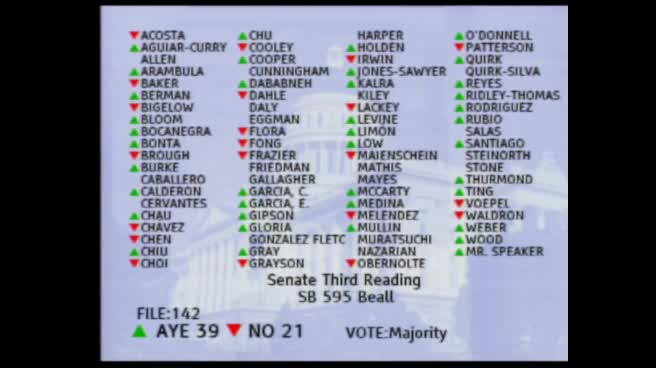 51SEC
Assembly Floor
 2MIN
Senate Floor
 1H
Senate Standing Committee on Appropriations
 15MIN
Senate Standing Committee on Environmental Quality
 16MIN
Senate Standing Committee on Governmental Organization
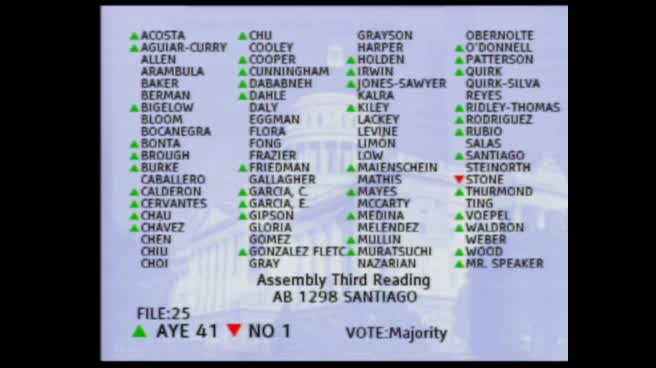 2MIN
Assembly Floor
 1H
Assembly Standing Committee on Appropriations
 12MIN






