AB 2639: Pupil suicide prevention policies: reviews: updates.
- Session Year: 2017-2018
- House: Assembly
- Latest Version Date: 2018-09-17
Existing law requires the governing board or body of a local educational agency that serves pupils in grades 7 to 12, inclusive, to, before the beginning of the 201718 school year, adopt a policy on pupil suicide prevention, as specified, that specifically addresses the needs of high-risk groups.
This bill would require the governing board or body of a local educational agency that serves pupils in grades 7 to 12, inclusive, to review, at minimum every 5th year, its policy on pupil suicide prevention and, if necessary, update its policy. By imposing additional duties on local educational agencies, the bill would impose a state-mandated local program.
The California Constitution requires the state to reimburse local agencies and school districts for certain costs mandated by the state. Statutory provisions establish procedures for making that reimbursement.
This bill would provide that, if the Commission on State Mandates determines that the bill contains costs mandated by the state, reimbursement for those costs shall be made pursuant to the statutory provisions noted above.
Existing law requires the governing board or body of a local educational agency that serves pupils in grades 7 to 12, inclusive, to, before the beginning of the 201718 school year, adopt a policy on pupil suicide prevention, as specified, that specifically addresses the needs of high-risk groups. Existing law requires the policy to address any training to be provided to teachers of pupils in grades 7 to 12, inclusive, on suicide awareness and prevention.
This bill would require the State Department of Education to identify one or more evidence-based online training programs that a local educational agency, as defined, or county office of education can use to train school staff and pupils as part of the local educational agencys or county office of educations policy on pupil suicide prevention. The bill would require each county office of education to, on a one-time basis, acquire a training program identified by the department and disseminate that training program to local educational agencies located in the county over which it has jurisdiction at no cost. governing board or body of a local educational agency that serves pupils in grades 7 to 12, inclusive, to review, at minimum every 5th year, its policy on pupil suicide prevention and, if necessary, update its policy. By imposing additional duties on county offices of education, local educational agencies, the bill would impose a state-mandated local program.
The California Constitution requires the state to reimburse local agencies and school districts for certain costs mandated by the state. Statutory provisions establish procedures for making that reimbursement.
This bill would provide that, if the Commission on State Mandates determines that the bill contains costs mandated by the state, reimbursement for those costs shall be made pursuant to the statutory provisions noted above.
Existing law requires the governing board or body of a local educational agency that serves pupils in grades 7 to 12, inclusive, to, before the beginning of the 201718 school year, adopt a policy on pupil suicide prevention, as specified, that specifically addresses the needs of high-risk groups. Existing law requires the policy to address any training to be provided to teachers of pupils in grades 7 to 12, inclusive, on suicide awareness and prevention.
This bill would require the State Department of Education to identify one or more evidence-based online training programs that a local educational agency, as defined, or county office of education can use to train school staff and pupils as part of the local educational agencys or county office of educations policy on pupil suicide prevention. The bill would require the department to provide a grant to a each county office of education to to, on a one-time basis, acquire and disseminate a training program identified by the department and disseminate that training program to local educational agencies located in the county over which it has jurisdiction at no cost. The bill would make its requirements contingent on funds being appropriated in the annual Budget Act or another statute for its purposes. By imposing additional duties on county offices of education, the bill would impose a state-mandated local program.
The California Constitution requires the state to reimburse local agencies and school districts for certain costs mandated by the state. Statutory provisions establish procedures for making that reimbursement.
This bill would provide that, if the Commission on State Mandates determines that the bill contains costs mandated by the state, reimbursement for those costs shall be made pursuant to the statutory provisions noted above.
Existing law requires the governing board or body of a local educational agency that serves pupils in grades 7 to 12, inclusive, to, before the beginning of the 201718 school year, adopt a policy on pupil suicide prevention, as specified, that specifically addresses the needs of high-risk groups. Existing law requires the policy to address any training to be provided to teachers of pupils in grades 7 to 12, inclusive, on suicide awareness and prevention.
This bill would require the State Department of Education to identify one or more evidence-based online training programs that a local educational agency, as defined, can use to train school staff and pupils as part of the local educational agencys policy on pupil suicide prevention. The bill would require the department to provide a grant to a county office of education to acquire and disseminate a training program identified by the department to local educational agencies at no cost. The bill would make its requirements contingent on funds being appropriated in the annual Budget Act or another statute for its purposes.
(a)The Legislature finds and declares all of the following:
(1)According to the federal Centers for Disease Control and Prevention, after a period of nearly consistent decline in suicide rates in the United States from 1986 to 1999, inclusive, suicide rates have increased almost steadily from 1999 to 2014, inclusive, with especially steep increases from 2006 to 2014, inclusive.
(2)The federal Centers for Disease Control and Prevention also reports that suicide among adolescents and young adults is increasing, and is now the second leading cause of death for youth and young adults 10 to 24 years of age, inclusive.
(3)As children and teens spend a significant amount of their young lives in school, the personnel who interact with them on a daily basis are in a prime position to recognize the warning signs of suicide and make the appropriate referrals for help.
(4)In a national survey conducted by the Jason Foundation, pupils reported that the number one person they would turn to for helping a friend who might be suicidal was a teacher.
(5)It is imperative that when a young person comes to school staff for help, that person has the knowledge, tools, and resources to respond.
(6)However, research on teacher and school staff preparedness has identified a lack of experience, training, and confidence to appropriately address mental health issues and suicidal ideation among pupils.
(7)The National Strategy for Suicide Prevention, authored by the United States Surgeon General and the National Action Alliance for Suicide Prevention, states that teachers and school counselors, among others who are on the front lines of suicide prevention, should be trained on suicide prevention.
(8)In 2016, AB 2246 (Chapter 642 of the Statutes of 2016) was enacted, requiring that each county office of education, school district, state special school, and charter school that serves pupils in grades 7 to 12, inclusive, adopt a pupil suicide prevention policy before the beginning of the 201718 school year. That law also requires that these policies address any training to be provided to teachers on suicide awareness and prevention.
(b)It is the intent of the Legislature that adopted policies on pupil suicide prevention be reviewed and, if necessary, updated to ensure that those policies remain relevant and address youth suicide prevention.
SEC. 2.Section 215 of the Education Code is amended to read:215.(a)(1)The governing board or body of a local educational agency that serves pupils in grades 7 to 12, inclusive, shall, before the beginning of the 201718 school year, adopt, at a regularly scheduled meeting, a policy on pupil suicide prevention in grades 7 to 12, inclusive. The policy shall be developed in consultation with school and community stakeholders, school-employed mental health professionals, and suicide prevention experts and shall, at a minimum, address procedures relating to suicide prevention, intervention, and postvention.
(2)The policy shall specifically address the needs of high-risk groups, including, but not limited to, all of the following:
(A)Youth bereaved by suicide.
(B)Youth with disabilities, mental illness, or substance use disorders.
(C)Youth experiencing homelessness or in out-of-home settings, such as foster care.
(D)Lesbian, gay, bisexual, transgender, or questioning youth.
(3)(A)The policy shall also address any training to be provided to teachers of pupils in grades 7 to 12, inclusive, on suicide awareness and prevention.
(B)Materials approved by a local educational agency for training shall include how to identify appropriate mental health services, both at the schoolsite and within the larger community, and when and how to refer youth and their families to those services.
(C)Materials approved for training may also include programs that can be completed through self-review of suitable suicide prevention materials.
(4)The policy shall be written to ensure that a school employee acts only within the authorization and scope of the employees credential or license. Nothing in this section shall be construed as authorizing or encouraging a school employee to diagnose or treat mental illness unless the employee is specifically licensed and employed to do so.
(5)To assist local educational agencies in developing policies for pupil suicide prevention, the department shall develop and maintain a model policy in accordance with this section to serve as a guide for local educational agencies.
(b)The governing board or body of a local educational agency that serves pupils in grades 7 to 12, inclusive, shall review, at minimum every fifth year, its policy on pupil suicide prevention and, if necessary, update its policy.
(c)Nothing in this section shall prevent the governing board or body of a local educational agency from reviewing or updating its policy on pupil suicide prevention more frequently than every fifth year.
(d)For purposes of this section, local educational agency means a county office of education, school district, state special school, or charter school.
SEC. 3.If the Commission on State Mandates determines that this act contains costs mandated by the state, reimbursement to local agencies and school districts for those costs shall be made pursuant to Part 7 (commencing with Section 17500) of Division 4 of Title 2 of the Government Code.
(a)The Legislature finds and declares all of the following:
(1)According to the federal Centers for Disease Control and Prevention, after a period of nearly consistent decline in suicide rates in the United States from 1986 to 1999, inclusive, suicide rates have increased almost steadily from 1999 to 2014, inclusive, with especially steep increases from 2006 to 2014, inclusive.
(2)The federal Centers for Disease Control and Prevention also reports that suicide among adolescents and young adults is increasing, and is now the second leading cause of death for youth and young adults 10 to 24 years of age, inclusive.
(3)As children and teens spend a significant amount of their young lives in school, the personnel who interact with them on a daily basis are in a prime position to recognize the warning signs of suicide and make the appropriate referrals for help.
(4)In a national survey conducted by the Jason Foundation, pupils reported that the number one person they would turn to for helping a friend who might be suicidal was a teacher.
(5)It is imperative that when a young person comes to school staff for help, that person has the knowledge, tools, and resources to respond.
(6)However, research on teacher and school staff preparedness has identified a lack of experience, training, and confidence to appropriately address mental health issues and suicidal ideation among pupils.
(7)The National Strategy for Suicide Prevention, authored by the United States Surgeon General and the National Action Alliance for Suicide Prevention, states that teachers and school counselors, among others who are on the front lines of suicide prevention, should be trained on suicide prevention.
(8)In 2016, AB 2246 (Chapter 642 of the Statutes of 2016) was enacted, requiring that each county office of education, school district, state special school, and charter school that serves pupils in grades 7 to 12, inclusive, adopt a suicide prevention policy before the beginning of the 201718 school year. That law also requires that these policies address any training to be provided to teachers on suicide awareness and prevention.
(b)It is the intent of the Legislature that, in order to support local educational agencies plans to train their employees on suicide awareness and prevention, the state provide local educational agencies access to evidence-based training in suicide awareness and prevention, in a cost-effective and flexible manner. that adopted policies on pupil suicide prevention be reviewed and, if necessary, updated to ensure that those policies remain relevant and address youth suicide prevention.
SEC. 2.Section 215 of the Education Code is amended to read:215.(a)(1)The governing board or body of a local educational agency that serves pupils in grades 7 to 12, inclusive, shall, before the beginning of the 201718 school year, adopt, at a regularly scheduled meeting, a policy on pupil suicide prevention in grades 7 to 12, inclusive. The policy shall be developed in consultation with school and community stakeholders, school-employed mental health professionals, and suicide prevention experts and shall, at a minimum, address procedures relating to suicide prevention, intervention, and postvention.
(2)The policy shall specifically address the needs of high-risk groups, including, but not limited to, all of the following:
(A)Youth bereaved by suicide.
(B)Youth with disabilities, mental illness, or substance use disorders.
(C)Youth experiencing homelessness or in out-of-home settings, such as foster care.
(D)Lesbian, gay, bisexual, transgender, or questioning youth.
(3)(A)The policy shall also address any training to be provided to teachers of pupils in grades 7 to 12, inclusive, on suicide awareness and prevention.
(B)Materials approved by a local educational agency for training shall include how to identify appropriate mental health services, both at the schoolsite and within the larger community, and when and how to refer youth and their families to those services.
(C)Materials approved for training may also include programs that can be completed through self-review of suitable suicide prevention materials.
(4)The policy shall be written to ensure that a school employee acts only within the authorization and scope of the employees credential or license. Nothing in this section shall be construed as authorizing or encouraging a school employee to diagnose or treat mental illness unless the employee is specifically licensed and employed to do so.
(5)To assist local educational agencies in developing policies for pupil suicide prevention, the department shall develop and maintain a model policy in accordance with this section to serve as a guide for local educational agencies.
(b)The governing board or body of a local educational agency that serves pupils in grades 7 to 12, inclusive, shall review, at minimum every fifth year, its policy on pupil suicide prevention and, if necessary, update its policy.
(c)Nothing in this section shall prevent the governing board or body of a local educational agency from reviewing or updating its policy on pupil suicide prevention more frequently than every fifth year.
(b)(d)For purposes of this section, local educational agency means a county office of education, school district, state special school, or charter school.
SEC. 2.Section 216 is added to the Education Code, to read:216.(a)The department shall identify one or more evidence-based online training programs that a local educational agency or county office of education can use to train school staff and pupils as part of the local educational agencys or county office of educations policy on pupil suicide prevention adopted pursuant to subdivision (a) of Section 215.(b)In identifying an online training program pursuant to subdivision (a), the department shall ensure all of the following:(1)The training program is evidence-based.(2)The training program is consistent with the model pupil suicide prevention policy developed by the department pursuant to paragraph (5) of subdivision (a) of Section 215.(3)The training program addresses the needs of high-risk groups as specified in paragraph (2) of subdivision (a) of Section 215.(4)The training program can track aggregate, statewide usage.(5)The training program can assess trainee knowledge before and after training is provided in order to measure training outcomes.(c)(1)Each county office of education shall, on a one-time basis, acquire a training program identified by the department pursuant to subdivision (a) and disseminate that training program to local educational agencies located in the county over which it has jurisdiction.(2)A county office of education shall make the training program available to local educational agencies pursuant to paragraph (1) at no cost.(3)A local educational agency or county office of education is not required to use the training program and may use the training program on a voluntary basis.(d)For purposes of this section, local educational agency means a school district, state special school, or charter school that serves pupils in grades 7 to 12, inclusive. SEC. 3.If the Commission on State Mandates determines that this act contains costs mandated by the state, reimbursement to local agencies and school districts for those costs shall be made pursuant to Part 7 (commencing with Section 17500) of Division 4 of Title 2 of the Government Code.
(a)The Legislature finds and declares all of the following:
(1)According to the federal Centers for Disease Control and Prevention, after a period of nearly consistent decline in suicide rates in the United States from 1986 to 1999, inclusive, suicide rates have increased almost steadily from 1999 to 2014, inclusive, with especially steep increases from 2006 to 2014, inclusive.
(2)The federal Centers for Disease Control and Prevention also reports that suicide among adolescents and young adults is increasing, and is now the second leading cause of death for youth and young adults 10 to 24 years of age, inclusive.
(3)As children and teens spend a significant amount of their young lives in school, the personnel who interact with them on a daily basis are in a prime position to recognize the warning signs of suicide and make the appropriate referrals for help.
(4)In a national survey conducted by the Jason Foundation, pupils reported that the number one person they would turn to for helping a friend who might be suicidal was a teacher.
(5)It is imperative that when a young person comes to school staff for help, that person has the knowledge, tools, and resources to respond.
(6)However, research on teacher and school staff preparedness has identified a lack of experience, training, and confidence to appropriately address mental health issues and suicide suicidal ideation among pupils.
(7)The National Strategy for Suicide Prevention, authored by the United States Surgeon General and the National Action Alliance for Suicide Prevention, states that teachers and school counselors, among others who are on the front lines of suicide prevention, should be trained on suicide prevention.
(8)In 2016, AB 2246 (Chapter 642 of the Statutes of 2016) was enacted, requiring that each county office of education, school district, state special school, and charter school that serves pupils in grades 7 to 12, inclusive, adopt a suicide prevention policy before the beginning of the 201718 school year. That law also requires that these policies address any training to be provided to teachers on suicide awareness and prevention.
(b)It is the intent of the Legislature that, in order to support local educational agencies plans to train their employees on suicide awareness and prevention, the state provide local educational agencies access to evidence-based training in suicide awareness and prevention, in a cost-effective and flexible manner.
SEC. 2.Section 216 is added to the Education Code, to read:216.(a)The department shall identify one or more evidence-based online training programs that a local educational agency or county office of education can use to train school staff and pupils as part of the local educational agencys or county office of educations policy on pupil suicide prevention adopted pursuant to subdivision (a) of Section 215.
(b)In identifying an online training program pursuant to subdivision (a), the department shall ensure all of the following:
(1)The training program is evidence-based.
(2)The training program is consistent with the model pupil suicide prevention policy developed by the department pursuant to paragraph (5) of subdivision (a) of Section 215.
(3)The training program addresses the needs of high-risk groups as specified in paragraph (2) of subdivision (a) of Section 215.
(4)The training program can track aggregate, statewide usage.
(5)The training program can assess trainee knowledge before and after training is provided in order to measure training outcomes.
(c)(1)The department shall, subject to funds being appropriated in the annual Budget Act or another statute for this purpose, provide a grant to a county office of education, upon application by the county office of education, for the county(c)(1)Each county office of education to shall, on a one-time basis, acquire and disseminate a training program identified by the department pursuant to subdivision (a) and disseminate that training program to local educational agencies. agencies located in the county over which it has jurisdiction.
(2)The A county office of education shall make the training program available to local educational agencies pursuant to paragraph (1) at no cost.
(3)A local educational agency or county office of education is not required to use the training program and may use the training program on a voluntary basis.
(d)For purposes of this section, local educational agency means a county office of education, school district, state special school, or charter school that serves pupils in grades 7 to 12, inclusive.
(e)The requirements of this section are contingent on funds being appropriated in the annual Budget Act or another statute for its purposes.SEC. 3.If the Commission on State Mandates determines that this act contains costs mandated by the state, reimbursement to local agencies and school districts for those costs shall be made pursuant to Part 7 (commencing with Section 17500) of Division 4 of Title 2 of the Government Code.
(a)The Legislature finds and declares all of the following:
(1)According to the federal Centers for Disease Control and Prevention, after a period of nearly consistent decline in suicide rates in the United States from 1986 to 1999, inclusive, suicide rates have increased almost steadily from 1999 to 2014, inclusive, with especially steep increases from 2006 to 2014, inclusive.
(2)The federal Centers for Disease Control and Prevention also reports that suicide among adolescents and young adults is increasing, and is now the second leading cause of death for youth and young adults 10 to 24 years of age, inclusive.
(3)As children and teens spend a significant amount of their young lives in school, the personnel who interact with them on a daily basis are in a prime position to recognize the warning signs of suicide and make the appropriate referrals for help.
(4)In a national survey conducted by the Jason Foundation, pupils reported that the number one person they would turn to for helping a friend who might be suicidal was a teacher.
(5)It is imperative that when a young person comes to school staff for help, that person has the knowledge, tools, and resources to respond.
(6)However, research on teacher and school staff preparedness has identified a lack of experience, training, and confidence to appropriately address mental health issues and suicide ideation among pupils.
(7)The National Strategy for Suicide Prevention, authored by the United States Surgeon General and the National Action Alliance for Suicide Prevention, states that teachers and school counselors, among others who are on the front lines of suicide prevention, should be trained on suicide prevention.
(8)In 2016, AB 2246 (Chapter 642 of the Statutes of 2016) was enacted, requiring that each county office of education, school district, state special school, and charter school that serves pupils in grades 7 to 12, inclusive, adopt a suicide prevention policy before the beginning of the 201718 school year. That law also requires that these policies address any training to be provided to teachers on suicide awareness and prevention.
(b)It is the intent of the Legislature that, in order to support local educational agencies plans to train their employees on suicide awareness and prevention, the state provide local educational agencies access to evidence-based training in suicide awareness and prevention, in a cost-effective and flexible manner.
SEC. 2.Section 216 is added to the Education Code, to read:216.(a)The department shall identify one or more evidence-based online training programs that a local educational agency can use to train school staff and pupils as part of the local educational agencys policy on pupil suicide prevention adopted pursuant to subdivision (a) of Section 215.
(b)In identifying an online training program pursuant to subdivision (a), the department shall ensure all of the following:
(1)The training program is evidence-based.
(2)The training program is consistent with the model pupil suicide prevention policy developed by the department pursuant to paragraph (5) of subdivision (a) of Section 215.
(3)The training program addresses the needs of high-risk groups as specified in paragraph (2) of subdivision (a) of Section 215.
(4)The training program can track aggregate, statewide usage.
(5)The training program can assess trainee knowledge before and after training is provided in order to measure training outcomes.
(c)(1)The department shall, subject to funds being appropriated in the annual Budget Act or another statute for this purpose, provide a grant to a county office of education, upon application by the county office of education, for the county office of education to acquire and disseminate a training program identified by the department pursuant to subdivision (a) to local educational agencies.
(2)The county office of education shall make the training program available to local educational agencies at no cost.
(3)A local educational agency is not required to use the training program and may use the training program on a voluntary basis.
(d)For purposes of this section, local educational agency means a county office of education, school district, state special school, or charter school that serves pupils in grades 7 to 12, inclusive.
(e)The requirements of this section are contingent on funds being appropriated in the annual Budget Act or another statute for its purposes.
|
Date
|
Status
|
|---|---|
| Sep 17, 2018 | Chaptered by Secretary of State - Chapter 437, Statutes of 2018. |
| Sep 17, 2018 | Approved by the Governor. |
| Sep 5, 2018 | Enrolled and presented to the Governor at 3 p.m. |
| Aug 27, 2018 | Senate amendments concurred in. To Engrossing and Enrolling. |
| Aug 22, 2018 | In Assembly. Concurrence in Senate amendments pending. May be considered on or after August 24 pursuant to Assembly Rule 77. |
| Aug 22, 2018 | Read third time. Passed. Ordered to the Assembly. |
| Aug 20, 2018 | Read second time. Ordered to third reading. |
| Aug 17, 2018 | From committee: Amend, and do pass as amended. (Ayes 7. Noes 0.) (August 16). |
| Aug 6, 2018 | In committee: Referred to APPR. suspense file. |
| Jun 28, 2018 | From committee: Do pass and re-refer to Com. on APPR. with recommendation: To Consent Calendar. (Ayes 7. Noes 0.) (June 27). Re-referred to Com. on APPR. |
| Jun 18, 2018 | From committee chair, with author's amendments: Amend, and re-refer to committee. Read second time, amended, and re-referred to Com. on ED. |
| Jun 14, 2018 | In committee: Set, first hearing. Hearing canceled at the request of author. |
| Jun 13, 2018 | Referred to Com. on ED. |
| Jun 4, 2018 | In Senate. Read first time. To Com. on RLS. for assignment. |
| May 31, 2018 | Read third time. Passed. Ordered to the Senate. |
| May 29, 2018 | Read second time. Ordered to third reading. |
| May 25, 2018 | From committee: Amend, and do pass as amended. (Ayes 12. Noes 0.) (May 25). |
| Apr 11, 2018 | In committee: Set, first hearing. Referred to APPR. suspense file. |
| Mar 22, 2018 | From committee: Do pass and re-refer to Com. on APPR. (Ayes 7. Noes 0.) (March 21). Re-referred to Com. on APPR. |
| Mar 8, 2018 | Referred to Com. on ED. |
| Feb 16, 2018 | From printer. May be heard in committee March 18. |
| Feb 15, 2018 | Read first time. To print. |
|
Date
|
Description
|
Location
|
Votes
|
|
|---|---|---|---|---|
| Aug 27, 2018 | AB 2639 BERMAN Concurrence in Senate Amendments | Assembly Floor |
Passed |
|
| Aug 22, 2018 | Assembly 3rd Reading AB2639 Berman et al. By Portantino | Senate Floor |
Passed |
|
| Aug 16, 2018 | Do pass as amended | Senate Standing Committee on Appropriations |
Passed |
|
| Aug 6, 2018 | Placed on suspense file | Senate Standing Committee on Appropriations |
Passed |
|
| Jun 27, 2018 | Do pass, but first be re-referred to the Committee on [Appropriations] with the recommendation: To Consent Calendar | Senate Standing Committee on Education |
Passed |
|
| May 31, 2018 | AB 2639 BERMAN Assembly Third Reading | Assembly Floor |
Passed |
|
| May 25, 2018 | Do pass as amended. | Assembly Standing Committee on Appropriations |
Passed |
|
| Mar 21, 2018 | Do pass and be re-referred to the Committee on [Appropriations] | Assembly Standing Committee on Education |
Passed |
This list shows positions taken on this bill by organizations on the date displayed, which is linked to the original source.
Positions by individuals are not included.
|
Organization
|
Position
|
Date
|
|---|---|---|
| American Foundation for Suicide Prevention | * Support | Mar 21, 2018 |
| California Medical Association | * Support | Mar 21, 2018 |
| California Parent Teacher Association | * Support | Mar 21, 2018 |
| California School Boards Association | ** Support | Aug 20, 2018 |
| California State PTA | ** Support | Aug 20, 2018 |
| Corona-Norco Unified School District | ** Support | Mar 20, 2018 |
| Equality California | ** Support | Aug 20, 2018 |
| Newport-Mesa Unified School District | ** Support | Mar 20, 2018 |
| SacLEGAL | ** Support | Aug 20, 2018 |
| Steinberg Institute | ** Support | Mar 20, 2018 |
| The Trevor Project | ** Support | Aug 20, 2018 |
CONCURRENCE IN SENATE AMENDMENTS
CSA1 Bill Id:AB 2639
Author:(Berman and O'Donnell)
As Amended Ver:August 17, 2018
Majority vote
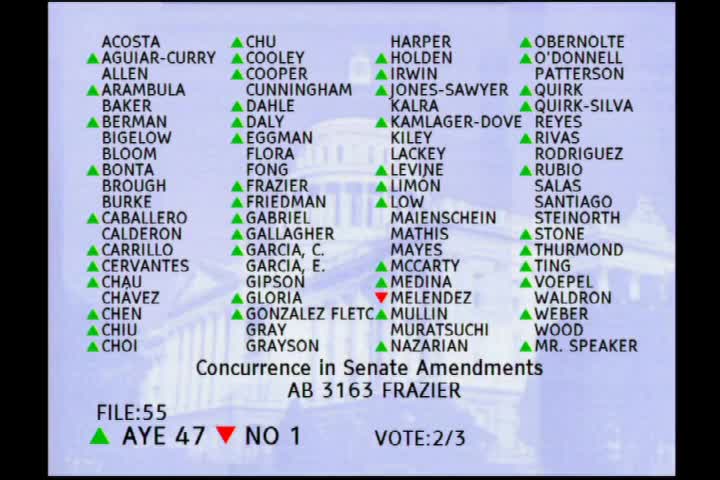
ASSEMBLY: | 78-0 | (May 31, 2018) | SENATE: | 39-0 | (August 22, 2018) |
Original Committee Reference: ED.
SUMMARY: Requires schools that serve students in grades 7 through 12 to review and, if necessary, update their policies on pupil suicide prevention at least every 5 years.
The Senate amendments:
- Delete the contents of the bill.
- Require the governing board or body of a local educational agency (LEA) that serves pupils in grades seven to 12, inclusive, to review, at minimum every fifth year, its policy on pupil suicide prevention and, if necessary, update its policy.
- State that nothing in the act shall prevent the governing board or body of a LEA from reviewing or updating its policy on pupil suicide prevention more frequently than every fifth year.
FISCAL EFFECT: According to the Senate Appropriations Committee, to the extent that school districts update their suicide prevention policies as a result of this measure, this bill could result in a reimbursable state mandate with Proposition 98 General Fund costs estimated to be in the tens of thousands to low hundreds of thousands of dollars. The cost for districts to review their suicide prevention policies every fifth year are expected to be minimal.
COMMENTS:
Need for the bill. The author's office states: "The federal Centers for Disease Control and Prevention reports that suicide among adolescents and young adults is on the rise, and is now the second leading cause of death among youth and young adults 10 to 24 years of age. As children and teens spend a significant amount of their young lives in school, the personnel who interact with them on a daily basis are in a prime position to recognize the warning signs of suicide and make the appropriate referrals for help. In a national survey conducted by the Jason Foundation, pupils reported that the number one person they would turn to for helping a friend who might be suicidal was a teacher.
It is imperative that when a young person comes to school staff for help, that person has the knowledge, tools, and resources to respond. However, research on teacher and school staff preparedness has identified a lack of experience, training, and confidence to appropriately address mental health issues and suicide ideation among pupils. Further, the National Strategy for Suicide Prevention, authored by the United States Surgeon General and the National Action Alliance for Suicide Prevention, states that teachers and school counselors, among others who are on the front lines of suicide prevention, should be trained on suicide prevention.
In 2016, AB 2246 (O'Donnell) Chapter 642, was signed into law. That measure requires schools that serve pupils in grades seven to 12 to adopt a policy on pupil suicide prevention in consultation with school and community stakeholders, school-employed mental health professionals, and suicide prevention experts. AB 2246 also requires that these policies address any training to be provided to teachers on suicide awareness and prevention.
In order to support schools' plans to train their staff on suicide prevention, AB 2639 is needed to take the next step of providing access to training in a cost-effective and flexible manner."
Youth suicide in California. According to the Lucile Packard Foundation for Children's Health, which compiles and reports data from state agency sources:
- In 2011-13, nearly 20% of California public school students in grades nine, 11, and nontraditional classes reported seriously considering attempting suicide in the past year.
- Reported suicidal ideation is higher among female students and among students from multiracial and Native Hawaiian/Pacific Islander backgrounds.
- In 2013, 481 California youth ages five through 24 were known to have committed suicide.
- The state's youth suicide rate in 2011-13 was 7.7 per 100,000 youth ages 15-24, slightly higher than previous years, but substantially lower than the rate in 1995-97 (9.4 per 100,000).
- In 2013, males accounted for almost 80% of youth suicides in California (354 of 452). Statewide and nationally, many more male youth (ages 15-24) than female youth commit suicide.
- In 2013, there were 3,322 hospitalizations for non-fatal self-inflicted injuries among children and youth ages five through 20 in California.
- In 2013, 62% of hospitalizations for self-inflicted injuries in California involved youth ages 16-20.
Analysis Prepared by: Tanya Lieberman / ED. / (916) 319-2087 FN: 0004523
Office of Senate Floor Analyses (916) 651-1520 Fax: (916) 327-4478 | AB |
THIRD READING
Bill No: AB 2639
:
SENATE EDUCATION COMMITTEE: 7-0, 6/27/18
AYES: Allen, Wilk, Galgiani, Leyva, McGuire, Pan, Vidak
SENATE APPROPRIATIONS COMMITTEE: 7-0, 8/16/18
AYES: Portantino, Bates, Beall, Bradford, Hill, Nielsen, Wiener
ASSEMBLY FLOOR: 78-0, 5/31/18 - See last page for vote
The Trevor Project
DIGEST:
This bill requires schools that serve students in grades 7 through 12 to review and, if necessary, update their policy on pupil suicide prevention at least every five years.
Existing law:
- Requires that the governing board or body of a local educational agencies (LEA), defined as a county offices of education, school district, the state special schools, or charter schools, which serve students in grades 7 to 12 to adopt, before the beginning of the 2017–18 school year, a policy on student suicide prevention for students in those grades. (Education Code § 215)
- Requires the policy to specifically address the needs of high-risk groups, including, but not limited to the following:
- Youth bereaved by suicide.
- Youth with disabilities, mental illness or substance abuse disorders.
- Youth experiencing homelessness or in out-of-home settings, such as foster care.
- Lesbian, gay, bisexual, transgender, or questioning youth. (EC § 215)
- Requires that the materials approved by the LEA for training include how to identify appropriate mental health services and when and how to refer youth and their families to those services. (EC § 215)
This bill requires the governing board or body of an LEA that serves in grades 7 through 12 to review its policy on pupil suicide prevention every five years and, if necessary, update the policy. This bill also permits LEAs to update the policy more frequently than every five years.
Comments
Need for the bill. According to the author. “In order to ensure that adopted policies on pupil suicide prevention remain relevant and address youth suicide prevention, legislation is needed to specify that local educational agencies should review its policy on pupil suicide prevention and, if necessary, update its policy. This bill builds upon the existing requirement for local educational agencies to adopt a policy on pupil suicide prevention and ensures that those policies remain relevant and continue to address youth suicide prevention.”
Youth suicide. Suicide is considered a major, preventable public health problem and according to the Centers on Disease Control is the second leading cause of death among teens 15-19 nationwide. A national study conducted by the Jason Foundation found that the number one person a student would contact to help a friend who might be suicidal was a teacher. When a young person comes to a teacher for help, it is vital that he or she has the knowledge, skills, and resources to respond appropriately. Additionally, according to the Lucile Packard Foundation for Children’s Health, which compiles and reports data from state agency sources:
- In 2013-15, nearly 20 percent of California public school students in grades 9, 11, and 26 percent of nontraditional students reported seriously considered attempting suicide in the past year.
- Reported suicidal ideation is higher among female students and among students from multiracial, American Indian/Alaska Native and Native Hawaiian/Pacific Islander backgrounds.
- The proportion of gay, lesbian, and bisexual students who seriously considered attempting suicide was nearly 50 percent, more than three times higher than the estimate for their straight peers (16 percent).
- In 2015, 495 California youth ages 5-24 were known to have committed suicide.
- The state’s youth suicide rate in 2013-15 was 7.9 per 100,000 youth ages 15-24, slightly higher than previous years, but substantially lower than the national average of 11.7 per 100,000.
- In 2015, males accounted for more than 75 percent of youth suicides in California (354 of 452). Statewide and nationally, many more male youth (ages 15-24) than female youth commit suicide.
- In 2014, there were 3,575 hospitalizations for non-fatal self-inflicted injuries among children and youth ages 5-20 in California. While the statewide rate of self-inflicted injury hospitalizations has fluctuated over the past two decades, rates have risen in recent years, from a 22-year low of 34.3 per 100,000 in 2008 to 43.1 per 100,000 in 2014.
- In 2014, 61 percent of hospitalizations for self-inflicted injuries in California involved youth ages 16-20.
FISCAL EFFECT: Appropriation: Fiscal Com.: Local:
According to the Senate Appropriations Committee, to the extent that school districts update their suicide prevention policies as a result of this measure, this bill could result in a reimbursable state mandate with Proposition 98 General Fund costs estimated to be in the tens of thousands to low hundreds of thousands of dollars. The cost for districts to review their suicide prevention policies every fifth year are expected to be minimal.
Equality California (co-source)
The Trevor Project (co-source)
California School Boards Association
California State PTA
SacLegal
OPPOSITION: (Verified 8/17/18)
None received
ASSEMBLY FLOOR: 78-0, 5/31/18
AYES: Acosta, Aguiar-Curry, Travis Allen, Arambula, Baker, Berman, Bigelow, Bloom, Bonta, Brough, Burke, Caballero, Calderon, Carrillo, Cervantes, Chau, Chávez, Chen, Chiu, Choi, Chu, Cooley, Cooper, Cunningham, Dahle, Daly, Eggman, Flora, Fong, Frazier, Friedman, Gallagher, Cristina Garcia, Eduardo Garcia, Gipson, Gloria, Gonzalez Fletcher, Gray, Grayson, Harper, Holden, Irwin, Jones-Sawyer, Kalra, Kamlager-Dove, Kiley, Lackey, Levine, Limón, Low, Maienschein, Mathis, Mayes, McCarty, Medina, Melendez, Mullin, Muratsuchi, Nazarian, Obernolte, O'Donnell, Patterson, Quirk, Quirk-Silva, Reyes, Rodriguez, Rubio, Salas, Santiago, Steinorth, Mark Stone, Thurmond, Ting, Voepel, Waldron, Weber, Wood, Rendon
8/20/18 9:15:28
**** END ****
SENATE COMMITTEE ON APPROPRIATIONS
Senator Anthony Portantino, Chair
2017 - 2018 Regular Session
AB 2639 (Berman) - Pupil suicide prevention policies: reviews: updates
Version: June 18, 2018 | Policy Vote: ED. 7 - 0 |
Urgency: No | Mandate: Yes |
Hearing Date: August 16, 2018 | Consultant: Lenin Del Castillo |
Bill Summary:
This bill requires schools that serve students in grades 7 through 12 to review and, if necessary, update their policy on pupil suicide prevention at least every 5 years.
*********** ANALYSIS ADDENDUM – SUSPENSE FILE ***********
The following information is revised to reflect amendments
adopted by the committee on August 16, 2018
Fiscal Impact:
To the extent that school districts update their suicide prevention policies as a result of this measure, this bill could result in a reimbursable state mandate with Proposition 98 General Fund costs estimated to be in the tens of thousands to low hundreds of thousands of dollars. The cost for districts to review their suicide prevention policies every fifth year are expected to be minimal.
Committee Amendments:
Make technical changes and add coauthors.
-- END --
SENATE COMMITTEE ON
Senator Anthony Portantino, Chair
2017 - 2018 Regular Session
AB 2639 (Berman) - Pupil suicide prevention policies: reviews: updates
Version: | Policy Vote: |
Urgency: | Mandate: |
Hearing Date: | Consultant: |
This bill meets the criteria for referral to the Suspense File.
Bill Summary:
This bill requires schools that serve students in grades 7 through 12 to review and, if necessary, update their policy on pupil suicide prevention at least every 5 years.
Fiscal Impact:
To the extent that school districts update their suicide prevention policies as a result of this measure, this bill could result in a reimbursable state mandate with Proposition 98 General Fund costs estimated to be in the tens of thousands to low hundreds of thousands of dollars. The cost for districts to review their suicide prevention policies every fifth year are expected to be minimal.
Background:
Existing law requires that the governing board or body of a local educational agency (LEA) which serve students in grades 7 to 12 to adopt, before the beginning of the 2017–18 school year, a policy on student suicide prevention for students in those grades. The policy shall specifically address the needs of high-risk groups, including, but not limited to the following: youth bereaved by suicide, youth with disabilities, mental illness or substance abuse disorders, youth experiencing homelessness or in out-of-home settings, such as foster care, and lesbian, gay, bisexual, transgender, or questioning youth.
Existing law requires that the materials approved by the LEA for training include how to identify appropriate mental health services and when and how to refer youth and their families to those services.
Proposed Law:
This bill requires the governing board or body of an LEA that serves in grades 7 through 12 to review its policy on pupil suicide prevention every five years and, if necessary, update the policy. This bill also permits LEAs to update the policy more frequently than every five years.
Related Legislation:
AB 2246 (O’Donnell, Chapter 642, Statues of 2016) required that local education agencies that serve students in grades 7-12 adopt a policy for student suicide prevention.
-- END --
SENATE COMMITTEE ON EDUCATION
Senator Benjamin Allen, Chair
2017 - 2018 Regular
Bill No: Hearing Date: June 27, 2018
Author: | Berman | ||
Version: |
| ||
Urgency: | Fiscal: | ||
Consultant: | |||
Subject: .
SUMMARY
This bill requires schools that serve students in grades 7 through 12 to review and, if necessary, update their policy on pupil suicide prevention at least every 5 years.
BACKGROUND
Existing law:
- Requires that the governing board or body of a local educational agencies (LEA), defined as a county offices of education (COE), school district, the state special schools, or charter schools, which serve students in grades 7 to 12 to adopt, before the beginning of the 2017–18 school year, a policy on student suicide prevention for students in those grades. (Education Code § 215)
- Requires the policy to specifically address the needs of high-risk groups, including, but not limited to the following:
- Youth bereaved by suicide.
- Youth with disabilities, mental illness or substance abuse disorders.
- Youth experiencing homelessness or in out-of-home settings, such as foster care.
- Lesbian, gay, bisexual, transgender, or questioning youth. (EC § 215)
- Requires that the materials approved by the LEA for training include how to identify appropriate mental health services and when and how to refer youth and their families to those services. (EC § 215)
ANALYSIS
This bill requires the governing board or body of an LEA that serves in grades 7 through 12 to review its policy on pupil suicide prevention every five years and, if necessary, update the policy. This bill also permits LEAs to update the policy more frequently than every five years.
STAFF COMMENTS
- Need for the bill. According to the author, “ The federal Centers for Disease Control and Prevention reports that suicide among adolescents and young adults is on the rise, and is now the second leading cause of death among youth and young adults 10 to 24 years of age. As children and teens spend a significant amount of their young lives in school, the personnel who interact with them on a daily basis are in a prime position to recognize the warning signs of suicide and make the appropriate referrals for help. In a national survey conducted by the Jason Foundation, pupils reported that the number one person they would turn to for helping a friend who might be suicidal was a teacher.”
“It is imperative that when a young person comes to school staff for help, that person has the knowledge, tools, and resources to respond. However, research on teacher and school staff preparedness has identified a lack of experience, training, and confidence to appropriately address mental health issues and suicide ideation among pupils. Further, the National Strategy for Suicide Prevention, authored by the United States Surgeon General and the National Action Alliance for Suicide Prevention, states that teachers and school counselors, among others who are on the front lines of suicide prevention, should be trained on suicide prevention.”
“In order to ensure that adopted policies on pupil suicide prevention remain relevant and address youth suicide prevention, legislation is needed to specify that local educational agencies should review its policy on pupil suicide prevention and, if necessary, update its policy. This bill builds upon the existing requirement for local educational agencies to adopt a policy on pupil suicide prevention and ensures that those policies remain relevant and continue to address youth suicide prevention.”
- Youth suicide. Suicide is considered a major, preventable public health problem and according to the Centers on Disease Control (CDC) is the second leading cause of death among teens 15-19 nationwide. A national study conducted by the Jason Foundation found that the number one person a student would contact to help a friend who might be suicidal was a teacher. When a young person comes to a teacher for help, it is vital that he or she has the knowledge, skills, and resources to respond appropriately. Additionally, according to the Lucile Packard Foundation for Children’s Health, which compiles and reports data from state agency sources:
- In 2013-15, nearly 20 percent of California public school students in grades 9, 11, and 26 percent of nontraditional students reported seriously considered attempting suicide in the past year.
- Reported suicidal ideation is higher among female students and among students from multiracial, American Indian/Alaska Native and Native Hawaiian/Pacific Islander backgrounds.
- The proportion of gay, lesbian, and bisexual students who seriously considered attempting suicide was nearly 50 percent, more than three times higher than the estimate for their straight peers (16 percent).
- In 2015, 495 California youth ages 5-24 were known to have committed suicide.
- The state’s youth suicide rate in 2013-15 was 7.9 per 100,000 youth ages 15-24, slightly higher than previous years, but substantially lower than the national average of 11.7 per 100,000.
- In 2015, males accounted for more than 75 percent of youth suicides in California (354 of 452). Statewide and nationally, many more male youth (ages 15-24) than female youth commit suicide.
- In 2014, there were 3,575 hospitalizations for non-fatal self-inflicted injuries among children and youth ages 5-20 in California. While the statewide rate of self-inflicted injury hospitalizations has fluctuated over the past two decades, rates have risen in recent years, from a 22-year low of 34.3 per 100,000 in 2008 to 43.1 per 100,000 in 2014.
- In 2014, 61 percent of hospitalizations for self-inflicted injuries in California involved youth ages 16-20.
- Fiscal impact. The fiscal effect/impact is unknown since this bill differs substantially from the prior version that was analyzed by the Assembly Appropriations Committee.
- Prior Legislation. AB 2246 (O’Donnell, Chapter 642, Statues of 2016) required that local education agencies that serve students in grades 7-12 adopt a policy for student suicide prevention.
SUPPORT
Equality California (Co-Sponsor)
The Trevor Project (Co-Sponsor)
California School Boards Association
California State PTA
SacLegal
OPPOSITION
None received
-- END --
ASSEMBLY THIRD READING
ATR Bill Id:
Author:(Berman and O'Donnell)
As Introduced Ver:May 25, 2018
Majority vote
Committee | Votes | Ayes | Noes |
Education | 7-0 | O'Donnell, Kiley, Lackey, Kalra, McCarty, Thurmond, Weber | |
Appropriations | 12-0 | Gonzalez Fletcher, Bloom, Bonta, Calderon, Carrillo, Chau, Eggman, Friedman, Eduardo Garcia, Nazarian, Quirk, Reyes |
|
SUMMARY: Requires the California Department of Education (CDE) to identify, and each county offices of education to make available, an online training program in suicide prevention that schools can use to train school staff and pupils, consistent with the local policies on suicide prevention. Specifically, this bill:
- Requires the CDE to identify one or more evidence-based online training programs that an LEA or a county office of education can use to train school staff and pupils pursuant to local policies on pupil suicide prevention, which are required by current law.
- Requires the CDE, in identifying an online training program to ensure that the online training or trainings:
- Are evidence-based
- Are consistent with the model pupil suicide prevention policy developed by the CDE
- Addresses the needs of high-risk groups required to be addressed by local suicide prevention policies
- Can track aggregate, statewide usage
- Can assess trainee knowledge before and after training is provided in order to measure training outcomes
- Requires each county office of education, on a one-time basis, to acquire and disseminate to the LEAs in its jurisdiction, the online training program identified by the CDE.
- Requires the COEs to make the training program available to LEAs at no cost.
- States that a LEA and a county office of education is not required to use the training program and may use the training program on a voluntary basis.
- Defines, for purposes of this act, LEA to mean a school district, state special school, or charter school that serves pupils in grades 7 to 12.
- Makes findings and declarations relative to the incidence of suicide among adolescents and the role of teachers in preventing youth suicide.
FISCAL EFFECT: According to the Assembly Education Committee:
- One-time General Fund costs of about $160,000 for CDE to hire staff to research and identify an online suicide prevention training program, develop a contract for purchasing the training program, and select the COE that will purchase and disseminate the training program. Ongoing General Fund costs of $49,000 for CDE staff to monitor the selected COE.
- Unknown Proposition 98 General Fund costs for COEs to purchase and disseminate an online suicide prevention training program. Costs would depend on the program the CDE identifies and the number of school districts that elect to use the training program.
- Potential unknown Proposition 98 General Fund costs to school districts that choose to train staff and students for costs not covered by the program such as staff release time and computers.
COMMENTS:
Need for the bill. The author's office states: "The federal Centers for Disease Control and Prevention reports that suicide among adolescents and young adults is on the rise, and is now the second leading cause of death among youth and young adults 10 to 24 years of age. As children and teens spend a significant amount of their young lives in school, the personnel who interact with them on a daily basis are in a prime position to recognize the warning signs of suicide and make the appropriate referrals for help. In a national survey conducted by the Jason Foundation, pupils reported that the number one person they would turn to for helping a friend who might be suicidal was a teacher.
It is imperative that when a young person comes to school staff for help, that person has the knowledge, tools, and resources to respond. However, research on teacher and school staff preparedness has identified a lack of experience, training, and confidence to appropriately address mental health issues and suicide ideation among pupils. Further, the National Strategy for Suicide Prevention, authored by the United States Surgeon General and the National Action Alliance for Suicide Prevention, states that teachers and school counselors, among others who are on the front lines of suicide prevention, should be trained on suicide prevention.
In 2016, AB 2246 (O'Donnell) was signed into law. That measure requires schools that serve pupils in grades 7 to 12 to adopt a policy on pupil suicide prevention in consultation with school and community stakeholders, school-employed mental health professionals, and suicide prevention experts. AB 2246 also requires that these policies address any training to be provided to teachers on suicide awareness and prevention.
In order to support schools' plans to train their staff on suicide prevention, AB 2639 is needed to take the next step of providing access to training in a cost-effective and flexible manner."
Youth suicide in California. According to the Lucile Packard Foundation for Children's Health, which compiles and reports data from state agency sources:
- In 2011-13, nearly 20% of California public school students in grades 9, 11, and nontraditional classes reported seriously considering attempting suicide in the past year.
- Reported suicidal ideation is higher among female students and among students from multiracial and Native Hawaiian/Pacific Islander backgrounds.
- In 2013, 481 California youth ages 5-24 were known to have committed suicide.
- The state's youth suicide rate in 2011-13 was 7.7 per 100,000 youth ages 15-24, slightly higher than previous years, but substantially lower than the rate in 1995-97 (9.4 per 100,000).
- In 2013, males accounted for almost 80% of youth suicides in California (354 of 452). Statewide and nationally, many more male youth (ages 15-24) than female youth commit suicide.
- In 2013, there were 3,322 hospitalizations for non-fatal self-inflicted injuries among children and youth ages 5-20 in California.
- In 2013, 62% of hospitalizations for self-inflicted injuries in California involved youth ages 16-20.
Recommendations on training school staff in suicide prevention. Numerous policy documents on suicide prevention recommend that teachers and other school staff be trained on this topic, generally viewing school staff as "gatekeepers" who can play a critical role in preventing suicide. Among them:
- The United States Surgeon General and the National Action Alliance for Suicide Prevention's National Strategy for Suicide Prevention, recommends that teachers and school counselors, among others who are on the front lines of suicide prevention, be trained on suicide prevention.
- The United States Department of Health and Human Services' Substance Abuse and Mental Health Services Administration (SAMHSA) recommends educating all staff about the importance of suicide prevention, training all staff to recognize suicide risk, and training selected staff to assess and refer students at risk of suicide to appropriate services.
- The World Health Organization recommends "training all school staff in the capacity to talk among themselves and with the students about life and death issues, improving their skills in identifying distress, depression and suicidal behaviour, and increasing their knowledge about available support are crucial means of suicide prevention."
- The CDE's model suicide prevention strategy recommends training of school staff. Specifically, the policy recommends annual training of all school staff on risk factors and warning signs of suicide, suicide prevention, intervention, referral, and postvention, including appropriate ways to interact with a youth who is demonstrating emotional distress or is suicidal.
Analysis Prepared by: Tanya Lieberman / ED. / (916) 319-2087 FN: 0003342
Date of Hearing: April 11, 2018
ASSEMBLY COMMITTEE ON APPROPRIATIONS
Lorena Gonzalez Fletcher, Chair
ABPCA Bill Id:AB 2639
Author:(Berman) – As Introduced Ver:February 15, 2018
Policy Committee: | Education | Vote: | 7 - 0 |
|
| ||
|
|
Urgency: No State Mandated Local Program: No Reimbursable: No
SUMMARY: This bill requires the California Department of Education (CDE) to identify and make available an evidence-based online suicide prevention training program that school districts serving students in grades 7 through 12 can use to train staff and students. The CDE will be required to award a grant to a county office of education (COE), who will use the grant to purchase and disseminate the online training program to school districts at no cost. This bill specifies that school districts are not required to use the training program.
FISCAL EFFECT:
- One-time General Fund costs of about $160,000 for CDE to hire staff to research and identify an online suicide prevention training program, develop a contract for purchasing the training program, and select the COE that will purchase and disseminate the training program. Ongoing General Fund costs of $49,000 for CDE staff to monitor the selected COE.
- Unknown Proposition 98 General Fund costs for COEs to purchase and disseminate an online suicide prevention training program. Costs would depend on the program the CDE identifies and the number of school districts that elect to use the training program. (Some training programs are available for free online, while others can cost in the thousands of dollars per individual trained.) Costs also would depend on the number of COE staff required to oversee the program.
- Potential unknown Proposition 98 General Fund costs to school districts that choose to train staff and students for costs not covered by the program such as staff release time and computers.
COMMENTS:
- Purpose. The author indicates:
As children and teens spend a significant amount of their young lives in school, the personnel who interact with them on a daily basis are in a prime position to recognize the warning signs of suicide and make the appropriate referrals for help…It is imperative that when a young person comes to school staff for help, that person has the knowledge, tools, and resources to respond. However, research on teacher and school staff preparedness has identified a lack of experience, training, and confidence to appropriately address mental health issues and suicide ideation among pupils.
- Background. AB 2246 (O’Donnell), of the 2015-16 Legislative Session, requires schools that serve students in grades 7 to 12 to adopt a policy on student suicide prevention in consultation with various local stakeholders, including school-employed mental health professionals and suicide prevention experts. AB 2246 also requires that these policies address any training to be provided to teachers on suicide awareness and prevention.
Analysis Prepared by: Natasha Collins / APPR. / (916) 319-2081
Date of Hearing: March 21, 2018
ASSEMBLY COMMITTEE ON EDUCATION
Patrick O'Donnell, Chair
ABPCA Bill Id:AB 2639 (
Author:Berman) – As Introduced Ver:February 15, 2018
SUBJECT: Pupil suicide prevention policies: evidence-based online training
SUMMARY: Requires the California Department of Education (CDE) to identify and make available an online training program in suicide prevention that a local educational agency (LEA) can use to train school staff and pupils, consistent with the LEA’s policy on suicide prevention. Specifically, this bill:
- Requires the CDE to identify one or more evidence-based online training programs that an LEA can use to train school staff and pupils as part of the LEA’s policy on pupil suicide prevention, which is required by current law.
- Requires the CDE, in identifying an online training program to ensure that the online training or trainings:
- are evidence-based
- are consistent with the model pupil suicide prevention policy developed by the CDE
- addresses the needs of high-risk groups required to be addressed by local suicide prevention policies
- can track aggregate, statewide usage
- can assess trainee knowledge before and after training is provided in order to measure training outcomes
- Requires the CDE, subject to appropriation, to provide a grant to a COE, upon application, for the COE to acquire and disseminate the online training program identified by the CDE.
- Requires the COE to make the training program available to LEAs at no cost.
- States that a LEA is not required to use the training program and may use the training program on a voluntary basis.
- Defines, for purposes of this act, LEA to mean a county office of education, school district, state special school, or charter school that serves pupils in grades 7 to 12.
- Makes the requirement of the act contingent on funds being appropriated in the annual Budget Act or another statute.
- Makes findings and declarations relative to the incidence of suicide among adolescents and the role of teachers in preventing youth suicide.
EXISTING LAW:
- Requires the governing boards of school districts, county offices of education, the state special schools, and charter schools which serve students in grades 7 to 12 to adopt, before the beginning of the 2017–18 school year, a policy on student suicide prevention for students in those grades.
- Requires that these policies address, at a minimum, procedures relating to suicide prevention, intervention, and postvention.
- Requires the policies to be developed in consultation with school and community stakeholders, school-employed mental health professionals, and suicide prevention experts.
- Requires that the policies specifically address the needs of high-risk groups, including youth bereaved by suicide, youth with disabilities, mental illness, or substance use disorders, youth experiencing homelessness or in out-of-home settings, students in foster care, and lesbian, gay, bisexual, transgender, or questioning youth.
- Requires that the policy address any training to be provided to teachers of students in grades 7 to 12 on suicide awareness and prevention.
- Requires that materials approved by an LEA for training include how to identify appropriate mental health services, both at the schoolsite and also within the larger community, and when and how to refer youth and their families to those services.
- States that materials approved for training may also include programs that can be completed through self-review of suitable suicide prevention materials.
- Requires the policy to be written to ensure that school employees act only within the authorization or scope of their credential or license.
- Requires the CDE, to assist LEAs in developing policies for student suicide prevention, to develop and maintain a model policy to serve as a guide for LEAs.
FISCAL EFFECT: Unknown
COMMENTS:
Need for the bill. The author’s office states: “The federal Centers for Disease Control and Prevention reports that suicide among adolescents and young adults is on the rise, and is now the second leading cause of death among youth and young adults 10 to 24 years of age. As children and teens spend a significant amount of their young lives in school, the personnel who interact with them on a daily basis are in a prime position to recognize the warning signs of suicide and make the appropriate referrals for help. In a national survey conducted by the Jason Foundation, pupils reported that the number one person they would turn to for helping a friend who might be suicidal was a teacher.
It is imperative that when a young person comes to school staff for help, that person has the knowledge, tools, and resources to respond. However, research on teacher and school staff preparedness has identified a lack of experience, training, and confidence to appropriately address mental health issues and suicide ideation among pupils. Further, the National Strategy for Suicide Prevention, authored by the United States Surgeon General and the National Action Alliance for Suicide Prevention, states that teachers and school counselors, among others who are on the front lines of suicide prevention, should be trained on suicide prevention.
In 2016, AB 2246 (O’Donnell) was signed into law. That measure requires schools that serve pupils in grades 7 to 12 to adopt a policy on pupil suicide prevention in consultation with school and community stakeholders, school-employed mental health professionals, and suicide prevention experts. AB 2246 also requires that these policies address any training to be provided to teachers on suicide awareness and prevention.
In order to support schools’ plans to train their staff on suicide prevention, AB 2639 is needed to take the next step of providing access to training in a cost-effective and flexible manner.”
Youth suicide in California. According to the Lucile Packard Foundation for Children’s Health, which compiles and reports data from state agency sources:
- In 2011-13, nearly 20% of California public school students in grades 9, 11, and nontraditional classes reported seriously considering attempting suicide in the past year.
- Reported suicidal ideation is higher among female students and among students from multiracial and Native Hawaiian/Pacific Islander backgrounds.
- In 2013, 481 California youth ages 5-24 were known to have committed suicide.
- The state’s youth suicide rate in 2011-13 was 7.7 per 100,000 youth ages 15-24, slightly higher than previous years, but substantially lower than the rate in 1995-97 (9.4 per 100,000).
- In 2013, males accounted for almost 80% of youth suicides in California (354 of 452). Statewide and nationally, many more male youth (ages 15-24) than female youth commit suicide.
- In 2013, there were 3,322 hospitalizations for non-fatal self-inflicted injuries among children and youth ages 5-20 in California.
- In 2013, 62% of hospitalizations for self-inflicted injuries in California involved youth ages 16-20.
Recommendations on training school staff in suicide prevention. Numerous policy documents on suicide prevention recommend that teachers and other school staff be trained on this topic, generally viewing school staff as “gatekeepers” who can play a critical role in preventing suicide. Among them:
- The United States Surgeon General and the National Action Alliance for Suicide Prevention’s National Strategy for Suicide Prevention, recommends that teachers and school counselors, among others who are on the front lines of suicide prevention, be trained on suicide prevention.
- The U.S. Department of Health and Human Services’ Substance Abuse and Mental Health Services Administration (SAMHSA) recommends educating all staff about the importance of suicide prevention, training all staff to recognize suicide risk, and training selected staff to assess and refer students at risk of suicide to appropriate services.
- The World Health Organization recommends “training all school staff in the capacity to talk among themselves and with the students about life and death issues, improving their skills in identifying distress, depression and suicidal behaviour, and increasing their knowledge about available support are crucial means of suicide prevention.”
- The CDE’s model suicide prevention strategy recommends training of school staff. Specifically, the policy recommends annual training of all school staff on risk factors and warning signs of suicide, suicide prevention, intervention, referral, and postvention, including appropriate ways to interact with a youth who is demonstrating emotional distress or is suicidal.
Evidence-based approaches for suicide prevention. This bill requires that the online training program selected by the CDE be evidence-based. The Suicide Prevention and Resource Center (SPRC) defines “evidence-based practice” as the use of current best evidence when making health decisions that affect communities. SPRC states that this practice includes making decisions based on available scientific evidence, using data and information systems to assess program efficacy, engaging communities in decision-making, and disseminating knowledge on effective approaches. The efficacy of suicide prevention is generally assessed using pre- and post-test evaluations that examine the impacts of training on user understanding of suicide and suicide prevention practices, or less commonly by identifying community-wide changes in the incidence of suicidal behaviors or events.
Few peer-reviewed articles provide scientific assessments of specific suicide prevention programs, but the existing research identifies certain practices that improve the effectiveness of suicide prevention. These practices include:
- Training personnel to differentiate between suicide risk factors (which suggest that students may be at risk for suicidal thinking) and warning signs (which indicate that students are in imminent danger of attempting suicide). Depression is considered a risk factor, while substance abuse, communication of intent to commit suicide, severe anxiety, and extreme agitation are considered suicide warning signs.
- Combining suicide screening with effective referral resources, so that school personnel know where to send at-risk students for help.
- Incorporating considerations of diversity into the design and implementation of suicide prevention protocols.
- Incorporating communication training into suicide prevention protocols, so that school personnel know not only how to identify students at risk, but how to communicate with students about suicide and distress. Studies suggest that surveillance training, which teaches staff to identify suicide risks and warning signs, may not be fully effective unless it is paired with communication training that teaches staff to engage in transactional conversations with students, so that students feel safe explicitly sharing, rather than concealing, signs of their distress or suicide risk. This concept is supported by reports that even healthcare professionals and family members of suicidal persons find it difficult to directly converse about suicide risk. In addition, a study conducted in a Georgia school district showed that one year after implementation of a widely-used suicide prevention training program, increased knowledge about suicide alone did not increase suicide risk identifications among staff. However, large increases in suicide risk identifications were noted among staff who already had strong communicative relationships with students.
Identifying evidence-based suicide prevention programs. Until recently, the federal Substance Abuse and Mental Health Services Administration (SAMHSA) maintained the National Registry of Evidence-Based Programs and Practices (NREPP), a database that described programs submitted by outside developers and designed to prevent or treat a variety of mental health issues. Program profiles followed a standardized format that allowed users to easily compare across programs and included information on each program’s target audience, goals, links to and summaries of peer-reviewed articles, and a rating that permitted quick assessment of the quality of research supporting each program. However, in January 2018, the Assistant Secretary for Mental Health and Substance Use issued a letter that criticized NREPP for presenting an inaccurately low number of options for users with particular needs, and for biasing its presentation of evidence-based programs towards outside developers, at the expense of services provided within communities. No new postings have been added to the NREPP website since September 2017 and multiple news agencies have reported that administration has discontinued NREPP, with the intention that a new entity will assume NREPP’s duties. It remains unclear what the new approach will be or when it will launch.
Although SPRC does not review individual programs, it maintains an online searchable database that provides information on several types of suicide prevention programs, including education, outreach, training, and treatment programs. This database designates programs as having “evidence of effectiveness” if they have been found to result in at least one positive outcome related to suicide prevention. Because SPRC provides this designation to programs with any level of evidence, the organization cautions that some of its listed programs may have “stronger or weaker evidence.” SPRC previously assigned this designation to many programs based on information supplied by the NREPP registry, but moving forward the organization plans to rely more heavily upon evidence from other sources, including literature reviews.
High risk groups. This bill requires that the suicide training made available by the bill address the needs of specific groups of students who are at higher risk of suicide. Research indicates the following about risk factors for the specific groups named in this bill:
- Youth bereaved by suicide: Young people appear to be particularly affected by others’ suicides. Research has found that the relative risk of suicide following exposure to another individual’s suicide was 2 to 4 times higher among 15- to 19-year-olds than among other age groups, and that between 1 percent and 5 percent of teen suicides occur in “suicide clusters.” A phenomenon known as “suicide contagion” refers to the increased risk of suicide for individuals bereaved by the suicide of others.
- Youth with disabilities: Research shows that adolescents with particular disabilities, such as chronic pain, loss of mobility, disfigurement, multiple sclerosis, and spinal cord injuries are at higher risk of suicide. People with multiple sclerosis, for example, are more than twice as likely as the general population to attempt suicide and almost twice as likely to actually complete suicide.
- Youth with mental illness and substance abuse disorders: Nearly 90% of all suicides are associated with a diagnosable mental health or substance-abuse disorder. People experiencing depression, manic-depressive disorder, anxiety disorders, borderline personality disorder, schizophrenia, and conduct disorders are at elevated risk for suicide.
- Youth experiencing homelessness: Limited research suggests that more than half of homeless and runaway youth have attempted suicide.
- Youth in foster care: Limited research suggests that youth in foster care are more than twice as likely to commit suicide and nearly four times as likely to attempt suicide as their peers.
- Youth in juvenile detention: Youth involved with the juvenile justice system are four times more likely to commit suicide than their peers.
- Lesbian, gay and bisexual youth: LGBTQ youth are four times more likely to attempt suicide than their straight peers. Nearly half of young transgender people have seriously considered suicide, and one-quarter report having made a suicide attempt.
Research identifies several other factors associated with elevated risk of suicide:
- Research indicates that a past history of suicide attempts is the best predictor of future attempts. Youth who have engaged in self harm are also at elevated risk.
- Analysis from the RAND Corporation also shows significant regional differences in suicide rates in California, with the highest rates – roughly double those of the regions with the lowest rates – in the rural northern counties of the state.
- In California, Native Hawaiian and Pacific Islander (Samoan, Guamanian, Chamorro only) are at elevated risk, and according to an analysis of data from the California Department of Public Health, between 2005 and 2010 the rate of suicide among this group doubled, while increasing 17% in the white population.
Health curriculum framework under revision, will include suicide prevention content. The state’s health content standards adopted in 2008 for grades 7-12 include mental, emotional and social health concepts such as analyzing signs of depression, potential suicide, and other self-destructive behaviors, and identifying warning signs for suicide.
The state’s health framework was last revised in 2003. It does not reflect the state’s health content standards, which were adopted in 2008. Work on revising of the health framework was initiated in 2008, but was suspended in 2009 as a result of state’s fiscal emergency. The Health curriculum framework revision is now underway, and final adoption by the SBE is scheduled for May, 2019. According to the CDE timeline, the IQC is scheduled to approve a draft of the framework, initiating a 60-day public review period. Once the framework is complete, the state can adopt standards-aligned instructional materials for LEAs to purchase.
According to the CDE, the draft framework includes content regarding suicide prevention in both the middle and high school sections, including a mention of the local suicide prevention policies required by AB 2246 and the model policy posted by the CDE. In addition, the draft includes instructional examples for recognizing warning signs of suicide, knowing when to ask for help and how to get help, and prompting awareness of mental health issues including suicide prevention.
Prior legislation. AB 2246 (O’Donnell) Chapter 642, Statutes of 2016 requires local educational agencies (LEAs) to adopt policies for the prevention of student suicides, and requires the CDE to develop and maintain a model suicide prevention policy.
AB 739 (Lowenthal) of the 2011-12 Session would have required the SBE and the Curriculum Development and Supplemental Materials Commission to include suicide prevention instruction and mental illness awareness instruction in the health education framework for pupils in grades 7 to 12 during the next revision of the framework. The bill would have authorized a school district, commencing with the 2012–13 school year, to provide suicide prevention instruction and mental illness awareness instruction to pupils in grades 7 to 12. This bill was held in the Assembly Appropriations Committee.
REGISTERED SUPPORT / OPPOSITION:
Support
Equality California (co-sponsor)
The Trevor Project (co-sponsor)
American Foundation for Suicide Prevention
California State PTA
Corona-Norco Unified School District
Newport-Mesa Unified School District
Steinberg Institute
Opposition
None on file
Analysis Prepared by: Tanya Lieberman / ED. / (916) 319-2087
Date of Hearing: March 21, 2018
ASSEMBLY COMMITTEE ON EDUCATION
Patrick O'Donnell, Chair
ABPCA Bill Id:AB 2639 (
Author:Berman) – As Introduced Ver:February 15, 2018
SUBJECT: Pupil suicide prevention policies: evidence-based online training
SUMMARY: Requires the California Department of Education (CDE) to identify and make available an online training program in suicide prevention that a local educational agency (LEA) can use to train school staff and pupils, consistent with the LEA’s policy on suicide prevention. Specifically, this bill:
- Requires the CDE to identify one or more evidence-based online training programs that an LEA can use to train school staff and pupils as part of the LEA’s policy on pupil suicide prevention, which is required by current law.
- Requires the CDE, in identifying an online training program to ensure that the online training or trainings:
- are evidence-based
- are consistent with the model pupil suicide prevention policy developed by the CDE
- addresses the needs of high-risk groups required to be addressed by local suicide prevention policies
- can track aggregate, statewide usage
- can assess trainee knowledge before and after training is provided in order to measure training outcomes
- Requires the CDE, subject to appropriation, to provide a grant to a COE, upon application, for the COE to acquire and disseminate the online training program identified by the CDE.
- Requires the COE to make the training program available to LEAs at no cost.
- States that a LEA is not required to use the training program and may use the training program on a voluntary basis.
- Defines, for purposes of this act, LEA to mean a county office of education, school district, state special school, or charter school that serves pupils in grades 7 to 12.
- Makes the requirement of the act contingent on funds being appropriated in the annual Budget Act or another statute.
- Makes findings and declarations relative to the incidence of suicide among adolescents and the role of teachers in preventing youth suicide.
EXISTING LAW:
- Requires the governing boards of school districts, county offices of education, the state special schools, and charter schools which serve students in grades 7 to 12 to adopt, before the beginning of the 2017–18 school year, a policy on student suicide prevention for students in those grades.
- Requires that these policies address, at a minimum, procedures relating to suicide prevention, intervention, and postvention.
- Requires the policies to be developed in consultation with school and community stakeholders, school-employed mental health professionals, and suicide prevention experts.
- Requires that the policies specifically address the needs of high-risk groups, including youth bereaved by suicide, youth with disabilities, mental illness, or substance use disorders, youth experiencing homelessness or in out-of-home settings, students in foster care, and lesbian, gay, bisexual, transgender, or questioning youth.
- Requires that the policy address any training to be provided to teachers of students in grades 7 to 12 on suicide awareness and prevention.
- Requires that materials approved by an LEA for training include how to identify appropriate mental health services, both at the schoolsite and also within the larger community, and when and how to refer youth and their families to those services.
- States that materials approved for training may also include programs that can be completed through self-review of suitable suicide prevention materials.
- Requires the policy to be written to ensure that school employees act only within the authorization or scope of their credential or license.
- Requires the CDE, to assist LEAs in developing policies for student suicide prevention, to develop and maintain a model policy to serve as a guide for LEAs.
FISCAL EFFECT: This bill has been keyed a state mandated local program by the Office of Legislative Counsel.
COMMENTS:
Need for the bill. The author’s office states: “The federal Centers for Disease Control and Prevention reports that suicide among adolescents and young adults is on the rise, and is now the second leading cause of death among youth and young adults 10 to 24 years of age. As children and teens spend a significant amount of their young lives in school, the personnel who interact with them on a daily basis are in a prime position to recognize the warning signs of suicide and make the appropriate referrals for help. In a national survey conducted by the Jason Foundation, pupils reported that the number one person they would turn to for helping a friend who might be suicidal was a teacher.
It is imperative that when a young person comes to school staff for help, that person has the knowledge, tools, and resources to respond. However, research on teacher and school staff preparedness has identified a lack of experience, training, and confidence to appropriately address mental health issues and suicide ideation among pupils. Further, the National Strategy for Suicide Prevention, authored by the United States Surgeon General and the National Action Alliance for Suicide Prevention, states that teachers and school counselors, among others who are on the front lines of suicide prevention, should be trained on suicide prevention.
In 2016, AB 2246 (O’Donnell) was signed into law. That measure requires schools that serve pupils in grades 7 to 12 to adopt a policy on pupil suicide prevention in consultation with school and community stakeholders, school-employed mental health professionals, and suicide prevention experts. AB 2246 also requires that these policies address any training to be provided to teachers on suicide awareness and prevention.
In order to support schools’ plans to train their staff on suicide prevention, AB 2639 is needed to take the next step of providing access to training in a cost-effective and flexible manner.”
Youth suicide in California. According to the Lucile Packard Foundation for Children’s Health, which compiles and reports data from state agency sources:
- In 2011-13, nearly 20% of California public school students in grades 9, 11, and nontraditional classes reported seriously considering attempting suicide in the past year.
- Reported suicidal ideation is higher among female students and among students from multiracial and Native Hawaiian/Pacific Islander backgrounds.
- In 2013, 481 California youth ages 5-24 were known to have committed suicide.
- The state’s youth suicide rate in 2011-13 was 7.7 per 100,000 youth ages 15-24, slightly higher than previous years, but substantially lower than the rate in 1995-97 (9.4 per 100,000).
- In 2013, males accounted for almost 80% of youth suicides in California (354 of 452). Statewide and nationally, many more male youth (ages 15-24) than female youth commit suicide.
- In 2013, there were 3,322 hospitalizations for non-fatal self-inflicted injuries among children and youth ages 5-20 in California.
- In 2013, 62% of hospitalizations for self-inflicted injuries in California involved youth ages 16-20.
Recommendations on training school staff in suicide prevention. Numerous policy documents on suicide prevention recommend that teachers and other school staff be trained on this topic, generally viewing school staff as “gatekeepers” who can play a critical role in preventing suicide. Among them:
- The United States Surgeon General and the National Action Alliance for Suicide Prevention’s National Strategy for Suicide Prevention, recommends that teachers and school counselors, among others who are on the front lines of suicide prevention, be trained on suicide prevention.
- The U.S. Department of Health and Human Services’ Substance Abuse and Mental Health Services Administration (SAMHSA) recommends educating all staff about the importance of suicide prevention, training all staff to recognize suicide risk, and training selected staff to assess and refer students at risk of suicide to appropriate services.
- The World Health Organization recommends “training all school staff in the capacity to talk among themselves and with the students about life and death issues, improving their skills in identifying distress, depression and suicidal behaviour, and increasing their knowledge about available support are crucial means of suicide prevention.”
- The CDE’s model suicide prevention strategy recommends training of school staff. Specifically, the policy recommends annual training of all school staff on risk factors and warning signs of suicide, suicide prevention, intervention, referral, and postvention, including appropriate ways to interact with a youth who is demonstrating emotional distress or is suicidal.
Evidence-based approaches for suicide prevention. This bill requires that the online training program selected by the CDE be evidence-based. The Suicide Prevention and Resource Center (SPRC) defines “evidence-based practice” as the use of current best evidence when making health decisions that affect communities. SPRC states that this practice includes making decisions based on available scientific evidence, using data and information systems to assess program efficacy, engaging communities in decision-making, and disseminating knowledge on effective approaches. The efficacy of suicide prevention is generally assessed using pre- and post-test evaluations that examine the impacts of training on user understanding of suicide and suicide prevention practices, or less commonly by identifying community-wide changes in the incidence of suicidal behaviors or events.
Few peer-reviewed articles provide scientific assessments of specific suicide prevention programs, but the existing research identifies certain practices that improve the effectiveness of suicide prevention. These practices include:
- Training personnel to differentiate between suicide risk factors (which suggest that students may be at risk for suicidal thinking) and warning signs (which indicate that students are in imminent danger of attempting suicide). Depression is considered a risk factor, while substance abuse, communication of intent to commit suicide, severe anxiety, and extreme agitation are considered suicide warning signs.
- Combining suicide screening with effective referral resources, so that school personnel know where to send at-risk students for help.
- Incorporating considerations of diversity into the design and implementation of suicide prevention protocols.
- Incorporating communication training into suicide prevention protocols, so that school personnel know not only how to identify students at risk, but how to communicate with students about suicide and distress. Studies suggest that surveillance training, which teaches staff to identify suicide risks and warning signs, may not be fully effective unless it is paired with communication training that teaches staff to engage in transactional conversations with students, so that students feel safe explicitly sharing, rather than concealing, signs of their distress or suicide risk. This concept is supported by reports that even healthcare professionals and family members of suicidal persons find it difficult to directly converse about suicide risk. In addition, a study conducted in a Georgia school district showed that one year after implementation of a widely-used suicide prevention training program, increased knowledge about suicide alone did not increase suicide risk identifications among staff. However, large increases in suicide risk identifications were noted among staff who already had strong communicative relationships with students.
Identifying evidence-based suicide prevention programs. Until recently, the federal Substance Abuse and Mental Health Services Administration (SAMHSA) maintained the National Registry of Evidence-Based Programs and Practices (NREPP), a database that described programs submitted by outside developers and designed to prevent or treat a variety of mental health issues. Program profiles followed a standardized format that allowed users to easily compare across programs and included information on each program’s target audience, goals, links to and summaries of peer-reviewed articles, and a rating that permitted quick assessment of the quality of research supporting each program. However, in January 2018, the Assistant Secretary for Mental Health and Substance Use issued a letter that criticized NREPP for presenting an inaccurately low number of options for users with particular needs, and for biasing its presentation of evidence-based programs towards outside developers, at the expense of services provided within communities. No new postings have been added to the NREPP website since September 2017 and multiple news agencies have reported that administration has discontinued NREPP, with the intention that a new entity will assume NREPP’s duties. It remains unclear what the new approach will be or when it will launch.
Although SPRC does not review individual programs, it maintains an online searchable database that provides information on several types of suicide prevention programs, including education, outreach, training, and treatment programs. This database designates programs as having “evidence of effectiveness” if they have been found to result in at least one positive outcome related to suicide prevention. Because SPRC provides this designation to programs with any level of evidence, the organization cautions that some of its listed programs may have “stronger or weaker evidence.” SPRC previously assigned this designation to many programs based on information supplied by the NREPP registry, but moving forward the organization plans to rely more heavily upon evidence from other sources, including literature reviews.
High risk groups. This bill requires that the suicide training made available by the bill address the needs of specific groups of students who are at higher risk of suicide. Research indicates the following about risk factors for the specific groups named in this bill:
- Youth bereaved by suicide: Young people appear to be particularly affected by others’ suicides. Research has found that the relative risk of suicide following exposure to another individual’s suicide was 2 to 4 times higher among 15- to 19-year-olds than among other age groups, and that between 1 percent and 5 percent of teen suicides occur in “suicide clusters.” A phenomenon known as “suicide contagion” refers to the increased risk of suicide for individuals bereaved by the suicide of others.
- Youth with disabilities: Research shows that adolescents with particular disabilities, such as chronic pain, loss of mobility, disfigurement, multiple sclerosis, and spinal cord injuries are at higher risk of suicide. People with multiple sclerosis, for example, are more than twice as likely as the general population to attempt suicide and almost twice as likely to actually complete suicide.
- Youth with mental illness and substance abuse disorders: Nearly 90% of all suicides are associated with a diagnosable mental health or substance-abuse disorder. People experiencing depression, manic-depressive disorder, anxiety disorders, borderline personality disorder, schizophrenia, and conduct disorders are at elevated risk for suicide.
- Youth experiencing homelessness: Limited research suggests that more than half of homeless and runaway youth have attempted suicide.
- Youth in foster care: Limited research suggests that youth in foster care are more than twice as likely to commit suicide and nearly four times as likely to attempt suicide as their peers.
- Youth in juvenile detention: Youth involved with the juvenile justice system are four times more likely to commit suicide than their peers.
- Lesbian, gay and bisexual youth: LGBTQ youth are four times more likely to attempt suicide than their straight peers. Nearly half of young transgender people have seriously considered suicide, and one-quarter report having made a suicide attempt.
Research identifies several other factors associated with elevated risk of suicide:
- Research indicates that a past history of suicide attempts is the best predictor of future attempts. Youth who have engaged in self harm are also at elevated risk.
- Analysis from the RAND Corporation also shows significant regional differences in suicide rates in California, with the highest rates – roughly double those of the regions with the lowest rates – in the rural northern counties of the state.
- In California, Native Hawaiian and Pacific Islander (Samoan, Guamanian, Chamorro only) are at elevated risk, and according to an analysis of data from the California Department of Public Health, between 2005 and 2010 the rate of suicide among this group doubled, while increasing 17% in the white population.
Health curriculum framework under revision, will include suicide prevention content. The state’s health content standards adopted in 2008 for grades 7-12 include mental, emotional and social health concepts such as analyzing signs of depression, potential suicide, and other self-destructive behaviors, and identifying warning signs for suicide.
The state’s health framework was last revised in 2003. It does not reflect the state’s health content standards, which were adopted in 2008. Work on revising of the health framework was initiated in 2008, but was suspended in 2009 as a result of state’s fiscal emergency. The Health curriculum framework revision is now underway, and final adoption by the SBE is scheduled for May, 2019. According to the CDE timeline, the IQC is scheduled to approve a draft of the framework, initiating a 60-day public review period. Once the framework is complete, the state can adopt standards-aligned instructional materials for LEAs to purchase.
According to the CDE, the draft framework includes content regarding suicide prevention in both the middle and high school sections, including a mention of the local suicide prevention policies required by AB 2246 and the model policy posted by the CDE. In addition, the draft includes instructional examples for recognizing warning signs of suicide, knowing when to ask for help and how to get help, and prompting awareness of mental health issues including suicide prevention.
Prior legislation. AB 2246 (O’Donnell) Chapter 642, Statutes of 2016 requires local educational agencies (LEAs) to adopt policies for the prevention of student suicides, and requires the CDE to develop and maintain a model suicide prevention policy.
AB 739 (Lowenthal) of the 2011-12 Session would have required the SBE and the Curriculum Development and Supplemental Materials Commission to include suicide prevention instruction and mental illness awareness instruction in the health education framework for pupils in grades 7 to 12 during the next revision of the framework. The bill would have authorized a school district, commencing with the 2012–13 school year, to provide suicide prevention instruction and mental illness awareness instruction to pupils in grades 7 to 12. This bill was held in the Assembly Appropriations Committee.
REGISTERED SUPPORT / OPPOSITION:
Support
Equality California (co-sponsor)
The Trevor Project (co-sponsor)
American Foundation for Suicide Prevention
California State PTA
Corona-Norco Unified School District
Newport-Mesa Unified School District
Steinberg Institute
Opposition
None on file
Analysis Prepared by: Tanya Lieberman / ED. / (916) 319-2087