AB 2663: Property taxation: change in ownership: exclusion: local registered domestic partners.
- Session Year: 2017-2018
- House: Assembly
- Latest Version Date: 2018-09-29
The California Constitution generally limits ad valorem taxes on real property to 1% of the full cash value of that property. For purposes of this limitation, full cash value is defined as, among other things, the appraised value of that real property when a change in ownership has occurred. Existing law provides that specified transfers are not deemed a change in ownership, including any transfer between registered domestic partners, as provided.
This bill would also exclude from the definition of change in ownership any transfer of property occurring on or after January 1, 2000, to June 26, 2015, inclusive, between local registered domestic partners, as defined. The bill would require any transferee whose property was reassessed in contravention of this provision to obtain a reversal of that reassessment upon application to the county assessor, as provided. The bill would authorize the county to charge a fee related to the application and reassessment reversal. The bill would require the State Board of Equalization to prescribe the form for claiming the reassessment reversal. The bill would require any reassessment reversal to apply commencing with the lien date of the assessment year in which the claim is filed.
By imposing new duties upon local county officials with respect to the change in ownership exclusion described above, this bill would impose a state-mandated local program.
The California Constitution requires the state to reimburse local agencies and school districts for certain costs mandated by the state. Statutory provisions establish procedures for making that reimbursement.
This bill would provide that no reimbursement is required by this act for a specified reason.
Existing law requires the state to reimburse local agencies annually for certain property tax revenues lost as a result of any exemption or classification of property for purposes of ad valorem property taxation.
This bill would provide that, notwithstanding those provisions, no appropriation is made and the state shall not reimburse local agencies for property tax revenues lost by them pursuant to the bill.
This bill would take effect immediately as a tax levy.
The California Constitution generally limits ad valorem taxes on real property to 1% of the full cash value of that property. For purposes of this limitation, full cash value is defined as, among other things, the appraised value of that real property when a change in ownership has occurred. Existing law provides that specified transfers are not deemed a change in ownership, including any transfer between registered domestic partners, as provided.
This bill would also exclude from the definition of change in ownership any transfer of property occurring on or after January 1, 2000, to June 26, 2015, inclusive, between local registered domestic partners, as defined. The bill would require any transferee whose property was reassessed in contravention of this provision to obtain a reversal of that reassessment upon application to the county assessor, as provided. The bill would authorize the county to charge a fee related to the application and reassessment reversal. The bill would require the State Board of Equalization to prescribe the form for claiming the reassessment reversal. The bill would require any reassessment reversal to apply commencing with the lien date of the assessment year in which the claim is filed.
By imposing new duties upon local county officials with respect to the change in ownership exclusion described above, this bill would impose a state-mandated local program.
The California Constitution requires the state to reimburse local agencies and school districts for certain costs mandated by the state. Statutory provisions establish procedures for making that reimbursement.
This bill would provide that no reimbursement is required by this act for a specified reason.
Existing law requires the state to reimburse local agencies annually for certain property tax revenues lost as a result of any exemption or classification of property for purposes of ad valorem property taxation.
This bill would provide that, notwithstanding those provisions, no appropriation is made and the state shall not reimburse local agencies for property tax revenues lost by them pursuant to the bill.
This bill would take effect immediately as a tax levy.
The California Constitution generally limits ad valorem taxes on real property to 1% of the full cash value of that property. For purposes of this limitation, full cash value is defined as, among other things, the appraised value of that real property when a change in ownership has occurred. Existing law provides that specified transfers are not deemed a change in ownership, including any transfer between registered domestic partners, as provided.
This bill would also exclude from the definition of change in ownership any transfer of property occurring on or after January 1, 2000, to June 26, 2015, inclusive, between local registered domestic partners, as defined. The bill would require any transferee whose property was reassessed in contravention of this provision to obtain a reversal of that reassessment upon application to the county assessor, as provided. The bill would authorize the county to charge a fee related to the application and reassessment reversal. The bill would require the State Board of Equalization to prescribe the form for claiming the reassessment reversal. The bill would require any reassessment reversal to apply commencing with the lien date of the assessment year in which the claim is filed.
By imposing new duties upon local county officials with respect to the change in ownership exclusion described above, this bill would impose a state-mandated local program.
The California Constitution requires the state to reimburse local agencies and school districts for certain costs mandated by the state. Statutory provisions establish procedures for making that reimbursement.
This bill would provide that no reimbursement is required by this act for a specified reason.
Existing law requires the state to reimburse local agencies annually for certain property tax revenues lost as a result of any exemption or classification of property for purposes of ad valorem property taxation.
This bill would provide that, notwithstanding those provisions, no appropriation is made and the state shall not reimburse local agencies for property tax revenues lost by them pursuant to the bill.
This bill would take effect immediately as a tax levy.
The California Constitution generally limits ad valorem taxes on real property to 1% of the full cash value of that property. For purposes of this limitation, full cash value is defined as, among other things, the appraised value of that real property when a change in ownership has occurred. Existing law provides that specified transfers are not deemed a change in ownership, including any transfer between registered domestic partners, as provided. Existing law prohibits a refund of property taxes from being made except on a claim filed within 4 years after making the payment sought to be refunded.
This bill would also exclude from the definition of change in ownership any transfer of property occurring on or after January 1, 2000, to June 26, 2015, inclusive, between local registered domestic partners, as defined. The bill would require any transferee whose property was reassessed in contravention of this provision to obtain a reversal of that reassessment, cancellation of the amount of the reassessment, and a refund of overpayment that resulted from the reassessment. The bill would provide that the prohibition described above does not apply to these refunds. reassessment upon application to the county assessor, as provided. The bill would authorize the county to charge a fee related to the application and reassessment reversal. The bill would require the State Board of Equalization to prescribe the form for claiming the reassessment reversal. The bill would require any reassessment reversal to apply commencing with the lien date of the assessment year in which the claim is filed.
By imposing new duties upon local county officials with respect to the change in ownership exclusion described above, this bill would impose a state-mandated local program.
This bill would make a legislative finding and declaration regarding the public purpose served by the bill.The California Constitution requires the state to reimburse local agencies and school districts for certain costs mandated by the state. Statutory provisions establish procedures for making that reimbursement.This bill would provide that, if the Commission on State Mandates determines that the bill contains costs mandated by the state, reimbursement for those costs shall be made pursuant to the statutory provisions noted above.The California Constitution requires the state to reimburse local agencies and school districts for certain costs mandated by the state. Statutory provisions establish procedures for making that reimbursement.
This bill would provide that no reimbursement is required by this act for a specified reason.
Existing law requires the state to reimburse local agencies annually for certain property tax revenues lost as a result of any exemption or classification of property for purposes of ad valorem property taxation.
This bill would provide that, notwithstanding those provisions, no appropriation is made and the state shall not reimburse local agencies for property tax revenues lost by them pursuant to the bill.
This bill would take effect immediately as a tax levy.
The California Constitution generally limits ad valorem taxes on real property to 1% of the full cash value of that property. For purposes of this limitation, full cash value is defined as, among other things, the appraised value of that real property when a change in ownership has occurred. Existing law provides that specified transfers are not deemed a change in ownership, including any transfer between registered domestic partners, as provided. Existing law prohibits a refund of property taxes from being made except on a claim filed within 4 years after making the payment sought to be refunded.
This bill would also exclude from the definition of change in ownership any transfer of property occurring on or after January 1, 2000, to June 26, 2015, inclusive, between local registered domestic partners, as defined. The bill would require any transferee whose property was reassessed in contravention of this provision to obtain a reversal of that reassessment, cancellation of the amount of the reassessment, and a refund of overpayment that resulted from the reassessment. The bill would provide that the prohibition described above does not apply to these refunds.
By imposing new duties upon local county officials with respect to the change in ownership exclusion described above, this bill would impose a state-mandated local program.
This bill would make a legislative finding and declaration regarding the public purpose served by the bill.
The California Constitution requires the state to reimburse local agencies and school districts for certain costs mandated by the state. Statutory provisions establish procedures for making that reimbursement.
This bill would provide that, if the Commission on State Mandates determines that the bill contains costs mandated by the state, reimbursement for those costs shall be made pursuant to the statutory provisions noted above.
Existing law requires the state to reimburse local agencies annually for certain property tax revenues lost as a result of any exemption or classification of property for purposes of ad valorem property taxation.
This bill would provide that, notwithstanding those provisions, no appropriation is made and the state shall not reimburse local agencies for property tax revenues lost by them pursuant to the bill.
Change in ownership shall not include:
(a)(1)Any transfer between coowners that results in a change in the method of holding title to the real property transferred without changing the proportional interests of the coowners in that real property, such as a partition of a tenancy in common.
(2)Any transfer between an individual or individuals and a legal entity or between legal entities, such as a cotenancy to a partnership, a partnership to a corporation, or a trust to a cotenancy, that results solely in a change in the method of holding title to the real property and in which proportional ownership interests of the transferors and transferees, whether represented by stock, partnership interest, or otherwise, in each and every piece of real property transferred, remain the same after the transfer. The provisions of this paragraph shall not apply to transfers also excluded from change in ownership under the provisions of subdivision (b) of Section 64.
(b)Any transfer for the purpose of perfecting title to the property.
(c)(1)The creation, assignment, termination, or reconveyance of a security interest; or (2) the substitution of a trustee under a security instrument.
(d)Any transfer by the trustor, or by the trustors spouse or registered domestic partner, or by both, into a trust for so long as (1) the transferor is the present beneficiary of the trust, or (2) the trust is revocable; or any transfer by a trustee of such a trust described in either clause (1) or (2) back to the trustor; or, any creation or termination of a trust in which the trustor retains the reversion and in which the interest of others does not exceed 12 years duration.
(e)Any transfer by an instrument whose terms reserve to the transferor an estate for years or an estate for life. However, the termination of such an estate for years or estate for life shall constitute a change in ownership, except as provided in subdivision (d) and in Section 63.
(f)The creation or transfer of a joint tenancy interest if the transferor, after the creation or transfer, is one of the joint tenants as provided in subdivision (b) of Section 65.
(g)Any transfer of a lessors interest in taxable real property subject to a lease with a remaining term (including renewal options) of 35 years or more. For the purpose of this subdivision, for 197980 and each year thereafter, it shall be conclusively presumed that all homes eligible for the homeowners exemption, other than manufactured homes located on rented or leased land and subject to taxation pursuant to Part 13 (commencing with Section 5800) and floating homes subject to taxation pursuant to Section 229, that are on leased land have a renewal option of at least 35 years on the lease of that land, whether or not in fact that renewal option exists in any contract or agreement.
(h)Any purchase, redemption, or other transfer of the shares or units of participation of a group trust, common trust fund, pooled fund, or other collective investment fund established by a financial institution.
(i)Any transfer of stock or membership certificate in a housing cooperative that was financed under one mortgage, provided that mortgage was insured under Section 213, 221(d)(3), 221(d)(4), or 236 of the National Housing Act, as amended, or that housing cooperative was financed or assisted pursuant to Section 514, 515, or 516 of the Housing Act of 1949 or Section 202 of the Housing Act of 1959, or the housing cooperative was financed by a direct loan from the California Housing Finance Agency, and provided that the regulatory and occupancy agreements were approved by the governmental lender or insurer, and provided that the transfer is to the housing cooperative or to a person or family qualifying for purchase by reason of limited income. Any subsequent transfer from the housing cooperative to a person or family not eligible for state or federal assistance in reduction of monthly carrying charges or interest reduction assistance by reason of the income level of that person or family shall constitute a change of ownership.
(j)Any transfer during the period March 1, 1975, to March 1, 1981, between coowners in any property that was held by them as coowners for all or part of that period, and which was eligible for a homeowners exemption during the period of the coownership, notwithstanding any other provision of this chapter. Any transferee whose interest was revalued in contravention of the provisions of this subdivision shall obtain a reversal of that revaluation with respect to the 198081 assessment year and thereafter, upon application to the county assessor of the county in which the property is located filed on or before March 26, 1982. No refunds shall be made under this subdivision for any assessment year prior to the 198081 fiscal year.
(k)Any transfer of property or an interest therein between a corporation sole, a religious corporation, a public benefit corporation, and a holding corporation as defined in Section 23701h holding title for the benefit of any of these corporations, or any combination thereof (including any transfer from one entity to the same type of entity), provided that both the transferee and transferor are regulated by laws, rules, regulations, or canons of the same religious denomination.
(l)Any transfer, that would otherwise be a transfer subject to reappraisal under this chapter, between or among the same parties for the purpose of correcting or reforming a deed to express the true intentions of the parties, provided that the original relationship between the grantor and grantee is not changed.
(m)Any intrafamily transfer of an eligible dwelling unit from a parent or parents or legal guardian or guardians to a minor child or children or between or among minor siblings as a result of a court order or judicial decree due to the death of the parent or parents. As used in this subdivision, eligible dwelling unit means the dwelling unit that was the principal place of residence of the minor child or children prior to the transfer and remains the principal place of residence of the minor child or children after the transfer.
(n)Any transfer of an eligible dwelling unit, whether by will, devise, or inheritance, from a parent or parents to a child or children, or from a guardian or guardians to a ward or wards, if the child, children, ward, or wards have been disabled, as provided in subdivision (d) of Section 12304 of the Welfare and Institutions Code, for at least five years preceding the transfer and if the child, children, ward, or wards have adjusted gross income that, when combined with the adjusted gross income of a spouse or spouses, parent or parents, and child or children, does not exceed twenty thousand dollars ($20,000) in the year in which the transfer occurs. As used in this subdivision, child or ward includes a minor or an adult. As used in this subdivision, eligible dwelling unit means the dwelling unit that was the principal place of residence of the child or children, or ward or wards for at least five years preceding the transfer and remains the principal place of residence of the child or children, or ward or wards after the transfer. Any transferee whose property was reassessed in contravention of this subdivision for the 198485 assessment year shall obtain a reversal of that reassessment upon application to the county assessor of the county in which the property is located. Application by the transferee shall be made to the assessor no later than 30 days after the later of either the transferees receipt of notice of reassessment pursuant to Section 75.31 or the end of the 198485 fiscal year.
(o)Any transfer of a possessory interest in tax-exempt real property subject to a sublease with a remaining term, including renewal options, that exceeds half the length of the remaining term of the leasehold, including renewal options.
(p)(1)Commencing on January 1, 2000, any transfer between registered domestic partners, as defined in Section 297 of the Family Code, including, but not limited to:
(A)Transfers to a trustee for the beneficial use of a registered domestic partner, or the surviving registered domestic partner of a deceased transferor, or by a trustee of such a trust to the registered domestic partner of the trustor.
(B)Transfers that take effect upon the death of a registered domestic partner.
(C)Transfers to a registered domestic partner or former registered domestic partner in connection with a property settlement agreement or decree of dissolution of a registered domestic partnership or legal separation.
(D)The creation, transfer, or termination, solely between registered domestic partners, of any coowners interest.
(E)The distribution of a legal entitys property to a registered domestic partner or former registered domestic partner in exchange for the interest of the registered domestic partner in the legal entity in connection with a property settlement agreement or a decree of dissolution of a registered domestic partnership or legal separation.
(2)Any transferee whose property was reassessed in contravention of the provisions of this subdivision for a transfer occurring between January 1, 2000, and January 1, 2006, shall obtain a reversal of that reassessment upon application to the county assessor of the county in which the property is located. Application by the transferee shall be made to the assessor no later than June 30, 2009. A county may charge a fee for its costs related to the application and reassessment reversal in an amount that does not exceed the actual costs incurred. This paragraph shall be liberally construed to provide the benefits of this subdivision and Article XIII A of the California Constitution to registered domestic partners.
(A)After consultation with the California Assessors Association, the State Board of Equalization shall prescribe the form for claiming the reassessment reversal described in paragraph (2). The claim form shall be entitled Claim for Reassessment Reversal for Registered Domestic Partners. The claim shall state on its face that a certificate of registered domestic partnership is available upon request from the California Secretary of State.
(B)The information on the claim shall include a description of the property, the parties to the transfer of interest in the property, the date of the transfer of interest in the property, and a statement that the transferee registered domestic partner and the transferor registered domestic partner were, on the date of transfer, in a registered domestic partnership as defined in Section 297 of the Family Code.
(C)The claimant shall declare that the information provided on the form is true, correct, and complete to the best of his or her knowledge and belief.
(D)The claimant shall provide with the completed claim the Certificate of Registered Domestic Partnership, or photocopy thereof, naming the transferee and transferor as registered domestic partners and reflecting the creation of the registered domestic partnership on a date prior to, or concurrent with, the date of the transfer for which a reassessment reversal is requested.
(E)Any reassessment reversal granted pursuant to a claim shall apply commencing with the lien date of the assessment year, as defined in Section 118, in which the claim is filed. No refunds shall be made under this paragraph for any prior assessment year.
(F)Under any reassessment reversal granted pursuant to that claim, the adjusted full cash value of the subject real property in the assessment year described in subparagraph (E) shall be the adjusted base year value of the subject real property in the assessment year in which the excluded purchase or transfer took place, factored to the assessment year described in subparagraph (E) for both of the following:
(i)Inflation as annually determined in accordance with paragraph (1) of subdivision (a) of Section 51.
(ii)Any subsequent new construction occurring with respect to the subject real property.
(q)(1)Any transfer of property occurring on or after January 1, 2000, to June 26, 2015, inclusive, between local registered domestic partners, including, but not limited to:
(A)Transfers to a trustee for the beneficial use of a local registered domestic partner, or the surviving local registered domestic partner of a deceased transferor, or by a trustee of such a trust to the local registered domestic partner of the trustor.
(B)Transfers that take effect upon the death of a local registered domestic partner.
(C)Transfers to a local registered domestic partner or former local registered domestic partner in connection with a property settlement agreement or decree of dissolution of a local registered domestic partnership or legal separation.
(D)The creation, transfer, or termination, solely between local registered domestic partners, of any coowners interest.
(E)The distribution of a legal entitys property to a local registered domestic partner or former local registered domestic partner in exchange for the interest of the local registered domestic partner in the legal entity in connection with a property settlement agreement or a decree of dissolution of a local registered domestic partnership or legal separation.
(2)Any transferee whose property was reassessed in contravention of this subdivision shall obtain a reversal of that reassessment upon application to the county assessor of the county in which the property is located. Application by the transferee shall be made to the assessor no later than June 30, 2022. A county may charge a fee for its costs related to the application and reassessment reversal in an amount that does not exceed the actual costs incurred. This paragraph shall be liberally construed to provide the benefits of this subdivision and Article XIII A of the California Constitution to local registered domestic partners.
(A)After consultation with the California Assessors Association, the State Board of Equalization shall prescribe the form for claiming the reassessment reversal described in paragraph (2). The claim form shall be entitled Claim for Reassessment Reversal for Local Registered Domestic Partners.
(B)The information on the claim shall include a description of the property, the parties to the transfer of interest in the property, the date of the transfer of interest in the property, and a statement that the transferee local registered domestic partner and the transferor local registered domestic partner were, on the date of transfer, in a local registered domestic partnership as defined by paragraph (3).
(C)The claimant shall declare that the information provided on the form is true, correct, and complete to the best of his or her knowledge and belief.
(D)The claimant shall provide with the completed claim documentation naming the transferee and transferor as local registered domestic partners and reflecting the creation of the local registered domestic partnership on a date prior to, or concurrent with, the date of the transfer for which a reassessment reversal is requested.
(E)Any reassessment reversal granted pursuant to a claim shall apply commencing with the lien date of the assessment year, as defined in Section 118, in which the claim is filed. No refunds shall be made under this paragraph for any prior assessment year.
(F)Under any reassessment reversal granted pursuant to that claim, the adjusted full cash value of the subject real property in the assessment year described in subparagraph (E) shall be the adjusted base year value of the subject real property in the assessment year in which the excluded purchase or transfer took place, factored to the assessment year described in subparagraph (E) for both of the following:
(i)Inflation as annually determined in accordance with paragraph (1) of subdivision (a) of Section 51.
(ii)Any subsequent new construction occurring with respect to the subject real property.
(3)For purposes of this subdivision, local registered domestic partner means a registered domestic partnership established by a city, county, city and county, or special district in which both of the following conditions are met:
(A)The registrants were of the same sex at the time of registration.
(B)The registrants were not in a registered domestic partnership with, or married to, any other person at the time of the transfer.
SEC. 2.No reimbursement is required by this act pursuant to Section 6 of Article XIIIB of the California Constitution because a local agency or school district has the authority to levy service charges, fees, or assessments sufficient to pay for the program or level of service mandated by this act, within the meaning of Section 17556 of the Government Code.
SEC. 3.Notwithstanding Section 2229 of the Revenue and Taxation Code, no appropriation is made by this act and the state shall not reimburse any local agency for any property tax revenues lost by it pursuant to this act.
SEC. 4.This act provides for a tax levy within the meaning of Article IV of the California Constitution and shall go into immediate effect.
Change in ownership shall not include:
(a)(1)Any transfer between coowners that results in a change in the method of holding title to the real property transferred without changing the proportional interests of the coowners in that real property, such as a partition of a tenancy in common.
(2)Any transfer between an individual or individuals and a legal entity or between legal entities, such as a cotenancy to a partnership, a partnership to a corporation, or a trust to a cotenancy, that results solely in a change in the method of holding title to the real property and in which proportional ownership interests of the transferors and transferees, whether represented by stock, partnership interest, or otherwise, in each and every piece of real property transferred, remain the same after the transfer. The provisions of this paragraph shall not apply to transfers also excluded from change in ownership under the provisions of subdivision (b) of Section 64.
(b)Any transfer for the purpose of perfecting title to the property.
(c)(1)The creation, assignment, termination, or reconveyance of a security interest; or (2) the substitution of a trustee under a security instrument.
(d)Any transfer by the trustor, or by the trustors spouse or registered domestic partner, or by both, into a trust for so long as (1) the transferor is the present beneficiary of the trust, or (2) the trust is revocable; or any transfer by a trustee of such a trust described in either clause (1) or (2) back to the trustor; or, any creation or termination of a trust in which the trustor retains the reversion and in which the interest of others does not exceed 12 years duration.
(e)Any transfer by an instrument whose terms reserve to the transferor an estate for years or an estate for life. However, the termination of such an estate for years or estate for life shall constitute a change in ownership, except as provided in subdivision (d) and in Section 63.
(f)The creation or transfer of a joint tenancy interest if the transferor, after the creation or transfer, is one of the joint tenants as provided in subdivision (b) of Section 65.
(g)Any transfer of a lessors interest in taxable real property subject to a lease with a remaining term (including renewal options) of 35 years or more. For the purpose of this subdivision, for 197980 and each year thereafter, it shall be conclusively presumed that all homes eligible for the homeowners exemption, other than manufactured homes located on rented or leased land and subject to taxation pursuant to Part 13 (commencing with Section 5800) and floating homes subject to taxation pursuant to Section 229, that are on leased land have a renewal option of at least 35 years on the lease of that land, whether or not in fact that renewal option exists in any contract or agreement.
(h)Any purchase, redemption, or other transfer of the shares or units of participation of a group trust, common trust fund, pooled fund, or other collective investment fund established by a financial institution.
(i)Any transfer of stock or membership certificate in a housing cooperative that was financed under one mortgage, provided that mortgage was insured under Section 213, 221(d)(3), 221(d)(4), or 236 of the National Housing Act, as amended, or that housing cooperative was financed or assisted pursuant to Section 514, 515, or 516 of the Housing Act of 1949 or Section 202 of the Housing Act of 1959, or the housing cooperative was financed by a direct loan from the California Housing Finance Agency, and provided that the regulatory and occupancy agreements were approved by the governmental lender or insurer, and provided that the transfer is to the housing cooperative or to a person or family qualifying for purchase by reason of limited income. Any subsequent transfer from the housing cooperative to a person or family not eligible for state or federal assistance in reduction of monthly carrying charges or interest reduction assistance by reason of the income level of that person or family shall constitute a change of ownership.
(j)Any transfer during the period March 1, 1975, to March 1, 1981, between coowners in any property that was held by them as coowners for all or part of that period, and which was eligible for a homeowners exemption during the period of the coownership, notwithstanding any other provision of this chapter. Any transferee whose interest was revalued in contravention of the provisions of this subdivision shall obtain a reversal of that revaluation with respect to the 198081 assessment year and thereafter, upon application to the county assessor of the county in which the property is located filed on or before March 26, 1982. No refunds shall be made under this subdivision for any assessment year prior to the 198081 fiscal year.
(k)Any transfer of property or an interest therein between a corporation sole, a religious corporation, a public benefit corporation, and a holding corporation as defined in Section 23701h holding title for the benefit of any of these corporations, or any combination thereof (including any transfer from one entity to the same type of entity), provided that both the transferee and transferor are regulated by laws, rules, regulations, or canons of the same religious denomination.
(l)Any transfer, that would otherwise be a transfer subject to reappraisal under this chapter, between or among the same parties for the purpose of correcting or reforming a deed to express the true intentions of the parties, provided that the original relationship between the grantor and grantee is not changed.
(m)Any intrafamily transfer of an eligible dwelling unit from a parent or parents or legal guardian or guardians to a minor child or children or between or among minor siblings as a result of a court order or judicial decree due to the death of the parent or parents. As used in this subdivision, eligible dwelling unit means the dwelling unit that was the principal place of residence of the minor child or children prior to the transfer and remains the principal place of residence of the minor child or children after the transfer.
(n)Any transfer of an eligible dwelling unit, whether by will, devise, or inheritance, from a parent or parents to a child or children, or from a guardian or guardians to a ward or wards, if the child, children, ward, or wards have been disabled, as provided in subdivision (d) of Section 12304 of the Welfare and Institutions Code, for at least five years preceding the transfer and if the child, children, ward, or wards have adjusted gross income that, when combined with the adjusted gross income of a spouse or spouses, parent or parents, and child or children, does not exceed twenty thousand dollars ($20,000) in the year in which the transfer occurs. As used in this subdivision, child or ward includes a minor or an adult. As used in this subdivision, eligible dwelling unit means the dwelling unit that was the principal place of residence of the child or children, or ward or wards for at least five years preceding the transfer and remains the principal place of residence of the child or children, or ward or wards after the transfer. Any transferee whose property was reassessed in contravention of this subdivision for the 198485 assessment year shall obtain a reversal of that reassessment upon application to the county assessor of the county in which the property is located. Application by the transferee shall be made to the assessor no later than 30 days after the later of either the transferees receipt of notice of reassessment pursuant to Section 75.31 or the end of the 198485 fiscal year.
(o)Any transfer of a possessory interest in tax-exempt real property subject to a sublease with a remaining term, including renewal options, that exceeds half the length of the remaining term of the leasehold, including renewal options.
(p)(1)Commencing on January 1, 2000, any transfer between registered domestic partners, as defined in Section 297 of the Family Code, including, but not limited to:
(A)Transfers to a trustee for the beneficial use of a registered domestic partner, or the surviving registered domestic partner of a deceased transferor, or by a trustee of such a trust to the registered domestic partner of the trustor.
(B)Transfers that take effect upon the death of a registered domestic partner.
(C)Transfers to a registered domestic partner or former registered domestic partner in connection with a property settlement agreement or decree of dissolution of a registered domestic partnership or legal separation.
(D)The creation, transfer, or termination, solely between registered domestic partners, of any coowners interest.
(E)The distribution of a legal entitys property to a registered domestic partner or former registered domestic partner in exchange for the interest of the registered domestic partner in the legal entity in connection with a property settlement agreement or a decree of dissolution of a registered domestic partnership or legal separation.
(2)Any transferee whose property was reassessed in contravention of the provisions of this subdivision for a transfer occurring between January 1, 2000, and January 1, 2006, shall obtain a reversal of that reassessment upon application to the county assessor of the county in which the property is located. Application by the transferee shall be made to the assessor no later than June 30, 2009. A county may charge a fee for its costs related to the application and reassessment reversal in an amount that does not exceed the actual costs incurred. This paragraph shall be liberally construed to provide the benefits of this subdivision and Article XIII A of the California Constitution to registered domestic partners.
(A)After consultation with the California Assessors Association, the State Board of Equalization shall prescribe the form for claiming the reassessment reversal described in paragraph (2). The claim form shall be entitled Claim for Reassessment Reversal for Registered Domestic Partners. The claim shall state on its face that a certificate of registered domestic partnership is available upon request from the California Secretary of State.
(B)The information on the claim shall include a description of the property, the parties to the transfer of interest in the property, the date of the transfer of interest in the property, and a statement that the transferee registered domestic partner and the transferor registered domestic partner were, on the date of transfer, in a registered domestic partnership as defined in Section 297 of the Family Code.
(C)The claimant shall declare that the information provided on the form is true, correct, and complete to the best of his or her knowledge and belief.
(D)The claimant shall provide with the completed claim the Certificate of Registered Domestic Partnership, or photocopy thereof, naming the transferee and transferor as registered domestic partners and reflecting the creation of the registered domestic partnership on a date prior to, or concurrent with, the date of the transfer for which a reassessment reversal is requested.
(E)Any reassessment reversal granted pursuant to a claim shall apply commencing with the lien date of the assessment year, as defined in Section 118, in which the claim is filed. No refunds shall be made under this paragraph for any prior assessment year.
(F)Under any reassessment reversal granted pursuant to that claim, the adjusted full cash value of the subject real property in the assessment year described in subparagraph (E) shall be the adjusted base year value of the subject real property in the assessment year in which the excluded purchase or transfer took place, factored to the assessment year described in subparagraph (E) for both of the following:
(i)Inflation as annually determined in accordance with paragraph (1) of subdivision (a) of Section 51.
(ii)Any subsequent new construction occurring with respect to the subject real property.
(q)(1)Any transfer of property occurring on or after January 1, 2000, to June 26, 2015, inclusive, between local registered domestic partners, including, but not limited to:
(A)Transfers to a trustee for the beneficial use of a local registered domestic partner, or the surviving local registered domestic partner of a deceased transferor, or by a trustee of such a trust to the local registered domestic partner of the trustor.
(B)Transfers that take effect upon the death of a local registered domestic partner.
(C)Transfers to a local registered domestic partner or former local registered domestic partner in connection with a property settlement agreement or decree of dissolution of a local registered domestic partnership or legal separation.
(D)The creation, transfer, or termination, solely between local registered domestic partners, of any coowners interest.
(E)The distribution of a legal entitys property to a local registered domestic partner or former local registered domestic partner in exchange for the interest of the local registered domestic partner in the legal entity in connection with a property settlement agreement or a decree of dissolution of a local registered domestic partnership or legal separation.
(2)Any transferee whose property was reassessed in contravention of this subdivision shall obtain a reversal of that reassessment upon application to the county assessor of the county in which the property is located. Application by the transferee shall be made to the assessor no later than June 30, 2022. A county may charge a fee for its costs related to the application and reassessment reversal in an amount that does not exceed the actual costs incurred. This paragraph shall be liberally construed to provide the benefits of this subdivision and Article XIII A of the California Constitution to local registered domestic partners.
(A)After consultation with the California Assessors Association, the State Board of Equalization shall prescribe the form for claiming the reassessment reversal described in paragraph (2). The claim form shall be entitled Claim for Reassessment Reversal for Local Registered Domestic Partners.
(B)The information on the claim shall include a description of the property, the parties to the transfer of interest in the property, the date of the transfer of interest in the property, and a statement that the transferee local registered domestic partner and the transferor local registered domestic partner were, on the date of transfer, in a local registered domestic partnership as defined by paragraph (3).
(C)The claimant shall declare that the information provided on the form is true, correct, and complete to the best of his or her knowledge and belief.
(D)The claimant shall provide with the completed claim documentation naming the transferee and transferor as local registered domestic partners and reflecting the creation of the local registered domestic partnership on a date prior to, or concurrent with, the date of the transfer for which a reassessment reversal is requested.
(E)Any reassessment reversal granted pursuant to a claim shall apply commencing with the lien date of the assessment year, as defined in Section 118, in which the claim is filed. No refunds shall be made under this paragraph for any prior assessment year.
(F)Under any reassessment reversal granted pursuant to that claim, the adjusted full cash value of the subject real property in the assessment year described in subparagraph (E) shall be the adjusted base year value of the subject real property in the assessment year in which the excluded purchase or transfer took place, factored to the assessment year described in subparagraph (E) for both of the following:
(i)Inflation as annually determined in accordance with paragraph (1) of subdivision (a) of Section 51.
(ii)Any subsequent new construction occurring with respect to the subject real property.
(3)For purposes of this subdivision, local registered domestic partner means a registered domestic partnership established by a city, county, city and county, or special district in which both of the following conditions are met:
(A)The registrants were of the same sex at the time of registration.
(B)The registrants were not in a registered domestic partnership with, or married to, any other person at the time of the transfer.
SEC. 2.No reimbursement is required by this act pursuant to Section 6 of Article XIIIB of the California Constitution because a local agency or school district has the authority to levy service charges, fees, or assessments sufficient to pay for the program or level of service mandated by this act, within the meaning of Section 17556 of the Government Code.
SEC. 3.Notwithstanding Section 2229 of the Revenue and Taxation Code, no appropriation is made by this act and the state shall not reimburse any local agency for any property tax revenues lost by it pursuant to this act.
SEC. 4.This act provides for a tax levy within the meaning of Article IV of the California Constitution and shall go into immediate effect.
Change in ownership shall not include:
(a)(1)Any transfer between coowners that results in a change in the method of holding title to the real property transferred without changing the proportional interests of the coowners in that real property, such as a partition of a tenancy in common.
(2)Any transfer between an individual or individuals and a legal entity or between legal entities, such as a cotenancy to a partnership, a partnership to a corporation, or a trust to a cotenancy, that results solely in a change in the method of holding title to the real property and in which proportional ownership interests of the transferors and transferees, whether represented by stock, partnership interest, or otherwise, in each and every piece of real property transferred, remain the same after the transfer. The provisions of this paragraph shall not apply to transfers also excluded from change in ownership under the provisions of subdivision (b) of Section 64.
(b)Any transfer for the purpose of perfecting title to the property.
(c)(1)The creation, assignment, termination, or reconveyance of a security interest; or (2) the substitution of a trustee under a security instrument.
(d)Any transfer by the trustor, or by the trustors spouse or registered domestic partner, or by both, into a trust for so long as (1) the transferor is the present beneficiary of the trust, or (2) the trust is revocable; or any transfer by a trustee of such a trust described in either clause (1) or (2) back to the trustor; or, any creation or termination of a trust in which the trustor retains the reversion and in which the interest of others does not exceed 12 years duration.
(e)Any transfer by an instrument whose terms reserve to the transferor an estate for years or an estate for life. However, the termination of such an estate for years or estate for life shall constitute a change in ownership, except as provided in subdivision (d) and in Section 63.
(f)The creation or transfer of a joint tenancy interest if the transferor, after the creation or transfer, is one of the joint tenants as provided in subdivision (b) of Section 65.
(g)Any transfer of a lessors interest in taxable real property subject to a lease with a remaining term (including renewal options) of 35 years or more. For the purpose of this subdivision, for 197980 and each year thereafter, it shall be conclusively presumed that all homes eligible for the homeowners exemption, other than manufactured homes located on rented or leased land and subject to taxation pursuant to Part 13 (commencing with Section 5800) and floating homes subject to taxation pursuant to Section 229, that are on leased land have a renewal option of at least 35 years on the lease of that land, whether or not in fact that renewal option exists in any contract or agreement.
(h)Any purchase, redemption, or other transfer of the shares or units of participation of a group trust, common trust fund, pooled fund, or other collective investment fund established by a financial institution.
(i)Any transfer of stock or membership certificate in a housing cooperative that was financed under one mortgage, provided that mortgage was insured under Section 213, 221(d)(3), 221(d)(4), or 236 of the National Housing Act, as amended, or that housing cooperative was financed or assisted pursuant to Section 514, 515, or 516 of the Housing Act of 1949 or Section 202 of the Housing Act of 1959, or the housing cooperative was financed by a direct loan from the California Housing Finance Agency, and provided that the regulatory and occupancy agreements were approved by the governmental lender or insurer, and provided that the transfer is to the housing cooperative or to a person or family qualifying for purchase by reason of limited income. Any subsequent transfer from the housing cooperative to a person or family not eligible for state or federal assistance in reduction of monthly carrying charges or interest reduction assistance by reason of the income level of that person or family shall constitute a change of ownership.
(j)Any transfer during the period March 1, 1975, to March 1, 1981, between coowners in any property that was held by them as coowners for all or part of that period, and which was eligible for a homeowners exemption during the period of the coownership, notwithstanding any other provision of this chapter. Any transferee whose interest was revalued in contravention of the provisions of this subdivision shall obtain a reversal of that revaluation with respect to the 198081 assessment year and thereafter, upon application to the county assessor of the county in which the property is located filed on or before March 26, 1982. No refunds shall be made under this subdivision for any assessment year prior to the 198081 fiscal year.
(k)Any transfer of property or an interest therein between a corporation sole, a religious corporation, a public benefit corporation, and a holding corporation as defined in Section 23701h holding title for the benefit of any of these corporations, or any combination thereof (including any transfer from one entity to the same type of entity), provided that both the transferee and transferor are regulated by laws, rules, regulations, or canons of the same religious denomination.
(l)Any transfer, that would otherwise be a transfer subject to reappraisal under this chapter, between or among the same parties for the purpose of correcting or reforming a deed to express the true intentions of the parties, provided that the original relationship between the grantor and grantee is not changed.
(m)Any intrafamily transfer of an eligible dwelling unit from a parent or parents or legal guardian or guardians to a minor child or children or between or among minor siblings as a result of a court order or judicial decree due to the death of the parent or parents. As used in this subdivision, eligible dwelling unit means the dwelling unit that was the principal place of residence of the minor child or children prior to the transfer and remains the principal place of residence of the minor child or children after the transfer.
(n)Any transfer of an eligible dwelling unit, whether by will, devise, or inheritance, from a parent or parents to a child or children, or from a guardian or guardians to a ward or wards, if the child, children, ward, or wards have been disabled, as provided in subdivision (d) of Section 12304 of the Welfare and Institutions Code, for at least five years preceding the transfer and if the child, children, ward, or wards have adjusted gross income that, when combined with the adjusted gross income of a spouse or spouses, parent or parents, and child or children, does not exceed twenty thousand dollars ($20,000) in the year in which the transfer occurs. As used in this subdivision, child or ward includes a minor or an adult. As used in this subdivision, eligible dwelling unit means the dwelling unit that was the principal place of residence of the child or children, or ward or wards for at least five years preceding the transfer and remains the principal place of residence of the child or children, or ward or wards after the transfer. Any transferee whose property was reassessed in contravention of the provisions of this subdivision for the 198485 assessment year shall obtain a reversal of that reassessment upon application to the county assessor of the county in which the property is located. Application by the transferee shall be made to the assessor no later than 30 days after the later of either the transferees receipt of notice of reassessment pursuant to Section 75.31 or the end of the 198485 fiscal year.
(o)Any transfer of a possessory interest in tax-exempt real property subject to a sublease with a remaining term, including renewal options, that exceeds half the length of the remaining term of the leasehold, including renewal options.
(p)(1)Commencing on January 1, 2000, any transfer between registered domestic partners, as defined in Section 297 of the Family Code, including, but not limited to:
(A)Transfers to a trustee for the beneficial use of a registered domestic partner, or the surviving registered domestic partner of a deceased transferor, or by a trustee of such a trust to the registered domestic partner of the trustor.
(B)Transfers that take effect upon the death of a registered domestic partner.
(C)Transfers to a registered domestic partner or former registered domestic partner in connection with a property settlement agreement or decree of dissolution of a registered domestic partnership or legal separation.
(D)The creation, transfer, or termination, solely between registered domestic partners, of any coowners interest.
(E)The distribution of a legal entitys property to a registered domestic partner or former registered domestic partner in exchange for the interest of the registered domestic partner in the legal entity in connection with a property settlement agreement or a decree of dissolution of a registered domestic partnership or legal separation.
(2)Any transferee whose property was reassessed in contravention of the provisions of this subdivision for a transfer occurring between January 1, 2000, and January 1, 2006, shall obtain a reversal of that reassessment upon application to the county assessor of the county in which the property is located. Application by the transferee shall be made to the assessor no later than June 30, 2009. A county may charge a fee for its costs related to the application and reassessment reversal in an amount that does not exceed the actual costs incurred. This paragraph shall be liberally construed to provide the benefits of this subdivision and Article XIII A of the California Constitution to registered domestic partners.
(A)After consultation with the California Assessors Association, the State Board of Equalization shall prescribe the form for claiming the reassessment reversal described in paragraph (2). The claim form shall be entitled Claim for Reassessment Reversal for Registered Domestic Partners. The claim shall state on its face that a certificate of registered domestic partnership is available upon request from the California Secretary of State.
(B)The information on the claim shall include a description of the property, the parties to the transfer of interest in the property, the date of the transfer of interest in the property, and a statement that the transferee registered domestic partner and the transferor registered domestic partner were, on the date of transfer, in a registered domestic partnership as defined in Section 297 of the Family Code.
(C)The claimant shall declare that the information provided on the form is true, correct, and complete to the best of his or her knowledge and belief.
(D)The claimant shall provide with the completed claim the Certificate of Registered Domestic Partnership, or photocopy thereof, naming the transferee and transferor as registered domestic partners and reflecting the creation of the registered domestic partnership on a date prior to, or concurrent with, the date of the transfer for which a reassessment reversal is requested.
(E)Any reassessment reversal granted pursuant to a claim shall apply commencing with the lien date of the assessment year, as defined in Section 118, in which the claim is filed. No refunds shall be made under this paragraph for any prior assessment year.
(F)Under any reassessment reversal granted pursuant to that claim, the adjusted full cash value of the subject real property in the assessment year described in subparagraph (E) shall be the adjusted base year value of the subject real property in the assessment year in which the excluded purchase or transfer took place, factored to the assessment year described in subparagraph (E) for both of the following:
(i)Inflation as annually determined in accordance with paragraph (1) of subdivision (a) of Section 51.
(ii)Any subsequent new construction occurring with respect to the subject real property.
(q)(1)Any transfer of property occurring on or after January 1, 2000, to June 26, 2015, inclusive, between local registered domestic partners, including, but not limited to:
(A)Transfers to a trustee for the beneficial use of a local registered domestic partner, or the surviving local registered domestic partner of a deceased transferor, or by a trustee of such a trust to the local registered domestic partner of the trustor.
(B)Transfers that take effect upon the death of a local registered domestic partner.
(C)Transfers to a local registered domestic partner or former local registered domestic partner in connection with a property settlement agreement or decree of dissolution of a local registered domestic partnership or legal separation.
(D)The creation, transfer, or termination, solely between local registered domestic partners, of any coowners interest.
(E)The distribution of a legal entitys property to a local registered domestic partner or former local registered domestic partner in exchange for the interest of the local registered domestic partner in the legal entity in connection with a property settlement agreement or a decree of dissolution of a local registered domestic partnership or legal separation.
(2)Any transferee whose property was reassessed in contravention of this subdivision shall obtain a reversal of that reassessment upon application to the county assessor of the county in which the property is located. Application by the transferee shall be made to the assessor no later than June 30, 2022. A county may charge a fee for its costs related to the application and reassessment reversal in an amount that does not exceed the actual costs incurred. This paragraph shall be liberally construed to provide the benefits of this subdivision and Article XIII A of the California Constitution to local registered domestic partners.
(A)After consultation with the California Assessors Association, the State Board of Equalization shall prescribe the form for claiming the reassessment reversal described in paragraph (2). The claim form shall be entitled Claim for Reassessment Reversal for Local Registered Domestic Partners.
(B)The information on the claim shall include a description of the property, the parties to the transfer of interest in the property, the date of the transfer of interest in the property, and a statement that the transferee local registered domestic partner and the transferor local registered domestic partner were, on the date of transfer, in a local registered domestic partnership as defined by paragraph (3).
(C)The claimant shall declare that the information provided on the form is true, correct, and complete to the best of his or her knowledge and belief.
(D)The claimant shall provide with the completed claim documentation naming the transferee and transferor as local registered domestic partners and reflecting the creation of the local registered domestic partnership on a date prior to, or concurrent with, the date of the transfer for which a reassessment reversal is requested.
(E)Any reassessment reversal granted pursuant to a claim shall apply commencing with the lien date of the assessment year, as defined in Section 118, in which the claim is filed. No refunds shall be made under this paragraph for any prior assessment year.
(F)Under any reassessment reversal granted pursuant to that claim, the adjusted full cash value of the subject real property in the assessment year described in subparagraph (E) shall be the adjusted base year value of the subject real property in the assessment year in which the excluded purchase or transfer took place, factored to the assessment year described in subparagraph (E) for both of the following:
(i)Inflation as annually determined in accordance with paragraph (1) of subdivision (a) of Section 51.
(ii)Any subsequent new construction occurring with respect to the subject real property.
(3)For purposes of this subdivision, local registered domestic partner means a registered domestic partnership established by a city, county, city and county, or special district in which both of the following conditions are met:
(A)The registrants were of the same sex at the time of registration.
(B)The registrants were not in a registered domestic partnership with, or married to, any other person at the time of the transfer.
SEC. 2.No reimbursement is required by this act pursuant to Section 6 of Article XIIIB of the California Constitution because a local agency or school district has the authority to levy service charges, fees, or assessments sufficient to pay for the program or level of service mandated by this act, within the meaning of Section 17556 of the Government Code.
SEC. 3.Notwithstanding Section 2229 of the Revenue and Taxation Code, no appropriation is made by this act and the state shall not reimburse any local agency for any property tax revenues lost by it pursuant to this act.
SEC. 4.This act provides for a tax levy within the meaning of Article IV of the California Constitution and shall go into immediate effect.
Change in ownership shall not include:
(a)(1)Any transfer between coowners that results in a change in the method of holding title to the real property transferred without changing the proportional interests of the coowners in that real property, such as a partition of a tenancy in common.
(2)Any transfer between an individual or individuals and a legal entity or between legal entities, such as a cotenancy to a partnership, a partnership to a corporation, or a trust to a cotenancy, that results solely in a change in the method of holding title to the real property and in which proportional ownership interests of the transferors and transferees, whether represented by stock, partnership interest, or otherwise, in each and every piece of real property transferred, remain the same after the transfer. The provisions of this paragraph shall not apply to transfers also excluded from change in ownership under the provisions of subdivision (b) of Section 64.
(b)Any transfer for the purpose of perfecting title to the property.
(c)(1)The creation, assignment, termination, or reconveyance of a security interest; or (2) the substitution of a trustee under a security instrument.
(d)Any transfer by the trustor, or by the trustors spouse or registered domestic partner, or by both, into a trust for so long as (1) the transferor is the present beneficiary of the trust, or (2) the trust is revocable; or any transfer by a trustee of such a trust described in either clause (1) or (2) back to the trustor; or, any creation or termination of a trust in which the trustor retains the reversion and in which the interest of others does not exceed 12 years duration.
(e)Any transfer by an instrument whose terms reserve to the transferor an estate for years or an estate for life. However, the termination of such an estate for years or estate for life shall constitute a change in ownership, except as provided in subdivision (d) and in Section 63.
(f)The creation or transfer of a joint tenancy interest if the transferor, after the creation or transfer, is one of the joint tenants as provided in subdivision (b) of Section 65.
(g)Any transfer of a lessors interest in taxable real property subject to a lease with a remaining term (including renewal options) of 35 years or more. For the purpose of this subdivision, for 197980 and each year thereafter, it shall be conclusively presumed that all homes eligible for the homeowners exemption, other than manufactured homes located on rented or leased land and subject to taxation pursuant to Part 13 (commencing with Section 5800) and floating homes subject to taxation pursuant to Section 229, that are on leased land have a renewal option of at least 35 years on the lease of that land, whether or not in fact that renewal option exists in any contract or agreement.
(h)Any purchase, redemption, or other transfer of the shares or units of participation of a group trust, common trust fund, pooled fund, or other collective investment fund established by a financial institution.
(i)Any transfer of stock or membership certificate in a housing cooperative that was financed under one mortgage, provided that mortgage was insured under Section 213, 221(d)(3), 221(d)(4), or 236 of the National Housing Act, as amended, or that housing cooperative was financed or assisted pursuant to Section 514, 515, or 516 of the Housing Act of 1949 or Section 202 of the Housing Act of 1959, or the housing cooperative was financed by a direct loan from the California Housing Finance Agency, and provided that the regulatory and occupancy agreements were approved by the governmental lender or insurer, and provided that the transfer is to the housing cooperative or to a person or family qualifying for purchase by reason of limited income. Any subsequent transfer from the housing cooperative to a person or family not eligible for state or federal assistance in reduction of monthly carrying charges or interest reduction assistance by reason of the income level of that person or family shall constitute a change of ownership.
(j)Any transfer during the period March 1, 1975, to March 1, 1981, between coowners in any property that was held by them as coowners for all or part of that period, and which was eligible for a homeowners exemption during the period of the coownership, notwithstanding any other provision of this chapter. Any transferee whose interest was revalued in contravention of the provisions of this subdivision shall obtain a reversal of that revaluation with respect to the 198081 assessment year and thereafter, upon application to the county assessor of the county in which the property is located filed on or before March 26, 1982. No refunds shall be made under this subdivision for any assessment year prior to the 198081 fiscal year.
(k)Any transfer of property or an interest therein between a corporation sole, a religious corporation, a public benefit corporation, and a holding corporation as defined in Section 23701h holding title for the benefit of any of these corporations, or any combination thereof (including any transfer from one entity to the same type of entity), provided that both the transferee and transferor are regulated by laws, rules, regulations, or canons of the same religious denomination.
(l)Any transfer, that would otherwise be a transfer subject to reappraisal under this chapter, between or among the same parties for the purpose of correcting or reforming a deed to express the true intentions of the parties, provided that the original relationship between the grantor and grantee is not changed.
(m)Any intrafamily transfer of an eligible dwelling unit from a parent or parents or legal guardian or guardians to a minor child or children or between or among minor siblings as a result of a court order or judicial decree due to the death of the parent or parents. As used in this subdivision, eligible dwelling unit means the dwelling unit that was the principal place of residence of the minor child or children prior to the transfer and remains the principal place of residence of the minor child or children after the transfer.
(n)Any transfer of an eligible dwelling unit, whether by will, devise, or inheritance, from a parent or parents to a child or children, or from a guardian or guardians to a ward or wards, if the child, children, ward, or wards have been disabled, as provided in subdivision (d) of Section 12304 of the Welfare and Institutions Code, for at least five years preceding the transfer and if the child, children, ward, or wards have adjusted gross income that, when combined with the adjusted gross income of a spouse or spouses, parent or parents, and child or children, does not exceed twenty thousand dollars ($20,000) in the year in which the transfer occurs. As used in this subdivision, child or ward includes a minor or an adult. As used in this subdivision, eligible dwelling unit means the dwelling unit that was the principal place of residence of the child or children, or ward or wards for at least five years preceding the transfer and remains the principal place of residence of the child or children, or ward or wards after the transfer. Any transferee whose property was reassessed in contravention of the provisions of this subdivision for the 198485 assessment year shall obtain a reversal of that reassessment upon application to the county assessor of the county in which the property is located. Application by the transferee shall be made to the assessor no later than 30 days after the later of either the transferees receipt of notice of reassessment pursuant to Section 75.31 or the end of the 198485 fiscal year.
(o)Any transfer of a possessory interest in tax-exempt real property subject to a sublease with a remaining term, including renewal options, that exceeds half the length of the remaining term of the leasehold, including renewal options.
(p)(1)Commencing on January 1, 2000, any transfer between registered domestic partners, as defined in Section 297 of the Family Code, including, but not limited to:
(A)Transfers to a trustee for the beneficial use of a registered domestic partner, or the surviving registered domestic partner of a deceased transferor, or by a trustee of such a trust to the registered domestic partner of the trustor.
(B)Transfers that take effect upon the death of a registered domestic partner.
(C)Transfers to a registered domestic partner or former registered domestic partner in connection with a property settlement agreement or decree of dissolution of a registered domestic partnership or legal separation.
(D)The creation, transfer, or termination, solely between registered domestic partners, of any coowners interest.
(E)The distribution of a legal entitys property to a registered domestic partner or former registered domestic partner in exchange for the interest of the registered domestic partner in the legal entity in connection with a property settlement agreement or a decree of dissolution of a registered domestic partnership or legal separation.
(2)Any transferee whose property was reassessed in contravention of the provisions of this subdivision for a transfer occurring between January 1, 2000, and January 1, 2006, shall obtain a reversal of that reassessment upon application to the county assessor of the county in which the property is located. Application by the transferee shall be made to the assessor no later than June 30, 2009. A county may charge a fee for its costs related to the application and reassessment reversal in an amount that does not exceed the actual costs incurred. This paragraph shall be liberally construed to provide the benefits of this subdivision and Article XIII A of the California Constitution to registered domestic partners.
(A)After consultation with the California Assessors Association, the State Board of Equalization shall prescribe the form for claiming the reassessment reversal described in paragraph (2). The claim form shall be entitled Claim for Reassessment Reversal for Registered Domestic Partners. The claim shall state on its face that a certificate of registered domestic partnership is available upon request from the California Secretary of State.
(B)The information on the claim shall include a description of the property, the parties to the transfer of interest in the property, the date of the transfer of interest in the property, and a statement that the transferee registered domestic partner and the transferor registered domestic partner were, on the date of transfer, in a registered domestic partnership as defined in Section 297 of the Family Code.
(C)The claimant shall declare that the information provided on the form is true, correct, and complete to the best of his or her knowledge and belief.
(D)The claimant shall provide with the completed claim the Certificate of Registered Domestic Partnership, or photocopy thereof, naming the transferee and transferor as registered domestic partners and reflecting the creation of the registered domestic partnership on a date prior to, or concurrent with, the date of the transfer for which a reassessment reversal is requested.
(E)Any reassessment reversal granted pursuant to a claim shall apply commencing with the lien date of the assessment year, as defined in Section 118, in which the claim is filed. No refunds shall be made under this paragraph for any prior assessment year.
(F)Under any reassessment reversal granted pursuant to that claim, the adjusted full cash value of the subject real property in the assessment year described in subparagraph (E) shall be the adjusted base year value of the subject real property in the assessment year in which the excluded purchase or transfer took place, factored to the assessment year described in subparagraph (E) for both of the following:
(i)Inflation as annually determined in accordance with paragraph (1) of subdivision (a) of Section 51.
(ii)Any subsequent new construction occurring with respect to the subject real property.
(q)(1)Any transfer of property occurring on or after January 1, 2000, to June 26, 2015, inclusive, between local registered domestic partners. partners, including, but not limited to:
(A)Transfers to a trustee for the beneficial use of a local registered domestic partner, or the surviving local registered domestic partner of a deceased transferor, or by a trustee of such a trust to the local registered domestic partner of the trustor.
(B)Transfers that take effect upon the death of a local registered domestic partner.
(C)Transfers to a local registered domestic partner or former local registered domestic partner in connection with a property settlement agreement or decree of dissolution of a local registered domestic partnership or legal separation.
(D)The creation, transfer, or termination, solely between local registered domestic partners, of any coowners interest.
(E)The distribution of a legal entitys property to a local registered domestic partner or former local registered domestic partner in exchange for the interest of the local registered domestic partner in the legal entity in connection with a property settlement agreement or a decree of dissolution of a local registered domestic partnership or legal separation.
(2)Any transferee whose property was reassessed in contravention of this subdivision shall obtain a reversal of that reassessment upon application to the county assessor of the county in which the property is located. Application by the transferee shall be made to the assessor no later than June 30, 2022. A county may charge a fee for its costs related to the application and reassessment reversal in an amount that does not exceed the actual costs incurred. This paragraph shall be liberally construed to provide the benefits of this subdivision and Article XIII A of the California Constitution to local registered domestic partners.
(A)After consultation with the California Assessors Association, the State Board of Equalization shall prescribe the form for claiming the reassessment reversal described in paragraph (2). The claim form shall be entitled Claim for Reassessment Reversal for Local Registered Domestic Partners.
(B)The information on the claim shall include a description of the property, the parties to the transfer of interest in the property, the date of the transfer of interest in the property, and a statement that the transferee local registered domestic partner and the transferor local registered domestic partner were, on the date of transfer, in a local registered domestic partnership as defined by paragraph (3).
(C)The claimant shall declare that the information provided on the form is true, correct, and complete to the best of his or her knowledge and belief.
(D)The claimant shall provide with the completed claim documentation naming the transferee and transferor as local registered domestic partners and reflecting the creation of the local registered domestic partnership on a date prior to, or concurrent with, the date of the transfer for which a reassessment reversal is requested.
(E)Any reassessment reversal granted pursuant to a claim shall apply commencing with the lien date of the assessment year, as defined in Section 118, in which the claim is filed. No refunds shall be made under this paragraph for any prior assessment year.
(F)Under any reassessment reversal granted pursuant to that claim, the adjusted full cash value of the subject real property in the assessment year described in subparagraph (E) shall be the adjusted base year value of the subject real property in the assessment year in which the excluded purchase or transfer took place, factored to the assessment year described in subparagraph (E) for both of the following:
(i)Inflation as annually determined in accordance with paragraph (1) of subdivision (a) of Section 51.
(ii)Any subsequent new construction occurring with respect to the subject real property.
(2)Any transferee whose property was reassessed in contravention of this subdivision shall obtain a reversal of that reassessment, cancellation of the amount of the reassessment, and a refund of overpayment that resulted from the reassessment.(3)For purposes of this subdivision, local registered domestic partner means a registered domestic partnership established by a city, county, city and county, or special district in which both of the following conditions are met:
(A)The registrants were of the same sex at the time of registration.
(B)The registrants were not in a registered domestic partnership with, or married to, any other person at the time of the transfer.
SEC. 2.No reimbursement is required by this act pursuant to Section 6 of Article XIIIB of the California Constitution because a local agency or school district has the authority to levy service charges, fees, or assessments sufficient to pay for the program or level of service mandated by this act, within the meaning of Section 17556 of the Government Code.
SEC. 3.Notwithstanding Section 2229 of the Revenue and Taxation Code, no appropriation is made by this act and the state shall not reimburse any local agency for any property tax revenues lost by it pursuant to this act.
SEC. 4.This act provides for a tax levy within the meaning of Article IV of the California Constitution and shall go into immediate effect.
SEC. 2.Section 5097 of the Revenue and Taxation Code is amended to read:5097.(a)(1)Except as provided in paragraph (2), an order for a refund under this article shall not be made, except on a claim:(A)Verified by the person who paid the tax, his or her guardian, executor, or administrator.(B)Except as provided in subparagraphs (C) or (D), filed within four years after making the payment sought to be refunded, or within one year after the mailing of notice as prescribed in Section 2635, or the period agreed to as provided in Section 532.1, or within 60 days of the date of the notice prescribed by subdivision (a) of Section 4836, whichever is later.(C)(i)Filed within one year, if an application for a reduction in an assessment or an application for equalization of an assessment has been filed pursuant to Section 1603 and the applicant does not state in the application that the application is intended to constitute a claim for a refund, of either of the following events, whichever occurs first:(I)After the county assessment appeals board makes a final determination on the application for reduction in assessment or on the application for equalization of an escape assessment of the property, and mails a written notice of its determination to the applicant and the notice does not advise the applicant to file a claim for refund.(II)After the expiration of the time period specified in subdivision (c) of Section 1604 if the county assessment appeals board fails to hear evidence and fails to make a final determination on the application for reduction in assessment or on the application for equalization of an escape assessment of the property.(ii)Filed within six months, if an application for a reduction in an assessment or an application for equalization of an assessment has been filed pursuant to Section 1603 and the applicant does not state in the application that the application is intended to constitute a claim for a refund, after the county assessment appeals board makes a final determination on the application for reduction in assessment or on the application for equalization of an escape assessment, and mails a written notice of its determination to the applicant and the notice advises the applicant to file a claim for refund within six months of the date of the county assessment appeals boards final determination.(D)Filed within eight years after making the payment sought to be refunded, or within 60 days of the notice prescribed by subdivision (a) of Section 4836, whichever is later, if the claim for refund is filed on or after January 1, 2015, and relates to the disabled veterans exemption described in Section 205.5.(2)The requirements of paragraph (1) shall not apply to the refund required pursuant to subdivision (q) of Section 62.(b)An application for a reduction in an assessment filed pursuant to Section 1603 shall also constitute a sufficient claim for refund under this section if the applicant states in the application that the application is intended to constitute a claim for refund. If the applicant does not so state, he or she may thereafter and within the period provided in subparagraph (C) of paragraph (1) of subdivision (a) file a separate claim for refund of taxes extended on the assessment which the applicant applied to have reduced pursuant to Section 1603 or 1604.(c)If an application for equalization of an escape assessment is filed pursuant to Section 1603, a claim may be filed on any taxes resulting from the escape assessment or the original assessment to which the escape relates within the period provided in subparagraph (C) of paragraph (1) of subdivision (a).(d)The amendments made to this section by Chapter 656 of the Statutes of 2014 apply to claims for refund filed on or after January 1, 2015.SEC. 3.The Legislature finds and declares that the addition of subdivision (q) to Section 62 of the Revenue and Taxation Code by this act serves a public purpose and does not constitute a gift of public funds.SEC. 4.If the Commission on State Mandates determines that this act contains costs mandated by the state, reimbursement to local agencies and school districts for those costs shall be made pursuant to Part 7 (commencing with Section 17500) of Division 4 of Title 2 of the Government Code.SEC. 5.Notwithstanding Section 2229 of the Revenue and Taxation Code, no appropriation is made by this act and the state shall not reimburse any local agency for any property tax revenues lost by it pursuant to this act.Change in ownership shall not include:
(a)(1)Any transfer between coowners that results in a change in the method of holding title to the real property transferred without changing the proportional interests of the coowners in that real property, such as a partition of a tenancy in common.
(2)Any transfer between an individual or individuals and a legal entity or between legal entities, such as a cotenancy to a partnership, a partnership to a corporation, or a trust to a cotenancy, that results solely in a change in the method of holding title to the real property and in which proportional ownership interests of the transferors and transferees, whether represented by stock, partnership interest, or otherwise, in each and every piece of real property transferred, remain the same after the transfer. The provisions of this paragraph shall not apply to transfers also excluded from change in ownership under the provisions of subdivision (b) of Section 64.
(b)Any transfer for the purpose of perfecting title to the property.
(c)(1)The creation, assignment, termination, or reconveyance of a security interest; or (2) the substitution of a trustee under a security instrument.
(d)Any transfer by the trustor, or by the trustors spouse or registered domestic partner, or by both, into a trust for so long as (1) the transferor is the present beneficiary of the trust, or (2) the trust is revocable; or any transfer by a trustee of such a trust described in either clause (1) or (2) back to the trustor; or, any creation or termination of a trust in which the trustor retains the reversion and in which the interest of others does not exceed 12 years duration.
(e)Any transfer by an instrument whose terms reserve to the transferor an estate for years or an estate for life. However, the termination of such an estate for years or estate for life shall constitute a change in ownership, except as provided in subdivision (d) and in Section 63.
(f)The creation or transfer of a joint tenancy interest if the transferor, after the creation or transfer, is one of the joint tenants as provided in subdivision (b) of Section 65.
(g)Any transfer of a lessors interest in taxable real property subject to a lease with a remaining term (including renewal options) of 35 years or more. For the purpose of this subdivision, for 197980 and each year thereafter, it shall be conclusively presumed that all homes eligible for the homeowners exemption, other than manufactured homes located on rented or leased land and subject to taxation pursuant to Part 13 (commencing with Section 5800) and floating homes subject to taxation pursuant to Section 229, that are on leased land have a renewal option of at least 35 years on the lease of that land, whether or not in fact that renewal option exists in any contract or agreement.
(h)Any purchase, redemption, or other transfer of the shares or units of participation of a group trust, common trust fund, pooled fund, or other collective investment fund established by a financial institution.
(i)Any transfer of stock or membership certificate in a housing cooperative that was financed under one mortgage, provided that mortgage was insured under Section 213, 221(d)(3), 221(d)(4), or 236 of the National Housing Act, as amended, or that housing cooperative was financed or assisted pursuant to Section 514, 515, or 516 of the Housing Act of 1949 or Section 202 of the Housing Act of 1959, or the housing cooperative was financed by a direct loan from the California Housing Finance Agency, and provided that the regulatory and occupancy agreements were approved by the governmental lender or insurer, and provided that the transfer is to the housing cooperative or to a person or family qualifying for purchase by reason of limited income. Any subsequent transfer from the housing cooperative to a person or family not eligible for state or federal assistance in reduction of monthly carrying charges or interest reduction assistance by reason of the income level of that person or family shall constitute a change of ownership.
(j)Any transfer during the period March 1, 1975, to March 1, 1981, between coowners in any property that was held by them as coowners for all or part of that period, and which was eligible for a homeowners exemption during the period of the coownership, notwithstanding any other provision of this chapter. Any transferee whose interest was revalued in contravention of the provisions of this subdivision shall obtain a reversal of that revaluation with respect to the 198081 assessment year and thereafter, upon application to the county assessor of the county in which the property is located filed on or before March 26, 1982. No refunds shall be made under this subdivision for any assessment year prior to the 1980-81 fiscal year.
(k)Any transfer of property or an interest therein between a corporation sole, a religious corporation, a public benefit corporation, and a holding corporation as defined in Section 23701h holding title for the benefit of any of these corporations, or any combination thereof (including any transfer from one entity to the same type of entity), provided that both the transferee and transferor are regulated by laws, rules, regulations, or canons of the same religious denomination.
(l)Any transfer, that would otherwise be a transfer subject to reappraisal under this chapter, between or among the same parties for the purpose of correcting or reforming a deed to express the true intentions of the parties, provided that the original relationship between the grantor and grantee is not changed.
(m)Any intrafamily transfer of an eligible dwelling unit from a parent or parents or legal guardian or guardians to a minor child or children or between or among minor siblings as a result of a court order or judicial decree due to the death of the parent or parents. As used in this subdivision, eligible dwelling unit means the dwelling unit that was the principal place of residence of the minor child or children prior to the transfer and remains the principal place of residence of the minor child or children after the transfer.
(n)Any transfer of an eligible dwelling unit, whether by will, devise, or inheritance, from a parent or parents to a child or children, or from a guardian or guardians to a ward or wards, if the child, children, ward, or wards have been disabled, as provided in subdivision (d) of Section 12304 of the Welfare and Institutions Code, for at least five years preceding the transfer and if the child, children, ward, or wards have adjusted gross income that, when combined with the adjusted gross income of a spouse or spouses, parent or parents, and child or children, does not exceed twenty thousand dollars ($20,000) in the year in which the transfer occurs. As used in this subdivision, child or ward includes a minor or an adult. As used in this subdivision, eligible dwelling unit means the dwelling unit that was the principal place of residence of the child or children, or ward or wards for at least five years preceding the transfer and remains the principal place of residence of the child or children, or ward or wards after the transfer. Any transferee whose property was reassessed in contravention of the provisions of this subdivision for the 198485 assessment year shall obtain a reversal of that reassessment upon application to the county assessor of the county in which the property is located. Application by the transferee shall be made to the assessor no later than 30 days after the later of either the transferees receipt of notice of reassessment pursuant to Section 75.31 or the end of the 198485 fiscal year.
(o)Any transfer of a possessory interest in tax-exempt real property subject to a sublease with a remaining term, including renewal options, that exceeds half the length of the remaining term of the leasehold, including renewal options.
(p)(1)Commencing on January 1, 2000, any transfer between registered domestic partners, as defined in Section 297 of the Family Code, including, but not limited to:
(A)Transfers to a trustee for the beneficial use of a registered domestic partner, or the surviving registered domestic partner of a deceased transferor, or by a trustee of such a trust to the registered domestic partner of the trustor.
(B)Transfers that take effect upon the death of a registered domestic partner.
(C)Transfers to a registered domestic partner or former registered domestic partner in connection with a property settlement agreement or decree of dissolution of a registered domestic partnership or legal separation.
(D)The creation, transfer, or termination, solely between registered domestic partners, of any coowners interest.
(E)The distribution of a legal entitys property to a registered domestic partner or former registered domestic partner in exchange for the interest of the registered domestic partner in the legal entity in connection with a property settlement agreement or a decree of dissolution of a registered domestic partnership or legal separation.
(2)Any transferee whose property was reassessed in contravention of the provisions of this subdivision for a transfer occurring between January 1, 2000, and January 1, 2006, shall obtain a reversal of that reassessment upon application to the county assessor of the county in which the property is located. Application by the transferee shall be made to the assessor no later than June 30, 2009. A county may charge a fee for its costs related to the application and reassessment reversal in an amount that does not exceed the actual costs incurred. This paragraph shall be liberally construed to provide the benefits of this subdivision and Article XIII A of the California Constitution to registered domestic partners.
(A)After consultation with the California Assessors Association, the State Board of Equalization shall prescribe the form for claiming the reassessment reversal described in paragraph (2). The claim form shall be entitled Claim for Reassessment Reversal for Registered Domestic Partners. The claim shall state on its face that a certificate of registered domestic partnership is available upon request from the California Secretary of State.
(B)The information on the claim shall include a description of the property, the parties to the transfer of interest in the property, the date of the transfer of interest in the property, and a statement that the transferee registered domestic partner and the transferor registered domestic partner were, on the date of transfer, in a registered domestic partnership as defined in Section 297 of the Family Code.
(C)The claimant shall declare that the information provided on the form is true, correct, and complete to the best of his or her knowledge and belief.
(D)The claimant shall provide with the completed claim the Certificate of Registered Domestic Partnership, or photocopy thereof, naming the transferee and transferor as registered domestic partners and reflecting the creation of the registered domestic partnership on a date prior to, or concurrent with, the date of the transfer for which a reassessment reversal is requested.
(E)Any reassessment reversal granted pursuant to a claim shall apply commencing with the lien date of the assessment year, as defined in Section 118, in which the claim is filed. No refunds shall be made under this paragraph for any prior assessment year.
(F)Under any reassessment reversal granted pursuant to that claim, the adjusted full cash value of the subject real property in the assessment year described in subparagraph (E) shall be the adjusted base year value of the subject real property in the assessment year in which the excluded purchase or transfer took place, factored to the assessment year described in subparagraph (E) for both of the following:
(i)Inflation as annually determined in accordance with paragraph (1) of subdivision (a) of Section 51.
(ii)Any subsequent new construction occurring with respect to the subject real property.
(q)(1)Any transfer of property occurring on or after January 1, 2000, to June 26, 2015, inclusive, between local registered domestic partners.
(2)Any transferee whose property was reassessed in contravention of this subdivision shall obtain a reversal of that reassessment, cancellation of the amount of the reassessment, and a refund of overpayment that resulted from the reassessment.
(3)For purposes of this subdivision, local registered domestic partner means a registered domestic partnership established by a city, county, city and county, or special district in which both of the following conditions are met:
(A)The registrants were of the same sex at the time of registration.
(B)The registrants were not in a registered domestic partnership with, or married to, any other person at the time of the transfer.
SEC. 2.Section 5097 of the Revenue and Taxation Code is amended to read:5097.(a)An (1)Except as provided in paragraph (2), an order for a refund under this article shall not be made, except on a claim:
(1)(A)Verified by the person who paid the tax, his or her guardian, executor, or administrator.
(2)(B)Except as provided in paragraph (3) or (4), subparagraphs (C) or (D), filed within four years after making the payment sought to be refunded, or within one year after the mailing of notice as prescribed in Section 2635, or the period agreed to as provided in Section 532.1, or within 60 days of the date of the notice prescribed by subdivision (a) of Section 4836, whichever is later.
(3)(A) Filed(C)(i)Filed within one year, if an application for a reduction in an assessment or an application for equalization of an assessment has been filed pursuant to Section 1603 and the applicant does not state in the application that the application is intended to constitute a claim for a refund, of either of the following events, whichever occurs first:
(i)(I)After the county assessment appeals board makes a final determination on the application for reduction in assessment or on the application for equalization of an escape assessment of the property, and mails a written notice of its determination to the applicant and the notice does not advise the applicant to file a claim for refund.
(ii)(II)After the expiration of the time period specified in subdivision (c) of Section 1604 if the county assessment appeals board fails to hear evidence and fails to make a final determination on the application for reduction in assessment or on the application for equalization of an escape assessment of the property.
(B)(ii)Filed within six months, if an application for a reduction in an assessment or an application for equalization of an assessment has been filed pursuant to Section 1603 and the applicant does not state in the application that the application is intended to constitute a claim for a refund, after the county assessment appeals board makes a final determination on the application for reduction in assessment or on the application for equalization of an escape assessment, and mails a written notice of its determination to the applicant and the notice advises the applicant to file a claim for refund within six months of the date of the county assessment appeals boards final determination.
(4)(D)Filed within eight years after making the payment sought to be refunded, or within 60 days of the notice prescribed by subdivision (a) of Section 4836, whichever is later, if the claim for refund is filed on or after January 1, 2015, and relates to the disabled veterans exemption described in Section 205.5.
(2)The requirements of paragraph (1) shall not apply to the refund required pursuant to subdivision (q) of Section 62.
(b)An application for a reduction in an assessment filed pursuant to Section 1603 shall also constitute a sufficient claim for refund under this section if the applicant states in the application that the application is intended to constitute a claim for refund. If the applicant does not so state, he or she may thereafter and within the period provided in paragraph (3) subparagraph (C) of paragraph (1) of subdivision (a) file a separate claim for refund of taxes extended on the assessment which the applicant applied to have reduced pursuant to Section 1603 or 1604.
(c)If an application for equalization of an escape assessment is filed pursuant to Section 1603, a claim may be filed on any taxes resulting from the escape assessment or the original assessment to which the escape relates within the period provided in paragraph (3) subparagraph (C) of paragraph (1) of subdivision (a).
(d)The amendments made to this section by Chapter 656 of the Statutes of 2014 apply to claims for refund filed on or after January 1, 2015.
SEC. 3.The Legislature finds and declares that the addition of subdivision (q) to Section 62 of the Revenue and Taxation Code by this act serves a public purpose and does not constitute a gift of public funds.
SEC. 4.If the Commission on State Mandates determines that this act contains costs mandated by the state, reimbursement to local agencies and school districts for those costs shall be made pursuant to Part 7 (commencing with Section 17500) of Division 4 of Title 2 of the Government Code.
SEC. 5.Notwithstanding Section 2229 of the Revenue and Taxation Code, no appropriation is made by this act and the state shall not reimburse any local agency for any property tax revenues lost by it pursuant to this act.
|
Date
|
Status
|
|---|---|
| Sep 29, 2018 | Chaptered by Secretary of State - Chapter 919, Statutes of 2018. |
| Sep 29, 2018 | Approved by the Governor. |
| Sep 5, 2018 | Enrolled and presented to the Governor at 3 p.m. |
| Aug 27, 2018 | Senate amendments concurred in. To Engrossing and Enrolling. |
| Aug 22, 2018 | In Assembly. Concurrence in Senate amendments pending. May be considered on or after August 24 pursuant to Assembly Rule 77. |
| Aug 21, 2018 | Read third time. Passed. Ordered to the Assembly. |
| Aug 20, 2018 | Read second time. Ordered to third reading. |
| Aug 17, 2018 | From committee: Amend, and do pass as amended. (Ayes 7. Noes 0.) (August 16). |
| Aug 13, 2018 | In committee: Referred to APPR. suspense file. |
| Aug 8, 2018 | From committee: Do pass and re-refer to Com. on APPR. (Ayes 7. Noes 0.) (August 8). Re-referred to Com. on APPR. |
| Jun 7, 2018 | Referred to Com. on GOV. & F. |
| May 31, 2018 | In Senate. Read first time. To Com. on RLS. for assignment. |
| May 30, 2018 | Read third time. Passed. Ordered to the Senate. |
| May 25, 2018 | From committee: Do pass. (Ayes 16. Noes 0.) (May 25). |
| Apr 18, 2018 | In committee: Set, first hearing. Referred to APPR. suspense file. |
| Apr 11, 2018 | Re-referred to Com. on APPR. |
| Apr 10, 2018 | Read second time and amended. |
| Apr 9, 2018 | From committee: Amend, and do pass as amended and re-refer to Com. on APPR. (Ayes 8. Noes 0.) (April 2). |
| Mar 8, 2018 | Referred to Com. on REV. & TAX. |
| Feb 16, 2018 | From printer. May be heard in committee March 18. |
| Feb 15, 2018 | Read first time. To print. |
|
Date
|
Description
|
Location
|
Votes
|
|
|---|---|---|---|---|
| Aug 27, 2018 | AB 2663 FRIEDMAN Concurrence in Senate Amendments | Assembly Floor |
Passed |
|
| Aug 21, 2018 | Assembly 3rd Reading AB2663 Friedman et al. By Wilk | Senate Floor |
Passed |
|
| Aug 16, 2018 | Do pass as amended | Senate Standing Committee on Appropriations |
Passed |
|
| Aug 13, 2018 | Placed on suspense file | Senate Standing Committee on Appropriations |
Passed |
|
| Aug 8, 2018 | Do pass, but first be re-referred to the Committee on [Appropriations] | Senate Standing Committee on Governance and Finance |
Passed |
|
| May 30, 2018 | AB 2663 FRIEDMAN Assembly Third Reading | Assembly Floor |
Passed |
|
| May 25, 2018 | Do pass. | Assembly Standing Committee on Appropriations |
Passed |
|
| Apr 2, 2018 | Do pass as amended and be re-referred to the Committee on [Appropriations] | Assembly Standing Committee on Revenue and Taxation |
Passed |
This list shows positions taken on this bill by organizations on the date displayed, which is linked to the original source.
Positions by individuals are not included.
|
Organization
|
Position
|
Date
|
|---|---|---|
| Equality California | ** Support | Aug 20, 2018 |
| Los Angeles County Assessor | * Support | Aug 8, 2018 |
| Los Angeles County Assessor Jeffrey Prang | ** Support | Aug 20, 2018 |
| Unknown. | ** Against | Aug 6, 2018 |
CONCURRENCE IN SENATE AMENDMENTS
CSA1 Bill Id:AB 2663
Author:(Friedman)
As Amended Ver:August 17, 2018
Majority vote. Tax Levy
ASSEMBLY: | 77-0 | (May 30, 2018) | SENATE: | 38-0 | (August 21, 2018) |
Original Committee Reference: REV. & TAX.
SUMMARY: Creates a retrospective change in ownership exclusion for transfers of property between same-sex local registered domestic partners from January 1, 2000, to June 26, 2015.
The Senate amendments add a coauthor.
EXISTING LAW:
- Provides, since January 1, 2000, a statewide domestic partner registry for same-sex couples and age-qualified couples to register their domestic partnership with the California Secretary of State.
- Specifies that all property is taxable, unless explicitly exempted by the California Constitution or federal law, and limits the maximum amount of any ad valorem tax on real property at 1% of full cash value, subject to an annual increase of the lesser of 2% or the inflation rate (commonly known as Proposition 13). Defines "full cash value" as the assessor's valuation of real property as shown on the 1975-76 tax bill or, thereafter, the appraised value of that real property when purchased, newly constructed, or a change in ownership has occurred.
- Requires a reassessment of real property to fair market value upon a "change of ownership of that property," which means that the value of the property, for property tax purposes, is re-determined based on current market value on the transfer date.
- Refers to the property value established for property tax purposes initially, or re-determined where appropriate, as a "base year value."
- Requires the base year value to be adjusted annually for inflation.
- Defines the phrase "a change in ownership" as a transfer of a present interest in real property, including the beneficial use thereof, the value of which is substantially equal to the value of the fee interest.
- Provides that a transfer of real property between two people, such as local registered domestic partners (RDPs), results in a property tax reassessment in proportion to the percent transferred, unless the transfer qualifies for one of numerous change in ownership exclusions available under existing law.
- Excludes from "change in ownership" the transfer of real property between the following two people:
- Spouses. The interspousal exclusion has been available since Proposition 13's enactment.
- State registered domestic partners (state RDPs), as defined in Family Code (FC) Section 297. The state RDPs exclusion has been available since January 1, 2006.[1]
The state RDPs exclusion was retroactively available for a limited 31/2 year window period (between January 1, 2006 and June 30, 2009) on a prospective basis for transfers occurring between the time frame of January 1, 2000, and January 1, 2006. State RDPs were required to file a claim with the county assessor requesting a reassessment reversal. State RDPs were explicitly prohibited from receiving associated property tax refunds for prior years.[2]
- Cotenants of a principal residence, if the principal residence was owned by two individuals and transferred to one of those individuals upon the death of the other, with the survivor obtaining sole ownership of that property. The cotenancy exclusion has been available since January 1, 2013.[3]
AS PASSED BY THE ASSEMBLY, this bill:
- Excluded from "change in ownership" any property transfer occurring on and after January 1, 2000,[4] to June 26, 2015,[5] inclusive, between local registered domestic partners (local RDPs).
- Defined "local registered domestic partner" as a registered domestic partnership established by a city, county, city and county, or special district where both of the following conditions are met:
- The registrants were of the same sex at the time of registration; and,
- The registrants were not in a registered domestic partnership with, or married to, any other person at the time of the transfer.
- Required the county assessor to reverse the reassessment of any property of a transferee that was reassessed in contravention of this bill's provisions on a prospective basis (i.e., "retrospective" change in ownership exclusion) upon the transferee filing an application to the county assessor of the county in which the property is located.
- Required the transferee to file, no later than June 30, 2022, an application with the county assessor to request the reassessment reversal.
- Specified that the retrospective exclusion that this bill creates is to be liberally construed to provide this bill's benefits to local registered domestic partners.
- Allowed a county to charge a fee not to exceed its actual costs to process the application and reverse the prior reassessment.
- Required the State Board of Equalization to prescribe the application (claim form) to request the reassessment reversal, as specified.
- Made any reassessment reversal granted applicable for the lien date of the assessment year in which the transferee files the claim and provides that the transferee will not receive property tax refunds for any prior assessment year.
- Required appropriate adjustments for annual inflation factoring and any subsequent new construction that may have occurred in the intervening years since the initial reassessment, as specified.
- Specified that no appropriation is made and the state shall not reimburse local agencies for the resulting property tax revenue loss.
- Provided that a local agency (county) will not be reimbursed for its costs, because the local agency has the authority to charge the transferee a fee sufficient to cover the administrative costs incurred.
- Takes immediate effect as a tax levy.
FISCAL EFFECT: According to the Senate Appropriations Committee, the Board of Equalization (BOE) indicates that this bill would result in an annual property tax revenue loss of approximately $560 per reassessed property. However, because the number of local Registered Domestic Partners and eligible property reassessments that occurred within the specified time frame is unknown, specific revenue loss estimates for this bill cannot be determined. As an order of magnitude, if 1,000 eligible properties were reassessed, annual local property revenue losses would be $560,000. Lower local property tax revenues lead to increased General Fund Proposition 98 spending by up to roughly 50% (the exact amount depends on the specific amount of the annual Proposition 98 guarantee, which in turns depends upon a variety of economic, demographic and budgetary factors). The BOE indicates that it would incur minor and absorbable costs to implement the provisions of the bill.
COMMENTS:
- The author has provided the following statement in support of this bill:
Prior to 2006, a change in ownership between domestic partners was not eligible for the same exclusion that applied to married couples. Subsequent legislation fixed the discrepancy to allow domestic partners registered at the state level to qualify for tax exclusion. However, domestic partners registered only with a county, city or other local jurisdiction were ineligible for the exclusion. AB 2663 creates parity in the law so that every domestic partnership has equal access to full and equal benefits, regardless of where they originally registered.
- Committee Staff Comments
- Change in ownership reassessments result in increased property taxes: While Proposition 13 amended the Constitution to require property to be reassessed upon a "change in ownership," it did not define that phrase. The implementing legislation defined the phrase and initially created a non-exclusive list of examples that are and are not a change in ownership. For policy reasons, both initially and over the years, the Legislature has excluded various transfers from the "change in ownership" definition. These exclusions allow a property to retain its low protected Proposition 13 base year value. The courts have affirmed the Legislature's authority to create statutory change in ownership exclusions that bar property tax reassessments for policy reasons (See, e.g., Strong v. Board of Equalization (2007) 155 Cal. App.4th 1182).
- Statewide domestic partner registry historical background: Effective January 1, 2000, California enacted its statewide domestic partner registry for same-sex couples and opposite-sex couples with one partner age 62+. Thereafter, the California Domestic Partners Rights and Responsibilities Act (the Act) of 2003[6], in part, extended to state RDPs the same rights, protections, and benefits, and the same responsibilities, obligations, and duties under law as granted to spouses. Relevant to this bill, the Act, by its own terms, was unable to extend the interspousal change in ownership exclusion to state RDPs because it was constitutionally-derived. [7]
- Change in ownership exclusions post-statewide registry: A series of subsequent property tax laws and administrative regulations excluded certain transfers of property from a "change in ownership" to reflect the state registry and the Act. Some of these exclusions also benefit other non-married co-owners, including local RDPs. Specifically:
- In 2003, property tax administrative regulations did the following:
- Excluded from change in ownership certain transfers resulting from intestate succession between state RDPs after a partner's death;[8] and,
- Modified "joint tenancy" related regulations that assisted coowners, including local or state RDPs, in estate planning using the vehicle of joint tenancy without negative property tax consequences. [9]
- In 2005, a state RDPs exclusion parallel to the interspousal exclusion was created.[10]
- In 2007, the state RDPs exclusion was allowed to apply retrospectively for transfers between state RDPs after their initial state registration date.[11]
- In 2013, a cotenancy exclusion was created, limited to shared-coowned principal residences, when a deceased coowner's interest transfers to the surviving coowner due to death.[12]
- In 2003, property tax administrative regulations did the following:
- Local governments took the domestic partner registry lead: In 1985, the City of West Hollywood created the first registry for its residents and city employees. In 1990 and 1991, San Francisco and Berkeley followed suit. Before the state registry, at least 25 cities and 8 counties offered local domestic partner registries. Local government RDPs requirements vary. Some limit registry to their employees to extend government-employee benefits. Some local government registries have a residency requirement, while others do not. The creation of state RDPs did not impact previously enacted local RDPs and future local registries can provide broader local rights and responsibilities than the state registry provides.[13] But, as the California Secretary of State Web site explains to local RDPs, to have domestic partner rights afforded by State law, the parties must register as state RDPs in California's registry.
- What is the problem? Persons who are local RDPs and did not subsequently register as state RDPs after January 1, 2000, may have had property reassessed if a transfer of property between the two was otherwise ineligible for any other available exclusion.
- What does this bill do? This bill provides the same tax relief to local RDPs as previously provided to similarly situated state RDPs. In the case of any prior reassessment due to transfers occurring within the time frame of January 1, 2000 through June 26, 2015 between local RDPs, the county assessor would reverse the prior reassessment and restore the property's Proposition 13 protected value on a prospective basis if the local RDP files the necessary application with the county assessor by June 30, 2022.
- Transfer time frame date significance: The bracketed dates represent the start of the statewide registry opportunity for same-sex couples and ends with the nationwide right to same-sex marriage. Transfers between local RDPs occurring after June 26, 2015 will be ineligible.
- Provides retrospective property tax relief: This bill provides the identical relief the Legislature has previously bestowed to taxpayers as a matter of legislative grace. [14] In other instances, new change in ownership exclusions have been granted retroactively (via a reassessment reversal), but have limited limit the resulting tax relief prospectively. That is to say the law provides a "retrospective" change in ownership exclusion. This bill requires retrospective application of its proposed exclusion and expressly disallows any property tax refund payments for prior tax years.
- Lacks gift of public funds public purpose statement: The courts have affirmed the Legislature's power to define the scope of "change in ownership" and to create exclusions from the general definition for nonarbitrary, rational policy reasons. The courts found that the exclusion for state RDPs is not palpably arbitrary and is supported by a rational basis.[15] In adding the state RDPs exclusion, the Legislature declared that it intended "to guarantee equality for all Californians, regardless of gender or sexual orientation, and to further the state's interests in protecting Californians from the potentially severe economic and social consequences of abandonment, separation, the death of a partner, and other life crises."[16] Committee staff notes that this bill lacks any public purpose statement. As introduced, this bill included a statement that this bill "serves a public purpose", which has since been amended out. The courts have held that determination of a public purpose is primarily a matter for the Legislature and will not be disturbed as long as it has a reasonable basis.
Analysis Prepared by: Rose Marie Kinnee / REV. & TAX. / (916) 319-2098 FN: 0004543
SB 565 (Migden), Chapter 416, Statutes of 2005. ↑
SB 559 (Kehoe), Chapter 555, Statutes of 2007. ↑
AB 1700 (Butler), Chapter 781, Statutes of 2012. ↑
On January 1, 2000, California created a statewide domestic partner registry allowing committed couples, as specified, to register their partnership with the State. AB 26 (Migden), Chapter 588, Statutes of 1999. ↑
On June 26, 2015, the United States Supreme Court in Obergefell v. Hodges (2015) 135 S. Ct. 2584 found that the U.S. Constitution guarantees a right to same-sex marriage nationwide. ↑
AB 205 (Goldberg), Chapter 421, Statutes of 2003. ↑
FC Section 297.5(i) provided that the Act did not amend or modify any provision of the California Constitution or any provision of any statute that was adopted by initiative. Initially, the interspousal exclusion was statutory. In 1986, Proposition 58 enshrined the exclusion in the Constitution. Strong v. Board of Equalization (2007) 155 Cal. App.4th 1182 upheld the constitutionality of the state RDP exclusion. ↑
Property Tax Rule 462.240(k). ↑
Property Tax Rule 462.040. ↑
SB 565. ↑
SB 559. ↑
AB 1700. ↑
FC Section 299.6. ↑
See R&TC Section 62(j) for co-owner transfers of homes occurring between 1975 and 1982; R&TC Section 62(n) for transfers of homes between parents and disabled children occurring between 1975 and 1984; and R&TC Section 62(p)(2) for any transfer between state RDPs occurring between 2000 and 2006. ↑
Strong v. Board of Equalization (2007) 155 Cal. App.4th 1182. ↑
SB 565, Chapter 416, Statutes of 2005, § 1(a), (b). ↑
Office of Senate Floor Analyses (916) 651-1520 Fax: (916) 327-4478 | AB |
THIRD READING
Bill No: AB 2663
Amended: 8/17/18 in Senate
SENATE GOVERNANCE & FIN. COMMITTEE: 7-0, 8/8/18
AYES: McGuire, Nguyen, Beall, Hernandez, Hertzberg, Lara, Moorlach
SENATE APPROPRIATIONS COMMITTEE: 7-0, 8/16/18
AYES: Portantino, Bates, Beall, Bradford, Hill, Nielsen, Wiener
ASSEMBLY FLOOR: 77-0, 5/30/18 - See last page for vote
DIGEST:
This bill enacts a new change in ownership exclusion for transfers of property occurring from January 1, 2000, until June 26, 2015, between local Registered Domestic Partners (RDPs).
Existing law:
- Provides that all property is taxable unless explicitly exempted by the Constitution or federal law (California Constitution, Article XIII)
- Limits the maximum amount of any ad valorem tax on real property at 1% of full cash value, and directs assessors to only reappraise property when newly constructed, or when ownership changes (Proposition 13, 1978).
- Defines “change in ownership” as a transaction that meets all three of the following tests:
- It transfers a present interest in real property,
- It transfers the beneficial use of the property, and
- The property rights transferred are substantially equivalent in value to the fee interest.
- Provides that a change of ownership does not include any situation where the person executing the transaction continues to own or reside on the property, such as placing property in a trust, creating a life estate, or purchasing the land under a mobile home, including property transfers between spouses.
- Establishes a statewide domestic partner registry in the Office of the Secretary of State for same-sex couples and opposite-sex couples with one partner over the age of 62 housed in the Office of the Secretary of State (AB 26, Migden, Chapter 588, Statutes of 1999).
- Enacts the California Domestic Partner Rights and Responsibilities Act of 2003 (AB 205, Goldberg, Chapter 421, Statutes of 2003), which afforded RDPs the same rights, protections, and benefits, and subject to the same responsibilities, obligations, and duties, under law as spouses.
- Excludes transfers between RDPs under certain circumstances from change in ownership (SB 565, Migden, Chapter 416, Statutes of 2005).
- Provides retrospective relief for any transfer of real property between RDPs that occurred between January 1, 2000, and January 1, 2006, by reversing any reassessment that occurred between these dates (SB 559, Kehoe, Chapter 555, Statutes of 2007). As a result, taxpayers now pay taxes based on assessments prior to their change in ownership reassessment after accounting for inflation on a prospective basis, beginning with the lien date of the assessment year in which they file a claim. The bill did not refund previously paid taxes.
This bill:
- Enacts a new change in ownership exclusion for transfers of property occurring from January 1, 2000, until June 26, 2015, between local RDPs to mirror those in place for married couples and state RDPs, including:
- Transfers to a trustee for the beneficial use of a local RDP, or the surviving local RDP of a deceased transferor, or by a trustee of a trust to the local RDP of the trustor.
- Transfers that take effect upon the death of a local RDP.
- Transfers to a local RDP or former local RDP in connection with a property settlement agreement or decree of dissolution of a local RDP or legal separation.
- The creation, transfer, or termination, solely between local RDPs of any co-owner’s interest.
- The distribution of a legal entity’s property in exchange for the interest of the local RDP in the legal entity in connection with a property settlement agreement or a decree of dissolution or legal separation.
- Directs assessors to reverse the reassessment of any transferee whose property was reassessed in contravention of this bill.
- Allows the transferee to file a claim with the assessor no later than June 30, 2022, who can charge a fee for his or her costs.
- States that its provisions must be liberally construed to apply its benefits to local RDPs.
- Directs the State Board of Equalization (BOE) to prescribe a form with specified contents for claiming the reassessment reversal, in consultation with the California Assessors’ Association.
- Requires any taxpayer filing a claim to declare that the information provided on the form is true, correct, and complete to the best of his or her knowledge and belief, and provide with the completed claim specified documentation.
- States that any reassessment reversal granted pursuant applies commencing with the lien date of the assessment year, in which the taxpayer files the claim.
- Precludes refunds for any prior assessment year. Instead, this bill directs assessors to enroll as the adjusted base year value of the property the value in the assessment year in which the excluded purchase or transfer took place, accounting for inflation and any subsequent new construction.
- Defines “Local RDP.”
- Makes legislative findings and declarations supporting its purposes.
Background
SB 559 only applied to RDPs on the state registry, but not local ones, who enacted their own registries before the state. In 1985, the City of West Hollywood created the first registry for its residents and city employees. In 1990 and 1991, San Francisco and Berkeley did the same. Before the state registry, at least 25 cities and eight counties offered local domestic partner registries. BOE recently surveyed local agencies regarding local registries, and found:
- The City and County of San Francisco reported over 14,000 local partnerships.
- The City of Oakland reported about 1,350 local partnerships since the year 2000.
- Los Angeles County stated local partnership numbers in the several thousands, but did not provide an exact number.
- Marin County reported 659 local partnerships established since the year 2000.
BOE adds that the above figures represent only a small number of local governments surveyed, and that the total number of local partnerships throughout California is difficult to estimate, as well as any overlap between RDPs who are both registered locally and with the California Secretary of State.
Additionally, local government RDPs requirements vary. Some limit registries to their employees to extend government-employee benefits. Some local government registries have a residency requirement, while others do not. The creation of state RDPs did not impact previously enacted local RDPs and future local registries can provide broader local rights and responsibilities than the state registry provides. However, state law only provides a change in ownership exclusion for RDPs in California's registry.
FISCAL EFFECT: Appropriation: Fiscal Com.: Local:
According to the Senate Appropriations Committee, BOE indicates that this bill would result in an annual property tax revenue loss of approximately $560 per reassessed property. However, because the number of local RDPs and eligible property reassessments that occurred within the specified time frame are unknown, specific revenue loss estimates for this bill cannot be determined. As an order of magnitude, if 1,000 eligible properties were reassessed, annual local property revenue losses would be $560,000. Lower local property tax revenues lead to increased General Fund Proposition 98 spending by up to roughly 50 percent (the exact amount depends on the specific amount of the annual Proposition 98 guarantee, which in turns depends upon a variety of economic, demographic and budgetary factors). BOE indicates that it would incur minor and absorbable costs to implement the provisions of this bill.
Equality California
Los Angeles County Assessor Jeffrey Prang
OPPOSITION: (Verified 8/17/18)
None received
ARGUMENTS IN SUPPORT: According to the author, “Prior to 2006, a change in ownership between domestic partners was not eligible for the same exclusion that applied to married couples. Subsequent legislation fixed the discrepancy to allow domestic partners registered at the state level to qualify for the tax exclusion. However, domestic partners registered only with a county, city or other local jurisdiction, were ineligible for the exclusion. AB 2663 creates parity in the law so that every domestic partnership has equal access to full and equal benefits, regardless of where they originally registered.”
ASSEMBLY FLOOR: 77-0, 5/30/18
AYES: Acosta, Aguiar-Curry, Travis Allen, Arambula, Baker, Berman, Bigelow, Bloom, Bonta, Brough, Burke, Caballero, Calderon, Carrillo, Cervantes, Chau, Chávez, Chen, Chiu, Choi, Chu, Cooley, Cooper, Cunningham, Dahle, Daly, Eggman, Flora, Fong, Frazier, Friedman, Gallagher, Cristina Garcia, Eduardo Garcia, Gipson, Gloria, Gonzalez Fletcher, Gray, Grayson, Harper, Holden, Irwin, Jones-Sawyer, Kalra, Kamlager-Dove, Kiley, Lackey, Levine, Limón, Low, Maienschein, Mathis, Mayes, McCarty, Medina, Melendez, Mullin, Muratsuchi, Nazarian, Obernolte, O'Donnell, Quirk, Quirk-Silva, Reyes, Rodriguez, Rubio, Salas, Santiago, Steinorth, Mark Stone, Thurmond, Ting, Voepel, Waldron, Weber, Wood, Rendon
NO VOTE RECORDED: Patterson
8/20/18 9:15:29
SENATE COMMITTEE ON
Senator Anthony Portantino, Chair
2017 - 2018 Regular Session
AB 2663 (Friedman) - Property taxation: change in ownership: exclusion: local registered domestic partners
Version: | Policy Vote: |
Urgency: | Mandate: |
Hearing Date: | Consultant: |
Bill Summary:
AB 2663 would enact a new change in ownership exclusion for transfers of property occurring from January 1, 2000, until June 26, 2015, between local registered domestic partners.
*********** ANALYSIS ADDENDUM – SUSPENSE FILE ***********
The following information is revised to reflect amendments
adopted by the committee on August 16, 2018
Fiscal Impact:
The Board of Equalization (BOE) indicates that the bill would result in an annual property tax revenue loss of approximately $560 per reassessed property. However, because the number of local Registered Domestic Partners and eligible property reassessments that occurred within the specified time frame are unknown, specific revenue loss estimates for this bill cannot be determined. As an order of magnitude, if 1,000 eligible properties were reassessed, annual local property revenue losses would be $560,000. Lower local property tax revenues lead to increased General Fund Proposition 98 spending by up to roughly 50 percent (the exact amount depends on the specific amount of the annual Proposition 98 guarantee, which in turns depends upon a variety of economic, demographic and budgetary factors). BOE indicates that it would incur minor and absorbable costs to implement the provisions of the bill.
Committee Amendments:
Add a coauthor.
-- END --
SENATE COMMITTEE ON APPROPRIATIONS
Senator Anthony Portantino, Chair
2017 - 2018 Regular Session
AB 2663 (Friedman) - Property taxation: change in ownership: exclusion: local registered domestic partners
Version: April 10, 2018 | Policy Vote: GOV. & F. 7 - 0 |
Urgency: No | Mandate: Yes |
Hearing Date: August 13, 2018 | Consultant: Robert Ingenito |
This bill meets the criteria for referral to the Suspense File.
Bill Summary: AB 2663 would enact a new change in ownership exclusion for transfers of property occurring from January 1, 2000, until June 26, 2015, between local registered domestic partners.
Fiscal Impact: The Board of Equalization (BOE) indicates that the bill would result in an annual property tax revenue loss of approximately $560 per reassessed property. However, because the number of local Registered Domestic Partners and eligible property reassessments that occurred within the specified time frame are unknown, specific revenue loss estimates for this bill cannot be determined. As an order of magnitude, if 1,000 eligible properties were reassessed, annual local property revenue losses would be $560,000. Lower local property tax revenues lead to increased General Fund Proposition 98 spending by up to roughly 50 percent (the exact amount depends on the specific amount of the annual Proposition 98 guarantee, which in turns depends upon a variety of economic, demographic and budgetary factors). BOE indicates that it would incur minor and absorbable costs to implement the provisions of the bill.
Background: The California Constitution provides that all property is taxable unless explicitly exempted by the Constitution or federal law. The Constitution (1) limits the maximum amount of any ad valorem tax on real property at 1 percent of full cash value, plus any locally-authorized bonded indebtedness, and (2) provides that assessors can only reappraise property whenever it is purchased, newly constructed, or when ownership changes (Proposition 13, 1978). Proposition 13 also limits on the inflationary growth of real property value to 2 percent per year.
Thus, when real property is purchased, the county assessor assigns it an assessed value that is equal to its purchase price, or “acquisition value,” referred to as the "base year value." Each year thereafter, the property’s assessed value increases by 2 percent or the rate of inflation (as measured by the California Consumer Price Index), whichever is lower. This process continues until the property is sold, at which point the county assessor again assigns it an assessed value equal to its most recent purchase price. In other words, a property’s assessed value resets to market value (what a willing buyer would pay for it) when it is sold. In most years, under this assessment practice, a property’s market value is greater than its assessed value. This occurs because assessed values increase by a maximum of 2 percent per year, whereas market values tend to increase more rapidly. Therefore, as long as a property does not change ownership, its assessed value increases predictably from one year to the next and is unaffected by higher annual increases in market value.
For example, a home purchased in 2011 for $300,000, has a maximum taxable base year value of $306,000 in 2012, $312,200 in 2013, $318,440 in 2014, $325,808 in 2015, and $332,324 in 2016. This base year value is then multiplied by the appropriate rate (usually 1 percent, but can be slightly more) to determine tax due. The annual values in the years after the home was purchased are referred to as factored base year values.
Reassessment limits and capped inflation growth ensure a predictable, slowly growing tax obligation for the taxpayer, and predictable revenue for local agencies; however, these provisions may also result in a taxable base year value below the property’s fair market value, which grows in magnitude the longer the assessor hasn’t reassessed the property. In most cases, this system results in shifting the cost of public services from incumbent homeowners onto individuals who recently purchased property.
Proposition 13 did not define “newly constructed” or “change in ownership,” thereby leaving the task to the Legislature. Ultimately, the Legislature adopted a general definition for change in ownership that applies to a transaction that meets three specified tests. Generally, a change of ownership does not include any situation where the person executing the transaction continues to own or reside on the property, including any transfers of property between spouses. Voters subsequently added the spousal change in ownership exclusion to the Constitution as part of an initiative that added exceptions to “change in ownership” for transfers of property between parents and children (Proposition 58, 1986), subject to certain limits. Voters also later approved change in ownership exclusions for transfers between grandparents and grandchildren (Proposition 193, 1996), also subject to certain limits.
In 2000, the Legislature established a statewide domestic partner registry, housed within the Office of the Secretary of State (SOS), for same-sex couples and opposite-sex couples with one partner over the age of 62. Soon thereafter, the Legislature enacted legislation which afforded Registered Domestic Partners (RDPs) the same rights, protections, and benefits, and subject to the same responsibilities, obligations, and duties, under law as spouses.
In response to cases where surviving RDPs had been reassessed after the death of their partners, BOE in 2003 amended its property tax rules to exclude from change of ownership transfers between RDPs under certain circumstances. The Legislature subsequently codified and expanded the rule change (SB 565, Migden, 2005), which was later upheld in court.
With SB 565, the Legislature provided that future transfers of property between RDPs did not constitute changes in ownership, and thus those transfers were excluded from reassessment. However, assessors had already reassessed some transfers between RDPs, thereby enrolling new values, and resulting in much higher property tax bills than identical transactions between married spouses would have. In response, the Legislature enacted SB 559 (Kehoe, 2007), which expanded SB 565 in two respects. First, it provided that a transfer into a trust by a trustor or a trustor's RDP is not a change in ownership as long as the trustor is the present beneficiary of the trust or the trust is revocable. Second, it provided retrospective relief for any transfer of real property between RDPs that occurred between January 1, 2000, and January 1, 2006. The bill reversed any reassessment that occurred between these dates on a prospective basis beginning with the lien date of the assessment year in which the claim is filed. The measure did not provide refunds of previously paid taxes.
SB 559 only applied to RDPs on the state registry, but not local ones, who enacted their own registries before the State. In 1985, the City of West Hollywood created the first registry for its residents and city employees. In 1990 and 1991, San Francisco and Berkeley did likewise. Before the state registry, at least 25 cities and 8 counties offered local domestic partner registries. BOE recently surveyed local agencies regarding local registries, and found the following:
- The City and County of San Francisco reported over 14,000 local partnerships.
- The City of Oakland reported about 1,350 local partnerships since the year 2000.
- Los Angeles County stated local partnership numbers in the several thousands, but did not provide an exact number.
- Marin County reported 659 local partnerships established since the year 2000.
BOE notes that these figures represent only a small number of local governments surveyed, and that the total number of local partnerships throughout California is difficult to quantify, as well as any overlap between RDPs who are both registered locally and with SOS.
Additionally, local government RDP requirements vary. Some limit registries to their employees to extend government-employee benefits. Some local government registries have a residency requirement, while others do not. The creation of state RDPs did not impact previously enacted local RDPs and future local registries can provide broader local rights and responsibilities than the state registry provides. However, as noted above, state law only allows protections for RDPs in California's registry.
Proposed Law: This bill would enact a new change in ownership exclusion for transfers of property occurring from January 1, 2000, until June 26, 2015, between local RDPs, as defined, to mirror those in place for married couples and state RDPs, including:
- Transfers to a trustee for the beneficial use of a local RDP, or the surviving local RDP of a deceased transferor, or by a trustee of a trust to the local RDP of the trustor.
- Transfers that take effect upon the death of a local RDP.
- Transfers to a local RDP or former local RDP in connection with a property settlement agreement or decree of dissolution of a local RDP or legal separation.
- The creation, transfer, or termination, solely between local RDPs of any co-owner’s interest.
- The distribution of a legal entity’s property in exchange for the interest of the local RDP in the legal entity in connection with a property settlement agreement or a decree of dissolution or legal separation.
The bill would direct assessors to reverse the reassessment of any transferee whose property was reassessed in contravention of the bill. Specifically, the transferee can file a claim with the assessor no later than June 30, 2022, who can recover costs with fees.
Additionally, the bill would direct BOE to prescribe a form with specified contents for claiming the reassessment reversal, in consultation with the California Assessors’ Association. Any taxpayer filing a claim must (1) declare that the information provided on the form is true, correct, and complete to the best of his or her knowledge and belief, and (2) provide with the completed claim specified documentation.
The bill states that any reassessment reversal granted pursuant applies commencing with the lien date of the assessment year, in which the taxpayer files the claim. It expressly precludes refunds for any prior assessment year. Instead, it directs assessors to enroll as the adjusted base year value of the property the value in the assessment year in which the excluded purchase or transfer took place, accounting for inflation and any subsequent new construction.
Staff Comments: As noted above, this bill would apply the same treatment to locally-registered RDPs that SB 559 gave to state RDPs. Regarding earlier legislation extending the rights and duties of marriage to persons registered as domestic partners in California, statistics are readily available from both SOS and the U.S. Census Bureau. However, other than the figures provided above, BOE staff found little data available with specific regard to local RDPs, and concludes that there too many possible scenarios and not nearly enough hard data to determine the total number of change in ownership events under the bill.
Instead, as an order of magnitude, BOE estimated the average impact of a single reassessment based on available data for the affected period. According to the California Association of Realtors, the median California home price average between January 2000 and June 2015 was about $386,000. This period covers the full range of the cycle in the California real estate market. The average assessed value of a property receiving the homeowners' exemption during the same period was $274,000. The average assessed value difference then was about $112,000 ($386,000 less $274,000). Multiplying by 50 percent to adjust for the effect of tenancy in common ownership brings the total amount of affected value to $56,000 ($112,000 x 1/2), or $560 on average per reassessment at the basic 1 percent property tax rate.
BOE notes that this estimate does not account for the effect of the annual inflation factor applied to real property assessments. Consequently, the earlier the reassessment during the affected period, the greater the impact of an annual inflation factor.
The California Constitution requires the State to reimburse local governments for the costs of new or expanded state mandated local programs. However, no reimbursement is required under this bill because it allows assessors to charge a fee for administering the bill’s provisions.
-- END --
SENATE COMMITTEE ON GOVERNANCE AND FINANCE
Senator Mike McGuire, Chair
2017 - 2018 Regular
Bill No: | AB 2663 | Hearing Date: | 8/8/18 |
Author: | Friedman | Tax Levy: | Yes |
Version: | 4/10/18 | Fiscal: | Yes |
Consultant: | Grinnell | ||
Property taxation: change in ownership: exclusion: local RDPs
Enacts a new change in ownership exclusion for transfers of property occurring from January 1, 2000, until June 26, 2015, between local RDPs.
Background
Property Taxes. Article XIII of the California Constitution provides that all property is taxable unless explicitly exempted by the Constitution or federal law. The Constitution limits the maximum amount of any ad valorem tax on real property at 1% of full cash value, and directs assessors to only reappraise property when newly constructed, or when ownership changes (Proposition 13, 1978). However, Proposition 13 did not define “newly constructed” or “change in ownership,” thereby leaving the task to the Legislature. After convening a task force to adapt Pre-Proposition 13 property tax statutes to conform to the initiative, the Legislature adopted a general definition for change in ownership that applies to a transaction that meets all three of the following tests:
- It transfers a present interest in real property,
- It transfers the beneficial use of the property, and
- The property rights transferred are substantially equivalent in value to the fee interest.
Generally, a change of ownership does not include any situation where the person executing the transaction continues to own or reside on the property, such as placing property in a trust, creating a life estate, or purchasing the land under a mobile home, including any transfers of property between spouses. Voters subsequently added the spousal change in ownership exclusion to the Constitution as part of an initiative that added exceptions to “change in ownership” for transfers of property between parents and children (Proposition 58, 1986), subject to certain limits. Voters also later approved change in ownership exclusions for transfers between grandparents and grandchildren (Proposition 193, 1996), also subject to certain limits.
RDPs. In 2000, the Legislature established a statewide domestic partner registry for same-sex couples and opposite-sex couples with one partner over the age of 62 housed in the office of the Secretary of State (AB 26, Migden). Soon after, the Legislature enacted the California Domestic Partner Rights and Responsibilities Act of 2003 (AB 205, Goldberg), which afforded Registered Domestic Partners (RDPs) the same rights, protections, and benefits, and subject to the same responsibilities, obligations, and duties, under law as spouses.
In response to cases where surviving RDPs had been reassessed after the death of their partners, the Board of Equalization (BOE) in 2003 amended its property tax rules to exclude transfers between RDPs under certain circumstances from change in ownership. The Legislature subsequently codified and expanded the rule change (SB 565, Migden, 2005). The Third District Court of Appeals upheld the bill after Amador County Assessor Mike Strong sued, arguing that the Legislature was not authorized by the Constitution to make the change (Strong v. Board of Equalization, Case No. C052818, 2007). Strong and the California Assessors Association also argued that Proposition 58 did not allow any exclusion for transfers between RDPs.
SB 559. With SB 565, the Legislature provided that future transfers of property between RDPs did not constitute changes in ownership, and therefore excluded from reassessment. However, assessors had already reassessed some transfers between RDPs, thereby enrolling new values, and resulting in much higher property tax bills than identical transactions between married spouses would have. In response, the Legislature enacted SB 559 (Kehoe), which expanded SB 565 in two respects:
- First, the measure provided that a transfer into a trust by a trustor or a trustor's RDP is not a change in ownership as long as the trustor is the present beneficiary of the trust or the trust is revocable.
- Second, the bill provided retrospective relief for any transfer of real property between RDPs that occurred between January 1, 2000, and January 1, 2006. The bill reversed any reassessment that occurred between these dates on a prospective basis beginning with the lien date of the assessment year in which the claim is filed. The measure did not provide refunds of previously paid taxes.
Local RDP registries. SB 559 only applied to RDPs on the state registry, but not local ones, who enacted their own registries before the state. In 1985, the City of West Hollywood created the first registry for its residents and city employees. In 1990 and 1991, San Francisco and Berkeley did the same. Before the state registry, at least 25 cities and 8 counties offered local domestic partner registries. BOE recently surveyed local agencies regarding local registries, and found:
- The City and County of San Francisco reported over 14,000 local partnerships.
- The City of Oakland reported about 1,350 local partnerships since the year 2000.
- Los Angeles County stated local partnership numbers in the several thousands, but did not provide an exact number.
- Marin County reported 659 local partnerships established since the year 2000.
BOE adds that the above figures represent only a small number of local governments surveyed, and that the total number of local partnerships throughout California is difficult to estimate, as well as any overlap between RDPs who are both registered locally and with the California Secretary of State.
Additionally, local government RDPs requirements vary. Some limit registries to their employees to extend government-employee benefits. Some local government registries have a residency requirement, while others do not. The creation of state RDPs did not impact previously enacted local RDPs and future local registries can provide broader local rights and responsibilities than the state registry provides. However, state law only allows protections for RDPs in California's registry.
Seeking to apply the same treatment that SB 559 afforded for state RDPs, the author wants to reverse previous reassessments for locally-registered RDPs.
Proposed Law
Assembly Bill 2663 enacts a new change in ownership exclusion for transfers of property occurring from January 1, 2000, until June 26, 2015, between local RDPs to mirror those in place for married couples and state RDPs, including:
- Transfers to a trustee for the beneficial use of a local RDP, or the surviving local RDP of a deceased transferor, or by a trustee of a trust to the local RDP of the trustor.
- Transfers that take effect upon the death of a local RDP.
- Transfers to a local RDP or former local RDP in connection with a property settlement agreement or decree of dissolution of a local RDP or legal separation.
- The creation, transfer, or termination, solely between local RDPs of any co-owner’s interest.
- The distribution of a legal entity’s property in exchange for the interest of the local RDP in the legal entity in connection with a property settlement agreement or a decree of dissolution or legal separation.
The bill directs assessors to reverse the reassessment of any transferee whose property was reassessed in contravention of the bill. Under the bill, the transferee can file a claim with the assessor no later than June 30, 2022, who can charge a fee for his or her costs. The measure adds that its provisions must be liberally construed to apply its benefits to local RDPs.
AB 2663 directs the State Board of Equalization (BOE) to prescribe a form with specified contents for claiming the reassessment reversal, in consultation with the California Assessors’ Association. Any taxpayer filing a claim must declare that the information provided on the form is true, correct, and complete to the best of his or her knowledge and belief, and provide with the completed claim specified documentation.
The measure states that any reassessment reversal granted pursuant applies commencing with the lien date of the assessment year, in which the taxpayer files the claim. The bill expressly precludes refunds for any prior assessment year. Instead, the measure directs assessors to enroll as the adjusted base year value of the property the value in the assessment year in which the excluded purchase or transfer took place, accounting for inflation and any subsequent new construction. AB 2663 also defines “local RDP,” and makes a legislative finding stating that it does not constitute a reimbursable mandate.
State Revenue Impact
According to BOE, for every local registered domestic partnership change in ownership reassessment reversal of residential property resulting from AB 2663, the average local revenue loss per event is $560, multiplied by the number of years the taxpayer is found to have exceeded taxes due.
Comments
1. Purpose of the bill. According to the author, “Prior to 2006, a change in ownership between domestic partners was not eligible for the same exclusion that applied to married couples. Subsequent legislation fixed the discrepancy to allow domestic partners registered at the state level to qualify for the tax exclusion. However, domestic partners registered only with a county, city or other local jurisdiction, were ineligible for the exclusion. AB 2663 creates parity in the law so that every domestic partnership has equal access to full and equal benefits, regardless of where they originally registered.”
2. Revenue loss. AB 2663 reverses previous reassessments for locally registered RDPs, which will result in lower assessed values, and therefore lower property tax obligations, than those currently imposed by law. As a result, the state (because it must backfill any reduced property tax revenues to non-basic aid school districts) and affected local agencies will have to reduce spending or increase taxes to match the amount of foregone revenue.
3. Reversals, not refunds. Similar to SB 559, AB 2663 allows affected taxpayers to file a claim with the assessor to reverse previous reassessments made in contravention to the bill, but does not direct counties to issue refunds for previously paid taxes based on assessed values reflecting those reassessments. While this measure provides consistent treatment to its predecessor, the Committee has approved measures in recent years authorizing refunds when qualified charities owning affordable housing exceeded the value threshold set in law (SB 996, Hill, 2016, and SB 1115, Hill, 2018).
4. Past, not future. The bill provides for retrospective relief for transfers occurring between January 1, 2000, and June 26, 2015, but does not apply to transfers of real property between local RDPs outside of that period. June 26, 2015, is the date of the United States Supreme Court’s ruling in Obergefell v. Hodges (2015) 135 S.Ct. 2584, which requires a state to license a marriage between two people of the same sex and to recognize a marriage between two people of the same sex when their marriage was lawfully licensed and performed out-of-state. Because neither current law nor this bill provides a prospective change in ownership exclusion for local RDPs, many future transfers between non-married RDPs would be subject to reassessment.
5. Mandate. The California Constitution requires the state to reimburse local governments for the costs of new or expanded state mandated local programs. Because AB 2663 requires assessors to perform additional duties, Legislative Counsel says that it imposes a new state mandate. However, the measure states that no reimbursement is requires because it allows assessors to charge a fee for administering the bill’s provisions.
Assembly Actions
Assembly Revenue and Taxation Committee: 8-0
Assembly Appropriations Committee: 16-0
Assembly Floor: 77-0
Support and Opposition
(8/6/18)
Support: Los Angeles County Assessor Jeffrey Prang, Equality California.
Opposition: Unknown.
-- END --
ASSEMBLY THIRD READING
ATR Bill Id:AB 2663
Author:(Friedman)
As Amended Ver:
. Tax Levy
Committee | Votes | Ayes | Noes |
Revenue & Taxation | 8-0 | Burke, Brough, Bonta, Chu, Gray, Melendez, Mullin, Quirk | |
Appropriations | 16-0 | Gonzalez Fletcher, Bigelow, Bloom, Bonta, Calderon, Carrillo, Chau, Eggman, Fong, Friedman, Gallagher, Eduardo Garcia, Nazarian, Obernolte, Quirk, Reyes |
|
SUMMARY: Creates a retrospective change in ownership exclusion for transfers of property between same-sex local registered domestic partners from January 1, 2000, to June 26, 2015. Specifically, this bill:
- Excludes from "change in ownership" any property transfer occurring on and after January 1, 2000,[1] to June 26, 2015,[2] inclusive, between local registered domestic partners (local RDPs).
- Defines "local registered domestic partner" as a registered domestic partnership established by a city, county, city and county, or special district where both of the following conditions are met:
- The registrants were of the same sex at the time of registration; and,
- The registrants were not in a registered domestic partnership with, or married to, any other person at the time of the transfer.
- Requires the county assessor to reverse the reassessment of any property of a transferee that was reassessed in contravention of this bill's provisions on a prospective basis (i.e., "retrospective" change in ownership exclusion) upon the transferee filing an application to the county assessor of the county in which the property is located.
- Requires the transferee to file, no later than June 30, 2022, an application with the county assessor to request the reassessment reversal.
- Specifies that the retrospective exclusion that this bill creates is to be liberally construed to provide this bill's benefits to local registered domestic partners.
- Allows a county to charge a fee not to exceed its actual costs to process the application and reverse the prior reassessment.
- Requires the State Board of Equalization to prescribe the application (claim form) to request the reassessment reversal, as specified.
- Makes any reassessment reversal granted applicable for the lien date of the assessment year in which the transferee files the claim and provides that the transferee will not receive property tax refunds for any prior assessment year.
- Requires appropriate adjustments for annual inflation factoring and any subsequent new construction that may have occurred in the intervening years since the initial reassessment, as specified.
- Specifies that no appropriation is made and the state shall not reimburse local agencies for the resulting property tax revenue loss.
- Provides that a local agency (county) will not be reimbursed for its costs, because the local agency has the authority to charge the transferee a fee sufficient to cover the administrative costs incurred.
- Takes immediate effect as a tax levy.
EXISTING LAW:
- Provides, since January 1, 2000, a statewide domestic partner registry for same-sex couples and age-qualified couples to register their domestic partnership with the California Secretary of State.
- Specifies that all property is taxable, unless explicitly exempted by the California Constitution or federal law, and limits the maximum amount of any ad valorem tax on real property at 1% of full cash value, subject to an annual increase of the lesser of 2% or the inflation rate (commonly known as Proposition 13). Defines "full cash value" as the assessor's valuation of real property as shown on the 1975-76 tax bill or, thereafter, the appraised value of that real property when purchased, newly constructed, or a change in ownership has occurred.
- Requires a reassessment of real property to fair market value upon a "change of ownership of that property," which means that the value of the property, for property tax purposes, is re-determined based on current market value on the transfer date.
- Refers to the property value established for property tax purposes initially, or re-determined where appropriate, as a "base year value."
- Requires the base year value to be adjusted annually for inflation.
- Defines the phrase "a change in ownership" as a transfer of a present interest in real property, including the beneficial use thereof, the value of which is substantially equal to the value of the fee interest.
- Provides that a transfer of real property between two people, such as local RDPs, results in a property tax reassessment in proportion to the percent transferred, unless the transfer qualifies for one of numerous change in ownership exclusions available under existing law.
- Excludes from "change in ownership" the transfer of real property between the following two people:
- Spouses. The interspousal exclusion has been available since Proposition 13's enactment.
- State registered domestic partners (state RDPs), as defined in Family Code (FC) Section 297. The state RDPs exclusion has been available since January 1, 2006.[3]
The state RDPs exclusion was retroactively available for a limited 3½ year window period (between January 1, 2006 and June 30, 2009) on a prospective basis for transfers occurring between the time frame of January 1, 2000, and January 1, 2006. State RDPs were required to file a claim with the county assessor requesting a reassessment reversal. State RDPs were explicitly prohibited from receiving associated property tax refunds for prior years.[4]
- Cotenants of a principal residence, if the principal residence was owned by two individuals and transferred to one of those individuals upon the death of the other, with the survivor obtaining sole ownership of that property. The cotenancy exclusion has been available since January 1, 2013.[5]
FISCAL EFFECT: According to the Assembly Appropriations Committee, annual property tax revenue loss of approximately $560 per reassessed property. If 600 eligible properties were reassessed between January 1, 2000 and June 26, 2015, annual local property revenue losses would be $336,000, resulting in a state General Fund costs of approximately $168,000 as a result of the Property 98 guarantee. However, because the number of local RDPs and number of eligible property reassessments that occurred during this period are unknown, specific revenue loss estimates cannot be provided.
COMMENTS:
- The author has provided the following statement in support of this bill:
Prior to 2006, a change in ownership between domestic partners was not eligible for the same exclusion that applied to married couples. Subsequent legislation fixed the discrepancy to allow domestic partners registered at the state level to qualify for tax exclusion. However, domestic partners registered only with a county, city or other local jurisdiction were ineligible for the exclusion. AB 2663 creates parity in the law so that every domestic partnership has equal access to full and equal benefits, regardless of where they originally registered.
- Committee Staff Comments
- Change in ownership reassessments result in increased property taxes: While Proposition 13 amended the Constitution to require property to be reassessed upon a "change in ownership," it did not define that phrase. The implementing legislation defined the phrase and initially created a non-exclusive list of examples that are and are not a change in ownership. For policy reasons, both initially and over the years, the Legislature has excluded various transfers from the "change in ownership" definition. These exclusions allow a property to retain its low protected Proposition 13 base year value. The courts have affirmed the Legislature's authority to create statutory change in ownership exclusions that bar property tax reassessments for policy reasons (See, e.g., Strong v. Board of Equalization (2007) 155 Cal. App.4th 1182).
- Statewide domestic partner registry historical background: Effective January 1, 2000, California enacted its statewide domestic partner registry for same-sex couples and opposite-sex couples with one partner age 62+. Thereafter, the California Domestic Partners Rights and Responsibilities Act (the Act) of 2003[6], in part, extended to state RDPs the same rights, protections, and benefits, and the same responsibilities, obligations, and duties under law as granted to spouses. Relevant to this bill, the Act, by its own terms, was unable to extend the interspousal change in ownership exclusion to state RDPs because it was constitutionally-derived. [7]
- Change in ownership exclusions post-statewide registry: A series of subsequent property tax laws and administrative regulations excluded certain transfers of property from a "change in ownership" to reflect the state registry and the Act. Some of these exclusions also benefit other non-married co-owners, including local RDPs. Specifically:
- In 2003, property tax administrative regulations did the following:
- Excluded from change in ownership certain transfers resulting from intestate succession between state RDPs after a partner's death;[8] and,
- Modified "joint tenancy" related regulations that assisted coowners, including local or state RDPs, in estate planning using the vehicle of joint tenancy without negative property tax consequences. [9]
- In 2005, a state RDPs exclusion parallel to the interspousal exclusion was created.[10]
- In 2007, the state RDPs exclusion was allowed to apply retrospectively for transfers between state RDPs after their initial state registration date.[11]
- In 2013, a cotenancy exclusion was created, limited to shared-coowned principal residences, when a deceased coowner's interest transfers to the surviving coowner due to death.[12]
- In 2003, property tax administrative regulations did the following:
- Local governments took the domestic partner registry lead: In 1985, the City of West Hollywood created the first registry for its residents and city employees. In 1990 and 1991, San Francisco and Berkeley followed suit. Before the state registry, at least 25 cities and 8 counties offered local domestic partner registries. Local government RDPs requirements vary. Some limit registry to their employees to extend government-employee benefits. Some local government registries have a residency requirement, while others do not. The creation of state RDPs did not impact previously enacted local RDPs and future local registries can provide broader local rights and responsibilities than the state registry provides.[13] But, as the California Secretary of State Web site explains to local RDPs, to have domestic partner rights afforded by State law, the parties must register as state RDPs in California's registry.
- What is the problem? Persons who are local RDPs and did not subsequently register as state RDPs after January 1, 2000, may have had property reassessed if a transfer of property between the two was otherwise ineligible for any other available exclusion.
- What does this bill do? This bill provides the same tax relief to local RDPs as previously provided to similarly situated state RDPs. In the case of any prior reassessment due to transfers occurring within the time frame of January 1, 2000 through June 26, 2015 between local RDPs, the county assessor would reverse the prior reassessment and restore the property's Proposition 13 protected value on a prospective basis if the local RDP files the necessary application with the county assessor by June 30, 2022.
- Transfer time frame date significance: The bracketed dates represent the start of the statewide registry opportunity for same-sex couples and ends with the nationwide right to same-sex marriage. Transfers between local RDPs occurring after June 26, 2015 will be ineligible.
- Provides retrospective property tax relief: This bill provides the identical relief the Legislature has previously bestowed to taxpayers as a matter of legislative grace. [14] In other instances, new change in ownership exclusions have been granted retroactively (via a reassessment reversal), but have limited limit the resulting tax relief prospectively. That is to say the law provides a "retrospective" change in ownership exclusion. This bill requires retrospective application of its proposed exclusion and expressly disallows any property tax refund payments for prior tax years.
- Lacks gift of public funds public purpose statement: The courts have affirmed the Legislature's power to define the scope of "change in ownership" and to create exclusions from the general definition for nonarbitrary, rational policy reasons. The courts found that the exclusion for state RDPs is not palpably arbitrary and is supported by a rational basis.[15] In adding the state RDPs exclusion, the Legislature declared that it intended "to guarantee equality for all Californians, regardless of gender or sexual orientation, and to further the state's interests in protecting Californians from the potentially severe economic and social consequences of abandonment, separation, the death of a partner, and other life crises."[16] Committee staff notes that this bill lacks any public purpose statement. As introduced, this bill included a statement that this bill "serves a public purpose", which has since been amended out. The courts have held that determination of a public purpose is primarily a matter for the Legislature and will not be disturbed as long as it has a reasonable basis.
Analysis Prepared by: Rose Marie Kinnee / REV. & TAX. / (916) 319-2098 FN: 0003110
On January 1, 2000, California created a statewide domestic partner registry allowing committed couples, as specified, to register their partnership with the State. AB 26 (Migden), Chapter 588, Statutes of 1999. ↑
On June 26, 2015, the United States Supreme Court in Obergefell v. Hodges (2015) 135 S. Ct. 2584 found that the U.S. Constitution guarantees a right to same-sex marriage nationwide. ↑
SB 565 (Migden), Chapter 416, Statutes of 2005. ↑
SB 559 (Kehoe), Chapter 555, Statutes of 2007. ↑
AB 1700 (Butler), Chapter 781, Statutes of 2012. ↑
AB 205 (Goldberg), Chapter 421, Statutes of 2003. ↑
FC Section 297.5(i) provided that the Act did not amend or modify any provision of the California Constitution or any provision of any statute that was adopted by initiative. Initially, the interspousal exclusion was statutory. In 1986, Proposition 58 enshrined the exclusion in the Constitution. Strong v. Board of Equalization (2007) 155 Cal. App.4th 1182 upheld the constitutionality of the state RDP exclusion. ↑
Property Tax Rule 462.240(k). ↑
Property Tax Rule 462.040. ↑
SB 565. ↑
SB 559. ↑
AB 1700. ↑
FC Section 299.6. ↑
See R&TC Section 62(j) for co-owner transfers of homes occurring between 1975 and 1982; R&TC Section 62(n) for transfers of homes between parents and disabled children occurring between 1975 and 1984; and R&TC Section 62(p)(2) for any transfer between state RDPs occurring between 2000 and 2006. ↑
Strong v. Board of Equalization (2007) 155 Cal. App.4th 1182. ↑
SB 565, Chapter 416, Statutes of 2005, § 1(a), (b). ↑
Date of Hearing: April 18, 2018
ASSEMBLY COMMITTEE ON APPROPRIATIONS
Lorena Gonzalez Fletcher, Chair
ABPCA Bill Id:AB 2663
Author:(Friedman) – As Amended Ver:April 10, 2018
Policy Committee: | Revenue and Taxation | Vote: | 8 - 0 |
|
| ||
|
|
Urgency: No State Mandated Local Program: Yes Reimbursable: No
SUMMARY:
This bill excludes certain prior transfers of property between local registered domestic partners (RDPs) from property reassessment. Specifically, this bill:
- Excludes from the definition of “change in ownership” specified property transfers between local domestic partners that occurred between January 1, 2000 and June 26, 2015.
- Specifies that any eligible transferee will receive a reassessment reversal upon approval from the county assessor and that any application has to be submitted by June 30, 2022.
- Defines the new adjusted full cash value of a reassessed home as the adjusted base year value of the property in the year in which the newly excluded purchase or transfer took place, adjusted by inflation and any subsequent new construction.
FISCAL EFFECT:
Annual property tax revenue loss of approximately $560 per reassessed property. If 600 eligible properties were reassessed between January 1, 2000 and June 26, 2015, annual local property revenue losses would be $336,000, resulting in a state General Fund costs of approximately $168,000 as a result of the Property 98 guarantee. However, because the number of local RDPs and number of eligible property reassessments that occurred during this period are unknown, specific revenue loss estimates cannot be provided. (See Comment #4.)
COMMENTS:
- Background and purpose. California’s statewide domestic partner registry for same-sex couples began in January 1, 2000. Subsequently, a series of property tax laws and administrative regulations gradually aligned the treatment of property transfers between state RDPs with that of married couples. As a result, a transfer of property between a state RDP is excluded from the definition of a “change in ownership” and thus this activity no longer triggers a reassessment. Current law does not provide a similar exclusion for those RDPs who are exclusively registered through their local government. This is relevant because many local governments took the domestic partner registry lead, and many local registries precede the creation of the state RDP policy in 2000.
According to the author, AB 2663 creates parity with state law so that every domestic partnership has equal access to the same property tax exclusion. This bill will allow eligible taxpayers to have their property tax reassessment reversed, thereby updating their property tax liability to reflect the assessment prior to the reversed reassessment.
- How would this bill work? This bill reverses a property tax reassessment that occurred when a property was transferred between local RDPs in the time between January 1, 2000 and June 26, 2015, the date of the nationwide right to same-sex marriage. For example, if a home that was purchased in 1980 was reassessed in 2010 because of a transfer of property between a local RDPs, the 2010 reassessment would be reversed and the new property tax liability would be calculated as if it had never occurred in the first place. The revenue loss associated with this reversal would depend on the original purchase price of the home in 1980 and the market value of the home in 2010.
- Recent amendments. Recent amendments to AB 2663 in policy committee significantly reduced the bill’s costs. Those amendments eliminated a retroactive refund that would have been provided to property owners who successfully reversed their property reassessment.
- Scope of this bill. There is significant uncertainty around the number of property transfers that would be covered by AB 2663. There is no statewide estimate of the number of locally registered RDPs, though surveys of cities by the Board of Equalization (BOE) indicate that at the least, there were tens of thousands of local RDPS in the period 2000 through 2015. For example, San Francisco has had over 14,000 local RDPs established since 1997, and Oakland has had about 1,350 registered domestic partners since 2000.
The costs of this bill would also depend on the number of local RDPs who never registered as state RDP, and how many property tax transfers occurred.
Finally, costs would depend on the location of the reassessed properties. While the estimated $560 revenue loss is based on a statewide estimate of housing costs and trends, it could be that a larger share of these properties was in higher-cost urban areas like San Francisco. This would result in a higher-than-average property tax revenue loss per eligible property.
Analysis Prepared by: Luke Reidenbach / APPR. / (916) 319-2081
Date of Hearing: April 2, 2018
ASSEMBLY COMMITTEE ON REVENUE AND TAXATION
Autumn R. Burke, Chairwoman
ABPCA Bill Id:AB 2663 (
Author:Friedman) – As Introduced Ver:February 15, 2018
Majority vote. Fiscal committee.
SUBJECT: Property taxation: change in ownership: exclusion: local registered domestic partners
SUMMARY: Creates a retroactive change in ownership exclusion for transfers of property between same-sex local registered domestic partners from January 1, 2000, to June 26, 2015, and requires property tax refunds or cancellations associated with the prior reassessment. Specifically, this bill:
- Excludes from "change in ownership" any property transfer occurring on and after January 1, 2000,[1] to June 26, 2015,[2] inclusive, between local registered domestic partners (local RDPs).
- Defines "local registered domestic partner" as a registered domestic partnership established by a city, county, city and county, or special district where both of the following conditions are met:
- The registrants were of the same sex at the time of registration; and,
- The registrants were not in a registered domestic partnership with, or married to, any other person at the time of the transfer.
- Requires the county assessor to reverse the reassessment of any property of a transferee that was reassessed in contravention of this bill's provisions.
- Requires county property tax administrators to:
- Cancel the prior reassessment amount; and,
- Refund prior taxes paid as an "overpayment" resulting from the prior reassessment without regard to the provisions applicable to claims for property tax refunds in Revenue and Taxation Code (R&TC) Section 5097.
- Contains legislative findings that this act serves a public purpose and does not constitute a gift of public funds.
- Specifies that no appropriation is made and the state shall not reimburse local agencies for the resulting property tax revenue loss.
- Provides that reimbursement to local agencies shall be made for the costs, if the Commission on State Mandates determines that this bill contains state-mandated costs.
EXISTING LAW:
- Provides, since January 1, 2000, a statewide domestic partner registry for same-sex couples and age-qualified couples to register their domestic partnership with the California Secretary of State (Family Code (FC) Section 297).
- Specifies that all property is taxable, unless explicitly exempted by the California Constitution or federal law, and limits the maximum amount of any ad valorem tax on real property at 1% of full cash value, subject to an annual increase of the lesser of 2% or the inflation rate (commonly known as Proposition 13). Defines "full cash value" as the assessor's valuation of real property as shown on the 1975-76 tax bill or, thereafter, the appraised value of that real property when purchased, newly constructed, or a change in ownership has occurred. (California Constitution, Article XIIIA, Section 2)
- Requires a reassessment of real property to fair market value upon a "change of ownership of that property," which means that the value of the property, for property tax purposes, is re-determined based on current market value on the transfer date.
- Refers to the property value established for property tax purposes initially, or re-determined where appropriate, as a "base year value." (R&TC Section 110.1)
- Requires the base year value to be adjusted annually for inflation, (R&TC Section 51)
- Defines the phrase "a change in ownership" as a transfer of a present interest in real property, including the beneficial use thereof, the value of which is substantially equal to the value of the fee interest. (R&TC Section 60)
- Provides that a transfer of real property between two people, such as local RDPs, results in a property tax reassessment in proportion to the percent transferred, unless the transfer qualifies for one of numerous change in ownership exclusions available under existing law. (California Constitution, Article XIIIA, Section 2; R&TC Sections 60-69.5)
- Excludes from "change in ownership" the transfer of real property between the following two people:
- Spouses. (R&TC Section 63)
- The interspousal exclusion has been available since Proposition 13's enactment.
- State registered domestic partners (state RDPs), as defined in FC Section 297. (R&TC Section 62(p))
- The state RDPs exclusion has been available since January 1, 2006. (R&TC Section 62(p)(1))[3]
- The state RDPs exclusion was retroactively available for a limited 3½ year window period (between January 1, 2006 and June 30, 2009) on a prospective basis for transfers occurring between the time frame of January 1, 2000, and January 1, 2006. State RDPs were required to file a claim with the county assessor requesting a reassessment reversal. State RDPs were explicitly prohibited from receiving associated property tax refunds for prior years. (R&TC Section 62(p)(2))[4]
- Cotenants of a principal residence, if the principal residence was owned by two individuals and transferred to one of those individuals upon the death of the other, with the survivor obtaining sole ownership of that property. (R&TC Section 62.3)
- The cotenancy exclusion has been available since January 1, 2013.[5]
- Spouses. (R&TC Section 63)
- Imposes, generally, a statute of limitations on claiming property tax refunds to payments made within the last four years. (R&TC Section 5097)
FISCAL EFFECT: Unknown
COMMENTS:
- The author has provided the following statement in support of this bill:
Prior to 2006, a change in ownership between domestic partners was not eligible for the same exclusion that applied to married couples. Subsequent legislation fixed the discrepancy to allow domestic partners registered at the state level to qualify for tax exclusion. However, domestic partners registered only with a county, city or other local jurisdiction were ineligible for the exclusion. AB 2663 creates parity in the law so that every domestic partnership has equal access to full and equal benefits, regardless of where they originally registered.
- Committee Staff Comments
- Change in ownership reassessments result in increased property taxes. While Proposition 13 amended the Constitution to require property to be reassessed upon a "change in ownership," it did not define that phrase. The implementing legislation defined the phrase and initially created a non-exclusive list of examples that are and are not a change in ownership. For policy reasons, both initially and over the years, the Legislature has excluded various transfers from the "change in ownership" definition. These exclusions allow a property to retain its low protected Proposition 13 base year value. The courts have affirmed the Legislature's authority to create statutory change in ownership exclusions that bar property tax reassessments for policy reasons (See, e.g., Strong v. Board of Equalization (2007) 155 Cal. App.4th 1182).
- Statewide domestic partner registry historical background: Effective January 1, 2000, California enacted its statewide domestic partner registry for same-sex couples and opposite-sex couples with one partner age 62+. Thereafter, the California Domestic Partners Rights and Responsibilities Act (the Act) of 2003[6], in part, extended to state RDPs the same rights, protections, and benefits, and the same responsibilities, obligations, and duties under law as granted to spouses. Relevant to this bill, the Act, by its own terms, was unable to extend the interspousal change in ownership exclusion to state RDPs because it was constitutionally-derived. [7]
- Change in ownership exclusions post-statewide registry: A series of subsequent property tax laws and administrative regulations excluded certain transfers of property from a "change in ownership" to reflect the state registry and the Act. Some of these exclusions also benefit other non-married co-owners, including local RDPs. Specifically:
- In 2003, property tax administrative regulations did the following:
- Excluded from change in ownership certain transfers resulting from intestate succession between state RDPs after a partner's death;[8] and,
- Modified "joint tenancy" related regulations that assisted coowners, including local or state RDPs, in estate planning using the vehicle of joint tenancy without negative property tax consequences. [9]
- In 2005, a state RDPs exclusion parallel to the interspousal exclusion was created.[10]
- In 2007, the state RDPs exclusion was allowed to apply retrospectively for transfers between state RDPs after their initial state registration date.[11]
- In 2013, a cotenancy exclusion was created, limited to shared-coowned principal residences, when a deceased coowner's interest transfers to the surviving coowner due to death.[12]
- In 2003, property tax administrative regulations did the following:
- Local governments took the domestic partner registry lead: In 1985, the City of West Hollywood created the first registry for its residents and city employees. In 1990 and 1991, San Francisco and Berkeley followed suit. Before the state registry, at least 25 cities and 8 counties offered local domestic partner registries. Local government RDPs requirements vary. Some limit registry to their employees to extend government-employee benefits. Some local government registries have a residency requirement, while others do not. The creation of state RDPs did not impact previously enacted local RDPs and future local registries can provide broader local rights and responsibilities than the state registry provides.[13] But, as the California Secretary of State Web site explains to local RDPs, to have domestic partner rights afforded by State law, the parties must register as state RDPs in California's registry.
- What is the problem? Persons who are local RDPs and did not subsequently register as state RDPs after January 1, 2000, may have had property reassessed if a transfer of property between the two was otherwise ineligible for any other available exclusion.
- What does this bill do? In the case of any prior reassessment due to transfers occurring within the time frame of January 1, 2000 through June 26, 2015 between local RDPs, the county assessor would reverse the prior reassessment and restore the property's Proposition 13 protected value. The local RDPs would receive refunds for the intervening years.
- Transfer time frame date significance: The bracketed dates represent the start of the statewide registry opportunity for same-sex couples and ends with the nationwide right to same-sex marriage. Transfers between local RDPs occurring after June 26, 2015 will be ineligible.
- The prospective, retroactive, or retrospective property tax relief decision: This bill takes a significant departure from the relief the Legislature has previously bestowed to taxpayers as a matter of legislative grace. [14] In other instances, new change in ownership exclusions have been granted retroactively (via a reassessment reversal), but have limited limit the resulting tax relief prospectively. That is to say the law provides a "retrospective" change in ownership exclusion. This bill requires retroactive rather than retrospective application of its proposed exclusion and requires property tax refund payments for prior tax years. The Committee may wish to evaluate the retroactive versus retrospective element of this bill and the precedent it sets for future exclusions.
- Unlimited refunds with interest? This bill extends greater tax relief to local RDPs than was previously provided to similarly situated state RDPs. Unlike this bill, state RPDs were expressly barred from property tax refunds for prior taxes paid (See R&TC Section 62(p)(2)(E)). Furthermore, this bill departs from the four-year statute of limitations for filing a refund claim. Generally, a four-year statute of limitations applies to refund claims to recover already paid taxes in California. It is unclear whether any other law (outside of the claim for refund requirement) might serve as a backstop limiting refunds for prior tax years. If not, then this bill makes an unprecedented departure and appears to allow local RDPs to receive property tax refunds for up to 18 tax years (from 2000 to 2018) for reassessments immediately reversed upon this bill's enactment. Additionally, would interest be paid on the refunds? This bill is silent. While cognizant of the principles underlying Proposition 13 and the tax policy behind this bill, Committee staff is concerned about creating a precedent for unlimited tax refunds. State and local governments need certainty and closure on property tax revenue receipts.
- Property type, property location, and local RDPs residency irrelevant: This bill's provisions would apply to homes and other real property, such as commercial property transferred between local RDPs. Some local governments allowed nonresidents to register their partnership in their jurisdiction. Since there may be no linkage, the local RDPs can reside anywhere and property location can be anywhere in California. So long as registrants meet the two conditions: same-sex at time of registration and not married or registered with another person at time of transfer, a reassessment reversal is permitted.
- Transfers of ownership interests in legal entities? This bill does not define "property." The interspousal exclusion and the state RDPs exclusion apply to transfers of ownership interests in legal entities that own real property. Legal entity change in ownership law is complex and differs from that applied to transfers of real property. It is unclear if this bill would reverse the prior reassessment of property owned by a legal entity because of a transfer of ownership interest in that legal entity between local RDPs. To minimize uncertainties and avoid disagreements, the author may wish to explicitly amend the bill to address this issue.
- Administrative concerns: Committee staff notes the implementation issues below, which are resolvable, if this bill follows the provisions previously enacted for state RDPs. Specifically:
- Discovery: The assessor is unlikely to possess information that identifies past reassessments between local RDPs. However, this bill does not require local RDPs to file a claim to alert the assessor of reassessment reversal eligibility. Impacted local RDPs will need to proactively contact the assessor to initiate the process.
- Open-ended retroactivity: This bill does not limit the period of time to reverse a prior reassessment. Thus, future discovery of reassessments within the time frame will also require reversal. For state RDPs, a finite 3 ½ year period was established to seek reassessment reversals. This bill's open-ended retroactivity coupled with its refund provisions creates long-term administrative complexities.
- Roll corrections/refunds: Generally, the law limits the county assessor's authority to correct the assessment roll for prior tax years. County auditors and county tax collectors also perform tasks necessary to issue property tax refunds. How and by whom will the refund amounts beyond those initiated from any assessor-initiated roll correction be processed and calculated?
- Inflation adjustments: This bill does not account for inflation factoring for the intervening years between the initial assessment and its reversal.
- Gift of public funds public purpose statement: The courts have affirmed the Legislature's power to define the scope of "change in ownership" and to create exclusions from the general definition for nonarbitrary, rational policy reasons. The courts found that the exclusion for state RDPs is not palpably arbitrary and is supported by a rational basis.[15] In adding the state RDPs exclusion, the Legislature declared that it intended "to guarantee equality for all Californians, regardless of gender or sexual orientation, and to further the state's interests in protecting Californians from the potentially severe economic and social consequences of abandonment, separation, the death of a partner, and other life crises."[16] Committee staff notes that, given this bill's expansive refund provisions granted to local RDPs, in comparison to that provided to state RDPs, the author may wish to expand the public purpose statement which simply states the bill "serves a public purpose." The courts have held that determination of a public purpose is primarily a matter for the Legislature and will not be disturbed as long as it has a reasonable basis.
- Technical amendment: Committee staff suggests the following technical amendment for precision. At page 7, line 36, insert "a person in" after "means."
REGISTERED SUPPORT / OPPOSITION:
Support
None of file
Opposition
None of file
Analysis Prepared by: Rose Marie Kinnee / REV. & TAX. / (916) 319-2098
On January 1, 2000, California created a statewide domestic partner registry allowing committed couples, as specified, to register their partnership with the State. AB 26 (Migden), Chapter 588, Statutes of 1999 ↑
On June 26, 2015, the United States Supreme Court in Obergefell v. Hodges (2015) 135 S. Ct. 2584 found that the U.S. Constitution guarantees a right to same-sex marriage nationwide. ↑
SB 565 (Migden), Chapter 416, Statutes of 2005 ↑
SB 559 (Kehoe), Chapter 555, Statutes of 2007 ↑
AB 1700 (Butler), Chapter 781, Statutes of 2012 ↑
AB 205 (Goldberg), Chapter 421, Statutes of 2003 ↑
FC Section 297.5(i) provided that the Act did not amend or modify any provision of the California Constitution or any provision of any statute that was adopted by initiative. Initially, the interspousal exclusion was statutory. In 1986, Proposition 58 enshrined the exclusion in the Constitution. Strong v. Board of Equalization (2007) 155 Cal. App.4th 1182 upheld the constitutionality of the state RDP exclusion. ↑
Property Tax Rule 462.240(k) ↑
Property Tax Rule 462.040 ↑
SB 565 ↑
SB 559 ↑
AB 1700 ↑
FC Section 299.6 ↑
See R&TC Section 62(j) for co-owner transfers of homes occurring between 1975 and 1982; R&TC Section 62(n) for transfers of homes between parents and disabled children occurring between 1975 and 1984; and R&TC Section 62(p)(2) for any transfer between state RDPs occurring between 2000 and 2006. ↑
Strong v. Board of Equalization (2007) 155 Cal. App.4th 1182 ↑
SB 565, Chapter 416, Statutes of 2005, § 1(a), (b). ↑
Discussed in Hearing
 1MIN
Assembly Floor
 3MIN
Senate Floor
 1H
Senate Standing Committee on Appropriations
 8MIN
Senate Standing Committee on Governance and Finance
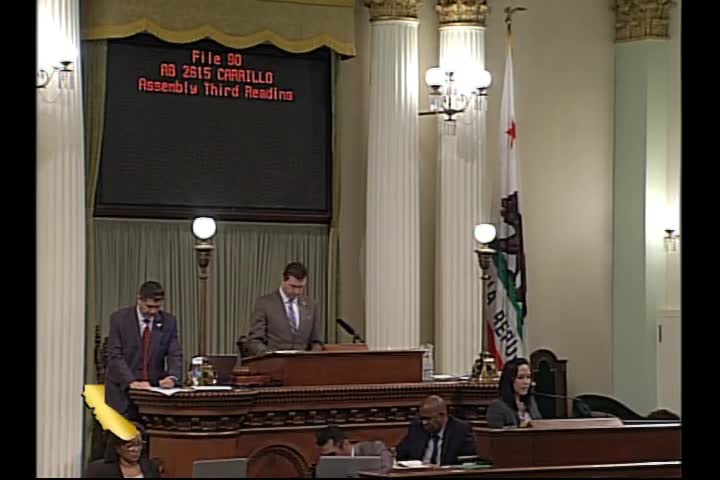 1MIN
Assembly Floor
 5MIN
Assembly Standing Committee on Revenue and Taxation
Bill Author