AB 2684: Parent and child relationship.
- Session Year: 2017-2018
- House: Assembly
- Latest Version Date: 2018-09-28
(1)The Uniform Parentage Act defines the parent and child relationship as the legal relationship existing between a child and the childs parents, and provides rebuttable presumptions as to the parentage of a child born under certain circumstances. The Uniform Act on Blood Tests to Determine Paternity provides the procedures for the use of genetic testing, as defined, to determine paternity.
This bill would delete the name of the Uniform Act on Blood Tests to Determine Paternity and would revise and recast provisions relating to establishing a parent and child relationship to, among other things, refer instead to genetic testing and parentage. The bill would revise the presumptions and procedures for establishing and challenging parentage based on a genetic or nongenetic relationship with a child, including to modify the procedures for genetic testing for parentage. The bill would authorize the court to apply existing standards for awarding attorneys fees and costs in actions related to marriage and child custody and visitation to awarding fees and costs in actions related to determining a parent and child relationship.
This bill would, beginning on January 1, 2020, modify the procedures and requirements under which a voluntary declaration of parentage may be established and challenged.
(2)Existing law requires the State Department of Public Health to license and regulate tissue banks, which process, store, or distribute human tissue for transplantation into human beings.
This bill would define gamete bank as a tissue bank that collects, processes, stores, or distributes gametes, including a facility that provides reproductive services. The bill would require a gamete bank licensed in this state, for gametes collected on or after January 1, 2020, to collect specified identifying information and medical information, as defined, from a gamete donor, to provide the gamete donor with specified information, and to obtain a declaration from the gamete donor regarding the disclosure or nondisclosure of his or her identity to a child that results from the donation, upon the child turning 18 years of age and requesting the information.
(1)The Uniform Parentage Act defines the parent and child relationship as the legal relationship existing between a child and the childs parents, and provides rebuttable presumptions as to the parentage of a child born under certain circumstances. The Uniform Act on Blood Tests to Determine Paternity provides the procedures for the use of genetic testing, as defined, to determine paternity.
This bill would delete the name of the Uniform Act on Blood Tests to Determine Paternity and would revise and recast these provisions relating to establishing a parent and child relationship to, among other things, refer instead to genetic testing and parentage, parentage. The bill would revise the presumptions and procedures for establishing and challenging parentage, and parentage based on a genetic or nongenetic relationship with a child, including to modify the procedures for genetic testing for parentage. The bill would also make various conforming changes to the Uniform Parentage Act, including changing references from paternity to parentage and to change the ways in The bill would authorize the court to apply existing standards for awarding attorneys fees and costs in actions related to marriage and child custody and visitation to awarding fees and costs in actions related to determining a parent and child relationship.
This bill would, beginning on January 1, 2020, modify the procedures and requirements under which a voluntary declaration of parentage may be established and challenged.
(2)Existing law requires the State Department of Public Health to license and regulate tissue banks, which process, store, or distribute human tissue for transplantation into human beings.
This bill would define gamete bank as a tissue bank that collects, processes, stores, or distributes gametes, including a facility that provides reproductive services. This The bill would require a gamete bank licensed in this state state, for gametes collected on or after January 1, 2020, to collect specified identifying information and medical information, as defined, from a gamete donor, to provide the gamete donor with specified information, and to obtain a declaration from the gamete donor regarding the disclosure or nondisclosure of his or her identity to a child that results from the donation, upon the child turning 18 years of age and requesting the information.
(1)The Uniform Parentage Act defines the parent and child relationship as the legal relationship existing between a child and the childs parents, and provides rebuttable presumptions as to the parentage of a child born under certain circumstances. The Uniform Act on Blood Tests to Determine Paternity provides the procedures for the use of genetic testing, as defined, to determine paternity.
This bill would delete the name of the Uniform Act on Blood Tests to Determine Paternity and would revise and recast these provisions to, among other things, refer instead to genetic testing and parentage and to specify parentage, revise the presumptions and procedures for establishing and challenging parentage, and modify the procedures for genetic testing for parentage. The bill would also make various conforming changes to the Uniform Parentage Act, including changing references from paternity to parentage and to change the ways in which a voluntary declaration of parentage may be established and challenged.
(2)Existing law requires the State Department of Public Health to license and regulate tissue banks, which process, store, or distribute human tissue for transplantation into human beings.
This bill would define gamete bank as a tissue bank that collects, processes, stores, or distributes gametes, including a facility that provides reproductive services. This bill would require a gamete bank licensed in this state to collect specified identifying information and medical information, as defined, from a gamete donor, to provide the gamete donor with specified information, and to obtain a declaration from the gamete donor regarding the disclosure or nondisclosure of his or her identity to a child that results from the donation, upon the child turning 18 years of age and requesting the information.
(1)The Uniform Parentage Act defines the parent and child relationship as the legal relationship existing between a child and the childs parents, and provides rebuttable presumptions as to the parentage of a child born under certain circumstances. The Uniform Act on Blood Tests to Determine Paternity provides the procedures for the use of genetic testing, as defined, to determine paternity.
This bill would delete the name of the Uniform Act on Blood Tests to Determine Paternity and would revise and recast these provisions to, among other things, refer instead to genetic testing and parentage and to specify the procedures for genetic testing for parentage. The bill would also make various conforming changes to the Uniform Parentage Act, including changing references from paternity to parentage and to change the ways in which a voluntary declaration of parentage may be challenged.
(2)Existing law requires the State Department of Public Health to license and regulate tissue banks, which process, store, or distribute human tissue for transplantation into human beings.
This bill would define gamete bank as a tissue bank that collects, processes, stores, or distributes gametes, including a facility that provides reproductive services. This bill would require a gamete bank licensed in this state to collect specified identifying information and medical information, as defined, from a gamete donor, to provide the gamete donor with specified information, and to obtain a declaration from the gamete donor regarding the disclosure or nondisclosure of his or her identity to a child that results from the donation, upon the child turning 18 years of age and requesting the information.
(1)The Uniform Parentage Act defines the parent and child relationship as the legal relationship existing between a child and the childs parents, and provides rebuttable presumptions as to the parentage of a child born under certain circumstances. The Uniform Act on Blood Tests to Determine Paternity provides the procedures for the use of genetic testing, as defined, to determine paternity.
This bill would delete the name of the Uniform Act on Blood Tests to Determine Paternity. The bill would require the act to govern voluntary and ordered genetic testing and the procedures for using genetic testing to determine parentage. The bill would prohibit the use of genetic testing to challenge or establish parentage under specified circumstances. Paternity and would revise and recast these provisions to, among other things, refer instead to genetic testing and parentage and to specify the procedures for genetic testing for parentage. The bill would also make various conforming changes to the Uniform Parentage Act, including changing references from paternity to parentage and to change the ways in which a voluntary declaration of parentage may be challenged.
(2)Existing law requires the State Department of Public Health to license and regulate tissue banks, which process, store, or distribute human tissue for transplantation into human beings.
This bill would define gamete bank as a tissue bank that collects, processes, stores, or distributes gametes, including a facility that provides reproductive services. This bill would require a gamete bank licensed in this state to collect specified identifying information and medical information, as defined, from a gamete donor, to provide the gamete donor with specified information, and to obtain a declaration from the gamete donor regarding the disclosure or nondisclosure of his or her identity to a child that results from the donation, upon the child turning 18 years of age and requesting the information.
Existing law defines the parent and child relationship as the legal relationship existing between a child and the childs parents, and provides rebuttable presumptions as to the parentage of a child born under certain circumstances. The Uniform Act on Blood Tests to Determine Paternity provides the procedures for the use of genetic testing, as defined, to determine paternity.
This bill would delete the name of the Uniform Act on Blood Tests to Determine Paternity. The bill would require the act to govern voluntary and ordered genetic testing and the procedures for using genetic testing to determine parentage. The bill would prohibit the use of genetic testing to challenge or establish parentage under specified circumstances.
The Legislature finds and declares all of the following:
(a)California has made great strides to ensure that same-sex parents and their children are treated equally under California law, but there are still significant protections denied to same-sex parents, transgender parents, and their children.
(b)The primary purposes of this act are to accomplish all of the following:
(1)Ensure that the parentage provisions of the Family Code treat same-sex parents equally, including the conclusive marital presumption of parentage in Section 7540 of the Family Code, and for parents who conceived children through assisted reproduction, to establish their parentage through a voluntary declaration of parentage.
(2)Update the genetic testing provisions to match current scientific requirements, apply gender neutrality, and codify case law regarding the relevance of genetic testing in cases involving multiple claims of parentage.
(3)Require gamete banks to establish a process for children conceived through donated sperm or eggs to receive nonidentifying medical information at any point in the childs life, and, if the donor agrees, personal identifying information at the childs option after 18 years of age.
(c)The provisions of this act should be interpreted to provide equal treatment to same-sex parents, transgender parents, and their children.
(d)It is not the intent of the Legislature to abrogate case law interpreting the laws amended in this act that is consistent with the purposes of this act, unless it is inconsistent with specific statutory language.
SEC. 2.Section 2032.010 of the Code of Civil Procedure is amended to read:2032.010.(a)This chapter does not affect genetic testing under Chapter 2 (commencing with Section 7550) of Part 2 of Division 12 of the Family Code.
(b)This chapter does not require the disclosure of the identity of an expert consulted by an attorney in order to make the certification required in an action for professional negligence under Section 411.35.
SEC. 3.The heading of Part 2 (commencing with Section 7540) of Division 12 of the Family Code is amended to read:2.PRESUMPTION CONCERNING CHILD OF MARRIAGE AND GENETIC TESTING TO DETERMINE PARENTAGESEC. 4.Section 7540 of the Family Code is repealed.SEC. 5.Section 7540 is added to the Family Code, to read:7540.(a)Except as provided in Section 7541, the child of spouses who cohabited at the time of conception and birth is conclusively presumed to be a child of the marriage.
(b)The conclusive marital presumption in subdivision (a) does not apply if the court determines that the husband of the woman who gave birth was impotent or sterile at the time of conception and that the child was not conceived through assisted reproduction.
SEC. 6.Section 7541 of the Family Code is amended to read:7541.(a)If the court finds that the spouse who is a presumed parent under Section 7540 is not a genetic parent of the child pursuant to Chapter 2 (commencing with Section 7550), the question of parentage shall be resolved in accordance with all other applicable provisions of this division, including, but not limited to, Section 7612.
(b)An action to challenge the parentage of the spouse who is a presumed parent under Section 7540 shall be filed not later than two years from the childs date of birth and may only be filed by any of the following:
(1)By either spouse.
(2)By a person who is a presumed parent under Section 7611 or by the child, through or by the childs guardian ad litem, to establish the parentage of the person who is a presumed parent under Section 7611.
(c)The petition or motion to challenge a presumption under Section 7540 pursuant to this section shall be supported by a declaration under oath submitted by the moving party stating the factual basis for placing the issue of parentage before the court.
(d)Genetic testing may not be used to challenge parentage, in either of the following cases:
(1)A case that reached final judgment of parentage on or before September 30, 1980.
(2)A case challenging the parentage of a spouse who is a parent pursuant to Section 7962 or subdivision (a) of Section 7613, except to resolve a dispute regarding whether the child was conceived through assisted reproduction.
SEC. 7.The heading of Chapter 2 (commencing with Section 7550) of Part 2 of Division 12 of the Family Code is amended to read:2.Genetic Testing to Determine ParentageSEC. 8.Section 7550 of the Family Code is repealed.SEC. 9.Section 7550 is added to the Family Code, to read:7550.This chapter shall govern both of the following:
(a)The genetic testing of a person who either voluntarily submits to genetic testing or is ordered to submit to genetic testing pursuant to an order of a court or local child support agency.
(b)The use of genetic testing in a proceeding to determine parentage.
SEC. 10.Section 7550.5 is added to the Family Code, to read:7550.5.The following definitions shall apply to this chapter:
(a)Combined relationship index means the product of all tested relationship indices.
(b)Ethnic or racial group means, for the purpose of genetic testing, a recognized group that a person identifies as the persons ancestry, or part of the ancestry, or that is identified by other information.
(c)Genetic testing means any genetic testing that complies with Section 7552.
(d)Hypothesized genetic relationship means an asserted genetic relationship between a person and a child.
(e)Probability of parentage means, for the ethnic or racial group to which a person alleged to be a parent belongs, the probability that a hypothesized genetic relationship is supported, compared to the probability that a genetic relationship is supported between the child and a random person of the ethnic or racial group used in the hypothesized genetic relationship, expressed as a percentage incorporating the combined relationship index and a prior probability.
(f)Relationship index means a likelihood ratio that compares the probability of a genetic marker given a hypothesized genetic relationship and the probability of the genetic marker given a genetic relationship between the child and a random person of the ethnic or racial group used in the hypothesized genetic relationship.
SEC. 11.Section 7551 of the Family Code is repealed.SEC. 12.Section 7551 is added to the Family Code, to read:7551.(a)Except as provided in subdivisions (b) and (c), in a civil action or proceeding in which parentage is a relevant fact, the court may, upon its own initiative or upon suggestion made by or on behalf of any person who is involved, and shall upon motion of any party to the action or proceeding made at a time so as not to delay the proceedings unduly, order the woman who gave birth, the child, and the alleged genetic parent to submit to genetic testing.
(b)(1)Genetic testing shall not be used for any of the following purposes:
(A)To challenge the parentage of a person who is a parent pursuant to subdivision (a) of Section 7613, except to resolve a dispute whether the child was conceived through assisted reproduction.
(B)To challenge the parentage of a person who is a parent pursuant to Section 7962, except to resolve a dispute whether the gestational carrier surrogate is a genetic parent.
(C)To establish the parentage of a person who is a donor pursuant to subdivision (b) or (c) of Section 7613, except to resolve a dispute whether the child was conceived through assisted reproduction.
(2)If the child has a presumed parent pursuant to Section 7540, a motion for genetic testing is governed by Section 7541.
(3)If the child has a parent whose parentage has been previously established in a judgment, a request for genetic testing shall be governed by Section 7647.7.
(4)A court shall not order genetic testing if the genetic testing would be used to establish the parentage of a person who is prohibited under this division from establishing parentage based on evidence of genetic testing.
(c)A court shall not order in utero genetic testing.
(d)In any case under this division in which genetic testing is ordered, the following shall apply:
(1)If a party refuses to submit to genetic testing, the court may resolve the question of parentage against that party or enforce its order if the rights of others and the interests of justice so require.
(2)The refusal of a party to submit to genetic testing is admissible in evidence in any proceeding to determine parentage.
(3)If two or more persons are subject to court-ordered genetic testing, the court may order that the testing be completed concurrently or sequentially.
(4)Genetic testing of a woman who gave birth to a child is not a condition precedent to the testing of the child and a person whose genetic parentage of the child is being determined. If the woman is unavailable for genetic testing, the court may order genetic testing of the child and each person whose genetic parentage of the child is at issue.
(5)An order under this division for genetic testing is enforceable by contempt.
SEC. 13.Section 7552 of the Family Code is repealed.SEC. 14.Section 7552 is added to the Family Code, to read:7552.(a)Genetic testing shall be of a type reasonably relied on by experts in the field of genetic testing and performed in a testing laboratory accredited by either of the following:
(1)The AABB, formerly known as the American Association of Blood Banks, or a successor organization.
(2)An accrediting body designated by the Secretary of the United States Department of Health and Human Services.
(b)A specimen used in genetic testing may consist of a sample or a combination of samples of blood, buccal cells, bone, hair, or other body tissue or fluid. The specimen used in the testing need not be of the same kind for each person undergoing genetic testing.
(c)Based on the ethnic or racial group of a person undergoing genetic testing, a testing laboratory shall determine the databases from which to select frequencies for use in calculating a relationship index. If a person or a local child support agency objects to the laboratorys choice, the following rules shall apply:
(1)Not later than 30 days after receipt of the report of the test, the objecting person or local child support agency may request the court to require the laboratory to recalculate the relationship index using an ethnic or racial group different from that used by the laboratory.
(2)The person or local child support agency objecting to the choice of laboratories under this subdivision shall do either of the following:
(A)If the requested frequencies are not available to the laboratory for the ethnic or racial group requested, provide the requested frequencies compiled in a manner recognized by accrediting bodies.
(B)Engage another laboratory to perform the calculations.
(3)The laboratory may use its own statistical estimate if there is a question of which ethnic or racial group is appropriate. The laboratory shall calculate the frequencies using statistics, if available, for any other ethnic or racial group requested.
(d)If, after recalculation of the relationship index pursuant to subdivision (c) using a different ethnic or racial group, genetic testing does not identify a person as a genetic parent of the child, the court may require a person who has been tested to submit to additional genetic testing to identify a genetic parent.
SEC. 15.Section 7552.5 of the Family Code is amended to read:7552.5.(a)A copy of the results of all genetic testing performed under Section 7551 or 7558 shall be served upon all parties, by any method of service authorized under Chapter 5 (commencing with Section 1010) of Title 14 of Part 2 of the Code of Civil Procedure except personal service, no later than 20 days prior to a hearing in which the genetic test results may be admitted into evidence. The genetic test results shall be accompanied by a declaration under penalty of perjury of the custodian of records or other qualified employee of the laboratory that conducted the genetic tests, stating in substance each of the following:
(1)The declarant is the duly authorized custodian of the records or other qualified employee of the laboratory, and has authority to certify the records.
(2)A statement that establishes in detail the chain of custody of all genetic samples collected, including the date on which the genetic sample was collected, the identity of each person from whom a genetic sample was collected, the identity of the person who performed or witnessed the collecting of the genetic samples and packaged them for transmission to the laboratory, the date on which the genetic samples were received by the laboratory, the identity of the person who unpacked the samples and forwarded them to the person who performed the laboratory analysis of the genetic sample, and the identification and qualifications of all persons who performed the laboratory analysis and published the results.
(3)A statement that establishes that the procedures used by the laboratory to conduct the tests for which the test results are attached are used in the laboratorys ordinary course of business to ensure accuracy and proper identification of genetic samples.
(4)The genetic test results were prepared at or near the time of completion of the genetic tests by personnel of the business qualified to perform genetic tests in the ordinary course of business.
(b)The genetic test results shall be admitted into evidence at the hearing or trial to establish parentage, without the need for foundation testimony of authenticity and accuracy, unless a written objection to the genetic test results is filed with the court and served on all other parties, by a party no later than five days prior to the hearing or trial in which parentage is at issue.
(c)If a written objection is filed with the court and served on all parties within the time specified in subdivision (b), experts appointed by the court shall be called by the court as witnesses to testify to their findings and are subject to cross-examination by the parties.
SEC. 16.Section 7554 of the Family Code is repealed.SEC. 17.Section 7554 is added to the Family Code, to read:7554.(a)If the woman who gave birth to the child is the only other person who is a parent or has a claim to parentage of the child under this division, the court shall find the alleged father or genetic parent who is not a donor under Section 7613 to be a parent of the child if he or she meets any of the following:
(1)Is identified pursuant to Section 7555 as a genetic parent of the child and the identification is not successfully challenged.
(2)Admits parentage in a pleading, when making an appearance, or during a hearing, the court accepts the admission, and the court determines that he or she is a genetic parent of the child.
(3)Declines to submit to genetic testing ordered by the court or a local child support agency, in which case, the court may find that the person is a parent of the child even if he or she denies a genetic relationship with the child.
(4)Is in default after service of process and the court determines the person to be a genetic parent of the child.
(5)Is neither identified nor excluded as a genetic parent by genetic testing and, based on other evidence, the court determines the person to be a genetic parent of the child.
(b)If more than one person other than the woman who gave birth asserts a claim under this division to be the childs parent, parentage shall be determined under provisions of this division.
SEC. 18.Section 7555 of the Family Code is repealed.SEC. 19.Section 7555 is added to the Family Code, to read:7555.(a)Subject to a challenge under subdivision (b), a person is identified under this part as a genetic parent of a child if genetic testing complies with this part and the results of the testing disclose both of the following:
(1)The person has at least a 99 percent probability of parentage, using a prior probability of 0.50, as calculated by using the combined relationship index obtained in the testing.
(2)A combined relationship index of at least 100 to 1.
(b)A person identified pursuant to subdivision (a) as a genetic parent of the child may challenge the genetic testing results only by other genetic testing satisfying the requirements of this chapter that either excludes the person as a genetic parent of the child or identifies another person as a possible genetic parent of the child other than the woman who gave birth to the child or the person challenging parentage.
(c)If more than one person, other than the woman who gave birth to the child, is identified by genetic testing as a possible genetic parent of the child, the court shall order each person to submit to further genetic testing to identify a genetic parent.
SEC. 20.Section 7556 of the Family Code is amended to read:7556.This part applies to criminal actions subject to the following limitations and provisions:
(a)An order for genetic testing shall be made only upon application of a party or on the courts initiative.
(b)The compensation of the experts, other than an expert witness appointed by the court for the courts needs, shall be paid by the county under order of court. The compensation of an expert witness appointed for the courts needs shall be paid by the court.
(c)The court may direct a verdict of acquittal if the person is found not to be a genetic parent pursuant to Section 7555, otherwise the case shall be submitted for determination upon all the evidence.
SEC. 21.Section 7558 of the Family Code is amended to read:7558.(a)This section applies only to cases where support enforcement services are being provided by the local child support agency pursuant to Section 17400.
(b)In any civil action or proceeding in which parentage is a relevant fact, and in which the issue of parentage is contested, the local child support agency may issue an administrative order requiring the mother, child, and the alleged father to submit to genetic testing if any of the following conditions exist:
(1)The person alleging parentage has signed a statement under penalty of perjury that sets forth facts that establish a reasonable possibility that the person is the childs genetic parent.
(2)The person denying parentage has signed a statement under penalty of perjury that sets forth facts that establish a reasonable possibility that the person is not a genetic parent of the child.
(3)The alleged father has filed an answer in the action or proceeding in which parentage is a relevant fact and has requested that genetic tests be performed.
(4)The woman who gave birth to the child and the alleged father agree in writing to submit to genetic tests.
(c)Notwithstanding subdivision (b), the local child support agency may not order a person to submit to genetic tests in any of the following instances:
(1)The person has been found to have good cause for failure to cooperate in the determination of parentage pursuant to Section 11477 of the Welfare and Institutions Code.
(2)A case in which more than one person other than the woman who gave birth asserts a claim under this division to be the childs parent.
(3)A case involving a child conceived through assisted reproduction.
(d)The local child support agency shall pay the costs of any genetic tests that are ordered under subdivision (b), subject to the county obtaining a court order for reimbursement from the alleged father if parentage is established pursuant to Section 7553.
(e)This section does not prohibit a person who has been ordered by the local child support agency to submit to genetic tests pursuant to this section from filing a notice of motion with the court in the action or proceeding in which parentage is a relevant fact seeking relief from the local child support agencys order to submit to genetic tests. In that event, the court shall resolve the issue of whether genetic tests should be ordered as provided in Section 7551. When a person refuses to submit to the tests after receipt of the administrative order pursuant to this section and fails to seek relief from the court from the administrative order either prior to the scheduled tests or within 10 days after the tests are scheduled, the court may resolve the question of parentage against that person or enforce the administrative order if the rights of others or the interest of justice so require. Except as provided in subdivision (c), a persons refusal to submit to tests ordered by the local child support agency is admissible in evidence in any proceeding to determine parentage if a notice of motion is not filed within the timeframes specified in this subdivision.
(f)If the original test result is contested, the local child support agency shall order an additional test only upon request and advance payment of the contestant.
(g)The local child support agency shall not order in utero genetic testing.
(h)The local child support agency shall administer this section consistent with federal law.
SEC. 22.Section 7559 is added to the Family Code, to read:7559.Payment of the cost of initial genetic testing shall be made in advance when agreed to by the parties or ordered by the court pursuant to Section 7640.
SEC. 23.Section 7560 is added to the Family Code, to read:7560.The court or local child support agency shall order additional genetic testing upon the request of a person who contests the results of the initial testing under Section 7555.
SEC. 24.Section 7562 is added to the Family Code, to read:7562.If a person seeking genetic testing demonstrates good cause, the court may order genetic testing of a deceased person.
SEC. 25.The heading of Chapter 3 (commencing with Section 7570) of Part 2 of Division 12 of the Family Code is amended to read:3.Establishment of Parentage by Voluntary DeclarationSEC. 26.Section 7570 of the Family Code is amended to read:7570.(a)The Legislature hereby finds and declares as follows:
(1)There is a compelling state interest in establishing paternity for all children. Establishing paternity is the first step toward a child support award, which, in turn, provides children with equal rights and access to benefits, including, but not limited to, social security, health insurance, survivors benefits, military benefits, and inheritance rights. Knowledge of family medical history is often necessary for correct medical diagnosis and treatment. Additionally, knowing ones father is important to a childs development.
(2)A simple system allowing for establishment of voluntary paternity will result in a significant increase in the ease of establishing paternity, a significant increase in paternity establishment, an increase in the number of children who have greater access to child support and other benefits, and a significant decrease in the time and money required to establish paternity due to the removal of the need for a lengthy and expensive court process to determine and establish paternity and is in the public interest.
(b)This section shall remain in effect only until January 1, 2020, and as of that date is repealed.
SEC. 27.Section 7570 is added to the Family Code, to read:7570.(a)The Legislature hereby finds and declares as follows:
(1)There is a compelling state interest in establishing parentage for all children. Establishing parentage is the first step toward a child support award, which, in turn, provides children with equal rights and access to benefits, including, but not limited to, social security, health insurance, survivors benefits, military benefits, and inheritance rights.
(2)A simple administrative system allowing for establishment of voluntary parentage will result in a significant increase in the ease of establishing parentage, a significant increase in parentage establishment, an increase in the number of children who have greater access to child support and other benefits, and a significant decrease in the time and money required to establish parentage due to the removal of the need for a lengthy and expensive court process to determine and establish parentage and is in the public interest.
(b)This section shall become operative on January 1, 2020.
SEC. 28.Section 7571 of the Family Code is amended to read:7571.(a)On and after January 1, 1995, upon the event of a live birth, prior to an unmarried mother leaving any hospital, the person responsible for registering live births under Section 102405 of the Health and Safety Code shall provide to the natural mother and shall attempt to provide, at the place of birth, to the man identified by the natural mother as the natural father, a voluntary declaration of paternity together with the written materials described in Section 7572. Staff in the hospital shall witness the signatures of parents signing a voluntary declaration of paternity and shall forward the signed declaration to the Department of Child Support Services within 20 days of the date the declaration was signed. A copy of the declaration shall be made available to each of the attesting parents.
(b)No health care provider shall be subject to any civil, criminal, or administrative liability for any negligent act or omission relative to the accuracy of the information provided, or for filing the declaration with the appropriate state or local agencies.
(c)The local child support agency shall pay the sum of ten dollars ($10) to birthing hospitals and other entities that provide prenatal services for each completed declaration of paternity that is filed with the Department of Child Support Services, provided that the local child support agency and the hospital or other entity providing prenatal services has entered into a written agreement that specifies the terms and conditions for the payment as required by federal law.
(d)If the declaration is not registered by the person responsible for registering live births at the hospital, it may be completed by the attesting parents, notarized, and mailed to the Department of Child Support Services at any time after the childs birth.
(e)Prenatal clinics shall offer prospective parents the opportunity to sign a voluntary declaration of paternity. In order to be paid for their services as provided in subdivision (c), prenatal clinics must ensure that the form is witnessed and forwarded to the Department of Child Support Services within 20 days of the date the declaration was signed.
(f)Declarations shall be made available without charge at all local child support agency offices, offices of local registrars of births and deaths, courts, and county welfare departments within this state. Staff in these offices shall witness the signatures of parents wishing to sign a voluntary declaration of paternity and shall be responsible for forwarding the signed declaration to the Department of Child Support Services within 20 days of the date the declaration was signed.
(g)The Department of Child Support Services, at its option, may pay the sum of ten dollars ($10) to local registrars of births and deaths, county welfare departments, or courts for each completed declaration of paternity that is witnessed by staff in these offices and filed with the Department of Child Support Services. In order to receive payment, the Department of Child Support Services and the entity shall enter into a written agreement that specifies the terms and conditions for payment as required by federal law. The Department of Child Support Services shall study the effect of the ten dollar ($10) payment on obtaining completed voluntary declaration of paternity forms.
(h)The Department of Child Support Services and local child support agencies shall publicize the availability of the declarations. The local child support agency shall make the declaration, together with the written materials described in subdivision (a) of Section 7572, available upon request to any parent and any agency or organization that is required to offer parents the opportunity to sign a voluntary declaration of paternity. The local child support agency shall also provide qualified staff to answer parents questions regarding the declaration and the process of establishing paternity.
(i)Copies of the declaration and any rescissions filed with the Department of Child Support Services shall be made available only to the parents, the child, the local child support agency, the county welfare department, the county counsel, the State Department of Health Services, and the courts.
(j)Publicly funded or licensed health clinics, pediatric offices, Head Start programs, child care centers, social services providers, prisons, and schools may offer parents the opportunity to sign a voluntary declaration of paternity. In order to be paid for their services as provided in subdivision (c), publicly funded or licensed health clinics, pediatric offices, Head Start programs, child care centers, social services providers, prisons, and schools shall ensure that the form is witnessed and forwarded to the Department of Child Support Services.
(k)Any agency or organization required to offer parents the opportunity to sign a voluntary declaration of paternity shall also identify parents who are willing to sign, but were unavailable when the child was born. The organization shall then contact these parents within 10 days and again offer the parent the opportunity to sign a voluntary declaration of paternity.
(l)This section shall remain in effect only until January 1, 2020, and as of that date is repealed.
SEC. 29.Section 7571 is added to the Family Code, to read:7571.(a)On and after January 1, 1995, upon the event of a live birth, prior to an unmarried mother or a mother who gave birth to a child conceived through assisted reproduction leaving a hospital, the person responsible for registering live births under Section 102405 of the Health and Safety Code shall provide to the woman giving birth and shall attempt to provide, at the place of birth, to the person identified by the woman giving birth as either the only possible genetic parent other than the woman who gave birth or the intended parent of a child conceived through assisted reproduction, a voluntary declaration of parentage together with the written materials described in Section 7572. Staff in the hospital shall witness the signatures of parents signing a voluntary declaration of parentage and shall forward the signed declaration to the Department of Child Support Services within 20 days of the date the declaration was signed. A copy of the declaration shall be made available to each of the attesting parents.
(b)A health care provider shall not be subject to civil, criminal, or administrative liability for a negligent act or omission relative to the accuracy of the information provided, or for filing the declaration with the appropriate state or local agencies.
(c)The local child support agency shall pay the sum of ten dollars ($10) to birthing hospitals and other entities that provide prenatal services for each completed declaration of parentage that is filed with the Department of Child Support Services, provided that the local child support agency and the hospital or other entity providing prenatal services has entered into a written agreement that specifies the terms and conditions for the payment as required by federal law.
(d)If the declaration is not registered by the person responsible for registering live births at the hospital, it may be completed by the attesting parents, notarized, and mailed to the Department of Child Support Services at any time after the childs birth.
(e)Prenatal clinics shall offer prospective parents the opportunity to sign a voluntary declaration of parentage. In order to be paid for their services as provided in subdivision (c), prenatal clinics must ensure that the form is witnessed and forwarded to the Department of Child Support Services within 20 days of the date the declaration was signed.
(f)Declarations shall be made available without charge at all local child support agency offices, offices of local registrars of births and deaths, courts, and county welfare departments within this state. Staff in these offices shall witness the signatures of parents wishing to sign a voluntary declaration of parentage and shall be responsible for forwarding the signed declaration to the Department of Child Support Services within 20 days of the date the declaration was signed.
(g)The Department of Child Support Services, at its option, may pay the sum of ten dollars ($10) to local registrars of births and deaths, county welfare departments, or courts for each completed declaration of parentage that is witnessed by staff in these offices and filed with the Department of Child Support Services. In order to receive payment, the Department of Child Support Services and the entity shall enter into a written agreement that specifies the terms and conditions for payment as required by federal law. The Department of Child Support Services shall study the effect of the ten dollar ($10) payment on obtaining completed voluntary declaration of parentage forms.
(h)The Department of Child Support Services and local child support agencies shall publicize the availability of the declarations. The local child support agency shall make the declaration, together with the written materials described in subdivision (a) of Section 7572, available upon request to any parent and any agency or organization that is required to offer parents the opportunity to sign a voluntary declaration of parentage. The local child support agency shall also provide qualified staff to answer parents questions regarding the declaration and the process of establishing parentage.
(i)Copies of the declaration and any rescissions filed with the Department of Child Support Services shall be made available only to the parents, the child, the local child support agency, the county welfare department, the county counsel, the State Department of Public Health, and the courts.
(j)Publicly funded or licensed health clinics, pediatric offices, Head Start programs, child care centers, social services providers, prisons, and schools may offer parents the opportunity to sign a voluntary declaration of parentage. In order to be paid for their services as provided in subdivision (c), publicly funded or licensed health clinics, pediatric offices, Head Start programs, child care centers, social services providers, prisons, and schools shall ensure that the form is witnessed and forwarded to the Department of Child Support Services.
(k)An agency or organization required to offer parents the opportunity to sign a voluntary declaration of parentage shall also identify parents who are willing to sign, but were unavailable when the child was born. The organization shall then contact these parents within 10 days and again offer the parent the opportunity to sign a voluntary declaration of parentage.
(l)This section shall become operative on January 1, 2020.
SEC. 30.Section 7572 of the Family Code is amended to read:7572.(a)The Department of Child Support Services, in consultation with the State Department of Health Care Services, the California Association of Hospitals and Health Systems, and other affected health provider organizations, shall work cooperatively to develop written materials to assist providers and parents in complying with this chapter. This written material shall be updated periodically by the Department of Child Support Services to reflect changes in law, procedures, or public need.
(b)The written materials for parents which shall be attached to the form specified in Section 7574 and provided to unmarried parents shall contain the following information:
(1)A signed voluntary declaration of paternity that is filed with the Department of Child Support Services legally establishes paternity.
(2)The legal rights and obligations of both parents and the child that result from the establishment of paternity.
(3)An alleged fathers constitutional rights to have the issue of paternity decided by a court; to notice of any hearing on the issue of paternity; to have an opportunity to present his case to the court, including his right to present and cross-examine witnesses; to have an attorney represent him; and to have an attorney appointed to represent him if he cannot afford one in a paternity action filed by a local child support agency.
(4)That by signing the voluntary declaration of paternity, the father is voluntarily waiving his constitutional rights.
(c)Parents shall also be given oral notice of the rights and responsibilities specified in subdivision (b). Oral notice may be accomplished through the use of audio or video recorded programs developed by the Department of Child Support Services to the extent permitted by federal law.
(d)The Department of Child Support Services shall, free of charge, make available to hospitals, clinics, and other places of birth any and all informational and training materials for the program under this chapter, as well as the paternity declaration form. The Department of Child Support Services shall make training available to every participating hospital, clinic, local registrar of births and deaths, and other place of birth no later than June 30, 1999.
(e)The Department of Child Support Services may adopt regulations, including emergency regulations, necessary to implement this chapter.
(f)This section shall remain in effect only until January 1, 2020, and as of that date is repealed.
SEC. 31.Section 7572 is added to the Family Code, to read:7572.(a)The Department of Child Support Services, in consultation with the State Department of Health Care Services, the California Association of Hospitals and Health Systems, and other affected health provider organizations, shall work cooperatively to develop written materials to assist providers and parents in complying with this chapter. This written material shall be updated periodically by the Department of Child Support Services to reflect changes in law, procedures, or public need.
(b)The written materials for unmarried parents or parents of a child conceived through assisted reproduction that shall be attached to the form specified in Section 7574 and shall contain the following information:
(1)A signed voluntary declaration of parentage that is filed with the Department of Child Support Services legally establishes parentage.
(2)The legal rights and obligations of both parents and the child that result from the establishment of parentage.
(3)An alleged fathers constitutional rights to have the issue of parentage decided by a court; to notice of any hearing on the issue of parentage; to have an opportunity to present his case to the court, including his right to present and cross-examine witnesses; to have an attorney represent him; and to have an attorney appointed to represent him if he cannot afford one in a parentage action filed by a local child support agency.
(4)That by signing the voluntary declaration of parentage, the father is voluntarily waiving his constitutional rights.
(c)Parents shall also be given oral notice of the rights and responsibilities specified in subdivision (b). Oral notice may be accomplished through the use of audio or video recorded programs developed by the Department of Child Support Services to the extent permitted by federal law.
(d)The Department of Child Support Services shall, free of charge, make available to hospitals, clinics, and other places of birth any and all informational and training materials for the program under this chapter, as well as the declaration of parentage form. The Department of Child Support Services shall make training available to every participating hospital, clinic, local registrar of births and deaths, and other place of birth no later than June 30, 1999.
(e)The Department of Child Support Services may adopt regulations, including emergency regulations, necessary to implement this chapter.
(f)This section shall become operative on January 1, 2020.
SEC. 32.Section 7573 of the Family Code is amended to read:7573.(a)Except as provided in Sections 7575, 7576, 7577, and 7612, a completed voluntary declaration of paternity, as described in Section 7574, that has been filed with the Department of Child Support Services shall establish the paternity of a child and shall have the same force and effect as a judgment for paternity issued by a court of competent jurisdiction. The voluntary declaration of paternity shall be recognized as a basis for the establishment of an order for child custody, visitation, or child support.
(b)This section shall remain in effect only until January 1, 2020, and as of that date is repealed.
SEC. 33.Section 7573 is added to the Family Code, to read:7573.(a)The following persons may sign a voluntary declaration of parentage to establish the parentage of the child:
(1)An unmarried woman who gave birth to the child and another person who is a genetic parent.
(2)A married or unmarried woman who gave birth to the child and another person who is a parent under Section 7613 of a child conceived through assisted reproduction.
(b)A voluntary declaration of parentage shall be in a record signed by the woman who gave birth to the child and by either the only possible genetic parent other than the woman who gave birth or the intended parent of a child conceived through assisted reproduction, and the signatures shall be attested by a notary or witnessed.
(c)Except as provided by Section 7580, a voluntary declaration of parentage takes effect on the filing of the document with the Department of Child Support Services.
(d)Except as provided in Sections 7573.5, 7575, 7576, 7577, and 7580, a completed voluntary declaration of parentage that complies with this chapter and that has been filed with the Department of Child Support Services is equivalent to a judgment of parentage of the child and confers on the declarant all rights and duties of a parent.
(e)The court shall give full faith and credit to a voluntary declaration of parentage effective in another state if the declaration was in a signed record and otherwise complies with the law of the other state.
(f)This section shall become operative on January 1, 2020.
SEC. 34.Section 7573.5 is added to the Family Code, to read:7573.5.(a)A voluntary declaration of parentage is void if, at the time of signing, any of the following are true:
(1)A person other than the woman who gave birth to the child or a person seeking to establish parentage through a voluntary declaration of parentage is a presumed parent under Section 7540 or subdivision (a), (b), or (c) of Section 7611.
(2)A court has entered a judgment of parentage of the child.
(3)Another person has signed a valid voluntary declaration of parentage.
(4)The child has a parent under Section 7613 or 7962 other than the signatories.
(5)The person seeking to establish parentage is a sperm or ova donor under subdivision (b) or (c) of Section 7613.
(6)The person seeking to establish parentage asserts that he or she is a parent under Section 7613 and the child was not conceived through assisted reproduction.
(b)In an action in which a party is seeking a determination that a voluntary declaration of parentage is void under this section, notice shall be provided pursuant to Section 7635.
(c)This section shall become operative on January 1, 2020.
SEC. 35.Section 7574 of the Family Code is amended to read:7574.(a)The voluntary declaration of paternity shall be executed on a form developed by the Department of Child Support Services in consultation with the State Department of Health Services, the California Family Support Council, and child support advocacy groups.
(b)The form described in subdivision (a) shall contain, at a minimum, the following:
(1)The name and the signature of the mother.
(2)The name and the signature of the father.
(3)The name of the child.
(4)The date of birth of the child.
(5)A statement by the mother that she has read and understands the written materials described in Section 7572, that the man who has signed the voluntary declaration of paternity is the only possible father, and that she consents to the establishment of paternity by signing the voluntary declaration of paternity.
(6)A statement by the father that he has read and understands the written materials described in Section 7572, that he understands that by signing the voluntary declaration of paternity he is waiving his rights as described in the written materials, that he is the biological father of the child, and that he consents to the establishment of paternity by signing the voluntary declaration of paternity.
(7)The name and the signature of the person who witnesses the signing of the declaration by the mother and the father.
(c)This section shall remain in effect only until January 1, 2020, and as of that date is repealed.
SEC. 36.Section 7574 is added to the Family Code, to read:7574.(a)The voluntary declaration of parentage shall be executed on a form developed by the Department of Child Support Services in consultation with the State Department of Public Health and groups addressing child support, child custody, assisted reproduction issues, and lesbian, gay, bisexual, and transgender rights.
(b)The form described in subdivision (a) shall contain, at a minimum, all of the following:
(1)The name and the signature of the woman who gave birth to the child.
(2)The name and the signature of the person seeking to establish parentage.
(3)The name of the child.
(4)The date of birth of the child.
(5)For a voluntary declaration of parentage signed pursuant to paragraph (1) of subdivision (a) of Section 7573, all of the following:
(A)A statement by the woman who gave birth that she is unmarried and understands the written materials described in Section 7572, that the person who is signing the voluntary declaration of parentage is the only possible genetic parent other than the woman who gave birth, that the woman who gave birth consents to the establishment of parentage by the genetic parent signing the voluntary declaration of parentage, and that the woman who gave birth understands that a challenge by a signatory to a valid declaration of parentage is permitted only under limited circumstances and is barred two years after the effective date of the declaration.
(B)A statement by the genetic parent signing the voluntary declaration of parentage that he or she has read and understands the written materials described in Section 7572, understands that by signing the voluntary declaration of parentage he or she is waiving his or her rights as described in the written materials, that he or she is the genetic parent of the child, that he or she consents to the establishment of parentage by signing the voluntary declaration of parentage, that he or she is assuming all the rights and responsibilities of a parent and wishes to be named on the childs birth certificate, and that he or she understands that a challenge by a signatory to a valid declaration of parentage is permitted only under limited circumstances and is barred two years after the effective date of the declaration.
(6)For a voluntary declaration of parentage signed pursuant to paragraph (2) of subdivision (a) of Section 7573, all of the following:
(A)A statement by the woman who gave birth that she has read and understands the written materials described in Section 7572, that the person who is signing the voluntary declaration of parentage is the intended parent of a child conceived through assisted reproduction, that the woman who gave birth consents to the establishment of parentage by the other person signing the voluntary declaration of parentage, and that the woman who gave birth understands that a challenge by a signatory to a valid declaration of parentage is permitted only under limited circumstances and is barred two years after the effective date of the declaration.
(B)A statement that the person seeking to establish parentage has read and understands the written materials described in Section 7572, understands that by signing the voluntary declaration of parentage he or she is waiving his or her rights as described in the written materials, that he or she is the intended parent of the child conceived through assisted reproduction, that he or she consents to the establishment of parentage by signing the voluntary declaration of parentage, that he or she is assuming all the rights and responsibilities of a parent and wishes to be named on the childs birth certificate, and that he or she understands that a challenge by a signatory to a valid declaration of parentage is permitted only under limited circumstances and is barred two years after the effective date of the declaration.
(7)The name and the signature of the person who witnesses the signing of the declaration.
(c)This section shall become operative on January 1, 2020.
SEC. 37.Section 7575 of the Family Code is amended to read:7575.(a)Either parent may rescind the voluntary declaration of paternity by filing a rescission form with the Department of Child Support Services within 60 days of the date of execution of the declaration by the attesting father or attesting mother, whichever signature is later, unless a court order for custody, visitation, or child support has been entered in an action in which the signatory seeking to rescind was a party. The Department of Child Support Services shall develop a form to be used by parents to rescind the declaration of paternity and instruction on how to complete and file the rescission with the Department of Child Support Services. The form shall include a declaration under penalty of perjury completed by the person filing the rescission form that certifies that a copy of the rescission form was sent by any form of mail requiring a return receipt to the other person who signed the voluntary declaration of paternity. A copy of the return receipt shall be attached to the rescission form when filed with the Department of Child Support Services. The form and instructions shall be written in simple, easy to understand language and shall be made available at the local family support office and the office of local registrar of births and deaths. The department shall, upon written request, provide to a court or commissioner a copy of any rescission form filed with the department that is relevant to proceedings before the court or commissioner.
(b)(1)Notwithstanding Section 7573, if the court finds that the man who signed the voluntary declaration is not identified as a genetic parent of the child under Section 7555, the court may set aside the voluntary declaration of paternity unless the court determines that denial of the action to set aside the voluntary declaration of paternity is in the best interest of the child, after consideration of all of the following factors:
(A)The age of the child.
(B)The length of time since the execution of the voluntary declaration of paternity by the man who signed the voluntary declaration.
(C)The nature, duration, and quality of any relationship between the man who signed the voluntary declaration and the child, including the duration and frequency of any time periods during which the child and the man who signed the voluntary declaration resided in the same household or enjoyed a parent-child relationship.
(D)The request of the man who signed the voluntary declaration that the parent-child relationship continue.
(E)Notice by the biological father of the child that he does not oppose preservation of the relationship between the man who signed the voluntary declaration and the child.
(F)The benefit or detriment to the child in establishing the biological parentage of the child.
(G)Whether the conduct of the man who signed the voluntary declaration has impaired the ability to ascertain the identity of, or get support from, the biological father.
(H)Additional factors deemed by the court to be relevant to its determination of the best interest of the child.
(2)If the court denies the action, the court shall state on the record the basis for the denial of the action and any supporting facts.
(3)(A)The notice of motion for genetic tests under this section may be filed not later than two years from the date of the childs birth by a local child support agency, the mother, the man who signed the voluntary declaration as the childs father, or in an action to determine the existence or nonexistence of the father and child relationship pursuant to Section 7630 or in any action to establish an order for child custody, visitation, or child support based upon the voluntary declaration of paternity.
(B)The local child support agencys authority under this subdivision is limited to those circumstances where there is a conflict between a voluntary acknowledgment of paternity and a judgment of paternity or a conflict between two or more voluntary acknowledgments of paternity.
(4)The notice of motion for genetic tests pursuant to this section shall be supported by a declaration under oath submitted by the moving party stating the factual basis for putting the issue of paternity before the court.
(c)(1)Nothing in this chapter shall be construed to prejudice or bar the rights of either parent to file an action or motion to set aside the voluntary declaration of paternity on any of the grounds described in, and within the time limits specified in, Section 473 of the Code of Civil Procedure. If the action or motion to set aside a judgment is required to be filed within a specified time period under Section 473 of the Code of Civil Procedure, the period within which the action or motion to set aside the voluntary declaration of paternity must be filed shall commence on the date that the court makes an initial order for custody, visitation, or child support based upon a voluntary declaration of paternity.
(2)The parent or local child support agency seeking to set aside the voluntary declaration of paternity shall have the burden of proof.
(3)Any order for custody, visitation, or child support shall remain in effect until the court determines that the voluntary declaration of paternity should be set aside, subject to the courts power to modify the orders as otherwise provided by law.
(4)Nothing in this section is intended to restrict a court from acting as a court of equity.
(5)If the voluntary declaration of paternity is set aside pursuant to paragraph (1), the court shall order that the mother, child, and alleged father submit to genetic tests pursuant to Chapter 2 (commencing with Section 7550). If the court finds that the person who executed the voluntary declaration of paternity is not identified as the genetic parent of the child under Section 7555, the question of paternity shall be resolved accordingly. If the person who executed the declaration as the father of the child is not excluded as a possible father, the question of paternity shall be resolved as otherwise provided by law. If the person who executed the declaration of paternity is ultimately determined to be the father of the child, any child support that accrued under an order based upon the voluntary declaration of paternity shall remain due and owing.
(6)The Judicial Council shall develop the forms and procedures necessary to effectuate this subdivision.
(d)This section shall remain in effect only until January 1, 2020, and as of that date is repealed.
SEC. 38.Section 7575 is added to the Family Code, to read:7575.(a)Either parent may rescind the voluntary declaration of parentage by filing a rescission form with the Department of Child Support Services within 60 days of the date of execution of the declaration by the attesting parents, whichever signature is later, unless a court order for custody, visitation, or child support has been entered in an action in which the signatory seeking to rescind was a party. The Department of Child Support Services shall develop a form to be used by parents to rescind the declaration of parentage and instructions on how to complete and file the rescission with the Department of Child Support Services. The form shall include a declaration under penalty of perjury completed by the person filing the rescission form that certifies that a copy of the rescission form was sent by any form of mail requiring a return receipt to the other person who signed the voluntary declaration of parentage. A copy of the return receipt shall be attached to the rescission form when filed with the Department of Child Support Services. The form and instructions shall be written in simple, easy to understand language and shall be made available at the local family support office and the office of local registrar of births and deaths. The department shall, upon written request, provide to a court or commissioner a copy of any rescission form filed with the department that is relevant to proceedings before the court or commissioner.
(b)This section shall become operative on January 1, 2020.
SEC. 39.Section 7576 of the Family Code is amended to read:7576.The following provisions shall apply for voluntary declarations signed on or before December 31, 1996.
(a)Except as provided in subdivision (d), the child of a woman and a man executing a declaration of paternity under this chapter is conclusively presumed to be the mans child. The presumption under this section has the same force and effect as the presumption under Section 7540.
(b)A voluntary declaration of paternity shall be recognized as the basis for the establishment of an order for child custody or support.
(c)In any action to rebut the presumption created by this section, a voluntary declaration of paternity shall be admissible as evidence to determine paternity of the child named in the voluntary declaration of paternity.
(d)The presumption established by this chapter may be rebutted by any person by requesting blood or genetic tests pursuant to Chapter 2 (commencing with Section 7550). The notice of motion for blood or genetic tests pursuant to this section shall be supported by a declaration under oath submitted by the moving party stating the factual basis for placing the issue of paternity before the court. The notice of motion for blood or genetic tests shall be made within three years from the date of execution of the declaration by the attesting father, or by the attesting mother, whichever signature is later. The two-year statute of limitations specified in subdivision (b) of Section 7541 is inapplicable for purposes of this section.
(e)A presumption under this chapter shall override all statutory presumptions of paternity except a presumption arising under Section 7540 or 7555, or as provided in Section 7612.
(f)This section shall remain in effect only until January 1, 2020, and as of that date is repealed.
SEC. 40.Section 7576 is added to the Family Code, to read:7576.(a)After the period for rescission provided in Section 7575 expires, but not later than two years after the effective date provided in subdivision (c) of Section 7573 of a voluntary declaration of parentage, a signatory of the voluntary declaration of parentage may commence a proceeding to challenge the declaration on the basis of fraud, duress, or material mistake of fact.
(b)The limitations period provided in subdivision (a) shall not apply if the voluntary declaration of parentage is void under Section 7573.5.
(c)This section shall become operative on January 1, 2020.
SEC. 41.Section 7577 of the Family Code is amended to read:7577.(a)Notwithstanding Section 7573, a voluntary declaration of paternity that is signed by a minor parent or minor parents shall not establish paternity until 60 days after both parents have reached the age of 18 years or are emancipated, whichever first occurs.
(b)A parent who signs a voluntary declaration of paternity when he or she is a minor may rescind the voluntary declaration of paternity at any time up to 60 days after the parent reaches the age of 18 or becomes emancipated whichever first occurs.
(c)A voluntary declaration of paternity signed by a minor creates a rebuttable presumption of paternity until the date that it establishes paternity as specified in subdivision (a).
(d)A voluntary declaration of paternity signed by a minor shall be admissible as evidence in any civil action to establish paternity of the minor named in the voluntary declaration.
(e)A voluntary declaration of paternity that is signed by a minor shall not be admissible as evidence in a criminal prosecution for violation of Section 261.5 of the Penal Code.
(f)This section shall remain in effect only until January 1, 2020, and as of that date is repealed.
SEC. 42.Section 7577 is added to the Family Code, to read:7577.The following rules apply in an action to challenge a valid voluntary declaration of parentage brought by a person who is not a signatory to the declaration. This section does not apply to a voluntary declaration of parentage that is void under Section 7573.5.
(a)A person has standing under this section if he or she is an alleged genetic parent who is not a donor under Section 7613, is a presumed parent under Section 7611, or any person who has standing under Section 7630.
(b)The petition challenging a voluntary declaration of parentage pursuant to this section shall be supported by a declaration under oath alleging specific facts to support standing under this section.
(c)If the court holds a hearing to determine standing, the hearing shall be held on an expedited basis. If the person challenging the voluntary declaration of parentage is an alleged genetic parent, genetic testing shall be ordered on an expedited basis.
(d)The action shall be filed not later than two years after the effective date of the declaration. This limitations period shall not apply if the voluntary declaration of parentage is void under Section 7573.5.
(e)Notice shall be provided to the signatories of the declaration and to any person entitled to notice under Section 7635. Any person who asserts a claim to parentage under this division shall be joined in the action.
(f)With respect to whether the voluntary declaration of parentage should be set aside, the person petitioning to set aside the voluntary declaration of parentage shall have the burden of proof by a preponderance of the evidence.
(g)The court may grant the petition to set aside the voluntary declaration of parentage only if the court finds that setting aside the voluntary declaration of parentage is in the best interests of the child, based on consideration of all of the following factors:
(1)The age of the child.
(2)The length of time since the effective date of the voluntary declaration of parentage.
(3)The nature, duration, and quality of any relationship between the person who signed the voluntary declaration of parentage and the child, including the duration and frequency of any time periods during which the child and the person resided in the same household or enjoyed a parent and child relationship.
(4)The request of the person who signed the voluntary declaration of parentage that the parent and child relationship continue.
(5)If the person challenges a voluntary declaration of parentage signed pursuant to paragraph (1) of subdivision (a) of Section 7573, the court shall additionally consider all of the following:
(A)Notice by the genetic parent of the child that the genetic parent does not oppose preservation of the relationship between the person who signed the declaration of parentage and the child.
(B)Whether any conduct of the person who signed the voluntary declaration has impaired the ability to ascertain the identity of, or obtain support from, the genetic parent.
(6)Additional factors deemed by the court to be relevant to its determination of the best interests of the child.
(h)If the voluntary declaration of parentage is challenged by a person who is presumed to be a parent under subdivision (d) of Section 7611, the courts ruling on the petition to set aside the voluntary declaration of parentage shall, in addition to the factors under subdivision (g), also take into account the nature, duration, and quality of the relationship between the petitioning party and the child and the benefit or detriment to the child of continuing that relationship.
(i)If the court denies the petition to set aside the voluntary declaration of parentage, the court shall state on the record the basis for the denial of the action and any supporting facts.
(j)(1)If the court grants the petition to set aside the voluntary declaration of parentage, the court shall adjudicate parentage pursuant to Section 7612.
(2)Any order for custody, visitation, or child support shall remain in effect until the court determines that the voluntary declaration of parentage should be set aside, subject to the courts power to modify the orders as otherwise provided by law.
(k)Nothing in this section shall be construed to prejudice or bar the rights of a person who is not a signatory and has standing under subdivision (a) to file an action or motion to set aside the voluntary declaration of parentage on any of the grounds described in, and within the time limits specified in, Section 473 of the Code of Civil Procedure. If the action or motion to set aside a judgment is required to be filed within a specified time period under Section 473 of the Code of Civil Procedure, the period within which the action or motion to set aside the voluntary declaration of parentage must be filed shall commence on the date that the court makes an initial order for custody, visitation, or child support based upon a voluntary declaration of parentage.
(l)Nothing in this section is intended to restrict a court from acting as a court of equity.
(m)The Judicial Council shall develop the forms and procedures necessary to effectuate this section.
(n)This section shall become operative on January 1, 2020.
SEC. 43.Section 7578 is added to the Family Code, to read:7578.(a)Every signatory to a voluntary declaration of parentage shall be made a party to a proceeding to challenge the declaration.
(b)By signing a voluntary declaration, a signatory submits to personal jurisdiction in this state in a proceeding to challenge the declaration, effective on the filing of the declaration with the Department of Child Support Services.
(c)The court shall not suspend the legal responsibilities arising from a voluntary declaration of parentage, including the duty to pay child support, during the pendency of a proceeding to challenge the voluntary declaration of parentage, unless the party challenging the declaration shows good cause.
(d)A party challenging a voluntary declaration of parentage has the burden of proof by a preponderance of the evidence.
(e)If the judgment or order of the court is at variance with the childs birth certificate, the court shall order that a new birth certificate be issued as prescribed in Article 2 (commencing with Section 102725) of Chapter 5 of Part 1 of Division 102 of the Health and Safety Code.
(f)This section shall become operative on January 1, 2020.
SEC. 44.Section 7580 is added to the Family Code, to read:7580.(a)Notwithstanding subdivision (c) of Section 7573, a voluntary declaration of parentage that is signed by a minor parent or minor parents shall not establish parentage until 60 days after both signatories have reached 18 years of age or are emancipated, whichever first occurs.
(b)A person who signs a voluntary declaration of parentage when he or she is a minor may rescind the voluntary declaration of parentage at any time up to 60 days after the signatory reaches 18 years of age or becomes emancipated, whichever first occurs.
(c)A voluntary declaration of parentage signed by a minor creates a rebuttable presumption for or against parentage until the date that it establishes parentage as specified in subdivision (a).
(d)A voluntary declaration of parentage signed by a minor shall be admissible as evidence in any civil action to establish parentage of the minor named in the voluntary declaration.
(e)A voluntary declaration of parentage that is signed by a minor shall not be admissible as evidence in a criminal prosecution for violation of Section 261.5 of the Penal Code.
(f)This section shall become operative on January 1, 2020.
SEC. 45.Section 7581 is added to the Family Code, to read:7581.The following provisions shall apply for voluntary declarations signed on or before December 31, 1996.
(a)Except as provided in subdivision (d), the child of a woman and a man executing a declaration of paternity under this chapter is conclusively presumed to be the mans child. The presumption under this section has the same force and effect as the presumption under Section 7540.
(b)A voluntary declaration of paternity shall be recognized as the basis for the establishment of an order for child custody or support.
(c)In an action to rebut the presumption created by this section, a voluntary declaration of paternity shall be admissible as evidence to determine paternity of the child named in the voluntary declaration of paternity.
(d)The presumption established by this section may be rebutted by any person by requesting genetic testing pursuant to Chapter 2 (commencing with Section 7550). The notice of motion for genetic testing pursuant to this section shall be supported by a declaration under oath submitted by the moving party stating the factual basis for placing the issue of paternity before the court. The notice of motion for genetic testing shall be made within three years from the date of execution of the declaration by the attesting father, or by the attesting mother, whichever signature is later. The two-year statute of limitations specified in subdivision (b) of Section 7541 is inapplicable for purposes of this section.
(e)A presumption under this section shall override all statutory presumptions of paternity, except a presumption arising under Section 7540, a claim made pursuant to Section 7555, or as provided in Section 7612.
(f)This section shall become operative on January 1, 2020.
SEC. 46.Section 7604 of the Family Code is amended to read:7604.A court may order pendente lite relief consisting of a custody or visitation order pursuant to Part 2 (commencing with Section 3020) of Division 8, if the court finds both of the following:
(a)A parent and child relationship exists pursuant to Section 7540 or 7541.
(b)The custody or visitation order would be in the best interest of the child.
SEC. 47.Section 7612 of the Family Code is amended to read:7612.(a)Except as provided in Chapter 1 (commencing with Section 7540) and Chapter 3 (commencing with Section 7570) of Part 2, a presumption under Section 7611 is a rebuttable presumption affecting the burden of proof and may be rebutted in an appropriate action only by clear and convincing evidence.
(b)If two or more presumptions arise under Section 7611 that conflict with each other, or if one or more presumptions under Section 7611 conflict with a claim by a person identified as a genetic parent pursuant to Section 7555, the presumption that on the facts is founded on the weightier considerations of policy and logic controls. If one of the presumed parents is also a presumed parent under Section 7540, the presumption arising under Section 7540 may only be rebutted pursuant to Section 7541.
(c)In an appropriate action, a court may find that more than two persons with a claim to parentage under this division are parents if the court finds that recognizing only two parents would be detrimental to the child. In determining detriment to the child, the court shall consider all relevant factors, including, but not limited to, the harm of removing the child from a stable placement with a parent who has fulfilled the childs physical needs and the childs psychological needs for care and affection, and who has assumed that role for a substantial period of time. A finding of detriment to the child does not require a finding of unfitness of any of the parents or persons with a claim to parentage.
(d)Unless a court orders otherwise after making the determination specified in subdivision (c), a presumption under Section 7611 is rebutted by a judgment establishing parentage of the child by another person.
(e)Within two years of the execution of a voluntary declaration of paternity, a person who is presumed to be a parent under Section 7611 may file a petition pursuant to Section 7630 to set aside a voluntary declaration of paternity. The courts ruling on the petition to set aside the voluntary declaration of paternity shall be made taking into account the validity of the voluntary declaration of paternity, the best interests of the child based upon the courts consideration of the factors set forth in subdivision (b) of Section 7575, and the best interests of the child based upon the nature, duration, and quality of the petitioning partys relationship with the child and the benefit or detriment to the child of continuing that relationship. In the event of a conflict between the presumption under Section 7611 and the voluntary declaration of paternity, the weightier considerations of policy and logic shall control.
(f)A voluntary declaration of paternity is invalid if, at the time the declaration was signed, any of the following conditions exist:
(1)The child already had a presumed parent under Section 7540.
(2)The child already had a presumed parent under subdivision (a), (b), or (c) of Section 7611.
(3)The man signing the declaration is a sperm donor, consistent with subdivision (b) of Section 7613.
(g)A persons offer or refusal to sign a voluntary declaration of paternity may be considered as a factor, but shall not be determinative, as to the issue of legal parentage in any proceedings regarding the establishment or termination of parental rights.
(h)This section shall remain in effect only until January 1, 2020, and as of that date is repealed.
SEC. 48.Section 7612 is added to the Family Code, to read:7612.(a)Except as provided in Chapter 1 (commencing with Section 7540) and Chapter 3 (commencing with Section 7570) of Part 2, a presumption under Section 7611 is a rebuttable presumption affecting the burden of proof and may be rebutted in an appropriate action only by clear and convincing evidence.
(b)If two or more presumptions arise under Section 7611 that conflict with each other, or if one or more presumptions under Section 7611 conflict with a claim by a person identified as a genetic parent pursuant to Section 7555, the presumption that on the facts is founded on the weightier considerations of policy and logic controls. If one of the presumed parents is also a presumed parent under Section 7540, the presumption arising under Section 7540 may only be rebutted pursuant to Section 7541.
(c)In an appropriate action, a court may find that more than two persons with a claim to parentage under this division are parents if the court finds that recognizing only two parents would be detrimental to the child. In determining detriment to the child, the court shall consider all relevant factors, including, but not limited to, the harm of removing the child from a stable placement with a parent who has fulfilled the childs physical needs and the childs psychological needs for care and affection, and who has assumed that role for a substantial period of time. A finding of detriment to the child does not require a finding of unfitness of any of the parents or persons with a claim to parentage.
(d)Unless a court orders otherwise after making the determination specified in subdivision (c), a presumption under Section 7611 is rebutted by a judgment establishing parentage of the child by another person.
(e)A persons offer or refusal to sign a voluntary declaration of parentage may be considered as a factor, but shall not be determinative, as to the issue of legal parentage in a proceeding regarding the establishment or termination of parental rights.
(f)This section shall become operative on January 1, 2020.
SEC. 49.Section 7613 of the Family Code is amended to read:7613.(a)(1)If a woman conceives through assisted reproduction with semen or ova or both donated by a donor not her spouse, with the consent of another intended parent, that intended parent is treated in law as if he or she were the natural parent of a child thereby conceived. The other intended parents consent shall be in writing and signed by the other intended parent and the woman conceiving through assisted reproduction.
(2)Failure to consent in writing, as required by paragraph (1), does not preclude the court from finding that the intended parent consented if the court finds by clear and convincing evidence that, prior to the conception of the child, the woman and the intended parent had an oral agreement that the woman and the intended parent would both be parents of the child.
(b)(1)The donor of semen provided to a licensed physician and surgeon or to a licensed sperm bank for use in assisted reproduction by a woman other than the donors spouse is treated in law as if he were not the natural parent of a child thereby conceived, unless otherwise agreed to in a writing signed by the donor and the woman prior to the conception of the child.
(2)If the semen is not provided to a licensed physician and surgeon or a licensed sperm bank as specified in paragraph (1), the donor of semen for use in assisted reproduction by a woman other than the donors spouse is treated in law as if he were not the natural parent of a child thereby conceived if either of the following are met:
(A)The donor and the woman agreed in a writing signed prior to conception that the donor would not be a parent.
(B)A court finds by clear and convincing evidence that the child was conceived through assisted reproduction and that, prior to the conception of the child, the woman and the donor had an oral agreement that the donor would not be a parent.
(3)Paragraphs (1) and (2) do not apply to a man who provided semen for use in assisted reproduction by a woman other than the mans spouse pursuant to a written agreement signed by the man and the woman prior to conception of the child stating that they intended for the man to be a parent.
(c)The donor of ova for use in assisted reproduction by a person other than the donors spouse or nonmarital partner is treated in law as if the donor were not the natural parent of a child thereby conceived unless the court finds satisfactory evidence that the person providing ova and the person intended for the person providing ova to be a parent.
SEC. 50.The heading of Article 1 (commencing with Section 7630) of Chapter 4 of Part 3 of Division 12 of the Family Code is amended to read:1.Determination of Parent and Child RelationshipSEC. 51.Section 7630 of the Family Code is amended to read:7630.(a)A child, the childs natural mother, a person presumed to be the childs parent under subdivision (a), (b), or (c) of Section 7611, a person seeking to be adjudicated as a parent or donor under Section 7613, an adoption agency to whom the child has been relinquished, or a prospective adoptive parent of the child may bring an action as follows:
(1)At any time for the purpose of declaring the existence of the parent and child relationship presumed under subdivision (a), (b), or (c) of Section 7611, or established pursuant to Section 7613.
(2)For the purpose of declaring the nonexistence of the parent and child relationship presumed under subdivision (a), (b), or (c) of Section 7611 only if the action is brought within a reasonable time after obtaining knowledge of relevant facts. After the presumption has been rebutted, parentage of the child by another person may be determined in the same action, if that person has been made a party.
(3)At any time for the purpose of declaring the nonexistence of the parent and child relationship of a donor under Section 7613.
(b)Any interested party may bring an action at any time for the purpose of determining the existence or nonexistence of the parent and child relationship presumed under subdivision (d) or (f) of Section 7611.
(c)Except as to cases coming within Chapter 1 (commencing with Section 7540) of Part 2 or when paragraph (2) of subdivision (a) applies, an action to determine parentage may be brought by the child, a personal representative of the child, the Department of Child Support Services, a presumed parent or the personal representative or a parent of that presumed parent if that parent has died or is a minor, or, in cases in which the natural mother is the only presumed parent or an action under Section 300 of the Welfare and Institutions Code or adoption is pending, a man alleged or alleging himself to be the father or the personal representative or a parent of the alleged father if the alleged father has died or is a minor.
(d)(1)If a proceeding has been filed under Chapter 2 (commencing with Section 7820) of Part 4, an action under subdivision (a) or (b) shall be consolidated with that proceeding. The parental rights of the presumed parent shall be determined as set forth in Sections 7820 to 7829, inclusive.
(2)If a proceeding pursuant to Section 7662 has been filed under Chapter 5 (commencing with Section 7660), an action under subdivision (c) shall be consolidated with that proceeding. The parental rights of the alleged father shall be determined as set forth in Section 7664.
(3)The consolidated action under paragraph (1) or (2) shall be heard in the court in which the proceeding under Section 7662 or Chapter 2 (commencing with Section 7820) of Part 4 is filed, unless the court finds, by clear and convincing evidence, that transferring the action to the other court poses a substantial hardship to the petitioner. Mere inconvenience does not constitute a sufficient basis for a finding of substantial hardship. If the court determines there is a substantial hardship, the consolidated action shall be heard in the court in which the parentage action is filed.
(e)(1)If any prospective adoptive parent who has physical custody of the child, any licensed California adoption agency that has legal custody of the child or to which the mother proposes to relinquish the child for adoption, or any person whom the mother has designated as the prospective adoptive parent in a written statement executed before a hospital social worker, an adoption service provider, an adoption agency representative, or a notary public, has not been joined as a party to an action to determine the existence of a parent and child relationship under subdivision (a), (b), or (c), or an action for custody by a person claiming to be a parent under this division, the court shall join the prospective adoptive parent or licensed California adoption agency as a party upon application or on its own motion, without the necessity of a motion for joinder. A joined party shall not be required to pay a fee in connection with this action.
(2)If a person brings an action to determine parentage and custody of a child who he or she has reason to believe is in the physical or legal custody of an adoption agency, or of one or more persons other than the childs parent who are prospective adoptive parents, he or she shall serve his or her entire pleading on, and give notice of all proceedings to, the adoption agency or the prospective adoptive parents, or both.
(f)A party to an assisted reproduction agreement may bring an action at any time to establish a parent and child relationship consistent with the intent expressed in that assisted reproduction agreement.
(g)(1)In an action to determine the existence of the parent and child relationship brought pursuant to subdivision (b), if the childs other parent has died and there are no existing court orders or pending court actions involving custody or guardianship of the child, then the persons having physical custody of the child shall be served with notice of the proceeding at least 15 days prior to the hearing, either by mail or in any manner authorized by the court. If any person identified as having physical custody of the child cannot be located, the court shall prescribe the manner of giving notice.
(2)If known to the person bringing the parentage action, relatives within the second degree of the child shall be given notice of the proceeding at least 15 days prior to the hearing, either by mail or in any manner authorized by the court. If a person identified as a relative of the second degree of the child cannot be located, or his or her whereabouts are unknown or cannot be ascertained, the court shall prescribe the manner of giving notice, or shall dispense with giving notice to that person.
(3)Proof of notice pursuant to this subdivision shall be filed with the court before the proceeding to determine the existence of the parent and child relationship is heard.
SEC. 52.Section 7635 of the Family Code is amended to read:7635.(a)The child may, if under the age of 12 years, and shall, if 12 years of age or older, be made a party to the action. If the child is a minor and a party to the action, the child shall be represented by a guardian ad litem appointed by the court. The guardian ad litem need not be represented by counsel if the guardian ad litem is a relative of the child.
(b)A natural parent, each person presumed to be a parent under Section 7611 or 7540, each person who is a parent of the child under Section 7613 or 7962, and each person alleged to be the genetic parent unless precluded under this division from establishing parentage based on genetic testing, shall be given notice of the action in the manner prescribed in Section 7666 and an opportunity to be heard, and shall be made a party if they request to be joined. Appointment of a guardian ad litem shall not be required for a minor who is a parent of the child who is the subject of the petition to establish parental relationship, unless the minor parent is unable to understand the nature of the proceedings or to assist counsel in preparing the case.
(c)The court may align the parties.
(d)In any initial or subsequent proceeding under this chapter where custody of, or visitation with, a minor child is in issue, the court may, if it determines it would be in the best interest of the minor child, appoint private counsel to represent the interests of the minor child pursuant to Chapter 10 (commencing with Section 3150) of Part 2 of Division 8.
SEC. 53.Section 7640 of the Family Code is amended to read:7640.The court may order reasonable fees of counsel, experts, and the childs guardian ad litem, and other costs of the action and pretrial proceedings, including genetic testing, to be paid by the parties, excluding any governmental entity, in proportions and at times determined by the court. The court may apply the standards set forth in Sections 2032 and 7605 in making this determination.
SEC. 54.Section 7644 of the Family Code is amended to read:7644.(a)Notwithstanding any other law, an action for child custody and support and for other relief as provided in Section 7637 may be filed based upon a voluntary declaration of paternity as provided in Chapter 3 (commencing with Section 7570) of Part 2.
(b)Except as provided in Section 7576, the voluntary declaration of paternity shall be given the same force and effect as a judgment of parentage entered by a court of competent jurisdiction. The court shall make appropriate orders as specified in Section 7637 based upon the voluntary declaration of paternity unless evidence is presented that the voluntary declaration of paternity has been rescinded by the parties or set aside as provided in Section 7575 of the Family Code.
(c)The Judicial Council shall develop the forms and procedures necessary to implement this section.
(d)This section shall remain in effect only until January 1, 2020, and as of that date is repealed.
SEC. 55.Section 7644 is added to the Family Code, to read:7644.(a)Notwithstanding any other law, an action for child custody and support and for other relief as provided in Section 7637 may be filed based upon a voluntary declaration of parentage as provided in Chapter 3 (commencing with Section 7570) of Part 2.
(b)Except as provided in Section 7581, the voluntary declaration of parentage shall be given the same force and effect as a judgment of parentage entered by a court of competent jurisdiction. The court shall make appropriate orders as specified in Section 7637 based upon the voluntary declaration of parentage unless evidence is presented that the voluntary declaration of parentage has been rescinded by the parties, set aside as provided in Section 7575, 7576, or 7577, or is void under Section 7573.5.
(c)The Judicial Council shall develop the forms and procedures necessary to implement this section.
(d)This section shall become operative on January 1, 2020.
SEC. 56.The heading of Article 1.5 (commencing with Section 7645) of Chapter 4 of Part 3 of Division 12 of the Family Code is amended to read:1.5.Setting Aside or Vacating Judgment of ParentageSEC. 57.Section 7645 of the Family Code is amended to read:7645.For purposes of this article, the following definitions shall apply:
(a)Child means the child of a previously established father or mother, as determined by the superior court in a judgment that is the subject of a motion brought pursuant to this article, or as a matter of law.
(b)Judgment means a judgment, order, or decree entered in a court of this state that establishes parentage, including a determination of parentage made pursuant to a petition filed under Section 300, 601, or 602 of the Welfare and Institutions Code. For purposes of this article, judgment does not include a judgment in any action for marital dissolution, legal separation, or nullity.
(c)Previously established father means a person identified as the father of a child in a judgment that is the subject of a motion brought pursuant to this article.
(d)Previously established mother means a person identified as the mother of a child in a judgment that is the subject of a motion brought pursuant to this article.
SEC. 58.Section 7646 of the Family Code is amended to read:7646.(a)Notwithstanding any other law, a judgment establishing parentage may be set aside or vacated upon a motion by a previously established parent, the child, or the legal representative of any of these persons if genetic testing indicates that the previously established father of a child is not the genetic father of the child. The motion shall be brought within one of the following time periods:
(1)Within a two-year period commencing with the date on which the previously established father knew or should have known of a judgment that established him as the father of the child or commencing with the date the previously established father knew or should have known of the existence of an action to adjudicate the issue of parentage, whichever is first, except as provided in paragraph (2).
(2)In the case of any previously established father who is the legal father as a result of a default judgment as of the effective date of this section, within a two-year period from January 1, 2005, to December 31, 2006, inclusive.
(b)Subdivision (a) does not apply if the child is presumed to be a child of a marriage pursuant to Section 7540, the previously established parent is a parent under Section 7613 or 7962, or the action is barred by paragraph (2) of subdivision (a) of Section 7630.
(c)Reconsideration of a motion brought under paragraph (3) of subdivision (a) may be requested and granted if the following requirements are met:
(1)The motion was filed with the court between September 24, 2006, and December 31, 2006, inclusive.
(2)The motion was denied solely on the basis that it was untimely.
(3)The request for reconsideration of the motion is filed on or before December 31, 2009.
SEC. 59.Section 7647 of the Family Code is amended to read:7647.(a)A court may grant a motion to set aside or vacate a judgment establishing parentage only if all of the following conditions are met:
(1)The motion is filed in a court of proper venue.
(2)The motion contains, at a minimum, all of the following information, if known:
(A)The legal name, age, county of residence, and residence address of the child.
(B)The names, mailing addresses, and counties of residence, or, if deceased, the date and place of death, of the following persons:
(i)The previously established parents and the alleged father of the child.
(ii)The guardian of the child, if any.
(iii)Any person who has physical custody of the child.
(iv)The guardian ad litem of the child, if any, as appointed pursuant to Section 7647.5.
(C)A declaration that the person filing the motion believes that the previously established father is not the genetic father of the child, the specific reasons for this belief, and a declaration that the person desires that the motion be granted. The moving party is not required to present evidence of genetic testing indicating that the previously established father is not the genetic father of the child in order to bring this motion pursuant to Section 7646.
(D)A declaration that the marital presumption set forth in Section 7540 does not apply and that an action is not barred under paragraph (2) of subdivision (a) of Section 7630.
(3)The court finds that the previously established father is not a genetic parent pursuant to Section 7555.
(b)The motion shall include a proof of service upon the following persons, excluding the person bringing the motion:
(1)The parties to the action resulting in the judgment of parentage.
(2)The local child support agency, if services are being provided to the child pursuant to Title IV-D or IV-E of the Social Security Act (42 U.S.C. Sec. 651 et seq. and 42 U.S.C. Sec. 670 et seq.).
(3)The childs guardian ad litem, if any.
SEC. 60.Section 7647.7 of the Family Code is amended to read:7647.7.Any genetic testing used to support the motion to set aside or vacate shall be conducted in accordance with Section 7552. The court shall, at the request of any person authorized to make a motion pursuant to this article, or may upon its own motion, order genetic testing to assist the court in making a determination whether the previously established father is the genetic father of the child.
SEC. 61.Section 7648 of the Family Code is amended to read:7648.The court may deny the motion to set aside or vacate a judgment establishing parentage if it determines that denial of the motion is in the best interest of the child, after consideration of the following factors:
(a)The age of the child.
(b)The length of time since the entry of the judgment establishing parentage.
(c)The nature, duration, and quality of any relationship between the previously established father and the child, including the duration and frequency of any time periods during which the child and the previously established father resided in the same household or enjoyed a parent and child relationship.
(d)The request of the previously established father that the parent and child relationship continue.
(e)Notice by the biological father of the child that he does not oppose preservation of the relationship between the previously established father and the child.
(f)The benefit or detriment to the child in establishing the genetic father as the parent of the child.
(g)Whether the conduct of the previously established father has impaired the ability to ascertain the identity of, or get support from, the biological father.
(h)Additional factors deemed by the court to be relevant to its determination of the best interest of the child.
SEC. 62.Section 7649 of the Family Code is amended to read:7649.This article does not limit the rights and remedies available under any other law with regard to setting aside or vacating a judgment of parentage.
SEC. 63.Section 7650 of the Family Code is amended to read:7650.(a)Any interested person may bring an action to determine the existence or nonexistence of a mother and child relationship. Insofar as practicable, the provisions of this division applicable to the father and child relationship apply.
(b)A woman is presumed to be the natural mother of a child if the child is in utero after the death of the decedent and the conditions set forth in Section 249.5 of the Probate Code are satisfied.
SEC. 64.Section 17412 of the Family Code is amended to read:17412.(a)Notwithstanding any other law, an action for child support may be brought by the local child support agency on behalf of a minor child or caretaker parent based upon a voluntary declaration of paternity as provided in Chapter 3 (commencing with Section 7570) of Part 2 of Division 12.
(b)Except as provided in Sections 7576 and 7577, the voluntary declaration of paternity shall be given the same force and effect as a judgment for paternity entered by a court of competent jurisdiction. The court shall make appropriate orders for support of the minor child based upon the voluntary declaration of paternity unless evidence is presented that the voluntary declaration of paternity has been rescinded by the parties or set aside by a court as provided in Section 7575.
(c)The Judicial Council shall develop the forms and procedures necessary to implement this section.
(d)This section shall remain in effect only until January 1, 2020, and as of that date is repealed.
SEC. 65.Section 17412 is added to the Family Code, to read:17412.(a)Notwithstanding any other law, an action for child support may be brought by the local child support agency on behalf of a minor child or caretaker parent based upon a voluntary declaration of parentage as provided in Chapter 3 (commencing with Section 7570) of Part 2 of Division 12.
(b)Except as provided in Sections 7580 and 7581, the voluntary declaration of parentage shall be given the same force and effect as a judgment for parentage entered by a court of competent jurisdiction. The court shall make appropriate orders for support of the minor child based upon the voluntary declaration of parentage unless evidence is presented that the voluntary declaration of parentage has been rescinded by the parties or set aside by a court as provided in Section 7575, 7576, or 7577.
(c)The Judicial Council shall develop the forms and procedures necessary to implement this section.
(d)This section shall become operative on January 1, 2020.
SEC. 66.Section 1635 of the Health and Safety Code is amended to read:1635.(a)Department means the State Department of Public Health.
(b)Donor means an individual, living or deceased, from whom tissue is removed.
(c)Gamete bank means a tissue bank that collects, processes, stores, or distributes gametes, including a facility that provides professional reproductive services, other than those facilities exempt from tissue bank licensure.
(d)Person means an individual, corporation, business trust, estate trust, partnership, association, state or local government, or subdivision or agency thereof, or any other legal entity.
(e)(1)Tissue means a human cell, group of cells, including the cornea, sclera, or vitreous humor and other segments of, or the whole eye, bones, skin, arteries, sperm, blood, other fluids, and any other portion of a human body, but shall not include an organ when recovered for transplantation or research purposes.
(2)For purposes of paragraph (1), organ means a human kidney, liver, heart, lung, pancreas, intestine (including the esophagus, stomach, small or large intestine, or any portion of the gastrointestinal tract), or vascularized composite allograft, and associated blood vessels recovered from an organ donor during the recovery of the organ.
(f)Tissue bank means a place, establishment, or institution that collects, processes, stores, or distributes tissue for transplantation into human beings.
(g)Transplantation means the act or process of transferring tissue, including by ingestion, from a donor to the body of the donor or another human being.
SEC. 67.Section 1644 of the Health and Safety Code is amended to read:1644.(a)For purposes of this chapter, donor, person, tissue, transplantation, and department shall have the meaning as defined for those terms in Section 1635.
(b)For purposes of this chapter, HIV shall mean human immunodeficiency virus.
(c)Identifying information means the full name of the donor, the donors date of birth, and the permanent and, if different, current address of the donor at the time of donation.
(d)Medical information means information regarding a present illness of the donor, past illness of the donor, and social, genetic, and family history of the donor.
SEC. 68.Section 1644.1 is added to the Health and Safety Code, to read:1644.1.(a)(1)Except as provided in paragraph (2), a gamete bank licensed in this state shall collect and retain from a gamete donor the donors identifying information and medical information at the time of the donation. If the gamete bank sends the gametes of a donor to another gamete bank, the sending gamete bank shall forward any identifying information and medical information, including the donors signed declaration under Section 1644.2 regarding identity disclosure, to the receiving gamete bank and shall no longer be required to retain the information. A receiving gamete bank licensed in this state shall collect and retain the information about the donor and each sending gamete bank.
(2)A gamete bank obtaining gametes for the purpose of clinical utilization within one month from receipt shall not be considered a receiving gamete bank responsible for long-term retention of any identifying information or medical information other than what is typically documented in the medical record, and shall not be responsible for responding to any request under Section 1644.3 other than to identify the sending gamete bank.
(b)This section shall apply only to gametes collected on or after January 1, 2020.
SEC. 69.Section 1644.2 is added to the Health and Safety Code, to read:1644.2.(a)A gamete bank licensed in this state that collects gametes from a donor shall do both of the following:
(1)Provide the donor with information in a record about the donors choice regarding identity disclosure.
(2)Obtain a declaration from the donor regarding identity disclosure.
(b)A gamete bank licensed in this state shall give a donor the choice to sign a declaration, attested by a notary or witnessed, that does either of the following:
(1)States that the donor agrees to disclose his or her identity to a child conceived by assisted reproduction with the donors gametes, on request, once the child attains 18 years of age.
(2)States that the donor does not agree presently to disclose the donors identity to the child.
(c)A gamete bank licensed in this state shall permit a donor who has signed a declaration under paragraph (2) of subdivision (b) to withdraw the declaration at any time by signing a declaration under paragraph (1) of subdivision (b).
(d)This section shall apply only to gametes collected on or after January 1, 2020.
SEC. 70.Section 1644.3 is added to the Health and Safety Code, to read:1644.3.(a)On request of a child conceived by assisted reproduction who attains 18 years of age, a gamete bank licensed in this state that collected, stored, or released for use the gametes used in the assisted reproduction shall provide the child with identifying information of the donor who provided the gametes, unless the donor signed and did not withdraw a declaration under paragraph (2) of subdivision (b) of Section 1644.2. If the donor signed and did not withdraw the declaration, the gamete bank shall make a good faith effort to notify the donor, who may elect under subdivision (c) of Section 1644.2 to withdraw the declaration.
(b)Regardless whether a donor signed a declaration under paragraph (2) of subdivision (b) of Section 1644.2, on request from a child conceived by assisted reproduction who attains 18 years of age, or, if the child is a minor, by a parent or guardian of the child, a gamete bank licensed in this state shall provide the child or, if the child is a minor, the parent or guardian of the child, access to nonidentifying medical information provided by the donor.
(c)This section shall apply only to gametes collected on or after January 1, 2020.
SEC. 71.The heading of Chapter 5 (commencing with Section 102625) of Part 1 of Division 102 of the Health and Safety Code is amended to read:5.Certificates of Birth Following Adoption, Legitimation, Court Determination of Parentage, and AcknowledgmentSEC. 72.The heading of Article 4 (commencing with Section 102766) of Chapter 5 of Part 1 of Division 102 of the Health and Safety Code is amended to read:4.Voluntary Declaration of ParentageSEC. 73.Section 102766 of the Health and Safety Code is amended to read:102766.(a)When a voluntary declaration of parentage is filed with the State Department of Social Services pursuant to subdivision (d) of Section 7571 of the Family Code, an application may be submitted to the State Registrar requesting that the signatorys name be added to the childs birth certificate.
(b)Upon receipt of the application and payment of the required fee, the State Registrar shall review the application for acceptance for filing and, if accepted, shall establish a new birth certificate for the child in the manner prescribed in Article 1 (commencing with Section 102625), if the original record of birth is on file in the office of the State Registrar.
SEC. 74.Section 102767 of the Health and Safety Code is amended to read:102767.(a)When a voluntary declaration of parentage is rescinded pursuant to Section 7575 of the Family Code, an application may be submitted to the State Registrar requesting that the signatorys name be removed from the childs birth certificate.
(b) Upon receipt of the application and payment of the required fee, the State Registrar shall establish a new birth certificate for the child in the manner prescribed in Article 1 (commencing with Section 102625), if the original record of birth is on file in the office of the State Registrar.
The Legislature finds and declares all of the following:
(a)California has made great strides to ensure that same-sex parents and their children are treated equally under California law, but there are still significant protections denied to same-sex parents, transgender parents, and their children.
(b)The primary purposes of this act are to accomplish all of the following:
(1)Ensure that the parentage provisions of the Family Code treat same-sex parents equally, including the conclusive marital presumption of parentage in Section 7540 of the Family Code, and for parents who conceived children through assisted reproduction, to establish their parentage through a voluntary declaration of parentage.
(2)Update the genetic testing provisions to match current scientific requirements, apply gender neutrality, and codify case law regarding the relevance of genetic testing in cases involving multiple claims of parentage.
(3)Require gamete banks to establish a process for children conceived through donated sperm or eggs to receive nonidentifying medical information at any point in the childs life, and, if the donor agrees, personal identifying information at the childs option after 18 years of age.
(c)The provisions of this act should be interpreted to provide equal treatment to same-sex parents, transgender parents, and their children.
(d)It is not the intent of the Legislature to abrogate case law interpreting the laws amended in this act that is consistent with the purposes of this act, unless it is inconsistent with specific statutory language.
SECTION 1.SEC. 2.Section 2032.010 of the Code of Civil Procedure is amended to read:2032.010.(a)This chapter does not affect genetic testing under Chapter 2 (commencing with Section 7550) of Part 2 of Division 12 of the Family Code.
(b)This chapter does not require the disclosure of the identity of an expert consulted by an attorney in order to make the certification required in an action for professional negligence under Sections 411.30 and Section 411.35.
SEC. 2.SEC. 3.The heading of Part 2 (commencing with Section 7540) of Division 12 of the Family Code is amended to read:2.PRESUMPTION CONCERNING CHILD OF MARRIAGE AND GENETIC TESTING TO DETERMINE PARENTAGESEC. 4.Section 7540 of the Family Code is repealed.7540.Except as provided in Section 7541, the child of a wife cohabiting with her husband, who is not impotent or sterile, is conclusively presumed to be a child of the marriage.SEC. 5.Section 7540 is added to the Family Code, to read:7540.(a)Except as provided in Section 7541, the child of spouses who cohabited at the time of conception and birth is conclusively presumed to be a child of the marriage.
(b)The conclusive marital presumption in subdivision (a) does not apply if the court determines that the husband of the woman who gave birth was impotent or sterile at the time of conception and that the child was not conceived through assisted reproduction.
SEC. 3.SEC. 6.Section 7541 of the Family Code is amended to read:7541.(a)Notwithstanding Section 7540, if If the court finds that the husband spouse who is a presumed parent under Section 7540 is not a genetic parent of the child pursuant to Section 7555, Chapter 2 (commencing with Section 7550), the question of parentage shall be resolved pursuant to Sections 7611 and in accordance with all other applicable provisions of this division, including, but not limited to, Section 7612.
(b)The notice of motion for genetic testing under this section may be filed not later than two years from the childs date of birth by the husband, or for the purposes of establishing parentage by the presumed father or the child through or by the childs guardian ad litem. As used in this subdivision, presumed father has the meaning given in Sections 7611 and 7612.(c)The notice of motion for genetic testing under this section may be filed by the mother of the child not later than two years from the childs date of birth if the childs genetic father has filed an affidavit with the court acknowledging parentage of the child.(b)An action to challenge the parentage of the spouse who is a presumed parent under Section 7540 shall be filed not later than two years from the childs date of birth and may only be filed by any of the following:
(1)By either spouse.
(2)By a person who is a presumed parent under Section 7611 or by the child, through or by the childs guardian ad litem, to establish the parentage of the person who is a presumed parent under Section 7611.
(d)(c)The notice of motion for genetic testing petition or motion to challenge a presumption under Section 7540 pursuant to this section shall be supported by a declaration under oath submitted by the moving party stating the factual basis for placing the issue of parentage before the court.
(e)Subdivision (a) does not apply, and genetic(d)Genetic testing may not be used to challenge parentage, in either of the following cases:
(1)A case that reached final judgment of parentage on or before September 30, 1980.
(2)A case challenging the parentage of a spouse who is a parent pursuant to Section 7962 or subdivision (a) of Section 7613. 7613, except to resolve a dispute regarding whether the child was conceived through assisted reproduction.
SEC. 4.SEC. 7.The heading of Chapter 2 (commencing with Section 7550) of Part 2 of Division 12 of the Family Code is amended to read:2.Genetic Testing to Determine ParentageSEC. 5.SEC. 8.Section 7550 of the Family Code is repealed.SEC. 6.SEC. 9.Section 7550 is added to the Family Code, to read:7550.(a)This chapter shall govern both of the following:
(1)(a)The genetic testing of a person who either voluntarily submits to genetic testing or is ordered to submit to genetic testing pursuant to an order of a court or local child support agency.
(2)(b)The use of genetic testing in a proceeding to determine parentage.
(b)Genetic testing shall not be used for any of the following purposes:(1)To challenge the parentage of a person who is a parent pursuant to subdivision (a) of Section 7613.(2)To challenge the parentage of a person who is a parent pursuant to Section 7962, unless a party alleges that the gestational carrier surrogate is a genetic parent.(3)To establish the parentage of a person who is a donor pursuant to subdivision (b) or (c) of Section 7613.SEC. 7.SEC. 10.Section 7550.5 is added to the Family Code, to read:7550.5.The following definitions shall apply to this chapter:
(a)Combined relationship index means the product of all tested relationship indices.
(b)Ethnic or racial group means, for the purpose of genetic testing, a recognized group that a person identifies as the persons ancestry, or part of the ancestry, or that is identified by other information.
(c)Genetic testing means any genetic testing that complies with Section 7552.
(c)(d)Hypothesized genetic relationship means an asserted genetic relationship between a person and a child.
(d)(e)Probability of parentage means, for the ethnic or racial group to which a person alleged to be a parent belongs, the probability that a hypothesized genetic relationship is supported, compared to the probability that a genetic relationship is supported between the child and a random person of the ethnic or racial group used in the hypothesized genetic relationship, expressed as a percentage incorporating the combined relationship index and a prior probability.
(e)(f)Relationship index means a likelihood ratio that compares the probability of a genetic marker given a hypothesized genetic relationship and the probability of the genetic marker given a genetic relationship between the child and a random person of the ethnic or racial group used in the hypothesized genetic relationship.
SEC. 8.SEC. 11.Section 7551 of the Family Code is repealed.SEC. 9.Section 7551 is added to the Family Code, to read:7551.(a)Except as otherwise provided in subdivision (b), in a civil action or proceeding in which parentage is a relevant fact, the court shall order the child and any other person to submit to genetic testing if a request for testing is supported by the sworn statement of a party that does either of the following:(1)Alleges a reasonable possibility that the person is the childs genetic parent.(2)Denies parentage of the child and states facts establishing a reasonable possibility that the person is not a genetic parent.(b)(1)If the child has a presumed parent pursuant to Section 7611, the court shall deny a motion for genetic testing unless testing would serve the best interests of the child, considering the factors set forth in Section 7577.(2)If the child has a parent who has signed a voluntary declaration of parentage, the court shall order genetic testing only if the voluntary declaration of parentage may be challenged pursuant to Section 7576 or 7577.(3)If the child has a parent whose parentage has been previously established in a judgment, a request for genetic testing shall be governed by Section 7647.7.(c)A court shall not order in utero genetic testing.(d)If two or more persons are subject to court-ordered genetic testing, the court may order that the testing be completed concurrently or sequentially.(e)Genetic testing of a woman who gave birth to a child is not a condition precedent to the testing of the child and a person whose genetic parentage of the child is being determined. If the woman is unavailable or declines to submit to genetic testing, the court may order genetic testing of the child and each person whose genetic parentage of the child is at issue.(f)An order under this section for genetic testing is enforceable by contempt.SEC. 12.Section 7551 is added to the Family Code, to read:7551.(a)Except as provided in subdivisions (b) and (c), in a civil action or proceeding in which parentage is a relevant fact, the court may, upon its own initiative or upon suggestion made by or on behalf of any person who is involved, and shall upon motion of any party to the action or proceeding made at a time so as not to delay the proceedings unduly, order the woman who gave birth, the child, and the alleged genetic parent to submit to genetic testing.
(b)(1)Genetic testing shall not be used for any of the following purposes:
(A)To challenge the parentage of a person who is a parent pursuant to subdivision (a) of Section 7613, except to resolve a dispute whether the child was conceived through assisted reproduction.
(B)To challenge the parentage of a person who is a parent pursuant to Section 7962, except to resolve a dispute whether the gestational carrier surrogate is a genetic parent.
(C)To establish the parentage of a person who is a donor pursuant to subdivision (b) or (c) of Section 7613, except to resolve a dispute whether the child was conceived through assisted reproduction.
(2)If the child has a presumed parent pursuant to Section 7540, a motion for genetic testing is governed by Section 7541.
(3)If the child has a parent whose parentage has been previously established in a judgment, a request for genetic testing shall be governed by Section 7647.7.
(4)A court shall not order genetic testing if the genetic testing would be used to establish the parentage of a person who is prohibited under this division from establishing parentage based on evidence of genetic testing.
(c)A court shall not order in utero genetic testing.
(d)In any case under this division in which genetic testing is ordered, the following shall apply:
(1)If a party refuses to submit to genetic testing, the court may resolve the question of parentage against that party or enforce its order if the rights of others and the interests of justice so require.
(2)The refusal of a party to submit to genetic testing is admissible in evidence in any proceeding to determine parentage.
(3)If two or more persons are subject to court-ordered genetic testing, the court may order that the testing be completed concurrently or sequentially.
(4)Genetic testing of a woman who gave birth to a child is not a condition precedent to the testing of the child and a person whose genetic parentage of the child is being determined. If the woman is unavailable for genetic testing, the court may order genetic testing of the child and each person whose genetic parentage of the child is at issue.
(5)An order under this division for genetic testing is enforceable by contempt.
SEC. 10.SEC. 13.Section 7552 of the Family Code is repealed.SEC. 11.SEC. 14.Section 7552 is added to the Family Code, to read:7552.(a)Genetic testing shall be of a type reasonably relied on by experts in the field of genetic testing and performed in a testing laboratory accredited by either of the following:
(1)The AABB, formerly known as the American Association of Blood Banks, or a successor organization.
(2)An accrediting body designated by the Secretary of the United States Department of Health and Human Services.
(b)A specimen used in genetic testing may consist of a sample or a combination of samples of blood, buccal cells, bone, hair, or other body tissue or fluid. The specimen used in the testing need not be of the same kind for each person undergoing genetic testing.
(c)Based on the ethnic or racial group of a person undergoing genetic testing, a testing laboratory shall determine the databases from which to select frequencies for use in calculating a relationship index. If a person or a local child support agency objects to the laboratorys choice, the following rules shall apply:
(1)Not later than 30 days after receipt of the report of the test, the objecting person or local child support agency may request the court to require the laboratory to recalculate the relationship index using an ethnic or racial group different from that used by the laboratory.
(2)The person or local child support agency objecting to the choice of laboratories under this subdivision shall do either of the following:
(A)If the requested frequencies are not available to the laboratory for the ethnic or racial group requested, provide the requested frequencies compiled in a manner recognized by accrediting bodies.
(B)Engage another laboratory to perform the calculations.
(3)The laboratory may use its own statistical estimate if there is a question of which ethnic or racial group is appropriate. The laboratory shall calculate the frequencies using statistics, if available, for any other ethnic or racial group requested.
(d)If, after recalculation of the relationship index pursuant to subdivision (c) using a different ethnic or racial group, genetic testing does not identify a person as a genetic parent of the child, the court may require a person who has been tested to submit to additional genetic testing to identify a genetic parent.
SEC. 12.SEC. 15.Section 7552.5 of the Family Code is amended to read:7552.5.(a)A copy of the results of all genetic tests testing performed under Section 7551 or 7558 shall be served upon all parties, by any method of service authorized under Chapter 5 (commencing with Section 1010) of Title 14 of Part 2 of the Code of Civil Procedure except personal service, no later than 20 days prior to a hearing in which the genetic test results may be admitted into evidence. The genetic test results shall be accompanied by a declaration under penalty of perjury of the custodian of records or other qualified employee of the laboratory that conducted the genetic tests, stating in substance each of the following:
(1)The declarant is the duly authorized custodian of the records or other qualified employee of the laboratory, and has authority to certify the records.
(2)A statement that establishes in detail the chain of custody of all genetic samples collected, including the date on which the genetic sample was collected, the identity of each person from whom a genetic sample was collected, the identity of the person who performed or witnessed the collecting of the genetic samples and packaged them for transmission to the laboratory, the date on which the genetic samples were received by the laboratory, the identity of the person who unpacked the samples and forwarded them to the person who performed the laboratory analysis of the genetic sample, and the identification and qualifications of all persons who performed the laboratory analysis and published the results.
(3)A statement that establishes that the procedures used by the laboratory to conduct the tests for which the test results are attached are used in the laboratorys ordinary course of business to ensure accuracy and proper identification of genetic samples.
(4)The genetic test results were prepared at or near the time of completion of the genetic tests by personnel of the business qualified to perform genetic tests in the ordinary course of business.
(b)The genetic test results shall be admitted into evidence at the hearing or trial to establish parentage, without the need for foundation testimony of authenticity and accuracy, unless a written objection to the genetic test results is filed with the court and served on all other parties, by a party no later than five days prior to the hearing or trial in which parentage is at issue.
(c)If a written objection is filed with the court and served on all parties within the time specified in subdivision (b), experts appointed by the court shall be called by the court as witnesses to testify to their findings and are subject to cross-examination by the parties.
SEC. 13.SEC. 16.Section 7554 of the Family Code is repealed.SEC. 14.SEC. 17.Section 7554 is added to the Family Code, to read:7554.(a)Except as provided by paragraph (2) of subdivision (b) of Section 7550, if If the woman who gave birth to the child is the only other person who is a parent or has a claim to parentage of the child under this division, the court shall find the alleged father or genetic parent who is not a donor under Section 7613 to be a parent of the child if he or she meets any of the following:
(1)Is identified pursuant to Section 7555 as a genetic parent of the child and the identification is not successfully challenged.
(2)Admits parentage in a pleading, when making an appearance, or during a hearing, the court accepts the admission, and the court determines that he or she is a genetic parent of the child.
(3)Declines to submit to genetic testing ordered by the court or a local child support agency, in which case, the court may find that the person is a parent of the child even if he or she denies a genetic relationship with the child.
(4)Is in default after service of process and the court determines the person to be a genetic parent of the child.
(5)Is neither identified nor excluded as a genetic parent by genetic testing and, based on other evidence, the court determines the person to be a genetic parent of the child.
(b)If the child has a presumed parent under Section 7611 other than the genetic parent or the woman who gave birth, parentage shall be determined under Section 7612.(c)If genetic testing is being used to challenge a voluntary declaration of parentage, the challenge shall be governed by Sections 7576 and 7577.(d)If genetic testing is being used to challenge a judgment of parentage, the challenge shall be governed by Article 1.5 (commencing with Section 7645) of Chapter 4 of Part 3.(b)If more than one person other than the woman who gave birth asserts a claim under this division to be the childs parent, parentage shall be determined under provisions of this division.
SEC. 15.SEC. 18.Section 7555 of the Family Code is repealed.SEC. 16.SEC. 19.Section 7555 is added to the Family Code, to read:7555.(a)Subject to a challenge under subdivision (b), a person is identified under this part as a genetic parent of a child if genetic testing complies with this part and the results of the testing disclose both of the following:
(1)The person has at least a 99 percent probability of parentage, using a prior probability of 0.50, as calculated by using the combined relationship index obtained in the testing.
(2)A combined relationship index of at least 100 to 1.
(b)A person identified pursuant to subdivision (a) as a genetic parent of the child may challenge the genetic testing results only by other genetic testing satisfying the requirements of this chapter that either excludes the person as a genetic parent of the child or identifies another person as a possible genetic parent of the child other than the woman who gave birth to the child or the person challenging parentage.
(c)If more than one person, other than the woman who gave birth to the child, is identified by genetic testing as a possible genetic parent of the child, the court shall order each person to submit to further genetic testing to identify a genetic parent.
SEC. 17.SEC. 20.Section 7556 of the Family Code is amended to read:7556.This part applies to criminal actions subject to the following limitations and provisions:
(a)An order for genetic testing shall be made only upon application of a party or on the courts initiative.
(b)The compensation of the experts, other than an expert witness appointed by the court for the courts needs, shall be paid by the county under order of court. The compensation of an expert witness appointed for the courts needs shall be paid by the court.
(c)The court may direct a verdict of acquittal if the person is found not to be a genetic parent pursuant to Section 7555, otherwise the case shall be submitted for determination upon all the evidence.
SEC. 18.SEC. 21.Section 7558 of the Family Code is amended to read:7558.(a)This section applies only to cases where support enforcement services are being provided by the local child support agency pursuant to Section 17400.
(b)In any civil action or proceeding in which parentage is a relevant fact, and in which the issue of parentage is contested, the local child support agency may issue an administrative order requiring the mother, child, and the alleged father to submit to genetic testing if any of the following conditions exist:
(1)The person alleging parentage has signed a statement under penalty of perjury that sets forth facts that establish a reasonable possibility that the person is the childs genetic parent.
(2)The person denying parentage has signed a statement under penalty of perjury that sets forth facts that establish a reasonable possibility that the person is not a genetic parent of the child.
(3)The alleged father has filed an answer in the action or proceeding in which parentage is a relevant fact and has requested that genetic tests be performed.
(4)The woman who gave birth to the child and the alleged father agree in writing to submit to genetic tests.
(c)Notwithstanding subdivision (b), the local child support agency may not order a person to submit to genetic tests in any of the following instances:
(1)The person has been found to have good cause for failure to cooperate in the determination of parentage pursuant to Section 11477 of the Welfare and Institutions Code.
(2)The child has a presumed parent pursuant to Section 7540 or 7611, other than the woman who gave birth to the child, a person who has signed a voluntary declaration of parentage unless that voluntary declaration of parentage has been successfully challenged or is void, or a person who has been judged a parent of the child.(3)The case is controlled by Section 7613 or 7962.(2)A case in which more than one person other than the woman who gave birth asserts a claim under this division to be the childs parent.
(3)A case involving a child conceived through assisted reproduction.
(d)The local child support agency shall pay the costs of any genetic tests that are ordered under subdivision (b), subject to the county obtaining a court order for reimbursement from the alleged father if parentage is established pursuant to Section 7553.
(e)This section does not prohibit a person who has been ordered by the local child support agency to submit to genetic tests pursuant to this section from filing a notice of motion with the court in the action or proceeding in which parentage is a relevant fact seeking relief from the local child support agencys order to submit to genetic tests. In that event, the court shall resolve the issue of whether genetic tests should be ordered as provided in Section 7551. When a person refuses to submit to the tests after receipt of the administrative order pursuant to this section and fails to seek relief from the court from the administrative order either prior to the scheduled tests or within 10 days after the tests are scheduled, the court may resolve the question of parentage against that person or enforce the administrative order if the rights of others or the interest of justice so require. Except as provided in subdivision (c), a persons refusal to submit to tests ordered by the local child support agency is admissible in evidence in any proceeding to determine parentage if a notice of motion is not filed within the timeframes specified in this subdivision.
(f)If the original test result is contested, the local child support agency shall order an additional test only upon request and advance payment of the contestant.
(g)The local child support agency shall not order in utero genetic testing.
(h)The local child support agency shall administer this section consistent with federal law.
SEC. 19.SEC. 22.Section 7559 is added to the Family Code, to read:7559.Payment of the cost of initial genetic testing shall be made in advance when agreed to by the parties or ordered by the court pursuant to Section 7640.
SEC. 20.SEC. 23.Section 7560 is added to the Family Code, to read:7560.The court or local child support agency shall order additional genetic testing upon the request of a person who contests the results of the initial testing under Section 7555.
SEC. 21.SEC. 24.Section 7562 is added to the Family Code, to read:7562.If a person seeking genetic testing demonstrates good cause, the court may order genetic testing of a deceased person.
SEC. 22.SEC. 25.The heading of Chapter 3 (commencing with Section 7570) of Part 2 of Division 12 of the Family Code is amended to read:3.Establishment of Parentage by Voluntary DeclarationSEC. 26.Section 7570 of the Family Code is amended to read:7570.(a)The Legislature hereby finds and declares as follows:
(a)(1)There is a compelling state interest in establishing paternity for all children. Establishing paternity is the first step toward a child support award, which, in turn, provides children with equal rights and access to benefits, including, but not limited to, social security, health insurance, survivors benefits, military benefits, and inheritance rights. Knowledge of family medical history is often necessary for correct medical diagnosis and treatment. Additionally, knowing ones father is important to a childs development.
(b)(2)A simple system allowing for establishment of voluntary paternity will result in a significant increase in the ease of establishing paternity, a significant increase in paternity establishment, an increase in the number of children who have greater access to child support and other benefits, and a significant decrease in the time and money required to establish paternity due to the removal of the need for a lengthy and expensive court process to determine and establish paternity and is in the public interest.
(b)This section shall remain in effect only until January 1, 2020, and as of that date is repealed.
SEC. 23.Section 7570 of the Family Code is amended to read:SEC. 27.Section 7570 is added to the Family Code, to read:7570.(a)The Legislature hereby finds and declares as follows:
(a)(1)There is a compelling state interest in establishing parentage for all children. Establishing parentage is the first step toward a child support award, which, in turn, provides children with equal rights and access to benefits, including, but not limited to, social security, health insurance, survivors benefits, military benefits, and inheritance rights.
(b)(2)A simple administrative system allowing for establishment of voluntary parentage will result in a significant increase in the ease of establishing parentage, a significant increase in parentage establishment, an increase in the number of children who have greater access to child support and other benefits, and a significant decrease in the time and money required to establish parentage due to the removal of the need for a lengthy and expensive court process to determine and establish parentage and is in the public interest.
(b)This section shall become operative on January 1, 2020.
SEC. 28.Section 7571 of the Family Code is amended to read:7571.(a)On and after January 1, 1995, upon the event of a live birth, prior to an unmarried mother leaving any hospital, the person responsible for registering live births under Section 102405 of the Health and Safety Code shall provide to the natural mother and shall attempt to provide, at the place of birth, to the man identified by the natural mother as the natural father, a voluntary declaration of paternity together with the written materials described in Section 7572. Staff in the hospital shall witness the signatures of parents signing a voluntary declaration of paternity and shall forward the signed declaration to the Department of Child Support Services within 20 days of the date the declaration was signed. A copy of the declaration shall be made available to each of the attesting parents.
(b)No health care provider shall be subject to any civil, criminal, or administrative liability for any negligent act or omission relative to the accuracy of the information provided, or for filing the declaration with the appropriate state or local agencies.
(c)The local child support agency shall pay the sum of ten dollars ($10) to birthing hospitals and other entities that provide prenatal services for each completed declaration of paternity that is filed with the Department of Child Support Services, provided that the local child support agency and the hospital or other entity providing prenatal services has entered into a written agreement that specifies the terms and conditions for the payment as required by federal law.
(d)If the declaration is not registered by the person responsible for registering live births at the hospital, it may be completed by the attesting parents, notarized, and mailed to the Department of Child Support Services at any time after the childs birth.
(e)Prenatal clinics shall offer prospective parents the opportunity to sign a voluntary declaration of paternity. In order to be paid for their services as provided in subdivision (c), prenatal clinics must ensure that the form is witnessed and forwarded to the Department of Child Support Services within 20 days of the date the declaration was signed.
(f)Declarations shall be made available without charge at all local child support agency offices, offices of local registrars of births and deaths, courts, and county welfare departments within this state. Staff in these offices shall witness the signatures of parents wishing to sign a voluntary declaration of paternity and shall be responsible for forwarding the signed declaration to the Department of Child Support Services within 20 days of the date the declaration was signed.
(g)The Department of Child Support Services, at its option, may pay the sum of ten dollars ($10) to local registrars of births and deaths, county welfare departments, or courts for each completed declaration of paternity that is witnessed by staff in these offices and filed with the Department of Child Support Services. In order to receive payment, the Department of Child Support Services and the entity shall enter into a written agreement that specifies the terms and conditions for payment as required by federal law. The Department of Child Support Services shall study the effect of the ten dollar ($10) payment on obtaining completed voluntary declaration of paternity forms.
(h)The Department of Child Support Services and local child support agencies shall publicize the availability of the declarations. The local child support agency shall make the declaration, together with the written materials described in subdivision (a) of Section 7572, available upon request to any parent and any agency or organization that is required to offer parents the opportunity to sign a voluntary declaration of paternity. The local child support agency shall also provide qualified staff to answer parents questions regarding the declaration and the process of establishing paternity.
(i)Copies of the declaration and any rescissions filed with the Department of Child Support Services shall be made available only to the parents, the child, the local child support agency, the county welfare department, the county counsel, the State Department of Health Services, and the courts.
(j)Publicly funded or licensed health clinics, pediatric offices, Head Start programs, child care centers, social services providers, prisons, and schools may offer parents the opportunity to sign a voluntary declaration of paternity. In order to be paid for their services as provided in subdivision (c), publicly funded or licensed health clinics, pediatric offices, Head Start programs, child care centers, social services providers, prisons, and schools shall ensure that the form is witnessed and forwarded to the Department of Child Support Services.
(k)Any agency or organization required to offer parents the opportunity to sign a voluntary declaration of paternity shall also identify parents who are willing to sign, but were unavailable when the child was born. The organization shall then contact these parents within 10 days and again offer the parent the opportunity to sign a voluntary declaration of paternity.
(l)This section shall remain in effect only until January 1, 2020, and as of that date is repealed.
SEC. 24.Section 7571 of the Family Code is amended to read:SEC. 29.Section 7571 is added to the Family Code, to read:7571.(a)On and after January 1, 1995, upon the event of a live birth, prior to a an unmarried mother or a mother who gave birth to a child conceived through assisted reproduction leaving a hospital, the person responsible for registering live births under Section 102405 of the Health and Safety Code shall provide to the woman giving birth and shall attempt to provide, at the place of birth, to any the person identified by the woman giving birth as a parent, either the only possible genetic parent other than the woman who gave birth or the intended parent of a child conceived through assisted reproduction, a voluntary declaration of parentage together with the written materials described in Section 7572. Staff in the hospital shall witness the signatures of parents signing a voluntary declaration of parentage and shall forward the signed declaration to the Department of Child Support Services within 20 days of the date the declaration was signed. A copy of the declaration shall be made available to each of the attesting parents.
(b)A health care provider shall not be subject to civil, criminal, or administrative liability for a negligent act or omission relative to the accuracy of the information provided, or for filing the declaration with the appropriate state or local agencies.
(c)The local child support agency shall pay the sum of ten dollars ($10) to birthing hospitals and other entities that provide prenatal services for each completed declaration of parentage that is filed with the Department of Child Support Services, provided that the local child support agency and the hospital or other entity providing prenatal services has entered into a written agreement that specifies the terms and conditions for the payment as required by federal law.
(d)If the declaration is not registered by the person responsible for registering live births at the hospital, it may be completed by the attesting parents, notarized, and mailed to the Department of Child Support Services at any time after the childs birth.
(e)Prenatal clinics shall offer prospective parents the opportunity to sign a voluntary declaration of parentage. In order to be paid for their services as provided in subdivision (c), prenatal clinics must ensure that the form is witnessed and forwarded to the Department of Child Support Services within 20 days of the date the declaration was signed.
(f)Declarations shall be made available without charge at all local child support agency offices, offices of local registrars of births and deaths, courts, and county welfare departments within this state. Staff in these offices shall witness the signatures of parents wishing to sign a voluntary declaration of parentage and shall be responsible for forwarding the signed declaration to the Department of Child Support Services within 20 days of the date the declaration was signed.
(g)The Department of Child Support Services, at its option, may pay the sum of ten dollars ($10) to local registrars of births and deaths, county welfare departments, or courts for each completed declaration of parentage that is witnessed by staff in these offices and filed with the Department of Child Support Services. In order to receive payment, the Department of Child Support Services and the entity shall enter into a written agreement that specifies the terms and conditions for payment as required by federal law. The Department of Child Support Services shall study the effect of the ten dollar ($10) payment on obtaining completed voluntary declaration of parentage forms.
(h)The Department of Child Support Services and local child support agencies shall publicize the availability of the declarations. The local child support agency shall make the declaration, together with the written materials described in subdivision (a) of Section 7572, available upon request to any parent and any agency or organization that is required to offer parents the opportunity to sign a voluntary declaration of parentage. The local child support agency shall also provide qualified staff to answer parents questions regarding the declaration and the process of establishing parentage.
(i)Copies of the declaration and any rescissions filed with the Department of Child Support Services shall be made available only to the parents, the child, the local child support agency, the county welfare department, the county counsel, the State Department of Public Health, and the courts.
(j)Publicly funded or licensed health clinics, pediatric offices, Head Start programs, child care centers, social services providers, prisons, and schools may offer parents the opportunity to sign a voluntary declaration of parentage. In order to be paid for their services as provided in subdivision (c), publicly funded or licensed health clinics, pediatric offices, Head Start programs, child care centers, social services providers, prisons, and schools shall ensure that the form is witnessed and forwarded to the Department of Child Support Services.
(k)An agency or organization required to offer parents the opportunity to sign a voluntary declaration of parentage shall also identify parents who are willing to sign, but were unavailable when the child was born. The organization shall then contact these parents within 10 days and again offer the parent the opportunity to sign a voluntary declaration of parentage.
(l)This section shall become operative on January 1, 2020.
SEC. 30.Section 7572 of the Family Code is amended to read:7572.(a)The Department of Child Support Services, in consultation with the State Department of Health Care Services, the California Association of Hospitals and Health Systems, and other affected health provider organizations, shall work cooperatively to develop written materials to assist providers and parents in complying with this chapter. This written material shall be updated periodically by the Department of Child Support Services to reflect changes in law, procedures, or public need.
(b)The written materials for parents which shall be attached to the form specified in Section 7574 and provided to unmarried parents shall contain the following information:
(1)A signed voluntary declaration of paternity that is filed with the Department of Child Support Services legally establishes paternity.
(2)The legal rights and obligations of both parents and the child that result from the establishment of paternity.
(3)An alleged fathers constitutional rights to have the issue of paternity decided by a court; to notice of any hearing on the issue of paternity; to have an opportunity to present his case to the court, including his right to present and cross-examine witnesses; to have an attorney represent him; and to have an attorney appointed to represent him if he cannot afford one in a paternity action filed by a local child support agency.
(4)That by signing the voluntary declaration of paternity, the father is voluntarily waiving his constitutional rights.
(c)Parents shall also be given oral notice of the rights and responsibilities specified in subdivision (b). Oral notice may be accomplished through the use of audio or video recorded programs developed by the Department of Child Support Services to the extent permitted by federal law.
(d)The Department of Child Support Services shall, free of charge, make available to hospitals, clinics, and other places of birth any and all informational and training materials for the program under this chapter, as well as the paternity declaration form. The Department of Child Support Services shall make training available to every participating hospital, clinic, local registrar of births and deaths, and other place of birth no later than June 30, 1999.
(e)The Department of Child Support Services may adopt regulations, including emergency regulations, necessary to implement this chapter.
(f)This section shall remain in effect only until January 1, 2020, and as of that date is repealed.
SEC. 25.Section 7572 of the Family Code is amended to read:SEC. 31.Section 7572 is added to the Family Code, to read:7572.(a)The Department of Child Support Services, in consultation with the State Department of Health Care Services, the California Association of Hospitals and Health Systems, and other affected health provider organizations, shall work cooperatively to develop written materials to assist providers and parents in complying with this chapter. This written material shall be updated periodically by the Department of Child Support Services to reflect changes in law, procedures, or public need.
(b)The written materials for unmarried parents or parents of a child conceived through assisted reproduction that shall be attached to the form specified in Section 7574 and provided to parents shall contain the following information:
(1)A signed voluntary declaration of parentage that is filed with the Department of Child Support Services legally establishes parentage.
(2)The legal rights and obligations of both parents and the child that result from the establishment of parentage.
(3)An alleged fathers constitutional rights to have the issue of parentage decided by a court; to notice of any hearing on the issue of parentage; to have an opportunity to present his case to the court, including his right to present and cross-examine witnesses; to have an attorney represent him; and to have an attorney appointed to represent him if he cannot afford one in a parentage action filed by a local child support agency.
(4)That by signing the voluntary declaration of parentage, the father is voluntarily waiving his constitutional rights.
(c)Parents shall also be given oral notice of the rights and responsibilities specified in subdivision (b). Oral notice may be accomplished through the use of audio or video recorded programs developed by the Department of Child Support Services to the extent permitted by federal law.
(d)The Department of Child Support Services shall, free of charge, make available to hospitals, clinics, and other places of birth any and all informational and training materials for the program under this chapter, as well as the declaration of parentage form. The Department of Child Support Services shall make training available to every participating hospital, clinic, local registrar of births and deaths, and other place of birth no later than June 30, 1999.
(e)The Department of Child Support Services may adopt regulations, including emergency regulations, necessary to implement this chapter.
(f)This section shall become operative on January 1, 2020.
SEC. 26.Section 7573 of the Family Code is repealed.SEC. 32.Section 7573 of the Family Code is amended to read:7573.(a)Except as provided in Sections 7575, 7576, 7577, and 7612, a completed voluntary declaration of paternity, as described in Section 7574, that has been filed with the Department of Child Support Services shall establish the paternity of a child and shall have the same force and effect as a judgment for paternity issued by a court of competent jurisdiction. The voluntary declaration of paternity shall be recognized as a basis for the establishment of an order for child custody, visitation, or child support.
(b)This section shall remain in effect only until January 1, 2020, and as of that date is repealed.
SEC. 27.SEC. 33.Section 7573 is added to the Family Code, to read:7573.(a)The following persons may sign a voluntary declaration of parentage to establish the parentage of the child:
(1)An unmarried woman who gave birth to the child and another person who is a genetic parent.
(2)A married or unmarried woman who gave birth to the child and another person who is a parent under Section 7613. 7613 of a child conceived through assisted reproduction.
(b)A voluntary declaration of parentage shall be in a record signed by the woman who gave birth to the child and by the person seeking to establish a parent and child relationship, either the only possible genetic parent other than the woman who gave birth or the intended parent of a child conceived through assisted reproduction, and the signatures shall be attested by a notary or witnessed.
(c)Except as provided by Section 7580, a voluntary declaration of parentage takes effect on the filing of the document with the Department of Child Support Services.
(d)Except as provided in Sections 7573.5, 7575, 7576, 7577, and 7580, a completed voluntary declaration of parentage that complies with this chapter and that has been filed with the Department of Child Support Services is equivalent to a judgment of parentage of the child and confers on the declarant all rights and duties of a parent.
(e)The court shall give full faith and credit to a voluntary declaration of parentage effective in another state if the declaration was in a signed record and otherwise complies with the law of the other state.
(f)This section shall become operative on January 1, 2020.
SEC. 28.SEC. 34.Section 7573.5 is added to the Family Code, to read:7573.5.A (a)A voluntary declaration of parentage is void if, at the time of signing, any of the following are true:
(a)(1)A person other than the woman who gave birth to the child or a person seeking to establish parentage through a voluntary declaration of parentage is a presumed parent under Section 7540 or subdivision (a), (b), or (c) of Section 7611.
(b)(2)A court has entered a judgment of parentage of the child.
(c)(3)Another person has signed a valid voluntary declaration of parentage.
(d)(4)The child has a parent under Section 7613 or 7962 other than the signatories.
(e)(5)The person seeking to establish parentage is a sperm or ova donor under subdivision (b) or (c) of Section 7613.
(f)(6)The person seeking to establish parentage asserts that he or she is a parent under Section 7613 and the child was not conceived through assisted reproduction.
(b)In an action in which a party is seeking a determination that a voluntary declaration of parentage is void under this section, notice shall be provided pursuant to Section 7635.
(c)This section shall become operative on January 1, 2020.
SEC. 29.Section 7574 of the Family Code is amended to read:7574.(a)The voluntary declaration of parentage shall be executed on a form developed by the Department of Child Support Services in consultation with the State Department of Public Health, the California Family Support Council, and child support advocacy groups.(b)The form described in subdivision (a) shall contain, at a minimum, the following:(1)The name and the signature of the woman who gave birth to the child.(2)The name and the signature of the person seeking to establish parentage.(3)The name of the child.(4)The date of birth of the child.(5)A statement that each signatory has read and understands the written materials described in Section 7572 and that each signatory understands both of the following:(A)The voluntary declaration of parentage is the equivalent of a judgment of parentage of the child.(B)A challenge to a valid declaration of parentage is permitted only under limited circumstances and is barred two years after the effective date of the declaration.(6)A statement that the person seeking to establish parentage is either of the following:(A)A genetic parent of the child.(B)A parent pursuant to Section 7613.(7)A statement that includes all of the following:(A)The child does not have a presumed parent pursuant to Section 7540 or 7611, other than the person seeking to establish parentage.(B)There is no judgment of parentage of the child.(C)There is no other person who signed a voluntary declaration of parentage or who is a parent pursuant to Section 7613 or Section 7962 other than the signatories.(8)The name and the signature of the person who witnesses the signing of the declaration.SEC. 30.Section 7575 of the Family Code is repealed.SEC. 31.Section 7575 is added to the Family Code, to read:7575.A signatory may rescind a voluntary declaration of parentage by filing a rescission form with the Department of Child Support Services in a signed record that is attested by a notary or witnessed before the earlier of the following:(a)Sixty days after the effective date of the declaration, as established in subdivision (c) of Section 7573.(b)The date of the first hearing before a court in a proceeding, to which the signatory is a party, that will determine the existence or nonexistence of a parent and child relationship, including a proceeding that establishes support.SEC. 32.Section 7576 of the Family Code is amended and renumbered to read:7581.The following provisions shall apply for voluntary declarations signed on or before December 31, 1996.(a)Except as provided in subdivision (d), the child of a woman and a man executing a declaration of paternity under this chapter is conclusively presumed to be the mans child. The presumption under this section has the same force and effect as the presumption under Section 7540.(b)A voluntary declaration of paternity shall be recognized as the basis for the establishment of an order for child custody or support.(c)In an action to rebut the presumption created by this section, a voluntary declaration of paternity shall be admissible as evidence to determine paternity of the child named in the voluntary declaration of paternity.(d)The presumption established by this section may be rebutted by any person by requesting genetic testing pursuant to Chapter 2 (commencing with Section 7550). The notice of motion for genetic testing pursuant to this section shall be supported by a declaration under oath submitted by the moving party stating the factual basis for placing the issue of paternity before the court. The notice of motion for genetic testing shall be made within three years from the date of execution of the declaration by the attesting father, or by the attesting mother, whichever signature is later. The two-year statute of limitations specified in subdivision (b) of Section 7541 is inapplicable for purposes of this section.(e)A presumption under this chapter shall override all statutory presumptions of paternity except a presumption arising under Section 7540, a claim pursuant to Section 7555, or as provided in Section 7612.SEC. 35.Section 7574 of the Family Code is amended to read:7574.(a)The voluntary declaration of paternity shall be executed on a form developed by the Department of Child Support Services in consultation with the State Department of Health Services, the California Family Support Council, and child support advocacy groups.
(b)The form described in subdivision (a) shall contain, at a minimum, the following:
(1)The name and the signature of the mother.
(2)The name and the signature of the father.
(3)The name of the child.
(4)The date of birth of the child.
(5)A statement by the mother that she has read and understands the written materials described in Section 7572, that the man who has signed the voluntary declaration of paternity is the only possible father, and that she consents to the establishment of paternity by signing the voluntary declaration of paternity.
(6)A statement by the father that he has read and understands the written materials described in Section 7572, that he understands that by signing the voluntary declaration of paternity he is waiving his rights as described in the written materials, that he is the biological father of the child, and that he consents to the establishment of paternity by signing the voluntary declaration of paternity.
(7)The name and the signature of the person who witnesses the signing of the declaration by the mother and the father.
(c)This section shall remain in effect only until January 1, 2020, and as of that date is repealed.
SEC. 36.Section 7574 is added to the Family Code, to read:7574.(a)The voluntary declaration of parentage shall be executed on a form developed by the Department of Child Support Services in consultation with the State Department of Public Health and groups addressing child support, child custody, assisted reproduction issues, and lesbian, gay, bisexual, and transgender rights.
(b)The form described in subdivision (a) shall contain, at a minimum, all of the following:
(1)The name and the signature of the woman who gave birth to the child.
(2)The name and the signature of the person seeking to establish parentage.
(3)The name of the child.
(4)The date of birth of the child.
(5)For a voluntary declaration of parentage signed pursuant to paragraph (1) of subdivision (a) of Section 7573, all of the following:
(A)A statement by the woman who gave birth that she is unmarried and understands the written materials described in Section 7572, that the person who is signing the voluntary declaration of parentage is the only possible genetic parent other than the woman who gave birth, that the woman who gave birth consents to the establishment of parentage by the genetic parent signing the voluntary declaration of parentage, and that the woman who gave birth understands that a challenge by a signatory to a valid declaration of parentage is permitted only under limited circumstances and is barred two years after the effective date of the declaration.
(B)A statement by the genetic parent signing the voluntary declaration of parentage that he or she has read and understands the written materials described in Section 7572, understands that by signing the voluntary declaration of parentage he or she is waiving his or her rights as described in the written materials, that he or she is the genetic parent of the child, that he or she consents to the establishment of parentage by signing the voluntary declaration of parentage, that he or she is assuming all the rights and responsibilities of a parent and wishes to be named on the childs birth certificate, and that he or she understands that a challenge by a signatory to a valid declaration of parentage is permitted only under limited circumstances and is barred two years after the effective date of the declaration.
(6)For a voluntary declaration of parentage signed pursuant to paragraph (2) of subdivision (a) of Section 7573, all of the following:
(A)A statement by the woman who gave birth that she has read and understands the written materials described in Section 7572, that the person who is signing the voluntary declaration of parentage is the intended parent of a child conceived through assisted reproduction, that the woman who gave birth consents to the establishment of parentage by the other person signing the voluntary declaration of parentage, and that the woman who gave birth understands that a challenge by a signatory to a valid declaration of parentage is permitted only under limited circumstances and is barred two years after the effective date of the declaration.
(B)A statement that the person seeking to establish parentage has read and understands the written materials described in Section 7572, understands that by signing the voluntary declaration of parentage he or she is waiving his or her rights as described in the written materials, that he or she is the intended parent of the child conceived through assisted reproduction, that he or she consents to the establishment of parentage by signing the voluntary declaration of parentage, that he or she is assuming all the rights and responsibilities of a parent and wishes to be named on the childs birth certificate, and that he or she understands that a challenge by a signatory to a valid declaration of parentage is permitted only under limited circumstances and is barred two years after the effective date of the declaration.
(7)The name and the signature of the person who witnesses the signing of the declaration.
(c)This section shall become operative on January 1, 2020.
SEC. 37.Section 7575 of the Family Code is amended to read:7575.(a)Either parent may rescind the voluntary declaration of paternity by filing a rescission form with the Department of Child Support Services within 60 days of the date of execution of the declaration by the attesting father or attesting mother, whichever signature is later, unless a court order for custody, visitation, or child support has been entered in an action in which the signatory seeking to rescind was a party. The Department of Child Support Services shall develop a form to be used by parents to rescind the declaration of paternity and instruction on how to complete and file the rescission with the Department of Child Support Services. The form shall include a declaration under penalty of perjury completed by the person filing the rescission form that certifies that a copy of the rescission form was sent by any form of mail requiring a return receipt to the other person who signed the voluntary declaration of paternity. A copy of the return receipt shall be attached to the rescission form when filed with the Department of Child Support Services. The form and instructions shall be written in simple, easy to understand language and shall be made available at the local family support office and the office of local registrar of births and deaths. The department shall, upon written request, provide to a court or commissioner a copy of any rescission form filed with the department that is relevant to proceedings before the court or commissioner.
(b)(1)Notwithstanding Section 7573, if the court finds that the conclusions of all of the experts based upon the results of the genetic tests performed pursuant to Chapter 2 (commencing with Section 7550) are that the man who signed the voluntary declaration is not the father of the child, man who signed the voluntary declaration is not identified as a genetic parent of the child under Section 7555, the court may set aside the voluntary declaration of paternity unless the court determines that denial of the action to set aside the voluntary declaration of paternity is in the best interest of the child, after consideration of all of the following factors:
(A)The age of the child.
(B)The length of time since the execution of the voluntary declaration of paternity by the man who signed the voluntary declaration.
(C)The nature, duration, and quality of any relationship between the man who signed the voluntary declaration and the child, including the duration and frequency of any time periods during which the child and the man who signed the voluntary declaration resided in the same household or enjoyed a parent-child relationship.
(D)The request of the man who signed the voluntary declaration that the parent-child relationship continue.
(E)Notice by the biological father of the child that he does not oppose preservation of the relationship between the man who signed the voluntary declaration and the child.
(F)The benefit or detriment to the child in establishing the biological parentage of the child.
(G)Whether the conduct of the man who signed the voluntary declaration has impaired the ability to ascertain the identity of, or get support from, the biological father.
(H)Additional factors deemed by the court to be relevant to its determination of the best interest of the child.
(2)If the court denies the action, the court shall state on the record the basis for the denial of the action and any supporting facts.
(3)(A)The notice of motion for genetic tests under this section may be filed not later than two years from the date of the childs birth by a local child support agency, the mother, the man who signed the voluntary declaration as the childs father, or in an action to determine the existence or nonexistence of the father and child relationship pursuant to Section 7630 or in any action to establish an order for child custody, visitation, or child support based upon the voluntary declaration of paternity.
(B)The local child support agencys authority under this subdivision is limited to those circumstances where there is a conflict between a voluntary acknowledgment of paternity and a judgment of paternity or a conflict between two or more voluntary acknowledgments of paternity.
(4)The notice of motion for genetic tests pursuant to this section shall be supported by a declaration under oath submitted by the moving party stating the factual basis for putting the issue of paternity before the court.
(c)(1)Nothing in this chapter shall be construed to prejudice or bar the rights of either parent to file an action or motion to set aside the voluntary declaration of paternity on any of the grounds described in, and within the time limits specified in, Section 473 of the Code of Civil Procedure. If the action or motion to set aside a judgment is required to be filed within a specified time period under Section 473 of the Code of Civil Procedure, the period within which the action or motion to set aside the voluntary declaration of paternity must be filed shall commence on the date that the court makes an initial order for custody, visitation, or child support based upon a voluntary declaration of paternity.
(2)The parent or local child support agency seeking to set aside the voluntary declaration of paternity shall have the burden of proof.
(3)Any order for custody, visitation, or child support shall remain in effect until the court determines that the voluntary declaration of paternity should be set aside, subject to the courts power to modify the orders as otherwise provided by law.
(4)Nothing in this section is intended to restrict a court from acting as a court of equity.
(5)If the voluntary declaration of paternity is set aside pursuant to paragraph (1), the court shall order that the mother, child, and alleged father submit to genetic tests pursuant to Chapter 2 (commencing with Section 7550). If the court finds that the conclusions of all the experts, as disclosed by the evidence based upon the genetic tests, are that the person who executed the voluntary declaration of paternity is not the father of the child, person who executed the voluntary declaration of paternity is not identified as the genetic parent of the child under Section 7555, the question of paternity shall be resolved accordingly. If the person who executed the declaration as the father of the child is not excluded as a possible father, the question of paternity shall be resolved as otherwise provided by law. If the person who executed the declaration of paternity is ultimately determined to be the father of the child, any child support that accrued under an order based upon the voluntary declaration of paternity shall remain due and owing.
(6)The Judicial Council shall develop the forms and procedures necessary to effectuate this subdivision.
(d)This section shall remain in effect only until January 1, 2020, and as of that date is repealed.
SEC. 38.Section 7575 is added to the Family Code, to read:7575.(a)Either parent may rescind the voluntary declaration of parentage by filing a rescission form with the Department of Child Support Services within 60 days of the date of execution of the declaration by the attesting parents, whichever signature is later, unless a court order for custody, visitation, or child support has been entered in an action in which the signatory seeking to rescind was a party. The Department of Child Support Services shall develop a form to be used by parents to rescind the declaration of parentage and instructions on how to complete and file the rescission with the Department of Child Support Services. The form shall include a declaration under penalty of perjury completed by the person filing the rescission form that certifies that a copy of the rescission form was sent by any form of mail requiring a return receipt to the other person who signed the voluntary declaration of parentage. A copy of the return receipt shall be attached to the rescission form when filed with the Department of Child Support Services. The form and instructions shall be written in simple, easy to understand language and shall be made available at the local family support office and the office of local registrar of births and deaths. The department shall, upon written request, provide to a court or commissioner a copy of any rescission form filed with the department that is relevant to proceedings before the court or commissioner.
(b)This section shall become operative on January 1, 2020.
SEC. 39.Section 7576 of the Family Code is amended to read:7576.The following provisions shall apply for voluntary declarations signed on or before December 31, 1996.
(a)Except as provided in subdivision (d), the child of a woman and a man executing a declaration of paternity under this chapter is conclusively presumed to be the mans child. The presumption under this section has the same force and effect as the presumption under Section 7540.
(b)A voluntary declaration of paternity shall be recognized as the basis for the establishment of an order for child custody or support.
(c)In any action to rebut the presumption created by this section, a voluntary declaration of paternity shall be admissible as evidence to determine paternity of the child named in the voluntary declaration of paternity.
(d)The presumption established by this chapter may be rebutted by any person by requesting blood or genetic tests pursuant to Chapter 2 (commencing with Section 7550). The notice of motion for blood or genetic tests pursuant to this section shall be supported by a declaration under oath submitted by the moving party stating the factual basis for placing the issue of paternity before the court. The notice of motion for blood or genetic tests shall be made within three years from the date of execution of the declaration by the attesting father, or by the attesting mother, whichever signature is later. The two-year statute of limitations specified in subdivision (b) of Section 7541 is inapplicable for purposes of this section.
(e)A presumption under this chapter shall override all statutory presumptions of paternity except a presumption arising under Section 7540 or 7555, or as provided in Section 7612.
(f)This section shall remain in effect only until January 1, 2020, and as of that date is repealed.
SEC. 33.SEC. 40.Section 7576 is added to the Family Code, to read:7576.(a)After the period for rescission provided in Section 7575 expires, but not later than two years after the effective date provided in subdivision (c) of Section 7573 of a voluntary declaration of parentage, a signatory of the voluntary declaration of parentage may commence a proceeding to challenge the declaration on the basis of fraud, duress, or material mistake of fact.
(b)The limitations period provided in subdivision (a) shall not apply if the voluntary declaration of parentage is void under Section 7573.5.
(c)This section shall become operative on January 1, 2020.
SEC. 34.Section 7577 of the Family Code is amended and renumbered to read:7580.(a)Notwithstanding subdivision (c) of Section 7573, a voluntary declaration of parentage that is signed by a minor parent or minor parents shall not establish parentage until 60 days after both signatories have reached 18 years of age or are emancipated, whichever first occurs.(b)A person who signs a voluntary declaration of parentage when he or she is a minor may rescind the voluntary declaration of parentage at any time up to 60 days after the signatory reaches 18 years of age or becomes emancipated, whichever first occurs.(c)A voluntary declaration of parentage signed by a minor creates a rebuttable presumption for or against parentage until the date that it establishes parentage as specified in subdivision (a).(d)A voluntary declaration of parentage signed by a minor shall be admissible as evidence in any civil action to establish parentage of the minor named in the voluntary declaration.(e)A voluntary declaration of parentage that is signed by a minor shall not be admissible as evidence in a criminal prosecution for violation of Section 261.5 of the Penal Code.SEC. 35.Section 7577 is added to the Family Code, to read:7577.Except for a voluntary declaration of parentage that is void under Section 7573.5, the following rules apply in a proceeding to challenge a voluntary declaration of parentage brought by a person who is not a signatory to the declaration:(a)The person shall be either an alleged genetic parent who is not a donor under Section 7613 or a person who has standing to have his or her parentage adjudicated under Section 7630.(b)The person shall commence the proceeding not later than two years after the effective date of the declaration.(c)The court may permit the proceeding only if the court finds permitting the proceeding is in the best interests of the child, based on consideration of all of the following factors:(1)The age of the child.(2)The length of time since the effective date of the voluntary declaration of parentage.(3)The nature, duration, and quality of any relationship between the person who signed the voluntary declaration of parentage and the child, including the duration and frequency of any time periods during which the child and the person resided in the same household or enjoyed a parent and child relationship.(4)The request of the person who signed the voluntary declaration of parentage that the parent and child relationship continue.(5)Notice by the alleged father of the child that he does not oppose preservation of the relationship between the person who signed the declaration of parentage and the child.(6)The benefit or detriment to the child in establishing a parent and child relationship with the person who is challenging the voluntary declaration of parentage.(7)Additional factors deemed by the court to be relevant to its determination of the best interests of the child.(d)If the court denies the action, the court shall state on the record the basis for the denial of the action and any supporting facts.(e)If the court permits the proceeding, the court shall adjudicate parentage pursuant to Section 7612.SEC. 41.Section 7577 of the Family Code is amended to read:7577.(a)Notwithstanding Section 7573, a voluntary declaration of paternity that is signed by a minor parent or minor parents shall not establish paternity until 60 days after both parents have reached the age of 18 years or are emancipated, whichever first occurs.
(b)A parent who signs a voluntary declaration of paternity when he or she is a minor may rescind the voluntary declaration of paternity at any time up to 60 days after the parent reaches the age of 18 or becomes emancipated whichever first occurs.
(c)A voluntary declaration of paternity signed by a minor creates a rebuttable presumption of paternity until the date that it establishes paternity as specified in subdivision (a).
(d)A voluntary declaration of paternity signed by a minor shall be admissible as evidence in any civil action to establish paternity of the minor named in the voluntary declaration.
(e)A voluntary declaration of paternity that is signed by a minor shall not be admissible as evidence in a criminal prosecution for violation of Section 261.5 of the Penal Code.
(f)This section shall remain in effect only until January 1, 2020, and as of that date is repealed.
SEC. 42.Section 7577 is added to the Family Code, to read:7577.The following rules apply in an action to challenge a valid voluntary declaration of parentage brought by a person who is not a signatory to the declaration. This section does not apply to a voluntary declaration of parentage that is void under Section 7573.5.
(a)A person has standing under this section if he or she is an alleged genetic parent who is not a donor under Section 7613, is a presumed parent under Section 7611, or any person who has standing under Section 7630.
(b)The petition challenging a voluntary declaration of parentage pursuant to this section shall be supported by a declaration under oath alleging specific facts to support standing under this section.
(c)If the court holds a hearing to determine standing, the hearing shall be held on an expedited basis. If the person challenging the voluntary declaration of parentage is an alleged genetic parent, genetic testing shall be ordered on an expedited basis.
(d)The action shall be filed not later than two years after the effective date of the declaration. This limitations period shall not apply if the voluntary declaration of parentage is void under Section 7573.5.
(e)Notice shall be provided to the signatories of the declaration and to any person entitled to notice under Section 7635. Any person who asserts a claim to parentage under this division shall be joined in the action.
(f)With respect to whether the voluntary declaration of parentage should be set aside, the person petitioning to set aside the voluntary declaration of parentage shall have the burden of proof by a preponderance of the evidence.
(g)The court may grant the petition to set aside the voluntary declaration of parentage only if the court finds that setting aside the voluntary declaration of parentage is in the best interests of the child, based on consideration of all of the following factors:
(1)The age of the child.
(2)The length of time since the effective date of the voluntary declaration of parentage.
(3)The nature, duration, and quality of any relationship between the person who signed the voluntary declaration of parentage and the child, including the duration and frequency of any time periods during which the child and the person resided in the same household or enjoyed a parent and child relationship.
(4)The request of the person who signed the voluntary declaration of parentage that the parent and child relationship continue.
(5)If the person challenges a voluntary declaration of parentage signed pursuant to paragraph (1) of subdivision (a) of Section 7573, the court shall additionally consider all of the following:
(A)Notice by the genetic parent of the child that the genetic parent does not oppose preservation of the relationship between the person who signed the declaration of parentage and the child.
(B)Whether any conduct of the person who signed the voluntary declaration has impaired the ability to ascertain the identity of, or obtain support from, the genetic parent.
(6)Additional factors deemed by the court to be relevant to its determination of the best interests of the child.
(h)If the voluntary declaration of parentage is challenged by a person who is presumed to be a parent under subdivision (d) of Section 7611, the courts ruling on the petition to set aside the voluntary declaration of parentage shall, in addition to the factors under subdivision (g), also take into account the nature, duration, and quality of the relationship between the petitioning party and the child and the benefit or detriment to the child of continuing that relationship.
(i)If the court denies the petition to set aside the voluntary declaration of parentage, the court shall state on the record the basis for the denial of the action and any supporting facts.
(j)(1)If the court grants the petition to set aside the voluntary declaration of parentage, the court shall adjudicate parentage pursuant to Section 7612.
(2)Any order for custody, visitation, or child support shall remain in effect until the court determines that the voluntary declaration of parentage should be set aside, subject to the courts power to modify the orders as otherwise provided by law.
(k)Nothing in this section shall be construed to prejudice or bar the rights of a person who is not a signatory and has standing under subdivision (a) to file an action or motion to set aside the voluntary declaration of parentage on any of the grounds described in, and within the time limits specified in, Section 473 of the Code of Civil Procedure. If the action or motion to set aside a judgment is required to be filed within a specified time period under Section 473 of the Code of Civil Procedure, the period within which the action or motion to set aside the voluntary declaration of parentage must be filed shall commence on the date that the court makes an initial order for custody, visitation, or child support based upon a voluntary declaration of parentage.
(l)Nothing in this section is intended to restrict a court from acting as a court of equity.
(m)The Judicial Council shall develop the forms and procedures necessary to effectuate this section.
(n)This section shall become operative on January 1, 2020.
SEC. 36.SEC. 43.Section 7578 is added to the Family Code, to read:7578.(a)Every signatory to a voluntary declaration of parentage shall be made a party to a proceeding to challenge the declaration.
(b)By signing a voluntary declaration, a signatory submits to personal jurisdiction in this state in a proceeding to challenge the declaration, effective on the filing of the declaration with the Department of Child Support Services.
(c)The court shall not suspend the legal responsibilities arising from a voluntary declaration of parentage, including the duty to pay child support, during the pendency of a proceeding to challenge the voluntary declaration of parentage, unless the party challenging the declaration shows good cause.
(d)A party challenging a voluntary declaration of parentage has the burden of proof. proof by a preponderance of the evidence.
(e)If the judgment or order of the court is at variance with the childs birth certificate, the court shall order that a new birth certificate be issued as prescribed in Article 2 (commencing with Section 102725) of Chapter 5 of Part 1 of Division 102 of the Health and Safety Code.
(f)This section shall become operative on January 1, 2020.
SEC. 37.Section 7579 is added to the Family Code, to read:7579.A court conducting a judicial proceeding or an administrative proceeding shall not ratify an unchallenged voluntary declaration of parentage.SEC. 44.Section 7580 is added to the Family Code, to read:7580.(a)Notwithstanding subdivision (c) of Section 7573, a voluntary declaration of parentage that is signed by a minor parent or minor parents shall not establish parentage until 60 days after both signatories have reached 18 years of age or are emancipated, whichever first occurs.
(b)A person who signs a voluntary declaration of parentage when he or she is a minor may rescind the voluntary declaration of parentage at any time up to 60 days after the signatory reaches 18 years of age or becomes emancipated, whichever first occurs.
(c)A voluntary declaration of parentage signed by a minor creates a rebuttable presumption for or against parentage until the date that it establishes parentage as specified in subdivision (a).
(d)A voluntary declaration of parentage signed by a minor shall be admissible as evidence in any civil action to establish parentage of the minor named in the voluntary declaration.
(e)A voluntary declaration of parentage that is signed by a minor shall not be admissible as evidence in a criminal prosecution for violation of Section 261.5 of the Penal Code.
(f)This section shall become operative on January 1, 2020.
SEC. 45.Section 7581 is added to the Family Code, to read:7581.The following provisions shall apply for voluntary declarations signed on or before December 31, 1996.
(a)Except as provided in subdivision (d), the child of a woman and a man executing a declaration of paternity under this chapter is conclusively presumed to be the mans child. The presumption under this section has the same force and effect as the presumption under Section 7540.
(b)A voluntary declaration of paternity shall be recognized as the basis for the establishment of an order for child custody or support.
(c)In an action to rebut the presumption created by this section, a voluntary declaration of paternity shall be admissible as evidence to determine paternity of the child named in the voluntary declaration of paternity.
(d)The presumption established by this section may be rebutted by any person by requesting genetic testing pursuant to Chapter 2 (commencing with Section 7550). The notice of motion for genetic testing pursuant to this section shall be supported by a declaration under oath submitted by the moving party stating the factual basis for placing the issue of paternity before the court. The notice of motion for genetic testing shall be made within three years from the date of execution of the declaration by the attesting father, or by the attesting mother, whichever signature is later. The two-year statute of limitations specified in subdivision (b) of Section 7541 is inapplicable for purposes of this section.
(e)A presumption under this section shall override all statutory presumptions of paternity, except a presumption arising under Section 7540, a claim made pursuant to Section 7555, or as provided in Section 7612.
(f)This section shall become operative on January 1, 2020.
SEC. 46.Section 7604 of the Family Code is amended to read:7604.A court may order pendente lite relief consisting of a custody or visitation order pursuant to Part 2 (commencing with Section 3020) of Division 8, if the court finds both of the following:
(a)Based on the tests authorized by Section 7541, a A parent and child relationship exists pursuant to Section 7540. 7540 or 7541.
(b)The custody or visitation order would be in the best interest of the child.
SEC. 47.Section 7612 of the Family Code is amended to read:7612.(a)Except as provided in Chapter 1 (commencing with Section 7540) and Chapter 3 (commencing with Section 7570) of Part 2, a presumption under Section 7611 is a rebuttable presumption affecting the burden of proof and may be rebutted in an appropriate action only by clear and convincing evidence.
(b)If two or more presumptions arise under Section 7610 or 7611 that conflict with each other, or if a presumption under Section 7611 conflicts with a claim pursuant to Section 7610, the presumption which on the facts is founded on the weightier considerations of policy and logic controls.(b)If two or more presumptions arise under Section 7611 that conflict with each other, or if one or more presumptions under Section 7611 conflict with a claim by a person identified as a genetic parent pursuant to Section 7555, the presumption that on the facts is founded on the weightier considerations of policy and logic controls. If one of the presumed parents is also a presumed parent under Section 7540, the presumption arising under Section 7540 may only be rebutted pursuant to Section 7541.
(c)In an appropriate action, a court may find that more than two persons with a claim to parentage under this division are parents if the court finds that recognizing only two parents would be detrimental to the child. In determining detriment to the child, the court shall consider all relevant factors, including, but not limited to, the harm of removing the child from a stable placement with a parent who has fulfilled the childs physical needs and the childs psychological needs for care and affection, and who has assumed that role for a substantial period of time. A finding of detriment to the child does not require a finding of unfitness of any of the parents or persons with a claim to parentage.
(d)Unless a court orders otherwise after making the determination specified in subdivision (c), a presumption under Section 7611 is rebutted by a judgment establishing parentage of the child by another person.
(e)Within two years of the execution of a voluntary declaration of paternity, a person who is presumed to be a parent under Section 7611 may file a petition pursuant to Section 7630 to set aside a voluntary declaration of paternity. The courts ruling on the petition to set aside the voluntary declaration of paternity shall be made taking into account the validity of the voluntary declaration of paternity, the best interests of the child based upon the courts consideration of the factors set forth in subdivision (b) of Section 7575, and the best interests of the child based upon the nature, duration, and quality of the petitioning partys relationship with the child and the benefit or detriment to the child of continuing that relationship. In the event of a conflict between the presumption under Section 7611 and the voluntary declaration of paternity, the weightier considerations of policy and logic shall control.
(f)A voluntary declaration of paternity is invalid if, at the time the declaration was signed, any of the following conditions exist:
(1)The child already had a presumed parent under Section 7540.
(2)The child already had a presumed parent under subdivision (a), (b), or (c) of Section 7611.
(3)The man signing the declaration is a sperm donor, consistent with subdivision (b) of Section 7613.
(g)A persons offer or refusal to sign a voluntary declaration of paternity may be considered as a factor, but shall not be determinative, as to the issue of legal parentage in any proceedings regarding the establishment or termination of parental rights.
(h)This section shall remain in effect only until January 1, 2020, and as of that date is repealed.
SEC. 38.Section 7612 of the Family Code is amended to read:SEC. 48.Section 7612 is added to the Family Code, to read:7612.(a)Except as provided in Chapter 1 (commencing with Section 7540) and Chapter 3 (commencing with Section 7570) of Part 2, a presumption under Section 7611 is a rebuttable presumption affecting the burden of proof and may be rebutted in an appropriate action only by clear and convincing evidence.
(b)If two or more presumptions arise under Section 7611 that conflict with each other, or if one or more presumptions under Section 7611 conflict with a claim by an alleged father or a person identified as a genetic parent pursuant to Section 7555, the presumption that on the facts is founded on the weightier considerations of policy and logic controls. If one of the presumed parents is also a presumed parent under Section 7540, the presumption arising under Section 7540 may only be rebutted pursuant to Section 7541.
(c)In an appropriate action, a court may find that more than two persons with a claim to parentage under this division are parents if the court finds that recognizing only two parents would be detrimental to the child. In determining detriment to the child, the court shall consider all relevant factors, including, but not limited to, the harm of removing the child from a stable placement with a parent who has fulfilled the childs physical needs and the childs psychological needs for care and affection, and who has assumed that role for a substantial period of time. A finding of detriment to the child does not require a finding of unfitness of any of the parents or persons with a claim to parentage.
(d)Unless a court orders otherwise after making the determination specified in subdivision (c), a presumption under Section 7611 is rebutted by a judgment establishing parentage of the child by another person.
(e)A persons offer or refusal to sign a voluntary declaration of parentage may be considered as a factor, but shall not be determinative, as to the issue of legal parentage in a proceeding regarding the establishment or termination of parental rights.
(f)This section shall become operative on January 1, 2020.
SEC. 39.SEC. 49.Section 7613 of the Family Code is amended to read:7613.(a)(1)If a woman conceives through assisted reproduction with semen or ova or both donated by a donor not her spouse, with the consent of another intended parent, that intended parent is treated in law as if he or she were the natural parent of a child thereby conceived. The other intended parents consent shall be in writing and signed by the other intended parent and the woman conceiving through assisted reproduction.
(2)Failure to consent in writing, as required by paragraph (1), does not preclude the court from finding that the intended parent consented if the court finds by clear and convincing evidence that, prior to the conception of the child, the woman and the intended parent had an oral agreement that the woman and the intended parent would both be parents of the child.
(b)(1)The donor of semen provided to a licensed physician and surgeon or to a licensed sperm bank for use in assisted reproduction by a woman other than the donors spouse is treated in law as if he were not the natural parent of a child thereby conceived, unless otherwise agreed to in a writing signed by the donor and the woman prior to the conception of the child.
(2)If the semen is not provided to a licensed physician and surgeon or a licensed sperm bank as specified in paragraph (1), the donor of semen for use in assisted reproduction by a woman other than the donors spouse is treated in law as if he were not the natural parent of a child thereby conceived if either of the following are met:
(A)The donor and the woman agreed in a writing signed prior to conception that the donor would not be a parent.
(B)A court finds by clear and convincing evidence that the child was conceived through assisted reproduction and that, prior to the conception of the child, the woman and the donor had an oral agreement that the donor would not be a parent.
(3)Paragraphs (1) and (2) do not apply to a man who provided semen for use in assisted reproduction by a woman other than the mans spouse pursuant to a written agreement signed by the man and the woman prior to conception of the child stating that they intended for the man to be a parent.
(c)The donor of ova for use in assisted reproduction by a person other than the donors spouse or nonmarital partner is treated in law as if the donor were not the natural parent of a child thereby conceived unless the court finds satisfactory evidence that the person providing ova and the person intended for the person providing ova to be a parent.
SEC. 40.SEC. 50.The heading of Article 1 (commencing with Section 7630) of Chapter 4 of Part 3 of Division 12 of the Family Code is amended to read:1.Determination of Parent and Child RelationshipSEC. 41.SEC. 51.Section 7630 of the Family Code is amended to read:7630.(a)A child, the childs natural mother, a person presumed to be the childs parent under subdivision (a), (b), or (c) of Section 7611, a person seeking to be adjudicated as a parent or donor under Section 7613, an adoption agency to whom the child has been relinquished, or a prospective adoptive parent of the child may bring an action as follows:
(1)At any time for the purpose of declaring the existence of the parent and child relationship presumed under subdivision (a), (b), or (c) of Section 7611, or established pursuant to Section 7613.
(2)A presumption of parentage under subdivision (a) or (b) of Section 7611 cannot be rebutted after the child attains two years of age, unless the court determines that the presumed parent is not a genetic parent, never resided with the child, and never held out the child as the presumed parents child or the child has more than one presumed parent.(2)For the purpose of declaring the nonexistence of the parent and child relationship presumed under subdivision (a), (b), or (c) of Section 7611 only if the action is brought within a reasonable time after obtaining knowledge of relevant facts. After the presumption has been rebutted, parentage of the child by another person may be determined in the same action, if that person has been made a party.
(3)At any time for the purpose of declaring the nonexistence of the parent and child relationship of a donor under Section 7613.
(b)Any interested party may bring an action at any time for the purpose of determining the existence or nonexistence of the parent and child relationship presumed under subdivision (d) or (f) of Section 7611.
(c)Except as to cases coming within Chapter 1 (commencing with Section 7540) of Part 2 or when paragraph (2) of subdivision (a) applies, an action to determine parentage may be brought by the child, a personal representative of the child, the Department of Child Support Services, a presumed parent or the personal representative or a parent of that presumed parent if that parent has died or is a minor, or, in cases in which the natural mother is the only presumed parent or an action under Section 300 of the Welfare and Institutions Code or adoption is pending, a man alleged or alleging himself to be the father or the personal representative or a parent of the alleged father if the alleged father has died or is a minor.
(d)(1)If a proceeding has been filed under Chapter 2 (commencing with Section 7820) of Part 4, an action under subdivision (a) or (b) shall be consolidated with that proceeding. The parental rights of the presumed parent shall be determined as set forth in Sections 7820 to 7829, inclusive.
(2)If a proceeding pursuant to Section 7662 has been filed under Chapter 5 (commencing with Section 7660), an action under subdivision (c) shall be consolidated with that proceeding. The parental rights of the alleged natural father shall be determined as set forth in Section 7664.
(3)The consolidated action under paragraph (1) or (2) shall be heard in the court in which the proceeding under Section 7662 or Chapter 2 (commencing with Section 7820) of Part 4 is filed, unless the court finds, by clear and convincing evidence, that transferring the action to the other court poses a substantial hardship to the petitioner. Mere inconvenience does not constitute a sufficient basis for a finding of substantial hardship. If the court determines there is a substantial hardship, the consolidated action shall be heard in the court in which the parentage action is filed.
(e)(1)If any prospective adoptive parent who has physical custody of the child, any licensed California adoption agency that has legal custody of the child or to which the mother proposes to relinquish the child for adoption, or any person whom the mother has designated as the prospective adoptive parent in a written statement executed before a hospital social worker, an adoption service provider, an adoption agency representative, or a notary public, has not been joined as a party to an action to determine the existence of a parent and child relationship under subdivision (a), (b), or (c), or an action for custody by the alleged natural father, a person claiming to be a parent under this division, the court shall join the prospective adoptive parent or licensed California adoption agency as a party upon application or on its own motion, without the necessity of a motion for joinder. A joined party shall not be required to pay a fee in connection with this action.
(2)If a person brings an action to determine parentage and custody of a child who he or she has reason to believe is in the physical or legal custody of an adoption agency, or of one or more persons other than the childs parent who are prospective adoptive parents, he or she shall serve his or her entire pleading on, and give notice of all proceedings to, the adoption agency or the prospective adoptive parents, or both.
(f)A party to an assisted reproduction agreement may bring an action at any time to establish a parent and child relationship consistent with the intent expressed in that assisted reproduction agreement.
(g)(1)In an action to determine the existence of the parent and child relationship brought pursuant to subdivision (b), if the childs other parent has died and there are no existing court orders or pending court actions involving custody or guardianship of the child, then the persons having physical custody of the child shall be served with notice of the proceeding at least 15 days prior to the hearing, either by mail or in any manner authorized by the court. If any person identified as having physical custody of the child cannot be located, the court shall prescribe the manner of giving notice.
(2)If known to the person bringing the parentage action, relatives within the second degree of the child shall be given notice of the proceeding at least 15 days prior to the hearing, either by mail or in any manner authorized by the court. If a person identified as a relative of the second degree of the child cannot be located, or his or her whereabouts are unknown or cannot be ascertained, the court shall prescribe the manner of giving notice, or shall dispense with giving notice to that person.
(3)Proof of notice pursuant to this subdivision shall be filed with the court before the proceeding to determine the existence of the parent and child relationship is heard.
SEC. 52.Section 7635 of the Family Code is amended to read:7635.(a)The child may, if under the age of 12 years, and shall, if 12 years of age or older, be made a party to the action. If the child is a minor and a party to the action, the child shall be represented by a guardian ad litem appointed by the court. The guardian ad litem need not be represented by counsel if the guardian ad litem is a relative of the child.
(b)The natural parent, each person presumed to be a parent under Section 7611, and each man alleged to be the natural father, may be made parties and shall be given notice of the action in the manner prescribed in Section 7666 and an opportunity to be heard. A natural parent, each person presumed to be a parent under Section 7611 or 7540, each person who is a parent of the child under Section 7613 or 7962, and each person alleged to be the genetic parent unless precluded under this division from establishing parentage based on genetic testing, shall be given notice of the action in the manner prescribed in Section 7666 and an opportunity to be heard, and shall be made a party if they request to be joined. Appointment of a guardian ad litem shall not be required for a minor who is a parent of the child who is the subject of the petition to establish parental relationship, unless the minor parent is unable to understand the nature of the proceedings or to assist counsel in preparing the case.
(c)The court may align the parties.
(d)In any initial or subsequent proceeding under this chapter where custody of, or visitation with, a minor child is in issue, the court may, if it determines it would be in the best interest of the minor child, appoint private counsel to represent the interests of the minor child pursuant to Chapter 10 (commencing with Section 3150) of Part 2 of Division 8.
SEC. 53.Section 7640 of the Family Code is amended to read:7640.The court may order reasonable fees of counsel, experts, and the childs guardian ad litem, and other costs of the action and pretrial proceedings, including blood tests, genetic testing, to be paid by the parties, excluding any governmental entity, in proportions and at times determined by the court. The court may apply the standards set forth in Sections 2032 and 7605 in making this determination.
SEC. 54.Section 7644 of the Family Code is amended to read:7644.(a)Notwithstanding any other law, an action for child custody and support and for other relief as provided in Section 7637 may be filed based upon a voluntary declaration of paternity as provided in Chapter 3 (commencing with Section 7570) of Part 2.
(b)Except as provided in Section 7576, the voluntary declaration of paternity shall be given the same force and effect as a judgment of parentage entered by a court of competent jurisdiction. The court shall make appropriate orders as specified in Section 7637 based upon the voluntary declaration of paternity unless evidence is presented that the voluntary declaration of paternity has been rescinded by the parties or set aside as provided in Section 7575 of the Family Code.
(c)The Judicial Council shall develop the forms and procedures necessary to implement this section.
(d)This section shall remain in effect only until January 1, 2020, and as of that date is repealed.
SEC. 42.Section 7644 of the Family Code is amended to read:SEC. 55.Section 7644 is added to the Family Code, to read:7644.(a)Notwithstanding any other law, an action for child custody and support and for other relief as provided in Section 7637 may be filed based upon a voluntary declaration of parentage as provided in Chapter 3 (commencing with Section 7570) of Part 2.
(b)Except as provided in Section 7581, the voluntary declaration of parentage shall be given the same force and effect as a judgment of parentage entered by a court of competent jurisdiction. The court shall make appropriate orders as specified in Section 7637 based upon the voluntary declaration of parentage unless evidence is presented that the voluntary declaration of parentage has been rescinded by the parties or parties, set aside as provided in Section 7575, 7576, or 7577. 7577, or is void under Section 7573.5.
(c)The Judicial Council shall develop the forms and procedures necessary to implement this section.
(d)This section shall become operative on January 1, 2020.
SEC. 43.SEC. 56.The heading of Article 1.5 (commencing with Section 7645) of Chapter 4 of Part 3 of Division 12 of the Family Code is amended to read:1.5.Setting Aside or Vacating Judgment of ParentageSEC. 44.SEC. 57.Section 7645 of the Family Code is amended to read:7645.For purposes of this article, the following definitions shall apply:
(a)Child means the child of a previously established father, father or mother, as determined by the superior court in a judgment that is the subject of a motion brought pursuant to this article, or as a matter of law.
(b)Judgment means a judgment, order, or decree entered in a court of this state that establishes parentage, including a determination of parentage made pursuant to a petition filed under Section 300, 601, or 602 of the Welfare and Institutions Code, or a voluntary declaration of parentage. Code. For purposes of this article, judgment does not include a judgment in any action for marital dissolution, legal separation, or nullity.
(c)Previously established father means a person identified as the father of a child in a judgment that is the subject of a motion brought pursuant to this article.
(d)Previously established mother means a person identified as the mother of a child in a judgment that is the subject of a motion brought pursuant to this article.
SEC. 45.SEC. 58.Section 7646 of the Family Code is amended to read:7646.(a)Notwithstanding any other law, a judgment establishing parentage may be set aside or vacated upon a motion by a previously established parent, the child, or the legal representative of any of these persons if genetic testing indicates that the previously established father of a child is not the genetic father of the child. The motion shall be brought within one of the following time periods:
(1)Within a two-year period commencing with the date on which the previously established father knew or should have known of a judgment that established him as the father of the child or commencing with the date the previously established father knew or should have known of the existence of an action to adjudicate the issue of parentage, whichever is first, except as provided in paragraph (2).
(2)In the case of any previously established father who is the legal father as a result of a default judgment as of the effective date of this section, within a two-year period from January 1, 2005, to December 31, 2006, inclusive.
(b)Subdivision (a) does not apply if the child is presumed to be a child of a marriage pursuant to Section 7540, the previously established parent is a parent under Section 7613 or 7962, or the action is barred by paragraph (2) of subdivision (a) of Section 7630.
(c)Reconsideration of a motion brought under paragraph (3) of subdivision (a) may be requested and granted if the following requirements are met:
(1)The motion was filed with the court between September 24, 2006, and December 31, 2006, inclusive.
(2)The motion was denied solely on the basis that it was untimely.
(3)The request for reconsideration of the motion is filed on or before December 31, 2009.
SEC. 46.SEC. 59.Section 7647 of the Family Code is amended to read:7647.(a)A court may grant a motion to set aside or vacate a judgment establishing parentage only if all of the following conditions are met:
(1)The motion is filed in a court of proper venue.
(2)The motion contains, at a minimum, all of the following information, if known:
(A)The legal name, age, county of residence, and residence address of the child.
(B)The names, mailing addresses, and counties of residence, or, if deceased, the date and place of death, of the following persons:
(i)The previously established parents and the alleged father of the child.
(ii)The guardian of the child, if any.
(iii)Any person who has physical custody of the child.
(iv)The guardian ad litem of the child, if any, as appointed pursuant to Section 7647.5.
(C)A declaration that the person filing the motion believes that the previously established father is not the genetic father of the child, the specific reasons for this belief, and a declaration that the person desires that the motion be granted. The moving party is not required to present evidence of genetic testing indicating that the previously established father is not the genetic father of the child in order to bring this motion pursuant to Section 7646.
(D)A declaration that the marital presumption set forth in Section 7540 does not apply and that an action is not barred under paragraph (2) of subdivision (a) of Section 7630.
(3)The court finds that the previously established father is not a genetic parent pursuant to Section 7555.
(b)The motion shall include a proof of service upon the following persons, excluding the person bringing the motion:
(1)The parties to the action resulting in the judgment of parentage.
(2)The local child support agency, if services are being provided to the child pursuant to Title IV-D or IV-E of the Social Security Act (42 U.S.C. Sec. 651 et seq. and 42 U.S.C. Sec. 670 et seq.).
(3)The childs guardian ad litem, if any.
SEC. 47.SEC. 60.Section 7647.7 of the Family Code is amended to read:7647.7.Any genetic testing used to support the motion to set aside or vacate shall be conducted in accordance with Section 7552. The court shall, at the request of any person authorized to make a motion pursuant to this article, or may upon its own motion, order genetic testing to assist the court in making a determination whether the previously established father is the genetic father of the child.
SEC. 48.SEC. 61.Section 7648 of the Family Code is amended to read:7648.The court shall may deny the motion to set aside or vacate a judgment establishing parentage if it determines that denial of the motion is in the best interest of the child, after consideration of the following factors:
(a)The age of the child.
(b)The length of time since the entry of the judgment establishing parentage.
(c)The nature, duration, and quality of any relationship between the previously established father and the child, including the duration and frequency of any time periods during which the child and the previously established father resided in the same household or enjoyed a parent and child relationship.
(d)The request of the previously established father that the parent and child relationship continue.
(e)Notice by the biological father of the child that he does not oppose preservation of the relationship between the previously established father and the child.
(f)The benefit or detriment to the child in establishing the genetic father as the parent of the child.
(g)Whether the conduct of the previously established father has impaired the ability to ascertain the identity of, or get support from, the biological father.
(h)Additional factors deemed by the court to be relevant to its determination of the best interest of the child.
SEC. 49.SEC. 62.Section 7649 of the Family Code is amended to read:7649.This article does not limit the rights and remedies available under any other law with regard to setting aside or vacating a judgment of parentage.
SEC. 50.SEC. 63.Section 7650 of the Family Code is amended to read:7650.(a)Any interested person may bring an action to determine the existence or nonexistence of a mother and child relationship. Insofar as practicable, the provisions of this division applicable to the father and child relationship apply.
(b)A woman is presumed to be the natural mother of a child if the child is in utero after the death of the decedent and the conditions set forth in Section 249.5 of the Probate Code are satisfied.
SEC. 64.Section 17412 of the Family Code is amended to read:17412.(a)Notwithstanding any other law, an action for child support may be brought by the local child support agency on behalf of a minor child or caretaker parent based upon a voluntary declaration of paternity as provided in Chapter 3 (commencing with Section 7570) of Part 2 of Division 12.
(b)Except as provided in Sections 7576 and 7577, the voluntary declaration of paternity shall be given the same force and effect as a judgment for paternity entered by a court of competent jurisdiction. The court shall make appropriate orders for support of the minor child based upon the voluntary declaration of paternity unless evidence is presented that the voluntary declaration of paternity has been rescinded by the parties or set aside by a court as provided in Section 7575.
(c)The Judicial Council shall develop the forms and procedures necessary to implement this section.
(d)This section shall remain in effect only until January 1, 2020, and as of that date is repealed.
SEC. 51.Section 17412 of the Family Code is amended to read:SEC. 65.Section 17412 is added to the Family Code, to read:17412.(a)Notwithstanding any other law, an action for child support may be brought by the local child support agency on behalf of a minor child or caretaker parent based upon a voluntary declaration of parentage as provided in Chapter 3 (commencing with Section 7570) of Part 2 of Division 12.
(b)Except as provided in Sections 7580 and 7581, the voluntary declaration of parentage shall be given the same force and effect as a judgment for parentage entered by a court of competent jurisdiction. The court shall make appropriate orders for support of the minor child based upon the voluntary declaration of parentage unless evidence is presented that the voluntary declaration of parentage has been rescinded by the parties or set aside by a court as provided in Section 7575, 7576, or 7577.
(c)The Judicial Council shall develop the forms and procedures necessary to implement this section.
(d)This section shall become operative on January 1, 2020.
SEC. 52.SEC. 66.Section 1635 of the Health and Safety Code is amended to read:1635.(a)Department means the State Department of Public Health.
(b)Donor means an individual, living or deceased, from whom tissue is removed.
(c)Gamete bank means a tissue bank that collects, processes, stores, or distributes gametes, including a facility that provides professional reproductive services, other than those facilities exempt from tissue bank licensure.
(d)Person means an individual, corporation, business trust, estate trust, partnership, association, state or local government, or subdivision or agency thereof, or any other legal entity.
(e)(1)Tissue means a human cell, group of cells, including the cornea, sclera, or vitreous humor and other segments of, or the whole eye, bones, skin, arteries, sperm, blood, other fluids, and any other portion of a human body, but shall not include an organ when recovered for transplantation or research purposes.
(2)For purposes of paragraph (1), organ means a human kidney, liver, heart, lung, pancreas, intestine (including the esophagus, stomach, small or large intestine, or any portion of the gastrointestinal tract), or vascularized composite allograft, and associated blood vessels recovered from an organ donor during the recovery of the organ.
(f)Tissue bank means a place, establishment, or institution that collects, processes, stores, or distributes tissue for transplantation into human beings.
(g)Transplantation means the act or process of transferring tissue, including by ingestion, from a donor to the body of the donor or another human being.
SEC. 53.SEC. 67.Section 1644 of the Health and Safety Code is amended to read:1644.(a)For purposes of this chapter, donor, person, tissue, transplantation, and department shall have the meaning as defined for those terms in Section 1635.
(b)For purposes of this chapter, HIV shall mean human immunodeficiency virus.
(c)Identifying information means the full name of the donor, the donors date of birth, and the permanent and, if different, current address of the donor at the time of donation.
(d)Medical information means information regarding a present illness of the donor, past illness of the donor, and social, genetic, and family history of the donor.
SEC. 54.SEC. 68.Section 1644.1 is added to the Health and Safety Code, to read:1644.1.(a)(1)Except as provided in paragraph (2), a gamete bank licensed in this state shall collect and retain from a gamete donor the donors identifying information and medical information at the time of the donation. If the gamete bank sends the gametes of a donor to another gamete bank, the sending gamete bank shall forward any identifying information and medical information, including the donors signed declaration under Section 1644.2 regarding identity disclosure, to the receiving gamete bank and shall no longer be required to retain the information. A receiving gamete bank licensed in this state shall collect and retain the information about the donor and each sending gamete bank.
(2)A gamete bank obtaining gametes for the purpose of clinical utilization within one month from receipt shall not be considered a receiving gamete bank responsible for long-term retention of any identifying information or medical information other than what is typically documented in the medical record, and shall not be responsible for responding to any request under Section 1644.3 other than to identify the sending gamete bank.
(b)This section shall apply only to gametes collected on or after January 1, 2020.
SEC. 55.SEC. 69.Section 1644.2 is added to the Health and Safety Code, to read:1644.2.(a)A gamete bank licensed in this state that collects gametes from a donor shall do both of the following:
(1)Provide the donor with information in a record about the donors choice regarding identity disclosure.
(2)Obtain a declaration from the donor regarding identity disclosure.
(b)A gamete bank licensed in this state shall give a donor the choice to sign a declaration, attested by a notary or witnessed, that does either of the following:
(1)States that the donor agrees to disclose his or her identity to a child conceived by assisted reproduction with the donors gametes, on request, once the child attains 18 years of age.
(2)States that the donor does not agree presently to disclose the donors identity to the child.
(c)A gamete bank licensed in this state shall permit a donor who has signed a declaration under paragraph (2) of subdivision (b) to withdraw the declaration at any time by signing a declaration under paragraph (1) of subdivision (b).
(d)This section shall apply only to gametes collected on or after January 1, 2020.
SEC. 56.SEC. 70.Section 1644.3 is added to the Health and Safety Code, to read:1644.3.(a)On request of a child conceived by assisted reproduction who attains 18 years of age, a gamete bank licensed in this state that collected, stored, or released for use the gametes used in the assisted reproduction shall provide the child with identifying information of the donor who provided the gametes, unless the donor signed and did not withdraw a declaration under paragraph (2) of subdivision (b) of Section 1644.2. If the donor signed and did not withdraw the declaration, the gamete bank shall make a good faith effort to notify the donor, who may elect under subdivision (c) of Section 1644.2 to withdraw the declaration.
(b)Regardless whether a donor signed a declaration under paragraph (2) of subdivision (b) of Section 1644.2, on request from a child conceived by assisted reproduction who attains 18 years of age, or, if the child is a minor, by a parent or guardian of the child, a gamete bank licensed in this state shall provide the child or, if the child is a minor, the parent or guardian of the child, access to nonidentifying medical information provided by the donor.
(c)This section shall apply only to gametes collected on or after January 1, 2020.
SEC. 57.SEC. 71.The heading of Chapter 5 (commencing with Section 102625) of Part 1 of Division 102 of the Health and Safety Code is amended to read:5.Certificates of Birth Following Adoption, Legitimation, Court Determination of Parentage, and AcknowledgmentSEC. 58.SEC. 72.The heading of Article 4 (commencing with Section 102766) of Chapter 5 of Part 1 of Division 102 of the Health and Safety Code is amended to read:4.Voluntary Declaration of ParentageSEC. 59.SEC. 73.Section 102766 of the Health and Safety Code is amended to read:102766.(a)When a voluntary declaration of parentage is filed with the State Department of Social Services pursuant to subdivision (d) of Section 7571 of the Family Code, an application may be submitted to the State Registrar requesting that the signatorys name be added to the childs birth certificate.
(b)Upon receipt of the application and payment of the required fee, the State Registrar shall review the application for acceptance for filing and, if accepted, shall establish a new birth certificate for the child in the manner prescribed in Article 1 (commencing with Section 102625), if the original record of birth is on file in the office of the State Registrar.
SEC. 60.SEC. 74.Section 102767 of the Health and Safety Code is amended to read:102767.(a)When a voluntary declaration of parentage is rescinded pursuant to Section 7575 of the Family Code, an application may be submitted to the State Registrar requesting that the signatorys name be removed from the childs birth certificate.
(b) Upon receipt of the application and payment of the required fee, the State Registrar shall establish a new birth certificate for the child in the manner prescribed in Article 1 (commencing with Section 102625), if the original record of birth is on file in the office of the State Registrar.
(a)This chapter does not affect genetic testing under Chapter 2 (commencing with Section 7550) of Part 2 of Division 12 of the Family Code.
(b)This chapter does not require the disclosure of the identity of an expert consulted by an attorney in order to make the certification required in an action for professional negligence under Sections 411.30 and 411.35.
SEC. 2.The heading of Part 2 (commencing with Section 7540) of Division 12 of the Family Code is amended to read:2.PRESUMPTION CONCERNING CHILD OF MARRIAGE AND GENETIC TESTING TO DETERMINE PARENTAGESEC. 3.Section 7541 of the Family Code is amended to read:7541.(a)Notwithstanding Section 7540, if the court finds that the husband is not a genetic parent of the child pursuant to Section 7555, the question of parentage shall be resolved pursuant to Sections 7611 and 7612.
(b)The notice of motion for genetic testing under this section may be filed not later than two years from the childs date of birth by the husband, or for the purposes of establishing parentage by the presumed father or the child through or by the childs guardian ad litem. As used in this subdivision, presumed father has the meaning given in Sections 7611 and 7612.
(c)The notice of motion for genetic testing under this section may be filed by the mother of the child not later than two years from the childs date of birth if the childs genetic father has filed an affidavit with the court acknowledging parentage of the child.
(d)The notice of motion for genetic testing pursuant to this section shall be supported by a declaration under oath submitted by the moving party stating the factual basis for placing the issue of parentage before the court.
(e)Subdivision (a) does not apply, and genetic testing may not be used to challenge parentage, in either of the following cases:
(1)A case that reached final judgment of parentage on or before September 30, 1980.
(2)A case challenging the parentage of a spouse who is a parent pursuant to subdivision (a) of Section 7613.
SEC. 4.The heading of Chapter 2 (commencing with Section 7550) of Part 2 of Division 12 of the Family Code is amended to read:2.Genetic Testing to Determine ParentageSEC. 5.Section 7550 of the Family Code is repealed.SEC. 6.Section 7550 is added to the Family Code, to read:7550.(a)This chapter shall govern both of the following:
(1)The genetic testing of a person who either voluntarily submits to genetic testing or is ordered to submit to genetic testing pursuant to an order of a court or local child support agency.
(2)The use of genetic testing in a proceeding to determine parentage.
(b)Genetic testing shall not be used for any of the following purposes:
(1)To challenge the parentage of a person who is a parent pursuant to subdivision (a) of Section 7613.
(2)To challenge the parentage of a person who is a parent pursuant to Section 7962, unless a party alleges that the gestational carrier surrogate is a genetic parent.
(3)To establish the parentage of a person who is a donor pursuant to subdivision (b) or (c) of Section 7613.
SEC. 7.Section 7550.5 is added to the Family Code, to read:7550.5.The following definitions shall apply to this chapter:
(a)Combined relationship index means the product of all tested relationship indices.
(b)Ethnic or racial group means, for the purpose of genetic testing, a recognized group that a person identifies as the persons ancestry, or part of the ancestry, or that is identified by other information.
(c)Hypothesized genetic relationship means an asserted genetic relationship between a person and a child.
(d)Probability of parentage means, for the ethnic or racial group to which a person alleged to be a parent belongs, the probability that a hypothesized genetic relationship is supported, compared to the probability that a genetic relationship is supported between the child and a random person of the ethnic or racial group used in the hypothesized genetic relationship, expressed as a percentage incorporating the combined relationship index and a prior probability.
(e)Relationship index means a likelihood ratio that compares the probability of a genetic marker given a hypothesized genetic relationship and the probability of the genetic marker given a genetic relationship between the child and a random person of the ethnic or racial group used in the hypothesized genetic relationship.
SEC. 8.Section 7551 of the Family Code is repealed.SEC. 9.Section 7551 is added to the Family Code, to read:7551.(a)Except as otherwise provided in subdivision (b), in a civil action or proceeding in which parentage is a relevant fact, the court shall order the child and any other person to submit to genetic testing if a request for testing is supported by the sworn statement of a party that does either of the following:
(1)Alleges a reasonable possibility that the person is the childs genetic parent.
(2)Denies parentage of the child and states facts establishing a reasonable possibility that the person is not a genetic parent.
(b)(1)If the child has a presumed parent pursuant to Section 7611, the court shall deny a motion for genetic testing unless testing would serve the best interests of the child, considering the factors set forth in Section 7577.
(2)If the child has a parent who has signed a voluntary declaration of parentage, the court shall order genetic testing only if the voluntary declaration of parentage may be challenged pursuant to Section 7576 or 7577.
(3)If the child has a parent whose parentage has been previously established in a judgment, a request for genetic testing shall be governed by Section 7647.7.
(c)A court shall not order in utero genetic testing.
(d)If two or more persons are subject to court-ordered genetic testing, the court may order that the testing be completed concurrently or sequentially.
(e)Genetic testing of a woman who gave birth to a child is not a condition precedent to the testing of the child and a person whose genetic parentage of the child is being determined. If the woman is unavailable or declines to submit to genetic testing, the court may order genetic testing of the child and each person whose genetic parentage of the child is at issue.
(f)An order under this section for genetic testing is enforceable by contempt.
SEC. 10.Section 7552 of the Family Code is repealed.SEC. 11.Section 7552 is added to the Family Code, to read:7552.(a)Genetic testing shall be of a type reasonably relied on by experts in the field of genetic testing and performed in a testing laboratory accredited by either of the following:
(1)The AABB, formerly known as the American Association of Blood Banks, or a successor organization.
(2)An accrediting body designated by the Secretary of the United States Department of Health and Human Services.
(b)A specimen used in genetic testing may consist of a sample or a combination of samples of blood, buccal cells, bone, hair, or other body tissue or fluid. The specimen used in the testing need not be of the same kind for each person undergoing genetic testing.
(c)Based on the ethnic or racial group of a person undergoing genetic testing, a testing laboratory shall determine the databases from which to select frequencies for use in calculating a relationship index. If a person or a local child support agency objects to the laboratorys choice, the following rules shall apply:
(1)Not later than 30 days after receipt of the report of the test, the objecting person or local child support agency may request the court to require the laboratory to recalculate the relationship index using an ethnic or racial group different from that used by the laboratory.
(2)The person or local child support agency objecting to the choice of laboratories under this subdivision shall do either of the following:
(A)If the requested frequencies are not available to the laboratory for the ethnic or racial group requested, provide the requested frequencies compiled in a manner recognized by accrediting bodies.
(B)Engage another laboratory to perform the calculations.
(3)The laboratory may use its own statistical estimate if there is a question of which ethnic or racial group is appropriate. The laboratory shall calculate the frequencies using statistics, if available, for any other ethnic or racial group requested.
(d)If, after recalculation of the relationship index pursuant to subdivision (c) using a different ethnic or racial group, genetic testing does not identify a person as a genetic parent of the child, the court may require a person who has been tested to submit to additional genetic testing to identify a genetic parent.
SEC. 12.Section 7552.5 of the Family Code is amended to read:7552.5.(a)A copy of the results of all genetic tests performed under Section 7551 or 7558 shall be served upon all parties, by any method of service authorized under Chapter 5 (commencing with Section 1010) of Title 14 of Part 2 of the Code of Civil Procedure except personal service, no later than 20 days prior to a hearing in which the genetic test results may be admitted into evidence. The genetic test results shall be accompanied by a declaration under penalty of perjury of the custodian of records or other qualified employee of the laboratory that conducted the genetic tests, stating in substance each of the following:
(1)The declarant is the duly authorized custodian of the records or other qualified employee of the laboratory, and has authority to certify the records.
(2)A statement that establishes in detail the chain of custody of all genetic samples collected, including the date on which the genetic sample was collected, the identity of each person from whom a genetic sample was collected, the identity of the person who performed or witnessed the collecting of the genetic samples and packaged them for transmission to the laboratory, the date on which the genetic samples were received by the laboratory, the identity of the person who unpacked the samples and forwarded them to the person who performed the laboratory analysis of the genetic sample, and the identification and qualifications of all persons who performed the laboratory analysis and published the results.
(3)A statement that establishes that the procedures used by the laboratory to conduct the tests for which the test results are attached are used in the laboratorys ordinary course of business to ensure accuracy and proper identification of genetic samples.
(4)The genetic test results were prepared at or near the time of completion of the genetic tests by personnel of the business qualified to perform genetic tests in the ordinary course of business.
(b)The genetic test results shall be admitted into evidence at the hearing or trial to establish parentage, without the need for foundation testimony of authenticity and accuracy, unless a written objection to the genetic test results is filed with the court and served on all other parties, by a party no later than five days prior to the hearing or trial in which parentage is at issue.
(c)If a written objection is filed with the court and served on all parties within the time specified in subdivision (b), experts appointed by the court shall be called by the court as witnesses to testify to their findings and are subject to cross-examination by the parties.
SEC. 13.Section 7554 of the Family Code is repealed.SEC. 14.Section 7554 is added to the Family Code, to read:7554.(a)Except as provided by paragraph (2) of subdivision (b) of Section 7550, if the woman who gave birth to the child is the only other person who is a parent or has a claim to parentage of the child under this division, the court shall find the alleged father or genetic parent to be a parent of the child if he or she meets any of the following:
(1)Is identified pursuant to Section 7555 as a genetic parent of the child and the identification is not successfully challenged.
(2)Admits parentage in a pleading, when making an appearance, or during a hearing, the court accepts the admission, and the court determines that he or she is a genetic parent of the child.
(3)Declines to submit to genetic testing ordered by the court or a local child support agency, in which case, the court may find that the person is a parent of the child even if he or she denies a genetic relationship with the child.
(4)Is in default after service of process and the court determines the person to be a genetic parent of the child.
(5)Is neither identified nor excluded as a genetic parent by genetic testing and, based on other evidence, the court determines the person to be a genetic parent of the child.
(b)If the child has a presumed parent under Section 7611 other than the genetic parent or the woman who gave birth, parentage shall be determined under Section 7612.
(c)If genetic testing is being used to challenge a voluntary declaration of parentage, the challenge shall be governed by Sections 7576 and 7577.
(d)If genetic testing is being used to challenge a judgment of parentage, the challenge shall be governed by Article 1.5 (commencing with Section 7645) of Chapter 4 of Part 3.
SEC. 15.Section 7555 of the Family Code is repealed.SEC. 16.Section 7555 is added to the Family Code, to read:7555.(a)Subject to a challenge under subdivision (b), a person is identified under this part as a genetic parent of a child if genetic testing complies with this part and the results of the testing disclose both of the following:
(1)The person has at least a 99 percent probability of parentage, using a prior probability of 0.50, as calculated by using the combined relationship index obtained in the testing.
(2)A combined relationship index of at least 100 to 1.
(b)A person identified pursuant to subdivision (a) as a genetic parent of the child may challenge the genetic testing results only by other genetic testing satisfying the requirements of this chapter that either excludes the person as a genetic parent of the child or identifies another person as a possible genetic parent of the child other than the woman who gave birth to the child or the person challenging parentage.
(c)Except as otherwise provided in Section 7561, if If more than one person, other than the woman who gave birth to the child, is identified by genetic testing as a possible genetic parent of the child, the court shall order each person to submit to further genetic testing to identify a genetic parent.
SEC. 17.Section 7556 of the Family Code is amended to read:7556.This part applies to criminal actions subject to the following limitations and provisions:
(a)An order for genetic testing shall be made only upon application of a party or on the courts initiative.
(b)The compensation of the experts, other than an expert witness appointed by the court for the courts needs, shall be paid by the county under order of court. The compensation of an expert witness appointed for the courts needs shall be paid by the court.
(c)The court may direct a verdict of acquittal if the person is found not to be a genetic parent pursuant to Section 7555, otherwise the case shall be submitted for determination upon all the evidence.
SEC. 18.Section 7558 of the Family Code is amended to read:7558.(a)This section applies only to cases where support enforcement services are being provided by the local child support agency pursuant to Section 17400.
(b)In any civil action or proceeding in which parentage is a relevant fact, and in which the issue of parentage is contested, the local child support agency may issue an administrative order requiring the mother, child, and the alleged father to submit to genetic testing if any of the following conditions exist:
(1)The person alleging parentage has signed a statement under penalty of perjury that sets forth facts that establish a reasonable possibility that the person is the childs genetic parent.
(2)The person denying parentage has signed a statement under penalty of perjury that sets forth facts that establish a reasonable possibility that the person is not a genetic parent of the child.
(3)The alleged father has filed an answer in the action or proceeding in which parentage is a relevant fact and has requested that genetic tests be performed.
(4)The woman who gave birth to the child and the alleged father agree in writing to submit to genetic tests.
(c)Notwithstanding subdivision (b), the local child support agency may not order a person to submit to genetic tests in any of the following instances:
(1)The person has been found to have good cause for failure to cooperate in the determination of parentage pursuant to Section 11477 of the Welfare and Institutions Code.
(2)The child has a presumed parent pursuant to Section 7611 or 7540, 7540 or 7611, other than the woman who gave birth to the child, a person who has signed a voluntary declaration of parentage, parentage unless that voluntary declaration of parentage has been successfully challenged or is void, or a person who has been judged a parent of the child.
(3)The case is controlled by Section 7613 or 7962.
(d)The local child support agency shall pay the costs of any genetic tests that are ordered under subdivision (b), subject to the county obtaining a court order for reimbursement from the alleged father if parentage is established pursuant to Section 7553.
(e)This section does not prohibit a person who has been ordered by the local child support agency to submit to genetic tests pursuant to this section from filing a notice of motion with the court in the action or proceeding in which parentage is a relevant fact seeking relief from the local child support agencys order to submit to genetic tests. In that event, the court shall resolve the issue of whether genetic tests should be ordered as provided in Section 7551. When a person refuses to submit to the tests after receipt of the administrative order pursuant to this section and fails to seek relief from the court from the administrative order either prior to the scheduled tests or within 10 days after the tests are scheduled, the court may resolve the question of parentage against that person or enforce the administrative order if the rights of others or the interest of justice so require. Except as provided in subdivision (c), a persons refusal to submit to tests ordered by the local child support agency is admissible in evidence in any proceeding to determine parentage if a notice of motion is not filed within the timeframes specified in this subdivision.
(f)If the original test result is contested, the local child support agency shall order an additional test only upon request and advance payment of the contestant.
(g)The local child support agency shall not order in utero genetic testing.
SEC. 19.Section 7559 is added to the Family Code, to read:7559.Payment of the cost of initial genetic testing shall be made in advance when agreed to by the parties or ordered by the court pursuant to Section 7640.
SEC. 20.Section 7560 is added to the Family Code, to read:7560.The court or local child support agency shall order additional genetic testing upon the request of a person who contests the results of the initial testing under Section 7555.
SEC. 21.Section 7561 is added to the Family Code, to read:7561.(a)If a genetic testing specimen is not available from the person who may be the genetic parent of a child, a person seeking genetic testing demonstrates good cause, and the court finds that the circumstances are just, the court may order any of the following persons to submit specimens for genetic testing:(1)A parent of the possible genetic parent.(2)A sibling of the possible genetic parent.(3)Another child of the possible genetic parent and the woman who gave birth to the other child.(4)Another relative of the possible genetic parent as necessary to complete genetic testing.(b)To issue an order pursuant to this section, the court shall find that a need for genetic testing outweighs the legitimate interests of the person sought to be tested.SEC. 22.Section 7561.5 is added to the Family Code, to read:7561.5.(a)If the court finds there is reason to believe that the person who may be the genetic parent has an identical sibling and there is evidence that the sibling may be a genetic parent of the child, the court may order genetic testing of the sibling.(b)If more than one sibling is identified under Section 7555 as a genetic parent of the child, the court may rely on nongenetic evidence to adjudicate which sibling is a genetic parent of the child.SEC. 23.SEC. 21.Section 7562 is added to the Family Code, to read:7562.If a person seeking genetic testing demonstrates good cause, the court may order genetic testing of a deceased person.
SEC. 24.SEC. 22.The heading of Chapter 3 (commencing with Section 7570) of Part 2 of Division 12 of the Family Code is amended to read:3.Establishment of Parentage by Voluntary DeclarationSEC. 25.SEC. 23.Section 7570 of the Family Code is amended to read:7570.The Legislature hereby finds and declares as follows:
(a)There is a compelling state interest in establishing parentage for all children. Establishing parentage is the first step toward a child support award, which, in turn, provides children with equal rights and access to benefits, including, but not limited to, social security, health insurance, survivors benefits, military benefits, and inheritance rights.
(b)A simple administrative system allowing for establishment of voluntary parentage will result in a significant increase in the ease of establishing parentage, a significant increase in parentage establishment, an increase in the number of children who have greater access to child support and other benefits, and a significant decrease in the time and money required to establish parentage due to the removal of the need for a lengthy and expensive court process to determine and establish parentage and is in the public interest.
SEC. 26.SEC. 24.Section 7571 of the Family Code is amended to read:7571.(a)On and after January 1, 1995, upon the event of a live birth, prior to a mother leaving a hospital, the person responsible for registering live births under Section 102405 of the Health and Safety Code shall provide to the woman giving birth and shall attempt to provide, at the place of birth, to any person identified by the woman giving birth as a parent, a voluntary declaration of parentage together with the written materials described in Section 7572. Staff in the hospital shall witness the signatures of parents signing a voluntary declaration of parentage and shall forward the signed declaration to the Department of Child Support Services within 20 days of the date the declaration was signed. A copy of the declaration shall be made available to each of the attesting parents.
(b)A health care provider shall not be subject to civil, criminal, or administrative liability for a negligent act or omission relative to the accuracy of the information provided, or for filing the declaration with the appropriate state or local agencies.
(c)The local child support agency shall pay the sum of ten dollars ($10) to birthing hospitals and other entities that provide prenatal services for each completed declaration of parentage that is filed with the Department of Child Support Services, provided that the local child support agency and the hospital or other entity providing prenatal services has entered into a written agreement that specifies the terms and conditions for the payment as required by federal law.
(d)If the declaration is not registered by the person responsible for registering live births at the hospital, it may be completed by the attesting parents, notarized, and mailed to the Department of Child Support Services at any time after the childs birth.
(e)Prenatal clinics shall offer prospective parents the opportunity to sign a voluntary declaration of parentage. In order to be paid for their services as provided in subdivision (c), prenatal clinics must ensure that the form is witnessed and forwarded to the Department of Child Support Services within 20 days of the date the declaration was signed.
(f)Declarations shall be made available without charge at all local child support agency offices, offices of local registrars of births and deaths, courts, and county welfare departments within this state. Staff in these offices shall witness the signatures of parents wishing to sign a voluntary declaration of parentage and shall be responsible for forwarding the signed declaration to the Department of Child Support Services within 20 days of the date the declaration was signed.
(g)The Department of Child Support Services, at its option, may pay the sum of ten dollars ($10) to local registrars of births and deaths, county welfare departments, or courts for each completed declaration of parentage that is witnessed by staff in these offices and filed with the Department of Child Support Services. In order to receive payment, the Department of Child Support Services and the entity shall enter into a written agreement that specifies the terms and conditions for payment as required by federal law. The Department of Child Support Services shall study the effect of the ten dollar ($10) payment on obtaining completed voluntary declaration of parentage forms.
(h)The Department of Child Support Services and local child support agencies shall publicize the availability of the declarations. The local child support agency shall make the declaration, together with the written materials described in subdivision (a) of Section 7572, available upon request to any parent and any agency or organization that is required to offer parents the opportunity to sign a voluntary declaration of parentage. The local child support agency shall also provide qualified staff to answer parents questions regarding the declaration and the process of establishing parentage.
(i)Copies of the declaration and any rescissions filed with the Department of Child Support Services shall be made available only to the parents, the child, the local child support agency, the county welfare department, the county counsel, the State Department of Public Health, and the courts.
(j)Publicly funded or licensed health clinics, pediatric offices, Head Start programs, child care centers, social services providers, prisons, and schools may offer parents the opportunity to sign a voluntary declaration of parentage. In order to be paid for their services as provided in subdivision (c), publicly funded or licensed health clinics, pediatric offices, Head Start programs, child care centers, social services providers, prisons, and schools shall ensure that the form is witnessed and forwarded to the Department of Child Support Services.
(k)An agency or organization required to offer parents the opportunity to sign a voluntary declaration of parentage shall also identify parents who are willing to sign, but were unavailable when the child was born. The organization shall then contact these parents within 10 days and again offer the parent the opportunity to sign a voluntary declaration of parentage.
SEC. 27.SEC. 25.Section 7572 of the Family Code is amended to read:7572.(a)The Department of Child Support Services, in consultation with the State Department of Health Care Services, the California Association of Hospitals and Health Systems, and other affected health provider organizations, shall work cooperatively to develop written materials to assist providers and parents in complying with this chapter. This written material shall be updated periodically by the Department of Child Support Services to reflect changes in law, procedures, or public need.
(b)The written materials for parents that shall be attached to the form specified in Section 7574 and provided to parents shall contain the following information:
(1)A signed voluntary declaration of parentage that is filed with the Department of Child Support Services legally establishes parentage.
(2)The legal rights and obligations of both parents and the child that result from the establishment of parentage.
(3)An alleged fathers constitutional rights to have the issue of parentage decided by a court; to notice of any hearing on the issue of parentage; to have an opportunity to present his case to the court, including his right to present and cross-examine witnesses; to have an attorney represent him; and to have an attorney appointed to represent him if he cannot afford one in a parentage action filed by a local child support agency.
(4)That by signing the voluntary declaration of parentage, the father is voluntarily waiving his constitutional rights.
(c)Parents shall also be given oral notice of the rights and responsibilities specified in subdivision (b). Oral notice may be accomplished through the use of audio or video recorded programs developed by the Department of Child Support Services to the extent permitted by federal law.
(d)The Department of Child Support Services shall, free of charge, make available to hospitals, clinics, and other places of birth any and all informational and training materials for the program under this chapter, as well as the declaration of parentage form. The Department of Child Support Services shall make training available to every participating hospital, clinic, local registrar of births and deaths, and other place of birth no later than June 30, 1999.
(e)The Department of Child Support Services may adopt regulations, including emergency regulations, necessary to implement this chapter.
SEC. 28.SEC. 26.Section 7573 of the Family Code is repealed.SEC. 29.SEC. 27.Section 7573 is added to the Family Code, to read:7573.(a)A woman who gave birth to a child, together with either a genetic parent or a parent under Section 7613, The following persons may sign a voluntary declaration of parentage to establish the parentage of the child. child:
(1)An unmarried woman who gave birth to the child and another person who is a genetic parent.
(2)A married or unmarried woman who gave birth to the child and another person who is a parent under Section 7613.
(b)A voluntary declaration of parentage shall be in a record signed by the woman who gave birth to the child and by the person seeking to establish a parent and child relationship, and the signatures shall be attested by a notary or witnessed.
(c)A voluntary declaration of parentage may be signed before or after the birth of the child. Except as provided by Section 7580, a voluntary declaration of parentage takes effect on the birth of the child or the filing of the document with the Department of Child Support Services, whichever occurs later. Services.
(d)Except as provided in Sections 7573.5, 7575, 7576, and 7580, a completed voluntary declaration of parentage that complies with this chapter and that has been filed with the Department of Child Support Services is equivalent to a judgment of parentage of the child and confers on the declarant all rights and duties of a parent.
(e)The court shall give full faith and credit to a voluntary declaration of parentage effective in another state if the declaration was in a signed record and otherwise complies with the law of the other state.
SEC. 30.SEC. 28.Section 7573.5 is added to the Family Code, to read:7573.5.A declaration of parentage is void if, at the time of signing, any of the following are true:
(a)A person other than the woman who gave birth to the child or a person seeking to establish parentage through a voluntary declaration of parentage is a presumed parent under Section 7611 or 7540. 7540 or 7611.
(b)A court has entered a judgment of parentage of the child.
(c)Another person has signed a valid voluntary declaration of parentage.
(d)The child has a parent under Section 7613 or 7962 other than the signatories.
(e)The person seeking to establish parentage is a sperm or ova donor under subdivision (b) or (c) of Section 7613.
(f)The person seeking to establish parentage asserts that he or she is a parent under Section 7613 and the child was not conceived through assisted reproduction.
SEC. 31.SEC. 29.Section 7574 of the Family Code is amended to read:7574.(a)The voluntary declaration of parentage shall be executed on a form developed by the Department of Child Support Services in consultation with the State Department of Public Health, the California Family Support Council, and child support advocacy groups.
(b)The form described in subdivision (a) shall contain, at a minimum, the following:
(1)The name and the signature of the woman who gave birth to the child.
(2)The name and the signature of the person seeking to establish parentage.
(3)The name of the child.
(4)The date of birth of the child.
(5)A statement that each signatory has read and understands the written materials described in Section 7572 and that each signatory understands both of the following:
(A) The voluntary declaration of parentage is the equivalent of a judgment of parentage of the child.
(B)A challenge to the a valid declaration of parentage is permitted only under limited circumstances and is barred two years after the effective date of the declaration.
(6)A statement that the person seeking to establish parentage is either a genetic parent of the child or a parent pursuant to Section 7613. of the following:
(A)A genetic parent of the child.
(B)A parent pursuant to Section 7613.
(7)A statement that includes all of the following:
(A)The child does not have a presumed parent pursuant to Section 7611 or 7540, 7540 or 7611, other than the person seeking to establish parentage.
(B)There is no judgment of parentage of the child.
(C)There is no other person who signed a voluntary declaration of parentage or who is a parent pursuant to Section 7613 or Section 7962 other than the signatories.
(8)The name and the signature of the person who witnesses the signing of the declaration.
SEC. 32.SEC. 30.Section 7575 of the Family Code is repealed.SEC. 33.SEC. 31.Section 7575 is added to the Family Code, to read:7575.A signatory may rescind a voluntary declaration of parentage by filing a rescission form with the Department of Child Support Services in a signed record that is attested by a notary or witnessed before the earlier of the following:
(a)Sixty days after the effective date of the declaration, as established in subdivision (c) of Section 7573.
(b)The date of the first hearing before a court in a proceeding, to which the signatory is a party, that will determine the existence or nonexistence of a parent and child relationship, including a proceeding that establishes support.
SEC. 34.SEC. 32.Section 7576 of the Family Code is amended and renumbered to read:7581.The following provisions shall apply for voluntary declarations signed on or before December 31, 1996.
(a)Except as provided in subdivision (d), the child of a woman and a man executing a declaration of paternity under this chapter is conclusively presumed to be the mans child. The presumption under this section has the same force and effect as the presumption under Section 7540.
(b)A voluntary declaration of paternity shall be recognized as the basis for the establishment of an order for child custody or support.
(c)In an action to rebut the presumption created by this section, a voluntary declaration of paternity shall be admissible as evidence to determine paternity of the child named in the voluntary declaration of paternity.
(d)The presumption established by this section may be rebutted by any person by requesting genetic testing pursuant to Chapter 2 (commencing with Section 7550). The notice of motion for genetic testing pursuant to this section shall be supported by a declaration under oath submitted by the moving party stating the factual basis for placing the issue of paternity before the court. The notice of motion for genetic testing shall be made within three years from the date of execution of the declaration by the attesting father, or by the attesting mother, whichever signature is later. The two-year statute of limitations specified in subdivision (b) of Section 7541 is inapplicable for purposes of this section.
(e)A presumption under this chapter shall override all statutory presumptions of paternity except a presumption arising under Section 7540, a claim pursuant to Section 7555, or as provided in Section 7612.
SEC. 35.SEC. 33.Section 7576 is added to the Family Code, to read:7576.(a)After the period for rescission provided in Section 7575 expires, but not later than two years after the effective date provided in subdivision (c) of Section 7573 of a voluntary declaration of parentage, a signatory of the voluntary declaration of parentage may commence a proceeding to challenge the declaration on the basis of fraud, duress, or material mistake of fact.
(b)The limitations period provided in subdivision (a) shall not apply if the voluntary declaration of parentage is void under Section 7573.5.
SEC. 36.SEC. 34.Section 7577 of the Family Code is amended and renumbered to read:7580.(a)Notwithstanding subdivision (c) of Section 7573, a voluntary declaration of parentage that is signed by a minor parent or minor parents shall not establish parentage until 60 days after both signatories have reached 18 years of age or are emancipated, whichever first occurs.
(b)A person who signs a voluntary declaration of parentage when he or she is a minor may rescind the voluntary declaration of parentage at any time up to 60 days after the signatory reaches 18 years of age or becomes emancipated, whichever first occurs.
(c)A voluntary declaration of parentage signed by a minor creates a rebuttable presumption for or against parentage until the date that it establishes parentage as specified in subdivision (a).
(d)A voluntary declaration of parentage signed by a minor shall be admissible as evidence in any civil action to establish parentage of the minor named in the voluntary declaration.
(e)A voluntary declaration of parentage that is signed by a minor shall not be admissible as evidence in a criminal prosecution for violation of Section 261.5 of the Penal Code.
SEC. 37.SEC. 35.Section 7577 is added to the Family Code, to read:7577.The Except for a voluntary declaration of parentage that is void under Section 7573.5, the following rules apply in a proceeding to challenge a voluntary declaration of parentage brought by a person, other than the child, who has standing to have his or her parentage adjudicated under Section 7630 and person who is not a signatory to the declaration:
(a)The person shall be either an alleged genetic parent who is not a donor under Section 7613 or a person who has standing to have his or her parentage adjudicated under Section 7630.
(a)(b)The person shall commence the proceeding not later than two years after the effective date of the declaration.
(b)(c)The court may permit the proceeding only if the court finds permitting the proceeding is in the best interests of the child, based on consideration of all of the following factors:
(1)The age of the child.
(2)The length of time since the effective date of the voluntary declaration of parentage.
(3)The nature, duration, and quality of any relationship between the person who signed the voluntary declaration of parentage and the child, including the duration and frequency of any time periods during which the child and the person resided in the same household or enjoyed a parent and child relationship.
(4)The request of the person who signed the voluntary declaration of parentage that the parent and child relationship continue.
(5)Notice by the alleged father of the child that he does not oppose preservation of the relationship between the person who signed the declaration of parentage and the child.
(6)The benefit or detriment to the child in establishing a parent and child relationship with the person who is challenging the voluntary declaration of parentage.
(7)Additional factors deemed by the court to be relevant to its determination of the best interests of the child.
(c)(d)If the court denies the action, the court shall state on the record the basis for the denial of the action and any supporting facts.
(d)(e)If the court permits the proceeding, the court shall adjudicate parentage pursuant to Section 7612.
SEC. 38.SEC. 36.Section 7578 is added to the Family Code, to read:7578.(a)Every signatory to a voluntary declaration of parentage shall be made a party to a proceeding to challenge the declaration.
(b)By signing a voluntary declaration, a signatory submits to personal jurisdiction in this state in a proceeding to challenge the declaration, effective on the filing of the declaration with the Department of Child Support Services.
(c)The court shall not suspend the legal responsibilities arising from a voluntary declaration of parentage, including the duty to pay child support, during the pendency of a proceeding to challenge the voluntary declaration of parentage, unless the party challenging the declaration shows good cause.
(d)A party challenging a voluntary declaration of parentage has the burden of proof.
(e)If the judgment or order of the court is at variance with the childs birth certificate, the court shall order that a new birth certificate be issued as prescribed in Article 2 (commencing with Section 102725) of Chapter 5 of Part 1 of Division 102 of the Health and Safety Code.
SEC. 39.SEC. 37.Section 7579 is added to the Family Code, to read:7579.A court conducting a judicial proceeding or an administrative proceeding shall not ratify an unchallenged voluntary declaration of parentage.
SEC. 40.Section 7611 of the Family Code is amended to read:7611.A person is presumed to be the natural parent of a child if the person meets the conditions provided in Chapter 1 (commencing with Section 7540) or Chapter 3 (commencing with Section 7570) of Part 2 or in any of the following subdivisions:(a)The presumed parent and the childs natural mother are or have been married to each other and the child is born during the marriage, or within 300 days after the marriage is terminated by death, annulment, declaration of invalidity, or divorce, or after a judgment of separation is entered by a court.(b)Before the childs birth, the presumed parent and the childs natural mother have attempted to marry each other by a marriage solemnized in apparent compliance with law, although the attempted marriage is or could be declared invalid, and either of the following is true:(1)If the attempted marriage could be declared invalid only by a court, the child is born during the attempted marriage, or within 300 days after its termination by death, annulment, declaration of invalidity, or divorce.(2)If the attempted marriage is invalid without a court order, the child is born within 300 days after the termination of cohabitation.(c)After the childs birth, the presumed parent and the childs natural mother have married, or attempted to marry, each other by a marriage solemnized in apparent compliance with law, although the attempted marriage is or could be declared invalid, and either of the following is true:(1)With his or her consent, the presumed parent is named as the childs parent on the childs birth certificate.(2)The presumed parent is obligated to support the child under a written voluntary promise or by court order.(d)The presumed parent receives the child into his or her home and openly holds out the child as his or her child.(e)If the child was born and resides in a nation with which the United States engages in an Orderly Departure Program or successor program, he acknowledges that he is the childs father in a declaration under penalty of perjury, as specified in Section 2015.5 of the Code of Civil Procedure. This subdivision shall remain in effect only until January 1, 1997, and on that date shall become inoperative.(f)The child is in utero after the death of the decedent and the conditions set forth in Section 249.5 of the Probate Code are satisfied.SEC. 41.SEC. 38.Section 7612 of the Family Code is amended to read:7612.(a)Except as provided in Chapter 1 (commencing with Section 7540) and Chapter 3 (commencing with Section 7570) of Part 2, a presumption under Section 7611 is a rebuttable presumption affecting the burden of proof and may be rebutted in an appropriate action only by clear and convincing evidence.
(b)If two or more presumptions arise under Section 7611 that conflict with each other, or if one or more presumptions under Section 7611 conflict with a claim by an alleged father or genetic parent pursuant to Section 7555, the presumption that on the facts is founded on the weightier considerations of policy and logic controls.
(c)In an appropriate action, a court may find that more than two persons with a claim to parentage under this division are parents if the court finds that recognizing only two parents would be detrimental to the child. In determining detriment to the child, the court shall consider all relevant factors, including, but not limited to, the harm of removing the child from a stable placement with a parent who has fulfilled the childs physical needs and the childs psychological needs for care and affection, and who has assumed that role for a substantial period of time. A finding of detriment to the child does not require a finding of unfitness of any of the parents or persons with a claim to parentage.
(d)Unless a court orders otherwise after making the determination specified in subdivision (c), a presumption under Section 7611 is rebutted by a judgment establishing parentage of the child by another person.
(e)A persons offer or refusal to sign a voluntary declaration of parentage may be considered as a factor, but shall not be determinative, as to the issue of legal parentage in a proceeding regarding the establishment or termination of parental rights.
SEC. 42.SEC. 39.Section 7613 of the Family Code is amended to read:7613.(a)(1)If a woman conceives through assisted reproduction with semen or ova or both donated by a donor not her spouse, with the consent of another intended parent, that intended parent is treated in law as if he or she were the natural parent of a child thereby conceived. The other intended parents consent shall be in writing and signed by the other intended parent and the woman conceiving through assisted reproduction.
(2)Failure to consent in writing, as required by paragraph (1), does not preclude the court from finding that the intended parent consented if the court finds by clear and convincing evidence that, prior to the conception of the child, the woman and the intended parent had an oral agreement that the woman and the intended parent would both be parents of the child.
(b)(1)The donor of semen provided to a licensed physician and surgeon or to a licensed sperm bank for use in assisted reproduction by a woman other than the donors spouse is treated in law as if he were not the natural parent of a child thereby conceived, unless otherwise agreed to in a writing signed by the donor and the woman prior to the conception of the child.
(2)If the semen is not provided to a licensed physician and surgeon or a licensed sperm bank as specified in paragraph (1), the donor of semen for use in assisted reproduction by a woman other than the donors spouse is treated in law as if he were not the natural parent of a child thereby conceived if either of the following are met:
(A)The donor and the woman agreed in a writing signed prior to conception that the donor would not be a parent.
(B)A court finds by clear and convincing evidence that the child was conceived through assisted reproduction and that, prior to the conception of the child, the woman and the donor had an oral agreement that the donor would not be a parent.
(3)Paragraphs (1) and (2) do not apply to a man who provided semen for use in assisted reproduction by a woman other than the mans spouse pursuant to a written agreement signed by the man and the woman prior to conception of the child stating that they intended for the man to be a parent.
(c)The donor of ova for use in assisted reproduction by a person other than the donors spouse or nonmarital partner is treated in law as if the donor were not the natural parent of a child thereby conceived unless the court finds satisfactory evidence that the person providing ova and the person intended for the person providing ova to be a parent.
SEC. 43.SEC. 40.The heading of Article 1 (commencing with Section 7630) of Chapter 4 of Part 3 of Division 12 of the Family Code is amended to read:1.Determination of Parent and Child RelationshipSEC. 44.SEC. 41.Section 7630 of the Family Code is amended to read:7630.(a)A child, the childs natural mother, a person presumed to be the childs parent under subdivision (a), (b), or (c) of Section 7611, a person seeking to be adjudicated as a parent under Section 7613, an adoption agency to whom the child has been relinquished, or a prospective adoptive parent of the child may bring an action as follows:
(1)At any time for the purpose of declaring the existence of the parent and child relationship presumed under subdivision (a), (b), or (c) of Section 7611, or established pursuant to Section 7613.
(2)A presumption of parentage under subdivision (a) or (b) of Section 7611 cannot be rebutted after the child attains two years of age, unless the court determines that the presumed parent is not a genetic parent, never resided with the child, and never held out the child as the presumed parents child or the child has more than one presumed parent.
(b)Any interested party may bring an action at any time for the purpose of determining the existence or nonexistence of the parent and child relationship presumed under subdivision (d) or (f) of Section 7611.
(c)Except as to cases coming within Chapter 1 (commencing with Section 7540) of Part 2 or when paragraph (2) of subdivision (a) applies, an action to determine parentage may be brought by the child, a personal representative of the child, the Department of Child Support Services, a presumed parent or the personal representative or a parent of that presumed parent if that parent has died or is a minor, or, in cases in which the natural mother is the only presumed parent or an action under Section 300 of the Welfare and Institutions Code or adoption is pending, a man alleged or alleging himself to be the father or the personal representative or a parent of the alleged father if the alleged father has died or is a minor.
(d)(1)If a proceeding has been filed under Chapter 2 (commencing with Section 7820) of Part 4, an action under subdivision (a) or (b) shall be consolidated with that proceeding. The parental rights of the presumed parent shall be determined as set forth in Sections 7820 to 7829, inclusive.
(2)If a proceeding pursuant to Section 7662 has been filed under Chapter 5 (commencing with Section 7660), an action under subdivision (c) shall be consolidated with that proceeding. The parental rights of the alleged natural father shall be determined as set forth in Section 7664.
(3)The consolidated action under paragraph (1) or (2) shall be heard in the court in which the proceeding under Section 7662 or Chapter 2 (commencing with Section 7820) of Part 4 is filed, unless the court finds, by clear and convincing evidence, that transferring the action to the other court poses a substantial hardship to the petitioner. Mere inconvenience does not constitute a sufficient basis for a finding of substantial hardship. If the court determines there is a substantial hardship, the consolidated action shall be heard in the court in which the parentage action is filed.
(e)(1)If any prospective adoptive parent who has physical custody of the child, any licensed California adoption agency that has legal custody of the child or to which the mother proposes to relinquish the child for adoption, or any person whom the mother has designated as the prospective adoptive parent in a written statement executed before a hospital social worker, an adoption service provider, an adoption agency representative, or a notary public, has not been joined as a party to an action to determine the existence of a parent and child relationship under subdivision (a), (b), or (c), or an action for custody by the alleged natural father, the court shall join the prospective adoptive parent or licensed California adoption agency as a party upon application or on its own motion, without the necessity of a motion for joinder. A joined party shall not be required to pay a fee in connection with this action.
(2)If a person brings an action to determine parentage and custody of a child who he or she has reason to believe is in the physical or legal custody of an adoption agency, or of one or more persons other than the childs parent who are prospective adoptive parents, he or she shall serve his or her entire pleading on, and give notice of all proceedings to, the adoption agency or the prospective adoptive parents, or both.
(f)A party to an assisted reproduction agreement may bring an action at any time to establish a parent and child relationship consistent with the intent expressed in that assisted reproduction agreement.
(g)(1)In an action to determine the existence of the parent and child relationship brought pursuant to subdivision (b), if the childs other parent has died and there are no existing court orders or pending court actions involving custody or guardianship of the child, then the persons having physical custody of the child shall be served with notice of the proceeding at least 15 days prior to the hearing, either by mail or in any manner authorized by the court. If any person identified as having physical custody of the child cannot be located, the court shall prescribe the manner of giving notice.
(2)If known to the person bringing the parentage action, relatives within the second degree of the child shall be given notice of the proceeding at least 15 days prior to the hearing, either by mail or in any manner authorized by the court. If a person identified as a relative of the second degree of the child cannot be located, or his or her whereabouts are unknown or cannot be ascertained, the court shall prescribe the manner of giving notice, or shall dispense with giving notice to that person.
(3)Proof of notice pursuant to this subdivision shall be filed with the court before the proceeding to determine the existence of the parent and child relationship is heard.
SEC. 45.SEC. 42.Section 7644 of the Family Code is amended to read:7644.(a)Notwithstanding any other law, an action for child custody and support and for other relief as provided in Section 7637 may be filed based upon a voluntary declaration of parentage as provided in Chapter 3 (commencing with Section 7570) of Part 2.
(b)Except as provided in Section 7581, the voluntary declaration of parentage shall be given the same force and effect as a judgment of parentage entered by a court of competent jurisdiction. The court shall make appropriate orders as specified in Section 7637 based upon the voluntary declaration of parentage unless evidence is presented that the voluntary declaration of parentage has been rescinded by the parties or set aside as provided in Section 7575, 7576, or 7577.
(c)The Judicial Council shall develop the forms and procedures necessary to implement this section.
SEC. 46.SEC. 43.The heading of Article 1.5 (commencing with Section 7645) of Chapter 4 of Part 3 of Division 12 of the Family Code is amended to read:1.5.Setting Aside or Vacating Judgment of ParentageSEC. 47.SEC. 44.Section 7645 of the Family Code is amended to read:7645.For purposes of this article, the following definitions shall apply:
(a)Child means the child of a previously established father, as determined by the superior court in a judgment that is the subject of a motion brought pursuant to this article, or as a matter of law.
(b)Judgment means a judgment, order, or decree entered in a court of this state that establishes parentage, including a determination of parentage made pursuant to a petition filed under Section 300, 601, or 602 of the Welfare and Institutions Code, or a voluntary declaration of parentage. For purposes of this article, judgment does not include a judgment in any action for marital dissolution, legal separation, or nullity.
(c)Previously established father means a person identified as the father of a child in a judgment that is the subject of a motion brought pursuant to this article.
(d)Previously established mother means a person identified as the mother of a child in a judgment that is the subject of a motion brought pursuant to this article.
SEC. 48.SEC. 45.Section 7646 of the Family Code is amended to read:7646.(a)Notwithstanding any other law, a judgment establishing parentage may be set aside or vacated upon a motion by a previously established parent, the child, or the legal representative of any of these persons if genetic testing indicates that the previously established father of a child is not the genetic father of the child. The motion shall be brought within one of the following time periods:
(1)Within a two-year period commencing with the date on which the previously established father knew or should have known of a judgment that established him as the father of the child or commencing with the date the previously established father knew or should have known of the existence of an action to adjudicate the issue of parentage, whichever is first, except as provided in paragraph (2) or (3) of this subdivision. (2).
(2)Within a two-year period commencing with the date of the childs birth if parentage was established by a voluntary declaration of parentage. Nothing in this paragraph shall bar any rights under subdivision (c) of Section 7575.(3)(2)In the case of any previously established father who is the legal father as a result of a default judgment as of the effective date of this section, within a two-year period from January 1, 2005, to December 31, 2006, inclusive.
(b)Subdivision (a) does not apply if the child is presumed to be a child of a marriage pursuant to Section 7540, or the action is barred by paragraph (2) of subdivision (a) of Section 7630.
(c)Reconsideration of a motion brought under paragraph (3) of subdivision (a) may be requested and granted if the following requirements are met:
(1)The motion was filed with the court between September 24, 2006, and December 31, 2006, inclusive.
(2)The motion was denied solely on the basis that it was untimely.
(3)The request for reconsideration of the motion is filed on or before December 31, 2009.
SEC. 49.SEC. 46.Section 7647 of the Family Code is amended to read:7647.(a)A court may grant a motion to set aside or vacate a judgment establishing parentage only if all of the following conditions are met:
(1)The motion is filed in a court of proper venue.
(2)The motion contains, at a minimum, all of the following information, if known:
(A)The legal name, age, county of residence, and residence address of the child.
(B)The names, mailing addresses, and counties of residence, or, if deceased, the date and place of death, of the following persons:
(i)The previously established parents and the alleged father of the child.
(ii)The guardian of the child, if any.
(iii)Any person who has physical custody of the child.
(iv)The guardian ad litem of the child, if any, as appointed pursuant to Section 7647.5.
(C)A declaration that the person filing the motion believes that the previously established father is not the genetic father of the child, the specific reasons for this belief, and a declaration that the person desires that the motion be granted. The moving party is not required to present evidence of genetic testing indicating that the previously established father is not the genetic father of the child in order to bring this motion pursuant to Section 7646.
(D)A declaration that the marital presumption set forth in Section 7540 does not apply and that an action is not barred under paragraph (2) of subdivision (a) of Section 7630.
(3)The court finds that the previously established father is not a genetic parent pursuant to Section 7555.
(b)The motion shall include a proof of service upon the following persons, excluding the person bringing the motion:
(1)The parties to the action resulting in the judgment of parentage.
(2)The local child support agency, if services are being provided to the child pursuant to Title IV-D or IV-E of the Social Security Act (42 U.S.C. Sec. 651 et seq. and 42 U.S.C. Sec. 670 et seq.).
(3)The childs guardian ad litem, if any.
SEC. 50.SEC. 47.Section 7647.7 of the Family Code is amended to read:7647.7.Any genetic testing used to support the motion to set aside or vacate shall be conducted in accordance with Section 7552. The court shall, at the request of any person authorized to make a motion pursuant to this article, or may upon its own motion, order genetic testing to assist the court in making a determination whether the previously established father is the genetic father of the child.
SEC. 51.SEC. 48.Section 7648 of the Family Code is amended to read:7648.The court shall deny the motion to set aside or vacate a judgment establishing parentage if it determines that denial of the motion is in the best interest of the child, after consideration of the following factors:
(a)The age of the child.
(b)The length of time since the entry of the judgment establishing parentage.
(c)The nature, duration, and quality of any relationship between the previously established father and the child, including the duration and frequency of any time periods during which the child and the previously established father resided in the same household or enjoyed a parent and child relationship.
(d)The request of the previously established father that the parent and child relationship continue.
(e)Notice by the biological father of the child that he does not oppose preservation of the relationship between the previously established father and the child.
(f)The benefit or detriment to the child in establishing the genetic father as the parent of the child.
(g)Whether the conduct of the previously established father has impaired the ability to ascertain the identity of, or get support from, the biological father.
(h)Additional factors deemed by the court to be relevant to its determination of the best interest of the child.
SEC. 52.SEC. 49.Section 7649 of the Family Code is amended to read:7649.This article does not limit the rights and remedies available under any other law with regard to setting aside or vacating a judgment of parentage.
SEC. 53.SEC. 50.Section 7650 of the Family Code is amended to read:7650.(a)Any interested person may bring an action to determine the existence or nonexistence of a mother and child relationship. Insofar as practicable, the provisions of this division applicable to the father and child relationship apply.
(b)A woman is presumed to be the natural mother of a child if the child is in utero after the death of the decedent and the conditions set forth in Section 249.5 of the Probate Code are satisfied.
SEC. 54.SEC. 51.Section 17412 of the Family Code is amended to read:17412.(a)Notwithstanding any other law, an action for child support may be brought by the local child support agency on behalf of a minor child or caretaker parent based upon a voluntary declaration of parentage as provided in Chapter 3 (commencing with Section 7570) of Part 2 of Division 12.
(b)Except as provided in Sections 7580 and 7581, the voluntary declaration of parentage shall be given the same force and effect as a judgment for parentage entered by a court of competent jurisdiction. The court shall make appropriate orders for support of the minor child based upon the voluntary declaration of parentage unless evidence is presented that the voluntary declaration of parentage has been rescinded by the parties or set aside by a court as provided in Section 7575, 7576, or 7577.
(c)The Judicial Council shall develop the forms and procedures necessary to implement this section.
SEC. 55.SEC. 52.Section 1635 of the Health and Safety Code is amended to read:1635.(a)Department means the State Department of Public Health.
(b)Donor means an individual, living or deceased, from whom tissue is removed.
(c)Gamete bank means a tissue bank that collects, processes, stores, or distributes gametes, including a facility that provides professional reproductive services. services, other than those facilities exempt from tissue bank licensure.
(d)Person means an individual, corporation, business trust, estate trust, partnership, association, state or local government, or subdivision or agency thereof, or any other legal entity.
(e)(1)Tissue means a human cell, group of cells, including the cornea, sclera, or vitreous humor and other segments of, or the whole eye, bones, skin, arteries, sperm, blood, other fluids, and any other portion of a human body, but shall not include an organ when recovered for transplantation or research purposes.
(2)For purposes of paragraph (1), organ means a human kidney, liver, heart, lung, pancreas, intestine (including the esophagus, stomach, small or large intestine, or any portion of the gastrointestinal tract), or vascularized composite allograft, and associated blood vessels recovered from an organ donor during the recovery of the organ.
(f)Tissue bank means a place, establishment, or institution that collects, processes, stores, or distributes tissue for transplantation into human beings.
(g)Transplantation means the act or process of transferring tissue, including by ingestion, from a donor to the body of the donor or another human being.
SEC. 56.SEC. 53.Section 1644 of the Health and Safety Code is amended to read:1644.(a)For purposes of this chapter, donor, person, tissue, transplantation, and department shall have the meaning as defined for those terms in Section 1635.
(b)For purposes of this chapter, HIV shall mean human immunodeficiency virus.
(c)Identifying information means the full name of the donor, the donors date of birth, and the permanent and, if different, current address of the donor at the time of donation.
(d)Medical information means information regarding a present illness of the donor, past illness of the donor, and social, genetic, and family history of the donor.
SEC. 57.SEC. 54.Section 1644.1 is added to the Health and Safety Code, to read:1644.1.(a)A (1)Except as provided in paragraph (2), a gamete bank licensed in this state shall collect and retain from a gamete donor the donors identifying information and medical information at the time of the donation. If the gamete bank sends the gametes of a donor to another gamete bank, the sending gamete bank shall forward any identifying information and medical information, including the donors signed declaration under Section 1644.2 regarding identity disclosure, to the receiving gamete bank and shall no longer be required to retain the information. A receiving gamete bank licensed in this state shall collect and retain the information about the donor and each sending gamete bank.
(2)A gamete bank obtaining gametes for the purpose of clinical utilization within one month from receipt shall not be considered a receiving gamete bank responsible for long-term retention of any identifying information or medical information other than what is typically documented in the medical record, and shall not be responsible for responding to any request under Section 1644.3 other than to identify the sending gamete bank.
(b)This section shall apply only to gametes collected on or after January 1, 2020.
SEC. 58.SEC. 55.Section 1644.2 is added to the Health and Safety Code, to read:1644.2.(a)A gamete bank licensed in this state that collects gametes from a donor shall do both of the following:
(1)Provide the donor with information in a record about the donors choice regarding identity disclosure.
(2)Obtain a declaration from the donor regarding identity disclosure.
(b)A gamete bank licensed in this state shall give a donor the choice to sign a declaration, attested by a notary or witnessed, that does either of the following:
(1)States that the donor agrees to disclose his or her identity to a child conceived by assisted reproduction with the donors gametes, on request, once the child attains 18 years of age.
(2)States that the donor does not agree presently to disclose the donors identity to the child.
(c)A gamete bank licensed in this state shall permit a donor who has signed a declaration under paragraph (2) of subdivision (b) to withdraw the declaration at any time by signing a declaration under paragraph (1) of subdivision (b).
(d)This section shall apply only to gametes collected on or after January 1, 2020.
SEC. 59.SEC. 56.Section 1644.3 is added to the Health and Safety Code, to read:1644.3.(a)On request of a child conceived by assisted reproduction who attains 18 years of age, a gamete bank licensed in this state that collected, stored, or released for use the gametes used in the assisted reproduction shall provide the child with identifying information of the donor who provided the gametes, unless the donor signed and did not withdraw a declaration under paragraph (2) of subdivision (b) of Section 1644.2. If the donor signed and did not withdraw the declaration, the gamete bank shall make a good faith effort to notify the donor, who may elect under subdivision (c) of Section 1644.2 to withdraw the declaration.
(b)Regardless whether a donor signed a declaration under paragraph (2) of subdivision (b) of Section 1644.2, on request from a child conceived by assisted reproduction who attains 18 years of age, or, if the child is a minor, by a parent or guardian of the child, a gamete bank licensed in this state shall provide the child or, if the child is a minor, the parent or guardian of the child, access to nonidentifying medical information provided by the donor.
(c)This section shall apply only to gametes collected on or after January 1, 2020.
SEC. 60.SEC. 57.The heading of Chapter 5 (commencing with Section 102625) of Part 1 of Division 102 of the Health and Safety Code is amended to read:5.Certificates of Birth Following Adoption, Legitimation, Court Determination of Parentage, and AcknowledgmentSEC. 61.SEC. 58.The heading of Article 4 (commencing with Section 102766) of Chapter 5 of Part 1 of Division 102 of the Health and Safety Code is amended to read:4.Voluntary Declaration of ParentageSEC. 62.SEC. 59.Section 102766 of the Health and Safety Code is amended to read:102766.(a)When a voluntary declaration of parentage is filed with the State Department of Social Services pursuant to subdivision (d) of Section 7571 of the Family Code, an application may be submitted to the State Registrar requesting that the signatorys name be added to the childs birth certificate.
(b)Upon receipt of the application and payment of the required fee, the State Registrar shall review the application for acceptance for filing and, if accepted, shall establish a new birth certificate for the child in the manner prescribed in Article 1 (commencing with Section 102625), if the original record of birth is on file in the office of the State Registrar.
SEC. 63.SEC. 60.Section 102767 of the Health and Safety Code is amended to read:102767.(a)When a voluntary declaration of parentage is rescinded pursuant to Section 7575 of the Family Code, an application may be submitted to the State Registrar requesting that the signatorys name be removed from the childs birth certificate.
(b) Upon receipt of the application and payment of the required fee, the State Registrar shall establish a new birth certificate for the child in the manner prescribed in Article 1 (commencing with Section 102625), if the original record of birth is on file in the office of the State Registrar.
(a)This chapter does not affect genetic testing under Chapter 2 (commencing with Section 7550) of Part 2 of Division 12 of the Family Code.
(b)This chapter does not require the disclosure of the identity of an expert consulted by an attorney in order to make the certification required in an action for professional negligence under Sections 411.30 and 411.35.
SEC. 2.The heading of Part 2 (commencing with Section 7540) of Division 12 of the Family Code is amended to read:2.PRESUMPTION CONCERNING CHILD OF MARRIAGE AND GENETIC TESTING TO DETERMINE PARENTAGESEC. 3.Section 7541 of the Family Code is amended to read:7541.(a)Notwithstanding Section 7540, if the court finds that the husband is not a genetic parent of the child pursuant to Section 7555, the question of parentage shall be resolved pursuant to Sections 7611 and 7612.
(b)The notice of motion for genetic testing under this section may be filed not later than two years from the childs date of birth by the husband, or for the purposes of establishing parentage by the presumed father or the child through or by the childs guardian ad litem. As used in this subdivision, presumed father has the meaning given in Sections 7611 and 7612.
(c)The notice of motion for genetic testing under this section may be filed by the mother of the child not later than two years from the childs date of birth if the childs genetic father has filed an affidavit with the court acknowledging parentage of the child.
(d)The notice of motion for genetic testing pursuant to this section shall be supported by a declaration under oath submitted by the moving party stating the factual basis for placing the issue of parentage before the court.
(e)Subdivision (a) does not apply, and genetic testing may not be used to challenge parentage, in either of the following cases:
(1)A case that reached final judgment of parentage on or before September 30, 1980.
(2)A case challenging the parentage of a spouse who is a parent pursuant to subdivision (a) of Section 7613.
SEC. 4.The heading of Chapter 2 (commencing with Section 7550) of Part 2 of Division 12 of the Family Code is amended to read:2.Genetic Testing to Determine ParentageSEC. 5.Section 7550 of the Family Code is repealed.SEC. 6.Section 7550 is added to the Family Code, to read:7550.(a)This chapter shall govern both of the following:
(1)The genetic testing of a person who either voluntarily submits to genetic testing or is ordered to submit to genetic testing pursuant to an order of a court or local child support agency.
(2)The use of genetic testing in a proceeding to determine parentage.
(b)Genetic testing shall not be used for any of the following purposes:
(1)To challenge the parentage of a person who is a parent pursuant to subdivision (a) of Section 7613.
(2)To challenge the parentage of a person who is a parent pursuant to Section 7962, unless a party alleges that the gestational carrier surrogate is a genetic parent.
(3)To establish the parentage of a person who is a donor pursuant to subdivision (b) or (c) of Section 7613.
SEC. 7.Section 7550.5 is added to the Family Code, to read:7550.5.The following definitions shall apply to this chapter:
(a)Combined relationship index means the product of all tested relationship indices.
(b)Ethnic or racial group means, for the purpose of genetic testing, a recognized group that a person identifies as the persons ancestry, or part of the ancestry, or that is identified by other information.
(c)Hypothesized genetic relationship means an asserted genetic relationship between a person and a child.
(d)Probability of parentage means, for the ethnic or racial group to which a person alleged to be a parent belongs, the probability that a hypothesized genetic relationship is supported, compared to the probability that a genetic relationship is supported between the child and a random person of the ethnic or racial group used in the hypothesized genetic relationship, expressed as a percentage incorporating the combined relationship index and a prior probability.
(e)Relationship index means a likelihood ratio that compares the probability of a genetic marker given a hypothesized genetic relationship and the probability of the genetic marker given a genetic relationship between the child and a random person of the ethnic or racial group used in the hypothesized genetic relationship.
SEC. 8.Section 7551 of the Family Code is repealed.SEC. 9.Section 7551 is added to the Family Code, to read:7551.(a)Except as otherwise provided in subdivision (b), in a civil action or proceeding in which parentage is a relevant fact, the court shall order the child and any other person to submit to genetic testing if a request for testing is supported by the sworn statement of a party that does either of the following:
(1)Alleges a reasonable possibility that the person is the childs genetic parent.
(2)Denies parentage of the child and states facts establishing a reasonable possibility that the person is not a genetic parent.
(b)(1)If the child has a presumed parent pursuant to Section 7611, the court shall deny a motion for genetic testing unless testing would serve the best interests of the child, considering the factors set forth in Section 7577.
(2)If the child has a parent who has signed a voluntary declaration of parentage, the court shall order genetic testing only if the voluntary declaration of parentage may be challenged pursuant to Section 7576 or 7577.
(3)If the child has a parent whose parentage has been previously established in a judgment, a request for genetic testing shall be governed by Section 7647.7.
(c)A court shall not order in utero genetic testing.
(d)If two or more persons are subject to court-ordered genetic testing, the court may order that the testing be completed concurrently or sequentially.
(e)Genetic testing of a woman who gave birth to a child is not a condition precedent to the testing of the child and a person whose genetic parentage of the child is being determined. If the woman is unavailable or declines to submit to genetic testing, the court may order genetic testing of the child and each person whose genetic parentage of the child is at issue.
(f)An order under this section for genetic testing is enforceable by contempt.
SEC. 10.Section 7552 of the Family Code is repealed.SEC. 11.Section 7552 is added to the Family Code, to read:7552.(a)Genetic testing shall be of a type reasonably relied on by experts in the field of genetic testing and performed in a testing laboratory accredited by either of the following:
(1)The AABB, formerly known as the American Association of Blood Banks, or a successor organization.
(2)An accrediting body designated by the Secretary of the United States Department of Health and Human Services.
(b)A specimen used in genetic testing may consist of a sample or a combination of samples of blood, buccal cells, bone, hair, or other body tissue or fluid. The specimen used in the testing need not be of the same kind for each person undergoing genetic testing.
(c)Based on the ethnic or racial group of a person undergoing genetic testing, a testing laboratory shall determine the databases from which to select frequencies for use in calculating a relationship index. If a person or a local child support agency objects to the laboratorys choice, the following rules shall apply:
(1)Not later than 30 days after receipt of the report of the test, the objecting person or local child support agency may request the court to require the laboratory to recalculate the relationship index using an ethnic or racial group different from that used by the laboratory.
(2)The person or local child support agency objecting to the choice of laboratories under this subdivision shall do either of the following:
(A)If the requested frequencies are not available to the laboratory for the ethnic or racial group requested, provide the requested frequencies compiled in a manner recognized by accrediting bodies.
(B)Engage another laboratory to perform the calculations.
(3)The laboratory may use its own statistical estimate if there is a question of which ethnic or racial group is appropriate. The laboratory shall calculate the frequencies using statistics, if available, for any other ethnic or racial group requested.
(d)If, after recalculation of the relationship index pursuant to subdivision (c) using a different ethnic or racial group, genetic testing does not identify a person as a genetic parent of the child, the court may require a person who has been tested to submit to additional genetic testing to identify a genetic parent.
SEC. 12.Section 7552.5 of the Family Code is amended to read:7552.5.(a)A copy of the results of all genetic tests performed under Section 7551 or 7558 shall be served upon all parties, by any method of service authorized under Chapter 5 (commencing with Section 1010) of Title 14 of Part 2 of the Code of Civil Procedure except personal service, no later than 20 days prior to a hearing in which the genetic test results may be admitted into evidence. The genetic test results shall be accompanied by a declaration under penalty of perjury of the custodian of records or other qualified employee of the laboratory that conducted the genetic tests, stating in substance each of the following:
(1)The declarant is the duly authorized custodian of the records or other qualified employee of the laboratory, and has authority to certify the records.
(2)A statement that establishes in detail the chain of custody of all genetic samples collected, including the date on which the genetic sample was collected, the identity of each person from whom a genetic sample was collected, the identity of the person who performed or witnessed the collecting of the genetic samples and packaged them for transmission to the laboratory, the date on which the genetic samples were received by the laboratory, the identity of the person who unpacked the samples and forwarded them to the person who performed the laboratory analysis of the genetic sample, and the identification and qualifications of all persons who performed the laboratory analysis and published the results.
(3)A statement that establishes that the procedures used by the laboratory to conduct the tests for which the test results are attached are used in the laboratorys ordinary course of business to ensure accuracy and proper identification of genetic samples.
(4)The genetic test results were prepared at or near the time of completion of the genetic tests by personnel of the business qualified to perform genetic tests in the ordinary course of business.
(b)The genetic test results shall be admitted into evidence at the hearing or trial to establish parentage, without the need for foundation testimony of authenticity and accuracy, unless a written objection to the genetic test results is filed with the court and served on all other parties, by a party no later than five days prior to the hearing or trial in which parentage is at issue.
(c)If a written objection is filed with the court and served on all parties within the time specified in subdivision (b), experts appointed by the court shall be called by the court as witnesses to testify to their findings and are subject to cross-examination by the parties.
SEC. 13.Section 7554 of the Family Code is repealed.SEC. 14.Section 7554 is added to the Family Code, to read:7554.(a)Except as provided by paragraph (2) of subdivision (b) of Section 7550, if the woman who gave birth to the child is the only other person who is a parent or has a claim to parentage of the child under this division, the court shall find the alleged father or genetic parent to be a parent of the child if he or she meets any of the following:
(1)Is identified pursuant to Section 7555 as a genetic parent of the child and the identification is not successfully challenged.
(2)Admits parentage in a pleading, when making an appearance, or during a hearing, the court accepts the admission, and the court determines that he or she is a genetic parent of the child.
(3)Declines to submit to genetic testing ordered by the court or a local child support agency, in which case, the court may find that the person is a parent of the child even if he or she denies a genetic relationship with the child.
(4)Is in default after service of process and the court determines the person to be a genetic parent of the child.
(5)Is neither identified nor excluded as a genetic parent by genetic testing and, based on other evidence, the court determines the person to be a genetic parent of the child.
(b)If the child has a presumed parent under Section 7611 other than the genetic parent or the woman who gave birth, parentage shall be determined under Section 7612.
(c)If genetic testing is being used to challenge a voluntary declaration of parentage, the challenge shall be governed by Sections 7576 and 7577.
(d)If genetic testing is being used to challenge a judgment of parentage, the challenge shall be governed by Article 1.5 (commencing with Section 7645) of Chapter 4 of Part 3.
SEC. 15.Section 7555 of the Family Code is repealed.SEC. 16.Section 7555 is added to the Family Code, to read:7555.(a)Subject to a challenge under subdivision (b), a person is identified under this part as a genetic parent of a child if genetic testing complies with this part and the results of the testing disclose both of the following:
(1)The person has at least a 99 percent probability of parentage, using a prior probability of 0.50, as calculated by using the combined relationship index obtained in the testing.
(2)A combined relationship index of at least 100 to 1.
(b)A person identified pursuant to subdivision (a) as a genetic parent of the child may challenge the genetic testing results only by other genetic testing satisfying the requirements of this chapter that either excludes the person as a genetic parent of the child or identifies another person as a possible genetic parent of the child other than the woman who gave birth to the child or the person challenging parentage.
(c)Except as otherwise provided in Section 7561, if more than one person, other than the woman who gave birth to the child, is identified by genetic testing as a possible genetic parent of the child, the court shall order each person to submit to further genetic testing to identify a genetic parent.
SEC. 17.Section 7556 of the Family Code is amended to read:7556.This part applies to criminal actions subject to the following limitations and provisions:
(a)An order for genetic testing shall be made only upon application of a party or on the courts initiative.
(b)The compensation of the experts, other than an expert witness appointed by the court for the courts needs, shall be paid by the county under order of court. The compensation of an expert witness appointed for the courts needs shall be paid by the court.
(c)The court may direct a verdict of acquittal if the person is found not to be a genetic parent pursuant to Section 7555, otherwise the case shall be submitted for determination upon all the evidence.
SEC. 18.Section 7558 of the Family Code is amended to read:7558.(a)This section applies only to cases where support enforcement services are being provided by the local child support agency pursuant to Section 17400.
(b)In any civil action or proceeding in which parentage is a relevant fact, and in which the issue of parentage is contested, the local child support agency may issue an administrative order requiring the mother, child, and the alleged father to submit to genetic testing if any of the following conditions exist:
(1)The person alleging parentage has signed a statement under penalty of perjury that sets forth facts that establish a reasonable possibility that the person is the childs genetic parent.
(2)The person denying parentage has signed a statement under penalty of perjury that sets forth facts that establish a reasonable possibility that the person is not a genetic parent of the child.
(3)The alleged father has filed an answer in the action or proceeding in which parentage is a relevant fact and has requested that genetic tests be performed.
(4)The woman who gave birth to the child and the alleged father agree in writing to submit to genetic tests.
(c)Notwithstanding subdivision (b), the local child support agency may not order a person to submit to genetic tests in any of the following instances:
(1)The person has been found to have good cause for failure to cooperate in the determination of parentage pursuant to Section 11477 of the Welfare and Institutions Code.
(2)The child has a presumed parent pursuant to Section 7611 or 7540, other than the woman who gave birth to the child, a person who has signed a voluntary declaration of parentage, or a person who has been judged a parent of the child.
(3)The case is controlled by Section 7613 or 7962.
(d)The local child support agency shall pay the costs of any genetic tests that are ordered under subdivision (b), subject to the county obtaining a court order for reimbursement from the alleged father if parentage is established pursuant to Section 7553.
(e)This section does not prohibit a person who has been ordered by the local child support agency to submit to genetic tests pursuant to this section from filing a notice of motion with the court in the action or proceeding in which parentage is a relevant fact seeking relief from the local child support agencys order to submit to genetic tests. In that event, the court shall resolve the issue of whether genetic tests should be ordered as provided in Section 7551. When a person refuses to submit to the tests after receipt of the administrative order pursuant to this section and fails to seek relief from the court from the administrative order either prior to the scheduled tests or within 10 days after the tests are scheduled, the court may resolve the question of parentage against that person or enforce the administrative order if the rights of others or the interest of justice so require. Except as provided in subdivision (c), a persons refusal to submit to tests ordered by the local child support agency is admissible in evidence in any proceeding to determine parentage if a notice of motion is not filed within the timeframes specified in this subdivision.
(f)If the original test result is contested, the local child support agency shall order an additional test only upon request and advance payment of the contestant.
(g)The local child support agency shall not order in utero genetic testing.
SEC. 19.Section 7559 is added to the Family Code, to read:7559.Payment of the cost of initial genetic testing shall be made in advance when agreed to by the parties or ordered by the court pursuant to Section 7640.
SEC. 20.Section 7560 is added to the Family Code, to read:7560.The court or local child support agency shall order additional genetic testing upon the request of a person who contests the results of the initial testing under Section 7555.
SEC. 21.Section 7561 is added to the Family Code, to read:7561.(a)If a genetic testing specimen is not available from the person who may be the genetic parent of a child, a person seeking genetic testing demonstrates good cause, and the court finds that the circumstances are just, the court may order any of the following persons to submit specimens for genetic testing:
(1)A parent of the possible genetic parent.
(2)A sibling of the possible genetic parent.
(3)Another child of the possible genetic parent and the woman who gave birth to the other child.
(4)Another relative of the possible genetic parent as necessary to complete genetic testing.
(b)To issue an order pursuant to this section, the court shall find that a need for genetic testing outweighs the legitimate interests of the person sought to be tested.
SEC. 22.Section 7561.5 is added to the Family Code, to read:7561.5.(a)If the court finds there is reason to believe that the person who may be the genetic parent has an identical sibling and there is evidence that the sibling may be a genetic parent of the child, the court may order genetic testing of the sibling.
(b)If more than one sibling is identified under Section 7555 as a genetic parent of the child, the court may rely on nongenetic evidence to adjudicate which sibling is a genetic parent of the child.
SEC. 23.Section 7562 is added to the Family Code, to read:7562.If a person seeking genetic testing demonstrates good cause, the court may order genetic testing of a deceased person.
SEC. 24.The heading of Chapter 3 (commencing with Section 7570) of Part 2 of Division 12 of the Family Code is amended to read:3.Establishment of Parentage by Voluntary DeclarationSEC. 25.Section 7570 of the Family Code is amended to read:7570.The Legislature hereby finds and declares as follows:
(a)There is a compelling state interest in establishing parentage for all children. Establishing parentage is the first step toward a child support award, which, in turn, provides children with equal rights and access to benefits, including, but not limited to, social security, health insurance, survivors benefits, military benefits, and inheritance rights.
(b)A simple administrative system allowing for establishment of voluntary parentage will result in a significant increase in the ease of establishing parentage, a significant increase in parentage establishment, an increase in the number of children who have greater access to child support and other benefits, and a significant decrease in the time and money required to establish parentage due to the removal of the need for a lengthy and expensive court process to determine and establish parentage and is in the public interest.
SEC. 26.Section 7571 of the Family Code is amended to read:7571.(a)On and after January 1, 1995, upon the event of a live birth, prior to a mother leaving a hospital, the person responsible for registering live births under Section 102405 of the Health and Safety Code shall provide to the woman giving birth and shall attempt to provide, at the place of birth, to any person identified by the woman giving birth as a parent, a voluntary declaration of parentage together with the written materials described in Section 7572. Staff in the hospital shall witness the signatures of parents signing a voluntary declaration of parentage and shall forward the signed declaration to the Department of Child Support Services within 20 days of the date the declaration was signed. A copy of the declaration shall be made available to each of the attesting parents.
(b)A health care provider shall not be subject to civil, criminal, or administrative liability for a negligent act or omission relative to the accuracy of the information provided, or for filing the declaration with the appropriate state or local agencies.
(c)The local child support agency shall pay the sum of ten dollars ($10) to birthing hospitals and other entities that provide prenatal services for each completed declaration of parentage that is filed with the Department of Child Support Services, provided that the local child support agency and the hospital or other entity providing prenatal services has entered into a written agreement that specifies the terms and conditions for the payment as required by federal law.
(d)If the declaration is not registered by the person responsible for registering live births at the hospital, it may be completed by the attesting parents, notarized, and mailed to the Department of Child Support Services at any time after the childs birth.
(e)Prenatal clinics shall offer prospective parents the opportunity to sign a voluntary declaration of parentage. In order to be paid for their services as provided in subdivision (c), prenatal clinics must ensure that the form is witnessed and forwarded to the Department of Child Support Services within 20 days of the date the declaration was signed.
(f)Declarations shall be made available without charge at all local child support agency offices, offices of local registrars of births and deaths, courts, and county welfare departments within this state. Staff in these offices shall witness the signatures of parents wishing to sign a voluntary declaration of parentage and shall be responsible for forwarding the signed declaration to the Department of Child Support Services within 20 days of the date the declaration was signed.
(g)The Department of Child Support Services, at its option, may pay the sum of ten dollars ($10) to local registrars of births and deaths, county welfare departments, or courts for each completed declaration of parentage that is witnessed by staff in these offices and filed with the Department of Child Support Services. In order to receive payment, the Department of Child Support Services and the entity shall enter into a written agreement that specifies the terms and conditions for payment as required by federal law. The Department of Child Support Services shall study the effect of the ten dollar ($10) payment on obtaining completed voluntary declaration of parentage forms.
(h)The Department of Child Support Services and local child support agencies shall publicize the availability of the declarations. The local child support agency shall make the declaration, together with the written materials described in subdivision (a) of Section 7572, available upon request to any parent and any agency or organization that is required to offer parents the opportunity to sign a voluntary declaration of parentage. The local child support agency shall also provide qualified staff to answer parents questions regarding the declaration and the process of establishing parentage.
(i)Copies of the declaration and any rescissions filed with the Department of Child Support Services shall be made available only to the parents, the child, the local child support agency, the county welfare department, the county counsel, the State Department of Public Health, and the courts.
(j)Publicly funded or licensed health clinics, pediatric offices, Head Start programs, child care centers, social services providers, prisons, and schools may offer parents the opportunity to sign a voluntary declaration of parentage. In order to be paid for their services as provided in subdivision (c), publicly funded or licensed health clinics, pediatric offices, Head Start programs, child care centers, social services providers, prisons, and schools shall ensure that the form is witnessed and forwarded to the Department of Child Support Services.
(k)An agency or organization required to offer parents the opportunity to sign a voluntary declaration of parentage shall also identify parents who are willing to sign, but were unavailable when the child was born. The organization shall then contact these parents within 10 days and again offer the parent the opportunity to sign a voluntary declaration of parentage.
SEC. 27.Section 7572 of the Family Code is amended to read:7572.(a)The Department of Child Support Services, in consultation with the State Department of Health Care Services, the California Association of Hospitals and Health Systems, and other affected health provider organizations, shall work cooperatively to develop written materials to assist providers and parents in complying with this chapter. This written material shall be updated periodically by the Department of Child Support Services to reflect changes in law, procedures, or public need.
(b)The written materials for parents that shall be attached to the form specified in Section 7574 and provided to parents shall contain the following information:
(1)A signed voluntary declaration of parentage that is filed with the Department of Child Support Services legally establishes parentage.
(2)The legal rights and obligations of both parents and the child that result from the establishment of parentage.
(3)An alleged fathers constitutional rights to have the issue of parentage decided by a court; to notice of any hearing on the issue of parentage; to have an opportunity to present his case to the court, including his right to present and cross-examine witnesses; to have an attorney represent him; and to have an attorney appointed to represent him if he cannot afford one in a parentage action filed by a local child support agency.
(4)That by signing the voluntary declaration of parentage, the father is voluntarily waiving his constitutional rights.
(c)Parents shall also be given oral notice of the rights and responsibilities specified in subdivision (b). Oral notice may be accomplished through the use of audio or video recorded programs developed by the Department of Child Support Services to the extent permitted by federal law.
(d)The Department of Child Support Services shall, free of charge, make available to hospitals, clinics, and other places of birth any and all informational and training materials for the program under this chapter, as well as the declaration of parentage form. The Department of Child Support Services shall make training available to every participating hospital, clinic, local registrar of births and deaths, and other place of birth no later than June 30, 1999.
(e)The Department of Child Support Services may adopt regulations, including emergency regulations, necessary to implement this chapter.
SEC. 28.Section 7573 of the Family Code is repealed.SEC. 29.Section 7573 is added to the Family Code, to read:7573.(a)A woman who gave birth to a child, together with either a genetic parent or a parent under Section 7613, may sign a voluntary declaration of parentage to establish the parentage of the child.
(b)A voluntary declaration of parentage shall be in a record signed by the woman who gave birth to the child and by the person seeking to establish a parent and child relationship, and the signatures shall be attested by a notary or witnessed.
(c)A voluntary declaration of parentage may be signed before or after the birth of the child. Except as provided by Section 7580, a voluntary declaration of parentage takes effect on the birth of the child or the filing of the document with the Department of Child Support Services, whichever occurs later.
(d)Except as provided in Sections 7573.5, 7575, 7576, and 7580, a completed voluntary declaration of parentage that complies with this chapter and that has been filed with the Department of Child Support Services is equivalent to a judgment of parentage of the child and confers on the declarant all rights and duties of a parent.
(e)The court shall give full faith and credit to a voluntary declaration of parentage effective in another state if the declaration was in a signed record and otherwise complies with the law of the other state.
SEC. 30.Section 7573.5 is added to the Family Code, to read:7573.5.A declaration of parentage is void if, at the time of signing, any of the following are true:
(a)A person other than the woman who gave birth to the child or a person seeking to establish parentage through a voluntary declaration of parentage is a presumed parent under Section 7611 or 7540.
(b)A court has entered a judgment of parentage of the child.
(c)Another person has signed a valid voluntary declaration of parentage.
(d)The child has a parent under Section 7613 or 7962 other than the signatories.
(e)The person seeking to establish parentage is a sperm or ova donor under subdivision (b) or (c) of Section 7613.
SEC. 31.Section 7574 of the Family Code is amended to read:7574.(a)The voluntary declaration of parentage shall be executed on a form developed by the Department of Child Support Services in consultation with the State Department of Public Health, the California Family Support Council, and child support advocacy groups.
(b)The form described in subdivision (a) shall contain, at a minimum, the following:
(1)The name and the signature of the woman who gave birth to the child.
(2)The name and the signature of the person seeking to establish parentage.
(3)The name of the child.
(4)The date of birth of the child.
(5)A statement that each signatory has read and understands the written materials described in Section 7572 and that each signatory understands both of the following:
(A) The voluntary declaration of parentage is the equivalent of a judgment of parentage of the child.
(B)A challenge to the declaration of parentage is permitted only under limited circumstances and is barred two years after the effective date of the declaration.
(6)A statement that the person seeking to establish parentage is either a genetic parent of the child or a parent pursuant to Section 7613.
(7)A statement that includes all of the following:
(A)The child does not have a presumed parent pursuant to Section 7611 or 7540, other than the person seeking to establish parentage.
(B)There is no judgment of parentage of the child.
(C)There is no other person who signed a voluntary declaration of parentage or who is a parent pursuant to Section 7613 or Section 7962 other than the signatories.
(8)The name and the signature of the person who witnesses the signing of the declaration.
SEC. 32.Section 7575 of the Family Code is repealed.SEC. 33.Section 7575 is added to the Family Code, to read:7575.A signatory may rescind a voluntary declaration of parentage by filing a rescission form with the Department of Child Support Services in a signed record that is attested by a notary or witnessed before the earlier of the following:
(a)Sixty days after the effective date of the declaration, as established in subdivision (c) of Section 7573.
(b)The date of the first hearing before a court in a proceeding, to which the signatory is a party, that will determine the existence or nonexistence of a parent and child relationship, including a proceeding that establishes support.
SEC. 34.Section 7576 of the Family Code is amended and renumbered to read:7581.The following provisions shall apply for voluntary declarations signed on or before December 31, 1996.
(a)Except as provided in subdivision (d), the child of a woman and a man executing a declaration of paternity under this chapter is conclusively presumed to be the mans child. The presumption under this section has the same force and effect as the presumption under Section 7540.
(b)A voluntary declaration of paternity shall be recognized as the basis for the establishment of an order for child custody or support.
(c)In an action to rebut the presumption created by this section, a voluntary declaration of paternity shall be admissible as evidence to determine paternity of the child named in the voluntary declaration of paternity.
(d)The presumption established by this section may be rebutted by any person by requesting genetic testing pursuant to Chapter 2 (commencing with Section 7550). The notice of motion for genetic testing pursuant to this section shall be supported by a declaration under oath submitted by the moving party stating the factual basis for placing the issue of paternity before the court. The notice of motion for genetic testing shall be made within three years from the date of execution of the declaration by the attesting father, or by the attesting mother, whichever signature is later. The two-year statute of limitations specified in subdivision (b) of Section 7541 is inapplicable for purposes of this section.
(e)A presumption under this chapter shall override all statutory presumptions of paternity except a presumption arising under Section 7540, a claim pursuant to Section 7555, or as provided in Section 7612.
SEC. 35.Section 7576 is added to the Family Code, to read:7576.After the period for rescission provided in Section 7575 expires, but not later than two years after the effective date provided in subdivision (c) of Section 7573 of a voluntary declaration of parentage, a signatory of the voluntary declaration of parentage may commence a proceeding to challenge the declaration on the basis of fraud, duress, or material mistake of fact.
SEC. 36.Section 7577 of the Family Code is amended and renumbered to read:7580.(a)Notwithstanding subdivision (c) of Section 7573, a voluntary declaration of parentage that is signed by a minor parent or minor parents shall not establish parentage until 60 days after both signatories have reached 18 years of age or are emancipated, whichever first occurs.
(b)A person who signs a voluntary declaration of parentage when he or she is a minor may rescind the voluntary declaration of parentage at any time up to 60 days after the signatory reaches 18 years of age or becomes emancipated, whichever first occurs.
(c)A voluntary declaration of parentage signed by a minor creates a rebuttable presumption for or against parentage until the date that it establishes parentage as specified in subdivision (a).
(d)A voluntary declaration of parentage signed by a minor shall be admissible as evidence in any civil action to establish parentage of the minor named in the voluntary declaration.
(e)A voluntary declaration of parentage that is signed by a minor shall not be admissible as evidence in a criminal prosecution for violation of Section 261.5 of the Penal Code.
SEC. 37.Section 7577 is added to the Family Code, to read:7577.The following rules apply in a proceeding to challenge a voluntary declaration of parentage brought by a person, other than the child, who has standing to have his or her parentage adjudicated under Section 7630 and is not a signatory to the declaration:
(a)The person shall commence the proceeding not later than two years after the effective date of the declaration.
(b)The court may permit the proceeding only if the court finds permitting the proceeding is in the best interests of the child, based on consideration of all of the following factors:
(1)The age of the child.
(2)The length of time since the effective date of the voluntary declaration of parentage.
(3)The nature, duration, and quality of any relationship between the person who signed the voluntary declaration of parentage and the child, including the duration and frequency of any time periods during which the child and the person resided in the same household or enjoyed a parent and child relationship.
(4)The request of the person who signed the voluntary declaration of parentage that the parent and child relationship continue.
(5)Notice by the alleged father of the child that he does not oppose preservation of the relationship between the person who signed the declaration of parentage and the child.
(6)The benefit or detriment to the child in establishing a parent and child relationship with the person who is challenging the voluntary declaration of parentage.
(7)Additional factors deemed by the court to be relevant to its determination of the best interests of the child.
(c)If the court denies the action, the court shall state on the record the basis for the denial of the action and any supporting facts.
(d)If the court permits the proceeding, the court shall adjudicate parentage pursuant to Section 7612.
SEC. 38.Section 7578 is added to the Family Code, to read:7578.(a)Every signatory to a voluntary declaration of parentage shall be made a party to a proceeding to challenge the declaration.
(b)By signing a voluntary declaration, a signatory submits to personal jurisdiction in this state in a proceeding to challenge the declaration, effective on the filing of the declaration with the Department of Child Support Services.
(c)The court shall not suspend the legal responsibilities arising from a voluntary declaration of parentage, including the duty to pay child support, during the pendency of a proceeding to challenge the voluntary declaration of parentage, unless the party challenging the declaration shows good cause.
(d)A party challenging a voluntary declaration of parentage has the burden of proof.
(e)If the judgment or order of the court is at variance with the childs birth certificate, the court shall order that a new birth certificate be issued as prescribed in Article 2 (commencing with Section 102725) of Chapter 5 of Part 1 of Division 102 of the Health and Safety Code.
SEC. 39.Section 7579 is added to the Family Code, to read:7579.A court conducting a judicial proceeding or an administrative proceeding shall not ratify an unchallenged voluntary declaration of parentage.
SEC. 40.Section 7611 of the Family Code is amended to read:7611.A person is presumed to be the natural parent of a child if the person meets the conditions provided in Chapter 1 (commencing with Section 7540) or Chapter 3 (commencing with Section 7570) of Part 2 or in any of the following subdivisions:
(a)The presumed parent and the childs natural mother are or have been married to each other and the child is born during the marriage, or within 300 days after the marriage is terminated by death, annulment, declaration of invalidity, or divorce, or after a judgment of separation is entered by a court.
(b)Before the childs birth, the presumed parent and the childs natural mother have attempted to marry each other by a marriage solemnized in apparent compliance with law, although the attempted marriage is or could be declared invalid, and either of the following is true:
(1)If the attempted marriage could be declared invalid only by a court, the child is born during the attempted marriage, or within 300 days after its termination by death, annulment, declaration of invalidity, or divorce.
(2)If the attempted marriage is invalid without a court order, the child is born within 300 days after the termination of cohabitation.
(c)After the childs birth, the presumed parent and the childs natural mother have married, or attempted to marry, each other by a marriage solemnized in apparent compliance with law, although the attempted marriage is or could be declared invalid, and either of the following is true:
(1)With his or her consent, the presumed parent is named as the childs parent on the childs birth certificate.
(2)The presumed parent is obligated to support the child under a written voluntary promise or by court order.
(d)The presumed parent receives the child into his or her home and openly holds out the child as his or her child.
(e)If the child was born and resides in a nation with which the United States engages in an Orderly Departure Program or successor program, he acknowledges that he is the childs father in a declaration under penalty of perjury, as specified in Section 2015.5 of the Code of Civil Procedure. This subdivision shall remain in effect only until January 1, 1997, and on that date shall become inoperative.
(f)The child is in utero after the death of the decedent and the conditions set forth in Section 249.5 of the Probate Code are satisfied.
SEC. 41.Section 7612 of the Family Code is amended to read:7612.(a)Except as provided in Chapter 1 (commencing with Section 7540) and Chapter 3 (commencing with Section 7570) of Part 2, a presumption under Section 7611 is a rebuttable presumption affecting the burden of proof and may be rebutted in an appropriate action only by clear and convincing evidence.
(b)If two or more presumptions arise under Section 7611 that conflict with each other, or if one or more presumptions under Section 7611 conflict with a claim by an alleged father or genetic parent pursuant to Section 7555, the presumption that on the facts is founded on the weightier considerations of policy and logic controls.
(c)In an appropriate action, a court may find that more than two persons with a claim to parentage under this division are parents if the court finds that recognizing only two parents would be detrimental to the child. In determining detriment to the child, the court shall consider all relevant factors, including, but not limited to, the harm of removing the child from a stable placement with a parent who has fulfilled the childs physical needs and the childs psychological needs for care and affection, and who has assumed that role for a substantial period of time. A finding of detriment to the child does not require a finding of unfitness of any of the parents or persons with a claim to parentage.
(d)Unless a court orders otherwise after making the determination specified in subdivision (c), a presumption under Section 7611 is rebutted by a judgment establishing parentage of the child by another person.
(e)A persons offer or refusal to sign a voluntary declaration of parentage may be considered as a factor, but shall not be determinative, as to the issue of legal parentage in a proceeding regarding the establishment or termination of parental rights.
SEC. 42.Section 7613 of the Family Code is amended to read:7613.(a)(1)If a woman conceives through assisted reproduction with semen or ova or both donated by a donor not her spouse, with the consent of another intended parent, that intended parent is treated in law as if he or she were the natural parent of a child thereby conceived. The other intended parents consent shall be in writing and signed by the other intended parent and the woman conceiving through assisted reproduction.
(2)Failure to consent in writing, as required by paragraph (1), does not preclude the court from finding that the intended parent consented if the court finds by clear and convincing evidence that, prior to the conception of the child, the woman and the intended parent had an oral agreement that the woman and the intended parent would both be parents of the child.
(b)(1)The donor of semen provided to a licensed physician and surgeon or to a licensed sperm bank for use in assisted reproduction by a woman other than the donors spouse is treated in law as if he were not the natural parent of a child thereby conceived, unless otherwise agreed to in a writing signed by the donor and the woman prior to the conception of the child.
(2)If the semen is not provided to a licensed physician and surgeon or a licensed sperm bank as specified in paragraph (1), the donor of semen for use in assisted reproduction by a woman other than the donors spouse is treated in law as if he were not the natural parent of a child thereby conceived if either of the following are met:
(A)The donor and the woman agreed in a writing signed prior to conception that the donor would not be a parent.
(B)A court finds by clear and convincing evidence that the child was conceived through assisted reproduction and that, prior to the conception of the child, the woman and the donor had an oral agreement that the donor would not be a parent.
(3)Paragraphs (1) and (2) do not apply to a man who provided semen for use in assisted reproduction by a woman other than the mans spouse pursuant to a written agreement signed by the man and the woman prior to conception of the child stating that they intended for the man to be a parent.
(c)The donor of ova for use in assisted reproduction by a person other than the donors spouse or nonmarital partner is treated in law as if the donor were not the natural parent of a child thereby conceived unless the court finds satisfactory evidence that the person providing ova and the person intended for the person providing ova to be a parent.
SEC. 43.The heading of Article 1 (commencing with Section 7630) of Chapter 4 of Part 3 of Division 12 of the Family Code is amended to read:1.Determination of Parent and Child RelationshipSEC. 44.Section 7630 of the Family Code is amended to read:7630.(a)A child, the childs natural mother, a person presumed to be the childs parent under subdivision (a), (b), or (c) of Section 7611, a parent under Section 7613, an adoption agency to whom the child has been relinquished, or a prospective adoptive parent of the child may bring an action as follows:
(1)At any time for the purpose of declaring the existence of the parent and child relationship presumed under subdivision (a), (b), or (c) of Section 7611, or established pursuant to Section 7613.
(2)A presumption of parentage under subdivision (a) or (b) of Section 7611 cannot be rebutted after the child attains two years of age, unless the court determines that the presumed parent is not a genetic parent, never resided with the child, and never held out the child as the presumed parents child or the child has more than one presumed parent.
(b)Any interested party may bring an action at any time for the purpose of determining the existence or nonexistence of the parent and child relationship presumed under subdivision (d) or (f) of Section 7611.
(c)Except as to cases coming within Chapter 1 (commencing with Section 7540) of Part 2 or when paragraph (2) of subdivision (a) applies, an action to determine parentage may be brought by the child, a personal representative of the child, the Department of Child Support Services, a presumed parent or the personal representative or a parent of that presumed parent if that parent has died or is a minor, or, in cases in which the natural mother is the only presumed parent or an action under Section 300 of the Welfare and Institutions Code or adoption is pending, a man alleged or alleging himself to be the father or the personal representative or a parent of the alleged father if the alleged father has died or is a minor.
(d)(1)If a proceeding has been filed under Chapter 2 (commencing with Section 7820) of Part 4, an action under subdivision (a) or (b) shall be consolidated with that proceeding. The parental rights of the presumed parent shall be determined as set forth in Sections 7820 to 7829, inclusive.
(2)If a proceeding pursuant to Section 7662 has been filed under Chapter 5 (commencing with Section 7660), an action under subdivision (c) shall be consolidated with that proceeding. The parental rights of the alleged natural father shall be determined as set forth in Section 7664.
(3)The consolidated action under paragraph (1) or (2) shall be heard in the court in which the proceeding under Section 7662 or Chapter 2 (commencing with Section 7820) of Part 4 is filed, unless the court finds, by clear and convincing evidence, that transferring the action to the other court poses a substantial hardship to the petitioner. Mere inconvenience does not constitute a sufficient basis for a finding of substantial hardship. If the court determines there is a substantial hardship, the consolidated action shall be heard in the court in which the parentage action is filed.
(e)(1)If any prospective adoptive parent who has physical custody of the child, any licensed California adoption agency that has legal custody of the child or to which the mother proposes to relinquish the child for adoption, or any person whom the mother has designated as the prospective adoptive parent in a written statement executed before a hospital social worker, an adoption service provider, an adoption agency representative, or a notary public, has not been joined as a party to an action to determine the existence of a parent and child relationship under subdivision (a), (b), or (c), or an action for custody by the alleged natural father, the court shall join the prospective adoptive parent or licensed California adoption agency as a party upon application or on its own motion, without the necessity of a motion for joinder. A joined party shall not be required to pay a fee in connection with this action.
(2)If a person brings an action to determine parentage and custody of a child who he or she has reason to believe is in the physical or legal custody of an adoption agency, or of one or more persons other than the childs parent who are prospective adoptive parents, he or she shall serve his or her entire pleading on, and give notice of all proceedings to, the adoption agency or the prospective adoptive parents, or both.
(f)A party to an assisted reproduction agreement may bring an action at any time to establish a parent and child relationship consistent with the intent expressed in that assisted reproduction agreement.
(g)(1)In an action to determine the existence of the parent and child relationship brought pursuant to subdivision (b), if the childs other parent has died and there are no existing court orders or pending court actions involving custody or guardianship of the child, then the persons having physical custody of the child shall be served with notice of the proceeding at least 15 days prior to the hearing, either by mail or in any manner authorized by the court. If any person identified as having physical custody of the child cannot be located, the court shall prescribe the manner of giving notice.
(2)If known to the person bringing the parentage action, relatives within the second degree of the child shall be given notice of the proceeding at least 15 days prior to the hearing, either by mail or in any manner authorized by the court. If a person identified as a relative of the second degree of the child cannot be located, or his or her whereabouts are unknown or cannot be ascertained, the court shall prescribe the manner of giving notice, or shall dispense with giving notice to that person.
(3)Proof of notice pursuant to this subdivision shall be filed with the court before the proceeding to determine the existence of the parent and child relationship is heard.
SEC. 45.Section 7644 of the Family Code is amended to read:7644.(a)Notwithstanding any other law, an action for child custody and support and for other relief as provided in Section 7637 may be filed based upon a voluntary declaration of parentage as provided in Chapter 3 (commencing with Section 7570) of Part 2.
(b)Except as provided in Section 7581, the voluntary declaration of parentage shall be given the same force and effect as a judgment of parentage entered by a court of competent jurisdiction. The court shall make appropriate orders as specified in Section 7637 based upon the voluntary declaration of parentage unless evidence is presented that the voluntary declaration of parentage has been rescinded by the parties or set aside as provided in Section 7575, 7576, or 7577.
(c)The Judicial Council shall develop the forms and procedures necessary to implement this section.
SEC. 46.The heading of Article 1.5 (commencing with Section 7645) of Chapter 4 of Part 3 of Division 12 of the Family Code is amended to read:1.5.Setting Aside or Vacating Judgment of ParentageSEC. 47.Section 7645 of the Family Code is amended to read:7645.For purposes of this article, the following definitions shall apply:
(a)Child means the child of a previously established father, as determined by the superior court in a judgment that is the subject of a motion brought pursuant to this article, or as a matter of law.
(b)Judgment means a judgment, order, or decree entered in a court of this state that establishes parentage, including a determination of parentage made pursuant to a petition filed under Section 300, 601, or 602 of the Welfare and Institutions Code, or a voluntary declaration of parentage. For purposes of this article, judgment does not include a judgment in any action for marital dissolution, legal separation, or nullity.
(c)Previously established father means a person identified as the father of a child in a judgment that is the subject of a motion brought pursuant to this article.
(d)Previously established mother means a person identified as the mother of a child in a judgment that is the subject of a motion brought pursuant to this article.
SEC. 48.Section 7646 of the Family Code is amended to read:7646.(a)Notwithstanding any other law, a judgment establishing parentage may be set aside or vacated upon a motion by a previously established parent, the child, or the legal representative of any of these persons if genetic testing indicates that the previously established father of a child is not the genetic father of the child. The motion shall be brought within one of the following time periods:
(1)Within a two-year period commencing with the date on which the previously established father knew or should have known of a judgment that established him as the father of the child or commencing with the date the previously established father knew or should have known of the existence of an action to adjudicate the issue of parentage, whichever is first, except as provided in paragraph (2) or (3) of this subdivision.
(2)Within a two-year period commencing with the date of the childs birth if parentage was established by a voluntary declaration of parentage. Nothing in this paragraph shall bar any rights under subdivision (c) of Section 7575.
(3)In the case of any previously established father who is the legal father as a result of a default judgment as of the effective date of this section, within a two-year period from January 1, 2005, to December 31, 2006, inclusive.
(b)Subdivision (a) does not apply if the child is presumed to be a child of a marriage pursuant to Section 7540, or the action is barred by paragraph (2) of subdivision (a) of Section 7630.
(c)Reconsideration of a motion brought under paragraph (3) of subdivision (a) may be requested and granted if the following requirements are met:
(1)The motion was filed with the court between September 24, 2006, and December 31, 2006, inclusive.
(2)The motion was denied solely on the basis that it was untimely.
(3)The request for reconsideration of the motion is filed on or before December 31, 2009.
SEC. 49.Section 7647 of the Family Code is amended to read:7647.(a)A court may grant a motion to set aside or vacate a judgment establishing parentage only if all of the following conditions are met:
(1)The motion is filed in a court of proper venue.
(2)The motion contains, at a minimum, all of the following information, if known:
(A)The legal name, age, county of residence, and residence address of the child.
(B)The names, mailing addresses, and counties of residence, or, if deceased, the date and place of death, of the following persons:
(i)The previously established parents and the alleged father of the child.
(ii)The guardian of the child, if any.
(iii)Any person who has physical custody of the child.
(iv)The guardian ad litem of the child, if any, as appointed pursuant to Section 7647.5.
(C)A declaration that the person filing the motion believes that the previously established father is not the genetic father of the child, the specific reasons for this belief, and a declaration that the person desires that the motion be granted. The moving party is not required to present evidence of genetic testing indicating that the previously established father is not the genetic father of the child in order to bring this motion pursuant to Section 7646.
(D)A declaration that the marital presumption set forth in Section 7540 does not apply and that an action is not barred under paragraph (2) of subdivision (a) of Section 7630.
(3)The court finds that the previously established father is not a genetic parent pursuant to Section 7555.
(b)The motion shall include a proof of service upon the following persons, excluding the person bringing the motion:
(1)The parties to the action resulting in the judgment of parentage.
(2)The local child support agency, if services are being provided to the child pursuant to Title IV-D or IV-E of the Social Security Act (42 U.S.C. Sec. 651 et seq. and 42 U.S.C. Sec. 670 et seq.).
(3)The childs guardian ad litem, if any.
SEC. 50.Section 7647.7 of the Family Code is amended to read:7647.7.Any genetic testing used to support the motion to set aside or vacate shall be conducted in accordance with Section 7552. The court shall, at the request of any person authorized to make a motion pursuant to this article, or may upon its own motion, order genetic testing to assist the court in making a determination whether the previously established father is the genetic father of the child.
SEC. 51.Section 7648 of the Family Code is amended to read:7648.The court shall deny the motion to set aside or vacate a judgment establishing parentage if it determines that denial of the motion is in the best interest of the child, after consideration of the following factors:
(a)The age of the child.
(b)The length of time since the entry of the judgment establishing parentage.
(c)The nature, duration, and quality of any relationship between the previously established father and the child, including the duration and frequency of any time periods during which the child and the previously established father resided in the same household or enjoyed a parent and child relationship.
(d)The request of the previously established father that the parent and child relationship continue.
(e)Notice by the biological father of the child that he does not oppose preservation of the relationship between the previously established father and the child.
(f)The benefit or detriment to the child in establishing the genetic father as the parent of the child.
(g)Whether the conduct of the previously established father has impaired the ability to ascertain the identity of, or get support from, the biological father.
(h)Additional factors deemed by the court to be relevant to its determination of the best interest of the child.
SEC. 52.Section 7649 of the Family Code is amended to read:7649.This article does not limit the rights and remedies available under any other law with regard to setting aside or vacating a judgment of parentage.
SEC. 53.Section 7650 of the Family Code is amended to read:7650.(a)Any interested person may bring an action to determine the existence or nonexistence of a mother and child relationship. Insofar as practicable, the provisions of this division applicable to the father and child relationship apply.
(b)A woman is presumed to be the natural mother of a child if the child is in utero after the death of the decedent and the conditions set forth in Section 249.5 of the Probate Code are satisfied.
SEC. 54.Section 17412 of the Family Code is amended to read:17412.(a)Notwithstanding any other law, an action for child support may be brought by the local child support agency on behalf of a minor child or caretaker parent based upon a voluntary declaration of parentage as provided in Chapter 3 (commencing with Section 7570) of Part 2 of Division 12.
(b)Except as provided in Sections 7580 and 7581, the voluntary declaration of parentage shall be given the same force and effect as a judgment for parentage entered by a court of competent jurisdiction. The court shall make appropriate orders for support of the minor child based upon the voluntary declaration of parentage unless evidence is presented that the voluntary declaration of parentage has been rescinded by the parties or set aside by a court as provided in Section 7575, 7576, or 7577.
(c)The Judicial Council shall develop the forms and procedures necessary to implement this section.
SEC. 55.Section 1635 of the Health and Safety Code is amended to read:1635.(a)Department means the State Department of Public Health.
(b)Donor means an individual, living or deceased, from whom tissue is removed.
(c)Gamete bank means a tissue bank that collects, processes, stores, or distributes gametes, including a facility that provides reproductive services.
(d)Person means an individual, corporation, business trust, estate trust, partnership, association, state or local government, or subdivision or agency thereof, or any other legal entity.
(e)(1)Tissue means a human cell, group of cells, including the cornea, sclera, or vitreous humor and other segments of, or the whole eye, bones, skin, arteries, sperm, blood, other fluids, and any other portion of a human body, but shall not include an organ when recovered for transplantation or research purposes.
(2)For purposes of paragraph (1), organ means a human kidney, liver, heart, lung, pancreas, intestine (including the esophagus, stomach, small or large intestine, or any portion of the gastrointestinal tract), or vascularized composite allograft, and associated blood vessels recovered from an organ donor during the recovery of the organ.
(f)Tissue bank means a place, establishment, or institution that collects, processes, stores, or distributes tissue for transplantation into human beings.
(g)Transplantation means the act or process of transferring tissue, including by ingestion, from a donor to the body of the donor or another human being.
SEC. 56.Section 1644 of the Health and Safety Code is amended to read:1644.(a)For purposes of this chapter, donor, person, tissue, transplantation, and department shall have the meaning as defined for those terms in Section 1635.
(b)For purposes of this chapter, HIV shall mean human immunodeficiency virus.
(c)Identifying information means the full name of the donor, the donors date of birth, and the permanent and, if different, current address of the donor at the time of donation.
(d)Medical information means information regarding a present illness of the donor, past illness of the donor, and social, genetic, and family history of the donor.
SEC. 57.Section 1644.1 is added to the Health and Safety Code, to read:1644.1.(a)A gamete bank licensed in this state shall collect and retain from a gamete donor the donors identifying information and medical information at the time of the donation. If the gamete bank sends the gametes of a donor to another gamete bank, the sending gamete bank shall forward any identifying information and medical information, including the donors signed declaration under Section 1644.2 regarding identity disclosure, to the receiving gamete bank. bank and shall no longer be required to retain the information. A receiving gamete bank licensed in this state shall collect and retain the information about the donor and each sending gamete bank.
(b)This section shall apply only to gametes collected on or after January 1, 2020.
SEC. 58.Section 1644.2 is added to the Health and Safety Code, to read:1644.2.(a)A gamete bank licensed in this state that collects gametes from a donor shall do both of the following:
(1)Provide the donor with information in a record about the donors choice regarding identity disclosure.
(2)Obtain a declaration from the donor regarding identity disclosure.
(b)A gamete bank licensed in this state shall give a donor the choice to sign a declaration, attested by a notary or witnessed, that does either of the following:
(1)States that the donor agrees to disclose his or her identity to a child conceived by assisted reproduction with the donors gametes, on request, once the child attains 18 years of age.
(2)States that the donor does not agree presently to disclose the donors identity to the child.
(c)A gamete bank licensed in this state shall permit a donor who has signed a declaration under paragraph (2) of subdivision (b) to withdraw the declaration at any time by signing a declaration under paragraph (1) of subdivision (b).
(d)This section shall apply only to gametes collected on or after January 1, 2020.
SEC. 59.Section 1644.3 is added to the Health and Safety Code, to read:1644.3.(a)On request of a child conceived by assisted reproduction who attains 18 years of age, a gamete bank licensed in this state that collected, stored, or released for use the gametes used in the assisted reproduction shall make a good faith effort to provide the child with identifying information of the donor who provided the gametes, unless the donor signed and did not withdraw a declaration under paragraph (2) of subdivision (b) of Section 1644.2. If the donor signed and did not withdraw the declaration, the gamete bank shall make a good faith effort to notify the donor, who may elect under subdivision (c) of Section 1644.2 to withdraw the declaration.
(b)Regardless whether a donor signed a declaration under paragraph (2) of subdivision (b) of Section 1644.2, on request from a child conceived by assisted reproduction who attains 18 years of age, or, if the child is a minor, by a parent or guardian of the child, a gamete bank licensed in this state shall make a good faith effort to provide the child or, if the child is a minor, the parent or guardian of the child, access to nonidentifying medical information. information provided by the donor.
(c)This section shall apply only to gametes collected on or after January 1, 2020.
SEC. 60.The heading of Chapter 5 (commencing with Section 102625) of Part 1 of Division 102 of the Health and Safety Code is amended to read:5.Certificates of Birth Following Adoption, Legitimation, Court Determination of Parentage, and AcknowledgmentSEC. 61.The heading of Article 4 (commencing with Section 102766) of Chapter 5 of Part 1 of Division 102 of the Health and Safety Code is amended to read:4.Voluntary Declaration of ParentageSEC. 62.Section 102766 of the Health and Safety Code is amended to read:102766.(a)When a voluntary declaration of parentage is filed with the State Department of Social Services pursuant to subdivision (d) of Section 7571 of the Family Code, an application may be submitted to the State Registrar requesting that the signatorys name be added to the childs birth certificate.
(b)Upon receipt of the application and payment of the required fee, the State Registrar shall review the application for acceptance for filing and, if accepted, shall establish a new birth certificate for the child in the manner prescribed in Article 1 (commencing with Section 102625), if the original record of birth is on file in the office of the State Registrar.
SEC. 63.Section 102767 of the Health and Safety Code is amended to read:102767.(a)When a voluntary declaration of parentage is rescinded pursuant to Section 7575 of the Family Code, an application may be submitted to the State Registrar requesting that the signatorys name be removed from the childs birth certificate.
(b) Upon receipt of the application and payment of the required fee, the State Registrar shall establish a new birth certificate for the child in the manner prescribed in Article 1 (commencing with Section 102625), if the original record of birth is on file in the office of the State Registrar.
(a)Nothing in this chapter affects tests under the Uniform Act on Blood Tests to Determine Paternity (Chapter This chapter does not affect genetic testing under Chapter 2 (commencing with Section 7550) of Part 2 of Division 12 of the Family Code). Code.
(b)Nothing in this chapter requires This chapter does not require the disclosure of the identity of an expert consulted by an attorney in order to make the certification required in an action for professional negligence under Sections 411.30 and 411.35.
SEC. 2.The heading of Part 2 (commencing with Section 7540) of Division 12 of the Family Code is amended to read:2.PRESUMPTION CONCERNING CHILD OF MARRIAGE AND BLOOD TESTS GENETIC TESTING TO DETERMINE PATERNITY PARENTAGESEC. 3.Section 7541 of the Family Code is amended to read:7541.(a)Notwithstanding Section 7540, if the court finds that the conclusions of all the experts, as disclosed by the evidence based on blood tests performed pursuant to Chapter 2 (commencing with Section 7550), are that the husband is not the father of the child, the question of paternity of the husband shall be resolved accordingly.7541.(a)Notwithstanding Section 7540, if the court finds that the husband is not a genetic parent of the child pursuant to Section 7555, the question of parentage shall be resolved pursuant to Sections 7611 and 7612.
(b)The notice of motion for blood tests genetic testing under this section may be filed not later than two years from the childs date of birth by the husband, or for the purposes of establishing paternity parentage by the presumed father or the child through or by the childs guardian ad litem. As used in this subdivision, presumed father has the meaning given in Sections 7611 and 7612.
(c)The notice of motion for blood tests genetic testing under this section may be filed by the mother of the child not later than two years from the childs date of birth if the childs biological genetic father has filed an affidavit with the court acknowledging paternity parentage of the child.
(d)The notice of motion for blood tests genetic testing pursuant to this section shall be supported by a declaration under oath submitted by the moving party stating the factual basis for placing the issue of paternity parentage before the court.
(e)Subdivision (a) does not apply, and blood tests genetic testing may not be used to challenge paternity, parentage, in any either of the following cases:
(1)A case that reached final judgment of paternity parentage on or before September 30, 1980.
(2)A case coming within challenging the parentage of a spouse who is a parent pursuant to subdivision (a) of Section 7613.
(3)A case in which the wife, with the consent of the husband, conceived by means of a surgical procedure.SECTION 1.SEC. 4.The heading of Chapter 2 (commencing with Section 7550) of Part 2 of Division 12 of the Family Code is amended to read:2.Genetic Testing to Determine ParentageSEC. 2.SEC. 5.Section 7550 of the Family Code is repealed.SEC. 3.SEC. 6.Section 7550 is added to the Family Code, to read:7550.(a)This chapter shall govern the both of the following:
(1)The genetic testing of a person who either voluntarily submits to genetic testing or is ordered to submit to genetic testing pursuant to an order of a court or local child support agency, and the agency.
(2)The use of genetic testing in a proceeding to determine parentage.
(b)Genetic testing shall not be used for any of the following purposes:
(1)To challenge the parentage of a person who is a parent pursuant to subdivision (a) of Section 7613 or Section 7962. 7613.
(2)To challenge the parentage of a person who is a parent pursuant to Section 7962, unless a party alleges that the gestational carrier surrogate is a genetic parent.
(2)(3)To establish the parentage of a person who is a donor under pursuant to subdivision (b) or (c) of Section 7613.
SEC. 7.Section 7550.5 is added to the Family Code, to read:7550.5.The following definitions shall apply to this chapter:
(a)Combined relationship index means the product of all tested relationship indices.
(b)Ethnic or racial group means, for the purpose of genetic testing, a recognized group that a person identifies as the persons ancestry, or part of the ancestry, or that is identified by other information.
(c)Hypothesized genetic relationship means an asserted genetic relationship between a person and a child.
(d)Probability of parentage means, for the ethnic or racial group to which a person alleged to be a parent belongs, the probability that a hypothesized genetic relationship is supported, compared to the probability that a genetic relationship is supported between the child and a random person of the ethnic or racial group used in the hypothesized genetic relationship, expressed as a percentage incorporating the combined relationship index and a prior probability.
(e)Relationship index means a likelihood ratio that compares the probability of a genetic marker given a hypothesized genetic relationship and the probability of the genetic marker given a genetic relationship between the child and a random person of the ethnic or racial group used in the hypothesized genetic relationship.
SEC. 8.Section 7551 of the Family Code is repealed.7551.In a civil action or proceeding in which paternity is a relevant fact, the court may upon its own initiative or upon suggestion made by or on behalf of any person who is involved, and shall upon motion of any party to the action or proceeding made at a time so as not to delay the proceedings unduly, order the mother, child, and alleged father to submit to genetic tests. If a party refuses to submit to the tests, the court may resolve the question of paternity against that party or enforce its order if the rights of others and the interests of justice so require. A partys refusal to submit to the tests is admissible in evidence in any proceeding to determine paternity. For the purposes of this chapter, genetic tests means any genetic test that is generally acknowledged as reliable by accreditation bodies designated by the United States Secretary of Health and Human Services.SEC. 9.Section 7551 is added to the Family Code, to read:7551.(a)Except as otherwise provided in subdivision (b), in a civil action or proceeding in which parentage is a relevant fact, the court shall order the child and any other person to submit to genetic testing if a request for testing is supported by the sworn statement of a party that does either of the following:
(1)Alleges a reasonable possibility that the person is the childs genetic parent.
(2)Denies parentage of the child and states facts establishing a reasonable possibility that the person is not a genetic parent.
(b)(1)If the child has a presumed parent pursuant to Section 7611, the court shall deny a motion for genetic testing unless testing would serve the best interests of the child, considering the factors set forth in Section 7577.
(2)If the child has a parent who has signed a voluntary declaration of parentage, the court shall order genetic testing only if the voluntary declaration of parentage may be challenged pursuant to Section 7576 or 7577.
(3)If the child has a parent whose parentage has been previously established in a judgment, a request for genetic testing shall be governed by Section 7647.7.
(c)A court shall not order in utero genetic testing.
(d)If two or more persons are subject to court-ordered genetic testing, the court may order that the testing be completed concurrently or sequentially.
(e)Genetic testing of a woman who gave birth to a child is not a condition precedent to the testing of the child and a person whose genetic parentage of the child is being determined. If the woman is unavailable or declines to submit to genetic testing, the court may order genetic testing of the child and each person whose genetic parentage of the child is at issue.
(f)An order under this section for genetic testing is enforceable by contempt.
SEC. 10.Section 7552 of the Family Code is repealed.7552.The genetic tests shall be performed by a laboratory approved by any accreditation body that has been approved by the United States Secretary of Health and Human Services. Any party or person at whose suggestion the tests have been ordered may demand that other experts, qualified as examiners of blood types, perform independent tests under order of the court, the results of which may be offered in evidence. The number and qualifications of these experts shall be determined by the court.SEC. 11.Section 7552 is added to the Family Code, to read:7552.(a)Genetic testing shall be of a type reasonably relied on by experts in the field of genetic testing and performed in a testing laboratory accredited by either of the following:
(1)The AABB, formerly known as the American Association of Blood Banks, or a successor organization.
(2)An accrediting body designated by the Secretary of the United States Department of Health and Human Services.
(b)A specimen used in genetic testing may consist of a sample or a combination of samples of blood, buccal cells, bone, hair, or other body tissue or fluid. The specimen used in the testing need not be of the same kind for each person undergoing genetic testing.
(c)Based on the ethnic or racial group of a person undergoing genetic testing, a testing laboratory shall determine the databases from which to select frequencies for use in calculating a relationship index. If a person or a local child support agency objects to the laboratorys choice, the following rules shall apply:
(1)Not later than 30 days after receipt of the report of the test, the objecting person or local child support agency may request the court to require the laboratory to recalculate the relationship index using an ethnic or racial group different from that used by the laboratory.
(2)The person or local child support agency objecting to the choice of laboratories under this subdivision shall do either of the following:
(A)If the requested frequencies are not available to the laboratory for the ethnic or racial group requested, provide the requested frequencies compiled in a manner recognized by accrediting bodies.
(B)Engage another laboratory to perform the calculations.
(3)The laboratory may use its own statistical estimate if there is a question of which ethnic or racial group is appropriate. The laboratory shall calculate the frequencies using statistics, if available, for any other ethnic or racial group requested.
(d)If, after recalculation of the relationship index pursuant to subdivision (c) using a different ethnic or racial group, genetic testing does not identify a person as a genetic parent of the child, the court may require a person who has been tested to submit to additional genetic testing to identify a genetic parent.
SEC. 12.Section 7552.5 of the Family Code is amended to read:7552.5.(a)A copy of the results of all genetic tests performed under Section 7552 7551 or 7558 shall be served upon all parties, by any method of service authorized under Chapter 5 (commencing with Section 1010) of Title 14 of Part 2 of the Code of Civil Procedure except personal service, no later than 20 days prior to any a hearing in which the genetic test results may be admitted into evidence. The genetic test results shall be accompanied by a declaration under penalty of perjury of the custodian of records or other qualified employee of the laboratory that conducted the genetic tests, stating in substance each of the following:
(1)The declarant is the duly authorized custodian of the records or other qualified employee of the laboratory, and has authority to certify the records.
(2)A statement which that establishes in detail the chain of custody of all genetic samples collected, including the date on which the genetic sample was collected, the identity of each person from whom a genetic sample was collected, the identity of the person who performed or witnessed the collecting of the genetic samples and packaged them for transmission to the laboratory, the date on which the genetic samples were received by the laboratory, the identity of the person who unpacked the samples and forwarded them to the person who performed the laboratory analysis of the genetic sample, and the identification and qualifications of all persons who performed the laboratory analysis and published the results.
(3)A statement which that establishes that the procedures used by the laboratory to conduct the tests for which the test results are attached are used in the laboratorys ordinary course of business to ensure accuracy and proper identification of genetic samples.
(4)The genetic test results were prepared at or near the time of completion of the genetic tests by personnel of the business qualified to perform genetic tests in the ordinary course of business.
(b)The genetic test results shall be admitted into evidence at the hearing or trial to establish paternity, parentage, without the need for foundation testimony of authenticity and accuracy, unless a written objection to the genetic test results is filed with the court and served on all other parties, by any a party no later than five days prior to the hearing or trial where paternity in which parentage is at issue.
(c)If a written objection is filed with the court and served on all parties within the time specified in subdivision (b), experts appointed by the court shall be called by the court as witnesses to testify to their findings and are subject to cross-examination by the parties.
(d)If a genetic test reflects a paternity index of 100 or greater, the copy of the results mailed under subdivision (a) shall be accompanied with a voluntary declaration of paternity form, information prepared according to Section 7572.SEC. 13.Section 7554 of the Family Code is repealed.7554.(a)If the court finds that the conclusions of all the experts, as disclosed by the evidence based upon the tests, are that the alleged father is not the father of the child, the question of paternity shall be resolved accordingly.(b)If the experts disagree in their findings or conclusions, or if the tests show the probability of the alleged fathers paternity, the question, subject to Section 352 of the Evidence Code, shall be submitted upon all the evidence, including evidence based upon the tests.SEC. 14.Section 7554 is added to the Family Code, to read:7554.(a)Except as provided by paragraph (2) of subdivision (b) of Section 7550, if the woman who gave birth to the child is the only other person who is a parent or has a claim to parentage of the child under this division, the court shall find the alleged father or genetic parent to be a parent of the child if he or she meets any of the following:
(1)Is identified pursuant to Section 7555 as a genetic parent of the child and the identification is not successfully challenged.
(2)Admits parentage in a pleading, when making an appearance, or during a hearing, the court accepts the admission, and the court determines that he or she is a genetic parent of the child.
(3)Declines to submit to genetic testing ordered by the court or a local child support agency, in which case, the court may find that the person is a parent of the child even if he or she denies a genetic relationship with the child.
(4)Is in default after service of process and the court determines the person to be a genetic parent of the child.
(5)Is neither identified nor excluded as a genetic parent by genetic testing and, based on other evidence, the court determines the person to be a genetic parent of the child.
(b)If the child has a presumed parent under Section 7611 other than the genetic parent or the woman who gave birth, parentage shall be determined under Section 7612.
(c)If genetic testing is being used to challenge a voluntary declaration of parentage, the challenge shall be governed by Sections 7576 and 7577.
(d)If genetic testing is being used to challenge a judgment of parentage, the challenge shall be governed by Article 1.5 (commencing with Section 7645) of Chapter 4 of Part 3.
SEC. 15.Section 7555 of the Family Code is repealed.7555.(a)There is a rebuttable presumption, affecting the burden of proof, of paternity, if the court finds that the paternity index, as calculated by the experts qualified as examiners of genetic markers, is 100 or greater. This presumption may be rebutted by a preponderance of the evidence.(b)As used in this section:(1)Genetic markers mean separate genes or complexes of genes identified as a result of genetic tests.(2)Paternity index means the commonly accepted indicator used for denoting the existence of paternity. It expresses the relative strength of the test results for and against paternity. The paternity index, computed using results of various paternity tests following accepted statistical principles, shall be in accordance with the method of expression accepted at the International Conference on Parentage Testing at Airlie House, Virginia, May 1982, sponsored by the American Association of Blood Banks.SEC. 16.Section 7555 is added to the Family Code, to read:7555.(a)Subject to a challenge under subdivision (b), a person is identified under this part as a genetic parent of a child if genetic testing complies with this part and the results of the testing disclose both of the following:
(1)The person has at least a 99 percent probability of parentage, using a prior probability of 0.50, as calculated by using the combined relationship index obtained in the testing.
(2)A combined relationship index of at least 100 to 1.
(b)A person identified pursuant to subdivision (a) as a genetic parent of the child may challenge the genetic testing results only by other genetic testing satisfying the requirements of this chapter that either excludes the person as a genetic parent of the child or identifies another person as a possible genetic parent of the child other than the woman who gave birth to the child or the person challenging parentage.
(c)Except as otherwise provided in Section 7561, if more than one person, other than the woman who gave birth to the child, is identified by genetic testing as a possible genetic parent of the child, the court shall order each person to submit to further genetic testing to identify a genetic parent.
SEC. 17.Section 7556 of the Family Code is amended to read:7556.This part applies to criminal actions subject to the following limitations and provisions:
(a)An order for the tests genetic testing shall be made only upon application of a party or on the courts initiative.
(b)The compensation of the experts, other than an expert witness appointed by the court for the courts needs, shall be paid by the county under order of court. The compensation of an expert witness appointed for the courts needs shall be paid by the court.
(c)The court may direct a verdict of acquittal upon the conclusions of all the experts under Section 7554; otherwise, if the person is found not to be a genetic parent pursuant to Section 7555, otherwise the case shall be submitted for determination upon all the evidence.
SEC. 18.Section 7558 of the Family Code is amended to read:7558.(a)This section applies only to cases where support enforcement services are being provided by the local child support agency pursuant to Section 17400.
(b)In any civil action or proceeding in which paternity parentage is a relevant fact, and in which the issue of paternity parentage is contested, the local child support agency may issue an administrative order requiring the mother, child, and the alleged father to submit to genetic testing if any of the following conditions exist:
(1)The person alleging paternity parentage has signed a statement under penalty of perjury that sets forth facts that establish a reasonable possibility of the requisite sexual conduct between the mother and the alleged father. that the person is the childs genetic parent.
(2)The person denying paternity parentage has signed a statement under penalty of perjury that sets forth facts that establish a reasonable possibility of the nonexistence of the requisite sexual contact between the parties. that the person is not a genetic parent of the child.
(3)The alleged father has filed an answer in the action or proceeding in which paternity parentage is a relevant fact and has requested that genetic tests be performed.
(4)The mother woman who gave birth to the child and the alleged father agree in writing to submit to genetic tests.
(c)Notwithstanding subdivision (b), the local child support agency may not order an individual a person to submit to genetic tests if the individual has been found to have good cause for failure to cooperate in the determination of paternity pursuant to Section 11477 of the Welfare and Institutions Code. in any of the following instances:
(1)The person has been found to have good cause for failure to cooperate in the determination of parentage pursuant to Section 11477 of the Welfare and Institutions Code.
(2)The child has a presumed parent pursuant to Section 7611 or 7540, other than the woman who gave birth to the child, a person who has signed a voluntary declaration of parentage, or a person who has been judged a parent of the child.
(3)The case is controlled by Section 7613 or 7962.
(d)The local child support agency shall pay the costs of any genetic tests that are ordered under subdivision (b), subject to the county obtaining a court order for reimbursement from the alleged father if paternity parentage is established under pursuant to Section 7553.
(e)Nothing in this section prohibits any This section does not prohibit a person who has been ordered by the local child support agency to submit to genetic tests pursuant to this section from filing a notice of motion with the court in the action or proceeding in which paternity parentage is a relevant fact seeking relief from the local child support agencys order to submit to genetic tests. In that event, the court shall resolve the issue of whether genetic tests should be ordered as provided in Section 7551. If any When a person refuses to submit to the tests after receipt of the administrative order pursuant to this section and fails to seek relief from the court from the administrative order either prior to the scheduled tests or within 10 days after the tests are scheduled, the court may resolve the question of paternity parentage against that person or enforce the administrative order if the rights of others or the interest of justice so require. Except as provided in subdivision (c), a persons refusal to submit to tests ordered by the local child support agency is admissible in evidence in any proceeding to determine paternity parentage if a notice of motion is not filed within the timeframes specified in this subdivision.
(f)If the original test result creates a rebuttable presumption of paternity under Section 7555 and the result is contested, the local child support agency shall order an additional test only upon request and advance payment of the contestant.
(g)The local child support agency shall not order in utero genetic testing.
SEC. 19.Section 7559 is added to the Family Code, to read:7559.Payment of the cost of initial genetic testing shall be made in advance when agreed to by the parties or ordered by the court pursuant to Section 7640.
SEC. 20.Section 7560 is added to the Family Code, to read:7560.The court or local child support agency shall order additional genetic testing upon the request of a person who contests the results of the initial testing under Section 7555.
SEC. 21.Section 7561 is added to the Family Code, to read:7561.(a)If a genetic testing specimen is not available from the person who may be the genetic parent of a child, a person seeking genetic testing demonstrates good cause, and the court finds that the circumstances are just, the court may order any of the following persons to submit specimens for genetic testing:
(1)A parent of the possible genetic parent.
(2)A sibling of the possible genetic parent.
(3)Another child of the possible genetic parent and the woman who gave birth to the other child.
(4)Another relative of the possible genetic parent as necessary to complete genetic testing.
(b)To issue an order pursuant to this section, the court shall find that a need for genetic testing outweighs the legitimate interests of the person sought to be tested.
SEC. 22.Section 7561.5 is added to the Family Code, to read:7561.5.(a)If the court finds there is reason to believe that the person who may be the genetic parent has an identical sibling and there is evidence that the sibling may be a genetic parent of the child, the court may order genetic testing of the sibling.
(b)If more than one sibling is identified under Section 7555 as a genetic parent of the child, the court may rely on nongenetic evidence to adjudicate which sibling is a genetic parent of the child.
SEC. 23.Section 7562 is added to the Family Code, to read:7562.If a person seeking genetic testing demonstrates good cause, the court may order genetic testing of a deceased person.
SEC. 24.The heading of Chapter 3 (commencing with Section 7570) of Part 2 of Division 12 of the Family Code is amended to read:3.Establishment of Paternity Parentage by Voluntary DeclarationSEC. 25.Section 7570 of the Family Code is amended to read:7570.The Legislature hereby finds and declares as follows:
(a)There is a compelling state interest in establishing paternity parentage for all children. Establishing paternity parentage is the first step toward a child support award, which, in turn, provides children with equal rights and access to benefits, including, but not limited to, social security, health insurance, survivors benefits, military benefits, and inheritance rights. Knowledge of family medical history is often necessary for correct medical diagnosis and treatment. Additionally, knowing ones father is important to a childs development.
(b)A simple administrative system allowing for establishment of voluntary paternity parentage will result in a significant increase in the ease of establishing paternity, parentage, a significant increase in paternity parentage establishment, an increase in the number of children who have greater access to child support and other benefits, and a significant decrease in the time and money required to establish paternity parentage due to the removal of the need for a lengthy and expensive court process to determine and establish paternity parentage and is in the public interest.
SEC. 26.Section 7571 of the Family Code is amended to read:7571.(a)On and after January 1, 1995, upon the event of a live birth, prior to an unmarried a mother leaving any a hospital, the person responsible for registering live births under Section 102405 of the Health and Safety Code shall provide to the natural mother woman giving birth and shall attempt to provide, at the place of birth, to the man identified by the natural mother as the natural father, to any person identified by the woman giving birth as a parent, a voluntary declaration of paternity parentage together with the written materials described in Section 7572. Staff in the hospital shall witness the signatures of parents signing a voluntary declaration of paternity parentage and shall forward the signed declaration to the Department of Child Support Services within 20 days of the date the declaration was signed. A copy of the declaration shall be made available to each of the attesting parents.
(b)No A health care provider shall not be subject to any civil, criminal, or administrative liability for any a negligent act or omission relative to the accuracy of the information provided, or for filing the declaration with the appropriate state or local agencies.
(c)The local child support agency shall pay the sum of ten dollars ($10) to birthing hospitals and other entities that provide prenatal services for each completed declaration of paternity parentage that is filed with the Department of Child Support Services, provided that the local child support agency and the hospital or other entity providing prenatal services has entered into a written agreement that specifies the terms and conditions for the payment as required by federal law.
(d)If the declaration is not registered by the person responsible for registering live births at the hospital, it may be completed by the attesting parents, notarized, and mailed to the Department of Child Support Services at any time after the childs birth.
(e)Prenatal clinics shall offer prospective parents the opportunity to sign a voluntary declaration of paternity. parentage. In order to be paid for their services as provided in subdivision (c), prenatal clinics must ensure that the form is witnessed and forwarded to the Department of Child Support Services within 20 days of the date the declaration was signed.
(f)Declarations shall be made available without charge at all local child support agency offices, offices of local registrars of births and deaths, courts, and county welfare departments within this state. Staff in these offices shall witness the signatures of parents wishing to sign a voluntary declaration of paternity parentage and shall be responsible for forwarding the signed declaration to the Department of Child Support Services within 20 days of the date the declaration was signed.
(g)The Department of Child Support Services, at its option, may pay the sum of ten dollars ($10) to local registrars of births and deaths, county welfare departments, or courts for each completed declaration of paternity parentage that is witnessed by staff in these offices and filed with the Department of Child Support Services. In order to receive payment, the Department of Child Support Services and the entity shall enter into a written agreement that specifies the terms and conditions for payment as required by federal law. The Department of Child Support Services shall study the effect of the ten dollar ($10) payment on obtaining completed voluntary declaration of paternity parentage forms.
(h)The Department of Child Support Services and local child support agencies shall publicize the availability of the declarations. The local child support agency shall make the declaration, together with the written materials described in subdivision (a) of Section 7572, available upon request to any parent and any agency or organization that is required to offer parents the opportunity to sign a voluntary declaration of paternity. parentage. The local child support agency shall also provide qualified staff to answer parents questions regarding the declaration and the process of establishing paternity. parentage.
(i)Copies of the declaration and any rescissions filed with the Department of Child Support Services shall be made available only to the parents, the child, the local child support agency, the county welfare department, the county counsel, the State Department of Health Services, Public Health, and the courts.
(j)Publicly funded or licensed health clinics, pediatric offices, Head Start programs, child care centers, social services providers, prisons, and schools may offer parents the opportunity to sign a voluntary declaration of paternity. parentage. In order to be paid for their services as provided in subdivision (c), publicly funded or licensed health clinics, pediatric offices, Head Start programs, child care centers, social services providers, prisons, and schools shall ensure that the form is witnessed and forwarded to the Department of Child Support Services.
(k)Any An agency or organization required to offer parents the opportunity to sign a voluntary declaration of paternity parentage shall also identify parents who are willing to sign, but were unavailable when the child was born. The organization shall then contact these parents within 10 days and again offer the parent the opportunity to sign a voluntary declaration of paternity. parentage.
SEC. 27.Section 7572 of the Family Code is amended to read:7572.(a)The Department of Child Support Services, in consultation with the State Department of Health Care Services, the California Association of Hospitals and Health Systems, and other affected health provider organizations, shall work cooperatively to develop written materials to assist providers and parents in complying with this chapter. This written material shall be updated periodically by the Department of Child Support Services to reflect changes in law, procedures, or public need.
(b)The written materials for parents which that shall be attached to the form specified in Section 7574 and provided to unmarried parents shall contain the following information:
(1)A signed voluntary declaration of paternity parentage that is filed with the Department of Child Support Services legally establishes paternity. parentage.
(2)The legal rights and obligations of both parents and the child that result from the establishment of paternity. parentage.
(3)An alleged fathers constitutional rights to have the issue of paternity parentage decided by a court; to notice of any hearing on the issue of paternity; parentage; to have an opportunity to present his case to the court, including his right to present and cross-examine witnesses; to have an attorney represent him; and to have an attorney appointed to represent him if he cannot afford one in a paternity parentage action filed by a local child support agency.
(4)That by signing the voluntary declaration of paternity, parentage, the father is voluntarily waiving his constitutional rights.
(c)Parents shall also be given oral notice of the rights and responsibilities specified in subdivision (b). Oral notice may be accomplished through the use of audio or video recorded programs developed by the Department of Child Support Services to the extent permitted by federal law.
(d)The Department of Child Support Services shall, free of charge, make available to hospitals, clinics, and other places of birth any and all informational and training materials for the program under this chapter, as well as the paternity declaration of parentage form. The Department of Child Support Services shall make training available to every participating hospital, clinic, local registrar of births and deaths, and other place of birth no later than June 30, 1999.
(e)The Department of Child Support Services may adopt regulations, including emergency regulations, necessary to implement this chapter.
SEC. 28.Section 7573 of the Family Code is repealed.7573.Except as provided in Sections 7575, 7576, 7577, and 7612, a completed voluntary declaration of paternity, as described in Section 7574, that has been filed with the Department of Child Support Services shall establish the paternity of a child and shall have the same force and effect as a judgment for paternity issued by a court of competent jurisdiction. The voluntary declaration of paternity shall be recognized as a basis for the establishment of an order for child custody, visitation, or child support.SEC. 29.Section 7573 is added to the Family Code, to read:7573.(a)A woman who gave birth to a child, together with either a genetic parent or a parent under Section 7613, may sign a voluntary declaration of parentage to establish the parentage of the child.
(b)A voluntary declaration of parentage shall be in a record signed by the woman who gave birth to the child and by the person seeking to establish a parent and child relationship, and the signatures shall be attested by a notary or witnessed.
(c)A voluntary declaration of parentage may be signed before or after the birth of the child. Except as provided by Section 7580, a voluntary declaration of parentage takes effect on the birth of the child or the filing of the document with the Department of Child Support Services, whichever occurs later.
(d)Except as provided in Sections 7573.5, 7575, 7576, and 7580, a completed voluntary declaration of parentage that complies with this chapter and that has been filed with the Department of Child Support Services is equivalent to a judgment of parentage of the child and confers on the declarant all rights and duties of a parent.
(e)The court shall give full faith and credit to a voluntary declaration of parentage effective in another state if the declaration was in a signed record and otherwise complies with the law of the other state.
SEC. 30.Section 7573.5 is added to the Family Code, to read:7573.5.A declaration of parentage is void if, at the time of signing, any of the following are true:
(a)A person other than the woman who gave birth to the child or a person seeking to establish parentage through a voluntary declaration of parentage is a presumed parent under Section 7611 or 7540.
(b)A court has entered a judgment of parentage of the child.
(c)Another person has signed a valid voluntary declaration of parentage.
(d)The child has a parent under Section 7613 or 7962 other than the signatories.
(e)The person seeking to establish parentage is a sperm or ova donor under subdivision (b) or (c) of Section 7613.
SEC. 31.Section 7574 of the Family Code is amended to read:7574.(a)The voluntary declaration of paternity parentage shall be executed on a form developed by the Department of Child Support Services in consultation with the State Department of Health Services, Public Health, the California Family Support Council, and child support advocacy groups.
(b)The form described in subdivision (a) shall contain, at a minimum, the following:
(1)The name and the signature of the mother. woman who gave birth to the child.
(2)The name and the signature of the father. person seeking to establish parentage.
(3)The name of the child.
(4)The date of birth of the child.
(5)A statement by the mother that she that each signatory has read and understands the written materials described in Section 7572, that the man who has signed the voluntary declaration of paternity is the only possible father, and that she consents to the establishment of paternity by signing the voluntary declaration of paternity. 7572 and that each signatory understands both of the following:
(A) The voluntary declaration of parentage is the equivalent of a judgment of parentage of the child.
(B)A challenge to the declaration of parentage is permitted only under limited circumstances and is barred two years after the effective date of the declaration.
(6)A statement by the father that he has read and understands the written materials described in Section 7572, that he understands that by signing the voluntary declaration of paternity he is waiving his rights as described in the written materials, that he is the biological father of the child, and that he consents to the establishment of paternity by signing the voluntary declaration of paternity. that the person seeking to establish parentage is either a genetic parent of the child or a parent pursuant to Section 7613.
(7)A statement that includes all of the following:
(A)The child does not have a presumed parent pursuant to Section 7611 or 7540, other than the person seeking to establish parentage.
(B)There is no judgment of parentage of the child.
(C)There is no other person who signed a voluntary declaration of parentage or who is a parent pursuant to Section 7613 or Section 7962 other than the signatories.
(7)(8)The name and the signature of the person who witnesses the signing of the declaration by the mother and the father. declaration.
SEC. 32.Section 7575 of the Family Code is repealed.7575.(a)Either parent may rescind the voluntary declaration of paternity by filing a rescission form with the Department of Child Support Services within 60 days of the date of execution of the declaration by the attesting father or attesting mother, whichever signature is later, unless a court order for custody, visitation, or child support has been entered in an action in which the signatory seeking to rescind was a party. The Department of Child Support Services shall develop a form to be used by parents to rescind the declaration of paternity and instruction on how to complete and file the rescission with the Department of Child Support Services. The form shall include a declaration under penalty of perjury completed by the person filing the rescission form that certifies that a copy of the rescission form was sent by any form of mail requiring a return receipt to the other person who signed the voluntary declaration of paternity. A copy of the return receipt shall be attached to the rescission form when filed with the Department of Child Support Services. The form and instructions shall be written in simple, easy to understand language and shall be made available at the local family support office and the office of local registrar of births and deaths. The department shall, upon written request, provide to a court or commissioner a copy of any rescission form filed with the department that is relevant to proceedings before the court or commissioner.(b)(1)Notwithstanding Section 7573, if the court finds that the conclusions of all of the experts based upon the results of the genetic tests performed pursuant to Chapter 2 (commencing with Section 7550) are that the man who signed the voluntary declaration is not the father of the child, the court may set aside the voluntary declaration of paternity unless the court determines that denial of the action to set aside the voluntary declaration of paternity is in the best interest of the child, after consideration of all of the following factors:(A)The age of the child.(B)The length of time since the execution of the voluntary declaration of paternity by the man who signed the voluntary declaration.(C)The nature, duration, and quality of any relationship between the man who signed the voluntary declaration and the child, including the duration and frequency of any time periods during which the child and the man who signed the voluntary declaration resided in the same household or enjoyed a parent-child relationship.(D)The request of the man who signed the voluntary declaration that the parent-child relationship continue.(E)Notice by the biological father of the child that he does not oppose preservation of the relationship between the man who signed the voluntary declaration and the child.(F)The benefit or detriment to the child in establishing the biological parentage of the child.(G)Whether the conduct of the man who signed the voluntary declaration has impaired the ability to ascertain the identity of, or get support from, the biological father.(H)Additional factors deemed by the court to be relevant to its determination of the best interest of the child.(2)If the court denies the action, the court shall state on the record the basis for the denial of the action and any supporting facts.(3)(A)The notice of motion for genetic tests under this section may be filed not later than two years from the date of the childs birth by a local child support agency, the mother, the man who signed the voluntary declaration as the childs father, or in an action to determine the existence or nonexistence of the father and child relationship pursuant to Section 7630 or in any action to establish an order for child custody, visitation, or child support based upon the voluntary declaration of paternity.(B)The local child support agencys authority under this subdivision is limited to those circumstances where there is a conflict between a voluntary acknowledgment of paternity and a judgment of paternity or a conflict between two or more voluntary acknowledgments of paternity.(4)The notice of motion for genetic tests pursuant to this section shall be supported by a declaration under oath submitted by the moving party stating the factual basis for putting the issue of paternity before the court.(c)(1)Nothing in this chapter shall be construed to prejudice or bar the rights of either parent to file an action or motion to set aside the voluntary declaration of paternity on any of the grounds described in, and within the time limits specified in, Section 473 of the Code of Civil Procedure. If the action or motion to set aside a judgment is required to be filed within a specified time period under Section 473 of the Code of Civil Procedure, the period within which the action or motion to set aside the voluntary declaration of paternity must be filed shall commence on the date that the court makes an initial order for custody, visitation, or child support based upon a voluntary declaration of paternity.(2)The parent or local child support agency seeking to set aside the voluntary declaration of paternity shall have the burden of proof.(3)Any order for custody, visitation, or child support shall remain in effect until the court determines that the voluntary declaration of paternity should be set aside, subject to the courts power to modify the orders as otherwise provided by law.(4)Nothing in this section is intended to restrict a court from acting as a court of equity.(5)If the voluntary declaration of paternity is set aside pursuant to paragraph (1), the court shall order that the mother, child, and alleged father submit to genetic tests pursuant to Chapter 2 (commencing with Section 7550). If the court finds that the conclusions of all the experts, as disclosed by the evidence based upon the genetic tests, are that the person who executed the voluntary declaration of paternity is not the father of the child, the question of paternity shall be resolved accordingly. If the person who executed the declaration as the father of the child is not excluded as a possible father, the question of paternity shall be resolved as otherwise provided by law. If the person who executed the declaration of paternity is ultimately determined to be the father of the child, any child support that accrued under an order based upon the voluntary declaration of paternity shall remain due and owing.(6)The Judicial Council shall develop the forms and procedures necessary to effectuate this subdivision.SEC. 33.Section 7575 is added to the Family Code, to read:7575.A signatory may rescind a voluntary declaration of parentage by filing a rescission form with the Department of Child Support Services in a signed record that is attested by a notary or witnessed before the earlier of the following:
(a)Sixty days after the effective date of the declaration, as established in subdivision (c) of Section 7573.
(b)The date of the first hearing before a court in a proceeding, to which the signatory is a party, that will determine the existence or nonexistence of a parent and child relationship, including a proceeding that establishes support.
SEC. 34.Section 7576 of the Family Code is amended and renumbered to read:7576.7581.The following provisions shall apply for voluntary declarations signed on or before December 31, 1996.
(a)Except as provided in subdivision (d), the child of a woman and a man executing a declaration of paternity under this chapter is conclusively presumed to be the mans child. The presumption under this section has the same force and effect as the presumption under Section 7540.
(b)A voluntary declaration of paternity shall be recognized as the basis for the establishment of an order for child custody or support.
(c)In any an action to rebut the presumption created by this section, a voluntary declaration of paternity shall be admissible as evidence to determine paternity of the child named in the voluntary declaration of paternity.
(d)The presumption established by this chapter section may be rebutted by any person by requesting blood or genetic tests genetic testing pursuant to Chapter 2 (commencing with Section 7550). The notice of motion for blood or genetic tests genetic testing pursuant to this section shall be supported by a declaration under oath submitted by the moving party stating the factual basis for placing the issue of paternity before the court. The notice of motion for blood tests genetic testing shall be made within three years from the date of execution of the declaration by the attesting father, or by the attesting mother, whichever signature is later. The two-year statute of limitations specified in subdivision (b) of Section 7541 is inapplicable for purposes of this section.
(e)A presumption under this chapter shall override all statutory presumptions of paternity except a presumption arising under Section 7540 or 7540, a claim pursuant to Section 7555, or as provided in Section 7612.
SEC. 35.Section 7576 is added to the Family Code, to read:7576.After the period for rescission provided in Section 7575 expires, but not later than two years after the effective date provided in subdivision (c) of Section 7573 of a voluntary declaration of parentage, a signatory of the voluntary declaration of parentage may commence a proceeding to challenge the declaration on the basis of fraud, duress, or material mistake of fact.
SEC. 36.Section 7577 of the Family Code is amended and renumbered to read:7577.7580.(a)Notwithstanding subdivision (c) of Section 7573, a voluntary declaration of paternity parentage that is signed by a minor parent or minor parents shall not establish paternity parentage until 60 days after both parents signatories have reached the age of 18 years of age or are emancipated, whichever first occurs.
(b)A parent person who signs a voluntary declaration of paternity parentage when he or she is a minor may rescind the voluntary declaration of paternity parentage at any time up to 60 days after the parent signatory reaches the age of 18 years of age or becomes emancipated emancipated, whichever first occurs.
(c)A voluntary declaration of paternity parentage signed by a minor creates a rebuttable presumption of paternity for or against parentage until the date that it establishes paternity parentage as specified in subdivision (a).
(d)A voluntary declaration of paternity parentage signed by a minor shall be admissible as evidence in any civil action to establish paternity parentage of the minor named in the voluntary declaration.
(e)A voluntary declaration of paternity parentage that is signed by a minor shall not be admissible as evidence in a criminal prosecution for violation of Section 261.5 of the Penal Code.
SEC. 37.Section 7577 is added to the Family Code, to read:7577.The following rules apply in a proceeding to challenge a voluntary declaration of parentage brought by a person, other than the child, who has standing to have his or her parentage adjudicated under Section 7630 and is not a signatory to the declaration:
(a)The person shall commence the proceeding not later than two years after the effective date of the declaration.
(b)The court may permit the proceeding only if the court finds permitting the proceeding is in the best interests of the child, based on consideration of all of the following factors:
(1)The age of the child.
(2)The length of time since the effective date of the voluntary declaration of parentage.
(3)The nature, duration, and quality of any relationship between the person who signed the voluntary declaration of parentage and the child, including the duration and frequency of any time periods during which the child and the person resided in the same household or enjoyed a parent and child relationship.
(4)The request of the person who signed the voluntary declaration of parentage that the parent and child relationship continue.
(5)Notice by the alleged father of the child that he does not oppose preservation of the relationship between the person who signed the declaration of parentage and the child.
(6)The benefit or detriment to the child in establishing a parent and child relationship with the person who is challenging the voluntary declaration of parentage.
(7)Additional factors deemed by the court to be relevant to its determination of the best interests of the child.
(c)If the court denies the action, the court shall state on the record the basis for the denial of the action and any supporting facts.
(d)If the court permits the proceeding, the court shall adjudicate parentage pursuant to Section 7612.
SEC. 38.Section 7578 is added to the Family Code, to read:7578.(a)Every signatory to a voluntary declaration of parentage shall be made a party to a proceeding to challenge the declaration.
(b)By signing a voluntary declaration, a signatory submits to personal jurisdiction in this state in a proceeding to challenge the declaration, effective on the filing of the declaration with the Department of Child Support Services.
(c)The court shall not suspend the legal responsibilities arising from a voluntary declaration of parentage, including the duty to pay child support, during the pendency of a proceeding to challenge the voluntary declaration of parentage, unless the party challenging the declaration shows good cause.
(d)A party challenging a voluntary declaration of parentage has the burden of proof.
(e)If the judgment or order of the court is at variance with the childs birth certificate, the court shall order that a new birth certificate be issued as prescribed in Article 2 (commencing with Section 102725) of Chapter 5 of Part 1 of Division 102 of the Health and Safety Code.
SEC. 39.Section 7579 is added to the Family Code, to read:7579.A court conducting a judicial proceeding or an administrative proceeding shall not ratify an unchallenged voluntary declaration of parentage.
SEC. 40.Section 7611 of the Family Code is amended to read:7611.A person is presumed to be the natural parent of a child if the person meets the conditions provided in Chapter 1 (commencing with Section 7540) or Chapter 3 (commencing with Section 7570) of Part 2 or in any of the following subdivisions:
(a)The presumed parent and the childs natural mother are or have been married to each other and the child is born during the marriage, or within 300 days after the marriage is terminated by death, annulment, declaration of invalidity, or divorce, or after a judgment of separation is entered by a court.
(b)Before the childs birth, the presumed parent and the childs natural mother have attempted to marry each other by a marriage solemnized in apparent compliance with law, although the attempted marriage is or could be declared invalid, and either of the following is true:
(1)If the attempted marriage could be declared invalid only by a court, the child is born during the attempted marriage, or within 300 days after its termination by death, annulment, declaration of invalidity, or divorce.
(2)If the attempted marriage is invalid without a court order, the child is born within 300 days after the termination of cohabitation.
(c)After the childs birth, the presumed parent and the childs natural mother have married, or attempted to marry, each other by a marriage solemnized in apparent compliance with law, although the attempted marriage is or could be declared invalid, and either of the following is true:
(1)With his or her consent, the presumed parent is named as the childs parent on the childs birth certificate.
(2)The presumed parent is obligated to support the child under a written voluntary promise or by court order.
(d)The presumed parent receives the child into his or her home and openly holds out the child as his or her natural child.
(e)If the child was born and resides in a nation with which the United States engages in an Orderly Departure Program or successor program, he acknowledges that he is the childs father in a declaration under penalty of perjury, as specified in Section 2015.5 of the Code of Civil Procedure. This subdivision shall remain in effect only until January 1, 1997, and on that date shall become inoperative.
(f)The child is in utero after the death of the decedent and the conditions set forth in Section 249.5 of the Probate Code are satisfied.
SEC. 41.Section 7612 of the Family Code is amended to read:7612.(a)Except as provided in Chapter 1 (commencing with Section 7540) and Chapter 3 (commencing with Section 7570) of Part 2, a presumption under Section 7611 is a rebuttable presumption affecting the burden of proof and may be rebutted in an appropriate action only by clear and convincing evidence.
(b)If two or more presumptions arise under Section 7610 or 7611 that conflict with each other, or if a presumption one or more presumptions under Section 7611 conflicts conflict with a claim pursuant to Section 7610, by an alleged father or genetic parent pursuant to Section 7555, the presumption which that on the facts is founded on the weightier considerations of policy and logic controls.
(c)In an appropriate action, a court may find that more than two persons with a claim to parentage under this division are parents if the court finds that recognizing only two parents would be detrimental to the child. In determining detriment to the child, the court shall consider all relevant factors, including, but not limited to, the harm of removing the child from a stable placement with a parent who has fulfilled the childs physical needs and the childs psychological needs for care and affection, and who has assumed that role for a substantial period of time. A finding of detriment to the child does not require a finding of unfitness of any of the parents or persons with a claim to parentage.
(d)Unless a court orders otherwise after making the determination specified in subdivision (c), a presumption under Section 7611 is rebutted by a judgment establishing parentage of the child by another person.
(e)Within two years of the execution of a voluntary declaration of paternity, a person who is presumed to be a parent under Section 7611 may file a petition pursuant to Section 7630 to set aside a voluntary declaration of paternity. The courts ruling on the petition to set aside the voluntary declaration of paternity shall be made taking into account the validity of the voluntary declaration of paternity, the best interests of the child based upon the courts consideration of the factors set forth in subdivision (b) of Section 7575, and the best interests of the child based upon the nature, duration, and quality of the petitioning partys relationship with the child and the benefit or detriment to the child of continuing that relationship. In the event of a conflict between the presumption under Section 7611 and the voluntary declaration of paternity, the weightier considerations of policy and logic shall control.(f)A voluntary declaration of paternity is invalid if, at the time the declaration was signed, any of the following conditions exist:(1)The child already had a presumed parent under Section 7540.(2)The child already had a presumed parent under subdivision (a), (b), or (c) of Section 7611.(3)The man signing the declaration is a sperm donor, consistent with subdivision (b) of Section 7613. (g)(e)A persons offer or refusal to sign a voluntary declaration of paternity parentage may be considered as a factor, but shall not be determinative, as to the issue of legal parentage in any proceedings a proceeding regarding the establishment or termination of parental rights.
SEC. 42.Section 7613 of the Family Code is amended to read:7613.(a)(1)If a woman conceives through assisted reproduction with semen or ova or both donated by a donor not her spouse, with the consent of another intended parent, that intended parent is treated in law as if he or she were the natural parent of a child thereby conceived. The other intended parents consent shall be in writing and signed by the other intended parent and the woman conceiving through assisted reproduction.
(2)Failure to consent in writing, as required by paragraph (1), does not preclude the court from finding that the intended parent consented if the court finds by clear and convincing evidence that, prior to the conception of the child, the woman and the intended parent had an oral agreement that the woman and the intended parent would both be parents of the child.
(b)(1)The donor of semen provided to a licensed physician and surgeon or to a licensed sperm bank for use in assisted reproduction by a woman other than the donors spouse is treated in law as if he were not the natural parent of a child thereby conceived, unless otherwise agreed to in a writing signed by the donor and the woman prior to the conception of the child.
(2)If the semen is not provided to a licensed physician and surgeon or a licensed sperm bank as specified in paragraph (1), the donor of semen for use in assisted reproduction by a woman other than the donors spouse is treated in law as if he were not the natural parent of a child thereby conceived if either of the following are met:
(A)The donor and the woman agreed in a writing signed prior to conception that the donor would not be a parent.
(B)A court finds by clear and convincing evidence that the child was conceived through assisted reproduction and that, prior to the conception of the child, the woman and the donor had an oral agreement that the donor would not be a parent.
(3)Paragraphs (1) and (2) do not apply to a man who provided semen for use in assisted reproduction by a woman other than the mans spouse pursuant to a written agreement signed by the man and the woman prior to conception of the child stating that they intended for the man to be a parent.
(c)The donor of ova for use in assisted reproduction by a person other than the donors spouse or nonmarital partner is treated in law as if the donor were not the natural parent of a child thereby conceived unless the court finds satisfactory evidence that the donor person providing ova and the person intended for the donor person providing ova to be a parent.
SEC. 43.The heading of Article 1 (commencing with Section 7630) of Chapter 4 of Part 3 of Division 12 of the Family Code is amended to read:1.Determination of Father Parent and Child RelationshipSEC. 44.Section 7630 of the Family Code is amended to read:7630.(a)A child, the childs natural mother, a person presumed to be the childs parent under subdivision (a), (b), or (c) of Section 7611, a parent under Section 7613, an adoption agency to whom the child has been relinquished, or a prospective adoptive parent of the child may bring an action as follows:
(1)At any time for the purpose of declaring the existence of the parent and child relationship presumed under subdivision (a), (b), or (c) of Section 7611. 7611, or established pursuant to Section 7613.
(2)For the purpose of declaring the nonexistence of the parent and child relationship presumed under subdivision (a), (b), or (c) of Section 7611 only if the action is brought within a reasonable time after obtaining knowledge of relevant facts. After the presumption has been rebutted, parentage of the child by another person may be determined in the same action, if that person has been made a party.(2)A presumption of parentage under subdivision (a) or (b) of Section 7611 cannot be rebutted after the child attains two years of age, unless the court determines that the presumed parent is not a genetic parent, never resided with the child, and never held out the child as the presumed parents child or the child has more than one presumed parent.
(b)Any interested party may bring an action at any time for the purpose of determining the existence or nonexistence of the parent and child relationship presumed under subdivision (d) or (f) of Section 7611.
(c)Except as to cases coming within Chapter 1 (commencing with Section 7540) of Part 2, 2 or when paragraph (2) of subdivision (a) applies, an action to determine the existence of the parent and child relationship parentage may be brought by the child, a personal representative of the child, the Department of Child Support Services, a presumed parent or the personal representative or a parent of that presumed parent if that parent has died or is a minor, or, in cases in which the natural mother is the only presumed parent or an action under Section 300 of the Welfare and Institutions Code or adoption is pending, a man alleged or alleging himself to be the father or the personal representative or a parent of the alleged father if the alleged father has died or is a minor.
(d)(1)If a proceeding has been filed under Chapter 2 (commencing with Section 7820) of Part 4, an action under subdivision (a) or (b) shall be consolidated with that proceeding. The parental rights of the presumed parent shall be determined as set forth in Sections 7820 to 7829, inclusive.
(2)If a proceeding pursuant to Section 7662 has been filed under Chapter 5 (commencing with Section 7660), an action under subdivision (c) shall be consolidated with that proceeding. The parental rights of the alleged natural father shall be determined as set forth in Section 7664.
(3)The consolidated action under paragraph (1) or (2) shall be heard in the court in which the proceeding under Section 7662 or Chapter 2 (commencing with Section 7820) of Part 4 is filed, unless the court finds, by clear and convincing evidence, that transferring the action to the other court poses a substantial hardship to the petitioner. Mere inconvenience does not constitute a sufficient basis for a finding of substantial hardship. If the court determines there is a substantial hardship, the consolidated action shall be heard in the court in which the parentage action is filed.
(e)(1)If any prospective adoptive parent who has physical custody of the child, any licensed California adoption agency that has legal custody of the child or to which the mother proposes to relinquish the child for adoption, or any person whom the mother has designated as the prospective adoptive parent in a written statement executed before a hospital social worker, an adoption service provider, an adoption agency representative, or a notary public, has not been joined as a party to an action to determine the existence of a parent and child relationship under subdivision (a), (b), or (c), or an action for custody by the alleged natural father, the court shall join the prospective adoptive parent or licensed California adoption agency as a party upon application or on its own motion, without the necessity of a motion for joinder. A joined party shall not be required to pay a fee in connection with this action.
(2)If a person brings an action to determine parentage and custody of a child who he or she has reason to believe is in the physical or legal custody of an adoption agency, or of one or more persons other than the childs parent who are prospective adoptive parents, he or she shall serve his or her entire pleading on, and give notice of all proceedings to, the adoption agency or the prospective adoptive parents, or both.
(f)A party to an assisted reproduction agreement may bring an action at any time to establish a parent and child relationship consistent with the intent expressed in that assisted reproduction agreement.
(g)(1)In an action to determine the existence of the parent and child relationship brought pursuant to subdivision (b), if the childs other parent has died and there are no existing court orders or pending court actions involving custody or guardianship of the child, then the persons having physical custody of the child shall be served with notice of the proceeding at least 15 days prior to the hearing, either by mail or in any manner authorized by the court. If any person identified as having physical custody of the child cannot be located, the court shall prescribe the manner of giving notice.
(2)If known to the person bringing the parentage action, relatives within the second degree of the child shall be given notice of the proceeding at least 15 days prior to the hearing, either by mail or in any manner authorized by the court. If a person identified as a relative of the second degree of the child cannot be located, or his or her whereabouts are unknown or cannot be ascertained, the court shall prescribe the manner of giving notice, or shall dispense with giving notice to that person.
(3)Proof of notice pursuant to this subdivision shall be filed with the court before the proceeding to determine the existence of the parent and child relationship is heard.
SEC. 45.Section 7644 of the Family Code is amended to read:7644.(a)Notwithstanding any other law, an action for child custody and support and for other relief as provided in Section 7637 may be filed based upon a voluntary declaration of paternity parentage as provided in Chapter 3 (commencing with Section 7570) of Part 2.
(b)Except as provided in Section 7576, 7581, the voluntary declaration of paternity parentage shall be given the same force and effect as a judgment of parentage entered by a court of competent jurisdiction. The court shall make appropriate orders as specified in Section 7637 based upon the voluntary declaration of paternity parentage unless evidence is presented that the voluntary declaration of paternity parentage has been rescinded by the parties or set aside as provided in Section 7575 of the Family Code. 7575, 7576, or 7577.
(c)The Judicial Council shall develop the forms and procedures necessary to implement this section.
SEC. 46.The heading of Article 1.5 (commencing with Section 7645) of Chapter 4 of Part 3 of Division 12 of the Family Code is amended to read:1.5.Setting Aside or Vacating Judgment of Paternity ParentageSEC. 47.Section 7645 of the Family Code is amended to read:7645.For purposes of this article, the following definitions shall apply:
(a)Child means the child of a previously established father, as determined by the superior court in a judgment that is the subject of a motion brought pursuant to this article, or as a matter of law.
(b)Judgment means a judgment, order, or decree entered in a court of this state that establishes paternity, parentage, including a determination of paternity parentage made pursuant to a petition filed under Section 300, 601, or 602 of the Welfare and Institutions Code, or a voluntary declaration of paternity. parentage. For purposes of this article, judgment does not include a judgment in any action for marital dissolution, legal separation, or nullity.
(c)Previously established father means a person identified as the father of a child in a judgment that is the subject of a motion brought pursuant to this article.
(d)Previously established mother means a person identified as the mother of a child in a judgment that is the subject of a motion brought pursuant to this article.
SEC. 48.Section 7646 of the Family Code is amended to read:7646.(a)Notwithstanding any other provision of law, a judgment establishing paternity parentage may be set aside or vacated upon a motion by the previously established mother of a child, the previously established father of a child, a previously established parent, the child, or the legal representative of any of these persons if genetic testing indicates that the previously established father of a child is not the biological genetic father of the child. The motion shall be brought within one of the following time periods:
(1)Within a two-year period commencing with the date on which the previously established father knew or should have known of a judgment that established him as the father of the child or commencing with the date the previously established father knew or should have known of the existence of an action to adjudicate the issue of paternity, parentage, whichever is first, except as provided in paragraph (2) or (3) of this subdivision.
(2)Within a two-year period commencing with the date of the childs birth if paternity parentage was established by a voluntary declaration of paternity. parentage. Nothing in this paragraph shall bar any rights under subdivision (c) of Section 7575.
(3)In the case of any previously established father who is the legal father as a result of a default judgment as of the effective date of this section, within a two-year period from January 1, 2005, to December 31, 2006, inclusive.
(b)Subdivision (a) does not apply if the child is presumed to be a child of a marriage pursuant to Section 7540. 7540, or the action is barred by paragraph (2) of subdivision (a) of Section 7630.
(c)Reconsideration of a motion brought under paragraph (3) of subdivision (a) may be requested and granted if the following requirements are met:
(1)The motion was filed with the court between September 24, 2006, and December 31, 2006, inclusive.
(2)The motion was denied solely on the basis that it was untimely.
(3)The request for reconsideration of the motion is filed on or before December 31, 2009.
SEC. 49.Section 7647 of the Family Code is amended to read:7647.(a)A court may grant a motion to set aside or vacate a judgment establishing paternity parentage only if all of the following conditions are met:
(1)The motion is filed in a court of proper venue.
(2)The motion contains, at a minimum, all of the following information, if known:
(A)The legal name, age, county of residence, and residence address of the child.
(B)The names, mailing addresses, and counties of residence, or, if deceased, the date and place of death, of the following persons:
(i)The previously established father and the previously established mother, and the biological mother and parents and the alleged father of the child.
(ii)The guardian of the child, if any.
(iii)Any person who has physical custody of the child.
(iv)The guardian ad litem of the child, if any, as appointed pursuant to Section 7647.5.
(C)A declaration that the person filing the motion believes that the previously established father is not the biological genetic father of the child, the specific reasons for this belief, and a declaration that the person desires that the motion be granted. The moving party is not required to present evidence of a paternity test genetic testing indicating that the previously established father is not the biological genetic father of the child in order to bring this motion pursuant to Section 7646.
(D)A declaration that the marital presumption set forth in Section 7540 does not apply. apply and that an action is not barred under paragraph (2) of subdivision (a) of Section 7630.
(3)The court finds that the conclusions of the expert, as described in Section 7552, and as supported by the evidence, are that the previously established father is not the biological father of the child. a genetic parent pursuant to Section 7555.
(b)The motion shall include a proof of service upon the following persons, excluding the person bringing the motion:
(1)The previously established mother.(2)The previously established father.(1)The parties to the action resulting in the judgment of parentage.
(3)(2)The local child support agency, if services are being provided to the child pursuant to Title IV-D or IV-E of the Social Security Act (42 U.S.C. Sec. 651 et seq. and 42 U.S.C. Sec. 670 et seq.).
(4)(3)The childs guardian ad litem, if any.
SEC. 50.Section 7647.7 of the Family Code is amended to read:7647.7.Any genetic testing used to support the motion to set aside or vacate shall be conducted in accordance with Section 7552. The court shall, at the request of any person authorized to make a motion pursuant to this article, or may upon its own motion, order genetic testing to assist the court in making a determination whether the previously established father is the biological genetic father of the child.
SEC. 51.Section 7648 of the Family Code is amended to read:7648.If the court finds that the conclusions of all of the experts, based upon the results of genetic tests performed pursuant to Chapter 2 (commencing with Section 7550) of Part 2, indicate that the previously established father is not the biological father of the child, the court may, nevertheless, The court shall deny the motion to set aside or vacate a judgment establishing parentage if it determines that denial of the motion is in the best interest of the child, after consideration of the following factors:
(a)The age of the child.
(b)The length of time since the entry of the judgment establishing paternity. parentage.
(c)The nature, duration, and quality of any relationship between the previously established father and the child, including the duration and frequency of any time periods during which the child and the previously established father resided in the same household or enjoyed a parent-child parent and child relationship.
(d)The request of the previously established father that the parent-child parent and child relationship continue.
(e)Notice by the biological father of the child that he does not oppose preservation of the relationship between the previously established father and the child.
(f)The benefit or detriment to the child in establishing the biological parentage genetic father as the parent of the child.
(g)Whether the conduct of the previously established father has impaired the ability to ascertain the identity of, or get support from, the biological father.
(h)Additional factors deemed by the court to be relevant to its determination of the best interest of the child.
SEC. 52.Section 7649 of the Family Code is amended to read:7649.Nothing in this article shall This article does not limit the rights and remedies available under any other provision of law with regard to setting aside or vacating a judgment of paternity or a voluntary declaration of paternity. parentage.
SEC. 53.Section 7650 of the Family Code is amended to read:7650.(a)Any interested person may bring an action to determine the existence or nonexistence of a mother and child relationship. Insofar as practicable, the provisions of this part division applicable to the father and child relationship apply.
(b)A woman is presumed to be the natural mother of a child if the child is in utero after the death of the decedent and the conditions set forth in Section 249.5 of the Probate Code are satisfied.
SEC. 54.Section 17412 of the Family Code is amended to read:17412.(a)Notwithstanding any other law, an action for child support may be brought by the local child support agency on behalf of a minor child or caretaker parent based upon a voluntary declaration of paternity parentage as provided in Chapter 3 (commencing with Section 7570) of Part 2 of Division 12.
(b)Except as provided in Sections 7576 and 7577, 7580 and 7581, the voluntary declaration of paternity parentage shall be given the same force and effect as a judgment for paternity parentage entered by a court of competent jurisdiction. The court shall make appropriate orders for support of the minor child based upon the voluntary declaration of paternity parentage unless evidence is presented that the voluntary declaration of paternity parentage has been rescinded by the parties or set aside by a court as provided in Section 7575. 7575, 7576, or 7577.
(c)The Judicial Council shall develop the forms and procedures necessary to implement this section.
SEC. 55.Section 1635 of the Health and Safety Code is amended to read:1635.(a)Donor means an individual, living or deceased, from whom tissue is removed. Department means the State Department of Public Health.
(b)Donor means an individual, living or deceased, from whom tissue is removed.
(c)Gamete bank means a tissue bank that collects, processes, stores, or distributes gametes, including a facility that provides reproductive services.
(b)(d)Person means an individual, corporation, business trust, estate trust, partnership, association, state or local government, or subdivision or agency thereof, or any other legal entity.
(c)(e)(1)Tissue means a human cell, group of cells, including the cornea, sclera, or vitreous humor and other segments of, or the whole eye, bones, skin, arteries, sperm, blood, other fluids, and any other portion of a human body, but shall not include an organ when recovered for transplantation or research purposes.
(2)For purposes of paragraph (1), organ means a human kidney, liver, heart, lung, pancreas, intestine (including the esophagus, stomach, small or large intestine, or any portion of the gastrointestinal tract), or vascularized composite allograft, and associated blood vessels recovered from an organ donor during the recovery of the organ.
(d)(f)Tissue bank means a place, establishment, or institution that collects, processes, stores, or distributes tissue for transplantation into human beings.
(e)(g)Transplantation means the act or process of transferring tissue, including by ingestion, from a donor to the body of the donor or another human being.
(f)Department means the State Department of Public Health.SEC. 56.Section 1644 of the Health and Safety Code is amended to read:1644.(a)For purposes of this chapter, donor, person, tissue, transplantation, and department shall have the meaning as defined for those terms in Section 1635.
(b)For purposes of this chapter, HIV shall mean human immunodeficiency virus.
(c)Identifying information means the full name of the donor, the donors date of birth, and the permanent and, if different, current address of the donor at the time of donation.
(d)Medical information means information regarding a present illness of the donor, past illness of the donor, and social, genetic, and family history of the donor.
SEC. 57.Section 1644.1 is added to the Health and Safety Code, to read:1644.1.(a)A gamete bank licensed in this state shall collect from a gamete donor the donors identifying information and medical information at the time of the donation. If the gamete bank sends the gametes of a donor to another gamete bank, the sending gamete bank shall forward any identifying information and medical information, including the donors signed declaration under Section 1644.2 regarding identity disclosure, to the receiving gamete bank. A receiving gamete bank licensed in this state shall collect and retain the information about the donor and each sending gamete bank.
(b)This section shall apply only to gametes collected on or after January 1, 2020.
SEC. 58.Section 1644.2 is added to the Health and Safety Code, to read:1644.2.(a)A gamete bank licensed in this state that collects gametes from a donor shall do both of the following:
(1)Provide the donor with information in a record about the donors choice regarding identity disclosure.
(2)Obtain a declaration from the donor regarding identity disclosure.
(b)A gamete bank licensed in this state shall give a donor the choice to sign a declaration, attested by a notary or witnessed, that does either of the following:
(1)States that the donor agrees to disclose his or her identity to a child conceived by assisted reproduction with the donors gametes, on request, once the child attains 18 years of age.
(2)States that the donor does not agree presently to disclose the donors identity to the child.
(c)A gamete bank licensed in this state shall permit a donor who has signed a declaration under paragraph (2) of subdivision (b) to withdraw the declaration at any time by signing a declaration under paragraph (1) of subdivision (b).
(d)This section shall apply only to gametes collected on or after January 1, 2020.
SEC. 59.Section 1644.3 is added to the Health and Safety Code, to read:1644.3.(a)On request of a child conceived by assisted reproduction who attains 18 years of age, a gamete bank licensed in this state that collected, stored, or released for use the gametes used in the assisted reproduction shall make a good faith effort to provide the child with identifying information of the donor who provided the gametes, unless the donor signed and did not withdraw a declaration under paragraph (2) of subdivision (b) of Section 1644.2. If the donor signed and did not withdraw the declaration, the gamete bank shall make a good faith effort to notify the donor, who may elect under subdivision (c) of Section 1644.2 to withdraw the declaration.
(b)Regardless whether a donor signed a declaration under paragraph (2) of subdivision (b) of Section 1644.2, on request from a child conceived by assisted reproduction who attains 18 years of age, or, if the child is a minor, by a parent or guardian of the child, a gamete bank licensed in this state shall make a good faith effort to provide the child or, if the child is a minor, the parent or guardian of the child, access to nonidentifying medical information.
(c)This section shall apply only to gametes collected on or after January 1, 2020.
SEC. 60.The heading of Chapter 5 (commencing with Section 102625) of Part 1 of Division 102 of the Health and Safety Code is amended to read:5.Certificates of Birth Following Adoption,Legitimation, Adoption, Legitimation, Court Determination of Paternity, Parentage, and AcknowledgmentSEC. 61.The heading of Article 4 (commencing with Section 102766) of Chapter 5 of Part 1 of Division 102 of the Health and Safety Code is amended to read:4.Voluntary Declaration of Paternity ParentageSEC. 62.Section 102766 of the Health and Safety Code is amended to read:102766.(a)When a voluntary declaration of paternity parentage is filed with the State Department of Social Services pursuant to subdivision (d) of Section 7571 of the Family Code, an application may be submitted to the State Registrar requesting that the fathers signatorys name be added to the childs birth certificate.
(b)Upon receipt of the application and payment of the required fee, the State Registrar shall review the application for acceptance for filing, and filing and, if accepted, shall establish a new birth certificate for the child in the manner prescribed in Article 1 (commencing with Section 102625), if the original record of birth is on file in the office of the State Registrar.
SEC. 63.Section 102767 of the Health and Safety Code is amended to read:102767.(a)When a voluntary declaration of paternity parentage is rescinded pursuant to subdivision (a) of Section 7575 of the Family Code, an application may be submitted to the State Registrar requesting that the fathers signatorys name be removed from the childs birth certificate.
(b) Upon receipt of the application and payment of the required fee, the State Registrar shall establish a new birth certificate for the child in the manner prescribed in Article 1 (commencing with Section 102625), if the original record of birth is on file in the office of the State Registrar.
(a)This chapter shall govern the genetic testing of a person who either voluntarily submits to genetic testing or is ordered to submit to genetic testing pursuant to an order of a court or local child support agency, and the use of genetic testing in a proceeding to determine parentage.
(b)Genetic testing shall not be used for any of the following purposes:
(1)To challenge the parentage of a person who is a parent pursuant to subdivision (a) of Section 7613 or Section 7962.
(2)To establish the parentage of a person who is a donor under subdivision (b) or (c) of Section 7613.
|
Date
|
Status
|
|---|---|
| Sep 28, 2018 | Chaptered by Secretary of State - Chapter 876, Statutes of 2018. |
| Sep 28, 2018 | Approved by the Governor. |
| Sep 11, 2018 | Enrolled and presented to the Governor at 4:30 p.m. |
| Aug 30, 2018 | Senate amendments concurred in. To Engrossing and Enrolling. |
| Aug 29, 2018 | In Assembly. Concurrence in Senate amendments pending. |
| Aug 29, 2018 | Read third time. Passed. Ordered to the Assembly. |
| Aug 27, 2018 | Read second time. Ordered to third reading. |
| Aug 24, 2018 | Read third time and amended. Ordered to second reading. |
| Aug 17, 2018 | From committee: Do pass. (Ayes 6. Noes 0.) (August 16). |
| Aug 6, 2018 | In committee: Referred to APPR. suspense file. |
| Jun 27, 2018 | From committee: Do pass and re-refer to Com. on APPR. (Ayes 6. Noes 1.) (June 26). Re-referred to Com. on APPR. |
| Jun 18, 2018 | From committee chair, with author's amendments: Amend, and re-refer to committee. Read second time, amended, and re-referred to Com. on JUD. |
| May 24, 2018 | Referred to Com. on JUD. |
| May 10, 2018 | In Senate. Read first time. To Com. on RLS. for assignment. |
| May 10, 2018 | Read third time. Passed. Ordered to the Senate. |
| May 3, 2018 | From Consent Calendar. |
| Apr 26, 2018 | Read second time. Ordered to Consent Calendar. |
| Apr 25, 2018 | From committee: Do pass. To Consent Calendar. (Ayes 17. Noes 0.) (April 25). |
| Apr 12, 2018 | Re-referred to Com. on APPR. |
| Apr 11, 2018 | Read second time and amended. |
| Apr 10, 2018 | From committee: Amend, and do pass as amended and re-refer to Com. on APPR. (Ayes 9. Noes 0.) (April 10). |
| Apr 5, 2018 | Re-referred to Com. on JUD. |
| Apr 4, 2018 | From committee chair, with author's amendments: Amend, and re-refer to Com. on JUD. Read second time and amended. |
| Mar 8, 2018 | Referred to Com. on JUD. |
| Feb 16, 2018 | From printer. May be heard in committee March 18. |
| Feb 15, 2018 | Read first time. To print. |
|
Date
|
Description
|
Location
|
Votes
|
|
|---|---|---|---|---|
| Aug 30, 2018 | AB 2684 BLOOM Concurrence in Senate Amendments | Assembly Floor |
Passed |
|
| Aug 29, 2018 | Assembly 3rd Reading AB2684 Bloom et al. By Wieckowski | Senate Floor |
Passed |
|
| Aug 16, 2018 | Do pass | Senate Standing Committee on Appropriations |
Passed |
|
| Aug 6, 2018 | Placed on suspense file | Senate Standing Committee on Appropriations |
Passed |
|
| Jun 26, 2018 | Do pass, but first be re-referred to the Committee on [Appropriations] | Senate Standing Committee on Judiciary |
Passed |
|
| May 10, 2018 | AB 2684 BLOOM Assembly Third Reading | Assembly Floor |
Passed |
|
| Apr 25, 2018 | Do pass. To Consent Calendar. | Assembly Standing Committee on Appropriations |
Passed |
|
| Apr 10, 2018 | Do pass as amended and be re-referred to the Committee on [Appropriations] | Assembly Standing Committee on Judiciary |
Passed |
This list shows positions taken on this bill by organizations on the date displayed, which is linked to the original source.
Positions by individuals are not included.
|
Organization
|
Position
|
Date
|
|---|---|---|
| Academy of California Adoption Lawyers | ** Against | Aug 18, 2018 |
| Academy Of California Family Formation Lawyers | ** Against | Aug 18, 2018 |
| ACLU | ** Support | Aug 27, 2018 |
| Arguments In Opposition: The Academy Of California Adoption Lawyers | ** Against | Aug 18, 2018 |
| Bay Area Municipal Elections Committee | * Support | Apr 10, 2018 |
| Equality California | ** Support | Aug 27, 2018 |
| Friends Committee on Legislation California | * Support | Apr 10, 2018 |
| National Center for Lesbian Rights | ** Support | Aug 27, 2018 |
| New American Civil Region Union of California | * Support | Apr 10, 2018 |
CONCURRENCE IN SENATE AMENDMENTS
CSA1 Bill Id:AB 2684
Author:(Bloom)
As Amended Ver:August 24, 2018
Majority vote
ASSEMBLY: | 69-0 | (May 10, 2018) | SENATE: | 35-2 | (August 29, 2018) |
Original Committee Reference: JUD.
SUMMARY: Updates and revises the Uniform Parentage Act (UPA). Specifically, this bill, among other things:
- Expands the presumption that children of married spouses are conclusively presumed, except as provided, to be children of the marriage to include children of same-sex couples and revises how challenges to that presumption may be made.
- Revises genetic testing statutes:
- Revises rules on when a court may and may not order genetic testing to establish parentage and what a court may do if a party refuses, when ordered, to submit to genetic testing.
- Revises scientific requirements for genetic testing consistent with the UPA of 2017 and current practices. Sets out the process for challenging a laboratory's findings.
- If the woman who gave birth is the only other person with a claim to parentage, requires the court to find that an alleged father or genetic parent who is not a donor is the child's parent if he or she:
- Is identified as a genetic parent, as provided;
- Admits parentage, the court accepts the admission, and determines that the parent is the genetic parent;
- Declines to submit to genetic testing ordered by the court or local child support agency, in which case the court may find parentage;
- Defaults and the court determines the person is the genetic parent; or
- Is neither identified or excluded by genetic testing and based on other evidence the court determines that the person is the genetic parent.
- If more than one person other than the woman who gave birth asserts a claim to be the child’s parent, provides that parentage shall be determined as provided.
- Prohibits a local child support agency from ordering genetic testing of a person in a case in which more than one person other than the woman who gave birth asserts a parentage claim or in a case involving a child conceived through assisted reproduction. Also prohibits a local child agency from ordering in utero genetic testing. Allows the court or the local child support agency to order additional genetic testing as provided. Requires a local child support agency to administer these provisions consistent with federal law.
- Allows a court, if the party seeking testing demonstrates good cause, to order genetic testing of a deceased person.
- Revises, effective January 1, 2020, voluntary establishment of parentage statutes:
- Expands who is eligible to sign a voluntary declaration of parentage to include not only an unmarried mother and the only possible genetic parent, but also a mother who gave birth to the child using assisted reproduction and the intended parent, as provided. Except as provided, a completed voluntary declaration of parentage that is filed with the Department of Child Support Services is equivalent to a judgement of parentage and confers all rights and duties of a parent on the declarant. Requires a court to give full, faith, and credit to a voluntary declaration of parentage from another state.
- Adds, to the list of when a voluntary declaration of parentage is void, the child has a presumed parent, a court has entered a judgment of parentage, another person has signed a valid declaration of parentage, the child has a parent as the result of assisted reproduction other than the signatories, the person seeking to establish parentage is a sperm or ova donor, or a person asserts that they are a parent, as provided, and the child was not conceived through assisted reproduction.
- Revises what must be on the voluntary declaration of parentage developed by the Department of Child Support Services to comply with the changes in this legislation.
- Limits the current two-year ability of declarants to challenge a voluntary declaration of parentage, after the existing 60-day rescission period, to challenges based on fraud, duress, and material mistake of fact, consistent with federal law, but that limit does not apply to a voluntary declaration that is void, as provided. Clarifies that, unless the voluntary declaration is void, the existing process to challenge a voluntary declaration of parentage may only be brought by a person who is not a signatory of the declaration and who has standing, as provided, is an alleged parent who is not a donor, or is a presumed parent.
- Provides that, by signing a voluntary declaration of parentage, a signatory submits to personal jurisdiction in California in an action challenging the declaration. Prevents the court from suspending legal responsibilities arising from the declaration, including the duty to pay child support, during the pendency of a challenge to the declaration. If the court order in the challenge to the declaration is at variance form the child's birth certificate, requires the court to order a new birth certificate, as provided.
- Allows the court, if a woman conceives through assisted reproduction and the intended parent does not consent in writing prior to conception, to find that the intended parent did consent if the court finds by clear and convincing evidence that, prior to conception, the woman and the intended parent had an oral agreement that they would both be parents of the child.
- Extends the limitation on challenges to parentage of a child born to married couples to include children born using assisted reproduction, providing that for the purpose of declaring the nonexistence of the parent and child relationship that may be presumed, as provided, the action must be brought within a reasonable time after obtaining knowledge of relevant facts. After the presumption has been rebutted, allows parentage by another person to be determined in the same action if that person has been made a party.
- Requires, beginning January 1, 2020, a gamete bank, providing reproductive services, as defined, to collect and retain identifying and medical information, as defined, from a donor at the time of the donation. Requires the gamete bank to obtain from the donor a declaration either agreeing or not agreeing to disclose the donor's identity to the child at 18 years of age. Allows the donor who initially decides to keep his or her identifying information confidential to change his or her mind. Allows the child at 18 to receive identifying information from a donor who agreed to the release of information. Requires the gamete bank provide the child, or the child's parent or guardian if the child is a minor, with nonidentifying medical information about the donor.
- Makes legislative findings regarding the intent of the bill, particularly in providing equal treatment to same-sex parents, transgender parents, and their children, but also states that it is not the intent of the Legislature to abrogate case law interpreting the laws amended by this bill that are consistent with the purposes of this bill, unless they are inconsistent with specific statutory language.
The Senate amendments revise rules for ordering genetic testing to establish parentage, expand the marital conclusive presumption of parentage to children born to same-sex couples, delay expansion of the voluntary declaration of parentage until 2020, and make legislative findings.
EXISTING LAW:
- Establishes the California UPA. Defines a parent and child relationship as the legal relationship existing between a child and the child's natural or adoptive parents incident to which the law confers or imposes rights, privileges, duties, and obligations. (Family Code Section 7600 et seq. Unless stated otherwise, all further statutory references are to that code.)
- Creates a procedure to establish parentage through a voluntary declaration of paternity signed at the hospital by the natural mother and the man identified as the natural father. Except as provided, holds that a completed voluntary declaration of paternity that has been filed with the Department of Child Support Services establishes the paternity of a child and has the same force and effect as a judgment for paternity issued by a court of competent jurisdiction. (Section 7570 et seq.)
- Defines a person as a presumed parent if, among other things: a) that person was married to the child's mother and the child was born within 300 days of the marriage; b) that person attempted to marry the child's mother; or c) that person receives the child into his or her home and holds the child out as his or her natural child. (Section 7611.)
- Provides that, notwithstanding any other provision of law, a mother, previously established father, child, or legal representative of any of them may move to set aside a judgment establishing paternity, including a voluntary declaration of paternity, if genetic testing indicates that the previously established father is not the biological father of the child, or in order to request a genetic test. Requires that the motion be filed: a) within two years of the date on which the previously established father knew or should have known of a judgment that established him as the father or the date on which he knew or should have known of the existence of an action to adjudicate the issue of paternity, whichever is first; or b) within two years of the date of the child's birth if paternity was established by a voluntary declaration of paternity, except as otherwise provided. (Sections 7541, 7575, and 7646.)
- Allows the court, under the Uniform Act on Blood Tests to Determine Paternity, to require, in an action where paternity is relevant, to order the mother, child, and alleged father to submit to genetic tests. A party's refusal to submit to the tests is admissible as evidence in any proceeding to determine paternity. There is a rebuttable presumption of paternity if the court finds that the paternity index, as calculated by the experts qualified as examiners of genetic markers, is 100 or greater. This presumption may be rebutted by a preponderance of the evidence. (Section 7550 et seq., 7635.5.)
FISCAL EFFECT: According to the Senate Appropriations Committee:
- The Department of Child Support Services (DCSS) reports one-time costs of $212,500 to revise forms and ongoing costs of about $1 million annually for 4.0 additional personnel and potentially $75,000 annually in revenue loss associated with the expansion of who may file a voluntary declaration of paternity (VDP) with the department. (General Fund, federal funds)
- The Department of Public Health anticipates minor and absorbable costs related to changes to the licensing and renewal procedure for Laboratory Field Services tissue bank licenses.
- There is likely to be minor and absorbable costs to the court associated with this measure, as it is unlikely to lead to a notable increase in judicial workload.
COMMENTS: The UPA was passed in 1975 to extend the parent and child relationship equally to every child and to every parent, regardless of the marital status of the parents. The UPA defines "parent and child relationship" as "the legal relationship existing between a child and the child's natural or adoptive parents incident to which the law confers or imposes rights, privileges, duties, and obligations." The term includes both mother and child, and father and child relationships. Legal parenthood can be established in a number of different ways. Under the Family Code, a person is conclusively presumed to be the parent of a child if he or she was married to and cohabitating with the child's mother, except as specified. A person who receives a child into his or her home and holds the child out as his or her own is also presumed a parent of the child. In addition, a man who signs a voluntary declaration of paternity is presumed to be the legal father of a child. While the UPA was updated in 2014 to be gender neutral (AB 1403 (Judiciary Committee), Chapter 510, Statutes of 2013), it still does not treat same-sex couples, who typically use assisted reproduction to have children, and opposite-sex couples equally.
This bill seeks to update the UPA in several key ways. First, it seeks to provide equal treatment to children born to same-sex couples by updating terms, presumptions, and statutory provisions to ensure that parents and children are treated the same, regardless of whether the children are born into same-sex or opposite-sex couples. Next, the bill updates how genetic testing is performed and used to establish and challenge parentage. Finally, the bill creates a process whereby children conceived with donated sperm or ova can get medical information about the donor and may, at 18 years of age if the donor agrees, receive identifying information about the donor.
Analysis Prepared by: Leora Gershenzon / JUD. / (916) 319-2334 FN: 0005020 FN:
Office of Senate Floor Analyses (916) 651-1520 Fax: (916) 327-4478 | AB 2684 |
THIRD READING
Bill No: AB 2684
Amended: 8/24/18 in Senate
SENATE JUDICIARY COMMITTEE: 6-1, 6/26/18
AYES: Jackson, Moorlach, Hertzberg, Monning, Stern, Wieckowski
NOES: Anderson
SENATE APPROPRIATIONS COMMITTEE: 6-0, 8/16/18
AYES: Portantino, Beall, Bradford, Hill, Nielsen, Wiener
NO VOTE RECORDED: Bates
ASSEMBLY FLOOR: 69-0, 5/10/18 - See last page for vote
SUBJECT: Parent and child relationship
National Center for Lesbian Rights
DIGEST:
This bill updates the Uniform Parentage Act (UPA) to: ensure equal treatment of same-sex couples; update provisions regarding genetic testing for parentage; and establish a process for children conceived from donated sperm or egg donors to receive medical information of the donor, and, if the donor agrees, identifying information.
Senate Floor Amendments of 8/24/18 revise and recast various provisions to resolve concerns regarding the implementation of the bill’s major policy goals.
Existing law:
- Establishes the UPA. (Fam. Code Sec. 7600 et seq.)
- Defines “a parent and child relationship” as the legal relationship existing between a child and the child’s natural or adoptive parents incident to which the law confers or imposes rights, privileges, duties, and obligations. (Fam. Code Sec. 7601(b).)
- Provides a procedure to establish parentage through a voluntary declaration of paternity signed at the hospital by the natural mother and the man identified as the natural father. Existing law generally provides that a completed voluntary declaration of paternity that has been filed with the Department of Child Support Services (DCSS) establishes the paternity of a child and has the same force and effect as a judgment for paternity issued by a court of competent jurisdiction. (Fam. Code Sec. 7570 et seq.)
- Defines a person as a “presumed parent” if, among other things, that person:
- was married to the child’s mother and the child was born within 300 days of the marriage;
- attempted to marry the child’s mother; or
- receives the child into his or her home and holds the child out as his or her natural child. (Fam. Code Sec. 7611.)
- Limits how a parentage presumption can be rebutted by providing that if two or more paternity presumptions conflict with one another, the presumption that is founded on the weightier considerations of policy and logic controls. Existing law also establishes a procedure for a presumed parent to challenge a voluntary declaration of paternity. (Fam. Code Sec. 7612.)
- Provides that if a woman conceives through assisted reproduction with semen or ova donated by a donor who is not her spouse, with the consent of another intended parent, that intended parent is treated in law as if he or she is the child's natural parent. Existing law also requires that the other intended parent’s consent be in writing and signed by both parties. (Fam. Code Sec. 7613(a).)
- Provides that a donor of semen to a licensed physician or sperm bank for use in assisted reproduction of a woman other than the donor’s spouse is treated as if he were not the natural parent of the child thereby conceived, unless otherwise agreed to in a writing signed by the donor and the woman prior to the conception of the child. (Fam. Code Sec. 7613(b)(1).)
- Provides that if the semen is not provided to a licensed physician or sperm bank, the semen donor is treated as if he were the natural parent of the child, unless the donor and the woman agree in writing before conception or a court finds by clear and convincing evidence that the child was conceived through assisted reproduction and that, before the conception of the child, the woman and the donor had an oral agreement that the donor would not be a parent, as provided. (Fam. Code Sec. 7613(b)(2).)
- Provides that paternity may be established through a civil action brought by any interested party, as specified. Existing law also provides that a party to an assisted reproduction agreement may bring an action at any time to establish a parent-child relationship consistent with the intent expressed in the agreement. Existing law requires the court, upon petition by any party to an assisted reproduction agreement for gestational carriers, to issue an order establishing parentage. (Fam. Code Secs. 7630 & 7962.)
- Provides that, notwithstanding any other provision of law, a mother, previously established father, child, or legal representative of any of them may move to set aside a judgment establishing paternity, including a voluntary declaration of paternity, if genetic testing indicates that the previously established father is not the biological father of the child, or in order to request a genetic test.
- Allows a court, under the Uniform Act on Blood Tests to Determine Paternity, to require, in an action where paternity is relevant, to order the mother, child, and alleged father to submit to genetic tests. Under existing law, a party’s refusal to submit to the tests is admissible as evidence in any proceeding to determine paternity. There is a rebuttable presumption of paternity if the court finds that the paternity index, as calculated by the experts qualified as examiners of genetic markers, is 100 or greater, and this presumption may be rebutted by a preponderance of the evidence. (Fam. Code Sec. 7550 et seq., 7635.5.)
- Provides that a parent may rescind a voluntary declaration of paternity, as specified. Additionally provides that, if a court finds that genetic testing indicates that the previously established father is not the biological father of the child, the court nevertheless may deny the motion to set aside the previous judgment establishing paternity (including a voluntary declaration of paternity) if the court determines that denial is in the best interests of the child, after considering specified factors. (Fam. Code Sec. 7575(a), (b).)
- Provides that, when a voluntary declaration of paternity is filed, an application is allowed to be submitted to the State Registrar requesting that the father’s name be added to the child’s birth certificate. Existing law, if a voluntary declaration of paternity is rescinded, allows an application to be submitted to the State Registrar requesting that the father’s name be removed from the child’s birth certificate. (Health & Saf. Code Secs. 102766 & 102767.)
This bill:
- States that:
- California has made great strides to ensure that same-sex parents and their children are treated equally under California law, but there are still significant protections denied to same-sex parents, transgender parents, and their children;
- the primary purposes of the bill are to: ensure that the parentage provisions treat same-sex parents equally, as specified; update the genetic testing provisions, as specified; require gamete banks to establish a process for children conceived through donated sperm or eggs to receive nonidentifying information, and, if the donor agrees, personal identifying information, as specified; and
- the bill’s provisions should be interpreted to provide equal treatment, and that it is not the intent of the Legislature to abrogate governing case law, unless it is inconsistent with specific statutory language.
- Updates the statutory scheme governing the presumption of paternity that applies when a child is born to a married couple to clarify that it applies to same-sex spouses as well.
- Updates the statutory scheme governing genetic testing to establish parentage by:
- generally replacing the term “blood test” with “genetic testing” and “paternity” with “parentage”;
- providing for permissive and mandatory court-ordered genetic testing to establish paternity in certain circumstances;
- prohibiting court-ordered genetic testing in certain circumstances that include children conceived through assisted reproduction or by gestational carrier surrogates;
- revising scientific requirements for genetic testing consistent with current practices, and establishing a process for challenging a laboratory’s findings;
- requiring, with specified exceptions, if the woman who gave birth is the only other person with a claim to parentage, that the court find that an alleged father or genetic parent who is not a donor is the child’s parent in specified circumstances;
- prohibiting a local child support agency from ordering genetic testing of a person in specified circumstances;
- prohibiting a local child agency from ordering in utero genetic testing;
- allowing the court or the local child support agency to order additional genetic testing upon request of a person who contests the results of the initial testing;
- allowing a court, if the party seeking testing demonstrates good cause, to order genetic testing of a deceased person; and
- specifying when the cost of genetic testing must be paid in advance.
- Revises, beginning January 1, 2020, the statutory scheme governing voluntary declarations of parentage by:
- expanding the scope of individuals eligible to sign a voluntary declaration of parentage to include an unmarried woman who gave birth to the child and another person who is a genetic parent, as well as a married or unmarried woman who gave birth to the child and another parent who is a parent of a child conceived through assisted reproduction, and by:
- specifying that, with some exceptions, a completed voluntary declaration of parentage is equivalent to a judgement of parentage and confers all rights and duties of a parent on the declarant; and
- requiring a court to give full faith and credit to a voluntary declaration of parentage from another state;
- voiding voluntary declarations of parentage if:
- a person other than the woman who gave birth to the child or a person seeking to establish parentage through a voluntary declaration of parentage is a presumed parent, as specified;
- a court has entered judgment of parentage of the child;
- another person has signed a valid declaration of parentage;
- the child has a parent as the result of assisted reproduction other than the signatories;
- the person seeking to establish parentage is a sperm or ova donor, as specified; or
- the person seeking to establish parentage asserts he or she is a parent under Family Code Section 7613 and the child was not conceived through assisted reproduction;
- requiring the DCSS to include specified information on the voluntary declaration of parentage form and to develop the form in consultation with specified stakeholders;
- limiting the period in which a voluntary declaration of parentage may be challenged to two years after its effective date, as provided, for challenges based on fraud, duress, or material mistake of fact, as specified;
- revising the process for challenging a voluntary declaration of parentage, clarifying the burden of proof a challenger must satisfy, and establishing the factors a court must consider before granting the petition to set aside the voluntary declaration of parentage; and
- providing additional protections to minors who sign voluntary declarations of parentage;
- Clarifies, updates, and provides guidance for establishing, rebutting, and vacating presumptions of parentage.
- Requires gamete banks, beginning January 1, 2020, with regard to identifying and medical information of donors, to:
- collect and retain the information at the time of donation;
- obtain from the donor a declaration either agreeing or not agreeing to disclose the donor’s identity to the child at 18 years of age;
- enable the donor to override the decision to not disclose the information;
- provide the donor’s identifying information on request of the child, unless the donor did not override the decision to withhold their information, in which case the gamete bank must make a good faith effort to notify the donor that the donor may still disclose their information to the child; and
- provide the donor’s non-identifying medical information to the child on request.
- Makes other reorganizing, technical, and clarifying changes.
Background
The UPA was part of a package of legislation introduced in 1975 (SB 347, Beilenson, Chapter 1244, Statutes of 1975) to eliminate the legal distinction between legitimate and illegitimate children. The UPA instead focuses on the “parent and child relationship,” defined as “the legal relationship existing between a child and his natural or adoptive parents incident to which the law confers or imposes rights, privileges, duties, and obligations. It includes the mother and child relationship and the father and child relationship.” (Fam. Code Sec. 7601.) The law further provides that “the parent and child relationship extends equally to every child and to every parent, regardless of the marital status of the parents.” (Fam. Code Sec. 7602.) AB 1403 (Committee on Judiciary, Chapter 510, Statutes of 2013) made technical and clarifying changes to the UPA to codify case law, and made the Act’s provisions gender neutral where appropriate.
This bill updates and revises the UPA by:
- updating terms, presumptions, and statutory provisions to ensure that parents and children are treated the same, regardless of whether the children are born to same-sex or opposite-sex couples;
- updating how genetic testing is performed and used to establish and challenge parentage; and
- creating a process whereby children conceived with donated sperm or ova can get medical information about the donor, and, at 18 years of age and with the agreement of the donor, receive identifying information about the donor.
Comments
As it progressed, this bill encountered staunch opposition by various stakeholders who, although supportive of the bill’s policy goals, expressed a wide array of concerns over the implementation of its provisions and the potential for unintended consequences. This bill passed out of the Senate Judiciary Committee on the condition that the author work with the stakeholders to resolve these concerns. After months of discussions and negotiations, the author, sponsors, and stakeholders, in the waning days of session, agreed to the latest round of amendments. As a result, all opposition has been removed.
FISCAL EFFECT: Appropriation: No Fiscal Com.: Yes Local: No
According to the Senate Appropriations Committee:
- DCSS reports one-time costs of $212,500 to revise forms and ongoing costs of about $1 million annually for 4.0 additional personnel and potentially $75,000 annually in revenue loss associated with the expansion of who may file a voluntary declaration of paternity with the DCSS. (General Fund, federal funds)
- The Department of Public Health anticipates minor and absorbable costs related to changes to the licensing and renewal procedure for Laboratory Field Services tissue bank licenses.
- There is likely to be minor and absorbable costs to the court associated with this bill, as it is unlikely to lead to a notable increase in judicial workload.
Equality California (co-source)
National Center for Lesbian Rights (co-source)
ACLU
OPPOSITION: (Verified 8/26/18)
None received
ARGUMENTS IN SUPPORT: The author writes, “California has long been a trail-blazer in protecting LGBT individuals and their children. Although California has already taken many steps to amend the Family Code to ensure its equal application to same-sex couples, there are still gaps in protection for families. This bill ensures that we continue to protect LGBT individuals, and updates laws to reflect current culture and technology.”
ASSEMBLY FLOOR: 69-0, 5/10/18
AYES: Acosta, Aguiar-Curry, Arambula, Baker, Berman, Bigelow, Bloom, Bonta, Brough, Burke, Caballero, Calderon, Carrillo, Cervantes, Chau, Chávez, Chen, Chiu, Chu, Cooper, Cunningham, Dahle, Daly, Eggman, Flora, Frazier, Gallagher, Eduardo Garcia, Gipson, Gloria, Gonzalez Fletcher, Gray, Harper, Holden, Irwin, Jones-Sawyer, Kalra, Kamlager-Dove, Kiley, Lackey, Levine, Limón, Low, Maienschein, Mathis, Mayes, McCarty, Medina, Melendez, Mullin, Muratsuchi, Nazarian, O'Donnell, Quirk, Quirk-Silva, Reyes, Rodriguez, Rubio, Salas, Santiago, Steinorth, Mark Stone, Thurmond, Ting, Voepel, Waldron, Weber, Wood, Rendon
NO VOTE RECORDED: Travis Allen, Choi, Cooley, Fong, Friedman, Cristina Garcia, Grayson, Obernolte, Patterson
Prepared by: Josh Tosney / JUD. / (916) 651-4113
8/27/18 19:48:37
**** END ****
Office of Senate Floor Analyses (916) 651-1520 Fax: (916) 327-4478 | AB 2684 |
THIRD READING
Bill No: AB 2684
Amended: 6/18/18 in Senate
SENATE JUDICIARY COMMITTEE: 6-1, 6/26/18
AYES: Jackson, Moorlach, Hertzberg, Monning, Stern, Wieckowski
NOES: Anderson
SENATE APPROPRIATIONS COMMITTEE: 6-0, 8/16/18
AYES: Portantino, Beall, Bradford, Hill, Nielsen, Wiener
NO VOTE RECORDED: Bates
ASSEMBLY FLOOR: 69-0, 5/10/18 - See last page for vote
SUBJECT: Parent and child relationship
National Center for Lesbian Rights
DIGEST:
This bill updates the Uniform Parentage Act to: ensure equal treatment of same-sex couples; update provisions regarding genetic testing for parentage; and establish a process for children conceived from donated sperm or egg donors to receive medical information of the donor, and, if the donor agrees, identifying information.
Existing law:
- Establishes the Uniform Parentage Act. (Fam. Code Sec. 7600 et seq.)
- Defines “a parent and child relationship” as the legal relationship existing between a child and the child’s natural or adoptive parents incident to which the law confers or imposes rights, privileges, duties, and obligations. (Fam. Code Sec. 7601(b).)
- Provides a procedure to establish parentage through a voluntary declaration of paternity signed at the hospital by the natural mother and the man identified as the natural father. Existing law generally provides that a completed voluntary declaration of paternity that has been filed with the Department of Child Support Services establishes the paternity of a child and has the same force and effect as a judgment for paternity issued by a court of competent jurisdiction. (Fam. Code Sec. 7570 et seq.)
- Defines a person as a “presumed parent” if, among other things, that person:
- was married to the child’s mother and the child was born within 300 days of the marriage;
- attempted to marry the child’s mother; or
- receives the child into his or her home and holds the child out as his or her natural child. (Fam. Code Sec. 7611.)
- Limits how a parentage presumption can be rebutted by providing that if two or more paternity presumptions conflict with one another, the presumption that is founded on the weightier considerations of policy and logic controls. Existing law also establishes a procedure for a presumed parent to challenge a voluntary declaration of paternity. (Fam. Code Sec. 7612.)
- Provides that if a woman conceives through assisted reproduction with semen or ova donated by a donor who is not her spouse, with the consent of another intended parent, that intended parent is treated in law as if he or she is the child's natural parent. Existing law also requires that the other intended parent’s consent be in writing and signed by both parties. (Fam. Code Sec. 7613(a).)
- Provides that a donor of semen to a licensed physician or sperm bank for use in assisted reproduction of a woman other than the donor’s spouse is treated as if he were not the natural parent of the child thereby conceived, unless otherwise agreed to in a writing signed by the donor and the woman prior to the conception of the child. (Fam. Code Sec. 7613(b)(1).)
- Provides that if the semen is not provided to a licensed physician or sperm bank, the semen donor is treated as if he were the natural parent of the child, unless the donor and the woman agree in writing before conception or a court finds by clear and convincing evidence that the child was conceived through assisted reproduction and that, before the conception of the child, the woman and the donor had an oral agreement that the donor would not be a parent, as provided. (Fam. Code Sec. 7613(b)(2).)
- Provides that paternity may be established through a civil action brought by any interested party, as specified. Existing law also provides that a party to an assisted reproduction agreement may bring an action at any time to establish a parent-child relationship consistent with the intent expressed in the agreement. Existing law requires the court, upon petition by any party to an assisted reproduction agreement for gestational carriers, to issue an order establishing parentage. (Fam. Code Secs. 7630 & 7962.)
- Provides that, notwithstanding any other provision of law, a mother, previously established father, child, or legal representative of any of them may move to set aside a judgment establishing paternity, including a voluntary declaration of paternity, if genetic testing indicates that the previously established father is not the biological father of the child, or in order to request a genetic test.
- Allows a court, under the Uniform Act on Blood Tests to Determine Paternity, to require, in an action where paternity is relevant, to order the mother, child, and alleged father to submit to genetic tests. Under existing law, a party’s refusal to submit to the tests is admissible as evidence in any proceeding to determine paternity. There is a rebuttable presumption of paternity if the court finds that the paternity index, as calculated by the experts qualified as examiners of genetic markers, is 100 or greater, and this presumption may be rebutted by a preponderance of the evidence. (Fam. Code Sec. 7550 et seq., 7635.5.)
- Provides that, if a court finds that genetic testing indicates that the previously established father is not the biological father of the child, the court nevertheless may deny the motion to set aside the previous judgment establishing paternity (including a voluntary declaration of paternity) if the court determines that denial is in the best interests of the child, after considering specified factors.
- Provides that, when a voluntary declaration of paternity is filed, an application is allowed to be submitted to the State Registrar requesting that the father’s name be added to the child’s birth certificate. Existing law, if a voluntary declaration of paternity is rescinded, allows an application to be submitted to the State Registrar requesting that the father’s name be removed from the child’s birth certificate. (Health & Saf. Code Secs. 102766 & 102767.)
This bill:
- Updates the statutory scheme governing genetic testing to establish parentage by:
- generally replacing the term “blood test” with genetic testing and “paternity” with “parentage”;
- defining the following terms related to genetic testing:
- combined relationship index;
- ethnic or racial group;
- hypothesized genetic relationship;
- probability of parentage; and
- relationship index;
- requiring a court to order genetic testing to establish parentage if a party alleges a reasonable possibility that the person is the child’s genetic parent or denies parentage and states facts supporting that possibility, with specified exceptions;
- revising scientific requirements for genetic testing consistent with current practices, and establishing a process for challenging a laboratory’s findings;
- requiring, with specified exceptions, if the woman who gave birth is the only other person with a claim to parentage, that the court find that an alleged father or genetic parent is the child’s parent if he or she:
- is identified as a genetic parent, as provided;
- admits parentage, the court accepts the admission, and determines that the parent is the genetic parent;
- declines to submit to genetic testing ordered by the court or local child support agency, in which case the court may find parentage;
- defaults and the court determines the person is the genetic parent; or
- is neither identified or excluded by genetic testing and based on other evidence the court determines that the person is the genetic parent;
- prohibiting a local child support agency from ordering genetic testing of a person in any of the following instances:
- the child already has a presumed parent, as provided, other than the woman who gave birth to the child;
- there is a signed voluntary declaration of parentage;
- a person has been adjudicated as the parent; or
- the child was conceived using assisted reproduction, as provided.
- prohibiting a local child agency from ordering in utero genetic testing;
- allowing the court or the local child support agency to order additional genetic testing, as provided;
- allowing a court, if the party seeking testing demonstrates good cause, to order genetic testing of a deceased person; and
- specifying when the cost of genetic testing must be paid in advance.
- Revises the statutory scheme governing voluntary establishment of parentage statutes by:
- expanding the scope of individuals eligible to sign a voluntary declaration of parentage to include any person identified as a parent by the woman who gave birth to the child, including a genetic parent and an intended parent using assisted reproduction, as provided, and by:
- allowing the declaration to be signed before or after the birth of the child, although it would not be effective until the birth of the child or the filing of the declaration with the Department of Child Support Services (DCSS), whichever comes later;
- specifying that, with some exceptions, a completed voluntary declaration of parentage is equivalent to a judgement of parentage and confers all rights and duties of a parent on the declarant; and
- requiring a court to give full faith and credit to a voluntary declaration of parentage from another state;
- voiding voluntary declarations of parentage if:
- the child has a presumed parent who took the child into his or her home and held the child out as his or her own;
- another person has signed a valid declaration of parentage;
- the child has a parent as the result of assisted reproduction other than the signatories;
- the person seeking to establish parentage is a sperm or ova donor, as specified; or
- the person seeking to establish parentage asserts he or she is a parent under Family Code Section 7613 and the child was not conceived through assisted reproduction;
- making conforming changes to the required content of the voluntary declaration of parentage form developed by the DCSS to conform changes in the bill;
- enabling a signatory to rescind a voluntary declaration of parentage by filing a form with the DCSS, as specified, by the earlier of the following:
- 60 days after the effective date of the declaration; or
- the date of the first hearing to establish the parent and child relationship;
- limiting the period in which a voluntary declaration of parentage may be challenged to two years after its effective date, as provided, for challenges based on fraud, duress, or material mistake of fact, subject to a specified process;
- providing that, by signing a voluntary declaration of parentage, a signatory submits to personal jurisdiction in California in an action challenging the declaration, and:
- preventing the court from suspending legal responsibilities arising from the declaration, including the duty to pay child support, during the pendency of a challenge to the declaration; and
- if the court order in the challenge to the declaration is at variance from the child’s birth certificate, requires the court to order a new birth certificate, as provided; and
- prohibiting a court conducting a judicial or administrative proceeding from ratifying an unchallenged voluntary declaration of parentage, as required by federal law.
- Allows a court, if a woman conceives through assisted reproduction and the intended parent does not consent in writing prior to conception, to find that the intended parent did consent if the court finds by clear and convincing evidence that, prior to conception, the woman and the intended parent had an oral agreement that they would both be parents of the child.
- Provides that the presumption of parentage cannot be rebutted after the child turns two years of age unless the court determines that the presumed parent is not the genetic parent, never resided with the child, never held the child out as his or her own, or the child has more than one presumed parent.
- Requires a court to deny a motion to set aside or vacate a judgment establishing parentage if it determines that denial of the motion is in the child’s best interest, as provided.
- Requires gamete banks, beginning January 1, 2020, with regard to identifying and medical information of donors, to:
- collect and retain the information at the time of donation;
- obtain from the donor a declaration either agreeing or not agreeing to disclose the donor’s identity to the child at 18 years of age;
- enable the donor to override the decision to not disclose the information;
- provide the donor’s identifying information on request of the child, unless the donor did not override the decision to not disclose their information, in which case the gamete bank must make a good faith effort to notify the donor that the donor may still disclose their information to the child; and
- provide the donor’s non-identifying medical information to the child on request.
- Makes other reorganizing, technical, and clarifying changes.
FISCAL EFFECT: Appropriation: No Fiscal Com.: Yes Local: No
According to the Senate Appropriations Committee:
- DCSS reports one-time costs of $212,500 to revise forms and ongoing costs of about $1 million annually for 4.0 additional personnel and potentially $75,000 annually in revenue loss associated with the expansion of who may file a voluntary declaration of paternity with the department. (General Fund, federal funds)
- The Department of Public Health anticipates minor and absorbable costs related to changes to the licensing and renewal procedure for Laboratory Field Services tissue bank licenses.
- There is likely to be minor and absorbable costs to the court associated with this bill, as it is unlikely to lead to a notable increase in judicial workload.
Equality California (co-source)
National Center for Lesbian Rights (co-source)
ACLU
OPPOSITION: (Verified 8/16/18)
Academy of California Adoption Lawyers/Academy of California Family Formation Lawyers
Executive Committee of the Family Law Section of the California Lawyers Association
ARGUMENTS IN SUPPORT: The author writes, “California has long been a trail-blazer in protecting LGBT individuals and their children. Although California has already taken many steps to amend the Family Code to ensure its equal application to same-sex couples, there are still gaps in protection for families. This bill ensures that we continue to protect LGBT individuals, and updates laws to reflect current culture and technology.”
ARGUMENTS IN OPPOSITION: The Academy of California Adoption Lawyers/Academy of California Family Formation Lawyers and the Executive Committee of the Family Law Section of the California Lawyers Association are opposed. However, the author’s office has been working closely with these stakeholders and is planning on adopting amendments that will remove their opposition.
ASSEMBLY FLOOR: 69-0, 5/10/18
AYES: Acosta, Aguiar-Curry, Arambula, Baker, Berman, Bigelow, Bloom, Bonta, Brough, Burke, Caballero, Calderon, Carrillo, Cervantes, Chau, Chávez, Chen, Chiu, Chu, Cooper, Cunningham, Dahle, Daly, Eggman, Flora, Frazier, Gallagher, Eduardo Garcia, Gipson, Gloria, Gonzalez Fletcher, Gray, Harper, Holden, Irwin, Jones-Sawyer, Kalra, Kamlager-Dove, Kiley, Lackey, Levine, Limón, Low, Maienschein, Mathis, Mayes, McCarty, Medina, Melendez, Mullin, Muratsuchi, Nazarian, O'Donnell, Quirk, Quirk-Silva, Reyes, Rodriguez, Rubio, Salas, Santiago, Steinorth, Mark Stone, Thurmond, Ting, Voepel, Waldron, Weber, Wood, Rendon
NO VOTE RECORDED: Travis Allen, Choi, Cooley, Fong, Friedman, Cristina Garcia, Grayson, Obernolte, Patterson
Prepared by: Josh Tosney / JUD. / (916) 651-4113
8/18/18 13:55:29
**** END ****
SENATE COMMITTEE ON
Senator Anthony Portantino, Chair
2017 - 2018 Regular Session
AB 2684 (Bloom) - Parent and child relationship
Version: | Policy Vote: |
Urgency: | Mandate: |
Hearing Date: | Consultant: |
This bill meets the criteria for referral to the Suspense File.
Bill Summary:
AB 2684 would make a number of revisions to the Uniform Parentage Act, including updating provisions related to genetic testing for parentage, establishing a process for children conceived from donated sperm or egg to receive medical information of the donor, and, upon agreement, identifying information.
Fiscal Impact:
- The Department of Child Support Services (DCSS) reports one-time costs of $212,500 to revise forms and ongoing costs of about $1 million annually for 4.0 additional personnel and potentially $75,000 annually in revenue loss associated with the expansion of who may file a voluntary declaration of paternity (VDP) with the department. (General Fund, federal funds)
- The Department of Public Health anticipates minor and absorbable costs related to changes to the licensing and renewal procedure for Laboratory Field Services tissue bank licenses.
- There is likely to be minor and absorbable costs to the court associated with this measure, as it is unlikely to lead to a notable increase in judicial workload.
Background:
The Uniform Parentage Act (UPA) was passed in 1975 to extend the parent and child relationship equally to every child and to every parent, regardless of the marital status of the parents. The act defines "parent and child relationship" as "the legal relationship existing between a child and the child's natural or adoptive parents incident to which the law confers or imposes rights, privileges, duties, and obligations." Legal parenthood can be established in a number of different ways. Under existing law, a person is conclusively presumed to be the parent of a child if he or she was married to and cohabitating with the child’s mother, except as specified. A person who receives a child into his or her home and holds the child out as his or her own is also presumed a parent of the child. Additionally, a man who signs a VDP is presumed to be the legal father of a child. While the Legislature updated UPA in 2014 to be gender neutral, the act’s provisions do not treat same-sex couples, who typically use assisted reproduction to have children, the same as opposite-sex couples.
Proposed Law:
This bill would:
- Delete the name of the Uniform Act on Blood Tests to Determine Paternity and would revise its provisions to, among other things, refer instead to genetic testing and parentage.
- Revise presumptions and procedures for establishing and challenging parentage.
- Modify the procedures for genetic testing for parentage.
- Make various conforming changes to UPA, including changing paternity to parentage and the ways in which a VDP may be established or challenged.
- Define gamete bank as a tissue bank that collects, processes, stores, or distributes gametes, including a facility that provides reproductive services.
- Require a gamete bank licensed in this state to collect specified identifying information and medical information, as defined, from a gamete donor, to provide the gamete donor with specified information, and to obtain a declaration from the gamete donor regarding the disclosure or nondisclosure of his or her identity to a child that results from the donation, upon the child turning age eighteen and requesting the information.
Related Legislation:
AB 1403 (Committee on Judiciary, Ch. 510, Stats. 2013) made technical and clarifying changes to UPA to codify case law and made the act’s provisions gender neutral where appropriate.
SB 347 (Beilenson, Ch. 1244, Stats. 1975) established UPA.
Staff Comments:
This bill would require DCSS to update training and outreach materials related to the Establishment of Paternity by Voluntary Declaration program to include establishment of parentage. Doing so would increase the complexity of the training that is delivered to authorized hospitals and clinics with birthing facilities, as well as potentially increasing the audience that would need to be trained, and the frequency with which training is provided. The department anticipates the need of additional staffing and resources to provide adequate training to birthing hospitals at an estimated annual cost of roughly $1 million.
Training, outreach, and customer service requirements would significantly increase the number of personnel years (PYs) required to administer DCSS’ Paternity Opportunity Program (POP) according to the requirements proposed in AB 2684. The department anticipates the need of additional customer service aspects to respond to inquiries from the public and other external stakeholders as well as fulfilling supplementary customer requests (e.g., rescissions, set-asides, certified copies, calls, and e-mails).
Under existing law, local child support agencies (LCSAs) are required to pay $10 to birthing hospitals and other entities for each completed VDP that is filed with DCSS. This measure would increase the number of people eligible to sign VDPs, resulting in additional costs. Currently, LCSAs pay approximately $1.5 million to hospitals for completed paternity declarations annually. Assuming a 5 percent increase in declarations of parentage, costs for this process is expected to be $75,000 annually. Local child support agencies, however, likely would not be able to reimburse these facilities using federal funds as parentage declarations are not a recognized federal reimbursement activity. Thus, without specific authority to charge for the cost for parentage VDPs, the General Fund may be impacted. Other administrative costs associated with VDPs for parentage may also not be considered reimbursable since federal law addresses paternity, not parentage. Thus, the funding source for these costs is unknown at this time.
-- END --
Senator Hannah-Beth Jackson, Chair
2017-2018 Regular Session
Bill No: AB 2684 (Author:Bloom)
Version: June 18, 2018
Hearing Date: June 26, 2018
Fiscal: Yes
Urgency: No
Consultant: JDT
SUBJECT
Parent and child relationship
DESCRIPTION
This bill would update the Uniform Parentage Act to: ensure equal treatment of same-sex couples; update provisions regarding genetic testing for parentage; and establish a process for children conceived from donated sperm or egg donors to receive medical information of the donor, and, if the donor agrees, identifying information.
BACKGROUND
The Uniform Parentage Act (UPA) was part of a package of legislation introduced in 1975 (SB 347, Beilenson, Ch. 1244, Stats. 1975) to eliminate the legal distinction between legitimate and illegitimate children. The UPA instead focuses on the “parent and child relationship,” defined as “the legal relationship existing between a child and his natural or adoptive parents incident to which the law confers or imposes rights, privileges, duties, and obligations. It includes the mother and child relationship and the father and child relationship.” (Fam. Code Sec. 7601.) The law further provides that “the parent and child relationship extends equally to every child and to every parent, regardless of the marital status of the parents.” (Fam. Code Sec. 7602.) AB 1403 (Committee on Judiciary, Ch. 510, Stats. 2013) made technical and clarifying changes to the UPA to codify case law, and made the Act’s provisions gender neutral where appropriate.
This bill would update and revise the UPA by:
- updating terms, presumptions, and statutory provisions to ensure that parents and children are treated the same, regardless of whether the children are born to same-sex or opposite-sex couples;
- updating how genetic testing is performed and used to establish and challenge parentage; and
- creating a process whereby children conceived with donated sperm or ova can get medical information about the donor, and, at 18 years of age and with the agreement of the donor, receive identifying information about the donor.
CHANGES TO EXISTING LAW
Existing law establishes the Uniform Parentage Act. (Fam. Code Sec. 7600 et seq.)
Existing law defines “a parent and child relationship” as the legal relationship existing between a child and the child’s natural or adoptive parents incident to which the law confers or imposes rights, privileges, duties, and obligations. (Fam. Code Sec. 7601(b).)
Existing law provides a procedure to establish parentage through a voluntary declaration of paternity signed at the hospital by the natural mother and the man identified as the natural father. Existing law generally provides that a completed voluntary declaration of paternity that has been filed with the Department of Child Support Services establishes the paternity of a child and has the same force and effect as a judgment for paternity issued by a court of competent jurisdiction. (Fam. Code Sec. 7570 et seq.)
Existing law defines a person as a “presumed parent” if, among other things, that person:
- was married to the child’s mother and the child was born within 300 days of the marriage;
- attempted to marry the child’s mother; or
- receives the child into his or her home and holds the child out as his or her natural child. (Fam. Code Sec. 7611.)
Existing law limits how a parentage presumption can be rebutted by providing that if two or more paternity presumptions conflict with one another, the presumption that is founded on the weightier considerations of policy and logic controls. Existing law also establishes a procedure for a presumed parent to challenge a voluntary declaration of paternity. (Fam. Code Sec. 7612.)
Existing law provides that if a woman conceives through assisted reproduction with semen or ova donated by a donor who is not her spouse, with the consent of another intended parent, that intended parent is treated in law as if he or she is the child's natural parent. Existing law also requires that the other intended parent’s consent be in writing and signed by both parties. (Fam. Code Sec. 7613(a).)
Existing law provides that a donor of semen to a licensed physician or sperm bank for use in assisted reproduction of a woman other than the donor’s spouse is treated as if he were not the natural parent of the child thereby conceived, unless otherwise agreed to in a writing signed by the donor and the woman prior to the conception of the child. (Fam. Code Sec. 7613(b)(1).)
Existing law provides that if the semen is not provided to a licensed physician or sperm bank, the semen donor is treated as if he were the natural parent of the child, unless the donor and the woman agree in writing before conception or a court finds by clear and convincing evidence that the child was conceived through assisted reproduction and that, before the conception of the child, the woman and the donor had an oral agreement that the donor would not be a parent, as provided. (Fam. Code Sec. 7613(b)(2).)
Existing law provides that paternity may be established through a civil action brought by any interested party, as specified. Existing law also provides that a party to an assisted reproduction agreement may bring an action at any time to establish a parent-child relationship consistent with the intent expressed in the agreement. Existing law requires the court, upon petition by any party to an assisted reproduction agreement for gestational carriers, to issue an order establishing parentage. (Fam. Code Secs. 7630 & 7962.)
Existing law provides that, notwithstanding any other provision of law, a mother, previously established father, child, or legal representative of any of them may move to set aside a judgment establishing paternity, including a voluntary declaration of paternity, if genetic testing indicates that the previously established father is not the biological father of the child, or in order to request a genetic test. Existing law also requires that the motion be filed:
- within two years of the date on which the previously established father knew or should have known of a judgment that established him as the father or the date on which he knew or should have known of the existence of an action to adjudicate the issue of paternity, whichever is first; or
- within two years of the date of the child's birth if paternity was established by a voluntary declaration of paternity, except as otherwise provided. (Fam. Code Secs. 7541, 7575 & 7646.)
Existing law allows a court, under the Uniform Act on Blood Tests to Determine Paternity, to require, in an action where paternity is relevant, to order the mother, child, and alleged father to submit to genetic tests. Under existing law, a party’s refusal to submit to the tests is admissible as evidence in any proceeding to determine paternity. There is a rebuttable presumption of paternity if the court finds that the paternity index, as calculated by the experts qualified as examiners of genetic markers, is 100 or greater, and this presumption may be rebutted by a preponderance of the evidence. (Fam. Code Sec. 7550 et seq., 7635.5.)
Existing law provides that, if a court finds that genetic testing indicates that the previously established father is not the biological father of the child, the court nevertheless may deny the motion to set aside the previous judgment establishing paternity (including a voluntary declaration of paternity) if the court determines that denial is in the best interests of the child, after considering the following factors:
- the age of the child;
- the length of time since the entry of the judgment establishing paternity;
- the nature, duration, and quality of any relationship between the previously established father and the child, including the duration and frequency of periods when the two lived together or enjoyed a parent-child relationship;
- the request of the previously established father that the parent-child relationship continue;
- notice by the biological father of the child that he does not oppose preservation of the relationship between the previously established father and the child;
- the benefit or detriment to the child in establishing biological parentage;
- whether the conduct of the previously established father has impaired the ability to ascertain the identity of, or get support from, the biological father; and
- any additional factors deemed by the court to be relevant to its determination of the best interest of the child. (Fam. Code Secs. 7575 & 7648.)
Existing law, when a voluntary declaration of paternity is filed, allows an application to be submitted to the State Registrar requesting that the father’s name be added to the child’s birth certificate. Existing law, if a voluntary declaration of paternity is rescinded, allows an application to be submitted to the State Registrar requesting that the father’s name be removed from the child’s birth certificate. (Health & Saf. Code Secs. 102766 & 102767.)
This bill would update the statutory scheme governing genetic testing to establish parentage by:
- generally replacing the term “blood test” with genetic testing and “paternity” with “parentage”;
- defining the following terms related to genetic testing:
- combined relationship index;
- ethnic or racial group;
- hypothesized genetic relationship;
- probability of parentage; and
- relationship index;
- requiring a court to order genetic testing to establish parentage if a party alleges a reasonable possibility that the person is the child’s genetic parent or denies parentage and states facts supporting that possibility, with specified exceptions;
- revising scientific requirements for genetic testing consistent with current practices, and establishing a process for challenging a laboratory’s findings;
- requiring, with specified exceptions, if the woman who gave birth is the only other person with a claim to parentage, that the court find that an alleged father or genetic parent is the child’s parent if he or she:
- is identified as a genetic parent, as provided;
- admits parentage, the court accepts the admission, and determines that the parent is the genetic parent;
- declines to submit to genetic testing ordered by the court or local child support agency, in which case the court may find parentage;
- defaults and the court determines the person is the genetic parent; or
- is neither identified or excluded by genetic testing and based on other evidence the court determines that the person is the genetic parent;
- prohibiting a local child support agency from ordering genetic testing of a person in any of the following instances:
- the child already has a presumed parent, as provided, other than the woman who gave birth to the child;
- there is a signed voluntary declaration of parentage;
- a person has been adjudicated as the parent; or
- the child was conceived using assisted reproduction, as provided.
- prohibiting a local child agency from ordering in utero genetic testing;
- allowing the court or the local child support agency to order additional genetic testing, as provided;
- allowing a court, if the party seeking testing demonstrates good cause, to order genetic testing of a deceased person; and
- specifying when the cost of genetic testing must be paid in advance.
This bill would revise the statutory scheme governing voluntary establishment of parentage statutes by:
- expanding the scope of individuals eligible to sign a voluntary declaration of parentage to include any person identified as a parent by the woman who gave birth to the child, including a genetic parent and an intended parent using assisted reproduction, as provided, and by:
- allowing the declaration to be signed before or after the birth of the child, although it would not be effective until the birth of the child or the filing of the declaration with the Department of Child Support Services (DCSS), whichever comes later;
- specifying that, with some exceptions, a completed voluntary declaration of parentage is equivalent to a judgement of parentage and confers all rights and duties of a parent on the declarant;
- requiring a court to give full faith and credit to a voluntary declaration of parentage from another state;
- voiding voluntary declarations of parentage if:
- the child has a presumed parent who took the child into his or her home and held the child out as his or her own;
- another person has signed a valid declaration of parentage;
- the child has a parent as the result of assisted reproduction other than the signatories;
- the person seeking to establish parentage is a sperm or ova donor, as specified; or
- the person seeking to establish parentage asserts he or she is a parent under Family Code Section 7613 and the child was not conceived through assisted reproduction;
- making conforming changes to the required content of the voluntary declaration of parentage form developed by the DCSS to conform changes in the bill;
- enabling a signatory to rescind a voluntary declaration of parentage by filing a form with the DCSS, as specified, by the earlier of the following:
- 60 days after the effective date of the declaration; or
- the date of the first hearing to establish the parent and child relationship;
- limiting the period in which a voluntary declaration of parentage may be challenged to two years after its effective date, as provided, for challenges based on fraud, duress, or material mistake of fact, subject to a specified process;
- providing that, by signing a voluntary declaration of parentage, a signatory submits to personal jurisdiction in California in an action challenging the declaration, and:
- preventing the court from suspending legal responsibilities arising from the declaration, including the duty to pay child support, during the pendency of a challenge to the declaration; and
- if the court order in the challenge to the declaration is at variance from the child’s birth certificate, requires the court to order a new birth certificate, as provided; and
- prohibiting a court conducting a judicial or administrative proceeding from ratifying an unchallenged voluntary declaration of parentage, as required by federal law.
This bill would allow a court, if a woman conceives through assisted reproduction and the intended parent does not consent in writing prior to conception, to find that the intended parent did consent if the court finds by clear and convincing evidence that, prior to conception, the woman and the intended parent had an oral agreement that they would both be parents of the child.
This bill would provide that the presumption of parentage cannot be rebutted after the child turns two years of age unless the court determines that the presumed parent is not the genetic parent, never resided with the child, never held the child out as his or her own, or the child has more than one presumed parent.
This bill would require a court to deny a motion to set aside or vacate a judgment establishing parentage if it determines that denial of the motion is in the child’s best interest, as provided.
This bill, beginning January 1, 2020, would, with regard to identifying and medical information of donors, require gamete banks to:
- collect and retain the information at the time of donation;
- obtain from the donor a declaration either agreeing or not agreeing to disclose the donor’s identity to the child at 18 years of age;
- enable the donor to override the decision to not disclose the information;
- provide the donor’s identifying information on request of the child, unless the donor did not override the decision to not disclose their information, in which case the gamete bank must make a good faith effort to notify the donor that the donor may still disclose their information to the child; and
- provide the donor’s non-identifying medical information to the child on request.
This bill would make other reorganizing, technical, and clarifying changes.
COMMENT
1. Stated need for the bill
The author writes:
California has long been a trail-blazer in protecting LGBT individuals and their children. Although California has already taken many steps to amend the Family Code to ensure its equal application to same-sex couples, there are still gaps in protection for families. This bill ensures that we continue to protect LGBT individuals, and updates laws to reflect current culture and technology.
This bill is co-sponsored by Equality California and National Center for Lesbian Rights (NCLR). Equality California writes:
Although California has taken many steps to ensure that LGBTQ people are treated equally under the law, LGBTQ parents and their children are still denied significant protections available to different-sex parents and their children. AB 2684 would extend these protections to LGBTQ parents.
2. Voluntary declarations of parentage for same-sex couples
- Policy goal
Existing law provides a procedure to establish parentage through a voluntary declaration of paternity (VDP) signed at the hospital by the natural mother and the man identified as the natural father. Existing law generally provides that a completed VDP that has been filed with the Department of Child Support Services establishes the paternity of a child and has the same force and effect as a judgment for paternity issued by a court of competent jurisdiction. (Fam. Code Sec. 7570 et seq.) Under federal law, an establishment of parentage through the VDP process has the force of a judgment and is entitled to full faith and credit in other states.
This bill would expand VDPs to apply to any person identified as a parent by the woman who gave birth to the child, including a genetic parent and an intended parent using assisted reproduction, as provided. Although these intended parents are considered legal parents under California law, VDP procedures would help ensure other states recognize their status as parents without going to court. Nevada and Washington recently made a similar change to their parentage provisions, and it is expected that Vermont will enact similar changes this legislative session.
NCLR writes:
California offers a simple, free process for men to establish that they are legal parents of their children. Voluntary declarations of paternity can be signed in every hospital and once properly executed, have the force of a court order and allow fathers to be listed on their children’s birth certificates, and every state is required by federal law to respect these declarations. 42 U.S.C. § 666(a)(5)(C)(iv). AB 2684 would allow voluntary acknowledgements of parentage to be signed by both men and women who conceive children through assisted reproduction, as well as by men who may be genetic fathers.
This crucial protection will allow thousands of families to be protected without any cost to them and without having to seek out legal representation. Every hospital is already required to provide the forms for this process and have an administrator who can process these declarations. At NCLR, we receive hundreds of calls from LGBTQ parents seeking to protect their parental rights who must consult an attorney and go to court to either adopt their own child or obtain another type of court order. This is a cumbersome, invasive, and typically expensive process that most parents do not have to go through.
- Concerns over implementation
In opposition, the Executive Committee of the Family Law Section of the California Lawyers Association (FLEXCOM) writes:
This bill creates problems with the existing VDOP process. It does not require attestations under penalty of perjury nor does it carefully articulate changes to the existing VDOP structure.
FLEXCOM believes that, to the greatest extent possible, the existing VDOP statutes should remain undisturbed. New statutes specifically providing for the use of VDOPs by assisted reproduction parents should be adopted. If the VDOP attestations are not airtight, recourse to set them aside will be severely limited. Informed consent is another potential issue. California law prohibits the use of VDOPs by married women. The proposed new section regarding when VDOPs are void has not been integrated throughout and likely needs additional provisions.
Proposed solution - Pending further stakeholder discussions: (1) At 7571(a), reinstate “unmarried”; (2) strike the proposed new 7573 (a) – (d); (3) add proposed new 7573(e) to existing 7573; (4) strike the proposed new 7573.3 in its entirety and insert “An unmarried woman who gave birth to a child, together with a parent under Section 7613, may sign a voluntary declaration of parentage of the child”; (5) preserve existing 7574; (6) create a new 7574.5 which provides for the content of an assisted reproduction VDOP, and further provides that the assisted reproduction VDOP and the current VDOP shall be in separate sections of the same form, or two separate forms; (7) strike proposed new 7575, 7576 and 7577 in their entirety (generally agree re splitting the contents of existing 7575, but the content of each section needs further discussion); (8) strike proposed changes at 7612(e) – (f) (pending discussions on content of 7573.3).
In response, the sponsors write:
Allowing intended parents of children born through assisted reproduction to establish their parentage through the VDOP provisions is a critical part of this bill. In the absence of being able to establish parentage through this process, same-sex parent families who create families through assisted reproduction are left vulnerable. While they may be considered parents as a matter of California law, in the absence of going to court and getting a judgment, that status may not be recognized and respected by other states. The proposed changes will alleviate that vulnerability.
Limiting 7571(a) and the other provisions to only unmarried women who have children through assisted reproduction would undermine a key goal of this bill, which is to provide same-sex parent families, including same-sex married parent families, with protections that are afforded to different-sex parent families. It may also raise constitutional concerns. We believe that ACAL is supportive of the inclusion of married women of children born through assisted reproduction. Section 7571 simply directs hospital administrators to provide the form to mothers who give birth. The form will clearly state who can sign it.
Section 7573 is the provision that allows parents, including same-sex parents, to sign VDOPs. Striking this section would defeat a major purpose of this bill. Much of what is included in Section 7573.5 simply restates existing law, currently located in Section 7612(f). The bill proposes moving this language into the VDOP chapter to reduce confusion. Per the request from ACAL, we agreed to add language clarifying that a VDOP seeking to establish the parentage of an intended parent under 7613 is void if the child was not born through assisted reproduction.
The amendments to Section 7574 are necessary to create a form that can be signed by same-sex parents and others using assisted reproduction. Requiring the department to use a separate form for families created through assisted reproduction unnecessarily singles those families out and increases administrative burdens. Other states that are currently implementing similar legislation intend to use a single form. We have already agreed to change 7575 to match existing 7575(a). Existing 7575(b) must be changed because it violates federal law regarding challenges to VDOPs. Proposed 7576 and 7577 restates the federal requirement for challenges to VDOPs.
Additionally, FLEXCOM expresses the following concern:
By eliminating 7575(c)(1) and (c)(4), this bill eliminates the court’s existing ability to provide relief based upon estoppel, extrinsic fraud and extrinsic mistake, and the court’s equitable powers. (See Moghaddam v. Bone, 142 Cal. App. 4th 283, 290, 47 Cal. Rptr. 3d 602, 607–08 (2006) (extrinsic fraud elements); see also In re William K. (2008) 161 Cal.App.4th 1, 10, 73 Cal.Rptr.3d 737 (equitable relief available in the parentage process).) These are essential in the context of VDOPs, which do not require, under either current law or AB 2684, either genetic testing or notice to all potential biological (or presumed) parents. Because a VDOP is essentially a judgment of parentage, access to existing equitable relief is necessary for parents who were wrongfully deprived of the opportunity to participate in the parentage determination. (See Adoption of Kelsey S., 1 Cal. 4th 816, 823 P.2d 1216 (1992), for the general rule now applicable in adoptions, dependency, and family law matters that a statutory scheme violates federal constitutional guarantees to extent that it allows a mother to unilaterally preclude her child's biological father from attaining parental status.)
Proposed solution - Reinstatement of the existing 7575(c)(1) and (c)(4) at the new section 7577 should resolve this issue.
In response, the sponsors write:
To be eligible to receive federal child support enforcement funds, California’s VDOP provisions need to comply with 42 U.S.C. § 666. Among other things, federal law expressly provides that, after the 60-day rescission period has elapsed, a signed VDOP may be challenged "only on the basis of fraud, duress, or material mistake of fact.” The language in proposed new Section 7576 directly tracks this federal requirement. Also, to be clear, this language is drawn directly from the UPA (2017). As stated in the comment to the Act, the VDOP Article of the “UPA (2017) was drafted in close consultation with the federal Office of Child Support Enforcement (OCSE) to be consistent with Title IV-D requirements.” Current California law as expressed in current 7575(c)(1) is out of compliance with federal law, as it allows for challenges in a wider array of circumstances. Accordingly, FLEXCOM's requested amendment to the bill likewise would render the bill to be out of compliance with the requirements of 42 U.S.C. § 666.
3. Extending presumptions of parentage to children born to same-sex couples
- Policy goal
Existing law provides that children born to a married woman who is cohabitating with her husband are presumed to be the children of the marriage and that presumption is conclusive after two years. (Fam. Code Secs. 7540 & 7541.) Children born to a woman who attempted to marry the other parent are also presumed to be children of the marriage, though that presumption is not conclusive after two years. (Fam. Code Sec. 7611.)
The bill would extend these provisions to different-sex married spouses’ parentage to include same-sex spouses. This bill would provide that the presumption of parentage cannot be rebutted after the child turns two years of age unless the court determines that the presumed parent is not the genetic parent, never resided with the child, never held the child out as his or her own, or the child has more than one presumed parent.
- Concerns over implementation
In opposition, FLEXCOM writes:
FLEXCOM strongly supports the goal of extending the marital presumption to same sex spouses. While some of the factual predicates giving rise to the marital presumption may differ for heterosexual couples and same sex couples, the application of the marital presumption should be consistent as to all married individuals. This bill improperly places a version of the marital presumption at 7630(a)(2). FLEXCOM believes all applications of the marital presumption should be addressed in the same statute, at either 7540 or in a new 7540.5. Otherwise, case law may develop that applies a perfected marital presumption differently based upon the statutory context (i.e. 7540 vs. 7630). In addition, the language in 7540 is overbroad and needs to be narrower.
Proposed solution - Striking the proposed new 7630(a)(2) and adding an additional subsection to 7540 should resolve this. FLEXCOM is ready and willing to work with the sponsors to develop this language.
In response, the sponsors write:
Currently, there are two marital presumptions under California law. The conclusive marital presumption (Section 7540), is currently written in gendered terms, and is written to apply to husbands who may be the child’s genetic parent and does not apply to children born through assisted reproduction. The other marital presumption is included in Section 7611(a). This is the presumption is written in gender-neutral terms, and clearly applies to same-sex spouses. We had extensive discussions about whether one of these marital presumptions could be eliminated. As we understand it, ACAL is opposed to the elimination of the 7540 marital presumption, so we do not understand that to be a viable option. Amending 7540 and 7541 so that they clearly apply to same-sex couples would require drastic changes to the structure and effect because those provisions are premised on the possibility of the spouse’s genetic parentage and because those provisions do not apply to children born through assisted reproduction.
Given this situation, the bill maintains two separate marital presumptions, but proposes an amendment to the rules applicable to the 7611 marital presumption to make it more parallel to the 7540 marital presumption that applies to husbands. Specifically, it adds a parallel two-year statute of limitations to challenges to the 7611 marital presumption. Without this addition, same-sex spouses are denied a critical protection that is currently extended to most husbands. FLEXCOM's suggestion of creating a third marital presumption – located at 7540.5 -- doesn’t make sense for a number of reasons. Because most same-sex spouses are not genetic parents, adding a new marital presumption in the genetic testing part doesn’t make sense, and could leave these families vulnerable. Second, California is already unusual in having two statutory marital presumptions. Adding a third would create confusion, and even more potential for disparate rules to develop. We understand that ACAL does not support creating a third marital presumption and is comfortable with the new proposed language for 7630(a)(2).
4. Oral agreement of the intended parent
Existing law provides that if a woman conceives through assisted reproduction with semen or ova donated by a donor who is not her spouse, with the consent of another intended parent, that intended parent is treated in law as if he or she is the child’s natural parent. Existing law also requires that the other intended parent’s consent be in writing and signed by both parties. (Fam. Code Sec. 7613(a).)
This bill would provide that the requirement that a failure to consent in writing under the provision described above does not preclude a court from finding that the intended parent consented, if the court finds by clear and convincing evidence that, before the conception of the child, the woman and the intended parent had an oral agreement that the woman and the intended parent would both be parents of the child.
The sponsors argue that evidence and experience show that many families do not know about the written consent requirement and often do not have proof of written consent. Current California law, therefore, fails to provide protection and clarity to many families created through assisted reproduction. They note, too, that the 2017 Uniform Parentage Act contains a similar provision. (National Conference of Commissioners on Uniform State Laws, Uniform Parentage Act (2017) Sec. 704(b)(1).)
5. Modernizing genetic testing provisions
This bill would update the statutory scheme governing genetic testing to establish parentage by, among other things:
- updating terms and definitions;
- requiring a court to order genetic testing to establish parentage if a party alleges a reasonable possibility that the person is the child’s genetic parent or denies parentage and states facts supporting that possibility, with specified exceptions;
- revising scientific requirements for genetic testing consistent with current practices, a setting out the process for challenging a laboratory’s findings;
- requiring, with specified exceptions, if the woman who gave birth is the only other person with a claim to parentage, that the court find that an alleged father or genetic parent is the child's parent if he or she meets specified criteria;
- prohibiting a local child support agency from ordering genetic testing of a person in instances in which parentage is otherwise established, as specified;
- prohibiting a local child agency from ordering in utero genetic testing; and
- allowing a court, if the party seeking testing demonstrates good cause, to order genetic testing of a deceased person;
These changes are intended to modernize California’s outdated genetic testing provisions to reflect current laboratory procedures and codify case law explaining the relevance of genetic testing in cases involving non-biological parents.
6. Medical and identifying information of sperm and egg donors
This bill, beginning January 1, 2020, would, with regard to identifying and medical information of donors, require gamete banks to:
- collect and retain the information at the time of donation;
- obtain from the donor a declaration either agreeing or not agreeing to disclose the donor’s identity to the child at 18 years of age;
- enable the donor to override the decision not to disclose the information;
- provide the donor’s identifying information on request of the child, unless the donor did not override the decision to not disclose their information, in which case the gamete bank must make a good faith effort to notify the donor that the donor may still disclose their information to the child; and
- provide the donor’s non-identifying information to the child on request.
As can be seen, the bill would require gamete banks to collect, retain, and furnish to children conceived by the donated sperm or ova non-identifying medical information of donors. Additionally, the bill enables a donor to determine whether to disclose their identity to the child upon reaching 18 years of age, if the child so requests. The bill provides that the donor may override the decision not to disclose the information, but does not enable the donor to override a prior decision to disclose the information. The sponsors indicate that this is consistent with longstanding practice in this area, as parents often select a donor’s material in reliance on the donor identifying themselves if the child so requests. Moreover, these provisions are similar to provisions in the Model UPA.
7. Concerns over constraints on judicial discretion
FLEXCOM expresses concern that this bill’s changes constrain judicial discretion. FLEXCOM writes:
This bill unduly limits judicial discretion in numerous ways; some examples are set forth below. (1) It eliminates the court’s discretion to order genetic testing “upon its own initiative…or on behalf of any person who is involved” (current 7551). (2) The new section 7554 is a series of forced procedural pathways; the court is left with no discretion to respond to situations not contemplated therein. (3) At the proposed new 7550(b)(1) and (3), the court’s ability to use genetic testing to challenge parentage pursuant to 7613(a) or establish the parentage of a disputed donor pursuant to 7613(b) or (c) is apparently eliminated. (4) Existing law provides at several junctures that parentage “will be resolved accordingly” (e.g. 7554(a)). This discretion has been eliminated. (5) Throughout the bill, the current permissive “may” language is replaced with “shall,” usually followed by restrictive options. These restrictions on the court’s ability to nimbly respond block access to legal relief and slow down the litigation process—both of which are detrimental to children and their litigating families.
Proposed solution - Pending further stakeholder discussions, strike the following sections from the bill: 7550, 7551, 7554, and 7558.
In response, the sponsors write:
We would be open to revising the language of new proposed Section 7551(a) to more closely match existing law. Specifically, we would agree to amending 7551(a) to read: “Except as otherwise provided in subdivision (b), in a civil action or proceeding in which parentage is at issue, the court may upon its own initiative or upon suggestion made by or on behalf of any person who is involved, and shall upon motion of any party to the action or proceeding made at a time so as not to delay the proceedings unduly, order the mother, child, and alleged genetic parent to submit to genetic tests.”
Section 7554 does not address testing but rather what the court should do when testing has been done. It requires the court to establish a genetic parent as a parent if there are no other possible parents besides the woman who gave birth, which we understand FLEXCOM supports. The other provisions of 7554 merely refer the court to other family code provisions to resolve parentage where there is another possible parent.
Parentage of children born through assisted reproduction is based on their intent (or lack of intent) to be a parent. Accordingly, 7550(b) merely clarifies that a person who is a parent of a child conceived through assisted reproduction cannot have their parentage challenged based on their lack of genetic connection to the child, and that donors cannot establish their parentage based on their genetic connection. See, e.g., Jason P. v. Danielle S., 226 Cal. App. 4th 167, 176, 171 Cal. Rptr. 3d 789, 795 (2014) (holding that section 7613(b) “preclude[s] a sperm donor from establishing paternity based upon his biological connection to the child”). Allowing the use of genetic testing to challenge the application of 7613 would conflict with existing law and would leave same-sex parent families, many of who are formed through assisted reproduction, vulnerable.
Additionally, in response to FLEXCOM’s point (5), above, regarding numerous changes replacing “may” with “shall,” the sponsors write:
Striking these provisions would eliminate one of the primary purposes of this bill, which is to provide same-sex parent families with the same kind of certainty and security that is provided to different-sex parent families.
This comment as it refers to Section 7550 is the same as the prior question, explained above. The use of “shall” in 7551(a) requires a court to order testing at the request of a party, which we recall including at FLEXCOM’s request. However, we could change 7551(a) as noted above, but the current law also uses shall when there is a request from a party. Section 7554(b) merely requires the court to refer to other provisions of the code when there is a VDOP or parentage judgment already entered, and 7554(c) prohibits genetic testing during pregnancy before birth. The use of “shall” in Section 7554 establishes that when there are no other possible parents besides the woman who gave birth, the court must declare the genetic parent to be a parent, which we understand FLEXCOM supports; and the requirement that when there are other possible parents, the court shall refer to other provisions of the code. The use of “shall” in Section 7558 is carried over from current law. The only change the bill makes to 7558, other than to replace gendered terms with gender neutral ones, is to provide that when there are other possible presumed parents, an agency cannot order genetic testing, and that these conflicting parentage claims must be resolved in a court proceeding with an ability for all parties to participate.
8. Opposition
The Academy of California Adoption Lawyers/Academy of California Family Formation Lawyers (Academy) writes:
We have recently received a rather significant list of proposed changes to the bill, and our Legislation Committee members are working diligently to review these changes to determine if our concerns are resolved. We do believe that some concerns have been addressed, but additional time is needed to review and discuss how all of the changes will affect existing law.
Therefore, at this time, the Academy still takes an “Oppose” position to [AB 2684], with the understanding that this may change in whole or in part as we continue our review of the proposed changes. Again, we thank you and the bill sponsors for the opportunity to participate in this process.
FLEXCOM, listing a vast array of concerns, takes an oppose unless amend position.
FLEXCOM writes:
FLEXCOM has had a series of detailed and productive discussions with the author’s office and the sponsors, resulting in several amendments to this bill. The comments below are based on the bill as proposed to be amended in the document the sponsors provided on June 18, 2018, following the most recent discussion. Although some of FLEXCOM’s concerns have been resolved by amendments, we still have concerns with the ramifications of the bill in its current form. FLEXCOM remains available to continue discussions with the author’s office, sponsors, and other interested stakeholders to attempt to resolve these concerns.
Support: ACLU
Opposition: Academy of California Adoption Lawyers/Academy of California Family Formation Lawyers
HISTORY
Source: Equality California; National Center for Lesbian Rights
Related Pending Legislation: None Known
Prior Legislation:
AB 1403 (Committee on Judiciary, Ch. 510, Stats. 2013) made technical and clarifying changes to the UPA to codify case law, and made the Act’s provisions gender neutral where appropriate.
SB 347 (Beilenson, Ch. 1244, Stats. 1975) added the UPA. See Background.
Prior Vote:
Assembly Floor (Ayes 69, Noes 0)
Assembly Appropriations Committee (Ayes 17, Noes 0)
Assembly Judiciary Committee (Ayes 9, Noes 0)
**************
ASSEMBLY THIRD READING
ATR Bill Id:AB 2684
Author:(Bloom)
As Amended Ver:April 11, 2018
Majority vote
Committee | Votes | Ayes | Noes |
Judiciary | 9-0 | Mark Stone, Cunningham, Chau, Chiu, Gonzalez Fletcher, Holden, Kalra, Maienschein, Reyes | |
Appropriations | 17-0 | Gonzalez Fletcher, Bigelow, Bloom, Bonta, Brough, Calderon, Carrillo, Chau, Eggman, Fong, Friedman, Gallagher, Eduardo Garcia, Nazarian, Obernolte, Quirk, Reyes |
|
SUMMARY: Updates and revises the Uniform Parentage Act (UPA). Specifically, this bill, among other things:
- Revises genetic testing statutes:
- Provides that genetic testing may not be used to challenge the parentage of a person who is a parent using assisted reproduction, as provided.
- Requires a court to order genetic testing to establish parentage if a party alleges a reasonable possibility that the person is the child's genetic parent or denies parentage and states facts supporting that possibility. Requires the court to deny genetic testing if the child has a presumed parent, as provided, unless testing is in the child's best interest. Prevents a court from ordering genetic testing in utero.
- Revises scientific requirements for genetic testing consistent with the UPA of 2017 and current practices. Sets out the process for challenging a laboratory's findings.
- Except as provided, if the woman who gave birth is the only other person with a claim to parentage, requires the court to find that an alleged father or genetic parent is the child's parent if he or she:
- Is identified as a genetic parent, as provided;
- Admits parentage, the court accepts the admission, and determines that the parent is the genetic parent;
- Declines to submit to genetic testing ordered by the court or local child support agency, in which case the court may find parentage;
- Defaults and the court determines the person is the genetic parent; or
- Is neither identified or excluded by genetic testing and based on other evidence the court determines that the person is the genetic parent.
- Prohibits a local child support agency from ordering genetic testing of a person if the child already has a presumed parent, as provided, other than the woman who gave birth to the child, there is a signed voluntary declaration of parentage, or a person has been adjudicated as the parent, or the child was conceived using assisted reproduction, as provided. Also prohibits a local child agency from ordering in utero genetic testing. Allows the court or the local child support agency to order additional genetic testing as provided.
- Allows the court, if a genetic specimen is not available from the person sought to be tested, the person seeking testing demonstrates good cause, and the court finds that circumstances are just, to test relatives of that person, as provided.
- Allows a court, if the party seeking testing demonstrates good cause, to order genetic testing of a deceased person.
- Revises voluntary establishment of parentage statutes:
- Expands who is eligible to sign a voluntary declaration of parentage to include any person identified as a parent by the woman who gave birth to the child, including a genetic parent and an intended parent using assisted reproduction, as provided. Allows the declaration to be signed before or after the birth of the child, but is not effective until the birth of the child or the filing of the declaration with the Department of Child Support Services, whichever comes later. Except as provided, a completed voluntary declaration of parentage is equivalent to a judgement of parentage and confers all rights and duties of a parent on the declarant. Requires a court to give full, faith, and credit to a voluntary declaration of parentage from another state.
- Adds, to the list of when a voluntary declaration of parentage is void, the child has a presumed parent who took the child into his or her home and held the child out as his or her own, another person has signed a valid declaration of parentage, the child has a parent as the result of assisted reproduction other than the signatories, or the person seeking to establish parentage is an ova donor.
- Revises what must be on the voluntary declaration of parentage developed by the Department of Child Support Services to comply with the changes in this legislation.
- Limits the current two-year ability of declarants to challenge a voluntary declaration of parentage, after the existing 60-day rescission period, to challenges based on fraud, duress, and material mistake of fact, consistent with federal law. Clarifies that the existing process to challenge a voluntary declaration of parentage may only be brought by a person who has standing, as provided, and is not a signatory to the voluntary declaration.
- Provides that, by signing a voluntary declaration of parentage, a signatory submits to personal jurisdiction in California in an action challenging the declaration. Prevents the court from suspending legal responsibilities arising from the declaration, including the duty to pay child support, during the pendency of a challenge to the declaration. If the court order in the challenge to the declaration is at variance form the child's birth certificate, requires the court to order a new birth certificate, as provided.
- Provides that a court conducting a judicial or administrative proceeding shall not ratify an unchallenged voluntary declaration of parentage, as required by federal law.
- Deletes the requirement that a person who takes a child into his or her home and holds the child out as his or her own must be the child's "natural" parent in order to be a presumed parent.
- Allows the court, if a woman conceives through assisted reproduction and the intended parent does not consent in writing prior to conception, to find that the intended parent did consent if the court finds by clear and convincing evidence that, prior to conception, the woman and the intended parent had an oral agreement that they would both be parents of the child.
- Extends the limitation on challenges to parentage of a child born to married couples to include children born using assisted reproduction, providing that the presumption of parentage cannot be rebutted after the child turns two years of age unless the court determines that the presumed parent is not the genetic parent, never resided with the child, never held the child out as his or her own, or the child has more than one presumed parent.
- Requires a court to deny a motion to set aside or vacate a judgment establishing parentage if it determines that denial of the motion is in the child's best interest, as provided.
- Requires, beginning January 1, 2020, a gamete bank, providing reproductive services, to collect and retain identifying and medical information, as defined, from a donor at the time of the donation. Requires the gamete bank to obtain from the donor a declaration either agreeing or not agreeing to disclose the donor's identity to the child at 18 years of age. Allows the donor who initially decides to keep his or her identifying information confidential to change his or her mind. Allows the child at 18 to receive identifying information from a donor who agreed to the release of information. Requires the gamete bank provide the child, or the child's parent or guardian if the child is a minor, with nonidentifying medical information about the donor.
EXISTING LAW:
- Establishes the California UPA. Defines a parent and child relationship as the legal relationship existing between a child and the child's natural or adoptive parents incident to which the law confers or imposes rights, privileges, duties, and obligations. (Family Code Section 7600 et seq. Unless stated otherwise, all further statutory references are to that code.)
- Creates a procedure to establish parentage through a voluntary declaration of paternity signed at the hospital by the natural mother and the man identified as the natural father. Except as provided, holds that a completed voluntary declaration of paternity that has been filed with the Department of Child Support Services establishes the paternity of a child and has the same force and effect as a judgment for paternity issued by a court of competent jurisdiction. (Section 7570 et seq.)
- Defines a person as a presumed parent if, among other things: a) that person was married to the child's mother and the child was born within 300 days of the marriage; b) that person attempted to marry the child's mother; or c) that person receives the child into his or her home and holds the child out as his or her natural child. (Section 7611.)
- Provides that, notwithstanding any other provision of law, a mother, previously established father, child, or legal representative of any of them may move to set aside a judgment establishing paternity, including a voluntary declaration of paternity, if genetic testing indicates that the previously established father is not the biological father of the child, or in order to request a genetic test. Requires that the motion be filed: a) within two years of the date on which the previously established father knew or should have known of a judgment that established him as the father or the date on which he knew or should have known of the existence of an action to adjudicate the issue of paternity, whichever is first; or b) within two years of the date of the child's birth if paternity was established by a voluntary declaration of paternity, except as otherwise provided. (Sections 7541, 7575, and 7646.)
- Allows the court, under the Uniform Act on Blood Tests to Determine Paternity, to require, in an action where paternity is relevant, to order the mother, child, and alleged father to submit to genetic tests. A party's refusal to submit to the tests is admissible as evidence in any proceeding to determine paternity. There is a rebuttable presumption of paternity if the court finds that the paternity index, as calculated by the experts qualified as examiners of genetic markers, is 100 or greater. This presumption may be rebutted by a preponderance of the evidence. (Section 7550 et seq., 7635.5.)
FISCAL EFFECT: According to the Assembly Appropriations Committee, negligible state costs.
COMMENTS: The UPA was passed in 1975 to extend the parent and child relationship equally to every child and to every parent, regardless of the marital status of the parents. The UPA defines "parent and child relationship" as "the legal relationship existing between a child and the child's natural or adoptive parents incident to which the law confers or imposes rights, privileges, duties, and obligations." The term includes both mother and child, and father and child relationships. Legal parenthood can be established in a number of different ways. Under the Family Code, a person is conclusively presumed to be the parent of a child if he or she was married to and cohabitating with the child's mother, except as specified. A person who receives a child into his or her home and holds the child out as his or her own is also presumed a parent of the child. In addition, a man who signs a voluntary declaration of paternity is presumed to be the legal father of a child. While the UPA was updated in 2014 to be gender neutral (AB 1403 (Judiciary Committee), Chapter 510, Statutes of 2013), it still does not treat same-sex couples, who typically use assisted reproduction to have children, and opposite-sex couples equally.
This bill seeks to update the UPA in several key ways. First, it seeks to provide equal treatment to children born to same-sex couples by updating terms, presumptions, and statutory provisions to ensure that parents and children are treated the same, regardless of whether the children are born into same-sex or opposite-sex couples. Next, the bill updates how genetic testing is performed and used to establish and challenge parentage. Finally, the bill creates a process whereby children conceived with donated sperm or ova can get medical information about the donor and may, at 18 years of age if the donor agrees, receive identifying information about the donor.
Analysis Prepared by: Leora Gershenzon / JUD. / (916) 319-2334 FN: 0002791
Date of Hearing: April 25, 2018
ASSEMBLY COMMITTEE ON APPROPRIATIONS
Lorena Gonzalez Fletcher, Chair
ABPCA Bill Id:AB 2684
Author:(Bloom) – As Amended Ver:April 11, 2018
Policy Committee: | Judiciary | Vote: | 9 - 0 |
|
|
Urgency: No State Mandated Local Program: No Reimbursable: No
SUMMARY:
This bill updates and revises the Uniform Parentage Act (UPA) by 1) updating terms, presumptions, and statutory provisions to ensure that parents and children are treated the same, regardless of whether the children are born to same-sex or opposite-sex couples, 2) updating how genetic testing is performed and used to establish and challenge parentage, and 3) creating a process whereby children conceived with donated sperm or ova can get medical information about the donor and may, at 18 years of age if the donor agrees, receive identifying information about the donor.
FISCAL EFFECT:
Negligible state costs.
COMMENTS:
- Purpose. This bill seeks to ensure equal protections for children born to same-sex couples and to update genetic testing provisions based on more-current science. The author states that although California "has already taken many steps to amend the Family Code to ensure its equal application to same-sex couples, there are still gaps in protection for families. AB 2684 addresses these gaps in protection and works to protect all families in the state."
- Background. The Uniform Parentage Act (UPA) was passed in 1975 to extend the parent and child relationship equally to every child and to every parent, regardless of the marital status of the parents. The UPA defines "parent and child relationship" as "the legal relationship existing between a child and the child's natural or adoptive parents incident to which the law confers or imposes rights, privileges, duties, and obligations." Legal parenthood can be established in a number of different ways. Under the Family Code, a person is conclusively presumed to be the parent of a child if he or she was married to and cohabitating with the child’s mother, except as specified. A person who receives a child into his or her home and holds the child out as his or her own is also presumed a parent of the child. In addition, a man who signs a voluntary declaration of paternity is presumed to be the legal father of a child. While the UPA was updated in 2014 to be gender neutral (AB 1403 (Judiciary Committee), Chapter 510, Statutes of 2013), it still does not treat same-sex couples, who typically use assisted reproduction to have children, and opposite-sex couples equally.
Analysis Prepared by: Jennifer Swenson / APPR. / (916) 319-2081
Date of Hearing: April 10, 2018
ASSEMBLY COMMITTEE ON JUDICIARY
Mark Stone, Chair
ABPCA Bill Id:AB 2684
Author:(Bloom) – As Amended Ver:April 4, 2018
As Proposed to be Amended
SUBJECT: UNIFORM PARENTAGE ACT
KEY ISSUE: SHOULD THE UNIFORM PARENTAGE ACT BE REVISED AND UPDATED TO, AMONG OTHER THINGS, ENSURE EQUAL PROTECTIONS FOR CHILDREN BORN TO SAME-SEX COUPLES AND UPDATE THE GENETIC TESTING PROVISIONS based on more current science?
SYNOPSIS
The Uniform Parentage Act (UPA) was passed in 1975 to extend the parent and child relationship equally to every child and to every parent, regardless of the marital status of the parents. The UPA defines "parent and child relationship" as "the legal relationship existing between a child and the child's natural or adoptive parents incident to which the law confers or imposes rights, privileges, duties, and obligations." Legal parenthood can be established in a number of different ways. Under the Family Code, a person is conclusively presumed to be the parent of a child if he or she was married to and cohabitating with the child’s mother, except as specified. A person who receives a child into his or her home and holds the child out as his or her own is also presumed a parent of the child. In addition, a man who signs a voluntary declaration of paternity is presumed to be the legal father of a child. While the UPA was updated in 2014 to be gender neutral (AB 1403 (Judiciary Committee), Chap 510. Stats. 2013), it still does not treat same-sex couples, who typically use assisted reproduction to have children, and opposite-sex couples equally.
This bill seeks to update the UPA in several key ways. First, it seeks to provide equal treatment to children born to same-sex couples by updating terms, presumptions, and statutory provisions to ensure that parents and children are treated the same, regardless of whether the children are born to same-sex or opposite-sex couples. Next, the bill updates how genetic testing is performed and used to establish and challenge parentage. Finally, the bill creates a process whereby children conceived with donated sperm or ova can get medical information about the donor and may, at 18 years of age if the donor agrees, receive identifying information about the donor. The author states that this bill fills in gaps in the law to protect all families in California, particularly same-sex couples not currently covered by some code provisions. This bill is co-sponsored by the National Center for Lesbian Rights and Equality California and has no reported opposition.
SUMMARY: Updates and revises the Uniform Parentage Act (UPA). Specifically, this bill:
- Revises genetic testing statutes:
- Defines the following terms related to genetic testing: combined relationship index, ethnic or racial group, hypothesized genetic relationship, probability of parentage, and relationship index to update California’s genetic testing provisions for establishing parentage.
- Provides that genetic testing may not be used to challenge the parentage of a person who is a parent using assisted reproduction, as provided.
- Requires a court to order genetic testing to establish parentage if a party alleges a reasonable possibility that the person is the child’s genetic parent or denies parentage and states facts supporting that possibility. Requires the court to deny genetic testing if the child has a presumed parent, as provided, unless testing is in the child’s best interest. Prevents a court from ordering genetic testing in utero.
- Revises scientific requirements for genetic testing consistent with the UPA of 2017 and current practices. Sets out the process for challenging a laboratory’s findings.
- Except as provided, if the woman who gave birth is the only other person with a claim to parentage, requires the court to find that an alleged father or genetic parent is the child's parent if he or she:
- Is identified as a genetic parent, as provided;
- Admits parentage, the court accepts the admission, and determines that the parent is the genetic parent;
- Declines to submit to genetic testing ordered by the court or local child support agency, in which case the court may find parentage;
- Defaults and the court determines the person is the genetic parent; or
- Is neither identified or excluded by genetic testing and based on other evidence the court determines that the person is the genetic parent.
- Prohibits a local child support agency from ordering genetic testing of a person if the child already has a presumed parent, as provided, other than the woman who gave birth to the child, there is a signed voluntary declaration of parentage, or a person has been adjudicated as the parent, or the child was conceived using assisted reproduction, as provided. Also prohibits a local child agency from ordering in utero genetic testing. Allows the court or the local child support agency to order additional genetic testing as provided.
- Allows the court, if a genetic specimen is not available from the person sought to be tested, the person seeking testing demonstrates good cause, and the court finds that circumstances are just, to test relatives of that person, as provided.
- Addresses how to use genetic testing for identical siblings.
- Allows a court, if the party seeking testing demonstrates good cause, to order genetic testing of a deceased person.
- Specifies when the cost of genetic testing must be made in advance.
- Revises voluntary establishment of parentage statutes:
- Expands who is eligible to sign a voluntary declaration of parentage to include any person identified as a parent by the woman who gave birth to the child, including a genetic parent and an intended parent using assisted reproduction, as provided. Allows the declaration to be signed before or after the birth of the child, but is not effective until the birth of the child or the filing of the declaration with the Department of Child Support Services, whichever comes later. Except as provided, a completed voluntary declaration of parentage is equivalent to a judgement of parentage and confers all rights and duties of a parent on the declarant. Requires a court to give full, faith, and credit to a voluntary declaration of parentage from another state.
- Adds, to the list of when a voluntary declaration of parentage is void, the child has a presumed parent who took the child into his or her home and held the child out as his or her own, another person has signed a valid declaration of parentage, the child has a parent as the result of assisted reproduction other than the signatories, or the person seeking to establish parentage is an ova donor.
- Revises what must be on the voluntary declaration of parentage developed by the Department of Child Support Services to comply with the changes in this legislation.
- Limits the current two-year ability of declarants to challenge a voluntary declaration of parentage, after the existing 60-day rescission period, to challenges based on fraud, duress, and material mistake of fact, consistent with federal law. Clarifies that the existing process to challenge a voluntary declaration of parentage may only be brought by a person who has standing, as provided, and is not a signatory to the voluntary declaration.
- Provides that, by signing a voluntary declaration of parentage, a signatory submits to personal jurisdiction in California in an action challenging the declaration. Prevents the court from suspending legal responsibilities arising from the declaration, including the duty to pay child support, during the pendency of a challenge to the declaration. If the court order in the challenge to the declaration is at variance form the child’s birth certificate, requires the court to order a new birth certificate, as provided.
- Provides that a court conducting a judicial or administrative proceeding shall not ratify an unchallenged voluntary declaration of parentage, as required by federal law.
- Deletes the requirement that a person who takes a child into his or her home and holds the child out as his or her own must be the child's "natural" parent in order to be a presumed parent.
- Allows the court, if a woman conceives through assisted reproduction and the intended parent does not consent in writing prior to conception, to find that the intended parent did consent if the court finds by clear and convincing evidence that, prior to conception, the woman and the intended parent had an oral agreement that they would both be parents of the child.
- Extends the limitation on challenges to parentage of a child born to married couples to include children born using assisted reproduction, providing that the presumption of parentage cannot be rebutted after the child turns two years of age unless the court determines that the presumed parent is not the genetic parent, never resided with the child, never held the child out as his or her own, or the child has more than one presumed parent.
- Requires a court to deny a motion to set aside or vacate a judgment establishing parentage if it determines that denial of the motion is in the child's best interest, as provided.
- Requires, beginning January 1, 2020, a gamete bank, providing reproductive services, to collect and retain identifying and medical information, as defined, from a donor at the time of the donation. Requires the gamete bank to obtain from the donor a declaration either agreeing or not agreeing to disclose the donor’s identity to the child at 18 years of age. Allows the donor who initially decides to keep his or her identifying information confidential to change his or her mind. Allows the child at 18 to receive identifying information from a donor who agreed to the release of information. Requires the gamete bank provide the child, or the child’s parent or guardian if the child is a minor, with nonidentifying medical information about the donor.
- Makes other reorganizing, technical, and clarifying changes.
EXISTING LAW:
- Establishes the California UPA. Defines a parent and child relationship as the legal relationship existing between a child and the child’s natural or adoptive parents incident to which the law confers or imposes rights, privileges, duties, and obligations. (Family Code Section 7600 et seq. Unless stated otherwise, all further statutory references are to that code.)
- Creates a procedure to establish parentage through a voluntary declaration of paternity signed at the hospital by the natural mother and the man identified as the natural father. Except as provided, holds that a completed voluntary declaration of paternity that has been filed with the Department of Child Support Services establishes the paternity of a child and has the same force and effect as a judgment for paternity issued by a court of competent jurisdiction. (Section 7570 et seq.)
- Defines a person as a presumed parent if, among other things: (a) that person was married to the child's mother and the child was born within 300 days of the marriage; (b) that person attempted to marry the child's mother; or (c) that person receives the child into his or her home and holds the child out as his or her natural child. (Section 7611.)
- Limits how a parentage presumption under 3), above, can be rebutted. Provides that, if two or more paternity presumptions conflict with one another, the presumption that is founded on the weightier considerations of policy and logic controls. Sets forth how a presumed parent can challenge a voluntary declaration of paternity. (Section 7612.)
- Provides that if a woman conceives through assisted reproduction with semen or ova donated by a donor not her spouse, with the consent of another intended parent, that intended parent is treated in law as if he or she is the child's natural parent. Requires that the other intended parent's consent be in writing and signed by both parties. Provides that a donor of semen to a licensed physician or sperm bank for use in assisted reproduction of a woman other than the donor’s spouse is treated in law as if he were not the natural parent of the child thereby conceived, unless otherwise agreed to in a writing signed by the donor and the woman prior to the conception of the child. If the semen is not provided to a licensed physician or sperm bank, provides that the semen donor is treated in law as if he were the natural parent of the child, unless the donor and the woman agree in writing before conception or a court finds by clear and convincing evidence that the child was conceived through assisted reproduction and that, prior to the conception of the child, the woman and the donor had an oral agreement that the donor would not be a parent, as provided. (Section 7613.)
- Provides that paternity may be established through a civil action brought by any interested party, as specified. Provides that a party to an assisted reproduction agreement may bring an action at any time to establish a parent-child relationship consistent with the intent expressed in the agreement. Requires the court, upon petition by any party to an assisted reproduction agreement for gestational carriers, to issue an order establishing parentage. (Sections 7630, 7962.)
- Provides that, notwithstanding any other provision of law, a mother, previously established father, child, or legal representative of any of them may move to set aside a judgment establishing paternity, including a voluntary declaration of paternity, if genetic testing indicates that the previously established father is not the biological father of the child, or in order to request a genetic test. Requires that the motion be filed: (1) within two years of the date on which the previously established father knew or should have known of a judgment that established him as the father or the date on which he knew or should have known of the existence of an action to adjudicate the issue of paternity, whichever is first; or (2) within two years of the date of the child's birth if paternity was established by a voluntary declaration of paternity, except as otherwise provided. (Sections 7541, 7575, 7646.)
- Allows the court, under the Uniform Act on Blood Tests to Determine Paternity, to require, in an action where paternity is relevant, to order the mother, child, and alleged father to submit to genetic tests. A party’s refusal to submit to the tests is admissible as evidence in any proceeding to determine paternity. There is a rebuttable presumption of paternity if the court finds that the paternity index, as calculated by the experts qualified as examiners of genetic markers, is 100 or greater. This presumption may be rebutted by a preponderance of the evidence. (Section 7550 et seq., 7635.5.)
- Provides that, if a court finds that genetic testing indicates that the previously established father is not the biological father of the child, the court nevertheless may deny the motion to set aside the previous judgment establishing paternity (including a voluntary declaration of paternity) if the court determines that denial is in the best interests of the child, after considering of the following factors:
- The age of the child;
- The length of time since the entry of the judgment establishing paternity;
- The nature, duration, and quality of any relationship between the previously established father and the child, including the duration and frequency of periods when the two lived together or enjoyed a parent-child relationship;
- The request of the previously established father that the parent-child relationship continue;
- Notice by the biological father of the child that he does not oppose preservation of the relationship between the previously established father and the child;
- The benefit or detriment to the child in establishing biological parentage;
- Whether the conduct of the previously established father has impaired the ability to ascertain the identity of, or get support from, the biological father; and
- Any additional factors deemed by the court to be relevant to its determination of the best interest of the child. (Sections 7575, 7648.)
- When a voluntary declaration of paternity is filed, allows an application to be submitted to the State Registrar requesting that the father’s name be added to the child’s birth certificate. When a voluntary declaration of paternity is rescinded, allows an application to be submitted to the State Registrar requesting that the father’s name be removed from the child’s birth certificate. (Health & Safety Code Sections 102766 and 102767.)
FISCAL EFFECT: As currently in print this bill is keyed fiscal.
COMMENTS: The UPA was passed in 1975 to extend the parent and child relationship equally to every child and to every parent, regardless of the marital status of the parents. The UPA defines "parent and child relationship" as "the legal relationship existing between a child and the child's natural or adoptive parents incident to which the law confers or imposes rights, privileges, duties, and obligations." The term includes both mother and child, and father and child relationships. Legal parenthood can be established in a number of different ways. Under the Family Code, a person is conclusively presumed to be the parent of a child if he or she was married to and cohabitating with the child’s mother, except as specified. A person who receives a child into his or her home and holds the child out as his or her own is also presumed a parent of the child. In addition, a man who signs a voluntary declaration of paternity is presumed to be the legal father of a child. While the UPA was updated in 2014 to be gender neutral (AB 1403 (Judiciary Committee), Chap 510. Stats. 2013), it still does not treat same-sex couples, who typically use assisted reproduction to have children, and opposite-sex couples equally.
This bill seeks to update the UPA in several key ways. First, it seeks to provide equal treatment to children born to same-sex couples by updating terms, presumptions, and statutory provisions to ensure that parents and children are treated the same, regardless of whether the children are born into same-sex or opposite-sex couples. Next, the bill updates how genetic testing is performed and used to establish and challenge parentage. Finally, the bill creates a process whereby children conceived with donated sperm or ova can get medical information about the donor and may, at 18 years of age if the donor agrees, receive identifying information about the donor.
In support of the bill, the author states that although California "has already taken many steps to amend the Family Code to ensure its equal application to same-sex couples, there are still gaps in protection for families. AB 2684 addresses these gaps in protection and works to protect all families in the state."
Expanding the voluntary declaration of parentage to same-sex parents. The voluntary declaration of paternity, created 25 years ago, allows unmarried parents to establish parentage at the hospital when their children are born. The program is required by federal law to help establish parentage and collect child support for children of unmarried parents. (See 42 U.S.C. Section 666 (c), (d).) As currently in statute, the program only applies to the natural mother and the man identified as the natural father by the mother. (Section 7571.) This bill expands that to include any person identified as a parent by the woman who gave birth to the child, including a genetic parent and an intended parent using assisted reproduction, as provided. This allows both men and women who have used assisted reproduction to have a child to execute a simple, no-cost declaration of parentage that, as required by federal law, is equivalent to a judgment of parentage and must be given full, faith, and credit by all states. This eliminates an otherwise necessary, expensive, and time-consuming court process to have their parentage recognized across the country, as same-sex couples must do today.
While expanding who can use the voluntary declaration of parentage, this bill also narrows how it can be challenged. Today, California law allows a voluntary declaration to be rescinded within 60 days and then set aside within two years if the parent is not the genetic parent and the court considers various factors. However, federal law is much narrower and, after the 60-day rescission period, only allows a voluntary declaration to be set aside only on the basis of fraud, duress, or material mistake of fact. (42 U.S.C. Section 666 (5)(D)(iii).) This bill adopts the federally required limitations.
Providing benefits of the presumption of parentage to children born during a marriage to same-sex couples. Children born to a married woman who is cohabitating with her husband are presumed to be the children of the marriage (Section 7540) and that presumption is conclusive after two years (Section 7541). Children born to a woman who attempted to marry the other parent are also presumed to be children of the marriage, though that presumption is not conclusive after two years. (Section 7611.) In an effort to treat same-sex couples the same as opposite-sex couples and allow same-sex couples and their children the security of the conclusive presumption of parentage, this bill expands the conclusive presumption. Under this bill, a presumption of parentage based on marriage or attempted marriage under Section 7611 cannot be rebutted after the child is two years of age, unless the court determines that the presumed parent is not a genetic parent, never resided with the child, and never held out the child as the presumed parent’s child or the child has more than one presumed parent. This should help provide more security to children born to same-sex couples.
Updating genetic testing provisions to recognize scientific advancements. The bill updates the existing genetic testing scheme, set out in Section 7550 and following, but particularly in Section 7555, with up-to-date scientific material on genetic matching. This is a long-overdue update to the California statute. The bill also addresses more issues around genetic testing that are absent from existing law, including (1) prohibiting genetic testing in utero, which can cause significant problems in the pregnancy; (2) allowing courts, if a genetic specimen is not available from the person sought to be tested, the person seeking testing demonstrates good cause, and the court finds the circumstances are just, to test relatives of that person; (3) addressing how to use genetic testing for identical siblings; and allowing courts, if the party seeking testing demonstrates good cause, to order genetic testing of a deceased person. These changes should make genetic testing for determining parentage more available.
Creating a repository for medical and identifying information from donors of genetic material. Today gamete banks, used to collect, process and store eggs and sperm, play a critical role in assisted reproduction but do not have a defined statutory role in providing various medical or identifying information to the child conceived as a result of assisted reproduction. This bill, based in part on a Washington State law, the UPA of 2017, and the practices of some gamete banks, creates new requirements on the banks to better inform children conceived using the assisted reproduction.
This bill requires, beginning January 1, 2020, a gamete bank that provides reproductive services in California to collect and maintain various identifying and medical information from a donor at the time of the donation. The bank must also obtain from the donor a declaration either agreeing or not agreeing to disclose the donor’s identity to the child at 18 years or age. If the donor initially decides to keep his or her identifying information confidential, the donor can change his or her mind, but if the donor agrees to release identifying information, that decision cannot be changed. At 18 years of age, the child conceived as a result of the donation may, if he or she so chooses, receive identifying information from a donor who agreed to the release of that information. Nonidentifying medical information is accessible immediately by the child, or the child’s parent or guardian if the child is a minor.
Proposed Amendments should help create better and more meaningful compliance with the new requirements. As currently drafted, this bill only requires the gamete bank to make a good faith effort to provide nonidentifying medical information about the donor and does not require the first gamete bank to receive a donation to maintain the medical and identifying information. The author has agreed to the following amendments, which address these concerns and help ensure that banks maintain this important information:
Health & Safety Code Section 1644.1
(a) A gamete bank licensed in this state shall collect and retain from a gamete donor the donor’s identifying information and medical information at the time of the donation. If the gamete bank sends the gametes of a donor to another gamete bank, the sending gamete bank shall forward any identifying information and medical information, including the donor’s signed declaration under Section 1644.2 regarding identity disclosure, to the receiving gamete bank and shall no longer be required to retain the information. A receiving gamete bank licensed in this state shall collect and retain the information about the donor and each sending gamete bank.
Health & Safety Code Section 1644.1
1644.3. (a) On request of a child conceived by assisted reproduction who attains 18 years of age, a gamete bank licensed in this state that collected, stored, or released for use the gametes used in the assisted reproduction shall make a good faith effort to provide the child with identifying information of the donor who provided the gametes, unless the donor signed and did not withdraw a declaration under paragraph (2) of subdivision (b) of Section 1644.2. If the donor signed and did not withdraw the declaration, the gamete bank shall make a good faith effort to notify the donor, who may elect under subdivision (c) of Section 1644.2 to withdraw the declaration.
(b) Regardless whether a donor signed a declaration under paragraph (2) of subdivision (b) of Section 1644.2, on request from a child conceived by assisted reproduction who attains 18 years of age, or, if the child is a minor, by a parent or guardian of the child, a gamete bank licensed in this state shall make a good faith effort to provide the child or, if the child is a minor, the parent or guardian of the child, access to nonidentifying medical information provided by the donor.
REGISTERED SUPPORT / OPPOSITION:
Support
Equality California (co-sponsor)
National Center for Lesbian Rights (co-sponsor)
Opposition
None on file
Analysis Prepared by: Leora Gershenzon / JUD. / (916) 319-2334

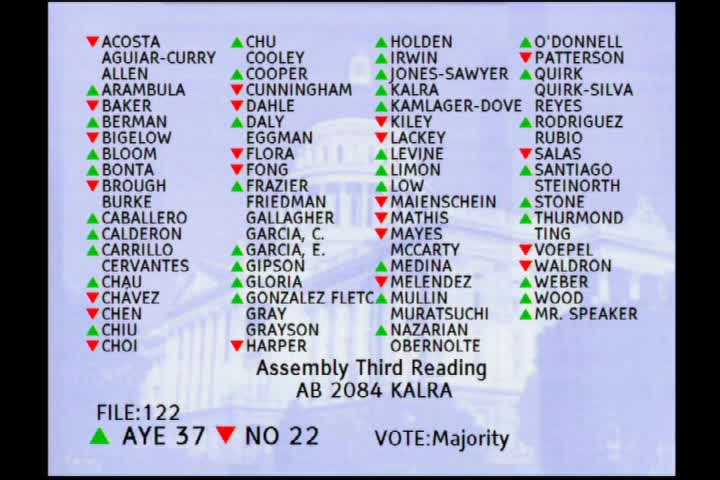
Bill Author

Bill Co-Author(s):
