AB 2747: Student Athlete Bill of Rights.
- Session Year: 2017-2018
- House: Assembly
- Latest Version Date: 2018-07-02
Existing law provides for a system of postsecondary education in this state. This system includes as segments the University of California, administered by the Regents of the University of California, the California State University, administered by the Trustees of the California State University, and independent institutions of higher education. Existing law further provides a Student Athlete Bill of Rights that applies to campuses of these segments that maintain intercollegiate athletic programs.
This bill would add to the Student Athlete Bill of Rights provisions authorizing institutions of higher education to establish a degree completion fund, requiring institutions of higher education to prepare notices containing pertinent data relating to the rights of student athletes, and procedures for filing complaints, under the Student Athlete Bill of Rights, and prohibiting institutions of higher education from intentionally retaliating, as defined, against a student athlete for making a complaint in good faith, or reporting, in good faith faith, a violation of the student athletes rights as identified in the bill. granted under any applicable statute, regulation, or policy.
Existing law provides for a system of postsecondary education in this state. This system includes as segments the University of California, administered by the Regents of the University of California, the California State University, administered by the Trustees of the California State University, and independent institutions of higher education. Existing law further provides a Student Athlete Bill of Rights that applies to campuses of these segments that maintain intercollegiate athletic programs.
This bill would add to the Student Athlete Bill of Rights provisions authorizing institutions of higher education to establish a degree completion fund, requiring institutions of higher education to prepare notices containing pertinent data relating to the rights of student athletes, and procedures for filing complaints, under the Student Athlete Bill of Rights, and prohibiting institutions of higher education from retaliating, as defined, against a student athlete for making a complaint or reporting in good faith, or reporting, in good faith a violation of the student athletes rights as identified in the bill.
Existing law provides for a system of postsecondary education in this state. This system includes as segments the University of California, administered by the Regents of the University of California, the California State University, administered by the Trustees of the California State University, and independent institutions of higher education. Existing law further provides a Student Athlete Bill of Rights that applies to campuses of these segments that maintain intercollegiate athletic programs.
This bill would add to the Student Athlete Bill of Rights a provision provisions authorizing institutions of higher education to establish a degree completion fund. fund, requiring institutions of higher education to prepare notices containing pertinent data relating to the rights of student athletes, and procedures for filing complaints, under the Student Athlete Bill of Rights, and prohibiting institutions of higher education from retaliating, as defined, against a student athlete for making a complaint or reporting a violation of the student athletes rights as identified in the bill.
(2)Existing law, the Child Abuse and Neglect Reporting Act, makes certain persons, including, among others, social workers, physicians, psychiatrists, and athletic coaches at public and private postsecondary educational institutions, mandated reporters. Under existing law, mandated reporters are required to report whenever the mandated reporter, in his or her professional capacity or within the scope of his or her employment, has knowledge of or observes a child whom the mandated reporter knows or reasonably suspects has been the victim of child abuse or neglect. Failure by a mandated reporter to report an incident of known or reasonably suspected child abuse or neglect is a misdemeanor.This bill, with respect to athletic coaches, as defined to include assistant coaches, graduate assistants involved in coaching, employees of collegiate athletic programs, and medical professionals providing care to students on behalf of a collegiate athletic program at public and private educational institutions, as well as employees of an intercollegiate athletic conference or intercollegiate multiconference association or athletic association, would provide that these persons would be known as collegiate athlete mandated reporters. The bill would require collegiate athlete mandated reporters to make an initial report by telephone and a followup report in writing if he or she has knowledge of, or observes, a collegiate athlete who the collegiate athlete mandated reporter knows or reasonably suspects has been a victim of abuse or neglect. This provision would apply to both minor and adult collegiate athletes.(1)Existing law provides for a system of postsecondary education in this state. This system includes as segments the University of California, administered by the Regents of the University of California, the California State University, administered by the Trustees of the California State University, and independent institutions of higher education. Existing law further provides a Student Athlete Bill of Rights that applies to campuses of these segments that maintain intercollegiate athletic programs.
This bill would add to the Student Athlete Bill of Rights provisions declaring that college athletes have the right to self-organization and requiring institutions of higher education, as defined, to provide student athletes with designated information. a provision authorizing institutions of higher education to establish a degree completion fund.
The bill would require institutions of higher education to establish a process by which the complaints of student athletes about violations of the NCAA Bill of Rights, the Student Athlete Bill of Rights enacted under this part or other pertinent state statutes, and institutional policies may be reported and investigated. The bill would also require institutions of higher education to appoint student athlete liaisons with duties and responsibilities that would include being available to all student athletes of the institution and to record and investigate the complaints of student athletes, as specified.The bill would specify that student athletes have the right to enforce a provision of this Student Athlete Bill of Rights in the superior court through a civil action for injunctive relief or money damages, or both. The bill would require the court to award court costs and reasonable reimbursement for attorneys fees to a student athlete who is the prevailing party in such an action. The bill would prohibit a student athlete, institution of higher education, or athletic conference, as defined, from being required to agree to adjudication, in another state, of a claim or controversy that arises in California. The bill would also prohibit a student athlete from being penalized for receiving any gift or income that can be demonstrated to be generally available to the students of the institution of higher education who are not athletes or for being accused of a noncriminal violation the investigation or adjudication of which has not been completed, as specified.The bill would authorize institutions of higher education to establish a degree completion fund with contributions earmarked for student athletes participating in one or more intercollegiate teams to collect income or financial gifts given to student athletes pursuant to specified requirements.The bill would authorize the Civil Rights Enforcement Section of the State Department of Justice to have specified powers and responsibilities for the investigation of complaints, and the prosecution of violations, of the Student Athlete Bill of Rights. The bill would authorize the Civil Rights Enforcement Section to impose specified fines for violations of the Student Athlete Bill of Rights, and would require the proceeds of these fines to be deposited in the Student Athletes Bill of Rights Enforcement Fund, which the bill would create in the State Treasury. The moneys deposited in the fund would be available, upon appropriation by the Legislature, for enforcement of the Student Athlete Bill of Rights.The bill would specify that administrative proceedings related to enforcement of the provisions of this bill would be conducted by the Office of Administrative Hearings in compliance with the Administrative Procedure Act.Specified provisions of this bill would become operative only if the head of the Civil Rights Enforcement Section of the Department of Justice certifies, in writing, to the Secretary of State that a national athletic association has enacted changes in its bylaws so that institutions of higher education in this state will not be penalized by that athletic association for compliance with the Student Athlete Bill of Rights.(2)Existing law, the Child Abuse and Neglect Reporting Act, makes certain persons, including, among others, social workers, physicians, psychiatrists, and athletic coaches at public and private postsecondary educational institutions, mandated reporters. Under existing law, mandated reporters are required to report whenever the mandated reporter, in his or her professional capacity or within the scope of his or her employment, has knowledge of or observes a child whom the mandated reporter knows or reasonably suspects has been the victim of child abuse or neglect. Failure by a mandated reporter to report an incident of known or reasonably suspected child abuse or neglect is a misdemeanor.
This bill, with respect to athletic coaches, as defined to include assistant coaches, graduate assistants involved in coaching, employees of collegiate athletic programs, and medical professionals providing care to students on behalf of a collegiate athletic program at public and private educational institutions, as well as employees of an intercollegiate athletic conference or intercollegiate multiconference association or athletic association, would provide that these persons would be known as collegiate athlete mandated reporters. The bill would require collegiate athlete mandated reporters to make an initial report by telephone and a followup report in writing if he or she has knowledge of, or observes, a college collegiate athlete who the collegiate athlete mandated reporter knows or reasonably suspects has been a victim of abuse or neglect. This provision would apply to both minor and adult college collegiate athletes.
(1)Existing law provides for a system of postsecondary education in this state. This system includes as segments the University of California, administered by the Regents of the University of California, the California State University, administered by the Trustees of the California State University,, University, and independent institutions of higher education. Existing law further provides a Student Athlete Bill of Rights that applies to campuses of these segments that maintain intercollegiate athletic programs.
This bill would add to the Student Athlete Bill of Rights provisions declaring that college athletes have the right to self-organization and requiring institutions of higher education, as defined, to provide student athletes with designated information.
The bill would require institutions of higher education to establish a process by which the complaints of student athletes about violations of the NCAA Bill of Rights, the Student Athlete Bill of Rights enacted under this part or other pertinent state statutes, and institutional policies may be reported and investigated. The bill would also require institutions of higher education to appoint student athlete liaisons with duties and responsibilities that would include being available to all student athletes of the institution and to record and investigate the complaints of student athletes, as specified.
The bill would specify that student athletes have the right to enforce a provision of this Student Athlete Bill of Rights in the superior court through a civil action for injunctive relief or money damages, or both. The bill would require the court to award court costs and reasonable reimbursement for attorneys fees to a student athlete who is the prevailing party in such an action. The bill would prohibit a student athlete, institution of higher education, or athletic conference, as defined, from being required to agree to adjudication, in another state, of a claim or controversy that arises in California. The bill would also prohibit a student athlete from being penalized for receiving any gift or income that can be demonstrated to be generally available to the students of the institution of higher education who are not athletes or for being accused of a noncriminal violation the investigation or adjudication of which has not been completed, as specified.
The bill would authorize institutions of higher education to establish a degree completion fund with contributions earmarked for student athletes participating in one or more intercollegiate teams to collect income or financial gifts given to student athletes pursuant to specified requirements.
The bill would authorize the Civil Rights Enforcement Section of the State Department of Justice to have specified powers and responsibilities for the investigation of complaints, and the prosecution of violations, of the Student Athlete Bill of Rights. The bill would authorize the Civil Rights Enforcement Section to impose specified fines for violations of the Student Athlete Bill of Rights, and would require the proceeds of these fines to be deposited in the Student Athletes Bill of Rights Enforcement Fund, which the bill would create in the State Treasury. The moneys deposited in the fund would be available, upon appropriation by the Legislature, for enforcement of the Student Athlete Bill of Rights.
The bill would specify that administrative proceedings related to enforcement of the provisions of this bill would be conducted by the Office of Administrative Hearings in compliance with the Administrative Procedure Act.
Specified provisions of this bill would become operative only if the head of the Civil Rights Enforcement Section of the Department of Justice certifies, in writing, to the Secretary of State that a national athletic association has enacted changes in its bylaws so that institutions of higher education in this state will not be penalized by that athletic association for compliance with the Student Athlete Bill of Rights.
(2)Existing law, the Child Abuse and Neglect Reporting Act, makes certain persons, including, among others, social workers, physicians, psychiatrists, and athletic coaches at public and private postsecondary educational institutions, mandated reporters. Under existing law, mandated reporters are required to report whenever the mandated reporter, in his or her professional capacity or within the scope of his or her employment, has knowledge of or observes a child whom the mandated reporter knows or reasonably suspects has been the victim of child abuse or neglect. Failure by a mandated reporter to report an incident of known or reasonably suspected child abuse or neglect is a misdemeanor.
This bill, with respect to athletic coaches coaches, as defined to include assistant coaches, graduate assistants involved in coaching, employees of collegiate athletic programs, and medical professionals providing care to students on behalf of a collegiate athletic program at public and private educational institutions, as well as employees of an intercollegiate athletic conference or intercollegiate multiconference association or athletic association, would provide that these persons would be known as collegiate athlete mandated reporters. The bill would require collegiate athlete mandated reporters to make an initial report by telephone and a followup report in writing if he or she has knowledge of, or observes, a college athlete who the collegiate athlete mandated reporter knows or reasonably suspects has been a victim of abuse or neglect. This provision would apply to both minor and adult college athletes.
(1)Existing law provides for a system of postsecondary education in this state. This system includes as segments the University of California, administered by the Regents of the University of California, the California State University, administered by the Trustees of the California State University, the California Community Colleges, administered by the Board of Governors of the California Community Colleges, and independent institutions of higher education. Existing law further provides a Student Athlete Bill of Rights. Rights that applies to campuses of these segments that maintain intercollegiate athletic programs.
This bill would state the intent of the Legislature to enact legislation to protect the right of all college athletes to study, work, and participate in athletics and for all college athletes to have equal access to athletic programs, facilities, and scholarships. add to the Student Athlete Bill of Rights provisions declaring that college athletes have the right to self-organization and requiring institutions of higher education, as defined, to provide student athletes with designated information.
The bill would require institutions of higher education to establish a process by which the complaints of student athletes about violations of the NCAA Bill of Rights, the Student Athlete Bill of Rights enacted under this part or other pertinent state statutes, and institutional policies may be reported and investigated. The bill would also require institutions of higher education to appoint student athlete liaisons with duties and responsibilities that would include being available to all student athletes of the institution and to record and investigate the complaints of student athletes, as specified.
The bill would specify that student athletes have the right to enforce a provision of this Student Athlete Bill of Rights in the superior court through a civil action for injunctive relief or money damages, or both. The bill would require the court to award court costs and reasonable reimbursement for attorneys fees to a student athlete who is the prevailing party in such an action. The bill would prohibit a student athlete, institution of higher education, or athletic conference, as defined, from being required to agree to adjudication, in another state, of a claim or controversy that arises in California. The bill would also prohibit a student athlete from being penalized for receiving any gift or income that can be demonstrated to be generally available to the students of the institution of higher education who are not athletes or for being accused of a noncriminal violation the investigation or adjudication of which has not been completed, as specified.
The bill would authorize the Civil Rights Enforcement Section of the State Department of Justice to have specified powers and responsibilities for the investigation of complaints, and the prosecution of violations, of the Student Athlete Bill of Rights.
(2)Existing law, the Child Abuse and Neglect Reporting Act, makes certain persons, including, among others, social workers, physicians, psychiatrists, and athletic coaches at public and private postsecondary educational institutions, mandated reporters. Under existing law, mandated reporters are required to report whenever the mandated reporter, in his or her professional capacity or within the scope of his or her employment, has knowledge of or observes a child whom the mandated reporter knows or reasonably suspects has been the victim of child abuse or neglect. Failure by a mandated reporter to report an incident of known or reasonably suspected child abuse or neglect is a misdemeanor.
This bill, with respect to athletic coaches at public and private educational institutions, would provide that these persons would be known as collegiate athlete mandated reporters. The bill would require collegiate athlete mandated reporters to make an initial report by telephone and a followup report in writing if he or she has knowledge of, or observes, a college athlete who the collegiate athlete mandated reporter knows or reasonably suspects has been a victim of abuse or neglect.
Existing law provides for a system of postsecondary education in this state. This system includes the University of California, administered by the Regents of the University of California, the California State University, administered by the Trustees of the California State University, the California Community Colleges, administered by the Board of Governors of the California Community Colleges, and independent institutions of higher education. Existing law further provides a Student Athlete Bill of Rights.
This bill would state the intent of the Legislature to enact legislation to protect the right of all college athletes to study, work, and participate in athletics and for all college athletes to have equal access to athletic programs, facilities, and scholarships.
For purposes of this part:
(a)Athletic association means any organization that is responsible for governing intercollegiate athletic programs.
(b)Athletic program means an intercollegiate athletic program at any institution of higher education within the meaning of subdivision (d).
(c)Graduation success rate means the percentage of student athletes who graduate from that institution of higher education within six years of their initial enrollment, excluding outgoing transfers in good academic standing with athletic eligibility remaining, and including incoming transfers. The rate is to be calculated by combining the rates of the four most recent classes that are available in the exact manner as the rate is calculated under National Collegiate Athletic Association rules.
(d)Institution of higher education means any campus of the University of California or the California State University, or any four-year private university located in California, that maintains an intercollegiate athletic program.
(e)Media rights means the rights to media coverage of intercollegiate athletics included in contracts that are entered into by intercollegiate athletic conferences and television networks and that generate monetary payments to individual institutions of higher education.
(f)Office for Civil Rights means the Office for Civil Rights within the United States Department of Education.
(g)Student athlete means any college student who participates in an intercollegiate athletic program of an institution of higher education, and includes student athletes who participate in basketball, football, and other intercollegiate sports.
SEC. 2.Section 67452.2 is added to the Education Code, to read:67452.2.The Legislature finds and declares all of the following:
(a)The State of California concurs with the Healthy People 2020 findings of the United States Department of Health and Human Resources. These findings identify the leading determinants of the health of populations and individuals, including discrimination, education, injury, and the costs of medical expenses. Collegiate athletes are at an elevated risk for poor public health outcomes.
(b)Nothing in the act that adds this section requires an institution of higher education to violate the regulations of an athletic association of which it is a member. Nothing in the act that adds this section requires an institution of higher education to create a degree completion fund.
(c)Collegiate athletes, the majority of whom are members of one or more vulnerable sectors of society, should be shielded from economic and educational discrimination.
SEC. 3.Section 67452.3 is added to the Education Code, to read:67452.3.An institution of higher education may establish a degree completion fund.
SEC. 4.Section 67454 is added to the Education Code, immediately following Section 67453, to read:67454.(a)An institution of higher education shall prepare a notice containing pertinent data regarding the following information:
(1)A student athletes rights pursuant to Title IX of the federal Education Amendments of 1972 (20 U.S.C. Sec. 1681 et seq.).
(2)A student athletes reporting rights pursuant to the federal Jeanne Clery Disclosure of Campus Security Policy and Campus Crime Statistics Act (20 U.S.C. Sec. 1092(f)).
(3)A student athletes rights pursuant to this part, as applicable.
(4)A student athletes rights pursuant to the regulations promulgated by any state commission authorized to provide up-to-date information about sports-related health risks and provide guidelines and mandates to ensure transparency and protections for student athletes.
(5)Any additional rights afforded specifically to student athletes, or students at large, as provided by the institution of higher education in any policy manual, handbook, executive order, or other written policy related to students rights.
(b)The notice developed pursuant to subdivision (a) shall contain sufficient information to enable a student athlete to file a complaint for a violation of any of the rights identified in the notice, including but not necessarily limited to, all of the following:
(1)The telephone number for the Civil Rights Hotline, utilized by the Office for Civil Rights for complaint reporting intake, as well as the telephone number of the Office for Civil Rights regional enforcement office.
(2)The Internet Web site address for the Office for Civil Rights online complaint form for Title IX complaint reporting.
(3)The Internet Web site address utilized by the United States Department of Education for reporting violations of the federal Jeanne Clery Disclosure of Campus Security Policy and Campus Crime Statistics Act.
(4)A list of the job classifications employed by the institution that are deemed mandated reporters pursuant to Section 11165.7 of the Penal Code, and the mandated reporters obligations under the law, including, but not necessarily limited to, which students are included in their reporting obligation.
(c)Every institution of higher education shall post and keep posted in a conspicuous location frequented by student athletes, including, but not necessarily limited to, athletic training facilities, the notice developed pursuant to subdivision (a).
(d)At the beginning of every academic year, the institution of higher education shall provide every student athlete a copy of the following:
(1)A copy of the notice developed pursuant to subdivision (a).
(2)A current copy of the National Collegiate Athletic Association Concussion Diagnosis and Management of Sports-Related Concussion Best Practices.
(3)Any written policies related to concussions or other sports medicine practices specific to the institution of higher education.
SEC. 5.Section 67455 is added to the Education Code, immediately following Section 67454, to read:67455.(a)An institution of higher education shall not intentionally retaliate against a student athlete for making a complaint in good faith or for reporting, in good faith, a violation of the student athletes rights identified in paragraphs (1) to (5), inclusive, of subdivision (a) of Section 67454. granted under any applicable statute, regulation, or policy.
(b)(1)For purposes of this section, retaliation shall include all means any of the following:
(A)A reduction in or loss of playing time.(B)(A)A reduction in or loss of any education benefits, including scholarships and stipends.
(C)(B)A reduction in or loss of any meal benefits provided to a student athlete.
(D)(C)A reduction in or loss of any housing benefits provided to a student athlete, including the relocation of a student athletes housing owned by the institution of higher education.
(2)For purposes of subparagraphs (A) to (C), inclusive, of paragraph (1), retaliation does not include mean an action taken, in good faith, by an institution of higher education on the basis of conduct other than a complaint made in good faith or the reporting, in good faith, of an alleged violation, as provided in paragraphs (1) to (5), inclusive, of subdivision (a) of Section 67454.
For purposes of this part:
(a)Athletic association means any organization that is responsible for governing intercollegiate athletic programs.
(b)Athletic program means an intercollegiate athletic program at any institution of higher education within the meaning of subdivision (d).
(c)Graduation success rate means the percentage of student athletes who graduate from that institution of higher education within six years of their initial enrollment, excluding outgoing transfers in good academic standing with athletic eligibility remaining, and including incoming transfers. The rate is to be calculated by combining the rates of the four most recent classes that are available in the exact manner as the rate is calculated under National Collegiate Athletic Association rules.
(d)Institution of higher education means any campus of the University of California or the California State University, or any four-year private university located in California, that maintains an intercollegiate athletic program.
(e)Media rights means the rights to media coverage of intercollegiate athletics included in contracts that are entered into by intercollegiate athletic conferences and television networks and that generate monetary payments to individual institutions of higher education.
(f)Office for Civil Rights means the Office for Civil Rights within the United States Department of Education.
(g)Student athlete means any college student who participates in an intercollegiate athletic program of an institution of higher education, and includes student athletes who participate in basketball, football, and other intercollegiate sports.
SEC. 2.Section 67452.2 is added to the Education Code, to read:67452.2.The Legislature finds and declares all of the following:
(a)The State of California concurs with the Healthy People 2020 findings of the United States Department of Health and Human Resources. These findings identify the leading determinants of the health of populations and individuals, including discrimination, education, injury, and the costs of medical expenses. Collegiate athletes are at an elevated risk for poor public health outcomes.
(b)Nothing in the act that adds this section requires an institution of higher education to violate the regulations of an athletic association of which it is a member. Nothing in the act that adds this section requires an institution of higher education to create a degree completion fund.
(c)Collegiate athletes, the majority of whom are members of one or more vulnerable sectors of society, should be shielded from economic and educational discrimination.
SEC. 2.SEC. 3.Section 67452.3 is added to the Education Code, to read:67452.3.An institution of higher education may establish a degree completion fund.
SEC. 3.SEC. 4.Section 67454 is added to the Education Code, immediately following Section 67453, to read:67454.(a)An institution of higher education shall prepare a notice containing pertinent data regarding the following information:
(1)A student athletes rights pursuant to Title IX of the federal Education Amendments of 1972 (20 U.S.C. Sec. 1681 et seq.).
(2)A student athletes reporting rights pursuant to the federal Jeanne Clery Disclosure of Campus Security Policy and Campus Crime Statistics Act (20 U.S.C. Sec. 1092(f)).
(3)A student athletes rights pursuant to this part. part, as applicable.
(4)A student athletes rights pursuant to the regulations promulgated by any state commission authorized to provide up-to-date information about sports-related health risks and provide guidelines and mandates to ensure transparency and protections for student athletes.
(5)Any additional rights afforded specifically to student athletes, or students at large, as provided by the institution of higher education in any policy manual, handbook, executive order, or other written policy related to students students rights.
(b)The notice developed pursuant to subdivision (a) shall contain sufficient information to enable a student athlete to file a complaint for a violation of any of the rights identified in the notice, including but not necessarily limited to, all of the following:
(1)The telephone number for the Civil Rights Hotline, utilized by the Office for Civil Rights for complaint reporting intake, as well as the telephone number of the Office for Civil Rights regional enforcement office.
(2)The Internet Web site address for the Office for Civil Rights online complaint form for Title IX complaint reporting.
(3)The Internet Web site address utilized by the United States Department of Education for reporting violations of the federal Jeanne Clery Disclosure of Campus Security Policy and Campus Crime Statistics Act.
(4)A list of the job classifications employed by the institution that are deemed mandated reporters pursuant to Section 11165.7 of the Penal Code, and the mandated reporters obligations under the law. law, including, but not necessarily limited to, which students are included in their reporting obligation.
(c)Every institution of higher education shall post and keep posted in a conspicuous location frequented by student athletes, including but not limited to including, but not necessarily limited to, athletic training facilities, the notice developed pursuant to subdivision (a).
(d)Upon the commencement At the beginning of every academic school year, the institution of higher education shall provide every student athlete a copy of the following:
(1)A copy of the notice developed pursuant to subdivision (a).
(2)A current copy of the National Collegiate Athletic Association Concussion Diagnosis and Management of Sports-Related Concussion Best Practices.
(3)Any written policies related to concussions or other sports medicine practices specific to the institution of higher education.
SEC. 4.SEC. 5.Section 67455 is added to the Education Code, immediately following Section 67454, to read:67455.(a)An institution of higher education shall not retaliate against a student athlete for making a complaint or reporting in good faith or for reporting, in good faith, a violation of the student athletes rights identified in paragraphs (1) to (5), inclusive, of subdivision (a) of Section 67454.
(b)For the (1)For purposes of this section, retaliation shall include all of the following:
(1)(A)A reduction in or loss of playing time.
(2)(B)A reduction in or loss of any education benefits benefits, including scholarships and stipends.
(3)(C)A reduction in or loss of any meal benefits provided to a student athlete.
(4)(D)A reduction in or loss of any housing benefits provided to a student athlete, including the relocation of a student athletes housing owned by the institution of higher education.
(2)For purposes of subparagraphs (A) to (C), inclusive, of paragraph (1), retaliation does not include an action taken, in good faith, by an institution of higher education on the basis of conduct other than a complaint made in good faith or the reporting, in good faith, of an alleged violation, as provided in paragraphs (1) to (5), inclusive, of subdivision (a) of Section 67454.
For purposes of this part:
(a)Athletic association means any organization that is responsible for governing intercollegiate athletic programs.
(b)Athletic program means an intercollegiate athletic program at any institution of higher education within the meaning of subdivision (d).
(c)Graduation success rate means the percentage of student athletes who graduate from that institution of higher education within six years of their initial enrollment, excluding outgoing transfers in good academic standing with athletic eligibility remaining, and including incoming transfers. The rate is to be calculated by combining the rates of the four most recent classes that are available in the exact manner as the rate is calculated under National Collegiate Athletic Association rules.
(d)Institution of higher education means any campus of the University of California or the California State University, or any four-year private university located in California, that maintains an intercollegiate athletic program.
(e)Media rights means the rights to media coverage of intercollegiate athletics included in contracts that are entered into by intercollegiate athletic conferences and television networks and that generate monetary payments to individual institutions of higher education.
(f)(f)Office for Civil Rights means the Office for Civil Rights within the United States Department of Education.
(g)Student athlete means any college student who participates in an intercollegiate athletic program of an institution of higher education, and includes student athletes who participate in basketball, football, and other intercollegiate sports.
SECTION 1.SEC. 2.Section 67452.3 is added to the Education Code, to read:67452.3.An institution of higher education may establish a degree completion fund.
SEC. 3.Section 67454 is added to the Education Code, immediately following Section 67453, to read:67454.(a)An institution of higher education shall prepare a notice containing pertinent data regarding the following information:
(1)A student athletes rights pursuant to Title IX of the federal Education Amendments of 1972 (20 U.S.C. Sec. 1681 et seq.).
(2)A student athletes rights pursuant to the federal Jeanne Clery Disclosure of Campus Security Policy and Campus Crime Statistics Act (20 U.S.C. Sec. 1092(f)).
(3)A student athletes rights pursuant to this part.
(4)A student athletes rights pursuant to the regulations promulgated by any state commission authorized to provide up-to-date information about sports-related health risks and provide guidelines and mandates to ensure transparency and protections for student athletes.
(5)Any additional rights afforded specifically to student athletes, or students at large, as provided by the institution of higher education in any policy manual, handbook, executive order, or other written policy related to students rights.
(b)The notice developed pursuant to subdivision (a) shall contain sufficient information to enable a student athlete to file a complaint for a violation of any of the rights identified in the notice, including but not necessarily limited to, all of the following:
(1)The telephone number for the Civil Rights Hotline, utilized by the Office for Civil Rights for complaint reporting intake, as well as the telephone number of the Office for Civil Rights regional enforcement office.
(2)The Internet Web site address for the Office for Civil Rights online complaint form for Title IX complaint reporting.
(3)The Internet Web site address utilized by the United States Department of Education for reporting violations of the federal Jeanne Clery Disclosure of Campus Security Policy and Campus Crime Statistics Act.
(4)A list of the job classifications employed by the institution that are deemed mandated reporters pursuant to Section 11165.7 of the Penal Code, and the mandated reporters obligations under the law.
(c)Every institution of higher education shall post and keep posted in a conspicuous location frequented by student athletes, including but not limited to athletic training facilities, the notice developed pursuant to subdivision (a).
(d)Upon the commencement of every academic school year, the institution of higher education shall provide every student athlete a copy of the following:
(1)A copy of the notice developed pursuant to subdivision (a).
(2)A current copy of the National Collegiate Athletic Association Concussion Diagnosis and Management of Sports-Related Concussion Best Practices.
(3)Any written policies related to concussions or other sports medicine practices specific to the institution of higher education.
SEC. 4.Section 67455 is added to the Education Code, immediately following Section 67454, to read:67455.(a)An institution of higher education shall not retaliate against a student athlete for making a complaint or reporting a violation of the student athletes rights identified in paragraphs (1) to (5), inclusive, of subdivision (a) of Section 67454.
(b)For the purposes of this section, retaliation shall include all of the following:
(1)A reduction in or loss of playing time.
(2)A reduction in or loss of any education benefits including scholarships and stipends.
(3)A reduction in or loss of any meal benefits provided to a student athlete.
(4)A reduction in or loss of any housing benefits provided to a student athlete, including the relocation of a student athletes housing owned by the institution of higher education.
SEC. 2.Section 11165.7 of the Penal Code is amended to read:11165.7.(a)As used in this article, mandated reporter is defined as any of the following:(1)A teacher.(2)An instructional aide.(3)A teachers aide or teachers assistant employed by a public or private school.(4)A classified employee of a public school.(5)An administrative officer or supervisor of child welfare and attendance, or a certificated pupil personnel employee of a public or private school.(6)An administrator of a public or private day camp.(7)An administrator or employee of a public or private youth center, youth recreation program, or youth organization.(8)An administrator, board member, or employee of a public or private organization whose duties require direct contact and supervision of children, including a foster family agency.(9)An employee of a county office of education or the State Department of Education whose duties bring the employee into contact with children on a regular basis.(10)A licensee, an administrator, or an employee of a licensed community care or child day care facility.(11)A Head Start program teacher.(12)A licensing worker or licensing evaluator employed by a licensing agency, as defined in Section 11165.11.(13)A public assistance worker.(14)An employee of a child care institution, including, but not limited to, foster parents, group home personnel, and personnel of residential care facilities.(15)A social worker, probation officer, or parole officer.(16)An employee of a school district police or security department.(17)A person who is an administrator or presenter of, or a counselor in, a child abuse prevention program in a public or private school.(18)A district attorney investigator, inspector, or local child support agency caseworker, unless the investigator, inspector, or caseworker is working with an attorney appointed pursuant to Section 317 of the Welfare and Institutions Code to represent a minor.(19)A peace officer, as defined in Chapter 4.5 (commencing with Section 830) of Title 3 of Part 2, who is not otherwise described in this section.(20)A firefighter, except for volunteer firefighters.(21)A physician and surgeon, psychiatrist, psychologist, dentist, resident, intern, podiatrist, chiropractor, licensed nurse, dental hygienist, optometrist, marriage and family therapist, clinical social worker, professional clinical counselor, or any other person who is currently licensed under Division 2 (commencing with Section 500) of the Business and Professions Code.(22)An emergency medical technician I or II, paramedic, or other person certified pursuant to Division 2.5 (commencing with Section 1797) of the Health and Safety Code.(23)A psychological assistant registered pursuant to Section 2913 of the Business and Professions Code.(24)A marriage and family therapist trainee, as defined in subdivision (c) of Section 4980.03 of the Business and Professions Code.(25)An unlicensed associate marriage and family therapist registered under Section 4980.44 of the Business and Professions Code.(26)A state or county public health employee who treats a minor for venereal disease or any other condition.(27)A coroner.(28)A medical examiner or other person who performs autopsies.(29)A commercial film and photographic print or image processor as specified in subdivision (e) of Section 11166. As used in this article, commercial film and photographic print or image processor means a person who develops exposed photographic film into negatives, slides, or prints, or who makes prints from negatives or slides, or who prepares, publishes, produces, develops, duplicates, or prints any representation of information, data, or an image, including, but not limited to, any film, filmstrip, photograph, negative, slide, photocopy, videotape, video laser disc, computer hardware, computer software, computer floppy disk, data storage medium, CD-ROM, computer-generated equipment, or computer-generated image, for compensation. The term includes any employee of that person; it does not include a person who develops film or makes prints or images for a public agency.(30)A child visitation monitor. As used in this article, child visitation monitor means a person who, for financial compensation, acts as a monitor of a visit between a child and another person when the monitoring of that visit has been ordered by a court of law.(31)An animal control officer or humane society officer. For the purposes of this article, the following terms have the following meanings:(A)Animal control officer means a person employed by a city, county, or city and county for the purpose of enforcing animal control laws or regulations.(B)Humane society officer means a person appointed or employed by a public or private entity as a humane officer who is qualified pursuant to Section 14502 or 14503 of the Corporations Code.(32)A clergy member, as specified in subdivision (d) of Section 11166. As used in this article, clergy member means a priest, minister, rabbi, religious practitioner, or similar functionary of a church, temple, or recognized denomination or organization.(33)Any custodian of records of a clergy member, as specified in this section and subdivision (d) of Section 11166.(34)An employee of any police department, county sheriffs department, county probation department, or county welfare department.(35)An employee or volunteer of a Court Appointed Special Advocate program, as defined in Rule 5.655 of the California Rules of Court.(36)A custodial officer, as defined in Section 831.5.(37)A person providing services to a minor child under Section 12300 or 12300.1 of the Welfare and Institutions Code.(38)An alcohol and drug counselor. As used in this article, an alcohol and drug counselor is a person providing counseling, therapy, or other clinical services for a state licensed or certified drug, alcohol, or drug and alcohol treatment program. However, alcohol or drug abuse, or both alcohol and drug abuse, is not, in and of itself, a sufficient basis for reporting child abuse or neglect.(39)A clinical counselor trainee, as defined in subdivision (g) of Section 4999.12 of the Business and Professions Code.(40)An associate professional clinical counselor registered under Section 4999.42 of the Business and Professions Code.(41)An employee or administrator of a public or private postsecondary educational institution, whose duties bring the administrator or employee into contact with children on a regular basis, or who supervises those whose duties bring the administrator or employee into contact with children on a regular basis, as to child abuse or neglect occurring on that institutions premises or at an official activity of, or program conducted by, the institution. Nothing in this paragraph shall be construed as altering the lawyer-client privilege as set forth in Article 3 (commencing with Section 950) of Chapter 4 of Division 8 of the Evidence Code.(42)An athletic coach, athletic administrator, or athletic director employed by any public or private school that provides any combination of instruction for kindergarten, or grades 1 to 12, inclusive.(43)(A)A commercial computer technician as specified in subdivision (e) of Section 11166. As used in this article, commercial computer technician means a person who works for a company that is in the business of repairing, installing, or otherwise servicing a computer or computer component, including, but not limited to, a computer part, device, memory storage or recording mechanism, auxiliary storage recording or memory capacity, or any other material relating to the operation and maintenance of a computer or computer network system, for a fee. An employer who provides an electronic communications service or a remote computing service to the public shall be deemed to comply with this article if that employer complies with Section 2258A of Title 18 of the United States Code.(B)An employer of a commercial computer technician may implement internal procedures for facilitating reporting consistent with this article. These procedures may direct employees who are mandated reporters under this paragraph to report materials described in subdivision (e) of Section 11166 to an employee who is designated by the employer to receive the reports. An employee who is designated to receive reports under this subparagraph shall be a commercial computer technician for purposes of this article. A commercial computer technician who makes a report to the designated employee pursuant to this subparagraph shall be deemed to have complied with the requirements of this article and shall be subject to the protections afforded to mandated reporters, including, but not limited to, those protections afforded by Section 11172.(44)(A)Any athletic coach, including, but not limited to, an assistant coach or a graduate assistant involved in coaching, any employee of a collegiate athletic program, or any medical professional providing care to students on behalf of a collegiate athletic program at a public or private postsecondary educational institution, or any employee of an intercollegiate athletic conference or intercollegiate multiconference association or athletic association, who shall be known as a collegiate athlete mandated reporter. (B)A collegiate athlete mandated reporter shall make a report to an agency specified in Section 11165.9 whenever he or she, in his or her professional capacity or within the scope of his or her employment, has knowledge of, or observes, a collegiate athlete who the collegiate athlete mandated reporter knows or reasonably suspects has been the victim of abuse or neglect. A collegiate athlete mandated reporter shall make an initial report by telephone to the agency immediately, or as soon as is practically possible, and shall prepare and send, fax, or electronically transmit, a written followup report within 36 hours of receiving the information concerning the incident. The collegiate athlete mandated reporter may include, with the report, any nonprivileged documentary evidence that he or she possesses relating to the incident. This paragraph is applicable to both minor and adult collegiate athletes.(45)An individual certified by a licensed foster family agency as a certified family home, as defined in Section 1506 of the Health and Safety Code.(46)An individual approved as a resource family, as defined in Section 1517 of the Health and Safety Code and Section 16519.5 of the Welfare and Institutions Code.(b)Except as provided in paragraph (35) of subdivision (a), volunteers of public or private organizations whose duties require direct contact with and supervision of children are not mandated reporters but are encouraged to obtain training in the identification and reporting of child abuse and neglect and are further encouraged to report known or suspected instances of child abuse or neglect to an agency specified in Section 11165.9.(c)Except as provided in subdivision (d), employers are strongly encouraged to provide their employees who are mandated reporters with training in the duties imposed by this article. This training shall include training in child abuse and neglect identification and training in child abuse and neglect reporting. Whether or not employers provide their employees with training in child abuse and neglect identification and reporting, the employers shall provide their employees who are mandated reporters with the statement required pursuant to subdivision (a) of Section 11166.5.(d)Pursuant to Section 44691 of the Education Code, school districts, county offices of education, state special schools and diagnostic centers operated by the State Department of Education, and charter schools shall annually train their employees and persons working on their behalf specified in subdivision (a) in the duties of mandated reporters under the child abuse reporting laws. The training shall include, but not necessarily be limited to, training in child abuse and neglect identification and child abuse and neglect reporting.(e)(1)On and after January 1, 2018, pursuant to Section 1596.8662 of the Health and Safety Code, a child care licensee applicant shall take training in the duties of mandated reporters under the child abuse reporting laws as a condition of licensure, and a child care administrator or an employee of a licensed child day care facility shall take training in the duties of mandated reporters during the first 90 days when he or she is employed by the facility.(2)A person specified in paragraph (1) who becomes a licensee, administrator, or employee of a licensed child day care facility shall take renewal mandated reporter training every two years following the date on which he or she completed the initial mandated reporter training. The training shall include, but not necessarily be limited to, training in child abuse and neglect identification and child abuse and neglect reporting.(f)Unless otherwise specifically provided, the absence of training shall not excuse a mandated reporter from the duties imposed by this article.(g)Public and private organizations are encouraged to provide their volunteers whose duties require direct contact with and supervision of children with training in the identification and reporting of child abuse and neglect.An institution of higher education may establish a degree completion fund.
SEC. 6.SEC. 2.Section 11165.7 of the Penal Code is amended to read:11165.7.(a)As used in this article, mandated reporter is defined as any of the following:
(1)A teacher.
(2)An instructional aide.
(3)A teachers aide or teachers assistant employed by a public or private school.
(4)A classified employee of a public school.
(5)An administrative officer or supervisor of child welfare and attendance, or a certificated pupil personnel employee of a public or private school.
(6)An administrator of a public or private day camp.
(7)An administrator or employee of a public or private youth center, youth recreation program, or youth organization.
(8)An administrator, board member, or employee of a public or private organization whose duties require direct contact and supervision of children, including a foster family agency.
(9)An employee of a county office of education or the State Department of Education whose duties bring the employee into contact with children on a regular basis.
(10)A licensee, an administrator, or an employee of a licensed community care or child day care facility.
(11)A Head Start program teacher.
(12)A licensing worker or licensing evaluator employed by a licensing agency, as defined in Section 11165.11.
(13)A public assistance worker.
(14)An employee of a child care institution, including, but not limited to, foster parents, group home personnel, and personnel of residential care facilities.
(15)A social worker, probation officer, or parole officer.
(16)An employee of a school district police or security department.
(17)A person who is an administrator or presenter of, or a counselor in, a child abuse prevention program in a public or private school.
(18)A district attorney investigator, inspector, or local child support agency caseworker, unless the investigator, inspector, or caseworker is working with an attorney appointed pursuant to Section 317 of the Welfare and Institutions Code to represent a minor.
(19)A peace officer, as defined in Chapter 4.5 (commencing with Section 830) of Title 3 of Part 2, who is not otherwise described in this section.
(20)A firefighter, except for volunteer firefighters.
(21)A physician and surgeon, psychiatrist, psychologist, dentist, resident, intern, podiatrist, chiropractor, licensed nurse, dental hygienist, optometrist, marriage and family therapist, clinical social worker, professional clinical counselor, or any other person who is currently licensed under Division 2 (commencing with Section 500) of the Business and Professions Code.
(22)An emergency medical technician I or II, paramedic, or other person certified pursuant to Division 2.5 (commencing with Section 1797) of the Health and Safety Code.
(23)A psychological assistant registered pursuant to Section 2913 of the Business and Professions Code.
(24)A marriage and family therapist trainee, as defined in subdivision (c) of Section 4980.03 of the Business and Professions Code.
(25)An unlicensed associate marriage and family therapist registered under Section 4980.44 of the Business and Professions Code.
(26)A state or county public health employee who treats a minor for venereal disease or any other condition.
(27)A coroner.
(28)A medical examiner or other person who performs autopsies.
(29)A commercial film and photographic print or image processor as specified in subdivision (e) of Section 11166. As used in this article, commercial film and photographic print or image processor means a person who develops exposed photographic film into negatives, slides, or prints, or who makes prints from negatives or slides, or who prepares, publishes, produces, develops, duplicates, or prints any representation of information, data, or an image, including, but not limited to, any film, filmstrip, photograph, negative, slide, photocopy, videotape, video laser disc, computer hardware, computer software, computer floppy disk, data storage medium, CD-ROM, computer-generated equipment, or computer-generated image, for compensation. The term includes any employee of that person; it does not include a person who develops film or makes prints or images for a public agency.
(30)A child visitation monitor. As used in this article, child visitation monitor means a person who, for financial compensation, acts as a monitor of a visit between a child and another person when the monitoring of that visit has been ordered by a court of law.
(31)An animal control officer or humane society officer. For the purposes of this article, the following terms have the following meanings:
(A)Animal control officer means a person employed by a city, county, or city and county for the purpose of enforcing animal control laws or regulations.
(B)Humane society officer means a person appointed or employed by a public or private entity as a humane officer who is qualified pursuant to Section 14502 or 14503 of the Corporations Code.
(32)A clergy member, as specified in subdivision (d) of Section 11166. As used in this article, clergy member means a priest, minister, rabbi, religious practitioner, or similar functionary of a church, temple, or recognized denomination or organization.
(33)Any custodian of records of a clergy member, as specified in this section and subdivision (d) of Section 11166.
(34)An employee of any police department, county sheriffs department, county probation department, or county welfare department.
(35)An employee or volunteer of a Court Appointed Special Advocate program, as defined in Rule 5.655 of the California Rules of Court.
(36)A custodial officer, as defined in Section 831.5.
(37)A person providing services to a minor child under Section 12300 or 12300.1 of the Welfare and Institutions Code.
(38)An alcohol and drug counselor. As used in this article, an alcohol and drug counselor is a person providing counseling, therapy, or other clinical services for a state licensed or certified drug, alcohol, or drug and alcohol treatment program. However, alcohol or drug abuse, or both alcohol and drug abuse, is not, in and of itself, a sufficient basis for reporting child abuse or neglect.
(39)A clinical counselor trainee, as defined in subdivision (g) of Section 4999.12 of the Business and Professions Code.
(40)An associate professional clinical counselor registered under Section 4999.42 of the Business and Professions Code.
(41)An employee or administrator of a public or private postsecondary educational institution, whose duties bring the administrator or employee into contact with children on a regular basis, or who supervises those whose duties bring the administrator or employee into contact with children on a regular basis, as to child abuse or neglect occurring on that institutions premises or at an official activity of, or program conducted by, the institution. Nothing in this paragraph shall be construed as altering the lawyer-client privilege as set forth in Article 3 (commencing with Section 950) of Chapter 4 of Division 8 of the Evidence Code.
(42)An athletic coach, athletic administrator, or athletic director employed by any public or private school that provides any combination of instruction for kindergarten, or grades 1 to 12, inclusive.
(43)(A)A commercial computer technician as specified in subdivision (e) of Section 11166. As used in this article, commercial computer technician means a person who works for a company that is in the business of repairing, installing, or otherwise servicing a computer or computer component, including, but not limited to, a computer part, device, memory storage or recording mechanism, auxiliary storage recording or memory capacity, or any other material relating to the operation and maintenance of a computer or computer network system, for a fee. An employer who provides an electronic communications service or a remote computing service to the public shall be deemed to comply with this article if that employer complies with Section 2258A of Title 18 of the United States Code.
(B)An employer of a commercial computer technician may implement internal procedures for facilitating reporting consistent with this article. These procedures may direct employees who are mandated reporters under this paragraph to report materials described in subdivision (e) of Section 11166 to an employee who is designated by the employer to receive the reports. An employee who is designated to receive reports under this subparagraph shall be a commercial computer technician for purposes of this article. A commercial computer technician who makes a report to the designated employee pursuant to this subparagraph shall be deemed to have complied with the requirements of this article and shall be subject to the protections afforded to mandated reporters, including, but not limited to, those protections afforded by Section 11172.
(44)(A)Any athletic coach, including, but not limited to, an assistant coach or a graduate assistant involved in coaching, any employee of a collegiate athletic program, or any medical professional providing care to students on behalf of a collegiate athletic program at a public or private postsecondary educational institution, or any employee of an intercollegiate athletic conference or intercollegiate multiconference association or athletic association, who shall be known as a collegiate athlete mandated reporter.
(B)A collegiate athlete mandated reporter shall make a report to an agency specified in Section 11165.9 whenever he or she, in his or her professional capacity or within the scope of his or her employment, has knowledge of, or observes, a college collegiate athlete who the collegiate athlete mandated reporter knows or reasonably suspects has been the victim of abuse or neglect. A collegiate athlete mandated reporter shall make an initial report by telephone to the agency immediately, or as soon as is practically possible, and shall prepare and send, fax, or electronically transmit, a written followup report within 36 hours of receiving the information concerning the incident. The collegiate athlete mandated reporter may include, with the report, any nonprivileged documentary evidence that he or she possesses relating to the incident. This paragraph is applicable to both minor and adult collegiate athletes.
(45)An individual certified by a licensed foster family agency as a certified family home, as defined in Section 1506 of the Health and Safety Code.
(46)An individual approved as a resource family, as defined in Section 1517 of the Health and Safety Code and Section 16519.5 of the Welfare and Institutions Code.
(b)Except as provided in paragraph (35) of subdivision (a), volunteers of public or private organizations whose duties require direct contact with and supervision of children are not mandated reporters but are encouraged to obtain training in the identification and reporting of child abuse and neglect and are further encouraged to report known or suspected instances of child abuse or neglect to an agency specified in Section 11165.9.
(c)Except as provided in subdivision (d), employers are strongly encouraged to provide their employees who are mandated reporters with training in the duties imposed by this article. This training shall include training in child abuse and neglect identification and training in child abuse and neglect reporting. Whether or not employers provide their employees with training in child abuse and neglect identification and reporting, the employers shall provide their employees who are mandated reporters with the statement required pursuant to subdivision (a) of Section 11166.5.
(d)Pursuant to Section 44691 of the Education Code, school districts, county offices of education, state special schools and diagnostic centers operated by the State Department of Education, and charter schools shall annually train their employees and persons working on their behalf specified in subdivision (a) in the duties of mandated reporters under the child abuse reporting laws. The training shall include, but not necessarily be limited to, training in child abuse and neglect identification and child abuse and neglect reporting.
(e)(1)On and after January 1, 2018, pursuant to Section 1596.8662 of the Health and Safety Code, a child care licensee applicant shall take training in the duties of mandated reporters under the child abuse reporting laws as a condition of licensure, and a child care administrator or an employee of a licensed child day care facility shall take training in the duties of mandated reporters during the first 90 days when he or she is employed by the facility.
(2)A person specified in paragraph (1) who becomes a licensee, administrator, or employee of a licensed child day care facility shall take renewal mandated reporter training every two years following the date on which he or she completed the initial mandated reporter training. The training shall include, but not necessarily be limited to, training in child abuse and neglect identification and child abuse and neglect reporting.
(f)Unless otherwise specifically provided, the absence of training shall not excuse a mandated reporter from the duties imposed by this article.
(g)Public and private organizations are encouraged to provide their volunteers whose duties require direct contact with and supervision of children with training in the identification and reporting of child abuse and neglect.
(a)College athletes have the right to self-organization and to be protected from retaliation while they are engaged in concerted activities for mutual aid and protection. College athletes shall also have the right to refrain from any or all of these activities.
(b)An athletic program shall provide its student athletes with information regarding their mandated reporter policies pursuant to Section 11165.7 of the Penal Code, the NCAA Bill of Rights, and the Student Athlete Bill of Rights enacted under this part.
SEC. 2.Section 67451.7 is added to the Education Code, to read:67451.7.(a)An institution of higher education shall establish a process by which the complaints of student athletes about violations of the NCAA Bill of Rights, the Student Athlete Bill of Rights enacted under this part or other pertinent state statutes, and institutional policies may be reported and investigated.
(b)An institution of higher education shall appoint an administrator, not employed by, or reporting to, the institutions athletic department, to be a student athlete liaison. The student athlete liaison shall do all of the following:
(1)Be available to all student athletes enrolled at the institution.
(2)Record, in writing, each complaint made by a student athlete enrolled at the institution.
(3)Initiate a prompt, fair, and impartial investigation into each complaint made under paragraph (2).
(4)Inform the student athlete, in writing, of the outcome of the investigation into the complaint.
(c)An institution of higher education shall provide each of its student athletes with all of the following information about the student athlete liaison:
(1)His or her name, title, telephone number, email address, and office location.
(2)Procedures for reporting to the student athlete liaison any violations of the NCAA Bill of Rights, the Student Athlete Bill of Rights enacted under this part or other pertinent state statutes, and institutional policies that the student athlete perceives as injurious to his or her academic, financial, or physical well-being.
(3)The procedures to be followed by the student athlete liaison in investigating a complaint under subdivision (b).
(4)Written assurance that any complaint made by the student athlete under this section shall be, and remain, confidential.
SEC. 3.Section 67452.3 is added to the Education Code, to read:67452.3.(a)A student athlete shall have the right to enforce a provision of this part in the superior court through a civil action for injunctive relief or money damages, or both. The court shall award court costs and reasonable reimbursement for attorneys fees to a student athlete who is the prevailing party in an action brought pursuant to this section.
(b) A student athlete, institution of higher education, or athletic conference shall not be required, as a condition of full participation in intercollegiate athletics, to agree to a provision that would require either of the following:
(1)That the student athlete, institution of higher education, or athletic conference submit to adjudication, outside of the state, of a claim that arises in California.
(2)That the student athlete, institution of higher education, or athletic conference be deprived of any protections provided under California law with respect to a controversy that arises in California.
(c)A (1)It is the intent of the Legislature to ensure that student athletes are able to receive food, transportation, and employment, and to receive recognition for their achievements through the receipt of awards or endorsements.
(2)A student athlete shall not be deprived of eligibility for competition or scholarship aid, or penalized in any other manner, for either of the following:
(1)(A)Receiving any gift or income that can be demonstrated to be generally available to the students of the institution of higher education who are not athletes.
(2)(i)This subparagraph does not apply to sources of income from representatives of the athletic interests at an institution of higher education that receives, as an average, ten million dollars ($10,000,000) or more in annual income derived from media rights for intercollegiate athletics.
(ii)This subparagraph does not apply to an inducement. For purposes of this subparagraph, inducement is a gift made by an institution of higher education to a student athlete who is enrolled at another institution of higher education in an attempt to recruit that student athlete.
(iii)A student athlete shall comply with all pertinent state and federal disclosure laws with respect to any gifts or income he or she receives.
(iv)An institution of higher learning may establish a degree completion fund with contributions earmarked for student athletes participating in one or more intercollegiate teams to collect income or financial gifts given to student athletes pursuant to the following provisions:
(I)A degree completion fund established by an institution of higher education on or after January 1, 2019, shall be connected with education by way of a full distribution of funds to each student athlete within 60 days of the completion of the student athletes undergraduate degree and intercollegiate athletic participation. A former student athlete whose athletic eligibility expires may use a portion of his or her degree completion fund allocation to pay for costs of attendance while he or she is enrolled in courses to progress toward undergraduate degree completion, and shall receive full distribution of any remaining funds within 60 days of receiving his or her undergraduate degree.
(II)Dollar-for-dollar matching funds shall be provided in the form of athletic scholarships or degree completion fund contributions for student athletes of the opposite gender to support federal Title IX compliance if net dollar-for-dollar athletic scholarship or degree completion fund contributions are not otherwise achieved.
(III)Each institution of higher education with student athletes who qualify for a degree completion fund earmark shall conduct an annual financial planning workshop for these student athletes that includes potential uses of their degree completion fund allocations, which shall include, but not necessarily be limited to, degree completion, tax liability, investment debt management, and expenses associated with long-term, sports-related injuries.
(IV)An institution of higher education shall withhold applicable state and federal taxes from each contribution made under this clause and submit the withheld funds to the appropriate government agency.
(V)A loan agreement entered into on or after January 1, 2019, that includes a student athletes degree completion fund earmarks is void.
(VI)Degree completion fund contribution amounts may differ from team to team, but shall be equal among student athletes on a specific team who have received an athletic scholarship and who are listed on the team roster at any time during the athletic programs fiscal year, and who remain in good academic and disciplinary standing. A student athlete who does not receive an athletic scholarship may receive an equivalent contribution.
(VII)An institution of higher education that belongs to an athletic conference of up to 16 members may agree to apply a sport-specific maximum annual contribution per student athletes of an amount no less than the average in-state cost of postsecondary attendance for college athletes of the conference that receive a contribution. A conference shall not discuss, collude, or otherwise enter into any agreement, formal or otherwise, with another conference, multiconference association, athletic association, or institution of higher education outside of its athletic conferences or athletic associations membership to set maximum contribution limits.
(B)Being accused of a rule violation or other offense, other than a criminal charge, if investigation and adjudication of the alleged violation or offense by the institution of higher education, the athletic association, or a law enforcement agency has not been completed.
(3)(A)An athletic conference, multiconference association, or athletic association shall not adopt or enforce a policy, agreement, practice, penalty, or rule of restitution that does, or that threatens to do, either of the following:
(i)Prohibit a student athlete from receiving any gift or legitimate business income so long as those provisions are not used as an inducement to participate in a specific athletic program and comply with any federal disclosure laws. That income exceeding twenty-five thousand dollars ($25,000) in a calendar year shall be placed in an account managed by the institution of higher education in which the student athlete is enrolled, and shall be presented to the student athlete within 45 days of the completion of that student athletes eligibility for intercollegiate competition.
(ii)Deprive a student athlete of eligibility for competition or scholarship aid, or penalize a student athlete in any other manner, nor shall an institution of higher education or athletic conference be punished in any way any if a student athlete is accused of a rule violation or other offense, other than a criminal charge, if the investigation and adjudication of the alleged violation or offense by the institution of higher education, the athletic association, or a law enforcement agency has not been completed.
(B)Upon verification that an athletic association has complied with subparagraph (A), an institution of higher education shall be prohibited from adopting or enforcing a policy, agreement, practice, penalty, or rule of restitution that interferes, or that threatens to interfere, with the rights of a student athlete that are set forth in subparagraph (A).
(d)As used in this section, athletic conference means an organization that is formed by institutions of higher education for purposes of conducting competitions in intercollegiate athletics.
(e)This section shall become operative only after the head of the Civil Rights Enforcement Section of the Department of Justice certifies, in writing, to the Secretary of State that a national athletic association has enacted changes in its bylaws so that institutions of higher education in this state will not be penalized by that athletic association for compliance with this chapter.
SEC. 4.Section 67452.5 is added to the Education Code, to read:67452.5.(a)The Civil Rights Enforcement Section of the State Department of Justice shall have powers and responsibilities with respect to this part that include, but are not necessarily limited to, all of the following:
(a)(1)Send, on or before January 31, 2019, a copy of the act that adds this section to each institution of higher education, athletic conference, multiconference association, and athletic association that maintains operations in California.
(2)To receive and promptly investigate complaints made by student athletes and former student athletes.
(b)(3)To prosecute violations of this part by institutions of higher education and athletic associations, and by persons employed by those entities.
(c)(4)To issue subpoenas and conduct audits as necessary to ensure, or assess the extent of, compliance with this part.
(b)(1)Each institution of higher education, athletic conference, multiconference association, and athletic association that fails to comply with any applicable provision of this chapter shall be, along with its personnel, subject to the following penalties and liabilities, as applicable for each day of noncompliance:
(A)Personnel shall be subject to a fine of five dollars ($5) per day per enrolled student athlete within the athletic jurisdiction of the organization with which they are associated.
(B)An institution of higher education shall be subject to a fine of fifty dollars ($50) per day per enrolled student athlete.
(C)An athletic conference and an athletic association shall be subject to a fine of fifty dollars ($50) per day per enrolled student athlete within the athletic jurisdiction of that conference or association.
(2)A fine assessed pursuant to paragraph (1) for a violation or violations of this chapter shall accumulate during the adjudication of any legal claim or appeal concerning the violation or violations, but shall not become due and payable until a final determination concerning the violation or violations in question is rendered.
(3)The proceeds of fines assessed pursuant to paragraph (1) shall be deposited in the Student Athlete Bill of Rights Enforcement Fund, which is hereby created in the State Treasury. The moneys deposited in the Student Athlete Bill of Rights Enforcement Fund shall be available, upon appropriation by the Legislature, to the Civil Rights Enforcement Section of the Department of Justice for purposes of enforcing this chapter.
(c)A person who has violated a provision of this chapter shall be responsible for the costs incurred by the state in investigating and prosecuting his or her violation.
(d)As used in this subdivision:
(1)Personnel means a paid or unpaid individual who serves as a representative, board member, executive officer, or director of an institution of higher education, athletic conference, multiconference association, or athletic association with final legal authority, as an individual or a group of individuals, to bind his or her organization to policies and practices that comply with this act.
(2)Personnel does not include a former student athlete whose athletic eligibility expired within the previous 36 months.
(e)This chapter shall apply to any applicable organizational manual published, or contract entered into, on and after January 1, 2019. This chapter shall also apply, on and after January 1, 2019, to any renewal, modification, or extension of an applicable organizational manual published, or a contract entered into before January 1, 2019.
(f)Administrative proceedings related to the enforcement of this section, including, but not necessarily limited to, the presentation of allegations and evidence by the Civil Rights Enforcement Section in support of the imposition of a fine under this section and the response of the person or entity charged with a violation of this chapter to that presentation of allegations and evidence, shall be conducted by the Office of Administrative Hearings in accordance with the pertinent provisions of the Administrative Procedure Act (Chapter 4 (commencing with Section 11370) of Part 1 of Division 3 of Title 2 of the Government Code).
(g)This section shall become operative only after the head of the Civil Rights Enforcement Section of the Department of Justice certifies, in writing, to the Secretary of State that a national athletic association has enacted changes in its bylaws so that institutions of higher education in this state will not be penalized by that athletic association for compliance with this chapter.
SEC. 5.Section 67453.3 is added to the Education Code, immediately following Section 67453, to read:67453.3.The provisions of this chapter are severable. If any provision of this chapter or its application is held invalid, that invalidity shall not affect other provisions or applications that can be given effect without the invalid provision or application.
SEC. 5.SEC. 6.Section 11165.7 of the Penal Code is amended to read:11165.7.(a)As used in this article, mandated reporter is defined as any of the following:
(1)A teacher.
(2)An instructional aide.
(3)A teachers aide or teachers assistant employed by a public or private school.
(4)A classified employee of a public school.
(5)An administrative officer or supervisor of child welfare and attendance, or a certificated pupil personnel employee of a public or private school.
(6)An administrator of a public or private day camp.
(7)An administrator or employee of a public or private youth center, youth recreation program, or youth organization.
(8)An administrator, board member, or employee of a public or private organization whose duties require direct contact and supervision of children, including a foster family agency.
(9)An employee of a county office of education or the State Department of Education whose duties bring the employee into contact with children on a regular basis.
(10)A licensee, an administrator, or an employee of a licensed community care or child day care facility.
(11)A Head Start program teacher.
(12)A licensing worker or licensing evaluator employed by a licensing agency, as defined in Section 11165.11.
(13)A public assistance worker.
(14)An employee of a child care institution, including, but not limited to, foster parents, group home personnel, and personnel of residential care facilities.
(15)A social worker, probation officer, or parole officer.
(16)An employee of a school district police or security department.
(17)A person who is an administrator or presenter of, or a counselor in, a child abuse prevention program in a public or private school.
(18)A district attorney investigator, inspector, or local child support agency caseworker, unless the investigator, inspector, or caseworker is working with an attorney appointed pursuant to Section 317 of the Welfare and Institutions Code to represent a minor.
(19)A peace officer, as defined in Chapter 4.5 (commencing with Section 830) of Title 3 of Part 2, who is not otherwise described in this section.
(20)A firefighter, except for volunteer firefighters.
(21)A physician and surgeon, psychiatrist, psychologist, dentist, resident, intern, podiatrist, chiropractor, licensed nurse, dental hygienist, optometrist, marriage and family therapist, clinical social worker, professional clinical counselor, or any other person who is currently licensed under Division 2 (commencing with Section 500) of the Business and Professions Code.
(22)An emergency medical technician I or II, paramedic, or other person certified pursuant to Division 2.5 (commencing with Section 1797) of the Health and Safety Code.
(23)A psychological assistant registered pursuant to Section 2913 of the Business and Professions Code.
(24)A marriage and family therapist trainee, as defined in subdivision (c) of Section 4980.03 of the Business and Professions Code.
(25)An unlicensed associate marriage and family therapist registered under Section 4980.44 of the Business and Professions Code.
(26)A state or county public health employee who treats a minor for venereal disease or any other condition.
(27)A coroner.
(28)A medical examiner or other person who performs autopsies.
(29)A commercial film and photographic print or image processor as specified in subdivision (e) of Section 11166. As used in this article, commercial film and photographic print or image processor means a person who develops exposed photographic film into negatives, slides, or prints, or who makes prints from negatives or slides, or who prepares, publishes, produces, develops, duplicates, or prints any representation of information, data, or an image, including, but not limited to, any film, filmstrip, photograph, negative, slide, photocopy, videotape, video laser disc, computer hardware, computer software, computer floppy disk, data storage medium, CD-ROM, computer-generated equipment, or computer-generated image, for compensation. The term includes any employee of that person; it does not include a person who develops film or makes prints or images for a public agency.
(30)A child visitation monitor. As used in this article, child visitation monitor means a person who, for financial compensation, acts as a monitor of a visit between a child and another person when the monitoring of that visit has been ordered by a court of law.
(31)An animal control officer or humane society officer. For the purposes of this article, the following terms have the following meanings:
(A)Animal control officer means a person employed by a city, county, or city and county for the purpose of enforcing animal control laws or regulations.
(B)Humane society officer means a person appointed or employed by a public or private entity as a humane officer who is qualified pursuant to Section 14502 or 14503 of the Corporations Code.
(32)A clergy member, as specified in subdivision (d) of Section 11166. As used in this article, clergy member means a priest, minister, rabbi, religious practitioner, or similar functionary of a church, temple, or recognized denomination or organization.
(33)Any custodian of records of a clergy member, as specified in this section and subdivision (d) of Section 11166.
(34)An employee of any police department, county sheriffs department, county probation department, or county welfare department.
(35)An employee or volunteer of a Court Appointed Special Advocate program, as defined in Rule 5.655 of the California Rules of Court.
(36)A custodial officer, as defined in Section 831.5.
(37)A person providing services to a minor child under Section 12300 or 12300.1 of the Welfare and Institutions Code.
(38)An alcohol and drug counselor. As used in this article, an alcohol and drug counselor is a person providing counseling, therapy, or other clinical services for a state licensed or certified drug, alcohol, or drug and alcohol treatment program. However, alcohol or drug abuse, or both alcohol and drug abuse, is not, in and of itself, a sufficient basis for reporting child abuse or neglect.
(39)A clinical counselor trainee, as defined in subdivision (g) of Section 4999.12 of the Business and Professions Code.
(40)An associate professional clinical counselor registered under Section 4999.42 of the Business and Professions Code.
(41)An employee or administrator of a public or private postsecondary educational institution, whose duties bring the administrator or employee into contact with children on a regular basis, or who supervises those whose duties bring the administrator or employee into contact with children on a regular basis, as to child abuse or neglect occurring on that institutions premises or at an official activity of, or program conducted by, the institution. Nothing in this paragraph shall be construed as altering the lawyer-client privilege as set forth in Article 3 (commencing with Section 950) of Chapter 4 of Division 8 of the Evidence Code.
(42)An athletic coach, athletic administrator, or athletic director employed by any public or private school that provides any combination of instruction for kindergarten, or grades 1 to 12, inclusive.
(43)(A)A commercial computer technician as specified in subdivision (e) of Section 11166. As used in this article, commercial computer technician means a person who works for a company that is in the business of repairing, installing, or otherwise servicing a computer or computer component, including, but not limited to, a computer part, device, memory storage or recording mechanism, auxiliary storage recording or memory capacity, or any other material relating to the operation and maintenance of a computer or computer network system, for a fee. An employer who provides an electronic communications service or a remote computing service to the public shall be deemed to comply with this article if that employer complies with Section 2258A of Title 18 of the United States Code.
(B)An employer of a commercial computer technician may implement internal procedures for facilitating reporting consistent with this article. These procedures may direct employees who are mandated reporters under this paragraph to report materials described in subdivision (e) of Section 11166 to an employee who is designated by the employer to receive the reports. An employee who is designated to receive reports under this subparagraph shall be a commercial computer technician for purposes of this article. A commercial computer technician who makes a report to the designated employee pursuant to this subparagraph shall be deemed to have complied with the requirements of this article and shall be subject to the protections afforded to mandated reporters, including, but not limited to, those protections afforded by Section 11172.
(44)(A)Any athletic coach, including, but not limited to, an assistant coach or a graduate assistant involved in coaching, any employee of a collegiate athletic program, or any medical professional providing care to students on behalf of a collegiate athletic program at a public or private postsecondary educational institution, or any employee of an intercollegiate athletic conference or intercollegiate multiconference association or athletic association, who shall be known as a collegiate athlete mandated reporter.
(B)A collegiate athlete mandated reporter shall make a report to an agency specified in Section 11165.9 whenever he or she, in his or her professional capacity or within the scope of his or her employment, has knowledge of, or observes, a college athlete who the collegiate athlete mandated reporter knows or reasonably suspects has been the victim of abuse or neglect. A collegiate athlete mandated reporter shall make an initial report by telephone to the agency immediately, or as soon as is practically possible, and shall prepare and send, fax, or electronically transmit, a written followup report within 36 hours of receiving the information concerning the incident. The collegiate athlete mandated reporter may include, with the report, any nonprivileged documentary evidence that he or she possesses relating to the incident. This paragraph is applicable to both minor and adult collegiate athletes.
(45)An individual certified by a licensed foster family agency as a certified family home, as defined in Section 1506 of the Health and Safety Code.
(46)An individual approved as a resource family, as defined in Section 1517 of the Health and Safety Code and Section 16519.5 of the Welfare and Institutions Code.
(b)Except as provided in paragraph (35) of subdivision (a), volunteers of public or private organizations whose duties require direct contact with and supervision of children are not mandated reporters but are encouraged to obtain training in the identification and reporting of child abuse and neglect and are further encouraged to report known or suspected instances of child abuse or neglect to an agency specified in Section 11165.9.
(c)Except as provided in subdivision (d), employers are strongly encouraged to provide their employees who are mandated reporters with training in the duties imposed by this article. This training shall include training in child abuse and neglect identification and training in child abuse and neglect reporting. Whether or not employers provide their employees with training in child abuse and neglect identification and reporting, the employers shall provide their employees who are mandated reporters with the statement required pursuant to subdivision (a) of Section 11166.5.
(d)Pursuant to Section 44691 of the Education Code, school districts, county offices of education, state special schools and diagnostic centers operated by the State Department of Education, and charter schools shall annually train their employees and persons working on their behalf specified in subdivision (a) in the duties of mandated reporters under the child abuse reporting laws. The training shall include, but not necessarily be limited to, training in child abuse and neglect identification and child abuse and neglect reporting.
(e)(1)On and after January 1, 2018, pursuant to Section 1596.8662 of the Health and Safety Code, a child care licensee applicant shall take training in the duties of mandated reporters under the child abuse reporting laws as a condition of licensure, and a child care administrator or an employee of a licensed child day care facility shall take training in the duties of mandated reporters during the first 90 days when he or she is employed by the facility.
(2)A person specified in paragraph (1) who becomes a licensee, administrator, or employee of a licensed child day care facility shall take renewal mandated reporter training every two years following the date on which he or she completed the initial mandated reporter training. The training shall include, but not necessarily be limited to, training in child abuse and neglect identification and child abuse and neglect reporting.
(f)Unless otherwise specifically provided, the absence of training shall not excuse a mandated reporter from the duties imposed by this article.
(g)Public and private organizations are encouraged to provide their volunteers whose duties require direct contact with and supervision of children with training in the identification and reporting of child abuse and neglect.
(a)College athletes have the right to self-organization and to be protected from retaliation while they are engaged in concerted activities for mutual aid and protection. College athletes shall also have the right to refrain from any or all of these activities.
(b)An athletic program shall provide its student athletes with information regarding their mandated reporter policies pursuant to Section 11165.7 of the Penal Code, the NCAA Bill of Rights, and the Student Athlete Bill of Rights enacted under this part.
SEC. 2.Section 67451.7 is added to the Education Code, to read:67451.7.(a)An institution of higher education shall establish a process by which the complaints of student athletes about violations of the NCAA Bill of Rights, the Student Athlete Bill of Rights enacted under this part or other pertinent state statutes, and institutional policies may be reported and investigated.
(b)An institution of higher education shall appoint an administrator, not employed by, or reporting to, the institutions athletic department, to be a student athlete liaison. The student athlete liaison shall do all of the following:
(1)Be available to all student athletes enrolled at the institution.
(2)Record, in writing, each complaint made by a student athlete enrolled at the institution.
(3)Initiate a prompt, fair, and impartial investigation into each complaint made under paragraph (2).
(4)Inform the student athlete, in writing, of the outcome of the investigation into the complaint.
(c)An institution of higher education shall provide each of its student athletes with all of the following information about the student athlete liaison:
(1)His or her name, title, telephone number, email address, and office location.
(2)Procedures for reporting to the student athlete liaison any violations of the NCAA Bill of Rights, the Student Athlete Bill of Rights enacted under this part or other pertinent state statutes, and institutional policies that the student athlete perceives as injurious to his or her academic, financial, or physical well-being.
(3)The procedures to be followed by the student athlete liaison in investigating a complaint under subdivision (b).
(4)Written assurance that any complaint made by the student athlete under this section shall be, and remain, confidential.
SEC. 3.Section 67452.3 is added to the Education Code, to read:67452.3.(a)A student athlete shall have the right to enforce a provision of this part in the superior court through a civil action for injunctive relief or money damages, or both. The court shall award court costs and reasonable reimbursement for attorneys fees to a student athlete who is the prevailing party in an action brought pursuant to this section.
(b) A student athlete, institution of higher education, or athletic conference shall not be required, as a condition of full participation in intercollegiate athletics, to agree to a provision that would require either of the following:
(1)That the student athlete, institution of higher education, or athletic conference submit to adjudication, outside of the state, of a claim that arises in California.
(2)That the student athlete, institution of higher education, or athletic conference be deprived of any protections provided under California law with respect to a controversy that arises in California.
(c)A student athlete shall not be deprived of eligibility for competition or scholarship aid, or penalized in any other manner, for either of the following:
(1)Receiving any gift or income that can be demonstrated to be generally available to the students of the institution of higher education who are not athletes.
(2)Being accused of a rule violation or other offense, other than a criminal charge, if investigation and adjudication of the alleged violation or offense by the institution of higher education, the athletic association, or a law enforcement agency has not been completed.
(d)As used in this section, athletic conference means an organization that is formed by institutions of higher education for purposes of conducting competitions in intercollegiate athletics.
SEC. 4.Section 67452.5 is added to the Education Code, to read:67452.5.The Civil Rights Enforcement Section of the State Department of Justice shall have powers and responsibilities with respect to this part that include, but are not necessarily limited to, all of the following:
(a)To receive and promptly investigate complaints made by student athletes.
(b)To prosecute violations of this part by institutions of higher education and athletic associations, and by persons employed by those entities.
(c)To issue subpoenas and conduct audits as necessary to ensure, or assess the extent of, compliance with this part.
SEC. 5.Section 11165.7 of the Penal Code is amended to read:11165.7.(a)As used in this article, mandated reporter is defined as any of the following:
(1)A teacher.
(2)An instructional aide.
(3)A teachers aide or teachers assistant employed by a public or private school.
(4)A classified employee of a public school.
(5)An administrative officer or supervisor of child welfare and attendance, or a certificated pupil personnel employee of a public or private school.
(6)An administrator of a public or private day camp.
(7)An administrator or employee of a public or private youth center, youth recreation program, or youth organization.
(8)An administrator, board member, or employee of a public or private organization whose duties require direct contact and supervision of children, including a foster family agency.
(9)An employee of a county office of education or the State Department of Education whose duties bring the employee into contact with children on a regular basis.
(10)A licensee, an administrator, or an employee of a licensed community care or child day care facility.
(11)A Head Start program teacher.
(12)A licensing worker or licensing evaluator employed by a licensing agency, as defined in Section 11165.11.
(13)A public assistance worker.
(14)An employee of a child care institution, including, but not limited to, foster parents, group home personnel, and personnel of residential care facilities.
(15)A social worker, probation officer, or parole officer.
(16)An employee of a school district police or security department.
(17)A person who is an administrator or presenter of, or a counselor in, a child abuse prevention program in a public or private school.
(18)A district attorney investigator, inspector, or local child support agency caseworker, unless the investigator, inspector, or caseworker is working with an attorney appointed pursuant to Section 317 of the Welfare and Institutions Code to represent a minor.
(19)A peace officer, as defined in Chapter 4.5 (commencing with Section 830) of Title 3 of Part 2, who is not otherwise described in this section.
(20)A firefighter, except for volunteer firefighters.
(21)A physician and surgeon, psychiatrist, psychologist, dentist, resident, intern, podiatrist, chiropractor, licensed nurse, dental hygienist, optometrist, marriage and family therapist, clinical social worker, professional clinical counselor, or any other person who is currently licensed under Division 2 (commencing with Section 500) of the Business and Professions Code.
(22)An emergency medical technician I or II, paramedic, or other person certified pursuant to Division 2.5 (commencing with Section 1797) of the Health and Safety Code.
(23)A psychological assistant registered pursuant to Section 2913 of the Business and Professions Code.
(24)A marriage and family therapist trainee, as defined in subdivision (c) of Section 4980.03 of the Business and Professions Code.
(25)An unlicensed associate marriage and family therapist registered under Section 4980.44 of the Business and Professions Code.
(26)A state or county public health employee who treats a minor for venereal disease or any other condition.
(27)A coroner.
(28)A medical examiner or other person who performs autopsies.
(29)A commercial film and photographic print or image processor as specified in subdivision (e) of Section 11166. As used in this article, commercial film and photographic print or image processor means a person who develops exposed photographic film into negatives, slides, or prints, or who makes prints from negatives or slides, or who prepares, publishes, produces, develops, duplicates, or prints any representation of information, data, or an image, including, but not limited to, any film, filmstrip, photograph, negative, slide, photocopy, videotape, video laser disc, computer hardware, computer software, computer floppy disk, data storage medium, CD-ROM, computer-generated equipment, or computer-generated image, for compensation. The term includes any employee of that person; it does not include a person who develops film or makes prints or images for a public agency.
(30)A child visitation monitor. As used in this article, child visitation monitor means a person who, for financial compensation, acts as a monitor of a visit between a child and another person when the monitoring of that visit has been ordered by a court of law.
(31)An animal control officer or humane society officer. For the purposes of this article, the following terms have the following meanings:
(A)Animal control officer means a person employed by a city, county, or city and county for the purpose of enforcing animal control laws or regulations.
(B)Humane society officer means a person appointed or employed by a public or private entity as a humane officer who is qualified pursuant to Section 14502 or 14503 of the Corporations Code.
(32)A clergy member, as specified in subdivision (d) of Section 11166. As used in this article, clergy member means a priest, minister, rabbi, religious practitioner, or similar functionary of a church, temple, or recognized denomination or organization.
(33)Any custodian of records of a clergy member, as specified in this section and subdivision (d) of Section 11166.
(34)An employee of any police department, county sheriffs department, county probation department, or county welfare department.
(35)An employee or volunteer of a Court Appointed Special Advocate program, as defined in Rule 5.655 of the California Rules of Court.
(36)A custodial officer, as defined in Section 831.5.
(37)A person providing services to a minor child under Section 12300 or 12300.1 of the Welfare and Institutions Code.
(38)An alcohol and drug counselor. As used in this article, an alcohol and drug counselor is a person providing counseling, therapy, or other clinical services for a state licensed or certified drug, alcohol, or drug and alcohol treatment program. However, alcohol or drug abuse, or both alcohol and drug abuse, is not, in and of itself, a sufficient basis for reporting child abuse or neglect.
(39)A clinical counselor trainee, as defined in subdivision (g) of Section 4999.12 of the Business and Professions Code.
(40)An associate professional clinical counselor registered under Section 4999.42 of the Business and Professions Code.
(41)An employee or administrator of a public or private postsecondary educational institution, whose duties bring the administrator or employee into contact with children on a regular basis, or who supervises those whose duties bring the administrator or employee into contact with children on a regular basis, as to child abuse or neglect occurring on that institutions premises or at an official activity of, or program conducted by, the institution. Nothing in this paragraph shall be construed as altering the lawyer-client privilege as set forth in Article 3 (commencing with Section 950) of Chapter 4 of Division 8 of the Evidence Code.
(42)An athletic coach, athletic administrator, or athletic director employed by any public or private school that provides any combination of instruction for kindergarten, or grades 1 to 12, inclusive.
(43)(A)A commercial computer technician as specified in subdivision (e) of Section 11166. As used in this article, commercial computer technician means a person who works for a company that is in the business of repairing, installing, or otherwise servicing a computer or computer component, including, but not limited to, a computer part, device, memory storage or recording mechanism, auxiliary storage recording or memory capacity, or any other material relating to the operation and maintenance of a computer or computer network system, for a fee. An employer who provides an electronic communications service or a remote computing service to the public shall be deemed to comply with this article if that employer complies with Section 2258A of Title 18 of the United States Code.
(B)An employer of a commercial computer technician may implement internal procedures for facilitating reporting consistent with this article. These procedures may direct employees who are mandated reporters under this paragraph to report materials described in subdivision (e) of Section 11166 to an employee who is designated by the employer to receive the reports. An employee who is designated to receive reports under this subparagraph shall be a commercial computer technician for purposes of this article. A commercial computer technician who makes a report to the designated employee pursuant to this subparagraph shall be deemed to have complied with the requirements of this article and shall be subject to the protections afforded to mandated reporters, including, but not limited to, those protections afforded by Section 11172.
(44)(A)Any athletic coach, including, but not limited to, an assistant coach or a graduate assistant involved in coaching, at a public or private postsecondary educational institutions. institution, who shall be known as a collegiate athlete mandated reporter.
(B)A collegiate athlete mandated reporter shall make a report to an agency specified in Section 11165.9 whenever he or she, in his or her professional capacity or within the scope of his or her employment, has knowledge of, or observes, a college athlete who the collegiate athlete mandated reporter knows or reasonably suspects has been the victim of abuse or neglect. A collegiate athlete mandated reporter shall make an initial report by telephone to the agency immediately, or as soon as is practically possible, and shall prepare and send, fax, or electronically transmit, a written followup report within 36 hours of receiving the information concerning the incident. The collegiate athlete mandated reporter may include, with the report, any nonprivileged documentary evidence that he or she possesses relating to the incident.
(45)An individual certified by a licensed foster family agency as a certified family home, as defined in Section 1506 of the Health and Safety Code.
(46)An individual approved as a resource family, as defined in Section 1517 of the Health and Safety Code and Section 16519.5 of the Welfare and Institutions Code.
(b)Except as provided in paragraph (35) of subdivision (a), volunteers of public or private organizations whose duties require direct contact with and supervision of children are not mandated reporters but are encouraged to obtain training in the identification and reporting of child abuse and neglect and are further encouraged to report known or suspected instances of child abuse or neglect to an agency specified in Section 11165.9.
(c)Except as provided in subdivision (d), employers are strongly encouraged to provide their employees who are mandated reporters with training in the duties imposed by this article. This training shall include training in child abuse and neglect identification and training in child abuse and neglect reporting. Whether or not employers provide their employees with training in child abuse and neglect identification and reporting, the employers shall provide their employees who are mandated reporters with the statement required pursuant to subdivision (a) of Section 11166.5.
(d)Pursuant to Section 44691 of the Education Code, school districts, county offices of education, state special schools and diagnostic centers operated by the State Department of Education, and charter schools shall annually train their employees and persons working on their behalf specified in subdivision (a) in the duties of mandated reporters under the child abuse reporting laws. The training shall include, but not necessarily be limited to, training in child abuse and neglect identification and child abuse and neglect reporting.
(e)(1)On and after January 1, 2018, pursuant to Section 1596.8662 of the Health and Safety Code, a child care licensee applicant shall take training in the duties of mandated reporters under the child abuse reporting laws as a condition of licensure, and a child care administrator or an employee of a licensed child day care facility shall take training in the duties of mandated reporters during the first 90 days when he or she is employed by the facility.
(2)A person specified in paragraph (1) who becomes a licensee, administrator, or employee of a licensed child day care facility shall take renewal mandated reporter training every two years following the date on which he or she completed the initial mandated reporter training. The training shall include, but not necessarily be limited to, training in child abuse and neglect identification and child abuse and neglect reporting.
(f)Unless otherwise specifically provided, the absence of training shall not excuse a mandated reporter from the duties imposed by this article.
(g)Public and private organizations are encouraged to provide their volunteers whose duties require direct contact with and supervision of children with training in the identification and reporting of child abuse and neglect.
SECTION 1.It is the intent of the Legislature to enact legislation to protect the right of all college athletes to study, work, and participate in athletics and for all college athletes to have equal access to athletic programs, facilities, and scholarships.It is the intent of the Legislature to enact legislation to protect the right of all college athletes to study, work, and participate in athletics and for all college athletes to have equal access to athletic programs, facilities, and scholarships.
|
Date
|
Status
|
|---|---|
| Aug 16, 2018 | In committee: Held under submission. |
| Aug 6, 2018 | In committee: Referred to APPR. suspense file. |
| Jul 2, 2018 | Read second time and amended. Re-referred to Com. on APPR. |
| Jun 28, 2018 | From committee: Amend, and do pass as amended and re-refer to Com. on APPR. (Ayes 6. Noes 1.) (June 26). |
| Jun 20, 2018 | From committee: Do pass and re-refer to Com. on JUD. (Ayes 6. Noes 1.) (June 20). Re-referred to Com. on JUD. |
| Jun 13, 2018 | Referred to Coms. on ED. and JUD. |
| Jun 4, 2018 | In Senate. Read first time. To Com. on RLS. for assignment. |
| May 31, 2018 | Read third time. Passed. Ordered to the Senate. |
| May 29, 2018 | Read second time. Ordered to third reading. |
| May 25, 2018 | From committee: Amend, and do pass as amended. (Ayes 15. Noes 1.) (May 25). |
| May 16, 2018 | In committee: Set, first hearing. Referred to APPR. suspense file. |
| Apr 30, 2018 | Re-referred to Com. on APPR. |
| Apr 26, 2018 | Read second time and amended. |
| Apr 25, 2018 | From committee: Amend, and do pass as amended and re-refer to Com. on APPR. (Ayes 9. Noes 0.) (April 24). |
| Apr 19, 2018 | Re-referred to Com. on JUD. |
| Apr 18, 2018 | From committee chair, with author's amendments: Amend, and re-refer to Com. on JUD. Read second time and amended. |
| Apr 18, 2018 | From committee: Do pass and re-refer to Com. on JUD. (Ayes 10. Noes 3.) (April 17). Re-referred to Com. on JUD. |
| Apr 10, 2018 | Re-referred to Com. on HIGHER ED. |
| Apr 9, 2018 | From committee chair, with author's amendments: Amend, and re-refer to Com. on HIGHER ED. Read second time and amended. |
| Apr 2, 2018 | Re-referred to Com. on HIGHER ED. |
| Mar 23, 2018 | From committee chair, with author's amendments: Amend, and re-refer to Com. on HIGHER ED. Read second time and amended. |
| Mar 22, 2018 | Referred to Coms. on HIGHER ED. and JUD. |
| Feb 17, 2018 | From printer. May be heard in committee March 19. |
| Feb 16, 2018 | Read first time. To print. |
|
Date
|
Description
|
Location
|
Votes
|
|
|---|---|---|---|---|
| Aug 6, 2018 | Placed on suspense file | Senate Standing Committee on Appropriations |
Passed |
|
| Jun 26, 2018 | Do pass as amended, but first amend, and re-refer to the Committee on [Appropriations] | Senate Standing Committee on Judiciary |
Passed |
|
| Jun 20, 2018 | Do pass, but first be re-referred to the Committee on [Judiciary] | Senate Standing Committee on Education |
Passed |
|
| May 31, 2018 | AB 2747 HOLDEN Assembly Third Reading | Assembly Floor |
Passed |
|
| May 25, 2018 | Do pass as amended. | Assembly Standing Committee on Appropriations |
Passed |
|
| Apr 24, 2018 | Do pass as amended and be re-referred to the Committee on [Appropriations] | Assembly Standing Committee on Judiciary |
Passed |
|
| Apr 17, 2018 | Do pass and be re-referred to the Committee on [Judiciary] | Assembly Standing Committee on Higher Education |
Passed |
This list shows positions taken on this bill by organizations on the date displayed, which is linked to the original source.
Positions by individuals are not included.
|
Organization
|
Position
|
Date
|
|---|---|---|
| Association of Independent California Colleges and Universities | * Support | Apr 24, 2018 |
| California NAACP | * Support | Apr 24, 2018 |
| California State University | ** Against | Apr 16, 2018 |
| National College Players Association | ** Support | Jun 19, 2018 |
| OSKR | * Indeterminate | Apr 17, 2018 |
| Stanford University | * Support | Apr 24, 2018 |
| The University of California | * Support | Apr 24, 2018 |
| United Steel Workers, District 12 | ** Support | Apr 21, 2018 |
| University of Southern California | * Support | Apr 24, 2018 |
SENATE COMMITTEE ON
Senator Anthony Portantino, Chair
2017 - 2018 Regular Session
AB 2747 (Holden) - Student Athlete Bill of Rights
Version: | Policy Vote: |
Urgency: | Mandate: |
Hearing Date: | Consultant: |
This bill meets the criteria for referral to the Suspense File.
Bill Summary:
This bill requires all campuses of the University of California (UC), California State University (CSU) and any four-year private university located in California that maintain an intercollegiate athletic program to prepare, provide and post a notice with specified rights afforded to student athletes. This bill also prohibits these institutions from intentionally retaliating against a student athlete for making a complaint in good faith.
Fiscal Impact:
This bill would impose one-time General Fund costs in the tens of thousands of dollars for the UC and CSU to produce and distribute notifications of student athlete rights at campuses. The segments may incur additional unknown costs to respond to related complaints.
Background:
Existing law establishes the Student Athlete Bill of Rights which applies specific requirements to a higher education institution receiving income of more than $10 million annually through media rights (contracts with television networks), and requires the institution to rely exclusively on these revenues to cover the costs of the requirements.
Existing law requires the postsecondary education institution, if a student athlete's athletic scholarship is not renewed due to incapacitating injury or illness resulting from participation in the athletic program, to provide an equivalent scholarship, that when combined with the previous athletic scholarship, provides the student with up to five academic years or until the student completes his academic degree, whichever comes first. A student's temporary leave of absence shall not count against the five-year limit.
Existing law requires an athletic program with a six-year graduation success rate, disaggregated by each team, of less than 60 percent, to provide a student athlete in good standing who has exhausted their athletic scholarship with an equivalent scholarship for up to one year.
Existing law requires each athletic program to conduct a financial and life skills workshop, as specified, for all first-year and third-year student athletes.
Existing law requires an athletic program to respond within seven business days to a student athlete's written request to transfer.
Existing law stipulates that an athletic program, unless the student athlete declines, is responsible for paying the health insurance premiums of a student athlete whose household income does not exceed the level of Cal Grant A recipients, for insurance covering claims resulting from the student's participation in the athletic program. It also stipulates that an athletic program is responsible for paying the insurance deductible amount applicable to a student who suffers injury resulting from participation in the athletic program, and if the student requires ongoing medical treatment, the program is to provide, for at least two years after the student's graduation or separation from the institution, either necessary medical treatment or health insurance covering the injury and resulting deductibles.
Proposed Law:
This bill requires an institution of higher education that maintains an intercollegiate athletic program to prepare a notice containing pertinent data regarding the following information:
- A student athlete’s rights pursuant to Title IX.
- A student athlete’s reporting rights pursuant to the federal Jeanne Clery Disclosure of Campus Security Policy and Campus Crime Statistics Act.
- A student athlete’s rights pursuant to this bill.
- A student athlete’s rights pursuant to the regulations developed by any state commission authorized to provide information about sports-related health risks.
- Any additional rights afforded specifically to student athletes, or students at large, as provided by the institution of higher education in any policy manual, handbook executive order, or other written policy related to students’ rights.
This bill requires the notice to contain sufficient information to enable a student athlete to file a complaint for a violation of any of the rights identified in the notice, including but not limited to, the telephone number for the Civil Rights Hotline, used by the Office for Civil Rights for complaint reporting intake, as well as the telephone number of the Office for Civil Rights regional enforcement office and the website address for the Office of Civil Rights online complaint form for Title IX complaint reporting.
This bill requires every institution of higher education to post and keep posted the notice in a conspicuous location frequented by student athletes, including but not limited to athletic training facilities.
This bill requires the institution of higher education to provide every student athlete with the following at the beginning of every academic year: a copy of the notice, a current copy of the National Collegiate Athletic Association Concussion Diagnosis and Management of Sports-Related Concussion Best Practices, and any written policies related to concussions or other sports medicine practices specific to the institution of higher education.
This bill prohibits an institution of higher education from intentionally retaliating against a student athlete for making a complaint in good faith or for reporting in good faith a violation of the student athlete’s rights. This bill defines “retaliation” to mean a reduction or of any education benefits, including scholarships and stipends, a reduction in or loss of any meal benefits provided to a student athlete, or a reduction in or loss of any housing benefits, as specified. “Retaliation” does not mean an action taken, in good faith, by an institution of higher education on the basis of conduct other than a complaint made in good faith or the reporting in good faith of an alleged violation of student rights.
This bill authorizes an institution of higher education to establish a degree completion fund.
Related Legislation:
AB 2220 (Bonta) extends portions of the existing Student Athlete Bill of Rights to apply to institutions of higher education that provide athletic scholarships and allows an additional year of eligibility for an equivalent scholarship for students who have been injured. This bill is also scheduled to be heard by this Committee on August 6, 2018.
-- END --
Senator Hannah-Beth Jackson, Chair
2017-2018 Regular Session
Bill No: AB 2747 (Author:Holden)
Version: May 25, 2018
Hearing Date: June 26, 2018
Fiscal: Yes
Urgency: No
Consultant: JDT
SUBJECT
Student Athlete Bill of Rights
DESCRIPTION
This bill would add to the Student Athletes Bill of Rights a requirement that an institution of higher education provide notice to student athletes of their rights, and would establish certain protections from retaliations against student athletes.
BACKGROUND
In State Compensation Ins. Fund v. Industrial Com. (1957) 135 Colo. 570, the Colorado Supreme Court denied a Worker’s Compensation claim brought by the widow of a college football player who was killed while playing in a football game. The court reasoned that the decedent was not an employee who was entitled compensation, but a “student athlete.” College sports have since become massively profitable, with student athletes generating billions for universities and private companies while earning nothing themselves. In an article published in The Atlantic in 2011, Taylor Branch described this term as follows:
The term student-athlete was deliberately ambiguous. College players were not students at play (which might understate their athletic obligations), nor were they just athletes in college (which might imply they were professionals). That they were high-performance athletes meant they could be forgiven for not meeting the academic standards of their peers; that they were students meant they did not have to be compensated, ever, for anything more than the cost of their studies. Student-athlete became the NCAA’s signature term, repeated constantly in and out of courtrooms. (The Shame of College Sports <https://www.theatlantic.com/magazine/archive/2011/10/the-shame-of-college-sports/308643/> [as of June 20, 2018].)
In response to the apparent hypocrisy of profiting off student athletes while denying them minimal protections, SB 1525 (Padilla, Ch. 625, Stats. 2012) was enacted to establish the Student Athlete Bill of Rights, which requires intercollegiate programs that average $10,000,000 or more in annual revenue from media rights for intercollegiate athletics to extend the scholarships of medically ineligible student athletes and student athletes in good standing who have exhausted their eligibility, as specified. SB 1525 also required the intercollegiate programs to cover the medical insurance premiums of certain low-income student athletes, as well as to pay for the medical treatment or health insurance of a student athlete injured while playing for the program.
This bill would expand the Student Athlete Bill of Rights by requiring institutions of higher education with intercollegiate sports programs to provide student athletes with a notice containing certain information regarding student athlete rights under federal and state laws and regulations and university policies. The bill would also prohibit an institution of higher education from retaliating against a student athlete for making a complaint in good faith or for reporting, in good faith, a violation of the student athlete’s rights, as specified.
This bill was previously heard by the Senate Committee on Education, and was passed by a vote of 6-1.
CHANGES TO EXISTING LAW
Existing law establishes the Student Athlete Bill of Rights, which establishes certain protections for student athletes at institutions that receive, on average, more than $10,000,000 in annual income derived from media rights for intercollegiate athletics. (Ed. Code Sec. 67450 et seq.)
Existing law makes the following legislative findings and declarations:
- meeting the educational needs of student athletes should be a priority for intercollegiate athletic programs;
- California’s institutions of higher education that participate in Division I and Division II intercollegiate athletics collectively generate millions of dollars annually in media contracts, and this revenue would not exist without the efforts of student athletes;
- student athletes generate large revenues for many athletic programs, spend approximately 40 hours per week participating in their respective sports, and suffer current and historically low graduation rates;
- providing adequate health and safety protection for student athletes can help prevent serious injury and death;
- current and former student athletes can be left to pay for medical expenses incurred from injuries suffered while participating in intercollegiate athletics;
- institutions of higher education should provide their student athletes with the same due process protection afforded to students who do not participate in athletics;
- athletic programs in this state are subject to federal gender equity requirements under Title IX of the Education Amendments of 1972 (20 U.S.C. Sec. 1681 et seq.);
- an institution of higher education should not punish any student athlete for transferring to another institution of higher education; and
- an institution of higher education should not use funds for purposes of this part that are dedicated for the benefit of the general student body. (Ed. Code Sec. 67450.)
Existing law defines a “student athlete” as any college student who participates in an intercollegiate athletic program of an institution of higher education, and includes student athletes who participate in basketball, football, and other intercollegiate sports. (Ed. Code Sec. 67451(f).)
Existing law requires an intercollegiate athletic program at any institution of higher education to comply with all of the following:
- if an athletic program does not renew an athletic scholarship of a student athlete who suffers an incapacitating injury or illness resulting from his or her participation in the athletic program, and the institution of higher education’s medical staff determines that he or she is medically ineligible to participate in intercollegiate athletics, the institution of higher education must provide an equivalent scholarship that, combined with the total duration of any previous athletic scholarship or scholarships received by the student athlete, will be provided for a total of up to five academic years or until the student athlete completes his or her undergraduate degree, whichever period is shorter;
- if a student athlete takes a temporary leave of absence from an institution of higher education, the duration of that leave of absence must not count against the five-year limit on eligibility for an equivalent scholarship described above; and
- an athletic program must provide an equivalent scholarship to a student athlete who was on an athletic scholarship and is in good standing, but has exhausted his or her athletic eligibility, for up to one year or until the student athlete completes his or her primary undergraduate degree, whichever is shorter, except as specified. (Ed. Code Sec. 67452(a)(1)-(3).)
Existing law provides that a student athlete whose athletic scholarship is not renewed for cause by an athletic program may receive no benefits under the Student Athlete Bill of Rights, but may appeal this decision within the institution of higher education attended by the student or within the athletic conference or association of which that institution of higher education is a member, as appropriate. (Ed. Code Sec. 67452(a)(1)-(4).)
Existing law requires every athletic program to conduct a financial and life skills workshop for all of its first-year and third-year student athletes at the beginning of the academic year. This workshop must include, but not be limited to, information concerning financial aid, debt management, and a recommended budget for full- and partial-scholarship student athletes living on or off campus during the academic year and the summer term based on the current academic year’s cost of attendance. The workshop must also include information on time management skills necessary for success as a student athlete, and academic resources available on campus. (Ed. Code Sec. 67452(b).)
Existing law requires an institution of higher education to grant a student athlete the same rights as other students with regard to any and all matters related to possible adverse or disciplinary actions, including, but not necessarily limited to, actions involving athletically related financial aid. (Ed. Code Sec. 67452(c).)
Existing law provides that unless a student athlete declines the payment of premiums, an athletic program must pay the premiums of each of its student athletes whose household has an income and asset level that does not exceed the level for Cal Grant A recipients, as specified. An athletic program must pay the insurance deductible amount applicable to the claim of any student athlete who suffers an injury resulting from his or her participation in the athletic program and makes a claim relating to that injury. If a student athlete suffers an injury resulting from his or her participation in the athletic program that requires ongoing medical treatment, the athletic program must provide, for a minimum of two years following the student athlete’s graduation or separation from the institution of higher education, the necessary medical treatment or health insurance that covers the injury and the resulting deductible amounts. (Ed. Code Sec. 67453(a)(1)-(3).)
Existing law requires an athletic program to adopt and implement guidelines to prevent, assess, and treat sports-related concussions and dehydration. In addition, an athletic program must adopt and implement exercise and supervision guidelines for any student athlete identified with potentially life-threatening health conditions who participates in an athletic program. (Ed. Code Sec. 67453(b).)
This bill would add additional rights under the existing Student Athlete Bill of Rights.
This bill would provide that an institution of higher education may establish a degree completion fund.
This bill would require an institution of higher education to prepare a notice containing pertinent data regarding the following information:
- a student athlete’s rights under Title IX of the federal Education Amendments of 1972 (20 U.S.C. Sec. 1681 et seq.);
- a student athlete’s reporting rights pursuant to federal Jeanne Clery Disclosure of Campus Security Policy and Campus Crime Statistics Act (20 U.S.C. Sec. 1092(f));
- a student athlete’s rights under the Student Athlete’s Bill of Rights;
- a student athlete’s rights pursuant to regulations promulgated by any state commission authorized to provide up-to-date information about sport-related health risks and provide guidelines and mandates to ensure transparency and protections for student athletes; and
- any additional rights afforded specifically to student athletes, or students at large, as provided by the institution of higher education in any policy manual, handbook, executive order, or other written policy related to students’ rights.
This bill would require the notice described above to contain sufficient information to enable a student athlete to file a complaint for a violation of any of the rights identified in the notice, including but not necessarily limited to, all of the following:
- the telephone number for the Civil Rights Hotline, utilized by the Office for Civil Rights for complaint reporting intake, as well as the telephone number of the Office for Civil Rights regional enforcement office;
- the website for the Office for Civil Rights online complaint form for Title IX complaint reporting;
- the website utilized by the United States Department of Education for reporting violations of the federal Jeanne Clery Disclosure of Campus Security Policy and Campus Crime Statistics Act; and
- a list of the job classifications employed by the institution that are deemed mandated reporters pursuant to Section 11165.7 of the Penal Code, and the mandated reporter’s obligations under the law, including, but not necessarily limited to, which students are included in their reporting obligation.
This bill would require every institution of higher education to post and keep posted in a conspicuous location frequented by student athletes, as specified, the notice described above.
This bill would require that, at the beginning of every academic year, the institution of higher education provide every student athlete a copy of the following:
- the notice described above;
- a current copy of the National Collegiate Athletic Association Concussion Diagnosis and Management of Sports-Related Concussion Best Practices; and
- any written policies related to concussions or other sports medicine practices specific to the institution of higher education.
This bill would prohibit an institution of higher education from retaliating against a student athlete for making a complaint in good faith or for reporting, in good faith, a violation of the student athlete’s rights, as described above. The bill would define “retaliation” for these purposes to include the following:
- a reduction in or loss of playing time;
- a reduction in or loss of any education benefits, including scholarships and stipends;
- a reduction in or loss of any meal benefits provided to a student athlete; and
- reduction in or loss of any housing benefits provided to a student athlete, including the relocation of a student athlete’s housing owned by the institution of higher education.
This bill would provide that “retaliation” does not include an action taken, in good faith, by an institution of higher education on the basis of conduct other than a complaint made in good faith or the reporting, in good faith, of an alleged violation of the student athlete’s rights, as described above.
This bill would make the following legislative findings and declarations:
- the State of California concurs with the Healthy People 2020 findings of the United States Department of Health and Human Resources;
- these findings identify the leading determinants of the health of populations and individuals, including discrimination, education, injury, and the costs of medical expenses;
- collegiate athletes are at an elevated risk for poor public health outcomes;
- nothing in the bill requires an institution of higher education to violate the regulations of an athletic association of which it is a member, nor requires an institution of higher education to create a degree completion fund; and
- collegiate athletes, the majority of whom are members of one or more vulnerable sectors of society, should be shielded from economic and educational discrimination.
COMMENT
1. Stated need for the bill
The author writes:
Student athletes are faced with tremendous challenges as they balance a demanding practice and game schedule with fulltime course work. These athletes are also expected to maintain a strict code of conduct dictated by more than just their coach or school, but by the NCAA. Even as these high expectations are maintained, the performance of athletes earns recognition or funding for the school, but athletes’ needs are not always paid attention to.
The bill addresses long standing issues concerning the treatment of student athletes.
2. The Student Athlete Bill of Rights
SB 1525 (Padilla, Ch. 625, Stats. 2012) enacted the Student Athlete Bill of Rights, which required intercollegiate programs that average $10,000,000 or more in annual revenue from media rights for intercollegiate athletics to extend the scholarships of medically ineligible student athletes and student athletes in good standing who have exhausted their eligibility, as specified. SB 1525 also required the intercollegiate programs to cover the medical insurance premiums of certain low-income student athletes, as well as to pay for the medical treatment or health insurance of a student athlete injured while playing for the program. Based on annual revenues from media rights, the Student Athlete Bill of Rights currently only applies to four institutions of higher education: the University of California at Berkeley and Los Angeles, Stanford University, and the University of Southern California.
This bill would apply to an “institution of higher education,” which is defined as any campus of the University of California or the California State University, or any four-year private university located in California, that maintains an intercollegiate athletic program. Thus, this bill, if enacted, would affect far more universities than the existing provisions of the Student Athlete Bill of Rights.
3. Notice of student athletes’ rights
This bill would require an institution of higher education to prepare a notice containing pertinent data regarding student athlete rights under federal and state laws and regulations and university policies. The bill would require the notice to contain sufficient information to enable a student athlete to file a complaint for a violation of any of the rights identified in the notice, as specified. The bill would require that the notice be posted in a conspicuous location frequented by student athletes, as specified.
Additionally, the bill would require that, at the beginning of every academic year, the institution of higher education provide every student athlete a copy of:
- the notice described above;
- a current copy of the National Collegiate Athletic Association Concussion Diagnosis and Management of Sports-Related Concussion Best Practices; and
- any written policies related to concussions or other sports medicine practices specific to the institution of higher education.
Given the demands on student athletes to compete in high-level athletics while meeting academic responsibilities, the utility of ensuring that student athletes have notice and easy access to information and resources that enable them to understand and vindicate their rights is readily apparent. Providing student athletes with this information also signals to coaching staff that student athletes may be more likely to file complaints for violations of their rights, which may forestall some violations.
4. Limited protections against retaliation
This bill would prohibit an institution of higher education from retaliating against a student athlete for making a complaint in good faith or for reporting, in good faith, a violation of the student athlete’s rights. The bill would define “retaliation” for these purposes to include all of the following:
- a reduction in or loss of playing time;
- a reduction in or loss of any education benefits, including scholarships and stipends;
- a reduction in or loss of any meal benefits provided to a student athlete; and
- reduction in or loss of any housing benefits provided to a student athlete, including the relocation of a student athlete’s housing owned by the institution of higher education.
The bill would provide that “retaliation” does not include an action taken, in good faith, by an institution of higher education on the basis of conduct other than a complaint made in good faith or the reporting, in good faith, of an alleged violation of the student athlete’s rights, as described above.
These provisions provide affirmative assurances that would enable student athletes to stand up for themselves and vindicate their rights without fear of negative consequences that may jeopardize a future professional athletic career or their education. A description of these anti-retaliation protections would be included in the notice described in Comment 3, increasing the likelihood that student athletes are able to invoke them, or better yet, deterring staff of the institution of higher education from taking actions that would necessitate those protections in the first place.
However, the playing-time reduction may be difficult to implement. In the majority of situations in which a student athlete’s playing time is reduced, there is likely a legitimate alternative explanation for the reduction, including: the player is playing poorly; another player is playing better; the matchup requires different players; injuries; and game situations. For star players who are benched, the retaliation would be clear, but for student athletes who are not star players—the majority of players—this standard may be difficult to apply. Moreover, if a student athlete reports a violation of his or her rights, the coaching staff may refrain from reducing the student athlete’s playing time, even if legitimate circumstances warrant a reduction.
By contrast, a reduction in education benefits, meals, or housing benefits, outside of the context of legitimate disciplinary actions, admits of very few alternative explanations that are not nefarious. In recognition of concerns regarding the implementation of the protection against retaliations in the form of playing-time reduction, the author has agreed to amend the bill to omit playing-time reduction as a form of retaliation, and to take other clarifying amendments.
Amendment
67455. (a) An institution of higher education shall not intentionally retaliate against a student athlete for making a complaint in good faith or for reporting, in good faith, a violation of the student athlete’s rights under any applicable law, regulation, or policy, including those identified by the notices required in paragraphs (1) to (5), inclusive, of subdivision (a) of Section 67454.
(b) (1) For purposes of this section, “retaliation” shall include all of means any of the following:
(A) A reduction in or loss of playing time.
(B) (A) A reduction in or loss of any education benefits, including scholarships and stipends.
(C) (B) A reduction in or loss of any meal benefits provided to a student athlete.
(D) (C) A reduction in or loss of any housing benefits provided to a student athlete, including the relocation of a student athlete’s housing owned by the institution of higher education.
(2) For purposes of subparagraphs (A) to (C), inclusive, of paragraph (1), “retaliation” does not include an action taken, in good faith, by an institution of higher education on the basis of conduct other than a complaint made in good faith or the reporting, in good faith, of an alleged violation, as provided in paragraphs (1) to (5), inclusive, of subdivision (a) of Section 67454.
Support: California State Conference of the National Association for the Advancement of Colored People; United Steel Workers, District 12
Opposition: None known
HISTORY
Source: National College Players Association
Related Pending Legislation: AB 1435 (Gonzalez Fletcher, 2017) would establish the College Athlete Protection Act, which among other protections, would provide for the creation of a College Athlete Protection Commission within the Department of Consumer Affairs. That bill is currently pending before the Senate Committee on Education.
Prior Legislation: SB 1525 (Padilla, Ch. 625, Stats. 2012). See Background.
Prior Vote:
Senate Committee on Education (Ayes 6, Noes 1)
Assembly Floor (Ayes 71, Noes 0)
Assembly Appropriations Committee (Ayes 15, Noes 1)
Assembly Judiciary Committee (Ayes 9, Noes 0)
Assembly Higher Education Committee (Ayes 10, Noes 3)
**************
SENATE COMMITTEE ON EDUCATION
Senator Benjamin Allen, Chair
2017 - 2018 Regular
Bill No: AB 2747 Hearing Date: June 20, 2018
Author: | |||
Version: | May 25, 2018 | ||
Urgency: | No | Fiscal: | Yes |
Consultant: | Lynn Lorber | ||
Subject: Student Athlete Bill of Rights.
NOTE: This bill has been referred to the Committees on Education and Judiciary. A "do pass" motion should include referral to the Committee on Judiciary.
SUMMARY
This bill requires all campuses of the University of California (UC), California State University, or any four-year private university located in California that maintain an intercollegiate athletic program to prepare, provide and post a notice with specified rights afforded to student athletes, prohibits these institutions of higher education from retaliating against a student athlete for making a complaint in good faith, and authorizes the establishment of a degree completion fund.
BACKGROUND
Existing law:
Student Athlete Bill of Rights
- Applies the requirements in # 2-8 only to a higher education institution receiving income of more than $10 million annually through media rights (contracts with television networks), and requires the institution to rely exclusively on this revenue to cover the costs of these requirements. (Education Code § 67452)
Equivalent scholarship
- Requires the postsecondary education institution, if a student athlete's athletic scholarship is not renewed due to incapacitating injury or illness resulting from participation in the athletic program, to provide an equivalent scholarship, that when combined with the previous athletic scholarship, provides the student with up to five academic years or until the student completes his academic degree, whichever comes first. A student's temporary leave of absence shall not count against the five-year limit. (EC § 67452)
- Requires an athletic program with a six-year graduation success rate, disaggregated by each team, of less than 60 percent, to provide a student athlete in good standing who has exhausted their athletic scholarship with an equivalent scholarship for up to one year. (EC § 67452)
Financial and life skills workshop
- Requires each athletic program to conduct a financial and life skills workshop, as specified, for all first-year and third-year student athletes. (EC § 67452)
Transfer
- Requires an athletic program to respond within seven business days to a student athlete's written request to transfer. (EC § 67452)
Health insurance premiums and deductible
- Stipulates that an athletic program, unless the student athlete declines, is responsible for paying the health insurance premiums of a student athlete whose household income does not exceed the level of Cal Grant A recipients, for insurance covering claims resulting from the student's participation in the athletic program. (EC § 67453)
- Stipulates that an athletic program is responsible for paying the insurance deductible amount applicable to a student who suffers injury resulting from participation in the athletic program, and if the student requires ongoing medical treatment, the program is to provide, for at least two years after the student's graduation or separation from the institution, either necessary medical treatment or health insurance covering the injury and resulting deductibles. (EC § 67453)
Guidelines
- Requires the athletic program to adopt and implement guidelines to prevent, assess and treat sports-related concussions and dehydration. (EC § 67453)
General provisions related to student athletes (separate from the Student Athlete Bill of Rights)
- Requires California postsecondary educational institutions that offer athletic scholarships to provide specific information on its website, such as the National Collegiate Athletic Association (NCAA) policy on scholarship duration, the most recent cost of attendance, and the policy on athletically related medical expenses. (EC § 67365)
- Prohibits any person from giving, offering, promising or attempting to give money or other items of value to a student athlete or member of the athlete's immediate family to induce, encourage or reward a student athlete's application, enrollment or attendance at a public or private institution of higher education (IHE) to participate in intercollegiate sporting activities. Some exceptions may be granted in accordance with NCAA rules. Existing law subjects a person who violates these rules to a civil penalty of up to $10,000, or three times the amount given, offered or promised, whichever is greater. (EC § 67360)
- Prohibits student athletes and members of their immediate family from soliciting or accepting money or other items of value as an inducement, encouragement or reward, subject to the same exceptions and penalty listed above. Existing law subjects a person who violates these rules to a civil penalty of up to $1,000 or an amount equal to the amount accepted by the student athlete or family member, whichever is greater. (EC § 67361)
ANALYSIS
This bill requires all campuses of the University of California (UC), California State University (CSU), or any four-year private university located in California that maintain an intercollegiate athletic program to prepare, provide and post a notice with specified rights afforded to student athletes, prohibits these institutions of higher education from retaliating against a student athlete for making a complaint in good faith, and authorizes the establishment of a degree completion fund. Specifically, this bill:
Notification
- Requires an institution of higher education (any campus of the UC, CSU, or any four-year private university located in California that maintains an intercollegiate athletic program) to prepare a notice containing pertinent data regarding the following information:
- A student athlete’s rights pursuant to Title IX.
- A student athlete’s reporting rights pursuant to the federal Jeanne Clery Disclosure of Campus Security Policy and Campus Crime Statistics Act.
- A student athlete’s rights pursuant to this bill.
- A student athlete’s rights pursuant to the regulations developed by any state commission authorized to provide information about sports-related health risks.
- Any additional rights afforded specifically to student athletes, or students at large, as provided by the institution of higher education in any policy manual, handbook executive order, or other written policy related to students’ rights.
- A student athlete’s rights pursuant to Title IX.
- Requires the notice to contain sufficient information to enable a student athlete to file a complaint for a violation of any of the rights identified in the notice, including but not limited to all of the following:
- The telephone number for the Civil Rights Hotline, used by the Office for Civil Rights for complaint reporting intake, as well as the telephone number of the Office for Civil Rights regional enforcement office.
- The website address for the Office of Civil Rights online complaint form for Title IX complaint reporting.
- The website address used by the United States Department of Education for reporting violations of the federal Jeanne Clery Disclosure of Campus Security Policy and Campus Crime Statistics Act.
- A list of the job classification employed by the institution that are deemed mandated reporters and the mandated reporter’s obligations, including but not limited to which students are included in their reporting obligation.
- The telephone number for the Civil Rights Hotline, used by the Office for Civil Rights for complaint reporting intake, as well as the telephone number of the Office for Civil Rights regional enforcement office.
- Requires every institution of higher education to post and keep posted the notice in a conspicuous location frequented by student athletes, including but not limited to athletic training facilities.
- Requires the institution of higher education to provide every student athlete a copy of the following at the beginning of every academic year:
- A copy of the notice.
- A current copy of the National Collegiate Athletic Association Concussion Diagnosis and Management of Sports-Related Concussion Best Practices.
- Any written policies related to concussions or other sports medicine practices specific to the institution of higher education.
- A copy of the notice.
Retaliation
- Prohibits an institution of higher education from retaliating against a student athlete for making a complaint in good faith or for reporting in good faith a violation of the student athlete’s rights described in # 1.
- Defines “retaliation” to include all of the following:
- A reduction in or loss of playing time.
- A reduction in or loss of any education benefits, including scholarships and stipends.
- A reduction in or loss of any meal benefits provided to a student athlete.
- A reduction in or loss of any housing benefits provided to a student athlete, including the relocation of a student athlete’s housing owned by the institution of higher education.
- A reduction in or loss of playing time.
- Provides that “retaliation” does not include an action taken, in good faith, by an institution of higher education on the basis of conduct other than a complaint made in good faith or the reporting in good faith of an alleged violation of student rights.
Degree completion fund
- Authorizes an institution of higher education to establish a degree completion fund.
Miscellaneous
- Defines “Office for Civil Rights” as the Office for Civil Rights within the United States Department of Education.
- States legislative findings and declarations relative to:
- The state concurring with the Healthy People 2020 findings, and states that collegiate athletes are at an elevated risk for poor public health outcomes.
- Nothing in this bill requiring an institution of higher education to violate the regulations of an athletic association of which it is a member, and provides that nothing requires an institution of higher education to create a degree completion fund.
- Shielding collegiate athletes from economic and educational discrimination.
- The state concurring with the Healthy People 2020 findings, and states that collegiate athletes are at an elevated risk for poor public health outcomes.
STAFF COMMENTS
- Need for the bill. According to the author, “Student athletes are faced with tremendous challenges as they balance a demanding practice and game schedule with fulltime coursework. These athletes are also expected to maintain a strict code of conduct dictated by more than just their coach or school, but by the National Collegiate Athletic Association (NCAA). Even as these high expectations are maintained, the performance of athletes earns recognition or funding for the school, but athletes’ needs are not always paid attention to. Many athletes are also prohibited from having jobs so they have limited resources to cover their everyday needs. For many athletes at Division I schools, a violation of NCAA bylaws means they not only lose their place on the team, but they lose their scholarship and access to an education. The current college athletics system creates a world where students assume all of the risk – physically, emotionally, financially, and academically – but colleges and the NCAA receive almost all the reward.”
- Applicability. The existing provisions of the Student Athlete Bill of Rights apply only to the University of California (UC) at Berkeley and Los Angeles, Stanford, and the University Southern California (these campuses are the only institutions of higher education in California that receive at least $10 million in annual income derived from media rights for intercollegiate athletics. The provisions of this bill are not limited to campuses that generate at least $10 million in media rights, and therefore apply to any campus of the UC, California State University, or any four-year private university located in California that maintains an intercollegiate athletic program. This bill affects college athletics governed by the NCAA, the National Association of Intercollegiate Athletics, and the National Christian College Athletic Association.
- Notification. Existing law requires postsecondary educational institutions that offer athletic scholarships to provide specific information on its website, such as the National Collegiate Athletics Association (NCAA) policy on scholarship duration, the most recent cost of attendance, and the policy on athletically related medical expenses. This bill requires affected universities to prepare a notice containing information regarding students’ rights, including a student athlete’s rights pursuant to this bill. The only “rights” provided by this bill are receiving this notice and not being retaliated against.
- Retaliation. This bill prohibits affected universities from retaliating against a student athlete for making a complaint in good faith or for reporting in good faith a violation of the student athlete’s rights. This bill defines “retaliation” to include a reduction in or loss of playing time, education benefits, meal benefits, or housing benefits including relocation. While it is not the author’s intent, this provision could be construed as to narrow or limit the scope of what is considered retaliation. The author may wish to consider clarifying that retaliation, as it applies to this bill, is not limited to these benefits.
It is not clear that this bill’s definition of “retaliation” relative to a reduction in or loss of playing time is directly the result of filing a complaint or reporting a violation. The author may wish to consider clarifying that a reduction or loss in playing time is considered retaliation only if it is directly a result of filing a complaint or reporting a violation of students’ rights.
This bill provides that “retaliation” does not include an action taken, in good faith, by a university on the basis of conduct other than a complaint or reporting, in good faith, of an alleged violation of student rights. Should this basis be on conduct and performance to clearly provide for situations where playing time is reduced or lost because of poor athletic performance? - Degree completion fund. This bill authorizes the establishment of a degree completion fund at any campus of the University of California, California State University, or any four-year private university located in California that maintains an intercollegiate athletic program. The NCAA maintains degree completion award programs, whereby students apply directly to the NCAA. None of the other athletic conferences that govern universities affected by this bill maintain a degree completion fund.
NCAA Division I
According to the NCAA’s website, the NCAA Division I Degree-Completion Award Program assists student athletes who cannot complete their education during their five-year eligibility period. To be eligible, a student athlete must have competed at an NCAA Division I institution, have received athletics-related financial aid, and be within 30 semester hours (45 quarter hours) of completion of his or her degree. The award covers tuition, fees, and an allowance for textbooks and expenses.
NCAA Division II
To be eligible for the NCAA Division II Degree-Completion Award Program, a student athlete must have completed athletics eligibility at an active NCAA Division II institution, be within 32 semester hours (48 quarter hours) of completion of an undergraduate degree, be completed within 10 semesters (15 quarters), be meeting the institution’s standard for good academic standing. This award value is the lesser of (a) tuition for his or her remaining credits toward completing an undergraduate degree, or (b) $7,000. This award is limited to a maximum of three student athletes from each institution.
It is not clear that this bill authorizes the establishment of a degree completion fund that is consistent with National Collegiate Athletic Association (NCAA) rules. The author may wish to consider clarifying that any universities that establish a degree completion fund must do so consistent with NCAA rules. - Fiscal impact. According to the Assembly Appropriations Committee, this bill would impose one-time General Fund (GF) cost pressures in the low tens of thousands of dollars and minor ongoing cost pressures to California State University (CSU) to produce and distribute notifications of student athlete rights at campuses, one-time GF cost pressures in the thousands of dollars and minor ongoing cost pressures to University of California (UC) to produce and distribute notifications of student athlete rights at campuses.
- Double-referred. This bill, should it pass out of this Committee, will be heard in the Senate Judiciary Committee on June 26, 2018.
- Related legislation. AB 1435 (Gonzalez Fletcher) establishes within the California Department of Education the College Athlete Protection program under the administration of a panel for the protection of college or university athletes; creates additional protections for student athletes and imposes additional duties upon colleges and universities. AB 1435 is scheduled to be heard by this Committee on June 27, 2018.
AB 2220 (Bonta) expands to existing Student Athlete Bill of Rights to include all campuses of the UC or the CSU, or any private postsecondary educational institution or independent institution of higher education located in California, that provides athletic scholarships for college student athletes. AB 2220 is scheduled to be heard by this Committee on June 27, 2018.
SUPPORT
National College Players Association
OPPOSITION
None received
-- END --
ASSEMBLY THIRD READING
ATR Bill Id:AB 2747
Author:(Holden)
As Amended Ver:May 25, 2018
Majority vote
Committee | Votes | Ayes | Noes |
Higher Education | 10-3 | Medina, Baker, Arambula, Bloom, Irwin, Levine, Low, Quirk-Silva, Santiago, Weber | Chávez, Kiley, Patterson |
Judiciary | 9-0 | Mark Stone, Cunningham, Chau, Chiu, Weber, Holden, Kalra, Maienschein, Reyes | |
Appropriations | 15-1 | Gonzalez Fletcher, Bigelow, Bloom, Bonta, Calderon, Carrillo, Chau, Eggman, Friedman, Gallagher, Eduardo Garcia, Nazarian, Obernolte, Quirk, Reyes | Fong |
SUMMARY: Adds to the Student Athlete Bill of Rights (SABR) provisions authorizing institutions of higher education (IHE) to establish a degree completion fund, requiring institutions of higher education to prepare notices containing pertinent data relating to the rights of student athletes, and procedures for filing complaints under SABR and prohibiting institutions of higher education from retaliating, as defined, against a student athlete for making a complaint or reporting a violation of the student athlete's rights as identified in this bill.
EXISTING LAW:
- Prohibits any person from giving, offering, promising or attempting to give money or other items of value to a student athlete or member of the athlete's immediate family to induce, encourage or reward a student athlete's application, enrollment or attendance at a public or private IHE to participate in intercollegiate sporting activities. (Education Code (EDC) Section 67360)
- Requires California postsecondary educational institutions that offer athletic scholarships to provide specific information on its Web site, such as the costs of attendance that are prohibited from inclusion in a full grant-in-aid athletic scholarship, NCAA policy on scholarship duration, the most recent cost of attendance, the institution's policy on athletically related medical expenses, and athletic release information. (EDC Section 67365)
- Finds and declares that College students are more vulnerable to rape than any other age group, and that Colleges should provide special sexual assault seminars for all athletic coaches and administrators and members of athletic teams. (EDC Section 67390)
- Applies the following to an IHE that receives, as an average, at least $10 million in annual income from media rights for intercollegiate athletics.
- Requires an IHE, if an athletic program does not renew an athletic scholarship of a student athlete who suffers an incapacitating injury or illness resulting from participating in the athletic program and is determined to be medically ineligible, to provide an equivalent scholarship for up to five academic years as specified. (EDC Section 67452)
- Requires an athletic program to provide an equivalent scholarship to a student athlete who was on an athletic scholarship and is in good standing but has exhausted his or her athletic eligibility, for up to one year. (EDC Section 67452)
- Requires each athletic program to be responsible for paying the premiums of each of its student athletes whose household has an income and asset level at or below the level for Cal Grant A recipients for insurance covering claims resulting from their participation in the athletic program. (EDC Section 67453)
- Requires an athletic program to be responsible for paying the insurance deductible for a claim of any student athlete who suffers an injury resulting from participation in the athletic program. (EDC Section 67453)
- Requires an athletic program, if a student suffers an injury resulting from participation in the athletic program that requires ongoing medical treatment, to provide for at least two years following the student's graduation or separation from the IHE either the necessary medical treatment or health insurance that covers the injury and resulting deductibles. (EDC Section 67453)
- Establishes the Child Abuse and Neglect Reporting Act and states that the intent and purpose of the Act is to protect children from abuse and neglect. (Penal Code Section 11164.)
- Specifies the occupations that are mandated reporters, including but not limited to teachers, athletic coaches, employees of a child day care facilities, peace officers, firefighters, doctors, emergency medical technicians, licensed family therapists, animal control officers, and clergy. Additionally, provides that employers of mandated employees are strongly encouraged to provide training in the duties in child abuse and neglect identification and training in child abuse and neglect reporting. Whether or not employers provide their employees with training in child abuse and neglect identification and reporting, the employers shall provide their employees who are mandated reporters a statement of their duty to report. (Penal Code Section 11165.7.)
FISCAL EFFECT: The Assembly Committee on Appropriations estimates one-time General Fund (GF) cost pressures in the low tens of thousands of dollars and minor ongoing cost pressures to California State University (CSU) to produce and distribute notifications of student athlete rights at campuses, one-time GF cost pressures in the thousands of dollars and minor ongoing cost pressures to University of California (UC) to produce and distribute notifications of student athlete rights at campuses, and one-time Proposition 98 GF cost pressures in the tens of thousands of dollars and minor ongoing cost pressures to California Community Colleges (CCC) to produce and distribute notifications of student athlete rights at campuses.
COMMENTS: Need for the bill. According to the author, "Student athletes are faced with tremendous challenges as they balance a demanding practice and game schedule with fulltime course work. These athletes are also expected to maintain a strict code of conduct dictated by more than just their coach or school, but by the [National Collegiate Athletic Association](NCAA). Even as these high expectations are maintained, the performance of athletes earns recognition or funding for the school, but athletes' needs are not always paid attention to. The bill addresses long standing issues concerning the treatment of student athletes."
Student Athlete Bill of Rights. California's student athlete bill of rights only applies to four universities: UC Berkeley and UC Los Angeles, Stanford University, and the University of Southern California (USC). The protections for California student athletes contained in the SABR (discussed in the Existing Law section above) are limited to universities that receive, as an average, at least $10 million in annual income from media rights for intercollegiate athletics.
Student athletics are governed by many different sanctioning bodies with different rules. In California, we have at last count 58,000 student athletes competing at the collegiate level. The welfare of these student-athletes are overseen by a variety of athletic sanctioning bodies, whose rules and oversight ability differ depending on the size, location, and course offering of the various institutions of higher education.
The major sanctioning organizations include the NCAA, the National Association of Intercollegiate Athletics (NAIA), the National Junior College Athletic Association (NJCAA), the California Community College Athletic Association, and the National Christian College Athletic Association (NCCAA). Even within these major sanctioning bodies, rules differ. For instance, the NCAA rules governing Division I, II and III institutions of higher education are not necessarily the same across divisions.
National Collegiate Athletic Association and Pac-12 Conference rules. According to the NCAA's Web site, "NCAA full scholarships cover tuition and fees, room, board and course-related books. Most student-athletes who receive athletic scholarships receive an amount covering a portion of these costs. Division I schools may provide student-athletes with multiyear scholarships. Additionally, Division I schools may pay for student-athletes to finish their bachelor's or master's degrees after they finish playing NCAA sports.
If a school plans to reduce or not renew a student-athlete's aid, the school must notify the student-athlete in writing by July 1 and provide an opportunity to appeal. In most cases, coaches decide who receives a scholarship, the scholarship amount and whether it will be renewed."
"NCAA bylaws require that member institutions verify student-athletes have insurance coverage for athletically related injuries, with limits up to the deductible of the NCAA Catastrophic Injury Insurance Program (currently $90,000), before they can practice or play. Members are permitted to provide that coverage, but they are not required to do so. Coverage can be provided through the school, a parent/guardian policy or a policy student-athletes have on their own. If coverage by some source is not in place, the student-athlete cannot practice or play.
The NCAA provides all student-athletes at all active member institutions coverage under the catastrophic program. This program provides $20 million in lifetime benefits to student-athletes who become totally disabled while practicing or playing. These benefits include medical expenses as well as disability benefits. An injured student-athlete is eligible to receive medical benefits after the policy deductible (currently $90,000) is met."
According to the Pac-12 Conference's Web site, rules adopted in 2014, which apply to all Pac-12 student-athletes across all sports, include:
- Athletic scholarships are guaranteed for four years for student-athletes in all sports.
- Student-athletes who leave school before graduating can use the remainder of their educational expenses later to earn their degrees.
- Medical expenses for student-athletes who are injured during their college athletic careers are covered for up to four years after a student-athlete leaves the institution.
- Student-athletes who transfer between Pac-12 institutions are able to receive athletic scholarships immediately.
- Student-athletes are represented in the Conference governance structure.
Helping student athletes advocate for themselves. In addition to academic responsibilities, athletes must dedicate dozens of hours to athletic practices, competitions, and travel. It is unrealistic to expect the average 18 to 22 year-old college student to understand their rights under state and federal law, much less a busy student athlete. To their credit, most California universities, including private institutions, provide student athletes with significant information regarding their rights. Several universities even make students, or their parents, sign forms indicating that they have been given this information. Nonetheless, at the height of a busy competition season, it's impractical to expect students to recall this information, especially if a student has been subjected to abuse or injured on the playing field.
To ensure that student athletes can access the resources necessary to advocate for their rights, this bill would mandate that IHEs provide student athletes with notice of their rights under Title IX, the Clery Act, the Student Athletes Bill of Rights, additional applicable state standards, and other school-specific information. The notice would be modeled after many notices required under the California Labor Code, and accordingly, schools would be required to post the notice in a conspicuous location frequented by student athletes. Most importantly, the notice would be required to contain relevant phone numbers, contact information, and website addresses that student athletes can use to file complaints for violations of their rights.
Furthermore, in keeping with the existing practices of many IHEs, the notice must also be provided to students at the commencement of every academic year and contain information regarding the institution's concussion protocols and other sports medicine related practices and procedures.
This bill also strengthens and codifies many existing practices employed by IHEs to ensure that student athletes know their rights, and know where to turn for help. Most importantly, this bill applies to all institutions of higher education, not just those with high value athletic departments. By modeling many of the best practices employed by institutions of higher education across California, this bill standardizes the information provided to student athletes across the state and will ensure that student athletes can be their own best advocate.
Ensuring that student athletes can assert their rights without fear of retaliation. This bill codifies in SABR that student athletes cannot be retaliated against for complaining about or reporting a violation of their rights. This ensures that both complaints to the institution of higher education as well as formal reports to the United States Department of Education would not result in harm to the student.
The retaliation provisions of this bill would encompass most of the issues that impact student athletes. The bill would state that acts of retaliation would include reduced playing time, reduced financial aid or meal benefits, or relocating a student's university owned housing unit. These provisions should supplement the notice provisions by ensuring that student athletes can advocate for their rights without fear of negative consequences that may jeopardize a future professional athletic career, or their education.
Permitting institutions of higher education to create a Degree Completion Fund. This bill provides that an institution of higher education may create a degree completion fund for student athletes. This provision was significantly narrowed by amendments taken by the author in agreement with the Assembly Committee on Higher Education. Prior iterations of the fund permitted students to accept outside funds that would likely trigger violations of NCAA rules, and would have imposed significant fiduciary duties on the institutions of higher education.
As a part of the agreement with the Assembly Committee on Higher Education, the provisions related to the fund have been stripped down to a simple authorization for an institution of higher education to create such a fund. The author has pledged to work with that Committee to better define the scope of the degree completion fund.
Prior legislation. AB 2220 (Bonta) of the current legislative session, would expand SABR from four universities to all intercollegiate athletic programs that provide athletic scholarships, as defined, and would remove the limitation in existing law for funding of SABR provisions to media rights revenues derived from the university athletic department. It would rename SABR as the College Student Athlete Bill of Rights (CSABR). It would further provide a private right of action, as specified, to college athletes who claim to have had any rights established under the CSABR violated by an institution of higher education, including any of its personnel, as defined, and change references from "student athlete" to "college student athlete." Currently pending before the Assembly Floor.
AB 1435 (Gonzales-Fletcher) of the current legislative session, would establish the College Athlete Protection Act under the administration of the College Athlete Protection Commission, which would be established by the bill, for the protection of college or university athletes participating in intercollegiate athletic programs offered by institutions of higher education located in California. Currently pending before the Senate Committee on Business and Professions.
AB 735 (Ridley-Thomas), Chapter 220, Statutes of 2016, removed the sunset form the SABR.
SB 1525 (Padilla), Chapter 625, Statutes of 2012, created the original SABR discussed as "Existing Law" above.
AB 1743 (Campos), Chapter 16, Statutes of 2012, clarified that the online scholarship disclosures required of a California postsecondary educational institution only apply to institutions that offer athletic scholarships to "student athletes."
AB 2079 (Torlakson-Davis), Chapter 592, Statutes of 2010 provided that all California postsecondary educational institutions that offer athletic scholarships are required to provide specified scholarship information on their websites.
Analysis Prepared by: Kevin J. Powers / HIGHER ED. / (916) 319-3960 FN: 0003395
Date of Hearing: May 16, 2018
ASSEMBLY COMMITTEE ON APPROPRIATIONS
Lorena Gonzalez Fletcher, Chair
ABPCA Bill Id:AB 2747
Author:(Holden) – As Amended Ver:April 26, 2018
Policy Committee: | Higher Education | Vote: | 10 - 3 |
Judiciary | 9 - 0 | ||
|
|
Urgency: No State Mandated Local Program: No Reimbursable: No
SUMMARY: This bill requires institutions of higher education to provide students with notices specifying certain information regarding student athlete’s legal rights under state and federal law. The bill prohibits an institution from retaliating against a student exercising their rights. It also allows institutions to create degree completion funds for student athletes.
FISCAL EFFECT:
- One-time GF cost pressures in the low tens of thousands of dollars and minor ongoing cost pressures to California State University (CSU) to produce and distribute notifications of student athlete rights at campuses.
- One-time GF cost pressures in the thousands of dollars and minor ongoing cost pressures to University of California (UC) to produce and distribute notifications.
- One-time Proposition 98 GF cost pressures in the tens of thousands of dollars and minor ongoing cost pressures to California Community Colleges (CCC) to produce and distribute notifications of student athlete rights at campuses. The state would need to reimburse these costs to CCC, if the Commission on State Mandates determines the bill’s requirements to be a reimbursable state mandate.
- One-time cost pressures in the tens of thousands of dollars and minor ongoing cost pressures to produce and distribute notifications of student athlete rights across private postsecondary institutions. The state does not provide reimbursements to private entities for state imposed costs.
COMMENTS:
- Degree Completion Fund. This bill does not define a degree completion fund, but earlier versions of the bill indicate that a degree completion fund is a mechanism for student athletes to collect funding, such as income or financial gifts, outside of the scholarship process.
- Related Legislation. AB 2220 (Bonta), of this session, expands student athlete rights currently applied to four universities to all intercollegiate athletic programs that provide athletic scholarship. Specifically, it removes limitations on fund source to support the student athlete rights and allows student athletes a private right of action, among other things. The bill is currently on this committee’s suspense calendar.
Analysis Prepared by: Natasha Collins / APPR. / (916) 319-2081
Date of Hearing: April 24, 2018
ASSEMBLY COMMITTEE ON JUDICIARY
Mark Stone, Chair
ABPCA Bill Id:AB 2747
Author:(Holden) – As Amended Ver:April 18, 2018
As Proposed to be Amended
SUBJECT: Student Athletes Bill of Rights: collegiate athleteS: notices
KEY ISSUES:
- SHOULD INSTITUTIONS OF HIGHER EDUCATION BE REQUIRED TO PROVIDE STUDENT ATHLETES WITH NOTICE OF THEIR RIGHTS UNDER VARIOUS STATE AND FEDERAL LAWS?
- SHOULD STUDENT ATHLETES BE PROTECTED FROM RETALIATION FOR EXERCISING THEIR RIGHTS UNDER STATE AND FEDERAL LAW?
- SHOULD INSTITUTIONS BE PERMITTED, BUT NOT REQUIRED, TO ESTABLISH DEGREE COMPLETION FUNDS FOR STUDENT ATHLETES?
SYNOPSIS
Student athletes at institutions of higher education face a myriad of challenges not faced by the student body at large. While, undoubtedly, student athletes are given benefits not conferred on other students, recent scandals at several nationally recognized institutions of higher education have demonstrated that student athletes face significant risks of chronic injuries or abuse not faced by the student body as a whole. In order to improve the treatment of student athletes at California’s institutions of higher education, as proposed to be amended, this bill seeks to add three new rights to the Student Athlete Bill of Rights. The Student Athlete Bill of Rights, as currently in existing law, provides that institutions of higher education generating more than $10 million in athletic department revenue annually, must provide guaranteed scholarships and medical insurance for college athletes, as specified. This bill adds to these rights by requiring institutions of higher education to provide students with notices regarding their legal rights so that student athletes are aware of their rights under state and federal law, and prohibits an institution from retaliating against a student exercising their rights under the law. Finally, as proposed to be amended, this bill permits, but does not require, institutions of higher education to create degree completion funds for student athletes.
This bill is sponsored by the National College Players Association, a group of current and former student athletes that advocates for greater protections for athletes, and argue that the bill is necessary to protect student athletes from abuse and potentially chronic sport-related injuries. Although this bill has no opposition on record, prior versions of this measure were opposed by several institutions of higher education. This bill was recently amended to reflect an agreement between the author and the Assembly Committee on Higher Education. In conjunction with the amendments proposed to be adopted by this Committee, recent amendments dramatically alter the bill from its original form. It is unclear if the changes made to the bill have removed or modified the prior concerns of the institutions of higher education. This bill was approved by the Assembly Committee on Higher Education by a 10-3 vote. This analysis reflects the bill as it is proposed to be amended.
SUMMARY: Makes several additions to the Student Athletes Bill of Rights to ensure that students are properly advised of their rights pursuant to various federal and state laws and are protected from retaliation for vindicating their rights. Additionally, the bill permits institutions of higher education to create degree completion funds for college athletes. Specifically, as proposed to be amended, this bill:
- Provides that institutions of higher education must prepare a notice for student athletes that contains information regarding the following:
- A student athlete’s rights pursuant to Title IX of the Education Amendments of 1972;
- A student athlete’s rights pursuant to the Jeanne Clery Disclosure of Campus Security Policy and Campus Crime Statistics Act;
- A student athlete’s rights pursuant to the Student Athletes Bill of Rights;
- A student athletes rights pursuant to regulations promulgated by state commissions authorized to provide up-to-date information about sports-related health risks; and
- Any additional rights afforded specifically to student athletes, or students at large, as provided by the institution of higher education in any policy manual, handbook, executive order, or other written policy related to student’s rights.
- The notice developed pursuant to 1) shall also contain sufficient information to enable a student athlete to file a complaint for a violation of any of the rights identified in the notice including but not limited to the following:
- The telephone number for the Civil Rights Hotline, utilized by the Office for Civil Rights for complaint reporting intake, as well as the telephone number of the Office for Civil Rights regional enforcement office;
- The Internet Web site address for the Office for Civil Rights online complaint form for Title IX complaint reporting;
- The Internet Web site address utilized by the United States Department of Education for reporting Clery Act violations; and
- A list of job classifications employed by the institution of higher education that are considered mandated reporters of child abuse.
- Provides that the notice developed pursuant to 1) shall be posted and keep posted in a conspicuous location frequented by student athletes, including but not limited to athletic training facilities.
- Requires an institution of higher education to provide student athletes, at the commencement of every academic school year, the following:
- A copy of the notice developed pursuant to 1);
- A current copy of the National Collegiate Athletic Association Concussion Diagnosis and Management of Sports-Related Concussion Best Practices; and
- Any written policies related to concussions or other sports medicine practices specific to the institution of higher education.
- Prohibits an institution of higher education from retaliating against a student athlete that complains or reports a violation of their rights.
- Provides that “retaliation” for the purpose of this bill includes any of the following:
- A reduction in or loss of playing time;
- A reduction in or loss of any education benefits including scholarships and stipends;
- A reduction in or loss of any meal benefits provided to a student athlete; or
- A reduction in or loss of any housing benefits provided to a student athlete, including the relocation of a student athlete’s housing owned by the institution of higher education.
- Defines “Office for Civil Rights” to mean the Office for Civil Rights within the United States Department of Education.
- Provides that an institution of higher education may establish a degree completion fund.
EXISTING LAW:
- States legislative findings that meeting the educational needs of student athletes should be a priority for intercollegiate athletic programs. (Education Code Section 67450 (a).)
- States legislative findings that student athletes generate large revenues for many athletic programs, spend approximately 40 hours per week participating in their respective sports, and suffer current and historically low graduation rates. (Education Code Section 67450 (c).)
- States legislative findings that institutions of higher education should provide their student athletes with the same due process protections afforded to students who do not participate in athletics. (Education Code Section 67450 (f).)
- Defines a “student athlete” as any college student who participates in an intercollegiate athletic program of an institution of higher education, and includes student athletes who participate in basketball, football, and other intercollegiate sports. (Education Code Section 67451 (f).)
- Provides that if an athletic program that averages at least $10 million in revenue does not renew an athletic scholarship of a student athlete who suffers an incapacitating injury or illness resulting from his or her participation in the athletic program, the institution of higher education shall provide an equivalent scholarship that, combined with the total duration of any previous athletic scholarship or scholarships received by the student athlete, will be provided for a total of up to five academic years or until the student athlete completes his or her undergraduate degree. (Education Code Section 67452 (a).)
- Requires an institution of higher education to grant a student athlete the same rights as other students with regard to any and all matters related to possible adverse or disciplinary actions, including, but not necessarily limited to, actions involving athletically related financial aid. (Education Code Section 67452 (c).)
- Provides that an athletic program that averages at least $10 million in revenue is responsible for paying the insurance premiums and deductibles of college athletes, as specified. (Education Code 67453 (a).)
- Requires an athletic program that averages at least $10 million in revenue to adopt and implement guidelines to prevent, assess, and treat sports-related concussions and dehydration. In addition, an athletic program shall adopt and implement exercise and supervision guidelines for any student athlete identified with potentially life-threatening health conditions who participates in an athletic program. (Education Code Section 67453 (b).)
- Provides that institutions of higher education must provide specified disclosures to student athletes regarding institutional policies concerning athletic scholarships. (Education Code Section 67367.)
- Provides that 46 different categories of persons are deemed mandated reporters of child abuse, including but not limited to an employee or administrator of a public or private postsecondary educational institution, whose duties bring the administrator or employee into contact with children on a regular basis, or who supervises those whose duties bring the administrator or employee into contact with children on a regular basis, and any athletic coach, including, but not limited to, an assistant coach or a graduate assistant involved in coaching, at public or private postsecondary educational institutions. (Penal Code Section 11165.7.)
- Provides that on the basis of sex, no person shall be excluded from participation in, be denied the benefits of, or be subjected to discrimination under any education program or activity receiving federal financial assistance. (20 U.S.C. Section 1681.)
- Requires institutions of higher education that receive federal aid to make timely reports to the campus community on crimes considered to be a threat to other students and employees that are reported to campus security or local law police agencies. Such reports shall be provided to students and employees in a manner that is timely, that withholds the names of victims as confidential, and that will aid in the prevention of similar occurrences. (20 U.S.C. Section 1092 (f)(3).)
FISCAL EFFECT: As currently in print this bill is keyed fiscal.
COMMENTS: In recent years, significant public debate has surrounded the “amateur” status of college athletes nationwide. This debate has coincided with an equally consequential debate regarding the adequacy of the policies and procedures that colleges and universities apply to handle sexual assault and other abuse cases involving students, including student athletes. Recognizing the unique experience of college athletes, and their increased potential for certain abuses, this bill seeks to enhance California’s existing Student Athlete Bill of Rights to ensure that college athletes are properly informed of their rights and potential avenues to ensure that their rights are protected, and provides institutions of higher education the opportunity to establish a degree completion fund for student athletes.
Existing California law provides student athletes more rights than many states, but the law remains inadequate. California, in its Student Athletes Bill of Rights, goes further than many states at protecting student athletes. The Student Athletes Bill of Rights, generally, provides that students cannot lose their scholarships due to injury, and requires institutions of higher education to provide support for injured athletes if they are athletes at an institution where the athletic program generates an average of $10 million in revenue annually. The author notes that these protections are a strong first-step to protect athletes; however, the author suggests that recent abuse scandals involving college athletes demonstrate that there is a deficiency in the system. The author contends that abuses of student athletes too often occur when a responsible party, obligated to report abuse under the Title IX Education Amendments of 1972 (Title IX) or the Jeanne Clery Disclosure of Campus Security Policy and Campus Crime Statistics Act (Clery Act), fail to meet their obligations.
In support of enhancing the Student Athletes Bill of Rights the author states:
Student athletes are faced with tremendous challenges as they balance a demanding practice and game schedule with fulltime course work. These athletes are also expected to maintain a strict code of conduct dictated by more than just their coach or school, but by the NCAA. Even as these high expectations are maintained, the performance of athletes earns recognition or funding for the school, but athletes’ needs are not always paid attention to.
The bill addresses long standing issues concerning the treatment of student athletes.
Helping student athletes advocate for themselves. Student athletes face significantly larger expectations and demands on their time compared to an institution of higher education’s student body as a whole. In addition to academic responsibilities, athletes must dedicate dozens of hours to athletic practices, competitions, and travel. It is unrealistic to expect the average 18 to 22 year-old college student to understand their rights under state and federal law, much less a busy student athlete. To their credit, most California universities, including private institutions like Stanford and the University of Southern California (USC), provide student athletes with significant information regarding their rights. Several universities even make students, or their parents, sign forms indicating that they have been given this information. Nonetheless, at the height of a busy competition season, it’s impractical to expect students to recall this information, especially if a student has been subjected to abuse or injured on the playing field.
To ensure that student athletes can access the resources necessary to advocate for their rights, as proposed to be amended, this bill would mandate that institutions of higher education provide student athletes with notice of their rights under Title IX, the Clery Act, the Student Athletes Bill of Rights, additional applicable state standards, and other school-specific information. The notice would be modeled after many notices required under the California Labor Code, and accordingly, as proposed to be amended, schools would be required to post the notice in a conspicuous location frequented by student athletes. Most importantly, the notice would be required to contain relevant phone numbers, contact information, and website addresses that student athletes can use to file complaints for violations of their rights.
Furthermore, in keeping with the existing practices of many institutions of higher education, the notice must also be provided to students at the commencement of every academic year. The annual notice would, in addition to the information in the posted notice, contain information regarding the institution’s concussion protocols and other sports medicine related practices and procedures.
As the author noted, in the past, the staff of institutions of higher education too frequently failed to properly advocate for student athletes. Several California institutions of higher education have suggested to this Committee that, based on lessons learned from incidents at schools nationwide, they have implemented stronger training for coaches and other staff. Nonetheless, student athletes should be empowered to advocate for their own rights. Accordingly, this bill strengthens and codifies many existing practices employed by institutions of higher education to ensure that student athletes know their rights, and know where to turn for help. Most importantly, this bill applies to all institutions of higher education, not just those with high value athletic departments.
By modeling many of the best practices employed by institutions of higher education across California, this bill standardizes the information provided to student athletes across the state, while doing so in a manner that will be relatively simple to implement for institutions of higher education. As proposed to be amended, this bill will ensure that student athletes can be their own best advocate.
Ensuring that student athletes can assert their rights without fear of retaliation. This bill, as proposed to be amended, codifies in the Student Athlete Bill of Rights that student athletes cannot be retaliated against for complaining about or reporting a violation of their rights. This ensures that both complaints to the institution of higher education as well as formal reports to the United States Department of Education would not result in harm to the student.
The retaliation provisions of this bill would encompass most of the issues that impact student athletes. The bill, as proposed to be amended, would state that acts of retaliation would include reduced playing time, reduced financial aid or meal benefits, or relocating a student’s university owned housing unit. These provisions should supplement the notice provisions by ensuring that student athletes can advocate for their rights without fear of negative consequences that may jeopardize a future professional athletic career, or their education.
Permitting institutions of higher education to create a Degree Completion Fund. This bill provides that an institution of higher education may create a degree completion fund for student athletes. This provision was significantly narrowed by amendments taken by the author in agreement with the Assembly Committee on Higher Education. Prior iterations of the fund permitted students to accept outside funds that would likely trigger violations of NCAA rules, and would have imposed significant fiduciary duties on the institutions of higher education.
As a part of the agreement with the Assembly Committee on Higher Education, the provisions related to the fund have been stripped down to a simple authorization for an institution of higher education to create such a fund. The author has pledged to work with that Committee to better define the scope of the degree completion fund.
Potential concerns for institutions of higher education. This bill was recently amended per the author’s agreement with the Assembly Committee on Higher Education. Prior to those amendments several institutions of higher education, including the University of California, the California State University, Stanford, and USC opposed the measure. However, many of their concerns were amended out of the bill as a part of the recent amendments. Those institutions expressed additional concerns regarding the mandated reporter language that is being largely removed from the bill as it is proposed to be amended. Although much of this bill, as proposed to be amended, is modeled after best practices at many universities, at this point it is unclear where institutions of higher education stand on the bill.
The author has pledged to continue to work with all stakeholders in order to develop a measure that can be implemented by institutions of higher education.
ARGUMENTS IN SUPPORT: In sponsoring this bill the National College Players Association, an advocacy group comprised of 20,000 current and former NCAA Division I college athletes, argues that this bill provides necessary protections to student athletes across California. They note:
Fifty percent of college athletes endure chronic sports injuries, which NCAA sports will not pay for. AB 2747 can empower California college athletes to solve graduate rate problem, alleviate racial disparities, and help with chronic injuries.
This bill provides California students the means to remedy misguided and harmful NCAA policies without subjecting our college and athletes to NCAA punishment.
Related Legislation: AB 1435 (Gonzalez Fletcher, 2017) would establish the College Athlete Protection Act, which among other protections, would provide for the creation of a College Athlete Protection Commission within the Department of Consumer Affairs. That bill is currently pending before the Senate Committee on Business, Professions and Economic Development.
REGISTERED SUPPORT / OPPOSITION:
Support
National College Players Association (sponsor)
California State Conference of the National Association for the Advancement of Colored People
United Steel Workers, District 12
Opposition
None on file
Analysis Prepared by: Nicholas Liedtke / JUD. / (916) 319-2334
Date of Hearing: April 17, 2018
ASSEMBLY COMMITTEE ON HIGHER EDUCATION
Jose Medina, Chair
ABPCA Bill Id:AB 2747 (
Author:Holden) – As Amended Ver:April 9, 2018
[Note: This bill is double referred to the Assembly Committee on Judiciary and will be heard by that Committee as it relates to issues under its jurisdiction.]
SUBJECT: Student Athletes Bill of Rights: student athlete liaisons: collegiate athlete mandated reporters
SUMMARY: Authorizes college athletes to self-organize, as specified. Requires campuses to establish a process by which the complaints of student athletes may be reported and investigated, as specified. Prohibits a student athlete from being penalized for receiving gifts or income, as specified. Establishes and defines collegiate mandated reporters, as specified. Specifically, this bill:
- Adds to the Student Athlete Bill of Rights (SABR) provisions declaring that college athletes have the right to self-organization and requires institutions of higher education (IHE), as defined, to provide student athletes with designated information.
- Requires IHEs to establish a process by which the complaints of student athletes about violations of the National Collegiate Athletic Association (NCAA) Bill of Rights and SABR enacted under this part or other pertinent state statutes, and institutional policies may be reported and investigated.
- Requires IHEs to appoint student athlete liaisons with duties and responsibilities that would include being available to all student athletes of the institution and to record and investigate the complaints of student athletes, as specified.
- Specifies that student athletes have the right to enforce a provision SABR in the superior court through a civil action for injunctive relief or money damages, or both. The bill would require the court to award court costs and reasonable reimbursement for attorneys’ fees to a student athlete who is the prevailing party in such an action.
- Prohibits a student athlete, IHE, or athletic conference, as defined, from being required to agree to adjudication, in another state, of a claim or controversy that arises in California.
- Prohibits a student athlete from being penalized for receiving any gift or income that can be demonstrated to be generally available to the students of the IHE who are not athletes or for being accused of a noncriminal violation in which the investigation or adjudication has not been completed, as specified.
- Authorizes IHEs to establish a degree completion fund with contributions earmarked for student athletes participating in one or more intercollegiate teams to collect income or financial gifts given to student athletes pursuant to specified requirements.
- Authorizes the Civil Rights Enforcement Section of the State Department of Justice to have specified powers and responsibilities for the investigation of complaints, and the prosecution of violations, of the SABR.
- Authorizes the Civil Rights Enforcement Section of the State Department of Justice to impose specified fines to be deposited in the SABR Enforcement Fund, which this bill will create in the State Treasury. The moneys deposited in the fund would be available, upon appropriation by the Legislature, for enforcement of the SABR
- Specifies that administrative proceedings related to enforcement provisions of this bill would be conducted by the Office of Administrative Hearings in compliance with the Administrative Procedure Act.
- Specifies that provisions of this bill will would become operative only if the head of the Civil Rights Enforcement Section of the Department of Justice certifies, in writing, to the Secretary of State that a national athletic association has enacted changes in its bylaws so that institutions of higher education in this state will not be penalized by that athletic association for compliance with the SABR.
- Defines “collegiate athlete mandated reporters” to be:
- Athletic coaches, as defined to include assistant coaches or graduate assistants involved in coaching, employees of collegiate athletic programs, and medical professionals providing care to students on behalf of a collegiate athletic program at public and private educational institutions; and,
- Employees of an intercollegiate athletic conference or intercollegiate multiconference association or athletic association.
- Requires collegiate athlete mandated reporters to make an initial report by telephone and a follow up report in writing if he or she has knowledge of, or observes, a college athlete who the collegiate athlete mandated reporter knows or reasonably suspects has been a victim of abuse or neglect. This provision would apply to both minor and adult college athletes.
EXISTING LAW:
- Prohibits any person from giving, offering, promising or attempting to give money or other items of value to a student athlete or member of the athlete's immediate family to induce, encourage or reward a student athlete's application, enrollment or attendance at a public or private IHE to participate in intercollegiate sporting activities. (Education Code (EDC) Section 67360)
- Requires California postsecondary educational institutions that offer athletic scholarships to provide specific information on its Web site, such as the costs of attendance that are prohibited from inclusion in a full grant-in-aid athletic scholarship, NCAA policy on scholarship duration, the most recent cost of attendance, the institution’s policy on athletically related medical expenses, and athletic release information. (EDC Section 67365)
- Finds and declares that College students are more vulnerable to rape than any other age group, and that Colleges should provide special sexual assault seminars for all athletic coaches and administrators and members of athletic teams. (EDC Section 67390)
- Applies the following to an IHE that receives, as an average, at least $10 million in annual income from media rights for intercollegiate athletics.
- Requires an IHE, if an athletic program does not renew an athletic scholarship of a student athlete who suffers an incapacitating injury or illness resulting from participating in the athletic program and is determined to be medically ineligible, to provide an equivalent scholarship for up to five academic years as specified. (EDC Section 67452)
- Requires an athletic program to provide an equivalent scholarship to a student athlete who was on an athletic scholarship and is in good standing but has exhausted his or her athletic eligibility, for up to one year. (EDC Section 67452)
- Requires each athletic program to be responsible for paying the premiums of each of its student athletes whose household has an income and asset level at or below the level for Cal Grant A recipients for insurance covering claims resulting from their participation in the athletic program. (EDC Section 67453)
- Requires an athletic program to be responsible for paying the insurance deductible for a claim of any student athlete who suffers an injury resulting from participation in the athletic program. (EDC Section 67453)
- Requires an athletic program, if a student suffers an injury resulting from participation in the athletic program that requires ongoing medical treatment, to provide for at least two years following the student’s graduation or separation from the IHE either the necessary medical treatment or health insurance that covers the injury and resulting deductibles. (EDC Section 67453)
- Establishes the Child Abuse and Neglect Reporting Act and states that the intent and purpose of the Act is to protect children from abuse and neglect. (Penal Code Section 11164.)
- Specifies the occupations that are mandated reporters, including but not limited to teachers, athletic coaches, employees of a child day care facilities, peace officers, firefighters, doctors, emergency medical technicians, licensed family therapists, animal control officers, and clergy. Additionally, provides that employers of mandated employees are strongly encouraged to provide training in the duties in child abuse and neglect identification and training in child abuse and neglect reporting. Whether or not employers provide their employees with training in child abuse and neglect identification and reporting, the employers shall provide their employees who are mandated reporters a statement of their duty to report. (Penal Code Section 11165.7.)
FISCAL EFFECT: Unknown.
COMMENTS: Need for the bill. According to the author, “The bill addresses long standing issues concerning the treatment of student athletes. Student athletes are faced with tremendous challenges as they balance a demanding practice and game schedule with fulltime course work. These athletes are also expected to maintain a strict code of conduct dictated by more than just their coach or school, but by the NCAA. Even as these high expectations are maintained, the performance of athletes earns recognition or funding for the school, but athletes’ needs are not always paid attention to. For example, there are reports of physical abuse, most notably at Michigan State, where students were uncomfortable speaking about the violations or did not have the violation adequately addressed. Many athletes are also prohibited from having jobs so they have limited resources to cover their everyday needs. For many athletes at Division one schools, a violation of NCAA bylaws means they not only lose their place on the team, but they lose their scholarship and access to an education. The current college athletics system creates a world where students assume all of the risk—physically, emotionally, financially, and academically—but colleges and the NCAA receive almost all the reward.”
The author also notes that, “Current law consists of the Student Athletes Bill of Rights which is a good foundation for how we should treat athletes, however, colleges are limited regarding their own student athletes policies because they are required to follow NCAA bylaws in order to participate in tournaments. There is no law to address the NCAA bylaws, but it is the bylaws that need to change to allow schools the flexibility to accommodate the needs of their college athletes. This bill will authorize the attorney general to prosecute and fine the NCAA, as an entity that does business in California, for not allowing schools to follow the provisions in this bill or any other California law.”
The National College Players Association (NCPA) writes that, “Athlete abuse incidents have made national headlines in recent years, but the NCAA will not act to address athlete abuse. The NCAA asks colleges to “self-police” which too often leads to cover-ups and continued player abuse. The NCAA denies California’s college athletes basic due process rights and creates an environment that athletes accused of breaking NCAA rules are guilty until proven innocent.”
“The NCAA also prohibits colleges from using a portion of their windfall revenue for a degree completion fund outlined in AB 2747. The state of California should not allow this. California college athlete graduation rates rank among the worse in the nation. 81 of California’s college teams across 29 Division I and Division II colleges have graduation rates below 60%, with an average graduation rate of 45%. African American male athletes suffer the lowest graduation rates in each sport.”
Student Athlete Bill of Rights. California's student athlete bill of rights only applies to four universities: the University of California (UC) at Berkeley and Los Angeles, Stanford University, and the University of Southern California (USC). The protections for California student athletes contained in the SABR (discussed in the Existing Law section above) are limited to universities that receive, as an average, at least $10 million in annual income from media rights for intercollegiate athletics.
Student athletics are governed by many different sanctioning bodies with different rules. In California, we have at last count 58,000 student athletes competing at the collegiate level. The welfare of these student-athletes are overseen by a variety of athletic sanctioning bodies, whose rules and oversight ability differ depending on the size, location, and course offering of the various institutions of higher education.
The major sanctioning organizations include the NCAA, the National Association of Intercollegiate Athletics (NAIA), the National Junior College Athletic Association (NJCAA), the California Community College Athletic Association, and the National Christian College Athletic Association (NCCAA). Even within these major sanctioning bodies, rules differ. For instance, the NCAA rules governing Division I, II and III institutions of higher education are not necessarily the same across divisions.
National Collegiate Athletic Association and Pac-12 Conference rules. According to the NCAA’s Web site, “NCAA full scholarships cover tuition and fees, room, board and course-related books. Most student-athletes who receive athletic scholarships receive an amount covering a portion of these costs. Division I schools may provide student-athletes with multiyear scholarships. Additionally, Division I schools may pay for student-athletes to finish their bachelor's or master's degrees after they finish playing NCAA sports.
If a school plans to reduce or not renew a student-athlete’s aid, the school must notify the student-athlete in writing by July 1 and provide an opportunity to appeal. In most cases, coaches decide who receives a scholarship, the scholarship amount and whether it will be renewed.”
“NCAA bylaws require that member institutions verify student-athletes have insurance coverage for athletically related injuries, with limits up to the deductible of the NCAA Catastrophic Injury Insurance Program (currently $90,000), before they can practice or play. Members are permitted to provide that coverage, but they are not required to do so. Coverage can be provided through the school, a parent/guardian policy or a policy student-athletes have on their own. If coverage by some source is not in place, the student-athlete cannot practice or play.
The NCAA provides all student-athletes at all active member institutions coverage under the catastrophic program. This program provides $20 million in lifetime benefits to student-athletes who become totally disabled while practicing or playing. These benefits include medical expenses as well as disability benefits. An injured student-athlete is eligible to receive medical benefits after the policy deductible (currently $90,000) is met.”
According to the Pac-12 Conference’s Web site, rules adopted in 2014, which apply to all Pac-12 student-athletes across all sports, include:
- Athletic scholarships are guaranteed for four years for student-athletes in all sports.
- Student-athletes who leave school before graduating can use the remainder of their educational expenses later to earn their degrees.
- Medical expenses for student-athletes who are injured during their college athletic careers are covered for up to four years after a student-athlete leaves the institution.
- Student-athletes who transfer between Pac-12 institutions are able to receive athletic scholarships immediately.
- Student-athletes are represented in the Conference governance structure.
Student of color and racial bias. A 2016 study titled “Black Male Student-Athletes and Racial Inequities in NCAA Division I College Sports: 2016 Edition” was published by the University of Pennsylvania Center for the Study of Race & Equity in Education. The author noted that “…the purpose of this report is to make transparent racial inequities in the Atlantic Coast Conference (ACC), Big Ten Conference, Big 12 Conference, Pac 12 Conference, and the Southeastern Conference (SEC).” This study found that during the 2014-15 academic school year, Black men were 2.5% of undergraduate students, but 56.3% of football teams and 60.8% of men’s basketball teams. The study also found that Across four cohorts, 53.6% of Black male student-athletes graduated within six years, compared to 68.5% of student-athletes overall, 58.4% of Black undergraduate men overall, and 75.4% of undergraduate students overall.
A study published in 2017 attempted to assess racial resentment by focusing NCAA pay-to-play polices because, according to the authors, it is a policy issue that involves no federal action and no government redistribution of resources. Titled “Prejudice or Principled Conservatism? Racial Resentment and White Opinion toward Paying College Athletes” and published in Political Research Quarterly, the study analyzed responses to public opinion survey questions from the 2014 Cooperative Congressional Election Study (CCES) and Amazon’s Mechanical Turk.
The responses came from 1,000 survey recipients - 674 of them self-identifying as white - to three questions used by political scientists to measure racial resentment among whites and concluded that:
- Whites were more likely than blacks to oppose college athlete pay-for-play.
- Harboring negative racial views about blacks was the single strongest predictor of white opposition to paying athletes—more important than age, education level, political affiliation, sports fandom, or even if respondents had played college sports themselves.
- The more negatively white respondents felt about blacks, the more they opposed pay-for-play.
- Racially resentful whites who were primed to think about African-American athletes before answering questions were more likely to oppose paying athletes than racially resentful whites who were primed to think about white athletes.
Opposition and concerns. Opposition to this bill comes from both public and private institutions, and represents athletic programs ranging from Pac-12 schools to small NAIA-affiliated institutions. They collectively wrote to the Committee expressing seven major points of opposition.
- Self-organization. Stanford University writes that, “The proposed legislation provides student-athletes with the right to self-organization. The term “self-organization” is not defined in the bill, but language is modeled after code provisions that give employees the right to unionize... Several years ago, an effort was made by football student-athletes at Northwestern to self-organize and the National Labor Relations Board (NLRB) ultimately declined jurisdiction thereby defeating the effort. Since then, student-athletes have sought employment status in furtherance of their effort to receive federal minimum wage rights, and the case was ultimately dismissed by the court. Students who attend college and participate in athletics as a co-curricular activity are no more employees than students who participate in other co-curricular programs like theater or the arts.”
The University of Southern California (USC) also notes that, “The NCAA has adopted a number of rule changes in recent years, including granting the Power Five conferences (the ACC, Big 10, Big 12, SEC, and Pac-12) substantial autonomy to pass rules that would allow them to give athletes more resources, including additional financial aid. The NCAA has also significantly loosened meal restrictions and several conferences have guaranteed four-year scholarships.” (Pac-12 rules are summarized above)
- Appointment of a Student-Athlete Liaison. The California State University (CSU) notes that, “While we appreciate the author’s concerns, CSU campuses already have multiple protections and safeguards in place for student athletes, including the designation of a Faculty Athletic Representative (FAR) on each campus. The individual in this position is typically a faculty member who reports directly to the President of each campus on issues related to academics of the student athlete, but who is also empowered to investigate any rule violations that may occur on campus.”
- Eligibility. The Association of Independent Colleges and Universities (AICCU) notes that, “The bill also prohibits a student athlete who is accused of a rule violation, other than a criminal charge, from being deprived of eligibility for competition until the investigation has been completed. It is important to note, that this would mean that a student athlete who was under investigation for, among other things, sexual assault or harassment, would have to be allowed to take the field during investigations by a Title IX office, since there are usually no criminal proceedings until after a Title IX office has done an investigation.”
Stanford University also writes that, “This provision is in conflict with federal regulations that require us to follow certain procedures when any of our students, including student-athletes, are accused of a Title IX offense. In certain circumstances a university may be required by Title IX to take action against a student in the absence of a criminal charge. Under this bill, in such a case, a university would face the choice of complying with federal law to protect a Title IX victim or comply with state law and protect a student-athlete. Moreover, because the bill only protects student- athletes, in the above scenario a student-athlete would receive treatment more favorable than a non-student-athlete.”
- Civil action for injunctive relief. The University of California (UC) writes that, “This right could have detrimental consequences to UC athletic programs as it will inevitably increase the volume of litigation, which is costly to defend even in meritless cases. In addition, because any of the provisions of the act could provide a basis for a lawsuit, it increases the likelihood of threatened lawsuits as a negotiating tactic to garner a settlement. Increased costs due to litigation and settlements could negatively affect UC campuses’ willingness or ability to offer scholarships to students. Additionally, there is nothing in current California law that would prevent students from taking action if they feel they were treated unfairly and it is not the experience of UC campuses that there is need for such action.”
- Degree completion fund. Stanford University notes that, “The bill permits a degree completion fund; however, this section is extremely confusing, and the purpose of the fund is unclear. It appears that the purpose of the fund is to create a mechanism to appropriate money to student-athletes outside of the scholarship process. This provision, like a number of other provisions of the bill would put California’s athletic programs in conflict with NCAA rules and could make our student athletes ineligible for intercollegiate competition.”
- Mandated reporters. AICCU notes that, “The bill would change the current mandatory reporting language. Currently, the mandatory reporting law is aimed at preventing the sexual or physical abuse, statutory rape, or sexual exploitation of a child under 18. This law was applied to California’s institutions of higher education as a result of the crimes that occurred at Penn State. This bill would alter the section of law directed at protecting minors by including adult student athletes, which is not the intent of this code section. Furthermore, the language actually changes the commonly accepted mandated reporter language from “knows or reasonably should have known” to “knows or suspects,” this could have serious unintended consequences.”
- Confusion with terms, definitions, and implementation. Opposition noted numerous concerns regarding sections SB 2747 that lacked clarity or definitions. For example, AICCU notes that, “we are not clear on what NCAA Bill of Rights the bill makes reference to, as the NCAA does not have a Bill of Rights.” USC also notes that, “the term “College athlete” is similarly vague. As drafted, and when taken in conjunction with the provisions of AB 2220, the scope of [SABR] would cover thousands of additional “club” and “intramural” students at university campuses – thus dramatically increasing the costs associated with the act.”
Committee comments and recommendations. Staff notes that language pertaining to mandated reporting falls under the purview of the Assembly Committee on Judiciary, to which this bill is double referred.
Committee staff recommends, and the author has approved, removing Sections 1, 2, 4, and 5 from the bill.
Committee staff recommends, and the author has approved, making substantial changes to the optional degree completion fund provided for in Section 3 of the bill. As currently drafted, national athletic associations would to change their bylaws before the fund could be implemented. Upon graduation, athletes would be able to receive full distribution of any remaining funds within 60 days of receiving his or her undergraduate degree. Committee staff understands the degree completion fund was inspired by an existing program that allows for Olympic medalists to keep their winnings (currently $25,000 for gold medals, $15,000 for silver medals and $10,000 for bronze medals), and an NCAA Degree Completion Award Program for both Division I and Division II athletes.
Staff notes that Olympic athletes, under rare circumstances, would be able to participate in two Olympic Games while maintaining athletic eligibility. Staff also notes that the NCAA Degree Completion Fund only pays for tuition, fees, and an allowance for textbooks and expenses.
As amended, Section 3 of the bill will read: An institution of higher learning may establish a degree completion fund.
In order to meet policy committee deadlines, the amendments described above will be processed by the Assembly Committee on Judiciary.
Moving forward, the author may wish to consider working with stakeholders to identify ways that a degree completion fund will best serve student-athletes as they move towards their goal of degree completion.
Prior legislation. AB 2220 (Bonta), which will be heard by this Committee today, would expand SABR from four universities to all intercollegiate athletic programs that provide athletic scholarships, as defined, and would remove the limitation in existing law for funding of SABR provisions to media rights revenues derived from the university athletic department. It would rename SABR as the College Student Athlete Bill of Rights (CSABR). It would further provide a private right of action, as specified, to college athletes who claim to have had any rights established under the CSABR violated by an institution of higher education, including any of its personnel, as defined, and change references from "student athlete" to "college student athlete." Currently pending before the Assembly Committee on Higher Education.
AB 1435 (Gonzales-Fletcher), of 2017, would establish the College Athlete Protection Act under the administration of the College Athlete Protection Commission, which would be established by the bill, for the protection of college or university athletes participating in intercollegiate athletic programs offered by institutions of higher education located in California. Currently pending before the Senate Committee on Business and Professions.
AB 735 (Ridley-Thomas), Chapter 220, Statutes of 2016, removed the sunset form the SABR.
SB 1525 (Padilla), Chapter 625, Statutes of 2012, created the original SABR discussed as "Existing Law" above.
AB 1743 (Campos), Chapter 16, Statutes of 2012, clarified that the online scholarship disclosures required of a California postsecondary educational institution only apply to institutions that offer athletic scholarships to "student athletes."
AB 2079 (Torlakson-Davis), Chapter 592, Statutes of 2010 provided that all California postsecondary educational institutions that offer athletic scholarships are required to provide specified scholarship information on their websites.
AB 95 (Torlakson), of 2008-09, would have required athletic recruiters to provide student athletes with specified information relating to the college athletic program within one week of initiating personal contact with the student athlete for purposes of athletic recruiting. Status: Filed with the Chief Clerk pursuant to Joint Rule 56. Died pursuant to Art. IV, Sec.10(c) of the Constitution.
SB 193 (Murray), of 2002-03, would have prohibited California institutions of higher education from participating in any organizations that regulates student athletic scholarships, including the NCAA. Status: Held in the Assembly Higher Education Committee.
REGISTERED SUPPORT / OPPOSITION:
Support
National College Players Association (Sponsor)
Opposition
Association of Independent California Colleges and Universities
California State University
Stanford University
University of California
University of Southern California
Analysis Prepared by: Kevin J. Powers / HIGHER ED. / (916) 319-3960
Discussed in Hearing
 1H
Senate Standing Committee on Appropriations
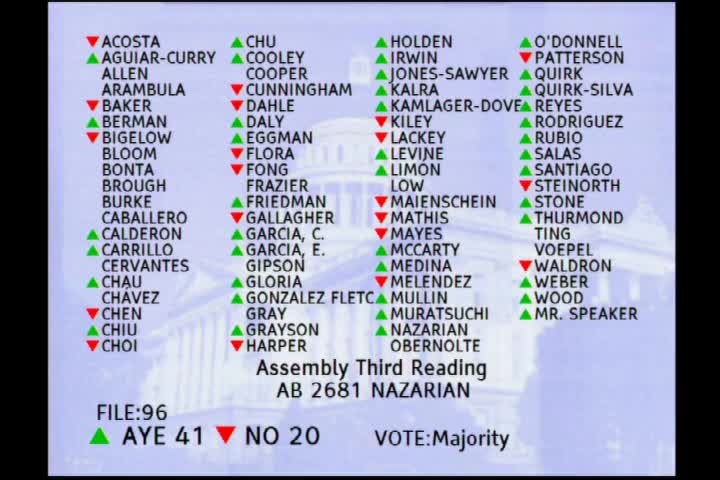 2MIN
Assembly Floor
 11MIN
Assembly Standing Committee on Judiciary
 19MIN
Assembly Standing Committee on Higher Education
Bill Author

Bill Co-Author(s):
