AB 2763: English language education: English learners: observation protocol.
- Session Year: 2017-2018
- House: Assembly
- Latest Version Date: 2018-04-18
Existing law requires each school district that has one or more pupils who are English learners to assess the English language development of each pupil. Existing law requires the Superintendent of Public Instruction to develop and administer tests to assess the English language development of pupils whose primary language is a language other than English, and requires that the tests include, but not be limited to, an assessment of achievement of these pupils in English reading, speaking, and written skills, in accordance with specified criteria.
This bill would require the State Department of Education, on or before November 30, 2019, June 30, 2020, to develop a standardized English language use teacher observation protocol for use by teachers in evaluating a pupils English language proficiency, as provided. The bill would require the department, in developing this protocol, to consult with teachers and experts, as provided. The bill would also require the department to develop and make available to local educational agencies, including charter schools, professional development tools to train teachers on the use of the protocol.
Existing law requires each school district that has one or more pupils who are English learners to assess the English language development of each pupil. Existing law requires the Superintendent of Public Instruction to develop and administer tests to assess the English language development of pupils whose primary language is a language other than English, and requires that the tests include, but not be limited to, an assessment of achievement of these pupils in English reading, speaking, and written skills, in accordance with specified criteria.
This bill would require the State Department of Education, on or before November 30, 2019, to develop a standardized English language use observation protocol for use by teachers in evaluating a pupils English language proficiency, as provided. The bill would require the department, in developing this protocol, to consult with teachers and experts, as provided. The bill would also require the department to develop and make available to local educational agencies, including charter schools, professional development tools to train teachers on the use of the protocol.
(a)As required by federal law, on or before November 30, 2019, June 30, 2020, the department shall develop a standardized English language use teacher observation protocol for use by teachers in evaluating a pupils English language proficiency, as required by paragraph (2) of subdivision (f) of Section 313.
(b)(1)The protocol shall be designed to be used by teachers to evaluate a pupils use of English while engaging in academic content learning, including interactive language use with peers.
(2)The protocol shall be designed to allow teachers to assess language practices across a range of proficiency levels in order to help teachers identify pupils performance along the continuum of progress toward proficiency in English.
(3)The protocol shall be designed to be used for all English learner pupils, including those who have individualized education programs.
(4)The protocol shall be designed for use by content area teachers at all grade levels, English language development teachers, bilingual teachers, and special education teachers, and shall be designed for ease of use by educators.
(5)The protocol shall be aligned to the English language development standards and the performance levels for the English language development test described in Chapter 7 (commencing with Section 60810) of Part 33 of Division 4 of Title 2.
(c)It is the intent of the Legislature that the protocol additionally be useful to all of the following:
(1)Teachers, as a formative assessment tool for purposes of supporting pupils progress toward proficiency in English during the school year.
(2)Teachers discussions with parents regarding pupils progress toward English language proficiency.
(3)Institutions of higher education in the preparation of new teachers.
(d)(1)In developing this protocol, the department shall consult, at a minimum, with current content area teachers at different grade levels, English language development teachers, bilingual teachers, and special education teachers, and with experts with demonstrated experience in observing and documenting pupil academic language practices and in developing and administering assessments for English learners. The department shall ensure that the majority of individuals with whom it consults are currently teaching, credentialed teachers who regularly instruct English learner pupils.
(2)Before the development of the protocol pursuant to subdivision (a), In developing the protocol, the department shall pilot the protocol with educators and pupils, and refine instruments and guidelines as needed.
(3)The department shall also conduct a validation process to ensure the protocol appropriately assesses the intended target language constructs, demonstrates a meaningful relationship to the performance levels for the English language development test and assessed classroom language use, and reflects pupil progress toward attaining targeted constructs.
(e)The department shall provide guidance to local educational agencies, including charter schools, on the use of the protocol.
(e)(f)The department shall develop and make available to local educational agencies, including charter schools, professional development tools to train teachers on the use of the protocol. These tools shall may include, but are not limited to, audio and video samples of English learner pupils language use for the purpose of assisting educators using the protocol in calibrating judgments about observed language use.
REVISIONS: HeadingLine 2.(a)As required by federal law, on or before November 30, 2019, the department shall develop a standardized English language use observation protocol for use by teachers in evaluating a pupils English language proficiency, as required by paragraph (2) of subdivision (f) of Section 313.
(b)(1)The protocol shall be designed to be used by teachers to evaluate a pupils use of English while engaging in academic content learning, including interactive language use with peers.
(2)The protocol shall be designed to allow teachers to assess language practices across a range of proficiency levels in order to help teachers identify pupils performance along the continuum of progress toward proficiency in English.
(3)The protocol shall be designed to be used for all English learner pupils, including those who have individualized education programs.
(4)The protocol shall be designed for use by content area teachers at all grade levels, English language development teachers, bilingual teachers, and special education teachers, and shall be designed for ease of use by educators.
(5)The protocol shall be aligned to the English language development standards and the performance levels for the English language development test described in Chapter 7 (commencing with Section 60810) of Part 33 of Division 4 of Title 2.
(c)It is the intent of the Legislature that the protocol be useful to all of the following:
(1)Teachers, as a formative assessment tool for purposes of supporting pupils progress toward proficiency in English during the school year.
(2)Teachers discussions with parents regarding pupils progress toward English language proficiency.
(3)Institutions of higher education in the preparation of new teachers.
(d)(1)In developing this protocol, the department shall consult, at a minimum, with current content area teachers at different grade levels, English language development teachers, bilingual teachers, and special education teachers, and with experts with demonstrated experience in observing and documenting pupil academic language practices and in developing and administering assessments for English learners. The department shall ensure that the majority of individuals with whom it consults are currently teaching, credentialed teachers who regularly instruct English learner pupils.
(2)Before the development of the protocol pursuant to subdivision (a), the department shall pilot the protocol with educators and pupils, and refine instruments and guidelines as needed.
(3)The department shall also conduct a validation process to ensure the protocol appropriately assesses the intended target language constructs, demonstrates a meaningful relationship to the performance levels for the English language development test and assessed classroom language use, and reflects pupil progress toward attaining targeted constructs.
(e)The department shall develop and make available to local educational agencies, including charter schools, professional development tools to train teachers on the use of the protocol. These tools shall include, but are not limited to, audio and video samples of English learner pupils language use for the purpose of assisting educators using the protocol in calibrating judgments about observed language use.
|
Date
|
Status
|
|---|---|
| Jun 11, 2018 | In committee: Hearing postponed by committee. |
| Jun 7, 2018 | Referred to Com. on ED. |
| May 31, 2018 | In Senate. Read first time. To Com. on RLS. for assignment. |
| May 30, 2018 | Read third time. Passed. Ordered to the Senate. |
| May 25, 2018 | Coauthors revised. |
| Apr 25, 2018 | In committee: Set, first hearing. Referred to APPR. suspense file. |
| Apr 19, 2018 | Re-referred to Com. on APPR. |
| Apr 18, 2018 | From committee chair, with author's amendments: Amend, and re-refer to Com. on APPR. Read second time and amended. |
| Apr 12, 2018 | From committee: Do pass and re-refer to Com. on APPR. (Ayes 6. Noes 0.) (April 11). Re-referred to Com. on APPR. |
| Mar 8, 2018 | Referred to Com. on ED. |
| Feb 17, 2018 | From printer. May be heard in committee March 19. |
| Feb 16, 2018 | Read first time. To print. |
|
Date
|
Description
|
Location
|
Votes
|
|
|---|---|---|---|---|
| May 30, 2018 | AB 2763 O'DONNELL Assembly Third Reading | Assembly Floor |
Passed |
|
| May 25, 2018 | Do pass. | Assembly Standing Committee on Appropriations |
Passed |
|
| Apr 11, 2018 | Do pass and be re-referred to the Committee on [Appropriations] | Assembly Standing Committee on Education |
Passed |
This list shows positions taken on this bill by organizations on the date displayed, which is linked to the original source.
Positions by individuals are not included.
|
Organization
|
Position
|
Date
|
|---|---|---|
| Abriendo Puertas | ** Support | Apr 9, 2018 |
| Association Of California School Administrators | * Support | Apr 11, 2018 |
| Azusa Unified School District | * Support | Apr 11, 2018 |
| California Association For Bilingual Education | * Support | Apr 11, 2018 |
| California Federation Of Teachers | * Support | Apr 11, 2018 |
| California Language TeacherS Association | ** Support | Apr 9, 2018 |
| California School Boards Association | * Support | Apr 11, 2018 |
| Californians Together | ** Support | Apr 9, 2018 |
| Children Now | ** Support | Apr 9, 2018 |
| Education Trust West | * Support | Apr 11, 2018 |
| Opening Doors | ** Support | Apr 9, 2018 |
| Public Advocates | ** Support | Apr 9, 2018 |
ASSEMBLY THIRD READING
ATR Bill Id:AB 2763
Author:(O'Donnell)
As Amended Ver:April 18, 2018
Majority vote
Committee | Votes | Ayes | Noes |
Education | 6-0 | O'Donnell, Kiley, Kalra, McCarty, Thurmond, Weber | |
Appropriations | 16-0 | Gonzalez Fletcher, Bigelow, Bloom, Bonta, Calderon, Carrillo, Chau, Eggman, Fong, Friedman, Gallagher, Eduardo Garcia, Nazarian, Obernolte, Quirk, Reyes |
|
SUMMARY: Requires the California Department of Education (CDE) to develop a standardized English language observation protocol for use by teachers in reclassification of English learners as fully English proficient. Specifically, this bill:
- Requires that, on or before June 30, 2020, the CDE develop a standardized English language observation protocol for use by teachers in evaluating a student's English language proficiency, as required for use in reclassification of English learners (ELs) as fully English proficient.
- Requires that the protocol be designed to be used by teachers to evaluate a student's use of English while engaging in academic content learning, including interactive language use with peers.
- Requires that the protocol be designed to allow teachers to assess language practices across a range of proficiency levels in order to help teachers identify students' performance along the continuum of progress toward proficiency in English.
- Requires that the protocol be designed to be used for all ELs, including those who have individualized education programs.
- Requires that the protocol be designed for use by content area teachers at all grade levels, English language development teachers, bilingual teachers, and special education teachers, and be designed for ease of use by educators.
- Requires that the protocol be aligned to the English language development (ELD) standards and the performance levels for the English language development state assessment.
- Requires CDE, in developing the protocol, to consult, at a minimum, with current content area teachers at different grade levels, ELD teachers, bilingual teachers, and special education teachers, and with experts with demonstrated experience in observing and documenting student academic language practices and in developing and administering assessments for ELs.
- Requires that the CDE ensure that the majority of individuals with whom it consults are currently teaching, credentialed teachers who regularly instruct ELs.
- Requires that, in developing the protocol, the department pilot the protocol with educators and students, and refine instruments and guidelines as needed.
- Requires CDE to conduct a validation process to ensure the protocol appropriately assesses the intended target language constructs, demonstrates a meaningful relationship to the performance levels for the ELD test and assessed classroom language use, and reflects student progress toward attaining targeted constructs.
- Requires the department to provide guidance to local educational agencies, including charter schools, on the use of the protocol.
- Requires the CDE to develop and make available to local educational agencies, including charter schools, professional development tools to train teachers on the use of the protocol. States that these tools may include audio and video samples of ELs' language use for the purpose of assisting educators using the protocol in calibrating judgments about observed language use.
- States the intent of the Legislature that the protocol additionally be useful to all of the following:
- Teachers, as a formative assessment tool for purposes of supporting students' progress toward proficiency in English during the school year.
- Teachers' discussions with parents regarding students' progress toward English language proficiency.
- Institutions of higher education in the preparation of new teachers.
FISCAL EFFECT: According to the Assembly Appropriations Committee, $437,000 one-time in federal Title III Every Student Succeeds Act funding for CDE to contract out to meet the requirements of this bill. CDE indicates this funding would be 2017-18 carryover funding for state operations technical assistance.
COMMENTS:
Need for the bill. The author states, "AB 2763 requires the California Department of Education to develop a standardized English language use observation protocol for use by teachers in evaluating an English learner's proficiency in English when determining whether to reclassify a student as fully English proficient.
Current law establishes four criteria for the reclassification of English learners as fully English proficient. One of these criteria is the teacher's evaluation of English learner's proficiency in English. This evaluation can be useful in assessing language uses which are not easily measured using a standardized assessment, such as interactive language use with peers and language use during academic content learning.
While this evaluation is highly consequential for students, no tools or guidance are provided to teachers for the purpose of completing this evaluation. As a result, these evaluations can vary widely from school district to school district, and even from classroom to classroom.
In the absence of standardized tools and expectations, these evaluations may be inconsistent with the English language development standards, or the proficiency levels used on the state assessment of English proficiency.
In addition, research by the Public Policy Institute of California and UC Santa Cruz shows that assessment results not related to English proficiency, and measures not related to academic or English proficiency, such as behavior and attendance, are sometimes inappropriately incorporated into these evaluations. This research identified the inclusion of these factors as a key reason why some English learners who demonstrate proficiency on both the English language development and English Language Arts assessments are not reclassified.
The federal Every Student Succeeds Act of 2015 requires states to establish standardized exit criteria for English learner classification, and recent guidance from the Council of Chief State School Officers recommends that states develop standardized, validated local assessment tools for use in reclassification decisions.
This bill will meet teachers' need for a standardized, standards-aligned protocol for measuring their students' proficiency in English, eventually making reclassification a more consistent and more valid."
In the absence of state guidance, teacher evaluations are inconsistent and frequently incorporate non-academic factors. In 2014, The Public Policy Institute of California (PPIC) published the first longitudinal analysis of ELs' transition from English learner to reclassified status. PPIC also conducted a survey of reclassification practices, receiving information on 303 school districts (including 9 of the 10 largest), representing 54% of the state's enrollment. With respect to the teachers' evaluation of EL proficiency, PPIC found:
- Non-academic factors were commonly included in the teachers' evaluation of ELs' academic proficiency. These included attendance (used by 30% of districts for K-2 students), behavior (used by 21% of districts for grades 6-8), discipline (used by 16% of districts in grades 9-12), homework (used by 38% of districts in grades 6-8) and class participation (used by 62% of districts in grades K-2).
Subjective evaluation criteria used by teachers, by grade level | Grades K–2 | Grades 3–5 | Grades 6–8 | Grades 9–12 |
Attendance | 30.4 | 29.5 | 31.2 | 23.5 |
Behavior | 20.3 | 19.6 | 20.9 | 13.3 |
Benchmarks | 84.5 | 80.4 | 81.4 | 67.5 |
Discipline | 10.1 | 9.6 | 11.1 | 16.3 |
Homework | 31.8 | 35.4 | 37.9 | 20.5 |
Participation | 61.5 | 60.2 | 59.7 | 46.4 |
Portfolio | 43.9 | 42.1 | 43.1 | 38.8 |
Projects | 45.9 | 47.2 | 50.2 | 37.0 |
None of the above | 13.5 | 16.2 | 23.7 | 27.7 |
Respondents (N) | 148 | 271 | 253 | 166 |
- While state law and guidelines refer only to measurement of skills in English, nearly half of surveyed districts required evidence of mastery of math (measured through the state math assessment), and about 8% of districts required proficiency in science or social studies. About 7% required all of these measures (math, science, social studies) as well as a writing assessment.
- Districts using discipline as a criterion for reclassification had higher rates of reclassification, "suggesting that a lack of disciplinary problems elevates a student's chances of reclassification, all else equal."
- Districts which required that the teacher evaluation include two measures (grades, minimum grade point average, math scores, additional assessments, etc.), had lower reclassification rates.
- A high percentage of districts (67% to 85%) reported using "benchmark" assessments, but they varied by district: "Districts reported using a variety of assessments that ranged from district rubrics to those developed by testing companies, such as the DIBELS."
- The degree to which criteria were required varied by district. Most districts identified required components of the evaluation (i.e. grades), but a sizeable percentage identified such factors only as "considered."
- Thresholds for grades varied by district. Most districts reported requiring a grade of "C" or better in English-language arts classes, but a few districts require a grade of "B" or better. Grades often include factors unrelated to proficiency, such as attendance, behavior, and homework completion.
- Grades or grade point average (GPA) were used more often in the teacher evaluation of high school students than in grades K through 8. Conversely, districts were less likely to require assessments as part of the teacher evaluation in high school than in the lower grade levels.
Analysis Prepared by: Tanya Lieberman / ED. / (916) 319-2087 FN: 0003254
Date of Hearing: April 25, 2018
ASSEMBLY COMMITTEE ON APPROPRIATIONS
Lorena Gonzalez Fletcher, Chair
ABPCA Bill Id:AB 2763
Author:(O'Donnell) – As Amended Ver:April 18, 2018
Policy Committee: | Education | Vote: | 6 - 0 |
|
| ||
|
|
Urgency: No State Mandated Local Program: No Reimbursable: No
SUMMARY: This bill requires, by November 30, 2019, the California Department of Education (CDE) to develop a standardized language use observation protocol for use by teachers in reclassification of English learners as fully English proficient. It also requires CDE to pilot the protocol, gather data and evaluate the pilot to refine the protocol, and create and disseminate guidance on the protocol to schools.
FISCAL EFFECT:
$437,000 one-time in federal Title III Every Student Succeeds Act funding for CDE to contract out to meet the requirements of this bill. CDE indicates this funding would be 2017-18 carryover funding for state operations technical assistance.
COMMENTS:
- Purpose. According to the author, “This bill will meet teachers’ need for a standardized, standards-aligned protocol for measuring their students’ proficiency in English, eventually making reclassification a more consistent and more valid.”
- Background. Current law establishes four criteria for the reclassification of English learners as fully English proficient. One of these criteria is the teacher’s evaluation of an English learner’s proficiency in English. This evaluation can be useful in assessing language uses which are not easily measured using a standardized assessment, such as interactive language use with peers and language use during academic content learning. Currently, no tools or guidance are provided to teachers for the purpose of completing this evaluation. As a result, these evaluations can vary widely. In addition, research indicates measures not related to academic or English proficiency, such as behavior and attendance, are sometimes inappropriately incorporated into these evaluations.
- Related Legislation. SB 463 (Lara) of this Legislative session establishes a new statewide criteria and process for the reclassification of English learners as fully English proficient.
Analysis Prepared by: Natasha Collins / APPR. / (916) 319-2081
Date of Hearing: April 11, 2018
ASSEMBLY COMMITTEE ON EDUCATION
Patrick O'Donnell, Chair
ABPCA Bill Id:AB 2763 (
Author:O'Donnell) – As Introduced Ver:February 16, 2018
SUBJECT: English language education: English learners: observation protocol
SUMMARY: Requires the California Department of Education (CDE) to develop a standardized language use observation protocol for use by teachers in reclassification of English learners as fully English proficient. Specifically, this bill:
- Requires that, on or before November 30, 2019, the CDE develop a standardized English language use observation protocol for use by teachers in evaluating a student’s English language proficiency, as required for use in reclassification of English learners (ELs) as fully English proficient.
- Requires that the protocol be designed to be used by teachers to evaluate a student’s use of English while engaging in academic content learning, including interactive language use with peers.
- Requires that the protocol be designed to allow teachers to assess language practices across a range of proficiency levels in order to help teachers identify students’ performance along the continuum of progress toward proficiency in English.
- Requires that the protocol be designed to be used for all ELs, including those who have individualized education programs.
- Requires that the protocol be designed for use by content area teachers at all grade levels, English language development teachers, bilingual teachers, and special education teachers, and be designed for ease of use by educators.
- Requires that the protocol be aligned to the English language development (ELD) standards and the performance levels for the English language development state assessment.
- Requires CDE, in developing the protocol, to consult, at a minimum, with current content area teachers at different grade levels, ELD teachers, bilingual teachers, and special education teachers, and with experts with demonstrated experience in observing and documenting student academic language practices and in developing and administering assessments for ELs.
- Requires that the CDE ensure that the majority of individuals with whom it consults are currently teaching, credentialed teachers who regularly instruct ELs.
- Requires that, before the development of the protocol, the department pilot the protocol with educators and students, and refine instruments and guidelines as needed.
- Requires CDE to conduct a validation process to ensure the protocol appropriately assesses the intended target language constructs, demonstrates a meaningful relationship to the performance levels for the ELD test and assessed classroom language use, and reflects student progress toward attaining targeted constructs.
- Requires the CDE to develop and make available to local educational agencies, including charter schools, professional development tools to train teachers on the use of the protocol. Requires that these tools include audio and video samples of ELs’ language use for the purpose of assisting educators using the protocol in calibrating judgments about observed language use.
- States the intent of the Legislature that the protocol be useful to all of the following:
- Teachers, as a formative assessment tool for purposes of supporting students’ progress toward proficiency in English during the school year.
- Teachers’ discussions with parents regarding students’ progress toward English language proficiency.
- Institutions of higher education in the preparation of new teachers.
EXISTING LAW:
- Existing law requires the CDE, with the approval of the State Board of Education (SBE), to establish procedures for conducting the state ELD assessment and for the reclassification of a student from English learner to English proficient. Current law requires the reclassification procedures developed by the CDE to use multiple criteria, including, but not limited to, all of the following:
- An assessment of language proficiency
- Teacher evaluation, including, but not limited to, a review of the student's curriculum mastery
- Parental opinion and consultation
- Comparison of the student’s performance in basic skills against an empirically established range of performance in basic skills based upon the performance of English proficient students of the same age that demonstrates whether the student is sufficiently proficient in English to participate effectively in a curriculum designed for students of the same age whose native language is English. (Education Code § 313)
- Existing regulations regarding reclassification require:
- That the teachers’ evaluation (the second criterion above) involve the participation of the student's classroom teacher and any other certificated staff with direct responsibility for teaching or placement decisions of the student.
- That parental involvement in reclassification (the fourth criterion above) include:
- Notice to parent(s) or guardian(s) of language reclassification and placement, including a description of the reclassification process and the parent's opportunity to participate; and
- Encouragement of the participation of parent(s) or guardian(s) in the school district's reclassification procedure, including seeking their opinion and consultation during the reclassification process. (5 CCR § 11303)
- Requires school districts, county offices of education, and charter schools, to assess the English language development of each student, upon initial enrollment and annually thereafter until the student is redesignated as fluent English proficient.
- Requires the CDE to review and analyze the criteria, policies and practices that school districts use to reclassify English learners and to recommend any policy changes necessary to identify when English learners are prepared for reclassification. (EC 313.5).
- The federal Every Student Succeeds Act (ESSA) of 2015 requires that states “establish and implement, with timely and meaningful consultation with local educational agencies representing the geographic diversity of the state, standardized statewide [EL] entrance and exit procedures.”
- Current CDE guidance on the teacher evaluation criterion of reclassification, included in the administration guide for the state’s former English language development assessment, states, “Use student’s academic performance. Note that incurred deficits in motivation and academic success unrelated to ELP do not preclude a student from reclassification.”
FISCAL EFFECT: Unknown
COMMENTS:
Need for the bill. The author states, “AB 2763 requires the California Department of Education to develop a standardized English language use observation protocol for use by teachers in evaluating an English learner’s proficiency in English when determining whether to reclassify a student as fully English proficient.
Current law establishes four criteria for the reclassification of English learners as fully English proficient. One of these criteria is the teacher’s evaluation of English learner’s proficiency in English. This evaluation can be useful in assessing language uses which are not easily measured using a standardized assessment, such as interactive language use with peers and language use during academic content learning.
While this evaluation is highly consequential for students, no tools or guidance are provided to teachers for the purpose of completing this evaluation. As a result, these evaluations can vary widely from school district to school district, and even from classroom to classroom.
In the absence of standardized tools and expectations, these evaluations may be inconsistent with the English language development standards, or the proficiency levels used on the state assessment of English proficiency.
In addition, research by the Public Policy Institute of California and UC Santa Cruz shows that assessment results not related to English proficiency, and measures not related to academic or English proficiency, such as behavior and attendance, are sometimes inappropriately incorporated into these evaluations. This research identified the inclusion of these factors as a key reason why some English learners who demonstrate proficiency on both the English language development and English Language Arts assessments are not reclassified.
The federal Every Student Succeeds Act of 2015 requires states to establish standardized exit criteria for English learner classification, and recent guidance from the Council of Chief State School Officers recommends that states develop standardized, validated local assessment tools for use in reclassification decisions.
This bill will meet teachers’ need for a standardized, standards-aligned protocol for measuring their students’ proficiency in English, eventually making reclassification a more consistent and more valid.”
The reclassification mystery: Why do students who score proficient on both the ELD and ELA assessments not get reclassified? The majority of California’s ELs enter school in kindergarten (Hill, 2012). Experts say that it should take 4 to 7 years for most students to achieve academic English proficiency. Yet roughly 30% to 50% fail to reclassify after 7 to 9 years of enrollment (Flores, 2009).
Since 2005, research has pointed to an unexplained phenomenon: the high rate of English learners who test proficient on both ELD and ELA assessments but who do not go on to be reclassified. This evidence includes:
- A 2005 state audit of eight school districts representing a sizeable percentage of statewide EL enrollment found that in a subsample of 180 ELs, 62% were not reclassified despite meeting their district’s criteria. In a single year across these districts, 42,000 candidates for reclassification were not reclassified.
- Robinson (2011) found that in one large California district the reclassification rate among ELs meeting standardized-test criteria diminished across cohorts, from 91% in Grade 4 to 64% in Grade 10.
- Umansky and Reardon (2014) found that in one California district 50% of ELs met standardized-test criteria by the end of Grade 5, but only 38% of them were reclassified.
- Estrada and Wang (2017), examining data from two California districts, report a high degree of discrepancy between the substantial percentage of ELs who meet state guidelines for ELD (37%) and ELA (60%) and the much smaller percentage reclassified (11%).
- Estrada (2014) found that in one medium sized district, of ELs meeting all criteria, 8% in Year 1 and 33% in Year 2 were not reclassified.
- Estrada (2014) found that in one district, students reclassified compared to those not reclassified did not differ in performance but were more likely to be Asian than Latino. Thompson (2015) also found that in a different district, native-Spanish speaking students were also less likely to be reclassified than other students, after controlling for other factors.
Since these studies investigated the reclassification of students who had met both the ELD and ELA proficiency criteria, they raise questions about the other criteria used for reclassification, principally the role of the teacher’s evaluation.
In the absence of state guidance, teacher evaluations are inconsistent and frequently incorporate non-academic factors. In 2014, The Public Policy Institute of California (PPIC) published the first longitudinal analysis of ELs’ transition from English learner to reclassified status. PPIC also conducted a survey of reclassification practices, receiving information on 303 school districts (including 9 of the 10 largest), representing 54% of the state’s enrollment. With respect to the teachers’ evaluation of EL proficiency, PPIC found:
- Non-academic factors were commonly included in the teachers’ evaluation of ELs’ academic proficiency. These included attendance (used by 30% of districts for K-2 students), behavior (used by 21% of districts for grades 6-8), discipline (used by 16% of districts in grades 9-12), homework (used by 38% of districts in grades 6-8) and class participation (used by 62% of districts in grades K-2).
Subjective evaluation criteria used by teachers, by grade level | Grades K–2 | Grades 3–5 | Grades 6–8 | Grades 9–12 |
Attendance | 30.4 | 29.5 | 31.2 | 23.5 |
Behavior | 20.3 | 19.6 | 20.9 | 13.3 |
Benchmarks | 84.5 | 80.4 | 81.4 | 67.5 |
Discipline | 10.1 | 9.6 | 11.1 | 16.3 |
Homework | 31.8 | 35.4 | 37.9 | 20.5 |
Participation | 61.5 | 60.2 | 59.7 | 46.4 |
Portfolio | 43.9 | 42.1 | 43.1 | 38.8 |
Projects | 45.9 | 47.2 | 50.2 | 37.0 |
None of the above | 13.5 | 16.2 | 23.7 | 27.7 |
Respondents (N) | 148 | 271 | 253 | 166 |
- While state law and guidelines refer only to measurement of skills in English, nearly half of surveyed districts required evidence of mastery of math (measured through the state math assessment), and about 8% of districts required proficiency in science or social studies. About 7% required all of these measures (math, science, social studies) as well as a writing assessment.
- Districts using discipline as a criterion for reclassification had higher rates of reclassification, “suggesting that a lack of disciplinary problems elevates a student’s chances of reclassification, all else equal.”
- Districts which required that the teacher evaluation include two measures (grades, minimum grade point average, math scores, additional assessments, etc.), had lower reclassification rates.
- A high percentage of districts (67% to 85%) reported using “benchmark” assessments, but they varied by district: “Districts reported using a variety of assessments that ranged from district rubrics to those developed by testing companies, such as the DIBELS.”
- The degree to which criteria were required varied by district. Most districts identified required components of the evaluation (i.e. grades), but a sizeable percentage identified such factors only as “considered.”
- Thresholds for grades varied by district. Most districts reported requiring a grade of “C” or better in English-language arts classes, but a few districts require a grade of “B” or better. Grades often include factors unrelated to proficiency, such as attendance, behavior, and homework completion.
- Grades or GPA were used more often in the teacher evaluation of high school students than in grades K–8. Conversely, districts were less likely to require assessments as part of the teacher evaluation in high school than in the lower grade levels.
Noting that there are no state guidelines for the teacher evaluation, PPIC still judged nearly all districts as using criteria which and requirements which are more rigorous than necessary.
A 2017 study by Estrada and Wang is the first to include qualitative information of the use of teacher evaluations in reclassification for students who had met both ELD and ELA criteria. The study took an in-depth look at practices in two California school districts, one large and one medium-sized, which together enroll nearly 1 in 5 English learners in the state. They found:
- The two districts had distinct philosophies toward reclassification and the role of the teacher in the process. District 1 viewed ‘‘Reclassifying is urgent’’ and supported the role of ‘‘teacher as advisor.” District 2’s view was that ‘‘reclassification can wait’’ and supported the role of ‘‘teacher as decider.’’ The authors notes that “these philosophies coincided with the extent to which district policy tacitly allowed school staff to withhold reclassification from such ELs and the extent to which that authority was exercised.”
- In District 1, which had higher reclassification rates of students proficient in ELD and ELA, “clearly defined criteria and threshold performances, combined with administrative data transparency and automaticity, reduced ambiguity and increased standardization.”
- In District 2, “inadequate knowledge, coupled with ambiguous criteria, greater staff involvement, and lack of administrate data transparency co-occurred with misapplication of criteria and unstandardized site-specific processes,” resulting in lower reclassification rates among students scoring proficient in both ELD and ELA.
- In District 2, locally chosen assessments used in the teacher’s evaluation “(a) were often misapplied to ELs meeting all criteria, (b) were not systematically applied to ELs meeting at least standardized-test criteria, and/or (c) did not match those specified in the reclassification forms. Instead, staff used a variety of content assessments (reading, writing, math), types of assessments (curriculum based, teacher-made), performance periods (weekly averages, unit tests, grading period), and performance levels.
- In District 2, “When ELs meeting all criteria were not reclassified, teacher/school staff recommendation not to reclassify trumped CELDT and CST proficient performances, preventing reclassification. This phenomenon included CELDT-proficient ELs who scored advanced on CSTs.” In this district, in one year all but one elementary teacher reported recommending continuing EL status for some students meeting both ELD and ELA criteria.
- In District 2, “elementary teacher rationales for not reclassifying students meeting all criteria fell into various categories. Teachers often said ELs would benefit from another year of support; three each cited concerns about in-class ELA and math (not a criterion in Year 2) performance. However, to reclassify, teachers expected ELs to possess ‘‘native English speaker skills’’ in listening, speaking, reading, and writing with few errors—an indication of inadequate understanding of second-language learning…A second rationale imposed higher than required performance on multiple criteria: ‘‘She scored overall advanced on the CELDT [in grade 4] . . . [but] she was intermediate [in the] reading [subtest]. On the CST, she scored proficient [in grade 3], but . . . basic in second grade.’’ A third rationale was that ELs should not reclassify too early: ‘‘. . . second grade is . . . at a level that hasn’t shown their true colors ... You should not reclassify until they’re third grade and above.’’
- In District 2, “another rationale involved nonacademic factors such as being ‘‘off task,’’ ‘‘not showing a lot of effort,’’ or being a ‘‘high performer, but spacey.’’ One teacher cited school and subgroup accountability concerns: ‘‘I think it’s important to not reclassify all of our top language learners because ELs are a subgroup at the school and high performers contribute to the EL-API.’’ Across years, three staff mentioned that schools received additional funds for ELs.”
- In District 2, “in the face of teacher recommendations not to reclassify, they tended to disregard proficient or advanced scores as ‘‘single’’ performances, ‘‘luck,’’ possibly ‘‘cheating,’’ or an indication that some students ‘‘are just good test takers.’’ …A teacher indicated, ‘‘I didn’t see any reason to hurry it . . . I wanted to wait and see how her fourth grade CELDT scores came back and to see if she could maintain proficient on the CST-ELA.’”
These findings are consistent with significant body of research on the effects of subjective judgement on teacher’s placement decisions.
A problem of practice rooted in state policy. It is worth noting that none of the practices reported in either of these studies appears to be illegal. The state’s reclassification statute is highly permissive and allows for great variation in practice. Additionally, the state has never provided teachers guidance or standards-aligned tools teachers can use to conduct this evaluation. Given the wide latitude given to districts in establishing criteria for deficiencies in the law, it is difficult for CDE to monitor for compliance. Not surprisingly, CDE reports that, for monitoring conducted to date in the 2017-18 school year, reclassification is one of the least common compliance findings.
Other causes of the failure to reclassify proficient students. This research also identified a number of other factors impeding the reclassification of qualified students, including:
- Timing of different assessment results
- Few reclassification windows
- Difficulty obtaining parental signatures
- Ambiguous criteria and procedures
- Poor understanding of, and compliance with, district standards
- Administrative problems, including failure to “push the button”
Who is an English learner? Depends on where you go to school. While entry procedures which determine who becomes classified as an English learner are determined by the state and therefore consistent, the flexibility in reclassification law make it possible for standards to vary considerably by district. And to the extent that teachers are given broad latitude in their evaluations, it may even vary from classroom to classroom. This means that the definition of English learner depends on where a student attends school, and that a student who moves from one district to another may see her status change even when her proficiency remains the same.
Do we really need teacher input in reclassification decisions? In a 2016 paper titled, “Toward a More Common Definition of an English Learner,” the Council of Chief State School Officers (CCSSO) provides guidance on establishing criteria for reclassification. With respect to the use of teacher input in reclassification, the CCSSO cites two reasons for retaining, standardizing, and strengthening the teacher evaluation in reclassification: 1) accepted standards of educational testing suggest that a highly stakes decision such as reclassification should not be made solely on the basis of a single score, and 2) the ELD test is not designed to evaluate language-intensive practices which are important elements of current content and ELD standards, such as interactive language use and language use while engaging with academic content. The CCSSO also noted that “locally-administered, language use observation protocols/rubrics can help to strengthen the validity of inferences of a greater range of language uses EL students need for success in school.”
CCSSO recommendations for teacher input on reclassification decisions. In a 2016 paper titled, “Discerning – and Fostering - what English Learners Can Do with Language,” the CCSSO made the following recommendations regarding the design and implementation of language use observation tools for reclassification. This bill has been written to reflect these recommendations.
- Evidence gathered should be complementary to, and not duplicative of, language uses targeted on the state ELP assessment.
- Evidence of classroom language uses should be student-focused, assets-based (i.e., describing what EL students can do with English); relevant and pedagogically useful for classroom teachers; meaningful and helpful to students; and developed for use by both ESL and academic content area teachers.
- Evidence-gathering methods should help educators regularly examine and recognize a range of proficiencies in target language uses and not just focus at the level of performance considered to be English-proficient for reclassification.
- Evidence-gathering processes and tools should be useful throughout the year for formative purposes (i.e., to gather evidence of student strengths and growth areas in using language, provide descriptive feedback to students, and help teachers extend students’ language uses and disciplinary learning).
- Evidence-gathering processes and tools should be used within a specific assessment window for summative purposes (e.g., reclassification decisions), and particularly as a more standardized method to implement teacher judgment/recommendation criteria.
- Substantial professional development and sustained administrative support are critical to successfully implementing locally-administered language use observation processes and tools statewide. This includes a mechanism for effectively calibrating professional judgments among teachers.
What do other states do? According to the CCSSO, a 2015 survey found that 29 states and the District of Columbia use a single criterion—the state’s English language proficiency (ELP) test—for determining which EL students exit EL status. The remaining 21 states use between two and four exit criteria, including academic test results (17 states), teacher input or evaluation (15 states), and some form of parental notification or consultation (six states).
Federal law requires standardization of exit criteria; state ESSA plan commits to developing a language use observation protocol and revisiting reclassification criteria. Federal law requires states to adopt standardized entry and exit procedures for English learner classification. In response to this requirement, the revised ESSA state plan which the State Board of Education is expected to adopt at their April meeting includes a commitment to developing both a language use observation tool and a parent involvement protocol in 2018–19, to be piloted in 2019–20.
Additionally, the CDE reported that in January, 2019, it plans to begin work with the Legislature on legislation to establish new reclassification criteria, including the language use and parent involvement protocols, with full implementation (including regulatory process) expected in 2021-22.
Reflecting these plans and the need to have these protocols and assessment data available prior to engaging in a larger discussion about reclassification criteria, this bill is silent on the manner in which the protocol will be used.
Student Oral Language Observation Matrix (SOLOM): One language observation tool which has been used by some school districts is known as the SOLOM. The SOLOM is a language observation tool that was introduced to the field by a 1984 CDE publication (Schooling and Language Minority Students: A Theoretical Framework). It was constructed using a theoretical framework for language acquisition, and is not aligned to the ELD (or any other) standards or performance levels. It does not meet the standards articulated above for an appropriate language use observation tool for reclassification.
Prior and related legislation. SB 463 (Lara) of this Session would establish new statewide criteria and processes for the reclassification of English learners as fully English proficient.
AB 491 (Gonzalez) of the 2015-16 Session (as the bill was heard in this Committee) would have required the CDE to recommend, and the State Board of Education to adopt, best practices for the reclassification of English learners, by July, 2016.
SB 1108 (Padilla), Chapter 434, Statues of 2012, requires the CDE, if state federal or private funds are provided for this purpose, to review and analyze the criteria, policies and practices that school districts use to reclassify English learners and to recommend any policy changes necessary to identify when English learners are prepared for reclassification.
REGISTERED SUPPORT / OPPOSITION:
Support
Abriendo Puertas/Opening Doors
Association of California School Administrators
California Association for Bilingual Education
California Federation of Teachers
California Language Teachers Association
California School Boards Association
Californians Together
Children Now
Education Trust – West
Public Advocates
Opposition
None on file
Analysis Prepared by: Tanya Lieberman / ED. / (916) 319-2087
Discussed in Hearing
View Older Hearings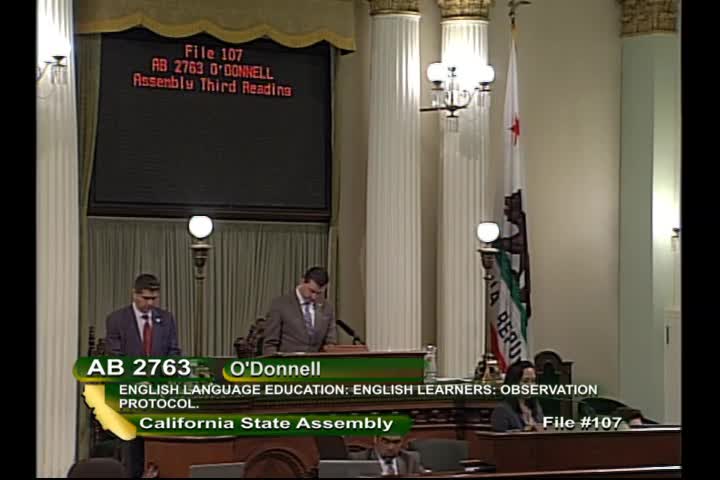
Bill Author

Bill Co-Author(s):
