AB 2781: Forensic ballistic and firearms procedures.
- Session Year: 2017-2018
- House: Assembly
- Latest Version Date: 2018-05-25
Existing law authorizes local law enforcement agencies to have specified information related to firearms entered into the United States Department of Justice, National Integrated Ballistic Information Network to ensure that representative samples of fired bullets and cartridge cases from crime scenes are recorded, as specified.
This bill would require a law enforcement agency, as defined, to obtain ballistic images from firearms, cartridge cases, and bullets firearms and cartridge cases obtained by the agency as specified, and submit those images to the National Integrated Ballistic Identification Network. Network or a comparable automated ballistic identification system used by the agency. The bill would also require the Department of Justice to develop a protocol for the implementation of this requirement.
By requiring new duties for local agencies, this bill would create a state-mandated local program.
The California Constitution requires the state to reimburse local agencies and school districts for certain costs mandated by the state. Statutory provisions establish procedures for making that reimbursement.
This bill would provide that, if the Commission on State Mandates determines that the bill contains costs mandated by the state, reimbursement for those costs shall be made pursuant to the statutory provisions noted above.
Existing law authorizes local law enforcement agencies to have specified information related to firearms entered into the United States Department of Justice, National Integrated Ballistic Information Network to ensure that representative samples of fired bullets and cartridge cases from crime scenes are recorded, as specified.
This bill would require a law enforcement agency, as defined, to obtain ballistic images from firearms, cartridge cases, and bullets obtained by the agency as specified, and submit those images to the National Integrated Ballistic Identification Network. The bill would also require the Department of Justice to develop a protocol for the implementation of this requirement.
By requiring new duties for local agencies, this bill would create a state-mandated local program.
Existing law requires the Attorney General to conduct a study to evaluate ballistics identification systems to determine the feasibility and potential benefits to law enforcement of utilizing a statewide ballistics identification system capable of maintaining a database of ballistic images and information from test fired and sold firearms. This bill would require law enforcement agencies to conduct, or cause to be conducted, test-firing and transmitting specified information to the National Crime Information Center and the Bureau of Alcohol, Tobacco, Firearms, and Explosives National Tracing Center for firearms seized, recovered, or acquired under specified circumstances. The bill would require the law enforcement agency to arrange for the firearm to be test-fired and to submit the test results to the National Integrated Ballistic Identification Network, as specified, and would require law enforcement agencies to submit ballistics information from spent shell casings recovered under specified circumstances, to that network. The bill would require the Department of Justice to develop and promulgate a statewide standard protocol for the recovery and forensic processing of firearms and firearm-related evidence when the firearm was unlawfully possessed, used for any unlawful purpose, recovered from the scene of a crime, or reasonably believed to have been used or associated with the commission of a crime. By imposing firearms related duties on local law enforcement agencies, this bill would impose a state-mandated local program.The California Constitution requires the state to reimburse local agencies and school districts for certain costs mandated by the state. Statutory provisions establish procedures for making that reimbursement.
This bill would provide that, if the Commission on State Mandates determines that the bill contains costs mandated by the state, reimbursement for those costs shall be made pursuant to the statutory provisions noted above.
Existing law requires the Attorney General to conduct a study to evaluate ballistics identification systems to determine the feasibility and potential benefits to law enforcement of utilizing a statewide ballistics identification system capable of maintaining a database of ballistic images and information from test fired and sold firearms.
This bill would require law enforcement agencies to conduct, or cause to be conducted, test-firing and transmitting specified information to the National Crime Information Center and the Bureau of Alcohol, Tobacco, Firearms, and Explosives National Tracing Center for firearms seized, recovered, or acquired under specified circumstances. The bill would require the law enforcement agency to arrange for the firearm to be test-fired and to submit the test results to the National Integrated Ballistic Identification Network, as specified, and would require law enforcement agencies to submit ballistics information from spent shell casings recovered under specified circumstances, to that network. The bill would require the Department of Justice to develop and promulgate a statewide standard protocol for the recovery and forensic processing of firearms and firearm-related evidence when the firearm was unlawfully possessed, used for any unlawful purpose, recovered from the scene of a crime, or reasonably believed to have been used or associated with the commission of a crime. By imposing firearms related duties on local law enforcement agencies, this bill would impose a state-mandated local program.
The California Constitution requires the state to reimburse local agencies and school districts for certain costs mandated by the state. Statutory provisions establish procedures for making that reimbursement.
This bill would provide that, if the Commission on State Mandates determines that the bill contains costs mandated by the state, reimbursement for those costs shall be made pursuant to the statutory provisions noted above.
(a)In addition to the requirements of Sections 11108 and 11108.3, if a law enforcement agency seizes or recovers a firearm that was unlawfully possessed, used for any unlawful purpose, recovered from the scene of a crime, is reasonably believed to have been used or associated with the commission of a crime, or is acquired by the agency as an abandoned or discarded firearm, the agency shall test fire the firearm, or cause the firearm to be test fired, as soon as practicable and submit the ballistic images to the National Integrated Ballistic Identification Network or a similar automated ballistic identification system used by that agency to determine whether the firearm is associated with, or related to, a crime, criminal event, or individual associated with or related to, a crime, or criminal event.
(b)If a law enforcement agency recovers any cartridge case or fired bullet at a crime scene or has reason to believe that a recovered cartridge case or fired bullet is related to, or associated with, the commission of a crime, or the unlawful discharge of a firearm, that agency shall, as soon as practicable, submit, or cause to be submitted, the ballistic image to the National Integrated Ballistic Identification Network. Network or a similar automated ballistic identification system used by that agency.
(c)The Department of Justice shall develop and promulgate a protocol for the implementation of this section.
(d)As used in this section, law enforcement agency means a police or sheriffs department, or any department or agency of the state or any political subdivision thereof that employs any peace officer as defined in Section 830, including, but not limited to, the Department of the California Highway Patrol, the Department of Fish and Wildlife, the University of California or the California State University Police Departments, and the police department of any school district, community college district, park district, transit district, railroad, and harbor, port, airport, or housing authority.
SEC. 2.If the Commission on State Mandates determines that this act contains costs mandated by the state, reimbursement to local agencies and school districts for those costs shall be made pursuant to Part 7 (commencing with Section 17500) of Division 4 of Title 2 of the Government Code.
(a)In addition to the requirements of Sections 11108 and 11108.3, commencing January 1, 2009, every local law enforcement agency may cause to be entered into the United States Department of Justice, National Integrated Ballistic Information Network (NIBIN) information to ensure that representative samples of fired bullets and cartridge cases collected at crime scenes, from test-fires of firearms recovered at crime scenes, and other firearm information needed to investigate crimes, are recorded into the NIBIN in accordance with the protocol set forth in subdivision (b). if a law enforcement agency seizes or recovers a firearm that was unlawfully possessed, used for any unlawful purpose, recovered from the scene of a crime, is reasonably believed to have been used or associated with the commission of a crime, or is acquired by the agency as an abandoned or discarded firearm, the agency shall test fire the firearm, or cause the firearm to be test fired, as soon as practicable and submit the ballistic images to the National Integrated Ballistic Identification Network to determine whether the firearm is associated with, or related to, a crime, criminal event, or individual associated with or related to, a crime, or criminal event.
(b)If a law enforcement agency recovers any cartridge case or fired bullet at a crime scene or has reason to believe that a recovered cartridge case or fired bullet is related to, or associated with, the commission of a crime, or the unlawful discharge of a firearm, that agency shall, as soon as practicable, submit, or cause to be submitted, the ballistic image to the National Integrated Ballistic Identification Network.
(b)(c)The Attorney General, in cooperation with those law enforcement agencies that choose to do so, Department of Justice shall develop and promulgate a protocol for the implementation of this section. The protocol shall be completed on or before July 1, 2008.
(c)The Attorney General shall have the authority to issue guidelines to further the purposes of this section.(d)As used in this section, law enforcement agency means a police or sheriffs department, or any department or agency of the state or any political subdivision thereof that employs any peace officer as defined in Section 830, including, but not limited to, the Department of the California Highway Patrol, the Department of Fish and Wildlife, the University of California or the California State University Police Departments, and the police department of any school district, community college district, park district, transit district, railroad, and harbor, port, airport, or housing authority.
SECTION 1.Division 13 (commencing with Section 34400) is added to Title 4 of Part 6 of the Penal Code, to read:13.Forensic Ballistic and Firearm Procedures1.Forensic Ballistic and Firearm Processing34400.(a)It is the policy of this State that law enforcement agencies solve crimes involving firearms by fully deploying available electronic technology and interjurisdictional information sharing programs.(b)If a law enforcement agency seizes or recovers a firearm that was unlawfully possessed, used for any unlawful purpose, recovered from the scene of a crime, is reasonably believed to have been used or associated with the commission of a crime, or is acquired by the agency as an abandoned or discarded firearm, the agency shall conduct or cause to be conducted, the following procedures:(1)Transmit and receive information relating to that firearm to and from the National Crime Information Center. Transmit and receive information relating to that firearm to and from the Bureau of Alcohol, Tobacco, Firearms, and Explosives National Tracing Center using eTrace.(2)Arrange for the firearm to be test-fired as soon as practicable and for the results of the test to be submitted to the National Integrated Ballistic Identification Network to determine whether the firearm is associated with, or related to, a crime, criminal event, or individual associated with or related to, a crime, or criminal event, or reasonably believed to be associated with, or related to, a crime or criminal event.(c)If a law enforcement agency recovers any spent shell casing at a crime scene or has reason to believe that the recovered spent shell casing is related to, or associated with, the commission of a crime, or the unlawful discharge of a firearm, that agency shall, as soon as practicable, submit the appropriate ballistic information to the National Integrated Ballistics Identification Network.(d)The Department of Justice shall develop and promulgate a statewide standard protocol for the recovery and forensic processing of firearms and firearm-related evidence when the firearm was unlawfully possessed, used for any unlawful purpose, recovered from the scene of a crime, or reasonably believed to have been used or associated with the commission of a crime.SEC. 2.If the Commission on State Mandates determines that this act contains costs mandated by the state, reimbursement to local agencies and school districts for those costs shall be made pursuant to Part 7 (commencing with Section 17500) of Division 4 of Title 2 of the Government Code.
(a)It is the policy of this State that law enforcement agencies solve crimes involving firearms by fully deploying available electronic technology and interjurisdictional information sharing programs.
(b)If a law enforcement agency seizes or recovers a firearm that was unlawfully possessed, used for any unlawful purpose, recovered from the scene of a crime, is reasonably believed to have been used or associated with the commission of a crime, or is acquired by the agency as an abandoned or discarded firearm, the agency shall conduct or cause to be conducted, the following procedures:
(1)Transmit and receive information relating to that firearm to and from the National Crime Information Center. Transmit and receive information relating to that firearm to and from the Bureau of Alcohol, Tobacco, Firearms, and Explosives National Tracing Center using eTrace.
(2)Arrange for the firearm to be test-fired as soon as practicable and for the results of the test to be submitted to the National Integrated Ballistic Identification Network to determine whether the firearm is associated with, or related to, a crime, criminal event, or individual associated with or related to, a crime, or criminal event, or reasonably believed to be associated with, or related to, a crime or criminal event.
(c)If a law enforcement agency recovers any spent shell casing at a crime scene or has reason to believe that the recovered spent shell casing is related to, or associated with, the commission of a crime, or the unlawful discharge of a firearm, that agency shall, as soon as practicable, submit the appropriate ballistic information to the National Integrated Ballistics Identification Network.
(d)The Department of Justice shall develop and promulgate a statewide standard protocol for the recovery and forensic processing of firearms and firearm-related evidence when the firearm was unlawfully possessed, used for any unlawful purpose, recovered from the scene of a crime, or reasonably believed to have been used or associated with the commission of a crime.
SEC. 2.If the Commission on State Mandates determines that this act contains costs mandated by the state, reimbursement to local agencies and school districts for those costs shall be made pursuant to Part 7 (commencing with Section 17500) of Division 4 of Title 2 of the Government Code.
|
Date
|
Status
|
|---|---|
| Aug 16, 2018 | In committee: Held under submission. |
| Aug 6, 2018 | In committee: Referred to APPR. suspense file. |
| Jun 26, 2018 | From committee: Do pass and re-refer to Com. on APPR. (Ayes 7. Noes 0.) (June 26). Re-referred to Com. on APPR. |
| Jun 13, 2018 | Referred to Com. on PUB. S. |
| Jun 4, 2018 | In Senate. Read first time. To Com. on RLS. for assignment. |
| May 31, 2018 | Read third time. Passed. Ordered to the Senate. |
| May 29, 2018 | Read second time. Ordered to third reading. |
| May 25, 2018 | From committee: Amend, and do pass as amended. (Ayes 12. Noes 0.) (May 25). |
| Apr 25, 2018 | In committee: Set, first hearing. Referred to APPR. suspense file. |
| Apr 10, 2018 | From committee: Do pass and re-refer to Com. on APPR. (Ayes 6. Noes 0.) (April 10). Re-referred to Com. on APPR. |
| Mar 15, 2018 | Re-referred to Com. on PUB. S. |
| Mar 14, 2018 | From committee chair, with author's amendments: Amend, and re-refer to Com. on PUB. S. Read second time and amended. |
| Mar 8, 2018 | Referred to Com. on PUB. S. |
| Feb 17, 2018 | From printer. May be heard in committee March 19. |
| Feb 16, 2018 | Read first time. To print. |
|
Date
|
Description
|
Location
|
Votes
|
|
|---|---|---|---|---|
| Aug 6, 2018 | Placed on suspense file | Senate Standing Committee on Appropriations |
Passed |
|
| Jun 26, 2018 | Do pass, but first be re-referred to the Committee on [Appropriations] | Senate Standing Committee on Public Safety |
Passed |
|
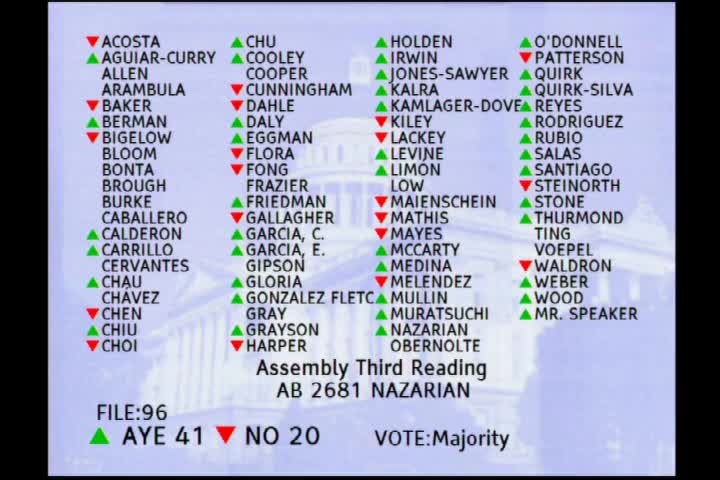
| May 31, 2018 | AB 2781 LOW Assembly Third Reading | Assembly Floor |
Passed |
|
| May 25, 2018 | Do pass as amended. | Assembly Standing Committee on Appropriations |
Passed |
|
| Apr 10, 2018 | Do pass and be re-referred to the Committee on [Appropriations] | Assembly Standing Committee on Public Safety |
Passed |
This list shows positions taken on this bill by organizations on the date displayed, which is linked to the original source.
Positions by individuals are not included.
|
Organization
|
Position
|
Date
|
|---|---|---|
| Assembly Floor Vote: 73 - 0 | ** Against | Jun 25, 2018 |
| California Association Of Crime Laboratory Directors | * Against | Jun 26, 2018 |
| California Brady Campaign to Prevent Gun Violence | * Support | Jun 26, 2018 |
| California State Sheriffs' Association | * Against | Apr 10, 2018 |
| Coalition Against Gun Violence | ** Support | Apr 9, 2018 |
| Peace Officers Research Association Of California | ** Support | Apr 9, 2018 |
| PURPOSE | ** Against | Jun 25, 2018 |
| Santa Clara District Attorney's Office | * Support | Jun 26, 2018 |
SENATE COMMITTEE ON APPROPRIATIONS
Senator Anthony Portantino, Chair
2017 - 2018 Regular Session
AB 2781 (Low) - Forensic ballistic and firearms procedures
Version: May 25, 2018 | Policy Vote: PUB. S. 7 - 0 |
Urgency: No | Mandate: Yes |
Hearing Date: August 6, 2018 | Consultant: Shaun Naidu |
This bill meets the criteria for referral to the Suspense File.
Bill Summary:
AB 2781 would require law enforcement agencies to obtain ballistic images from firearms, cartridge cases, and bullets obtained in connection with criminal investigations, as specified, and submit those images to an automated ballistic identification system.
Fiscal Impact:
- The Department of Justice (DOJ) reports one-time costs of $12.1 million and ongoing costs of $10.1 million annually and the need for 69.0 new positions to process the expected increase in the number of firearms, cartridge cases, and fired bullets it tests and enters into NIBIN. (Special funds*/General Fund)
- The Department of Fish and Wildlife (DFW) estimate one-time costs of about $1 million to purchase the necessary equipment and ongoing personnel costs of $2.1 million annually. (General Fund)
- Unknown, potentially-major costs, likely in the millions of dollars, to local jurisdictions that do not have a forensic analysis agreement with DOJ and would obtain and upload ballistic images, on their own or regionally, as required by this measure. One-time costs in obtaining the necessary equipment would be significant, in the hundreds of thousands of dollars per NIBIN terminal. These costs likely would be reimbursable by the state, the extent of which would be determined by the Commission on State Mandates. (General Fund, local funds)
*DNA Identification Fund & Dealer Records of Sale (DROS) Special Account
Background:
Currently, a local law enforcement agency is permitted to enter specified firearms-related information into the U.S. Department of Justice, National Integrated Ballistic Information Network (NIBIN). Entry of the information into NIBIN ensures that representative samples of fired bullets and cartridge cases from crime scenes are recorded. According to the analysis of this bill by the Assembly Committee on Public Safety:
The NIBIN Program is part of the Firearms Programs Division of the Bureau of Alcohol, Tobacco, Firearms and Explosives (ATF). In 1999, ATF established the National Integrated Ballistic Information Network (NIBIN) to provide federal, state, and local partner agencies with an automated ballistic imaging network. NIBIN is the only national network that allows for the capture and comparison of ballistic evidence. NIBIN provides investigators the ability to compare their ballistics evidence against evidence from other violent crimes on a national, regional and local level, thus generating investigative links.
(https://www.atf.gov/resource-center/fact-sheet/fact-sheet-national-integrated-ballistic-information-network)
…
NIBIN is the only interstate automated ballistic imaging network in operation in the United States and is available to most major population centers in the United States. Prior to the NIBIN Program, firearms examiners performed this process manually which was extremely labor intensive. To use NIBIN, firearms examiners or technicians enter cartridge casing evidence into the Integrated Ballistic Identification System (IBIS). These images are correlated against the database. Law enforcement can search against evidence from their jurisdiction, neighboring ones, and others across the country.
(https://www.atf.gov/firearms/national-integrated-ballistic-information-network-nibin)
Proposed Law:
This bill would:
- Require a law enforcement agency to obtain ballistic images from firearms and cartridge cases obtained by the agency as specified, and submit those images to the National Integrated Ballistic Identification or a comparable automated ballistic identification system used by the agency
- Require DOJ to develop a protocol for the implementation of this requirement.
- Define “law enforcement agency” to mean:
- A Police or sheriff’s department.
- Any department or agency of the state or any political subdivision thereof that employs any peace officer, as defined, including CHP, DFW, the University of California or California State University police departments, and the police department of any school district, transit district, airport, and harbor, port, or housing authority.
Related Legislation:
AB 2222 (Quirk, 2018) would expand which law enforcement agencies are required to report information about firearms that are reported lost, stolen, or recovered. AB 2222 is pending in this Committee.
AB 2733 (Harper, 2018) would repeal the requirement that a firearm be designed and equipped with microscopic characters that leave an imprint, as specified, on each cartridge when the gun is fired in order to be listed on the roster of not unsafe handguns. AB 2733 failed passage in the Assembly Committee on Public Safety.
Staff Comments:
To process the anticipated increased workload, DOJ reports that its Bureau of Forensic Services would require 4.0 Criminalists trained as firearms examiners, 1.0 Criminalist for DNA, and 1.0 Laboratory Technician for each of the bureau’s ten field labs, plus 3.0 additional Latent Print Analysts for the state. Aside from personnel, the bureau would require additional equipment to process samples and would incur annual maintenance costs for lab machines.
The procedure to enter a test-fired ballistic image into NIBIN includes packaging and paperwork that takes approximate 30 to 60 minutes to perform per firearm. To ensure the timely processing and test-firing of submitted firearms, cartridge cases, and bullets, and to account for the geographic location of DOJ offices, the department anticipates the need of 6.0 new Property Controller I positions within its Bureau of Firearms to handle the increased workload.
Implementation costs borne by DOJ resulting from this measure would be funded through the DNA Identification Fund and the DROS Special Account, both of which would not be able to absorb the increased costs associated with AB 2781. The DNA Identification Fund has an anticipated fiscal year (FY) 2018-19 ending balance of a little over $1 million. Recently, expenditures from this account have outpaced revenue by about $2 million annually. The FY 2018-19 proposed expenditure from the DROS Special Account exceeds the estimated revenue by over $700,000, leaving a diminished estimated reserve of $5.5 million. Consequently, as the appropriate funding sources are structurally imbalanced or unable to absorb costs that would be imposed AB 2781, this bill would result in cost pressure to the General Fund to supplement, or potentially supplant, those funds.
Personnel costs to DFW related to this measure are for 7.0 Lieutenant (Supervisor) positions and 2.0 Wildlife Forensic (Specialist) positions.
There are twenty-two local law enforcement agencies in California that participate in NIBIN, with almost a majority of them clustered in the San Francisco Bay Area. Many law enforcement agencies that do not directly participate in NIBIN, contract with DOJ for firearm forensic services. According to DOJ, forty-six counties currently contract with the department to conduct analysis services for blood and breath specimens. The department includes within these services, at no additional cost to the local jurisdiction, the processing of other forensic analysis services, such as the type that would be required by this measure. The remaining counties that do not contract with DOJ for these services are the larger-population counties. They include Los Angeles, San Diego, Santa Clara, San Francisco, Sacramento, Orange, and Contra Costa counties. To the extent that these counties do not already submit into NIBIN ballistic images, this bill would impose new costs, including large one-time equipment purchase costs. To the extent that these counties already submit ballistic images but do so differently than the procedures that would be established by DOJ, this bill could result in additional costs to conform their practices with DOJ guidelines. Additionally, the state would be required to reimburse compliance costs for counties that currently are obtaining and submitting ballistic imagines voluntarily once the practice is mandated by legislation.
-- END --
SENATE COMMITTEE ON PUBLIC SAFETY
Senator Nancy Skinner, Chair
2017 - 2018 Regular
Bill No: AB 2781 Hearing Date: June 26, 2018
Author: | Low | ||
Version: | May 25, 2018 | ||
Urgency: | No | Fiscal: | Yes |
Consultant: | GC | ||
Subject: Forensic Ballistic and Firearms Procedures
HISTORY
Source: Santa Clara District Attorney’s Office
Prior Legislation: SB 248 (Padilla), Ch. 639, Stats. of 2007
Support: Bay Area Student Activists; California Chapters of the Brady Campaign; Coalition Against Gun Violence; County of Santa Clara; Peace Officers Research Association of California (PORAC)
Opposition: California Association of Crime Laboratory Directors; California State Sheriffs’ Association
Assembly Floor Vote: 73 - 0
PURPOSE
The purpose of this bill is to require law enforcement agencies to obtain ballistic images from firearms, cartridge cases, and bullets obtained by the agencies in connection with criminal investigations, as specified, and submit those images to the National Integrated Ballistic Identification Network (NIBIN) or a similar automated ballistic identification system.
Existing law allows local law enforcement agencies to enter into the United States Department of Justice, National Integrated Ballistic Information Network (NIBIN) information to ensure that representative samples of fired bullets and cartridge cases collected at crime scenes, from test-fires of firearms recovered at crime scenes, and other firearm information needed to investigate crimes, are recorded into the NIBIN in accordance with specified protocols. (Pen. Code, § 11108.10, subd. (a).)
Existing law requires the Attorney General, in cooperation with the law enforcement agencies that choose to do so, to develop a protocol to allow local law enforcement agencies to enter information to NIBIN. (Pen. Code, § 11108.10, subd. (b).)
Existing law requires each sheriff or police chief executive to submit descriptions of serialized property, or non-serialized property that has been uniquely inscribed, which has been reported stolen, lost, found, recovered or under observation, directly into the appropriate DOJ automated property system for firearms, stolen bicycles, stolen vehicles, or other property, as the case may be. (Pen. Code, § 11108, subd. (a).)
Existing law states information about a firearm entered into the automated system for firearms shall remain in the system until the reported firearm has been found, recovered, is no longer under observation, or the record is determined to have been entered in error. (Pen. Code, § 11108, subd. (b).)
Existing law provides that in addition to the requirements of existing law that apply to a local law enforcement agency's duty to report to DOJ the recovery of a firearm, a police or sheriff's department shall, and any other law enforcement agency or agent may, report to the department in a manner determined by the AG in consultation with the Bureau of Alcohol, Tobacco, Firearms and Explosives (ATF) all available information necessary to identify and trace the history of all recovered firearms that are illegally possessed, have been used in a crime, or are suspected of having been used in a crime. (Pen. Code, § 11108.3, subd. (a).)
Existing law states that when the DOJ receives information from a local law enforcement agency pursuant to existing law, it shall promptly forward this information to the National Tracing Center of the federal Bureau of Alcohol, Tobacco, Firearms and Explosives to the extent practicable. (Pen. Code, § 11108.3, subd. (b).)
This bill specifies that if a law enforcement agency seizes or recovers a firearm that was unlawfully possessed, used for any unlawful purpose, recovered from the scene of a crime, is reasonably believed to have been used or associated with the commission of a crime, or is acquired by the agency as an abandoned or discarded firearm, the agency shall test fire the firearm, or cause the firearm to be test fired, as soon as practicable and submit the ballistic images to NIBIN to determine whether the firearm is associated with, or related to, a crime, criminal event, or individual associated with or related to, a crime, or criminal event.
This bill requires that if a law enforcement agency recovers any cartridge case at a crime scene or has reason to believe that a recovered cartridge case is related to, or associated with, the commission of a crime, or the unlawful discharge of a firearm, that agency shall, as soon as practicable, submit, or cause to be submitted, the ballistic image to NIBIN or a similar automated ballistic identification system.
This bill requires the Department of Justice (DOJ) to develop and promulgate a protocol for the implementation of this bill.
This bill defines ''law enforcement agency'' for purposes of this bill as ''a police or sheriff's department, or any department or agency of the state or any political subdivision thereof that employs any peace officer, including, but not limited to, the Department of the California Highway Patrol, the Department of Fish and Wildlife, the University of California or the California State University Police Departments, and the police department of any school district, community college district, park district, transit district, railroad, and harbor, port, airport, or housing authority.''
COMMENTS
- Need for This Bill
According to the author of this bill:
Gun violence continues to plague California, with guns used in thousands of violent crimes each year. This bill would harness the power of existing technology and systems to quickly solve gun crimes and identify crime gun shooters.
Firearms produce unique markings on expended shell casings after the gun is fired. The Bureau of Alcohol, Tobacco, Firearms and Explosives (ATF) maintains a database of thousands of images of expended shell casings, called National Integrated Ballistics Information Network (NIBIN). When guns and casings are quickly and uniformly submitted for NIBIN comparison, multiple shooting events can be linked to one another, creating an important lead in a shooting investigation.
Current law permits California law enforcement to submit ballistic information to the ATF database, but does not require the submission, thereby causing significant delay, backlog and under-utilization of this important law enforcement tool.
Gun violence remains a serious concern for law enforcement across California, with low clearance rates for gun-related assaults, robberies and homicides. Existing technology can quickly link shootings to one another, allowing police to identify and incapacitate a shooter from future victimization. Unfortunately, law enforcement has not consistently used the NIBIN technology for all eligible guns and casings. When the system is used reliably, jurisdictions across the country find previously unknown related shooting cases and are able to solve major crime sprees while identifying prolific offenders.
In states that mandate NIBIN submission, like New Jersey and Delaware, turnaround time is so quick for ballistics evidence that investigators use the information as critical leads in active shooting investigations. Without a mandate, many jurisdictions are not reliably or rapidly inputting casing evidence that would solve a crime in a neighboring jurisdiction, thereby hampering investigators’ ability to solve their own shootings. Gun violence often involves multiple counties and criminals take guns between counties to commit shootings. By mandating all California agencies to quickly submit their evidence, investigators can be assured that evidence from a neighboring jurisdiction will be input and all California guns will contribute to solving shootings across county lines.
AB 2781 requires submission of all ballistic images from firearms and cartridge casings into the National Integrated Ballistics Information Network (NIBIN) to help solve gun crimes.
This law would dramatically increase law enforcement’s ability to stop future violent acts by swiftly identifying shooters using an existing evidence-based solution. Requiring the Department of Justice to promulgate a protocol for this program insures that best practices can guide proper implementation.
- National Integrated Ballistic Information Network (NIBIN)
The NIBIN Program is part of the Firearms Programs Division of the Bureau of Alcohol, Tobacco, Firearms and Explosives (ATF). In 1999, ATF established the National Integrated Ballistic Information Network (NIBIN) to provide federal, state, and local partner agencies with an automated ballistic imaging network. NIBIN is the only national network that allows for the capture and comparison of ballistic evidence. NIBIN provides investigators the ability to compare their ballistics evidence against evidence from other violent crimes on a national, regional and local level, thus generating investigative links.[1]
Since the program’s inception in 1999, NIBIN partners have captured approximately 2.8 million images of ballistic evidence and confirmed more than 74,000 NIBIN hits.
NIBIN is the only interstate automated ballistic imaging network in operation in the United States and is available to most major population centers in the United States. Prior to the NIBIN Program, firearms examiners performed this process manually which was extremely labor intensive. To use NIBIN, firearms examiners or technicians enter cartridge casing evidence into the Integrated Ballistic Identification System (IBIS). These images are correlated against the database. Law enforcement can search against evidence from their jurisdiction, neighboring ones, and others across the country.[2]
The ATF states that for NIBIN to be most effective, it requires adherence to four steps:
- Comprehensive Collection and Entry: Partner agencies must collect and submit all evidence suitable for entry into NIBIN, regardless of crime. Evidence includes both cartridge cases recovered from crime scenes and test fires from recovered crime guns.
- Timely Turnaround: Violent crime investigations can go cold very quickly, so the goal is to enter the evidence into the network as quickly as possible in order to identify potential NIBIN Leads, and subsequently providing this relevant and actionable intelligence to the investigators.
- Investigative Follow-Up and Prosecution: Linking otherwise unassociated crimes gives investigators a better chance to identify and arrest shooters before they reoffend.
- Feedback Loop: Without feedback, NIBIN partners cannot know how their efforts are making the community safer, which is necessary for sustained success.[3]
3. Santa Clara County NIBIN Statistics
The Santa Clara District Attorney’s Office implemented a Gun Related Intelligence Program in the Fall of 2017. The program relies on the introduction of evidence into the NIBIN system to generate investigative leads in cases that involve firearms. According to the Santa Clara District Attorney’s Office, since implementing the Gun Related Intelligence Program in the fall of 2017, the Santa Clara County Crime Laboratory has identified 118 associated ballistic events covering 41 separate cases. Associations are grouped by gun and assigned a case number, and are investigative leads requiring confirmation by a trained expert firearms examiner in order to be relied on for arrests. Use of the Gun Related Intelligence Programs has resulted in new investigative leads and previously unknown associations due to the NIBIN work this year.
4. NIBIN Use in California
Santa Clara District Attorney’s Crime Laboratory is one of approximately 20 agencies in California that are participating in NIBIN. Among the law enforcement entities utilizing NIBIN, in addition to the Santa Clara District Attorney, are the San Diego Sheriff’s Department, San Diego Police Department Crime Laboratory, Los Angeles County Scientific Services Bureau Firearms Identification Section/Los Angeles Police Department Scientific Investigation Division, Firearms Analysis Unit, Santa Ana Police Department Forensic Services, San Mateo County Sheriff’s Forensic Laboratory, Sacramento California Police Department, Alameda County Sheriff’s Crime Laboratory, Oakland Police Department Criminalistics Division, Contra Costa County Office of the Sheriff, San Joaquin County Sheriff’s Office.[4]
Optimally, each agency would have its own IBIS terminal. However, the terminals cost approximately $250,000 per terminal. At the terminal site, any firearms that are available (e.g., a firearm recovered from a crime scene) must be test fired to obtain casings with the ballistic markings. Images of the casings from the crime scene and/or fired from the gun are then entered into NIBIN. A significant amount of law enforcement time is required to enter the data into the system.
This bill would require every a firearm that was unlawfully possessed, used for any unlawful purpose, recovered from the scene of a crime, is reasonably believed to have been used or associated with the commission of a crime, to be test fire the firearm and submit the ballistic images to NIBN. This bill would also require every cartridge case or fired bullet recovered from a crime scene to submit the ballistic image to NIBIN. The mandates in this bill will require significant resources.
5. Argument in Support
According to the Santa Clara County District Attorney:
When a gun is fired it leaves unique markings on the expended shell casings that can be compared in a massive national database. Current technology allows investigators to link shootings to one another, but NIBIN’s effectiveness has been hampered by delay in submitting evidence for analysis. This delay can impede investigations while shooters remain outstanding and continue coming gun crimes.
The passage of this bill also will help keep our communities safer. When we solve gun crimes quickly by matching expended shell casings from shootings with the same gun, we not only hold the shooter accountable, but we stop the serial use of the same gun for multiple gun crimes in our neighborhoods. This bill closes an efficiency gap in California, by requiring that all eligible crime guns and expended casings from crime scenes are processed quickly and uniformly. This is an incredible tool for law enforcement. Requiring all California law enforcement agencies to submit this evidence will hugely improve all jurisdictions’ ability to solve shootings and bring shooters to justice.
6. Argument in Opposition
According to the California Association of Crime Laboratory Directors:
NIBIN is a national database of digital images of spent bullets and cartridge cases that were found at crime scenes or test-fired from confiscated weapons. The Bureau of Alcohol, Tobacco, Firearms, and Explosives (ATF) manages the system and provides the equipment to crime labs around the country. In California, Penal Code § 11108 requires police and sheriffs’ departs to submit recovered firearm information directly into the Automated Firearm System (AFS).
We acknowledge that the NIBIN can be a useful investigatory tool for forensic labs to help their law enforcement partners link crimes and identify suspects, while understanding patterns of firearm sharing and trafficking. However, AB 2781 overlooks the reality that most crime laboratories, especially in rural areas, do not have access to NIBIN because it’s cost prohibitive. If a crime laboratory does not have the resources to procure the technology contemplated by this bill, they should not be held to the requirement set out in this proposal.
-- END –
(https://www.atf.gov/resource-center/fact-sheet/fact-sheet-national-integrated-ballistic-information-network) ↑
(https://www.atf.gov/firearms/national-integrated-ballistic-information-network-nibin) ↑
(https://www.atf.gov/resource-center/fact-sheet/fact-sheet-national-integrated-ballistic-information-network) ↑
(https://www.atf.gov/firearms/nibin-interactive-map) ↑
ASSEMBLY THIRD READING
ATR Bill Id:AB 2781
Author:(Low)
As Amended Ver:
Majority vote
Committee | Votes | Ayes | Noes |
Public Safety | 6-0 | Jones-Sawyer, Lackey, Carrillo, Gonzalez Fletcher, Quirk, Santiago | |
Appropriations | 12-0 | Gonzalez Fletcher, Bloom, Bonta, Calderon, Carrillo, Chau, Eggman, Friedman, Eduardo Garcia, Nazarian, Quirk, Reyes |
|
SUMMARY: Requires law enforcement agencies to obtain ballistic images from firearms, cartridge cases, and bullets obtained by the agencies in connection with criminal investigations, as specified, and submit those images to the National Integrated Ballistic Identification Network (NIBIN) or a similar automated ballistic identification system. Specifically, this bill:
- Specifies that if a law enforcement agency seizes or recovers a firearm that was unlawfully possessed, used for any unlawful purpose, recovered from the scene of a crime, is reasonably believed to have been used or associated with the commission of a crime, or is acquired by the agency as an abandoned or discarded firearm, the agency shall test fire the firearm, or cause the firearm to be test fired, as soon as practicable and submit the ballistic images to NIBIN to determine whether the firearm is associated with, or related to, a crime, criminal event, or individual associated with or related to, a crime, or criminal event.
- Requires that if a law enforcement agency recovers any cartridge case at a crime scene or has reason to believe that a recovered cartridge case is related to, or associated with, the commission of a crime, or the unlawful discharge of a firearm, that agency shall, as soon as practicable, submit, or cause to be submitted, the ballistic image to NIBIN or a similar automated ballistic identification system.
- Requires the Department of Justice (DOJ) to develop and promulgate a protocol for the implementation of this bill.
- Defines ''law enforcement agency'' for purposes of this bill as ''a police or sheriff's department, or any department or agency of the state or any political subdivision thereof that employs any peace officer, including, but not limited to, the Department of the California Highway Patrol, the Department of Fish and Wildlife, the University of California or the California State University Police Departments, and the police department of any school district, community college district, park district, transit district, railroad, and harbor, port, airport, or housing authority.''
EXISTING LAW:
- Allows local law enforcement agencies to enter into the United States Department of Justice, National Integrated Ballistic Information Network (NIBIN) information to ensure that representative samples of fired bullets and cartridge cases collected at crime scenes, from test-fires of firearms recovered at crime scenes, and other firearm information needed to investigate crimes, are recorded into the NIBIN in accordance with specified protocols.
- Requires the Attorney General, in cooperation with the law enforcement agencies that choose to do so, to develop a protocol to allow local law enforcement agencies to enter information to NIBIN.
- Requires each sheriff or police chief executive to submit descriptions of serialized property, or non-serialized property that has been uniquely inscribed, which has been reported stolen, lost, found, recovered or under observation, directly into the appropriate DOJ automated property system for firearms, stolen bicycles, stolen vehicles, or other property, as the case may be.
- States information about a firearm entered into the automated system for firearms shall remain in the system until the reported firearm has been found, recovered, is no longer under observation, or the record is determined to have been entered in error.
- Provides that in addition to the requirements of existing law that apply to a local law enforcement agency's duty to report to DOJ the recovery of a firearm, a police or sheriff's department shall, and any other law enforcement agency or agent may, report to the department in a manner determined by the AG in consultation with the Bureau of Alcohol, Tobacco, Firearms and Explosives (ATF) all available information necessary to identify and trace the history of all recovered firearms that are illegally possessed, have been used in a crime, or are suspected of having been used in a crime.
- States that when the DOJ receives information from a local law enforcement agency pursuant to existing law, it shall promptly forward this information to the National Tracing Center of the federal Bureau of Alcohol, Tobacco, Firearms and Explosives to the extent practicable.
FISCAL EFFECT: According to the Assembly Appropriations Committee:
- Significant costs (DNA ID fund and Dealer Record of Sale Account) for DOJ to handle a significant increase in the number of firearms, and cartridge cases it tests and submits on behalf of the 46 counties that currently contract with DOJ for firearms forensic services.
- Significant state mandate costs (GF), likely in the millions of dollars annually, for the 12 counties that do not contract with DOJ, including the 20 local law enforcement agencies that currently participate directly in NIBIN or a similar network. These local law enforcement agencies will have costs to handle a significant increase in the number of firearms that must be test fired and have ballistics images processed and uploaded to NIBIN or a similar network. Law enforcement agencies that do not already have direct access to NIBIN or a similar network and do not contract with DOJ may also have costs to obtain a NIBIN or similar network secure terminal, which the Assembly Public Safety Committee analysis of this bill indicates costs about $250,000.
COMMENTS: According to the author, "AB 2781 helps solve gun crimes by creating a uniform submission process to ensure that all eligible ballistic images from firearms, cartridge cases and bullets are entered into the NIBIN database quickly to assist law enforcement in solving gun crimes, apprehending shooters, and bringing them to justice.''
Please see the policy committee analysis for a full discussion of this bill.
Analysis Prepared by: David Billingsley / PUB. S. / (916) 319-3744 FN: 0003246
Date of Hearing: April 25, 2018
ASSEMBLY COMMITTEE ON APPROPRIATIONS
Lorena Gonzalez Fletcher, Chair
ABPCA Bill Id:AB 2781
Author:(Low) – As Amended Ver:March 14, 2018
Policy Committee: | Public Safety | Vote: | 6 - 0 |
|
| ||
|
|
Urgency: No State Mandated Local Program: Yes Reimbursable: Yes
SUMMARY:
This bill requires law enforcement agencies to obtain and submit to the National Integrated Ballistic Identification Network (NIBIN) ballistic information from firearms, cartridge cases, and bullets obtained by the agencies and reasonably believed to be associated with a crime. Specifically, this bill:
- Requires a law enforcement agency that seizes or recovers a firearm, as specified, to test fire the firearm, or cause the firearm to be test fired, as soon as practicable and submit the ballistic images to NIBIN to determine whether the firearm is associated with a crime or with an individual associated with a crime.
- Requires a law enforcement agency that recovers any cartridge case or fired bullet at a crime scene or has reason to believe that a recovered cartridge case or fired bullet is associated with the commission of a crime to, as soon as practicable, submit, or cause to be submitted, the ballistic image to NIBIN.
- Requires the Department of Justice (DOJ) to develop and promulgate a protocol for the implementation of this bill.
- Defines “law enforcement agency” for purposes of this bill as:
A police or sheriff’s department, or any department or agency of the state or any political subdivision thereof that employs any peace officer, including, but not limited to, the Department of the California Highway Patrol, the Department of Fish and Wildlife, the University of California or the California State University Police Departments, and the police department of any school district, community college district, park district, transit district, railroad, and harbor, port, airport, or housing authority.
FISCAL EFFECT:
- Significant costs (DNA ID fund and Dealer Record of Sale Account) for DOJ to handle a significant increase in the number of firearms, cartridge cases, and fired bullets it tests and submits to NIBIN on behalf of the 46 counties that currently contract with DOJ for firearms forensic services. Specifically, DOJ reports costs of $12.1 million in 2018-19 and $10 million in 2019-20 and ongoing for 69 additional staff positions and equipment.
- Significant state mandate costs (GF), likely in the millions of dollars annually, for the 12 counties that do not contract with DOJ, including the 20 local law enforcement agencies that currently participate directly in NIBIN. These local law enforcement agencies will have costs to handle a significant increase in the number of firearms that must be test fired and have ballistics images processed and uploaded to NIBIN. Law enforcement agencies that do not already have direct access to NIBIN and do not contract with DOJ may also have costs to obtain a NIBIN secure terminal, which the Assembly Public Safety Committee analysis of this bill indicates costs about $250,000.
COMMENTS:
- Backgound. The NIBIN Program is part of the Firearms Programs Division of the Bureau of Alcohol, Tobacco, Firearms and Explosives (ATF). In 1999, ATF established the NIBIN to provide federal, state, and local partner agencies with an automated ballistic imaging network. NIBIN is the only national network that allows for the capture and comparison of ballistic evidence. NIBIN provides investigators the ability to compare their ballistics evidence against evidence from other violent crimes on a national, regional and local level, thus generating investigative links. Participation in NIBIN requires that firearms and ammunition are tested and that test information is uploaded to the NIBIN system through a secured terminal. According to the Public Safety Committee analysis of this bill, NIBIN terminals cost about $250,000 each. About 20 law enforcement agencies in California participate in NIBIN. Law enforcement agencies that do not participate in NIBIN can contract with DOJ for firearm forensic services. Currently, 46 counties contract with DOJ for these services.
- According to the author:
AB 2781 helps solve gun crimes by creating a uniform submission process to ensure that all eligible ballistic images from firearms, cartridge cases and bullets are entered into the NIBIN database quickly to assist law enforcement in solving gun crimes, apprehending shooters, and bringing them to justice
Analysis Prepared by: Jessica Peters / APPR. / (916) 319-2081
Date of Hearing:
Counsel: David Billingsley
ASSEMBLY COMMITTEE ON PUBLIC SAFETY
Reginald Byron Jones-Sawyer, Sr., Chair
ABPCA Bill Id:AB 2781
Author:(Low) – As Amended Ver:March 14, 2018
SUMMARY:
Requires law enforcement agencies to obtain ballistic images from firearms, cartridge cases, and bullets obtained by the agencies in connection with criminal investigations, as specified, and submit those images to the National Integrated Ballistic Identification Network (NIBIN). Specifically, this bill:
- Specifies that if a law enforcement agency seizes or recovers a firearm that was unlawfully possessed, used for any unlawful purpose, recovered from the scene of a crime, is reasonably believed to have been used or associated with the commission of a crime, or is acquired by the agency as an abandoned or discarded firearm, the agency shall test fire the firearm, or cause the firearm to be test fired, as soon as practicable and submit the ballistic images to NIBIN to determine whether the firearm is associated with, or related to, a crime, criminal event, or individual associated with or related to, a crime, or criminal event.
- Requires that if a law enforcement agency recovers any cartridge case or fired bullet at a crime scene or has reason to believe that a recovered cartridge case or fired bullet is related to, or associated with, the commission of a crime, or the unlawful discharge of a firearm, that agency shall, as soon as practicable, submit, or cause to be submitted, the ballistic image to NIBIN.
- Requires the Department of Justice (DOJ) to develop and promulgate a protocol for the implementation of this bill.
- Defines “law enforcement agency” for purposes of this bill as “a police or sheriff’s department, or any department or agency of the state or any political subdivision thereof that employs any peace officer, including, but not limited to, the Department of the California Highway Patrol, the Department of Fish and Wildlife, the University of California or the California State University Police Departments, and the police department of any school district, community college district, park district, transit district, railroad, and harbor, port, airport, or housing authority.”
EXISTING LAW:
- Allows local law enforcement agencies to enter into the United States Department of Justice, National Integrated Ballistic Information Network (NIBIN) information to ensure that representative samples of fired bullets and cartridge cases collected at crime scenes, from test-fires of firearms recovered at crime scenes, and other firearm information needed to investigate crimes, are recorded into the NIBIN in accordance with specified protocols. (Pen. Code, § 11108.10, subd. (a).)
- Requires the Attorney General, in cooperation with the law enforcement agencies that choose to do so, to develop a protocol to allow local law enforcement agencies to enter information to NIBIN. (Pen. Code, § 11108.10, subd. (b).)
- Requires each sheriff or police chief executive to submit descriptions of serialized property, or non-serialized property that has been uniquely inscribed, which has been reported stolen, lost, found, recovered or under observation, directly into the appropriate DOJ automated property system for firearms, stolen bicycles, stolen vehicles, or other property, as the case may be. (Pen. Code, § 11108, subd. (a).)
- States information about a firearm entered into the automated system for firearms shall remain in the system until the reported firearm has been found, recovered, is no longer under observation, or the record is determined to have been entered in error. (Pen. Code, § 11108, subd. (b).)
- Provides that in addition to the requirements of existing law that apply to a local law enforcement agency's duty to report to DOJ the recovery of a firearm, a police or sheriff's department shall, and any other law enforcement agency or agent may, report to the department in a manner determined by the AG in consultation with the Bureau of Alcohol, Tobacco, Firearms and Explosives (ATF) all available information necessary to identify and trace the history of all recovered firearms that are illegally possessed, have been used in a crime, or are suspected of having been used in a crime. (Pen. Code, § 11108.3, subd. (a).)
- States that when the DOJ receives information from a local law enforcement agency pursuant to existing law, it shall promptly forward this information to the National Tracing Center of the federal Bureau of Alcohol, Tobacco, Firearms and Explosives to the extent practicable. (Pen. Code, § 11108.3, subd. (b).)
FISCAL EFFECT:
Unknown
COMMENTS:
- Author's Statement: According to the author, "AB 2781 helps solve gun crimes by creating a uniform submission process to ensure that all eligible ballistic images from firearms, cartridge cases and bullets are entered into the NIBIN database quickly to assist law enforcement in solving gun crimes, apprehending shooters, and bringing them to justice.”
- National Integrated Ballistic Information Network (NIBIN): The NIBIN Program is part of the Firearms Programs Division of the Bureau of Alcohol, Tobacco, Firearms and Explosives (ATF). In 1999, ATF established the National Integrated Ballistic Information Network (NIBIN) to provide federal, state, and local partner agencies with an automated ballistic imaging network. NIBIN is the only national network that allows for the capture and comparison of ballistic evidence. NIBIN provides investigators the ability to compare their ballistics evidence against evidence from other violent crimes on a national, regional and local level, thus generating investigative links. (https://www.atf.gov/resource-center/fact-sheet/fact-sheet-national-integrated-ballistic-information-network)
Since the program’s inception in 1999, NIBIN partners have captured approximately 2.8 million images of ballistic evidence and confirmed more than 74,000 NIBIN hits.
NIBIN is the only interstate automated ballistic imaging network in operation in the United States and is available to most major population centers in the United States. Prior to the NIBIN Program, firearms examiners performed this process manually which was extremely labor intensive. To use NIBIN, firearms examiners or technicians enter cartridge casing evidence into the Integrated Ballistic Identification System (IBIS). These images are correlated against the database. Law enforcement can search against evidence from their jurisdiction, neighboring ones, and others across the country. (https://www.atf.gov/firearms/national-integrated-ballistic-information-network-nibin)
The ATF states that for NIBIN to be most effective, it requires adherence to four steps: - Comprehensive Collection and Entry: Partner agencies must collect and submit all evidence suitable for entry into NIBIN, regardless of crime. Evidence includes both cartridge cases recovered from crime scenes and test fires from recovered crime guns.
- Timely Turnaround: Violent crime investigations can go cold very quickly, so the goal is to enter the evidence into the network as quickly as possible in order to identify potential NIBIN Leads, and subsequently providing this relevant and actionable intelligence to the investigators.
- Investigative Follow-Up and Prosecution: Linking otherwise unassociated crimes gives investigators a better chance to identify and arrest shooters before they reoffend.
- Feedback Loop: Without feedback, NIBIN partners cannot know how their efforts are making the community safer, which is necessary for sustained success. (https://www.atf.gov/resource-center/fact-sheet/fact-sheet-national-integrated-ballistic-information-network)
- Santa Clara County NIBIN Statistics: The Santa Clara District Attorney’s Office implemented a Gun Related Intelligence Program in the Fall of 2017. The program relies on the introduction of evidence into the NIBIN system to generate investigative leads in cases that involve firearms. According to the Santa Clara District Attorney’s Office, since implementing the Gun Related Intelligence Program in the fall of 2017, the Santa Clara County Crime Laboratory has identified 118 associated ballistic events covering 41 separate cases. Associations are grouped by gun and assigned a case number, and are investigative leads requiring confirmation by a trained expert firearms examiner in order to be relied on for arrests. Use of the Gun Related Intelligence Programs has resulted in new investigative leads and previously unknown associations due to the NIBIN work this year.
- NIBIN Use in California: Santa Clara District Attorney’s Crime Laboratory is one of approximately 20 agencies in California that are participating in NIBIN. Among the law enforcement entities utilizing NIBIN, in addition to the Santa Clara District Attorney, are the San Diego Sheriff’s Department, San Diego Police Department Crime Laboratory, Los Angeles County Scientific Services Bureau Firearms Identification Section/Los Angeles Police Department Scientific Investigation Division, Firearms Analysis Unit, Santa Ana Police Department Forensic Services, San Mateo County Sheriff’s Forensic Laboratory, Sacramento California Police Department, Alameda County Sheriff’s Crime Laboratory, Oakland Police Department Criminalistics Division, Contra Costa County Office of the Sheriff, San Joaquin County Sheriff’s Office. (https://www.atf.gov/firearms/nibin-interactive-map)
Optimally, each agency would have its own IBIS terminal. However, the terminals cost approximately $250,000 per terminal. At the terminal site, any firearms that are available (e.g., a firearm recovered from a crime scene) must be test fired to obtain casings with the ballistic markings. Images of the casings from the crime scene and/or fired from the gun are then entered into NIBIN. A significant amount of law enforcement time is required to enter the data into the system.
This bill would require every a firearm that was unlawfully possessed, used for any unlawful purpose, recovered from the scene of a crime, is reasonably believed to have been used or associated with the commission of a crime, to be test fire the firearm and submit the ballistic images to NIBN. This bill would also require every cartridge case or fired bullet recovered from a crime scene to submit the ballistic image to NIBIN. The mandates in this bill will require significant resources. - Argument in Support: According to the Santa Clara County District Attorney, “When a gun is fired it leaves unique markings on the expended shell casings that can be compared in a massive national database. Current technology allows investigators to link shootings to one another, but NIBIN’s effectiveness has been hampered by delay in submitting evidence for analysis. This delay can impede investigations while shooters remain outstanding and continue coming gun crimes.
“The passage of this bill also will help keep our communities safer. When we solve gun crimes quickly by matching expended shell casings from shootings with the same gun, we not only hold the shooter accountable, but we stop the serial use of the same gun for multiple gun crimes in our neighborhoods. This bill closes an efficiency gap in California, by requiring that all eligible crime guns and expended casings from crime scenes are processed quickly and uniformly. This is an incredible tool for law enforcement. Requiring all California law enforcement agencies to submit this evidence will hugely improve all jurisdictions’ ability to solve shootings and bring shooters to justice.” - Argument in Opposition: According to the California Association of Crime Laboratory Directors, “NIBIN is a national database of digital images of spent bullets and cartridge cases that were found at crime scenes or test-fired from confiscated weapons. The Bureau of Alcohol, Tobacco, Firearms, and Explosives (ATF) manages the system and provides the equipment to crime labs around the country. In California, Penal Code § 11108 requires police and sheriffs’ departs to submit recovered firearm information directly into the Automated Firearm System (AFS).
“We acknowledge that the NIBIN can be a useful investigatory tool for forensic labs to help their law enforcement partners link crimes and identify suspects, while understanding patterns of firearm sharing and trafficking. However, AB 2781 overlooks the reality that most crime laboratories, especially in rural areas, do not have access to NIBIN because it’s cost prohibitive. If a crime laboratory does not have the resources to procure the technology contemplated by this bill, they should not be held to the requirement set out in this proposal.” - Related Legislation:
- AB 2222 (Quirk), would require all law enforcement agencies to report to the Department of Justice any information in their possession necessary to identify and trace the history of a recovered firearm that is illegally possessed, has been used in a crime, or is suspected of having been used in a crime. AB 2222 is awaiting hearing in the Assembly Appropriations Committee.
- AB 2733 (Harper), would delete the requirement that a firearm be designed and equipped with microscopic characters that leave an imprint, as specified, on each cartridge when the firearm is fired in order to be listed on the roster of not unsafe handguns. AB 2733 was failed passage in the Assembly Public Safety Committee.
- AB 2222 (Quirk), would require all law enforcement agencies to report to the Department of Justice any information in their possession necessary to identify and trace the history of a recovered firearm that is illegally possessed, has been used in a crime, or is suspected of having been used in a crime. AB 2222 is awaiting hearing in the Assembly Appropriations Committee.
- Prior Legislation: SB 248 (Padilla), Chapter 639, Statutes of 2007, authorized law enforcement agencies to have specified information related to firearms entered into the NIBIN to ensure that representative samples of fired bullets and cartridge cases from crime scenes are recorded, as specified.
REGISTERED SUPPORT / OPPOSITION:
Support
Brady Campaign, California Chapters
Coalition Against Gun Violence
Peace Officers Research Association of California
Santa Clara County District Attorney
Opposition
California Association of Crime Laboratory Directors
California State Sheriffs’ Association
Analysis Prepared by:
David Billingsley / PUB. S. / (916) 319-3744
Discussed in Hearing
 1H
Senate Standing Committee on Appropriations
 7MIN
Senate Standing Committee on Public Safety
 45SEC
Assembly Floor
 9MIN
Assembly Standing Committee on Public Safety
Bill Author

Bill Co-Author(s):