AB 2798: Hospitals: licensing.
- Session Year: 2017-2018
- House: Assembly
- Latest Version Date: 2018-09-29
Existing law establishes the State Department of Public Health and sets forth its powers and duties, including, but not limited to, duties relating to the licensing and regulation of health facilities, as defined.
This bill would prescribe timelines for the department to approve a written application submitted by a general acute care hospital or an acute psychiatric hospital to, among other things, modify, add, or expand a service or program. The bill would require the department to complete its evaluation and approve or deny an application within 100 days of receipt of the application. The bill would require the department to approve a written application to expand a service that is currently being provided within 30 business days of receipt of the completed application, unless the hospital is out of compliance with existing laws governing the service to be expanded. Under the bill, an approved expanded service would remain licensed for not more than 18 months, unless the department approves the license for a longer period. The bill would require the department to develop a centralized applications advice program to assist hospitals in identifying and completing the correct paperwork and other requirements necessary to modify, add, or expand a service or program. The bill would require the department, on or before December 31, 2019, to develop an automated application system to process applications. Under the bill, the resources necessary to implement the application process would be made available, upon appropriation, from the Internal Departmental Quality Improvement Account.
Existing law establishes the State Department of Public Health and sets forth its powers and duties, including, but not limited to, duties relating to the licensing and regulation of health facilities, as defined.
This bill would prescribe timelines for the department to approve a written application submitted by a general acute care hospital or an acute psychiatric hospital to to, among other things, modify, add, or expand a service or program. The bill would require the department to complete its evaluation and approve or deny a completed an application to modify or add a service or program within 45 business within 100 days of receipt of the completed application. The bill would require the department to approve a written application to expand a service that is currently being provided within 30 business days of receipt of the completed application, unless the hospital is out of compliance with existing laws governing the service to be expanded. Under the bill, an approved expanded service would remain licensed for not more than 18 months, unless the department approves the license for a longer period. The bill would set forth requirements for a completed application and require the department to develop a centralized applications advice program to assist hospitals in identifying and completing the correct paperwork and other requirements necessary to modify, add, or expand a service or program. The bill would require the department, on or before December 31, 2019, to develop an automated application system to process applications to modify, add, or expand a service or program and would require the department to publicly report metrics on the workload and timelines of the application process, as specified, and to post the data quarterly on the departments Internet Web site. applications. Under the bill, the resources necessary to implement the application process would be made available, upon appropriation, from the Internal Departmental Quality Improvement Account.
Existing law establishes the State Department of Public Health and sets forth its powers and duties, including, but not limited to, duties relating to the licensing and regulation of health facilities, as defined.
This bill would prescribe timelines for the department to approve a written application submitted by a general acute care hospital or an acute psychiatric hospital to modify, add, or expand a service or program. The bill would require the department to approve or deny a completed application to modify or add a service or program within 45 business days of receipt of the completed application. The bill would require the department to approve a written application to expand a service that is currently being provided within 30 business days of receipt of the completed application, unless the hospital is out of compliance with existing laws governing the service to be expanded. Under the bill, an approved expanded service would remain licensed for not more than 18 months, unless the department approves the license for a longer period. The bill would set forth requirements for a completed application and require the department to develop a centralized applications unit advice program to assist hospitals in identifying and completing the correct paperwork and other requirements necessary to modify, add, or expand a service or program. The bill would require the department, on or before December 31, 2019, to develop an automated application system to process applications to modify, add, or expand a service or program and would require the department to publicly report metrics on the workload and timelines of the application process, as specified, and to post the data quarterly on the departments Internet Web site. Under the bill, the resources necessary to implement the application process would be made available, upon appropriation, from the Internal Departmental Quality Improvement Account.
Existing law establishes the State Department of Public Health and sets forth its powers and duties, including, but not limited to, duties relating to the licensing and regulation of health facilities, as defined.
This bill would declare the intent of the Legislature to subsequently amend this bill to include provisions that would make sufficient resources and staffing available to the department to enable it to approve applications for hospital licensure changes within 60 days.This bill would prescribe timelines for the department to approve a written application submitted by a general acute care hospital or an acute psychiatric hospital to modify, add, or expand a service or program. The bill would require the department to approve or deny a completed application to modify or add a service or program within 45 business days of receipt of the completed application. The bill would require the department to approve a written application to expand a service that is currently being provided within 30 business days of receipt of the completed application, unless the hospital is out of compliance with existing laws governing the service to be expanded. The bill would set forth requirements for a completed application and require the department to develop a centralized applications unit advice program to assist hospitals in identifying and completing the correct paperwork and other requirements necessary to modify, add, or expand a service or program. The bill would require the department, on or before December 31, 2019, to develop an automated application system to process applications to modify, add, or expand a service or program and would require the department to publicly report metrics on the workload and timelines of the application process, as specified, and to post the data quarterly on the departments Internet Web site. Under the bill, the resources necessary to implement the application process would be made available, upon appropriation, from the Internal Departmental Quality Improvement Account.
Existing law establishes the State Department of Public Health and sets forth its powers and duties, including, but not limited to, duties relating to the licensing and regulation of health facilities, as defined.
This bill would declare the intent of the Legislature to subsequently amend this bill to include provisions that would make sufficient resources and staffing available to the department to enable it to approve applications for hospital licensure changes within 60 days.
It is the intent of the Legislature to provide the State Department of Public Health with the resources, staffing, training, and external consultants necessary to meet the requirements of this act.
SEC. 2.Section 1272 is added to the Health and Safety Code, to read:1272.(a)If a general acute care hospital or an acute psychiatric hospital submits a written application to the departments centralized applications unit, the department shall do both of the following:
(1)Complete its evaluation and approve or deny the application within 100 days of receiving it, including completing any activities pursuant to paragraph (2).
(2)Once the written application is approved, the district office of the department shall, within 30 business days from the date of approval, complete any additional review, including an onsite visit, if applicable, and submit its findings to the department. If the hospitals application is approved, the department shall add it to the hospitals license and issue a new or revised license on the 31st business day following approval of the written application.
(b)Notwithstanding subdivision (a), if a general acute care hospital or an acute psychiatric hospital submits a written application to expand a service that it currently provides and that is currently approved by the department, the department shall, within 30 business days of receipt of the completed application, approve the expansion, add it to the hospital license, and issue a revised license, unless the hospital is out of compliance with existing laws governing the service to be expanded. A service approved pursuant to this subdivision shall remain licensed for not more than 18 months, unless the department approves the license for a longer period. The department shall not be required to conduct an onsite inspection of the service to approve the expansion. This subdivision does not preclude the department from conducting an onsite inspection of a hospital at any time or denying an application in accordance with this subdivision.
(c)A general acute care hospital or an acute psychiatric hospital that receives a license to modify, add, or expand a service or program pursuant to this section shall comply with all laws related to that service or program.
(d)The department shall develop a centralized applications advice program to assist hospitals in identifying and completing the correct paperwork and other requirements necessary to modify, add, or expand a service or program.
(e)On or before December 31, 2019, the department shall develop an automated application system to process applications submitted pursuant to this section.
(f)The resources necessary to implement this section shall, upon appropriation by the Legislature, be made available from the Internal Departmental Quality Improvement Account, established pursuant to subdivision (f) of Section 1280.15.
It is the intent of the Legislature to provide the State Department of Public Health with the resources, staffing, training, and external consultants necessary to meet the requirements of this act.
SEC. 2.Section 1272 is added to the Health and Safety Code, to read:1272.(a)If a general acute care hospital or an acute psychiatric hospital submits a written application to the department to modify or add a service or program, the following timelines shall apply: departments centralized applications unit, the department shall do both of the following:
(1)The department shall evaluate the written application for completeness and, if necessary, request additional information from the hospital within 15 business days of receipt of the application.(2)The department shall approve or deny a completed written application within 45 business days of receipt of the completed application.(1)Complete its evaluation and approve or deny the application within 100 days of receiving it, including completing any activities pursuant to paragraph (2).
(3)(2)Once the written application is approved, the district office of the department shall, within 30 business days from the date of approval, complete any additional review, including an onsite visit, if applicable, and submit its findings to the department. If the hospitals modified or additional service or program application is approved, the department shall add it to the hospitals license and issue a new or revised license on the 31st business day following approval of the written application.
(b)When Notwithstanding subdivision (a), if a general acute care hospital or an acute psychiatric hospital submits a written application to expand a service that it currently provides and that is currently approved by the department, the department shall, within 30 business days of receipt of the completed application, approve the expansion, add it to the hospital license, and issue a new revised license, unless the hospital is out of compliance with existing laws governing the service to be expanded. A service approved pursuant to this subdivision shall remain licensed for not more than 18 months, unless the department approves the license for a longer period. The department shall not be required to conduct an onsite inspection of the service to approve the expansion. This subdivision does not preclude the department from conducting an onsite inspection of a hospital at any time or denying an application in accordance with this subdivision.
(c)A completed application for purposes of this section shall include all of the following:(1)The appropriate forms, fees, and documentation, as determined by the department.(2)A description of the type of service or program to be provided.(3)Written policies and procedures for the service or program.(4)Evidence of the hospitals compliance with applicable building standards and possession of a fire clearance for the service or program space.(d)(c)A general acute care hospital or an acute psychiatric hospital that receives a license to modify, add, or expand a service or program pursuant to this section shall comply with all laws related to that service or program.
(e)(d)The department shall develop a centralized applications advice program to assist hospitals in identifying and completing the correct paperwork and other requirements necessary to modify, add, or expand a service or program.
(f)(e)On or before December 31, 2019, the department shall develop an automated application system to process applications submitted pursuant to this section.
(g)The department shall publicly report metrics on the workload and timelines of the application process, including the workload of the centralized application unit advice program and local district offices, for all facility types and all application types. This data shall be posted quarterly on the departments Internet Web site.(h)(f)The resources necessary to implement this section shall, upon appropriation by the Legislature, be made available from the Internal Departmental Quality Improvement Account, established pursuant to subdivision (f) of Section 1280.15.
It is the intent of the Legislature to provide the State Department of Public Health with the resources, staffing, training, and external consultants necessary to meet the requirements of this act.
SEC. 2.Section 1272 is added to the Health and Safety Code, to read:1272.(a)If a general acute care hospital or an acute psychiatric hospital submits a written application to the department to modify or add a service or program, the following timelines shall apply:
(1)The department shall evaluate the written application for completeness and, if necessary, request additional information from the hospital within 15 business days of receipt of the application.
(2)The department shall approve or deny a completed written application within 45 business days of receipt of the completed application. If the application is not approved or denied within the 45 business day period, the written application shall be deemed approved on the 46th business day.
(3)Once the written application is approved, the district office of the department shall, within 30 business days from the date of approval, complete any additional review, including an on-site onsite visit, if applicable, and submit its findings to the department. If the hospitals modified or additional service or program is approved, the department shall add it to the hospitals license and issue a new license on the 31st business day following approval of the written application. If the district office does not complete its review within the required 30 business days, the modified or additional service or program shall be deemed approved and the department shall add it to the hospitals license and issue a new license on the 31st business day following approval of the written application.
(b)If When a general acute care hospital or an acute psychiatric hospital submits a written application to expand a service that it currently provides and that is currently approved by the department, the department shall, within 30 business days of receipt of the completed application, approve the expansion, add it to the hospital license, and issue a new license, unless the hospital is out of compliance with existing laws governing the service to be expanded. A service approved pursuant to this subdivision shall remain licensed for not more than 18 months, unless the department approves the license for a longer period. The department shall not be required to conduct an onsite inspection of the service to approve the expansion. This subdivision does not preclude the department from conducting an onsite inspection of a hospital at any time or denying an application in accordance with this subdivision.
(c)A completed application for purposes of this section shall include all of the following:
(1)The appropriate forms, fees, and documentation, as determined by the department.
(2)A description of the type of service or program to be provided.
(3)Written policies and procedures for the service or program.
(4)Evidence of the hospitals compliance with applicable building standards and possession of a fire clearance for the service or program space.
(d)A general acute care hospital or an acute psychiatric hospital that receives a license to modify, add, or expand a service or program pursuant to this section shall comply with all laws related to that service or program.
(e)The department shall develop a centralized applications unit advice program to assist hospitals in identifying and completing the correct paperwork and other requirements necessary to modify, add, or expand a service or program.
(f)On or before December 31, 2019, the department shall develop an automated application system to process applications submitted pursuant to this section.
(g)The department shall publicly report metrics on the workload and timelines of the application process, including the workload of the centralized application unit advice program and local district offices, for all facility types and all application types. This data shall be posted quarterly on the departments Internet Web site.
(h)The resources necessary to implement this section shall, upon appropriation by the Legislature, be made available from the Internal Departmental Quality Improvement Account, established pursuant to subdivision (f) of Section 1280.15.
It is the intent of the Legislature to provide the State Department of Public Health with the resources, staffing, training, and external consultants necessary to meet the requirements of this act.
SEC. 2.Section 1272 is added to the Health and Safety Code, to read:1272.(a)If a general acute care hospital or an acute psychiatric hospital submits a written application to the department to modify or add a service or program, the following timelines shall apply:
(1)The department shall evaluate the written application for completeness and, if necessary, request additional information from the hospital within 15 business days of receipt of the application.
(2)The department shall approve or deny a completed written application within 45 business days of receipt of the completed application. If the application is not approved or denied within the 45 business day period, the written application shall be deemed approved on the 46th business day.
(3)Once the written application is approved, the district office of the department shall, within 30 business days from the date of approval, complete any additional review, including an on-site visit, if applicable, and submit its findings to the department. If the hospitals modified or additional service or program is approved, the department shall add it to the hospitals license and issue a new license on the 31st business day following approval of the written application. If the district office does not complete its review within the required 30 business days, the modified or additional service or program shall be deemed approved and the department shall add it to the hospitals license and issue a new license on the 31st business day following approval of the written application.
(b)If a general acute care hospital or an acute psychiatric hospital submits a written application to expand a service that it currently provides and that is currently approved by the department, the department shall, within 30 business days of receipt of the completed application, approve the expansion, add it to the hospital license, and issue a new license, unless the hospital is out of compliance with existing laws governing the service to be expanded. The department shall not be required to conduct an onsite inspection of the service to approve the expansion. This subdivision does not preclude the department from conducting an onsite inspection of a hospital at any time or denying an application in accordance with this subdivision.
(c)A completed application for purposes of this section shall include all of the following:
(1)The appropriate forms, fees, and documentation, as determined by the department.
(2)A description of the type of service or program to be provided.
(3)Written policies and procedures for the service or program.
(4)Evidence of the hospitals compliance with applicable building standards and possession of a fire clearance for the service or program space.
(d)A general acute care hospital or an acute psychiatric hospital that receives a license to modify, add, or expand a service or program pursuant to this section shall comply with all laws related to that service or program.
(e)The department shall develop a centralized applications unit advice program to assist hospitals in identifying and completing the correct paperwork and other requirements necessary to modify, add, or expand a service or program.
(f)On or before December 31, 2019, the department shall develop an automated application system to process applications submitted pursuant to this section.
(g)The department shall publicly report metrics on the workload and timelines of the application process, including the workload of the centralized application unit advice program and local district offices, for all facility types and all application types. This data shall be posted quarterly on the departments Internet Web site.
(h)The resources necessary to implement this section shall, upon appropriation by the Legislature, be made available from the Internal Departmental Quality Improvement Account, established pursuant to subdivision (f) of Section 1280.15.
SECTION 1.The Legislature finds and declares both of the following:(a)Hospitals are now experiencing extremely long wait times for approval of applications to modify their license so as to expand or add services, change the location of a service, or change the ownership of a hospital.(b)It is the intent of the Legislature to subsequently amend this measure to include provisions that would make sufficient resources and staffing available to the State Department of Public Health, including external consultation services, as necessary for the departments hospital licensing and certification programs to be able to approve applications for licensure changes described in subdivision (a) within 60 days of receipt of the application, including, but not limited to, completion of an onsite survey and all other work associated with making changes to the hospital license.The Legislature finds and declares both of the following:
(a)Hospitals are now experiencing extremely long wait times for approval of applications to modify their license so as to expand or add services, change the location of a service, or change the ownership of a hospital.
(b)It is the intent of the Legislature to subsequently amend this measure to include provisions that would make sufficient resources and staffing available to the State Department of Public Health, including external consultation services, as necessary for the departments hospital licensing and certification programs to be able to approve applications for licensure changes described in subdivision (a) within 60 days of receipt of the application, including, but not limited to, completion of an onsite survey and all other work associated with making changes to the hospital license.
|
Date
|
Status
|
|---|---|
| Sep 29, 2018 | Chaptered by Secretary of State - Chapter 922, Statutes of 2018. |
| Sep 29, 2018 | Approved by the Governor. |
| Sep 7, 2018 | Enrolled and presented to the Governor at 2:30 p.m. |
| Aug 29, 2018 | Senate amendments concurred in. To Engrossing and Enrolling. |
| Aug 24, 2018 | In Assembly. Concurrence in Senate amendments pending. May be considered on or after August 26 pursuant to Assembly Rule 77. |
| Aug 24, 2018 | Read third time. Passed. Ordered to the Assembly. |
| Aug 21, 2018 | Ordered to special consent calendar. |
| Aug 17, 2018 | From committee: Do pass. (Ayes 7. Noes 0.) (August 16). |
| Aug 6, 2018 | In committee: Referred to APPR. suspense file. |
| Jun 28, 2018 | From committee: Do pass and re-refer to Com. on APPR. (Ayes 9. Noes 0.) (June 27). Re-referred to Com. on APPR. |
| Jun 19, 2018 | From committee chair, with author's amendments: Amend, and re-refer to committee. Read second time, amended, and re-referred to Com. on HEALTH. |
| Jun 13, 2018 | Referred to Com. on HEALTH. |
| Jun 4, 2018 | In Senate. Read first time. To Com. on RLS. for assignment. |
| May 31, 2018 | Read third time. Passed. Ordered to the Senate. |
| May 25, 2018 | From committee: Do pass. (Ayes 16. Noes 0.) (May 25). |
| May 9, 2018 | In committee: Set, first hearing. Referred to APPR. suspense file. |
| Apr 23, 2018 | Re-referred to Com. on APPR. |
| Apr 19, 2018 | Read second time and amended. |
| Apr 18, 2018 | From committee: Amend, and do pass as amended and re-refer to Com. on APPR. with recommendation: To Consent Calendar. (Ayes 15. Noes 0.) (April 17). |
| Apr 2, 2018 | Re-referred to Com. on HEALTH. |
| Mar 23, 2018 | From committee chair, with author's amendments: Amend, and re-refer to Com. on HEALTH. Read second time and amended. |
| Mar 22, 2018 | Referred to Com. on HEALTH. |
| Feb 17, 2018 | From printer. May be heard in committee March 19. |
| Feb 16, 2018 | Read first time. To print. |
|
Date
|
Description
|
Location
|
Votes
|
|
|---|---|---|---|---|
| Aug 29, 2018 | AB 2798 MAIENSCHEIN Concurrence in Senate Amendments | Assembly Floor |
Passed |
|
| Aug 24, 2018 | Special Consent AB2798 | Senate Floor |
Passed |
|
| Aug 16, 2018 | Do pass | Senate Standing Committee on Appropriations |
Passed |
|
| Aug 6, 2018 | Placed on suspense file | Senate Standing Committee on Appropriations |
Passed |
|
| Jun 27, 2018 | Do pass, but first be re-referred to the Committee on [Appropriations] | Senate Standing Committee on Health |
Passed |
|
| May 31, 2018 | AB 2798 MAIENSCHEIN Assembly Third Reading | Assembly Floor |
Passed |
|
| May 25, 2018 | Do pass. | Assembly Standing Committee on Appropriations |
Passed |
|
| Apr 17, 2018 | Do pass as amended, and be re-referred to the Committee on [Appropriations] with recommendation: To Consent Calendar | Assembly Standing Committee on Health |
Passed |
This list shows positions taken on this bill by organizations on the date displayed, which is linked to the original source.
Positions by individuals are not included.
|
Organization
|
Position
|
Date
|
|---|---|---|
| Adventist Health Bakersfield | ** Support | Aug 18, 2018 |
| Adventist Health Feather River | ** Support | Aug 18, 2018 |
| Adventist Health St. Helena | ** Support | Aug 18, 2018 |
| Adventist Health Ukiah Valley | ** Support | Aug 18, 2018 |
| Alliance Of Catholic Health Care | ** Support | Aug 18, 2018 |
| Association of California Healthcare Districts | ** Support | Aug 18, 2018 |
| Bakersfield Memorial Hospital | ** Support | Aug 18, 2018 |
| Beverly Hospital | ** Support | Aug 18, 2018 |
| California Hospital Association | ** Support | Aug 18, 2018 |
| City and County of San Francisco | * Support | Jun 27, 2018 |
| County of Santa Clara | ** Support | Aug 18, 2018 |
| Dignity Health | ** Support | Aug 18, 2018 |
| District Hospital Leadership Forum | ** Support | Aug 18, 2018 |
| El Camino Hospital Silicon Valley | ** Support | Aug 18, 2018 |
| Enloe Medical Center | ** Support | Aug 18, 2018 |
| Fairchild Medical Center | ** Support | Aug 18, 2018 |
| Healdsburg District Hospital | ** Support | Aug 18, 2018 |
| Hoag Hospital Newport Beach | ** Support | Aug 18, 2018 |
| Hoag Memorial Hospital Presbyterian | ** Support | Aug 18, 2018 |
| Hospital Corporation of America | ** Support | Aug 18, 2018 |
| Jerold Phelps Community Hospital | ** Support | Aug 18, 2018 |
| John Muir Health | ** Support | Aug 18, 2018 |
| Kaweah Delta Health Care District | ** Support | Aug 18, 2018 |
| Kern Medical | ** Support | Aug 18, 2018 |
| Kern Valley Healthcare District | ** Support | Aug 18, 2018 |
| Lucile Packard Children's Hospital Stanford | ** Support | Aug 18, 2018 |
| Mad River Community Hospital | ** Support | Aug 18, 2018 |
| Madera Community Hospital | ** Support | Aug 18, 2018 |
| Mayers Memorial Hospital District | ** Support | Aug 18, 2018 |
| Mercy Hospitals | ** Support | Aug 18, 2018 |
| Methodist Hospital Southern California | ** Support | Aug 18, 2018 |
| Modoc Medical Center | ** Support | Aug 18, 2018 |
| Natividad Medical Center | ** Support | Aug 18, 2018 |
| North Bay Healthcare | ** Support | Aug 18, 2018 |
| Oak Valley Hospital District | ** Support | Aug 18, 2018 |
| Parkview Community Hospital Medical Center | ** Support | Aug 18, 2018 |
| Plumas District Hospital | ** Support | Aug 18, 2018 |
| Providence St. Joseph Health | ** Support | Aug 18, 2018 |
| Ridgecrest Regional Hospital | ** Support | Aug 18, 2018 |
| Salinas Valley Memorial Healthcare System | ** Support | Aug 18, 2018 |
| San Antonio Regional Hospital | ** Support | Aug 18, 2018 |
| Santa Clara County Board of Supervisors | * Support | Jun 27, 2018 |
| Sharp Healthcare | ** Support | Aug 18, 2018 |
| Shasta Regional Medical Center | ** Support | Aug 18, 2018 |
| Shaw Yoder Antwih | * Support | Jun 27, 2018 |
| Sierra View Medical Center | ** Support | Aug 18, 2018 |
| Sonoma Valley Hospital | ** Support | Aug 18, 2018 |
| Southern Humboldt Community Healthcare District | * Support | Apr 17, 2018 |
| Stanford Health Care | ** Support | Aug 18, 2018 |
| Tenet Health | ** Support | Aug 18, 2018 |
| United Hospital Association | ** Support | Aug 18, 2018 |
| Valley Children's Healthcare | ** Support | Aug 18, 2018 |
| Vista Del Mar Hospital | ** Support | Aug 18, 2018 |
CONCURRENCE IN SENATE AMENDMENTS
CSA1 Bill Id:AB 2798
Author:(Maienschein)
As Amended Ver:June 19, 2018
Majority vote
ASSEMBLY: | 77-0 | (May 31, 2018) | SENATE: | 39-0 | (August 24, 2018) |
Original Committee Reference: HEALTH
SUMMARY: Establishes specific timelines for the Department of Public Health (DPH) to approve applications from hospitals seeking to modify, add, or expand a service or program. Requires DPH, if it does not meet those timelines for an expanded service, to deem the application approved and issue a new license that includes the expanded service, which will remain licensed for not more than 18 months. Requires DPH to develop a Centralized Applications Unit (CAU) advice program to assist hospitals in completing application paperwork, and to develop an automated system to process applications.
The Senate amendments extend the period of time DPH has to complete an evaluation and approve or deny an application from 45 days to 100 days; delete provisions requiring DPH to publicly report metrics on the workload and timelines of the application process; and, delete provisions enumerating the requirements for written applications.
FISCAL EFFECT: According to the Assembly Appropriations Committee, ongoing costs of $3.3 million annually to DPH to expedite reviews, staff an advice program, and survey approved applicants within the specified time period (Internal Departmental Quality Improvement Account or the Licensing and Certification (L&C) fund, supported by hospital licensure fees). The Internal Departmental Quality Improvement Account fund balance, as proposed in the governor's 2018-19 budget, is $18 million.
COMMENTS: According to the author, due to delays related to DPH's L&C program consolidating all applications to the CAU, which appears to be overwhelmed and understaffed, hospitals are now experiencing extremely long wait times for application approvals. The author states that currently, it can take over 10 months for applications to be assigned an analyst and an additional four or five months to approve the application and complete an onsite inspection, if needed. The author contends the backlog in the CAU has reached the point of endangering the health of California’s citizens. Delays in approving these applications means that patients lack access to critical and sometimes life-saving services. For example, one hospital waited over six months to expand its existing cardiac catheterization laboratory; during the wait, the two additional beds remained empty and 911 ambulances had to find another hospital with an open cardiac catheterization bed, thus delaying treatment for those patients. Another hospital in Northern California waited six months for DPH to approve a new magnetic resonance imaging (MRI) center, and was forced to transport ill patients in an ambulance to a distant facility simply because DPH had not completed its review to approve the new MRI center. The author concludes this bill will streamline the application process to make sure that Californians’ lives are not in jeopardy due to the delays and backlog in DPH.
- L&C. The DPH L&C program is responsible for regulatory oversight of licensed health facilities and health care professionals. L&C fulfills this role by conducting periodic inspections and compliant investigations of health facilities to ensure that they comply with federal and state laws and regulations. The federal Centers for Medicare and Medicaid Services contracts with L&C to evaluate facilities accepting Medicare and Medicaid (Medi-Cal in California) payments to certify that they meet federal requirements.
- CAU. On October 20, 2016 DPH issued an All Facilities Letter notifying hospitals that DPH was consolidating the processing of licensing applications and report of change requests from DPH district offices to the CAU in Sacramento. The CAU processes applications based on the order in which they are received. The DPH Website notes that providers submitting applications or reporting changes that require generation of a new or existing license should anticipate processing times to potentially reach or exceed six months for processing. This processing timeline applies to initial applications, Change of Ownership, and requests for changes to Change of Administrator; Change of Administrator Designee; Change of Bed; Change of Director of Nursing; Change of Director of Patient Care Services; Change of Director of Patient Care Services Designee; Change in Geographical Service Area; Change of Governing Board; Change of Indirect Ownership; Change of Location, Change in Mailing Address; Change of Name, Change of Service; and, Change of Stock Transfer.
DPH is developing data metrics which will detail the volume and timeliness of the processing of applications and that is expected to be posted on DPH’s Website in the next few months. CAU staffing has increased from its initial eight permanent employees to now 61 total employees (25 are limited term appointments for one year). DPH began developing an online application which includes processing the application electronically once submitted through the licensing portal. However, at this time all applications must still be submitted on paper. DPH is currently working on developing a more specific timeline for the electronic process.
According to DPH, in 2017 CAU received a total of 30 applications from APHs, averaging two a month, and 895 total applications from general acute care hospitals, about 74 a month. The average time to assign an application to an analyst is six to nine months depending on provider and application type. Onsite reviews are being prioritized below complaint investigations surveys, and depending on the district office assigned are requiring hospitals to wait a very long time, some up to 18 months. The average time for CAU to complete an application from date received through completion is approximately 170 to 200 days.
- Hospital licensing fees. L&C is required to publish a Health Facility License Fee Report (Fee Report) by February of each year. The Fee Report provides data on how the fees are calculated and what adjustments are proposed for the upcoming fiscal year. DPH also identifies all of its required workload, both state and federal (inspections for example) to be done in all facilities. From that DPH determines the annual fees for each facility type. Historically, DPH increases fees a certain amount (5% proposed for 2018-19) for facility types that would receive an increase in fees (based on workload) and if a facility type would receive a decrease in fees (based on workload) DPH usually holds the fee the same as the prior year. DPH proposes to raise hospital fees by 5% in 2018-19. Hospital fees have increased more than 100% in the past four years, from $266.58 in budget year 2014-15 to a proposed $540.79 in 2018-19.
The California Hospital Association (CHA) is the sponsor of this bill. CHA states that delays in processing and approving applications mean that patients lack access to critical, and potentially lifesaving services. CHA notes that nearly every region in this state has a hospital that has experienced delays in application approval and that these delays are occurring as DPH proposes in the 2018-19 Budget, to raise hospital licensing fees for the fourth consecutive year. If this fee increase is approved, fees will have been raise 103% in four years. CHA concludes that without this bill, hospitals will have to wait eight to 10 months for an application to be assigned an analyst and an additional four to five months for approval.
Stanford Health Care (SHC) supports this bill and provides an example of how delays have impacted care at SHC: in October 2017, SHC submitted an application for inpatient rehabilitation services. As of last week an analyst had not yet been assigned to the project. The space has been ready to see patients for two months.
Kaweah Delta Health Care District (KD) states in support that KD has experienced significant delays in licensing since the implementation of the DPH CAU. Specifically, KD waited nine months for DPH to review, approve, and survey a new Catheterization Lab. Each of the facilities was fully furnished and ready for patient care at the time the application packet was submitted (pursuant to DPH guidelines). The delay in the licensing cost KD over $50,000 in lease payments. To date, KD has six outstanding application packets in Sacramento awaiting review and approval, three of which are for Rural Health Clinic expansions to serve the Medi-Cal population.
There is no known opposition to this bill.
Analysis Prepared by: Lara Flynn / HEALTH / (916) 319-2097 FN: 0004232
Office of Senate Floor Analyses (916) 651-1520 Fax: (916) 327-4478 | AB |
THIRD READING
Bill No: AB 2798
:
SENATE HEALTH COMMITTEE: 9-0, 6/27/18
AYES: Pan, Nguyen, Beall, Hernandez, Leyva, Mitchell, Monning, Nielsen, Roth
SENATE APPROPRIATIONS COMMITTEE: 7-0, 8/16/18
AYES: Portantino, Bates, Beall, Bradford, Hill, Nielsen, Wiener
ASSEMBLY FLOOR: 77-0, 5/31/18 - See last page for vote
SOURCE: California Hospital Association
DIGEST:
This bill requires Department of Public Health (DPH) to approve or deny an application submitted by a hospital to the centralized application unit within 100 days of receiving the application. This bill also requires DPH, if the application is to expand a service that the hospital already provides, to approve the expansion within 30 days, specifies an inspection for the expanded service is not required, and requires the expanded service to remain licensed for no more than 18 months, unless DPH approves the license for a longer period.
Existing law:
- Licenses and regulates hospitals, including a general acute care hospital and an acute psychiatric hospital, by the DPH. Permits general acute care hospitals, in addition to the basic services all hospitals are required to offer, to be approved by DPH to offer special services, including, among other services, a radiation therapy department, a hemodialysis center, a burn center, cardiac surgery, a cardiac catheterization laboratory, and other special services as DPH prescribes by regulation. [HSC §1250 and §1255]
- Requires DPH to review applications by hospitals to add or modify an outpatient clinic service as a supplemental service within 30 days of receipt. If the initial application is incomplete, requires DPH to provide the hospital with guidance on how to complete the application within 30 days of receipt of the initial application. Requires DPH to either grant or deny the application for the outpatient clinic service within 100 days of the filing of a completed application. [HSC §1253.6]
- Requires DPH, if a hospital has previously been approved for an outpatient clinic service, to approve the additional or modified outpatient clinic service within 30 days, and specifies that an onsite inspection is not required, but is not precluded. [HSC §1253.6]
- Defines “centralized applications unit” (CAU) as the centralized applications unit in the Licensing and Certification Division of DPH. [HSC §1221]
- Requires all new applications for licenses for clinics to be reviewed by the CAU, requires the CAU to work with organization that are among, and advocate on behalf of, clinics to streamline application forms and clarify information needed to qualify as completed, and to provide a telephone number for clinic applicants to verify receipt of their application. Requires all new applications submitted to the CAU by clinics to be reviewed within two weeks for completeness. [HSC §1221, et seq.]
- Establishes the Internal Departmental Quality Improvement Account, requires all penalties assessed by DPH against hospitals to be deposited into this account, as well as penalties assessed by DPH against other types of facilities for violations related to patient privacy. Requires moneys in this account to be expended for internal quality improvement activities in DPH’s Licensing and Certification Program, upon appropriation by the Legislature. [HSC §1280.16]
This bill:
- Requires DPH, if a hospital submits a written application to the CAU, to do both of the following within 100 days:
- Complete its evaluation and approve or deny the application; and,
- Once the application is approved, requires the district office of DPH, within 30 business days from the date of approval, complete any additional review, including an onsite visit, if applicable, and submit its findings to DPH. Requires DPH, if the application is approved, to add it to the hospital’s license and issue a new or revised license on the 31st business day following approval of the written application.
- Requires DPH, notwithstanding 1) above, if a hospital submits a written application to expand a service that it currently provides and that is currently approved by DPH, to approve the expansion within 30 business days of receiving the completed application, add it to the hospital license, and issue a revised license, unless the hospital is out of compliance with existing laws governing the service to be expanded.
- Requires an expanded service approved pursuant to 2) above to remain licensed for no more than 18 months, unless DPH approve the license for a longer period. Prohibits DPH from being required to conduct an onsite inspection of the service to approve the expansion. Specifies that this provision does not preclude DPH from conducting an onsite inspection of a hospital at any time or denying an application.
- Requires a hospital that receives a license to modify, add, or expand a service or program to comply with all laws related to that service or program.
- Requires DPH to develop a centralized applications advice program to assist hospitals in identifying and completing the correct paperwork and other requirements necessary to modify, add, or expand a service or program.
- Requires DPH, on or before December 31, 2019, to develop an automated application system to process applications submitted pursuant to this bill.
- Requires the resources necessary to implement this bill, upon appropriation by the Legislature, to be made available from the Internal Department Quality Improvement Account, as specified.
- States the intent of the Legislature to provide DPH with the resources, staffing, training, and external consultants necessary to meet the requirements of this bill.
Comments
- Author’s statement. According to the author, due to delays related to a DPH Licensing and Certification program consolidating all applications to the CAU, which appears to be overwhelmed and understaffed, hospitals are now experiencing extremely long wait times for application approvals. Currently, it can take over ten months for applications to be assigned an analyst and an additional four or five months to approve the application and complete an onsite inspection, if needed. The backlog in the CAU has reached the point of endangering the health of California’s citizens. Delays in approving these applications means that patients lack access to critical and sometimes life-saving services. For example, one hospital waited over six months to expand its existing cardiac catheterization laboratory; during the wait, the two additional beds remained empty and 911 ambulances had to find another hospital with an open cardiac cauterization bed, thus delaying treatment for those patients. Another hospital in Northern California waited six months for DPH to approve a new MRI, and was forced to transport ill patients in an ambulance to a distant facility simply because DPH had not completed its review to approve the new MRI. This bill will streamline the application process to make sure that Californians’ lives are not in jeopardy due to the delays and backlog in DPH.
- About the CAU. According to DPH, prior to the CAU, applications were processed in the 13 district offices across the state. Beginning in July 2016, DPH began centralizing all application processing at its headquarters in Sacramento. The goal of the CAU is to ensure standardization and consistency of the state licensing and federal certification application process. The CAU processes applications in the order in which they are received, and processing times vary widely due to the complexity of the application. While DPH’s CAU website states that providers submitting applications “should anticipate processing times of six or more months,” DPH states that average processing time is now 280 days (over nine months). DPH states that since it shifted all applications to the CAU, processing time has increased, but it is actively working to decrease the timeline.
In addition to setting a 100 day deadline for processing applications, this bill also requires DPH to develop a CAU “applications advice program,” and to develop an automated application system. With regard to the applications advice program, DPH states that it currently has an informal advice program, with a rotating analyst that is responsible for answering questions, or referring calls and emails to area specialists. With regard to the automated application system, DPH already has an online application for the CAU that it is available for clinics and long term care facilities. DPH states that it is beginning the development of the online application for some types of applications for hospitals, and anticipates this application will be completed in four to six months.
FISCAL EFFECT: Appropriation: Fiscal Com.: Local:
According to the Senate Appropriations Committee:
According to the Department of Public Health, $1.8 million (Internal Departmental Quality Improvement Account Fund) in fiscal year (FY) 2018-19 and $3.4 million (IDQIA Fund) in 2019-20 and annually thereafter for 23 positions. Specifically:
- $181,588 (IDQIA Fund) in FY 2018-19 and $351,176 (IDQIA fund) ongoing for 3.0 associate governmental program analysts to review incoming applications, notify applicants of missing information within 15 business days, and to establish a centralized application advice program.
- $1.2 million (IDQIA Fund) in FY 2018-19 and $2.1 million (IDQIA Fund) ongoing, for 14.0 health facility evaluation nurses in each of the 14 district offices with heavy travel to survey approved applicants within 30 business days.
- $99,263 (IDQIA Fund) in FY 2018-19 and $198,526 (IDQIA Fund) ongoing for two nurses in LA County to survey approved applicants within 30 business days.
- $363,165 (IDQIA Fund) in FY 2018-19 and $726,331 (IDQIA Fund) ongoing for associated governmental program analysts to assist the nurses in their survey and application review.
California Hospital Association (source)
Adventist Health Bakersfield
Adventist Health Feather River
Adventist Health St. Helena
Adventist Health Ukiah Valley
Alliance of Catholic Health Care
Association of California Healthcare Districts
Bakersfield Memorial Hospital
Beverly Hospital
California Hospital Association
County of Santa Clara
Dignity Health
District Hospital Leadership Forum
El Camino Hospital Silicon Valley
Enloe Medical Center
Fairchild Medical Center
Healdsburg District Hospital
HOAG Hospital Newport Beach
HOAG Memorial Hospital Presbyterian
Hospital Corporation of America
Jerold Phelps Community Hospital
John Muir Health
Kaweah Delta Health Care District
Kern Medical
Kern Valley Healthcare District
Lucile Packard Children's Hospital Stanford
Mad River Community Hospital
Madera Community Hospital
Mayers Memorial Hospital District
Mercy Hospitals
Methodist Hospital Southern California
Modoc Medical Center
Natividad Medical Center
North Bay Healthcare
Oak Valley Hospital District
Parkview Community Hospital Medical Center
Plumas District Hospital
Providence Little Company of Mary Medical Centers San Pedro and Torrance
Providence St. Joseph Health
Ridgecrest Regional Hospital
Salinas Valley Memorial Healthcare System
San Antonio Regional Hospital
Sharp HealthCare
Shasta Regional Medical Center
Sierra View Medical Center
Sonoma Valley Hospital
Stanford Health Care
Tenet Health
United Hospital Association
Valley Children's Healthcare
Vista Del Mar Hospital
OPPOSITION: (Verified 8/15/18)
None received
ARGUMENTS IN SUPPORT: The California Hospital Association (CHA) is sponsoring this bill, stating that this bill would require DPH to review and approve or deny a hospital application within 100 days of receipt, and that if it did not meet certain time frames for processing applications to expand services, the application would be deemed approved for up to 18 months, giving DPH time to complete its work. According to CHA, this bill would also require DPH to develop an assistance unit to help hospitals with the application process, and to fully automate the application process. According to CHA, nearly every region in California has a hospital that has experienced delays in application approval. CHA notes that these delays are occurring as hospital licensing fees have increased for the fourth consecutive year, adding up to a 103% fee increase over the four years.
Numerous hospitals and health systems support this bill. Lucile Packard Children’s Hospital Stanford writes that it has an application for approval of its new operating suites, which are vitally necessary for the care of children and youth, including those with complex medical conditions, and that delays in opening the suites would not only delay access to critical services, but would also constitute a major financial hardship. Many other hospitals cited their own examples of delays in receiving approval to install equipment or add services. Hospitals argue in support that despite the promise of increased efficiency and standardization with a centralized application process, delays in processing and approving applications mean that patients lack access to lifesaving services.
ASSEMBLY FLOOR: 77-0, 5/31/18
AYES: Acosta, Aguiar-Curry, Travis Allen, Arambula, Baker, Berman, Bigelow, Bloom, Bonta, Brough, Burke, Caballero, Calderon, Carrillo, Cervantes, Chau, Chávez, Chen, Chiu, Chu, Cooley, Cooper, Cunningham, Dahle, Daly, Eggman, Flora, Fong, Frazier, Friedman, Gallagher, Cristina Garcia, Eduardo Garcia, Gipson, Gloria, Gonzalez Fletcher, Gray, Grayson, Harper, Holden, Irwin, Jones-Sawyer, Kalra, Kamlager-Dove, Kiley, Lackey, Levine, Limón, Low, Maienschein, Mathis, Mayes, McCarty, Medina, Melendez, Mullin, Muratsuchi, Nazarian, Obernolte, O'Donnell, Patterson, Quirk, Quirk-Silva, Reyes, Rodriguez, Rubio, Salas, Santiago, Steinorth, Mark Stone, Thurmond, Ting, Voepel, Waldron, Weber, Wood, Rendon
NO VOTE RECORDED: Choi
8/18/18 14:48:42
SENATE COMMITTEE ON APPROPRIATIONS
Senator Anthony Portantino, Chair
2017 - 2018 Regular Session
AB 2798 (Maienschein) - Hospitals: licensing
Version: June 19, 2018 | Policy Vote: HEALTH 9 - 0 |
Urgency: No | Mandate: No |
Hearing Date: August 6, 2018 | Consultant: Samantha Lui |
This bill meets the criteria for referral to the Suspense File.
Bill Summary:
Requires the Department of Public Health (CDPH) to approve or deny a hospital application within 100 days of receiving it, and the CDPH district office to, within 30 business days of date of approval, complete any additional review. Requires CDPH to develop a centralized application advice program to assist hospitals in identifying and completing correct paperwork. Requires CDPH, on or before December 31, 2019, to develop and automated application system.
Fiscal Impact:
According to the Department of Public Health, $1.8 million (Internal Departmental Quality Improvement Account Fund) in fiscal year (FY) 2018-19 and $3.4 million (IDQIA Fund) in 2019-20 and annually thereafter for 23 positions. Specifically:
- $181,588 (IDQIA Fund) in FY 2018-19 and $351,176 (IDQIA fund) ongoing for 3.0 associate governmental program analysts to review incoming applications, notify applicants of missing information within 15 business days, and to establish a centralized application advice program.
- $1.2 million (IDQIA Fund) in FY 2018-19 and $2.1 million (IDQIA Fund) ongoing, for 14.0 health facility evaluation nurses in each of the 14 district offices with heavy travel to survey approved applicants within 30 business days.
- $99,263 (IDQIA Fund) in FY 2018-19 and $198,526 (IDQIA Fund) ongoing for two nurses in LA County to survey approved applicants within 30 business days.
- $363,165 (IDQIA Fund) in FY 2018-19 and $726,331 (IDQIA Fund) ongoing for associated governmental program analysts to assist the nurses in their survey and application review.
Staff notes the Internal Departmental Quality Improvement Account fund balance for 2018-19 is $18.0 million and is funded through penalty proceeds from health facilities and other entities. Moneys in the IDQIA account are authorized for internal quality improvement activities in the Licensing and Certification Program and is a sub-fund of the Special Deposit Fund. Staff notes the bill’s ongoing licensing workload may be more appropriately funded by the Licensing and Certification program Fund.
Background:
- Prior to 2016, applications were processed in the 13 district offices across the state. Beginning in July 2016, DPH began centralizing all application processing at its headquarters in Sacramento. The goal of the Centralized Application Unit is to ensure standardization and consistency of the state licensing and federal certification application process. The CAU processes applications in the order in which they are received, and processing times vary widely due to the complexity of the application. While DPH’s CAU website states that providers submitting applications “should anticipate processing times of six or more months,” CDPH states that average processing time is now 280 days (over nine months). CDPH states that since it shifted all applications to the CAU, processing time has increased, but it is actively working to decrease the timeline.
Proposed Law:
Assembly Bill 2798 includes the following provisions, among others:
- Requires CDPH, if a general acute care hospital or an acute psychiatric hospital submits a written application to the department’s centralized applications unit, to complete its evaluation and approve or deny the application within 100 days of receiving it.
- Requires the CDPH district office to, within 30 business days from the date of approval, complete any additional review, including an onsite visit, if applicable, and submit its findings to the department. If the hospital’s application is approved, the department shall add it to the hospital’s license and issue a new or revised license on the 31st business day following approval of the written application.
- Requires CDPH, within 30 business days of receipt of a complete application, if a general acute care hospital or an acute psychiatric hospital submits a written application to expand a service that it currently provides and that is currently approved by the department, approve the expansion, add it to the hospital license, and issue a revised license, unless the hospital is out of compliance with existing laws governing the service to be expanded. A qualified service must remain licensed for not more than 18 months, unless the department approves the license for a longer period.
- Exempts the department from conducting an onsite inspection of the service to approve the expansion, but does not preclude the department from conducting an onsite inspection of a hospital at any time or denying an application.
- Requires a general acute care hospital or an acute psychiatric hospital that receives a license to modify, add, or expand a service or program to comply with all laws related to that service or program.
- Requires CDPH to develop a centralized applications advice program to assist hospitals in identifying and completing the correct paperwork and other requirements necessary to modify, add, or expand a service or program.
- Requires, on or before December 31, 2019, CDPH to develop an automated application system to process applications submitted pursuant to the bill
- Requires that funding of the bill be upon appropriation by the Legislature from the Internal Departmental Quality Improvement Account.
Related Legislation:
The Legislature has considered proposals related to CDPH review, including:
- AB 1225 (Patterson) requires DPH to report to the Legislature by January 1, 2020 on its efforts to update or modernize its Title 22 regulations to better reflect modern day best practices and technologies, and also its use of program flex waivers. Additionally, requires DPH to focus on, and prioritize, adoption of amendments to regulations related to cardiovascular surgery staff, equipment and supplies, and regulations related to staffing requirements and procedural limitations within cardiac catheterization laboratories. AB 1225 is pending consideration in this committee.
- AB 2679 (O’Donnell) requires DPH to amend specified regulations related to the laundry process for hospital linens, by January 1, 2020, to reflect modern advancements in linen laundry processes. AB 2679 is set for the August 13, 2018, hearing in this committee.
- AB 1544 (Jones, Chapter 543, Statutes of 2009) required CDPH to approve a completed application by a general acute care hospital to add or modify an outpatient clinic service within 100 days of receipt of a completed application. For hospitals that already have an approved outpatient clinic service, required DPH to approve an additional or modified outpatient clinic service within 30 days, and specifies that an onsite inspection is not required, but is not precluded.
- AB 951 (Flores, Chapter 525, Statutes of 2001) created the CAU for clinics within DPH, and required that all applications for clinic licenses be reviewed for completeness by the CAU within two weeks of receipt. AB 951 required that applications forwarded to the district office be scheduled for survey within 30 days of receipt and that a telephone number be provided for clinic applicants to verify receipt of their application by the CAU.
- AB 2747 (Hadley of 2016) would have required DPH, within 90 days after receiving an initial and complete chronic dialysis clinic application, to complete the application paperwork and conduct a licensure survey, if necessary. AB 2747 was vetoed by the Governor, who stated: Currently, the Department is taking the necessary steps to reduce the time spent processing applications for all health facilities. I believe this is a better approach than mandating timeframes for one type of facility.
Staff Comments:
In addition to setting a 100 day deadline for processing applications, this bill also requires DPH to develop a CAU “applications advice program,” and to develop an automated application system. With regard to the applications advice program, CDPH states that it currently has an informal advice program, with a rotating analyst that is responsible for answering questions, or referring calls and emails to area specialists. With regard to the automated application system, CDPH already has an online application for the CAU that it is available for clinics and long term care facilities. CDPH states that it is beginning the development of the online application for some types of applications for hospitals, and anticipates this application will be completed in four to six months.
-- END --
SENATE COMMITTEE ON HEALTH
Senator Dr. Richard Pan, Chair
BILL NO: AB 2798
AUTHOR: | Maienschein | ||
VERSION: | June 19, 2018 | ||
HEARING DATE: | June 27, 2018 | ||
CONSULTANT: | Vincent D. Marchand | ||
SUBJECT: Hospitals: licensing
SUMMARY:
Requires Department of Public Health (DPH) to approve or deny an application submitted by a hospital to the centralized application unit within 100 days of receiving the application. Requires DPH, if the application is to expand a service that the hospital already provides, to approve the expansion within 30 days, specifies an inspection for the expanded service is not required, and requires the expanded service to remain licensed for no more than 18 months, unless DPH approves the license for a longer period.
Existing law:
- Licenses and regulates hospitals, including a general acute care hospital and an acute psychiatric hospital, by the DPH. Permits general acute care hospitals, in addition to the basic services all hospitals are required to offer, to be approved by DPH to offer special services, including, among other services, a radiation therapy department, a hemodialysis center, a burn center, cardiac surgery, a cardiac catheterization laboratory, and other special services as DPH prescribes by regulation. [HSC §1250 and §1255]
- Requires DPH to review applications by hospitals to add or modify an outpatient clinic service as a supplemental service within 30 days of receipt. If the initial application is incomplete, requires DPH to provide the hospital with guidance on how to complete the application within 30 days of receipt of the initial application. Requires DPH to either grant or deny the application for the outpatient clinic service within 100 days of the filing of a completed application. [HSC §1253.6]
- Requires DPH, if a hospital has previously been approved for an outpatient clinic service, to approve the additional or modified outpatient clinic service within 30 days, and specifies that an onsite inspection is not required, but is not precluded. [HSC §1253.6]
- Defines “centralized applications unit” (CAU) as the centralized applications unit in the Licensing and Certification Division of DPH. [HSC §1221]
- Requires all new applications for licenses for clinics to be reviewed by the CAU, requires the CAU to work with organization that are among, and advocate on behalf of, clinics to streamline application forms and clarify information needed to qualify as completed, and to provide a telephone number for clinic applicants to verify receipt of their application. Requires all new applications submitted to the CAU by clinics to be reviewed within two weeks for completeness. [HSC §1221, et seq.]
- Establishes the Internal Departmental Quality Improvement Account, requires all penalties assessed by DPH against hospitals to be deposited into this account, as well as penalties assessed by DPH against other types of facilities for violations related to patient privacy. Requires moneys in this account to be expended for internal quality improvement activities in DPH’s Licensing and Certification Program, upon appropriation by the Legislature. [HSC §1280.16]
This bill:
- Requires DPH, if a hospital submits a written application to the CAU, to do both of the following within 100 days:
- Complete its evaluation and approve or deny the application; and,
- Once the application is approved, requires the district office of DPH, within 30 business days from the date of approval, complete any additional review, including an onsite visit, if applicable, and submit its findings to DPH. Requires DPH, if the application is approved, to add it to the hospital’s license and issue a new or revised license on the 31st business day following approval of the written application.
- Requires DPH, notwithstanding 1) above, if a hospital submits a written application to expand a service that it currently provides and that is currently approved by DPH, to approve the expansion within 30 business days of receiving the completed application, add it to the hospital license, and issue a revised license, unless the hospital is out of compliance with existing laws governing the service to be expanded.
- Requires an expanded service approved pursuant to 2) above to remain licensed for no more than 18 months, unless DPH approve the license for a longer period. Prohibits DPH from being required to conduct an onsite inspection of the service to approve the expansion. Specifies that this provision does not preclude DPH from conducting an onsite inspection of a hospital at any time or denying an application.
- Requires a hospital that receives a license to modify, add, or expand a service or program to comply with all laws related to that service or program.
- Requires DPH to develop a centralized applications advice program to assist hospitals in identifying and completing the correct paperwork and other requirements necessary to modify, add, or expand a service or program.
- Requires DPH, on or before December 31, 2019, to develop an automated application system to process applications submitted pursuant to this bill.
- Requires the resources necessary to implement this bill, upon appropriation by the Legislature, to be made available from the Internal Department Quality Improvement Account, as specified.
- States the intent of the Legislature to provide DPH with the resources, staffing, training, and external consultants necessary to meet the requirements of this bill.
FISCAL EFFECT:
According to the Assembly Appropriations Committee: Ongoing costs of $3.3 million annually to DPH to expedite reviews, staff an advice program, and survey approved applicants within the specified time period (Internal Departmental Quality Improvement Account or the Licensing and Certification fund, supported by hospital licensure fees).
The Internal Departmental Quality Improvement Account fund balance, as proposed in the governor's 2018-19 budget, is $18 million.
PRIOR VOTES:
Assembly Floor: | 77 - 0 |
Assembly Appropriations Committee: | 16 - 0 |
Assembly Health Committee: | 15 - 0 |
COMMENTS:
- Author’s statement. According to the author, due to delays related to a DPH Licensing and Certification program consolidating all applications to the CAU, which appears to be overwhelmed and understaffed, hospitals are now experiencing extremely long wait times for application approvals. Currently, it can take over ten months for applications to be assigned an analyst and an additional four or five months to approve the application and complete an onsite inspection, if needed. The backlog in the CAU has reached the point of endangering the health of California’s citizens. Delays in approving these applications means that patients lack access to critical and sometimes life-saving services. For example, one hospital waited over six months to expand its existing cardiac catheterization laboratory; during the wait, the two additional beds remained empty and 911 ambulances had to find another hospital with an open cardiac cauterization bed, thus delaying treatment for those patients. Another hospital in Northern California waited six months for DPH to approve a new MRI, and was forced to transport ill patients in an ambulance to a distant facility simply because DPH had not completed its review to approve the new MRI. This bill will streamline the application process to make sure that Californians’ lives are not in jeopardy due to the delays and backlog in DPH.
- Background on the CAU. According to DPH, prior to the CAU, applications were processed in the 13 district offices across the state. Beginning in July 2016, DPH began centralizing all application processing at its headquarters in Sacramento. The goal of the CAU is to ensure standardization and consistency of the state licensing and federal certification application process. The CAU processes applications in the order in which they are received, and processing times vary widely due to the complexity of the application. While DPH’s CAU website states that providers submitting applications “should anticipate processing times of six or more months,” DPH states that average processing time is now 280 days (over nine months). DPH states that since it shifted all applications to the CAU, processing time has increased, but it is actively working to decrease the timeline.
In addition to setting a 100 day deadline for processing applications, this bill also requires DPH to develop a CAU “applications advice program,” and to develop an automated application system. With regard to the applications advice program, DPH states that it currently has an informal advice program, with a rotating analyst that is responsible for answering questions, or referring calls and emails to area specialists. With regard to the automated application system, DPH already has an online application for the CAU that it is available for clinics and long term care facilities. DPH states that it is beginning the development of the online application for some types of applications for hospitals, and anticipates this application will be completed in four to six months. - History of concern with DPH’s Licensing and Certification Program. DPH’s Licensing and Certification Program (L&C) licenses and regulates numerous categories of health facilities and agencies, including hospitals, skilled nursing facilities, and clinics. In addition, the Center for Medicaid and Medicare Services (CMS) contracts with L&C to evaluate facilities to certify that they meet federal requirements to become Medicare and Medi-Cal providers. There have been long-standing concerns about the L&C program, especially with regard to complaint investigation backlogs in long-term care facilities, and it has been the subject of multiple legislative oversight hearings, including by the Senate Budget and Fiscal Review Subcommittee No. 3, as well as an audit by the California State Auditor in 2014. A lack of an adequate number of health facility evaluator nurses to perform licensing and certification surveys and to work on complaint investigations was identified as part of these oversight hearings, and the 2015-2016 Budget included an increase in expenditure authority to add 237 positions to address the L&C workload. While DPH initially had difficult filling the vacant position, in 2017-2018, DPH made progress toward filling its surveyor positions, and as of June 2018 the surveyor vacancy rate had decreased to roughly 6%.
- Related legislation. AB 1225 (Patterson) requires DPH to report to the Legislature by January 1, 2020 on its efforts to update or modernize its Title 22 regulations to better reflect modern day best practices and technologies, and also its use of program flex waivers. Additionally, requires DPH to focus on, and prioritize, adoption of amendments to regulations related to cardiovascular surgery staff, equipment and supplies, and regulations related to staffing requirements and procedural limitations within cardiac catheterization laboratories. AB 1225 is set for hearing on June 27, 2018 in this Committee.
AB 2679 (O’Donnell) requires DPH to amend specified regulations related to the laundry process for hospital linens, by January 1, 2020, to reflect modern advancements in linen laundry processes. AB 2679 passed the Senate Health Committee by a vote of 8-0 on June 20, 2018. - Prior legislation. AB 1544 (Jones, Chapter 543, Statutes of 2009) required DPH to approve a completed application by a general acute care hospital to add or modify an outpatient clinic service within 100 days of receipt of a completed application. For hospitals that already have an approved outpatient clinic service, required DPH to approve an additional or modified outpatient clinic service within 30 days, and specifies that an onsite inspection is not required, but is not precluded.
AB 951 (Flores, Chapter 525, Statutes of 2001) created the CAU for clinics within DPH, and required that all applications for clinic licenses be reviewed for completeness by the CAU within two weeks of receipt. In addition, AB 951 required that applications forwarded to the district office be scheduled for survey within 30 days of receipt and that a telephone number be provided for clinic applicants to verify receipt of their application by the CAU.
AB 2747 (Hadley of 2016) would have required DPH, within 90 days after receiving an initial and complete chronic dialysis clinic application, to complete the application paperwork and conduct a licensure survey, if necessary. AB 2747 was vetoed by the Governor, who stated: “Currently, the Department is taking the necessary steps to reduce the time spent processing applications for all health facilities. I believe this is a better approach than mandating timeframes for one type of facility.” - Support. The California Hospital Association (CHA) is sponsoring this bill, stating that this bill would require DPH to review and approve or deny a hospital application within 100 days of receipt, and that if it did not meet certain time frames for processing applications to expand services, the application would be deemed approved for up to 18 months, giving DPH time to complete its work. According to CHA, this bill would also require DPH to develop an assistance unit to help hospitals with the application process, and to fully automate the application process. According to CHA, nearly every region in California has a hospital that has experienced delays in application approval. CHA notes that these delays are occurring as hospital licensing fees have increased for the fourth consecutive year, adding up to a 103% fee increase over the four years.
Numerous hospitals and health systems support this bill. Lucile Packard Children’s Hospital Stanford writes that it has an application for approval of its new operating suites, which are vitally necessary for the care of children and youth, including those with complex medical conditions, and that delays in opening the suites would not only delay access to critical services, but would also constitute a major financial hardship. Many other hospitals cited their own examples of delays in receiving approval to install equipment or add services. Hospitals argue in support that despite the promise of increased efficiency and standardization with a centralized application process, delays in processing and approving applications mean that patients lack access to lifesaving services.
SUPPORT AND OPPOSITION:
Support: California Hospital Association (sponsor)
Adventist Health Bakersfield
Adventist Health Feather River
Adventist Health St. Helena
Adventist Health Ukiah Valley
Alliance of Catholic Health Care
Association of California Healthcare Districts
Bakersfield Memorial Hospital
Beverly Hospital
California Hospital Association
County of Santa Clara
Dignity Health
District Hospital Leadership Forum
El Camino Hospital Silicon Valley
Enloe Medical Center
Fairchild Medical Center
Healdsburg District Hospital
HOAG Hospital Newport Beach
HOAG Memorial Hospital Presbyterian
Hospital Corporation of America
Jerold Phelps Community Hospital
John Muir Health
Kaweah Delta Health Care District
Kern Medical
Kern Valley Healthcare District
Lucile Packard Children's Hospital Stanford
Mad River Community Hospital
Madera Community Hospital
Mayers Memorial Hospital District
Mercy Hospitals
Methodist Hospital Southern California
Modoc Medical Center
Natividad Medical Center
North Bay Healthcare
Oak Valley Hospital District
Parkview Community Hospital Medical Center
Plumas District Hospital
Providence Little Company of Mary Medical Centers San Pedro and Torrance
Providence St. Joseph Health
Ridgecrest Regional Hospital
Salinas Valley Memorial Healthcare System
San Antonio Regional Hospital
Sharp HealthCare
Shasta Regional Medical Center
Sierra View Medical Center
Sonoma Valley Hospital
Stanford Health Care
Tenet Health
United Hospital Association
Valley Children's Healthcare
Vista Del Mar Hospital
Oppose: None Received
-- END --
ASSEMBLY THIRD READING
ATR Bill Id:AB 2798
Author:(Maienschein)
As Amended Ver:April 19, 2018
Majority vote
Committee | Votes | Ayes | Noes |
Health | 15-0 | Wood, Mayes, Aguiar-Curry, Bigelow, Bonta, Burke, Carrillo, Flora, Limón, McCarty, Nazarian, Rodriguez, Santiago, Thurmond, Waldron | |
Appropriations | 16-0 | Gonzalez Fletcher, Bigelow, Bloom, Bonta, Calderon, Carrillo, Chau, Eggman, Fong, Friedman, Gallagher, Eduardo Garcia, Nazarian, Obernolte, Quirk, Reyes |
|
SUMMARY: Establishes specific timelines for the Department of Public Health (DPH) to approve applications from hospitals seeking to modify, add, or expand a service or program. Requires DPH, if it does not meet those timelines for an expanded service, to deem the application approved and issue a new license that includes the expanded service, which will main licensed for not more than 18 months. Requires DPH to develop a Centralized Applications Unit (CAU) advice program to assist hospitals in completing application paperwork, and to develop an automated system to process applications and to publicly report metrics on the workload and timelines of the application process. Specifically, this bill:
- Requires if a general acute care hospital (GACH) or an acute psychiatric hospital (APH) submits a written application to DPH, to modify or add a service or program, for the following timelines to apply:
- Within 15 business days of receipt of the application for DPH to evaluate the written application for completeness and, if necessary, request additional information from the hospital;
- Within 45 business days of receipt of the completed application for DPH to approve or deny a completed written application; and,
- Within 30 business days from the date of approval for the DPH district office to complete any additional review, including an on-site visit, if applicable, and submit its findings to DPH. Requires, if the hospital's modified or additional service or program is approved, DPH to add it to the hospital's license and issue a new license on the 31st business day following approval of the application.
- Requires DPH to, if a GACH or APH submits a written application to expand a service it currently provides that is currently approved by DPH, within 30 business days of receipt of the completed application, approve the expansion, add it to the hospital license, and issue a new license, unless the hospital is out of compliance with existing laws governing the service to be expanded. Specifies DPH is not required to conduct an onsite inspection of the service to approve the expansion, but does not preclude DPH from conducting an onsite inspection of a hospital at any time or denying an application in accordance with these provisions.
- Requires a completed application to include all of the following:
- The appropriate forms, fees, and documentation as determined by DPH;
- A description of the type of service or program to be provided;
- Written policies and procedures for the service or program; and,
- Evidence of the hospital's compliance with applicable building standards and possession of a fire clearance for the service or program space.
- Requires a GACH or APH that receives a license to modify, add, or expand a service or program to comply with all laws related to that service or program.
- Requires DPH to develop a CAU advice program to assist hospitals in identifying and completing the correct paperwork and other requirements necessary to modify, add, or expand a service or program.
- Requires DPH, on or before December 31, 2019, to develop an automated application system to process applications submitted pursuant to these provisions.
- Requires DPH to publicly report metrics on the workload and timelines of the application process, including the workload of the CAU advice program and local district offices, for all facility types and all application types. Requires this data to be posted quarterly on DPH's Internet Website.
- Requires that the resources necessary to implement these provisions, upon appropriation by the Legislature, be made available from the Internal Departmental Quality Improvement Account.
FISCAL EFFECT: According to the Assembly Appropriations Committee, ongoing costs of $3.3 million annually to DPH to expedite reviews, staff an advice program, and survey approved applicants within the specified time period (Internal Departmental Quality Improvement Account or the Licensing and Certification (L&C) fund, supported by hospital licensure fees). The Internal Departmental Quality Improvement Account fund balance, as proposed in the governor's 2018-19 budget, is $18 million.
COMMENTS: According to the author, due to delays related to DPH's L&C program consolidating all applications to the CAU, which appears to be overwhelmed and understaffed, hospitals are now experiencing extremely long wait times for application approvals. The author states that currently, it can take over 10 months for applications to be assigned an analyst and an additional four or five months to approve the application and complete an onsite inspection, if needed. The author contends the backlog in the CAU has reached the point of endangering the health of California’s citizens. Delays in approving these applications means that patients lack access to critical and sometimes life-saving services. For example, one hospital waited over six months to expand its existing cardiac catheterization laboratory; during the wait, the two additional beds remained empty and 911 ambulances had to find another hospital with an open cardiac catheterization bed, thus delaying treatment for those patients. Another hospital in Northern California waited six months for DPH to approve a new magnetic resonance imaging (MRI) center, and was forced to transport ill patients in an ambulance to a distant facility simply because DPH had not completed its review to approve the new MRI center. The author concludes this bill will streamline the application process to make sure that Californians’ lives are not in jeopardy due to the delays and backlog in DPH.
- L&C. The DPH L&C program is responsible for regulatory oversight of licensed health facilities and health care professionals. L&C fulfills this role by conducting periodic inspections and compliant investigations of health facilities to ensure that they comply with federal and state laws and regulations. The federal Centers for Medicare and Medicaid Services contracts with L&C to evaluate facilities accepting Medicare and Medicaid (Medi-Cal in California) payments to certify that they meet federal requirements.
- CAU. On October 20, 2016 DPH issued an All Facilities Letter notifying hospitals that DPH was consolidating the processing of licensing applications and report of change requests from DPH district offices to the CAU in Sacramento. The CAU processes applications based on the order in which they are received. The DPH Website notes that providers submitting applications or reporting changes that require generation of a new or existing license should anticipate processing times to potentially reach or exceed six months for processing. This processing timeline applies to initial applications, Change of Ownership, and requests for changes to Change of Administrator; Change of Administrator Designee; Change of Bed; Change of Director of Nursing; Change of Director of Patient Care Services; Change of Director of Patient Care Services Designee; Change in Geographical Service Area; Change of Governing Board; Change of Indirect Ownership; Change of Location, Change in Mailing Address; Change of Name, Change of Service; and, Change of Stock Transfer.
DPH is developing data metrics which will detail the volume and timeliness of the processing of applications and that is expected to be posted on DPH’s Website in the next few months. CAU staffing has increased from its initial 8 permanent employees to now 61 total employees (25 are limited term appointments for one year). DPH began developing an online application which includes processing the application electronically once submitted through the licensing portal. However, at this time all applications must still be submitted on paper. DPH is currently working on developing a more specific timeline for the electronic process.
According to DPH, in 2017 CAU received a total of 30 applications from APHs, averaging two a month, and 895 total applications from GACHs, about 74 a month. The average time to assign an application to an analyst is six to nine months depending on provider and application type. Onsite reviews are being prioritized below complaint investigations surveys, and depending on the district office assigned are requiring hospitals to wait a very long time, some up to 18 months. The average time for CAU to complete an application from date received through completion is approximately 170 to 200 days.
- Hospital licensing fees. L&C is required to publish a Health Facility License Fee Report (Fee Report) by February of each year. The Fee Report provides data on how the fees are calculated and what adjustments are proposed for the upcoming fiscal year. DPH also identifies all of its required workload, both state and federal (inspections for example) to be done in all facilities. From that DPH determines the annual fees for each facility type. Historically, DPH increases fees a certain amount (5% proposed for 2018-19) for facility types that would receive an increase in fees (based on workload) and if a facility type would receive a decrease in fees (based on workload) DPH usually holds the fee the same as the prior year. DPH proposes to raise hospital fees by 5% in 2018-19. Hospital fees have increased more than 100% in the past four years, from $266.58 in budget year 2014-15 to a proposed $540.79 in 2018-19.
- The California Hospital Association (CHA) is the sponsor of this bill. CHA states that delays in processing and approving applications mean that patients lack access to critical, and potentially lifesaving services. CHA notes that nearly every region in this state has a hospital that has experienced delays in application approval and that these delays are occurring as DPH proposes in the 2018-19 Budget, to raise hospital licensing fees for the fourth consecutive year. If this fee increase is approved, fees will have been raise 103% in four years. CHA concludes that without this bill, hospitals will have to wait eight to 10 months for an application to be assigned an analyst and an additional four to five months for approval.
Stanford Health Care (SHC) supports this bill and provides an example of how delays have impacted care at SHC: in October 2017, SHC submitted an application for inpatient rehabilitation services. As of last week an analyst had not yet been assigned to the project. The space has been ready to see patients for two months.
Kaweah Delta Health Care District (KD) states in support that KD has experienced significant delays in licensing since the implementation of the DPH CAU. Specifically, KD waited nine months for DPH to review, approve, and survey a new Catheterization Lab. Each of the facilities was fully furnished and ready for patient care at the time the application packet was submitted (pursuant to DPH guidelines). The delay in the licensing cost KD over $50,000 in lease payments. To date, KD has six outstanding application packets in Sacramento awaiting review and approval, three of which are for Rural Health Clinic expansions to serve the Medi-Cal population.
There is no known opposition to this bill.
Analysis Prepared by: Lara Flynn / HEALTH / (916) 319-2097 FN: 0003225
Date of Hearing: May 9, 2018
ASSEMBLY COMMITTEE ON APPROPRIATIONS
Lorena Gonzalez Fletcher, Chair
ABPCA Bill Id:AB 2798
Author:(Maienschein) – As Amended Ver:April 19, 2018
Policy Committee: | Health | Vote: | 15 - 0 |
Urgency: No State Mandated Local Program: No Reimbursable: No
SUMMARY:
This bill establishes timelines for the California Department of Public Health's (CDPH's) review and approval of hospital applications to modify or add a service or program. Specifically, this bill:
- Requires CDPH to evaluate the application within 15 days of receipt and requires CDPH to approve or deny a completed written application, as defined, within 45 days.
- Requires any additional review, including an onsite inspection, if applicable, to be conducted within 30 days and if approved, requires CDPH to add the new or modified service or program to the hospital's license on the 31st day following approval of the written application.
- Requires, when a hospital submits an application to expand a current service, CDPH to approve the application on an 18-month provisional basis unless the hospital is out of compliance with existing laws governing provision of that service.
- Requires CDPH to develop an automated application system, develop a centralized applications unit advice program, and publicly report on relevant metrics quarterly.
- Makes resources necessary to implement this bill available, upon appropriation, from the Internal Departmental Quality Improvement Account.
FISCAL EFFECT:
Ongoing costs of $3.3 million annually to CDPH to expedite reviews, staff an advice program, and survey approved applicants within the specified time period (Internal Departmental Quality Improvement Account or the Licensing and Certification fund, supported by hospital licensure fees).
The Internal Departmental Quality Improvement Account fund balance, as proposed in the governor's 2018-19 budget, is $18 million.
COMMENTS:
- Purpose. According to the author, because of delays related to CDPH's licensing and certification program's development of a centralized applications unit, hospitals now experience extremely long wait times for application approvals. The sponsor of this bill, the California Hospital Association, contends delays in approving these applications means patients lack access to critical and sometimes life-saving services. CHA notes that nearly every region in the state has a hospital that has experienced delays in application approval.
- Background. Hospitals and other licensed health facilities are required to seek approval from CDPH for significant changes to their operations, such as adding a magnetic resonance imaging (MRI) center or expanding capacity at a cardiac catheterization laboratory. The process for accepting, reviewing and approving applications was previously handled at district offices. According to CDPH, these functions were centralized beginning in July 2016, and the centralization was completed in February 2017. CDPH is developing data metrics, which will detail the volume and timeliness of the processing of applications and that is expected to be posted on CDPH’s website in the next few months. CDPH also began developing an online application, which includes processing the application electronically once submitted through the licensing portal. The average time for the central applications unit to complete an application from date received through completion is about 170 to 200 days.
Analysis Prepared by: Lisa Murawski / APPR. / (916) 319-2081
Date of Hearing: April 17, 2018
ASSEMBLY COMMITTEE ON HEALTH
Jim Wood, Chair
ABPCA Bill Id:AB 2798
Author:(Maienschein) – As Amended Ver:March 23, 2018
SUBJECT: Hospitals: licensing.
SUMMARY: Establishes specific timelines for the Department of Public Health (DPH) to approve applications from hospitals seeking to modify, add, or expand a service or program, and requires DPH, if it does not meet those timelines, to deem the application approved and issue a new license that includes the expanded or new service or program. Requires DPH to develop a Centralized Applications Unit (CAU) advice program to assist hospitals in completing application paperwork. Requires DPH to develop an automated system to process applications and to publicly report metrics on the workload and timelines of the application process. Specifically, this bill:
- Requires if a general acute care hospital (GACH) or an acute psychiatric hospital (APH) submits a written application to DPH, to modify or add a service or program, for the following timelines to apply:
- Within 15 business days of receipt of the application for DPH to evaluate the written application for completeness and, if necessary, request additional information from the hospital;
- Within 45 business days of receipt of the completed application for DPH to approve or deny a completed written application. Specifies if the application is not approved or denied within the 45 day period, the application be deemed approved on the 46th business day; and,
- Within 30 business days from the date of approval for the DPH district office to complete any additional review, including an on-site visit, if applicable, and submit its findings to DPH. Requires, if the hospital's modified or additional service or program is approved, DPH to add it to the hospital's license and issue a new license on the 31st business day following approval of the application. Specifies, if the district office does not complete its review within 30 business days, the modified or additional service or program be deemed approved and added to the hospital's license, and for DPH to issue a new license on the 31st business day following approval of the written application.
- Requires DPH to, if a GACH or APH submits a written application to expand a service it currently provides that is currently approved by DPH, within 30 business days of receipt of the completed application, approve the expansion, add it to the hospital license, and issue a new license, unless the hospital is out of compliance with existing laws governing the service to be expanded. Specifies DPH is not required to conduct an onsite inspection of the service to approve the expansion, but does not preclude DPH from conducting an onsite inspection of a hospital at any time or denying an application in accordance with these provisions.
- Requires a completed application to include all of the following:
- The appropriate forms, fees, and documentation as determined by DPH;
- A description of the type of service or program to be provided;
- Written policies and procedures for the service or program; and,
- Evidence of the hospital's compliance with applicable building standards and possession of a fire clearance for the service or program space.
- The appropriate forms, fees, and documentation as determined by DPH;
- Requires a GACH or APH that receives a license to modify, add, or expand a service or program to comply with all laws related to that service or program.
- Requires DPH to develop a CAU advice program to assist hospitals in identifying and completing the correct paperwork and other requirements necessary to modify, add, or expand a service or program.
- Requires DPH, on or before December 31, 2019, to develop an automated application system to process applications submitted pursuant to these provisions.
- Requires DPH to publicly report metrics on the workload and timelines of the application process, including the workload of the CAU advice program and local district offices, for all facility types and all application types. Requires this data to be posted quarterly on DPH's Internet Website.
- Requires that the resources necessary to implement these provisions, upon appropriation by the Legislature, be made available from the Internal Departmental Quality Improvement Account.
EXISTING LAW:
- Establishes DPH to, among other functions, license and regulate hospitals, including GACHs and APHs. Establishes within DPH’s Center for Health Care Quality, the Licensing and Certification Program (L&C) CAU.
- Permits hospitals, in addition to the basic services all hospitals are required to offer, to be approved by DPH regulations to offer special services, including but not limited to the following: radiation therapy department; burn center; emergency center; hemodialysis center; psychiatric; intensive care newborn nursery; cardiac surgery; cardiac catheterization laboratory; renal transplant; and, other special services. Requires DPH to adopt standards and regulations for special services, as necessary.
- Requires DPH, upon issuance and renewal of a license for a GACH or an APH, to separately identify on the license each supplemental service. Defines supplemental services, through regulation, as an organized inpatient or outpatient service which is not required to be provided by law or regulation.
- Requires DPH to work with stakeholders to review, streamline, and revise the initial and renewal license application form prescribed and furnished by DPH to any person, firm, association, partnership, or corporation desiring a license, a change in licensed beds or services, or renewing a license for a hospital, acute APH or special hospital.
FISCAL EFFECT: This bill has not yet been analyzed by a fiscal committee.
COMMENTS:
- PURPOSE OF THIS BILL. According to the author, due to delays related to DPH's L&C program consolidating all applications to the CAU, which appears to be overwhelmed and understaffed, hospitals are now experiencing extremely long wait times for application approvals. The author states that currently, it can take over 10 months for applications to be assigned an analyst and an additional four or five months to approve the application and complete an onsite inspection, if needed. The author contends the backlog in the CAU has reached the point of endangering the health of California’s citizens. Delays in approving these applications means that patients lack access to critical and sometimes life-saving services. For example, one hospital waited over six months to expand its existing cardiac catheterization laboratory; during the wait, the two additional beds remained empty and 911 ambulances had to find another hospital with an open cardiac catheterization bed, thus delaying treatment for those patients. Another hospital in Northern California waited six months for DPH to approve a new magnetic resonance imaging (MRI) center, and was forced to transport ill patients in an ambulance to a distant facility simply because DPH had not completed its review to approve the new MRI center. The author concludes this bill will streamline the application process to make sure that Californians’ lives are not in jeopardy due to the delays and backlog in DPH.
- BACKGROUND.
- L&C. The DPH L&C program is responsible for regulatory oversight of licensed health facilities and health care professionals. L&C fulfills this role by conducting periodic inspections and compliant investigations of health facilities to ensure that they comply with federal and state laws and regulations. L&C licenses and certifies over 7,500 health care facilities and agencies in California, such as hospitals and nursing homes, in 30 different licensure and certification categories. The federal Centers for Medicare and Medicaid Services contracts with L&C to evaluate facilities accepting Medicare and Medicaid (Medi-Cal in California) payments to certify that they meet federal requirements. L&Cs fields operations are implemented through district officers, including over 1,000 positions, throughout the state, and through a contract with Los Angeles County. In addition, L&C oversees the certification of nurse assistants, home health aides, hemodialysis technicians, and the licensing of nursing home administrators.
- CAU. On October 20, 2016 DPH issued an All Facilities Letter (AFL) notifying hospitals that DPH was consolidating the processing of licensing applications and report of change requests from DPH district offices to the CAU in Sacramento. According to the DPH Website, the CAU has absorbed all health care facility and agency applications previously processed by L&C’s district offices. The CAU processes applications based on the order in which they are received. Processing times for applications and other reports of changes vary widely due to complexity of application or reported change and unpredictable workload volume. The DPH Website notes that providers submitting applications or reporting changes that require generation of a new or existing license should anticipate processing times to potentially reach or exceed six months for processing. This processing timeline applies to initial applications, Change of Ownership, and requests for changes to Change of Administrator; Change of Administrator Designee; Change of Bed; Change of Director of Nursing; Change of Director of Patient Care Services; Change of Director of Patient Care Services Designee; Change in Geographical Service Area; Change of Governing Board; Change of Indirect Ownership; Change of Location, Change in Mailing Address; Change of Name, Change of Service; and, Change of Stock Transfer.
According to DPH, the Centralization began July 2016 and was completed in February 2017. DPH is developing data metrics which will detail the volume and timeliness of the processing of applications and that is expected to be posted on DPH’s Website in the next few months. CAU staffing has increased from its initial 8 permanent employees to now 61 total employees (25 are limited term appointments for one year). DPH began developing an online application which includes processing the application electronically once submitted through the licensing portal. However, at this time all applications must still be submitted on paper. The Initial (new) online application was developed and is scheduled to go live the week of April 16, 2018, for Initial applications only for skilled nursing facilities, intermediate care facilities, management companies, and primary care clinics. DPH is beginning the development of the online application for change of location, service, name, and beds for GACHs. It is anticipated that this application will be completed in a four to six month timeframe. DPH is currently working on developing a more specific timeline for the electronic process and would like to begin with the development of the Report of Change application for change of location, name, service, and bed and then continue the development of the Initial application for the remaining license types that were not developed in the first phase.
- L&C. The DPH L&C program is responsible for regulatory oversight of licensed health facilities and health care professionals. L&C fulfills this role by conducting periodic inspections and compliant investigations of health facilities to ensure that they comply with federal and state laws and regulations. L&C licenses and certifies over 7,500 health care facilities and agencies in California, such as hospitals and nursing homes, in 30 different licensure and certification categories. The federal Centers for Medicare and Medicaid Services contracts with L&C to evaluate facilities accepting Medicare and Medicaid (Medi-Cal in California) payments to certify that they meet federal requirements. L&Cs fields operations are implemented through district officers, including over 1,000 positions, throughout the state, and through a contract with Los Angeles County. In addition, L&C oversees the certification of nurse assistants, home health aides, hemodialysis technicians, and the licensing of nursing home administrators.
According to DPH, in 2017 CAU received a total of 30 applications from APHs, averaging two a month, and 895 total applications from GACHs, about 74 a month. The average time to assign an application to an analyst is six to nine months depending on provider and application type.
According to DPH, depending on the application type, the average time to review and process a completed application is four hours for Report of Changes and eight hours for Initials and Change of Ownership. Onsite reviews are being prioritized below complaint investigations surveys, and depending on the district office assigned are requiring hospitals to wait a very long time, some up to 18 months.
Once the district office completes their survey, they meet with the provider prior to leaving the facility to let them know if the application will be approved. If approved, then the district office will notify CAU of the approval so a license can be issued. A new license is issued between seven to 10 days after the survey has been completed. If the facility did not pass the survey inspection, the district office would not tell the provider that they did not pass; rather, they indicate that there are areas of concern and a formal letter is drafted and sent to the provider. This timeframe is dependent on the drafting and review of the letter to indicate that their license will be denied.
The average time for CAU to complete an application from date received through completion is approximately 170 to 200 days.
Currently, there are 40 analyst positions in CAU to process applications, of which 33 are filled. Twenty of the 40 are Limited Term appointments for one year which began March 3, 2018. CAU continues to recruit and fill the vacant positions. Without the limited term analyst positions, CAU has 20 analyst positions processing applications.
- Hospital licensing fees. L&C is required to publish a Health Facility License Fee Report (Fee Report) by February of each year. The Fee Report provides data on how the fees are calculated and what adjustments are proposed for the upcoming fiscal year. DPH also identifies all of its required workload, both state and federal (inspections for example) to be done in all facilities. From that DPH determines the annual fees for each facility type. Historically, DPH increases fees a certain amount (5% proposed for 2018-19) for facility types that would receive an increase in fees (based on workload) and if a facility type would receive a decrease in fees (based on workload) DPH usually holds the fee the same as the prior year. DPH proposes to raise hospital fees by 5% in 2018-19. Hospital fees have increased more than 100% in the past four years, from $266.58 in budget year 2014-15 to a proposed $540.79 in 2018-19.
- Hospital licensing fees. L&C is required to publish a Health Facility License Fee Report (Fee Report) by February of each year. The Fee Report provides data on how the fees are calculated and what adjustments are proposed for the upcoming fiscal year. DPH also identifies all of its required workload, both state and federal (inspections for example) to be done in all facilities. From that DPH determines the annual fees for each facility type. Historically, DPH increases fees a certain amount (5% proposed for 2018-19) for facility types that would receive an increase in fees (based on workload) and if a facility type would receive a decrease in fees (based on workload) DPH usually holds the fee the same as the prior year. DPH proposes to raise hospital fees by 5% in 2018-19. Hospital fees have increased more than 100% in the past four years, from $266.58 in budget year 2014-15 to a proposed $540.79 in 2018-19.
DPH has undertaken several improvement activities to increase the CAU’s efficiency, including hiring additional permanent staff and several temporary staff and working toward automating the application process. Much of this was supported by the following Budget actions:
- The 2015-16 Budget provided DPH funding to purchase software to automate the processing of forms in CAU and the Professional Certification Branch;
- The 2016-17 Budget authorized DPH to use $1.5 million to redesign CAU information technology systems, including replacing substantially paper-based processes with information technology solutions as well as online applications and reporting features; and,
- The 2017-18 Budget provided DPH with a multi-year expenditure authority from its Internal Department Quality Improvement Account for contacted services, including the continued redesign of the CAU information technology system.
- The 2015-16 Budget provided DPH funding to purchase software to automate the processing of forms in CAU and the Professional Certification Branch;
- SUPPORT. The California Hospital Association (CHA) is the sponsor of this bill. CHA states that delays in processing and approving applications mean that patients lack access to critical, and potentially lifesaving services. CHA notes that nearly every region in this state has a hospital that has experienced delays in application approval and that these delays are occurring as DPH proposes in the 2018-19 Budget, to raise hospital licensing fees for the fourth consecutive year. If this fee increase is approved, fees will have been raise 103% in four years. CHA concludes that without this bill, hospitals will have to wait eight to 10 months for an application to be assigned an analyst and an additional four to five months for approval.
Stanford Health Care (SHC) supports this bill and provides an example of how delays have impacted care at SHC: in October 2017, SHC submitted an application for inpatient rehabilitation services. As of last week an analyst had not yet been assigned to the project. The space has been ready to see patients for two months.
Kaweah Delta Health Care District (KD) states in support that KD has experienced significant delays in licensing since the implementation of the DPH CAU. Specifically, KD waited nine months for DPH to review, approve, and survey a new Catheterization Lab. Each of the facilities was fully furnished and ready for patient care at the time the application packet was submitted (pursuant to DPH guidelines). The delay in the licensing cost KD over $50,000 in lease payments. To date, KD has six outstanding application packets in Sacramento awaiting review and approval, three of which are for Rural Health Clinic expansions to serve the Medi-Cal population. - RELATED LEGISLATION. AB 2679 (O'Donnell) requires DPH on or before January 1, 2020, to amend current regulations to reflect modern advancements in linen laundry processes. AB 2679 is pending in the Assembly Health Committee.
- PREVIOUS LEGISLATION.
- AB 2747 (Hadley)of 2016, would have required the department, within 90 days after receiving an initial and complete chronic dialysis clinic application, to complete the application paperwork and conduct a licensure survey, if necessary. Governor Brown vetoed AB 2747 and his veto message stated: “Currently, the Department is taking the necessary steps to reduce the time spent processing applications for all health facilities. I believe this is a better approach than mandating timeframes for one type of facility.”
- AB 1387 (Arambula), Chapter 213 statutes of 2016, eliminated the requirement that licensed home medical device retail facilities be inspected annually by DPH if the licensed facility is accredited by an approved accrediting organization.
- AB 2747 (Hadley)of 2016, would have required the department, within 90 days after receiving an initial and complete chronic dialysis clinic application, to complete the application paperwork and conduct a licensure survey, if necessary. Governor Brown vetoed AB 2747 and his veto message stated: “Currently, the Department is taking the necessary steps to reduce the time spent processing applications for all health facilities. I believe this is a better approach than mandating timeframes for one type of facility.”
- SUGGESTED AMENDMENTS. As currently drafted this bill requires DPH, if it does not meet specified timelines, to automatically approve an application for modified, added, or expanded services or programs. The Committee may wish to amend the bill to narrow the provisions as follows:
- To narrow the provision of an expedited license only to applications for the expansion of existing services or programs and to clarify that if DPH does not complete an inspection within the required timelines that the license be approved, but limited to an 18 month duration; and,
- To delete the requirement that DPH develop an advice unit, and instead require DPH to institute an advice program.
REGISTERED SUPPORT / OPPOSITION:
Support
California Hospital Association (sponsor)
Adventist Health Bakersfield
Adventist Health Feather River
Adventist Health St. Helena
Adventist Health Ukiah Valley
Alliance of Catholic Health Care
Association of California Healthcare Districts
Bakersfield Memorial Hospital
Beverly Hospital
California Hospital Association
County of Santa Clara
Dignity Health
District Hospital Leadership Forum
El Camino Hospital Silicon Valley
Enloe Medical Center
Fairchild Medical Center
Healdsburg District Hospital
HOAG Hospital Newport Beach
HOAG Memorial Hospital Presbyterian
Hospital Corporation of America
Jerold Phelps Community Hospital
John Muir Health
Kaweah Delta Health Care District
Kern Medical
Kern Valley Healthcare District
Lucile Packard Children's Hospital Stanford
Mad River Community Hospital
Madera Community Hospital
Mayers Memorial Hospital District
Mercy Hospitals
Methodist Hospital Southern California
Modoc Medical Center
Natividad Medical Center
North Bay Healthcare
Oak Valley Hospital District
Parkview Community Hospital Medical Center
Plumas District Hospital
Providence Little Company of Mary Medical Centers San Pedro and Torrance
Providence St. Joseph Health
Ridgecrest Regional Hospital
Salinas Valley Memorial Healthcare System
San Antonio Regional Hospital
Sharp HealthCare
Shasta Regional Medical Center
Sierra View Medical Center
Sonoma Valley Hospital
Stanford Health Care
Tenet Health
United Hospital Association
Valley Children's Healthcare
Vista Del Mar Hospital
Opposition
None on file.
Analysis Prepared by: Lara Flynn / HEALTH / (916) 319-2097
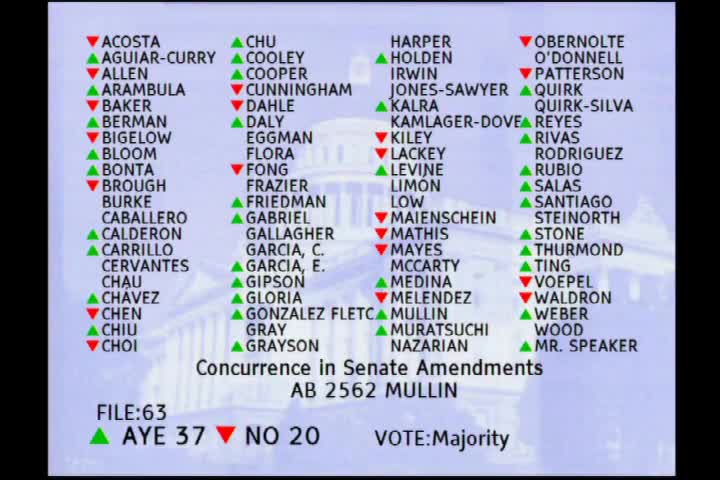


Bill Author


