AB 2841: Sick leave: accrual and use.
- Session Year: 2017-2018
- House: Assembly
- Latest Version Date: 2018-02-16
(1)Under existing law, an employee who works in California for 30 or more days within a year from the commencement of employment is entitled to paid sick days for certain purposes, to be accrued at a rate of no less than one hour for every 30 hours worked, and to be available for use beginning on the 90th day of employment, so that an employee has no less than 24 hours of accrued sick leave or paid time off by the 120th calendar day of employment or each calendar year, or in each 12-month period. Existing law provides that an employer may satisfy the accrual requirements of this section by providing not less than 24 hours or 3 days of paid sick leave that is available to the employee to use by the completion of his or her 120th calendar day of employment. Under existing law an employer has no obligation under these provisions to allow an employees total accrual of paid sick leave to exceed 48 hours or 6 days, provided that an employees rights to accrue and use paid sick leave are not otherwise limited, as specified. Under existing law, an employer is required to permit sick leave to carry over to the following year of employment, but may limit the carryover amount to 24 hours or 3 days.
This bill would change the requirements of the employers alternate sick leave accrual method to require no less than 40 hours of accrued sick leave or paid time off by the 200th calendar day of employment, as specified. The bill would also provide an employer is under no obligation to allow an employees total accrual of paid of sick leave to exceed 80 hours or 10 days, as specified. The bill would raise the limitation on sick leave carried over to the following year of employment to 40 hours or 5 days.
(2)Existing law provides that providers of in-home supportive services accrue sick leave in accordance with a schedule that is based on the timeline for state minimum wage increases, up to a maximum of 24 hours or 3 days when the minimum wage reaches $15 per hour.
This bill would increase the sick leave accrual for in-home supportive services providers to 40 hours or 5 days for employment beginning January 1, 2026.
(a)(1)An employee who, on or after July 1, 2015, works in California for the same employer for 30 or more days within a year from the commencement of employment is entitled to paid sick days as specified in this section.
(2)On and after July 1, 2018, a provider of in-home supportive services under Section 14132.95, 14132.952, or 14132.956 of, or Article 7 (commencing with Section 12300) of Chapter 3 of Part 3 of Division 9 of, the Welfare and Institutions Code, who works in California for 30 or more days within a year from the commencement of employment is entitled to paid sick days as specified in subdivision (e) and subject to the rate of accrual in paragraph (1) of subdivision (b).
(b)(1)An employee shall accrue paid sick days at the rate of not less than one hour per every 30 hours worked, beginning at the commencement of employment or the operative date of this article, whichever is later, subject to the use and accrual limitations set forth in this section.
(2)An employee who is exempt from overtime requirements as an administrative, executive, or professional employee under a wage order of the Industrial Welfare Commission is deemed to work 40 hours per workweek for the purposes of this section, unless the employees normal workweek is less than 40 hours, in which case the employee shall accrue paid sick days based upon that normal workweek.
(3)An employer may use a different accrual method, other than providing one hour per every 30 hours worked, provided that the accrual is on a regular basis so that an employee has no less than 24 40 hours of accrued sick leave or paid time off by the 120th 200th calendar day of employment or each calendar year, or in each 12-month period.
(4)An employer may satisfy the accrual requirements of this section by providing not less than 24 40 hours or three five days of paid sick leave that is available to the employee to use by the completion of his or her 120th 200th calendar day of employment.
(c)An employee shall be entitled to use accrued paid sick days beginning on the 90th day of employment, after which day the employee may use paid sick days as they are accrued.
(d)Accrued paid sick days shall carry over to the following year of employment. However, an employer may limit an employees use of accrued paid sick days to 24 40 hours or three five days in each year of employment, calendar year, or 12-month period. This section shall be satisfied and no accrual or carryover is required if the full amount of leave is received at the beginning of each year of employment, calendar year, or 12-month period. The term full amount of leave means three five days or 24 40 hours.
(e)For a provider of in-home supportive services under Section 14132.95, 14132.952, or 14132.956 of, or Article 7 (commencing with Section 12300) of Chapter 3 of Part 3 of Division 9 of, the Welfare and Institutions Code, the term full amount of leave is defined as follows:
(1)Eight hours or one day in each year of employment, calendar year, or 12-month period beginning July 1, 2018.
(2)Sixteen hours or two days in each year of employment, calendar year, or 12-month period beginning when the minimum wage, as set forth in paragraph (1) of subdivision (b) of Section 1182.12 and accounting for any years postponed under subparagraph (D) of paragraph (3) of subdivision (d) of Section 1182.12, has reached thirteen dollars ($13) per hour.
(3)Twenty-four hours or three days in each year of employment, calendar year, or 12-month period beginning when the minimum wage, as set forth in paragraph (1) of subdivision (b) of Section 1182.12 and accounting for any years postponed under subparagraph (D) of paragraph (3) of subdivision (d) of Section 1182.12, has reached fifteen dollars ($15) per hour.
(4)Forty hours or five days in each year of employment beginning January 1, 2026.
(f)An employer is not required to provide additional paid sick days pursuant to this section if the employer has a paid leave policy or paid time off policy, the employer makes available an amount of leave applicable to employees that may be used for the same purposes and under the same conditions as specified in this section, and the policy satisfies one of the following:
(1)Satisfies the accrual, carryover, and use requirements of this section.
(2)Provided paid sick leave or paid time off to a class of employees before January 1, 2015, pursuant to a sick leave policy or paid time off policy that used an accrual method different than providing one hour per 30 40 hours worked, provided that the accrual is on a regular basis so that an employee, including an employee hired into that class after January 1, 2015, has no less than one day or eight hours of accrued sick leave or paid time off within three months of employment of each calendar year, or each 12-month period, and the employee was eligible to earn at least three five days or 24 40 hours of sick leave or paid time off within nine months of employment. If an employer modifies the accrual method used in the policy it had in place prior to January 1, 2015, the employer shall comply with any accrual method set forth in subdivision (b) or provide the full amount of leave at the beginning of each year of employment, calendar year, or 12-month period. This section does not prohibit the employer from increasing the accrual amount or rate for a class of employees covered by this subdivision.
(3)Notwithstanding any other law, sick leave benefits provided pursuant to the provisions of Sections 19859 to 19868.3, inclusive, of the Government Code, or annual leave benefits provided pursuant to the provisions of Sections 19858.3 to 19858.7, inclusive, of the Government Code, or by provisions of a memorandum of understanding reached pursuant to Section 3517.5 that incorporate or supersede provisions of Section 19859 to 19868.3, inclusive, or Sections 19858.3 to 19858.7, inclusive of the Government Code, meet the requirements of this section.
(g)(1)Except as specified in paragraph (2), an employer is not required to provide compensation to an employee for accrued, unused paid sick days upon termination, resignation, retirement, or other separation from employment.
(2)If an employee separates from an employer and is rehired by the employer within one year from the date of separation, previously accrued and unused paid sick days shall be reinstated. The employee shall be entitled to use those previously accrued and unused paid sick days and to accrue additional paid sick days upon rehiring, subject to the use and accrual limitations set forth in this section. An employer is not required to reinstate accrued paid time off to an employee that was paid out at the time of termination, resignation, or separation of employment.
(h)An employer may lend paid sick days to an employee in advance of accrual, at the employers discretion and with proper documentation.
(i)An employer shall provide an employee with written notice that sets forth the amount of paid sick leave available, or paid time off leave an employer provides in lieu of sick leave, for use on either the employees itemized wage statement described in Section 226 or in a separate writing provided on the designated pay date with the employees payment of wages. If an employer provides unlimited paid sick leave or unlimited paid time off to an employee, the employer may satisfy this section by indicating on the notice or the employees itemized wage statement unlimited. The penalties described in this article for a violation of this subdivision shall be in lieu of the penalties for a violation of Section 226. This subdivision shall apply to employers covered by Wage Order 11 or 12 of the Industrial Welfare Commission only on and after January 21, 2016.
(j)An employer has no obligation under this section to allow an employees total accrual of paid sick leave to exceed 48 80 hours or 6 10 days, provided that an employees rights to accrue and use paid sick leave are not limited other than as allowed under this section.
(k)An employee may determine how much paid sick leave he or she needs to use, provided that an employer may set a reasonable minimum increment, not to exceed two hours, for the use of paid sick leave.
(l)For the purposes of this section, an employer shall calculate paid sick leave using any of the following calculations:
(1)Paid sick time for nonexempt employees shall be calculated in the same manner as the regular rate of pay for the workweek in which the employee uses paid sick time, whether or not the employee actually works overtime in that workweek.
(2)Paid sick time for nonexempt employees shall be calculated by dividing the employees total wages, not including overtime premium pay, by the employees total hours worked in the full pay periods of the prior 90 days of employment.
(3)Paid sick time for exempt employees shall be calculated in the same manner as the employer calculates wages for other forms of paid leave time.
(m)If the need for paid sick leave is foreseeable, the employee shall provide reasonable advance notification. If the need for paid sick leave is unforeseeable, the employee shall provide notice of the need for the leave as soon as practicable.
(n)An employer shall provide payment for sick leave taken by an employee no later than the payday for the next regular payroll period after the sick leave was taken.
(o)The State Department of Social Services, in consultation with stakeholders, shall convene a workgroup to implement paid sick leave for in-home supportive services providers as specified in this section. This workgroup shall finish its implementation work by November 1, 2017, and the State Department of Social Services shall issue guidance such as an all-county letter or similar instructions by December 1, 2017.
(p)Notwithstanding the rulemaking provisions of the Administrative Procedure Act (Chapter 3.5 (commencing with Section 11340) of Part 1 of Division 3 of Title 2 of the Government Code), the State Department of Social Services may implement, interpret, or make specific this section by means of an all-county letter, or similar instructions, without taking any regulatory action.
|
Date
|
Status
|
|---|---|
| May 25, 2018 | In committee: Held under submission. |
| Apr 25, 2018 | In committee: Set, first hearing. Referred to APPR. suspense file. |
| Apr 12, 2018 | From committee: Do pass and re-refer to Com. on APPR. (Ayes 5. Noes 2.) (April 11). Re-referred to Com. on APPR. |
| Mar 8, 2018 | Referred to Com. on L. & E. |
| Feb 17, 2018 | From printer. May be heard in committee March 19. |
| Feb 16, 2018 | Read first time. To print. |
|
Date
|
Description
|
Location
|
Votes
|
|
|---|---|---|---|---|
| Apr 11, 2018 | Do pass and be re-referred to the Committee on [Appropriations] | Assembly Standing Committee on Labor and Employment |
Passed |
This list shows positions taken on this bill by organizations on the date displayed, which is linked to the original source.
Positions by individuals are not included.
|
Organization
|
Position
|
Date
|
|---|---|---|
| AARP | * Support | Apr 11, 2018 |
| ACLU of California | * Support | Apr 11, 2018 |
| African American Farmers of California | ** Against | Apr 9, 2018 |
| American Pistachio Growers | ** Against | Apr 9, 2018 |
| Associated General Contractors | ** Against | Apr 9, 2018 |
| Association Of California School Administrators | ** Against | Apr 9, 2018 |
| BreastfeedLA | ** Support | Apr 9, 2018 |
| California Agriculture Aircraft Association | ** Against | Apr 9, 2018 |
| California Ambulance Association | ** Against | Apr 9, 2018 |
| California Association Of Nurseries And Garden Centers | ** Against | Apr 9, 2018 |
| California Association Of School Business Officials | ** Against | Apr 9, 2018 |
| California Association Of Winegrape Growers | ** Against | Apr 9, 2018 |
| California Beer and Beverage Distributors | ** Against | Apr 9, 2018 |
| California Business Properties Association | ** Against | Apr 9, 2018 |
| California Chamber Of Commerce | * Against | Apr 11, 2018 |
| california cotton ginners and growers association, inc. | ** Against | Apr 9, 2018 |
| California Employment Lawyers Association | ** Support | Apr 9, 2018 |
| California Family Business Association | * Against | Apr 11, 2018 |
| California Farm Bureau Federation | ** Against | Apr 9, 2018 |
| California Fresh Fruit Association | ** Against | Apr 9, 2018 |
| California Grocers Association | ** Against | Apr 9, 2018 |
| California League of Food Producers | * Against | Apr 11, 2018 |
| California Manufacturers And Technology Association | ** Against | Apr 9, 2018 |
| California Medical Association | * Support | Apr 11, 2018 |
| California Nurses Association | * Support | Apr 11, 2018 |
| California Partnership To End Domestic Violence | * Support | Apr 11, 2018 |
| California Professional Association Of Specialty Contractors | ** Against | Apr 9, 2018 |
| California Restaurant Association | * Against | Apr 11, 2018 |
| California Retailers Association | ** Against | Apr 9, 2018 |
| California School Boards Association | ** Against | Apr 9, 2018 |
| California State Association Of Counties | ** Against | Apr 9, 2018 |
| California Tomato Growers Association | ** Against | Apr 9, 2018 |
| California Travel Association | ** Against | Apr 9, 2018 |
| California Trucking Association | ** Against | Apr 9, 2018 |
| California Working Family Coalition | * Support | Apr 11, 2018 |
| Camarillo Chamber of Commerce | ** Against | Apr 9, 2018 |
| Civil Justice Association Of California | ** Against | Apr 9, 2018 |
| Construction Employers' Association | ** Against | Apr 9, 2018 |
| Cwa Political Action | ** Support | Apr 9, 2018 |
| Far West Equipment Dealers Association | ** Against | Apr 9, 2018 |
| Fight for 15 | * Support | Apr 11, 2018 |
| Greater Coachella Valley Chamber of Commerce | ** Against | Apr 9, 2018 |
| Greater Conejo Valley Chamber of Commerce | ** Against | Apr 9, 2018 |
| Koreatown Immigrant Workers Alliance | ** Support | Apr 9, 2018 |
| League Of California Cities | ** Against | Apr 9, 2018 |
| Legal Aid At Work | * Support | Apr 11, 2018 |
| Mi Familia Vota | ** Support | Apr 9, 2018 |
| National Association of Social Workers | * Support | Apr 11, 2018 |
| National Federation Of Independent Business | ** Against | Apr 9, 2018 |
| National Hispanic Council On Aging | ** Support | Apr 9, 2018 |
| Nisei Farmers League | ** Against | Apr 9, 2018 |
| Office of Fiona Ma | * Support | Apr 11, 2018 |
| Official Police Garages of Los Angeles | ** Against | Apr 9, 2018 |
| Orange County Business Council | ** Against | Apr 9, 2018 |
| Organization United For Respect - Our Walmart | ** Support | Apr 9, 2018 |
| Oxnard Chamber of Commerce | ** Against | Apr 9, 2018 |
| Rancho Cordova Chamber of Commerce | ** Against | Apr 9, 2018 |
| Restaurants Opportunities Centers Of California United | ** Support | Apr 9, 2018 |
| rise together | ** Support | Apr 9, 2018 |
| Santa Clara County Wage Theft Coalition | * Support | Apr 11, 2018 |
| Santa Maria Valley Chamber of Commerce | ** Against | Apr 9, 2018 |
| SEIU California | * Support | Apr 11, 2018 |
| Simi Valley Chamber of Commerce | ** Against | Apr 9, 2018 |
| Southwest California Legislative Council | ** Against | Apr 9, 2018 |
| Teamsters | * Support | Apr 11, 2018 |
| The Western Center on Law and Poverty | * Support | Apr 11, 2018 |
| UDW AFSCME | * Support | Apr 11, 2018 |
| Unite Here | * Support | Apr 11, 2018 |
| United Food And Commercial Workers Western States Council | * Support | Apr 11, 2018 |
| Western Agricultural Processors | ** Against | Apr 9, 2018 |
| Western Growers Association | * Against | Apr 11, 2018 |
| Wine Institute | ** Against | Apr 9, 2018 |
| YWCA San Francisco & Marin | ** Support | Apr 9, 2018 |
Date of Hearing: April 25, 2018
ASSEMBLY COMMITTEE ON APPROPRIATIONS
Lorena Gonzalez Fletcher, Chair
ABPCA Bill Id:AB 2841
Author:(Gonzalez Fletcher) – As Introduced Ver:February 16, 2018
Policy Committee: | Labor and Employment | Vote: | 5 - 2 |
|
| ||
|
|
Urgency: No State Mandated Local Program: No Reimbursable: No
SUMMARY:
This bill increases the minimum amount of sick leave an employee is entitled to accrue to 40 hours by the 200th calendar day of employment, and allows an employer to limit an employee’s use of this leave to 40 hours, or five days, in each year of employment. This bill also increases the sick leave accrual for in-home supportive services (IHSS) providers to 40 hours, or five days, beginning January 1, 2026.
FISCAL EFFECT:
- One-time special fund costs of $450,000 and ongoing special fund costs of $400,000 for the Department of Industrial Relations (DIR) to investigate and enforce additional wage and retaliation claims.
- Annual General Fund costs in excess of $60 million beginning in 2026 to expand sick leave to more than 450,000 IHSS providers in California.
COMMENTS:
Background and purpose. AB 1522 (Gonzalez fletcher), Chapter 317, Statutes of 2014, established a requirement for employers to provide a minimum of three days of sick leave to their employees. Under current law, sick leave must accrue at a rate of no less than 1 hour for every 30 hours worked so that an employee has no less than 24 hours of accrued leave by the 120th calendar day of employment.
According to the author, AB 2841 will ensure that California keeps pace with the growing movement of providing employees adequate paid sick time. The author points to ordinances adopted by California cities or other state laws that provide more robust benefits than those guaranteed under state law. As of this year, Maryland, Washington, Arizona, Massachusetts, Oregon and Connecticut allow workers to accrue five paid sick days.
Analysis Prepared by: Luke Reidenbach / APPR. / (916) 319-2081
Date of Hearing: April 11, 2018
ASSEMBLY COMMITTEE ON LABOR AND EMPLOYMENT
Tony Thurmond, Chair
ABPCA Bill Id:AB 2841 (
Author:Gonzalez Fletcher) – As Introduced Ver:February 16, 2018
SUBJECT: Sick leave: accrual and use
SUMMARY: Increases the minimum amount of sick leave that an employee may and increases how much sick leave can be carried over to the next year. Specifically, this bill:
- Changes the requirements of the employer’s alternate sick leave accrual method to require no less than 40 hours of accrued sick leave or paid time off by the 200th calendar day of employment, as specified.
- Provides an employer is under no obligation to allow an employee’s total accrual of paid of sick leave to exceed 80 hours or ten days, as specified.
- Raise the limitation on sick leave carried over to the following year of employment to 40 hours or five days.
- Increases the sick leave accrual for in-home supportive services providers to 40 hours or five days for employment beginning January 1, 2026.
EXISTING LAW:
- Ensures an employee who works in California for 30 or more days within a year from the commencement of employment is entitled to paid sick days for certain purposes.
- Mandates sick leave to be accrued at a rate of no less than one hour for every 30 hours worked, and to be available for use beginning on the 90th day of employment, so that an employee has no less than 24 hours of accrued sick leave or paid time off by the 120th calendar day of employment or each calendar year, or in each 12-month period.
- Provides that an employer may satisfy these accrual requirements by providing not less than 24 hours of paid sick leave that is available to the employee to use by the completion of his or her 120th calendar day of employment.
- Ensures that an employer has no obligation under these provisions to allow an employee’s total accrual of paid sick leave to exceed 48 hours, provided that an employee’s rights to accrue and use paid sick leave are not otherwise limited, as specified.
- Permits sick leave to carry over to the following year of employment, but allows the employer to limit the carryover amount to 24 hours or three days.
FISCAL EFFECT: Unknown
COMMENTS: According to the author, “The bill will ensure California keeps pace with the growing movement of providing all employees with the ability to take care of themselves or a family member without risking economic or job security. Cities across California, such as San Francisco, Oakland, Emeryville, Santa Monica, San Diego, Los Angeles, and Berkeley, have passed ordinances granting workers more expansive paid sick leave than what currently exists under state law. As of this year, Maryland and Washington have also allowed workers to accrue five paid sick days – joining Arizona, Massachusetts, Oregon, and Connecticut.”
Arguments in Support
Legal Aid at Work and others wrote in support that, “Every California employee will get sick or need to care for a sick family member at some point. The Centers for Disease Control and Prevention reported that people who fell ill with the severe flu this year needed at least one week to recover. Although state law provides for a minimum of 3 paid sick days per year, many people and families will need more time than that to recover from illness.”
Fiona Ma, Vice Chair of the Board of Equalization, writes in support, “Parents without sufficient paid sick leave are twice as likely to send a sick child to school, leading to high likelihood of delayed education development and poor health. Parents are also five times more likely to have to take their child to the emergency room because of their inability to take sufficient time off during the work day, which can create extra financial burdens associated with delayed health services.”
The Restaurant Opportunities Centers of CA writes in support of the bill, “Our 2010 national study, “Serving While Sick” is the largest study every conducted on health conditions of restaurant workers. This study found that over 87% of restaurant workers reported not having paid sick days, and thus, 63% of workers reported preparing, cooking and serving while sick. Paid sick days are essential to ensure that both workers and those they serve are safe from avoidable harmful risks to their health.”
Arguments in Opposition
The Chamber of Commerce and others write, “Increasing the number of paid sick days from 3 to 5 might not seem like a huge burden, unless you are a California employer. Employer costs in California continue to be on the rise as the minimum wage increases, we have the highest income tax rates in the nation, and among the highest energy and workers’ compensation costs. Additionally, the minimum wage continues to increase $1.00 each year until January 2022. This $1.00 increase is in addition to the other cumulative costs employers are already facing such as increased real estate costs and state tax increases.”
The Chamber and others continue, “Given the cumulative costs and existing protected leaves of absence California employers are already struggling with, California should refrain from mandating additional sick days and instead should incentivize employers to offer more expansive sick day benefits by reducing costs in other areas. One area in which California can reduce costs on employers so that they have the capacity to offer paid sick leave is daily overtime. California is one of only three states that mandate both daily and weekly overtime, creating a huge cost to employers. If this cost were reduced by conforming to federal law and only mandating weekly overtime, employers would more likely have the ability to offer paid sick leave as well as provide a more flexible schedule for working families.”
Paid Sick Leave and Economic Security
A 2017 report form the Economic Policy Institute titled “Work Sick or Lose Pay?” finds, among other things, the following:
“Lack of paid sick days is a real problem, particularly for low-wage workers, and it shows up in the large paid sick days gap between high- and low-wage workers. While approximately 64 percent of private-sector American workers currently have access to paid sick days, this topline number masks the fact that higher-wage workers have much greater access to paid sick days than lower-wage workers do: for example, 87 percent of private-sector workers in the top 10 percent of wages have the ability to earn paid sick days, compared with only 27 percent of private-sector workers in the bottom 10 percent.
Lack of paid sick days deprives workers of funds needed for basic necessities. Without the ability to earn paid sick days, workers must choose between going to work sick (or sending a child to school sick) and losing much-needed pay. For the average worker who does not have access to paid sick days, the costs of taking unpaid sick time can make a painful dent in the monthly budget for the worker’s household:
If the worker needs to take off even a half day due to illness, the lost wages are equivalent to the household’s monthly spending for fruits and vegetables; lost wages from taking off nearly three days equal their entire grocery budget for the month.
Two days of unpaid sick time are roughly the equivalent of a month’s worth of gas, making it difficult to get to work.
Three days of unpaid sick time translate into a household’s monthly utilities budget, preventing the worker from paying for electricity and heat.
In the event of a lengthier illness—say, seven and a half days of unpaid sick time—the worker would lose income equivalent to a monthly rent or mortgage payment.”
Paid Leave in Other States
Eight other states and Washington, D.C. currently require employers to provide paid sick leave. Six of those states (Arizona, Connecticut, Maryland, Massachusetts, Oregon and Washington) allow employees to accrue a minimum of 40 hours of sick leave, as proposed by this legislation.
According to the National Conference of State Legislatures, “Connecticut was the first state to require private sector employers to provide paid sick leave to their employees, with a law enacted in 2011. California became the second state to enact paid sick requirements, with the passage of the Healthy Workplace, Healthy Families Act of 2014. Massachusetts was the third state to require paid sick leave, as voters there approved the Earned Sick Time for Employees ballot measure during the 2014 general election. The Oregon Legislature enacted a law during the 2015 session, and the Vermont Legislature did so during the 2016 session. During the 2016 general election, voters in Arizona and Washington approved ballot measures requiring employers to provide paid sick leave. The Rhode Island Legislature was the only state to pass a paid sick leave law in 2017, which will take effect in 2018. The Maryland Legislature overrode a gubernatorial veto of paid sick leave legislation in January 2018; the law took effect the next month.”
Prior Legislation
SB 3 (Leno), Chapter 4, Statutes of 2016. Increased the state minimum wage, ultimately to $15 per hour, indexes the minimum wage thereafter, and provides for paid sick days to providers of in-home supportive services.
AB 1522 (Gonzalez), Chapter 317, Statutes of 2014. Established a requirement for employers to provide a minimum of three days of sick leave to their employees.
AB 400 (Ma), 2011. Would have allowed an employee who works for a small business (10 or fewer employees) to accrue a minimum of up to of five days of sick leave and all other employees to accrue a minimum of up to of nine days of sick leave. Held under submission in the Assembly Appropriations Committee.
AB 109 (Knox), Chapter 164, Statutes of 1999. Required employers who provides sick leave for employees to permit an employee to use a specified portion of the employee's accrued sick leave to attend to the illness of a child, parent, or spouse of the employee.
REGISTERED SUPPORT / OPPOSITION:
Support
AARP California
ACLU California Center for Advocacy and Policy
BreastfeedLA
California Employment Lawyers Association
California Partnership to End Domestic Violence
CWA Political Action
Fiona Ma, State Board of Equalization Member
Koreatown Immigrant Workers Alliance
Legal Aid at Work
Mi Familia Vota
National Hispanic Council on Aging
Organization United for Respect - OUR Walmart
Restaurants Opportunities Centers of California United
Rise Together
YWCA San Francisco & Marin
Opposition
African American Farmers of California
American Pistachio Growers
Associated Builders and Contractors, Inc. – Northern California Chapter
Associated General Contractors
Association of California School Administrators
California Agriculture Aircraft Association
California Ambulance Association
California Association of Nurseries and Garden Centers
California Association of School Business Officials
California Association of Winegrape Growers
California Beer and Beverage Distributors
California Business Properties Association
California Chamber of Commerce
California Cotton Ginners and Growers Association, Inc.
California Farm Bureau Federation
California Fresh Fruit Association
California Grocers Association
California League of Food Producers
California Manufacturers and Technology Association
California Professional Association of Specialty Contractors
California Restaurant Association
California Retailers Association
California School Boards Association
California State Association of Counties
California Tomato Growers Association
California Travel Association
California Trucking Association
Camarillo Chamber of Commerce
Civil Justice Association of California
Construction Employers’ Association
Family Business Association of California
Far West Equipment Dealers Association
Greater Coachella Valley Chamber of Commerce
Greater Conejo Valley Chamber of Commerce
League of California Cities
National Federation of Independent Business
Nisei Farmers League
Official Police Garages of Los Angeles
Orange County Business Council
Oxnard Chamber of Commerce
Rancho Cordova Chamber of Commerce
Santa Maria Valley Chamber of Commerce
Simi Valley Chamber of Commerce
Southwest California Legislative Council
Western Agricultural Processors
Western Growers Association
Wine Institute
Analysis Prepared by: Jennifer Richard / L. & E. /
Discussed in Hearing
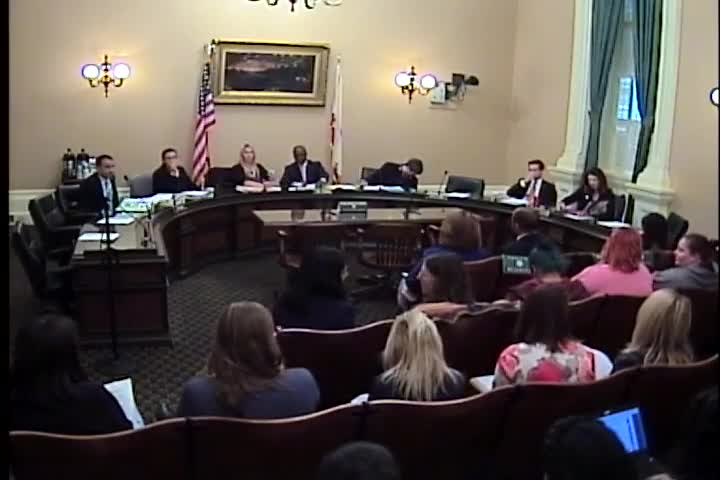 14MIN
Assembly Standing Committee on Labor and Employment
Bill Author

Bill Co-Author(s):