AB 2856: California Environmental Quality Act: housing development projects.
- Session Year: 2017-2018
- House: Assembly
- Latest Version Date: 2018-02-16
The California Environmental Quality Act (CEQA) requires a lead agency, as defined, to prepare, or cause to be prepared, and certify the completion of, an environmental impact report on a project that it proposes to carry out or approve that may have a significant effect on the environment or to adopt a negative declaration if it finds that the project will not have that effect. CEQA also requires a lead agency to prepare a mitigated negative declaration for a project that may have a significant effect on the environment if revisions in the project would avoid or mitigate that effect and there is no substantial evidence that the project, as revised, would have a significant effect on the environment. CEQA establishes a procedure by which a person may seek judicial review of the decision of the lead agency made pursuant to CEQA.
This bill would, except as provided, prohibit the court, in an action or proceeding brought alleging a violation of CEQA, from staying or enjoining the siting, construction, or operation of housing development projects, as defined.
(a)For purposes of this section, housing development project or project means any activity related to the construction of new houses or dwelling units for the primary purpose of providing decent, safe, and sanitary housing for persons and families of all income levels.
(b)(1)Notwithstanding any other law, in granting relief in an action or proceeding brought pursuant to this division challenging a housing development project, the court shall not stay or enjoin the siting, construction, or operation of the project unless the court finds either of the following:
(A)The continued construction or operation of the housing development project presents an imminent threat to public health and safety.
(B)The housing development project site contains unforeseen important Native American artifacts or unforeseen important historical or archaeological values that would be materially, permanently, and adversely affected by the continued construction or operation of the project unless the courts stays or enjoins the construction or operation of the project.
(2)If the court finds that subparagraph (A) or (B) of paragraph (1) is satisfied, the court shall only enjoin those specific activities associated with the housing development project that present an imminent threat to public health and safety or that materially, permanently, and adversely affect unforeseen important Native American artifacts or unforeseen important historical or archaeological values.
|
Date
|
Status
|
|---|---|
| Apr 9, 2018 | In committee: Set, first hearing. Failed passage. Reconsideration granted. |
| Mar 8, 2018 | Referred to Coms. on NAT. RES. and H. & C.D. |
| Feb 17, 2018 | From printer. May be heard in committee March 19. |
| Feb 16, 2018 | Read first time. To print. |
|
Date
|
Description
|
Location
|
Votes
|
|
|---|---|---|---|---|
| Apr 9, 2018 | Do pass and be re-referred to the Committee on [Housing and Community Development] | Assembly Standing Committee on Natural Resources |
Passed |
This list shows positions taken on this bill by organizations on the date displayed, which is linked to the original source.
Positions by individuals are not included.
|
Organization
|
Position
|
Date
|
|---|---|---|
| Associated Builders And Contractors Of Northern California | ** Support | Apr 6, 2018 |
| California Apartment Association | * Support | Apr 9, 2018 |
| California Association Of Realtors | * Support | Apr 9, 2018 |
| California Building Industry Association | * Support | Apr 9, 2018 |
| California Chamber Of Commerce | * Support | Apr 9, 2018 |
| California community builders | ** Support | Apr 6, 2018 |
| California League Of Conservation Voters | ** Against | Apr 6, 2018 |
| Judicial Council of California | ** Against | Apr 6, 2018 |
| Planning And Conservation League | * Against | Apr 9, 2018 |
| Sierra Club California | * Against | Apr 9, 2018 |
| Southwest California Legislative Council | ** Support | Apr 6, 2018 |
Date of Hearing: April 9, 2018
ASSEMBLY COMMITTEE ON NATURAL RESOURCES
Al Muratsuchi, Acting Chair
ABPCA Bill Id:AB 2856 (
Author:Melendez) – As Introduced Ver:February 16, 2018
SUBJECT: California Environmental Quality Act: housing development projects
SUMMARY: Generally prohibits a court, in granting relief in an action or proceeding challenging any activity related to the construction of new housing under the California Environmental Quality Act (CEQA), from staying or enjoining the siting, construction or operation of the project.
EXISTING LAW:
- CEQA requires lead agencies with the principal responsibility for carrying out or approving a proposed project to prepare a negative declaration, mitigated negative declaration, or environmental impact report (EIR) for this action, unless the project is exempt from CEQA (CEQA includes various statutory exemptions, as well as categorical exemptions in the CEQA guidelines).
- Exempts from CEQA any residential development project, including any subdivision, or any zoning change that is undertaken to implement, and is consistent with, a specific plan for which an EIR has been certified after January 1, 1980, unless substantial changes or new information require the preparation of a supplemental EIR for the specific plan, in which case the exemption applies once the supplemental EIR is certified.
- Exempts from CEQA specified residential housing projects which meet detailed criteria established to ensure the project does not have a significant effect on the environment, including urban affordable housing projects not more than 100 units on a site not more than 5 acres in size, and urban infill housing projects not more than 100 units on a site not more than 4 acres in size, which is within one-half mile of a major transit stop. [SB 1925 (Sher), Chapter 1039, Statutes of 2002]
- Requires metropolitan planning organizations (MPOs) to include a sustainable communities strategy (SCS), as defined, in their regional transportation plans, or an alternative planning strategy (APS), for the purpose of reducing greenhouse gas (GHG) emissions, aligns planning for transportation and housing, and creates specified incentives for the implementation of the strategies, including CEQA exemption or abbreviated review for residential or mixed-use residential "transit priority projects" if the project is consistent with the use designation, density, building intensity, and applicable policies specified for the project area in either an approved SCS or APS. [SB 375 (Steinberg), Chapter 728, Statutes of 2008]
- Establishes abbreviated CEQA review procedures for specified infill projects, where only specific or more significant effects on the environment which were not addressed in a prior planning-level EIR need be addressed. An EIR for such a project need not consider alternative locations, densities, and building intensities or growth-inducing impacts. Infill projects may include residential, retail, commercial, transit station, school, or public office building projects located within an urban area. [SB 226 (Simitian), Chapter 469, Statutes of 2011]
- Exempts from CEQA residential, mixed-use, and "employment center" projects, as defined, located within "transit priority areas," as defined, if the project is consistent with an adopted specific plan and specified elements of an SCS or APS adopted pursuant to SB 375. [SB 743 (Steinberg), Chapter 386, Statutes of 2013]
- The CEQA Guidelines include a categorical exemption for infill development projects (Section 15332), as follows:
- The project is consistent with the applicable general plan designation and all applicable general plan policies as well as with applicable zoning designation and regulations;
- The proposed development occurs within city limits on a project site of no more than five acres substantially surrounded by urban uses;
- The project site has no value as habitat for endangered, rare, or threatened species;
- Approval of the project would not result in any significant effects relating to traffic, noise, air quality, or water quality; and,
- The site can be adequately served by all required utilities and public services.
- Authorizes judicial review of CEQA actions taken by public agencies, following the agency's decision to carry out or approve the project. Challenges alleging improper determination that a project may have a significant effect on the environment, or alleging an EIR doesn't comply with CEQA, must be filed in the Superior Court within 30 days of filing of the notice of approval. The courts are required to give CEQA actions preference over all other civil actions.
- Upon finding a public agency's actions are not in compliance with CEQA, requires a court to order one or more of the following:
- A mandate that the determination, finding, or decision be voided by the public agency, in whole or in part;
- If the court finds that a specific project activity or activities will prejudice the consideration or implementation of particular mitigation measures or alternatives to the project, a mandate that the public agency and any real parties in interest suspend any or all specific project activity or activities, pursuant to the determination, finding, or decision, that could result in an adverse change or alteration to the physical environment, until the public agency has taken any actions that may be necessary to bring the determination, finding, or decision into compliance with this division; and
- A mandate that the public agency take specific action as may be necessary to bring the determination, finding, or decision into compliance with CEQA.
Any order shall include only those mandates which are necessary to achieve compliance with CEQA and only those specific project activities in noncompliance with CEQA.
- Imposes specific limits on injunctive relief under CEQA for three specified projects: Los Angeles football stadium/convention center, Sacramento downtown arena, and Capitol Building annex project.
THIS BILL:
- Defines a "housing development project" as any activity related to the construction of new houses or dwelling units for the primary purpose of providing decent, safe and sanitary housing for persons and families of all income levels.
- Limits remedies available to a court in a CEQA lawsuit challenging a housing development project by generally prohibiting a court, in granting relief, from staying or enjoining the siting, construction or operation of the project and provides that a court may only enjoin those specific activities associated with the project that present an imminent threat to public health and safety or that materially, permanently, and adversely affect unforeseen important Native American artifacts or unforeseen important historical or archaeological values (in effect limiting the equitable powers of the court and prohibiting existing remedies under CEQA such as voiding the lead agency's decision or suspending project activities).
FISCAL EFFECT: Non-fiscal
COMMENTS:
- Background. CEQA provides a process for evaluating the environmental effects of applicable projects undertaken or approved by public agencies. If a project is not exempt from CEQA, an initial study is prepared to determine whether the project may have a significant effect on the environment. If the initial study shows that there would not be a significant effect on the environment, the lead agency must prepare a negative declaration. If the initial study shows that the project may have a significant effect on the environment, the lead agency must prepare an EIR.
Generally, an EIR must accurately describe the proposed project, identify and analyze each significant environmental impact expected to result from the proposed project, identify mitigation measures to reduce those impacts to the extent feasible, and evaluate a range of reasonable alternatives to the proposed project. If mitigation measures are required or incorporated into a project, the agency must adopt a reporting or monitoring program to ensure compliance with those measures.
CEQA includes various statutory exemptions, as well as categorical exemptions in the CEQA Guidelines. SB 1925 (2002) established CEQA exemptions for certain residential projects providing affordable urban or agricultural housing, or located on an infill site within an urbanized area, and meeting specified unit and acreage criteria. The stated intent of the Legislature in enacting those provisions included “creating a streamlined procedure for agricultural employee housing, affordable housing, and urban infill housing projects that do not have an adverse effect on the environment.” For purposes of qualifying for the CEQA exemption for affordable housing, among other criteria, projects must be located within an urbanized area, not more than 5 acres in area and fewer than 100 units.
Since SB 1925, additional legislation has provided CEQA exemptions and streamlining for residential (not specific to, but including, affordable housing) and certain other projects in infill areas. SB 375 (2008) provided a CEQA exemption for a narrow set of eligible residential projects in infill areas adjacent to transit. SB 226 (2011) provided abbreviated CEQA review procedures for a broader set of urban infill projects, including retail, commercial, and public buildings. SB 743 (2013) established a new exemption for residential, mixed-use and "employment center" projects located within one-half mile of a major transit stop, if the project is consistent with an adopted specific plan and specified elements of an SB 375 strategy. SB 743 also required the Office of Planning and Research (OPR) to propose revisions to the CEQA Guidelines for transportation impacts to better support infill development.
In 2017, the Legislature passed three bills to streamline the CEQA process for affordable housing projects. SB 35 (Wiener) establishes a ministerial approval process (i.e., not subject to CEQA) for certain multifamily affordable housing projects that are proposed in local jurisdictions that have not met regional housing needs. SB 540 (Roth) authorizes a city or county to establish a Workforce Housing Opportunity Zone (WHOZ) by preparing an EIR and by adopting a specific plan. Once a WHOZ is established, and for five years thereafter, requires approval of eligible housing developments within a WHOZ within 60 days without requiring the preparation of an EIR or negative declaration under CEQA. AB 73 (Chiu) authorizes a city or county to create a "housing sustainability district" (HSD) to complete upfront zoning and environmental review in order to receive incentive payments for residential and mixed-use development projects with an affordable housing component. Requires the city or county to prepare an EIR when designating an HSD, then "housing projects" within, and consistent with, a designated HSD are exempt from CEQA.
- CEQA judicial review. CEQA is enforced through judicial review. CEQA actions taken by public agencies can be challenged in Superior Court once the agency approves or determines to carry out the project. CEQA appeals are subject to unusually short statutes of limitations. Under current law, court challenges of CEQA decisions generally must be filed within 30 to 35 days, depending on the type of decision. The courts are required to give CEQA actions preference over all other civil actions. The petitioner must request a hearing within 90 days of filing the petition and, generally, briefing must be completed within 90 days of the request for hearing. There is no deadline specified for the court to render a decision.
Since 2011, the Legislature has established expedited CEQA judicial review procedures for a limited number of projects, including limiting injunctive relief for three projects: Los Angeles football stadium/convention center, Sacramento downtown arena, and Capitol Building annex project.
The bills limiting injunctive relief for the Los Angeles stadium and Sacramento arena projects included provisions requiring the projects to minimize traffic and air quality impacts through project design or mitigation measures, including reducing to at least zero the net GHG emissions from private automobile trips.
- Prior legislation. The following bills included provisions limiting injunctive relief nearly identical to the provisions in this bill:
- SB 292 (Padilla), Chapter 353, Statutes of 2011, applied to the Los Angeles football stadium/convention center project, which has not proceeded;
- SB 743 (Steinberg), Chapter 386, Statutes of 2013, applied to the Sacramento downtown arena project, now known as Golden1 Center;
- SB 836 (Committee on Budget and Fiscal Review), Chapter 31, Statutes of 2016, applied to the Capitol Annex project;
- AB 1586 (Mathis), which applied to the Temperance Flat Reservoir, failed in this committee by a vote of 1-6 on April 4, 2016;
- AB 311 (Gallagher), which applied to water storage projects funded by the Water Quality, Supply, and Infrastructure Improvement Act of 2014 (Proposition 1), failed in this committee by a vote of 3-6 on April 27, 2015; and
- AB 641 (Mayes), which applied broadly to housing developments, failed in this committee by a vote of 2-7 on April 27, 2015.
- AB 30 (Cabellero), which applied to strip mall housing conversion projects, was held in this committee without a vote after a hearing on May 8, 2017.
- Related legislation. AB 2279 (Fong), pending in this committee, establishes similar prohibitions on injunctive relief in CEQA lawsuits to a housing project for which an EIR has been certified.
- Double referral. This bill has been double referred to the Housing and Community Development Committee.
REGISTERED SUPPORT / OPPOSITION:
Support
Associated Builders and Contractors of Northern California
California Apartment Association
California Association of Realtors
California Chamber of Commerce
California Community Builders
Southwest California Legislative Council
Opposition
California League of Conservation Voters
Judicial Council of California
Planning and Conservation League
Sierra Club California
Analysis Prepared by: Lawrence Lingbloom / NAT. RES. /
Discussed in Hearing
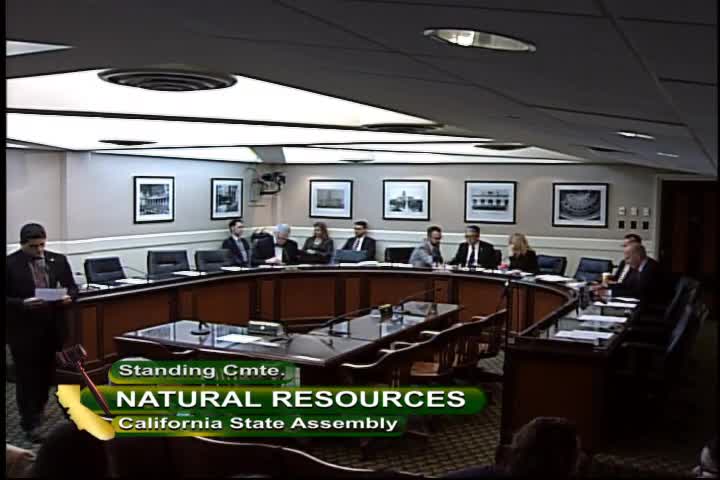 18MIN
Assembly Standing Committee on Natural Resources
Bill Author

Bill Co-Author(s):