AB 2874: Health facilities: notice: Attorney General.
- Session Year: 2017-2018
- House: Assembly
- Latest Version Date: 2018-04-18
(1)Existing law requires the State Department of Public Health to inspect and license health facilities, as specified. Existing law requires a hospital that provides emergency medical services to, as soon as possible, but not later than 90 days prior to a planned reduction or elimination of the level of emergency medical services, provide notice of the intended change to the department, other specified entities, and the public. Existing law requires a health facility implementing a downgrade or change to make reasonable efforts to ensure that the community it serves is informed of the downgrade or closure. Existing law also requires a health facility to provide public notice, as specified, not less than 30 days prior to closing the facility, eliminating a supplemental service, as defined, or relocating the provision of supplemental services to a different campus.
This bill would require a hospital that provides emergency medical services or a health facility to provide notice, as specified, at least 180 days before making the changes described above. The bill would also require a hospital that provides emergency medical services to additionally provide notice to the Attorney General before a planned reduction or elimination of the level of emergency medical services.
(2)Existing law requires any nonprofit corporation, as defined, that operates or controls a health facility or operates or controls a facility that provides similar health care, to provide written notice to, and obtain the written consent of, the Attorney General prior to agreeing to sell or otherwise dispose of a material amount of its assets to another nonprofit corporation or entity. Existing law authorizes the Attorney General to consider, before consenting to an agreement to sell or dispose of assets to these corporations or entities, whether the terms and conditions of the agreement or transaction are fair and reasonable to the nonprofit corporation, and whether the agreement or transaction is at a fair market value, as specified. Existing law requires the Attorney General to conduct one or more public meetings to hear comments from interested parties, as specified, and to notify the nonprofit corporation in writing of the decision to consent to, give conditional consent to, or not consent to the agreement or transaction within 90 days of the receipt of the written notice, as specified.
This bill would require a health facility, as defined, to provide written notice to the Attorney General pursuant to the notice and consent requirements described above not less than 180 days prior to closing the facility or eliminating a supplemental service, as defined. The bill would prohibit a health facility from closing the facility or eliminating a supplemental service prior to obtaining the written consent of the Attorney General, as specified. General. The bill would require the Attorney General to conduct one or more public meetings to hear comments from interested parties, as specified, and to notify the facility in writing of the decision to consent to, give conditional consent to, or not consent to the closure or elimination of service within 90 days of the receipt of the written notice, as specified.
(3)Under existing law, violation of the provisions relating to health facility licensure is a misdemeanor.
By changing the definition of a crime, this bill would impose a state-mandated local program.
The California Constitution requires the state to reimburse local agencies and school districts for certain costs mandated by the state. Statutory provisions establish procedures for making that reimbursement.
This bill would provide that no reimbursement is required by this act for a specified reason.
(1)Existing law requires the State Department of Public Health to inspect and license health facilities, as specified. Existing law requires a hospital that provides emergency medical services to, as soon as possible, but not later than 90 days prior to a planned reduction or elimination of the level of emergency medical services, provide notice of the intended change to the department, other specified entities, and the public. Existing law requires a health facility implementing a downgrade or change to make reasonable efforts to ensure that the community it serves is informed of the downgrade or closure. Existing law also requires a health facility to provide public notice, as specified, not less than 30 days prior to closing the facility, eliminating a supplemental service, as defined, or relocating the provision of supplemental services to a different campus.
This bill would require a hospital that provides emergency medical services or a health facility to provide notice, as specified, at least 180 days before making the changes described above. The bill would also require a hospital that provides emergency medical services to additionally provide notice to the Attorney General before a planned reduction or elimination of the level of emergency medical services.
(2)Existing law requires any nonprofit corporation, as defined, that operates or controls a health facility or operates or controls a facility that provides similar health care, to provide written notice to, and obtain the written consent of, the Attorney General prior to agreeing to sell or otherwise dispose of a material amount of its assets to another nonprofit corporation or entity. Existing law authorizes the Attorney General to consider, before consenting to an agreement to sell or dispose of assets to these corporations or entities, whether the terms and conditions of the agreement or transaction are fair and reasonable to the nonprofit corporation, and whether the agreement or transaction is at a fair market value, as specified.
This bill would require a health facility, as defined, to provide written notice to the Attorney General pursuant to the notice and consent requirements described above not less than 180 days prior to closing the facility or eliminating a supplemental service, as defined. The bill would prohibit a health facility from closing the facility or eliminating a supplemental service prior to obtaining the written consent of the Attorney General, as specified.
(3)Under existing law, violation of the provisions relating to health facility licensure is a misdemeanor.
By changing the definition of a crime, this bill would impose a state-mandated local program.
The California Constitution requires the state to reimburse local agencies and school districts for certain costs mandated by the state. Statutory provisions establish procedures for making that reimbursement.
This bill would provide that no reimbursement is required by this act for a specified reason.
Existing law requires the State Department of Public Health to license and regulate specified health facilities, including a general acute care hospital, an acute psychiatric hospital, a skilled nursing facility, and other types of specialized facilities.This bill would make technical, nonsubstantive changes to that provision.Existing law requires the State Department of Public Health to license and regulate specified health facilities, including a general acute care hospital, an acute psychiatric hospital, a skilled nursing facility, and other types of specialized facilities.
This bill would make technical, nonsubstantive changes to that provision.
(a) Any hospital that provides emergency medical services under Section 1255 shall, as soon as possible, but not later than 180 days prior to a planned reduction or elimination of the level of emergency medical services, provide notice of the intended change to the state department, the Attorney General, the local government entity in charge of the provision of health services, and all health care service plans or other entities under contract with the hospital to provide services to enrollees of the plan or other entity.
(b) In addition to the notice required by subdivision (a), the hospital shall provide, at the same time as the notice specified in subdivision (a), public notice of the intended change in a manner that is likely to reach a significant number of residents of the community serviced by that facility.
(c) A hospital shall not be subject to this section or Section 1255.2 if the state department does either of the following:
(1) Determines that the use of resources to keep the emergency center open substantially threatens the stability of the hospital as a whole.
(2) Cites the emergency center for unsafe staffing practices.
SEC. 2.Section 1255.2 of the Health and Safety Code is amended to read:1255.2.A health facility implementing a downgrade or change downgrade, change, or closure shall make reasonable efforts to ensure that the community served by its facility is informed of the downgrade or closure downgrade, change, or closure at least 180 days prior to the downgrade, change, or closure. Reasonable efforts may include, but not be limited to, advertising the change in terms likely to be understood by a layperson, soliciting media coverage regarding the change, informing patients of the facility of the impending change, and notifying contracting health care service plans as required in Section 1255.1.
SEC. 3.Section 1255.25 of the Health and Safety Code is amended to read:1255.25.(a)(1)Not less than 180 days prior to closing a health facility, as defined in subdivision (a) or (b) of Section 1250, or eliminating a supplemental service, as defined in Section 70067 of Chapter 1 of Division 5 of Title 22 of the California Code of Regulations, the facility shall provide public notice of the proposed closure or elimination of the supplemental service, including a notice posted at the entrance to all affected facilities and a notice to the department and the board of supervisors of the county in which the health facility is located.
(2)Not less than 180 days prior to relocating the provision of supplemental services to a different campus, a health facility, as defined in subdivision (a) or (b) of Section 1250, shall provide public notice of the proposed relocation of supplemental services, including a notice posted at the entrance to all affected facilities and notice to the department and the board of supervisors of the county in which the health facility is located.
(b)The notice required by paragraph (1) or (2) of subdivision (a) shall include all of the following:
(1)A description of the proposed closure, elimination, or relocation. The description shall be limited to publicly available data, including the number of beds eliminated, if any, the probable decrease in the number of personnel, and a summary of any service that is being eliminated, if applicable.
(2)A description of the three nearest available comparable services in the community. If the health facility closing these services serves Medi-Cal or Medicare patients, this health facility shall specify if the providers of the nearest available comparable services serve these patients.
(3)A telephone number and address for each of the following, where interested parties may offer comments:
(A)The health facility.
(B)The parent entity, if any, or contracted company, if any, that acts as the corporate administrator of the health facility.
(C)The chief executive officer.
(c)Notwithstanding subdivisions (a) and (b), this section shall not apply to county facilities subject to Section 1442.5.
SEC. 4.Section 1255.26 is added to the Health and Safety Code, to read:1255.26.(a)(1)Not less than 180 days prior to closing a health facility, as defined in subdivision (a) or (b) of Section 1250, or eliminating a supplemental service, as defined in Section 70067 of Article 1 of Chapter 1 of Division 5 of Title 22 of the California Code of Regulations, the facility shall provide written notice to the Attorney General pursuant to Sections 5920 to 5924, inclusive, of the Corporations Code. General.
(2)The notice to the Attorney General shall contain the information the Attorney General determines is required. The notice shall be made available by the Attorney General to the public in written form as soon as is practicable after it is received by the Attorney General. The notice to the Attorney General shall include a list of the primary languages spoken at the facility and the threshold languages for Medi-Cal beneficiaries as determined by the State Department of Health Care Services for the county in which the facility is located. The Attorney General may require the facility to provide certain components of the notice in any of those languages.
(b)(1)The facility shall not close a health facility, as defined in subdivision (a) or (b) of Section 1250, or eliminate a supplemental service, as defined in Section 70067 of Article 1 of Chapter 1 of Division 5 of Title 22 of the California Code of Regulations, prior to obtaining the written consent of the Attorney General pursuant to Sections 5920 to 5924, inclusive, of the Corporations Code. General.
(2)Within 90 days of the receipt of the written notice required by subdivision (a), the Attorney General shall notify the facility in writing of the decision to consent to, give conditional consent to, or not consent to the facility closure or elimination of service. The Attorney General may extend this period for one additional 45-day period if any of the following conditions are satisfied:
(A)The extension is necessary to obtain relevant information from any state agency, experts, or consultants.
(B)The proposed closure or elimination of service is substantially modified after the first public meeting conducted by the Attorney General in accordance with subdivision (c).
(C)The proposed closure or elimination of service involves a multifacility health system serving multiple communities, rather than a single facility.
(c)Prior to issuing any written decision referred to in subdivision (b), the Attorney General shall conduct one or more public meetings, one of which shall be in the county in which the facility is located, to hear comments from interested parties. At least 14 days before conducting the public meeting, the Attorney General shall provide written notice of the time and place of the meeting through publication in one or more newspapers of general circulation in the affected community and to the board of supervisors of the county in which the facility is located. This notice shall be provided in English and in the primary languages spoken at the facility and the threshold languages for Medi-Cal beneficiaries as determined by the State Department of Health Care Services for the county in which the facility is located. If a substantive change in the proposed closure or elimination of service is submitted to the Attorney General after the initial public meeting, the Attorney General may conduct an additional public meeting to hear comments from interested parties with respect to that change.
SEC. 5.No reimbursement is required by this act pursuant to Section 6 of Article XIIIB of the California Constitution because the only costs that may be incurred by a local agency or school district will be incurred because this act creates a new crime or infraction, eliminates a crime or infraction, or changes the penalty for a crime or infraction, within the meaning of Section 17556 of the Government Code, or changes the definition of a crime within the meaning of Section 6 of Article XIIIB of the California Constitution.
(a) Any hospital that provides emergency medical services under Section 1255 shall, as soon as possible, but not later than 90 180 days prior to a planned reduction or elimination of the level of emergency medical services, provide notice of the intended change to the state department, the Attorney General, the local government entity in charge of the provision of health services, and all health care service plans or other entities under contract with the hospital to provide services to enrollees of the plan or other entity.
(b) In addition to the notice required by subdivision (a), the hospital shall, within the time limits specified in subdivision (a), provide shall provide, at the same time as the notice specified in subdivision (a), public notice of the intended change in a manner that is likely to reach a significant number of residents of the community serviced by that facility.
(c) A hospital shall not be subject to this section or Section 1255.2 if the state department does either of the following:
(1) Determines that the use of resources to keep the emergency center open substantially threatens the stability of the hospital as a whole.
(2) Cites the emergency center for unsafe staffing practices.
SEC. 2.Section 1255.2 of the Health and Safety Code is amended to read:1255.2.A health facility implementing a downgrade or change shall make reasonable efforts to ensure that the community served by its facility is informed of the downgrade or closure. closure at least 180 days prior to the downgrade, change, or closure. Reasonable efforts may include, but not be limited to, advertising the change in terms likely to be understood by a layperson, soliciting media coverage regarding the change, informing patients of the facility of the impending change, and notifying contracting health care service plans as required in Section 1255.1.
SEC. 3.Section 1255.25 of the Health and Safety Code is amended to read:1255.25.(a)(1)Not less than 30 180 days prior to closing a health facility, as defined in subdivision (a) or (b) of Section 1250, or eliminating a supplemental service, as defined in Section 70067 of Chapter 1 of Division 5 of Title 22 of the California Code of Regulations, the facility shall provide public notice of the proposed closure or elimination of the supplemental service, including a notice posted at the entrance to all affected facilities and a notice to the department and the board of supervisors of the county in which the health facility is located.
(2)Not less than 30 180 days prior to relocating the provision of supplemental services to a different campus, a health facility, as defined in subdivision (a) or (b) of Section 1250, shall provide public notice of the proposed relocation of supplemental services, including a notice posted at the entrance to all affected facilities and notice to the department and the board of supervisors of the county in which the health facility is located.
(b)The notice required by paragraph (1) or (2) of subdivision (a) shall include all of the following:
(1)A description of the proposed closure, elimination, or relocation. The description shall be limited to publicly available data, including the number of beds eliminated, if any, the probable decrease in the number of personnel, and a summary of any service that is being eliminated, if applicable.
(2)A description of the three nearest available comparable services in the community. If the health facility closing these services serves Medi-Cal or Medicare patients, this health facility shall specify if the providers of the nearest available comparable services serve these patients.
(3)A telephone number and address for each of the following, where interested parties may offer comments:
(A)The health facility.
(B)The parent entity, if any, or contracted company, if any, that acts as the corporate administrator of the health facility.
(C)The chief executive officer.
(c)Notwithstanding subdivisions (a) and (b), this section shall not apply to county facilities subject to Section 1442.5.
SEC. 4.Section 1255.26 is added to the Health and Safety Code, to read:1255.26.(a)Not less than 180 days prior to closing a health facility, as defined in subdivision (a) or (b) of Section 1250, or eliminating a supplemental service, as defined in Section 70067 of Article 1 of Chapter 1 of Division 5 of Title 22 of the California Code of Regulations, the facility shall provide written notice to the Attorney General pursuant to Sections 5920 to 5924, inclusive, of the Corporations Code.
(b)The facility shall not close a health facility, as defined in subdivision (a) or (b) of Section 1250, or eliminate a supplemental service, as defined in Section 70067 of Article 1 of Chapter 1 of Division 5 of Title 22 of the California Code of Regulations, prior to obtaining the written consent of the Attorney General pursuant to Sections 5920 to 5924, inclusive, of the Corporations Code.
SEC. 5.No reimbursement is required by this act pursuant to Section 6 of Article XIIIB of the California Constitution because the only costs that may be incurred by a local agency or school district will be incurred because this act creates a new crime or infraction, eliminates a crime or infraction, or changes the penalty for a crime or infraction, within the meaning of Section 17556 of the Government Code, or changes the definition of a crime within the meaning of Section 6 of Article XIIIB of the California Constitution.
SECTION 1.Section 1250 of the Health and Safety Code is amended to read:1250.As used in this chapter, health facility means a facility, place, or building that is organized, maintained, and operated for the diagnosis, care, prevention, and treatment of human illness, physical or mental, including convalescence and rehabilitation and including care during and after pregnancy, or for any one or more of these purposes, for one or more persons, to which the persons are admitted for a 24-hour stay or longer, and includes the following types:(a)General acute care hospital means a health facility having a duly constituted governing body with overall administrative and professional responsibility and an organized medical staff that provides 24-hour inpatient care, including the following basic services: medical, nursing, surgical, anesthesia, laboratory, radiology, pharmacy, and dietary services. A general acute care hospital may include more than one physical plant maintained and operated on separate premises as provided in Section 1250.8. A general acute care hospital that exclusively provides acute medical rehabilitation center services, including at least physical therapy, occupational therapy, and speech therapy, may provide for the required surgical and anesthesia services through a contract with another acute care hospital. A general acute care hospital that, on July 1, 1983, provided required surgical and anesthesia services through a contract or agreement with another acute care hospital may continue to provide these surgical and anesthesia services through a contract or agreement with an acute care hospital. Notwithstanding the requirements of this subdivision, a general acute care hospital operated by the Department of Corrections and Rehabilitation or the Department of Veterans Affairs may provide surgery and anesthesia services during normal weekday working hours, and not provide these services during other hours of the weekday or on weekends or holidays, if the general acute care hospital otherwise meets the requirements of this section.A general acute care hospital includes a rural general acute care hospital. However, a rural general acute care hospital shall not be required by the department to provide surgery and anesthesia services. A rural general acute care hospital shall meet either of the following conditions:(1)The hospital meets criteria for designation within peer group six or eight, as defined in the report entitled Hospital Peer Grouping for Efficiency Comparison, dated December 20, 1982.(2)The hospital meets the criteria for designation within peer group five or seven, as defined in the report entitled Hospital Peer Grouping for Efficiency Comparison, dated December 20, 1982, and has no more than 76 acute care beds and is located in a census dwelling place of 15,000 or less population according to the 1980 federal census.(b)Acute psychiatric hospital means a health facility having a duly constituted governing body with overall administrative and professional responsibility and an organized medical staff that provides 24-hour inpatient care for persons with mental health disorders or other patients referred to in Division 5 (commencing with Section 5000) or Division 6 (commencing with Section 6000) of the Welfare and Institutions Code, including the following basic services: medical, nursing, rehabilitative, pharmacy, and dietary services.(c)(1)Skilled nursing facility means a health facility that provides skilled nursing care and supportive care to patients whose primary need is for availability of skilled nursing care on an extended basis.(2)Skilled nursing facility includes a small house skilled nursing facility (SHSNF), as defined in Section 1323.5.(d)Intermediate care facility means a health facility that provides inpatient care to ambulatory or nonambulatory patients who have recurring need for skilled nursing supervision and need supportive care, but who do not require availability of continuous skilled nursing care.(e)Intermediate care facility/developmentally disabled habilitative means a facility with a capacity of 4 to 15 beds that provides 24-hour personal care, habilitation, developmental, and supportive health services to 15 or fewer persons with developmental disabilities who have intermittent recurring needs for nursing services, but have been certified by a physician and surgeon as not requiring availability of continuous skilled nursing care.(f)Special hospital means a health facility having a duly constituted governing body with overall administrative and professional responsibility and an organized medical or dental staff that provides inpatient or outpatient care in dentistry or maternity.(g)Intermediate care facility/developmentally disabled means a facility that provides 24-hour personal care, habilitation, developmental, and supportive health services to persons with developmental disabilities whose primary need is for developmental services and who have a recurring but intermittent need for skilled nursing services.(h)Intermediate care facility/developmentally disabled-nursing means a facility with a capacity of 4 to 15 beds that provides 24-hour personal care, developmental services, and nursing supervision for persons with developmental disabilities who have intermittent recurring needs for skilled nursing care but have been certified by a physician and surgeon as not requiring continuous skilled nursing care. The facility shall serve medically fragile persons with developmental disabilities or who demonstrate significant developmental delay that may lead to a developmental disability if not treated.(i)(1)Congregate living health facility means a residential home with a capacity, except as provided in paragraph (4), of no more than 18 beds, that provides inpatient care, including the following basic services: medical supervision, 24-hour skilled nursing and supportive care, pharmacy, dietary, social, recreational, and at least one type of service specified in paragraph (2). The primary need of congregate living health facility residents shall be for availability of skilled nursing care on a recurring, intermittent, extended, or continuous basis. This care is generally less intense than that provided in general acute care hospitals but more intense than that provided in skilled nursing facilities.(2)Congregate living health facilities shall provide one or more of the following services:(A)Services for persons who are mentally alert, persons with physical disabilities, who may be ventilator dependent.(B)Services for persons who have a diagnosis of terminal illness, a diagnosis of a life-threatening illness, or both. Terminal illness means the individual has a life expectancy of six months or less as stated in writing by his or her attending physician and surgeon. A life-threatening illness means the individual has an illness that can lead to a possibility of a termination of life within five years or less as stated in writing by his or her attending physician and surgeon.(C)Services for persons who are catastrophically and severely disabled. A person who is catastrophically and severely disabled means a person whose origin of disability was acquired through trauma or nondegenerative neurologic illness, for whom it has been determined that active rehabilitation would be beneficial and to whom these services are being provided. Services offered by a congregate living health facility to a person who is catastrophically disabled shall include, but not be limited to, speech, physical, and occupational therapy.(3)A congregate living health facility license shall specify which of the types of persons described in paragraph (2) to whom a facility is licensed to provide services.(4)(A)A facility operated by a city and county for the purposes of delivering services under this section may have a capacity of 59 beds.(B)A congregate living health facility not operated by a city and county servicing persons who are terminally ill, persons who have been diagnosed with a life-threatening illness, or both, that is located in a county with a population of 500,000 or more persons, or located in a county of the 16th class pursuant to Section 28020 of the Government Code, may have not more than 25 beds for the purpose of serving persons who are terminally ill.(5)A congregate living health facility shall have a noninstitutional, homelike environment.(j)(1)Correctional treatment center means a health facility operated by the Department of Corrections and Rehabilitation, the Department of Corrections and Rehabilitation, Division of Juvenile Facilities, or a county, city, or city and county law enforcement agency that, as determined by the department, provides inpatient health services to that portion of the inmate population who do not require a general acute care level of basic services. This definition shall not apply to those areas of a law enforcement facility that houses inmates or wards who may be receiving outpatient services and are housed separately for reasons of improved access to health care, security, and protection. The health services provided by a correctional treatment center shall include, but are not limited to, all of the following basic services: physician and surgeon, psychiatrist, psychologist, nursing, pharmacy, and dietary. A correctional treatment center may provide the following services: laboratory, radiology, perinatal, and any other services approved by the department.(2)Outpatient surgical care with anesthesia may be provided, if the correctional treatment center meets the same requirements as a surgical clinic licensed pursuant to Section 1204, with the exception of the requirement that patients remain less than 24 hours.(3)Correctional treatment centers shall maintain written service agreements with general acute care hospitals to provide for those inmate physical health needs that cannot be met by the correctional treatment center.(4)Physician and surgeon services shall be readily available in a correctional treatment center on a 24-hour basis.(5)It is not the intent of the Legislature to have a correctional treatment center supplant the general acute care hospitals at the California Medical Facility, the California Mens Colony, and the California Institution for Men. This subdivision shall not be construed to prohibit the Department of Corrections and Rehabilitation from obtaining a correctional treatment center license at these sites.(k)Nursing facility means a health facility licensed pursuant to this chapter that is certified to participate as a provider of care either as a skilled nursing facility in the federal Medicare Program under Title XVIII of the federal Social Security Act (42 U.S.C. Sec. 1395 et seq.) or as a nursing facility in the federal Medicaid Program under Title XIX of the federal Social Security Act (42 U.S.C. Sec. 1396 et seq.), or as both.(l)Regulations defining a correctional treatment center described in subdivision (j) that is operated by a county, city, or city and county, the Department of Corrections and Rehabilitation, or the Department of Corrections and Rehabilitation, Division of Juvenile Facilities, shall not become effective prior to, or, if effective, shall be inoperative until January 1, 1996, and until that time these correctional facilities are exempt from any licensing requirements.(m)Intermediate care facility/developmentally disabled-continuous nursing (ICF/DD-CN) means a homelike facility with a capacity of four to eight, inclusive, beds that provides 24-hour personal care, developmental services, and nursing supervision for persons with developmental disabilities who have continuous needs for skilled nursing care and have been certified by a physician and surgeon as warranting continuous skilled nursing care. The facility shall serve medically fragile persons who have developmental disabilities or demonstrate significant developmental delay that may lead to a developmental disability if not treated. ICF/DD-CN facilities shall be subject to licensure under this chapter upon adoption of licensing regulations in accordance with Section 1275.3. A facility providing continuous skilled nursing services to persons with developmental disabilities pursuant to Section 14132.20 or 14495.10 of the Welfare and Institutions Code shall apply for licensure under this subdivision within 90 days after the regulations become effective, and may continue to operate pursuant to those sections until its licensure application is either approved or denied.(n)Hospice facility means a health facility licensed pursuant to this chapter with a capacity of no more than 24 beds that provides hospice services. Hospice services include, but are not limited to, routine care, continuous care, inpatient respite care, and inpatient hospice care as defined in subdivision (d) of Section 1339.40, and is operated by a provider of hospice services that is licensed pursuant to Section 1751 and certified as a hospice pursuant to Part 418 of Title 42 of the Code of Federal Regulations.As used in this chapter, health facility means a facility, place, or building that is organized, maintained, and operated for the diagnosis, care, prevention, and treatment of human illness, physical or mental, including convalescence and rehabilitation and including care during and after pregnancy, or for any one or more of these purposes, for one or more persons, to which the persons are admitted for a 24-hour stay or longer, and includes the following types:
(a)General acute care hospital means a health facility having a duly constituted governing body with overall administrative and professional responsibility and an organized medical staff that provides 24-hour inpatient care, including the following basic services: medical, nursing, surgical, anesthesia, laboratory, radiology, pharmacy, and dietary services. A general acute care hospital may include more than one physical plant maintained and operated on separate premises as provided in Section 1250.8. A general acute care hospital that exclusively provides acute medical rehabilitation center services, including at least physical therapy, occupational therapy, and speech therapy, may provide for the required surgical and anesthesia services through a contract with another acute care hospital. In addition, a A general acute care hospital that, on July 1, 1983, provided required surgical and anesthesia services through a contract or agreement with another acute care hospital may continue to provide these surgical and anesthesia services through a contract or agreement with an acute care hospital. The general acute care hospital operated by the State Department of Developmental Services at Agnews Developmental Center may, until June 30, 2007, provide surgery and anesthesia services through a contract or agreement with another acute care hospital. Notwithstanding the requirements of this subdivision, a general acute care hospital operated by the Department of Corrections and Rehabilitation or the Department of Veterans Affairs may provide surgery and anesthesia services during normal weekday working hours, and not provide these services during other hours of the weekday or on weekends or holidays, if the general acute care hospital otherwise meets the requirements of this section.
A general acute care hospital includes a rural general acute care hospital. However, a rural general acute care hospital shall not be required by the department to provide surgery and anesthesia services. A rural general acute care hospital shall meet either of the following conditions:
(1)The hospital meets criteria for designation within peer group six or eight, as defined in the report entitled Hospital Peer Grouping for Efficiency Comparison, dated December 20, 1982.
(2)The hospital meets the criteria for designation within peer group five or seven, as defined in the report entitled Hospital Peer Grouping for Efficiency Comparison, dated December 20, 1982, and has no more than 76 acute care beds and is located in a census dwelling place of 15,000 or less population according to the 1980 federal census.
(b)Acute psychiatric hospital means a health facility having a duly constituted governing body with overall administrative and professional responsibility and an organized medical staff that provides 24-hour inpatient care for persons with mental health disorders or other patients referred to in Division 5 (commencing with Section 5000) or Division 6 (commencing with Section 6000) of the Welfare and Institutions Code, including the following basic services: medical, nursing, rehabilitative, pharmacy, and dietary services.
(c)(1)Skilled nursing facility means a health facility that provides skilled nursing care and supportive care to patients whose primary need is for availability of skilled nursing care on an extended basis.
(2)Skilled nursing facility includes a small house skilled nursing facility (SHSNF), as defined in Section 1323.5.
(d)Intermediate care facility means a health facility that provides inpatient care to ambulatory or nonambulatory patients who have recurring need for skilled nursing supervision and need supportive care, but who do not require availability of continuous skilled nursing care.
(e)Intermediate care facility/developmentally disabled habilitative means a facility with a capacity of 4 to 15 beds that provides 24-hour personal care, habilitation, developmental, and supportive health services to 15 or fewer persons with developmental disabilities who have intermittent recurring needs for nursing services, but have been certified by a physician and surgeon as not requiring availability of continuous skilled nursing care.
(f)Special hospital means a health facility having a duly constituted governing body with overall administrative and professional responsibility and an organized medical or dental staff that provides inpatient or outpatient care in dentistry or maternity.
(g)Intermediate care facility/developmentally disabled means a facility that provides 24-hour personal care, habilitation, developmental, and supportive health services to persons with developmental disabilities whose primary need is for developmental services and who have a recurring but intermittent need for skilled nursing services.
(h)Intermediate care facility/developmentally disabled-nursing means a facility with a capacity of 4 to 15 beds that provides 24-hour personal care, developmental services, and nursing supervision for persons with developmental disabilities who have intermittent recurring needs for skilled nursing care but have been certified by a physician and surgeon as not requiring continuous skilled nursing care. The facility shall serve medically fragile persons with developmental disabilities or who demonstrate significant developmental delay that may lead to a developmental disability if not treated.
(i)(1)Congregate living health facility means a residential home with a capacity, except as provided in paragraph (4), of no more than 18 beds, that provides inpatient care, including the following basic services: medical supervision, 24-hour skilled nursing and supportive care, pharmacy, dietary, social, recreational, and at least one type of service specified in paragraph (2). The primary need of congregate living health facility residents shall be for availability of skilled nursing care on a recurring, intermittent, extended, or continuous basis. This care is generally less intense than that provided in general acute care hospitals but more intense than that provided in skilled nursing facilities.
(2)Congregate living health facilities shall provide one or more of the following services:
(A)Services for persons who are mentally alert, persons with physical disabilities, who may be ventilator dependent.
(B)Services for persons who have a diagnosis of terminal illness, a diagnosis of a life-threatening illness, or both. Terminal illness means the individual has a life expectancy of six months or less as stated in writing by his or her attending physician and surgeon. A life-threatening illness means the individual has an illness that can lead to a possibility of a termination of life within five years or less as stated in writing by his or her attending physician and surgeon.
(C)Services for persons who are catastrophically and severely disabled. A person who is catastrophically and severely disabled means a person whose origin of disability was acquired through trauma or nondegenerative neurologic illness, for whom it has been determined that active rehabilitation would be beneficial and to whom these services are being provided. Services offered by a congregate living health facility to a person who is catastrophically disabled shall include, but not be limited to, speech, physical, and occupational therapy.
(3)A congregate living health facility license shall specify which of the types of persons described in paragraph (2) to whom a facility is licensed to provide services.
(4)(A)A facility operated by a city and county for the purposes of delivering services under this section may have a capacity of 59 beds.
(B)A congregate living health facility not operated by a city and county servicing persons who are terminally ill, persons who have been diagnosed with a life-threatening illness, or both, that is located in a county with a population of 500,000 or more persons, or located in a county of the 16th class pursuant to Section 28020 of the Government Code, may have not more than 25 beds for the purpose of serving persons who are terminally ill.
(5)A congregate living health facility shall have a noninstitutional, homelike environment.
(j)(1)Correctional treatment center means a health facility operated by the Department of Corrections and Rehabilitation, the Department of Corrections and Rehabilitation, Division of Juvenile Facilities, or a county, city, or city and county law enforcement agency that, as determined by the department, provides inpatient health services to that portion of the inmate population who do not require a general acute care level of basic services. This definition shall not apply to those areas of a law enforcement facility that houses inmates or wards who may be receiving outpatient services and are housed separately for reasons of improved access to health care, security, and protection. The health services provided by a correctional treatment center shall include, but are not limited to, all of the following basic services: physician and surgeon, psychiatrist, psychologist, nursing, pharmacy, and dietary. A correctional treatment center may provide the following services: laboratory, radiology, perinatal, and any other services approved by the department.
(2)Outpatient surgical care with anesthesia may be provided, if the correctional treatment center meets the same requirements as a surgical clinic licensed pursuant to Section 1204, with the exception of the requirement that patients remain less than 24 hours.
(3)Correctional treatment centers shall maintain written service agreements with general acute care hospitals to provide for those inmate physical health needs that cannot be met by the correctional treatment center.
(4)Physician and surgeon services shall be readily available in a correctional treatment center on a 24-hour basis.
(5)It is not the intent of the Legislature to have a correctional treatment center supplant the general acute care hospitals at the California Medical Facility, the California Mens Colony, and the California Institution for Men. This subdivision shall not be construed to prohibit the Department of Corrections and Rehabilitation from obtaining a correctional treatment center license at these sites.
(k)Nursing facility means a health facility licensed pursuant to this chapter that is certified to participate as a provider of care either as a skilled nursing facility in the federal Medicare Program under Title XVIII of the federal Social Security Act (42 U.S.C. Sec. 1395 et seq.) or as a nursing facility in the federal Medicaid Program under Title XIX of the federal Social Security Act (42 U.S.C. Sec. 1396 et seq.), or as both.
(l)Regulations defining a correctional treatment center described in subdivision (j) that is operated by a county, city, or city and county, the Department of Corrections and Rehabilitation, or the Department of Corrections and Rehabilitation, Division of Juvenile Facilities, shall not become effective prior to, or, if effective, shall be inoperative until January 1, 1996, and until that time these correctional facilities are exempt from any licensing requirements.
(m)Intermediate care facility/developmentally disabled-continuous nursing (ICF/DD-CN) means a homelike facility with a capacity of four to eight, inclusive, beds that provides 24-hour personal care, developmental services, and nursing supervision for persons with developmental disabilities who have continuous needs for skilled nursing care and have been certified by a physician and surgeon as warranting continuous skilled nursing care. The facility shall serve medically fragile persons who have developmental disabilities or demonstrate significant developmental delay that may lead to a developmental disability if not treated. ICF/DD-CN facilities shall be subject to licensure under this chapter upon adoption of licensing regulations in accordance with Section 1275.3. A facility providing continuous skilled nursing services to persons with developmental disabilities pursuant to Section 14132.20 or 14495.10 of the Welfare and Institutions Code shall apply for licensure under this subdivision within 90 days after the regulations become effective, and may continue to operate pursuant to those sections until its licensure application is either approved or denied.
(n)Hospice facility means a health facility licensed pursuant to this chapter with a capacity of no more than 24 beds that provides hospice services. Hospice services include, but are not limited to, routine care, continuous care, inpatient respite care, and inpatient hospice care as defined in subdivision (d) of Section 1339.40, and is operated by a provider of hospice services that is licensed pursuant to Section 1751 and certified as a hospice pursuant to Part 418 of Title 42 of the Code of Federal Regulations.
|
Date
|
Status
|
|---|---|
| May 31, 2018 | Read third time. Refused passage. |
| May 25, 2018 | From committee: Do pass. (Ayes 11. Noes 4.) (May 25). |
| May 16, 2018 | In committee: Set, first hearing. Referred to APPR. suspense file. |
| Apr 24, 2018 | From committee: Do pass and re-refer to Com. on APPR. (Ayes 7. Noes 2.) (April 24). Re-referred to Com. on APPR. |
| Apr 18, 2018 | From committee chair, with author's amendments: Amend, and re-refer to Com. on JUD. Read second time and amended. |
| Apr 19, 2018 | Re-referred to Com. on JUD. |
| Apr 18, 2018 | From committee: Do pass and re-refer to Com. on JUD. (Ayes 11. Noes 4.) (April 17). Re-referred to Com. on JUD. |
| Apr 2, 2018 | Re-referred to Com. on HEALTH. |
| Mar 23, 2018 | From committee chair, with author's amendments: Amend, and re-refer to Com. on HEALTH. Read second time and amended. |
| Mar 22, 2018 | Referred to Coms. on HEALTH and JUD. |
| Feb 17, 2018 | From printer. May be heard in committee March 19. |
| Feb 16, 2018 | Read first time. To print. |
|
Date
|
Description
|
Location
|
Votes
|
|
|---|---|---|---|---|
| May 31, 2018 | AB 2874 THURMOND Assembly Third Reading | Assembly Floor |
Failed |
|
| May 25, 2018 | Do pass. | Assembly Standing Committee on Appropriations |
Passed |
|
| Apr 24, 2018 | Do pass and be re-referred to the Committee on [Appropriations] | Assembly Standing Committee on Judiciary |
Passed |
|
| Apr 17, 2018 | Do pass and be re-referred to the Committee on [Judiciary] | Assembly Standing Committee on Health |
Passed |
This list shows positions taken on this bill by organizations on the date displayed, which is linked to the original source.
Positions by individuals are not included.
|
Organization
|
Position
|
Date
|
|---|---|---|
| Alliance For Catholic Health Care | ** Against | Apr 20, 2018 |
| California Children'S Hospital Association | * Against | Apr 17, 2018 |
| California Hospital Association | ** Against | Apr 20, 2018 |
| California Labor Federation | * Support | Apr 24, 2018 |
| California Nurses Association | ** Support | Apr 20, 2018 |
| SEIU California | ** Support | Apr 20, 2018 |
| United Hospital Association | * Against | Apr 17, 2018 |
ASSEMBLY THIRD READING
ATR Bill Id:AB 2874
Author:(Thurmond)
As Amended Ver:April 18, 2018
Majority vote
Committee | Votes | Ayes | Noes |
Health | 11-4 | Wood, Aguiar-Curry, Bonta, Burke, Carrillo, Limón, McCarty, Nazarian, Rodriguez, Santiago, Thurmond | Mayes, Bigelow, Flora, Waldron |
Judiciary | 7-2 | Mark Stone, Chau, Chiu, Weber, Holden, Kalra, Reyes | Cunningham, Kiley |
Appropriations | 11-4 | Gonzalez Fletcher, Bonta, Calderon, Carrillo, Chau, Eggman, Friedman, Eduardo Garcia, Nazarian, Quirk, Reyes | Bigelow, Fong, Gallagher, Obernolte |
SUMMARY: Requires any hospital that provides emergency medical services (EMS) to notify the Attorney General (AG) no later than 180 days prior to a planned reduction or elimination of the level of EMS. Specifically, this bill:
- Extends the notice a hospital must provide the Department of Public Health (DPH) and the local government entity in charge of the provision of health services, prior to closing or reducing EMS from 90 days to 180 days. Requires public notice to be provided at the same time notice is provided to DPH.
- Requires a hospital, not less than 180 days prior to closing or eliminating a supplemental service, to provide written notice to the AG, requires the notice to include a list of the primary languages spoken at the facility and the threshold languages for Medi-Cal beneficiaries as determined by the Department of Health Care Services. Prohibits the hospital from closing prior to obtaining written consent from the AG.
- Requires the AG, within 90 days of the receipt of the written notice, to notify the facility in writing of the decision to consent to, give conditional consent to, or not consent to the facility closure or elimination of service. Allows the AG to extend this period for one additional 45-day period if any of the following conditions are satisfied:
- The extension is necessary to obtain relevant information from any state agency, experts, or consultants;
- The proposed closure or elimination of service is substantially modified after the first public meeting conducted by the AG pursuant to 4), below; or,
- The proposed closure or elimination of service involves a multi-facility health system serving multiple communities, rather than a single facility.
- Requires the AG to conduct one or more public meetings to hear comments from interested parties, as specified.
FISCAL EFFECT: According to the Assembly Appropriations Committee, costs in the range of $500,000 to $800,000 General Fund annually to the Department of Justice to review and approve hospital proposals. Costs could vary based on volume.
COMMENTS: According to the author, hospitals are an integral part of our communities, and because of that close relationship, hospitals are a vital part of the public interest. The author states that when choosing to close a facility or service, hospitals should be working with community residents and elected officials to ensure that all alternative solutions to closure could be discussed. Further, given the impact of a closure to the community, the state needs to provide oversight and enforcement authority when a hospital chooses to close a facility or service. The author concludes that this bill ensures sufficient community input and protections by the state from closure of hospitals or services.
According to a 2015 report by from the California HealthCare Foundation (CHCF), "California Hospitals: An Evolving Environment," between 2004 and 2013, the number of acute care hospitals in California declined 4%, from 401 to 386, while the number of beds remained mostly unchanged: 28 hospitals closed, for a loss of about 4,032 beds, and 20 hospitals opened with 2,487 beds. During that same timeframe emergency department (ED) beds increased 34% while ED visits grew by 40%. The use of EDs in California increased from 261 visits per 1,000 population in 2003 to 312 visits in 2012, a 19% rise compared to 11% for the U.S. as a whole. The majority (86%) of ED visits did not result in an admission. The CHCF report also notes that California hospitals were faring better in 2013 than 2004: 66% had positive total margins in 2013 compared to 59% in 2004. However, as of 2014, California had the lowest number of EDs per capita in the nation: 6.7 per 1 million people. As a result, California received an 'F' for lack of ED beds in a 2014 national report by the American College of Emergency Physicians.
- AG Review of nonprofit transactions. Current law requires the AG's review and consent for any sale or transfer of a health care facility owned or operated by a non-profit corporation whose assets are held in public trust. The review process includes public meetings and, when necessary, preparation of expert reports. The AGs decision often requires the continuation of existing levels of charity care, continued operation of EDs and other essential services, and other actions necessary to avoid adverse effects on healthcare in the local community.
- ED closure impact evaluation. Under existing law, hospitals are also required to provide notice at least 90 days prior to a planned reduction or elimination of the level of EMS to DPH, the local health department, and all health care service plans or other entities under contract with the hospital to provide services to enrollees. However, a separate provision of law, which permits a hospital to surrender a license or permit with the approval of DPH, specifies that "before approving a downgrade or closure of emergency services," the county or the local EMS agency is required to conduct an impact evaluation of the downgrade or closure upon the community, and how that downgrade or closure will affect EMS provided by other entities.
This impact evaluation is required to incorporate at least one public hearing, and must be done within 60 days of DPH receiving notice of the intent to downgrade or close EMS. However, despite the language stating "before approving a downgrade or closure of emergency services," DPH has not interpreted this provision of law as giving it the ability to deny a hospital the ability to close or reduce EMS, and therefore the impact evaluation is more of a tool to help the community and the local EMS agency prepare for the reduction or closure.
- Alta Bates Medical Center. The proponents of this bill cite Alta Bates Medical Center as an example of why it is needed. Alta Bates Medical Center is a 347 bed hospital located in Berkeley. Alta Bates merged with Summit in 1999, which is part of Sutter Health, a non-profit hospital chain. Sutter has stated that it does not plan to bring the Alta Bates campus up to seismic safety standards that would be required by 2030, and therefore intends to close the Alta Bates campus sometime prior to 2030. Sutter states that it intends to consolidate services at its Summit campus in Oakland a few miles away, which has a new 238 bed tower that is compliant with the 2030 seismic deadline, with future plans for another tower and upgraded and expanded emergency services. However, Berkeley officials and many community members are especially concerned about the potential loss of the only ED in Berkeley, and fear increased transport time and ED overcrowding throughout the East Bay region.
The California Nurses Association (CNA) is the sponsor of this bill and states that across California, major providers of healthcare and jobs close their doors with little notice to the community. CNA notes that hospital closures decimate neighborhoods and endanger cities, particularly when residents are left without a local emergency room within a safe distance of their homes and schools.
The California State Council of the Service Employees International Union (SEIU California) supports this bill, noting that existing law requires that hospitals only have to give a scant 30-day notice before closing a hospital, and 90 days before eliminating or reducing emergency services. SEIU California states that these timeframes are simply too short and do not allow for sufficient community engagement, and do not allow local and state public officials an adequate period to find alternatives or negotiate solutions.
The California Hospital Association (CHA) is opposed to this bill and states that hospitals generally do not reduce or eliminate services if the patient volume is sufficient to keep them open. CHA notes that a hospital ED is the most expensive setting in which to provide care because of the required staffing, clinical expertise and available ancillary and other services: if ED visits are low, the cost of care in that setting becomes even more expensive, inefficient and difficult to sustain. CHA points out that procedures are currently in place for hospitals to notify DPH and local county governments prior to downgrading or closing emergency services, and adding a statutory layer of oversight for the AG is unnecessary, duplicative and inappropriate.
Analysis Prepared by: Lara Flynn / HEALTH / (916) 319-2097 FN: 0003230
Date of Hearing: May 16, 2018
ASSEMBLY COMMITTEE ON APPROPRIATIONS
Lorena Gonzalez Fletcher, Chair
ABPCA Bill Id:AB 2874
Author:(Thurmond) – As Amended Ver:April 18, 2018
Policy Committee: | Health | Vote: | 11 - 4 |
Judiciary | 7 - 2 |
Urgency: No State Mandated Local Program: Yes Reimbursable: No
SUMMARY:
This bill requires the attorney general (AG) to review and approve reductions in hospital services or closures of hospitals, and requires health facilities to provide more notice prior to closures or planned reductions. Specifically, this bill:
- Requires hospitals to provide notice to the AG 180 days prior to closing a hospital or eliminating a supplemental service (an inpatient or outpatient service which is not required to be provided—these include dialysis, radiation, and heart surgery, among others).
- Requires AG review and approval prior to hospital closure or elimination of the supplemental service, and requires the AG’s review process to be informed by community engagement, with notices posted in languages relevant to the community.
- Requires notice to be provided 180 days prior to a planned reduction or elimination of the level of emergency medical services, and requires the AG to be notified. (Current law requires 90 days notification.)
- Requires licensed health facilities, in providing notice of a downgrade or change pursuant to current law, to provide such notice 180 days in advance of the downgrade or change, and adds closures to the list of events that require notice.
FISCAL EFFECT:
Costs in the range of $500,000 to $800,000 GF annually to the Department of Justice (DOJ) to review and approve hospital proposals. Costs could vary based on volume.
COMMENTS:
- Purpose. According to the author, hospitals are integral to communities. The author states that when choosing to close a facility or service, hospitals should work with community residents and elected officials to ensure all alternative solutions to closure can be discussed. The author continues, given the impact of a closure on the community, the state must provide oversight and enforcement authority when a hospital chooses to close a facility or eliminate service.
- Background. Existing law requires nonprofit hospitals to provide written notice to, and to obtain consent from, the AG prior to entering into any agreement or transaction that would transfer a material amount of assets. This bill creates a somewhat similar review and approval process to apply to any hospital closure or service reduction. It also provides a longer window between notice and closure or service reductions of various types.
- Support. The California Nurses Association (CNA), the sponsor of this bill, contends major providers of healthcare and jobs close their doors with little notice to the community. SEIU California states in support that existing timeframes are simply too short and do not allow for sufficient community engagement, and do not allow local and state public officials an adequate period to find alternatives or negotiate solutions.
- Opposition. The California Hospital Association (CHA) states in opposition that hospitals generally do not reduce or eliminate services if the patient volume is sufficient to keep them open. CHA points out procedures are currently in place for hospitals to notify the California Department of Public Health and local county governments prior to downgrading or closing emergency services, and asserts adding a statutory layer of oversight for the AG is unnecessary, duplicative, and inappropriate.
- Prior Legislation. SB 687 (Skinner), of the current session, requires a nonprofit corporation that operates a health facility that includes a licensed emergency center to obtain the consent of the AG prior to a planned elimination or reduction in the level of emergency medical services provided. SB 687 was vetoed by the governor, who noted a requirement for AG approval would not solve underlying financial issues that led to a hospital's closure.
SB 1094 (Lara), of the 2013-2014 Legislative Session, would have provided an additional 30 days for the AG to review proposed transactions involving nonprofit health facilities and to enforce the conditions of an approved agreement, as well as to amend the conditions of an agreement or transaction involving a nonprofit health facility if a party to the transaction or agreement made material misrepresentations to the AG. SB 1094 was vetoed by the governor on the grounds that the AG was revising regulations pertaining to those transactions.
Analysis Prepared by: Lisa Murawski / APPR. / (916) 319-2081
Date of Hearing: April 24, 2018
ASSEMBLY COMMITTEE ON JUDICIARY
Mark Stone, Chair
ABPCA Bill Id:AB 2874
Author:(Thurmond) – As Amended Ver:April 18, 2018
SUBJECT: HEALTH FACILITIES: NOTICE: ATTORNEY GENERAL
KEY ISSUES:
- SHOULD HEALTH FACILITIES THAT PROVIDE EMERGENCY SERVICES BE REQUIRED TO NOTIFY THE ATTORNEY GENERAL, AND GET THE ATTORNEY GENERAL’S CONSENT, PRIOR TO CLOSING THE FACILITY OR ELIMINATING THE EMERGENCY SERVICES THAT ARE PROVIDED AT THE FACILITY AND BE PROHIBITED FROM CLOSING A FACILITY WITHOUT THE WRITTEN CONSENT OF THE ATTORNEY GENERAL?
- SHOULD THE TIME PERIODS FOR A HEALTH FACILITY TO NOTIFY THE DEPARTMENT OF PUBLIC HEALTH, THE LOCAL GOVERNMENT ENTITY IN CHARGE OF PROVIDING HEALTH SERVICES, AND OTHER AFFECTED ENTITIES ABOUT A PLANNED REDUCTION OR ELIMINATION OF EMERGENCY SERVICES AT THE FACILITY BE EXTENDED TO 180 DAYS?
SYNOPSIS
This bill, sponsored by the California Nurses Association, seeks to require more state oversight of planned emergency service reductions by health facilities because of the adverse impact of such closures on the communities that rely on them. It also seeks to ensure that more notice of planned closures of local facilities, and reductions of crucial services provided by those facilities, is provided to the public and the agencies overseeing them. It also requires, for the first time, the AG to review planned closures of hospitals and emergency rooms operated by for-profit entities. Supporters of this bill point to recent closures of hospitals and emergency departments, as well as possible upcoming closures, as examples of why greater regulatory scrutiny and oversight is needed of such decisions.
Existing law requires a health facility or hospital that provides emergency medical services to, as soon as possible, but not later than 90 days prior to reducing the level of emergency medical services, provide notice of the intended change to the State Department of Public Health (department), the local government entity in charge of the provision of health services (i.e. the county health department), and the public. Existing law also requires a health facility to provide public notice, as specified, at least 30 days prior to closing the facility, eliminating emergency services, or relocating the provision of emergency services to a different campus. Existing law does not empower either the department, or the county health department, once notified of the planned closure or reduction, to do anything to stop the plans. Rather, existing law seems to have the goal of ensuring that those who will likely be most affected by the planned closure or reduction--the public, the department, and the county—are aware of the plans.
This bill extends the notice requirements in two ways. First, it extends the time period for notification of a hospital implementing a downgrade, change, or closure of its services from 90 to 180 days. Thus, a hospital that provides emergency medical services would be required to notify, at least 180 days before making the changes described above, to the public, the department and the county. Second, the bill would also impose a new requirement for a private hospital that provides EMS and plans to close a facility, or plans to reduce or eliminate emergency services, to notify the Attorney General of the plan.
This bill requires a health facility, not less than 180 days before closing a facility or eliminating EMS at the facility, to notify the AG of the plan. It then requires the AG to review the plan and hold at least one public meeting about it. The bill imposes requirements that are very similar to those in the Corporations Code which govern the AG’s review of proposed transfers of hospital assets by nonprofit corporations. For example, the requirements for notice—by the hospital to the AG, by the AG to the public—as well as for public hearings, and timelines for the AG’s final decision to consent, give conditional consent, or deny consent are virtually identical to those in the Corporations Code. The analysis discusses how this bill is largely silent about which factors the AG should consider in evaluating a planned closure or elimination of EMS. It also discusses how it is somewhat unclear how the bill’s requirements, which apply to all hospitals—both nonprofit and for-profit—affect, if at all, the provisions in the Corporations Code which apply to just public nonprofit facilities. The analysis concludes that the author may wish to clarify these issues as the bill moves forward.
The bill, which was previously approved by the Assembly Health Committee by a vote of 11-4, is supported by the California Nurses Association (sponsor), the California Labor Federation, and SEIU California. It is opposed by the Alliance for Catholic Health Care and California Hospital Association.
SUMMARY: In order to provide more notice, public input, and regulatory scrutiny of plans to reduce or eliminate emergency services at local hospitals, provides additional notice to state and local government entities and prohibits closure without the consent of the Attorney General (AG). Specifically, this bill:
- Extends the notice that a hospital must provide to the Department of Public Health (DPH) and the local government entity in charge of the provision of health services, prior to downgrading, closing, or changing emergency medical services (EMS) to 180 days (from 90 days in existing law).
- Requires a hospital, at least 180 days prior to downgrade, change, or closure (extended from the 30 days required in existing law), to make reasonable efforts to ensure that the community served by the facility is informed of the downgrade, change, or closure.
- Prohibits a hospital from closing a facility prior to obtaining written consent from the AG.
- Requires, not less than 180 days prior to closing a health facility, or eliminating a supplemental service, such as EMS, the facility to provide written notice to the Attorney General, which is then required to be available to the public, and requires the notice to meet the following criteria:
- Contain any information the Attorney General determines is required.
- Include a list of the primary languages spoken at the facility and the threshold languages for Medi-Cal beneficiaries as determined by the State Department of Health Care Services for the county in which the facility is located.
- Be translated into any of the languages identified in b), above, if required by the Attorney General.
- Requires the AG, within 90 days of the receipt of the written notice described in 4), above, to notify the facility in writing of the AG’s decision to consent to, give conditional consent to, or not consent to the facility closure or elimination of service.
- Allows the AG to extend the 90-day period for one additional 45-day period if any of the following conditions are satisfied:
- The extension is necessary to obtain relevant information from any state agency, experts, or consultants.
- The proposed closure or elimination of service is substantially modified after the first public meeting conducted by the Attorney General in accordance with subdivision (c).
- The proposed closure or elimination of service involves a multifacility health system serving multiple communities, rather than a single facility.
- Requires the AG, prior to issuing any written decision regarding closure of a facility or elimination of a service, to conduct one or more public meetings, one of which shall be in the county in which the facility is located, to hear comments from interested parties that is noticed at least 14 days before the hearing, published in newspapers and provided in English and in the primary languages spoken at the facility and the threshold languages for Medi-Cal beneficiaries as determined by the State Department of Health Care Services for the county in which the facility is located.
- Allows, if a substantive change in the proposed closure or elimination of service is submitted to the Attorney General after the initial public meeting, the Attorney General to conduct an additional public meeting to hear comments from interested parties with respect to that change.
EXISTING LAW:
- Requires any nonprofit corporation that operates or controls a health facility, or operates or controls a facility that provides similar health care, to provide written notice to, and to obtain the written consent of, the AG prior to entering into any agreement or transaction to do either of the following:
- Sell, transfer, lease, exchange, option, convey, or otherwise dispose of, its assets to a for-profit corporation or entity or to a mutual benefit corporation or entity when a material amount of the assets of the nonprofit corporation are involved in the agreement or transaction.
- Transfer control, responsibility, or governance of a material amount of the assets or operations of the nonprofit corporation to any for-profit corporation or entity or to any mutual benefit corporation or entity. (Corporations Code Section 5920 (a).)
- Requires the AG, within 90 days of the receipt of the written notice required by 1), above, to notify the nonprofit corporation in writing of the decision to consent to, give conditional consent to, or not consent to the agreement or transaction, or to extend this period for one additional 45-day period for specified reasons. (Corporations Code Section 5921.)
- Requires the AG, prior to issuing any written decision referred to in Section 5921, to conduct one or more public meetings, one of which shall be in the county in which the facility is located, to hear comments from interested parties. (Corporations Code Section 5922.)
- Provides the AG with discretion to consent to, give conditional consent to, or not consent to any agreement or transaction described in 1), above. In making the determination, the Attorney General shall consider any factors that the Attorney General deems relevant, including, but not limited to, whether any of the following apply:
- The terms and conditions of the agreement or transaction are fair and reasonable to the nonprofit corporation.
- The agreement or transaction will result in inurement to any private person or entity.
- Fair market value of the agreement or transaction, meaning the most likely price that the assets being sold would bring in a competitive and open market under all conditions requisite to a fair sale, the buyer and seller, each acting prudently, knowledgeably, and in their own best interest, and a reasonable time being allowed for exposure in the open market.
- The market value has been manipulated by the actions of the parties in a manner that causes the value of the assets to decrease.
- The proposed use of the proceeds from the agreement or transaction is consistent with the charitable trust on which the assets are held by the health facility or by the affiliated nonprofit health system.
- The agreement or transaction involves or constitutes any breach of trust.
- The Attorney General has been provided, pursuant to Section 5250, with sufficient information and data by the nonprofit public benefit corporation to evaluate adequately the agreement or transaction or the effects thereof on the public.
- The agreement or transaction may create a significant effect on the availability or accessibility of health care services to the affected community.
- The proposed agreement or transaction is in the public interest.
- The agreement or transaction may create a significant effect on the availability and accessibility of cultural interests provided by the facility in the affected community. (Corporations Code Section 5923.)
- Provides the AG with the authority, within the timelines provided in 4), above, to do either of the following and to be reimbursed from the selling nonprofit corporation for all actual, reasonable, direct costs incurred in reviewing, evaluating, and making the determination referred to in Section 5921, including administrative costs:
- Contract with, consult, and receive advice from any state agency on those terms and conditions that the Attorney General deems appropriate.
- In his or her sole discretion, contract with experts or consultants to assist in reviewing the proposed agreement or transaction. (Corporations Code Section 5924.)
- Requires any hospital that provides emergency services to provide written notice to DPH and the local government entity in charge of the provision of health services, as well as the community served by the facility, at least 90 days prior to a planned reduction or elimination of emergency services provided at the facility. (Health and Safety Code (HSC) Section 1255.1.)
- Requires any hospital that provides emergency services to make reasonable efforts to ensure that the community served by its facility is informed of the downgrade or closure, and defines “reasonable efforts” to include advertising the change in terms likely to be understand by a layperson, soliciting media coverage of the change, informing patients, and notifying contracting health plans. (HSC Section 1255.2.)
- Requires, at least 30 days prior to either the closure of a health facility, or elimination of EMS, or the relocation of such services to a different campus or health facility, the hospital shall provide notice of such change to DPH, the local government entity in charge of the provision of health services, and the public regarding the change. (HSC Section 1255.25.)
- Requires, after receiving a report of a planned health facility downgrade or closure, the local government entity in charge of the provision of health services to conduct an impact evaluation of the proposed downgrade or closure, to conduct at least one public hearing, and to report on the proposed downgrade or closure to the State. (HSC Section 1300 (b).)
FISCAL EFFECT: As currently in print this bill is keyed fiscal.
COMMENTS: This bill, like similar past legislation, seeks to require more state oversight of planned emergency service reductions by health facilities because of the adverse impact of such closures on the communities that rely on them. It also seeks to ensure that more notice of planned closures of local facilities, and reductions of crucial services provided by those facilities, is provided to the public and the agencies overseeing them. It also requires, for the first time, the AG to review planned closures of hospitals and emergency rooms operated by for-profit entities.
Like last year’s SB 687 (Skinner), which was approved by the Legislature (and this Committee) but vetoed by the governor, this bill would require written notice to, and obtain the written consent of, the AG prior to a planned closure of a hospital or reduction or elimination of emergency services provided at the facility. But the two bills approached the problem in different ways. Although SB 687 was specific to non-profit corporations seeking to reduce, relocate, or close EMS facilities, this bill would apply to all hospitals that provide emergency services.
Background - Recent and threatened reductions of emergency medical services by nonprofit hospitals. Supporters of this bill point to recent closures of hospitals and emergency departments, as well as possible upcoming closures, as examples of why greater regulatory scrutiny and oversight is needed of such decisions.
According to a 2015 report from the California HealthCare Foundation (CHCF), “California Hospitals: An Evolving Environment,” between 2004 and 2013, the number of acute care hospitals in California declined 4%, from 401 to 386, while the number of beds remained mostly unchanged: 28 hospitals closed, for a loss of about 4,032 beds, and 20 hospitals opened with 2,487 beds. During that same timeframe emergency department (ED) beds increased 34% while ED visits grew by 40%. The use of EDs in California increased from 261 visits per 1,000 population in 2003 to 312 visits in 2012, a 19% rise compared to 11% for the U.S. as a whole. The majority (86%) of ED visits did not result in an admission. The CHCF report also notes that California hospitals were faring better in 2013 than 2004: 66% had positive total margins in 2013 compared to 59% in 2004. However, as of 2014, California had the lowest number of EDs per capita in the nation: 6.7 per 1 million people. As a result, California received an ‘F’ for lack of ED beds in a 2014 national report by the American College of Emergency Physicians.
Saddleback Memorial was a 73-bed hospital in San Clemente that was part of MemorialCare Health System, a nonprofit health care delivery system with six hospitals in Los Angeles and Orange County. MemorialCare announced in August of 2014 that it was planning to replace Saddleback Memorial with a new facility that would offer a wide range of outpatient services, including an advanced urgent care. In response to community concerns about the loss of the emergency services, MemorialCare initially proposed to maintain just the emergency room on the hospital campus as a satellite extension of its hospital in Laguna Hills, 14 miles away, but ultimately closed all services offered at Saddleback Memorial on May 30, 2016.
Alta Bates is a 347-bed hospital located in Berkeley. Alta Bates merged with Summit in 1999, which is part of Sutter Health, a nonprofit hospital chain. Sutter Health has stated that it does not plan to bring the Alta Bates campus up to seismic safety standards that would be required by 2030, and therefore intends to close the Alta Bates campus at some point in the future (prior to 2030). Sutter Health states that it intends to consolidate services at its Summit campus in Oakland a few miles away. However, Berkeley officials and many community members are especially concerned about the potential loss of the only emergency department in Berkeley, and fear increased transport time and ER overcrowding throughout the East Bay region. Also within the author’s district, the 2015 closure of San Pablo’s Doctors Medical left over 250,000 residents of West Contra Costa County with only one full-service hospital, the 50-bed Kaiser Richmond facility.
Extended Time Periods for Notice of Closures and Reductions. Existing law requires a health facility or hospital that provides emergency medical services to, as soon as possible, but not later than 90 days prior to reducing the level of emergency medical services, provide notice of the intended change to the State Department of Public Health (department), the local government entity in charge of the provision of health services (i.e. the county health department), and the public. Existing law also requires a health facility to provide public notice, as specified, at least 30 days prior to closing the facility, eliminating emergency services, or relocating the provision of emergency services to a different campus.
Existing law does not empower either the department, or the county health department, once notified of the planned closure or reduction, to do anything to stop the plans. Rather, existing law seems to have the goal of ensuring that those who will likely be most affected by the planned closure or reduction--the public, the department, and the county—are aware of the plans. For example, existing law requires the local government entity in charge of the provision of health services, after receiving a report of a planned health facility downgrade or closure, to conduct an impact evaluation of the proposed downgrade or closure, to conduct at least one public hearing, and to report on the proposed downgrade or closure to the State. (HSC Section 1300 (b).) But the purpose of the impact evaluation and public hearing is not to stop the closure or downgrade. Under current law, neither the state, county, nor AG has the authority to prevent the closure of a health facility that serves the community’s vital needs, or to stop the elimination of EMS.
According to the author, the notice provisions in existing law are inadequate:
Since the closure of hospitals and emergency services harms the community, hospitals should be working with community residents, doctors, nurses, and workers to receive public input health care services. And while existing law requires that hospitals give a 30-day notice before closing a hospital and a 90-day notice before eliminating or reducing emergency services, these timeframes do not allow for sufficient engagement from public officials and the local community to find alternatives or negotiate. . . .These hospitals are where our family members are born, our neighbors go when they get sick, and our cities count on to be there when a wildfire or emergency strikes. Hospitals are a vital part of the public interest, and Californians are entitled to proper oversight when they or their services close.
This bill extends the notice requirements in two ways. First, it extends the time period for notification of a hospital implementing a downgrade, change, or closure of its services from 90 to 180 days. Thus, a hospital that provides emergency medical services would be required to notify, at least 180 days before making the changes described above, to the public, the department and the county. Second, the bill would also impose a new requirement for a private hospital that provides EMS and plans to close a facility, or plans to reduce or eliminate emergency services, to notify the Attorney General of the plan (in addition to requiring the AG to consent to, give conditional consent to, or deny consent to a proposed closure, as described below).
AG Review of Health Facility Closures. According to the author, the impact on the public of hospital closures and reductions of emergency services makes additional oversight and review of those decisions appropriate:
[Gi]ven the impact of a closure to the community, the State needs to provide oversight and enforcement authority when a hospital chooses to close a facility or service. This bill ensures that ensures sufficient community input and protections by the State from closure of hospitals or services.
Current law requires the AG to review the planned transfer of a nonprofit hospital’s charitable assets to either a for-profit corporation, or another nonprofit corporation (Sections 5914 and 5920), in order to ensure that those assets are dedicated to their intended public use. The AG has 90 days from the time the hospital provides notice of the intent to sell to issue a decision and may utilize a 45-day extension under certain circumstances. During this approval process, the AG must hold at least one public hearing in the county where the facility is located to hear comments from interested parties. The AG may consent to, give conditional consent to, or deny consent to the proposed sale, transaction, or agreement. In evaluating whether or not to consent to the transaction, the AG may look to any factors it deems relevant, including the fair market value of the hospital, whether the transaction would affect the availability of healthcare services to the community, or whether the transaction is otherwise in the public interest.
This bill requires a health facility, not less than 180 days before closing a facility or eliminating EMS at the facility, to notify the AG of the plan. It then requires the AG to review the plan and hold at least one public meeting about it. The bill imposes requirements that are very similar to those in the Corporations Code which govern the AG’s review of proposed transfers of hospital assets by nonprofit corporations. For example, the requirements for notice—by the hospital to the AG, by the AG to the public—as well as for public hearings, and timelines for the AG’s final decision to consent, give conditional consent, or deny consent are virtually identical to those in the Corporations Code.
But whereas existing law provides specific guidelines and standards for the AG to consider in making a decision about planned transfers of public hospital assets, this bill is largely silent about which factors the AG should consider in evaluating a planned closure or elimination of EMS. Corporations Code Section 5917, for example, provides that the AG “shall consider any factors the Attorney General deems relevant” but goes on to list specific facts, such as whether “The agreement or transaction will result in inurement to any private person or entity” and whether “The proposed agreement or transaction is in the public interest.” This bill does not specify which factors the AG should consider in determining whether to consent to a proposed closure of a facility, or elimination of EMS at a facility. And deciding which factors are appropriate for the AG to consider in the case of a private, for-profit hospital is not a simple task. Clearly, such closures and eliminations have a public cost. But in the case of a private, for-profit hospital, the hospital is entitled to make decisions that hurt the public if they are in the best interests of the hospital. So the factors set forth in Corporations Code Section 5917, governing hospitals run by public nonprofit corporations, which are perfectly appropriate when the hospital is a public asset, are likely not applicable in a context where the hospital is operated by a for-profit corporation.
Finally, it is somewhat unclear how the bill’s requirements, which apply to all hospitals—both nonprofit and for-profit—affect, if at all, the provisions in the Corporations Code which apply to just public nonprofit facilities. Presumably, those provisions would continue to apply to proposed transfers of hospital assets because they are more specific in their application (to nonprofit corporation that operates or controls a health facilities) than those in this bill. And any review by the AG of the proposed closure of a health facility, or elimination of EMS at a health facility operated by a nonprofit corporation would continue to be governed by those provisions, even if this bill were to become law.
Given that it is somewhat unclear under the bill what factors the AG would be expected to rely upon in order to make a decision whether to consent to the proposed closure of a for-profit hospital, or the proposed elimination of a supplemental service, such as EMS, at such a facility, the author may wish to clarify those factors as the bill moves forward. Also, given that it is somewhat unclear whether the provisions of this bill—which applies to all hospitals, regardless of their corporate structure—are intended to override the more detailed and specific provisions in the Corporations Code that apply to nonprofit corporations operating health facilities, the author may wish to clarify this issue, as well.
ARGUMENTS IN SUPPORT: The California Nurses Association (CNA) is the sponsor of this bill and states that across California, major providers of healthcare and jobs close their doors with little notice to the community. CNA notes that hospital closures decimate neighborhoods and endanger cities, particularly when residents are left without a local emergency room within a safe distance of their homes and schools.
SEIU California supports this bill, noting that existing law requires that hospitals only have to give a scant 30-day notice before closing a hospital, and 90 days before eliminating or reducing emergency services. The California Labor Federation and SEIU California both state that these timeframes are too short and do not allow for sufficient community engagement, and do not allow local and state public officials an adequate period to find alternatives or negotiate solutions.
ARGUMENTS IN OPPOSITION: The California Hospital Association (CHA) is opposed to this bill and states that hospitals generally do not reduce or eliminate services if the patient volume is sufficient to keep them open. CHA notes that hospital emergency departments are the most expensive setting in which to provide care, so that if usage is low, the cost of care in that setting becomes even more expensive, inefficient and difficult to sustain. CHA points out that procedures are currently in place for hospitals to notify DPH and local county governments prior to downgrading or closing emergency services, and that adding a statutory layer of oversight by the AG is “unnecessary, duplicative and inappropriate.”
Prior Similar Legislation: AB 651 (Muratsuchi, Chap. 782, Stats. 2017) extended the time frame for the AG to approve or reject the proposed sale of a nonprofit health facility from 60 to 90 days, required that public notice of a hearing regarding the proposed sale be provided in English and any other language that is widely spoken in the county where the facility is located, and required the AG to consider whether the sale will have an adverse impact on the significant cultural interests in the affected community.
SB 687 (Skinner) of 2017 would have required a nonprofit corporation that operates a health facility that includes a licensed emergency center to obtain the consent of the AG prior to a planned elimination or reduction in the level of emergency medical services provided. SB 687 was vetoed by the Governor.
SB 1094 (Lara) of 2014 would have provided an additional 30 days for the AG to review proposed transactions involving nonprofit health facilities. This bill would also have allowed the AG to enforce the conditions of an approved agreement, and to amend the conditions of an agreement or transaction involving a nonprofit health facility if a party to the transaction or agreement made material misrepresentations to the AG. Finally, this bill would have required the AG, prior to imposing an amended condition, to provide the parties to the agreement written notice of the proposed condition and allowed the parties 30 days to respond. SB 1094 was vetoed by the Governor.
REGISTERED SUPPORT / OPPOSITION:
Support
California Nurses Association (sponsor)
California Labor Federation
SEIU California
Opposition
Alliance for Catholic Health Care
California Hospital Association
Analysis Prepared by: Alison Merrilees / JUD. / (916) 319-2334
Date of Hearing: April 17, 2018
ASSEMBLY COMMITTEE ON HEALTH
Jim Wood, Chair
ABPCA Bill Id:AB 2874
Author:(Thurmond) – As Amended Ver:March 23, 2018
SUBJECT: Health facilities: notice: Attorney General.
SUMMARY: Requires any hospital that provides emergency medical services (EMS) to notify the Attorney General (AG) no later than 180 days prior to a planned reduction or elimination of the level of EMS. Specifically, this bill:
- Extends the notice a hospital must provide the Department of Public Health (DPH) and the local government entity in charge of the provision of health services, prior to closing or reducing EMS from 90 days to 180 days. Requires public notice to be provided at the same time notice is provided to DPH.
- Requires a hospital, not less than 180 days prior to closing or eliminating a supplemental service, to provide written notice to the AG. Prohibits the hospital from closing prior to obtaining written consent from the AG.
- Extends from 30 to 180 days, the amount of public notice a hospital must provide regarding the proposed closure of the hospital, or the elimination of a supplemental service.
EXISTING LAW:
- Licenses and regulates hospitals by DPH. Defines a general acute care hospital as a health facility having a duly constituted governing body with overall administrative and professional responsibility and an organized medical staff that provides 24-hour inpatient care, including the following basic services: medical; nursing; surgical; anesthesia; laboratory; radiology; pharmacy; and, dietary services
- Permits hospitals, in addition to the basic services specified in 1) above, to be approved by DPH to offer special services, including but not limited to the following: radiation therapy department; burn center; emergency center; hemodialysis center; psychiatric; intensive care newborn nursery; cardiac surgery; cardiac catheterization laboratory; renal transplant; and, other special services DPH may prescribe by regulation.
- Defines supplemental services, through regulation, as an organized inpatient or outpatient service which is not required to be provided by law or regulation.
- Requires any hospital that provides EMS to, as soon as possible, but not later than 90 days prior to a planned reduction or elimination of the level of EMS, to provide notice of the intended change to DPH and the local government entity in charge of the provision health services, and all health care service plans or other entities under contract with the hospital. Requires, within the same time limits, the hospital to provide public notice of the intended change in a manner that is likely to reach a significant number of residents of the community serviced by that facility.
- Specifies that a hospital is not subject to the requirements of 4) above if DPH does either of the following:
- Determines that the use of resources to keep the emergency center open substantially threatens the stability of the hospital as a whole; or,
- Cites the emergency center for unsafe staffing practices.
- Requires any nonprofit corporation that operates or controls a health facility, as defined, to provide written notice to, and obtain the written consent of, the AG prior to entering into any agreement or transaction to do either of the following:
- Sell, transfer, lease, exchange, option, convey, or otherwise dispose of, its assets to a for-profit corporation or entity, or another nonprofit corporation; or,
- Transfer control, responsibility, or governance of a material amount of the assets or operations of the nonprofit corporation to any for-profit corporation or entity, or another nonprofit corporation.
- Sell, transfer, lease, exchange, option, convey, or otherwise dispose of, its assets to a for-profit corporation or entity, or another nonprofit corporation; or,
FISCAL EFFECT: This bill has not yet been analyzed by a fiscal committee.
COMMENTS:
- PURPOSE OF THIS BILL. According to the author, hospitals are an integral part of our communities, and because of that close relationship, hospitals are a vital part of the public interest. The author states that when choosing to close a facility or service, hospitals should be working with community residents and elected officials to ensure that all alternative solutions to closure could be discussed. Further, given the impact of a closure to the community, the state needs to provide oversight and enforcement authority when a hospital chooses to close a facility or service. The author concludes that this bill ensures sufficient community input and protections by the state from closure of hospitals or services.
- BACKGROUND. According to a 2015 report by from the California HealthCare Foundation (CHCF), “California Hospitals: An Evolving Environment,” between 2004 and 2013, the number of acute care hospitals in California declined 4%, from 401 to 386, while the number of beds remained mostly unchanged: 28 hospitals closed, for a loss of about 4,032 beds, and 20 hospitals opened with 2,487 beds. During that same timeframe emergency department (ED) beds increased 34% while ED visits grew by 40%. The use of EDs in California increased from 261 visits per 1,000 population in 2003 to 312 visits in 2012, a 19% rise compared to 11% for the U.S. as a whole. The majority (86%) of ED visits did not result in an admission. The CHCF report also notes that California hospitals were faring better in 2013 than 2004: 66% had positive total margins in 2013 compared to 59% in 2004. However, as of 2014, California had the lowest number of EDs per capita in the nation: 6.7 per 1 million people. As a result, California received an ‘F’ for lack of ED beds in a 2014 national report by the American College of Emergency Physicians.
- AG Review of nonprofit transactions. As described in existing law above, current law requires the AG's review and consent for any sale or transfer of a health care facility owned or operated by a non-profit corporation whose assets are held in public trust. The review process includes public meetings and, when necessary, preparation of expert reports. The AGs decision often requires the continuation of existing levels of charity care, continued operation of EDs and other essential services, and other actions necessary to avoid adverse effects on healthcare in the local community.
- ED closure impact evaluation. Under existing law, hospitals are also required to provide notice at least 90 days prior to a planned reduction or elimination of the level of EMS to DPH, the local health department, and all health care service plans or other entities under contract with the hospital to provide services to enrollees. However, a separate provision of law, which permits a hospital to surrender a license or permit with the approval of DPH, specifies that “before approving a downgrade or closure of emergency services,” the county or the local EMS agency is required to conduct an impact evaluation of the downgrade or closure upon the community, and how that downgrade or closure will affect EMS provided by other entities.
This impact evaluation is required to incorporate at least one public hearing, and must be done within 60 days of DPH receiving notice of the intent to downgrade or close EMS. However, despite the language stating “before approving a downgrade or closure of emergency services,” DPH has not interpreted this provision of law as giving it the ability to deny a hospital the ability to close or reduce EMS, and therefore the impact evaluation is more of a tool to help the community and the local EMS agency prepare for the reduction or closure. - Alta Bates Medical Center. The proponents of this bill cite Alta Bates Medical Center as an example of why it is needed. Alta Bates Medical Center is a 347 bed hospital located in Berkeley. Alta Bates merged with Summit in 1999, which is part of Sutter Health, a non-profit hospital chain. Sutter has stated that it does not plan to bring the Alta Bates campus up to seismic safety standards that would be required by 2030, and therefore intends to close the Alta Bates campus sometime prior to 2030. Sutter states that it intends to consolidate services at its Summit campus in Oakland a few miles away, which has a new 238 bed tower that is compliant with the 2030 seismic deadline, with future plans for another tower and upgraded and expanded emergency services. However, Berkeley officials and many community members are especially concerned about the potential loss of the only ED in Berkeley, and fear increased transport time and ED overcrowding throughout the East Bay region.
- SUPPORT. The California Nurses Association (CNA) is the sponsor of this bill and states that across California, major providers of healthcare and jobs close their doors with little notice to the community. CNA notes that hospital closures decimate neighborhoods and endanger cities, particularly when residents are left without a local emergency room within a safe distance of their homes and schools.
The California State Council of the Service Employees International Union (SEIU California) supports this bill, noting that existing law requires that hospitals only have to give a scant 30-day notice before closing a hospital, and 90 days before eliminating or reducing emergency services. SEIU California states that these timeframes are simply too short and do not allow for sufficient community engagement, and do not allow local and state public officials an adequate period to find alternatives or negotiate solutions. - OPPOSITION. The California Hospital Association (CHA) is opposed to this bill and states that hospitals generally do not reduce or eliminate services if the patient volume is sufficient to keep them open. CHA notes that a hospital ED is the most expensive setting in which to provide care because of the required staffing, clinical expertise and available ancillary and other services: if ED visits are low, the cost of care in that setting becomes even more expensive, inefficient and difficult to sustain. CHA points out that procedures are currently in place for hospitals to notify DPH and local county governments prior to downgrading or closing emergency services, and adding a statutory layer of oversight for the AG is unnecessary, duplicative and inappropriate.
- PREVIOUS LEGISLATION.
- SB 687 (Skinner) of 2017 would have required a nonprofit corporation that operates a health facility that includes a licensed emergency center to obtain the consent of the AG prior to a planned elimination or reduction in the level of emergency medical services provided. SB 687 was vetoed by the Governor.
- SB 1094 (Lara) of 2014 would have provided an additional 30 days for the AG to review proposed transactions involving nonprofit health facilities. This bill would also have allowed the AG to enforce the conditions of an approved agreement, and to amend the conditions of an agreement or transaction involving a nonprofit health facility if a party to the transaction or agreement made material misrepresentations to the AG. Finally, this bill would have required the AG, prior to imposing an amended condition, to provide the parties to the agreement written notice of the proposed condition and allowed the parties 30 days to respond. SB 1094 was vetoed by the Governor.
- SUGGESTED AMENDMENTS.
- As currently drafted this bill applies current authority of the AG to review nonprofit hospital sales to for-profit hospitals that are planning to close. In order to capture the author and sponsors' intent, the Committee recommends amending this bill to clearly authorize the AG to review and either approve, or deny, the closure of a hospital.
- Technical amendment to clarify the author's intent that a hospital implementing a downgrade, closure, or change shall make reasonable efforts to ensure that the community served by its facility is informed.
REGISTERED SUPPORT / OPPOSITION:
Support
California Labor Federation
California Nurses Association
Service Employees International Union - California
Opposition
California Hospital Association
Analysis Prepared by: Lara Flynn / HEALTH / (916) 319-2097
Discussed in Hearing
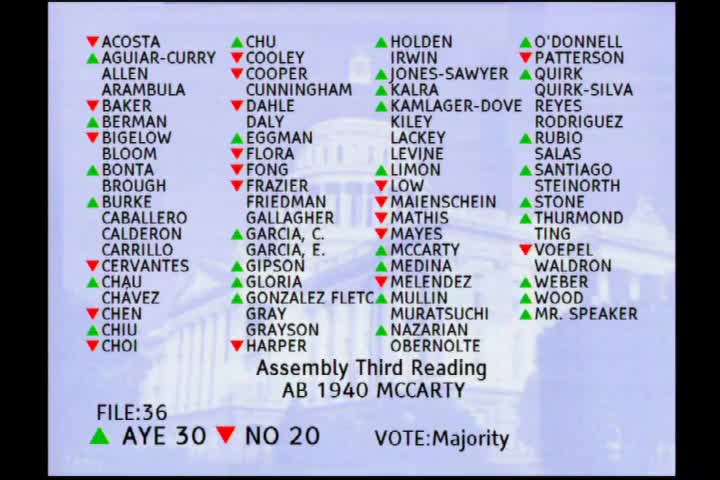 5MIN
Assembly Floor
 8MIN
Assembly Standing Committee on Judiciary
 8MIN
Assembly Standing Committee on Health
Bill Author

Bill Co-Author(s):