AB 2949: Pupil residency: pupils of military families.
- Session Year: 2017-2018
- House: Assembly
- Latest Version Date: 2018-09-10
Existing law requires each person between 6 and 18 years of age not otherwise exempted to attend a public full-time day school or continuation school or classes in the school district where the residency of the persons parent or legal guardian is located. Existing law provides that a pupil is deemed to have complied with the residency requirements for school attendance in a school district if the pupil satisfies one of specified requirements. Existing law provides that a pupil complies with the residency requirements for school attendance in a school district if the pupils parent is transferred or is pending transfer to a military installation within the state while on active military duty pursuant to an official military order.
This bill would require local educational agencies, as defined, to allow a pupil who is a child of a military family to continue attending his or her school of origin, as defined, or a school within the school district of origin, as provided, regardless of any change of residence of the military family or the end of military service of the pupils parent, as specified. By requiring local educational agencies to allow pupils of military families who no longer satisfy the residency requirement to attend their schools of origin, the bill would impose a state-mandated local program.
The California Constitution requires the state to reimburse local agencies and school districts for certain costs mandated by the state. Statutory provisions establish procedures for making that reimbursement.
This bill would provide that, if the Commission on State Mandates determines that the bill contains costs mandated by the state, reimbursement for those costs shall be made pursuant to the statutory provisions noted above.
Existing law requires each person between 6 and 18 years of age not otherwise exempted to attend a public full-time day school or continuation school or classes in the school district where the residency of the persons parent or legal guardian is located. Existing law provides that a pupil is deemed to have complied with the residency requirements for school attendance in a school district if the pupil satisfies one of specified requirements. Existing law provides that a pupil complies with the residency requirements for school attendance in a school district if the pupils parent is transferred or is pending transfer to a military installation within the state while on active military duty pursuant to an official military order.
This bill would require local educational agencies, as defined, to allow a pupil who is a child of a military family to continue attending his or her school of origin, as defined, regardless of any change of residence of the military family or the end of military service of the pupils parent, as specified. The bill would require a local educational agency with a last in, first out policy or practice prioritizing the order in which pupils are forced to change schools due to class or school capacity limits to include a category for pupils of active duty military parents within the established priority system, with the intent of minimizing school disruption for the pupil. By requiring local educational agencies to allow pupils of military families who no longer satisfy the residency requirement to attend their schools of origin, the bill would impose a state-mandated local program.
The California Constitution requires the state to reimburse local agencies and school districts for certain costs mandated by the state. Statutory provisions establish procedures for making that reimbursement.
This bill would provide that, if the Commission on State Mandates determines that the bill contains costs mandated by the state, reimbursement for those costs shall be made pursuant to the statutory provisions noted above.
Existing law requires each person between 6 and 18 years of age not otherwise exempted to attend a public full-time day school or continuation school or classes in the school district where the residency of the persons parent or legal guardian is located. Existing law provides that a pupil is deemed to have complied with the residency requirements for school attendance in a school district if the pupil satisfies one of specified requirements. Existing law provides that a pupil complies with the residency requirements for school attendance in a school district if the pupils parent is transferred or is pending transfer to a military installation within the state while on active military duty pursuant to an official military order.
This bill would require local educational agencies, as defined, to allow a pupil who is a child of a military family to continue attending his or her school of origin, as defined, regardless of any change of residence of the military family or the end of military service of the pupils parent, as specified. The bill would require the a local educational agency to consider the active-duty military status of the parent of a pupil who is a child of a military family when making decisions about involuntary pupil relocation due to class or school capacity limits agency with a last in, first out policy or practice prioritizing the order in which pupils are forced to change schools due to class or school capacity limits to include a category for pupils of active duty military parents within the established priority system, with the intent of minimizing school disruption for the pupil. By requiring local educational agencies to allow pupils of military families who no longer satisfy the residency requirement to attend his or her school their schools of origin, the bill would impose a state-mandated local program.
The California Constitution requires the state to reimburse local agencies and school districts for certain costs mandated by the state. Statutory provisions establish procedures for making that reimbursement.
This bill would provide that, if the Commission on State Mandates determines that the bill contains costs mandated by the state, reimbursement for those costs shall be made pursuant to the statutory provisions noted above.
Existing law requires each person between 6 and 18 years of age not otherwise exempted to attend a public full-time day school or continuation school or classes in the school district where the residency of the persons parent or legal guardian is located. Existing law provides that a pupil is deemed to have complied with the residency requirements for school attendance in a school district if the pupil satisfies one of specified requirements. Existing law provides that a pupil complies with the residency requirements for school attendance in a school district if the pupils parent is transferred or is pending transfer to a military installation within the state while on active military duty pursuant to an official military order.
This bill would require local educational agencies, as defined, to allow a pupil who is a child of a military family to continue attending his or her school of origin, as defined, regardless of any change of residence of the military family or the end of military service of the pupils parent, as specified. The bill would require the local educational agency to consider the active-duty military status of the parent of a pupil who is a child of a military family when making decisions about involuntary pupil relocation due to class or school capacity limits with the intent of minimizing school disruption for the pupil. By requiring local educational agencies to allow pupils of military families who no longer satisfy the residency requirement to attend his or her school of origin, the bill would impose a state-mandated local program.
The California Constitution requires the state to reimburse local agencies and school districts for certain costs mandated by the state. Statutory provisions establish procedures for making that reimbursement.
This bill would provide that, if the Commission on State Mandates determines that the bill contains costs mandated by the state, reimbursement for those costs shall be made pursuant to the statutory provisions noted above.
(a)For purposes of this section, the following definitions apply:
(1)Local educational agency means a county office of education, a school district, or a charter school.
(2)Pupil who is a child of a military family means a pupil who meets the definition of children of military families in Section 49701.
(3)School of origin means the school in which the pupil is enrolled at the time that a change in residence occurs.
(b)Notwithstanding Section 48200, the local educational agency serving a pupil who is a child of a military family shall do either of the following:
(1)Allow the pupil to continue his or her education in the school of origin, regardless of any change of residence of the military family during that school year, for the duration of the pupils status as a child of a military family.
(2)For a pupil whose status changes due to the end of military service of his or her parent during a school year, comply with either of the following, as applicable:
(A)If the pupil is enrolled in kindergarten or any of grades 1 to 8, inclusive, allow the pupil to continue his or her education in the school of origin through the duration of that academic school year.
(B)If the child is enrolled in high school, allow the pupil to continue his or her education in the school of origin through graduation.
(c)To ensure that the pupil who is a child of a military family has the benefit of matriculating with his or her peers in accordance with the established feeder patterns of school districts, the following apply:
(1)If the pupil who is a child of a military family is transitioning between school grade levels, the local educational agency shall allow the pupil who is a child of a military family to continue in the school district of origin in the same attendance area.
(2)If the pupil who is a child of a military family is transitioning to a middle school or high school, and the school designated for matriculation is in another school district, the local educational agency shall allow the pupil who is a child of a military family to continue to the school designated for matriculation in that school district.
(3)The new school shall immediately enroll the pupil who is a child of a military family even if the child has outstanding fees, fines, textbooks, or other items or moneys due to the school last attended or is unable to produce clothing or records normally required for enrollment, such as previous academic records, medical records, including, but not limited to, records or other proof of immunization history pursuant to Chapter 1 (commencing with Section 120325) of Part 2 of Division 105 of the Health and Safety Code, proof of residency, other documentation, or school uniforms.
(d)Unless otherwise required by federal law, this section does not require a local educational agency to provide transportation services to allow a pupil subject to paragraph (1) or (2) of subdivision (b) or subdivision (c) to attend a school pursuant to this section.
SEC. 2.If the Commission on State Mandates determines that this act contains costs mandated by the state, reimbursement to local agencies and school districts for those costs shall be made pursuant to Part 7 (commencing with Section 17500) of Division 4 of Title 2 of the Government Code.
(a)For purposes of this section, the following definitions apply:
(1)Local educational agency means a county office of education, a school district, or a charter school.
(2)Pupil who is a child of a military family means a pupil who meets the definition of children of military families in Section 49701.
(3)School of origin means the school in which the pupil is enrolled at the time that a change in residence occurs.
(b)Notwithstanding Section 48200, the local educational agency serving a pupil who is a child of a military family shall do either of the following:
(1)Allow the pupil to continue his or her education in the school of origin for the duration of the school year, origin, regardless of any change of residence of the military family during that school year. year, for the duration of the pupils status as a child of a military family.
(2)For a pupil whose status changes due to the end of military service of his or her parent during a school year, comply with either of the following, as applicable:
(A)If the pupil is enrolled in kindergarten or any of grades 1 to 10, 8, inclusive, allow the pupil to continue his or her education in the school of origin through the duration of that academic school year.
(B)If the child is enrolled in grade 11 or 12, high school, allow the pupil to continue his or her education in the school of origin through graduation.
(c)To ensure that the pupil who is a child of a military family has the benefit of matriculating with his or her peers in accordance with the established feeder patterns of school districts, the following apply:
(1)If the pupil who is a child of a military family is transitioning between school grade levels, the local educational agency shall allow the pupil who is a child of a military family to continue in the school district of origin in the same attendance area.
(2)If the pupil who is a child of a military family is transitioning to a middle school or high school, and the school designated for matriculation is in another school district, the local educational agency shall allow the pupil who is a child of a military family to continue to the school designated for matriculation in that school district.
(3)The new school shall immediately enroll the pupil who is a child of a military family even if the child has outstanding fees, fines, textbooks, or other items or moneys due to the school last attended or is unable to produce clothing or records normally required for enrollment, such as previous academic records, medical records, including, but not limited to, records or other proof of immunization history pursuant to Chapter 1 (commencing with Section 120325) of Part 2 of Division 105 of the Health and Safety Code, proof of residency, other documentation, or school uniforms.
(c)(d)Unless otherwise required by federal law, this section does not require a local educational agency to provide transportation services to allow a pupil subject to paragraph (1) or (2) of subdivision (b) or subdivision (c) to attend a school pursuant to this section.
SEC. 2.If the Commission on State Mandates determines that this act contains costs mandated by the state, reimbursement to local agencies and school districts for those costs shall be made pursuant to Part 7 (commencing with Section 17500) of Division 4 of Title 2 of the Government Code.
(a)For purposes of this section, the following definitions apply:
(1)Local educational agency means a county office of education, a school district, or a charter school.
(2)Pupil who is a child of a military family means a pupil who meets the definition of children of military families in Section 49701.
(3)School of origin means the school in which the pupil is enrolled at the time that a change in residence occurs.
(b)Notwithstanding Section 48200, the local educational agency serving a pupil who is a child of a military family shall do either of the following:
(1)Allow the pupil to continue his or her education in the school of origin for the duration of the school year, regardless of any change of residence of the military family during that school year.
(2)For a pupil whose status changes due to the end of military service of his or her parent during a school year, comply with either of the following, as applicable:
(A)If the pupil is enrolled in kindergarten or any of grades 1 to 10, inclusive, allow the pupil to continue his or her education in the school of origin through the duration of that school year.
(B)If the child is enrolled in grade 11 or 12, allow the pupil to continue his or her education in the school of origin through graduation.
(c)(1)Unless otherwise required by federal law, this section does not require a local educational agency to provide transportation services to allow a pupil subject to paragraph (1) or (2) of subdivision (b) to attend a school pursuant to this section.
(2)Paragraph (1) does not prohibit a local educational agency from, at its discretion, providing transportation services to allow a pupil subject to paragraph (1) or (2) of subdivision (b) to attend a school pursuant to this section. (d)In the case of a local educational agency that has a last in, first out policy or practice prioritizing the order in which pupils are forced to change schools due to class or school capacity limits, the local educational agency shall include a category for pupils of active duty military parents within the established priority system, with the intent of minimizing school disruptions for the pupil.SEC. 2.If the Commission on State Mandates determines that this act contains costs mandated by the state, reimbursement to local agencies and school districts for those costs shall be made pursuant to Part 7 (commencing with Section 17500) of Division 4 of Title 2 of the Government Code.
(a)For purposes of this section, the following definitions apply:
(1)Local educational agency means a county office of education, a school district, or a charter school.
(2)Pupil who is a child of a military family means a pupil who meets the definition of children of military families as defined in Section 49701.
(3)School of origin means the school in which the pupil first enrolled and attended upon arrival of his or her parents current duty station on official military permanent change of station orders, having provided all required proof of residency documents. is enrolled at the time that a change in residence occurs.
(b)Notwithstanding Section 48200, the local educational agency serving a pupil who is a child of a military family shall do either of the following:
(1)Allow the pupil to continue his or her education in the school of origin for the duration of the school year, regardless of any change of residence of the military family during that school year.
(2)For a pupil whose status changes due to the end of military service of his or her parent during a school year, comply with either of the following: following, as applicable:
(A)If the pupil is enrolled in kindergarten or any of grades 1 to 8, 10, inclusive, allow the pupil to continue his or her education in the school of origin through the duration of that school year.
(B)If the child is enrolled in high school, grade 11 or 12, allow the pupil to continue his or her education in the school of origin through graduation.
(c)(1)Unless otherwise required by federal law, this section does not require a local educational agency to provide transportation services to allow a pupil described in subject to paragraph (1) or (2) of subdivision (b) to attend a school pursuant to this section.
(2)Paragraph (1) does not prohibit a local educational agency from, at its discretion, providing transportation services to allow a pupil described in subject to paragraph (1) or (2) of subdivision (b) to attend a school pursuant to this section.
(d)When making decisions about involuntary pupil relocation In the case of a local educational agency that has a last in, first out policy or practice prioritizing the order in which pupils are forced to change schools due to class or school capacity limits, a the local educational agency shall consider the active-duty include a category for pupils of active duty military status of the parent of a pupil who is a child of a military family parents within the established priority system, with the intent of minimizing school disruptions for the pupil.
SEC. 2.If the Commission on State Mandates determines that this act contains costs mandated by the state, reimbursement to local agencies and school districts for those costs shall be made pursuant to Part 7 (commencing with Section 17500) of Division 4 of Title 2 of the Government Code.
(a)For purposes of this section, the following definitions apply:
(1)Local educational agency means a county office of education, a school district, or a charter school.
(2)Pupil who is a child of a military family means a pupil who meets the definition of children of military families as defined in Section 49701.
(3)School of origin means the school in which the pupil first enrolled and attended upon arrival of his or her parents current duty station on official military permanent change of station orders, having provided all required proof of residency documents.
(b)Notwithstanding Section 48200, the local educational agency serving a pupil who is a child of a military family shall do either of the following:
(1)Allow the pupil to continue his or her education in the school of origin for the duration of the school year, regardless of any change of residence of the military family during that school year.
(2)For a pupil whose status changes due to the end of military service of his or her parent during a school year, either of the following:
(A)If the pupil is enrolled in kindergarten or any of grades 1 to 8, inclusive, allow the pupil to continue his or her education in the school of origin through the duration of that school year.
(B)If the child is enrolled in high school, allow the pupil to continue his or her education in the school of origin through graduation.
(c)(1)Unless otherwise required by federal law, this section does not require a local educational agency to provide transportation services to allow a pupil described in paragraph (1) or (2) of subdivision (b) to attend a school pursuant to this section.
(2)Paragraph (1) does not prohibit a local educational agency from, at its discretion, providing transportation services to allow a pupil described in paragraph (1) or (2) of subdivision (b) to attend a school pursuant to this section.
(d)When making decisions about involuntary pupil relocation due to class or school capacity limits, a local educational agency shall consider the active-duty military status of the parent of a pupil who is a child of a military family with the intent of minimizing school disruptions for the pupil.
SEC. 2.If the Commission on State Mandates determines that this act contains costs mandated by the state, reimbursement to local agencies and school districts for those costs shall be made pursuant to Part 7 (commencing with Section 17500) of Division 4 of Title 2 of the Government Code.
|
Date
|
Status
|
|---|---|
| Sep 10, 2018 | Chaptered by Secretary of State - Chapter 327, Statutes of 2018. |
| Sep 10, 2018 | Approved by the Governor. |
| Aug 27, 2018 | Enrolled and presented to the Governor at 3 p.m. |
| Aug 20, 2018 | Senate amendments concurred in. To Engrossing and Enrolling. |
| Aug 14, 2018 | In Assembly. Concurrence in Senate amendments pending. May be considered on or after August 16 pursuant to Assembly Rule 77. |
| Aug 13, 2018 | Read third time. Passed. Ordered to the Assembly. |
| Aug 7, 2018 | Read second time. Ordered to Consent Calendar. |
| Aug 6, 2018 | From committee: Be ordered to second reading file pursuant to Senate Rule 28.8 and ordered to Consent Calendar. |
| Jun 26, 2018 | From committee: Do pass and re-refer to Com. on APPR. with recommendation: To Consent Calendar. (Ayes 6. Noes 0.) (June 26). Re-referred to Com. on APPR. |
| Jun 12, 2018 | Read second time and amended. Re-referred to Com. on V.A. |
| Jun 11, 2018 | From committee: Amend, and do pass as amended and re-refer to Com. on V.A. with recommendation: To Consent Calendar. (Ayes 6. Noes 0.) (June 6). |
| May 17, 2018 | Referred to Coms. on ED. and V.A. |
| May 3, 2018 | In Senate. Read first time. To Com. on RLS. for assignment. |
| May 3, 2018 | Read third time. Passed. Ordered to the Senate. |
| Apr 26, 2018 | Read second time. Ordered to Consent Calendar. |
| Apr 25, 2018 | From committee: Do pass. To Consent Calendar. (Ayes 17. Noes 0.) (April 25). |
| Apr 11, 2018 | From committee: Do pass and re-refer to Com. on APPR. (Ayes 10. Noes 0.) (April 10). Re-referred to Com. on APPR. |
| Apr 4, 2018 | Re-referred to Com. on V.A. |
| Apr 3, 2018 | Read second time and amended. |
| Apr 2, 2018 | From committee: Amend, and do pass as amended and re-refer to Com. on V.A. (Ayes 6. Noes 0.) (March 21). |
| Mar 14, 2018 | Re-referred to Com. on ED. |
| Mar 13, 2018 | From committee chair, with author's amendments: Amend, and re-refer to Com. on ED. Read second time and amended. |
| Mar 8, 2018 | Referred to Coms. on ED. and V.A. |
| Feb 17, 2018 | From printer. May be heard in committee March 19. |
| Feb 16, 2018 | Read first time. To print. |
|
Date
|
Description
|
Location
|
Votes
|
|
|---|---|---|---|---|
| Aug 20, 2018 | AB 2949 GLORIA Concurrence in Senate Amendments | Assembly Floor |
Passed |
|
| Aug 13, 2018 | Consent Calendar AB2949 | Senate Floor |
Passed |
|
| Jun 26, 2018 | Do pass, but first be re-referred to the Committee on [Appropriations] with the recommendation: To Consent Calendar | Senate Standing Committee on Veterans Affairs |
Passed |
|
| Jun 6, 2018 | Do pass as amended, but first amend, and re-refer to the Committee on [Veterans Affairs] with the recommendation: To Consent Calendar | Senate Standing Committee on Education |
Passed |
|
| May 3, 2018 | AB 2949 GLORIA Consent Calendar Second Day Regular Session | Assembly Floor |
Passed |
|
| Apr 25, 2018 | Do pass. To Consent Calendar. | Assembly Standing Committee on Appropriations |
Passed |
|
| Apr 10, 2018 | Do pass and be re-referred to the Committee on [Appropriations] | Assembly Standing Committee on Veterans Affairs |
Passed |
|
| Mar 21, 2018 | Do pass as amended and be re-referred to the Committee on [Veterans Affairs] | Assembly Standing Committee on Education |
Passed |
This list shows positions taken on this bill by organizations on the date displayed, which is linked to the original source.
Positions by individuals are not included.
|
Organization
|
Position
|
Date
|
|---|---|---|
| American Academy Of Pediatrics, California | ** Support | Aug 8, 2018 |
| California School Boards Association | ** Support | Aug 8, 2018 |
| California School Employees Association | ** Support | Aug 8, 2018 |
| California State PTA | ** Support | Jun 25, 2018 |
| Department Of The Navy, Commander Navy Region Southwest | ** Support | Aug 8, 2018 |
| Fairfield, City Of | ** Support | Jun 25, 2018 |
| Marine Corps Installations West | ** Support | Aug 8, 2018 |
| Marine Corps Installations West- Sponsor | ** Support | Apr 9, 2018 |
| Navy, Department Of The, Commander Navy Region Southwest | ** Support | Jun 25, 2018 |
| San Bernardino County District Advocates for Better Schools | ** Support | Jun 25, 2018 |
| San Diego Unified School District | ** Support | Aug 8, 2018 |
| US Marine Corps | * Support | Mar 21, 2018 |
CONCURRENCE IN SENATE AMENDMENTS
CSA1 Bill Id:AB 2949
Author:(Gloria)
As Amended Ver:June 12, 2018
Majority vote
ASSEMBLY: | 71-0 | (May 3, 2018) | SENATE: | 37-0 | (August 13, 2018) |
Original Committee Reference: ED.
SUMMARY: Requires that a student who is the child of a military family be allowed to remain in his or her school of origin, and to matriculate with his or her peers in accordance with the established feeder patterns of school districts.
The Senate amendments:
- Specify that the requirement that children of military families be allowed to remain in their schools of origin applies for the duration of a pupil's status as a child of a military family.
- For a pupil whose status changes due to the end of military service of his or her parent:
- Requires that a pupil be allowed to remain in his or her school of origin for the duration of the academic school year, if the pupil is enrolled in grades kindergarten through 8, instead of grades kindergarten through 10.
- Requires that a pupil be allowed to remain in his or her school of origin through graduation, if the pupil is enrolled in high school, instead of in grades 11 or 12.
- Requires the following, to ensure that a pupil who is the child of a military family can matriculate with his or her peers in accordance with a school district's established feeder patterns:
- Requires a local educational agency (LEA) to allow the child of a military family to continue in his or her school district of origin in the same attendance area, if the pupil is transitioning between grade levels.
- Requires an LEA to allow the child of a military family to enroll in a school designated for matriculation in another school district, if he or she is transitioning to middle or high school.
- Requires a new school to immediately enroll a pupil who is a child of a military family, even if the child has outstanding fees, fines, textbooks, or other moneys due to the school last attended, or if the pupil is unable to produce clothing, school uniforms, or records normally required for enrollment, such as previous academic records, proof of residency, other documentation, or medical records, including, but not limited to, records or other proof of immunization history.
FISCAL EFFECT: According to the Senate Appropriations Committee, pursuant to Senate Rule 28.8, negligible state costs.
COMMENTS:
Need for the bill. The author's office states: "United States active duty service members typically receive a Permanent Change of Station every three to four years due to mission and training requirements. Children of military families change schools up to nine times, on average, before graduating. These children are often times forced to experience additional, unnecessary school changes due to military housing availability and district policies that require that students enroll in the school district of their new residence during the school year. AB 2949 would minimize additional school disruptions for military students by giving military families the option of completing the current academic year at their school of original enrollment."
Analysis Prepared by: Naomi Ondrasek / ED. / (916) 319-2087 FN: 0003904
Office of Senate Floor Analyses (916) 651-1520 Fax: (916) 327-4478 | AB |
CONSENT
Bill No: AB 2949
:
SENATE EDUCATION COMMITTEE: 6-0, 6/6/18
AYES: Allen, Wilk, Galgiani, Leyva, Pan, Vidak
SENATE VETERANS AFFAIRS COMMITTEE: 6-0, 6/26/18
AYES: Roth, Nielsen, Dodd, Hueso, Nguyen, Wilk
SENATE APPROPRIATIONS COMMITTEE: Senate Rule 28.8
ASSEMBLY FLOOR: 71-0, 5/3/18 (Consent) - See last page for vote
SOURCE: Marine Corps Installations West
DIGEST:
This bill extends the right to remain in the school of origin to students who are children of a military family, which is currently provided to students who are in foster care or who are homeless.
Existing law:
- Provides that each person between the ages of 6 and 18 years is subject to compulsory full-time education, and requires such persons to attend the public full-time day school for the full time designated as the length of the schoolday by the governing board of the school district in which the residency of either the parent or legal guardian is located. (Education Code § 48200)
- Requires local education agencies (LEAs) to allow a foster child to continue his or her education in the school of origin for the duration of the jurisdiction of the court after changing residential placement. (EC § 48853.5)
- Requires, if the jurisdiction of the court is terminated prior to the end of an academic year, the foster youth must be allowed to continue in the school of origin through the duration of the school year. Requires, if the foster youth is transitioning between grade levels, including transitions to middle or high school and even if the school designated for matriculation is in another school district, the school district to allow the foster youth to matriculate with his or her peers. (EC § 48853.5)
- Defines "school of origin" as the school the foster child attended when he or she was permanently housed or the last school in which the foster child was enrolled. If the school the foster child attended when permanently housed is different from the school of last attendance, or if there is another school that the foster child attended with which the child is connected and the child attended within the immediately preceding 15 months, the educational liaison, the foster child and the person holding educational rights shall determine the school that shall be deemed the school of origin. (EC § 48853.5)
- Requires LEAs to allow, at the point of any change or any subsequent change in residence once a child becomes homeless, a homeless child to continue his or her education in the school of origin through the duration of homelessness.
(EC § 48852.7)
- Requires the LEA, if the homeless child’s status changes before the end of the academic year so that he or she is no longer homeless, either of the following to apply:
- If the homeless child is in high school, the LEA must allow the formerly homeless child to continue his or her education in the school of origin through graduation.
- If the homeless child is in kindergarten or any of grades 1-8, the LEA must allow the formerly homeless child to continue his or her education in the school of origin through the duration of the academic year. (EC § 48852.7)
- If the homeless child is in high school, the LEA must allow the formerly homeless child to continue his or her education in the school of origin through graduation.
This bill:
- Requires the LEA serving a student who is a child of a military family to do either of the following:
- Allow the student to continue his or her education in the school of origin, regardless of any change of residence of the military family during that school year, for the duration of the student’s status as a child of a military family.
- For a student whose status changes due to the end of military service of his or her parent during a school year, comply with either of the following, as applicable:
- If the student is enrolled in kindergarten or any of grades 1-8, allow the student to continue his or her education in the school of origin through the duration of that academic school year.
- If the student is enrolled in high school, allow the student to continue his or her education in the school of origin through graduation.
- If the student is enrolled in kindergarten or any of grades 1-8, allow the student to continue his or her education in the school of origin through the duration of that academic school year.
- Allow the student to continue his or her education in the school of origin, regardless of any change of residence of the military family during that school year, for the duration of the student’s status as a child of a military family.
- Requires the following, to ensure that a student who is a child of a military family has the benefit of matriculating with his or her peers in accordance with the established feeder patterns of school districts:
- The LEA to allow the student to continue in the school district of origin in the same attendance area if the student is transitioning between school grade levels.
- The LEA to allow the student to continue to the school designated for matriculation in that school district if the student is transitioning to a middle school or high school and the school designated for matriculation is in another school district.
- The new school to immediately enroll the student even if the child has outstanding fees, fines, textbooks, or other items or moneys due to the school last attended or is unable to produce clothing or records normally required for enrollment, such as previous academic records, medical records, including, but not limited to, records or other proof of immunization history, proof of residency, other documentation, or school uniforms.
- The LEA to allow the student to continue in the school district of origin in the same attendance area if the student is transitioning between school grade levels.
- Provides that, unless otherwise required by federal law, this bill does not require an LEA to provide transportation services to allow a student to attend a school pursuant to this bill.
- Defines the following:
- “Local educational agency” as a county office of education, a school district, or a charter school.
- “Pupil who is a child of a military family” as a school-aged child or children, enrolled in kindergarten through grade 12, in the household of an active duty member.
- “School of origin” as the school in which the student is enrolled at the time that a change in residence occurs.
- “Local educational agency” as a county office of education, a school district, or a charter school.
Comments
Parity. This bill is consistent with existing law relative to the ability for foster or homeless youth to remain in the school of origin and matriculate with his or her peers. Current law extends to foster youth, homeless youth, and students of military families an exemption from local high school graduation requirements, the awarding of partial credit for completed coursework.
Interstate Compact on Educational Opportunity for Military Children (Compact). The United States Department of Defense, in collaboration with the National Center for Interstate Compacts and the Council of State Governments, developed the Compact to address educational transition issues of children of military families.
The goal of the Compact is to ensure that the children of military families are afforded the same opportunities for educational success as other children, and are not penalized or delayed in achieving their educational goals. States participating in the Compact work to coordinate graduation requirements, transfer of records, course placement, and other administrative policies. According to the Department of Defense, all 50 States and the District of Columbia participate in the interstate compact. California adopted the Compact in the state’s Education Code in 2009.
The Compact addresses a number of topics, including:
- Timely enrollment.
- Transfer of school records.
- School placement.
- Eligibility for enrollment and participation in school programs, athletics, and extracurricular activities.
- On-time graduation.
The Compact does not speak generally to the right of students to remain in their schools of origin when their parents’ residence changes, but does state that a transitioning military child, placed in the care of a noncustodial parent or other person standing in loco parentis, who lives in a jurisdiction other than that of the custodial parent, may continue to attend the school in which he/she was enrolled while residing with the custodial parent.
A 2014 review of the implementation of the Compact in California by the California Department of Education (CDE) found variations in implementation across districts. The report suggested that California undertake a more comprehensive effort to ensure that school district personnel and military families are maximally familiar with the provisions of the Compact so that its provisions are applied consistently. The report also found that California’s membership in the Compact has substantially aided both school districts and military families by alleviating many of the educational difficulties military children encounter in their frequent moves from a school in one state to a school in another state.
Military student identifier. LEAs must be able to identify students from military families in order to comply with the requirements of state law, this bill, and the Compact. While a past legislative attempt to create a state-level military student identifier was unsuccessful, California is required to create one to comply with federal law. According to the Education Commission of the States, the Every Student Succeeds Act requires states to identify military students with a unique military identifier, which will allow military student data to be analyzed as a separate, self-contained subgroup. The identifier is intended to help assess military student performance, as well as help to understand the relationship between military life and dependent child development. In November of 2017, the CDE issued an update to schools which stated that it had just received permission to collect military student data, as required by federal law. The CDE asked local educational agencies to submit these data if available, and if not, prepare to collect and report the data in 2018–19.
FISCAL EFFECT: Appropriation: Fiscal Com.: Local:
Marine Corps Installations West (source)
American Academy of Pediatrics, California
California School Boards Association
California School Employees Association
Department of the Navy, Commander Navy Region Southwest
San Diego Regional Chamber of Commerce’s Defense, Veterans & Military Affairs Committee
San Diego Unified School District
ASSEMBLY FLOOR: 71-0, 5/3/18
AYES: Acosta, Aguiar-Curry, Arambula, Baker, Berman, Bigelow, Bloom, Bonta, Brough, Burke, Calderon, Carrillo, Cervantes, Chau, Chávez, Chen, Chiu, Chu, Cooley, Cooper, Cunningham, Dahle, Daly, Eggman, Flora, Fong, Frazier, Friedman, Gallagher, Eduardo Garcia, Gipson, Gloria, Gonzalez Fletcher, Gray, Harper, Holden, Irwin, Jones-Sawyer, Kalra, Kamlager-Dove, Kiley, Lackey, Levine, Limón, Low, Maienschein, Mathis, Mayes, McCarty, Medina, Melendez, Mullin, Muratsuchi, Nazarian, Obernolte, O'Donnell, Patterson, Quirk, Reyes, Rodriguez, Rubio, Salas, Santiago, Steinorth, Mark Stone, Thurmond, Ting, Waldron, Weber, Wood, Rendon
NO VOTE RECORDED: Travis Allen, Caballero, Choi, Cristina Garcia, Grayson, Quirk-Silva, Voepel
8/8/18 10:21:44
SENATE COMMITTEE ON
Senator Richard Roth, Chair
2017 - 2018 Regular
Bill No: Hearing Date: 6/26/18
Author: | Gloria | ||
Version: | Amended | ||
Urgency: | Fiscal: | ||
Consultant: | |||
Subject:
Summary:
This bill requires that a student who is the child of a military family be allowed to remain in his or her school of origin for the duration of the school year regardless of any change of residence of the military family or the end of military service of the pupil’s parent.
Existing law:
Regarding military children:
- Establishes the Interstate Compact on Educational Opportunity for Military Children (Compact). The Compact states that a transitioning military child, placed in the care of a noncustodial parent or other person standing in loco parentis, who lives in a jurisdiction other than that of the custodial parent, may continue to attend the school in which he/she was enrolled while residing with the custodial parent.
- Defines “a pupil who is a child of a military family,” as a school-aged child enrolled in grades K-12 who is living in the household of an active duty service member. This is the same definition used in current law for purposes of the Compact.
- Requires school districts to exempt a student of a military family who transfers between schools any time after the completion of the student’s second year of high school from all coursework and other requirements that are in excess of state graduation requirements, unless the school district makes a finding that the student is reasonably able to complete the school district’s graduation requirements in time to graduate from high school by the end of the student’s fourth year of high school.
- Requires a school district or a county office of education to accept coursework satisfactorily completed by a student of a military family while attending another public school even if the student did not complete the entire course, and requires that the student be issued full or partial credit for work completed.
- Prohibits a school district of residence from prohibiting the transfer of a student, who is a child of an active military duty parent, to a school in any school district, if the school district, to which the parents of the student apply, approves the application for transfer.
- Provides that a pupil has complied with residency requirements for school attendance in a school district if the pupil satisfies one of the specified requirements for school attendance in a school district if the pupil’s parent is transferred or is pending transfer to a military installation within the state while on active military duty pursuant to an official military
This bill:
This bill requires that a student who is the child of a military family be allowed to remain in his or her school of origin for the duration of the school year regardless of any change of residence of the military family or the end of military service of the pupil’s parent.
- Requires the LEA serving a student who is a child of a military family to do either of the following:
- Allow the student to continue his or her education in the school of origin for the duration of the school year, regardless of any change of residence of the military family during that school year.
- For a student whose status changes due to the end of military service of the parent during a school year, comply with either of the following, as applicable:
- If the student is enrolled in kindergarten or any of grades 1-10, allow the student to continue his or her education in the school of origin through the duration of that school year.
- If the student is enrolled in grade 11 or 12, allow the student to continue his or her education in the school of origin through graduation.
- If the student is enrolled in kindergarten or any of grades 1-10, allow the student to continue his or her education in the school of origin through the duration of that school year.
- Allow the student to continue his or her education in the school of origin for the duration of the school year, regardless of any change of residence of the military family during that school year.
- Provides that, to ensure that a military child will have the benefit of matriculating with his or her peers in accordance with the established feeder patterns of school districts, the following apply:
- If the pupil who is a child of a military family is transitioning between school grade levels, the local educational agency (LEA) shall allow the pupil who is a child of a military family to continue in the school district of origin in the same attendance area.
- If the pupil who is a child of a military family is transitioning to a middle school or high school, and the school designated for matriculation is in another school district, the LEA shall allow the pupil who is a child of a military family to continue to the school designated for matriculation in that school district.
- The new school shall immediately enroll the pupil who is a child of a military family even if the child has outstanding fees, fines, textbooks, or other items or moneys due to the school last attended or is unable to produce clothing or records normally required for enrollment, such as previous academic records, medical records, including, but not limited to, records or other proof of immunization history.
- Provides that, unless otherwise required by federal law, this bill does not require a LEA to provide transportation services to allow a student to attend a school pursuant to this bill.
- Defines the following:
- “Local educational agency” as a county office of education, a school district, or a charter school.
- “Pupil who is a child of a military family” as a school-aged child or children, enrolled in kindergarten through grade 12, in the household of an active duty member.
- “School of origin” as the school in which the student is enrolled at the time that a change in residence occurs.
BACKGROUND
California is home to the largest number of active duty military in the country, with 155,000 active duty personnel, representing 13.5 percent of the national force. As of August 2017, there were 56,127 children attending K-12 schools in California, who were affiliated with 30 different military commands throughout the state, with the largest concentration in San Diego County.
According to the Department of Defense, children from military families move an average of six to nine times during a school career, and 33% of these children are in transition annually. For children, frequent moves can disrupt education and bring periods of stressful acclimation to a new environment where they may not have any friends and may be disconnected from school and community activities. Because of differences among school districts in the timing and format of subjects and lessons, children may find some lessons repetitive, while they may miss other lessons entirely as they move from one school to the next. The delay in transferring school records, which can take weeks or months, may mean that students are placed in classes inappropriate to their previous experiences or ability level.
Interstate Compact on Educational Opportunity for Military Children. The United States Department of Defense, in collaboration with the National Center for Interstate Compacts and the Council of State Governments, developed the Interstate Compact on Educational Opportunity for Military Children (Compact) to address educational transition issues of children of military families.
The goal of the Compact is to ensure that the children of military families are afforded the same opportunities for educational success as other children, and are not penalized or delayed in achieving their educational goals. States participating in the Compact coordinate graduation requirements, transfer of records, course placement, and other administrative policies. According to the Department of Defense, all 50 States and the District of Columbia participate in the interstate compact. California adopted the Compact in the state’s Education Code in 2009.
The Interstate Compact on Educational Opportunity for Military Children (Compact) addresses a number of topics, including:
- Timely enrollment.
- Transfer of school records.
- School placement.
- Eligibility for enrollment and participation in school programs, athletics, and extracurricular activities.
- On-time graduation.
The Compact does not speak generally to the right of students to remain in their schools of origin when their parents’ residence changes, but does state that a transitioning military child, placed in the care of a noncustodial parent or other person standing in loco parentis, who lives in a jurisdiction other than that of the custodial parent, may continue to attend the school in which he/she was enrolled while residing with the custodial parent.
A 2014 review of the implementation of the Compact in California by the California Department of Education found variations in implementation across districts. The report suggested that California undertake a more comprehensive effort to ensure that school district personnel and military families are maximally familiar with the provisions of the Compact so that its provisions are applied consistently. The report also found that California’s membership in the Compact has substantially aided both school districts and military families by alleviating many of the educational difficulties military children encounter in their frequent moves from a school in one state to a school in another state.
COMMENT
Prior/Related Legislation:
AB 365 (Muratsuchi, Chapter 739, Statutes of 2017) requires school districts to exempt a student of a military family who transfers between schools any time after the completion of the student’s second year of high school from local graduation requirements, and that work completed in other school districts be accepted for partial credit.
SB 455 (Newman, Chapter 239, Statutes of 2017) establishes that a student whose parent is transferred or is pending transfer to a military installation within state while on active military duty pursuant to an official military order has complied with the residency requirements for school attendance in any school district.
AB 306 (Hadley, Chapter 771, Statutes of 2016) prohibits a school district of residence from prohibiting the transfer of a pupil who is a child of an active military duty parent to a school in any school district, if the school district to which the parents of the pupil applies approves the application for transfer.
AB 2341 (Quirk-Silva, 2014) would have added an indicator to the California Longitudinal Pupil Achievement Data System to identify students of military families, and would have required LEAs to report enrollment of students of military families, as specified. (Held, Senate Appropriations Committee.)
AB 343 (Saldana, Chapter 237, Statutes of 2009) enacts the Compact, which addresses issues experienced by children of military families who frequently transfer between schools.
AB 2049 (Saldana, Chapter 589, Statutes of 2008) requires SPI to convene and support a task force to review and make recommendations regarding the Compact.
AB 2102 (Saldana, Chapter 608, Statutes of 2006) establishes procedures, including requiring the CDE to establish a formal liaison with the United States Department of Defense and school districts that enroll military dependents, to facilitate and smooth the transfer of school-age military dependents and their school records.
POSITIONS
Sponsor: Marine Corps Installations West
Support:
California School Employees Association
California State PTA
Fairfield, City of
Navy, Department of the, Commander Navy Region Southwest
San Bernardino County District Advocates for Better Schools (SANDABS)
San Diego Regional Chamber of Commerce’s Defense, Veterans & Military Affairs Committee
San Diego Unified School District
Oppose: None received.
-- END --
SENATE COMMITTEE ON EDUCATION
Senator Benjamin Allen, Chair
2017 - 2018 Regular
Bill No: AB 2949 Hearing Date: June 6, 2018
Author: | |||
Version: | April 3, 2018 | ||
Urgency: | No | Fiscal: | Yes |
Consultant: | Lynn Lorber | ||
Subject: Pupil residency: pupils of military families.
NOTE: This bill has been referred to the Committees on Education and Veterans Affairs. A "do pass" motion should include referral to the Committee on Veterans Affairs.
SUMMARY
This bill extends the right to remain in the school of origin to students who are children of a military family, which is currently provided to students who are in foster care or who are homeless.
BACKGROUND
Existing law:
- Provides that each person between the ages of 6 and 18 years is subject to compulsory full-time education, and requires such persons to attend the public full-time day school for the full time designated as the length of the schoolday by the governing board of the school district in which the residency of either the parent or legal guardian is located. (Education Code § 48200)
- Requires local education agencies (LEAs) to allow a foster child to continue his or her education in the school of origin for the duration of the jurisdiction of the court after changing residential placement. (EC § 48853.5)
- Requires, if the jurisdiction of the court is terminated prior to the end of an academic year, the foster youth must be allowed to continue in the school of origin through the duration of the school year. Requires, if the foster youth is transitioning between grade levels, including transitions to middle or high school and even if the school designated for matriculation is in another school district, the school district to allow the foster youth to matriculate with his or her peers. (EC § 48853.5)
- Defines "school of origin" as the school the foster child attended when he or she was permanently housed or the last school in which the foster child was enrolled. If the school the foster child attended when permanently housed is different from the school of last attendance, or if there is another school that the foster child attended with which the child is connected and the child attended within the immediately preceding 15 months, the educational liaison, the foster child and the person holding educational rights shall determine the school that shall be deemed the school of origin. (EC § 48853.5)
- Requires local educational agencies (LEAs) to allow, at the point of any change or any subsequent change in residence once a child becomes homeless, a homeless child to continue his or her education in the school of origin through the duration of homelessness.
(EC § 48852.7) - Requires the LEA, if the homeless child’s status changes before the end of the academic year so that he or she is no longer homeless, either of the following to apply:
- If the homeless child is in high school, the LEA must allow the formerly homeless child to continue his or her education in the school of origin through graduation.
- If the homeless child is in kindergarten or any of grades 1-8, the LEA must allow the formerly homeless child to continue his or her education in the school of origin through the duration of the academic year.
(EC § 48852.7)
- If the homeless child is in high school, the LEA must allow the formerly homeless child to continue his or her education in the school of origin through graduation.
ANALYSIS
This bill extends the right to remain in the school of origin to students who are children of a military family, which is currently provided to students who are in foster care or who are homeless. Specifically, this bill:
- Requires the LEA serving a student who is a child of a military family to do either of the following:
- Allow the student to continue his or her education in the school of origin for the duration of the school year, regardless of any change of residence of the military family during that school year.
- For a student whose status changes due to the end of military service of his or her parent during a school year, comply with either of the following, as applicable:
- If the student is enrolled in kindergarten or any of grades 1-10, allow the student to continue his or her education in the school of origin through the duration of that school year.
- If the student is enrolled in grade 11 or 12, allow the student to continue his or her education in the school of origin through graduation.
- If the student is enrolled in kindergarten or any of grades 1-10, allow the student to continue his or her education in the school of origin through the duration of that school year.
- Allow the student to continue his or her education in the school of origin for the duration of the school year, regardless of any change of residence of the military family during that school year.
- Provides that, unless otherwise required by federal law, this bill does not require a LEA to provide transportation services to allow a student to attend a school pursuant to this bill.
- Defines the following:
- “Local educational agency” as a county office of education, a school district, or a charter school.
- “Pupil who is a child of a military family” as a school-aged child or children, enrolled in kindergarten through grade 12, in the household of an active duty member.
- “School of origin” as the school in which the student is enrolled at the time that a change in residence occurs.
- “Local educational agency” as a county office of education, a school district, or a charter school.
STAFF COMMENTS
- Need for the bill. According to the author, “United States active duty service members typically receive a Permanent Change of Station every three to four years due to mission and training requirements. Children of military families change schools up to nine times, on average, before graduating. These children are often times forced to experience additional, unnecessary school changes due to military housing availability and district policies that require that students enroll in the school district of their new residence during the school year. AB 2949 would minimize additional school disruptions for military students by giving military families the option of completing the current academic year at their school of original enrollment.”
- Parity. This bill is consistent with existing law relative to the ability for foster or homeless youth to remain in the school of origin. Current law extends to foster youth, homeless youth, and students of military families an exemption from local high school graduation requirements, the awarding of partial credit for completed coursework.
Staff recommends an amendment to grant further parity to students of military families by requiring, if the student is transitioning between grade levels, including transitions to middle or high school and even if the school designated for matriculation is in another school district, the school district to allow the student of a military family to matriculate with his or her peers. - Interstate Compact on Educational Opportunity for Military Children. The United States Department of Defense, in collaboration with the National Center for Interstate Compacts and the Council of State Governments, developed the Interstate Compact on Educational Opportunity for Military Children (Compact) to address educational transition issues of children of military families.
The goal of the Compact is to ensure that the children of military families are afforded the same opportunities for educational success as other children, and are not penalized or delayed in achieving their educational goals. States participating in the Compact work to coordinate graduation requirements, transfer of records, course placement, and other administrative policies. According to the Department of Defense, all 50 States and the District of Columbia participate in the interstate compact. California adopted the Compact in the state’s Education Code in 2009.
The Interstate Compact on Educational Opportunity for Military Children (Compact) addresses a number of topics, including:- Timely enrollment.
- Transfer of school records.
- School placement.
- Eligibility for enrollment and participation in school programs, athletics, and extracurricular activities.
- On-time graduation.
- Timely enrollment.
The Compact does not speak generally to the right of students to remain in their schools of origin when their parents’ residence changes, but does state that a transitioning military child, placed in the care of a noncustodial parent or other person standing in loco parentis, who lives in a jurisdiction other than that of the custodial parent, may continue to attend the school in which he/she was enrolled while residing with the custodial parent.
A 2014 review of the implementation of the Compact in California by the California Department of Education (CDE) found variations in implementation across districts. The report suggested that California undertake a more comprehensive effort to ensure that school district personnel and military families are maximally familiar with the provisions of the Compact so that its provisions are applied consistently. The report also found that California’s membership in the Compact has substantially aided both school districts and military families by alleviating many of the educational difficulties military children encounter in their frequent moves from a school in one state to a school in another state.
- Military student identifier. Local educational agencies must be able to identify students from military families in order to comply with the requirements of state law, this bill, and the Interstate Compact on Educational Opportunity for Military Children. While a past legislative attempt to create a state-level military student identifier was unsuccessful (see prior legislation below), California is required to create one to comply with federal law. According to the Education Commission of the States, the Every Student Succeeds Act requires states to identify military students with a unique military identifier, which will allow military student data to be analyzed as a separate, self-contained subgroup. The identifier is intended to help assess military student performance, as well as help to understand the relationship between military life and dependent child development. In November of 2017, the CDE issued an update to schools which stated that it had just received permission to collect military student data, as required by federal law. The CDE asked local educational agencies to submit these data if available, and if not, prepare to collect and report the data in 2018–19.
- Related legislation. AB 2121 (Caballero) extends to students who are migratory children and to students participating in a newcomer program certain rights regarding exemptions from local graduation requirements and acceptance of partial credit that are currently afforded to other groups of highly mobile students, and extends the applicability of those provisions to charter schools. AB 2121 is scheduled to be heard by this Committee on June 6, 2018.
- Prior legislation. AB 2341 (Quirk-Silva, 2014) would have added an indicator to the California Longitudinal Pupil Achievement Data System to identify students of military families, and would have required local educational agencies to report enrollment of students of military families, as specified. AB 2341 was held in the Senate Appropriations Committee.
SUPPORT
American Academy of Pediatrics, California
California School Boards Association
California School Employees Association
Department of the Navy, Commander Navy Region Southwest
Marine Corps Installations West
San Diego Regional Chamber of Commerce’s Defense, Veterans & Military Affairs Committee
San Diego Unified School District
OPPOSITION
None received
-- END --
Date of Hearing: April 25, 2018
ASSEMBLY COMMITTEE ON APPROPRIATIONS
Lorena Gonzalez Fletcher, Chair
ABPCA Bill Id:AB 2949
Author:(Gloria) – As Amended Ver:April 3, 2018
Policy Committee: | Education | Vote: | 6 - 0 |
Veterans Affairs | 10 - 0 | ||
|
|
Urgency: No State Mandated Local Program: Yes Reimbursable: No
SUMMARY: This bill requires that a student who is the child of a military family be allowed to remain in their school of origin for the duration of the school year, or until high school graduation if the student is in grades 11 or 12, regardless of any change of residence of the military family or the end of military service of the student’s parent.
FISCAL EFFECT:
Potential minor Proposition 98 General Fund state costs if a student’s enrollment in their school of origin generates higher per-student funding than at the school they would have otherwise attended, as described below.
COMMENTS:
- Background. California has about 56,000 children of military families attending K-12 schools. These students are affiliated with 30 different military commands throughout the state.
- Per-Student Funding. Schools in California generate funding on a per-student basis through the Local Control Funding Formula (LCFF). Under LCFF, a student who attends a school with high concentrations of disadvantaged students generates, on average, $4,000 more funding than a student who does not attend a school with high concentrations of disadvantaged students.
- Staff Comments. This bill provides children of military families with the same rights to remain in their school of origin as foster youth, another highly mobile student population.
Analysis Prepared by: Natasha Collins / APPR. / (916) 319-2081
Date of Hearing: April 10, 2018
ASSEMBLY COMMITTEE ON VETERANS AFFAIRS
Jacqui Irwin, Chair
ABPCA Bill Id:AB 2949 (
Author:Gloria) – As Amended Ver:April 3, 2018
SUBJECT: Pupil residency: pupils of military families
SUMMARY: Requires that a student who is the child of a military family be allowed to remain in his or her school of origin for the duration of the school year regardless of any change of residence of the military family or the end of military service of the pupil’s parent. Specifically, this bill:
- Requires a school district, a county office of education, or a charter school serving a student who is the child of a military family to do either of the following:
- Allow the student to remain in his or her school of origin for the remainder of the school year, regardless of any change of residence of the military family during that school year, or
- For a student whose status changes due to the end of military service of his or her parent during a school year, either of the following:
- for a student is enrolled in kindergarten or any of grades 1 to 10, allow the student to continue his or her education in the school of origin through the duration of that school year.
- for a student enrolled in grade 11 or 12, allow the student to continue his or her education in the school of origin through graduation.
- States that, unless otherwise required by federal law, the bill does not require a local educational agency (LEA) to provide transportation services to allow a student who is eligible to remain in his or her school of origin.
- Defines, for the purposes of this bill, “school of origin” to mean the school in which a student is enrolled at the time that a change in residence occurs.
EXISTING LAW:
- Establishes the Interstate Compact on Educational Opportunity for Military Children (Compact). The Compact states that a transitioning military child, placed in the care of a noncustodial parent or other person standing in loco parentis, who lives in a jurisdiction other than that of the custodial parent, may continue to attend the school in which he/she was enrolled while residing with the custodial parent.
- Defines “a pupil who is a child of a military family,” as a school-aged child enrolled in grades K-12 who is living in the household of an active duty service member. This is the same definition used in current law for purposes of the Compact.
- Requires school districts to exempt a student of a military family who transfers between schools any time after the completion of the student’s second year of high school from all coursework and other requirements that are in excess of state graduation requirements, unless the school district makes a finding that the student is reasonably able to complete the school district’s graduation requirements in time to graduate from high school by the end of the student’s fourth year of high school.
- Requires a school district or a county office of education to accept coursework satisfactorily completed by a student of a military family while attending another public school even if the student did not complete the entire course, and requires that the student be issued full or partial credit for work completed.
- Prohibits a school district of residence from prohibiting the transfer of a student who is a child of an active military duty parent to a school in any school district, if the school district to which the parents of the student applies approves the application for transfer.
- Provides that a pupil has complied with residency requirements for school attendance in a school district if the pupil satisfies one of the specified requirements for school attendance in a school district if the pupil’s parent is transferred or is pending transfer to a military installation within the state while on active military duty pursuant to an official military order.
FISCAL EFFECT: Unknown at this time.
COMMENTS:
California is home to the largest number of active duty military in the country, with 155,000 active duty personnel, representing 13.5 percent of the national force. As of August 2017, there were 56,127 children attending K-12 schools in California, who were affiliated with 30 different military commands throughout the state, with the largest concentration in San Diego County.
Since the war in Afghanistan began in 2001, followed in 2002 by the war in Iraq, the United States has seen the largest sustained deployment of military servicemen and servicewomen in the history of the all-volunteer force. As a result, more than two million military children have been separated from their service member parents, both fathers and mothers, because of combat deployments. Many families have seen multiple deployments—three, four, even five or more family separations and reunifications. Others have struggled with combat-related mental health problems, including posttraumatic stress disorder (PTSD); physical injuries, including traumatic brain injury (TBI); and death, all of which can affect children and families for years.
According to the Department of Defense (DOD), children from military families move an average of six to nine times during a school career, and 33% of these children are in transition annually. For children, frequent moves can disrupt education and bring periods of stressful acclimation to a new environment where they may not have any friends and may be disconnected from school and community activities. Because of differences among school districts in the timing and format of subjects and lessons, children may find some lessons repetitive, while they may miss other lessons entirely as they move from one school to the next. The delay in transferring school records, which can take weeks or months, may mean that students are placed in classes inappropriate to their previous experiences or ability level.
It has been shown that enhancing the lives of children in military families also enhances the quality of their families’ lives. Research documents a positive relationship between the wellbeing of the families of military personnel and the likelihood that they will stay in the service. Given the nation’s continual need for high-quality service members, it is in the public interest to ensure that military children and families are thriving.
In order to ensure the best outcome for the children of active duty service members both ease of transition and the possibility of remaining in school through the end of the term need to be in place. According to this bill, if the status of a pupil who is a child of a military family changes due to the end of military service when the pupil is enrolled in high school, the LEA shall allow the child to continue his or her education in the school of origin through graduation.
According to the author:
“Military personnel typically receive a permanent change of station (PCS) every three or four years due to mission and training requirements. Children of active duty service members change schools up to nine times, on average, before graduating. These children are oftentimes forced to experience additional, unnecessary school changes due to military housing availability and district policies that require that the last students in be the first students displaced to a new school or class due to capacity limits.
No existing law addresses the educational stability of military children, whereby the state requires that local education agencies require that military students are permitted to complete the duration of their current school year at the same school regardless of changes in residence. AB 2949 addresses this issue.”
This policy mirrors current state policy addressing the educational stability of foster youth, a similarly highly mobile student population.
Related and prior legislation:
AB 365 (Muratsuchi), Chapter 739, Statutes of 2017 requires school districts to exempt a student of a military family who transfers between schools any time after the completion of the student’s second year of high school from local graduation requirements, and that work completed in other school districts be accepted for partial credit.
SB 455 (Newman) Chapter 239, Statutes of 2017 establishes that a student whose parent is transferred or is pending transfer to a military installation within state while on active military duty pursuant to an official military order has complied with the residency requirements for school attendance in any school district.
AB 306 (Hadley), Chapter 771, Statutes of 2016, prohibits a school district of residence from prohibiting the transfer of a pupil who is a child of an active military duty parent to a school in any school district, if the school district to which the parents of the pupil applies approves the application for transfer.
AB 2341 (Quirk-Silva) of the 2013-14 Session would have added an indicator to the California Longitudinal Pupil Achievement Data System (CALPADS) to identify pupils of military families, and would have required LEAs to report enrollment of pupils of military families, as specified. This bill was held in the Senate Appropriations Committee.
AB 343 (Saldana) Chapter 237, Statutes of 2009, enacts the Compact, which addresses issues experienced by children of military families who frequently transfer between schools.
AB 2049 (Saldana) Chapter 589, Statutes of 2008, requires SPI to convene and support a task force to review and make recommendations regarding the Compact.
AB 2102 (Saldana), Chapter 608, Statutes of 2006, establishes procedures, including requiring the CDE to establish a formal liaison with the United States Department of Defense and school districts that enroll military dependents, to facilitate and smooth the transfer of school-age military dependents and their school records.
REGISTERED SUPPORT / OPPOSITION:
Support
Marine Corps Installations West- Sponsor
California School Boards Association
San Diego Unified School District
Opposition
None on File
Analysis Prepared by: Jenny Callison / V.A. / (916) 319-3550
Date of Hearing: March 21, 2018
ASSEMBLY COMMITTEE ON EDUCATION
Patrick O'Donnell, Chair
ABPCA Bill Id:AB 2949 (
Author:Gloria) – As Amended Ver:March 13, 2018
[This bill has been referred to the Committee on Veterans Affairs and will be heard by that Committee as it relates to issues under its jurisdiction.]
SUBJECT: Pupil residency: pupils of military families
SUMMARY: Requires that a student who is the child of a military family be allowed to remain in his or her school of origin for the duration of the school year when their family moves. Specifically, this bill:
- Requires a school district, a county office of education, or a charter school serving a student who is the child of a military family to do either of the following:
- Allow the student to remain in his or her school of origin for the remainder of the school year, regardless of any change of residence of the military family during that school year, or
- For a student whose status changes due to the end of military service of his or her parent during a school year, either of the following:
- for a student is enrolled in kindergarten or any of grades 1 to 10, allow the student to continue his or her education in the school of origin through the duration of that school year.
- for a student enrolled in grade 11 or 12, allow the student to continue his or her education in the school of origin through graduation.
- States that, unless otherwise required by federal law, the bill does not require a local educational agency (LEA) to provide transportation services to allow a student who is eligible to remain in his or her school of origin.
- States that the act does not prohibit an LEA from, at its discretion, providing transportation services to allow a student who is eligible to remain in his or her school of origin.
- Requires an LEA that has a “last in, first out” policy or practice prioritizing the order in which students are forced to change schools due to class or school capacity limits, to include a category for pupils of active duty parents within the established priority system, with the intent of minimizing school disruptions for the pupil.
- Defines, for the purposes of this bill, “school of origin” to mean the school in which a student is enrolled at the time that a change in residence occurs.
EXISTING LAW:
- Defines “a pupil who is a child of a military family,” as a school-aged child enrolled in grades K-12 who is living in the household of an active duty service member. This is the same definition used in current law for purposes of Interstate Compact on Educational Opportunity for Military Children.
- Requires that, at the initial detention or placement, or any subsequent change in placement of a foster child, the LEA serving the foster child him or her to continue his or her education in the school of origin for the duration of the jurisdiction of the court.
- Requires that, if the jurisdiction of the court is terminated before the end of an academic year, the LEA allow a former foster child who is in kindergarten or any of grades 1 to 8, inclusive, to continue his or her education in the school of origin through the duration of the academic school year.
- Requires that, if the jurisdiction of the court is terminated while a foster child is in high school, the LEA allow the former foster child to continue his or her education in the school of origin through graduation.
- Requires school districts to exempt a student of a military family who transfers between schools any time after the completion of the student’s second year of high school from all coursework and other requirements that are in excess of state graduation requirements, unless the school district makes a finding that the student is reasonably able to complete the school district’s graduation requirements in time to graduate from high school by the end of the student’s fourth year of high school.
- Requires a school district or a county office of education to accept coursework satisfactorily completed by a student of a military family while attending another public school even if the student did not complete the entire course, and requires that the student be issued full or partial credit for work completed.
- Establishes the Interstate Compact on Educational Opportunity for Military Children (Compact). The Compact states that a transitioning military child, placed in the care of a noncustodial parent or other person standing in loco parentis, who lives in a jurisdiction other than that of the custodial parent, may continue to attend the school in which he/she was enrolled while residing with the custodial parent.
- Prohibits a school district of residence from prohibiting the transfer of a student who is a child of an active military duty parent to a school in any school district, if the school district to which the parents of the student applies approves the application for transfer.
- Provides that a pupil has complied with residency requirements for school attendance in a school district if the pupil satisfies one of the specified requirements for school attendance in a school district if the pupil’s parent is transferred or is pending transfer to a military installation within the state while on active military duty pursuant to an official military order.
FISCAL EFFECT: This bill has been keyed a state mandated local program by the Office of Legislative Counsel.
COMMENTS:
Need for the bill. The author’s office states: “Military personnel typically receive a permanent change of station (PCS) every three or four years due to mission and training requirements. Children of active duty service members change schools up to nine times, on average, before graduating. These children are oftentimes forced to experience additional, unnecessary school changes due to military housing availability and district policies that require that the last students in be the first students displaced to a new school or class due to capacity limits.
No existing law addresses the educational stability of military children, whereby the state requires that local education agencies require that military students are permitted to complete the duration of their current school year at the same school regardless of changes in residence. No existing law protects military students from being disproportionately displaced from their school due capacity related ‘last in, first out’ policies.”
Students of military families in California. According to the Department of Defense, California is home to the largest number of active duty military in the country, with 155,000 active duty personnel, representing 13.5 percent of the national force. According to the author, as of August 2017, there were 56,127 children attending K-12 schools in California, who were affiliated with 30 different military commands throughout the state, with the largest concentration in San Diego County. The Department of Defense has policies in place to assist with minimizing the effects of school moves. Military families usually move at predictable times of the year typically in the summer months when school is out, with a smaller number moving during the winter holiday break.
Effect of high mobility on academic success. According to the Department of Defense (DOD), children from military families move an average of six to nine times during a school career, and 33% of these children are in transition annually. A 2012 report by the Military Child Education Coalition for the U.S. Army found that “graduation requirements, tiered diplomas, prerequisite courses, grading variations, and state high stakes testing are all challenges to the student in transition.”
Numerous studies indicate that student mobility is associated with poor educational outcomes. One meta-analysis (Mehana, 2004) on the effects of school mobility on reading and math achievement in the elementary grades found the equivalent of a 3–4 month performance disadvantage in achievement. Another (Reynolds, 2009) found that frequent mobility was associated with significantly lower reading and math achievement by up to a third of a standard deviation, and that students who moved three or more times had rates of school dropout that was nearly one-third of a standard deviation higher than those who were school stable. One longitudinal study (Temple, 1999) found that half of the one year difference between mobile and non-mobile students could be attributed to mobility, and that it is “frequent, rather than occasional, mobility that significantly increases the risk of underachievement.” And another longitudinal study (Herbers, 2014) found that students who experience more school changes between kindergarten and twelfth grade are less likely to complete high school on time, complete fewer years of school, and attain lower levels of occupational prestige, even when controlling for poverty. Results of this study indicated more negative outcomes associated with moves later in the grade school career, particularly between fourth and eighth grade.
Knowledge gap on academic outcomes for students of military families. There is very little published data regarding the academic performance of students from military families. One area of inquiry has been the effect of long parental deployments on students’ academic performance, and one study (Richardson, 2011) found that students whose parents have been deployed 19 months or longer have modestly lower scores across all subjects and irrespective of the rank, component, seniority, or gender of the parent. Another study (Engel, 2010) of students in DOD schools found that long deployments and deployments during the month of testing had the most adverse effects, and that evidence suggests that these effects may persist for several years. A 2011 policy brief from the University of Southern California School of Social Work notes that “Living with fear that a parent – or another relative – serving in the military is in danger can traumatize a child to the point where it significantly affects their ability to function in the school environment.”
Other research has focused on risk factors which are associated with poor academic outcomes. One study (Sullivan, 2015), using data from the 2013 administration of the California Healthy Kids Survey, found that students from military families had greater odds of experience with substance use, physical violence, nonphysical harassment than their peers. Another study (Gilreath, 2016) using the same data set found that California military-connected youth are at a higher risk for suicidal ideation, plans, attempts, and attempts requiring medical care because of suicidal behaviors.
Now that the CDE has been given permission to implement a Military Student Identifier (see below), it may be possible to conduct more research on students from military families, and to develop policy reflective of any specific needs of these students.
Interstate Compact on Educational Opportunity for Military Children. The DOD, in collaboration with the National Center for Interstate Compacts and the Council of State Governments, developed the Interstate Compact on Educational Opportunity for Military Children (Compact) to address educational transition issues of children of military families.
The goal of the Compact is to ensure that the children of military families are afforded the same opportunities for educational success as other children, and are not penalized or delayed in achieving their educational goals. States participating in the Compact work to coordinate graduation requirements, transfer of records, course placement, and other administrative policies. According to the DOD, all 50 States and the District of Columbia participate in the interstate compact. California adopted the Compact in the state’s Education Code in 2009.
The compact addresses a number of topics, including:
- Timely enrollment
- Transfer of school records
- School placement
- Eligibility for enrollment and participation in school programs, athletics, and extracurricular activities
- On-time graduation
The Compact does not speak generally to the right of students to remain in their schools of origin when their parents’ residence changes, but does state that a transitioning military child, placed in the care of a noncustodial parent or other person standing in loco parentis, who lives in a jurisdiction other than that of the custodial parent, may continue to attend the school in which he/she was enrolled while residing with the custodial parent.
A 2014 CDE review of the implementation of the Compact in California found variations in implementation across districts. The report suggested that California undertake a more comprehensive effort to ensure that school district personnel and military families are maximally familiar with the provisions of the Compact so that its provisions are applied consistently. The report also found that California’s membership in the Compact has substantially aided both school districts and military families by alleviating many of the educational difficulties military children encounter in their frequent moves from a school in one state to a school in another state.
Military student identifier. To comply with the requirements of state law, this legislation, and the Compact, school districts must be able to identify students from military families. Los Angeles Unified School District, for example, uses a military and veteran identifier on students’ emergency-notification cards and include this identifier in their district-wide student information system.
While a past legislative attempt to create a state-level military student identifier was unsuccessful (see prior legislation below), California is required to create one to comply with federal law. According to the Education Commission of the States, the Every Student Succeeds Act (ESSA) requires states to identify military students with a unique military identifier, which will allow military student data to be analyzed as a separate, self-contained subgroup. The identifier is intended to help assess military student performance, as well as help to understand the relationship between military life and dependent child development.
In November of last year, the CDE issued an update to schools which stated that it had just received permission to collect military student data, as required by ESSA. CDE asked LEAs to submit these data if available, and if not, prepare to collect and report the data in 2018–19.
Recommended amendments. Staff recommends that this bill be amended to:
- Remove the provision which states that the act does not prohibit an LEA from, at its discretion, providing transportation services to allow a student who is eligible to remain in his or her school of origin.
- Remove the provision which requires an LEA that has a “last in, first out” policy or practice prioritizing the order in which students are forced to change schools due to class or school capacity limits, to include a category for pupils of active duty parents within the established priority system, with the intent of minimizing school disruptions for the pupil.
Related and prior legislation. AB 365 (Muratsuchi), Chapter 739, Statutes of 2017 requires school districts to exempt a student of a military family who transfers between schools any time after the completion of the student’s second year of high school from local graduation requirements, and that work completed in other school districts be accepted for partial credit.
SB 455 (Newman) Chapter 239, Statutes of 2017 establishes that a student whose parent is transferred or is pending transfer to a military installation within state while on active military duty pursuant to an official military order has complied with the residency requirements for school attendance in any school district.
AB 306 (Hadley), Chapter 771, Statutes of 2016, prohibits a school district of residence from prohibiting the transfer of a pupil who is a child of an active military duty parent to a school in any school district, if the school district to which the parents of the pupil applies approves the application for transfer.
AB 2341 (Quirk-Silva) of the 2013-14 Session would have added an indicator to the California Longitudinal Pupil Achievement Data System (CALPADS) to identify pupils of military families, and would have required LEAs to report enrollment of pupils of military families, as specified. This bill was held in the Senate Appropriations Committee.
AB 2202 (Block), Chapter 402, Statutes of 2012, extends the sunset from January 1, 2013 to January 1, 2014, for provisions related to the SPI reconvening a task force to review the impact of the Compact on school districts and students, and issue a final report to the Legislature by December 1, 2013.
AB 343 (Saldana) Chapter 237, Statutes of 2009, enacts the Compact, which addresses issues experienced by children of military families who frequently transfer between schools.
AB 2049 (Saldana) Chapter 589, Statutes of 2008, requires SPI to convene and support a task force to review and make recommendations regarding the Compact.
AB 1809 (Saldana) of the 2007-08 Session would have established the Interstate Commission on Educational Opportunities for Military Families and ratified the Interstate Compact on Educational Opportunity for Military Children, to remove barriers to educational success imposed on children of military families due to frequent moves and deployment of their parents. This bill was held in the Assembly Appropriations Committee.
AB 2102 (Saldana), Chapter 608, Statutes of 2006, establishes procedures, including requiring the CDE to establish a formal liaison with the United States Department of Defense and school districts that enroll military dependents, to facilitate and smooth the transfer of school-age military dependents and their school records.
REGISTERED SUPPORT / OPPOSITION:
Support
Marine Corps Installations West
Opposition
None on file
Analysis Prepared by: Tanya Lieberman / ED. / (916) 319-2087
Date of Hearing: March 21, 2018
ASSEMBLY COMMITTEE ON EDUCATION
Patrick O'Donnell, Chair
ABPCA Bill Id:AB 2949 (
Author:Gloria) – As Amended Ver:March 13, 2018
[This bill has been referred to the Committee on Veterans Affairs and will be heard by that Committee as it relates to issues under its jurisdiction.]
SUBJECT: Pupil residency: pupils of military families
SUMMARY: Requires that a student who is the child of a military family be allowed to remain in his or her school of origin for the duration of the school year when their family moves. Specifically, this bill:
- Requires a school district, a county office of education, or a charter school serving a student who is the child of a military family to do either of the following:
- Allow the student to remain in his or her school of origin for the remainder of the school year, regardless of any change of residence of the military family during that school year, or
- For a student whose status changes due to the end of military service of his or her parent during a school year, either of the following:
- for a student is enrolled in kindergarten or any of grades 1 to 10, allow the student to continue his or her education in the school of origin through the duration of that school year.
- for a student enrolled in grade 11 or 12, allow the student to continue his or her education in the school of origin through graduation.
- States that, unless otherwise required by federal law, the bill does not require a local educational agency (LEA) to provide transportation services to allow a student who is eligible to remain in his or her school of origin.
- States that the act does not prohibit an LEA from, at its discretion, providing transportation services to allow a student who is eligible to remain in his or her school of origin.
- Requires an LEA that has a “last in, first out” policy or practice prioritizing the order in which students are forced to change schools due to class or school capacity limits, to include a category for pupils of active duty parents within the established priority system, with the intent of minimizing school disruptions for the pupil.
- Defines, for the purposes of this bill, “school of origin” to mean the school in which a student is enrolled at the time that a change in residence occurs.
EXISTING LAW:
- Defines “a pupil who is a child of a military family,” as a school-aged child enrolled in grades K-12 who is living in the household of an active duty service member. This is the same definition used in current law for purposes of Interstate Compact on Educational Opportunity for Military Children.
- Extends certain rights to students in foster care and those who are homeless to remain in their schools of origin when their residence changes.
- Requires school districts to exempt a student of a military family who transfers between schools any time after the completion of the student’s second year of high school from all coursework and other requirements that are in excess of state graduation requirements, unless the school district makes a finding that the student is reasonably able to complete the school district’s graduation requirements in time to graduate from high school by the end of the student’s fourth year of high school.
- Requires a school district or a county office of education to accept coursework satisfactorily completed by a student of a military family while attending another public school even if the student did not complete the entire course, and requires that the student be issued full or partial credit for work completed.
- Establishes the Interstate Compact on Educational Opportunity for Military Children (Compact). The Compact states that a transitioning military child, placed in the care of a noncustodial parent or other person standing in loco parentis, who lives in a jurisdiction other than that of the custodial parent, may continue to attend the school in which he/she was enrolled while residing with the custodial parent.
- Prohibits a school district of residence from prohibiting the transfer of a student who is a child of an active military duty parent to a school in any school district, if the school district to which the parents of the student applies approves the application for transfer.
- Provides that a pupil has complied with residency requirements for school attendance in a school district if the pupil satisfies one of the specified requirements for school attendance in a school district if the pupil’s parent is transferred or is pending transfer to a military installation within the state while on active military duty pursuant to an official military order.
FISCAL EFFECT: This bill has been keyed a state mandated local program by the Office of Legislative Counsel.
COMMENTS:
Need for the bill. The author’s office states: “Military personnel typically receive a permanent change of station (PCS) every three or four years due to mission and training requirements. Children of active duty service members change schools up to nine times, on average, before graduating. These children are oftentimes forced to experience additional, unnecessary school changes due to military housing availability and district policies that require that the last students in be the first students displaced to a new school or class due to capacity limits.
No existing law addresses the educational stability of military children, whereby the state requires that local education agencies require that military students are permitted to complete the duration of their current school year at the same school regardless of changes in residence. No existing law protects military students from being disproportionately displaced from their school due capacity related ‘last in, first out’ policies.”
Students of military families in California. According to the Department of Defense, California is home to the largest number of active duty military in the country, with 155,000 active duty personnel, representing 13.5 percent of the national force. According to the author, as of August 2017, there were 56,127 children attending K-12 schools in California, who were affiliated with 30 different military commands throughout the state, with the largest concentration in San Diego County. The Department of Defense has policies in place to assist with minimizing the effects of school moves. Military families usually move at predictable times of the year typically in the summer months when school is out, with a smaller number moving during the winter holiday break.
Transiency of children of military families affects school performance and social adjustment. According to the Department of Defense (DOD), children from military families move an average of six to nine times during a school career, and 33% of these children are in transition annually. A 2012 report by the Military Child Education Coalition for the U.S. Army found that “graduation requirements, tiered diplomas, prerequisite courses, grading variations, and state high stakes testing are all challenges to the student in transition.”
Effect of mobility on student academic success. Numerous studies indicate that student mobility is associated with poor educational outcomes. One meta-analysis (Mehana, 2004) on the effects of school mobility on reading and math achievement in the elementary grades found the equivalent of a 3–4 month performance disadvantage in achievement. Another (Reynolds, 2009) found that frequent mobility was associated with significantly lower reading and math achievement by up to a third of a standard deviation, and that students who moved three or more times had rates of school dropout that was nearly one-third of a standard deviation higher than those who were school stable. One longitudinal study (Temple, 1999) found that half of the one year difference between mobile and non-mobile students could be attributed to mobility, and that it is “frequent, rather than occasional, mobility that significantly increases the risk of underachievement.” And another longitudinal study (Herbers, 2014) found that students who experience more school changes between kindergarten and twelfth grade are less likely to complete high school on time, complete fewer years of school, and attain lower levels of occupational prestige, even when controlling for poverty. Results of this study indicated more negative outcomes associated with moves later in the grade school career, particularly between fourth and eighth grade.
Knowledge gap on academic outcomes for students of military families. There is very little published data regarding the academic performance of students from military families. One area of inquiry has been the effect of long parental deployments on students’ academic performance, and one study (Richardson, 2011) found that students whose parents have been deployed 19 months or longer have modestly lower scores across all subjects and irrespective of the rank, component, seniority, or gender of the parent. Another study (Engel, 2010) of students in DOD schools found that long deployments and deployments during the month of testing had the most adverse effects, and that evidence suggests that these effects may persist for several years. A 2011 policy brief from the University of Southern California School of Social Work notes that “Living with fear that a parent – or another relative – serving in the military is in danger can traumatize a child to the point where it significantly affects their ability to function in the school environment.”
Other research has focused on risk factors which are associated with poor academic outcomes. One study (Sullivan, 2015), using data from the 2013 administration of the California Healthy Kids Survey, found that students from military families had greater odds of experience with substance use, physical violence, nonphysical harassment than their peers. Another study (Gilreath, 2016) using the same data set found that California military-connected youth are at a higher risk for suicidal ideation, plans, attempts, and attempts requiring medical care because of suicidal behaviors.
Now that the CDE has been given permission to implement a Military Student Identifier (see below), it may be possible to conduct more research on students from military families, and to develop policy reflective of any specific needs of these students.
Interstate Compact on Educational Opportunity for Military Children. The DOD, in collaboration with the National Center for Interstate Compacts and the Council of State Governments, developed the Interstate Compact on Educational Opportunity for Military Children (Compact) to address educational transition issues of children of military families.
The goal of the Compact is to ensure that the children of military families are afforded the same opportunities for educational success as other children, and are not penalized or delayed in achieving their educational goals. States participating in the Compact work to coordinate graduation requirements, transfer of records, course placement, and other administrative policies. According to the DOD, all 50 States and the District of Columbia participate in the interstate compact. California adopted the Compact in the state’s Education Code in 2009.
The compact addresses a number of topics, including:
- Timely enrollment
- Transfer of school records
- School placement
- Eligibility for enrollment and participation in school programs, athletics, and extracurricular activities
- On-time graduation
The Compact does not speak generally to the right of students to remain in their schools of origin when their parents’ residence changes, but does state that a transitioning military child, placed in the care of a noncustodial parent or other person standing in loco parentis, who lives in a jurisdiction other than that of the custodial parent, may continue to attend the school in which he/she was enrolled while residing with the custodial parent.
A 2014 CDE review of the implementation of the Compact in California found variations in implementation across districts. The report suggested that California undertake a more comprehensive effort to ensure that school district personnel and military families are maximally familiar with the provisions of the Compact so that its provisions are applied consistently. The report also found that California’s membership in the Compact has substantially aided both school districts and military families by alleviating many of the educational difficulties military children encounter in their frequent moves from a school in one state to a school in another state.
Military student identifier. To comply with the requirements of state law, this legislation, and the Compact, school districts must be able to identify students from military families. Los Angeles Unified School District, for example, uses a military and veteran identifier on students’ emergency-notification cards and include this identifier in their district-wide student information system.
While a past legislative attempt to create a state-level military student identifier was unsuccessful (see prior legislation below), California is required to create one to comply with federal law. According to the Education Commission of the States, the Every Student Succeeds Act (ESSA) requires states to identify military students with a unique military identifier, which will allow military student data to be analyzed as a separate, self-contained subgroup. The identifier is intended to help assess military student performance, as well as help to understand the relationship between military life and dependent child development.
In November of last year, the CDE issued an update to schools which stated that it had just received permission to collect military student data, as required by ESSA. CDE asked LEAs to submit these data if available, and if not, prepare to collect and report the data in 2018–19.
Recommended amendments. Staff recommends that this bill be amended to:
- Remove the provision which states that the act does not prohibit an LEA from, at its discretion, providing transportation services to allow a student who is eligible to remain in his or her school of origin.
- Remove the provision which requires an LEA that has a “last in, first out” policy or practice prioritizing the order in which students are forced to change schools due to class or school capacity limits, to include a category for pupils of active duty parents within the established priority system, with the intent of minimizing school disruptions for the pupil.
Related and prior legislation. AB 365 (Muratsuchi), Chapter 739, Statutes of 2017 requires school districts to exempt a student of a military family who transfers between schools any time after the completion of the student’s second year of high school from local graduation requirements, and that work completed in other school districts be accepted for partial credit.
SB 455 (Newman) Chapter 239, Statutes of 2017 establishes that a student whose parent is transferred or is pending transfer to a military installation within state while on active military duty pursuant to an official military order has complied with the residency requirements for school attendance in any school district.
AB 306 (Hadley), Chapter 771, Statutes of 2016, prohibits a school district of residence from prohibiting the transfer of a pupil who is a child of an active military duty parent to a school in any school district, if the school district to which the parents of the pupil applies approves the application for transfer.
AB 2341 (Quirk-Silva) of the 2013-14 Session would have added an indicator to the California Longitudinal Pupil Achievement Data System (CALPADS) to identify pupils of military families, and would have required LEAs to report enrollment of pupils of military families, as specified. This bill was held in the Senate Appropriations Committee.
AB 2202 (Block), Chapter 402, Statutes of 2012, extends the sunset from January 1, 2013 to January 1, 2014, for provisions related to the SPI reconvening a task force to review the impact of the Compact on school districts and students, and issue a final report to the Legislature by December 1, 2013.
AB 343 (Saldana) Chapter 237, Statutes of 2009, enacts the Compact, which addresses issues experienced by children of military families who frequently transfer between schools.
AB 2049 (Saldana) Chapter 589, Statutes of 2008, requires SPI to convene and support a task force to review and make recommendations regarding the Compact.
AB 1809 (Saldana) of the 2007-08 Session would have established the Interstate Commission on Educational Opportunities for Military Families and ratified the Interstate Compact on Educational Opportunity for Military Children, to remove barriers to educational success imposed on children of military families due to frequent moves and deployment of their parents. This bill was held in the Assembly Appropriations Committee.
AB 2102 (Saldana), Chapter 608, Statutes of 2006, establishes procedures, including requiring the CDE to establish a formal liaison with the United States Department of Defense and school districts that enroll military dependents, to facilitate and smooth the transfer of school-age military dependents and their school records.
REGISTERED SUPPORT / OPPOSITION:
Support
Marine Corps Installations West
Opposition
None on file
Analysis Prepared by: Tanya Lieberman / ED. / (916) 319-2087
Discussed in Hearing
View Older Hearings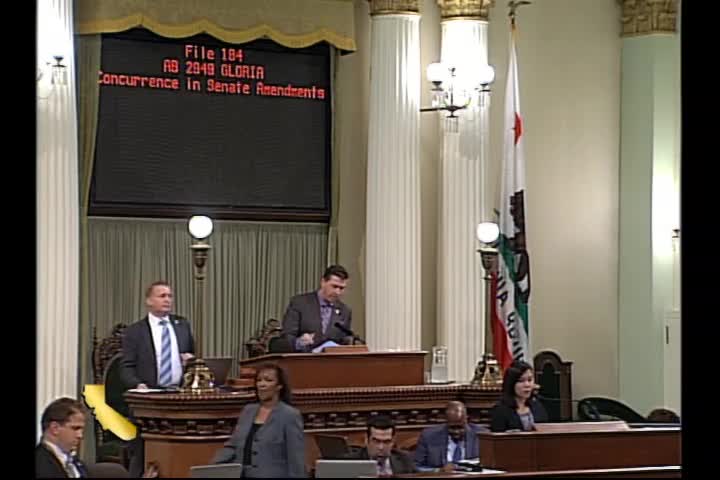
Bill Author

Bill Co-Author(s):