AB 2986: Transportation network companies: disclosure of participating driver information.
- Session Year: 2017-2018
- House: Assembly
- Latest Version Date: 2018-09-06
(1)The Passenger Charter-party Carriers Act defines a transportation network company as an organization, whether a corporation, partnership, sole proprietor, or other form, operating in California that provides prearranged transportation services for compensation using an online-enabled platform to connect passengers with drivers using their personal vehicles. Existing law requires a transportation network company, among other things, to conduct, or have a 3rd party conduct, a local and national criminal background check for each participating driver, as specified, and prohibits a transportation network company from contracting with, employing, or retaining a driver if he or she, among other things, is currently registered on the United States Department of Justice National Sex Offender Public Web site, has been convicted of any of certain terrorism-related felonies or a violent felony, or, within the previous 7 years, has been convicted of misdemeanor assault or battery, any domestic violence offense, driving under the influence of alcohol or drugs, or any of a specified list of felonies. A violation of the act is a crime.
The bill would additionally require a transportation network company to provide information about the transportation network company driver to the passenger on its online-enabled application or platform at the time that the passenger is matched to that driver, including the transportation network company drivers first name and a picture of the driver, an image of the make and model of the drivers vehicle, and the license plate number of the vehicle.
(2)Because a violation of the act is a crime and this bill would expand the scope of the act, this bill would impose a state-mandated local program.
(3)The California Constitution requires the state to reimburse local agencies and school districts for certain costs mandated by the state. Statutory provisions establish procedures for making that reimbursement.
This bill would provide that no reimbursement is required by this act for a specified reason.
(1)The Passenger Charter-party Carriers Act defines a transportation network company as an organization, whether a corporation, partnership, sole proprietor, or other form, operating in California that provides prearranged transportation services for compensation using an online-enabled platform to connect passengers with drivers using their personal vehicles. Existing law requires a transportation network company company, among other things, to conduct, or have a 3rd party conduct, a local and national criminal background check for each participating driver, as specified, and prohibits a transportation network company from contracting with, employing, or retaining a driver if he or she, among other things, is currently registered on the United States Department of Justice National Sex Offender Public Web site, has been convicted of any of certain terrorism-related felonies or a violent felony, or, within the previous 7 years, has been convicted of misdemeanor assault or battery, any domestic violence offense, driving under the influence of alcohol or drugs, or any of a specified list of felonies. A violation of the act is generally a misdemeanor and is subject to a fine of not less than $1,000 and not more than $5,000 or by imprisonment in a county jail for not more than 3 months, or by both that fine and imprisonment. Existing law also provides that a transportation network company that violates, or fails to comply with, these provisions is subject to a penalty of not less than $1,000 nor more than $5,000 for each offense. A violation of the act is a crime.
The bill would additionally prohibit a transportation network company from contracting with, employing, or continuing to retain a driver if he or she is convicted of, among other things, any one of a number of specified sex offenses, any burglary of the first degree, or human trafficking. The bill would additionally prohibit a transportation network company from contracting with, employing, or retaining a driver if he or she has been convicted, within the previous 7 years, of, among other things, any burglary of the second degree, any specified crime committed against an elder or a dependent adult, any assault or battery, or shoplifting. The bill would also extend the period of time for the disqualifying offense of a conviction for driving under the influence of alcohol or drugs from within the previous 7 to 10 years.The bill would additionally require a transportation network company to provide information about the transportation network company driver to the passenger on its online-enabled application or platform at the time that the passenger is matched to that driver, including the transportation network company drivers first name and a picture of the driver, an image of the make and model of the drivers vehicle, and the license plate number of the vehicle.
(2)Because a violation of the act and these provisions is a crime and this bill would expand the scope of the act, this bill would impose a state-mandated local program.
(3)The California Constitution requires the state to reimburse local agencies and school districts for certain costs mandated by the state. Statutory provisions establish procedures for making that reimbursement.
This bill would provide that no reimbursement is required by this act for a specified reason.
(1)The Passenger Charter-party Carriers Act defines a transportation network company as an organization, whether a corporation, partnership, sole proprietor, or other form, operating in California that provides prearranged transportation services for compensation using an online-enabled platform to connect passengers with drivers using their personal vehicles. Existing law requires a transportation network company to conduct, or have a 3rd party conduct, a local and national criminal background check for each participating driver, as specified, and prohibits a transportation network company from contracting with, employing, or retaining a driver if he or she, among other things, is currently registered on the United States Department of Justice National Sex Offender Public Web site, has been convicted of any of certain terrorism-related felonies or a violent felony, or, within the previous 7 years, has been convicted of misdemeanor assault or battery, any domestic violence offense, driving under the influence of alcohol or drugs, or any of a specified list of felonies. A violation of the act is generally a misdemeanor and is subject to a fine of not less than $1,000 and not more than $5,000 or by imprisonment in a county jail for not more than 3 months, or by both that fine and imprisonment. Existing law also provides that a transportation network company that violates, or fails to comply with, these provisions is subject to a penalty of not less than $1,000 nor more than $5,000 for each offense.
The bill would additionally prohibit a transportation network company from contracting with, employing, or continuing to retain a driver if he or she is convicted of, among other things, any one of a number of specified sex offenses, any burglary of the first degree, or human trafficking. The bill would additionally prohibit a transportation network company from contracting with, employing, or retaining a driver if he or she has been convicted, within the previous 7 years, of, among other things, any burglary of the second degree, any specified crime committed against an elder or a dependent adult, any assault or battery, or shoplifting. The bill would also extend the period of time for the disqualifying offense of a conviction for driving under the influence of alcohol or drugs from within the previous 7 to 10 years.
(2)Because a violation of the act and these provisions is a crime and this bill would expand the scope of the act, this bill would impose a state-mandated local program.
(3)The California Constitution requires the state to reimburse local agencies and school districts for certain costs mandated by the state. Statutory provisions establish procedures for making that reimbursement.
This bill would provide that no reimbursement is required by this act for a specified reason.
Existing law establishes the Structural Pest Control Board within the Department of Consumer Affairs to define, license, and regulate structural pest control operators. Existing law defines pesticide to include any spray adjuvant and any substance, or mixture of substances, intended to be used for preventing, destroying, repelling, or mitigating any pest or organism.This bill would make a nonsubstantive change to that provision.Existing law establishes the Structural Pest Control Board within the Department of Consumer Affairs to define, license, and regulate structural pest control operators. Existing law defines pesticide to include any spray adjuvant and any substance, or mixture of substances, intended to be used for preventing, destroying, repelling, or mitigating any pest or organism.
This bill would make a nonsubstantive change to that provision.
A transportation network company shall provide all of the following information to a passenger on its online-enabled application or platform at the time the passenger is matched with a transportation network company driver:
(a)The transportation network company drivers first name and a picture of the driver.
(b)An image of the make and model of the transportation network company drivers vehicle.
(c)The license plate number of the transportation network company drivers vehicle.
SEC. 2.No reimbursement is required by this act pursuant to Section 6 of Article XIIIB of the California Constitution because the only costs that may be incurred by a local agency or school district will be incurred because this act creates a new crime or infraction, eliminates a crime or infraction, or changes the penalty for a crime or infraction, within the meaning of Section 17556 of the Government Code, or changes the definition of a crime within the meaning of Section 6 of Article XIIIB of the California Constitution.
(a)(1)A transportation network company shall conduct, or have a third party conduct, a local and national criminal background check for each participating driver that shall include both of the following:
(A)The use of a multistate and multijurisdiction criminal records locator or other similar commercial nationwide database with validation.
(B)A search of the United States Department of Justice National Sex Offender Public Web site.
(2)A transportation network company shall not contract with, employ, or retain a driver if he or she meets either of the following criteria:
(A)Is currently registered on the United States Department of Justice National Sex Offender Public Web site.
(B)Has been convicted of any of the following offenses:
(i)A violent felony, as defined in Section 667.5 of the Penal Code.
(ii)A violation of Section 11413, 11418, 11418.5, or 11419 of the Penal Code.
(iii)Any offense enumerated in subdivision (c) of Section 290 of the Penal Code.
(iv)Section 530.5 of the Penal Code.
(v)Any burglary of the first degree.
(vi)Subdivision (a) of Section 236.1 of the Penal Code.
(vii)Subdivision (a) of Section 266h or subdivision (a) of Section 266i of the Penal Code.
(viii)Subdivision (b) or (c) of Section 368 of the Penal Code.
(ix)Section 29800 or Section 29900 of the Penal Code.
(x)Section 186.10 of the Penal Code.
(3)A transportation network company shall not contract with, employ, or retain a driver if he or she has been convicted of any of the following offenses within the previous seven years. years:
(A)Misdemeanor assault Assault or battery.
(B)A domestic violence offense.
(C)Driving under the influence of alcohol or drugs.(D)(C)A felony violation of Section 18540 of the Elections Code, or of Section 67, 68, 85, 86, 92, 93, 137, 138, 165, 518, 530, or 18500 of, subdivision (a) of Section 484 of, subdivision (a) of Section 487 of, or subdivision (b) of Section 25540 of, the Penal Code.
(D)Any burglary of the second degree.
(E)Subdivision (d) or (e) of Section 368 of the Penal Code.
(F)Section 23103, as specified in Section 23103.5, of the Vehicle Code.
(G)Section 459.5 of the Penal Code.
(H)Subdivision (a) of Section 484 of the Penal Code.
(4)A transportation network company shall not contract with, employ, or retain a driver if he or she has been convicted of driving under the influence of alcohol or drugs within the previous 10 years.
(4)(5)Paragraphs (2) and (3) (2), (3), and (4) apply with respect to a conviction of any offense committed in another jurisdiction that includes all of the elements of any of the offenses described or defined in those paragraphs.
(5)(6)This section shall not be interpreted to prevent a transportation network company from imposing additional standards.
(b)A transportation network company that violates, or fails to comply with, this section is subject to a penalty of not less than one thousand dollars ($1,000) nor more than five thousand dollars ($5,000) for each offense.
(c)(1)Notwithstanding Section 1786.12 of the Civil Code, an investigative consumer reporting agency may furnish an investigative consumer report to a transportation network company about a person seeking to become a participating driver, regardless of whether the participating driver is to be an employee or an independent contractor of the transportation network company.
(2)Paragraph (7) of subdivision (a) of Section 1786.18 of the Civil Code does not apply to an investigative consumer report furnished to a transportation network company pursuant to paragraph (1).
SEC. 2.No reimbursement is required by this act pursuant to Section 6 of Article XIIIB of the California Constitution because the only costs that may be incurred by a local agency or school district will be incurred because this act creates a new crime or infraction, eliminates a crime or infraction, or changes the penalty for a crime or infraction, within the meaning of Section 17556 of the Government Code, or changes the definition of a crime within the meaning of Section 6 of Article XIIIB of the California Constitution.
SECTION 1.Section 8504.1 of the Business and Professions Code is amended to read:8504.1.Pesticide includes any of the following:(a)Any spray adjuvant.(b)Any substance, or mixture of substances, that is intended to be used for preventing, destroying, repelling, or mitigating any pest or organism.Pesticide includes any of the following:
(a)Any spray adjuvant.
(b)Any substance, or mixture of substances, which substances, that is intended to be used for preventing, destroying, repelling, or mitigating any pest or organism.
|
Date
|
Status
|
|---|---|
| Sep 6, 2018 | Chaptered by Secretary of State - Chapter 286, Statutes of 2018. |
| Sep 6, 2018 | Approved by the Governor. |
| Aug 27, 2018 | Enrolled and presented to the Governor at 3 p.m. |
| Aug 22, 2018 | In Assembly. Ordered to Engrossing and Enrolling. |
| Aug 21, 2018 | Read third time. Passed. Ordered to the Assembly. |
| Aug 7, 2018 | Read second time. Ordered to third reading. |
| Aug 6, 2018 | From committee: Be ordered to second reading pursuant to Senate Rule 28.8. |
| Jun 28, 2018 | From committee: Do pass and re-refer to Com. on APPR. (Ayes 10. Noes 0.) (June 27). Re-referred to Com. on APPR. |
| Jun 12, 2018 | From committee: Do pass and re-refer to Com. on E., U. & C. with recommendation: To Consent Calendar. (Ayes 12. Noes 0.) (June 12). Re-referred to Com. on E., U. & C. |
| May 30, 2018 | Referred to Coms. on T. & H. and E., U. & C. |
| May 17, 2018 | In Senate. Read first time. To Com. on RLS. for assignment. |
| May 17, 2018 | Read third time. Passed. Ordered to the Senate. |
| May 10, 2018 | Read second time. Ordered to Consent Calendar. |
| May 9, 2018 | From committee: Do pass. To Consent Calendar. (Ayes 16. Noes 0.) (May 9). |
| Apr 26, 2018 | From committee: Do pass and re-refer to Com. on APPR. (Ayes 11. Noes 0.) (April 25). Re-referred to Com. on APPR. |
| Apr 23, 2018 | Re-referred to Com. on C. & C. |
| Apr 19, 2018 | From committee chair, with author's amendments: Amend, and re-refer to Com. on C. & C. Read second time and amended. |
| Apr 11, 2018 | In committee: Set, first hearing. Hearing canceled at the request of author. |
| Apr 3, 2018 | Re-referred to Com. on C. & C. |
| Apr 2, 2018 | From committee chair, with author's amendments: Amend, and re-refer to Com. on C. & C. Read second time and amended. |
| Apr 2, 2018 | Referred to Coms. on C. & C. and PUB. S. |
| Feb 17, 2018 | From printer. May be heard in committee March 19. |
| Feb 16, 2018 | Read first time. To print. |
|
Date
|
Description
|
Location
|
Votes
|
|
|---|---|---|---|---|
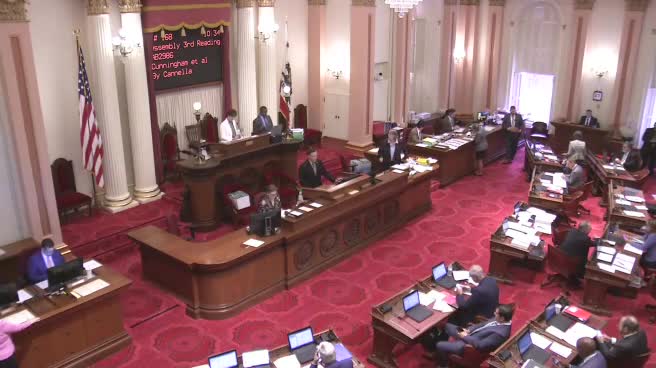
| Aug 21, 2018 | Assembly 3rd Reading AB2986 Cunningham et al. By Cannella | Senate Floor |
Passed |
|
| Jun 27, 2018 | Do pass, but first be re-referred to the Committee on [Appropriations] | Senate Standing Committee on Energy, Utilities and Communications |
Passed |
|
| Jun 12, 2018 | Do pass, but first be re-referred to the Committee on [Energy, Utilities and Communications] with the recommendation: To Consent Calendar | Senate Standing Committee on Transportation and Housing |
Passed |
|
| May 17, 2018 | AB 2986 CUNNINGHAM Consent Calendar Second Day Regular Session | Assembly Floor |
Passed |
|
| May 9, 2018 | Do pass. To Consent Calendar. | Assembly Standing Committee on Appropriations |
Passed |
|
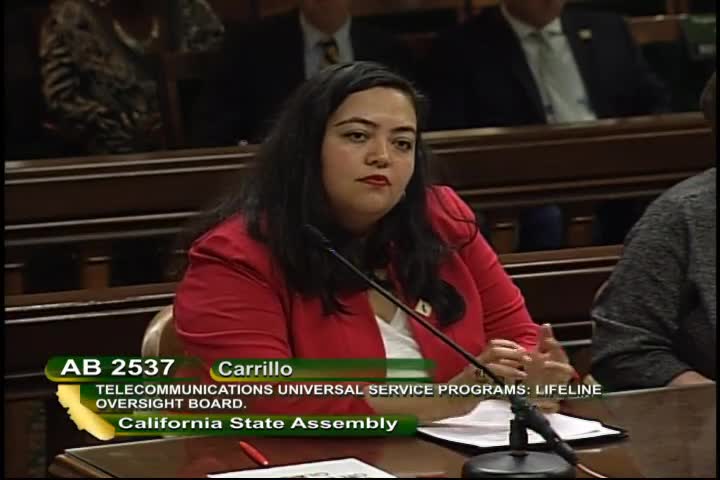
| Apr 25, 2018 | Do pass and be re-referred to the Committee on [Appropriations] | Assembly Standing Committee on Communications and Conveyance |
Passed |
This list shows positions taken on this bill by organizations on the date displayed, which is linked to the original source.
Positions by individuals are not included.
|
Organization
|
Position
|
Date
|
|---|---|---|
| California District Attorneys Association | ** Support | Aug 8, 2018 |
| Technet | ** Support | Jun 25, 2018 |
| The Internet Association | ** Support | Jun 25, 2018 |
Office of Senate Floor Analyses (916) 651-1520 Fax: (916) 327-4478 | AB |
THIRD READING
Bill No: AB 2986
:
SENATE TRANS. & HOUSING COMMITTEE: 12-0, 6/12/18
AYES: Beall, Cannella, Allen, Dodd, Gaines, Galgiani, McGuire, Roth, Skinner, Vidak, Wieckowski, Wiener
NO VOTE RECORDED: Morrell
SENATE ENERGY, U. & C. COMMITTEE: 10-0, 6/27/18
AYES: Hueso, Morrell, Bradford, Hertzberg, Hill, McGuire, Skinner, Stern, Vidak, Wiener
NO VOTE RECORDED: Cannella
SENATE APPROPRIATIONS COMMITTEE: Senate Rule 28.8
ASSEMBLY FLOOR: 73-0, 5/17/18 (Consent) - See last page for vote
DIGEST:
This bill requires transportation network companies (TNC) to provide to passengers specified information about drivers and their vehicles.
Existing law:
- Establishes the California Public Utilities Commission (CPUC) to regulate privately owned public utilities and common carriers in California and directs the CPUC to regulate transportation charter-party carriers (CPCs).
- Establishes TNCs, such as Lyft and Uber, as a subset of CPCs subject to CPUC regulations which include, but are not limited to:
- Criminal backgrounds check on each driver and conduct a search of the United States Department of Justice National Sex Offender Public Web site.
- A safety inspection of each vehicle.
- Minimum insurance requirements.
This bill requires TNCs to provide the following to passengers on its app:
- The driver’s first name and picture.
- An image of the make and model of the TNC vehicle and the license plate number.
Comments
- Author’s statement. “Current regulations promulgated by the Public Utilities Commission require that an app operated by a TNC display for its passengers a picture of the driver, the driver's vehicle, and the license plate number to identify the vehicle. Recent events in San Luis Obispo, Los Angeles, and elsewhere underscore the importance of passengers having the tools to identify their TNC driver before entering a vehicle. It is all too easy for an unscrupulous driver to use even their perceived role as a TNC driver to take advantage of vulnerable passengers. AB 2986 strengthens these important PUC regulations, ensuring they are codified in state law.”
- Looks familiar. This bill codifies existing CPUC TNC regulations[1]. It may be unnecessary, but the bill requirements are so fundamental that it is hard to envision how it could be harmful.
- No impact on autonomous vehicles. This bill will not impact TNC rides offered through autonomous vehicles as the bill only deals with instances when passengers are matched with drivers.
FISCAL EFFECT: Appropriation: Fiscal Com.: Local:
California District Attorneys Association
None received
ASSEMBLY FLOOR: 73-0, 5/17/18
AYES: Acosta, Aguiar-Curry, Travis Allen, Arambula, Baker, Berman, Bigelow, Bloom, Bonta, Brough, Burke, Caballero, Calderon, Carrillo, Cervantes, Chau, Chávez, Chen, Chiu, Choi, Chu, Cooley, Cooper, Cunningham, Dahle, Daly, Eggman, Flora, Fong, Frazier, Friedman, Gallagher, Eduardo Garcia, Gipson, Gloria, Gonzalez Fletcher, Gray, Grayson, Harper, Holden, Irwin, Jones-Sawyer, Kalra, Kamlager-Dove, Kiley, Lackey, Levine, Limón, Low, Maienschein, Mathis, Mayes, McCarty, Medina, Mullin, Nazarian, Obernolte, O'Donnell, Patterson, Quirk, Quirk-Silva, Reyes, Rodriguez, Rubio, Salas, Mark Stone, Thurmond, Ting, Voepel, Waldron, Weber, Wood, Rendon
NO VOTE RECORDED: Cristina Garcia, Melendez, Muratsuchi, Santiago, Steinorth
8/8/18 10:42:09
**** END ****
D.13-09-045, p.27; September 19, 2013. ↑
SENATE COMMITTEE ON ENERGY, UTILITIES AND COMMUNICATIONS
Senator Ben Hueso, Chair
2017 - 2018 Regular
Bill No: Hearing Date: 6/27/2018
Author: | |||
Version: | As Amended | ||
Urgency: | Fiscal: | ||
Consultant: | |||
SUBJECT:
DIGEST: This bill requires transportation network companies (TNC) to provide each passenger with the driver’s name, picture, image of the driver’s car, and license plate when the passenger books a ride.
ANALYSIS:
Existing law:
- Authorizes the California Public Utilities Commission (CPUC) to supervise and regulate every charter-party carrier of passengers. (Public Utilities Code §5381)
- Defines a charter-party carrier of passengers as every person engaged in the transportation of persons by motor vehicle for compensation over any public highway in this state. A charter-party carrier of passengers includes any person, corporation, or other entity engaged in the provision of a hired driver service when a rented motor vehicle is being operated by a hired driver. (Public Utilities Code §5360)
- Defines a TNC as an organization, including, but not limited to, a corporation, limited liability company, partnership, sole proprietor, or any other entity, operating in California that provides prearranged transportation services for compensation using an online-enabled application or platform to connect passengers with drivers using a personal vehicle. (Public Utilities Code §5431)
- Requires each TNC to conduct, or have a third party conduct, a local and national background check on each TNC driver. This background check must include a search of the United States Department of Justice National Sex Offender Public Web site and a multistate and multijurisdiction criminal records locator or other similar commercial nationwide database with validation. TNCs are prohibited from contracting with or employing a driver that has been convicted of certain offenses within seven years, including, but not limited to, domestic violence, assault, and battery. (Public Utilities Code §5445.2)
This bill requires a TNC to provide each passenger with the following information on the TNC’s online-enabled application or platform at the time the passenger is matched with a driver:
- The driver’s first name and a picture of the driver.
- An image of the make and model of the driver’s vehicle.
- The license plate number of the driver’s vehicle.
Background
TNC Safety Concerns. In January 2018, a TNC driver in San Luis Obispo County was charged with sexually assaulting and burglarizing multiple female passengers after scouting his victims using a ride-share app. Law enforcement officials said that the accused driver used the TNC’s online platform to identify women arranging rides and then posed as the driver assigned to the women in the app before assaulting them. In 2017, a San Diego TNC driver was convicted of sexually assaulting at least nine female passengers. TNC drivers have been the subject of multiple sexual assault cases in California in recent years. Despite these public cases involving TNC drivers, little public data on TNC safety exists.
Bill Codifies Existing TNC Requirements. In 2013, the CPUC issued a decision (D. 13-09-045) classifying TNCs as charter-party passenger carriers and establishing minimum safety, regulatory, and background check requirements for TNCs. This decision also required the TNC app connecting drivers and passengers to display the following for each passenger booking a ride: a picture of the driver, a picture of the vehicle the driver is approved to use, and the license plate number to identify the vehicle.
This bill would codify the requirement that a TNC app provide each passenger with a picture of the driver, a picture of the make and model of the driver’s vehicle, and the vehicle’s license plate number at the time the passenger is matched with the vehicle in the TNC’s platform. Since TNCs are already required to comply with these requirements, this codification should not negatively impact TNCs.
Ongoing Efforts to Enhance TNC Safety. In 2016, the Legislature passed AB 1289 (Cooper, Chapter 740, Statues of 2016) which required each TNC to conduct background checks on their drivers that included certain record searches and prohibited TNCs from employing drivers convicted of certain offenses. In November 2017, the CPUC adopted a decision to strengthen TNC background check requirements by requiring TNCs to complete background checks using a screener that meets certain accreditation standards and requiring TNCs to complete background checks both prior to employing a driver and on an annual basis.
Prior/Related Legislation
AB 1289 (Cooper, Chapter 740, Statutes of 2016) required each TNC to conduct, or have a third party conduct, a local and national background check for each driver. This background check is required to include a search of the United States Department of Justice National Sex Offender Public Web site.
AB 2293 (Bonilla, Chapter 389, Statutes of 2014) established liability insurance requirements for TNCs and their drivers and required TNC drivers to carry proof of insurance.
FISCAL EFFECT: Appropriation: Fiscal Com.: Local:
SUPPORT:
California District Attorneys Association
TechNet
The Internet Association
OPPOSITION:
None received
ARGUMENTS IN SUPPORT: According to the author:
“Current regulations promulgated by the Public Utilities Commission require that an app operated by a Transportation Network Company (TNC) display for its passengers a picture of the driver, the driver's vehicle, and the license plate number to identify the vehicle. Recent events in San Luis Obispo, Los Angeles, and elsewhere underscore the importance of passengers having the tools to identify their TNC driver before entering a vehicle. It is all too easy for an unscrupulous driver to use even their perceived role as a TNC driver to take advantage of vulnerable passengers. AB 2986 strengthens these important PUC regulations, ensuring they are codified in state law.”
-- END --
SENATE COMMITTEE ON TRANSPORTATION AND HOUSING
Senator Jim Beall, Chair
2017 - 2018 Regular
Bill No: AB 2986 Hearing Date: 6/12/18
Author: | Cunningham | ||
Version: | 4/19/2018 | ||
Urgency: | No | Fiscal: | Yes |
Consultant: | Randy Chinn | ||
SUBJECT: Transportation network companies: disclosure of participating driver information
DIGEST: This bill requires transportation network companies (TNC) to provide to passengers specified information about drivers and their vehicles.
ANALYSIS:
Existing law:
- Establishes the California Public Utilities Commission (CPUC) to regulate privately owned public utilities and common carriers in California and directs the CPUC to regulate transportation charter-party carriers (CPCs).
- Establishes TNCs, such as Lyft and Uber, as a subset of CPCs subject to CPUC regulations which include, but are not limited to:
- Criminal backgrounds check on each driver and conduct a search of the United States Department of Justice National Sex Offender Public Web site.
- A safety inspection of each vehicle
- Minimum insurance requirements
This bill:
Requires TNCs to provide the following to passengers on its app:
- The driver’s first name and picture.
- An image of the make and model of the TNC vehicle and the license plate number.
COMMENTS:
- Author’s Statement. Current regulations promulgated by the Public Utilities Commission require that an app operated by a TNC display for its passengers a picture of the driver, the driver's vehicle, and the license plate number to identify the vehicle. Recent events in San Luis Obispo, Los Angeles, and elsewhere underscore the importance of passengers having the tools to identify their TNC driver before entering a vehicle. It is all too easy for an unscrupulous driver to use even their perceived role as a TNC driver to take advantage of vulnerable passengers. AB 2986 strengthens these important PUC regulations, ensuring they are codified in state law.
- Looks Familiar. This bill codifies existing CPUC TNC regulations[1]. It may be unnecessary, but the bill requirements are so fundamental that it is hard to envision how it could be harmful.
- No Impact on AVs. This bill will not impact TNC rides offered through autonomous vehicles as the bill only deals with instances when passengers are matched with drivers.
Related Legislation:
SB 1080 (Newman, 2018) — permits out-of-state TNC drivers who are active military members or their families to drive for a TNC without a California Driver’s License provided the TNC provides those drivers with educational material about specified California driving laws.
AB 1289 (Cooper, Chapter 740 of 2016) — required a TNC to conduct a criminal background check for each participating driver.
AB 2293 (Bonilla, Chapter 389 of 2014) — established guidelines for insurance coverage for TNCs to ensure personal and financial safety of consumers.
FISCAL EFFECT: Appropriation: Fiscal Com.: Local:
Assembly votes:
Communications and Conveyance: 11-0
Appropriations: 16-0
Floor: 73-0
POSITIONS: (Communicated to the committee before noon on Wednesday,
June 6, 2018.)
SUPPORT:
California District Attorneys Association
Internet Association
TechNet
OPPOSITION:
None received.
-- END --
D.13-09-045, p.27; September 19, 2013. ↑
Date of Hearing: May 9, 2018
ASSEMBLY COMMITTEE ON APPROPRIATIONS
Lorena Gonzalez Fletcher, Chair
ABPCA Bill Id:AB 2986
Author:(Cunningham) – As Amended Ver:April 19, 2018
Policy Committee: | Communications and Conveyance | Vote: | 11 - 0 |
|
| ||
|
|
Urgency: No State Mandated Local Program: Yes Reimbursable: No
SUMMARY:
This bill places in statute an existing regulatory requirement that a transportation network company (TNC), such as Lyft and Wings, provide all of the following information to a passenger on its online-enabled application or platform at the time the passenger is matched with a TNC driver: (a) the TNC driver’s first name and a picture of the driver; (b) an image of the make and model of the driver’s vehicle; and (c) the license plate number of the driver’s vehicle.
FISCAL EFFECT:
Negligible costs, if any.
COMMENTS:
Background and Purpose. A result of a historical bureaucratic quirk, the California Public Utilities Commission (CPUC) regulates some aspects of TNCs operations. Among CPUC’s regulation is the requirement that a TNC provide all of the following information to a passenger on the TNC’s online-enabled application or platform at the time the passenger is matched with a TNC driver:
- The TNC driver’s first name and a picture of the driver.
- An image of the make and model of the TNC driver’s vehicle.
- The license plate number of the TNC driver’s vehicle.
This bill places in statute the preceding regulatory requirements.
It is unclear what is gained by placing these specific TNC requirements in statute. Somewhat reasonably, the author assumes there will never be a reason to not require a TNC, via its app, to provide a passenger with a driver’s first name and picture, an image of the make and model of the driver’s vehicle, and the license plate number of the vehicle. However, life is unpredictable. Regulations are much easier to change, should the need arise, than is statute.
The author introduced this bill in response to an individual who used the Uber app to identify drunken women awaiting an Uber driver, intercept them by presenting himself as the Uber driver, and then sexually assault them.
Analysis Prepared by: Jay Dickenson / APPR. / (916) 319-2081
Date of Hearing: April 25, 2018
ASSEMBLY COMMITTEE ON COMMUNICATIONS AND CONVEYANCE
Miguel Santiago, Chair
ABPCA Bill Id:AB 2986 (
Author:Cunningham) – As Amended Ver:April 19, 2018
SUBJECT: Transportation network companies: disclosure of participating driver information
SUMMARY: Codifies an existing requirement for a Transportation Network Company (TNC) to provide all of the following information to a passenger on its online-enabled application or platform at the time the passenger is matched with a TNC driver: (1) the TNC driver’s first name and a picture of the driver; (2) an image of the make and model of the TNC driver’s vehicle; and
(3) the license plate number of the TNC driver’s vehicle.
EXISTING LAW:
- Establishes the “Passenger Charter-Party Carriers Act,” which authorizes the California Public Utilities Commission (CPUC) to supervise and regulate every charter-party carrier of passengers (CPC) in the State and may do all things, necessary and convenient in the exercise of such power and jurisdiction, including issuing permits or certificates, investigating complaints against carriers, and cancel, revoke, or suspend permits and certificates for specific violations. (Public Utilities Code (PUC) Section Code 5381 et seq.)
- Defines “Charter-party carrier of passengers” to mean every person engaged in the transportation of persons by motor vehicle for compensation, whether in common or contract carriage, over any public highway in this state. (PUC Section 5360)
- Defines a “Transportation network company” to mean an organization, including, but not limited to, a corporation, limited liability company, partnership, sole proprietor, or any other entity, operating in California that provides prearranged transportation services for compensation using an online-enabled application or platform to connect passengers with drivers using a personal vehicle. (PUC Section 5431)
- Requires a TNC and any participating driver to maintain TNC insurance, as specified, including primary liability insurance coverage of $100,000 per person and $300,000 per occurrence for death and personal injury, and $50,000 for property damage from the moment a driver logs on to the application until the driver accepts a ride request; $1 million for personal injury and property damage from the moment a driver logs on to the application until the driver accepts a ride request; and $1 million for personal injury and property damage from the moment a ride request is accepted until the passenger exits the vehicle. (PUC Section 5433)
- Requires a TNC to conduct, or have a third party conduct, a local and national criminal background check for each participating driver, as specified. (PUC Section 5445.2 (a)(1))
- Prohibits a TNC from contracting with, employing, or retaining a driver if he or she meets either of the following criteria:
- Is currently registered on the United States Department of Justice National Sex Offender Public Web site; or,
- Has been convicted of specified violent felonies or acts of terrorism and offenses related to weapons of mass destruction and biological agents. (PUC Section 5445.2 (a)(2))
- Prohibits a TNC from contracting with, employing, or retaining a driver if he or she has been convicted of any of the following offenses within the previous seven years:
- Misdemeanor assault or battery;
- A domestic violence offense;
- Driving under the influence of alcohol or drugs; or,
- Specified felony violations related to elections. (PUC Section 5445.2 (a)(3))
- Specifies that the Legislature does not intend, and nothing in the specified article shall be construed, to prohibit the CPUC from exercising its rulemaking authority in a manner consistent with the specified article, or to prohibit enforcement activities related to TNCs. (PUC Section 5441)
FISCAL EFFECT: Unknown. This bill has been keyed fiscal by the Legislative Counsel.
COMMENTS:
- Author’s Statement: According to the author, “Current regulations promulgated by the [CPUC] require that an app operated by a [TNC] display for its passengers a picture of the driver, the driver's vehicle, and the license plate number to identify the vehicle. Recent events in San Luis Obispo, Los Angeles, and elsewhere underscore the importance of passengers having the tools to identify their TNC driver before entering a vehicle. It is all too easy for an unscrupulous driver to use even their perceived role as a TNC driver to take advantage of vulnerable passengers. AB 2986 strengthens these important CPUC regulations, ensuring they are codified in state law.”
- Background: The CPUC has regulatory and safety oversight authority over CPCs, such as limousines, airport shuttles, tour buses, sightseeing services, and charter, party buses. CPCs are charter vehicles that offer transportation services on a prearranged basis for the exclusive use of an individual or group. Charges are based on either, or a combination of, mileage or time of use. TNCs are companies that offer patrons prearrange transportation services through an app on their smartphone or computer. Although TNCs do not neatly fall into the conventional definition of a CPC, the CPUC believes that TNCs fall under its existing jurisdiction over certain transportation services because they are providing passengers’ transportation for compensation.
- TNC Safety Requirements: Since the inception of TNCs, the Legislature and the CPUC has sought to balance the need to adopt rules and regulations that promote the public safety aspects of the TNC industry, while not obstructing the public’s demand for such new mode of transportation. The CPUC has instituted a number of safety requirements on TNCs including requiring TNCs to maintain specified commercial liability insurance, conduct criminal background checks, instituting a zero tolerance intoxicating substance policy, dictating the type of vehicles that can be used, among others.
In 2016, the Legislature passed AB 1289 (Cooper) Chapter 740, Statutes of 2016, which required TNCs to conduct a local and national criminal background check for each participating driver. There are various forms of background checks ranging from simple name checks to biometric checks that are run through federal, state, or local law enforcement databases. TNCs generally contract with third party firms that they argue provide a more comprehensive review necessary to ensure passenger safety
The CPUC is allowed to impose additional standards on TNCs as it continues to respond to market, regulatory, and technological changes. In November 2017, the CPUC issued a proposed decision (R. 12-12-011) adopting additional requirements for TNCs including:
- Requiring a commercial background check companies that a TNC employs to be accredited by the National Association of Professional Background Screener’s Background Screening Credentialing Council;
- Requiring each TNC to receive proof of accreditation of the background check company and provide proof of accreditation with any reporting that the CPUC may require;
- Requiring the background screening for each TNC driver to be conducted for each year the TNC driver subscribes to the app; and,
- Limiting the information a TNC can require from a criminal background check going past seven years, as specified.
In the proposed decision, the CPUC declined to require a TNC that does not primarily transport minors to conduct a biometric background check of a TNC driver finding that doing so would not add a greater level of safety over and above the current background check protocols.
- TNC Incidents: While no industry is perfect, news reports continue to identify situations in which TNC drivers have been accused of criminal acts such as rape, felony assault, kidnapping, among others. The author points to an incident that occurred in January 2018 in his district in which an Uber driver sexually assaulted several women by using the app to scout potential victims seeking rides and then picking up the victims before their actual matched vehicle arrived. TNCs are required to display consistent trade dress that meet specific requirements to identify that they are a TNC vehicle while operating, however, the victims in these incidents were unaware that they were entering the wrong TNC vehicle. In response, law enforcement officials warned TNC riders to make sure that the driver identified on the app to pick them up matches the one that arrives.
Following the incident, the author submitted a letter requesting information from the CPUC on its TNC background check process and requesting that it conduct an inquiring into the specified incident. The CPUC responded by stating that it is conducting an investigation related to the specified incident, but is refraining from making investigation records public until the investigation is complete.
To ensure that riders are entering the correct vehicle, Uber and Lyft have been rolling out new beacon devices for its drivers which light up to a specific color to help drivers and riders find each other. Such devices could be helpful especially at night or in crowded areas or events where multiple people may be hailing a ride at the same time. The CPUC requires TNCs to display on its app a picture of the driver, and the vehicle the driver is approved to use, including the license plate number. This bill codifies the CPUC requirement for TNCs to display on its app the first name and picture of the driver, the make and model of the vehicle, and license plate number.
- Previous Legislation: AB 1289 (Cooper) of 2016 requires a TNC to conduct a criminal background check for each participating driver. Status: Chaptered by the Secretary of State, Chapter 740, Statutes of 2016.
AB 2293 (Bonilla) of 2014 establishes guidelines for insurance coverage for TNCs to ensure personal and financial safety of consumers. Status: Chaptered by the Secretary of State, Chapter 389, Statutes of 2014.
REGISTERED SUPPORT / OPPOSITION:
Support
None on file.
Opposition
None on file.
Analysis Prepared by: Edmond Cheung / C. & C. / (916) 319-2637
Discussed in Hearing
 1MIN
Senate Floor
 8MIN
Assembly Standing Committee on Communications and Conveyance
Bill Author

Bill Co-Author(s):
