AB 2989: Motorized scooter: use of helmet: maximum speed.
- Session Year: 2017-2018
- House: Assembly
- Latest Version Date: 2018-09-19
Existing law generally prescribes the operation of a motorized scooter, defined as 2-wheeled device that has handlebars, has a floorboard that is designed to be stood upon when riding, and is powered by an electric motor or by a source other than electric power. Existing law requires a drivers license or permit to operate a motorized scooter. Existing law prohibits the operation of a motorized scooter on a highway with a speed limit in excess of 25 miles per hour unless the motorized scooter is operated within a Class II bike lane. Existing law prohibits an operator of a motorized scooter from operating the motorized scooter without wearing a properly fitted and fastened helmet meeting specified standards. Existing law prohibits a person from operating a motorized scooter at a speed in excess of 15 miles per hour. A violation of prescriptions or prohibitions regarding motorized scooters is a crime.
This bill would permit a local authority to authorize the operation of a motorized scooter on a highway with a speed limit of up to 35 miles per hour and would additionally allow for operation of a motorized scooter on a highway with a higher speed limit if the motorized scooter is operated within a Class IV bikeway. The bill would specify that the existing maximum 15 mile per hour speed limit for the operation of a motorized scooter applies regardless of a higher speed limit applicable to the highway. The bill would require the operator of a motorized scooter to wear a helmet only if the operator is under 18 years of age.
Existing law generally prescribes the operation of a motorized scooter, defined as 2-wheeled device that has handlebars, has a floorboard that is designed to be stood upon when riding, and is powered by an electric motor or by a source other than electric power. Existing law requires a drivers license or permit to operate a motorized scooter. Existing law prohibits the operation of a motorized scooter on a highway with a speed limit in excess of 25 miles per hour unless the motorized scooter is operated within a Class II bike lane. Existing law prohibits an operator of a motorized scooter from operating the motorized scooter without wearing a properly fitted and fastened helmet meeting specified standards. Existing law prohibits a person from operating a motorized scooter at a speed in excess of 15 miles per hour. A violation of prescriptions or prohibitions regarding motorized scooters is a crime.
This bill would permit a local authority to authorize the operation of a motorized scooter on a highway with a speed limit of up to 35 miles per hour, and would hour and would additionally allow for operation of a motorized scooter on a highway with a higher speed limit if the motorized scooter is operated within a Class II or Class IV bikeway. The bill would specify that the existing maximum 15 mile per hour speed limit for the operation of a motorized scooter applies regardless of a higher speed limit applicable to the highway. The bill would require the operator of a motorized scooter to wear a helmet only if the operator is under 18 years of age.
Existing law generally prescribes the operation of a motorized scooter, defined as 2-wheeled device that has handlebars, has a floorboard that is designed to be stood upon when riding, and is powered by an electric motor or by a source other than electric power. Existing law requires a drivers license or permit to operate a motorized scooter. Existing law prohibits the operation of a motorized scooter on a highway with a speed limit in excess of 25 miles per hour unless the motorized scooter is operated within a Class II bike lane. Existing law prohibits an operator of a motorized scooter from operating the motorized scooter without wearing a properly fitted and fastened helmet meeting specified standards. A violation of prescriptions or prohibitions regarding motorized scooters is a crime.
This bill would permit the operation of a motorized scooter on a highway with a speed limit of up to 35 miles per hour, and would allow for operation on a highway with a higher speed limit if the motorized scooter is operated within a Class II or Class IV bikeway. The bill would require the operator of a motorized scooter to wear a helmet only if the operator is less than under 18 years of age.
Existing law generally prescribes the operation of a motorized scooter, defined as 2-wheeled device that has handlebars, has a floorboard that is designed to be stood upon when riding, and is powered by an electric motor or by a source other than electric power. Existing law requires a drivers license or permit to operate a motorized scooter. Existing law prohibits an operator of a motorized scooter from operating the motorized scooter without wearing a properly fitted and fastened helmet meeting specified standards. A violation of prescriptions or prohibitions regarding motorized scooters is a crime.
The bill would require the operator of a motorized scooter to wear a helmet only if the operator is less than 18 years of age.
Existing law generally prescribes the operation of a motorized scooter, as defined, and requires a drivers license or permit to operate a motorized scooter. A violation of prescriptions or prohibitions regarding motorized scooters is a crime.Under existing law, it is a crime for a person riding, among other things, a bicycle to attach the bicycle or the person to a vehicle on the roadway. Under existing law, it is a crime to leave a bicycle on a sidewalk so that there is not an adequate path for pedestrians. Existing law requires a minor operating, among other things, a bicycle or a nonmotorized scooter to wear a helmet, as prescribed, and failure to do so is a crime.This bill would define a standup electric scooter as a 2-wheeled device that has handlebars and a floorboard that is designed to be stood upon while riding, is powered by an electric motor of less than 750 watts, and does not exceed a speed of 20 miles per hour. The bill would except a standup electric scooter from the definition of a motorized scooter. The bill would, among other provisions, require the minor operator of a standup electric scooter to wear a bicycle helmet while operating the standup electric scooter. The bill would expand the bicycle-related offenses described above to include a standup electric scooter. The bill would require a standup electric scooter to be equipped with specified safety equipment, and would proscribe operation of a standup electric scooter under certain circumstances, including operation with any passengers in addition to the operator. By expanding the scope of existing crimes, and imposing additional conditions on the operation of a standup electric scooter, the violation of which would be an offense, this bill would impose a state-mandated local program.Existing law authorizes transit development boards and public agencies, including, but not limited to, the Regents of the University of California and the Trustees of the California State University, to adopt ordinances, rules, or regulations, respectively, to restrict, or specify the conditions for, the use of bicycles, motorized bicycles, electric bicycles, skateboards, electrically motorized boards, and roller skates on property under the control of, or any portion of property used by, the board, or on public property under the jurisdiction of the agency, respectively.This bill would additionally authorize those boards and agencies to adopt ordinances, rules, and regulations, respectively, for the use of standup electric scooters.The California Constitution requires the state to reimburse local agencies and school districts for certain costs mandated by the state. Statutory provisions establish procedures for making that reimbursement.This bill would provide that no reimbursement is required by this act for a specified reason.Existing law generally prescribes the operation of a motorized scooter, as defined, and requires a drivers license or permit to operate a motorized scooter. A violation of prescriptions or prohibitions regarding motorized scooters is a crime.
Under existing law, it is a crime for a person riding, among other things, a bicycle to attach the bicycle or the person to a vehicle on the roadway. Under existing law, it is a crime to leave a bicycle on a sidewalk so that there is not an adequate path for pedestrians. Existing law requires a minor operating, among other things, a bicycle or a nonmotorized scooter to wear a helmet, as prescribed, and failure to do so is a crime.
This bill would define a standup electric scooter as a 2-wheeled device that has handlebars and a floorboard that is designed to be stood upon while riding, is powered by an electric motor of less than 750 watts, and does not exceed a speed of 20 miles per hour. The bill would except a standup electric scooter from the definition of a motorized scooter. The bill would, among other provisions, require the minor operator of a standup electric scooter to wear a bicycle helmet while operating the standup electric scooter. The bill would expand the bicycle-related offenses described above to include a standup electric scooter. The bill would require a standup electric scooter to be equipped with specified safety equipment, and would proscribe operation of a standup electric scooter under certain circumstances, including operation with any passengers in addition to the operator. By expanding the scope of existing crimes, and imposing additional conditions on the operation of a standup electric scooter, the violation of which would be an offense, this bill would impose a state-mandated local program.
Existing law authorizes transit development boards and public agencies, including, but not limited to, the Regents of the University of California and the Trustees of the California State University, to adopt ordinances, rules, or regulations, respectively, to restrict, or specify the conditions for, the use of bicycles, motorized bicycles, electric bicycles, skateboards, electrically motorized boards, and roller skates on property under the control of, or any portion of property used by, the board, or on public property under the jurisdiction of the agency, respectively.
This bill would additionally authorize those boards and agencies to adopt ordinances, rules, and regulations, respectively, for the use of standup electric scooters.
The California Constitution requires the state to reimburse local agencies and school districts for certain costs mandated by the state. Statutory provisions establish procedures for making that reimbursement.
This bill would provide that no reimbursement is required by this act for a specified reason.
Existing law generally prescribes the operation of a motorized scooter, as defined, and requires a drivers license or permit to operate a motorized scooter. A violation of prescriptions or prohibitions regarding motorized scooters is a crime.
Under existing law, it is a crime for a person riding, among other things, a bicycle to attach the bicycle or the person to a vehicle on the roadway. Under existing law, it is a crime to leave a bicycle on a sidewalk so that there is not an adequate path for pedestrians. Existing law requires a minor operating, among other things, a bicycle or a nonmotorized scooter to wear a helmet, as prescribed, and failure to do so is a crime.
This bill would define a standup electric scooter as a 2-wheeled device that has handlebars and a floorboard that is designed to be stood upon while riding, is powered by an electric motor of less than 750 watts, and does not exceed a speed of 20 miles per hour. The bill would except a standup electric scooter from the definition of a motorized scooter. The bill would, among other provisions, require the minor operator of a standup electric scooter to wear a bicycle helmet while operating the standup electric scooter. The bill would expand the bicycle-related offenses described above to include a standup electric scooter. The bill would require a standup electric scooter to be equipped with specified safety equipment, and would proscribe operation of a standup electric scooter under certain circumstances, including operation with any passengers in addition to the operator. By expanding the scope of existing crimes, and imposing additional conditions on the operation of a standup electric scooter, the violation of which would be an offense, this bill would impose a state-mandated local program.
The California Constitution requires the state to reimburse local agencies and school districts for certain costs mandated by the state. Statutory provisions establish procedures for making that reimbursement.
This bill would provide that no reimbursement is required by this act for a specified reason.
Existing law generally prescribes the operation of a motorized scooter, as defined, and requires a drivers license or permit to operate a motorized scooter. A violation of prescriptions or prohibitions regarding motorized scooters is a crime.
Under existing law, it is a crime for a person riding, among other things, a bicycle to attach the bicycle or the person to a vehicle on the roadway. Under existing law, it is a crime to leave a bicycle on a sidewalk so that there is not an adequate path for pedestrians. Existing law requires a person minor operating, among other things, a bicycle or a nonmotorized scooter to wear a helmet, as prescribed, and failure to do so is a crime.
This bill would define a standup electric scooter as a 2-wheeled device that has handlebars and a floorboard that is designed to be stood upon while riding, is powered by an electric motor of less than 250 750 watts, and does not exceed a speed of 15 20 miles per hour. The bill would except a standup electric scooter from the definition of a motorized scooter. The bill would, among other provisions, require the minor operator of a standup electric scooter to wear a bicycle helmet while operating the standup electric scooter. The bill would expand the bicycle-related offenses described above to include a standup electric scooter. By expanding the scope of existing crimes, this bill would impose a state-mandated local program.
The California Constitution requires the state to reimburse local agencies and school districts for certain costs mandated by the state. Statutory provisions establish procedures for making that reimbursement.
This bill would provide that no reimbursement is required by this act for a specified reason.
Existing law generally prescribes the operation of a motorized scooter, as defined, and requires a drivers license or permit to operate a motorized scooter. A violation of prescriptions or prohibitions regarding motorized scooters is a crime.
Under existing law, it is a crime for a person riding, among other things, a bicycle to attach the bicycle or the person to a vehicle on the roadway. Under existing law, it is a crime to leave a bicycle on a sidewalk so that there is not an adequate path for pedestrians. Existing law requires a person operating, among other things, a bicycle or a nonmotorized scooter to wear a helmet, as prescribed, and failure to do so is a crime.
This bill would define a standup electric scooter as a 2-wheeled device that has handlebars and a floorboard that is designed to be stood upon while riding, is powered by an electric motor of less than 250 watts, and does not exceed a speed of 15 miles per hour. The bill would except a standup electric scooter from the definition of a motorized scooter. The bill would, among other provisions, require the operator of a standup electric scooter to wear a bicycle helmet while operating the standup electric scooter. The bill would expand the bicycle-related offenses described above to include a standup electric scooter. By expanding the scope of existing crimes, this bill would impose a state-mandated local program.
The California Constitution requires the state to reimburse local agencies and school districts for certain costs mandated by the state. Statutory provisions establish procedures for making that reimbursement.
This bill would provide that no reimbursement is required by this act for a specified reason.
Existing law generally regulates the registration of vehicles. Existing law requires the owner of a vehicle of a type required to be registered under the Vehicle Code to submit an application for the original or renewal registration of that vehicle to the Department of Motor Vehicles on the appropriate form furnished by the department, as specified.This bill would make technical, nonsubstantive changes to those provisions.Existing law generally regulates the registration of vehicles. Existing law requires the owner of a vehicle of a type required to be registered under the Vehicle Code to submit an application for the original or renewal registration of that vehicle to the Department of Motor Vehicles on the appropriate form furnished by the department, as specified.
This bill would make technical, nonsubstantive changes to those provisions.
The operator of a motorized scooter shall not do any of the following:
(a)Operate a motorized scooter unless it is equipped with a brake that will enable the operator to make a braked wheel skid on dry, level, clean pavement.
(b)Operate a motorized scooter on a highway with a speed limit in excess of 25 miles per hour unless the motorized scooter is operated within a Class II or Class IV bikeway, except that a local authority may, by ordinance or resolution, authorize the operation of a motorized scooter outside of a Class II or Class IV bikeway on a highway with a speed limit of up to 35 miles per hour. The 15 mile per hour maximum speed limit for the operation of a motorized scooter specified in Section 22411 applies to the operation of a motorized scooter on all highways, including bikeways, regardless of a higher speed limit applicable to the highway.
(c)Operate a motorized scooter without wearing a properly fitted and fastened bicycle helmet that meets the standards described in Section 21212, if the operator is under 18 years of age.
(d)Operate a motorized scooter without a valid drivers license or instruction permit.
(e)Operate a motorized scooter with any passengers in addition to the operator.
(f)Operate a motorized scooter carrying any package, bundle, or article that prevents the operator from keeping at least one hand upon the handlebars.
(g)Operate a motorized scooter upon a sidewalk, except as may be necessary to enter or leave adjacent property.
(h)Operate a motorized scooter on the highway with the handlebars raised so that the operator must elevate his or her hands above the level of his or her shoulders in order to grasp the normal steering grip area.
(i)Leave a motorized scooter lying on its side on any sidewalk, or park a motorized scooter on a sidewalk in any other position, so that there is not an adequate path for pedestrian traffic.
(j)Attach the motorized scooter or himself or herself while on the roadway, by any means, to any other vehicle on the roadway.
The operator of a motorized scooter shall not do any of the following:
(a)Operate a motorized scooter unless it is equipped with a brake that will enable the operator to make a braked wheel skid on dry, level, clean pavement.
(b)Operate a motorized scooter on a highway with a speed limit in excess of 35 25 miles per hour unless the motorized scooter is operated within a Class II or Class IV bikeway. bikeway, except that a local authority may, by ordinance or resolution, authorize the operation of a motorized scooter outside of a Class II or Class IV bikeway on a highway with a speed limit of up to 35 miles per hour. The 15 mile per hour maximum speed limit for the operation of a motorized scooter specified in Section 22411 applies to the operation of a motorized scooter on all highways, including bikeways, regardless of a higher speed limit applicable to the highway.
(c)Operate a motorized scooter without wearing a properly fitted and fastened bicycle helmet that meets the standards described in Section 21212, if the operator is under 18 years of age.
(d)Operate a motorized scooter without a valid drivers license or instruction permit.
(e)Operate a motorized scooter with any passengers in addition to the operator.
(f)Operate a motorized scooter carrying any package, bundle, or article that prevents the operator from keeping at least one hand upon the handlebars.
(g)Operate a motorized scooter upon a sidewalk, except as may be necessary to enter or leave adjacent property.
(h)Operate a motorized scooter on the highway with the handlebars raised so that the operator must elevate his or her hands above the level of his or her shoulders in order to grasp the normal steering grip area.
(i)Leave a motorized scooter lying on its side on any sidewalk, or park a motorized scooter on a sidewalk in any other position, so that there is not an adequate path for pedestrian traffic.
(j)Attach the motorized scooter or himself or herself while on the roadway, by any means, to any other vehicle on the roadway.
The operator of a motorized scooter shall not do any of the following:
(a)Operate a motorized scooter unless it is equipped with a brake that will enable the operator to make a braked wheel skid on dry, level, clean pavement.
(b)Operate a motorized scooter on a highway with a speed limit in excess of 25 35 miles per hour unless the motorized scooter is operated within a class Class II bicycle lane. or Class IV bikeway.
(c)Operate a motorized scooter without wearing a properly fitted and fastened bicycle helmet that meets the standards described in Section 21212, if the operator is less than under 18 years of age.
(d)Operate a motorized scooter without a valid drivers license or instruction permit.
(e)Operate a motorized scooter with any passengers in addition to the operator.
(f)Operate a motorized scooter carrying any package, bundle, or article that prevents the operator from keeping at least one hand upon the handlebars.
(g)Operate a motorized scooter upon a sidewalk, except as may be necessary to enter or leave adjacent property.
(h)Operate a motorized scooter on the highway with the handlebars raised so that the operator must elevate his or her hands above the level of his or her shoulders in order to grasp the normal steering grip area.
(i)Leave a motorized scooter lying on its side on any sidewalk, or park a motorized scooter on a sidewalk in any other position, so that there is not an adequate path for pedestrian traffic.
(j)Attach the motorized scooter or himself or herself while on the roadway, by any means, to any other vehicle on the roadway.
The operator of a motorized scooter shall not do any of the following:
(a)Operate a motorized scooter unless it is equipped with a brake that will enable the operator to make a braked wheel skid on dry, level, clean pavement.
(b)Operate a motorized scooter on a highway with a speed limit in excess of 25 miles per hour unless the motorized scooter is operated within a class II bicycle lane.
(c)Operate a motorized scooter without wearing a properly fitted and fastened bicycle helmet that meets the standards described in Section 21212. 21212, if the operator is less than 18 years of age.
(d)Operate a motorized scooter without a valid drivers license or instruction permit.
(e)Operate a motorized scooter with any passengers in addition to the operator.
(f)Operate a motorized scooter carrying any package, bundle, or article that prevents the operator from keeping at least one hand upon the handlebars.
(g)Operate a motorized scooter upon a sidewalk, except as may be necessary to enter or leave adjacent property.
(h)Operate a motorized scooter on the highway with the handlebars raised so that the operator must elevate his or her hands above the level of his or her shoulders in order to grasp the normal steering grip area.
(i)Leave a motorized scooter lying on its side on any sidewalk, or park a motorized scooter on a sidewalk in any other position, so that there is not an adequate path for pedestrian traffic.
(j)Attach the motorized scooter or himself or herself while on the roadway, by any means, to any other vehicle on the roadway.
All matter omitted in this version of the bill appears in the bill as amended in the Assembly, May 25, 2018. (JR11)(a)A motorized scooter is any two-wheeled device that has handlebars, has a floorboard that is designed to be stood upon when riding, and is powered by an electric motor. This device may also have a driver seat that does not interfere with the ability of the rider to stand and ride and may also be designed to be powered by human propulsion. For purposes of this section, a motorcycle, as defined in Section 400, a motor-driven cycle, as defined in Section 405, a motorized bicycle or moped, as defined in Section 406, or a standup electric scooter, as defined in Section 543.7, is not a motorized scooter.
(b)A device meeting the definition in subdivision (a) that is powered by a source other than electrical power is also a motorized scooter.
(c)(1)A manufacturer of motorized scooters shall provide a disclosure to buyers that advises buyers that the buyers existing insurance policies may not provide coverage for these scooters and that the buyers should contact their insurance company or insurance agent to determine if coverage is provided.
(2)The disclosure required under paragraph (1) shall meet both of the following requirements:
(A)The disclosure shall be printed in not less than 14-point boldface type on a single sheet of paper that contains no information other than the disclosure.
(B)The disclosure shall include the following language in capital letters:
YOUR INSURANCE POLICIES MAY NOT PROVIDE COVERAGE FOR ACCIDENTS INVOLVING THE USE OF THIS SCOOTER. TO DETERMINE IF COVERAGE IS PROVIDED, YOU SHOULD CONTACT YOUR INSURANCE COMPANY OR AGENT.
(d)(1)A manufacturer of motorized scooters shall provide a disclosure to a buyer that advises the buyer that the buyer may not modify or alter the exhaust system to cause that system to amplify or create an excessive noise, or to fail to meet applicable emission requirements.
(2)The disclosure required under paragraph (1) shall meet both of the following requirements:
(A)The disclosure shall be printed in not less than 14-point boldface type on a single sheet of paper that contains no information other than the disclosure.
(B)The disclosure shall include the following language in capital letters:
YOU MAY NOT MODIFY OR ALTER THE EXHAUST SYSTEM OF THIS SCOOTER TO CAUSE IT TO AMPLIFY OR CREATE EXCESSIVE NOISE PER VEHICLE CODE SECTION 21226, OR TO FAIL TO MEET APPLICABLE EMISSION REQUIREMENTS PER VEHICLE CODE 27156.
SEC. 2.Section 543.7 is added to the Vehicle Code, to read:543.7.(a)A standup electric scooter is a two-wheeled device that has handlebars and a floorboard that is designed to be stood upon while riding, is powered by an electric motor of less than 750 watts, and does not exceed a speed of 20 miles per hour. A standup electric scooter may also allow human propulsion.
(b)Except as provided in subdivision (c), a standup electric scooter may be operated on a sidewalk only in the absence of a bikeway, as defined in Section 890.4 of the Streets and Highways Code, on the adjoining street. A standup electric scooter may be parked in the same manner and at the same locations as a bicycle may be parked.
(c)A local authority may adopt rules and regulations by ordinance or resolution prohibiting or restricting persons from riding or propelling a standup electric scooter on highways, sidewalks, or roadways.
SEC. 3.Section 21113 of the Vehicle Code is amended to read:21113.(a)(1)Except as provided in paragraph (2), a person shall not drive a vehicle or animal, or stop, park, or leave standing a vehicle or animal, whether attended or unattended, upon the driveways, paths, parking facilities, or the grounds of any of the following:
(A)A public school, state university, state college, or an educational institution exempted, in whole or in part, from taxation.
(B)A unit of the state park system.
(C)A county park.
(D)A municipal airport.
(E)A rapid transit district, transit development board, transit district, public transportation agency, county transportation commission created pursuant to Section 130050 of the Public Utilities Code, or a joint powers agency operating or managing a commuter rail system.
(F)Any property under the direct control of the legislative body of a municipality.
(G)A state, county, or hospital district institution or building.
(H)Any harbor improvement district or harbor district formed pursuant to Part 2 (commencing with Section 5800) or Part 3 (commencing with Section 6000) of Division 8 of the Harbors and Navigation Code.
(I)A district organized pursuant to Part 3 (commencing with Section 27000) of Division 16 of the Streets and Highways Code.
(J)State grounds served by the Department of the California Highway Patrol.
(K)Any property under the possession or control of a housing authority formed pursuant to Article 2 (commencing with Section 34240) of Chapter 1 of Part 2 of Division 24 of the Health and Safety Code.
(2)The activities described in paragraph (1) may be performed with the permission of, and upon and subject to any condition or regulation that may be imposed by, the legislative body of the municipality, or the governing board or officer of the public school, state university, state college, county park, municipal airport, rapid transit district, transit development board, transit district, public transportation agency, county transportation commission, joint powers agency operating or managing a commuter rail system, or state, county, or hospital district institution or building, or educational institution, or harbor district, or a district organized pursuant to Part 3 (commencing with Section 27000) of Division 16 of the Streets and Highways Code, or housing authority, or the Director of Parks and Recreation regarding units of the state park system or the state agency with jurisdiction over the grounds served by the Department of the California Highway Patrol.
(b)A governing board, legislative body, or officer shall erect or place appropriate signs giving notice of any special conditions or regulations that are imposed under this section and the governing board, legislative body, or officer shall also prepare and keep available at the principal administrative office of the governing board, legislative body, or officer, for examination by all interested persons, a written statement of all those special conditions and regulations adopted pursuant to this section.
(c)When a governing board, legislative body, or officer permits public traffic upon the driveways, paths, parking facilities, or grounds under their control then, except for those conditions imposed or regulations enacted by the governing board, legislative body, or officer applicable to the traffic, all the provisions of this code relating to traffic upon the highways shall be applicable to the traffic upon the driveways, paths, parking facilities, or grounds.
(d)A public transportation agency that imposes any condition or regulation upon a person who parks or leaves standing a vehicle, pursuant to subdivision (a), is authorized to do either of the following:
(1)Enforce that condition or regulation in the manner provided in Article 3 (commencing with Section 40200) of Chapter 1 of Division 17 of this code. The public transportation agency shall be considered the issuing agency for that purpose.
(2)Designate regularly employed and salaried employees, who are engaged in directing traffic or enforcing parking laws and regulations, for the purpose of removing any vehicle in the same manner as a city, county, or jurisdiction of a state agency pursuant to Chapter 10 (commencing with Section 22650) of Division 11 of this code.
(e)With respect to the permitted use of vehicles or animals on property under the direct control of the legislative body of a municipality, no change in the use of vehicles or animals on the property, that had been permitted on January 1, 1976, shall be effective unless and until the legislative body, at a meeting open to the general public, determines that the use of vehicles or animals on the property should be prohibited or regulated.
(f)A transit development board may adopt ordinances, rules, or regulations to restrict, or specify the conditions for, the use of bicycles, motorized bicycles, electric bicycles, skateboards, electrically motorized boards, standup electric scooters, and roller skates on property under the control of, or any portion of property used by, the board.
(g)A public agency, including, but not limited to, the Regents of the University of California and the Trustees of the California State University, may adopt rules or regulations to restrict, or specify the conditions for, the use of bicycles, motorized bicycles, electric bicycles, skateboards, electrically motorized boards, standup electric scooters, and roller skates on public property under the jurisdiction of that agency.
(h)Housing authority, for the purposes of this section, means a housing authority located within a county with a population of over 6,000,000 people, and any other housing authority that complies with the requirements of this section.
(i)Public transportation agency, for purposes of this section, means a public agency that provides public transportation as defined in paragraph (1) of subdivision (f) of Section 1 of Article XIXA of the California Constitution or a county transportation commission created pursuant to Section 130050 of the Public Utilities Code.
SEC. 3.SEC. 4.Section 21203 of the Vehicle Code is amended to read:21203.A person riding upon any motorcycle, motorized bicycle, bicycle, coaster, standup electric scooter, roller skates, sled, or toy vehicle shall not attach the same or himself or herself to any streetcar or vehicle on the roadway.
SEC. 4.SEC. 5.Section 21209 of the Vehicle Code is amended to read:21209.(a)A person shall not drive a motor vehicle in a bicycle lane established on a roadway pursuant to Section 21207 except as follows:
(1)To park where parking is permitted.
(2)To enter or leave the roadway.
(3)To prepare for a turn within a distance of 200 feet from the intersection.
(b)This section does not prohibit the use of a motorized bicycle or a standup electric scooter in a bicycle lane, pursuant to Section 21207.5, at a speed no greater than is reasonable or prudent, having due regard for visibility, traffic conditions, and the condition of the roadway surface of the bicycle lane, and in a manner which does not endanger the safety of bicyclists.
SEC. 5.SEC. 6.Section 21210 of the Vehicle Code is amended to read:21210.A person shall not leave a bicycle or a standup electric scooter lying on its side on any sidewalk, or park a bicycle or a standup electric scooter on a sidewalk in any other position, so that there is not an adequate path for pedestrian traffic. Local authorities may, by ordinance or resolution, prohibit bicycle or standup electric scooter parking in designated areas of the public highway, provided that appropriate signs are erected.
SEC. 6.SEC. 7.Section 21212 of the Vehicle Code is amended to read:21212.(a)A person under 18 years of age shall not operate a bicycle, a nonmotorized scooter, a skateboard, or a standup electric scooter, nor shall he or she wear in-line or roller skates, nor ride upon a bicycle, a nonmotorized scooter, a skateboard, or a standup electric scooter as a passenger, upon a street, bikeway, as defined in Section 890.4 of the Streets and Highways Code, or any other public bicycle path or trail unless that person is wearing a properly fitted and fastened bicycle helmet that meets the standards of either the American Society for Testing and Materials (ASTM) or the United States Consumer Product Safety Commission (CPSC), or standards subsequently established by those entities. This requirement also applies to a person who rides upon a bicycle while in a restraining seat that is attached to the bicycle or in a trailer towed by the bicycle.
(b)Any helmet sold or offered for sale for use by operators and passengers of bicycles, nonmotorized scooters, skateboards, standup electric scooters, or in-line or roller skates shall be conspicuously labeled in accordance with the standard described in subdivision (a), which shall constitute the manufacturers certification that the helmet conforms to the applicable safety standards.
(c)A person shall not sell, or offer for sale, for use by an operator or passenger of a bicycle, nonmotorized scooter, skateboard, standup electric scooter, or in-line or roller skates any safety helmet that is not of a type meeting requirements established by this section.
(d)Any charge under this subdivision shall be dismissed when the person charged alleges in court, under oath, that the charge against the person is the first charge against that person under this subdivision, unless it is otherwise established in court that the charge is not the first charge against the person.
(e)Except as provided in subdivision (d), a violation of this section is an infraction punishable by a fine of not more than twenty-five dollars ($25).
The parent or legal guardian having control or custody of an unemancipated minor whose conduct violates this section shall be jointly and severally liable with the minor for the amount of the fine imposed pursuant to this subdivision.
(f)Notwithstanding Section 1463 of the Penal Code or any other provision of law, the fines collected for a violation of this section shall be allocated as follows:
(1)Seventy-two and one-half percent of the amount collected shall be deposited in a special account of the county health department, to be used for bicycle, nonmotorized scooter, skateboard, and in-line and roller skate safety education and for assisting low-income families in obtaining approved bicycle helmets for children under the age of 18 years, either on a loan or purchase basis. The county may contract for the implementation of this program, which, to the extent practicable, shall be operated in conjunction with the child passenger restraint program pursuant to Section 27360.
(2)Two and one-half percent of the amount collected shall be deposited in the county treasury to be used by the county to administer the program described in paragraph (1).
(3)If the violation occurred within a city, 25 percent of the amount collected shall be transferred to and deposited in the treasury of that city. If the violation occurred in an unincorporated area, this 25 percent shall be deposited and used pursuant to paragraph (1).
SEC. 7.SEC. 8.Article 5.3 (commencing with Section 21240) is added to Chapter 1 of Division 11 of the Vehicle Code, to read:5.3.Operation of Standup Electric Scooters21240.(a)A standup electric scooter operated upon a highway during darkness shall be equipped with the following:(1)21240.(a)Except as provided in subdivision (b), (d), a standup electric scooter operated upon a highway during darkness shall be equipped with a lamp emitting a white light that, while the standup electric scooter is in motion, illuminates the highway in front of the operator and is visible from a distance of 300 feet in front and from the sides of the standup electric scooter.
(2)(b)Except as provided in subdivision (c), (e), a standup electric scooter operated upon a highway during darkness shall be equipped with a red reflector on the rear that is visible from a distance of 500 feet to the rear when directly in front of lawful upper beams of headlamps on a motor vehicle.
(3)(c)A standup electric scooter operated upon a highway during darkness shall be equipped with a white or yellow reflector on each side visible from the front and rear of the standup electric scooter from a distance of 200 feet.
(b)(d)A lamp or lamp combination, emitting a white light, attached to the operator and visible from a distance of 300 feet in front and from the sides of the standup electric scooter, may be used in lieu of the lamp required by paragraph (1) of subdivision (a).
(c)(e)A red reflector, or reflectorized material meeting the requirements of Section 25500, attached to the operator and visible from a distance of 500 feet to the rear when directly in front of lawful upper beams of headlamps on a motor vehicle, may be used in lieu of the reflector required by paragraph (2) of subdivision (a). subdivision (b).
21241.The operator of a standup electric scooter shall not do any of the following:
(a)Operate a standup electric scooter unless it is equipped with a brake that will enable the operator to make a braked wheel skid on dry, level, clean pavement.
(b)Operate a standup electric scooter with a passenger in addition to the operator.
(c)Operate a standup electric scooter carrying a package, bundle, or article that prevents the operator from keeping at least one hand upon the handlebars.
(d)Operate a standup electric scooter on the highway with the handlebars raised so that the operator must elevate his or her hands above the level of his or her shoulders in order to grasp the normal steering grip area.
SEC. 8.SEC. 9.No reimbursement is required by this act pursuant to Section 6 of Article XIIIB of the California Constitution because the only costs that may be incurred by a local agency or school district will be incurred because this act creates a new crime or infraction, eliminates a crime or infraction, or changes the penalty for a crime or infraction, within the meaning of Section 17556 of the Government Code, or changes the definition of a crime within the meaning of Section 6 of Article XIIIB of the California Constitution.
(a)A motorized scooter is any two-wheeled device that has handlebars, has a floorboard that is designed to be stood upon when riding, and is powered by an electric motor. This device may also have a driver seat that does not interfere with the ability of the rider to stand and ride and may also be designed to be powered by human propulsion. For purposes of this section, a motorcycle, as defined in Section 400, a motor-driven cycle, as defined in Section 405, a motorized bicycle or moped, as defined in Section 406, or a standup electric scooter, as defined in Section 543.7, is not a motorized scooter.
(b)A device meeting the definition in subdivision (a) that is powered by a source other than electrical power is also a motorized scooter.
(c)(1)A manufacturer of motorized scooters shall provide a disclosure to buyers that advises buyers that the buyers existing insurance policies may not provide coverage for these scooters and that the buyers should contact their insurance company or insurance agent to determine if coverage is provided.
(2)The disclosure required under paragraph (1) shall meet both of the following requirements:
(A)The disclosure shall be printed in not less than 14-point boldface type on a single sheet of paper that contains no information other than the disclosure.
(B)The disclosure shall include the following language in capital letters:
YOUR INSURANCE POLICIES MAY NOT PROVIDE COVERAGE FOR ACCIDENTS INVOLVING THE USE OF THIS SCOOTER. TO DETERMINE IF COVERAGE IS PROVIDED, YOU SHOULD CONTACT YOUR INSURANCE COMPANY OR AGENT.
(d)(1)A manufacturer of motorized scooters shall provide a disclosure to a buyer that advises the buyer that the buyer may not modify or alter the exhaust system to cause that system to amplify or create an excessive noise, or to fail to meet applicable emission requirements.
(2)The disclosure required under paragraph (1) shall meet both of the following requirements:
(A)The disclosure shall be printed in not less than 14-point boldface type on a single sheet of paper that contains no information other than the disclosure.
(B)The disclosure shall include the following language in capital letters:
YOU MAY NOT MODIFY OR ALTER THE EXHAUST SYSTEM OF THIS SCOOTER TO CAUSE IT TO AMPLIFY OR CREATE EXCESSIVE NOISE PER VEHICLE CODE SECTION 21226, OR TO FAIL TO MEET APPLICABLE EMISSION REQUIREMENTS PER VEHICLE CODE 27156.
SEC. 2.Section 543.7 is added to the Vehicle Code, to read:543.7.(a)A standup electric scooter is a two-wheeled device that has handlebars and a floorboard that is designed to be stood upon while riding, is powered by an electric motor of less than 750 watts, and does not exceed a speed of 20 miles per hour. A standup electric scooter may also allow human propulsion.
(b)Except as provided in subdivision (c), a standup electric scooter may be operated on sidewalks and a sidewalk only in the absence of a bikeway, as defined in Section 890.4 of the Streets and Highways Code, on the adjoining street. A standup electric scooter may be parked in the same manner and at the same locations as a bicycle may be parked.
(c)A local authority may adopt rules and regulations by ordinance or resolution prohibiting or restricting persons from riding or propelling a standup electric scooter on highways, sidewalks, or roadways.
SEC. 3.Section 21203 of the Vehicle Code is amended to read:21203.A person riding upon any motorcycle, motorized bicycle, bicycle, coaster, standup electric scooter, roller skates, sled, or toy vehicle shall not attach the same or himself or herself to any streetcar or vehicle on the roadway.
SEC. 4.Section 21209 of the Vehicle Code is amended to read:21209.(a)A person shall not drive a motor vehicle in a bicycle lane established on a roadway pursuant to Section 21207 except as follows:
(1)To park where parking is permitted.
(2)To enter or leave the roadway.
(3)To prepare for a turn within a distance of 200 feet from the intersection.
(b)This section does not prohibit the use of a motorized bicycle or a standup electric scooter in a bicycle lane, pursuant to Section 21207.5, at a speed no greater than is reasonable or prudent, having due regard for visibility, traffic conditions, and the condition of the roadway surface of the bicycle lane, and in a manner which does not endanger the safety of bicyclists.
SEC. 5.Section 21210 of the Vehicle Code is amended to read:21210.A person shall not leave a bicycle or a standup electric scooter lying on its side on any sidewalk, or park a bicycle or a standup electric scooter on a sidewalk in any other position, so that there is not an adequate path for pedestrian traffic. Local authorities may, by ordinance or resolution, prohibit bicycle or standup electric scooter parking in designated areas of the public highway, provided that appropriate signs are erected.
SEC. 6.Section 21212 of the Vehicle Code is amended to read:21212.(a)A person under 18 years of age shall not operate a bicycle, a nonmotorized scooter, a skateboard, or a standup electric scooter, nor shall he or she wear in-line or roller skates, nor ride upon a bicycle, a nonmotorized scooter, a skateboard, or a standup electric scooter as a passenger, upon a street, bikeway, as defined in Section 890.4 of the Streets and Highways Code, or any other public bicycle path or trail unless that person is wearing a properly fitted and fastened bicycle helmet that meets the standards of either the American Society for Testing and Materials (ASTM) or the United States Consumer Product Safety Commission (CPSC), or standards subsequently established by those entities. This requirement also applies to a person who rides upon a bicycle while in a restraining seat that is attached to the bicycle or in a trailer towed by the bicycle.
(b)Any helmet sold or offered for sale for use by operators and passengers of bicycles, nonmotorized scooters, skateboards, standup electric scooters, or in-line or roller skates shall be conspicuously labeled in accordance with the standard described in subdivision (a), which shall constitute the manufacturers certification that the helmet conforms to the applicable safety standards.
(c)A person shall not sell, or offer for sale, for use by an operator or passenger of a bicycle, nonmotorized scooter, skateboard, standup electric scooter, or in-line or roller skates any safety helmet that is not of a type meeting requirements established by this section.
(d)Any charge under this subdivision shall be dismissed when the person charged alleges in court, under oath, that the charge against the person is the first charge against that person under this subdivision, unless it is otherwise established in court that the charge is not the first charge against the person.
(e)Except as provided in subdivision (d), a violation of this section is an infraction punishable by a fine of not more than twenty-five dollars ($25).
The parent or legal guardian having control or custody of an unemancipated minor whose conduct violates this section shall be jointly and severally liable with the minor for the amount of the fine imposed pursuant to this subdivision.
(f)Notwithstanding Section 1463 of the Penal Code or any other provision of law, the fines collected for a violation of this section shall be allocated as follows:
(1)Seventy-two and one-half percent of the amount collected shall be deposited in a special account of the county health department, to be used for bicycle, nonmotorized scooter, skateboard, and in-line and roller skate safety education and for assisting low-income families in obtaining approved bicycle helmets for children under the age of 18 years, either on a loan or purchase basis. The county may contract for the implementation of this program, which, to the extent practicable, shall be operated in conjunction with the child passenger restraint program pursuant to Section 27360.
(2)Two and one-half percent of the amount collected shall be deposited in the county treasury to be used by the county to administer the program described in paragraph (1).
(3)If the violation occurred within a city, 25 percent of the amount collected shall be transferred to and deposited in the treasury of that city. If the violation occurred in an unincorporated area, this 25 percent shall be deposited and used pursuant to paragraph (1).
SEC. 7.Article 5.3 (commencing with Section 21240) is added to Chapter 1 of Division 11 of the Vehicle Code, to read:5.3.Operation of Standup Electric Scooters21240.(a)A standup electric scooter operated upon a highway during darkness shall be equipped with the following:
(1)Except as provided in subdivision (b), a lamp emitting a white light that, while the standup electric scooter is in motion, illuminates the highway in front of the operator and is visible from a distance of 300 feet in front and from the sides of the standup electric scooter.
(2)Except as provided in subdivision (c), a red reflector on the rear that is visible from a distance of 500 feet to the rear when directly in front of lawful upper beams of headlamps on a motor vehicle.
(3)A white or yellow reflector on each side visible from the front and rear of the standup electric scooter from a distance of 200 feet.
(b)A lamp or lamp combination, emitting a white light, attached to the operator and visible from a distance of 300 feet in front and from the sides of the standup electric scooter, may be used in lieu of the lamp required by paragraph (1) of subdivision (a).
(c)A red reflector, or reflectorized material meeting the requirements of Section 25500, attached to the operator and visible from a distance of 500 feet to the rear when directly in front of lawful upper beams of headlamps on a motor vehicle, may be used in lieu of the reflector required by paragraph (2) of subdivision (a).
21241.The operator of a standup electric scooter shall not do any of the following:
(a)Operate a standup electric scooter unless it is equipped with a brake that will enable the operator to make a braked wheel skid on dry, level, clean pavement.
(b)Operate a standup electric scooter with a passenger in addition to the operator.
(c)Operate a standup electric scooter carrying a package, bundle, or article that prevents the operator from keeping at least one hand upon the handlebars.
(d)Operate a standup electric scooter on the highway with the handlebars raised so that the operator must elevate his or her hands above the level of his or her shoulders in order to grasp the normal steering grip area.
SEC. 8.No reimbursement is required by this act pursuant to Section 6 of Article XIIIB of the California Constitution because the only costs that may be incurred by a local agency or school district will be incurred because this act creates a new crime or infraction, eliminates a crime or infraction, or changes the penalty for a crime or infraction, within the meaning of Section 17556 of the Government Code, or changes the definition of a crime within the meaning of Section 6 of Article XIIIB of the California Constitution.
(a)A motorized scooter is any two-wheeled device that has handlebars, has a floorboard that is designed to be stood upon when riding, and is powered by an electric motor. This device may also have a driver seat that does not interfere with the ability of the rider to stand and ride and may also be designed to be powered by human propulsion. For purposes of this section, a motorcycle, as defined in Section 400, a motor-driven cycle, as defined in Section 405, a motorized bicycle or moped, as defined in Section 406, or a standup electric scooter, as defined in Section 543.7, is not a motorized scooter.
(b)A device meeting the definition in subdivision (a) that is powered by a source other than electrical power is also a motorized scooter.
(c)(1)A manufacturer of motorized scooters shall provide a disclosure to buyers that advises buyers that the buyers existing insurance policies may not provide coverage for these scooters and that the buyers should contact their insurance company or insurance agent to determine if coverage is provided.
(2)The disclosure required under paragraph (1) shall meet both of the following requirements:
(A)The disclosure shall be printed in not less than 14-point boldface type on a single sheet of paper that contains no information other than the disclosure.
(B)The disclosure shall include the following language in capital letters:
YOUR INSURANCE POLICIES MAY NOT PROVIDE COVERAGE FOR ACCIDENTS INVOLVING THE USE OF THIS SCOOTER. TO DETERMINE IF COVERAGE IS PROVIDED, YOU SHOULD CONTACT YOUR INSURANCE COMPANY OR AGENT.
(d)(1)A manufacturer of motorized scooters shall provide a disclosure to a buyer that advises the buyer that the buyer may not modify or alter the exhaust system to cause that system to amplify or create an excessive noise, or to fail to meet applicable emission requirements.
(2)The disclosure required under paragraph (1) shall meet both of the following requirements:
(A)The disclosure shall be printed in not less than 14-point boldface type on a single sheet of paper that contains no information other than the disclosure.
(B)The disclosure shall include the following language in capital letters:
YOU MAY NOT MODIFY OR ALTER THE EXHAUST SYSTEM OF THIS SCOOTER TO CAUSE IT TO AMPLIFY OR CREATE EXCESSIVE NOISE PER VEHICLE CODE SECTION 21226, OR TO FAIL TO MEET APPLICABLE EMISSION REQUIREMENTS PER VEHICLE CODE 27156.
SEC. 2.Section 543.7 is added to the Vehicle Code, to read:543.7.(a)A standup electric scooter is a two-wheeled device that has handlebars and a floorboard that is designed to be stood upon while riding, is powered by an electric motor of less than 750 watts, and does not exceed a speed of 20 miles per hour. A standup electric scooter may also allow human propulsion.
(b)Except as provided in subdivision (c), a standup electric scooter may be operated on sidewalks and may be parked in the same manner and at the same locations as a bicycle may be parked.
(c)A local authority may adopt rules and regulations by ordinance or resolution prohibiting or restricting persons from riding or propelling a standup electric scooter on highways, sidewalks, or roadways.
SEC. 3.Section 21203 of the Vehicle Code is amended to read:21203.A person riding upon any motorcycle, motorized bicycle, bicycle, coaster, standup electric scooter, roller skates, sled, or toy vehicle shall not attach the same or himself or herself to any streetcar or vehicle on the roadway.
SEC. 4.Section 21209 of the Vehicle Code is amended to read:21209.(a)A person shall not drive a motor vehicle in a bicycle lane established on a roadway pursuant to Section 21207 except as follows:
(1)To park where parking is permitted.
(2)To enter or leave the roadway.
(3)To prepare for a turn within a distance of 200 feet from the intersection.
(b)This section does not prohibit the use of a motorized bicycle or a standup electric scooter in a bicycle lane, pursuant to Section 21207.5, at a speed no greater than is reasonable or prudent, having due regard for visibility, traffic conditions, and the condition of the roadway surface of the bicycle lane, and in a manner which does not endanger the safety of bicyclists.
SEC. 5.Section 21210 of the Vehicle Code is amended to read:21210.A person shall not leave a bicycle or a standup electric scooter lying on its side on any sidewalk, or park a bicycle or a standup electric scooter on a sidewalk in any other position, so that there is not an adequate path for pedestrian traffic. Local authorities may, by ordinance or resolution, prohibit bicycle or standup electric scooter parking in designated areas of the public highway, provided that appropriate signs are erected.
SEC. 6.Section 21212 of the Vehicle Code is amended to read:21212.(a)A person under 18 years of age shall not operate a bicycle, a nonmotorized scooter, a skateboard, or a standup electric scooter, nor shall he or she wear in-line or roller skates, nor ride upon a bicycle, a nonmotorized scooter, a skateboard, or a standup electric scooter as a passenger, upon a street, bikeway, as defined in Section 890.4 of the Streets and Highways Code, or any other public bicycle path or trail unless that person is wearing a properly fitted and fastened bicycle helmet that meets the standards of either the American Society for Testing and Materials (ASTM) or the United States Consumer Product Safety Commission (CPSC), or standards subsequently established by those entities. This requirement also applies to a person who rides upon a bicycle while in a restraining seat that is attached to the bicycle or in a trailer towed by the bicycle.
(b)Any helmet sold or offered for sale for use by operators and passengers of bicycles, nonmotorized scooters, skateboards, standup electric scooters, or in-line or roller skates shall be conspicuously labeled in accordance with the standard described in subdivision (a), which shall constitute the manufacturers certification that the helmet conforms to the applicable safety standards.
(c)A person shall not sell, or offer for sale, for use by an operator or passenger of a bicycle, nonmotorized scooter, skateboard, standup electric scooter, or in-line or roller skates any safety helmet that is not of a type meeting requirements established by this section.
(d)Any charge under this subdivision shall be dismissed when the person charged alleges in court, under oath, that the charge against the person is the first charge against that person under this subdivision, unless it is otherwise established in court that the charge is not the first charge against the person.
(e)Except as provided in subdivision (d), a violation of this section is an infraction punishable by a fine of not more than twenty-five dollars ($25).
The parent or legal guardian having control or custody of an unemancipated minor whose conduct violates this section shall be jointly and severally liable with the minor for the amount of the fine imposed pursuant to this subdivision.
(f)Notwithstanding Section 1463 of the Penal Code or any other provision of law, the fines collected for a violation of this section shall be allocated as follows:
(1)Seventy-two and one-half percent of the amount collected shall be deposited in a special account of the county health department, to be used for bicycle, nonmotorized scooter, skateboard, and in-line and roller skate safety education and for assisting low-income families in obtaining approved bicycle helmets for children under the age of 18 years, either on a loan or purchase basis. The county may contract for the implementation of this program, which, to the extent practicable, shall be operated in conjunction with the child passenger restraint program pursuant to Section 27360.
(2)Two and one-half percent of the amount collected shall be deposited in the county treasury to be used by the county to administer the program described in paragraph (1).
(3)If the violation occurred within a city, 25 percent of the amount collected shall be transferred to and deposited in the treasury of that city. If the violation occurred in an unincorporated area, this 25 percent shall be deposited and used pursuant to paragraph (1).
SEC. 7.Article 5.3 (commencing with Section 21240) is added to Chapter 1 of Division 11 of the Vehicle Code, to read:5.3.Operation of Standup Electric Scooters21240.(a)A standup electric scooter operated upon a highway during darkness shall be equipped with the following:
(1)Except as provided in subdivision (b), a lamp emitting a white light that, while the standup electric scooter is in motion, illuminates the highway in front of the operator and is visible from a distance of 300 feet in front and from the sides of the standup electric scooter.
(2)Except as provided in subdivision (c), a red reflector on the rear that is visible from a distance of 500 feet to the rear when directly in front of lawful upper beams of headlamps on a motor vehicle.
(3)A white or yellow reflector on each side visible from the front and rear of the standup electric scooter from a distance of 200 feet.
(b)A lamp or lamp combination, emitting a white light, attached to the operator and visible from a distance of 300 feet in front and from the sides of the standup electric scooter, may be used in lieu of the lamp required by paragraph (1) of subdivision (a).
(c)A red reflector, or reflectorized material meeting the requirements of Section 25500, attached to the operator and visible from a distance of 500 feet to the rear when directly in front of lawful upper beams of headlamps on a motor vehicle, may be used in lieu of the reflector required by paragraph (2) of subdivision (a).
21241.The operator of a standup electric scooter shall not do any of the following:
(a)Operate a standup electric scooter unless it is equipped with a brake that will enable the operator to make a braked wheel skid on dry, level, clean pavement.
(b)Operate a standup electric scooter with a passenger in addition to the operator.
(c)Operate a standup electric scooter carrying a package, bundle, or article that prevents the operator from keeping at least one hand upon the handlebars.
(d)Operate a standup electric scooter on the highway with the handlebars raised so that the operator must elevate his or her hands above the level of his or her shoulders in order to grasp the normal steering grip area.
SEC. 7.SEC. 8.No reimbursement is required by this act pursuant to Section 6 of Article XIIIB of the California Constitution because the only costs that may be incurred by a local agency or school district will be incurred because this act creates a new crime or infraction, eliminates a crime or infraction, or changes the penalty for a crime or infraction, within the meaning of Section 17556 of the Government Code, or changes the definition of a crime within the meaning of Section 6 of Article XIIIB of the California Constitution.
(a)A motorized scooter is any two-wheeled device that has handlebars, has a floorboard that is designed to be stood upon when riding, and is powered by an electric motor. This device may also have a driver seat that does not interfere with the ability of the rider to stand and ride and may also be designed to be powered by human propulsion. For purposes of this section, a motorcycle, as defined in Section 400, a motor-driven cycle, as defined in Section 405, a motorized bicycle or moped, as defined in Section 406, or a standup electric scooter, as defined in Section 543.7, is not a motorized scooter.
(b)A device meeting the definition in subdivision (a) that is powered by a source other than electrical power is also a motorized scooter.
(c)(1)A manufacturer of motorized scooters shall provide a disclosure to buyers that advises buyers that the buyers existing insurance policies may not provide coverage for these scooters and that the buyers should contact their insurance company or insurance agent to determine if coverage is provided.
(2)The disclosure required under paragraph (1) shall meet both of the following requirements:
(A)The disclosure shall be printed in not less than 14-point boldface type on a single sheet of paper that contains no information other than the disclosure.
(B)The disclosure shall include the following language in capital letters:
YOUR INSURANCE POLICIES MAY NOT PROVIDE COVERAGE FOR ACCIDENTS INVOLVING THE USE OF THIS SCOOTER. TO DETERMINE IF COVERAGE IS PROVIDED, YOU SHOULD CONTACT YOUR INSURANCE COMPANY OR AGENT.
(d)(1)A manufacturer of motorized scooters shall provide a disclosure to a buyer that advises the buyer that the buyer may not modify or alter the exhaust system to cause that system to amplify or create an excessive noise, or to fail to meet applicable emission requirements.
(2)The disclosure required under paragraph (1) shall meet both of the following requirements:
(A)The disclosure shall be printed in not less than 14-point boldface type on a single sheet of paper that contains no information other than the disclosure.
(B)The disclosure shall include the following language in capital letters:
YOU MAY NOT MODIFY OR ALTER THE EXHAUST SYSTEM OF THIS SCOOTER TO CAUSE IT TO AMPLIFY OR CREATE EXCESSIVE NOISE PER VEHICLE CODE SECTION 21226, OR TO FAIL TO MEET APPLICABLE EMISSION REQUIREMENTS PER VEHICLE CODE 27156.
SEC. 2.Section 543.7 is added to the Vehicle Code, to read:543.7.(a)A standup electric scooter is a two-wheeled device that has handlebars and a floorboard that is designed to be stood upon while riding, is powered by an electric motor of less than 250 750 watts, and does not exceed a speed of 15 20 miles per hour. A standup electric scooter may also allow human propulsion.
(b)Except as provided in subdivision (c), a standup electric scooter may be operated on sidewalks and may be parked in the same manner and at the same locations as a bicycle may be parked.
(c)A local authority may adopt rules and regulations by ordinance or resolution prohibiting or restricting persons from riding or propelling a standup electric scooter on highways, sidewalks, or roadways.
SEC. 3.Section 21203 of the Vehicle Code is amended to read:21203.A person riding upon any motorcycle, motorized bicycle, bicycle, coaster, standup electric scooter, roller skates, sled, or toy vehicle shall not attach the same or himself or herself to any streetcar or vehicle on the roadway.
SEC. 4.Section 21209 of the Vehicle Code is amended to read:21209.(a)A person shall not drive a motor vehicle in a bicycle lane established on a roadway pursuant to Section 21207 except as follows:
(1)To park where parking is permitted.
(2)To enter or leave the roadway.
(3)To prepare for a turn within a distance of 200 feet from the intersection.
(b)This section does not prohibit the use of a motorized bicycle or a standup electric scooter in a bicycle lane, pursuant to Section 21207.5, at a speed no greater than is reasonable or prudent, having due regard for visibility, traffic conditions, and the condition of the roadway surface of the bicycle lane, and in a manner which does not endanger the safety of bicyclists.
SEC. 5.Section 21210 of the Vehicle Code is amended to read:21210.A person shall not leave a bicycle or a standup electric scooter lying on its side on any sidewalk, or park a bicycle or a standup electric scooter on a sidewalk in any other position, so that there is not an adequate path for pedestrian traffic. Local authorities may, by ordinance or resolution, prohibit bicycle or standup electric scooter parking in designated areas of the public highway, provided that appropriate signs are erected.
SEC. 6.Section 21212 of the Vehicle Code is amended to read:21212.(a)A person under 18 years of age shall not operate a bicycle, a nonmotorized scooter, a skateboard, or a standup electric scooter, nor shall he or she wear in-line or roller skates, nor ride upon a bicycle, a nonmotorized scooter, a skateboard, or a standup electric scooter as a passenger, upon a street, bikeway, as defined in Section 890.4 of the Streets and Highways Code, or any other public bicycle path or trail unless that person is wearing a properly fitted and fastened bicycle helmet that meets the standards of either the American Society for Testing and Materials (ASTM) or the United States Consumer Product Safety Commission (CPSC), or standards subsequently established by those entities. This requirement also applies to a person who rides upon a bicycle while in a restraining seat that is attached to the bicycle or in a trailer towed by the bicycle.
(b)Any helmet sold or offered for sale for use by operators and passengers of bicycles, nonmotorized scooters, skateboards, standup electric scooters, or in-line or roller skates shall be conspicuously labeled in accordance with the standard described in subdivision (a), which shall constitute the manufacturers certification that the helmet conforms to the applicable safety standards.
(c)A person shall not sell, or offer for sale, for use by an operator or passenger of a bicycle, nonmotorized scooter, skateboard, standup electric scooter, or in-line or roller skates any safety helmet that is not of a type meeting requirements established by this section.
(d)Any charge under this subdivision shall be dismissed when the person charged alleges in court, under oath, that the charge against the person is the first charge against that person under this subdivision, unless it is otherwise established in court that the charge is not the first charge against the person.
(e)Except as provided in subdivision (d), a violation of this section is an infraction punishable by a fine of not more than twenty-five dollars ($25).
The parent or legal guardian having control or custody of an unemancipated minor whose conduct violates this section shall be jointly and severally liable with the minor for the amount of the fine imposed pursuant to this subdivision.
(f)Notwithstanding Section 1463 of the Penal Code or any other provision of law, the fines collected for a violation of this section shall be allocated as follows:
(1)Seventy-two and one-half percent of the amount collected shall be deposited in a special account of the county health department, to be used for bicycle, nonmotorized scooter, skateboard, and in-line and roller skate safety education and for assisting low-income families in obtaining approved bicycle helmets for children under the age of 18 years, either on a loan or purchase basis. The county may contract for the implementation of this program, which, to the extent practicable, shall be operated in conjunction with the child passenger restraint program pursuant to Section 27360.
(2)Two and one-half percent of the amount collected shall be deposited in the county treasury to be used by the county to administer the program described in paragraph (1).
(3)If the violation occurred within a city, 25 percent of the amount collected shall be transferred to and deposited in the treasury of that city. If the violation occurred in an unincorporated area, this 25 percent shall be deposited and used pursuant to paragraph (1).
SEC. 7.No reimbursement is required by this act pursuant to Section 6 of Article XIIIB of the California Constitution because the only costs that may be incurred by a local agency or school district will be incurred because this act creates a new crime or infraction, eliminates a crime or infraction, or changes the penalty for a crime or infraction, within the meaning of Section 17556 of the Government Code, or changes the definition of a crime within the meaning of Section 6 of Article XIIIB of the California Constitution.
(a)A motorized scooter is any two-wheeled device that has handlebars, has a floorboard that is designed to be stood upon when riding, and is powered by an electric motor. This device may also have a driver seat that does not interfere with the ability of the rider to stand and ride and may also be designed to be powered by human propulsion. For purposes of this section, a motorcycle, as defined in Section 400, a motor-driven cycle, as defined in Section 405, or a motorized bicycle or moped, as defined in Section 406, or a standup electric scooter, as defined in Section 543.7, is not a motorized scooter.
(b)A device meeting the definition in subdivision (a) that is powered by a source other than electrical power is also a motorized scooter.
(c)(1)A manufacturer of motorized scooters shall provide a disclosure to buyers that advises buyers that the buyers existing insurance policies may not provide coverage for these scooters and that the buyers should contact their insurance company or insurance agent to determine if coverage is provided.
(2)The disclosure required under paragraph (1) shall meet both of the following requirements:
(A)The disclosure shall be printed in not less than 14-point boldface type on a single sheet of paper that contains no information other than the disclosure.
(B)The disclosure shall include the following language in capital letters:
YOUR INSURANCE POLICIES MAY NOT PROVIDE COVERAGE FOR ACCIDENTS INVOLVING THE USE OF THIS SCOOTER. TO DETERMINE IF COVERAGE IS PROVIDED, YOU SHOULD CONTACT YOUR INSURANCE COMPANY OR AGENT.
(d)(1)A manufacturer of motorized scooters shall provide a disclosure to a buyer that advises the buyer that the buyer may not modify or alter the exhaust system to cause that system to amplify or create an excessive noise, or to fail to meet applicable emission requirements.
(2)The disclosure required under paragraph (1) shall meet both of the following requirements:
(A)The disclosure shall be printed in not less than 14-point boldface type on a single sheet of paper that contains no information other than the disclosure.
(B)The disclosure shall include the following language in capital letters:
YOU MAY NOT MODIFY OR ALTER THE EXHAUST SYSTEM OF THIS SCOOTER TO CAUSE IT TO AMPLIFY OR CREATE EXCESSIVE NOISE PER VEHICLE CODE SECTION 21226, OR TO FAIL TO MEET APPLICABLE EMISSION REQUIREMENTS PER VEHICLE CODE 27156.
(e)This section shall become operative on January 1, 2008.SEC. 2.Section 543.7 is added to the Vehicle Code, to read:543.7.(a)A standup electric scooter is a two-wheeled device that has handlebars and a floorboard that is designed to be stood upon while riding, is powered by an electric motor of less than 250 watts, and does not exceed a speed of 15 miles per hour. A standup electric scooter may also allow human propulsion.
(b)Except as provided in subdivision (c), a standup electric scooter may be operated on sidewalks and may be parked in the same manner and at the same locations as a bicycle may be parked.
(c)A local authority may adopt rules and regulations by ordinance or resolution prohibiting or restricting persons from riding or propelling a standup electric scooter on highways, sidewalks, or roadways.
SEC. 3.Section 21203 of the Vehicle Code is amended to read:21203.No A person riding upon any motorcycle, motorized bicycle, bicycle, coaster, standup electric scooter, roller skates, sled, or toy vehicle shall not attach the same or himself or herself to any streetcar or vehicle on the roadway.
SEC. 4.Section 21209 of the Vehicle Code is amended to read:21209.(a)No A person shall not drive a motor vehicle in a bicycle lane established on a roadway pursuant to Section 21207 except as follows:
(1)To park where parking is permitted.
(2)To enter or leave the roadway.
(3)To prepare for a turn within a distance of 200 feet from the intersection.
(b)This section does not prohibit the use of a motorized bicycle or a standup electric scooter in a bicycle lane, pursuant to Section 21207.5, at a speed no greater than is reasonable or prudent, having due regard for visibility, traffic conditions, and the condition of the roadway surface of the bicycle lane, and in a manner which does not endanger the safety of bicyclists.
SEC. 5.Section 21210 of the Vehicle Code is amended to read:21210.No A person shall not leave a bicycle or a standup electric scooter lying on its side on any sidewalk, or shall park a bicycle or a standup electric scooter on a sidewalk in any other position, so that there is not an adequate path for pedestrian traffic. Local authorities may, by ordinance or resolution, prohibit bicycle or standup electric scooter parking in designated areas of the public highway, provided that appropriate signs are erected.
SEC. 6.Section 21212 of the Vehicle Code is amended to read:21212.(a)A person under 18 years of age shall not operate a bicycle, a nonmotorized scooter, or a skateboard, or a standup electric scooter, nor shall they he or she wear in-line or roller skates, nor ride upon a bicycle, a nonmotorized scooter, or a skateboard a skateboard, or a standup electric scooter as a passenger, upon a street, bikeway, as defined in Section 890.4 of the Streets and Highways Code, or any other public bicycle path or trail unless that person is wearing a properly fitted and fastened bicycle helmet that meets the standards of either the American Society for Testing and Materials (ASTM) or the United States Consumer Product Safety Commission (CPSC), or standards subsequently established by those entities. This requirement also applies to a person who rides upon a bicycle while in a restraining seat that is attached to the bicycle or in a trailer towed by the bicycle.
(b)Any helmet sold or offered for sale for use by operators and passengers of bicycles, nonmotorized scooters, skateboards, standup electric scooters, or in-line or roller skates shall be conspicuously labeled in accordance with the standard described in subdivision (a) (a), which shall constitute the manufacturers certification that the helmet conforms to the applicable safety standards.
(c)No A person shall not sell, or offer for sale, for use by an operator or passenger of a bicycle, nonmotorized scooter, skateboard, standup electric scooter, or in-line or roller skates any safety helmet which that is not of a type meeting requirements established by this section.
(d)Any charge under this subdivision shall be dismissed when the person charged alleges in court, under oath, that the charge against the person is the first charge against that person under this subdivision, unless it is otherwise established in court that the charge is not the first charge against the person.
(e)Except as provided in subdivision (d), a violation of this section is an infraction punishable by a fine of not more than twenty-five dollars ($25).
The parent or legal guardian having control or custody of an unemancipated minor whose conduct violates this section shall be jointly and severally liable with the minor for the amount of the fine imposed pursuant to this subdivision.
(f)Notwithstanding Section 1463 of the Penal Code or any other provision of law, the fines collected for a violation of this section shall be allocated as follows:
(1)Seventy-two and one-half percent of the amount collected shall be deposited in a special account of the county health department, to be used for bicycle, nonmotorized scooter, skateboard, and in-line and roller skate safety education and for assisting low-income families in obtaining approved bicycle helmets for children under the age of 18 years, either on a loan or purchase basis. The county may contract for the implementation of this program, which, to the extent practicable, shall be operated in conjunction with the child passenger restraint program pursuant to Section 27360.
(2)Two and one-half percent of the amount collected shall be deposited in the county treasury to be used by the county to administer the program described in paragraph (1).
(3)If the violation occurred within a city, 25 percent of the amount collected shall be transferred to and deposited in the treasury of that city. If the violation occurred in an unincorporated area, this 25 percent shall be deposited and used pursuant to paragraph (1).
SEC. 7.No reimbursement is required by this act pursuant to Section 6 of Article XIIIB of the California Constitution because the only costs that may be incurred by a local agency or school district will be incurred because this act creates a new crime or infraction, eliminates a crime or infraction, or changes the penalty for a crime or infraction, within the meaning of Section 17556 of the Government Code, or changes the definition of a crime within the meaning of Section 6 of Article XIIIB of the California Constitution.
SECTION 1.Section 4150 of the Vehicle Code is amended to read:4150.Application for the original or renewal registration of a vehicle of a type that is required to be registered under this code shall be made by the owner to the department on the appropriate form furnished by it and shall contain all of the following information:(a)The true, full name, business or residence and mailing address, and drivers license or identification card number, if any, of the owner, and the true, full name and business or residence or mailing address of the legal owner, if any.(b)The name of the county in which the owner resides.(c)A description of the vehicle, including the following data, if it exists:(1)The make, model, and type of body.(2)The vehicle identification number or any other identifying number as may be required by the department.(3)The date first sold by a manufacturer, remanufacturer, or dealer to a consumer.(d)Any other information that is reasonably required by the department to enable it to determine whether the vehicle is lawfully entitled to registration.Application for the original or renewal registration of a vehicle of a type that is required to be registered under this code shall be made by the owner to the department upon on the appropriate form furnished by it and shall contain all of the following: following information:
(a)The true, full name, business or residence and mailing address, and drivers license or identification card number, if any, of the owner, and the true, full name and business or residence or mailing address of the legal owner, if any.
(b)The name of the county in which the owner resides.
(c)A description of the vehicle, including the following data insofar as they may exist: data, if it exists:
(1)The make, model, and type of body.
(2)The vehicle identification number or any other identifying number as may be required by the department.
(3)The date first sold by a manufacturer, remanufacturer, or dealer to a consumer.
(d)Any other information that is reasonably required by the department to enable it to determine whether the vehicle is lawfully entitled to registration.
|
Date
|
Status
|
|---|---|
| Sep 19, 2018 | Chaptered by Secretary of State - Chapter 552, Statutes of 2018. |
| Sep 19, 2018 | Approved by the Governor. |
| Sep 7, 2018 | Enrolled and presented to the Governor at 2:30 p.m. |
| Aug 29, 2018 | Senate amendments concurred in. To Engrossing and Enrolling. |
| Aug 23, 2018 | In Assembly. Concurrence in Senate amendments pending. May be considered on or after August 25 pursuant to Assembly Rule 77. |
| Aug 23, 2018 | Read third time. Passed. Ordered to the Assembly. |
| Aug 20, 2018 | Read second time. Ordered to third reading. |
| Aug 16, 2018 | Read third time and amended. Ordered to second reading. |
| Aug 6, 2018 | Read second time. Ordered to third reading. |
| Jul 5, 2018 | Read third time and amended. Ordered to second reading. |
| Jul 3, 2018 | Read second time. Ordered to third reading. |
| Jul 2, 2018 | Withdrawn from committee. |
| Jun 28, 2018 | Read second time and amended. Re-referred to Com. on APPR. |
| Jun 27, 2018 | From committee: Amend, and do pass as amended and re-refer to Com. on APPR. (Ayes 12. Noes 0.) (June 26). |
| Jun 13, 2018 | Referred to Com. on T. & H. |
| May 31, 2018 | In Senate. Read first time. To Com. on RLS. for assignment. |
| May 30, 2018 | Read third time. Passed. Ordered to the Senate. |
| May 29, 2018 | Read second time. Ordered to third reading. |
| May 25, 2018 | From committee: Amend, and do pass as amended. (Ayes 16. Noes 0.) (May 25). |
| May 9, 2018 | In committee: Set, first hearing. Referred to APPR. suspense file. |
| May 1, 2018 | Re-referred to Com. on APPR. |
| Apr 30, 2018 | Read second time and amended. |
| Apr 26, 2018 | From committee: Amend, and do pass as amended and re-refer to Com. on APPR. (Ayes 14. Noes 0.) (April 23). |
| Apr 18, 2018 | Re-referred to Com. on TRANS. |
| Apr 17, 2018 | From committee chair, with author's amendments: Amend, and re-refer to Com. on TRANS. Read second time and amended. |
| Apr 16, 2018 | In committee: Hearing postponed by committee. |
| Apr 4, 2018 | Re-referred to Com. on TRANS. |
| Apr 3, 2018 | From committee chair, with author's amendments: Amend, and re-refer to Com. on TRANS. Read second time and amended. |
| Apr 2, 2018 | Re-referred to Com. on TRANS. |
| Mar 22, 2018 | Referred to Com. on TRANS. |
| Feb 17, 2018 | From printer. May be heard in committee March 19. |
| Feb 16, 2018 | Read first time. To print. |
|
Date
|
Description
|
Location
|
Votes
|
|
|---|---|---|---|---|
| Aug 29, 2018 | AB 2989 FLORA Concurrence in Senate Amendments | Assembly Floor |
Passed |
|
| Aug 23, 2018 | Assembly 3rd Reading AB2989 Flora et al. By Cannella | Senate Floor |
Passed |
|
| Jun 26, 2018 | Do pass as amended, but first amend, and re-refer to the Committee on [Appropriations] | Senate Standing Committee on Transportation and Housing |
Passed |
|
| May 30, 2018 | AB 2989 FLORA Assembly Third Reading | Assembly Floor |
Passed |
|
| May 25, 2018 | Do pass as amended. | Assembly Standing Committee on Appropriations |
Passed |
|
| Apr 23, 2018 | Do pass as amended and be re-referred to the Committee on [Appropriations] | Assembly Standing Committee on Transportation |
Passed |
This list shows positions taken on this bill by organizations on the date displayed, which is linked to the original source.
Positions by individuals are not included.
|
Organization
|
Position
|
Date
|
|---|---|---|
| Bird | ** Support | Aug 20, 2018 |
| Bird | * Support | Apr 23, 2018 |
| California Council for the Blind | * Against | Apr 23, 2018 |
| California Walks | ** Against | Aug 20, 2018 |
| Californians for Disability Rights | * Against | Apr 23, 2018 |
| City and County of San Francisco | ** Against | Aug 20, 2018 |
| City of Santa Monica | * Support | Jun 26, 2018 |
| Los Angeles Walks | ** Against | Aug 20, 2018 |
| South Brentwood Residents Association | ** Against | Aug 20, 2018 |
| Walk Long Beach | ** Against | Aug 20, 2018 |
| Walk San Francisco | ** Against | Aug 20, 2018 |
CONCURRENCE IN SENATE AMENDMENTS
CSA1 Bill Id:AB 2989
Author:(Flora)
As Amended Ver:August 16, 2018
Majority vote
ASSEMBLY: | 74-1 | (May 30, 2018) | SENATE: | 33-2 | (August 23, 2018) |
Original Committee Reference: TRANS.
SUMMARY: Makes changes to the restrictions related to the operation of motorized scooters.
The Senate amendments delete the Assembly version of the bill and instead:
- Allow a local authority to authorize the operation of a motorized scooter on streets with a speed limit of up to 35 miles per hour (mph).
- Require an operator of a motorized scooter to wear a helmet only if he or she is under the age of 18.
AS PASSED BY THE ASSEMBLY, this bill:
- Defined a "standup electric scooter" as a two-wheeled device that has handlebars and a floorboard that is designed to be stood upon while riding, is powered by an electric motor of less than 750 watts, and does not exceed a speed of 20 miles per hour (mph). This bill specifically excluded standup electric scooters from the definition of a motorized scooter.
- Authorized a person to operate a standup electric scooter on sidewalks only in the absence of a bikeway on the adjoining street, and also to park in the same manner and at the same locations as bicycles.
- Authorized a local jurisdiction, transit development board, or public university, to adopt rules and regulations prohibiting or restricting persons from riding or propelling a standup electric scooter on highways, sidewalks, or roadways.
- Restricted a person from leaving a standup electric scooter lying on its side on any sidewalk, or parking a standup electric scooter on a sidewalk in any manner such that there is not an adequate path for pedestrian traffic.
- Required a person under the age of 18 to wear a properly fitted and fastened helmet, as defined, while riding on a standup electric scooter.
- Restricted a person from operating a standup electric scooter in the following ways:
- With any passengers in addition to the operator.
- Carrying any package, bundle, or article that prevents the operator from keeping at least one hand upon the handlebars.
- Without a brake that enables the operator to make a braked skid on dry, level, clean pavement.
- With handlebars positioned so that the operator's hands are above the level of his or her shoulders.
- Authorized a person to operate a standup electric scooter in a bicycle lane established on a roadway in a manner which does not endanger the safety of bicyclists.
- Required every standup electric scooter operated during darkness to be equipped with a front white light, white or yellow side reflectors, and a red rear reflector, as defined.
FISCAL EFFECT: None, this bill is keyed non-fiscal by the Legislative Counsel.
COMMENTS: The author believes that new sustainable transportation technologies offer innovative approaches to the first/last mile transportation problem, in alignment with California's transit and climate change goals. According to the author, one such technology, the standup electric scooter, shows great promise to alleviate congestion and provide efficient first/last mile transportation. While the technology for standup electric scooters is not new, cities and counties do not have adequate state or local law to understand how to regulate them. In order to provide clarity for riders, law enforcement, and city governments, the author contends that it is essential to have a clear definition for this new technology, with regulations similar to comparable vehicle types.
A motorized scooter is defined as any two-wheeled device that has handlebars, has a floorboard that is designed to be stood upon while riding, and is powered by an electric motor. Under existing state law, to ride a motorized scooter on public streets, you must have a valid driver's license or permit and wear a helmet. Motorized scooter riders may not operate on sidewalks, nor on streets where the posted speed limit is in excess of 25 mph unless in a bike lane. Cities and local jurisdictions also have the authority to further regulate operation and parking of these scooters within their areas. Electric standup scooters, as deployed by Bird and other similar dockless scooter companies, fall under this existing classification of motorized scooters and are regulated as such.
This bill makes two minor changes to the restrictions related to the operation of motorized scooters in order to better accommodate these new electric standup scooters. First, the bill allows a local authority to authorize the operation of a motorized scooter on streets with a speed limit of up to 35 mph. This change opens up the universe of where the scooters can be operated. The bill specifies, however, that the statutory speed limit of 15 mph for motorized scooters applies to the operation of these vehicles on all roads regardless of the road's speed limit. Second, this bill reduces the requirement for operators of motorized scooters to wear a helmet only if under the age of 18. Currently, anyone operating a motorized scooter must wear a helmet, as the proper use of a bicycle helmet has been shown to reduce head injuries and the risk of death from bicycle crashes. A study of 6,000 bike-related injuries in the United States found that riders wearing helmets had 52% lower risk of brain injury and a 44% lower risk of death compared to unhelmeted riders. Due to these safety concerns, Bird and other similar companies highly recommend the use of helmets on their scooters, and some even offer their riders free helmets. This bill gives adults the freedom to choose whether or not to wear a helmet when riding a motorized scooter.
Analysis Prepared by: Eric Thronson / TRANS. / (916) 319-2093 FN: 0004362
Office of Senate Floor Analyses (916) 651-1520 Fax: (916) 327-4478 | AB |
THIRD READING
Bill No: AB 2989
Amended: 8/16/18 in Senate
SENATE TRANS. & HOUSING COMMITTEE: 12-0, 6/26/18
AYES: Beall, Cannella, Allen, Dodd, Gaines, Galgiani, McGuire, Morrell, Roth, Skinner, Vidak, Wiener
NO VOTE RECORDED: Wieckowski
ASSEMBLY FLOOR: 74-1, 5/30/18 - See last page for vote
SUBJECT: Motorized scooter: use of helmet: maximum speed
DIGEST:
This bill requires an operator of a motorized scooter to wear a helmet, only if they are under the age of 18, and permits local authorities to authorize the operation of motorized scooters on roads with speed limits up to 35 miles per hour (mph) outside of a Class II or Class IV bikeway.
Senate Floor Amendments of 8/16/18 permit a local authority to authorize motorized scooters to be operated on roadways with a speed limit up to 35 mph outside of a Class II or Class IV bikeway; and specify that the existing 15 mph speed limit applies to the operation of motorized scooters on all roadways.
Senate Floor Amendments of 7/5/18 allow motorized scooters to be operated on roads with speed limits up to 35 mph.
Existing law:
- Defines a “motorized scooter” as a two-wheeled device that has handlebars and a floorboard that is designed to be stood upon while riding, and is powered by an electric motor.
- Prohibits a person from operating a motorized scooter on a road with a speed limit higher than 25 mph, unless it is operating within a Class II bikeway.
- Prohibits a person from leaving a motorized scooter lying on its side on any sidewalk, or park a motorized scooter on a sidewalk in any other position, so that there is not an adequate path for pedestrian traffic.
- Prohibits a person from operating a motorized scooter on sidewalks, except as necessary to enter or leave adjacent property.
- Requires an operator of a motorized scooter to have a valid driver’s license or learner’s permit, and to wear a helmet regardless of the operator’s age.
- Prohibits a person from riding a motorized scooter faster than 15 mph.
- Requires every motorized scooter operated during darkness to be equipped with a front white light, white or yellow side reflectors, and a red rear reflector, as defined.
- Does not prevent a local authority, by ordinance, from regulating the parking and operation of motorized scooters on pedestrian or bicycle facilities and local streets and highways, if that regulation is not in conflict with state law.
- Requires a person under the age of 18 to wear a properly fitted and fastened helmet, as defined, while riding on, or being a passenger on, a bicycle, non-motorized scooter, or a skateboard, or while wearing in-line or roller skates.
This bill:
- Requires an operator of a motorized scooter to wear a helmet, only if they are under the age of 18.
- Prohibits a person from operating a motorized scooter on a road with a speed limit higher than 25 mph unless it is operating within a Class II or Class IV bikeway.
- Permits local authorities, by ordinance or resolution, to authorize the operation of a motorized scooter outside of a Class II or Class IV bikeway on a road with a speed limit of up to 35 mph.
- Specifies that the 15 mph maximum speed for the operation of motorized scooters applies to the operation of motorized scooters on all streets, including bikeways, regardless of a higher speed limit applicable to the street.
Comments
- Purpose. The author states that this bill updates the existing motorized scooter code to better suit emerging technologies and the varied needs of different communities throughout California.
- Motorized scooters. In California, a “motorized scooter” is defined as any two-wheeled device that has handlebars, has a floorboard that is designed to be stood upon while riding, and is powered by an electric motor. This definition does not include motor-driven cycles (e.g., Vespas), mopeds, and electric personal assistive mobility devices, which have different laws.
Under existing law, to ride a motorized scooter on public streets, you must have a valid driver’s license or permit and wear a helmet. Scooter riders must travel no faster than 15 mph, and may not ride on sidewalks nor on streets where the posted speed limit is higher than 25 mph, unless in a bike lane. Motorized scooters are also not allowed to be left on a sidewalk or parked in the way of pedestrian traffic. Cities and local jurisdictions also have the authority to further regulate operation and parking of these scooters within their areas, such as banning their operation. Electric standup scooters, as deployed by dockless scooter companies like Bird, fall under this existing definition of “motorized scooters”, and are regulated as such.
- Dockless electric scooter companies. The sponsor of this bill is Bird, a dockless electric scooter company. These companies are deploying electric scooters in cities across California. Their business model is similar to the dockless bicycle sharing model. A user creates an online account with a company, then the user can look for and “unlock” any of the company’s scooters using the company’s app on a smart phone, use the scooter for a trip on a per-minute rate, and then leave the scooter wherever the user ends the trip, rather than park it back at a designated station. This sharing model promises greater convenience for users, though it requires making these scooters ubiquitous throughout a community, which has caused issues for local jurisdictions. The hope is that these dockless electric scooters could replace some car trips to help alleviate congestion, and provide another efficient and sustainable transportation option.
- Adult bicycle helmet laws. Currently, in California, adults are required to wear a bicycle helmet when operating a moped, a Class III electric bicycle, an electrically-motorized skateboard, and a motorized scooter. Adults are not required to wear a bicycle helmet when riding a bicycle, a Class I or II electric bicycle, a skateboard, in-line or roller skates, and non-motorized scooters.
- “Chilling effect” of helmets. The sponsor of this bill argues that the existing state law that all operators wear a helmet when riding motorized scooters makes the use of motorized scooters inconvenient and discourages it as an alternative mode of transportation. The helmet law is particularly problematic for the dockless electric scooter companies, who want consumers to be able to pick up one of their scooters and go, and to not have to worry about getting ticketed for not wearing a helmet, similar to how it is for the dockless bicycle companies. This bill brings the helmet law for motorized scooters into parity with the helmet law for bicycles.
- Helmets reduce the risk of death. The proper use of a bicycle helmet has been shown to reduce head injuries and the risk of death from bicycle crashes. A study of about 6,000 bike-related injuries in the United States found that riders wearing helmets had a 52% lower risk of brain injury and a 44% lower risk of death compared to unhelmeted riders.[1] There is little information regarding the benefits of helmet use for motorized scooters, due to the low number of riders, but wearing a helmet when operating motorized scooters should similarly reduce the risk of death and injury. Due to these safety concerns, Bird and other similar companies highly recommend the use of helmets on their scooters, and some even offer their riders free helmets. This bill gives adults the freedom to choose whether or not to wear a helmet when riding a motorized scooter.
- Opt-in on extending range. Existing law prohibits the operation of scooters on roads with a speed limit greater than 25 mph outside of a bike lane. This bill permits local authorities to authorize, by ordinance or resolution, the operation of scooters on roads with a speed limit up to 35 mph outside of a bike lane. Allowing scooters on more streets could provide scooter riders greater mobility, especially in areas with fewer or no bike lanes. However, scooter riders could be exposed to more dangerous riding conditions. This bill gives local authorities and communities the option of expanding the operational range of scooters in their jurisdictions, if desired.
This bill also updates the law to include Class IV bikeways in addition to Class II bikeways, as acceptable travel paths for motorized scooters on roads with a speed limit greater than 25 mph. Class IV bikeways, or separated bikeways, are a newer type of bikeway design, which provide physical separation from vehicular traffic to improve safety for all users.
- How fast can it go? Existing law prohibits a person from operating a motorized scooter faster than 15 mph. This bill specifies that this 15 mph operational speed limit applies when riding scooters on all roads and bike lanes, regardless of the posted speed limit. Bird and other similar companies’ scooters are built to have a top speed of 14 to 15 mph.
AB 604 (Olsen, Chapter 777, Statutes of 2015) defined “electrically motorized skateboards” and required these devices to meet certain operational requirements.
AB 1096 (Chiu, Chapter 568, Statutes of 2015) defined various classes of electric bicycles and established parameters for their operation in California.
SB 441 (Chesbro, Chapter 722, Statutes of 1999) defined “motorized scooters” and required these devices to meet certain operational requirements.
FISCAL EFFECT: Appropriation: Fiscal Com.: Local:
Bird (source)
OPPOSITION: (Verified 8/20/18)
California Walks
City and County of San Francisco
Los Angeles Walks
South Brentwood Residents Association
Walk Long Beach
ASSEMBLY FLOOR: 74-1, 5/30/18
AYES: Acosta, Aguiar-Curry, Travis Allen, Arambula, Baker, Berman, Bigelow, Bloom, Bonta, Brough, Burke, Caballero, Calderon, Carrillo, Cervantes, Chau, Chávez, Chen, Choi, Chu, Cooley, Cooper, Cunningham, Dahle, Daly, Eggman, Flora, Fong, Frazier, Gallagher, Cristina Garcia, Eduardo Garcia, Gipson, Gloria, Gonzalez Fletcher, Gray, Grayson, Harper, Irwin, Jones-Sawyer, Kalra, Kamlager-Dove, Kiley, Lackey, Levine, Limón, Low, Maienschein, Mathis, Mayes, McCarty, Medina, Melendez, Mullin, Muratsuchi, Nazarian, Obernolte, O'Donnell, Patterson, Quirk, Quirk-Silva, Reyes, Rodriguez, Rubio, Salas, Santiago, Steinorth, Mark Stone, Thurmond, Voepel, Waldron, Weber, Wood, Rendon
NOES: Holden
NO VOTE RECORDED: Chiu, Friedman, Ting
8/20/18 16:25:19
**** END ****
https://www.reuters.com/article/us-health-bicycles-helmets-idUSKCN10U1LY ↑
Office of Senate Floor Analyses (916) 651-1520 Fax: (916) 327-4478 | AB |
THIRD READING
Bill No: AB 2989
Amended: 7/5/18 in Senate
SENATE TRANS. & HOUSING COMMITTEE: 12-0, 6/26/18
AYES: Beall, Cannella, Allen, Dodd, Gaines, Galgiani, McGuire, Morrell, Roth, Skinner, Vidak, Wiener
NO VOTE RECORDED: Wieckowski
ASSEMBLY FLOOR: 74-1, 5/30/18 - See last page for vote
SUBJECT: Motorized scooter: use of helmet: maximum speed
DIGEST:
This bill requires an operator of a motorized scooter to wear a helmet, only if they are under the age of 18, and extends the allowable operation of motorized scooters to roads with a speed limit up to 35 miles per hour where there is no bike lane.
Senate Floor Amendments of 7/5/18 allow motorized scooters to be operated on roads with speed limits up to 35 mph.
Existing law:
- Defines a “motorized scooter” as a two-wheeled device that has handlebars and a floorboard that is designed to be stood upon while riding, and is powered by an electric motor.
- Prohibits a person from operating a motorized scooter on a road with a speed limit higher than 25 miles per hour (mph), unless it is operating within a Class II bicycle lane.
- Prohibits a person from leaving a motorized scooter lying on its side on any sidewalk, or park a motorized scooter on a sidewalk in any other position, so that there is not an adequate path for pedestrian traffic.
- Prohibits a person from operating a motorized scooter on sidewalks, except as necessary to enter or leave adjacent property.
- Requires an operator of a motorized scooter to have a valid driver’s license or learner’s permit, and to wear a helmet regardless of the operator’s age.
- Prohibits a person from riding a motorized scooter faster than 15 mph.
- Requires every motorized scooter operated during darkness to be equipped with a front white light, white or yellow side reflectors, and a red rear reflector, as defined.
- Does not prevent a local authority, by ordinance, from regulating the parking and operation of motorized scooters on pedestrian or bicycle facilities and local streets and highways, if that regulation is not in conflict with state law.
- Requires a person under the age of 18 to wear a properly fitted and fastened helmet, as defined, while riding on, or being a passenger on, a bicycle, non-motorized scooter, or a skateboard, or while wearing in-line or roller skates.
This bill:
- Requires an operator of a motorized scooter to wear a helmet, only if they are under the age of 18.
- Increases the maximum speed limit of roads on which a person can operate a motorized scooter without being in a bike lane, from 25 mph to 35 mph.
- Specifies that motorized scooters can be operated in a Class IV bike lane.
Comments
- Purpose. The author states that this bill updates the existing motorized scooter code to better suit emerging technologies and the varied needs of different communities throughout California.
- Motorized scooters. In California, a “motorized scooter” is defined as any two-wheeled device that has handlebars, has a floorboard that is designed to be stood upon while riding, and is powered by an electric motor. This definition does not include motor-driven cycles (e.g., Vespas), mopeds, and electric personal assistive mobility devices, which have different laws.
Under existing law, to ride a motorized scooter on public streets, you must have a valid driver’s license or permit and wear a helmet. Scooter riders must travel less than 15 mph, and may not ride on sidewalks nor on streets where the posted speed limit is higher than 25 mph, unless in a bike lane. Motorized scooters are also not allowed to be left on a sidewalk or parked in the way of pedestrian traffic. Cities and local jurisdictions also have the authority to further regulate operation and parking of these scooters within their areas, such as banning the operation of scooters. Electric standup scooters, as deployed by dockless scooter companies like Bird, fall under this existing definition of “motorized scooters”, and are regulated as such.
- Dockless electric scooter companies. The sponsor of this bill is Bird, a dockless electric scooter company. These companies are deploying electric scooters in cities across California. Their business model is similar to the dockless bicycle sharing model. A user creates an online account with a company, then the user can look for and “unlock” any of the company’s scooters using the company’s app on a smart phone, use the scooter for a trip on a per-minute rate, and then leave the scooter wherever the user ends the trip, rather than park it back at a designated station. This sharing model promises greater convenience for users, though it requires making these scooters ubiquitous throughout a community, which has caused issues for local jurisdictions. The hope is that these dockless electric scooters could replace some car trips to help alleviate congestion, and provide another efficient and sustainable transportation option.
- Adult bicycle helmet laws. Currently, in California, adults are required to wear a bicycle helmet when operating a moped, a Class III electric bicycle, an electrically-motorized skateboard, and a motorized scooter. Adults are not required to wear a bicycle helmet when riding a bicycle, a Class I or II electric bicycle, a skateboard, in-line or roller skates, and non-motorized scooters.
- “Chilling effect” of helmets. The sponsor of this bill argues that the existing state law that all operators wear a helmet when riding motorized scooters makes the use of motorized scooters inconvenient and discourages it as an alternative mode of transportation. The helmet law is particularly problematic for the dockless electric scooter companies, who want consumers to be able to pick up one of their scooters and go, and to not have to worry about getting ticketed for not wearing a helmet, similar to how it is for the dockless bicycle companies. This bill brings the helmet law for motorized scooters into parity with the helmet law for bicycles.
- Helmets reduce the risk of death. The proper use of a bicycle helmet has been shown to reduce head injuries and the risk of death from bicycle crashes. A study of ~6,000 bike-related injuries in the United States found that riders wearing helmets had 52% lower risk of brain injury and a 44% lower risk of death compared to unhelmeted riders.[1] There is little information regarding the benefits of helmet use for motorized scooters, due to the low number of riders, but wearing a helmet when operating motorized scooters should similarly reduce the risk of death and injury. Due to these safety concerns, Bird and other similar companies highly recommend the use of helmets on their scooters, and some even offer their riders free helmets. This bill gives adults the freedom to choose whether or not to wear a helmet when riding a motorized scooter.
- Extending operational range. This bill also changes the maximum speed limit of roads that motorized scooters can operate on without being in a bike lane from 25 mph to 35 mph. This bill updates this section of the motorized scooter law to match the law for electrically motorized skateboards. Allowing scooters on roads with speed limits up to 35 mph provides scooter riders greater mobility, especially in areas with fewer or no bike lanes. However, scooter riders could be exposed to more dangerous riding conditions. This bill also clarifies that motorized scooters can operate on Class IV bikeways. Class IV bikeways, or separated bikeways, are a newer design, which provide physical separation from vehicular traffic to improve safety for all users.
AB 604 (Olsen, Chapter 777, Statutes of 2015) defined “electrically motorized skateboards” and required these devices to meet certain operational requirements.
AB 1096 (Chiu, Chapter 568, Statutes of 2015) defined various classes of electric bicycles and establishes parameters for their operation in California.
SB 441 (Chesbro, Chapter 722, Statutes of 1999) defined “motorized scooters” and required these devices to meet certain operational requirements.
FISCAL EFFECT: Appropriation: Fiscal Com.: Local:
Bird (source)
California Walks
City and County of San Francisco
Los Angeles Walks
South Brentwood Residents Association
Walk Long Beach
ASSEMBLY FLOOR: 74-1, 5/30/18
AYES: Acosta, Aguiar-Curry, Travis Allen, Arambula, Baker, Berman, Bigelow, Bloom, Bonta, Brough, Burke, Caballero, Calderon, Carrillo, Cervantes, Chau, Chávez, Chen, Choi, Chu, Cooley, Cooper, Cunningham, Dahle, Daly, Eggman, Flora, Fong, Frazier, Gallagher, Cristina Garcia, Eduardo Garcia, Gipson, Gloria, Gonzalez Fletcher, Gray, Grayson, Harper, Irwin, Jones-Sawyer, Kalra, Kamlager-Dove, Kiley, Lackey, Levine, Limón, Low, Maienschein, Mathis, Mayes, McCarty, Medina, Melendez, Mullin, Muratsuchi, Nazarian, Obernolte, O'Donnell, Patterson, Quirk, Quirk-Silva, Reyes, Rodriguez, Rubio, Salas, Santiago, Steinorth, Mark Stone, Thurmond, Voepel, Waldron, Weber, Wood, Rendon
NOES: Holden
NO VOTE RECORDED: Chiu, Friedman, Ting
8/7/18 17:05:00
**** END ****
https://www.reuters.com/article/us-health-bicycles-helmets-idUSKCN10U1LY ↑
Office of Senate Floor Analyses (916) 651-1520 Fax: (916) 327-4478 | AB |
THIRD READING
Bill No: AB 2989
:
SENATE TRANS. & HOUSING COMMITTEE: 12-0, 6/26/18
AYES: Beall, Cannella, Allen, Dodd, Gaines, Galgiani, McGuire, Morrell, Roth, Skinner, Vidak, Wiener
NO VOTE RECORDED: Wieckowski
ASSEMBLY FLOOR: 74-1, 5/30/18 - See last page for vote
SUBJECT: Motorized scooter: use of helmet: maximum speed
DIGEST:
This bill requires an operator of a motorized scooter to wear a helmet, only if they are under the age of 18.
Existing law:
- Defines a “motorized scooter” as a two-wheeled device that has handlebars and a floorboard that is designed to be stood upon while riding, and is powered by an electric motor.
- Restricts a motorized scooter from operating on a road with a speed limit greater than 25 miles per hour (mph), unless it is operating within a bicycle lane.
- Restricts a person from leaving a motorized scooter lying on its side on any sidewalk, or park a motorized scooter on a sidewalk in any other position, so that there is not an adequate path for pedestrian traffic.
- Restricts a motorized scooter from operation on sidewalks, except as necessary to enter or leave adjacent property.
- Requires an operator of a motorized scooter to have a valid driver’s license or learner’s permit, and to wear a helmet regardless of the operator’s age.
- Restricts a person from riding a motorized scooter faster than 15 mph.
- Requires every motorized scooter operated during darkness to be equipped with a front white light, white or yellow side reflectors, and a red rear reflector, as defined.
- Does not prevent a local authority, by ordinance, from regulating the parking and operation of motorized scooters on pedestrian or bicycle facilities and local streets and highways, if that regulation is not in conflict with state law.
- Requires a person under the age of 18 to wear a properly fitted and fastened helmet, as defined, while riding on, or being a passenger on, a bicycle, non-motorized scooter, or a skateboard, or while wearing in-line or roller skates.
This bill requires an operator of a motorized scooter to wear a helmet, only if they are under the age of 18.
Background
- Motorized scooters. A motorized scooter is defined as any two-wheeled device that has handlebars, has a floorboard that is designed to be stood upon while riding, and is powered by an electric motor. Under existing state law, to ride a motorized scooter on public streets, you must have a valid driver’s license or permit and wear a helmet. Motorized scooter riders must also travel less than 15 mph, and may not ride on streets where the posted speed limit is 25 mph and under, unless in a bike lane, nor on sidewalks. Motorized scooters are also not allowed to be left on its side on a sidewalk or parked in the way of pedestrian traffic. Cities and local jurisdictions also have the authority to further regulate operation and parking of these scooters within their areas. Electric standup scooters, as deployed by Bird and other similar dockless scooter companies, fall under this existing classification of ‘motorized scooters’, and are regulated as such.
- Adult helmet laws. Currently, in California, adults are required to wear a helmet when operating a moped, a class III electric bicycle, an electrically-motorized skateboard, and a motorized scooter. Adults are not required to wear a helmet when riding a bicycle, a Class I or II electric bicycle, a skateboard, in-line or roller skates, and non-motorized scooters.
Comments
- Dockless electric scooter companies. The sponsor of this bill is Bird, a dockless electric scooter company. These companies are deploying electric scooters in cities across California. Their business model is similar to the dockless bicycle sharing model. A user creates an online account with a company, then the user can look for and “unlock” any of the company’s scooters using the company’s app on a smart phone, use the scooter for a trip on a per-minute rate, and then leave the scooter wherever the user ends the trip, rather than park it back at a designated station. This sharing model promises greater convenience for users, though it requires making these scooters ubiquitous throughout a community, which has caused issues for local jurisdictions. The hope is that these dockless electric scooters could replace some car trips to help alleviate congestion, and provide another efficient and sustainable transportation option.
- ‘Chilling effect’ of helmets. The sponsor of this bill argues that the current state law that all operators wear a helmet when riding motorized scooters makes the use of motorized scooters inconvenient and discourages it as an alternative mode of transportation. The helmet law is particularly problematic for the dockless electric scooter companies, who want consumers to be able to pick up one of their scooters and go, and to not have to worry about getting ticketed for not wearing a helmet, similar to how it is for the dockless bicycle companies. This bill brings the helmet law for motorized scooters into parity with the helmet law for bicycles, and electrically-assisted bicycles.
- Helmets reduce the risk of death. The proper use of a bicycle helmet has been shown to reduce head injuries and the risk of death from bicycle crashes. A study of ~6,000 bike-related injuries in the United States found that riders wearing helmets had 52% lower risk of brain injury and a 44% lower risk of death compared to unhelmeted riders.[1] There is little information regarding the benefits of helmet use for motorized scooters, due to the low number of riders, but wearing a helmet when operating motorized scooters should similarly reduce the risk of death and injury. Due to these safety concerns, Bird and other similar companies highly recommend the use of helmets on their scooters, and some even offer their riders free helmets. This bill gives adults the freedom to choose whether or not to wear a helmet when riding a motorized scooter.
FISCAL EFFECT: Appropriation: Fiscal Com.: Local:
Bird (source)
California Walks
City and County of San Francisco
Los Angeles Walks
Walk Long Beach
Walk San Francisco
ASSEMBLY FLOOR: 74-1, 5/30/18
AYES: Acosta, Aguiar-Curry, Travis Allen, Arambula, Baker, Berman, Bigelow, Bloom, Bonta, Brough, Burke, Caballero, Calderon, Carrillo, Cervantes, Chau, Chávez, Chen, Choi, Chu, Cooley, Cooper, Cunningham, Dahle, Daly, Eggman, Flora, Fong, Frazier, Gallagher, Cristina Garcia, Eduardo Garcia, Gipson, Gloria, Gonzalez Fletcher, Gray, Grayson, Harper, Irwin, Jones-Sawyer, Kalra, Kamlager-Dove, Kiley, Lackey, Levine, Limón, Low, Maienschein, Mathis, Mayes, McCarty, Medina, Melendez, Mullin, Muratsuchi, Nazarian, Obernolte, O'Donnell, Patterson, Quirk, Quirk-Silva, Reyes, Rodriguez, Rubio, Salas, Santiago, Steinorth, Mark Stone, Thurmond, Voepel, Waldron, Weber, Wood, Rendon
NOES: Holden
NO VOTE RECORDED: Chiu, Friedman, Ting
7/3/18 15:17:44
**** END ****
https://www.reuters.com/article/us-health-bicycles-helmets-idUSKCN10U1LY ↑
SENATE COMMITTEE ON TRANSPORTATION AND HOUSING
Senator Jim Beall, Chair
2017 - 2018 Regular
Bill No: AB 2989 Hearing Date: 6/26/2018
Author: | Flora | ||
Version: | 5/25/2018 Amended | ||
Urgency: | No | Fiscal: | Yes |
Consultant: | Jeffery Song | ||
SUBJECT: Standup electric scooters
DIGEST: This bill defines standup electric scooters and includes a number of requirements for their operation.
ANALYSIS:
Existing law:
- Defines a “motorized scooter” as a two-wheeled device that has handlebars and a floorboard that is designed to be stood upon while riding, and is powered by an electric motor.
- Restricts a motorized scooter from operating on a road with a speed limit greater than 25 mph, unless it is operating within a bicycle lane.
- Restricts a person from leaving a motorized scooter lying on its side on any sidewalk, or park a motorized scooter on a sidewalk in any other position, so that there is not an adequate path for pedestrian traffic.
- Restricts a motorized scooter from operation on sidewalks, except as necessary to enter or leave adjacent property.
- Requires an operator of a motorized scooter to have a valid driver’s license or learner’s permit, and to wear a helmet regardless of the operator’s age.
- Restricts a person from riding a motorized scooter faster than 15 mph.
- Requires every motorized scooter operated during darkness to be equipped with a front white light, white or yellow side reflectors, and a red rear reflector, as defined.
- Does not prevent a local authority, by ordinance, from regulating the parking and operation of motorized scooters on pedestrian or bicycle facilities and local streets and highways, if that regulation is not in conflict with state law.
- Authorizes a local jurisdiction to adopt rules and regulations prohibiting or restricting persons from riding or propelling bicycles on sidewalks.
- Restricts a person from leaving a bicycle lying on its side on any sidewalk, or parking a bicycle on a sidewalk in any manner such that there is not an adequate path for pedestrian traffic.
- Requires a person under the age of 18 to wear a properly fitted and fastened helmet, as defined, while riding on, or being a passenger on, a bicycle, non-motorized scooter, or a skateboard, or while wearing in-line or roller skates.
This bill:
- Defines a "standup electric scooter" as a two-wheeled device that has handlebars and a floorboard that is designed to be stood upon while riding, is powered by an electric motor of less than 750 watts, and does not exceed a speed of 20 miles per hour (mph). This bill specifically excludes standup electric scooters from the definition of a motorized scooter.
- Authorizes a person to operate a standup electric scooter on sidewalks only in the absence of a bikeway on the adjoining street, and also to park in the same manner and at the same locations as bicycles.
- Authorizes a local jurisdiction, transit development board, or public university, to adopt rules and regulations prohibiting or restricting persons from riding or propelling a standup electric scooter on highways, sidewalks, or roadways.
- Restricts a person from leaving a standup electric scooter lying on its side on any sidewalk, or parking a standup electric scooter on a sidewalk in any manner such that there is not an adequate path for pedestrian traffic.
- Authorizes local authorities to prohibit standup electric scooter in designated areas of the public highway.
- Requires a person under the age of 18 to wear a properly fitted and fastened helmet, as defined, while riding on a standup electric scooter.
- Restricts a person from operating a standup electric scooter in the following ways:
- With any passengers in addition to the operator.
- Carrying any package, bundle, or article that prevents the operator from keeping at least one hand upon the handlebars.
- Without a brake that enables the operator to make a braked skid on dry, level, clean pavement.
- With handlebars positioned so that the operator’s hands are above the level of his or her shoulders.
- With any passengers in addition to the operator.
- Authorizes a person to operate a standup electric scooter in a bicycle lane established on a roadway in a manner which does not endanger the safety of bicyclists.
- Requires every standup electric scooter operated during darkness to be equipped with a front white light, white or yellow side reflectors, and a red rear reflector, as defined.
COMMENTS
- Purpose. The author states that in order to provide clarity for riders, law enforcement, and local governments, it is essential to have a clear definition for this new technology; with regulations similar to comparable vehicle types. This bill creates a baseline legal framework for local governments to build upon depending on the specific needs of the communities.
- Dockless Electric Scooter Companies. The sponsor of this bill is Bird, a dockless electric scooter company. These companies have rapidly deployed scooters in cities across California. Their business model is similar to the dockless bicycle sharing model. A user creates an online account with a company, then the user can look for and ‘unlock’ any of the company’s scooters using its app on a smart phone, take it for a trip on a per-minute rate, and then leave the scooter wherever the user ends the trip, rather than park it back at a designated station. This sharing model promises greater convenience for users, though it requires making these scooters ubiquitous throughout a community, which has caused many issues for local jurisdictions. The hope is that these dockless electric scooters could replace short car trips to help alleviate congestion, and provide another efficient and sustainable transportation option.
With this bill, the author and sponsor would like to create a separate definition in the code for ‘electric standup scooter’ as a two-wheeled device that has handlebars, has a floorboard that is designed to be stood upon while riding, is powered by an electric motor of less than 750 watts, and does not exceed a speed of 20 mph, and regulate them similarly to electric bicycles.
- Motorized Scooters. Electrically-powered standup scooters are not a new technology. Currently, the electric scooters, as deployed by Bird and other companies, fall under the existing classification of ‘motorized scooters’. A motorized scooter is defined as any two-wheeled device that has handlebars, has a floorboard that is designed to be stood upon while riding, and is powered by an electric motor. Under existing state law, to ride a motorized scooter on public streets, you must have a valid driver’s license or permit and wear a helmet. Motorized scooter riders must also travel less than 15 mph, and may not be operated on sidewalks or on streets if the posted speed limit is over 25 mph, unless in a bike lane. Motorized scooters are also not allowed to be left on its side on a sidewalk or parked in the way of pedestrian traffic. Cities and local jurisdictions also have the authority to further regulate operation and parking of these scooters within their areas.
- Enforcement and Safety Issues. One of the major concerns with creating a separate designation for electric standup scooters compared to motorized scooters is that there is no visible way to tell them apart. In the proposed definition in the bill, all of the defining physical features (two-wheeled device, handlebars, floorboard to stand on) are the same. The only difference is in the specification of wattage. This bill also creates traffic rules under which electric standup scooters can be operated that differ from motorized scooters. This would make it very complicated for law enforcement and cities to be able to properly police and regulate the streets. The bill also lacks key safety considerations that are currently in the ‘motorized scooter’ law, such as having an age limit (i.e., requiring a driver’s license to operate), and the prohibition on riding on sidewalks.
- Opposition. The City of Santa Monica writes in opposition that “motorized scooters pose a significant public safety hazard when not ridden or parked in compliance with existing law. By creating a new definition for these motorized scooters this bill will weaken the laws regulating how these vehicles may be operated to a level that is not commensurate with the hazards they pose.” Los Angeles Walks writes in opposition that “allowing high-speed stand-up electric scooters to operate on sidewalks poses a significant risk to pedestrians, from school-bound children to strolling older adults.”
- Is this bill necessary? It is unclear why a new vehicle category is needed. Many cities in the state have already established ordinances and pilot programs to get these dockless electric scooter companies operating on their streets safely, under the existing ‘motorized scooter’ definition.[1] Also, Bird, the sponsor, and other companies ask their users to operate their scooters in a way that conforms to the existing ‘motorized scooter’ definition. The author and committee may wish to consider amending the bill to remove creating the new definition of electric standup scooter, and instead require that only those under 18 years of age are required to wear a helmet when operating a motorized scooter.
- Purpose of Amendments. With these amendments, the dockless electric scooters will continue to be regulated as motorized scooters, as they are now. These regulations include requiring a driver’s license or permit to ride, traveling at less than 15 mph, not riding on sidewalks, and only riding on roads with speed limits 25 mph or less, unless in a bike lane. The amendments would narrow the bill down to one provision: no longer requiring adults to wear a bicycle helmet when riding a motorized scooter.
The argument for this provision is that current adult helmet law for motorized scooters makes riding these scooters inconvenient and thus discourages the use of scooters; similar to what is argued for why there is no adult helmet requirement for bicycles. This law is problematic for companies like Bird, who want consumers to be able to pick up one of their vehicles and go, and to not have to worry about getting ticketed for not wearing a helmet, like how it is for the dockless bicycle companies. This amended bill would make the helmet law for motorized scooters to be the same as the helmet law for bicycles.
- Helmets Reduce the Risk of Death. The proper use of a helmet has been shown to reduce head injuries and the risk of death from bicycle crashes. A study of ~6,000 bike-related injuries in the US found that riders wearing helmets had 52% lower risk of brain injury and a 44% lower risk of death compared to unhelmeted riders.[2] There is little information specifically for motorized scooters, due to the low number of riders, but helmets should similarly reduce the risk of death and injury when operating motorized scooters. Due to these safety concerns, Bird and other similar companies highly recommend the use of helmets on their scooters, and some even offer their riders free helmets. This amended bill would give adult riders the freedom to choose whether or not to wear a helmet when riding a motorized scooter.
Related Legislation:
AB 604 (Olsen, Chapter 777, Statutes of 2015) — defined “electrically motorized skateboards” and required these devices to meet certain operational requirements.
AB 1096 (Chiu, Chapter 568, Statutes of 2015) — defined various classes of electric bicycles and establishes parameters for their operation in California.
SB 441 (Chesbro, Chapter 722, Statutes of 1999) — defined “motorized scooters” and required these devices to meet certain operational requirements.
Assembly Votes:
Floor 74-1
Approps 16-0
Trans 14-0
FISCAL EFFECT: Appropriation: Fiscal Com.: Local:
POSITIONS: (Communicated to the committee before noon on Wednesday,
June 20, 2018.)
SUPPORT:
Bird (sponsor)
OPPOSITION:
California Walks
City of Santa Monica
Los Angeles Walks
Walk Long Beach
Walk San Francisco
-- END --
ASSEMBLY THIRD READING
ATR Bill Id:AB 2989
Author:(Flora)
As Amended Ver:
Majority vote
Committee | Votes | Ayes | Noes |
Transportation | 14-0 | Frazier, Fong, Aguiar-Curry, Baker, Berman, Chu, Daly, Friedman, Gipson, Harper, Mathis, Medina, Nazarian, O'Donnell | |
Appropriations | 16-0 | Gonzalez Fletcher, Bigelow, Bloom, Bonta, Calderon, Carrillo, Chau, Eggman, Fong, Friedman, Gallagher, Eduardo Garcia, Nazarian, Obernolte, Quirk, Reyes |
|
SUMMARY: Defines standup electric scooters and includes a number of safety requirements for their safe operation. Specifically, this bill:
- Defines a "standup electric scooter" as a two-wheeled device that has handlebars and a floorboard that is designed to be stood upon while riding, is powered by an electric motor of less than 750 watts, and does not exceed a speed of 20 miles per hour (mph). This bill specifically excludes standup electric scooters from the definition of a motorized scooter.
- Authorizes a person to operate a standup electric scooter on sidewalks only in the absence of a bikeway on the adjoining street, and also to park in the same manner and at the same locations as bicycles.
- Authorizes a local jurisdiction, transit development board, or public university, to adopt rules and regulations prohibiting or restricting persons from riding or propelling a standup electric scooter on highways, sidewalks, or roadways.
- Restricts a person from leaving a standup electric scooter lying on its side on any sidewalk, or parking a standup electric scooter on a sidewalk in any manner such that there is not an adequate path for pedestrian traffic.
- Requires a person under the age of 18 to wear a properly fitted and fastened helmet, as defined, while riding on a standup electric scooter.
- Restricts a person from operating a standup electric scooter in the following ways:
- With any passengers in addition to the operator.
- Carrying any package, bundle, or article that prevents the operator from keeping at least one hand upon the handlebars.
- Without a brake that enables the operator to make a braked skid on dry, level, clean pavement.
- With handlebars positioned so that the operator's hands are above the level of his or her shoulders.
- Authorizes a person to operate a standup electric scooter in a bicycle lane established on a roadway in a manner which does not endanger the safety of bicyclists.
- Requires every standup electric scooter operated during darkness to be equipped with a front white light, white or yellow side reflectors, and a red rear reflector, as defined.
FISCAL EFFECT: According to the Assembly Appropriations Committee, costs (Motor Vehicle Account) of around one hundred thousand dollars for the Department of Motor Vehicles to reprogram information technology systems.
COMMENTS: The author believes that new sustainable transportation technologies offer innovative approaches to the first/last mile transportation problem, in alignment with California's transit and climate change goals. According to the author, one such technology, the standup electric scooter, shows great promise to alleviate congestion and provide efficient first/last mile transportation. While the technology for standup electric scooters is not new, cities and counties do not have adequate state or local law to understand how to regulate them. In order to provide clarity for riders, law enforcement, and city governments, the author contends that it is essential to have a clear definition for this new technology, with regulations similar to comparable vehicle types.
Companies have very rapidly deployed standup electric scooters in cities across California. The apparent business model for this deployment is to operate a mobility service similar to traditional bikeshare services, except that these new services are "dockless," meaning the scooters do not have to be returned to specific docks when a person is finished operating them. This dockless ride is intended to be more convenient for the potential user, but it can really only work if the scooters are ubiquitous. With that in mind, businesses deploying these scooters are setting them out across dense communities in significant numbers. Early adopters of this new mobility option are using their smart phones to operate the scooters, but because it is so new there appears to be little rhyme or reason to the way the scooters are being operated, leading to increasing concerns among city officials.
To make the point, the City of Santa Monica, writing in opposition to this bill, states that the proliferation of motorized scooters (these standup electric scooters) in the City of Santa Monica in recent months has created public safety concerns, including requiring the City to respond to nine traffic accidents involving these scooters. The City adopted an ordinance regulating the placement of "dockless mobility" devices in the public right of way and remove scooters when necessary. The City writes that these scooters pose a significant public safety hazard when not ridden or parked in compliance with existing law.
Please see the policy committee analysis for full discussion of this bill.
Analysis Prepared by: Eric Thronson / TRANS. / (916) 319-2093 FN: 0003278
Date of Hearing: May 9, 2018
ASSEMBLY COMMITTEE ON APPROPRIATIONS
Lorena Gonzalez Fletcher, Chair
ABPCA Bill Id:AB 2989
Author:(Flora) – As Amended Ver:April 30, 2018
Policy Committee: | Transportation | Vote: | 14 - 0 |
|
| ||
|
|
Urgency: No State Mandated Local Program: Yes Reimbursable: No
SUMMARY:
This bill defines “standup electric scooters” in state law and includes a number of safety requirements for their safe operation.
FISCAL EFFECT:
Significant costs (Motor Vehicle Account), in the millions of dollars, for the Department of Motor Vehicles (DMV) for information technology (IT) reprogramming because this bill creates new subdivisions of vehicle code violations that cannot be easily entered into DMV’s IT systems.
COMMENTS:
- Background and purpose. Companies have very rapidly deployed standup electric scooters in cities across California. The apparent business model for this deployment is to operate a mobility service similar to traditional bikeshare services. According to the author, standup electric scooters show great promise to alleviate congestion and provide efficient first-and-last-mile transportation connections to transit service. While the technology for standup electric scooters is not new, some argue that cities and counties do not have adequate state or local law to understand how to regulate them. In order to provide clarity for riders, law enforcement, and city governments, the author contends that it is essential to have a clear definition for this technology, with regulations similar to comparable vehicle types.
- Staff comments. This bill creates multiple levels of subdivisions within the vehicle code for the restrictions on operating standup electric scooters. This has the effect of creating new vehicle code violations for which DMV must reprogram its IT systems. However, DMV’s IT systems cannot easily handle new violations with multi-level subdivisions. To reduce costs, the author may wish to consider amendments to the bill to restructure the new vehicle code sections in the bill in a manner that is more easily accepted by DMV’s IT systems.
Analysis Prepared by: Jessica Peters / APPR. / (916) 319-2081
Date of Hearing: April 23, 2018
ASSEMBLY COMMITTEE ON TRANSPORTATION
Jim Frazier, Chair
ABPCA Bill Id:AB 2989 (
Author:Flora) – As Amended Ver:April 17, 2018
SUBJECT: Standup electric scooters
SUMMARY: Defines standup electric scooters and includes a number of safety requirements for their safe operation. Specifically, this bill:
- Defines a “standup electric scooter” as a two-wheeled device that has handlebars and a floorboard that is designed to be stood upon while riding, is powered by an electric motor of less than 750 watts, and does not exceed a speed of 20 miles per hour (mph). This bill specifically excludes standup electric scooters from the definition of a motorized scooter.
- Authorizes a person to operate a standup electric scooter on sidewalks and park in the same manner and at the same locations as bicycles.
- Authorizes a local jurisdiction to adopt rules and regulations prohibiting or restricting persons from riding or propelling a standup electric scooter on highways, sidewalks, or roadways.
- Restricts a person from leaving a standup electric scooter lying on its side on any sidewalk, or parking a standup electric scooter on a sidewalk in any manner such that there is not an adequate path for pedestrian traffic.
- Requires a person under the age of 18 to wear a properly fitted and fastened helmet, as defined, while riding on a standup electric scooter.
- Restricts a person from operating a standup electric scooter in the following ways:
- With any passengers in addition to the operator.
- Carrying any package, bundle, or article that prevents the operator from keeping at least one hand upon the handlebars.
- Without a brake that enables the operator to make a braked skid on dry, level, clean pavement.
- With handlebars positioned so that the operator’s hands are above the level of his or her shoulders.
- With any passengers in addition to the operator.
- Authorizes a person to operate a standup electric scooter in a bicycle lane established on a roadway in a manner which does not endanger the safety of bicyclists.
- Requires every standup electric scooter operated during darkness to be equipped with a front white light, white or yellow side reflectors, and a red rear reflector, as defined.
EXISTING LAW:
- Defines a “motorized scooter” as a two-wheeled device that has handlebars and a floorboard that is designed to be stood upon while riding, is powered by an electric motor.
- Restricts electrically motorized skateboards to 15 mph, and restricts a person from operating an electrically motorized skateboard at a speed greater than is reasonable or prudent having due regard for weather, visibility, pedestrian traffic, and in no event at a speed that endangers the safety of any person or property.
- Restricts a motorized scooter from operation on sidewalks.
- Requires an operator of a motorized scooter to have a valid driver’s license or learner permit, and to wear a helmet regardless of the operator’s age.
- Authorizes a local jurisdiction to adopt rules and regulations prohibiting or restricting persons from riding or propelling bicycles on sidewalks.
- Restricts a person from leaving a bicycle lying on its side on any sidewalk, or parking a bicycle on a sidewalk in any manner such that there is not an adequate path for pedestrian traffic.
- Requires a person under the age of 18 to wear a properly fitted and fastened helmet, as defined, while riding on, or being a passenger on, a bicycle, non-motorized scooter, or a skateboard, or while wearing in-line or roller skates.
- Requires every motorized scooter operated during darkness to be equipped with a front white light, white or yellow side reflectors, and a red rear reflector, as defined.
FISCAL EFFECT: Unknown
COMMENTS: The author believes that new sustainable transportation technologies offer innovative approaches to the first/last mile transportation problem, in alignment with California’s transit and climate change goals. According to the author, one such technology, the standup electric scooter, shows great promise to alleviate congestion and provide efficient first/last mile transportation. While the technology for standup electric scooters is not new, cities and counties do not have adequate state or local law to understand how to regulate them. In order to provide clarity for riders, law enforcement, and city governments, the author contends that it is essential to have a clear definition for this new technology, with regulations similar to comparable vehicle types.
Companies have very rapidly deployed standup electric scooters in cities across California. The apparent business model for this deployment is to operate a mobility service similar to traditional bikeshare services, except that these new services are “dockless,” meaning the scooters do not have to be returned to specific docks when a person is finished operating them. This dockless ride is intended to be more convenient for the potential user, but it can really only work if the scooters are ubiquitous. With that in mind, businesses deploying these scooters are setting them out across dense communities in significant numbers. Early adopters of this new mobility option are using their smart phones to operate the scooters, but because it is so new there appears to be little rhyme or reason to the way the scooters are being operated, leading to increasing concerns among city officials.
To make the point, the City of Santa Monica, writing in opposition to this bill, states that the proliferation of motorized scooters (these standup electric scooters) in the City of Santa Monica in recent months has created public safety concerns, including requiring the City to respond to nine traffic accidents involving these scooters. The City adopted an ordinance regulating the placement of “dockless mobility” devices in the public right of way and remove scooters when necessary. The City writes that these scooters pose a significant public safety hazard when not ridden or parked in compliance with existing law.
Committee Concerns:
- The author claims that these scooters are substantially similar in use to electric bicycles. Existing law subjects electric bicycles to all the requirements of regular bicycles, such as restricting their operation while under the influence of drugs or alcohol, operating to the far right-hand edge of the road, etc. This bill, while including some of the safe operation regulations in existing law for bicycles, fails to address many important safety considerations.
In addition, despite the author’s belief that standup electric scooters are similar to electric bikes, their definition is substantially closer to that of a motorized scooter. In fact, the primary difference between the definition of a standup electric scooter in this bill and that of a motorized scooter in existing law is the limit of electric power and speed. It appears the author wants to make the case that, because these standup electric scooters are somewhat limited in power and speed (though motorized scooters could be less powerful and slower), they should not be subject to many of the restrictions on motorized scooters such as not being operated on sidewalks, not needing a driver’s license to operate, and not requiring a helmet if you are over 18 years of age. It seems unclear why standup electric scooters should be treated differently than motorized scooters except to try and accommodate this new dockless business model.
- This bill limits standup electric scooters to speeds of 20 mph, but allows them to be operated on a sidewalk. In the letter from the City of Santa Monica, they claim to observe these scooters traveling as fast as 22 mph. For reference, world-class sprinters run around 24 mph in the 100 meter dash. The base speed limit for vehicles in residential streets is 25 mph.
In contrast, existing law limits electrically motorized skateboards to 15 mph and also restricts a person from operating an electrically motorized skateboard at a speed greater than is reasonable or prudent having due regard for weather, visibility, pedestrian traffic, and in no event at a speed that endangers the safety of any person or property. It seems reasonable that, at a minimum, standup electric scooters should be held to the same speed restrictions as electrically motorized skateboards.
- How many types of vehicles does the state need to define in order to fairly and equitably regulate the safe passage of all Californians? There are currently large sections of existing law dedicated to the safe operation and use of a wide variety of remarkably similar mobility devices, from electric bicycles, to motorized scooters, to segways, and each article applies various safety rules in slightly different ways. As technology continues to evolve the way people get around, it seems reasonable to begin to rationalize these various sections and not continue to expand statute with slight variations in order to accommodate the latest idea.
- The bill currently specifies that local jurisdictions can regulate the operation of standup electric scooters, but not their parking. The author should consider clarifying that local jurisdictions can regulate both the operation and parking of standup electric scooters.
Related Legislation: AB 3077 (Caballero), allows a person under the age of 18 that is cited for not wearing a bicycle helmet to correct the violation by proving they have a properly fitting helmet and by attending a bicycle safety course if one is available. AB 3077 passed out of this committee on April 16, 2018, with a 14-0 vote.
Prior Legislation: AB 604 (Olsen), Chapter 777, Statutes of 2015, defined “electrically motorized skateboards” and required these devices to meet certain operational requirements.
AB 1096 (Chiu), Chapter 568, Statutes of 2015, defined various classes of electric bicycles and establishes parameters for their operation in California.
SB 441 (Chesbro), Chapter 722, Statutes of 1999, defined “motorized scooters” and required these devices to meet certain operational requirements.
REGISTERED SUPPORT / OPPOSITION:
Support
Bird (Sponsor)
Opposition
City of Santa Monica
Analysis Prepared by: Eric Thronson / TRANS. / (916) 319-2093
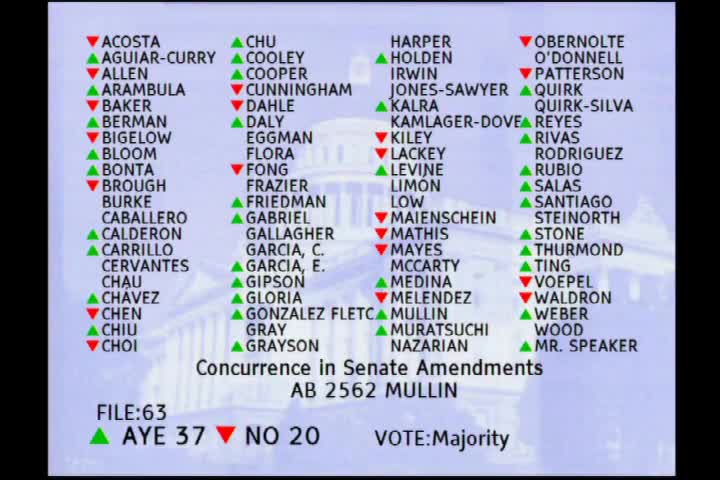
Bill Author



