AB 2998: Consumer products: flame retardant materials.
- Session Year: 2017-2018
- House: Assembly
- Latest Version Date: 2018-09-29
Existing law, the Home Furnishings and Thermal Insulation Act, a violation of which is a misdemeanor, provides for the regulation of persons engaged in businesses relating to upholstered furniture, bedding and filling materials, and insulation, and provides for the enforcement and administration of those provisions by a chief under the Director of Consumer Affairs. Existing law authorizes the Bureau of Electronic and Appliance Repair, Home Furnishings, and Thermal Insulation to establish grades, specifications, and tolerances for materials used in upholstered furniture and bedding or filling materials and requires a manufacturer of upholstered furniture to indicate whether a product contains flame retardant chemicals.
This bill, on and after January 1, 2020, would prohibit a person, including a manufacturer, from selling or distributing in commerce in this state new, not previously owned juvenile products, mattresses, or upholstered furniture that contains, or a constituent component of which contains, covered flame retardant chemicals, as defined, at levels above 1,000 parts per million, except as specified, and would prohibit a custom upholsterer from, among other things, repairing upholstered furniture or reupholstered furniture using replacement components that contain covered flame retardant chemicals at levels above 1,000 parts per million, except as specified. The bill would authorize the director to adopt regulations and rules to implement and enforce the bills provisions. The bill would require the bureau to (1) enforce and ensure compliance with these requirements, (2) provide the Department of Toxic Substances Control with a selection of samples from products regulated by the bills provisions for testing, and (3) reimburse the department for certain testing costs. The bill would also authorize the bureau to assess fines against manufacturers for a violation of the bills provisions, as specified. The bill would require the bureau to receive complaints from consumers concerning these regulated products that are sold in this state. The bill would require the International Sleep Products Association to conduct surveys of mattress producers, including those registered with the bureau, and to submit a survey report with prescribed information to the bureau by January 31, 2020, and every 3 years thereafter. The bill would require registered producers of new mattresses to respond to the survey. The bill would require the association to submit to the bureau a list of any producers who fail to respond to the survey and to post the list of nonresponders on its Internet Web site. The bill would define various other terms for these purposes. The bill would also make various findings and declarations in this regard.
Because a violation of the bills provisions would be a misdemeanor, the bill would impose a state-mandated local program.
The California Constitution requires the state to reimburse local agencies and school districts for certain costs mandated by the state. Statutory provisions establish procedures for making that reimbursement.
This bill would provide that no reimbursement is required by this act for a specified reason.
Existing law, the Home Furnishings and Thermal Insulation Act, a violation of which is a misdemeanor, provides for the regulation of persons engaged in businesses relating to upholstered furniture, bedding and filling materials, and insulation, and provides for the enforcement and administration of those provisions by a chief under the Director of Consumer Affairs. Existing law authorizes the Bureau of Electronic and Appliance Repair, Home Furnishings, and Thermal Insulation to establish grades, specifications, and tolerances for materials used in upholstered furniture and bedding or filling materials and requires a manufacturer of upholstered furniture to indicate whether a product contains flame retardant chemicals.
This bill, on and after January 1, 2020, would prohibit a person, including a manufacturer, from selling or distributing in commerce in this state new, not previously owned juvenile products, mattresses, or upholstered furniture that contains, or a constituent component of which contains, covered flame retardant chemicals, as defined, at levels above 1,000 parts per million, except as specified, and would prohibit a custom upholsterer from, among other things, repairing upholstered furniture or reupholstered furniture using replacement components that contain covered flame retardant chemicals at levels above 1,000 parts per million, except as specified. The bill would authorize the director to adopt regulations and rules to implement and enforce the bills provisions. The bill would require the bureau to (1) enforce and ensure compliance with these requirements, (2) provide the Department of Toxic Substances Control with a selection of samples from products regulated by the bills provisions for testing, and (3) reimburse the department for certain testing costs. The bill would also authorize the bureau to assess fines against manufacturers for a violation of the bills provisions, as specified. The bill would require the bureau to receive complaints from consumers concerning these regulated products that are sold in this state. The bill would require the International Sleep Products Association to conduct surveys of mattress producers producers, including those registered with the bureau bureau, and to submit a survey report with prescribed information to the bureau by January 31, 2020, and every 3 years thereafter. The bill would require registered producers of new mattresses to respond to the survey. The bill would require the association to submit to the bureau a list of any producers who fail to respond to the survey and to post the list of nonresponders on its Internet Web site. The bill would define various other terms for these purposes. The bill would also make various findings and declarations in this regard.
Because a violation of the bills provisions would be a misdemeanor, the bill would impose a state-mandated local program.
The California Constitution requires the state to reimburse local agencies and school districts for certain costs mandated by the state. Statutory provisions establish procedures for making that reimbursement.
This bill would provide that no reimbursement is required by this act for a specified reason.
Existing law, the Home Furnishings and Thermal Insulation Act, a violation of which is a misdemeanor, provides for the regulation of persons engaged in businesses relating to upholstered furniture, bedding and filling materials, and insulation, and provides for the enforcement and administration of those provisions by a chief under the Director of Consumer Affairs. Existing law authorizes the Bureau of Electronic and Appliance Repair, Home Furnishings, and Thermal Insulation to establish grades, specifications, and tolerances for materials used in upholstered furniture and bedding or filling materials and requires a manufacturer of upholstered furniture to indicate whether a product contains flame retardant chemicals.
This bill, on and after January 1, 2020, would prohibit a person, including a manufacturer, from selling or distributing in commerce in this state new, not previously owned juvenile products, mattresses, or upholstered furniture that contains, or a constituent component of which contains, covered flame retardant chemicals, as defined, at levels above 1,000 parts per million, except as specified, and would prohibit a custom upholsterer from, among other things, repairing upholstered furniture or reupholstered furniture using replacement components that contain covered flame retardant chemicals at levels above 1,000 parts per million, except as specified. The bill would authorize the director to adopt regulations and rules to implement and enforce the bills provisions. The bill would require the bureau to (1) enforce and ensure compliance with these requirements, (2) provide the Department of Toxic Substances Control with a selection of samples from products regulated by the bills provisions for testing, and (3) reimburse the department for certain testing costs. The bill would also authorize the bureau to assess fines against manufacturers for a violation of the bills provisions, as specified. The bill would require the bureau to receive complaints from consumers concerning these regulated products that are sold in this state. The bill would require the International Sleep Products Association to conduct surveys of mattress producers registered with the bureau and to submit a survey report with prescribed information to the bureau by January 31, 2020, and every 3 years thereafter. The bill would require registered producers of new mattresses to respond to the survey. The bill would require the association to submit to the bureau a list of any producers who fail to respond to the survey and to post the list of nonresponders on its Internet Web site. The bill would define various other terms for these purposes. The bill would also make various findings and declarations in this regard.
Because a violation of the bills provisions would be a misdemeanor, the bill would impose a state-mandated local program.
The California Constitution requires the state to reimburse local agencies and school districts for certain costs mandated by the state. Statutory provisions establish procedures for making that reimbursement.
This bill would provide that no reimbursement is required by this act for a specified reason.
Existing law, the Home Furnishings and Thermal Insulation Act, a violation of which is a misdemeanor, provides for the regulation of persons engaged in businesses relating to upholstered furniture, bedding and filling materials, and insulation, and provides for the enforcement and administration of those provisions by a chief under the Director of Consumer Affairs. Existing law authorizes the Bureau of Electronic and Appliance Repair, Home Furnishings, and Thermal Insulation to establish grades, specifications, and tolerances for materials used in upholstered furniture and bedding or filling materials and requires a manufacturer of upholstered furniture to indicate whether a product contains flame retardant chemicals.
This bill, on and after January 1, 2020, would prohibit a person, including a manufacturer, from selling or distributing in commerce in this state new, not previously owned juvenile products, mattresses, or upholstered furniture that contains, or a constituent component of which contains, covered flame retardant chemicals chemicals, as defined, at levels above 1,000 parts per million, except as specified, and would prohibit a custom upholsterer from, among other things, repairing upholstered furniture or reupholstered furniture using replacement components that contain covered flame retardant chemicals at levels above 1,000 parts per million, except as specified. The bill would authorize the director to adopt regulations and rules to implement and enforce the acts bills provisions. The bill would require the bureau to (1) enforce and ensure compliance with these requirements, (2) reimburse the Department of Toxic Substances Control for certain testing costs, and (3) provide the Department of Toxic Substances Control with a selection of samples from products regulated by the acts provisions. bills provisions for testing, and (3) reimburse the department for certain testing costs. The bill would also authorize the bureau to assess fines against manufacturers for a violation of the acts bills provisions, as specified. The bill would require the bureau to receive complaints from consumers concerning these regulated products that are sold in this state. The bill would define various other terms for these purposes. The bill would also make various findings and declarations in this regard.
Because a violation of the bills provisions would be a misdemeanor, the bill would impose a state-mandated local program.
The California Constitution requires the state to reimburse local agencies and school districts for certain costs mandated by the state. Statutory provisions establish procedures for making that reimbursement.
This bill would provide that no reimbursement is required by this act for a specified reason.
Existing law, the Home Furnishings and Thermal Insulation Act, a violation of which is a misdemeanor, provides for the regulation of persons engaged in businesses relating to upholstered furniture, bedding and filling materials, and insulation, and provides for the enforcement and administration of those provisions by a chief under the Director of Consumer Affairs. Existing law authorizes the Bureau of Electronic and Appliance Repair, Home Furnishings, and Thermal Insulation to establish grades, specifications, and tolerances for materials used in upholstered furniture and bedding or filling materials and requires a manufacturer of upholstered furniture to indicate whether a product contains flame retardant chemicals.
This bill, on and after January 1, 2020, would prohibit a person, including a manufacturer, from selling or distributing in commerce in this state new, not previously owned juvenile products, mattresses, or upholstered furniture that contains, or a constituent component of which contains, flame retardant chemicals at levels above 1,000 parts per million, except as specified, and would prohibit a custom upholsterer from, among other things, repairing upholstered furniture or reupholstered furniture using replacement components that contain flame retardant chemicals at levels above 1,000 parts per million, except as specified. The bill would authorize the director to adopt regulations and rules to implement and enforce the acts provisions. The bill would require the bureau to (1) enforce and ensure compliance with these requirements, (2) reimburse the Department of Toxic Substances Control for certain testing costs, and (3) provide the Department of Toxic Substances Control with a selection of samples from products regulated by the acts provisions. The bill would also authorize the bureau to assess fines against manufacturers for a violation of the acts provisions, as specified. The bill would require the bureau to receive complaints from consumers concerning these regulated products that are sold in this state. The bill would define various terms for these purposes. The bill would also make various findings and declarations in this regard.
Because a violation of the bills provisions would be a misdemeanor, the bill would impose a state-mandated local program.
The California Constitution requires the state to reimburse local agencies and school districts for certain costs mandated by the state. Statutory provisions establish procedures for making that reimbursement.
This bill would provide that no reimbursement is required by this act for a specified reason.
Existing law, the Home Furnishings and Thermal Insulation Act, a violation of which is a misdemeanor, provides for the regulation of persons engaged in businesses relating to upholstered furniture, bedding and filling materials, and insulation, and provides for the enforcement and administration of those provisions by a chief under the Director of Consumer Affairs. Existing law authorizes the bureau Bureau of Electronic and Appliance Repair, Home Furnishings, and Thermal Insulation to establish grades, specifications, and tolerances for materials used in upholstered furniture and bedding or filling materials and requires a manufacturer of upholstered furniture to indicate whether a product contains flame retardant chemicals.
This bill, on and after January 1, 2020, would prohibit a person, including a manufacturer, from selling or distributing in commerce in this state new, not previously owned juvenile products, mattresses, or upholstered furniture that contains, or a constituent component of which contains, flame retardant chemicals at levels above 1,000 parts per million, except as specified, and would prohibit a custom upholsterer from, among other things, repairing upholstered furniture or reupholstered furniture using replacement components that contain flame retardant chemicals at levels above 1,000 parts per million, except as specified. The bill would authorize the director to adopt regulations and rules to implement and enforce the acts provisions. The bill would require the bureau to (1) enforce and ensure compliance with these requirements and would require the bureau to requirements, (2) reimburse the Department of Toxic Substances Control for certain testing costs, and (3) provide the Department of Toxic Substances Control with a selection of samples from products regulated by the acts provisions and provisions. The bill would also authorize the bureau to assess fines against manufacturers for a violation of the acts provisions, as specified. The bill would require the bureau to receive complaints from consumers concerning these regulated products that are sold in this state. The bill would define various terms for these purposes. The bill would also make various findings and declarations in this regard.
Because a violation of the bills provisions would be a misdemeanor, the bill would impose a state-mandated local program.
The California Constitution requires the state to reimburse local agencies and school districts for certain costs mandated by the state. Statutory provisions establish procedures for making that reimbursement.
This bill would provide that no reimbursement is required by this act for a specified reason.
Existing law, the Home Furnishings and Thermal Insulation Act, a violation of which is a misdemeanor, provides for the regulation of persons engaged in businesses relating to upholstered furniture, bedding and filling materials, and insulation, and provides for the enforcement and administration of those provisions by a chief under the Director of Consumer Affairs. Existing law authorizes the bureau to establish grades, specifications, and tolerances for materials used in upholstered furniture and bedding or filling materials and requires a manufacturer of upholstered furniture to indicate whether a product contains flame retardant chemicals.
This bill bill, on and after January 1, 2020, would prohibit an establishment a person, including a manufacturer, from selling or distributing in commerce in this state new, not previously owned juvenile products, mattresses, or upholstered or reupholstered furniture containing more than 0.1% of a flame retardant chemical or more than 0.1% of a mixture containing a flame retardant chemical. furniture that contains, or a constituent component of which contains, flame retardant chemicals at levels above 1,000 parts per million, except as specified, and would prohibit a custom upholsterer from, among other things, repairing upholstered furniture or reupholstered furniture using components that contain flame retardant chemicals at levels above 1,000 parts per million, except as specified. The bill would authorize the director to adopt regulations and rules to implement and enforce the acts provisions. The bill would require the bureau to enforce and ensure compliance with these requirements and would require the bureau to provide the Department of Toxic Substances Control with a selection of samples from products regulated by the acts provisions and would authorize the bureau to assess fines against manufacturers for a violation of the acts provisions, as specified. The bill would require the bureau to receive complaints from consumers concerning these regulated products that are sold in this state. The bill would define various terms for these purposes. The bill would also make various findings and declarations in this regard.
Because a violation of the bills provisions would be a misdemeanor, the bill would impose a state-mandated local program.
The California Constitution requires the state to reimburse local agencies and school districts for certain costs mandated by the state. Statutory provisions establish procedures for making that reimbursement.
This bill would provide that no reimbursement is required by this act for a specified reason.
Existing law, the Home Furnishings and Thermal Insulation Act, a violation of which is a misdemeanor, provides for the regulation of persons engaged in businesses relating to upholstered furniture, bedding and filling materials, and insulation, and provides for the enforcement and administration of those provisions by a chief under the Director of Consumer Affairs. Existing law authorizes the bureau to establish grades, specifications, and tolerances for materials used in upholstered furniture and bedding or filling materials and requires a manufacturer of upholstered furniture to indicate whether a product contains flame retardant chemicals.
This bill would prohibit an establishment from selling juvenile products, mattresses, or upholstered or reupholstered furniture containing more than 0.1% of a flame retardant chemical or more than 0.1% of a mixture containing a flame retardant chemical. The bill would authorize the director to adopt regulations and rules to implement and enforce the acts provisions. The bill would make various findings and declarations in this regard.
Because a violation of the bills provisions would be a misdemeanor, the bill would impose a state-mandated local program.
The California Constitution requires the state to reimburse local agencies and school districts for certain costs mandated by the state. Statutory provisions establish procedures for making that reimbursement.
This bill would provide that no reimbursement is required by this act for a specified reason.
The Legislature finds and declares all of the following:
(a)The State of California has found that flame retardant chemicals are not needed to provide fire safety. The Bureau of Electronic and Appliance Repair, Home Furnishings, and Thermal Insulation (hereafter bureau) is charged with developing state flammability standards for adoption via regulation. From 1975 to 2013, flame retardant chemicals were commonly used in upholstered furniture to meet flammability standard, Technical Bulletin 117 (TB-117). In 2013, California updated its flammability standard with the adoption of Technical Bulletin 117-2013 (TB 117-2 but it is 520 013). Compliance with TB 117-2013 is widely being achieved without the use of flame retardant chemicals. However, some product manufacturers still use flame retardant chemicals in upholstered furniture and juvenile products, even though these chemicals are not necessary for fire safety or compliance with TB 117-2013.
(b)In 2013, the bureau exempted 18 juvenile products from having to meet any flammability standard because the bureau determined that these products are not prone to cause or sustain a serious fire if ignited. The following types of juvenile products that are exempted from state flammability standards include bassinets, highchair pads, nursing pads, booster seats, infant bouncers, nursing pillows, car seats, infant carriers, playpen side pads, changing pads, infant seats, playards, floor playmats, infant swings, portable hook-on chairs, highchairs, infant walkers, and strollers.
(c)In 2017, the United States Consumer Product Safety Commission issued a guidance document based on the overwhelming scientific evidence presented to the commission to alert the public to serious concerns about the toxicity of organohalogen flame retardants added to childrens products, furniture, mattresses, and plastic casings surrounding electronics. The commission requested that manufacturers eliminate the use of these chemicals in their products. It also recommended that retailers obtain assurance from manufacturers that their products do not contain these chemicals and that consumers, especially those who are pregnant or with young children, avoid products containing these chemicals.
(d)Scientists have found that many of the flame retardant chemicals commonly used in furniture exhibit one or more of the key characteristics of a class of synthetic chemicals commonly referred to as Persistent Organic Pollutants (POPs). These chemicals accumulate in our bodies and in the environment, persist in the environment for long periods of time, are capable of long-range transport, and are toxic to humans and animals. Flame retardant chemicals have been found in remote regions such as the Arctic and in deep sea life. Flame retardant chemicals have been detected in the atmosphere, seawater, freshwater, sediments, and a variety of wildlife.
(e)Firefighters are at particular risk from flame retardant chemicals. Numerous studies document increased cancer rates and deaths amongst firefighters due to occupational exposures. The cancers that are elevated in firefighters include four types (multiple myeloma, non-Hodgkins lymphoma, prostate, and testicular) that are potentially related to exposure to cancer-causing chemicals called dioxins. Dioxins are formed when products burn in a fire and the presence of flame retardant chemicals can result in more toxic smoke containing dioxins and furans to which firefighters are exposed. Studies have found firefighters blood levels of certain flame retardants to be three times higher than levels in other Americans, and twice as high as levels among California residents.
(f)Children living in California have some of the highest documented blood concentrations of certain flame retardant chemicals compared to other children in the United States. Scientists recognize the urgency of reducing the exposure of vulnerable populations, particularly young children, to flame retardant chemicals. A consensus statement issued by the Project Targeting Environmental Neuro-Developmental Risks (Project TENDR) found that certain flame retardant chemicals are associated with loss of IQ, attention problems, and other developmental problems in children, and called for action to reduce exposures to toxic chemicals, such as flame retardants, that contribute to the prevalence of neurodevelopmental disabilities in children.
(g)Flame retardant chemicals migrate out of products over their lifetime and end up in household dust. Inhalation and ingestion of indoor dust, often from hand to mouth behaviors, is a common route of human exposure to flame retardant chemicals. Studies have shown that indoor dust contains anywhere from 1.5 to 50 times greater concentration of flame retardant chemicals than the outdoor environment. Given that humans spend 90 percent of their time indoors, human exposure to flame retardant chemicals can be significant. Children have been found to have three to five times higher levels of certain flame retardant chemicals than their mothers.
(h)The federal government has failed to adequately regulate the use of flame retardant chemicals. In 2016, Congress passed the Frank R. Lautenberg Chemical Safety for the 21st Century Act (Public Law 114-182), which adds to the responsibilities of the United States Environmental Protection Agency (EPA) under the federal Toxic Substances Control Act (15 U.S.C. Sec. 2601 et seq.) to assess and regulate chemicals. The EPA has yet to restrict use of any flame retardant chemicals under this enactment.
(i)In the absence of federal action, California and other states have taken steps to limit or ban the use of certain flame retardant chemicals. In 2017, the State of Maine passed legislation that prohibits the sale of residential upholstered furniture containing flame retardants. In fall of 2017, the City and County of San Francisco passed an ordinance that prohibits the sale of upholstered and reupholstered furniture as well as childrens products containing flame retardant chemicals. The State of Rhode Island also passed legislation that will ban the sale of furniture or residential upholstered bedding with any added organohalogen flame retardants.
(j)Studies demonstrate that mattresses also contribute significantly to the flame retardant levels in indoor air and dust. Studies also find that removing flame-retarded products from indoor environments reduces air and dust contamination. Therefore, decreasing the amount of flame-retarded products in buildings would result in decreased human exposures.
(k)While many categories of products and materials that are not covered by this act contain flame retardant chemicals, which pose health risksas the United States Consumer Product Safety Commission has recognized, for examplethis act takes an incremental approach to addressing these health risks and focuses on those categories of products and materials with which the bureau has prior experience in addressing the presence of flame retardant chemicals.
SEC. 2.Article 5.5 (commencing with Section 19100) is added to Chapter 3 of Division 8 of the Business and Professions Code, to read:5.5.Juvenile Products, Upholstered Furniture, and Mattresses19100.For the purposes of this article, the following definitions apply:
(a)Chemical has the same meaning as in subdivision (a) of Section 19094.
(b)Consumer price index has the same meaning as in subdivision (a) of Section 19094.
(c)(1)Covered flame retardant chemical means any chemical that meets both of the following criteria:
(A)A functional use for the chemical is to resist or inhibit the spread of fire or as a synergist to chemicals that resist or inhibit the spread of fire, including, but not limited to, any chemical for which the term flame retardant appears on the Occupational Safety and Health Administration substance safety data sheet pursuant to subdivision (g) of Section 19100.1200 of Title 29 of the Code of Federal Regulations as it read on January 1, 2019.
(B)The chemical is one of the following:
(i)A halogenated, organophosphorus, organonitrogen, or nanoscale chemical.
(ii)A chemical defined as a designated chemical in Section 105440 of the Health and Safety Code.
(iii)A chemical listed on the Washington State Department of Ecologys list of Chemicals of High Concern to Children in Section 173-334-130 of Title 173 of the Washington Administrative Code as of January 1, 2019, and identified as a flame retardant or as a synergist to flame retardants in the rationale for inclusion in the list.
(2)As used in this subdivision:
(A)Halogenated chemical means any chemical that contains one or more halogen elements, including fluorine, chlorine, bromine, or iodine.
(B)Organophosphorus chemical is any chemical that contains one or more carbon elements and one or more phosphorus elements.
(C)Organonitrogen chemical is any chemical that contains one or more carbon elements and one or more nitrogen elements.
(d)Juvenile product means a product subject to this chapter and designed for residential use by infants and children under 12 years of age, including, but not limited to, a bassinet, booster seat, changing pad, floor playmat, highchair, highchair pad, infant bouncer, infant carrier, infant seat, infant swing, infant walker, nursing pad, nursing pillow, playpen side pad, playard, portable hook-on chair, stroller, and childrens nap mat.
(e)Juvenile products do not include any of the following:
(1)Products that are not primarily intended for use in the home, such as products or components for motor vehicles, watercraft, aircraft, or other vehicles.
(2)Products subject to Part 571 of Title 49 of the Code of Federal Regulations regarding parts and products used in vehicles and aircraft.
(3)Products required to meet state flammability standards in Technical Bulletin 133, entitled Flammability Test Procedure for Seating Furniture for Use in Public Occupancies.
(4)Consumer electronic products that do not fall under the bureaus jurisdiction for flammability standards.
(f)Mattress has the same definition as that term is defined in Section 1632.1 of Title 16 of the Code of Federal Regulations.
(g)Reupholstered furniture means furniture whose original fabric, padding, decking, barrier material, foam, or other resilient filling has been replaced by a custom upholsterer, that has not been sold since the time of the replacement, and that is required to meet the flammability standards set forth in Technical Bulletin 117-2013 entitled Requirements, Test Procedure and Apparatus for Testing the Smolder Resistance of Materials Used in Upholstered Furniture. Reupholstered furniture shall not include products required to meet Technical Bulletin 133.
(h)Upholstered furniture has the same meaning as covered products does in subdivision (a) of Section 19094.
19101.(a)On or after January 1, 2020, a person, including a manufacturer, shall not sell or distribute in commerce in this state any new, not previously owned juvenile products, mattresses, or upholstered furniture that contains, or a constituent component of which contains, covered flame retardant chemicals at levels above 1,000 parts per million.
(b)On or after January 1, 2020, a custom upholsterer shall not repair, reupholster, recover, restore, or renew upholstered furniture or reupholstered furniture using replacement components that contain covered flame retardant chemicals at levels above 1,000 parts per million.
(c)The prohibitions in subdivisions (a) and (b) do not apply to the following:
(1)Electronic components of juvenile products, mattresses, reupholstered furniture, upholstered furniture, or any associated casing for those electronic components.
(2)Upholstered or reupholstered furniture components other than those identified in paragraph (1) of subdivision (a) of Section 19094.
(3)Thread or fiber when used for stitching mattress components together.
(4)Components of adult mattresses other than foam. As used in this paragraph, adult mattresses means mattresses other than toddler mattresses, crib mattresses, and other infant sleep products.
19102.The director may adopt regulations and rules necessary or appropriate for the implementation and enforcement of this article.
19103.(a)The bureau shall enforce and ensure compliance with Section 19101.
(b)(1)The bureau shall provide the Department of Toxic Substances Control with a selection of samples from products regulated under this article to test for compliance with Section 19101. The bureau shall select samples based on consultation with the Department of Toxic Substances Control, taking into account a range of manufacturers and types of products regulated under this article. The bureau shall integrate these testing requirements into the existing testing program described in subdivision (c) of Section 19094.
(2)(A)If the Department of Toxic Substances Controls testing shows that any reupholstered furniture or new, not previously owned juvenile products, mattresses, or upholstered furniture is in violation of Section 19101, the bureau may assess fines for violations against manufacturers of the product for the violation. The bureau shall reimburse the Department of Toxic Substances Control for the cost of testing for the presence of covered flame retardant chemicals pursuant to this article.
(B)If a person continues to sell or distribute products in commerce in this state belonging to the same stock keeping unit (SKU) as products that do not comply with Section 19101, after notice of the violation is posted on the bureaus Internet Web site, the bureau may assess fines against the person for the continued sale or distribution of those products. The bureau shall make information about any citation issued pursuant to this section available to the public on its Internet Web site, and shall develop a process for keeping interested persons informed about updates to notices of violation posted on the bureaus Internet Web site.
(c)A fine for a violation of this section shall be assessed in accordance with the following schedule:
(1)The fine for the first violation shall be not less than one thousand dollars ($1,000), but not more than two thousand five hundred dollars ($2,500).
(2)The fine for the second violation shall be not less than two thousand five hundred dollars ($2,500), but not more than five thousand dollars ($5,000).
(3)The fine for the third violation shall be not less than five thousand dollars ($5,000), but not more than seven thousand five hundred dollars ($7,500).
(4)The fine for any subsequent violation shall be not less than seven thousand five hundred dollars ($7,500), but not more than ten thousand dollars ($10,000).
(d)In determining the amount of the fine for a violation of this section, the bureau shall consider the following factors:
(1)The nature and severity of the violation.
(2)The good or bad faith of the cited person.
(3)The history of previous violations.
(4)Evidence that the violation was willful.
(5)The extent to which the cited person or entity has cooperated with the bureau.
(e)(1)The bureau shall adjust all minimum and maximum fines imposed by this section for inflation every five years.
(2)The adjustment shall be equivalent to the percentage, if any, that the Consumer Price Index at the time of adjustment exceeds the Consumer Price Index at the time this section goes into effect. Any increase determined under this paragraph shall be rounded as follows:
(A)In multiples of ten dollars ($10) in the case of penalties less than or equal to one hundred dollars ($100).
(B)In multiples of one hundred dollars ($100) in the case of penalties greater than one hundred dollars ($100), but less than or equal to one thousand dollars ($1,000).
(C)In multiples of one thousand dollars ($1,000) in the case of penalties greater than one thousand dollars ($1,000).
(f)The bureau shall receive complaints from consumers concerning products regulated by this article sold in this state.
19104.(a)The International Sleep Products Association shall conduct a survey of mattress producers, including those that are registered with the bureau as of January 1, 2019, and shall submit a survey report to the bureau on or before January 31, 2020. The International Sleep Products Association shall conduct a new survey of mattress producers, including, but not limited to, registered mattress producers, and submit a survey report to the bureau on or before January 31, 2023, and every three years thereafter. A survey report shall include the following information for each unique combination of fibers or yarns, or both, and other materials in components used for meeting flammability standards, including, but not limited to, mattress components such as fire barriers or flame retardant chemical-treated batting or ticking or closing thread, used in the manufacture of new mattresses:
(1)A list of the fibers or any other materials used in each component used for meeting flammability standards other than chemicals identified under paragraph (2). The specific brand name or producer of the fire barrier need not be identified.
(2)The identity of any covered flame retardant chemical, as described in subparagraph (A) of paragraph (1) of subdivision (c) of Section 19100, contained in each mattress component in an amount over 1000 parts per million, including, but not limited to, the Chemical Abstracts Service (CAS) number, if available.
(3)The method for incorporating the chemical in each mattress component used for meeting flammability standards, such as additive, reactive, or other method.
(4)The percentage of new mattress units in the United States that use the mattress component for meeting flammability standards.
(5)The types of mattresses that the mattress component is used with, such as innerspring, polyurethane foam, memory foam, gel foam, latex foam, fiber, air bladders, or the combination of those materials.
(b)All mattress producers of new mattresses that are registered with the bureau, commencing January 1, 2019, and thereafter, shall respond to the survey conducted by the International Sleep Products Association pursuant to subdivision (a). The International Sleep Products Association shall submit to the bureau a list of any producers who fail to respond to the survey. The bureau shall post the list of nonresponders on its Internet Web site.
(c)The bureau shall post the reports on its Internet Web site.
SEC. 3.No reimbursement is required by this act pursuant to Section 6 of Article XIIIB of the California Constitution because the only costs that may be incurred by a local agency or school district will be incurred because this act creates a new crime or infraction, eliminates a crime or infraction, or changes the penalty for a crime or infraction, within the meaning of Section 17556 of the Government Code, or changes the definition of a crime within the meaning of Section 6 of Article XIIIB of the California Constitution.
The Legislature finds and declares all of the following:
(a)The State of California has found that flame retardant chemicals are not needed to provide fire safety. The Bureau of Electronic and Appliance Repair, Home Furnishings, and Thermal Insulation (hereafter bureau) is charged with developing state flammability standards for adoption via regulation. From 1975 to 2013, flame retardant chemicals were commonly used in upholstered furniture to meet flammability standard, Technical Bulletin 117 (TB-117). In 2013, California updated its flammability standard with the adoption of Technical Bulletin 117-2013 (TB 117-2 but it is 520 013). Compliance with TB 117-2013 is widely being achieved without the use of flame retardant chemicals. However, some product manufacturers still use flame retardant chemicals in upholstered furniture and juvenile products, even though these chemicals are not necessary for fire safety or compliance with TB 117-2013.
(b)In 2013, the bureau exempted 18 juvenile products from having to meet any flammability standard because the bureau determined that these products are not prone to cause or sustain a serious fire if ignited. The following types of juvenile products that are exempted from state flammability standards include bassinets, highchair pads, nursing pads, booster seats, infant bouncers, nursing pillows, car seats, infant carriers, playpen side pads, changing pads, infant seats, playards, floor play mats, playmats, infant swings, portable hook-on chairs, highchairs, infant walkers, and strollers.
(c)In 2017, the United States Consumer Product Safety Commission issued a guidance document based on the overwhelming scientific evidence presented to the commission to alert the public to serious concerns about the toxicity of organohalogen flame retardants added to childrens products, furniture, mattresses, and plastic casings surrounding electronics. The commission requested that manufacturers eliminate the use of these chemicals in their products. It also recommended that retailers obtain assurance from manufacturers that their products do not contain these chemicals and that consumers, especially those who are pregnant or with young children, avoid products containing these chemicals.
(d)Scientists have found that many of the flame retardant chemicals commonly used in furniture exhibit one or more of the key characteristics of a class of synthetic chemicals commonly referred to as Persistent Organic Pollutants (POPs). These chemicals accumulate in our bodies and in the environment, persist in the environment for long periods of time, are capable of long-range transport, and are toxic to humans and animals. Flame retardant chemicals have been found in remote regions such as the Arctic and in deep sea life. Flame retardant chemicals have been detected in the atmosphere, seawater, freshwater, sediments, and a variety of wildlife.
(e)Firefighters are at particular risk from flame retardant chemicals. Numerous studies document increased cancer rates and deaths amongst firefighters due to occupational exposures. The cancers that are elevated in firefighters include four types (multiple myeloma, non-Hodgkins lymphoma, prostate, and testicular) that are potentially related to exposure to cancer-causing chemicals called dioxins. Dioxins are formed when products burn in a fire and the presence of flame retardant chemicals can result in more toxic smoke containing dioxins and furans to which firefighters are exposed. Studies have found firefighters blood levels of certain flame retardants to be three times higher than levels in other Americans, and twice as high as levels among California residents.
(f)Children living in California have some of the highest documented blood concentrations of certain flame retardant chemicals compared to other children in the United States. Scientists recognize the urgency of reducing the exposure of vulnerable populations, particularly young children, to flame retardant chemicals. A consensus statement issued by the Project Targeting Environmental Neuro-Developmental Risks (Project TENDR) found that certain flame retardant chemicals are associated with loss of IQ, attention problems, and other developmental problems in children, and called for action to reduce exposures to toxic chemicals, such as flame retardants, that contribute to the prevalence of neurodevelopmental disabilities in children.
(g)Flame retardant chemicals migrate out of products over their lifetime and end up in household dust. Inhalation and ingestion of indoor dust, often from hand to mouth behaviors, is a common route of human exposure to flame retardant chemicals. Studies have shown that indoor dust contains anywhere from 1.5 to 50 times greater concentration of flame retardant chemicals than the outdoor environment. Given that humans spend 90 percent of their time indoors, human exposure to flame retardant chemicals can be significant. Children have been found to have three to five times higher levels of certain flame retardant chemicals than their mothers.
(h)The federal government has failed to adequately regulate the use of flame retardant chemicals. In 2016, Congress passed the Frank R. Lautenberg Chemical Safety for the 21st Century Act (Public Law 114-182), which adds to the responsibilities of the United States Environmental Protection Agency (EPA) under the federal Toxic Substances Control Act (15 U.S.C. Sec. 2601 et seq.) to assess and regulate chemicals. The EPA has yet to restrict use of any flame retardant chemicals under this enactment.
(i)In the absence of federal action, California and other states have taken steps to limit or ban the use of certain flame retardant chemicals. In 2017, the State of Maine passed legislation that prohibits the sale of residential upholstered furniture containing flame retardants. In fall of 2017, the City and County of San Francisco passed an ordinance that prohibits the sale of upholstered and reupholstered furniture as well as childrens products containing flame retardant chemicals. The State of Rhode Island also passed legislation that will ban the sale of furniture or residential upholstered bedding with any added organohalogen flame retardants.
(j)Studies demonstrate that mattresses also contribute significantly to the flame retardant levels in indoor air and dust. Studies also find that removing flame-retarded products from indoor environments reduces air and dust contamination. Therefore, decreasing the amount of flame-retarded products in buildings would result in decreased human exposures.
(k)While many categories of products and materials that are not covered by this act contain flame retardant chemicals, which pose health risksas the United States Consumer Product Safety Commission has recognized, for examplethis act takes an incremental approach to addressing these health risks and focuses on those categories of products and materials with which the bureau has prior experience in addressing the presence of flame retardant chemicals.
SEC. 2.Article 5.5 (commencing with Section 19100) is added to Chapter 3 of Division 8 of the Business and Professions Code, to read:5.5.Juvenile Products, Upholstered Furniture, and Mattresses19100.For the purposes of this article, the following definitions apply:
(a)Chemical has the same meaning as in subdivision (a) of Section 19094.
(b)Consumer price index has the same meaning as in subdivision (a) of Section 19094.
(c)(1)Covered flame retardant chemical means any chemical that meets both of the following criteria:
(A)A functional use for the chemical is to resist or inhibit the spread of fire or as a synergist to chemicals that resist or inhibit the spread of fire, including, but not limited to, any chemical for which the term flame retardant appears on the Occupational Safety and Health Administration substance safety data sheet pursuant to subdivision (g) of Section 19100.1200 of Title 29 of the Code of Federal Regulations as it read on January 1, 2019.
(B)The chemical is one of the following:
(i)A halogenated, organophosphorus, organonitrogen, or nanoscale chemical.
(ii)A chemical defined as a designated chemical in Section 105440 of the Health and Safety Code.
(iii)A chemical listed on the Washington State Department of Ecologys list of Chemicals of High Concern to Children in Section 173-334-130 of Title 173 of the Washington Administrative Code as of January 1, 2019, and identified as a flame retardant or as a synergist to flame retardants in the rationale for inclusion in the list.
(2)As used in this subdivision:
(A)Halogenated chemical means any chemical that contains one or more halogen elements, including fluorine, chlorine, bromine, or iodine.
(B)Organophosphorus chemical is any chemical that contains one or more carbon elements and one or more phosphorus elements.
(C)Organonitrogen chemical is any chemical that contains one or more carbon elements and one or more nitrogen elements.
(d)Juvenile product means a product subject to this chapter and designed for residential use by infants and children under 12 years of age, including, but not limited to, a bassinet, booster seat, changing pad, floor playmat, highchair, highchair pad, infant bouncer, infant carrier, infant seat, infant swing, infant walker, nursing pad, nursing pillow, playpen side pad, playard, portable hook-on chair, stroller, and childrens nap mat.
(e)Juvenile products do not include any of the following:
(1)Products that are not primarily intended for use in the home, such as products or components for motor vehicles, watercraft, aircraft, or other vehicles.
(2)Products subject to Part 571 of Title 49 of the Code of Federal Regulations regarding parts and products used in vehicles and aircraft.
(3)Products required to meet state flammability standards in Technical Bulletin 133, entitled Flammability Test Procedure for Seating Furniture for Use in Public Occupancies.
(4)Consumer electronic products that do not fall under the bureaus jurisdiction for flammability standards.
(f)Mattress has the same definition as that term is defined in Section 1632.1 of Title 16 of the Code of Federal Regulations.
(g)Reupholstered furniture means furniture whose original fabric, padding, decking, barrier material, foam, or other resilient filling has been replaced by a custom upholsterer, that has not been sold since the time of the replacement, and that is required to meet the flammability standards set forth in Technical Bulletin 117-2013 entitled Requirements, Test Procedure and Apparatus for Testing the Smolder Resistance of Materials Used in Upholstered Furniture. Reupholstered furniture shall not include products required to meet Technical Bulletin 133.
(h)Upholstered furniture has the same meaning as covered products does in subdivision (a) of Section 19094.
19101.(a)On or after January 1, 2020, a person, including a manufacturer, shall not sell or distribute in commerce in this state any new, not previously owned juvenile products, mattresses, or upholstered furniture that contains, or a constituent component of which contains, covered flame retardant chemicals at levels above 1,000 parts per million.
(b)On or after January 1, 2020, a custom upholsterer shall not repair, reupholster, recover, restore, or renew upholstered furniture or reupholstered furniture using replacement components that contain covered flame retardant chemicals at levels above 1,000 parts per million.
(c)The prohibitions in subdivisions (a) and (b) do not apply to the following:
(1)Electronic components of juvenile products, mattresses, reupholstered furniture, upholstered furniture, or any associated casing for those electronic components.
(2)Upholstered or reupholstered furniture components other than those identified in paragraph (1) of subdivision (a) of Section 19094.
(3)Thread or fiber when used for stitching mattress components together.
(4)Components of adult mattresses other than foam. As used in this paragraph, adult mattresses means mattresses other than toddler mattresses, crib mattresses, and other infant sleep products.
19102.The director may adopt regulations and rules necessary or appropriate for the implementation and enforcement of this article.
19103.(a)The bureau shall enforce and ensure compliance with Section 19101.
(b)(1)The bureau shall provide the Department of Toxic Substances Control with a selection of samples from products regulated under this article to test for compliance with Section 19101. The bureau shall select samples based on consultation with the Department of Toxic Substances Control, taking into account a range of manufacturers and types of products regulated under this article. The bureau shall integrate these testing requirements into the existing testing program described in subdivision (c) of Section 19094.
(2)(A)If the Department of Toxic Substances Controls testing shows that any reupholstered furniture or new, not previously owned juvenile products, mattresses, or upholstered furniture is in violation of Section 19101, the bureau may assess fines for violations against manufacturers of the product for the violation. The bureau shall reimburse the Department of Toxic Substances Control for the cost of testing for the presence of covered flame retardant chemicals pursuant to this article.
(B)If a person continues to sell or distribute products in commerce in this state belonging to the same stock keeping unit (SKU) as products that do not comply with Section 19101, after notice of the violation is posted on the bureaus Internet Web site, the bureau may assess fines against the person for the continued sale or distribution of those products. The bureau shall make information about any citation issued pursuant to this section available to the public on its Internet Web site, and shall develop a process for keeping interested persons informed about updates to notices of violation posted on the bureaus Internet Web site.
(c)A fine for a violation of this section shall be assessed in accordance with the following schedule:
(1)The fine for the first violation shall be not less than one thousand dollars ($1,000), but not more than two thousand five hundred dollars ($2,500).
(2)The fine for the second violation shall be not less than two thousand five hundred dollars ($2,500), but not more than five thousand dollars ($5,000).
(3)The fine for the third violation shall be not less than five thousand dollars ($5,000), but not more than seven thousand five hundred dollars ($7,500).
(4)The fine for any subsequent violation shall be not less than seven thousand five hundred dollars ($7,500), but not more than ten thousand dollars ($10,000).
(d)In determining the amount of the fine for a violation of this section, the bureau shall consider the following factors:
(1)The nature and severity of the violation.
(2)The good or bad faith of the cited person.
(3)The history of previous violations.
(4)Evidence that the violation was willful.
(5)The extent to which the cited person or entity has cooperated with the bureau.
(e)(1)The bureau shall adjust all minimum and maximum fines imposed by this section for inflation every five years.
(2)The adjustment shall be equivalent to the percentage, if any, that the Consumer Price Index at the time of adjustment exceeds the Consumer Price Index at the time this section goes into effect. Any increase determined under this paragraph shall be rounded as follows:
(A)In multiples of ten dollars ($10) in the case of penalties less than or equal to one hundred dollars ($100).
(B)In multiples of one hundred dollars ($100) in the case of penalties greater than one hundred dollars ($100), but less than or equal to one thousand dollars ($1,000).
(C)In multiples of one thousand dollars ($1,000) in the case of penalties greater than one thousand dollars ($1,000).
(f)The bureau shall receive complaints from consumers concerning products regulated by this article sold in this state.
19104.(a)The International Sleep Products Association shall conduct a survey of mattress producers, including those that are registered with the bureau as of January 1, 2019, and shall submit a survey report to the bureau on or before January 31, 2020. The International Sleep Products Association shall conduct a new survey of mattress producers, including, but not limited to, registered mattress producers producers, and submit a survey report to the bureau on or before Janary January 31, 2023, and every three years thereafter. A survey report shall include the following information for each unique combination of fibers or yarns, or both, and other materials in components used for meeting flammability standards, including, but not limited to, mattress components such as fire barriers or flame retardant chemical-treated batting or ticking or closing thread, used in the manufacture of new mattresses:
(1)A list of the fibers or any other materials used in each component used for meeting flammability standards other than chemicals identified under paragraph (2). The specific brand name or producer of the fire barrier need not be identified.
(2)The identity of any covered flame retardant chemical chemical, as described in subparagraph (A) of paragraph (1) of subdivision (c) of Section 19100, contained in each mattress component in an amount over 1000 parts per million, including, but not limited to, the Chemical Abstracts Service (CAS) number, if available.
(3)The method for incorporating the chemical in each mattress component used for meeting flammability standards, such as additive, reactive, or other method.
(4)The percentage of new mattress units in the United States that use the mattress component for meeting flammability standards.
(5)The types of mattresses that the mattress component is used with, such as innerspring, polyurethane foam, memory foam, gel foam, latex foam, fiber, air bladders, or the combination of those materials.
(b)All mattress producers of new mattresses that are registered with the bureau, commencing January 1, 2019, and thereafter, shall respond to the survey conducted by the International Sleep Products Association pursuant to subdivision (a). The International Sleep Products Association shall submit to the bureau a list of any producers who fail to respond to the survey. The bureau shall post the list of nonresponders on its Internet Web site.
(c)The bureau shall post the reports on its Internet Web site.
SEC. 3.No reimbursement is required by this act pursuant to Section 6 of Article XIIIB of the California Constitution because the only costs that may be incurred by a local agency or school district will be incurred because this act creates a new crime or infraction, eliminates a crime or infraction, or changes the penalty for a crime or infraction, within the meaning of Section 17556 of the Government Code, or changes the definition of a crime within the meaning of Section 6 of Article XIIIB of the California Constitution.
The Legislature finds and declares all of the following:
(a)The State of California has found that flame retardant chemicals are not needed to provide fire safety. The Bureau of Electronic and Appliance Repair, Home Furnishings, and Thermal Insulation (hereafter bureau) is charged with developing state flammability standards for adoption via regulation. From 1975 to 2013, flame retardant chemicals were commonly used in upholstered furniture to meet flammability standard, Technical Bulletin 117 (TB-117). In 2013, California updated its flammability standard with the adoption of Technical Bulletin 117-2013 (TB 117-2 but it is 520 013). Compliance with TB 117-2013 is widely being achieved without the use of flame retardant chemicals. However, some product manufacturers still use flame retardant chemicals in upholstered furniture and juvenile products, even though these chemicals are not necessary for fire safety or compliance with TB 117-2013.
(b)In 2013, the bureau exempted 18 juvenile products from having to meet any flammability standard because the bureau determined that these products are not prone to cause or sustain a serious fire if ignited. The following types of juvenile products that are exempted from state flammability standards include bassinets, highchair pads, nursing pads, booster seats, infant bouncers, nursing pillows, car seats, infant carriers, playpen side pads, changing pads, infant seats, playards, floor play mats, infant swings, portable hook-on chairs, highchairs, infant walkers, and strollers.
(c)In 2017, the United States Consumer Product Safety Commission issued a guidance document based on the overwhelming scientific evidence presented to the commission to alert the public to serious concerns about the toxicity of organohalogen flame retardants added to childrens products, furniture, mattresses, and plastic casings surrounding electronics. The commission requested that manufacturers eliminate the use of these chemicals in their products. It also recommended that retailers obtain assurance from manufacturers that their products do not contain these chemicals and that consumers, especially those who are pregnant or with young children, avoid products containing these chemicals.
(d)Scientists have found that many of the flame retardant chemicals commonly used in furniture exhibit one or more of the key characteristics of a class of synthetic chemicals commonly referred to as Persistent Organic Pollutants (POPs). These chemicals accumulate in our bodies and in the environment, persist in the environment for long periods of time, are capable of long-range transport, and are toxic to humans and animals. Flame retardant chemicals have been found in remote regions such as the Arctic and in deep sea life. Flame retardant chemicals have been detected in the atmosphere, seawater, freshwater, sediments, and a variety of wildlife.
(e)Firefighters are at particular risk from flame retardant chemicals. Numerous studies document increased cancer rates and deaths amongst firefighters due to occupational exposures. The cancers that are elevated in firefighters include four types (multiple myeloma, non-Hodgkins lymphoma, prostate, and testicular) that are potentially related to exposure to cancer-causing chemicals called dioxins. Dioxins are formed when products burn in a fire and the presence of flame retardant chemicals can result in more toxic smoke containing dioxins and furans to which firefighters are exposed. Studies have found firefighters blood levels of certain flame retardants to be three times higher than levels in other Americans, and twice as high as levels among California residents.
(f)Children living in California have some of the highest documented blood concentrations of certain flame retardant chemicals compared to other children in the United States. Scientists recognize the urgency of reducing the exposure of vulnerable populations, particularly young children, to flame retardant chemicals. A consensus statement issued by the Project Targeting Environmental Neuro-Developmental Risks (Project TENDR) found that certain flame retardant chemicals are associated with loss of IQ, attention problems, and other developmental problems in children, and called for action to reduce exposures to toxic chemicals, such as flame retardants, that contribute to the prevalence of neurodevelopmental disabilities in children.
(g)Flame retardant chemicals migrate out of products over their lifetime and end up in household dust. Inhalation and ingestion of indoor dust, often from hand to mouth behaviors, is a common route of human exposure to flame retardant chemicals. Studies have shown that indoor dust contains anywhere from 1.5 to 50 times greater concentration of flame retardant chemicals than the outdoor environment. Given that humans spend 90 percent of their time indoors, human exposure to flame retardant chemicals can be significant. Children have been found to have three to five times higher levels of certain flame retardant chemicals than their mothers.
(h)The federal government has failed to adequately regulate the use of flame retardant chemicals. In 2016, Congress passed the Frank R. Lautenberg Chemical Safety for the 21st Century Act (Public Law 114-182), which adds to the responsibilities of the United States Environmental Protection Agency (EPA) under the federal Toxic Substances Control Act (15 U.S.C. Sec. 2601 et seq.) to assess and regulate chemicals. The EPA has yet to restrict use of any flame retardant chemicals under this enactment.
(i)In the absence of federal action, California and other states have taken steps to limit or ban the use of certain flame retardant chemicals. In 2017, the State of Maine passed legislation that prohibits the sale of residential upholstered furniture containing flame retardants. In fall of 2017, the City and County of San Francisco passed an ordinance that prohibits the sale of upholstered and reupholstered furniture as well as childrens products containing flame retardant chemicals. The State of Rhode Island also passed legislation that will ban the sale of furniture or residential upholstered bedding with any added organohalogen flame retardants.
(j)Studies demonstrate that mattresses also contribute significantly to the flame retardant levels in indoor air and dust. Studies also find that removing flame-retarded products from indoor environments reduces air and dust contamination. Therefore, decreasing the amount of flame-retarded products in buildings would result in decreased human exposures.
(k)While many categories of products and materials that are not covered by this act contain flame retardant chemicals, which pose health risksas the United States Consumer Product Safety Commission has recognized, for examplethis act takes an incremental approach to addressing these health risks and focuses on those categories of products and materials with which the bureau has prior experience in addressing the presence of flame retardant chemicals.
SEC. 2.Article 5.5 (commencing with Section 19100) is added to Chapter 3 of Division 8 of the Business and Professions Code, to read:5.5.Juvenile Products, Upholstered Furniture, and Mattresses19100.For the purposes of this article, the following definitions apply:
(a)Chemical has the same meaning as in subdivision (a) of Section 19094.
(b)Consumer price index has the same meaning as in subdivision (a) of Section 19094.
(c)(1)Covered flame retardant chemical means any chemical that meets both of the following criteria:
(A)A functional use for the chemical is to resist or inhibit the spread of fire or as a synergist to chemicals that resist or inhibit the spread of fire, including, but not limited to, any chemical for which the term flame retardant appears on the Occupational Safety and Health Administration substance safety data sheet pursuant to subdivision (g) of Section 19100.1200 of Title 29 of the Code of Federal Regulations as it read on January 1, 2019.
(B)The chemical is one of the following:
(i)A halogenated, organophosphorus, organonitrogen, or nanoscale chemical.
(ii)A chemical defined as a designated chemical in Section 105440 of the Health and Safety Code.
(iii)A chemical listed on the Washington State Department of Ecologys list of Chemicals of High Concern to Children in Section 173-334-130 of Title 173 of the Washington Administrative Code as of January 1, 2019, and identified as a flame retardant or as a synergist to flame retardants in the rationale for inclusion in the list.
(2)As used in this subdivision:
(A)Halogenated chemical means any chemical that contains one or more halogen elements, including fluorine, chlorine, bromine, or iodine.
(B)Organophosphorus chemical is any chemical that contains one or more carbon elements and one or more phosphorus elements.
(C)Organonitrogen chemical is any chemical that contains one or more carbon elements and one or more nitrogen elements.
(d)Juvenile product means a product subject to this chapter and designed for residential use by infants and children under 12 years of age, including, but not limited to, a bassinet, booster seat, changing pad, floor playmat, highchair, highchair pad, infant bouncer, infant carrier, infant seat, infant swing, infant walker, nursing pad, nursing pillow, playpen side pad, playard, portable hook-on chair, stroller, and childrens nap mat.
(e)Juvenile products do not include any of the following:
(1)Products that are not primarily intended for use in the home, such as products or components for motor vehicles, watercraft, aircraft, or other vehicles.
(2)Products subject to Part 571 of Title 49 of the Code of Federal Regulations regarding parts and products used in vehicles and aircraft.
(3)Products required to meet state flammability standards in Technical Bulletin 133, entitled Flammability Test Procedure for Seating Furniture for Use in Public Occupancies.
(4)Consumer electronic products that do not fall under the bureaus jurisdiction for flammability standards.
(f)Mattress has the same definition as that term is defined in Section 1632.1 of Title 16 of the Code of Federal Regulations.
(g)Reupholstered furniture means furniture whose original fabric, padding, decking, barrier material, foam, or other resilient filling has been replaced by a custom upholsterer, that has not been sold since the time of the replacement, and that is required to meet the flammability standards set forth in Technical Bulletin 117-2013 entitled Requirements, Test Procedure and Apparatus for Testing the Smolder Resistance of Materials Used in Upholstered Furniture. Reupholstered furniture shall not include products required to meet Technical Bulletin 133.
(h)Upholstered furniture has the same meaning as covered products does in subdivision (a) of Section 19094.
19101.(a)On or after January 1, 2020, a person, including a manufacturer, shall not sell or distribute in commerce in this state any new, not previously owned juvenile products, mattresses, or upholstered furniture that contains, or a constituent component of which contains, covered flame retardant chemicals at levels above 1,000 parts per million.
(b)On or after January 1, 2020, a custom upholsterer shall not repair, reupholster, recover, restore, or renew upholstered furniture or reupholstered furniture using replacement components that contain covered flame retardant chemicals at levels above 1,000 parts per million.
(c)The prohibitions in subdivisions (a) and (b) do not apply to the following:
(1)Electronic components of juvenile products, mattresses, reupholstered furniture, upholstered furniture, or any associated casing for those electronic components.
(2)Upholstered or reupholstered furniture components other than those identified in paragraph (1) of subdivision (a) of Section 19094.
(3)Thread or fiber when used for stitching mattress components together.
(4)Components of adult mattresses other than foam. As used in this paragraph, adult mattresses means mattresses other than toddler mattresses, crib mattresses, and other infant sleep products.
19102.The director may adopt regulations and rules necessary or appropriate for the implementation and enforcement of this article.
19103.(a)The bureau shall enforce and ensure compliance with Section 19101.
(b)(1)The bureau shall provide the Department of Toxic Substances Control with a selection of samples from products regulated under this article to test for compliance with Section 19101. The bureau shall select samples based on consultation with the Department of Toxic Substances Control, taking into account a range of manufacturers and types of products regulated under this article. The bureau shall integrate these testing requirements into the existing testing program described in subdivision (c) of Section 19094.
(2)(A)If the Department of Toxic Substances Controls testing shows that any reupholstered furniture or new, not previously owned juvenile products, mattresses, or upholstered furniture is in violation of Section 19101, the bureau may assess fines for violations against manufacturers of the product for the violation. The bureau shall reimburse the Department of Toxic Substances Control for the cost of testing for the presence of covered flame retardant chemicals pursuant to this article.
(B)If a person continues to sell or distribute products in commerce in this state belonging to the same stock keeping unit (SKU) as products that do not comply with Section 19101, after notice of the violation is posted on the bureaus Internet Web site, the bureau may assess fines against the person for the continued sale or distribution of those products. The bureau shall make information about any citation issued pursuant to this section available to the public on its Internet Web site, and shall develop a process for keeping interested persons informed about updates to notices of violation posted on the bureaus Internet Web site.
(c)A fine for a violation of this section shall be assessed in accordance with the following schedule:
(1)The fine for the first violation shall be not less than one thousand dollars ($1,000), but not more than two thousand five hundred dollars ($2,500).
(2)The fine for the second violation shall be not less than two thousand five hundred dollars ($2,500), but not more than five thousand dollars ($5,000).
(3)The fine for the third violation shall be not less than five thousand dollars ($5,000), but not more than seven thousand five hundred dollars ($7,500).
(4)The fine for any subsequent violation shall be not less than seven thousand five hundred dollars ($7,500), but not more than ten thousand dollars ($10,000).
(d)In determining the amount of the fine for a violation of this section, the bureau shall consider the following factors:
(1)The nature and severity of the violation.
(2)The good or bad faith of the cited person.
(3)The history of previous violations.
(4)Evidence that the violation was willful.
(5)The extent to which the cited person or entity has cooperated with the bureau.
(e)(1)The bureau shall adjust all minimum and maximum fines imposed by this section for inflation every five years.
(2)The adjustment shall be equivalent to the percentage, if any, that the Consumer Price Index at the time of adjustment exceeds the Consumer Price Index at the time this section goes into effect. Any increase determined under this paragraph shall be rounded as follows:
(A)In multiples of ten dollars ($10) in the case of penalties less than or equal to one hundred dollars ($100).
(B)In multiples of one hundred dollars ($100) in the case of penalties greater than one hundred dollars ($100), but less than or equal to one thousand dollars ($1,000).
(C)In multiples of one thousand dollars ($1,000) in the case of penalties greater than one thousand dollars ($1,000).
(f)The bureau shall receive complaints from consumers concerning products regulated by this article sold in this state.
19104.(a)The International Sleep Products Association shall conduct a survey of mattress producers, including those that are registered with the bureau as of January 1, 2019, and shall submit a survey report to the bureau on or before January 31, 2020. The International Sleep Products Association shall conduct a new survey of registered mattress producers and submit a survey report to the bureau on or before Janary 31, 2023, and every three years thereafter. A survey report shall include the following information for each unique combination of fibers or yarns, or both, and other materials in components used for meeting flammability standards, including, but not limited to, mattress components such as fire barriers or flame retardant chemical-treated batting or ticking or closing thread, used in the manufacture of new mattresses:
(1)A list of the fibers or any other materials used in each component used for meeting flammability standards other than chemicals identified under paragraph (2). The specific brand name or producer of the fire barrier need not be identified.
(2)The identity of any covered flame retardant chemical contained in each mattress component in an amount over 1000 parts per million, including, but not limited to, the Chemical Abstracts Service (CAS) number, if available.
(3)The method for incorporating the chemical in each mattress component used for meeting flammability standards, such as additive, reactive, or other method.
(4)The percentage of new mattress units in the United States that use the mattress component for meeting flammability standards.
(5)The types of mattresses that the mattress component is used with, such as innerspring, polyurethane foam, memory foam, gel foam, latex foam, fiber, air bladders, or the combination of those materials.
(b)All mattress producers of new mattresses that are registered with the bureau, commencing January 1, 2019, and thereafter, shall respond to the survey conducted by the International Sleep Products Association pursuant to subdivision (a). The International Sleep Products Association shall submit to the bureau a list of any producers who fail to respond to the survey. The bureau shall post the list of nonresponders on its Internet Web site.
(c)The bureau shall post the reports on its Internet Web site.
SEC. 3.No reimbursement is required by this act pursuant to Section 6 of Article XIIIB of the California Constitution because the only costs that may be incurred by a local agency or school district will be incurred because this act creates a new crime or infraction, eliminates a crime or infraction, or changes the penalty for a crime or infraction, within the meaning of Section 17556 of the Government Code, or changes the definition of a crime within the meaning of Section 6 of Article XIIIB of the California Constitution.
The Legislature finds and declares all of the following:
(a)The State of California has found that flame retardant chemicals are not needed to provide fire safety. The Bureau of Electronic and Appliance Repair, Home Furnishings, and Thermal Insulation (hereafter bureau) is charged with developing state flammability standards for adoption via regulation. From 1975 to 2013, flame retardant chemicals were commonly used in upholstered furniture to meet flammability standard, Technical Bulletin 117 (TB-117). In 2013, California updated its flammability standard with the adoption of Technical Bulletin 117-2013 (TB 117-2 but it is 520 013). Compliance with TB 117-2013 is widely being achieved without the use of flame retardant chemicals. However, some product manufacturers still use flame retardant chemicals in upholstered furniture and juvenile products, even though these chemicals are not necessary for fire safety or compliance with TB 117-2013.
(b)In 2013, the bureau exempted 18 juvenile products from having to meet any flammability standard because the bureau determined that these products are not prone to cause or sustain a serious fire if ignited. The following types of juvenile products that are exempted from state flammability standards include bassinets, highchair pads, nursing pads, booster seats, infant bouncers, nursing pillows, car seats, infant carriers, playpen side pads, changing pads, infant seats, playards, floor play mats, infant swings, portable hook-on chairs, highchairs, infant walkers, and strollers.
(c)In 2017, the United States Consumer Product Safety Commission issued a guidance document based on the overwhelming scientific evidence presented to the commission to alert the public to serious concerns about the toxicity of organohalogen flame retardants added to childrens products, furniture, mattresses, and plastic casings surrounding electronics. The commission requested that manufacturers eliminate the use of these chemicals in their products. It also recommended that retailers obtain assurance from manufacturers that their products do not contain these chemicals and that consumers, especially those who are pregnant or with young children, avoid products containing these chemicals.
(d)Scientists have found that many of the flame retardant chemicals commonly used in furniture exhibit one or more of the key characteristics of a class of synthetic chemicals commonly referred to as Persistent Organic Pollutants (POPs). These chemicals accumulate in our bodies and in the environment, persist in the environment for long periods of time, are capable of long-range transport, and are toxic to humans and animals. Flame retardant chemicals have been found in remote regions such as the Arctic and in deep sea life. Flame retardant chemicals have been detected in the atmosphere, seawater, freshwater, sediments, and a variety of wildlife.
(e)Firefighters are at particular risk from flame retardant chemicals. Numerous studies document increased cancer rates and deaths amongst firefighters due to occupational exposures. The cancers that are elevated in firefighters include four types (multiple myeloma, non-Hodgkins lymphoma, prostate, and testicular) that are potentially related to exposure to cancer-causing chemicals called dioxins. Dioxins are formed when products burn in a fire and the presence of flame retardant chemicals can result in more toxic smoke containing dioxins and furans to which firefighters are exposed. Studies have found firefighters blood levels of certain flame retardants to be three times higher than levels in other Americans, and twice as high as levels among California residents.
(f)Children living in California have some of the highest documented blood concentrations of certain flame retardant chemicals compared to other children in the United States. Scientists recognize the urgency of reducing the exposure of vulnerable populations, particularly young children, to flame retardant chemicals. A consensus statement issued by the Project Targeting Environmental Neuro-Developmental Risks (Project TENDR) found that certain flame retardant chemicals are associated with loss of IQ, attention problems, and other developmental problems in children, and called for action to reduce exposures to toxic chemicals, such as flame retardants, that contribute to the prevalence of neurodevelopmental disabilities in children.
(g)Flame retardant chemicals migrate out of products over their lifetime and end up in household dust. Inhalation and ingestion of indoor dust, often from hand to mouth behaviors, is a common route of human exposure to flame retardant chemicals. Studies have shown that indoor dust contains anywhere from 1.5 to 50 times greater concentration of flame retardant chemicals than the outdoor environment. Given that humans spend 90 percent of their time indoors, human exposure to flame retardant chemicals can be significant. Children have been found to have three to five times higher levels of certain flame retardant chemicals than their mothers.
(h)The federal government has failed to adequately regulate the use of flame retardant chemicals. In 2016, Congress passed the Frank R. Lautenberg Chemical Safety for the 21st Century Act (Public Law 114-182), which adds to the responsibilities of the United States Environmental Protection Agency (EPA) under the federal Toxic Substances Control Act (15 U.S.C. Sec. 2601 et seq.) to assess and regulate chemicals. The EPA has yet to restrict use of any flame retardant chemicals under this enactment.
(i)In the absence of federal action, California and other states have taken steps to limit or ban the use of certain flame retardant chemicals. In 2017, the State of Maine passed legislation that prohibits the sale of residential upholstered furniture containing flame retardants. In fall of 2017, the City and County of San Francisco passed an ordinance that prohibits the sale of upholstered and reupholstered furniture as well as childrens products containing flame retardant chemicals. The State of Rhode Island also passed legislation that will ban the sale of furniture or residential upholstered bedding with any added organohalogen flame retardants.
(j)Studies demonstrate that mattresses also contribute significantly to the flame retardant levels in indoor air and dust. Studies also find that removing flame-retarded products from indoor environments reduces air and dust contamination. Therefore, decreasing the amount of flame-retarded products in buildings would result in decreased human exposures.
(k)While many categories of products and materials that are not covered by this act contain flame retardant chemicals, which pose health risksas the United States Consumer Product Safety Commission has recognized, for examplethis act takes an incremental approach to addressing these health risks and focuses on those categories of products and materials with which the bureau has prior experience in addressing the presence of flame retardant chemicals.
SEC. 2.Article 5.5 (commencing with Section 19100) is added to Chapter 3 of Division 8 of the Business and Professions Code, to read:5.5.Juvenile Products, Upholstered Furniture, and Mattresses19100.For the purposes of this article, the following definitions apply:
(a)Chemical has the same meaning as in subdivision (a) of Section 19094.
(b)Consumer price index has the same meaning as in subdivision (a) of Section 19094.
(c)(1)Flame Covered flame retardant chemical means any chemical that is meets both of the following: following criteria:
(A)For which a A functional use for the chemical is to resist or inhibit the spread of fire or as a synergist to chemicals that resist or inhibit the spread of fire, including, but not limited to, any chemical for which the term flame retardant appears on the Occupational Safety and Health Administration substance safety data sheet pursuant to subdivision (g) of Section 19100.1200 of Title 29 of the Code of Federal Regulations as it read on January 1, 2019.
(B)Is The chemical is one of the following:
(i)A halogenated, organophosphorus, organonitrogen, or nanoscale chemical.
(ii)A chemical defined as a designated chemical in Section 105440 of the Health and Safety Code.
(iii)A chemical identified as a flame retardant listed on the Washington State Department of Ecologys list of Chemicals of High Concern to Children in Section 173-334-130 of Title 173 of the Washington Administrative Code as of January 1, 2019. 2019, and identified as a flame retardant or as a synergist to flame retardants in the rationale for inclusion in the list.
(2)As used in this subdivision:
(A)Halogenated chemical means any chemical that contains one or more halogen elements, including fluorine, chlorine, bromine, or iodine.
(B)Organophosphorus chemical is any chemical that contains one or more carbon elements and one or more phosphorus elements.
(C)Organonitrogen chemical is any chemical that contains one or more carbon elements and one or more nitrogen elements.
(d)Juvenile product means a product subject to this chapter and designed for residential use by infants and children under 12 years of age, including, but not limited to, a bassinet, booster seat, changing pad, floor playmat, highchair, highchair pad, infant bouncer, infant carrier, infant seat, infant swing, infant walker, nursing pad, nursing pillow, playpen side pad, playard, portable hook-on chair, stroller, and childrens nap mat.
(e)Juvenile products do not include any of the following:
(1)Products that are not primarily intended for use in the home, such as products or components for motor vehicles, watercraft, aircraft, or other vehicles.
(2)Products subject to Part 571 of Title 49 of the Code of Federal Regulations regarding parts and products used in vehicles and aircraft.
(3)Products required to meet state flammability standards in Technical Bulletin 133, entitled Flammability Test Procedure for Seating Furniture for Use in Public Occupancies.
(4)Consumer electronic products that do not fall under the bureaus jurisdiction for flammability standards.
(f)Mattress has the same definition as that term is defined in Section 1632.1 of Title 16 of the Code of Federal Regulations.
(g)Reupholstered furniture means furniture whose original fabric, padding, decking, barrier material, foam, or other resilient filling has been replaced by a custom upholsterer, that has not been sold since the time of the replacement, and that is required to meet the flammability standards set forth in Technical Bulletin 117-2013 entitled Requirements, Test Procedure and Apparatus for Testing the Smolder Resistance of Materials Used in Upholstered Furniture. Reupholstered furniture shall not include products required to meet Technical Bulletin 133.
(h)Upholstered furniture has the same meaning as covered products does in subdivision (a) of Section 19094.
19101.(a)On or after January 1, 2020, a person, including a manufacturer, shall not sell or distribute in commerce in this state any new, not previously owned juvenile products, mattresses, or upholstered furniture that contains, or a constituent component of which contains, covered flame retardant chemicals at levels above 1,000 parts per million.
(b)On or after January 1, 2020, a custom upholsterer shall not repair, reupholster, recover, restore, or renew upholstered furniture or reupholstered furniture using replacement components that contain covered flame retardant chemicals at levels above 1,000 parts per million.
(c)The prohibitions in subdivisions (a) and (b) do not apply to the following:
(1)Electronic components of juvenile products, mattresses, reupholstered furniture, upholstered furniture, or any associated casing for those electronic components.
(2)Upholstered or reupholstered furniture components other than those identified in paragraph (1) of subdivision (a) of Section 19094.
(3)Thread or fiber when used for stitching mattress components together.
19102.The director may adopt regulations and rules necessary or appropriate for the implementation and enforcement of this article.
19103.(a)The bureau shall enforce and ensure compliance with Section 19101.
(b)(1)The bureau shall provide the Department of Toxic Substances Control with a selection of samples from products regulated under this article to test for compliance with Section 19101. The bureau shall select samples based on consultation with the Department of Toxic Substances Control, taking into account a range of manufacturers and types of products regulated under this article. The bureau shall integrate these testing requirements into the existing testing program described in subdivision (c) of Section 19094.
(2)(A)If the Department of Toxic Substances Controls testing shows that any reupholstered furniture or new, not previously owned juvenile products, mattresses, or upholstered furniture is in violation of Section 19101, the bureau may assess fines for violations against manufacturers of the product for the violation. The bureau shall reimburse the Department of Toxic Substances Control for the cost of testing for the presence of covered flame retardant chemicals pursuant to this article.
(B)If a person continues to sell or distribute products in commerce in this state belonging to the same stock keeping unit (SKU) as products that do not comply with Section 19101, after notice of the violation is posted on the bureaus Internet Web site, the bureau may assess fines against the person for the continued sale or distribution of those products. The bureau shall make information about any citation issued pursuant to this section available to the public on its Internet Web site, and shall develop a process for keeping interested persons informed about updates to notices of violation posted on the bureaus Internet Web site.
(c)A fine for a violation of this section shall be assessed in accordance with the following schedule:
(1)The fine for the first violation shall be not less than one thousand dollars ($1,000), but not more than two thousand five hundred dollars ($2,500).
(2)The fine for the second violation shall be not less than two thousand five hundred dollars ($2,500), but not more than five thousand dollars ($5,000).
(3)The fine for the third violation shall be not less than five thousand dollars ($5,000), but not more than seven thousand five hundred dollars ($7,500).
(4)The fine for any subsequent violation shall be not less than seven thousand five hundred dollars ($7,500), but not more than ten thousand dollars ($10,000).
(d)In determining the amount of the fine for a violation of this section, the bureau shall consider the following factors:
(1)The nature and severity of the violation.
(2)The good or bad faith of the cited person.
(3)The history of previous violations.
(4)Evidence that the violation was willful.
(5)The extent to which the cited person or entity has cooperated with the bureau.
(e)(1)The bureau shall adjust all minimum and maximum fines imposed by this section for inflation every five years.
(2)The adjustment shall be equivalent to the percentage, if any, that the Consumer Price Index at the time of adjustment exceeds the Consumer Price Index at the time this section goes into effect. Any increase determined under this paragraph shall be rounded as follows:
(A)In multiples of ten dollars ($10) in the case of penalties less than or equal to one hundred dollars ($100).
(B)In multiples of one hundred dollars ($100) in the case of penalties greater than one hundred dollars ($100), but less than or equal to one thousand dollars ($1,000).
(C)In multiples of one thousand dollars ($1,000) in the case of penalties greater than one thousand dollars ($1,000).
(f)The bureau shall receive complaints from consumers concerning products regulated by this article sold in this state.
SEC. 3.No reimbursement is required by this act pursuant to Section 6 of Article XIIIB of the California Constitution because the only costs that may be incurred by a local agency or school district will be incurred because this act creates a new crime or infraction, eliminates a crime or infraction, or changes the penalty for a crime or infraction, within the meaning of Section 17556 of the Government Code, or changes the definition of a crime within the meaning of Section 6 of Article XIIIB of the California Constitution.
The Legislature finds and declares all of the following:
(a)The State of California has found that flame retardant chemicals are not needed to provide fire safety. The Bureau of Electronic and Appliance Repair, Home Furnishings, and Thermal Insulation (hereafter bureau) is charged with developing state flammability standards for adoption via regulation. From 1975 to 2013, flame retardant chemicals were commonly used in upholstered furniture to meet flammability standard, Technical Bulletin 117 (TB-117). In 2013, California updated its flammability standard with the adoption of Technical Bulletin 117-2013 (TB 117-2 but it is 520 013). Compliance with TB 117-2013 is widely being achieved without the use of flame retardant chemicals. However, some product manufacturers still use flame retardant chemicals in upholstered furniture and juvenile products, even though these chemicals are not necessary for fire safety or compliance with TB 117-2013.
(b)In 2013, the bureau exempted 18 juvenile products from having to meet any flammability standard because the bureau determined that these products are not prone to cause or sustain a serious fire if ignited. The following types of juvenile products that are exempted from state flammability standards include bassinets, highchair pads, nursing pads, booster seats, infant bouncers, nursing pillows, car seats, infant carriers, playpen side pads, changing pads, infant seats, playards, floor play mats, infant swings, portable hook-on chairs, highchairs, infant walkers, and strollers.
(c)In 2017, the United States Consumer Product Safety Commission issued a guidance document based on the overwhelming scientific evidence presented to the commission to alert the public to serious concerns about the toxicity of organohalogen flame retardants added to childrens products, furniture, mattresses, and plastic casings surrounding electronics. The commission requested that manufacturers eliminate the use of these chemicals in their products. It also recommended that retailers obtain assurance from manufacturers that their products do not contain these chemicals and that consumers, especially those who are pregnant or with young children, avoid products containing these chemicals.
(d)Scientists have found that many of the flame retardant chemicals commonly used in furniture exhibit one or more of the key characteristics of a class of synthetic chemicals commonly referred to as Persistent Organic Pollutants (POPs). These chemicals accumulate in our bodies and in the environment; environment, persist in the environment for long periods of time; time, are capable of long-range transport, and are toxic to humans and animals. Flame retardant chemicals have been found in remote regions such as the Arctic and in deep sea life. Flame retardant chemicals have been detected in the atmosphere, seawater, freshwater, sediments, and a variety of wildlife.
(e)Firefighters are at particular risk from flame retardant chemicals. Numerous studies document increased cancer rates and deaths amongst firefighters due to occupational exposures. The cancers that are elevated in firefighters include four types (multiple myeloma, non-Hodgkins lymphoma, prostate, and testicular) that are potentially related to exposure to cancer-causing chemicals called dioxins. Dioxins are formed when products burn in a fire and the presence of flame retardant chemicals can result in more toxic smoke containing dioxins and furans to which firefighters are exposed. Studies have found firefighters blood levels of certain flame retardants to be three times higher than levels in other Americans, and twice as high as levels among California residents.
(f)Children living in California have some of the highest documented blood concentrations of certain flame retardant chemicals compared to other children in the United States. Scientists recognize the urgency of reducing the exposure of vulnerable populations, particularly young children, to flame retardant chemicals. A consensus statement issued by the Project Targeting Environmental Neuro-Developmental Risks (Project TENDR) found that certain flame retardant chemicals are associated with loss of IQ, attention problems, and other developmental problems in children, and called for action to reduce exposures to toxic chemicals, such as flame retardants, that contribute to the prevalence of neurodevelopmental disabilities in children.
(g)Flame retardant chemicals migrate out of products over their lifetime and end up in household dust. Inhalation and ingestion of indoor dust, often from hand to mouth behaviors, is a common route of human exposure to flame retardant chemicals. Studies have shown that indoor dust contains anywhere from 1.5 to 50 times greater concentration of flame retardant chemicals than the outdoor environment. Given that humans spend 90 percent of their time indoors, human exposure to flame retardant chemicals can be significant. Children have been found to have three to five times higher levels of certain flame retardant chemicals than their mothers.
(h)The federal government has failed to adequately regulate the use of flame retardant chemicals. In 2016, Congress passed the Frank R. Lautenberg Chemical Safety for the 21st Century Act (Public Law 114-182), which adds to the responsibilities of the United States Environmental Protection Agency (EPA) under the federal Toxic Substances Control Act (15 U.S.C. Sec. 2601 et seq.) to assess and regulate chemicals. The EPA has yet to restrict use of any flame retardant chemicals under this enactment.
(i)In the absence of federal action, California and other states have taken steps to limit or ban the use of certain flame retardant chemicals. In 2017, the State of Maine passed legislation that prohibits the sale of residential upholstered furniture containing flame retardants. In fall of 2017, the City and County of San Francisco passed an ordinance that prohibits the sale of upholstered and reupholstered furniture as well as childrens products containing flame retardant chemicals. The State of Rhode Island also passed legislation that will ban the sale of furniture or residential upholstered bedding with any added organohalogen flame retardants.
(j)Studies demonstrate that mattresses also contribute significantly to the flame retardant levels in indoor air and dust. Studies also find that removing flame-retarded products from indoor environments reduces air and dust contamination. Therefore, decreasing the amount of flame-retarded products in buildings would result in decreased human exposures.
(k)While many categories of products and materials that are not covered by this act contain flame retardant chemicals, which pose health risksas the United States Consumer Product Safety Commission has recognized, for examplethis act takes an incremental approach to addressing these health risks and focuses on those categories of products and materials with which the bureau has prior experience in addressing the presence of flame retardant chemicals.
SEC. 2.Article 5.5 (commencing with Section 19100) is added to Chapter 3 of Division 8 of the Business and Professions Code, to read:5.5.Juvenile Products, Upholstered Furniture, and Mattresses19100.For the purposes of this article, the following definitions apply:
(a)Chemical has the same meaning as in subdivision (a) of Section 19094.
(a)(b)Consumer price index has the same meaning as in subdivision (a) of Section 19094.
(b)Flame retardant chemical has the same meaning as in subdivision (a) of Section 19094.(c)(1)Flame retardant chemical means any chemical that is both of the following:
(A)For which a functional use is to resist or inhibit the spread of fire, including, but not limited to, any chemical for which the term flame retardant appears on the Occupational Safety and Health Administration substance safety data sheet pursuant to subdivision (g) of Section 19100.1200 of Title 29 of the Code of Federal Regulations as it read on January 1, 2019.
(B)Is one of the following:
(i)A halogenated, organophosphorus, organonitrogen, or nanoscale chemical.
(ii)A chemical defined as a designated chemical in Section 105440 of the Health and Safety Code.
(iii)A chemical identified as a flame retardant on the Washington State Department of Ecologys list of Chemicals of High Concern to Children in Section 173-334-130 of Title 173 of the Washington Administrative Code as of January 1, 2019.
(2)As used in this subdivision:
(A)Halogenated chemical means any chemical that contains one or more halogen elements, including fluorine, chlorine, bromine, or iodine.
(B)Organophosphorus chemical is any chemical that contains one or more carbon elements and one or more phosphorus elements.
(C)Organonitrogen chemical is any chemical that contains one or more carbon elements and one or more nitrogen elements.
(c)
(d)Juvenile product means a product subject to this chapter and designed for residential use by infants and children under 12 years of age, including, but not limited to, a bassinet, booster seat, changing pad, floor play mat, playmat, highchair, highchair pad, infant bouncer, infant carrier, infant seat, infant swing, infant walker, nursing pad, nursing pillow, playpen side pad, playard, portable hook-on chair, stroller, and childrens nap mat.
(d)
(e)Juvenile products do not include any of the following:
(1)Products that are not primarily intended for use in the home, such as products or components for motor vehicles, watercraft, aircraft, or other vehicles.
(2)Products subject to Part 571 of Title 49 of the Code of Federal Regulations regarding parts and products used in vehicles and aircraft.
(3)Products required to meet state flammability standards in Technical Bulletin 133, entitled Flammability Test Procedure for Seating Furniture for Use in Public Occupancies.
(4)Consumer electronic products that do not fall under the bureaus jurisdiction for flammability standards.
(e)
(f)Mattress has the same definition as that term is defined in Section 1632.1 of Title 16 of the Code of Federal Regulations.
(f)
(g)Reupholstered furniture means furniture whose original fabric, padding, decking, barrier material, foam, or other resilient filling has been replaced by a custom upholsterer, that has not been sold since the time of the replacement, and that is required to meet the flammability standards set forth in Technical Bulletin 117-2013 entitled Requirements, Test Procedure and Apparatus for Testing the Smolder Resistance of Materials Used in Upholstered Furniture. Reupholstered Furniture furniture shall not include products required to meet Technical Bulletin 133.
(g)
(h)Upholstered furniture has the same meaning as covered products does in subdivision (a) of Section 19094.
19101.(a)On or after January 1, 2020, a person, including a manufacturer, shall not sell or distribute in commerce in this state any new, not previously owned juvenile products, mattresses, or upholstered furniture that contains, or a constituent component of which contains, flame retardant chemicals at levels above 1,000 parts per million.
(b)On or after January 1, 2020, a custom upholsterer shall not repair, reupholster, recover, restore, or renew upholstered furniture or reupholstered furniture using replacement components that contain flame retardant chemicals at levels above 1,000 parts per million.
(c)The prohibitions in subdivisions (a) and (b) do not apply to either of the following:
(1)Electronic components of juvenile products, mattresses, reupholstered furniture, upholstered furniture, or any associated casing for those electronic components.
(2)Upholstered or reupholstered furniture components other than those identified in paragraph (1) of subdivision (a) of Section 19094.
(3)Thread or fiber when used for stitching mattress components together.
19102.The director may adopt regulations and rules necessary or appropriate for the implementation and enforcement of this article.
19103.(a)The bureau shall enforce and ensure compliance with Section 19101.
(b)(1)The bureau shall provide the Department of Toxic Substances Control with a selection of samples from products regulated under this article to test for compliance with Section 19101. The bureau shall select samples based on consultation with the Department of Toxic Substances Control, taking into account a range of manufacturers and types of products regulated under this article. The bureau shall integrate these testing requirements into the existing testing program described in subdivision (c) of Section 19094.
(2)(A)If the Department of Toxic Substances Controls testing shows that any reupholstered furniture or new, not previously owned juvenile products, mattresses, or upholstered furniture is in violation of Section 19101, the bureau may assess fines for violations against manufacturers of the product for the violation. The bureau shall reimburse the Department of Toxic Substances Control for the cost of testing for the presence of flame retardant chemicals pursuant to this article.
(B)If a person continues to sell or distribute products in commerce in this state belonging to the same stock keeping unit (SKU) as products that do not comply with Section 19101, after notice of the violation is posted on the bureaus Internet Web site, the bureau may assess fines against the person for the continued sale or distribution of those products. The bureau shall make information about any citation issued pursuant to this section available to the public on its Internet Web site, and shall develop a process for keeping interested persons informed about updates to notices of violation posted on the bureaus Internet Web site.
(c)A fine for a violation of this section shall be assessed in accordance with the following schedule:
(1)The fine for the first violation shall be not less than one thousand dollars ($1,000), but not more than two thousand five hundred dollars ($2,500).
(2)The fine for the second violation shall be not less than two thousand five hundred dollars ($2,500), but not more than five thousand dollars ($5,000).
(3)The fine for the third violation shall be not less than five thousand dollars ($5,000), but not more than seven thousand five hundred dollars ($7,500).
(4)The fine for any subsequent violation shall be not less than seven thousand five hundred dollars ($7,500), but not more than ten thousand dollars ($10,000).
(d)In determining the amount of the fine for a violation of this section, the bureau shall consider the following factors:
(1)The nature and severity of the violation.
(2)The good or bad faith of the cited person.
(3)The history of previous violations.
(4)Evidence that the violation was willful.
(5)The extent to which the cited person or entity has cooperated with the bureau.
(e)(1)The bureau shall adjust all minimum and maximum fines imposed by this section for inflation every five years.
(2)The adjustment shall be equivalent to the percentage, if any, that the Consumer Price Index at the time of adjustment exceeds the Consumer Price Index at the time this section goes into effect. Any increase determined under this paragraph shall be rounded as follows:
(A)In multiples of ten dollars ($10) in the case of penalties less than or equal to one hundred dollars ($100).
(B)In multiples of one hundred dollars ($100) in the case of penalties greater than one hundred dollars ($100), but less than or equal to one thousand dollars ($1,000).
(C)In multiples of one thousand dollars ($1,000) in the case of penalties greater than one thousand dollars ($1,000).
(f)The bureau shall receive complaints from consumers concerning products regulated by this article sold in this state.
SEC. 3.No reimbursement is required by this act pursuant to Section 6 of Article XIIIB of the California Constitution because the only costs that may be incurred by a local agency or school district will be incurred because this act creates a new crime or infraction, eliminates a crime or infraction, or changes the penalty for a crime or infraction, within the meaning of Section 17556 of the Government Code, or changes the definition of a crime within the meaning of Section 6 of Article XIIIB of the California Constitution.
The Legislature finds and declares all of the following:
(a)The State of California has found that flame retardant chemicals are not needed to provide fire safety. The Bureau of Electronic and Appliance Repair, Home Furnishings, and Thermal Insulation (hereafter bureau) is charged with developing state flammability standards for adoption via regulation. From 1975 to 2013, flame retardant chemicals were commonly used in upholstered furniture to meet flammability standard, Technical Bulletin 117 (TB-117). In 2013, California updated its flammability standard with the adoption of Technical Bulletin 117-2013 (TB 117-2 but it is 520 013). Compliance with TB 117-2013 is widely being achieved without the use of flame retardant chemicals. However, some product manufacturers still use flame retardant chemicals in upholstered furniture and juvenile products, even though these chemicals are not necessary for fire safety or compliance with TB 117-2013.
(b)In 2013, the bureau exempted 18 juvenile products from having to meet any flammability standard because the bureau determined that these products are not prone to cause or sustain a serious fire if ignited. The following types of juvenile products that are exempted from state flammability standards include bassinets, highchair pads, nursing pads, booster seats, infant bouncers, nursing pillows, car seats, infant carriers, playpen side pads, changing pads, infant seats, playards, floor play mats, infant swings, portable hook-on chairs, highchairs, infant walkers, and strollers.
(c)In 2017, the United States Consumer Product Safety Commission issued a guidance document based on the overwhelming scientific evidence presented to the commission to alert the public to serious concerns about the toxicity of organohalogen flame retardants added to childrens products, furniture, mattresses, and plastic casings surrounding electronics. The commission requested that manufacturers eliminate the use of these chemicals in their products. It also recommended that retailers obtain assurance from manufacturers that their products do not contain these chemicals and that consumers, especially those who are pregnant or with young children, avoid products containing these chemicals.
(d)Scientists have found that many of the flame retardant chemicals commonly used in furniture exhibit one or more of the key characteristics of a class of synthetic chemicals commonly referred to as Persistent Organic Pollutants (POPs). These chemicals accumulate in our bodies and in the environment; persist in the environment for long periods of time; are capable of long-range transport, and are toxic to humans and animals. Flame retardant chemicals have been found in remote regions such as the Arctic and in deep sea life. Flame retardant chemicals have been detected in the atmosphere, seawater, freshwater, sediments, and a variety of wildlife.
(e)Firefighters are at particular risk from flame retardant chemicals. Numerous studies document increased cancer rates and deaths amongst firefighters due to occupational exposures. The cancers that are elevated in firefighters include four types (multiple myeloma, non-Hodgkins lymphoma, prostate, and testicular) that are potentially related to exposure to cancer-causing chemicals called dioxins. Dioxins are formed when products burn in a fire and the presence of flame retardant chemicals can result in more toxic smoke containing dioxins and furans to which firefighters are exposed. Studies have found firefighters blood levels of certain flame retardants to be three times higher than levels in other Americans, and twice as high as levels among California residents.
(f)Children living in California have some of the highest documented blood concentrations of certain flame retardant chemicals compared to other children in the United States. Scientists recognize the urgency to reduce of reducing the exposure of vulnerable populations, particularly young children, to flame retardant chemicals. A consensus statement issued by the Project Targeting Environmental Neuro-Developmental Risks (Project TENDR) found that certain flame retardant chemicals are associated with loss of IQ, attention problems, and other developmental problems in children. children, and called for action to reduce exposures to toxic chemicals, such as flame retardants, that contribute to the prevalence of neurodevelopmental disabilities in children.
(g)Flame retardant chemicals migrate out of these products over the their lifetime of the product and end up in household dust. Inhalation and ingestion of indoor dust, often from hand to mouth behaviors, is a common route of human exposure to flame retardant chemicals. Studies have shown that indoor dust contains anywhere from 1.5 to 50 times greater concentration of flame retardant chemicals than the outdoor environment. Given that humans spend 90 percent of their time indoors, human exposure to flame retardant chemicals can be significant. Children have been found to have three to five times higher levels of certain flame retardant chemicals than their mothers.
(h)The federal government has failed to adequately regulate the use of flame retardant chemicals. In 2016, Congress passed the Frank R. Lautenberg Chemical Safety for the 21st Century Act (Public Law 114-182), which adds to the responsibilities of the United States Environmental Protection Agency (EPA) under the federal Toxic Substances Control Act (15 U.S.C. Sec. 2601 et seq.) to assess and regulate chemicals. The EPA has yet to restrict use of any flame retardant chemicals under this enactment.
(i)In the absence of federal action, California and other states have taken steps to limit or ban the use of certain flame retardant chemicals. In 2017, the State of Maine passed legislation that prohibits the sale of residential upholstered furniture containing flame retardants. In fall of 2017, the City and County of San Francisco passed an ordinance that prohibits the sale of upholstered and reupholstered furniture as well as childrens products containing flame retardant chemicals. The State of Rhode Island also passed legislation that will ban the sale of furniture or residential upholstered bedding with any added organohalogen flame retardants.
(j)Studies demonstrate that mattresses also contribute significantly to the flame retardant levels in indoor air and dust. Studies also find that removing flame-retarded products from indoor environments reduces air and dust contamination. Therefore, decreasing the amount of flame-retarded products in buildings would result in decreased human exposures.
(k)While many categories of products and materials that are not covered by this act contain flame retardant chemicals, which pose health risks, as risksas the United States Consumer Product Safety Commission has recognized, this for examplethis act takes an incremental approach to addressing these health risks and focuses on those categories of products and materials that with which the bureau has prior experience in addressing the presence of flame retardant chemicals.
SEC. 2.Article 5.5 (commencing with Section 19100) is added to Chapter 3 of Division 8 of the Business and Professions Code, to read:5.5.Juvenile Products Products, Upholstered Furniture, and Mattresses19100.For the purposes of this article, the following definitions apply:
(a)Consumer price index has the same meaning as in subdivision (a) of Section 19094.
(b)Flame retardant chemical has the same meaning as in subdivision (a) of Section 19094.
(c)Juvenile product means a product subject to this chapter and designed for residential use by infants and children under 12 years of age, including, but not limited to, a bassinet, booster seat, changing pad, floor play mat, highchair, highchair pad, infant bouncer, infant carrier, infant seat, infant swing, infant walker, nursing pad, nursing pillow, playpen side pad, playard, portable hook-on chair, stroller, and childrens nap mat.
(d)Juvenile products do not include any of the following:
(1)Products that are not primarily intended for use in the home, such as products or components for motor vehicles, watercraft, aircraft, or other vehicles.
(2)Products subject to Part 571 of Title 49 of the Code of Federal Regulations regarding parts and products used in vehicles and aircraft.
(3)Products required to meet state flammability standards in Technical Bulletin 133, entitled Flammability Test Procedure for Seating Furniture for Use in Public Occupancies.
(4)Consumer electronic products that do not fall under the bureaus jurisdiction for flammability standards.
(e)Mattress has the same definition as that term is defined in Section 1632.1 of Title 16 of the Code of Federal Regulations.
(f)Reupholstered furniture means furniture whose original fabric, padding, decking, barrier material, foam, or other resilient filling has been replaced by a custom upholsterer, that has not been sold since the time of the replacement, and that is required to meet the flammability standards set forth in Technical Bulletin 117-2013 entitled Requirements, Test Procedure and Apparatus for Testing the Smolder Resistance of Materials Used in Upholstered Furniture. Reupholstered Furniture shall not include products required to meet Technical Bulletin 133.
(g)Upholstered furniture has the same meaning as covered products does in subdivision (a) of Section 19094.
19101.(a)On or after January 1, 2020, a person, including a manufacturer, shall not sell or distribute in commerce in this state any new, not previously owned juvenile products, mattresses, or upholstered furniture that contains, or a constituent component of which contains, flame retardant chemicals at levels above 1,000 parts per million.
(b)On or after January 1, 2020, a custom upholsterer shall not repair, reupholster, recover, restore, or renew upholstered furniture or reupholstered furniture using replacement components that contain flame retardant chemicals at levels above 1,000 parts per million.
(c)The prohibition prohibitions in subdivisions (a) and (b) do not apply to either of the following:
(1)Electroniccomponents Electronic components of juvenile products, mattresses, reupholstered furniture, upholstered furniture, or any associated casing for those electronic components.
(2)Upholstered or reupholstered furniture components other than those identified in paragraph (1) of subdivision (a) of Section 19094.
19102.The director may adopt regulations and rules necessary or appropriate for the implementation and enforcement of this article.
19103.(a)The bureau shall enforce and ensure compliance with Section 19101.
(b)(1)The bureau shall provide the Department of Toxic Substances Control with a selection of samples from products regulated under this article to test for compliance with Section 19101. The bureau shall select samples based on consultation with the Department of Toxic Substances Control, taking into account a range of manufacturers and types of covered products. products regulated under this article. The bureau shall integrate these testing requirements into the existing testing program described in subdivision (c) of Section 19094.
(2)(A)If the Department of Toxic Substances Controls testing shows that any reupholstered furniture or new, not previously owned juvenile products, mattresses, or upholstered furniture is in violation of Section 19101, the bureau may assess fines for violations against manufacturers of the product for the violation. The bureau shall reimburse the Department of Toxic Substances Control for the cost of testing for the presence of flame retardant chemicals pursuant to this article.
(B)If a person continues to sell or distribute products in commerce in this state belonging to the same stock keeping unit (SKU) as products that do not comply with Section 19101, after notice of the violation is posted on the bureaus Internet Web site, the bureau may assess fines against the person for the continued sale or distribution of those products. The bureau shall make information about any citation issued pursuant to this section available to the public on its Internet Web site, and shall develop a process for keeping interested persons informed about updates to notices of violation posted on the bureaus Internet Web site.
(c)A fine for a violation of this section shall be assessed in accordance with the following schedule:
(1)The fine for the first violation shall be not less than one thousand dollars ($1,000), but not more than two thousand five hundred dollars ($2,500).
(2)The fine for the second violation shall be not less than two thousand five hundred dollars ($2,500), but not more than five thousand dollars ($5,000).
(3)The fine for the third violation shall be not less than five thousand dollars ($5,000), but not more than seven thousand five hundred dollars ($7,500).
(4)The fine for any subsequent violation shall be not less than seven thousand five hundred dollars ($7,500), but not more than ten thousand dollars ($10,000).
(d)In determining the amount of the fine for a violation of this section, the bureau shall consider the following factors:
(1)The nature and severity of the violation.
(2)The good or bad faith of the cited person.
(3)The history of previous violations.
(4)Evidence that the violation was willful.
(5)The extent to which the cited person or entity has cooperated with the bureau.
(e)(1)The bureau shall adjust all minimum and maximum fines imposed by this section for inflation every five years.
(2)The adjustment shall be equivalent to the percentage, if any, that the Consumer Price Index at the time of adjustment exceeds the Consumer Price Index at the time this section goes into effect. Any increase determined under this paragraph shall be rounded as follows:
(A)In multiples of ten dollars ($10) in the case of penalties less than or equal to one hundred dollars ($100).
(B)In multiples of one hundred dollars ($100) in the case of penalties greater than one hundred dollars ($100), but less than or equal to one thousand dollars ($1,000).
(C)In multiples of one thousand dollars ($1,000) in the case of penalties greater than one thousand dollars ($1,000).
(f)The bureau shall receive complaints from consumers concerning products regulated by this article sold in this state.
SEC. 3.No reimbursement is required by this act pursuant to Section 6 of Article XIIIB of the California Constitution because the only costs that may be incurred by a local agency or school district will be incurred because this act creates a new crime or infraction, eliminates a crime or infraction, or changes the penalty for a crime or infraction, within the meaning of Section 17556 of the Government Code, or changes the definition of a crime within the meaning of Section 6 of Article XIIIB of the California Constitution.
The Legislature finds and declares all of the following:
(a)The State of California has found that flame retardant chemicals are not needed to provide fire safety. The Bureau of Electronic and Appliance Repair, Home Furnishings, and Thermal Insulation (hereafter bureau) is charged with developing state flammability standards for adoption via regulation. From 1975 to 2013, flame retardant chemicals were commonly used in upholstered furniture to meet flammability standard, Technical Bulletin 117 (TB-117). In 2013, California updated its flammability standard with the adoption of Technical Bulletin 117-2013 (TB 117-2 but it is 520 013). Compliance with TB 117-2013 is widely being achieved without the use of flame retardant chemicals. However, some product manufacturers still use flame retardant chemicals in upholstered furniture and juvenile products, even though these chemicals are not necessary for fire safety or compliance with TB 117-2013.
(b)In 2013, the bureau exempted 18 juvenile products from having to meet any flammability standard because the bureau determined that these products are not prone to cause or sustain a serious fire if ignited. The following types of juvenile products that are exempted from state flammability standards include bassinets, highchair pads, nursing pads, booster seats, infant bouncers, nursing pillows, car seats, infant carriers, playpen side pads, changing pads, infant seats, playards, floor play mats, infant swings, portable hook-on chairs, highchairs, infant walkers, and strollers.
(c)In 2017, the United States Consumer Product Safety Commission issued a guidance document based on the overwhelming scientific evidence presented to the commission to alert the public to serious concerns about the toxicity of organohalogen flame retardants added to childrens products, furniture, mattresses, and plastic casings surrounding electronics. The commission requested that manufacturers eliminate the use of these chemicals in their products. It also recommended that retailers obtain assurance from manufacturers that their products do not contain these chemicals and that consumers, especially those who are pregnant or with young children, avoid products containing these chemicals.
(d)Scientists have found that many of the flame retardant chemicals commonly used in furniture exhibit one or more of the key characteristics of a class of synthetic chemicals commonly referred to as Persistent Organic Pollutants (POPs). These chemicals accumulate in our bodies and in the environment; persist in the environment for long periods of time; are capable of long-range transport, and are toxic to humans and animals. Flame retardant chemicals have been found in remote regions such as the Arctic and in deep sea life. Flame retardant chemicals have been detected in the atmosphere, seawater, freshwater, sediments, and a variety of wildlife.
(e)Firefighters are at particular risk from flame retardant chemicals. Numerous studies document increased cancer rates and deaths amongst firefighters due to occupational exposures. The cancers that are elevated in firefighters include four types (multiple myeloma, non-Hodgkins lymphoma, prostate, and testicular) that are potentially related to exposure to cancer-causing chemicals called dioxins. Dioxins are formed when products burn in a fire and the presence of flame retardant chemicals can result in more toxic smoke containing dioxins and furans to which firefighters are exposed. Studies have found firefighters blood levels of certain flame retardants to be three times higher than levels in other Americans, and twice as high as levels among California residents.
(f)Children living in California have some of the highest documented blood concentrations of certain flame retardant chemicals compared to other children in the United States. Scientists recognize the urgency to reduce the exposure of vulnerable populations, particularly young children, to flame retardant chemicals. A consensus statement issued by the Project Targeting Environmental Neuro-Developmental Risks (Project TENDR) found that certain flame retardant chemicals are associated with loss of IQ, attention problems, and other developmental problems in children.
(g)Flame retardant chemicals migrate out of these products over the lifetime of the product and end up in household dust. Inhalation and ingestion of indoor dust, often from hand to mouth behaviors, is a common route of human exposure to flame retardant chemicals. Studies have shown that indoor dust contains anywhere from 1.5 to 50 times greater concentration of flame retardant chemicals than the outdoor environment. Given that humans spend 90 percent of their time indoors, human exposure to flame retardant chemicals can be significant. Children have been found to have three to five times higher levels of certain flame retardant chemicals than their mothers.
(h)The federal government has failed to adequately regulate the use of flame retardant chemicals. In 2016, Congress passed the Frank R. Lautenberg Chemical Safety for the 21st Century Act (Public Law 114-182), which adds to the responsibilities of the United States Environmental Protection Agency (EPA) under the federal Toxic Substances Control Act (15 U.S.C. Sec. 2601 et seq.) to assess and regulate chemicals. The EPA has yet to restrict use of any flame retardant chemicals under this enactment.
(i)In the absence of federal action, California and other states have taken steps to limit or ban the use of certain flame retardant chemicals. In 2017, the State of Maine passed legislation that prohibits the sale of residential upholstered furniture containing flame retardants. In fall of 2017, the City and County of San Francisco passed an ordinance that prohibits the sale of upholstered and reupholstered furniture as well as childrens products containing flame retardant chemicals. The State of Rhode Island also passed legislation that will ban the sale of furniture or residential upholstered bedding with any added organohalogen flame retardants.
(j)Studies demonstrate that mattresses contribute significantly to the flame retardant levels in indoor air and dust. Studies also find that removing flame-retarded products from indoor environments reduces air and dust contamination. Therefore, decreasing the amount of flame-retarded products in buildings would result in decreased human exposures.
(k)While many categories of products and materials that are not covered by this act contain flame retardant chemicals, which pose health risks, as the United States Consumer Product Safety Commission has recognized, this act takes an incremental approach to addressing these health risks and focuses on those categories of products and materials that the bureau has prior experience in addressing the presence of flame retardant chemicals.
SEC. 2.Article 5.5 (commencing with Section 19100) is added to Chapter 3 of Division 8 of the Business and Professions Code, to read:5.5.Juvenile Products19100.For the purposes of this article, the following definitions apply:
(a)Establishment means any store, stand, booth, concession, or any other business that sells juvenile products, mattresses, reupholstered furniture, or upholstered furniture, or is in the business of reupholstering residential furniture in California.(a)Consumer price index has the same meaning as in subdivision (a) of Section 19094.
(b)Flame retardant chemical means any chemical or chemical compound for which a functional use is to resist or inhibit the spread of fire. Flame retardant chemicals include, but are not limited to, halogenated, phosphorous based, nitrogen based, and nanoscale flame retardants; flame retardant chemicals listed as designated chemicals pursuant to Section 105440 of the Health and Safety Code, and any chemical or chemical compound for which the words flame retardant is required to appear on the substance safety data sheet pursuant to Section 1910.1200(g) of Title 29 of Code of Federal Regulations. has the same meaning as in subdivision (a) of Section 19094.
(c)Juvenile product means a new, not previously owned product subject to this article chapter and designed for residential use by infants and children under 12 years of age, including, but not limited to, a bassinet, booster seat, changing pad, floor play mat, highchair, highchair pad, infant bouncer, infant carrier, infant seat, infant swing, infant walker, nursing pad, nursing pillow, playpen side pad, playard, portable hook-on chair, stroller, and childrens nap mat.
(d)Juvenile products do not include any of the following:
(1)Products that are not primarily intended for use in the home, such as products or components for motor vehicles, watercraft, aircraft, or other vehicles.
(2)Products subject to Part 571 of Title 49 of the Code of Federal Regulations regarding parts and products used in vehicles and aircraft.
(3)Products required to meet federal flammability standards in Parts 1632 and 1633 of Title 16 of the Code of Federal Regulationsregarding mattress products.(4)(3)Products required to meet state flammability standards in Technical Bulletin 133, entitled Flammability Test Procedure for Seating Furniture for Use in Public Occupancies.
(4)Consumer electronic products that do not fall under the bureaus jurisdiction for flammability standards.
(e)Mattress has the same definition as that term is defined in Section 1632.1 of Title 16 of the Code of Federal Regulations.
(f)Reupholstered furniture means furniture whose original fabric, padding, decking, barrier material, foam, or other resilient filling has been replaced by an establishment, a custom upholsterer, that has not been sold since the time of the replacement, and that is required to meet the flammability standards set forth in Technical Bulletin 117-2013 entitled Requirements, Test Procedure and Apparatus for Testing the Smolder Resistance of Materials Used in Upholstered Furniture. Reupholstered Furniture shall not include products required to meet Technical Bulletin 133.
(g)Sell means any of the following undertaken by an establishment: sell, offer for sale, transfer possession for compensation, trade, rent, lease, or otherwise give or distribute, or an intent to conduct any of these activities.(h)(g)Upholstered furniture means new, not previously owned seating made with soft materials, including, but not limited to, fabric, padding, decking, barrier material, foam, or other resilient filling, that is required to meet the flammability standards set forth in Technical Bulletin 117-2013 entitled Requirements, Test Procedure and Apparatus for Testing the Smolder Resistance of Materials Used in Upholstered Furniture. Upholstered furniture shall not include products required to meet Technical Bulletin 133. has the same meaning as covered products does in subdivision (a) of Section 19094.
19101.(a)On or after January 1, 2020, an establishment in this state may a person, including a manufacturer, shall not sell or distribute in commerce in this state any new, not previously owned juvenile products, mattresses, reupholstered furniture, or upholstered furniture containing more than 0.1 percent of a flame retardant chemical or containing more than 0.1 percent of a mixture that includes a flame retardant chemical. that contains, or a constituent component of which contains, flame retardant chemicals at levels above 1,000 parts per million.
(b)On or after January 1, 2020, a custom upholsterer shall not repair, reupholster, recover, restore, or renew upholstered furniture or reupholstered furniture using components that contain flame retardant chemicals at levels above 1,000 parts per million.
(b)(c)The prohibition in subdivision (b) does subdivisions (a) and (b) do not apply to electrical either of the following:
(1)Electroniccomponents of juvenile products, mattresses, reupholstered furniture, or upholstered furniture. furniture, or any associated casing for those electronic components.
(2)Upholstered or reupholstered furniture components other than those identified in paragraph (1) of subdivision (a) of Section 19094.
19102.The director may adopt regulations and rules necessary or appropriate for the implementation and enforcement of this article.
19103.(a)The bureau shall enforce and ensure compliance with Section 19101.
(b)(1)The bureau shall provide the Department of Toxic Substances Control with a selection of samples from products regulated under this article to test for compliance with Section 19101. The bureau shall select samples based on consultation with the Department of Toxic Substances Control, taking into account a range of manufacturers and types of covered products. The bureau shall integrate these testing requirements into the existing testing program described in subdivision (c) of Section 19094.
(2)(A)If the Department of Toxic Substances Controls testing shows that any reupholstered furniture or new, not previously owned juvenile products, mattresses, or upholstered furniture is in violation of Section 19101, the bureau may assess fines for violations against manufacturers of the product for the violation.
(B)If a person continues to sell or distribute products in commerce in this state belonging to the same stock keeping unit (SKU) as products that do not comply with Section 19101, after notice of the violation is posted on the bureaus Internet Web site, the bureau may assess fines against the person for the continued sale or distribution of those products. The bureau shall make information about any citation issued pursuant to this section available to the public on its Internet Web site, and shall develop a process for keeping interested persons informed about updates to notices of violation posted on the bureaus Internet Web site.
(c)A fine for a violation of this section shall be assessed in accordance with the following schedule:
(1)The fine for the first violation shall be not less than one thousand dollars ($1,000), but not more than two thousand five hundred dollars ($2,500).
(2)The fine for the second violation shall be not less than two thousand five hundred dollars ($2,500), but not more than five thousand dollars ($5,000).
(3)The fine for the third violation shall be not less than five thousand dollars ($5,000), but not more than seven thousand five hundred dollars ($7,500).
(4)The fine for any subsequent violation shall be not less than seven thousand five hundred dollars ($7,500), but not more than ten thousand dollars ($10,000).
(d)In determining the amount of the fine for a violation of this section, the bureau shall consider the following factors:
(1)The nature and severity of the violation.
(2)The good or bad faith of the cited person.
(3)The history of previous violations.
(4)Evidence that the violation was willful.
(5)The extent to which the cited person or entity has cooperated with the bureau.
(e)(1)The bureau shall adjust all minimum and maximum fines imposed by this section for inflation every five years.
(2)The adjustment shall be equivalent to the percentage, if any, that the Consumer Price Index at the time of adjustment exceeds the Consumer Price Index at the time this section goes into effect. Any increase determined under this paragraph shall be rounded as follows:
(A)In multiples of ten dollars ($10) in the case of penalties less than or equal to one hundred dollars ($100).
(B)In multiples of one hundred dollars ($100) in the case of penalties greater than one hundred dollars ($100), but less than or equal to one thousand dollars ($1,000).
(C)In multiples of one thousand dollars ($1,000) in the case of penalties greater than one thousand dollars ($1,000).
(f)The bureau shall receive complaints from consumers concerning products regulated by this article sold in this state.
SEC. 3.No reimbursement is required by this act pursuant to Section 6 of Article XIIIB of the California Constitution because the only costs that may be incurred by a local agency or school district will be incurred because this act creates a new crime or infraction, eliminates a crime or infraction, or changes the penalty for a crime or infraction, within the meaning of Section 17556 of the Government Code, or changes the definition of a crime within the meaning of Section 6 of Article XIIIB of the California Constitution.
The Legislature finds and declares all of the following:
(a)The Bureau of Electronic and Appliance Repair, Home Furnishings, and Thermal Insulation (the bureau) is charged with developing state flammability standards for adoption via regulation. Since the adoption by the bureau of Technical Bulletin 117 (TB-117) in 1975, which sets forth flammability standards, flame retardant chemicals have been routinely used in upholstered furniture and certain juvenile products to meet TB-117s open-flame standard. In 2013, California updated its flammability standard with the adoption of Technical Bulletin 117-2013 (TB 117-2013). Flame retardant chemicals were commonly used to meet TB-117. By contrast, compliance with TB 117-2013 is widely being achieved without the use of flame retardant chemicals. TB 117-2013 also exempts certain juvenile products from meeting its flammability standard.
(b)Scientists have found that organohalogens and some organophosphorous flame retardant chemicals exhibit one or more of the key characteristics of a class of synthetic organic compounds commonly referred to as Persistent Organic Pollutants (POPs), in that they are bioaccumulative, persistent, capable of long-range transport, or toxic.
(c)A study led by Duke University published in 2012 of residential couches purchased in the United States between 1985 and 2010 revealed that the foam inside 85 percent of couches tested contained flame-retardant chemicals.
(d)Another Duke University-led study published in 2011 revealed that foam in 80 percent of tested baby products contained toxic or potentially harmful flame retardant chemicals, and that the most commonly occurring flame retardant in these products was tris(1,3-dichloroisopropyl) phosphate (TDCPP). Furthermore, testing by the State of Washingtons Department of Ecology published in the departments report to the Washington State Legislature and most recently updated in 2015, uncovered a variety of flame retardants in childrens products and upholstered furniture, including six halogenated flame retardants. A more recent Duke University study published in 2015 found a correlation between infants exposure to juvenile products containing added flame retardants, and the level of TDCPP, one type of halogenated flame retardant chemical, in the infants bodies.
(e)Inhalation and ingestion of indoor dust is a common route of human exposure to flame retardant chemicals. Studies have shown that indoor dust contains anywhere from 1.5 to 50 times greater concentration of flame retardant chemicals than the outdoor environment. Given that humans spend 90 percent of their time indoors, human exposure to flame retardants can be significant.
(f)A 2010 National Health and Nutrition Examination Survey conducted by the National Center for Health Statistics detected polybrominated diphenyl ether (PBDE) flame retardants in the blood of 97 percent of those surveyed. Children living in California have some of the highest documented blood PBDE concentrations of any population studied. A 2014 University of California, Berkeley study found flame retardants in the dust of 100 percent of the California early childhood education facilities studied. In addition, TDCPP levels in 51 percent of the facilities studied exceeded Proposition 65 guidelines for carcinogens.
(g)Scientists recognize the urgency to reduce the exposure of vulnerable populations, particularly young children, to flame retardant chemicals. A consensus statement issued by the Project Targeting Environmental Neuro-Developmental Risks (Project TENDR) found that PBDEs are associated with neurodevelopmental disorders in children.
(h)TDCPP, tris(2-chloroethyl) phosphate (TCEP), and Tris(2,3-dibromopropyl) phosphate (TDBPP) have been linked to cancer, as well as repercussions on both reproductive health and embryo development. In addition, these chemicals are listed on Californias Proposition 65 list of chemicals known to cause cancer, birth defects, or other reproductive harm.
(i)In 2017, the United States Consumer Product Safety Commission issued a guidance document based on the overwhelming scientific evidence presented to the commission to alert the public to serious concerns about the toxicity of organohalogen flame retardants added to childrens products, furniture, mattresses and plastic casings surrounding electronics. The commission requested that manufacturers eliminate the use of these chemicals in their products. It also recommended that retailers obtain assurance from manufacturers that their products do not contain these chemicals, and that consumers, especially those who are pregnant or with young children, avoid products containing these chemicals.
(j)Effective July 1, 2017, Californias Department of Toxic Substances Control identified childrens foam-padded sleeping products containing TDCPP or TCEP as priority products for evaluation in connection with health hazards.
(k)Firefighters are at particular risk for exposure to flame retardants via inhalation and ingestion of smoke, dust, and debris from household products and insulation containing flame retardants. Elevated rates of cancer have been reported among firefighters; and studies have found firefighters PBDE blood levels to be three times higher than levels in other Americans, and twice as high as levels among California residents.
(l)At least one study has demonstrated a correlation between household dust containing flame retardants and elevated levels of flame retardants in house cats blood. These elevated levels of flame retardants have also been linked to higher incidence of feline hyperthyroidism.
(m)Flame retardant chemicals have been detected in the atmosphere, seawater, freshwater, sediments, and a variety of wildlife. Because they resist degradation and are capable of being transported long distances, flame retardant chemicals have been found in remote regions such as the Arctic and in deep sea life.
(n)Consumer products containing flame retardants may be discarded at landfills at the end of their useful lives. Flame retardants in landfills have been shown to contaminate landfill leachate and biosolids, and levels of flame retardants are higher in people and wildlife living near landfills.
(o)The federal government has failed to adequately regulate the use of flame retardant chemicals. In 2016, Congress passed the Frank R. Lautenberg Chemical Safety for the 21st Century Act, which adds to the responsibilities of the United States Environmental Protection Agency (EPA) under the federal Toxic Substances Control Act (15 U.S.C. Sec. 2601 et seq.) to assess and regulate chemicals. The EPA has yet to restrict use of any flame retardant chemicals under this enactment.
(p)In the absence of federal action, California and other states have taken steps to limit or ban the use of certain flame retardant chemicals.
(q)The Legislature enacted Section 108922 of the Health and Safety Code, which banned the commercial manufacture and distribution of products on or after June 1, 2006 that contain over one-tenth of one percent of either of two brominated flame retardant chemicals, octa- and penta-brominated diphenyl ethers. However, many other flame retardant chemicals, such as known carcinogens TCEP and TDCPP, and highly persistent HBCD, remain in use. One 2016 meta-analysis found 47 unique non-PBDE flame retardant chemicals in indoor house dust. Three of these chemicals were found in over 90 percent of samples, indicating that flame retardants are ubiquitous in indoor environments.
(r)A United States Consumer Product Safety Commission study found that there was no significant difference in fire safety between foams with added flame retardant chemicals formulated to pass TB-117, and foams not containing any flame retardant chemicals.
(s)The bureau currently exempts the following types of juvenile product from state flammability standards: bassinets, highchair pads, nursing pads, booster seats, infant bouncers, nursing pillows, car seats, infant carriers, playpen side pads, changing pads, infant seats, playards, floor play mats, infant swings, portable hook-on chairs, highchairs, infant walkers, and strollers.
(t)TB 117-2013 sets forth flammability standards, but does not govern the use of flame retardant chemicals. Some product manufacturers thus still opt to use flame retardant chemicals in upholstered furniture and juvenile products, even though these chemicals are not necessary for compliance with TB 117-2013.
(u)In 2014, the Legislative enacted Senate Bill 1019, requiring manufacturers of product items covered by TB 117-2013 to affix a label to each item disclosing whether the item contains or does not contain flame retardant chemicals.
SEC. 2.Article 5.5 (commencing with Section 19100) is added to Chapter 3 of Division 8 of the Business and Professions Code, to read:5.5.Juvenile Products19100.For the purposes of this article, the following definitions apply:
(a)Establishment means any store, stand, booth, concession, or any other business that sells juvenile products, mattresses, reupholstered furniture, or upholstered furniture, or is in the business of reupholstering residential furniture in California.
(b)Flame retardant chemical means any chemical or chemical compound for which a functional use is to resist or inhibit the spread of fire. Flame retardant chemicals include, but are not limited to, halogenated, phosphorous based, nitrogen based, and nanoscale flame retardants; flame retardant chemicals listed as designated chemicals pursuant to Section 105440 of the Health and Safety Code, and any chemical or chemical compound for which the words flame retardant is required to appear on the substance safety data sheet pursuant to Section 1910.1200(g) of Title 29 of Code of Federal Regulations.
(c)Juvenile product means a new, not previously owned product subject to this article and designed for residential use by infants and children under 12 years of age, including, but not limited to, a bassinet, booster seat, changing pad, floor play mat, highchair, highchair pad, infant bouncer, infant carrier, infant seat, infant swing, infant walker, nursing pad, nursing pillow, playpen side pad, playard, portable hook-on chair, stroller, and childrens nap mat.
(d)Juvenile products do not include any of the following:
(1)Products that are not primarily intended for use in the home, such as products or components for motor vehicles, watercraft, aircraft, or other vehicles.
(2)Products subject to Part 571 of Title 49 of the Code of Federal Regulations regarding parts and products used in vehicles and aircraft.
(3)Products required to meet federal flammability standards in Parts 1632 and 1633 of Title 16 of the Code of Federal Regulationsregarding mattress products.
(4)Products required to meet state flammability standards in Technical Bulletin 133, entitled Flammability Test Procedure for Seating Furniture for Use in Public Occupancies.
(e)Mattress has the same definition as that term is defined in Section 1632.1 of Title 16 of the Code of Federal Regulations.
(f)Reupholstered furniture means furniture whose original fabric, padding, decking, barrier material, foam, or other resilient filling has been replaced by an establishment, that has not been sold since the time of the replacement, and that is required to meet the flammability standards set forth in Technical Bulletin 117-2013 entitled Requirements, Test Procedure and Apparatus for Testing the Smolder Resistance of Materials Used in Upholstered Furniture. Reupholstered Furniture shall not include products required to meet Technical Bulletin 133.
(g)Sell means any of the following undertaken by an establishment: sell, offer for sale, transfer possession for compensation, trade, rent, lease, or otherwise give or distribute, or an intent to conduct any of these activities.
(h)Upholstered furniture means new, not previously owned seating made with soft materials, including, but not limited to, fabric, padding, decking, barrier material, foam, or other resilient filling, that is required to meet the flammability standards set forth in Technical Bulletin 117-2013 entitled Requirements, Test Procedure and Apparatus for Testing the Smolder Resistance of Materials Used in Upholstered Furniture. Upholstered furniture shall not include products required to meet Technical Bulletin 133.
19101.(a)On or after January 1, 2020, an establishment in this state may not sell juvenile products, mattresses, reupholstered furniture, or upholstered furniture containing more than 0.1 percent of a flame retardant chemical or containing more than 0.1 percent of a mixture that includes a flame retardant chemical.
(b)The prohibition in subdivision (b) does not apply to electrical components of juvenile products, mattresses, reupholstered furniture, or upholstered furniture.
19102.The director may adopt regulations and rules necessary or appropriate for the implementation and enforcement of this article.
SEC. 3.No reimbursement is required by this act pursuant to Section 6 of Article XIIIB of the California Constitution because the only costs that may be incurred by a local agency or school district will be incurred because this act creates a new crime or infraction, eliminates a crime or infraction, or changes the penalty for a crime or infraction, within the meaning of Section 17556 of the Government Code, or changes the definition of a crime within the meaning of Section 6 of Article XIIIB of the California Constitution.
|
Date
|
Status
|
|---|---|
| Sep 29, 2018 | Chaptered by Secretary of State - Chapter 924, Statutes of 2018. |
| Sep 29, 2018 | Approved by the Governor. |
| Sep 7, 2018 | Enrolled and presented to the Governor at 2:30 p.m. |
| Aug 29, 2018 | Senate amendments concurred in. To Engrossing and Enrolling. |
| Aug 27, 2018 | In Assembly. Concurrence in Senate amendments pending. May be considered on or after August 29 pursuant to Assembly Rule 77. |
| Aug 27, 2018 | Read third time. Passed. Ordered to the Assembly. |
| Aug 23, 2018 | Read second time. Ordered to third reading. |
| Aug 22, 2018 | Read third time and amended. Ordered to second reading. |
| Aug 21, 2018 | Read second time and amended. Ordered to third reading. |
| Aug 20, 2018 | From committee: Amend, and do pass as amended. (Ayes 5. Noes 2.) (August 16). |
| Aug 13, 2018 | In committee: Referred to APPR. suspense file. |
| Aug 6, 2018 | In committee: Hearing postponed by committee. |
| Aug 6, 2018 | From committee chair, with author's amendments: Amend, and re-refer to committee. Read second time, amended, and re-referred to Com. on APPR. |
| Jul 2, 2018 | Read second time and amended. Re-referred to Com. on APPR. |
| Jun 28, 2018 | From committee: Amend, and do pass as amended and re-refer to Com. on APPR. (Ayes 7. Noes 2.) (June 25). |
| Jun 21, 2018 | From committee: Do pass and re-refer to Com. on B., P. & E.D. (Ayes 5. Noes 2.) (June 20). Re-referred to Com. on B., P. & E.D. |
| Jun 13, 2018 | Referred to Coms. on EQ. and B., P. & E.D. |
| May 31, 2018 | In Senate. Read first time. To Com. on RLS. for assignment. |
| May 30, 2018 | Read third time. Passed. Ordered to the Senate. |
| May 29, 2018 | Read second time. Ordered to third reading. |
| May 25, 2018 | From committee: Amend, and do pass as amended. (Ayes 12. Noes 4.) (May 25). |
| May 9, 2018 | In committee: Set, first hearing. Referred to APPR. suspense file. |
| Apr 18, 2018 | From committee: Do pass and re-refer to Com. on APPR. (Ayes 7. Noes 2.) (April 17). Re-referred to Com. on APPR. |
| Apr 11, 2018 | From committee: Do pass and re-refer to Com. on P. & C.P. (Ayes 5. Noes 2.) (April 10). Re-referred to Com. on P. & C.P. |
| Apr 4, 2018 | Re-referred to Com. on E.S. & T.M. |
| Apr 3, 2018 | From committee chair, with author's amendments: Amend, and re-refer to Com. on E.S. & T.M. Read second time and amended. |
| Mar 12, 2018 | Referred to Coms. on E.S. & T.M. and P. & C.P. |
| Feb 17, 2018 | From printer. May be heard in committee March 19. |
| Feb 16, 2018 | Read first time. To print. |
|
Date
|
Description
|
Location
|
Votes
|
|
|---|---|---|---|---|
| Aug 29, 2018 | AB 2998 BLOOM Concurrence in Senate Amendments | Assembly Floor |
Passed |
|
| Aug 27, 2018 | Assembly 3rd Reading AB2998 Bloom et al. By Mitchell | Senate Floor |
Passed |
|
| Aug 16, 2018 | Do pass as amended | Senate Standing Committee on Appropriations |
Passed |
|
| Aug 13, 2018 | Placed on suspense file | Senate Standing Committee on Appropriations |
Passed |
|
| Jun 25, 2018 | Do pass as amended, but first amend, and re-refer to the Committee on [Appropriations] | Senate Standing Committee on Business, Professions and Economic Development |
Passed |
|
| Jun 20, 2018 | Do pass, but first be re-referred to the Committee on [Business, Professions and Economic Development] | Senate Standing Committee on Environmental Quality |
Passed |
|
| May 30, 2018 | AB 2998 BLOOM Assembly Third Reading | Assembly Floor |
Passed |
|
| May 25, 2018 | Do pass as amended. | Assembly Standing Committee on Appropriations |
Passed |
|
| Apr 17, 2018 | Do pass and be re-referred to the Committee on [Appropriations] | Assembly Standing Committee on Privacy and Consumer Protection |
Passed |
|
| Apr 10, 2018 | Do pass and be re-referred to the Committee on [Privacy and Consumer Protection] | Assembly Standing Committee on Environmental Safety and Toxic Materials |
Passed |
This list shows positions taken on this bill by organizations on the date displayed, which is linked to the original source.
Positions by individuals are not included.
|
Organization
|
Position
|
Date
|
|---|---|---|
| A Voice for Choice | * Support | Apr 10, 2018 |
| A Voice for Choice Advocacy | ** Support | Aug 23, 2018 |
| American Chemistry Council | ** Against | Aug 23, 2018 |
| Association Of Regional Center Agencies | ** Support | Aug 23, 2018 |
| ATIRA Systems | * Support | Apr 17, 2018 |
| Biomonitoring Resource Center | ** Support | Apr 8, 2018 |
| Biomonitoring Resource Center, | ** Support | Apr 13, 2018 |
| Breast Cancer Action | ** Support | Aug 23, 2018 |
| Breast Cancer Prevention Partners | ** Support | Aug 23, 2018 |
| CA League of Conservation Voters | ** Support | Aug 23, 2018 |
| CalChamber | ** Against | Aug 23, 2018 |
| California Association Of Professional Scientists | ** Support | Jun 22, 2018 |
| California Furniture Manufacturers Association | ** Support | Apr 13, 2018 |
| California Health Coalition Advocacy | * Support | Jun 20, 2018 |
| California Manufacturers & Technology Association | ** Against | Aug 23, 2018 |
| California Product Stewardship Council | * Support | Jun 20, 2018 |
| California Professional Firefighters | ** Support | Aug 23, 2018 |
| California Retailers Association | ** Against | Aug 23, 2018 |
| CALPIRG | ** Support | Aug 23, 2018 |
| Capitol Public Health Advocate | * Support | Jun 20, 2018 |
| Center For Biological Diversity | ** Support | Aug 23, 2018 |
| Center For Environmental Health | ** Support | Aug 23, 2018 |
| Chemical Industry Council Of California | ** Against | Aug 23, 2018 |
| City and County of San Francisco | ** Support | Aug 23, 2018 |
| City of Davis Fire Department | * Support | Apr 10, 2018 |
| City of San Francisco | * Support | Jun 20, 2018 |
| Clean Motor Action | * Support | Jun 20, 2018 |
| Clean Water Action | ** Support | Aug 23, 2018 |
| Clean Water Fund | ** Support | Aug 23, 2018 |
| Coalition For Clean Air | ** Support | Aug 23, 2018 |
| Communications Workers Of America - District 9, Afl-Cio | ** Support | Apr 13, 2018 |
| Connecticut Clean Water Action | ** Support | Aug 23, 2018 |
| Consumer Attorneys Of California | ** Support | Aug 23, 2018 |
| Consumer Federation Of California | ** Support | Jun 22, 2018 |
| Dignity Health | ** Support | Aug 23, 2018 |
| Ecology Center | ** Support | Aug 23, 2018 |
| Educate Advocate | ** Support | Aug 23, 2018 |
| Empower Family California | ** Support | Aug 23, 2018 |
| Environmental Working Group | ** Support | Aug 23, 2018 |
| Friends Of The Earth | ** Support | Aug 23, 2018 |
| Green Science Policy Institute | ** Support | Aug 23, 2018 |
| HDR INC | ** Support | Aug 23, 2018 |
| Hdr Inc. | ** Support | Jun 22, 2018 |
| Health Care Without Harm | ** Support | Aug 23, 2018 |
| Healthy Building Network | ** Support | Aug 23, 2018 |
| Hernandez Strategy Group | * Support | Apr 17, 2018 |
| International Association of Fire Fighters | ** Support | Aug 23, 2018 |
| International Sleep Products Association | * Against | Jun 20, 2018 |
| Just Transition Alliance | ** Support | Aug 23, 2018 |
| Juvenile Products Manufacturers Association | ** Against | Aug 23, 2018 |
| Kaiser Permanente | ** Support | Aug 23, 2018 |
| Kay Chesterfield, Inc. | ** Support | Aug 23, 2018 |
| McHugh, Koepke & Associates | * Against | Jun 25, 2018 |
| National Federation Of Independent Business | ** Against | Aug 23, 2018 |
| Natural Resources Defense Council | ** Support | Aug 23, 2018 |
| Natural Resources Defense Council (NRDC) | * Support | Apr 10, 2018 |
| North American Flame Retardant Alliance | * Against | Apr 10, 2018 |
| Perkins + Will | ** Support | Aug 23, 2018 |
| Perkins+Will | ** Support | Jun 22, 2018 |
| Physicians for Social Responsibility, San Francisco Chapter | ** Support | Aug 23, 2018 |
| Plastic Pollution Coalition | ** Support | Aug 23, 2018 |
| Retail Industry Leaders Association | ** Against | Aug 23, 2018 |
| Roche Bobois | ** Support | Jun 22, 2018 |
| Roche Bobois San Francisco | ** Support | Aug 23, 2018 |
| Room And Board | ** Support | Aug 23, 2018 |
| Safer States | ** Support | Aug 23, 2018 |
| San Francisco Department of the Environment | ** Support | Jun 22, 2018 |
| Seventh Generation Advisors | ** Support | Aug 23, 2018 |
| Shaw Yoder Antwih Inc | * Support | Apr 17, 2018 |
| Sierra Club California | * Support | Jun 20, 2018 |
| Silent Spring Institute | ** Support | Aug 23, 2018 |
| Sprout | ** Support | Jun 22, 2018 |
| Sprout San Francisco | ** Support | Aug 23, 2018 |
| Stok | ** Support | Aug 23, 2018 |
| Sustainable Furnishings Council | ** Support | Aug 23, 2018 |
| Sustainable San Francisco | ** Support | Aug 23, 2018 |
| The 5 Gyres Institute | ** Support | Aug 23, 2018 |
| The Honest Company | ** Support | Aug 23, 2018 |
| The Toy Association | ** Against | Aug 23, 2018 |
| Trillium Asset Management | ** Support | Aug 23, 2018 |
| Women'S Voice For The Earth | ** Support | Aug 23, 2018 |
| Women's Voices for the Earth | ** Support | Jun 22, 2018 |
| Worksafe | ** Support | Aug 23, 2018 |
CONCURRENCE IN SENATE AMENDMENTS
CSA1 Bill Id:AB 2998
Author:(Bloom)
As Amended Ver:August 22, 2018
Majority vote
ASSEMBLY: | 58-12 | (May 30, 2018) | SENATE: | 39-0 | (August 27, 2018) |
Original Committee Reference: E.S. & T.M.
SUMMARY: Prohibits, on or after January 1, 2020, a person from selling or distributing in commerce any reupholstered furniture or any new juvenile products, mattresses, or upholstered furniture that contain, or a constituent component of which contains, covered flame retardant chemicals above specified levels.
The Senate amendments
- Refine the definition for "covered flame retardant chemical" by specifying that the functional use for the chemical is to resist or inhibit the spread of fire or as a synergist to chemicals that resist or inhibit the spread of fire, including, but not limited to, any chemical for which the term "flame retardant" appears on the Occupational Safety and Health Administration substance safety data sheet, as defined.
- Include in the definition of "covered flame retardant chemical" that the chemical must be one of the following:
- A halogenated, organophosphorus, organonitrogen, or nanoscale chemical, as defined;
- A chemical defined as a "designated chemical" under the California Environmental Contaminant Biomonitoring Program; or,
- A chemical listed on the Washington State Department of Ecology's list of Chemicals of High Concern to Children and identified as a flame retardant or as a synergist to flame retardants.
- Expand the exemptions for the prohibitions established in this bill to include thread or fiber when used for stitching mattress components together, and components of adult mattresses other than foam. Define "adult mattresses" as mattresses other than toddler mattresses, crib mattresses, and other infant sleep products.
- Require the International Sleep Products Association (ISPA) to conduct a survey of mattress producers and submit a survey report to the Bureau of Electronic and Appliance Repair, Home Furnishings and Thermal Insulation (Bureau) on or before January 31, 2020 and require ISPA to conduct and submit a new survey and report to the Bureau on or before January 31, 2023, and every three years thereafter. Require the survey report to include specified information on the use of flame retardant chemicals in mattresses.
- Require that all mattress producers of new mattresses that are registered with the Bureau respond to the survey conducted by ISPA.
- Make other technical and conforming changes.
FISCAL EFFECT: According to the Senate Appropriations Committee, enactment of this bill could result in expenditures of $326,000 in 2019-20, $279,000 in 2020-21, and $186,000 (special fund) ongoing for the Department of Consumer Affairs to promulgate regulations, provide enforcement, and conduct outreach. It is expected that the fine revenue collected from citations issued will partially offset these costs.
COMMENTS:
What are flame retardant (FR) chemicals? FR chemicals are chemicals added to plastic, foam, textiles, and other constituents and products to slow or prevent the start or growth of fire. FR chemicals are often added or applied to furnishings, electronics and electrical devices, building and construction materials, insulation materials, and transportation products.
Human exposure to FR chemicals: Human exposure to FRs occurs mainly through inhalation or ingestion of FR contaminated dust, which enters households and the environment when foam treated with FR chemicals in upholstered furniture and other products breaks down and escapes the product. Food and water contaminated with FRs is another source of exposure. Exposure from dermal contact with contaminated soil and dust may also occur. Medical studies have linked FR chemicals to job-related cancer and other illnesses in American firefighters, indicating heightened exposure during fires.
Human health impacts of flame retardant chemicals: According to the National Institute of Environmental Health Sciences, a growing body of evidence shows that many FR chemicals are associated with adverse health effects in animals and humans, including endocrine and thyroid disruption, impacts to the immune system, reproductive toxicity, cancer, and adverse effects on fetal and child development and on neurologic function. There are currently 14 FR chemicals listed in California, through Proposition 65, as known to cause cancer, birth defects, or other reproductive harm.
California's upholstered furniture flammability standard: The Bureau develops flammability standards in the form of Technical Bulletins (TBs), which are adopted through regulation. In October 1975, the Bureau promulgated regulations that resulted in the development of TB 117, which required that upholstered furniture undergo testing to ensure that it passed open flame and cigarette smolder tests. Manufacturers predominately met this requirement through using polyurethane foam treated with FR chemicals.
In 2012, the Bureau determined that TB 117 did not adequately address the flammability performance of upholstered furniture; that there are no significant fire performance differences between the FR foams formulated to pass TB 117 and untreated foams; and, that the addition of FR chemicals to foam can actually increase smolder propensity.
In recognition of TB 117's fire safety shortcomings, as well as noting the health concerns related to flame retardant chemicals, the Bureau published TB 117- 2013 in November 2013. TB 117-2013 updates flammability standards from the open flame method of testing to a smoldering test. Manufacturers have indicated that they can comply with TB 117-2013 without the use of flame retardant chemicals.
Juvenile products and flammability standards: In 2010, the Bureau found that some juvenile products are less likely to be ignited or come in contact with an ignition source under the exercise of reasonable care and supervision of adults. Therefore, it updated its regulations to exempt strollers, infant carriers, and nursing pillows from TB 117. In November 2013, the Bureau again amended regulations to exempt fifteen additional juvenile products, which are mostly consistent with the juvenile products listed in this bill, from meeting the flammability requirements of the now-in-effect TB 117-2013.
Flammability standards for mattresses: All mattresses and mattress pads must meet a federal standard for flammability through a cigarette ignition resistance test, and all mattresses and mattress sets must meet a federal standard for flammability through an open flame test. California has additional, conforming flammability regulations for mattresses.
Fire retardants in mattresses: According to ISPA, which represents mattress manufacturers, "The industry moved away from foam embedded with chemical FRs years ago. Mattress FR strategies use barrier methods which incorporate, among other things, silica (sand) embedded into rayon which then covers the foam and creates the fire retardant barrier."
Do chemical bans work? Two recent studies by the Department of Toxic Substances Control (DTSC) scientists showed that levels of the FR chemical polybrominated diphenyl ether (PBDE) are decreasing following a phase-out. One study compared PBDEs in breast milk of California women and the other looked at PBDEs in the blood of house cats. The studies found that PBDE levels had dropped since the phase-out of PBDEs in both cases. DTSC asserts that these results show that regulatory interventions have a demonstrable effect on exposures.
Analysis Prepared by: Shannon McKinney / E.S. & T.M. / (916) 319-3965 FN: 0004965
Office of Senate Floor Analyses (916) 651-1520 Fax: (916) 327-4478 | AB |
THIRD READING
Bill No: AB 2998
Amended: 8/22/18 in Senate
SENATE ENVIRONMENTAL QUALITY COMMITTEE: 5-2, 6/20/18
AYES: Wieckowski, Hill, Lara, Skinner, Stern
NOES: Stone, Gaines
SENATE BUS., PROF. & ECON. DEV. COMMITTEE: 7-2, 6/25/18
AYES: Hill, Allen, Dodd, Galgiani, Glazer, Hernandez, Pan
NOES: Fuller, Wilk
SENATE APPROPRIATIONS COMMITTEE: 5-2, 8/16/18
AYES: Portantino, Beall, Bradford, Hill, Wiener
NOES: Bates, Nielsen
ASSEMBLY FLOOR: 58-12, 5/30/18 - See last page for vote
SOURCE: California Professional Firefighters
Center for Environmental Health
Natural Resources Defense Council
DIGEST:
This bill prohibits the sale of new mattresses or upholstered furniture that contain specific flame retardant chemicals as specified.
Senate Floor Amendments of 8/22/18 make technical and clarifying changes, including correcting grammatical errors.
Existing law:
- Establishes the Bureau of Electronic and Appliance Repair, Home Furnishings and Thermal Insulation (bureau) within the Department of Consumer Affairs.
- Authorizes the bureau to administer and enforce the Home Furnishings and Thermal Insulation Act (HFTI Act) that provides for the licensing and inspection of businesses that manufacture and sell upholstered furniture, bedding and thermal insulation.
- Requires, pursuant to the HFTI Act, mattresses and box springs manufactured for sale in this state to be fire retardant and also requires all seating furniture sold or offered for sale in this state to be flame retardant.
- Defines a “fire retardant” product as a product that meets the regulations adopted by the bureau.
- Authorizes the bureau to administer and enforce the Home Furnishings and Thermal Insulation Act (HFTI Act) that provides for the licensing and inspection of businesses that manufacture and sell upholstered furniture, bedding and thermal insulation.
- Prohibits the manufacturing, processing, or distributing in commerce a product, or a flame-retarded part of a product, containing more than 1/10 of 1% pentaBDE or octaBDE (AB 302 (Chan) Chapter 205, Statutes of 2003).
- Requires the Office of Environmental Health Hazard Assessment (OEHHA) to publish a list of chemicals known to cause cancer or birth defects or other reproductive damage, pursuant to the Safe Drinking Water and Toxic Enforcement Act of 1986 (Proposition 65).
- Authorizes the Department of Toxic Substances Control (DTSC) to identify chemicals of concern and evaluate, assess alternatives to, and regulate consumer products that contain chemicals of concern.
This bill prohibits, on and after January 1, 2020, a person, including a manufacturer, from selling or distributing in commerce in this state, new, not previously owned juvenile products, mattresses, or upholstered furniture that contains, or a constituent component of which contains, flame retardant chemicals at levels above 1,000 parts per million, except as specified, and prohibits a custom upholsterer from, among other things, repairing upholstered furniture or reupholstered furniture using replacement components that contain flame retardant chemicals at levels above 1,000 parts per million, except as specified.
Background
- Technical Bulletin 117. In 1975, California adopted Technical Bulletin 117 (TB 117), requiring that each component material (such as polyurethane foam used to fill furniture) be able to withstand a small open flame, equivalent to a candle, for at least 12 seconds.
The bureau is responsible for publishing and enforcing TB 117.
Furniture manufacturers typically meet TB 117 with additive halogenated organic flame retardants. Although no other U.S. state has a similar standard, because California has such a large market, many manufacturers meet TB 117 in products that they distribute across the United States.
The proliferation of flame retardants, and especially halogenated organic flame retardants, in furniture across the United States is linked to TB 117.
- Flame-Retardant Chemicals & Public Health Hazards. Manufacturers of consumer products commonly add flame-retardant chemicals to plastics and other flammable materials to reduce the risk of fire. These chemicals are released into the environment during manufacture, use, and disposal of products containing flame retardants.
The earliest flame retardants, polychlorinated biphenyls (PCBs) were banned in the United States in 1977 when it was determined that they are toxic. With the ban, industries shifted to using brominated flame retardants.
The most studied of the brominated flame retardants are the polybrominated diphenyl ethers (PBDEs), which were first introduced into the market over thirty years ago. PBDEs are closely related in structure and behavior of PCBs.
PCBs are known to have neurotoxic and carcinogenic effects and were banned by Congress in 1977. Because of similarity of the chemical’s molecular structures, concerns were raised about potential biological hazards of PBDEs.
Studies in laboratory animals and humans have linked PBDEs to thyroid disruption, memory and learning problems, delayed mental and physical development, lower IQ, advanced puberty, and reduced fertility.
A 1998 study in Sweden found the first evidence of potential for breast milk contamination from PBDEs. In the Swedish study, archived samples collected between 1972 and 1997 were analyzed for the presence of PBDEs to get an overall summed total of PBDEs in milk. The data from Sweden show a drastic increase in the quantity of PBDEs detected in women’s breast milk from 1972 to 1997, with concentrations doubling every five years.
Sweden’s voluntary phase-out of PBDEs by companies and branches of the government began as early as 1990, and the Swedish government strongly encouraged the European Union to ban PBDEs outright.
A striking response to Sweden’s voluntary PBDE controls can be seen after 1997. Total PBDE levels in Swedish women’s breast milk fell about 30% between 1997 and 2000.
The European Union has banned several types of PBDEs as of 2008, 10 years after the Swedish discovered that they were accumulating in breast milk.
Sweden is the only nation with a comprehensive breast milk monitoring program, so it has been difficult to track PBDE concentration trends elsewhere. However, in regions where bans and restrictions have not been established, available studies are showing that PBDE concentrations in breast milk have risen far past Sweden’s 1997 peak.
The highest recorded PBDE levels in humans to date have been in the United States.
A 2002 study of PBDEs in San Francisco Bay Area women’s breast fat reported an average of 86 ng/g fat, which is 21.5 times higher than Sweden’s 1997 peak.
Studies of PBDEs in maternal blood and milk in Texas and Indiana from 2001 and 2002 reported levels similar to those found in the San Francisco Bay Area.
Average PBDE levels in Japanese women’s breast milk are comparable with those found in Sweden and other parts of Europe, and levels in Canada were recently found to be 25.4 ng/g fat.
The United States has average PBDE levels about 3 times higher than those found in Canada, and more than 100 times higher than those measured in Japan.
In 2003, concerned about the hazards posed by two types of PBDEs, especially to breast-fed infants, the California Legislature passed, and the Governor enacted, a ban on these chemicals (AB 302 (Chan) Chapter 205, Statutes of 2003).
- Exposure Pathways. Nearly all Americans now tested have flame retardants in their body.
Residents in North America tend to have substantially higher body levels of flame retardants than people who live in many other developed areas; and around the world, human body levels of flame retardants have increased over the last 30 years.
People can be exposed to flame retardants through several routes, including diet; inhalation of dust from consumer products in the home, vehicle, or workplace; or environmental contamination near their home or workplace.
Infants and toddlers are particularly exposed to flame retardants found in breast milk and dust. Because many halogenated flame retardants are fat-soluble, they accumulate in fatty areas such as breast tissue and are mobilized into breast milk, delivering high levels of flame retardants to breast-feeding infants.
As consumer products age, small particles of material become dust particles in the air and land on surfaces around the home, including the floor. Young children crawling and playing on the floor frequently bring their hands to their mouths, ingesting about twice as much house dust as adults per day in the United States. Young children in the United States tend to carry higher levels of flame retardants per unit body weight than do adults.
Some occupations expose workers to higher levels of halogenated flame retardants and their degradation products.
U.S. firefighters also show elevated levels of PBDEs and high levels of brominated furans, toxic degradation products of brominated flame retardants.
- Efficacy. Recent review of these chemicals by both the federal and California governments has found that the use these chemicals for fire protection in compliance with TB 117 provide no “meaningful” protection.
Several studies in the 1980s tested ignition in whole pieces of furniture with different upholstery and filling types, including different flame retardant formulations. These studies found that the type of fabric covering had a large influence on ease of ignition, that cotton fillings were much less flammable than polyurethane foam fillings, and that an interliner material substantially reduced the ease of ignition. They also found that although some flame retardant formulations decreased the ease of ignition, the most basic formulation that met TB 117 had very little effect. In one of the studies, foam fillings that met TB 117 had equivalent ignition times as the same foam fillings without flame retardants.
In 2012, the Chair of the Federal Consumer Product Safety Commission testified to Congress that “the fire-retardant foams did not offer a practically significant greater level of open flame safety than the untreated foams” and California’s bureau made similar findings.
In actuality, the chemicals pose additional risk because when ignited by fire they burn and degrade into a dioxin compound that is carcinogenic posing inhalation risk to residents and firefighters.
- Chicago Tribune “Playing with Fire”. In 2012, the Chicago Tribune published a series of articles: “Playing With Fire,” which investigated the proliferation of the use of flame retardant chemicals in the United States, and evaluated the scientific evidence of the safety of flame retardant chemicals and their effectiveness in reducing damage from fire. The series writers’ investigation found that furniture first became treated with flame retardants because of the tobacco industry, according to internal cigarette company documents examined by The Tribune.
A generation ago, tobacco companies were facing growing pressure to produce fire-safe cigarettes because so many house fires started with smoldering cigarettes. The tobacco industry worked with the chemical industry to advocate for policies that would require furniture to contain flame retardants rather than require fire-safe cigarettes.
The documents examined by the Tribune show that cigarette lobbyists secretly organized the National Association of State Fire Marshals to guide its agenda of pushing for flame retardants in furniture and formed an advocacy group called Citizens for Fire Safety, along with other fire safety groups around the world, created to explicitly lobby against efforts to ban, restrict or further regulate flame retardants.
According to the Tribune articles, Citizens for Fire Safety paid a prominent Seattle physician, Dr. David Heimbach, the former president of the American Burn Association, and made donations to other community activists to testify before California state lawmakers in a hearing of the Senate Committee on Business and Professions against SB 772 (Leno, 2009), which would have exempted certain children’s products from flame retardant requirements. In March, 2014, the State of Washington issued disciplinary charges against Dr. Heimbach. The medical licensing authorities allege that Heimbach fabricated testimony and failed to disclose his ties to the chemical industry and falsely presented himself as an unbiased burn expert when he was in fact collecting $240,000 from flame retardant manufacturers.
- Updated Policy. TB 117-2013. In 2012, Governor Brown directed the bureau to review California’s four-decade-old flammability standards and recommend changes to reduce toxic flame retardants while continuing to ensure fire safety. Governor Brown stated, “Toxic flame retardants are found in everything from high chairs to couches and a growing body of evidence suggests that these chemicals harm human health and the environment. We must find better ways to meet fire safety standards by reducing and eliminating wherever possible dangerous chemicals.”
Comments
- Purpose of Bill. According to the author, “Every day, Californians are exposed to toxic flame retardant chemicals, which are added to many household products including mattresses, juvenile products, and upholstered furniture. These chemicals cause a variety of adverse health effects, ranging from endocrine disruption to cancer. Furthermore, these chemicals are also unnecessary to meet flammability standards. It is senseless to allow these toxic chemicals to continue being used when they do not provide a meaningful fire safety benefit. AB 2998 puts consumer safety first by restricting the use of these chemicals in California.”
FISCAL EFFECT: Appropriation: Fiscal Com.: Local:
According to the Senate Appropriations Committee, this bill would cost $326,000 in 2019-20, $279,000 in 2020-21, and $186,000 (special fund) ongoing for the Department of Consumer Affairs to promulgate regulations, provide enforcement, and conduct outreach. It is expected that the fine revenue collected from citations issued will partially offset these costs.
California Professional Firefighters (co-source)
Center for Environmental Health (co-source)
Natural Resources Defense Council (co-source)
A Voice for Choice Advocacy
Association of Regional Center Agencies
Breast Cancer Action
Breast Cancer Prevention Partners
CA League of Conservation Voters
CALPIRG
Center for Biological Diversity
City and County of San Francisco
Clean Water Action
Coalition for Clean Air
Connecticut Clean Water Action/Clean Water Fund
Consumer Attorneys of California
Dignity Health
Ecology Center
Educate Advocate
Empower Family California
Environmental Working Group
Friends of the Earth
Green Science Policy Institute
HDR Inc
Health Care Without Harm
Healthy Building Network
International Association of Fire Fighters
Just Transition Alliance
Kaiser Permanente
Kay Chesterfield, Inc.
Perkins + Will
Physicians for Social Responsibility, San Francisco Chapter
Plastic Pollution Coalition
Roche Bobois San Francisco
Room and Board
Safer States
Seventh Generation Advisors
Silent Spring Institute
Sprout San Francisco
Stok
Sustainable Furnishings Council
Sustainable San Francisco
The 5 Gyres Institute
The Honest Company
Trillium Asset Management
Women’s Voice for the Earth
WorkSafe
OPPOSITION: (Verified 8/17/18)
CalChamber
California Manufacturers & Technology Association
California Retailers Association
Chemical Industry Council of California
Juvenile Products Manufacturers Association
National Federation of Independent Business
Retail Industry Leaders Association
The Toy Association
ASSEMBLY FLOOR: 58-12, 5/30/18
AYES: Aguiar-Curry, Arambula, Baker, Berman, Bloom, Bonta, Burke, Caballero, Calderon, Carrillo, Cervantes, Chau, Chen, Chiu, Chu, Cooley, Cooper, Cunningham, Dahle, Daly, Eggman, Flora, Friedman, Gallagher, Cristina Garcia, Gipson, Gloria, Gonzalez Fletcher, Gray, Grayson, Holden, Irwin, Jones-Sawyer, Kalra, Kamlager-Dove, Levine, Limón, Low, Maienschein, McCarty, Medina, Mullin, Muratsuchi, Nazarian, O'Donnell, Quirk, Quirk-Silva, Rodriguez, Salas, Santiago, Mark Stone, Thurmond, Ting, Voepel, Waldron, Weber, Wood, Rendon
NOES: Acosta, Bigelow, Brough, Chávez, Fong, Harper, Kiley, Lackey, Melendez, Obernolte, Patterson, Steinorth
NO VOTE RECORDED: Travis Allen, Choi, Frazier, Eduardo Garcia, Mathis, Mayes, Reyes, Rubio
8/23/18 16:15:31
**** END ****
Office of Senate Floor Analyses (916) 651-1520 Fax: (916) 327-4478 | AB |
THIRD READING
Bill No: AB 2998
:
SENATE ENVIRONMENTAL QUALITY COMMITTEE: 5-2, 6/20/18
AYES: Wieckowski, Hill, Lara, Skinner, Stern
NOES: Stone, Gaines
SENATE BUS., PROF. & ECON. DEV. COMMITTEE: 7-2, 6/25/18
AYES: Hill, Allen, Dodd, Galgiani, Glazer, Hernandez, Pan
NOES: Fuller, Wilk
SENATE APPROPRIATIONS COMMITTEE: 5-2, 8/16/18
AYES: Portantino, Beall, Bradford, Hill, Wiener
NOES: Bates, Nielsen
ASSEMBLY FLOOR: 58-12, 5/30/18 - See last page for vote
SOURCE: California Professional Firefighters
Center for Environmental Health
Natural Resources Defense Council
DIGEST:
This bill prohibits the sale of new mattresses or upholstered furniture that contain specific flame retardant chemicals as specified.
Existing law:
- Establishes the Bureau of Electronic and Appliance Repair, Home Furnishings and Thermal Insulation (bureau) within the Department of Consumer Affairs.
- Authorizes the bureau to administer and enforce the Home Furnishings and Thermal Insulation Act (HFTI Act) that provides for the licensing and inspection of businesses that manufacture and sell upholstered furniture, bedding and thermal insulation.
- Requires, pursuant to the HFTI Act, mattresses and box springs manufactured for sale in this state to be fire retardant and also requires all seating furniture sold or offered for sale in this state to be flame retardant.
- Defines a “fire retardant” product as a product that meets the regulations adopted by the bureau.
- Authorizes the bureau to administer and enforce the Home Furnishings and Thermal Insulation Act (HFTI Act) that provides for the licensing and inspection of businesses that manufacture and sell upholstered furniture, bedding and thermal insulation.
- Prohibits the manufacturing, processing, or distributing in commerce a product, or a flame-retarded part of a product, containing more than 1/10 of 1% pentaBDE or octaBDE (AB 302 (Chan) Chapter 205, Statutes of 2003).
- Requires the Office of Environmental Health Hazard Assessment (OEHHA) to publish a list of chemicals known to cause cancer or birth defects or other reproductive damage, pursuant to the Safe Drinking Water and Toxic Enforcement Act of 1986 (Proposition 65).
- Authorizes the Department of Toxic Substances Control (DTSC) to identify chemicals of concern and evaluate, assess alternatives to, and regulate consumer products that contain chemicals of concern.
This bill prohibits, on and after January 1, 2020, a person, including a manufacturer, from selling or distributing in commerce in this state, new, not previously owned juvenile products, mattresses, or upholstered furniture that contains, or a constituent component of which contains, flame retardant chemicals at levels above 1,000 parts per million, except as specified, and prohibits a custom upholsterer from, among other things, repairing upholstered furniture or reupholstered furniture using replacement components that contain flame retardant chemicals at levels above 1,000 parts per million, except as specified.
Background
- Technical Bulletin 117. In 1975, California adopted Technical Bulletin 117 (TB 117), requiring that each component material (such as polyurethane foam used to fill furniture) be able to withstand a small open flame, equivalent to a candle, for at least 12 seconds.
The bureau is responsible for publishing and enforcing TB 117.
Furniture manufacturers typically meet TB 117 with additive halogenated organic flame retardants. Although no other U.S. state has a similar standard, because California has such a large market, many manufacturers meet TB 117 in products that they distribute across the United States.
The proliferation of flame retardants, and especially halogenated organic flame retardants, in furniture across the United States is linked to TB 117.
- Flame-Retardant Chemicals & Public Health Hazards. Manufacturers of consumer products commonly add flame-retardant chemicals to plastics and other flammable materials to reduce the risk of fire. These chemicals are released into the environment during manufacture, use, and disposal of products containing flame retardants.
The earliest flame retardants, polychlorinated biphenyls (PCBs) were banned in the United States in 1977 when it was determined that they are toxic. With the ban, industries shifted to using brominated flame retardants.
The most studied of the brominated flame retardants are the polybrominated diphenyl ethers (PBDEs), which were first introduced into the market over thirty years ago. PBDEs are closely related in structure and behavior of PCBs.
PCBs are known to have neurotoxic and carcinogenic effects and were banned by Congress in 1977. Because of similarity of the chemical’s molecular structures, concerns were raised about potential biological hazards of PBDEs.
Studies in laboratory animals and humans have linked PBDEs to thyroid disruption, memory and learning problems, delayed mental and physical development, lower IQ, advanced puberty, and reduced fertility.
A 1998 study in Sweden found the first evidence of potential for breast milk contamination from PBDEs. In the Swedish study, archived samples collected between 1972 and 1997 were analyzed for the presence of PBDEs to get an overall summed total of PBDEs in milk. The data from Sweden show a drastic increase in the quantity of PBDEs detected in women’s breast milk from 1972 to 1997, with concentrations doubling every five years.
Sweden’s voluntary phase-out of PBDEs by companies and branches of the government began as early as 1990, and the Swedish government strongly encouraged the European Union to ban PBDEs outright.
A striking response to Sweden’s voluntary PBDE controls can be seen after 1997. Total PBDE levels in Swedish women’s breast milk fell about 30% between 1997 and 2000.
The European Union has banned several types of PBDEs as of 2008, 10 years after the Swedish discovered that they were accumulating in breast milk.
Sweden is the only nation with a comprehensive breast milk monitoring program, so it has been difficult to track PBDE concentration trends elsewhere. However, in regions where bans and restrictions have not been established, available studies are showing that PBDE concentrations in breast milk have risen far past Sweden’s 1997 peak.
The highest recorded PBDE levels in humans to date have been in the United States.
A 2002 study of PBDEs in San Francisco Bay Area women’s breast fat reported an average of 86 ng/g fat, which is 21.5 times higher than Sweden’s 1997 peak.
Studies of PBDEs in maternal blood and milk in Texas and Indiana from 2001 and 2002 reported levels similar to those found in the San Francisco Bay Area.
Average PBDE levels in Japanese women’s breast milk are comparable with those found in Sweden and other parts of Europe, and levels in Canada were recently found to be 25.4 ng/g fat.
The United States has average PBDE levels about 3 times higher than those found in Canada, and more than 100 times higher than those measured in Japan.
In 2003, concerned about the hazards posed by two types of PBDEs, especially to breast-fed infants, the California Legislature passed, and the Governor enacted, a ban on these chemicals (AB 302 (Chan) Chapter 205, Statutes of 2003).
- Exposure Pathways. Nearly all Americans now tested have flame retardants in their body.
Residents in North America tend to have substantially higher body levels of flame retardants than people who live in many other developed areas; and around the world, human body levels of flame retardants have increased over the last 30 years.
People can be exposed to flame retardants through several routes, including diet; inhalation of dust from consumer products in the home, vehicle, or workplace; or environmental contamination near their home or workplace.
Infants and toddlers are particularly exposed to flame retardants found in breast milk and dust. Because many halogenated flame retardants are fat-soluble, they accumulate in fatty areas such as breast tissue and are mobilized into breast milk, delivering high levels of flame retardants to breast-feeding infants.
As consumer products age, small particles of material become dust particles in the air and land on surfaces around the home, including the floor. Young children crawling and playing on the floor frequently bring their hands to their mouths, ingesting about twice as much house dust as adults per day in the United States. Young children in the United States tend to carry higher levels of flame retardants per unit body weight than do adults.
Some occupations expose workers to higher levels of halogenated flame retardants and their degradation products.
U.S. firefighters also show elevated levels of PBDEs and high levels of brominated furans, toxic degradation products of brominated flame retardants.
- Efficacy. Recent review of these chemicals by both the federal and California governments has found that the use these chemicals for fire protection in compliance with TB 117 provide no “meaningful” protection.
Several studies in the 1980s tested ignition in whole pieces of furniture with different upholstery and filling types, including different flame retardant formulations. These studies found that the type of fabric covering had a large influence on ease of ignition, that cotton fillings were much less flammable than polyurethane foam fillings, and that an interliner material substantially reduced the ease of ignition. They also found that although some flame retardant formulations decreased the ease of ignition, the most basic formulation that met TB 117 had very little effect. In one of the studies, foam fillings that met TB 117 had equivalent ignition times as the same foam fillings without flame retardants.
In 2012, the Chair of the Federal Consumer Product Safety Commission testified to Congress that “the fire-retardant foams did not offer a practically significant greater level of open flame safety than the untreated foams” and California’s bureau made similar findings.
In actuality, the chemicals pose additional risk because when ignited by fire they burn and degrade into a dioxin compound that is carcinogenic posing inhalation risk to residents and firefighters.
- Chicago Tribune “Playing with Fire”. In 2012, the Chicago Tribune published a series of articles: “Playing With Fire,” which investigated the proliferation of the use of flame retardant chemicals in the United States, and evaluated the scientific evidence of the safety of flame retardant chemicals and their effectiveness in reducing damage from fire. The series writers’ investigation found that furniture first became treated with flame retardants because of the tobacco industry, according to internal cigarette company documents examined by The Tribune.
A generation ago, tobacco companies were facing growing pressure to produce fire-safe cigarettes because so many house fires started with smoldering cigarettes. The tobacco industry worked with the chemical industry to advocate for policies that would require furniture to contain flame retardants rather than require fire-safe cigarettes.
The documents examined by the Tribune show that cigarette lobbyists secretly organized the National Association of State Fire Marshals to guide its agenda of pushing for flame retardants in furniture and formed an advocacy group called Citizens for Fire Safety, along with other fire safety groups around the world, created to explicitly lobby against efforts to ban, restrict or further regulate flame retardants.
According to the Tribune articles, Citizens for Fire Safety paid a prominent Seattle physician, Dr. David Heimbach, the former president of the American Burn Association, and made donations to other community activists to testify before California state lawmakers in a hearing of the Senate Committee on Business and Professions against SB 772 (Leno, 2009), which would have exempted certain children’s products from flame retardant requirements. In March, 2014, the State of Washington issued disciplinary charges against Dr. Heimbach. The medical licensing authorities allege that Heimbach fabricated testimony and failed to disclose his ties to the chemical industry and falsely presented himself as an unbiased burn expert when he was in fact collecting $240,000 from flame retardant manufacturers.
- Updated Policy. TB 117-2013. In 2012, Governor Brown directed the bureau to review California’s four-decade-old flammability standards and recommend changes to reduce toxic flame retardants while continuing to ensure fire safety. Governor Brown stated, “Toxic flame retardants are found in everything from high chairs to couches and a growing body of evidence suggests that these chemicals harm human health and the environment. We must find better ways to meet fire safety standards by reducing and eliminating wherever possible dangerous chemicals.”
Comments
- Purpose of Bill. According to the author, “Every day, Californians are exposed to toxic flame retardant chemicals, which are added to many household products including mattresses, juvenile products, and upholstered furniture. These chemicals cause a variety of adverse health effects, ranging from endocrine disruption to cancer. Furthermore, these chemicals are also unnecessary to meet flammability standards. It is senseless to allow these toxic chemicals to continue being used when they do not provide a meaningful fire safety benefit. AB 2998 puts consumer safety first by restricting the use of these chemicals in California.”
FISCAL EFFECT: Appropriation: Fiscal Com.: Local:
According to the Senate Appropriations Committee, this bill would cost $326,000 in 2019-20, $279,000 in 2020-21, and $186,000 (special fund) ongoing for the Department of Consumer Affairs to promulgate regulations, provide enforcement, and conduct outreach. It is expected that the fine revenue collected from citations issued will partially offset these costs.
California Professional Firefighters (co-source)
Center for Environmental Health (co-source)
Natural Resources Defense Council (co-source)
A Voice for Choice Advocacy
Association of Regional Center Agencies
Breast Cancer Action
Breast Cancer Prevention Partners
CA League of Conservation Voters
CALPIRG
Center for Biological Diversity
City and County of San Francisco
Clean Water Action
Coalition for Clean Air
Connecticut Clean Water Action/Clean Water Fund
Consumer Attorneys of California
Dignity Health
Ecology Center
Educate Advocate
Empower Family California
Environmental Working Group
Friends of the Earth
Green Science Policy Institute
HDR Inc
Health Care Without Harm
Healthy Building Network
International Association of Fire Fighters
Just Transition Alliance
Kaiser Permanente
Kay Chesterfield, Inc.
Perkins + Will
Physicians for Social Responsibility, San Francisco Chapter
Plastic Pollution Coalition
Roche Bobois San Francisco
Room and Board
Safer States
Seventh Generation Advisors
Silent Spring Institute
Sprout San Francisco
Stok
Sustainable Furnishings Council
Sustainable San Francisco
The 5 Gyres Institute
The Honest Company
Trillium Asset Management
Women’s Voice for the Earth
WorkSafe
OPPOSITION: (Verified 8/17/18)
CalChamber
California Manufacturers & Technology Association
California Retailers Association
Chemical Industry Council of California
Juvenile Products Manufacturers Association
National Federation of Independent Business
Retail Industry Leaders Association
The Toy Association
ASSEMBLY FLOOR: 58-12, 5/30/18
AYES: Aguiar-Curry, Arambula, Baker, Berman, Bloom, Bonta, Burke, Caballero, Calderon, Carrillo, Cervantes, Chau, Chen, Chiu, Chu, Cooley, Cooper, Cunningham, Dahle, Daly, Eggman, Flora, Friedman, Gallagher, Cristina Garcia, Gipson, Gloria, Gonzalez Fletcher, Gray, Grayson, Holden, Irwin, Jones-Sawyer, Kalra, Kamlager-Dove, Levine, Limón, Low, Maienschein, McCarty, Medina, Mullin, Muratsuchi, Nazarian, O'Donnell, Quirk, Quirk-Silva, Rodriguez, Salas, Santiago, Mark Stone, Thurmond, Ting, Voepel, Waldron, Weber, Wood, Rendon
NOES: Acosta, Bigelow, Brough, Chávez, Fong, Harper, Kiley, Lackey, Melendez, Obernolte, Patterson, Steinorth
NO VOTE RECORDED: Travis Allen, Choi, Frazier, Eduardo Garcia, Mathis, Mayes, Reyes, Rubio
8/21/18 20:07:58
**** END ****
SENATE COMMITTEE ON APPROPRIATIONS
Senator Anthony Portantino, Chair
2017 - 2018 Regular Session
AB 2998 (Bloom) - Consumer products: flame retardant materials
Version: August 6, 2018 | Policy Vote: E.Q. 5 - 2, B., P. & E.D. 7 - 2 |
Urgency: No | Mandate: Yes |
Hearing Date: August 16, 2018 | Consultant: Ashley Ames |
Bill Summary:
This bill would prohibit the sale of new mattresses or upholstered furniture that contain specific flame retardant chemicals.
*********** ANALYSIS ADDENDUM – SUSPENSE FILE ***********
The following information is revised to reflect amendments
adopted by the committee on August 16, 2018
Fiscal Impact:
- $326,000 in 2019-20, $279,000 in 2020-21, and $186,000 (special fund) ongoing for the Department of Consumer Affairs to promulgate regulations, provide enforcement, and conduct outreach. It is expected that the fine revenue collected from citations issued will partially offset these costs.
Author Amendments:
Require surveys of mattress producers and report specific information periodically.
-- END --
SENATE COMMITTEE ON APPROPRIATIONS
Senator Anthony Portantino, Chair
2017 - 2018 Regular Session
AB 2998 (Bloom) - Consumer products: flame retardant materials
Version: August 6, 2018 | Policy Vote: E.Q. 5 - 2, B., P. & E.D. 7 - 2 |
Urgency: No | Mandate: Yes |
Hearing Date: August 13, 2018 | Consultant: Ashley Ames |
This bill meets the criteria for referral to the Suspense File.
Bill Summary:
This bill would prohibit the sale of new mattresses or upholstered furniture that contain specific flame retardant chemicals.
Fiscal Impact:
- $326,000 in 2019-20, $279,000 in 2020-21, and $186,000 (special fund) ongoing for the Department of Consumer Affairs to promulgate regulations, provide enforcement, and conduct outreach. It is expected that the fine revenue collected from citations issued will partially offset these costs.
Background:
Existing law establishes the Bureau of Home Furnishings and Thermal Insulation within the Department of Consumer Affairs and requires it to license and inspect businesses that manufacture and sell upholstered furniture. All mattresses and box springs must be fire retardant and meet federal standards for resistance to open-flame testing. All filling materials and cover fabrics contained in upholstered furniture must meet certain smolder resistant testing standards and have a label indicating that it meets those standards.
Exposure to flame retardant chemicals can occur through diet, inhalation of dust from consumer products, or environmental contamination. Generally, as products age they degrade and shed dust particles into the air and onto the land.
Proposed Law:
- This bill would ban the sale of juvenile products, mattresses, reupholstered furniture, and upholstered furniture containing more than 1000 parts per million (ppm) of a covered flame retardant chemical after January 1, 2020. This bill would also:
- Prohibit custom upholsters from repairing, reupholstering, recovering, restoring, or renewing upholstered furniture using components that contain covered flame retardant chemicals above those levels.
- Provide that these prohibitions do not apply to specified products, including electronic components of juvenile products, mattresses, reupholstered furniture or any associated casing for such electronic components.
- Establish penalties from $1,000 for a first violation and up to $10,000 for a fourth or subsequent violation of these restrictions.
- Require the Bureau of Home Furnishings and Thermal Insulation to enforce these restrictions and consider the nature and severity of the violation, good or bad faith of the violator, history of previous violations, and cooperation with the investigation when setting the penalty amount.
- Require the Bureau to adjust the penalty every five years based on inflation.
- Allow the Bureau to receive complaints from consumers.
- Define in statute several terms and phrases within the bill.
-- END --
SENATE COMMITTEE ON
BUSINESS, PROFESSIONS AND ECONOMIC DEVELOPMENT
Senator Jerry Hill, Chair
2017 - 2018 Regular
Bill No: AB 2998 Hearing Date: June 25, 2018
Author: | Bloom | ||
Version: |
| ||
Urgency: | Fiscal: | ||
Consultant: | |||
Subject: Consumer products: flame retardant materials
SUMMARY:
Prohibits the sale of specified juvenile products, mattresses, and upholstered furniture containing flame retardant chemicals beginning January 1, 2020, and further requires the Bureau of Electronics and Appliance Repair, Home Furnishings and Thermal Insulation (Bureau) to test for compliance and authorizes the Bureau to issue fines for violations, as specified.
NOTE: This bill was double referred from the Senate Committee on Environmental Quality and passed on a 5-2 vote on June 20, 2018.
Existing law:
- Establishes the Home Furnishings and Thermal Insulation Act (Act) which requires licensure of furniture and bedding manufacturers, importers, wholesalers, retailers, supply dealers, custom upholsterers, thermal insulation manufacturers, and bedding sanitizers under the jurisdiction of the Department of Consumer Affairs (DCA). (BPC § 19000 et. seq.)
- Defines “upholstered furniture” to mean any furniture, including children’s furniture, movable or stationary, which is made or sold with cushions or pillows, lose or attached, or is itself stuffed or filled in whole or in part with any material, is or can be stuffed or filled in whole or in part with any substance or material, hidden or concealed by fabric or any other covering, as specified, and does not include furniture used exclusively for the purpose of physical fitness and exercise.
(BPC § 19006) - Defines a “custom upholsterer” as a person, as specified, who repairs, reupholsters, re-covers, restores, or renews upholstered furniture or who makes to order and specification of the user any article of upholstered furniture using either new materials or the owner’s materials. (BPC § 19010.1)
- Defines a “manufacturer” to mean a person, as specified, who makes any article of upholstered furniture or bedding in whole or in part, or who does the upholstery or covering of any unit, using either new or secondhand material. (BPC § 19011)
- Requires all mattresses and mattress sets manufactured in this state to be fire retardant, which means a product that meets the standards for resistance to open-flame test adopted by the United States Consumer Product Safety Commission, as specified. (BPC § 19161(a))
- Requires a manufacturer of covered products to indicate on a product label whether or not the product contains added flame retardant chemicals by including a “flame retardant chemical statement” on the label of covered products that specifies whether or not the upholstery materials in the product contains added flame retardant chemicals. (BPC § 19094(b)(1))
- Requires, upon request from the Bureau, a manufacturer of a covered product in California to provide within 30 days of the request, documentation establishing the accuracy of the “flame retardant chemical statement” on the label, and authorizes the Bureau to charge a specified fine for failure to maintain or provide the documentation. (BPC § 19094 (3)(A)(B))
- Requires the Bureau to provide the Department of Toxics and Substance Control (DTSC) with a selection of samples from covered products marked “contain NO added flame retardant” for testing for the presence of added flame retardants and allows the Bureau to select the items to be sampled and requires the Bureau to annually assess its resources to determine the number of products to be tested, as specified. (BPC § 19094(c)(3)(D))
This bill:
- Defines “juvenile product” to mean a product subject to the provisions of this bill and designed for residential use by infants and children under 12 years of age, including, but not limited to, a bassinet, booster seat, changing pad, floor play mat, highchair, highchair pad, infant bouncer, infant carrier, infant seat, infant swing, infant walker, nursing pad, nursing pillow, playpen side pad, play yard, portable hook-on chair, stroller, and children’s nap mat.
- Specifies that “juvenile products” do not include: 1) Products that are primarily intended for use in the home, such as products or components for motor vehicles, watercraft, aircraft, or other vehicles; (2) products subject to specified federal regulations regarding parts and products used in vehicles and aircraft; (3) products required to meet state flammability standards in Technical Bulletin 133, entitled “Flammability Test Procedure for Seating Furniture for Use in Public Occupancies;” and (4) consumer electronic products that do not fall under the Bureau’s jurisdiction for flammability standards.
- Clarifies that “mattress” has the same definition as specified under federal regulations.
- Defines “reupholstered furniture” to mean furniture whose original fabric, padding, decking, barrier material, foam, or other resilient filling has been replaced by a custom upholsterer, that has not been sold since the time of the replacement, and that is required to meet the flammability standards specified under the Bureau’s Technical Bulletin (TB) 117-2013 entitled “Requirements, Test Procedures and Apparatus for Testing the Smolder Resistance of Materials Used in Upholstered “ and does not include products required to meet TB 133.
- Specifies that “upholstered furniture” has the same meaning as “covered products” under the HFTI act.
- Prohibits a person, including a manufacturer, from selling or distributing in commerce any new, not previously owned, juvenile products, mattresses, or upholstered furniture that contains or a constituent component of which contains, flame retardant chemicals at level 1,000 parts per million on or after January 1, 2020.
- Prohibits a custom upholsterer from repairing, reupholstering, recovering, restoring, or renewing upholstered or reupholstered furniture using replacement components that contain flame retardants chemicals at levels above 1,000 parts per million.
- Specifies that the prohibitions in Items #6) and #7) above do not apply to: electronic components of juvenile products, mattresses, reupholstered furniture, or any associated casing for those electronic components; upholstered or reupholstered components, as specified.
- Requires the Bureau to enforce and ensure compliance and authorizes the Director of DCA to adopt regulations and rules necessary for implementing and enforcing the prohibitions specified in Items #6) and #7) above.
- Requires the Bureau to provide to the DTSC with a selection of samples from products regulated under this bill to test for compliance with the prohibitions specified in Items #6) and #7) above; and further requires the Bureau to select samples based on consultation with DTSC, taking into account a range of manufacturers and types of products, as specified, and integrate these requirements into the Bureau’s, existing testing program.
- States that if the DTSC’s testing shows that any of the tested products are in violation, the Bureau may assess fines against the manufacturer for violations of this bill, and requires the Bureau to reimburse the DTSC for testing costs.
- States that if a person continues to sell or distribute products that are in violation of the provisions of this bill, as specified, the Bureau may assess fines against the person.
- Requires the Bureau to make information available on its internet website regarding citations and violations.
- Specifies the fine schedule for a violation of the provisions of this bill as follows:
- The fine for the first violation is not less than $1,000 but more than $2,500;
- The fine for the second violation is not less than $2,500 but not more than $5,000;
- The fine for the third violation is not less than $5,000 but not more than $7,500; and,
- The fine for any subsequent violation is not less than $7,500 but not more than $10,000.
- The fine for the first violation is not less than $1,000 but more than $2,500;
- Requires the Bureau, when determining the amount of a fine for a violation to consider the following factors: the nature and severity of the violation; the good or bad faith of the cited person; the history of previous violations; the willingness to cooperate with the Bureau; and the evidence that the violation was willful.
- Requires the Bureau to adjust the fine limits every five years for inflation based on the Consumer Price Index, as specified.
- Requires the Bureau to receive complaints from consumers concerning products regulated by this bill.
- Makes other technical changes related to definitions.
- Makes various findings and declarations related to the use of flame retardant chemicals, including:
- The State of California has found that flame retardant chemicals are not needed to provide fire safety. In 2013, California updated its flammability standard with the adoption of Technical Bulletin 117-2013. Compliance with
TB 117-2013 is widely being achieved without the use of flame retardant chemicals. However, some product manufacturers still use flame retardant chemicals in upholstered furniture and juvenile products, even though these chemicals are not necessary for fire safety or compliance with TB 117-2013; - In 2013, the Bureau exempted 18 juvenile products from having to meet flammability standards because the Bureau determined that these products “are not prone to cause or sustain a serious fire if ignited.”
- Firefighters are at particular risk from flame retardant chemicals and numerous studies document increased cancer rates and deaths amongst firefighters due to occupational exposures.
- Children living in California have some of the highest documented blood concentrations of certain flame retardant chemicals compared to other children in the United States; and,
- In the absence of federal action, California and other states have taken steps to limit or ban the use of certain flame retardant chemicals.
- The State of California has found that flame retardant chemicals are not needed to provide fire safety. In 2013, California updated its flammability standard with the adoption of Technical Bulletin 117-2013. Compliance with
FISCAL EFFECT:
Unknown. This bill is keyed fiscal by the Legislative Counsel. According to the Assembly Committee on Appropriations analysis dated May 9, 2018, this bill will result in: “1) Increased initial enforcement costs of approximately $325,000 for year one, $280,000 for year two and $185,000 ongoing. This includes travel and equipment costs. The Bureau anticipates any fines collected from the citations issued from non-compliance will offset the enforcement costs. A citation can range from $1,000-$10,000 per citation or product. 2) Attorney General and Office of Administrative Hearing costs are anticipated to be minor and absorbable within existing resources.
COMMENTS:
- Purpose. This bill is sponsored by the Natural Resources Defense Council, the California Professional Firefighters and the Center for Environmental Health. According to the Author, “flame retardant chemicals have been shown, time and time again, to be toxic to the environment and to human beings. They pose an especially high risk to children and firefighters who are exposed to these chemicals at higher levels. In addition to being toxic, flame retardants are also ineffective and unnecessary. In 2013, California adopted a new flammability standard that can be met without the use of these chemicals. As a result, much of the market has moved away from the use of toxic flame retardant chemicals; however, stragglers continue to remain. A full ban on products containing these chemicals is necessary to protect Californians.”
- Background.
Bureau of Electronic and Appliance Repair, Home Furnishings and Thermal Insulation. The Bureau was established in 2009 with the enactment of ABX4 20 (Strickland, Chapter 18, Statutes of 2009). That bill merged the separate Bureau of Home Furnishings and Thermal Insulation (HFTI) and the Bureau of Electronic and Appliance Repair (EAR) into one regulatory entity.
Today, the Bureau (although merged) continues to operate two separate regulatory programs: 1) the HFTI program which is responsible for the oversight and regulation of furniture and bedding manufacturers, importers, wholesalers, retailers, supply dealers, custom upholsterers, thermal insulation manufacturers, bedding sanitizers; and, 2) the EAR program which includes the repair of televisions, microwave ovens, audio and video playback equipment, video cameras, video games, copiers, computer systems, smart phones, tablets/ the repair and installation of auto stereo and alarm equipment, interlock ignition devices and residential satellite/antenna equipment, major home appliances, such as refrigerators, freezers, stoves/ovens, washer, dryers, dishwashers and trash compactors, and the sale and administration of service contracts for various consumer items sold or used for personal, family or household use.
Technical Bulletin 117 and Technical Bulletin 117-2013. In 1975, California adopted flammability standard TB 117, which required that each component material (such as polyurethane foam) be able to withstand a small open flame, equivalent to a candle, for at least 12 seconds. This performance-based standard did not prescribe the use of flame retardant chemicals, manufacturing methods, or specific materials to meet the standards. However, furniture manufacturers typically met TB 117 by treating materials with flame retardants comprised of halogenated compounds. At the time, California was the only state to have established such a standard and as a result, many manufacturers chose to meet the TB 117 standard in products distributed across the United States.
Significant concerns were subsequently raised related to the environmental and health impacts of the flame retardant chemicals that were used to meet the standard. In 2012, Governor Brown directed the Bureau to revise flammability standards for upholstered furniture sold in the state. According to a statement released from the Governor's office, “Toxic flame retardants are found in everything from high chairs to couches and a growing body of evidence suggests that these chemicals harm human health and the environment.”
In addition to the environmental and health concerns, the Bureau concluded that the existing standard did not adequately address the flammability performance of upholstered furniture in an actual fire. As a result, the Bureau published TB 117-2013, a revised standard, to test upholstered furniture for smolder ignition, which is the predominant source of fires today.
TB117-2013 is a “semi-composite” test in which components are combined with standard test materials to construct a test specimen. The standards were crafted based on a comprehensive review, statewide workshops, and public comment, which included over 30,000 comments in support, and a petition that reached over 68,000 signatures in support. Manufacturers have indicated that they can comply with TB 117-2013 without the use of flame retardant chemicals. The new TB117-2013 became effective on January 1, 2014, and manufacturers were provided with on year to complete the transition.
As a result of the Bureau’s updated California’s flammability standards, TB 117-2013, manufacturers are able to meet flammability standards without using flame retardant chemicals which were commonly used prior to 2014 in order to meet California’s prior flammability standards. Although the TB117-2013 allows manufacturers to meet the new standards without the use of flame retardant chemicals, it does not prohibit their use in California products.
Exemption for Juvenile Products. Under the original TB 117, juvenile products were included in the items that had to meet TB 117 standards. In the mid-2000’s it was determined by the Bureau that certain juvenile products could be exempt from the revised TB 117-2013 requirements as they were found to not pose a significant risk. Under (Tile 4, California Code of Regulations, § 1374.2), the following items are exempt from TB 117-2013 requirements: Bassinets, booster seats, car seats, changing pads, floor play mats, highchairs, highchair pads, infant bouncers, infant carriers, infant seats, infant swings, infant walkers, nursing pads, nursing pillows, playpen side pads, play yards, portable hook-on chairs, and strollers. This bill would expressly prohibit a manufacturer or retailer from selling a juvenile product in California with flame retardants chemicals, as specified.
Labeling Requirement. In response to health and environmental concerns associated with the use of certain flame retardant chemicals in upholstered furniture, in 2014, SB 1019 (Leno, Chapter 862, Statutes of 2014), was signed into law. That bill required manufacturers of upholstered furniture to include a label on all of their products denoting whether or not that item has added flame retardant chemicals in the product.
To achieve compliance with the labeling requirements, SB 1019 established a mandatory testing process administered by the Bureau and in conjunction with the DTSC. BPC § 19094(D) specifically requires Bureau to provide the DTSC with a selection of samples from certain upholstered products that state that “NO” flame retardant chemicals on the label for compliance testing purposes. The Bureau must reimburse the DTSC for the cost of testing, and no later than August 1 of each Fiscal Year (FY), the Bureau is required to assess its available resources to determine the number of tests to be completed in that FY.
Enforcement for the labeling requirements is under the jurisdiction of the Bureau and fines are specified in statute (BPC § 19094(E)). Fines start at a minimum of $1000 for the first violation and can reach $10,000 for four or more violations. The Bureau is required to provide enforcement information for violations of BPC § 19094 on its website. As currently drafted, this bill would maintain the current label and test requirement as prescribed in SB 1019 for covered products, and would incorporate the testing requirements of this bill into its existing testing structure with the DTSC. Manufacturers would still be required to label their products as to whether or not it contains flame retardants, as currently required, and the Bureau will continue to work with DTSC to test for compliance.
The current flame retardant label notification requirement under SB 1019, (BPC 19094) is only applicable to “covered products” which include any flexible polyurethane foam or upholstered or reupholstered product that is required to meet the test requirements in TB 117-2013. TB 117-2013 does not apply to bedding products such as mattresses, comforters, mattress pads, bed pillows, and decorative pillows.
As currently drafted, this bill would permit the Bureau to assess a fine for both a labeling violation (under current law) and a violation of selling a product that the DTSC and the Bureau have determined to contain flame retardant chemicals. This bill would require the Bureau to make any information about any citation available pertaining to a on its internet website. Further, this bill would require the Bureau to develop a process for keeping interested persons informed about updates and notices to violations of manufactures, sellers, or both, pertaining to selling or manufacturing an item that contains flame retardant chemicals, as defined. In order for a seller to become aware of a manufacturer violation, the seller may be required to check the Bureau’s web site (perhaps daily) or sign up for interested person emails from the Bureau related to enforcement actions, depending on the process established by the Bureau.
Flame Retardant Chemicals. People can be exposed to flame retardants through several routes, including inhalation of dust from consumer products in the home or workplace. As consumer products such as couches and sofas age, small particles of material become dust particles in the air and land on surfaces around the home, including the floor. According to information from the DTSC pertaining to flame retardants, “Flame retardant chemicals have been added to polyurethane foam, textiles, building materials, electronics and other consumer products to meet flammability standards, including California's [TB 117]. Flame retardants may be mixed with the base material (additive flame retardants) or may be chemically bonded to it (reactive flame retardants). Additive flame retardants can escape from consumer products and settle into house dust. Contact with dust is the major route of exposure to flame retardants, particularly for children. Due to the widespread use, Americans carry much higher levels of flame retardants in their bodies than anyone else in the world, and California children have some of the highest levels ever reported.”
TB 117 was revised because it did not adequately address the flammability performance of upholstery cover fabric and its interactions with underlying filling materials. The new standard, TB 117-2013, effective January 1, 2015, was intended to improve fire safety and often eliminates the need for flame retardant chemicals, but did not preclude their use.
Federal Standards. This bill applies to certain juvenile products, mattresses, and upholstered furniture. Under current law, (BPC § 19161) all mattresses and mattress sets manufactured in California are required to be “fire retardant”. Under the law, “fire retardant” means a product that meets the standards for resistance to an open-flame test adopted by the United States Consumer Product Safety Commission, as specified in federal regulations. The Bureau is authorized to adopt regulations to implement those standards.
Similar Prohibitions. The state of Maine recently enacted legislation that banned the use of all flame retardant chemicals in newly upholstered furniture. That piece of legislation (LD 182 HP 138) is scheduled to take effect in January of 2019. In November of 2017, the City of San Francisco adopted an ordinance which prohibits the sale of certain products containing flame retardant chemicals including upholstered furniture, reupholstered furniture, and juvenile products beginning in 2019. However, the ordinance does not apply to mattresses required to meet certain flame retardant guidelines under the federal regulations.
- Arguments in Support. The National Resources Defense Council writes in support, that “[This bill] ensures that flame retardant chemicals will no longer be used in residential furniture, certain children’s products, and mattresses, where they contribute to significant exposure in California’s homes...Evidence indicates that the vast majority of manufacturers in all of these product categories already make products without toxic flame retardant chemicals.”
Center for Environmental Health, Breast Cancer Action, California League of Conservation Voters, Center for Biological Diversity, Clean Water Action, Coalition for Clean Air, Consumer Federation of California, Ecology Center, Friends of the Earth, Health Care Without Harm, Healthy Building Network, International Association of Firefighters, Just Transition Alliance, Plastic Pollution Coalition, Safer States, Sustainable San Francisco, The 5 Gyres Institute, WorkSafe, and Women’s Voices for the Earth write in support, that “Children living in California have some of the highest documented blood concentrations of certain flame retardant chemicals compared to other children in the U.S. Flame retardant chemicals have been linked to cancer, reduced IQ, attention problems, hormone disruption and infertility.”
The Consumer Attorneys of California, California Professional Firefighters, CALPIRG, A Voice for Choice Advocacy, and the Environmental Working Group write in support and note that “The states Bureau of Electronic and Appliance Repair, Home Furnishings and Thermal Insulation found that flame-retardant chemicals in furniture do not provide a meaningful fire safety benefit.”
Clean Water Action, Breast Cancer Prevention Partners, Perkins+Will, Physicians for Social Responsibility San Francisco Bay Area Chapter, Silent Spring Institute, Center for Environmental Health, Sustainable Furnishings Council write in support and note that flame retardant chemicals, which migrate out of products and end up in household dust have been linked to cancer and other health related issues and are particularly dangerous to children.
Educate. Advocate., Empower Family California, City and County of San Francisco, Association of Regional Center Agencies, and the California Association of Professional Scientists write in support and note that this bill will help to reduce the amount of flame retardant toxics.
San Francisco Department of the Environment writes in support, “Unfortunately, the new standard does not prohibit the use of flame retardant chemicals and some product manufacturers still opt to use flame retardant chemicals to meet the required flammability tests.”
Dignity Health, HDR Inc, Kaiser Permanente, Kay Chesterfield, Inc, Roche Bobois, Room and Board, Sprout, Stok, Sustainable Furnishings Council, The Honest Company, Trillium Asset Management writes in support, “Many of the chemicals used to make flame retardants have been shown to lead to endocrine disruption, infertility, and reduced IQ. Although exposure to these chemicals is dangerous to the general population, workers, infants and firefighters have especially high exposure risks. Infants are exposed to flame retardants through breast milk and dust, and as flame retardant chemicals burn, they convert to carcinogenic dioxins and furans that firefighters are exposed to as they battle structural fires.”
- Prior Related Legislation. SB 1019 (Leno, Chapter 862, Statutes of 2014), required an upholstered furniture manufacturer to indicate on the product label whether or not a product contains added flame retardant chemicals, by including a specified statement; required manufacturer to retain documentation, as specified, of whether or not flame retardant chemicals were added to the product, and provide that documentation to the Bureau; and authorized the Bureau to assess fines for violations of the above provisions, as specified.
AB 127 (Skinner, Chapter 579, Statutes of 2013), required the State Fire Marshal, in consultation with the Bureau, to review the flammability standards for building insulation materials, including whether the flammability standards for some insulation materials can only be met with the addition of chemical flame retardants and requires, if deemed appropriate by the State Fire Marshal based on this review, the State Fire Marshal to, by July 1, 2015, propose, for consideration by the Building Standards Commission, updated insulation flammability standards.
AB 2197 (Mitchell of 2012), would have required Bureau to revise regulations to require all seating furniture sold or offered for sale to meet a smolder flammability test rather than an open flame-test. (Status: This bill was held in the Assembly Committee on Environmental Safety and Toxic Materials.)
SB 147 (Leno of 2011), would have required the Bureau, on or before March 1, 2013, to modify the requirements for flammability of residential upholstered furniture to include a smolder flammability test as an alternative method of compliance. STATUS: This billed was held in the Senate Committee on Business, Professions, and Economic Development. The intent of this bill and AB 2197 of 2012 was implemented through regulation through the adoption of TB 117-2013. (Status: This bill was failed passage in the Senate Committee on Business, Professions and Economic Development.)
SB 1291 (Leno of 2010), would have required DTSC to include, as a chemical under consideration in the Green Chemistry process, any chemical that is used, or is proposed to be used, as a flame retardant. (Status: This bill was held on the Senate Floor.)
SB 772 (Leno of 2009) would have exempted “juvenile products,” as defined, from the fire retardant requirements pursuant to federal law and the regulations of the Bureau, except that the Bureau could have, by regulation modified this exemption if the Bureau determined that any juvenile products posed a serious fire hazard. (Status: This bill was held in the Assembly Committee on Appropriations.)
AB 706 (Leno of 2008), commencing July 1, 2010, would have required bedding products to comply with certain requirements, including that they not contain a chemical or component not in compliance with alternatives assessment requirements as specified, and required the DTSC to develop and adopt methodology for the coordination and conduct of an alternative assessment to review the classes of chemicals used to meet the fire retardant standards set by Bureau and to meet other requirements as specified. (Status: This bill was held on the Senate Floor.)
- Proposed Author’s Amendments. The Author has requested the following two amendments:
1) On page 6, strike lines 8 and 9, and insert:
(b) “Covered flame retardant chemical” means any chemical
1. for which a functional use is to resist or inhibit the spread of fire (including but not limited to any chemical for which “flame retardant” appears on the substance Safety Data Sheet (SDS) pursuant to Section 1910.1200(g) of Title 29 of the Code of Federal Regulations); and
2. which is one of the following:
a. a halogenated, organophosphorus, organonitrogen, or nanoscale chemical;
b. a chemical listed as a “designated chemical” pursuant to Section 105440 of the Health and Safety Code; or
c. a chemical identified as a flame retardant on the Washington Department of Ecology’s list of Chemicals of High Concern to Children in the Washington Administrative Code, title 173, chapter 334-130.
A halogenated chemical is any chemical that contains one or more halogen elements (fluorine, chlorine, bromine or iodine).
An organophosphorus chemical is any chemical that contains one or more carbon elements and one or more phosphorus elements.
An organonitrogen chemical is any chemical that contains one or more carbon elements and one or more nitrogen elements.
(c)“Chemical” has the same meaning as in subdivision (a) of Section 19094.
2) On Page 7, line 21, after “19094” insert:
(3) Thread or fiber when used for stitching mattress components together.
SUPPORT AND OPPOSITION:
Support:
National Resources Defense Council (sponsor)
Center for Environmental Health (sponsor)
A Voice for Choice Advocacy
Breast Cancer Action
Breast Cancer Prevention Partners
California Association of Professional Scientists
California League of Conservation Voters
California Professional Firefighters
California Public Interest Research Group
Center for Biological Diversity
Center for Environmental Health
City and County of San Francisco, Association of Regional Center Agencies,
Clean Water Action
Clean Water Action
Coalition for Clean Air
Consumer Attorneys of California
Consumer Federation of California
Dignity Health
Ecology Center
Educate. Advocate.
Empower Family California
Environmental Working Group
Friends of the Earth
HDR Inc.
Health Care without Harm
Healthy Building Network
International Association of Firefighters
Just Transition Alliance
Kaiser Permanente
Kay Chesterfield, Inc.
Perkins+Will
Physicians for Social Responsibility San Francisco Bay Area Chapter
Plastic Pollution Coalition
Roche Bobois
Room and Board
Safer States
San Francisco Department of the Environment
Silent Spring Institute
Sprout
Stok
Sustainable Furnishings Council
Sustainable Furnishings Council
Sustainable San Francisco
The 5 Gyres Institute
The Honest Company
Trillium Asset Management
Women’s Voices for the Earth
WorkSafe
Opposition:
None on file as of June 20, 2018.
-- END --
SENATE COMMITTEE ON ENVIRONMENTAL QUALITY
Senator Wieckowski, Chair
2017 - 2018 Regular
Bill No: AB 2998
Author: | Bloom | ||
Version: | 5/25/2018 | Hearing Date: | 6/20/2018 |
Urgency: | No | Fiscal: | Yes |
Consultant: | Rachel Machi Wagoner | ||
SUBJECT: Consumer products: flame retardant materials
ANALYSIS:
Existing law:
- Establishes the Bureau of Electronic and Appliance Repair, Home Furnishings and Thermal Insulation (bureau) within the Department of Consumer Affairs.
- Authorizes the bureau to administer and enforce the Home Furnishings and Thermal Insulation Act (HFTI Act) that provides for the licensing and inspection of businesses that manufacture and sell upholstered furniture, bedding and thermal insulation.
- Requires, pursuant to the HFTI Act, mattresses and box springs manufactured for sale in this state to be fire retardant and also requires all seating furniture sold or offered for sale in this state to be flame retardant.
- Defines a “fire retardant” product as a product that meets the regulations adopted by the bureau.
- Authorizes the bureau to administer and enforce the Home Furnishings and Thermal Insulation Act (HFTI Act) that provides for the licensing and inspection of businesses that manufacture and sell upholstered furniture, bedding and thermal insulation.
- Prohibits the manufacturing, processing, or distributing in commerce a product, or a flame-retarded part of a product, containing more than 1/10 of 1% pentaBDE or octaBDE (AB 302 (Chan) Chapter 205, Statutes of 2003).
- Requires the Office of Environmental Health Hazard Assessment (OEHHA) to publish a list of chemicals known to cause cancer or birth defects or other reproductive damage, pursuant to the Safe Drinking Water and Toxic Enforcement Act of 1986 (Proposition 65).
- Authorizes the Department of Toxic Substances Control (DTSC) to identify chemicals of concern and evaluate, assess alternatives to, and regulate consumer products that contain chemicals of concern.
This bill:
- Prohibits, on and after January 1, 2020, a person, including a manufacturer, from selling or distributing in commerce in this state, new, not previously owned juvenile products, mattresses, or upholstered furniture that contains, or a constituent component of which contains, flame retardant chemicals at levels above 1,000 parts per million, except as specified, and would prohibit a custom upholsterer from, among other things, repairing upholstered furniture or reupholstered furniture using replacement components that contain flame retardant chemicals at levels above 1,000 parts per million, except as specified.
- Authorizes the director to adopt regulations and rules to implement and enforce the act’s provisions.
- Requires the bureau to (1) enforce and ensure compliance with these
- Authorizes the bureau to assess fines against manufacturers for a violation of the act’s provisions, as specified. The bill would require the bureau to receive complaints from consumers concerning these regulated products that are sold in this state. The bill would define various terms for these purposes. The bill would also make various findings and declarations in this regard.
Background
- Technical Bulletin 117. In 1975, California adopted Technical Bulletin 117 (TB 117), requiring that each component material (such as polyurethane foam used to fill furniture) be able to withstand a small open flame, equivalent to a candle, for at least 12 seconds.
The bureau is responsible for publishing and enforcing TB 117.
Furniture manufacturers typically meet TB 117 with additive halogenated organic flame retardants. Although no other U.S. states have a similar standard, because California has such a large market many manufacturers meet TB 117 in products that they distribute across the United States.
The proliferation of flame retardants, and especially halogenated organic flame retardants, in furniture across the United States is linked to TB 117.
- Flame-Retardant Chemicals & Public Health Hazards. Manufacturers of consumer products commonly add flame-retardant chemicals to plastics and other flammable materials to reduce the risk of fire. These chemicals are released into the environment during manufacture, use, and disposal of products containing flame retardants.
PCBs The earliest flame retardants, polychlorinated biphenyls (PCBs) were banned in the United States in 1977 when it was determined that they are toxic. With the ban, industries shifted to using brominated flame retardants.
PBDEs The most studied of the brominated flame retardants are the polybrominated diphenyl ethers (PBDEs), which were first introduced into the market over thirty years ago. PBDEs are closely related in structure and behavior of PCBs.
PCBs are known to have neurotoxic and carcinogenic effects and were banned by Congress in 1977. Because of similarity of the chemical’s molecular structures, concerns were raised about potential biological hazards of PBDEs.
Studies in laboratory animals and humans have linked PBDEs to thyroid disruption, memory and learning problems, delayed mental and physical development, lower IQ, advanced puberty, and reduced fertility.
A 2009 in vivo animal study conducted by the United States Environmental Protection Agency (US EPA) noted that PBDEs are particularly toxic to the developing brains of animals. Peer-reviewed studies have shown that even a single dose administered to mice during development of the brain can cause permanent changes in behavior, including hyperactivity.
A 1998 study in Sweden found the first evidence of potential for breast milk contamination from PBDEs. In the Swedish study, archived samples collected between 1972 and 1997 were analyzed for the presence of PBDEs to get an overall summed total of PBDEs in milk. The data from Sweden show a drastic increase in the quantity of PBDEs detected in women’s breast milk from 1972 to 1997, with concentrations doubling every five years.
Sweden’s voluntary phase-out of PBDEs by companies and branches of the government began as early as 1990, and the Swedish government strongly encouraged the European Union to ban PBDEs outright.
A striking response to Sweden’s voluntary PBDE controls can be seen after 1997. Total PBDE levels in Swedish women’s breast milk fell about 30% between 1997 and 2000.
The European Union has banned several types of PBDEs as of 2008, 10 years after the Swedish discovered that they were accumulating in breast milk.
Sweden is the only nation with a comprehensive breast milk monitoring program, so it has been difficult to track PBDE concentration trends elsewhere. However, in regions where bans and restrictions have not been established, available studies are showing that PBDE concentrations in breast milk have risen far past Sweden’s 1997 peak.
The highest recorded PBDE levels in humans to date have been in the United States.
A 2002 study of PBDEs in San Francisco Bay Area women’s breast fat reported an average of 86 ng/g fat, which is 21.5 times higher than Sweden’s 1997 peak.
Studies of PBDEs in maternal blood and milk in Texas and Indiana from 2001 and 2002 reported levels similar to those found in the San Francisco Bay Area.
Average PBDE levels in Japanese women’s breast milk are comparable with those found in Sweden and other parts of Europe, and levels in Canada were recently found to be 25.4 ng/g fat.
The United States has average PBDE levels about 3 times higher than those found in Canada, and more than 100 times higher than those measured in Japan.
In 2003, concerned about the hazards posed by two types of PBDEs, especially to breast-fed infants, the California Legislature passed, and the Governor enacted, a ban on these chemicals (AB 302 (Chan) Chapter 205, Statutes of 2003).
Chlorinated Tris. Chlorinated Tris (TDCPP) has been in use since the 1960s. TDCPP was banned from use in children’s pajamas in 1977 when it was found to be mutagenic, but remains in use as a foam additive in furniture, car seats, and other products.
Its use has increased in the United States following the 2006 ban on the common flame retardant PentaPBDE.
According to studies conducted in rats, TDCPP is associated with increased tumor rates in kidneys and testes, some of which were cancerous.
Evidence suggests that it may impact fertility by influencing hormone levels and semen quality in men. A recently published study found that TDCPP was a neurotoxin to brain cells. In an assessment conducted by the Consumer Product and Safety Commission, TDCPP was found to pose a threat to human health.
Pursuant to Proposition 65, the State of California has listed TDCPP as a chemical known to cause cancer.
On March 13, 2014, DTSC named TDCPP in children’s foam padded sleep products as a priority product to be evaluated in the Safer Consumer Products Program for potential regulatory action.
Because of molecular similarity, other flame retardants are similarly linked to cancer and other above-listed adverse health effects.
Additionally, many flame retardants degrade into compounds that are also toxic, and in some cases the degradation products may be the primary toxic agent. Halogenated compounds with aromatic rings can degrade into dioxins and dioxin-like compounds, particularly when heated, such as during production, a fire, recycling, or exposure to sun. Chlorinated dioxins are among the highly toxic compounds listed by the Stockholm Convention on Persistent Organic Pollutants.
- Exposure Pathways. Nearly all Americans now tested have flame retardants in their body.
Residents in North America tend to have substantially higher body levels of flame retardants than people who live in many other developed areas; and around the world, human body levels of flame retardants have increased over the last 30 years.
People can be exposed to flame retardants through several routes, including diet; inhalation of dust from consumer products in the home, vehicle, or workplace; or environmental contamination near their home or workplace.
Infants and toddlers are particularly exposed to flame retardants found in breast milk and dust. Because many halogenated flame retardants are fat-soluble, they accumulate in fatty areas such as breast tissue and are mobilized into breast milk, delivering high levels of flame retardants to breast-feeding infants.
As consumer products age, small particles of material become dust particles in the air and land on surfaces around the home, including the floor. Young children crawling and playing on the floor frequently bring their hands to their mouths, ingesting about twice as much house dust as adults per day in the United States. Young children in the United States tend to carry higher levels of flame retardants per unit body weight than do adults.
Some occupations expose workers to higher levels of halogenated flame retardants and their degradation products.
Studies have shown U.S. foam recyclers and carpet installers, who handle padding often made from recycled polyurethane foam, showed elevated levels of flame retardants in their tissues. Workers in electronics recycling plants around the world also have elevated body levels of flame retardants relative to the general population. Electronics recyclers in Guiyu, China, have some of the highest human body levels of PBDEs in the world.
U.S. firefighters also show elevated levels of PBDEs and high levels of brominated furans, toxic degradation products of brominated flame retardants.
- Environmental Exposure. Flame retardants manufactured for use in consumer products are found in various environments around the world.
In 2009, the U.S. National Oceanic and Atmospheric Administration released a report on PBDEs and found that, in contrast to earlier reports, they were discovered throughout the U.S. coastal zone. This nationwide survey found that New York’s Hudson Raritan Estuary had the highest overall concentrations of PBDEs, both in sediments and shellfish.
Individual sites with the highest PBDE measurements were found in shellfish taken from Anaheim Bay, California, and four sites in the Hudson Raritan Estuary.
Watersheds that include the Southern California Bight, Puget Sound, the central and eastern Gulf of Mexico off the Tampa-St. Petersburg, Florida coast, and Lake Michigan waters near Chicago and Gary, Indiana also were found to have high PBDE concentrations.
Communities near electronics factories and disposal facilities, especially areas with little environmental oversight or control, develop high levels of flame retardants in air, soil, water, vegetation, and people.
Organophosphorus flame retardants have been detected in wastewater in Spain and Sweden, and some compounds do not appear to be removed thoroughly during water treatment.
- Efficacy. Recent review of these chemicals by both the federal and California governments has found that the use these chemicals for fire protection in compliance with TB 117 provide no “meaningful” protection.
In the past, advocates for the flame retardant industry have cited a study from the National Bureau of Standards indicating that a room filled with flame-retarded products (a polyurethane foam-padded chair and several other objects, including cabinetry and electronics) offered a 15-fold greater time window for occupants to escape the room than a similar room free of flame retardants.
However, critics of this position, including the lead author of this study, Vyentis Babrauskas, argue that the levels of flame retardant used in that 1988 study are much higher than the levels required by TB 117 and the levels used broadly in the United States in upholstered furniture do not provide meaningful fire protection.
Several studies in the 1980s tested ignition in whole pieces of furniture with different upholstery and filling types, including different flame retardant formulations. In particular, they looked at maximum heat release and time to maximum heat release, two key indicators of fire danger. These studies found that the type of fabric covering had a large influence on ease of ignition, that cotton fillings were much less flammable than polyurethane foam fillings, and that an interliner material substantially reduced the ease of ignition. They also found that although some flame retardant formulations decreased the ease of ignition, the most basic formulation that met TB 117 had very little effect. In one of the studies, foam fillings that met TB 117 had equivalent ignition times as the same foam fillings without flame retardants.
In 2012, the Chair of the Federal Consumer Product Safety Commission testified to Congress that “the fire-retardant foams did not offer a practically significant greater level of open flame safety than the untreated foams” and California’s bureau made similar findings.
In actuality, the chemicals pose additional risk because when ignited by fire they burn and degrade into a dioxin compound that is carcinogenic posing inhalation risk to residents and firefighters.
- Chicago Tribune “Playing with Fire”. In 2012, the Chicago Tribune published a series of articles: “Playing With Fire,” which investigated the proliferation of the use of flame retardant chemicals in the United States, and evaluated the scientific evidence of the safety of flame retardant chemicals and their effectiveness in reducing damage from fire.
The series writers’ investigation found that furniture first became treated with flame retardants because of the tobacco industry, according to internal cigarette company documents examined by The Tribune.
A generation ago, tobacco companies were facing growing pressure to produce fire-safe cigarettes, because so many house fires started with smoldering cigarettes. The tobacco industry worked with the chemical industry to advocate for policies that would require furniture to contain flame retardants rather than require fire-safe cigarettes.
The documents examined by the Tribune show that cigarette lobbyists secretly organized the National Association of State Fire Marshals and then guided its agenda so that it pushed for flame retardants in furniture.
The Tribune also found that an advocacy group called Citizens for Fire Safety, along with other fire safety groups around the world, was created to explicitly lobby against efforts to ban, restrict or further regulate flame retardants. The Citizens for Fire Safety describes itself as “a coalition of fire professionals, educators, community activists, burn centers, doctors, fire departments and industry leaders.” However, according to documents obtained from the California Secretary of State, the organization is a trade association with only three members: Albemarle Corporation, ICL Industrial Products, and Chemtura Corporation, which together represent 40% of the world market for flame retardants.
The Tribune authors write, “These powerful industries distorted science in ways that overstated the benefits of the chemicals, created a phony consumer watchdog group that stoked the public’s fear of fire and helped organize and steer an association of top fire officials that spent more than a decade campaigning for their [the tobacco and chemical industries’] cause.”
According to the Tribune articles, Citizens for Fire Safety paid a prominent Seattle physician, Dr. David Heimbach, the former president of the American Burn Association, and made donations to other community activists to testify before California state lawmakers in a hearing of the Senate Committee on Business and Professions against SB 772 (Leno, 2009), which would have exempted certain children’s products from flame retardant requirements.
Dr. Heimbach testified that he treated a 7-week-old girl who was burned in a fire started by a candle that ignited a chemical-free pillow. The Tribune’s investigation found that Dr. Heimbach made up his testimony before the Senate committee. Their investigation found that there was no 7-week-old burn victim and no candle fire or patient that he treated as a result of fire where flame retardants could have prevented injury. After the Chicago Tribune investigation, Heimbach admitted he made up the story.
In March, 2014, the State of Washington issued disciplinary charges against Dr. Heimbach. The medical licensing authorities allege that Heimbach fabricated testimony and failed to disclose his ties to the chemical industry and falsely presented himself as an unbiased burn expert when he was in fact collecting $240,000 from flame retardant manufacturers. The Medical Quality Assurance Commission charges state that Heimbach’s “misrepresentations to legislators, to burn experts and to other doctors is conduct which harms the reputation of the profession…. This conduct demonstrates an unfitness to bear the responsibilities or enjoy the privileges of the profession.” He faces seven charges, including unprofessional conduct and violating patient privacy. To date a hearing has not been set.
This series of articles raises serious questions as to whether false information and testimony provided to California’s Legislature influenced the failure of previous legislation.
- Updated Policy. TB 117-2013. In 2012, Governor Brown directed the bureau to review California’s four-decade-old flammability standards and recommend changes to reduce toxic flame retardants while continuing to ensure fire safety. Governor Brown stated, “Toxic flame retardants are found in everything from high chairs to couches and a growing body of evidence suggests that these chemicals harm human health and the environment. We must find better ways to meet fire safety standards by reducing and eliminating wherever possible dangerous chemicals.”
In recognition of TB 117’s inadequacy in addressing the flammability performance of upholstery cover fabric and its interactions with underlying filling materials and the health concerns over the use of these chemicals, the bureau published TB 117-2013 to allow for a smolder standard that does not require the use of flame retardant chemicals to be in compliance. TB117-2013 supersedes TB 117.
SB 1019 built off of the revised technical bulletin (TB 117- 2013) by providing transparency in regard to the chemical content of upholstered furniture.
Since 2015, upon the enactment of SB 1019 many retailers have begun to offer flame retardant free furnishing at a wide range of price points. (e.g. IKEA, Macys, and many small retailers).
Comments
- Purpose of Bill. According to the author, “Every day, Californians are exposed to toxic flame retardant chemicals, which are added to many household products including mattresses, juvenile products, and upholstered furniture. These chemicals cause a variety of adverse health effects, ranging from endocrine disruption to cancer. Furthermore, these chemicals are also unnecessary to meet flammability standards. It is senseless to allow these toxic chemicals to continue being used when they do not provide a meaningful fire safety benefit. AB 2998 puts consumer safety first by restricting the use of these chemicals in California.
- The Legislature Directing Green Chemistry. When the Green Chemistry legislation was passed it was the intent of the Legislature to create a process where scientific evaluation would lend itself to deliberate regulatory actions. It was meant to provide an alternative path to the Legislature considering measures where Members of the Legislature were evaluating data and crafting statutory action one chemical at a time.
However, it was also the intent of the Legislature to preserve its authority to continue to legislate on specific chemicals, classes or products as it feels are appropriate for immediate action. The Green Chemistry legislation was crafted recognizing that the Safe Consumer Product process was for chemical product combination evaluations where further information was needed to evaluate, but contemplated that the Legislature would continue to provide regulatory direction when deemed appropriate.
Related/Prior Legislation
SB 1019(Leno, Chapter 862, Statutes of 2014) requires upholstered furniture to include a label indicating whether the product has added flame retardant chemicals. This bill also directs the Bureau of Electronic and Appliance Repair, Home Furnishings and Thermal Insulation (Bureau) to ensure compliance with labeling and documentation and to assess fines for violations.
AB 127 (Skinner, Chapter 579, Statutes of 2013), requires the State Fire Marshal, in consultation with the bureau, to review the flammability standards for building insulation materials, including whether the flammability standards for some insulation materials can only be met with the addition of chemical flame retardants and requires, if deemed appropriate by the State Fire Marshal based on this review, the State Fire Marshal to, by July 1, 2015, propose for consideration by the commission updated insulation flammability standards that accomplish certain things, including maintaining overall building fire safety.
SB 147 (Leno, 2011) would have required the bureau, on or before March 1, 2013, to modify TB 117 regarding product standards for fire retardant furniture to include a smolder flammability test to provide an alternative method of compliance that can be met without the use of chemical fire retardants and does not compromise fire safety; required the bureau, in developing the smolder flammability test, to consider the draft smolder standard proposed by the federal Consumer Product Safety Commission, to take into consideration the cost to manufacturers and consumers, and amend existing label specifications to identify any products meeting that adopted standard. The bill further authorized the Bureau Chief to additionally exempt polyurethane foam from the fire retardant requirements, as specified.Note: the provisions of this bill have been largely implemented through the revision of TB 117 in 2013.
SB 1291 (Leno) of 2010, would have required the DTSC to include, as a chemical under consideration, any chemical that is used, or is proposed to be used, as a flame retardant, in accordance with the review process (Green Chemistry Process) under the current chemical of concern regulations. That bill was placed on the inactive file on the Senate Floor and died on file.
SB 772 (Leno) of 2009, would have exempted “juvenile products,” as defined, from the fire retardant requirements pursuant to federal law and the regulations of the bureau, except that the bureau could have, by regulation modified this exemption if the bureau determined that any juvenile products posed a serious fire hazard. That bill died in the Assembly Appropriations Committee.
Note: the provisions of SB 772 have been largely implemented through regulation by the bureau effective December 29, 2010.
AB 706 (Leno) of 2008, commencing July 1, 2010, would have required bedding products to comply with certain requirements, including that they not contain a chemical or component not in compliance with alternatives assessment requirements as specified, and required the DTSC to develop and adopt methodology for the coordination and conduct of an alternative assessment to review the classes of chemicals used to meet the fire retardancy standards set by the bureau, and to meet other requirements as specified. That bill failed passage on the Senate Floor.
AB 302 (Chan) Chapter 205, Statutes of 2003, banned the use of penta and octa PBDEs after January 1, 2008.
Double Referral. If this measure is approved by the Senate Environmental Quality Committee, the do pass motion must include the action to re-refer the bill to the Senate Business and Professions Committee.
SOURCE:
Natural Resources Defense Council
California Professional Firefighters
Center for Environmental Health
SUPPORT:
Association of Regional Center Agencies
A Voice for Choice Advocacy
Breast Cancer Action
Breast Cancer Prevention Partners
CA League of Conservation Voters
CALPIRG
California Health Coalition Advocacy
Center for Biological Diversity
City and County of San Francisco
Clean Water Action
Coalition for Clean Air
Consumer Attorneys of California
Ecology Center
Educate Advocate
Empower Family California
Environmental Working Group
Friends of the Earth
Green Science Policy Institute
Health Care Without Harm
Healthy Building Network
International Association of Fire Fighters
Just Transition Alliance
Perkins + Will
Physicians for Social Responsibility, San Francisco Chapter
Plastic Pollution Coalition
Roche Bobois San Francisco
Safer States
Seventh Generation Advisors
Silent Spring Institute
Sprout San Francisco
Sustainable San Francisco
The 5 Gyres Institute
WorkSafe
Women’s Voices for the Earth
OPPOSITION:
American Chemistry Council
CalChamber
California Manufacturers & Technology Association
California Retailers Association
Chemical Industry Council of California
International Sleep Products Association
Juvenile Products Manufacturers Association
National Federation of Independent Business
Retail Industry Leaders Association
The Toy Association
-- END --
ASSEMBLY THIRD READING
ATR Bill Id:AB 2998
Author:(Bloom)
As Amended Ver:May 25, 2018
Majority vote
Committee | Votes | Ayes | Noes |
Environmental Safety | 5-2 | Quirk, Arambula, Friedman, Holden, Muratsuchi | Melendez, Brough |
Privacy | 7-2 | Chau, Berman, Calderon, Irwin, Mullin, Reyes, Ting | Kiley, Obernolte |
Appropriations | 12-4 | Gonzalez Fletcher, Bloom, Bonta, Calderon, Carrillo, Chau, Eggman, Friedman, Eduardo Garcia, Nazarian, Quirk, Reyes | Bigelow, Fong, Gallagher, Obernolte |
SUMMARY: Prohibits, on or after January 1, 2020, a person from selling or distributing in commerce any reupholstered furniture or any new juvenile products, mattresses, or upholstered furniture that contain, or a constituent component of which contains, flame retardant (FR) chemicals above specified levels. Specifically, this bill:
- Prohibits, on or after January 1, 2020, a person, including a manufacturer, from selling or distributing in commerce in this state any new, not previously owned juvenile products, mattresses, or upholstered furniture that contains, or a constituent component of which contains, FR chemicals at levels above 1,000 parts per million.
- Prohibits, on or after January 1, 2020, a custom upholsterer from repairing, reupholstering, recovering, restoring, or renewing upholstered furniture or reupholstered furniture using replacement components that contain FR chemicals at levels above 1,000 parts per million.
- Requires the Bureau of Electronic and Appliance Repair, Home Furnishings and Thermal Insulation (Bureau) to enforce and ensure compliance with the FR prohibition, including by assessing specified fines for violations.
EXISTING LAW:
- Requires a manufacturer of upholstered furniture to indicate whether or not the product contains added FR chemicals.
- Prohibits a person from manufacturing, processing, or distributing in commerce a product or part of a product that contains more than 1/10th of 1% of the FR pentaBDE or octaBDE.
- Requires, pursuant to Technical Bulletin (TB) 117-2013, beginning January 1, 2015, all filling materials and cover fabrics contained in any article of upholstered furniture and added to reuphosltered furniture sold in California to meet certain smolder resistant testing standards, and to be labeled as specified. Exempts from compliance with TB 117-2013 specified juvenile products.
- Requires, pursuant to federal regulation and comforming state law, mattresses, mattress sets, and mattress pads to meet, as specified, a standard for flammability through a cigarette ignition resistance test and through an open flame test.
FISCAL EFFECT: According to the Assembly Appropriations Committee, enactment of this bill could result in increased initial enforcement costs of approximately $325,000 for year one, $280,000 for year two and $185,000 ongoing. This includes travel and equipment costs. The Bureau anticipates that fines, which can range from $1,000-$10,000 per citation or product, collected from the citations issued from non-compliance will offset the enforcement costs. Additionally, the Assembly Appropriations Committee denotes that Attorney General and Office of Administrative Hearing costs are anticipated to be minor and absorbable within existing resources.
COMMENTS:
What are FR chemicals? Flame retardant chemicals are chemicals added to plastic, foam, textiles, and other constituents to slow or prevent the start or growth of fire. FR chemicals are often added or applied to furnishings; electronics and electrical devices; building and construction materials; insulation materials; and, transportation products.
Human exposure to FR chemicals: Human exposure to FRs occurs mainly through inhalation or ingestion of FR contaminated dust. Food and water contaminated with FRs is another source of exposure. Exposure from dermal contact with contaminated soil and dust may also occur.
Contaminated dust enters households and the environment when foam treated with FR chemicals in upholstered furniture and other products breaks down and escapes the product as dust. FR chemicals also enter the environment through manufacturing processes and through the disposal of treated products. Electronic waste and the uncontrolled burning and dismantling of electronic and electric waste contribute to FRs in the environment. Medical studies have linked FR chemicals to job-related cancer and other illnesses in American firefighters, indicating heightened exposure during fires.
Human health impacts of flame retardant chemicals: According to the National Institute of Environmental Health Sciences, FRs can offer benefits when they are added to some products; however, a growing body of evidence shows that many of these chemicals are associated with adverse health effects in animals and humans, including endocrine and thyroid disruption; impacts to the immune system; reproductive toxicity; cancer; and, adverse effects on fetal and child development and on neurologic function. There are currently 14 FR chemicals listed in California, through Proposition 65, as known to cause cancer, birth defects, or other reproductive harm.
California's upholstered furniture flammability standard: The Bureau develops flammability standards in the form of Technical Bulletins (TBs), which are adopted through regulation. In October 1975, the Bureau promulgated regulations that resulted in the development of TB 117, which required that the concealed filling materials and cover fabric of upholstered furniture undergo individual component testing to ensure that they passed open flame and cigarette smolder tests. Manufacturers predominately met this requirement through using polyurethane foam treated with FR chemicals.
In 2012, the Bureau determined that TB 117 did not adequately address the flammability performance of upholstered furniture cover fabric and its interactions with underlying filling materials. The Bureau cited conclusions drawn by the U.S. Consumer Product Safety Commission, which found that there are no significant fire performance differences between the FR foams formulated to pass TB 117 and untreated foams. Furthermore, the Bureau found that the addition of FR chemicals to foam can actually increase smolder propensity.
In recognition of TB 117's fire safety shortcomings, as well as noting the health concerns related to flame retardant chemicals, the Bureau published TB 117- 2013 in November 2013. TB 117-2013 updates flammability standards from the open flame method of testing to a smoldering test. Manufacturers have indicated that they can comply with TB 117-2013 without the use of flame retardant chemicals.
Juvenile products and flammability standards: In 2010, the Bureau found that some are less likely to be ignited or come in contact with an ignition source under the exercise of reasonable care and supervision of adults. Therefore, it updated its regulations to exempt strollers, infant carriers, and nursing pillows from TB 117. In November 2013, the Bureau again amended regulations to exempt fifteen additional juvenile products, which are mostly consistent with the products listed in this bill, from meeting the flammability requirements of the now-in-effect TB 117-2013.
Flammability standards for mattresses: All mattresses and mattress pads must meet a federal standard for flammability through a cigarette ignition resistance test, and all mattresses and mattress sets must meet a federal standard for flammability through an open flame test. California has additional, conforming flammability regulations for mattresses.
Fire retardants in mattresses: According to the International Sleep Products Association, which represents mattress manufacturers, "The industry moved away from foam embedded with chemical FRs years ago. Mattress FR strategies use barrier methods which incorporate, among other things, silica (sand) embedded into rayon which then covers the foam and creates the fire retardant barrier."
Do chemical bans work? Two recent studies by DTSC scientists showed that levels of the FR chemical polybrominated diphenyl ether (PBDE) are decreasing following a phase-out. One study compared PBDEs in breast milk of California women and the other looked at PBDEs in the blood of house cats. The studies found that PBDE levels had dropped since the phase-out of PBDEs in both cases. DTSC asserts that these results show that regulatory interventions have a demonstrable effect on exposures.
Analysis Prepared by: Shannon McKinney / E.S. & T.M. / (916) 319-3965 FN: 0003384
Date of Hearing: May 9, 2018
ASSEMBLY COMMITTEE ON APPROPRIATIONS
Lorena Gonzalez Fletcher, Chair
ABPCA Bill Id:AB 2998
Author:(Bloom) – As Amended Ver:April 3, 2018
Policy Committee: | Environmental Safety and Toxic Materials | Vote: | 5 - 2 |
Privacy and Consumer Protection | 7 - 2 | ||
|
|
Urgency: No State Mandated Local Program: Yes Reimbursable: No
SUMMARY:
This bill, on and after January 1, 2020, prohibits the sale of juvenile products, mattresses, and upholstered or re-upholstered furniture in California that contain flame retardant chemicals (at levels above 1,000 parts per million) and prohibits custom upholsterers from using materials containing flame retardant chemicals (at levels above 1,000 parts per million) to repair furniture, as specified. Additionally, this bill:
- Authorizes the director of the Bureau of Electronic and Appliance Repair, Home Furnishings, and Thermal Insulation (Bureau), within the Department of Consumer Affairs (DCA) to adopt regulations and rules necessary or appropriate for the implementation and enforcement of this article.
- Requires the Bureau to enforce compliance with the provisions above and provide the Department of Toxic Substances Control (DTSC) with a selection of samples from products regulated under this article to test for compliance.
- Authorizes the Bureau to assess fines against manufacturers for violations of these provisions and provides a framework for assessing and executing those fines, and requires the Bureau to adjust all minimum and maximum fines every five years based on the Consumer Price Index, as specified.
- Requires the Bureau to receive complaints from consumers concerning products regulated by this article sold in this state.
FISCAL EFFECT:
- Increased initial enforcement costs of approximately $325,000 for year one, $280,000 for year two and $185,000 ongoing. This includes travel and equipment costs.
The Bureau anticipates any fines collected from the citations issued from non-compliance will offset the enforcement costs. A citation can range from $1,000-$10,000 per citation or product.
- Attorney General and Office of Administrative Hearing costs are anticipated to be minor and absorbable within existing resources.
COMMENTS:
- Purpose. According to the author,
A restriction on the sale of specific products containing chemical flame retardants is the only way to ensure that every Californian has access to products that don’t present a dire health risk to their families just by their mere presence in a home. This bill will, for example, prevent children from inhaling migrating toxic particles or ingesting them when they mouth certain juvenile products. Likewise, this bill will reduce the toxic exposures to firefighters when they battle blazes in homes and commercial structures these products burn.
- Background. FRs are added to plastic, foam, textiles, electronics, and other products to reduce the likelihood that products will catch fire and to slow the rate at which the products burn.
According to the National Institute of Environmental Health Sciences (NIEHS), FRs offer benefits when they are added to some products, however, many of these chemicals are associated with adverse health effects in animals and humans.
Adverse health impacts include endocrine and thyroid disruption; impacts to the immune system; reproductive toxicity; cancer; and, adverse effects on fetal and child development and neurologic function. There are currently 14 FR chemicals listed in California through Proposition 65 known to cause cancer, birth defects, or other reproductive harm.
Human exposure to FRs occurs mainly through inhalation or ingestion of FR contaminated dust. Contaminated dust enters households and the environment when foam treated with FR chemicals in upholstered furniture and other products breaks down and escapes the product as dust. FR chemicals also enter the environment through manufacturing processes and through the disposal of treated products.
Electronic waste and the uncontrolled burning and dismantling of electronic and electric waste contribute to FRs in the environment. Medical studies have linked FR chemicals to job-related cancer and other illnesses in American firefighters, indicating heightened exposure during fires. Since many FR chemicals do not easily break down, they can remain persistent in the environment for years.
By banning the sale of specific produces containing chemical FRs, this bill seeks to prevent children from inhaling migrating toxic particles or ingesting them when they mouth certain juvenile products. Likewise, this bill seeks to reduce the toxic exposures to firefighters when they battle blazes in homes and commercial structures.
- Prior legislation: SB 1019 (Leno), Ch. 862, Statutes of 2014, requires upholstered furniture to include a label indicating whether the product has added FR chemicals and directs the bureau to ensure compliance with labeling and documentation.
Analysis Prepared by: Jennifer Galehouse / APPR. / (916) 319-2081
Date of Hearing: April 17, 2018
ASSEMBLY COMMITTEE ON PRIVACY AND CONSUMER PROTECTION
Ed Chau, Chair
ABPCA Bill Id:AB 2998 (
Author:Bloom) – As Amended Ver:April 3, 2018
SUBJECT: Juvenile products: flame retardant materials
SUMMARY: This bill, on and after January 1, 2020, would prohibit a person, including a manufacturer, from selling new juvenile products, mattresses, or upholstered furniture that contain flame retardant (FR) chemicals, as specified, and would prohibit a custom upholsterer from, among other things, repairing upholstered furniture or reupholstered furniture using components that contain FR chemicals, as specified. Specifically, this bill would:
- Prohibit, on or after January 1, 2020, a person, including a manufacturer, from selling or distributing in commerce in this state any new, not previously owned juvenile products, mattresses, or upholstered furniture that contains, or a constituent component of which contains, flame retardant chemicals at levels above 1,000 parts per million.
- Prohibit, on or after January 1, 2020, a custom upholsterer from repairing, reupholstering, recovering, restoring, or renewing upholstered furniture or reupholstered furniture using components that contain flame retardant chemicals at levels above 1,000 parts per million.
- Authorize the director of the Bureau, within the Department of Consumer Affairs (DCA) to adopt regulations and rules necessary or appropriate for the implementation and enforcement of this article.
- Require the Bureau to enforce compliance with the provisions above and provide the Department of Toxic Substances Control (DTSC) with a selection of samples from products regulated under this article to test for compliance with specified law.
- Authorize the Bureau to assess fines against manufacturers for violations of these provisions, and provide a framework for assessing and executing those fines, including:
- Requiring notice of the violation to be posted on the Bureau’s website.
- Requiring the Bureau to make information about any citation issued available to the public on its website.
- Requiring that any fine for a violation be assessed in accordance with a specified schedule, and after consideration specified factors.
- Require the Bureau to adjust all minimum and maximum fines every five years based on the Consumer Price Index, as specified.
- Require the Bureau to receive complaints from consumers concerning products regulated by this article sold in this state.
- Provide, among others, the following definitions:
- “Juvenile product” means a product subject to this chapter and designed for residential use by infants and children under 12 years of age, including, but not limited to, a bassinet, booster seat, changing pad, floor play mat, highchair, highchair pad, infant bouncer, infant carrier, infant seat, infant swing, infant walker, nursing pad, nursing pillow, playpen side pad, playard, portable hook-on chair, stroller, and children’s nap mat.
- Juvenile products do not include any of the following: (1) products that are not primarily intended for use in the home, such as products or components for motor vehicles, watercraft, aircraft, or other vehicles; (2) products subject specified federal regulations regarding parts and products used in vehicles and aircraft; (3) products required to meet state flammability standards in Technical Bulletin 133, entitled “Flammability Test Procedure for Seating Furniture for Use in Public Occupancies;” and (4) consumer electronic products that do not fall under the Bureau’s jurisdiction for flammability standards.
- “Reupholstered furniture” means furniture whose original fabric, padding, decking, barrier material, foam, or other resilient filling has been replaced by a custom upholsterer, that has not been sold since the time of the replacement, and that is required to meet the flammability standards set forth in Technical Bulletin 117-2013 entitled “Requirements, Test Procedure and Apparatus for Testing the Smolder Resistance of Materials Used in Upholstered Furniture.” Reupholstered Furniture shall not include products required to meet Technical Bulletin 133.
- Make various findings and declarations related to the use of flame retardant chemicals, including:
- The State of California has found that flame retardant chemicals are not needed to provide fire safety. In 2013, California updated its flammability standard with the adoption of Technical Bulletin 117-2013. Compliance with TB 117-2013 is widely being achieved without the use of flame retardant chemicals. However, some product manufacturers still use flame retardant chemicals in upholstered furniture and juvenile products, even though these chemicals are not necessary for fire safety or compliance with TB 117-2013.
- Firefighters are at particular risk from FR chemicals.
- Children living in California have some of the highest documented blood concentrations of certain FR chemicals compared to other children in the United States.
- The federal government has failed to adequately regulate the use of FR chemicals. In 2016, Congress passed the Frank R. Lautenberg Chemical Safety for the 21st Century Act (Public Law 114-182), which adds to the responsibilities of the United States Environmental Protection Agency (EPA) under the federal Toxic Substances Control Act (15 U.S.C. Sec. 2601 et seq.) to assess and regulate chemicals. The EPA has yet to restrict use of any FR chemicals under this enactment.
- In the absence of federal action, California and other states have taken steps to limit or ban the use of certain FR chemicals. In 2017, the State of Maine passed legislation that prohibits the sale of residential upholstered furniture containing FRs. In fall of 2017, the City and County of San Francisco passed an ordinance that prohibits the sale of upholstered and reupholstered furniture as well as children’s products containing FR chemicals. The State of Rhode Island also passed legislation that will ban the sale of furniture or residential upholstered bedding with any added organohalogen FRs.
EXISTING LAW:
- Establishes the Home Furnishings and Thermal Insulation Act (Act) and requires it to be administered by the Bureau, and requires protection of the public to be the highest priority for the Bureau in exercising its licensing, regulatory, and disciplinary functions. Requires, whenever the protection of the public is inconsistent with other interests sought to be promoted, the protection of the public to be paramount. (Bus. & Prof. Sec. 19000 et seq.)
- Specifies that the Act applies to upholstered furniture, bedding and filling materials, and insulation sold in California regardless of its point of origin. (Bus. & Prof. Code Sec. 19070.)
- Defines, in reference to flexible polyurethane foam, upholstered furniture, and reupholstered furniture (upholstered furniture) labeling requirements, “FR chemical” as any chemical or chemical compound for which a functional use is to resist or inhibit the spread of fire. Provides that FR chemicals include, but are not limited to, halogenated, phosphorous-based, nitrogen-based, and nanoscale FRs, FR chemicals listed as “designated chemicals” pursuant to biomonitoring statutes, and any chemical or chemical compound for which “flame retardant” appears on the substance Safety Data Sheet pursuant to the Code of Federal Regulations. (Bus. & Prof. Code Sec. 19094(a)(3).)
- Requires a manufacturer of upholstered furniture to indicate whether or not the product contains added FR chemicals by including a statutorily required “FR chemical statement” and an “X” indicating the presence of FR chemicals on the required FR label, per TB 117-2013. (Bus. & Prof. Code Sec. 19094(b)(1).)
- Requires the manufacturer of upholstered furniture sold in California to retain that documentation to show whether FR chemicals were added to their products and to provide this information to the Bureau. (Bus. & Prof. Code Secs. 19094(c)(1), 19094(c)(3)(A).)
- Requires the Bureau to ensure compliance with the FR labeling and documentation requirements for upholstered furniture including assess specified fines for the failure of the manufacturer of upholstered furniture to maintain or provide to the Bureau the documentation establishing the accuracy of the FR chemical statement on the label. (Bus. & Prof. Code Sec. 19094(c).)
- Requires the Bureau to provide the DTSC with a selection of samples from upholstered furniture marked “contains NO added FR chemicals” for testing for the presence of added FR chemicals, as specified, and to reimburse DTSC for the cost of testing. (Bus. & Prof. Code Sec. 19094(c)(3)(D)(i).)
- Requires all mattresses and mattress sets manufactured for sale in this state to be fire retardant. Defines, for these products, “fire retardant” as a product that meets the standards for resistance to open-flame test adopted by the United States Consumer Product Safety Commission (CPSC) and set forth in the Code of Federal Regulations. (Bus. & Prof. Code Sec. 19161(a).)
- Requires all flexible polyurethane foam, as defined, that is offered for sale to the general public at retail outlets to be fire retardant, as defined by the Bureau. (Bus. & Prof. Code Sec. 19161.3.)
- Authorizes the chief of the Bureau to, subject to the approval of DCA and in his or her discretion, exempt items of upholstered furniture which are deemed not to pose a serious fire hazard from fire retardant requirements. (Bus. & Prof. Code Sec. 19161.5.)
- Requires, under Safer Consumer Products (Green Chemistry) statutes, DTSC to identify and prioritize chemicals of concern and to adopt regulations to evaluate chemicals of concern in consumer products to determine how best to limit exposure or to reduce the level of hazard posed by a chemical of concern. Authorizes DTSC to take specified regulatory actions to limit exposure or to reduce the level of hazard posed by a chemical of concern. DTSC listed two FR chemicals in children’s foam padded sleeping products in their first round of action under this law. (Health & Safety Code Sec. 25251 et. seq.)
- Requires, pursuant to Technical Bulletin (TB) 117-2013, beginning January 1, 2015, all filling materials and cover fabrics contained in any article of upholstered furniture and added to reuphosltered furniture sold in California to meet certain smolder resistant testing standards, and to be labeled as specified. (Cal Code Regs. Sec. 1374.)
- Exempts from compliance with TB 117-2013 the following juvenile products: bassinets, booster seats, car seats, changing pads, floor play mats, highchairs, highchair pads, infant bouncers, infant carriers, infant seats, infant swings, infant walkers, nursing pads, nursing pillows, playpen side pads, play-yards, portable hook-on chairs, and strollers. (Cal Code Regs. Sec. 1374.2)
FISCAL EFFECT: Unknown
COMMENTS:
- Purpose of the bill: This bill would prohibit the sale of juvenile products, mattresses, and upholstered or reupholstered furniture in California that contain FR chemicals. This bill is co-sponsored by the Natural Resources Defense Council, the California Professional Firefighters, and the Center for Environmental Health
- Author’s statement: According to the author, “Flame retardants are added to a variety of household products including fabrics, electronics, and children’s toys. Originally introduced to meet flammability standards in products, these chemicals are now ubiquitous in American households and have steadily built up in the environment and in human bodies. […] Recent legislation, including Senator Mark Leno’s SB 1019 to require labeling of upholstered furniture that has FRs, have made positive steps in reducing exposure to these toxic chemicals. The market has responded and more and more manufacturers are moving away from using these chemicals. However, until a full ban on specific products containing FR chemicals is put in place, exposure risks will continue to exist. This bill is an important and necessary step in decreasing Californians’ exposure to these chemicals.”
- Flame retardant chemicals: This bill would prohibit the sale or distribution of products in four categories that contain FR chemicals: reupholstered furniture, and new, not previously owned juvenile products, mattresses, and upholstered furniture. FRs are added to plastic, foam, textiles, electronics, and other products to reduce the likelihood that products will catch fire and to slow the rate at which they burn if they do catch fire. Chemical FRs undergo a chemical reaction that quenches the fire, typically by reducing the amount of oxygen available to feed the fire.
According to the National Institute of Environmental Health Sciences (NIEHS), FRs can offer benefits when they are added to some products; however, a growing body of evidence shows that many of these chemicals are associated with adverse health effects in animals and humans, including endocrine and thyroid disruption; impacts to the immune system; reproductive toxicity; cancer; and, adverse effects on fetal and child development and on neurologic function. There are currently 14 FR chemicals listed in California, through Proposition 65, as known to cause cancer, birth defects, or other reproductive harm. Human exposure to FRs occurs mainly through inhalation or ingestion of FR contaminated dust. Contaminated dust enters households and the environment when foam treated with FR chemicals in upholstered furniture and other products breaks down and escapes the product as dust. FR chemicals also enter the environment through manufacturing processes and through the disposal of treated products. Electronic waste and the uncontrolled burning and dismantling of electronic and electric waste contribute to FRs in the environment. Medical studies have linked FR chemicals to job-related cancer and other illnesses in American firefighters, indicating heightened exposure during fires. Since many FR chemicals do not easily break down, they can remain persistent in the environment for years.
By banning the sale of specific produces containing chemical FRs, the author and sponsors hope to better “ensure that every Californian has access to products that don’t present a dire health risk to their families just by their mere presence in a home. This bill will, for example, prevent children from inhaling migrating toxic particles or ingesting them when they mouth certain juvenile products. Likewise, this bill will reduce the toxic exposures to firefighters when they battle blazes in homes and commercial structures these products burn.”
Although there appears to be no agreement between the proponents and opponents of this bill as to the nature of FR chemicals, their utility, or their harmful effects, these issues have been discussed at length in the Assembly Environmental Safety and Toxic Materials Committee, which approved the bill on April 10, 2018 on a 5-2 vote.
- The need to reduce firefighters’ exposure to toxic chemicals arguably outweighs the utility of flame retardant chemicals: The Bureau, within the DCA, develops flammability standards in the form of Technical Bulletins (TBs), which are adopted through regulation. In 2013, the Bureau published TB 117- 2013, entitled “Requirements, Test Procedure and Apparatus for Testing the Smolder Resistance of Materials Used in Upholstered Furniture.” TB 117-2013 updates flammability standards from the “open flame” method of testing to a “smoldering” test. TB 117-2013 required manufacturers to come into full mandatory compliance by January 1, 2015. Manufacturers have indicated that they can comply with TB 117-2013 without the use of FR chemicals.
The California Professional Firefighters (CFA) (co-sponsor) argues that it is because of the presence of unnecessary FRs and other toxic chemicals that fires are more toxic today than ever before. CFA points to recent research revealing that these toxic chemicals are not only ineffective, they are associated with a wide range of well-documented, serious health effects in people, particularly firefighters. CFA writes:
For example, every time a firefighter enters a structure fire or responds to a vehicle fire they are confronted with a haze of toxins and chemical compounds. Gasses seep into their protective clothing and sometimes penetrate their breathing apparatus. During overhaul and mop-up operations, toxins are still being produced and firefighters can directly inhale them. And, when a firefighter returns to the station, these toxins will stay on their protective clothing and equipment, adding another pathway of exposure for the men and women back at the firehouse.
[…] The cumulative effect of prolonged exposure to flame retardants and their combustion by-products over the course of one’s fire service career can be devastating: not only via the manifestation of occupational cancer, but job-caused heart, lung and other debilitating diseases, which can be traced to toxic exposures, like those involving flame retardant chemicals. In fact, recent studies show that firefighters have much higher levels and different patterns of these cancer-causing chemicals in their blood than the general population. […]
Independent research from the U.S. Department of Commerce’s National Bureau of Standards and Consumer Product Safety Commission (CPSC) found that flame retardant foam compliant with California’s old flammability standard Technical Bulletin 117 (TB 117) was not effective in reducing fire hazards. Before being updated in 2014, California’s old flammability standard, originally adopted in 1975, led to the prevalent use of harmful flame-retardant chemicals in furniture and baby products across North America.
The CPSC research also found that in some cases, the presence of flame retardants actually made products perform worse in flammability tests.
In addition, the National Fire Protection Association [NFPA], the nation’s long-established independent authority on scientifically-based fire safety standards used by fire agencies throughout the nation, including California, issued a white paper on upholstered furniture ignitions, which noted that “recent experiments by CPSC and [the Underwriters Laboratories] UL have not shown a consistent or significant effect of fire retardants on measures of fire growth.” To this end, NFPA points to CPSC and its findings that flame retardant foams “did not offer a practically, significantly greater level of open flame safety as did the untreated foams.” [emphasis in original]
In opposition, a coalition representing a variety of manufacturers, retailers, and consumer product companies argues that fire safety should not be overlooked. “While we have made great gains over the years, the recent devastation caused by fires in California are a stark reminder of the threat to life and property. […] Fire also affects some of our most vulnerable populations. Fires and burns are the third leading cause of unintentional death among children 14 and under. […] In 2015, adults aged 65 and older represented 15 percent of the United States population, but suffered 50 percent of all fire deaths. […] Fire retardants are an important fire safety tool that help save lives, reduce fires, and limit property damage. This point is reinforced by the fact that AB 2998 excepts electrical components from the prohibition presumably because these products may pose a fire risk and that FRs can play a role in reducing that risk.”
- California’s past efforts to restrict flame retardant materials: Beginning in 2003, the California Legislature began reviewing bills seeking to regulate the use of chemical FRs. AB 302 (Chan, Ch. 205, Stats. 2003) banned the use of penta and octa polybrominated diphenyl ethers (PBDEs) after January 1, 2008. In 2008, Mark Leno began introducing a bill nearly every year which would have regulated FR chemicals in some way. (See AB 706 (Leno, 2008), SB 772 (Leno, 2009), SB 1291 (Leno, 2010), and SB 147 (Leno, 2011).) In 2014, Senator Leno introduced SB 1019 (Leno, Ch. 862, Stats. 2014) which required manufacturers of upholstered furniture to indicate on the product label whether or not a product contains added FR chemicals. That bill was signed by Governor Brown on September 30, 2014.
Arguably, these legislative efforts have encouraged the majority of manufacturers selling in California to proactively make products without FRs. Natural Resources Defense Counsel (co-sponsor) points to a 2016 BEARHFTI report showing that 75 percent of inspected products have labels indicating no FR chemicals and that 79 percent of tested products (15 out of 19) carrying “no flame retardant chemical” labels were accurate. (California Bureau of Electronic and Appliance Repair, Home Furnishings and Thermal Insulation, Bureau Advisory Council (July 20, 2017) Advisory Council Meeting Materials Packet, http://www.bearhfti.ca.gov/about_us/meetings/materials_07202017.pdf [as of April 10, 2018].) This bill would require, as a matter of law, what most manufacturers in California are already doing: producing juvenile products, mattresses, and upholstered furniture without FR chemicals.
A coalition representing a variety of manufacturers, retailers, and consumer product companies, see this bill in a different light. This coalition argues, in opposition, that “this bill sidesteps the implementation of the Safer Consumer Products regulation by the Department of Toxic Substances Control (DTSC).[…] The 2008 law passed by the Legislature requires DTSC to establish a process to identify, prioritize, and as necessary, evaluate chemicals of concern in consumer products and their potential alternatives. DTSC states ‘the regulations provide for a four-step continuous, science-based, iterative process to identify safer consumer product alternatives.’ This process includes creating a list of candidate chemicals; identifying priority product/candidate chemical combinations; requiring manufacturers conduct alternative assessments; and, if warranted, imposing a wide array of regulatory responses – including bans.”
On this point, it is important to note that AB 1879 (Feuer-Huffman, Ch. 559, Stats. of 2008), which enacted California’s Safer Consumer Product statute, does not, in any way, preclude the Legislature from taking legislative action on consumer products or use of chemicals in consumer product applications. While the Safer Consumer Product program set up a regulatory framework to scientifically evaluate product safety, the permutations of product and chemical combinations are virtually limitless, and DTSC has the formidable task of identifying just three priority products per work plan. Additionally, not only does the Safer Consumer Product Program lack a dedicated funding source to fund DTSC’s work, DTSC is currently operating in under a structural deficit, so resources for that program are incredibly limited. DTSC has had historic challenges with this program due to resource constraints. To this end, when there is science to support a change in state policy to protect public health, the Legislature, made of up elected officials responsible to their constituents, can arguably respond to that science more expeditiously than DTSC.
- California can offer protections to residents beyond what the federal government requires: A coalition representing a variety of manufacturers, retailers, and consumer product companies argue in opposition that this bill is based on an unsupported assumption that consumer products contain harmful substances: “Bear in mind that more than a dozen federal laws are in place to regulate the safety of chemicals in commerce, including the Consumer Product Safety Improvement Act and the Federal Hazardous Substances Act (FHSA). The FHSA gives the Consumer Product Safety Commission authority to ban by regulation a hazardous substance if it determines that the product is so hazardous that the cautionary labeling required by the act is inadequate to protect the public. Any toy or other article that is intended for use by children and that contains a hazardous substance is also banned under the FHSA if child can gain access to the substance. In addition, the act gives the Commission authority to ban by regulation any toy, or other article intended for use by children which presents a mechanical, electrical or thermal hazard.”
It is not disputed that the safety of chemicals is regulated at the federal level, however, this Legislature has routinely acted to offer protections to its residents that are more protective than what is required by the federal government. The findings and declarations included in this bill point to a lack of federal action as one of the reasons this legislation is needed. In addition, because of the market share that California represents, many consumer protection laws enacted in this state end up benefiting consumers all over the country because it is not cost-effective for manufacturers to create multiple versions of products to sell in different locations.
In support, Sprout, a chain of children’s stores based in San Francisco writes, “AB 2998 will make it possible for all families and retailers, regardless of their knowledge of this issue to have products that do not contain these harmful and unnecessary chemicals. This is important to ensure that parents of all income levels can buy healthier products for their families. When parents are confident about the products they are considering, they are more likely to purchase the product, and this is good for California families and retailers.”
- Bill provides for enforcement by the Bureau and sets up a discretionary penalty structure identical to that of SB 1019: This bill would require the Bureau to integrate specified testing requirements into its existing testing program, and would allow, if a person continues to sell or distribute products, after notice of a violation is posted on the Bureau’s website, the Bureau to assess fines against the person. The bill would require that the Bureau make information about any citation issued available on its website, and would require the Bureau to develop a process for keeping interested persons informed about updates to notices of violation.
Notably, this bill would not require the Bureau to assess fines, but would permit it to do so, and would additionally give the Bureau discretion to adjust the amount of the fines as well. The penalty structure under this bill is identical to the penalty structure the Legislature approved, and the governor signed, with the passage of SB 1019 (Leno, Ch. 862, Stats. 2014), which was arguably a bill of a similar nature in that it regulated the use of (by requiring a notice to consumers) of FR chemicals. Furthermore, the bill at hand, if signed into law, would have a delayed implementation. Manufacturers would therefore have a calendar year, until January 1, 2020, to ensure that any products placed for sale would be free of FR chemicals.
- San Francisco ordinance prohibiting FR chemicals may, in part, be in conflict with this bill: A coalition of environmental advocacy groups, in support, explains that “according to California’s Bureau of Electronic and Appliance Repair, Home Furnishings and Thermal Insulation (BEARHFTI), FR chemicals in furniture and juvenile products do not provide any meaningful fire safety benefit. A prohibition on the sale of specific products containing chemical flame retardants has already been adopted in Maine, Rhode Island and the County of San Francisco. We must act on protecting California’s most vulnerable populations and public servants who fearlessly work to protect lives and property.”
Indeed, the prohibition in San Francisco has been raised as a the subject of some concern. The Juvenile Products Manufacturer’s Association (JMPA) is currently opposed to the bill but would remove its opposition if the bill were amended to address some of JPMA’s concerns, including a conflict with a local ordinance of San Francisco. JPMA writes:
A uniform statewide approach to the regulation of flame retardant regulation in upholstered furniture and juvenile products is necessary - if Assembly Bill 2998 is to move forward. While JPMA is productively trying to work with the San Francisco Department of the Environment on this issue, as they are the only locality in California to take action on flame retardants impacting juvenile products, statewide uniformity is still necessary for this issue. A patchwork of varying local requirements on top of the requirements of AB 2998 would unduly burden commerce within the State of California. Additionally, the purpose of AB 2998, is to clearly fill the field of regulation of flame retardants in these product categories.
In response, the author writes, “just as California is often an incubator for innovative legislation implemented nationally, so our are often cities originators of inventive and progressive policy solutions. San Francisco was proactive in adopting an ordinance before the state and should not be penalized for that. Additionally, if other cities wish to follow suit and develop their own ordinance they should be free to do so. To my knowledge, there is one specific item in this bill that may conflict with the San Francisco ordinance. My office is committed to exploring solutions to any specific items without fully pre-empting the San Francisco ordinance.”
- Additional arguments in opposition: The coalition of organizations representing a cross section of consumer product companies, manufacturers, and retailers additionally argues that the definition of FR under this bill is overly broad:
The chemistries subject to the proposed restriction are defined so broadly that virtually any chemical or chemical compound that exists now or one that may be invent4ed in the future would be prohibited. Water arguably would be restricted if its functional use was to “resist or inhibit the spread of fire.” Innovation among manufactures and raw material suppliers is common practice as businesses seek to identify newer, environmentally friendlier, and more cost effective products. AB 2998 stifles any attempt at innovation.
In response, the author writes, “AB 2998 bans all flame retardant chemicals because they have been repeatedly shown to be toxic and because they are completely unnecessary to achieve flammability requirements. Trying to regulate each new iteration of flame retardant chemical has proven itself to be ineffective; every time a chemical has been identified as toxic and been targeted in a long regulatory process (that often does not even lead to a ban), the industry has developed a new chemical with similar dangers to human health. In the 2000’s a flame retardant known as penta became widely recognized as toxic; the EU voted to ban it and the industry voluntarily withdrew it in the United States. The chemical developed by the industry to take its place, Firemaster 550, was also soon found to be toxic and accumulating in the environment.
Decabromodiphenyl ether was voluntarily phased out by industry after serious concerns, but its replacement, Decabromodiphenyl ethane has been found to have the same impact on the environment and wildlife. The flame retardant brominated tris, when found to be dangerous, was replaced with chlorinated tris, a chemical cousin that has similar effects. The list goes on. The only way to fully protect Californians is with a full ban on this class of chemicals when they are not needed.”
- Prior legislation: SB 1019 (Leno, Ch. 862, Stats. 2014) required upholstered furniture to include a label indicating whether the product has added FR chemicals and directs BEARHFTI to ensure compliance with labeling and documentation.
AB 2197 (Mitchell, 2012) would have required all seating furniture sold or offered for sale to meet a smolder flammability test rather than an open flame test.
SB 147 (Leno, 2011) would have modified the requirements applicable to the FR test for upholstered furniture to include a smolder flammability test that can be met without the use of fire retardants.
SB 1291 (Leno, 2010) would have required DTSC to include, as a chemical under consideration, any chemical that is used, or proposed to be used, as a FR.
- Double referral: This bill was double-referred to the Assembly Environmental Safety and Toxic Materials Committee, where it was heard on April 10, 2018, and passed out on a 5-2 vote.
REGISTERED SUPPORT / OPPOSITION:
Support
Natural Resources Defense Council (co-sponsor)
California Professional Firefighters (co-sponsor)
Center for Environmental Health (co-sponsor)
A Voice for Choice Advocacy
Biomonitoring Resource Center,
Breast Cancer Action
Breast Cancer Prevention Partners
California Furniture Manufacturers Association
California League of Conservation Voters
CALPIRG
Center for Biological Diversity
Center for Environmental Health,
Clean Water Action
Coalition for Clean Air
Communications Workers of America - District 9, AFL-CIO
Connecticut Clean Water Action/Clean Water Fund
Consumer Attorneys of California
Ecology Center
Educate Advocate
Empower Family California
Environmental Working Group
Friends of the Earth
Green Science Policy Institute
Health Care Without Harm
Healthy Building Network
Kay Chesterfield, Inc.
International Association of Fire Fighters
Just Transition Alliance
Plastic Pollution Coalition
Perkins + Will
Physicians for Social Responsibility, San Francisco Chapter
Roche Bobois San Francisco
Safer States
Seventh Generation Advisors
Sprout San Francisco
Sustainable San Francisco
The 5 Gyres Institute
WorkSafe
Women’s Voices for the Earth
Opposition
American Chemistry Council
California Chamber of Commerce
California Manufacturers & Technology Association
California Retailers Association
International Sleep Products Association
Juvenile Products Manufacturers Association (unless amended)
National Federation of Independent Businesses
Retail Industry Leaders Association
The Toy Association
Analysis Prepared by: Nichole Rapier / P. & C.P. / (916) 319-2200
Date of Hearing: April 10, 2018
ASSEMBLY COMMITTEE ON ENVIRONMENTAL SAFETY AND TOXIC MATERIALS
Bill Quirk, Chair
ABPCA Bill Id:AB 2998 (
Author:Bloom) – As Amended Ver:April 3, 2018
SUBJECT: Juvenile products: flame retardant materials
SUMMARY: Prohibits, on or after January 1, 2020, a person, including a manufacturer, from selling or distributing in commerce any new juvenile products, mattresses, or upholstered furniture, or reupholstered furniture, that contain, or a constituent component of which contains, flame retardant (FR) chemicals above specified levels. Specifically, this bill:
- Makes findings about the utility and hazards of FR chemicals.
- Defines "juvenile product" as a product subject to the Home Furnishings and Thermal Insulation Act and designed for residential use by infants and children younger than 12 years of age, including, but not limited to, a bassinet, booster seat, changing pad, floor play mat, highchair, highchair pad, infant bouncer, infant carrier, infant seat, infant swing, infant walker, nursing pad, nursing pillow, playpen side pad, playard, portable hook-on chair, stroller, and children’s nap mat.
- Exempts from the definition of juvenile products the following:
- Products that are not primarily intended for use in the home, such as products or components for motor vehicles, watercraft, aircraft, or other vehicles;
- Products subject to Federal Motor Vehicle Safety Standards regarding parts and products used in vehicles and aircraft;
- Products required to meet state flammability standards in Technical Bulletin 133, entitled "Flammability Test Procedure for Seating Furniture for Use in Public Occupancies;" and,
- Consumer electronic products that do not fall under the Bureau of Electronic and Appliance Repair, Home Furnishings and Thermal Insulation's (Bureau’s) jurisdiction for flammability standards.
- Defines "reupholstered furniture" as furniture whose original fabric, padding, decking, barrier material, foam, or other resilient filling has been replaced by a custom upholsterer, that has not been sold since the time of the replacement, and that is required to meet the flammability standards set forth in Technical Bulletin (TB) 117-2013 entitled "Requirements, Test Procedure and Apparatus for Testing the Smolder Resistance of Materials Used in Upholstered Furniture." Excludes from the definition of reupholstered furniture, products required to meet Technical Bulletin 133.
- Prohibits, on or after January 1, 2020, a person, including a manufacturer, from selling or distributing in commerce in this state any new, not previously owned juvenile products, mattresses, or upholstered furniture that contains, or a constituent component of which contains, flame retardant (FR) chemicals at levels above 1,000 parts per million (ppm).
- Prohibits, on or after January 1, 2020, a custom upholsterer from repairing, reupholstering, recovering, restoring, or renewing upholstered furniture or reupholstered furniture using components that contain FR chemicals at levels above 1,000 parts per million.
- Exempts from the prohibition both of the following:
- Electronic components of juvenile products, mattresses, reupholstered furniture, upholstered furniture, or any associated casing for those electronic components; and,
- Upholstered or reupholstered furniture components other than those separate constituent parts of upholstered furniture sold in California, as identified in Technical Bulletin 117-2013, specifically cover fabrics, barrier materials, resilient filling materials, and decking materials.
- Authorizes the director of the Bureau to adopt regulations and rules necessary or appropriate for the implementation and enforcement of this prohibition.
- Requires the Bureau to enforce and ensure compliance with this prohibition.
- Requires the Bureau to provide the Department of Toxic Substances Control (DTSC) with a selection of samples from products prohibited from containing FR chemicals to test for compliance.
- Requires the Bureau to select samples based on consultation with DTSC, taking into account a range of manufacturers and types of covered products.
- Requires the Bureau to integrate these testing requirements into the existing testing program for testing compliance with existing upholstered furniture labeling requirements for added FR chemicals.
- Authorizes the Bureau, if DTSC’s testing shows that any reupholstered furniture or new, not previously owned juvenile products, mattresses, or upholstered furniture is in violation of the FR chemical prohibition, to assess fines for violations against manufacturers of the product for the violation.
- Authorizes the Bureau, if a person continues to sell or distribute products in commerce in this state belonging to the same stock keeping unit (SKU) as products that do not comply with FR chemical prohibition, after notice of the violation is posted on the Bureau’s Internet Web site, to assess fines against the person for the continued sale or distribution of those products.
- Requires the Bureau to make information about any citation for violation of the FR chemical prohibition available to the public on its Internet Web site, and to develop a process for keeping interested persons informed about updates to notices of violations posted on the Bureau’s Internet Web site.
- Requires that a fine for a violation of the FR chemical prohibition be assessed in accordance with the following schedule:
- The fine for the first violation shall be not less than $1,000, but not more $2,500;
- The fine for the second violation shall be not less than $2,500, but not more than $5,000;
- The fine for the third violation shall be not less than $5,000, but not more than $7,500; and,
- The fine for any subsequent violation shall be not less than $7,500, but not more than $10,000.
- Requires the Bureau, in determining the amount of the fine for a violation of the FR chemical prohibition, to consider the following factors:
- The nature and severity of the violation;
- The good or bad faith of the cited person;
- The history of previous violations;
- Evidence that the violation was willful; and,
- The extent to which the cited person or entity has cooperated with the Bureau.
- Requires the Bureau to adjust all minimum and maximum fines relative to violations of the FR chemical prohibition for inflation every five years.
- Requires that the adjustment be equivalent to the percentage, if any, that the Consumer Price Index at the time of adjustment exceeds the Consumer Price Index at the time the FR chemical prohibition in this bill goes into effect. Requires any increase to be rounded as prescribed.
- Requires the Bureau to receive complaints from consumers concerning products regulated by this bill sold in this state.
EXISTING LAW:
- Establishes the Home Furnishings and Thermal Insulation Act (Act) and requires it to be administered by the Bureau within the Department of Consumer Affairs (DCA). (Business and Professions Code (BPC) § 19000 et seq.)
- Requires protection of the public to be the highest priority for the Bureau in exercising its licensing, regulatory, and disciplinary functions. Requires, whenever the protection of the public is inconsistent with other interests sought to be promoted, the protection of the public to be paramount. (BPC § 19004.1)
- Specifies that the Act applies to upholstered furniture, bedding and filling materials, and insulation sold in California regardless of its point of origin. (BPC § 19070)
- Defines, in reference to flexible polyurethane foam, upholstered furniture, and reupholstered furniture (upholstered furniture) labeling requirements, "flame retardant chemical" as any chemical or chemical compound for which a functional use is to resist or inhibit the spread of fire. Provides that flame retardant chemicals include, but are not limited to, halogenated, phosphorous-based, nitrogen-based, and nanoscale flame retardants, flame retardant chemicals listed as "designated chemicals" pursuant to Biomonitoring statutes, and any chemical or chemical compound for which "flame retardant" appears on the substance Safety Data Sheet persuant to the Code of Federal Regulaions. (BPC § 19094 (a)(3))
- Requires a manufacturer of upholstered furniture to indicate whether or not the product contains added FR chemicals by including a statutorily required "flame retardant chemical statement" and an "X" indicating the presence of FR chemicals on the required FR label, per TB 117-2013. (BPC § 19094 (b)(1))
- Requires the manufacturer of upholstered furniture sold in California to retain that documentation to show whether FR chemicals were added to their products and to provide this information to the Bureau. (BPC § 19094 (c)(1) and § 19094 (c)(3)(A))
- Requires the Bureau to ensure compliance with the FR labeling and documentation requirements for upholstered furniture. (BPC § 19094 (c)(2))
- Requires the Bureau to assess specified fines for the failure of the manufacturer of upholstered furniture to maintain or provide to the Bureau the documentation establishing the accuracy of the FR chemical statement on the label. (BPC § 19094 (c)(3)(B))
- Requires the Bureau to provide DTSC with a selection of samples from upholstered furniture marked "contains NO added FR chemicals" for testing for the presence of added flame retardant chemicals, as specified, and to reimburse DTSC for the cost of testing. (BPC § 19094 (c)(3)(D)(i))
- Authorizes the Bureau, if DTSC’s testing shows that upholstered furniture labeled as "contain NO added flame retardant chemicals" is mislabeled because it contains added flame retardant chemicals, to assess fines for violations against manufacturers of the upholstered furniture and component manufacturers to be held jointly and severally liable for the violation. (BPC § 19094 (c)(3)(E)(i))
- Requires all mattresses and mattress sets manufactured for sale in this state to be fire retardant. Defines, for these products, "fire retardant" as a product that meets the standards for resistance to open-flame test adopted by the United States Consumer Product Safety Commission (CPSC) and set forth in the Code of Federal Regulations. (BPC § 19161 (a))
- Requires all flexible polyurethane foam, as defined, that is offered for sale to the general public at retail outlets to be fire retardant, as defined by the Bureau. (BPC § 19161.3)
- Authorizes the chief of the Bureau to, subject to the approval of DCA and in his or her discretion, exempt items of upholstered furniture which are deemed not to pose a serious fire hazard from fire retardant requirements. (BPC § 19161.5)
- Requires, under the Safe Drinking Water and Toxic Enforcement Act of 1986 (Proposition 65), the Governor to cause a list to be published of those chemicals known to the state to cause cancer or reproductive toxicity, and to cause such list to be revised and republished in light of additional knowledge at least once per year. Currently, 14 FR chemicals are listed under Proposition 65. (Health and Safety Code (HSC) § 25249.8)
- Requires, under Safer Consumer Products (Green Chemistry) statutes, DTSC to identify and prioritize chemicals of concern and to adopt regulations to evaluate chemicals of concern in consumer products to determine how best to limit exposure or to reduce the level of hazard posed by a chemical of concern. Authorizes DTSC to take specified regulatory actions to limit exposure or to reduce the level of hazard posed by a chemical of concern. DTSC listed two FR chemicals in children's foam padded sleeping products in their first round of action under this law. (HSC § 25251 et. seq.)
- Prohibits a person from manufacturing, processing, or distributing in commerce a product or part of a product that contains more than 1/10th of 1% of pentaBDE or octaBDE. (HSC § 108922)
- Requires, pursuant to Technical Bulletin (TB) 117-2013, beginning January 1, 2015, all filling materials and cover fabrics contained in any article of upholstered furniture and added to reuphosltered furniture sold in California to meet certain smolder resistant testing standards, and to be labeled as specified. (Article 13, Division 3, Title 4, California Code of Regulations (CCR) § 1374)
- Exempts from compliance with TB 117-2013 the following juvenile products: bassinets, booster seats, car seats, changing pads, floor play mats, highchairs, highchair pads, infant bouncers, infant carriers, infant seats, infant swings, infant walkers, nursing pads, nursing pillows, playpen side pads, playards, portable hook-on chairs, and strollers. (Article 13, Division 3, Title 4 , CCR § 1374.2)
- Requires mattresses and mattress pads to meet a standard for flammability through a cigarette ignition resistance test. (16 Code of Federal Regulations (CFR) 1632)
- Requires mattresses and mattress sets to meet a standard for flammability through an open flame test. (16 CFR 1633)
FISCAL EFFECT: Unknown.
COMMENTS:
Need for the bill: According to the author,
"Many of the chemicals used to make flame retardants accumulate in the blood and fat of humans and have been shown to lead to endocrine disruption, infertility, and reduced IQ. Although exposure to these chemicals is dangerous to the general population, infants and firefighters have especially high exposure risks…
In addition to being toxic, flame retardants are also ineffective. According to California’s Bureau of Electronic and Appliance Repair, Home Furnishings and Thermal Insulation [Bureau], flame-retardant chemicals in furniture do not provide a meaningful fire safety benefit. The National Fire Protection Association, the nation’s long-established independent authority on scientifically-based fire safety standard, reported similar findings in a white paper on upholstered furniture ignitions, which concluded that flame retardant foams "did not offer a practically, significantly greater level of open flame safety as did the untreated foams…"
A restriction on the sale of specific products containing chemical flame retardants is the only way to ensure that every Californian has access to products that don’t present a dire health risk to their families just by their mere presence in a home. This bill will, for example, prevent children from inhaling migrating toxic particles or ingesting them when they mouth certain juvenile products. Likewise, this bill will reduce the toxic exposures to firefighters when they battle blazes in homes and commercial structures these products burn."
What are flame retardant (FR) chemicals? Flame retardant chemicals, which have been used since the 1970s, are chemicals added to plastic, foam, textiles, electronics, building materials, and other products to slow or prevent the start or growth of fire. While there are hundreds of different FR chemicals, FR chemicals are often broken into categories based on chemical structure and properties. In general, FRs are grouped based on whether they contain bromine, chlorine, phosphorus, nitrogen, metals, or boron. Brominated FRs and organophosphorus FRs are two types of commonly used FR chemicals.
Where are FR chemicals used? FR chemicals are often added or applied to the following products: furnishings, such as foam, upholstery, mattresses, carpets, curtains, and fabric blinds; electronics and electrical devices, such as computers, laptops, phones, televisions, household appliances, wires, and cables; building and construction materials, such as electrical wires and cables; insulation materials, such as polystyrene and polyurethane insulation foams; and, transportation products, such as seats, seat covers and fillings, bumpers, overhead compartments, and other parts of automobiles, airplanes, and trains.
AB 2998 prohibits the sale or distribution of products in four categories that contain FR chemicals: reupholstered furniture, and new, not previously owned juvenile products, mattresses, and upholstered furniture.
Human exposure to FR chemicals: Human exposure to FRs occurs mainly through inhalation or ingestion of FR contaminated dust. Food and water contaminated with FRs is another source of exposure. Exposure from dermal contact with contaminated soil and dust may also occur.
Contaminated dust enters households and the environment when foam treated with FR chemicals in upholstered furniture and other products breaks down and escapes the product as dust. FR chemicals also enter the environment through manufacturing processes and through the disposal of treated products. Electronic waste and the uncontrolled burning and dismantling of electronic and electric waste contribute to FRs in the environment. Medical studies have linked FR chemicals to job-related cancer and other illnesses in American firefighters, indicating heightened exposure during fires.
Research conducted in 2014 by the Environmental Working Group and Duke University found that young children typically have 3 – 5 times higher amounts of FR chemicals in their systems than do their mothers, likely because they spend more time on the floor amongst contaminated dust and put their hands (and other contaminated products) in their mouths more frequently than do adults. Studies also show that infants are additionally exposed to FRs through the ingestion of breast milk.
Since many FR chemicals do not easily break down, they can remain persistent in the environment for years. They can also bio accumulate in people and animals over time.
Human health impacts of flame retardant chemicals: According to the National Institute of Environmental Health Sciences (NIEHS), FRs can offer benefits when they are added to some products; however, a growing body of evidence shows that many of these chemicals are associated with adverse health effects in animals and humans, including endocrine and thyroid disruption; impacts to the immune system; reproductive toxicity; cancer; and, adverse effects on fetal and child development and on neurologic function. There are currently 14 FR chemicals listed in California, through Proposition 65, as known to cause cancer, birth defects, or other reproductive harm.
Polybrominated diphenyl ethers (PBDEs), a brominated FR and the most thoroughly studied of the FR chemicals, have been found in birds, fish, shellfish, amphibians, marine mammals, sewage sludge, sediments, air samples, meats, dairy products, and even vegetables. There has been extensive animal research over the past decade indicating that PBDE exposure can lead to abnormalities in learning, memory, and neurodevelopment, and linking exposure to hyperactivity, endocrine disruption, and other neurotoxicological effects. In animal studies conducted by the National Toxicology Program (NTP) at NIEHS, several PBDEs have been shown to cause cancer.
In humans, PBDEs have been found to accumulate in blood, fat, and breast milk. Recent research has shown that PBDE exposure in humans may lead to endocrine disruption, reproductive difficulty, neurodevelopmental issues, reduced IQ, and elevated thyroid levels. Studies have found PBDEs in fetal cord blood, indicating that these chemicals can cross the placenta and expose fetuses during critical times of development. American children with higher PBDE levels tend to score worse on assessments of learning and attention, and these deficiencies persist throughout childhood. The National Academies of Sciences, Engineering, and Medicine reviewed research on PBDEs and concluded they are a presumed hazard to human intelligence.
While PBDEs are being phased out of use, alternative FR chemicals are pervasive and have raised similar and other toxicological concerns to those raised by PBDE formulations. Studies have linked exposure to other flame retardant chemicals to endocrine disruption; fertility issues; and, carcinogenic, mutagenic, reprotoxic, obesogenic, and neurotoxicological effects. The chemicals have also been found to also be persistent and bio accumulative. According to Veena Singla, Ph.D., Associate Director of the Program on Reproductive Health and the Environment at the University of California, San Francisco, "The toxicity of these [replacement] flame retardants is established, and more research emerges every day linking exposures to these chemicals with adverse health impacts in people."
The NEIHS points to a few specific examples of impacts of FR chemicals other than PBDEs. Tetrabromobisphenol A (TBBPA), currently the world’s most highly produced brominated flame retardant, appears to have endocrine-disrupting properties and a NTP study found that it caused cancers of the uterus in female rats and liver in male mice. Hexabromocyclododecane (HBCD), another brominated FR, has been shown to have effects on the brain, immune system, and reproductive system, and to cause endocrine disruption in animals.
Some organophosphate FRs have been identified as replacement chemicals for PBDEs. NIEHS states that findings show that some of these replacement organophosphate FRs have activity comparable to the phased-out PBDEs.
Additional types of flame retardants are still being found worldwide. For example, the chlorinated organophosphate tris(1,3-dichloro-2-propyl)phosphate (TDCPP) has been linked to cancer in rats, and has been shown to be present in humans. NIEHS-supported researchers found that some of the components of the FR Firemaster 550 caused endocrine and metabolic effects in rats and may lead to obesity and an increase in the onset of puberty.
Researchers are continuing to study these newer commercial mixtures, as well as conduct longer-term and different studies on other FR chemicals, to determine how they are metabolized in the body, determine whether they may cause adverse health effects, and what long term impacts of exposure may be.
California's upholstered furniture flammability standard: The Bureau develops flammability standards in the form of Technical Bulletins (TBs), which are adopted through regulation. There are also a number of other federal flammability standards developed by the United States CPSC, which are currently in effect nationwide. While the CPSC has been studying a national residential upholstered furniture standard for several years, California remains the only state with a residential upholstered furniture flammability standard. However, since California is such a large portion of the national market, most manufacturers choose to meet California's standards for their products sold across the country.
TB 117: In October 1975, the Bureau promulgated regulations that resulted in the development of TB 117 entitled, "Requirements, Test Procedures and Apparatus for Testing the Flame Retardance of Filling Materials Used in Upholstered Furniture." This mandatory performance standard required that the concealed filling materials and cover fabric of upholstered furniture undergo individual component testing to ensure that they passed open flame and cigarette smolder tests. The main emphasis of TB 117 was on the open flame testing of interior filling materials, which had to withstand exposure to a 12-second small open flame. Manufacturers predominately met this requirement through using polyurethane foam treated with FR chemicals.
In 2012, the Bureau determined that TB 117 did not adequately address the flammability performance of upholstered furniture cover fabric and its interactions with underlying filling materials. Furthermore, the Bureau found that the addition of FR chemicals to foam can actually increase smolder propensity. In addition, concerns were intensifying about the negative human health and environmental impacts caused by FR chemicals. On June 18, 2012, Governor Jerry Brown directed the Bureau to revise the flammability standards for upholstered furniture sold in the state, saying "Toxic flame retardants are found in everything from high chairs to couches and a growing body of evidence suggests that these chemicals harm human health and the environment. We must find better ways to meet fire safety standards by reducing and eliminating—wherever possible—dangerous chemicals."
TB 117- 2013: In recognition of TB 117’s fire safety shortcomings, as well as noting the health concerns related to flame retardant chemicals, the Bureau published TB 117- 2013, entitled "Requirements, Test Procedure and Apparatus for Testing the Smolder Resistance of Materials Used in Upholstered Furniture," in November 2013. TB 117-2013 updates flammability standards from the open flame method of testing to a smoldering test. Manufacturers have indicated that they can comply with TB 117-2013 without the use of flame retardant chemicals. TB 117-2013 required manufacturers to come into full mandatory compliance by January 1, 2015. TB 117-2013 supersedes TB 117.
Are FR chemicals needed in furniture? When promulgating TB 117- 2013, the Bureau cited the following documents drafted, and conclusions drawn, by the CPSC. The CPSC document, "Upholstered Furniture Full Scale Chair Tests - Open Flame Ignition Results and Analysis" found that there are no significant fire performance differences between the FR foams formulated to pass TB 117 and untreated foams. The CPSC study, "Upholstered Furniture Flammability: Regulatory Options for Small Open Flame & Smoking Material Ignited Fires" found that upholstery cover fabrics play a more important role in fire behavior performance than filling material. The CPSC study, "Performance Criteria, and Standard Materials for the CPSC Staff Draft Upholstered Furniture Standard" found that FR treated foam with a relatively low concentration of FR chemicals actually increases the damage to cover fabrics from a smoldering cigarette relative to untreated foam. The Bureau performed their own research, the results of which were consistent with the observations made by the CPSC.
Voluntary phase out of FR chemicals in furniture: According to the author of the bill, dozens of retailers and manufacturers have pledged to eliminate FRs in their products. These include Ashley Furniture, Crate and Barrel, Bob's Discount Furniture, Ethan Allen, IKEA, La-Z-Boy, Macy's, Pier 1 Imports, Restoration Hardware, Sam's Club, and Walmart.
Are FR chemicals used in upholstered furniture to comply with flammability requirements? Due to a statutory requirement enacted by Senate Bill (SB) 1019 (Leno, Chapter 862, Statutes of 2014), the Bureau sampled upholstered furniture from January 1, 2017 – July 15, 2017 to determine whether manufacturers were following statutory requirements to label furniture as having, or not having, added FR chemicals. The Bureau found that of the samples, 75% were marked as having no added FR chemicals, and 22% were marked as having added FR chemicals. (One of the samples marked as not having added FR chemicals did actually have the chemicals, but the others tested (9 of 10) did not.) The Bureau found relatively similar rates of denoting FR use in upholstered furniture in 2015 and 2016. While these samples are small, they imply that most upholstered furniture manufacturers are complying with TB 117-2013 without the use of added FR chemicals.
AB 2998 prohibits the sale of upholstered and reupholstered furniture with FR chemicals.
Juvenile products and flammability standards: In 2010, the Bureau found that some juvenile products contain a much lesser fuel load content (i.e. foam, batting) than average adult seating furniture. In addition, these products are less likely to be ignited or come in contact with an ignition source under the exercise of reasonable care and supervision of adults. Therefore, in December 2010, the Bureau published the finding that three specified juvenile products (strollers, infant carriers, and nursing pillows) "will not pose a serious fire hazard to infants and children if they are exempt from the TB 117 flammability requirements," and updated its regulations to exempt those products from TB 117. In November 2013, the Bureau again amended regulations to exempt fifteen additional juvenile products from meeting the flammability requirements of the now-in-effect TB 117-2013. The exempted juvenile products (total of eighteen) are: bassinets, booster seats, car seats, changing pads, floor play mats, highchairs, highchair pads, infant bouncers, infant carriers, infant seats, infant swings, infant walker, nursing pads, nursing pillows, playpen side pads, playards, portable hook-on chairs, and strollers. This full exemption became effective on January 1, 2014.
AB 2998 prohibits the sale of juvenile products with FR chemicals. Juvenile products are defined in the bill as including, but not limited to, a bassinet, booster seat, changing pad, floor play mat, highchair, highchair pad, infant bouncer, infant carrier, infant seat, infant swing, infant walker, nursing pad, nursing pillow, playpen side pad, playard, portable hook-on chair, stroller, and children’s nap mat. The definition of juvenile products in the bill is largely the same as those products explicitly exempted from California's flammability standards, except the list in the bill excludes car seats and includes children’s nap mats.
Flame retardants in juvenile products: Despite an exemption from California flammability standards, tests on juvenile products show that these products continue to contain FR chemicals. For example, tests commissioned by the Center for Environmental Health and performed by Duke University in August 2014 on children's nap mats found that six of the 10 tested mats contained FR chemicals. In another example, in 2014 the State of Washington Department of Ecology tested 10 changing pads and found that three contained FR chemicals. Additional testing by Duke University found that of 17 nap mats purchased in April and May 2015, nearly a year and a half after the exemption from TB 117-2013 went into effect, three were identified as containing FR chemicals. The Center for Environmental Health reports that in 2016, of the 27 juvenile products they tested, 18 products (67%) had no identified FR chemicals, and 7 had known FR chemicals (26%).
Flammability standards, mattresses: All mattresses sold in the United States must meet the requirements of 16 CFR Parts 1632 and 1633, as regulated by the CPSC. 16 CFR 1632 requires mattresses and mattress pads to meet a standard for flammability through a cigarette ignition resistance test, and 16 CFR 1633 requires mattresses and mattress sets to meet a standard for flammability through an open flame test. California has additional, conforming flammability regulations for mattresses.
Fire retardants in mattresses: According to the International Sleep Products Association, which represents mattress manufacturers, "Our members meet the requirements of Parts 1632 and 1633 [of the CFR] using a variety of different materials. These standards do not require the use of foams that contain brominated fire retardants. Instead, we use different fabrics and fibers to protect the interior materials in mattresses from igniting when exposed to harmful heat sources. Those fabrics and fibers have been used safely for decades in a variety of applications, including as fire fighter gear, race driver garments and building materials." They add, "The industry moved away from foam embedded with chemical FRs years ago. Mattress FR strategies use barrier methods which incorporate, among other things, silica (sand) embedded into rayon which then covers the foam and creates the fire retardant barrier."
Despite the assertion that mattress manufacturers do not use added FR chemicals, sponsors of the bill point to a survey completed by Conservation Minnesota in 2015 in which 9 out of 14 manufacturers reported not being FR-free, and to a 2012 laboratory test and following story by the Chicago Tribune that found that 11 of the 27 baby mattresses they tested contained the FR TDCPP.
AB 2998 prohibits the sale of mattresses with FR chemicals.
Flame retardant chemicals and the Safer Consumer Products regulations: AB 1879 (Feuer, Chapter 559, Statutes of 2008) enacted California's Safer Consumer Product, or Green Chemistry, program, which requires DTSC to identify, prioritize, and evaluate chemicals of concern in consumer products to determine how best to limit exposure or to reduce the level of hazard posed by those chemicals. It also authorizes DTSC to take regulatory action to limit exposure or to reduce the level of hazard posed by a chemical of concern.
On March 13, 2014, under the program, DTSC released its first list of three "priority products," which are consumer products identified by DTSC as containing one or more chemicals of concern– known as "candidate chemicals" – that have a hazard trait that can harm people or the environment. DTSC placed products on list based on two criteria: 1) the products have the potential to expose people or the environment to one or more candidate chemicals, and 2) this exposure has the potential to "contribute to or cause significant or widespread adverse impacts." This list included children's foam-padded sleeping products (nap mats and cots, sleep positioners, travel beds, bassinet foam, portable crib mattresses, play pens, car bed pads) that contain the FR TDCPP. After a thorough review of the research, DTSC determined that children may be at risk for adverse health effects if they use or are near children’s foam-padded sleeping products that contain the chemical FRs TDCPP or TCEP and promulgated the regulation for Children's Foam-Padded Sleeping Products containing TDCPP or TCEP as a Priority Product, which went into effect on July 1, 2017. Manufacturers were required to notify DTSC that their children’s foam-padded sleeping products contain TDCPP or TCEP by September 1, 2017. The next step of the regulatory process is that manufacturers of children's foam sleeping products that contain TDCPP or TCEP must submit an alternatives analysis, after which DTSC will formulate a regulatory response.
Local action on FRs: In October 2017, the city and county of San Francisco passed an ordinance that prohibits, beginning January 1, 2019, an establishment in San Francisco from selling upholstered furniture, reupholstered furniture, and juvenile products, any component of which has been made with or contains a flame retardant chemical at a level above l,000 ppm.
Do chemical bans work? Two recent studies by DTSC scientists showed that PBDE levels were decreasing. DTSC describes the first study, published in December 2015, as designed to assess the effect of the legislative action that led to the phase out of PBDEs. The study compared PBDEs in breast milk of California women collected at two different time periods, before and after the phase out. The first group of 82 women was recruited in 2003-05 and the second group of 66 women in 2009-11. Overall, PBDEs dropped by 39% between the two time periods. According to DTSC, despite the decrease, 30% of breastfed infants are still exposed to unacceptably high PBDE levels.
The second study, published in January 2016, looked at PBDEs and other persistent chemical contaminants in the blood of house cats. In collaboration with local veterinarians, DTSC scientists recruited cats from two time periods: 2008-10 and 2012-13. PBDE levels in the second time period had dropped by half, whereas other chemical contaminants showed no significant changes.
DTSC asserts that these results show that regulatory interventions have a demonstrable effect on exposures.
Current flame retardant labeling requirements: SB 1019 (Leno, Chapter 862, Statutes of 2014), which became effective on January 1, 2015, requires a manufacturer of upholstered furniture regulated by TB 117-2013 to indicate on the product label whether or not the product contains added flame retardant chemicals. It also sets up an enforcement scheme similar to that described in AB 2998.
Is labeling necessary if this bill passes? Current law requires a manufacturer of upholstered furniture regulated by TB 117-2013 to indicate on the product label whether or not the product contains added flame retardant chemicals. This bill prohibits the sale of juvenile products, mattresses, upholstered furniture, or reupholstered furniture that contains FR chemicals. Should the provisions of this bill be enacted and all upholstered furniture be prohibited from containing FR chemicals, are the current upholstered furniture labeling requirements necessary?
Arguments in support of AB 2998: According to the California Professional Firefighters (CPF), "It is the presence of flame retardants and other toxic chemicals in our homes and buildings that makes fires today much more toxic than ever before. In recent years, research has revealed that these toxic chemicals are not only ineffective, they are associated with a wide range of well-documented, serious health effects in people, particularly firefighters… The cumulative effect of prolonged exposure to flame retardants and their combustion by-products over the course of one’s fire service career can be devastating: not only via the manifestation of occupational cancer, but job-caused heart, lung and other debilitating diseases, which can be traced to toxic exposures, like those involving flame retardant chemicals. In fact, recent studies show that firefighters have much higher levels and different patterns of these cancer-causing chemicals in their blood than the general population… The [Bureau] found that flame-retardant chemicals in furniture do not provide a meaningful fire safety benefit. In fact, the presence of some flame-retardant chemicals can result in more toxic smoke containing cancer-causing chemicals like dioxins and furans when there is a fire -- putting firefighters at increased risk. Independent research from the US Department of Commerce’s National Bureau of Standards and CPSC found that flame retardant foam compliant with California’s old flammability standard TB 117 was not effective in reducing fire hazards."
Kay Chesterfield, Inc., writes in support, "We always hear from our clients that they do not want flame retardant chemicals in their reupholstered furniture because they are harmful to the health of their children and provide no fire safety benefit… In addition to providing healthy materials to our clients, not using polyurethane foam treated with flame retardant chemicals protects our workers from being exposed to these toxic chemicals."
Roche Bobois San Francisco argues in support, "As a furniture retailer, AB 2998 does not pose compliance challenges for our business. When the California furniture flammability regulation passed, Roche Bobois elected to remove flame retardant chemicals from all of our furniture products."
According to a coalition of public health and environmental advocacy organizations, "Children living in California have some of the highest documented blood concentrations of certain flame retardant chemicals compared to other children in the U.S. Flame retardant chemicals have been linked to cancer, reduced IQ, attention problems, hormone disruption and infertility… A prohibition on the sale of specific products containing chemical flame retardants has already been adopted in Maine, Rhode Island and the County of San Francisco."
Arguments in opposition of AB 2998: The American Chemistry Council, the California Chamber of Commerce, the California Manufacturers & Technology Association, the California Retailers Association, the Juvenile Products Manufacturers Association (JMPA), the National Federation of Independent Business, the Retail Industry Leaders Association, and the Toy Association argue in opposition, "Safety is a top priority for our industries, and we believe consumers deserve to have confidence that the products they buy are safe for their intended uses. Our members invest significant resources in product and environmental stewardship and share a common commitment to advancing the safe and secure management of the products we produce and sell. Though this legislation may be well intentioned, we have the following concerns: a presumption that the presence of any substance meant to suppress ignition or the spread of a fire in these applications means the product is somehow harmful; the definition of "flame retardant chemical" is so broad that it would essentially restrict chemistries not yet even invented regardless of the compounds human health/environmental profile and its evaluation by competent regulatory authorities; the bill does not recognize the important role certain chemistries play in protecting consumers from a variety of hazards, including the risk from fire; the legislation sidesteps the state’s existing Safer Consumer Products (SCP) program currently being implemented by the Department of Toxic Substances Control (DTSC); and the bill does not take into consideration the current flame retardant evaluation work underway by the United States Environmental Protection Agency (USEPA) and the Consumer Product Safety Commission (CPSC)."
The International Sleep Products Association argues in opposition, "AB 2998’s extraordinarily broad definition for "flame retardant chemical" would likely ban from sale in California mattresses that contain most if not all of the fabric and fiber materials that the industry uses to meet the federal flammability standards. As a result, AB 2998 would frustrate the strong federal purpose advanced by the CPSC’s federal mattress flammability standards."
According to JMPA, "A uniform statewide approach to the regulation of flame retardant regulation in upholstered furniture and juvenile products is necessary - if Assembly Bill 2998 is to move forward. While JPMA is productively trying to work with the San Francisco Department of the Environment on this issue, as they are the only locality in California to take action on flame retardants impacting juvenile products, statewide uniformity is still necessary for this issue."
Related legislation:
- SB 763 (Leno, 2015). Would have required manufacturers of juvenile products manufactured on or after July 1, 2016 to indicate on a label whether or not the product contains added flame retardant chemicals. This bill was substantially amended in the Assembly Appropriations Committee, and later deleted and amended to contain provisions in an unrelated subject area.
- SB 1019 (Leno, Chapter 862, Statutes of 2014). Requires a manufacturer of upholstered furniture to indicate on the product label whether or not a product contains added flame retardant chemicals.
- AB 2197 (Mitchell, 2012). Would have required the Bureau to revise regulations to require all seating furniture sold or offered for sale to meet a smolder flammability test rather than an open flame-test. This bill was not heard in the Assembly ESTM committee, at the author’s request. The provisions of this bill were largely implemented through regulation through the adoption of TB 117-2013.
- SB 147 (Leno, 2011). Would have required the Bureau, on or before March 1, 2013, to modify the requirements for flammability of upholstered furniture to include a smolder flammability test as an alternative method of compliance. This bill failed passage in the Senate Committee on Business, Professions, and Economic Development. Note: The provisions of this bill were largely implemented through regulation through the adoption of TB 117-2013.
- SB 1291 (Leno, 2010). Would have required DTSC to include, as a chemical under consideration in the Green Chemistry process, any chemical that is used, or is proposed to be used, as a flame retardant. This bill was placed on the inactive file on the Senate Floor and died on file.
- SB 772 (Leno, 2009). Would have exempted "juvenile products," as defined, from flame retardant regulations, unless the Bureau determined that the juvenile product posed a serious fire hazard. This bill was held under submission in the Assembly Appropriations Committee. Note: The provisions of this bill have been largely implemented through regulation.
- AB 706 (Leno, 2008). Would have required, commencing July 1, 2010, seating furniture and bedding products to comply with certain requirements, including that they not contain a chemical or component not in compliance with alternatives assessment requirements, and would have required DTSC to adopt methodology for an alternative assessment to review the classes of chemicals used to meet fire retardant standards. This bill failed passage on the Senate Floor.
- AB 302 (Chan, Chapter 205, Statutes of 2003). Prohibited the use of penta and octa PBDEs after January 1, 2008.
Double referral: This bill is double referred to the Assembly Committee on Privacy and Consumer Protection.
REGISTERED SUPPORT / OPPOSITION:
Support
California Professional Firefighters (Co- Sponsor)
Center for Environmental Health (Co- Sponsor)
Natural Resources Defense Council (Co- Sponsor)
A Voice for Choice Advocacy
Association of Regional Center Agencies
Biomonitoring Resource Center
Breast Cancer Action
California League of Conservation Voters
CALPIRG
Center for Biological Diversity
City and County of San Francisco
Clean Water Action
Coalition for Clean Air
Communications Workers of America – District 9, AFLCIO
Connecticut Clean Water Action/Clean Water Fund
Consumer Attorneys of California
Consumer Federation of California
Ecology Center
Educate. Advocate.
Empower Family California
Environmental Working Group
Friends of the Earth
Green Science Policy Institute
Health Care Without Harm
Healthy Building Network
International Association of Fire Fighters
Kay Chesterfield, Inc.
Perkins + Will
Physicians for Social Responsibility, San Francisco Bay Area Chapter
Plastic Pollution Coalition
Roche Bobois San Francisco
Safer States
Seventh Generation Advisors
Silent Spring Institute
Sprout San Francisco
Sustainable Furnishings Council
Sustainable San Francisco
The 5 Gyres Institute
WorkSafe
Opposition
American Chemistry Council
California Chamber of Commerce
California Manufacturers and Technology Association
California Retailers Association
International Sleep Products Association
Juvenile Products Manufacturers Association
National Federation of Independent Business
Retail Industry Leaders Association
The Toy Association
Analysis Prepared by: Shannon McKinney / E.S. & T.M. /
Discussed in Hearing
 57SEC
Assembly Floor
 5MIN
Senate Floor
 1H
Senate Standing Committee on Appropriations
 23MIN
Senate Standing Committee on Business, Professions and Economic Development
 26MIN
Senate Standing Committee on Environmental Quality
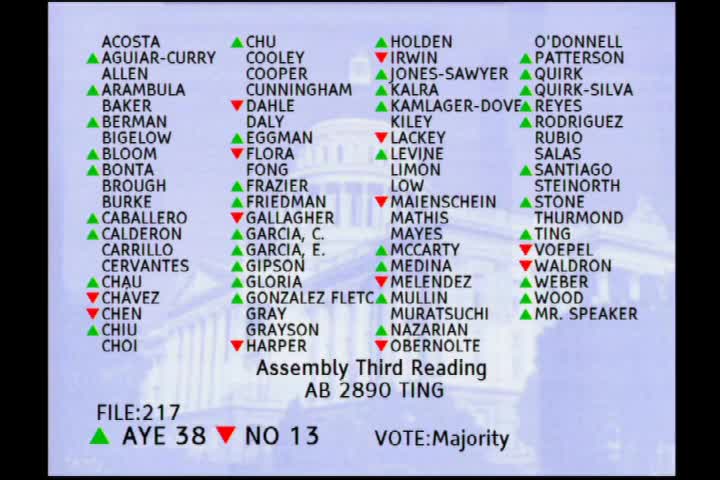 3MIN
Assembly Floor
 21MIN
Assembly Standing Committee on Privacy and Consumer Protection
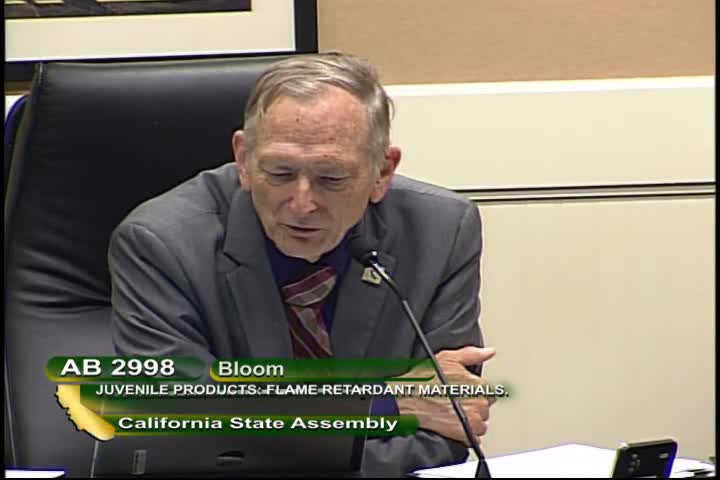 24MIN
Assembly Standing Committee on Environmental Safety and Toxic Materials
Bill Author




