AB 30: Environmental quality: judicial review: strip mall conversion housing projects.
- Session Year: 2017-2018
- House: Assembly
- Latest Version Date: 2017-04-03
The California Environmental Quality Act, referred to as CEQA, requires a lead agency, as defined, to prepare, or cause to be prepared and certify the completion of an environmental impact report, referred to as an EIR, on a project that it proposes to carry out or approve that may have a significant effect on the environment or to adopt a negative declaration if it finds that the project will not have that effect. CEQA establishes a procedure for the preparation and certification of the record of proceedings upon the filing of an action or proceeding challenging a lead agencys action on the grounds of noncompliance with CEQA.
CEQA requires that an action or proceeding to attack, review, set aside, void or annul a determination, finding, or decision of a public agency, as provided, on the grounds of noncompliance with its provisions be brought in accordance with specified law governing administrative mandamus. CEQA requires a court to make specified orders if it finds that any determination, finding, or decision of a public agency has been made without compliance with CEQA, but prohibits a court from enjoining certain projects unless the court makes specified findings.
This bill would similarly prohibit a court from enjoining a qualified strip mall conversion housing projects, as defined, unless the court makes specified findings.
The Planning and Zoning Law requires a county or city to prepare and adopt a comprehensive, long-term general plan for the physical development of the county or city. After the legislative body has adopted a general plan, that law authorizes the preparation of specific plans by the planning agency for the systematic implementation of the general plan for all or part of the area covered by the general plan. That law generally requires that a specific plan be adopted in the same manner as a general plan, but provides that a specific plan may be adopted by resolution or by ordinance and amended as often as the legislative body deems necessary.This bill would authorize a legislative body of a city or county to identify an area of underperforming infill and direct the planning agency to prepare a specific plan, in accordance with the above described provisions and specified additional procedures, to provide for immediate development within that area. The bill would require the specific plan make certain findings relating to the need for affordable housing and to designate the specific plan area as an overlay zone in which development is permitted by right. The bill would require the legislative body conduct at least one public hearing before approving a specific plan pursuant to these provisions to provide for community participation.The Planning and Zoning Law requires a county or city to prepare and adopt a comprehensive, long-term general plan for the physical development of the county or city. After the legislative body has adopted a general plan, that law authorizes the preparation of specific plans by the planning agency for the systematic implementation of the general plan for all or part of the area covered by the general plan. That law generally requires that a specific plan be adopted in the same manner as a general plan, but provides that a specific plan may be adopted by resolution or by ordinance and amended as often as the legislative body deems necessary.
This bill would authorize a legislative body of a city or county to identify an area of underperforming infill and direct the planning agency to prepare a specific plan, in accordance with the above described provisions and specified additional procedures, to provide for immediate development within that area. The bill would require the specific plan make certain findings relating to the need for affordable housing and to designate the specific plan area as an overlay zone in which development is permitted by right. The bill would require the legislative body conduct at least one public hearing before approving a specific plan pursuant to these provisions to provide for community participation.
(a)For purposes of this section, the following definitions shall apply:
(1)Approved strip mall conversion housing project means a project that meets all of the following criteria:
(A)The project is located at a site consisting of a single-story shopping center with surface parking.
(B)The project is funded, approved, or both, by a public agency, whether state, regional, or local.
(C)The project is for the construction of new housing units in a location and at a density that is consistent with, and not greater than, allowed by either of the following:
(i)An approved local general plan, specific plan, community redevelopment plan, or zoning ordinance, provided that the applicable plan or ordinance was approved by a local agency following certification of an environmental impact report pursuant to this division.
(ii)An applicable sustainable communities strategy that was adopted by a transportation planning agency as part of a regional transportation plan pursuant to Section 65080 of the Government Code following certification of an environmental impact report pursuant to this division.
(2)Qualified strip mall conversion housing project means an approved strip mall conversion housing project that meets all of the following criteria:
(A)The approved strip mall conversion housing project does not displace any residents in existing, permitted housing units.
(B)The approved strip mall conversion housing project includes any of the following:
(i)Rental units that are affordable to households with an income at or below 120 percent of the area median income for the location in which the project is located.
(ii)For-sale units that are affordable to households with an income at or below 150 percent of the area median income for the location in which the project is located, assuming that the household has sufficient funds for a 20-percent or greater downpayment plus closing costs.
(iii)A combination of rental and for-sale units as described in clauses (i) and (ii), respectively.
(C)The approved strip mall conversion housing project is located in a city or urbanized area, as defined by the United States Census Bureau for purposes of the dicennial census, and includes in an onsite or offsite location the equivalent of 20 percent of the housing units as deed restricted affordable housing that is affordable to very low and low-income households in the proportion of very low and low-income housing units set forth in the applicable regional housing needs assessment pursuant to Section 65584 of the Government Code.
(D)The approved strip mall conversion housing project pays to support workforce training funds in the amount of two hundred dollars ($200) per housing unit to support certified construction trade apprenticeship training programs offered in partnership with California community colleges that are designed to train adults with and without high school diplomas with the technical skills needed to be hired to perform middle wage jobs which are available within the region. As used in this subparagraph, middle wage job means a job that offers gross annual wages that are approximately 150 percent of the area median income.
(b)In granting relief in an action or proceeding brought pursuant to this division, the court shall not enjoin a qualified strip mall conversion housing project unless the court finds either of the following:
(1)The continuation of the qualified strip mall conversion housing project presents an imminent threat to the public health and safety.
(2)The qualified strip mall conversion housing project site contains unforeseen important Native American artifacts or unforeseen important historical, archaeological, or ecological values that would be materially, permanently, and adversely affected by the continuation of the qualified strip mall conversion housing project unless the court stays or enjoins the qualified strip mall conversion housing project.
(c)If the court finds that either paragraph (1) or (2) of subdivision (b) is satisfied, the court shall only enjoin those specific activities associated with the qualified strip mall conversion housing project that present an imminent threat to public health and safety or that materially, permanently, and adversely affect unforeseen important Native American artifacts or unforeseen important historical, archaeological, or ecological values.
(d)This section shall not be construed to do either of the following:
(1)Limit or otherwise modify the authority of a public agency to approve, conditionally approve, or disapprove a housing development project.
(2)Exempt a public agency from compliance with any otherwise applicable provision of this division, including requirements regarding the evaluation and mitigation of environmental impacts, public review or comment, and review and decisionmaking by a lead agency or responsible agency.
SECTION 1.Section 65458 is added to the Government Code, to read:65458.(a)The Legislature finds and declares all of the following:(1)It is estimated that California has a housing deficit of approximately 1,000,000 units across all income levels.(2)Less than 200,000 housing units are built in California per year, and during the economic downturn, fewer than ___ units were constructed each year.(3)The lack of housing availability has resulted in significant overcrowding in many neighborhoods as many families double and triple up in housing units intended for two to three people.(4)This causes tension within neighborhoods, insecurity, a strain on municipal and other public services, and overcrowding in schools.(5)Families are moving further from their principal place of employment, resulting in longer commute times, increased environmental impact including greenhouse gas emissions, latchkey children without adult supervision after school, and a disconnect between residents and the cities or communities in which they live.(6)The lack of affordable housing in many communities results in people living in unsuitable and illegal living spaces for the long term, including attics, garages, sheds, cars, motels, parks, and open spaces.(7)The lack of housing affordable to local workforces has arrested economic development.(b)(1)A legislative body may identify an area of underperforming infill and direct the planning agency to prepare a specific plan in accordance with the requirements of this article to provide for immediate development within that area.(2)The legislative body shall conduct at least one public hearing before approving a specific plan prepared pursuant to this section to provide for community participation. Notice of the hearing shall be given pursuant to Section 65090.(c)(1)A specific plan prepared pursuant to this section shall, at minimum, do both of the following:(A)Make all of the following findings:(i)There is a critical need for housing within the community.(ii)There is an unmet need for housing affordable to workers, seniors, veterans, or other vital and underserved groups.(iii)If the designated property use within the proposed specific plan area is not changed, any new housing would create sprawl and detrimentally affect the environment.(iv)The proposed specific plan area is along an arterial road that has access, or will have access, to public transportation.(v)Mixed use of the property within the proposed specific plan area will benefit the neighborhood and enhance the aesthetics of the community.(vi)It is in the best interests of the community to develop a walkable neighborhood.(B)Designate the specific plan area as an overlay zone in which development is permitted by right.(2)The specific plan may additionally do any or all of the following:(A)Increase the density of parcels of property within the specific plan area to accommodate commercial and residential uses.(B)Reduce parking requirements applicable to a residential development, including by allowing for residential use of commercial parking.(C)Increase the floor area ratio of parcels of property within the specific plan area to intensify use of the parcel.(D)Develop opportunities to connect the specific plan area with surrounding neighborhoods to encourage walking and bicycle usage to access commercial developments.(a)The Legislature finds and declares all of the following:
(1)It is estimated that California has a housing deficit of approximately 1,000,000 units across all income levels.
(2)Less than 200,000 housing units are built in California per year, and during the economic downturn, fewer than ___ units were constructed each year.
(3)The lack of housing availability has resulted in significant overcrowding in many neighborhoods as many families double and triple up in housing units intended for two to three people.
(4)This causes tension within neighborhoods, insecurity, a strain on municipal and other public services, and overcrowding in schools.
(5)Families are moving further from their principal place of employment, resulting in longer commute times, increased environmental impact including greenhouse gas emissions, latchkey children without adult supervision after school, and a disconnect between residents and the cities or communities in which they live.
(6)The lack of affordable housing in many communities results in people living in unsuitable and illegal living spaces for the long term, including attics, garages, sheds, cars, motels, parks, and open spaces.
(7)The lack of housing affordable to local workforces has arrested economic development.
(b)(1)A legislative body may identify an area of underperforming infill and direct the planning agency to prepare a specific plan in accordance with the requirements of this article to provide for immediate development within that area.
(2)The legislative body shall conduct at least one public hearing before approving a specific plan prepared pursuant to this section to provide for community participation. Notice of the hearing shall be given pursuant to Section 65090.
(c)(1)A specific plan prepared pursuant to this section shall, at minimum, do both of the following:
(A)Make all of the following findings:
(i)There is a critical need for housing within the community.
(ii)There is an unmet need for housing affordable to workers, seniors, veterans, or other vital and underserved groups.
(iii)If the designated property use within the proposed specific plan area is not changed, any new housing would create sprawl and detrimentally affect the environment.
(iv)The proposed specific plan area is along an arterial road that has access, or will have access, to public transportation.
(v)Mixed use of the property within the proposed specific plan area will benefit the neighborhood and enhance the aesthetics of the community.
(vi)It is in the best interests of the community to develop a walkable neighborhood.
(B)Designate the specific plan area as an overlay zone in which development is permitted by right.
(2)The specific plan may additionally do any or all of the following:
(A)Increase the density of parcels of property within the specific plan area to accommodate commercial and residential uses.
(B)Reduce parking requirements applicable to a residential development, including by allowing for residential use of commercial parking.
(C)Increase the floor area ratio of parcels of property within the specific plan area to intensify use of the parcel.
(D)Develop opportunities to connect the specific plan area with surrounding neighborhoods to encourage walking and bicycle usage to access commercial developments.
|
Date
|
Status
|
|---|---|
| Feb 1, 2018 | From committee: Filed with the Chief Clerk pursuant to Joint Rule 56. |
| Jan 31, 2018 | Died pursuant to Art. IV, Sec. 10(c) of the Constitution. |
| May 8, 2017 | In committee: Set, first hearing. Testimony taken. |
| May 4, 2017 | Assembly Rule 56 suspended. (Page 1363.) |
| Apr 17, 2017 | From committee: Be re-referred to Coms. on NAT. RES. and H. & C.D. (Ayes 9. Noes 0.) (April 17). Re-referred to Com. on NAT. RES. |
| Apr 6, 2017 | Re-referred to Com. on RLS. pursuant to Assembly Rule 96. |
| Apr 4, 2017 | Re-referred to Com. on L. GOV. |
| Apr 3, 2017 | From committee chair, with author's amendments: Amend, and re-refer to Com. on L. GOV. Read second time and amended. |
| Jan 19, 2017 | Referred to Coms. on L. GOV. and H. & C.D. |
| Dec 6, 2016 | From printer. May be heard in committee January 5. |
| Dec 5, 2016 | Read first time. To print. |
|
Date
|
Description
|
Location
|
Votes
|
|
|---|---|---|---|---|
| Apr 17, 2017 | Favorable with Committee Substitute | Assembly Standing Committee on Rules |
Passed |
This list shows positions taken on this bill by organizations on the date displayed, which is linked to the original source.
Positions by individuals are not included.
|
Organization
|
Position
|
Date
|
|---|---|---|
| California community builders | * Support | May 8, 2017 |
| California League Of Conservation Voters | ** Against | May 5, 2017 |
| Judicial Council of California | ** Against | May 5, 2017 |
| Sierra Club | * Against | May 8, 2017 |
Date of Hearing: May 8, 2017
ASSEMBLY COMMITTEE ON NATURAL RESOURCES
Cristina Garcia, Chair
ABPCA Bill Id:AB 30 (
Author:Caballero) – As Amended Ver:April 3, 2017
SUBJECT: Environmental quality: judicial review: strip mall conversion housing projects
SUMMARY: Generally prohibits a court, in granting relief in an action or proceeding challenging a "qualified strip mall housing conversion project" under the California Environmental Quality Act (CEQA), from staying or enjoining the construction or operation of the project.
EXISTING LAW:
- CEQA requires lead agencies with the principal responsibility for carrying out or approving a proposed project to prepare a negative declaration, mitigated negative declaration, or environmental impact report (EIR) for this action, unless the project is exempt from CEQA (CEQA includes various statutory exemptions, as well as categorical exemptions in the CEQA guidelines).
- Exempts from CEQA any residential development project, including any subdivision, or any zoning change that is undertaken to implement and is consistent with a specific plan for which an EIR has been certified after January 1, 1980, unless substantial changes or new information require the preparation of a supplemental EIR for the specific plan, in which case the exemption applies once the supplemental EIR is certified.
- Exempts from CEQA specified residential housing projects which meet detailed criteria established to ensure the project does not have a significant effect on the environment, including urban affordable housing projects not more than 100 units on a site not more than 5 acres in size, and urban infill housing projects not more than 100 units on a site not more than 4 acres in size, which is within one-half mile of a major transit stop. [SB 1925 (Sher), Chapter 1039, Statutes of 2002]
- Requires metropolitan planning organizations (MPOs) to include a sustainable communities strategy (SCS), as defined, in their regional transportation plans, or an alternative planning strategy (APS), for the purpose of reducing greenhouse gas (GHG) emissions, aligns planning for transportation and housing, and creates specified incentives for the implementation of the strategies, including CEQA exemption or abbreviated review for residential or mixed-use residential "transit priority projects" if the project is consistent with the use designation, density, building intensity, and applicable policies specified for the project area in either an approved SCS or APS. [SB 375 (Steinberg), Chapter 728, Statutes of 2008]
- Establishes abbreviated CEQA review procedures for specified infill projects, where only specific or more significant effects on the environment which were not addressed in a prior planning-level EIR need be addressed. An EIR for such a project need not consider alternative locations, densities, and building intensities or growth-inducing impacts. Infill projects may include residential, retail, commercial, transit station, school, or public office building projects located within an urban area. [SB 226 (Simitian), Chapter 469, Statutes of 2011]
- Exempts from CEQA residential, mixed-use, and "employment center" projects, as defined, located within "transit priority areas," as defined, if the project is consistent with an adopted specific plan and specified elements of a SCS or APS adopted pursuant to SB 375. [SB 743 (Steinberg), Chapter 386, Statutes of 2013]
- The CEQA Guidelines include a categorical exemption for infill development projects (Section 15332), as follows:
- The project is consistent with the applicable general plan designation and all applicable general plan policies as well as with applicable zoning designation and regulations;
- The proposed development occurs within city limits on a project site of no more than five acres substantially surrounded by urban uses;
- The project site has no value as habitat for endangered, rare, or threatened species;
- Approval of the project would not result in any significant effects relating to traffic, noise, air quality, or water quality; and,
- The site can be adequately served by all required utilities and public services.
- Authorizes judicial review of CEQA actions taken by public agencies, following the agency's decision to carry out or approve the project. Challenges alleging improper determination that a project may have a significant effect on the environment, or alleging an EIR doesn't comply with CEQA, must be filed in the Superior Court within 30 days of filing of the notice of approval. The courts are required to give CEQA actions preference over all other civil actions.
- Upon finding a public agency's actions are not in compliance with CEQA, requires a court to order one or more of the following:
- A mandate that the determination, finding, or decision be voided by the public agency, in whole or in part;
- If the court finds that a specific project activity or activities will prejudice the consideration or implementation of particular mitigation measures or alternatives to the project, a mandate that the public agency and any real parties in interest suspend any or all specific project activity or activities, pursuant to the determination, finding, or decision, that could result in an adverse change or alteration to the physical environment, until the public agency has taken any actions that may be necessary to bring the determination, finding, or decision into compliance with this division; and
- A mandate that the public agency take specific action as may be necessary to bring the determination, finding, or decision into compliance with CEQA.
Any order shall include only those mandates which are necessary to achieve compliance with CEQA and only those specific project activities in noncompliance with CEQA.
- Imposes specific limits on injunctive relief under CEQA for three specified projects: Los Angeles football stadium /convention center, Sacramento downtown arena, and Capitol Building annex project.
THIS BILL:
- Defines a "qualified strip mall conversion housing project" as a project to construct new housing units at the site of a single-story shopping center with surface parking that meets the following criteria:
- The project does not displace residents of existing housing units;
- The project includes either rental units affordable to households at or below 120% of the area median income (AMI) or for-sale units affordable to households at or below 150% of AMI, or a combination of rental and for-sale units;
- The project is located in a city or "urbanized area" as defined by the U.S. Census Bureau (a community with a population over 50,000);
- The project includes, onsite or offsite, the equivalent of 20% of the units as deed-restricted housing affordable to very low and low-income households; and
- The project pays $200 per housing unit to support certified construction trade apprenticeship programs offered in partnership with California Community Colleges.
- Limits remedies available to a court in a CEQA lawsuit challenging a qualified strip mall housing conversion project by generally prohibiting a court, in granting relief, from staying or enjoining the construction or operation of the project and provides that a court may only enjoin those specific activities associated with the project that present an imminent threat to public health and safety or that materially, permanently, and adversely affect unforeseen important Native American artifacts or unforeseen important historical, archaeological, or ecological values (in effect limiting the equitable powers of the court and prohibiting existing remedies under CEQA such as voiding the lead agency's decision or suspending project activities).
FISCAL EFFECT: Non-fiscal
COMMENTS:
- Background. CEQA provides a process for evaluating the environmental effects of applicable projects undertaken or approved by public agencies. If a project is not exempt from CEQA, an initial study is prepared to determine whether the project may have a significant effect on the environment. If the initial study shows that there would not be a significant effect on the environment, the lead agency must prepare a negative declaration. If the initial study shows that the project may have a significant effect on the environment, the lead agency must prepare an EIR.
Generally, an EIR must accurately describe the proposed project, identify and analyze each significant environmental impact expected to result from the proposed project, identify mitigation measures to reduce those impacts to the extent feasible, and evaluate a range of reasonable alternatives to the proposed project. If mitigation measures are required or incorporated into a project, the agency must adopt a reporting or monitoring program to ensure compliance with those measures.
CEQA includes various statutory exemptions, as well as categorical exemptions in the CEQA Guidelines. As noted in the existing law section above, there are several existing statutory and categorical exemptions for housing projects. It appears a strip mall conversion housing project in an urban area could qualify for most, if not all, of these existing exemptions.
- CEQA judicial review. CEQA is enforced through judicial review. CEQA actions taken by public agencies can be challenged in Superior Court once the agency approves or determines to carry out the project. CEQA appeals are subject to unusually short statutes of limitations. Under current law, court challenges of CEQA decisions generally must be filed within 30 to35 days, depending on the type of decision. The courts are required to give CEQA actions preference over all other civil actions. The petitioner must request a hearing within 90 days of filing the petition and, generally, briefing must be completed within 90 days of the request for hearing. There is no deadline specified for the court to render a decision.
Since 2011, the Legislature has established expedited CEQA judicial review procedures for a limited number of projects, including limiting injunctive relief for three projects: Los Angeles football stadium /convention center, Sacramento downtown arena, and Capitol Building annex project.
The bills limiting injunctive relief for the Los Angeles stadium and Sacramento arena projects included provisions requiring the projects to minimize traffic and air quality impacts through project design or mitigation measures, including reducing to at least zero the net GHG emissions from private automobile trips.
- Prior legislation. The following bills included provisions limiting injunctive relief nearly identical to the provisions in this bill:
- SB 292 (Padilla), Chapter 353, Statutes of 2011, applied to the Los Angeles football stadium /convention center project, which has not proceeded;
- SB 743 (Steinberg), Chapter 386, Statutes of 2013, applied to the Sacramento downtown arena project, now known as Golden1 Center;
- SB 836 (Committee on Budget and Fiscal Review), Chapter 31, Statutes of 2016, applied to the Capitol Annex project;
- AB 1586 (Mathis), which applied to the Temperance Flat Reservoir, failed in this committee by a vote of 1-6 on April 4, 2016;
- AB 311 (Gallagher), which applied to water storage projects funded by the Water Quality, Supply, and Infrastructure Improvement Act of 2014 (Proposition 1), failed in this committee by a vote of 3-6 on April 27, 2015; and
- AB 641 (Mayes), which applied broadly to housing developments, failed in this committee by a vote of 2-7 on April 27, 2015.
- Double referral. This bill has been double referred to the Housing and Community Development Committee.
REGISTERED SUPPORT / OPPOSITION:
Support
None on file
Opposition
California League of Conservation Voters
Judicial Council of California
Sierra Club California
Analysis Prepared by: Lawrence Lingbloom / NAT. RES. /
Discussed in Hearing
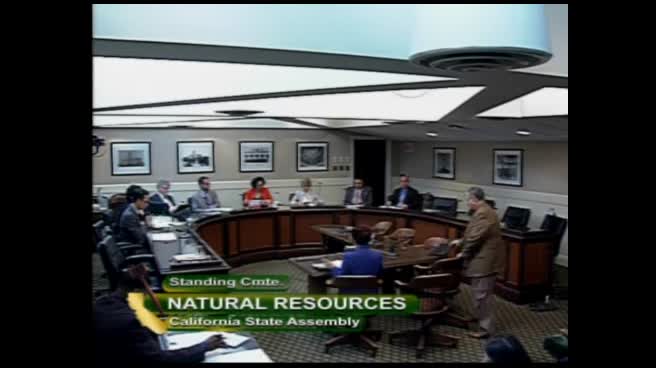 27MIN
Assembly Standing Committee on Natural Resources
Bill Author

Bill Co-Author(s):