AB 3014: Brake friction materials: copper limits: high-performance road- and track-capable vehicle exemption.
- Session Year: 2017-2018
- House: Assembly
- Latest Version Date: 2018-06-07
Existing law establishes the Department of Toxic Substances Control in the California Environmental Protection Agency, with powers and duties regarding the management of hazardous waste. Existing law, commencing on January 1, 2021, prohibits motor vehicle brake friction materials containing more than 5% copper by weight from being sold in the state, and, commencing on January 1, 2025, prohibits motor vehicle brake friction materials exceeding 0.5% copper by weight from being sold in the state.
This bill would exempt high performance road and track capable vehicles and high-performance road- and track-capable vehicles and brake friction materials for use on those vehicles from the prohibition against the sale of motor vehicle brake friction materials containing more than 5% copper by weight on and after January 1, 2021. 2021, if the seller first receives approval for the exemption from the department. The bill would require the department to annually exempt no more than 10,000 high-performance road- and track-capable vehicles, and brake friction materials for use on those vehicles, per manufacturer of those vehicles or materials from that prohibition and would require that brake friction material on a high-performance road- and track-capable vehicle, and brake friction material for use on one of those vehicles, exempted pursuant to these provisions not exceed 30% copper by weight.
The bill would also make nonsubstantive changes.
Existing law establishes the Department of Toxic Substances Control in the California Environmental Protection Agency, with powers and duties regarding the management of hazardous waste. Existing law, commencing on January 1, 2021, prohibits motor vehicle brake friction materials containing more than 5% copper by weight from being sold in the state, and, commencing on January 1, 2025, prohibits motor vehicle brake friction materials exceeding 0.5% copper by weight from being sold in the state.
This bill would exempt high performance road and track capable vehicles and brake friction materials for use on those vehicles from the prohibition against the sale of motor vehicle brake friction materials containing more than 5% copper by weight on and after January 1, 2021.
ThisThe bill would make nonsubstantive changes.
Existing law establishes the Department of Toxic Substances Control in the California Environmental Protection Agency, with powers and duties regarding the management of hazardous waste. Existing law, commencing on January 1, 2021, prohibits motor vehicle brake friction materials containing more than 5% copper by weight from being sold in the state, and, commencing on January 1, 2025, prohibits motor vehicle brake friction materials exceeding 0.5% copper by weight from being sold in the state.
This bill would exempt high performance road and track capable vehicles and brake friction materials for use on those vehicles from the prohibition against the sale of motor vehicle brake friction materials containing more than 5% copper by weight on and after January 1, 2021.
This bill would make nonsubstantive changes.
The Employee Housing Act requires that buildings used for human habitation, and buildings accessory thereto, comply with the building standards in the California Building Standards Code relating to employee housing, as defined.This bill would make a nonsubstantive change to the provision naming that act.The Employee Housing Act requires that buildings used for human habitation, and buildings accessory thereto, comply with the building standards in the California Building Standards Code relating to employee housing, as defined.
This bill would make a nonsubstantive change to the provision naming that act.
(a)Brake friction materials for the following motor vehicle classes are exempt from this article:
(1)Military tactical support vehicles.
(2)Vehicles employing internal closed oil immersed brakes, or a similar brake system that is fully contained and emits no copper, other debris, or fluids under normal operating conditions.
(3)Brakes designed for the primary purpose of holding the vehicle stationary and not designed to be used while the vehicle is in motion.
(4)Motorcycles.
(5)Motor vehicles subject to voluntary or mandatory recalls of brake friction materials or systems due to safety concerns. This exemption shall expire upon the lifting of the recall and provision of new brake friction materials that comply with this article.
(6)Motor vehicles manufactured by small volume manufacturers, as defined in Section 1900 of Title 13 of the California Code of Regulations.
(b)Vehicles manufactured prior to January 1, 2021, and brake friction materials for use on vehicles manufactured prior to January 1, 2021, are exempt from the requirements of Section 25250.52.
(c)Vehicles manufactured prior to January 1, 2025, and brake friction materials for use on vehicles manufactured prior to January 1, 2025, are exempt from the requirements of Section 25250.53.
(d)High performance road and track capable vehicles and (1)A high-performance road- and track-capable vehicle and brake friction materials material for use on those vehicles such a vehicle are exempt from the requirements of Section 25250.52. 25250.52 if the seller first receives approval for the exemption from the department pursuant to paragraph (2).
(2)The department shall annually exempt no more than 10,000 high-performance road- and track-capable vehicles, and brake friction materials for use on those vehicles, per manufacturer of those vehicles or materials from the requirements of Section 25250.52. Brake friction material on a high-performance road- and track-capable vehicle, and brake friction material for use on one of those vehicles, exempted pursuant to this paragraph shall not exceed 30 percent copper by weight.
(3)For purposes of this subdivision, high-performance road- and track-capable vehicle means a motor vehicle for which all of the following apply:
(A)(i)The motor vehicle has vehicle content or design features that enable it to operate at a higher performance level than motor vehicles produced with standard content.
(ii)Examples of the vehicle content or design features referenced in clause (i) include, but are not limited to, performance brakes, performance tires, additional specific cooling for the engine, transmission, brakes, or fluids, aero panels, including spoilers, and additional engine horsepower and torque.
(B)The motor vehicle is specifically marketed by the manufacturer for use on closed racecourses, such as racetracks, drag strips, or street racing courses.
(C)The motor vehicle is street legal, unless it is specifically advertised as off-road only.
(e)Vehicles for which an extension for noncompliance with the requirements of Section 25250.53 was approved pursuant to Section 25250.54 are exempt from Section 25250.53 for the period of the extension.
(a)Brake friction materials for the following motor vehicle classes are exempt from this article:
(1)Military tactical support vehicles.
(2)Vehicles employing internal closed oil immersed brakes, or a similar brake system that is fully contained and emits no copper, other debris, or fluids under normal operating conditions.
(3)Brakes designed for the primary purpose of holding the vehicle stationary and not designed to be used while the vehicle is in motion.
(4)Motorcycles.
(5)Motor vehicles subject to voluntary or mandatory recalls of brake friction materials or systems due to safety concerns. This exemption shall expire upon the lifting of the recall and provision of new brake friction materials that comply with this article.
(6)Motor vehicles manufactured by small volume manufacturers, as defined in Section 1900 of Title 13 of the California Code of Regulations.
(b)Vehicles manufactured prior to January 1, 2021, and brake friction materials for use on vehicles manufactured prior to January 1, 2021, are exempt from the requirements of Section 25250.52.
(c)Vehicles manufactured prior to January 1, 2025, and brake friction materials for use on vehicles manufactured prior to January 1, 2025, are exempt from the requirements of Section 25250.53.
(d)High performance road and track capable vehicles and brake friction materials for use on those vehicles are exempt from the requirements of Section 25205.52. 25250.52.
(e)Vehicles for which an extension for noncompliance with the requirements of Section 25250.53 was approved pursuant to Section 25250.54 are exempt from Section 25250.53 for the period of the extension.
(a)Brake friction materials for the following motor vehicle classes are exempt from this article:
(a)(1)Military tactical support vehicles.
(b)(2)Vehicles employing internal closed oil immersed brakes, or a similar brake system that is fully contained and emits no copper, other debris, or fluids under normal operating conditions.
(c)(3)Brakes designed for the primary purpose of holding the vehicle stationary and not designed to be used while the vehicle is in motion.
(d)(4)Motorcycles.
(e)(5)Motor vehicles subject to voluntary or mandatory recalls of brake friction materials or systems due to safety concerns. This exemption shall expire upon the lifting of the recall and provision of new brake friction materials that comply with this article.
(f)(6)Motor vehicles manufactured by small volume manufacturers, as defined in Section 1900 of Title 13 of the California Code of Regulations.
(g)(b)Vehicles manufactured prior to January 1, 2021, and brake friction materials for use on vehicles manufactured prior to January 1, 2021, are exempt from the requirements of Section 25250.52.
(h)(c)Vehicles manufactured prior to January 1, 2025, and brake friction materials for use on vehicles manufactured prior to January 1, 2025, are exempt from the requirements of Section 25250.53.
(d)High performance road and track capable vehicles and brake friction materials for use on those vehicles are exempt from the requirements of Section 25205.52.
(i)(e)Vehicles for which an extension from for noncompliance with the requirements of Section 25250.53 was approved pursuant to Section 25250.54. 25250.54 are exempt from 25250.53 for the period of the extension.
SECTION 1.Section 17000 of the Health and Safety Code is amended to read:17000.This part shall be known, and may be cited, as the Employee Housing Act.This part shall be known known, and may be cited, as the Employee Housing Act.
|
Date
|
Status
|
|---|---|
| Jun 20, 2018 | In committee: Set, second hearing. Hearing canceled at the request of author. |
| Jun 14, 2018 | In committee: Set, second hearing. Hearing canceled at the request of author. |
| Jun 7, 2018 | From committee chair, with author's amendments: Amend, and re-refer to committee. Read second time, amended, and re-referred to Com. on EQ. |
| May 24, 2018 | In committee: Set, first hearing. Hearing canceled at the request of author. |
| May 17, 2018 | Referred to Com. on EQ. |
| May 3, 2018 | In Senate. Read first time. To Com. on RLS. for assignment. |
| May 3, 2018 | Read third time. Passed. Ordered to the Senate. |
| Apr 26, 2018 | Read second time. Ordered to Consent Calendar. |
| Apr 25, 2018 | From committee: Do pass. To Consent Calendar. (Ayes 17. Noes 0.) (April 25). |
| Apr 16, 2018 | Re-referred to Com. on APPR. |
| Apr 12, 2018 | Read second time and amended. |
| Apr 11, 2018 | From committee: Amend, and do pass as amended and re-refer to Com. on APPR. (Ayes 6. Noes 0.) (April 10). |
| Apr 2, 2018 | From committee chair, with author's amendments: Amend, and re-refer to Com. on E.S. & T.M. Read second time and amended. |
| Apr 2, 2018 | Re-referred to Com. on E.S. & T.M. |
| Mar 23, 2018 | From committee chair, with author's amendments: Amend, and re-refer to Com. on E.S. & T.M. Read second time and amended. |
| Mar 22, 2018 | Referred to Com. on E.S. & T.M. |
| Feb 17, 2018 | From printer. May be heard in committee March 19. |
| Feb 16, 2018 | Read first time. To print. |
|
Date
|
Description
|
Location
|
Votes
|
|
|---|---|---|---|---|
| May 3, 2018 | AB 3014 QUIRK Consent Calendar Second Day Regular Session | Assembly Floor |
Passed |
|
| Apr 25, 2018 | Do pass. To Consent Calendar. | Assembly Standing Committee on Appropriations |
Passed |
|
| Apr 10, 2018 | Do pass as amended and be re-referred to the Committee on [Appropriations] | Assembly Standing Committee on Environmental Safety and Toxic Materials |
Passed |
This list shows positions taken on this bill by organizations on the date displayed, which is linked to the original source.
Positions by individuals are not included.
|
Organization
|
Position
|
Date
|
|---|---|---|
| Alliance Of Automobile Manufacturers | ** Support | Apr 8, 2018 |
| City Of San Diego | * Indeterminate | Apr 10, 2018 |
| Clean Water Action | * Indeterminate | Apr 10, 2018 |
| Environmental Working Group | * Indeterminate | Apr 10, 2018 |
| Sierra Club California | * Indeterminate | Apr 10, 2018 |
| Sustainable Conservation | * Indeterminate | Apr 10, 2018 |
Date of Hearing: April 25, 2018
ASSEMBLY COMMITTEE ON APPROPRIATIONS
Lorena Gonzalez Fletcher, Chair
ABPCA Bill Id:AB 3014
Author:(Quirk) – As Amended Ver:April 12, 2018
Policy Committee: | Environmental Safety and Toxic Materials | Vote: | 6 - 0 |
|
| ||
|
|
Urgency: No State Mandated Local Program: No Reimbursable: No
SUMMARY:
This bill exempts high performance road-and-track capable vehicles, and the vehicles’ brake friction materials, from the requirement that brake friction materials contain no more than 5% copper by weight by January 1, 2021.
FISCAL EFFECT:
Minor DTSC costs to update its website, factsheets and outreach materials.
COMMENTS:
Purpose and Background. SB 346 (Kehoe), Chapter 307, Statutes of 2010, prohibits the sale of automobile brake pads containing more than trace amounts of copper, certain heavy metals, and asbestos. The purpose of SB 346 is to reduce the amount of copper and other toxic substances released from brakes and entering California’s streams, rivers, and marine environment.
SB 346 phased-in the sales bans on various types of brake pads. In 2014, SB 346 banned brake pads containing more than trace amounts of heavy metals and asbestos. In 2021, brake pads containing more than 5% copper will no longer be allowed to be sold in California, and by 2025, the law reduces the amount of copper allowed to almost zero.
Copper is toxic to many aquatic organisms and limiting the copper content of brakes is essential to complying with the federal Clean Water Act, including copper water quality standards and total maximum daily loads (TMDLs) in California’s urban watersheds.
High performance road-and-track capable vehicles are cars that can legally drive on the road but also have the power to perform on a race track. These cars have engines and brakes that are different than typical vehicles. Due to technological challenges, manufacturers have not yet been able to develop brake pads for these high performance road-and-track capable vehicles that are able to meet the copper reduction limits (no more than 5% copper) by the 2021 deadline.
This bill provides a narrow exemption from the 2021 deadline, but continues to require these vehicles to meet the 2025 deadline that limits the amount of copper in brakes to almost zero.
Analysis Prepared by: Jennifer Galehouse / APPR. / (916) 319-2081
Date of Hearing: April 10, 2018
ASSEMBLY COMMITTEE ON ENVIRONMENTAL SAFETY AND TOXIC MATERIALS
Bill Quirk, Chair
ABPCA Bill Id:AB 3014 (
Author:Quirk) – As Amended Ver:March 23, 2018
SUBJECT: Brake friction materials: copper limits: high performance road and track capable vehicle exemption
SUMMARY: Exempts high performance road and track capable vehicles and brake friction materials for use on those vehicles from the requirement that those brake friction materials contain no more than 5 percent copper by weight by January 1, 2021.
EXISTING LAW:
1) Prohibits, on and after January 1, 2014, any motor vehicle brake friction materials from being sold in California if they contain the following constituents and exceed the following concentrations: cadmium (0.01 percent by weight); chromium (VI)-salts (0.1 percent by weight); lead (0.1 percent by weight); mercury (0.1 percent by weight); and, asbestiform fibers (0.1 percent by weight). (Health and Safety Code (HSC) § 25250.51 (a))
2) Authorizes motor vehicle manufacturers and distributors, wholesalers, or retailers of replacement brake friction materials to continue to sell non-compliant brake friction materials, until December 31, 2023, for the sole purpose of depleting their inventory. (HSC § 25250.51 (b))
3) Prohibits, on and after January 1, 2021, any motor vehicle brake friction material from being sold in California if it exceeds 5 percent copper weight. (HSC § 25250.52)
4) Prohibits, on and after January 1, 2025, any motor vehicle brake friction material from being sold in California if it exceeds 0.5 percent copper weight. (HSC § 25250.53)
5) Exempts brake friction materials from the requirements of having to meet certain concentrations of specific constituents for the following vehicle classes:
(a) Military tactical support vehicles;
(b) Vehicles employing internal closed oil immersed brakes, or a similar brake system that is fully contained and emits no copper, other debris, or fluids under normal operating conditions;
(c) Brakes designed for the primary purpose of holding the vehicle stationary and not designed to be used while the vehicle is in motion;
(d) Motorcycles;
(e) Motor vehicles subject to voluntary or mandatory recalls of brake friction materials or systems due to safety concerns;
(f) Motor vehicles manufactured by small volume manufacturers, as defined in Section 1900 of Title 13 of the California Code of Regulations;
(g) Vehicles manufactured prior to January 1, 2021, and brake friction materials for use on vehicles manufactured prior to January 1, 2021, from the requirements of HSC 25250.52; and,
(h) Vehicles manufactured prior to January 1, 2025, and brake friction materials for use on vehicles manufactured prior to January 1, 2025, from the requirements of HSC 25250.53. (HSC § 25250.55)
6) Requires, on or before January 1, 2023, the Department of Toxic Substances Control (DTSC) and the California State Water Resources Control Board (State Water Board) to submit to the Governor and Legislature a report on the implementation of vehicle brake copper reduction efforts and the progress toward meeting the copper total maximum daily load (TMDL) allocations in the state. (HSC § 25250.65)
FISCAL EFFECT: Unknown.
COMMENTS:
Need for the bill: According to the author: "In 2010, the Legislature passed SB 346 (Kehoe) which limited the use of copper in motor vehicle brake pads. The automotive industry is working to achieve the 0.5 percent copper solutions for all vehicles, as well the intermediate solution of less than 5% copper subject to the 2021 deadline. However, few technical solutions exist in the intermediate copper range for high performance road and track capable vehicles, none of which have been found to satisfy the entire industry. For some high-performance road and track-capable vehicles, the industry is just now beginning to identify friction material technology that will support the regulation. Due to the requirement to perform on the track in addition to the road, implementation of very low copper friction solutions require significant re-engineering of the brake system to integrate successfully to achieve critical safety and performance requirements.
AB 3014 provides a narrow exemption for high performance road and track capable vehicles, and brake friction materials for use on these vehicles, from the 2021 deadline. Manufacturers of these vehicles will continue to pursue and would be required to achieve the 0.5% copper requirement for all vehicles being sold in the state by 2025. By excluding track capable vehicles from the 2021 deadline, the automotive industry will be able to remain competitive in California while it works to reduce copper levels by January 1, 2025."
Copper in the aquatic environment: According to the U.S. EPA, elevated levels of copper are toxic in aquatic environments and may adversely affect fish, invertebrates, plants, and amphibians. Acute toxic effects may include mortality of organisms; chronic toxicity can result in reductions in survival, reproduction, and growth. Motor vehicles are a major source of toxic contaminants such as copper, a metal that originates from vehicle exhaust and brake pad wear. Copper and other pollutants are deposited on roads and other impervious surfaces and then transported to aquatic habitats via storm water runoff.
Total Maximum Daily Loads (TMDLs): The State Water Board has established TMDLs as allowable pollution limits on copper and other pollutants in several Southern California urban watersheds. Failure to comply with these TMDLs will result in serious penalties to local governments. The ubiquity of copper in the urban environment, and the technical difficulty and impracticality of treating storm water to remove it, mean that compliance with copper TMDLs will not be feasible without source reduction of copper, such as reducing copper from brake pads.
DTSC: DTSC was established to protect California against threats to public health and degradation to the environment and to restore properties degraded by past environmental contamination. Through its statutory mandates, DTSC cleans up existing contamination, regulates management of hazardous wastes, and prevents pollution by working with businesses to reduce their hazardous waste and use of toxic materials.
California copper brake pad law: On September 27, 2010, Governor Schwarzenegger signed SB 346 (Kehoe, Chapter 307, Statutes of 2010) which prohibits the sale of automobile brake pads sold in California containing more than trace amounts of copper, certain heavy metals, and asbestos. The purpose is to reduce the amount of copper and other toxic substances released from brakes from entering California’s streams, rivers, and marine environment.
SB 346 phased in the bans. In 2014, it banned brake pads containing more than trace amounts of heavy metals and asbestos. In 2021 it bans brake pads containing more than 5 percent copper. By 2025, the law reduces the amount of copper allowed to almost zero. Copper is toxic to many aquatic organisms and limiting the copper content of brakes is essential to comply with a federal Clean Water Act mandate, including copper water quality standards and TMDLs in California’s urban watersheds.
SB 346 requires manufacturers to comply with laboratory testing and certify with a mark that their products comply with the restrictions set for brake pads. DTSC, the Washington State Department of Ecology, and the Society of Automotive Engineers (SAE) Brake Materials Environmental Task Force have developed criteria for testing and marking brake pads that meet state laws and regulations. Washington State passed a law similar to SB 346 in 2010 and adopted regulations in 2012.
High performance and track capable vehicles: What is a track capable vehicle? Essentially, it's a car that can legally drive on the road and also has the power to race on a race track. These track capable cars may include some cars that look like race cars but also include regular looking cars on the outside but have engines and brakes that are different than the rest of the vehicles. As a result of technical challenges, manufacturers have not yet developed brake pads for these high performance and track capable vehicles that meet the copper reduction limits for the 2021 deadline. Therefore, AB 3014 provides these track capable vehicles with a narrow exemption from that deadline but continues to hold these vehicles to the 2025 deadline.
Technical amendments: There is an incorrect code reference in the bill, specifically the committee and author may wish to make the following technical amendment:
On page 3, on line 6, strike "25205.52" and insert "25250.52"
Related Legislation:
1) AB 501 (Nazarian, Chapter 392, Statutes of 2013). Authorizes motor vehicle dealers to continue to sell or offer for sale brake friction material not certified as compliant with the chemical standards, if the brake friction material was installed on a vehicle before the dealer acquired the vehicle. Exempts specified motortrucks or two-axle truck tractors from the motor carrier permit requirements.
2) SB 346 (Kehoe, Chapter 307, Statues of 2010). Restricts the use of copper and other toxic chemicals in automobile brake pads. Limits the use of copper in motor vehicle brake pads to no more than five percent by weight on or after January 1, 2021, and no more than .5 percent by weight on or after January 2025.
REGISTERED SUPPORT / OPPOSITION:
Support
Alliance of Automobile Manufacturers
Opposition
None on file.
Analysis Prepared by: Josh Tooker / E.S. & T.M. /
Discussed in Hearing
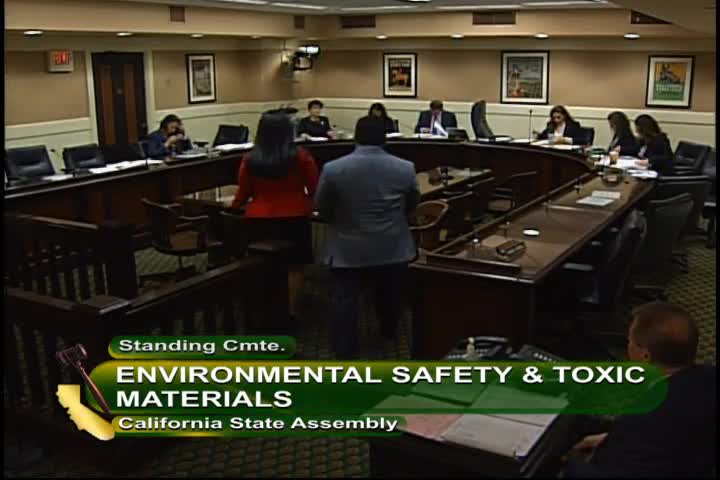 10MIN
Assembly Standing Committee on Environmental Safety and Toxic Materials
Bill Author

Bill Co-Author(s):