AB 3026: Firearms: concealed carry licenses.
- Session Year: 2017-2018
- House: Assembly
- Latest Version Date: 2018-03-22
Existing law authorizes the sheriff of a county, or the chief or other head of a municipal police department, to issue a license to carry a concealed handgun or to carry a loaded and exposed handgun, as specified, if good cause exists for the issuance and the applicant is of good moral character and satisfies certain other criteria.
This bill would instead require the sheriff of a county, or the chief or other head of a municipal police department, to issue a license to carry a concealed handgun or to carry a loaded and exposed handgun, as specified, if good cause exists for the issuance and the applicant is of good moral character and satisfies certain other criteria.
This bill would define good cause for these purposes to include self-defense, defending the life of another, or preventing crime in which human life is threatened, and would provide procedural guidelines to the issuing authority on determining the presence or absence of good cause.
This bill would authorize a resident of another state to apply for a license to carry a concealed handgun or to carry a loaded and exposed handgun, as specified, from any sheriff in the state using the same procedure and would authorize that sheriff to issue a license.
The bill would make other technical, nonsubstantive changes.
By requiring a sheriff or chief of police to issue that license except in specified circumstances, this bill would create a state-mandated local program.
The California Constitution requires the state to reimburse local agencies and school districts for certain costs mandated by the state. Statutory provisions establish procedures for making that reimbursement.
This bill would provide that, if the Commission on State Mandates determines that the bill contains costs mandated by the state, reimbursement for those costs shall be made pursuant to the statutory provisions noted above.
Existing law generally regulates the sale or other transfer, possession, and manufacture of firearms.This bill would express the intent of the Legislature to enact legislation relating to firearms.Existing law generally regulates the sale or other transfer, possession, and manufacture of firearms.
This bill would express the intent of the Legislature to enact legislation relating to firearms.
(a)When If a person applies for a license to carry a pistol, revolver, or other firearm capable of being concealed upon the person, handgun, the sheriff of a county may shall issue a license to that person upon proof of all of the following:
(1)The applicant is of good moral character.
(2)Good cause cause, as determined pursuant to Section 26202, exists for issuance of the license.
(3)The applicant is a resident of the county or a city within the county, or the applicants principal place of employment or business is in the county or a city within the county and the applicant spends a substantial period of time in that place of employment or business.
(4)The applicant has completed a course of training as described in Section 26165.
(b)The sheriff may issue a license under subdivision (a) in either of the following formats:
(1)A license to carry concealed a pistol, revolver, or other firearm capable of being concealed upon the person. a concealed handgun.
(2)Where If the population of the county issuing the license is less than 200,000 persons according to the most recent federal decennial census, a license to carry a loaded and exposed handgun in only that county a pistol, revolver, or other firearm capable of being concealed upon the person. county.
(c)(1)Nothing in this This chapter shall does not preclude the sheriff of the county from entering into an agreement with the chief or other head of a municipal police department of a city to process all applications for licenses, renewals of licenses, or amendments to licenses pursuant to this chapter, in lieu of the sheriff.
(2)This subdivision shall only apply to applicants who reside within the city in which the chief or other head of the municipal police department has agreed to process applications for licenses, renewals of licenses, and amendments to licenses, pursuant to this chapter.
SEC. 2.Section 26155 of the Penal Code is amended to read:26155.(a)When If a person applies for a license to carry a pistol, revolver, or other firearm capable of being concealed upon the person, handgun, the chief or other head of a municipal police department of any city or city and county may shall issue a license to that person upon proof of all of the following:
(1)The applicant is of good moral character.
(2)Good cause cause, as determined pursuant to Section 26202, exists for issuance of the license.
(3)The applicant is a resident of that city.
(4)The applicant has completed a course of training as described in Section 26165.
(b)The chief or other head of a municipal police department may issue a license under subdivision (a) in either of the following formats:
(1)A license to carry concealed a pistol, revolver, or other firearm capable of being concealed upon the person. a concealed handgun.
(2)Where the population of the county in which the city is located is less than 200,000 persons according to the most recent federal decennial census, a license to carry a loaded and exposed handgun in only that county a pistol, revolver, or other firearm capable of being concealed upon the person. county.
(c)Nothing in this This chapter shall does not preclude the chief or other head of a municipal police department of any city from entering an agreement with the sheriff of the county in which the city is located for the sheriff to process all applications for licenses, renewals of licenses, and amendments to licenses, pursuant to this chapter.
SEC. 3.Section 26156 is added to the Penal Code, to read:26156.A resident of another state who does not maintain a residence within the State of California may apply to the sheriff of any county for a license to carry a handgun. The sheriff of a county may, at his or her discretion, issue a license to that person upon proof of all of the following:
(a)The applicant is of good moral character.
(b)Good cause, as determined pursuant to subdivision (b) of Section 26202, exists for issuance of the license.
(c)The applicant has completed a course of training as described in Section 26165.
SEC. 4.Section 26202 of the Penal Code is amended to read:26202.(a)Upon making the determination of good cause pursuant to Section 26150 or 26155, the licensing authority shall give written notice to the applicant of the licensing authoritys determination. If the licensing authority determines that good cause exists, the notice shall inform the applicants to proceed with the training requirements specified in Section 26165. If the licensing authority determines that good cause does not exist, the notice shall inform the applicant that the request for a license has been denied and shall state the reason from the departments published policy, described in Section 26160, as to why the determination was made.
(b)(1)Good cause for the issuance of a license to carry a handgun includes, but is not limited to, self-defense, defending the life of another, or preventing crime in which human life is threatened.
(2)If an applicants stated cause is self-defense, defending the life of another, or preventing crime in which human life is threatened, he or she shall not be required to prove the existence of specific circumstances regarding his or her stated good cause.
(3)If an applicants stated cause is not self-defense, defending the life of another, or preventing crime in which human life is threatened, the sheriff or chief or other head of a municipal police department of a city or city and county may, by considering the following, determine whether the applicant has stated good cause:
(A)Section 1 of Article I of the California Constitution, including the declaration of rights providing that all people are by nature free and independent and have inalienable rights, and that among these are enjoying and defending life and liberty, acquiring, possessing, and protecting property, and pursuing and obtaining safety, happiness, and privacy.
(B)The value of concealed firearms in deterring violent crime.
SEC. 5.If the Commission on State Mandates determines that this act contains costs mandated by the state, reimbursement to local agencies and school districts for those costs shall be made pursuant to Part 7 (commencing with Section 17500) of Division 4 of Title 2 of the Government Code.
SECTION 1.It is the intent of the Legislature to enact legislation relating to firearms.It is the intent of the Legislature to enact legislation relating to firearms.
|
Date
|
Status
|
|---|---|
| Apr 26, 2018 | From committee: Without further action pursuant to Joint Rule 62(a). |
| Apr 17, 2018 | In committee: Set, first hearing. Failed passage. Reconsideration granted. |
| Apr 2, 2018 | Re-referred to Com. on PUB. S. |
| Mar 22, 2018 | Referred to Com. on PUB. S. |
| Feb 17, 2018 | From printer. May be heard in committee March 19. |
| Feb 16, 2018 | Read first time. To print. |
|
Date
|
Description
|
Location
|
Votes
|
|
|---|---|---|---|---|
| Apr 17, 2018 | Reconsideration. | Assembly Standing Committee on Public Safety |
Failed |
|
| Apr 17, 2018 | Do pass and be re-referred to the Committee on [Appropriations] | Assembly Standing Committee on Public Safety |
Failed |
This list shows positions taken on this bill by organizations on the date displayed, which is linked to the original source.
Positions by individuals are not included.
|
Organization
|
Position
|
Date
|
|---|---|---|
| All of Us or None | * Against | Apr 17, 2018 |
| California Brady Campaign to Prevent Gun Violence | * Against | Apr 17, 2018 |
| California Pink Pistols | * Support | Apr 17, 2018 |
| California Rifle and Pistol Association | * Support | Apr 17, 2018 |
| Fire Arms Policy Coalition | * Support | Apr 17, 2018 |
| Giffords Law Center | * Against | Apr 17, 2018 |
| Gun Owners of California | * Support | Apr 17, 2018 |
| National Rifle Assocation | * Support | Apr 17, 2018 |
| Pink Pistols | ** Support | Apr 16, 2018 |
| Riverside Sheriffs Association | * Support | Apr 17, 2018 |
Date of Hearing:
Chief Counsel: Gregory Pagan
ASSEMBLY COMMITTEE ON PUBLIC SAFETY
Reginald Byron Jones-Sawyer, Sr., Chair
ABPCA Bill Id:AB 3026
Author:(Melendez) – As Amended Ver:March 22, 2018
SUMMARY:
Defines "good cause" for the issuance of a license to carry a concealed handgun to include, but not limited to, self-defense, defending the life of another, or preventing crime in which human life is threatened; provides guidelines to determine the presence or absence of "good cause", and requires the issuance of a license to carry a concealed handgun if the applicant meets specified requirements. Specifically, this bill:
- Provides that when a person applies for a license to carry a handgun the sheriff of the county or chief of a municipal police department shall issue a license to that person upon proof of all of the following
- The applicant is of good moral character;
- Good cause exists for issuance of the license;
- The applicant is a resident of the city, county, or city and county; and,
- The applicant has completed a specified course of firearms training.
- The applicant is of good moral character;
- States that "good cause" for the issuance of a license to carry a handgun includes, but is not limited to, self-defense, defending the life of another, or preventing crime in which human life is threatened.
- Provides that if the applicant's stated cause is self-defense, defending the life of another, or preventing crime in which human life is threatened, he or she shall not be required to prove the existence of specific circumstances regarding his or her stated "good cause."
- States that if an applicant’s stated cause is not self-defense, defending the life of another, or preventing crime in which human life is threatened, the sheriff or chief or other head of a municipal police department of a city or city and county may, by considering the following, determine whether the applicant has stated good cause:
- Inalienable rights guaranteed by the California Constitution, including the declaration of rights providing that all people are by nature free and independent and have inalienable rights, and that among these are enjoying and defending liberty, acquiring, possessing, and protecting property, and pursuing and obtaining safety, happiness, and privacy; and,
- The value of concealed firearms in deterring violent crime.
- Inalienable rights guaranteed by the California Constitution, including the declaration of rights providing that all people are by nature free and independent and have inalienable rights, and that among these are enjoying and defending liberty, acquiring, possessing, and protecting property, and pursuing and obtaining safety, happiness, and privacy; and,
- Provides that a resident of another state that does not maintain residence within the State of California may apply to the sheriff of any county for a license to carry a handgun. The sheriff, of any county may, at his or her discretion issue a license to that person upon proof of all of the following:
- The applicant is of good moral character;
- Good cause, as specified, exists for the issuance of the license; and,
- The applicant has completed the prescribed course of training,
- The applicant is of good moral character;
EXISTING LAW:
- Provides a county sheriff or municipal police chief may issue a CCW upon proof that:
- The person applying is of good moral character (Pen. Code, §§ 26150 & 26155, subd. (a)(1).);
- Good cause exists for the issuance (Pen. Code, §§ 26150 & 26155, subd. (a)(2).);
- The person applying meets the appropriate residency requirements (Pen. Code, §§ 26150 & 26155, subd. (a)(3).); and,
- The person has completed the appropriate training course (Pen. Code, §§ 26150 & 26155, subd. (a)(4).).
- The person applying is of good moral character (Pen. Code, §§ 26150 & 26155, subd. (a)(1).);
- Provides that the license may either:
- Allow the person to carry a concealed firearm on his or her person (Pen. Code, §§ 26150 & 26155, subd. (b)(1).); or
- Allow the person to carry a loaded and exposed firearm in a county whose population is less than 200,000 persons according to the most recent federal decennial census. (Pen. Code, §§ 26150 & 26155, subd. (b)(2).)
- Allow the person to carry a concealed firearm on his or her person (Pen. Code, §§ 26150 & 26155, subd. (b)(1).); or
- States that for a new applicant for a CCW, the course of training for issuance of a CCW may be any course acceptable to the licensing authority and shall not exceed 16 hours, and shall include instruction on at least firearm safety and the law regarding the permissible use of a firearm. (Pen. Code, § 26165, subd. (a).)
- Provides that a CCW license is valid for up to two years, three years for judicial officers, or four years in the case of a reserve or auxiliary peace officer. (Pen. Code, § 26220.)
- Provides that a license may include any reasonable restrictions or conditions that the issuing authority deems warranted, which shall be listed on the license. (Pen. Code § 26200, subds. (a) & (b).)
- Provides that the fingerprints of each applicant are taken and submitted to the Department of Justice (DOJ). Provides criminal penalties for knowingly filing a false application for a concealed weapon license. (Pen. Code, §§ 26180 &26185.)
- Specifies that applications for CCW licenses, applications for amendments to CCW licenses, amendments to CCW licenses, and CCW licenses under this article shall be uniform throughout the state, upon forms to be prescribed by the Attorney General. (Pen. Code, § 26175, subd (a)(1).)
- Provides that the Attorney General shall convene a committee composed of one representative of the California State Sheriffs' Association, one representative of the California Police Chiefs Association, and one representative of the Department of Justice to review, and as deemed appropriate, revise the standard application form for CCW licenses. The committee shall meet for this purpose if two of the committee's members deem that necessary. (Pen. Code, § 26175, subd (a)(2).)
- States that the application shall include a section summarizing the statutory provisions of state law that result in the automatic denial of a license. (Pen. Code, § 26175, subd (b).)
- Provides that the standard application form for CCW licenses shall require information from the applicant, including, but not limited to, the name, occupation, residence, and business address of the applicant, the applicant's age, height, weight, color of eyes and hair, and reason for desiring a license to carry the weapon. (Pen. Code, § 26175, subd (c).)
- Specifies that applications for licenses shall be filed in writing and signed by the applicant. (Pen. Code, § 26175, subd (d).)
- Provides that applications for amendments to CCW licenses shall be filed in writing and signed by the applicant, and shall state what type of amendment is sought and the reason for desiring the amendment. (Pen. Code, § 26175, subd (e).)
- States that the forms shall contain a provision whereby the applicant attests to the truth of statements contained in the application. (Pen. Code, § 26175, subd (f).)
- Provides that an applicant shall not be required to complete any additional application or form for a license, or to provide any information other than that necessary to complete the standard application form, except to clarify or interpret information provided by the applicant on the standard application form. (Pen. Code, § 26175, subd (g).)
- States that the standard application form is deemed to be a local form expressly exempt from the requirements of the Administrative Procedures Act. (Pen. Code, § 26175, subd (h).)
- Provides that any CCW license issued upon the application shall set forth the licensee's name, occupation, residence and business address, the licensee's age, height, weight, color of eyes and hair, and the reason for desiring a license to carry the weapon, and shall, in addition, contain a description of the weapon or weapons authorized to be carried, giving the name of the manufacturer, the serial number, and the caliber. The license issued to the licensee may be laminated. (Pen. Code, § 26175, subd (i).)
FISCAL EFFECT:
Unknown
COMMENTS:
- Author's Statement: According to the author, "The current system of issuing concealed carry permits is not equal in California. If a citizen passes the background check and completes the necessary safety training requirements, there should be no reason to deny them a CCW. The Constitution enumerates the right to own a gun; it is not a privilege only to be granted to a select few. With that, the Fourteenth Amendment guarantees equal protection under the law. Everyone should have the right to an equal and fair opportunity standard to receive a concealed carry weapon in California. The current ‘good cause’ benchmark is inconsistent and unequally applies the law across all 58 counties. AB 757 offers a meaningful first step to a long-standing problem by instituting a just, efficient, and effective framework for licensed to carry permits.”
- Background: Peruta v. County of San Diego: For approving a license to carry a concealed firearm, the County of San Diego required that an applicant show that good cause exists for issuance of the license and provided that generalized self defense could not serve as good cause. Mr. Peruta, a San Diego County resident, contested the condition as unconstitutionally abridging his Second Amendment right to bear arm. The U.S. District Court for the Southern District of California ruled against Mr. Peruta in a summary judgment, and Mr. Peruta appealed. In a 2-to-1 decision, the U.S. Court of Appeals for the Ninth Circuit held that "the Second Amendment does require that the states permit some form of carry for self-defense outside the home." (Peruta v. County of San Diego (2014) 742 F.3d 1144, 1172.) The majority went on to state that "concealed carry per se does not fall outside the scope of the right to bear arms; but insistence upon a particular mode of carry does." (Ibid.) The dissent felt that the county's "good cause" policy fell squarely within the Supreme Court's definition of a presumptively lawful regulatory measure.
On February 27, 2014, the Department of Justice, on behalf of the state, filed a motion to for en banc review of the decision. On June 9, 2016 the en banc court affirmed the lower court ruling, saying that, "there is no Second Amendment right for members of the general public to carry concealed firearms in public."
Argument in Support: According to the National Rifle Association, “The current system of issuing concealed carry permits is not equal in California. If a citizen passes the background check and completes the necessary safety training requirements, there should be no reason to deny them a CCW. The Constitution enumerates the right to own a gun; it is not a privilege only to be granted to a select few. With that, the Fourteenth Amendment guarantees equal protection under the law. Everyone should have the right to an equal and fair opportunity standard to receive a concealed carry weapon in California. The current ‘good cause’ benchmark is inconsistent and unequally applies the law across all 58 counties. AB 757 offers a meaningful first step to a long-standing problem by instituting a just, efficient, and effective framework for licensed to carry permits.
"AB 3026 would address the inequitable nature of California's current concealed carry law by providing a consistent standard for issuance of concealed carry permits to in state residents and providing a consistent standard for issuance of concealed carry permits to in state residents and providing a discretionary permit for out of state residents. Current law outlines a number of requirements for the issuance of a concealed carry license including the existence of '’good cause.'’ This critical requirement is left undefined, leaving discretion for the issuing authorities to discriminate against many politicians or use the licensing process to favor certain individuals rather than issue licenses in an equitable and consistent manner. AB 3016 would resolve this issue by outlining the parameters for what constitutes ''good cause'', require that the issuing authority ''shall'' issue a license if the other statutorily required criteria are met for in state residents and ''may'' issue a license for out of state residents.
''Self-defense is a fundamental right. In District of Columbia v. Heller (2008), the Supreme Court ruled that ''the inherent right of self-defense has been central to the Second Amendment right, ''which is the' 'individual right to possess and carry weapons in case of confrontation. This meaning is strongly confirmed by the historical background of the Second Amendment. Also, while the law enforcement personnel provide protection generally, they are not required to provide for the safety of any individual member of society.
''As the number of Right to Carry states and carry permit-holders have increased, violent crime has decreased. Since 1991, when violent crime hit an all-time high, 26 states have adopted ''shall issue'' laws, replacing laws that prohibited the carrying of concealed firearms or that issued concealed carry permits on a very limited basis. Concurrently, the number of carry permit-holders has risen to over 15 million, many other federal, state, and local gun control laws have been eliminated or made less restrictive, and the number of privately-owned guns has risen by over 150 million. At the same time, through 2013, the nation's total violent crime rate has decreased 51 percent, to a 43-year low, including a 54 percent decrease in the nation's murder rate, to a near all-time low.''
- Argument in Opposition: According to the Giffords Law Center to Prevent Gun Violence, "AB 3026 would significantly weaken local law enforcement's ability to determine who should be permitted to carry concealed, loaded weapons in public in our state.
''Historically, almost every state prohibited or strictly limited the carrying of concealed, loaded weapons in public places. These restrictions were among the earliest gun laws adopted in the United States. In the 20th Century, some states, including California, began to grant law enforcement discretion to issue ''CCW'' (concealed carry weapons) licenses to residents of their jurisdiction who passed a background check, received firearm safety training, and/or demonstrated a legitimate need to carry hidden, loaded guns in public. At the behest of the gun lobby, however, many states have weakened these licensing requirements in recent years.
''Thankfully, California has not been among them. Under existing California law, municipal police chiefs and county sheriffs may issue CCW licenses to residents of their jurisdiction if the licensing authority determines that the applicant is ''of good moral character'' and that ''good cause exists for the issuance of the license.''
''This bill would also functionally repeal state law's ''good cause'' requirement by requiring licensing authorities to accept an applicant's ''stated good cause,'' without additional inquiry, that he or she desires a CCW license for self-defense or crime prevention purposes. This bill would affirmatively prevent law enforcement from requiring additional evidence from such applicants regarding any specific circumstances pertaining to their ''good standing.''
- Prior Legislation:
- AB 757 (Melendez), of the 2017-2018 Legislative Session, was substantially similar to this bill. AB 757 failed passage in this committee.
- AB 871 (Jones), of the 2013-2014 Legislative Session, would have provided that "good cause" for the issuance of a license to carry a concealed handgun by a sheriff of a county or a chief of a municipal police force includes, but is not limited to, personal protection or self-defense. AB 871 failed passage in this committee.
- AB 1563 (Donnelly), of the 2013-2014 Legislative Session, would have required the Department of Justice Requires DOJ to issue a license to carry a concealed handgun upon the person within 30 days of submission of a completed application, as specified and with certain exceptions. AB 1563 failed passage in this committee.
- AB 2376 (Halderman), of the 2011-2012 Legislative Session, would have defined "good cause" for the issuance of a license to carry a concealed handgun, by a sheriff of a county or a chief of a municipal police force, to include, but not limited to, if the applicant has a report on file with a law enforcement agency evidencing that he or she is a victim of a hate crime. AB 2376 failed passage in this committee.
- AB 2615 (Jones), of the 2011-2012 Legislative Session, would have provided that "good cause" for the issuance of a license to carry a concealable firearm includes, but is not limited to, self-defense and personal protection. AB 2615 failed passage in this committee.
- AB 357 (Knight), of the 2009-2010 Legislative Session, would have deleted the "good cause" requirement for the issuance of a license to carry a concealed handgun upon the person and would have required issuance if the applicant was of good moral character and met other criteria relating to residency and training. AB 357 failed passage in this committee.
- AB 2053 (Miller), of the 2009-2010 Legislative Session, would have defined "good cause" for the issuance of a license to carry a concealed handgun upon the person to include self-defense, defending the life of another, or preventing crime in which human life is threatened. AB 2053 failed passage in this committee.
- AB 462 (Haynes), of the 2003-2004 Legislative Session, would have defined "good cause" for the issuance of a license to carry a concealed handgun upon the person to include if the applicant has a report on file with a law enforcement agency evidencing that he or she is a victim of domestic violence or stalking and has obtained a restraining order against a specified individual or is the victim of a hate crime. AB 462 failed passage in this committee.
- SB 1283 (Haynes), of the 2001-2002 Legislative Session, would have defined "good cause" for the issuance of a license to carry a concealed handgun upon the person to include a victim of domestic violence who has obtained a restraining order or is a victim of a hate crime. SB 1283 failed passage in the Senate Public Safety Committee.
- AB 757 (Melendez), of the 2017-2018 Legislative Session, was substantially similar to this bill. AB 757 failed passage in this committee.
REGISTERED SUPPORT / OPPOSITION:
Support
Gun Owners of California
National Rifle Association
Pink Pistols
Riverside Sheriffs' Association
Opposition
California Chapters of the Brady Campaign to Prevent Gun Violence
Giffords Law Center to prevent Gun Violence
Analysis Prepared by:
Gregory Pagan / PUB. S. / (916) 319-3744
Discussed in Hearing
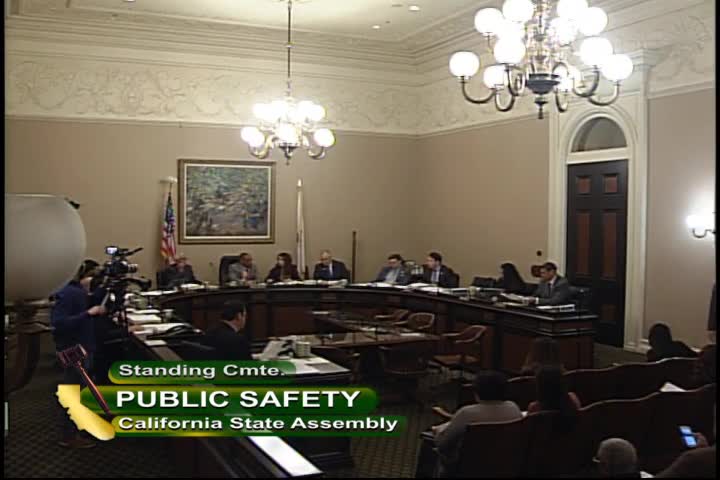 17MIN
Assembly Standing Committee on Public Safety
Bill Author

Bill Co-Author(s):