AB 3092: Agricultural labor relations: unfair labor practices.
- Session Year: 2017-2018
- House: Assembly
- Latest Version Date: 2018-02-16
Existing law establishes the right of agricultural employees to form, join, or assist labor organizations to engage in collective bargaining activities with agricultural employers regarding wages, working conditions, or other aspects of employment. Existing law prohibits a labor organization or its agents from engaging in specified unfair labor practices.
This bill would additionally prohibit a labor organization from abandoning or failing to represent a bargaining unit for 3 or more years. This bill would require the Agricultural Labor Relations Board to decertify a labor organization that violates this provision.
It shall be an unfair labor practice for a labor organization or its agents to do any of the following:
(a)To restrain or coerce:
(1)Agricultural employees in the exercise of the rights guaranteed in Section 1152. This paragraph shall not impair the right of a labor organization to prescribe its own rules with respect to the acquisition or retention of membership therein.
(2)An agricultural employer in the selection of his representatives for the purposes of collective bargaining or the adjustment of grievances.
(b)To cause or attempt to cause an agricultural employer to discriminate against an employee in violation of subdivision (c) of Section 1153, or to discriminate against an employee with respect to whom membership in such the organization has been denied or terminated for reasons other than failure to satisfy the membership requirements specified in subdivision (c) of Section 1153.
(c)To refuse to bargain collectively in good faith with an agricultural employer, provided it is the employees representative of his employees subject to the provisions of Chapter 5 (commencing with Section 1156) of this part. 1156).
(d)To do either of the following: (i) To engage in, or to induce or encourage any individual employed by any person to engage in, a strike or a refusal in the course of his the individuals employment to use, manufacture, process, transport, or otherwise handle or work on any goods, articles, materials, or commodities, or to perform any services; or (ii) to threaten, coerce, or restrain any person; where in either case (i) or (ii) an object thereof is any of the following:
(1)Forcing or requiring any employer or self-employed person to join any labor or employer organization or to enter into any agreement which is prohibited by Section 1154.5.
(2)Forcing or requiring any person to cease using, selling, transporting, or otherwise dealing in the products of any other producer, processor, or manufacturer, or to cease doing business with any other person, or forcing or requiring any other employer to recognize or bargain with a labor organization as the employees representative of his employees unless such the labor organization has been certified as the representative of such the employees. Nothing contained in this paragraph shall be construed to make unlawful, where not otherwise unlawful, any primary strike or primary picketing.
(3)Forcing or requiring any employer to recognize or bargain with a particular labor organization as the employees representative of his agricultural employees if another labor organization has been certified as the representative of such the employees under the provisions of Chapter 5 (commencing with Section 1156) of this part. 1156).
(4)Forcing or requiring any employer to assign particular work to employees in a particular labor organization or in a particular trade, craft, or class, unless such the employer is failing to conform to an order or certification of the board determining the bargaining representative for employees performing such the work.
Nothing contained in this subdivision (d) shall be construed to prohibit publicity, including picketing for the purpose of truthfully advising the public, including consumers, that a product or products or ingredients thereof are produced by an agricultural employer with whom the labor organization has a primary dispute and are distributed by another employer, as long as such the publicity does not have an effect of inducing any individual employed by any person other than the primary employer in the course of his the individuals employment to refuse to pick up, deliver, or transport any goods, or not to perform any services at the establishment of the employer engaged in such the distribution, and as long as such the publicity does not have the effect of requesting the public to cease patronizing such the other employer.
However, publicity which includes picketing and has the effect of requesting the public to cease patronizing such the other employer, shall be permitted only if the labor organization is currently certified as the representative of the primary employers employees.
Further, publicity other than picketing, but including peaceful distribution of literature which has the effect of requesting the public to cease patronizing such the other employer, shall be permitted only if the labor organization has not lost an election for the primary employers employees within the preceding 12-month period, and no other labor organization is currently certified as the representative of the primary employers employees.
Nothing contained in this subdivision (d) shall be construed to prohibit publicity, including picketing, which may not be prohibited under the United States Constitution or the California Constitution.
Nor shall anything in this subdivision (d) be construed to apply or be applicable to any labor organization in its representation of workers who are not agricultural employees. Any such labor organization shall continue to be governed in its intrastate activities for nonagricultural workers by Section 923 and applicable judicial precedents.
(e)To require of employees covered by an agreement authorized under subdivision (c) of Section 1153 the payment, as a condition precedent to becoming a member of such the organization, of a fee in an amount which the board finds excessive or discriminatory under all circumstances. In making such a the finding, the board shall consider, among other relevant factors, the practices and customs of labor organizations in the agriculture industry and the wages currently paid to the employees affected.
(f)To cause or attempt to cause an agricultural employer to pay or deliver, or agree to pay or deliver, any money or other thing of value, in the nature of an exaction, for services which are not performed or not to be performed.
(g)To picket or cause to be picketed, or threaten to picket or cause to be picketed, any employer where an object thereof is either forcing or requiring an employer to recognize or bargain with a labor organization as the representative of his employees, employees representative, or forcing or requiring the employees of an employer to accept or select such the labor organization as their collective-bargaining representative, unless such the labor organization is currently certified as the representative of such the employees, in any of the following cases:
(1)Where the employer has lawfully recognized in accordance with this part any other labor organization and a question concerning representation may not appropriately be raised under Section 1156.3.
(2)Where within the preceding 12 months a valid election under Chapter 5 (commencing with Section 1156) of this part has been conducted.
Nothing in this subdivision shall be construed to prohibit any picketing or other publicity for the purpose of truthfully advising the public (including consumers) that an employer does not employ members of, or have a contract with, a labor organization, unless an effect of such the picketing is to induce any individual employed by any other person in the course of his the individuals employment, not to pick up, deliver, or transport any goods or not to perform any services.
Nothing in this subdivision (g) shall be construed to permit any act which would otherwise be an unfair labor practice under this section.
(h)To picket or cause to be picketed, or threaten to picket or cause to be picketed, any employer where an object thereof is either forcing or requiring an employer to recognize or bargain with the labor organization as a representative of his the employers employees unless such the labor organization is currently certified as the collective-bargaining representative of such the employees.
(i)To abandon or fail to represent the bargaining unit for a period of three years or more. The board shall decertify a labor organization that violates this subdivision.
(i)NothingNothing contained in this section shall be construed to make unlawful a refusal by any person to enter upon the premises of any agricultural employer, other than his the persons own employer, if the employees of such the employer are engaged in a strike ratified or approved by a representative of such the employees whom such the employer is required to recognize under this part.
|
Date
|
Status
|
|---|---|
| May 15, 2018 | From committee: Without further action pursuant to Joint Rule 62(a). |
| Apr 18, 2018 | In committee: Set, first hearing. Failed passage. |
| Mar 12, 2018 | Referred to Com. on L. & E. |
| Feb 17, 2018 | From printer. May be heard in committee March 19. |
| Feb 16, 2018 | Read first time. To print. |
|
Date
|
Description
|
Location
|
Votes
|
|
|---|---|---|---|---|
| Apr 18, 2018 | Do pass and be re-referred to the Committee on [Appropriations] | Assembly Standing Committee on Labor and Employment |
Failed |
This list shows positions taken on this bill by organizations on the date displayed, which is linked to the original source.
Positions by individuals are not included.
|
Organization
|
Position
|
Date
|
|---|---|---|
| California Labor Federation | * Against | Apr 18, 2018 |
| California Rural Legal Assistance Foundation | * Against | Apr 18, 2018 |
| California Teamsters | * Against | Apr 18, 2018 |
| Equal Rights Advocates | * Against | Apr 18, 2018 |
| Jaguar Farm Labor Contracting, Inc. | ** Support | Apr 16, 2018 |
| Pick Justice | ** Support | Apr 16, 2018 |
| Pick Justice | * Support | Apr 18, 2018 |
| United Farm Workers | * Against | Apr 18, 2018 |
Date of Hearing: April 18, 2018
ASSEMBLY COMMITTEE ON LABOR AND EMPLOYMENT
Tony Thurmond, Chair
ABPCA Bill Id:AB 3092 (
Author:Patterson) – As Introduced Ver:February 16, 2018
SUBJECT: Agricultural labor relations: unfair labor practices
SUMMARY: Considers a labor organization’s abandonment or failure to represent a bargaining unit for three or more years an unfair labor practice requiring decertification of the labor organization by the Agricultural Labor Relations Board (ALRB).
EXISTING LAW:
- Establishes the right of agricultural employees to form, join, or assist labor organizations to engage in collective bargaining activities with agricultural employers regarding wages, working conditions, or other aspects of employment.
- Prohibits a labor organization or its agents from engaging in specified unfair labor practices.
- Establishes conditions under which a certified labor organization or an agricultural employer may file a declaration with the ALRB stating that the parties have failed to reach a collective bargaining agreement, thus triggering a board order for mandatory mediation.
FISCAL EFFECT: Unknown
COMMENTS: According to the author, this bill is needed to “expand worker rights by nullifying failed representation.” The author states that the mandatory mediation process for certain bargaining disputes is problematic because it allows “labor organizations who [have] abandoned workers for decades to initiate a forced contract with or without worker approval years after a certification of representation [has] been won.”
Background on the Agricultural Labor Relations Act (ALRA)
The ALRA was enacted in 1975 “to encourage and protect the right of agricultural employees to full freedom of association, self-organization, and designation of representatives of their own choosing, to negotiate the terms and conditions of their employment, and to be free from the interference, restraint, or coercion of employers of labor.[1]” The ALRA also created the ALRB and charged the Board with “specific powers and responsibilities of administration, particularly in conducting and certifying elections and in investigating and preventing unfair labor practices.[2]”
Under the ALRA, a labor organization becomes the exclusive bargaining representative of a group of employees by obtaining the majority of votes in a secret ballot election. In addition, the Act provides a process by which employees may petition the Board to decertify a labor organization as their exclusive representative.[3] The union certification and decertification process under the ALRA “shows a purpose on the part of the Legislature to prohibit the employer from being an active participant in determining which union it shall bargain with in cases arising under the ALRA.[4]” Further, courts have ruled that the ALRA prohibits agricultural employers from using the defense of a union’s absence to avoid bargaining with an employee chosen union. As one Court of Appeal concluded, the ALRA does not allow an employer to rely on its good faith belief that the union no longer enjoys majority support to circumvent its’ duty to bargain.[5]
Arguments in Support
Pick Justice argues in support that the bill is needed because “current law governing agricultural labor relations is silent on instances when a labor organization wins an election for the right to represent a unit of workers but then simply disappears.”
Arguments in Opposition
The United Farm Workers argue the bill is misleading and state, “when farm workers vote for a labor organization and win, but an employer refuses to acknowledge the election outcome by choosing not to negotiate a post-election collective bargaining agreement, it is the employer who is choosing to disregard the democratic process.”
Related and Prior Legislation
AB 3093 (Patterson) of 2018. This is companion legislation and would condition the enforcement of a contract ordered through mandatory mediation on the approval by the majority of the members of the affected bargaining unit.
AB 3094 (Patterson) of 2018. This is companion legislation and would provide that if the ALRB refuses to certify a union election due to misconduct by board personnel, the employer, or the union, the board shall conduct a second election unless the board finds the misconduct so egregious that a new election would not reflect the free and fair choice of the employees, in which case it will certify the election against the party that engaged in the misconduct. In addition, the decision to certify the election due to misconduct would be reviewable by an appellate court.
AB 2751 (Stone) of 2018. This bill would require the ALRB to conduct a study on how to eliminate delays and expedite the implementation of collective bargaining agreements ordered by the board after mandatory mediation and provide recommendations and adopt regulations to implement any recommendations by a time specified.
AB 1389 (Patterson) of 2015. Mirrored the provisions of this bill and would have made bargaining unit members parties to a mandatory mediation process that is triggered when the labor organization and the employer are unable to reach a first-time agreement and other conditions are met. The bill failed passage in this Committee.
REGISTERED SUPPORT / OPPOSITION:
Support
Jaguar Farm Labor Contracting, Inc.
Pick Justice
Opposition
California Rural Legal Assistance Foundation
California Teamsters Public Affairs Council
United Farm Workers
Analysis Prepared by: Megan Lane / L. & E. /
Discussed in Hearing
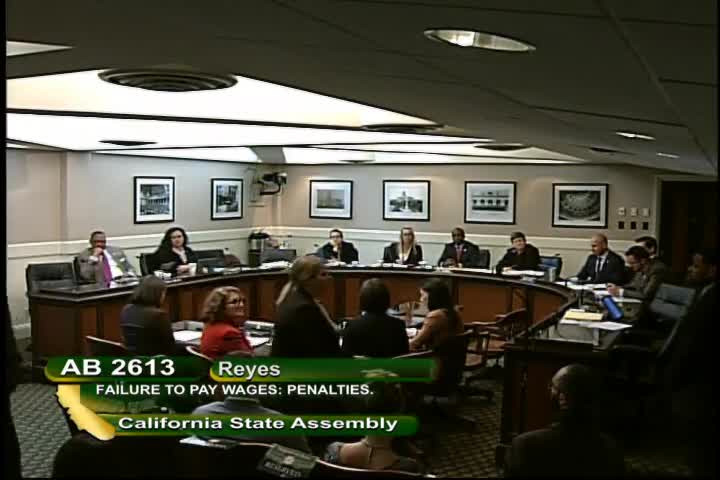 23MIN
Assembly Standing Committee on Labor and Employment
Bill Author

Bill Co-Author(s):