AB 3093: Agricultural labor relations: unfair labor practices.
- Session Year: 2017-2018
- House: Assembly
- Latest Version Date: 2018-02-16
Existing law establishes the right of agricultural employees to form, join, or assist labor organizations to engage in collective bargaining activities with agricultural employers regarding wages, working conditions, or other aspects of employment. Existing law prohibits a labor organization or its agents from engaging in specified unfair labor practices.
Existing law establishes the conditions and time periods under which an agricultural employer, as defined, or a certified labor organization representing agricultural employees may file a declaration with the Agricultural Labor Relations Board stating that the parties have failed to reach a collective bargaining agreement, thus triggering a board order for mandatory mediation.
Existing law authorizes a party, within 60 days of the order by the Agricultural Labor Relations Board taking effect, to file an action to enforce the order. Existing law prohibits an order of the board from being stayed during the pendency of any appeal of the order unless the appellant demonstrates that he or she is likely to prevail on the merits and that he or she will be irreparably harmed by implementation of the boards order.
This bill would condition the effect and enforcement of an order resulting from the binding mediation on the order being approved by a majority of the members of the affected bargaining unit.
An order issued by the mediator, the board, or the court that would impose the terms of binding mediation pursuant to Section 1164 shall not take effect or be enforceable until it is approved by a majority of the agricultural employees of the bargaining unit affected by the order.
|
Date
|
Status
|
|---|---|
| May 15, 2018 | From committee: Without further action pursuant to Joint Rule 62(a). |
| Apr 18, 2018 | In committee: Set, first hearing. Failed passage. |
| Mar 12, 2018 | Referred to Com. on L. & E. |
| Feb 17, 2018 | From printer. May be heard in committee March 19. |
| Feb 16, 2018 | Read first time. To print. |
|
Date
|
Description
|
Location
|
Votes
|
|
|---|---|---|---|---|
| Apr 18, 2018 | Do pass and be re-referred to the Committee on [Appropriations] | Assembly Standing Committee on Labor and Employment |
Failed |
This list shows positions taken on this bill by organizations on the date displayed, which is linked to the original source.
Positions by individuals are not included.
|
Organization
|
Position
|
Date
|
|---|---|---|
| California Labor Federation | * Support | Apr 18, 2018 |
| California Rural Legal Assistance | * Against | Apr 18, 2018 |
| Equal Rights Advocates | * Against | Apr 18, 2018 |
| Jaguar Farm Labor Contracting, Inc. | ** Support | Apr 16, 2018 |
| Pick Justice | ** Support | Apr 16, 2018 |
| Pick Justice | * Support | Apr 18, 2018 |
| self | * Support | Apr 18, 2018 |
| Teamsters | * Against | Apr 18, 2018 |
| United Farm Workers | * Against | Apr 18, 2018 |
Date of Hearing: April 18, 2018
ASSEMBLY COMMITTEE ON LABOR AND EMPLOYMENT
Tony Thurmond, Chair
ABPCA Bill Id:AB 3093 (
Author:Patterson) – As Introduced Ver:February 16, 2018
SUBJECT: Agricultural labor relations: unfair labor practices
SUMMARY: Provides that an order imposing contract terms on parties as a result of the mandatory mediation and conciliation process (MMC) under the Agricultural Labor Relations Act (ALRA) shall not take effect until it is approved by the majority of bargaining unit members.
EXISTING LAW:
- Establishes the right of agricultural employees to form, join, or assist labor organizations to engage in collective bargaining activities with agricultural employers regarding wages, working conditions, or other aspects of employment.
- Prohibits a labor organization or its agents from engaging in specified unfair labor practices.
- Establishes conditions under which a certified labor organization or an agricultural employer may file a declaration with the Agricultural Labor Relations Board (ALRB) stating that the parties have failed to reach a collective bargaining agreement, thus triggering a board order for mandatory mediation.
- Authorizes a party, within 60 days of the board’s order taking effect, to file an action to enforce the order.
- Prohibits such order of the board from being stayed during an appeal of the order unless the appellant demonstrates that he or she is likely to prevail on the merits and would be irreparably harmed by implementation of the board’s order.
FISCAL EFFECT: Unknown
COMMENTS: According to the author, the ALRA is unique in allowing a “government entity to force a contract on a group of employees through the use of the MMC process. This unprecedented amount of government power over workers is not shared by workers in other sectors.” The author argues the bill is necessary “in order to give the workers tangible participation in the MMC process.”
Background on the Agricultural Labor Relations Act
The ALRA was enacted in 1975 “to encourage and protect the right of agricultural employees to full freedom of association, self-organization, and designation of representatives of their own choosing, to negotiate the terms and conditions of their employment, and to be free from the interference, restraint, or coercion of employers of labor.[1]” The ALRA also created the ALRB and charged the Board with “specific powers and responsibilities of administration, particularly in conducting and certifying elections and in investigating and preventing unfair labor practices.[2]”
Summary of the Mandatory Mediation and Conciliation (MMC) Process
The MMC process applies only to employers who have employed 25 or more agricultural employees during any calendar week in the year preceding the filing of the request for mediation. In addition, there are limitations on when an agricultural employer or a labor organization can ask for mandatory mediation. Mandatory mediation may be requested if the following conditions are met:
- The parties have failed to reach agreement for at least one year after the date on which the labor organization made its initial request to bargain;
- The employer has committed an unfair labor practice, and
- The parties have not previously had a binding contract between them.
Assuming the above requirements are met, a request for mandatory mediation triggers a specific process. The ALRB must immediately issue an order directing both parties to meditation. Once a mediator is agreed upon by the parties, the mediator schedules a 30 day period for mediation, which can be extended if necessary. If issues are outstanding after the 30 day period, the mediation process is considered exhausted. Within 21 days, the mediator issues the final terms of a collective bargaining agreement, including issues in dispute by the parties. If the mediator decides issues in dispute, the mediator must explain the basis for his or her ruling. Within seven days of the ruling, either party may appeal a mediator’s decision to the ALRB. The ALRB may only review the mediator’s decision on specific grounds such as the mediator’s report was clearly erroneous in its findings of material facts or was arbitrary and capricious.
If there is no basis to set it aside, the mediator’s decision becomes the final order of the ALRB. If there is a basis to revoke it, then the mediator mediates the process again. If, after issuing a new decision, a party believes that the mediator is corrupt, then a new mediator would be called in. Finally, either party may petition for a writ of review in the court of appeal or at the California Supreme Court. Judicial review at this stage is limited to certain aspects of the Board’s decision.
Arguments in Support
Pick Justice argues in support that the MMC process does a disservice to farm workers because “it allows an unelected Board to create and enforce provisions of a contract that working people may not want or could further the financial burdens or actually worsen workplace conditions.”
Arguments in Opposition
The United Farm Workers argue the bill is misleading and “imposes an additional vote after farm workers vote, win and the election is certified by the state...The democratic process and the vote of the people should mean something the first time.”
Related and Prior Legislation
AB 3092 (Patterson) of 2018. This is companion legislation and would consider a union’s abandonment or failure to represent a bargaining unit for three or more years an unfair labor practice requiring decertification of the labor organization by the ALRB.
AB 3094 (Patterson) of 2018. This is companion legislation and would provide that if the ALRB refuses to certify a union election due to misconduct by board personnel, the employer, or the union, the board shall conduct a second election unless the board finds the misconduct so egregious that a new election would not reflect the free and fair choice of the employees, in which case it will certify the election against the party that engaged in the misconduct. In addition, the decision to certify the election due to misconduct would be reviewable by an appellate court.
AB 2751 (Stone) of 2018. This bill would require the ALRB to conduct a study on how to eliminate delays and expedite the implementation of collective bargaining agreements ordered by the board after mandatory mediation and provide recommendations and adopt regulations to implement any recommendations by a time specified.
AB 1389 (Patterson) of 2015. Mirrored the provisions of this bill and would have made bargaining unit members parties to the mandatory mediation process that is triggered when the labor organization and the employer are unable to reach a first-time agreement and other conditions are met. The bill failed passage in this Committee.
REGISTERED SUPPORT / OPPOSITION:
Support
Jaguar Farm Labor Contracting, Inc.
Pick Justice
Opposition
California Rural Legal Assistance Foundation
California Teamsters Public Affairs Council
United Farm Workers (UFW)
Analysis Prepared by: Megan Lane / L. & E. /
Discussed in Hearing
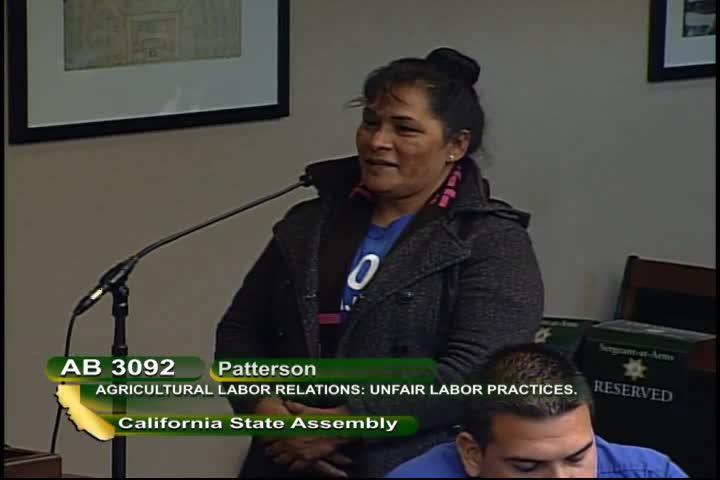 20MIN
Assembly Standing Committee on Labor and Employment
Bill Author

Bill Co-Author(s):