AB 3094: Agricultural labor relations: labor representative elections: misconduct.
- Session Year: 2017-2018
- House: Assembly
- Latest Version Date: 2018-02-16
Existing law requires the Agricultural Labor Relations Board to certify the results of an election conducted by secret ballot of employees in a collective bargaining unit to designate a collective bargaining representative, unless the board determines there are sufficient grounds to refuse to do so. Existing law further provides that if the board refuses to certify an election because of employer misconduct that would render slight the chances of a new election reflecting the free and fair choice of employees, that the labor organization shall be certified as the bargaining representative for the bargaining unit.
This bill would instead provide that, if the board finds that misconduct by board personnel, the employer, or the labor organization affected the result of the election, the board shall refuse to certify the election and order a new election to be conducted, unless the board finds that misconduct by the employer or labor organization is so egregious that conducting a new election would not likely reflect the free and fair choice of the employees, in which case the board would be required to certify the election against the party that engaged in the misconduct, subject to review by the appropriate appellate court.
(a)A petition that is either signed by, or accompanied by authorization cards signed by, a majority of the currently employed employees in the bargaining unit may be filed by an agricultural employee or group of agricultural employees, or any individual or labor organization acting on behalf of those agricultural employees, in accordance with any rules and regulations prescribed by the board. The petition shall allege all of the following:
(1)That the number of agricultural employees currently employed by the employer named in the petition, as determined from the employers payroll immediately preceding the filing of the petition, is not less than 50 percent of the employers peak agricultural employment for the current calendar year.
(2)That no valid election pursuant to this section has been conducted among the agricultural employees of the employer named in the petition within the 12 months immediately preceding the filing of the petition.
(3)That no labor organization is currently certified as the exclusive collective bargaining representative of the agricultural employees of the employer named in the petition.
(4)That the petition is not barred by an existing collective bargaining agreement.
(b)Upon receipt of a signed petition, as described in subdivision (a), the board shall immediately investigate the petition. If the board has reasonable cause to believe that a bona fide question of representation exists, it shall direct a representation election by secret ballot to be held, upon due notice to all interested parties and within a maximum of seven days of the filing of the petition. If, at the time the election petition is filed, a majority of the employees in a bargaining unit are engaged in a strike, the board shall, with all due diligence, attempt to hold a secret ballot election within 48 hours of the filing of the petition. The holding of elections under strike circumstances shall take precedence over the holding of other secret ballot elections.
(c)The board shall make available at any election held under this chapter ballots printed in English and Spanish. The board may also make available at the election ballots printed in any other language as may be requested by an agricultural labor organization or any agricultural employee eligible to vote under this part. Every election ballot, except ballots in runoff elections where the choice is between labor organizations, shall provide the employee with the opportunity to vote against representation by a labor organization by providing an appropriate space designated No Labor Organizations.
(d)Any other labor organization shall be qualified to appear on the ballot if it presents authorization cards signed by at least 20 percent of the employees in the bargaining unit at least 24 hours prior to the election.
(e)(1)Within five days after an election, any person may file with the board a signed petition asserting that allegations made in the petition filed pursuant to subdivision (a) were incorrect, asserting that the board improperly determined the geographical scope of the bargaining unit, or objecting to the conduct of the election or conduct affecting the results of the election.
(2)Upon receipt of a petition under this subdivision, the board, upon due notice, shall conduct a hearing to determine whether the election shall be certified. This hearing may be conducted by an officer or employee of a regional office of the board. The officer may not make any recommendations with respect to the certification of the election. The board may refuse to certify the election if it finds, on the record of the hearing, that any of the assertions made in the petition filed pursuant to this subdivision are correct, that the election was not conducted properly, or that misconduct affecting the results of the election occurred. The board shall certify the election unless it determines that there are sufficient grounds to refuse to do so.
(f)Notwithstanding any other provision of law, if the board refuses to certify an election because of employer misconduct that, in addition to affecting the results of the election, would render slight the chances of a new election reflecting the free and fair choice of employees, the labor organization shall be certified as the exclusive bargaining representative for the bargaining unit.(f)(1)Notwithstanding any other law, if the board finds that misconduct by board personnel, the employer, or the labor organization affected the results of the election, the board shall refuse to certify the results of the election and shall order a new election to be conducted, except as specified in paragraph (2).
(2)If the board finds that misconduct by the employer or labor organization is so egregious that conducting a new election would not likely reflect the free and fair choice of the employees in the bargaining unit, the board shall certify the election results against the party that engaged in misconduct, subject to review by the appropriate appellate court.
(g)If no petition is filed pursuant to subdivision (e) within five days of the election, the board shall certify the election.
(h)The board shall decertify a labor organization if either of the following occur:
(1)The Department of Fair Employment and Housing finds that the labor organization engaged in discrimination on any basis listed in subdivision (a) of Section 12940 of the Government Code, as those bases are defined in Sections 12926 and 12926.1 of the Government Code, except as otherwise provided in Section 12940 of the Government Code.
(2)The United States Equal Employment Opportunity Commission finds, pursuant to Section 2000e-5 of Title 42 of the United States Code, that the labor organization engaged in discrimination on the basis of race, color, national origin, religion, sex, or any other arbitrary or invidious classification in violation of Subchapter VI of Chapter 21 of Title 42 of the United States Code during the period of the labor organizations present certification.
(i)(1)With regard to elections held pursuant to this section or Section 1156.7, the following time limits apply for action by the board, and agents acting pursuant to authority delegated by the board:
(A)(i)The board shall, within 21 days of the filing of election objections or the submittal of evidence in support of challenges to ballots, evaluate the election objections or challenged ballots and issue a decision determining which, if any, must be set for hearing.
(ii)The hearing on election objections or challenged ballots set pursuant to clause (i) shall be scheduled to commence within 28 days of the date of the boards decision to set a hearing.
(B)The investigative hearing examiner (IHE) appointed pursuant to Section 1145 shall issue a recommended decision within 60 days of the close of the hearing on the matters described in subparagraph (A). Upon mutual agreement of the parties, the IHE may extend the time period to issue a recommended decision by 30 days.
(C)The board shall issue a decision regarding the election objections or challenged ballots within 45 days of receipt of any exceptions to the decision of the IHE.
(2)The board may consolidate a challenged ballot hearing with a hearing on objections to an election.
(3)The board may grant extensions on the time limits specified in this subdivision upon a showing of good cause or by stipulation of all affected parties.
|
Date
|
Status
|
|---|---|
| May 15, 2018 | From committee: Without further action pursuant to Joint Rule 62(a). |
| Apr 18, 2018 | In committee: Set, first hearing. Failed passage. |
| Mar 12, 2018 | Referred to Coms. on L. & E. and JUD. |
| Feb 17, 2018 | From printer. May be heard in committee March 19. |
| Feb 16, 2018 | Read first time. To print. |
|
Date
|
Description
|
Location
|
Votes
|
|
|---|---|---|---|---|
| Apr 18, 2018 | Do pass and be re-referred to the Committee on [Judiciary] | Assembly Standing Committee on Labor and Employment |
Failed |
This list shows positions taken on this bill by organizations on the date displayed, which is linked to the original source.
Positions by individuals are not included.
|
Organization
|
Position
|
Date
|
|---|---|---|
| California Labor Federation | * Against | Apr 18, 2018 |
| California Rural Legal Assistance Foundation | * Against | Apr 18, 2018 |
| Equal Rights Advocates | * Against | Apr 18, 2018 |
| Jaguar Farm Labor Contracting, Inc. | ** Support | Apr 16, 2018 |
| Pick Justice | ** Support | Apr 16, 2018 |
| Pick Justice | * Support | Apr 18, 2018 |
| Teamsters | * Against | Apr 18, 2018 |
| United Farm Workers | * Against | Apr 18, 2018 |
Date of Hearing: April 18, 2018
ASSEMBLY COMMITTEE ON LABOR AND EMPLOYMENT
Tony Thurmond, Chair
ABPCA Bill Id:AB 3094 (
Author:Patterson) – As Introduced Ver:February 16, 2018
SUBJECT: Agricultural labor relations: labor representative elections: misconduct
SUMMARY: Expands the bases upon which the Agricultural Labor Relations Board (ALRB or board) may refuse to certify a union election to include misconduct by board personnel or a union and permits the board to order a second election unless misconduct by the employer or union is deemed egregious enough, in which case the board will certify against the offending party. Specifically, this bill:
- Provides that if the board in an election by employees to certify a bargaining representative, refuses to certify due to misconduct by board personnel, the employer, or the union, the board shall conduct a second election unless the misconduct was so egregious that the votes do not reflect the free and fair choice of the employees, in which case the board will certify the election against the party that engaged in the misconduct.
- Subjects the decision of the board to certify against the party who engaged in the misconduct to appellate court review.
EXISTING LAW:
- Requires the ALRB to certify the results of an election conducted by secret ballot of employees in a collective bargaining unit to designate a bargaining representative, unless the board determines there are sufficient grounds to refuse to do so.
- Provides that in the event the board refuses to certify an election because of employer misconduct that would make slim the chances of a second election reflecting the free and fair choice of the employees, the board shall certify the union as the exclusive bargaining representative of the bargaining unit employees.
FISCAL EFFECT: Unknown
COMMENTS: According to the author, “In order to ensure that workers voices are heard, especially in matters that affect their very livelihood, it is necessary to provide real, tangible due process that respects the wishes of workers in matters of who they choose, or not choose, to represent them.” The author argues that permitting a second certification election is the kind of due process workers need.
Background on the Agricultural Labor Relations Act
The ALRA was enacted in 1975 “to encourage and protect the right of agricultural employees to full freedom of association, self-organization, and designation of representatives of their own choosing, to negotiate the terms and conditions of their employment, and to be free from the interference, restraint, or coercion of employers of labor.[1]” The ALRA also created the ALRB and charged the Board with “specific powers and responsibilities of administration, particularly in conducting and certifying elections and in investigating and preventing unfair labor practices.[2]”
Arguments in Support
Pick Justice argues in support of the bill that the current union certification process allows the ALRB to “throw out, unilaterally and without judicial review, the results of an election and certify a labor organization as the exclusive collective bargaining unit if employer misconduct (which would have affected the outcome of the election) is found.”
Arguments in Opposition
The United Farm Workers argue in opposition that the bill is “unnecessary because existing law contains penalties for election misconduct by all parties.” In addition, the California Teamsters Public Affairs Council opposes the bill because it gives “employers another tool to derail a fair union election, killing momentum for organizing campaigns and disproportionately affecting labor organizations and the workers they seek to represent.”
Related and Prior Legislation
AB 3092 (Patterson) of 2018. This is companion legislation and would consider a union’s abandonment or failure to represent a bargaining unit for 3 or more years an unfair labor practice requiring decertification of the labor organization by the ALRB.
AB 3093 (Patterson) of 2018. This is companion legislation and would provide that an order imposing contract terms on parties as a result of the mandatory mediation and conciliation process (MMC) shall not take effect until it is approved by the majority of bargaining unit members.
AB 2751 (Stone) of 2018. This bill would require the ALRB to conduct a study on how to eliminate delays and expedite the implementation of collective bargaining agreements ordered by the board after mandatory mediation and provide recommendations and adopt regulations to implement any recommendations by a time specified.
AB 1389 (Patterson) of 2015. Would have made bargaining unit members parties to the mandatory mediation process that is triggered when the labor organization and the employer are unable to reach a first-time agreement and other conditions are met. Would have also required the ALRB to decertify a union that has abandoned or failed to represent a bargaining unit for 3 or more years. The bill failed passage in this Committee.
REGISTERED SUPPORT / OPPOSITION:
Support
Jaguar Farm Labor Contracting, Inc.
Pick Justice
Opposition
California Rural Legal Assistance Foundation
California Teamsters Public Affairs Council
United Farm Workers (UFW)
Analysis Prepared by: Megan Lane / L. & E. /
Discussed in Hearing
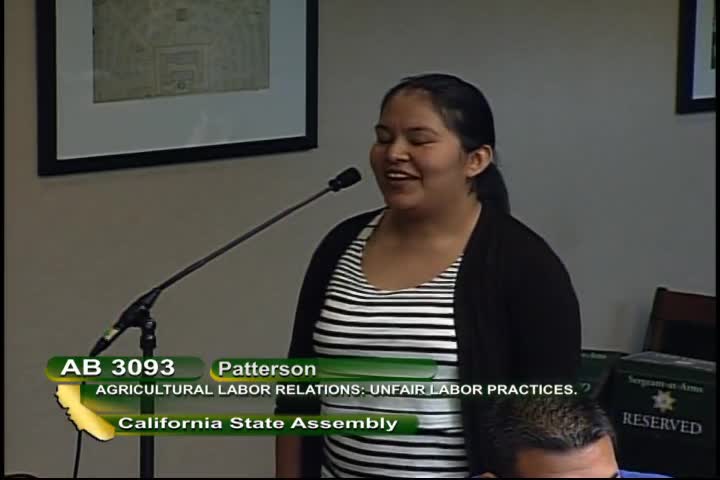 23MIN
Assembly Standing Committee on Labor and Employment
Bill Author

Bill Co-Author(s):