AB 3101: Community colleges.
- Session Year: 2017-2018
- House: Assembly
- Latest Version Date: 2018-09-19
Existing law establishes the California Community Colleges, under the administration of the Board of Governors of the California Community Colleges, as one of the segments of public postsecondary education in this state. Existing law establishes community college districts, administered by governing boards, throughout the state, and authorizes these districts to provide instruction to students at the community college campuses maintained by the districts. Existing law requires each student to be classified as a resident or nonresident at a California community college.
This bill would require the Chancellor of the California Community Colleges, on or before July 31, 2019, to revise the California community college online application process so that only data that is required by the federal government, state law, or that is otherwise necessary, as determined by the chancellor, is collected during the process. The bill would authorize the chancellor, to the extent that data can be collected from the student at a later time, to delay the collection of that data until after the student has applied to a community college. The bill would exempt a student seeking to enroll exclusively in career development and college preparation courses, and other courses for which no credit is given, at a community college from community college residency classification requirements.
To the extent this bill would impose additional duties on community college districts, the bill would impose a state-mandated local program.
The California Constitution requires the state to reimburse local agencies and school districts for certain costs mandated by the state. Statutory provisions establish procedures for making that reimbursement.
This bill would provide that, if the Commission on State Mandates determines that the bill contains costs mandated by the state, reimbursement for those costs shall be made pursuant to the statutory provisions noted above.
Existing law establishes the California Community Colleges, under the administration of the Board of Governors of the California Community Colleges, as one of the segments of public postsecondary education in this state. Existing law establishes community college districts, administered by governing boards, throughout the state, and authorizes these districts to provide instruction to students at the community college campuses maintained by the districts. Existing law requires each student to be classified as a resident or nonresident at a California community college.
This bill would require the Chancellor of the California Community Colleges, on or before July 31, 2019, to revise the California community college online application process so that only data that is required by the federal government, state law, or that is otherwise necessary, as determined by the chancellor, is collected during the process. The bill would authorize the chancellor, to the extent that data can be collected from the student at a later time, to delay the collection of that data until after the student has applied to a community college. The bill would exempt a student seeking to enroll exclusively in noncredit courses career development and college preparation courses, and other courses for which no credit is given, at a community college from community college residency classification requirements.
To the extent this bill would impose additional duties on community college districts, the bill would impose a state-mandated local program.
The California Constitution requires the state to reimburse local agencies and school districts for certain costs mandated by the state. Statutory provisions establish procedures for making that reimbursement.
This bill would provide that, if the Commission on State Mandates determines that the bill contains costs mandated by the state, reimbursement for those costs shall be made pursuant to the statutory provisions noted above.
Existing law establishes the California Community Colleges, under the administration of the Board of Governors of the California Community Colleges, as one of the segments of public postsecondary education in this state. Existing law establishes community college districts, administered by governing boards, throughout the state, and authorizes these districts to provide instruction to students at the community college campuses maintained by the districts. Existing law requires each student to be classified as a resident or nonresident at a California community college.
This bill would require the board, Chancellor of the California Community Colleges, on or before July 31, 2019, to revise the CCCApply application and enrollment California community college online application process so that only data that is required by the federal government, state law, or that is otherwise necessary, as determined by the board, chancellor, is collected during the process. The bill would require the board, authorize the chancellor, to the extent that data can be collected from the student at a later time, to delay the collection of that data until after the student is enrolled. has applied to a community college. The bill would exempt a student seeking to enroll exclusively in noncredit courses at a community college from community college residency classification requirements.
To the extent this bill would impose additional duties on community college districts, the bill would impose a state-mandated local program.
The California Constitution requires the state to reimburse local agencies and school districts for certain costs mandated by the state. Statutory provisions establish procedures for making that reimbursement.
This bill would provide that, if the Commission on State Mandates determines that the bill contains costs mandated by the state, reimbursement for those costs shall be made pursuant to the statutory provisions noted above.
Existing law establishes the California Community Colleges, under the administration of the Board of Governors of the California Community Colleges, as one of the segments of public postsecondary education in this state. Existing law establishes community college districts, administered by governing boards, throughout the state, and authorizes these districts to provide instruction to students at the community college campuses maintained by the districts.
This bill would require the board, on or before July 31, 2019, to revise the CCCApply application and enrollment process so that only data that is required by the federal government, or that is otherwise necessary, as determined by the board, is collected during the process. The bill would require the board, to the extent that data can be collected from the student at a later time, to delay the collection of that data until after the student is enrolled.
To the extent this bill would impose additional duties on community college districts, the bill would impose a state-mandated local program.
The California Constitution requires the state to reimburse local agencies and school districts for certain costs mandated by the state. Statutory provisions establish procedures for making that reimbursement.
This bill would provide that, if the Commission on State Mandates determines that the bill contains costs mandated by the state, reimbursement for those costs shall be made pursuant to the statutory provisions noted above.
The Legislature finds and declares all of the following:
(a)The online system by which students apply to community colleges can be cumbersome and create a barrier to access for some students who are seeking to access community college.
(b)On average, the application process takes a student 45 minutes to complete due to the amount of information it requests.
(c)The state has documented an average abandonment rate of 5 percent, and ranging up to 14 percent at some community colleges, in regards to the number of students who begin the application process, but fail to complete it.
(d)In response, the Chancellor of the California Community Colleges is undertaking a review of the online application system to ensure that it supports students through the community college application and enrollment process. The Office of the Chancellor of the California Community Colleges plans to implement changes to the online application system by the fall of 2019.
SEC. 2.Section 68086 is added to the Education Code, to read:68086.(a)A student seeking to enroll exclusively in career development and college preparation courses, and other courses for which no credit is given, at a community college shall not be subject to the residency classification requirements of Article 3 (commencing with Section 68040).
(b)Nothing in subdivision (a) shall prohibit the Chancellor of the California Community Colleges from collecting residency data, for a student described in subdivision (a), that is voluntarily submitted by the student after he or she enrolls at a community college.
SEC. 3.Section 71030 is added to the Education Code, to read:71030.On or before July 31, 2019, the Chancellor of the California Community Colleges shall revise the California community college online application process so that only data that is required by the federal government, state law, or that is otherwise necessary, as determined by the chancellor, is collected during the process. To the extent that data can be collected from the student at a later time, the chancellor may delay the collection of that data until after the student has applied to a community college.
SEC. 4.If the Commission on State Mandates determines that this act contains costs mandated by the state, reimbursement to local agencies and school districts for those costs shall be made pursuant to Part 7 (commencing with Section 17500) of Division 4 of Title 2 of the Government Code.
The Legislature finds and declares all of the following:
(a)The online system by which students apply to community colleges can be cumbersome and create a barrier to access for some students who are seeking to access community college.
(b)On average, the application process takes a student 45 minutes to complete due to the amount of information it requests. Students who have limited English skills, or who are not technologically proficient, can take longer than 45 minutes to complete the application process.
(c)The state has documented an average abandonment rate of 5 percent, and ranging up to 14 percent at some community colleges, in regards to the number of students who begin the application process, but fail to complete it. Additionally, for some parts of the application, such as the personal information page, the abandonment rate may be as high as 23 percent. Even for students who complete the application process, many of them never enroll.
(d)In response, the Chancellor of the California Community Colleges is undertaking a review of the online application system to ensure that it supports students through the community college application and enrollment process. The Office of the Chancellor of the California Community Colleges plans to implement changes to the online application system by the fall of 2019.
SEC. 2.Section 68086 is added to the Education Code, to read:68086.A student seeking to enroll exclusively in noncredit courses career development and college preparation courses, and other courses for which no credit is given, at a community college shall not be subject to the residency classification requirements of Article 3 (commencing with Section 68040).
SEC. 3.Section 71030 is added to the Education Code, to read:71030.On or before July 31, 2019, the Chancellor of the California Community Colleges shall revise the California community college online application process so that only data that is required by the federal government, state law, or that is otherwise necessary, as determined by the chancellor, is collected during the process. To the extent that data can be collected from the student at a later time, the chancellor may delay the collection of that data until after the student has applied to a community college.
SEC. 4.If the Commission on State Mandates determines that this act contains costs mandated by the state, reimbursement to local agencies and school districts for those costs shall be made pursuant to Part 7 (commencing with Section 17500) of Division 4 of Title 2 of the Government Code.
The Legislature finds and declares all of the following:
(a)The online system by which students apply to community colleges is known to can be cumbersome and create, create a barrier to access for many some students who are seeking to access community college.
(b)The On average, the application process can take takes a student hours 45 minutes to complete due to the amount of information it requests. Students who have limited English skills, or who are not technologically proficient, can take longer than 45 minutes to complete the application process.
(c)The state has documented a significant an average abandonment rate of 5 percent, and ranging up to 14 percent at some community colleges, in regards to the number of students who begin the application process, but fail to complete it. Consequently, many students fail to complete the process and never enroll. Additionally, for some parts of the application, such as the personal information page, the abandonment rate may be as high as 23 percent. Even for students who complete the application process, many of them never enroll.
(d)In response, the Chancellor of the California Community Colleges is undertaking a review of the online application system to ensure that it supports students through the community college application and enrollment process. The Office of the Chancellor of the California Community Colleges plans to implement changes to the online application system by the fall of 2019.
SEC. 2.Section 68086 is added to the Education Code, to read:68086.A student seeking to enroll exclusively in noncredit courses at a community college shall not be subject to the residency classification requirements of Article 3 (commencing with Section 68040).
SEC. 2.SEC. 3.Section 71030 is added to the Education Code, to read:71030.On or before July 31, 2019, the board of governors Chancellor of the California Community Colleges shall revise the CCCApply application and enrollment California community college online application process so that only data that is required by the federal government, state law, or that is otherwise necessary, as determined by the board, chancellor, is collected during the process. To the extent that data can be collected from the student at a later time, the board shall chancellor may delay the collection of that data until after the student is enrolled. has applied to a community college.
SEC. 3.SEC. 4.If the Commission on State Mandates determines that this act contains costs mandated by the state, reimbursement to local agencies and school districts for those costs shall be made pursuant to Part 7 (commencing with Section 17500) of Division 4 of Title 2 of the Government Code.
The Legislature finds and declares all of the following:
(a)The system by which students apply to community colleges is known to be cumbersome and create, a barrier to access for many students who are seeking to access community college.
(b)The application process can take a student hours to complete due to the amount of information it requests.
(c)The state has documented a significant abandonment rate in regards to the number of students who begin the application process, but fail to complete it. Consequently, many students fail to complete the process and never enroll.
SEC. 2.Section 71030 is added to the Education Code, to read:71030.On or before July 31, 2019, the board of governors shall revise the CCCApply application and enrollment process so that only data that is required by the federal government, or that is otherwise necessary, as determined by the board, is collected during the process. To the extent that data can be collected from the student at a later time, the board shall delay the collection of that data until after the student is enrolled.
SEC. 3.If the Commission on State Mandates determines that this act contains costs mandated by the state, reimbursement to local agencies and school districts for those costs shall be made pursuant to Part 7 (commencing with Section 17500) of Division 4 of Title 2 of the Government Code.
|
Date
|
Status
|
|---|---|
| Sep 19, 2018 | Chaptered by Secretary of State - Chapter 553, Statutes of 2018. |
| Sep 19, 2018 | Approved by the Governor. |
| Sep 11, 2018 | Enrolled and presented to the Governor at 4:30 p.m. |
| Aug 30, 2018 | Senate amendments concurred in. To Engrossing and Enrolling. |
| Aug 29, 2018 | In Assembly. Concurrence in Senate amendments pending. |
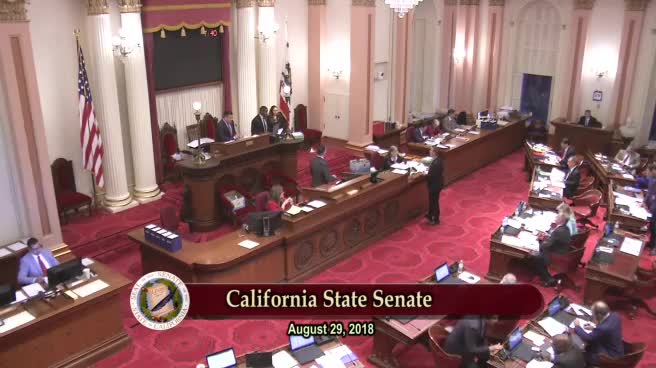
| Aug 29, 2018 | Read third time. Passed. Ordered to the Assembly. |
| Aug 27, 2018 | Read second time. Ordered to third reading. |
| Aug 24, 2018 | Read third time and amended. Ordered to second reading. |
| Aug 20, 2018 | Read second time. Ordered to third reading. |
| Aug 17, 2018 | From committee: Amend, and do pass as amended. (Ayes 7. Noes 0.) (August 16). |
| Jun 25, 2018 | In committee: Referred to APPR. suspense file. |
| Jun 6, 2018 | From committee: Do pass and re-refer to Com. on APPR. (Ayes 6. Noes 0.) (June 6). Re-referred to Com. on APPR. |
| May 29, 2018 | From committee chair, with author's amendments: Amend, and re-refer to committee. Read second time, amended, and re-referred to Com. on ED. |
| May 24, 2018 | Referred to Com. on ED. |
| May 10, 2018 | In Senate. Read first time. To Com. on RLS. for assignment. |
| May 10, 2018 | Read third time. Passed. Ordered to the Senate. |
| May 3, 2018 | Read second time. Ordered to Consent Calendar. |
| May 2, 2018 | From committee: Do pass. To Consent Calendar. (Ayes 17. Noes 0.) (May 2). |
| Apr 18, 2018 | From committee: Do pass and re-refer to Com. on APPR. (Ayes 13. Noes 0.) (April 17). Re-referred to Com. on APPR. |
| Mar 12, 2018 | Referred to Com. on HIGHER ED. |
| Feb 17, 2018 | From printer. May be heard in committee March 19. |
| Feb 16, 2018 | Read first time. To print. |
|
Date
|
Description
|
Location
|
Votes
|
|
|---|---|---|---|---|
| Aug 30, 2018 | AB 3101 CARRILLO Concurrence in Senate Amendments | Assembly Floor |
Passed |
|
| Aug 29, 2018 | Assembly 3rd Reading AB3101 Carrillo By Lara | Senate Floor |
Passed |
|
| Aug 16, 2018 | Do pass as amended | Senate Standing Committee on Appropriations |
Passed |
|
| Jun 25, 2018 | Placed on suspense file | Senate Standing Committee on Appropriations |
Passed |
|
| Jun 6, 2018 | Do pass, but first be re-referred to the Committee on [Appropriations] | Senate Standing Committee on Education |
Passed |
|
| May 10, 2018 | AB 3101 CARRILLO Consent Calendar Second Day Regular Session | Assembly Floor |
Passed |
|
| May 2, 2018 | Do pass. To Consent Calendar. | Assembly Standing Committee on Appropriations |
Passed |
|
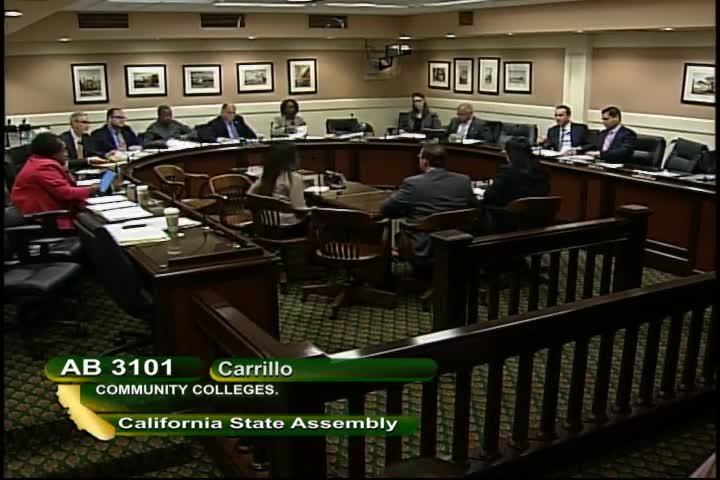
| Apr 17, 2018 | Do pass and be re-referred to the Committee on [Appropriations] | Assembly Standing Committee on Higher Education |
Passed |
This list shows positions taken on this bill by organizations on the date displayed, which is linked to the original source.
Positions by individuals are not included.
|
Organization
|
Position
|
Date
|
|---|---|---|
| Faculty Association of California Community Colleges | * Support | Apr 17, 2018 |
| Association Of Community And Continuing Education | ** Support | Aug 27, 2018 |
| California Community College Chancellor Office | * Indeterminate | Apr 17, 2018 |
| Cerritos Community College District | ** Support | Apr 16, 2018 |
| Coast Community College District | * Support | Apr 17, 2018 |
| coastline community college | ** Support | Aug 27, 2018 |
| Community College League of California | ** Support | Aug 27, 2018 |
| Contra Costa College | ** Support | Aug 27, 2018 |
| Contra Costa Community College District | ** Support | Apr 16, 2018 |
| El Camino Community College District | ** Support | Aug 27, 2018 |
| Foothill-De Anza Community College District | ** Support | Aug 27, 2018 |
| Golden West College | ** Support | Aug 27, 2018 |
| Golden West Community College | ** Support | Apr 16, 2018 |
| Kern Community College District | ** Support | Aug 27, 2018 |
| Lassen Community College District | ** Support | Aug 27, 2018 |
| Los Angeles Community College District | ** Support | Aug 27, 2018 |
| Los Rios Community College District | ** Support | Aug 27, 2018 |
| North Orange Community College District | ** Support | Aug 27, 2018 |
| Orange Coast College | ** Support | Aug 27, 2018 |
| Peralta Community College District | ** Support | Aug 27, 2018 |
| San Bernardino Community College District | ** Support | Apr 16, 2018 |
| Solano Community College | ** Support | Aug 27, 2018 |
| Solano Community College District | ** Support | Apr 16, 2018 |
| South Orange County Community College District | ** Support | Aug 27, 2018 |
| Southwestern Community College District | ** Support | Aug 27, 2018 |
| Yuba and South Orange County Community College Districts | * Support | Apr 17, 2018 |
CONCURRENCE IN SENATE AMENDMENTS
CSA1 Bill Id:AB 3101
Author:(Carrillo)
As Amended Ver:August 24, 2018
Majority vote
ASSEMBLY: | 73-0 | (May 10, 2018) | SENATE: | 39-0 | (August 29, 2018) |
Original Committee Reference: HIGHER ED.
SUMMARY: Requires on or before July 31, 2019, the Chancellor of the California Community Colleges (CCC) to revise the CCC online application so that only certain data is collected during the process. This bill also exempts a student seeking to enroll exclusively in noncredit courses from community college residency classification requirements. Specifically, this bill:
- Requires, by July 31, 2019, the Chancellor of the CCCs, to revise the CCC online application process so that only data that is required by the federal government, state law, or that is otherwise necessary, as determined by the chancellor, is collected during the process
- Provides that to the extent that data can be collected from the student at a later time, the chancellor may delay the collection of that data until after the student has applied to a CCC.
- Exempts a student seeking to enroll exclusively in career development and college preparation courses, and other courses for which no credit is given at a CCC from being subject to residency classification requirements.
- Provides that nothing in this bill prohibits the Chancellor of the CCC from collecting voluntarily submitted residency data after enrollment.
- States legislative findings and declarations relative to the online application process and abandonment rates.
- Establishes if the Commission on State Mandates determines that this bill contains costs mandated by the state, the state shall reimburse the applicable entities.
The Senate amendments add a section to the bill that exempts a student seeking to enroll exclusively in career development and college preparation courses, and other courses for which no credit is given at a CCC from being subject to residency classification requirements. The amendments also remove references to the CCC Board of Governors, and instead specify that Chancellor of the CCC is responsible for implementing the provisions of this bill. Finally, technical and clarifying amendments are made to the findings and declarations.
FISCAL EFFECT: According to the Senate Appropriations Committee, by allowing students that enroll exclusively in noncredit courses to be exempted from residency classification requirements, this bill could result in additional state apportionment costs, likely to be minor, to the extent that it results in increased enrollment in these courses. The Chancellor's Office indicates minor and likely absorbable one-time General Fund costs to approve revisions to CCCApply to ensure that only the necessary data is included in the application.
COMMENTS: Need for the bill. According to the author, "The system by which students enroll in the Community College system is known to be cumbersome and creates a barrier for access to many students. This process does not need to be complicated or difficult to complete, given the fact that the Community Colleges accept 100% of the students eligible to enroll. This bill would require the…California Community Colleges to revise the lengthy and complicated CCCApply application so that it is accessible and efficient for all applicants."
Background. Since 2001, CCCApply has served over 10 million students applying to one or more of 114 California Community Colleges, generating over one million submitted applications per year. In 2011, the CCCApply master development contract between the CCC Chancellor's Office and the Xap Corporation expired, allowing the CCC Technology Center to develop a new version of CCCApply and a statewide student account system called OpenCCC.
In their 2017 annual report, the CCC Technology Center noted that research was being conducted due to concerns from the California Community College Chancellor's Office (CCCCO) and from individual campuses "regarding the length of the Standard application, and that students may be abandoning the application due the length." The 2017 Annual Report also noted that the CCC Academic Senate had raised concerns that the current application "creates barriers for [non-credit] students, both in regards to the lengthy process, as well as the overall relevance of the questions for this population."
CCCApply Abandonment Report. The CCC Technology Center released a "CCCApply Application Abandonment Report" in February of 2017. That report found that, from 2012-2016, the average application abandonment rate was 5.13%. The colleges with the highest abandonment rate range from 7% to 11% abandonment, and some of those colleges with the highest rates are located in communities with low college attainment rates. The report also observed that "personal information" page on CCCApply was the area where students were most likely to abandon their application, with a 23% abonnement rate observed on average.
Recommendations in the report are generally consistent with the provisions of this bill. The report noted that the CCC Technology Center "…may want to pursue a review toward removing any non-essential personal and/or education-related questions. The net effect of this action would be to reduce application complexity, thereby also improving the student application experience."
Noncredit courses. Existing law requires each student be classified as a resident or nonresident at a public postsecondary educational institution. This bill exempts noncredit students from being subject to those requirements. Current law, provides that noncredit instruction is limited to ten categories of which include English as a second language, remedial academic courses and short-term vocational programs. Unlike credit bearing courses, students enrolled in noncredit courses are exempted from paying CCC systemwide enrollment fee. The rate of this fee depends on a student's resident or nonresident classification (i.e. nonresidents pay a higher rate). Information used to help determine residency status is collected during the application process. According to proponents of this bill since enrollment fees are not assessed to students enrolled in noncredit courses there is no need to determine residency status or collect that information during the application process.
Provisions of this bill added in the Senate would also prohibit residency classification data from being collected from students in these noncredit courses. Language taken in the most recent amendments make clear that the Chancellor of the CCC may collect residency data if voluntarily submitted by the student following enrollment.
Analysis Prepared by: Kevin J. Powers / HIGHER ED. / (916) 319-3960 FN: 0004589
Office of Senate Floor Analyses (916) 651-1520 Fax: (916) 327-4478 | AB |
THIRD READING
Bill No: AB 3101
:
SENATE EDUCATION COMMITTEE: 6-0, 6/6/18
AYES: Allen, Wilk, Galgiani, Leyva, Pan, Vidak
SENATE APPROPRIATIONS COMMITTEE: 7-0, 8/16/18
AYES: Portantino, Bates, Beall, Bradford, Hill, Nielsen, Wiener
ASSEMBLY FLOOR: 73-0, 5/10/18 (Consent) - See last page for vote
DIGEST:
This bill requires, on or before July 31, 2019, the Chancellor of the California Community Colleges (CCC) to revise the CCC online application so that only certain data is collected during the process. This bill also exempts a student seeking to enroll exclusively in noncredit courses from community college residency classification requirements.
Senate Floor Amendments of 8/24/18 clarify that the Chancellor may collect residency data that is voluntarily submitted after enrollment.
Existing law:
- Establishes the mission and function of the CCC as the offering of academic and vocational instruction at the lower division level and the CCC are authorized to grant the associate in arts and the associate in science degree. The community colleges are also required to offer remedial instruction, English as a Second Language instruction, and adult noncredit instruction, and support services which help students succeed at the postsecondary level. (Education Code § 66010.4)
- Requires that each student be classified as a resident or nonresident at the University of California (UC), the California State University (CSU), the California Maritime Academy, or CCC. (EC 68040)
- Requires each student enrolled or applying for admission to an institution provide the information and evidence of residence as deemed necessary by the governing board or district governing board, as appropriate, to determine his or her classification. (EC § 68041)
- Defines “resident” as a student who has residence, for more than one year immediately preceding the residence determination date and “residence classification,” to mean a classification as a residence at the UC, the CSU, the California Maritime Academy, or a CCC. (EC § 68017 and 68022)
- Defines a “nonresident” is a student who does not have residence in the state for more than one year immediately preceding the residence determination date. Existing law requires that a student classified as a nonresident be required to pay, in addition to other fees required by the institution, nonresident tuition. (EC §68018 and 68050)
- Requires the Board of Governors to charge each student a $46 per unit per semester fee. Existing law exempts students enrolled in the noncredit courses. (EC § 76300)
This bill:
- Requires, by July 31, 2019, the Chancellor of the CCCs, to revise the CCC online application process so that only data that is required by the federal government, state law, or that is otherwise necessary, as determined by the chancellor, is collected during the process.
- Provides that to the extent that data can be collected from the student at a later time, the chancellor may delay the collection of that data until after the student has applied to a CCC.
- Exempts a student seeking to enroll exclusively in career development and college preparation courses, and other courses for which no credit is given at a CCC from being subject to residency classification requirements.
- Provides that nothing in this bill prohibits the Chancellor of the CCC from collecting voluntarily submitted residency data after enrollment.
- States legislative findings and declarations relative to the online application process and abandonment rates.
- Establishes if the Commission on State Mandates determines that this bill contains costs mandated by the state, the state shall reimburse the applicable entities.
Comments
- CCCApply. CCCApply is the online system by which students enroll in the community college system. CCCApply accepts more than one million submitted applications per year. In 2011, the CCCApply master development contract between the CCC Chancellor's Office and the Xap Corporation expired, allowing the CCC Technology Center to develop a new version of CCCApply.
The CCC Chancellor’s Office received a $500,000 grant from the College Futures Foundation in early 2018 to revise CCCApply to be more student centered. The revisions are consistent with the requirements of this bill. The chancellor’s office plans to implement these changes to the CCCApply system by fall of 2019
- CCCApply abandonment report. The CCC Technology Center released a “CCCApply Application Abandonment Report” in February of 2017. That report noted concerns that the application creates barriers for students because of its length and certain personal information it requires. Specifically, it found that, from 2012-2016, the average application abandonment rate was 5.13 percent. The colleges with the highest abandonment rate range from seven percent to 11 percent abandonment, and some of those colleges with the highest rates are located in communities with low college attainment rates. The report also observed that “personal information” page on CCCApply was the area where students were most likely to abandon their application, with a 23 percent abonnement rate observed on average. The Center recommended the Chancellor’s Office take actions generally consistent with the provisions of this bill.
Senate Education Committee staff notes that an independent analysis of CCCApply and noncredit residency requirements also found that the residency components of CCCApply are overwhelming for a very large percentage of noncredit students, and nearly half of all noncredit programs in the state do not use the online system, instead using paper applications.
- Noncredit courses. Existing law requires each student be classified as a resident or nonresident at a public postsecondary educational institution. This bill exempts noncredit students from being subject to those requirements. Current law, provides that noncredit instruction is limited to ten categories of which include English as a second language, remedial academic courses and short-term vocational programs. Unlike credit bearing courses, students enrolled in noncredit courses are exempted from paying CCC systemwide enrollment fee. The rate of this fee depends on a student’s resident or nonresident classification (i.e. nonresidents pay a higher rate). Information used to help determine residency status is collected during the application process. According to proponents of this bill since enrollment fees are not assessed to students enrolled in noncredit courses there is no need to determine residency status or collect that information during the application process. It appears that the proposed exemption would also prohibit residency classification status from being determined for this group of student for any other reason.
FISCAL EFFECT: Appropriation: Fiscal Com.: Local:
According to the Senate Appropriations Committee:
- By allowing students that enroll exclusively in noncredit courses to be exempted from residency classification requirements, this bill could result in additional state apportionment costs, likely to be minor, to the extent that it results in increased enrollment in these courses.
- The Chancellor’s Office indicates minor and likely absorbable one-time General Fund costs to approve revisions to CCCApply to ensure that only the necessary data is included in the application.
Association of Community and Continuing Education
Coastline Community College
Community College League of California
Contra Costa College
El Camino Community College District
Foothill-De Anza Community College District
Golden West College
Kern Community College District
Lassen Community College District
Los Angeles Community College District
Los Rios Community College District
North Orange Community College District
Orange Coast College
Peralta Community College District
Solano Community College
South Orange County Community College District
Southwestern Community College District
OPPOSITION: (Verified 8/17/18)
None received
ASSEMBLY FLOOR: 73-0, 5/10/18
AYES: Acosta, Aguiar-Curry, Arambula, Baker, Berman, Bigelow, Bloom, Bonta, Brough, Burke, Caballero, Calderon, Carrillo, Cervantes, Chau, Chávez, Chen, Chiu, Choi, Chu, Cooper, Cunningham, Dahle, Daly, Eggman, Flora, Fong, Frazier, Gallagher, Eduardo Garcia, Gipson, Gloria, Gonzalez Fletcher, Gray, Grayson, Harper, Holden, Irwin, Jones-Sawyer, Kalra, Kamlager-Dove, Kiley, Lackey, Levine, Limón, Low, Maienschein, Mathis, Mayes, McCarty, Medina, Melendez, Mullin, Muratsuchi, Nazarian, O'Donnell, Patterson, Quirk, Quirk-Silva, Reyes, Rodriguez, Rubio, Salas, Santiago, Steinorth, Mark Stone, Thurmond, Ting, Voepel, Waldron, Weber, Wood, Rendon
NO VOTE RECORDED: Travis Allen, Cooley, Friedman, Cristina Garcia, Obernolte
8/27/18 19:37:43
**** END ****
Office of Senate Floor Analyses (916) 651-1520 Fax: (916) 327-4478 | AB |
THIRD READING
Bill No: AB 3101
:
SENATE EDUCATION COMMITTEE: 6-0, 6/6/18
AYES: Allen, Wilk, Galgiani, Leyva, Pan, Vidak
SENATE APPROPRIATIONS COMMITTEE: 7-0, 8/16/18
AYES: Portantino, Bates, Beall, Bradford, Hill, Nielsen, Wiener
ASSEMBLY FLOOR: 73-0, 5/10/18 (Consent) - See last page for vote
DIGEST:
This bill requires, on or before July 31, 2019, the Chancellor of the California Community Colleges (CCC) to revise the CCC online application so that only certain data is collected during the process. This bill also exempts a student seeking to enroll exclusively in noncredit courses from community college residency classification requirements.
Existing law:
- Establishes the mission and function of the CCC as the offering of academic and vocational instruction at the lower division level and the CCC are authorized to grant the associate in arts and the associate in science degree. The community colleges are also required to offer remedial instruction, English as a Second Language instruction, and adult noncredit instruction, and support services which help students succeed at the postsecondary level. (Education Code § 66010.4)
- Requires that each student be classified as a resident or nonresident at the University of California (UC), the California State University (CSU), the California Maritime Academy, or CCC. (EC 68040)
- Requires each student enrolled or applying for admission to an institution provide the information and evidence of residence as deemed necessary by the governing board or district governing board, as appropriate, to determine his or her classification. (EC § 68041)
- Defines “resident” as a student who has residence, for more than one year immediately preceding the residence determination date and “residence classification,” to mean a classification as a residence at the UC, the CSU, the California Maritime Academy, or a CCC. (EC § 68017 and 68022)
- Defines a “nonresident” is a student who does not have residence in the state for more than one year immediately preceding the residence determination date. Existing law requires that a student classified as a nonresident be required to pay, in addition to other fees required by the institution, nonresident tuition. (EC §68018 and 68050)
- Requires the Board of Governors to charge each student a $46 per unit per semester fee. Existing law exempts students enrolled in the noncredit courses. (EC § 76300)
This bill:
- Requires, by July 31, 2019, the Chancellor of the CCCs, to revise the CCC online application process so that only data that is required by the federal government, state law, or that is otherwise necessary, as determined by the chancellor, is collected during the process.
- Provides that to the extent that data can be collected from the student at a later time, the chancellor may delay the collection of that data until after the student has applied to a CCC.
- Exempts a student seeking to enroll exclusively in career development and college preparation courses, and other courses for which no credit is given at a CCC from being subject to residency classification requirements.
- States legislative findings and declarations relative to the online application process and abandonment rates.
- Establishes if the Commission on State Mandates determines that this bill contains costs mandated by the state, the state shall reimburse the applicable entities.
Comments
- CCCApply. CCCApply is the online system by which students enroll in the community college system. CCCApply accepts more than one million submitted applications per year. In 2011, the CCCApply master development contract between the CCC Chancellor's Office and the Xap Corporation expired, allowing the CCC Technology Center to develop a new version of CCCApply.
The CCC Chancellor’s Office received a $500,000 grant from the College Futures Foundation in early 2018 to revise CCCApply to be more student centered. The revisions are consistent with the requirements of this bill. The chancellor’s office plans to implement these changes to the CCCApply system by fall of 2019
- CCCApply abandonment report. The CCC Technology Center released a “CCCApply Application Abandonment Report” in February of 2017. That report noted concerns that the application creates barriers for students because of its length and certain personal information it requires. Specifically, it found that, from 2012-2016, the average application abandonment rate was 5.13 percent. The colleges with the highest abandonment rate range from seven percent to 11 percent abandonment, and some of those colleges with the highest rates are located in communities with low college attainment rates. The report also observed that “personal information” page on CCCApply was the area where students were most likely to abandon their application, with a 23 percent abonnement rate observed on average. The Center recommended the Chancellor’s Office take actions generally consistent with the provisions of this bill.
Senate Education Committee staff notes that an independent analysis of CCCApply and noncredit residency requirements also found that the residency components of CCCApply are overwhelming for a very large percentage of noncredit students, and nearly half of all noncredit programs in the state do not use the online system, instead using paper applications.
- Noncredit courses. Existing law requires each student be classified as a resident or nonresident at a public postsecondary educational institution. This bill exempts noncredit students from being subject to those requirements. Current law, provides that noncredit instruction is limited to ten categories of which include English as a second language, remedial academic courses and short-term vocational programs. Unlike credit bearing courses, students enrolled in noncredit courses are exempted from paying CCC systemwide enrollment fee. The rate of this fee depends on a student’s resident or nonresident classification (i.e. nonresidents pay a higher rate). Information used to help determine residency status is collected during the application process. According to proponents of this bill since enrollment fees are not assessed to students enrolled in noncredit courses there is no need to determine residency status or collect that information during the application process. It appears that the proposed exemption would also prohibit residency classification status from being determined for this group of student for any other reason.
FISCAL EFFECT: Appropriation: Fiscal Com.: Local:
According to the Senate Appropriations Committee:
- By allowing students that enroll exclusively in noncredit courses to be exempted from residency classification requirements, this bill could result in additional state apportionment costs, likely to be minor, to the extent that it results in increased enrollment in these courses.
- The Chancellor’s Office indicates minor and likely absorbable one-time General Fund costs to approve revisions to CCCApply to ensure that only the necessary data is included in the application.
Association of Community and Continuing Education
Coastline Community College
Community College League of California
Contra Costa College
El Camino Community College District
Foothill-De Anza Community College District
Golden West College
Kern Community College District
Lassen Community College District
Los Angeles Community College District
Los Rios Community College District
North Orange Community College District
Orange Coast College
Peralta Community College District
Solano Community College
South Orange County Community College District
Southwestern Community College District
OPPOSITION: (Verified 8/17/18)
None received
ASSEMBLY FLOOR: 73-0, 5/10/18
AYES: Acosta, Aguiar-Curry, Arambula, Baker, Berman, Bigelow, Bloom, Bonta, Brough, Burke, Caballero, Calderon, Carrillo, Cervantes, Chau, Chávez, Chen, Chiu, Choi, Chu, Cooper, Cunningham, Dahle, Daly, Eggman, Flora, Fong, Frazier, Gallagher, Eduardo Garcia, Gipson, Gloria, Gonzalez Fletcher, Gray, Grayson, Harper, Holden, Irwin, Jones-Sawyer, Kalra, Kamlager-Dove, Kiley, Lackey, Levine, Limón, Low, Maienschein, Mathis, Mayes, McCarty, Medina, Melendez, Mullin, Muratsuchi, Nazarian, O'Donnell, Patterson, Quirk, Quirk-Silva, Reyes, Rodriguez, Rubio, Salas, Santiago, Steinorth, Mark Stone, Thurmond, Ting, Voepel, Waldron, Weber, Wood, Rendon
NO VOTE RECORDED: Travis Allen, Cooley, Friedman, Cristina Garcia, Obernolte
8/20/18 11:11:26
**** END ****
SENATE COMMITTEE ON APPROPRIATIONS
Senator Anthony Portantino, Chair
2017 - 2018 Regular Session
AB 3101 (Carrillo) - Community colleges
Version: May 29, 2018 | Policy Vote: ED. 6 - 0 |
Urgency: No | Mandate: Yes |
Hearing Date: August 16, 2018 | Consultant: Lenin Del Castillo |
*********** ANALYSIS ADDENDUM – SUSPENSE FILE ***********
The following information is revised to reflect amendments
adopted by the committee on August 16, 2018
Bill Summary:
This bill requires, on or before July 31, 2019, the Chancellor of the California Community Colleges (CCC) to revise the CCC online application so that only certain data is collected during the process. This bill also exempts a student seeking to enroll exclusively in noncredit courses from community college residency classification requirements.
Fiscal Impact:
- By allowing students that enroll exclusively in noncredit courses to be exempted from residency classification requirements, this bill could result in additional state apportionment costs, likely to be minor, to the extent that it results in increased enrollment in these courses.
- The Chancellor’s Office indicates minor and likely absorbable one-time General Fund costs to approve revisions to CCCApply to ensure that only the necessary data is included in the application.
Author Amendments:
Provide that the bill’s provisions also apply to career development and college preparation noncredit courses.
-- END --
SENATE COMMITTEE ON APPROPRIATIONS
Senator Anthony Portantino, Chair
2017 - 2018 Regular Session
AB 3101 (Carrillo) - Community colleges
Version: May 29, 2018 | Policy Vote: ED. 6 - 0 |
Urgency: No | Mandate: Yes |
Hearing Date: June 25, 2018 | Consultant: Lenin Del Castillo |
This bill meets the criteria for referral to the Suspense File.
Bill Summary:
This bill requires, on or before July 31, 2019, the Chancellor of the California Community Colleges (CCC) to revise the CCC online application so that only certain data is collected during the process. This bill also exempts a student seeking to enroll exclusively in noncredit courses from community college residency classification requirements.
Fiscal Impact:
- By allowing students that enroll exclusively in noncredit courses to be exempted from residency classification requirements, this bill could result in additional state apportionment costs to the extent that it results in increased enrollment in these courses. A precise estimate is unknown, but every one percent increase in noncredit apportionment funding would increase state costs by about $3 million annually.
- The Chancellor’s Office indicates minor and likely absorbable one-time General Fund costs to approve revisions to CCCApply to ensure that only the necessary data is included in the application.
Background:
Existing law establishes the mission and function of the CCC as the offering of academic and vocational instruction at the lower division level and the CCC are authorized to grant the associate in arts and the associate in science degree. The community colleges are also required to offer remedial instruction, English as a Second Language instruction, and adult noncredit instruction, and support services which help students succeed at the postsecondary level.
Existing law requires that each student be classified as a resident or nonresident at the University of California (UC), the California State University (CSU), or the California Maritime Academy or at a CCC.
Existing law defines “resident” as a student who has residence, for more than one year immediately preceding the residence determination date and “residence classification,” to mean a classification as a residence at the UC the CSU, the California Maritime Academy, or a CCC. Existing law defines a “nonresident” is a student who does not have residence in the state for more than one year immediately preceding the residence determination date. Existing law requires that a student classified as a nonresident be required to pay, in addition to other fees required by the institution, nonresident tuition.
Existing law requires the Board of Governors to charge each student a $46 per unit per semester fee and exempts students enrolled in the noncredit courses.
Proposed Law:
This bill requires, by July 31, 2019, the Chancellor’s Office to revise the CCC online application process so that only data that is required by the federal government, state law, or that is otherwise necessary, as determined by the chancellor, is collected during the process.
This bill provides that to the extent that data can be collected from the student at a later time, the chancellor may delay the collection of that data until after the student has applied to a CCC.
This bill also exempts a student seeking to enroll exclusively in noncredit courses at a CCC from being subject to residency classification requirements.
Staff Comments:
Existing law requires each student be classified as a resident or nonresident at a public postsecondary educational institution. Existing law also limits noncredit instruction to ten categories which include English as a second language, remedial academic courses and short-term vocational programs. Unlike credit bearing courses, students enrolled in noncredit courses are exempted from paying systemwide enrollment fees. The rate for credit courses depends on a student’s resident or nonresident classification, with nonresidents paying a higher rate. Information used to help determine residency status is collected during the application process.
This bill also exempts a student seeking to enroll exclusively in noncredit courses from community college residency classification requirements. This could lead to increased enrollment in these courses, resulting in additional state apportionment costs. A precise estimate is unknown, but every one percent increase in noncredit apportionment funding would increase state costs by about $3 million annually.
-- END --
SENATE COMMITTEE ON EDUCATION
Senator Benjamin Allen, Chair
2017 - 2018 Regular
Bill No: AB 3101 Hearing Date: June 6, 2018
Author: | |||
Version: | May 29, 2018 | ||
Urgency: | No | Fiscal: | Yes |
Consultant: | Olgalilia Ramirez | ||
Subject: Community colleges
SUMMARY
This bill requires, on or before July 31, 2019, the Chancellor of the California Community Colleges (CCC) to revise the CCC online application so that only certain data is collected during the process. This bill also exempts a student seeking to enroll exclusively in noncredit courses from community college residency classification requirements.
BACKGROUND
Existing law:
- Establishes the mission and function of the CCC as the offering of academic and vocational instruction at the lower division level and the CCC are authorized to grant the associate in arts and the associate in science degree. The community colleges are also required to offer remedial instruction, English as a Second Language instruction, and adult noncredit instruction, and support services which help students succeed at the postsecondary level. (Education Code § 66010.4)
- Requires that each student be classified as a resident or nonresident at the University of California (UC), the California State University (CSU), or the California Maritime Academy or at a CCC. (EC 68040)
- Requires each student enrolled or applying for admission to an institution provide the information and evidence of residence as deemed necessary by the governing board or district governing board, as appropriate, to determine his or her classification. (EC § 68041)
- Defines “resident” as a student who has residence, for more than one year immediately preceding the residence determination date and “residence classification,” to mean a classification as a residence at the UC the CSU, the California Maritime Academy, or a CCC. (EC § 68017 and 68022)
- Defines a “nonresident” is a student who does not have residence in the state for more than one year immediately preceding the residence determination date. Existing law requires that a student classified as a nonresident be required to pay, in addition to other fees required by the institution, nonresident tuition. (EC §68018 and 68050)
- Requires the Board of Governors to charge each student a $46 per unit per semester fee. Existing law exempts students enrolled in the noncredit courses. (EC § 76300)
ANALYSIS
This bill:
- Requires, by July 31, 2019, the Chancellor of the California Community Colleges(CCC), to revise the CCC online application process so that only data that is required by the federal government, state law, or that is otherwise necessary, as determined by the chancellor, is collected during the process.
- Provides that to the extent that data can be collected from the student at a later time, the chancellor may delay the collection of that data until after the student has applied to a CCC.
- Exempts a student seeking to enroll exclusively in noncredit courses at a CCC from being subject to residency classification requirements.
- States legislative findings and declarations relative to the online application process and abandonment rates.
- Establishes if the Commission on State Mandates determines that this act contains costs mandated by the state, the state shall reimburse the applicable entities.
STAFF COMMENTS
- Need for the bill. According to the author, “The system by which students enroll in the Community College system is known to be cumbersome and creates a barrier for access to many students. This process does not need to be complicated or difficult to complete, given the fact that the Community Colleges accept 100 percent of the students eligible to enroll. This bill would require the Board of Governors of the California Community Colleges to revise the lengthy and complicated CCCApply application so that it is accessible and efficient for all applicants.”
- CCCApply. CCCApply is the online system by which students enroll in the community college system. CCCApply accepts more than one million submitted applications per year. In 2011, the CCCApply master development contract between the CCC Chancellor's Office and the Xap Corporation expired, allowing the CCC Technology Center to develop a new version of CCCApply.
The CCC Chancellor’s Office received a $500,000 grant from the College Futures Foundation in early 2018 to revise CCCApply to be more student centered. The revisions are consistent with the requirements of this bill. The chancellor’s office plans to implement these changes to the CCCApply system by fall of 2019
- CCCApply Abandonment Report. The California Community Colleges (CCC) Technology Center released a “CCCApply Application Abandonment Report” in February of 2017. That report noted concerns that the application creates barriers for students because of its length and certain personal information it requires. Specifically, it found that, from 2012-2016, the average application abandonment rate was 5.13 percent. The colleges with the highest abandonment rate range from 7percent to 11 percent abandonment, and some of those colleges with the highest rates are located in communities with low college attainment rates. The report also observed that “personal information” page on CCCApply was the area where students were most likely to abandon their application, with a 23 percent abonnement rate observed on average. The Center recommended the chancellor’s office take actions generally consistent with the provisions of this bill.
Staff notes that an independent analysis of CCC apply and noncredit residency requirements also found that the residency components of CCC Apply are overwhelming for a very large percentage of noncredit students, and nearly half of all noncredit programs in the state do not use the online system, instead using paper applications.
- Noncredit courses. Existing law requires each student be classified as a resident or nonresident at a public postsecondary educational institution. This bill exempts noncredit students from being subject to those requirements. Current law, provides that noncredit instruction is limited to ten categories of which include English as a second language, remedial academic courses and short-term vocational programs. Unlike credit bearing courses, students enrolled in noncredit courses are exempted from paying CCC systemwide enrollment fee. The rate of this fee depends on a student’s resident or nonresident classification (i.e. nonresidents pay a higher rate). Information used to help determine residency status is collected during the application process. According to proponents of this measure since enrollment fees are not assessed to students enrolled in noncredit courses there is no need to determine residency status or collect that information during the application process. It appears that the proposed exemption would also prohibit residency classification status from being determined for any other reason.
SUPPORT
Association of Community and Continuing Education
Coastline Community College
Community College League of California
Contra Costa College
El Camino Community College District
Foothill-De Anza Community College District
Golden West College
Kern Community College District
Lassen Community College District
Los Angeles Community College District
Los Rios Community College District
North Orange Community College District
Orange Coast College
Peralta Community College District
Solano Community College
South Orange County Community College District
Southwestern Community College District
OPPOSITION
None received
-- END --
Date of Hearing: May 2, 2018
ASSEMBLY COMMITTEE ON APPROPRIATIONS
Lorena Gonzalez Fletcher, Chair
ABPCA Bill Id:AB 3101
Author:(Carrillo) – As Introduced Ver:February 16, 2018
Policy Committee: | Higher Education | Vote: | 13 - 0 |
|
| ||
|
|
Urgency: No State Mandated Local Program: Yes Reimbursable: Yes
SUMMARY: This bill requires the California Community Colleges (CCC) Board of Governors, on or before July 31, 2019, to revise the CCCApply application and enrollment process so that only data required by the federal government, or is otherwise necessary, is collected during the process.
FISCAL EFFECT:
Minor and likely absorbable one-time General Fund costs for the CCC Board of Governors to approve revisions to CCCApply to ensure only necessary data is included in the application. (As described in more detail below, the CCC has already received funding to redesign the application.) The state would need to reimburse these costs to CCC, if the Commission on State Mandates determines the bill’s requirements to be a reimbursable state mandate.
COMMENTS:
Background. CCCApply is the online system by which students enroll in the community college system. CCCApply accepts more than one million submitted applications per year. In 2011, the CCCApply master development contract between the CCC Chancellor's Office and the Xap Corporation expired, allowing the CCC Technology Center to develop a new version of CCCApply.
Recent reports from the CCC Technology Center noted concerns that the application creates barriers for students because of its length and certain personal information it requires. The Center recommended the chancellor’s office take actions generally consistent with the provisions of this bill.
The CCC Chancellor’s Office received a $500,000 grant from the College Futures Foundation in early 2018 to revise CCCApply to be more student centered. The revisions are consistent with the requirements of this bill. The chancellor’s office plans to implement these changes to the CCCApply system by fall of 2019.
Analysis Prepared by: Natasha Collins / APPR. / (916) 319-2081
Date of Hearing: April 17, 2018
ASSEMBLY COMMITTEE ON HIGHER EDUCATION
Jose Medina, Chair
ABPCA Bill Id:AB 3101 (
Author:Carrillo) – As Introduced Ver:February 16, 2018
SUBJECT: Community colleges
SUMMARY: Requires the Board of Governors (BOG) of the California Community Colleges (CCC), on or before July 31, 2019, to revise the CCCApply application and enrollment process so that only data that is required by the federal government, or that is otherwise necessary, is collected during the process. Specifically, this bill:
- Requires that, on or before July 31, 2019, the BOG shall revise the CCCApply application and enrollment process so that only data that is required by the federal government, or that is otherwise necessary, as determined by the board, is collected during the process. To the extent that data can be collected from the student at a later time, the board shall delay the collection of that data until after the student is enrolled.
- Makes findings and declarations, including:
- The system by which students apply to community colleges is known to be cumbersome and create a barrier to access for many students who are seeking to access community college;
- The application process can take a student hours to complete due to the amount of information it requests; and,
- The state has documented a significant abandonment rate in regards to the number of students who begin the application process, but fail to complete it. Consequently, many students fail to complete the process and never enroll.
EXISTING LAW:
- Differentiates the missions and functions of public and independent institutions of higher education. Under these provisions:
- The primary mission of the California State University (CSU) is required to offer undergraduate and graduate instruction through the master’s degree. The CSU is authorized to establish two-year programs only when mutually agreed upon by the Trustees and the CCC Board of Governors. The CSU is also authorized to jointly award the doctoral degree with the University of California (UC), and with one or more independent institutions of higher education.
- The UC is authorized to provide undergraduate and graduate instruction and has exclusive jurisdiction in public higher education over graduate instruction in the professions of law, medicine, dentistry and veterinary medicine. The UC is also the primary state-supported academic agency for research.
- The independent institutions of higher education are required to provide undergraduate and graduate instruction and research in accordance with their respective missions.
- The mission and function of the CCC is the offering of academic and vocational instruction at the lower division level and the CCC are authorized to grant the associate in arts and the associate in science degree. The community colleges are also required to offer remedial instruction, English as a Second Language instruction, and adult noncredit instruction, and support services which help students succeed at the postsecondary level. (Education Code Section 66010.4)
FISCAL EFFECT: Unknown.
COMMENTS: Need for the bill. According to the author, “The system by which students enroll in the Community College system is known to be cumbersome and creates a barrier for access to many students. This process does not need to be complicated or difficult to complete, given the fact that the Community Colleges accept 100 [percent] of the students eligible to enroll. This bill would require the Board of Governors of the California Community Colleges to revise the lengthy and complicated CCCApply application so that it is accessible and efficient for all applicants.”
Background. Since 2001, CCCApply has served over 10 million students applying to one or more of 114 California Community Colleges, generating over one million submitted applications per year. In 2011, the CCCApply master development contract between the CCC Chancellor's Office and the Xap Corporation expired, allowing the CCC Technology Center to develop a new version of CCCApply and a statewide student account system called OpenCCC.
In their 2017 annual report, the CCC Technology Center noted that research was being conducted due to concerns from the California Community College Chancellor’s Office (CCCCO) and from individual campuses “regarding the length of the Standard application, and that students may be abandoning the application due the length.” The 2017 Annual Report also noted that the CCC Academic Senate had raised concerns that the current application “creates barriers for [non-credit] students, both in regards to the lengthy process, as well as the overall relevance of the questions for this population.”
CCCApply Abandonment Report. The CCC Technology Center released a “CCCApply Application Abandonment Report” in February of 2017. That report found that, from 2012-2016, the average application abandonment rate was 5.13%. The colleges with the highest abandonment rate range from 7% to 11% abandonment, and some of those colleges with the highest rates are located in communities with low college attainment rates. The report also observed that “personal information” page on CCCApply was the area where students were most likely to abandon their application, with a 23% abonnement rate observed on average.
Recommendations in the report are generally consistent with the provisions of AB 3101. The report noted that the CCC Technology Center “…may want to pursue a review toward removing any non-essential personal and/or education-related questions. The net effect of this action would be to reduce application complexity, thereby also improving the student application experience.”
Arguments in support. Several CCC districts have expressed their support for this legislation. The sponsor of this legislation, the Los Angeles Community College District (LACCD), noted that, “…the current CCCApply application is difficult to complete for prospective students and an estimated average of 5% have to abandon the effort. Unfortunately, that percentage trends closer to 10% at the highest abandonment colleges, including several in the [LACCD]. These trends deter tens of thousands of students from starting their educational journey. This worsens an education shortage that California cannot afford.”
REGISTERED SUPPORT / OPPOSITION:
Support
Cerritos Community College District
Coastline Community College
Community College League of California
Contra Costa Community College District
Faculty Association of California Community Colleges
Foothill-DeAnza Community College District
Golden West Community College
Kern Community College District
Lassen Community College District
Los Angeles Community College District (Sponsor)
Los Rios Community College District
North Orange Community College District
Orange Coast College
Peralta Community College District
San Bernardino Community College District
Solano Community College District
Southwestern Community College District
Opposition
None on file
Analysis Prepared by: Kevin J. Powers / HIGHER ED. / (916) 319-3960

Bill Author

Bill Co-Author(s):