AB 3170: Sales and use taxes: exemptions: water efficiency.
- Session Year: 2017-2018
- House: Assembly
- Latest Version Date: 2018-04-16
Existing sales and use tax laws impose taxes on retailers measured by the gross receipts from the sale of tangible personal property sold at retail in this state, or on the storage, use, or other consumption in this state of tangible personal property purchased from a retailer for storage, use, or other consumption in this state, and provides various exemptions from the taxes imposed by those laws. Under existing law, a sale or purchase of tangible personal property pursuant to a layaway agreement or raincheck, or under certain conditions, is considered a sale or purchase only when both payment and delivery are complete.
This bill would would, until January 1, 2024, exempt from those taxes the gross receipts from the sale of, and the storage, use, or other consumption of, qualified water efficiency products sold or purchased during the 3-day period beginning at 12:01 a.m. on the Saturday preceding the last Monday in March, and ending at 11:59 p.m. on the following Monday in March, or for which a layaway agreement is entered into, a raincheck is issued, or other specified orders are placed, during this period, as specified.
The Bradley-Burns Uniform Local Sales and Use Tax Law authorizes counties and cities to impose local sales and use taxes in conformity with the Sales and Use Tax Law, and existing laws authorize districts, as specified, to impose transactions and use taxes in accordance with the Transactions and Use Tax Law, which generally conforms to the Sales and Use Tax Law. Amendments to the Sales and Use Tax Law are automatically incorporated into the local tax laws.
Existing law requires the state to reimburse counties and cities for revenue losses caused by the enactment of sales and use tax exemptions.
This bill would provide that, notwithstanding Section 2230 of the Revenue and Taxation Code, no appropriation is made and the state shall not reimburse any local agencies for sales and use tax revenues lost by them pursuant to this bill.
This bill would take effect immediately as a tax levy.
Existing sales and use tax laws impose taxes on retailers measured by the gross receipts from the sale of tangible personal property sold at retail in this state, or on the storage, use, or other consumption in this state of tangible personal property purchased from a retailer for storage, use, or other consumption in this state, and provides various exemptions from the taxes imposed by those laws. Under existing law, a sale or purchase of tangible personal property pursuant to a layaway agreement or raincheck, or under certain conditions, is considered a sale or purchase only when both payment and delivery are complete.
This bill would exempt from those taxes the gross receipts from the sale of, and the storage, use, or other consumption of, qualified water efficiency products sold or purchased during the 3-day period beginning at 12:01 a.m. on the Saturday preceding the last Monday in March, and ending at 11:59 p.m. on the following Monday in March, or for which a layaway agreement is entered into, a raincheck is issued, or other specified orders are placed, during this period, as specified.
The Bradley-Burns Uniform Local Sales and Use Tax Law authorizes counties and cities to impose local sales and use taxes in conformity with the Sales and Use Tax Law, and existing laws authorize districts, as specified, to impose transactions and use taxes in accordance with the Transactions and Use Tax Law, which generally conforms to the Sales and Use Tax Law. Amendments to the Sales and Use Tax Law are automatically incorporated into the local tax laws.
Existing law requires the state to reimburse counties and cities for revenue losses caused by the enactment of sales and use tax exemptions.
This bill would provide that, notwithstanding Section 2230 of the Revenue and Taxation Code, no appropriation is made and the state shall not reimburse any local agencies for sales and use tax revenues lost by them pursuant to this bill.
This bill would take effect immediately as a tax levy.
(a)There are exempted from the taxes imposed by this part the gross receipts from the sale in this state of, and the storage, use, or other consumption in this state of, a qualified water efficiency product that is any of the following:
(1)Sold or purchased during the qualified exemption period.
(2)Sold or purchased pursuant to a layaway agreement that is entered into, and for which the purchaser has made a deposit of at least 10 percent of the gross receipts from the sale or purchase, during the qualified exemption period.
(3)Sold or purchased pursuant to a raincheck issued for the product during the qualified exemption period. This paragraph does not require any retailer to issue rainchecks.
(b)For purposes of this section, the following terms have the following meanings:
(1)Layaway has the same meaning as defined in Section 1749.1 of the Civil Code.
(2)Qualified water efficiency product includes, but is not limited to, means any of the following tangible personal property:
(A)A soaker or drip-irrigation hose.
(B)A moisture control for a sprinkler or irrigation system.(C)Mulch.(D)(B)Soil moisture-based control technologies.
(C)Weather-based irrigation controllers.
(D)Mulch, compost, or cocompost products including soil amendments, erosion controls, soil toppings, ground covers, weed suppressants, and organic materials used for water conservation.
(E)A rain barrel or an alternative rain and moisture collection system. system with a capacity of 100 gallons or more.
(E)(F)A permeable ground cover surface surface, other than living turf grass, that allows water to reach underground basins, aquifers, or water collection points.
(F)(G)Low-water use plants as determined by the Water Use Classification of Landscape Species (WUCOLS).
(H)A Water Sense WaterSense product.
(3)Qualified exemption period means the three-day period beginning at 12:01 a.m. on the Saturday preceding the last Monday in March, and ending at 11:59 p.m. on the following Monday in March.
(4)Raincheck means a document issued to a customer when a product is out of stock that allows the customer to purchase the product at a later time at the products price at the time the document is issued.
(5)WaterSense product means a product that has been designated as a WaterSense certified product under the WaterSense program operated by the United States Environmental Protection Agency, or a similar successor program.
(c)This section shall remain in effect only until January 1, 2024, and as of that date is repealed.
SEC. 2.Notwithstanding Section 2230 of the Revenue and Taxation Code, no appropriation is made by this act and the state shall not reimburse any local agency for any sales and use tax revenues lost by it under this act.
SEC. 3.This act provides for a tax levy within the meaning of Article IV of the California Constitution and shall go into immediate effect.
(a)There are exempted from the taxes imposed by this part the gross receipts from the sale in this state of, and the storage, use, or other consumption in this state of, a qualified water efficiency product that is any of the following:
(1)Sold or purchased during the qualified exemption period.
(2)Sold or purchased pursuant to a layaway agreement that is entered into, and for which the purchaser has made a deposit of at least 10 percent of the gross receipts from the sale or purchase, during the qualified exemption period.
(3)Sold or purchased pursuant to a raincheck issued for the product during the qualified exemption period. This paragraph does not require any retailer to issue rainchecks.
(b)For purposes of this section, the following terms have the following meanings:
(1)Layaway has the same meaning as defined in Section 1749.1 of the Civil Code.
(2)Qualified water efficiency product includes, but is not limited to, any of the following tangible personal property:
(A)A soaker or drip-irrigation hose.
(B)A moisture control for a sprinkler or irrigation system.
(C)Mulch.
(D)A rain barrel or an alternative rain and moisture collection system.
(E)A permeable ground cover surface that allows water to reach underground basins, aquifers, or water collection points.
(F)A Water Sense product.
(3)Qualified exemption period means the three-day period beginning at 12:01 a.m. on the Saturday preceding the last Monday in March, and ending at 11:59 p.m. on the following Monday in March.
(4)Raincheck means a document issued to a customer when a product is out of stock that allows the customer to purchase the product at a later time at the products price at the time the document is issued.
(5)WaterSense product means a product that has been designated as a WaterSense certified product under the WaterSense program operated by the United States Environmental Protection Agency, or a similar successor program.
SEC. 2.Notwithstanding Section 2230 of the Revenue and Taxation Code, no appropriation is made by this act and the state shall not reimburse any local agency for any sales and use tax revenues lost by it under this act.
SEC. 3.This act provides for a tax levy within the meaning of Article IV of the California Constitution and shall go into immediate effect.
|
Date
|
Status
|
|---|---|
| May 25, 2018 | In committee: Held under submission. |
| Apr 25, 2018 | In committee: Set, first hearing. Referred to APPR. suspense file. |
| Apr 17, 2018 | Re-referred to Com. on APPR. |
| Apr 16, 2018 | Read second time and amended. |
| Apr 12, 2018 | From committee: Amend, and do pass as amended and re-refer to Com. on APPR. (Ayes 7. Noes 0.) (April 9). |
| Mar 12, 2018 | Referred to Com. on REV. & TAX. |
| Feb 17, 2018 | From printer. May be heard in committee March 19. |
| Feb 16, 2018 | Read first time. To print. |
|
Date
|
Description
|
Location
|
Votes
|
|
|---|---|---|---|---|
| Apr 9, 2018 | Do pass as amended and be re-referred to the Committee on [Appropriations] | Assembly Standing Committee on Revenue and Taxation |
Passed |
This list shows positions taken on this bill by organizations on the date displayed, which is linked to the original source.
Positions by individuals are not included.
|
Organization
|
Position
|
Date
|
|---|---|---|
| California Apartment Association | ** Support | Apr 6, 2018 |
| California Association Of Nurseries And Garden Centers | ** Support | Apr 6, 2018 |
| California Manufacturers & Technology Association | ** Support | Apr 6, 2018 |
| California Municipal Utilities Association | * Support | Apr 9, 2018 |
| California Retailers Association | ** Support | Apr 6, 2018 |
| California State Association Of Counties | ** Against | Apr 6, 2018 |
| California Water Alliance | ** Support | Apr 6, 2018 |
| Grocery Manufacturers Association | ** Support | Apr 6, 2018 |
| Household and Commercial Products Association | * Support | Apr 9, 2018 |
| Metropolitan Water District Of Southern California | * Support | Apr 9, 2018 |
| Nursery Growers Association | ** Support | Apr 6, 2018 |
| Plumbing Manufacturers International | * Support | Apr 9, 2018 |
| Scotts Miraclegro | ** Support | Apr 6, 2018 |
| The Home Depot | * Support | Apr 9, 2018 |
Date of Hearing: April 25, 2018
ASSEMBLY COMMITTEE ON APPROPRIATIONS
Lorena Gonzalez Fletcher, Chair
ABPCA Bill Id:AB 3170
Author:(Friedman) – As Amended Ver:April 16, 2018
Policy Committee: | Revenue and Taxation | Vote: | 7 - 0 |
Urgency: No State Mandated Local Program: No Reimbursable: No
SUMMARY:
This bill provides a three-day sales and use tax (SUT) exemption (sales tax holiday) for certain qualified water efficiency products, as defined. This three-day sales tax holiday takes place on the Saturday preceding the last Monday in March through that Monday, for years 2019 through 2023.
FISCAL EFFECT:
Annual General Fund (GF) revenue loss of $4.6 million in 2018-19 and $4.7 million in 2019-20.
COMMENTS:
- Purpose. According to author, AB 3170 will encourage California residents to purchase and install water efficient products in their homes. Supporters of the bill argue that California’s prolonged drought calls for additional policies to help residents maximize water efficiency.
- Sales tax holidays. Over the last 35 years, sales tax holidays have been used by more than 20 states to provide residents a temporary break from paying the sales tax on goods such as clothing, school supplies, or emergency preparedness equipment. In 2016, at least 17 states held sales tax holidays.
However, many states have repealed or suspended sales tax holidays in the face of revenue shortfalls. For example, lawmakers in Florida, Georgia, Maryland, Massachusetts, and Washington, D.C. all canceled holidays following the last recession. According to a 2016 analysis by the Institute on Taxation and Economic Policy, concerns about sales tax holidays extend beyond revenue losses. This is because such holidays may provide windfall benefits to higher income residents who would otherwise purchase the exempted goods; can be exploited by retailors wo increase their prices or limit their own sales events; and are often difficult to administer.
- Fiscal implications of tax expenditures. Existing law allows for various tax expenditures such as credits, deductions, exclusions, and exemptions for particular taxpayer groups. These features of the tax code can result in significant state costs through foregone tax revenue, and, in many cases, policymakers have little control over the revenue loss that occurs in any given year. As a result, many tax expenditure bills now include provisions designed to give the Legislature more control over costs. Examples of such provisions include placing a sunset date or making a bill’s provisions contingent upon a separate budget appropriation. AB 3170 contains a sunset.
Analysis Prepared by: Luke Reidenbach / APPR. / (916) 319-2081
Date of Hearing: April 9, 2018
ASSEMBLY COMMITTEE ON REVENUE AND TAXATION
Autumn R. Burke, Chairwoman
ABPCA Bill Id:AB 3170 (
Author:Friedman) – As Introduced Ver:February 16, 2018
Majority vote. Tax levy. Fiscal committee.
SUBJECT: Sales and use taxes: exemptions: water efficiency
SUMMARY: Provides a three-day sales and use tax (SUT) exemption holiday for certain qualified water efficiency products. Specifically, this bill:
- Provides a SUT exemption for a "qualified water efficiency product" that is any of the following:
- Sold or purchased during the "qualified exemption period";
- Sold or purchased under a "layaway" agreement that is entered into, and for which the purchaser has made a deposit of at least 10%, during the "qualified exemption period"; or,
- Sold or purchased pursuant to a "raincheck" issued for the product during the "qualified exemption period".
- Defines a " qualified water efficiency product" to include, without limitation, any of the following items of tangible personal property (TPP):
- A soaker or drip-irrigation hose;
- A moisture control for a sprinkler or irrigation system;
- Mulch;
- A rain barrel or an alternative rain and moisture collection system;
- A permeable ground cover surface that allows water to reach underground basins, aquifers, or water collection points; and,
- A "WaterSense" product.
- Defines the "qualified exemption period" as the three-day period beginning at 12:01 a.m. on the Saturday preceding the last Monday in March, and ending at 11:59 p.m. on the following Monday in March.
- Defines "layaway" by reference to Civil Code Section 1749.1.
- Defines a "raincheck" as a document issued to a customer when a product is out of stock that allows the customer to purchase the product at a later time at the product's price at the time the document is issued.
- Defines a "WaterSense product" as a product that has been designated as a WaterSense certified product under the WaterSense program operated by the United States Environmental Protection Agency, or a similar successor program.
- Provides that, notwithstanding Revenue and Taxation Code Section 2230, the state shall not reimburse any local agency for any SUT revenues lost by it under this bill.
- Takes immediate effect as a tax levy.
EXISTING LAW:
- Imposes a sales tax on retailers for the privilege of selling TPP, absent a specific exemption. The tax is based upon the retailer's gross receipts from TPP sales in this state.
- Imposes a complimentary use tax on the storage, use, or other consumption of TPP purchased out-of-state and brought into California. The use tax is imposed on the purchaser; and unless the purchaser pays the use tax to an out-of-state retailer registered to collect California's use tax, the purchaser remains liable for the tax. The use tax is set at the same rate as the state's sales tax and must generally be remitted to the California Department of Tax and Fee Administration (CDTFA).
- Defines a "layaway" as an agreement by a retail seller with a consumer to retain specified consumer goods for sale to the consumer at a specified price, in earnest of which sale the consumer has deposited an agreed upon sum of money. (Civil Code Section 1749.1(c).)
FISCAL EFFECT: Staff estimates SUT revenue loss from this bill to be $8.5 million in 2019 and $8.7 million in 2020.
COMMENTS:
- The author has provided the following statement in support of this bill:
A recent study by the Department of Water Resources revealed California's last drought was the worst we've seen since the 1400's. It served as a wake-up call for many of us- that we could no longer use water the ways we have in the past. Efficiency was no longer an ideal for future generations to achieve, it is an immediate imperative – whether we are in a drought year or not.
Fortunately, we are living in a time of tremendous innovation, and bright minds are pioneering new tools all the time to help us maximize water efficiency. From remote sensors that help winemakers irrigate only when necessary to technology that can detect micro leaks in your household plumbing, we are seeing real growth in this sector. And with good reason: saving water saves money on utility bills, making efficiency a smart investment for big companies as well as individual homeowners.
To make water efficiency a way of life for all Californians, we need more incentives available to the average resident. By granting Californians an exemption from sales tax one weekend a year, we minimize the financial impact to the state and local governments, while giving residents another reason to purchase and install water efficient products in their homes.
- This bill is supported by the California Apartment Association, which notes the following:
California continues to face the prospect of a prolonged drought. Providing an annual sales and use tax exemption for a three-day period, will create an incentive for rent property owners and tenants to implement more affordable water conservation practices at their properties.
Updating old water fixtures, from interior plumbing to exterior landscaping, can achieve significant water savings. AB 3170 is a creative approach to combatting California's ongoing drought conditions.
- This bill is opposed by the California State Association of Counties, which notes the following:
We recognize the intent of the measure but have ongoing concerns with proposals such as these that erode the sales tax base for cities and counties. As such, we request that only the state portion of the sales tax [be] provided for the exemption and critical funds for locally administered state programs – such as those under Realignment – as well as county-based services and programs are not impacted.
- Committee Staff Comments:
- What is a "tax expenditure"? Existing law provides various credits, deductions, exclusions, and exemptions for particular taxpayer groups. In the late 1960s, U.S. Treasury officials began arguing that these features of the tax law should be referred to as "expenditures" since they are generally enacted to accomplish some governmental purpose and there is a determinable cost associated with each (in the form of foregone revenues).
- How is a tax expenditure different from a direct expenditure? As the Department of Finance notes in its annual Tax Expenditure Report, there are several key differences between tax expenditures and direct expenditures. First, tax expenditures are reviewed less frequently than direct expenditures once they are put in place. Second, there is generally no control over the amount of revenue losses associated with any given tax expenditure. Finally, it should also be noted that, once enacted, it takes a two-thirds vote to rescind an existing tax expenditure absent a sunset date. This effectively results in a "one-way ratchet" whereby tax expenditures can be conferred by majority vote, but cannot be rescinded, irrespective of their efficacy or cost, without a supermajority vote.
- An overview of the SUT Law: California's SUT Law imposes a sales tax on retailers for the privilege of selling TPP, absent a specific exemption. The tax is based upon a retailer's gross receipts from TPP sales in California. The SUT Law also imposes a mirror "use tax" on the storage, use, or other consumption of TPP purchased out-of-state and brought into California. The use tax is imposed on the purchaser, and unless the purchaser pays the use tax to an out-of-state retailer registered to collect California's use tax, the purchaser remains liable for the tax. The use tax is set at the same rate as the state's sales tax and must generally be remitted to the CDTFA.
- What is a "tax expenditure"? Existing law provides various credits, deductions, exclusions, and exemptions for particular taxpayer groups. In the late 1960s, U.S. Treasury officials began arguing that these features of the tax law should be referred to as "expenditures" since they are generally enacted to accomplish some governmental purpose and there is a determinable cost associated with each (in the form of foregone revenues).
The SUT represents the state's second largest source of General Fund (GF) revenues. Nevertheless, the past 60 years have seen a dramatic reduction in the state's reliance on the SUT and a corresponding increase in its reliance on personal income tax revenues. In fiscal year (FY) 2016-17, SUT revenues were estimated to comprise roughly 20% of the state's GF revenues, down from nearly 60% in FY 1950-51.
- What accounts for the state's reduced reliance on SUT revenues? The SUT Law was enacted in a very different era. In the 1930s, California's economy was largely dominated by manufacturing, and residents mostly bought and sold tangible goods. Thus, in establishing the base for a new consumption tax, it made sense to impose the tax on sales of TPP, defined as personal property that may be "seen, weighed, measured, felt, or touched." Over the past 80 years, however, California's economy has seen dramatic growth in the service and information sectors, resulting in a significant erosion of the SUT base. For example, the Commission on the 21st Century Economy noted that spending on taxable goods represented 34.6% of personal income in 2008, down from 55.4% in 1980. As a result, tax experts and economists from across the political spectrum argue that California should expand its SUT base.
It could be argued that, while well-intentioned, additional SUT exemptions further erode an already shrinking SUT base. This, in turn, increases fiscal pressures to maintain or even increase California's relatively high SUT rate. High rates arguably promote non-compliance and encourage out-of-state purchases, placing California retailers at a competitive disadvantage. High rates also risk impacting consumer decision-making, which runs counter to widely accepted principles of sound tax policy.
- A very broad definition: This bill would provide a complete SUT exemption for qualified water efficiency products sold during a three-day period each year. A qualified water efficiency product "includes, but is not limited to" any of the following: (i) a soaker or drip-irrigation hose; (ii) a moisture control for a sprinkler or irrigation system; (iii) mulch; (iv) a rain barrel or an alternative rain and moisture collection system; (v) a permeable ground cover surface, as defined; and, (vi) a WaterSense product.
This definition's vagueness could lead to disputes between taxpayers and the CDTFA regarding which items are covered by the exemption. As a preliminary matter, use of the phrase "includes, but is not limited to" adds a significant degree of ambiguity to the definition, by suggesting that the list is merely a starting point for those items exempted from SUT. In addition, the definition uses terms that are susceptible to a very broad interpretation. For example, what is an "alternative rain and moisture collection system"? Could this include a bucket or prefabricated pond? Moreover, what is a "permeable ground cover surface"? Would this include new turf or grass, which is by almost all accounts very water intensive? For ease of administration, it may be preferable to charge a state entity, like the California Department of Water Resources, with maintaining a complete list of those items covered by the exemption. This list could then be published on the Department's Web site and would be easily accessible to both retailers and consumers alike.
- Incentive or reward? California currently exempts certain sales, either partially or completely, from the SUT. Each additional exemption further erodes the tax base and reduces governmental revenues. Because individual exemptions establish a precedent for future legislation, it is important to examine whether a particular tax expenditure actually changes behavior or simply subsidizes existing behavior. While a SUT holiday may induce consumers to spend more on a particular day, it is unclear whether this exemption would increase the overall number of sales during the calendar year of water efficiency products. Put differently, the proposed exemption may incentivize consumers to buy things they would have bought anyway but during the SUT holiday period.
- A note on sunsets: As currently drafted, this bill does not contain a sunset for the SUT exemption. This Committee has a longstanding policy favoring the inclusion of five-year sunset provisions to allow periodic legislative review of tax expenditure programs. The Committee may wish to consider adding a sunset provision to this bill.
- Suggested technical amendment: On page 3, line 5, strike "Water Sense" and insert "WaterSense".
REGISTERED SUPPORT / OPPOSITION:
Support
California Apartment Association
California Association of Nurseries and Garden Centers
California Manufacturers & Technology Association
California Municipal Utilities Association
California Retailers Association
California Water Alliance
Grocery Manufacturers Association
Home Depot
Household & Commercial Products Association
Metropolitan Water District of Southern California
Nursery Growers Association
Plumbing Manufacturers International
Scotts MiracleGro
Opposition
California State Association of Counties
Analysis Prepared by: M. David Ruff / REV. & TAX. / (916) 319-2098
Discussed in Hearing
 6MIN
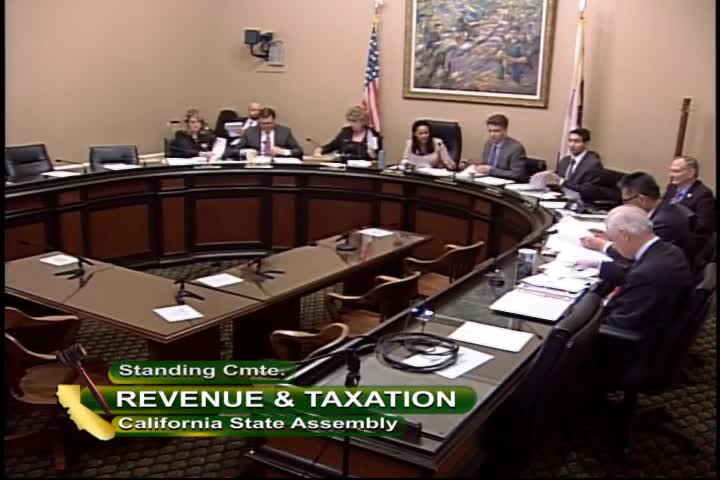
Assembly Standing Committee on Revenue and Taxation
Bill Author

Bill Co-Author(s):