AB 3254: Local government organization: omnibus.
- Session Year: 2017-2018
- House: Assembly
- Latest Version Date: 2018-07-09
The Cortese-Knox-Hertzberg Local Government Reorganization Act of 2000 (the Act) provides the authority and procedure for the initiation, conduct, and completion of changes of organization, reorganization, and sphere of influence changes for cities and districts, as specified. Existing law defines various terms for purposes of that Act, including the terms affected territory and inhabited territory.
This bill would revise those definitions to include territory that is to receive extended services from a local agency, and additionally define the term uninhabited territory for purposes of the Act.
The Act requires mailed notice to be given to landowners and to all registered voters within territory affected by a proposed change of organization, reorganization, or sphere of influence change, including notice to all landowners or registered voters within 300 feet of the exterior boundary of the property that is subject of a hearing, as specified.
This bill would specify that the requirement to mail notice to all landowners or registered voters within 300 feet of the exterior boundary of the property that is subject of a hearing applies only in the case of commission proceedings.
The Act provides for the selection of representatives of independent special districts on each local agency formation commission by an independent special district selection committee pursuant to a nomination and election process. Existing law requires the executive officer of the commission to call and hold a meeting of the special district selection committee when, among other things, the executive officer anticipates a vacancy within the next 90 days among the members or alternate members representing independent special districts on the commission, as specified.
This bill would authorize the executive officer to prepare and deliver a call for nominations to each eligible district. The bill would, at the end of the nominating period, if only one candidate is nominated for a vacancy, require that candidate to be deemed appointed if a specified disclosure is made by the written notice of the meeting.
If the independent special district selection committee has determined to conduct business by mail, or if the executive officer determines that a meeting of the special district selection committee for the purpose of appointing the special district members or filling vacancies is not feasible, existing law requires the executive officer to conduct the business of the committee, including elections, by mail in accordance with specified procedures.
This bill would revise the elections procedures to, among other things, require all notices and election materials to be addressed to the presiding officer.
The Act sets forth the powers and duties of a local agency formation commission. If the proposal includes the incorporation of a city or the formation of a district, the commission is required to determine the property tax revenue to be exchanged by the affected local agencies, as specified.
This bill would specify the provisions under which the commission to determine the property tax revenue to be exchanged by affected local agencies if the proposal includes the disincorporation of a city.
The Act sets forth the factors to be considered by the commission in the review of a proposal, including, among others, per capita assessed valuation.
This bill would instead require the commission to consider assessed valuation generally.
The Cortese-Knox-Hertzberg Local Government Reorganization Act of 2000 (the Act) provides the authority and procedure for the initiation, conduct, and completion of changes of organization, reorganization, and sphere of influence changes for cities and districts, as specified. Existing law defines various terms for purposes of that Act, including the terms affected territory and inhabited territory.
This bill would revise those definitions to include territory that is to receive extended services from a local agency, and additionally define the term uninhabited territory for purposes of the Act.
The Act requires mailed notice to be given to landowners and to all registered voters within territory affected by a proposed change of organization, reorganization, or sphere of influence change, including notice to all landowners or registered voters within 300 feet of the exterior boundary of the property that is subject of a hearing, as specified.
This bill would specify that the requirement to mail notice to all landowners or registered voters within 300 feet of the exterior boundary of the property that is subject of a hearing applies only in the case of commission proceedings.
The Act sets forth the powers and duties of a local agency formation commission. If the proposal includes the incorporation of a city or the formation of a district, the commission is required to determine the property tax revenue to be exchanged by the affected local agencies, as specified.
This bill would specify the provisions under which the commission to determine the property tax revenue to be exchanged by affected local agencies if the proposal includes the disincorporation of a city.
The Act sets forth the factors to be considered by the commission in the review of a proposal, including, among others, per capita assessed valuation.
This bill would instead require the commission to consider assessed valuation generally.
Affected territory means any territory for which a change of organization, reorganization, or sphere of influence change is proposed or ordered, or any territory to which services are proposed to be provided pursuant to Sections 56133, 56133.5, or 56134.
SEC. 2.Section 56046 of the Government Code is amended to read:56046.Inhabited territory means territory within which there reside 12 or more registered voters. The number of registered voters, as determined by the elections officer, shall be established as of the date a certificate of filing is issued by the executive officer.
SEC. 3.Section 56079.5 is added to the Government Code, to read:56079.5.Uninhabited territory means territory within which there reside fewer than 12 registered voters. The number of registered voters, as determined by the elections officer, shall be established as of the date a certificate of filing is issued by the executive officer.
SEC. 4.Section 56133.5 of the Government Code is amended to read:56133.5.(a)A pilot program is hereby established for the Napa and San Bernardino commissions. If consistent with adopted policy, the Napa and San Bernardino commissions may authorize a city or district to provide new or extended services outside its jurisdictional boundary and outside its sphere of influence to support existing or planned uses involving public or private properties, subject to approval at a noticed public hearing in which the commission makes all of the following determinations:
(1)The extension of service or services deficiency was identified and evaluated in a review of municipal services prepared pursuant to Section 56430.
(2)The extension of service will not result in either (1) adverse impacts on open space or agricultural lands or (2) growth inducing impacts.
(3)A sphere of influence change involving the affected territory and its affected agency is not feasible under this division or desirable based on the adopted policies of the commission.
(b)Subdivision (d) of Section 56133 shall apply to any request for new or extended services pursuant to this section.
(c)For purposes of this section, planned use means any project that is included in an approved specific plan as of July 1, 2015.
(d)The Napa and San Bernardino commissions shall submit a report before January 1, 2020, to the Legislature on their participation in the pilot program, including how many requests for extension of services were received pursuant to this section and the action by the commission to approve, disapprove, or approve with conditions. The report required to be submitted pursuant to this subdivision shall be submitted in compliance with Section 9795 of the Government Code.
(e)The pilot program established pursuant to this section shall be consistent with Chapter 8.5 (commencing with Section 1501) of the Public Utilities Code.
(f)This section shall remain in effect only until January 1, 2021, and as of that date is repealed.
SEC. 5.Section 56157 of the Government Code is amended to read:56157.When mailed notice is required to be given to:
(a)A county, city, or district, it shall be addressed to the clerk of the county, city, or district.
(b)A commission, it shall be addressed to the executive officer.
(c)Proponents, it shall be addressed to the persons so designated in the petition at the address specified in the petition.
(d)Landowners within the affected territory, it shall be addressed to each person to whom land is assessed, as shown upon the most recent assessment roll being prepared by the county at the time the proponent adopts a resolution of application pursuant to Section 56654 or files a notice of intention to circulate a petition with the executive officer pursuant to subdivision (a) of Section 56700.4, at the address shown upon the assessment roll and, in the case of commission proceedings as defined in Section 56028, to all landowners within 300 feet of the exterior boundary of the property that is the subject of the hearing, at least 21 days prior to the hearing. This requirement may be waived if proof satisfactory to the commission is presented that shows that individual notices to landowners have already been provided by the initiating agency. Notice also shall be either posted or published in accordance with Section 56153 in a newspaper of general circulation that is circulated within the affected territory 21 days prior to the hearing.
(e)Persons requesting special notice, it shall be addressed to each person who has filed a written request for special notice with the executive officer or clerk at the mailing address specified in the request.
(f)Registered voters within the affected territory, to the address as shown on the most recent index of affidavits prepared by the county elections official at the time the proponent adopts a resolution of application pursuant to Section 56654 or files a notice of intention to circulate a petition with the executive officer pursuant to subdivision (a) of Section 56700.4 and, in the case of commission proceedings as defined in Section 56028, to all registered voters within 300 feet of the exterior boundary of the property that is the subject of the hearing, at least 21 days prior to the hearing. This requirement may be waived if proof satisfactory to the commission is presented that shows that individual notices to registered voters have already been provided by the initiating agency. Notice shall also either be posted or published in accordance with Section 56153 in a newspaper of general circulation that is circulated within the affected territory 21 days prior to the hearing.
(g)Pursuant to subdivisions (d) and (f), if a landowner or landowners and registered voter or voters are the same individual or individuals, only one notice is required to be mailed.
(h)If the total number of notices required to be mailed in accordance with subdivisions (d) and (f) exceeds 1,000, then notice may instead be provided by publishing a display advertisement of at least one-eighth page in a newspaper, as specified in Section 56153, at least 21 days prior to the hearing.
SEC. 6.Section 56332 of the Government Code is amended to read:56332.(a)The independent special district selection committee shall consist of the presiding officer of the legislative body of each independent special district. However, if the presiding officer of an independent special district is unable to participate in a meeting or election of the independent special district selection committee, the legislative body of the district may appoint one of its members as an alternate to participate in the selection committee in the presiding officers place. Those districts shall include districts located wholly within the county and those containing territory within the county representing 50 percent or more of the assessed value of taxable property of the district, as shown on the last equalized county assessment roll. Each member of the committee shall be entitled to one vote for each independent special district of which he or she is the presiding officer or his or her alternate as designated by the governing body. Members representing a majority of the eligible districts shall constitute a quorum.
(b)The executive officer shall call and give written notice of all meetings of the members of the selection committee. A meeting shall be called and held under one of the following circumstances:
(1)Whenever the executive officer anticipates that a vacancy will occur within the next 90 days among the members or alternate member representing independent special districts on the commission.
(2)Whenever a vacancy exists among the members or alternate member representing independent special districts upon the commission.
(3)Upon receipt of a written request by one or more members of the selection committee representing districts having 10 percent or more of the assessed value of taxable property within the county, as shown on the last equalized county assessment roll.
(4)Upon the adoption of a resolution of intention pursuant to Section 56332.5.
(5)Upon receipt of a written request by one or more members of the selection committee notifying the executive officer of the need to appoint a member representing independent special districts on an oversight board pursuant to paragraph (3) of subdivision (j) of Section 34179 of the Health and Safety Code.
(c)The selection committee shall appoint two regular members and one alternate member to the commission. The members so appointed shall be elected or appointed members of the legislative body of an independent special district residing within the county but shall not be members of the legislative body of a city or county. If one of the regular district members is absent from a commission meeting or disqualifies himself or herself from participating in a meeting, the alternate district member may serve and vote in place of the regular district member for that meeting. Service on the commission by a regular district member shall not disqualify, or be cause for disqualification of, the member from acting on proposals affecting the special district on whose legislative body the member serves. The special district selection committee may, at the time it appoints a member or alternate, provide that the member or alternate is disqualified from voting on proposals affecting the district on whose legislative body the member serves.
(1)The executive officer may prepare and deliver a call for nominations to each eligible district. The presiding officer, or his or her alternate as designated by the governing body, may respond in writing by the date specified in the call for nominations, which date shall be at least 30 days from the date on which the executive officer mailed the call for nominations to the eligible district.
(2)At the end of the nominating period, if only one candidate is nominated for a vacant seat, that candidate shall be deemed appointed. This paragraph shall be operative only if the written notice of the meeting provided pursuant to subdivision (b) discloses that, if nominations are received for only one candidate by the end of the nominating period, the candidate shall be deemed appointed and the meeting may be cancelled.
(d)If the office of a regular district member becomes vacant, the alternate member may serve and vote in place of the former regular district member until the appointment and qualification of a regular district member to fill the vacancy.
(e)A majority of the independent special district selection committee may determine to conduct the committees business by mail, including holding all elections by mailed ballot, pursuant to subdivision (f).
(f)If the independent special district selection committee has determined to conduct the committees business by mail or if the executive officer determines that a meeting of the special district selection committee is not feasible, the executive officer shall conduct the business of the committee by mail. Elections by mail shall be conducted as provided in this subdivision.
(1)The executive officer shall prepare and deliver a call for nominations to each eligible district. The presiding officer, or his or her alternate as designated by the governing body, may respond in writing by the date specified in the call for nominations, which date shall be at least 30 days from the date on which the executive officer mailed the call for nominations to the eligible district.
(2)At the end of the nominating period, if only one candidate is nominated for a vacant seat, that candidate shall be deemed appointed. If two or more candidates are nominated, the executive officer shall prepare and deliver one ballot and voting instructions to each eligible district. The ballot shall include the names of all nominees and the office for which each was nominated. Each presiding officer, or his or her alternate as designated by the governing body, shall return the ballot to the executive officer by the date specified in the voting instructions, which date shall be at least 30 days from the date on which the executive officer mailed the ballot to the eligible district.
(3)The call for nominations, ballots, and voting instructions shall be delivered by certified mail to each eligible district. As an alternative to the delivery by certified mail, the executive officer may transmit materials by electronic mail. All notices and election materials shall be addressed to the presiding officer, care of the clerk of the district.
(4) Nominations and ballots may be returned to the executive officer by electronic mail.
(5)Each returned nomination and ballot shall be signed by the presiding officer or his or her alternate as designated by the governing body of the eligible district.
(6)For an election to be valid, at least a quorum of the special districts must submit valid ballots. The candidate receiving the most votes shall be elected, unless another procedure has been adopted by the selection committee. Any nomination and ballot received by the executive officer after the date specified is invalid, provided, however, that if a quorum of ballots is not received by that date, the executive officer shall extend the date to submit ballots by 60 days and notify all districts of the extension. If ballots from a quorum of the districts have not been received at the end of the 60-day extension period, the executive officer shall extend the period to return ballots for a length of time at his or her discretion until a quorum is achieved, unless another procedure has been adopted by the selection committee. The executive officer shall announce the results of the election within seven days of the date specified.
(7)For a vote on special district representation to be valid, at least a quorum of the special districts must submit valid ballots to the executive officer by the date specified in the voting instructions, which date shall be at least 30 days from the date on which the executive officer mailed the ballot to the eligible district. If ballots from a quorum of the districts have not been received at the end of the 60-day extension period, the executive officer shall extend the period to return ballots for a length of time at his or her discretion until a quorum is achieved, unless another procedure has been adopted by the selection committee. By majority vote of those district representatives voting on the issue, the selection committee shall either accept or deny representation. The executive officer shall announce the results of the election within seven days of the date specified.
(8)All election materials shall be retained by the executive officer for a period of at least six months after the announcement of the election results.
(g)For purposes of this section, executive officer means the executive officer or designee as authorized by the commission.
SEC. 7.Section 56375 of the Government Code is amended to read:56375.The commission shall have all of the following powers and duties subject to any limitations upon its jurisdiction set forth in this part:
(a)(1)To review and approve with or without amendment, wholly, partially, or conditionally, or disapprove proposals for changes of organization or reorganization, consistent with written policies, procedures, and guidelines adopted by the commission.
(2)The commission may initiate proposals by resolution of application for any of the following:
(A)The consolidation of a district, as defined in Section 56036.
(B)The dissolution of a district.
(C)A merger.
(D)The establishment of a subsidiary district.
(E)The formation of a new district or districts.
(F)A reorganization that includes any of the changes specified in subparagraph (A), (B), (C), (D), or (E).
(G)The dissolution of an inactive district pursuant to Section 56879.
(3)A commission may initiate a proposal described in paragraph (2) only if that change of organization or reorganization is consistent with a recommendation or conclusion of a study prepared pursuant to Section 56378, 56425, or 56430, and the commission makes the determinations specified in subdivision (b) of Section 56881.
(4)A commission shall not disapprove an annexation to a city, initiated by resolution, of contiguous territory that the commission finds is any of the following:
(A)Surrounded or substantially surrounded by the city to which the annexation is proposed or by that city and a county boundary or the Pacific Ocean if the territory to be annexed is substantially developed or developing, is not prime agricultural land as defined in Section 56064, is designated for urban growth by the general plan of the annexing city, and is not within the sphere of influence of another city.
(B)Located within an urban service area that has been delineated and adopted by a commission, which is not prime agricultural land, as defined by Section 56064, and is designated for urban growth by the general plan of the annexing city.
(C)An annexation or reorganization of unincorporated islands meeting the requirements of Section 56375.3.
(5)As a condition to the annexation of an area that is surrounded, or substantially surrounded, by the city to which the annexation is proposed, the commission may require, where consistent with the purposes of this division, that the annexation include the entire island of surrounded, or substantially surrounded, territory.
(6)A commission shall not impose any conditions that would directly regulate land use density or intensity, property development, or subdivision requirements.
(7)The decision of the commission with regard to a proposal to annex territory to a city shall be based upon the general plan and prezoning of the city. When the development purposes are not made known to the annexing city, the annexation shall be reviewed on the basis of the adopted plans and policies of the annexing city or county. A commission shall require, as a condition to annexation, that a city prezone the territory to be annexed or present evidence satisfactory to the commission that the existing development entitlements on the territory are vested or are already at build-out, and are consistent with the citys general plan. However, the commission shall not specify how, or in what manner, the territory shall be prezoned.
(8)(A)Except for those changes of organization or reorganization authorized under Section 56375.3, and except as provided by subparagraph (B), a commission shall not approve an annexation to a city of any territory greater than 10 acres, or as determined by commission policy, where there exists a disadvantaged unincorporated community that is contiguous to the area of proposed annexation, unless an application to annex the disadvantaged unincorporated community to the subject city has been filed with the executive officer.
(B)An application to annex a contiguous disadvantaged community shall not be required if either of the following apply:
(i)A prior application for annexation of the same disadvantaged community has been made in the preceding five years.
(ii)The commission finds, based upon written evidence, that a majority of the registered voters within the affected territory are opposed to annexation.
(b)With regard to a proposal for annexation or detachment of territory to, or from, a city or district or with regard to a proposal for reorganization that includes annexation or detachment, to determine whether territory proposed for annexation or detachment, as described in its resolution approving the annexation, detachment, or reorganization, is inhabited or uninhabited.
(c)With regard to a proposal for consolidation of two or more cities or districts, to determine which city or district shall be the consolidated successor city or district.
(d)To approve the annexation of unincorporated, noncontiguous territory, subject to the limitations of Section 56742, located in the same county as that in which the city is located, and that is owned by a city and used for municipal purposes and to authorize the annexation of the territory without notice and hearing.
(e)To approve the annexation of unincorporated territory consistent with the planned and probable use of the property based upon the review of general plan and prezoning designations. No subsequent change may be made to the general plan for the annexed territory or zoning that is not in conformance to the prezoning designations for a period of two years after the completion of the annexation, unless the legislative body for the city makes a finding at a public hearing that a substantial change has occurred in circumstances that necessitate a departure from the prezoning in the application to the commission.
(f)With respect to the incorporation of a new city or the formation of a new special district, to determine the number of registered voters residing within the proposed city or special district or, for a landowner-voter special district, the number of owners of land and the assessed value of their land within the territory proposed to be included in the new special district. The number of registered voters shall be calculated as of the time of the last report of voter registration by the county elections official to the Secretary of State prior to the date the first signature was affixed to the petition. The executive officer shall notify the petitioners of the number of registered voters resulting from this calculation. The assessed value of the land within the territory proposed to be included in a new landowner-voter special district shall be calculated as shown on the last equalized assessment roll.
(g)To adopt written procedures for the evaluation of proposals, including written definitions consistent with existing state law. The commission may adopt standards for any of the factors enumerated in Section 56668. Any standards adopted by the commission shall be written.
(h)To adopt standards and procedures for the evaluation of service plans submitted pursuant to Section 56653 and the initiation of a change of organization or reorganization pursuant to subdivision (a).
(i)To make and enforce regulations for the orderly and fair conduct of hearings by the commission.
(j)To incur usual and necessary expenses for the accomplishment of its functions.
(k)To appoint and assign staff personnel and to employ or contract for professional or consulting services to carry out and effect the functions of the commission.
(l)To review the boundaries of the territory involved in any proposal with respect to the definiteness and certainty of those boundaries, the nonconformance of proposed boundaries with lines of assessment or ownership, and other similar matters affecting the proposed boundaries.
(m)To waive the restrictions of Section 56744 if it finds that the application of the restrictions would be detrimental to the orderly development of the community and that the area that would be enclosed by the annexation or incorporation is so located that it cannot reasonably be annexed to another city or incorporated as a new city.
(n)To waive the application of Section 22613 of the Streets and Highways Code if it finds the application would deprive an area of a service needed to ensure the health, safety, or welfare of the residents of the area and if it finds that the waiver would not affect the ability of a city to provide any service. However, within 60 days of the inclusion of the territory within the city, the legislative body may adopt a resolution nullifying the waiver.
(o)If the proposal includes the incorporation of a city, as defined in Section 56043, or the formation of a district, as defined in Section 2215 of the Revenue and Taxation Code, the commission shall determine the property tax revenue to be exchanged by the affected local agencies pursuant to Section 56810. If the proposal includes the disincorporation of a city, as defined in Section 56034, the commission shall determine the property tax revenue to be exchanged by the affected local agencies pursuant to Section 56813.
(p)To authorize a city or district to provide new or extended services outside its jurisdictional boundaries pursuant to Section 56133.
(q)To enter into an agreement with the commission for an adjoining county for the purpose of determining procedures for the consideration of proposals that may affect the adjoining county or where the jurisdiction of an affected agency crosses the boundary of the adjoining county.
(r)To approve with or without amendment, wholly, partially, or conditionally, or disapprove pursuant to this section the annexation of territory served by a mutual water company formed pursuant to Part 7 (commencing with Section 14300) of Division 3 of Title 1 of the Corporations Code that operates a public water system to a city or special district. Any annexation approved in accordance with this subdivision shall be subject to the state and federal constitutional prohibitions against the taking of private property without the payment of just compensation. This subdivision shall not impair the authority of a public agency or public utility to exercise eminent domain authority.
SEC. 8.Section 56652 of the Government Code is amended to read:56652.Each application shall be in the form as the commission may prescribe and shall contain all of the following information:
(a)A petition or resolution of application initiating the proposal.
(b)A statement of the nature of each proposal.
(c)A map and description, acceptable to the executive officer, of the boundaries of the affected territory for each proposed change of organization or reorganization.
(d)Any data and information as may be required by any regulation of the commission.
(e)Any additional data and information, as may be required by the executive officer, pertaining to any of the matters or factors which may be considered by the commission.
(f)The names of the officers or persons, not to exceed three in number, who are to be furnished with copies of the report by the executive officer and who are to be given mailed notice of the hearing.
SEC. 9.Section 56668 of the Government Code is amended to read:56668.Factors to be considered in the review of a proposal shall include, but not be limited to, all of the following:
(a)Population and population density; land area and land use; assessed valuation; topography, natural boundaries, and drainage basins; proximity to other populated areas; the likelihood of significant growth in the area, and in adjacent incorporated and unincorporated areas, during the next 10 years.
(b)The need for organized community services; the present cost and adequacy of governmental services and controls in the area; probable future needs for those services and controls; probable effect of the proposed incorporation, formation, annexation, or exclusion and of alternative courses of action on the cost and adequacy of services and controls in the area and adjacent areas.
Services, as used in this subdivision, refers to governmental services whether or not the services are services which would be provided by local agencies subject to this division, and includes the public facilities necessary to provide those services.
(c)The effect of the proposed action and of alternative actions, on adjacent areas, on mutual social and economic interests, and on the local governmental structure of the county.
(d)The conformity of both the proposal and its anticipated effects with both the adopted commission policies on providing planned, orderly, efficient patterns of urban development, and the policies and priorities in Section 56377.
(e)The effect of the proposal on maintaining the physical and economic integrity of agricultural lands, as defined by Section 56016.
(f)The definiteness and certainty of the boundaries of the territory, the nonconformance of proposed boundaries with lines of assessment or ownership, the creation of islands or corridors of unincorporated territory, and other similar matters affecting the proposed boundaries.
(g)A regional transportation plan adopted pursuant to Section 65080.
(h)The proposals consistency with city or county general and specific plans.
(i)The sphere of influence of any local agency which may be applicable to the proposal being reviewed.
(j)The comments of any affected local agency or other public agency.
(k)The ability of the newly formed or receiving entity to provide the services which are the subject of the application to the area, including the sufficiency of revenues for those services following the proposed boundary change.
(l)Timely availability of water supplies adequate for projected needs as specified in Section 65352.5.
(m)The extent to which the proposal will affect a city or cities and the county in achieving their respective fair shares of the regional housing needs as determined by the appropriate council of governments consistent with Article 10.6 (commencing with Section 65580) of Chapter 3 of Division 1 of Title 7.
(n)Any information or comments from the landowner or landowners, voters, or residents of the affected territory.
(o)Any information relating to existing land use designations.
(p)The extent to which the proposal will promote environmental justice. As used in this subdivision, environmental justice means the fair treatment of people of all races, cultures, and incomes with respect to the location of public facilities and the provision of public services.
SEC. 10.Section 56856.5 of the Government Code is amended to read:56856.5.(a)The commission shall not approve or conditionally approve a change of organization or reorganization that would result in the annexation to a city or special district of territory that is subject to a contract entered into pursuant to the California Land Conservation Act of 1965 (Chapter 7 (commencing with Section 51200) of Part 1 of Division 1), other than a contract entered into pursuant to Article 7 (commencing with Section 51296) of Chapter 7 of Part 1 of Division 1, if that city or special district provides or would provide facilities or services related to sewers, nonagricultural water, or streets and roads to the territory, unless these facilities or services benefit land uses that are allowed under the contract.
(b)This section shall not be construed to preclude the annexation of territory for the purpose of using other facilities or services provided by the agency that benefit land uses allowable under the contract.
(c)Notwithstanding subdivision (a), the commission may nevertheless approve a change of organization or reorganization if it finds any of the following:
(1)The city or county that would administer the contract after annexation has adopted policies and feasible implementation measures applicable to the affected territory ensuring the continuation of agricultural use and other uses allowable under the contract on a long-term basis.
(2)The change of organization or reorganization encourages and provides planned, well-ordered, and efficient urban development patterns that include appropriate consideration of the preservation of open-space lands within those urban development patterns.
(3)The change of organization or reorganization is necessary to provide services to planned, well-ordered, and efficient urban development patterns that include appropriate consideration of the preservation of open-space lands within those urban development patterns.
(d)This section shall not apply to territory subject to a contract for which either of the following applies:
(1)A notice of nonrenewal has been served pursuant to Section 51245, if the annexing agency agrees that no services will actually be provided by it for use during the remaining life of the contract for land uses or activities not allowed under the contract.
(2)A tentative cancellation has been approved pursuant to Section 51282.
SEC. 11.Section 56880 of the Government Code, as added by Section 7 of Chapter 334 of the Statutes of 2017, is amended and renumbered to read:56879.5.This article shall not apply to a special district formed by special legislation that is required by its enabling statute to obtain funding within a specified period of time or be dissolved. That district shall not be subject to this article during that specified period of time.
SEC. 12.Section 57025 of the Government Code is amended to read:57025.(a)The executive officer of the commission shall give notice of the protest hearing to be held on the proposal by publication pursuant to Sections 56153 and 56154 and by posting pursuant to Sections 56158 and 56159.
(b)The executive officer shall give mailed notice to all landowners owning land within any affected territory, consistent with Sections 56155 to 56157, inclusive.
(c)If the affected territory is inhabited, the executive officer shall also give mailed notice to all registered voters residing within any affected territory, consistent with Sections 56155 to 56157, inclusive.
(d)The executive officer shall also give mailed notice to each affected city, affected district, or affected county, the proponents, if any, and to persons requesting special notice, consistent with Sections 56155 to 56157, inclusive.
(e)In the case of a proposed change of organization or reorganization that would result in the extension of any previously authorized special tax or benefit assessment to the affected territory, the executive officer of the commission shall give mailed notice to each landowner within the affected territory.
SEC. 13.Section 57026 of the Government Code is amended to read:57026.The notice required to be given by Section 57025 shall contain all of the following information:
(a)A statement of the distinctive short form designation assigned by the commission to the proposal.
(b)A statement of the manner in which, and by whom, proceedings were initiated. However, a reference to the proponents, if any, shall be sufficient where proceedings were initiated by a petition.
(c)A description of the exterior boundaries of the affected territory.
(d)A description of the particular change or changes of organization proposed for each of the subject districts or cities and new districts or new cities proposed to be formed, and any terms and conditions to be applicable. The description may include a reference to the commissions resolution making determinations for a full and complete description of the change of organization or reorganization, and the terms and conditions.
(e)A statement of the reason or reasons for the change of organization or reorganization as set forth in the proposal submitted to the commission.
(f)A statement of the time, date, and place of the protest hearing on the proposed change of organization or reorganization.
(g)If the affected territory is inhabited and the change of organization or reorganization provides for the submission of written protests, a statement that any owner of land within the territory, or any registered voter residing within the territory, may file a written protest against the proposal with the executive officer of the commission at any time prior to the conclusion of the hearing by the commission on the proposal.
(h)If the affected territory is uninhabited and the change of organization or reorganization provides for submission of written protests, a statement that any owner of land within the territory may file a written protest against the proposal with the executive officer of the commission at any time prior to the conclusion of the hearing by the commission on the proposal.
Affected territory means any territory for which a change of organization, reorganization, or sphere of influence change is proposed or ordered, or any territory to which services are proposed to be provided pursuant to Sections 56133, 56133.5, or 56134.
SEC. 2.Section 56046 of the Government Code is amended to read:56046.Inhabited territory means territory within which there reside 12 or more registered voters. The number of registered voters, as determined by the elections officer, shall be established as of the date a certificate of filing is issued by the executive officer.
SEC. 3.Section 56079.5 is added to the Government Code, to read:56079.5.Uninhabited territory means territory within which there reside fewer than 12 registered voters. The number of registered voters, as determined by the elections officer, shall be established as of the date a certificate of filing is issued by the executive officer.
SEC. 4.Section 56133.5 of the Government Code is amended to read:56133.5.(a)A pilot program is hereby established for the Napa and San Bernardino commissions. If consistent with adopted policy, the Napa and San Bernardino commissions may authorize a city or district to provide new or extended services outside its jurisdictional boundary and outside its sphere of influence to support existing or planned uses involving public or private properties, subject to approval at a noticed public hearing in which the commission makes all of the following determinations:
(1)The extension of service or services deficiency was identified and evaluated in a review of municipal services prepared pursuant to Section 56430.
(2)The extension of service will not result in either (1) adverse impacts on open space or agricultural lands or (2) growth inducing impacts.
(3)A sphere of influence change involving the subject affected territory and its affected agency is not feasible under this division or desirable based on the adopted policies of the commission.
(b)Subdivision (d) of Section 56133 shall apply to any request for new or extended services pursuant to this section.
(c)For purposes of this section, planned use means any project that is included in an approved specific plan as of July 1, 2015.
(d)The Napa and San Bernardino commissions shall submit a report before January 1, 2020, to the Legislature on their participation in the pilot program, including how many requests for extension of services were received pursuant to this section and the action by the commission to approve, disapprove, or approve with conditions. The report required to be submitted pursuant to this subdivision shall be submitted in compliance with Section 9795 of the Government Code.
(e)The pilot program established pursuant to this section shall be consistent with Chapter 8.5 (commencing with Section 1501) of the Public Utilities Code.
(f)This section shall remain in effect only until January 1, 2021, and as of that date is repealed.
SEC. 4.SEC. 5.Section 56157 of the Government Code is amended to read:56157.When mailed notice is required to be given to:
(a)A county, city, or district, it shall be addressed to the clerk of the county, city, or district.
(b)A commission, it shall be addressed to the executive officer.
(c)Proponents, it shall be addressed to the persons so designated in the petition at the address specified in the petition.
(d)Landowners within the affected territory, it shall be addressed to each person to whom land is assessed, as shown upon the most recent assessment roll being prepared by the county at the time the proponent adopts a resolution of application pursuant to Section 56654 or files a notice of intention to circulate a petition with the executive officer pursuant to subdivision (a) of Section 56700.4, at the address shown upon the assessment roll and, in the case of commission proceedings as defined in Section 56028, to all landowners within 300 feet of the exterior boundary of the property that is the subject of the hearing, at least 21 days prior to the hearing. This requirement may be waived if proof satisfactory to the commission is presented that shows that individual notices to landowners have already been provided by the initiating agency. Notice also shall be either posted or published in accordance with Section 56153 in a newspaper of general circulation that is circulated within the affected territory 21 days prior to the hearing.
(e)Persons requesting special notice, it shall be addressed to each person who has filed a written request for special notice with the executive officer or clerk at the mailing address specified in the request.
(f)Registered voters within the affected territory, to the address as shown on the most recent index of affidavits prepared by the county elections official at the time the proponent adopts a resolution of application pursuant to Section 56654 or files a notice of intention to circulate a petition with the executive officer pursuant to subdivision (a) of Section 56700.4 and, in the case of commission proceedings as defined in Section 56028, to all registered voters within 300 feet of the exterior boundary of the property that is the subject of the hearing, at least 21 days prior to the hearing. This requirement may be waived if proof satisfactory to the commission is presented that shows that individual notices to registered voters have already been provided by the initiating agency. Notice shall also either be posted or published in accordance with Section 56153 in a newspaper of general circulation that is circulated within the affected territory 21 days prior to the hearing.
(g)Pursuant to subdivisions (d) and (f), if a landowner or landowners and registered voter or voters are the same individual or individuals, only one notice is required to be mailed.
(h)If the total number of notices required to be mailed in accordance with subdivisions (d) and (f) exceeds 1,000, then notice may instead be provided by publishing a display advertisement of at least one-eighth page in a newspaper, as specified in Section 56153, at least 21 days prior to the hearing.
SEC. 6.Section 56332 of the Government Code is amended to read:56332.(a)The independent special district selection committee shall consist of the presiding officer of the legislative body of each independent special district. However, if the presiding officer of an independent special district is unable to participate in a meeting or election of the independent special district selection committee, the legislative body of the district may appoint one of its members as an alternate to participate in the selection committee in the presiding officers place. Those districts shall include districts located wholly within the county and those containing territory within the county representing 50 percent or more of the assessed value of taxable property of the district, as shown on the last equalized county assessment roll. Each member of the committee shall be entitled to one vote for each independent special district of which he or she is the presiding officer or his or her alternate as designated by the governing body. Members representing a majority of the eligible districts shall constitute a quorum.
(b)The executive officer shall call and give written notice of all meetings of the members of the selection committee. A meeting shall be called and held under one of the following circumstances:
(1)Whenever the executive officer anticipates that a vacancy will occur within the next 90 days among the members or alternate member representing independent special districts on the commission.
(2)Whenever a vacancy exists among the members or alternate member representing independent special districts upon the commission.
(3)Upon receipt of a written request by one or more members of the selection committee representing districts having 10 percent or more of the assessed value of taxable property within the county, as shown on the last equalized county assessment roll.
(4)Upon the adoption of a resolution of intention pursuant to Section 56332.5.
(5)Upon receipt of a written request by one or more members of the selection committee notifying the executive officer of the need to appoint a member representing independent special districts on an oversight board pursuant to paragraph (3) of subdivision (j) of Section 34179 of the Health and Safety Code.
(c)The selection committee shall appoint two regular members and one alternate member to the commission. The members so appointed shall be elected or appointed members of the legislative body of an independent special district residing within the county but shall not be members of the legislative body of a city or county. If one of the regular district members is absent from a commission meeting or disqualifies himself or herself from participating in a meeting, the alternate district member may serve and vote in place of the regular district member for that meeting. Service on the commission by a regular district member shall not disqualify, or be cause for disqualification of, the member from acting on proposals affecting the special district on whose legislative body the member serves. The special district selection committee may, at the time it appoints a member or alternate, provide that the member or alternate is disqualified from voting on proposals affecting the district on whose legislative body the member serves.
(1)The executive officer may prepare and deliver a call for nominations to each eligible district. The presiding officer, or his or her alternate as designated by the governing body, may respond in writing by the date specified in the call for nominations, which date shall be at least 30 days from the date on which the executive officer mailed the call for nominations to the eligible district.
(2)At the end of the nominating period, if only one candidate is nominated for a vacant seat, that candidate shall be deemed appointed. This paragraph shall be operative only if the written notice of the meeting provided pursuant to subdivision (b) discloses that, if nominations are received for only one candidate by the end of the nominating period, the candidate shall be deemed appointed and the meeting may be cancelled.
(d)If the office of a regular district member becomes vacant, the alternate member may serve and vote in place of the former regular district member until the appointment and qualification of a regular district member to fill the vacancy.
(e)A majority of the independent special district selection committee may determine to conduct the committees business by mail, including holding all elections by mailed ballot, pursuant to subdivision (f).
(f)If the independent special district selection committee has determined to conduct the committees business by mail or if the executive officer determines that a meeting of the special district selection committee is not feasible, the executive officer shall conduct the business of the committee by mail. Elections by mail shall be conducted as provided in this subdivision.
(1)The executive officer shall prepare and deliver a call for nominations to each eligible district. The presiding officer, or his or her alternate as designated by the governing body, may respond in writing by the date specified in the call for nominations, which date shall be at least 30 days from the date on which the executive officer mailed the call for nominations to the eligible district.
(2)At the end of the nominating period, if only one candidate is nominated for a vacant seat, that candidate shall be deemed appointed. If two or more candidates are nominated, the executive officer shall prepare and deliver one ballot and voting instructions to each eligible district. The ballot shall include the names of all nominees and the office for which each was nominated. Each presiding officer, or his or her alternate as designated by the governing body, shall return the ballot to the executive officer by the date specified in the voting instructions, which date shall be at least 30 days from the date on which the executive officer mailed the ballot to the eligible district.
(3)The call for nominations, ballots, and voting instructions shall be delivered by certified mail to each eligible district. As an alternative to the delivery by certified mail, the executive officer, with prior concurrence of the presiding officer or his or her alternate as designated by the governing body, officer may transmit materials by electronic mail. All notices and election materials shall be addressed to the presiding officer, care of the clerk of the district.
(4)If the executive officer has transmitted the call for nominations or ballots by electronic mail, the presiding officer, or his or her alternate as designated by the governing body, may respond Nominations and ballots may be returned to the executive officer by electronic mail.
(5)Each returned nomination and ballot shall be signed by the presiding officer or his or her alternate as designated by the governing body of the eligible district.
(6)For an election to be valid, at least a quorum of the special districts must submit valid ballots. The candidate receiving the most votes shall be elected, unless another procedure has been adopted by the selection committee. Any nomination and ballot received by the executive officer after the date specified is invalid, provided, however, that if a quorum of ballots is not received by that date, the executive officer shall extend the date to submit ballots by 60 days and notify all districts of the extension. If ballots from a quorum of the districts have not been received at the end of the 60-day extension period, the executive officer shall extend the period to return ballots for a length of time at his or her discretion until a quorum is achieved, unless another procedure has been adopted by the selection committee. The executive officer shall announce the results of the election within seven days of the date specified.
(7)For a vote on special district representation to be valid, at least a quorum of the special districts must submit valid ballots. ballots to the executive officer by the date specified in the voting instructions, which date shall be at least 30 days from the date on which the executive officer mailed the ballot to the eligible district. If ballots from a quorum of the districts have not been received at the end of the 60-day extension period, the executive officer shall extend the period to return ballots for a length of time at his or her discretion until a quorum is achieved, unless another procedure has been adopted by the selection committee. By majority vote of those district representatives voting on the issue, the selection committee shall either accept or deny representation. The executive officer shall announce the results of the election within seven days of the date specified.
(8)All election materials shall be retained by the executive officer for a period of at least six months after the announcement of the election results.
(g)For purposes of this section, executive officer means the executive officer or designee as authorized by the commission.
SEC. 5.SEC. 7.Section 56375 of the Government Code is amended to read:56375.The commission shall have all of the following powers and duties subject to any limitations upon its jurisdiction set forth in this part:
(a)(1)To review and approve with or without amendment, wholly, partially, or conditionally, or disapprove proposals for changes of organization or reorganization, consistent with written policies, procedures, and guidelines adopted by the commission.
(2)The commission may initiate proposals by resolution of application for any of the following:
(A)The consolidation of a district, as defined in Section 56036.
(B)The dissolution of a district.
(C)A merger.
(D)The establishment of a subsidiary district.
(E)The formation of a new district or districts.
(F)A reorganization that includes any of the changes specified in subparagraph (A), (B), (C), (D), or (E).
(G)The dissolution of an inactive district pursuant to Section 56879.
(3)A commission may initiate a proposal described in paragraph (2) only if that change of organization or reorganization is consistent with a recommendation or conclusion of a study prepared pursuant to Section 56378, 56425, or 56430, and the commission makes the determinations specified in subdivision (b) of Section 56881.
(4)A commission shall not disapprove an annexation to a city, initiated by resolution, of contiguous territory that the commission finds is any of the following:
(A)Surrounded or substantially surrounded by the city to which the annexation is proposed or by that city and a county boundary or the Pacific Ocean if the territory to be annexed is substantially developed or developing, is not prime agricultural land as defined in Section 56064, is designated for urban growth by the general plan of the annexing city, and is not within the sphere of influence of another city.
(B)Located within an urban service area that has been delineated and adopted by a commission, which is not prime agricultural land, as defined by Section 56064, and is designated for urban growth by the general plan of the annexing city.
(C)An annexation or reorganization of unincorporated islands meeting the requirements of Section 56375.3.
(5)As a condition to the annexation of an area that is surrounded, or substantially surrounded, by the city to which the annexation is proposed, the commission may require, where consistent with the purposes of this division, that the annexation include the entire island of surrounded, or substantially surrounded, territory.
(6)A commission shall not impose any conditions that would directly regulate land use density or intensity, property development, or subdivision requirements.
(7)The decision of the commission with regard to a proposal to annex territory to a city shall be based upon the general plan and prezoning of the city. When the development purposes are not made known to the annexing city, the annexation shall be reviewed on the basis of the adopted plans and policies of the annexing city or county. A commission shall require, as a condition to annexation, that a city prezone the territory to be annexed or present evidence satisfactory to the commission that the existing development entitlements on the territory are vested or are already at build-out, and are consistent with the citys general plan. However, the commission shall not specify how, or in what manner, the territory shall be prezoned.
(8)(A)Except for those changes of organization or reorganization authorized under Section 56375.3, and except as provided by subparagraph (B), a commission shall not approve an annexation to a city of any territory greater than 10 acres, or as determined by commission policy, where there exists a disadvantaged unincorporated community that is contiguous to the area of proposed annexation, unless an application to annex the disadvantaged unincorporated community to the subject city has been filed with the executive officer.
(B)An application to annex a contiguous disadvantaged community shall not be required if either of the following apply:
(i)A prior application for annexation of the same disadvantaged community has been made in the preceding five years.
(ii)The commission finds, based upon written evidence, that a majority of the registered voters within the affected territory are opposed to annexation.
(b)With regard to a proposal for annexation or detachment of territory to, or from, a city or district or with regard to a proposal for reorganization that includes annexation or detachment, to determine whether territory proposed for annexation or detachment, as described in its resolution approving the annexation, detachment, or reorganization, is inhabited or uninhabited.
(c)With regard to a proposal for consolidation of two or more cities or districts, to determine which city or district shall be the consolidated successor city or district.
(d)To approve the annexation of unincorporated, noncontiguous territory, subject to the limitations of Section 56742, located in the same county as that in which the city is located, and that is owned by a city and used for municipal purposes and to authorize the annexation of the territory without notice and hearing.
(e)To approve the annexation of unincorporated territory consistent with the planned and probable use of the property based upon the review of general plan and prezoning designations. No subsequent change may be made to the general plan for the annexed territory or zoning that is not in conformance to the prezoning designations for a period of two years after the completion of the annexation, unless the legislative body for the city makes a finding at a public hearing that a substantial change has occurred in circumstances that necessitate a departure from the prezoning in the application to the commission.
(f)With respect to the incorporation of a new city or the formation of a new special district, to determine the number of registered voters residing within the proposed city or special district or, for a landowner-voter special district, the number of owners of land and the assessed value of their land within the territory proposed to be included in the new special district. The number of registered voters shall be calculated as of the time of the last report of voter registration by the county elections official to the Secretary of State prior to the date the first signature was affixed to the petition. The executive officer shall notify the petitioners of the number of registered voters resulting from this calculation. The assessed value of the land within the territory proposed to be included in a new landowner-voter special district shall be calculated as shown on the last equalized assessment roll.
(g)To adopt written procedures for the evaluation of proposals, including written definitions consistent with existing state law. The commission may adopt standards for any of the factors enumerated in Section 56668. Any standards adopted by the commission shall be written.
(h)To adopt standards and procedures for the evaluation of service plans submitted pursuant to Section 56653 and the initiation of a change of organization or reorganization pursuant to subdivision (a).
(i)To make and enforce regulations for the orderly and fair conduct of hearings by the commission.
(j)To incur usual and necessary expenses for the accomplishment of its functions.
(k)To appoint and assign staff personnel and to employ or contract for professional or consulting services to carry out and effect the functions of the commission.
(l)To review the boundaries of the territory involved in any proposal with respect to the definiteness and certainty of those boundaries, the nonconformance of proposed boundaries with lines of assessment or ownership, and other similar matters affecting the proposed boundaries.
(m)To waive the restrictions of Section 56744 if it finds that the application of the restrictions would be detrimental to the orderly development of the community and that the area that would be enclosed by the annexation or incorporation is so located that it cannot reasonably be annexed to another city or incorporated as a new city.
(n)To waive the application of Section 22613 of the Streets and Highways Code if it finds the application would deprive an area of a service needed to ensure the health, safety, or welfare of the residents of the area and if it finds that the waiver would not affect the ability of a city to provide any service. However, within 60 days of the inclusion of the territory within the city, the legislative body may adopt a resolution nullifying the waiver.
(o)If the proposal includes the incorporation of a city, as defined in Section 56043, or the formation of a district, as defined in Section 2215 of the Revenue and Taxation Code, the commission shall determine the property tax revenue to be exchanged by the affected local agencies pursuant to Section 56810. If the proposal includes the disincorporation of a city, as defined in Section 56034, the commission shall determine the property tax revenue to be exchanged by the affected local agencies pursuant to Section 56813.
(p)To authorize a city or district to provide new or extended services outside its jurisdictional boundaries pursuant to Section 56133.
(q)To enter into an agreement with the commission for an adjoining county for the purpose of determining procedures for the consideration of proposals that may affect the adjoining county or where the jurisdiction of an affected agency crosses the boundary of the adjoining county.
(r)To approve with or without amendment, wholly, partially, or conditionally, or disapprove pursuant to this section the annexation of territory served by a mutual water company formed pursuant to Part 7 (commencing with Section 14300) of Division 3 of Title 1 of the Corporations Code that operates a public water system to a city or special district. Any annexation approved in accordance with this subdivision shall be subject to the state and federal constitutional prohibitions against the taking of private property without the payment of just compensation. This subdivision shall not impair the authority of a public agency or public utility to exercise eminent domain authority.
SEC. 8.Section 56652 of the Government Code is amended to read:56652.Each application shall be in the form as the commission may prescribe and shall contain all of the following information:
(a)A petition or resolution of application initiating the proposal.
(b)A statement of the nature of each proposal.
(c)A map and description, acceptable to the executive officer, of the boundaries of the subject affected territory for each proposed change of organization or reorganization.
(d)Any data and information as may be required by any regulation of the commission.
(e)Any additional data and information, as may be required by the executive officer, pertaining to any of the matters or factors which may be considered by the commission.
(f)The names of the officers or persons, not to exceed three in number, who are to be furnished with copies of the report by the executive officer and who are to be given mailed notice of the hearing.
SEC. 6.SEC. 9.Section 56668 of the Government Code is amended to read:56668.Factors to be considered in the review of a proposal shall include, but not be limited to, all of the following:
(a)Population and population density; land area and land use; assessed valuation; topography, natural boundaries, and drainage basins; proximity to other populated areas; the likelihood of significant growth in the area, and in adjacent incorporated and unincorporated areas, during the next 10 years.
(b)The need for organized community services; the present cost and adequacy of governmental services and controls in the area; probable future needs for those services and controls; probable effect of the proposed incorporation, formation, annexation, or exclusion and of alternative courses of action on the cost and adequacy of services and controls in the area and adjacent areas.
Services, as used in this subdivision, refers to governmental services whether or not the services are services which would be provided by local agencies subject to this division, and includes the public facilities necessary to provide those services.
(c)The effect of the proposed action and of alternative actions, on adjacent areas, on mutual social and economic interests, and on the local governmental structure of the county.
(d)The conformity of both the proposal and its anticipated effects with both the adopted commission policies on providing planned, orderly, efficient patterns of urban development, and the policies and priorities in Section 56377.
(e)The effect of the proposal on maintaining the physical and economic integrity of agricultural lands, as defined by Section 56016.
(f)The definiteness and certainty of the boundaries of the territory, the nonconformance of proposed boundaries with lines of assessment or ownership, the creation of islands or corridors of unincorporated territory, and other similar matters affecting the proposed boundaries.
(g)A regional transportation plan adopted pursuant to Section 65080.
(h)The proposals consistency with city or county general and specific plans.
(i)The sphere of influence of any local agency which may be applicable to the proposal being reviewed.
(j)The comments of any affected local agency or other public agency.
(k)The ability of the newly formed or receiving entity to provide the services which are the subject of the application to the area, including the sufficiency of revenues for those services following the proposed boundary change.
(l)Timely availability of water supplies adequate for projected needs as specified in Section 65352.5.
(m)The extent to which the proposal will affect a city or cities and the county in achieving their respective fair shares of the regional housing needs as determined by the appropriate council of governments consistent with Article 10.6 (commencing with Section 65580) of Chapter 3 of Division 1 of Title 7.
(n)Any information or comments from the landowner or owners, landowners, voters, or residents of the affected territory.
(o)Any information relating to existing land use designations.
(p)The extent to which the proposal will promote environmental justice. As used in this subdivision, environmental justice means the fair treatment of people of all races, cultures, and incomes with respect to the location of public facilities and the provision of public services.
SEC. 10.Section 56856.5 of the Government Code is amended to read:56856.5.(a)The commission shall not approve or conditionally approve a change of organization or reorganization that would result in the annexation to a city or special district of territory that is subject to a contract entered into pursuant to the California Land Conservation Act of 1965 (Chapter 7 (commencing with Section 51200) of Part 1 of Division 1), other than a contract entered into pursuant to Article 7 (commencing with Section 51296) of Chapter 7 of Part 1 of Division 1, if that city or special district provides or would provide facilities or services related to sewers, nonagricultural water, or streets and roads to the territory, unless these facilities or services benefit land uses that are allowed under the contract.
(b)This section shall not be construed to preclude the annexation of territory for the purpose of using other facilities or services provided by the agency that benefit land uses allowable under the contract.
(c)Notwithstanding subdivision (a), the commission may nevertheless approve a change of organization or reorganization if it finds any of the following:
(1)The city or county that would administer the contract after annexation has adopted policies and feasible implementation measures applicable to the subject affected territory ensuring the continuation of agricultural use and other uses allowable under the contract on a long-term basis.
(2)The change of organization or reorganization encourages and provides planned, well-ordered, and efficient urban development patterns that include appropriate consideration of the preservation of open-space lands within those urban development patterns.
(3)The change of organization or reorganization is necessary to provide services to planned, well-ordered, and efficient urban development patterns that include appropriate consideration of the preservation of open-space lands within those urban development patterns.
(d)This section shall not apply to territory subject to a contract for which either of the following applies:
(1)A notice of nonrenewal has been served pursuant to Section 51245, if the annexing agency agrees that no services will actually be provided by it for use during the remaining life of the contract for land uses or activities not allowed under the contract.
(2)A tentative cancellation has been approved pursuant to Section 51282.
SEC. 11.Section 56880 of the Government Code, as added by Section 7 of Chapter 334 of the Statutes of 2017, is amended and renumbered to read:56880.56879.5This article shall not apply to a special district formed by special legislation that is required by its enabling statute to obtain funding within a specified period of time or be dissolved. That district shall not be subject to this article during that specified period of time.
SEC. 12.Section 57025 of the Government Code is amended to read:57025.(a)The executive officer of the commission shall give notice of the protest hearing to be held on the proposal by publication pursuant to Sections 56153 and 56154 and by posting pursuant to Sections 56158 and 56159.
(b)The executive officer shall give mailed notice to all landowners owning land within any affected territory, consistent with Sections 56155 to 56157, inclusive.
(c)If the subject affected territory is inhabited, the executive officer shall also give mailed notice to all registered voters residing within any affected territory, consistent with Sections 56155 to 56157, inclusive.
(d)The executive officer shall also give mailed notice to each affected city, affected district, or affected county, the proponents, if any, and to persons requesting special notice, consistent with Sections 56155 to 56157, inclusive.
(e)In the case of a proposed change of organization or reorganization that would result in the extension of any previously authorized special tax or benefit assessment to the affected territory, the executive officer of the commission shall give mailed notice to each landowner within the affected territory.
SEC. 13.Section 57026 of the Government Code is amended to read:57026.The notice required to be given by Section 57025 shall contain all of the following information:
(a)A statement of the distinctive short form designation assigned by the commission to the proposal.
(b)A statement of the manner in which, and by whom, proceedings were initiated. However, a reference to the proponents, if any, shall be sufficient where proceedings were initiated by a petition.
(c)A description of the exterior boundaries of the subject affected territory.
(d)A description of the particular change or changes of organization proposed for each of the subject districts or cities and new districts or new cities proposed to be formed, and any terms and conditions to be applicable. The description may include a reference to the commissions resolution making determinations for a full and complete description of the change of organization or reorganization, and the terms and conditions.
(e)A statement of the reason or reasons for the change of organization or reorganization as set forth in the proposal submitted to the commission.
(f)A statement of the time, date, and place of the protest hearing on the proposed change of organization or reorganization.
(g)If the subject affected territory is inhabited and the change of organization or reorganization provides for the submission of written protests, a statement that any owner of land within the territory, or any registered voter residing within the territory, may file a written protest against the proposal with the executive officer of the commission at any time prior to the conclusion of the hearing by the commission on the proposal.
(h)If the subject affected territory is uninhabited and the change of organization or reorganization provides for submission of written protests, a statement that any owner of land within the territory may file a written protest against the proposal with the executive officer of the commission at any time prior to the conclusion of the hearing by the commission on the proposal.
Affected territory means any territory for which a change of organization or organization, reorganization, or sphere of influence change, change is proposed or ordered. ordered, or any territory to which services are proposed to be provided pursuant to Sections 56133, 56133.5, or 56134.
SEC. 2.Section 56046 of the Government Code is amended to read:56046.Inhabited territory means territory within which there reside 12 or more registered voters. The number of registered voters, as determined by the elections officer, shall be established as of the date a certificate of filing is issued by the executive officer. All other territory shall be deemed uninhabited.
SEC. 3.Section 56079.5 is added to the Government Code, to read:56079.5.Uninhabited territory means territory within which there reside fewer than 12 registered voters. The number of registered voters, as determined by the elections officer, shall be established as of the date a certificate of filing is issued by the executive officer.
SEC. 4.Section 56157 of the Government Code is amended to read:56157.When mailed notice is required to be given to:
(a)A county, city, or district, it shall be addressed to the clerk of the county, city, or district.
(b)A commission, it shall be addressed to the executive officer.
(c)Proponents, it shall be addressed to the persons so designated in the petition at the address specified in the petition.
(d)Landowners, Landowners within the affected territory, it shall be addressed to each person to whom land is assessed, as shown upon the most recent assessment roll being prepared by the county at the time the proponent adopts a resolution of application pursuant to Section 56654 or files a notice of intention to circulate a petition with the executive officer pursuant to subdivision (a) of Section 56700.4, at the address shown upon the assessment roll and and, in the case of commission proceedings as defined in Section 56028, to all landowners within 300 feet of the exterior boundary of the property that is the subject of the hearing hearing, at least 21 days prior to the hearing. This requirement may be waived if proof satisfactory to the commission is presented that shows that individual notices to landowners have already been provided by the initiating agency. Notice also shall be either posted or published in accordance with Section 56153 in a newspaper of general circulation that is circulated within the affected territory 21 days prior to the hearing.
(e)Persons requesting special notice, it shall be addressed to each person who has filed a written request for special notice with the executive officer or clerk at the mailing address specified in the request.
(f)To all registered Registered voters within the affected territory, to the address as shown on the most recent index of affidavits prepared by the county elections official at the time the proponent adopts a resolution of application pursuant to Section 56654 or files a notice of intention to circulate a petition with the executive officer pursuant to subdivision (a) of Section 56700.4 and and, in the case of commission proceedings as defined in section 56028, to all registered voters within 300 feet of the exterior boundary of the property that is the subject of the hearing hearing, at least 21 days prior to the hearing. This requirement may be waived if proof satisfactory to the commission is presented that shows that individual notices to registered voters have already been provided by the initiating agency. Notice shall also either be posted or published in accordance with Section 56153 in a newspaper of general circulation that is circulated within the affected territory 21 days prior to the hearing.
(g)Pursuant to subdivisions (d) and (f), if a landowner or landowners and registered voter or voters are the same individual or individuals, only one notice is required to be mailed.
(h)If the total number of notices required to be mailed in accordance with subdivisions (d) and (f) exceeds 1,000, then notice may instead be provided by publishing a display advertisement of at least one-eighth page in a newspaper, as specified in Section 56153, at least 21 days prior to the hearing.
SEC. 5.Section 56375 of the Government Code is amended to read:56375.The commission shall have all of the following powers and duties subject to any limitations upon its jurisdiction set forth in this part:
(a)(1)To review and approve with or without amendment, wholly, partially, or conditionally, or disapprove proposals for changes of organization or reorganization, consistent with written policies, procedures, and guidelines adopted by the commission.
(2)The commission may initiate proposals by resolution of application for any of the following:
(A)The consolidation of a district, as defined in Section 56036.
(B)The dissolution of a district.
(C)A merger.
(D)The establishment of a subsidiary district.
(E)The formation of a new district or districts.
(F)A reorganization that includes any of the changes specified in subparagraph (A), (B), (C), (D), or (E).
(G)The dissolution of an inactive district pursuant to Section 56879.
(3)A commission may initiate a proposal described in paragraph (2) only if that change of organization or reorganization is consistent with a recommendation or conclusion of a study prepared pursuant to Section 56378, 56425, or 56430, and the commission makes the determinations specified in subdivision (b) of Section 56881.
(4)A commission shall not disapprove an annexation to a city, initiated by resolution, of contiguous territory that the commission finds is any of the following:
(A)Surrounded or substantially surrounded by the city to which the annexation is proposed or by that city and a county boundary or the Pacific Ocean if the territory to be annexed is substantially developed or developing, is not prime agricultural land as defined in Section 56064, is designated for urban growth by the general plan of the annexing city, and is not within the sphere of influence of another city.
(B)Located within an urban service area that has been delineated and adopted by a commission, which is not prime agricultural land, as defined by Section 56064, and is designated for urban growth by the general plan of the annexing city.
(C)An annexation or reorganization of unincorporated islands meeting the requirements of Section 56375.3.
(5)As a condition to the annexation of an area that is surrounded, or substantially surrounded, by the city to which the annexation is proposed, the commission may require, where consistent with the purposes of this division, that the annexation include the entire island of surrounded, or substantially surrounded, territory.
(6)A commission shall not impose any conditions that would directly regulate land use density or intensity, property development, or subdivision requirements.
(7)The decision of the commission with regard to a proposal to annex territory to a city shall be based upon the general plan and prezoning of the city. When the development purposes are not made known to the annexing city, the annexation shall be reviewed on the basis of the adopted plans and policies of the annexing city or county. A commission shall require, as a condition to annexation, that a city prezone the territory to be annexed or present evidence satisfactory to the commission that the existing development entitlements on the territory are vested or are already at build-out, and are consistent with the citys general plan. However, the commission shall not specify how, or in what manner, the territory shall be prezoned.
(8)(A)Except for those changes of organization or reorganization authorized under Section 56375.3, and except as provided by subparagraph (B), a commission shall not approve an annexation to a city of any territory greater than 10 acres, or as determined by commission policy, where there exists a disadvantaged unincorporated community that is contiguous to the area of proposed annexation, unless an application to annex the disadvantaged unincorporated community to the subject city has been filed with the executive officer.
(B)An application to annex a contiguous disadvantaged community shall not be required if either of the following apply:
(i)A prior application for annexation of the same disadvantaged community has been made in the preceding five years.
(ii)The commission finds, based upon written evidence, that a majority of the registered voters within the affected territory are opposed to annexation.
(b)With regard to a proposal for annexation or detachment of territory to, or from, a city or district or with regard to a proposal for reorganization that includes annexation or detachment, to determine whether territory proposed for annexation or detachment, as described in its resolution approving the annexation, detachment, or reorganization, is inhabited or uninhabited.
(c)With regard to a proposal for consolidation of two or more cities or districts, to determine which city or district shall be the consolidated successor city or district.
(d)To approve the annexation of unincorporated, noncontiguous territory, subject to the limitations of Section 56742, located in the same county as that in which the city is located, and that is owned by a city and used for municipal purposes and to authorize the annexation of the territory without notice and hearing.
(e)To approve the annexation of unincorporated territory consistent with the planned and probable use of the property based upon the review of general plan and prezoning designations. No subsequent change may be made to the general plan for the annexed territory or zoning that is not in conformance to the prezoning designations for a period of two years after the completion of the annexation, unless the legislative body for the city makes a finding at a public hearing that a substantial change has occurred in circumstances that necessitate a departure from the prezoning in the application to the commission.
(f)With respect to the incorporation of a new city or the formation of a new special district, to determine the number of registered voters residing within the proposed city or special district or, for a landowner-voter special district, the number of owners of land and the assessed value of their land within the territory proposed to be included in the new special district. The number of registered voters shall be calculated as of the time of the last report of voter registration by the county elections official to the Secretary of State prior to the date the first signature was affixed to the petition. The executive officer shall notify the petitioners of the number of registered voters resulting from this calculation. The assessed value of the land within the territory proposed to be included in a new landowner-voter special district shall be calculated as shown on the last equalized assessment roll.
(g)To adopt written procedures for the evaluation of proposals, including written definitions consistent with existing state law. The commission may adopt standards for any of the factors enumerated in Section 56668. Any standards adopted by the commission shall be written.
(h)To adopt standards and procedures for the evaluation of service plans submitted pursuant to Section 56653 and the initiation of a change of organization or reorganization pursuant to subdivision (a).
(i)To make and enforce regulations for the orderly and fair conduct of hearings by the commission.
(j)To incur usual and necessary expenses for the accomplishment of its functions.
(k)To appoint and assign staff personnel and to employ or contract for professional or consulting services to carry out and effect the functions of the commission.
(l)To review the boundaries of the territory involved in any proposal with respect to the definiteness and certainty of those boundaries, the nonconformance of proposed boundaries with lines of assessment or ownership, and other similar matters affecting the proposed boundaries.
(m)To waive the restrictions of Section 56744 if it finds that the application of the restrictions would be detrimental to the orderly development of the community and that the area that would be enclosed by the annexation or incorporation is so located that it cannot reasonably be annexed to another city or incorporated as a new city.
(n)To waive the application of Section 22613 of the Streets and Highways Code if it finds the application would deprive an area of a service needed to ensure the health, safety, or welfare of the residents of the area and if it finds that the waiver would not affect the ability of a city to provide any service. However, within 60 days of the inclusion of the territory within the city, the legislative body may adopt a resolution nullifying the waiver.
(o)If the proposal includes the incorporation of a city, as defined in Section 56043, or the formation of a district, as defined in Section 2215 of the Revenue and Taxation Code, the commission shall determine the property tax revenue to be exchanged by the affected local agencies pursuant to Section 56810. If the proposal includes the disincorporation of a city, as defined in Section 56034, the commission shall determine the property tax revenue to be exchanged by the affected local agencies pursuant to Section 56813.
(p)To authorize a city or district to provide new or extended services outside its jurisdictional boundaries pursuant to Section 56133.
(q)To enter into an agreement with the commission for an adjoining county for the purpose of determining procedures for the consideration of proposals that may affect the adjoining county or where the jurisdiction of an affected agency crosses the boundary of the adjoining county.
(r)To approve with or without amendment, wholly, partially, or conditionally, or disapprove pursuant to this section the annexation of territory served by a mutual water company formed pursuant to Part 7 (commencing with Section 14300) of Division 3 of Title 1 of the Corporations Code that operates a public water system to a city or special district. Any annexation approved in accordance with this subdivision shall be subject to the state and federal constitutional prohibitions against the taking of private property without the payment of just compensation. This subdivision shall not impair the authority of a public agency or public utility to exercise eminent domain authority.
SEC. 6.Section 56668 of the Government Code is amended to read:56668.Factors to be considered in the review of a proposal shall include, but not be limited to, all of the following:
(a)Population and population density; land area and land use; per capita assessed valuation; topography, natural boundaries, and drainage basins; proximity to other populated areas; the likelihood of significant growth in the area, and in adjacent incorporated and unincorporated areas, during the next 10 years.
(b)The need for organized community services; the present cost and adequacy of governmental services and controls in the area; probable future needs for those services and controls; probable effect of the proposed incorporation, formation, annexation, or exclusion and of alternative courses of action on the cost and adequacy of services and controls in the area and adjacent areas.
Services, as used in this subdivision, refers to governmental services whether or not the services are services which would be provided by local agencies subject to this division, and includes the public facilities necessary to provide those services.
(c)The effect of the proposed action and of alternative actions, on adjacent areas, on mutual social and economic interests, and on the local governmental structure of the county.
(d)The conformity of both the proposal and its anticipated effects with both the adopted commission policies on providing planned, orderly, efficient patterns of urban development, and the policies and priorities in Section 56377.
(e)The effect of the proposal on maintaining the physical and economic integrity of agricultural lands, as defined by Section 56016.
(f)The definiteness and certainty of the boundaries of the territory, the nonconformance of proposed boundaries with lines of assessment or ownership, the creation of islands or corridors of unincorporated territory, and other similar matters affecting the proposed boundaries.
(g)A regional transportation plan adopted pursuant to Section 65080.
(h)The proposals consistency with city or county general and specific plans.
(i)The sphere of influence of any local agency which may be applicable to the proposal being reviewed.
(j)The comments of any affected local agency or other public agency.
(k)The ability of the newly formed or receiving entity to provide the services which are the subject of the application to the area, including the sufficiency of revenues for those services following the proposed boundary change.
(l)Timely availability of water supplies adequate for projected needs as specified in Section 65352.5.
(m)The extent to which the proposal will affect a city or cities and the county in achieving their respective fair shares of the regional housing needs as determined by the appropriate council of governments consistent with Article 10.6 (commencing with Section 65580) of Chapter 3 of Division 1 of Title 7.
(n)Any information or comments from the landowner or owners, voters, or residents of the affected territory.
(o)Any information relating to existing land use designations.
(p)The extent to which the proposal will promote environmental justice. As used in this subdivision, environmental justice means the fair treatment of people of all races, cultures, and incomes with respect to the location of public facilities and the provision of public services.
|
Date
|
Status
|
|---|---|
| Jul 9, 2018 | Chaptered by Secretary of State - Chapter 86, Statutes of 2018. |
| Jul 9, 2018 | Approved by the Governor. |
| Jun 29, 2018 | Enrolled and presented to the Governor at 3 p.m. |
| Jun 25, 2018 | In Assembly. Ordered to Engrossing and Enrolling. |
| Jun 25, 2018 | Read third time. Passed. Ordered to the Assembly. |
| Jun 14, 2018 | Read second time. Ordered to Consent Calendar. |
| Jun 13, 2018 | From committee: Do pass. To Consent Calendar. (Ayes 7. Noes 0.) (June 13). |
| May 30, 2018 | Referred to Com. on GOV. & F. |
| May 22, 2018 | In Senate. Read first time. To Com. on RLS. for assignment. |
| May 21, 2018 | Read third time. Passed. Ordered to the Senate. |
| May 17, 2018 | Read third time and amended. Ordered to third reading. |
| May 14, 2018 | Read second time. Ordered to Consent Calendar. |
| May 10, 2018 | From committee: Do pass. To Consent Calendar. (Ayes 9. Noes 0.) (May 9). |
| Mar 22, 2018 | Referred to Com. on L. GOV. |
| Mar 15, 2018 | From printer. May be heard in committee April 14. |
| Mar 14, 2018 | Read first time. To print. |
|
Date
|
Description
|
Location
|
Votes
|
|
|---|---|---|---|---|
| Jun 25, 2018 | Consent Calendar AB3254 L. GOV. | Senate Floor |
Passed |
|
| Jun 13, 2018 | Do pass and be ordered to the Consent Calendar | Senate Standing Committee on Governance and Finance |
Passed |
|
| May 21, 2018 | AB 3254 L. GOV. Assembly Third Reading By AGUIAR-CURRY | Assembly Floor |
Passed |
|
| May 9, 2018 | Do pass. To Consent Calendar. | Assembly Standing Committee on Local Government |
Passed |
This list shows positions taken on this bill by organizations on the date displayed, which is linked to the original source.
Positions by individuals are not included.
|
Organization
|
Position
|
Date
|
|---|---|---|
| Amador Lafco | ** Support | Jun 15, 2018 |
| Butte Lafco | ** Support | Jun 15, 2018 |
| Calafco [Sponsor] | ** Support | May 8, 2018 |
| Calaveras Lafco | ** Support | Jun 15, 2018 |
| California Association of Local Agency Formation Commissions | ** Support | Jun 15, 2018 |
| California State Association Of Counties | ** Support | Jun 15, 2018 |
| Colusa Lafco | ** Support | Jun 15, 2018 |
| Contra Costa LAFCO | ** Support | Jun 15, 2018 |
| El Dorado LAFCO | ** Support | Jun 15, 2018 |
| Fresno Lafco | ** Support | Jun 15, 2018 |
| Kern Lafco | ** Support | Jun 15, 2018 |
| Lake Lafco | ** Support | Jun 15, 2018 |
| Lassen Lafco | ** Support | Jun 15, 2018 |
| Mendocino Lafco | ** Support | Jun 15, 2018 |
| Merced Lafco | ** Support | Jun 15, 2018 |
| Modoc Lafco | ** Support | Jun 15, 2018 |
| Napa Lafco | ** Support | Jun 15, 2018 |
| Nevada County LAFCO | ** Support | Jun 15, 2018 |
| Orange County LAFCO | ** Support | Jun 15, 2018 |
| Riverside LAFCO | ** Support | Jun 15, 2018 |
| San Benito Lafco | ** Support | Jun 15, 2018 |
| San Bernardino LAFCO | ** Support | Jun 15, 2018 |
| San Diego LAFCO | ** Support | Jun 15, 2018 |
| San Luis Obispo Lafco | ** Support | Jun 15, 2018 |
| Santa Clara Lafco | ** Support | Jun 15, 2018 |
| Santa Cruz LAFCO | ** Support | Jun 15, 2018 |
| solano lafco | ** Support | Jun 15, 2018 |
| Sonoma LAFCO | ** Support | Jun 15, 2018 |
| Sutter Lafco | ** Support | Jun 15, 2018 |
| Unknown. | ** Against | Jun 8, 2018 |
| Yolo Lafco | ** Support | Jun 15, 2018 |
| Yuba Lafco | ** Support | Jun 15, 2018 |
Office of Senate Floor Analyses (916) 651-1520 Fax: (916) 327-4478 | AB |
CONSENT
Bill No: AB 3254
:
SENATE GOVERNANCE & FIN. COMMITTEE: 7-0, 6/13/18
AYES: McGuire, Nguyen, Beall, Hernandez, Hertzberg, Lara, Moorlach
ASSEMBLY FLOOR: 74-0, 5/21/18 - See last page for vote
SOURCE: California Association of Local Agency Formation Commissions
DIGEST:
This bill makes several non-controversial changes to the local agency formation commission (LAFCO) statutes, which govern local government organization and reorganization.
ANALYSIS: This bill makes the following changes to state laws affecting LAFCOs:
Affected Territory
Existing law defines "affected territory" and limits it to any territory for a change of organization, reorganization, or sphere of influence change that is proposed or ordered. However, the term "affected territory" is found in several other code sections all addressing extensions of service beyond an agency's jurisdictional boundary.
This bill inserts into the definition of "affected territory" those situations that refer to extension of service, as well as changes of organization, reorganization, and sphere of influence changes. This bill also changes the remaining Government Code Sections that refer to the term "subject territory" to "affected territory." [See SEC. 1, 4, 5, 8, 10, 12, and 13 of the bill.]
Uninhabited Territory
Existing law provides a definition for "inhabited territory" which also includes a default definition for "uninhabited territory."
This bill provides a separate definition of "uninhabited territory" to ensure that a definition of both terms can be found separately and distinctly, within the Cortese-Knox-Hertzberg Local Government Reorganization Act (Act), for any inquiring party searching for either term independently of the other term. [SEC. 2 and 3.]
Mailed Notification
Existing law provides that when mailed notice is required to be given, LAFCOs must provide the notice to owners of land within the subject boundary and registered voters residing within that boundary, as well as to landowners and registered voters within 300 feet of the exterior boundary of the subject properties. That requirement is appropriate for a LAFCO's initial proceeding, when LAFCO considers the merits of a proposal. However, once the LAFCO has approved a proposal, and the proposal is subject to a protest proceeding, only landowners and registered voters within the boundary have the right of protest, per Government Code Section 57051. Consistent with that section, Government Code Section 57025 requires notice of the protest proceeding to be sent only to landowners and registered voters within the subject boundary. The generalized statement in Government Code Section 56157, which requires notice to be sent to landowners and registered voters outside the subject boundary could incorrectly imply that they have the right to protest when they do not, and is inconsistent with other sections of state law.
This bill refines the language to direct notice to the outside landowners and voters only for LAFCO's initial proceeding and not in conjunction with the protest proceeding. [SEC. 5.]
Disincorporation
Existing law enumerates the powers and duties of LAFCOs, including the ability to incorporate and disincorporate cities. When incorporating a city, the LAFCO must determine the property tax revenue to be exchanged among the affected local governments. AB 851 (Mayes, Chapter 304, Statutes of 2015) made several changes to the statutes governing the city disincorporation process, including to establish a process for determining property tax revenue exchanges among affected local governments. However, AB 851 neglected to update the list of powers and duties to direct LAFCO to determine the amount of property tax to be exchanged.
This bill updates the list of powers and duties to clearly require the LAFCO to make this determination in accordance with the process established by AB 851. [SEC. 7.]
Per Capita Valuation
Existing law requires a LAFCO to consider a number of factors in the review of a proposal. Government Code Section 56668 (a) requires, among other information, a LAFCO to consider "per capita assessed valuation." Per capita is defined as: equally to each individual; per unit of population; or by or for each person. As a result, the number of residents living on a proposal area influences the assessed valuation of the proposal area. However, the total assessed valuation of the proposal area is more relevant information for a LAFCO as it considers a proposal, and per capita valuation can be calculated based on the total assessed valuation and population of the affected territory.
This bill removes “per capita” from the requirement to consider “per capita assessed valuation,” thus requiring a LAFCO to consider only assessed valuation. [SEC. 9.]
Duplication
SB 448 (Wieckowski, Chapter 334, Statutes of 2017) established Government Code Section 56880. Existing law already contained a Government Code section numbered 56880.
This bill renumbers Government Code Section 56880, as enacted by SB 448, to Government Code Section 56879.5 in order to avoid duplication. [SEC. 11.]
Selection Committee Nominations
Existing law provides for the selection of representatives of independent special districts on each LAFCO by an independent special district selection committee pursuant to a nomination and election process.
This bill makes several changes to this process. [SEC. 6.]
- Appointment of nominees without vote. When selection committee proceedings are conducted by mail and only one nomination has been received by the close of the nomination period, current law calls for appointment of the nominee without a subsequent vote. A similar procedure does not currently exist for physical meetings of the selection committee. AB 3254 provides the option of issuing a call for nominations prior to the date of a physical meeting of the selection committee, a procedure currently practiced by some LAFCOs. AB 3254 also allows for the appointment of a candidate when only one nomination has been submitted in the same manner as is currently prescribed for proceedings by mail.
- Use of email for delivering materials. Under existing law, when selection committee proceedings are conducted by mail, the executive officer can transmit materials by electronic mail as an alternative to delivering materials by certified mail. However, this alternative can only be exercised with the prior concurrence of the district presiding officer or designated alternate board member. Communication directly with the presiding officer can be difficult and time consuming and has resulted in confusion and miscommunication. Additionally, LAFCOs are not always aware of who the current presiding officer is at any given time. AB 3254 establishes the district clerk as the point of contact and responsible party for coordinating the completion of ballot materials by the presiding officer and their return to LAFCO. AB 3254 also allows a LAFCO to send materials to the district via email at the executive officer's discretion, similar to notices of public hearing.
- Extensions of ballot deadline for quorum. When selection committee proceedings are conducted by mail and districts representing a quorum have not submitted ballots by the deadline established by the executive officer, existing law requires the executive officer to extend the deadline by 60 days. However, existing law does not provide direction in the event a quorum has still not been achieved at the end of the 60-day extension period. AB 3254 allows for additional extensions at the end of the 60-day extension, with the length at the discretion of the executive officer, unless an alternative procedure has been adopted by the selection committee. AB 3254 also applies similar timing provisions to the process for deciding on district representation.
Background
The Act delegates the Legislature’s power to control the boundaries of cities and special districts to LAFCOs. The courts call LAFCOs the Legislature’s watchdog over local boundary changes.
As practitioners find problems with the Act, they ask for statutory improvements. These minor problems do not warrant separate (and expensive) bills. According to the Legislative Analyst, in 2001-02 the cost of producing a bill was $17,890. Legislators respond by combining several of these minor amendments into an annual “omnibus bill.” In 2017, for example, the LAFCO omnibus bill was AB 1725 (Assembly Local Government Committee, Chapter 353) which contained several noncontroversial statutory changes to LAFCO law, avoiding significant legislative costs.
Comments
Purpose of the bill. Even the best written statutes contain minor flaws. When statutory problems appear in the state law affecting LAFCOs, the Assembly Local Government Committee avoids legislative costs by combining several changes to state laws into a single, consensus bill. AB 3254 compiles, into a single bill, noncontroversial statutory changes to eight parts of LAFCO law. Moving a bill through the legislative process costs the state around $18,000. By avoiding seven other bills, the Committee’s measure avoids more than $126,000 in legislative costs. Although the practice may violate a strict interpretation of the single-subject and germaneness rules, the Committee insists on a very public review of each item. By carefully reviewing each item with the affected parties, the Committee also avoids controversy. Should any item in AB 3254 attract opposition, the Committee will delete it. In this transparent process, there is no hidden agenda. If it’s not consensus, it’s not omnibus.
FISCAL EFFECT: Appropriation: Fiscal Com.: Local:
California Association of Local Agency Formation Commissions (source)
Amador LAFCO
Butte LAFCO
Calaveras LAFCO
California State Association of Counties
Colusa LAFCO
Contra Costa LAFCO
El Dorado LAFCO
Fresno LAFCO
Kern LAFCO
Lake LAFCO
Lassen LAFCO
Mendocino LAFCO
Merced LAFCO
Modoc LAFCO
Napa LAFCO
Nevada County LAFCO
Orange County LAFCO
Riverside LAFCO
San Benito LAFCO
San Bernardino LAFCO
San Diego LAFCO
San Luis Obispo LAFCO
Santa Clara LAFCO
Santa Cruz LAFCO
Solano LAFCO
Sonoma LAFCO
Sutter LAFCO
Yolo LAFCO
Yuba LAFCO
OPPOSITION: (Verified 6/14/18)
None received
ASSEMBLY FLOOR: 74-0, 5/21/18
AYES: Acosta, Aguiar-Curry, Travis Allen, Arambula, Baker, Berman, Bigelow, Bloom, Bonta, Brough, Burke, Caballero, Calderon, Carrillo, Cervantes, Chau, Chávez, Chen, Chiu, Choi, Chu, Cooley, Cooper, Cunningham, Dahle, Daly, Flora, Fong, Frazier, Friedman, Gallagher, Gipson, Gloria, Gonzalez Fletcher, Grayson, Harper, Holden, Irwin, Jones-Sawyer, Kalra, Kamlager-Dove, Kiley, Lackey, Levine, Limón, Low, Maienschein, Mathis, Mayes, McCarty, Medina, Melendez, Mullin, Muratsuchi, Nazarian, Obernolte, O'Donnell, Patterson, Quirk, Quirk-Silva, Reyes, Rodriguez, Rubio, Salas, Santiago, Steinorth, Mark Stone, Thurmond, Ting, Voepel, Waldron, Weber, Wood, Rendon
NO VOTE RECORDED: Eggman, Cristina Garcia, Eduardo Garcia, Gray
6/15/18 10:41:50
**** END ****
SENATE COMMITTEE ON GOVERNANCE AND FINANCE
Senator Mike McGuire, Chair
2017 - 2018 Regular
Bill No: | AB 3254 | Hearing Date: | 6/13/18 |
Author: | Committee on Local Government | Tax Levy: | No |
Version: | 5/17/18 | Fiscal: | No |
Consultant: | Favorini-Csorba | ||
Local government organization: omnibus
Proposes several changes to laws affecting local government organization and reorganization.
Background and Existing Law
The Cortese-Knox-Hertzberg Local Government Reorganization Act delegates the Legislature’s power to control the boundaries of cities and special districts to local agency formation commissions (LAFCOs). The courts call LAFCOs the Legislature’s watchdog over local boundary changes.
As practitioners find problems with the Cortese-Knox-Hertzberg Act, they ask for statutory improvements. These minor problems do not warrant separate (and expensive) bills. According to the Legislative Analyst, in 2001-02 the cost of producing a bill was $17,890. Legislators respond by combining several of these minor amendments into an annual “omnibus bill.” In 2017, for example, the LAFCO omnibus bill was AB 1725 (Assembly Local Government Committee) which contained several noncontroversial statutory changes to LAFCO law, avoiding significant legislative costs.
Proposed Law
Assembly Bill 3254 makes the following changes to state laws affecting LAFCOs:
Affected territory. Existing law defines "affected territory" and limits it to any territory for a change of organization, reorganization, or sphere of influence change that is proposed or ordered. However, the term "affected territory" is found in several other code sections all addressing extensions of service beyond an agency's jurisdictional boundary. AB 3254 inserts into the definition of "affected territory" those situations that refer to extension of service, as well as changes of organization, reorganization, and sphere of influence changes. AB 3254 also changes the remaining Government Code Sections that refer to the term "subject territory" to "affected territory." [See SEC. 1, 4, 5, 8, 10, 12, and 13 of the bill.]
Uninhabited territory. Existing law provides a definition for "inhabited territory" which also includes a default definition for "uninhabited territory." AB 3254 provides a separate definition of "uninhabited territory" to ensure that a definition of both terms can be found separately and distinctly, within the Act, for any inquiring party searching for either term independently of the other term. [SEC. 2 and 3.]
Mailed notification. Existing law provides that when mailed notice is required to be given, LAFCOs must provide the notice to owners of land within the subject boundary and registered voters residing within that boundary, as well as to landowners and registered voters within 300 feet of the exterior boundary of the subject properties. That requirement is appropriate for a LAFCO's initial proceeding, when LAFCO considers the merits of a proposal. However, once the LAFCO has approved a proposal, and the proposal is subject to a protest proceeding, only landowners and registered voters within the boundary have the right of protest, per Government Code Section 57051. Consistent with that section, Government Code Section 57025 requires notice of the protest proceeding to be sent only to landowners and registered voters within the subject boundary. The generalized statement in Government Code Section 56157, which requires notice to be sent to landowners and registered voters outside the subject boundary could incorrectly imply that they have the right to protest when they do not, and is inconsistent with other sections of state law. AB 3254 refines the language to direct notice to the outside landowners and voters only for LAFCO's initial proceeding and not in conjunction with the protest proceeding. [SEC. 5.]
Disincorporation. Current law enumerates the powers and duties of LAFCOs, including the ability to incorporate and disincorporate cities. When incorporating a city, the LAFCO must determine the property tax revenue to be exchanged among the affected local governments. AB 851 (Mayes, 2015) made several changes to the statutes governing the city disincorporation process, including to establish a process for determining property tax revenue exchanges among affected local governments. However, AB 851 neglected to update the list of powers and duties to direct LAFCO to determine the amount of property tax to be exchanged. AB 3254 updates the list of powers and duties to clearly require the LAFCO to make this determination in accordance with the process established by AB 851. [SEC. 7.]
Per capita valuation. Current law requires a LAFCO to consider a number of factors in the review of a proposal. Government Code Section 56668 (a) requires, among other information, a LAFCO to consider "per capita assessed valuation." Per capita is defined as: equally to each individual; per unit of population; or by or for each person. As a result, the number of residents living on a proposal area influences the assessed valuation of the proposal area. However, the total assessed valuation of the proposal area is more relevant information for a LAFCO as it considers a proposal, and per capita valuation can be calculated based on the total assessed valuation and population of the affected territory. AB 3254 removes “per capita” from the requirement to consider “per capita assessed valuation,” thus requiring a LAFCO to consider only assessed valuation. [SEC. 9.]
Duplication. SB 448 (Wieckowski, 2017) established Government Code Section 56880. Existing law already contained a Government Code section numbered 56880. AB 3254 renumbers Government Code Section 56880, as enacted by SB 448, to Government Code Section 56879.5 in order to avoid duplication. [SEC. 11.]
Selection committee nominations. Current law provides for the selection of representatives of independent special districts on each local agency formation commission by an independent special district selection committee pursuant to a nomination and election process. AB 3254 makes several changes to this process. [SEC. 6.]
- Appointment of nominees without vote. When selection committee proceedings are conducted by mail and only one nomination has been received by the close of the nomination period, current law calls for appointment of the nominee without a subsequent vote. A similar procedure does not currently exist for physical meetings of the selection committee. AB 3254 provides the option of issuing a call for nominations prior to the date of a physical meeting of the selection committee, a procedure currently practiced by some LAFCOs. AB 3254 also allows for the appointment of a candidate when only one nomination has been submitted in the same manner as is currently prescribed for proceedings by mail.
- Use of email for delivering materials. Under current law, when selection committee proceedings are conducted by mail, the executive officer can transmit materials by electronic mail as an alternative to delivering materials by certified mail. However, this alternative can only be exercised with the prior concurrence of the district presiding officer or designated alternate board member. Communication directly with the presiding officer can be difficult and time consuming and has resulted in confusion and miscommunication. Additionally, LAFCOs are not always aware of who the current presiding officer is at any given time. AB 3254 establishes the district clerk as the point of contact and responsible party for coordinating the completion of ballot materials by the presiding officer and their return to LAFCO. AB 3254 also allows a LAFCO to send materials to the district via email at the executive officer's discretion, similar to notices of public hearing.
- Extensions of ballot deadline for quorum. When selection committee proceedings are conducted by mail and districts representing a quorum have not submitted ballots by the deadline established by the executive officer, existing law requires the executive officer to extend the deadline by 60 days. However, current law does not provide direction in the event a quorum has still not been achieved at the end of the 60-day extension period. AB 3254 allows for additional extensions at the end of the 60-day extension, with the length at the discretion of the executive officer, unless an alternative procedure has been adopted by the selection committee. AB 3254 also applies similar timing provisions to the process for deciding on district representation.
State Revenue Impact
No estimate.
Comments
Purpose of the bill. Even the best written statutes contain minor flaws. When statutory problems appear in the state law affecting LAFCOs, the Assembly Local Government Committee avoids legislative costs by combining several changes to state laws into a single, consensus bill. AB 3254 compiles, into a single bill, noncontroversial statutory changes to eight parts of LAFCO law. Moving a bill through the legislative process costs the state around $18,000. By avoiding seven other bills, the Committee’s measure avoids more than $126,000 in legislative costs. Although the practice may violate a strict interpretation of the single-subject and germaneness rules, the Committee insists on a very public review of each item. By carefully reviewing each item with the affected parties, the Committee also avoids controversy. Should any item in AB 3254 attract opposition, the Committee will delete it. In this transparent process, there is no hidden agenda. If it’s not consensus, it’s not omnibus.
Assembly Actions
Assembly Local Government Committee: 9-0
Assembly Floor: 74-0
Support and Opposition
(6/8/18)
Support: Amador LAFCO; Butte Local Agency Formation Commission; Calaveras Local Agency Formation Commission; California Association of Local Agency Formation Commissions; CSAC; Colusa Local Agency Formation Commission; El Dorado; Fresno Local Agency Formation Commission; Kern Local Agency Formation Commission; Contra Costa Local Agency Formation Commission; LAFCO; Local Agency Formation Commission of Napa County; Local Agency Formation Commission San Benito County; Local Agency Formation Commission for San Bernardino County; LAFCO for San Diego LAFCO for San Luis Obispo; LAFCO for Santa Clara County; LAFCO for Santa Cruz County; Lake Local Formation Commission; Lassen Local Agency Formation Commission; Mendocino Local Agency Formation Commission; Merced Local Agency Formation Commission; MODOC Local Agency Formation Commission; Nevada County Local Agency Formation Commission; Orange County LAFCO; Riverside LAFCO; Solano LAFCO; Sonoma LAFCO; Sutter LAFCO; Yolo LAFCO; Yuba LAFCO.
Opposition: Unknown.
-- END --
ASSEMBLY THIRD READING
ATR Bill Id:AB 3254
Author:(Committee on Local Government)
As Introduced Ver:May 17, 2018
Majority vote
Committee | Votes | Ayes | Noes |
Local Government | 9-0 | Aguiar-Curry, Waldron, Bloom, Caballero, Cooley, Grayson, Lackey, Voepel, Mullin |
SUMMARY: Makes several non-controversial changes to the local agency formation commission (LAFCO) statutes which govern local government organization and reorganization. Specifically, this bill:
- Authorizes a LAFCO executive officer to prepare and deliver a call for nominations to each eligible district. The presiding officer, or his or her alternate as designated by the governing body, may respond in writing by the date specified in the call for nominations, which date shall be at least 30 days from the date on which the executive officer mailed the call for nominations to the eligible district.
- Specifies that at the end of the nominating period, if only one candidate is nominated for a vacant seat, that candidate shall be deemed appointed. This paragraph shall be operative only if the written notice of the meeting discloses that, if nominations are received for only one candidate by the end of the nominating period, the candidate shall be deemed appointed and the meeting may be cancelled.
- Specifies that all notices and election materials shall be addressed to the presiding officer, care of the clerk of the district.
- Provides that if ballots from a quorum of the districts have not been received at the end of the 60-day extension period, the executive officer shall extend the period to return ballots for a length of time at his or her discretion until a quorum is achieved, unless another procedure has been adopted by the selection committee.
- Requires the executive officer to announce the results of the election within seven days of the date specified.
- Makes technical and clarifying changes to laws governing LAFCOs.
EXISTING LAW establishes the procedures for the organization and reorganization of cities, counties, and special districts under the Cortese-Knox-Hertzberg Local Reorganization Act of 2000 (Act).
FISCAL EFFECT: None
COMMENTS:
- LAFCOs. LAFCOs are responsible for coordinating logical and timely changes in local governmental boundaries, conducting special studies that review ways to reorganize, simplify, and streamline governmental structures, and preparing a sphere of influence for each city and special district within each county. The courts refer to LAFCOs as the Legislature's "watchdog" over local boundary changes. The Act establishes procedures for local government changes of organization, including city incorporations, disincorporations, city and special district consolidations, and annexations to a city or special district. LAFCOs regulate boundary changes through the approval or denial of proposals by other public agencies or individuals for these procedures.
- Background and Prior Legislation. As statutes go into effect, local officials and others often discover problems or inconsistencies in the language of the law and approach the Legislature to correct them. These minor problems do not warrant separate bills, so the Local Government Committee (Committee) has found that it is expeditious and relatively inexpensive to respond to multiple minor, non-controversial requests on related issues by combining them into an annual "omnibus bill." Since the major rewrite of the Act governing local agency organization and reorganization [AB 2838 (Hertzberg), Chapter 761, Statutes of 2000], the Committee has focused its omnibus bill efforts on LAFCO-related issues.
Prior bills authored by the Committee include: AB 2795, Chapter 47, Statutes of 2010; AB 1430, Chapter 300, Statutes of 2011; AB 2698, Chapter 62, Statutes of 2012; AB 1427, Chapter 87, Statutes of 2013; AB 2762, Chapter 112, Statutes of 2014; AB 1532, Chapter 114, Statutes of 2015; AB 2910, Chapter 165, Statutes of 2016; and, AB 1725, Chapter 353, Statutes of 2017.
This bill reflects the concerns of LAFCOs and other stakeholders who have brought proposals and issues to the Committee. All proposals are vetted by a large number of stakeholders. Any proposal that provokes any controversy or opposition is rejected for inclusion.
- Bill Summary. This bill is sponsored by the California Association of LAFCOs (CALAFCO) and makes several non-controversial changes to the Act, including the following:
- Affected Territory. Existing law defines "affected territory" and limits it to any territory for a change of organization, reorganization, or sphere of influence change that is proposed or ordered. However, the term "affected territory" is found in several other code sections all addressing extensions of service beyond an agency's jurisdictional boundary. This proposal encompasses in the definition of "affected territory" those situations that refer to extension of service, as well as changes of organization, reorganization, and sphere of influence changes.
Additionally, this bill changes the remaining Government Code Sections that refer to the term "subject territory" to "affected territory." These proposals clarify the statute and improve consistency in the Act.
- Uninhabited Territory. Existing law provides a definition for "inhabited territory" which also includes a default definition for "uninhabited territory." This proposal provides a separate definition of "uninhabited territory" to ensure that a definition of both terms can be found separately and distinctly, within the Act, for any inquiring party searching for either term independently of the other term.
- Mailed Notification. Existing law states that when mailed notice is required to be given, LAFCOs must provide the notice to owners of land within the subject boundary and registered voters residing within that boundary, as well as to landowners and registered voters within 300 feet of the exterior boundary of the subject properties. That requirement is appropriate for a LAFCO's initial proceeding, when LAFCO considers the merits of a proposal. However, once the LAFCO has approved a proposal, and the proposal is subject to a protest proceeding, only landowners and registered voters within the boundary have the right of protest, per Government Code Section 57051. Consistent with that section, Government Code Section 57025 requires notice of the protest proceeding to be sent only to landowners and registered voters within the subject boundary. The generalized statement in Government Code Section 56157, which requires notice to be sent to landowners and registered voters outside the subject boundary, is confusing if read in isolation, incorrectly implies that they have the right to protest when they do not, and is inconsistent with other sections of state law. The proposed change refines the language to direct notice to the outside landowners and voters only for LAFCO's initial proceeding and not in conjunction with the protest proceeding.
- Disincorporation. AB 851 (Mayes), Chapter 304, Statutes of 2015, made several changes to the statutes governing the city disincorporation process. During the process of the disincorporation statutes update, the change to Government Code Section 56375 (o) was overlooked. This proposed language keeps the power conferred upon the LAFCO to address the disincorporation issue and clearly identifies that the LAFCO has the power and authority to address the transfer of property tax revenues during the disincorporation process as defined in Government Code Section 56813.
- Per Capita. Current law requires a LAFCO to consider a number of factors in the review of a proposal. Government Code Section 56668 (a) requires, among other information, the LAFCO to consider "per capita assessed valuation." Per capita is defined as: equally to each individual; per unit of population; or by or for each person, thus this factor would require the LAFCO to calculate the assessed valuation on a per person basis. As a result, the number of residents living on a proposal area influences the assessed valuation of the proposal area. While the per capita calculation does not add value to the analysis for a change of organization/reorganization, the assessed valuation of the proposal area provides relevant information to the LAFCO to assist in their consideration of a proposal. The proposal is to only remove "per capita" from Government Code Section 56668(a).
- Duplication. SB 448 (Wieckowski), Chapter 334, Statutes of 2017, established Government Code Section 56880. Existing law already contained a Government Code section numbered 56880 so this proposal renumbers Government Code Section 56880, enacted by SB 448, to Government Code Section 56879.5 to avoid duplication.
- Selection Committee Nominations. When selection committee proceedings are conducted by mail and only one nomination has been received by the close of the nomination period, current law calls for appointment of the nominee without a subsequent vote. A similar procedure does not currently exist for physical meetings of the selection committee. This proposal provides the option of issuing a call for nominations prior to the date of a physical meeting of the selection committee, a procedure currently practiced by some LAFCOs. Second, it allows for the appointment of a candidate when only one nomination has been submitted in the same manner as is currently prescribed for proceedings by mail.
Additionally, under current law, when selection committee proceedings are conducted by mail, the executive officer can transmit materials by electronic mail as an alternative to delivering materials by certified mail. However, this much more efficient alternative can only be exercised with the prior concurrence of the district presiding officer or designated alternate board member. Communication directly with the presiding officer can be difficult and time consuming and has resulted in confusion and miscommunication. Additionally, LAFCOs are not always aware of who the current presiding officer is at any given time. This proposal will establish the district clerk as the point of contact and responsible party for coordinating the completion of ballot materials by the presiding officer and their return to LAFCO. Additionally, LAFCO would be able to send materials to the district via email at the executive officer's discretion, similar to notices of public hearing.
Lastly, when selection committee proceedings are conducted by mail and districts representing a quorum have not submitted ballots by the deadline established by the executive officer, existing law provides for a 60-day extension. The current statute does not provide direction in the event a quorum has still not been achieved at the end of the 60-day extension period. This proposal would provide statutory direction to the process where there is currently none. The change would specifically allow for additional extensions at the end of the 60-day extension, with the length at the discretion of the executive officer. Additionally, this proposal would apply similar timing provisions to the process for deciding on district representation as above.
- Arguments in Support. CALAFCO states, "This annual bill includes technical changes to the Act which governs the work of local agency formation commissions. These changes are necessary as commissions implement the Act and small inconsistencies are found or clarifications are needed to make the law as unambiguous as possible. This legislation helps insure the Cortese-Knox-Hertzberg Act remains a vital and practical law that is consistently applied around the state."
- Arguments in Opposition. None on file.
Analysis Prepared by: Jimmy MacDonald / L. GOV. / (916) 319-3958 FN: 0002972
ASSEMBLY THIRD READING
ATR Bill Id:AB 3254
Author:(Committee on Local Government)
As Introduced Ver:March 14, 2018
Majority vote
Committee | Votes | Ayes | Noes |
Local Government | 9-0 | Aguiar-Curry, Waldron, Bloom, Caballero, Cooley, Grayson, Lackey, Voepel, Mullin |
SUMMARY: Makes several non-controversial changes to the local agency formation commission (LAFCO) statutes which govern local government organization and reorganization.
EXISTING LAW establishes the procedures for the organization and reorganization of cities, counties, and special districts under the Cortese-Knox-Hertzberg Local Reorganization Act of 2000 (Act).
FISCAL EFFECT: None
COMMENTS:
- LAFCOs. LAFCOs are responsible for coordinating logical and timely changes in local governmental boundaries, conducting special studies that review ways to reorganize, simplify, and streamline governmental structures, and preparing a sphere of influence for each city and special district within each county. The courts refer to LAFCOs as the Legislature's "watchdog" over local boundary changes. The Act establishes procedures for local government changes of organization, including city incorporations, disincorporations, city and special district consolidations, and annexations to a city or special district. LAFCOs regulate boundary changes through the approval or denial of proposals by other public agencies or individuals for these procedures.
- Background and Prior Legislation. As statutes go into effect, local officials and others often discover problems or inconsistencies in the language of the law and approach the Legislature to correct them. These minor problems do not warrant separate bills, so this Committee has found that it is expeditious and relatively inexpensive to respond to multiple minor, non-controversial requests on related issues by combining them into an annual "omnibus bill." Since the major rewrite of the Act governing local agency organization and reorganization [AB 2838 (Hertzberg), Chapter 761, Statutes of 2000], the Committee has focused its omnibus bill efforts on LAFCO-related issues.
Prior bills authored by the Committee include: AB 2795, Chapter 47, Statutes of 2010; AB 1430, Chapter 300, Statutes of 2011; AB 2698, Chapter 62, Statutes of 2012; AB 1427, Chapter 87, Statutes of 2013; AB 2762, Chapter 112, Statutes of 2014; AB 1532, Chapter 114, Statutes of 2015; AB 2910, Chapter 165, Statutes of 2016; and, AB 1725, Chapter 353, Statutes of 2017.
This bill reflects the concerns of LAFCOs and other stakeholders who have brought proposals and issues to the Committee. All proposals are vetted by a large number of stakeholders. Any proposal that provokes any controversy or opposition is rejected for inclusion.
- Bill Summary. This bill is sponsored by the California Association of LAFCOs (CALAFCO) and makes several non-controversial changes to the Act, including the following:
- Affected Territory. Existing law defines "affected territory" and limits it to any territory for a change of organization, reorganization, or sphere of influence change that is proposed or ordered. However, the term "affected territory" is found in several other code sections all addressing extensions of service beyond an agency's jurisdictional boundary. This proposal encompasses in the definition of "affected territory" those situations that refer to extension of service, as well as changes of organization, reorganization, and sphere of influence changes. This proposal clarifies the statute and improves consistency in the Act.
- Uninhabited Territory. Existing law provides a definition for "inhabited territory" which also includes a default definition for "uninhabited territory." This proposal provides a separate definition of "uninhabited territory" to ensure that a definition of both terms can be found separately and distinctly, within the Act, for any inquiring party searching for either term independently of the other term.
- Mailed Notification. Existing law states that when mailed notice is required to be given, LAFCOs must provide the notice to owners of land within the subject boundary and registered voters residing within that boundary, as well as to landowners and registered voters within 300 feet of the exterior boundary of the subject properties. That requirement is appropriate for a LAFCO's initial proceeding, when LAFCO considers the merits of a proposal. However, once the LAFCO has approved a proposal, and the proposal is subject to a protest proceeding, only landowners and registered voters within the boundary have the right of protest, per Government Code Section 57051. Consistent with that section, Government Code Section 57025 requires notice of the protest proceeding to be sent only to landowners and registered voters within the subject boundary. The generalized statement in Section 56157, which requires notice to be sent to landowners and registered voters outside the subject boundary, is confusing if read in isolation, incorrectly implies that they have the right to protest when they do not, and is inconsistent with other sections of state law. The proposed change refines the language to direct notice to the outside landowners and voters only for LAFCO's initial proceeding and not in conjunction with the protest proceeding.
- Disincorporation. AB 851 (Mayes), Chapter 304, Statutes of 2015, made several changes to the statutes governing the city disincorporation process. During the process of the disincorporation statutes update, the change to Government Code Section 56375 (o) was overlooked. This proposed language keeps the power conferred upon the LAFCO to address the disincorporation issue and clearly identifies that the LAFCO has the power and authority to address the transfer of property tax revenues during the disincorporation process as defined in Government Code Section 56813.
- Per Capita. Current law requires a LAFCO to consider a number of factors in the review of a proposal. Government Code Section 56668 (a) requires, among other information, the LAFCO to consider "per capita assessed valuation." Per capita is defined as: equally to each individual; per unit of population; or by or for each person, thus this factor would require the LAFCO to calculate the assessed valuation on a per person basis. As a result, the number of residents living on a proposal area influences
the assessed valuation of the proposal area. While the per capita calculation does not add value to the analysis for a change of organization/reorganization, the assessed valuation of the proposal area provides relevant information to the LAFCO to assist in their consideration of a proposal. The proposal is to only remove "per capita" from 56668(a).
- Arguments in Support. CALAFCO states, "This annual bill includes technical changes to the Act which governs the work of local agency formation commissions. These changes are necessary as commissions implement the Act and small inconsistencies are found or clarifications are needed to make the law as unambiguous as possible. This legislation helps insure the Cortese-Knox-Hertzberg Act remains a vital and practical law that is consistently applied around the state."
- Arguments in Opposition. None on file.
Analysis Prepared by: Jimmy MacDonald / L. GOV. / (916) 319-3958 FN: 0002939
Date of Hearing: May 9, 2018
ASSEMBLY COMMITTEE ON LOCAL GOVERNMENT
Cecilia Aguiar-Curry, Chair
ABPCA Bill Id:AB 3254 (
Author:Committee on Local Government) – As Introduced Ver:March 14, 2018
SUBJECT: Local government organization: omnibus.
SUMMARY: Makes several non-controversial changes to the local agency formation commission (LAFCO) statutes which govern local government organization and reorganization.
EXISTING LAW establishes the procedures for the organization and reorganization of cities, counties, and special districts under the Cortese-Knox-Hertzberg Local Reorganization Act of 2000 (Act).
FISCAL EFFECT: None
COMMENTS:
- LAFCOs. LAFCOs are responsible for coordinating logical and timely changes in local governmental boundaries, conducting special studies that review ways to reorganize, simplify, and streamline governmental structures, and preparing a sphere of influence
for each city and special district within each county. The courts refer to LAFCOs as the Legislature's "watchdog" over local boundary changes. The Act establishes procedures for local government changes of organization, including city incorporations, disincorporations, city and special district consolidations, and annexations to a city or special district. LAFCOs regulate boundary changes through the approval or denial of proposals by other public agencies or individuals for these procedures. - Background and Prior Legislation. As statutes go into effect, local officials and others often discover problems or inconsistencies in the language of the law and approach the Legislature to correct them. These minor problems do not warrant separate bills, so this Committee has found that it is expeditious and relatively inexpensive to respond to multiple minor, non-controversial requests on related issues by combining them into an annual "omnibus bill." Since the major rewrite of the Act governing local agency organization and reorganization [AB 2838 (Hertzberg), Chapter 761, Statutes of 2000], the Committee has focused its omnibus bill efforts on LAFCO-related issues.
Prior bills authored by the Committee include: AB 2795, Chapter 47, Statutes of 2010;
AB 1430, Chapter 300, Statutes of 2011; AB 2698, Chapter 62, Statutes of 2012; AB 1427, Chapter 87, Statutes of 2013; AB 2762, Chapter 112, Statutes of 2014; AB 1532, Chapter 114, Statutes of 2015; AB 2910, Chapter 165, Statutes of 2016; and, AB 1725, Chapter 353, Statutes of 2017.
This bill reflects the concerns of LAFCOs and other stakeholders who have brought proposals and issues to the Committee. All proposals are vetted by a large number of stakeholders. Any proposal that provokes any controversy or opposition is rejected for inclusion.
- Bill Summary. This bill is sponsored by the California Association of LAFCOs (CALAFCO) and makes several non-controversial changes to the Act, including the following:
- Affected Territory. Existing law defines "affected territory" and limits it to any territory for a change of organization, reorganization, or sphere of influence change that is proposed or ordered. However, the term "affected territory" is found in several other code sections all addressing extensions of service beyond an agency's jurisdictional boundary. This proposal encompasses in the definition of "affected territory" those situations that refer to extension of service, as well as changes of organization, reorganization, and sphere of influence changes. This proposal clarifies the statute and improves consistency in the Act.
- Uninhabited Territory. Existing law provides a definition for "inhabited territory" which also includes a default definition for "uninhabited territory." This proposal provides a separate definition of "uninhabited territory" to ensure that a definition of both terms can be found separately and distinctly, within the Act, for any inquiring party searching for either term independently of the other term.
- Mailed Notification. Existing law states that when mailed notice is required to be given, LAFCOs must provide the notice to owners of land within the subject boundary and registered voters residing within that boundary, as well as to landowners and registered voters within 300 feet of the exterior boundary of the subject properties. That requirement is appropriate for a LAFCO’s initial proceeding, when LAFCO considers the merits of a proposal. However, once the LAFCO has approved a proposal, and the proposal is subject to a protest proceeding, only landowners and registered voters within the boundary have the right of protest, per Government Code Section 57051. Consistent with that section, Government Code Section 57025 requires notice of the protest proceeding to be sent only to landowners and registered voters within the subject boundary. The generalized statement in Section 56157, which requires notice to be sent to landowners and registered voters outside the subject boundary, is confusing if read in isolation, incorrectly implies that they have the right to protest when they do not, and is inconsistent with other sections of state law. The proposed change refines the language to direct notice to the outside landowners and voters only for LAFCO’s initial proceeding and not in conjunction with the protest proceeding.
- Disincorporation. AB 851 (Mayes), Chapter 304, Statutes of 2015, made several changes to the statutes governing the city disincorporation process. During the process
of the disincorporation statutes update, the change to Government Code Section 56375 (o) was overlooked. This proposed language keeps the power conferred upon the LAFCO to address the disincorporation issue and clearly identifies that the LAFCO has the power and authority to address the transfer of property tax revenues during the disincorporation process as defined in Government Code Section 56813. - Per Capita. Current law requires a LAFCO to consider a number of factors in the review of a proposal. Government Code Section 56668 (a) requires, among other information, the LAFCO to consider “per capita assessed valuation.” Per capita is defined as: equally to each individual; per unit of population; or by or for each person, thus this factor would require the LAFCO to calculate the assessed valuation on a per person basis. As a result, the number of residents living on a proposal area influences
the assessed valuation of the proposal area. While the per capita calculation does not add value to the analysis for a change of organization/reorganization, the assessed valuation of the proposal area provides relevant information to the LAFCO to assist in their consideration of a proposal. The proposal is to only remove “per capita” from 56668(a).
- Arguments in Support. CALAFCO states, "This annual bill includes technical changes to the Act which governs the work of local agency formation commissions. These changes are necessary as commissions implement the Act and small inconsistencies are found or clarifications are needed to make the law as unambiguous as possible. This legislation helps insure the Cortese-Knox-Hertzberg Act remains a vital and practical law that is consistently applied around the state."
- Arguments in Opposition. None on file.
REGISTERED SUPPORT / OPPOSITION:
Support
CALAFCO [SPONSOR]
California State Association of Counties
LAFCOs of: Butte, Calaveras, Colusa, Contra Costa, El Dorado, Fresno, Imperial, Kern, Lake, Lassen, Los Angeles, Mendocino, Merced, Modoc, Nevada, Orange, Riverside, San Benito, San Bernardino, San Luis Obispo, Santa Cruz, Solano, Sonoma, Stanislaus, Sutter, Yolo, and Yuba
Opposition
None on file
Analysis Prepared by: Jimmy MacDonald / L. GOV. / (916) 319-3958
Discussed in Hearing
View Older Hearings
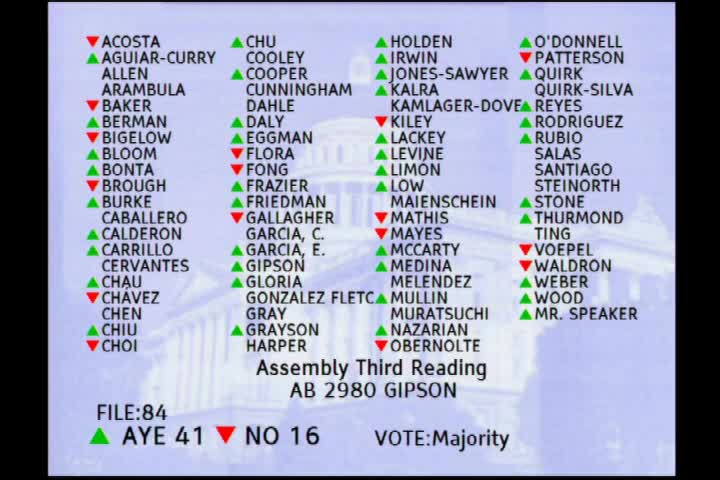
Bill Author
Bill Co-Author(s):