AB 345: Vehicular air pollution: regulations: exemption.
- Session Year: 2017-2018
- House: Assembly
- Latest Version Date: 2018-06-07
Existing law imposes various limitations on the emissions of air contaminants for the control of air pollution from vehicular and nonvehicular sources. Pursuant to that authority, the State Air Resources Board has adopted a regulation to significantly reduce emissions of particulate matter, oxides of nitrogen, and other criteria air pollutants from existing diesel trucks and buses operating in the state, commonly known as the Truck and Bus Regulation.
This bill would require the state board to exempt vehicles that do not exceed 5,000 miles annually and low-mileage agricultural vehicles, as defined, that meet certain requirements from any regulation to reduce emissions of diesel particulate matter, oxides of nitrogen, and other criteria air pollutants from in-use, diesel-fueled vehicles.
Existing law authorizes an individual to contribute amounts in excess of his or her tax liability for the support of specified funds. Under existing law, there are general administrative provisions applicable to these voluntary contributions, which, among other things, provide for the disbursement of contributions following repeal of the fund provisions and require undesignated funds to be transferred to the General Fund.Existing law also provides that when establishing these voluntary tax contribution funds the words voluntary tax contribution be included in the name of the fund, that the administering agency comply with specified Internet Web site reporting requirements, that the fund provisions remain in effect only until January 1 of the 7th calendar year following the first appearance of the voluntary tax contribution on the personal income tax return, that the required calendar year minimum contribution amount for the fund to continue appearing on the return is $250,000, and that the contributions be continuously appropriated from the fund to the administering entity.This bill, beginning in 2018, would allow an individual to designate on his or her tax return that a specified amount in excess of his or her tax liability be transferred to the Disaster Victim Assistance Voluntary Tax Contribution Fund, which would be created by this bill. The bill would conform with those aforementioned requirements by continuously appropriating those funds to the Franchise Tax Board and the Controller in connection with their duties pursuant to these provisions and to the Office of Emergency Services for distribution to specified nonprofit organizations to only assist victims of natural disasters in the United States, providing that the fund provisions remain in effect only until January 1, 2025, and repealing the provisions as of that date, unless earlier repealed because annual contributions to the fund do not equal or exceed an unadjusted $250,000 minimum contribution amount, and requiring the Office of Emergency Services to comply with those Internet Web site reporting requirements. By continuously appropriating these funds, the bill would make an appropriation.Existing law authorizes an individual to contribute amounts in excess of his or her tax liability for the support of specified funds. Under existing law, there are general administrative provisions applicable to these voluntary contributions, which, among other things, provide for the disbursement of contributions following repeal of the fund provisions and require undesignated funds to be transferred to the General Fund.
Existing law also provides that when establishing these voluntary tax contribution funds the words voluntary tax contribution be included in the name of the fund, that the administering agency comply with specified Internet Web site reporting requirements, that the fund provisions remain in effect only until January 1 of the 7th calendar year following the first appearance of the voluntary tax contribution on the personal income tax return, that the required calendar year minimum contribution amount for the fund to continue appearing on the return is $250,000, and that the contributions be continuously appropriated from the fund to the administering entity.
This bill, beginning in 2018, would allow an individual to designate on his or her tax return that a specified amount in excess of his or her tax liability be transferred to the Disaster Victim Assistance Voluntary Tax Contribution Fund, which would be created by this bill. The bill would conform with those aforementioned requirements by continuously appropriating those funds to the Franchise Tax Board and the Controller in connection with their duties pursuant to these provisions and to the Office of Emergency Services for distribution to specified nonprofit organizations to only assist victims of natural disasters in the United States, providing that the fund provisions remain in effect only until January 1, 2025, and repealing the provisions as of that date, unless earlier repealed because annual contributions to the fund do not equal or exceed an unadjusted $250,000 minimum contribution amount, and requiring the Office of Emergency Services to comply with those Internet Web site reporting requirements. By continuously appropriating these funds, the bill would make an appropriation.
(1)Existing law authorizes the legislative body of a city or county to establish a procedure to use a nuisance abatement lien or a special assessment to collect abatement costs and related administrative costs.This bill would authorize, until January 1, 2023, the legislative body of a city or county to also collect fines related to the nuisance abatement using a nuisance abatement lien or a special assessment.(2)Existing law authorizes the legislative body of a local agency to make, by ordinance, any violation of an ordinance subject to an administrative fine or penalty and limits the maximum fine or penalty amounts for infractions to $100 for the first violation, $200 for a 2nd violation of the same ordinance within one year of the first violation, and $500 for each additional violation of the same ordinance within one year of the first violation. For violations of city or county building and safety codes determined to be an infraction, existing law limits the amount of the fine to $100 for a first violation, $500 for a 2nd violation of the same ordinance within one year, and $1,000 for each additional violation of the same ordinance within one year of the first violation.The bill would, for violations of a city building and safety code determined to be an infraction, increase the amounts of the fines to $134 for a first violation, $668 for a 2nd violation of the same ordinance within one year, and $1,336 for each additional violation of the same ordinance within one year of the first violation.(1)Existing law authorizes the legislative body of a city or county to establish a procedure to use a nuisance abatement lien or a special assessment to collect abatement costs and related administrative costs.
This bill would authorize, until January 1, 2023, the legislative body of a city or county to also collect fines related to the nuisance abatement using a nuisance abatement lien or a special assessment.
(2)Existing law authorizes the legislative body of a local agency to make, by ordinance, any violation of an ordinance subject to an administrative fine or penalty and limits the maximum fine or penalty amounts for infractions to $100 for the first violation, $200 for a 2nd violation of the same ordinance within one year of the first violation, and $500 for each additional violation of the same ordinance within one year of the first violation. For violations of city or county building and safety codes determined to be an infraction, existing law limits the amount of the fine to $100 for a first violation, $500 for a 2nd violation of the same ordinance within one year, and $1,000 for each additional violation of the same ordinance within one year of the first violation.
The bill would, for violations of a city building and safety code determined to be an infraction, increase the amounts of the fines to $134 for a first violation, $668 for a 2nd violation of the same ordinance within one year, and $1,336 for each additional violation of the same ordinance within one year of the first violation.
(1)Existing law authorizes the legislative body of a city or county to establish a procedure to use a nuisance abatement lien or a special assessment to collect abatement costs and related administrative costs.
This bill would authorize, until January 1, 2023, the legislative body of a city or county to also collect fines related to the nuisance abatement using a nuisance abatement lien or a special assessment.
Existing(2)Existing law authorizes the legislative body of a local agency to make, by ordinance, any violation of an ordinance subject to an administrative fine or penalty and limits the maximum fine or penalty amounts for infractions to $100 for the first violation, $200 for a 2nd violation of the same ordinance within one year of the first violation, and $500 for each additional violation of the same ordinance within one year of the first violation. For violations of city or county building and safety codes determined to be an infraction, existing law limits the amount of the fine to $100 for a first violation, $500 for a 2nd violation of the same ordinance within one year, and $1,000 for each additional violation of the same ordinance within one year of the first violation.
The bill would, for violations of a city building and safety code determined to be an infraction, increase the amounts of the fines to $134 for a first violation, $668 for a 2nd violation of the same ordinance within one year, and $1,336 for each additional violation of the same ordinance within one year of the first violation.
Existing law authorizes the legislative body of a local agency to make, by ordinance, any violation of an ordinance subject to an administrative fine or penalty and limits the maximum fine or penalty amounts for infractions to $100 for the first violation, $200 for a 2nd violation of the same ordinance within one year of the first violation, and $500 for each additional violation of the same ordinance within one year of the first violation. For violations of city or county building and safety codes determined to be an infraction, existing law limits the amount of the fine to $100 for a first violation, $500 for a 2nd violation of the same ordinance within one year, and $1,000 for each additional violation of the same ordinance within one year of the first violation.
This bill would increase those amounts to $300 for the first violation, $500 for a 2nd violation of the same ordinance within one year of the first violation, and $1,000 for each additional violation of the same ordinance within one year of the first violation for any violation of an ordinance determined to be an infraction. The bill would, for violations of a city or county building and safety codes code determined to be an infraction, additionally increase the amounts of the fines to $500 $134 for a first violation, $750 $668 for a 2nd violation of the same ordinance within one year, and $1,500 $1,336 for each additional violation of the same ordinance within one year of the first violation.
Existing law authorizes the legislative body of a local agency to make, by ordinance, any violation of an ordinance subject to an administrative fine or penalty and limits the maximum fine or penalty amounts for infractions to $100 for the first violation, $200 for a 2nd violation of the same ordinance within one year of the first violation, and $500 for each additional violation of the same ordinance within one year of the first violation. For violations of city or county building and safety codes determined to be an infraction, existing law limits the amount of the fine to $100 for a first violation, $500 for a 2nd violation of the same ordinance within one year, and $1,000 for each additional violation of the same ordinance within one year of the first violation.
This bill would increase those amounts to $300 for the first violation, $500 for a 2nd violation of the same ordinance within one year of the first violation, and $1,000 for each additional violation of the same ordinance within one year of the first violation for any violation of an ordinance determined to be an infraction. The bill would, for violations of city or county building and safety codes determined to be an infraction, additionally increase the amounts of the fines to $500 for a first violation, $750 for a 2nd violation of the same ordinance within one year, and $1,500 for each additional violation of the same ordinance within one year of the first violation.
Existing law makes violation of a city ordinance a misdemeanor unless an ordinance makes it an infraction. Existing law prescribes limits on fines for violations. This bill would state the intent of the Legislature to subsequently amend this bill to include provisions that would increase the maximum fee local governments may fine for municipal code violations to $500 per violation and to clarify that an initial warning need not be given prior to the imposition of a fine.Existing law makes violation of a city ordinance a misdemeanor unless an ordinance makes it an infraction. Existing law prescribes limits on fines for violations.
This bill would state the intent of the Legislature to subsequently amend this bill to include provisions that would increase the maximum fee local governments may fine for municipal code violations to $500 per violation and to clarify that an initial warning need not be given prior to the imposition of a fine.
(a)As used in this section, the following definitions apply:
(1)Agricultural vehicle has the same meaning as in paragraph (6) of subdivision (m) of Section 2025 of Title 13 of the California Code of Regulations, as it read on January 1, 2017.
(2)Low-mileage agricultural vehicle means an agricultural vehicle that meets the requirements of subdivision (m) of Section 2025 of Title 13 of the California Code of Regulations, as it read on January 1, 2017.
(b)Beginning January 1, 2019, the state board shall exempt from any regulation to reduce emissions of diesel particulate matter, oxides of nitrogen, and other criteria air pollutants from in-use, diesel-fueled vehicles a vehicle that does not exceed 5,000 miles annually and has submitted to the state board the documentation required pursuant to paragraph (12) of subdivision (r) or subdivision (s) of Section 2025 of Title 13 of the California Code of Regulations, as it read on January 1, 2017.
(c)(1)Beginning January 1, 2019, and until January 1, 2023, the state board shall exempt from any regulation to reduce emissions of diesel particulate matter, oxides of nitrogen, and other criteria air pollutants from in-use, diesel-fueled vehicles a low-mileage agricultural vehicle if the owner of that vehicle has initially submitted by January 31, 2019, to the state board the documentation required pursuant to paragraph (14) of subdivision (r) or subdivision (s) of Section 2025 of Title 13 of the California Code of Regulations, as it read on January 1, 2017.
(2)The exemption provided for pursuant to paragraph (1) shall apply so long as the low-mileage agricultural vehicle satisfies the reporting requirements of paragraph (14) of subdivision (r) or subdivision (s) of Section 2025 of Title 13 of the California Code of Regulations, as it read on January 1, 2017, and meets the following:
(A)Does not exceed 15,000 miles between January 1, 2019, and January 1, 2020.
(B)Does not exceed 10,000 miles annually between January 1, 2020, and January 1, 2023.
(d)The state board shall amend any applicable regulation in effect as of January 1, 2019, to implement this section. Any rulemaking opened pursuant to this subdivision shall be limited to the purposes of this section.
SECTION 1.Article 25 (commencing with Section 18925) is added to Chapter 3 of Part 10.2 of Division 2 of the Revenue and Taxation Code, to read:25.Disaster Victim Assistance Voluntary Tax Contribution Fund18925.(a)An individual may designate on the tax return that a contribution in excess of the tax liability, if any, be made to the Disaster Victim Assistance Voluntary Tax Contribution Fund established by Section 18926. That designation is to be used as a voluntary contribution on the tax return.(b)The contributions shall be in full dollar amounts and may be made individually by each signatory on a joint return.(c)A designation made under subdivision (a) shall be made for a taxable year on the original return for that taxable year, and once made shall be irrevocable. If payments and credits reported on the return, together with any other credits associated with the individuals account, do not exceed the individuals liability, if any, the return shall be treated as though no designation has been made.(d)The Franchise Tax Board shall revise the form of the return for taxable years 2017 to 2023, inclusive, to include a space labeled the Disaster Victim Assistance Voluntary Tax Contribution Fund to allow for the designation permitted under subdivision (a). The form shall also include in the instructions information that the contribution may be in the amount of one dollar ($1) or more and that the contribution shall be used to assist victims of natural disasters in the United States.(e)A deduction shall be allowed under Article 6 (commencing with Section 17201) of Chapter 3 of Part 10 for any contribution made pursuant to subdivision (a).18926.There is hereby established in the State Treasury the Disaster Victim Assistance Voluntary Tax Contribution Fund to receive contributions made pursuant to Section 18925. The Franchise Tax Board shall notify the Controller of both the amount of money paid by individuals in excess of their tax liability and the amount of refund money that individuals have designated pursuant to Section 18925 to be transferred to the Disaster Victim Assistance Voluntary Tax Contribution Fund. The Controller shall transfer from the Personal Income Tax Fund to the Disaster Victim Assistance Voluntary Tax Contribution Fund an amount not in excess of the sum of the amounts designated by individuals pursuant to Section 18925 for payment into that fund.18927.(a)Notwithstanding Section 13340 of the Government Code, all money designated under the Disaster Victim Assistance Voluntary Tax Contribution Fund space on a tax return and transferred to the Disaster Victim Assistance Voluntary Tax Contribution Fund pursuant to Section 18926 shall be continuously appropriated and allocated as follows:(1)To the Franchise Tax Board and the Controller for reimbursement of all costs incurred by the Franchise Tax Board and the Controller in connection with their duties under this article.(2)To the Office of Emergency Services for the distribution of funds to nonprofit organizations to only assist victims of natural disasters in the United States. Any nonprofit organization receiving funds shall be in active status, and shall be exempt from federal income taxation as an organization described in Section 501(c)(3) of the Internal Revenue Code. The Office of Emergency Services shall award the funds and be responsible for overseeing the grant program.(b)For the purposes of this article, natural disaster means either of the following:(1)A federally declared disaster for purposes of Section 165 (i) of the Internal Revenue Code.(2)A gubernatorially declared state of emergency issued pursuant to Section 8625 of the Government Code.(c)In the first 12 months of awarding funds, to the extent practicable, the Office of Emergency Services shall give preference to nonprofit organizations assisting the victims of Hurricane Harvey and its aftermath.(d)A nonprofit organization shall not use grant moneys awarded pursuant to this section for its administrative costs.(e)The Office of Emergency Services shall use no more than 5 percent of moneys received pursuant to subdivision (a) for its administrative costs.(f)The Office of Emergency Services shall comply with the Internet Web site reporting requirements described in Section 18873. 18928.(a)Except as otherwise provided in subdivision (b), this article shall remain in effect only until January 1, 2025, and is repealed as of that date.(b)(1) By September 1 of the 2018 calendar year and each subsequent calendar year that the Disaster Victim Assistance Voluntary Tax Contribution Fund appears on the tax return, the Franchise Tax Board shall determine whether the amount of contributions estimated to be received during the calendar year will equal or exceed the minimum contribution amount for the calendar year pursuant to paragraph (3). The Franchise Tax Board shall estimate the amount of contributions to be received by using the actual amounts received and an estimate of the contributions that will be received by the end of that calendar year.(2)If the Franchise Tax Board determines that the amount of the contributions estimated to be received during a calendar year will not at least equal the minimum contribution amount for the calendar year, this article is inoperative with respect to taxable years beginning on or after January 1 of that calendar year, and shall be repealed on December 1 of that calendar year.(3)For purposes of this section, the minimum contribution amount for a calendar year means two hundred fifty thousand dollars ($250,000).(a)An individual may designate on the tax return that a contribution in excess of the tax liability, if any, be made to the Disaster Victim Assistance Voluntary Tax Contribution Fund established by Section 18926. That designation is to be used as a voluntary contribution on the tax return.
(b)The contributions shall be in full dollar amounts and may be made individually by each signatory on a joint return.
(c)A designation made under subdivision (a) shall be made for a taxable year on the original return for that taxable year, and once made shall be irrevocable. If payments and credits reported on the return, together with any other credits associated with the individuals account, do not exceed the individuals liability, if any, the return shall be treated as though no designation has been made.
(d)The Franchise Tax Board shall revise the form of the return for taxable years 2017 to 2023, inclusive, to include a space labeled the Disaster Victim Assistance Voluntary Tax Contribution Fund to allow for the designation permitted under subdivision (a). The form shall also include in the instructions information that the contribution may be in the amount of one dollar ($1) or more and that the contribution shall be used to assist victims of natural disasters in the United States.
(e)A deduction shall be allowed under Article 6 (commencing with Section 17201) of Chapter 3 of Part 10 for any contribution made pursuant to subdivision (a).
18926.There is hereby established in the State Treasury the Disaster Victim Assistance Voluntary Tax Contribution Fund to receive contributions made pursuant to Section 18925. The Franchise Tax Board shall notify the Controller of both the amount of money paid by individuals in excess of their tax liability and the amount of refund money that individuals have designated pursuant to Section 18925 to be transferred to the Disaster Victim Assistance Voluntary Tax Contribution Fund. The Controller shall transfer from the Personal Income Tax Fund to the Disaster Victim Assistance Voluntary Tax Contribution Fund an amount not in excess of the sum of the amounts designated by individuals pursuant to Section 18925 for payment into that fund.
18927.(a)Notwithstanding Section 13340 of the Government Code, all money designated under the Disaster Victim Assistance Voluntary Tax Contribution Fund space on a tax return and transferred to the Disaster Victim Assistance Voluntary Tax Contribution Fund pursuant to Section 18926 shall be continuously appropriated and allocated as follows:
(1)To the Franchise Tax Board and the Controller for reimbursement of all costs incurred by the Franchise Tax Board and the Controller in connection with their duties under this article.
(2)To the Office of Emergency Services for the distribution of funds to nonprofit organizations to only assist victims of natural disasters in the United States. Any nonprofit organization receiving funds shall be in active status, and shall be exempt from federal income taxation as an organization described in Section 501(c)(3) of the Internal Revenue Code. The Office of Emergency Services shall award the funds and be responsible for overseeing the grant program.
(b)For the purposes of this article, natural disaster means either of the following:
(1)A federally declared disaster for purposes of Section 165 (i) of the Internal Revenue Code.
(2)A gubernatorially declared state of emergency issued pursuant to Section 8625 of the Government Code.
(c)In the first 12 months of awarding funds, to the extent practicable, the Office of Emergency Services shall give preference to nonprofit organizations assisting the victims of Hurricane Harvey and its aftermath.
(d)A nonprofit organization shall not use grant moneys awarded pursuant to this section for its administrative costs.
(e)The Office of Emergency Services shall use no more than 5 percent of moneys received pursuant to subdivision (a) for its administrative costs.
(f)The Office of Emergency Services shall comply with the Internet Web site reporting requirements described in Section 18873.
18928.(a)Except as otherwise provided in subdivision (b), this article shall remain in effect only until January 1, 2025, and is repealed as of that date.
(b)(1) By September 1 of the 2018 calendar year and each subsequent calendar year that the Disaster Victim Assistance Voluntary Tax Contribution Fund appears on the tax return, the Franchise Tax Board shall determine whether the amount of contributions estimated to be received during the calendar year will equal or exceed the minimum contribution amount for the calendar year pursuant to paragraph (3). The Franchise Tax Board shall estimate the amount of contributions to be received by using the actual amounts received and an estimate of the contributions that will be received by the end of that calendar year.
(2)If the Franchise Tax Board determines that the amount of the contributions estimated to be received during a calendar year will not at least equal the minimum contribution amount for the calendar year, this article is inoperative with respect to taxable years beginning on or after January 1 of that calendar year, and shall be repealed on December 1 of that calendar year.
(3)For purposes of this section, the minimum contribution amount for a calendar year means two hundred fifty thousand dollars ($250,000).
All matter omitted in this version of the bill appears in the bill as amended in the Senate, July 17, 2017. (JR11)(a)The board of supervisors, by ordinance, may establish a procedure for the abatement of a nuisance. The ordinance shall, at a minimum, provide that the owner of the parcel, and anyone known to the board of supervisors to be in possession of the parcel, be given notice of the abatement proceeding and an opportunity to appear before the board of supervisors and be heard prior to the abatement of the nuisance by the county. However, nothing in this section prohibits the summary abatement of a nuisance upon order of the board of supervisors, or upon order of any other county officer authorized by law to summarily abate nuisances, if the board or officer determines that the nuisance constitutes an immediate threat to public health or safety.
(b)In any action to abate a nuisance, whether by administrative proceedings, judicial proceedings, or summary abatement, the owner of the parcel upon which the nuisance is found to exist shall be liable for all costs of abatement incurred by the county and fines related to the nuisance abatement, including, but not limited to, administrative costs, and any and all costs incurred in the physical abatement of the nuisance. Recovery of costs pursuant to this section shall be in addition to and shall not limit any prevailing partys right to recover costs pursuant to Sections 1032 and 1033.5 of the Code of Civil Procedure or any other provision of law.
(c)A county may, by ordinance, provide for the recovery of attorneys fees in any action, administrative proceeding, or special proceeding to abate a nuisance. If the ordinance provides for the recovery of attorneys fees, it shall provide for recovery of attorneys fees by the prevailing party, rather than limiting recovery of attorneys fees to the county if it prevails. The ordinance may limit recovery of attorneys fees by the prevailing party to those individual actions or proceedings in which the county elects, at the initiation of that individual action or proceeding, to seek recovery of its own attorneys fees. In no action, administrative proceeding, or special proceeding shall an award of attorneys fees to a prevailing party exceed the amount of reasonable attorneys fees incurred by the county in the action or proceeding.
(d)If the owner fails to pay the costs of the abatement upon demand by the county, the board of supervisors may order the cost of the abatement to and fines related to the nuisance abatement to be specially assessed against the parcel. The assessment may be collected at the same time and in the same manner as ordinary county taxes are collected, and shall be subject to the same penalties and the same procedure and sale in case of delinquency as are provided for ordinary county taxes. All laws applicable to the levy, collection, and enforcement of county taxes are applicable to the special assessment.
(e)If the board of supervisors specially assesses the cost of the abatement against the parcel, the board also may cause a notice of abatement lien to be recorded. The notice shall, at a minimum, identify the record owner or possessor of property, set forth the last known address of the record owner or possessor, set forth the date upon which abatement of the nuisance was ordered by the board of supervisors and the date the abatement was complete, and include a description of the real property subject to the lien and the amount of the abatement cost.
(f)However, if the board of supervisors does not cause the recordation of a notice of abatement lien pursuant to subdivision (e), and any real property to which the costs of abatement relates has been transferred or conveyed to a bona fide purchaser for value, or a lien on a bona fide encumbrancer for value has been created and attaches to that property, prior to the date on which the first installment of county taxes would become delinquent, then the cost of abatement shall not result in a lien against that real property but shall be transferred to the unsecured roll for collection.
(g)Recordation of a notice of abatement lien pursuant to subdivision (e) has the same effect as recordation of an abstract of a money judgment recorded pursuant to Article 2 (commencing with Section 697.310) of Chapter 2 of Division 2 of Title 9 of Part 2 of the Code of Civil Procedure. The lien created has the same priority as a judgment lien on real property and continues in effect until released. Upon order of the board of supervisors, or any county officer authorized by the board of supervisors to act on its behalf, an abatement lien created under this section may be released or subordinated in the same manner as a judgment lien on real property may be released or subordinated.
(h)The board of supervisors may delegate the hearing required by subdivision (a), prior to abatement of a public nuisance, to a hearing board designated by the board of supervisors. The hearing board shall make a written recommendation to the board of supervisors. The board of supervisors may adopt the recommendation without further notice of hearing, or may set the matter for a de novo hearing before the board of supervisors.
(i)The board of supervisors may, by ordinance, delegate to a hearing officer appointed pursuant to Section 27720 the powers and duties specified by this section.
(j)This section shall remain in effect only until January 1, 2023, and as of that date is repealed.
SEC. 2.Section 25845 is added to the Government Code, to read:25845.(a)The board of supervisors, by ordinance, may establish a procedure for the abatement of a nuisance. The ordinance shall, at a minimum, provide that the owner of the parcel, and anyone known to the board of supervisors to be in possession of the parcel, be given notice of the abatement proceeding and an opportunity to appear before the board of supervisors and be heard prior to the abatement of the nuisance by the county. However, nothing in this section prohibits the summary abatement of a nuisance upon order of the board of supervisors, or upon order of any other county officer authorized by law to summarily abate nuisances, if the board or officer determines that the nuisance constitutes an immediate threat to public health or safety.
(b)In any action to abate a nuisance, whether by administrative proceedings, judicial proceedings, or summary abatement, the owner of the parcel upon which the nuisance is found to exist shall be liable for all costs of abatement incurred by the county, including, but not limited to, administrative costs, and any and all costs incurred in the physical abatement of the nuisance. Recovery of costs pursuant to this section shall be in addition to and shall not limit any prevailing partys right to recover costs pursuant to Sections 1032 and 1033.5 of the Code of Civil Procedure or any other provision of law.
(c)A county may, by ordinance, provide for the recovery of attorneys fees in any action, administrative proceeding, or special proceeding to abate a nuisance. If the ordinance provides for the recovery of attorneys fees, it shall provide for recovery of attorneys fees by the prevailing party, rather than limiting recovery of attorneys fees to the county if it prevails. The ordinance may limit recovery of attorneys fees by the prevailing party to those individual actions or proceedings in which the county elects, at the initiation of that individual action or proceeding, to seek recovery of its own attorneys fees. In no action, administrative proceeding, or special proceeding shall an award of attorneys fees to a prevailing party exceed the amount of reasonable attorneys fees incurred by the county in the action or proceeding.
(d)If the owner fails to pay the costs of the abatement upon demand by the county, the board of supervisors may order the cost of the abatement to be specially assessed against the parcel. The assessment may be collected at the same time and in the same manner as ordinary county taxes are collected, and shall be subject to the same penalties and the same procedure and sale in case of delinquency as are provided for ordinary county taxes. All laws applicable to the levy, collection, and enforcement of county taxes are applicable to the special assessment.
(e)If the board of supervisors specially assesses the cost of the abatement against the parcel, the board also may cause a notice of abatement lien to be recorded. The notice shall, at a minimum, identify the record owner or possessor of property, set forth the last known address of the record owner or possessor, set forth the date upon which abatement of the nuisance was ordered by the board of supervisors and the date the abatement was complete, and include a description of the real property subject to the lien and the amount of the abatement cost.
(f)However, if the board of supervisors does not cause the recordation of a notice of abatement lien pursuant to subdivision (e), and any real property to which the costs of abatement relates has been transferred or conveyed to a bona fide purchaser for value, or a lien on a bona fide encumbrancer for value has been created and attaches to that property, prior to the date on which the first installment of county taxes would become delinquent, then the cost of abatement shall not result in a lien against that real property but shall be transferred to the unsecured roll for collection.
(g)Recordation of a notice of abatement lien pursuant to subdivision (e) has the same effect as recordation of an abstract of a money judgment recorded pursuant to Article 2 (commencing with Section 697.310) of Chapter 2 of Division 2 of Title 9 of Part 2 of the Code of Civil Procedure. The lien created has the same priority as a judgment lien on real property and continues in effect until released. Upon order of the board of supervisors, or any county officer authorized by the board of supervisors to act on its behalf, an abatement lien created under this section may be released or subordinated in the same manner as a judgment lien on real property may be released or subordinated.
(h)The board of supervisors may delegate the hearing required by subdivision (a), prior to abatement of a public nuisance, to a hearing board designated by the board of supervisors. The hearing board shall make a written recommendation to the board of supervisors. The board of supervisors may adopt the recommendation without further notice of hearing, or may set the matter for a de novo hearing before the board of supervisors.
(i)The board of supervisors may, by ordinance, delegate to a hearing officer appointed pursuant to Section 27720 the powers and duties specified by this section.
(j)This section shall become operative on January 1, 2023.
SEC. 3.Section 36900 of the Government Code is amended to read:36900.(a)Violation of a city ordinance is a misdemeanor unless by ordinance it is made an infraction. The violation of a city ordinance may be prosecuted by city authorities in the name of the people of the State of California, or redressed by civil action.
(b)Every violation determined to be an infraction is punishable by the following:
(1)A fine not exceeding one hundred dollars ($100) for a first violation.
(2)A fine not exceeding two hundred dollars ($200) for a second violation of the same ordinance within one year.
(3)A fine not exceeding five hundred dollars ($500) for each additional violation of the same ordinance within one year.
(c)Notwithstanding any other law, a violation of local building and safety codes determined to be an infraction is punishable by the following:
(1)A fine not exceeding one hundred thirty-four dollars ($134) for a first violation.
(2)A fine not exceeding six hundred sixty-eight dollars ($668) for a second violation of the same ordinance within one year.
(3)A fine not exceeding one thousand three hundred thirty-six dollars ($1,336) for each additional violation of the same ordinance within one year of the first violation.
(d)A city levying an administrative fine pursuant to subdivision (c) shall establish a process for granting a hardship waiver to reduce the amount of the fine upon a showing by the responsible party that payment of the full amount of the fine would impose an undue financial burden on the responsible party.
SEC. 4.Section 38773.1 of the Government Code is amended to read:38773.1.(a)The legislative body may by ordinance establish a procedure to collect abatement and related administrative costs and fines by a nuisance abatement lien. This ordinance shall require notice prior to the recordation of the lien to the owner of record of the parcel of land on which the nuisance is maintained, based on the last equalized assessment roll or the supplemental roll, whichever is more current.
(b)The notice shall be served in the same manner as summons in a civil action in accordance with Article 3 (commencing with Section 415.10) of Chapter 4 of Title 5 of Part 2 of the Code of Civil Procedure. If the owner of record, after diligent search cannot be found, the notice may be served by posting a copy thereof in a conspicuous place upon the property for a period of 10 days and publication thereof in a newspaper of general circulation published in the county in which the property is located pursuant to Section 6062.
(c)A nuisance abatement lien shall be recorded in the county recorders office in the county in which the parcel of land is located and from the date of recording shall have the force, effect, and priority of a judgment lien.
(1)A nuisance abatement lien authorized by this section shall specify the amount of the lien, the name of the agency on whose behalf the lien is imposed, the date of the abatement order, the street address, legal description and assessors parcel number of the parcel on which the lien is imposed, and the name and address of the recorded owner of the parcel.
(2)In the event that the lien is discharged, released, or satisfied, either through payment or foreclosure, notice of the discharge containing the information specified in paragraph (1) shall be recorded by the governmental agency. A nuisance abatement lien and the release of the lien shall be indexed in the grantor-grantee index.
(3)A nuisance abatement lien may be foreclosed by an action brought by the city for a money judgment.
(4)Notwithstanding Section 6103, Section 27383, or any other provision of law, the county recorder may impose a fee on the city to reimburse the costs of processing and recording the lien and providing notice to the property owner. A city may recover from the property owner any costs incurred regarding the processing and recording of the lien and providing notice to the property owner as part of its foreclosure action to enforce the lien.
(d)This section shall remain in effect only until January 1, 2023, and as of that date is repealed.
SEC. 5.Section 38773.1 is added to the Government Code, to read:38773.1.(a)The legislative body may by ordinance establish a procedure to collect abatement and related administrative costs by a nuisance abatement lien. This ordinance shall require notice prior to the recordation of the lien to the owner of record of the parcel of land or which the nuisance is maintained, based on the last equalized assessment roll or the supplemental roll, whichever is more current.
(b)The notice shall be served in the same manner as summons in a civil action in accordance with Article 3 (commencing with Section 415.10) of Chapter 4 of Title 5 of Part 2 of the Code of Civil Procedure. If the owner of record, after diligent search cannot be found, the notice may be served by posting a copy thereof in a conspicuous place upon the property for a period of 10 days and publication thereof in a newspaper of general circulation published in the county in which the property is located pursuant to Section 6062.
(c)A nuisance abatement lien shall be recorded in the county recorders office in the county in which the parcel of land is located and from the date of recording shall have the force, effect, and priority of a judgment lien.
(1)A nuisance abatement lien authorized by this section shall specify the amount of the lien, the name of the agency on whose behalf the lien is imposed, the date of the abatement order, the street address, legal description and assessors parcel number of the parcel on which the lien is imposed, and the name and address of the recorded owner of the parcel.
(2)In the event that the lien is discharged, released, or satisfied, either through payment or foreclosure, notice of the discharge containing the information specified in paragraph (1) shall be recorded by the governmental agency. A nuisance abatement lien and the release of the lien shall be indexed in the grantor-grantee index.
(3)A nuisance abatement lien may be foreclosed by an action brought by the city for a money judgment.
(4)Notwithstanding Section 6103, Section 27383, or any other provision of law, the county recorder may impose a fee on the city to reimburse the costs of processing and recording the lien and providing notice to the property owner. A city may recover from the property owner any costs incurred regarding the processing and recording of the lien and providing notice to the property owner as part of its foreclosure action to enforce the lien.
(d)This section shall become operative on January 1, 2023.
SEC. 6.Section 38773.5 of the Government Code is amended to read:38773.5.(a)As an alternative to the procedure authorized by Section 38773.1, the legislative body may, by ordinance, establish a procedure for the abatement of a nuisance and make the cost of abatement, including fines, a special assessment against that parcel of land on which the nuisance is maintained.
(b)A city may, by ordinance, provide for the recovery of attorneys fees in any action, administrative proceeding, or special proceeding to abate a nuisance. If the ordinance provides for the recovery of attorneys fees, it shall provide for recovery of attorneys fees by the prevailing party, rather than limiting recovery of attorneys fees to the city if it prevails. The ordinance may limit recovery of attorneys fees by the prevailing party to those individual actions or proceedings in which the city elects, at the initiation of that individual action or proceeding, to seek recovery of its own attorneys fees. In no action, administrative proceeding, or special proceeding shall an award of attorneys fees to a prevailing party exceed the amount of reasonable attorneys fees incurred by the city in the action or proceeding.
(c)Any procedure established pursuant to this section shall include notice, by certified mail, to the property owner, if the property owners identity can be determined from the county assessors or county recorders records. The notice shall be given at the time of imposing the assessment and shall specify that the property may be sold after three years by the tax collector for unpaid delinquent assessments. The tax collectors power of sale shall not be affected by the failure of the property owner to receive notice. The assessment may be collected at the same time and in the same manner as ordinary municipal taxes are collected, and shall be subject to the same penalties and the same procedure and sale in case of delinquency as provided for ordinary municipal taxes. All laws applicable to the levy, collection and enforcement of municipal taxes shall be applicable to the special assessment. However, if any real property to which the cost of abatement relates has been transferred or conveyed to a bona fide purchaser for value, or if a lien of a bona fide encumbrancer for value has been created and attaches thereon, prior to the date on which the first installment of the taxes would become delinquent, then the cost of abatement shall not result in a lien against the real property but instead shall be transferred to the unsecured roll for collection.
(d)A local agency that has imposed an assessment pursuant to this section may, subject to the requirements applicable to the sale of property pursuant to Section 3691 of the Revenue and Taxation Code, conduct a sale of vacant residential developed property for which the payment of that assessment is delinquent.
(e)Notices or instruments relating to the abatement proceeding or special assessment shall be entitled to recordation.
(f)This section shall remain in effect only until January 1, 2023, and as of that date is repealed.
SEC. 7.Section 38773.5 is added to the Government Code, to read:38773.5.(a)As an alternative to the procedure authorized by Section 38773.1, the legislative body may by ordinance establish a procedure for the abatement of a nuisance and make the cost of abatement of a nuisance upon a parcel of land a special assessment against that parcel.
(b)A city may, by ordinance, provide for the recovery of attorneys fees in any action, administrative proceeding, or special proceeding to abate a nuisance. If the ordinance provides for the recovery of attorneys fees, it shall provide for recovery of attorneys fees by the prevailing party, rather than limiting recovery of attorneys fees to the city if it prevails. The ordinance may limit recovery of attorneys fees by the prevailing party to those individual actions or proceedings in which the city elects, at the initiation of that individual action or proceeding, to seek recovery of its own attorneys fees. In no action, administrative proceeding, or special proceeding shall an award of attorneys fees to a prevailing party exceed the amount of reasonable attorneys fees incurred by the city in the action or proceeding.
(c)Any procedure established pursuant to this section shall include notice, by certified mail, to the property owner, if the property owners identity can be determined from the county assessors or county recorders records. The notice shall be given at the time of imposing the assessment and shall specify that the property may be sold after three years by the tax collector for unpaid delinquent assessments. The tax collectors power of sale shall not be affected by the failure of the property owner to receive notice. The assessment may be collected at the same time and in the same manner as ordinary municipal taxes are collected, and shall be subject to the same penalties and the same procedure and sale in case of delinquency as provided for ordinary municipal taxes. All laws applicable to the levy, collection and enforcement of municipal taxes shall be applicable to the special assessment. However, if any real property to which the cost of abatement relates has been transferred or conveyed to a bona fide purchaser for value, or if a lien of a bona fide encumbrancer for value has been created and attaches thereon, prior to the date on which the first installment of the taxes would become delinquent, then the cost of abatement shall not result in a lien against the real property but instead shall be transferred to the unsecured roll for collection.
(d)A local agency that has imposed an assessment pursuant to this section may, subject to the requirements applicable to the sale of property pursuant to Section 3691 of the Revenue and Taxation Code, conduct a sale of vacant residential developed property for which the payment of that assessment is delinquent.
(e)Notices or instruments relating to the abatement proceeding or special assessment shall be entitled to recordation.
(f)This section shall become operative on January 1, 2023.
(a)The board of supervisors, by ordinance, may establish a procedure for the abatement of a nuisance. The ordinance shall, at a minimum, provide that the owner of the parcel, and anyone known to the board of supervisors to be in possession of the parcel, be given notice of the abatement proceeding and an opportunity to appear before the board of supervisors and be heard prior to the abatement of the nuisance by the county. However, nothing in this section prohibits the summary abatement of a nuisance upon order of the board of supervisors, or upon order of any other county officer authorized by law to summarily abate nuisances, if the board or officer determines that the nuisance constitutes an immediate threat to public health or safety.
(b)In any action to abate a nuisance, whether by administrative proceedings, judicial proceedings, or summary abatement, the owner of the parcel upon which the nuisance is found to exist shall be liable for all costs of abatement incurred by the county, county and fines related to the nuisance abatement, including, but not limited to, administrative costs, and any and all costs incurred in the physical abatement of the nuisance. Recovery of costs pursuant to this section shall be in addition to and shall not limit any prevailing partys right to recover costs pursuant to Sections 1032 and 1033.5 of the Code of Civil Procedure or any other provision of law.
(c)A county may, by ordinance, provide for the recovery of attorneys attorneys fees in any action, administrative proceeding, or special proceeding to abate a nuisance. If the ordinance provides for the recovery of attorneys attorneys fees, it shall provide for recovery of attorneys attorneys fees by the prevailing party, rather than limiting recovery of attorneys attorneys fees to the county if it prevails. The ordinance may limit recovery of attorneys attorneys fees by the prevailing party to those individual actions or proceedings in which the county elects, at the initiation of that individual action or proceeding, to seek recovery of its own attorneys attorneys fees. In no action, administrative proceeding, or special proceeding shall an award of attorneys attorneys fees to a prevailing party exceed the amount of reasonable attorneys attorneys fees incurred by the county in the action or proceeding.
(d)If the owner fails to pay the costs of the abatement upon demand by the county, the board of supervisors may order the cost of the abatement to and fines related to the nuisance abatement to be specially assessed against the parcel. The assessment may be collected at the same time and in the same manner as ordinary county taxes are collected, and shall be subject to the same penalties and the same procedure and sale in case of delinquency as are provided for ordinary county taxes. All laws applicable to the levy, collection, and enforcement of county taxes are applicable to the special assessment.
(e)If the board of supervisors specially assesses the cost of the abatement against the parcel, the board also may cause a notice of abatement lien to be recorded. The notice shall, at a minimum, identify the record owner or possessor of property, set forth the last known address of the record owner or possessor, set forth the date upon which abatement of the nuisance was ordered by the board of supervisors and the date the abatement was complete, and include a description of the real property subject to the lien and the amount of the abatement cost.
(f)However, if the board of supervisors does not cause the recordation of a notice of abatement lien pursuant to subdivision (e), and any real property to which the costs of abatement relates has been transferred or conveyed to a bona fide purchaser for value, or a lien on a bona fide encumbrancer for value has been created and attaches to that property, prior to the date on which the first installment of county taxes would become delinquent, then the cost of abatement shall not result in a lien against that real property but shall be transferred to the unsecured roll for collection.
(g)Recordation of a notice of abatement lien pursuant to subdivision (e) has the same effect as recordation of an abstract of a money judgment recorded pursuant to Article 2 (commencing with Section 697.310) of Chapter 2 of Division 2 of Title 9 of Part 2 of the Code of Civil Procedure. The lien created has the same priority as a judgment lien on real property and continues in effect until released. Upon order of the board of supervisors, or any county officer authorized by the board of supervisors to act on its behalf, an abatement lien created under this section may be released or subordinated in the same manner as a judgment lien on real property may be released or subordinated.
(h)The board of supervisors may delegate the hearing required by subdivision (a), prior to abatement of a public nuisance, to a hearing board designated by the board of supervisors. The hearing board shall make a written recommendation to the board of supervisors. The board of supervisors may adopt the recommendation without further notice of hearing, or may set the matter for a de novo hearing before the board of supervisors.
(i)The board of supervisors may, by ordinance, delegate to a hearing officer appointed pursuant to Section 27720 the powers and duties specified by this section.
(j)This section shall remain in effect only until January 1, 2023, and as of that date is repealed.
SEC. 2.Section 25845 is added to the Government Code, to read:25845.(a)The board of supervisors, by ordinance, may establish a procedure for the abatement of a nuisance. The ordinance shall, at a minimum, provide that the owner of the parcel, and anyone known to the board of supervisors to be in possession of the parcel, be given notice of the abatement proceeding and an opportunity to appear before the board of supervisors and be heard prior to the abatement of the nuisance by the county. However, nothing in this section prohibits the summary abatement of a nuisance upon order of the board of supervisors, or upon order of any other county officer authorized by law to summarily abate nuisances, if the board or officer determines that the nuisance constitutes an immediate threat to public health or safety.
(b)In any action to abate a nuisance, whether by administrative proceedings, judicial proceedings, or summary abatement, the owner of the parcel upon which the nuisance is found to exist shall be liable for all costs of abatement incurred by the county, including, but not limited to, administrative costs, and any and all costs incurred in the physical abatement of the nuisance. Recovery of costs pursuant to this section shall be in addition to and shall not limit any prevailing partys right to recover costs pursuant to Sections 1032 and 1033.5 of the Code of Civil Procedure or any other provision of law.
(c)A county may, by ordinance, provide for the recovery of attorneys fees in any action, administrative proceeding, or special proceeding to abate a nuisance. If the ordinance provides for the recovery of attorneys fees, it shall provide for recovery of attorneys fees by the prevailing party, rather than limiting recovery of attorneys fees to the county if it prevails. The ordinance may limit recovery of attorneys fees by the prevailing party to those individual actions or proceedings in which the county elects, at the initiation of that individual action or proceeding, to seek recovery of its own attorneys fees. In no action, administrative proceeding, or special proceeding shall an award of attorneys fees to a prevailing party exceed the amount of reasonable attorneys fees incurred by the county in the action or proceeding.
(d)If the owner fails to pay the costs of the abatement upon demand by the county, the board of supervisors may order the cost of the abatement to be specially assessed against the parcel. The assessment may be collected at the same time and in the same manner as ordinary county taxes are collected, and shall be subject to the same penalties and the same procedure and sale in case of delinquency as are provided for ordinary county taxes. All laws applicable to the levy, collection, and enforcement of county taxes are applicable to the special assessment.
(e)If the board of supervisors specially assesses the cost of the abatement against the parcel, the board also may cause a notice of abatement lien to be recorded. The notice shall, at a minimum, identify the record owner or possessor of property, set forth the last known address of the record owner or possessor, set forth the date upon which abatement of the nuisance was ordered by the board of supervisors and the date the abatement was complete, and include a description of the real property subject to the lien and the amount of the abatement cost.
(f)However, if the board of supervisors does not cause the recordation of a notice of abatement lien pursuant to subdivision (e), and any real property to which the costs of abatement relates has been transferred or conveyed to a bona fide purchaser for value, or a lien on a bona fide encumbrancer for value has been created and attaches to that property, prior to the date on which the first installment of county taxes would become delinquent, then the cost of abatement shall not result in a lien against that real property but shall be transferred to the unsecured roll for collection.
(g)Recordation of a notice of abatement lien pursuant to subdivision (e) has the same effect as recordation of an abstract of a money judgment recorded pursuant to Article 2 (commencing with Section 697.310) of Chapter 2 of Division 2 of Title 9 of Part 2 of the Code of Civil Procedure. The lien created has the same priority as a judgment lien on real property and continues in effect until released. Upon order of the board of supervisors, or any county officer authorized by the board of supervisors to act on its behalf, an abatement lien created under this section may be released or subordinated in the same manner as a judgment lien on real property may be released or subordinated.
(h)The board of supervisors may delegate the hearing required by subdivision (a), prior to abatement of a public nuisance, to a hearing board designated by the board of supervisors. The hearing board shall make a written recommendation to the board of supervisors. The board of supervisors may adopt the recommendation without further notice of hearing, or may set the matter for a de novo hearing before the board of supervisors.
(i)The board of supervisors may, by ordinance, delegate to a hearing officer appointed pursuant to Section 27720 the powers and duties specified by this section.
(j)This section shall become operative on January 1, 2023.
SECTION 1.SEC. 3.Section 36900 of the Government Code is amended to read:36900.(a)Violation of a city ordinance is a misdemeanor unless by ordinance it is made an infraction. The violation of a city ordinance may be prosecuted by city authorities in the name of the people of the State of California, or redressed by civil action.
(b)Every violation determined to be an infraction is punishable by the following:
(1)A fine not exceeding one hundred dollars ($100) for a first violation.
(2)A fine not exceeding two hundred dollars ($200) for a second violation of the same ordinance within one year.
(3)A fine not exceeding five hundred dollars ($500) for each additional violation of the same ordinance within one year.
(c)Notwithstanding any other law, a violation of local building and safety codes determined to be an infraction is punishable by the following:
(1)A fine not exceeding one hundred thirty-four dollars ($134) for a first violation.
(2)A fine not exceeding six hundred sixty-eight dollars ($668) for a second violation of the same ordinance within one year.
(3)A fine not exceeding one thousand three hundred thirty-six dollars ($1,336) for each additional violation of the same ordinance within one year of the first violation.
SEC. 4.Section 38773.1 of the Government Code is amended to read:38773.1.(a)The legislative body may by ordinance establish a procedure to collect abatement and related administrative costs and fines by a nuisance abatement lien. This ordinance shall require notice prior to the recordation of the lien to the owner of record of the parcel of land or on which the nuisance is maintained, based on the last equalized assessment roll or the supplemental roll, whichever is more current.
(b)The notice shall be served in the same manner as summons in a civil action in accordance with Article 3 (commencing with Section 415.10) of Chapter 4 of Title 5 of Part 2 of the Code of Civil Procedure. If the owner of record, after diligent search cannot be found, the notice may be served by posting a copy thereof in a conspicuous place upon the property for a period of 10 days and publication thereof in a newspaper of general circulation published in the county in which the property is located pursuant to Section 6062.
(c)A nuisance abatement lien shall be recorded in the county recorders office in the county in which the parcel of land is located and from the date of recording shall have the force, effect, and priority of a judgment lien.
(1)A nuisance abatement lien authorized by this section shall specify the amount of the lien, the name of the agency on whose behalf the lien is imposed, the date of the abatement order, the street address, legal description and assessors parcel number of the parcel on which the lien is imposed, and the name and address of the recorded owner of the parcel.
(2)In the event that the lien is discharged, released, or satisfied, either through payment or foreclosure, notice of the discharge containing the information specified in paragraph (1) shall be recorded by the governmental agency. A nuisance abatement lien and the release of the lien shall be indexed in the grantor-grantee index.
(3)A nuisance abatement lien may be foreclosed by an action brought by the city for a money judgment.
(4)Notwithstanding Section 6103, Section 27383, or any other provision of law, the county recorder may impose a fee on the city to reimburse the costs of processing and recording the lien and providing notice to the property owner. A city may recover from the property owner any costs incurred regarding the processing and recording of the lien and providing notice to the property owner as part of its foreclosure action to enforce the lien.
(d)This section shall remain in effect only until January 1, 2023, and as of that date is repealed.
SEC. 5.Section 38773.1 is added to the Government Code, to read:38773.1.(a)The legislative body may by ordinance establish a procedure to collect abatement and related administrative costs by a nuisance abatement lien. This ordinance shall require notice prior to the recordation of the lien to the owner of record of the parcel of land or which the nuisance is maintained, based on the last equalized assessment roll or the supplemental roll, whichever is more current.
(b)The notice shall be served in the same manner as summons in a civil action in accordance with Article 3 (commencing with Section 415.10) of Chapter 4 of Title 5 of Part 2 of the Code of Civil Procedure. If the owner of record, after diligent search cannot be found, the notice may be served by posting a copy thereof in a conspicuous place upon the property for a period of 10 days and publication thereof in a newspaper of general circulation published in the county in which the property is located pursuant to Section 6062.
(c)A nuisance abatement lien shall be recorded in the county recorders office in the county in which the parcel of land is located and from the date of recording shall have the force, effect, and priority of a judgment lien.
(1)A nuisance abatement lien authorized by this section shall specify the amount of the lien, the name of the agency on whose behalf the lien is imposed, the date of the abatement order, the street address, legal description and assessors parcel number of the parcel on which the lien is imposed, and the name and address of the recorded owner of the parcel.
(2)In the event that the lien is discharged, released, or satisfied, either through payment or foreclosure, notice of the discharge containing the information specified in paragraph (1) shall be recorded by the governmental agency. A nuisance abatement lien and the release of the lien shall be indexed in the grantor-grantee index.
(3)A nuisance abatement lien may be foreclosed by an action brought by the city for a money judgment.
(4)Notwithstanding Section 6103, Section 27383, or any other provision of law, the county recorder may impose a fee on the city to reimburse the costs of processing and recording the lien and providing notice to the property owner. A city may recover from the property owner any costs incurred regarding the processing and recording of the lien and providing notice to the property owner as part of its foreclosure action to enforce the lien.
(d)This section shall become operative on January 1, 2023.
SEC. 6.Section 38773.5 of the Government Code is amended to read:38773.5.(a)As an alternative to the procedure authorized by Section 38773.1, the legislative body may may, by ordinance ordinance, establish a procedure for the abatement of a nuisance and make the cost of abatement of a nuisance upon a parcel of land a special assessment against that parcel. abatement, including fines, a special assessment against that parcel of land on which the nuisance is maintained.
(b)A city may, by ordinance, provide for the recovery of attorneys fees in any action, administrative proceeding, or special proceeding to abate a nuisance. If the ordinance provides for the recovery of attorneys fees, it shall provide for recovery of attorneys fees by the prevailing party, rather than limiting recovery of attorneys fees to the city if it prevails. The ordinance may limit recovery of attorneys fees by the prevailing party to those individual actions or proceedings in which the city elects, at the initiation of that individual action or proceeding, to seek recovery of its own attorneys fees. In no action, administrative proceeding, or special proceeding shall an award of attorneys fees to a prevailing party exceed the amount of reasonable attorneys fees incurred by the city in the action or proceeding.
(c)Any procedure established pursuant to this section shall include notice, by certified mail, to the property owner, if the property owners identity can be determined from the county assessors or county recorders records. The notice shall be given at the time of imposing the assessment and shall specify that the property may be sold after three years by the tax collector for unpaid delinquent assessments. The tax collectors power of sale shall not be affected by the failure of the property owner to receive notice. The assessment may be collected at the same time and in the same manner as ordinary municipal taxes are collected, and shall be subject to the same penalties and the same procedure and sale in case of delinquency as provided for ordinary municipal taxes. All laws applicable to the levy, collection and enforcement of municipal taxes shall be applicable to the special assessment. However, if any real property to which the cost of abatement relates has been transferred or conveyed to a bona fide purchaser for value, or if a lien of a bona fide encumbrancer for value has been created and attaches thereon, prior to the date on which the first installment of the taxes would become delinquent, then the cost of abatement shall not result in a lien against the real property but instead shall be transferred to the unsecured roll for collection.
(d)A local agency that has imposed an assessment pursuant to this section may, subject to the requirements applicable to the sale of property pursuant to Section 3691 of the Revenue and Taxation Code, conduct a sale of vacant residential developed property for which the payment of that assessment is delinquent.
(e)Notices or instruments relating to the abatement proceeding or special assessment shall be entitled to recordation.
(f)This section shall remain in effect only until January 1, 2023, and as of that date is repealed.
SEC. 7.Section 38773.5 is added to the Government Code, to read:38773.5.(a)As an alternative to the procedure authorized by Section 38773.1, the legislative body may by ordinance establish a procedure for the abatement of a nuisance and make the cost of abatement of a nuisance upon a parcel of land a special assessment against that parcel.
(b)A city may, by ordinance, provide for the recovery of attorneys fees in any action, administrative proceeding, or special proceeding to abate a nuisance. If the ordinance provides for the recovery of attorneys fees, it shall provide for recovery of attorneys fees by the prevailing party, rather than limiting recovery of attorneys fees to the city if it prevails. The ordinance may limit recovery of attorneys fees by the prevailing party to those individual actions or proceedings in which the city elects, at the initiation of that individual action or proceeding, to seek recovery of its own attorneys fees. In no action, administrative proceeding, or special proceeding shall an award of attorneys fees to a prevailing party exceed the amount of reasonable attorneys fees incurred by the city in the action or proceeding.
(c)Any procedure established pursuant to this section shall include notice, by certified mail, to the property owner, if the property owners identity can be determined from the county assessors or county recorders records. The notice shall be given at the time of imposing the assessment and shall specify that the property may be sold after three years by the tax collector for unpaid delinquent assessments. The tax collectors power of sale shall not be affected by the failure of the property owner to receive notice. The assessment may be collected at the same time and in the same manner as ordinary municipal taxes are collected, and shall be subject to the same penalties and the same procedure and sale in case of delinquency as provided for ordinary municipal taxes. All laws applicable to the levy, collection and enforcement of municipal taxes shall be applicable to the special assessment. However, if any real property to which the cost of abatement relates has been transferred or conveyed to a bona fide purchaser for value, or if a lien of a bona fide encumbrancer for value has been created and attaches thereon, prior to the date on which the first installment of the taxes would become delinquent, then the cost of abatement shall not result in a lien against the real property but instead shall be transferred to the unsecured roll for collection.
(d)A local agency that has imposed an assessment pursuant to this section may, subject to the requirements applicable to the sale of property pursuant to Section 3691 of the Revenue and Taxation Code, conduct a sale of vacant residential developed property for which the payment of that assessment is delinquent.
(e)Notices or instruments relating to the abatement proceeding or special assessment shall be entitled to recordation.
(f)This section shall become operative on January 1, 2023.
(a)Violation of a city ordinance is a misdemeanor unless by ordinance it is made an infraction. The violation of a city ordinance may be prosecuted by city authorities in the name of the people of the State of California, or redressed by civil action.
(b)Every violation determined to be an infraction is punishable by the following:
(1)A fine not exceeding three hundred dollars ($300) one hundred dollars ($100) for a first violation.
(2)A fine not exceeding five hundred dollars ($500) two hundred dollars ($200) for a second violation of the same ordinance within one year.
(3)A fine not exceeding one thousand dollars ($1,000) five hundred dollars ($500) for each additional violation of the same ordinance within one year.
(c)Notwithstanding any other provision of law, a violation of local building and safety codes determined to be an infraction is punishable by the following:
(1)A fine not exceeding five hundred dollars ($500) one hundred thirty-four dollars ($134) for a first violation.
(2)A fine not exceeding seven hundred fifty dollars ($750) six hundred sixty-eight dollars ($668) for a second violation of the same ordinance within one year.
(3)A fine not exceeding one thousand five hundred dollars ($1,500) three hundred thirty-six dollars ($1,336) for each additional violation of the same ordinance within one year of the first violation.
(a)Violation of a county ordinance is a misdemeanor unless by ordinance it is made an infraction. The violation of a county ordinance may be prosecuted by county authorities in the name of the people of the State of California, or redressed by civil action.
(b)Every violation determined to be an infraction is punishable by (1) a the following:
(1)A fine not exceeding one three hundred dollars ($100) ($300) for a first violation; (2) a violation.
(2)A fine not exceeding two five hundred dollars ($200) ($500) for a second violation of the same ordinance within one year; (3) a year.
(3)A fine not exceeding five hundred one thousand dollars ($500) ($1,000) for each additional violation of the same ordinance within one year.
(c)Notwithstanding any other provision of law, a violation of local building and safety codes determined to be an infraction is punishable by (1) a the following:
(1)A fine not exceeding one five hundred dollars ($100) ($500) for a first violation; (2) a violation.
(2)A fine not exceeding five hundred dollars ($500) seven hundred fifty dollars ($750) for a second violation of the same ordinance within one year; (3) a year.
(3)A fine not exceeding one thousand five hundred dollars ($1,000) ($1,500) for each additional violation of the same ordinance within one year of the first violation.
SEC. 2.Section 36900 of the Government Code is amended to read:36900.(a)Violation of a city ordinance is a misdemeanor unless by ordinance it is made an infraction. The violation of a city ordinance may be prosecuted by city authorities in the name of the people of the State of California, or redressed by civil action.
(b)Every violation determined to be an infraction is punishable by (1) a the following:
(1)A fine not exceeding one three hundred dollars ($100) ($300) for a first violation; (2) a violation.
(2)A fine not exceeding two five hundred dollars ($200) ($500) for a second violation of the same ordinance within one year; (3) a year.
(3)A fine not exceeding five hundred one thousand dollars ($500) ($1,000) for each additional violation of the same ordinance within one year.
(c)Notwithstanding any other provision of law, a violation of local building and safety codes determined to be an infraction is punishable by (1) a the following:
(1)A fine not exceeding one five hundred dollars ($100) ($500) for a first violation; (2) a violation.
(2)A fine not exceeding five hundred dollars ($500) seven hundred fifty dollars ($750) for a second violation of the same ordinance within one year; (3) a year.
(3)A fine not exceeding one thousand five hundred dollars ($1,000) ($1,500) for each additional violation of the same ordinance within one year of the first violation.
SECTION 1.It is the intent of the Legislature to subsequently amend this measure to include provisions that would increase the maximum fee local governments may fine for municipal code violations to five hundred dollars ($500) per violation and to clarify that an initial warning need not be given prior to the imposition of a fine.It is the intent of the Legislature to subsequently amend this measure to include provisions that would increase the maximum fee local governments may fine for municipal code violations to five hundred dollars ($500) per violation and to clarify that an initial warning need not be given prior to the imposition of a fine.
|
Date
|
Status
|
|---|---|
| Jun 20, 2018 | In committee: Set, first hearing. Failed passage. Reconsideration granted. |
| Jun 13, 2018 | Re-referred to Coms. on EQ. and T. & H. |
| Jun 7, 2018 | From committee chair, with author's amendments: Amend, and re-refer to committee. Read second time, amended, and re-referred to Com. on RLS. |
| Sep 11, 2017 | Re-referred to Com. on RLS. pursuant to Senate Rule 29.10(c). |
| Sep 11, 2017 | Read second time. Ordered to third reading. |
| Sep 8, 2017 | Read third time and amended. Ordered to second reading. |
| Jul 17, 2017 | Read second time and amended. Ordered to third reading. |
| Jul 13, 2017 | From committee: Amend, and do pass as amended. (Ayes 5. Noes 1.) (July 12). |
| Jul 5, 2017 | From committee chair, with author's amendments: Amend, and re-refer to committee. Read second time, amended, and re-referred to Com. on GOV. & F. |
| Jun 20, 2017 | In committee: Set, first hearing. Hearing canceled at the request of author. |
| Jun 14, 2017 | Referred to Com. on GOV. & F. |
| Jun 5, 2017 | In Senate. Read first time. To Com. on RLS. for assignment. |
| Jun 1, 2017 | Read third time. Passed. Ordered to the Senate. (Ayes 47. Noes 29. Page 2041.) |
| May 17, 2017 | Read second time. Ordered to third reading. |
| May 16, 2017 | Read second time and amended. Ordered returned to second reading. |
| May 15, 2017 | From committee: Amend, and do pass as amended. (Ayes 5. Noes 3.) (May 10). |
| Mar 22, 2017 | Re-referred to Com. on L. GOV. |
| Mar 21, 2017 | From committee chair, with author's amendments: Amend, and re-refer to Com. on L. GOV. Read second time and amended. |
| Mar 20, 2017 | Referred to Com. on L. GOV. |
| Feb 9, 2017 | From printer. May be heard in committee March 11. |
| Feb 8, 2017 | Read first time. To print. |
|
Date
|
Description
|
Location
|
Votes
|
|
|---|---|---|---|---|
| Jun 20, 2018 | [06-21-2018] hearing: Motion to Reconsider. [Reconsideration Granted.] | Senate Standing Committee on Environmental Quality |
Passed |
|
| Jun 20, 2018 | Do pass, but first be re-referred to the Committee on [Transportation and Housing] | Senate Standing Committee on Environmental Quality |
Passed |
|
| Jul 12, 2017 | Do pass as amended | Senate Standing Committee on Governance and Finance |
Passed |
|
| Jun 1, 2017 | AB 345 RIDLEY-THOMAS Assembly Third Reading | Assembly Floor |
Passed |
|
| May 10, 2017 | Do pass as amended. | Assembly Standing Committee on Local Government |
Passed |
This list shows positions taken on this bill by organizations on the date displayed, which is linked to the original source.
Positions by individuals are not included.
|
Organization
|
Position
|
Date
|
|---|---|---|
| African American Farmers of California | ** Support | Jun 18, 2018 |
| Agricultural Council Of California | ** Support | Jun 18, 2018 |
| Almond Alliance of California | ** Support | Jun 18, 2018 |
| American Civil Liberties Union of California | ** Against | May 9, 2017 |
| American Lung Association in California | ** Against | Jun 18, 2018 |
| American Pistachio Growers | ** Support | Jun 18, 2018 |
| Arguments In Opposition: | ** Against | Jun 18, 2018 |
| Asian Pacific Environmental Network | ** Against | Jun 18, 2018 |
| Association Of California Egg Farmers | ** Support | Jun 18, 2018 |
| Bay Area Air Quality Management District | ** Against | Jun 18, 2018 |
| California Agricultural Aircraft Association | ** Support | Jun 18, 2018 |
| California Association Of Code Enforcement Officers | * Support | Jul 12, 2017 |
| California Bean Shippers Association | ** Support | Jun 18, 2018 |
| California Bicycle Coalition | ** Against | Jun 18, 2018 |
| California Cattlemen'S Association | ** Support | Jun 18, 2018 |
| California Citrus Mutual | ** Support | Jun 18, 2018 |
| California Cotton Ginners and Growers Association | ** Support | Jun 18, 2018 |
| california dairies inc. | ** Support | Jun 18, 2018 |
| California Environmental Justice Alliance | ** Against | Jun 18, 2018 |
| California Fresh Fruit Association | ** Support | Jun 18, 2018 |
| California Grain and Feed Association | ** Support | Jun 18, 2018 |
| California Pear Growers Association | ** Support | Jun 18, 2018 |
| California Poultry Federation | ** Support | Jun 18, 2018 |
| California Rice Commission | ** Support | Jun 18, 2018 |
| California Seed Association | ** Support | Jun 18, 2018 |
| California State Floral Association | ** Support | Jun 18, 2018 |
| California Strawberry Commission | ** Support | Jun 18, 2018 |
| California Tomato Growers Association | ** Support | Jun 18, 2018 |
| Catholic Charities, Diocese of Stockton | ** Against | Jun 18, 2018 |
| Center on Race, Poverty & the Environment | ** Against | Jun 18, 2018 |
| Central California Asthma Collaborative | ** Against | Jun 18, 2018 |
| Central Valley Air Quality Coalition | ** Against | Jun 18, 2018 |
| Coalition For Clean Air | ** Against | Jun 18, 2018 |
| Earthjustice | ** Against | Jun 18, 2018 |
| Leadership Counsel for Justice and Accountability | ** Against | Jun 18, 2018 |
| League Of California Cities | ** Support | Jul 19, 2017 |
| Natural Resources Defense Council | ** Against | Jun 18, 2018 |
| Nisei Farmers League | ** Support | Jun 18, 2018 |
| Regional Asthma Management and Prevention | ** Against | Jun 18, 2018 |
| Sierra Club California | ** Against | Jun 18, 2018 |
| The Western Center on Law and Poverty | * Neutral | Jul 12, 2017 |
| Union Of Concerned Scientists | ** Against | Jun 18, 2018 |
| Unknown. | ** Against | Jul 7, 2017 |
| Valley Climate | ** Against | Jun 18, 2018 |
| Western Agricultural Processors Association | ** Support | Jun 18, 2018 |
| Western Growers | ** Support | Jun 18, 2018 |
| Western Plant Health Association | ** Support | Jun 18, 2018 |
| Western United Dairymen | ** Support | Jun 18, 2018 |
SENATE COMMITTEE ON ENVIRONMENTAL QUALITY
Senator Wieckowski, Chair
2017 - 2018 Regular
Bill No: AB 345
Author: | Caballero and Aguiar-Curry | ||
Version: | 6/7/2018 | Hearing Date: | 6/20/2018 |
Urgency: | No | Fiscal: | Yes |
Consultant: | David Ernest García | ||
SUBJECT: Vehicular air pollution: regulations: exemption
ANALYSIS:
Existing law:
- Establishes the Air Resources Board (ARB) as the air pollution control agency in California and requires ARB, among other things, to control emissions from a wide array of mobile sources and coordinate, encourage, and review the efforts of all levels of government as they affect air quality. (Health and Safety Code (HSC) §39500 et seq.)
- Requires the ARB to promulgate and enforce rules and regulations necessary for the proper execution of its statutory mandates. (HSC §39601 et seq.)
- Establishes Section 2025 of Title 13 of the California Code of Regulations (Truck and Bus Regulation) that requires lower-emitting oxides of nitrogen engines and diesel particulate matter filters for nearly every heavy-duty vehicle operated in California.
This bill:
- Defines:
- “Agricultural vehicle” to have the same meaning as in paragraph (6) of subdivision (m) of Section 2025 of Title 13 of the California Code of Regulations, as it read on January 1, 2017.
- “Low-mileage agricultural vehicle” to mean an agricultural vehicle that meets the requirements of subdivision (m) of Section 2025 of Title 13 of the California Code of Regulations, as it read on January 1, 2017.
- “Agricultural vehicle” to have the same meaning as in paragraph (6) of subdivision (m) of Section 2025 of Title 13 of the California Code of Regulations, as it read on January 1, 2017.
- Requires, beginning January 1, 2019, ARB to exempt from regulations a vehicle that does not exceed 5,000 miles annually and has submitted to ARB the documentation required pursuant to paragraph (12) of subdivision (r) or subdivision (s) of the Truck and Bus Regulation, as it read on January 1, 2017.
- Requires, beginning January 1, 2019 and until January 1, 2023, ARB to exempt from regulations a low-mileage agricultural vehicle if the owner of that vehicle has initially submitted by January 31, 2019, to ARB the documentation required pursuant to paragraph (14) of subdivision (r) or subdivision (s) of the Truck and Bus Regulation, as it read on January 1, 2017.
- Requires the exemption for low-mileage agricultural vehicle to apply only when:
- The low-mileage agricultural vehicle satisfies the reporting requirements of paragraph (14) of subdivision (r) or subdivision (s) of the Truck and Bus Regulation, as it read on January 1, 2017.
- The low-mileage agricultural vehicle does not exceed 15,000 miles between January 1, 2019, and January 1, 2020.
- The low-mileage agricultural vehicle does not exceed 10,000 miles annually between January 1, 2020, and January 1, 2023.
- The low-mileage agricultural vehicle satisfies the reporting requirements of paragraph (14) of subdivision (r) or subdivision (s) of the Truck and Bus Regulation, as it read on January 1, 2017.
- Requires ARB to amend any applicable regulation in effect as of January 1, 2019 to be consistent with this legislation and requires such rulemakings to be limited to the contents of this legislation.
Background
- Air quality standards. In 1969 and 1971, ARB set the first air quality standards for ozone, Particulate Matter (PM), oxides of nitrogen (NOx), oxides of sulfur (SOx), and carbon monoxide due to their negative impacts on public health above specified concentrations.
The federal government followed suit and set National Ambient Air Quality Standards (NAAQS) for six “criteria pollutants.” These included ground-level ozone, PM, NOx, SOx, carbon monoxide, and added lead. Now, the US EPA reviews each NAAQS at five-year intervals to ensure that the standards are based on the most recent scientific information.
Regions that do not meet the national standards for any one of the standards are designated as “nonattainment areas.” - Truck and Bus Regulation. The “Truck and Bus Regulation” (Section 2025 of Title 13 of the California Code of Regulations), adopted in 2009, aims to reduce air toxics (diesel PM) and other criteria pollutants by ensuring that nearly every heavy-duty vehicle operated in California meets 2010 heavy-duty engine emission standards by 2023. PM filter requirements for heavier trucks and buses phased in beginning January 2012 and, in January 2015, engine replacement requirements for heavier and lighter trucks began to phase-in.
At the time the Truck and Bus regulation was adopted, heavy-duty trucks were the largest mobile source of NOx and diesel PM emissions in California. The regulation requires emission control equipment retrofit for trucks and buses that are already on the road, and accelerates the turnover of old trucks and buses to the 2010 engine standards. This will reduce emissions from nearly one million heavy-duty diesel trucks and buses operating in California.
The Truck and Bus Regulation reduces NOx emissions by 90% by requiring trucks and buses to upgrade to the 2010 state and federal heavy-duty engine standards, which require engines to be equipped with Selective Catalytic Reduction systems. The regulation reduces diesel PM emissions approximately 98% by requiring PM filters. Filters are not a one-time purchase; they must eventually be cleaned or changed.
Of particular relevance to this bill, paragraph (12) of subdivision (r) of the Truck and Bus Regulation details the annual reporting requirements for low-use vehicles. Paragraph (14) of subdivision (r) of the Truck and Bus Regulation details the annual reporting requirements for agricultural fleets. Finally, subdivision (s) of the Truck and Bus Regulation details record keeping requirements for various types of fleet owners. - Health effects of diesel exhaust. Diesel exhaust is produced when an engine burns diesel fuel. It is a complex mixture of thousands of gases and fine particles (commonly known as soot) that contains more than 40 toxic air contaminants. These include many known or suspected cancer-causing substances, such as benzene, arsenic and formaldehyde. It also contains other harmful pollutants, including nitrogen oxides (a component of smog).
In 1998, the California Environmental Protection Agency’s (CalEPA) Office of Environmental Health Hazard Assessment (OEHHA) completed a comprehensive health assessment of diesel exhaust. This assessment formed the basis for a decision by ARB to formally identify particles in diesel exhaust as a toxic air contaminant that may pose a threat to human health.
Diesel engines are a major source PM. The elderly and people with emphysema, asthma, and chronic heart and lung disease are especially sensitive to PM. Numerous studies have linked elevated particle levels in the air to increased hospital admissions, emergency room visits, asthma attacks and premature deaths among those suffering from respiratory problems. Because children’s lungs and respiratory systems are still developing, they are also more susceptible than healthy adults to fine particles. Exposure to PM is associated with increased frequency of childhood illnesses and can also reduce lung function in children.
Diesel exhaust, and many individual substances contained in it, has the potential to contribute to mutations in cells that can lead to cancer. In fact, long-term exposure to diesel exhaust particles poses the highest cancer risk of any toxic air contaminant evaluated by OEHHA.
Comments
- Purpose of Bill. According to the author, “California’s farmers and ranchers have many trucks that they use only in the spring and fall during planting and harvest activities. ARB understood this and allowed the owners of these trucks to keep them for longer if they stay below the mileage threshold before being required to replace them in 2023. These trucks are expensive to replace, some cost in the hundreds of thousands of dollars range, and provide a valuable service on farms and ranches. There are ongoing challenges with ARB’s mileage reporting system and many truck owners who regularly report their mileage have found out later that the reports were not received and the trucks have been removed from classification as agricultural trucks. In 2020, when being out of compliance means DMV will refuse registration of these trucks, it is expected that many farmers and ranchers will face challenges getting registered even if they have done everything necessary to remain in compliance. Additionally, trucks used infrequently do not meet the cost-effectiveness standard under the Carl Moyer Program, which means the owners of these trucks aren’t eligible for financial assistance when replacing these trucks.
“Additionally, due to the outcome of the Lawson lawsuit, many truck owners are out of compliance simply because of a court ruling. AB 345 will help these truck owners remain in compliance without significantly impacting California’s air quality.” - Harmful health impacts and a dangerous precedent. As noted in the background, diesel exhaust is hazardous to human health and poses the highest cancer risk of any toxic air contaminant evaluated by OEHHA. Despite this fact, AB 345 seeks to exempt certain vehicles that produce this toxic air contaminant from the Truck and Bus Regulation, which has significantly helped reduce diesel air pollution in the state and is directly responsible for reducing future cancer cases, incidences of asthma and asthma attacks, premature death, and other negative health impacts.
Many of California’s agricultural operations exist in air basins that already have dangerously unhealthy air quality. AB 345 would further endanger the health of some of the poorest and most vulnerable Californians that are already suffering disproportionally from the negative air quality impacts of diesel exhaust.
Additionally, the Truck and Bus Regulation has been the law in California for almost ten years. Although it has been amended—most recently by SB 1 (Beall, Chapter 5, Statutes of 2017)—the requirements of the Truck and Bus Regulation have been known for a long time.
In 2014, John R. Lawson Rock and Oil of Fresno and the California Trucking Association sued ARB to invalidate the 2014 amendments to the Truck and Bus Regulation. Among other things, these amendments would have relaxed mileage standards for low-mileage agricultural vehicles. In bringing the lawsuit, Lawson said the amendment created unfair competition between trucking companies like his, which spent millions of dollars to comply with the Truck and Bus Regulation, and trucking companies that shunned the rules.
The most recent outcome of that lawsuit was decided in the 5th District Court of Appeals on January 31, 2018; the appeals court upheld the superior court ruling and the 2014 amendments to the Truck and Bus Regulation were thrown out. This decision means that low-use trucks can only be driven 1,000 or fewer annual miles to remain in compliance with the Truck and Bus Regulation and trucks registered as agricultural trucks must be driven fewer than 10,000 miles annually to remain in compliance.
It must be noted that ARB defended their amendments to the Truck and Bus Regulation in the superior court and in the appellate court. When the amendments were initially thrown out by the superior court, ARB Executive Officer Richard Corey stated that, “in 2014, we recognized the extreme economic pressures experienced by smaller trucking fleets and independent owners as they sought to comply by upgrading or purchasing new equipment. We responded by amending the regulation to make it more flexible for ‘the little guys’ to comply. This court decision negates those amendments and deals a profound blow to the smaller fleets, small farmers and independent owners.”
Notwithstanding ARB’s position, the appellate court upheld, that “with respect to [the California Environmental Quality Act], the [superior] court concluded [ARB] made several errors, including approving a project prior to the completion of an environmental study, adopting the wrong baseline for its analysis, incorrectly concluding the modifications would have no significant adverse impact on the environment, and improperly applying a piecemeal approach to the environmental review. With respect to the [Administrative Procedures Act], the trial court found [ARB] conducted an incomplete economic impact analysis.”
Should ARB want to amend the Truck and Bus Regulation to include the provisions that were struck out by the courts, ARB need only to do so in a manner that does not violate two state laws: the California Environmental Quality Act and the Administrative Procedures Act.
Given that AB 345 sets a dangerous precedent of subverting the state’s laws, open and fair regulatory process, and legal system by seeking redress in the Legislature—and will have harmful impacts on public health—the Committee should hold this measure.
Related/Prior Legislation
SB 41 (Galgiani, 2017) would have deemed a person to be in compliance with the Truck and Bus Regulation and would have prohibited ARB from (i) requiring the person to spend additional money on compliance or (ii) taking enforcement actions against a person if various specified conditions were met. SB 41 died in the Senate Environmental Quality Committee.
DOUBLE REFERRAL:
If this measure is approved by the Senate Environmental Quality Committee, the do pass motion must include the action to re-refer the bill to the Senate Transportation and Housing Committee.
SOURCE:
California Farm Bureau Federation
SUPPORT:
African American Farmers of California
Agricultural Council of California
Almond Alliance of California
American Pistachio Growers
Association of California Egg Farmers
California Agricultural Aircraft Association
California Bean Shippers Association
California Cattlemen’s Association
California Citrus Mutual
California Cotton Ginners and Growers Association
California Dairies Inc.
California Fresh Fruit Association
California Grain and Feed Association
California Pear Growers Association
California Poultry Federation
California Rice Commission
California Seed Association
California State Floral Association
California Strawberry Commission
California Tomato Growers Association
Nisei Farmers League
Western Agricultural Processors Association
Western Growers
Western Plant Health Association
Western United Dairymen
OPPOSITION:
American Lung Association in California
Asian Pacific Environmental Network
Bay Area Air Quality Management District
California Bicycle Coalition
California Environmental Justice Alliance
Catholic Charities, Diocese of Stockton
Center on Race, Poverty & the Environment
Central California Asthma Collaborative
Central Valley Air Quality Coalition
Coalition for Clean Air
Earthjustice
Leadership Counsel for Justice and Accountability
Natural Resources Defense Council
Regional Asthma Management and Prevention
Sierra Club California
Union of Concerned Scientists
Valley Climate
ARGUMENTS IN SUPPORT:
According to a coalition letter by the supporters of AB 345:
The California Air Resources Board (ARB) adopted its Diesel Truck and Bus Regulation (Truck Rule) in December 2008. This rule requires upgrades to diesel trucks to reduce their emissions. The compliance schedule is based on a number of factors and allowed an extended compliance time line for agricultural trucks that were reported to ARB by January 2015 and are kept below set mileage thresholds (15,000 miles annually until 2020 and then 10,000 miles annually until 2023). The Truck Rule also allowed trucks driven fewer than 5,000 miles annually to continue to use their trucks without requiring upgrades. Under current law, the low-use threshold is set to drop to 1,000 annual miles beginning January 1, 2020. Additionally, the Department of Motor Vehicles (DMV) will begin refusing registration for trucks listed as out of compliance in ARB’s Truck Rule database January 1, 2020.
Additionally, in 2014, John R. Lawson Rock and Oil of Fresno (Lawson) and the California Trucking Association (CTA) sued ARB to invalidate the 2014 amendments to the Truck Rule. In early 2018 the ultimate outcome of that lawsuit was decided in the 5th District Court of Appeals and the 2014 amendments to the Truck Rule were set aside. This decision means that low-use trucks can only be driven 1,000 or fewer annual miles to remain in compliance with the Truck Rule, and trucks registered as agricultural trucks must be driven fewer than 10,000 miles annually to remain in compliance. The result of the lawsuit increases the need for AB 345 (Caballero) as businesses that expected to use their trucks more than 1,000 or 10,000 miles annually respectively are now out of compliance with the rule due to the court’s ruling …
AB 345 (Caballero) will allow farmers and ranchers to report agricultural trucks to ARB again, allowing trucks that were not signed up by 2015 to gain eligibility under the Agricultural Vehicle Extension program so long as they sign up by January 31, 2019. The bill also maintains the low-use mileage threshold at 5,000 miles annually. This will allow these trucks to remain in use for their useful life and not require the significant investment necessary to upgrade trucks that are driven so infrequently. ARB recognizes the costs to upgrade these trucks and the low levels of cumulative emissions from them because it has deemed that these vehicles are not eligible for Carl Moyer funding to replace them. This is because they do not meet the Carl Moyer program’s cost-benefit standards because of their low-use.
ARGUMENTS IN OPPOSITION:
According to a coalition letter by the opponents of AB 345:
California’s on-road heavy-duty diesel vehicles regulation requires diesel trucks and buses that operate in California to upgrade their vehicles in order to significantly reduce particulate matter, oxides of nitrogen, and other criteria pollutants. The regulation – which covers approximately two million pieces of equipment – requires truckers to invest in the cleanest available equipment, cutting diesel soot by more than 99 percent and smog forming pollutants by more than 90 percent. These short-lived climate pollutants not only accelerate climate change but also have a detrimental impact on human health by irritating the eyes, nose, throat, and lungs and contributing to heart and lung diseases, asthma, cancer, and even premature death. It is estimated that California’s truck and bus rule will prevent an estimated 3,500 deaths. Diesel pollution from trucks and buses that do not meet these standards disproportionately increase regional smog and impact local health, particularly in low-income communities of color.
Most truckers have made the necessary investments to comply with the rule, but the Air Resources Board estimates that as many as 30 percent of the trucks on the road today do not comply with the rule, and the enforcement net is not strong enough to find all the violators. These trucks both pollute at a much higher rate and unfairly compete with compliant truckers, undercutting their investments in clean vehicles.
AB 345 would undermine California’s efforts to reduce toxic diesel exhaust by adding statutory exemptions for “low-mileage agricultural vehicles,” which could have annual mileage up to 14,999 miles, and for all vehicles that do not exceed 5,000 miles annually. Both of these loopholes are unnecessary and unwise, given that the diesel truck standards were adopted in 2008, so truck owners have now had almost 10 years to come into compliance.
The San Joaquin Valley (SJV) would bear the brunt of this continued diesel pollution. The Valley’s four million residents already suffer from the worst particle pollution in the country, and have high rates of childhood asthma, heart and lung diseases. Efforts to clean the air in the SJV would be significantly impaired by this legislation, as the time of year most of these dirty trucks operate coincides with the highest levels of ozone and particulate matter pollution annually. The SJV Air Pollution Control District, in partnership with the California Air Resources Board, has a program that allows the owners of trucks, some over 40 years old, to trade them up for comparable used trucks that comply with the standards.
The Legislature should not punish the owners who played by the rules by putting them at a disadvantage compared with owners who violate those rules; and the Legislature should not roll back the progress the state has made in reducing the emissions of diesel exhaust, at a time when millions of Californians are still breathing unhealthy air..
-- END --
Office of Senate Floor Analyses (916) 651-1520 Fax: (916) 327-4478 | AB |
THIRD READING
Bill No: AB 345
:
SENATE GOVERNANCE & FIN. COMMITTEE: 5-1, 7/12/17
AYES: McGuire, Beall, Hernandez, Hertzberg, Lara
NOES: Nguyen
NO VOTE RECORDED: Moorlach
ASSEMBLY FLOOR: 47-29, 6/1/17 - See last page for vote
DIGEST:
This bill allows cities and counties to recover fines through nuisance abatement liens and special assessments, and increases the maximum administrative fines for violations of city building codes and safety standards.
Existing law:
- Prohibits, under the United States and California Constitutions, governments from impairing property rights without due process of law.
- Allows counties and cities to adopt and enforce ordinances that regulate local health, safety, peace, and welfare.
- Defines a nuisance as anything that is injurious to health, indecent or offensive to the senses, obstructs the free use of property, or unlawfully obstructs free passage.
- Allows counties and cities to adopt ordinances that establish local procedures for abating nuisances (AB 2593, Veysey, 1965) and to recover abatement costs, including administrative costs, by using a special assessment, abatement lien, or both.
- Allows, as an alternative to civil and criminal enforcement mechanisms, a local agency’s legislative body to make any violation of any of its ordinances subject to an administrative fine or penalty (SB 814, Alquist, 1995).
- Provides that a violation of a city ordinance is a misdemeanor unless by ordinance it is made an infraction. In general, every ordinance violation that is determined to be an infraction is punishable by:
- A fine not exceeding $100 for a first violation.
- A fine not exceeding $200 for a second violation of the same ordinance within one year.
- A fine not exceeding $500 for each additional violation of the same ordinance within one year.
- Establishes higher limits for a violation of local building and safety codes determined to be an infraction, punishable by:
- A fine not exceeding $100 for a first violation.
- A fine not exceeding $500 for a second violation of the same ordinance within one year.
- A fine not exceeding $1,000 for each additional violation of the same ordinance within one year.
- Allows cities to impose fines and penalties through civil or criminal proceedings. These fines and penalties are limited to $1,000 per violation and six months in prison.
This bill:
- Authorizes a county board of supervisors to assess fines related to nuisance abatement against a parcel if the parcel owner fails to pay the costs of abatement upon demand by the county.
- Authorizes a city council to establish a procedure to collect abatement related fines by a nuisance abatement lien and to include fines in the cost of abatement that the council can specially assess against the parcel of land on which the nuisance is maintained.
- Repeals the above provisions on January 1, 2023.
- Increases the maximum fine that a city may impose administratively for a violation of local building and safety codes, to:
- $134 for a first violation;
- $668 for a second violation of the same ordinance within one year, and;
- $1,336 for each additional violation of the same ordinance within one year.
- Requires a city that imposes the higher penalties above to establish a process for granting a hardship waiver to reduce the amount of the fine upon a showing by the responsible party that payment of the full amount of the fine would impose an undue financial burden on the responsible party.
Background
Counties’ Nuisance Abatement Procedures. A county ordinance establishing administrative procedures for nuisance abatement must require that the owner of the parcel, and anyone known to be in possession of the parcel, receive notice of the abatement proceeding and have a hearing in front of the board of supervisors before the county can abate the nuisance. The county supervisors can delegate the hearing to a hearing board or hearing officer. A county may summarily abate a nuisance that a board of supervisors or county officer determine that it constitutes an immediate threat to public health or safety.
If the owner fails to pay the county’s abatement costs, the board of supervisors can order the abatement cost to be specially assessed against the parcel. The assessment can be collected on the property tax bill, subject to the same penalties, procedure, and sale in case of delinquency as are provided for ordinary county taxes. All laws regarding the levy, collection, and enforcement of county taxes apply to the special assessment.
If a county specially assesses abatement costs against a parcel, it can also record a notice of abatement lien, which has the same effect as putting a lien on the property and has the same priority as a judgment lien. If no abatement lien is recorded and the real property on which an assessment is imposed is sold, or becomes foreclosed, before the first installment of the taxes becomes delinquent, then the assessment transfers to the unsecured tax roll for collection.
Cities’ Nuisance Abatement Procedures. A city ordinance establishing a procedure for nuisance abatement and making the cost of abatement of a nuisance upon a parcel of land a special assessment against that parcel must include notice, by certified mail, to the property owner. The notice must be given at the time of imposing the assessment and must specify that the property may be sold after three years by the tax collector for unpaid delinquent assessments. The tax collector's power of sale is not affected by the failure of the property owner to receive notice. The assessment can be collected on the property tax bill, subject to the same penalties, procedure, and sale in case of delinquency as provided for ordinary municipal taxes. All laws regarding the levy, collection, and enforcement of municipal taxes apply to the special assessment. However, if the real property is sold, or becomes foreclosed, before the first installment of the taxes becomes delinquent, then the cost of abatement transfers to the unsecured tax roll for collection.
Alternatively, a city can, by ordinance, establish a procedure to collect abatement costs, including administrative costs, by a nuisance abatement lien. The ordinance must require that the owner of the parcel on which the nuisance is maintained receive notice prior to recordation of the abatement lien. If the owner cannot be served with the notice, it can be posted on the property and published in a newspaper. A nuisance abatement lien must be recorded with the county recorder and has the force, effect, and priority of a judgment lien. The lien may be foreclosed by an action brought by the city for a money judgment.
Comments
- Purpose of the bill. Local ordinances and building and safety codes reflect policies adopted by communities to establish standards, resolve issues, maintain public and private property, and protect public health and safety. In order for such laws to be effective there must be adequate enforcement mechanisms. But state law limits the fines that cities may administratively impose for violations of local building and safety codes, and these caps have not been updated since 2003. Because of inflation, the deterrent effect of these penalties has been eroded in that time, leading to nuisances and other problems that put lives at risk and reduce property values. Furthermore, some recalcitrant property owners maintain nuisances on their properties while ignoring administrative fines. These fines accumulate into large debts, which are costly for local officials to recover through the courts. Using special assessment and abatement liens gives local officials a less expensive and more effective method for collecting unpaid fines and will provide a stronger incentive for property owners to comply with local ordinances. AB 345 helps local agencies protect the public’s health and safety by giving them stronger code enforcement authority that mirrors the authority they already use to collect nuisance abatement costs. AB 345 also updates the maximum amount a city can fine a recalcitrant property owner for local building and safety code violations to keep pace with inflation. Local governments still have discretion in how little to charge – AB 345 simply gives them an option when stronger incentives to remedy public safety issues are needed.
- Too strong? Special assessments and abatement liens are powerful debt collection mechanisms, which local officials can use to foreclose and sell real property. When local governments use such powerful tools, property owners need substantial due process safeguards. Local administrative proceedings must meet minimum due process standards established by the courts, including adequate notice to the proper parties, a reasonable opportunity to be heard, and a chance to challenge the evidence. Additionally, state law specifically allows property owners to appeal local administrative fines and penalties in Superior Court. Allowing local officials to collect unpaid administrative fines with special assessments and abatement liens puts the burden on the property owner to dispute the fines after it has already been collected, instead of requiring a local government to go to court when a property owner doesn’t pay. This makes it easier for local governments to collect the money but harder for a property owner to dispute improperly imposed fines.
Related/Prior Legislation
AB 556 (Limon, 2017) increases the maximum fines for violations of event permit ordinances where the activity is commercial in nature, as defined. Specifically, the maximum fines would be increased to $150 for the first violation, $700 for the second violation within three years, and $2,500 for the third violation within three years.
AB 514 (Williams, 2015) would have increased maximum fines for violations of specified types of county ordinances to the lesser of three times the cost of the permit or $5,000 for the first violation, $10,000 for the second violation, and $15,000 for the third violation, if the local government made a finding that that fine wouldn’t impose an undue hardship and that the violation posed an unusual health or safety threat. AB 514 passed the Senate Governance and Finance Committee by a vote of 5-1 but was vetoed by the Governor with the following message:
“I am returning Assembly Bill 514 without my signature. This bill increases the maximum amount of administrative fines and penalties that counties can impose for violations of certain local ordinances. The public's health and safety is compromised when people willfully violate county ordinances. Deterring such behavior is a worthwhile goal. This bill, however, lacks the balance needed to prevent unintended consequences, especially on those with modest means and those who are unfamiliar with their local ordinances.”
AB 2317 (Saldana, 2010) contained identical provisions expanding nuisance abatement liens and special assessments to include administrative penalties, with a sunset date of January 1, 2014. The Senate Local Government Committee approved AB 2317 by a vote of 3-1 but was vetoed by the Governor with the following message:
“I am returning Assembly Bill 2317 without my signature. It is important that the due process rights of homeowners are balanced against a local government's right to collect a nuisance abatement fine. The current system that requires a local government to seek judicial approval to impose a lien properly balances these opposing interests. For this reason I am unable to sign this bill.”
FISCAL EFFECT: Appropriation: Fiscal Com.: Local:
League of California Cities
OPPOSITION: (Verified 7/19/17)
None received
ASSEMBLY FLOOR: 47-29, 6/1/17
AYES: Aguiar-Curry, Arambula, Berman, Bloom, Bocanegra, Bonta, Burke, Calderon, Cervantes, Chau, Chiu, Chu, Cooper, Dababneh, Daly, Frazier, Friedman, Cristina Garcia, Eduardo Garcia, Gipson, Gloria, Gomez, Gray, Grayson, Holden, Jones-Sawyer, Kalra, Limón, Low, Medina, Mullin, Muratsuchi, Nazarian, O'Donnell, Quirk, Quirk-Silva, Reyes, Ridley-Thomas, Rodriguez, Rubio, Salas, Santiago, Mark Stone, Thurmond, Weber, Wood, Rendon
NOES: Acosta, Travis Allen, Baker, Bigelow, Brough, Caballero, Chávez, Chen, Cooley, Cunningham, Dahle, Flora, Fong, Gallagher, Gonzalez Fletcher, Harper, Irwin, Kiley, Lackey, Levine, Maienschein, Mathis, Mayes, Melendez, Obernolte, Patterson, Steinorth, Voepel, Waldron
NO VOTE RECORDED: Choi, Eggman, McCarty, Ting
7/19/17 15:19:54
**** END ****
SENATE COMMITTEE ON GOVERNANCE AND FINANCE
Senator Mike McGuire, Chair
2017 - 2018 Regular
Bill No: | AB 345 | Hearing Date: | 7/12/17 |
Author: | Ridley-Thomas | Tax Levy: | No |
Version: | 7/5/17 Amended | Fiscal: | No |
Consultant: | Favorini-Csorba | ||
Municipal code violations
Allows cities and counties to recover fines through nuisance abatement liens and special assessments, and increases the maximum administrative fines for violations of city building codes and safety standards.
Background
The United States and California Constitutions prohibit governments from impairing property rights without due process of law. The California Constitution also allows counties and cities to adopt and enforce ordinances that regulate local health, safety, peace, and welfare.
State law defines a nuisance as anything that is injurious to health, indecent or offensive to the senses, obstructs the free use of property, or unlawfully obstructs free passage. In addition to civil and criminal enforcement mechanisms, counties and cities can adopt ordinances that establish local procedures for abating nuisances (AB 2593, Veysey, 1965). Counties and cities can recover abatement costs, including administrative costs, by using a special assessment, abatement lien, or both.
Counties’ Nuisance Abatement Procedures. A county ordinance establishing administrative procedures for nuisance abatement must require that the owner of the parcel, and anyone known to be in possession of the parcel, receive notice of the abatement proceeding and have a hearing in front of the board of supervisors before the county can abate the nuisance. The county supervisors can delegate the hearing to a hearing board or hearing officer. A county may summarily abate a nuisance that a board of supervisors or county officer determine that it constitutes an immediate threat to public health or safety.
If the owner fails to pay the county’s abatement costs, the board of supervisors can order the abatement cost to be specially assessed against the parcel. The assessment can be collected on the property tax bill, subject to the same penalties, procedure, and sale in case of delinquency as are provided for ordinary county taxes. All laws regarding the levy, collection, and enforcement of county taxes apply to the special assessment.
If a county specially assesses abatement costs against a parcel, it can also record a notice of abatement lien, which has the same effect as putting a lien on the property and has the same priority as a judgment lien. If no abatement lien is recorded and the real property on which an assessment is imposed is sold, or becomes foreclosed, before the first installment of the taxes becomes delinquent, then the assessment transfers to the unsecured tax roll for collection.
Cities’ Nuisance Abatement Procedures. A city ordinance establishing a procedure for nuisance abatement and making the cost of abatement of a nuisance upon a parcel of land a special assessment against that parcel must include notice, by certified mail, to the property owner. The notice must be given at the time of imposing the assessment and must specify that the property may be sold after three years by the tax collector for unpaid delinquent assessments. The tax collector's power of sale is not affected by the failure of the property owner to receive notice. The assessment can be collected on the property tax bill, subject to the same penalties, procedure, and sale in case of delinquency as provided for ordinary municipal taxes. All laws regarding the levy, collection, and enforcement of municipal taxes apply to the special assessment. However, if the real property is sold, or becomes foreclosed, before the first installment of the taxes becomes delinquent, then the cost of abatement transfers to the unsecured tax roll for collection.
Alternatively, a city can, by ordinance, establish a procedure to collect abatement costs, including administrative costs, by a nuisance abatement lien. The ordinance must require that the owner of the parcel on which the nuisance is maintained receive notice prior to recordation of the abatement lien. If the owner cannot be served with the notice, it can be posted on the property and published in a newspaper. A nuisance abatement lien must be recorded with the county recorder and has the force, effect, and priority of a judgment lien. The lien may be foreclosed by an action brought by the city for a money judgment.
Local Penalties for Ordinance Violations. As an alternative to civil and criminal enforcement mechanisms, a local agency’s legislative body can make any violation of any of its ordinances subject to an administrative fine or penalty (SB 814, Alquist, 1995). The local agency must adopt an ordinance specifying the administrative procedures that govern the imposition, enforcement, collection, and administrative review of the fines or penalties. The administrative procedures must grant a reasonable time to remedy a continuing violation before the imposition of administrative fines or penalties, when the violation pertains to building, plumbing, electrical, or other similar structural and zoning issues that do not create an immediate danger to health or safety. Within 20 days after service of a final administrative order or decision regarding administrative fines or penalties, a person contesting that final administrative order or decision may appeal in Superior Court. Local agencies must go through a civil court proceeding to collect unpaid fines and penalties.
Under state law, a violation of a city ordinance is a misdemeanor unless by ordinance it is made an infraction. In general, every ordinance violation that is determined to be an infraction is punishable by:
- A fine not exceeding $100 for a first violation.
- A fine not exceeding $200 for a second violation of the same ordinance within one year.
- A fine not exceeding $500 for each additional violation of the same ordinance within one year.
As an exception to the general limits on fines for infractions, SB 567 (Torlakson, 2003) established higher limits for a violation of local building and safety codes determined to be an infraction. These violations are punishable by:
- A fine not exceeding $100 for a first violation.
- A fine not exceeding $500 for a second violation of the same ordinance within one year.
- A fine not exceeding $1,000 for each additional violation of the same ordinance within one year.
Cities may also impose fines and penalties through civil or criminal proceedings. These fines and penalties are limited to $1,000 per violation and six months in prison.
Additional Penalties. Under the Penal Code and the Government Code, additional penalties are levied on every fine, penalty, or forfeiture imposed by and collected by the courts for criminal offenses. If a city or county chooses to prosecute a violation of its ordinances through the courts, rather than its administrative procedures, these additional penalties are added to the fines for infractions or misdemeanors. These add-ons include:
- A penalty of $10 for every $10 or fraction thereof on every fine, penalty or forfeiture imposed by and collected by the courts for criminal offenses.
- A state surcharge of 20% to be levied on every base fine collected by the court.
- An additional penalty of $7 for every $10 or fraction thereof upon every fine, penalty, or forfeiture imposed and collected by the courts for criminal offenses.
Some local officials suggest that the maximum amounts of fines that local governments can impose under current law are too low to encourage negligent property owners to abate nuisances on their own, and that court processes to collect fines are too onerous. To help local governments deter this kind of behavior, local officials want the Legislature to increase the maximum fines that they can impose for building ordinance violations and to allow cities and counties to include nuisance related fines in abatement liens and assessments.
Proposed Law
Assembly Bill 345 authorizes a county board of supervisors to assess fines related to nuisance abatement against a parcel if the parcel owner fails to pay the costs of abatement upon demand by the county. AB 345 also authorizes a city council to establish a procedure to collect abatement related fines by a nuisance abatement lien and to include fines in the cost of abatement that the council can specially assess against the parcel of land on which the nuisance is maintained. AB 345 includes a sunset date for these provisions of January 1, 2023.
AB 345 also increases the maximum fine that a city may impose administratively for a violation of local building and safety codes, to:
- $134 for a first violation;
- $668 for a second violation of the same ordinance within one year, and;
- $1,336 for each additional violation of the same ordinance within one year.
State Revenue Impact
No estimate.
Comments
1. Purpose of the bill. Local ordinances and building and safety codes reflect policies adopted by communities to establish standards, resolve issues, maintain public and private property, and protect public health and safety. In order for such laws to be effective there must be adequate enforcement mechanisms. But state law limits the fines that cities may administratively impose for violations of local building and safety codes, and these caps have not been updated since 2003. Because of inflation, the deterrent effect of these penalties has been eroded in that time, leading to nuisances and other problems that put lives at risk and reduce property values. Furthermore, some recalcitrant property owners maintain nuisances on their properties while ignoring administrative fines. These fines accumulate into large debts, which are costly for local officials to recover through the courts. Using special assessment and abatement liens gives local officials a less expensive and more effective method for collecting unpaid fines and will provide a stronger incentive for property owners to comply with local ordinances. AB 345 helps local agencies protect the public’s health and safety by giving them stronger code enforcement authority that mirrors the authority they already use to collect nuisance abatement costs. AB 345 also updates the maximum amount a city can fine a recalcitrant property owner for local building and safety code violations to keep pace with inflation. Local governments still have discretion in how little to charge—AB 345 simply gives them an option when stronger incentives to remedy public safety issues are needed.
2. Juice. Excessive fines—especially when combined with additional fees imposed through the court process—can weigh heavily on people with limited means, while having a limited deterrent effect on those with deeper pockets. AB 345 increases the maximum fines for violations of local building codes in an effort to encourage greater compliance, but city officials may seek the maximum fines for other reasons, without regard for the deterrent effect or the effect on the person responsible for the violation. Over the past several decades, city budgets have been squeezed by ballot measures such as Proposition 13 and Proposition 218 and new mandates from the state policymakers. Local government revenue sources are often constrained to specific purposes, leaving cities with fewer general fund resources. Fine revenues are one remaining source of funds for general activities. As such, cities may be tempted to maximize revenue from fines. For example, San Mateo has come under scrutiny for excessive fines for violations caught by red light cameras—garnering $2.4 million in 2014. In order to ensure that cities do not impose excessive fines, the Committee may wish to consider amending AB 345 to mandate the inclusion of a hardship waiver or another process to ensure that these fines do not impose an undue burden on lower income property owners.
3. Lien on me. Local governments already have the ability to abate nuisances and recover the costs to do so through either abatement liens or special assessments. The costs to abate a nuisance can climb rapidly—abating a nuisance often involves multiple visits by city or county staff, hearings, and the actual abatement of the nuisance. These costs provide a stronger incentive for recalcitrant property owners to fix problems on their property than the administrative fines that a local agency can levy. In addition, cities that want a stronger deterrent can pursue civil or criminal charges. Yet AB 345 would increase the fines that cities can impose administratively to greater than the amount they can collect through those means, despite the greater due process requirements and property owner protections inherent in these other processes. Given that local governments have other powerful tools available, is such an increase needed?
4. Too strong? Special assessments and abatement liens are powerful debt collection mechanisms, which local officials can use to foreclose and sell real property. When local governments use such powerful tools, property owners need substantial due process safeguards. Local administrative proceedings must meet minimum due process standards established by the courts, including adequate notice to the proper parties, a reasonable opportunity to be heard, and a chance to challenge the evidence. Additionally, state law specifically allows property owners to appeal local administrative fines and penalties in Superior Court. Allowing local officials to collect unpaid administrative fines with special assessments and abatement liens puts the burden on the property owner to dispute the fines after it has already been collected, instead of requiring a local government to go to court when a property owner doesn’t pay. This makes it easier for local governments to collect the money but harder for a property owner to dispute improperly imposed fines.
5. Related legislation. AB 556 (Limon), which the Committee will also hear at its June 28th hearing, would increase the maximum fines for violations of event permit ordinances where the activity is commercial in nature, as defined. Specifically, the maximum fines would be increased to $150 for the first violation, $700 for the second violation within 3 years, and $2,500 for the third violation within 3 years.
AB 514 (Williams, 2015) would have increased maximum fines for violations of specified types of county ordinances to the lesser of three times the cost of the permit or $5,000 for the first violation, $10,000 for the second violation, and $15,000 for the third violation, if the local government made a finding that that fine wouldn’t impose an undue hardship and that the violation posed an unusual health or safety threat. AB 514 passed the Senate Governance and Finance Committee by a vote of 5-1 but was vetoed by the Governor with the following message:
“I am returning Assembly Bill 514 without my signature. This bill increases the maximum amount of administrative fines and penalties that counties can impose for violations of certain local ordinances. The public's health and safety is compromised when people willfully violate county ordinances. Deterring such behavior is a worthwhile goal. This bill, however, lacks the balance needed to prevent unintended consequences, especially on those with modest means and those who are unfamiliar with their local ordinances.”
AB 2317 (Saldana, 2010) contained identical provisions expanding nuisance abatement liens and special assessments to include administrative penalties, with a sunset date of January 1, 2014. The Senate Local Government Committee approved AB 2317 by a vote of 3-1 but was vetoed by the Governor with the following message:
“I am returning Assembly Bill 2317 without my signature. It is important that the due process rights of homeowners are balanced against a local government's right to collect a nuisance abatement fine. The current system that requires a local government to seek judicial approval to impose a lien properly balances these opposing interests. For this reason I am unable to sign this bill.”
Assembly Actions
Assembly Local Government Committee: 5-3
Assembly Floor: 47-29
Support and Opposition
(7/7/17)
Support: League of California Cities.
Opposition: Unknown.
-- END --
ASSEMBLY THIRD READING
ATR Bill Id:AB 345
Author:(Ridley-Thomas)
As Amended Ver:May 16, 2017
Majority vote
Committee | Votes | Ayes | Noes |
Local Government | 5-3 | Aguiar-Curry, Bloom, Grayson, Ridley-Thomas, Voepel | Waldron, Caballero, Lackey |
SUMMARY: Increases the fines that a city may assess for a violation of its local building and safety codes. Specifically, this bill:
- Increases the fines that a city may assess for a violation of its local building and safety codes that is determined to be an infraction.
- Provides that these violations are punishable by the following:
- A fine not exceeding $134 for a first violation;
- A fine not exceeding $668 for a second violation of the same ordinance within one year; and,
- A fine not exceeding $1,336 for each additional violation of the same ordinance within one year of the first violation.
EXISTING LAW:
- Allows the legislative body of a city to collect any fee, cost, or charge incurred in specified activities, including the abatement of public nuisances, enforcement of specified zoning ordinances, inspections and abatement of violations of the State Housing Law, inspections and abatement of violations of the California Building Standards Code, and inspections and abatement of violations related to local ordinances that implement these laws.
- Limits the amount of a fee, cost, or charge described above to the actual cost incurred performing the inspections and enforcement activity, including permit fees, fines, late charges, and interest.
- Provides that a violation of a city ordinance is a misdemeanor, unless by ordinance it is made an infraction.
- Provides that a violation of a city ordinance may be prosecuted by city authorities in the name of the people of the State of California, or redressed by civil action.
- Provides that every violation of a city ordinance determined to be an infraction is punishable by the following:
- A fine not exceeding $100 for a first violation;
- A fine not exceeding $200 for a second violation of the same ordinance within one year; and,
- A fine not exceeding $500 for each additional violation of the same ordinance within one year.
- Provides that a violation of local building and safety codes determined to be an infraction is punishable by the following:
- A fine not exceeding $100 for a first violation;
- A fine not exceeding $500 for a second violation of the same ordinance within one year; and,
- A fine not exceeding $1,000 for each additional violation of the same ordinance within one year of the first violation.
- Allows the legislative body of a local agency, by ordinance, to make any violation of any ordinance enacted by the local agency subject to an administrative fine or penalty, and requires the local agency to set forth the administrative procedures that govern the imposition, enforcement, collection, and administrative review by the local agency of those administrative fines or penalties.
- Prohibits, for the purposes of administrative fines or penalties where the violation of an ordinance would otherwise be an infraction, the administrative fine or penalty from exceeding the maximum fine or penalty amounts set forth in 5), above.
- Requires the administrative procedures described in 7), above, to provide for a reasonable period of time for a person responsible for a continuing violation to correct or otherwise remedy the violation prior to the imposition of administrative fines or penalties, when the violation pertains to building, plumbing, electrical, or other similar structural or zoning issues, that do not create an immediate danger to health or safety.
- Provides a process for appealing a local agency's decision regarding administrative fines or penalties via civil proceedings, including reimbursement of court filing fees by the local agency if the court finds in favor of the contestant, as specified.
- Allows cities to impose fines, penalties, and forfeitures for violations of ordinances, and to fix the penalty by fine or imprisonment, or both. A fine shall not exceed $1,000. Imprisonment shall not exceed six months.
- Allows cities to establish by ordinance a procedure to collect nuisance abatement costs and related administrative costs via a nuisance abatement lien or a special assessment.
- Provides for an additional state penalty of $10 for every $10 or fraction thereof levied upon every fine, penalty or forfeiture imposed and collected by the courts for all criminal offenses, including all offenses, except parking offenses, involving the Vehicle Code. The money collected from the penalty is distributed in specified percentages among the Fish and Game Preservation Fund, the Restitution Fund, the Peace Officers Training Fund, the Driver Training Penalty Assessment Fund, the Corrections Training Fund, the Local Public Prosecutors and Public Defenders Training Fund, the Victim-Witness Assistance Fund, and the Traumatic Brain Injury Fund.
- Requires a state surcharge of 20% to be levied on every base fine collected by the court, to be deposited in the General Fund.
- Provides that, in each county, there shall be levied an additional penalty of $7 for every $10 or fraction thereof upon every fine, penalty, or forfeiture imposed and collected by the courts for all criminal offenses, including all offenses involving a violation of the Vehicle Code or any local ordinance adopted pursuant to the Vehicle Code, except parking offenses. The money collected shall be placed in any of the following funds if established by a County Board of Supervisors: a Courthouse Construction Fund; a Criminal Justice Facilities Construction Fund; an Automated Fingerprint Identification Fund; an Emergency Medical Services Fund; and, a DNA Identification Fund.
- Generally limits the penalty for a misdemeanor to a fine of $1,000 or six months in county jail, or both, and generally limits the penalty for an infraction to $250, but allows specified exceptions to these penalties.
FISCAL EFFECT: None
COMMENTS:
- Bill Summary. This bill increases the fines that cities may assess for violations of their local building and safety codes. The proposed fine structure is as follows:
- A fine not exceeding $134 for a first violation;
- A fine not exceeding $668 for a second violation of the same ordinance within one year; and,
- A fine not exceeding $1,336 for each additional violation of the same ordinance within one year of the first violation.
This bill is sponsored by the author.
- Author's Statement. According to the author, "Many communities across the state have struggled for decades to rehabilitate blighted communities and often have significant challenges with compliance. Administrative fines and penalties for code and building violations have not been increased since 2003. AB 345's intent is to deter property negligence and encourage compliance with local government regulations to improve care and maintenance of properties."
- Background. Local governments have the authority to enact local planning and land use regulations to protect the public health, safety, and welfare of their residents through their police power. The "police power" provides the right to adopt and enforce zoning regulations, as long as they do not conflict with state laws.
Current law allows cities to establish ordinances, and makes violations of ordinances misdemeanors, unless by ordinance the city makes them infractions. The violation of an ordinance may be prosecuted by city authorities in the name of the people of the State of California, or redressed by civil action. Current law outlines the following fine structure for ordinance violations, and for building and safety code violations, that are determined to be infractions:
Number of violations within specified time periods | Amount of fine for ordinance violations that are infractions [pursuant to Government Code (GOV) Section 36900 (b); last adjusted in 1983] | Amount of fine for building and safety code violations that are infractions [pursuant to GOV Section 36900 (c); established in 2003] |
First violation | Fine does not exceed $100 | Fine does not exceed $100 |
Second violation within one year of first violation | Fine does not exceed $200 | Fine does not exceed $500 |
Third violation within one year of first violation | Fine does not exceed $500 | Fine does not exceed $1,000 |
The fine amounts for ordinance violations, which are contained in GOV Section 36900 (b), have not been adjusted since 1983. An attempt to do so was made in 2003, but the Legislature chose instead to establish the increased fine amounts for building and safety code violations, which are contained in GOV Section 36900 (c). These fine amounts have not changed since then.
- Fines in Today's Dollars. The fine amounts for ordinance violations have not been increased since 1983. The fine amounts for building and safety code violations were established in 2003 and have not been adjusted since then. In today's dollars, these amounts would be approximately as follows:
Number of violations within specified time periods | Amount of fine for ordinance violations (adjusted from 1983) | Amount of fine for building and safety code violations (adjusted from 2003) |
First violation | Fine does not exceed $248 | Fine does not exceed $134 |
Second violation within one year of first violation | Fine does not exceed $497 | Fine does not exceed $668 |
Third violation within one year of first violation | Fine does not exceed $1,242 | Fine does not exceed $1,336 |
This bill adjusts the fines for building and safety code violations to account for inflation.
- Additional Penalties Levied by the Courts. Pursuant to the Penal Code and the Government Code, additional penalties are levied on every fine, penalty or forfeiture imposed by and collected by the courts for criminal offenses. Penal Code Section 1464 levies a penalty of $10 for every $10 or fraction thereof on every fine, penalty or forfeiture imposed by and collected by the courts for criminal offenses. Penal Code Section 1465.7 requires a state surcharge of 20% to be levied on every base fine collected by the court. Government Code Section 76000 levies an additional penalty of $7 for every $10 or fraction thereof upon every fine, penalty, or forfeiture imposed and collected by the courts for criminal offenses. To the extent that a city chooses to prosecute a violation of its ordinances through the courts, these additional penalties would be added to the fines increased by this bill.
- Nuisance Abatement. Cities are allowed, via ordinance, to establish administrative procedures for abating nuisances that include the ability to recover abatement costs via special assessments and abatement liens. A public nuisance is generally defined as "Anything which is injurious to health, or is indecent, or offensive to the senses, or an obstruction to the free use of property, so as to interfere with the comfortable enjoyment of life or property by an entire community or neighborhood, or by any considerable number of persons, or unlawfully obstructs the free passage or use, in the customary manner, of any navigable lake, or river, bay, stream, canal, or basin, or any public park, square, street, or highway." In addition, a city's legislative body may declare what constitutes a nuisance via ordinance.
A city ordinance establishing a procedure for nuisance abatement and making the cost of abatement of a nuisance upon a parcel of land a special assessment against that parcel must include notice, by certified mail, to the property owner. The notice must be given at the time of imposing the assessment and must specify that the property may be sold after three years by the tax collector for unpaid delinquent assessments. The tax collector's power of sale is not affected by the failure of the property owner to receive notice.
The assessment can be collected on the property tax bill, subject to the same penalties, procedures, and sale in case of delinquency as provided for ordinary municipal taxes. All laws regarding the levy, collection, and enforcement of municipal taxes apply to the special assessment. However, if the real property is sold, or becomes foreclosed, before the first installment of the taxes becomes delinquent, then the cost of abatement transfers to the unsecured tax roll for collection.
Alternatively, a city can, by ordinance, establish a procedure to collect abatement costs, including administrative costs, by a nuisance abatement lien. The ordinance must require that the owner of the parcel on which the nuisance is maintained receive notice before recording the abatement lien. If the owner cannot be served with the notice, it can be posted on the property and published in a newspaper. A nuisance abatement lien must be recorded with the county recorder and has the force, effect, and priority of a judgment lien. The lien may be foreclosed by an action brought by the city for a money judgment.
- Policy Considerations. The Legislature may wish to consider the following:
- Nuisance Abatement Procedures. As noted above, cities are able to abate nuisances and hold property owners accountable for those costs via special assessments and abatement liens. The Legislature may wish to consider whether cities already have the necessary authority to address the conditions that the author has cited as the impetus for this bill.
- Legislative Review. The Committee may wish to consider adding a sunset date to allow the Legislature to revisit this bill's increased fine amounts to determine if they do, indeed, result in greater compliance with local ordinances.
- Court Action. Existing law provides that a violation of an ordinance may be prosecuted by city authorities, or redressed by civil action. The Committee may wish to consider whether this bill is needed, given these avenues of redress.
- Related Legislation. AB 556 (Limón) of the current legislative session, which is pending in the Assembly, increases the fine amounts that counties may assess for a violation of an event permit requirement that is an infraction.
- Previous Legislation.
AB 514 (Williams) of 2015 would have allowed counties to assess larger administrative fines for specified violations of county ordinances determined to be infractions that govern building and safety, brush removal, grading, film permitting, and zoning. AB 514 was vetoed with the following message:
The public's health and safety is compromised when people willfully violate county ordinances. Deterring such behavior is a worthwhile goal. This bill, however, lacks the balance needed to prevent unintended consequences, especially on those with modest means and those who are unfamiliar with their local ordinances.
AB 683 (Mullin) of 2013 would have authorized counties, cities and special districts, until January 1, 2020, after notice and public hearing, to order unpaid fines or penalties to be specially assessed against a parcel if the fines or penalties were related to ordinance violations on the real property that constitute a threat to public health and safety. AB 683 also would have allowed a lien to be recorded against a property for which fines and penalties were not paid. AB 683 was vetoed with the following message:
This bill is similar to legislation I vetoed in the previous legislative session. While the state's housing situation has improved, this bill could hamper efforts on the part of distressed homeowners to refinance or sell their property. While the bill requires additional outreach to a homeowner before a lien is recorded, there is no limit on the accrual of fines until that time. Abating the ordinance violation should be the primary goal and there is already an existing process for locals to recover their costs.
AB 129 (Beall) of 2011 would have authorized counties and cities, until January 1, 2020, after notice and public hearing, to order unpaid fines or penalties to be specially assessed against a parcel if the fines or penalties were related to ordinance violations on the real property that constituted a threat to public health and safety. AB 129 was vetoed with the following message:
At a time when property owners are struggling to pay their mortgages, this bill would weaken the due process requirements for local building departments to obtain property liens. Local governments already have a fair process in place, and I see no reason to change it.
AB 2613 (Beall) of 2010 would have authorized counties and cities, after notice and public hearing, to order unpaid fines or penalties related to ordinance violations on real property to be specially assessed against the parcel. AB 2613 was vetoed with the following message:
It is important that the due process rights of homeowners are balanced against a local government's right to collect an ordinance violation fine. The current system that requires a local government to seek judicial approval to impose a lien properly balances these opposing interests.
SB 567 (Torlakson), Chapter 60, Statutes of 2003, increased fines for a violation of local building and safety codes determined to be an infraction to $500 for a second violation of the same ordinance within one year and $1,000 for each additional violation of the same ordinance within one year.
SB 814 (Alquist), Chapter 898, Statutes of 1995, authorized local agencies to adopt an ordinance to make a violation of any of the local agency's ordinances subject to an administrative fine or penalty.
- Arguments in Support. The League of California Cities, in support, writes, "Local ordinances and building and safety codes reflect policies adopted by communities to establish standards, resolve issues, maintain public and private property, and protect public health and safety. In order for such laws to be effective there must be adequate enforcement mechanisms. While existing law authorizes various levels of fines, including up to $100 for the first violation, these statutory amounts have not been updated in many years.
"Inadequate penalties can erode respect for the law. If the consequences for violating a local ordinance or building standard are deemed to be minimal then some community members will ignore the law and create inequities in its application. For instance, if an ordinance requires dry brush to be cleared for fire protection, and a property owner chooses not to do so, they could be placing the homes of their neighboring properties at risk. If one property owner allows trash and junk to build up on their property, it could attract vermin and devalue adjacent properties.
"Obviously, the appropriate level of the fines is a policy question. They need to be high enough to encourage compliance, while avoiding being overly burdensome or disproportionate on the unaware or first offenders, with more severe penalties for those that violate repeatedly. The March 21st amendments to this measure propose various levels of increases. While the League has no position at this time on those specific amounts, we agree with you that the existing levels should be updated to ensure that local agencies can properly enforce their ordinances and building and safety requirements. We look forward to working with you and other stakeholders in an effort to appropriately update this area of law."
- Arguments in Opposition. None on file.
Analysis Prepared by: Angela Mapp / L. GOV. / (916) 319-3958 FN: 0000434
Date of Hearing: May 10, 2017
ASSEMBLY COMMITTEE ON LOCAL GOVERNMENT
Cecilia Aguiar-Curry, Chair
ABPCA Bill Id:AB 345 (
Author:Ridley-Thomas) – As Amended Ver:March 21, 2017
SUBJECT: Municipal code violations.
SUMMARY: Increases the fines that counties and cities may assess for violations of their ordinances and local building and safety codes. Specifically, this bill:
- Provides that every violation of a county or city ordinance determined to be an infraction is punishable by the following:
- A fine not exceeding $300 for a first violation;
- A fine not exceeding $500 for a second violation of the same ordinance within one year; and,
- A fine not exceeding $1,000 for each additional violation of the same ordinance within one year.
- Provides that a violation of local building and safety codes determined to be an infraction is punishable by the following:
- A fine not exceeding $500 for a first violation;
- A fine not exceeding $750 for a second violation of the same ordinance within one year; and,
- A fine not exceeding $1,500 for each additional violation of the same ordinance within one year of the first violation.
EXISTING LAW:
- Allows the legislative body of a city, county, or city and county, to collect any fee, cost,
or charge incurred in specified activities, including the abatement of public nuisances, enforcement of specified zoning ordinances, inspections and abatement of violations of the State Housing Law, inspections and abatement of violations of the California Building Standards Code, and inspections and abatement of violations related to local ordinances that implement these laws. - Limits the amount of a fee, cost, or charge described above to the actual cost incurred performing the inspections and enforcement activity, including permit fees, fines, late charges, and interest.
- Provides that violation of a city or county ordinance is a misdemeanor, unless by ordinance it is made an infraction.
- Provides that a violation of a city or county ordinance may be prosecuted by city or county authorities in the name of the people of the State of California, or redressed by civil action.
- Provides that every violation of a city or county ordinance determined to be an infraction is punishable by the following:
- A fine not exceeding $100 for a first violation;
- A fine not exceeding $200 for a second violation of the same ordinance within one year; and,
- A fine not exceeding $500 for each additional violation of the same ordinance within one year.
- Provides that a violation of local building and safety codes determined to be an infraction is punishable by the following:
- A fine not exceeding $100 for a first violation;
- A fine not exceeding $500 for a second violation of the same ordinance within one year; and,
- A fine not exceeding $1,000 for each additional violation of the same ordinance within one year of the first violation.
- Allows the legislative body of a local agency, by ordinance, to make any violation of any ordinance enacted by the local agency subject to an administrative fine or penalty, and requires the local agency to set forth the administrative procedures that govern the imposition, enforcement, collection, and administrative review by the local agency of those administrative fines or penalties.
- Prohibits, for the purposes of administrative fines or penalties where the violation of an ordinance would otherwise be an infraction, the administrative fine or penalty from exceeding the maximum fine or penalty amounts set forth in 5), above.
- Requires the administrative procedures described in 7), above, to provide for a reasonable period of time for a person responsible for a continuing violation to correct or otherwise remedy the violation prior to the imposition of administrative fines or penalties, when the violation pertains to building, plumbing, electrical, or other similar structural or zoning issues, that do not create an immediate danger to health or safety.
- Provides a process for appealing a local agency's decision regarding administrative fines or penalties via civil proceedings, including reimbursement of court filing fees by the local agency if the court finds in favor of the contestant, as specified.
- Allows cities to impose fines, penalties, and forfeitures for violations of ordinances, and to fix the penalty by fine or imprisonment, or both. A fine shall not exceed $1,000. Imprisonment shall not exceed six months.
- Allows cities and counties to establish by ordinance a procedure to collect nuisance abatement costs and related administrative costs via a nuisance abatement lien or a special assessment.
- Provides for an additional state penalty of $10 for every $10 or fraction thereof levied upon every fine, penalty or forfeiture imposed and collected by the courts for all criminal offenses, including all offenses, except parking offenses, involving the Vehicle Code. The money collected from the penalty is distributed in specified percentages among the Fish and Game Preservation Fund, the Restitution Fund, the Peace Officers Training Fund, the Driver Training Penalty Assessment Fund, the Corrections Training Fund, the Local Public Prosecutors and Public Defenders Training Fund, the Victim-Witness Assistance Fund, and the Traumatic Brain Injury Fund.
- Requires a state surcharge of 20% to be levied on every base fine collected by the court, to be deposited in the General Fund.
- Provides that, in each county, there shall be levied an additional penalty of $7 for every $10 or fraction thereof upon every fine, penalty, or forfeiture imposed and collected by the courts for all criminal offenses, including all offenses involving a violation of the Vehicle Code or any local ordinance adopted pursuant to the Vehicle Code, except parking offenses. The money collected shall be placed in any of the following funds if established by a County Board of Supervisors: a Courthouse Construction Fund; a Criminal Justice Facilities Construction Fund; an Automated Fingerprint Identification Fund; an Emergency Medical Services Fund; and, a DNA Identification Fund.
- Generally limits the penalty for a misdemeanor to a fine of $1,000 or six months in county jail, or both, and generally limits the penalty for an infraction to $250, but allows specified exceptions to these penalties.
FISCAL EFFECT: None
COMMENTS:
- Bill Summary. This bill increases the fines that counties and cities may assess for violations of their ordinances and local building and safety codes.
The proposed fine structure is as follows:
Number of violations within specified time periods | Amount of fine for ordinance violations that are infractions | Amount of fine for building and safety code violations that are infractions |
First violation | Fine does not exceed $300 | Fine does not exceed $500 |
Second violation within one year of first violation | Fine does not exceed $500 | Fine does not exceed $750 |
Subsequent violations within one year of first violation | Fine does not exceed $1,000 | Fine does not exceed $1,500 |
This bill is sponsored by the author.
- Author's Statement. According to the author, "Many communities across the state have struggled for decades to rehabilitate blighted communities and often have significant challenges with compliance. Administrative fines and penalties for code and building violations have not been increased since 2003. AB 345’s intent is to deter property negligence and encourage compliance with local government regulations to improve care and maintenance of properties."
- Background. Local governments have the authority to enact local planning and land use regulations to protect the public health, safety, and welfare of their residents through their police power. The "police power" provides the right to adopt and enforce zoning regulations, as long as they do not conflict with state laws.
Current law allows counties and cities to establish ordinances, and makes violations of ordinances misdemeanors, unless by ordinance the county makes them infractions. The violation of an ordinance may be prosecuted by county or city authorities in the name of the people of the State of California, or redressed by civil action. Current law outlines the following fine structure for ordinance violations, and for building and safety code violations, that are determined to be infractions:
Number of violations within specified time periods | Amount of fine for ordinance violations that are infractions [pursuant to GOV Section 25132 (b); last adjusted in 1983] | Amount of fine for building and safety code violations that are infractions [pursuant to GOV Section 25132 (c); established in 2003] |
First violation | Fine does not exceed $100 | Fine does not exceed $100 |
Second violation within one year of first violation | Fine does not exceed $200 | Fine does not exceed $500 |
Third violation within one year of first violation | Fine does not exceed $500 | Fine does not exceed $1,000 |
The fine amounts for ordinance violations, which are contained in Government Code (GOV) section 25132 (b), have not been adjusted since 1983. An attempt to do so was made in 2003, but the Legislature chose instead to establish the increased fine amounts for building and safety code violations, which are contained in GOV section 25132 (c). These fine amounts have not changed since then.
- Fines in Today's Dollars. The fine amounts for ordinance violations have not been increased since 1983. The fine amounts for building and safety code violations were established in 2003 and have not been adjusted since then. In today's dollars, these amounts would be approximately as follows:
Number of violations within specified time periods | Amount of fine for ordinance violations (adjusted from 1983) | Amount of fine for building and safety code violations (adjusted from 2003) |
First violation | Fine does not exceed $248 | Fine does not exceed $134 |
Second violation within one year of first violation | Fine does not exceed $497 | Fine does not exceed $668 |
Third violation within one year of first violation | Fine does not exceed $1,242 | Fine does not exceed $1,336 |
- Administrative Alternative. As an alternative to the court process, a local agency can make any violation of any of its ordinances subject to an administrative fine or penalty. This provision was enacted in 1995 to relieve the courts of some of these cases and offer local agencies a faster, easier, and less costly means of pursuing remedies for ordinance violations.
In order to make an ordinance violation subject to an administrative fine or penalty, the local agency must adopt an ordinance specifying the administrative procedures that govern the imposition, enforcement, collection, and administrative review of the fines or penalties. When a violation pertains to building, plumbing, electrical, or other similar structural and zoning issues that do not create an immediate danger to health or safety, the administrative procedures must grant a reasonable time to remedy a continuing violation before the imposition of administrative fines or penalties.
Within 20 days after service of a final administrative order or decision regarding administrative fines or penalties, a person contesting that final administrative order or decision may appeal in Superior Court. A local agency must go through a civil court proceeding to collect fines and penalties that are not secured via the administrative process.
Existing law governing this administrative process specifically states, "Where the violation would otherwise be an infraction, the administrative fine or penalty shall not exceed the maximum fine or penalty amounts for infractions set forth in subdivision (b) of Section 25132." This effectively sets maximum fines for infractions that are enforced through a local agency's administrative process. These maximum fines are identical to the maximum fines that may be assessed for ordinance violations that are infractions (with the highest fine capped at $500). This bill would increase these fine amounts in the provisions that govern the administrative process, allowing a city or a county to pursue these increased fine amounts via its administrative process, rather than having to pursue higher fine amounts through the courts.
- Additional Penalties Levied by the Courts. Pursuant to the Penal Code and the Government Code, additional penalties are levied on every fine, penalty or forfeiture imposed by and collected by the courts for criminal offenses. Penal Code Section 1464 levies a penalty of $10 for every $10 or fraction thereof on every fine, penalty or forfeiture imposed by and collected by the courts for criminal offenses. Penal Code Section 1465.7 requires a state surcharge of 20% to be levied on every base fine collected by the court. Government Code Section 76000 levies an additional penalty of $7 for every $10 or fraction thereof upon every fine, penalty, or forfeiture imposed and collected by the courts for criminal offenses. To the extent that a city or county chooses to prosecute a violation of its ordinances through the courts, rather than its administrative procedures, these additional penalties would be added to the fines increased by this bill.
- Nuisance Abatement. Both cities and counties are allowed, via ordinance, to establish administrative procedures for abating nuisances that include the ability to recover abatement costs via special assessments and abatement liens. A public nuisance is generally defined as "Anything which is injurious to health, or is indecent, or offensive to the senses, or an obstruction to the free use of property, so as to interfere with the comfortable enjoyment of life or property by an entire community or neighborhood, or by any considerable number of persons, or unlawfully obstructs the free passage or use, in the customary manner, of any navigable lake, or river, bay, stream, canal, or basin, or any public park, square, street, or highway." In addition, a city's legislative body may declare what constitutes a nuisance via ordinance.
A city ordinance establishing a procedure for nuisance abatement and making the cost of abatement of a nuisance upon a parcel of land a special assessment against that parcel must include notice, by certified mail, to the property owner. The notice must be given at the time of imposing the assessment and must specify that the property may be sold after three years by the tax collector for unpaid delinquent assessments. The tax collector's power of sale is not affected by the failure of the property owner to receive notice.
The assessment can be collected on the property tax bill, subject to the same penalties, procedures, and sale in case of delinquency as provided for ordinary municipal taxes. All laws regarding the levy, collection, and enforcement of municipal taxes apply to the special assessment. However, if the real property is sold, or becomes foreclosed, before the first installment of the taxes becomes delinquent, then the cost of abatement transfers to the unsecured tax roll for collection.
Alternatively, a city can, by ordinance, establish a procedure to collect abatement costs, including administrative costs, by a nuisance abatement lien. The ordinance must require that the owner of the parcel on which the nuisance is maintained receive notice before recording the abatement lien. If the owner cannot be served with the notice, it can be posted on the property and published in a newspaper. A nuisance abatement lien must be recorded with the county recorder and has the force, effect, and priority of a judgment lien. The lien may be foreclosed by an action brought by the city for a money judgment.
A county ordinance establishing administrative procedures for nuisance abatement must require that the owner of the parcel, and anyone known to be in possession of the parcel, receive notice of the abatement proceeding and have a hearing before the board of supervisors before the county can abate the nuisance. The county supervisors can delegate the hearing to a hearing board or a hearing officer. A county can abate a nuisance that a board of supervisors or county officer determines constitutes an immediate threat to public health or safety.
If the owner fails to pay the county’s abatement costs, the board of supervisors can order the abatement costs to be specially assessed against the parcel. The assessment can be collected on the property tax bill, subject to the same penalties, procedures, and sale in case of delinquency as for ordinary county taxes. All laws regarding the levy, collection, and enforcement of county taxes apply to the special assessment.
If a county specially assesses abatement costs against a parcel, it also can record a notice of abatement lien, which has the same effect as recording an abstract of a money judgment and the same priority as a judgment lien. If no abatement lien is recorded and the real property on which an assessment is imposed is sold, or becomes foreclosed, before the first installment of the taxes becomes delinquent, then the assessment transfers to the unsecured tax roll for collection.
- Policy Considerations. The Committee may wish to consider the following:
- Inflationary Adjustment Only? As mentioned above, the fine amounts in existing law have not been adjusted since 1983 and 2003, respectively. The Committee may wish to consider if an inflationary adjustment alone would serve as an appropriate remedy for the problem identified by the author.
- Nuisance Abatement Procedures. As noted above, cities and counties are able to abate nuisances and hold property owners accountable for those costs via special assessments and abatement liens. The Committee may wish to consider whether cities and counties already have the necessary authority to address the conditions that the author has cited as the impetus for this bill.
- Fine Amounts. Current law caps fines for infraction violations at amounts ranging from $100 to $1,000, depending on the number of violations in a year's time and the type of ordinance that is violated. Current law also sets a limit of $1,000 on fines that a city may impose for ordinance violations. This bill raises these amounts significantly, in some cases more than doubling existing fines. If existing fines were adjusted for inflation, they would range from about $134 to about $1,336. The Committee may wish to consider to what extent fines for the types of violations identified in this bill should be increased.
- Increase of Fine Caps for Administrative Procedures. As mentioned above, existing law that governs a county's authority to make a violation of any of its ordinances subject to an administrative fine or penalty caps fines for ordinance violations that are infractions. These caps are significantly lower than the fines that this bill would allow. The Committee may wish to consider the potential impacts of allowing counties and cities to pursue higher fine amounts via their administrative procedures, rather than the courts.
- Legislative Review. The Committee may wish to consider adding a sunset date to allow the Legislature to revisit this bill's increased fine amounts to determine if they do, indeed, result in greater compliance with local ordinances.
- Court Action. Existing law provides that a violation of an ordinance may be prosecuted by city or county authorities, or redressed by civil action. The Committee may wish to consider whether this bill is needed, given these avenues of redress.
- Committee Amendments. The Committee may wish to amend the bill as follows to address some of the concerns raised above:
- Limit the bill to cities only.
- Allow an increase of fines for building and safety codes only.
- Allow fines for building and safety code violations to be increased for inflation (fine for first violation would not exceed $134, fine for second violation would not exceed $668, and fine for third or subsequent violation would not exceed $1,336).
- Related Legislation. AB 556 (Limón), which is pending in this Committee, increases the fine amounts that counties may assess for a violation of an event permit requirement that is an infraction.
- Previous Legislation. AB 514 (Williams) of 2015 would have allowed counties to assess larger administrative fines for specified violations of county ordinances determined to be infractions that govern building and safety, brush removal, grading, film permitting, and zoning. AB 514 was vetoed with the following message:
"The public's health and safety is compromised when people willfully violate county ordinances. Deterring such behavior is a worthwhile goal. This bill, however, lacks the balance needed to prevent unintended consequences, especially on those with modest means and those who are unfamiliar with their local ordinances."
AB 683 (Mullin) of 2013 would have authorized counties, cities and special districts, until January 1, 2020, after notice and public hearing, to order unpaid fines or penalties to be specially assessed against a parcel if the fines or penalties were related to ordinance violations on the real property that constitute a threat to public health and safety. AB 683 also would have allowed a lien to be recorded against a property for which fines and penalties were not paid. AB 683 was vetoed with the following message:
"This bill is similar to legislation I vetoed in the previous legislative session. While the state's housing situation has improved, this bill could hamper efforts on the part of distressed homeowners to refinance or sell their property. While the bill requires additional outreach to a homeowner before a lien is recorded, there is no limit on the accrual of fines until that time. Abating the ordinance violation should be the primary goal and there is already an existing process for locals to recover their costs."
AB 129 (Beall) of 2011 would have authorized counties and cities, until January 1, 2020, after notice and public hearing, to order unpaid fines or penalties to be specially assessed against a parcel if the fines or penalties were related to ordinance violations on the real property that constituted a threat to public health and safety. AB 129 was vetoed with the following message:
"At a time when property owners are struggling to pay their mortgages, this bill would weaken the due process requirements for local building departments to obtain property liens. Local governments already have a fair process in place, and I see no reason to change it."
AB 2613 (Beall) of 2010 would have authorized counties and cities, after notice and public hearing, to order unpaid fines or penalties related to ordinance violations on real property to be specially assessed against the parcel. AB 2613 was vetoed with the following message:
"It is important that the due process rights of homeowners are balanced against a local government's right to collect an ordinance violation fine. The current system that requires a local government to seek judicial approval to impose a lien properly balances these opposing interests."
SB 567 (Torlakson), Chapter 60, Statutes of 2003, increased fines for a violation of local building and safety codes determined to be an infraction to $500 for a second violation of the same ordinance within one year and $1,000 for each additional violation of the same ordinance within one year.
SB 814 (Alquist), Chapter 898, Statutes of 1995, authorized local agencies to adopt an ordinance to make a violation of any of the local agency's ordinances subject to an administrative fine or penalty.
- Arguments in Support. The League of California Cities, in support, writes, "Local ordinances and building and safety codes reflect policies adopted by communities to establish standards, resolve issues, maintain public and private property, and protect public health and safety. In order for such laws to be effective there must be adequate enforcement mechanisms. While existing law authorizes various levels of fines, including up to $100 for the first violation, these statutory amounts have not been updated in many years.
"Inadequate penalties can erode respect for the law. If the consequences for violating a local ordinance or building standard are deemed to be minimal then some community members will ignore the law and create inequities in its application. For instance, if an ordinance requires dry brush to be cleared for fire protection, and a property owner chooses not to do so, they could be placing the homes of their neighboring properties at risk. If one property owner allows trash and junk to build up on their property, it could attract vermin and devalue adjacent properties.
"Obviously, the appropriate level of the fines is a policy question. They need to be high enough to encourage compliance, while avoiding being overly burdensome or disproportionate on the unaware or first offenders, with more severe penalties for those that violate repeatedly. The March 21st amendments to this measure propose various levels of increases. While the League has no position at this time on those specific amounts, we agree with you that the existing levels should be updated to ensure that local agencies can properly enforce their ordinances and building and safety requirements. We look forward to working with you and other stakeholders in an effort to appropriately update this area of law."
- Arguments in Opposition. The American Civil Liberties Union of California, in opposition, states, "After extensive publicity about the problems with Ferguson, Missouri, charging its residents high municipal fines to fund its government operations, California has been in the spotlight for similar problems in cities and counties across the state. California counties already impose higher fines and fees than counties in other states. For example, the City and County of San Francisco collects more per capita in municipal fines and fees than other consolidated city-county governments in the United States.
"For the past few decades, municipal fines and fees have been on the rise in California. Since most municipal violations are adjudicated in state traffic courts, they are subject to the state’s numerous add-on fees and assessments. In 2006, a $100 base fine ticket cost $390 after the imposition of state statutory fees and assessments. Today, that same $100 base fine ticket increases to almost $500 after fees and assessments, and jumps to over $800 if a person misses the initial deadline to pay. Such fines and fees can create insurmountable financial burdens for even middle-class Californians, and further trap low-income Californians in vicious cycles of poverty. A 2016 report from the Federal Reserve system revealed that 46% of American families do not have money available to cover an unexpected expense of even $400…
"Unequal enforcement of municipal fines and fees also disproportionately impacts communities of color, and regularly occurs in the context of over-policing. Officers from the San Diego Police Department reported being instructed to enforce public safety laws more leniently in white communities than communities of color, and studies from across California show that black and Latino drivers are disproportionally pulled over more, without good reason, and disproportionately searched. Municipal code enforcement also often targets homeless people, who can least afford high fines. People that are considered undesirable by local authorities can be cited and arrested under the municipal code for activities such as merely being in public. AB 345 would draw these individuals into the criminal justice system, and either keep them impoverished on the street or incarcerated, rather than in housing." (citations omitted)
REGISTERED SUPPORT / OPPOSITION:
Support
League of California Cities
Opposition
American Civil Liberties Union of California
Western Center on Law and Poverty
Analysis Prepared by: Angela Mapp / L. GOV. / (916) 319-3958
Discussed in Hearing
 5MIN
Senate Standing Committee on Governance and Finance
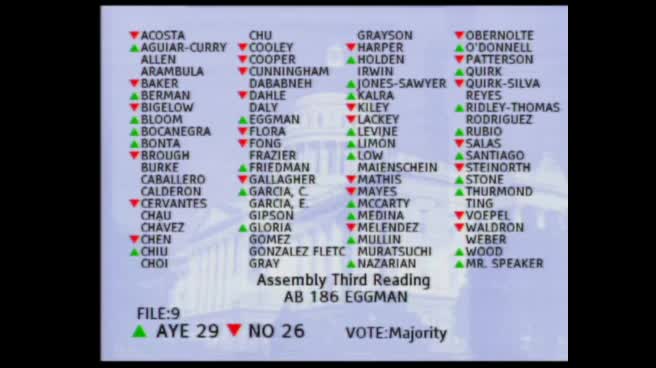 1MIN
Assembly Floor
 31MIN
Assembly Standing Committee on Local Government



Bill Co-Author(s):