AB 355: Water pollution: enforcement.
- Session Year: 2017-2018
- House: Assembly
- Latest Version Date: 2017-10-06
Under the Porter-Cologne Water Quality Control Act, the State Water Resources Control Board (state board) and the California regional water quality control boards (regional boards) are the principal state agencies with primary authority over water quality matters. The act authorizes a regional board to investigate the quality of state waters, and grants to a regional board certain authority in connection with those investigative functions. The act authorizes a regional board to administratively impose civil liability in connection with violations of certain water quality provisions, and authorizes the executive officer of a regional board to issue a complaint to any person on whom administrative civil liability may be imposed pursuant to the act.
The state act, with certain exceptions, imposes a mandatory minimum penalty of $3,000 for serious violations, as defined, and for exceeding certain effluent limitations, failing to file a required report, or filing that report incomplete, if those violations occur 4 or more times in any period of 6 consecutive months. Existing law permits the state board or regional board, in lieu of assessing all or a portion of the mandatory minimum penalties against a publicly owned treatment works serving a small community, as defined, to elect to require the publicly owned treatment works to spend an equivalent amount towards completion of a compliance project proposed by the publicly owned treatment works if the state board or regional board makes certain findings. Existing law, for these purposes, defines a publicly owned treatment works serving a small community as a publicly owned treatment works serving a population of 10,000 persons or fewer or a rural county, with a financial hardship, as specified.
This bill, for purposes of the exception, would instead define publicly owned treatment works serving a small community as a publicly owned treatment works serving a population of 20,000 persons or fewer or a rural county, with a financial hardship.
Existing law requires the state board to continuously report and update information on its Internet Web site, but at a minimum annually on or before January 1, regarding its enforcement activities.
This bill would instead require the state board to continuously report and update information on its Internet Web site and to annually report on its enforcement activities on or before December 31.
Existing law provides for the regulation of underground storage tanks by the state board. Existing law imposes a civil or criminal penalty, as specified, for violations of specified provisions relating to underground storage tank systems, and requires that civil penalties or criminal fines be deposited into the State Water Pollution Cleanup and Abatement Account, to be available upon appropriation by the Legislature, for purposes of activities relating to water pollution or the cleaning up of waste or abating its effects on waters of the state.
This bill would allow the state board to impose civil liability administratively for those violations pursuant to the administrative liability provisions of the Porter-Cologne Water Quality Control Act, to be deposited in the State Water Pollution Cleanup and Abatement Account. The bill would require the executive director of the state board to consult with the appropriate local agency before issuing a complaint.
Under the Porter-Cologne Water Quality Control Act, the State Water Resources Control Board (state board) and the California regional water quality control boards (regional boards) are the principal state agencies with primary authority over water quality matters. The act authorizes a regional board to investigate the quality of state waters, and grants to a regional board certain authority in connection with those investigative functions. The act authorizes a regional board to administratively impose civil liability in connection with violations of certain water quality provisions, and authorizes the executive officer of a regional board to issue a complaint to any person on whom administrative civil liability may be imposed pursuant to the act.
The state act, with certain exceptions, imposes a mandatory minimum penalty of $3,000 for serious violations, as defined, and for exceeding certain effluent limitations, failing to file a required report, or filing that report incomplete, if those violations occur 4 or more times in any period of 6 consecutive months. Existing law permits the state board or regional board, in lieu of assessing all or a portion of the mandatory minimum penalties against a publicly owned treatment works serving a small community, as defined, to elect to require the publicly owned treatment works to spend an equivalent amount towards completion of a compliance project proposed by the publicly owned treatment works if the state board or regional board makes certain findings. Existing law, for these purposes, defines a publicly owned treatment works serving a small community as a publicly owned treatment works serving a population of 10,000 persons or fewer or a rural county, with a financial hardship, as specified.
This bill, for purposes of the exception, would instead define publicly owned treatment works serving a small community as a publicly owned treatment works serving a population of 20,000 persons or fewer or a rural county, with a financial hardship.
Existing law requires the state board to continuously report and update information on its Internet Web site, but at a minimum annually, annually on or before January 1, regarding its enforcement activities.
This bill would instead require the state board to continuously report and update information on its Internet Web site and to annually report on its enforcement activities on or before December 31.
Existing law provides for the regulation of underground storage tanks by the state board. Existing law imposes a civil penalty or criminal penalty, as specified, for violations of specified provisions relating to underground storage tank systems, and requires that those civil penalties or criminal fines be deposited into the State Water Pollution Cleanup and Abatement Account, to be available upon appropriation by the Legislature, for purposes of activities relating to water pollution or the cleaning up of waste or abating its effects on waters of the state.
This bill would allow the state board to impose those civil penalties civil liability administratively for those violations pursuant to the administrative liability provisions of the Porter-Cologne Water Quality Control Act, to be deposited in the State Water Pollution Cleanup and Abatement Account. The bill would require the executive director of the state board to consult with the appropriate local agency before issuing a complaint.
Under the Porter-Cologne Water Quality Control Act, the State Water Resources Control Board (state board) and the California regional water quality control boards (regional boards) are the principal state agencies with primary authority over water quality matters. The act authorizes a regional board to investigate the quality of state waters, and grants to a regional board certain authority in connection with those investigative functions. The act authorizes a regional board to administratively impose civil liability in connection with violations of certain water quality provisions, and authorizes the executive officer of a regional board to issue a complaint to any person on whom administrative civil liability may be imposed pursuant to the act.
The state act, with certain exceptions, imposes a mandatory minimum penalty of $3,000 for serious violations, as defined, and for exceeding certain effluent limitations, failing to file a required report, or filing that report incomplete, if those violations occur 4 or more times in any period of 6 consecutive months. Existing law permits the state board or regional board, in lieu of assessing all or a portion of the mandatory minimum penalties against a publicly owned treatment works serving a small community, as defined, to elect to require the publicly owned treatment works to spend an equivalent amount towards completion of a compliance project proposed by the publicly owned treatment works if the state board or regional board makes certain findings. Existing law, for these purposes, defines a publicly owned treatment works serving a small community as a publicly owned treatment works serving a population of 10,000 persons or fewer or a rural county, with a financial hardship, as specified.
This bill, for purposes of the exception, would instead define publicly owned treatment works serving a small community as a publicly owned treatment works serving a population of 20,000 persons or fewer or a rural county, with a financial hardship.
Existing law requires the state board to continuously report and update information on its Internet Web site, but at a minimum annually, regarding its enforcement activities.
This bill would instead require the state board to continuously report and update information on its Internet Web site and to annually report on its enforcement activities on or before December 31.
Existing law provides for the regulation of underground storage tanks by the state board. Existing law imposes a civil penalty for violations of specified provisions relating to underground storage tank systems, and requires that those civil penalties be deposited into the State Water Pollution Cleanup and Abatement Account, to be available upon appropriation by the Legislature, for purposes of activities relating to water pollution or the cleaning up of waste or abating its effects on waters of the state.
This bill would allow the regional state board to impose those civil penalties administratively pursuant to the administrative liability provisions of the Porter-Cologne Water Quality Control Act, to be deposited in the State Water Pollution Cleanup and Abatement Account. The bill would require the executive officer director of the regional state board to consult with the appropriate local agency before issuing a complaint.
Under the Porter-Cologne Water Quality Control Act, the State Water Resources Control Board (state board) and the California regional water quality control boards (regional boards) are the principal state agencies with primary authority over water quality matters. The act authorizes a regional board to investigate the quality of state waters, and grants to a regional board certain authority in connection with those investigative functions. The act authorizes a regional board to administratively impose civil liability in connection with violations of certain water quality provisions, and authorizes the executive officer of a regional board to issue a complaint to any person on whom administrative civil liability may be imposed pursuant to the act.
The state act, with certain exceptions, imposes a mandatory minimum penalty of $3,000 for serious violations, as defined, and for exceeding certain effluent limitations, failing to file a required report, or filing that report incomplete, if those violations occur 4 or more times in any period of 6 consecutive months. Existing law permits the state board or regional board, in lieu of assessing all or a portion of the mandatory minimum penalties against a publicly owned treatment works serving a small community, as defined, to elect to require the publicly owned treatment works to spend an equivalent amount towards completion of a compliance project proposed by the publicly owned treatment works if the state board or regional board makes certain findings. Existing law, for these purposes, defines a publicly owned treatment works serving a small community as a publicly owned treatment works serving a population of 10,000 persons or fewer or a rural county, with a financial hardship, as specified.
This bill, for purposes of the exception, would instead define publicly owned treatment works serving a small community as a publicly owned treatment works serving a population of 20,000 persons or fewer or a rural county, with a financial hardship.
Existing law requires the state board to continuously report and update information on its Internet Web site, but at a minimum annually, regarding its enforcement activities.
This bill would instead require the state board to continuously report and update information on its Internet Web site and to annually report on its enforcement activities on or before December 31.
Existing law provides for the regulation of underground storage tanks by the state board. Existing law imposes a civil penalty for violations of specified provisions relating to underground storage tank systems, and requires that those civil penalties be deposited into the State Water Pollution Cleanup and Abatement Account, to be available upon appropriation by the Legislature, for purposes of activities relating to water pollution or the cleaning up of waste or abating its effects on waters of the state.
This bill would allow the regional board to impose those civil penalties administratively pursuant to the administrative liability provisions of the Porter-Cologne Water Quality Control Act, to be deposited in the State Water Pollution Cleanup and Abatement Account. The bill would require the executive officer of the regional board to consult with the appropriate local agency before issuing a complaint.
Existing law, the California Safe Drinking Water Act, imposes on the State Water Resources Control Board various responsibilities and duties relating to providing a dependable, safe supply of drinking water. The act prohibits a person from operating a public water system without a permit and requires any person who owns a public water system to ensure that the system, among other things, provides a reliable and adequate supply of pure, wholesome, healthful, and potable water.This bill would require the state board to collaborate with all public water systems to improve drinking water infrastructure and ensure adequate, safe, and clean drinking water supplies.Existing law, the California Safe Drinking Water Act, imposes on the State Water Resources Control Board various responsibilities and duties relating to providing a dependable, safe supply of drinking water. The act prohibits a person from operating a public water system without a permit and requires any person who owns a public water system to ensure that the system, among other things, provides a reliable and adequate supply of pure, wholesome, healthful, and potable water.
This bill would require the state board to collaborate with all public water systems to improve drinking water infrastructure and ensure adequate, safe, and clean drinking water supplies.
(a)An operator of an underground tank system is liable for a civil penalty of not less than five hundred dollars ($500) or more than five thousand dollars ($5,000) for each underground storage tank, for each day of violation, for any of the following violations:
(1)Operating an underground tank system that has not been issued a permit, in violation of this chapter.
(2)Violation of an applicable requirement of the permit issued for the operation of the underground tank system.
(3)Failure to maintain records, as required by this chapter.
(4)Failure to report an unauthorized release, as required by Sections 25294 and 25295.
(5)Failure to properly close an underground tank system, as required by Section 25298.
(6)Violation of an applicable requirement of this chapter or a regulation adopted by the board pursuant to Section 25299.3.
(7)Failure to permit inspection or to perform a monitoring, testing, or reporting required pursuant to Section 25288 or 25289.
(8)Making a false statement, representation, or certification in an application, record, report, or other document submitted or required to be maintained pursuant to this chapter.
(9)Tampering with or otherwise disabling automatic leak detection devices or alarms.
(b)An owner of an underground tank system is liable for a civil penalty of not less than five hundred dollars ($500) or more than five thousand dollars ($5,000) per day for each underground storage tank, for each day of violation, for any of the following violations:
(1)Failure to obtain a permit as specified by this chapter.
(2)Failure to repair or upgrade an underground tank system in accordance with this chapter.
(3)Abandonment or improper closure of an underground tank system subject to this chapter.
(4)Violation of an applicable requirement of the permit issued for operation of the underground tank system.
(5)Violation of an applicable requirement of this chapter or a regulation adopted by the board pursuant to Section 25299.3.
(6)Failure to permit inspection or to perform a monitoring, testing, or reporting required pursuant to Section 25288 or 25289.
(7)Making a false statement, representation, or certification in an application, record, report, or other document submitted or required to be maintained pursuant to this chapter.
(c)A person who intentionally fails to notify the board, the regional board, or the local agency when required to do so by this chapter or who submits false information in a permit application, amendment, or renewal, pursuant to Section 25286, is liable for a civil penalty of not more than five thousand dollars ($5,000) for each underground storage tank for which notification is not given or false information is submitted.
(d)(1)A person who violates a corrective action requirement established by, or issued pursuant to, Section 25296.10 is liable for a civil penalty of not more than ten thousand dollars ($10,000) for each underground storage tank for each day of violation.
(2)A civil penalty under this subdivision may be imposed in a civil action under this chapter, or may be administratively imposed by the board or a regional board pursuant to Article 2.5 (commencing with Section 13323) of Chapter 5 of Division 7 of the Water Code.
(e)A person who violates Section 25292.3 is liable for a civil penalty of not more than five thousand dollars ($5,000) for each underground storage tank for each day of violation.
(f)(1)A person who falsifies any monitoring records required by this chapter, or knowingly fails to report an unauthorized release, shall, upon conviction, be punished by a fine of not less than five thousand dollars ($5,000) or more than ten thousand dollars ($10,000), by imprisonment in the county jail for not to exceed one year, or by both that fine and imprisonment.
(2)A person who intentionally disables or tampers with an automatic leak detection system in a manner that would prevent the automatic leak detection system from detecting a leak or alerting the owner or operator of the leak, shall, upon conviction, be punished by a fine of not less than five thousand dollars ($5,000) or more than ten thousand dollars ($10,000), by imprisonment in the county jail for not more than one year, or by both the fine and imprisonment.
(g)In determining both the civil and criminal penalties imposed pursuant to this section, the board, a regional board, or the court, as the case may be, shall consider all relevant circumstances, including, but not limited to, the extent of harm or potential harm caused by the violation, the nature of the violation and the period of time over which it occurred, the frequency of past violations, and the corrective action, if any, taken by the person who holds the permit.
(h)(1)A civil penalty or criminal fine imposed pursuant to this section for a separate violation shall be separate from, and in addition to, any other civil penalty or criminal fine imposed pursuant to this section or any other provision of law, except that no civil penalty shall be recovered under subdivision (d) for violations for which a civil penalty is recovered pursuant to Section 13268 or 13350 of the Water Code. The penalty or fine shall be paid to the unified program agency, the participating agency, or the state, whichever is represented by the office of the city attorney, district attorney, or Attorney General bringing the action.
(2)Any penalties or fines paid to a unified program agency or a participating agency pursuant to paragraph (1) shall be deposited into a special account and shall be expended only to fund the activities of the unified program agency or participating agency in enforcing the unified program, as specified in subdivision (c) of Section 25404, within the jurisdiction of that agency pursuant to the unified program specified in Chapter 6.11 (commencing with Section 25404).
(3)All penalties or fines collected by the board or a regional board pursuant to this section or Section 25299.05 or collected on behalf of the board or a regional board by the Attorney General for these purposes shall be deposited in the State Water Pollution Cleanup and Abatement Account in the State Water Quality Control Fund, and are available for expenditure by the board, upon appropriation, pursuant to Section 13441 of the Water Code.
(i)Paragraph (9) of subdivision (a) does not prohibit the owner or operator of an underground storage tank, or his or her designee, from maintaining, repairing, or replacing automatic leak detection devices or alarms associated with that tank.
SEC. 2.Section 25299.05 is added to the Health and Safety Code, to read:25299.05.Notwithstanding Sections 25299.02 and 25299.03, the board may impose civil liability administratively for a violation described in subdivision (a), (b), (c), (e), or (f) of Section 25299 pursuant to Article 2.5 (commencing with Section 13323) of Chapter 5 of Division 7 of the Water Code. The executive director of the board shall consult with the appropriate local agency or agencies before issuing a complaint pursuant to Section 13323.
SEC. 3.Section 13385 of the Water Code is amended to read:13385.(a)A person who violates any of the following shall be liable civilly in accordance with this section:
(1)Section 13375 or 13376.
(2)A waste discharge requirement or dredged or fill material permit issued pursuant to this chapter or any water quality certification issued pursuant to Section 13160.
(3)A requirement established pursuant to Section 13383.
(4)An order or prohibition issued pursuant to Section 13243 or Article 1 (commencing with Section 13300) of Chapter 5, if the activity subject to the order or prohibition is subject to regulation under this chapter.
(5)A requirement of Section 301, 302, 306, 307, 308, 318, 401, or 405 of the federal Clean Water Act (33 U.S.C. Sec. 1311, 1312, 1316, 1317, 1318, 1341, or 1345), as amended.
(6)A requirement imposed in a pretreatment program approved pursuant to waste discharge requirements issued under Section 13377 or approved pursuant to a permit issued by the administrator.
(b)(1)Civil liability may be imposed by the superior court in an amount not to exceed the sum of both of the following:
(A)Twenty-five thousand dollars ($25,000) for each day in which the violation occurs.
(B)Where there is a discharge, any portion of which is not susceptible to cleanup or is not cleaned up, and the volume discharged but not cleaned up exceeds 1,000 gallons, an additional liability not to exceed twenty-five dollars ($25) multiplied by the number of gallons by which the volume discharged but not cleaned up exceeds 1,000 gallons.
(2)The Attorney General, upon request of a regional board or the state board, shall petition the superior court to impose the liability.
(c)Civil liability may be imposed administratively by the state board or a regional board pursuant to Article 2.5 (commencing with Section 13323) of Chapter 5 in an amount not to exceed the sum of both of the following:
(1)Ten thousand dollars ($10,000) for each day in which the violation occurs.
(2)Where there is a discharge, any portion of which is not susceptible to cleanup or is not cleaned up, and the volume discharged but not cleaned up exceeds 1,000 gallons, an additional liability not to exceed ten dollars ($10) multiplied by the number of gallons by which the volume discharged but not cleaned up exceeds 1,000 gallons.
(d)For purposes of subdivisions (b) and (c), discharge includes any discharge to navigable waters of the United States, any introduction of pollutants into a publicly owned treatment works, or any use or disposal of sewage sludge.
(e)In determining the amount of any liability imposed under this section, the regional board, the state board, or the superior court, as the case may be, shall take into account the nature, circumstances, extent, and gravity of the violation or violations, whether the discharge is susceptible to cleanup or abatement, the degree of toxicity of the discharge, and, with respect to the violator, the ability to pay, the effect on its ability to continue its business, any voluntary cleanup efforts undertaken, any prior history of violations, the degree of culpability, economic benefit or savings, if any, resulting from the violation, and other matters that justice may require. At a minimum, liability shall be assessed at a level that recovers the economic benefits, if any, derived from the acts that constitute the violation.
(f)(1)Except as provided in paragraph (2), for the purposes of this section, a single operational upset that leads to simultaneous violations of more than one pollutant parameter shall be treated as a single violation.
(2)(A)For the purposes of subdivisions (h) and (i), a single operational upset in a wastewater treatment unit that treats wastewater using a biological treatment process shall be treated as a single violation, even if the operational upset results in violations of more than one effluent limitation and the violations continue for a period of more than one day, if all of the following apply:
(i)The discharger demonstrates all of the following:
(I)The upset was not caused by wastewater treatment operator error and was not due to discharger negligence.
(II)But for the operational upset of the biological treatment process, the violations would not have occurred nor would they have continued for more than one day.
(III)The discharger carried out all reasonable and immediately feasible actions to reduce noncompliance with the applicable effluent limitations.
(ii)The discharger is implementing an approved pretreatment program, if so required by federal or state law.
(B)Subparagraph (A) only applies to violations that occur during a period for which the regional board has determined that violations are unavoidable, but in no case may that period exceed 30 days.
(g)Remedies under this section are in addition to, and do not supersede or limit, any other remedies, civil or criminal, except that no liability shall be recoverable under Section 13261, 13265, 13268, or 13350 for violations for which liability is recovered under this section.
(h)(1)Notwithstanding any other provision of this division, and except as provided in subdivisions (j), (k), and (l), a mandatory minimum penalty of three thousand dollars ($3,000) shall be assessed for each serious violation.
(2)For the purposes of this section, a serious violation means any waste discharge that violates the effluent limitations contained in the applicable waste discharge requirements for a Group II pollutant, as specified in Appendix A to Section 123.45 of Title 40 of the Code of Federal Regulations, by 20 percent or more or for a Group I pollutant, as specified in Appendix A to Section 123.45 of Title 40 of the Code of Federal Regulations, by 40 percent or more.
(i)(1)Notwithstanding any other provision of this division, and except as provided in subdivisions (j), (k), and (l), a mandatory minimum penalty of three thousand dollars ($3,000) shall be assessed for each violation whenever the person does any of the following four or more times in any period of six consecutive months, except that the requirement to assess the mandatory minimum penalty shall not be applicable to the first three violations:
(A)Violates a waste discharge requirement effluent limitation.
(B)Fails to file a report pursuant to Section 13260.
(C)Files an incomplete report pursuant to Section 13260.
(D)Violates a toxicity effluent limitation contained in the applicable waste discharge requirements where the waste discharge requirements do not contain pollutant-specific effluent limitations for toxic pollutants.
(2)For the purposes of this section, a period of six consecutive months means the period commencing on the date that one of the violations described in this subdivision occurs and ending 180 days after that date.
(j)Subdivisions (h) and (i) do not apply to any of the following:
(1)A violation caused by one or any combination of the following:
(A)An act of war.
(B)An unanticipated, grave natural disaster or other natural phenomenon of an exceptional, inevitable, and irresistible character, the effects of which could not have been prevented or avoided by the exercise of due care or foresight.
(C)An intentional act of a third party, the effects of which could not have been prevented or avoided by the exercise of due care or foresight.
(D)(i)The operation of a new or reconstructed wastewater treatment unit during a defined period of adjusting or testing, not to exceed 90 days for a wastewater treatment unit that relies on a biological treatment process and not to exceed 30 days for any other wastewater treatment unit, if all of the following requirements are met:
(I)The discharger has submitted to the regional board, at least 30 days in advance of the operation, an operations plan that describes the actions the discharger will take during the period of adjusting and testing, including steps to prevent violations and identifies the shortest reasonable time required for the period of adjusting and testing, not to exceed 90 days for a wastewater treatment unit that relies on a biological treatment process and not to exceed 30 days for any other wastewater treatment unit.
(II)The regional board has not objected in writing to the operations plan.
(III)The discharger demonstrates that the violations resulted from the operation of the new or reconstructed wastewater treatment unit and that the violations could not have reasonably been avoided.
(IV)The discharger demonstrates compliance with the operations plan.
(V)In the case of a reconstructed wastewater treatment unit, the unit relies on a biological treatment process that is required to be out of operation for at least 14 days in order to perform the reconstruction, or the unit is required to be out of operation for at least 14 days and, at the time of the reconstruction, the cost of reconstructing the unit exceeds 50 percent of the cost of replacing the wastewater treatment unit.
(ii)For the purposes of this section, wastewater treatment unit means a component of a wastewater treatment plant that performs a designated treatment function.
(2)(A)Except as provided in subparagraph (B), a violation of an effluent limitation where the waste discharge is in compliance with either a cease and desist order issued pursuant to Section 13301 or a time schedule order issued pursuant to Section 13300, if all of the following requirements are met:
(i)The cease and desist order or time schedule order is issued after January 1, 1995, but not later than July 1, 2000, specifies the actions that the discharger is required to take in order to correct the violations that would otherwise be subject to subdivisions (h) and (i), and the date by which compliance is required to be achieved and, if the final date by which compliance is required to be achieved is later than one year from the effective date of the cease and desist order or time schedule order, specifies the interim requirements by which progress towards compliance will be measured and the date by which the discharger will be in compliance with each interim requirement.
(ii)The discharger has prepared and is implementing in a timely and proper manner, or is required by the regional board to prepare and implement, a pollution prevention plan that meets the requirements of Section 13263.3.
(iii)The discharger demonstrates that it has carried out all reasonable and immediately feasible actions to reduce noncompliance with the waste discharge requirements applicable to the waste discharge and the executive officer of the regional board concurs with the demonstration.
(B)Subdivisions (h) and (i) shall become applicable to a waste discharge on the date the waste discharge requirements applicable to the waste discharge are revised and reissued pursuant to Section 13380, unless the regional board does all of the following on or before that date:
(i)Modifies the requirements of the cease and desist order or time schedule order as may be necessary to make it fully consistent with the reissued waste discharge requirements.
(ii)Establishes in the modified cease and desist order or time schedule order a date by which full compliance with the reissued waste discharge requirements shall be achieved. For the purposes of this subdivision, the regional board may not establish this date later than five years from the date the waste discharge requirements were required to be reviewed pursuant to Section 13380. If the reissued waste discharge requirements do not add new effluent limitations or do not include effluent limitations that are more stringent than those in the original waste discharge requirements, the date shall be the same as the final date for compliance in the original cease and desist order or time schedule order or five years from the date that the waste discharge requirements were required to be reviewed pursuant to Section 13380, whichever is earlier.
(iii)Determines that the pollution prevention plan required by clause (ii) of subparagraph (A) is in compliance with the requirements of Section 13263.3 and that the discharger is implementing the pollution prevention plan in a timely and proper manner.
(3)A violation of an effluent limitation where the waste discharge is in compliance with either a cease and desist order issued pursuant to Section 13301 or a time schedule order issued pursuant to Section 13300 or 13308, if all of the following requirements are met:
(A)The cease and desist order or time schedule order is issued on or after July 1, 2000, and specifies the actions that the discharger is required to take in order to correct the violations that would otherwise be subject to subdivisions (h) and (i).
(B)The regional board finds that, for one of the following reasons, the discharger is not able to consistently comply with one or more of the effluent limitations established in the waste discharge requirements applicable to the waste discharge:
(i)The effluent limitation is a new, more stringent, or modified regulatory requirement that has become applicable to the waste discharge after the effective date of the waste discharge requirements and after July 1, 2000, new or modified control measures are necessary in order to comply with the effluent limitation, and the new or modified control measures cannot be designed, installed, and put into operation within 30 calendar days.
(ii)New methods for detecting or measuring a pollutant in the waste discharge demonstrate that new or modified control measures are necessary in order to comply with the effluent limitation and the new or modified control measures cannot be designed, installed, and put into operation within 30 calendar days.
(iii)Unanticipated changes in the quality of the municipal or industrial water supply available to the discharger are the cause of unavoidable changes in the composition of the waste discharge, the changes in the composition of the waste discharge are the cause of the inability to comply with the effluent limitation, no alternative water supply is reasonably available to the discharger, and new or modified measures to control the composition of the waste discharge cannot be designed, installed, and put into operation within 30 calendar days.
(iv)The discharger is a publicly owned treatment works located in Orange County that is unable to meet effluent limitations for biological oxygen demand, suspended solids, or both, because the publicly owned treatment works meets all of the following criteria:
(I)Was previously operating under modified secondary treatment requirements pursuant to Section 301(h) of the Clean Water Act (33 U.S.C. Sec. 1311(h)).
(II)Did vote on July 17, 2002, not to apply for a renewal of the modified secondary treatment requirements.
(III)Is in the process of upgrading its treatment facilities to meet the secondary treatment standards required by Section 301(b)(1)(B) of the Clean Water Act (33 U.S.C. Sec. 1311(b)(1)(B)).
(C)(i)The regional board establishes a time schedule for bringing the waste discharge into compliance with the effluent limitation that is as short as possible, taking into account the technological, operational, and economic factors that affect the design, development, and implementation of the control measures that are necessary to comply with the effluent limitation. Except as provided in clause (ii), for the purposes of this subdivision, the time schedule shall not exceed five years in length.
(ii)(I)For purposes of the upgrade described in subclause (III) of clause (iv) of subparagraph (B), the time schedule shall not exceed 10 years in length.
(II)Following a public hearing, and upon a showing that the discharger is making diligent progress toward bringing the waste discharge into compliance with the effluent limitation, the regional board may extend the time schedule for an additional period not exceeding five years in length, if the discharger demonstrates that the additional time is necessary to comply with the effluent limitation. This subclause does not apply to a time schedule described in subclause (I).
(iii)If the time schedule exceeds one year from the effective date of the order, the schedule shall include interim requirements and the dates for their achievement. The interim requirements shall include both of the following:
(I)Effluent limitations for the pollutant or pollutants of concern.
(II)Actions and milestones leading to compliance with the effluent limitation.
(D)The discharger has prepared and is implementing in a timely and proper manner, or is required by the regional board to prepare and implement, a pollution prevention plan pursuant to Section 13263.3.
(k)(1)In lieu of assessing all or a portion of the mandatory minimum penalties pursuant to subdivisions (h) and (i) against a publicly owned treatment works serving a small community, the state board or the regional board may elect to require the publicly owned treatment works to spend an equivalent amount towards the completion of a compliance project proposed by the publicly owned treatment works, if the state board or the regional board finds all of the following:
(A)The compliance project is designed to correct the violations within five years.
(B)The compliance project is in accordance with the enforcement policy of the state board, excluding any provision in the policy that is inconsistent with this section.
(C)The publicly owned treatment works has prepared a financing plan to complete the compliance project.
(2)For the purposes of this subdivision, a publicly owned treatment works serving a small community means a publicly owned treatment works serving a population of 20,000 persons or fewer or a rural county, with a financial hardship as determined by the state board after considering such factors as median income of the residents, rate of unemployment, or low population density in the service area of the publicly owned treatment works.
(l)(1)In lieu of assessing penalties pursuant to subdivision (h) or (i), the state board or the regional board, with the concurrence of the discharger, may direct a portion of the penalty amount to be expended on a supplemental environmental project in accordance with the enforcement policy of the state board. If the penalty amount exceeds fifteen thousand dollars ($15,000), the portion of the penalty amount that may be directed to be expended on a supplemental environmental project may not exceed fifteen thousand dollars ($15,000) plus 50 percent of the penalty amount that exceeds fifteen thousand dollars ($15,000).
(2)For the purposes of this section, a supplemental environmental project means an environmentally beneficial project that a person agrees to undertake, with the approval of the regional board, that would not be undertaken in the absence of an enforcement action under this section.
(3)This subdivision applies to the imposition of penalties pursuant to subdivision (h) or (i) on or after January 1, 2003, without regard to the date on which the violation occurs.
(m)The Attorney General, upon request of a regional board or the state board, shall petition the appropriate court to collect any liability or penalty imposed pursuant to this section. Any person who fails to pay on a timely basis any liability or penalty imposed under this section shall be required to pay, in addition to that liability or penalty, interest, attorneys fees, costs for collection proceedings, and a quarterly nonpayment penalty for each quarter during which the failure to pay persists. The nonpayment penalty shall be in an amount equal to 20 percent of the aggregate amount of the persons penalty and nonpayment penalties that are unpaid as of the beginning of the quarter.
(n)(1)Subject to paragraph (2), funds collected pursuant to this section shall be deposited in the State Water Pollution Cleanup and Abatement Account.
(2)(A)Notwithstanding any other provision of law, moneys collected for a violation of a water quality certification in accordance with paragraph (2) of subdivision (a) or for a violation of Section 401 of the federal Clean Water Act (33 U.S.C. Sec. 1341) in accordance with paragraph (5) of subdivision (a) shall be deposited in the Waste Discharge Permit Fund and separately accounted for in that fund.
(B)The funds described in subparagraph (A) shall be expended by the state board, upon appropriation by the Legislature, to assist regional boards, and other public agencies with authority to clean up waste or abate the effects of the waste, in cleaning up or abating the effects of the waste on waters of the state or for the purposes authorized in Section 13443.
(o)The state board shall continuously report and update information on its Internet Web site. The state board shall report annually on or before December 31 regarding its enforcement activities. The information shall include all of the following:
(1)A compilation of the number of violations of waste discharge requirements in the previous calendar year, including stormwater enforcement violations.
(2)A record of the formal and informal compliance and enforcement actions taken for each violation, including stormwater enforcement actions.
(3)An analysis of the effectiveness of current enforcement policies, including mandatory minimum penalties.
(p)The amendments made to subdivisions (f), (h), (i), and (j) during the second year of the 200102 Regular Session apply only to violations that occur on or after January 1, 2003.
SEC. 4.Section 13399.27 of the Water Code is amended to read:13399.27.On or before December 31, the state board, after any necessary investigation, shall annually prepare, and make available to the public, a report that includes both of the following for the previous calendar year:
(a)A list of those persons that were notified of their duty to comply with applicable general storm water NPDES permits pursuant to Section 13399.30 and a description of the responses received to those notifications, including the filing of notices of intent to obtain coverage or notices of nonapplicability, returned mail and no response, appeals of filing or permitting requirements pursuant to this chapter, site inspections, enforcement actions taken, and penalties assessed therefor.
(b)A list of those dischargers identified pursuant to Section 13399.31 that, during the previous calendar year, failed to submit an annual report or construction certification required by a regional board, and any penalties assessed therefor.
(a)An operator of an underground tank system shall be is liable for a civil penalty of not less than five hundred dollars ($500) or more than five thousand dollars ($5,000) for each underground storage tank tank, for each day of violation violation, for any of the following violations:
(1)Operating an underground tank system that has not been issued a permit, in violation of this chapter.
(2)Violation of an applicable requirement of the permit issued for the operation of the underground tank system.
(3)Failure to maintain records, as required by this chapter.
(4)Failure to report an unauthorized release, as required by Sections 25294 and 25295.
(5)Failure to properly close an underground tank system, as required by Section 25298.
(6)Violation of an applicable requirement of this chapter or any a regulation adopted by the board pursuant to Section 25299.3.
(7)Failure to permit inspection or to perform a monitoring, testing, or reporting required pursuant to Section 25288 or 25289.
(8)Making a false statement, representation, or certification in an application, record, report, or other document submitted or required to be maintained pursuant to this chapter.
(9)Tampering with or otherwise disabling automatic leak detection devices or alarms.
(b)An owner of an underground tank system shall be is liable for a civil penalty of not less than five hundred dollars ($500) or more than five thousand dollars ($5,000) per day for each underground storage tank, for each day of violation, for any of the following violations:
(1)Failure to obtain a permit as specified by this chapter.
(2)Failure to repair or upgrade an underground tank system in accordance with this chapter.
(3)Abandonment or improper closure of an underground tank system subject to this chapter.
(4)Violation of an applicable requirement of the permit issued for operation of the underground tank system.
(5)Violation of an applicable requirement of this chapter or a regulation adopted by the board pursuant to Section 25299.3.
(6)Failure to permit inspection or to perform a monitoring, testing, or reporting required pursuant to Section 25288 or 25289.
(7)Making a false statement, representation, or certification in an application, record, report, or other document submitted or required to be maintained pursuant to this chapter.
(c)A person who intentionally fails to notify the board, the regional board, or the local agency when required to do so by this chapter or who submits false information in a permit application, amendment, or renewal, pursuant to Section 25286, is liable for a civil penalty of not more than five thousand dollars ($5,000) for each underground storage tank for which notification is not given or false information is submitted.
(d)(1)A person who violates a corrective action requirement established by, or issued pursuant to, Section 25296.10 is liable for a civil penalty of not more than ten thousand dollars ($10,000) for each underground storage tank for each day of violation.
(2)A civil penalty under this subdivision may be imposed in a civil action under this chapter, or may be administratively imposed by the board or a regional board pursuant to Article 2.5 (commencing with Section 13323) of Chapter 5 of Division 7 of the Water Code.
(e)A person who violates Section 25292.3 is liable for a civil penalty of not more than five thousand dollars ($5,000) for each underground storage tank for each day of violation.
(f)(1)A person who falsifies any monitoring records required by this chapter, or knowingly fails to report an unauthorized release, shall, upon conviction, be punished by a fine of not less than five thousand dollars ($5,000) or more than ten thousand dollars ($10,000), by imprisonment in the county jail for not to exceed one year, or by both that fine and imprisonment.
(2)A person who intentionally disables or tampers with an automatic leak detection system in a manner that would prevent the automatic leak detection system from detecting a leak or alerting the owner or operator of the leak, shall, upon conviction, be punished by a fine of not less than five thousand dollars ($5,000) or more than ten thousand dollars ($10,000), by imprisonment in the county jail for not more than one year, or by both the fine and imprisonment.
(g)In determining both the civil and criminal penalties imposed pursuant to this section, the board, a regional board, or the court, as the case may be, shall consider all relevant circumstances, including, but not limited to, the extent of harm or potential harm caused by the violation, the nature of the violation and the period of time over which it occurred, the frequency of past violations, and the corrective action, if any, taken by the person who holds the permit.
(h)(1)A civil penalty or criminal fine imposed pursuant to this section for a separate violation shall be separate, separate from, and in addition to, any other civil penalty or criminal fine imposed pursuant to this section or any other provision of law, except that no civil penalty shall be recovered under subdivision (d) for violations for which a civil penalty is recovered pursuant to Section 13268 or 13350 of the Water Code. The penalty or fine shall be paid to the unified program agency, the participating agency, or the state, whichever is represented by the office of the city attorney, district attorney, or Attorney General bringing the action.
(2)Any penalties or fines paid to a unified program agency or a participating agency pursuant to paragraph (1) shall be deposited into a special account and shall be expended only to fund the activities of the unified program agency or participating agency in enforcing the unified program, as specified in subdivision (c) of Section 25404, within the jurisdiction of that agency pursuant to the unified program specified in Chapter 6.11 (commencing with Section 25404).
(3)All penalties or fines collected by the board or a regional board pursuant to this section or Section 25299.05 or collected on behalf of the board or a regional board by the Attorney General for these purposes shall be deposited in the State Water Pollution Cleanup and Abatement Account in the State Water Quality Control Fund, and are available for expenditure by the board, upon appropriation, pursuant to Section 13441 of the Water Code.
(i)Paragraph (9) of subdivision (a) does not prohibit the owner or operator of an underground storage tank, or his or her designee, from maintaining, repairing, or replacing automatic leak detection devices or alarms associated with that tank.
SEC. 2.Section 25299.05 is added to the Health and Safety Code, to read:25299.05.The Notwithstanding Sections 25299.02 and 25299.03, the board may impose civil liability administratively for a violation described in subdivision (a), (b), (c), (e), or (f) of Section 25299 pursuant to Article 2.5 (commencing with Section 13323) of Chapter 5 of Division 7 of the Water Code. The executive director of the board shall consult with the appropriate local agency or agencies before issuing a complaint pursuant to Section 13323.
SEC. 3.Section 13385 of the Water Code is amended to read:13385.(a)A person who violates any of the following shall be liable civilly in accordance with this section:
(1)Section 13375 or 13376.
(2)A waste discharge requirement or dredged or fill material permit issued pursuant to this chapter or any water quality certification issued pursuant to Section 13160.
(3)A requirement established pursuant to Section 13383.
(4)An order or prohibition issued pursuant to Section 13243 or Article 1 (commencing with Section 13300) of Chapter 5, if the activity subject to the order or prohibition is subject to regulation under this chapter.
(5)A requirement of Section 301, 302, 306, 307, 308, 318, 401, or 405 of the federal Clean Water Act (33 U.S.C. Sec. 1311, 1312, 1316, 1317, 1318, 1341, or 1345), as amended.
(6)A requirement imposed in a pretreatment program approved pursuant to waste discharge requirements issued under Section 13377 or approved pursuant to a permit issued by the administrator.
(b)(1)Civil liability may be imposed by the superior court in an amount not to exceed the sum of both of the following:
(A)Twenty-five thousand dollars ($25,000) for each day in which the violation occurs.
(B)Where there is a discharge, any portion of which is not susceptible to cleanup or is not cleaned up, and the volume discharged but not cleaned up exceeds 1,000 gallons, an additional liability not to exceed twenty-five dollars ($25) multiplied by the number of gallons by which the volume discharged but not cleaned up exceeds 1,000 gallons.
(2)The Attorney General, upon request of a regional board or the state board, shall petition the superior court to impose the liability.
(c)Civil liability may be imposed administratively by the state board or a regional board pursuant to Article 2.5 (commencing with Section 13323) of Chapter 5 in an amount not to exceed the sum of both of the following:
(1)Ten thousand dollars ($10,000) for each day in which the violation occurs.
(2)Where there is a discharge, any portion of which is not susceptible to cleanup or is not cleaned up, and the volume discharged but not cleaned up exceeds 1,000 gallons, an additional liability not to exceed ten dollars ($10) multiplied by the number of gallons by which the volume discharged but not cleaned up exceeds 1,000 gallons.
(d)For purposes of subdivisions (b) and (c), discharge includes any discharge to navigable waters of the United States, any introduction of pollutants into a publicly owned treatment works, or any use or disposal of sewage sludge.
(e)In determining the amount of any liability imposed under this section, the regional board, the state board, or the superior court, as the case may be, shall take into account the nature, circumstances, extent, and gravity of the violation or violations, whether the discharge is susceptible to cleanup or abatement, the degree of toxicity of the discharge, and, with respect to the violator, the ability to pay, the effect on its ability to continue its business, any voluntary cleanup efforts undertaken, any prior history of violations, the degree of culpability, economic benefit or savings, if any, resulting from the violation, and other matters that justice may require. At a minimum, liability shall be assessed at a level that recovers the economic benefits, if any, derived from the acts that constitute the violation.
(f)(1)Except as provided in paragraph (2), for the purposes of this section, a single operational upset that leads to simultaneous violations of more than one pollutant parameter shall be treated as a single violation.
(2)(A)For the purposes of subdivisions (h) and (i), a single operational upset in a wastewater treatment unit that treats wastewater using a biological treatment process shall be treated as a single violation, even if the operational upset results in violations of more than one effluent limitation and the violations continue for a period of more than one day, if all of the following apply:
(i)The discharger demonstrates all of the following:
(I)The upset was not caused by wastewater treatment operator error and was not due to discharger negligence.
(II)But for the operational upset of the biological treatment process, the violations would not have occurred nor would they have continued for more than one day.
(III)The discharger carried out all reasonable and immediately feasible actions to reduce noncompliance with the applicable effluent limitations.
(ii)The discharger is implementing an approved pretreatment program, if so required by federal or state law.
(B)Subparagraph (A) only applies to violations that occur during a period for which the regional board has determined that violations are unavoidable, but in no case may that period exceed 30 days.
(g)Remedies under this section are in addition to, and do not supersede or limit, any other remedies, civil or criminal, except that no liability shall be recoverable under Section 13261, 13265, 13268, or 13350 for violations for which liability is recovered under this section.
(h)(1)Notwithstanding any other provision of this division, and except as provided in subdivisions (j), (k), and (l), a mandatory minimum penalty of three thousand dollars ($3,000) shall be assessed for each serious violation.
(2)For the purposes of this section, a serious violation means any waste discharge that violates the effluent limitations contained in the applicable waste discharge requirements for a Group II pollutant, as specified in Appendix A to Section 123.45 of Title 40 of the Code of Federal Regulations, by 20 percent or more or for a Group I pollutant, as specified in Appendix A to Section 123.45 of Title 40 of the Code of Federal Regulations, by 40 percent or more.
(i)(1)Notwithstanding any other provision of this division, and except as provided in subdivisions (j), (k), and (l), a mandatory minimum penalty of three thousand dollars ($3,000) shall be assessed for each violation whenever the person does any of the following four or more times in any period of six consecutive months, except that the requirement to assess the mandatory minimum penalty shall not be applicable to the first three violations:
(A)Violates a waste discharge requirement effluent limitation.
(B)Fails to file a report pursuant to Section 13260.
(C)Files an incomplete report pursuant to Section 13260.
(D)Violates a toxicity effluent limitation contained in the applicable waste discharge requirements where the waste discharge requirements do not contain pollutant-specific effluent limitations for toxic pollutants.
(2)For the purposes of this section, a period of six consecutive months means the period commencing on the date that one of the violations described in this subdivision occurs and ending 180 days after that date.
(j)Subdivisions (h) and (i) do not apply to any of the following:
(1)A violation caused by one or any combination of the following:
(A)An act of war.
(B)An unanticipated, grave natural disaster or other natural phenomenon of an exceptional, inevitable, and irresistible character, the effects of which could not have been prevented or avoided by the exercise of due care or foresight.
(C)An intentional act of a third party, the effects of which could not have been prevented or avoided by the exercise of due care or foresight.
(D)(i)The operation of a new or reconstructed wastewater treatment unit during a defined period of adjusting or testing, not to exceed 90 days for a wastewater treatment unit that relies on a biological treatment process and not to exceed 30 days for any other wastewater treatment unit, if all of the following requirements are met:
(I)The discharger has submitted to the regional board, at least 30 days in advance of the operation, an operations plan that describes the actions the discharger will take during the period of adjusting and testing, including steps to prevent violations and identifies the shortest reasonable time required for the period of adjusting and testing, not to exceed 90 days for a wastewater treatment unit that relies on a biological treatment process and not to exceed 30 days for any other wastewater treatment unit.
(II)The regional board has not objected in writing to the operations plan.
(III)The discharger demonstrates that the violations resulted from the operation of the new or reconstructed wastewater treatment unit and that the violations could not have reasonably been avoided.
(IV)The discharger demonstrates compliance with the operations plan.
(V)In the case of a reconstructed wastewater treatment unit, the unit relies on a biological treatment process that is required to be out of operation for at least 14 days in order to perform the reconstruction, or the unit is required to be out of operation for at least 14 days and, at the time of the reconstruction, the cost of reconstructing the unit exceeds 50 percent of the cost of replacing the wastewater treatment unit.
(ii)For the purposes of this section, wastewater treatment unit means a component of a wastewater treatment plant that performs a designated treatment function.
(2)(A)Except as provided in subparagraph (B), a violation of an effluent limitation where the waste discharge is in compliance with either a cease and desist order issued pursuant to Section 13301 or a time schedule order issued pursuant to Section 13300, if all of the following requirements are met:
(i)The cease and desist order or time schedule order is issued after January 1, 1995, but not later than July 1, 2000, specifies the actions that the discharger is required to take in order to correct the violations that would otherwise be subject to subdivisions (h) and (i), and the date by which compliance is required to be achieved and, if the final date by which compliance is required to be achieved is later than one year from the effective date of the cease and desist order or time schedule order, specifies the interim requirements by which progress towards compliance will be measured and the date by which the discharger will be in compliance with each interim requirement.
(ii)The discharger has prepared and is implementing in a timely and proper manner, or is required by the regional board to prepare and implement, a pollution prevention plan that meets the requirements of Section 13263.3.
(iii)The discharger demonstrates that it has carried out all reasonable and immediately feasible actions to reduce noncompliance with the waste discharge requirements applicable to the waste discharge and the executive officer of the regional board concurs with the demonstration.
(B)Subdivisions (h) and (i) shall become applicable to a waste discharge on the date the waste discharge requirements applicable to the waste discharge are revised and reissued pursuant to Section 13380, unless the regional board does all of the following on or before that date:
(i)Modifies the requirements of the cease and desist order or time schedule order as may be necessary to make it fully consistent with the reissued waste discharge requirements.
(ii)Establishes in the modified cease and desist order or time schedule order a date by which full compliance with the reissued waste discharge requirements shall be achieved. For the purposes of this subdivision, the regional board may not establish this date later than five years from the date the waste discharge requirements were required to be reviewed pursuant to Section 13380. If the reissued waste discharge requirements do not add new effluent limitations or do not include effluent limitations that are more stringent than those in the original waste discharge requirements, the date shall be the same as the final date for compliance in the original cease and desist order or time schedule order or five years from the date that the waste discharge requirements were required to be reviewed pursuant to Section 13380, whichever is earlier.
(iii)Determines that the pollution prevention plan required by clause (ii) of subparagraph (A) is in compliance with the requirements of Section 13263.3 and that the discharger is implementing the pollution prevention plan in a timely and proper manner.
(3)A violation of an effluent limitation where the waste discharge is in compliance with either a cease and desist order issued pursuant to Section 13301 or a time schedule order issued pursuant to Section 13300 or 13308, if all of the following requirements are met:
(A)The cease and desist order or time schedule order is issued on or after July 1, 2000, and specifies the actions that the discharger is required to take in order to correct the violations that would otherwise be subject to subdivisions (h) and (i).
(B)The regional board finds that, for one of the following reasons, the discharger is not able to consistently comply with one or more of the effluent limitations established in the waste discharge requirements applicable to the waste discharge:
(i)The effluent limitation is a new, more stringent, or modified regulatory requirement that has become applicable to the waste discharge after the effective date of the waste discharge requirements and after July 1, 2000, new or modified control measures are necessary in order to comply with the effluent limitation, and the new or modified control measures cannot be designed, installed, and put into operation within 30 calendar days.
(ii)New methods for detecting or measuring a pollutant in the waste discharge demonstrate that new or modified control measures are necessary in order to comply with the effluent limitation and the new or modified control measures cannot be designed, installed, and put into operation within 30 calendar days.
(iii)Unanticipated changes in the quality of the municipal or industrial water supply available to the discharger are the cause of unavoidable changes in the composition of the waste discharge, the changes in the composition of the waste discharge are the cause of the inability to comply with the effluent limitation, no alternative water supply is reasonably available to the discharger, and new or modified measures to control the composition of the waste discharge cannot be designed, installed, and put into operation within 30 calendar days.
(iv)The discharger is a publicly owned treatment works located in Orange County that is unable to meet effluent limitations for biological oxygen demand, suspended solids, or both, because the publicly owned treatment works meets all of the following criteria:
(I)Was previously operating under modified secondary treatment requirements pursuant to Section 301(h) of the Clean Water Act (33 U.S.C. Sec. 1311(h)).
(II)Did vote on July 17, 2002, not to apply for a renewal of the modified secondary treatment requirements.
(III)Is in the process of upgrading its treatment facilities to meet the secondary treatment standards required by Section 301(b)(1)(B) of the Clean Water Act (33 U.S.C. Sec. 1311(b)(1)(B)).
(C)(i)The regional board establishes a time schedule for bringing the waste discharge into compliance with the effluent limitation that is as short as possible, taking into account the technological, operational, and economic factors that affect the design, development, and implementation of the control measures that are necessary to comply with the effluent limitation. Except as provided in clause (ii), for the purposes of this subdivision, the time schedule shall not exceed five years in length.
(ii)(I)For purposes of the upgrade described in subclause (III) of clause (iv) of subparagraph (B), the time schedule shall not exceed 10 years in length.
(II)Following a public hearing, and upon a showing that the discharger is making diligent progress toward bringing the waste discharge into compliance with the effluent limitation, the regional board may extend the time schedule for an additional period not exceeding five years in length, if the discharger demonstrates that the additional time is necessary to comply with the effluent limitation. This subclause does not apply to a time schedule described in subclause (I).
(iii)If the time schedule exceeds one year from the effective date of the order, the schedule shall include interim requirements and the dates for their achievement. The interim requirements shall include both of the following:
(I)Effluent limitations for the pollutant or pollutants of concern.
(II)Actions and milestones leading to compliance with the effluent limitation.
(D)The discharger has prepared and is implementing in a timely and proper manner, or is required by the regional board to prepare and implement, a pollution prevention plan pursuant to Section 13263.3.
(k)(1)In lieu of assessing all or a portion of the mandatory minimum penalties pursuant to subdivisions (h) and (i) against a publicly owned treatment works serving a small community, the state board or the regional board may elect to require the publicly owned treatment works to spend an equivalent amount towards the completion of a compliance project proposed by the publicly owned treatment works, if the state board or the regional board finds all of the following:
(A)The compliance project is designed to correct the violations within five years.
(B)The compliance project is in accordance with the enforcement policy of the state board, excluding any provision in the policy that is inconsistent with this section.
(C)The publicly owned treatment works has prepared a financing plan to complete the compliance project.
(2)For the purposes of this subdivision, a publicly owned treatment works serving a small community means a publicly owned treatment works serving a population of 20,000 persons or fewer or a rural county, with a financial hardship as determined by the state board after considering such factors as median income of the residents, rate of unemployment, or low population density in the service area of the publicly owned treatment works.
(l)(1)In lieu of assessing penalties pursuant to subdivision (h) or (i), the state board or the regional board, with the concurrence of the discharger, may direct a portion of the penalty amount to be expended on a supplemental environmental project in accordance with the enforcement policy of the state board. If the penalty amount exceeds fifteen thousand dollars ($15,000), the portion of the penalty amount that may be directed to be expended on a supplemental environmental project may not exceed fifteen thousand dollars ($15,000) plus 50 percent of the penalty amount that exceeds fifteen thousand dollars ($15,000).
(2)For the purposes of this section, a supplemental environmental project means an environmentally beneficial project that a person agrees to undertake, with the approval of the regional board, that would not be undertaken in the absence of an enforcement action under this section.
(3)This subdivision applies to the imposition of penalties pursuant to subdivision (h) or (i) on or after January 1, 2003, without regard to the date on which the violation occurs.
(m)The Attorney General, upon request of a regional board or the state board, shall petition the appropriate court to collect any liability or penalty imposed pursuant to this section. Any person who fails to pay on a timely basis any liability or penalty imposed under this section shall be required to pay, in addition to that liability or penalty, interest, attorneys fees, costs for collection proceedings, and a quarterly nonpayment penalty for each quarter during which the failure to pay persists. The nonpayment penalty shall be in an amount equal to 20 percent of the aggregate amount of the persons penalty and nonpayment penalties that are unpaid as of the beginning of the quarter.
(n)(1)Subject to paragraph (2), funds collected pursuant to this section shall be deposited in the State Water Pollution Cleanup and Abatement Account.
(2)(A)Notwithstanding any other provision of law, moneys collected for a violation of a water quality certification in accordance with paragraph (2) of subdivision (a) or for a violation of Section 401 of the federal Clean Water Act (33 U.S.C. Sec. 1341) in accordance with paragraph (5) of subdivision (a) shall be deposited in the Waste Discharge Permit Fund and separately accounted for in that fund.
(B)The funds described in subparagraph (A) shall be expended by the state board, upon appropriation by the Legislature, to assist regional boards, and other public agencies with authority to clean up waste or abate the effects of the waste, in cleaning up or abating the effects of the waste on waters of the state or for the purposes authorized in Section 13443.
(o)The state board shall continuously report and update information on its Internet Web site. The state board shall report annually on or before December 31 regarding its enforcement activities. The information shall include all of the following:
(1)A compilation of the number of violations of waste discharge requirements in the previous calendar year, including stormwater enforcement violations.
(2)A record of the formal and informal compliance and enforcement actions taken for each violation, including stormwater enforcement actions.
(3)An analysis of the effectiveness of current enforcement policies, including mandatory minimum penalties.
(p)The amendments made to subdivisions (f), (h), (i), and (j) during the second year of the 200102 Regular Session apply only to violations that occur on or after January 1, 2003.
SEC. 4.Section 13399.27 of the Water Code is amended to read:13399.27.On or before December 31, the state board, after any necessary investigation, shall annually prepare, and make available to the public, a report that includes both of the following for the previous calendar year:
(a)A list of those persons that were notified of their duty to comply with applicable general storm water NPDES permits pursuant to Section 13399.30 and a description of the responses received to those notifications, including the filing of notices of intent to obtain coverage or notices of nonapplicability, returned mail and no response, appeals of filing or permitting requirements pursuant to this chapter, site inspections, enforcement actions taken, and penalties assessed therefor.
(b)A list of those dischargers identified pursuant to Section 13399.31 that, during the previous calendar year, failed to submit an annual report or construction certification required by a regional board, and any penalties assessed therefor.
(a)An operator of an underground tank system shall be liable for a civil penalty of not less than five hundred dollars ($500) or more than five thousand dollars ($5,000) for each underground storage tank for each day of violation for any of the following violations:
(1)Operating an underground tank system that has not been issued a permit, in violation of this chapter.
(2)Violation of an applicable requirement of the permit issued for the operation of the underground tank system.
(3)Failure to maintain records, as required by this chapter.
(4)Failure to report an unauthorized release, as required by Sections 25294 and 25295.
(5)Failure to properly close an underground tank system, as required by Section 25298.
(6)Violation of an applicable requirement of this chapter or any regulation adopted by the board pursuant to Section 25299.3.
(7)Failure to permit inspection or to perform a monitoring, testing, or reporting required pursuant to Section 25288 or 25289.
(8)Making a false statement, representation, or certification in an application, record, report, or other document submitted or required to be maintained pursuant to this chapter.
(9)Tampering with or otherwise disabling automatic leak detection devices or alarms.
(b)An owner of an underground tank system shall be liable for a civil penalty of not less than five hundred dollars ($500) or more than five thousand dollars ($5,000) per day for each underground storage tank, for each day of violation, for any of the following violations:
(1)Failure to obtain a permit as specified by this chapter.
(2)Failure to repair or upgrade an underground tank system in accordance with this chapter.
(3)Abandonment or improper closure of an underground tank system subject to this chapter.
(4)Violation of an applicable requirement of the permit issued for operation of the underground tank system.
(5)Violation of an applicable requirement of this chapter or a regulation adopted by the board pursuant to Section 25299.3.
(6)Failure to permit inspection or to perform a monitoring, testing, or reporting required pursuant to Section 25288 or 25289.
(7)Making a false statement, representation, or certification in an application, record, report, or other document submitted or required to be maintained pursuant to this chapter.
(c)A person who intentionally fails to notify the board, the regional board, or the local agency when required to do so by this chapter or who submits false information in a permit application, amendment, or renewal, pursuant to Section 25286, is liable for a civil penalty of not more than five thousand dollars ($5,000) for each underground storage tank for which notification is not given or false information is submitted.
(d)(1)A person who violates a corrective action requirement established by, or issued pursuant to, Section 25296.10 is liable for a civil penalty of not more than ten thousand dollars ($10,000) for each underground storage tank for each day of violation.
(2)A civil penalty under this subdivision may be imposed in a civil action under this chapter, or may be administratively imposed by the board or a regional board pursuant to Article 2.5 (commencing with Section 13323) of Chapter 5 of Division 7 of the Water Code.
(e)A person who violates Section 25292.3 is liable for a civil penalty of not more than five thousand dollars ($5,000) for each underground storage tank for each day of violation.
(f)(1)A person who falsifies any monitoring records required by this chapter, or knowingly fails to report an unauthorized release, shall, upon conviction, be punished by a fine of not less than five thousand dollars ($5,000) or more than ten thousand dollars ($10,000), by imprisonment in the county jail for not to exceed one year, or by both that fine and imprisonment.
(2)A person who intentionally disables or tampers with an automatic leak detection system in a manner that would prevent the automatic leak detection system from detecting a leak or alerting the owner or operator of the leak, shall, upon conviction, be punished by a fine of not less than five thousand dollars ($5,000) or more than ten thousand dollars ($10,000), by imprisonment in the county jail for not more than one year, or by both the fine and imprisonment.
(g)In determining both the civil and criminal penalties imposed pursuant to this section, the board, a regional board, or the court, as the case may be, shall consider all relevant circumstances, including, but not limited to, the extent of harm or potential harm caused by the violation, the nature of the violation and the period of time over which it occurred, the frequency of past violations, and the corrective action, if any, taken by the person who holds the permit.
(h)(1)A civil penalty or criminal fine imposed pursuant to this section for a separate violation shall be separate, and in addition to, any other civil penalty or criminal fine imposed pursuant to this section or any other provision of law, except that no civil penalty shall be recovered under subdivision (d) for violations for which a civil penalty is recovered pursuant to Section 13268 or 13350 of the Water Code. The penalty or fine shall be paid to the unified program agency, the participating agency, or the state, whichever is represented by the office of the city attorney, district attorney, or Attorney General bringing the action.
(2)Any penalties or fines paid to a unified program agency or a participating agency pursuant to paragraph (1) shall be deposited into a special account and shall be expended only to fund the activities of the unified program agency or participating agency in enforcing the unified program, as specified in subdivision (c) of Section 25404, within the jurisdiction of that agency pursuant to the unified program specified in Chapter 6.11 (commencing with Section 25404).
(3)All penalties or fines collected by the board or a regional board pursuant to this section or Section 25299.05 or collected on behalf of the board or a regional board by the Attorney General for these purposes shall be deposited in the State Water Pollution Cleanup and Abatement Account in the State Water Quality Control Fund, and are available for expenditure by the board, upon appropriation, pursuant to Section 13441 of the Water Code.
(i)Paragraph (9) of subdivision (a) does not prohibit the owner or operator of an underground storage tank, or his or her designee, from maintaining, repairing, or replacing automatic leak detection devices or alarms associated with that tank.
SEC. 2.Section 25299.05 is added to the Health and Safety Code, to read:25299.05.The regional board may impose civil liability administratively for a violation described in subdivision (a), (b), (c), (e), or (f) of Section 25299 pursuant to Article 2.5 (commencing with Section 13323) of Chapter 5 of Division 7 of the Water Code. The executive officer director of the regional board shall consult with the appropriate local agency or agencies before issuing a complaint pursuant to Section 13323.
SEC. 3.Section 13385 of the Water Code is amended to read:13385.(a)A person who violates any of the following shall be liable civilly in accordance with this section:
(1)Section 13375 or 13376.
(2)A waste discharge requirement or dredged or fill material permit issued pursuant to this chapter or any water quality certification issued pursuant to Section 13160.
(3)A requirement established pursuant to Section 13383.
(4)An order or prohibition issued pursuant to Section 13243 or Article 1 (commencing with Section 13300) of Chapter 5, if the activity subject to the order or prohibition is subject to regulation under this chapter.
(5)A requirement of Section 301, 302, 306, 307, 308, 318, 401, or 405 of the federal Clean Water Act (33 U.S.C. Sec. 1311, 1312, 1316, 1317, 1318, 1341, or 1345), as amended.
(6)A requirement imposed in a pretreatment program approved pursuant to waste discharge requirements issued under Section 13377 or approved pursuant to a permit issued by the administrator.
(b)(1)Civil liability may be imposed by the superior court in an amount not to exceed the sum of both of the following:
(A)Twenty-five thousand dollars ($25,000) for each day in which the violation occurs.
(B)Where there is a discharge, any portion of which is not susceptible to cleanup or is not cleaned up, and the volume discharged but not cleaned up exceeds 1,000 gallons, an additional liability not to exceed twenty-five dollars ($25) multiplied by the number of gallons by which the volume discharged but not cleaned up exceeds 1,000 gallons.
(2)The Attorney General, upon request of a regional board or the state board, shall petition the superior court to impose the liability.
(c)Civil liability may be imposed administratively by the state board or a regional board pursuant to Article 2.5 (commencing with Section 13323) of Chapter 5 in an amount not to exceed the sum of both of the following:
(1)Ten thousand dollars ($10,000) for each day in which the violation occurs.
(2)Where there is a discharge, any portion of which is not susceptible to cleanup or is not cleaned up, and the volume discharged but not cleaned up exceeds 1,000 gallons, an additional liability not to exceed ten dollars ($10) multiplied by the number of gallons by which the volume discharged but not cleaned up exceeds 1,000 gallons.
(d)For purposes of subdivisions (b) and (c), discharge includes any discharge to navigable waters of the United States, any introduction of pollutants into a publicly owned treatment works, or any use or disposal of sewage sludge.
(e)In determining the amount of any liability imposed under this section, the regional board, the state board, or the superior court, as the case may be, shall take into account the nature, circumstances, extent, and gravity of the violation or violations, whether the discharge is susceptible to cleanup or abatement, the degree of toxicity of the discharge, and, with respect to the violator, the ability to pay, the effect on its ability to continue its business, any voluntary cleanup efforts undertaken, any prior history of violations, the degree of culpability, economic benefit or savings, if any, resulting from the violation, and other matters that justice may require. At a minimum, liability shall be assessed at a level that recovers the economic benefits, if any, derived from the acts that constitute the violation.
(f)(1)Except as provided in paragraph (2), for the purposes of this section, a single operational upset that leads to simultaneous violations of more than one pollutant parameter shall be treated as a single violation.
(2)(A)For the purposes of subdivisions (h) and (i), a single operational upset in a wastewater treatment unit that treats wastewater using a biological treatment process shall be treated as a single violation, even if the operational upset results in violations of more than one effluent limitation and the violations continue for a period of more than one day, if all of the following apply:
(i)The discharger demonstrates all of the following:
(I)The upset was not caused by wastewater treatment operator error and was not due to discharger negligence.
(II)But for the operational upset of the biological treatment process, the violations would not have occurred nor would they have continued for more than one day.
(III)The discharger carried out all reasonable and immediately feasible actions to reduce noncompliance with the applicable effluent limitations.
(ii)The discharger is implementing an approved pretreatment program, if so required by federal or state law.
(B)Subparagraph (A) only applies to violations that occur during a period for which the regional board has determined that violations are unavoidable, but in no case may that period exceed 30 days.
(g)Remedies under this section are in addition to, and do not supersede or limit, any other remedies, civil or criminal, except that no liability shall be recoverable under Section 13261, 13265, 13268, or 13350 for violations for which liability is recovered under this section.
(h)(1)Notwithstanding any other provision of this division, and except as provided in subdivisions (j), (k), and (l), a mandatory minimum penalty of three thousand dollars ($3,000) shall be assessed for each serious violation.
(2)For the purposes of this section, a serious violation means any waste discharge that violates the effluent limitations contained in the applicable waste discharge requirements for a Group II pollutant, as specified in Appendix A to Section 123.45 of Title 40 of the Code of Federal Regulations, by 20 percent or more or for a Group I pollutant, as specified in Appendix A to Section 123.45 of Title 40 of the Code of Federal Regulations, by 40 percent or more.
(i)(1)Notwithstanding any other provision of this division, and except as provided in subdivisions (j), (k), and (l), a mandatory minimum penalty of three thousand dollars ($3,000) shall be assessed for each violation whenever the person does any of the following four or more times in any period of six consecutive months, except that the requirement to assess the mandatory minimum penalty shall not be applicable to the first three violations:
(A)Violates a waste discharge requirement effluent limitation.
(B)Fails to file a report pursuant to Section 13260.
(C)Files an incomplete report pursuant to Section 13260.
(D)Violates a toxicity effluent limitation contained in the applicable waste discharge requirements where the waste discharge requirements do not contain pollutant-specific effluent limitations for toxic pollutants.
(2)For the purposes of this section, a period of six consecutive months means the period commencing on the date that one of the violations described in this subdivision occurs and ending 180 days after that date.
(j)Subdivisions (h) and (i) do not apply to any of the following:
(1)A violation caused by one or any combination of the following:
(A)An act of war.
(B)An unanticipated, grave natural disaster or other natural phenomenon of an exceptional, inevitable, and irresistible character, the effects of which could not have been prevented or avoided by the exercise of due care or foresight.
(C)An intentional act of a third party, the effects of which could not have been prevented or avoided by the exercise of due care or foresight.
(D)(i)The operation of a new or reconstructed wastewater treatment unit during a defined period of adjusting or testing, not to exceed 90 days for a wastewater treatment unit that relies on a biological treatment process and not to exceed 30 days for any other wastewater treatment unit, if all of the following requirements are met:
(I)The discharger has submitted to the regional board, at least 30 days in advance of the operation, an operations plan that describes the actions the discharger will take during the period of adjusting and testing, including steps to prevent violations and identifies the shortest reasonable time required for the period of adjusting and testing, not to exceed 90 days for a wastewater treatment unit that relies on a biological treatment process and not to exceed 30 days for any other wastewater treatment unit.
(II)The regional board has not objected in writing to the operations plan.
(III)The discharger demonstrates that the violations resulted from the operation of the new or reconstructed wastewater treatment unit and that the violations could not have reasonably been avoided.
(IV)The discharger demonstrates compliance with the operations plan.
(V)In the case of a reconstructed wastewater treatment unit, the unit relies on a biological treatment process that is required to be out of operation for at least 14 days in order to perform the reconstruction, or the unit is required to be out of operation for at least 14 days and, at the time of the reconstruction, the cost of reconstructing the unit exceeds 50 percent of the cost of replacing the wastewater treatment unit.
(ii)For the purposes of this section, wastewater treatment unit means a component of a wastewater treatment plant that performs a designated treatment function.
(2)(A)Except as provided in subparagraph (B), a violation of an effluent limitation where the waste discharge is in compliance with either a cease and desist order issued pursuant to Section 13301 or a time schedule order issued pursuant to Section 13300, if all of the following requirements are met:
(i)The cease and desist order or time schedule order is issued after January 1, 1995, but not later than July 1, 2000, specifies the actions that the discharger is required to take in order to correct the violations that would otherwise be subject to subdivisions (h) and (i), and the date by which compliance is required to be achieved and, if the final date by which compliance is required to be achieved is later than one year from the effective date of the cease and desist order or time schedule order, specifies the interim requirements by which progress towards compliance will be measured and the date by which the discharger will be in compliance with each interim requirement.
(ii)The discharger has prepared and is implementing in a timely and proper manner, or is required by the regional board to prepare and implement, a pollution prevention plan that meets the requirements of Section 13263.3.
(iii)The discharger demonstrates that it has carried out all reasonable and immediately feasible actions to reduce noncompliance with the waste discharge requirements applicable to the waste discharge and the executive officer of the regional board concurs with the demonstration.
(B)Subdivisions (h) and (i) shall become applicable to a waste discharge on the date the waste discharge requirements applicable to the waste discharge are revised and reissued pursuant to Section 13380, unless the regional board does all of the following on or before that date:
(i)Modifies the requirements of the cease and desist order or time schedule order as may be necessary to make it fully consistent with the reissued waste discharge requirements.
(ii)Establishes in the modified cease and desist order or time schedule order a date by which full compliance with the reissued waste discharge requirements shall be achieved. For the purposes of this subdivision, the regional board may not establish this date later than five years from the date the waste discharge requirements were required to be reviewed pursuant to Section 13380. If the reissued waste discharge requirements do not add new effluent limitations or do not include effluent limitations that are more stringent than those in the original waste discharge requirements, the date shall be the same as the final date for compliance in the original cease and desist order or time schedule order or five years from the date that the waste discharge requirements were required to be reviewed pursuant to Section 13380, whichever is earlier.
(iii)Determines that the pollution prevention plan required by clause (ii) of subparagraph (A) is in compliance with the requirements of Section 13263.3 and that the discharger is implementing the pollution prevention plan in a timely and proper manner.
(3)A violation of an effluent limitation where the waste discharge is in compliance with either a cease and desist order issued pursuant to Section 13301 or a time schedule order issued pursuant to Section 13300 or 13308, if all of the following requirements are met:
(A)The cease and desist order or time schedule order is issued on or after July 1, 2000, and specifies the actions that the discharger is required to take in order to correct the violations that would otherwise be subject to subdivisions (h) and (i).
(B)The regional board finds that, for one of the following reasons, the discharger is not able to consistently comply with one or more of the effluent limitations established in the waste discharge requirements applicable to the waste discharge:
(i)The effluent limitation is a new, more stringent, or modified regulatory requirement that has become applicable to the waste discharge after the effective date of the waste discharge requirements and after July 1, 2000, new or modified control measures are necessary in order to comply with the effluent limitation, and the new or modified control measures cannot be designed, installed, and put into operation within 30 calendar days.
(ii)New methods for detecting or measuring a pollutant in the waste discharge demonstrate that new or modified control measures are necessary in order to comply with the effluent limitation and the new or modified control measures cannot be designed, installed, and put into operation within 30 calendar days.
(iii)Unanticipated changes in the quality of the municipal or industrial water supply available to the discharger are the cause of unavoidable changes in the composition of the waste discharge, the changes in the composition of the waste discharge are the cause of the inability to comply with the effluent limitation, no alternative water supply is reasonably available to the discharger, and new or modified measures to control the composition of the waste discharge cannot be designed, installed, and put into operation within 30 calendar days.
(iv)The discharger is a publicly owned treatment works located in Orange County that is unable to meet effluent limitations for biological oxygen demand, suspended solids, or both, because the publicly owned treatment works meets all of the following criteria:
(I)Was previously operating under modified secondary treatment requirements pursuant to Section 301(h) of the Clean Water Act (33 U.S.C. Sec. 1311(h)).
(II)Did vote on July 17, 2002, not to apply for a renewal of the modified secondary treatment requirements.
(III)Is in the process of upgrading its treatment facilities to meet the secondary treatment standards required by Section 301(b)(1)(B) of the Clean Water Act (33 U.S.C. Sec. 1311(b)(1)(B)).
(C)(i)The regional board establishes a time schedule for bringing the waste discharge into compliance with the effluent limitation that is as short as possible, taking into account the technological, operational, and economic factors that affect the design, development, and implementation of the control measures that are necessary to comply with the effluent limitation. Except as provided in clause (ii), for the purposes of this subdivision, the time schedule shall not exceed five years in length.
(ii)(I)For purposes of the upgrade described in subclause (III) of clause (iv) of subparagraph (B), the time schedule shall not exceed 10 years in length.
(II)Following a public hearing, and upon a showing that the discharger is making diligent progress toward bringing the waste discharge into compliance with the effluent limitation, the regional board may extend the time schedule for an additional period not exceeding five years in length, if the discharger demonstrates that the additional time is necessary to comply with the effluent limitation. This subclause does not apply to a time schedule described in subclause (I).
(iii)If the time schedule exceeds one year from the effective date of the order, the schedule shall include interim requirements and the dates for their achievement. The interim requirements shall include both of the following:
(I)Effluent limitations for the pollutant or pollutants of concern.
(II)Actions and milestones leading to compliance with the effluent limitation.
(D)The discharger has prepared and is implementing in a timely and proper manner, or is required by the regional board to prepare and implement, a pollution prevention plan pursuant to Section 13263.3.
(k)(1)In lieu of assessing all or a portion of the mandatory minimum penalties pursuant to subdivisions (h) and (i) against a publicly owned treatment works serving a small community, the state board or the regional board may elect to require the publicly owned treatment works to spend an equivalent amount towards the completion of a compliance project proposed by the publicly owned treatment works, if the state board or the regional board finds all of the following:
(A)The compliance project is designed to correct the violations within five years.
(B)The compliance project is in accordance with the enforcement policy of the state board, excluding any provision in the policy that is inconsistent with this section.
(C)The publicly owned treatment works has prepared a financing plan to complete the compliance project.
(2)For the purposes of this subdivision, a publicly owned treatment works serving a small community means a publicly owned treatment works serving a population of 20,000 persons or fewer or a rural county, with a financial hardship as determined by the state board after considering such factors as median income of the residents, rate of unemployment, or low population density in the service area of the publicly owned treatment works.
(l)(1)In lieu of assessing penalties pursuant to subdivision (h) or (i), the state board or the regional board, with the concurrence of the discharger, may direct a portion of the penalty amount to be expended on a supplemental environmental project in accordance with the enforcement policy of the state board. If the penalty amount exceeds fifteen thousand dollars ($15,000), the portion of the penalty amount that may be directed to be expended on a supplemental environmental project may not exceed fifteen thousand dollars ($15,000) plus 50 percent of the penalty amount that exceeds fifteen thousand dollars ($15,000).
(2)For the purposes of this section, a supplemental environmental project means an environmentally beneficial project that a person agrees to undertake, with the approval of the regional board, that would not be undertaken in the absence of an enforcement action under this section.
(3)This subdivision applies to the imposition of penalties pursuant to subdivision (h) or (i) on or after January 1, 2003, without regard to the date on which the violation occurs.
(m)The Attorney General, upon request of a regional board or the state board, shall petition the appropriate court to collect any liability or penalty imposed pursuant to this section. Any person who fails to pay on a timely basis any liability or penalty imposed under this section shall be required to pay, in addition to that liability or penalty, interest, attorneys fees, costs for collection proceedings, and a quarterly nonpayment penalty for each quarter during which the failure to pay persists. The nonpayment penalty shall be in an amount equal to 20 percent of the aggregate amount of the persons penalty and nonpayment penalties that are unpaid as of the beginning of the quarter.
(n)(1)Subject to paragraph (2), funds collected pursuant to this section shall be deposited in the State Water Pollution Cleanup and Abatement Account.
(2)(A)Notwithstanding any other provision of law, moneys collected for a violation of a water quality certification in accordance with paragraph (2) of subdivision (a) or for a violation of Section 401 of the federal Clean Water Act (33 U.S.C. Sec. 1341) in accordance with paragraph (5) of subdivision (a) shall be deposited in the Waste Discharge Permit Fund and separately accounted for in that fund.
(B)The funds described in subparagraph (A) shall be expended by the state board, upon appropriation by the Legislature, to assist regional boards, and other public agencies with authority to clean up waste or abate the effects of the waste, in cleaning up or abating the effects of the waste on waters of the state or for the purposes authorized in Section 13443.
(o)The state board shall continuously report and update information on its Internet Web site. The state board shall report annually on or before December 31 regarding its enforcement activities. The information shall include all of the following:
(1)A compilation of the number of violations of waste discharge requirements in the previous calendar year, including stormwater enforcement violations.
(2)A record of the formal and informal compliance and enforcement actions taken for each violation, including stormwater enforcement actions.
(3)An analysis of the effectiveness of current enforcement policies, including mandatory minimum penalties.
(p)The amendments made to subdivisions (f), (h), (i), and (j) during the second year of the 200102 Regular Session apply only to violations that occur on or after January 1, 2003.
SEC. 4.Section 13399.27 of the Water Code is amended to read:13399.27.On or before December 31, the state board, after any necessary investigation, shall annually prepare, and make available to the public, a report that includes both of the following for the previous calendar year:
(a)A list of those persons that were notified of their duty to comply with applicable general storm water NPDES permits pursuant to Section 13399.30 and a description of the responses received to those notifications, including the filing of notices of intent to obtain coverage or notices of nonapplicability, returned mail and no response, appeals of filing or permitting requirements pursuant to this chapter, site inspections, enforcement actions taken, and penalties assessed therefor.
(b)A list of those dischargers identified pursuant to Section 13399.31 that, during the previous calendar year, failed to submit an annual report or construction certification required by a regional board, and any penalties assessed therefor.
(a)An operator of an underground tank system shall be liable for a civil penalty of not less than five hundred dollars ($500) or more than five thousand dollars ($5,000) for each underground storage tank for each day of violation for any of the following violations:
(1)Operating an underground tank system that has not been issued a permit, in violation of this chapter.
(2)Violation of an applicable requirement of the permit issued for the operation of the underground tank system.
(3)Failure to maintain records, as required by this chapter.
(4)Failure to report an unauthorized release, as required by Sections 25294 and 25295.
(5)Failure to properly close an underground tank system, as required by Section 25298.
(6)Violation of an applicable requirement of this chapter or any regulation adopted by the board pursuant to Section 25299.3.
(7)Failure to permit inspection or to perform a monitoring, testing, or reporting required pursuant to Section 25288 or 25289.
(8)Making a false statement, representation, or certification in an application, record, report, or other document submitted or required to be maintained pursuant to this chapter.
(9)Tampering with or otherwise disabling automatic leak detection devices or alarms.
(b)An owner of an underground tank system shall be liable for a civil penalty of not less than five hundred dollars ($500) or more than five thousand dollars ($5,000) per day for each underground storage tank, for each day of violation, for any of the following violations:
(1)Failure to obtain a permit as specified by this chapter.
(2)Failure to repair or upgrade an underground tank system in accordance with this chapter.
(3)Abandonment or improper closure of an underground tank system subject to this chapter.
(4)Violation of an applicable requirement of the permit issued for operation of the underground tank system.
(5)Violation of an applicable requirement of this chapter or a regulation adopted by the board pursuant to Section 25299.3.
(6)Failure to permit inspection or to perform a monitoring, testing, or reporting required pursuant to Section 25288 or 25289.
(7)Making a false statement, representation, or certification in an application, record, report, or other document submitted or required to be maintained pursuant to this chapter.
(c)A person who intentionally fails to notify the board, the regional board, or the local agency when required to do so by this chapter or who submits false information in a permit application, amendment, or renewal, pursuant to Section 25286, is liable for a civil penalty of not more than five thousand dollars ($5,000) for each underground storage tank for which notification is not given or false information is submitted.
(d)(1)A person who violates a corrective action requirement established by, or issued pursuant to, Section 25296.10 is liable for a civil penalty of not more than ten thousand dollars ($10,000) for each underground storage tank for each day of violation.
(2)A civil penalty under this subdivision may be imposed in a civil action under this chapter, or may be administratively imposed by the board or a regional board pursuant to Article 2.5 (commencing with Section 13323) of Chapter 5 of Division 7 of the Water Code.
(e)A person who violates Section 25292.3 is liable for a civil penalty of not more than five thousand dollars ($5,000) for each underground storage tank for each day of violation.
(f)(1)A person who falsifies any monitoring records required by this chapter, or knowingly fails to report an unauthorized release, shall, upon conviction, be punished by a fine of not less than five thousand dollars ($5,000) or more than ten thousand dollars ($10,000), by imprisonment in the county jail for not to exceed one year, or by both that fine and imprisonment.
(2)A person who intentionally disables or tampers with an automatic leak detection system in a manner that would prevent the automatic leak detection system from detecting a leak or alerting the owner or operator of the leak, shall, upon conviction, be punished by a fine of not less than five thousand dollars ($5,000) or more than ten thousand dollars ($10,000), by imprisonment in the county jail for not more than one year, or by both the fine and imprisonment.
(g)In determining both the civil and criminal penalties imposed pursuant to this section, the board, a regional board, or the court, as the case may be, shall consider all relevant circumstances, including, but not limited to, the extent of harm or potential harm caused by the violation, the nature of the violation and the period of time over which it occurred, the frequency of past violations, and the corrective action, if any, taken by the person who holds the permit.
(h)(1)A civil penalty or criminal fine imposed pursuant to this section for a separate violation shall be separate, and in addition to, any other civil penalty or criminal fine imposed pursuant to this section or any other provision of law, except that no civil penalty shall be recovered under subdivision (d) for violations for which a civil penalty is recovered pursuant to Section 13268 or 13350 of the Water Code. The penalty or fine shall be paid to the unified program agency, the participating agency, or the state, whichever is represented by the office of the city attorney, district attorney, or Attorney General bringing the action.
(2)Any penalties or fines paid to a unified program agency or a participating agency pursuant to paragraph (1) shall be deposited into a special account and shall be expended only to fund the activities of the unified program agency or participating agency in enforcing the unified program, as specified in subdivision (c) of Section 25404, within the jurisdiction of that agency pursuant to the unified program specified in Chapter 6.11 (commencing with Section 25404).
(3)All penalties or fines collected by the board or a regional board pursuant to this section or Section 25299.05 or collected on behalf of the board or a regional board by the Attorney General for these purposes shall be deposited in the State Water Pollution Cleanup and Abatement Account in the State Water Quality Control Fund, and are available for expenditure by the board, upon appropriation, pursuant to Section 13441 of the Water Code.
(i)Paragraph (9) of subdivision (a) does not prohibit the owner or operator of an underground storage tank, or his or her designee, from maintaining, repairing, or replacing automatic leak detection devices or alarms associated with that tank.
SEC. 2.Section 25299.05 is added to the Health and Safety Code, to read:25299.05.The regional board may impose civil liability administratively for a violation described in subdivision (a), (b), (c), (e), or (f) of Section 25299 pursuant to Article 2.5 (commencing with Section 13323) of Chapter 5 of Division 7 of the Water Code. The executive officer of the regional board shall consult with the appropriate local agency or agencies before issuing a complaint pursuant to Section 13323.
SEC. 3.Section 13385 of the Water Code is amended to read:13385.(a)A person who violates any of the following shall be liable civilly in accordance with this section:
(1)Section 13375 or 13376.
(2)A waste discharge requirement or dredged or fill material permit issued pursuant to this chapter or any water quality certification issued pursuant to Section 13160.
(3)A requirement established pursuant to Section 13383.
(4)An order or prohibition issued pursuant to Section 13243 or Article 1 (commencing with Section 13300) of Chapter 5, if the activity subject to the order or prohibition is subject to regulation under this chapter.
(5)A requirement of Section 301, 302, 306, 307, 308, 318, 401, or 405 of the federal Clean Water Act (33 U.S.C. Sec. 1311, 1312, 1316, 1317, 1318, 1341, or 1345), as amended.
(6)A requirement imposed in a pretreatment program approved pursuant to waste discharge requirements issued under Section 13377 or approved pursuant to a permit issued by the administrator.
(b)(1)Civil liability may be imposed by the superior court in an amount not to exceed the sum of both of the following:
(A)Twenty-five thousand dollars ($25,000) for each day in which the violation occurs.
(B)Where there is a discharge, any portion of which is not susceptible to cleanup or is not cleaned up, and the volume discharged but not cleaned up exceeds 1,000 gallons, an additional liability not to exceed twenty-five dollars ($25) multiplied by the number of gallons by which the volume discharged but not cleaned up exceeds 1,000 gallons.
(2)The Attorney General, upon request of a regional board or the state board, shall petition the superior court to impose the liability.
(c)Civil liability may be imposed administratively by the state board or a regional board pursuant to Article 2.5 (commencing with Section 13323) of Chapter 5 in an amount not to exceed the sum of both of the following:
(1)Ten thousand dollars ($10,000) for each day in which the violation occurs.
(2)Where there is a discharge, any portion of which is not susceptible to cleanup or is not cleaned up, and the volume discharged but not cleaned up exceeds 1,000 gallons, an additional liability not to exceed ten dollars ($10) multiplied by the number of gallons by which the volume discharged but not cleaned up exceeds 1,000 gallons.
(d)For purposes of subdivisions (b) and (c), discharge includes any discharge to navigable waters of the United States, any introduction of pollutants into a publicly owned treatment works, or any use or disposal of sewage sludge.
(e)In determining the amount of any liability imposed under this section, the regional board, the state board, or the superior court, as the case may be, shall take into account the nature, circumstances, extent, and gravity of the violation or violations, whether the discharge is susceptible to cleanup or abatement, the degree of toxicity of the discharge, and, with respect to the violator, the ability to pay, the effect on its ability to continue its business, any voluntary cleanup efforts undertaken, any prior history of violations, the degree of culpability, economic benefit or savings, if any, resulting from the violation, and other matters that justice may require. At a minimum, liability shall be assessed at a level that recovers the economic benefits, if any, derived from the acts that constitute the violation.
(f)(1)Except as provided in paragraph (2), for the purposes of this section, a single operational upset that leads to simultaneous violations of more than one pollutant parameter shall be treated as a single violation.
(2)(A)For the purposes of subdivisions (h) and (i), a single operational upset in a wastewater treatment unit that treats wastewater using a biological treatment process shall be treated as a single violation, even if the operational upset results in violations of more than one effluent limitation and the violations continue for a period of more than one day, if all of the following apply:
(i)The discharger demonstrates all of the following:
(I)The upset was not caused by wastewater treatment operator error and was not due to discharger negligence.
(II)But for the operational upset of the biological treatment process, the violations would not have occurred nor would they have continued for more than one day.
(III)The discharger carried out all reasonable and immediately feasible actions to reduce noncompliance with the applicable effluent limitations.
(ii)The discharger is implementing an approved pretreatment program, if so required by federal or state law.
(B)Subparagraph (A) only applies to violations that occur during a period for which the regional board has determined that violations are unavoidable, but in no case may that period exceed 30 days.
(g)Remedies under this section are in addition to, and do not supersede or limit, any other remedies, civil or criminal, except that no liability shall be recoverable under Section 13261, 13265, 13268, or 13350 for violations for which liability is recovered under this section.
(h)(1)Notwithstanding any other provision of this division, and except as provided in subdivisions (j), (k), and (l), a mandatory minimum penalty of three thousand dollars ($3,000) shall be assessed for each serious violation.
(2)For the purposes of this section, a serious violation means any waste discharge that violates the effluent limitations contained in the applicable waste discharge requirements for a Group II pollutant, as specified in Appendix A to Section 123.45 of Title 40 of the Code of Federal Regulations, by 20 percent or more or for a Group I pollutant, as specified in Appendix A to Section 123.45 of Title 40 of the Code of Federal Regulations, by 40 percent or more.
(i)(1)Notwithstanding any other provision of this division, and except as provided in subdivisions (j), (k), and (l), a mandatory minimum penalty of three thousand dollars ($3,000) shall be assessed for each violation whenever the person does any of the following four or more times in any period of six consecutive months, except that the requirement to assess the mandatory minimum penalty shall not be applicable to the first three violations:
(A)Violates a waste discharge requirement effluent limitation.
(B)Fails to file a report pursuant to Section 13260.
(C)Files an incomplete report pursuant to Section 13260.
(D)Violates a toxicity effluent limitation contained in the applicable waste discharge requirements where the waste discharge requirements do not contain pollutant-specific effluent limitations for toxic pollutants.
(2)For the purposes of this section, a period of six consecutive months means the period commencing on the date that one of the violations described in this subdivision occurs and ending 180 days after that date.
(j)Subdivisions (h) and (i) do not apply to any of the following:
(1)A violation caused by one or any combination of the following:
(A)An act of war.
(B)An unanticipated, grave natural disaster or other natural phenomenon of an exceptional, inevitable, and irresistible character, the effects of which could not have been prevented or avoided by the exercise of due care or foresight.
(C)An intentional act of a third party, the effects of which could not have been prevented or avoided by the exercise of due care or foresight.
(D)(i)The operation of a new or reconstructed wastewater treatment unit during a defined period of adjusting or testing, not to exceed 90 days for a wastewater treatment unit that relies on a biological treatment process and not to exceed 30 days for any other wastewater treatment unit, if all of the following requirements are met:
(I)The discharger has submitted to the regional board, at least 30 days in advance of the operation, an operations plan that describes the actions the discharger will take during the period of adjusting and testing, including steps to prevent violations and identifies the shortest reasonable time required for the period of adjusting and testing, not to exceed 90 days for a wastewater treatment unit that relies on a biological treatment process and not to exceed 30 days for any other wastewater treatment unit.
(II)The regional board has not objected in writing to the operations plan.
(III)The discharger demonstrates that the violations resulted from the operation of the new or reconstructed wastewater treatment unit and that the violations could not have reasonably been avoided.
(IV)The discharger demonstrates compliance with the operations plan.
(V)In the case of a reconstructed wastewater treatment unit, the unit relies on a biological treatment process that is required to be out of operation for at least 14 days in order to perform the reconstruction, or the unit is required to be out of operation for at least 14 days and, at the time of the reconstruction, the cost of reconstructing the unit exceeds 50 percent of the cost of replacing the wastewater treatment unit.
(ii)For the purposes of this section, wastewater treatment unit means a component of a wastewater treatment plant that performs a designated treatment function.
(2)(A)Except as provided in subparagraph (B), a violation of an effluent limitation where the waste discharge is in compliance with either a cease and desist order issued pursuant to Section 13301 or a time schedule order issued pursuant to Section 13300, if all of the following requirements are met:
(i)The cease and desist order or time schedule order is issued after January 1, 1995, but not later than July 1, 2000, specifies the actions that the discharger is required to take in order to correct the violations that would otherwise be subject to subdivisions (h) and (i), and the date by which compliance is required to be achieved and, if the final date by which compliance is required to be achieved is later than one year from the effective date of the cease and desist order or time schedule order, specifies the interim requirements by which progress towards compliance will be measured and the date by which the discharger will be in compliance with each interim requirement.
(ii)The discharger has prepared and is implementing in a timely and proper manner, or is required by the regional board to prepare and implement, a pollution prevention plan that meets the requirements of Section 13263.3.
(iii)The discharger demonstrates that it has carried out all reasonable and immediately feasible actions to reduce noncompliance with the waste discharge requirements applicable to the waste discharge and the executive officer of the regional board concurs with the demonstration.
(B)Subdivisions (h) and (i) shall become applicable to a waste discharge on the date the waste discharge requirements applicable to the waste discharge are revised and reissued pursuant to Section 13380, unless the regional board does all of the following on or before that date:
(i)Modifies the requirements of the cease and desist order or time schedule order as may be necessary to make it fully consistent with the reissued waste discharge requirements.
(ii)Establishes in the modified cease and desist order or time schedule order a date by which full compliance with the reissued waste discharge requirements shall be achieved. For the purposes of this subdivision, the regional board may not establish this date later than five years from the date the waste discharge requirements were required to be reviewed pursuant to Section 13380. If the reissued waste discharge requirements do not add new effluent limitations or do not include effluent limitations that are more stringent than those in the original waste discharge requirements, the date shall be the same as the final date for compliance in the original cease and desist order or time schedule order or five years from the date that the waste discharge requirements were required to be reviewed pursuant to Section 13380, whichever is earlier.
(iii)Determines that the pollution prevention plan required by clause (ii) of subparagraph (A) is in compliance with the requirements of Section 13263.3 and that the discharger is implementing the pollution prevention plan in a timely and proper manner.
(3)A violation of an effluent limitation where the waste discharge is in compliance with either a cease and desist order issued pursuant to Section 13301 or a time schedule order issued pursuant to Section 13300 or 13308, if all of the following requirements are met:
(A)The cease and desist order or time schedule order is issued on or after July 1, 2000, and specifies the actions that the discharger is required to take in order to correct the violations that would otherwise be subject to subdivisions (h) and (i).
(B)The regional board finds that, for one of the following reasons, the discharger is not able to consistently comply with one or more of the effluent limitations established in the waste discharge requirements applicable to the waste discharge:
(i)The effluent limitation is a new, more stringent, or modified regulatory requirement that has become applicable to the waste discharge after the effective date of the waste discharge requirements and after July 1, 2000, new or modified control measures are necessary in order to comply with the effluent limitation, and the new or modified control measures cannot be designed, installed, and put into operation within 30 calendar days.
(ii)New methods for detecting or measuring a pollutant in the waste discharge demonstrate that new or modified control measures are necessary in order to comply with the effluent limitation and the new or modified control measures cannot be designed, installed, and put into operation within 30 calendar days.
(iii)Unanticipated changes in the quality of the municipal or industrial water supply available to the discharger are the cause of unavoidable changes in the composition of the waste discharge, the changes in the composition of the waste discharge are the cause of the inability to comply with the effluent limitation, no alternative water supply is reasonably available to the discharger, and new or modified measures to control the composition of the waste discharge cannot be designed, installed, and put into operation within 30 calendar days.
(iv)The discharger is a publicly owned treatment works located in Orange County that is unable to meet effluent limitations for biological oxygen demand, suspended solids, or both, because the publicly owned treatment works meets all of the following criteria:
(I)Was previously operating under modified secondary treatment requirements pursuant to Section 301(h) of the Clean Water Act (33 U.S.C. Sec. 1311(h)).
(II)Did vote on July 17, 2002, not to apply for a renewal of the modified secondary treatment requirements.
(III)Is in the process of upgrading its treatment facilities to meet the secondary treatment standards required by Section 301(b)(1)(B) of the Clean Water Act (33 U.S.C. Sec. 1311(b)(1)(B)).
(C)(i)The regional board establishes a time schedule for bringing the waste discharge into compliance with the effluent limitation that is as short as possible, taking into account the technological, operational, and economic factors that affect the design, development, and implementation of the control measures that are necessary to comply with the effluent limitation. Except as provided in clause (ii), for the purposes of this subdivision, the time schedule shall not exceed five years in length.
(ii)(I)For purposes of the upgrade described in subclause (III) of clause (iv) of subparagraph (B), the time schedule shall not exceed 10 years in length.
(II)Following a public hearing, and upon a showing that the discharger is making diligent progress toward bringing the waste discharge into compliance with the effluent limitation, the regional board may extend the time schedule for an additional period not exceeding five years in length, if the discharger demonstrates that the additional time is necessary to comply with the effluent limitation. This subclause does not apply to a time schedule described in subclause (I).
(iii)If the time schedule exceeds one year from the effective date of the order, the schedule shall include interim requirements and the dates for their achievement. The interim requirements shall include both of the following:
(I)Effluent limitations for the pollutant or pollutants of concern.
(II)Actions and milestones leading to compliance with the effluent limitation.
(D)The discharger has prepared and is implementing in a timely and proper manner, or is required by the regional board to prepare and implement, a pollution prevention plan pursuant to Section 13263.3.
(k)(1)In lieu of assessing all or a portion of the mandatory minimum penalties pursuant to subdivisions (h) and (i) against a publicly owned treatment works serving a small community, the state board or the regional board may elect to require the publicly owned treatment works to spend an equivalent amount towards the completion of a compliance project proposed by the publicly owned treatment works, if the state board or the regional board finds all of the following:
(A)The compliance project is designed to correct the violations within five years.
(B)The compliance project is in accordance with the enforcement policy of the state board, excluding any provision in the policy that is inconsistent with this section.
(C)The publicly owned treatment works has prepared a financing plan to complete the compliance project.
(2)For the purposes of this subdivision, a publicly owned treatment works serving a small community means a publicly owned treatment works serving a population of 10,000 20,000 persons or fewer or a rural county, with a financial hardship as determined by the state board after considering such factors as median income of the residents, rate of unemployment, or low population density in the service area of the publicly owned treatment works.
(l)(1)In lieu of assessing penalties pursuant to subdivision (h) or (i), the state board or the regional board, with the concurrence of the discharger, may direct a portion of the penalty amount to be expended on a supplemental environmental project in accordance with the enforcement policy of the state board. If the penalty amount exceeds fifteen thousand dollars ($15,000), the portion of the penalty amount that may be directed to be expended on a supplemental environmental project may not exceed fifteen thousand dollars ($15,000) plus 50 percent of the penalty amount that exceeds fifteen thousand dollars ($15,000).
(2)For the purposes of this section, a supplemental environmental project means an environmentally beneficial project that a person agrees to undertake, with the approval of the regional board, that would not be undertaken in the absence of an enforcement action under this section.
(3)This subdivision applies to the imposition of penalties pursuant to subdivision (h) or (i) on or after January 1, 2003, without regard to the date on which the violation occurs.
(m)The Attorney General, upon request of a regional board or the state board, shall petition the appropriate court to collect any liability or penalty imposed pursuant to this section. Any person who fails to pay on a timely basis any liability or penalty imposed under this section shall be required to pay, in addition to that liability or penalty, interest, attorneys fees, costs for collection proceedings, and a quarterly nonpayment penalty for each quarter during which the failure to pay persists. The nonpayment penalty shall be in an amount equal to 20 percent of the aggregate amount of the persons penalty and nonpayment penalties that are unpaid as of the beginning of the quarter.
(n)(1)Subject to paragraph (2), funds collected pursuant to this section shall be deposited in the State Water Pollution Cleanup and Abatement Account.
(2)(A)Notwithstanding any other provision of law, moneys collected for a violation of a water quality certification in accordance with paragraph (2) of subdivision (a) or for a violation of Section 401 of the federal Clean Water Act (33 U.S.C. Sec. 1341) in accordance with paragraph (5) of subdivision (a) shall be deposited in the Waste Discharge Permit Fund and separately accounted for in that fund.
(B)The funds described in subparagraph (A) shall be expended by the state board, upon appropriation by the Legislature, to assist regional boards, and other public agencies with authority to clean up waste or abate the effects of the waste, in cleaning up or abating the effects of the waste on waters of the state or for the purposes authorized in Section 13443.
(o)The state board shall continuously report and update information on its Internet Web site, but at a minimum, site. The state board shall report annually on or before January 1, December 31 regarding its enforcement activities. The information shall include all of the following:
(1)A compilation of the number of violations of waste discharge requirements in the previous calendar year, including stormwater enforcement violations.
(2)A record of the formal and informal compliance and enforcement actions taken for each violation, including stormwater enforcement actions.
(3)An analysis of the effectiveness of current enforcement policies, including mandatory minimum penalties.
(p)The amendments made to subdivisions (f), (h), (i), and (j) during the second year of the 200102 Regular Session apply only to violations that occur on or after January 1, 2003.
SEC. 4.Section 13399.27 of the Water Code is amended to read:13399.27.On or before February 1, 2000, and on each February 1 thereafter, December 31, the state board, after any necessary investigation, shall annually prepare, and make available to the public, a report that includes both of the following: following for the previous calendar year:
(a)A list of those persons that were notified of their duty to comply with applicable general storm water NPDES permits pursuant to Section 13399.30 and a description of the responses received to those notifications, including the filing of notices of intent to obtain coverage or notices of nonapplicability, returned mail and no response, appeals of filing or permitting requirements pursuant to this chapter, site inspections, enforcement actions taken, and penalties assessed therefor.
(b)A list of those dischargers identified pursuant to Section 13399.31 that, during the previous calendar year, failed to submit an annual report or construction certification required by a regional board, and any penalties assessed therefor.
SECTION 1.Section 116327 is added to the Health and Safety Code, to read:116327.The state board shall collaborate with all public water systems to improve drinking water infrastructure and ensure adequate, safe, and clean drinking water supplies.The state board shall collaborate with all public water systems to improve drinking water infrastructure and ensure adequate, safe, and clean drinking water supplies.
|
Date
|
Status
|
|---|---|
| Oct 6, 2017 | Chaptered by Secretary of State - Chapter 524, Statutes of 2017. |
| Oct 6, 2017 | Approved by the Governor. |
| Sep 25, 2017 | Enrolled and presented to the Governor at 12 p.m. |
| Sep 14, 2017 | Senate amendments concurred in. To Engrossing and Enrolling. |
| Sep 14, 2017 | In Assembly. Concurrence in Senate amendments pending. |
| Sep 13, 2017 | Read third time. Passed. Ordered to the Assembly. |
| Sep 5, 2017 | Read second time. Ordered to third reading. |
| Sep 1, 2017 | From committee: Do pass. (Ayes 7. Noes 0.) (September 1). |
| Jul 10, 2017 | In committee: Referred to APPR. suspense file. |
| Jun 21, 2017 | From committee: Do pass and re-refer to Com. on APPR. (Ayes 6. Noes 0.) (June 21). Re-referred to Com. on APPR. |
| Jun 7, 2017 | From committee chair, with author's amendments: Amend, and re-refer to committee. Read second time, amended, and re-referred to Com. on EQ. |
| Jun 1, 2017 | In committee: Set, first hearing. Hearing canceled at the request of author. |
| May 18, 2017 | Referred to Com. on EQ. |
| May 8, 2017 | In Senate. Read first time. To Com. on RLS. for assignment. |
| May 8, 2017 | Read third time. Passed. Ordered to the Senate. (Ayes 72. Noes 2. Page 1419.) |
| Apr 27, 2017 | Read second time. Ordered to third reading. |
| Apr 26, 2017 | From committee: Do pass. (Ayes 16. Noes 0.) (April 26). |
| Apr 5, 2017 | From committee: Do pass and re-refer to Com. on APPR. (Ayes 6. Noes 0.) (April 4). Re-referred to Com. on APPR. |
| Mar 29, 2017 | Re-referred to Com. on E.S. & T.M. |
| Mar 28, 2017 | From committee chair, with author's amendments: Amend, and re-refer to Com. on E.S. & T.M. Read second time and amended. |
| Mar 20, 2017 | Re-referred to Com. on E.S. & T.M. |
| Mar 16, 2017 | From committee chair, with author's amendments: Amend, and re-refer to Com. on E.S. & T.M. Read second time and amended. |
| Feb 21, 2017 | Referred to Com. on E.S. & T.M. |
| Feb 9, 2017 | From printer. May be heard in committee March 11. |
| Feb 8, 2017 | Read first time. To print. |
|
Date
|
Description
|
Location
|
Votes
|
|
|---|---|---|---|---|
| Sep 14, 2017 | AB 355 Chu Concurrence in Senate Amendments | Assembly Floor |
Passed |
|
| Sep 13, 2017 | Assembly 3rd Reading AB355 Chu By Wieckowski | Senate Floor |
Passed |
|
| Sep 1, 2017 | Do pass | Senate Standing Committee on Appropriations |
Passed |
|
| Jul 10, 2017 | Placed on suspense file | Senate Standing Committee on Appropriations |
Passed |
|
| Jun 21, 2017 | Do pass, but first be re-referred to the Committee on [Appropriations] | Senate Standing Committee on Environmental Quality |
Passed |
|
| May 8, 2017 | AB 355 CHU Assembly Third Reading | Assembly Floor |
Passed |
|
| Apr 26, 2017 | Do pass. | Assembly Standing Committee on Appropriations |
Passed |
|
| Apr 4, 2017 | Do pass and be re-referred to the Committee on [Appropriations] | Assembly Standing Committee on Environmental Safety and Toxic Materials |
Passed |
This list shows positions taken on this bill by organizations on the date displayed, which is linked to the original source.
Positions by individuals are not included.
|
Organization
|
Position
|
Date
|
|---|---|---|
| California Association Of Sanitation Agencies | ** Support | Sep 3, 2017 |
| Clean Water Action California | ** Support | Sep 3, 2017 |
| Community Water Center | ** Support | Sep 3, 2017 |
| Leadership Counsel for Justice & Accountability | ** Support | Sep 3, 2017 |
| Sierra Club California | ** Support | Sep 3, 2017 |
| Wholly H2O | ** Support | Sep 3, 2017 |
CONCURRENCE IN SENATE AMENDMENTS
CSA1 Bill Id:AB 355
Author:(Chu)
As Amended Ver:June 7, 2017
Majority vote
ASSEMBLY: | 72-2 | (May 8, 2017) | SENATE: | 39-0 | (September 13, 2017) |
Original Committee Reference: E.S. & T.M.
SUMMARY: Makes changes to the State Water Resources Control Board's (State Water Board's) governing statutes. Specifically, this bill:
- Authorizes the State Water Board to impose civil liability administratively on an owner of an underground storage tank for failure to comply with various requirements on underground storage tank management. Requires the executive director of the State Water Board to consult with the appropriate local agency or agencies before issuing a complaint.
- Changes the definition of "a publicly owned treatment works serving a small community," in the context of assessing penalties for discharge violations, from a publicly owned treatment works serving a population of 10,000 persons or fewer with a financial hardship to a publicly owned treatment works serving a population of 20,000 persons or fewer with a financial hardship.
- Changes the date, from January 1 to December 31, by which the State Water Board must report annually regarding its enforcement activities related to waste discharge violations, compliance updates, and an analysis of the effectiveness of current enforcement policies.
- Changes the date, from February 1 to December 31, by which the State Water Board, after any necessary investigation, must annually prepare, and make available to the public, a report that includes both information on those persons that were notified of their duty to comply with applicable general storm water National Pollutant Discharge Elimination System permits, and a list of those dischargers that, during the previous calendar year, failed to submit an annual report or construction certification required by a regional water quality control board (Regional Water Board), and any penalties assessed therefor.
The Senate amendments clarify the State Water Board's authority to administratively impose civil liability.
EXISTING LAW:
- Vests the State Water Board with regulatory and penalty authority over owners of underground storage tanks.
- Requires every civil action brought under the Underground Storage Tank Program (USTP) to be brought by the city attorney, the district attorney, or the Attorney General in the name of the people of the State of California.
- Authorizes the State Water Board or a Regional Water Board, in lieu of assessing all or a portion of the mandatory minimum penalties, to require a publicly owned treatment works serving a small community of 10,000 persons or fewer to spend an equivalent amount towards the completion of a compliance project proposed by the publicly owned treatment works.
- Authorizes the State Water Board to award grants, pursuant to the Small Community Wastewater Grant Program, to small communities with a population of 20,000 persons or fewer to assist those small communities in meeting water pollution control requirements.
- Authorizes any executive officer of a Regional Water Board to issue a complaint to any person on whom administrative civil liability may be imposed.
FISCAL EFFECT: According to the Senate Appropriations Committee, enactment of this bill would result in increased State Water Board costs to fund two additional administrative enforcement positions (Underground Storage Tank Cleanup Fund), which is expected to be offset by a decrease in fees paid to the State Attorney General.
COMMENTS:
Underground storage tank regulation: Under the Underground Storage Tank Program, the State Water Board is the primary state entity responsible for regulating underground storage tanks to protect against groundwater contamination. The State Water Board provides guidance and direction to the Certified Unified Program Agencies (CUPAs) and oversees their administration of this program. The CUPAs are authorized to permit and take enforcement action against underground storage tank operators, whereas the State Water Board may only indirectly enforce underground storage tank requirements by referral to the State Attorney General. This bill would give the State Water Board new authority to take administrative enforcement actions for underground storage tank violations.
Publicly owned treatment works serving small communities: Current law requires the State Water Board to impose mandatory minimum penalties (MMPs) for certain water quality violations. When assessing penalties, a publicly owned treatment works serving a small community is defined in terms of population size, as well as financial hardship considerations including median income, employment rate, and service area population density. The current maximum population allowed is 10,000 persons. This relatively low population size in the definition of a "small community" significantly limits the number of communities that can qualify for compliance projects in lieu of paying a penalty. Many financially challenged communities with more than 10,000 persons are unable to afford both paying penalties and making necessary upgrades to their treatment plants to prevent further violations.
This bill would change the definition of a publicly owned treatment works to expand the number of small communities who are eligible to conduct a compliance project in lieu of paying MMPs.
Changing the definition to 20,000 person or fewer would be consistent with the definition of "small community" under the Small Community Wastewater Grant Program in which the State Water Board provides grants to small communities for assistance in meeting water pollution control requirements.
Analysis Prepared by: Paige Brokaw / E.S. & T.M. / (916) 319-3965 FN: 0001890
Office of Senate Floor Analyses (916) 651-1520 Fax: (916) 327-4478 | AB |
THIRD READING
Bill No: AB 355
:
SENATE ENVIRONMENTAL QUALITY COMMITTEE: 6-0, 6/21/17
AYES: Wieckowski, Stone, Hill, Lara, Skinner, Stern
NO VOTE RECORDED: Gaines
SENATE APPROPRIATIONS COMMITTEE: 7-0, 9/1/17
AYES: Lara, Bates, Beall, Bradford, Hill, Nielsen, Wiener
ASSEMBLY FLOOR: 72-2, 5/8/17 - See last page for vote
DIGEST:
- This bill authorizes the State Water Resources Control Board (SWRCB) to impose civil liability administratively on an owner of an underground storage tank for failure to comply with various requirements on underground storage tank management.
Existing law:
- Vests SWRCB with regulatory and penalty authority over owners of underground storage tanks.
- Requires every civil action brought under the Underground Storage Tank Program (USTP) to be brought by the city attorney, the district attorney, or the Attorney General in the name of the people of the State of California.
- Authorizes SWRCB or a regional water quality control board (RWQCB), in lieu of assessing all or a portion of the mandatory minimum penalties, to require a publicly owned treatment works (POTWs) serving a small community of 10,000 persons or fewer to spend an equivalent amount towards the completion of a compliance project proposed by the POTWs.
- Authorizes SWRCB to award grants, pursuant to the Small Community Wastewater Grant Program, to small communities with a population of 20,000 persons or fewer to assist those small communities in meeting water pollution control requirements.
- Authorizes any executive officer of a regional water board to issue a complaint to any person on whom administrative civil liability may be imposed.
This bill makes changes to the SWRCB governing statutes. Specifically, this bill:
- Authorizes SWRCB to impose civil liability administratively on an owner of an underground storage tank for failure to comply with various requirements on underground storage tank management.
- Requires the executive director of SWRCB to consult with the appropriate local agency or agencies before issuing a complaint.
- Changes the definition of “a publicly owned treatment works serving a small community,” in the context of assessing penalties for discharge violations, from a publicly owned treatment works serving a population of 10,000 persons or fewer with a financial hardship to a POTWs serving a population of 20,000 persons or fewer with a financial hardship.
- Changes the date, from January 1 to December 31, by which SWRCB must report annually regarding its enforcement activities related to waste discharge violations, compliance updates, and an analysis of the effectiveness of current enforcement policies.
- Changes the date, from February 1 to December 31, by which SWRCB, after any necessary investigation, must annually prepare, and make available to the public, a report that includes both information on those persons that were notified of their duty to comply with applicable general storm water National Pollutant Discharge Elimination System permits, and a list of those dischargers that, during the previous calendar year, failed to submit an annual report or construction certification required by an RWQCB, and any penalties assessed therefor.
Comments
- Purpose of Bill. According to the author, “although California has established that every Californian should have the right to clean drinking water, there are many people throughout the state going without. Small and disadvantaged communities are usually disproportionately impacted and the state should help alleviate the financial burden to could prevent access to safe, clean, and affordable water. AB 355 would ensure that more communities could benefit from an exemption that would allow funding compliance projects in lieu of paying a penalty.
“Additionally, the author states that AB 355 would also streamline the current administrative enforcement process dealing with underground storage tank violations and aligning various reporting dates. This measure promotes efficiency and overall good government practices.”
- Underground storage tank regulation: An underground storage tank is any one or combination of tanks, including pipes connected thereto, that is used for the storage of hazardous substances and that is substantially or totally beneath the surface of the ground.
The USTP was established to protect public health and safety and the environment from releases of petroleum and other hazardous substances from tanks. Under the USTP, the SWRCB is the primary state entity responsible for regulating underground storage tanks to protect against groundwater contamination. The SWRCB provides guidance and direction to the Certified Unified Program Agencies (CUPAs) and oversees their administration of this program.
The CUPAs are authorized to permit and take enforcement action against underground storage tank operators, whereas SWRCB may only indirectly enforce underground storage tank requirements by referral to the State Attorney General. There is not a mechanism for SWRCB to take enforcement action on its own through the assessment of civil penalties if a local agency is unable or unwilling to do so.
The California Non-Upgraded Tank Workgroup (Workgroup) was convened to prepare a report to the California Environmental Protection Agency (CalEPA), as required by SB 989 (Sher, Chapter 812, Statutes of 1999). The panel consisted of representatives from industry, CUPAs, Regional Water Boards, and CalEPA. In 2001, the Workgroup issued a report containing recommendations for achieving prompt closures of non-upgraded underground storage tanks. One of the Workgroup’s top three recommendations was to give SWRCB state oversight function including assumption of enforcement authority for the USTP.
AB 355 gives SWRCB new authority to take administrative enforcement actions for underground storage tank violations and requires the SWRCB Executive Director consult the local CUPA before taking any enforcement action.
- Mandatory minimum penalties. Current law requires SWRCB to impose mandatory minimum penalties (MMPs) for certain water quality violations. MMPs were established in 1999 in response to concerns over SWRCB and regional water boards failing to take enforcement actions against Water Code violations.
Current law, Water Code Section 13385(h), requires an MMP of $3,000 for each “serious” violation. This penalty applies when the discharger does any of the following four or more times in any period of six-consecutive months: (a) violates effluent limitations, (b) fails to file a report of waste discharge or files an incomplete report, or (c) violates a toxicity effluent limitation where the waste discharge requirement does not contain pollutant-specific effluent limitations for toxic pollutants.
In policy deliberations before the Senate Environmental Quality Committee, the direction of the committee has been to ensure that at a minimum, the economic benefit of a violation of law should be recovered. This perspective is supported, in part, by various reports documenting the lack of deterrence against violations of environmental law due to insufficient sanctions.
Current law also allows SWRCB and RWQCBs to authorize qualifying POTWs serving a “small community” to complete a project to come into compliance, in lieu of paying MMPs where they spend an amount equivalent to the MMP toward completion of a project to help bring them into compliance with water quality requirements, such as making improvements in their treatment plant.
A POTWs serving a small community is defined in terms of population, and as financial hardship considerations including median income, employment rate, and service area population density. The current maximum population allowed is 10,000 persons.
The in lieu compliance project alternative is intended to apply to a specific circumstance – POTWs serving a small community meeting certain conditions. Expanding that provision by increasing the population cap and enabling other dischargers to participate erodes at the original purpose for establishing MMPs.
The concern is that increasing the statutory threshold for allowing small communities to expend an equivalent amount of money on coming into compliance in lieu of MMP assessment does not accomplish the same goal as assisting that community come into compliance and may in fact create circumstances by which POTWs wait to come into compliance with drinking and waste water standards. By qualifying for what is in essence, an exemption from MMP violation assessments, POTWs could continue to discharge knowing that the MMPs they are accumulating could potentially be applied to the compliance project when the POTW is ready to do the necessary compliance measures. This could eliminate the disincentive to pollute intended by the MMP statute and creates an incentive to wait until funding is available to come into compliance. In the meantime, pollution into drinking water supplies downstream continues to occur and the public health is potentially jeopardized.
However, the current definition of a “small community” is very small and significantly limits the number of communities that can qualify for compliance projects in lieu of paying a penalty. Many financially challenged communities with more than 10,000 persons are unable to afford both paying penalties and making necessary upgrades to their treatment plants to prevent further violations.
The author notes that changing the definition to 20,000 person or fewer would be consistent with the definition of “small community” under the Small Community Wastewater Grant Program in which SWRCB provides grants to small communities for assistance in meeting water pollution control requirements.
According to the author, there are 19 POTWs that serve populations between 10,000 and 20,000 persons and only seven of those 19 POTWs have been identified by SWRCB as serving disadvantaged communities. Those communities are Chester Public Utility District, Cutler-Orosi Joint Powers Wastewater Authority City of Red Bluff, City of Auburn, City of Grass Valley, Linda County Water District and the City of Anderson.
Because there are a relatively low number of additional disadvantaged communities that would be eligible for this relief and it is reliant on the SWRCB or RWQCB making findings that the publicly owned treatment works will come into compliance and has prepared a financing plan to do so, this authorization is not likely to impede California’s drinking water objectives.
Related/Prior Legislation
AB 640 (Logue, 2011) would have expanded the definition of small community POTWs that are allowed to use mandatory minimum penalties for remediation of water code violations by increasing the allowable population serving the small community POTW from 10,000 to 20,000 persons. AB 640 was referred to the Senate Environmental Quality Committee, but was not heard at the author’s request.
AB 408 (Wieckowski, Logue, Miller, Chapter 603, Statutes of 2011) made various changes to hazardous waste management law. In addition, would have expanded the compliance project “in lieu” provisions from the mandatory minimum penalty violations provisions of the Porter-Cologne Water Quality Control Act for publicly POTWs serving a population of 20,000 or fewer persons.
SB 1284 (Ducheny, Chapter 645, Statutes of 2010) exempted certain Water Code violations of waste discharge reporting requirements from existing mandatory minimum penalties and extends the time limit under which dischargers must come into compliance with a permit requirement from five years to 10 years.
AB 914 (Logue, 2009) would have expanded the compliance project in lieu provisions by changing POTW to “publicly owned facility,” which includes a POTW, or a publicly-owned or privately-owned water system, serving a population of 20,000 or fewer persons or a rural county. AB 914 was amended to remove this provision and replaced with different content.
AB 913 (Logue, 2009) would have prohibited the SWRCB or a RWQCB from imposing a mandatory minimum penalty for a violation for which an action to impose liability is not requested or imposed by the SWRCB or a RWQCB within 12 months of the SWRCB or RWQCB receiving notice of the violation. (Withdrawn by the author prior to its first hearing in the Assembly Committee on Environmental Safety and Toxic Materials.)
AB 914 (Logue, 2009) would have allowed the SWRCB, when determining financial hardship, to also consider the impact of the penalties on individual ratepayers if it finds that the review of the specified factors does not adequately represent the range of economic circumstances in a community. (Vetoed by Governor Schwarzenegger.)
AB 2900 (La Malfa, 2008) would have required the SWRCB or a RWQCB to expeditiously take appropriate action to assess any mandatory minimum penalty for each serious waste discharge violation of the federal Clean Water Act and the Porter-Cologne Water Quality Control Act. (Died in the Assembly Committee on Environmental Safety and Toxic Materials.)
AB 1541 (Montanez, Chapter 609, Statutes of 2003) classified the failure to file with SWRCB certain monitoring reports related to discharge of water pollutants or fill material as a "serious violation" and, thus, subjected this violation to a mandatory minimum $3,000 penalty.
SB 390 (Alpert, Chapter 686, Statutes of 1999) revised the authority of RWQCBs to waive waste discharge requirements of the Porter-Cologne Water Quality Control Act as to a specific discharge if the waiver is not against the public interest and is not for a period to exceed five years; required RWQCB’s and the SWRCB to enforce the conditions under which a waiver was granted; required RWQCB’s, prior to renewing any waiver, to review waiver terms at a public hearing; and revised liability provisions where a person violates prescribed orders or discharges waste in violation of a waste discharge requirement waiver or condition.
FISCAL EFFECT: Appropriation: Fiscal Com.: Local:
According to the Senate Appropriations Committee, AB 355 will increase SWRCB costs to fund two additional administrative enforcement positions (Underground Storage Tank Cleanup Fund), which is expected to be offset by a decrease in fees paid to the State Attorney General.
California Association of Sanitation Agencies
Clean Water Action California
Community Water Center
Leadership Counsel for Justice & Accountability
Sierra Club California
Wholly H2O
OPPOSITION: (Verified 6/21/17)
None received
ASSEMBLY FLOOR: 72-2, 5/8/17
AYES: Acosta, Aguiar-Curry, Arambula, Baker, Berman, Bigelow, Bloom, Bocanegra, Bonta, Brough, Burke, Caballero, Calderon, Cervantes, Chau, Chávez, Chiu, Chu, Cooley, Cooper, Cunningham, Dababneh, Dahle, Daly, Eggman, Flora, Fong, Friedman, Gallagher, Cristina Garcia, Eduardo Garcia, Gipson, Gloria, Gomez, Gonzalez Fletcher, Grayson, Harper, Holden, Irwin, Jones-Sawyer, Kalra, Kiley, Lackey, Levine, Limón, Low, Maienschein, Mathis, Mayes, McCarty, Melendez, Mullin, Muratsuchi, Nazarian, Obernolte, O'Donnell, Quirk, Quirk-Silva, Reyes, Ridley-Thomas, Rodriguez, Rubio, Salas, Santiago, Steinorth, Mark Stone, Thurmond, Ting, Voepel, Weber, Wood, Rendon
NOES: Gray, Waldron
NO VOTE RECORDED: Travis Allen, Chen, Choi, Frazier, Medina, Patterson
9/3/17 18:22:45
**** END ****
SENATE COMMITTEE ON APPROPRIATIONS
Senator Ricardo Lara, Chair
2017 - 2018 Regular Session
AB 355 (Chu) - Water pollution: enforcement
Version: June 7, 2017 | Policy Vote: E.Q. 6 - 0 |
Urgency: No | Mandate: No |
Hearing Date: July 10, 2017 | Consultant: Narisha Bonakdar |
This bill meets the criteria for referral to the Suspense File.
Bill Summary:
- AB 355 authorizes the State Water Resources Control Board (SWRCB) to impose civil liability administratively on an owner of an underground storage tank for failure to comply with various requirements on underground storage tank management.
Fiscal Impact:
Increased SWRCB costs to fund two additional administrative enforcement positions (Underground Storage Tank Cleanup Fund), which is expected to be offset by a decrease in fees paid to the State Attorney General.
Background:
Underground Storage Tanks. An underground storage tank is used for the storage of hazardous substances beneath the surface of the ground. The Underground Storage Tank Program (Program) was established to protect public health and safety and the environment from releases of petroleum and other hazardous substances from tanks. Under the Program, SWRCB is responsible for regulating underground storage tanks to protect against groundwater contamination. SWRCB provides guidance and direction to the Certified Unified Program Agencies (CUPAs) and oversees their administration of this program.
The CUPAs are authorized to permit and take enforcement action against underground storage tank operators, while SWRCB may only indirectly enforce underground storage tank requirements by referral to the State Attorney General. There is no mechanism for SWRCB to take enforcement action on its own through the assessment of civil penalties if a local agency is unable or unwilling to do so. This bill provides SWRCB with the authority to administratively impose civil penalties.
Mandatory Minimum Penalties. SWRCB is required to impose mandatory minimum penalties (MMPs) of $3,000 for each serious water quality violation. Current law also allows SWRCB to require qualifying publicly owned treatment works serving small communities to conduct compliance projects in lieu of paying MMPs if they spend an equivalent amount toward completion of a project to help bring them into compliance, such as improvements to their water treatment facilities.
Proposed Law:
This bill:
- Authorizes the SWRCB to impose civil liability administratively on an owner of an underground storage tank for failure to comply with various requirements on underground storage tank management.
- Requires the executive director of the SWRCB to consult with the appropriate local agency or agencies before issuing a complaint.
- Changes the definition of “a publicly owned treatment works serving a small community,” in the context of assessing penalties for discharge violations, from a publicly owned treatment works serving a population of 10,000 persons or fewer with a financial hardship to a publicly owned treatment works serving a population of 20,000 persons or fewer with a financial hardship.
- Changes the date, from January 1 to December 31, by which SWRCB must report annually regarding its enforcement activities related to waste discharge violations, compliance updates, and an analysis of the effectiveness of current enforcement policies.
- Changes the date, from February 1 to December 31, by which SWRCB, after any necessary investigation, must annually prepare, and make available to the public, a report that includes both information on those persons that were notified of their duty to comply with applicable general storm water National Pollutant Discharge Elimination System (NPDES) permits, and a list of those dischargers that, during the previous calendar year, failed to submit an annual report or construction certification required by a Regional Water Quality Control Board (regional water board), and any penalties assessed therefor.
Related Legislation:
AB 408 (Wieckowski, Logue, Miller, Chapter 603, Statutes of 2011) makes various changes to hazardous waste management law. In addition, would have expanded the compliance project “in lieu” provisions from the mandatory minimum penalty violations provisions of the Porter-Cologne Water Quality Control Act for publicly owned treatment works (POTWs) serving a population of 20,000 or fewer persons.
SB 1284 (Ducheny, Chapter 645, Statutes of 2010) exempts certain Water Code violations of waste discharge reporting requirements from existing mandatory minimum penalties and extends the time limit under which dischargers must come into compliance with a permit requirement from five years to 10 years.
Staff Comments:
Purpose of the bill. According to the author, AB 355 would “streamline the current administrative enforcement process dealing with underground storage tank violations and aligning various reporting dates. This measure promotes efficiency and overall good government practices.”
-- END --
SENATE COMMITTEE ON ENVIRONMENTAL QUALITY
Senator Wieckowski, Chair
2017 - 2018 Regular
Bill No: AB 355
Author: | Chu | ||
Version: | 6/7/2017 | Hearing Date: | 6/21/2017 |
Urgency: | No | Fiscal: | Yes |
Consultant: | Rachel Machi Wagoner | ||
SUBJECT: Water pollution: enforcement
ANALYSIS:
Existing law:
- Vests the State Water Resources Control Board (SWRCB) with regulatory and penalty authority over owners of underground storage tanks.
- Requires every civil action brought under the Underground Storage Tank Program (USTP) to be brought by the city attorney, the district attorney, or the Attorney General in the name of the people of the State of California.
- Authorizes SWRCB or a regional water quality control board (regional board), in lieu of assessing all or a portion of the mandatory minimum penalties, to require a publicly owned treatment works serving a small community of 10,000 persons or fewer to spend an equivalent amount towards the completion of a compliance project proposed by the publicly owned treatment works.
- Authorizes SWRCB to award grants, pursuant to the Small Community Wastewater Grant Program, to small communities with a population of 20,000 persons or fewer to assist those small communities in meeting water pollution control requirements.
- Authorizes any executive officer of a regional water board to issue a complaint to any person on whom administrative civil liability may be imposed.
This bill: Makes changes to the State Water Resources Control Board’s (SWRCB) governing statutes. Specifically, this bill:
- Authorizes SWRCB to impose civil liability administratively on an owner of an underground storage tank for failure to comply with various requirements on underground storage tank management.
- Requires the executive director of SWRCB to consult with the appropriate local agency or agencies before issuing a complaint.
- Changes the definition of “a publicly owned treatment works serving a small community,” in the context of assessing penalties for discharge violations, from a publicly owned treatment works serving a population of 10,000 persons or fewer with a financial hardship to a publicly owned treatment works serving a population of 20,000 persons or fewer with a financial hardship.
- Changes the date, from January 1 to December 31, by which SWRCB must report annually regarding its enforcement activities related to waste discharge violations, compliance updates, and an analysis of the effectiveness of current enforcement policies.
- Changes the date, from February 1 to December 31, by which SWRCB, after any necessary investigation, must annually prepare, and make available to the public, a report that includes both information on those persons that were notified of their duty to comply with applicable general storm water National Pollutant Discharge Elimination System (NPDES) permits, and a list of those dischargers that, during the previous calendar year, failed to submit an annual report or construction certification required by a Regional Water Quality Control Board (regional water board), and any penalties assessed therefor.
Background and Comments
- Purpose of Bill. According to the author, “although California has established that every Californian should have the right to clean drinking water, there are many people throughout the state going without. Small and disadvantaged communities are usually disproportionately impacted and the state should help alleviate the financial burden to could prevent access to safe, clean, and affordable water. AB 355 would ensure that more communities could benefit from an exemption that would allow funding compliance projects in lieu of paying a penalty.
“Additionally, the author states that AB 355 would also streamline the current administrative enforcement process dealing with underground storage tank violations and aligning various reporting dates. This measure promotes efficiency and overall good government practices.”
- Underground storage tank regulation: An underground storage tank is any one or combination of tanks, including pipes connected thereto, that is used for the storage of hazardous substances and that is substantially or totally beneath the surface of the ground.
The USTP was established to protect public health and safety and the environment from releases of petroleum and other hazardous substances from tanks. Under the USTP, the SWRCB is the primary state entity responsible for regulating underground storage tanks to protect against groundwater contamination. The SWRCB provides guidance and direction to the Certified Unified Program Agencies (CUPAs) and oversees their administration of this program.
The CUPAs are authorized to permit and take enforcement action against underground storage tank operators, whereas SWRCB may only indirectly enforce underground storage tank requirements by referral to the State Attorney General. There is not a mechanism for SWRCB to take enforcement action on its own through the assessment of civil penalties if a local agency is unable or unwilling to do so.
The California Non-Upgraded Tank Workgroup (Workgroup) was convened to prepare a report to the California Environmental Protection Agency (CalEPA), as required by SB 989 (Sher, Chapter 812, Statutes of 1999). The panel consisted of representatives from industry, CUPAs, Regional Water Boards, and CalEPA. In 2001, the Workgroup issued a report containing recommendations for achieving prompt closures of non-upgraded underground storage tanks. One of the Workgroup’s top three recommendations was to give SWRCB state oversight function including assumption of enforcement authority for the underground storage tank program.
AB 355 would give SWRCB new authority to take administrative enforcement actions for underground storage tank violations and requires the SWRCB Executive Director consult the local CUPA before taking any enforcement action.
- Mandatory minimum penalties. Current law requires SWRCB to impose mandatory minimum penalties (MMPs) for certain water quality violations. MMPs were established in 1999 in response to concerns over SWRCB and regional water boards failing to take enforcement actions against Water Code violations.
Current law, Water Code Section 13385(h), requires an MMP of $3,000 for each “serious” violation. This penalty applies when the discharger does any of the following four or more times in any period of six-consecutive months: (1) Violates effluent limitations, (2) Fails to file a report of waste discharge or files an incomplete report, or (3) Violates a toxicity effluent limitation where the waste discharge requirement does not contain pollutant-specific effluent limitations for toxic pollutants.
In policy deliberations before the Senate Environmental Quality Committee, the direction of the committee has been to ensure that at a minimum, the economic benefit of a violation of law should be recovered. This perspective is supported, in part, by various reports documenting the lack of deterrence against violations of environmental law due to insufficient sanctions.
Current law also allows SWRCB and regional boards to authorize qualifying publicly owned treatment works serving a “small community” to complete a project to come into compliance, in lieu of paying MMPs where they spend an amount equivalent to the MMP toward completion of a project to help bring them into compliance with water quality requirements, such as making improvements in their treatment plant.
A publicly owned treatment works serving a small community is defined in terms of population, and as financial hardship considerations including median income, employment rate, and service area population density. The current maximum population allowed is 10,000 persons.
The in lieu compliance project alternative is intended to apply to a specific circumstance – publicly owned treatment works (POTWs) serving a small community meeting certain conditions. Expanding that provision by increasing the population cap and enabling other dischargers to participate erodes at the original purpose for establishing MMPs.
The concern is that increasing the statutory threshold for allowing small communities to expend an equivalent amount of money on coming into compliance in lieu of MMP assessment does not accomplish the same goal as assisting that community come into compliance and may in fact create circumstances by which POTWs wait to come into compliance with drinking and waste water standards. By qualifying for what is in essence, an exemption from MMP violation assessments, POTWs could continue to discharge knowing that the MMPs they are accumulating could potentially be applied to the compliance project when the POTW is ready to do the necessary compliance measures. This could eliminate the disincentive to pollute intended by the MMP statute and creates an incentive to wait until funding is available to come into compliance. In the meantime, pollution into drinking water supplies downstream continues to occur and the public health is potentially jeopardized.
However, the current definition of a “small community” is very small and significantly limits the number of communities that can qualify for compliance projects in lieu of paying a penalty. Many financially challenged communities with more than 10,000 persons are unable to afford both paying penalties and making necessary upgrades to their treatment plants to prevent further violations.
The author notes that changing the definition to 20,000 person or fewer would be consistent with the definition of “small community” under the Small Community Wastewater Grant Program in which SWRCB provides grants to small communities for assistance in meeting water pollution control requirements.
According to the author, there are 19 publicly owned treatment works that serve populations between 10,000 and 20,000 persons and only seven of those 19 publicly owned treatment works have been identified by SWRCB as serving disadvantaged communities. Those communities are Chester Public Utility District, Cutler-Orosi Joint Powers Wastewater Authority City of Red Bluff, City of Auburn, City of Grass Valley, Linda County Water District and the City of Anderson.
Because there are a relatively low number of additional disadvantaged communities that would be eligible for this relief and it is reliant on the SWRCB or regional board making findings that the publicly owned treatment works will come into compliance and has prepared a financing plan to do so, this authorization is not likely to impede California’s drinking water objectives.
- What is a “Small Community”? The Water Code contains five other definitions for “small community” with population caps for certain programs. None of these references exceed 10,000 persons.
Water Code § Population Cap
§13999.2(j) Clean Water Bond Law of 1984 5,000 or less with
financial hardship
§14052(k) Clean Water/Reclamation Bond Law of 1988 3,500 or less with
financial hardship
§78610(d) Clean Water and Water Recycling Program 5,000 or less with
financial hardship
§79084(b) Costa-Machado Water Act of 2000 10,000 or less with
financial hardship
§79120(d) Costa-Machado Water Act of 2000 10,000 or less with
financial hardship
It may be advisable that SWRCB review all other definitions of “small community” and recommend changes to these definitions to make them consistent and adequately reflect the current demographics of California.
Related/Prior Legislation
AB 640 (Logue, 2011) would have expanded the definition of small community publicly owned treatment works (POTWs) that are allowed to use mandatory minimum penalties for remediation of water code violations by increasing the allowable population serving the small community POTW from 10,000 to 20,000 persons. AB 640 was referred to the Senate Environmental Quality Committee, but was not heard at author’s request.
AB 408 (Wieckowski, Logue, Miller, Chapter 603, Statutes of 2011) makes various changes to hazardous waste management law. In addition, would have expanded the compliance project “in lieu” provisions from the mandatory minimum penalty violations provisions of the Porter-Cologne Water Quality Control Act for publicly owned treatment works (POTWs) serving a population of 20,000 or fewer persons.
AB 914 (Logue, 2009) expands the compliance project in lieu provisions by changing POTW to “publicly owned facility,” which includes a POTW, or a publicly-owned or privately-owned water system, serving a population of 20,000 or fewer persons or a rural county. AB 914 was amended to remove this provision and replaced with different content.
SB 1284 (Ducheny, Chapter 645, Statutes of 2010) exempts certain Water Code violations of waste discharge reporting requirements from existing mandatory minimum penalties and extends the time limit under which dischargers must come into compliance with a permit requirement from five years to 10 years.
SB 390 (Alpert, Chapter 686, Statutes of 1999) revised the authority of regional water quality control boards (RWQCB’s) to waive waste discharge requirements of the Porter-Cologne Water Quality Control Act as to a specific discharge if the waiver is not against the public interest and is not for a period to exceed five years; required RWQCB’s and the SWRCB to enforce the conditions under which a waiver was granted; required RWQCB’s, prior to renewing any waiver, to review waiver terms at a public hearing; and revised liability provisions where a person violates prescribed orders or discharges waste in violation of a waste discharge requirement waiver or condition.
AB 1541 (Montanez, Chapter 609, Statutes of 2003) classified the failure to file with SWRCB certain monitoring reports related to discharge of water pollutants or fill material as a "serious violation" and, thus, subjected this violation to a mandatory minimum $3,000 penalty.
AB 2900 (La Malfa, 2008) would have required the SWRCB or a RWQCB to expeditiously take appropriate action to assess any mandatory minimum penalty for each serious waste discharge violation of the federal Clean Water Act and the Porter-Cologne Water Quality Control Act. (Died in the Assembly Committee on Environmental Safety and Toxic Materials.)
AB 913 (Logue, 2009) would have prohibited the SWRCB or a RWQCB from imposing a mandatory minimum penalty for a violation for which an action to impose liability is not requested or imposed by the SWRCB or a RWQCB within 12 months of the SWRCB or RWQCB receiving notice of the violation. (Withdrawn by the author prior to its first hearing in the Assembly Committee on Environmental Safety and Toxic Materials.)
AB 914 (Logue, 2009) would have allowed the SWRCB, when determining financial hardship, to also consider the impact of the penalties on individual ratepayers if it finds that the review of the specified factors does not adequately represent the range of economic circumstances in a community. (Vetoed by Governor Schwarzenegger.)
SOURCE:
Author
SUPPORT:
California Association of Sanitation Agencies
Clean Water Action California
Community Water Center
Leadership Counsel for Justice & Accountability
Sierra Club California
Wholly H2O
OPPOSITION:
None received
-- END --
ASSEMBLY THIRD READING
ATR Bill Id:AB 355
Author:(Chu)
As Amended Ver:March 28, 2017
Majority vote
Committee | Votes | Ayes | Noes |
Environmental Safety | 6-0 | Quirk, Dahle, Arambula, Cristina Garcia, Friedman, Holden | |
Appropriations | 16-0 | Gonzalez Fletcher, Bigelow, Bloom, Bocanegra, Bonta, Brough, McCarty, Chau, Eggman, Fong, Friedman, Eduardo Garcia, Gray, Muratsuchi, Obernolte, Reyes |
SUMMARY: Makes changes to the State Water Resources Control Board's (State Water Board's) governing statutes. Specifically, this bill:
- Authorizes the State Water Board to impose civil liability administratively on an owner of an underground storage tank for failure to comply with various requirements on underground storage tank management.
- Requires the executive director of the State Water Board to consult with the appropriate local agency or agencies before issuing a complaint.
- Changes the definition of "a publicly owned treatment works serving a small community," in the context of assessing penalties for discharge violations, from a publicly owned treatment works serving a population of 10,000 persons or fewer with a financial hardship to a publicly owned treatment works serving a population of 20,000 persons or fewer with a financial hardship.
- Changes the date, from January 1 to December 31, by which the State Water Board must report annually regarding its enforcement activities related to waste discharge violations, compliance updates, and an analysis of the effectiveness of current enforcement policies.
- Changes the date, from February 1 to December 31, by which the State Water Board, after any necessary investigation, must annually prepare, and make available to the public, a report that includes both information on those persons that were notified of their duty to comply with applicable general storm water National Pollutant Discharge Elimination System permits, and a list of those dischargers that, during the previous calendar year, failed to submit an annual report or construction certification required by a Regional Water Quality Control Board (regional water board), and any penalties assessed therefor.
FISCAL EFFECT: According to the Assembly Appropriations Committee, enactment of this bill would result in increased State Water Board costs to fund two additional administrative enforcement positions offset by a decrease in fees paid to the State Attorney General.
COMMENTS: Underground storage tank regulation: Under the Underground Storage Tank Program, the State Water Board is the primary state entity responsible for regulating underground storage tanks to protect against groundwater contamination. The State Water Board provides guidance and direction to the Certified Unified Program Agencies (CUPAs) and oversees their administration of this program. The CUPAs are authorized to permit and take enforcement action against underground storage tank operators, whereas the State Water Board may only indirectly enforce underground storage tank requirements by referral to the State Attorney General. There is not a mechanism for the State Water Board to take enforcement action on its own through the assessment of civil penalties if a local agency is unable or unwilling to do so.
This bill would give the State Water Board new authority to take administrative enforcement actions for underground storage tank violations. To prevent stepping on the local agencies' toes, the bill also specifies that the executive director of the State Water Board would have to consult the local CUPA before taking any enforcement action.
Publicly owned treatment works serving small communities: This bill would change the definition of a publicly owned treatment works to expand the number of small communities who are eligible to conduct a compliance project in lieu of paying mandatory minimum penalties.
Current law requires the State Water Board to impose mandatory minimum penalties (MMPs) for certain water quality violations. MMPs were established in 1999 in response to concerns over the State Water Board and regional water boards failing to take enforcement actions against Water Code violations. Current law also allows the State Water Board to require qualifying publicly owned treatment works serving a small community to conduct a compliance project, in lieu of paying mandatory minimum penalties where they spend an amount equivalent to the MMP toward completion of a project to help bring them into compliance with water quality requirements, such as making improvements in their treatment plant.
When assessing penalties, a publicly owned treatment works serving a small community is defined in terms of population size, as well as financial hardship considerations including median income, employment rate, and service area population density. The current maximum population allowed is 10,000 persons. This relatively low population size in the definition of a "small community" significantly limits the number of communities that can qualify for compliance projects in lieu of paying a penalty. Many financially challenged communities with more than 10,000 persons are unable to afford both paying penalties and making necessary upgrades to their treatment plants to prevent further violations.
Changing the definition to 20,000 person or fewer would be consistent with the definition of "small community" under the Small Community Wastewater Grant Program in which the State Water Board provides grants to small communities for assistance in meeting water pollution control requirements.
Analysis Prepared by: Paige Brokaw / E.S. & T.M. / (916) 319-3965 FN: 0000204
Date of Hearing: April 26, 2017
ASSEMBLY COMMITTEE ON APPROPRIATIONS
Lorena Gonzalez Fletcher, Chair
ABPCA Bill Id:AB 355
Author:(Chu) – As Amended Ver:March 28, 2017
Policy Committee: | Environmental Safety and Toxic Materials | Vote: | 6 - 0 |
|
| ||
|
|
Urgency: No State Mandated Local Program: No Reimbursable: No
SUMMARY:
This bill revises the Porter-Cologne Water Quality Control Act and other statutes that govern the State Water Resources Control Board (SWRCB). Specifically, this bill:
- Authorizes SWRCB to administratively impose civil penalties on an owner of an underground storage tank for failure to comply with various requirements on underground storage tank management. Requires the executive director of SWRCB to consult with the appropriate local agency or agencies before issuing a complaint.
- Changes the definition of a facility serving a small community, for the purposes of providing mandatory minimum penalty relief, from a publicly owned treatment works serving a population of 10,000 persons or fewer with a financial hardship to a publicly owned treatment works serving a population of 20,000 persons or fewer with a financial hardship.
- Changes the date, from January 1 to December 31, by which the SWRCB must report annually regarding its enforcement activities related to waste discharge violations, compliance updates, and an analysis of the effectiveness of current enforcement policies.
- Changes the date, from February 1 to December 31, by which the SWRCB, must annually prepare a report on compliance with storm water National Pollutant Discharge Elimination System (NPDES) permits and other specified regional water board requirements.
FISCAL EFFECT:
Increased SWRCB costs to fund two additional administrative enforcement positions (Underground Storage Tank Cleanup Fund) offset by a decrease in fees paid to the State Attorney General.
COMMENTS:
- Purpose. This bill revises SWRCB's governing statutes to increase penalty authority and flexibility and align reporting requirements to achieve efficiencies.
- Underground Storage Tanks. An underground storage tank is used for the storage of hazardous substances beneath the surface of the ground. The Underground Storage Tank Program (USTP) was established to protect public health and safety and the environment from releases of petroleum and other hazardous substances from tanks. Under the USTP, SWRCB is responsible for regulating underground storage tanks to protect against groundwater contamination. SWRCB provides guidance and direction to the Certified Unified Program Agencies (CUPAs) and oversees their administration of this program.
The CUPAs are authorized to permit and take enforcement action against underground storage tank operators, while SWRCB may only indirectly enforce underground storage tank requirements by referral to the State Attorney General. There is no mechanism for SWRCB to take enforcement action on its own through the assessment of civil penalties if a local agency is unable or unwilling to do so. This bill provides SWRCB with the authority to administratively impose civil penalties.
- Mandatory Minimum Penalties. SWRCB is required to impose mandatory minimum penalties (MMPs) of $3,000 for each serious water quality violation. Current law also allows SWRCB to require qualifying publicly owned treatment works serving small communities to conduct compliance projects in lieu of paying MMPs if they spend an equivalent amount toward completion of a project to help bring them into compliance, such as improvements to their water treatment facilities.
This bill changes the definition of a publicly owned treatment works to expand the number of small communities who are eligible to conduct a compliance project in lieu of paying MMPs.
- Reporting Requirements. This bill adjusts reporting deadlines for SWRCB to align the deadlines for reports on violations and enforcement activities.
Analysis Prepared by: Jennifer Galehouse / APPR. / (916) 319-2081
Date of Hearing: April 4, 2017
ASSEMBLY COMMITTEE ON ENVIRONMENTAL SAFETY AND TOXIC MATERIALS
Bill Quirk, Chair
ABPCA Bill Id:AB 355 (
Author:Chu) – As Amended Ver:March 28, 2017
SUBJECT: Water pollution: enforcement
SUMMARY: Makes changes to the State Water Resources Control Board's (State Water Board) governing statutes. Specifically, this bill:
- Authorizes the State Water Board to impose civil liability administratively on an owner of an underground storage tank for failure to comply with various requirements on underground storage tank management.
- Requires the executive director of the State Water Board to consult with the appropriate local agency or agencies before issuing a complaint.
- Changes the definition of "a publicly owned treatment works serving a small community," in the context of assessing penalties for discharge violations, from a publicly owned treatment works serving a population of 10,000 persons or fewer with a financial hardship to a publicly owned treatment works serving a population of 20,000 persons or fewer with a financial hardship.
- Changes the date, from January 1 to December 31, by which the State Water Board must report annually regarding its enforcement activities related to waste discharge violations, compliance updates, and an analysis of the effectiveness of current enforcement policies.
- Changes the date, from February 1 to December 31, by which the State Water Board, after any necessary investigation, must annually prepare, and make available to the public, a report that includes both information on those persons that were notified of their duty to comply with applicable general storm water National Pollutant Discharge Elimination System (NPDES) permits, and a list of those dischargers that, during the previous calendar year, failed to submit an annual report or construction certification required by a Regional Water Quality Control Board (regional water board), and any penalties assessed therefor.
EXISTING LAW:
- Vests the State Water Board with regulatory and penalty authority over owners of underground storage tanks. (Health & Safety Code (HSC) § 25299)
- Requires every civil action brought under the Underground Storage Tank Program (USTP) to be brought by the city attorney, the district attorney, or the Attorney General in the name of the people of the State of California. (HSC § 25299)
- Authorizes the State Water Board or a regional water board, in lieu of assessing all or a portion of the mandatory minimum penalties, to require a publicly owned treatment works serving a small community of 10,000 persons or fewer to spend an equivalent amount towards the completion of a compliance project proposed by the publicly owned treatment works. (HSC § 25299)
- Authorizes the State Water Board to award grants, pursuant to the Small Community Wastewater Grant Program, to small communities with a population of 20,000 persons or fewer to assist those small communities in meeting water pollution control requirements. (Public Resources Code § 30925)
- Authorizes any executive officer of a regional water board to issue a complaint to any person on whom administrative civil liability may be imposed. (Water Code § 13323)
FISCAL EFFECT: Unknown.
COMMENTS:
Underground storage tank regulation: An underground storage tank is any one or combination of tanks, including pipes connected thereto, that is used for the storage of hazardous substances and that is substantially or totally beneath the surface of the ground.
The USTP was established to protect public health and safety and the environment from releases of petroleum and other hazardous substances from tanks. Under the USTP, the State Water Board is the primary state entity responsible for regulating underground storage tanks to protect against groundwater contamination. The State Water Board provides guidance and direction to the Certified Unified Program Agencies (CUPAs) and oversees their administration of this program.
The CUPAs are authorized to permit and take enforcement action against underground storage tank operators, whereas the State Water Board may only indirectly enforce underground storage tank requirements by referral to the State Attorney General. There is not a mechanism for the State Water Board to take enforcement action on its own through the assessment of civil penalties if a local agency is unable or unwilling to do so.
The California Non-Upgraded Tank Workgroup (Workgroup) was convened to prepare a report to the California Environmental Protection Agency (CalEPA), as required by Senate Bill 989 (Chapter 812, Statutes of 1999). The panel consisted of representatives from industry, CUPAs, Regional Water Boards, and CalEPA. In 2001, the Workgroup issued a report containing recommendations for achieving prompt closures of non-upgraded underground storage tanks. One of the Workgroup’s top three recommendations was to give the State Water Board state oversight function including assumption of enforcement authority for the underground storage tank program.
AB 355 would give the State Water Board new authority to take administrative enforcement actions for underground storage tank violations. To prevent stepping on the local agencies' toes, the bill also specifies that the executive director of the State Water Board would have to consult the local CUPA before taking any enforcement action.
Publicly owned treatment works serving small communities: AB 355 would change the definition of a publicly owned treatment works to expand the number of small communities who are eligible to conduct a compliance project in lieu of paying mandatory minimum penalties.
Current law requires the State Water Board to impose mandatory minimum penalties (MMPs) for certain water quality violations. MMPs were established in 1999 in response to concerns over the State Water Board and regional water boards failing to take enforcement actions against Water Code violations. Current law, Water Code section 13385(h), requires an MMP of $3,000 for each "serious" violation.
Current law also allows the State Water Board to require qualifying publicly owned treatment works serving a small community to conduct a compliance project, in lieu of paying mandatory minimum penalties where they spend an amount equivalent to the MMP toward completion of a project to help bring them into compliance with water quality requirements, such as making improvements in their treatment plant.
A publicly owned treatment works serving a small community is defined in terms of population, and as financial hardship considerations including median income, employment rate, and service area population density. The current maximum population allowed is 10,000 persons. This relatively low definition of a "small community" significantly limits the number of communities that can qualify for compliance projects in lieu of paying a penalty. Many financially challenged communities with more than 10,000 persons are unable to afford both paying penalties and making necessary upgrades to their treatment plants to prevent further violations.
The author notes that changing the definition to 20,000 person or fewer would be consistent with the definition of "small community" under the Small Community Wastewater Grant Program in which the State Water Board provides grants to small communities for assistance in meeting water pollution control requirements.
According to the author, there are 19 publicly owned treatment works that serve populations between 10,000 and 20,000 persons. Seven of those 19 publicly owned treatment works serve disadvantaged communities.
Legislative history: In 2011, AB 640 (Logue) and AB 408 (Wieckowski) proposed making this exact change to the definition of a small community.
The intent behind AB 408, according to the Assembly Environmental Safety & Toxic Material Committee analysis, was to codify a recommendation from the State Water Board's 2008 Water Quality Improvement Initiative, which recommended the following:
"Modify Mandatory Minimum Penalties (MMPs) for Small Disadvantaged Communities. Expand the number of small disadvantaged communities that are eligible to complete a compliance project instead of paying all or a portion of the MMP by increasing the population criteria from a maximum of 10,000 people to a maximum of 20,000 people."
The Environmental Safety & Toxic Materials Committee approved both of those bills making that change. However, the Legislature raised concerns about these bills as they moved through the legislative process.
When mandatory minimum penalties were added in 1999, the State Water Board and publicly owned treatment works were authorized to require a discharger to complete and implement pollution prevention, comply with that plan, and make the plans available for public review. The State Water Board was authorized to assess civil liability and penalties, and to include a pollution prevention plan in any waste discharge requirements or other permit issued by the entity.
The compliance project in lieu of penalties is limited to publicly owned treatment works – not other types of dischargers, and is intended to apply to a specific circumstance – serving a small community meeting certain conditions. The Legislature raised concerns that expanding that provision by increasing the population cap to 20,000 conflicted with the original purpose for establishing mandatory minimum penalties. The amendment to the definition of a publicly owned treatment works serving a small community was ultimately struck from both AB 640 and AB 408.
Reporting: AB 355 would adjust reporting deadlines for the State Water Board to align the reporting deadlines on violations and enforcement activities.
REGISTERED SUPPORT / OPPOSITION:
Support
California Association of Sanitation Agencies
Clean Water Action California
Community Water Center
Leadership Counsel for Justice & Accountability
Sierra Club California
Wholly H2O
Opposition
None on file.
Analysis Prepared by: Paige Brokaw / E.S. & T.M. /
Discussed in Hearing
 59SEC
Assembly Floor
 2MIN
Senate Floor
 1H
Senate Standing Committee on Appropriations
 4MIN
Senate Standing Committee on Environmental Quality
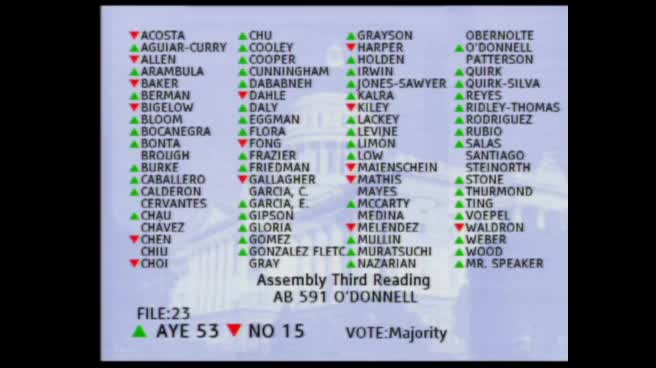 1MIN
Assembly Floor
 2MIN
Assembly Standing Committee on Appropriations
 5MIN
Assembly Standing Committee on Environmental Safety and Toxic Materials
Bill Author

Bill Co-Author(s):