AB 38: Student loan servicers: licensing and regulation: Student Loan Servicing Act.
- Session Year: 2017-2018
- House: Assembly
- Latest Version Date: 2018-09-14
Existing law, operative July 1, 2018, establishes the Student Loan Servicing Act to provide for the licensure, regulation, and oversight of student loan servicers by the Commissioner of Business Oversight, who is the head of the Department of Business Oversight. The act prohibits a person from engaging in the business of servicing a student loan in this state without a license, unless the person falls within certain exceptions. Under the act, a person applying for a license, among other things, is required to pay an application fee, sign the application under penalty of perjury, and submit to a criminal background check by the Department of Justice. The act authorizes the commissioner to deny an application for a license for specified reasons. The act also authorizes the commissioner to promulgate regulations and take various other administrative actions. The act defines various terms for its purposes, and excludes specified entities, including banks, trust companies, and certain nonprofit community service organizations from its provisions.
This bill would revise and recast the circumstances under which the commissioner is authorized to deny an application for a license. The bill would require an applicant to appoint the commissioner as the applicants attorney to receive service of process relating to specified actions and would require the service to include an affidavit of compliance. By expanding the crime of perjury, the bill would impose a state-mandated local program. The bill would redefine the term student loan under the act to mean any loan solely for use to finance a postsecondary education and costs of attendance at a postsecondary institution and would redefine student loan servicers to exclude debt collectors whose business operations involve collection on defaulted student loans, as specified. In addition to other terms, the bill would define the term Nationwide Multistate Licensing System & Registry to mean certain systems of records, created for nondepository, financial services licensing or registration, including student loan servicers, as specified. The bill would exclude from the act a state or nonprofit private institution or organization having an agreement with the United States Secretary of Education, in connection with its responsibilities as a guaranty agency engaged in default aversion, pursuant to specific federal student loan provisions. The bill would also authorize the commissioner to require an applicant for a student loan servicer license or a student loan servicer licensee to make some or all of the required filings with, and to pay assessments to, the commissioner through the Nationwide Multistate Licensing System & Registry.
This bill would authorize the commissioner to establish relationships or contracts with the Nationwide Multistate Licensing System & Registry or other designated entities to collect and maintain records and process transaction fees. The bill would authorize the commissioner, for purposes of participating in the licensing system and registry, to waive or modify rules, regulations, orders, and other requirements as reasonably necessary. The bill would permit the commissioner to use the system and registry as a channeling agent for requesting information from the Department of Justice and other sources, and would require the commissioner to establish a process by which applicants and licensees may challenge information entered into the licensing system and registry. Additionally, the bill would specify that any of various federal or state law requirements regarding the privacy or confidentiality of any information provided to the licensing system and registry, or privilege with respect to that information, would continue to apply, and that this information is authorized to be shared under the system without the loss of privilege or confidentiality. The bill would require the commissioner to report violations of the act, as well as other enforcement actions and information to the licensing system and registry to the extent that the information is a public record.
The act permits the commissioner to prescribe circumstances under which to accept electronic records, including applications, financial statements, reports, and other specified documents.
This bill would include within that category of electronic records a surety bond, rider, or endorsement.
Under the act, a licensee is required to respond to a qualified written request by acknowledging receipt of the request within 5 business days, as specified.
This bill would extend that timeframe to 10 business days. The bill additionally would authorize the commissioner to require persons who are not expressly excluded from the act to file, under oath or otherwise, special reports or answers in writing to specific questions or requests for information with the commissioner. The bill would provide that in any proceeding under the act, the burden of proving an exemption or an exception from a definition would be on the person claiming it. By increasing the circumstances in which a person may be required to take an oath, the bill would expand the crime of perjury, thereby imposing a state-mandated local program.
This bill would make legislative findings in support of its provisions and would also make related and conforming changes to the act.
The California Constitution requires the state to reimburse local agencies and school districts for certain costs mandated by the state. Statutory provisions establish procedures for making that reimbursement.
This bill would provide that no reimbursement is required by this act for a specified reason.
Existing constitutional provisions require that a statute that limits the right of access to the meetings of public bodies or the writings of public officials and agencies be adopted with findings demonstrating the interest protected by the limitation and the need for protecting that interest.
This bill would make legislative findings to that effect.
Existing law, operative July 1, 2018, establishes the Student Loan Servicing Act to provide for the licensure, regulation, and oversight of student loan servicers by the Commissioner of Business Oversight, who is the head of the Department of Business Oversight. The act prohibits a person from engaging in the business of servicing a student loan in this state without a license, unless the person falls within certain exceptions. Under the act, a person applying for a license, among other things, is required to pay an application fee, sign the application under penalty of perjury, and submit to a criminal background check by the Department of Justice. The act authorizes the commissioner to deny an application for a license for specified reasons. The act also authorizes the commissioner to promulgate regulations and take various other administrative actions. The act defines various terms for its purposes, and excludes specified entities, including banks, trust companies, and certain nonprofit community service organizations from its provisions.
This bill would revise and recast the circumstances under which the commissioner is authorized to deny an application for a license. The bill would require an applicant to appoint the commissioner as the applicants attorney to receive service of process relating to specified actions and would require the service to include an affidavit of compliance. By expanding the crime of perjury, the bill would impose a state-mandated local program. The bill would redefine the term student loan under the act to mean any loan solely for use to finance a postsecondary education and costs of attendance at a postsecondary institution and would redefine student loan servicers to exclude debt collectors whose business operations involve collection on defaulted student loans, as specified. In addition to other terms, the bill would define the term Nationwide Multistate Licensing System & Registry to mean certain systems of records, created for nondepository, financial services licensing or registration, including student loan servicers, as specified. The bill would exclude from the act a state or nonprofit private institution or organization having an agreement with the United States Secretary of Education, in connection with its responsibilities as a guaranty agency engaged in default aversion, pursuant to specific federal student loan provisions. The bill would also authorize the commissioner to require an applicant for a student loan servicer license or a student loan servicer licensee to make some or all of the required filings with, and to pay assessments to, the commissioner through the Nationwide Multistate Licensing System & Registry.
This bill would authorize the commissioner to establish relationships or contracts with the Nationwide Multistate Licensing System & Registry or other designated entities to collect and maintain records and process transaction fees. The bill would authorize the commissioner, for purposes of participating in the licensing system and registry, to waive or modify rules, regulations, orders, and other requirements as reasonably necessary. The bill would permit the commissioner to use the system and registry as a channeling agent for requesting information from the Department of Justice and other sources, and would require the commissioner to establish a process by which applicants and licensees may challenge information entered into the licensing system and registry. Additionally, the bill would specify that any of various federal or state law requirements regarding the privacy or confidentiality of any information provided to the licensing system and registry, or privilege with respect to that information, would continue to apply, and that this information is authorized to be shared under the system without the loss of privilege or confidentiality. The bill would require the commissioner to report violations of the act, as well as other enforcement actions and information to the licensing system and registry to the extent that the information is a public record.
The act permits the commissioner to prescribe circumstances under which to accept electronic records, including applications, financial statements, reports, and other specified documents.
This bill would include within that category of electronic records a surety bond, rider, or endorsement.
Under the act, a licensee is required to respond to a qualified written request by acknowledging receipt of the request within 5 business days, as specified.
This bill would extend that timeframe to 10 business days. The bill additionally would authorize the commissioner to require persons who are not expressly excluded from the act to file, under oath or otherwise, special reports or answers in writing to specific questions or requests for information with the commissioner. The bill would provide that in any proceeding under the act, the burden of proving an exemption or an exception from a definition would be on the person claiming it. By increasing the circumstances in which a person may be required to take an oath, the bill would expand the crime of perjury, thereby imposing a state-mandated local program.
This bill would make legislative findings in support of its provisions and would also make related and conforming changes to the act.
The California Constitution requires the state to reimburse local agencies and school districts for certain costs mandated by the state. Statutory provisions establish procedures for making that reimbursement.
This bill would provide that no reimbursement is required by this act for a specified reason.
Existing constitutional provisions require that a statute that limits the right of access to the meetings of public bodies or the writings of public officials and agencies be adopted with findings demonstrating the interest protected by the limitation and the need for protecting that interest.
This bill would make legislative findings to that effect.
Existing law, operative July 1, 2018, establishes the Student Loan Servicing Act to provide for the licensure, regulation, and oversight of student loan servicers by the Commissioner of Business Oversight, who is the head of the Department of Business Oversight. The act prohibits a person from engaging in the business of servicing a student loan in this state without a license, unless the person falls within certain exceptions. Under the act, a person applying for a license, among other things, is required to pay an application fee, sign the application under penalty of perjury, and submit to a criminal background check by the Department of Justice. The act authorizes the commissioner to deny an application for a license for specified reasons. The act also authorizes the commissioner to promulgate regulations and take various other administrative actions. The act defines various terms for its purposes, and excludes specified entities, including banks, trust companies, and certain nonprofit community service organizations from its provisions.
This bill would revise and recast the circumstances under which the commissioner is authorized to deny an application for a license. The bill would require an applicant to appoint the commissioner as the applicants attorney to receive service of process relating to specified actions and would require the service to include an affidavit of compliance. By expanding the crime of perjury, the bill would impose a state-mandated local program. The bill would redefine the term student loan under the act to mean any loan solely for use to finance a postsecondary education and costs of attendance at a postsecondary institution and would redefine student loan servicers to exclude debt collectors whose business operations involve collection on defaulted student loans, as specified. In addition to other terms, the bill would define the term Nationwide Multistate Licensing System & Registry to mean certain systems of records, created for nondepository, financial services licensing or registration, including student loan servicers, as specified. The bill would exclude from the act a state or nonprofit private institution or organization having an agreement with the United States Secretary of Education, in connection with its responsibilities as a guaranty agency engaged in default aversion, pursuant to specific federal student loan provisions. The bill would also authorize the commissioner to require an applicant for a student loan servicer license or a student loan servicer licensee to make some or all of the required filings with, and to pay assessments to, the commissioner through the Nationwide Multistate Licensing System & Registry.
This bill would authorize the commissioner to establish relationships or contracts with the Nationwide Multistate Licensing System & Registry or other designated entities to collect and maintain records and process transaction fees. The bill would authorize the commissioner, for purposes of participating in the licensing system and registry, to waive or modify rules, regulations, orders, and other requirements as reasonably necessary. The bill would permit the commissioner to use the system and registry as a channeling agent for requesting information from the Department of Justice and other sources, and would require the commissioner to establish a process by which applicants and licensees may challenge information entered into the licensing system and registry. Additionally, the bill would specify that any of various federal or state law requirements regarding the privacy or confidentiality of any information provided to the licensing system and registry, or privilege with respect to that information, would continue to apply, and that this information is authorized to be shared under the system without the loss of privilege or confidentiality. The bill would require the commissioner to report violations of the act, as well as other enforcement actions and information to the licensing system and registry to the extent that the information is a public record.
The act permits the commissioner to prescribe circumstances under which to accept electronic records, including applications, financial statements, reports, and other specified documents.
This bill would include within that category of electronic records a surety bond, rider, or endorsement.
Under the act, a licensee is required to respond to a qualified written request by acknowledging receipt of the request within 5 business days, as specified.
This bill would extend that timeframe to 10 business days. The bill additionally would authorize the commissioner to require persons who are not expressly excluded from the act to file, under oath or otherwise, special reports or answers in writing to specific questions or requests for information with the commissioner. The bill would provide that in any proceeding under the act, the burden of proving an exemption or an exception from a definition would be on the person claiming it. By increasing the circumstances in which a person may be required to take an oath, the bill would expand the crime of perjury, thereby imposing a state-mandated local program.
This bill would make legislative findings in support of its provisions and would also make related and conforming changes to the act.
The California Constitution requires the state to reimburse local agencies and school districts for certain costs mandated by the state. Statutory provisions establish procedures for making that reimbursement.
This bill would provide that no reimbursement is required by this act for a specified reason.
Existing constitutional provisions require that a statute that limits the right of access to the meetings of public bodies or the writings of public officials and agencies be adopted with findings demonstrating the interest protected by the limitation and the need for protecting that interest.
This bill would make legislative findings to that effect.
Existing law, operative July 1, 2018, establishes the Student Loan Servicing Act to provide for the licensure, regulation, and oversight of student loan servicers by the Commissioner of Business Oversight, who is the head of the Department of Business Oversight. The act prohibits a person from engaging in the business of servicing a student loan in this state without a license, unless the person falls within certain exceptions. Under the act, a person applying for a license, among other things, is required to pay an application fee, sign the application under penalty of perjury, and submit to a criminal background check by the Department of Justice. The act authorizes the commissioner to deny an application for a license for specified reasons. The act also authorizes the commissioner to promulgate regulations and take various other administrative actions. The act defines various terms for its purposes. purposes, and excludes specified entities, including banks, trust companies, and certain nonprofit community service organizations from its provisions.
This bill would revise and recast the circumstances under which the commissioner is authorized to deny an application for a license. The bill would require an applicant to appoint the commissioner as the applicants attorney to receive service of process relating to specified actions and would require the service to include an affidavit of compliance. By expanding the crime of perjury, the bill would impose a state-mandated local program. The bill would redefine the term student loan under the act to mean any loan solely for use to finance a postsecondary education and costs of attendance at a postsecondary institution and would redefine student loan servicers to exclude debt collectors whose business operations involve collection on defaulted student loans, as specified. The In addition to other terms, the bill also would define the term Nationwide Multistate Licensing System & Registry to mean certain systems of records, created for nondepository, financial services licensing or registration, including student loan servicers, as specified. The bill would exclude from the act a state or nonprofit private institution or organization having an agreement with the United States Secretary of Education, in connection with its responsibilities as a guaranty agency engaged in default aversion, pursuant to specific federal student loan provisions. The bill would also authorize the commissioner to require an applicant for a student loan servicer license or a student loan servicer licensee to make some or all of the required filings with, and to pay assessments to, the commissioner through the Nationwide Multistate Licensing System & Registry.
This bill would authorize the commissioner to establish relationships or contracts with the Nationwide Multistate Licensing System & Registry or other designated entities to collect and maintain records and process transaction fees. The bill would authorize the commissioner, for purposes of participating in the licensing system and registry, to waive or modify rules, regulations, orders, and other requirements as reasonably necessary. The bill would permit the commissioner to use the system and registry as a channeling agent for requesting information from the Department of Justice and other sources, and would require the commissioner to establish a process by which applicants and licensees may challenge information entered into the licensing system and registry. Additionally, the bill would specify that any of various federal or state law requirements regarding the privacy or confidentiality of any information provided to the licensing system and registry, or privilege with respect to that information, would continue to apply, and that this information is authorized to be shared under the system without the loss of privilege or confidentiality. The bill would require the commissioner to report violations of the act, as well as other enforcement actions and information to the licensing system and registry to the extent that the information is a public record.
The act permits the commissioner to prescribe circumstances under which to accept electronic records, including applications, financial statements, reports, and other specified documents.
This bill would include within that category of electronic records a surety bond, rider, or endorsement.
Under the act, a licensee is required to respond to a qualified written request by acknowledging receipt of the request within 5 business days, as specified.
This bill would extend that timeframe to 10 business days. The bill additionally would authorize the commissioner to require persons who are not expressly excluded from the act to file, under oath or otherwise, special reports or answers in writing to specific questions or requests for information with the commissioner. The bill would provide that in any proceeding under the act, the burden of proving an exemption or an exception from a definition would be on the person claiming it. By increasing the circumstances in which a person may be required to take an oath, the bill would expand the crime of perjury, thereby imposing a state-mandated local program.
This bill would make legislative findings in support of its provisions and would also make related and conforming changes to the act.
The California Constitution requires the state to reimburse local agencies and school districts for certain costs mandated by the state. Statutory provisions establish procedures for making that reimbursement.
This bill would provide that no reimbursement is required by this act for a specified reason.
Existing constitutional provisions require that a statute that limits the right of access to the meetings of public bodies or the writings of public officials and agencies be adopted with findings demonstrating the interest protected by the limitation and the need for protecting that interest.
This bill would make legislative findings to that effect.
Existing law, operative July 1, 2018, establishes the Student Loan Servicing Act to provide for the licensure, regulation, and oversight of student loan servicers by the Commissioner of Business, Business Oversight, who is the head of the Department of Business Oversight. The act prohibits a person from engaging in the business of servicing a student loan in this state without a license, unless the person falls within certain exceptions. Under the act, a person applying for a license, among other things, is required to pay an application fee, sign the application under penalty of perjury, and submit to a criminal background check by the Department of Justice. The act authorizes the commissioner to deny an application for a license for specified reasons. The act also authorizes the commissioner to promulgate regulations and take various other administrative actions. The act defines various terms for its purposes.
This bill would revise and recast the circumstances under which the commissioner is authorized to deny an application for a license. The bill would require an applicant to appoint the commissioner as the applicants attorney to receive service of process relating to specified actions and would require the service to include an affidavit of compliance. By expanding the crime of perjury, the bill would impose a state-mandated local program. The bill would redefine the term student loan under the act to mean any loan solely for use to finance a postsecondary education and costs of attendance at a postsecondary institution and would redefine student loan servicers to exclude debt collectors whose business operations involve collection on defaulted student loans, as specified. The bill also would define the term Nationwide Multistate Licensing System & Registry to mean certain systems of records, created for nondepository, financial services licensing or registration, including student loan servicers, as specified. The bill would authorize the commissioner to require an applicant for a student loan servicer license or a student loan servicer licensee to make some or all of the required filings with, and to pay assessments to, the commissioner through the Nationwide Multistate Licensing System & Registry.
This bill would authorize the commissioner to establish relationships or contracts with the Nationwide Multistate Licensing System & Registry or other designated entities to collect and maintain records and process transaction fees. The bill would authorize the commissioner, for purposes of participating in the licensing system and registry, to waive or modify rules, regulations, orders, and other requirements as reasonably necessary. The bill would permit the commissioner to use the system and registry as a channeling agent for requesting information from the Department of Justice and other sources, and would require the commissioner to establish a process by which applicants and licensees may challenge information entered into the licensing system and registry. Additionally, the bill would specify that any of various federal or state law requirements regarding the privacy or confidentiality of any information provided to the licensing system and registry, or privilege with respect to that information, would continue to apply, and that this information is authorized to be shared under the system without the loss of privilege or confidentiality. The bill would require the commissioner to report violations of the act, as well as other enforcement actions and information to the licensing system and registry to the extent that the information is a public record.
The act permits the commissioner to prescribe circumstances under which to accept electronic records, including applications, financial statements, reports, and other specified documents.
This bill would include within that category of electronic records a surety bond, rider, or endorsement.
Under the act, a licensee is required to respond to a qualified written request by acknowledging receipt of the request within 5 business days, as specified.
This bill would extend that timeframe to 10 business days. The bill additionally would authorize the commissioner to require persons who are not expressly excluded from the act to file, under oath or otherwise, special reports or answers in writing to specific questions or requests for information with the commissioner. The bill would provide that in any proceeding under the act, the burden of proving an exemption or an exception from a definition would be on the person claiming it. By increasing the circumstances in which a person may be required to take an oath, the bill would expand the crime of perjury, thereby imposing a state-mandated local program.
Existing law authorizes the department to issue a citation, which may include an administrative penalty, to a person engaged in the business of servicing student loans without a license or a licensee or person violating any provision of this act. Existing law requires these penalties to be deposited into the State Corporations Fund.This bill would instead require these penalties to be deposited into the Financial Institutions Fund.This bill would make legislative findings in support of its provisions and would also make related and conforming changes to the act.
The California Constitution requires the state to reimburse local agencies and school districts for certain costs mandated by the state. Statutory provisions establish procedures for making that reimbursement.
This bill would provide that no reimbursement is required by this act for a specified reason.
Existing constitutional provisions require that a statute that limits the right of access to the meetings of public bodies or the writings of public officials and agencies be adopted with findings demonstrating the interest protected by the limitation and the need for protecting that interest.
This bill would make legislative findings to that effect.
Existing law, operative July 1, 2018, establishes the Student Loan Servicing Act to provide for the licensure, regulation, and oversight of student loan servicers by the Commissioner of Business, who is the head of the Department of Business Oversight. The act prohibits a person from engaging in the business of servicing a student loan in this state without a license, unless the person falls within certain exceptions. Under the act, a person applying for a license, among other things, is required to pay an application fee, sign the application under penalty of perjury, and submit to a criminal background check by the Department of Justice. The act authorizes the commissioner to deny an application for a license for specified reasons. The act also authorizes the commissioner to promulgate regulations and take various other administrative actions. The act defines various terms for its purposes.
This bill would revise and recast the circumstances under which the commissioner is authorized to deny an application for a license. The bill would require an applicant to appoint the commissioner as the applicants attorney to receive service of process relating to specified actions and would require the service to include an affidavit of compliance. By expanding the crime of perjury, the bill would impose a state-mandated local program. The bill would redefine the term student loan under the act to mean any loan solely for use to finance a postsecondary education and costs of attendance at a postsecondary institution, institution and would redefine student loan servicers to exclude debt collectors whose business operations involve collection on defaulted student loans, as specified. The bill also would define the term Nationwide Multistate Licensing System & Registry to mean certain systems of records, created for nondepository, financial services licensing or registration, including student loan servicers, as specified. The bill would authorize the commissioner to require an applicant for a student loan servicer license or a student loan servicer licensee to make some or all of the required filings with, and to pay assessments to, the commissioner through the Nationwide Multistate Licensing System & Registry.
This bill would authorize the commissioner to establish relationships or contracts with the Nationwide Multistate Licensing System & Registry or other designated entities to collect and maintain records and process transaction fees. The bill would authorize the commissioner, for purposes of participating in the licensing system and registry, to waive or modify rules, regulations, orders, and other requirements as reasonably necessary. The bill would permit the commissioner to use the system and registry as a channeling agent for requesting information from the Department of Justice and other sources, and would require the commissioner to establish a process by which applicants and licensees may challenge information entered into the licensing system and registry. Additionally, the bill would specify that any of various federal or state law requirements regarding the privacy or confidentiality of any information provided to the licensing system and registry, or privilege with respect to that information, would continue to apply, and that this information is authorized to be shared under the system without the loss of privilege or confidentiality. The bill would require the commissioner to report violations of the act, as well as other enforcement actions and information to the licensing system and registry to the extent that the information is a public record.
The act permits the commissioner to prescribe circumstances under which to accept electronic records, including applications, financial statements, reports, and other specified documents.
This bill would include within that category of electronic records a surety bond, rider, or endorsement.
Under the act, a licensee is required to respond to a qualified written request by acknowledging receipt of the request within 5 business days, as specified.
This bill would extend that timeframe to 10 business days. The bill additionally would authorize the commissioner, for purposes of assessing whether a person is covered by or exempt from the act, to require that person, commissioner to require persons who are not expressly excluded from the act to file, under oath or otherwise, to file special reports or answers in writing to specific questions or requests for information with the commissioner. The bill would provide that in any proceeding under the act, the burden of proving an exemption or an exception from a definition would be on the person claiming it. By increasing the circumstances in which a person may be required to take an oath, the bill would expand the crime of perjury, thereby imposing a state-mandated local program.
Existing law authorizes the department to issue a citation, which may include an administrative penalty, to a person engaged in the business of servicing student loans without a license or a licensee or person violating any provision of this act. Existing law requires these penalties to be deposited into the State Corporations Fund.
This bill would instead require these penalties to be deposited into the Financial Institutions Fund.
This bill would make legislative findings in support of its provisions and would also make related and conforming changes to the act.
The California Constitution requires the state to reimburse local agencies and school districts for certain costs mandated by the state. Statutory provisions establish procedures for making that reimbursement.
This bill would provide that no reimbursement is required by this act for a specified reason.
Existing constitutional provisions require that a statute that limits the right of access to the meetings of public bodies or the writings of public officials and agencies be adopted with findings demonstrating the interest protected by the limitation and the need for protecting that interest.
This bill would make legislative findings to that effect.
Existing law, operative July 1, 2018, establishes the Student Loan Servicing Act to provide for the licensure, regulation, and oversight of student loan servicers by the Commissioner of Business Oversight. Business, who is the head of the Department of Business Oversight. The act prohibits a person from engaging in the business of servicing a student loan in this state without a license, unless the person falls within certain exceptions. Under the act, a person applying for a license, among other things, must is required to pay an application fee, sign the application under penalty of perjury, and submit to a criminal background check by the Department of Justice. The act authorizes the commissioner to deny an application for a license for specified reasons. The act also authorizes the commissioner to promulgate regulations and take various other administrative actions, and the actions. The act defines various terms for its purposes.
This bill would revise and recast the circumstances under which the commissioner is authorized to deny an application for a license. The bill would require an applicant to appoint the commissioner as the applicants attorney to receive service of process relating to specified actions and would require the service to include an affidavit of compliance. By expanding the crime of perjury, the bill would impose a state-mandated local program. The bill would redefine the term student loan under the act to mean any loan solely for use to finance a postsecondary education and costs of attendance at a postsecondary institution, as specified. The bill also would define the term Nationwide Multistate Licensing System & Registry to mean certain systems of records, created for nondepository, financial services licensing or registration, including student loan servicers, as specified. The bill would authorize the commissioner to require an applicant for a student loan servicer license or a student loan servicer licensee to make some or all of the required filings with, and to pay assessments to, the commissioner through the Nationwide Multistate Licensing System & Registry.
TheThis bill would authorize the commissioner to establish relationships or contracts with the Nationwide Multistate Licensing System & Registry or other designated entities to collect and maintain records and process transaction fees. The bill would authorize the commissioner, for purposes of participating in the licensing system and registry, to waive or modify rules, regulations, orders, and other requirements as reasonably necessary. The bill would permit the commissioner to use the system and registry as a channeling agent for requesting information from the Department of Justice and other sources, and would require the commissioner to establish a process by which applicants and licensees may challenge information entered into the licensing system and registry. Additionally, the bill would specify that any of various federal or state law requirements regarding the privacy or confidentiality of any information provided to the licensing system and registry, or privilege with respect to that information, would continue to apply, and that this information may is authorized to be shared under the system without the loss of privilege or confidentiality. The bill would require the commissioner to report violations of the act, as well as other enforcement actions and information to the licensing system and registry to the extent that the information is a public record.
The act permits the commissioner to prescribe circumstances under which to accept electronic records, including applications, financial statements, reports, and other specified documents.
This bill would include within that category of electronic records a surety bond, rider, or endorsement.
Under the act, a licensee must is required to respond to a qualified written request by acknowledging receipt of the request within 5 business days, as specified.
This bill would extend that timeframe to 10 business days. The bill additionally would authorize the commissioner, for purposes of assessing whether a person is covered by or exempt from the act, to require that person, under oath or otherwise, to file special reports or answers in writing to specific questions or requests for information with the commissioner. The bill would provide that in any proceeding under the act, the burden of proving an exemption or an exception from a definition would be on the person claiming it. By increasing the circumstances in which a person may be required to take an oath, the bill would expand the crime of perjury, thereby imposing a state-mandated local program. The
Existing law authorizes the department to issue a citation, which may include an administrative penalty, to a person engaged in the business of servicing student loans without a license or a licensee or person violating any provision of this act. Existing law requires these penalties to be deposited into the State Corporations Fund.
This bill would instead require these penalties to be deposited into the Financial Institutions Fund.
This bill also would make legislative findings in support of its provisions, and would provisions and would also make related and conforming changes to the act.
The California Constitution requires the state to reimburse local agencies and school districts for certain costs mandated by the state. Statutory provisions establish procedures for making that reimbursement.
This bill would provide that no reimbursement is required by this act for a specified reason.
Existing constitutional provisions require that a statute that limits the right of access to the meetings of public bodies or the writings of public officials and agencies be adopted with findings demonstrating the interest protected by the limitation and the need for protecting that interest.
This bill would make legislative findings to that effect.
Existing law, operative July 1, 2018, establishes the Student Loan Servicing Act to provide for the licensure, regulation, and oversight of student loan servicers by the Commissioner of Business Oversight. The act prohibits a person from engaging in the business of servicing a student loan in this state without a license, unless the person falls within certain exceptions. Under the act, a person applying for a license, among other things, must pay an application fee, sign the application under penalty of perjury, and submit to a criminal background check by the Department of Justice. The act also authorizes the commissioner to promulgate regulations and take various other administrative actions, and the act defines various terms for its purposes.
This bill would redefine the term student loan under the act to mean any loan solely for use to finance a postsecondary education and costs of attendance at a postsecondary institution, as specified. The bill also would define the term Nationwide Multistate Licensing System & Registry to mean certain systems of records, created for nondepository, financial services licensing or registration, including student loan servicers, as specified. The bill would authorize the commissioner to require an applicant for a student loan servicer license or a student loan servicer licensee to make some or all of the required filings with, and to pay assessments to, the commissioner through the Nationwide Multistate Licensing System & Registry.
The bill would authorize the commissioner to establish relationships or contracts with the Nationwide Multistate Licensing System & Registry or other designated entities to collect and maintain records and process transaction fees. The bill would authorize the commissioner, for purposes of participating in the licensing system and registry, to waive or modify rules, regulations, orders, and other requirements as reasonably necessary. The bill would permit the commissioner to use the system and registry as a channeling agent for requesting information from the Department of Justice and other sources, and would require the commissioner to establish a process by which applicants and licensees may challenge information entered into the licensing system and registry. Additionally, the bill would specify that any of various federal or state law requirements regarding the privacy or confidentiality of any information provided to the licensing system and registry, or privilege with respect to that information, would continue to apply, and that this information may be shared under the system without the loss of privilege or confidentiality. The bill would require the commissioner to report violations of the act, as well as other enforcement actions and information to the licensing system and registry to the extent that the information is a public record.
The act permits the commissioner to prescribe circumstances under which to accept electronic records, including applications, financial statements, reports, and other specified documents.
This bill would include within that category of electronic records a surety bond, rider, or endorsement.
Under the act, a licensee must respond to a qualified written request by acknowledging receipt of the request within 5 business days, as specified.
This bill would extend that timeframe to 10 business days. The bill additionally would authorize the commissioner, for purposes of assessing whether a person is covered by or exempt from the act, to require that person, under oath or otherwise, to file special reports or answers in writing to specific questions or requests for information with the commissioner. The bill would provide that in any proceeding under the act, the burden of proving an exemption or an exception from a definition would be on the person claiming it. By increasing the circumstances in which a person may be required to take an oath, the bill would expand the crime of perjury, thereby imposing a state-mandated local program. The bill also would make legislative findings in support of its provisions, and would make related and conforming changes to the act.
The California Constitution requires the state to reimburse local agencies and school districts for certain costs mandated by the state. Statutory provisions establish procedures for making that reimbursement.
This bill would provide that no reimbursement is required by this act for a specified reason.
Existing constitutional provisions require that a statute that limits the right of access to the meetings of public bodies or the writings of public officials and agencies be adopted with findings demonstrating the interest protected by the limitation and the need for protecting that interest.
This bill would make legislative findings to that effect.
This bill would declare the Legislatures intent to build upon existing law to ensure that the Student Loan Servicing Acts goals are met and to work with advocates, departments, and industry to create a smooth transition into the program.Existing law, operative July 1, 2018, establishes the Student Loan Servicing Act to provide for the licensure, regulation, and oversight of student loan servicers by the Commissioner of Business Oversight.
This bill would declare the Legislatures intent to build upon existing law to ensure that the Student Loan Servicing Acts goals are met and to work with advocates, departments, and industry to create a smooth transition into the program.
(a)The Legislature finds and declares all of the following:
(1)Student loan debt has created a national crisis, with over 40,000,000 people in the United States owing some amount of student loan debt. Total student educational debt in the United States exceeds one trillion two hundred billion dollars ($1,200,000,000,000), exceeding both the total amount of credit card and car loan debt.
(2)Currently, more than 40 percent of student borrowers are not making payments on their student loans. About one in six borrowers are in default, meaning they have gone a least a year without making a payment. The Consumer Finance Protection Bureau (hereafter CFPB) has found that one in three borrowers will redefault within two years. Servicing delays associated with income-driven loan forgiveness programs are predicted to cause over 200,000 borrowers to redefault within the next two years.
(3)Even though Californias financial aid programs are some of the nations strongest, our states college graduates still incur significant debt. According to the United States Department of Education, as of January 2015, there were approximately 4,156,000 student educational loan borrowers in California, and the total student educational loan debt outstanding for Californians was about one billion two hundred million dollars ($1.2 billion).
(4)Student educational loan debt is a drag on the states economy, preventing borrowers from achieving financial independence, buying property, and starting businesses.
(5)Student educational loan servicers administer student loans, serving as a critical link between borrowers and lenders in managing accounts, processing payments, and communicating directly with borrowers.
(6)The CFPB has continued to find that student loan borrowers encounter servicers that discourage borrower-friendly alternative payment plans, fail to respond to questions and payment processing errors, and fail to provide sufficient information to borrowers regarding payments, benefits, interest rates, and other charges.
(7)With the increasingly uncertain federal landscape, it is now more important than ever to ensure California student loan borrowers will be given meaningful access to federal affordable repayment options and loan forgiveness benefits, reliable information, and quality customer service and fair treatment.
(b)Therefore, it is the intent of the Legislature to do the following:
(1)Build upon existing law to ensure that the Student Loan Servicing Acts goals are met as the federal government enacts new regulations.
(2)Work with advocates, departments, and industry to create a smooth transition into the program.
SEC. 2.Section 28102 of the Financial Code is amended to read:28102.(a)No person shall engage in the business of servicing a student loan in this state without first obtaining a license pursuant to this division. A license shall not be transferable or assignable.
(b)This division shall not apply to any of the following:
(1)A bank, trust company, or industrial loan company doing business under the authority of, or in accordance with, a license, certificate, or charter issued by the United States or any state, district, territory, or commonwealth of the United States that is authorized to transact business in this state.
(2)A federally chartered savings and loan association, federal savings bank, or federal credit union that is authorized to transact business in this state.
(3)A savings and loan association, savings bank, or credit union organized under the laws of this or any other state that is authorized to transact business in this state.
(4)A public postsecondary educational institution or a private nonprofit postsecondary educational institution servicing a student loan it extended to the borrower.
(5)A nonprofit community service organization that meets all the criteria of Section 12104.
(6)In connection with its responsibilities as a guaranty agency engaged in default aversion, a state or nonprofit private institution or organization having an agreement with the United States Secretary of Education under Section 428(b) of the Higher Education Act of 1965 (20 U.S.C. Sec. 1078(b)).
(c)A private postsecondary educational institution not exempted from the requirements of this division pursuant to subdivision (b) shall not be required to comply with this division for the servicing of a student loan it extended to a borrower that a licensee is servicing pursuant to a servicing agreement with the private postsecondary educational institution for that student loan.
SEC. 3.Section 28104 of the Financial Code is amended to read:28104.For the purposes of this division, the following terms have the following meanings:
(a)Applicant means a person applying for a license pursuant to this division.
(b)Borrower means either of the following:
(1)A person who has received or agreed to pay a student loan.
(2)A person who shares responsibility for repaying a student loan with a person described in paragraph (1).
(c)Commissioner means the Commissioner of Business Oversight.
(d)Default aversion means those activities in which guaranty agencies engage to prevent default by a borrower pursuant to the law and regulations of the Federal Family Education Loan Program.
(e)Department means the Department of Business Oversight.
(f)Engage in the business means, without limitation, servicing student loans.
(g)In this state means any activity of a person relating to servicing student loans that originates from this state and is directed to persons outside this state, or that originates from outside this state and is directed to persons inside this state, or that originates inside this state and is directed to persons inside this state.
(h)Licensee means a person licensed pursuant to this division.
(i)Nationwide Multistate Licensing System & Registry means a system of record, created by the Conference of State Bank Supervisors and the American Association of Residential Mortgage Regulators, for nondepository, financial services licensing or registration, including student loan servicers, in participating state agencies, the District of Columbia, Puerto Rico, the United States Virgin Islands, and Guam.
(j)Person means an individual, a corporation, a partnership, a limited liability company, an association, a trust, an unincorporated organization, a government, or a political subdivision of a government, and any other entity.
(k)Qualified written request means a written correspondence made by a borrower, other than notice on a payment medium supplied by a licensee, that is transmitted by mail, facsimile, or electronically through an email address or Internet Web site designated by the licensee to receive communications from a borrower that does all of the following:
(1)Enables the licensee to identify the name and account of the borrower.
(2)Includes a statement of the reasons for the belief by the borrower, to the extent applicable, that the account is in error or that provides sufficient detail to the servicer regarding information sought by the borrower, such as requesting a complete payment history for the loan or the borrowers account, a copy of the borrowers student loan promissory note, or the contact information for the creditor to whom the borrowers student loan is owed.
(l)Servicing means any of the following activities related to a student loan of a borrower:
(1)Performing both of the following:
(A)Receiving any scheduled periodic payments from a borrower or any notification that a borrower made a scheduled periodic payment.
(B)Applying payments to the borrowers account pursuant to the terms of the student loan or the contract governing the servicing.
(2)During a period when no payment is required on a student loan, performing both of the following:
(A)Maintaining account records for the student loan.
(B)Communicating with the borrower regarding the student loan on behalf of the owner of the student loan promissory note.
(3)Interacting with a borrower related to that borrowers student loan, with the goal of helping the borrower avoid default on his or her student loan or facilitating the activities described in paragraph (1) or (2).
(m)(1)Student loan means any loan made solely for use to finance a postsecondary education and costs of attendance at a postsecondary institution, including, but not limited to, tuition, fees, books and supplies, room and board, transportation, and miscellaneous personal expenses. A student loan includes a loan made to refinance a student loan.
(2)(A)A student loan shall not include an extension of credit under an open-end consumer credit plan, a reverse mortgage transaction, a residential mortgage transaction, or any other loan that is secured by real property or a dwelling.
(B)A student loan shall not include an extension of credit made by a postsecondary educational institution to a borrower if one of the following applies:
(i)The term of the extension of credit is no longer than the borrowers education program.
(ii)The remaining, unpaid principal balance of the extension of credit is less than $1,500 at the time of the borrowers graduation or completion of the program.
(iii)The borrower fails to graduate or successfully complete his or her education program and has a balance due at the time of his or her disenrollment from the postsecondary institution.
(n)Student loan servicer means any person engaged in the business of servicing student loans. A student loan servicer does not include a debt collector, as defined in Section 1788.2 of the Civil Code, whose student loan debt collection business, and business operations, involve collecting, or attempting to collect, on defaulted student loans, that is, federal student loans for which no payment has been received for 270 days or more, or private student loans, in default, according to the terms of the loan documents. Debt collectors who also service nondefaulted student loans, as part of their business, and business operations, are student loan servicers.
SEC. 4.Section 28106 of the Financial Code is amended to read:28106.(a)The commissioner shall administer the provisions of this division and may promulgate rules and regulations and issue orders consistent with that authority.
(b)Without limitation, the functions, powers, and duties of the commissioner include all of the following:
(1)To issue or refuse to issue a license as provided by this division.
(2)To revoke or suspend for cause any license as provided by this division.
(3)To keep records of licenses issued under this division.
(4)To receive, consider, investigate, and act upon complaints made in connection with a licensee.
(5)To prescribe the forms of and receive (A) applications for licenses and (B) reports, books, and records required to be made by a licensee under this division, including annual audited financial statements.
(6)To subpoena documents and witnesses and compel their attendance and production, to administer oaths, and to require the production of books, papers, or other materials relevant to any inquiry authorized by this division.
(7)To require information with regard to an applicant that the commissioner may deem necessary, with regard for the paramount public interest in ascertaining the experience, background, honesty, truthfulness, integrity, and competency of an applicant for servicing student loans, and if an applicant is an entity other than an individual, in ascertaining the honesty, truthfulness, integrity, and competency of officers, directors, or managing members of the corporation, association, or other entity, or the general partners of a partnership.
(8)To enforce by order any provision of this division.
(9)To levy fees, fines, and charges in an amount sufficient to cover the cost of the services performed in administering this division.
(10)To appoint examiners, attorneys, supervisors, experts, and special assistants as needed to effectively and efficiently administer this division.
SEC. 5.Section 28110 of the Financial Code is amended to read:28110.(a)Notwithstanding any other law, the commissioner may by rule or order prescribe circumstances under which to accept electronic records or electronic signatures. This section shall not be deemed to require the commissioner to accept electronic records or electronic signatures.
(b)For purposes of this section, the following terms have the following meanings:
(1)Electronic record means an initial license application, or material modification of that license application, and any other record created, generated, sent, communicated, received, or stored by electronic means. Electronic records also includes, but is not limited to, all of the following:
(A)An application, amendment, supplement, and exhibit, filed for any license, consent, or other authority.
(B)A financial statement, report, or advertising.
(C)A surety bond, rider, or endorsement thereto.
(D)An order, license, consent, or other authority.
(E)A notice of public hearing, accusation, and statement of issues in connection with any application, license, consent, or other authority.
(F)A proposed decision of a hearing officer and a decision of the commissioner.
(G)The transcripts of a hearing and correspondence between a party and the commissioner directly relating to the record.
(H)A release, newsletter, interpretive opinion, determination, or specific ruling.
(I)Correspondence between a party and the commissioner directly relating to any document listed in subparagraphs (A) to (H), inclusive.
(2)Electronic signature means an electronic sound, symbol, or process attached to or logically associated with an electronic record and executed or adopted by a person with the intent to sign the electronic record.
(c)The Legislature finds and declares that the Department of Business Oversight has continuously implemented methods to accept records filed electronically, and is encouraged to continue to expand its use of electronic filings to the extent feasible, as budget, resources, and equipment are made available to accomplish that goal.
SEC. 6.Section 28111 is added to the Financial Code, to read:28111.(a)The commissioner may require an applicant for a student loan servicer license or a student loan servicer licensee to make some or all of the filings with the commissioner through the Nationwide Multistate Licensing System & Registry.
(b)The commissioner may require an application to be made through the Nationwide Multistate Licensing System & Registry, and may require fees, fingerprints, financial statements, supporting documents, changes of address, and any other information, and amendments or modifications thereto, to be submitted by applicants and licensees through the Nationwide Multistate Licensing System & Registry.
(c)The commissioner may require licensees to pay assessments through the Nationwide Multistate Licensing System & Registry.
SEC. 7.Section 28114 of the Financial Code is amended to read:28114.(a)The commissioner shall submit to the Department of Justice fingerprint images and related information required by the Department of Justice of every applicant for a license for purposes of obtaining information as to the existence and content of a record of state or federal convictions, state or federal arrests, and information as to the existence and content of a record of state or federal arrests for which the Department of Justice establishes that the person is free on bail or on his or her own recognizance pending trial or appeal.
(b)When received, the Department of Justice shall transmit fingerprint images and related information received pursuant to this section to the Federal Bureau of Investigation for the purpose of obtaining a federal criminal history records check. The Department of Justice shall review the information returned from the Federal Bureau of Investigation and compile and disseminate a response to the commissioner.
(c)The Department of Justice shall provide a response to the commissioner pursuant to paragraph (1) of subdivision (p) of Section 11105 of the Penal Code.
(d)The commissioner shall request from the Department of Justice subsequent arrest notification service, as provided pursuant to Section 11105.2 of the Penal Code, for the license applicant described in subdivision (a).
(e)The Department of Justice shall charge a fee, payable by the applicant, sufficient to cover the costs of processing the requests pursuant to this section.
SEC. 8.Section 28116 of the Financial Code is amended to read:28116.(a)Upon the filing of an application for a license pursuant to Section 28112 and the payment of the fees, the commissioner shall investigate the applicant and its general partners and individuals owning or controlling, directly or indirectly, 10 percent or more of the outstanding interests or any individual responsible for the conduct of the applicants servicing activities in this state, if the applicant is a partnership. If the applicant is a corporation, trust, limited liability company, or association, including an unincorporated organization, the commissioner shall investigate the applicant, its principal officers, directors, trustee, managing members, and individuals owning or controlling, directly or indirectly, 10 percent or more of the outstanding equity securities or any individual responsible for the conduct of the applicants servicing activities in this state.
(b)Upon the filing of an application for a license pursuant to Section 28128 and the payment of the fees, the commissioner shall investigate the individual responsible for the servicing activity of the licensee at the new location described in the application. The investigation may be limited to information that was not included in prior applications filed pursuant to this division. If the commissioner determines that the applicant has satisfied this division and does not find facts constituting reasons for denial, the commissioner shall issue and deliver a license to the applicant.
(c)For the purposes of this section, principal officers shall mean president, chief executive officer, treasurer, and chief financial officer, as may be applicable, and any other officer with direct responsibility for the conduct of the applicants servicing activities in this state.
SEC. 9.Section 28117 is added to the Financial Code, to read:28117.(a)Before an applicant is issued a license, the applicant shall file with the commissioner, in such form as the commissioner may require, an appointment irrevocably appointing the commissioner to be the applicants or licensees attorney, to receive service of any lawful process in any noncriminal judicial or administrative proceeding against the applicant or licensee, or any of its successors, that arises under this division or under any regulation or order issued under this division after such appointment has been filed, with the same force and validity as if served personally on the applicant, licensee, or successor.
(b)Service may be made by leaving a copy of the process at any office of the commissioner, but that service is not effective unless (1) the party making that service, who may be the commissioner, sends notice of service and a copy of the process by registered or certified mail to the party served at its last address on file with the commissioner, and (2) an affidavit of compliance with this section by the party making service is filed in the case on or before the return date, if any, or within such further time as the court, in the case of a judicial proceeding, or the administrative agency, in the case of an administrative proceeding, allows.
SEC. 10.Section 28120 of the Financial Code is amended to read:28120.(a)The proceedings for a denial of a license shall be conducted in accordance with Chapter 5 (commencing with Section 11500) of Part 1 of Division 3 of Title 2 of the Government Code.
(b)The commissioner may deny an application for a license for any of the following reasons:
(1)A false statement of a material fact has been made in the application.
(2)The applicant or any principal officer, director, general partner, managing member, or individual owning or controlling, directly or indirectly, 10 percent or more of the outstanding interests or equity securities of the applicant, within the last 10 years has (A) been convicted of, or pleaded nolo contendere to, a crime or (B) committed any act involving dishonesty, fraud, or deceit, if the crime or act is substantially related to the qualifications, functions, or duties of a person engaged in business in accordance with this division.
(3)The applicant or any principal officer, director, general partner, managing member, or individual owning or controlling, directly or indirectly, 10 percent or more of the outstanding interests or equity securities of the applicant, has violated, or is not in material compliance with this division, or an order or rule of the commissioner.
(4)A material requirement for issuance of a license has not been met.
(5)The applicant or any principal officer, director, general partner, managing member, or individual owning or controlling, directly or indirectly, 10 percent or more of the outstanding interests or equity securities of the applicant, has violated this division or the rules thereunder, or any similar regulatory scheme of this or a foreign jurisdiction.
(6)The applicant or any principal officer, director, general partner, managing member, or individual owning or controlling, directly or indirectly, 10 percent or more of the outstanding interests or equity securities of the applicant, has been held liable in any civil action by final judgment or any administrative judgment by any public agency within the past seven years.
(7)The commissioner, based on its investigation of the applicant, is unable to find that the financial responsibility, criminal records, experience, character, and general fitness of the applicant and its general partners, managing members, principal officers and directors, and individuals owning or controlling, directly or indirectly, 10 percent or more of the outstanding interests or equity securities of the applicant, support a finding that the business will be operated honestly, fairly, efficiently, and in accordance with the requirements of this division.
SEC. 11.Section 28122 of the Financial Code is amended to read:28122.(a)The commissioner may deem an application for a license abandoned if the applicant fails to respond to any request for information required by the commissioner or department during an investigation of the application.
(b)The commissioner shall notify the applicant, in writing, that if the applicant fails to submit responsive information within 60 days from the date the commissioner sent the written request for information, the commissioner shall deem the application abandoned.
(c)An application fee paid prior to the date an application is deemed abandoned shall not be refunded. Abandonment of an application pursuant to this subdivision shall not preclude the applicant from submitting a new application and fee for a license.
SEC. 12.Article 3 (commencing with Section 28125) is added to Chapter 2 of Division 12.5 of the Financial Code, to read:3.Nationwide Multistate Licensing System & Registry28125.(a)The commissioner is authorized to establish relationships or contracts with the Nationwide Multistate Licensing System & Registry or other entities designated by the Nationwide Multistate Licensing System & Registry to collect and maintain records and process transaction fees or other fees related to licensees or other persons subject to this division.
(b)For the purpose of participating in the Nationwide Multistate Licensing System & Registry, the commissioner is authorized to waive or modify, in whole or in part, by rule, regulation, or order, any or all of the requirements of this division and to establish new requirements as reasonably necessary to participate in the Nationwide Multistate Licensing System & Registry.
(c)The commissioner may use the Nationwide Multistate Licensing System & Registry as a channeling agent for requesting information from, and distributing information to, the Department of Justice, any other governmental agency, or any other source, as directed by the commissioner.
(d)The commissioner shall establish a process through which applicants and licensees may challenge information entered into the Nationwide Multistate Licensing System & Registry by the commissioner.
28125.1.(a)Except as otherwise provided in Section 1512 of the SAFE Act (12 U.S.C. Sec. 5111(a)), the requirements under any federal law or the Information Practices Act of 1977 (Chapter 1 (commencing with Section 1798) of Part 4 of Division 3 of the Civil Code) regarding the privacy or confidentiality of any information or material provided to the Nationwide Multistate Licensing System & Registry, and any privilege arising under federal or state law, including the rules of any state court, with respect to that information or material, shall continue to apply to the information or material after the information or material has been disclosed to the Nationwide Multistate Licensing System & Registry. The information and material may be shared with all state and federal regulatory officials with industry oversight authority without the loss of privilege or the loss of confidentiality protections provided by federal law or the Information Practices Act.
(b)Information or material that is subject to a privilege or confidentiality under subdivision (a) shall not be subject to the following:
(1)Disclosure under any federal or state law governing the disclosure to the public of information held by an officer or an agency of the federal government or the state.
(2)Subpoena or discovery, or admission into evidence, in any private civil action or administrative process, unless with respect to any privilege held by the Nationwide Multistate Licensing System & Registry with respect to the information or material, the person to whom the information or material pertains waives, in whole or in part, in the discretion of that person, that privilege.
(c)This section shall not apply with respect to the information or material relating to the employment history of, and publicly adjudicated disciplinary and enforcement actions included in, the Nationwide Multistate Licensing System & Registry for access by the public.
28125.2.The commissioner shall report regularly violations of this division, as well as enforcement actions and other relevant information, to the Nationwide Multistate Licensing System & Registry, to the extent that the information is a public record.
SEC. 13.Section 28128 of the Financial Code is amended to read:28128.(a)A licensee seeking to engage in the business of servicing student loans at a new location shall submit an application for a branch office license to the commissioner at least 10 days before engaging in the business of servicing student loans at a new location and pay the fee required by Section 28112.
(b)The licensee may engage in the business of servicing student loans at the new location 10 days after the date of submission of a branch office application.
(c)(1)The commissioner shall approve or deny the individual responsible for the servicing activity of the licensee at the new location in accordance with Article 2 of Chapter 2 (commencing with Section 28112), and shall notify the licensee of this decision within 90 days of the date of receipt of the application.
(2)If the commissioner denies the application, the licensee shall, within 10 days of the date of receipt of notification of the commissioners denial, submit a new application to the commissioner designating a different individual responsible for the servicing activity of the licensee at the new location. The commissioner shall approve or deny the different individual as provided in paragraph (1).
(d)A licensee shall not engage in the business of servicing student loans at a new location in a name other than a name approved by the commissioner.
(e)A branch office license to engage in the business of servicing at a new location shall be issued in accordance with this section. A change of street address of a place of business designated in a license shall be made in accordance with Section 28126 and shall not constitute a new location subject to the requirements of this section.
SEC. 14.Section 28130 of the Financial Code is amended to read:28130.A licensee shall do all of the following:
(a)Develop policies and procedures reasonably intended to promote compliance with this division.
(b)File with the commissioner any report required by the commissioner.
(c)Comply with the provisions of this division and any regulation or order of the commissioner.
(d)Submit to periodic examination by the commissioner as required by this division and any regulation or order of the commissioner.
(e)Advise the commissioner of filing a petition for bankruptcy within five days of the filing.
(f)Provide, free of charge on its Internet Web site, information or links to information regarding repayment and loan forgiveness options that may be available to borrowers and provide this information or these links to borrowers via written correspondence or email at least once per calendar year.
(g)(1)Respond to a qualified written request by acknowledging receipt of the request within 10 business days and within 30 business days, provide information relating to the request and, if applicable, the action the licensee will take to correct the account or an explanation for the licensees position that the borrowers account is correct.
(2)The 30-day period described in paragraph (1) may be extended for not more than 15 days if, before the end of the 30-day period, the licensee notifies the borrower of the extension and the reasons for the delay in responding.
(3)After receipt of a qualified written request related to a dispute on a borrowers payment on a student loan, a licensee shall not, for 60 days, furnish adverse information to any consumer reporting agency regarding any payment that is the subject of the qualified written request.
(h)(1)Except as provided in federal law or required by a student loan agreement, a licensee shall inquire of a borrower how to apply an overpayment to a student loan. A borrowers direction on how to apply an overpayment to a student loan shall stay in effect for any future overpayments during the term of a student loan until the borrower provides different directions.
(2)For purposes of this subdivision, overpayment means a payment on a student loan in excess of the monthly amount due from a borrower on a student loan, also commonly referred to as a prepayment.
SEC. 15.Section 28134 of the Financial Code is amended to read:28134.(a)If the sale, assignment, or other transfer of the servicing of a student loan results in a change in the identity of the party to whom the borrower is required to send payments or direct any communications concerning the student loan the licensee shall notify the borrower in writing at least 15 days before the borrower is required to send a payment on the student loan of all of the following:
(1)The identity of the new student loan servicer and the number of the license of the new student loan servicer issued by the commissioner.
(2)The name and address of the new student loan servicer to whom subsequent payments or communications are required to be sent.
(3)The telephone numbers and Internet Web sites of the new student loan servicer.
(4)The effective date of the sale, assignment, or transfer.
(5)The date on which the licensee, as the current student loan servicer, will stop accepting payments on the borrowers student loan.
(6)The date on which the new student loan servicer will begin accepting payments on the borrowers student loan.
(b)A licensee shall transfer all information regarding a borrower, a borrowers account, and a borrowers student loan to the new licensee servicing the borrowers student loan within 45 calendar days of the effective date of the sale, assignment, or transfer.
SEC. 16.Section 28136 of the Financial Code is amended to read:28136.The licensee shall not do any of the following:
(a)Directly or indirectly employ any scheme, device, or artifice to defraud or mislead a borrower.
(b)Engage in any unfair or deceptive practice toward any borrower or misrepresent or omit any material information in connection with the servicing of a student loan, including, but not limited to, misrepresenting the amount, nature, or terms of any fee or payment due or claimed to be due on a student loan, the terms and conditions of the student loan agreement, or the borrowers obligations under the student loan.
(c)Misapply payments made by a borrower to the outstanding balance of a student loan.
(d)If the licensee is required to or voluntarily reports to a consumer reporting agency, fail to accurately report each borrowers payment performance to at least one consumer reporting agency that compiles and maintains files on consumers on a nationwide basis, upon acceptance as a data furnisher by that consumer reporting agency. For purposes of this subdivision, a consumer reporting agency that compiles and maintains files on consumers on a nationwide basis is one that meets the definition in Section 603(p) of the federal Fair Credit Reporting Act (15 U.S.C. Sec. 1681a(p)).
(e)Refuse to communicate with an authorized representative of the borrower who provides a written authorization signed by the borrower, provided the licensee may adopt reasonable procedures for verifying that the representative is in fact authorized to act on behalf of the borrower and for protecting the borrower from fraud or abusive practices.
(f)Negligently or intentionally make any false statement or knowingly and willfully make any omission of a material fact in connection with any information or reports filed with the commissioner, the department, or another governmental agency.
SEC. 17.Section 28142 of the Financial Code is amended to read:28142.(a)A licensee shall maintain a surety bond in accordance with this section in a minimum amount of twenty-five thousand dollars ($25,000). The bond shall be payable to the commissioner and issued by an insurer authorized to do business in this state. The surety bond, including any and all riders and endorsements executed subsequent to the effective date of the bond, shall be filed with the commissioner within 10 days of execution. For licensees with multiple licensed locations, only one surety bond is required. The bond shall be used for the recovery of expenses, fines, and fees levied by the commissioner in accordance with this division or for losses or damages incurred by borrowers as the result of a licensees noncompliance with the requirements of this division. The commissioner may require licensees to submit bonds, riders, and endorsements electronically through the Nationwide Multistate Licensing System & Registrys electronic surety bond function.
(b)When an action is commenced on a licensees bond, the commissioner may require the filing of a new bond. Immediately upon recovery of any action on the bond, the licensee shall file a new bond. Failure to file a new bond within 10 days of the recovery on a bond, or within 10 days after notification by the commissioner that a new bond is required, constitutes sufficient grounds for the suspension or revocation of the license.
(c)The commissioner may require a higher bond amount for a licensee based on the dollar amount of servicing of student loans by that licensee.
SEC. 18.Section 28144 of the Financial Code is amended to read:28144.(a)Each licensee shall pay to the commissioner its pro rata share of all costs and expenses reasonably incurred in the administration of this division, as estimated by the commissioner, for the ensuing year and any deficit actually incurred or anticipated in the administration of the division in the year in which the assessment is made. The pro rata share shall be the proportion that a licensees servicing activities in this state bears to the costs and expenses remaining after the amount assessed pursuant to subdivision (c).
(b)On or before the 30th day of September in each year, the commissioner shall notify each licensee of the amount assessed and levied against it and that amount shall be paid by October 31. If payment is not made by October 31, the commissioner shall assess and collect a penalty, in addition to the assessment, of 1 percent of the assessment for each month or part of a month that the payment is delayed or withheld.
(c)In the levying and collection of the assessment, a licensee shall neither be assessed for nor be permitted to pay less than two hundred fifty dollars ($250) per licensed location per year.
(d)If a licensee fails to pay the assessment on or before the 31st day of October, the commissioner may by order summarily suspend or revoke the license issued to the licensee. If, after an order is made, a request for hearing is filed in writing within 30 days, and a hearing is not held within 60 days thereafter, the order is deemed rescinded as of its effective date. During any period when the license is revoked or suspended, a licensee shall not engage in the business of servicing student loans in this state pursuant to this division except as may be permitted by order of the commissioner. However, the revocation, suspension, or surrender of a license shall not affect the powers of the commissioner as provided in this division.
(e)Notwithstanding subdivisions (a) to (d), inclusive, the commissioner may by rule require licensees to pay assessments through the Nationwide Multistate Licensing System & Registry.
SEC. 19.Section 28153 is added to the Financial Code, to read:28153.The commissioner may require persons who are not expressly excluded from this division under subdivision (b) of Section 28102 to file with the commissioner, under oath or otherwise, in the form and within a reasonable period of time as prescribed by the commissioner by special reports, or answers in writing to specific questions or requests for information.
SEC. 20.Section 28153.5 is added to the Financial Code, to read:28153.5.In any proceeding under this division, the burden of proving an exemption or an exception from a definition is upon the person claiming it.
SEC. 21.Section 28154 of the Financial Code is amended to read:28154.(a)If a licensee fails to do either of the following, the commissioner shall impose a penalty in a sum of up to one hundred dollars ($100) for every day late:
(1)To make any report required by law or by the commissioner within 10 days from the day designated for the making of the report, or within any extension of time granted by the commissioner.
(2)To include therein any matter required by law or by the commissioner.
(b)The commissioner may by order summarily suspend or revoke the license if a licensee fails to file any report required by this division.
SEC. 22.No reimbursement is required by this act pursuant to Section 6 of Article XIIIB of the California Constitution because the only costs that may be incurred by a local agency or school district will be incurred because this act creates a new crime or infraction, eliminates a crime or infraction, or changes the penalty for a crime or infraction, within the meaning of Section 17556 of the Government Code, or changes the definition of a crime within the meaning of Section 6 of Article XIIIB of the California Constitution.
SEC. 23.The Legislature finds and declares that Section 12 of this act, which adds Article 3 (commencing with Section 28125) to Chapter 2 of Division 12.5 of the Financial Code, imposes a limitation on the publics right of access to the meetings of public bodies or the writings of public officials and agencies within the meaning of Section 3 of Article I of the California Constitution. Pursuant to that constitutional provision, the Legislature makes the following findings to demonstrate the interest protected by this limitation and the need for protecting that interest:
It is necessary to protect the confidential information and material submitted by applicants and licensees to the Nationwide Multistate Licensing System & Registry.
(a)The Legislature finds and declares all of the following:
(1)Student loan debt has created a national crisis, with over 40,000,000 people in the United States owing some amount of student loan debt. Total student educational debt in the United States exceeds one trillion two hundred billion dollars ($1,200,000,000,000), exceeding both the total amount of credit card and car loan debt.
(2)Currently, more than 40 percent of student borrowers are not making payments on their student loans. About one in six borrowers are in default, meaning they have gone a least a year without making a payment. The Consumer Finance Protection Bureau (hereafter CFPB) has found that one in three borrowers will redefault within two years. Servicing delays associated with income-driven loan forgiveness programs are predicted to cause over 200,000 borrowers to redefault within the next two years.
(3)Even though Californias financial aid programs are some of the nations strongest, our states college graduates still incur significant debt. According to the United States Department of Education, as of January 2015, there were approximately 4,156,000 student educational loan borrowers in California, and the total student educational loan debt outstanding for Californians was about one billion two hundred million dollars ($1.2 billion).
(4)Student educational loan debt is a drag on the states economy, preventing borrowers from achieving financial independence, buying property, and starting businesses.
(5)Student educational loan servicers administer student loans, serving as a critical link between borrowers and lenders in managing accounts, processing payments, and communicating directly with borrowers.
(6)The CFPB has continued to find that student loan borrowers encounter servicers that discourage borrower-friendly alternative payment plans, fail to respond to questions and payment processing errors, and fail to provide sufficient information to borrowers regarding payments, benefits, interest rates, and other charges.
(7)With the increasingly uncertain federal landscape, it is now more important than ever to ensure California student loan borrowers will be given meaningful access to federal affordable repayment options and loan forgiveness benefits, reliable information, and quality customer service and fair treatment.
(b)Therefore, it is the intent of the Legislature to do the following:
(1)Build upon existing law to ensure that the Student Loan Servicing Acts goals are met as the federal government enacts new regulations.
(2)Work with advocates, departments, and industry to create a smooth transition into the program.
SEC. 2.Section 28102 of the Financial Code is amended to read:28102.(a)No person shall engage in the business of servicing a student loan in this state without first obtaining a license pursuant to this division. A license shall not be transferable or assignable.
(b)This division shall not apply to any of the following:
(1)A bank, trust company, or industrial loan company doing business under the authority of, or in accordance with, a license, certificate, or charter issued by the United States or any state, district, territory, or commonwealth of the United States that is authorized to transact business in this state.
(2)A federally chartered savings and loan association, federal savings bank, or federal credit union that is authorized to transact business in this state.
(3)A savings and loan association, savings bank, or credit union organized under the laws of this or any other state that is authorized to transact business in this state.
(4)A public postsecondary educational institution or a private nonprofit postsecondary educational institution servicing a student loan it extended to the borrower.
(5)A nonprofit community service organization that meets all the criteria of Section 12104.
(6)In connection with its responsibilities as a guaranty agency engaged in default aversion, a state or nonprofit private institution or organization having an agreement with the United States Secretary of Education under Section 428(b) of the Higher Education Act of 1965 (20 U.S.C. Sec. 1078(b)).
(c)A private postsecondary educational institution not exempted from the requirements of this division pursuant to subdivision (b) shall not be required to comply with this division for the servicing of a student loan it extended to a borrower that a licensee is servicing pursuant to a servicing agreement with the private postsecondary educational institution for that student loan.
SEC. 3.Section 28104 of the Financial Code is amended to read:28104.For the purposes of this division, the following terms have the following meanings:
(a)Applicant means a person applying for a license pursuant to this division.
(b)Borrower means either of the following:
(1)A person who has received or agreed to pay a student loan.
(2)A person who shares responsibility for repaying a student loan with a person described in paragraph (1).
(c)Commissioner means the Commissioner of Business Oversight.
(d)Default aversion means those activities in which guaranty agencies engage to prevent default by a borrower pursuant to the law and regulations of the Federal Family Education Loan Program.
(e)Department means the Department of Business Oversight.
(f)Engage in the business means, without limitation, servicing student loans.
(g)In this state means any activity of a person relating to servicing student loans that originates from this state and is directed to persons outside this state, or that originates from outside this state and is directed to persons inside this state, or that originates inside this state and is directed to persons inside this state.
(h)Licensee means a person licensed pursuant to this division.
(i)Nationwide Multistate Licensing System & Registry means a system of record, created by the Conference of State Bank Supervisors and the American Association of Residential Mortgage Regulators, for nondepository, financial services licensing or registration, including student loan servicers, in participating state agencies, the District of Columbia, Puerto Rico, the United States Virgin Islands, and Guam.
(j)Person means an individual, a corporation, a partnership, a limited liability company, an association, a trust, an unincorporated organization, a government, or a political subdivision of a government, and any other entity.
(k)Qualified written request means a written correspondence made by a borrower, other than notice on a payment medium supplied by a licensee, that is transmitted by mail, facsimile, or electronically through an email address or Internet Web site designated by the licensee to receive communications from a borrower that does all of the following:
(1)Enables the licensee to identify the name and account of the borrower.
(2)Includes a statement of the reasons for the belief by the borrower, to the extent applicable, that the account is in error or that provides sufficient detail to the servicer regarding information sought by the borrower, such as requesting a complete payment history for the loan or the borrowers account, a copy of the borrowers student loan promissory note, or the contact information for the creditor to whom the borrowers student loan is owed.
(l)Servicing means any of the following activities related to a student loan of a borrower:
(1)Performing both of the following:
(A)Receiving any scheduled periodic payments from a borrower or any notification that a borrower made a scheduled periodic payment.
(B)Applying payments to the borrowers account pursuant to the terms of the student loan or the contract governing the servicing.
(2)During a period when no payment is required on a student loan, performing both of the following:
(A)Maintaining account records for the student loan.
(B)Communicating with the borrower regarding the student loan on behalf of the owner of the student loan promissory note.
(3)Interacting with a borrower related to that borrowers student loan, with the goal of helping the borrower avoid default on his or her student loan or facilitating the activities described in paragraph (1) or (2).
(m)(1)Student loan means any loan made solely for use to finance a postsecondary education and costs of attendance at a postsecondary institution, including, but not limited to, tuition, fees, books and supplies, room and board, transportation, and miscellaneous personal expenses. A student loan includes a loan made to refinance a student loan.
(2)(A)A student loan shall not include an extension of credit under an open-end consumer credit plan, a reverse mortgage transaction, a residential mortgage transaction, or any other loan that is secured by real property or a dwelling.
(B)A student loan shall not include an extension of credit made by a postsecondary educational institution to a borrower if one of the following applies:
(i)The term of the extension of credit is no longer than the borrowers education program.
(ii)The remaining, unpaid principal balance of the extension of credit is less than $1,500 at the time of the borrowers graduation or completion of the program.
(iii)The borrower fails to graduate or successfully complete his or her education program and has a balance due at the time of his or her disenrollment from the postsecondary institution.
(n)Student loan servicer means any person engaged in the business of servicing student loans. A student loan servicer does not include a debt collector, as defined in Section 1788.2 of the Civil Code, whose student loan debt collection business, and business operations, involve collecting, or attempting to collect, on defaulted student loans, that is, federal student loans for which no payment has been received for 270 days or more, or private student loans, in default, according to the terms of the loan documents. Debt collectors who also service nondefaulted student loans, as part of their business, and business operations, are student loan servicers.
SEC. 4.Section 28106 of the Financial Code is amended to read:28106.(a)The commissioner shall administer the provisions of this division and may promulgate rules and regulations and issue orders consistent with that authority.
(b)Without limitation, the functions, powers, and duties of the commissioner include all of the following:
(1)To issue or refuse to issue a license as provided by this division.
(2)To revoke or suspend for cause any license as provided by this division.
(3)To keep records of licenses issued under this division.
(4)To receive, consider, investigate, and act upon complaints made in connection with a licensee.
(5)To prescribe the forms of and receive (A) applications for licenses and (B) reports, books, and records required to be made by a licensee under this division, including annual audited financial statements.
(6)To subpoena documents and witnesses and compel their attendance and production, to administer oaths, and to require the production of books, papers, or other materials relevant to any inquiry authorized by this division.
(7)To require information with regard to an applicant that the commissioner may deem necessary, with regard for the paramount public interest in ascertaining the experience, background, honesty, truthfulness, integrity, and competency of an applicant for servicing student loans, and if an applicant is an entity other than an individual, in ascertaining the honesty, truthfulness, integrity, and competency of officers, directors, or managing members of the corporation, association, or other entity, or the general partners of a partnership.
(8)To enforce by order any provision of this division.
(9)To levy fees, fines, and charges in an amount sufficient to cover the cost of the services performed in administering this division.
(10)To appoint examiners, attorneys, supervisors, experts, and special assistants as needed to effectively and efficiently administer this division.
SEC. 5.Section 28110 of the Financial Code is amended to read:28110.(a)Notwithstanding any other law, the commissioner may by rule or order prescribe circumstances under which to accept electronic records or electronic signatures. This section shall not be deemed to require the commissioner to accept electronic records or electronic signatures.
(b)For purposes of this section, the following terms have the following meanings:
(1)Electronic record means an initial license application, or material modification of that license application, and any other record created, generated, sent, communicated, received, or stored by electronic means. Electronic records also includes, but is not limited to, all of the following:
(A)An application, amendment, supplement, and exhibit, filed for any license, consent, or other authority.
(B)A financial statement, report, or advertising.
(C)A surety bond, rider, or endorsement thereto.
(D)An order, license, consent, or other authority.
(E)A notice of public hearing, accusation, and statement of issues in connection with any application, license, consent, or other authority.
(F)A proposed decision of a hearing officer and a decision of the commissioner.
(G)The transcripts of a hearing and correspondence between a party and the commissioner directly relating to the record.
(H)A release, newsletter, interpretive opinion, determination, or specific ruling.
(I)Correspondence between a party and the commissioner directly relating to any document listed in subparagraphs (A) to (H), inclusive.
(2)Electronic signature means an electronic sound, symbol, or process attached to or logically associated with an electronic record and executed or adopted by a person with the intent to sign the electronic record.
(c)The Legislature finds and declares that the Department of Business Oversight has continuously implemented methods to accept records filed electronically, and is encouraged to continue to expand its use of electronic filings to the extent feasible, as budget, resources, and equipment are made available to accomplish that goal.
SEC. 6.Section 28111 is added to the Financial Code, to read:28111.(a)The commissioner may require an applicant for a student loan servicer license or a student loan servicer licensee to make some or all of the filings with the commissioner through the Nationwide Multistate Licensing System & Registry.
(b)The commissioner may require an application to be made through the Nationwide Multistate Licensing System & Registry, and may require fees, fingerprints, financial statements, supporting documents, changes of address, and any other information, and amendments or modifications thereto, to be submitted by applicants and licensees through the Nationwide Multistate Licensing System & Registry.
(c)The commissioner may require licensees to pay assessments through the Nationwide Multistate Licensing System & Registry.
SEC. 7.Section 28114 of the Financial Code is amended to read:28114.(a)The commissioner shall submit to the Department of Justice fingerprint images and related information required by the Department of Justice of every applicant for a license for purposes of obtaining information as to the existence and content of a record of state or federal convictions, state or federal arrests, and information as to the existence and content of a record of state or federal arrests for which the Department of Justice establishes that the person is free on bail or on his or her own recognizance pending trial or appeal.
(b)When received, the Department of Justice shall transmit fingerprint images and related information received pursuant to this section to the Federal Bureau of Investigation for the purpose of obtaining a federal criminal history records check. The Department of Justice shall review the information returned from the Federal Bureau of Investigation and compile and disseminate a response to the commissioner.
(c)The Department of Justice shall provide a response to the commissioner pursuant to paragraph (1) of subdivision (p) of Section 11105 of the Penal Code.
(d)The commissioner shall request from the Department of Justice subsequent arrest notification service, as provided pursuant to Section 11105.2 of the Penal Code, for the license applicant described in subdivision (a).
(e)The Department of Justice shall charge a fee, payable by the applicant, sufficient to cover the costs of processing the requests pursuant to this section.
SEC. 8.Section 28116 of the Financial Code is amended to read:28116.(a)Upon the filing of an application for a license pursuant to Section 28112 and the payment of the fees, the commissioner shall investigate the applicant and its general partners and individuals owning or controlling, directly or indirectly, 10 percent or more of the outstanding interests or any individual responsible for the conduct of the applicants servicing activities in this state, if the applicant is a partnership. If the applicant is a corporation, trust, limited liability company, or association, including an unincorporated organization, the commissioner shall investigate the applicant, its principal officers, directors, trustee, managing members, and individuals owning or controlling, directly or indirectly, 10 percent or more of the outstanding equity securities or any individual responsible for the conduct of the applicants servicing activities in this state.
(b)Upon the filing of an application for a license pursuant to Section 28128 and the payment of the fees, the commissioner shall investigate the individual responsible for the servicing activity of the licensee at the new location described in the application. The investigation may be limited to information that was not included in prior applications filed pursuant to this division. If the commissioner determines that the applicant has satisfied this division and does not find facts constituting reasons for denial, the commissioner shall issue and deliver a license to the applicant.
(c)For the purposes of this section, principal officers shall mean president, chief executive officer, treasurer, and chief financial officer, as may be applicable, and any other officer with direct responsibility for the conduct of the applicants servicing activities in this state.
SEC. 9.Section 28117 is added to the Financial Code, to read:28117.(a)Before an applicant is issued a license, the applicant shall file with the commissioner, in such form as the commissioner may require, an appointment irrevocably appointing the commissioner to be the applicants or licensees attorney, to receive service of any lawful process in any noncriminal judicial or administrative proceeding against the applicant or licensee, or any of its successors, that arises under this division or under any regulation or order issued under this division after such appointment has been filed, with the same force and validity as if served personally on the applicant, licensee, or successor.
(b)Service may be made by leaving a copy of the process at any office of the commissioner, but that service is not effective unless (1) the party making that service, who may be the commissioner, sends notice of service and a copy of the process by registered or certified mail to the party served at its last address on file with the commissioner, and (2) an affidavit of compliance with this section by the party making service is filed in the case on or before the return date, if any, or within such further time as the court, in the case of a judicial proceeding, or the administrative agency, in the case of an administrative proceeding, allows.
SEC. 10.Section 28120 of the Financial Code is amended to read:28120.(a)The proceedings for a denial of a license shall be conducted in accordance with Chapter 5 (commencing with Section 11500) of Part 1 of Division 3 of Title 2 of the Government Code.
(b)The commissioner may deny an application for a license for any of the following reasons:
(1)A false statement of a material fact has been made in the application.
(2)The applicant or any principal officer, director, general partner, managing member, or individual owning or controlling, directly or indirectly, 10 percent or more of the outstanding interests or equity securities of the applicant, within the last 10 years has (A) been convicted of, or pleaded nolo contendere to, a crime or (B) committed any act involving dishonesty, fraud, or deceit, if the crime or act is substantially related to the qualifications, functions, or duties of a person engaged in business in accordance with this division.
(3)The applicant or any principal officer, director, general partner, managing member, or individual owning or controlling, directly or indirectly, 10 percent or more of the outstanding interests or equity securities of the applicant, has violated, or is not in material compliance with this division, or an order or rule of the commissioner.
(4)A material requirement for issuance of a license has not been met.
(5)The applicant or any principal officer, director, general partner, managing member, or individual owning or controlling, directly or indirectly, 10 percent or more of the outstanding interests or equity securities of the applicant, has violated this division or the rules thereunder, or any similar regulatory scheme of this or a foreign jurisdiction.
(6)The applicant or any principal officer, director, general partner, managing member, or individual owning or controlling, directly or indirectly, 10 percent or more of the outstanding interests or equity securities of the applicant, has been held liable in any civil action by final judgment or any administrative judgment by any public agency within the past seven years.
(7)The commissioner, based on its investigation of the applicant, is unable to find that the financial responsibility, criminal records, experience, character, and general fitness of the applicant and its general partners, managing members, principal officers and directors, and individuals owning or controlling, directly or indirectly, 10 percent or more of the outstanding interests or equity securities of the applicant, support a finding that the business will be operated honestly, fairly, efficiently, and in accordance with the requirements of this division.
SEC. 11.Section 28122 of the Financial Code is amended to read:28122.(a)The commissioner may deem an application for a license abandoned if the applicant fails to respond to any request for information required by the commissioner or department during an investigation of the application.
(b)The commissioner shall notify the applicant, in writing, that if the applicant fails to submit responsive information within 60 days from the date the commissioner sent the written request for information, the commissioner shall deem the application abandoned.
(c)An application fee paid prior to the date an application is deemed abandoned shall not be refunded. Abandonment of an application pursuant to this subdivision shall not preclude the applicant from submitting a new application and fee for a license.
SEC. 12.Article 3 (commencing with Section 28125) is added to Chapter 2 of Division 12.5 of the Financial Code, to read:3.Nationwide Multistate Licensing System & Registry28125.(a)The commissioner is authorized to establish relationships or contracts with the Nationwide Multistate Licensing System & Registry or other entities designated by the Nationwide Multistate Licensing System & Registry to collect and maintain records and process transaction fees or other fees related to licensees or other persons subject to this division.
(b)For the purpose of participating in the Nationwide Multistate Licensing System & Registry, the commissioner is authorized to waive or modify, in whole or in part, by rule, regulation, or order, any or all of the requirements of this division and to establish new requirements as reasonably necessary to participate in the Nationwide Multistate Licensing System & Registry.
(c)The commissioner may use the Nationwide Multistate Licensing System & Registry as a channeling agent for requesting information from, and distributing information to, the Department of Justice, any other governmental agency, or any other source, as directed by the commissioner.
(d)The commissioner shall establish a process through which applicants and licensees may challenge information entered into the Nationwide Multistate Licensing System & Registry by the commissioner.
28125.1.(a)Except as otherwise provided in Section 1512 of the SAFE Act (12 U.S.C. Sec. 5111(a)), the requirements under any federal law or the Information Practices Act of 1977 (Chapter 1 (commencing with Section 1798) of Part 4 of Division 3 of the Civil Code) regarding the privacy or confidentiality of any information or material provided to the Nationwide Multistate Licensing System & Registry, and any privilege arising under federal or state law, including the rules of any state court, with respect to that information or material, shall continue to apply to the information or material after the information or material has been disclosed to the Nationwide Multistate Licensing System & Registry. The information and material may be shared with all state and federal regulatory officials with industry oversight authority without the loss of privilege or the loss of confidentiality protections provided by federal law or the Information Practices Act.
(b)Information or material that is subject to a privilege or confidentiality under subdivision (a) shall not be subject to the following:
(1)Disclosure under any federal or state law governing the disclosure to the public of information held by an officer or an agency of the federal government or the state.
(2)Subpoena or discovery, or admission into evidence, in any private civil action or administrative process, unless with respect to any privilege held by the Nationwide Multistate Licensing System & Registry with respect to the information or material, the person to whom the information or material pertains waives, in whole or in part, in the discretion of that person, that privilege.
(c)This section shall not apply with respect to the information or material relating to the employment history of, and publicly adjudicated disciplinary and enforcement actions included in, the Nationwide Multistate Licensing System & Registry for access by the public.
28125.2.The commissioner shall report regularly violations of this division, as well as enforcement actions and other relevant information, to the Nationwide Multistate Licensing System & Registry, to the extent that the information is a public record.
SEC. 13.Section 28128 of the Financial Code is amended to read:28128.(a)A licensee seeking to engage in the business of servicing student loans at a new location shall submit an application for a branch office license to the commissioner at least 10 days before engaging in the business of servicing student loans at a new location and pay the fee required by Section 28112.
(b)The licensee may engage in the business of servicing student loans at the new location 10 days after the date of submission of a branch office application.
(c)(1)The commissioner shall approve or deny the individual responsible for the servicing activity of the licensee at the new location in accordance with Article 2 of Chapter 2 (commencing with Section 28112), and shall notify the licensee of this decision within 90 days of the date of receipt of the application.
(2)If the commissioner denies the application, the licensee shall, within 10 days of the date of receipt of notification of the commissioners denial, submit a new application to the commissioner designating a different individual responsible for the servicing activity of the licensee at the new location. The commissioner shall approve or deny the different individual as provided in paragraph (1).
(d)A licensee shall not engage in the business of servicing student loans at a new location in a name other than a name approved by the commissioner.
(e)A branch office license to engage in the business of servicing at a new location shall be issued in accordance with this section. A change of street address of a place of business designated in a license shall be made in accordance with Section 28126 and shall not constitute a new location subject to the requirements of this section.
SEC. 14.Section 28130 of the Financial Code is amended to read:28130.A licensee shall do all of the following:
(a)Develop policies and procedures reasonably intended to promote compliance with this division.
(b)File with the commissioner any report required by the commissioner.
(c)Comply with the provisions of this division and any regulation or order of the commissioner.
(d)Submit to periodic examination by the commissioner as required by this division and any regulation or order of the commissioner.
(e)Advise the commissioner of filing a petition for bankruptcy within five days of the filing.
(f)Provide, free of charge on its Internet Web site, information or links to information regarding repayment and loan forgiveness options that may be available to borrowers and provide this information or these links to borrowers via written correspondence or email at least once per calendar year.
(g)(1)Respond to a qualified written request by acknowledging receipt of the request within 10 business days and within 30 business days, provide information relating to the request and, if applicable, the action the licensee will take to correct the account or an explanation for the licensees position that the borrowers account is correct.
(2)The 30-day period described in paragraph (1) may be extended for not more than 15 days if, before the end of the 30-day period, the licensee notifies the borrower of the extension and the reasons for the delay in responding.
(3)After receipt of a qualified written request related to a dispute on a borrowers payment on a student loan, a licensee shall not, for 60 days, furnish adverse information to any consumer reporting agency regarding any payment that is the subject of the qualified written request.
(h)(1)Except as provided in federal law or required by a student loan agreement, a licensee shall inquire of a borrower how to apply an overpayment to a student loan. A borrowers direction on how to apply an overpayment to a student loan shall stay in effect for any future overpayments during the term of a student loan until the borrower provides different directions.
(2)For purposes of this subdivision, overpayment means a payment on a student loan in excess of the monthly amount due from a borrower on a student loan, also commonly referred to as a prepayment.
SEC. 15.Section 28134 of the Financial Code is amended to read:28134.(a)If the sale, assignment, or other transfer of the servicing of a student loan results in a change in the identity of the party to whom the borrower is required to send payments or direct any communications concerning the student loan the licensee shall notify the borrower in writing at least 15 days before the borrower is required to send a payment on the student loan of all of the following:
(1)The identity of the new student loan servicer and the number of the license of the new student loan servicer issued by the commissioner.
(2)The name and address of the new student loan servicer to whom subsequent payments or communications are required to be sent.
(3)The telephone numbers and Internet Web sites of the new student loan servicer.
(4)The effective date of the sale, assignment, or transfer.
(5)The date on which the licensee, as the current student loan servicer, will stop accepting payments on the borrowers student loan.
(6)The date on which the new student loan servicer will begin accepting payments on the borrowers student loan.
(b)A licensee shall transfer all information regarding a borrower, a borrowers account, and a borrowers student loan to the new licensee servicing the borrowers student loan within 45 calendar days of the effective date of the sale, assignment, or transfer.
SEC. 16.Section 28136 of the Financial Code is amended to read:28136.The licensee shall not do any of the following:
(a)Directly or indirectly employ any scheme, device, or artifice to defraud or mislead a borrower.
(b)Engage in any unfair or deceptive practice toward any borrower or misrepresent or omit any material information in connection with the servicing of a student loan, including, but not limited to, misrepresenting the amount, nature, or terms of any fee or payment due or claimed to be due on a student loan, the terms and conditions of the student loan agreement, or the borrowers obligations under the student loan.
(c)Misapply payments made by a borrower to the outstanding balance of a student loan.
(d)If the licensee is required to or voluntarily reports to a consumer reporting agency, fail to accurately report each borrowers payment performance to at least one consumer reporting agency that compiles and maintains files on consumers on a nationwide basis, upon acceptance as a data furnisher by that consumer reporting agency. For purposes of this subdivision, a consumer reporting agency that compiles and maintains files on consumers on a nationwide basis is one that meets the definition in Section 603(p) of the federal Fair Credit Reporting Act (15 U.S.C. Sec. 1681a(p)).
(e)Refuse to communicate with an authorized representative of the borrower who provides a written authorization signed by the borrower, provided the licensee may adopt reasonable procedures for verifying that the representative is in fact authorized to act on behalf of the borrower and for protecting the borrower from fraud or abusive practices.
(f)Negligently or intentionally make any false statement or knowingly and willfully make any omission of a material fact in connection with any information or reports filed with the commissioner, the department, or another governmental agency.
SEC. 17.Section 28142 of the Financial Code is amended to read:28142.(a)A licensee shall maintain a surety bond in accordance with this section in a minimum amount of twenty-five thousand dollars ($25,000). The bond shall be payable to the commissioner and issued by an insurer authorized to do business in this state. The surety bond, including any and all riders and endorsements executed subsequent to the effective date of the bond, shall be filed with the commissioner within 10 days of execution. For licensees with multiple licensed locations, only one surety bond is required. The bond shall be used for the recovery of expenses, fines, and fees levied by the commissioner in accordance with this division or for losses or damages incurred by borrowers as the result of a licensees noncompliance with the requirements of this division. The commissioner may require licensees to submit bonds, riders, and endorsements electronically through the Nationwide Multistate Licensing System & Registrys electronic surety bond function.
(b)When an action is commenced on a licensees bond, the commissioner may require the filing of a new bond. Immediately upon recovery of any action on the bond, the licensee shall file a new bond. Failure to file a new bond within 10 days of the recovery on a bond, or within 10 days after notification by the commissioner that a new bond is required, constitutes sufficient grounds for the suspension or revocation of the license.
(c)The commissioner may require a higher bond amount for a licensee based on the dollar amount of servicing of student loans by that licensee.
SEC. 18.Section 28144 of the Financial Code is amended to read:28144.(a)Each licensee shall pay to the commissioner its pro rata share of all costs and expenses reasonably incurred in the administration of this division, as estimated by the commissioner, for the ensuing year and any deficit actually incurred or anticipated in the administration of the division in the year in which the assessment is made. The pro rata share shall be the proportion that a licensees servicing activities in this state bears to the costs and expenses remaining after the amount assessed pursuant to subdivision (c).
(b)On or before the 30th day of September in each year, the commissioner shall notify each licensee of the amount assessed and levied against it and that amount shall be paid by October 31. If payment is not made by October 31, the commissioner shall assess and collect a penalty, in addition to the assessment, of 1 percent of the assessment for each month or part of a month that the payment is delayed or withheld.
(c)In the levying and collection of the assessment, a licensee shall neither be assessed for nor be permitted to pay less than two hundred fifty dollars ($250) per licensed location per year.
(d)If a licensee fails to pay the assessment on or before the 31st day of October, the commissioner may by order summarily suspend or revoke the license issued to the licensee. If, after an order is made, a request for hearing is filed in writing within 30 days, and a hearing is not held within 60 days thereafter, the order is deemed rescinded as of its effective date. During any period when the license is revoked or suspended, a licensee shall not engage in the business of servicing student loans in this state pursuant to this division except as may be permitted by order of the commissioner. However, the revocation, suspension, or surrender of a license shall not affect the powers of the commissioner as provided in this division.
(e)Notwithstanding subdivisions (a) to (d), inclusive, the commissioner may by rule require licensees to pay assessments through the Nationwide Multistate Licensing System & Registry.
SEC. 19.Section 28153 is added to the Financial Code, to read:28153.The commissioner may require persons who are not expressly excluded from this division under subdivision (b) of Section 28102 to file with the commissioner, under oath or otherwise, in the form and within a reasonable period of time as prescribed by the commissioner by special reports, or answers in writing to specific questions or requests for information.
SEC. 20.Section 28153.5 is added to the Financial Code, to read:28153.5.In any proceeding under this division, the burden of proving an exemption or an exception from a definition is upon the person claiming it.
SEC. 21.Section 28154 of the Financial Code is amended to read:28154.(a)If a licensee fails to do either of the following, the commissioner shall impose a penalty in a sum of up to one hundred dollars ($100) for every day late:
(1)To make any report required by law or by the commissioner within 10 days from the day designated for the making of the report, or within any extension of time granted by the commissioner.
(2)To include therein any matter required by law or by the commissioner.
(b)The commissioner may by order summarily suspend or revoke the license if a licensee fails to file any report required by this division.
SEC. 22.No reimbursement is required by this act pursuant to Section 6 of Article XIIIB of the California Constitution because the only costs that may be incurred by a local agency or school district will be incurred because this act creates a new crime or infraction, eliminates a crime or infraction, or changes the penalty for a crime or infraction, within the meaning of Section 17556 of the Government Code, or changes the definition of a crime within the meaning of Section 6 of Article XIIIB of the California Constitution.
SEC. 23.The Legislature finds and declares that Section 12 of this act, which adds Article 3 (commencing with Section 28125) to Chapter 2 of Division 12.5 of the Financial Code, imposes a limitation on the publics right of access to the meetings of public bodies or the writings of public officials and agencies within the meaning of Section 3 of Article I of the California Constitution. Pursuant to that constitutional provision, the Legislature makes the following findings to demonstrate the interest protected by this limitation and the need for protecting that interest:
It is necessary to protect the confidential information and material submitted by applicants and licensees to the Nationwide Multistate Licensing System & Registry.
(a)The Legislature finds and declares all of the following:
(1)Student loan debt has created a national crisis, with over 40,000,000 people in the United States owing some amount of student loan debt. Total student educational debt in the United States exceeds one trillion two hundred billion dollars ($1,200,000,000,000), exceeding both the total amount of credit card and car loan debt.
(2)Currently, more than 40 percent of student borrowers are not making payments on their student loans. About one in six borrowers are in default, meaning they have gone a least a year without making a payment. The Consumer Finance Protection Bureau (hereafter CFPB) has found that one in three borrowers will redefault within two years. Servicing delays associated with income-driven loan forgiveness programs are predicted to cause over 200,000 borrowers to redefault within the next two years.
(3)Even though Californias financial aid programs are some of the nations strongest, our states college graduates still incur significant debt. According to the United States Department of Education, as of January 2015, there were approximately 4,156,000 student educational loan borrowers in California, and the total student educational loan debt outstanding for Californians was about one billion two hundred million dollars ($1.2 billion).
(4)Student educational loan debt is a drag on the states economy, preventing borrowers from achieving financial independence, buying property, and starting businesses.
(5)Student educational loan servicers administer student loans, serving as a critical link between borrowers and lenders in managing accounts, processing payments, and communicating directly with borrowers.
(6)The CFPB has continued to find that student loan borrowers encounter servicers that discourage borrower-friendly alternative payment plans, fail to respond to questions and payment processing errors, and fail to provide sufficient information to borrowers regarding payments, benefits, interest rates, and other charges.
(7)With the increasingly uncertain federal landscape, it is now more important than ever to ensure California student loan borrowers will be given meaningful access to federal affordable repayment options and loan forgiveness benefits, reliable information, and quality customer service and fair treatment.
(b)Therefore, it is the intent of the Legislature to do the following:
(1)Build upon existing law to ensure that the Student Loan Servicing Acts goals are met as the federal government enacts new regulations.
(2)Work with advocates, departments, and industry to create a smooth transition into the program.
SEC. 2.Section 28102 of the Financial Code is amended to read:28102.(a)No person shall engage in the business of servicing a student loan in this state without first obtaining a license pursuant to this division. A license shall not be transferable or assignable.
(b)This division shall not apply to any of the following:
(1)A bank, trust company, or industrial loan company doing business under the authority of, or in accordance with, a license, certificate, or charter issued by the United States or any state, district, territory, or commonwealth of the United States that is authorized to transact business in this state.
(2)A federally chartered savings and loan association, federal savings bank, or federal credit union that is authorized to transact business in this state.
(3)A savings and loan association, savings bank, or credit union organized under the laws of this or any other state that is authorized to transact business in this state.
(4)A public postsecondary educational institution or a private nonprofit postsecondary educational institution servicing a student loan it extended to the borrower.
(5)A nonprofit community service organization that meets all the criteria of Section 12104.
(6)In connection with its responsibilities as a guarantee guaranty agency engaged in default aversion, a state or nonprofit private institution or organization having an agreement with the United States Secretary of Education under Section 428(b) of the Higher Education Act of 1965 (20 U.S.C. Sec. 1078(b)).
(c)A private postsecondary educational institution not exempted from the requirements of this division pursuant to subdivision (b) shall not be required to comply with this division for the servicing of a student loan it extended to a borrower that a licensee is servicing pursuant to a servicing agreement with the private postsecondary educational institution for that student loan.
SEC. 3.Section 28104 of the Financial Code is amended to read:28104.For the purposes of this division, the following terms have the following meanings:
(a)Applicant means a person applying for a license pursuant to this division.
(b)Borrower means either of the following:
(1)A person who has received or agreed to pay a student loan.
(2)A person who shares responsibility for repaying a student loan with a person described in paragraph (1).
(c)Commissioner means the Commissioner of Business Oversight.
(d)Default aversion means those activities in which guarantee guaranty agencies engage to prevent default by a borrower pursuant to the law and regulations of the Federal Family Education Loan Program.
(e)Department means the Department of Business Oversight.
(f)Engage in the business means, without limitation, servicing student loans.
(g)In this state means any activity of a person relating to servicing student loans that originates from this state and is directed to persons outside this state, or that originates from outside this state and is directed to persons inside this state, or that originates inside this state and is directed to persons inside this state.
(h)Licensee means a person licensed pursuant to this division.
(i)Nationwide Multistate Licensing System & Registry means a system of record, created by the Conference of State Bank Supervisors and the American Association of Residential Mortgage Regulators, for nondepository, financial services licensing or registration, including student loan servicers, in participating state agencies, the District of Columbia, Puerto Rico, the United States Virgin Islands, and Guam.
(j)Person means an individual, a corporation, a partnership, a limited liability company, an association, a trust, an unincorporated organization, a government, or a political subdivision of a government, and any other entity.
(k)Qualified written request means a written correspondence made by a borrower, other than notice on a payment medium supplied by a licensee, that is transmitted by mail, facsimile, or electronically through an email address or Internet Web site designated by the licensee to receive communications from a borrower that does all of the following:
(1)Enables the licensee to identify the name and account of the borrower.
(2)Includes a statement of the reasons for the belief by the borrower, to the extent applicable, that the account is in error or that provides sufficient detail to the servicer regarding information sought by the borrower, such as requesting a complete payment history for the loan or the borrowers account, a copy of the borrowers student loan promissory note, or the contact information for the creditor to whom the borrowers student loan is owed.
(l)Servicing means any of the following activities related to a student loan of a borrower:
(1)Performing both of the following:
(A)Receiving any scheduled periodic payments from a borrower or any notification that a borrower made a scheduled periodic payment.
(B)Applying payments to the borrowers account pursuant to the terms of the student loan or the contract governing the servicing.
(2)During a period when no payment is required on a student loan, performing both of the following:
(A)Maintaining account records for the student loan.
(B)Communicating with the borrower regarding the student loan on behalf of the owner of the student loan promissory note.
(3)Interacting with a borrower related to that borrowers student loan, with the goal of helping the borrower avoid default on his or her student loan or facilitating the activities described in paragraph (1) or (2).
(m)(1)Student loan means any loan made solely for use to finance a postsecondary education and costs of attendance at a postsecondary institution, including, but not limited to, tuition, fees, books and supplies, room and board, transportation, and miscellaneous personal expenses. A student loan includes a loan made to refinance a student loan.
(2)(A)A student loan shall not include an extension of credit under an open-end consumer credit plan, a reverse mortgage transaction, a residential mortgage transaction, or any other loan that is secured by real property or a dwelling.
(B)A student loan shall not include an extension of credit made by a postsecondary educational institution to a borrower if one of the following applies:
(i)The term of the extension of credit is no longer than the borrowers education program.
(ii)The remaining, unpaid principal balance of the extension of credit is less than $1,500 at the time of the borrowers graduation or completion of the program.
(iii)The borrower fails to graduate or successfully complete his or her education program and has a balance due at the time of his or her disenrollment from the postsecondary institution.
(n)Student loan servicer means any person engaged in the business of servicing student loans. A student loan servicer does not include a debt collector, as defined in Section 1788.2 of the Civil Code, whose student loan debt collection business, and business operations, involve collecting, or attempting to collect, on defaulted student loans, that is, federal student loans for which no payment has been received for 270 days or more, or private student loans, in default, according to the terms of the loan documents. Debt collectors who also service nondefaulted student loans, as part of their business, and business operations, are student loan servicers.
SEC. 4.Section 28106 of the Financial Code is amended to read:28106.(a)The commissioner shall administer the provisions of this division and may promulgate rules and regulations and issue orders consistent with that authority.
(b)Without limitation, the functions, powers, and duties of the commissioner include all of the following:
(1)To issue or refuse to issue a license as provided by this division.
(2)To revoke or suspend for cause any license as provided by this division.
(3)To keep records of licenses issued under this division.
(4)To receive, consider, investigate, and act upon complaints made in connection with a licensee.
(5)To prescribe the forms of and receive (A) applications for licenses and (B) reports, books, and records required to be made by a licensee under this division, including annual audited financial statements.
(6)To subpoena documents and witnesses and compel their attendance and production, to administer oaths, and to require the production of books, papers, or other materials relevant to any inquiry authorized by this division.
(7)To require information with regard to an applicant that the commissioner may deem necessary, with regard for the paramount public interest in ascertaining the experience, background, honesty, truthfulness, integrity, and competency of an applicant for servicing student loans, and if an applicant is an entity other than an individual, in ascertaining the honesty, truthfulness, integrity, and competency of officers, directors, or managing members of the corporation, association, or other entity, or the general partners of a partnership.
(8)To enforce by order any provision of this division.
(9)To levy fees, fines, and charges in an amount sufficient to cover the cost of the services performed in administering this division.
(10)To appoint examiners, attorneys, supervisors, experts, and special assistants as needed to effectively and efficiently administer this division.
SEC. 5.Section 28110 of the Financial Code is amended to read:28110.(a)Notwithstanding any other law, the commissioner may by rule or order prescribe circumstances under which to accept electronic records or electronic signatures. This section shall not be deemed to require the commissioner to accept electronic records or electronic signatures.
(b)For purposes of this section, the following terms have the following meanings:
(1)Electronic record means an initial license application, or material modification of that license application, and any other record created, generated, sent, communicated, received, or stored by electronic means. Electronic records also includes, but is not limited to, all of the following:
(A)An application, amendment, supplement, and exhibit, filed for any license, consent, or other authority.
(B)A financial statement, report, or advertising.
(C)A surety bond, rider, or endorsement thereto.
(D)An order, license, consent, or other authority.
(E)A notice of public hearing, accusation, and statement of issues in connection with any application, license, consent, or other authority.
(F)A proposed decision of a hearing officer and a decision of the commissioner.
(G)The transcripts of a hearing and correspondence between a party and the commissioner directly relating to the record.
(H)A release, newsletter, interpretive opinion, determination, or specific ruling.
(I)Correspondence between a party and the commissioner directly relating to any document listed in subparagraphs (A) to (H), inclusive.
(2)Electronic signature means an electronic sound, symbol, or process attached to or logically associated with an electronic record and executed or adopted by a person with the intent to sign the electronic record.
(c)The Legislature finds and declares that the Department of Business Oversight has continuously implemented methods to accept records filed electronically, and is encouraged to continue to expand its use of electronic filings to the extent feasible, as budget, resources, and equipment are made available to accomplish that goal.
SEC. 6.Section 28111 is added to the Financial Code, to read:28111.(a)The commissioner may require an applicant for a student loan servicer license or a student loan servicer licensee to make some or all of the filings with the commissioner through the Nationwide Multistate Licensing System & Registry.
(b)The commissioner may require an application to be made through the Nationwide Multistate Licensing System & Registry, and may require fees, fingerprints, financial statements, supporting documents, changes of address, and any other information, and amendments or modifications thereto, to be submitted by applicants and licensees through the Nationwide Multistate Licensing System & Registry.
(c)The commissioner may require licensees to pay assessments through the Nationwide Multistate Licensing System & Registry.
SEC. 7.Section 28114 of the Financial Code is amended to read:28114.(a)The commissioner shall submit to the Department of Justice fingerprint images and related information required by the Department of Justice of every applicant for a license for purposes of obtaining information as to the existence and content of a record of state or federal convictions, state or federal arrests, and information as to the existence and content of a record of state or federal arrests for which the Department of Justice establishes that the person is free on bail or on his or her own recognizance pending trial or appeal.
(b)When received, the Department of Justice shall transmit fingerprint images and related information received pursuant to this section to the Federal Bureau of Investigation for the purpose of obtaining a federal criminal history records check. The Department of Justice shall review the information returned from the Federal Bureau of Investigation and compile and disseminate a response to the commissioner.
(c)The Department of Justice shall provide a response to the commissioner pursuant to paragraph (1) of subdivision (p) of Section 11105 of the Penal Code.
(d)The commissioner shall request from the Department of Justice subsequent arrest notification service, as provided pursuant to Section 11105.2 of the Penal Code, for the license applicant described in subdivision (a).
(e)The Department of Justice shall charge a fee, payable by the applicant, sufficient to cover the costs of processing the requests pursuant to this section.
SEC. 8.Section 28116 of the Financial Code is amended to read:28116.(a)Upon the filing of an application for a license pursuant to Section 28112 and the payment of the fees, the commissioner shall investigate the applicant and its general partners and individuals owning or controlling, directly or indirectly, 10 percent or more of the outstanding interests or any individual responsible for the conduct of the applicants servicing activities in this state, if the applicant is a partnership. If the applicant is a corporation, trust, limited liability company, or association, including an unincorporated organization, the commissioner shall investigate the applicant, its principal officers, directors, trustee, managing members, and individuals owning or controlling, directly or indirectly, 10 percent or more of the outstanding equity securities or any individual responsible for the conduct of the applicants servicing activities in this state.
(b)Upon the filing of an application for a license pursuant to Section 28128 and the payment of the fees, the commissioner shall investigate the individual responsible for the servicing activity of the licensee at the new location described in the application. The investigation may be limited to information that was not included in prior applications filed pursuant to this division. If the commissioner determines that the applicant has satisfied this division and does not find facts constituting reasons for denial, the commissioner shall issue and deliver a license to the applicant.
(c)For the purposes of this section, principal officers shall mean president, chief executive officer, treasurer, and chief financial officer, as may be applicable, and any other officer with direct responsibility for the conduct of the applicants servicing activities in this state.
SEC. 9.Section 28117 is added to the Financial Code, to read:28117.(a)Before an applicant is issued a license, the applicant shall file with the commissioner, in such form as the commissioner may require, an appointment irrevocably appointing the commissioner to be the applicants or licensees attorney, to receive service of any lawful process in any noncriminal judicial or administrative proceeding against the applicant or licensee, or any of its successors, that arises under this division or under any regulation or order issued under this division after such appointment has been filed, with the same force and validity as if served personally on the applicant, licensee, or successor.
(b)Service may be made by leaving a copy of the process at any office of the commissioner, but that service is not effective unless (1) the party making that service, who may be the commissioner, sends notice of service and a copy of the process by registered or certified mail to the party served at its last address on file with the commissioner, and (2) an affidavit of compliance with this section by the party making service is filed in the case on or before the return date, if any, or within such further time as the court, in the case of a judicial proceeding, or the administrative agency, in the case of an administrative proceeding, allows.
SEC. 10.Section 28120 of the Financial Code is amended to read:28120.(a)The proceedings for a denial of a license shall be conducted in accordance with Chapter 5 (commencing with Section 11500) of Part 1 of Division 3 of Title 2 of the Government Code.
(b)The commissioner may deny an application for a license for any of the following reasons:
(1)A false statement of a material fact has been made in the application.
(2)The applicant or any principal officer, director, general partner, managing member, or individual owning or controlling, directly or indirectly, 10 percent or more of the outstanding interests or equity securities of the applicant, within the last 10 years has (A) been convicted of, or pleaded nolo contendere to, a crime or (B) committed any act involving dishonesty, fraud, or deceit, if the crime or act is substantially related to the qualifications, functions, or duties of a person engaged in business in accordance with this division.
(3)The applicant or any principal officer, director, general partner, managing member, or individual owning or controlling, directly or indirectly, 10 percent or more of the outstanding interests or equity securities of the applicant, has violated, or is not in material compliance with this division, or an order or rule of the commissioner.
(4)A material requirement for issuance of a license has not been met.
(5)The applicant or any principal officer, director, general partner, managing member, or individual owning or controlling, directly or indirectly, 10 percent or more of the outstanding interests or equity securities of the applicant, has violated this division or the rules thereunder, or any similar regulatory scheme of this or a foreign jurisdiction.
(6)The applicant or any principal officer, director, general partner, managing member, or individual owning or controlling, directly or indirectly, 10 percent or more of the outstanding interests or equity securities of the applicant, has been held liable in any civil action by final judgment or any administrative judgment by any public agency within the past seven years.
(7)The commissioner, based on its investigation of the applicant, is unable to find that the financial responsibility, criminal records, experience, character, and general fitness of the applicant and its general partners, managing members, principal officers and directors, and individuals owning or controlling, directly or indirectly, 10 percent or more of the outstanding interests or equity securities of the applicant, support a finding that the business will be operated honestly, fairly, efficiently, and in accordance with the requirements of this division.
SEC. 11.Section 28122 of the Financial Code is amended to read:28122.(a)The commissioner may deem an application for a license abandoned if the applicant fails to respond to any request for information required by the commissioner or department during an investigation of the application.
(b)The commissioner shall notify the applicant, in writing, that if the applicant fails to submit responsive information within 60 days from the date the commissioner sent the written request for information, the commissioner shall deem the application abandoned.
(c)An application fee paid prior to the date an application is deemed abandoned shall not be refunded. Abandonment of an application pursuant to this subdivision shall not preclude the applicant from submitting a new application and fee for a license.
SEC. 12.Article 3 (commencing with Section 28125) is added to Chapter 2 of Division 12.5 of the Financial Code, to read:3.Nationwide Multistate Licensing System & Registry28125.(a)The commissioner is authorized to establish relationships or contracts with the Nationwide Multistate Licensing System & Registry or other entities designated by the Nationwide Multistate Licensing System & Registry to collect and maintain records and process transaction fees or other fees related to licensees or other persons subject to this division.
(b)For the purpose of participating in the Nationwide Multistate Licensing System & Registry, the commissioner is authorized to waive or modify, in whole or in part, by rule, regulation, or order, any or all of the requirements of this division and to establish new requirements as reasonably necessary to participate in the Nationwide Multistate Licensing System & Registry.
(c)The commissioner may use the Nationwide Multistate Licensing System & Registry as a channeling agent for requesting information from, and distributing information to, the Department of Justice, any other governmental agency, or any other source, as directed by the commissioner.
(d)The commissioner shall establish a process through which applicants and licensees may challenge information entered into the Nationwide Multistate Licensing System & Registry by the commissioner.
28125.1.(a)Except as otherwise provided in Section 1512 of the SAFE Act (12 U.S.C. Sec. 5111(a)), the requirements under any federal law or the Information Practices Act of 1977 (Chapter 1 (commencing with Section 1798) of Part 4 of Division 3 of the Civil Code) regarding the privacy or confidentiality of any information or material provided to the Nationwide Multistate Licensing System & Registry, and any privilege arising under federal or state law, including the rules of any state court, with respect to that information or material, shall continue to apply to the information or material after the information or material has been disclosed to the Nationwide Multistate Licensing System & Registry. The information and material may be shared with all state and federal regulatory officials with industry oversight authority without the loss of privilege or the loss of confidentiality protections provided by federal law or the Information Practices Act.
(b)Information or material that is subject to a privilege or confidentiality under subdivision (a) shall not be subject to the following:
(1)Disclosure under any federal or state law governing the disclosure to the public of information held by an officer or an agency of the federal government or the state.
(2)Subpoena or discovery, or admission into evidence, in any private civil action or administrative process, unless with respect to any privilege held by the Nationwide Multistate Licensing System & Registry with respect to the information or material, the person to whom the information or material pertains waives, in whole or in part, in the discretion of that person, that privilege.
(c)This section shall not apply with respect to the information or material relating to the employment history of, and publicly adjudicated disciplinary and enforcement actions included in, the Nationwide Multistate Licensing System & Registry for access by the public.
28125.2.The commissioner shall report regularly violations of this division, as well as enforcement actions and other relevant information, to the Nationwide Multistate Licensing System & Registry, to the extent that the information is a public record.
SEC. 13.Section 28128 of the Financial Code is amended to read:28128.(a)A licensee seeking to engage in the business of servicing student loans at a new location shall submit an application for a branch office license to the commissioner at least 10 days before engaging in the business of servicing student loans at a new location and pay the fee required by Section 28112.
(b)The licensee may engage in the business of servicing student loans at the new location 10 days after the date of submission of a branch office application.
(c)(1)The commissioner shall approve or deny the individual responsible for the servicing activity of the licensee at the new location in accordance with Article 2 of Chapter 2 (commencing with Section 28112), and shall notify the licensee of this decision within 90 days of the date of receipt of the application.
(2)If the commissioner denies the application, the licensee shall, within 10 days of the date of receipt of notification of the commissioners denial, submit a new application to the commissioner designating a different individual responsible for the servicing activity of the licensee at the new location. The commissioner shall approve or deny the different individual as provided in paragraph (1).
(d)A licensee shall not engage in the business of servicing student loans at a new location in a name other than a name approved by the commissioner.
(e)A branch office license to engage in the business of servicing at a new location shall be issued in accordance with this section. A change of street address of a place of business designated in a license shall be made in accordance with Section 28126 and shall not constitute a new location subject to the requirements of this section.
SEC. 14.Section 28130 of the Financial Code is amended to read:28130.A licensee shall do all of the following:
(a)Develop policies and procedures reasonably intended to promote compliance with this division.
(b)File with the commissioner any report required by the commissioner.
(c)Comply with the provisions of this division and any regulation or order of the commissioner.
(d)Submit to periodic examination by the commissioner as required by this division and any regulation or order of the commissioner.
(e)Advise the commissioner of filing a petition for bankruptcy within five days of the filing.
(f)Provide, free of charge on its Internet Web site, information or links to information regarding repayment and loan forgiveness options that may be available to borrowers and provide this information or these links to borrowers via written correspondence or email at least once per calendar year.
(g)(1)Respond to a qualified written request by acknowledging receipt of the request within 10 business days and within 30 business days, provide information relating to the request and, if applicable, the action the licensee will take to correct the account or an explanation for the licensees position that the borrowers account is correct.
(2)The 30-day period described in paragraph (1) may be extended for not more than 15 days if, before the end of the 30-day period, the licensee notifies the borrower of the extension and the reasons for the delay in responding.
(3)After receipt of a qualified written request related to a dispute on a borrowers payment on a student loan, a licensee shall not, for 60 days, furnish adverse information to any consumer reporting agency regarding any payment that is the subject of the qualified written request.
(h)(1)Except as provided in federal law or required by a student loan agreement, a licensee shall inquire of a borrower how to apply an overpayment to a student loan. A borrowers direction on how to apply an overpayment to a student loan shall stay in effect for any future overpayments during the term of a student loan until the borrower provides different directions.
(2)For purposes of this subdivision, overpayment means a payment on a student loan in excess of the monthly amount due from a borrower on a student loan, also commonly referred to as a prepayment.
SEC. 15.Section 28134 of the Financial Code is amended to read:28134.(a)If the sale, assignment, or other transfer of the servicing of a student loan results in a change in the identity of the party to whom the borrower is required to send payments or direct any communications concerning the student loan the licensee shall notify the borrower in writing at least 15 days before the borrower is required to send a payment on the student loan of all of the following:
(1)The identity of the new student loan servicer and the number of the license of the new student loan servicer issued by the commissioner.
(2)The name and address of the new student loan servicer to whom subsequent payments or communications are required to be sent.
(3)The telephone numbers and Internet Web sites of the new student loan servicer.
(4)The effective date of the sale, assignment, or transfer.
(5)The date on which the licensee, as the current student loan servicer, will stop accepting payments on the borrowers student loan.
(6)The date on which the new student loan servicer will begin accepting payments on the borrowers student loan.
(b)A licensee shall transfer all information regarding a borrower, a borrowers account, and a borrowers student loan to the new licensee servicing the borrowers student loan within 45 calendar days of the effective date of the sale, assignment, or transfer.
SEC. 16.Section 28136 of the Financial Code is amended to read:28136.The licensee shall not do any of the following:
(a)Directly or indirectly employ any scheme, device, or artifice to defraud or mislead a borrower.
(b)Engage in any unfair or deceptive practice toward any borrower or misrepresent or omit any material information in connection with the servicing of a student loan, including, but not limited to, misrepresenting the amount, nature, or terms of any fee or payment due or claimed to be due on a student loan, the terms and conditions of the student loan agreement, or the borrowers obligations under the student loan.
(c)Misapply payments made by a borrower to the outstanding balance of a student loan.
(d)If the licensee is required to or voluntarily reports to a consumer reporting agency, fail to accurately report each borrowers payment performance to at least one consumer reporting agency that compiles and maintains files on consumers on a nationwide basis, upon acceptance as a data furnisher by that consumer reporting agency. For purposes of this subdivision, a consumer reporting agency that compiles and maintains files on consumers on a nationwide basis is one that meets the definition in Section 603(p) of the federal Fair Credit Reporting Act (15 U.S.C. Sec. 1681a(p)).
(e)Refuse to communicate with an authorized representative of the borrower who provides a written authorization signed by the borrower, provided the licensee may adopt reasonable procedures for verifying that the representative is in fact authorized to act on behalf of the borrower and for protecting the borrower from fraud or abusive practices.
(f)Negligently or intentionally make any false statement or knowingly and willfully make any omission of a material fact in connection with any information or reports filed with the commissioner, the department, or another governmental agency.
SEC. 17.Section 28142 of the Financial Code is amended to read:28142.(a)A licensee shall maintain a surety bond in accordance with this section in a minimum amount of twenty-five thousand dollars ($25,000). The bond shall be payable to the commissioner and issued by an insurer authorized to do business in this state. The surety bond, including any and all riders and endorsements executed subsequent to the effective date of the bond, shall be filed with the commissioner within 10 days of execution. For licensees with multiple licensed locations, only one surety bond is required. The bond shall be used for the recovery of expenses, fines, and fees levied by the commissioner in accordance with this division or for losses or damages incurred by borrowers as the result of a licensees noncompliance with the requirements of this division. The commissioner may require licensees to submit bonds, riders, and endorsements electronically through the Nationwide Multistate Licensing System & Registrys electronic surety bond function.
(b)When an action is commenced on a licensees bond, the commissioner may require the filing of a new bond. Immediately upon recovery of any action on the bond, the licensee shall file a new bond. Failure to file a new bond within 10 days of the recovery on a bond, or within 10 days after notification by the commissioner that a new bond is required, constitutes sufficient grounds for the suspension or revocation of the license.
(c)The commissioner may require a higher bond amount for a licensee based on the dollar amount of servicing of student loans by that licensee.
SEC. 18.Section 28144 of the Financial Code is amended to read:28144.(a)Each licensee shall pay to the commissioner its pro rata share of all costs and expenses reasonably incurred in the administration of this division, as estimated by the commissioner, for the ensuing year and any deficit actually incurred or anticipated in the administration of the division in the year in which the assessment is made. The pro rata share shall be the proportion that a licensees servicing activities in this state bears to the costs and expenses remaining after the amount assessed pursuant to subdivision (c).
(b)On or before the 30th day of September in each year, the commissioner shall notify each licensee of the amount assessed and levied against it and that amount shall be paid by October 31. If payment is not made by October 31, the commissioner shall assess and collect a penalty, in addition to the assessment, of 1 percent of the assessment for each month or part of a month that the payment is delayed or withheld.
(c)In the levying and collection of the assessment, a licensee shall neither be assessed for nor be permitted to pay less than two hundred fifty dollars ($250) per licensed location per year.
(d)If a licensee fails to pay the assessment on or before the 31st day of October, the commissioner may by order summarily suspend or revoke the license issued to the licensee. If, after an order is made, a request for hearing is filed in writing within 30 days, and a hearing is not held within 60 days thereafter, the order is deemed rescinded as of its effective date. During any period when the license is revoked or suspended, a licensee shall not engage in the business of servicing student loans in this state pursuant to this division except as may be permitted by order of the commissioner. However, the revocation, suspension, or surrender of a license shall not affect the powers of the commissioner as provided in this division.
(e)Notwithstanding subdivisions (a) to (d), inclusive, the commissioner may by rule require licensees to pay assessments through the Nationwide Multistate Licensing System & Registry.
SEC. 19.Section 28153 is added to the Financial Code, to read:28153.The commissioner may require persons who are not expressly excluded from this division under subdivision (b) of Section 28102 to file with the commissioner, under oath or otherwise, in the form and within a reasonable period of time as prescribed by the commissioner by special reports, or answers in writing to specific questions or requests for information.
SEC. 20.Section 28153.5 is added to the Financial Code, to read:28153.5.In any proceeding under this division, the burden of proving an exemption or an exception from a definition is upon the person claiming it.
SEC. 21.Section 28154 of the Financial Code is amended to read:28154.(a)If a licensee fails to do either of the following, the commissioner shall impose a penalty in a sum of up to one hundred dollars ($100) for every day late:
(1)To make any report required by law or by the commissioner within 10 days from the day designated for the making of the report, or within any extension of time granted by the commissioner.
(2)To include therein any matter required by law or by the commissioner.
(b)The commissioner may by order summarily suspend or revoke the license if a licensee fails to file any report required by this division.
SEC. 22.No reimbursement is required by this act pursuant to Section 6 of Article XIIIB of the California Constitution because the only costs that may be incurred by a local agency or school district will be incurred because this act creates a new crime or infraction, eliminates a crime or infraction, or changes the penalty for a crime or infraction, within the meaning of Section 17556 of the Government Code, or changes the definition of a crime within the meaning of Section 6 of Article XIIIB of the California Constitution.
SEC. 23.The Legislature finds and declares that Section 12 of this act, which adds Article 3 (commencing with Section 28125) to Chapter 2 of Division 12.5 of the Financial Code, imposes a limitation on the publics right of access to the meetings of public bodies or the writings of public officials and agencies within the meaning of Section 3 of Article I of the California Constitution. Pursuant to that constitutional provision, the Legislature makes the following findings to demonstrate the interest protected by this limitation and the need for protecting that interest:
It is necessary to protect the confidential information and material submitted by applicants and licensees to the Nationwide Multistate Licensing System & Registry.
(a)The Legislature finds and declares all of the following:
(1)Student loan debt has created a national crisis, with over 40,000,000 people in the United States owing some amount of student loan debt. Total student educational debt in the United States exceeds one trillion two hundred billion dollars ($1,200,000,000,000), exceeding both the total amount of credit card and car loan debt.
(2)Currently, more than 40 percent of student borrowers are not making payments on their student loans. About one in six borrowers are in default, meaning they have gone a least a year without making a payment. The Consumer Finance Protection Bureau (hereafter CFPB) has found that one in three borrowers will redefault within two years. Servicing delays associated with income-driven loan forgiveness programs are predicted to cause over 200,000 borrowers to redefault within the next two years.
(3)Even though Californias financial aid programs are some of the nations strongest, our states college graduates still incur significant debt. According to the United States Department of Education, as of January 2015, there were approximately 4,156,000 student educational loan borrowers in California, and the total student educational loan debt outstanding for Californians was about one billion two hundred million dollars ($1.2 billion).
(4)Student educational loan debt is a drag on the states economy, preventing borrowers from achieving financial independence, buying property, and starting businesses.
(5)Student educational loan servicers administer student loans, serving as a critical link between borrowers and lenders in managing accounts, processing payments, and communicating directly with borrowers.
(6)The CFPB has continued to find that student loan borrowers encounter servicers that discourage borrower-friendly alternative payment plans, fail to respond to questions and payment processing errors, and fail to provide sufficient information to borrowers regarding payments, benefits, interest rates, and other charges.
(7)With the increasingly uncertain federal landscape, it is now more important than ever to ensure California student loan borrowers will be given meaningful access to federal affordable repayment options and loan forgiveness benefits, reliable information, and quality customer service and fair treatment.
(b)Therefore, it is the intent of the Legislature to do the following:
(1)Build upon existing law to ensure that the Student Loan Servicing Acts goals are met as the federal government enacts new regulations.
(2)Work with advocates, departments, and industry to create a smooth transition into the program.
SEC. 2.Section 28102 of the Financial Code is amended to read:28102.(a)No person shall engage in the business of servicing a student loan in this state without first obtaining a license pursuant to this division. A license shall not be transferable or assignable.
(b)This division shall not apply to any of the following:
(1)A bank, trust company, or industrial loan company doing business under the authority of, or in accordance with, a license, certificate, or charter issued by the United States or any state, district, territory, or commonwealth of the United States that is authorized to transact business in this state.
(2)A federally chartered savings and loan association, federal savings bank, or federal credit union that is authorized to transact business in this state.
(3)A savings and loan association, savings bank, or credit union organized under the laws of this or any other state that is authorized to transact business in this state.
(4)A public postsecondary educational institution or a private nonprofit postsecondary educational institution servicing a student loan it extended to the borrower.
(5)A nonprofit community service organization that meets all the criteria of Section 12104.
(6)In connection with its responsibilities as a guarantee agency engaged in default aversion, a state or nonprofit private institution or organization having an agreement with the United States Secretary of Education under Section 428(b) of the Higher Education Act of 1965 (20 U.S.C. Sec. 1078(b)).
(c)A private postsecondary educational institution not exempted from the requirements of this division pursuant to subdivision (b) shall not be required to comply with this division for the servicing of a student loan it extended to a borrower that a licensee is servicing pursuant to a servicing agreement with the private postsecondary educational institution for that student loan.
SEC. 3.Section 28104 of the Financial Code is amended to read:28104.For the purposes of this division, the following terms have the following meanings:
(a)Applicant means a person applying for a license pursuant to this division.
(b)Borrower means either of the following:
(1)A person who has received or agreed to pay a student loan.
(2)A person who shares responsibility for repaying a student loan with a person described in paragraph (1).
(c)Commissioner means the Commissioner of Business Oversight.
(d)Default aversion means those activities in which guarantee agencies engage to prevent default by a borrower pursuant to the law and regulations of the Federal Family Education Loan Program.
(d)(e)Department means the Department of Business Oversight.
(e)(f)Engage in the business means, without limitation, servicing student loans.
(f)(g)In this state means any activity of a person relating to servicing student loans that originates from this state and is directed to persons outside this state, or that originates from outside this state and is directed to persons inside this state, or that originates inside this state and is directed to persons inside this state.
(g)(h)Licensee means a person licensed pursuant to this division.
(h)(i)Nationwide Multistate Licensing System & Registry means a system of record, created by the Conference of State Bank Supervisors and the American Association of Residential Mortgage Regulators, for nondepository, financial services licensing or registration, including student loan servicers, in participating state agencies, the District of Columbia, Puerto Rico, the United States Virgin Islands, and Guam.
(i)(j)Person means an individual, a corporation, a partnership, a limited liability company, an association, a trust, an unincorporated organization, a government, or a political subdivision of a government, and any other entity.
(j)(k)Qualified written request means a written correspondence made by a borrower, other than notice on a payment medium supplied by a licensee, that is transmitted by mail, facsimile, or electronically through an email address or Internet Web site designated by the licensee to receive communications from a borrower that does all of the following:
(1)Enables the licensee to identify the name and account of the borrower.
(2)Includes a statement of the reasons for the belief by the borrower, to the extent applicable, that the account is in error or that provides sufficient detail to the servicer regarding information sought by the borrower, such as requesting a complete payment history for the loan or the borrowers account, a copy of the borrowers student loan promissory note, or the contact information for the creditor to whom the borrowers student loan is owed.
(k)(l)Servicing means any of the following activities related to a student loan of a borrower:
(1)Performing both of the following:
(A)Receiving any scheduled periodic payments from a borrower or any notification that a borrower made a scheduled periodic payment.
(B)Applying payments to the borrowers account pursuant to the terms of the student loan or the contract governing the servicing.
(2)During a period when no payment is required on a student loan, performing both of the following:
(A)Maintaining account records for the student loan.
(B)Communicating with the borrower regarding the student loan on behalf of the owner of the student loan promissory note.
(3)Interacting with a borrower related to that borrowers student loan, with the goal of helping the borrower avoid default on his or her student loan or facilitating the activities described in paragraph (1) or (2).
(l)(m)(1)Student loan means any loan made solely for use to finance a postsecondary education and costs of attendance at a postsecondary institution, including, but not limited to, tuition, fees, books and supplies, room and board, transportation, and miscellaneous personal expenses. A student loan includes a loan made to refinance a student loan.
(2)(A)A student loan shall not include an extension of credit under an open-end consumer credit plan, a reverse mortgage transaction, a residential mortgage transaction, or any other loan that is secured by real property or a dwelling.
(B)A student loan shall not include an extension of credit made by a postsecondary educational institution to a borrower if one of the following applies:
(i)The term of the extension of credit is no longer than the borrowers education program.
(ii)The remaining, unpaid principal balance of the extension of credit is less than $1,500 at the time of the borrowers graduation or completion of the program.
(iii)The borrower fails to graduate or successfully complete his or her education program and has a balance due at the time of his or her disenrollment from the postsecondary institution.
(m)(n)Student loan servicer means any person engaged in the business of servicing student loans. A student loan servicer does not include a debt collector, as defined in Section 1788.2 of the Civil Code, whose student loan debt collection business, and business operations, involve collecting, or attempting to collect, on defaulted student loans, that is, federal student loans for which no payment has been received for 270 days or more, or private student loans, in default, according to the terms of the loan documents. Debt collectors who also service nondefaulted student loans, as part of their business, and business operations, are student loan servicers.
SEC. 4.Section 28106 of the Financial Code is amended to read:28106.(a)The commissioner shall administer the provisions of this division and may promulgate rules and regulations and issue orders consistent with that authority.
(b)Without limitation, the functions, powers, and duties of the commissioner include all of the following:
(1)To issue or refuse to issue a license as provided by this division.
(2)To revoke or suspend for cause any license as provided by this division.
(3)To keep records of licenses issued under this division.
(4)To receive, consider, investigate, and act upon complaints made in connection with a licensee.
(5)To prescribe the forms of and receive (A) applications for licenses and (B) reports, books, and records required to be made by a licensee under this division, including annual audited financial statements.
(6)To subpoena documents and witnesses and compel their attendance and production, to administer oaths, and to require the production of books, papers, or other materials relevant to any inquiry authorized by this division.
(7)To require information with regard to an applicant that the commissioner may deem necessary, with regard for the paramount public interest in ascertaining the experience, background, honesty, truthfulness, integrity, and competency of an applicant for servicing student loans, and if an applicant is an entity other than an individual, in ascertaining the honesty, truthfulness, integrity, and competency of officers, directors, or managing members of the corporation, association, or other entity, or the general partners of a partnership.
(8)To enforce by order any provision of this division.
(9)To levy fees, fines, and charges in an amount sufficient to cover the cost of the services performed in administering this division.
(10)To appoint examiners, attorneys, supervisors, experts, and special assistants as needed to effectively and efficiently administer this division.
SEC. 5.Section 28110 of the Financial Code is amended to read:28110.(a)Notwithstanding any other law, the commissioner may by rule or order prescribe circumstances under which to accept electronic records or electronic signatures. This section shall not be deemed to require the commissioner to accept electronic records or electronic signatures.
(b)For purposes of this section, the following terms have the following meanings:
(1)Electronic record means an initial license application, or material modification of that license application, and any other record created, generated, sent, communicated, received, or stored by electronic means. Electronic records also includes, but is not limited to, all of the following:
(A)An application, amendment, supplement, and exhibit, filed for any license, consent, or other authority.
(B)A financial statement, report, or advertising.
(C)A surety bond, rider, or endorsement thereto.
(D)An order, license, consent, or other authority.
(E)A notice of public hearing, accusation, and statement of issues in connection with any application, license, consent, or other authority.
(F)A proposed decision of a hearing officer and a decision of the commissioner.
(G)The transcripts of a hearing and correspondence between a party and the commissioner directly relating to the record.
(H)A release, newsletter, interpretive opinion, determination, or specific ruling.
(I)Correspondence between a party and the commissioner directly relating to any document listed in subparagraphs (A) to (H), inclusive.
(2)Electronic signature means an electronic sound, symbol, or process attached to or logically associated with an electronic record and executed or adopted by a person with the intent to sign the electronic record.
(c)The Legislature finds and declares that the Department of Business Oversight has continuously implemented methods to accept records filed electronically, and is encouraged to continue to expand its use of electronic filings to the extent feasible, as budget, resources, and equipment are made available to accomplish that goal.
SEC. 6.Section 28111 is added to the Financial Code, to read:28111.(a)The commissioner may require an applicant for a student loan servicer license or a student loan servicer licensee to make some or all of the filings with the commissioner through the Nationwide Multistate Licensing System & Registry.
(b)The commissioner may require an application to be made through the Nationwide Multistate Licensing System & Registry, and may require fees, fingerprints, financial statements, supporting documents, changes of address, and any other information, and amendments or modifications thereto, to be submitted by applicants and licensees through the Nationwide Multistate Licensing System & Registry.
(c)The commissioner may require licensees to pay assessments through the Nationwide Multistate Licensing System & Registry.
SEC. 7.Section 28114 of the Financial Code is amended to read:28114.(a)The commissioner shall submit to the Department of Justice fingerprint images and related information required by the Department of Justice of every applicant for a license for purposes of obtaining information as to the existence and content of a record of state or federal convictions, state or federal arrests, and information as to the existence and content of a record of state or federal arrests for which the Department of Justice establishes that the person is free on bail or on his or her own recognizance pending trial or appeal.
(b)When received, the Department of Justice shall transmit fingerprint images and related information received pursuant to this section to the Federal Bureau of Investigation for the purpose of obtaining a federal criminal history records check. The Department of Justice shall review the information returned from the Federal Bureau of Investigation and compile and disseminate a response to the commissioner.
(c)The Department of Justice shall provide a response to the commissioner pursuant to paragraph (1) of subdivision (p) of Section 11105 of the Penal Code.
(d)The commissioner shall request from the Department of Justice subsequent arrest notification service, as provided pursuant to Section 11105.2 of the Penal Code, for the license applicant described in subdivision (a).
(e)The Department of Justice shall charge a fee, payable by the applicant, sufficient to cover the costs of processing the requests pursuant to this section.
SEC. 8.Section 28116 of the Financial Code is amended to read:28116.(a)Upon the filing of an application for a license pursuant to Section 28112 and the payment of the fees, the commissioner shall investigate the applicant and its general partners and individuals owning or controlling, directly or indirectly, 10 percent or more of the outstanding interests or any individual responsible for the conduct of the applicants servicing activities in this state, if the applicant is a partnership. If the applicant is a corporation, trust, limited liability company, or association, including an unincorporated organization, the commissioner shall investigate the applicant, its principal officers, directors, trustee, managing members, and individuals owning or controlling, directly or indirectly, 10 percent or more of the outstanding equity securities or any individual responsible for the conduct of the applicants servicing activities in this state.
(b)Upon the filing of an application for a license pursuant to Section 28128 and the payment of the fees, the commissioner shall investigate the individual responsible for the servicing activity of the licensee at the new location described in the application. The investigation may be limited to information that was not included in prior applications filed pursuant to this division. If the commissioner determines that the applicant has satisfied this division and does not find facts constituting reasons for denial, the commissioner shall issue and deliver a license to the applicant.
(c)For the purposes of this section, principal officers shall mean president, chief executive officer, treasurer, and chief financial officer, as may be applicable, and any other officer with direct responsibility for the conduct of the applicants servicing activities in this state.
SEC. 9.Section 28117 is added to the Financial Code, to read:28117.(a)Before an applicant is issued a license, the applicant shall file with the commissioner, in such form as the commissioner may require, an appointment irrevocably appointing the commissioner to be the applicants or licensees attorney, to receive service of any lawful process in any noncriminal judicial or administrative proceeding against the applicant or licensee, or any of its successors, that arises under this division or under any regulation or order issued under this division after such appointment has been filed, with the same force and validity as if served personally on the applicant, licensee, or successor.
(b)Service may be made by leaving a copy of the process at any office of the commissioner, but that service is not effective unless (1) the party making that service, who may be the commissioner, sends notice of service and a copy of the process by registered or certified mail to the party served at its last address on file with the commissioner, and (2) an affidavit of compliance with this section by the party making service is filed in the case on or before the return date, if any, or within such further time as the court, in the case of a judicial proceeding, or the administrative agency, in the case of an administrative proceeding, allows.
SEC. 10.Section 28120 of the Financial Code is amended to read:28120.(a)The proceedings for a denial of a license shall be conducted in accordance with Chapter 5 (commencing with Section 11500) of Part 1 of Division 3 of Title 2 of the Government Code.
(b)The commissioner may deny an application for a license for any of the following reasons:
(1)A false statement of a material fact has been made in the application.
(2)The applicant or any principal officer, director, general partner, managing member, or individual owning or controlling, directly or indirectly, 10 percent or more of the outstanding interests or equity securities of the applicant, within the last 10 years has (A) been convicted of, or pleaded nolo contendere to, a crime or (B) committed any act involving dishonesty, fraud, or deceit, if the crime or act is substantially related to the qualifications, functions, or duties of a person engaged in business in accordance with this division.
(3)The applicant or any principal officer, director, general partner, managing member, or individual owning or controlling, directly or indirectly, 10 percent or more of the outstanding interests or equity securities of the applicant, has violated, or is not in material compliance with this division, or an order or rule of the commissioner.
(4)A material requirement for issuance of a license has not been met.
(5)The applicant or any principal officer, director, general partner, managing member, or individual owning or controlling, directly or indirectly, 10 percent or more of the outstanding interests or equity securities of the applicant, has violated this division or the rules thereunder, or any similar regulatory scheme of this or a foreign jurisdiction.
(6)The applicant or any principal officer, director, general partner, managing member, or individual owning or controlling, directly or indirectly, 10 percent or more of the outstanding interests or equity securities of the applicant, has been held liable in any civil action by final judgment or any administrative judgment by any public agency within the past seven years.
(7)The commissioner, based on its investigation of the applicant, is unable to find that the financial responsibility, criminal records, experience, character, and general fitness of the applicant and its general partners, managing members, principal officers and directors, and individuals owning or controlling, directly or indirectly, 10 percent or more of the outstanding interests or equity securities of the applicant, support a finding that the business will be operated honestly, fairly, efficiently, and in accordance with the requirements of this division.
SEC. 11.Section 28122 of the Financial Code is amended to read:28122.(a)The commissioner may deem an application for a license abandoned if the applicant fails to respond to any request for information required by the commissioner or department during an investigation of the application.
(b)The commissioner shall notify the applicant, in writing, that if the applicant fails to submit responsive information within 60 days from the date the commissioner sent the written request for information, the commissioner shall deem the application abandoned.
(c)An application fee paid prior to the date an application is deemed abandoned shall not be refunded. Abandonment of an application pursuant to this subdivision shall not preclude the applicant from submitting a new application and fee for a license.
SEC. 12.Article 3 (commencing with Section 28125) is added to Chapter 2 of Division 12.5 of the Financial Code, to read:3.Nationwide Multistate Licensing System & Registry28125.(a)The commissioner is authorized to establish relationships or contracts with the Nationwide Multistate Licensing System & Registry or other entities designated by the Nationwide Multistate Licensing System & Registry to collect and maintain records and process transaction fees or other fees related to licensees or other persons subject to this division.
(b)For the purpose of participating in the Nationwide Multistate Licensing System & Registry, the commissioner is authorized to waive or modify, in whole or in part, by rule, regulation, or order, any or all of the requirements of this division and to establish new requirements as reasonably necessary to participate in the Nationwide Multistate Licensing System & Registry.
(c)The commissioner may use the Nationwide Multistate Licensing System & Registry as a channeling agent for requesting information from, and distributing information to, the Department of Justice, any other governmental agency, or any other source, as directed by the commissioner.
(d)The commissioner shall establish a process through which applicants and licensees may challenge information entered into the Nationwide Multistate Licensing System & Registry by the commissioner.
28125.1.(a)Except as otherwise provided in Section 1512 of the SAFE Act (12 U.S.C. Sec. 5111(a)), the requirements under any federal law or the Information Practices Act of 1977 (Chapter 1 (commencing with Section 1798) of Part 4 of Division 3 of the Civil Code) regarding the privacy or confidentiality of any information or material provided to the Nationwide Multistate Licensing System & Registry, and any privilege arising under federal or state law, including the rules of any state court, with respect to that information or material, shall continue to apply to the information or material after the information or material has been disclosed to the Nationwide Multistate Licensing System & Registry. The information and material may be shared with all state and federal regulatory officials with industry oversight authority without the loss of privilege or the loss of confidentiality protections provided by federal law or the Information Practices Act.
(b)Information or material that is subject to a privilege or confidentiality under subdivision (a) shall not be subject to the following:
(1)Disclosure under any federal or state law governing the disclosure to the public of information held by an officer or an agency of the federal government or the state.
(2)Subpoena or discovery, or admission into evidence, in any private civil action or administrative process, unless with respect to any privilege held by the Nationwide Multistate Licensing System & Registry with respect to the information or material, the person to whom the information or material pertains waives, in whole or in part, in the discretion of that person, that privilege.
(c)This section shall not apply with respect to the information or material relating to the employment history of, and publicly adjudicated disciplinary and enforcement actions included in, the Nationwide Multistate Licensing System & Registry for access by the public.
28125.2.The commissioner shall report regularly violations of this division, as well as enforcement actions and other relevant information, to the Nationwide Multistate Licensing System & Registry, to the extent that the information is a public record.
SEC. 13.Section 28128 of the Financial Code is amended to read:28128.(a)A licensee seeking to engage in the business of servicing student loans at a new location shall submit an application for a branch office license to the commissioner at least 10 days before engaging in the business of servicing student loans at a new location and pay the fee required by Section 28112.
(b)The licensee may engage in the business of servicing student loans at the new location 10 days after the date of submission of a branch office application.
(c)(1)The commissioner shall approve or deny the individual responsible for the servicing activity of the licensee at the new location in accordance with Article 2 of Chapter 2 (commencing with Section 28112), and shall notify the licensee of this decision within 90 days of the date of receipt of the application.
(2)If the commissioner denies the application, the licensee shall, within 10 days of the date of receipt of notification of the commissioners denial, submit a new application to the commissioner designating a different individual responsible for the servicing activity of the licensee at the new location. The commissioner shall approve or deny the different individual as provided in paragraph (1).
(d)A licensee shall not engage in the business of servicing student loans at a new location in a name other than a name approved by the commissioner.
(e)A branch office license to engage in the business of servicing at a new location shall be issued in accordance with this section. A change of street address of a place of business designated in a license shall be made in accordance with Section 28126 and shall not constitute a new location subject to the requirements of this section.
SEC. 14.Section 28130 of the Financial Code is amended to read:28130.A licensee shall do all of the following:
(a)Develop policies and procedures reasonably intended to promote compliance with this division.
(b)File with the commissioner any report required by the commissioner.
(c)Comply with the provisions of this division and any regulation or order of the commissioner.
(d)Submit to periodic examination by the commissioner as required by this division and any regulation or order of the commissioner.
(e)Advise the commissioner of filing a petition for bankruptcy within five days of the filing.
(f)Provide, free of charge on its Internet Web site, information or links to information regarding repayment and loan forgiveness options that may be available to borrowers and provide this information or these links to borrowers via written correspondence or email at least once per calendar year.
(g)(1)Respond to a qualified written request by acknowledging receipt of the request within 10 business days and within 30 business days, provide information relating to the request and, if applicable, the action the licensee will take to correct the account or an explanation for the licensees position that the borrowers account is correct.
(2)The 30-day period described in paragraph (1) may be extended for not more than 15 days if, before the end of the 30-day period, the licensee notifies the borrower of the extension and the reasons for the delay in responding.
(3)After receipt of a qualified written request related to a dispute on a borrowers payment on a student loan, a licensee shall not, for 60 days, furnish adverse information to any consumer reporting agency regarding any payment that is the subject of the qualified written request.
(h)(1)Except as provided in federal law or required by a student loan agreement, a licensee shall inquire of a borrower how to apply an overpayment to a student loan. A borrowers direction on how to apply an overpayment to a student loan shall stay in effect for any future overpayments during the term of a student loan until the borrower provides different directions.
(2)For purposes of this subdivision, overpayment means a payment on a student loan in excess of the monthly amount due from a borrower on a student loan, also commonly referred to as a prepayment.
SEC. 15.Section 28134 of the Financial Code is amended to read:28134.(a)If the sale, assignment, or other transfer of the servicing of a student loan results in a change in the identity of the party to whom the borrower is required to send payments or direct any communications concerning the student loan the licensee shall notify the borrower in writing at least 15 days before the borrower is required to send a payment on the student loan of all of the following:
(1)The identity of the new student loan servicer and the number of the license of the new student loan servicer issued by the commissioner.
(2)The name and address of the new student loan servicer to whom subsequent payments or communications are required to be sent.
(3)The telephone numbers and Internet Web sites of the new student loan servicer.
(4)The effective date of the sale, assignment, or transfer.
(5)The date on which the licensee, as the current student loan servicer, will stop accepting payments on the borrowers student loan.
(6)The date on which the new student loan servicer will begin accepting payments on the borrowers student loan.
(b)A licensee shall transfer all information regarding a borrower, a borrowers account, and a borrowers student loan to the new licensee servicing the borrowers student loan within 45 calendar days of the effective date of the sale, assignment, or transfer.
SEC. 16.Section 28136 of the Financial Code is amended to read:28136.The licensee shall not do any of the following:
(a)Directly or indirectly employ any scheme, device, or artifice to defraud or mislead a borrower.
(b)Engage in any unfair or deceptive practice toward any borrower or misrepresent or omit any material information in connection with the servicing of a student loan, including, but not limited to, misrepresenting the amount, nature, or terms of any fee or payment due or claimed to be due on a student loan, the terms and conditions of the student loan agreement, or the borrowers obligations under the student loan.
(c)Misapply payments made by a borrower to the outstanding balance of a student loan.
(d)If the licensee is required to or voluntarily reports to a consumer reporting agency, fail to accurately report each borrowers payment performance to at least one consumer reporting agency that compiles and maintains files on consumers on a nationwide basis, upon acceptance as a data furnisher by that consumer reporting agency. For purposes of this subdivision, a consumer reporting agency that compiles and maintains files on consumers on a nationwide basis is one that meets the definition in Section 603(p) of the federal Fair Credit Reporting Act (15 U.S.C. Sec. 1681a(p)).
(e)Refuse to communicate with an authorized representative of the borrower who provides a written authorization signed by the borrower, provided the licensee may adopt reasonable procedures for verifying that the representative is in fact authorized to act on behalf of the borrower and for protecting the borrower from fraud or abusive practices.
(f)Negligently or intentionally make any false statement or knowingly and willfully make any omission of a material fact in connection with any information or reports filed with the commissioner, the department, or another governmental agency.
SEC. 17.Section 28142 of the Financial Code is amended to read:28142.(a)A licensee shall maintain a surety bond in accordance with this section in a minimum amount of twenty-five thousand dollars ($25,000). The bond shall be payable to the commissioner and issued by an insurer authorized to do business in this state. The surety bond, including any and all riders and endorsements executed subsequent to the effective date of the bond, shall be filed with the commissioner within 10 days of execution. For licensees with multiple licensed locations, only one surety bond is required. The bond shall be used for the recovery of expenses, fines, and fees levied by the commissioner in accordance with this division or for losses or damages incurred by borrowers as the result of a licensees noncompliance with the requirements of this division. The commissioner may require licensees to submit bonds, riders, and endorsements electronically through the Nationwide Multistate Licensing System & Registrys electronic surety bond function.
(b)When an action is commenced on a licensees bond, the commissioner may require the filing of a new bond. Immediately upon recovery of any action on the bond, the licensee shall file a new bond. Failure to file a new bond within 10 days of the recovery on a bond, or within 10 days after notification by the commissioner that a new bond is required, constitutes sufficient grounds for the suspension or revocation of the license.
(c)The commissioner may require a higher bond amount for a licensee based on the dollar amount of servicing of student loans by that licensee.
SEC. 18.Section 28144 of the Financial Code is amended to read:28144.(a)Each licensee shall pay to the commissioner its pro rata share of all costs and expenses reasonably incurred in the administration of this division, as estimated by the commissioner, for the ensuing year and any deficit actually incurred or anticipated in the administration of the division in the year in which the assessment is made. The pro rata share shall be the proportion that a licensees servicing activities in this state bears to the costs and expenses remaining after the amount assessed pursuant to subdivision (c).
(b)On or before the 30th day of September in each year, the commissioner shall notify each licensee of the amount assessed and levied against it and that amount shall be paid by October 31. If payment is not made by October 31, the commissioner shall assess and collect a penalty, in addition to the assessment, of 1 percent of the assessment for each month or part of a month that the payment is delayed or withheld.
(c)In the levying and collection of the assessment, a licensee shall neither be assessed for nor be permitted to pay less than two hundred fifty dollars ($250) per licensed location per year.
(d)If a licensee fails to pay the assessment on or before the 31st day of October, the commissioner may by order summarily suspend or revoke the license issued to the licensee. If, after an order is made, a request for hearing is filed in writing within 30 days, and a hearing is not held within 60 days thereafter, the order is deemed rescinded as of its effective date. During any period when the license is revoked or suspended, a licensee shall not engage in the business of servicing student loans in this state pursuant to this division except as may be permitted by order of the commissioner. However, the revocation, suspension, or surrender of a license shall not affect the powers of the commissioner as provided in this division.
(e)Notwithstanding subdivisions (a) to (d), inclusive, the commissioner may by rule require licensees to pay assessments through the Nationwide Multistate Licensing System & Registry.
SEC. 19.Section 28153 is added to the Financial Code, to read:28153.The commissioner may require persons who are not expressly excluded from this division under subdivision (b) of Section 28102 to file with the commissioner, under oath or otherwise, in the form and within a reasonable period of time as prescribed by the commissioner by special reports, or answers in writing to specific questions or requests for information.
SEC. 20.Section 28153.5 is added to the Financial Code, to read:28153.5.In any proceeding under this division, the burden of proving an exemption or an exception from a definition is upon the person claiming it.
SEC. 21.Section 28154 of the Financial Code is amended to read:28154.(a)If a licensee fails to do either of the following, the commissioner shall impose a penalty in a sum of up to one hundred dollars ($100) for every day late:
(1)To make any report required by law or by the commissioner within 10 days from the day designated for the making of the report, or within any extension of time granted by the commissioner.
(2)To include therein any matter required by law or by the commissioner.
(b)The commissioner may by order summarily suspend or revoke the license if a licensee fails to file any report required by this division.
SEC. 22.No reimbursement is required by this act pursuant to Section 6 of Article XIIIB of the California Constitution because the only costs that may be incurred by a local agency or school district will be incurred because this act creates a new crime or infraction, eliminates a crime or infraction, or changes the penalty for a crime or infraction, within the meaning of Section 17556 of the Government Code, or changes the definition of a crime within the meaning of Section 6 of Article XIIIB of the California Constitution.
SEC. 23.The Legislature finds and declares that Section 12 of this act, which adds Article 3 (commencing with Section 28125) to Chapter 2 of Division 12.5 of the Financial Code, imposes a limitation on the publics right of access to the meetings of public bodies or the writings of public officials and agencies within the meaning of Section 3 of Article I of the California Constitution. Pursuant to that constitutional provision, the Legislature makes the following findings to demonstrate the interest protected by this limitation and the need for protecting that interest:
It is necessary to protect the confidential information and material submitted by applicants and licensees to the Nationwide Multistate Licensing System & Registry.
(a)The Legislature finds and declares all of the following:
(1)Student loan debt has created a national crisis, with over 40,000,000 people in the United States owing some amount of student loan debt. Total student educational debt in the United States exceeds one trillion two hundred billion dollars ($1,200,000,000,000), exceeding both the total amount of credit card and car loan debt.
(2)Currently, more than 40 percent of student borrowers are not making payments on their student loans. About one in six borrowers are in default, meaning they have gone a least a year without making a payment. The Consumer Finance Protection Bureau (hereafter CFPB) has found that one in three borrowers will redefault within two years. Servicing delays associated with income-driven loan forgiveness programs are predicted to cause over 200,000 borrowers to redefault within the next two years.
(3)Even though Californias financial aid programs are some of the nations strongest, our states college graduates still incur significant debt. According to the United States Department of Education, as of January 2015, there were approximately 4,156,000 student educational loan borrowers in California, and the total student educational loan debt outstanding for Californians was about one billion two hundred million dollars ($1.2 billion).
(4)Student educational loan debt is a drag on the states economy, preventing borrowers from achieving financial independence, buying property, and starting businesses.
(5)Student educational loan servicers administer student loans, serving as a critical link between borrowers and lenders in managing accounts, processing payments, and communicating directly with borrowers.
(6)The CFPB has continued to find that student loan borrowers encounter servicers that discourage borrower-friendly alternative payment plans, fail to respond to questions and payment processing errors, and fail to provide sufficient information to borrowers regarding payments, benefits, interest rates, and other charges.
(7)With the increasingly uncertain federal landscape, it is now more important than ever to ensure California student loan borrowers will be given meaningful access to federal affordable repayment options and loan forgiveness benefits, reliable information, and quality customer service and fair treatment.
(b)Therefore, it is the intent of the Legislature to do the following:
(1)Build upon existing law to ensure that the Student Loan Servicing Acts goals are met as the federal government enacts new regulations.
(2)Work with advocates, departments, and industry to create a smooth transition into the program.
SEC. 2.Section 28102 of the Financial Code is amended to read:28102.(a)No person shall engage in the business of servicing a student loan in this state without first obtaining a license pursuant to this division. A license shall not be transferable or assignable.
(b)This division shall not apply to any of the following:
(1)A bank, trust company, or industrial loan company doing business under the authority of, or in accordance with, a license, certificate, or charter issued by the United States or any state, district, territory, or commonwealth of the United States that is authorized to transact business in this state.
(2)A federally chartered savings and loan association, federal savings bank, or federal credit union that is authorized to transact business in this state.
(3)A savings and loan association, savings bank, or credit union organized under the laws of this or any other state that is authorized to transact business in this state.
(4)A public postsecondary educational institution or a private nonprofit postsecondary educational institution servicing a student loan it extended to the borrower.
(5)A nonprofit community service organization that meets all the criteria of Section 12104.
(c)A private postsecondary educational institution not exempted from the requirements of this division pursuant to subdivision (b) shall not be required to comply with this division for the servicing of a student loan it extended to a borrower that a licensee is servicing pursuant to a servicing agreement with the private postsecondary educational institution for that student loan.
SEC. 3.Section 28104 of the Financial Code is amended to read:28104.For the purposes of this division, the following terms have the following meanings:
(a)Applicant means a person applying for a license pursuant to this division.
(b)Borrower means either of the following:
(1)A person who has received or agreed to pay a student loan.
(2)A person who shares responsibility for repaying a student loan with a person described in paragraph (1).
(c)Commissioner means the Commissioner of Business Oversight.
(d)Department means the Department of Business Oversight.(e)Engage in the business means, without limitation, servicing student loans.(f)In this state means any activity of a person relating to servicing student loans that originates from this state and is directed to persons outside this state, or that originates from outside this state and is directed to persons inside this state, or that originates inside this state and is directed to persons inside this state.(g)Licensee means a person licensed pursuant to this division.(h)Nationwide Multistate Licensing System & Registry means a system of record, created by the Conference of State Bank Supervisors and the American Association of Residential Mortgage Regulators, for nondepository, financial services licensing or registration, including student loan servicers, in participating state agencies, the District of Columbia, Puerto Rico, the United States Virgin Islands, and Guam.(i)Person means an individual, a corporation, a partnership, a limited liability company, an association, a trust, an unincorporated organization, a government, or a political subdivision of a government, and any other entity.(j)Qualified written request means a written correspondence made by a borrower, other than notice on a payment medium supplied by a licensee, that is transmitted by mail, facsimile, or electronically through an email address or Internet Web site designated by the licensee to receive communications from a borrower that does all of the following:(1)Enables the licensee to identify the name and account of the borrower.
(2)Includes a statement of the reasons for the belief by the borrower, to the extent applicable, that the account is in error or that provides sufficient detail to the servicer regarding information sought by the borrower, such as requesting a complete payment history for the loan or the borrowers account, a copy of the borrowers student loan promissory note, or the contact information for the creditor to whom the borrowers student loan is owed.
(k)Servicing means any of the following activities related to a student loan of a borrower:(1)Performing both of the following:
(A)Receiving any scheduled periodic payments from a borrower or any notification that a borrower made a scheduled periodic payment.
(B)Applying payments to the borrowers account pursuant to the terms of the student loan or the contract governing the servicing.
(2)During a period when no payment is required on a student loan, performing both of the following:
(A)Maintaining account records for the student loan.
(B)Communicating with the borrower regarding the student loan on behalf of the owner of the student loan promissory note.
(3)Interacting with a borrower related to that borrowers student loan, with the goal of helping the borrower avoid default on his or her student loan or facilitating the activities described in paragraph (1) or (2).
(l)(1)Student loan means any loan made solely for use to finance a postsecondary education and costs of attendance at a postsecondary institution, including, but not limited to, tuition, fees, books and supplies, room and board, transportation, and miscellaneous personal expenses. A student loan includes a loan made to refinance a student loan.(2)(A)A student loan shall not include an extension of credit under an open-end consumer credit plan, a reverse mortgage transaction, a residential mortgage transaction, or any other loan that is secured by real property or a dwelling.
(B)A student loan shall not include an extension of credit made by a postsecondary educational institution to a borrower if one of the following apply: applies:
(i)The term of the extension of credit is no longer than the borrowers education program.
(ii)The remaining, unpaid principal balance of the extension of credit is less than $1,500 at the time of the borrowers graduation or completion of the program.
(iii)The borrower fails to graduate or successfully complete his or her education program and has a balance due at the time of his or her disenrollment from the postsecondary institution.
(m)Student loan servicer means any person engaged in the business of servicing student loans. A student loan servicer does not include a debt collector, as defined in Section 1788.2 of the Civil Code, whose student loan debt collection business, and business operations, involve collecting, or attempting to collect, on defaulted student loans, that is, federal student loans for which no payment has been received for 270 days or more, or private student loans, in default, according to the terms of the loan documents. Debt collectors who also service nondefaulted student loans, as part of their business, and business operations, are included within the definition of student loan servicer. student loan servicers.SEC. 4.Section 28106 of the Financial Code is amended to read:28106.(a)The commissioner shall administer the provisions of this division and may promulgate rules and regulations and issue orders consistent with that authority.
(b)Without limitation, the functions, powers, and duties of the commissioner include all of the following:
(1)To issue or refuse to issue a license as provided by this division.
(2)To revoke or suspend for cause any license as provided by this division.
(3)To keep records of licenses issued under this division.
(4)To receive, consider, investigate, and act upon complaints made in connection with a licensee.
(5)To prescribe the forms of and receive (A) applications for licenses and (B) reports, books, and records required to be made by a licensee under this division, including annual audited financial statements.
(6)To subpoena documents and witnesses and compel their attendance and production, to administer oaths, and to require the production of books, papers, or other materials relevant to any inquiry authorized by this division.
(7)To require information with regard to an applicant that the commissioner may deem necessary, with regard for the paramount public interest in ascertaining the experience, background, honesty, truthfulness, integrity, and competency of an applicant for servicing student loans, and if an applicant is an entity other than an individual, in ascertaining the honesty, truthfulness, integrity, and competency of officers, directors directors, or managing members of the corporation, association, or other entity, or the general partners of a partnership.
(8)To enforce by order any provision of this division.
(9)To levy fees, fines, and charges in an amount sufficient to cover the cost of the services performed in administering this division.
(10)To appoint examiners, attorneys, supervisors, experts, and special assistants as needed to effectively and efficiently administer this division.
SEC. 5.Section 28110 of the Financial Code is amended to read:28110.(a)Notwithstanding any other law, the commissioner may by rule or order prescribe circumstances under which to accept electronic records or electronic signatures. This section shall not be deemed to require the commissioner to accept electronic records or electronic signatures.
(b)For purposes of this section, the following terms have the following meanings:
(1)Electronic record means an initial license application, or material modification of that license application, and any other record created, generated, sent, communicated, received, or stored by electronic means. Electronic records also includes, but is not limited to, all of the following:
(A)An application, amendment, supplement, and exhibit, filed for any license, consent, or other authority.
(B)A financial statement, report, or advertising.
(C)A surety bond, rider, or endorsement thereto.
(D)An order, license, consent, or other authority.
(E)A notice of public hearing, accusation, and statement of issues in connection with any application, license, consent, or other authority.
(F)A proposed decision of a hearing officer and a decision of the commissioner.
(G)The transcripts of a hearing and correspondence between a party and the commissioner directly relating to the record.
(H)A release, newsletter, interpretive opinion, determination, or specific ruling.
(I)Correspondence between a party and the commissioner directly relating to any document listed in subparagraphs (A) to (H), inclusive.
(2)Electronic signature means an electronic sound, symbol, or process attached to or logically associated with an electronic record and executed or adopted by a person with the intent to sign the electronic record.
(c)The Legislature finds and declares that the Department of Business Oversight has continuously implemented methods to accept records filed electronically, and is encouraged to continue to expand its use of electronic filings to the extent feasible, as budget, resources, and equipment are made available to accomplish that goal.
SEC. 6.Section 28111 is added to the Financial Code, to read:28111.(a)The commissioner may require an applicant for a student loan servicer license or a student loan servicer licensee to make some or all of the filings with the commissioner through the Nationwide Multistate Licensing System & Registry.
(b)The commissioner may require an application to be made through the Nationwide Multistate Licensing System & Registry, and may require fees, fingerprints, financial statements, supporting documents, changes of address, and any other information, and amendments or modifications thereto, to be submitted by applicants and licensees through the Nationwide Multistate Licensing System & Registry.
(c)The commissioner may require licensees to pay assessments through the Nationwide Multistate Licensing System & Registry.
SEC. 7.Section 28114 of the Financial Code is amended to read:28114.(a)The commissioner shall submit to the Department of Justice fingerprint images and related information required by the Department of Justice of every applicant for a license for purposes of obtaining information as to the existence and content of a record of state or federal convictions, state or federal arrests, and information as to the existence and content of a record of state or federal arrests for which the Department of Justice establishes that the person is free on bail or on his or her own recognizance pending trial or appeal.
(b)When received, the Department of Justice shall forward transmit fingerprint images and related information received pursuant to this section to the Federal Bureau of Investigation requests for the purpose of obtaining a federal summary criminal history information received pursuant to this section. records check. The Department of Justice shall review the information returned from the Federal Bureau of Investigation and compile and disseminate a response to the commissioner.
(c)The Department of Justice shall provide a response to the commissioner pursuant to paragraph (1) of subdivision (p) of Section 11105 of the Penal Code.
(d)The commissioner shall request from the Department of Justice subsequent arrest notification service, as provided pursuant to Section 11105.2 of the Penal Code, for the license applicant described in subdivision (a).
(e)The Department of Justice shall charge a fee, payable by the applicant, sufficient to cover the costs of processing the requests pursuant to this section.
SEC. 7.SEC. 8.Section 28116 of the Financial Code is amended to read:28116.(a)Upon the filing of an application for a license pursuant to Section 28112 and the payment of the fees, the commissioner shall investigate the applicant and its general partners and individuals owning or controlling, directly or indirectly, 10 percent or more of the outstanding interests or any individual responsible for the conduct of the applicants servicing activities in this state, if the applicant is a partnership. If the applicant is a corporation, trust, limited liability company, or association, including an unincorporated organization, the commissioner shall investigate the applicant, its principal officers, directors, trustee, managing members, and individuals owning or controlling, directly or indirectly, 10 percent or more of the outstanding equity securities or any individual responsible for the conduct of the applicants servicing activities in this state.
(b)Upon the filing of an application for a license pursuant to Section 28128 and the payment of the fees, the commissioner shall investigate the individual responsible for the servicing activity of the licensee at the new location described in the application. The investigation may be limited to information that was not included in prior applications filed pursuant to this division. If the commissioner determines that the applicant has satisfied this division and does not find facts constituting reasons for denial, the commissioner shall issue and deliver a license to the applicant.
(c)For the purposes of this section, principal officers shall mean president, chief executive officer, treasurer, and chief financial officer, as may be applicable, and any other officer with direct responsibility for the conduct of the applicants servicing activities in this state.
SEC. 8.SEC. 9.Section 28117 is added to the Financial Code, to read:28117.(a)Before an applicant is issued a license, the applicant shall file with the commissioner, in such form as the commissioner may require, an appointment irrevocably appointing the commissioner to be the applicants or licensees attorney, to receive service of any lawful process in any noncriminal judicial or administrative proceeding against the applicant or licensee, or any of its successors, that arises under this division or under any regulation or order issued under this division after such appointment has been filed, with the same force and validity as if served personally on the applicant, licensee, or successor.
(b)Service may be made by leaving a copy of the process at any office of the commissioner, but that service is not effective unless (1) the party making that service, who may be the commissioner, sends notice of service and a copy of the process by registered or certified mail to the party served at its last address on file with the commissioner, and (2) an affidavit of compliance with this section by the party making service is filed in the case on or before the return date, if any, or within such further time as the court, in the case of a judicial proceeding, or the administrative agency, in the case of an administrative proceeding, allows.
SEC. 9.SEC. 10.Section 28120 of the Financial Code is amended to read:28120.(a)The proceedings for a denial of a license shall be conducted in accordance with Chapter 5 (commencing with Section 11500) of Part 1 of Division 3 of Title 2 of the Government Code.
(b)The commissioner may deny an application for a license for any of the following reasons:
(1)A false statement of a material fact has been made in the application.
(2)The applicant or any principal officer, director, general partner, managing member, or individual owning or controlling, directly or indirectly, 10 percent or more of the outstanding interests or equity securities of the applicant, within the last 10 years has (A) been convicted of, or pleaded nolo contendere to, a crime or (B) committed any act involving dishonesty, fraud, or deceit, if the crime or act is substantially related to the qualifications, functions, or duties of a person engaged in business in accordance with this division.
(3)The applicant or any principal officer, director, general partner, managing member, or individual owning or controlling, directly or indirectly, 10 percent or more of the outstanding interests or equity securities of the applicant, has violated, or is not in material compliance with this division, or an order or rule of the commissioner.
(4)A material requirement for issuance of a license has not been met.
(5)The applicant or any principal officer, director, general partner, managing member, or individual owning or controlling, directly or indirectly, 10 percent or more of the outstanding interests or equity securities of the applicant, has violated this division or the rules thereunder, or any similar regulatory scheme of this or a foreign jurisdiction.
(6)The applicant or any principal officer, director, general partner, managing member, or individual owning or controlling, directly or indirectly, 10 percent or more of the outstanding interests or equity securities of the applicant, has been held liable in any civil action by final judgment or any administrative judgment by any public agency within the past seven years.
(7)The commissioner, based on its investigation of the applicant, is unable to find that the financial responsibility, criminal records, experience, character, and general fitness of the applicant and its general partners, managing members, principal officers and directors, and individuals owning or controlling, directly or indirectly, 10 percent or more of the outstanding interests or equity securities of the applicant, support a finding that the business will be operated honestly, fairly, efficiently, and in accordance with the requirements of this division.
SEC. 10.SEC. 11.Section 28122 of the Financial Code is amended to read:28122.(a)The commissioner may deem an application for a license abandoned if the applicant fails to respond to any request for information required by the commissioner or department during an investigation of the application.
(b)The commissioner shall notify the applicant, in writing, that if the applicant fails to submit responsive information within 60 days from the date the commissioner sent the written request for information, the commissioner shall deem the application abandoned.
(c)An application fee paid prior to the date an application is deemed abandoned shall not be refunded. Abandonment of an application pursuant to this subdivision shall not preclude the applicant from submitting a new application and fee for a license.
SEC. 11.SEC. 12.Article 3 (commencing with Section 28125) is added to Chapter 2 of Division 12.5 of the Financial Code, to read:3.Nationwide Multistate Licensing System & Registry28125.(a)The commissioner is authorized to establish relationships or contracts with the Nationwide Multistate Licensing System & Registry or other entities designated by the Nationwide Multistate Licensing System & Registry to collect and maintain records and process transaction fees or other fees related to licensees or other persons subject to this division.
(b)For the purpose of participating in the Nationwide Multistate Licensing System & Registry, the commissioner is authorized to waive or modify, in whole or in part, by rule, regulation, or order, any or all of the requirements of this division and to establish new requirements as reasonably necessary to participate in the Nationwide Multistate Licensing System & Registry.
(c)The commissioner may use the Nationwide Multistate Licensing System & Registry as a channeling agent for requesting information from, and distributing information to, the Department of Justice, any other governmental agency, or any other source, as directed by the commissioner.
(d)The commissioner shall establish a process through which applicants and licensees may challenge information entered into the Nationwide Multistate Licensing System & Registry by the commissioner.
28125.1.(a)Except as otherwise provided in Section 1512 of the SAFE Act (12 U.S.C. Sec. 5111(a)), the requirements under any federal law or the Information Practices Act of 1977 (Chapter 1 (commencing with Section 1798) of Part 4 of Division 3 of the Civil Code) regarding the privacy or confidentiality of any information or material provided to the Nationwide Multistate Licensing System & Registry, and any privilege arising under federal or state law, including the rules of any state court, with respect to that information or material, shall continue to apply to the information or material after the information or material has been disclosed to the Nationwide Multistate Licensing System & Registry. The information and material may be shared with all state and federal regulatory officials with industry oversight authority without the loss of privilege or the loss of confidentiality protections provided by federal law or the Information Practices Act.
(b)Information or material that is subject to a privilege or confidentiality under subdivision (a) shall not be subject to the following:
(1)Disclosure under any federal or state law governing the disclosure to the public of information held by an officer or an agency of the federal government or the state.
(2)Subpoena or discovery, or admission into evidence, in any private civil action or administrative process, unless with respect to any privilege held by the Nationwide Multistate Licensing System & Registry with respect to the information or material, the person to whom the information or material pertains waives, in whole or in part, in the discretion of that person, that privilege.
(c)This section shall not apply with respect to the information or material relating to the employment history of, and publicly adjudicated disciplinary and enforcement actions included in, the Nationwide Multistate Licensing System & Registry for access by the public.
28125.2.The commissioner shall report regularly violations of this division, as well as enforcement actions and other relevant information, to the Nationwide Multistate Licensing System & Registry, to the extent that the information is a public record.
SEC. 12.SEC. 13.Section 28128 of the Financial Code is amended to read:28128.(a)A licensee seeking to engage in the business of servicing student loans at a new location shall submit an application for a branch office license to the commissioner at least 10 days before engaging in the business of servicing student loans at a new location and pay the fee required by Section 28112.
(b)The licensee may engage in the business of servicing student loans at the new location 10 days after the date of submission of a branch office application.
(c)(1)The commissioner shall approve or deny the individual responsible for the servicing activity of the licensee at the new location in accordance with Article 2 of Chapter 2 (commencing with Section 28112), and shall notify the licensee of this decision within 90 days of the date of receipt of the application.
(2)If the commissioner denies the application, the licensee shall, within 10 days of the date of receipt of notification of the commissioners denial, submit a new application to the commissioner designating a different individual responsible for the servicing activity of the licensee at the new location. The commissioner shall approve or deny the different individual as provided in paragraph (1).
(d)A licensee shall not engage in the business of servicing student loans at a new location in a name other than a name approved by the commissioner.
(e)A branch office license to engage in the business of servicing at a new location shall be issued in accordance with this section. A change of street address of a place of business designated in a license shall be made in accordance with Section 28126 and shall not constitute a new location subject to the requirements of this section.
SEC. 13.SEC. 14.Section 28130 of the Financial Code is amended to read:28130.A licensee shall do all of the following:
(a)Develop policies and procedures reasonably intended to promote compliance with this division.
(b)File with the commissioner any report required by the commissioner.
(c)Comply with the provisions of this division and any regulation or order of the commissioner.
(d)Submit to periodic examination by the commissioner as required by this division and any regulation or order of the commissioner.
(e)Advise the commissioner of filing a petition for bankruptcy within five days of the filing.
(f)Provide, free of charge on its Internet Web site, information or links to information regarding repayment and loan forgiveness options that may be available to borrowers and provide this information or these links to borrowers via written correspondence or email at least once per calendar year.
(g)(1)Respond to a qualified written request by acknowledging receipt of the request within 10 business days and within 30 business days, provide information relating to the request and, if applicable, the action the licensee will take to correct the account or an explanation for the licensees position that the borrowers account is correct.
(2)The 30-day period described in paragraph (1) may be extended for not more than 15 days if, before the end of the 30-day period, the licensee notifies the borrower of the extension and the reasons for the delay in responding.
(3)After receipt of a qualified written request related to a dispute on a borrowers payment on a student loan, a licensee shall not, for 60 days, furnish adverse information to any consumer reporting agency regarding any payment that is the subject of the qualified written request.
(h)(1)Except as provided in federal law or required by a student loan agreement, a licensee shall inquire of a borrower how to apply an overpayment to a student loan. A borrowers direction on how to apply an overpayment to a student loan shall stay in effect for any future overpayments during the term of a student loan until the borrower provides different directions.
(2)For purposes of this subdivision, overpayment means a payment on a student loan in excess of the monthly amount due from a borrower on a student loan, also commonly referred to as a prepayment.
SEC. 14.SEC. 15.Section 28134 of the Financial Code is amended to read:28134.(a)If the sale, assignment, or other transfer of the servicing of a student loan results in a change in the identity of the party to whom the borrower is required to send payments or direct any communications concerning the student loan the licensee shall notify the borrower in writing at least 15 days before the borrower is required to send a payment on the student loan of all of the following:
(1)The identity of the new student loan servicer and the number of the license of the new student loan servicer issued by the commissioner.
(2)The name and address of the new student loan servicer to whom subsequent payments or communications are required to be sent.
(3)The telephone numbers and Internet Web sites of the new student loan servicer.
(4)The effective date of the sale, assignment, or transfer.
(5)The date on which the licensee, as the current student loan servicer, will stop accepting payments on the borrowers student loan.
(6)The date on which the new student loan servicer will begin accepting payments on the borrowers student loan.
(b)A licensee shall transfer all information regarding a borrower, a borrowers account, and a borrowers student loan to the new licensee servicing the borrowers student loan within 45 calendar days of the effective date of the sale, assignment, or transfer.
SEC. 15.SEC. 16.Section 28136 of the Financial Code is amended to read:28136.The licensee shall not do any of the following:
(a)Directly or indirectly employ any scheme, device, or artifice to defraud or mislead a borrower.
(b)Engage in any unfair or deceptive practice toward any borrower or misrepresent or omit any material information in connection with the servicing of a student loan, including, but not limited to, misrepresenting the amount, nature, or terms of any fee or payment due or claimed to be due on a student loan, the terms and conditions of the student loan agreement, or the borrowers obligations under the student loan.
(c)Misapply payments made by a borrower to the outstanding balance of a student loan.
(d)If the licensee is required to or voluntarily reports to a consumer reporting agency, fail to accurately report each borrowers payment performance to at least one consumer reporting agency that compiles and maintains files on consumers on a nationwide basis, upon acceptance as a data furnisher by that consumer reporting agency. For purposes of this subdivision, a consumer reporting agency that compiles and maintains files on consumers on a nationwide basis is one that meets the definition in Section 603(p) of the federal Fair Credit Reporting Act (15 U.S.C. Sec. 1681a(p)).
(e)Refuse to communicate with an authorized representative of the borrower who provides a written authorization signed by the borrower, provided the licensee may adopt reasonable procedures for verifying that the representative is in fact authorized to act on behalf of the borrower and for protecting the borrower from fraud or abusive practices.
(f)Negligently or intentionally make any false statement or knowingly and willfully make any omission of a material fact in connection with any information or reports filed with the commissioner, the department, or another governmental agency.
SEC. 16.SEC. 17.Section 28142 of the Financial Code is amended to read:28142.(a)A licensee shall maintain a surety bond in accordance with this section in a minimum amount of twenty-five thousand dollars ($25,000). The bond shall be payable to the commissioner and issued by an insurer authorized to do business in this state. The surety bond, including any and all riders and endorsements executed subsequent to the effective date of the bond, shall be filed with the commissioner within 10 days of execution. For licensees with multiple licensed locations, only one surety bond is required. The bond shall be used for the recovery of expenses, fines, and fees levied by the commissioner in accordance with this division or for losses or damages incurred by borrowers as the result of a licensees noncompliance with the requirements of this division. The commissioner may require licensees to submit bonds, riders, and endorsements electronically through the Nationwide Multistate Licensing System & Registrys electronic surety bond function.
(b)When an action is commenced on a licensees bond, the commissioner may require the filing of a new bond. Immediately upon recovery of any action on the bond, the licensee shall file a new bond. Failure to file a new bond within 10 days of the recovery on a bond, or within 10 days after notification by the commissioner that a new bond is required, constitutes sufficient grounds for the suspension or revocation of the license.
(c)The commissioner may require a higher bond amount for a licensee based on the dollar amount of servicing of student loans by that licensee.
SEC. 17.SEC. 18.Section 28144 of the Financial Code is amended to read:28144.(a)Each licensee shall pay to the commissioner its pro rata share of all costs and expenses reasonably incurred in the administration of this division, as estimated by the commissioner, for the ensuing year and any deficit actually incurred or anticipated in the administration of the division in the year in which the assessment is made. The pro rata share shall be the proportion that a licensees servicing activities in this state bears to the costs and expenses remaining after the amount assessed pursuant to subdivision (c).
(b)On or before the 30th day of September in each year, the commissioner shall notify each licensee of the amount assessed and levied against it and that amount shall be paid by October 31. If payment is not made by October 31, the commissioner shall assess and collect a penalty, in addition to the assessment, of 1 percent of the assessment for each month or part of a month that the payment is delayed or withheld.
(c)In the levying and collection of the assessment, a licensee shall neither be assessed for nor be permitted to pay less than two hundred fifty dollars ($250) per licensed location per year.
(d)If a licensee fails to pay the assessment on or before the 31st day of October, the commissioner may by order summarily suspend or revoke the license issued to the licensee. If, after an order is made, a request for hearing is filed in writing within 30 days, and a hearing is not held within 60 days thereafter, the order is deemed rescinded as of its effective date. During any period when the license is revoked or suspended, a licensee shall not engage in the business of servicing student loans in this state pursuant to this division except as may be permitted by order of the commissioner. However, the revocation, suspension, or surrender of a license shall not affect the powers of the commissioner as provided in this division.
(e)Notwithstanding subdivisions (a) to (d), inclusive, the commissioner may by rule require licensees to pay assessments through the Nationwide Multistate Licensing System & Registry.
SEC. 18.SEC. 19.Section 28153 is added to the Financial Code, to read:28153.The commissioner may require persons who are not expressly excluded from this division under subdivision (b) of Section 28102 to file with the commissioner, under oath or otherwise, in the form and within a reasonable period of time as prescribed by the commissioner by special reports, or answers in writing to specific questions or requests for information.
SEC. 19.SEC. 20.Section 28153.5 is added to the Financial Code, to read:28153.5.In any proceeding under this division, the burden of proving an exemption or an exception from a definition is upon the person claiming it.
SEC. 20.SEC. 21.Section 28154 of the Financial Code is amended to read:28154.(a)If a licensee fails to do either of the following, the commissioner shall impose a penalty in a sum of up to one hundred dollars ($100) for every day late:
(1)To make any report required by law or by the commissioner within 10 days from the day designated for the making of the report, or within any extension of time granted by the commissioner.
(2)To include therein any matter required by law or by the commissioner.
(b)The commissioner may by order summarily suspend or revoke the license if a licensee fails to file any report required by this division.
SEC. 21.Section 28170 of the Financial Code is amended to read:28170.(a)If, upon inspection, examination or investigation, based upon a complaint or otherwise, the department has cause to believe that a person is engaged in the business of servicing student loans without a license, or a licensee or person is violating any provision of this division or any rule or order thereunder, the department may issue a citation to that person in writing, describing with particularity the basis of the citation. Each citation may contain an order to desist and refrain and an assessment of an administrative penalty not to exceed two thousand five hundred dollars ($2,500). All penalties collected under this section shall be deposited in the Financial Institutions Fund.(b)The sanctions authorized under this section shall be separate from, and in addition to, all other administrative, civil, or criminal remedies.(c)If within 30 days from the receipt of the citation the person cited fails to notify the department that the person intends to request a hearing as described in subdivision (d), the citation shall be deemed final.(d)Any hearing under this section shall be conducted in accordance with Chapter 5 (commencing with Section 11500) of Part 1 of Division 3 of Title 2 of the Government Code, and in all states the commissioner has all the powers granted therein.(e)After the exhaustion of the review procedures provided for in this section, the department may apply to the appropriate superior court for a judgment in the amount of the administrative penalty and order compelling the cited person to comply with the order of the department. The application, which shall include a certified copy of the final order of the department, shall constitute a sufficient showing to warrant the issuance of the judgment and order.SEC. 22.No reimbursement is required by this act pursuant to Section 6 of Article XIIIB of the California Constitution because the only costs that may be incurred by a local agency or school district will be incurred because this act creates a new crime or infraction, eliminates a crime or infraction, or changes the penalty for a crime or infraction, within the meaning of Section 17556 of the Government Code, or changes the definition of a crime within the meaning of Section 6 of Article XIIIB of the California Constitution.
SEC. 23.The Legislature finds and declares that Section 11 12 of this act, which adds Article 3 (commencing with Section 28125) to Chapter 2 of Division 12.5 of the Financial Code, imposes a limitation on the publics right of access to the meetings of public bodies or the writings of public officials and agencies within the meaning of Section 3 of Article I of the California Constitution. Pursuant to that constitutional provision, the Legislature makes the following findings to demonstrate the interest protected by this limitation and the need for protecting that interest:
It is necessary to protect the confidential information and material submitted by applicants and licensees to the Nationwide Multistate Licensing System & Registry.
(a)The Legislature finds and declares all of the following:
(1)Student loan debt has created a national crisis, with over 40,000,000 people in the United States owing some amount of student loan debt. Total student educational debt in the United States exceeds one trillion two hundred billion dollars ($1,200,000,000,000), exceeding both the total amount of credit card and car loan debt.
(2)Currently, more than 40 percent of student borrowers are not making payments on their student loans. About one in six borrowers are in default, meaning they have gone a least a year without making a payment. The Consumer Finance Protection Bureau (hereafter CFPB) has found that one in three borrowers will redefault within two years. Servicing delays associated with income-driven loan forgiveness programs are predicted to cause over 200,000 borrowers to redefault within the next two years.
(3)Even though Californias financial aid programs are some of the nations strongest, our states college graduates still incur significant debt. According to the United States Department of Education, as of January 2015, there were approximately 4,156,000 student educational loan borrowers in California, and the total student educational loan debt outstanding for Californians was about one billion two hundred million dollars ($1.2 billion).
(4)Student educational loan debt is a drag on the states economy, preventing borrowers from achieving financial independence, buying property, and starting businesses.
(5)Student educational loan servicers administer student loans, serving as a critical link between borrowers and lenders in managing accounts, processing payments, and communicating directly with borrowers.
(6)The CFPB has continued to find that student loan borrowers encounter servicers that discourage borrower-friendly alternative payment plans, fail to respond to questions and payment processing errors, and fail to provide sufficient information to borrowers regarding payments, benefits, interest rates, and other charges.
(7)With the increasingly uncertain federal landscape, it is now more important than ever to ensure California student loan borrowers will be given meaningful access to federal affordable repayment options and loan forgiveness benefits, reliable information, and quality customer service and fair treatment.
(b)Therefore, it is the intent of the Legislature to do the following:
(1)Build upon existing law to ensure that the Student Loan Servicing Acts goals are met as the federal government enacts new regulations.
(2)Work with advocates, departments, and industry to create a smooth transition into the program.
SEC. 2.Section 28102 of the Financial Code is amended to read:28102.(a)No person shall engage in the business of servicing a student loan in this state without first obtaining a license pursuant to this division. A license shall not be transferable or assignable.
(b)This division shall not apply to any of the following:
(1)A bank, trust company, or industrial loan company doing business under the authority of, or in accordance with, a license, certificate, or charter issued by the United States or any state, district, territory, or commonwealth of the United States that is authorized to transact business in this state.
(2)A federally chartered savings and loan association, federal savings bank, or federal credit union that is authorized to transact business in this state.
(3)A savings and loan association, savings bank, or credit union organized under the laws of this or any other state that is authorized to transact business in this state.
(4)A public postsecondary educational institution or a private nonprofit postsecondary educational institution servicing a student loan it extended to the borrower.
(5)A nonprofit community service organization that meets all the criteria of Section 12104.
(c)A private postsecondary educational institution not exempted from the requirements of this division pursuant to subdivision (b) shall not be required to comply with this division for the servicing of a student loan it extended to a borrower that a licensee is servicing pursuant to a servicing agreement with the private postsecondary educational institution for that student loan.
SEC. 3.Section 28104 of the Financial Code is amended to read:28104.For the purposes of this division, the following terms have the following meanings:
(a)Applicant means a person applying for a license pursuant to this division.
(b)Borrower means either of the following:
(1)A person who has received or agreed to pay a student loan.
(2)A person who shares responsibility for repaying a student loan with a person described in paragraph (1).
(c)Commissioner means the Commissioner of Business Oversight.
(d)Department means the Department of Business Oversight.
(e)Engage in the business means, without limitation, servicing student loans.
(f)In this state means any activity of a person relating to servicing student loans that originates from this state and is directed to persons outside this state, or that originates from outside this state and is directed to persons inside this state, or that originates inside this state and is directed to persons inside this state.
(g)Licensee means a person licensed pursuant to this division.
(h)Nationwide Multistate Licensing System & Registry means a system of record, created by the Conference of State Bank Supervisors and the American Association of Residential Mortgage Regulators, for nondepository, financial services licensing or registration, including student loan servicers, in participating state agencies, the District of Columbia, Puerto Rico, the United States Virgin Islands, and Guam.
(i)Person means an individual, a corporation, a partnership, a limited liability company, an association, a trust, an unincorporated organization, a government, or a political subdivision of a government, and any other entity.
(j)Qualified written request means a written correspondence made by a borrower, other than notice on a payment medium supplied by a licensee, that is transmitted by mail, facsimile, or electronically through an email address or Internet Web site designated by the licensee to receive communications from a borrower that does all of the following:
(1)Enables the licensee to identify the name and account of the borrower.
(2)Includes a statement of the reasons for the belief by the borrower, to the extent applicable, that the account is in error or that provides sufficient detail to the servicer regarding information sought by the borrower, such as requesting a complete payment history for the loan or the borrowers account, a copy of the borrowers student loan promissory note, or the contact information for the creditor to whom the borrowers student loan is owed.
(k)Servicing means any of the following activities related to a student loan of a borrower:
(1)Performing both of the following:
(A)Receiving any scheduled periodic payments from a borrower or any notification that a borrower made a scheduled periodic payment.
(B)Applying payments to the borrowers account pursuant to the terms of the student loan or the contract governing the servicing.
(2)During a period when no payment is required on a student loan, performing both of the following:
(A)Maintaining account records for the student loan.
(B)Communicating with the borrower regarding the student loan on behalf of the owner of the student loan promissory note.
(3)Interacting with a borrower related to that borrowers student loan, with the goal of helping the borrower avoid default on his or her student loan or facilitating the activities described in paragraph (1) or (2).
(l)(1)Student loan means any loan made solely for use to finance a postsecondary education and costs of attendance at a postsecondary institution, including, but not limited to, tuition, fees, books and supplies, room and board, transportation, and miscellaneous personal expenses. A student loan includes a loan made to refinance a student loan.
(2)(A)A student loan shall not include an extension of credit under an open-end consumer credit plan, a reverse mortgage transaction, a residential mortgage transaction, or any other loan that is secured by real property or a dwelling.
(B)A student loan shall not include an extension of credit made by a postsecondary educational institution to a borrower if one of the following apply:
(i)The term of the extension of credit is no longer than the borrowers education program.
(ii)The remaining, unpaid principal balance of the extension of credit is less than $1,500 at the time of the borrowers graduation or completion of the program.
(iii)The borrower fails to graduate or successfully complete his or her education program and has a balance due at the time of his or her disenrollment from the postsecondary institution.
(m)Student loan servicer means any person engaged in the business of servicing student loans. A student loan servicer does not include a debt collector, as defined in Section 1788.2 of the Civil Code, whose student loan debt collection business, and business operations, involve collecting, or attempting to collect, on defaulted student loans, that is, federal student loans for which no payment has been received for 270 days or more, or private student loans, in default, according to the terms of the loan documents. Debt collectors who also service student loans, as part of their business, and business operations, are included within the definition of student loan servicer.
SEC. 4.Section 28106 of the Financial Code is amended to read:28106.(a)The commissioner shall administer the provisions of this division and may promulgate rules and regulations and issue orders consistent with that authority.
(b)Without limitation, the functions, powers, and duties of the commissioner include all of the following:
(1)To issue or refuse to issue a license as provided by this division.
(2)To revoke or suspend for cause any license as provided by this division.
(3)To keep records of licenses issued under this division.
(4)To receive, consider, investigate, and act upon complaints made in connection with a licensee.
(5)To prescribe the forms of and receive (A) applications for licenses and (B) reports, books, and records required to be made by a licensee under this division, including annual audited financial statements.
(6)To subpoena documents and witnesses and compel their attendance and production, to administer oaths, and to require the production of books, papers, or other materials relevant to any inquiry authorized by this division.
(7)To require information with regard to an applicant that the commissioner may deem necessary, with regard for the paramount public interest in ascertaining the experience, background, honesty, truthfulness, integrity, and competency of an applicant for servicing student loans, and if an applicant is an entity other than an individual, in ascertaining the honesty, truthfulness, integrity, and competency of officers, directors or managing members of the corporation, association, or other entity, or the general partners of a partnership.
(8)To enforce by order any provision of this division.
(9)To levy fees, fines, and charges in an amount sufficient to cover the cost of the services performed in administering this division.
(10)To appoint examiners, attorneys, supervisors, experts, and special assistants as needed to effectively and efficiently administer this division.
SEC. 5.Section 28110 of the Financial Code is amended to read:28110.(a)Notwithstanding any other law, the commissioner may by rule or order prescribe circumstances under which to accept electronic records or electronic signatures. This section shall not be deemed to require the commissioner to accept electronic records or electronic signatures.
(b)For purposes of this section, the following terms have the following meanings:
(1)Electronic record means an initial license application, or material modification of that license application, and any other record created, generated, sent, communicated, received, or stored by electronic means. Electronic records also includes, but is not limited to, all of the following:
(A)An application, amendment, supplement, and exhibit, filed for any license, consent, or other authority.
(B)A financial statement, report, or advertising.
(C)A surety bond, rider, or endorsement thereto.
(D)An order, license, consent, or other authority.
(E)A notice of public hearing, accusation, and statement of issues in connection with any application, license, consent, or other authority.
(F)A proposed decision of a hearing officer and a decision of the commissioner.
(G)The transcripts of a hearing and correspondence between a party and the commissioner directly relating to the record.
(H)A release, newsletter, interpretive opinion, determination, or specific ruling.
(I)Correspondence between a party and the commissioner directly relating to any document listed in subparagraphs (A) to (H), inclusive.
(2)Electronic signature means an electronic sound, symbol, or process attached to or logically associated with an electronic record and executed or adopted by a person with the intent to sign the electronic record.
(c)The Legislature finds and declares that the Department of Business Oversight has continuously implemented methods to accept records filed electronically, and is encouraged to continue to expand its use of electronic filings to the extent feasible, as budget, resources, and equipment are made available to accomplish that goal.
SEC. 6.Section 28111 is added to the Financial Code, to read:28111.(a)The commissioner may require an applicant for a student loan servicer license or a student loan servicer licensee to make some or all of the filings with the commissioner through the Nationwide Multistate Licensing System & Registry.
(b)The commissioner may require an application to be made through the Nationwide Multistate Licensing System & Registry, and may require fees, fingerprints, financial statements, supporting documents, changes of address, and any other information, and amendments or modifications thereto, to be submitted by applicants and licensees through the Nationwide Multistate Licensing System & Registry.
(c)The commissioner may require licensees to pay assessments through the Nationwide Multistate Licensing System & Registry.
SEC. 7.Section 28116 of the Financial Code is amended to read:28116.(a)Upon the filing of an application for a license pursuant to Section 28112 and the payment of the fees, the commissioner shall investigate the applicant and its general partners and individuals owning or controlling, directly or indirectly, 10 percent or more of the outstanding interests or any individual responsible for the conduct of the applicants servicing activities in this state, if the applicant is a partnership. If the applicant is a corporation, trust, limited liability company, or association, including an unincorporated organization, the commissioner shall investigate the applicant, its principal officers, directors, trustee, managing members, and individuals owning or controlling, directly or indirectly, 10 percent or more of the outstanding equity securities or any individual responsible for the conduct of the applicants servicing activities in this state.
(b)Upon the filing of an application for a license pursuant to Section 28128 and the payment of the fees, the commissioner shall investigate the individual responsible for the servicing activity of the licensee at the new location described in the application. The investigation may be limited to information that was not included in prior applications filed pursuant to this division. If the commissioner determines that the applicant has satisfied this division and does not find facts constituting reasons for denial, the commissioner shall issue and deliver a license to the applicant.
(c)For the purposes of this section, principal officers shall mean president, chief executive officer, treasurer, and chief financial officer, as may be applicable, and any other officer with direct responsibility for the conduct of the applicants servicing activities in this state.
SEC. 8.Section 28117 is added to the Financial Code, to read:28117.(a)Before an applicant is issued a license, the applicant shall file with the commissioner, in such form as the commissioner may require, an appointment irrevocably appointing the commissioner to be the applicants or licensees attorney, to receive service of any lawful process in any noncriminal judicial or administrative proceeding against the applicant or licensee, or any of its successors, that arises under this division or under any regulation or order issued under this division after such appointment has been filed, with the same force and validity as if served personally on the applicant, licensee, or successor.
(b)Service may be made by leaving a copy of the process at any office of the commissioner, but that service is not effective unless (1) the party making that service, who may be the commissioner, sends notice of service and a copy of the process by registered or certified mail to the party served at its last address on file with the commissioner, and (2) an affidavit of compliance with this section by the party making service is filed in the case on or before the return date, if any, or within such further time as the court, in the case of a judicial proceeding, or the administrative agency, in the case of an administrative proceeding, allows.
SEC. 9.Section 28120 of the Financial Code is amended to read:28120.(a)The proceedings for a denial of a license shall be conducted in accordance with Chapter 5 (commencing with Section 11500) of Part 1 of Division 3 of Title 2 of the Government Code.
(b)The commissioner may deny an application for a license for any of the following reasons:
(1)A false statement of a material fact has been made in the application.
(2)The applicant or any principal officer, director, general partner, managing member, or individual owning or controlling, directly or indirectly, 10 percent or more of the outstanding interests or equity securities of the applicant, within the last 10 years has (A) been convicted of, or pleaded nolo contendere to, a crime or (B) committed any act involving dishonesty, fraud, or deceit, if the crime or act is substantially related to the qualifications, functions, or duties of a person engaged in business in accordance with this division.
(3)The applicant or any principal officer, director, general partner, managing member, or individual owning or controlling, directly or indirectly, 10 percent or more of the outstanding interests or equity securities of the applicant, has violated, or is not in material compliance with this division, or an order or rule of the commissioner.
(4)A material requirement for issuance of a license has not been met.
(5)The applicant or any principal officer, director, general partner, managing member, or individual owning or controlling, directly or indirectly, 10 percent or more of the outstanding interests or equity securities of the applicant, has violated this division or the rules thereunder, or any similar regulatory scheme of this or a foreign jurisdiction.
(6)The applicant or any principal officer, director, general partner, managing member, or individual owning or controlling, directly or indirectly, 10 percent or more of the outstanding interests or equity securities of the applicant, has been held liable in any civil action by final judgment or any administrative judgment by any public agency within the past seven years.
(7)The commissioner, based on its investigation of the applicant, is unable to find that the financial responsibility, criminal records, experience, character, and general fitness of the applicant and its general partners, managing members, principal officers and directors, and individuals owning or controlling, directly or indirectly, 10 percent or more of the outstanding interests or equity securities of the applicant, support a finding that the business will be operated honestly, fairly, efficiently, and in accordance with the requirements of this division.
SEC. 10.Section 28122 of the Financial Code is amended to read:28122.(a)The commissioner may deem an application for a license abandoned if the applicant fails to respond to any request for information required by the commissioner or department during an investigation of the application.
(b)The commissioner shall notify the applicant, in writing, that if the applicant fails to submit responsive information within 60 days from the date the commissioner sent the written request for information, the commissioner shall deem the application abandoned.
(c)An application fee paid prior to the date an application is deemed abandoned shall not be refunded. Abandonment of an application pursuant to this subdivision shall not preclude the applicant from submitting a new application and fee for a license.
SEC. 11.Article 3 (commencing with Section 28125) is added to Chapter 2 of Division 12.5 of the Financial Code, to read:3.Nationwide Multistate Licensing System & Registry28125.(a)The commissioner is authorized to establish relationships or contracts with the Nationwide Multistate Licensing System & Registry or other entities designated by the Nationwide Multistate Licensing System & Registry to collect and maintain records and process transaction fees or other fees related to licensees or other persons subject to this division.
(b)For the purpose of participating in the Nationwide Multistate Licensing System & Registry, the commissioner is authorized to waive or modify, in whole or in part, by rule, regulation, or order, any or all of the requirements of this division and to establish new requirements as reasonably necessary to participate in the Nationwide Multistate Licensing System & Registry.
(c)The commissioner may use the Nationwide Multistate Licensing System & Registry as a channeling agent for requesting information from, and distributing information to, the Department of Justice, any other governmental agency, or any other source, as directed by the commissioner.
(d)The commissioner shall establish a process through which applicants and licensees may challenge information entered into the Nationwide Multistate Licensing System & Registry by the commissioner.
28125.1.(a)Except as otherwise provided in Section 1512 of the SAFE Act (12 U.S.C. 5111(a)), the requirements under any federal law or the Information Practices Act of 1977 (Chapter 1 (commencing with Section 1798) of Part 4 of Division 3 of the Civil Code) regarding the privacy or confidentiality of any information or material provided to the Nationwide Multistate Licensing System & Registry, and any privilege arising under federal or state law, including the rules of any state court, with respect to that information or material, shall continue to apply to the information or material after the information or material has been disclosed to the Nationwide Multistate Licensing System & Registry. The information and material may be shared with all state and federal regulatory officials with industry oversight authority without the loss of privilege or the loss of confidentiality protections provided by federal law or the Information Practices Act.
(b)Information or material that is subject to a privilege or confidentiality under subdivision (a) shall not be subject to the following:
(1)Disclosure under any federal or state law governing the disclosure to the public of information held by an officer or an agency of the federal government or the state.
(2)Subpoena or discovery, or admission into evidence, in any private civil action or administrative process, unless with respect to any privilege held by the Nationwide Multistate Licensing System & Registry with respect to the information or material, the person to whom the information or material pertains waives, in whole or in part, in the discretion of that person, that privilege.
(c)This section shall not apply with respect to the information or material relating to the employment history of, and publicly adjudicated disciplinary and enforcement actions included in, the Nationwide Multistate Licensing System & Registry for access by the public.
28125.2.The commissioner shall report regularly violations of this division, as well as enforcement actions and other relevant information, to the Nationwide Multistate Licensing System & Registry, to the extent that the information is a public record.
SEC. 12.Section 28128 of the Financial Code is amended to read:28128.(a)A licensee seeking to engage in the business of servicing student loans at a new location shall submit an application for a branch office license to the commissioner at least 10 days before engaging in the business of servicing student loans at a new location and pay the fee required by Section 28112.
(b)The licensee may engage in the business of servicing student loans at the new location 10 days after the date of submission of a branch office application.
(c)(1)The commissioner shall approve or deny the individual responsible for the servicing activity of the licensee at the new location in accordance with Article 2 of Chapter 2 (commencing with Section 28112), and shall notify the licensee of this decision within 90 days of the date of receipt of the application.
(2)If the commissioner denies the application, the licensee shall, within 10 days of the date of receipt of notification of the commissioners denial, submit a new application to the commissioner designating a different individual responsible for the servicing activity of the licensee at the new location. The commissioner shall approve or deny the different individual as provided in paragraph (1).
(d)A licensee shall not engage in the business of servicing student loans at a new location in a name other than a name approved by the commissioner.
(e)A branch office license to engage in the business of servicing at a new location shall be issued in accordance with this section. A change of street address of a place of business designated in a license shall be made in accordance with Section 28126 and shall not constitute a new location subject to the requirements of this section.
SEC. 13.Section 28130 of the Financial Code is amended to read:28130.A licensee shall do all of the following:
(a)Develop policies and procedures reasonably intended to promote compliance with this division.
(b)File with the commissioner any report required by the commissioner.
(c)Comply with the provisions of this division and any regulation or order of the commissioner.
(d)Submit to periodic examination by the commissioner as required by this division and any regulation or order of the commissioner.
(e)Advise the commissioner of filing a petition for bankruptcy within five days of the filing.
(f)Provide, free of charge on its Internet Web site, information or links to information regarding repayment and loan forgiveness options that may be available to borrowers and provide this information or these links to borrowers via written correspondence or email at least once per calendar year.
(g)(1)Respond to a qualified written request by acknowledging receipt of the request within 10 business days and within 30 business days, provide information relating to the request and, if applicable, the action the licensee will take to correct the account or an explanation for the licensees position that the borrowers account is correct.
(2)The 30-day period described in paragraph (1) may be extended for not more than 15 days if, before the end of the 30-day period, the licensee notifies the borrower of the extension and the reasons for the delay in responding.
(3)After receipt of a qualified written request related to a dispute on a borrowers payment on a student loan, a licensee shall not, for 60 days, furnish adverse information to any consumer reporting agency regarding any payment that is the subject of the qualified written request.
(h)(1)Except as provided in federal law or required by a student loan agreement, a licensee shall inquire of a borrower how to apply an overpayment to a student loan. A borrowers direction on how to apply an overpayment to a student loan shall stay in effect for any future overpayments during the term of a student loan until the borrower provides different directions.
(2)For purposes of this subdivision, overpayment means a payment on a student loan in excess of the monthly amount due from a borrower on a student loan, also commonly referred to as a prepayment.
SEC. 14.Section 28134 of the Financial Code is amended to read:28134.(a)If the sale, assignment, or other transfer of the servicing of a student loan results in a change in the identity of the party to whom the borrower is required to send payments or direct any communications concerning the student loan the licensee shall notify the borrower in writing at least 15 days before the borrower is required to send a payment on the student loan of all of the following:
(1)The identity of the new student loan servicer and the number of the license of the new student loan servicer issued by the commissioner.
(2)The name and address of the new student loan servicer to whom subsequent payments or communications are required to be sent.
(3)The telephone numbers and Internet Web sites of the new student loan servicer.
(4)The effective date of the sale, assignment, or transfer.
(5)The date on which the licensee, as the current student loan servicer, will stop accepting payments on the borrowers student loan.
(6)The date on which the new student loan servicer will begin accepting payments on the borrowers student loan.
(b)A licensee shall transfer all information regarding a borrower, a borrowers account, and a borrowers student loan to the new licensee servicing the borrowers student loan within 45 calendar days of the effective date of the sale, assignment, or transfer.
SEC. 15.Section 28136 of the Financial Code is amended to read:28136.The licensee shall not do any of the following:
(a)Directly or indirectly employ any scheme, device, or artifice to defraud or mislead a borrower.
(b)Engage in any unfair or deceptive practice toward any borrower or misrepresent or omit any material information in connection with the servicing of a student loan, including, but not limited to, misrepresenting the amount, nature, or terms of any fee or payment due or claimed to be due on a student loan, the terms and conditions of the student loan agreement, or the borrowers obligations under the student loan.
(c)Misapply payments made by a borrower to the outstanding balance of a student loan.
(d)If the licensee is required to or voluntarily reports to a consumer reporting agency, fail to accurately report each borrowers payment performance to at least one consumer reporting agency that compiles and maintains files on consumers on a nationwide basis, upon acceptance as a data furnisher by that consumer reporting agency. For purposes of this subdivision, a consumer reporting agency that compiles and maintains files on consumers on a nationwide basis is one that meets the definition in Section 603(p) of the federal Fair Credit Reporting Act (15 U.S.C. Sec. 1681a(p)).
(e)Refuse to communicate with an authorized representative of the borrower who provides a written authorization signed by the borrower, provided the licensee may adopt reasonable procedures for verifying that the representative is in fact authorized to act on behalf of the borrower and for protecting the borrower from fraud or abusive practices.
(f)Negligently or intentionally make any false statement or knowingly and willfully make any omission of a material fact in connection with any information or reports filed with the commissioner, the department, or another governmental agency.
SEC. 16.Section 28142 of the Financial Code is amended to read:28142.(a)A licensee shall maintain a surety bond in accordance with this section in a minimum amount of twenty-five thousand dollars ($25,000). The bond shall be payable to the commissioner and issued by an insurer authorized to do business in this state. The surety bond, including any and all riders and endorsements executed subsequent to the effective date of the bond, shall be filed with the commissioner within 10 days of execution. For licensees with multiple licensed locations, only one surety bond is required. The bond shall be used for the recovery of expenses, fines, and fees levied by the commissioner in accordance with this division or for losses or damages incurred by borrowers as the result of a licensees noncompliance with the requirements of this division. The commissioner may require licensees to submit bonds, riders, and endorsements electronically through the Nationwide Multistate Licensing System & Registrys electronic surety bond function.
(b)When an action is commenced on a licensees bond, the commissioner may require the filing of a new bond. Immediately upon recovery of any action on the bond, the licensee shall file a new bond. Failure to file a new bond within 10 days of the recovery on a bond, or within 10 days after notification by the commissioner that a new bond is required, constitutes sufficient grounds for the suspension or revocation of the license.
(c)The commissioner may require a higher bond amount for a licensee based on the dollar amount of servicing of student loans by that licensee.
SEC. 17.Section 28144 of the Financial Code is amended to read:28144.(a)Each licensee shall pay to the commissioner its pro rata share of all costs and expenses reasonably incurred in the administration of this division, as estimated by the commissioner, for the ensuing year and any deficit actually incurred or anticipated in the administration of the division in the year in which the assessment is made. The pro rata share shall be the proportion that a licensees servicing activities in this state bears to the costs and expenses remaining after the amount assessed pursuant to subdivision (c).
(b)On or before the 30th day of September in each year, the commissioner shall notify each licensee of the amount assessed and levied against it and that amount shall be paid by October 31. If payment is not made by October 31, the commissioner shall assess and collect a penalty, in addition to the assessment, of 1 percent of the assessment for each month or part of a month that the payment is delayed or withheld.
(c)In the levying and collection of the assessment, a licensee shall neither be assessed for nor be permitted to pay less than two hundred fifty dollars ($250) per licensed location per year.
(d)If a licensee fails to pay the assessment on or before the 31st day of October, the commissioner may by order summarily suspend or revoke the license issued to the licensee. If, after an order is made, a request for hearing is filed in writing within 30 days, and a hearing is not held within 60 days thereafter, the order is deemed rescinded as of its effective date. During any period when the license is revoked or suspended, a licensee shall not engage in the business of servicing student loans in this state pursuant to this division except as may be permitted by order of the commissioner. However, the revocation, suspension, or surrender of a license shall not affect the powers of the commissioner as provided in this division.
(e)Notwithstanding subdivisions (a) to (d), inclusive, the commissioner may by rule require licensees to pay assessments through the Nationwide Multistate Licensing System & Registry.
SEC. 18.Section 28153 is added to the Financial Code, to read:28153.In order to assess whether a person is covered by, or is exempt from, this division, the The commissioner may require persons claiming exemption who are not expressly excluded from this division under subdivision (b) of Section 28102 to file with the commissioner, under oath or otherwise, in the form and within a reasonable period of time as prescribed by the commissioner by special reports, or answers in writing to specific questions or requests for information.
SEC. 19.Section 28153.5 is added to the Financial Code, to read:28153.5.In any proceeding under this division, the burden of proving an exemption or an exception from a definition is upon the person claiming it.
SEC. 20.Section 28154 of the Financial Code is amended to read:28154.(a)If a licensee fails to do either of the following, the commissioner shall impose a penalty in a sum of up to one hundred dollars ($100) for every day late:
(1)To make any report required by law or by the commissioner within 10 days from the day designated for the making of the report, or within any extension of time granted by the commissioner.
(2)To include therein any matter required by law or by the commissioner.
(b)The commissioner may by order summarily suspend or revoke the license if a licensee fails to file any report required by this division.
SEC. 21.Section 28170 of the Financial Code is amended to read:28170.(a)If, upon inspection, examination or investigation, based upon a complaint or otherwise, the department has cause to believe that a person is engaged in the business of servicing student loans without a license, or a licensee or person is violating any provision of this division or any rule or order thereunder, the department may issue a citation to that person in writing, describing with particularity the basis of the citation. Each citation may contain an order to desist and refrain and an assessment of an administrative penalty not to exceed two thousand five hundred dollars ($2,500). All penalties collected under this section shall be deposited in the Financial Institutions Fund.
(b)The sanctions authorized under this section shall be separate from, and in addition to, all other administrative, civil, or criminal remedies.
(c)If within 30 days from the receipt of the citation the person cited fails to notify the department that the person intends to request a hearing as described in subdivision (d), the citation shall be deemed final.
(d)Any hearing under this section shall be conducted in accordance with Chapter 5 (commencing with Section 11500) of Part 1 of Division 3 of Title 2 of the Government Code, and in all states the commissioner has all the powers granted therein.
(e)After the exhaustion of the review procedures provided for in this section, the department may apply to the appropriate superior court for a judgment in the amount of the administrative penalty and order compelling the cited person to comply with the order of the department. The application, which shall include a certified copy of the final order of the department, shall constitute a sufficient showing to warrant the issuance of the judgment and order.
SEC. 22.No reimbursement is required by this act pursuant to Section 6 of Article XIIIB of the California Constitution because the only costs that may be incurred by a local agency or school district will be incurred because this act creates a new crime or infraction, eliminates a crime or infraction, or changes the penalty for a crime or infraction, within the meaning of Section 17556 of the Government Code, or changes the definition of a crime within the meaning of Section 6 of Article XIIIB of the California Constitution.
SEC. 23.The Legislature finds and declares that Section 8 11 of this act, which adds Article 3 (commencing with Section 28125) to Chapter 2 of Division 12.5 of the Financial Code, imposes a limitation on the publics right of access to the meetings of public bodies or the writings of public officials and agencies within the meaning of Section 3 of Article I of the California Constitution. Pursuant to that constitutional provision, the Legislature makes the following findings to demonstrate the interest protected by this limitation and the need for protecting that interest:
It is necessary to protect the confidential information and material submitted by applicants and licensees to the Nationwide Multistate Licensing System & Registry.
(a)The Legislature finds and declares all of the following:
(1)Student loan debt has created a national crisis, with over 40,000,000 people in the United States owing some amount of student loan debt. Total student educational debt in the United States exceeds one trillion two hundred billion dollars ($1,200,000,000,000), exceeding both the total amount of credit card and car loan debt.
(2)Currently, more than 40 percent of student borrowers are not making payments on their student loans. About one in six borrowers are in default, meaning they have gone a least a year without making a payment. The Consumer Finance Protection Bureau (hereafter CFPB) has found that one in three borrowers will redefault within two years. Servicing delays associated with income-driven loan forgiveness programs are predicted to cause over 200,000 borrowers to redefault within the next two years.
(3)Even though Californias financial aid programs are some of the nations strongest, our states college graduates still incur significant debt. According to the United States Department of Education, as of January 2015, there were approximately 4,156,000 student educational loan borrowers in California, and the total student educational loan debt outstanding for Californians was about one billion two hundred million dollars ($1.2 billion).
(4)Student educational loan debt is a drag on the states economy, preventing borrowers from achieving financial independence, buying property, and starting businesses.
(5)Student educational loan servicers administer student loans, serving as a critical link between borrowers and lenders in managing accounts, processing payments, and communicating directly with borrowers.
(6)The CFPB has continued to find that student loan borrowers encounter servicers that discourage borrower-friendly alternative payment plans, fail to respond to questions and payment processing errors, and fail to provide sufficient information to borrowers regarding payments, benefits, interest rates, and other charges.
(7)With the increasingly uncertain federal landscape, it is now more important than ever to ensure California student loan borrowers will be given meaningful access to federal affordable repayment options and loan forgiveness benefits, reliable information, and quality customer service and fair treatment.
(b)Therefore, it is the intent of the Legislature to do the following:
(1)Build upon existing law to ensure that the Student Loan Servicing Acts goals are met as the federal government enacts new regulations.
(2)Work with advocates, departments, and industry to create a smooth transition into the program.
SEC. 2.Section 28102 of the Financial Code is amended to read:28102.(a)No person shall engage in the business of servicing a student loan in this state without first obtaining a license pursuant to this division. A license shall not be transferable or assignable.
(b)This division shall not apply to any of the following:
(1)A bank, trust company, or industrial loan company doing business under the authority of, or in accordance with, a license, certificate, or charter issued by the United States or any state, district, territory, or commonwealth of the United States that is authorized to transact business in this state.
(2)A federally chartered savings and loan association, federal savings bank, or federal credit union that is authorized to transact business in this state.
(3)A savings and loan association, savings bank, or credit union organized under the laws of this or any other state that is authorized to transact business in this state.
(4)A public postsecondary educational institution or a private nonprofit postsecondary educational institution servicing a student loan it extended to the borrower.
(5)A nonprofit community service organization that meets all the criteria of Section 12104.
(c)A private postsecondary educational institution not exempted from the requirements of this division pursuant to subdivision (b) shall not be required to comply with this division for the servicing of a student loan it extended to a borrower that a licensee is servicing pursuant to a servicing agreement with the private postsecondary educational institution for that student loan.
SEC. 3.Section 28104 of the Financial Code is amended to read:28104.For the purposes of this division, the following terms have the following meanings:
(a)Applicant means a person applying for a license pursuant to this division.
(b)Borrower means either of the following:
(1)A person who has received or agreed to pay a student loan.
(2)A person who shares responsibility for repaying a student loan with a person described in paragraph (1).
(c)Commissioner means the Commissioner of Business Oversight.
(d)Department means the Department of Business Oversight.
(e)Engage in the business means, without limitation, servicing student loans.
(f)In this state means any activity of a person relating to servicing student loans that originates from this state and is directed to persons outside this state, or that originates from outside this state and is directed to persons inside this state, or that originates inside this state and is directed to persons inside this state.
(g)Licensee means a person licensed pursuant to this division.
(h)Nationwide Multistate Licensing System & Registry means that certain systems of records, a system of record, created by the Conference of State Bank Supervisors and the American Association of Residential Mortgage Regulators, for nondepository, financial services licensing or registration, including student loan servicers, in participating state agencies, the District of Columbia, Puerto Rico, the United States Virgin Islands, and Guam.
(i)Person means an individual, a corporation, a partnership, a limited liability company, an association, a trust, an unincorporated organization, a government, or a political subdivision of a government, and any other entity.
(j)Qualified written request means a written correspondence made by a borrower, other than notice on a payment medium supplied by a licensee, that is transmitted by mail, facsimile, or electronically through an email address or Internet Web site designated by the licensee to receive communications from a borrower that does all of the following:
(1)Enables the licensee to identify the name and account of the borrower.
(2)Includes a statement of the reasons for the belief by the borrower, to the extent applicable, that the account is in error or that provides sufficient detail to the servicer regarding information sought by the borrower, such as requesting a complete payment history for the loan or the borrowers account, a copy of the borrowers student loan promissory note, or the contact information for the creditor to whom the borrowers student loan is owed.
(k)Servicing means any of the following activities related to a student loan of a borrower:
(1)Performing both of the following:
(A)Receiving any scheduled periodic payments from a borrower or any notification that a borrower made a scheduled periodic payment.
(B)Applying payments to the borrowers account pursuant to the terms of the student loan or the contract governing the servicing.
(2)During a period when no payment is required on a student loan, performing both of the following:
(A)Maintaining account records for the student loan.
(B)Communicating with the borrower regarding the student loan on behalf of the owner of the student loan promissory note.
(3)Interacting with a borrower related to that borrowers student loan, with the goal of helping the borrower avoid default on his or her student loan or facilitating the activities described in paragraph (1) or (2).
(l)(1)Student loan means any loan made solely for use to finance a postsecondary education and costs of attendance at a postsecondary institution, including, but not limited to, tuition, fees, books and supplies, room and board, transportation, and miscellaneous personal expenses. A student loan includes a loan made to refinance a student loan.
(2)(A)A student loan shall not include an extension of credit under an open-end consumer credit plan, a reverse mortgage transaction, a residential mortgage transaction, or any other loan that is secured by real property or a dwelling.
(B)A student loan shall not include an extension of credit made by a postsecondary educational institution to a borrower if one of the following apply:
(i)The term of the extension of credit is no longer than the borrowers education program.
(ii)The remaining, unpaid principal balance of the extension of credit is less than $1,500 at the time of the borrowers graduation or completion of the program.
(iii)The borrower fails to graduate or successfully complete his or her education program and has a balance due at the time of his or her disenrollment from the postsecondary institution.
(m)Student loan servicer means any person engaged in the business of servicing student loans.
SEC. 4.Section 28106 of the Financial Code is amended to read:28106.(a)The commissioner shall administer the provisions of this division and may promulgate rules and regulations and issue orders consistent with that authority.
(b)Without limitation, the functions, powers, and duties of the commissioner include all of the following:
(1)To issue or refuse to issue a license as provided by this division.
(2)To revoke or suspend for cause any license as provided by this division.
(3)To keep records of licenses issued under this division.
(4)To receive, consider, investigate, and act upon complaints made in connection with a licensee.
(5)To prescribe the forms of and receive (A) applications for licenses and (B) reports, books, and records required to be made by a licensee under this division, including annual audited financial statements.
(6)To subpoena documents and witnesses and compel their attendance and production, to administer oaths, and to require the production of books, papers, or other materials relevant to any inquiry authorized by this division.
(7)To require information with regard to an applicant that the commissioner may deem necessary, with regard for the paramount public interest in ascertaining the experience, background, honesty, truthfulness, integrity, and competency of an applicant for servicing student loans, and if an applicant is an entity other than an individual, in ascertaining the honesty, truthfulness, integrity, and competency of officers, directors or managing members of the corporation, association, association, or other entity, or the general partners of a partnership.
(8)To enforce by order any provision of this division.
(9)To levy fees, fines, and charges in an amount sufficient to cover the cost of the services performed in administering this division.
(10)To appoint examiners, attorneys, supervisors, experts, and special assistants as needed to effectively and efficiently administer this division.
SEC. 5.Section 28110 of the Financial Code is amended to read:28110.(a)Notwithstanding any other law, the commissioner may by rule or order prescribe circumstances under which to accept electronic records or electronic signatures. This section shall not be deemed to require the commissioner to accept electronic records or electronic signatures.
(b)For purposes of this section, the following terms have the following meanings:
(1)Electronic record means an initial license application, or material modification of that license application, and any other record created, generated, sent, communicated, received, or stored by electronic means. Electronic records also includes, but is not limited to, all of the following:
(A)An application, amendment, supplement, and exhibit, filed for any license, consent, or other authority.
(B)A financial statement, report, or advertising.
(C)A surety bond, rider, or endorsement thereto.
(D)An order, license, consent, or other authority.
(E)A notice of public hearing, accusation, and statement of issues in connection with any application, license, consent, or other authority.
(F)A proposed decision of a hearing officer and a decision of the commissioner.
(G)The transcripts of a hearing and correspondence between a party and the commissioner directly relating to the record.
(H)A release, newsletter, interpretive opinion, determination, or specific ruling.
(I)Correspondence between a party and the commissioner directly relating to any document listed in subparagraphs (A) to (H), inclusive.
(2)Electronic signature means an electronic sound, symbol, or process attached to or logically associated with an electronic record and executed or adopted by a person with the intent to sign the electronic record.
(c)The Legislature finds and declares that the Department of Business Oversight has continuously implemented methods to accept records filed electronically, and is encouraged to continue to expand its use of electronic filings to the extent feasible, as budget, resources, and equipment are made available to accomplish that goal.
SEC. 6.Section 28111 is added to the Financial Code, to read:28111.(a)The commissioner may require an applicant for a student loan servicer license or a student loan servicer licensee to make some or all of the filings with the commissioner through the Nationwide Multistate Licensing System & Registry.
(b)The commissioner may require an application to be made through the Nationwide Multistate Licensing System & Registry, and may require fees, fingerprints, financial statements, supporting documents, changes of address, and any other information, and amendments or modifications thereto, to be submitted by applicants and licensees through the Nationwide Multistate Licensing System & Registry.
(b)(c)The commissioner may require licensees to pay assessments through the Nationwide Multistate Licensing System & Registry.
SEC. 7.Section 28116 of the Financial Code is amended to read:28116.(a)Upon the filing of an application for a license pursuant to Section 28112 and the payment of the fees, the commissioner shall investigate the applicant and its general partners and individuals owning or controlling, directly or indirectly, 10 percent or more of the outstanding interests or any person individual responsible for the conduct of the applicants servicing activities in this state, if the applicant is a partnership. If the applicant is a corporation, trust, limited liability company, or association, including an unincorporated organization, the commissioner shall investigate the applicant, its principal officers, directors, trustee, managing members, and individuals owning or controlling, directly or indirectly, 10 percent or more of the outstanding equity securities or any person individual responsible for the conduct of the applicants servicing activities in this state.
(b)Upon the filing of an application for a license pursuant to Section 28126 28128 and the payment of the fees, the commissioner shall investigate the person individual responsible for the servicing activity of the licensee at the new location described in the application. The investigation may be limited to information that was not included in prior applications filed pursuant to this division. If the commissioner determines that the applicant has satisfied this division and does not find facts constituting reasons for denial, the commissioner shall issue and deliver a license to the applicant.
(c)For the purposes of this section, principal officers shall mean president, chief executive officer, treasurer, and chief financial officer, as may be applicable, and any other officer with direct responsibility for the conduct of the applicants servicing activities in this state.
SEC. 8.Section 28117 is added to the Financial Code, to read:28117.(a)Before an applicant is issued a license, the applicant shall file with the commissioner, in such form as the commissioner may require, an appointment irrevocably appointing the commissioner to be the applicants or licensees attorney, to receive service of any lawful process in any noncriminal judicial or administrative proceeding against the applicant or licensee, or any of its successors, that arises under this division or under any regulation or order issued under this division after such appointment has been filed, with the same force and validity as if served personally on the applicant, licensee, or successor.
(b)Service may be made by leaving a copy of the process at any office of the commissioner, but that service is not effective unless (1) the party making that service, who may be the commissioner, sends notice of service and a copy of the process by registered or certified mail to the party served at its last address on file with the commissioner, and (2) an affidavit of compliance with this section by the party making service is filed in the case on or before the return date, if any, or within such further time as the court, in the case of a judicial proceeding, or the administrative agency, in the case of an administrative proceeding, allows.
SEC. 9.Section 28120 of the Financial Code is amended to read:28120.(a)The proceedings for a denial of a license shall be conducted in accordance with Chapter 5 (commencing with Section 11500) of Part 1 of Division 3 of Title 2 of the Government Code.
(b)The commissioner may deny an application for a license for any of the following reasons:
(1)The applicant made a A false statement of a material fact on has been made in the application.
(2)The applicant or an individual specified in Section 28116 within the last 10 years of the date of application has committed any act involving dishonesty, fraud, or deceit, or has been convicted of, or pleaded nolo contendere to, a crime substantially related to the qualifications, functions, or duties related to servicing.(3)The applicant or an individual specified in Section 28116 has violated any provision of this division.(2)The applicant or any principal officer, director, general partner, managing member, or individual owning or controlling, directly or indirectly, 10 percent or more of the outstanding interests or equity securities of the applicant, within the last 10 years has (A) been convicted of, or pleaded nolo contendere to, a crime or (B) committed any act involving dishonesty, fraud, or deceit, if the crime or act is substantially related to the qualifications, functions, or duties of a person engaged in business in accordance with this division.
(3)The applicant or any principal officer, director, general partner, managing member, or individual owning or controlling, directly or indirectly, 10 percent or more of the outstanding interests or equity securities of the applicant, has violated, or is not in material compliance with this division, or an order or rule of the commissioner.
(4)A material requirement for issuance of a license has not been met.
(5)The applicant or any principal officer, director, general partner, managing member, or individual owning or controlling, directly or indirectly, 10 percent or more of the outstanding interests or equity securities of the applicant, has violated this division or the rules thereunder, or any similar regulatory scheme of this or a foreign jurisdiction.
(6)The applicant or any principal officer, director, general partner, managing member, or individual owning or controlling, directly or indirectly, 10 percent or more of the outstanding interests or equity securities of the applicant, has been held liable in any civil action by final judgment or any administrative judgment by any public agency within the past seven years.
(7)The commissioner, based on its investigation of the applicant, is unable to find that the financial responsibility, criminal records, experience, character, and general fitness of the applicant and its general partners, managing members, principal officers and directors, and individuals owning or controlling, directly or indirectly, 10 percent or more of the outstanding interests or equity securities of the applicant, support a finding that the business will be operated honestly, fairly, efficiently, and in accordance with the requirements of this division.
SEC. 7.SEC. 10.Section 28122 of the Financial Code is amended to read:28122.(a)The commissioner may deem an application for a license abandoned if the applicant fails to respond to any request for information required by the commissioner or department during an investigation of the application.
(b)The commissioner shall notify the applicant, in writing, that if the applicant fails to submit responsive information within 60 days from the date the commissioner sent the written request for information, the commissioner shall deem the application abandoned.
(c)An application fee paid prior to the date an application is deemed abandoned shall not be refunded. Abandonment of an application pursuant to this subdivision shall not preclude the applicant from submitting a new application and fee for a license.
SEC. 8.SEC. 11.Article 3 (commencing with Section 28125) is added to Chapter 2 of Division 12.5 of the Financial Code, to read:3.Nationwide Multistate Licensing System & Registry28125.(a)The commissioner is authorized to establish relationships or contracts with the Nationwide Multistate Licensing System & Registry or other entities designated by the Nationwide Multistate Licensing System & Registry to collect and maintain records and process transaction fees or other fees related to licensees or other persons subject to this division.
(b)For the purpose of participating in the Nationwide Multistate Licensing System & Registry, the commissioner is authorized to waive or modify, in whole or in part, by rule, regulation, or order, any or all of the requirements of this division and to establish new requirements as reasonably necessary to participate in the Nationwide Multistate Licensing System & Registry.
(c)The commissioner may use the Nationwide Multistate Licensing System & Registry as a channeling agent for requesting information from, and distributing information to, the Department of Justice, any other governmental agency, or any other source, as directed by the commissioner.
(d)The commissioner shall establish a process through which applicants and licensees may challenge information entered into the Nationwide Multistate Licensing System & Registry by the commissioner.
28125.1.(a)Except as otherwise provided in Section 1512 of the SAFE Act (12 U.S.C. 5111(a)), the requirements under any federal law or the Information Practices Act of 1977 (Chapter 1 (commencing with Section 1798) of Part 4 of Division 3 of the Civil Code) regarding the privacy or confidentiality of any information or material provided to the Nationwide Multistate Licensing System & Registry, and any privilege arising under federal or state law, including the rules of any state court, with respect to that information or material, shall continue to apply to the information or material after the information or material has been disclosed to the Nationwide Multistate Licensing System & Registry. The information and material may be shared with all state and federal regulatory officials with industry oversight authority without the loss of privilege or the loss of confidentiality protections provided by federal law or the Information Practices Act.
(b)Information or material that is subject to a privilege or confidentiality under subdivision (a) shall not be subject to the following:
(1)Disclosure under any federal or state law governing the disclosure to the public of information held by an officer or an agency of the federal government or the state.
(2)Subpoena or discovery, or admission into evidence, in any private civil action or administrative process, unless with respect to any privilege held by the Nationwide Multistate Licensing System & Registry with respect to the information or material, the person to whom the information or material pertains waives, in whole or in part, in the discretion of that person, that privilege.
(c)This section shall not apply with respect to the information or material relating to the employment history of, and publicly adjudicated disciplinary and enforcement actions included in, the Nationwide Multistate Licensing System & Registry for access by the public.
28125.2.The commissioner shall report regularly violations of this division, as well as enforcement actions and other relevant information, to the Nationwide Multistate Licensing System & Registry, to the extent that the information is a public record.
SEC. 12.Section 28128 of the Financial Code is amended to read:28128.(a)A licensee seeking to engage in the business of servicing student loans at a new location shall submit an application for a branch office license to the commissioner at least 10 days before engaging in the business of servicing student loans at a new location and pay the fee required by Section 28112.
(b)The licensee may engage in the business of servicing student loans at the new location 10 days after the date of submission of a branch office application.
(c)(1)The commissioner shall approve or deny the person individual responsible for engaging in the business of the servicing activity of the licensee at the new location in accordance with Article 2 of Chapter 2 (commencing with Section 28112), and shall notify the licensee of this decision within 90 days of the date of receipt of the application.
(2)If the commissioner denies the application, the licensee shall, within 10 days of the date of receipt of notification of the commissioners denial, submit a new application to the commissioner designating a different person individual responsible for engaging in the business of the servicing activity of the licensee at the new location. The commissioner shall approve or deny the different person individual as provided in paragraph (1).
(d)A licensee shall not engage in the business of servicing student loans at a new location in a name other than a name approved by the commissioner.
(e)A branch office license to engage in the business of servicing at a new location shall be issued in accordance with this section. A change of street address of a place of business designated in a license shall be made in accordance with Section 28126 and shall not constitute a new location subject to the requirements of this section.
SEC. 9.SEC. 13.Section 28130 of the Financial Code is amended to read:28130.A licensee shall do all of the following:
(a)Develop policies and procedures reasonably intended to promote compliance with this division.
(b)File with the commissioner any report required by the commissioner.
(c)Comply with the provisions of this division and any regulation or order of the commissioner.
(d)Submit to periodic examination by the commissioner as required by this division and any regulation or order of the commissioner.
(e)Advise the commissioner of filing a petition for bankruptcy within five days of the filing.
(f)Provide, free of charge on its Internet Web site, information or links to information regarding repayment and loan forgiveness options that may be available to borrowers and provide this information or these links to borrowers via written correspondence or email at least once per calendar year.
(g)(1)Respond to a qualified written request by acknowledging receipt of the request within 10 business days and within 30 business days, provide information relating to the request and, if applicable, the action the licensee will take to correct the account or an explanation for the licensees position that the borrowers account is correct.
(2)The 30-day period described in paragraph (1) may be extended for not more than 15 days if, before the end of the 30-day period, the licensee notifies the borrower of the extension and the reasons for the delay in responding.
(3)After receipt of a qualified written request related to a dispute on a borrowers payment on a student loan, a licensee shall not, for 60 days, furnish adverse information to any consumer reporting agency regarding any payment that is the subject of the qualified written request.
(h)(1)Except as provided in federal law or required by a student loan agreement, a licensee shall inquire of a borrower how to apply an overpayment to a student loan. A borrowers direction on how to apply an overpayment to a student loan shall stay in effect for any future overpayments during the term of a student loan until the borrower provides different directions.
(2)For purposes of this subdivision, overpayment means a payment on a student loan in excess of the monthly amount due from a borrower on a student loan, also commonly referred to as a prepayment.
SEC. 10.SEC. 14.Section 28134 of the Financial Code is amended to read:28134.(a)If the sale, assignment, or other transfer of the servicing of a student loan results in a change in the identity of the party to whom the borrower is required to send payments or direct any communications concerning the student loan the licensee shall notify the borrower in writing at least 15 days before the borrower is required to send a payment on the student loan of all of the following:
(1)The identity of the new student loan servicer and the number of the license of the new student loan servicer issued by the commissioner.
(2)The name and address of the new student loan servicer to whom subsequent payments or communications are required to be sent.
(3)The telephone numbers and Internet Web sites of the new student loan servicer.
(4)The effective date of the sale, assignment, or transfer.
(5)The date on which the licensee, as the current student loan servicer, will stop accepting payments on the borrowers student loan.
(6)The date on which the new student loan servicer will begin accepting payments on the borrowers student loan.
(b)A licensee shall transfer all information regarding a borrower, a borrowers account, and a borrowers student loan to the new licensee servicing the borrowers student loan within 45 calendar days of the effective date of the sale, assignment, or transfer.
SEC. 11.SEC. 15.Section 28136 of the Financial Code is amended to read:28136.The licensee shall not do any of the following:
(a)Directly or indirectly employ any scheme, device, or artifice to defraud or mislead a borrower.
(b)Engage in any unfair or deceptive practice toward any borrower or misrepresent or omit any material information in connection with the servicing of a student loan, including, but not limited to, misrepresenting the amount, nature, or terms of any fee or payment due or claimed to be due on a student loan, the terms and conditions of the student loan agreement, or the borrowers obligations under the student loan.
(c)Misapply payments made by a borrower to the outstanding balance of a student loan.
(d)If the licensee is required to or voluntarily reports to a consumer reporting agency, fail to accurately report each borrowers payment performance to at least one consumer reporting agency that compiles and maintains files on consumers on a nationwide basis, upon acceptance as a data furnisher by that consumer reporting agency. For purposes of this subdivision, a consumer reporting agency that compiles and maintains files on consumers on a nationwide basis is one that meets the definition in Section 603(p) of the federal Fair Credit Reporting Act (15 U.S.C. Sec. 1681a(p)).
(e)Refuse to communicate with an authorized representative of the borrower who provides a written authorization signed by the borrower, provided the licensee may adopt reasonable procedures for verifying that the representative is in fact authorized to act on behalf of the borrower and for protecting the borrower from fraud or abusive practices.
(f)Negligently or intentionally make any false statement or knowingly and willfully make any omission of a material fact in connection with any information or reports filed with the commissioner, the department, or another governmental agency.
SEC. 12.SEC. 16.Section 28142 of the Financial Code is amended to read:28142.(a)A licensee shall maintain a surety bond in accordance with this section in a minimum amount of twenty-five thousand dollars ($25,000). The bond shall be payable to the commissioner and issued by an insurer authorized to do business in this state. The surety bond, including any and all riders and endorsements executed subsequent to the effective date of the bond, shall be filed with the commissioner within 10 days of execution. For licensees with multiple licensed locations, only one surety bond is required. The bond shall be used for the recovery of expenses, fines, and fees levied by the commissioner in accordance with this division or for losses or damages incurred by borrowers as the result of a licensees noncompliance with the requirements of this division. The commissioner may require licensees to submit bonds, riders, and endorsements electronically through the Nationwide Multistate Licensing System & Registrys electronic surety bond function.
(b)When an action is commenced on a licensees bond, the commissioner may require the filing of a new bond. Immediately upon recovery of any action on the bond, the licensee shall file a new bond. Failure to file a new bond within 10 days of the recovery on a bond, or within 10 days after notification by the commissioner that a new bond is required, constitutes sufficient grounds for the suspension or revocation of the license.
(c)The commissioner may require a higher bond amount for a licensee based on the dollar amount of servicing of student loans by that licensee.
SEC. 13.SEC. 17.Section 28144 of the Financial Code is amended to read:28144.(a)Each licensee shall pay to the commissioner its pro rata share of all costs and expenses reasonably incurred in the administration of this division, as estimated by the commissioner, for the ensuing year and any deficit actually incurred or anticipated in the administration of the division in the year in which the assessment is made. The pro rata share shall be the proportion that a licensees servicing activities in this state bears to the costs and expenses remaining after the amount assessed pursuant to subdivision (c).
(b)On or before the 30th day of September in each year, the commissioner shall notify each licensee of the amount assessed and levied against it and that amount shall be paid by October 31. If payment is not made by October 31, the commissioner shall assess and collect a penalty, in addition to the assessment, of 1 percent of the assessment for each month or part of a month that the payment is delayed or withheld.
(c)In the levying and collection of the assessment, a licensee shall neither be assessed for nor be permitted to pay less than two hundred fifty dollars ($250) per licensed location per year.
(d)If a licensee fails to pay the assessment on or before the 31st day of October, the commissioner may by order summarily suspend or revoke the license issued to the licensee. If, after an order is made, a request for hearing is filed in writing within 30 days, and a hearing is not held within 60 days thereafter, the order is deemed rescinded as of its effective date. During any period when the license is revoked or suspended, a licensee shall not engage in the business of servicing student loans in this state pursuant to this division except as may be permitted by order of the commissioner. However, the revocation, suspension, or surrender of a license shall not affect the powers of the commissioner as provided in this division.
(e)Notwithstanding subdivisions (a) to (d), inclusive, the commissioner may by rule require licensees to pay assessments through the Nationwide Multistate Licensing System & Registry.
SEC. 14.SEC. 18.Section 28153 is added to the Financial Code, to read:28153.In order to assess whether a person is covered by, or is exempt from, this division, the commissioner may require persons claiming exemption from this division to file with the commissioner, under oath or otherwise, in the form and within a reasonable period of time as prescribed by commissioner by rule or order, special reports, or answers in writing to specific questions or requests for information.
SEC. 15.SEC. 19.Section 28153.5 is added to the Financial Code, to read:28153.5.In any proceeding under this division, the burden of proving an exemption or an exception from a definition is upon the person claiming it.
SEC. 16.SEC. 20.Section 28154 of the Financial Code is amended to read:28154.(a)If a licensee fails to do either of the following, the commissioner shall impose a penalty in a sum of up to one hundred dollars ($100) for every day late:
(1)To make any report required by law or by the commissioner within 10 days from the day designated for the making of the report, or within any extension of time granted by the commissioner.
(2)To include therein any matter required by law or by the commissioner.
(b)The commissioner may by order summarily suspend or revoke the license if a licensee fails to file any report required by this division.
SEC. 21.Section 28170 of the Financial Code is amended to read:28170.(a)If, upon inspection, examination or investigation, based upon a complaint or otherwise, the department has cause to believe that a person is engaged in the business of servicing student loans without a license, or a licensee or person is violating any provision of this division or any rule or order thereunder, the department may issue a citation to that person in writing, describing with particularity the basis of the citation. Each citation may contain an order to desist and refrain and an assessment of an administrative penalty not to exceed two thousand five hundred dollars ($2,500). All penalties collected under this section shall be deposited in the State Corporations Fund. Financial Institutions Fund.
(b)The sanctions authorized under this section shall be separate from, and in addition to, all other administrative, civil, or criminal remedies.
(c)If within 30 days from the receipt of the citation the person cited fails to notify the department that the person intends to request a hearing as described in subdivision (d), the citation shall be deemed final.
(d)Any hearing under this section shall be conducted in accordance with Chapter 5 (commencing with Section 11500) of Part 1 of Division 3 of Title 2 of the Government Code, and in all states the commissioner has all the powers granted therein.
(e)After the exhaustion of the review procedures provided for in this section, the department may apply to the appropriate superior court for a judgment in the amount of the administrative penalty and order compelling the cited person to comply with the order of the department. The application, which shall include a certified copy of the final order of the department, shall constitute a sufficient showing to warrant the issuance of the judgment and order.
SEC. 17.SEC. 22.No reimbursement is required by this act pursuant to Section 6 of Article XIIIB of the California Constitution because the only costs that may be incurred by a local agency or school district will be incurred because this act creates a new crime or infraction, eliminates a crime or infraction, or changes the penalty for a crime or infraction, within the meaning of Section 17556 of the Government Code, or changes the definition of a crime within the meaning of Section 6 of Article XIIIB of the California Constitution.
SEC. 18.SEC. 23.The Legislature finds and declares that Section 8 of this act, which adds Article 3 (commencing with Section 28125) to Chapter 2 of Division 12.5 of the Financial Code, imposes a limitation on the publics right of access to the meetings of public bodies or the writings of public officials and agencies within the meaning of Section 3 of Article I of the California Constitution. Pursuant to that constitutional provision, the Legislature makes the following findings to demonstrate the interest protected by this limitation and the need for protecting that interest:
It is necessary to protect the confidential information and material submitted by applicants and licensees to the Nationwide Multistate Licensing System & Registry.
(a)The Legislature finds and declares all of the following:
(1)Student loan debt has created a national crisis, with over 40,000,000 people in the United States owing some amount of student loan debt. Total student educational debt in the United States exceeds one trillion two hundred billion dollars ($1,200,000,000,000), exceeding both the total amount of credit card and car loan debt.
(2)Currently, more than 40 percent of student borrowers are not making payments on their student loans. About one in six borrowers are in default, meaning they have gone a least a year without making a payment. The Consumer Finance Protection Bureau (hereafter CFPB) has found that one in three borrowers will redefault within two years. Servicing delays associated with income driven income-driven loan forgiveness programs are predicted to cause over 200,000 borrowers to redefault within the next two years.
(3)Even though Californias financial aid programs are some of the nations strongest, our states college graduates still incur significant debt. According to the United States Department of Education, as of January 2015, there were approximately 4,156,00 4,156,000 student educational loan borrowers in California, and the total student educational loan debt outstanding for Californians was about $1.2 billion. one billion two hundred million dollars ($1.2 billion).
(4)Student educational loan debt is a drag on the states economy, preventing borrowers from achieving financial independence, buying property, and starting businesses.
(5)Student educational loan servicers administer student loans, serving as a critical link between borrowers and lenders in managing accounts, processing payments, and communicating directly with borrowers.
(6)The CFPB has continued to find that student loan borrowers encounter servicers that discourage borrower-friendly alternative payment plans, fail to respond to questions and payment processing errors, and fail to provide sufficient information to borrowers regarding payments, benefits, interest rates, and other charges.
(7)With the increasingly uncertain federal landscape, it is now more important than ever to ensure California student loan borrowers will be given meaningful access to federal affordable repayment options and loan forgiveness benefits, reliable information, and quality customer service and fair treatment.
(b)Therefore, it is the intent of the Legislature to do the following:
(1)Build upon existing law to ensure that the Student Loan Servicing Acts goals are met as the federal government enacts new regulations.
(2)Work with advocates, departments, and industry to create a smooth transition into the program.
SEC. 2.Section 28102 of the Financial Code is amended to read:28102.(a)No person shall engage in the business of servicing a student loan in this state, directly or indirectly, state without first obtaining a license pursuant to this division. A license shall not be transferable or assignable.
(b)This division shall not apply to any of the following:
(1)A bank, trust company, or industrial loan company doing business under the authority of, or in accordance with, a license, certificate, or charter issued by the United States or any state, district, territory, or commonwealth of the United States that is authorized to transact business in this state.
(2)A federally chartered savings and loan association, federal savings bank, or federal credit union that is authorized to transact business in this state.
(3)A savings and loan association, savings bank, or credit union organized under the laws of this or any other state that is authorized to transact business in this state.
(4)A public postsecondary educational institution or a private nonprofit postsecondary educational institution servicing a student loan it extended to the borrower.
(5)A nonprofit community service organization that meets all the criteria of Section 12104.
(c)A private postsecondary educational institution not exempted from the requirements of this division pursuant to subdivision (b) shall not be required to comply with this division for the servicing of a student loan it extended to a borrower that a licensee is servicing pursuant to a servicing agreement with the private postsecondary educational institution for that student loan.
SEC. 3.Section 28104 of the Financial Code is amended to read:28104.For the purposes of this division, the following terms have the following meanings:
(a)Applicant means a person applying for a license pursuant to this division.
(b)Borrower means either of the following:
(1)A person who has received or agreed to pay a student loan.
(2)A person who shares responsibility for repaying a student loan with a person described in paragraph (1).
(c)Commissioner means the Commissioner of Business Oversight.
(d)Department means the Department of Business Oversight.
(e)Engage in the business means, without limitation, servicing student loans.
(f)In this state means any activity of a person relating to servicing student loans that originates from this state and is directed to persons outside this state, or that originates from outside this state and is directed to persons inside this state, or that originates inside this state and is directed to persons inside this state.
(g)Licensee means a person licensed pursuant to this division.
(h)Nationwide Multistate Licensing System & Registry means that certain systems of records, created by the Conference of State Bank Supervisors and the American Association of Residential Mortgage Regulators, for nondepository, financial services licensing or registration, including student loan servicers, in participating agencies, the District of Columbia, Puerto Rico, the United States Virgin Islands, and Guam.
(h)(i)Person means an individual, a corporation, a partnership, a limited liability company, an association, a trust, an unincorporated organization, a government, or a political subdivision of a government, and any other entity.
(i)(j)Qualified written request means a written correspondence made by a borrower, other than notice on a payment medium supplied by a licensee, that is transmitted by mail, facsimile, or electronically through an email address or Internet Web site designated by the licensee to receive communications from a borrower that does all of the following:
(1)Enables the licensee to identify the name and account of the borrower.
(2)Includes a statement of the reasons for the belief by the borrower, to the extent applicable, that the account is in error or that provides sufficient detail to the servicer regarding information sought by the borrower, such as requesting a complete payment history for the loan or the borrowers account, a copy of the borrowers student loan promissory note, or the contact information for the creditor to whom the borrowers student loan is owed.
(j)(k)Servicing means any of the following activities related to a student loan of a borrower:
(1)Performing both of the following:
(A)Receiving any scheduled periodic payments from a borrower or any notification that a borrower made a scheduled periodic payment.
(B)Applying payments to the borrowers account pursuant to the terms of the student loan or the contract governing the servicing.
(2)During a period when no payment is required on a student loan, performing both of the following:
(A)Maintaining account records for the student loan.
(B)Communicating with the borrower regarding the student loan on behalf of the owner of the student loan promissory note.
(3)Interacting with a borrower related to that borrowers student loan, with the goal of helping the borrower avoid default on his or her student loan or facilitating the activities described in paragraph (1) or (2).
(k)(l)(1)Student loan means any loan primarily made solely for use to finance a postsecondary education and costs of attendance at a postsecondary institution, including, but not limited to, tuition, fees, books and supplies, room and board, transportation, and miscellaneous personal expenses. A student loan includes a loan made to refinance a student loan.
(2)(A)A student loan shall not include an extension of credit under an open-end consumer credit plan, a reverse mortgage transaction, a residential mortgage transaction, or any other loan that is secured by real property or a dwelling.
(B)A student loan shall not include an extension of credit made by a postsecondary educational institution to a borrower if one of the following apply:
(i)The term of the extension of credit is no longer than the borrowers education program.
(ii)The remaining, unpaid principal balance of the extension of credit is less than $1,500 at the time of the borrowers graduation or completion of the program.
(iii)The borrower fails to graduate or successfully complete his or her education program and has a balance due at the time of his or her disenrollment from the postsecondary institution.
(l)(m)Student loan servicer means any person engaged in the business of servicing student loans.
SEC. 4.Section 28106 of the Financial Code is amended to read:28106.(a)The commissioner shall administer the provisions of this division and may promulgate rules and regulations and issue orders consistent with that authority.
(b)Without limitation, the functions, powers, and duties of the commissioner include all of the following:
(1)To issue or refuse to issue a license as provided by this division.
(2)To revoke or suspend for cause any license as provided by this division.
(3)To keep records of licenses issued under this division.
(4)To receive, consider, investigate, and act upon complaints made in connection with a licensee.
(5)To prescribe the forms of and receive (A) applications for licenses and (B) reports, books, and records required to be made by a licensee under this division, including annual audited financial statements.
(6)To subpoena documents and witnesses and compel their attendance and production, to administer oaths, and to require the production of books, papers, or other materials relevant to any inquiry authorized by this division.
(7)To require information with regard to an applicant that the commissioner may deem necessary, with regard for the paramount public interest in ascertaining the experience, background, honesty, truthfulness, integrity, and competency of an applicant for servicing student loans, and if an applicant is an entity other than an individual, in ascertaining the honesty, truthfulness, integrity, and competency of an officer or director of the corporation, association, or other entity, or the members officers, directors or managing members of the corporation, association, association, or other entity, or the general partners of a partnership.
(8)To enforce by order any provision of this division.
(9)To levy fees, fines, and charges in an amount sufficient to cover the cost of the services performed in administering this division.
(10)To appoint examiners, attorneys, supervisors, experts, and special assistants as needed to effectively and efficiently administer this division.
SEC. 5.Section 28110 of the Financial Code is amended to read:28110.(a)Notwithstanding any other law, the commissioner may by rule or order prescribe circumstances under which to accept electronic records or electronic signatures. This section shall not be deemed to require the commissioner to accept electronic records or electronic signatures.
(b)For purposes of this section, the following terms have the following meanings:
(1)Electronic record means an initial license application, or material modification of that license application, and any other record created, generated, sent, communicated, received, or stored by electronic means. Electronic records also includes, but is not limited to, all of the following:
(A)An application, amendment, supplement, and exhibit, filed for any license, consent, or other authority.
(B)A financial statement, report, or advertising.
(C)A surety bond, rider, or endorsement thereto.
(C)(D)An order, license, consent, or other authority.
(D)(E)A notice of public hearing, accusation, and statement of issues in connection with any application, license, consent, or other authority.
(E)(F)A proposed decision of a hearing officer and a decision of the commissioner.
(F)(G)The transcripts of a hearing and correspondence between a party and the commissioner directly relating to the record.
(G)(H)A release, newsletter, interpretive opinion, determination, or specific ruling.
(H)(I)Correspondence between a party and the commissioner directly relating to any document listed in subparagraphs (A) to (G), (H), inclusive.
(2)Electronic signature means an electronic sound, symbol, or process attached to or logically associated with an electronic record and executed or adopted by a person with the intent to sign the electronic record.
(c)The Legislature finds and declares that the Department of Business Oversight has continuously implemented methods to accept records filed electronically, and is encouraged to continue to expand its use of electronic filings to the extent feasible, as budget, resources, and equipment are made available to accomplish that goal.
SEC. 6.Section 28111 is added to the Financial Code, to read:28111.(a)The commissioner may require an applicant for a student loan servicer license or a student loan servicer licensee to make some or all of the filings with the commissioner through the Nationwide Multistate Licensing System & Registry.
(b)The commissioner may require licensees to pay assessments through the Nationwide Multistate Licensing System & Registry.
SEC. 7.Section 28122 of the Financial Code is amended to read:28122.(a)The commissioner may deem an application for a license abandoned if the applicant fails to respond to any request for information required by the commissioner or department during an investigation of the application.
(b)The commissioner shall notify the applicant, in writing, that if the applicant fails to submit responsive information no later than within 60 days after from the date the commissioner sent the written request for information, the commissioner shall deem the application abandoned.
(c)An application fee paid prior to the date an application is deemed abandoned shall not be refunded. Abandonment of an application pursuant to this subdivision shall not preclude the applicant from submitting a new application and fee for a license.
SEC. 8.Article 3 (commencing with Section 28125) is added to Chapter 2 of Division 12.5 of the Financial Code, to read:3.Nationwide Multistate Licensing System & Registry28125.(a)The commissioner is authorized to establish relationships or contracts with the Nationwide Multistate Licensing System & Registry or other entities designated by the Nationwide Multistate Licensing System & Registry to collect and maintain records and process transaction fees or other fees related to licensees or other persons subject to this division.
(b)For the purpose of participating in the Nationwide Multistate Licensing System & Registry, the commissioner is authorized to waive or modify, in whole or in part, by rule, regulation, or order, any or all of the requirements of this division and to establish new requirements as reasonably necessary to participate in the Nationwide Multistate Licensing System & Registry.
(c)The commissioner may use the Nationwide Multistate Licensing System & Registry as a channeling agent for requesting information from, and distributing information to, the Department of Justice, any other governmental agency, or any other source, as directed by the commissioner.
(d)The commissioner shall establish a process through which applicants and licensees may challenge information entered into the Nationwide Multistate Licensing System & Registry by the commissioner.
28125.1.(a)Except as otherwise provided in Section 1512 of the SAFE Act (12 U.S.C. 5111(a)), the requirements under any federal law or the Information Practices Act of 1977 (Chapter 1 (commencing with Section 1798) of Part 4 of Division 3 of the Civil Code) regarding the privacy or confidentiality of any information or material provided to the Nationwide Multistate Licensing System & Registry, and any privilege arising under federal or state law, including the rules of any state court, with respect to that information or material, shall continue to apply to the information or material after the information or material has been disclosed to the Nationwide Multistate Licensing System & Registry. The information and material may be shared with all state and federal regulatory officials with industry oversight authority without the loss of privilege or the loss of confidentiality protections provided by federal law or the Information Practices Act.
(b)Information or material that is subject to a privilege or confidentiality under subdivision (a) shall not be subject to the following:
(1)Disclosure under any federal or state law governing the disclosure to the public of information held by an officer or an agency of the federal government or the state.
(2)Subpoena or discovery, or admission into evidence, in any private civil action or administrative process, unless with respect to any privilege held by the Nationwide Multistate Licensing System & Registry with respect to the information or material, the person to whom the information or material pertains waives, in whole or in part, in the discretion of that person, that privilege.
(c)This section shall not apply with respect to the information or material relating to the employment history of, and publicly adjudicated disciplinary and enforcement actions included in, the Nationwide Multistate Licensing System & Registry for access by the public.
28125.2.The commissioner shall report regularly violations of this division, as well as enforcement actions and other relevant information, to the Nationwide Multistate Licensing System & Registry, to the extent that the information is a public record.
SEC. 9.Section 28130 of the Financial Code is amended to read:28130.A licensee shall do all of the following:
(a)Develop policies and procedures reasonably intended to promote compliance with this division.
(b)File with the commissioner any report required by the commissioner.
(c)Comply with the provisions of this division and any regulation or order of the commissioner.
(d)Submit to periodic examination by the commissioner as required by this division and any regulation or order of the commissioner.
(e)Advise the commissioner of filing a petition for bankruptcy within five days of the filing.
(f)Provide, free of charge on its Internet Web site, information or links to information regarding repayment and loan forgiveness options that may be available to borrowers and provide this information or these links to borrowers via written correspondence or email at least once per calendar year.
(g)(1)Respond to a qualified written request by acknowledging receipt of the request within five 10 business days and within 30 business days, provide information relating to the request and, if applicable, the action the licensee will take to correct the account or an explanation for the licensees position that the borrowers account is correct.
(2)The 30-day period described in paragraph (1) may be extended for not more than 15 days if, before the end of the 30-day period, the licensee notifies the borrower of the extension and the reasons for the delay in responding.
(3)After receipt of a qualified written request related to a dispute on a borrowers payment on a student loan, a licensee shall not, for 60 days, furnish adverse information to any consumer reporting agency regarding any payment that is the subject of the qualified written request.
(h)(1)Except as provided in federal law or required by a student loan agreement, a licensee shall inquire of a borrower how to apply an overpayment to a student loan. A borrowers direction on how to apply an overpayment to a student loan shall stay in effect for any future overpayments during the term of a student loan until the borrower provides different directions.
(2)For purposes of this subdivision, overpayment means a payment on a student loan in excess of the monthly amount due from a borrower on a student loan, also commonly referred to as a prepayment.
SEC. 10.Section 28134 of the Financial Code is amended to read:28134.(a)If the sale, assignment, or other transfer of the servicing of a student loan results in a change in the identity of the party to whom the borrower is required to send payments or direct any communications concerning the student loan the licensee shall notify the borrower in writing at least 15 days before the borrower is required to send a payment on the student loan of all of the following:
(1)The identity of the new student loan servicer and the number of the license of the new student loan servicer issued by the commissioner.
(2)The name and address of the new student loan servicer to whom subsequent payments or communications are required to be sent.
(3)The telephone numbers and Internet Web sites of the new student loan servicer.
(4)The effective date of the sale, assignment, or transfer.
(5)The date on which the licensee, as the current student loan servicer, will stop accepting payments on the borrowers student loan.
(6)The date on which the new student loan servicer will begin accepting payments on the borrowers student loan.
(b)A licensee shall transfer all information regarding a borrower, a borrowers account, and a borrowers student loan to the new licensee servicing the borrowers student loan within 45 calendar days. days of the effective date of the sale, assignment, or transfer.
SEC. 11.Section 28136 of the Financial Code is amended to read:28136.The licensee shall not do any of the following:
(a)Directly or indirectly employ any scheme, device, or artifice to defraud or mislead a borrower.
(b)Engage in any unfair or deceptive practice toward any borrower or misrepresent or omit any material information in connection with the servicing of a student loan, including, but not limited to, misrepresenting the amount, nature, or terms of any fee or payment due or claimed to be due on a student loan, the terms and conditions of the student loan agreement, or the borrowers obligations under the student loan.
(c)Misapply payments made by a borrower to the outstanding balance of a student loan.
(d)If the licensee is required to or voluntarily reports to a consumer reporting agency, fail to accurately report each borrowers payment performance to at least one consumer reporting agency that compiles and maintains files on consumers on a nationwide basis, upon acceptance as a data furnisher by that consumer reporting agency. For purposes of this subdivision, a consumer reporting agency that compiles and maintains files on consumers on a nationwide basis is one that meets the definition in Section 603(p) of the federal Fair Credit Reporting Act (15 U.S.C. Sec. 1681a(p)).
(e)Refuse to communicate with an authorized representative of the borrower who provides a written authorization signed by the borrower, provided the licensee may adopt reasonable procedures reasonably related to for verifying that the representative is in fact authorized to act on behalf of the borrower. borrower and for protecting the borrower from fraud or abusive practices.
(f)Negligently or intentionally make any false statement or knowingly and willfully make any omission of a material fact in connection with any information or reports filed with the commissioner, the department, or another governmental agency.
SEC. 12.Section 28142 of the Financial Code is amended to read:28142.(a)A licensee shall maintain a surety bond in accordance with this section in a minimum amount of twenty-five thousand dollars ($25,000). The bond shall be payable to the commissioner and issued by an insurer authorized to do business in this state. An original The surety bond, including any and all riders and endorsements executed subsequent to the effective date of the bond, shall be filed with the commissioner within 10 days of execution. For licensees with multiple licensed locations, only one surety bond is required. The bond shall be used for the recovery of expenses, fines, and fees levied by the commissioner in accordance with this division or for losses or damages incurred by borrowers as the result of a licensees noncompliance with the requirements of this division. The commissioner may require licensees to submit bonds, riders, and endorsements electronically through the Nationwide Multistate Licensing System & Registrys electronic surety bond function.
(b)When an action is commenced on a licensees bond, the commissioner may require the filing of a new bond. Immediately upon recovery of any action on the bond, the licensee shall file a new bond. Failure to file a new bond within 10 days of the recovery on a bond, or within 10 days after notification by the commissioner that a new bond is required, constitutes sufficient grounds for the suspension or revocation of the license.
(c)The commissioner may require a higher bond amount for a licensee based on the dollar amount of servicing of student loans by that licensee.
SEC. 13.Section 28144 of the Financial Code is amended to read:28144.(a)Each licensee shall pay to the commissioner its pro rata share of all costs and expenses reasonably incurred in the administration of this division, as estimated by the commissioner, for the ensuing year and any deficit actually incurred or anticipated in the administration of the division in the year in which the assessment is made. The pro rata share shall be the proportion that a licensees servicing activities in this state bears to the costs and expenses remaining after the amount assessed pursuant to subdivision (c).
(b)On or before the 30th day of September in each year, the commissioner shall notify each licensee of the amount assessed and levied against it and that amount shall be paid by October 31. If payment is not made by October 31, the commissioner shall assess and collect a penalty, in addition to the assessment, of 1 percent of the assessment for each month or part of a month that the payment is delayed or withheld.
(c)In the levying and collection of the assessment, a licensee shall neither be assessed for nor be permitted to pay less than two hundred fifty dollars ($250) per licensed location per year.
(d)If a licensee fails to pay the assessment on or before the 31st day of October, the commissioner may by order summarily suspend or revoke the license issued to the licensee. If, after an order is made, a request for hearing is filed in writing within 30 days, and a hearing is not held within 60 days thereafter, the order is deemed rescinded as of its effective date. During any period when the license is revoked or suspended, a licensee shall not engage in the business of servicing student loans in this state pursuant to this division except as may be permitted by order of the commissioner. However, the revocation, suspension, or surrender of a license shall not affect the powers of the commissioner as provided in this division.
(e)Notwithstanding subdivisions (a) to (d), inclusive, the commissioner may by rule require licensees to pay assessments through the Nationwide Multistate Licensing System & Registry.
SEC. 14.Section 28153 is added to the Financial Code, to read:28153.In order to assess whether a person is covered by, or is exempt from, this division, the commissioner may require persons claiming exemption from this division to file with the commissioner, under oath or otherwise, in the form and within a reasonable period of time as prescribed by commissioner by rule or order, special reports, or answers in writing to specific questions or requests for information.
SEC. 15.Section 28153.5 is added to the Financial Code, to read:28153.5.In any proceeding under this division, the burden of proving an exemption or an exception from a definition is upon the person claiming it.
SEC. 16.Section 28154 of the Financial Code is amended to read:28154.(a)If a licensee fails to do either of the following, the commissioner shall impose a penalty in a sum of up to one hundred dollars ($100) for every day: day late:
(1)To make any report required by law or by the commissioner within 10 days from the day designated for the making of the report, or within any extension of time granted by the commissioner.
(2)To include therein any matter required by law or by the commissioner.
(b)The commissioner may by order summarily suspend or revoke the license if a licensee fails to file any report required by this division.
SEC. 17.No reimbursement is required by this act pursuant to Section 6 of Article XIIIB of the California Constitution because the only costs that may be incurred by a local agency or school district will be incurred because this act creates a new crime or infraction, eliminates a crime or infraction, or changes the penalty for a crime or infraction, within the meaning of Section 17556 of the Government Code, or changes the definition of a crime within the meaning of Section 6 of Article XIIIB of the California Constitution.
SEC. 18.The Legislature finds and declares that Section 8 of this act, which adds Article 3 (commencing with Section 28125) to Chapter 2 of Division 12.5 of the Financial Code, imposes a limitation on the publics right of access to the meetings of public bodies or the writings of public officials and agencies within the meaning of Section 3 of Article I of the California Constitution. Pursuant to that constitutional provision, the Legislature makes the following findings to demonstrate the interest protected by this limitation and the need for protecting that interest:
It is necessary to protect the confidential information and material submitted by applicants and licensees to the Nationwide Multistate Licensing System & Registry.
(a)The Legislature finds and declares all of the following:
(1)Student loan debt has created a national crisis, with over 40,000,000 people in the United States owing some amount of student loan debt. Total student educational debt in the United States exceeds one trillion two hundred billion dollars ($1,200,000,000,000), exceeding both the total amount of credit card and car loan debt.
(2)Currently, more than 40 percent of student borrowers are not making payments on their student loans. About one in six borrowers are in default, meaning they have gone a least a year without making a payment. The Consumer Finance Protection Bureau (hereafter CFPB) has found that one in three borrowers will redefault within two years. Servicing delays associated with income driven loan forgiveness programs are predicted to cause over 200,000 borrowers to redefault within the next two years.
(3)Even though Californias financial aid programs are some of the nations strongest, our states college graduates still incur significant debt. According to the United States Department of Education, as of January 2015, there were approximately 4,156,00 student educational loan borrowers in California, and the total student educational loan debt outstanding for Californians was about $1.2 billion.
(4)Student educational loan debt is a drag on the states economy, preventing borrowers from achieving financial independence, buying property, and starting businesses.
(5)Student educational loan servicers administer student loans, serving as a critical link between borrowers and lenders in managing accounts, processing payments, and communicating directly with borrowers.
(6)CFPB has continued to find that student loan borrowers encounter servicers that discourage borrower-friendly alternative payment plans, fail to respond to questions and payment processing errors, and fail to provide sufficient information to borrowers regarding payments, benefits, interest rates, and other charges.
(7)With the increasingly uncertain federal landscape, it is now more important than ever to ensure California student loan borrowers will be given meaningful access to federal affordable repayment options and loan forgiveness benefits, reliable information, and quality customer service and fair treatment.
(b)Therefore, it is the intent of the Legislature to do the following:
(1)Build upon existing law to ensure that the Student Loan Servicing Acts goals are met as the federal government enacts new regulations.
(2)Work with advocates, departments, and industry to create a smooth transition into the program.
|
Date
|
Status
|
|---|---|
| Sep 14, 2018 | Chaptered by Secretary of State - Chapter 379, Statutes of 2018. |
| Sep 14, 2018 | Approved by the Governor. |
| Sep 4, 2018 | Enrolled and presented to the Governor at 3 p.m. |
| Aug 27, 2018 | Senate amendments concurred in. To Engrossing and Enrolling. |
| Aug 23, 2018 | In Assembly. Concurrence in Senate amendments pending. May be considered on or after August 25 pursuant to Assembly Rule 77. |
| Aug 23, 2018 | Read third time. Passed. Ordered to the Assembly. |
| Aug 21, 2018 | Read second time. Ordered to third reading. |
| Aug 20, 2018 | Read third time and amended. Ordered to second reading. |
| Aug 7, 2018 | Read second time. Ordered to third reading. |
| Aug 6, 2018 | From committee: Be ordered to second reading pursuant to Senate Rule 28.8. |
| Jun 26, 2018 | Read second time and amended. Re-referred to Com. on APPR. |
| Jun 25, 2018 | From committee: Amend, and do pass as amended and re-refer to Com. on APPR. (Ayes 5. Noes 2.) (June 20). |
| Jun 11, 2018 | From committee chair, with author's amendments: Amend, and re-refer to committee. Read second time, amended, and re-referred to Com. on B. & F.I. |
| May 30, 2018 | In committee: Set, first hearing. Hearing canceled at the request of author. |
| Mar 15, 2018 | Withdrawn from committee. |
| Sep 7, 2017 | From committee chair, with author's amendments: Amend, and re-refer to committee. Read second time, amended, and re-referred to Com. on I., B. & F.I. |
| Jul 12, 2017 | In committee: Set, first hearing. Testimony taken. |
| Jul 3, 2017 | From committee chair, with author's amendments: Amend, and re-refer to committee. Read second time, amended, and re-referred to Com. on I., B. & F.I. |
| May 24, 2017 | Referred to Com. on I., B. & F.I. |
| May 15, 2017 | In Senate. Read first time. To Com. on RLS. for assignment. |
| May 15, 2017 | Read third time. Passed. Ordered to the Senate. (Ayes 55. Noes 23. Page 1535.) |
| May 11, 2017 | Read second time. Ordered to third reading. |
| May 10, 2017 | From committee: Do pass. (Ayes 12. Noes 5.) (May 10). |
| Apr 25, 2017 | From committee: Do pass and re-refer to Com. on APPR. (Ayes 8. Noes 3.) (April 24). Re-referred to Com. on APPR. |
| Apr 4, 2017 | In committee: Hearing postponed by committee. |
| Mar 29, 2017 | In committee: Hearing postponed by committee. |
| Mar 27, 2017 | Re-referred to Com. on B. & F. |
| Mar 23, 2017 | Referred to Com. on B. & F. |
| Dec 6, 2016 | From printer. May be heard in committee January 5. |
| Dec 5, 2016 | Read first time. To print. |
|
Date
|
Description
|
Location
|
Votes
|
|
|---|---|---|---|---|
| Aug 27, 2018 | AB 38 STONE Concurrence in Senate Amendments | Assembly Floor |
Passed |
|
| Aug 23, 2018 | Assembly 3rd Reading AB38 Mark Stone By Galgiani | Senate Floor |
Passed |
|
| Jun 20, 2018 | Do pass as amended, but first amend, and re-refer to the Committee on [Appropriations] | Senate Standing Committee on Banking and Financial Institutions |
Passed |
|
| May 15, 2017 | AB 38 STONE Assembly Third Reading | Assembly Floor |
Passed |
|
| May 10, 2017 | Do pass. | Assembly Standing Committee on Appropriations |
Passed |
|
| Apr 24, 2017 | Do pass and be re-referred to the Committee on [Appropriations] | Assembly Standing Committee on Banking and Finance |
Passed |
This list shows positions taken on this bill by organizations on the date displayed, which is linked to the original source.
Positions by individuals are not included.
|
Organization
|
Position
|
Date
|
|---|---|---|
| California Association Of Collectors | ** Support | Aug 21, 2018 |
| California Association Of Nonprofits | ** Support | Aug 21, 2018 |
| California Bankers Association | * Neutral | Apr 24, 2017 |
| educational credit management corporation | ** Against | Jul 10, 2017 |
| National Council of Higher Education Resources | ** Against | Jul 10, 2017 |
| Navient Solutions, Inc. | * Against | Apr 24, 2017 |
| Oppose | ** Against | Jul 10, 2017 |
| Student Loan Servicing Alliance | ** Against | Aug 21, 2018 |
| University Of California Student Association | ** Support | Aug 21, 2018 |
CONCURRENCE IN SENATE AMENDMENTS
CSA1 Bill Id:AB 38
Author:(Mark Stone)
As Amended Ver:August 20, 2018
Majority vote
ASSEMBLY: | 55-23 | (May 15, 2017) | SENATE: | 28-11 | (August 23, 2018) |
Original Committee Reference: B. & F.
SUMMARY: Changes the Student Loan Servicing Act (Act) authorizing the Commissioner of the Department of Business Oversight (DBO) to implement licensee requirements under the Act, as specified. Specifically, this bill:
- Defines the Nationwide Multistate Licensing System & Registry (NMLS&R), authorizes the Commissioner of DBO (commissioner) to require student loan servicer applicants and licensees to make some or all of their required filings with the commissioner through the NMLS&R, as specified, and requires the commissioner to report violations of the Act, as well as enforcement actions and other relevant information to the NMLS&R, to the extent that information is a public record.
- Contains uncodified findings and declarations and states legislative intent to build on existing law to ensure that the Student Loan Servicing Act's goals are met as the federal government enacts new regulations, and to work with advocates, departments, and industry to create a smooth transition under the Act.
- Modifies the scope of the Act by providing that no person shall engage in the business of servicing a student loan in this state without first obtaining a license pursuant to the Act.
- Modifies the definition of a student loan to provide that a student loan is one made solely (rather than primarily) for use to finance a postsecondary education and costs of attendance at a postsecondary institution.
- Provides that a student loan servicer does not include a debt collector whose student loan debt collection business and business operations involve collecting or attempting to collect on defaulted student loans, as defined.
- Requires each applicant for a student loan servicing license to file with the commissioner an appointment irrevocably appointing the commissioner to be the applicant's or licensee's attorney to receive service of any lawful process in any noncriminal judicial or administrative proceeding against the applicant or licensee, or any of its successors, which arises from actions covered by the Act.
- Provides licensees with an additional five business days (ten business days rather than five business days) to acknowledge receipt of a qualified written request from a borrower.
- Provides that, in order to assess whether a person is covered by or is exempt from the Act, the commissioner may require persons who are not expressly excluded from the Act to file with the commissioner special reports or answers in writing to specific questions or requests for information.
- Provides that, in any proceeding under the Act, the burden of proving an exemption or an exception from a definition is upon the person claiming it.
Makes other technical and minor clarifying changes to the Act.
The Senate amendments:
- Require an applicant to appoint the commissioner as the applicant's attorney to receive service of process relating to specified actions and would require the service to include an affidavit of compliance.
- The act authorizes the commissioner to deny an application for a license for specified reasons.
- Redefines “student loan servicers” to exclude debt collectors whose business operations involve collection on defaulted student loans, as specified.
- Excludes specified entities, including banks, trust companies, and certain nonprofit community service organizations from its provisions.
- Excludes from the act a state or nonprofit private institution or organization having an agreement with the United States Secretary of Education, in connection with its responsibilities as a guaranty agency engaged in default aversion, pursuant to specific federal student loan provisions.
- Expands the crime of perjury, thereby imposing a state-mandated local program.
- Makes other technical and minor clarifying changes to the Act.
EXISTING LAW: Provides for the Student Loan Servicing Act, operative July 1, 2018, administered by the California Department of Business Oversight, as specified (Financial Code Section 28100).
FISCAL EFFECT: According to the Senate Appropriations Committee pursuant to Senate Rule 28.8 costs are minor and absorbable.
COMMENTS: : The Student Loan Servicing Act is intended to increase protections for student loan borrowers and allow for greater transparency of the actions of student loan servicers. The changes in the Act contained in this bill allow the Commissioner of DBO to implement the requirements of the Act more efficiently and effectively. According to the author's office:
The Student Loan Servicing Act gave California the power to regulate student loan servicers and protect student loan borrowers. With its passage, California has provided national leadership in the student loan servicing arena with many states introducing similar bills after the act found success in California.
AB 38 continues the last year's goals of increased transparency and protection for student loan borrowers. AB 38 allows for easier implementation for [DBO] and increases transparency within an industry that often lacks readily available information.
With the amount of student debt quickly becoming a national crisis, California must continue to lead and protect its student loan borrowers.
Student loan options: There are four types of postsecondary education loans.
- Direct Loans are federal loans made directly to borrowers by the Department of Education through the William D. Ford Federal Direct Loan Program.
- Federal Family Education Loan Program (FFELP) loans were originated by private lenders and guaranteed by the federal government. Federal law ended new originations of FFELP loans in 2010 but many remain outstanding.
- Federal Perkins Loans are co-funded by higher education institutions and the federal government and are originated and administered by the education institutions.
- Private student loans are made by depository and non-depository financial institutions, states, institutions of higher education, and other entities. These loans and their servicing come with varying levels of consumer protections.
Student loan debt: Student loan debt is the second highest outstanding consumer debt in the United States, second only to mortgage debt. Nationwide student loan debt is $1.2 trillion with an average debt balance of $29,000. California ranks relatively well compared to the other states on the average student loan debt per student. However, even with a low ranking on the debt scale a California student will rack up an average of $21,383 in public education institution debt. Data is unclear on how much private education debt may add to the average per student but private education debt overall is on the rise from a $55.9 billion in 2005 to $140.2 billion in 2011 and, in large part, fueled by the reselling of loans on the secondary market in a system very similar to mortgage funding and asset backed securities (The High Economic and Social Costs of Student Loan Debt, CNBC. June 15, 2015). According to the Wall Street Journal, Congratulations, Class of 2015: You're the Most Indebted Ever, May 2015, not only is average debt rising but the number of students taking out loans is also on the rise with 71% of bachelor's degree recipients taking out loans, double the number two decades ago.
This growing trend toward increasing the use of loans for education financing is taking a toll on graduates. For example, homeownership rates are dropping among people under the age of 35. Some of this may be related to the fact that mortgage lenders must look at all sources of debt, including student loans and this debt can either delay homeownership or require the borrower to reduce their housing expectations. The National Association of Realtors has found that over half of potential first time buyers that are having trouble saving for a down payment for a house have trouble due to student loan debt. According to CNBC, student loan default rates stand around 13-15% with the average amount of default at $14,000 while the default rates for some private-for profit schools is at 30%. A recent report from the Wall Street Journal, More Than 40% of Student Borrowers Aren't Making Payments, April 7, 2016, found:
- Forty percent of Americans who borrowed from the Government's main student-loan program aren't making payments or are behind on more than $200 billion owed.
- One in six borrowers (3.6 million) were in default on $56 million in student debt.
- Three million borrowers owing almost $110 billion were in forbearance or deferment.
The cost of education is obviously on the rise and loans are filling a greater portion of the financing options. As the use of loans increases the levels of student financial literacy remain for the most part, dismal. A decade ago the biggest obstacle for students entering college was the potential draw of credit card offers that could lead to thousands of dollars in debt. With rising college costs the addition of more student loans is adding tens of thousands of dollars in debt. Twenty somethings reaching for the dream of a bachelor's degree are able to run up massive debt with little understanding of how to even balance a checkbook. A survey on student loans by Citizens Bank reveals that recent college graduates are lacking in basic details about their loan debt. For example, 45% didn't know what percentage of their salary went to paying off their loans; another 37% were unaware of the interest rate on their loan; and 59% did not know how long it would take to pay off their loans.
Student loan servicing: The Consumer Financial Protection Bureau (CFPB) released a report, Student Loan Servicing: Analysis of Public Input and Recommendations for Reform, in September of 2015.
- The report indicated that consumers with federal and private student loans report a range of problems around servicers making mistakes, records getting lost, payments being processed too slowly, or servicer personnel not having the latest information about a consumer's account. Borrowers report that these issues include:
- Poor customer service and bad information causing borrowers distress: Borrowers report problems accessing basic account information, receiving conflicting information about repayment programs and loan features, and receiving inaccurate billing statements. When errors occur, borrowers report problems getting them resolved and a lack of recourse.
- Servicing transfers leading to surprise fees and lost benefits: More than 10 million borrowers have had their servicer change in the past five years. Consumers and industry report, however, that servicing transfers can create confusion when companies have different policies and procedures related to payment posting, allocation, and processing, as well as the administration of certain borrower benefits. When servicers change, payments may be lost, consumers may incur surprise late fees, and processing problems and missing account records can knock borrowers off track on repaying their loans.
- Roadblocks to refinance keeping borrowers tied to high-rate loans: Borrowers seeking to refinance student loans often depend on their current servicer to provide accurate and timely information about how to pay off their student loans. Public comments from borrowers and from student loan refinancing companies describe payoff problems, including inaccurate payoff statements, surprise bills demanding extra payments, and customer service confusion that increases costs for borrowers, lenders, and servicers.
- Co-signer policies causing auto-defaults and borrower distress: Private student loan borrowers continue to report serious financial distress when a company unexpectedly puts their loan in default status. These borrowers report paying on time each month, only to discover that their loan has been placed into default and sent to a debt collector following the death or bankruptcy of a co-signer, causing damage to their credit.
- Payment processing practices increasing fees and penalizing borrowers: Borrowers expect servicers to process monthly payments and apply them to the loans in their account correctly, in a timely manner and without needlessly increasing costs.
Analysis Prepared by: William Herms / B. & F. / (916) 319-3081 FN: 0004737
Office of Senate Floor Analyses (916) 651-1520 Fax: (916) 327-4478 | AB |
THIRD READING
Bill No: AB 38
:
SENATE BANKING & F.I. COMMITTEE: 5-2, 6/20/18
AYES: Bradford, Galgiani, Hueso, Lara, Portantino
NOES: Vidak, Gaines
SENATE APPROPRIATIONS COMMITTEE: Senate Rule 28.8
ASSEMBLY FLOOR: 55-23, 5/15/17 - See last page for vote
DIGEST:
This bill makes a series of amendments to the Student Loan Servicing Act, which are intended to clarify its scope and aid its implementation.
Senate Floor Amendments of 8/20/18 correct typos.
ANALYSIS: Existing law provides for the Student Loan Servicing Act (the Act), operative July 1, 2018, administered by the California Department of Business Oversight (DBO), as specified (Financial Code Section 28100 et seq.).
This bill:
- Contains uncodified findings and declarations and states legislative intent to build on existing law to ensure that the Act’s goals are met as the federal government enacts new regulations, and to work with advocates, departments, and industry to create a smooth transition under the Act.
- Modifies the scope of the Act by providing that no person shall engage in the business of servicing a student loan in this state without first obtaining a license pursuant to the Act. Existing law provides that no person may engage in the business of servicing a student loan in this state, directly or indirectly, without being licensed.
- Modifies the definition of a student loan to provide that a student loan is one made solely (rather than primarily) for use to finance a postsecondary education and costs of attendance at a postsecondary institution.
- Provides that a student loan servicer does not include a debt collector whose student loan debt collection business and business operations involve collecting or attempting to collect on defaulted student loans, as defined. Provides, however, that debt collectors who also service nondefaulted student loans as part of their business and business operations are considered student loan servicers.
- Provides, further, that a student loan servicer does not include a state or nonprofit private institution or organization having an agreement with the United States Secretary of Education in connection with its responsibilities as a guaranty agency engaged in default aversion, as specified.
- Defines the Nationwide Multistate Licensing System & Registry (NMLS&R), authorizes the Commissioner of DBO (commissioner) to require student loan servicer applicants and licensees to make some or all of their required filings with the commissioner through the NMLS&R, as specified, and requires the commissioner to report violations of the Act, as well as enforcement actions and other relevant information to the NMLS&R, to the extent that information is a public record.
- Requires each applicant for a student loan servicing license to file with the commissioner an appointment irrevocably appointing the commissioner to be the applicant’s or licensee’s attorney to receive service of any lawful process in any noncriminal judicial or administrative proceeding against the applicant or licensee, or any of its successors, which arises from actions covered by the Act.
- Provides licensees with an additional five business days (ten business days rather than five business days) to acknowledge receipt of a qualified written request from a borrower.
- Provides that, in order to assess whether a person is covered by or is exempt from the Act, the commissioner may require persons who are not expressly excluded from the Act to file with the commissioner special reports or answers in writing to specific questions or requests for information.
- Provides that, in any proceeding under the Act, the burden of proving an exemption or an exception from a definition is upon the person claiming it.
- Makes other technical and minor clarifying changes to the Act.
Background
In 2016, in response to widespread complaints from borrowers about their treatment at the hands of student loan servicers and significant concerns expressed by federal regulators about federal and private student loan servicing practices, the Legislature enacted the Student Loan Servicing Act (AB 2251, Stone, Chapter 824, Statutes of 2016). In passing AB 2251, California joined Connecticut as one of only two states in the country to enact laws regulating student loan servicers at the state level. Since that time, Washington, Illinois, and the District of Columbia have enacted their own laws of this type.
Although AB 2251 was signed by Governor Brown, the bill did not move to the Governor’s desk unopposed. In deference to concerns raised by the bill’s opponents as AB 2251 was moving through the Legislature, Assemblymember Stone agreed to delay the operative date of the Act to July 1, 2018, to provide him time to work with interested parties during 2017 on legislation to address outstanding concerns. AB 38 is the vehicle for those negotiations and includes several changes to the Act that were requested by organizations opposed to AB 2251. Some opposition to the Act remains, but a significant number of the outstanding issues raised by opponents to AB 2251 have now been resolved.
Comments
Status of Federal Student Loan Servicing Reform. When AB 2251 was being debated in the Senate Banking and Financial Institutions Committee in August, 2016, the United States Department of Education (USDOE) appeared poised to move forward with significant reforms to federal student loan servicing rules. Pursuant to a memorandum issued in July, 2016 (later clarified in October, 2016), USDOE envisioned that, within two to three years, all federal direct student loans would be serviced from “a single servicing platform on which all borrower accounts held by USDOE will reside, and to which multiple customer service providers will have access...This new ecosystem will function in a manner that will clarify for borrowers that the USDOE is the servicer of their loan.” At the time, it was envisioned that, using a USDOE-branded portal, borrowers would be able to log into a single website to get information about their federal direct student loans, make payments, apply for benefits, and manage their accounts. Although the actual servicing of loans would continue to be performed by USDOE contractors, borrowers would not know the identities of these contractors; instead, it would appear to them that all of their interactions with their servicer were being conducted with USDOE. If those federal servicing reforms had moved forward, they had the potential to create significant confusion within California regarding the way in which the rules of the Act would be applied to federal student loan servicers.
However, on April 11, 2017, Education Secretary Betsy DeVos withdrew the federal memoranda, which had laid out the new federal servicing blueprint summarized above. Although many expect the USDOE to implement new federal student loan servicing rules at some point in the future, both the timing and content of those new rules are currently unclear. Furthermore, although the contracts between the USDOE and servicers of federal student loans expire in 2019, the status and content of any new contracts are uncertain. For all of those reasons, concerns about confusion created by the application of the Act to federal student loan servicers appear premature at the current time.
Federal Preemption. On March 12, 2018, USDOE published a notice in the Federal Register asserting its belief that state regulation of federal student loan servicers is pre-empted by federal law (Federal Register Vol. 83, No. 48, pp 10619-10622). In the summary accompanying the Federal Register notice, USDOE states, “Recently several states have enacted regulatory requirements on servicers of loans under the William D. Ford Federal Direct Loan Program (Direct Loan Program). States also impose disclosure requirements on loan servicers with respect to loans made under Title IV of the Higher Education Act of 1965, as amended (HEA). Finally, state regulations impact Federal Family Education Loan (FFEL) Program servicing. The Department believes such regulation is preempted by federal law.” The Federal Register notice contains several arguments in support of USDOE’s position. However, to date, no court has ruled on this specific issue. For that reason, although USDOE may hold the opinion that portions of the Act are pre-empted by federal law, DBO is required to enforce the Act until such time as an appellate court invalidates it.
FISCAL EFFECT: Appropriation: Fiscal Com.: Local:
California Association of Nonprofits
California Association of Collectors
University of California Student Association
Student Loan Servicing Alliance
ARGUMENTS IN SUPPORT: The California Association of Nonprofits supported AB 2251 and supports AB 38. “AB 38 will build upon this law, to ensure that student loan borrowers are given reliable information, quality customer service, and meaningful access to repayment and forgiveness programs.” The University of California Student Association supports AB 38 “because it continues last year’s effort to increase accountability within the student loan servicing industry and helps student loan borrowers successfully pay their student loan debts.”
ARGUMENTS IN OPPOSITION: The Student Loan Servicing Alliance (SLSA) was opposed to AB 2251, because of concerns over pre-emption and other issues. SLSA opposes AB 38 for the same reasons. “We remain concerned that the Student Loan Servicing Act conflicts with federal student loan regulations and policies and has the potential to create more confusion for student loan borrowers....SLSA submitted comments and suggested changes when the Student Loan Servicing Act was considered in 2016. Many of our concerns are still relevant.”
ASSEMBLY FLOOR: 55-23, 5/15/17
AYES: Aguiar-Curry, Arambula, Berman, Bloom, Bocanegra, Bonta, Burke, Caballero, Calderon, Cervantes, Chau, Chiu, Chu, Cooley, Cooper, Dababneh, Dahle, Daly, Eggman, Frazier, Friedman, Cristina Garcia, Eduardo Garcia, Gipson, Gloria, Gomez, Gonzalez Fletcher, Gray, Grayson, Irwin, Jones-Sawyer, Kalra, Levine, Limón, Low, Maienschein, Medina, Mullin, Muratsuchi, Nazarian, O'Donnell, Quirk, Quirk-Silva, Reyes, Ridley-Thomas, Rodriguez, Rubio, Salas, Santiago, Mark Stone, Thurmond, Ting, Weber, Wood, Rendon
NOES: Acosta, Travis Allen, Baker, Bigelow, Brough, Chávez, Chen, Choi, Cunningham, Flora, Fong, Gallagher, Harper, Kiley, Lackey, Mathis, Mayes, Melendez, Obernolte, Patterson, Steinorth, Voepel, Waldron
NO VOTE RECORDED: Holden, McCarty
8/21/18 18:40:06
**** END ****
Office of Senate Floor Analyses (916) 651-1520 Fax: (916) 327-4478 | AB |
THIRD READING
Bill No: AB 38
:
SENATE BANKING & F.I. COMMITTEE: 5-2, 6/20/18
AYES: Bradford, Galgiani, Hueso, Lara, Portantino
NOES: Vidak, Gaines
SENATE APPROPRIATIONS COMMITTEE: Senate Rule 28.8
ASSEMBLY FLOOR: 55-23, 5/15/17 - See last page for vote
DIGEST:
This bill makes a series of amendments to the Student Loan Servicing Act, which are intended to clarify its scope and aid its implementation.
ANALYSIS: Existing law provides for the Student Loan Servicing Act (the Act), operative July 1, 2018, administered by the California Department of Business Oversight (DBO), as specified (Financial Code Section 28100 et seq.).
This bill:
- Contains uncodified findings and declarations and states legislative intent to build on existing law to ensure that the Act’s goals are met as the federal government enacts new regulations, and to work with advocates, departments, and industry to create a smooth transition under the Act.
- Modifies the scope of the Act by providing that no person shall engage in the business of servicing a student loan in this state without first obtaining a license pursuant to the Act. Existing law provides that no person may engage in the business of servicing a student loan in this state, directly or indirectly, without being licensed.
- Modifies the definition of a student loan to provide that a student loan is one made solely (rather than primarily) for use to finance a postsecondary education and costs of attendance at a postsecondary institution.
- Provides that a student loan servicer does not include a debt collector whose student loan debt collection business and business operations involve collecting or attempting to collect on defaulted student loans, as defined. Provides, however, that debt collectors who also service nondefaulted student loans as part of their business and business operations are considered student loan servicers.
- Provides, further, that a student loan servicer does not include a state or nonprofit private institution or organization having an agreement with the United States Secretary of Education in connection with its responsibilities as a guarantee agency engaged in default aversion, as specified.
- Defines the Nationwide Multistate Licensing System & Registry (NMLS&R), authorizes the Commissioner of DBO (commissioner) to require student loan servicer applicants and licensees to make some or all of their required filings with the commissioner through the NMLS&R, as specified, and requires the commissioner to report violations of the Act, as well as enforcement actions and other relevant information to the NMLS&R, to the extent that information is a public record.
- Requires each applicant for a student loan servicing license to file with the commissioner an appointment irrevocably appointing the commissioner to be the applicant’s or licensee’s attorney to receive service of any lawful process in any noncriminal judicial or administrative proceeding against the applicant or licensee, or any of its successors, which arises from actions covered by the Act.
- Provides licensees with an additional five business days (ten business days rather than five business days) to acknowledge receipt of a qualified written request from a borrower.
- Provides that, in order to assess whether a person is covered by or is exempt from the Act, the commissioner may require persons who are not expressly excluded from the Act to file with the commissioner special reports or answers in writing to specific questions or requests for information.
- Provides that, in any proceeding under the Act, the burden of proving an exemption or an exception from a definition is upon the person claiming it.
- Makes other technical and minor clarifying changes to the Act.
Background
In 2016, in response to widespread complaints from borrowers about their treatment at the hands of student loan servicers and significant concerns expressed by federal regulators about federal and private student loan servicing practices, the Legislature enacted the Student Loan Servicing Act (AB 2251, Stone, Chapter 824, Statutes of 2016). In passing AB 2251, California joined Connecticut as one of only two states in the country to enact laws regulating student loan servicers at the state level. Since that time, Washington, Illinois, and the District of Columbia have enacted their own laws of this type.
Although AB 2251 was signed by Governor Brown, the bill did not move to the Governor’s desk unopposed. In deference to concerns raised by the bill’s opponents as AB 2251 was moving through the Legislature, Assemblymember Stone agreed to delay the operative date of the Act to July 1, 2018, to provide him time to work with interested parties during 2017 on legislation to address outstanding concerns. AB 38 is the vehicle for those negotiations and includes several changes to the Act that were requested by organizations opposed to AB 2251. Some opposition to the Act remains, but a significant number of the outstanding issues raised by opponents to AB 2251 have now been resolved.
Comments
Status of Federal Student Loan Servicing Reform. When AB 2251 was being debated in the Senate Banking and Financial Institutions Committee in August, 2016, the United States Department of Education (USDOE) appeared poised to move forward with significant reforms to federal student loan servicing rules. Pursuant to a memorandum issued in July, 2016 (later clarified in October, 2016), USDOE envisioned that, within two to three years, all federal direct student loans would be serviced from “a single servicing platform on which all borrower accounts held by USDOE will reside, and to which multiple customer service providers will have access...This new ecosystem will function in a manner that will clarify for borrowers that the USDOE is the servicer of their loan.” At the time, it was envisioned that, using a USDOE-branded portal, borrowers would be able to log into a single website to get information about their federal direct student loans, make payments, apply for benefits, and manage their accounts. Although the actual servicing of loans would continue to be performed by USDOE contractors, borrowers would not know the identities of these contractors; instead, it would appear to them that all of their interactions with their servicer were being conducted with USDOE. If those federal servicing reforms had moved forward, they had the potential to create significant confusion within California regarding the way in which the rules of the Act would be applied to federal student loan servicers.
However, on April 11, 2017, Education Secretary Betsy DeVos withdrew the federal memoranda, which had laid out the new federal servicing blueprint summarized above. Although many expect the USDOE to implement new federal student loan servicing rules at some point in the future, both the timing and content of those new rules are currently unclear. Furthermore, although the contracts between the USDOE and servicers of federal student loans expire in 2019, the status and content of any new contracts are uncertain. For all of those reasons, concerns about confusion created by the application of the Act to federal student loan servicers appear premature at the current time.
Federal Preemption. On March 12, 2018, USDOE published a notice in the Federal Register asserting its belief that state regulation of federal student loan servicers is pre-empted by federal law (Federal Register Vol. 83, No. 48, pp 10619-10622). In the summary accompanying the Federal Register notice, USDOE states, “Recently several states have enacted regulatory requirements on servicers of loans under the William D. Ford Federal Direct Loan Program (Direct Loan Program). States also impose disclosure requirements on loan servicers with respect to loans made under Title IV of the Higher Education Act of 1965, as amended (HEA). Finally, state regulations impact Federal Family Education Loan (FFEL) Program servicing. The Department believes such regulation is preempted by federal law.” The Federal Register notice contains several arguments in support of USDOE’s position. However, to date, no court has ruled on this specific issue. For that reason, although USDOE may hold the opinion that portions of the Act are pre-empted by federal law, DBO is required to enforce the Act until such time as an appellate court invalidates it.
FISCAL EFFECT: Appropriation: Fiscal Com.: Local:
California Association of Nonprofits
California Association of Collectors
University of California Student Association
Student Loan Servicing Alliance
ARGUMENTS IN SUPPORT: The California Association of Nonprofits supported AB 2251 and supports AB 38. “AB 38 will build upon this law, to ensure that student loan borrowers are given reliable information, quality customer service, and meaningful access to repayment and forgiveness programs.” The University of California Student Association supports AB 38 “because it continues last year’s effort to increase accountability within the student loan servicing industry and helps student loan borrowers successfully pay their student loan debts.”
ARGUMENTS IN OPPOSITION: The Student Loan Servicing Alliance (SLSA) was opposed to AB 2251, because of concerns over pre-emption and other issues. SLSA opposes AB 38 for the same reasons. “We remain concerned that the Student Loan Servicing Act conflicts with federal student loan regulations and policies and has the potential to create more confusion for student loan borrowers....SLSA submitted comments and suggested changes when the Student Loan Servicing Act was considered in 2016. Many of our concerns are still relevant.”
ASSEMBLY FLOOR: 55-23, 5/15/17
AYES: Aguiar-Curry, Arambula, Berman, Bloom, Bocanegra, Bonta, Burke, Caballero, Calderon, Cervantes, Chau, Chiu, Chu, Cooley, Cooper, Dababneh, Dahle, Daly, Eggman, Frazier, Friedman, Cristina Garcia, Eduardo Garcia, Gipson, Gloria, Gomez, Gonzalez Fletcher, Gray, Grayson, Irwin, Jones-Sawyer, Kalra, Levine, Limón, Low, Maienschein, Medina, Mullin, Muratsuchi, Nazarian, O'Donnell, Quirk, Quirk-Silva, Reyes, Ridley-Thomas, Rodriguez, Rubio, Salas, Santiago, Mark Stone, Thurmond, Ting, Weber, Wood, Rendon
NOES: Acosta, Travis Allen, Baker, Bigelow, Brough, Chávez, Chen, Choi, Cunningham, Flora, Fong, Gallagher, Harper, Kiley, Lackey, Mathis, Mayes, Melendez, Obernolte, Patterson, Steinorth, Voepel, Waldron
NO VOTE RECORDED: Holden, McCarty
8/8/18 10:02:55
**** END ****
SENATE COMMITTEE ON
BANKING AND FINANCIAL INSTITUTIONS
Senator Steven Bradford, Chair
2017 - 2018 Regular
Bill No: Hearing Date: June 20, 2018
Author: | |||
Version: | June 11, 2018 Amended | ||
Urgency: | Fiscal: | ||
Consultant: | |||
Subject:
SUMMARY
This bill makes a series of amendments to the Student Loan Servicing Act, which are intended to clarify its scope and aid its implementation.
EXISTING LAW
- Provides for the Student Loan Servicing Act (the Act), operative July 1, 2018, administered by the California Department of Business Oversight (DBO), as specified (Financial Code Section 28100 et seq.).
THIS BILL
- Contains uncodified findings and declarations and states legislative intent to build on existing law to ensure that the Student Loan Servicing Act’s goals are met as the federal government enacts new regulations, and to work with advocates, departments, and industry to create a smooth transition under the Act.
- Modifies the scope of the Act by providing that no person shall engage in the business of servicing a student loan in this state without first obtaining a license pursuant to the Act. Existing law provides that no person may engage in the business of servicing a student loan in this state, directly or indirectly, without being licensed.
- Modifies the definition of a student loan to provide that a student loan is one made solely (rather than primarily) for use to finance a postsecondary education and costs of attendance at a postsecondary institution.
- Provides that a student loan servicer does not include a debt collector whose student loan debt collection business and business operations involve collecting or attempting to collect on defaulted student loans, as defined. Provides, however, that debt collectors who also service nondefaulted student loans as part of their business and business operations are considered student loan servicers.
- Defines the Nationwide Multistate Licensing System & Registry (NMLS&R), authorizes the Commissioner of DBO (commissioner) to require student loan servicer applicants and licensees to make some or all of their required filings with the commissioner through the NMLS&R, as specified, and requires the commissioner to report violations of the Act, as well as enforcement actions and other relevant information to the NMLS&R, to the extent that information is a public record.
- Requires each applicant for a student loan servicing license to file with the commissioner an appointment irrevocably appointing the commissioner to be the applicant’s or licensee’s attorney to receive service of any lawful process in any noncriminal judicial or administrative proceeding against the applicant or licensee, or any of its successors, which arises from actions covered by the Act.
- Provides licensees with an additional five business days (ten business days rather than five business days) to acknowledge receipt of a qualified written request from a borrower.
- Provides that, in order to assess whether a person is covered by or is exempt from the Act, the commissioner may require persons who are not expressly excluded from the Act to file with the commissioner special reports or answers in writing to specific questions or requests for information.
- Provides that, in any proceeding under the Act, the burden of proving an exemption or an exception from a definition is upon the person claiming it.
- Makes other technical and minor clarifying changes to the Act.
COMMENTS
- Purpose: This bill is sponsored by the author to clarify provisions of the Student Loan Servicing Act and aid DBO’s implementation of that Act.
- Background: In 2016, in response to widespread complaints from borrowers about their treatment at the hands of student loan servicers and significant concerns expressed by federal regulators about federal and private student loan servicing practices, the Legislature enacted the Student Loan Servicing Act (AB 2251, Stone, Chapter 824, Statutes of 2016). In passing AB 2251, California joined Connecticut as one of only two states in the country to enact laws regulating student loan servicers at the state level. Since that time, Washington, Illinois, and the District of Columbia have enacted their own laws of this type.
Although AB 2251 was signed by Governor Brown, the bill did not move to the Governor’s desk unopposed. In deference to concerns raised by the bill’s opponents as AB 2251 was moving through the Legislature, Assemblymember Stone agreed to delay the operative date of the Act to July 1, 2018, to provide him time to work with interested parties during 2017 on legislation to address outstanding concerns. AB 38 is the vehicle for those negotiations and includes several changes to the Act that were requested by organizations opposed to AB 2251.
AB 38 stalled in the Senate Insurance, Banking and Financial Institutions Committee in July, 2017 over a disagreement involving guaranty agencies. That disagreement has since been resolved, and this bill’s author will be proposing amendments in Committee (see Amendments section) to codify the successful resolution of that disagreement. Once this bill is amended pursuant to the author’s wishes, the Act will not apply to a state or nonprofit private institution or organization having an agreement with the United States Department of Education in connection with its responsibilities as a guarantee agency engaged in default aversion.
Some opposition to the Act remains, but a significant number of the outstanding issues raised by opponents to AB 2251 have now been resolved. - Status of Federal Student Loan Servicing Reform: When AB 2251 was being debated in the Senate Banking and Financial Institutions Committee in August, 2016, the United States Department of Education (USDOE) appeared poised to move forward with significant reforms to federal student loan servicing rules. Pursuant to a memorandum issued in July, 2016 (later clarified in October, 2016), USDOE envisioned that, within two to three years, all federal direct student loans would be serviced from “a single servicing platform on which all borrower accounts held by USDOE will reside, and to which multiple customer service providers will have access...This new ecosystem will function in a manner that will clarify for borrowers that the USDOE is the servicer of their loan.” At the time, it was envisioned that, using a USDOE-branded portal, borrowers would be able to log into a single website to get information about their federal direct student loans, make payments, apply for benefits, and manage their accounts. Although the actual servicing of loans would continue to be performed by USDOE contractors, borrowers would not know the identities of these contractors; instead, it would appear to them that all of their interactions with their servicer were being conducted with USDOE. If those federal servicing reforms had moved forward, they had the potential to create significant confusion within California regarding the way in which the rules of the Act would be applied to federal student loan servicers.
However, on April 11, 2017, Education Secretary Betsy DeVos withdrew the federal memoranda, which had laid out the new federal servicing blueprint summarized above. Although many expect the USDOE to implement new federal student loan servicing rules at some point in the future, both the timing and content of those new rules are currently unclear. Furthermore, although the contracts between the USDOE and servicers of federal student loans expire in 2019, the status and content of any new contracts are uncertain. For all of those reasons, concerns about confusion created by the application of the Act to federal student loan servicers appear premature at the current time. - Federal Preemption: On March 12, 2018, USDOE published a notice in the Federal Register asserting its belief that state regulation of federal student loan servicers is pre-empted by federal law (Federal Register Vol. 83, No. 48, pp 10619-10622). In the summary accompanying the Federal Register notice, USDOE states, “Recently several states have enacted regulatory requirements on servicers of loans under the William D. Ford Federal Direct Loan Program (Direct Loan Program). States also impose disclosure requirements on loan servicers with respect to loans made under Title IV of the Higher Education Act of 1965, as amended (HEA). Finally, state regulations impact Federal Family Education Loan (FFEL) Program servicing. The Department believes such regulation is preempted by federal law.” The Federal Register notice contains several arguments in support of USDOE’s position. However, to date, no court has ruled on this specific issue. For that reason, although USDOE may hold the opinion that portions of the Act are pre-empted by federal law, DBO is required to enforce the Act until such time as an appellate court invalidates it.
- Support:
- The California Association of Nonprofits supported AB 2251 and supports AB 38. “AB 38 will build upon this law, to ensure that student loan borrowers are given reliable information, quality customer service, and meaningful access to repayment and forgiveness programs.”
- The University of California Student Association supports AB 38 “because it continues last year’s effort to increase accountability within the student loan servicing industry and helps student loan borrowers successfully pay their student loan debts.”
- The California Association of Collectors supports the bill, because it “clarifies the intent of AB 2251 (Stone) to ensure debt collectors providing debt collection services only are not student loan servicers.”
- The California Association of Nonprofits supported AB 2251 and supports AB 38. “AB 38 will build upon this law, to ensure that student loan borrowers are given reliable information, quality customer service, and meaningful access to repayment and forgiveness programs.”
- Opposition:
- The Student Loan Servicing Alliance (SLSA) was opposed to AB 2251, because of concerns over pre-emption and other issues. SLSA opposes AB 38 for the same reasons. “We remain concerned that the Student Loan Servicing Act conflicts with federal student loan regulations and policies and has the potential to create more confusion for student loan borrowers....SLSA submitted comments and suggested changes when the Student Loan Servicing Act was considered in 2016. Many of our concerns are still relevant.” A subset of the concerns raised by SLSA is summarized below:
Section 28104(f): The definition of “in this state” is overly broad, captures even those customers who move into California without updating their current residency information with their servicer, and may result in conflicts with other sovereign state’s student loan servicing obligations.
Sections 28108(a)(2) and 28108(b): Federal privacy laws and the restrictions placed on servicers under the current federal student loan servicing contract prohibit access to and production of federal data by all persons not previously cleared by the federal government. A servicer who provides information to a non-cleared person faces potential contractual penalties as well as prosecution under federal laws. This issue is the subject of pending litigation between a federal student loan servicer and the State of Connecticut.
Section 28130(g)(3): This section prohibits furnishing any adverse information regarding disputed payments to a credit reporting agency for 60 days. This provision is in direct conflict with and is preempted by Section 625(b)(1)(E) of the Fair Credit Reporting Act, which prohibits states from enacting laws that contain requirements or prohibitions regarding information in credit reports.
Section 28134(a): This section is preempted by 20 USC Section 1098(g), which specifies the language, timing, and manner of disclosures required to be sent in relation to federally owned or guaranteed loans.
- The Student Loan Servicing Alliance (SLSA) was opposed to AB 2251, because of concerns over pre-emption and other issues. SLSA opposes AB 38 for the same reasons. “We remain concerned that the Student Loan Servicing Act conflicts with federal student loan regulations and policies and has the potential to create more confusion for student loan borrowers....SLSA submitted comments and suggested changes when the Student Loan Servicing Act was considered in 2016. Many of our concerns are still relevant.” A subset of the concerns raised by SLSA is summarized below:
- Amendments: The author will be proposing the following amendments to resolve concerns raised by guarantee agencies regarding the bill’s applicability to their default aversion activities.
- Page 5, below line 39, insert: (6) In connection with its responsibilities as a guaranty agency engaged in default aversion, a state or nonprofit private institution or organization having an agreement with the United States Secretary of Education under Section 428(b) of the Higher Education Act of 1965 (20 USC Sec. 1078(b)).
Page 6, between lines 18 and 19, insert: (d) “Default aversion” means those activities in which guarantee agencies engage to prevent default by a borrower pursuant to the law and regulations of the Federal Family Education Loan Program.
- Page 5, below line 39, insert: (6) In connection with its responsibilities as a guaranty agency engaged in default aversion, a state or nonprofit private institution or organization having an agreement with the United States Secretary of Education under Section 428(b) of the Higher Education Act of 1965 (20 USC Sec. 1078(b)).
- Prior and Related Legislation:
- AB 2251 (Stone, Chapter 824, Statutes of 2016) enacted the Student Loan Servicing Act, effective July 1, 2018.
- AB 2251 (Stone, Chapter 824, Statutes of 2016) enacted the Student Loan Servicing Act, effective July 1, 2018.
LIST OF REGISTERED SUPPORT/OPPOSITION
Support
California Association of Nonprofits
California Association of Collectors
University of California Student Association
Opposition
Student Loan Servicing Alliance
-- END --
SENATE COMMITTEE ON
Senator Tony Mendoza, Chair
2017 - 2018 Regular
Bill No: Hearing Date: July 12, 2017
Author: | |||
Version: | July 3, 2017 Amended | ||
Urgency: | Fiscal: | ||
Consultant: | |||
Subject:
SUMMARY
Makes a series of amendments to the Student Loan Servicing Act, which are intended to clarify its scope and aid its implementation.
DIGEST
Existing law
- Provides for the Student Loan Servicing Act, operative July 1, 2018, administered by the California Department of Business Oversight (DBO), as specified (Financial Code Section 28100 et seq.).
This bill
- Contains uncodified findings and declarations and states legislative intent to build on existing law to ensure that the Student Loan Servicing Act’s goals are met as the federal government enacts new regulations, and to work with advocates, departments, and industry to create a smooth transition under the Act.
- Modifies the scope of the Act by providing that no person shall engage in the business of servicing a student loan in this state without first obtaining a license pursuant to the Act. Prior language provided that no person could engage in the business of servicing a student loan in this state, directly or indirectly, without being licensed.
- Modifies the definition of a student loan to provide that a student loan is one made solely (rather than primarily) for use to finance a postsecondary education and costs of attendance at a postsecondary institution.
- Defines the Nationwide Multistate Licensing System & Registry (NMLS&R), authorizes the Commissioner of DBO (commissioner) to require student loan servicer applicants and licensees to make some or all of their required filings with the commissioner through the NMLS&R, as specified, and requires the commissioner to report violations of the Act, as well as enforcement actions and other relevant information to the NMLS&R, to the extent that information is a public record.
- Provides licensees with an additional five business days (ten business days rather than five business days) to acknowledge receipt of a qualified written request from a borrower.
- Provides that, in order to assess whether a person is covered by or is exempt from the Act, the commissioner may require persons claiming exemption from the Act to file with the commissioner special reports or answers in writing to specific questions or requests for information.
- Provides that, in any proceeding under the Act, the burden of proving an exemption or an exception from a definition is upon the person claiming it.
- Makes other technical and minor clarifying changes to the Act.
COMMENTS
- Purpose of the bill: This bill is sponsored by the author to clarify provisions of the Student Loan Servicing Act and aid DBO’s implementation of that Act.
- Background: Last year, in response to widespread complaints from borrowers about their treatment at the hands of student loan servicers and significant concerns expressed by federal regulators about federal and private student loan servicing practices, the Legislature enacted the Student Loan Servicing Act (AB 2251, Stone, Chapter 824, Statutes of 2016). In passing AB 2251 last year, California joined Connecticut as one of only two states in the country to enact laws regulating student loan servicers at the state level.
Although AB 2251 was signed by Governor Brown, the bill did not move to the Governor’s desk unopposed. In deference to concerns raised by the bill’s opponents as AB 2251 was moving through the Legislature last year, Assemblymember Stone agreed to delay the operative date of the Student Loan Servicing Act to July 1, 2018, to provide him time to work with interested parties during 2017 on legislation to address outstanding concerns. AB 38 is the vehicle for the 2017 negotiations and includes several changes to the Act that were requested by organizations opposed to AB 2251. However, outstanding issues do remain. Assemblymember Stone was still negotiating language with the debt collection and debt buyer industries as of the date this analysis was finalized, Navient submitted a letter taking no position on the bill but requesting several amendments, and, as noted below, the National Council of Higher Education Resources and the Educational Credit Management Corporation are opposed to the bill, unless it is amended to delete federally-recognized guaranty agencies from the entities subject to the Act’s provisions. - Status of Federal Student Loan Servicing Reform: When AB 2251 was being debated in the Senate Banking and Financial Institutions Committee in August, 2016, the United States Department of Education (USDOE) appeared poised to move forward with significant reforms to federal student loan servicing rules. Pursuant to a memorandum issued in July, 2016 (later clarified in October, 2016), USDOE envisioned that, within two to three years, all federal direct student loans would be serviced from “a single servicing platform on which all borrower accounts held by USDOE will reside, and to which multiple customer service providers will have access...This new ecosystem will function in a manner that will clarify for borrowers that the USDOE is the servicer of their loan.” At the time, it was envisioned that, using a USDOE-branded portal, borrowers would be able to log into a single website to get information about their federal direct student loans, make payments, apply for benefits, and manage their accounts. Although the actual servicing of loans would continue to be performed by USDOE contractors, borrowers would not know the identities of these contractors; instead, it would appear to them that all of their servicer interactions were being conducted with USDOE.
On April 11, 2017, Education Secretary Betsy DeVos withdrew the federal memoranda which had laid out the new federal servicing blueprint summarized above. Although many expect the USDOE to implement new federal student loan servicing rules at some point in the future, both the timing and content of those new rules are currently unclear. - Should Possible Conflicts With Federal Law Be Addressed?: If and when those new rules are finalized, the potential exists for those rules to conflict with one or more provisions of the Student Loan Servicing Act. Some have suggested that amendments to the Act to address potential conflicts are unnecessary, on grounds that DBO has the discretion to decline to enforce any provision of state law that conflicts with federal law or regulation. However, informal advice provided to Committee staff by an attorney with the Office of Legislative Counsel suggests otherwise.
The Legislative Counsel attorney identified Article III, Section 3.5, subdivision (c) of the California Constitution, which states that an administrative agency has no power “to declare a statute unenforceable, or to refuse to enforce a statute on the basis that federal law or federal regulations prohibit the enforcement of such statute unless an appellate court has made a determination that the enforcement of such statute is prohibited by federal law or federal regulations.” For that reason, if any provision of the Student Loan Servicing Act conflicts, in whole or in part, with any provision of federal law or federal regulation, the DBO commissioner will lack the discretion to decline to enforce the conflicting provision.
However, according to the informal advice provided by the Legislative Counsel attorney, the California Supreme Court has upheld as valid under Article III, Section 3.5(c) a state statute in which the Legislature directs the administrative agency to enforce a statute to the extent it is consistent with federal law and regulation. In a 1988 California Supreme Court ruling (Reese v. Kizer, 46 Cal. 3d 997), the court found the following language constitutional: “Any provision of this act that is in conflict with any federal statute or regulation shall be inapplicable to the extent of such conflict, but the provision and the remainder of the provisions shall be unaffected to the extent no conflict exists.” In that case, the Court clarified that the “relevant federal authorities” were the entities responsible for identifying the existence of a conflict with state law.
This Committee may wish to ask this bill’s author to add language identical to that upheld in Reese v. Kizer to the Student Loan Servicing Act. Doing so would clarify the way in which conflicts with federal law or regulation should be handled under the Act, in a manner that would not require the department or the regulated community to wait for an appellate court to rule on the existence of a conflict, nor wait for a future legislature to pass legislation amending the Act to address a conflict.
The flip side of this argument holds that DBO should retain the authority to enforce the entire Student Loan Servicing Act, until the department is expressly told to refrain from enforcing one or more specific provisions of that Act by an appellate court or a future legislature. - Support:
- The California Association of Nonprofits supported last year’s AB 2251 and supports AB 38. “AB 38 will build upon this law, to ensure that student loan borrowers are given reliable information, quality customer service, and meaningful access to repayment and forgiveness programs.”
- The University of California Student Association supports AB 38 “because it continues last year’s effort to increase accountability within the student loan servicing industry and helps student loan borrowers successfully pay their student loan debts.”
- The California Association of Nonprofits supported last year’s AB 2251 and supports AB 38. “AB 38 will build upon this law, to ensure that student loan borrowers are given reliable information, quality customer service, and meaningful access to repayment and forgiveness programs.”
- Opposition: The National Council of Higher Education Resources (NCHER) and Educational Credit Management Corporation (ECMC) are opposed to the bill, unless it amends the Student Loan Servicing Act to exempt guaranty agencies that have agreements with the USDOE under a specified section of the Higher Education Act of 1965. NCHER is also seeking an amendment to exempt state and nonprofit servicers with fewer than 100,000 borrower accounts attributable to California residents.
NCHER represents 25 of the 26 state and nonprofit guaranty agencies that have agreements with USDOE to help manage the Federal Family Education Loan Program (FFELP) at the state and local level. ECMC is a member of NCHER and has been the designated guaranty agency for the State of California since November, 2010. According to NCHER, guaranty agencies are paid by the federal government to review default claims and ensure that due diligence is performed by the lender and servicer, purchase these default claims on behalf of USDOE, work with defaulted student and parent borrowers to rehabilitate their defaulted loans and restore their credit, recover defaulted loans, process discharge claims for eligible borrowers, and report actions to credit bureaus. They are also required by USDOE to perform late-state delinquency services for struggling FFELP borrowers. These services supplement services provided by the borrower’s actual federal student loan servicer.
NCHER argues that, because guaranty agencies do not carry out the array of duties that are performed by servicers, such as accepting and posting regularly scheduled payments, these guaranty agencies should not be subject to the Student Loan Servicing Act. As the Act is currently written, guaranty agencies are covered, because the servicer definition includes those who “interact with a borrower related to that borrower’s student loan, with the goal of helping the borrower avoid default on his or her student loan.” NCHER believes that the requirements of the Act will hinder the ability of guaranty agencies to satisfy the requirements imposed on them by the Higher Education Act and USDOE’s regulations.
ECMC asserts that, in its current form, AB 38 “will hinder ECMC’s ability to continue to provide valuable services to California students, most of whom are low-income, first generation college students. In addition, it will also provide a redundant and confusing layer of regulation for ECMC’s default prevention activities in the state.”
NCHER also represents state and nonprofit higher education financing agencies and authorities that are chartered by their state Legislatures, with the public mission to expand college access and success for students from their state and/or for students who attend institutions in their state. Due to the increased mobility of today’s generation, students with loans from these specific state agencies may currently reside in California. NCHER believes that it is unreasonable to subject these public mission-oriented organizations to different state licensing and state-specific servicing rules throughout the country. NCHER would like to see these smaller agencies exempted from the requirements of the Student Loan Servicing Act, as well. - Amendments:
- The author’s office negotiated the following amendment with the California Bankers Association after this Committee’s amendment deadline. The author is proposing to amend the language on page 20, lines 30 through 36, as follows:
In order to assess whether a person is covered by, or is exempt from, this division, theThe commissioner may require personsclaiming exemptionnot expressly excluded from this division under subdivision (b) of Section 28102 to file with the commissioner, under oath or otherwise, in the form and within a reasonable period of time, as prescribed by the commissioner, special reports, or answers in writing to specific questions or requests for information. - If this Committee wishes to ask this bill’s author to address potential conflicts between the Student Loan Servicing Act and federal law or regulation in a manner consistent with the California Supreme Court’s ruling in Reese v. Kizer, the following language would achieve that intent: “Any provision of this Act that is in conflict with any federal statute or regulation shall be inapplicable to the extent of such conflict, but the provision and the remainder of the provisions shall be unaffected to the extent no conflict exists.”
- The author’s office negotiated the following amendment with the California Bankers Association after this Committee’s amendment deadline. The author is proposing to amend the language on page 20, lines 30 through 36, as follows:
- Prior and Related Legislation:
- AB 2251 (Stone, Chapter 824, Statutes of 2016) enacted the Student Loan Servicing Act, effective July 1, 2018.
- AB 2251 (Stone, Chapter 824, Statutes of 2016) enacted the Student Loan Servicing Act, effective July 1, 2018.
POSITIONS
Support
California Association of Nonprofits
University of California Student Association
Oppose
Educational Credit Management Corporation
National Council of Higher Education Resources
-- END --
ASSEMBLY THIRD READING
ATR Bill Id:AB 38
Author:(Mark Stone)
As Amended Ver:March 23, 2017
Majority vote
Committee | Votes | Ayes | Noes |
Banking | 8-3 | Dababneh, Burke, Cervantes, Grayson, Limón, Ridley-Thomas, Mark Stone, Weber | Chen, Melendez, Steinorth |
Appropriations | 12-5 | Gonzalez Fletcher, Bloom, Bocanegra, Bonta, Calderon, Chau, Eggman, Friedman, Eduardo Garcia, Gray, Muratsuchi, Reyes | Bigelow, Brough, Fong, Gallagher, Obernolte |
SUMMARY: Changes the Student Loan Servicing Act (Act) authorizing the Commissioner of the Department of Business Oversight (DBO) to implement licensee requirements under the Act, as specified. Specifically, this bill:
- Defines the term "Nationwide Multistate Licensing System and Registry" to mean certain systems of records, and the requirements of licensees, as specified.
- Authorizes the Commissioner of DBO, for purposes of participating in the licensing system and registry, to waive or modify rules, regulations, orders and other requirements reasonably necessary.
- Permits the Commissioner of DBO to use the registry to request information from the Department of Justice and other sources, as specified.
- Requires the Commissioner of DBO to report on violations of the Act and other enforcement actions, as specified.
- Includes within that category of electronic records a surety bond, rider, or endorsement.
- Extends the time for a licensee to acknowledge the receipt of a qualified written request from five days to 10 days.
- Increases the circumstances in which a person may be required to take an oath, thereby expanding the crime of perjury, imposing a state-mandated local program.
EXISTING LAW: AB 2251 (Stone), Chapter 824, Statutes of 2016, enacts the Student Loan Servicing Act, operative July 1, 2018, which establishes a new licensing law applicable to student loan servicers, administered by DBO.
FISCAL EFFECT: According to the Assembly Appropriations Committee, minor and absorbable costs to DBO.
COMMENTS: The Student Loan Servicing Act is intended to increase protections for student loan borrowers and allow for greater transparency of the actions of student loan servicers. The changes in the Act contained in this bill allow the Commissioner of DBO to implement the requirements of the Act more efficiently and effectively. According to the author's office:
The Student Loan Servicing Act gave California the power to regulate student loan servicers and protect student loan borrowers. With its passage, California has provided national leadership in the student loan servicing arena with many states introducing similar bills after the act found success in California.
AB 38 continues the last year's goals of increased transparency and protection for student loan borrowers. AB 38 allows for easier implementation for [DBO] and increases transparency within an industry that often lacks readily available information.
With the amount of student debt quickly becoming a national crisis, California must continue to lead and protect its student loan borrowers.
Student loan options: There are four types of postsecondary education loans.
- Direct Loans are federal loans made directly to borrowers by the Department of Education through the William D. Ford Federal Direct Loan Program.
- Federal Family Education Loan Program (FFELP) loans were originated by private lenders and guaranteed by the federal government. Federal law ended new originations of FFELP loans in 2010 but many remain outstanding.
- Federal Perkins Loans are co-funded by higher education institutions and the federal government and are originated and administered by the education institutions.
- Private student loans are made by depository and non-depository financial institutions, states, institutions of higher education, and other entities. These loans and their servicing come with varying levels of consumer protections.
Student loan debt: Student loan debt is the second highest outstanding consumer debt in the United States, second only to mortgage debt. Nationwide student loan debt is $1.2 trillion with an average debt balance of $29,000. California ranks relatively well compared to the other states on the average student loan debt per student. However, even with a low ranking on the debt scale a California student will rack up an average of $21,383 in public education institution debt. Data is unclear on how much private education debt may add to the average per student but private education debt overall is on the rise from a $55.9 billion in 2005 to $140.2 billion in 2011 and, in large part, fueled by the reselling of loans on the secondary market in a system very similar to mortgage funding and asset backed securities (The High Economic and Social Costs of Student Loan Debt, CNBC. June 15, 2015). According to the Wall Street Journal, Congratulations, Class of 2015: You're the Most Indebted Ever, May 2015, not only is average debt rising but the number of students taking out loans is also on the rise with 71% of bachelor's degree recipients taking out loans, double the number two decades ago.
This growing trend toward increasing the use of loans for education financing is taking a toll on graduates. For example, homeownership rates are dropping among people under the age of 35. Some of this may be related to the fact that mortgage lenders must look at all sources of debt, including student loans and this debt can either delay homeownership or require the borrower to reduce their housing expectations. The National Association of Realtors has found that over half of potential first time buyers that are having trouble saving for a down payment for a house have trouble due to student loan debt. According to CNBC, student loan default rates stand around 13-15% with the average amount of default at $14,000 while the default rates for some private-for profit schools is at 30%. A recent report from the Wall Street Journal, More Than 40% of Student Borrowers Aren't Making Payments, April 7, 2016, found:
- Forty percent of Americans who borrowed from the Government's main student-loan program aren't making payments or are behind on more than $200 billion owed.
- One in six borrowers (3.6 million) were in default on $56 million in student debt.
- Three million borrowers owing almost $110 billion were in forbearance or deferment.
The cost of education is obviously on the rise and loans are filling a greater portion of the financing options. As the use of loans increases the levels of student financial literacy remain for the most part, dismal. A decade ago the biggest obstacle for students entering college was the potential draw of credit card offers that could lead to thousands of dollars in debt. With rising college costs the addition of more student loans is adding tens of thousands of dollars in debt. Twenty somethings reaching for the dream of a bachelor's degree are able to run up massive debt with little understanding of how to even balance a checkbook. A survey on student loans by Citizens Bank reveals that recent college graduates are lacking in basic details about their loan debt. For example, 45% didn't know what percentage of their salary went to paying off their loans; another 37% were unaware of the interest rate on their loan; and 59% did not know how long it would take to pay off their loans.
Student loan servicing: The Consumer Financial Protection Bureau released a report, Student Loan Servicing: Analysis of Public Input and Recommendations for Reform, in September of 2015.
- The report indicated that consumers with federal and private student loans report a range of problems around servicers making mistakes, records getting lost, payments being processed too slowly, or servicer personnel not having the latest information about a consumer's account. Borrowers report that these issues include:
- Poor customer service and bad information causing borrowers distress: Borrowers report problems accessing basic account information, receiving conflicting information about repayment programs and loan features, and receiving inaccurate billing statements. When errors occur, borrowers report problems getting them resolved and a lack of recourse.
- Servicing transfers leading to surprise fees and lost benefits: More than 10 million borrowers have had their servicer change in the past five years. Consumers and industry report, however, that servicing transfers can create confusion when companies have different policies and procedures related to payment posting, allocation, and processing, as well as the administration of certain borrower benefits. When servicers change, payments may be lost, consumers may incur surprise late fees, and processing problems and missing account records can knock borrowers off track on repaying their loans.
- Roadblocks to refinance keeping borrowers tied to high-rate loans: Borrowers seeking to refinance student loans often depend on their current servicer to provide accurate and timely information about how to pay off their student loans. Public comments from borrowers and from student loan refinancing companies describe payoff problems, including inaccurate payoff statements, surprise bills demanding extra payments, and customer service confusion that increases costs for borrowers, lenders, and servicers.
- Co-signer policies causing auto-defaults and borrower distress: Private student loan borrowers continue to report serious financial distress when a company unexpectedly puts their loan in default status. These borrowers report paying on time each month, only to discover that their loan has been placed into default and sent to a debt collector following the death or bankruptcy of a co-signer, causing damage to their credit.
- Payment processing practices increasing fees and penalizing borrowers: Borrowers expect servicers to process monthly payments and apply them to the loans in their account correctly, in a timely manner and without needlessly increasing costs.
Technical problem: This bill creates confusion because it establishes conditions where the Commissioner of DBO decides who is exempted from the division by requiring special reports or answers in writing. The Commissioner of DBO can then decide an entity is not exempted and the burden of proof is then on the entity to prove the exemption. If an entity is refused an exemption, then all the requirements under the Student Loan Servicing Act would then apply to that entity (i.e. a bank). The author may wish to work with effected parties to clarify.
Analysis Prepared by: William Herms / B. & F. / (916) 319-3081 FN: 0000344
Date of Hearing: May 10, 2017
ASSEMBLY COMMITTEE ON APPROPRIATIONS
Lorena Gonzalez Fletcher, Chair
ABPCA Bill Id:AB 38
Author:(Mark Stone) – As Amended Ver:March 23, 2017
Policy Committee: | Banking and Finance | Vote: | 8 - 3 |
|
| ||
|
|
Urgency: No State Mandated Local Program: Yes Reimbursable: No
SUMMARY:
This bill changes the Student Loan Servicing Act (Act), which becomes operative July 1, 2018, by authorizing the Commissioner of the Department of Business Oversight (DBO) to implement specified licensee requirements under the Act. Specifically, this bill:
- Permits the Commissioner of DBO to establish relationships or contracts with the Nationwide Multistate Licensing System and Registry (Registry) to collect and maintain records and process related fees. This bill also permits the use of the registry to request information from the Department of Justice and other sources, as specified.
- Authorizes the Commissioner of DBO, for purposes of participating in the Registry, to waive or modify rules, regulations, orders and other requirements reasonably necessary.
- Requires the Commissioner of DBO to report on violations of the Act and other enforcement actions, as specified.
- Extends the time for a licensee to acknowledge the receipt of a qualified written request from five days to 10 days.
FISCAL EFFECT:
Minor and absorbable costs to DBO.
COMMENTS:
- Background. AB 2251 (Stone), Chapter 824, Statutes of 2016, enacted the Act, operative July 1, 2018, to establish a new licensing law applicable to student loan servicers. The Act is administered by DBO and is intended to increase protections for student loan borrowers and allow for greater transparency of the actions of student loan servicers.
- Purpose. The purpose of this bill is to allow the Commissioner of DBO to implement the requirements of the Act more efficiently and effectively. According to the author. “The Student Loan Servicing Act gave California the power to regulate student loan servicers and protect student loan borrowers. With its passage, California has provided national leadership in the student loan servicing arena with many states introducing similar bills after the act found success in California. AB 38 continues the last year’s goals of increased transparency and protection for student loan borrowers. AB 38 allows for easier implementation for DBO and increases transparency within an industry that often lacks readily available information.”
Analysis Prepared by: Jessica Peters / APPR. / (916) 319-2081
Date of Hearing: April 24, 2017
ASSEMBLY COMMITTEE ON BANKING AND FINANCE
Matthew Dababneh, Chair
ABPCA Bill Id:AB 38 (
Author:Mark Stone) – As Amended Ver:March 23, 2017
SUBJECT: Student loan servicers: licensing and regulation: Student Loan Servicing Act
SUMMARY: Changes the Student Loan Servicing Act (Act) authorizing the Commissioner of the Department of Business Oversight (DBO) to implement licensee requirements under the Act, as specified. Specifically, this bill:
- Defines the term “Nationwide Multistate Licensing System and Registry” to mean certain systems of records, and the requirements of licensees, as specified.
- Authorizes the Commissioner of DBO, for purposes of participating in the licensing system and registry, to waive or modify rules, regulations, orders and other requirements reasonably necessary.
- Permits the Commissioner of DBO to use the registry to request information from the Department of Justice and other sources, as specified.
- Requires the Commissioner of DBO to report on violations of the Act and other enforcement actions, as specified.
- Includes within that category of electronic records a surety bond, rider, or endorsement.
- Extends the time for a licensee to acknowledge the receipt of a qualified written request from five days to 10 days.
- Increases the circumstances in which a person may be required to take an oath, thereby expanding the crime of perjury, imposing a state-mandated local program.
EXISTING LAW: AB 2251 (Stone), Chapter 824, Statutes of 2016, enacts the Student Loan Servicing Act, operative July 1, 2018, which establishes a new licensing law applicable to student loan servicers, administered by DBO.
FISCAL EFFECT: Unknown
COMMENTS: The Student Loan Servicing Act is intended to increase protections for student loan borrowers and allow for greater transparency of the actions of student loan servicers. The changes in the Act contained in this bill allow the Commissioner of DBO to implement the requirements of the Act more efficiently and effectively. According to the author’s office:
The Student Loan Servicing Act gave California the power to regulate student loan servicers and protect student loan borrowers. With its passage, California has provided national leadership in the student loan servicing arena with many states introducing similar bills after the act found success in California.
AB 38 continues the last year’s goals of increased transparency and protection for student loan borrowers. AB 38 allows for easier implementation for [DBO] and increases transparency within an industry that often lacks readily available information.
With the amount of student debt quickly becoming a national crisis, California must continue to lead and protect its student loan borrowers.
Student loan options: There are four types of postsecondary education loans.
- Direct Loans are federal loans made directly to borrowers by the Department of Education through the William D. Ford Federal Direct Loan Program.
- Federal Family Education Loan Program (FFELP) loans were originated by private lenders and guaranteed by the federal government. Federal law ended new originations of FFELP loans in 2010 but many remain outstanding.
- Federal Perkins Loans are co-funded by higher education institutions and the federal government and are originated and administered by the education institutions.
- Private student loans are made by depository and non-depository financial institutions, states, institutions of higher education, and other entities. These loans and their servicing come with varying levels of consumer protections.
Student loan debt: Student loan debt is the second highest outstanding consumer debt in the United States, second only to mortgage debt. Nationwide student loan debt is $1.2 trillion with an average debt balance of $29,000. California ranks relatively well compared to the other states on the average student loan debt per student. However, even with a low ranking on the debt scale a California student will rack up an average of $21,383 in public education institution debt. Data is unclear on how much private education debt may add to the average per student but private education debt overall is on the rise from a $55.9 billion in 2005 to $140.2 billion in 2011 and, in large part, fueled by the reselling of loans on the secondary market in a system very similar to mortgage funding and asset backed securities (The High Economic and Social Costs of Student Loan Debt, CNBC. June 15, 2015). According to the Wall Street Journal, Congratulations, Class of 2015: You're the Most Indebted Ever, May 2015, not only is average debt rising but the number of students taking out loans is also on the rise with 71% of bachelor's degree recipients taking out loans, double the number two decades ago.
This growing trend toward increasing the use of loans for education financing is taking a toll on graduates. For example, homeownership rates are dropping among people under the age of 35. Some of this may be related to the fact that mortgage lenders must look at all sources of debt, including student loans and this debt can either delay homeownership or require the borrower to reduce their housing expectations. The National Association of Realtors has found that over half of potential first time buyers that are having trouble saving for a down payment for a house have trouble due to student loan debt. According to CNBC, student loan default rates stand around 13-15% with the average amount of default at $14,000 while the default rates for some private-for profit schools is at 30%. A recent report from the Wall Street Journal, More Than 40% of Student Borrowers Aren't Making Payments, April 7, 2016, found:
- Forty percent of Americans who borrowed from the Government's main student-loan program aren't making payments or are behind on more than $200 billion owed.
- One in six borrowers (3.6 million) were in default on $56 million in student debt.
- Three million borrowers owing almost $110 billion were in forbearance or deferment.
The cost of education is obviously on the rise and loans are filling a greater portion of the financing options. As the use of loans increases the levels of student financial literacy remain for the most part, dismal. A decade ago the biggest obstacle for students entering college was the potential draw of credit card offers that could lead to thousands of dollars in debt. With rising college costs the addition of more student loans is adding tens of thousands of dollars in debt. Twenty somethings reaching for the dream of a bachelor's degree are able to run up massive debt with little understanding of how to even balance a checkbook. A survey on student loans by Citizens Bank reveals that recent college graduates are lacking in basic details about their loan debt. For example, 45% didn't know what percentage of their salary went to paying off their loans; another 37% were unaware of the interest rate on their loan; and 59% did not know how long it would take to pay off their loans.
Student loan servicing: The Consumer Financial Protection Bureau (CFPB) released a report, Student Loan Servicing: Analysis of Public Input and Recommendations for Reform, in September of 2015.
- The report indicated that consumers with federal and private student loans report a range of problems around servicers making mistakes, records getting lost, payments being processed too slowly, or servicer personnel not having the latest information about a consumer's account. Borrowers report that these issues include:
- Poor customer service and bad information causing borrowers distress: Borrowers report problems accessing basic account information, receiving conflicting information about repayment programs and loan features, and receiving inaccurate billing statements. When errors occur, borrowers report problems getting them resolved and a lack of recourse.
- Servicing transfers leading to surprise fees and lost benefits: More than 10 million borrowers have had their servicer change in the past five years. Consumers and industry report, however, that servicing transfers can create confusion when companies have different policies and procedures related to payment posting, allocation, and processing, as well as the administration of certain borrower benefits. When servicers change, payments may be lost, consumers may incur surprise late fees, and processing problems and missing account records can knock borrowers off track on repaying their loans.
- Roadblocks to refinance keeping borrowers tied to high-rate loans: Borrowers seeking to refinance student loans often depend on their current servicer to provide accurate and timely information about how to pay off their student loans. Public comments from borrowers and from student loan refinancing companies describe payoff problems, including inaccurate payoff statements, surprise bills demanding extra payments, and customer service confusion that increases costs for borrowers, lenders, and servicers.
- Co-signer policies causing auto-defaults and borrower distress: Private student loan borrowers continue to report serious financial distress when a company unexpectedly puts their loan in default status. These borrowers report paying on time each month, only to discover that their loan has been placed into default and sent to a debt collector following the death or bankruptcy of a co-signer, causing damage to their credit.
- Payment processing practices increasing fees and penalizing borrowers: Borrowers expect servicers to process monthly payments and apply them to the loans in their account correctly, in a timely manner and without needlessly increasing costs.
Technical problem: This bill creates confusion because it establishes conditions where the Commissioner of DBO decides who is exempted from the division by requiring special reports or answers in writing. The Commissioner of DBO can then decide an entity is not exempted and the burden of proof is then on the entity to prove the exemption. If an entity is refused an exemption, then all the requirements under the Student Loan Servicing Act would then apply to that entity (i.e. a bank). The author may wish to work with effected parties to clarify.
REGISTERED SUPPORT / OPPOSITION:
Support
California Association of Nonprofits
Opposition
None on file
Analysis Prepared by: William Herms / B. & F. / (916) 319-3081
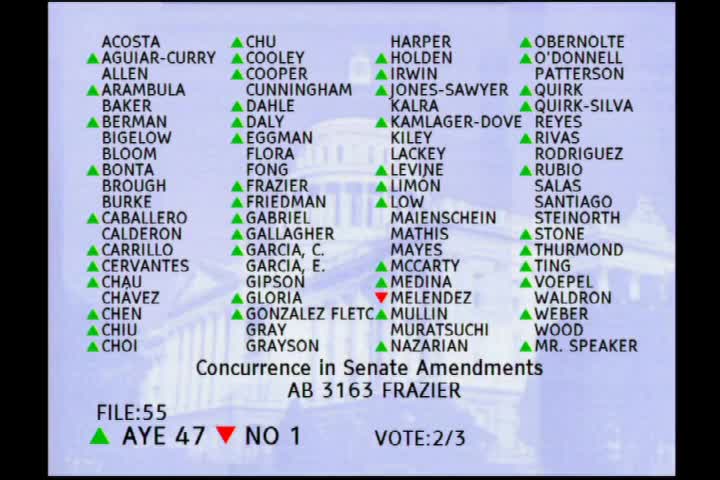
Bill Author

Bill Co-Author(s):