AB 385: Pupil data: visual and performing arts.
- Session Year: 2017-2018
- House: Assembly
- Latest Version Date: 2017-06-21
(1)Existing law requires the governing board of each school district to adopt a local control and accountability plan and requires the governing board of a school district to update its local control and accountability plan before July 1 of each year. Existing law requires a local control and accountability plan to include a description of the annual goals to be achieved for each of the states delineated priorities, as specified, for all pupils and certain subgroups of pupils, and a description of the specific actions the school district will take during each year of the local control and accountability plan to achieve the identified goals, including the enumeration of any specific actions necessary for that year to correct any deficiencies in regard to the state states priorities. The states delineated priorities include, among others, the extent to which pupils have access to, and are enrolled in, a broad course of study that includes all of the subject areas described in specified provisions of the Education Code, including visual and performing arts.
This bill would require encourage each county office of education to provide local control and accountability plan guidance to its respective school districts related to the collection and dispersal of elementary arts education data, based on examples of school districts currently reporting elementary data. By imposing additional duties on county offices of education, the bill would impose a state-mandated local program. data, and making the data and any best practices used by a school district for compiling the data available to the public upon request.
(2)Existing law establishes the California Longitudinal Pupil Achievement Data System (CALPADS), and requires a local educational agency to retain all data necessary to compile reports required by specified federal law, including, but not limited to, dropout and graduation rates. Existing law requires that the CALPADS be used to accomplish specified goals, and that it have, among other things, the capability to include pupil achievement data from multiple years.
This bill would require a school district to make available to the public that voluntarily reports enrollment and completion data specifically related to visual and performing arts offered by the school district for pupils in kindergarten and any of grades 1 to 6, inclusive, that is currently being collected through the CALPADS. By imposing additional duties on school districts, the bill would impose a state-mandated local program. to the CALPADS to make that data and any best practices used by the school district for compiling the data available to the public upon request.
(3)The California Constitution requires the state to reimburse local agencies and school districts for certain costs mandated by the state. Statutory provisions establish procedures for making that reimbursement.This bill would provide that, if the Commission on State Mandates determines that the bill contains costs mandated by the state, reimbursement for those costs shall be made pursuant to the statutory provisions noted above.(1)Existing law requires the governing board of each school district to adopt a local control and accountability plan and requires the governing board of a school district to update its local control and accountability plan before July 1 of each year. Existing law requires a local control and accountability plan to include a description of the annual goals to be achieved for each of the states delineated priorities, as specified, for all pupils and certain subgroups of pupils, and a description of the specific actions the school district will take during each year of the local control and accountability plan to achieve the identified goals, including the enumeration of any specific actions necessary for that year to correct any deficiencies in regard to the state priorities. The states delineated priorities include, among others, the extent to which pupils have access to, and are enrolled in, a broad course of study that includes all of the subject areas described in specified provisions of the Education Code, including visual and performing arts.
This bill would encourage, and not require, a school district to highlight in its local control and accountability plan the access to required instruction and course offerings, as applicable, in visual and performing arts for pupils enrolled in kindergarten and any of grades 1 to 6, inclusive, as applicable, when discussing the state priority described above. The bill would encourage, and not require, a school district to submit enrollment and completion data specifically related to visual and performing arts using existing state course codes for pupils enrolled in kindergarten and any of grades 1 to 6, inclusive, as applicable, through the California Longitudinal Pupil Achievement Data System to support the information provided under these provisions and to promote public awareness of offered instruction in arts education. require each county office of education to provide local control and accountability plan guidance to its respective school districts related to the collection and dispersal of elementary arts education data, based on examples of school districts currently reporting elementary data. By imposing additional duties on county offices of education, the bill would impose a state-mandated local program.
(2)Existing law establishes the California Longitudinal Pupil Achievement Data System (CALPADS), and requires a local educational agency to retain all data necessary to compile reports required by specified federal law, including, but not limited to, dropout and graduation rates. Existing law requires that the CALPADS be used to accomplish specified goals, and that it have, among other things, the capability to include pupil achievement data from multiple years.
This bill would require a school district to make available to the public enrollment and completion data specifically related to visual and performing arts offered by the school district for pupils in kindergarten and any of grades 1 to 6, inclusive, that is currently being collected through the CALPADS. By imposing additional duties on school districts, the bill would impose a state-mandated local program.
(3)The California Constitution requires the state to reimburse local agencies and school districts for certain costs mandated by the state. Statutory provisions establish procedures for making that reimbursement.
This bill would provide that, if the Commission on State Mandates determines that the bill contains costs mandated by the state, reimbursement for those costs shall be made pursuant to the statutory provisions noted above.
Existing law requires the governing board of each school district to adopt a local control and accountability plan and requires the governing board of a school district to update its local control and accountability plan before July 1 of each year. Existing law requires a local control and accountability plan to include a description of the annual goals to be achieved for each of the states delineated priorities, as specified, for all pupils and certain subgroups of pupils, and a description of the specific actions the school district will take during each year of the local control and accountability plan to achieve the identified goals, including the enumeration of any specific actions necessary for that year to correct any deficiencies in regard to the state priorities. The states delineated priorities include, among others, the extent to which pupils have access to, and are enrolled in, a broad course of study that includes all of the subject areas described in specified provisions of the Education Code, including visual and performing arts.
This bill would encourage, and not require, a school district to highlight in its local control and accountability plan the access to required instruction and course offerings, as applicable, in visual and performing arts for pupils enrolled in kindergarten and any of grades 1 to 6, inclusive, as applicable, when discussing the state priority described above. The bill would encourage, and not require, a school district to submit enrollment and completion data specifically related to visual and performing arts using existing state course codes for pupils enrolled in kindergarten and any of grades 1 to 6, inclusive, as applicable, through the California Longitudinal Pupil Achievement Data System to support the information provided under these provisions and to promote public awareness of offered instruction in arts education.
Existing law establishes the California Longitudinal Pupil Achievement Data System (CALPADS), and requires a local educational agency to retain all data necessary to compile reports required by specified federal law, including, but not limited to, dropout and graduation rates. Existing law requires that the CALPADS be used to accomplish specified goals, and that it have, among other things, the capability to include pupil achievement data from multiple years.This bill would require the State Department of Education to, as part of the CALPADS, require local educational agencies to provide subject level enrollment and completion data for prekindergarten, kindergarten, and any of grades 1 to 12, inclusive, as applicable, to aid in the accomplishment of the goals of the CALPADS. To the extent these provisions would require the reporting of more information by local educational agencies than is required under federal law, the bill would impose a state-mandated local program.The California Constitution requires the state to reimburse local agencies and school districts for certain costs mandated by the state. Statutory provisions establish procedures for making that reimbursement.This bill would provide that, if the Commission on State Mandates determines that the bill contains costs mandated by the state, reimbursement for those costs shall be made pursuant to the statutory provisions noted above.Existing law establishes the California Longitudinal Pupil Achievement Data System (CALPADS), and requires a local educational agency to retain all data necessary to compile reports required by specified federal law, including, but not limited to, dropout and graduation rates. Existing law requires that the CALPADS be used to accomplish specified goals, and that it have, among other things, the capability to include pupil achievement data from multiple years.
This bill would require the State Department of Education to, as part of the CALPADS, require local educational agencies to provide subject level enrollment and completion data for prekindergarten, kindergarten, and any of grades 1 to 12, inclusive, as applicable, to aid in the accomplishment of the goals of the CALPADS. To the extent these provisions would require the reporting of more information by local educational agencies than is required under federal law, the bill would impose a state-mandated local program.
The California Constitution requires the state to reimburse local agencies and school districts for certain costs mandated by the state. Statutory provisions establish procedures for making that reimbursement.
This bill would provide that, if the Commission on State Mandates determines that the bill contains costs mandated by the state, reimbursement for those costs shall be made pursuant to the statutory provisions noted above.
The Legislature finds and declares all of the following:
(a)The elementary and secondary component of the California public education system is held accountable based on data received from local educational agencies.
(b)National and state educational reform efforts revolve around using data at both the state and local levels to better inform decisionmaking.
(c)The State Department of Education, for purposes of the California Longitudinal Pupil Achievement Data System, requires local educational agencies to provide course enrollment and completion data of departmentalized courses in grades 7 to 12, inclusive.
(d)Arts education in California is mandated for pupils in grades 1 to 12, inclusive, by Sections 51210 and 51220 of the Education Code, which provide, with minor variation and in part, [t]he adopted course of study ... shall include instruction ... in ... [v]isual and performing arts, including instruction in the subjects of dance, music, theatre, and visual arts, aimed at the development of aesthetic appreciation and the skills of creative expression.
SEC. 2.Section 52060 of the Education Code is amended to read:52060.(a)On or before July 1, 2014, the governing board of each school district shall adopt a local control and accountability plan using a template adopted by the state board.
(b)A local control and accountability plan adopted by the governing board of a school district shall be effective for a period of three years, and shall be updated on or before July 1 of each year.
(c)A local control and accountability plan adopted by the governing board of a school district shall include, for the school district and each school within the school district, both of the following:
(1)A description of the annual goals, for all pupils and each subgroup of pupils identified pursuant to Section 52052, to be achieved for each of the state priorities identified in subdivision (d) and for any additional local priorities identified by the governing board of the school district. For purposes of this article, a subgroup of pupils identified pursuant to Section 52052 shall be a numerically significant pupil subgroup as specified in paragraphs (2) and (3) of subdivision (a) of Section 52052.
(2)A description of the specific actions the school district will take during each year of the local control and accountability plan to achieve the goals identified in paragraph (1), including the enumeration of any specific actions necessary for that year to correct any deficiencies in regard to the state priorities listed in paragraph (1) of subdivision (d). The specific actions shall not supersede the provisions of existing local collective bargaining agreements within the jurisdiction of the school district.
(d)All of the following are state priorities:
(1)The degree to which the teachers of the school district are appropriately assigned in accordance with Section 44258.9, and fully credentialed in the subject areas, and, for the pupils they are teaching, every pupil in the school district has sufficient access to the standards-aligned instructional materials as determined pursuant to Section 60119, and school facilities are maintained in good repair, as defined in subdivision (d) of Section 17002.
(2)Implementation of the academic content and performance standards adopted by the state board, including how the programs and services will enable English learners to access the common core academic content standards adopted pursuant to Section 60605.8 and the English language development standards adopted pursuant to former Section 60811.3, as that section read on June 30, 2013, or former Section 60811.4, as that section read on December 31, 2016, for purposes of gaining academic content knowledge and English language proficiency.
(3)Parental involvement, including efforts the school district makes to seek parent input in making decisions for the school district and each individual schoolsite, and including how the school district will promote parental participation in programs for unduplicated pupils and individuals with exceptional needs.
(4)Pupil achievement, as measured by all of the following, as applicable:
(A)Statewide assessments administered pursuant to Article 4 (commencing with Section 60640) of Chapter 5 of Part 33 or any subsequent assessment, as certified by the state board.
(B)The Academic Performance Index, as described in Section 52052.
(C)The percentage of pupils who have successfully completed courses that satisfy the requirements for entrance to the University of California and the California State University, or career technical education sequences or programs of study that align with state board-approved career technical education standards and frameworks, including, but not limited to, those described in subdivision (a) of Section 52302, subdivision (a) of Section 52372.5, or paragraph (2) of subdivision (e) of Section 54692.
(D)The percentage of English learner pupils who make progress toward English proficiency as measured by the California English Language Development Test or any subsequent assessment of English proficiency, as certified by the state board.
(E)The English learner reclassification rate.
(F)The percentage of pupils who have passed an advanced placement examination with a score of 3 or higher.
(G)The percentage of pupils who participate in, and demonstrate college preparedness pursuant to, the Early Assessment Program, as described in Chapter 6 (commencing with Section 99300) of Part 65 of Division 14 of Title 3, or any subsequent assessment of college preparedness.
(5)Pupil engagement, as measured by all of the following, as applicable:
(A)School attendance rates.
(B)Chronic absenteeism rates.
(C)Middle school dropout rates, as described in paragraph (3) of subdivision (a) of Section 52052.1.
(D)High school dropout rates.
(E)High school graduation rates.
(6)School climate, as measured by all of the following, as applicable:
(A)Pupil suspension rates.
(B)Pupil expulsion rates.
(C)Other local measures, including surveys of pupils, parents, and teachers on the sense of safety and school connectedness.
(7)The extent to which pupils have access to, and are enrolled in, a broad course of study that includes all of the subject areas described in Section 51210 and subdivisions (a) to (i), inclusive, of Section 51220, as applicable, including the programs and services developed and provided to unduplicated pupils and individuals with exceptional needs, and the programs and services that are provided to benefit these pupils as a result of the funding received pursuant to Section 42238.02, as implemented by Section 42238.03.
(8)Pupil outcomes, if available, in the subject areas described in Section 51210 and subdivisions (a) to (i), inclusive, of Section 51220, as applicable.
(e)For purposes of the descriptions required by subdivision (c), the governing board of a school district may consider qualitative information, including, but not limited to, findings that result from school quality reviews conducted pursuant to subparagraph (J) of paragraph (4) of subdivision (a) of Section 52052 or any other reviews.
(f)To the extent practicable, data reported in a local control and accountability plan shall be reported in a manner consistent with how information is reported on a school accountability report card.
(g)The governing board of a school district shall consult with teachers, principals, administrators, other school personnel, local bargaining units of the school district, parents, and pupils in developing a local control and accountability plan.
(h)A school district may identify local priorities, goals in regard to the local priorities, and the method for measuring the school districts progress toward achieving those goals.
(i)Each county office of education shall is encouraged to provide local control and accountability plan guidance to its respective school districts related to the collection and dispersal of elementary arts education data, based on examples of school districts currently reporting elementary data. data, and making the data and any best practices used by a school district for compiling the data available to the public upon request pursuant to Section 60902.
SEC. 3.Section 60902 is added to the Education Code, to read:60902.(a)A school district shall make available to the public that voluntarily reports enrollment and completion data specifically related to visual and performing arts offered by the school district for pupils in kindergarten and any of grades 1 to 6, inclusive, that is currently being collected through to the California Longitudinal Pupil Achievement Data System. System shall make that data and any best practices used by the school district for compiling the data available to the public upon request.
(b)The implementation of this section shall not subject the department to a loss of funding pursuant to the Budget Act of 2017.
SEC. 4.If the Commission on State Mandates determines that this act contains costs mandated by the state, reimbursement to local agencies and school districts for those costs shall be made pursuant to Part 7 (commencing with Section 17500) of Division 4 of Title 2 of the Government Code.The Legislature finds and declares all of the following:
(a)The elementary and secondary component of the California public education system is held accountable based on data received from local educational agencies.
(b)National and state educational reform efforts revolve around using data at both the state and local levels to better inform decisionmaking.
(c)The State Department of Education, for purposes of the California Longitudinal Pupil Achievement Data System, requires local educational agencies to provide course enrollment and completion data of departmentalized courses in grades 7 to 12, inclusive.
(d)Arts education in California is mandated for pupils in grades 1 to 12, inclusive, by Sections 51210 and 51220 of the Education Code, which provide, with minor variation and in part, [t]he adopted course of study ... shall include instruction ... in ... [v]isual and performing arts, including instruction in the subjects of dance, music, theatre, and visual arts, aimed at the development of aesthetic appreciation and the skills of creative expression.
SEC. 2.Section 52060 of the Education Code is amended to read:52060.(a)On or before July 1, 2014, the governing board of each school district shall adopt a local control and accountability plan using a template adopted by the state board.
(b)A local control and accountability plan adopted by the governing board of a school district shall be effective for a period of three years, and shall be updated on or before July 1 of each year.
(c)A local control and accountability plan adopted by the governing board of a school district shall include, for the school district and each school within the school district, both of the following:
(1)A description of the annual goals, for all pupils and each subgroup of pupils identified pursuant to Section 52052, to be achieved for each of the state priorities identified in subdivision (d) and for any additional local priorities identified by the governing board of the school district. For purposes of this article, a subgroup of pupils identified pursuant to Section 52052 shall be a numerically significant pupil subgroup as specified in paragraphs (2) and (3) of subdivision (a) of Section 52052.
(2)A description of the specific actions the school district will take during each year of the local control and accountability plan to achieve the goals identified in paragraph (1), including the enumeration of any specific actions necessary for that year to correct any deficiencies in regard to the state priorities listed in paragraph (1) of subdivision (d). The specific actions shall not supersede the provisions of existing local collective bargaining agreements within the jurisdiction of the school district.
(d)All of the following are state priorities:
(1)The degree to which the teachers of the school district are appropriately assigned in accordance with Section 44258.9, and fully credentialed in the subject areas, and, for the pupils they are teaching, every pupil in the school district has sufficient access to the standards-aligned instructional materials as determined pursuant to Section 60119, and school facilities are maintained in good repair, as defined in subdivision (d) of Section 17002.
(2)Implementation of the academic content and performance standards adopted by the state board, including how the programs and services will enable English learners to access the common core academic content standards adopted pursuant to Section 60605.8 and the English language development standards adopted pursuant to former Section 60811.3, as that section read on June 30, 2013, or Section 60811.4, for purposes of gaining academic content knowledge and English language proficiency.
(3)Parental involvement, including efforts the school district makes to seek parent input in making decisions for the school district and each individual schoolsite, and including how the school district will promote parental participation in programs for unduplicated pupils and individuals with exceptional needs.
(4)Pupil achievement, as measured by all of the following, as applicable:
(A)Statewide assessments administered pursuant to Article 4 (commencing with Section 60640) of Chapter 5 of Part 33 or any subsequent assessment, as certified by the state board.
(B)The Academic Performance Index, as described in Section 52052.
(C)The percentage of pupils who have successfully completed courses that satisfy the requirements for entrance to the University of California and the California State University, or career technical education sequences or programs of study that align with state board-approved career technical education standards and frameworks, including, but not limited to, those described in subdivision (a) of Section 52302, subdivision (a) of Section 52372.5, or paragraph (2) of subdivision (e) of Section 54692.
(D)The percentage of English learner pupils who make progress toward English proficiency as measured by the California English Language Development Test or any subsequent assessment of English proficiency, as certified by the state board.
(E)The English learner reclassification rate.
(F)The percentage of pupils who have passed an advanced placement examination with a score of 3 or higher.
(G)The percentage of pupils who participate in, and demonstrate college preparedness pursuant to, the Early Assessment Program, as described in Chapter 6 (commencing with Section 99300) of Part 65 of Division 14 of Title 3, or any subsequent assessment of college preparedness.
(5)Pupil engagement, as measured by all of the following, as applicable:
(A)School attendance rates.
(B)Chronic absenteeism rates.
(C)Middle school dropout rates, as described in paragraph (3) of subdivision (a) of Section 52052.1.
(D)High school dropout rates.
(E)High school graduation rates.
(6)School climate, as measured by all of the following, as applicable:
(A)Pupil suspension rates.
(B)Pupil expulsion rates.
(C)Other local measures, including surveys of pupils, parents, and teachers on the sense of safety and school connectedness.
(7)The extent to which pupils have access to, and are enrolled in, a broad course of study that includes all of the subject areas described in Section 51210 and subdivisions (a) to (i), inclusive, of Section 51220, as applicable, including the programs and services developed and provided to unduplicated pupils and individuals with exceptional needs, and the programs and services that are provided to benefit these pupils as a result of the funding received pursuant to Section 42238.02, as implemented by Section 42238.03.
(8)Pupil outcomes, if available, in the subject areas described in Section 51210 and subdivisions (a) to (i), inclusive, of Section 51220, as applicable.
(e)For purposes of the descriptions required by subdivision (c), the governing board of a school district may consider qualitative information, including, but not limited to, findings that result from school quality reviews conducted pursuant to subparagraph (J) of paragraph (4) of subdivision (a) of Section 52052 or any other reviews.
(f)To the extent practicable, data reported in a local control and accountability plan shall be reported in a manner consistent with how information is reported on a school accountability report card.
(g)The governing board of a school district shall consult with teachers, principals, administrators, other school personnel, local bargaining units of the school district, parents, and pupils in developing a local control and accountability plan.
(h)A school district may identify local priorities, goals in regard to the local priorities, and the method for measuring the school districts progress toward achieving those goals.
(i)(1)A school district is encouraged, and is not required, to highlight in its local control and accountability plan the access to required instruction and course offerings, as applicable, in visual and performing arts for pupils enrolled in kindergarten and any of grades 1 to 6, inclusive, as applicable, when discussing the state priority described in paragraph (7) of subdivision (d).(2)(A)A school district is encouraged, and is not required, to submit enrollment and completion data specifically related to visual and performing arts using existing state course codes for pupils enrolled in kindergarten and any of grades 1 to 6, inclusive, as applicable, through the California Longitudinal Pupil Achievement Data System to support the information provided in paragraph (1) and to promote public awareness of offered instruction in arts education.(B)The implementation of this paragraph shall not subject the department to a loss of funding pursuant to the Budget Act of 2017.(i)Each county office of education shall provide local control and accountability plan guidance to its respective school districts related to the collection and dispersal of elementary arts education data, based on examples of school districts currently reporting elementary data.
SEC. 3.Section 60902 is added to the Education Code, to read:60902.(a)A school district shall make available to the public enrollment and completion data specifically related to visual and performing arts offered by the school district for pupils in kindergarten and any of grades 1 to 6, inclusive, that is currently being collected through the California Longitudinal Pupil Achievement Data System.
(b)The implementation of this section shall not subject the department to a loss of funding pursuant to the Budget Act of 2017.
SEC. 4.If the Commission on State Mandates determines that this act contains costs mandated by the state, reimbursement to local agencies and school districts for those costs shall be made pursuant to Part 7 (commencing with Section 17500) of Division 4 of Title 2 of the Government Code.
The Legislature finds and declares all of the following:
(a)The elementary and secondary component of the California public education system is held accountable based on data received from local educational agencies.
(b)National and state educational reform efforts revolve around using data at both the state and local levels to better inform decisionmaking.
(c)The State Department of Education, for purposes of the California Longitudinal Pupil Achievement Data System, requires local educational agencies to provide course enrollment and completion data of departmentalized courses in grades 7 to 12, inclusive.
(d)By expanding this requirement to include prekindergarten, kindergarten, and grades 1 to 6, inclusive, the state and policymakers will have better information to make more informed decisions when it comes to addressing lack of access to high-quality subject matter instruction, including arts education, and ensuring equal access in all of our states communities.(d)Arts education in California is mandated for pupils in grades 1 to 12, inclusive, by Sections 51210 and 51220 of the Education Code, which provide, with minor variation and in part, [t]he adopted course of study ... shall include instruction ... in ... [v]isual and performing arts, including instruction in the subjects of dance, music, theatre, and visual arts, aimed at the development of aesthetic appreciation and the skills of creative expression.
SEC. 2.Section 52060 of the Education Code is amended to read:52060.(a)On or before July 1, 2014, the governing board of each school district shall adopt a local control and accountability plan using a template adopted by the state board.
(b)A local control and accountability plan adopted by the governing board of a school district shall be effective for a period of three years, and shall be updated on or before July 1 of each year.
(c)A local control and accountability plan adopted by the governing board of a school district shall include, for the school district and each school within the school district, both of the following:
(1)A description of the annual goals, for all pupils and each subgroup of pupils identified pursuant to Section 52052, to be achieved for each of the state priorities identified in subdivision (d) and for any additional local priorities identified by the governing board of the school district. For purposes of this article, a subgroup of pupils identified pursuant to Section 52052 shall be a numerically significant pupil subgroup as specified in paragraphs (2) and (3) of subdivision (a) of Section 52052.(2)A description of the specific actions the school district will take during each year of the local control and accountability plan to achieve the goals identified in paragraph (1), including the enumeration of any specific actions necessary for that year to correct any deficiencies in regard to the state priorities listed in paragraph (1) of subdivision (d). The specific actions shall not supersede the provisions of existing local collective bargaining agreements within the jurisdiction of the school district.(d)All of the following are state priorities:
(1)The degree to which the teachers of the school district are appropriately assigned in accordance with Section 44258.9, and fully credentialed in the subject areas, and, for the pupils they are teaching, every pupil in the school district has sufficient access to the standards-aligned instructional materials as determined pursuant to Section 60119, and school facilities are maintained in good repair, as defined in subdivision (d) of Section 17002.
(2)Implementation of the academic content and performance standards adopted by the state board, including how the programs and services will enable English learners to access the common core academic content standards adopted pursuant to Section 60605.8 and the English language development standards adopted pursuant to former Section 60811.3, as that section read on June 30, 2013, or Section 60811.4, for purposes of gaining academic content knowledge and English language proficiency.
(3)Parental involvement, including efforts the school district makes to seek parent input in making decisions for the school district and each individual schoolsite, and including how the school district will promote parental participation in programs for unduplicated pupils and individuals with exceptional needs.
(4)Pupil achievement, as measured by all of the following, as applicable:
(A)Statewide assessments administered pursuant to Article 4 (commencing with Section 60640) of Chapter 5 of Part 33 or any subsequent assessment, as certified by the state board.
(B)The Academic Performance Index, as described in Section 52052.
(C)The percentage of pupils who have successfully completed courses that satisfy the requirements for entrance to the University of California and the California State University, or career technical education sequences or programs of study that align with state board-approved career technical education standards and frameworks, including, but not limited to, those described in subdivision (a) of Section 52302, subdivision (a) of Section 52372.5, or paragraph (2) of subdivision (e) of Section 54692.
(D)The percentage of English learner pupils who make progress toward English proficiency as measured by the California English Language Development Test or any subsequent assessment of English proficiency, as certified by the state board.
(E)The English learner reclassification rate.
(F)The percentage of pupils who have passed an advanced placement examination with a score of 3 or higher.
(G)The percentage of pupils who participate in, and demonstrate college preparedness pursuant to, the Early Assessment Program, as described in Chapter 6 (commencing with Section 99300) of Part 65 of Division 14 of Title 3, or any subsequent assessment of college preparedness.
(5)Pupil engagement, as measured by all of the following, as applicable:
(A)School attendance rates.
(B)Chronic absenteeism rates.
(C)Middle school dropout rates, as described in paragraph (3) of subdivision (a) of Section 52052.1.
(D)High school dropout rates.
(E)High school graduation rates.
(6)School climate, as measured by all of the following, as applicable:
(A)Pupil suspension rates.
(B)Pupil expulsion rates.
(C)Other local measures, including surveys of pupils, parents, and teachers on the sense of safety and school connectedness.
(7)The extent to which pupils have access to, and are enrolled in, a broad course of study that includes all of the subject areas described in Section 51210 and subdivisions (a) to (i), inclusive, of Section 51220, as applicable, including the programs and services developed and provided to unduplicated pupils and individuals with exceptional needs, and the programs and services that are provided to benefit these pupils as a result of the funding received pursuant to Section 42238.02, as implemented by Section 42238.03.
(8)Pupil outcomes, if available, in the subject areas described in Section 51210 and subdivisions (a) to (i), inclusive, of Section 51220, as applicable.
(e)For purposes of the descriptions required by subdivision (c), the governing board of a school district may consider qualitative information, including, but not limited to, findings that result from school quality reviews conducted pursuant to subparagraph (J) of paragraph (4) of subdivision (a) of Section 52052 or any other reviews.
(f)To the extent practicable, data reported in a local control and accountability plan shall be reported in a manner consistent with how information is reported on a school accountability report card.
(g)The governing board of a school district shall consult with teachers, principals, administrators, other school personnel, local bargaining units of the school district, parents, and pupils in developing a local control and accountability plan.
(h)A school district may identify local priorities, goals in regard to the local priorities, and the method for measuring the school districts progress toward achieving those goals.
(i)(1)A school district is encouraged, and is not required, to highlight in its local control and accountability plan the access to required instruction and course offerings, as applicable, in visual and performing arts for pupils enrolled in kindergarten and any of grades 1 to 6, inclusive, as applicable, when discussing the state priority described in paragraph (7) of subdivision (d).
(2)(A)A school district is encouraged, and is not required, to submit enrollment and completion data specifically related to visual and performing arts using existing state course codes for pupils enrolled in kindergarten and any of grades 1 to 6, inclusive, as applicable, through the California Longitudinal Pupil Achievement Data System to support the information provided in paragraph (1) and to promote public awareness of offered instruction in arts education.
(B)The implementation of this paragraph shall not subject the department to a loss of funding pursuant to the Budget Act of 2017.
SEC. 2.Section 60902 is added to the Education Code, to read:60902.(a)The department shall, as part of the California Longitudinal Pupil Achievement Data System, require local educational agencies to provide subject level enrollment and completion data for prekindergarten, kindergarten, and any of grades 1 to 12, inclusive, as applicable, to aid in the accomplishment of the goals described in subdivision (d) of Section 60900.(b)Data submitted pursuant to this section shall comply with subdivision (g) of Section 60900.SEC. 3.If the Commission on State Mandates determines that this act contains costs mandated by the state, reimbursement to local agencies and school districts for those costs shall be made pursuant to Part 7 (commencing with Section 17500) of Division 4 of Title 2 of the Government Code.The Legislature finds and declares all of the following:
(a)The elementary and secondary component of the California public education system is held accountable based on data received from local educational agencies.
(b)National and state educational reform efforts revolve around using data at both the state and local levels to better inform decisionmaking.
(c)The State Department of Education, for purposes of the California Longitudinal Pupil Achievement Data System, requires local educational agencies to provide course enrollment and completion data of departmentalized courses in grades 7 to 12, inclusive.
(d)By expanding this requirement to include prekindergarten, kindergarten, and grades 1 to 6, inclusive, the state and policymakers will have better information to make more informed decisions when it comes to addressing lack of access to high-quality subject matter instruction, including arts education, and ensuring equal access in all of our states communities.
SEC. 2.Section 60902 is added to the Education Code, to read:60902.(a)The department shall, as part of the California Longitudinal Pupil Achievement Data System, require local educational agencies to provide subject level enrollment and completion data for prekindergarten, kindergarten, and any of grades 1 to 12, inclusive, as applicable, to aid in the accomplishment of the goals described in subdivision (d) of Section 60900.
(b)Data submitted pursuant to this section shall comply with subdivision (g) of Section 60900.
SEC. 3.If the Commission on State Mandates determines that this act contains costs mandated by the state, reimbursement to local agencies and school districts for those costs shall be made pursuant to Part 7 (commencing with Section 17500) of Division 4 of Title 2 of the Government Code.
|
Date
|
Status
|
|---|---|
| Sep 1, 2017 | In committee: Held under submission. |
| Jul 10, 2017 | In committee: Referred to APPR. suspense file. |
| Jun 21, 2017 | Read second time and amended. Re-referred to Com. on APPR. |
| Jun 20, 2017 | From committee: Amend, and do pass as amended and re-refer to Com. on APPR. (Ayes 7. Noes 0.) (June 14). |
| Jun 1, 2017 | Re-referred to Com. on ED. |
| May 24, 2017 | From committee chair, with author's amendments: Amend, and re-refer to committee. Read second time, amended, and re-referred to Com. on RLS. |
| May 18, 2017 | Referred to Com. on RLS. |
| May 8, 2017 | In Senate. Read first time. To Com. on RLS. for assignment. |
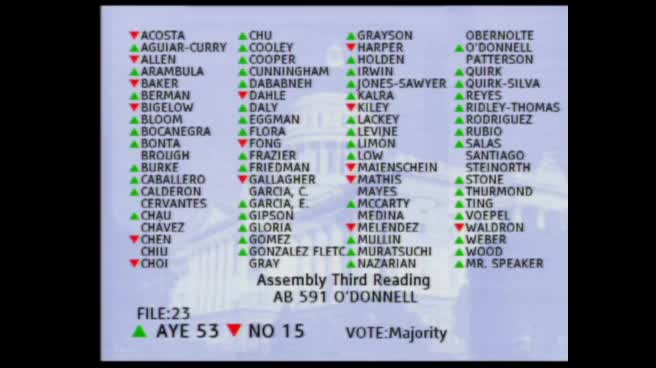
| May 8, 2017 | Read third time. Passed. Ordered to the Senate. (Ayes 75. Noes 0. Page 1419.) |
| Apr 27, 2017 | Read second time. Ordered to third reading. |
| Apr 26, 2017 | From committee: Do pass. (Ayes 16. Noes 0.) (April 26). |
| Apr 6, 2017 | From committee: Do pass and re-refer to Com. on APPR. (Ayes 7. Noes 0.) (April 5). Re-referred to Com. on APPR. |
| Mar 30, 2017 | Re-referred to Com. on ED. |
| Mar 29, 2017 | From committee chair, with author's amendments: Amend, and re-refer to Com. on ED. Read second time and amended. |
| Mar 15, 2017 | In committee: Hearing postponed by committee. |
| Feb 21, 2017 | Referred to Com. on ED. |
| Feb 10, 2017 | From printer. May be heard in committee March 12. |
| Feb 9, 2017 | Read first time. To print. |
|
Date
|
Description
|
Location
|
Votes
|
|
|---|---|---|---|---|
| Jul 10, 2017 | Placed on suspense file | Senate Standing Committee on Appropriations |
Passed |
|
| Jun 14, 2017 | Do pass as amended, but first amend, and re-refer to the Committee on [Appropriations] | Senate Standing Committee on Education |
Passed |
|
| May 8, 2017 | AB 385 CHU Assembly Third Reading | Assembly Floor |
Passed |
|
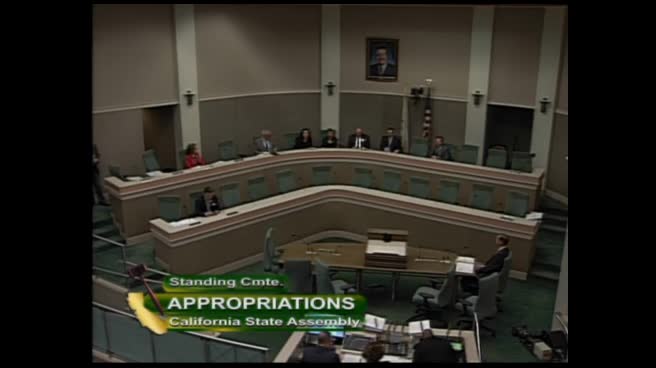
| Apr 26, 2017 | Do pass. | Assembly Standing Committee on Appropriations |
Passed |
|
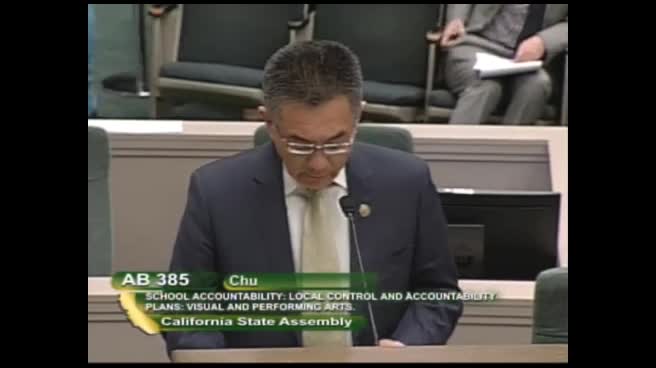
| Apr 5, 2017 | Do pass and be re-referred to the Committee on [Appropriations] | Assembly Standing Committee on Education |
Passed |
This list shows positions taken on this bill by organizations on the date displayed, which is linked to the original source.
Positions by individuals are not included.
|
Organization
|
Position
|
Date
|
|---|---|---|
| Arts & Business Council of the Sacramento Region | ** Support | Jun 13, 2017 |
| Arts Education Data Project | * Indeterminate | Apr 5, 2017 |
| Arts Orange County | ** Support | Jun 13, 2017 |
| Association Of California School Administrators | * Against | Jun 14, 2017 |
| California Alliance For Arts Education | * Support | Jun 14, 2017 |
| California Art Education Association | ** Support | Jun 13, 2017 |
| California Arts Advocates | ** Support | Jun 13, 2017 |
| California Dance Education Association | ** Support | Jun 13, 2017 |
| California Music Educators | * Support | Apr 5, 2017 |
| California Music Educators Association | ** Support | Jun 13, 2017 |
| California School Boards Association | * Indeterminate | Jun 14, 2017 |
| California State PTA | * Support | Jun 14, 2017 |
| LONG ISLANDS FINEST HOMES LLC | * Indeterminate | Apr 5, 2017 |
| San Francisco Unified School District | * Support | Jun 14, 2017 |
| Theater West | ** Support | Jun 13, 2017 |
SENATE COMMITTEE ON
Senator Ricardo Lara, Chair
2017 - 2018 Regular Session
AB 385 (Chu) - Pupil data: visual and performing arts
Version: | Policy Vote: |
Urgency: | Mandate: |
Hearing Date: | Consultant: |
This bill meets the criteria for referral to the Suspense File.
Bill Summary:
This bill encourages county offices of education to provide local control and accountability plan (LCAP) guidance to school districts on collecting and dispersing elementary arts education data. Further, the bill requires school districts that currently report enrollment and completion data related to elementary arts education courses to the California Longitudinal Pupil Achievement Data System (CALPADS) to make that data available to the public.
Fiscal Impact: Unknown cost pressure, potentially in the low hundreds of thousands of dollars in Proposition 98 General Fund, for county offices of education to provide additional LCAP guidance to school districts. Any cost to the California Department of Education (CDE) regarding the submittal of additional data to CALPADS is expected to be minor and absorbable.
Background:
Existing law requires school districts to include visual and performing arts, including dance, music, theater, and visual arts, in their courses of study in grades 1 to 6 and 7 to 12. Further, it requires students, as a condition of high school graduation, to complete one year of either visual and performing arts, foreign language, or career technical education.
Existing law also requires school districts to adopt and annually revise local an LCAP. The LCAPs must address the eight state priorities, including a description of the extent to which pupils have access to, and are enrolled in, a broad course of study, including the programs and services developed and provided to unduplicated pupils and individuals with exceptional needs, and the programs and services that are provided to benefit these pupils as a result of the funding received under the Local Control Funding Formula.
Proposed Law:
This bill encourages each county office of education to provide LCAP guidance to its respective school districts related to the collection and dispersal of elementary arts education data, based on examples of school districts currently reporting elementary data. Further, this bill requires a school district to make available to the public enrollment and completion data specifically related to visual and performing arts offered by the school district for pupils in kindergarten and any of grades 1 to 6, inclusive, that is currently being collected through CALPADS. This bill also specifies that its implementation shall not subject the California Department of Education to a loss of funding pursuant to the Budget Act of 2017.
Related Legislation:
SB 390 (Mendoza) adds implementation of the Model School Library Standards for California Public Schools to the state priority areas that local educational agencies are required to address in their LCAPs. This bill is pending in the Assembly Appropriations Committee.
-- END --
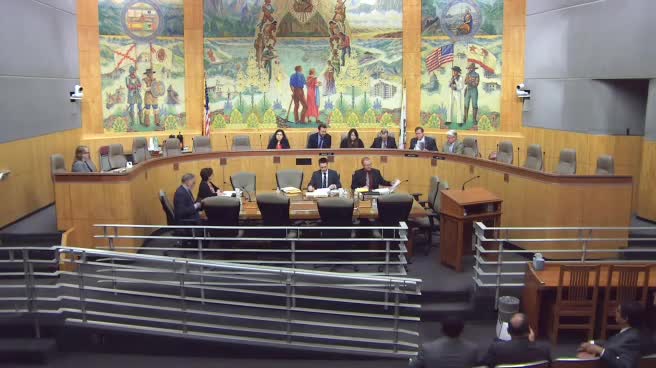
SENATE COMMITTEE ON EDUCATION
Senator Benjamin Allen, Chair
2017 - 2018 Regular
Bill No: AB 385 Hearing Date: June 14, 2017
Author: | |||
Version: | May 24, 2017 | ||
Urgency: | No | Fiscal: | Yes |
Consultant: | Ian Johnson | ||
Subject: Pupil data: visual and performing arts
SUMMARY
This bill requires county offices of education to provide local control and accountability plan guidance to school districts on collecting and dispersing elementary arts education data. Further, the bill requires school districts that currently report data related to elementary arts education courses to the California Longitudinal Pupil Achievement Data System (CALPADS) to make that data available to the public.
BACKGROUND
Existing law:
- Requires school districts to include visual and performing arts, including dance, music, theater, and visual arts, in their courses of study in grades 1 to 6 and 7 to 12.
- Requires students, as a condition of high school graduation, to complete one year of either visual and performing arts, foreign language, or career technical education.
- Requires CALPADS to accomplish all of the following goals:
- Provide school districts and the California Department of Education access to data necessary to comply with federal reporting requirements.
- Provide a better means of evaluating educational progress and investments over time.
- Provide local educational agencies information that can be used to improve pupil achievement.
- Provide an efficient, flexible, and secure means of maintaining longitudinal statewide pupil level data.
- Facilitate the ability of the state to publicly report data as required by federal law.
- Ensure that any data access provided to researchers, as required pursuant to the federal Race to the Top regulations and guidelines, is provided only to the extent that the data access is in compliance with the federal Family Educational Rights and Privacy Act of 1974.
- Prohibits the California Department of Education (CDE) from adding additional data to the California Longitudinal Pupil Achievement Data System (CALPADS).
- Requires school districts to adopt and annually revise local control and accountability plans (LCAPs).
- Requires LCAPs to address eight state priorities, including a description of the extent to which pupils have access to, and are enrolled in, a broad course of study, including the programs and services developed and provided to unduplicated pupils and individuals with exceptional needs, and the programs and services that are provided to benefit these pupils as a result of the funding received under the Local Control Funding Formula.
ANALYSIS
This bill:
- Requires each county office of education to provide LCAP guidance to its respective school districts related to the collection and dispersal of elementary arts education data, based on examples of school districts currently reporting elementary data.
- Requires a school district to make available to the public enrollment and completion data specifically related to visual and performing arts offered by the school district for pupils in kindergarten and any of grades 1 to 6, inclusive, that is currently being collected through CALPADS.
- Specifies that implementation of this section shall not subject the CDE to a loss of funding pursuant to the Budget Act of 2017.
STAFF COMMENTS
- Need for the bill. According to the author, “The data collected by the California Arts Education Data Project in middle and high schools has already reinforced the need to continue to address inequities in access to and participation in arts education.
Here are just a few of the deficiencies and inequities that became available to education leaders and parents as a result of the project:
- The proportion of students with access to any arts courses was greater where the majority of students in the school are either African American or Hispanic when compared to the total student enrollment distribution.
- The greater the percentage of students receiving free and reduced lunch, the lower the participation rate in the arts.
- Students with no access to the arts were overrepresented in charter schools.
This is just a small fraction of the information provided by the California Arts Education Data Project, and it is crucial to our understanding of how and where arts education shortcomings exist in the state. Without having this data publicly available and without school districts having an understanding of how to collect and disperse this data, California will remain in the dark in terms of our understanding of arts education at the elementary level, leaving us unable to address inequities and gaps in access.”
- California Longitudinal Pupil Achievement Data System (CALPADS). The CALPADS was created to enable California to meet federal requirements and has been operational since 2009, containing information on student demographics, program participation, grade level, enrollment, course enrollment and completion, discipline, and statewide assessment data.
For the past several years, the annual Budget Act has included control language specifying that, as a condition of receiving funds, the California Department of Education is prohibited from adding data elements to CALPADS.
CALPADS currently collects course enrollment data for grades 7 to 12 only; however, some districts voluntarily report kindergarten and grade 1 to 6 course data. This bill requires those districts choosing to report elementary school course data related to arts education to CALPADS to make that data publicly available. According to the author’s office, the intent of this provision is for (1) members of the public to be informed about the extent to which the arts are being included in elementary instruction, and (2) school districts choosing to report elementary school course data related to arts education to share best practices for compiling the data. If it is the desire of the Committee to pass this measure, staff recommends that the bill be amended to clarify that the requirement only applies to those district currently choosing to report elementary arts education data to CALPADS and that both the data and any best practices used by the district for compiling the data be made available to the public upon request.
- California Arts Education Data Project. California is one of four states in the 2015-16 cohort of the National Arts Education Data Project. The project is a partnership between the State Education Agency Directors of Arts Education and Quadrant Research. The nation-wide project coordinates with participating state departments of education to collect and report arts education data from state longitudinal data systems and other state departmental data sets on an annual basis.
California’s project released a report in October 2016, which was based on CALPADS data from 2013-14 and 2014-15. The most notable findings from the report are:
- Although most students (96.7 percent) have access to arts instruction, only 26 percent of students have access to the four arts disciplines as required by state education code.
- 38 percent of all students participated in arts education courses.
- Participation in Art (17 percent) and Music (14 percent) were highest among the five artistic disciplines. Music and Art are also the most widely available of the arts disciplines.
- There were 101,374 students, or 3.3 percent, who did not have access to any arts instruction. Between 2014 and 2015, there has been a 9.6 percent improvement in the number students without access to arts instruction.
- The proportion of students without access to any arts courses was greater where the majority of students in the school were either African American or Hispanic when compared to the distribution of the total student enrollment.
- Middle School arts enrollment is unusually low. There is a larger percentage of student participation in high schools than in either middle schools or the elementary schools. This is contrary to findings in other states where participation rates decline as the grade levels advance.
- The overall student-to-arts-teacher ratio is 232 to 1. For Art, the ratio is 441:1; for Dance, it is 1446:1; for Music, it is 752:1; and for Theatre, it is 1075:1.
- School districts establish goals and actions in their local control and accountability plans (LCAPs). As part of their adoption of an annual LCAP, school district governing boards must include, for the school district and each school within the district, a description of: (1) the annual goals to be achieved for each of the state priorities, and (2) the specific actions to be taken during each year of the plan to achieve the goals established. School districts have the discretion to establish what their goals and specific actions will be, and which state priority areas those goals and actions will address. School districts are not required to have eight different goals—a standalone goal for each state priority. Rather, most school districts identify goals and actions that address several of the state priority areas simultaneously.
- County offices review and approve district LCAPs. Existing law tasks county offices of education with both fiscal and academic oversight of districts within their jurisdiction. The academic oversight responsibilities consist primarily of reviewing and approving district LCAPs. As part of this process, state law requires county offices of education to verify that district LCAP documents use the state-approved format, align with districts’ adopted budgets, and appropriately direct funds to disadvantaged students. If district LCAPs meet these requirements, county offices of education must approve them. If an LCAP is rejected, the county office of education must provide technical assistance in refining the plan.
- County office role in supporting districts is still evolving. When the state designed its new local control school funding and accountability system, county offices of education were given a role in supporting certain types of districts. Specifically, county offices must provide technical assistance to districts that do not meet performance benchmarks in two or more of the eight specified state priority areas for one or more student subgroups. Upon identifying a district as underperforming, county offices are required to do at least one of the following: (1) review the district’s strengths and weakness and identify effective programs that could help the district improve, (2) assign an academic expert to help the school district improve outcomes, or (3) request the California Collaborative for Educational Excellence to provide assistance to the district. The exact role of county offices of education in supporting districts under the state’s new accountability system is still being worked out.
Given the evolving nature of the role of county offices in supporting districts, this bill’s requirement on county offices of education to provide local control and accountability plan guidance to school districts on collecting and dispersing elementary arts education data may be inappropriate. Further, the bill’s requirement could lead to other expectations being placed on county offices of education before the state has more clearly defined what the role of county offices of education should be in the state’s new school accountability system. If it is the desire of the Committee to pass this measure, staff recommends that the bill be amended to encourage, rather than require, county offices of education to provide arts education data guidance and best practices to school districts.
SUPPORT
Arts & Business Council of the Sacramento Region
Arts Orange County
California Alliance for Arts Education
California Art Education Association
California Arts Advocates
California Dance Education Association
California Music Educators Association
California State PTA
Theater West
OPPOSITION
Association of California School Administrators
-- END --
ASSEMBLY THIRD READING
ATR Bill Id:AB 385
Author:(Chu)
As Amended Ver:March 29, 2017
Majority vote
Committee | Votes | Ayes | Noes |
Education | 7-0 | O'Donnell, Chávez, Gloria, Kiley, McCarty, Thurmond, Weber | |
Appropriations | 16-0 | Gonzalez Fletcher, Bigelow, Bloom, Bocanegra, Bonta, Brough, McCarty, Chau, Eggman, Fong, Friedman, Eduardo Garcia, Gray, Muratsuchi, Obernolte, Reyes |
SUMMARY: Encourages school districts to highlight K-6 instruction and course offerings in visual and performing arts in their local control and accountability plans (LCAPS) and submit visual and performing arts enrollment and course completion data using course codes through the California Longitudinal Pupil Achievement Data System (CALPADS). Specifically, this bill:
- Makes findings and declarations regarding the use of data for accountability and decision making purposes and the place of visual and performing arts in the required course of study.
- Encourages school districts to highlight in their LCAPs the access to required instruction and course offerings, as applicable, in visual and performing arts for pupils enrolled in kindergarten and grades 1-6, inclusive, when discussing the extent to which pupils have access to, and are enrolled in, a broad course of study that includes all required courses.
- Encourages school districts to submit enrollment and completion data specifically related to visual and performing arts using existing state course codes for pupils enrolled in kindergarten and any of grades 1-6, inclusive, through CALPADS to promote public awareness offered instruction in arts education.
- Provides that the voluntary reporting of course data to CALPADS shall not subject the California Department of Education (CDE) to a loss of funding pursuant to the Budget Act prohibition against expanding CALPADS.
EXISTING LAW:
- Requires school districts to include visual and performing arts, including dance, music, theater, and visual arts, in their courses of study in grades 1-6 and 7-12.
- Requires CALPADS to accomplish all of the following goals:
- Provide school districts and the CDE access to data necessary to comply with federal reporting requirements;
- Provide a better means of evaluating educational progress and investments over time;
- Provide local education agencies information that can be used to improve pupil achievement;
- Provide an efficient, flexible, and secure means of maintaining longitudinal statewide pupil level data;
- To facilitate the ability of the state to publicly report data as required by federal law; and
- To ensure that any data access provided to researchers, as required pursuant to the federal Race to the Top regulations and guidelines is provided, only to the extent that the data access is in compliance with the federal Family Educational Rights and Privacy Act of 1974 (20 United State Code Section 1232(g)).
- Prohibits the CDE from adding additional data to CALPADS (budget control language for budget item 6100-001-0890).
- Requires school districts to adopt and annually revise LCAPS.
- Requires LCAPS to address eight state priorities, including a description of the extent to which pupils have access to, and are enrolled in, a broad course of study that includes all of the statutorily required courses.
FISCAL EFFECT: According to the Assembly Appropriations Committee, minor and absorbable cost to the CDE. CDE notes that the bill provides that the voluntary reporting of course data to CALPADS will not subject CDE to a loss of funding pursuant to the Budget Act prohibition against expanding CALPADS. No direct fiscal impact to school districts. School districts are encouraged, but are not required to submit this data within their LCAPs.
COMMENTS:
Inequitable access to visual and performing arts courses. Existing law prescribes a course of study for grades 1 through 6 and 7 through 12. In both grade spans, the prescribed course of study includes visual and performing arts, including instruction in dance, music, theater, and visual arts. However, according to a report from the Arts Education Data Project,[1] there are 517 schools serving 101,374 students (3.3% of all students) that provide no performing or visual arts courses. The report also found that 14% of all elementary students have no access to art courses. In addition, 41% of the students with no access to arts courses are eligible for free or reduced-price meals, and a disproportionate percentage of "no arts" students attend schools that are either majority Black or majority Latino. In other words, students who are low-income or who are ethnic minorities are more likely than students in general to have no access to performing or visual arts courses.
School district LCAPs. Existing law requires each school district to adopt and annually update an LCAP, and requires each LCAP to address eight state priorities:
- Teacher assignments
- Implementation of state-adopted academic content and performance standards
- Parental involvement
- Pupil achievement
- Pupil engagement
- School climate
- Pupil access to required courses of study
- Pupil outcomes
This bill encourages, but does not require, districts to highlight, for purposes of priority 7) above, enrollment and completion data for visual and performing arts.
Existing law prohibits expanding CALPADS. CALPADS was established primarily to meet federal data and reporting requirements, and its maintenance and operation is funded with federal funds. For the past several years, budget control language has provided that "…the SDE [State Department of Education] shall not add additional data elements to CALPADS, require local educational agencies to use the data collected through the CALPADS for any purpose, or otherwise expand or enhance the system beyond the data elements and functionalities that are [currently required]." For this reason, this bill provides that the submission of the new course data to CALPADS shall not result in a loss of funding pursuant to this Budget Act provision.
Reason for the bill. According to the author's office, the information requested by this bill can help school leaders, parents, and advocates determine the status of arts education access in their schools and identify and address inequities that exist.
Analysis Prepared by: Rick Pratt / ED. / (916) 319-2087 FN: 0000195
R. Morrison, A. Young, E. Parsons, and P. Cirillo, "Arts Education Data Project California Executive Summary Report," October 2016.
↑
Date of Hearing: April 26, 2017
ASSEMBLY COMMITTEE ON APPROPRIATIONS
Lorena Gonzalez Fletcher, Chair
ABPCA Bill Id:AB 385
Author:(Chu) – As Amended Ver:March 29, 2017
Policy Committee: | Education | Vote: | 7 - 0 |
|
|
Urgency: No State Mandated Local Program: No Reimbursable: No
SUMMARY:
This bill encourages school districts to highlight K-6 instruction and course offerings in visual and performing arts in their local control and accountability plans (LCAPs), and to submit visual and performing arts enrollment and course completion data using course codes through the California Longitudinal Pupil Achievement Data System (CALPADS).
FISCAL EFFECT:
Minor and absorbable cost to the California Department of Education (CDE). CDE notes that the bill provides that the voluntary reporting of course data to CALPADS will not subject CDE to a loss of funding pursuant to the Budget Act prohibition against expanding CALPADS.
No direct fiscal impact to school districts. School districts are encouraged, but are not required to submit this data within their LCAPs.
COMMENTS:
Background and Purpose. Existing law prohibits the CDE from adding additional data to CALPADS. CALPADS was authorized by SB 1453 (Alpert), Chapter 1002, Statutes of 2002 to enable California to meet federal requirements delineated in the No Child Left Behind (NCLB) Act of 2001. It has been operational since 2009 and is the statewide system that stores individual-level longitudinal data on students and district/school certificated staff in California’s public schools. CALPADS currently collects course enrollment data for courses in grades 7 to 12, but not for courses in grades 1 to 6. However, the CDE reports that some districts voluntarily report grade 1 to 6 course data.
Existing law also requires school districts to adopt and annually revise LCAPs. LCAPs address eight state priorities, including a description of the extent to which pupils have access to, and are enrolled in, a broad course of study that includes all of the statutorily required courses, known as priority #7.This bill encourages, but does not require, districts to highlight, for purposes of priority #7, enrollment and completion data for visual and performing arts. According to the author's office, the information requested by this bill can help school leaders, parents, and advocates determine the status of arts education access in their schools and identify and address inequities that exist.
Analysis Prepared by: Daisy Gonzales / APPR. / (916) 319-2081
Date of Hearing: April 5, 2017
ASSEMBLY COMMITTEE ON EDUCATION
Patrick O'Donnell, Chair
ABPCA Bill Id:AB 385 (
Author:Chu) – As Amended Ver:March 29, 2017
SUBJECT: School accountability: local control and accountability plans: visual and performing arts
SUMMARY: Encourages school districts to highlight K-6 instruction and course offerings in visual and performing arts in their local control and accountability plans (LCAPS) and submit visual and performing arts enrollment and course completion data using course codes through the California Longitudinal Pupil Achievement Data System (CALPADS). Specifically, this bill:
- Makes findings and declarations regarding the use of data for accountability and decision making purposes and the place of visual and performing arts in the required course of study.
- Encourages school districts to highlight in their LCAPs the access to required instruction and course offerings, as applicable, in visual and performing arts for pupils enrolled in kindergarten and grades 1-6, inclusive, when discussing the extent to which pupils have access to, and are enrolled in, a broad course of study that includes all required courses.
- Encourages school districts to submit enrollment and completion data specifically related to visual and performing arts using existing state course codes for pupils enrolled in kindergarten and any of grades 1-6, inclusive, through CALPADS to promote public awareness offered instruction in arts education.
- Provides that the voluntary reporting of course data to CALPADS shall not subject the CDE to a loss of funding pursuant to the Budget Act prohibition against expanding CALPADS.
EXISTING LAW:
- Requires school districts to include visual and performing arts, including dance, music, theater, and visual arts, in their courses of study in grades 1 to 6 and 7 to 12.
- Requires CALPADS to accomplish all of the following goals:
- Provide school districts and the CDE access to data necessary to comply with federal reporting requirements;
- Provide a better means of evaluating educational progress and investments over time;
- Provide LEAs information that can be used to improve pupil achievement;
- Provide an efficient, flexible, and secure means of maintaining longitudinal statewide pupil level data;
- To facilitate the ability of the state to publicly report data as required by federal law; and
- To ensure that any data access provided to researchers, as required pursuant to the federal Race to the Top regulations and guidelines is provided, only to the extent that the data access is in compliance with the federal Family Educational Rights and Privacy Act of 1974 (20 U.S.C. Sec. 1232g).
- Prohibits the CDE from adding additional data to CALPADS (budget control language for budget item 6100-001-0890).
- Requires school districts to adopt and annually revise LCAPS.
- Requires LCAPS to address eight state priorities, including a description of the extent to which pupils have access to, and are enrolled in, a broad course of study that includes all of the statutorily required courses.
FISCAL EFFECT: Unknown
COMMENTS:
Inequitable access to visual and performing arts courses. Existing law prescribes a course of study for grades 1 through 6 and 7 through 12. In both grade spans, the prescribed course of study includes visual and performing arts, including instruction in dance, music, theater, and visual arts. However, according to a report from the Arts Education Data Project,[1] there are 517 schools serving 101,374 students (3.3% of all students) that provide no performing or visual arts courses. The report also found that 14% of all elementary students have no access to art courses. In addition, 41% of the students with no access to arts courses are eligible for free or reduced-price meals, and a disproportionate percentage of "no arts" students attend schools that are either majority Black or majority Latino. In other words, students who are low-income or who are ethnic minorities are more likely than students in general to have no access to performing or visual arts courses.
School district LCAPs. Existing law requires each school district to adopt and annually update an LCAP, and requires each LCAP to address eight state priorities:
- Teacher assignments
- Implementation of state-adopted academic content and performance standards
- Parental involvement
- Pupil achievement
- Pupil engagement
- School climate
- Pupil access to required courses of study
- Pupil outcomes
This bill encourages, but does not require, districts to highlight, for purposes of priority #7, enrollment and completion data for visual and performing arts.
CALPADS. CALPADS was authorized by SB 1453 (Chapter 1002, Statutes of 2002) to enable California to meet federal requirements delineated in the No Child Left Behind (NCLB) Act of 2001. It has been operational since 2009 and is the statewide system that stores individual-level longitudinal data on students and district/school certificated staff in California’s public schools. CALPADS is used by LEAs to collect, maintain and report information such as:
- Student enrollment and demographics
- Student English language acquisition status data
- Student program participation data (e.g. eligibility for Free/Reduced price meals)
- Student course enrollment and course completion
- Student data related to graduation and dropout rates
- Student suspension/expulsion data
- Certificated staff demographics
- Teacher assignments
- Course attributes (e.g. subject, whether or not it meets UC/CSU requirements, etc.)
- Assessment results
CALPADS currently collects course enrollment data for courses in grades 7 to 12, but not for courses in grades 1 to 6. However, the CDE reports that some districts voluntarily report grade 1 to 6 course data. This bill encourages, but does not require, districts to submit course enrollment and completion data specifically related to visual and performing arts through CALPADS.
Existing law prohibits expanding CALPADS. CALPADS was established primarily to meet federal data and reporting requirements, and its maintenance and operation is funded with federal funds. For the past several years, budget control language has provided that "…the SDE shall not add additional data elements to CALPADS, require local educational agencies to use the data collected through the CALPADS for any purpose, or otherwise expand or enhance the system beyond the data elements and functionalities that are [currently required]." For this reason, this bill provides that the submission of the new course data to CALPADS shall not result in a loss of funding pursuant to this Budget Act provision.
Reason for the bill. According to the author's office, the information requested by this bill can help school leaders, parents, and advocates determine the status of arts education access in their schools and identify and address inequities that exist.
REGISTERED SUPPORT / OPPOSITION:
Support
Arts & Business Council of the Sacramento Region
Arts Orange County
California Alliance for Arts Education
California Art Education Association
California Arts Advocates
California Music Educators Association
Theater West
Opposition
None received
Analysis Prepared by: Rick Pratt / ED. / (916) 319-2087
R. Morrison, A. Young, E. Parsons, and P. Cirillo, "Arts Education Data Project California Executive Summary Report," October 2016.
↑
Discussed in Hearing
 10MIN
Senate Standing Committee on Education
 1MIN
Assembly Floor
 3MIN
Assembly Standing Committee on Appropriations
 7MIN
Assembly Standing Committee on Education
Bill Author

Bill Co-Author(s):