AB 392: Conspiracy: shoplifting.
- Session Year: 2017-2018
- House: Assembly
- Latest Version Date: 2017-02-09
Existing law makes it a crime, punishable as a misdemeanor or a felony, for 2 or more persons to conspire to commit any crime.
This bill would specify that the crime of conspiracy occurs when 2 or more persons conspire to commit shoplifting, and that the punishment for that conspiracy offense would be a felony, as specified. The bill would provide that conspiracy to commit shoplifting would be known as organized retail crime.
By changing the punishment for an existing crime, this bill would impose a state-mandated local program.
The California Constitution requires the state to reimburse local agencies and school districts for certain costs mandated by the state. Statutory provisions establish procedures for making that reimbursement.
This bill would provide that no reimbursement is required by this act for a specified reason.
(a)(1)If two or more persons conspire:
(1)(A)To commit any crime.
(2)(B)Falsely and maliciously to indict another for any crime, or to procure another to be charged or arrested for any crime.
(3)(C)Falsely to move or maintain any suit, action, or proceeding.
(4)(D)To cheat and defraud any person of any property, by any means which are in themselves criminal, or to obtain money or property by false pretenses or by false promises with fraudulent intent not to perform those promises.
(5)(E)To commit any act injurious to the public health, to public morals, or to pervert or obstruct justice, or the due administration of the laws.
(6)(F)To commit any crime against the person of the President or Vice President of the United States, the Governor of any state or territory, any United States justice or judge, or the secretary of any of the executive departments of the United States.
(G)To commit shoplifting in violation of Section 459.5. Conspiracy to commit shoplifting shall be known as organized retail crime.
They(2)They are punishable as follows:
When(A)When they conspire to commit any crime against the person of any official specified in subparagraph (F) of paragraph (6), (1) they are guilty of a felony and are punishable by imprisonment pursuant to subdivision (h) of Section 1170 for five, seven, or nine years.
When(B)When they conspire to commit any other felony, they shall be punishable in the same manner and to the same extent as is provided for the punishment of that felony. If the felony is one for which different punishments are prescribed for different degrees, the jury or court which finds the defendant guilty thereof shall determine the degree of the felony the defendant conspired to commit. If the degree is not so determined, the punishment for conspiracy to commit the felony shall be that prescribed for the lesser degree, except in the case of conspiracy to commit murder, in which case the punishment shall be that prescribed for murder in the first degree.
If(C)If the felony is conspiracy to commit two or more felonies which have different punishments and the commission of those felonies constitute but one offense of conspiracy, the penalty shall be that prescribed for the felony which has the greater maximum term.
When(D)When they conspire to do an act described in subparagraph (D) of paragraph (4), (1) they shall be punishable by imprisonment in a county jail for not more than one year, or by imprisonment pursuant to subdivision (h) of Section 1170, or by a fine not exceeding ten thousand dollars ($10,000), or by both that imprisonment and fine.
(E)When they conspire to do an act described in subparagraph (G) of paragraph (1), they shall be punishable by imprisonment pursuant to subdivision (h) of Section 1170, or by a fine not exceeding ten thousand dollars ($10,000), or by both that imprisonment and fine.
When(F)When they conspire to do any of the other acts described in this section, they shall be punishable by imprisonment in a county jail for not more than one year, or pursuant to subdivision (h) of Section 1170, or by a fine not exceeding ten thousand dollars ($10,000), or by both that imprisonment and fine. When they receive a felony conviction for conspiring to commit identity theft, as defined in Section 530.5, the court may impose a fine of up to twenty-five thousand dollars ($25,000).
All(3)All cases of conspiracy may be prosecuted and tried in the superior court of any county in which any overt act tending to effect the conspiracy shall be was done.
(b)Upon a trial for conspiracy, in a case where an overt act is necessary to constitute the offense, the defendant cannot be convicted unless one or more overt acts are expressly alleged in the indictment or information, nor unless one of the acts alleged is proved; but other overt acts not alleged may be given in evidence.
SEC. 2.No reimbursement is required by this act pursuant to Section 6 of Article XIIIB of the California Constitution because the only costs that may be incurred by a local agency or school district will be incurred because this act creates a new crime or infraction, eliminates a crime or infraction, or changes the penalty for a crime or infraction, within the meaning of Section 17556 of the Government Code, or changes the definition of a crime within the meaning of Section 6 of Article XIIIB of the California Constitution.
|
Date
|
Status
|
|---|---|
| Feb 1, 2018 | From committee: Filed with the Chief Clerk pursuant to Joint Rule 56. |
| Jan 31, 2018 | Died pursuant to Art. IV, Sec. 10(c) of the Constitution. |
| Mar 14, 2017 | In committee: Set, first hearing. Failed passage. |
| Feb 21, 2017 | Referred to Com. on PUB. S. |
| Feb 10, 2017 | From printer. May be heard in committee March 12. |
| Feb 9, 2017 | Read first time. To print. |
|
Date
|
Description
|
Location
|
Votes
|
|
|---|---|---|---|---|
| Mar 14, 2017 | Reconsideration. | Assembly Standing Committee on Public Safety |
Passed |
|
| Mar 14, 2017 | Do pass and be re-referred to the Committee on [Appropriations] | Assembly Standing Committee on Public Safety |
Failed |
This list shows positions taken on this bill by organizations on the date displayed, which is linked to the original source.
Positions by individuals are not included.
|
Organization
|
Position
|
Date
|
|---|---|---|
| ACLU of California | * Against | Mar 14, 2017 |
| Association For Los Angeles Deputy Sheriffs | ** Support | Mar 13, 2017 |
| Burlington Stores, Inc. | ** Support | Mar 13, 2017 |
| California Association Of Code Enforcement Officers | ** Support | Mar 13, 2017 |
| California Attorneys For Criminal Justice | * Against | Mar 14, 2017 |
| California College And University Police Chiefs Association | ** Support | Mar 13, 2017 |
| California Narcotic Officers Association | ** Support | Mar 13, 2017 |
| California Police Chiefs Association Inc. | ** Support | Mar 13, 2017 |
| California Public Defenders Association | ** Against | Mar 13, 2017 |
| California Retail Association | * Support | Mar 14, 2017 |
| California State Sheriffs' Association | * Support | Mar 14, 2017 |
| Chiefs of Police | * Support | Mar 14, 2017 |
| Friends Committee of Legislation in California | * Against | Mar 14, 2017 |
| Kery German, Retired Loss Prevention Manager | ** Support | Mar 13, 2017 |
| Los Angeles County Profession Peace Officers Association | ** Support | Mar 13, 2017 |
| Los Angeles Police Protective League | ** Support | Mar 13, 2017 |
| Political Solutions Inc. | * Support | Mar 14, 2017 |
| Riverside Sheriffs Association | ** Support | Mar 13, 2017 |
| Riverside Sheriffs' Association | ** Support | Mar 13, 2017 |
Date of Hearing:
Counsel: Cheryl Anderson
ASSEMBLY COMMITTEE ON PUBLIC SAFETY
Reginald Byron Jones-Sawyer, Sr., Chair
ABPCA Bill Id:AB 392
Author:(Lackey) – As Introduced Ver:February 9, 2017
SUMMARY:
Specifies that the crime of conspiracy occurs when two or more persons conspire to commit shoplifting and that offense is punishable as a felony. Specifically, this bill:
- Specifies that the crime of conspiracy occurs if two or more persons conspire to commit shoplifting.
- Provides that conspiracy to commit shoplifting shall be known as “organized retail crime.”
- Changes the punishment for the existing crime of conspiracy to commit any crime by specifying that conspiracy to commit shoplifting is punishable as a felony, rather than as an alternate felony or misdemeanor.
- Specifies that the offense is punishable under realignment provisions by 16 months, or two or three years in the county jail, except in the case where a person has a prior or current serious or violent conviction or is required to register as a sex offender, in which case the sentence shall be served in state prison, or by a fine not exceeding $10,000, or by both that imprisonment and fine.
EXISTING LAW:
- Provides that entering into a commercial establishment “with intent to commit grand or petit larceny or any felony” constitutes second degree burglary. (Pen. Code, §§ 459, 460.)
- Specifies that second degree commercial burglary is punishable as a misdemeanor or as felony pursuant to realignment provisions. (Pen. Code, §§ 461, 1170, subd. (h).)
- Defines shoplifting as entering a commercial establishment with intent to commit larceny while that establishment is open during regular business hours, where the value of the property that is taken or intended to be taken does not exceed $950 dollars. Any other entry into a commercial establishment with intent to commit larceny is burglary. (Pen. Code, § 459.5, subd. (a).)
- Requires that any act of shoplifting as defined shall be charged as shoplifting. (Pen. Code, § 459.5, subd. (b).)
- Prohibits a person charged with shoplifting from also being charged with burglary or theft of the same property. (Pen. Code, § 459.5, subd. (b).)
- Punishes shoplifting as a misdemeanor, except in the case where a person has a prior conviction for a designated serious or violent offense or is required to register as a sex offender, in which case it is punishable as a felony pursuant to realignment provisions. (Pen. Code, §§ 459.5, subd. (a), 1170, subd. (h).)
- Defines conspiracy as two or more persons conspiring to commit any crime, together with proof of the commission of an overt act by one or more of the parties to such agreement in furtherance of the agreement. (Pen. Code, §§ 182, subd. (a)(1), 184.)
- Provides that, except as specified, conspiracy to commit a misdemeanor is punishable alternatively as a misdemeanor or as a felony. Specifically, the offense shall be punishable as a misdemeanor by imprisonment in the county jail for not more than one year, or as a felony pursuant to realignment provisions by 16 months, or two or three years in the county jail, except in the case where a person has a prior or current serious or violent conviction or is required to register as a sex offender, in which case the sentence shall be served in state prison, or by a fine not exceeding $10,000, or by both that imprisonment and fine. (Pen. Code, §§ 182, subd. (a), 1170, subd. (h).)
- Specifies that any crime against the person of the President or Vice President of the United States, the Governor of any state or territory, any United States justice or judge, or the secretary of any of the executive departments of the United States is a felony punishable by imprisonment pursuant to realignment provisions for five, seven, or nine years. (Pen. Code, § 182, subd. (6).)
- Gives the trial court discretion to reduce a wobbler (offense alternatively punishable as a felony or a misdemeanor offense) from a felony to a misdemeanor. (Pen. Code, § 17, subd. (b).)
FISCAL EFFECT:
Unknown
COMMENTS:
- Author's Statement: According to the author, “AB 392 will update California’s conspiracy laws to apply to organized retail crimes. This critical provision will ensure that organized criminals seeking to steal large amounts of products are able to be charged with a serious crime.
“Because Proposition 47 reduced shoplifting to a misdemeanor, this created challenges for stopping serious organized shoplifting offenders. AB 392 does not amend Proposition 47 in any way but will give retailers and law enforcement a tool to go after the most serious offenders who are targeting local businesses.”
- Overview and Purpose of Proposition 47: Proposition 47, also known as the Safe Neighborhoods and Schools Act, was approved by the voters in November 2014. Proposition 47 reduced the penalties for certain drug and property crimes and directed that the resulting state savings be directed to mental health and substance abuse treatment, truancy and dropout prevention, and victims’ services. Specifically, the initiative reduced the penalties for possession for personal use of most illegal drugs to misdemeanors. The initiative also reduced the penalties for theft, shoplifting, receiving stolen property, writing bad checks, and check forgery valued at $950 or less from felonies to misdemeanors. However, the measure limited the reduced penalties to offenders who do not have designated prior convictions for serious or violent felonies and who are not required to register as sex offenders. (See Legislative Analyst's Office analysis of Proposition 47 <http://www.lao.ca.gov/ballot/2014/prop-47-110414.pdf>.)
Among the crimes reduced to misdemeanors by Proposition 47 “are certain second degree burglaries where the defendant enters a commercial establishment with the intent to steal. Such offense is now characterized as shoplifting as defined in new [Penal Code] section 459.5.” (People v. Sherow (2015) 239 Cal.App.4th 875, 879.)
Provides two mechanisms by which a person previously convicted of a felony offense that would be shoplifting under Proposition 47 may have their conviction reduced to a misdemeanor – resentencing and redesignation. (People v. Lynall (2015) 233 Cal.App.4th 1102, 1109; Pen. Code, §§ 1170.18, subds. (b), (b), (f)-(h).)
“One of Proposition 47’s primary purposes is to reduce the number of nonviolent offenders in state prisons, thereby saving money and focusing prison on offenders considered more serious under the terms of the initiative.” (Harris v. Superior Court (2016) 1 Cal.5th 984, 992, citing Voter Information Guide, Gen. Elec. (Nov. 4, 2014) text of Prop. 47, § 2, p. 70.) These policies are supported by a liberal construction clause in Proposition 47, sections 15 and 18. (<http://vig.cdn.sos.ca.gov/2014/general/pdf/text-of-proposed-laws1.pdf#prop47>.)
Liberal interpretation of Proposition 47 arguably fits into the larger effort to reduce prison overcrowding and overspending prompted by Eighth Amendment violations. (Brown v. Plata (2011) 563 U.S. 493, 540-545 [131 S.Ct. 1910, 179 L.Ed.2d 969].)
Conspiracy to commit shoplifting is not a violent or serious felony. (Pen. Code, §§ 667.5, subd. (c) [violent felonies], 1192.7 [serious felonies].) - Conspiracy: “The doctrine of conspiracy plays a dual role in our criminal law. First, conspiracy is a substantive offense in itself—‘an agreement between two or more persons that they will commit an unlawful object (or achieve a lawful object by unlawful means), and in furtherance of the agreement, have committed one overt act toward the achievement of their objective.’ [Citations.] Second, proof of a conspiracy serves to impose criminal liability on all conspirators for crimes committed in furtherance of the conspiracy.” (People v. Salcedo (1994) 30 Cal.App.4th 209, 215.) It is the agreement, rather than the object of the agreement, that is punishable. (Pinkerton v. United States (1945) 328 U.S. 640, 644 [66 S.Ct. 1180].)
It is generally proper to charge conspiracy even if in so doing the punishment imposed is more severe than that provided for the criminal conduct which is the objective of the conspiracy (the target offense). (People v. Koch (1970) 4 Cal.App.3d 270, 276.) This rule emanates from the notion that a conspiracy increases the likelihood that the criminal object will be successfully attained, and makes it more likely that crimes unrelated to the original purpose for which the combination was formed will be committed. (Callanan v. United State (1961) 364 U.S. 587, 593-594 [5 L.Ed.2d 312, 317, 81 S.Ct. 321].) “Thus wrongful conduct by such combination should be criminally punished even when the same acts would be excused or receive a lesser punishment when performed by an individual; group criminal conduct calls for enhanced punishment, and society has a justifiable right and obligation to intervene at an earlier stage.” (People v. Williams (1980) 101 Cal.App.3d 711, 721.) “Collaboration in a criminal enterprise significantly magnifies the risks to society by increasing the amount of injury that may be inflicted.” (People v. Morante (1999) 20 Cal.4th 403, 417, fn. 5.)
The constitutionality of this general rule has been challenged on constitutional grounds. It has been argued that when the target offense is punishable only as misdemeanor, it is unconstitutional to impose felony liability/punishment for conspiring to commit the misdemeanor target offense. This argument has been rejected by courts on the grounds that conspiracy is a distinct offense, and that the propriety of punishing conspiring to commit a misdemeanor more severely than if the misdemeanor were actually committed is a matter solely for the Legislature. (See People v. Koch, supra, 4 Cal.App.3d at p. 276; see also People v. Holstun (1959) 167 Cal.App.2d 479, 486-487.)
However, there is an exception to this general rule. Conspiracy cannot be used to elevate criminal conduct to felony status where there appears to be an “affirmative legislative intent” to impose a lesser punishment or no punishment at all. (Hutchins v. Municipal Court (1976) 61 Cal.App.3d 77, 83.) “In the case of a provision adopted by the voters, ‘their intent governs.’” (People v. Rivera (2015) 233 Cal.App.4th 1085, 1099–1100, quoting People v. Jones (1993) 5 Cal.4th 1142, 1146 and Horwich v. Superior Court (1999) 21 Cal.4th 272, 276.)
The California Supreme Court has granted review in several cases to address the applicability of Proposition 47 to theft related offenses not explicitly included in the act. For example, review has been granted in People v. Gonzales (2015) 242 Cal.App.4th 35, review granted 2/17/2016 (S231171), on the issue of whether a defendant is entitled to resentencing under Penal Code section 1170.18 on his conviction for second degree burglary either on the ground that it met the definition of misdemeanor shoplifting (Pen. Code, § 459.5) or on the ground that section 1170.18 impliedly includes any second degree burglary involving property valued at $950 or less.
Assuming arguendo the voters intended to reduce the punishment for all forms of shoplifting, including those prosecuted as conspiracy to commit shoplifting, this bill would implicate this exception to the general rule.
- Application of Proposition 47 to Conspiracy to Commit Shoplifting: Appellate courts have addressed the applicability of Proposition 47 to conspiracy in resentencing and redesignation contexts. In People v. Huerta (2016C (Huerta), the appellate court rejected the prosecution’s argument that the redesignation provisions of Proposition 47 (Pen. Code, § 1170.18, subds. (f)-(h)) did not apply to reduce the defendant’s second degree commercial burglary conviction (Pen. Code, § 459) to misdemeanor shoplifting (Pen. Code, § 459). The prosecution contended that the defendant “‘entered the department store in concert with [an accomplice] with the intent to commit the crime of conspiracy therein.’” (Huerta, supra, at p. 544.) According to the prosecution, the uncharged conspiracy was a conspiracy to commit larceny. (Id. at p. 545.) The prosecution argued that even after the voters passed Proposition 47, the intent to commit conspiracy is not shoplifting, and burglary predicated on such a conspiracy may be charged as a felony. (Id. at pp. 544-545.)
The appellate court disagreed, finding that though the prosecution’s argument might be true for some forms of conspiracy, it is not true for conspiracy to commit larceny. (People v. Huerta, supra, 3 Cal.App.5th 545.) The court noted that if the defendant “harbored the intent to conspire to commit larceny, she necessarily harbored the intent to commit larceny as well.” (Ibid.) The court further noted that if the defendant “harbored the intent to commit larceny, the new shoplifting provision directs the offense ‘shall be charged as shoplifting’ and further that “[n]o person who is charged with shoplifting may also be charged with burglary or theft of the same property.’ (§ 459.5, subd. (b), italics added.)” (Huerta, supra, at p. 545.) The alleged conspiracy was directed at the theft of the same items as the defendant’s intent to commit larceny. The court concluded that had Proposition 47 been in effect at the time of the offense, that under the plain language of the statute, the prosecution would have been required to charge shoplifting and could not have charged burglary predicated on conspiracy. (Ibid.)
By contrast, in People v. Segura (2015) 239 Cal.App.4th 1282 (Segura), the appellate court found that the resentencing provisions of Proposition 47 (Pen. Code, § 1170.18, subds. (a), (b)) did not apply to a conviction for conspiracy to commit theft (Pen. Code, §§ 182, subd. (a)(1), 484, subd. (a), 488). (Segura, supra, at pp. 1283-1284.) The Segura court found the resentencing provisions of Penal Code section 1170.18 specify the sections of the Health and Safety Code and Penal Code to which they apply and conspiracy is not one. (Segura, supra, at p. 1284.)
The defendant contended the “spirit evidenced by the voters in enacting Proposition 47” was an intent “to insure that all thefts of property, where the value of the property is less than $950 and the petitioner has no disqualifying prior convictions, will be classified as misdemeanor offenses.” (People v. Segura, supra, 239 Cal.App.4th at p. 1284.) The court concluded it was not authorized to amend Penal Code section 1170.18 to include conspiracy crimes. The court stated that the statute’s omission of conspiracy did not lead to an absurd result because “[c]rimes committed pursuant to a conspiracy present a greater evil than crimes committed by an individual. As the court long ago realized, ‘a group of evil minds planning and giving support to the commission of crime is more likely to be a menace to society than where one individual alone sets out to violate the law.’” (Segura, supra, at p. 1284, quoting People v. Welch (1928) 89 Cal.App. 18, 22.)
Although addressed in different contexts than the one at issue here, Huerta and Segura illustrate how courts are currently grappling with the application of Proposition 47 to conspiracy to commit theft of property valued at $950 or less, given that conspiracy is not explicitly stated in the act. As Huerta points out, under Proposition 47, a defendant who enters a commercial establishment with the intent to commit larceny of property valued at $950 or less, and where the property taken or intended to be taken does not exceed that value, must be charged with misdemeanor shoplifting. Proposition 47 also prohibits charging that person with burglary or theft of the same items. (Pen. Code, § 459.5, subd. (a).) Arguably, this bill contravenes Proposition 47 by requiring that a defendant be charged with felony conspiracy to commit shoplifting which is directed at the theft of the same items as the defendant’s intent to commit shoplifting. Arguably, it also violates the spirit of Proposition 47 and the intent of the voter’s in enacting it by specifying that non-violent, non-serious theft valued at $950 or less must be punished as a felony. On the other hand, it could be argued that this bill does not contravene Proposition 47 because the defendant is being punished for the agreement to commit shoplifting, not the act itself.
If charging conspiracy to commit shoplifting as a felony does not contravene Proposition 47, it may already be punished as a felony under current law. (Pen. Code, § 182.) This bill would eliminate the court’s current discretion to punish conspiracy to commit shoplifting alternatively as a misdemeanorP. (Pen. Code, § 17, subd. (b).)
- California Constitutional Limitations on Amending a Voter Initiative: Because Proposition 47 was a voter initiative, the Legislature may not amend the statute without subsequent voter approval unless the initiative permits such amendment, and then only upon whatever conditions the voters attached to the Legislature's amendatory powers. (People v. Superior Court (Pearson) (2010) 48 Cal.4th 564, 568; see also Cal. Const., art. II, § 10, subd. (c).) The California Constitution states, “The Legislature may amend or repeal referendum statutes. It may amend or repeal an initiative statute by another statute that becomes effective only when approved by the electors unless the initiative statute permits amendment or repeal without their approval.” (Cal. Const., art. II, § 10, subd. (c).) Therefore, unless the initiative expressly authorizes the Legislature to amend, only the voters may alter statutes created by initiative.
The purpose of California’s constitutional limitation on the Legislature’s power to amend initiative statutes is to protect the people’s initiative powers by precluding the Legislature from undoing what the people have done, without the electorate’s consent. Courts have a duty to jealously guard the people’s initiative power and, hence, to apply a liberal construction to this power wherever it is challenged in order that the right to resort to the initiative process is not improperly annulled by a legislative body. (Proposition 103 Enforcement Project v. Quackenbush (1998) 64 Cal.App.4th 1473.)
As to the Legislature’s authority to amend the initiative, Proposition 47 states: “This act shall be broadly construed to accomplish its purposes. The provisions of this measure may be amended by a two‑thirds vote of the members of each house of the Legislature and signed by the Governor so long as the amendments are consistent with and further the intent of this act. The Legislature may by majority vote amend, add, or repeal provisions to further reduce the penalties for any of the offenses addressed by this act.” (<http://vig.cdn.sos.ca.gov/2014/general/pdf/text-of-proposed-laws1.pdf#prop47>.)
If Proposition 47 is interpreted as having reduced the punishment for all forms of shoplifting, including conspiracy to commit shoplifting, then the change will have to go before the voters for ratification. - Argument in Support: According to the Association for Los Angeles Deputy Sheriffs, this bill “. . . will help address what has become an alarming problem since the adoption of Proposition 47. Under that measure, commercial burglary, where the amount taken is less than $950.00 is deemed to be a misdemeanor shoplifting. Since the adoption of Proposition 47, organized criminal enterprises have worked in concert to engage in this conduct, always being careful to keep the amount taken in each transaction to under $950.00
“This bill will provide that such conduct in concert constitutes a felony conspiracy.” - Argument in Opposition: According to the American Civil Liberties Union of California, “Conspiracy to commit shoplifting, and of course, shoplifting itself, are already crimes under existing law. The increased penalty for conspiracy to commit shoplifting proposed in AB 411 (sic) would create inequitable results by punishing the conspiracy more harshly than the underlying crime, would likely lead to the targeting of young people and especially young people of color, and would create needless further complication in the law.
“Under AB 392, a person who walks into a store and takes and item worth less than $950 would be guilty of a misdemeanor – but two people who decide to go together to a store to steal something, and then change their minds after they get there, would be guilty of a felony. This is an unfair result, and one that does nothing to discourage the actual act of shoplifting.
“AB 392 would create a disproportionate punishment that would apply most often in cases involving young people. Many if not most teenagers think about shoplifting and even talk to friends about it – but many of those teenagers never steal anything. Under the changes proposed in AB 392, shopkeeper who didn’t like the looks of some kids hanging around the store could all too easily allege that he had heard them planning to steal – and set in motion a potential felony prosecution. The potential for targeting young people of color is particularly troubling. AB 392 hands the prosecutors another tool for seeking harsh punishments of young people who have done very little or perhaps nothing at all wrong.
“Finally, we note that this is yet another example of creating a new provision of law to address behavior that is already subject to criminal penalties. As Governor Brown cautioned in an October 2015 veto message of nine bills:
‘Each of these bills creates a new crime – usually by finding a novel way to characterize and criminalize conduct that is already subject to criminal penalties. This multiplication and particularization of criminal behavior creates increasing complexity without commensurate benefit.
‘Over the last several decades, California’s criminal code has grown to more than 5,000 separate provisions, covering almost every conceivable form of human misbehavior. During the same period, our jail and prison populations have exploded…’1
“Now is not the time to be adding additional crimes to our complex Penal Code, unless truly necessary….”
1Governor Edmund G. Borwn, Jr., Veto Message., Veto Message (October 3, 2015), available at https:www.gov.ca.gov/docs/SB_722_Veto_Messafe.pdf.”
- Related Legislation: AB 1326 (Cooper) provides that theft and theft-related offenses reclassified as misdemeanors under Proposition 47 may be punishable as a felony if the property involved in the multiple commission of those offenses within a 12-month period has a value in the aggregate exceeding $950. AB 1326 is pending referral.
- Prior Legislation: Proposition 47 of the November 2014 general election, the Safe Neighborhoods and Schools Act, reduced the penalties for certain drug and property crimes.
REGISTERED SUPPORT / OPPOSITION:
Support
Association for Los Angeles Deputy Sheriffs
Burlington Stores, Inc.
California Association of Code Enforcement Officers
California College and University Police Chiefs Association
California Narcotic Officers Association
California Police Chiefs Association Inc.
California Retailer’s Association
California State Sheriffs’ Association
Kery German, Retired Loss Prevention Manager
Los Angeles County Profession Peace Officers Association
Los Angeles Police Protective League
Riverside Sheriffs’ Association
Opposition
American Civil Liberties Union of California
California Attorneys for Criminal Justice
California Public Defenders Association
Friends Committee on Legislation
Analysis Prepared by:
Cheryl Anderon / PUB. S. /
Discussed in Hearing
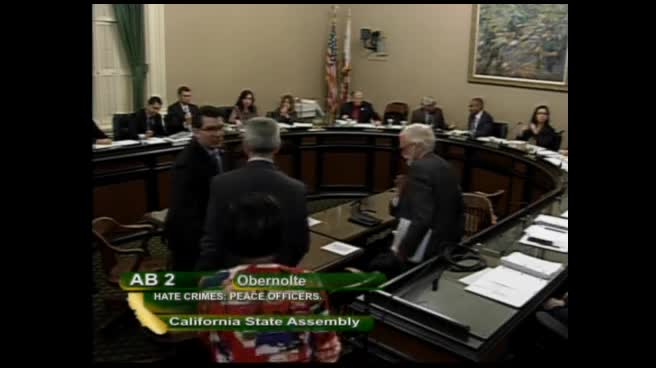 13MIN
Assembly Standing Committee on Public Safety
Bill Author

Bill Co-Author(s):
