AB 422: California State University: Doctor of Nursing Practice Degree Program.
- Session Year: 2017-2018
- House: Assembly
- Latest Version Date: 2017-10-12
Existing law, until July 1, 2018, establishes the Doctor of Nursing Practice Degree Pilot Program, under which the California State University is authorized to establish a Doctor of Nursing Practice degree pilot program at 3 campuses to award Doctor of Nursing Practice degrees, subject to specified program and enrollment requirements.
This bill would repeal those provisions and would authorize the California State University to establish Doctor of Nursing Practice degree programs that offer Doctor of Nursing Practice degrees, subject to specified program and enrollment requirements. The bill would require the California State University to provide initial funding from within existing budgets, as specified, and would express the Legislatures intent that the California State University seek private donations or other nonstate funds to fund startup costs for the programs.
(a)Notwithstanding Section 66010.4, in order to meet specific nursing education needs in California, the California State University may establish Doctor of Nursing Practice degree programs.
(b)The Doctor of Nursing Practice degree offered by the California State University shall be distinguished from the doctor of philosophy degrees in nursing offered at, or in conjunction with, the University of California.
(c)Doctor of Nursing Practice degree programs offered by the California State University shall focus on the preparation of nursing faculty to teach in postsecondary nursing education programs and may also train nurses for advanced nursing practice or nurse leadership, or both.
(d)Doctor of Nursing Practice degree programs established by the California State University are not exempt from any required review and approval processes.
(e) Enrollments in Doctor of Nursing Practice programs shall not alter the California State Universitys ratio of graduate instruction to total enrollment, and shall not diminish enrollment growth in university undergraduate programs.
(f)The California State University shall provide any initial funding needed for Doctor of Nursing Practice programs authorized by this article from within existing budgets for academic programs support, without diminishing the quality of program support offered to California State University undergraduate programs. It is the intent of the Legislature that the California State University seek private donations or other nonstate funds to fund startup costs for Doctor of Nursing Practice degree programs.
89281.The California State University shall permit students enrolled in the Doctor of Nursing Practice Degree Pilot Program established pursuant to this article, as it read on December 31, 2017, to complete their coursework on and after January 1, 2018.
REVISIONS: HeadingLines 1, 2, and 3.|
Date
|
Status
|
|---|---|
| Oct 12, 2017 | Chaptered by Secretary of State - Chapter 702, Statutes of 2017. |
| Oct 12, 2017 | Approved by the Governor. |
| Sep 13, 2017 | Enrolled and presented to the Governor at 4 p.m. |
| Sep 7, 2017 | In Assembly. Ordered to Engrossing and Enrolling. |
| Sep 7, 2017 | Read third time. Passed. Ordered to the Assembly. |
| Sep 5, 2017 | Read second time. Ordered to third reading. |
| Sep 1, 2017 | From committee: Do pass. (Ayes 7. Noes 0.) (September 1). |
| Jul 10, 2017 | In committee: Referred to APPR. suspense file. |
| Jun 28, 2017 | From committee: Do pass and re-refer to Com. on APPR. (Ayes 7. Noes 0.) (June 28). Re-referred to Com. on APPR. |
| Jun 8, 2017 | Referred to Com. on ED. |
| May 30, 2017 | In Senate. Read first time. To Com. on RLS. for assignment. |
| May 30, 2017 | Read third time. Passed. Ordered to the Senate. (Ayes 76. Noes 1. Page 1783.) |
| May 26, 2017 | Coauthors revised. |
| Apr 5, 2017 | In committee: Set, first hearing. Referred to APPR. suspense file. |
| Mar 15, 2017 | From committee: Do pass and re-refer to Com. on APPR. (Ayes 12. Noes 1.) (March 14). Re-referred to Com. on APPR. |
| Feb 21, 2017 | Referred to Com. on HIGHER ED. |
| Feb 10, 2017 | From printer. May be heard in committee March 12. |
| Feb 9, 2017 | Read first time. To print. |
|
Date
|
Description
|
Location
|
Votes
|
|
|---|---|---|---|---|
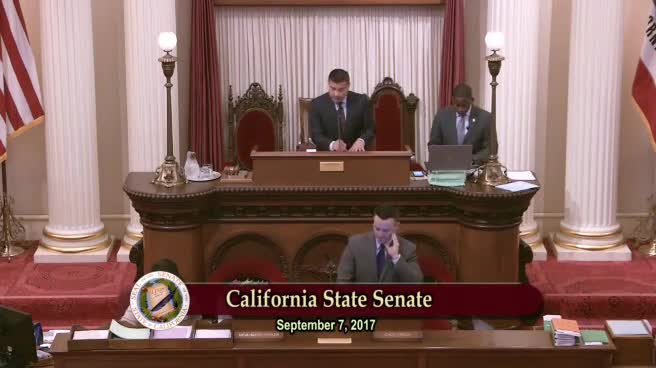
| Sep 7, 2017 | Assembly 3rd Reading AB422 Arambula et al. By Newman | Senate Floor |
Passed |
|
| Sep 1, 2017 | Do pass | Senate Standing Committee on Appropriations |
Passed |
|
| Jul 10, 2017 | Placed on suspense file | Senate Standing Committee on Appropriations |
Passed |
|
| Jun 28, 2017 | Do pass, but first be re-referred to the Committee on [Appropriations] | Senate Standing Committee on Education |
Passed |
|
| May 30, 2017 | AB 422 ARAMBULA Assembly Third Reading | Assembly Floor |
Passed |
|
| May 26, 2017 | Do pass. | Assembly Standing Committee on Appropriations |
Passed |
|
| Mar 14, 2017 | Do pass and be re-referred to the Committee on [Appropriations] | Assembly Standing Committee on Higher Education |
Passed |
This list shows positions taken on this bill by organizations on the date displayed, which is linked to the original source.
Positions by individuals are not included.
|
Organization
|
Position
|
Date
|
|---|---|---|
| 21 Individuals | ** Support | Mar 13, 2017 |
| Academic Senate of the California State University | ** Support | Mar 13, 2017 |
| American Nurses Association | ** Support | Sep 2, 2017 |
| California Association for Nurse Practitioners | ** Support | Sep 2, 2017 |
| California Children'S Hospital Association | ** Support | Sep 2, 2017 |
| California State Student Association | ** Support | Sep 2, 2017 |
| California State University | ** Support | Sep 2, 2017 |
| California State University Fresno | * Support | Jun 28, 2017 |
| CareMore Medical Group | ** Support | Sep 2, 2017 |
| Central California Blood Center | ** Support | Sep 2, 2017 |
| chico chamber of commerce | ** Support | Sep 2, 2017 |
| Children's Hospital of Orange County | ** Support | Mar 13, 2017 |
| Childrens Hospital of Orange County | ** Support | Mar 13, 2017 |
| Chinatown Service Center | ** Support | Sep 2, 2017 |
| choc children's | ** Support | Sep 2, 2017 |
| City of Long Beach | * Support | Jun 28, 2017 |
| clinical sierra vista | ** Support | Sep 2, 2017 |
| Community Medical Centers | ** Support | Mar 13, 2017 |
| csu, bakersfield department of nursing | ** Support | Sep 2, 2017 |
| csu, chico college of natural sciences | ** Support | Sep 2, 2017 |
| csu, fullerton | ** Support | Sep 2, 2017 |
| csu, long beach | ** Support | Sep 2, 2017 |
| csu, long beach school of nursing | ** Support | Sep 2, 2017 |
| csu, sacramento | ** Support | Sep 2, 2017 |
| diversify medical group | ** Support | Sep 2, 2017 |
| El Camino Hospital | ** Support | Sep 2, 2017 |
| emergency medical management associates | ** Support | Sep 2, 2017 |
| Hoag Memorial Hospital Presbyterian | ** Support | Sep 2, 2017 |
| Humboldt State University | ** Support | Mar 13, 2017 |
| Kaiser Permanente | ** Support | Sep 2, 2017 |
| Kaiser Permanente School of Anesthesia | * Support | Jun 28, 2017 |
| keck medical center | ** Support | Sep 2, 2017 |
| Keck Medical Center of USC | ** Support | Mar 13, 2017 |
| Long Beach Memorial | ** Support | Sep 2, 2017 |
| Long Beach Memorial Hospital | ** Support | Mar 13, 2017 |
| mayor robert garcia, city of long beach | ** Support | Sep 2, 2017 |
| Mental Health America | ** Support | Sep 2, 2017 |
| Mental Health America of Los Angeles | ** Support | Sep 2, 2017 |
| Miller Children's and Women's Hospital Long Beach | ** Support | Sep 2, 2017 |
| on lok, inc. | ** Support | Sep 2, 2017 |
| Orange County Business Council | ** Support | Sep 2, 2017 |
| Oxnard Chamber of Commerce | ** Support | Sep 2, 2017 |
| Saint Agnes Medical Center | ** Support | Sep 2, 2017 |
| San Jose State DNP Program | * Support | Jun 28, 2017 |
| San Jose State University | ** Support | Sep 2, 2017 |
| Sant Health System | ** Support | Mar 13, 2017 |
| sante health system | ** Support | Mar 13, 2017 |
| SEIU California | * Support | Jun 28, 2017 |
| Sequoia Health Care District | ** Support | Mar 13, 2017 |
| Several individuals | ** Support | Sep 2, 2017 |
| Sonoma State University | ** Support | Sep 2, 2017 |
| Southern California CSU DNP Consortium | ** Support | Sep 2, 2017 |
| St. Joseph Hoag Health | ** Support | Sep 2, 2017 |
| St. Jude Medical Center | ** Support | Sep 2, 2017 |
| the elizabeth hospice | ** Support | Sep 2, 2017 |
| The Health Trust | ** Support | Sep 2, 2017 |
| Valley Children's Healthcare | ** Support | Sep 2, 2017 |
| Vista Community Clinic | ** Support | Sep 2, 2017 |
| Wellspace Health | ** Support | Sep 2, 2017 |
Office of Senate Floor Analyses (916) 651-1520 Fax: (916) 327-4478 | AB |
THIRD READING
Bill No: AB 422
:
SENATE EDUCATION COMMITTEE: 7-0, 6/28/17
AYES: Allen, Wilk, Galgiani, Leyva, Mendoza, Pan, Vidak
SENATE APPROPRIATIONS COMMITTEE: 7-0, 9/1/17
AYES: Lara, Bates, Beall, Bradford, Hill, Nielsen, Wiener
ASSEMBLY FLOOR: 76-1, 5/30/17 - See last page for vote
DIGEST:
This bill repeals provisions relating to the Doctor of Nursing Practice (DNP) degree pilot program, and instead authorizes the California State University (CSU) to permanently establish DNP degree programs.
Existing law:
- Provides that the primary mission of the CSU is undergraduate and graduate instruction through the master’s degree, but authorizes the CSU to offer joint doctoral degrees with the University of California (UC), or with one or more independent institutions of higher education, only as specified. (Education Code § 66010.4)
- Provides, in setting forth the missions and functions of California’s public and independent institutions of higher education, among other things, that UC has the sole authority in public higher education to award the doctoral degree in all fields of learning, except that it may agree with the CSU to award joint doctoral degrees in selected fields. (EC § 66010.4)
- Authorizes the CSU to independently award the Doctor of Education degree focused solely on preparing administrative leaders for California public K-14 schools. (EC § 66040, et seq.)
- Authorizes the CSU to offer the Doctor of Audiology (Au.D) degree; and, specifies that the Au.D degree programs at the CSU shall be focused on preparing audiologists to provide health care services and shall be consistent with the standards for accreditation set forth by the Council on Academic Accreditation in Audiology and Speech-Language Pathology (EC 66041, et seq.).
- Authorizes the CSU, until January 1, 2019, to offer the Doctor of Physical Therapy degree focused solely on preparing physical therapists to provide health care services, and shall be consistent with meeting the requirements of the Commission on Accreditation in Physical Therapy Education. (EC § 66402, et seq.)
- Authorizes the CSU, until January 1, 2019, to offer the DNP degree programs at up to three campuses chosen by the CSU Trustees and requires the CSU to provide data, as specified, by July 1, 2016, to the Legislative Analyst’s Office (LAO), in order for the LAO to prepare a report to the Legislature on or before January 1, 2017. (EC § 89281, et seq.)
This bill repeals provisions relating to the DNP Degree Pilot program, and instead authorizes the CSU to permanently establish a DNP degree program. Specifically, it:
- Requires that the DNP degree offered by the CSU be distinguished from the doctor of philosophy degrees in nursing offered at, or in conjunction with, the UC.
- Requires that the DNP degree programs offered by CSU to focus on the preparation of nursing faculty to teach in postsecondary nursing education programs and may also train nurses for advanced nursing practice or nurse leadership, or both.
- Specifies that these programs are not exempt from any required review and approval process.
- Prohibits enrollment in these programs from altering the ratio of graduate instruction to total enrollment and diminishing growth of enrollment of undergraduate programs.
- Requires the CSU to provide any initial funding needed for these programs from within existing budgets for academic programs support, without diminishing the quality of program support offered to undergraduate programs.
- States legislative intent that the CSU seek private donations or other non-state funds to fund startup costs for DNP degree programs.
Comments
- Need for the bill. In 2010, the Legislature approved AB 867 (Nava/Arambula, Chapter 416, Statutes of 2010), giving the CSU authority to offer the DNP degree programs on a pilot basis. The authority to enroll new students expires on July 1, 2018. According to the author, “without this authority, the ability to grow CSU’s nursing faculty, maintain key industry partnerships and graduate highly qualified healthcare professionals into the workforce will be eliminated.” This bill seeks to permanently extend CSU’s existing authority to award a DNP degree.
- Status of existing pilot. AB 867 (Nava/Arambula, Chapter 4716, Statues of 2010) resulted from a study by the CSU Nursing Doctorate Advisory Committee, comprised of CSU representatives and a research consultant, to determine how best to address California’s nursing faculty shortage. The DNP program is an applied doctoral degree for nursing professionals that is distinct from the basic research Ph.D. in nursing. At that time CSU reported that the bill was necessary for training future CSU and California Community College nursing faculty. CSU’s 18 pre-licensure nursing programs were full and unable to expand, in part because there are not enough faculty available to meet the low student-to-faculty ratios required by accreditors and licensing boards for these programs. In addition, CSU anticipated that the new program would allow it to train more advance practice nurses, which may be the educational level necessary for certification in the future.
Ultimately, the CSU was authorized to operate DNP pilot programs for the purposes of; 1) Preparing clinical faculty to teach in postsecondary nursing education programs; and 2) Training nurses for advanced nursing practice or nurse leadership, or both. Two CSU pilot DNP programs were developed through campus consortia:
- Northern California DNP consortium: CSU, Fresno and San José.
- Southern California DNP consortium: CSU Long Beach, Fullerton and Los Angeles.
CSU reports that in fall 2012 the Northern California CSU DNP consortium and the Southern California CSU DNP consortium enrolled their first DNP student cohorts. To date, five cohorts of students have been served by the program. Additionally, Kaiser Northern California, The Centers for Medicare and Medicaid Innovation, and the California Office of Statewide Health Planning and Development have awarded grant funding that supporter DNP student doctoral projects, which are required in CSU DNP programs.
- Status of CSU DNP graduates. According to the CSU, approximately one-third of CSU DNP graduates have accepted nursing teaching positions. For the CSU, 23 percent of graduates currently teaching in the system. Notably, nine graduates have accepted tenure-track nursing positions in the CSU. In 2014 graduates represented 17.4 percent of nursing tenure-track hires made across the system that year. DNP graduates have utilized their advanced training to work in many capacities through the state, with one in five alumni are working with medically underserved populations or regions.
- Related report. SB 103 (Committee on Budget and Fiscal Review, Chapter 324, Statutes of 2015) directed the LAO to assess CSU’s DNP programs and make a recommendation on whether the pilot should be extended beyond its 2018. The report provided the following findings and recommendations:
- CSU formed two DNP consortia (Northern and Southern CA) consisting of a total of five campuses.
- About one-third of CSU’s DNP program graduates are serving as faculty, but few are in tenure/tenure-track positions. Within a 21 month span, 93 percent have graduated from the program (162 of a total 174 students), 34 percent of those graduates serve as faculty at CSU or other postsecondary institution. Most of these graduates are in part-time or other faculty positions that do not require a doctorate.
- The state is no longer facing a nursing shortage. The Board of Nursing and other experts report that overall the state’s RN labor market is in good balance and assuming current graduation production continues, supply is sufficient to ensure an adequately sized RN workforce for decades to come.
- CSU continues to report trouble with attracting doctorally prepared nursing faculty, but few are tenured faculty at CSU.
- Increasing faculty compensation levels for nursing faculty is a more direct way for CSU to address regular recruitment challenges for tenured faculty.
- For the most part, expectations about higher entry-to-practice requirements (i.e. Doctoral degree) for advanced practice registered nurses (APRNs) have not materialized.
- Other options available to Californians seeking a DNP include online programs offered throughout the country. The LAO also noted that three UC campuses are seeking to offer the program by 2018.
- The LAO recommends that the Legislature allow the CSU DNP program to sunset for the following reasons:
- Given that nursing shortage no longer exists, CSU has more direct ways to attract nursing faculty.
- The DNP has not become the required degree for APRNs.
- An increasing number of other DNP programs are now available to students.
- Other DNP programs within the state. In 2014-15, ten California universities offered DNP programs and graduated a total of 193 students. The CSU graduates accounted for 28 percent of these graduates. In California, the number of DNP programs has increased from one in 2006 (University of San Francisco) to ten in 2017 including the CSU pilots. As noted by the LAO, three UC campuses plan to DNP degrees in the coming year.
- Master Plan for Higher Education. As outlined in the Master Plan for Higher Education and by state statute, the primary mission of the CSU is undergraduate and graduate instruction through the master’s degree. The UC was granted the sole authority to offer doctoral degrees. Notably, this bill specifies that the DNP degree offered by the CSU is to be distinguished from the doctor of philosophy degrees in nursing offered at, or in conjunction with, the UC.
Notwithstanding the differentiation of mission envisioned by the Master Plan and outlined in statute, the Legislature has authorized the CSU to go beyond its original mission to offer four professional doctoral degrees which include the Doctor of Audiology, Doctor of Education, Doctor of Physical Therapy and DNP (pilot). Fees were capped at the rate charged at the UC, no additional funding was provided by the state, and these programs were to be implemented without diminishing or reducing enrollment in undergraduate programs. Additionally, the CSU programs offer applied doctorates and are not duplicative of degrees offered by UC. However, UC is set to establish its own DNP program in 2018.
- Should CSU’s authority sunset? The LAO recommends that the Legislature allow the CSU DNP program to sunset, given that the nursing shortage no longer exists, the DNP has not become the required degree for advanced practice registered nurses (APRNs) and an increase in the number of programs now available to students. Under current law, the CSU is authorized to offer joint degrees with either the UC or private higher education institutions. Arguably, under this authority, the need to offer the DNP program could be met by establishing partnerships between UC and CSU campuses.
However, citing an impending wave of retiring nursing faculty coupled with difficulties faced in hiring tenure track faculty due to the lack of a sufficient pool of candidates, CSU reports that it continues to experience a nursing faculty shortage. Additionally, CSU has established key industry partnerships related to the DNP program including with Kaiser Permanent. Since 2000, this partnership has graduated more than half of the nurse anesthetist in California. By 2022, all nurse anesthetist programs must be taught at the doctoral level. According to CSU, the Kaiser Permanent partnership that is critical to the nurse anesthetist pipeline will be lost if the CSU is not granted permanent DNP granting authority.
FISCAL EFFECT: Appropriation: Fiscal Com.: Local:
According to the Senate Appropriations Committee, “While the bill includes legislative intent that the CSU seek private donations or other non-state funds to fund startup costs for DNP degree programs, the CSU indicates that the programs’ tuition covers a majority of the operating costs. Further, the CSU indicates that for the first three cohorts, the combined campus contributions to the programs ranged from approximately $155,000 to $213,000 per year. Additionally, the CSU Chancellor’s Office provided $3,500 in one-time funds to each DNP program to assist with expenses associated with initial national nursing accreditation reviews. Based on these existing amounts, there would be additional costs that are similar for every new program that is opened.”
American Nurses Association/California
California Association for Nurse Practitioners
California Children’s Hospital Association
California State Council of the Service Employees International Union
California State Student Association
California State University
CareMore Medical Group
Center for Education and Professional Development at Stanford Health Care
Central California Blood Center
Chico Chamber of Commerce
Chinatown Service Center
CHOC Children’s
Clinical Sierra Vista
CSU, Bakersfield Department of Nursing
CSU, Chico College of Natural Sciences
CSU, Fullerton
CSU, Long Beach
CSU, Long Beach School of Nursing
CSU, Sacramento
Diversify Medical Group
El Camino Hospital
Emergency Medical Management Associates
Hoag Memorial Hospital Presbyterian
Kaiser Permanente
Keck Medical Center
Long Beach Memorial
Mayor Robert Garcia, City of Long Beach
Mental Health America
Mental Health America of Los Angeles
Miller Children’s and Women’s Hospital Long Beach
On Lok, Inc.
Orange County Business Council
Oxnard Chamber of Commerce
Saint Agnes Medical Center
San José State University
Sonoma State University
Southern California CSU DNP Consortium
St. Joseph Hoag Health
St. Jude Medical Center
The Elizabeth Hospice
The Health Trust
Valley Children’s Healthcare
Vista Community Clinic
WellSpace Health
Several Individuals
OPPOSITION: (Verified 8/31/17)
None received
ASSEMBLY FLOOR: 76-1, 5/30/17
AYES: Acosta, Aguiar-Curry, Travis Allen, Arambula, Baker, Berman, Bigelow, Bloom, Bocanegra, Bonta, Brough, Burke, Caballero, Calderon, Cervantes, Chávez, Chen, Chiu, Chu, Cooley, Cooper, Cunningham, Dababneh, Dahle, Daly, Flora, Fong, Frazier, Friedman, Gallagher, Cristina Garcia, Eduardo Garcia, Gipson, Gloria, Gomez, Gonzalez Fletcher, Gray, Grayson, Harper, Holden, Irwin, Jones-Sawyer, Kalra, Lackey, Levine, Limón, Low, Maienschein, Mathis, Mayes, McCarty, Medina, Melendez, Mullin, Muratsuchi, Nazarian, Obernolte, O'Donnell, Patterson, Quirk, Quirk-Silva, Reyes, Ridley-Thomas, Rodriguez, Rubio, Salas, Santiago, Steinorth, Mark Stone, Thurmond, Ting, Voepel, Waldron, Weber, Wood, Rendon
NOES: Kiley
NO VOTE RECORDED: Chau, Choi, Eggman
9/2/17 13:37:33
**** END ****
SENATE COMMITTEE ON
Senator Ricardo Lara, Chair
2017 - 2018 Regular Session
AB 422 (Arambula) - California State University: Doctor of Nursing Practice Degree Program
Version: | Policy Vote: |
Urgency: | Mandate: |
Hearing Date: | Consultant: |
This bill meets the criteria for referral to the Suspense File.
Bill Summary:
This bill authorizes the California State University (CSU) to permanently establish Doctor of Nursing Practice (DNP) degree programs, and also repeals various provisions relating to the program.
Fiscal Impact:
While the bill includes legislative intent that the CSU seek private donations or other non-state funds to fund startup costs for DNP degree programs, the CSU indicates that the programs’ tuition covers a majority of the operating costs. Further, the CSU indicates that for the first three cohorts, the combined campus contributions to the programs ranged from approximately $155,000 to $213,000 per year. Additionally, the CSU Chancellor’s Office provided $3,500 in one-time funds to each DNP program to assist with expenses associated with initial national nursing accreditation reviews. Based on these existing amounts, there would be additional costs that are similar for every new program that is opened.
Background:
Existing law authorizes the CSU, until January 1, 2019, to offer the DNP degree programs at up to three campuses chosen by the CSU Trustees. The program is an applied doctoral degree for nursing professionals that is distinct from the basic research Ph.D. in nursing. CSU was authorized to operate DNP pilot programs for the purposes of; 1) Preparing clinical faculty to teach in postsecondary nursing education programs; and 2) Training nurses for advanced nursing practice or nurse leadership, or both. Two CSU pilot DNP programs were developed through campus consortia—the Northern California DNP consortium (CSU Fresno and San José) and the Southern California DNP consortium (CSU Long Beach, Fullerton and Los Angeles).
CSU reports that each consortium enrolled their first DNP student cohorts in the Fall of 2012. To date, five cohorts of students have been served by the program. Additionally, Kaiser Northern California, The Centers for Medicare and Medicaid Innovation, and the California Office of Statewide Health Planning and Development have awarded grant funding that supporter DNP student doctoral projects which are required components of the program.
Proposed Law:
This bill repeals provisions relating to the DNP Degree Pilot program, and instead authorizes the CSU to permanently establish a DNP degree program. Specifically, it:
- Requires that the Doctor of Nursing Practice degree offered by the CSU be distinguished from the doctor of philosophy degrees in nursing offered at, or in conjunction with, the University of California.
- Requires that the DNP degree programs offered by CSU to focus on the preparation of nursing faculty to teach in postsecondary nursing education programs and may also train nurses for advanced nursing practice or nurse leadership, or both.
- Specifies that these programs are not exempt from any required review and approval process.
- Prohibits enrollment in these programs from altering the ratio of graduate instruction to total enrollment and diminishing growth of enrollment of undergraduate programs.
- Requires the CSU to provide any initial funding needed for these programs from within existing budgets for academic programs support, without diminishing the quality of program support offered to undergraduate programs.
- States legislative intent that the CSU seek private donations or other non-state funds to fund startup costs for DNP degree programs.
Related Legislation:
SB 103 (Committee on Budget and Fiscal Review, Chapter 324, Statutes of 2015) directed the Legislative Analyst’s Office to assess CSU’s DNP programs and make a recommendation on whether the pilot should be extended beyond its 2018.
AB 867 (Nava/Arambula, Chapter 416, Statutes of 2010), provided CSU the authority to offer DNP degree programs on a pilot basis.
-- END --
SENATE COMMITTEE ON EDUCATION
Senator Benjamin Allen, Chair
2017 - 2018 Regular
Bill No: Hearing Date: June 28, 2017
Author: | Arambula | ||
Version: |
| ||
Urgency: | Fiscal: | ||
Consultant: | |||
Subject:
SUMMARY
This bill repeals provisions relating to the Doctor of Nursing Practice (DNP) degree pilot program, and instead authorizes the California State University (CSU) to permanently establish DNP degree programs.
BACKGROUND
Existing law:
- Provides that the primary mission of the CSU is undergraduate and graduate instruction through the master’s degree, but authorizes the CSU to offer joint doctoral degrees with the University of California (UC), or with one or more independent institutions of higher education, only as specified. (Education Code § 66010.4)
- In setting forth the missions and functions of California’s public and independent institutions of higher education provides, among other things, that UC has the sole authority in public higher education to award the doctoral degree in all fields of learning, except that it may agree with the CSU to award joint doctoral degrees in selected fields. (EC § 66010.4)
- Authorizes the CSU to independently award the Doctor of Education (Ed.D) degree focused solely on preparing administrative leaders for California public K-14 schools. (EC § 66040, et seq.)
- Authorizes the CSU to offer the Doctor of Audiology (Au.D) degree; and, specifies that the Au.D degree programs at the CSU shall be focused on preparing audiologists to provide health care services and shall be consistent with the standards for accreditation set forth by the Council on Academic Accreditation in Audiology and Speech-Language Pathology (EC 66041, et seq.).
- Authorizes the CSU, until January 1, 2019, to offer the Doctor of Physical Therapy (D.P.T.) degree focused solely on preparing physical therapists to provide health care services, and shall be consistent with meeting the requirements of the Commission on Accreditation in Physical Therapy Education. (EC § 66402, et seq.)
- Authorizes the California State University (CSU), until January 1, 2019, to offer the Doctor of Nursing Practice (DNP) degree programs at up to three campuses chosen by the CSU Trustees and requires the CSU to provide data, as specified, by July 1, 2016, to the Legislative Analyst’s Office (LAO), in order for the LAO to prepare a report to the Legislature on or before January 1, 2017. (EC § 89281, et seq.)
ANALYSIS
This bill repeals provisions relating to the DNP Degree Pilot program, and instead authorizes the CSU to permanently establish a DNP degree program. Specifically, it:
- Requires that the Doctor of Nursing Practice degree offered by the CSU be distinguished from the doctor of philosophy degrees in nursing offered at, or in conjunction with, the University of California.
- Requires that the DNP degree programs offered by CSU to focus on the preparation of nursing faculty to teach in postsecondary nursing education programs and may also train nurses for advanced nursing practice or nurse leadership, or both.
- Specifies that these programs are not exempt from any required review and approval process.
- Prohibits enrollment in these programs from altering the ratio of graduate instruction to total enrollment and diminishing growth of enrollment of undergraduate programs.
- Requires the CSU to provide any initial funding needed for these programs from within existing budgets for academic programs support, without diminishing the quality of program support offered to undergraduate programs.
- States legislative intent that the CSU seek private donations or other non-state funds to fund startup costs for DNP degree programs.
STAFF COMMENTS
- Need for the bill. In 2010, the Legislature approved AB 867 (Nava/Arambula, Chapter 416, Statutes of 2010), giving the CSU authority to offer Doctor of Nursing Practice degree programs on a pilot basis. The authority to enroll new students expires on July 1, 2018. According to the author, “without this authority, the ability to grow CSU’s nursing faculty, maintain key industry partnerships and graduate highly qualified healthcare professionals into the workforce will be eliminated.”
This bill seeks to permanently extend CSU’s existing authority to award a DNP degree.
- Status of existing pilot. AB 867 (Nava/Arambula, Chapter 4716, Statues of 2010) resulted from a study by the CSU Nursing Doctorate Advisory Committee, comprised of California State University (CSU) representatives and a research consultant, to determine how best to address California’s nursing faculty shortage. The Doctorate of Nursing Practice (DNP) program is an applied doctoral degree for nursing professionals that is distinct from the basic research Ph.D. in nursing. At that time CSU reported that the bill was necessary for training future CSU and California Community College nursing faculty. CSU’s 18 pre-licensure nursing programs were full and unable to expand, in part because there are not enough faculty available to meet the low student-to-faculty ratios required by accreditors and licensing boards for these programs. In addition, CSU anticipated that the new program would allow it to train more advance practice nurses, which may be the educational level necessary for certification in the future.
Ultimately, the CSU was authorized to operate DNP pilot programs for the purposes of; 1) Preparing clinical faculty to teach in postsecondary nursing education programs; and 2) Training nurses for advanced nursing practice or nurse leadership, or both. Two CSU pilot DNP programs were developed through campus consortia:
- Northern California DNP consortium: CSU, Fresno and San José.
- Southern California DNP consortium: CSU Long Beach, Fullerton and Los Angeles.
CSU reports that in fall 2012 the Northern California CSU DNP consortium and the Southern California CSU DNP consortium enrolled their first DNP student cohorts. To date, five cohorts of students have been served by the program. Additionally, Kaiser Northern California, The Centers for Medicare and Medicaid Innovation, and the California Office of Statewide Health Planning and Development have awarded grant funding that supporter DNP student doctoral projects, which are required in CSU DNP programs.
- Status of CSU DNP graduates. According to the CSU, approximately one-third of CSU DNP graduates have accepted nursing teaching positions. For the CSU, 23 percent of graduates currently teaching in the system. Notably, nine graduates have accepted tenure-track nursing positions in the CSU. In 2014 graduates represented 17.4 percent of nursing tenure-track hires made across the system that year. DNP graduates have utilized their advanced training to work in many capacities through the state, with one in five alumni are working with medically underserved populations or regions.
- Related report. SB 103 (Committee on Budget and Fiscal Review, Chapter 324, Statutes of 2015) directed the Legislative Analyst’s Office to assess CSU’s DNP programs and make a recommendation on whether the pilot should be extended beyond its 2018. The report provided the following findings and recommendations:
- CSU formed two DNP consortia (Northern and Southern CA) consisting of a total of five campuses.
- About one-third of California State University’s (CSU) Doctor of Nursing Practice (DNP) program graduates are serving as faculty, but few are in tenure/tenure-track positions. Within a 21 month span, 93 percent have graduated from the program (162 of a total 174 students), 34 percent of those graduates serve as faculty at CSU or other postsecondary institution. Most of these graduates are in part-time or other faculty positions that do not require a doctorate.
- The state is no longer facing a nursing shortage. The Board of Nursing and other experts report that overall the state’s RN labor market is in good balance and assuming current graduation production continues, supply is sufficient to ensure an adequately sized RN workforce for decades to come.
- CSU continues to report trouble with attracting doctorally prepared nursing faculty, but few are tenured faculty at CSU.
- Increasing faculty compensation levels for nursing faculty is a more direct way for CSU to address regular recruitment challenges for tenured faculty.
- For the most part, expectations about higher entry-to-practice requirements (i.e. Doctoral degree) for advanced practice registered nurses (APRNs) have not materialized.
- Other options available to Californians seeking a DNP include online programs offered throughout the country. The Legislative Analyst’s Office (LAO) also noted that three University of California (UC) campuses are seeking to offer the program by 2018.
- The LAO recommends that the Legislature allow the CSU DNP program to sunset for the following reasons:
- Given that nursing shortage no longer exists, CSU has more direct ways to attract nursing faculty.
- The DNP has not become the required degree for APRNs.
- An increasing number of other DNP programs are now available to students.
- Other DNP programs within the state. In 2014-15, ten California universities offered DNP programs and graduated a total of 193 students. The CSU graduates accounted for 28 percent of these graduates. In California, the number of DNP programs has increased from one in 2006 (University of San Francisco) to ten in 2017 including the CSU pilots. As noted by the LAO, three UC campuses plan to DNP degrees in the coming year.
- Master Plan for Higher Education. As outlined in the Master Plan for Higher Education and by state statute, the primary mission of the CSU is undergraduate and graduate instruction through the master’s degree. The UC was granted the sole authority to offer doctoral degrees. Notably, this bill specifies that the Doctor of Nursing Practice (DNP) degree offered by the California State University (CSU) is to be distinguished from the doctor of philosophy degrees in nursing offered at, or in conjunction with, the University of California (UC).
Notwithstanding the differentiation of mission envisioned by the Master Plan and outlined in statute, the Legislature has authorized the CSU to go beyond its original mission to offer four professional doctoral degrees which include the Doctor of Audiology, Doctor of Education, Doctor of Physical Therapy and DNP (pilot). Fees were capped at the rate charged at the UC, no additional funding was provided by the state, and these programs were to be implemented without diminishing or reducing enrollment in undergraduate programs. Additionally, the CSU programs offer applied doctorates and are not duplicative of degrees offered by UC. However, UC is set to establish its own DNP program in 2018.
Unlike the original authorization established by AB 867 (Nava/Arambula, Chapter 4716, Statues of 2010), this bill does not cap fees at the rate charged by the UC.
The committee may wish to consider whether a similar cap should be required as a condition of granting CSU’s permanent authority to offer DNP degrees.
- Should CSU’s authority sunset? The Legislative Analyst’s Office (LAO) recommends that the Legislature allow the CSU DNP program to sunset, given that the nursing shortage no longer exists, the DNP has not become the required degree for advanced practice registered nurses (APRNs) and an increase in the number of programs now available to students. Under current law, the CSU is authorized to offer joint degrees with either the UC or private higher education institutions. Arguably, under this authority, the need to offer the DNP program could be met by establishing partnerships between UC and CSU campuses.
However, citing an impending wave of retiring nursing faculty coupled with difficulties faced in hiring tenure track faculty due to the lack of a sufficient pool of candidates, CSU reports that it continues to experience a nursing faculty shortage. Additionally, CSU has established key industry partnerships related to the DNP program including with Kaiser Permanent. Since 2000, this partnership has graduated more than half of the nurse anesthetist in California. By 2022, all nurse anesthetist programs must be taught at the doctoral level. According to CSU, the Kaiser Permanent partnership that is critical to the nurse anesthetist pipeline will be lost if the CSU is not granted permanent DNP granting authority.
SUPPORT
American Nurses Association/California
California Association for Nurse Practitioners
California Children’s Hospital Association
California State Council of the Service Employees International Union (SEIU California)
California State Student Association
California State University
CareMore Medical Group
Center for Education and Professional Development at Stanford Health Care
Central California Blood Center
Chico Chamber of Commerce
Chinatown Service Center
CHOC Children’s
Clinical Sierra Vista
CSU, Bakersfield Department of Nursing
CSU, Chico College of Natural Sciences
CSU, Fullerton
CSU, Long Beach
CSU, Long Beach School of Nursing
CSU, Sacramento
Diversify Medical Group
El Camino Hospital
Emergency Medical Management Associates
Hoag Memorial Hospital Presbyterian
Kaiser Permanente
Keck Medical Center
Long Beach Memorial
Mayor Robert Garcia, City of Long Beach
Mental Health America
Mental Health America of Los Angeles
Miller Children’s and Women’s Hospital Long Beach
On Lok, Inc.
Orange County Business Council
Oxnard Chamber of Commerce
Ronald Norby, CSU Long Beach Graduate Program Director, School of Nursing
Saint Agnes Medical Center
San José State University
Sonoma State University
Southern California CSU DNP Consortium
St. Joseph Hoag Health
St. Jude Medical Center
Sylvia Everroad, Chief Administrative Officer of Kaiser Permanente Southern California
The Elizabeth Hospice
The Health Trust
Valley Children’s Healthcare
Vista Community Clinic
WellSpace Health
OPPOSITION
None received
-- END --
ASSEMBLY THIRD READING
ATR Bill Id:AB 422
Author:(Arambula)
As Introduced Ver:February 9, 2017
Majority vote
Committee | Votes | Ayes | Noes |
Higher Education | 12-1 | Medina, Baker, Arambula, Bloom, Chávez, Choi, Irwin, Levine, Low, Quirk-Silva, Santiago, Weber | Kiley |
Appropriations | 17-0 | Gonzalez Fletcher, Bigelow, Bloom, Bocanegra, Bonta, Brough, Calderon, McCarty, Quirk, Fong, Friedman, Gallagher, Eduardo Garcia, Gray, Muratsuchi, Obernolte, Reyes |
|
SUMMARY: Repeals provisions relating to the Doctor of Nursing Practice Degree Pilot program, and instead authorizes the California State University (CSU) to establish Doctor of Nursing Practice degree programs.
EXISTING LAW:
- Provides that the primary mission of the CSU is undergraduate and graduate instruction through the master's degree, but authorizes the CSU to offer joint doctoral degrees with the UC, or with one or more independent institutions of higher education, only as specified. Specifies that, in setting forth the missions and functions of California’s public and independent institutions of higher education that, among other things, the UC has the sole authority in public higher education to award the doctoral degree in all fields of learning, except that it may agree with the CSU to award joint doctoral degrees in selected fields (Education Code (EC) Section 66010.4).
- Authorizes the CSU to independently award the Doctor of Education (Ed.D.) degree focused solely on preparing administrative leaders for California public K-14 schools (EC 66040, et seq.).
- Authorizes the CSU to offer the Doctor of Audiology (Au.D) degree; and, specifies that the Au.D degree programs at the CSU shall be focused on preparing audiologists to provide health care services and shall be consistent with the standards for accreditation set forth by the Council on Academic Accreditation in Audiology and Speech-Language Pathology (EC 66041, et seq.).
- Authorizes the CSU, until January 1, 2019, to offer the Doctor of Physical Therapy (D.P.T.) degree; and, specifies that the D.P.T. degree programs at the CSU shall be focused on preparing physical therapists to provide health care services, and shall be consistent with meeting the requirements of the Commission on Accreditation in Physical Therapy Education (EC 66042, et seq.).
- Authorizes the CSU, until January 1, 2019, to offer Doctor of Nursing Practice degree programs at up to three campuses chosen by the CSU Trustees; specifies that the CSU shall not enroll any new students in the DNP degree programs on or after July 1, 2018; and, requires the CSU to provide data, as specified, by July 1, 2016, to the Legislative Analyst's Office (LAO), in order for the LAO to prepare a report to the Legislature on or before January 1, 2017 (EC 89281, et seq.).
FISCAL EFFECT: On-going cost of $522,000 annually to continue to operate existing DNP degree programs. In 2014-15, the CSU expended $213,454 in campus operating fees to operate the DNP pilot programs; $20,369 in financial aid fee waivers and $288,500 in State University Grants.
The bill also directs CSU to seek private donations or other non-state funds to fund startup costs for future DNP programs. If the CSU opens additional DNP programs, there will be cost pressures on campus base funds exceeding $250,000 annually to operate every new DNP program.
COMMENTS: Background. AB 867 (Nava), Chapter 416, Statutes of 2010, granted the CSU the authority to establish a Doctor of Nursing practice (DNP) degree pilot program. The DNP is an applied doctoral degree for nursing professionals that, as stipulated in EC Section 89281, is required to be distinct from nursing programs offered at, or in conjunction with, the University of California (UC). The original legislation resulted from a study by the CSU Nursing Doctorate Advisory Committee (comprised of CSU representatives and a research consultant) to determine how best to address California's nursing faculty shortage.
At that time, CSU found that their existing nursing programs were full and unable to expand, in part because there was not enough nursing faculty available to meet the low student-to-faculty ratios required by accreditors and licensing boards for these programs. In addition, the CSU believed that higher entry to practice requirements for advanced practice nurses were imminent, and the DNP would give the system the ability to train more advance practice nurses. Ultimately, the CSU was authorized to operate DNP pilot programs for the specific purposes of:
- Preparing clinical faculty to teach in postsecondary nursing education programs
- Training nurses for advanced nursing practice or nurse leadership, or both.
The CSU was authorized to establish a DNP degree pilot program at three campuses chosen by the Board of Trustees.
Pilot program and outcomes. Two CSU pilot DNP programs were developed through campus consortia with a designated administrative campus: The Northern California CSU DNP Consortium involved a partnership of CSU Fresno (administrative) and San José State; The Southern California CSU DNP Consortium linked CSU Fullerton (administrative campus), CSU Long Beach, and CSU Los Angeles. Both programs designed consistent curricula, were nationally accredited by the Commission on Collegiate Nursing Education (CCNE) after their first year of operation, and were approved by the CSU Chancellor’s Office and the Senior Commission of the Western Association of Schools and Colleges (WASC).
In fall 2012 the Northern California CSU DNP Consortium and the Southern California CSU DNP Consortium enrolled their first DNP student cohorts. To date, five cohorts of students have been served by the program. Additionally, Kaiser Northern California, The Centers for Medicare and Medicaid Innovation, and the California Office of Statewide Health Planning and Development (OSHPD) have awarded grant funding that supported DNP student doctoral projects, which are required in CSU DNP programs.
Graduation rate. To date, three cohorts of students have had enough time to complete the program. The overall graduation rate for these cohorts is 93%.
DNP alumni. Approximately one-third of CSU DNP graduates have accepted nursing teaching positions. According to the CSU, 37 alumni (23% of graduates) are currently teaching in the system, and nine graduates have accepted tenure-track nursing positions in the CSU. In 2014, CSU DNP graduates represented 17.4% of nursing tenure-track hires made across the system for that year.
The LAO's analysis of the DNP pilot program takes a close look at the 162 CSU DNP graduates to date. At the time of publication in January 2017, most of the 37 faculty members serving at CSU (29 faculty) were in non-tenure lecturer positions. Seventeen of these faculty members were already lecturers at CSU when they enrolled in the DNP program. The remaining eight faculty hires have tenure-track positions at CSU. Of these eight tenure-track hires, three were already lecturers at CSU when they enrolled in the DNP program.
LAO analysis. In January of 2017, the LAO submitted the statutorily required evaluation of the program, titled "Evaluation of CSU's Doctor of Nursing Practice Pilot Program." The major findings of the report were that:
- The state is no longer facing a nursing shortage;
- The CSU continues to report trouble attracting doctorally-prepared nursing faculty;
- Only eight graduates have taken tenure-track positions in the CSU, a small overall percentage;
- The more direct way for the CSU to address regular recruitment challenges is to offer more competitive salaries;
- Expectations About Higher Entry-to-Practice requirements for Advanced Practice Registered Nurses have not materialized (except for nurse anesthetists); and
- There are increased options available for individuals seeking a DNP.
The LAO recommended that the pilot program be allowed to sunset.
The CSU continues to experience a nursing faculty shortage. CSU campuses report considerable difficulties with recruiting tenure-track faculty. For example, the Chancellor's Office recently queried three CSU nursing programs concerning their ability to hire tenure-track faculty. In 2015-16, these programs advertised for a total of eight tenure track positions, but had to cancel six of these searches for lack of a sufficient pool of candidates. In addition to difficulty filling nursing tenure-track positions, the CSU has an impending wave of tenured nursing faculty retirements. Of CSU’s nursing tenure track faculty, two-thirds are age 55 or older and only 20% are younger than age 50.
Effectiveness of CSU DNP Program? Two CSU consortia pilot programs have graduated 162 students to date. Given that the nursing faculty shortage is a nationwide problem and that the CSU has fewer resources than many other higher education institutions to either compete with other nursing colleges or with the workplace that offers high salaries, the system contends that the ability to be able to grow their own faculty through their own DNP program is the best option for ensuring that CSU nursing programs have the highly-qualified faculty members necessary to teach.
Per the pilot authorization in AB 867 (2010), the CSU was required to design programs for working professionals. The LAO report states that advanced practice clinicians such as nurse practitioners earned an average of $105,000 in 2014 and senior nursing administrators averaged more than $150,000. The average starting salary of an entry level tenure-track nursing faculty positions in the CSU is $80,000.
As noted in the LAO analysis, “…the starting salary for CSU tenure-track faculty is more than $10,000 higher in nursing departments than in history departments (and about $25,000 lower in nursing departments than in business departments). A more direct way for CSU to confront its faculty recruitment problem would be to pay more competitive salaries. CSU nursing programs also could mitigate their hiring problems by modifying somewhat the proportion of overall faculty openings that are tenure-track.”
DNP graduates have utilized their advanced training to work in many capacities throughout the state, with nearly one in five alumni working with medically underserved populations or regions. Alumni hold positions such as: cardiovascular clinical nurse specialist at Fresno Heart Hospital, family nurse practitioner in primary care at Riverside Medical Clinic, director of the nurse practitioner program at Fresno Pacific University and chief of patient care services at the Long Beach VA hospital.
Are there other DNP providers? In 2014-15, ten California universities offered DNP programs and graduated a total of 193 students. The CSU graduates accounted for 28% of these graduates. In California, the number of DNP programs has increased from one in 2006 (at the University of San Francisco) to ten in 2017 including, the CSU pilots. Three UC campuses (San Francisco, Irvine, and Los Angeles) are seeking to offer DNP degrees by 2018, though these programs will be primarily delivered online.
What happens if the program is allowed to sunset? Without permanent authority, the CSU contends that its ability to grow its own nursing faculty, maintain key industry partnerships and graduate highly qualified healthcare professionals into the workforce will be eliminated.
Since 2000, a CSU Fullerton and Kaiser Permanente partnership graduated more than half of nurse anesthetists in California. By 2022, all nurse anesthetist programs must be taught at the doctoral level. CSU contends that this partnership is critical, and the nurse anesthetist pipeline will be lost if the CSU is not granted permanent DNP granting authority.
Analysis Prepared by: Kevin J. Powers / HIGHER ED. / (916) 319-3960 FN: 0000643
Date of Hearing: 04/05/2017
ASSEMBLY COMMITTEE ON APPROPRIATIONS
Lorena Gonzalez Fletcher, Chair
ABPCA Bill Id:AB 422
Author:(Arambula) – As Introduced Ver:February 9, 2017
Policy Committee: | Assembly Higher Education | Vote: | 12-1 |
Urgency: No State Mandated Local Program: No Reimbursable: No
SUMMARY:
This bill repeals provisions relating to the Doctor of Nursing Practice Degree Pilot Program, and instead authorizes the California State University (CSU) to establish Doctor of Nursing Practice (DNP) degree programs permanently. Specifically, this bill:
- Repeals existing provisions governing the DNP Degree Pilot Program and authorizes the CSU to establish degree programs that offer DNP degrees, subject to specified program and enrollment requirements.
- Requires the CSU to provide initial funding from existing resources, and would express the Legislature’s intent that the CSU seek private donations or other non-state funds to fund startup costs for the programs.
FISCAL EFFECT:
On-going cost of $522,000 annually to continue to operate existing DNP degree programs. In 2014-15, the CSU expended $213,454 in campus operating fees to operate the DNP pilot programs; $20,369 in financial aid fee waivers and $288,500 in State University Grants.
The bill also directs CSU to seek private donations or other non-state funds to fund startup costs for future DNP programs. If the CSU opens additional DNP programs, there will be cost pressures on campus base funds exceeding $250,000 annually to operate every new DNP program.
COMMENTS:
- Background. AB 867 (Nava) Chapter 416, Statutes of 2010, granted the CSU the authority to establish DNP degree pilot programs with a sunset expiring July 1, 2018. The DNP is an applied doctoral degree for nursing professionals that is required to be distinct from nursing programs offered at, or in conjunction with, the University of California (UC). The original legislation resulted from a study by the CSU Nursing Doctorate Advisory Committee (comprised of CSU representatives and a research consultant) to determine how best to address California's nursing faculty shortage. In January of 2017, the LAO submitted the statutorily required evaluation of the program. In this report, the LAO recommends that the pilot programs be allowed to sunset because the state is no longer in a nursing shortage.
- Nursing Faculty Shortage. The CSU continues to experience a nursing faculty shortage. CSU campuses report considerable difficulties with recruiting tenure-track faculty. According to CSU, applications for CSU nursing faculty positions hovers around six or seven, fewer than for other disciplines. In addition to difficulty filling nursing tenure-track positions, the CSU has an impending wave of tenured nursing faculty retirements. Of CSU’s nursing tenure track faculty, two-thirds are age 55 or older and only 20% are younger than age 50.
- Pilot Program Outcomes. Two CSU pilot DNP programs were developed through campus consortia with a designated administrative campus: The Northern California CSU DNP Consortium involved a partnership of CSU Fresno (administrative) and San José State; The Southern California CSU DNP Consortium links CSU Fullerton (administrative campus), CSU Long Beach, and CSU Los Angeles. Both programs designed consistent curricula, were nationally accredited by the Commission on Collegiate Nursing Education (CCNE) after their first year of operation, and were approved by the CSU Chancellor’s Office and the Senior Commission of the Western Association of Schools and Colleges (WASC). To date, three cohorts of students have had enough time to complete the program. The overall graduation rate for these cohorts is 93%. Approximately one-third of CSU DNP graduates have accepted nursing teaching positions. In 2014, CSU DNP graduates represented 17.4 % of nursing tenure-track hires made across the CSU system for that year.
- Staff Comments. The CSU has an extensive proposal process to open new degree programs. If CSU wanted to open additional DNP programs, a campus would have to submit a proposal to the Board of Trustees and get approval from the Office of the Chancellor. Proposals must meet specific requirements and include information about the State need and student demands for the program, the capacity to secure qualified faculty, curriculum that is responsive to employment opportunities for students, adequate resources to fund the program and provide an assessment plan to evaluate curriculum and student learning outcomes.
In 2014-15, the DNP programs produced a net $1.9 million in tuition revenue and only used $213,454 in campus operating funds. Without permanent authority, the CSU contends that its ability to grow its own nursing faculty, maintain key industry partnerships and graduate highly qualified healthcare professionals into the workforce will be eliminated. Should the program sunset, the CSU will not be allowed to operate existing programs.
Analysis Prepared by: Daisy Gonzales / APPR. / (916) 319-2081
Date of Hearing: March 14, 2017
ASSEMBLY COMMITTEE ON HIGHER EDUCATION
Jose Medina, Chair
ABPCA Bill Id:AB 422 (
Author:Arambula) – As Introduced Ver:February 9, 2017
SUBJECT: California State University: Doctor of Nursing Practice Degree Program
SUMMARY: Repeals provisions relating to the Doctor of Nursing Practice Degree Pilot program, and instead authorizes the California State University (CSU) to establish Doctor of Nursing Practice degree programs, as specified. Specifically, this bill:
- Repeals existing provisions governing the Doctor of Nursing Practice Degree Pilot Program and would authorize the CSU to establish Doctor of Nursing Practice (DNP) degree programs that offer Doctor of Nursing Practice degrees, subject to specified program and enrollment requirements.
- Requires the CSU to provide initial funding from existing resources, and would express the Legislature’s intent that the CSU seek private donations or other non-state funds to fund startup costs for the programs.
EXISTING LAW:
- Provides that the primary mission of the CSU is undergraduate and graduate instruction through the master's degree, but authorizes the CSU to offer joint doctoral degrees with the UC, or with one or more independent institutions of higher education, only as specified. Specifies that, in setting forth the missions and functions of California’s public and independent institutions of higher education that, among other things, the UC has the sole authority in public higher education to award the doctoral degree in all fields of learning, except that it may agree with the CSU to award joint doctoral degrees in selected fields (Education Code (EC) Section 66010.4).
- Authorizes the CSU to independently award the Doctor of Education (Ed.D.) degree focused solely on preparing administrative leaders for California public K-14 schools (EC 66040, et seq.).
- Authorizes the CSU to offer the Doctor of Audiology (Au.D) degree; and, specifies that the Au.D degree programs at the CSU shall be focused on preparing audiologists to provide health care services and shall be consistent with the standards for accreditation set forth by the Council on Academic Accreditation in Audiology and Speech-Language Pathology (EC 66041, et seq.).
- Authorizes the CSU, until January 1, 2019, to offer the Doctor of Physical Therapy (D.P.T.) degree; and, specifies that the D.P.T. degree programs at the CSU shall be focused on preparing physical therapists to provide health care services, and shall be consistent with meeting the requirements of the Commission on Accreditation in Physical Therapy Education (EC 66042, et seq.).
- Authorizes the CSU, until January 1, 2019, to offer Doctor of Nursing Practice degree programs at up to three campuses chosen by the CSU Trustees; specifies that the CSU shall not enroll any new students in the DNP degree programs on or after July 1, 2018; and, requires the CSU to provide data, as specified, by July 1, 2016, to the Legislative Analyst's Office (LAO), in order for the LAO to prepare a report to the Legislature on or before January 1, 2017 (EC 89281, et seq.).
FISCAL EFFECT: Unknown
COMMENTS: Background. AB 867 (Nava, 2010) granted the CSU the authority to establish a Doctor of Nursing practice (DNP) degree pilot program. The DNP is an applied doctoral degree for nursing professionals that, as stipulated in EC Section 89281, is required to be distinct from nursing programs offered at, or in conjunction with, the University of California (UC). The original legislation resulted from a study by the CSU Nursing Doctorate Advisory Committee (comprised of CSU representatives and a research consultant) to determine how best to address California's nursing faculty shortage.
At that time, CSU found that their existing nursing programs were full and unable to expand, in part because there was not enough nursing faculty available to meet the low student-to-faculty ratios required by accreditors and licensing boards for these programs. In addition, the CSU believed that higher entry to practice requirements for advanced practice nurses were imminent, and the DNP would give the system the ability to train more advance practice nurses. Ultimately, the CSU was authorized to operate DNP pilot programs for the specific purposes of:
- Preparing clinical faculty to teach in postsecondary nursing education programs
- Training nurses for advanced nursing practice or nurse leadership, or both.
The CSU was authorized to establish a DNP degree pilot program at three campuses chosen by the Board of Trustees. Authorizing legislation required the CSU to cap enrollment at 90 full-time equivalent students at all three campuses combined (the CSU has noted that they believed this number to be per cohort); specified that initial funding was to come from existing budgets without diminishing the quality or enrollment of undergraduate programs; and required the Legislative Analyst's Office (LAO) to evaluate the pilot program and report the results to the Legislature.
Pilot program and outcomes. Two CSU pilot DNP programs were developed through campus consortia with a designated administrative campus: The Northern California CSU DNP Consortium involved a partnership of CSU Fresno (administrative) and San José State; The Southern California CSU DNP Consortium linked CSU Fullerton (administrative campus), CSU Long Beach, and CSU Los Angeles. Both programs designed consistent curricula, were nationally accredited by the Commission on Collegiate Nursing Education (CCNE) after their first year of operation, and were approved by the CSU Chancellor’s Office and the Senior Commission of the Western Association of Schools and Colleges (WASC).
In fall 2012 the Northern California CSU DNP Consortium and the Southern California CSU DNP Consortium enrolled their first DNP student cohorts. To date, five cohorts of students have been served by the program. Additionally, Kaiser Northern California, The Centers for Medicare and Medicaid Innovation, and the California Office of Statewide Health Planning and Development (OSHPD) have awarded grant funding that supported DNP student doctoral projects, which are required in CSU DNP programs.
Graduation rate. To date, three cohorts of students have had enough time to complete the program. The overall graduation rate for these cohorts is 93 percent.
DNP alumni. Approximately one-third of CSU DNP graduates have accepted nursing teaching positions. According to the CSU, 37 alumni (23 percent of graduates) are currently teaching in the system, and nine graduates have accepted tenure-track nursing positions in the CSU. In 2014, CSU DNP graduates represented 17.4 percent of nursing tenure-track hires made across the system for that year.
The LAO’s analysis of the DNP pilot program takes a close look at the 162 CSU DNP graduates to date. At the time of publication in January 2017, most of the 37 faculty members serving at CSU (29 faculty) were in non-tenure lecturer positions. Seventeen of these faculty members were already lecturers at CSU when they enrolled in the DNP program. The remaining eight faculty hires have tenure-track positions at CSU. Of these eight tenure-track hires, three were already lecturers at CSU when they enrolled in the DNP program.
LAO analysis. In January of 2017, the LAO submitted the statutorily required evaluation of the program, titled “Evaluation of CSU’s Doctor of Nursing Practice Pilot Program.” The major findings of the report were that:
- The state is no longer facing a nursing shortage;
- The CSU continues to report trouble attracting doctorally-prepared nursing faculty;
- Only eight graduates have taken tenure-track positions in the CSU, a small overall percentage;
- The more direct way for the CSU to address regular recruitment challenges is to offer more competitive salaries;
- Expectations About Higher Entry-to-Practice requirements for Advanced Practice Registered Nurses have not materialized (except for nurse anesthetists); and
- There are increased options available for individuals seeking a DNP.
The LAO recommended that the pilot program be allowed to sunset.
Is there a nursing shortage? Various studies and reports indicate that the demand for nurses is strong and/or project that the demand for nurses will be greater than supply.
The California Employment Development Department EDD projected in January 2017 that between 2014 and 2024, California will have 105,000 openings for registered nurses.
The Bureau’s Employment Projections 2012-2022, released in December 2013, notes that registered nursing is among the top occupations for job growth and will require an increase of 19 percent by 2022. Between workforce growth and the need for replacements due to retirements and attrition, the Bureau estimates 1.05 million nurses will be needed by 2022.
According to the LAO analysis, an October 2015 study by UC San Francisco and the Board of Registered Nursing is the basis for the conclusion “…the large number of nursing
graduations in the state (which has held reasonably stable at about 11,000 per year) likely is sufficient to ensure an adequate nursing workforce in the state for decades to come. Some hospital officials still report difficulty, however, with recruiting experienced RNs for certain specialized positions and attracting nurses to work in certain regions of the state (such as the Inland Empire and rural areas).”
However, that study concludes with the following caution to policymakers:
“Policymakers should be cautioned that the 2015 BRN forecasts represent the long-term and are not intended to reflect rapidly changing economic and labor market conditions. They also are based on the most currently available data; the factors that affect RN supply and demand are unlikely to remain static. The most important possible changes include: (1) the number of graduates from RN education programs; (2) inter-state migration; and (3) employment rates of both newly-graduated and older RNs. These factors and any other potential influences on California’s nursing shortage, such as the limited pool of faculty, limited availability of clinical education placements, and faculty salaries that are not competitive with clinical practice positions, should be monitored continuously.”
The CSU continues to experience a nursing faculty shortage. CSU campuses report considerable difficulties with recruiting tenure-track faculty. According to CSU, applications for CSU nursing faculty positions hovers around six or seven, fewer than for other disciplines. For example, the Chancellor’s Office recently queried three CSU nursing programs concerning their ability to hire tenure-track faculty. In 2015-16, these programs advertised for a total of eight tenure track positions, but had to cancel six of these searches for lack of a sufficient pool of candidates. The difficulties in hiring tenure track nursing faculty experienced by these three campuses provides a snapshot of what typically occurs at the other 16 nursing campuses.
In additional to difficulty filling nursing tenure-track positions, the CSU has an impending wave of tenured nursing faculty retirements. Of CSU’s nursing tenure track faculty, two-thirds are age 55 or older and only 20 percent are younger than age 50.
Effectiveness of CSU DNP Program? Two CSU consortia pilot programs have graduated 162 students to date. One-third of these graduates are now employed in nursing faculty positions in California, including 23 percent at the CSU. CSU DNP graduates represented 17.4 percent of nursing tenure-track hires made across the system in 2014.
Given that the nursing faculty shortage is a nationwide problem and that the CSU has fewer resources than many other higher education institutions to either compete with other nursing colleges or with the workplace that offers high salaries, the system contends that the ability to be able to grow their own faculty through their own DNP program is the best option for ensuring that CSU nursing programs have the highly-qualified faculty members necessary to teach.
Per the pilot authorization in AB 867 (2010), the CSU was required to design programs for working professionals. The LAO report states that advanced practice clinicians such as nurse practitioners earned an average of $105,000 in 2014 and senior nursing administrators averaged more than $150,000. The average starting salary of an entry level tenure-track nursing faculty positions in the CSU is $80,000.
As noted in the LAO analysis, “…the starting salary for CSU tenure-track faculty is more than $10,000 higher in nursing departments than in history departments (and about $25,000 lower in nursing departments than in business departments). A more direct way for CSU to confront its faculty recruitment problem would be to pay more competitive salaries. CSU nursing programs also could mitigate their hiring problems by modifying somewhat the proportion of overall faculty openings that are tenure-track.”
DNP graduates have utilized their advanced training to work in many capacities throughout the state, with nearly one in five alumni working with medically underserved populations or regions. Alumni hold positions such as: cardiovascular clinical nurse specialist at Fresno Heart Hospital, family nurse practitioner in primary care at Riverside Medical Clinic, director of the nurse practitioner program at Fresno Pacific University and chief of patient care services at the Long Beach VA hospital.
Are there other DNP providers? In 2014-15, ten California universities offered DNP programs and graduated a total of 193 students. The CSU graduates accounted for 28 percent of these graduates. In California, the number of DNP programs has increased from one in 2006 (at the University of San Francisco) to ten in 2017 including, the CSU pilots. Three UC campuses (San Francisco, Irvine, and Los Angeles) are seeking to offer DNP degrees by 2018, though these programs will be primarily delivered online.
What happens if the program is allowed to sunset? Without permanent authority, the CSU contends that its ability to grow its own nursing faculty, maintain key industry partnerships and graduate highly qualified healthcare professionals into the workforce will be eliminated.
Since 2000, a CSU Fullerton and Kaiser Permanente partnership graduated more than half of nurse anesthetists in California. By 2022, all nurse anesthetist programs must be taught at the doctoral level. CSU contends that this partnership is critical, and the nurse anesthetist pipeline will be lost if the CSU is not granted permanent DNP granting authority.
REGISTERED SUPPORT / OPPOSITION:
Support
Academic Senate of the California State University
California State University (Sponsor)
CareMore Medical Group
Children’s Hospital of Orange County
Community Medical Centers
Hoag Memorial Hospital Presbyterian
Humboldt State University
Kaiser Permanente School of Anesthesia
Keck Medical Center of USC
Long Beach Memorial Hospital
Mental Health America of Los Angeles
Miller Children’s and Women’s Hospital Long Beach
Saint Agnes Medical Center
Santé Health System
Sequoia Health Care District
Southern California CSU DNP Consortium
St. Joseph Hoag Health
St. Jude Medical Center
Valley Children’s Healthcare
21 Individuals
Opposition
None on File
Analysis Prepared by: Kevin J. Powers / HIGHER ED. / (916) 319-3960
Discussed in Hearing
 3MIN
Senate Floor
 1H
Senate Standing Committee on Appropriations
 13MIN
Senate Standing Committee on Education
 2MIN
Assembly Floor
 1H
Assembly Standing Committee on Appropriations
 18MIN




