AB 504: Community colleges: Student Success and Support Program funding.
- Session Year: 2017-2018
- House: Assembly
- Latest Version Date: 2017-10-13
(1)Existing law establishes the California Community Colleges, under the administration of the Board of Governors of the California Community Colleges, as one of the segments of public postsecondary education in this state. Existing law, known as the Seymour-Campbell Student Success Act of 2012, establishes and provides for the funding of the Student Success and Support Program. Existing law requires, as a condition for receiving Student Success and Support Program funding, that the governing board of each community college district maintain a student equity plan, as specified.
Existing law requires the student equity plan to include, for each community college in the community college district, campus-based research as to the extent of student equity by gender and for each of several specified categories of students. Existing law also requires the student equity plan to include whether significant underrepresentation of any of these categories of students is found to exist in terms of access to, and completion of, basic skills, career technical education and workforce training, and transfer courses.
This bill would require the student equity plan to instead include whether that significant underrepresentation of any of these categories of students is found to exist in terms of access and retention, degree and certificate completion, English as a Second Language and basic skills completion, and transfer. The bill would require the Chancellor of the California Community Colleges to establish a standard methodology, for measurement of student equity and disproportionate impact for disaggregated subgroups of the student population of the California Community Colleges, for use in the student equity plans of community college districts, as specified.
(2)Existing law requires the Chancellor of the California Community Colleges to establish a list of eligible and ineligible expenditures and activities to ensure that Student Success and Support Program funding is used to support the implementation of student equity plan goals and the coordination of services for the targeted student populations.
This bill would require that Student Success and Support Program funding be used to support the implementation of student equity plan goals and the coordination of services for the targeted student population through evidence-based practices.
This bill would incorporate additional changes to Sections 78220 and 78221 of the Education Code proposed by AB 1018 to be operative only if this bill and AB 1018 are enacted and this bill is enacted last.
(1)Existing law establishes the California Community Colleges, under the administration of the Board of Governors of the California Community Colleges, as one of the segments of public postsecondary education in this state. Existing law, known as the Seymour-Campbell Student Success Act of 2012, establishes and provides for the funding of the Student Success and Support Program. Existing law requires, as a condition for receiving Student Success and Support Program funding, that the governing board of each community college district maintain a student equity plan, as specified.
Existing law requires the student equity plan to include, for each community college in the community college district, campus-based research as to the extent of student equity by gender and for each of several specified categories of students. Existing law also requires the student equity plan to include whether significant underrepresentation of any of these categories of students is found to exist regarding goals for access to, and completion of, basic skills, career technical education and workforce training, and transfer courses.
This bill would require the student equity plan to instead include whether that significant underrepresentation of any of these categories of students is found to exist regarding goals for access and retention, degree and certificate completion, English as a Second Language and basic skills completion, and transfer. The bill would require the Chancellor of the California Community Colleges to establish a standard methodology for measurement of student equity and disproportionate impact for disaggregated subgroups of the student population of the California Community Colleges, for use in the student equity plans of community college districts, as specified.
(2)Existing law requires the Chancellor of the California Community Colleges to establish a list of eligible and ineligible expenditures and activities to ensure that Student Success and Support Program funding is used to support the implementation of student equity plan goals and the coordination of services for the targeted student populations.
This bill would require that Student Success and Support Program funding be used to support the implementation of student equity plan goals and the coordination of services for the targeted student population through evidence-based practices.
(1)Existing law establishes the California Community Colleges, under the administration of the Board of Governors of the California Community Colleges, as one of the segments of public postsecondary education in this state. Existing law, known as the Seymour-Campbell Student Success Act of 2012, establishes and provides for the funding of the Student Success and Support Program. Existing law requires, as a condition for receiving Student Success and Support Program funding, that the governing board of each community college district maintain a student equity plan, as specified.
Existing law requires the student equity plan to include, for each community college in the community college district, campus-based research as to the extent of student equity by gender and for each of several specified categories of students. Existing law also requires the student equity plan to include whether significant underrepresentation of any of these categories of students is found to exist in terms of access to, and completion of, basic skills, career technical education and workforce training, and transfer courses.
This bill would require the student equity plan to instead include whether that significant underrepresentation of any of these categories of students is found to exist in terms of access and retention, degree and certificate completion, English as a Second Language and basic skills completion, and transfer. The bill would require the Chancellor of the California Community Colleges to establish a standard definition of equity and a standard definition of significant underrepresentation, and measures of these terms, methodology, for measurement of student equity and disproportionate impact for disaggregated subgroups of the student population of the California Community Colleges, for use in the student equity plans of community college districts. districts, as specified.
(2)Existing law requires the Chancellor of the California Community Colleges to establish a list of eligible and ineligible expenditures and activities to ensure that Student Success and Support Program funding is used to support the implementation of student equity plan goals and the coordination of services for the targeted student populations.
This bill would require that Student Success and Support Program funding be used to support the implementation of student equity plan goals and the coordination of services for the targeted student population through evidence-based practices.
(1)Existing law establishes the California Community Colleges, under the administration of the Board of Governors of the California Community Colleges, as one of the segments of public postsecondary education in this state. Existing law, known as the Seymour-Campbell Student Success Act of 2012, establishes and provides for the funding of the Student Success and Support Program. Existing law requires, as a condition for receiving Student Success and Support Program funding, that the governing board of each community college district maintain a student equity plan, as specified.
Existing law requires the student equity plan to include, for each community college in the community college district, campus-based research as to the extent of student equity by gender and for each of several specified categories of students. Existing law also requires the student equity plan to include whether significant underrepresentation of any of these categories of students is found to exist in terms of access to, and completion of, basic skills, career technical education and workforce training, and transfer courses.
This bill would require the Chancellor of the California Community Colleges to establish a standard definitions and measures of the terms definition of equity and a standard definition of significant underrepresentation underrepresentation, and measures of these terms, for use in the student equity plans of community college districts.
(2)Existing law requires the Chancellor of the California Community Colleges to establish a list of eligible and ineligible expenditures and activities to ensure that Student Success and Support Program funding is used to support the implementation of student equity plan goals and the coordination of services for the targeted student populations.
This bill would require that Student Success and Support Program funding be used to support the implementation of student equity plan goals and the coordination of services for the targeted student population through evidence-based practices.
(1)Existing law establishes the California Community Colleges, under the administration of the Board of Governors of the California Community Colleges, as one of the segments of public postsecondary education in this state. Existing law, known as the Seymour-Campbell Student Success Act of 2012, establishes and provides for the funding of the Student Success and Support Program. Existing law requires, as a condition for receiving Student Success and Support Program funding, that the governing board of each community college district maintain a student equity plan, as specified.
Existing law requires the student equity plan to include, for each community college in the community college district, campus-based research as to the extent of student equity by gender and for each of several specified categories of students. Existing law also requires the student equity plan to include whether significant underrepresentation of any of these categories of students is found to exist in terms of access to, and completion of, basic skills, career technical education and workforce training, and transfer courses.
This bill would require the Chancellor of the California Community Colleges to establish standard definitions and measures of the terms equity and significant underrepresentation for use in the student equity plans of community college districts.
(2)Existing law requires the Chancellor of the California Community Colleges to establish a list of eligible and ineligible expenditures and activities to ensure that Student Success and Support Program funding is used to support the implementation of student equity plan goals and the coordination of services for the targeted student populations.
This bill would require that Student Success and Support Program funding be used to support the implementation of student equity plan goals and the coordination of services for the targeted student population through evidence-based practices.
(a)As a condition for receiving Student Success and Support Program funding, and in order to ensure equal educational opportunities and to promote student success for all students, regardless of race, gender, age, disability, or economic circumstances, the governing board of each community college district shall maintain a student equity plan that includes all of the following for each community college in the community college district:
(1)Campus-based research, as to the extent of student equity by gender and for each of the following categories of students, that uses the methodology established pursuant to subdivision (d) of Section 78221:
(A)Current or former foster youth.
(B)Students with disabilities.
(C)Low-income students.
(D)Veterans.
(E)Students in the following ethnic and racial categories, as they are defined by the United States Census Bureau for the 2010 Census for reporting purposes:
(i)American Indian or Alaska Native.
(ii)Asian.
(iii)Black or African American.
(iv)Hispanic or Latino.
(v)Native Hawaiian or other Pacific Islander.
(vi)White.
(vii)Some other race.
(viii)More than one race.
(2)Goals for access and retention, degree and certificate completion, English as a Second Language and basic skills completion, and transfer for the overall student population and for each population group of high-need or disadvantaged students, and a determination of what activities are most likely to effectively meet those goals.
(3)Whether significant underrepresentation is found to exist pursuant to paragraphs (1) and (2), based on the methodology established pursuant to subdivision (d) of Section 78221, measures for addressing the disparities in those areas, implementation activities designed to attain the goals specified in paragraph (2), including, but not limited to, the adoption of evidence-based models of remediation, implementation of assessment and placement policies that more accurately predict student success and identify students remedial needs, and a means of coordinating with, at a minimum, the following student equity-related categorical programs or campus-based programs:
(A)Students with disabilities.
(B)Extended Opportunity Programs and Services and Special Services.
(C)Fund for Student Success.
(D)Student Success and Support Program.
(E)Programs for foster youth.
(F)Programs for veterans.
(G)Special Services for CalWORKs Recipients.
(H)Student Financial Aid Administration.
(I)Student Success for Basic Skills Students.
(4)Sources of funds for the activities in the plan.
(5)A schedule and process for evaluation.
(6)An executive summary that includes, at a minimum, the student groups for whom goals have been set, the goals, the initiatives that the community college or community college district will undertake to achieve these goals, the resources that have been budgeted for that purpose, and the community college district official to contact for further information. Commencing with the 201617 academic year, the executive summary shall also include a detailed accounting of how funding was expended and an assessment of the progress made in achieving the identified goals.
(b)Student equity plans shall be developed with the active involvement of all groups on campus as required by law, including, but not limited to, the academic senate, academic faculty and staff, student services, and students, and with the involvement of appropriate people from the community.
(c)The plan shall be adopted by the governing board of the community college district and submitted to the Chancellor of the California Community Colleges on or before January 1, 2015, who shall publish all executive summaries, sending copies to the appropriate policy and budget committees of the Legislature, the Department of Finance, every community college and community college district, each consultation group identified in subdivision (b) that so requests, and additional individuals and organizations as deemed appropriate.
(d)The plan shall be updated every three academic years and plan updates shall be submitted to the Chancellor of the California Community Colleges for publication and distribution as provided for in subdivision (c).
SEC. 1.5.Section 78220 of the Education Code is amended to read:78220.(a)As a condition for receiving Student Success and Support Program funding, and in order to ensure equal educational opportunities and to promote student success for all students, regardless of race, gender, age, disability, or economic circumstances, the governing board of each community college district shall maintain a student equity plan that includes all of the following for each community college in the community college district:
(1)Campus-based research, as to the extent of student equity by gender and for each of the following categories of students, that uses the methodology established pursuant to subdivision (d) of Section 78221:
(A)Current or former foster youth.
(B)Students with disabilities.
(C)Low-income students.
(D)Veterans.
(E)Students in the following ethnic and racial categories, as they are defined by the United States Census Bureau for the 2010 Census for reporting purposes:
(i)American Indian or Alaska Native.
(ii)Asian.
(iii)Black or African American.
(iv)Hispanic or Latino.
(v)Native Hawaiian or other Pacific Islander.
(vi)White.
(vii)Some other race.
(viii)More than one race.
(F)Homeless students.
(G)Lesbian, gay, bisexual, or transgender students.
(H)Additional categories of students determined by the governing board of the community college district.
(2)To the extent that student data described in paragraph (1) has been collected, the Office of the Chancellor of the California Community Colleges shall make the data available to community college districts for determining student equity and disproportionate impact.
(3)Goals for access and retention, degree and certificate completion, English as a Second Language and basic skills completion, and transfer for the overall student population and for each population group of high-need or disadvantaged students, and a determination of what activities are most likely to effectively meet those goals.
(4)Whether significant underrepresentation is found to exist pursuant to paragraphs (1) and (3), based on the methodology established pursuant to subdivision (d) of Section 78221, measures for addressing the disparities in those areas, implementation activities designed to attain the goals specified in paragraph (3), including, but not necessarily limited to, the adoption of evidence-based models of remediation, implementation of assessment and placement policies that more accurately predict student success and identify students remedial needs, and a means of coordinating with, at a minimum, the following student equity-related categorical programs or campus-based programs:
(A)Students with disabilities.
(B)Extended Opportunity Programs and Services and Special Services.
(C)Fund for Student Success.
(D)Student Success and Support Program.
(E)Programs for foster youth.
(F)Programs for veterans.
(G)Special Services for CalWORKs Recipients.
(H)Student Financial Aid Administration.
(I)Student Success for Basic Skills Students.
(5)Sources of funds for the activities in the plan.
(6)A schedule and process for evaluation.
(7)An executive summary that includes, at a minimum, the student groups for whom goals have been set, the goals, the initiatives that the community college or community college district will undertake to achieve these goals, the resources that have been budgeted for that purpose, and the community college district official to contact for further information. Commencing with the 201617 academic year, the executive summary shall also include a detailed accounting of how funding was expended and an assessment of the progress made in achieving the identified goals.
(b)Student equity plans shall be developed with the active involvement of all groups on campus as required by law, including, but not limited to, the academic senate, academic faculty and staff, student services, and students, and with the involvement of appropriate people from the community.
(c)The plan shall be adopted by the governing board of the community college district and submitted to the Chancellor of the California Community Colleges on or before January 1, 2015, who shall publish all executive summaries, sending copies to the appropriate policy and budget committees of the Legislature, the Department of Finance, every community college and community college district, each consultation group identified in subdivision (b) that so requests, and additional individuals and organizations as deemed appropriate.
(d)The plan shall be updated every three academic years and plan updates shall be submitted to the Chancellor of the California Community Colleges for publication and distribution as provided for in subdivision (c).
SEC. 2.Section 78221 of the Education Code is amended to read:78221.The Chancellor of the California Community Colleges shall allocate funds provided for purposes of successfully implementing the activities and goals specified in the student equity plans adopted pursuant to Section 78220, consistent with all of the following:
(a)The chancellor shall ensure a community college district has submitted a student equity plan that is consistent with Section 78220. For purposes of allocating funding appropriated in the 201415 Budget Act, a community college district that has not submitted a student equity plan shall provide the chancellor with an outline for the community college districts completion of the student equity plan on or before January 1, 2015.
(b)The chancellor shall ensure that community college districts that serve greater populations of students who are high-need students or disadvantaged students receive greater resources to provide services to students, consistent with the goals and activities specified in their student equity plans.
(c)The chancellor shall establish criteria for calculating the number of high-need and disadvantaged students in a community college district. For purposes of this article, high-need students mean students who have an expected family contribution, as defined in subdivision (g) of Section 69432.7, at any time during those students matriculation at the institution, that would qualify those students to receive federal Pell Grants and students from ZIP Codes in the bottom two quintiles of college attainment. The calculation of a students expected family contribution shall be based on the Free Application for Federal Student Aid (FAFSA) application or an application determined by the California Student Aid Commission to be equivalent to the FAFSA application submitted by that student. For purposes of this article, the determination of who are disadvantaged students shall take into account the college participation rate of the college-aged population of, and the socioeconomic status of, a community college district population.
(d)The chancellor shall establish a standard methodology, including guidelines, for measurement of student equity and disproportionate impact for disaggregated subgroups of the student population of the California Community Colleges. The chancellor shall establish the methodology for use in the student equity plans of community college districts.
(e)(1)The chancellor shall establish a list of eligible and ineligible expenditures and activities to ensure that funding is used to support the implementation of student equity plan goals and the coordination of services for the targeted student populations through evidence-based practices.
(2)On or before March 15, 2016, and on or before March 15 annually thereafter, the chancellor shall report to the Department of Finance, the Legislative Analyst, and the appropriate policy and fiscal committees of the Legislature, on the expenditure of funds for purposes of this article during the previous fiscal year.
SEC. 2.5.Section 78221 of the Education Code is amended to read:78221.The Chancellor of the California Community Colleges shall allocate funds provided for purposes of successfully implementing the activities and goals specified in the student equity plans adopted pursuant to Section 78220, consistent with all of the following:
(a)The chancellor shall ensure a community college district has submitted a student equity plan that is consistent with Section 78220. For purposes of allocating funding appropriated in the 201415 Budget Act, a community college district that has not submitted a student equity plan shall provide the chancellor with an outline for the community college districts completion of the student equity plan on or before January 1, 2015.
(b)The chancellor shall ensure that community college districts that serve greater populations of students who are high-need students or disadvantaged students receive greater resources to provide services to students, consistent with the goals and activities specified in their student equity plans.
(c)The chancellor shall establish criteria for calculating the number of high-need and disadvantaged students in a community college district. For purposes of this article, high-need students mean students who have an expected family contribution, as defined in subdivision (g) of Section 69432.7, at any time during those students matriculation at the institution, that would qualify those students to receive federal Pell Grants and students from ZIP Codes in the bottom two quintiles of college attainment. The calculation of a students expected family contribution shall be based on the Free Application for Federal Student Aid (FAFSA) application or an application determined by the California Student Aid Commission to be equivalent to the FAFSA application submitted by that student. For purposes of this article, the determination of who are disadvantaged students shall take into account the college participation rate of the college-aged population of, and the socioeconomic status of, a community college district population.
(d)The chancellor shall establish a standard methodology, including guidelines, for measurement of student equity and disproportionate impact for disaggregated subgroups of the student population of the California Community Colleges. The chancellor shall establish the methodology for use in the student equity plans of community college districts.
(e)(1)The chancellor shall, consistent with the goal of eliminating any achievement disparities that are identified pursuant to the requirements of Section 78220, provide guidance to community college districts regarding expenditures and activities to ensure that funding is used to support evidence-based practices to implement student equity plan goals and coordinate services for the targeted student populations through evidence-based practices.
(2)On or before March 15, 2016, and on or before March 15 annually thereafter, the chancellor shall report to the Department of Finance, the Legislative Analyst, and the appropriate policy and fiscal committees of the Legislature, on the expenditure of funds for purposes of this article during the previous fiscal year.
SEC. 3.(a)Section 1.5 of this bill incorporates amendments to Section 78220 of the Education Code proposed by both this bill and Assembly Bill 1018. That section shall only become operative if (1) both bills are enacted and become effective on or before January 1, 2018, (2) each bill amends Section 78220 of the Education Code, and (3) this bill is enacted after Assembly Bill 1018, in which case Section 1 of this bill shall not become operative.
(b)Section 2.5 of this bill incorporates amendments to Section 78221 of the Education Code proposed by both this bill and Assembly Bill 1018. That section shall only become operative if (1) both bills are enacted and become effective on or before January 1, 2018, (2) each bill amends Section 78221 of the Education Code, and (3) this bill is enacted after Assembly Bill 1018, in which case Section 2 of this bill shall not become operative.
(a)As a condition for receiving Student Success and Support Program funding, and in order to ensure equal educational opportunities and to promote student success for all students, regardless of race, gender, age, disability, or economic circumstances, the governing board of each community college district shall maintain a student equity plan that includes all of the following for each community college in the community college district:
(1)Campus-based research, as to the extent of student equity by gender and for each of the following categories of students, that uses the methodology established pursuant to subdivision (d) of Section 78221:
(A)Current or former foster youth.
(B)Students with disabilities.
(C)Low-income students.
(D)Veterans.
(E)Students in the following ethnic and racial categories, as they are defined by the United States Census Bureau for the 2010 Census for reporting purposes:
(i)American Indian or Alaska Native.
(ii)Asian.
(iii)Black or African American.
(iv)Hispanic or Latino.
(v)Native Hawaiian or other Pacific Islander.
(vi)White.
(vii)Some other race.
(viii)More than one race.
(2)Goals for access and retention, degree and certificate completion, English as a Second Language and basic skills completion, and transfer for the overall student population and for each population group of high-need or disadvantaged students, and a determination of what activities are most likely to effectively meet those goals.
(3)Whether significant underrepresentation is found to exist pursuant to paragraphs (1) and (2), based on the methodology established pursuant to subdivision (d) of Section 78221, measures for addressing the disparities in those areas, implementation activities designed to attain the goals specified in paragraph (2), including, but not limited to, the adoption of evidence-based models of remediation, implementation of assessment and placement policies that more accurately predict student success and identify students remedial needs, and a means of coordinating with, at a minimum, the following student equity-related categorical programs or campus-based programs:
(A)Students with disabilities.
(B)Extended Opportunity Programs and Services and Special Services.
(C)Fund for Student Success.
(D)Student Success and Support Program.
(E)Programs for foster youth.
(F)Programs for veterans.
(G)Special Services for CalWORKs Recipients.
(H)Student Financial Aid Administration.
(I)Student Success for Basic Skills Students.
(4)Sources of funds for the activities in the plan.
(5)A schedule and process for evaluation.
(6)An executive summary that includes, at a minimum, the students student groups for whom goals have been set, the goals, the initiatives that the community college or community college district will undertake to achieve these goals, the resources that have been budgeted for that purpose, and the community college district official to contact for further information. Commencing with the 201617 academic year, the executive summary shall also include a detailed accounting of how funding was expended and an assessment of the progress made in achieving the identified goals.
(b)Student equity plans shall be developed with the active involvement of all groups on campus as required by law, including, but not limited to, the academic senate, academic faculty and staff, student services, and students, and with the involvement of appropriate people from the community.
(c)The plan shall be adopted by the governing board of the community college district and submitted to the Chancellor of the California Community Colleges on or before January 1, 2015, who shall publish all executive summaries, sending copies to the appropriate policy and budget committees of the Legislature, the Department of Finance, every community college and community college district, each consultation group identified in subdivision (b) that so requests, and additional individuals and organizations as deemed appropriate.
(d)The plan shall be updated every three academic years and plan updates shall be submitted to the Chancellor of the California Community Colleges for publication and distribution as provided for in subdivision (c).
SEC. 1.5.Section 78220 of the Education Code is amended to read:78220.(a)As a condition for receiving Student Success and Support Program funding, and in order to ensure equal educational opportunities and to promote student success for all students, regardless of race, gender, age, disability, or economic circumstances, the governing board of each community college district shall maintain a student equity plan that includes all of the following for each community college in the community college district:
(1)Campus-based research research, as to the extent of student equity by gender and for each of the following categories of students: students, that uses the methodology established pursuant to subdivision (d) of Section 78221:
(A)Current or former foster youth.
(B)Students with disabilities.
(C)Low-income students.
(D)Veterans.
(E)Students in the following ethnic and racial categories, as they are defined by the United States Census Bureau for the 2010 Census for reporting purposes:
(i)American Indian or Alaska Native.
(ii)Asian.
(iii)Black or African American.
(iv)Hispanic or Latino.
(v)Native Hawaiian or other Pacific Islander.
(vi)White.
(vii)Some other race.
(viii)More than one race.
(F)Homeless students.
(G)Lesbian, gay, bisexual, or transgender students.
(H)Additional categories of students determined by the governing board of the community college district.
(2)To the extent that student data described in paragraph (1) has been collected, the Office of the Chancellor of the California Community Colleges shall make the data available to community college districts for determining student equity and disproportionate impact.
(2)(3)Goals for access to, and completion of, basic skills, career technical education and workforce training, and transfer courses and retention, degree and certificate completion, English as a Second Language and basic skills completion, and transfer for the overall student population and for each population group of high-need or disadvantaged students, and a determination of what activities are most likely to effectively meet those goals.
(3)(4)Whether significant underrepresentation is found to exist pursuant to paragraphs (1) and (2), (3), based on the methodology established pursuant to subdivision (d) of Section 78221, measures for addressing the disparities in those areas, implementation activities designed to attain the goals specified in paragraph (2), (3), including, but not necessarily limited to, the adoption of evidence-based models of remediation, implementation of placement tests assessment and placement policies that more accurately predict student success and identify students remedial needs, and a means of coordinating with, at a minimum, the following student equity-related categorical programs or campus-based programs:
(A)Students with disabilities.
(B)Extended Opportunity Programs and Services and Special Services.
(C)Fund for Student Success.
(D)Student Success and Support Program.
(E)Programs for foster youth.
(F)Programs for veterans.
(G)Special Services for CalWORKs Recipients.
(H)Student Financial Aid Administration.
(I)Student Success for Basic Skills Students.
(4)(5)Sources of funds for the activities in the plan.
(5)(6)A schedule and process for evaluation.
(6)(7)An executive summary that includes, at a minimum, the students student groups for whom goals have been set, the goals, the initiatives that the community college or community college district will undertake to achieve these goals, the resources that have been budgeted for that purpose, and the community college district official to contact for further information. Commencing with the 201617 academic year, the executive summary shall also include a detailed accounting of how funding was expended and an assessment of the progress made in achieving the identified goals.
(b)Student equity plans shall be developed with the active involvement of all groups on campus as required by law, including, but not limited to, the academic senate, academic faculty and staff, student services, and students, and with the involvement of appropriate people from the community.
(c)The plan shall be adopted by the governing board of the community college district and submitted to the Chancellor of the California Community Colleges on or before January 1, 2015, who shall publish all executive summaries, sending copies to the appropriate policy and budget committees of the Legislature, the Department of Finance, every community college and community college district, each consultation group identified in subdivision (b) that so requests, and additional individuals and organizations as deemed appropriate.
(d)The plan shall be updated every three academic years and plan updates shall be submitted to the Chancellor of the California Community Colleges for publication and distribution as provided for in subdivision (c).
SEC. 2.Section 78221 of the Education Code is amended to read:78221.The Chancellor of the California Community Colleges shall allocate funds provided for purposes of successfully implementing the activities and goals specified in the student equity plans adopted pursuant to Section 78220, consistent with all of the following:
(a)The chancellor shall ensure a community college district has submitted a student equity plan that is consistent with Section 78220. For purposes of allocating funding appropriated in the 201415 Budget Act, a community college district that has not submitted a student equity plan shall provide the chancellor with an outline for the community college districts completion of the student equity plan on or before January 1, 2015.
(b)The chancellor shall ensure that community college districts that serve greater populations of students who are high-need students or disadvantaged students receive greater resources to provide services to students, consistent with the goals and activities specified in their student equity plans.
(c)The chancellor shall establish criteria for calculating the number of high-need and disadvantaged students in a community college district. For purposes of this article, high-need students mean students who have an expected family contribution, as defined in subdivision (g) of Section 69432.7, at any time during those students matriculation at the institution, that would qualify those students to receive federal Pell Grants and students from ZIP codes Codes in the bottom two quintiles of college attainment. The calculation of a students expected family contribution shall be based on the Free Application for Federal Student Aid (FAFSA) application or an application determined by the California Student Aid Commission to be equivalent to the FAFSA application submitted by that student. For purposes of this article, the determination of who are disadvantaged students shall take into account the college participation rate of the college-aged population of, and the socioeconomic status of, a community college district population.
(d)The chancellor shall establish a standard methodology, including guidelines, for measurement of student equity and disproportionate impact for disaggregated subgroups of the student population of the California Community Colleges. The chancellor shall establish the methodology for use in the student equity plans of community college districts.
(e)(1)The chancellor shall establish a list of eligible and ineligible expenditures and activities to ensure that funding is used to support the implementation of student equity plan goals and the coordination of services for the targeted student populations through evidence-based practices.
(2)On or before March 15, 2016, and on or before March 15 annually thereafter, the chancellor shall report to the Department of Finance, the Legislative Analyst, and the appropriate policy and fiscal committees of the Legislature, on the expenditure of funds for purposes of this article during the previous fiscal year.
SEC. 2.5.Section 78221 of the Education Code is amended to read:78221.The Chancellor of the California Community Colleges shall allocate funds provided for purposes of successfully implementing the activities and goals specified in the student equity plans adopted pursuant to Section 78220, consistent with all of the following:
(a)The chancellor shall ensure a community college district has submitted a student equity plan that is consistent with Section 78220. For purposes of allocating funding appropriated in the 201415 Budget Act, a community college district that has not submitted a student equity plan shall provide the chancellor with an outline for the community college districts completion of the student equity plan on or before January 1, 2015.
(b)The chancellor shall ensure that community college districts that serve greater populations of students who are high-need students or disadvantaged students receive greater resources to provide services to students, consistent with the goals and activities specified in their student equity plans.
(c)The chancellor shall establish criteria for calculating the number of high-need and disadvantaged students in a community college district. For purposes of this article, high-need students mean students who have an expected family contribution, as defined in subdivision (g) of Section 69432.7, at any time during those students matriculation at the institution, that would qualify those students to receive federal Pell Grants and students from ZIP codes Codes in the bottom two quintiles of college attainment. The calculation of a students expected family contribution shall be based on the Free Application for Federal Student Aid (FAFSA) application or an application determined by the California Student Aid Commission to be equivalent to the FAFSA application submitted by that student. For purposes of this article, the determination of who are disadvantaged students shall take into account the college participation rate of the college-aged population of, and the socioeconomic status of, a community college district population.
(d)The chancellor shall establish a standard methodology, including guidelines, for measurement of student equity and disproportionate impact for disaggregated subgroups of the student population of the California Community Colleges. The chancellor shall establish the methodology for use in the student equity plans of community college districts.
(d)(e)(1)The chancellor shall establish a list of eligible and ineligible shall, consistent with the goal of eliminating any achievement disparities that are identified pursuant to the requirements of Section 78220, provide guidance to community college districts regarding expenditures and activities to ensure that funding is used to support the implementation of evidence-based practices to implement student equity plan goals and the coordination of coordinate services for the targeted student populations. populations through evidence-based practices.
(2)Notwithstanding Section 10231.5 of the Government Code, by On or before March 15, 2016, and by on or before March 15 annually thereafter, the chancellor shall report to the Department of Finance, the Legislative Analyst, and the appropriate policy and fiscal committees of the Legislature, on the expenditure of funds for purposes of this article during the previous fiscal year.
SEC. 3.(a)Section 1.5 of this bill incorporates amendments to Section 78220 of the Education Code proposed by both this bill and Assembly Bill 1018. That section shall only become operative if (1) both bills are enacted and become effective on or before January 1, 2018, (2) each bill amends Section 78220 of the Education Code, and (3) this bill is enacted after Assembly Bill 1018, in which case Section 1 of this bill shall not become operative.
(b)Section 2.5 of this bill incorporates amendments to Section 78221 of the Education Code proposed by both this bill and Assembly Bill 1018. That section shall only become operative if (1) both bills are enacted and become effective on or before January 1, 2018, (2) each bill amends Section 78221 of the Education Code, and (3) this bill is enacted after Assembly Bill 1018, in which case Section 2 of this bill shall not become operative.
(a)As a condition for receiving Student Success and Support Program funding, and in order to ensure equal educational opportunities and to promote student success for all students, regardless of race, gender, age, disability, or economic circumstances, the governing board of each community college district shall maintain a student equity plan that includes all of the following for each community college in the community college district:
(1)Campus-based research, as to the extent of student equity by gender and for each of the following categories of students, that uses the methodology established pursuant to subdivision (d) of Section 78221:
(A)Current or former foster youth.
(B)Students with disabilities.
(C)Low-income students.
(D)Veterans.
(E)Students in the following ethnic and racial categories, as they are defined by the United States Census Bureau for the 2010 Census for reporting purposes:
(i)American Indian or Alaska Native.
(ii)Asian.
(iii)Black or African American.
(iv)Hispanic or Latino.
(v)Native Hawaiian or other Pacific Islander.
(vi)White.
(vii)Some other race.
(viii)More than one race.
(2)Goals for access and retention, degree and certificate completion, English as a Second Language and basic skills completion, and transfer for the overall student population and for each population group of high-need or disadvantaged students, and a determination of what activities are most likely to effectively meet those goals.
(3)Whether significant underrepresentation is found to exist pursuant to paragraphs (1) and (2), based on the methodology established pursuant to subdivision (d) of Section 78221, measures for addressing the disparities in those areas, implementation activities designed to attain the goals specified in paragraph (2), including, but not limited to, the adoption of evidence-based models of remediation, implementation of assessment and placement policies that more accurately predict student success and identify students remedial needs, and a means of coordinating with, at a minimum, the following student equity-related categorical programs or campus-based programs:
(A)Students with disabilities.
(B)Extended Opportunity Programs and Services and Special Services.
(C)Fund for Student Success.
(D)Student Success and Support Program.
(E)Programs for foster youth.
(F)Programs for veterans.
(G)Special Services for CalWORKs Recipients.
(H)Student Financial Aid Administration.
(I)Student Success for Basic Skills Students.
(4)Sources of funds for the activities in the plan.
(5)A schedule and process for evaluation.
(6)An executive summary that includes, at a minimum, the students groups for whom goals have been set, the goals, the initiatives that the community college or community college district will undertake to achieve these goals, the resources that have been budgeted for that purpose, and the community college district official to contact for further information. Commencing with 201617 academic year, the executive summary shall also include a detailed accounting of how funding was expended and an assessment of the progress made in achieving the identified goals.
(b)Student equity plans shall be developed with the active involvement of all groups on campus as required by law, including, but not limited to, the academic senate, academic faculty and staff, student services, and students, and with the involvement of appropriate people from the community.
(c)The plan shall be adopted by the governing board of the community college district and submitted to the Chancellor of the California Community Colleges on or before January 1, 2015, who shall publish all executive summaries, sending copies to the appropriate policy and budget committees of the Legislature, the Department of Finance, every community college and community college district, each consultation group identified in subdivision (b) that so requests, and additional individuals and organizations as deemed appropriate.
(d)The plan shall be updated every three academic years and plan updates shall be submitted to the Chancellor of the California Community Colleges for publication and distribution as provided for in subdivision (c).
SEC. 2.Section 78221 of the Education Code is amended to read:78221.The Chancellor of the California Community Colleges shall allocate funds provided for purposes of successfully implementing the activities and goals specified in the student equity plans adopted pursuant to Section 78220, consistent with all of the following:
(a)The chancellor shall ensure a community college district has submitted a student equity plan that is consistent with Section 78220. For purposes of allocating funding appropriated in the 201415 Budget Act, a community college district that has not submitted a student equity plan shall provide the chancellor with an outline for the community college districts completion of the student equity plan on or before January 1, 2015.
(b)The chancellor shall ensure that community college districts that serve greater populations of students who are high-need students or disadvantaged students receive greater resources to provide services to students, consistent with the goals and activities specified in their student equity plans.
(c)The chancellor shall establish criteria for calculating the number of high-need and disadvantaged students in a community college district. For purposes of this article, high-need students mean students who have an expected family contribution, as defined in subdivision (g) of Section 69432.7, at any time during those students matriculation at the institution, that would qualify those students to receive federal Pell Grants and students from ZIP codes in the bottom two quintiles of college attainment. The calculation of a students expected family contribution shall be based on the Free Application for Federal Student Aid (FAFSA) application or an application determined by the California Student Aid Commission to be equivalent to the FAFSA application submitted by that student. For purposes of this article, the determination of who are disadvantaged students shall take into account the college participation rate of the college-aged population of, and the socioeconomic status of, a community college district population.
(d)The chancellor shall establish a standard methodology, including guidelines, for measurement of student equity and disproportionate impact for disaggregated subgroups of the student population of the California Community Colleges. The chancellor shall establish the methodology for use in the student equity plans of community college districts.
(e)(1)The chancellor shall establish a list of eligible and ineligible expenditures and activities to ensure that funding is used to support the implementation of student equity plan goals and the coordination of services for the targeted student populations through evidence-based practices.
(2)On or before March 15, 2016, and on or before March 15 annually thereafter, the chancellor shall report to the Department of Finance, the Legislative Analyst, and the appropriate policy and fiscal committees of the Legislature, on the expenditure of funds for purposes of this article during the previous fiscal year.
(a)As a condition for receiving Student Success and Support Program funding, and in order to ensure equal educational opportunities and to promote student success for all students, regardless of race, gender, age, disability, or economic circumstances, the governing board of each community college district shall maintain a student equity plan that includes all of the following for each community college in the community college district:
(1)Campus-based research research, as to the extent of student equity by gender and for each of the following categories of students: students, that uses the methodology established pursuant to subdivision (d) of Section 78221:
(A)Current or former foster youth.
(B)Students with disabilities.
(C)Low-income students.
(D)Veterans.
(E)Students in the following ethnic and racial categories, as they are defined by the United States Census Bureau for the 2010 Census for reporting purposes:
(i)American Indian or Alaska Native.
(ii)Asian.
(iii)Black or African American.
(iv)Hispanic or Latino.
(v)Native Hawaiian or other Pacific Islander.
(vi)White.
(vii)Some other race.
(viii)More than one race.
(2)Goals for access to, and completion of, basic skills, career technical education and workforce training, and transfer courses access and retention, degree and certificate completion, English as a Second Language and basic skills completion, and transfer for the overall student population and for each population group of high-need or disadvantaged students, and a determination of what activities are most likely to effectively meet those goals.
(3)Whether significant underrepresentation is found to exist pursuant to paragraphs (1) and (2), based on the methodology established pursuant to subdivision (d) of Section 78221, measures for addressing the disparities in those areas, implementation activities designed to attain the goals specified in paragraph (2), including, but not limited to, the adoption of evidence-based models of remediation, implementation of assessment and placement tests and policies that more accurately predict student success and identify students remedial needs, and a means of coordinating with, at a minimum, the following student equity-related categorical programs or campus-based programs:
(A)Students with disabilities.
(B)Extended Opportunity Programs and Services and Special Services.
(C)Fund for Student Success.
(D)Student Success and Support Program.
(E)Programs for foster youth.
(F)Programs for veterans.
(G)Special Services for CalWORKs Recipients.
(H)Student Financial Aid Administration.
(I)Student Success for Basic Skills Students.
(4)Sources of funds for the activities in the plan.
(5)A schedule and process for evaluation.
(6)An executive summary that includes, at a minimum, the students groups for whom goals have been set, the goals, the initiatives that the community college or community college district will undertake to achieve these goals, the resources that have been budgeted for that purpose, and the community college district official to contact for further information. Commencing with 201617 academic year, the executive summary shall also include a detailed accounting of how funding was expended and an assessment of the progress made in achieving the identified goals.
(b)Student equity plans shall be developed with the active involvement of all groups on campus as required by law, including, but not limited to, the academic senate, academic faculty and staff, student services, and students, and with the involvement of appropriate people from the community.
(c)The plan shall be adopted by the governing board of the community college district and submitted to the Chancellor of the California Community Colleges on or before January 1, 2015, who shall publish all executive summaries, sending copies to the appropriate policy and budget committees of the Legislature, the Department of Finance, every community college and community college district, each consultation group identified in subdivision (b) that so requests, and additional individuals and organizations as deemed appropriate.
(d)The plan shall be updated every three academic years and plan updates shall be submitted to the Chancellor of the California Community Colleges for publication and distribution as provided for in subdivision (c).
SECTION 1.SEC. 2.Section 78221 of the Education Code is amended to read:78221.The Chancellor of the California Community Colleges shall allocate funds provided for purposes of successfully implementing the activities and goals specified in the student equity plans adopted pursuant to Section 78220, consistent with all of the following:
(a)The chancellor shall ensure a community college district has submitted a student equity plan that is consistent with Section 78220. For purposes of allocating funding appropriated in the 201415 Budget Act, a community college district that has not submitted a student equity plan shall provide the chancellor with an outline for the community college districts completion of the student equity plan on or before January 1, 2015.
(b)The chancellor shall ensure that community college districts that serve greater populations of students who are high-need students or disadvantaged students receive greater resources to provide services to students, consistent with the goals and activities specified in their student equity plans.
(c)The chancellor shall establish criteria for calculating the number of high-need and disadvantaged students in a community college district. For purposes of this article, high-need students mean students who have an expected family contribution, as defined in subdivision (g) of Section 69432.7, at any time during those students matriculation at the institution, that would qualify those students to receive federal Pell Grants and students from ZIP codes in the bottom two quintiles of college attainment. The calculation of a students expected family contribution shall be based on the Free Application for Federal Student Aid (FAFSA) application or an application determined by the California Student Aid Commission to be equivalent to the FAFSA application submitted by that student. For purposes of this article, the determination of who are disadvantaged students shall take into account the college participation rate of the college-aged population of, and the socioeconomic status of, a community college district population.
(d)The chancellor shall establish a standard definition of equity and a standard definition of significant underrepresentation, and measures of these terms, for use in the student equity plans of community college districts. methodology, including guidelines, for measurement of student equity and disproportionate impact for disaggregated subgroups of the student population of the California Community Colleges. The chancellor shall establish the methodology for use in the student equity plans of community college districts.
(e)(1)The chancellor shall establish a list of eligible and ineligible expenditures and activities to ensure that funding is used to support the implementation of student equity plan goals and the coordination of services for the targeted student populations through evidence-based practices.
(2)On or before March 15, 2016, and on or before March 15 annually thereafter, the chancellor shall report to the Department of Finance, the Legislative Analyst, and the appropriate policy and fiscal committees of the Legislature, on the expenditure of funds for purposes of this article during the previous fiscal year.
The Chancellor of the California Community Colleges shall allocate funds provided for purposes of successfully implementing the activities and goals specified in the student equity plans adopted pursuant to Section 78220, consistent with all of the following:
(a)The chancellor shall ensure a community college district has submitted a student equity plan that is consistent with Section 78220. For purposes of allocating funding appropriated in the 201415 Budget Act, a community college district that has not submitted a student equity plan shall provide the chancellor with an outline for the community college districts completion of the student equity plan on or before January 1, 2015.
(b)The chancellor shall ensure that community college districts that serve greater populations of students who are high-need students or disadvantaged students receive greater resources to provide services to students, consistent with the goals and activities specified in their student equity plans.
(c)The chancellor shall establish criteria for calculating the number of high-need and disadvantaged students in a community college district. For purposes of this article, high-need students mean students who have an expected family contribution, as defined in subdivision (g) of Section 69432.7, at any time during those students matriculation at the institution, that would qualify those students to receive federal Pell Grants and students from ZIP codes in the bottom two quintiles of college attainment. The calculation of a students expected family contribution shall be based on the Free Application for Federal Student Aid (FAFSA) application or an application determined by the California Student Aid Commission to be equivalent to the FAFSA application submitted by that student. For purposes of this article, the determination of who are disadvantaged students shall take into account the college participation rate of the college-aged population of, and the socioeconomic status of, a community college district population.
(d)The chancellor shall establish a standard definitions and measures of the terms definition of equity and a standard definition of significant underrepresentation underrepresentation, and measures of these terms, for use in the student equity plans of community college districts.
(e)(1)The chancellor shall establish a list of eligible and ineligible expenditures and activities to ensure that funding is used to support the implementation of student equity plan goals and the coordination of services for the targeted student populations through evidence-based practices.
(2)On or before March 15, 2016, and on or before March 15 annually thereafter, the chancellor shall report to the Department of Finance, the Legislative Analyst, and the appropriate policy and fiscal committees of the Legislature, on the expenditure of funds for purposes of this article during the previous fiscal year.
The Chancellor of the California Community Colleges shall allocate funds provided for purposes of successfully implementing the activities and goals specified in the student equity plans adopted pursuant to Section 78220, consistent with all of the following:
(a)The chancellor shall ensure a community college district has submitted a student equity plan that is consistent with Section 78220. For purposes of allocating funding appropriated in the 201415 Budget Act, a community college district that has not submitted a student equity plan shall provide the chancellor with an outline for the community college districts completion of the student equity plan on or before January 1, 2015.
(b)The chancellor shall ensure that community college districts that serve greater populations of students who are high-need students or disadvantaged students receive greater resources to provide services to students, consistent with the goals and activities specified in their student equity plans.
(c)The chancellor shall establish criteria for calculating the number of high-need and disadvantaged students in a community college district. For purposes of this article, high-need students mean students who have an expected family contribution, as defined in subdivision (g) of Section 69432.7, at any time during those students matriculation at the institution, that would qualify those students to receive federal Pell Grants and students from ZIP codes in the bottom two quintiles of college attainment. The calculation of a students expected family contribution shall be based on the Free Application for Federal Student Aid (FAFSA) application or an application determined by the California Student Aid Commission to be equivalent to the FAFSA application submitted by that student. For purposes of this article, the determination of who are disadvantaged students shall take into account the college participation rate of the college-aged population of, and the socioeconomic status of, a community college district population.
(d)The chancellor shall establish standard definitions and measures of the terms equity and significant underrepresentation for use in the student equity plans of community college districts.
(d)(e)(1)The chancellor shall establish a list of eligible and ineligible expenditures and activities to ensure that funding is used to support the implementation of student equity plan goals and the coordination of services for the targeted student populations. populations through evidence-based practices.
(2)Notwithstanding Section 10231.5 of the Government Code, by On or before March 15, 2016, and by on or before March 15 annually thereafter, the chancellor shall report to the Department of Finance, the Legislative Analyst, and the appropriate policy and fiscal committees of the Legislature, on the expenditure of funds for purposes of this article during the previous fiscal year.
|
Date
|
Status
|
|---|---|
| Oct 13, 2017 | Chaptered by Secretary of State - Chapter 742, Statutes of 2017. |
| Oct 13, 2017 | Approved by the Governor. |
| Sep 20, 2017 | Enrolled and presented to the Governor at 4:30 p.m. |
| Sep 13, 2017 | Assembly Rule 77(a) suspended. |
| Sep 13, 2017 | In Assembly. Concurrence in Senate amendments pending. May be considered on or after September 15 pursuant to Assembly Rule 77. |
| Sep 12, 2017 | Read third time. Passed. Ordered to the Assembly. |
| Sep 11, 2017 | Read second time. Ordered to third reading. |
| Sep 8, 2017 | Action rescinded whereby the bill was read third time, passed, and to Assembly. |
| Jul 20, 2017 | In Senate. Held at Desk. |
| Jul 20, 2017 | Returned by the Governor at the request of the Assembly. |
| Jul 12, 2017 | Enrolled and presented to the Governor at 11:30 a.m. |
| Jul 6, 2017 | Senate amendments concurred in. To Engrossing and Enrolling. (Ayes 75. Noes 0. Page 2467.). |
| Jul 3, 2017 | In Assembly. Concurrence in Senate amendments pending. May be considered on or after July 5 pursuant to Assembly Rule 77. |
| Jul 3, 2017 | Read third time. Passed. Ordered to the Assembly. |
| Jun 27, 2017 | Read second time. Ordered to Consent Calendar. |
| Jun 26, 2017 | From committee: Be placed on second reading file pursuant to Senate Rule 28.8 and ordered to consent calendar. |
| Jun 14, 2017 | From committee: Do pass and re-refer to Com. on APPR. with recommendation: To Consent Calendar. (Ayes 7. Noes 0.) (June 14). Re-referred to Com. on APPR. |
| Jun 5, 2017 | From committee chair, with author's amendments: Amend, and re-refer to committee. Read second time, amended, and re-referred to Com. on ED. |
| May 18, 2017 | Referred to Com. on ED. |
| May 4, 2017 | In Senate. Read first time. To Com. on RLS. for assignment. |
| May 4, 2017 | Read third time. Passed. Ordered to the Senate. (Ayes 76. Noes 0. Page 1390.) |
| Apr 27, 2017 | Read second time. Ordered to Consent Calendar. |
| Apr 26, 2017 | From committee: Do pass. To Consent Calendar. (Ayes 16. Noes 0.) (April 26). |
| Apr 19, 2017 | From committee: Do pass and re-refer to Com. on APPR. (Ayes 13. Noes 0.) (April 18). Re-referred to Com. on APPR. |
| Mar 16, 2017 | Re-referred to Com. on HIGHER ED. |
| Mar 15, 2017 | From committee chair, with author's amendments: Amend, and re-refer to Com. on HIGHER ED. Read second time and amended. |
| Feb 27, 2017 | Referred to Com. on HIGHER ED. |
| Feb 14, 2017 | From printer. May be heard in committee March 16. |
| Feb 13, 2017 | Read first time. To print. |
|
Date
|
Description
|
Location
|
Votes
|
|
|---|---|---|---|---|
| Sep 13, 2017 | AB 504 Medina Concurrence in Senate Amendments | Assembly Floor |
Passed |
|
| Sep 12, 2017 | Assembly 3rd Reading AB504 Medina et al. By Hill | Senate Floor |
Passed |
|
| Jul 6, 2017 | Favorable with 2 amendments | Assembly Floor |
Passed |
|
| Jul 3, 2017 | Consent Calendar 2nd AB504 | Senate Floor |
Passed |
|
| Jun 14, 2017 | Do pass, but first be re-referred to the Committee on [Appropriations] with the recommendation: To Consent Calendar | Senate Standing Committee on Education |
Passed |
|
| May 4, 2017 | AB 504 MEDINA Consent Calendar Second Day Regular Session | Assembly Floor |
Passed |
|
| Apr 26, 2017 | Do pass. To Consent Calendar. | Assembly Standing Committee on Appropriations |
Passed |
|
| Apr 18, 2017 | Do pass and be re-referred to the Committee on [Appropriations] | Assembly Standing Committee on Higher Education |
Passed |
This list shows positions taken on this bill by organizations on the date displayed, which is linked to the original source.
Positions by individuals are not included.
|
Organization
|
Position
|
Date
|
|---|---|---|
| California Community Colleges Chancellor's Office | ** Support | Sep 12, 2017 |
| California Federation Of Teachers | ** Support | Sep 12, 2017 |
| Faculty Association Of California Community Colleges | ** Support | Sep 12, 2017 |
| San Jose-Evergreen Community College District | ** Support | Sep 12, 2017 |
| Western Association for College Admission Counseling | ** Support | Sep 12, 2017 |
| Young Invincibles | ** Support | Apr 17, 2017 |
CONCURRENCE IN SENATE AMENDMENTS
CSA1 Bill Id:AB 504
Author:(Medina)
As Amended Ver:September 8, 2017
Majority vote
ASSEMBLY: | 76-0 | (May 4, 2017) | SENATE: | 40-0 | (September 12, 2017) |
Original Committee Reference: HIGHER ED.
SUMMARY: Modifies the current criteria for the development of student equity plans of which community college governing boards are required to maintain for each California Community College (CCC) in order to receive Student Success and Support Program (SSSP) funding under existing law by requiring the CCC Chancellor to establish a standard methodology for measurement of student equity.
The Senate amendments:
- Require the CCC Chancellor to establish a standard methodology for measurement of student equity and disproportionate impact for disaggregated student subgroups.
- Provide that the CCC Chancellor establish the methodology for us in the student equity plans of CCC districts.
- Require campus-based research that is used to determine the extent of student equity within the targeted categories use the methodology provided by the CCC Chancellor.
- Provide that the determination of whether significant underrepresentation is found to exist in terms of the specified goals and student categories be based on the methodology as established by the CCC Chancellor.
- Modify the current requirement that the student equity plan include certain goals for access to and completion of basic skills, career technical education and workforce training, and transfer course to instead require plans to include goals for access and retention, degree and certificate completion, English as a Second Language and basic skills completion, and transfer.
- Require the CCC Chancellor, when allocating funds used to support the implementation of student equity plan goals and the coordination of services for the targeted student populations, to be based on evidence-based practices.
- Address potential chaptering-out issues with AB 1018 (Reyes) of the current legislative session.
- Make technical and clarifying changes.
EXISTING LAW:
- Creates the SSSP in order to provide a variety of programs intended to ensure the success of CCC students, including, but not limited to: a) student assessment before course registration; b) counseling and other education planning services; c) advising; and, d) development of an education plan leading to a course of study. Specifies funding for SSSP shall be targeted to fully implement orientation, assessment, counseling and advising, and other education planning services needed to assist a student in making an informed decision about his or her educational goal and course of study and in the development of an education plan. (Education Code (EC) 78212).
- Requires that all community college districts (CCDs), with the assistance of the CCC Chancellor, establish and maintain institutional research to evaluate the effectiveness of the SSSP, as specified, and of any other programs or services designed to facilitate students' completion of their educational goals and course of study. Specifies the metrics for said research shall include, but be not limited to the following: a) prior educational experience, including transcripts when appropriate, as determined by the chancellor; b) educational goals and courses of study; c) criteria for exemption from orientation, assessment, or required counseling or advisement, if applicable; d) need for financial assistance; e) disaggregated data by ethnicity, gender, disability, age, and socioeconomic status, to the extent this information is available; f) academic performance, such as the completion of specified unit thresholds, success in basic skills courses, grade point average, course completion outcomes, transfer readiness, and degree and certificate completion; and, g) any additional information that the chancellor finds appropriate (EC Section 78214).
- As a condition for receiving SSSP funding, and in order to ensure equal educational opportunities and to promote student success for all students, regardless of race, gender, age, disability, or economic circumstances, the governing board of each CCD shall maintain a student equity plan that includes, but is not limited to, the following for each community college in the CCD: a) campus-based research as to the extent of student equity by gender and specified underrepresented groups; b) goals for access to, and completion of, basic skills, career technical education and workforce training, and transfer courses for the overall student population and for each population group of high-need or disadvantaged students, and a determination of what activities are most likely to effectively meet those goals; c) where significant underrepresentation is found to exist, measures for addressing the disparities in those areas, implementation activities designed to attain the specified goals, including, but not limited to, the adoption of evidence-based models of remediation; and, d) a schedule and process for evaluation. The plan shall be adopted by the governing board of the CCD and submitted to the CCC Chancellor, as specified (EC 78820).
- Requires the CCC Chancellor to allocate funds provided for purposes of successfully implementing the activities and goals specified in the student equity plans, consistent with all of the following: a) the Chancellor shall ensure CCDs submit a student equity plan that is consistent, as specified in EC Section 78220; b) the Chancellor shall ensure that CCDs serving greater populations of students who are high-need or disadvantaged receive greater resources to provide services to students, consistent to the goals and activities specified in their student equity plans; c) the Chancellor shall establish criteria for calculating the number of high-need and disadvantaged students in a CCD; d) the Chancellor shall establish a list of eligible and ineligible expenditures and activities to ensure that funding is used to support the implementation of student equity plan goals and the coordination of services for the targeted student populations; and, e) the Chancellor shall report to the Department of Finance, the Legislative Analyst, and the appropriate policy and fiscal committees of the Legislature, on the expenditure of student equity funds (EC Section 78221).
FISCAL EFFECT: According to the Senate Appropriations Committee, pursuant to Senate Rules 28.8, negligible state costs.
COMMENTS: Student success and support. Senate Bill 1456 (Lowenthal), Chapter 624, Statutes of 2012, was enacted to implement some of the Student Success Task Force recommendations. Among other things, SB 1456 revised and recast the Seymour-Campbell Matriculation Act of 1986 as the Seymour-Campbell Success Act of 2012 in order to target funding to services such as orientation, assessment, and counseling and advising to assist students with the development of education plans. It also required that students define goals, required that students declare a course of study and mandated student participation in assessment, orientation and education planning.
At a regulatory level, the CCC Board of Governors (BOG) has approved regulations that provide enrollment priority to students who have participated in assessment, orientation and who have developed an education plan. A revision of Title 5 regulations is in progress to implement provisions of SB 1456 to require students to complete core services as well as to declare a course of study. Additionally, in 2012 the Board of Governors adopted enrollment priorities and, as of Spring 2013, districts are required to notify students that accumulating 100 degree-applicable units or being on academic or progress probation for two consecutive terms will result in the loss of enrollment priority. Finally, as of Fall 2014, students who complete orientation, assessment, and have a student education plan, receive a higher enrollment priority.
Student equity plans. The 2016-17 Budget Act allocated $155 million in ongoing funds to CCDs to implement student equity plans. The 2016-17 allocations to districts were calculated using the existing student equity funding formula, which includes factors for annual full-time equivalent student (FTES), high need students, educational attainment of residential zip code, participation rate, poverty rate, unemployment rate, and unduplicated foster youth headcount.
To be noted, student equity funds must be used to address the student equity populations and indicators as defined in statute (EC Sections 78220 and 78221) and be based on the disproportionate impact study, goals, and activities as outlined in the CCDs student equity plans that are submitted to the CCC Chancellor's Office (CCCCO). Additionally, the colleges have two fiscal years to expend these funds. The expenditure cycle for the 2016-17 funds will thus end on June 30, 2018; the CCDs will have to provide mid-cycle and end of cycle expenditure reports to the CCCCO in September 2017 and September 2018, respectively.
Legislative Analyst's Office (LAO) report. The LAO, per SB 1456 (as highlighted in the "Student success and support" section of this analysis), in September 2016 issued, "California Community Colleges: Second Progress Report on the Student Success Act of 2012". The report, in part, found that systemwide and college efforts to implement SSSP and student equity are generally consistent with the intent of the SB 1456. The report also found that SSSP and student equity activities vary across colleges. Additionally, the report found that under current guidelines, a college may receive conflicting answers as to whether an equity gap exists for a particular group, depending on which methodology the college chooses.
The report made several recommendations including, but not limited to: 1) the Legislature should direct the CCCCO to identify a consistent way of measuring disparities for each of the specified student outcomes; and, 2) the Legislature should direct the CCCCO to identify a list of practices shown to be effective in improving student success and reducing equity gaps in community college settings.
Need for the measure. According to the author, "Progress to address education equity and student completion rates has been uneven. A recent report to the Legislature revealed that not all colleges were strategically spending their SSSP and student equity funds. Further, completion rates of mandatory SSSP services by CCC students remained low. The report also revealed that individual colleges used different definitions and methods to measure equity and underrepresentation, leading to conflicting answers on how best to address such issues. Additionally, colleges had misidentified inequities, such as finding that affluent students were disadvantaged at a college because they were underrepresented."
Previous legislation. SB 1143 (Liu) Chapter 409, Statutes of 2010, created the California Community Colleges Student Success Task Force which made 22 recommendations to the CCC BOG to improve student educational achievement in the state. To note, the CCC BOG approved the recommendations in January 2012, which focused on increasing student graduation, transfer, and certificate completion rates at then all 112 community colleges.
SB 1456 (Lowenthal) Chapter 624, Statutes of 2012, established the Seymour-Campbell Student Success Act of 2012, and among other reforms to the CCCs relating to student success, established the SSSP. To note, since the enactment of SB 1456, the Legislature and the Governor have continually provided funding to SSSP, which is currently $285 million annually.
Analysis Prepared by: Jeanice Warden / HIGHER ED. / (916) 319-3960 FN: 0002265
Office of Senate Floor Analyses (916) 651-1520 Fax: (916) 327-4478 | AB |
THIRD READING
Bill No: AB 504
Amended: 9/8/17 in Senate
SENATE EDUCATION COMMITTEE: 7-0, 6/14/17
AYES: Allen, Wilk, Galgiani, Leyva, Mendoza, Pan, Vidak
SENATE APPROPRIATIONS COMMITTEE: Senate Rule 28.8
ASSEMBLY FLOOR: 76-0, 5/4/17 (Consent) - See last page for vote
DIGEST:
This bill modifies the current criteria for the development of student equity plans of which community college governing boards are required to maintain for each California Community College (CCC) in order to receive Student Success and Support Program (SSSP) funding under existing law by requiring the CCC Chancellor to establish a standard methodology for measurement of student equity.
Senate Floor Amendments of 9/8/17 add double-jointing language to avoid chaptering issues with AB 1018 (Reyes).
Existing law:
- Establishes the SSSP in order to provide a variety of programs intended to ensure the success of CCC students, including, but not limited to: a) student assessment before course registration; b) counseling and other education planning services; c) advising; and, d) development of an education plan leading to a course of study. Specifies funding for the SSSP be targeted to fully implement orientation, assessment, counseling and advising, and other education planning services needed to assist a student in making an informed decision about his or her educational goal and course of study and in the development of an education plan. (Education Code (EC) § 78212).
- Requires that all CCC districts, with the assistance of the CCC Chancellor, establish and maintain institutional research to evaluate the effectiveness of the SSSP, as specified, and of any other programs or services designed to facilitate students' completion of their educational goals and course of study.
- Requires the metrics for such research to include, but be not limited to the following: a) prior educational experience, including transcripts when appropriate, as determined by the chancellor; b) educational goals and courses of study; c) criteria for exemption from orientation, assessment, or required counseling or advisement, if applicable; d) need for financial assistance; e) disaggregated data by ethnicity, gender, disability, age, and socioeconomic status, to the extent this information is available; f) academic performance, such as the completion of specified unit thresholds, success in basic skills courses, grade point average, course completion outcomes, transfer readiness, and degree and certificate completion; and, g) any additional information that the chancellor finds appropriate (EC § 78214).
- Requires, as a condition for receiving SSSP funding, and in order to ensure equal educational opportunities and to promote student success for all students, regardless of race, gender, age, disability, or economic circumstances, the governing board of each CCC district is to maintain a student equity plan that includes, but is not limited to, the following for each CCC:
- Campus-based research as to the extent of student equity by gender and specified underrepresented groups.
- Goals for access to, and completion of, basic skills, career technical education and workforce training, and transfer courses for the overall student population and for each population group of high-need or disadvantaged students, and a determination of what activities are most likely to effectively meet those goals.
- Where significant underrepresentation is found to exist, measures for addressing the disparities in those areas, implementation activities designed to attain the specified goals, including, but not limited to, the adoption of evidence-based models of remediation; and, d) a schedule and process for evaluation. The plan shall be adopted by the governing board of the CCC district and submitted to the CCC Chancellor, as specified (EC § 78820).
- Requires the CCC Chancellor to allocate funds provided for purposes of successfully implementing the activities and goals specified in the student equity plans, consistent with all of the following:
- Submission of a student equity plan that is consistent, as specified in EC Section 78220.
- CCC districts serving greater populations of students who are high-need or disadvantaged receive greater resources to provide services to students, consistent with the goals and activities specified in their student equity plans.
- Criteria established by the Chancellor for calculating the number of high-need and disadvantaged students in a CCC district.
- The list established by the Chancellor of eligible and ineligible expenditures and activities to ensure that funding is used to support the implementation of student equity plan goals and the coordination of services for the targeted student populations. (EC § 78221).
- Requires a report by the Chancellor provided to the Department of Finance, the Legislative Analyst, and the appropriate policy and fiscal committees of the Legislature, on the expenditure of student equity funds. (EC § 78221).
This bill modifies the current criteria for the development of student equity plans of which community college governing boards are required to maintain for each CCC in order to receive SSSP funding under existing law by requiring the CCC Chancellor to establish a standard methodology for measurement of student equity. Specifically, it:
- Requires the Chancellor to establish a standard methodology for measurement of student equity and disproportionate impact for disaggregated student subgroups.
- Provides that the Chancellor establish the methodology for use in the student equity plans of CCC districts.
- Requires campus-based research that is used to determine the extent of student equity within the targeted categories additional use the methodology provided by the Chancellor.
- Provides that the determination of whether significant underrepresentation is found to exist in terms of the specified goals and student categories be based on the methodology established by the Chancellor.
- Modifies the current requirement that the student equity plan include certain goals for access to and completion of basic skills, career technical education and workforce training and transfer course to instead require plans to include goals for access and retention, degree and certificate completion, English as a Second Language and basic skills completion, and transfer.
- Requires the CCC Chancellor, when allocating funds used to support the implementation of student equity plan goals and the coordination of services for the targeted student populations, to be based on evidence-based practices.
- Makes other conforming and clarifying changes.
Comments
- Need for the bill. According to the author, "Progress to address education equity and student completion rates has been uneven. A recent report to the Legislature revealed that not all colleges were strategically spending their SSSP and student equity funds. Further, completion rates of mandatory Student Success and Support services by CCC students remained low. The report also showed that individual colleges used different definitions and methods to measure equity and underrepresentation, leading to conflicting answers on how best to address such issues. Additionally, colleges had misidentified inequities, such as finding that affluent students were disadvantaged at a college because they were underrepresented."
This bill seeks to establish a standard methodology to be used systemwide for measuring student equity and achievement gaps on each CCC for purposes of preparing student equity plans.
- Student Success and Student Equity at CCCs. Since 2012, the State has increased ongoing funding for community college student success and support by nearly $600 million. These funds have been designated to support the SSSP established by SB 1456 (Lowenthal, Chapter 624, Statutes of 2012) to provide targeted services such as orientation, assessment, and counseling and advising to assist students with the development of education plans. In addition these funds support the creation of student equity plans to improve access and outcomes for disadvantaged groups, as well as a number of Chancellor’s Office Initiatives to provide related support to districts. Colleges may use student equity funds to provide a broad array of services as long as these expenditures target student groups with achievement gaps identified in a college student equity plan submitted to the CCC Chancellor’s Office.
- Related report. SB 1456, in addition to establishing the Student Success Act of 2012, required the Legislative Analyst (LAO) to submit a report to the Legislature evaluating progress on implementation of the Act and impacts on student completion. The report focused on implementation of the SSSP and Student Equity Program. The LAO examined the early effects of these programs on student success rates and student equity. Among other things, the report found flaws and inconsistencies with how colleges determine whether an equity gap exists for a particular group and how colleges use funds as some colleges spend funds more strategically than others.
This report was released on September 2016 and made several recommendations designed to improve the implementation and evaluation of SSSP and student equity moving forward. The recommendations related to this bill include the following:
- Standardized Equity Gap Analysis. LAO recommends that the Legislature direct the Chancellor’s Office to identify a consistent way of measuring disparities for each of the specified student outcomes and provide additional training for campus personnel analyzing disparities.
- Promote Evidence-Based Practices in SSSP and Student Equity. LAO recommends that the Legislature direct the Chancellor’s Office to identify a list of practices shown to be effective in improving student success and reducing equity gaps in community college settings. This would allow the state to direct the use of SSSP and student equity funds toward effective practices over time.
Consistent with these recommendations this bill seeks to ensure that funding allocated for purposes of supporting the implementation of student plan goals and the coordination of services for the targeted student populations are used effectively through us of evidence-based practices. This bill also proposes to standardize the methodology used for measurement of student equity and disparities within each goal and student groups.
FISCAL EFFECT: Appropriation: Fiscal Com.: Local:
California Community Colleges Chancellor’s Office
California Federation of Teachers
Faculty Association of California Community Colleges
San Jose-Evergreen Community College District
Western Association for College Admission Counseling
None received
ASSEMBLY FLOOR: 76-0, 5/4/17
AYES: Acosta, Aguiar-Curry, Arambula, Baker, Berman, Bloom, Bocanegra, Bonta, Brough, Burke, Caballero, Calderon, Cervantes, Chau, Chávez, Chen, Chiu, Choi, Chu, Cooley, Cooper, Cunningham, Dababneh, Dahle, Daly, Eggman, Flora, Fong, Frazier, Friedman, Gallagher, Eduardo Garcia, Gipson, Gloria, Gomez, Gonzalez Fletcher, Gray, Grayson, Harper, Holden, Irwin, Jones-Sawyer, Kalra, Kiley, Lackey, Levine, Limón, Low, Maienschein, Mathis, Mayes, McCarty, Medina, Melendez, Mullin, Muratsuchi, Nazarian, Obernolte, O'Donnell, Quirk, Quirk-Silva, Reyes, Ridley-Thomas, Rodriguez, Rubio, Salas, Santiago, Steinorth, Mark Stone, Thurmond, Ting, Voepel, Waldron, Weber, Wood, Rendon
NO VOTE RECORDED: Travis Allen, Bigelow, Cristina Garcia, Patterson
9/12/17 9:22:49
**** END ****
CONCURRENCE IN SENATE AMENDMENTS
CSA1 Bill Id:AB 504
Author:(Medina)
As Amended Ver:June 5, 2017
Majority vote
ASSEMBLY: | 76-0 | (May 4, 2017) | SENATE: | 33-0 | (July 3, 2017) |
Original Committee Reference: HIGHER ED.
SUMMARY: Modifies the current criteria for the development of student equity plans of which community college governing boards are required to maintain for each California Community College (CCC) in order to receive Student Success and Support Program (SSSP) funding under existing law by requiring the CCC Chancellor to establish a standard methodology for measurement of student equity.
The Senate amendments:
- Require the CCC Chancellor to establish a standard methodology for measurement of student equity and disproportionate impact for disaggregated student subgroups.
- Provide that the CCC Chancellor establish the methodology for us in the student equity plans of CCC districts.
- Require campus-based research that is used to determine the extent of student equity within the targeted categories use the methodology provided by the CCC Chancellor.
- Provide that the determination of whether significant underrepresentation is found to exist in terms of the specified goals and student categories be based on the methodology as established by the CCC Chancellor.
- Modify the current requirement that the student equity plan include certain goals for access to and completion of basic skills, career technical education and workforce training, and transfer course to instead require plans to include goals for access and retention, degree and certificate completion, English as a Second Language and basic skills completion, and transfer.
- Require the CCC Chancellor, when allocating funds used to support the implementation of student equity plan goals and the coordination of services for the targeted student populations, to be based on evidence-based practices.
- Make technical and clarifying changes.
EXISTING LAW:
- Creates the SSSP in order to provide a variety of programs intended to ensure the success of CCC students, including, but not limited to: a) student assessment before course registration; b) counseling and other education planning services; c) advising; and, d) development of an education plan leading to a course of study. Specifies funding for SSSP shall be targeted to fully implement orientation, assessment, counseling and advising, and other education planning services needed to assist a student in making an informed decision about his or her educational goal and course of study and in the development of an education plan. (Education Code (EC) 78212).
- Requires that all community college districts (CCDs), with the assistance of the CCC Chancellor, establish and maintain institutional research to evaluate the effectiveness of the SSSP, as specified, and of any other programs or services designed to facilitate students' completion of their educational goals and course of study. Specifies the metrics for said research shall include, but be not limited to the following: a) prior educational experience, including transcripts when appropriate, as determined by the chancellor; b) educational goals and courses of study; c) criteria for exemption from orientation, assessment, or required counseling or advisement, if applicable; d) need for financial assistance; e) disaggregated data by ethnicity, gender, disability, age, and socioeconomic status, to the extent this information is available; f) academic performance, such as the completion of specified unit thresholds, success in basic skills courses, grade point average, course completion outcomes, transfer readiness, and degree and certificate completion; and, g) any additional information that the chancellor finds appropriate (EC Section 78214).
- As a condition for receiving SSSP funding, and in order to ensure equal educational opportunities and to promote student success for all students, regardless of race, gender, age, disability, or economic circumstances, the governing board of each CCD shall maintain a student equity plan that includes, but is not limited to, the following for each community college in the CCD: a) campus-based research as to the extent of student equity by gender and specified underrepresented groups; b) goals for access to, and completion of, basic skills, career technical education and workforce training, and transfer courses for the overall student population and for each population group of high-need or disadvantaged students, and a determination of what activities are most likely to effectively meet those goals; c) where significant underrepresentation is found to exist, measures for addressing the disparities in those areas, implementation activities designed to attain the specified goals, including, but not limited to, the adoption of evidence-based models of remediation; and, d) a schedule and process for evaluation. The plan shall be adopted by the governing board of the CCD and submitted to the CCC Chancellor, as specified (EC 78820).
- Requires the CCC Chancellor to allocate funds provided for purposes of successfully implementing the activities and goals specified in the student equity plans, consistent with all of the following: a) the Chancellor shall ensure CCDs submit a student equity plan that is consistent, as specified in EC Section 78220; b) the Chancellor shall ensure that CCDs serving greater populations of students who are high-need or disadvantaged receive greater resources to provide services to students, consistent to the goals and activities specified in their student equity plans; c) the Chancellor shall establish criteria for calculating the number of high-need and disadvantaged students in a CCD; d) the Chancellor shall establish a list of eligible and ineligible expenditures and activities to ensure that funding is used to support the implementation of student equity plan goals and the coordination of services for the targeted student populations; and, e) the Chancellor shall report to the Department of Finance, the Legislative Analyst, and the appropriate policy and fiscal committees of the Legislature, on the expenditure of student equity funds (EC Section 78221).
FISCAL EFFECT: According to the Senate Appropriations Committee, pursuant to Senate Rules 28.8, negligible state costs.
COMMENTS: Student success and support. Senate Bill 1456 (Lowenthal), Chapter 624, Statutes of 2012, was enacted to implement some of the Student Success Task Force recommendations. Among other things, SB 1456 revised and recast the Seymour-Campbell Matriculation Act of 1986 as the Seymour-Campbell Success Act of 2012 in order to target funding to services such as orientation, assessment, and counseling and advising to assist students with the development of education plans. It also required that students define goals, required that students declare a course of study and mandated student participation in assessment, orientation and education planning.
At a regulatory level, the CCC Board of Governors (BOG) has approved regulations that provide enrollment priority to students who have participated in assessment, orientation and who have developed an education plan. A revision of Title 5 regulations is in progress to implement provisions of SB 1456 to require students to complete core services as well as to declare a course of study. Additionally, in 2012 the Board of Governors adopted enrollment priorities and, as of Spring 2013, districts are required to notify students that accumulating 100 degree-applicable units or being on academic or progress probation for two consecutive terms will result in the loss of enrollment priority. Finally, as of Fall 2014, students who complete orientation, assessment, and have a student education plan, receive a higher enrollment priority.
Student equity plans. The 2016-17 Budget Act allocated $155 million in ongoing funds to CCDs to implement student equity plans. The 2016-17 allocations to districts were calculated using the existing student equity funding formula, which includes factors for annual full-time equivalent student (FTES), high need students, educational attainment of residential zip code, participation rate, poverty rate, unemployment rate, and unduplicated foster youth headcount.
To be noted, student equity funds must be used to address the student equity populations and indicators as defined in statute (EC Sections 78220 and 78221) and be based on the disproportionate impact study, goals, and activities as outlined in the CCDs student equity plans that are submitted to the CCC Chancellor's Office (CCCCO). Additionally, the colleges have two fiscal years to expend these funds. The expenditure cycle for the 2016-17 funds will thus end on June 30, 2018; the CCDs will have to provide mid-cycle and end of cycle expenditure reports to the CCCCO in September 2017 and September 2018, respectively.
Legislative Analyst's Office (LAO) report. The LAO, per SB 1456 (as highlighted in the "Student success and support" section of this analysis), in September 2016 issued, "California Community Colleges: Second Progress Report on the Student Success Act of 2012". The report, in part, found that systemwide and college efforts to implement SSSP and student equity are generally consistent with the intent of the SB 1456. The report also found that SSSP and student equity activities vary across colleges. Additionally, the report found that under current guidelines, a college may receive conflicting answers as to whether an equity gap exists for a particular group, depending on which methodology the college chooses.
The report made several recommendations including, but not limited to: a) the Legislature should direct the CCCCO to identify a consistent way of measuring disparities for each of the specified student outcomes; and, b) the Legislature should direct the CCCCO to identify a list of practices shown to be effective in improving student success and reducing equity gaps in community college settings.
Need for the measure. According to the author, "Progress to address education equity and student completion rates has been uneven. A recent report to the Legislature revealed that not all colleges were strategically spending their SSSP and student equity funds. Further, completion rates of mandatory SSSP services by CCC students remained low. The report also revealed that individual colleges used different definitions and methods to measure equity and underrepresentation, leading to conflicting answers on how best to address such issues. Additionally, colleges had misidentified inequities, such as finding that affluent students were disadvantaged at a college because they were underrepresented."
Previous legislation. SB 1143 (Liu), Chapter 409, Statutes of 2010, created the California Community Colleges Student Success Task Force which made 22 recommendations to the CCC BOG to improve student educational achievement in the state. To note, the CCC BOG approved the recommendations in January 2012, which focused on increasing student graduation, transfer, and certificate completion rates at then all 112 community colleges.
SB 1456 (Lowenthal), Chapter 624, Statutes of 2012, established the Seymour-Campbell Student Success Act of 2012, and among other reforms to the CCCs relating to student success, established the SSSP. To note, since the enactment of SB 1456, the Legislature and the Governor have continually provided funding to SSSP, which is currently $285 million annually.
Analysis Prepared by: Jeanice Warden / HIGHER ED. / (916) 319-3960 FN: 0001042
Office of Senate Floor Analyses (916) 651-1520 Fax: (916) 327-4478 | AB |
CONSENT
Bill No: AB 504
:
SENATE EDUCATION COMMITTEE: 7-0, 6/14/17
AYES: Allen, Wilk, Galgiani, Leyva, Mendoza, Pan, Vidak
SENATE APPROPRIATIONS COMMITTEE: Senate Rule 28.8
ASSEMBLY FLOOR: 76-0, 5/4/17 (Consent) - See last page for vote
DIGEST:
This bill modifies the current criteria for the development of student equity plans of which community college governing boards are required to maintain for each California Community College (CCC) in order to receive Student Success and Support Program (SSSP) funding under existing law by requiring the CCC Chancellor to establish a standard methodology for measurement of student equity.
Existing law:
- Establishes the SSSP in order to provide a variety of programs intended to ensure the success of CCC students, including, but not limited to: a) student assessment before course registration; b) counseling and other education planning services; c) advising; and, d) development of an education plan leading to a course of study. Specifies funding for the SSSP be targeted to fully implement orientation, assessment, counseling and advising, and other education planning services needed to assist a student in making an informed decision about his or her educational goal and course of study and in the development of an education plan. (Education Code (EC) § 78212).
- Requires that all CCC districts, with the assistance of the CCC Chancellor, establish and maintain institutional research to evaluate the effectiveness of the SSSP, as specified, and of any other programs or services designed to facilitate students' completion of their educational goals and course of study.
- Requires the metrics for such research to include, but be not limited to the following: a) prior educational experience, including transcripts when appropriate, as determined by the chancellor; b) educational goals and courses of study; c) criteria for exemption from orientation, assessment, or required counseling or advisement, if applicable; d) need for financial assistance; e) disaggregated data by ethnicity, gender, disability, age, and socioeconomic status, to the extent this information is available; f) academic performance, such as the completion of specified unit thresholds, success in basic skills courses, grade point average, course completion outcomes, transfer readiness, and degree and certificate completion; and, g) any additional information that the chancellor finds appropriate (EC § 78214).
- Requires, as a condition for receiving SSSP funding, and in order to ensure equal educational opportunities and to promote student success for all students, regardless of race, gender, age, disability, or economic circumstances, the governing board of each CCC district is to maintain a student equity plan that includes, but is not limited to, the following for each CCC:
- Campus-based research as to the extent of student equity by gender and specified underrepresented groups.
- Goals for access to, and completion of, basic skills, career technical education and workforce training, and transfer courses for the overall student population and for each population group of high-need or disadvantaged students, and a determination of what activities are most likely to effectively meet those goals.
- Where significant underrepresentation is found to exist, measures for addressing the disparities in those areas, implementation activities designed to attain the specified goals, including, but not limited to, the adoption of evidence-based models of remediation; and, d) a schedule and process for evaluation. The plan shall be adopted by the governing board of the CCC district and submitted to the CCC Chancellor, as specified (EC § 78820).
- Requires the CCC Chancellor to allocate funds provided for purposes of successfully implementing the activities and goals specified in the student equity plans, consistent with all of the following:
- Submission of a student equity plan that is consistent, as specified in EC Section 78220.
- CCC districts serving greater populations of students who are high-need or disadvantaged receive greater resources to provide services to students, consistent with the goals and activities specified in their student equity plans.
- Criteria established by the Chancellor for calculating the number of high-need and disadvantaged students in a CCC district.
- The list established by the Chancellor of eligible and ineligible expenditures and activities to ensure that funding is used to support the implementation of student equity plan goals and the coordination of services for the targeted student populations. (EC § 78221).
- Requires a report by the Chancellor provided to the Department of Finance, the Legislative Analyst, and the appropriate policy and fiscal committees of the Legislature, on the expenditure of student equity funds. (EC § 78221).
This bill modifies the current criteria for the development of student equity plans of which community college governing boards are required to maintain for each CCC in order to receive SSSP funding under existing law by requiring the CCC Chancellor to establish a standard methodology for measurement of student equity. Specifically, it:
- Requires the Chancellor to establish a standard methodology for measurement of student equity and disproportionate impact for disaggregated student subgroups.
- Provides that the Chancellor establish the methodology for use in the student equity plans of CCC districts.
- Requires campus-based research that is used to determine the extent of student equity within the targeted categories additional use the methodology provided by the Chancellor.
- Provides that the determination of whether significant underrepresentation is found to exist in terms of the specified goals and student categories be based on the methodology established by the Chancellor.
- Modifies the current requirement that the student equity plan include certain goals for access to and completion of basic skills, career technical education and workforce training and transfer course to instead require plans to include goals for access and retention, degree and certificate completion, English as a Second Language and basic skills completion, and transfer.
- Requires the CCC Chancellor, when allocating funds used to support the implementation of student equity plan goals and the coordination of services for the targeted student populations, to be based on evidence-based practices.
- Makes other conforming and clarifying changes.
Comments
- Need for the bill. According to the author, "Progress to address education equity and student completion rates has been uneven. A recent report to the Legislature revealed that not all colleges were strategically spending their SSSP and student equity funds. Further, completion rates of mandatory Student Success and Support services by CCC students remained low. The report also showed that individual colleges used different definitions and methods to measure equity and underrepresentation, leading to conflicting answers on how best to address such issues. Additionally, colleges had misidentified inequities, such as finding that affluent students were disadvantaged at a college because they were underrepresented."
This bill seeks to establish a standard methodology to be used systemwide for measuring student equity and achievement gaps on each CCC for purposes of preparing student equity plans.
- Student Success and Student Equity at CCCs. Since 2012, the State has increased ongoing funding for community college student success and support by nearly $600 million. These funds have been designated to support the SSSP established by SB 1456 (Lowenthal, Chapter 624, Statutes of 2012) to provide targeted services such as orientation, assessment, and counseling and advising to assist students with the development of education plans. In addition these funds support the creation of student equity plans to improve access and outcomes for disadvantaged groups, as well as a number of Chancellor’s Office Initiatives to provide related support to districts. Colleges may use student equity funds to provide a broad array of services as long as these expenditures target student groups with achievement gaps identified in a college student equity plan submitted to the CCC Chancellor’s Office.
- Related report. SB 1456, in addition to establishing the Student Success Act of 2012, required the Legislative Analyst (LAO) to submit a report to the Legislature evaluating progress on implementation of the Act and impacts on student completion. The report focused on implementation of the SSSP and Student Equity Program. The LAO examined the early effects of these programs on student success rates and student equity. Among other things, the report found flaws and inconsistencies with how colleges determine whether an equity gap exists for a particular group and how colleges use funds as some colleges spend funds more strategically than others.
This report was released on September 2016 and made several recommendations designed to improve the implementation and evaluation of SSSP and student equity moving forward. The recommendations related to this bill include the following:
- Standardized Equity Gap Analysis. LAO recommends that the Legislature direct the Chancellor’s Office to identify a consistent way of measuring disparities for each of the specified student outcomes and provide additional training for campus personnel analyzing disparities.
- Promote Evidence-Based Practices in SSSP and Student Equity. LAO recommends that the Legislature direct the Chancellor’s Office to identify a list of practices shown to be effective in improving student success and reducing equity gaps in community college settings. This would allow the state to direct the use of SSSP and student equity funds toward effective practices over time.
Consistent with these recommendations this bill seeks to ensure that funding allocated for purposes of supporting the implementation of student plan goals and the coordination of services for the targeted student populations are used effectively through us of evidence-based practices. This bill also proposes to standardize the methodology used for measurement of student equity and disparities within each goal and student groups.
FISCAL EFFECT: Appropriation: Fiscal Com.: Local:
California Community Colleges Chancellor’s Office
California Federation of Teachers
Faculty Association of California Community Colleges
Western Association for College Admission Counseling
OPPOSITION: (Verified 6/26/17)
None received
ASSEMBLY FLOOR: 76-0, 5/4/17
AYES: Acosta, Aguiar-Curry, Arambula, Baker, Berman, Bloom, Bocanegra, Bonta, Brough, Burke, Caballero, Calderon, Cervantes, Chau, Chávez, Chen, Chiu, Choi, Chu, Cooley, Cooper, Cunningham, Dababneh, Dahle, Daly, Eggman, Flora, Fong, Frazier, Friedman, Gallagher, Eduardo Garcia, Gipson, Gloria, Gomez, Gonzalez Fletcher, Gray, Grayson, Harper, Holden, Irwin, Jones-Sawyer, Kalra, Kiley, Lackey, Levine, Limón, Low, Maienschein, Mathis, Mayes, McCarty, Medina, Melendez, Mullin, Muratsuchi, Nazarian, Obernolte, O'Donnell, Quirk, Quirk-Silva, Reyes, Ridley-Thomas, Rodriguez, Rubio, Salas, Santiago, Steinorth, Mark Stone, Thurmond, Ting, Voepel, Waldron, Weber, Wood, Rendon
NO VOTE RECORDED: Travis Allen, Bigelow, Cristina Garcia, Patterson
6/27/17 17:06:42
**** END ****
SENATE COMMITTEE ON EDUCATION
Senator Benjamin Allen, Chair
2017 - 2018 Regular
Bill No: Hearing Date: June 14, 2017
Author: | Medina | ||
Version: |
| ||
Urgency: | Fiscal: | ||
Consultant: | |||
Subject:
SUMMARY
This bill modifies the current criteria for the development of student equity plans of which community college governing boards are required to maintain for each California Community College (CCC) in order to receive Student Success and Support Program (SSSP) funding under existing law by requiring the CCC Chancellor to establish a standard methodology for measurement of student equity.
BACKGROUND
Existing law:
- Establishes the SSSP in order to provide a variety of programs intended to ensure the success of CCC students, including, but not limited to: a) student assessment before course registration; b) counseling and other education planning services; c) advising; and, d) development of an education plan leading to a course of study. Specifies funding for the SSSP be targeted to fully implement orientation, assessment, counseling and advising, and other education planning services needed to assist a student in making an informed decision about his or her educational goal and course of study and in the development of an education plan. (Education Code (EC) § 78212).
- Requires that all CCC districts, with the assistance of the CCC Chancellor, establish and maintain institutional research to evaluate the effectiveness of the SSSP, as specified, and of any other programs or services designed to facilitate students' completion of their educational goals and course of study.
- Requires the metrics for such research to include, but be not limited to the following: a) prior educational experience, including transcripts when appropriate, as determined by the chancellor; b) educational goals and courses of study; c) criteria for exemption from orientation, assessment, or required counseling or advisement, if applicable; d) need for financial assistance; e) disaggregated data by ethnicity, gender, disability, age, and socioeconomic status, to the extent this information is available; f) academic performance, such as the completion of specified unit thresholds, success in basic skills courses, grade point average, course completion outcomes, transfer readiness, and degree and certificate completion; and, g) any additional information that the chancellor finds appropriate (EC § 78214).
- As a condition for receiving Student Success and Support Program (SSSP) funding, and in order to ensure equal educational opportunities and to promote student success for all students, regardless of race, gender, age, disability, or economic circumstances, the governing board of each California Community College (CCC) district is required to maintain a student equity plan that includes, but is not limited to, the following for each CCC:
- Campus-based research as to the extent of student equity by gender and specified underrepresented groups.
- Goals for access to, and completion of, basic skills, career technical education and workforce training, and transfer courses for the overall student population and for each population group of high-need or disadvantaged students, and a determination of what activities are most likely to effectively meet those goals.
- Where significant underrepresentation is found to exist, measures for addressing the disparities in those areas, implementation activities designed to attain the specified goals, including, but not limited to, the adoption of evidence-based models of remediation; and, d) a schedule and process for evaluation. The plan shall be adopted by the governing board of the CCC district and submitted to the CCC Chancellor, as specified (EC § 78820).
- Requires the CCC Chancellor to allocate funds provided for purposes of successfully implementing the activities and goals specified in the student equity plans, consistent with all of the following:
- Submission of a student equity plan that is consistent, as specified in EC Section 78220.
- CCC districts serving greater populations of students who are high-need or disadvantaged receive greater resources to provide services to students, consistent with the goals and activities specified in their student equity plans.
- Criteria established by the Chancellor for calculating the number of high-need and disadvantaged students in a CCC district.
- The list established by the Chancellor of eligible and ineligible expenditures and activities to ensure that funding is used to support the implementation of student equity plan goals and the coordination of services for the targeted student populations. (EC § 78221).
- Requires a report by the Chancellor provided to the Department of Finance, the Legislative Analyst, and the appropriate policy and fiscal committees of the Legislature, on the expenditure of student equity funds. (EC § 78221).
ANALYSIS
This bill modifies the current criteria for the development of student equity plans of which community college governing boards are required to maintain for each California Community College (CCC) in order to receive Student Success and Support Program (SSSP) funding under existing law by requiring the CCC Chancellor to establish a standard methodology for measurement of student equity. Specifically, it:
- Requires the Chancellor to establish a standard methodology for measurement of student equity and disproportionate impact for disaggregated student subgroups.
- Provides that the Chancellor establish the methodology for use in the student equity plans of CCC districts.
- Requires campus-based research that is used to determine the extent of student equity within the targeted categories additional use the methodology provided by the Chancellor.
- Provides that the determination of whether significant underrepresentation is found to exist in terms of the specified goals and student categories be based on the methodology established by the Chancellor.
- Modifies the current requirement that the student equity plan include certain goals for access to and completion of basic skills, career technical education and workforce training and transfer course to instead require plans to include goals for access and retention, degree and certificate completion, English as a Second Language and basic skills completion, and transfer.
- Requires the CCC Chancellor, when allocating funds used to support the implementation of student equity plan goals and the coordination of services for the targeted student populations, to be based on evidence-based practices.
- Makes other conforming and clarifying changes.
STAFF COMMENTS
- Need for the bill. According to the author, "Progress to address education equity and student completion rates has been uneven. A recent report to the Legislature revealed that not all colleges were strategically spending their SSSP and student equity funds. Further, completion rates of mandatory Student Success and Support services by CCC students remained low. The report also showed that individual colleges used different definitions and methods to measure equity and underrepresentation, leading to conflicting answers on how best to address such issues. Additionally, colleges had misidentified inequities, such as finding that affluent students were disadvantaged at a college because they were underrepresented."
This measure seeks to establish a standard methodology to be used systemwide for measuring student equity and achievement gaps on each California Community College (CCC) for purposes of preparing student equity plans.
- Student Success and Student Equity at CCCs. Since 2012, the State has increased ongoing funding for community college student success and support by nearly $600 million. These funds have been designated to support the Student Services Support Program (SSSP) established by SB 1456 (Lowenthal) to provide targeted services such as orientation, assessment, and counseling and advising to assist students with the development of education plans. In addition these funds support the creation of student equity plans to improve access and outcomes for disadvantaged groups, as well as a number of Chancellor’s Office Initiatives to provide related support to districts. Colleges may use student equity funds to provide a broad array of services as long as these expenditures target student groups with achievement gaps identified in a college student equity plan submitted to the CCC Chancellor’s Office.
- Related report. SB 1456 (Lowenthal, Chapter 624, Statutes of 2012), in addition to establishing the Student Success Act of 2012, required the Legislative Analyst (LAO) to submit a report to the Legislature evaluating progress on implementation of the Act and impacts on student completion. The report focused on implementation of the SSSP and Student Equity Program. The LAO examined the early effects of these programs on student success rates and student equity. Among other things, the report found flaws and inconsistencies with how colleges determine whether an equity gap exists for a particular group and how colleges use funds as some colleges spend funds more strategically than others.
This report was released on September 2016 and made several recommendations designed to improve the implementation and evaluation of SSSP and student equity moving forward. The recommendations related to this bill include the following:
- Standardized Equity Gap Analysis. LAO recommends that the Legislature direct the Chancellor’s Office to identify a consistent way of measuring disparities for each of the specified student outcomes and provide additional training for campus personnel analyzing disparities.
- Promote Evidence-Based Practices in SSSP and Student Equity. LAO recommends that the Legislature direct the Chancellor’s Office to identify a list of practices shown to be effective in improving student success and reducing equity gaps in community college settings. This would allow the state to direct the use of SSSP and student equity funds toward effective practices over time.
Consistent with these recommendations this bill seeks to ensure that funding allocated for purposes of supporting the implementation of student plan goals and the coordination of services for the targeted student populations are used effectively through us of evidence-based practices. This bill also proposes to standardize the methodology used for measurement of student equity and disparities within each goal and student groups.
- Related legislation.
AB 1018 (Reyes, 2017) requires the governing board of each California Community Colleges (CCC) district to add homeless students to the categories of students required to be addressed in their student equity plans. AB 1018 is in the Senate Rules Committee pending referral.
AB 1468 (Chiu, 2017) Authorizes the use of funding from the CCC Student Equity Program, up to $25,000 per campus of apportionment funding, or both, to be used for emergency student financial assistance. AB 1468 is pending hearing in this Committee.
SUPPORT
California Community Colleges Chancellor’s Office
California Federation of Teachers
Faculty Association of California Community Colleges
OPPOSITION
None received
-- END --
Date of Hearing: April 26, 2017
ASSEMBLY COMMITTEE ON APPROPRIATIONS
Lorena Gonzalez Fletcher, Chair
ABPCA Bill Id:AB 504
Author:(Medina) – As Amended Ver:March 15, 2017
Policy Committee: | Higher Education Committee | Vote: | 7-0 |
Urgency: No State Mandated Local Program: No Reimbursable: No
SUMMARY:
This bill requires the California Community Colleges Chancellor, when allocating Student Success and Support Program (SSSP) funds to community college districts (CCD) for purposes of successfully implementing activities and goals adopted in student equity plans, to establish a standard definition of "equity" and a standard definition of "significant underrepresentation" and measures of these terms, for use in the student equity plans of CCDs.
FISCAL EFFECT:
Minor and absorbable cost to the California Community College Chancellor’s Office (CCCCO).
COMMENTS:
- Purpose. According to the author, "Progress to address education equity and student completion rates has been uneven. A recent report to the Legislature revealed that not all colleges were strategically spending their SSSP and student equity funds. Further, completion rates of mandatory SSSP services by California Community College (CCC) students remained low. The report also revealed that individual colleges used different definitions and methods to measure equity and underrepresentation, leading to conflicting answers on how best to address such issues. Additionally, colleges had misidentified inequities, such as finding that affluent students were disadvantaged at a college because they were underrepresented." The author contends that by having a standard definition, "colleges can address educational attainment disparities efficiently.”
- Background. Existing law creates the SSSP in order to provide a variety of programs intended to ensure the success of CCC students, including, but not limited to: a) student assessment before course registration; b) counseling and other education planning services; c) advising; and, d) development of an education plan leading to a course of study. Funding for SSSP is required to be targeted to fully implement orientation, assessment, counseling and advising, and other education planning services needed to assist a student in making an informed decision about his or her educational goals. As a condition for receiving SSSP funding, the governing board of each CCD is obligated to maintain a student equity plan that includes, but is not limited to, the following for each community college in the district: a) campus-based research by gender and specified underrepresented groups; b) goals for access to, and completion of, basic skills, career technical education and workforce training, and transfer courses for the overall student population and for each population group of high-need or disadvantaged students, and a determination of what activities are most likely to effectively meet those goals; c) where significant underrepresentation is found to exist, measures for addressing the disparities, and implementation activities designed to attain the specified goals and, d) a schedule and process for evaluation. Existing law also requires the CCCCO to approve the plans and establish a list of eligible and ineligible expenditures and activities to ensure that funding is used to support the implementation of student equity plan goals and the coordination of services for the targeted student populations. The Chancellor also reports to the Department of Finance, the Legislative Analyst, and the appropriate policy and fiscal committees of the Legislature, on the expenditure of student equity funds. The 2016-17 Budget Act allocated $155 million in ongoing funds to CCDs to implement student equity plans.
- Related Legislation. AB 637 (Medina) in this Legislative Session would require campus-based research for purposes of student equity plans, to use a standard definition and measure of "equity" and "significant underrepresentation" as provided by the Community College Chancellor. The bill will be heard in this Committee today.
Analysis Prepared by: Daisy Gonzales / APPR. / (916) 319-2081
Date of Hearing: April 18, 2017
ASSEMBLY COMMITTEE ON HIGHER EDUCATION
Jose Medina, Chair
ABPCA Bill Id:AB 504 (
Author:Medina) – As Amended Ver:March 15, 2017
SUBJECT: Community colleges: Student Success and Support Program funding.
SUMMARY: Requires the California Community Colleges (CCC) Chancellor, when allocating Student Success and Support Program (SSSP) funds to community college districts (CCD) for purposes of successfully implementing activities and goals adopted in student equity plans, to establish a standard definition of "equity" and a standard definition of "significant underrepresentation" and measures of these terms, for use in the student equity plans of CCDs.
EXISTING LAW:
- Creates the SSSP in order to provide a variety of programs intended to ensure the success of CCC students, including, but not limited to: a) student assessment before course registration; b) counseling and other education planning services; c) advising; and, d) development of an education plan leading to a course of study. Specifies funding for SSSP shall be targeted to fully implement orientation, assessment, counseling and advising, and other education planning services needed to assist a student in making an informed decision about his or her educational goal and course of study and in the development of an education plan. (Education Code (EC) 78212).
- Requires that all CCDs, with the assistance of the CCC Chancellor, establish and maintain institutional research to evaluate the effectiveness of the SSSP, as specified, and of any other programs or services designed to facilitate students' completion of their educational goals and course of study. Specifies the metrics for said research shall include, but be not limited to the following: a) prior educational experience, including transcripts when appropriate, as determined by the chancellor; b) educational goals and courses of study; c) criteria for exemption from orientation, assessment, or required counseling or advisement, if applicable; d) need for financial assistance; e) disaggregated data by ethnicity, gender, disability, age, and socioeconomic status, to the extent this information is available; f) academic performance, such as the completion of specified unit thresholds, success in basic skills courses, grade point average, course completion outcomes, transfer readiness, and degree and certificate completion; and, g) any additional information that the chancellor finds appropriate (EC Section 78214).
- As a condition for receiving SSSP funding, and in order to ensure equal educational opportunities and to promote student success for all students, regardless of race, gender, age, disability, or economic circumstances, the governing board of each CCD shall maintain a student equity plan that includes, but is not limited to, the following for each community college in the CCD: a) campus-based research as to the extent of student equity by gender and specified underrepresented groups; b) goals for access to, and completion of, basic skills, career technical education and workforce training, and transfer courses for the overall student population and for each population group of high-need or disadvantaged students, and a determination of what activities are most likely to effectively meet those goals; c) where significant underrepresentation is found to exist, measures for addressing the disparities in those areas, implementation activities designed to attain the specified goals, including, but not limited to, the adoption of evidence-based models of remediation; and, d) a schedule and process for evaluation. The plan shall be adopted by the governing board of the CCD and submitted to the CCC Chancellor, as specified (EC 78820).
- Requires the CCC Chancellor to allocate funds provided for purposes of successfully implementing the activities and goals specified in the student equity plans, consistent with all of the following: a) the Chancellor shall ensure CCDs submit a student equity plan that is consistent, as specified in EC Section 78220; b) the Chancellor shall ensure that CCDs serving greater populations of students who are high-need or disadvantaged receive greater resources to provide services to students, consistent to the goals and activities specified in their student equity plans; c) the Chancellor shall establish criteria for calculating the number of high-need and disadvantaged students in a CCD; d) the Chancellor shall establish a list of eligible and ineligible expenditures and activities to ensure that funding is used to support the implementation of student equity plan goals and the coordination of services for the targeted student populations; and, e) the Chancellor shall report to the Department of Finance, the Legislative Analyst, and the appropriate policy and fiscal committees of the Legislature, on the expenditure of student equity funds (EC Section 78221).
FISCAL EFFECT: Unknown.
COMMENTS: Student success and support. Senate Bill 1456 (Lowenthal), Chapter 624, Statutes of 2012, was enacted to implement some of the Student Success Task Force recommendations. Among other things, SB 1456 revised and recast the Seymour-Campbell Matriculation Act of 1986 as the Seymour-Campbell Success Act of 2012 in order to target funding to services such as orientation, assessment, and counseling and advising to assist students with the development of education plans. It also required that students define goals, required that students declare a course of study and mandated student participation in assessment, orientation and education planning.
At a regulatory level, the CCC Board of Governors (BOG) has approved regulations that provide enrollment priority to students who have participated in assessment, orientation and who have developed an education plan. A revision of Title 5 regulations is in progress to implement provisions of SB 1456 to require students to complete core services as well as to declare a course of study. Additionally, in 2012 the Board of Governors adopted enrollment priorities and, as of Spring 2013, districts are required to notify students that accumulating 100 degree-applicable units or being on academic or progress probation for two consecutive terms will result in the loss of enrollment priority. Finally, as of Fall 2014, students who complete orientation, assessment, and have a student education plan, receive a higher enrollment priority.
Student equity plans. The 2016-17 Budget Act allocated $155 million in ongoing funds to CCDs to implement student equity plans. The 2016-17 allocations to districts were calculated using the existing student equity funding formula, which includes factors for annual full-time equivalent student (FTES), high need students, educational attainment of residential zip code, participation rate, poverty rate, unemployment rate, and unduplicated foster youth headcount.
To be noted, student equity funds must be used to address the student equity populations and indicators as defined in statute (EC Sections 78220 and 78221) and be based on the disproportionate impact study, goals, and activities as outlined in the CCDs student equity plans that are submitted to the CCC Chancellor's Office (CCCCO). Additionally, the colleges have two fiscal years to expend these funds. The expenditure cycle for the 2016-17 funds will thus end on June 30, 2018; the CCDs will have to provide mid-cycle and end of cycle expenditure reports to the CCCCO in September 2017 and September 2018, respectively.
Legislative Analyst's Office (LAO) report. The LAO, per SB 1456 (as highlighted in the "Student success and support" section of this analysis), in September 2016 issued, "California Community Colleges: Second Progress Report on the Student Success Act of 2012". The report, in part, found that systemwide and college efforts to implement SSSP and student equity are generally consistent with the intent of the SB 1456. The report also found that SSSP and student equity activities vary across colleges. Additionally, the report found that under current guidelines, a college may receive conflicting answers as to whether an equity gap exists for a particular group, depending on which methodology the college chooses.
The report made several recommendations including, but not limited to: a) the Legislature should direct the CCCCO to identify a consistent way of measuring disparities for each of the specified student outcomes; and, b) the Legislature should direct the CCCCO to identify a list of practices shown to be effective in improving student success and reducing equity gaps in community college settings.
Need for the measure. According to the author, "Progress to address education equity and student completion rates has been uneven. A recent report to the Legislature revealed that not all colleges were strategically spending their SSSP and student equity funds. Further, completion rates of mandatory SSSP services by CCC students remained low. The report also revealed that individual colleges used different definitions and methods to measure equity and underrepresentation, leading to conflicting answers on how best to address such issues. Additionally, colleges had misidentified inequities, such as finding that affluent students were disadvantaged at a college because they were underrepresented."
This measure requires for a consistent definition of equity and underrepresentation. The author contends that by having a standard definition, "colleges can address educational attainment disparities efficiently".
Related and previous legislation. AB 637 (Medina), which will be heard in this Committee today, would require campus-based research for purposes of student equity plans, to use a standard definition and measure of "equity" and "significant underrepresentation" as provided by the CCC Chancellor.
SB 1143 (Liu) Chapter 409, Statutes of 2010, created the California Community Colleges Student Success Task Force which made 22 recommendations to the CCC BOG to improve student educational achievement in the state. To note, the CCC BOG approved the recommendations in January 2012, which focused on increasing student graduation, transfer, and certificate completion rates at then all 112 community colleges.
SB 1456 (Lowenthal) Chapter 624, Statutes of 2012, established the Seymour-Campbell Student Success Act of 2012, and among other reforms to the CCCs relating to student success, established the SSSP. To note, since the enactment of SB 1456, the Legislature and the Governor have continually provided funding to SSSP, which is currently $285 million annually.
REGISTERED SUPPORT / OPPOSITION:
Support
California Federation of Teachers
Faculty Association of California Community Colleges
Young Invincibles
Opposition
None on file
Analysis Prepared by: Jeanice Warden / HIGHER ED. / (916) 319-3960
Discussed in Hearing
View Older Hearings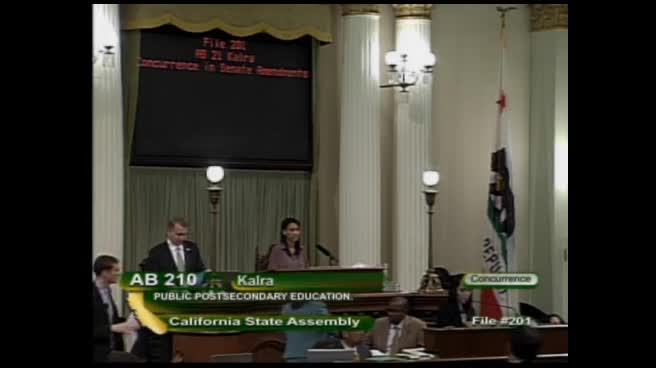

Bill Author

Bill Co-Author(s):
