AB 572: Law enforcement: training: racial profiling.
- Session Year: 2017-2018
- House: Assembly
- Latest Version Date: 2018-06-14
Existing law requires peace officers to receive preservice training developed by the Commission on Peace Officer Standards and Training regarding racial, identity, and cultural awareness, recognizing implicit bias, and preventing racial or identity profiling in law enforcement. Existing law requires peace officers to also complete a refresher course on these subjects at least every 5 years.
This bill would instead require the refresher training to be completed at least annually.
By requiring local agencies to provide that training for their employees with greater frequency, this bill would create a state-mandated local program.
The California Constitution requires the state to reimburse local agencies and school districts for certain costs mandated by the state. Statutory provisions establish procedures for making that reimbursement.
This bill would provide that, if the Commission on State Mandates determines that the bill contains costs mandated by the state, reimbursement for those costs shall be made pursuant to the statutory provisions noted above.
Existing law provides that the State Department of Health Care Services has the sole authority in state government to license adult alcoholism or drug abuse recovery or treatment facilities, as defined. Existing law authorizes the department to conduct announced or unannounced site visits to licensed facilities to review compliance with all applicable statutes and regulations.This bill would require the State Department of Health Care Services to establish a pilot program to locate an investigator within a participating city to investigate complaints against licensed adult alcoholism or drug abuse recovery or treatment facilities within the city. The participating city would be the City of Costa Mesa if the City Council of the City of Costa Mesa elects to participate in the pilot program. The bill would require the department to implement the pilot program by executing a contract with the City of Costa Mesa providing that the department will assign an investigator and the city will reimburse the department for the costs associated with the pilot program, including, but not limited to, the administrative costs and the investigators compensation and benefits. The bill would authorize the City of Costa Mesa to contract with the County of Orange or a city incorporated within the County of Orange to assign the investigator to investigate complaints within those entities if the Orange County Board of Supervisors or the city council of the city adopts an ordinance or resolution electing to participate in the pilot program. The bill would require the pilot program to be completed no later than December 31, 2019, and would require the City of Costa Mesa to submit a report of the results of the pilot program, as specified, to the Legislature no later than July 1, 2020. The bill would require the pilot program to be conducted in conformance with federal confidentiality laws and regulations. The provisions of this bill would be repealed on January 1, 2021.Existing law provides that the State Department of Health Care Services has the sole authority in state government to license adult alcoholism or drug abuse recovery or treatment facilities, as defined. Existing law authorizes the department to conduct announced or unannounced site visits to licensed facilities to review compliance with all applicable statutes and regulations.
This bill would require the State Department of Health Care Services to establish a pilot program to locate an investigator within a participating county city to investigate complaints against licensed adult alcoholism or drug abuse recovery or treatment facilities within the county. city. The participating county city would be the County of Orange City of Costa Mesa if the Orange County Board of Supervisors City Council of the City of Costa Mesa elects to participate in the pilot program. The bill would require the department to implement the pilot program by executing a contract with the County of Orange City of Costa Mesa providing that the department will assign an investigator and the county city will reimburse the department for the costs associated with the pilot program, including, but not limited to, the administrative costs and the investigators compensation and benefits. The bill would authorize the City of Costa Mesa to contract with the County of Orange or a city incorporated within the County of Orange to assign the investigator to investigate complaints within those entities if the Orange County Board of Supervisors or the city council of the city adopts an ordinance or resolution electing to participate in the pilot program. The bill would require the pilot program to be completed no later than December 31, 2019, and would require the county City of Costa Mesa to submit a report of the results of the pilot program, as specified, to the Legislature no later than July 1, 2020. The bill would require the pilot program to be conducted in conformance with federal confidentiality laws and regulations. The provisions of this bill would be repealed on January 1, 2021.
Existing law provides that the State Department of Health Care Services has the sole authority in state government to license adult alcoholism or drug abuse recovery or treatment facilities, as defined. Existing law authorizes the department to conduct announced or unannounced site visits to licensed facilities to review compliance with all applicable statutes and regulations.
This bill would require the State Department of Health Care Services to establish a pilot program to locate an investigator within a participating county to investigate complaints against licensed adult alcoholism or drug abuse recovery or treatment facilities within the county. The participating county would be the County of Orange if the Orange County Board of Supervisors elects to participate in the pilot program. The bill would require the department to implement the pilot program by executing a contract with the County of Orange providing that the department will assign an investigator and the county will reimburse the department for the costs associated with the pilot program, including, but not limited to, the administrative costs and the investigators compensation and benefits. The bill would require the pilot program to be completed no later than December 31, 2019, and would require the county to submit a report of the results of the pilot program, as specified, to the Legislature no later than July 1, 2020. The provisions of this bill would be repealed on January 1, 2021.
Existing law provides that the State Department of Health Care Services has the sole authority in state government to license adult alcoholism or drug abuse recovery or treatment facilities, as defined. Existing law authorizes the department to conduct announced or unannounced site visits to licensed facilities to review compliance with all applicable statutes and regulations.
This bill would require the State Department of Health Care Services to establish a pilot program to locate an investigator within a participating county to investigate complaints against licensed adult alcoholism or drug abuse recovery or treatment facilities within the county. The participating county would be the County of Orange if the Orange County Board of Supervisors elects to participate in the pilot program. The bill would require the department to implement the pilot program by executing a contract with the County of Orange providing that the department will assign an investigator and the county will reimburse the department for the investigators compensation and benefits. The bill would require the pilot program to be completed no later than December 31, 2019, and would require the county to submit a report of the results of the pilot program, as specified, to the Legislature no later than July 1, 2020. The provisions of this bill would be repealed on January 1, 2021.
(a)The commission shall develop and disseminate guidelines and training for all peace officers in California as described in subdivision (a) of Section 13510 and who adhere to the standards approved by the commission, on the racial and cultural differences among the residents of this state. The course or courses of instruction and the guidelines shall stress understanding and respect for racial, identity, and cultural differences, and development of effective, noncombative methods of carrying out law enforcement duties in a diverse racial, identity, and cultural environment.
(b)The course of basic training for peace officers shall include adequate instruction on racial, identity, and cultural diversity in order to foster mutual respect and cooperation between law enforcement and members of all racial, identity, and cultural groups. In developing the training, the commission shall consult with appropriate groups and individuals having an interest and expertise in the field of racial, identity, and cultural awareness and diversity.
(c)For the purposes of this section the following shall apply:
(1)Disability, gender, nationality, religion, and sexual orientation have the same meaning as in Section 422.55. 422.56.
(2)Culturally diverse and cultural diversity include, but are not limited to, disability, gender, nationality, religion, and sexual orientation issues.
(3)Racial has the same meaning as race or ethnicity in Section 422.55. 422.56.
(4)Stop has the same meaning as in paragraph (2) of subdivision (g) of Section 12525.5 of the Government Code.
(d)The Legislature finds and declares as follows:
(1)The working men and women in California law enforcement risk their lives every day. The people of California greatly appreciate the hard work and dedication of peace officers in protecting public safety. The good name of these officers should not be tarnished by the actions of those few who commit discriminatory practices.
(2)Racial or identity profiling is a practice that presents a great danger to the fundamental principles of our Constitution and a democratic society. It is abhorrent and cannot be tolerated.
(3)Racial or identity profiling alienates people from law enforcement, hinders community policing efforts, and causes law enforcement to lose credibility and trust among the people whom law enforcement is sworn to protect and serve.
(4)Pedestrians, users of public transportation, and vehicular occupants who have been stopped, searched, interrogated, and subjected to a property seizure by a peace officer for no reason other than the color of their skin, national origin, religion, gender identity or expression, housing status, sexual orientation, or mental or physical disability are the victims of discriminatory practices.
(5)It is the intent of the Legislature in enacting the changes to this section made by the act that added this paragraph that additional training is required to address the pernicious practice of racial or identity profiling and that enactment of this section is in no way dispositive of the issue of how the state should deal with racial or identity profiling.
(e)Racial or identity profiling, for purposes of this section, is the consideration of, or reliance on, to any degree, actual or perceived race, color, ethnicity, national origin, age, religion, gender identity or expression, sexual orientation, or mental or physical disability in deciding which persons to subject to a stop or in deciding upon the scope or substance of law enforcement activities following a stop, except that an officer may consider or rely on characteristics listed in a specific suspect description. The activities include, but are not limited to, traffic or pedestrian stops, or actions during a stop, such as asking questions, frisks, consensual and nonconsensual searches of a person or any property, seizing any property, removing vehicle occupants during a traffic stop, issuing a citation, and making an arrest.
(f)A peace officer shall not engage in racial or identity profiling.
(g)Every peace officer in this state shall participate in expanded training as prescribed and certified by the Commission on Peace Officers Standards and Training.
(h)The curriculum shall be evidence-based and shall include and examine evidence-based patterns, practices, and protocols that make up racial or identity profiling, including implicit bias. This training shall prescribe evidence-based patterns, practices, and protocols that prevent racial or identity profiling. In developing the training, the commission shall consult with the Racial and Identity Profiling Advisory Board established pursuant to subdivision (j). The course of instruction shall include, but not be limited to, significant consideration of each of the following subjects:
(1)Identification of key indices and perspectives that make up racial, identity, and cultural differences among residents in a local community.
(2)Negative impact of intentional and implicit biases, prejudices, and stereotyping on effective law enforcement, including examination of how historical perceptions of discriminatory enforcement practices have harmed police-community relations and contributed to injury, death, disparities in arrest detention and incarceration rights, and wrongful convictions.
(3)The history and role of the civil and human rights movement and struggles and their impact on law enforcement.
(4)Specific obligations of peace officers in preventing, reporting, and responding to discriminatory or biased practices by fellow peace officers.
(5)Perspectives of diverse, local constituency groups and experts on particular racial, identity, and cultural and police-community relations issues in a local area.
(6)The prohibition against racial or identity profiling in subdivision (f).
(i)Once the initial basic training is completed, each peace officer in California as described in subdivision (a) of Section 13510 who adheres to the standards approved by the commission shall be required to complete a refresher course every five years thereafter, annually or on a more frequent basis if deemed necessary, in order to keep current with changing racial, identity, and cultural trends.
(j)(1)Beginning July 1, 2016, the The Attorney General shall establish the Racial and Identity Profiling Advisory Board (RIPA) for the purpose of eliminating racial and identity profiling, and improving diversity and racial and identity sensitivity in law enforcement.
(2)RIPA shall include the following members:
(A)The Attorney General, or his or her designee.
(B)The President of the California Public Defenders Association, or his or her designee.
(C)The President of the California Police Chiefs Association, or his or her designee.
(D)The President of the California State Sheriffs Association, or his or her designee.
(E)The President of the Peace Officers Research Association of California, or his or her designee.
(F)The Commissioner of the California Highway Patrol, or his or her designee.
(G)A university professor who specializes in policing, and racial and identity equity.
(H)Two representatives of human or civil rights tax-exempt organizations who specialize in civil or human rights.
(I)Two representatives of community organizations who specialize in civil or human rights and criminal justice, and work with victims of racial and identity profiling. At least one representative shall be between 16 and 24 years of age.
(J)Two religious clergy members who specialize in addressing and reducing racial and identity bias toward individuals and groups.
(K)Up to two other members that the Governor may prescribe.
(L)Up to two other members that the President pro Tempore of the Senate may prescribe.
(M)Up to two other members that the Speaker of the Assembly may prescribe.
(3)Each year, on an annual basis, RIPA shall do the following:
(A)Analyze the data reported pursuant to Section 12525.5 of the Government Code and Section 13012 of this code.
(B)Analyze law enforcement training under this section.
(C)Work in partnership with state and local law enforcement agencies to review and analyze racial and identity profiling policies and practices across geographic areas in California.
(D)Conduct, and consult available, evidence-based research on intentional and implicit biases, and law enforcement stop, search, and seizure tactics.
(E)Issue a report that provides RIPAs analysis under subparagraphs (A) to (D), inclusive, and detailed findings on the past and current status of racial and identity profiling, and makes policy recommendations for eliminating racial and identity profiling. RIPA shall post the report on its Internet Web site. Each report shall include disaggregated statistical data for each reporting law enforcement agency. The report shall include, at minimum, each reporting law enforcement agencys total results for each data collection criterion under subdivision (b) of Section 12525.5 of the Government Code for each calendar year. The reports shall be retained and made available to the public by posting those reports on the Department of Justices OpenJustice Web portal. The first annual report shall be issued no later than January 1, 2018. The reports are public records within the meaning of subdivision (d) of Section 6252 of the Government Code and are open to public inspection pursuant to Sections 6253, 6256, 6257, 6253 and 6258 of the Government Code.
(F)Hold at least three public meetings annually to discuss racial and identity profiling, and potential reforms to prevent racial and identity profiling. Each year, one meeting shall be held in northern California, one in central California, and one in southern California. RIPA shall provide the public with notice of at least 60 days before each meeting.
(4)Pursuant to subdivision (e) of Section 12525.5 of the Government Code, RIPA shall advise the Attorney General in developing regulations for the collection and reporting of stop data, and ensuring uniform reporting practices across all reporting agencies.
(5)Members of RIPA shall not receive compensation, nor per diem expenses, for their services as members of RIPA.
(6)No An action of RIPA shall be is not valid unless agreed to by a majority of its members.
(7)The initial terms of RIPA members shall be four years.
(8)Each year, RIPA shall elect two of its members as cochairpersons.
SEC. 2.If the Commission on State Mandates determines that this act contains costs mandated by the state, reimbursement to local agencies and school districts for those costs shall be made pursuant to Part 7 (commencing with Section 17500) of Division 4 of Title 2 of the Government Code.
SECTION 1.Section 11834.015 is added to the Health and Safety Code, to read:11834.015.(a)(1)The State Department of Health Care Services shall establish a pilot program to locate a Substance Use Disorder Compliance Division investigator within a participating city to investigate licensed adult alcoholism or drug abuse recovery or treatment facilities within that city. The participating city shall be the City of Costa Mesa, if the City Council of the City of Costa Mesa adopts an ordinance or resolution electing to participate in the pilot program.(2)The department shall implement the pilot program by executing a contract with the City of Costa Mesa that provides for all of the following:(A)The department shall assign a Substance Use Disorder Compliance Division investigator to investigate complaints against licensed adult alcoholism or drug abuse recovery or treatment facilities within the City of Costa Mesa.(B)The City of Costa Mesa shall reimburse the department for the costs associated with the pilot program, including, but not limited to, the administrative costs and the investigators compensation and benefits.(C)The City of Costa Mesa shall provide office space and amenities to the investigator.(D)If the Orange County Board of Supervisors or a city council of a city incorporated within the County of Orange adopts an ordinance or resolution electing to participate in the pilot program, the City of Costa Mesa may contract with that entity. The terms of the contract shall include all of the following:(i)The City of Costa Mesa shall assign the Substance Use Disorder Compliance Division investigator to investigate complaints against licensed adult alcoholism or drug abuse recovery or treatment facilities within an unincorporated area of the County of Orange or the participating city as contracted.(ii)The County of Orange or the participating city shall enter into a memorandum of understanding with the City of Costa Mesa to determine a cost-sharing arrangement for the investigators compensation and benefits. The City of Costa Mesa shall reimburse the department for the investigators compensation and benefits.(b)The pilot program established pursuant to subdivision (a) shall be completed no later than December 31, 2019.(c)If the City of Costa Mesa participates in the pilot program authorized by subdivision (a), it shall, no later than July 1, 2020, submit a report of the results of the pilot program to the Legislature, in compliance with Section 9795 of the Government Code, that includes both of the following:(1)An evaluation of the effectiveness of the pilot program.(2)Recommendations for subsequent actions.(d)The pilot program shall be conducted in conformance with federal confidentiality laws and regulations, including, but not limited to, Section 290dd-2 of Title 42 of the United States Code and Part 2 of Subchapter A of Chapter I of Title 42 of the Code of Federal Regulations.(e)This section shall remain in effect only until January 1, 2021, and as of that date is repealed.(a)(1)The State Department of Health Care Services shall establish a pilot program to locate a Substance Use Disorder Compliance Division investigator within a participating county city to investigate licensed adult alcoholism or drug abuse recovery or treatment facilities within that county. city. The participating county city shall be the County of Orange, City of Costa Mesa, if the Orange County Board of Supervisors City Council of the City of Costa Mesa adopts an ordinance or resolution electing to participate in the pilot program.
(2)The department shall implement the pilot program by executing a contract with the County of Orange City of Costa Mesa that provides for all of the following:
(A)The department shall assign a Substance Use Disorder Compliance Division investigator to investigate complaints against licensed adult alcoholism or drug abuse recovery or treatment facilities within the County of Orange. City of Costa Mesa.
(B)The County of Orange City of Costa Mesa shall reimburse the department for the costs associated with the pilot program, including, but not limited to, the administrative costs and the investigators compensation and benefits.
(C)The County of Orange City of Costa Mesa shall provide office space and amenities to the investigator.
(D)If the Orange County Board of Supervisors or a city council of a city incorporated within the County of Orange adopts an ordinance or resolution electing to participate in the pilot program, the City of Costa Mesa may contract with that entity. The terms of the contract shall include all of the following:
(i)The City of Costa Mesa shall assign the Substance Use Disorder Compliance Division investigator to investigate complaints against licensed adult alcoholism or drug abuse recovery or treatment facilities within an unincorporated area of the County of Orange or the participating city as contracted.
(ii)The County of Orange or the participating city shall enter into a memorandum of understanding with the City of Costa Mesa to determine a cost-sharing arrangement for the investigators compensation and benefits. The City of Costa Mesa shall reimburse the department for the investigators compensation and benefits.
(b)The pilot program established pursuant to subdivision (a) shall be completed no later than December 31, 2019.
(c)If the County of Orange City of Costa Mesa participates in the pilot program authorized by subdivision (a), it shall, no later than July 1, 2020, submit a report of the results of the pilot program to the Legislature, in compliance with Section 9795 of the Government Code, that includes both of the following:
(1)An evaluation of the effectiveness of the pilot program.
(2)Recommendations for subsequent actions.
(d)The pilot program shall be conducted in conformance with federal confidentiality laws and regulations, including, but not limited to, Section 290dd-2 of Title 42 of the United States Code and Part 2 of Subchapter A of Chapter I of Title 42 of the Code of Federal Regulations.
(d)(e)This section shall remain in effect only until January 1, 2021, and as of that date is repealed.
(a)(1)The State Department of Health Care Services shall establish a pilot program to locate a Substance Use Disorder Compliance Division investigator within a participating county to investigate licensed adult alcoholism or drug abuse recovery or treatment facilities within that county. The participating county shall be the County of Orange, if the Orange County Board of Supervisors adopts an ordinance or resolution electing to participate in the pilot program.
(2)The department shall implement the pilot program by executing a contract with the County of Orange that provides for all of the following:
(A)The department shall assign a Substance Use Disorder Compliance Division investigator to investigate complaints against licensed adult alcoholism or drug abuse recovery or treatment facilities within the County of Orange.
(B)The County of Orange shall reimburse the department for the costs associated with the pilot program, including, but not limited to, the administrative costs and the investigators compensation and benefits.
(C)The County of Orange shall provide office space and amenities to the investigator.
(b)The pilot program established pursuant to subdivision (a) shall be completed no later than December 31, 2019.
(c)If the County of Orange participates in the pilot program authorized by subdivision (a), it shall, no later than July 1, 2020, submit a report of the results of the pilot program to the Legislature, in compliance with Section 9795 of the Government Code, that includes both of the following:
(1)An evaluation of the effectiveness of the pilot program.
(2)Recommendations for subsequent actions.
(d)This section shall remain in effect only until January 1, 2021, and as of that date is repealed.
(a)(1)The State Department of Health Care Services shall establish a pilot program to locate a Substance Use Disorder Compliance Division investigator within a participating county to investigate licensed adult alcoholism or drug abuse recovery or treatment facilities within that county. The participating county shall be the County of Orange, if the Orange County Board of Supervisors adopts an ordinance or resolution electing to participate in the pilot program.
(2)The department shall implement the pilot program by executing a contract with the County of Orange that provides for all of the following:
(A)The department shall assign a Substance Use Disorder Compliance Division investigator to investigate complaints against licensed adult alcoholism or drug abuse recovery or treatment facilities within the County of Orange.
(B)The County of Orange shall reimburse the department for the investigators compensation and benefits.
(C)The County of Orange shall provide office space and amenities to the investigator.
(b)The pilot program established pursuant to subdivision (a) shall be completed no later than December 31, 2019.
(c)If the County of Orange participates in the pilot program authorized by subdivision (a), it shall, no later than July 1, 2020, submit a report of the results of the pilot program to the Legislature, in compliance with Section 9795 of the Government Code, that includes both of the following:
(1)An evaluation of the effectiveness of the pilot program.
(2)Recommendations for subsequent actions.
(d)This section shall remain in effect only until January 1, 2021, and as of that date is repealed.
|
Date
|
Status
|
|---|---|
| Aug 31, 2018 | Ordered to inactive file at the request of Assembly Member Quirk-Silva. |
| Aug 29, 2018 | Senate amendments concurred in. To Engrossing and Enrolling. |
| Aug 24, 2018 | In Assembly. Concurrence in Senate amendments pending. May be considered on or after August 26 pursuant to Assembly Rule 77. |
| Aug 24, 2018 | Read third time. Passed. Ordered to the Assembly. |
| Aug 21, 2018 | Ordered to special consent calendar. |
| Aug 17, 2018 | From committee: Do pass. (Ayes 7. Noes 0.) (August 16). |
| Aug 6, 2018 | In committee: Referred to APPR. suspense file. |
| Jun 26, 2018 | From committee: Do pass and re-refer to Com. on APPR. with recommendation: To Consent Calendar. (Ayes 7. Noes 0.) (June 26). Re-referred to Com. on APPR. |
| Jun 20, 2018 | Re-referred to Com. on PUB. S. |
| Jun 18, 2018 | Withdrawn from committee. |
| Jun 14, 2018 | From committee chair, with author's amendments: Amend, and re-refer to committee. Read second time, amended, and re-referred to Com. on HEALTH. |
| Jul 3, 2017 | From committee chair, with author's amendments: Amend, and re-refer to committee. Read second time, amended, and re-referred to Com. on HEALTH. |
| Jun 14, 2017 | Referred to Com. on HEALTH. |
| Jun 1, 2017 | In Senate. Read first time. To Com. on RLS. for assignment. |
| May 31, 2017 | Read third time. Passed. Ordered to the Senate. (Ayes 76. Noes 0. Page 1933.) |
| May 30, 2017 | Read second time. Ordered to third reading. |
| May 26, 2017 | From committee: Amend, and do pass as amended. (Ayes 16. Noes 0.) (May 26). |
| Apr 26, 2017 | In committee: Set, first hearing. Referred to APPR. suspense file. |
| Apr 5, 2017 | From committee: Do pass and re-refer to Com. on APPR. (Ayes 14. Noes 0.) (April 4). Re-referred to Com. on APPR. |
| Feb 27, 2017 | Referred to Com. on HEALTH. |
| Feb 15, 2017 | From printer. May be heard in committee March 17. |
| Feb 14, 2017 | Read first time. To print. |
|
Date
|
Description
|
Location
|
Votes
|
|
|---|---|---|---|---|
| Aug 24, 2018 | Special Consent AB572 | Senate Floor |
Passed |
|
| Aug 16, 2018 | Do pass | Senate Standing Committee on Appropriations |
Passed |
|
| Aug 6, 2018 | Placed on suspense file | Senate Standing Committee on Appropriations |
Passed |
|
| Jun 26, 2018 | Do pass, but first be re-referred to the Committee on [Appropriations] with the recommendation: To Consent Calendar | Senate Standing Committee on Public Safety |
Passed |
|
| May 31, 2017 | AB 572 QUIRK-SILVA Assembly Third Reading | Assembly Floor |
Passed |
|
| May 26, 2017 | Do pass as amended. | Assembly Standing Committee on Appropriations |
Passed |
|
| Apr 4, 2017 | Do pass and be re-referred to the Committee on [Appropriations] | Assembly Standing Committee on Health |
Passed |
This list shows positions taken on this bill by organizations on the date displayed, which is linked to the original source.
Positions by individuals are not included.
|
Organization
|
Position
|
Date
|
|---|---|---|
| Association of California Cities-Orange County | ** Support | Jul 10, 2017 |
| Association Of Orange County Deputy Sheriffs | ** Support | Aug 18, 2018 |
| California Consortium of Addiction Programs and Professionals | * Against | Jul 12, 2017 |
| California Society Of Addiction Medicine | ** Against | Jul 10, 2017 |
| California Statewide Law Enforcement Association | ** Support | Aug 18, 2018 |
| City of Aliso Viejo | * Support | Jul 12, 2017 |
| City of Costa Mesa | * Support | Jul 12, 2017 |
| City Of Tustin | * Support | Jul 12, 2017 |
| Disability Rights California | ** Against | Jul 10, 2017 |
| The Western Center on Law and Poverty | * Against | Jul 12, 2017 |
CONCURRENCE IN SENATE AMENDMENTS
CSA1 Bill Id:AB 572
Author:(Quirk-Silva)
As Amended Ver:June 14, 2018
Majority vote
ASSEMBLY: |
| (May 31, 2017) | SENATE: | 39-0 | (August 24, 2018) |
(vote not relevant)
Original Committee Reference: HEALTH
SUMMARY: Requires peace officers to complete refresher training on racial profiling and implicit bias annually, instead of every five years.
The Senate amendments delete the Assembly version of this bill and instead require peace officers to complete refresher training on racial profiling and implicit bias annually rather than every five years.
EXISTING LAW:
- Prohibits a peace officer from engaging in racial or identity profiling.
- Defines "racial or identity profiling" as "consideration of or reliance on, to any degree, actual or perceived race, color, ethnicity, national origin, age, religion, gender identity or expression, sexual orientation, or mental or physical disability in deciding which persons to subject to a stop or in deciding upon the scope and substance of law enforcement activities following a stop. The activities include, but are not limited to, traffic or pedestrian stops, or actions during a stop, such as, asking questions, frisks, consensual and nonconsensual searches of a person or any property, seizing any property, removing vehicle occupants during a traffic stop, issuing a citation, and making an arrest."
- Requires each state and local agency that employs peace officers to annually report to the Attorney General (AG) data on all stops, as specified, conducted by that agency's peace officers for the preceding calendar year.
- Requires that the Commission on Peace Officers Standards and Training (POST) develop and disseminate guidelines and training for all peace officers in California on the racial and cultural differences among the residents of this state. The course or courses of instruction and the guidelines shall stress understanding and respect for racial, identity, and cultural differences, and development of effective, noncombative methods of carrying out law enforcement duties in a diverse racial, identity, and cultural environment.
- Provides that the course of basic training for peace officers shall include adequate instruction on racial, identity, and cultural diversity in order to foster mutual respect and cooperation between law enforcement and members of all racial, identity, and cultural groups. In developing the training, the commission shall consult with appropriate groups and individuals having an interest and expertise in the field of racial, identity, and cultural awareness and diversity.
- Provides that "racial or identity profiling," for purposes of POST training, is the consideration of, or reliance on, to any degree, actual or perceived race, color, ethnicity, national origin, age, religion, gender identity or expression, sexual orientation, or mental or physical disability in deciding which persons to subject to a stop or in deciding upon the scope or substance of law enforcement activities following a stop, except that an officer may consider or rely on characteristics listed in a specific suspect description. The activities include, but are not limited to, traffic or pedestrian stops, or actions during a stop, such as asking questions, frisks, consensual and nonconsensual searches of a person or any property, seizing any property, removing vehicle occupants during a traffic stop, issuing a citation, and making an arrest.
- Provides that once basic racial profiling and implicit bias training is completed, officers must complete a refresher course every five years.
FISCAL EFFECT: Unknown
AS PASSED BY THE ASSEMBLY, this bill established, until January 1, 2021, a pilot program in Orange County (OC) to locate an investigator within the county to investigate complaints against licensed adult alcoholism or drug abuse recovery or treatment facilities within the county.
Analysis Prepared by: Sandy Uribe / PUB. S. / (916) 319-3744 FN: 0004895
Office of Senate Floor Analyses (916) 651-1520 Fax: (916) 327-4478 | AB |
THIRD READING
Bill No: AB 572
:
SENATE PUBLIC SAFETY COMMITTEE: 7-0, 6/26/18
AYES: Skinner, Anderson, Bradford, Jackson, Mitchell, Stone, Wiener
SENATE APPROPRIATIONS COMMITTEE: 7-0, 8/16/18
AYES: Portantino, Bates, Beall, Bradford, Hill, Nielsen, Wiener
ASSEMBLY FLOOR: Not relevant
DIGEST:
This bill requires peace officers to complete refresher training on their racial profiling and implicit bias training every year rather than every five years.
Existing law:
- Prohibits a law enforcement officer from engaging in racial profiling. (Penal Code § 13519.4(f).)
- Defines “racial profiling,” as “the practice of detaining a suspect based on a broad set of criteria which casts suspicion on an entire class of people without any individualized suspicion of the particular person being stopped.” (Penal Code § 13519.4(e).)
- Requires that the course of basic training for law enforcement officers include adequate instruction on racial and cultural diversity in order to foster mutual respect and cooperation between law enforcement and members of all racial and cultural groups. (Penal Code § 13519.4(b).)
- Requires the Department of Justice (DOJ) to present to the Governor, on or before July 1st, an annual report containing the criminal statistics of the preceding calendar year. (Penal Code § 13010(g).)
- Mandates that the annual report contain statistics showing all of the following:
- The amount and the types of offenses known to the public authorities;
- The personal and social characteristics of criminals and delinquents;
- The administrative actions taken by law enforcement, judicial, penal, and correctional agencies or institutions, including those in the juvenile justice system, in dealing with criminals or delinquents;
- The administrative actions taken by law enforcement, prosecutorial, judicial, penal, and correctional agencies, including those in the juvenile justice system, in dealing with minors who are the subject of a petition or hearing in the juvenile court to transfer their case to the jurisdiction of an adult criminal court or whose cases are directly filed or otherwise initiated in an adult criminal court; and,
- The number of citizens' complaints received by law enforcement agencies, as specified. The statistics must indicate the total number of these complaints, the number alleging criminal conduct of either a felony or misdemeanor, and the number sustained in each category. The report shall not contain a reference to any individual agency but shall be by gross numbers only. (Penal Code § 13012.)
- The amount and the types of offenses known to the public authorities;
- Requires state and local law enforcement agencies to report statistical data to the DOJ at those times and in the manner that the Attorney General prescribes. (Penal Code § 13020.)
- Requires that the Commission on Peace Officers Standards and Training (POST) develop and disseminate guidelines and training for all peace officers in California on the racial and cultural differences among the residents of this state. The course or courses of instruction and the guidelines shall stress understanding and respect for racial, identity, and cultural differences, and development of effective, noncombative methods of carrying out law enforcement duties in a diverse racial, identity, and cultural environment. (Penal Code § 13519.4.)
- Provides that the course of basic training for peace officers shall include adequate instruction on racial, identity, and cultural diversity in order to foster mutual respect and cooperation between law enforcement and members of all racial, identity, and cultural groups. In developing the training, the commission shall consult with appropriate groups and individuals having an interest and expertise in the field of racial, identity, and cultural awareness and diversity. (Penal Code § 13519.4.)
- Provides that “racial or identity profiling,” for purposes of POST training, is the consideration of, or reliance on, to any degree, actual or perceived race, color, ethnicity, national origin, age, religion, gender identity or expression, sexual orientation, or mental or physical disability in deciding which persons to subject to a stop or in deciding upon the scope or substance of law enforcement activities following a stop, except that an officer may consider or rely on characteristics listed in a specific suspect description. The activities include, but are not limited to, traffic or pedestrian stops, or actions during a stop, such as asking questions, frisks, consensual and nonconsensual searches of a person or any property, seizing any property, removing vehicle occupants during a traffic stop, issuing a citation, and making an arrest.
- Provides that once basic racial profiling and implicit bias training is completed, officers must complete a refresher course every five years. (Penal Code § 13519.4.)
This bill specifies that officers must complete their refresher training on racial profiling and implicit bias training annually.
Background
POST was established by the Legislature in 1959 to set minimum selection and training standards for California law enforcement. POST develops and implements various courses to train peace officers, including both basic and continuing professional training. Peace officer basic training includes a minimum of 664 hours of POST-developed training and testing in 42 separate areas of instruction. According to POST’s Web site, most POST-certified basic training academies exceed the 664 minimum hours by 200 or more hours.
Law enforcement officers are prohibited from engaging in racial profiling. (Penal Code § 13519.4(f).) “Racial profiling” is currently defined as the practice of detaining a suspect based on a broad set of criteria which casts suspicion on an entire class of people without any individualized suspicion of the particular person being stopped. (Penal Code § 13519.4(e).)
Although racial profiling is prohibited, studies show that racial profiling by law enforcement does occur. For example, according to a report by the Oakland Police Department, African-Americans, who compose 28 percent of Oakland’s population, accounted for 62 percent of police stops from last April to November. The figures also showed that stops of African-Americans were more likely to result in felony arrests. And, while African-Americans were more likely to be searched after being stopped, police were no more likely to find contraband from searching African-Americans than members of other racial groups.
Likewise, in 2010, the Los Angeles Times reported that “The U.S. Department of Justice has warned the Los Angeles Police Department that its investigations into racial profiling by officers are inadequate and that some cops still tolerate the practice.”… “The Justice Department's concerns, which were conveyed in a recent letter obtained by The Times, are a setback for the LAPD, which remains under federal oversight on the issue.” The article noted, “[p]rofiling complaints typically occur after a traffic or pedestrian stop, when the officer is accused of targeting a person solely because of his or her race, ethnicity, religious garb or some other form of outward appearance. About 250 such cases arise each year, but more damaging is the widely held belief, especially among black and Latino men, that the practice is commonplace.”
AB 1102 (Murray, Chapter 684, Statutes of 2000) created a requirement that law enforcement not engage in racial profiling and mandated that POST develop a curriculum to train officers.
AB 953 (Weber, Chapter 466, Statutes of 2015) modified the definition of “racial profiling required local law enforcement agencies to report specified information on stops to the Attorney General's office; and, established the Racial and Identity Profiling Advisory Board (RIPA).
This bill requires peace officers complete refresher training on their racial profiling and implicit bias training every year rather than every five years.
FISCAL EFFECT: Appropriation: Fiscal Com.: Local:
According to the Senate Appropriations Committee, unknown, potentially-significant costs to local law enforcement agencies to cover expenses associated with their officers taking the refresher training more frequently. These costs include officer wages for the time of the training, wages to backfill officers who are taking the course with other officers, and potentially transportation expenses to and from the course. Local costs to comply with this bill would be subject to reimbursement by the state, the extent of which would be determined by the Commission on State Mandates. Considering that there are over 500 local law enforcement agencies across the state, compliance costs associated with this measure could reach into the millions of dollars in the aggregate. (General Fund, local funds)
Association of Orange County Deputy Sheriffs
California Statewide Law Enforcement Association
OPPOSITION: (Verified 8/16/18)
None received
ARGUMENT IN SUPPORT: According to the Association of Orange County Deputy Sheriffs, “On behalf of the Association of Orange County Deputy Sheriffs (AOCDS) we are proud to sponsor, AB 572 (Quirk-Silva). Additionally in support are: The Fraternal Order of Police (FOP) California Lodge, the Long Beach Police Officers Association (LBPOA), and the Sacramento County Deputy Sheriffs’ Association (SCDSA).
“When men and women train to become peace officers, they must first complete preservice training that has been developed by the Commission on Peace Officer Standards and Training (POST). This course includes topics regarding racial, identity, and cultural awareness, recognizing implicit bias and preventing racial or identity profiling in law enforcement. This training also includes de-escalation training and tactics. Currently, peace officers are only required to take this course every 5 years. AB 572 will require peace officers to receive a refresher course annually on racial, identity, and cultural awareness, recognizing implicit bias and preventing racial or identity profiling in law enforcement. In addition, this training will require annual training on de-escalation training and techniques.
“Recent events have resulted in increased tension between law enforcement and the communities whom they protect and serve which has caused a lack of community trust. The men and women of law enforcement acknowledge this issue and seek to remedy it in a way they think best serves not only the community, but the law enforcement profession. AB 572 is a solution we believe will help train officers, de-escalate situations in which force potentially may be required, and will lessen the risk of injury or life, of both civilians and officers.
“Annual training will help to ensure that our officers, statewide, maintain adequate and routine training to stop racial or identity profiling in any form. It is critical that law enforcement officers treat all people equally and with respect. In addition to re-enforcing equality, the refresher course will keep officers current with changing racial and cultural trends. As well as training officers on new de-escalation training and techniques. AB 572 is a small step in fostering a stronger and better relationship between the community and law enforcement. Together we will work to ensure safety and justice in our state.”
Prepared by: Gabe Caswell / PUB. S. /
8/18/18 13:23:31
**** END ****
SENATE COMMITTEE ON APPROPRIATIONS
Senator Anthony Portantino, Chair
2017 - 2018 Regular Session
AB 572 (Quirk-Silva) - Law enforcement: training: racial profiling
Version: June 14, 2018 | Policy Vote: PUB. S. 7 - 0 |
Urgency: No | Mandate: Yes |
Hearing Date: August 6, 2018 | Consultant: Shaun Naidu |
This bill meets the criteria for referral to the Suspense File.
Bill Summary:
AB 572 would require peace officers to complete refresher training on racial profiling and implicit bias every year instead of every five years.
Fiscal Impact:
Unknown, potentially-significant costs to local law enforcement agencies to cover expenses associated with their officers taking the refresher training more frequently. These costs include officer wages for the time of the training, wages to backfill officers who are taking the course with other officers, and potentially transportation expenses to and from the course. Local costs to comply with this measure would be subject to reimbursement by the state, the extent of which would be determined by the Commission on State Mandates. Considering that there are over 500 local law enforcement agencies across the state, compliance costs associated with this measure could reach into the millions of dollars in the aggregate. (General Fund, local funds)
Background:
Peace officers are prohibited from engaging in racial profiling, which is defined as the practice of detaining a suspect based on a broad set of criteria which casts suspicion on an entire class of people without any individualized suspicion of the particular person being stopped. To help prevent peace officers from engaging in such conduct, existing law requires officers to receive preservice training developed by POST regarding racial, identity, and cultural awareness, recognizing implicit bias, and preventing racial or identity profiling in law enforcement. Officers must complete a refresher course on this matter at least every five years after completing the initial basic training, or on a more frequent basis if deemed necessary, in order to keep current with changing racial, identity, and cultural trends.
The POST course on racial and identity profiling must include, but not be limited to, significant consideration of (1) identification of key indices and perspectives that make up racial, identity, and cultural differences among residents in a local community; (2) negative impact of intentional and implicit biases, prejudices, and stereotyping on effective law enforcement, including examination of how historical perceptions of discriminatory enforcement practices have harmed police-community relations and contributed to injury, death, disparities in arrest detention and incarceration rights, and wrongful convictions; (3) the history and role of the civil and human rights movement and struggles and their impact on law enforcement; (4) specific obligations of peace officers in preventing, reporting, and responding to discriminatory or biased practices by fellow peace officers; (5) perspectives of diverse, local constituency groups and experts on particular racial, identity, and cultural and police-community relations issues in a local area; and (6) the prohibition against racial or identity profiling.
Proposed Law:
This bill would require peace officer to complete the refresher course on racial and identity profiling annually.
Related Legislation:
AB 1102 (Murray, Ch. 684, Stats. 2000) prohibited peace officers from engaging in racial profiling and mandated POST to develop a curriculum to train officers.
AB 953 (Weber, Ch. 466, Stats. 2015) modified the definition of “racial profiling,” required local law enforcement agencies to report specified information on stops to the Attorney General's office, and established the Racial and Identity Profiling Advisory Board.
-- END --
SENATE COMMITTEE ON PUBLIC SAFETY
Senator Nancy Skinner, Chair
2017 - 2018 Regular
Bill No: AB 572 Hearing Date: June 26, 2018
Author: | Quirk-Silva | ||
Version: | June 14, 2018 | ||
Urgency: | No | Fiscal: | Yes |
Consultant: | GC | ||
Subject: Law Enforcement: Training: Racial Profiling
HISTORY
Source: Association of Orange County Deputy Sheriffs
Prior Legislation:
Support: Unknown
Opposition: None known
Assembly Floor Vote: Not relevant
PURPOSE
The purpose of this bill is to require peace officers complete refresher training on their racial profiling and implicit bias training every year rather than every five years.
Existing law prohibits a law enforcement officer from engaging in racial profiling. (Penal Code § 13519.4(f).)
Existing law defines “racial profiling,” as “the practice of detaining a suspect based on a broad set of criteria which casts suspicion on an entire class of people without any individualized suspicion of the particular person being stopped.” (Penal Code § 13519.4(e).)
Existing law requires that the course of basic training for law enforcement officers include adequate instruction on racial and cultural diversity in order to foster mutual respect and cooperation between law enforcement and members of all racial and cultural groups. (Penal Code § 13519.4(b).)
Existing law requires the DOJ to present to the Governor, on or before July 1st, an annual report containing the criminal statistics of the preceding calendar year. (Penal Code § 13010(g).)
Existing law mandates that the annual report contain statistics showing all of the following:
- The amount and the types of offenses known to the public authorities;
- The personal and social characteristics of criminals and delinquents;
- The administrative actions taken by law enforcement, judicial, penal, and correctional agencies or institutions, including those in the juvenile justice system, in dealing with criminals or delinquents;
- The administrative actions taken by law enforcement, prosecutorial, judicial, penal, and correctional agencies, including those in the juvenile justice system, in dealing with minors who are the subject of a petition or hearing in the juvenile court to transfer their case to the jurisdiction of an adult criminal court or whose cases are directly filed or otherwise initiated in an adult criminal court; and,
- The number of citizens' complaints received by law enforcement agencies, as specified. The statistics must indicate the total number of these complaints, the number alleging criminal conduct of either a felony or misdemeanor, and the number sustained in each category. The report shall not contain a reference to any individual agency but shall be by gross numbers only.
(Penal Code § 13012.)
Existing law requires state and local law enforcement agencies to report statistical data to the DOJ at those times and in the manner that the Attorney General prescribes. (Penal Code § 13020.)
Existing law requires that the Commission on Peace Officers Standards and Training (POST) develop and disseminate guidelines and training for all peace officers in California on the racial and cultural differences among the residents of this state. The course or courses of instruction and the guidelines shall stress understanding and respect for racial, identity, and cultural differences, and development of effective, noncombative methods of carrying out law enforcement duties in a diverse racial, identity, and cultural environment. (Penal Code § 13519.4.)
Existing law provides that the course of basic training for peace officers shall include adequate instruction on racial, identity, and cultural diversity in order to foster mutual respect and cooperation between law enforcement and members of all racial, identity, and cultural groups. In developing the training, the commission shall consult with appropriate groups and individuals having an interest and expertise in the field of racial, identity, and cultural awareness and diversity. (Penal Code § 13519.4.)
Existing law provides that “racial or identity profiling,” for purposes of POST training, is the consideration of, or reliance on, to any degree, actual or perceived race, color, ethnicity, national origin, age, religion, gender identity or expression, sexual orientation, or mental or physical disability in deciding which persons to subject to a stop or in deciding upon the scope or substance of law enforcement activities following a stop, except that an officer may consider or rely on characteristics listed in a specific suspect description. The activities include, but are not limited to, traffic or pedestrian stops, or actions during a stop, such as asking questions, frisks, consensual and nonconsensual searches of a person or any property, seizing any property, removing vehicle occupants during a traffic stop, issuing a citation, and making an arrest.
Existing law provides that once basic racial profiling and implicit bias training is completed, officers must complete a refresher course every five years. (Penal Code § 13519.4.)
This bill specifies that officers must complete their refresher training on racial profiling and implicit bias training annually.
COMMENTS
1. Need for This Bill
According to the author:
Recent events have resulted in increased tension between law enforcement and the communities whom they protect and serve which has caused a lack of trust. The men and women of law enforcement acknowledge this issue and seek to remedy it in a way they think best serves not only the community, but the law enforcement profession. AB 572 is a solution we believe will help train officers, de-escalate situations in which force potentially may be required, and will lessen the risk of injury or life, of both civilians and officers. When men and women train to become peace officers, they must first complete preservice training that has been developed by the Commission on Peace Officer Standards and Training (POST). This course includes topics regarding racial, identity, and cultural awareness, recognizing implicit bias and preventing racial or identity profiling in law enforcement. This training also includes de-escalation training and tactics. Additionally, under existing law, peace officers are required to take a refresher course on this subject at least every 5 years.
AB 572 will require that this refresher course be taken annually. This will help to ensure that our officers, statewide, maintain adequate and routine training to stop racial or identity profiling in any form. It is critical that law enforcement officers treat all people equally and with respect. In addition to re-enforcing equality, the refresher course will keep officers current with changing racial and cultural trends. As well as training officers on new de-escalation training and techniques. AB 572 is a small step in fostering a stronger and better relationship between the community and law enforcement. Together we will work to ensure safety and justice in our state.
2. Commission on Peace Officers Standards and Training (POST)
The Commission on Peace Officers Standards and Training (POST) was established by the Legislature in 1959 to set minimum selection and training standards for California law enforcement. POST develops and implements various courses to train peace officers, including both basic and continuing professional training. Peace officer basic training includes a minimum of 664 hours of POST-developed training and testing in 42 separate areas of instruction. According to POST’s website, most POST-certified basic training academies exceed the 664 minimum hours by 200 or more hours.
3. Racial Profiling and Bias Training by POST and the Effect of this Legislation
Law enforcement officers are prohibited from engaging in racial profiling. (Penal Code § 13519.4(f).) “Racial profiling” is currently defined as the practice of detaining a suspect based on a broad set of criteria which casts suspicion on an entire class of people without any individualized suspicion of the particular person being stopped. (Penal Code § 13519.4(e).)
Although racial profiling is prohibited, studies show that racial profiling by law enforcement does occur. For example, according to a report by the Oakland Police Department, African-Americans, who compose 28 percent of Oakland’s population, accounted for 62 percent of police stops from last April to November. The figures also showed that stops of African-Americans were more likely to result in felony arrests. And, while African-Americans were more likely to be searched after being stopped, police were no more likely to find contraband from searching African-Americans than members of other racial groups.[1]
Likewise, in 2010, the Los Angeles Times reported that “The U.S. Department of Justice has warned the Los Angeles Police Department that its investigations into racial profiling by officers are inadequate and that some cops still tolerate the practice.”… “The Justice Department's concerns, which were conveyed in a recent letter obtained by The Times, are a setback for the LAPD, which remains under federal oversight on the issue.” The article noted, “[p]rofiling complaints typically occur after a traffic or pedestrian stop, when the officer is accused of targeting a person solely because of his or her race, ethnicity, religious garb or some other form of outward appearance. About 250 such cases arise each year, but more damaging is the widely held belief, especially among black and Latino men, that the practice is commonplace.”[2]
AB 1102 (Murray), Statutes of 2000, Chapter 684 created a requirement that law enforcement not engage in racial profiling and mandated that POST develop a curriculum to train officers.
AB 953 (Weber), Statutes of 2015, Chapter 466 modified the definition of “racial profiling required local law enforcement agencies to report specified information on stops to the Attorney General's office; and, established the Racial and Identity Profiling Advisory Board (RIPA).
This bill requires peace officers complete refresher training on their racial profiling and implicit bias training every year rather than every five years.
4. Argument in Support
According to the Association of Orange County Deputy Sheriffs:
On behalf of the Association of Orange County Deputy Sheriffs (AOCDS) we are proud to sponsor, AB 572 (Quirk-Silva). Additionally in support are: The Fraternal Order of Police (FOP) California Lodge, the Long Beach Police Officers Association (LBPOA), and the Sacramento County Deputy Sheriffs’ Association (SCDSA).
When men and women train to become peace officers, they must first complete preservice training that has been developed by the Commission on Peace Officer Standards and Training (POST). This course includes topics regarding racial, identity, and cultural awareness, recognizing implicit bias and preventing racial or identity profiling in law enforcement. This training also includes de-escalation training and tactics. Currently, peace officers are only required to take this course every 5 years. AB 572 will require peace officers to receive a refresher course annually on racial, identity, and cultural awareness, recognizing implicit bias and preventing racial or identity profiling in law enforcement. In addition, this training will require annual training on de-escalation training and techniques.
Recent events have resulted in increased tension between law enforcement and the communities whom they protect and serve which has caused a lack of community trust. The men and women of law enforcement acknowledge this issue and seek to remedy it in a way they think best serves not only the community, but the law enforcement profession. AB 572 is a solution we believe will help train officers, de-escalate situations in which force potentially may be required, and will lessen the risk of injury or life, of both civilians and officers.
Annual training will help to ensure that our officers, statewide, maintain adequate and routine training to stop racial or identity profiling in any form. It is critical that law enforcement officers treat all people equally and with respect. In addition to re-enforcing equality, the refresher course will keep officers current with changing racial and cultural trends. As well as training officers on new de-escalation training and techniques. AB 572 is a small step in fostering a stronger and better relationship between the community and law enforcement. Together we will work to ensure safety and justice in our state.
-- END –
SENATE COMMITTEE ON HEALTH
Senator Ed Hernandez, O.D., Chair
BILL NO: AB 572
AUTHOR: | Quirk-Silva | ||
VERSION: | July 3, 2017 | ||
HEARING DATE: | July 12, 2017 | ||
CONSULTANT: | Reyes Diaz | ||
SUBJECT: Alcoholism or drug abuse treatment facilities: City of Costa Mesa pilot program
SUMMARY:
Requires the Department of Health Care Services (DHCS) to establish a pilot program, if the City of Costa Mesa elects to participate, whereby DHCS assigns a compliance analyst to investigate complaints against licensed adult alcoholism or drug abuse recovery or treatment facilities within the City of Costa Mesa or other local governments within Orange County, as specified. Requires the City of Costa Mesa to report to the Legislature, as specified, regarding the effectiveness of the pilot program and recommendations for subsequent actions.
Existing federal law: Protects, pursuant to Title 42, Code of Federal Regulations, Part 2, the confidentiality of the identity, diagnosis, prognosis, or treatment of any patient records maintained in connection with the performance of any federally assisted program or activity relating to substance abuse education, prevention, training, treatment, rehabilitation, or research.
Existing law:
- Requires DHCS to license adult alcoholism or drug abuse recovery or treatment facilities (RTFs) that provide 24-hour residential, non-medical services to adults who are recovering from problems related to alcohol, drug, or alcohol and drug misuse or abuse, and who need alcohol, drug, or alcohol and drug recovery, treatment, or detoxification services.
- Requires DHCS to issue licenses for a period of two years and to conduct onsite program visits for compliance at least once during the license period. Permits DHCS to conduct announced or unannounced site visits to licensed RTFs for the purpose of reviewing for compliance with all applicable statutes and regulations.
This bill:
- Requires DHCS to establish a pilot program to locate a compliance analyst within the City of Costa Mesa to investigate licensed RTFs within that city, if the city adopts an ordinance or resolution electing to participate in the pilot program.
- Requires DHCS to implement the pilot program through a contract with the City of Costa Mesa that provides for all of the following: DHCS assigns a compliance analyst to investigate complaints against RTFs within Costa Mesa; Costa Mesa reimburses DHCS for the costs associated with the pilot program, including the administrative costs and the analyst’s compensation and benefits; and Costa Mesa provides office space and amenities to the analyst.
- Permits Costa Mesa to contract with Orange County (OC) or a city incorporated within OC, upon the adoption of an ordinance or resolution by the board of supervisors or a city council, as specified, for the analyst to conduct investigations in those areas. Requires the contract to include the following: Costa Mesa assigns the compliance analyst to investigate complaints about RTFs within the unincorporated area of OC or the participating city as contracted, and OC or the participating city enters into a memorandum of understanding with Costa Mesa to determine cost-sharing arrangements for the analyst’s compensation and benefits. Requires Costa Mesa to reimburse DHCS for the analyst’s compensation and benefits.
- Requires the pilot program to be completed no later than December 31, 2019. Requires Costa Mesa to submit a report of the results of the pilot program to the Legislature no later than July 1, 2020, as specified. Requires the report to include both an evaluation of the effectiveness of the pilot program and recommendations for subsequent actions.
- Requires the pilot program to be conducted in conformance with federal confidentiality laws and regulations, as specified.
- Requires the pilot program to be in effect only until January 1, 2021.
FISCAL EFFECT: According to the Assembly Appropriations Committee analysis of the previous version of this bill, which is substantially similar (the previous version required OC to oversee the pilot program):
- Estimated costs of $300,000 for 2018-19 and $150,000 for the first half of fiscal year 2019-20 (reimbursements from OC). DHCS indicates the establishment of this pilot would require a supervising investigator as well as an investigator placed locally.
- In addition to the salary costs, DHCS could incur minor non-reimbursable costs for associated travel, relocation, and training. These costs would also be funded through reimbursements from OC.
PRIOR VOTES:
Assembly Floor: | 76 - 0 |
Assembly Appropriations Committee: | 16 - 0 |
Assembly Health Committee: | 14 - 0 |
COMMENTS:
- Author’s statement. According to the author, unfortunately, because of bad actors in the industry, RTFs have a long and often contentious history with their neighbors. When a city receives a complaint or concern by a resident/patient against a sober living facility, often times, a city’s only recourse is to file a complaint with DHCS. This bill would create a voluntary pilot program for impacted communities in OC to fund and house a DHCS complaint analyst within their city. It would be an added resource for cities, helping them to enforce state and local regulations, and provide patients with better care and higher rehabilitation outcomes.
- RTFs. RTFs are licensed by DHCS to provide recovery, treatment, or detoxification services (based on what is commonly referred to as the social model). (The Department of Public Health licenses medical model RTFs known as chemical dependency recovery hospitals.) The services provided by these RTFs include group and individual counseling, educational sessions, and alcoholism or drug abuse recovery and treatment planning. Social model RTFs are allowed to provide clients first aid and emergency care. Since the passage of AB 848 (Stone, Chapter 744, Statutes of 2015), RTFs can apply to DHCS for an additional license to provide incidental medical services by a licensed physician or other health care practitioner, as specified. As part of their licensing function, DHCS conducts reviews of RTF operations every two years, or as necessary. DHCS’s Substance Use Disorder Compliance Division (SUDCD) checks for compliance with statute and regulations to ensure the health and safety of RTF residents and investigates all complaints related to RTFs, including deaths, complaints against staff, and allegations of operating without a license. DHCS has the authority to suspend or revoke a license for conduct in the operation of an RTF that is inimical to the health, morals, welfare, or safety of either an individual in, or receiving services from, the RTF or to the people of California. According to DHCS, as of March 9, 2017, DHCS licenses 970 RTFs throughout the state.
- DHCS complaint process. According to DHCS, it has a process for taking, assessing, assigning, and then investigating complaints. DHCS has approximately 30 analysts who can perform onsite investigations. Supervisors within the SUDCD prioritize complaints either as high, medium, or low, as follows:
- High priority includes either a death, allegations of sexual harassment, or any other complaints that jeopardize the health and safety of RTF residents;
- Medium priority includes conflicts of interest in business dealings, treatment protocols not being followed, or other serious allegations that do not jeopardize the health and safety of residents; and,
- Low priority includes RTF residents’ complaints about the dislike of food being served at the RTF or neighbors’ complaints about increased neighborhood noise.
According to DHCS, in the past two years, 76 complaints (out of 1,016 statewide), or approximately 7%, have been investigated in OC against all the types of facilities licensed or certified by DHCS (not just RTFs). DHCS notes that complaints often require cross investigations and can become complicated, which is why a supervisor assesses complaints and assigns to analysts accordingly, depending on workload, if a death is involved, and whether or not the complaint involves litigation. DHCS states that it also regularly involves local law enforcement, especially when investigations include criminal allegations or DHCS is attempting to revoke an RTF license. DHCS’s Audits and Investigations unit also has the authority to perform investigations, especially when complaints include allegations of Medi-Cal fraud.
- DHCS request for additional positions. According to DHCS, a Budget Change Proposal was recently approved in which it requested 14 additional positions to address the increased and ongoing workload and application review backlog that is being experienced by its Licensing and Certification Section. Of the 14 additional positions, four analysts are being dedicated, on a limited term, by DHCS to address issues in Los Angeles County (LAC). According to DHCS, LAC has the largest number of substance use disorder facilities, and with a uniquely dense population (estimated at 10.1 million people in 2014), LAC has experienced a surge in facilities seeking licensure to meet increased demand. DHCS also states that LAC currently has the highest application backlog. DHCS states that with the additional licensure of facilities, it will not only see an increase in the number of applications for LAC facilities but also an increase in ongoing workload related to the licensure of facilities, including renewal applications, routine site inspections, complaint investigations, and follow-up of any deficiencies cited in order to comply with statutory mandates to protect the health and safety of clients in DHCS-licensed and/or certified facilities.
The limited-term analysts dedicated to assisting LAC will be located at DHCS in Sacramento and will be responsible for formulating procedures and policies, and making recommendations on administrative and program-related problems. These analysts will also provide technical assistance to providers and LAC representatives, as well as provide training and outreach on program requirements, conduct county outreach and training on program standards and licensure requirements both in-house and out in the field, and complete multiple outreach and reviews for applicants and providers to foster understanding and program compliance.
- Support. The Association of California Cities-Orange County (ACC-OC) states that this bill is an effort to increase the oversight of noncompliant drug and alcohol residences, which will ultimately result in better quality care for patients, as well as create an important regulatory tool and resource for cities. ACC-OC states that, as of October 2016, there are 83 licensed RTFs and 95 unlicensed sober living homes within the City of Costa Mesa. ACC-OC states that the issue lies with facility operators who seize on the lack of oversight to open sub-standard facilities, and the inability of cities to ensure that the facilities within their jurisdictions are functioning properly.
- Opposition. The California Society of Addiction Medicine (CSAM) states that California is in the middle of a crisis in terms of treatment opportunities for opioid addiction, which is supported by the federal government’s recent grant to California of $44.7 million per year to develop and implement programs to address the opioid epidemic. CSAM further states that national and regional news media have begun to point out flaws in the current treatment paradigm, mostly focusing on unregulated sober living homes and their perceived negative impact. CSAM states that this bill takes those perceived problems and conflates them with DHCS-licensed RTFs and then asks for DHCS to station an analyst to investigate complaints against RTFs in one particular city or county. CSAM argues that it makes more sense to spend precious resources to help DHCS expand their ongoing efforts to require better treatment and better treatment outcomes from their licensees statewide. Disability Rights California (DRC) argues that there is no description of the parameters of the pilot program, what is being tested within the pilot, or any criteria by which the program would be evaluated. DRC and the Western Center on Law and Poverty (WCLP) state this poses a potential risk that this pilot program could result in injecting an OC approach to compliance enforcement, rather than allowing DHCS to consistently enforce RTFs statewide. DRC and WCLP argue that issues of regulation and enforcement related to RTFs often result from neighborhood opposition to these facilities, and directing one analyst paid by and located in OC could be used as a mechanism to restrict community treatment choices.
- Policy concerns.
- Who should benefit from additional resources? While ACC-OC states that there are 83 licensed RTFs in Costa Mesa, DHCS indicates that LAC has the most facilities and is experiencing the highest number of issues related to licensing, which is an issue that is expected to grow statewide because of increased demand for RTFs. In response, DHCS requested and has received 14 additional analyst positions, four of which will be dedicated to assisting LAC on a limited-term basis. The Committee may wish to consider whether assigning one analyst to Costa Mesa (which has about 3.5% of OC’s total population) is warranted more than any other region of the state, or if DHCS, as the state regulator, should determine its workload and redirect analysts to areas it has identified as needing extra assistance as new RTFs are established, as it has with LAC.
- Who is directing the work of the analyst? This bill requires DHCS to contract with and assign an analyst to Costa Mesa, but it also permits Costa Mesa to subcontract with other local governments. It is unclear who would direct the work of the analyst, whether DHCS is required to approve any subcontracts, and who would have ultimate oversight of the analyst.
SUPPORT AND OPPOSITION:
Support: Association of California Cities-Orange County (sponsor)
Oppose: California Society of Addiction Medicine
Disability Rights California
Western Center on Law and Poverty
-- END --
ASSEMBLY THIRD READING
ATR Bill Id:AB 572
Author:(Quirk-Silva)
As Introduced Ver:May 26, 2017
Majority vote
Committee | Votes | Ayes | Noes |
Health | 14-0 | Wood, Maienschein, Bonta, Burke, Gallagher, Limón, McCarty, Nazarian, Patterson, Quirk-Silva, Rodriguez, Santiago, Thurmond, Waldron | |
Appropriations | 16-0 | Gonzalez Fletcher, Bigelow, Bloom, Bocanegra, Bonta, Brough, Calderon, McCarty, Quirk, Fong, Friedman, Gallagher, Eduardo Garcia, Gray, Muratsuchi, Reyes |
|
SUMMARY: Establishes, until January 1, 2021, a pilot program in Orange County (OC) to locate an investigator within the county to investigate complaints against licensed adult alcoholism or drug abuse recovery or treatment facilities within the county. Specifically, this bill:
- Requires the Department of Health Care Services (DHCS) to establish a pilot program to locate a Substance Use Disorder Compliance Division (SUDCD) investigator within OC to investigate licensed adult alcoholism or drug abuse recovery or treatment facilities within that county if the OC Board of Supervisors adopts an ordinance or resolution electing to participate in the pilot program.
- Requires DHCS to implement the pilot program by executing a contract with OC to do all of the following:
- Assign a SUDCD Division investigator, by DHCS, to investigate complaints against licensed adult alcoholism or drug abuse recovery or treatment facilities within the County of Orange;
- Require OC to reimburse DHCS for the costs associated with the pilot program, including, but not limited to, the administrative costs and the investigator's compensation and benefits;
- Require OC to provide office space and amenities to the investigator; and,
- Require the pilot program to be completed no later than December 31, 2019.
- Requires OC, if it elects to participate in the pilot program, to submit a report of the results of the pilot program to the Legislature no later than July 1, 2020, that includes an evaluation of the effectiveness of the pilot program and recommendations for subsequent actions.
- Sunsets the authorization for the pilot project on January 1, 2021.
FISCAL EFFECT: According to the Assembly Appropriations Committee:
- Estimated costs of $300,000 for 2018-19 and $150,000 for the first half of fiscal year 2019-20 (reimbursements from OC). DHCS indicates the establishment of this pilot would require a supervising investigator as well as an investigator placed locally.
- In addition to the salary costs, DHCS could incur minor non- reimbursable costs for associated travel, relocation, and training. These costs would also be funded through reimbursements from Orange County.
COMMENTS: According to the author, OC is home to a disproportionate number of alcohol and drug abuse treatment facilities, with more than 15% of the state's alcohol and drug facilities housed within its boundaries. This bill would help alleviate the current oversight/enforcement shortfall and provide an opportunity to collect data on best practices when serving this segment of our community.
Alcoholism or drug abuse recovery or treatment facilities provide 24- hour non-medical care and specialize in providing services to chemically dependent adults who do not require treatment in an acute-care medical facility on an inpatient, intensive outpatient, outpatient, and partial hospitalization basis. These facilities range in size from six-bed facilities in residential neighborhoods to centers that accommodate more than 100 beds. The basic services provided by facilities include group, individual and educational sessions, alcoholism or drug abuse, and recovery and treatment planning. These services can be provided by a variety of health care providers such as alcohol and drug counselors, mental health therapists, social workers, psychologists, nurses, and physicians.
The Association of California Cities – OC (ACC-OC) states that this bill will increase the oversight of noncompliant alcohol and drug abuse treatment facilities, which will ultimately result in better quality care for patients. According to ACC-OC, in recent years, OC has seen a massive increase in alcohol and drug abuse treatment facilities. ACC-OC states overall, California has nearly 2,000 licensed facilities and countless unlicensed homes – an alarming 15% of which are saturated in OC. Currently, DHCS is the only entity that has the authority to enforce treatment facility regulations and inspect noncompliant facilities in response to a complaint. Therefore when issues arise, a city's only recourse is often to file a complaint with DHCS. ACC-OC writes that according to DHCS, there are only 16 SUDCD analysts handling the entirety of the state's noncompliant treatment facilities, all of whom are located in Sacramento. ACC-OC argues that this has caused a backlog in the complaint processes, investigation response, and general monitoring. This bill would work to alleviate the backlog and increase local control by creating a voluntary pilot program to house a SUDCD investigator within the county.
This bill has no known opposition.
Analysis Prepared by: Paula Villescaz / HEALTH / (916) 319-2097 FN: 0000670
Date of Hearing: April 26, 2017
ASSEMBLY COMMITTEE ON APPROPRIATIONS
Lorena Gonzalez Fletcher, Chair
ABPCA Bill Id:AB 572
Author:(Quirk-Silva) – As Introduced Ver:February 14, 2017
Policy Committee: | Health | Vote: | 14 - 0 |
Urgency: No State Mandated Local Program: No Reimbursable: No
SUMMARY:
This bill creates a pilot program to provide for a local investigator for complaints against licensed alcohol and drug abuse recovery and treatment facilities in Orange County (OC). Specifically, this bill:
- Provides for an investigator based in OC who would investigate complaints against licensed alcohol and drug abuse recovery and treatment facilities within OC, as an alternative to state headquarters-based Department of Health Care Services (DHCS) investigators.
- Requires OC to provide office space and reimburse DHCS for the expenses associated with the investigator.
- Establishes that the pilot is operative upon a vote by the OC Board of Supervisors to opt in, and that it must end by December 31, 2019.
- Requires the OC, if it opts in to the pilot, to submit an evaluation report by July 1, 2020.
FISCAL EFFECT:
- Estimated costs of $300,000 for 2018-19 and $150,000 for the first half of fiscal year 2019-20 (reimbursements from Orange County). DHCS indicates the establishment of this pilot would require a supervising investigator as well as an investigator placed locally.
- In addition to the salary costs noted above, DHCS could incur minor non-reimbursable costs for associated travel, relocation, and training (GF).
COMMENTS:
- Purpose. This bill intends to provide a higher level of service to the public in OC who are registering complaints about alcohol and drug abuse recovery and treatment facilities with DHCS. The author notes an enforcement and oversight shortfall in the current state system, and believes a local investigator could be more responsive to the community. The Association of California Cities – OC is the sponsor of this bill.
- Background. DHCS licenses 24-hour residential nonmedical facility that provide alcohol and other drug (AOD) treatment services, such as detoxification, counseling and educational sessions, or alcoholism or drug abuse recovery or treatment planning. DHCS also offers a voluntary facility certification to those programs that provide day treatment, outpatient and nonresidential detoxification. In addition, small, 6-bed sober living homes are part of the continuum of care for drug and alcohol abuse treatment, but are considered residences under the law and are not required to be licensed. DHCS receives complaints about both licensed and unlicensed facilities. According to DHCS, the department received 76 complaints over the last two years, 6 of which were substantiated, 35 of which were unsubstantiated, and 35 of which are still open. It takes the department between 90 days and three years to resolve a complaint, depending upon the circumstances and whether there is related litigation.
- Related Legislation. AB 285 (Melendez), also being heard today, establishes a voluntary certification process for drug and alcohol free residences, as defined (sober living homes).
Analysis Prepared by: Lisa Murawski / APPR. / (916) 319-2081
Date of Hearing: April 4, 2017
ASSEMBLY COMMITTEE ON HEALTH
Jim Wood, Chair
ABPCA Bill Id:AB 572
Author:(Quirk-Silva) – As Introduced Ver:February 14, 2017
SUBJECT: Alcoholism or drug abuse treatment facilities: Orange County pilot program.
SUMMARY: Establishes, until January 1, 2021, a pilot program in Orange County (OC) to locate an investigator within the county to investigate complaints against licensed adult alcoholism or drug abuse recovery or treatment facilities within the county. Specifically, this bill:
- Requires the Department of Health Care Services (DHCS) to establish a pilot program to locate a Substance Use Disorder Compliance Division (SUDCD) investigator within OC to investigate licensed adult alcoholism or drug abuse recovery or treatment facilities within that county if the OC Board of Supervisors adopts an ordinance or resolution electing to participate in the pilot program.
- Requires DHCS to implement the pilot program by executing a contract with OC to do all of the following:
- Assign a SUDCD Division investigator, by DHCS, to investigate complaints against licensed adult alcoholism or drug abuse recovery or treatment facilities within the County of Orange;
- Require OC to reimburse DHCS for the investigator’s compensation and benefits;
- Require OC to provide office space and amenities to the investigator; and,
- Require the pilot program to be completed no later than December 31, 2019.
- Requires OC, if it elects to participate in the pilot program, to submit a report of the results of the pilot program to the Legislature no later than July 1, 2020, that includes both of the following:
- An evaluation of the effectiveness of the pilot program; and,
- Recommendations for subsequent actions.
- Sunsets the authorization for the pilot project on January 1, 2021.
EXISTING LAW:
- Permits the board of supervisors of each county to apply to DHCS for funds for the purpose of alleviating problems in its county related to alcohol abuse and other drug use.
- Requires DHCS to coordinate state and local alcohol and other drug abuse prevention, care, treatment, and rehabilitation programs. States that it is the intent of the Legislature that DHCS and the counties maintain a cooperative partnership to assure effective implementation of local alcohol and other drug abuse prevention programs.
- Grants responsibility to the county to administer and coordinate all county alcohol and other drug programs funded by the state and counties cooperatively. Requires county alcohol and other drug programs to account to the boards of supervisors and to the state for their effective implementation. Requires counties to establish their own priorities for alcohol and other drug programs, except with respect to funds that are allocated to the county for federally required programs and services.
- Requires counties that apply for funds to provide alcohol and other drug abuse services to prepare and submit a contract for alcohol and other drug abuse services to DHCS and requires the contract to include the following:
- Appropriate expenditures of funds in a manner that meets the requirements for federal financial participation;
- Provide DHCS with the information necessary to meet its oversight function, including, but not limited to, any required auditing, reporting, and data collection;
- Specify the type, scope, and cost of the services to be provided; and,
- Require performance requirements within the terms of the contract to include, at a minimum, all of the following:
- Provisions for an adequate quality and quantity of service;
- Provisions for access to services for at-risk populations;
- Provisions requiring that all funds allocated by the state for alcohol and other drug programs be used exclusively for the purpose for which those funds are distributed;
- Provisions requiring that performance be in compliance with applicable state and federal laws, regulations, and standards;
- Estimated numbers and characteristics of clients-participants by type of service;
- Provisions that allow DHCS access to financial and service records of the county and contractors of the county for the purpose of auditing the requirements in the contract and establishing the data necessary to meet federal auditing and reporting requirements; and,
- Provisions for resolution of disputed audit findings.
FISCAL EFFECT: This bill has not yet been analyzed by a fiscal committee.
COMMENTS:
- PURPOSE OF THIS BILL. According to the author, OC is home to a disproportionate number of alcohol and drug abuse treatment facilities, with more than 15% of the state’s alcohol and drug facilities housed within its boundaries. This bill would help alleviate the current oversight/enforcement shortfall and provide an opportunity to collect data on best practices when serving this segment of our community.
- BACKGROUND. Alcoholism or drug abuse recovery or treatment facilities provide 24- hour non-medical care and specialize in providing services to chemically dependent adults who do not require treatment in an acute-care medical facility on an inpatient, intensive outpatient, outpatient, and partial hospitalization basis. These facilities range in size from six-bed facilities in residential neighborhoods to centers that accommodate more than 100 beds. The basic services provided by facilities include group, individual and educational sessions, alcoholism or drug abuse, and recovery and treatment planning. These services can be provided by a variety of health care providers such as alcohol and drug counselors, mental health therapists, social workers, psychologists, nurses, and physicians.
- Alcohol and Drug Treatment Facility Licensing and Certification. DHCS has sole authority to license facilities that have seven or more treatment beds and provide 24-hour residential nonmedical services to eligible adults who are recovering from problems related to alcohol or other drug misuse or abuse. Licensure is required when at least one of the following services is provided: detoxification; group sessions; individual sessions; educational sessions; or, alcoholism or other drug abuse recovery or treatment planning. Additionally, facilities may be subject to other types of permits, clearances, business taxes, or local fees that may be required by the cities or counties in which the facilities are located. Many facilities licensed by DHCS are also certified by DHCS. Certification by DHCS identifies those facilities which exceed minimum levels of service quality and are in substantial compliance with State program standards, specifically the Alcohol and/or Other Drug Certification Standards. DHCS does not license alcohol and drug residential treatment programs with six or less beds.
- SUDCD. The SUDCD is one compliance division within DHCS. The SUDCD focuses on compliance with state and federal statute, regulations, and other governing requirements. The SUDCD oversees licensing and certification functions, monitoring, and complaints for driving-under-the-influence programs, narcotic treatment programs, and outpatient and residential providers. The SUDCD also oversees conducts complaint investigations on certified alcohol and other drug counselors, is responsible for implementing the Drug Medi-Cal Organized Delivery System, and ensures compliance with the statewide criminal justice treatment programs and counselor certification. The SUDCD has 16 complaint analysts who conduct complaint investigations for the entire state, and 509 complaints were opened in fiscal year 2015-16. There are currently 357 residential treatment program licensed by DHCS and of the 357 programs, 108 are in OC.
- County Role. Existing law permits DHCS and the counties to cooperatively administer substance use disorder treatment programs. Counties are required to bear the financial risk in providing any alcohol or other drug services and the county supervisors are responsible for designating a health-related county agency or department to administer the county alcohol and drug program. The county-designated alcohol and drug program administrator is responsible for the preparation of the county contract, ensuring compliance with applicable anti-discriminatory laws, and submitting an annual report to their board of supervisors reporting all activities of the alcohol and other drug program, including a financial accounting of expenditures, number of persons served, and a forecast of anticipated needs for the upcoming year, the evaluation of alcohol and other drug programs, and ensuring program quality in compliance with appropriate standards. While there is no prohibition that keeps cities from fulfilling these responsibilities, these responsibilities are statutorily given to the counties. All licensing, oversight, and compliance enforcement rests with DHCS.
- SUPPORT. The Association of California Cities – OC (ACC-OC) states that this bill will increase the oversight of noncompliant alcohol and drug abuse treatment facilities, which will ultimately result in better quality care for patients. According to ACC-OC, in recent years, OC has seen a massive increase in alcohol and drug abuse treatment facilities. ACC-OC states overall, California has nearly 2,000 licensed facilities and countless unlicensed homes – an alarming 15% of which are saturated in OC. Currently, DHCS is the only entity that has the authority to enforce treatment facility regulations and inspect noncompliant facilities in response to a complaint. Therefore when issues arise, a city's only recourse is often to file a complaint with DHCS. ACC-OC writes that according to DHCS, there are only 16 SUDCD analysts handling the entirety of the state's noncompliant treatment facilities, all of whom are located in Sacramento. ACC-OC argues that this has caused a backlog in the complaint processes, investigation response, and general monitoring. This bill would work to alleviate the backlog and increase local control by creating a voluntary pilot program to house a SUDCD investigator within the county.
- RELATED LEGISLATION. AB 285 (Melendez) establishes a voluntary certification process for drug and alcohol free residences and defines "drug and alcohol free residence." AB 285 is pending in the Assembly Appropriations Committee.
- POLICY COMMENTS. This bill delegates current DHCS oversight responsibility to OC, and it is unclear if this assignment of responsibility is appropriate. Committee staff has requested information from DHCS regarding how many complaints it has received from cities, counties, or other local governments regarding both licensed and unlicensed drug and alcohol treatment programs in the last two years, information regarding the disposition of those complaints, and information regarding how long has it taken to resolve each complaint. However, DHCS has not provided this information to the Committee. Additionally, existing law requires DHCS to enter into county contracts that ensure the appropriate expenditures of funds in a manner that meets the requirements for federal financial participation. It is unclear if the delegation of inspection authority to OC will comply with federal contracting provisions.
REGISTERED SUPPORT / OPPOSITION:
Support
Association of California Cities – OC
Opposition
None on file.
Analysis Prepared by: Paula Villescaz / HEALTH / (916) 319-2097
Discussed in Hearing
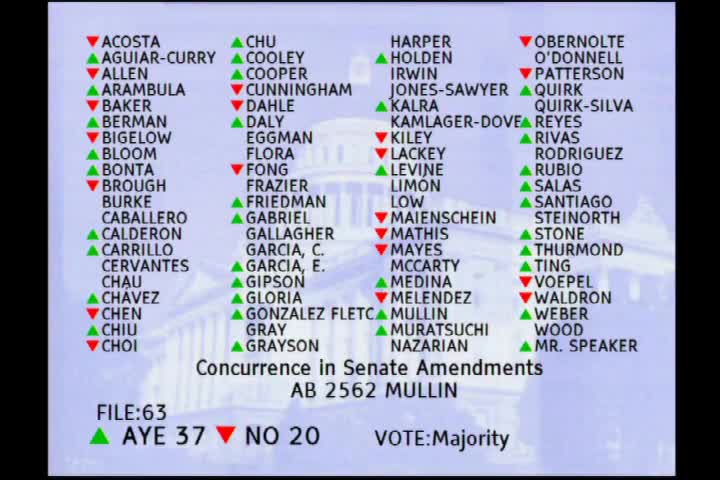 1MIN
Assembly Floor
 1H
Senate Standing Committee on Appropriations
 34MIN
Senate Standing Committee on Health
 1MIN
Assembly Floor
 1H
Assembly Standing Committee on Appropriations
 13MIN
Assembly Standing Committee on Health
Bill Author

Bill Co-Author(s):