AB 607: Public social services: disaster assistance services.
- Session Year: 2017-2018
- House: Assembly
- Latest Version Date: 2017-10-05
(1)Existing law provides for the California Work Opportunity and Responsibility to Kids (CalWORKs) program, under which each county provides cash assistance and other benefits to qualified low-income families and individuals. Existing law prohibits a person from receiving CalWORKs benefits unless he or she is a resident of the state. Existing law requires CalWORKs eligibility to be terminated if the recipient has received aid payment at an address outside of the state for two consecutive months, the county has made inquiry of the recipient, and the recipient has not responded and has not clearly shown that he or she has not established residence elsewhere and has been prevented by illness or other good cause from returning to this state.
This bill, to be known and cited as the Community Resiliency and Disaster Preparedness Act of 2017, would, among other things, additionally authorize a person who has responded, clearly showing that he or she has not established residence elsewhere and has been prevented from returning to the state due to a disaster declared by the Governor, or the President of the United States, to continue his or her CalWORKs eligibility. To the extent that this bill affects eligibility under the CalWORKs program, the bill would create a state-mandated local program.
As part of the CalWORKs program, existing law provides that a homeless family that has used all available liquid resources in excess of $100 may be eligible for assistance to pay for temporary shelter or permanent housing, as specified, and requires a family that becomes homeless as a direct and primary result of a state or federally declared natural disaster to be eligible for the temporary and permanent homeless assistance.
This bill would, in the event of a state or federally declared disaster in a county, require the county human services agency to coordinate with public and private disaster response organizations and agencies to identify and inform recipients of their eligibility for the temporary and permanent homeless assistance. By increasing the duties of county officials, this bill would impose a state-mandated local program.
(2)Existing federal law provides for the federal Supplemental Nutrition Assistance Program (SNAP), known in California as CalFresh, under which supplemental nutrition assistance benefits allocated to the state by the federal government are distributed to eligible individuals by each county. Existing federal law, through Disaster SNAP, provides for short-term food assistance benefits to families suffering in the wake of a major disaster.
This bill would require the department and the county human services agency, if the President of the United States issues a major disaster declaration for individual assistance, to request to operate a federal Disaster Supplemental Nutrition Assistance Program (D-SNAP) for the regions affected by the major disaster. The bill would require the department to offer training on Disaster CalFresh to county human services agencies and others. The bill would require county human services agencies to annually submit to the department a disaster plan, as specified, to ensure there are sufficient resources necessary to continue adequate access to benefits during a disaster. By increasing the duties of county officials, the bill would impose a state-mandated local program.
(3)The bill would, in the event of a declaration by the Governor or the President of a major disaster, continuously appropriate to the State Department of Social Services from the General Fund an amount necessary to cover specified costs relating to the administration of disaster assistance services provided under CalFresh, but not to exceed $300,000 per disaster declaration.
(4)Existing law continuously appropriates moneys from the General Fund to defray a portion of county costs under the CalWORKs program.
This bill would instead provide that the continuous appropriation would not be made for purposes of implementing the bill.
(5)This bill would incorporate additional changes to Section 11450 of the Welfare and Institutions Code proposed by AB 236 and AB 557 to be operative only if this bill and AB 236, this bill and AB 557, or all 3 bills are enacted and this bill is enacted last.
(6)The California Constitution requires the state to reimburse local agencies and school districts for certain costs mandated by the state. Statutory provisions establish procedures for making that reimbursement.
This bill would provide that, if the Commission on State Mandates determines that the bill contains costs mandated by the state, reimbursement for those costs shall be made pursuant to the statutory provisions noted above.
(1)Existing law provides for the California Work Opportunity and Responsibility to Kids (CalWORKs) program, under which each county provides cash assistance and other benefits to qualified low-income families and individuals. Existing law prohibits a person from receiving CalWORKs benefits unless he or she is a resident of the state. Existing law requires CalWORKs eligibility to be terminated if the recipient has received aid payment at an address outside of the state for two consecutive months, the county has made inquiry of the recipient, and the recipient has not responded and has not clearly shown that he or she has not established residence elsewhere and has been prevented by illness or other good cause from returning to this state.
This bill, to be known and cited as the Community Resiliency and Disaster Preparedness Act of 2017, would, among other things, additionally authorize a person who has responded, clearly showing that he or she has not established residence elsewhere and has been prevented from returning to the state due to a disaster declared by the Governor, or the President of the United States, to continue his or her CalWORKs eligibility. To the extent that this bill affects eligibility under the CalWORKs program, the bill would create a state-mandated local program.
As part of the CalWORKs program, existing law provides that a homeless family that has used all available liquid resources in excess of $100 may be eligible for assistance to pay for temporary shelter or permanent housing, as specified, and requires a family that becomes homeless as a direct and primary result of a state or federally declared natural disaster to be eligible for the temporary and permanent homeless assistance.
This bill would, in the event of a state or federally declared disaster in a county, require the county human services agency to coordinate with public and private disaster response organizations and agencies to identify and inform recipients of their eligibility for the temporary and permanent homeless assistance. By increasing the duties of county officials, this bill would impose a state-mandated local program.
(2)Existing federal law provides for the federal Supplemental Nutrition Assistance Program (SNAP), known in California as CalFresh, under which supplemental nutrition assistance benefits allocated to the state by the federal government are distributed to eligible individuals by each county. Existing federal law, through Disaster SNAP, provides for short-term food assistance benefits to families suffering in the wake of a major disaster.
This bill would require the department and the county human services agency, if the President of the United States issues a major disaster declaration for individual assistance, to request to operate a federal Disaster Supplemental Nutrition Assistance Program (D-SNAP) for the regions affected by the majordisaster. major disaster. The bill would require the department to offer training on Disaster CalFresh to county human services agencies and others. The bill would require county human services agencies to annually submit to the department a disaster plan, as specified, to ensure there are sufficient resources necessary to continue adequate access to benefits during a disaster. By increasing the duties of county officials, the bill would impose a state-mandated local program.
(3)The bill would, in the event of a declaration by the Governor or the President of a major disaster, continuously appropriate to the State Department of Social Services from the General Fund an amount necessary to cover specified costs relating to the administration of disaster assistance services provided under CalFresh, but not to exceed $300,000 per disaster declaration.
(4)Existing law continuously appropriates moneys from the General Fund to defray a portion of county costs under the CalWORKs program.
This bill would instead provide that the continuous appropriation would not be made for purposes of implementing the bill.
(5)This bill would incorporate additional changes to Section 11450 of the Welfare and Institutions Code proposed by AB 236 and AB 557 to be operative only if this bill and AB 236, this bill and AB 557, or all 3 bills are enacted and this bill is enacted last.
(5)(6)The California Constitution requires the state to reimburse local agencies and school districts for certain costs mandated by the state. Statutory provisions establish procedures for making that reimbursement.
This bill would provide that, if the Commission on State Mandates determines that the bill contains costs mandated by the state, reimbursement for those costs shall be made pursuant to the statutory provisions noted above.
(1)Existing law provides for the California Work Opportunity and Responsibility to Kids (CalWORKs) program, under which each county provides cash assistance and other benefits to qualified low-income families and individuals. Existing law prohibits a person from receiving CalWORKs benefits unless he or she is a resident of the state. Existing law requires CalWORKs eligibility to be terminated if the recipient has received aid payment at an address outside of the state for two consecutive months, the county has made inquiry of the recipient, and the recipient has not responded and has not clearly shown that he or she has not established residence elsewhere and has been prevented by illness or other good cause from returning to this state.
This bill, to be known and cited as the Community Resiliency and Disaster Preparedness Act of 2017, would would, among other things, additionally authorize a person who has responded, clearly showing that he or she has not established residence elsewhere and has been prevented from returning to the state due to a disaster declared by the Governor, or the President of the United States, to continue his or her CalWORKs eligibility. To the extent that this bill affects eligibility under the CalWORKs program, the bill would create a state-mandated local program.
As part of the CalWORKs program, existing law provides that a homeless family that has used all available liquid resources in excess of $100 may be eligible for assistance to pay for temporary shelter or permanent housing, as specified, and requires a family that becomes homeless as a direct and primary result of a state or federally declared natural disaster to be eligible for the temporary and permanent homeless assistance.
This bill would, in the event of a state or federally declared disaster in a county, require the county human services agency to coordinate with public and private disaster response organizations and agencies to identify and inform recipients of their eligibility for the temporary and permanent homeless assistance. By increasing the duties of county officials, this bill would impose a state-mandated local program.
(2)Existing federal law provides for the federal Supplemental Nutrition Assistance Program (SNAP), known in California as CalFresh, under which supplemental nutrition assistance benefits allocated to the state by the federal government are distributed to eligible individuals by each county. Existing federal law, through Disaster SNAP, provides for short-term food assistance benefits to families suffering in the wake of a major disaster. Existing federal regulation authorizes states to provide replacement issuances to a household when the household reports that food purchased with SNAP benefits was destroyed in a household misfortune.
This bill would require the department and the county human services agency, if the President of the United States issues a major disaster declaration for individual assistance, to request to operate a federal Disaster Supplemental Nutrition Assistance Program (D-SNAP) for the regions affected by the major disaster. The bill would also, whenever there is an event resulting in the loss of food by a significant number of CalFresh households, whether or not a disaster is declared by the Governor or the President, require the department and the county human services agency to request a waiver to provide automatic, mass replacement benefits to eligible households.
The disaster. The bill would require the department to offer training on Disaster CalFresh to county human services agencies and others training on Disaster CalFresh. others. The bill would require county human services agencies to annually submit to the department a disaster plan, as specified, to ensure there are sufficient resources necessary to continue adequate benefit access to benefits during a disaster. By increasing the duties of county officials, the bill would impose a state-mandated local program.
(3)Existing law provides for the California Special Supplemental Nutrition Program for Women, Infants, and Children (WIC Program) administered by the State Department of Public Health and participating local agencies, under which nutrition and other assistance is provided to eligible low-income postpartum and lactating women, infants, and children under 5 years of age.This bill would require all participating local agencies in a county to develop, as specified, and to annually submit, a joint disaster response plan for the WIC program to the department. By increasing the duties of local officials, the bill would impose a state-mandated local program.(4)(3)The bill would, in the event of a declaration by the Governor or the President of a major disaster, continuously appropriate to the State Department of Public Health and the State Department of Social Services from the General Fund an amount necessary to cover specified costs relating to the administration of disaster assistance services provided under the WIC Program and CalFresh, but not to exceed $300,000 per disaster declaration per department. declaration.
(5)(4)Existing law continuously appropriates moneys from the General Fund to defray a portion of county costs under the CalWORKs program.
This bill would instead provide that the continuous appropriation would not be made for purposes of implementing the bill.
(6)(5)The California Constitution requires the state to reimburse local agencies and school districts for certain costs mandated by the state. Statutory provisions establish procedures for making that reimbursement.
This bill would provide that, if the Commission on State Mandates determines that the bill contains costs mandated by the state, reimbursement for those costs shall be made pursuant to the statutory provisions noted above.
(1)Existing law provides for the California Work Opportunity and Responsibility to Kids (CalWORKs) program, under which each county provides cash assistance and other benefits to qualified low-income families and individuals. Existing law prohibits a person from receiving CalWORKs benefits unless he or she is a resident of the state. Existing law requires CalWORKs eligibility to be terminated if the recipient has received aid payment at an address outside of the state for two consecutive months, the county has made inquiry of the recipient, and the recipient has not responded and has not clearly shown that he or she has not established residence elsewhere and has been prevented by illness or other good cause from returning to this state.
This bill, to be known and cited as the Community Resiliency and Disaster Preparedness Act of 2017, would additionally authorize a person who has responded, clearly showing that he or she has not established residence elsewhere and has been prevented from returning to the state due to a disaster declared by the Governor, or the President of the United States, to continue his or her CalWORKs eligibility. To the extent that this bill affects eligibility under the CalWORKs program, the bill would create a state-mandated local program.
Under the CalWORKs program, recipients are required to participate in specified welfare-to-work activities, unless a recipient is excused from participation for good cause when the county has determined there is a condition or other circumstance that temporarily prevents or significantly impairs the recipients ability to be regularly employed or to participate in welfare-to-work activities.This bill would include, as a condition that may constitute good cause, a case when the applicants or recipients county of residence has been declared a disaster area by the Governor or the President of the United States, or the unemployment rate for the county in which a recipient resides has been at or above 9.5% in at least one of the last 4 calendar quarters.As part of the CalWORKs program, existing law provides that a homeless family that has used all available liquid resources in excess of $100 may be eligible for assistance to pay for temporary shelter or permanent housing, as specified, and requires a family that becomes homeless as a direct and primary result of a state or federally declared natural disaster to be eligible for the temporary and permanent homeless assistance.
This bill would, in the event of a state or federally declared disaster in a county, require the county human services agency to coordinate with public and private disaster response organizations and agencies to identify and inform recipients of their eligibility for the temporary and permanent homeless assistance. By increasing the duties of county officials, this bill would impose a state-mandated local program.
(2)Existing federal law provides for the federal Supplemental Nutrition Assistance Program (SNAP), known in California as CalFresh, under which supplemental nutrition assistance benefits allocated to the state by the federal government are distributed to eligible individuals by each county. Existing federal law, through Disaster SNAP, provides for short-term food assistance benefits to families suffering in the wake of a major disaster. Existing federal regulation authorizes states to provide replacement issuances to a household when the household reports that food purchased with SNAP benefits was destroyed in a household misfortune.
This bill would require the department, department and the county human services agency, if the President of the United States issues a major disaster declaration for individual assistance, to request to operate a federal Disaster Supplemental Nutrition Assistance Program (D-SNAP) for the regions affected by the major disaster. The bill would also, whenever there is an event resulting in the loss of food by a significant number of CalFresh households, whether or not a disaster is declared by the Governor or the President, require the department and the county human services agency to request a waiver to provide automatic, mass replacement benefits to eligible households.
The bill would, commencing October 1, 2018, would require the department to offer, and offer to county human services agencies and others to attend, a biannual training on Disaster CalFresh. The bill would require county human services agencies to annually submit to the department a disaster plan, as specified, to ensure there are sufficient resources necessary to continue adequate benefit access during a disaster. By increasing the duties of county officials, the bill would impose a state-mandated local program.
(3)Existing law provides for the California Special Supplemental Nutrition Program for Women, Infants, and Children (WIC Program) administered by the State Department of Public Health and participating local agencies, under which nutrition and other assistance is provided to eligible low-income postpartum and lactating women, infants, and children under 5 years of age.
This bill would require all participating local agencies in a county to develop, as specified, and to annually submit, a joint disaster response plan for the WIC program to the department. By increasing the duties of local officials, the bill would impose a state-mandated local program.
(4)The bill would, in the event of a declaration by the Governor or the President of a major disaster, continuously appropriate to the State Department of Public Health and the State Department of Social Services from the General Fund an amount necessary to cover specified costs relating to the administration of disaster assistance services provided under the WIC Program and CalFresh, but not to exceed $300,000 per disaster declaration per department.
(5)Existing law continuously appropriates moneys from the General Fund to defray a portion of county costs under the CalWORKs program.
This bill would instead provide that the continuous appropriation would not be made for purposes of implementing the bill.
(6)The California Constitution requires the state to reimburse local agencies and school districts for certain costs mandated by the state. Statutory provisions establish procedures for making that reimbursement.
This bill would provide that, if the Commission on State Mandates determines that the bill contains costs mandated by the state, reimbursement for those costs shall be made pursuant to the statutory provisions noted above.
(1)Existing law provides for the California Work Opportunity and Responsibility to Kids (CalWORKs) program, under which each county provides cash assistance and other benefits to qualified low-income families and individuals. Existing law prohibits a person from receiving CalWORKs benefits unless he or she is a resident of the state. Existing law requires CalWORKs eligibility to be terminated if the recipient has received aid payment at an address outside of the state for two consecutive months, the county has made inquiry of the recipient, and the recipient has not responded and has not clearly shown that he or she has not established residence elsewhere and has been prevented by illness or other good cause from returning to this state.
This bill, to be known and cited as the Community Resiliency and Disaster Preparedness Act of 2017, would additionally authorize a person who has responded, clearly showing that he or she has not established residence elsewhere and has been prevented from returning to the state due to a disaster declared by the Governor, Governor, or the President of the United States, to continue his or her CalWORKs eligibility. To the extent that this bill affects eligibility under the CalWORKs program, the bill would create a state-mandated local program.
Under the CalWORKs program, recipients are required to participate in specified welfare-to-work activities, unless a recipient is excused from participation for good cause when the county has determined there is a condition or other circumstance that temporarily prevents or significantly impairs the recipients ability to be regularly employed or to participate in welfare-to-work activities.
This bill would include, as a condition that may constitute good cause, a case when the applicants or recipients county of residence has been declared a disaster area by the county, the Governor, Governor or the President of the United States. States, or the unemployment rate for the county in which a recipient resides has been at or above 9.5% in at least one of the last 4 calendar quarters.
As part of the CalWORKs program, existing law provides that a homeless family that has used all available liquid resources in excess of $100 may be eligible for assistance to pay for temporary shelter or permanent housing, as specified, and requires a family that becomes homeless as a direct and primary result of a state or federally declared natural disaster to be eligible for the temporary and permanent homeless assistance.
This bill would, in the event of a state or federally declared disaster in a county, require the county human services agency to coordinate with public and private disaster response organizations and agencies to identify and inform recipients of their eligibility for the temporary and permanent homeless assistance. By increasing the duties of county officials, this bill would impose a state-mandated local program.
(2)Existing federal law provides for the federal Supplemental Nutrition Assistance Program (SNAP), known in California as CalFresh, under which supplemental nutrition assistance benefits allocated to the state by the federal government are distributed to eligible individuals by each county. Existing federal law, through Disaster SNAP, provides for short-term food assistance benefits to families suffering in the wake of a major disaster. Existing federal regulation authorizes states to provide replacement issuances to a household when the household reports that food purchased with SNAP benefits was destroyed in a household misfortune.
This bill would require the department, if the President of the United States issues a major disaster declaration for individual assistance, to request to operate a federal Disaster Supplemental Nutrition Assistance Program (D-SNAP) for the regions affected by the major disaster. The bill would also, whenever there is an event resulting in the loss of food by a significant number of CalFresh households, whether or not a disaster is declared by the Governor or the President, require the department and the county human services agency to request a waiver to provide automatic, mass replacement benefits to eligible households.
The bill would, commencing October 1, 2018, require the department to offer, and county human services agencies and others to attend, a biannual training on Disaster CalFresh. The bill would require county human services agencies to annually submit to the department a disaster plan, as specified, to ensure there are sufficient resources necessary to continue adequate benefit access during a disaster. By increasing the duties of county officials, the bill would impose a state-mandated local program.
(3)Existing law provides for the California Special Supplemental Nutrition Program for Women, Infants, and Children (WIC Program) administered by the State Department of Public Health and participating local agencies, under which nutrition and other assistance is provided to eligible low-income postpartum and lactating women, infants, and children under 5 years of age.
This bill would require a all participating local agency agencies in a county to develop, as specified, and to annually submit, a joint disaster response plan for the WIC program to the department. By increasing the duties of local officials, the bill would impose a state-mandated local program.
(4)The bill would would, in the event of a declaration by the Governor or the President of a major disaster, continuously appropriate to the State Department of Public Health and the State Department of Social Services from the General Fund an amount necessary to covered cover specified costs relating to the administration of disaster assistance services provided under the WIC Program and CalFresh, but not to exceed $300,000 per disaster declaration per department.
(5)Existing law continuously appropriates moneys from the General Fund to defray a portion of county costs under the CalWORKs program.
This bill would instead provide that the continuous appropriation would not be made for purposes of implementing the bill.
(6)The California Constitution requires the state to reimburse local agencies and school districts for certain costs mandated by the state. Statutory provisions establish procedures for making that reimbursement.
This bill would provide that, if the Commission on State Mandates determines that the bill contains costs mandated by the state, reimbursement for those costs shall be made pursuant to the statutory provisions noted above.
(1)Existing law provides for the California Work Opportunity and Responsibility to Kids (CalWORKs) program, under which each county provides cash assistance and other benefits to qualified low-income families and individuals. Existing law prohibits a person from receiving CalWORKs benefits unless he or she is a resident of the state. Existing law requires CalWORKs eligibility to be terminated if the recipient has received aid payment at an address outside of the state for two consecutive months, the county has made inquiry of the recipient, and the recipient has not responded and has not clearly shown that he or she has not established residence elsewhere and has been prevented by illness or other good cause from returning to this state.
This bill, to be known and cited as the Community Resiliency and Disaster Preparedness Act of 2017, would additionally authorize a person who has responded, clearly showing that he or she has not established residence elsewhere and has been prevented from returning to the state due to a disaster declared by the Governor, to continue his or her CalWORKs eligibility. To the extent that this bill affects eligibility under the CalWORKs program, the bill would create a state-mandated local program.
Under the CalWORKs program, recipients are required to participate in specified welfare-to-work activities, unless a recipient is excused from participation for good cause when the county has determined there is a condition or other circumstance that temporarily prevents or significantly impairs the recipients ability to be regularly employed or to participate in welfare-to-work activities.
This bill would include, as a condition that may constitute good cause, a case when the applicants or recipients county of residence has been declared a disaster area by the county, the Governor, or the President of the United States.
As part of the CalWORKs program, existing law provides that a homeless family that has used all available liquid resources in excess of $100 may be eligible for assistance to pay for temporary shelter or permanent housing, as specified, and requires a family that becomes homeless as a direct and primary result of a state or federally declared natural disaster to be eligible for the temporary and permanent homeless assistance.
This bill would, in the event of a state or federally declared disaster in a county, require the county human services agency to coordinate with public and private disaster response organizations and agencies to identify and inform recipients of their eligibility for the temporary and permanent homeless assistance. By increasing the duties of county officials, this bill would impose a state-mandated local program.
(2)Existing federal law provides for the federal Supplemental Nutrition Assistance Program (SNAP), known in California as CalFresh, under which supplemental nutrition assistance benefits allocated to the state by the federal government are distributed to eligible individuals by each county. Existing federal law, through Disaster SNAP, provides for short-term food assistance benefits to families suffering in the wake of a major disaster. Existing federal regulation authorizes states to provide replacement issuances to a household when the household reports that food purchased with SNAP benefits was destroyed in a household misfortune.
This bill would require the department, if the President of the United States issues a major disaster declaration for individual assistance, to request to operate a federal Disaster Supplemental Nutrition Assistance Program (D-SNAP) for the regions affected by the major disaster. The bill would also, whenever there is an event resulting in the loss of food by a significant number of CalFresh households, whether or not a disaster is declared by the President, require the department to request a waiver to provide automatic, mass replacement benefits to eligible households.
The bill would, commencing October 1, 2018, require the department to offer, and county human services agencies and others to attend, a biannual training on Disaster CalFresh. The bill would require county human services agencies to annually submit to the department a disaster plan, as specified, to ensure there are sufficient resources necessary to continue adequate benefit access during a disaster. By increasing the duties of county officials, the bill would impose a state-mandated local program.
(3)Existing law provides for the California Special Supplemental Nutrition Program for Women, Infants, and Children (WIC Program) administered by the State Department of Public Health and participating local agencies, under which nutrition and other assistance is provided to eligible low-income postpartum and lactating women, infants, and children under 5 years of age.
This bill would require a participating local agency to develop, as specified, and to annually submit, a disaster response plan for the WIC program to the department. By increasing the duties of local officials, the bill would impose a state-mandated local program.
(4)The bill would continuously appropriate to the State Department of Public Health and the State Department of Social Services from the General Fund an amount necessary to covered specified costs relating to the administration of disaster assistance services provided under the WIC Program and CalFresh, but not to exceed $300,000 per disaster declaration per department.
(5)Existing law continuously appropriates moneys from the General Fund to defray a portion of county costs under the CalWORKs program.
This bill would instead provide that the continuous appropriation would not be made for purposes of implementing the bill.
(6)The California Constitution requires the state to reimburse local agencies and school districts for certain costs mandated by the state. Statutory provisions establish procedures for making that reimbursement.
This bill would provide that, if the Commission on State Mandates determines that the bill contains costs mandated by the state, reimbursement for those costs shall be made pursuant to the statutory provisions noted above.
This act shall be known and may be cited as the Community Resiliency and Disaster Preparedness Act of 2017.
SEC. 2.(a)The Legislature finds and declares all of the following:
(1)Community resilience is a measure of the sustained ability of a community to respond to, withstand, and recover from, adverse situations, such as economic shocks and natural disasters.
(2)Californias recent natural disasters, such as firestorms, earthquakes, and droughts, have underscored the importance of disaster preparedness and have highlighted the need for policies that strengthen economies before and after economic shocks.
(3)Whether undermined by economic shocks or natural disasters, the resiliency of a community must be defined by how well the poorest residents recover.
(b)It is the intent of the Legislature, in enacting the Community Resiliency and Disaster Preparedness Act of 2017, that our communities will be better poised to prevent hunger, homelessness, and hardship following economic shocks or natural disasters.
SEC. 3.Section 11100 of the Welfare and Institutions Code is amended to read:11100.(a)For the purposes of the provisions of this code relating to public assistance, the continued absence of a recipient of public assistance from the state for a period of 60 days or longer shall be prima facie evidence of the intent of the recipient to have changed his or her residence to a place outside the state. The county granting the public assistance shall make inquiry from all recipients who have been continuously absent from the state for a period of 30 days, with the next assistance payment, to determine their intent to remain residents of California or to become residents of another state, and shall redetermine the residence of those persons. When the inquiry made under this section establishes that the recipient is no longer a resident of the state, his or her aid shall be terminated immediately.
(b)If a recipient is prevented by illness, displacement due to a disaster declared by the Governor or the President of the United States, or other good cause from returning to the state at the end of 60 days, and has not by act or intent established residence elsewhere, residence shall not be deemed to have been lost in the state.
SEC. 4.Section 11105 of the Welfare and Institutions Code is amended to read:11105.(a)No person shall be granted aid under this part unless he or she is a resident of the state.
(b)If a recipient of aid under Chapter 2 (commencing with Section 11200) receives an aid payment at an address outside of the state for two consecutive months, the recipients eligibility shall be terminated if the county has inquired with the recipient pursuant to Section 11100, and the recipient has not responded to this inquiry by clearly showing that he or she has (1) not established residence elsewhere and (2) been prevented by illness, displacement due to a disaster declared by the Governor or the President of the United States, or other good cause from returning to the state.
(c)If a recipient whose aid is terminated pursuant to subdivision (b) reapplies for aid, payments shall be restored if all other eligibility criteria are met and if the recipient can prove both of the following:
(1)His or her permanent residence is in the state.
(2)He or she has not established residence in any other state, which can be considered to be of a permanent nature.
(d)Nothing in this section shall be construed as limiting Aid to Families with Dependent Children-Foster Care payments to children placed out of state by California childrens placement agencies.
SEC. 5.Section 11450 of the Welfare and Institutions Code is amended to read:11450.(a)(1)(A)Aid shall be paid for each needy family, which shall include all eligible brothers and sisters of each eligible applicant or recipient child and the parents of the children, but shall not include unborn children, or recipients of aid under Chapter 3 (commencing with Section 12000), qualified for aid under this chapter. In determining the amount of aid paid, and notwithstanding the minimum basic standards of adequate care specified in Section 11452, the familys income, exclusive of any amounts considered exempt as income or paid pursuant to subdivision (e) or Section 11453.1, determined for the prospective semiannual period pursuant to Sections 11265.1, 11265.2, and 11265.3, and then calculated pursuant to Section 11451.5, shall be deducted from the sum specified in the following table, as adjusted for cost-of-living increases pursuant to Section 11453 and paragraph (2). In no case shall the amount of aid paid for each month exceed the sum specified in the following table, as adjusted for cost-of-living increases pursuant to Section 11453 and paragraph (2), plus any special needs, as specified in subdivisions (c), (e), and (f):
Number of | Maximum |
|---|---|
1 | $326 |
2 | 535 |
3 | 663 |
4 | 788 |
5 | 899 |
6 | 1,010 |
7 | 1,109 |
8 | 1,209 |
9 | 1,306 |
10 or more | 1,403 |
(B)If, when, and during those times that the United States government increases or decreases its contributions in assistance of needy children in this state above or below the amount paid on July 1, 1972, the amounts specified in the above table shall be increased or decreased by an amount equal to that increase or decrease by the United States government, provided that no increase or decrease shall be subject to subsequent adjustment pursuant to Section 11453.
(2)The sums specified in paragraph (1) shall not be adjusted for cost of living for the 199091, 199192, 199293, 199394, 199495, 199596, 199697, and 199798 fiscal years, and through October 31, 1998, nor shall that amount be included in the base for calculating any cost-of-living increases for any fiscal year thereafter. Elimination of the cost-of-living adjustment pursuant to this paragraph shall satisfy the requirements of Section 11453.05, and no further reduction shall be made pursuant to that section.
(b)(1)When the family does not include a needy child qualified for aid under this chapter, aid shall be paid to a pregnant child who is 18 years of age or younger at any time after verification of pregnancy, in the amount that would otherwise be paid to one person, as specified in subdivision (a), if the child and her child, if born, would have qualified for aid under this chapter. Verification of pregnancy shall be required as a condition of eligibility for aid under this subdivision.
(2)Notwithstanding paragraph (1), when the family does not include a needy child qualified for aid under this chapter, aid shall be paid to a pregnant woman for the month in which the birth is anticipated and for the six-month period immediately prior to the month in which the birth is anticipated, in the amount that would otherwise be paid to one person, as specified in subdivision (a), if the woman and child, if born, would have qualified for aid under this chapter. Verification of pregnancy shall be required as a condition of eligibility for aid under this subdivision.
(3)Paragraph (1) shall apply only when the Cal-Learn Program is operative.
(c)The amount of forty-seven dollars ($47) per month shall be paid to pregnant women qualified for aid under subdivision (a) or (b) to meet special needs resulting from pregnancy if the woman and child, if born, would have qualified for aid under this chapter. County welfare departments shall refer all recipients of aid under this subdivision to a local provider of the Women, Infants, and Children program. If that payment to pregnant women qualified for aid under subdivision (a) is considered income under federal law in the first five months of pregnancy, payments under this subdivision shall not apply to persons eligible under subdivision (a), except for the month in which birth is anticipated and for the three-month period immediately prior to the month in which delivery is anticipated, if the woman and child, if born, would have qualified for aid under this chapter.
(d)For children receiving AFDC-FC under this chapter, there shall be paid, exclusive of any amount considered exempt as income, an amount of aid each month that, when added to the childs income, is equal to the rate specified in Section 11460, 11461, 11462, 11462.1, or 11463. In addition, the child shall be eligible for special needs, as specified in departmental regulations.
(e)In addition to the amounts payable under subdivision (a) and Section 11453.1, a family shall be entitled to receive an allowance for recurring special needs not common to a majority of recipients. These recurring special needs shall include, but not be limited to, special diets upon the recommendation of a physician for circumstances other than pregnancy, and unusual costs of transportation, laundry, housekeeping services, telephone, and utilities. The recurring special needs allowance for each family per month shall not exceed that amount resulting from multiplying the sum of ten dollars ($10) by the number of recipients in the family who are eligible for assistance.
(f)After a family has used all available liquid resources, both exempt and nonexempt, in excess of one hundred dollars ($100), with the exception of funds deposited in a restricted account described in subdivision (a) of Section 11155.2, the family shall also be entitled to receive an allowance for nonrecurring special needs.
(1)An allowance for nonrecurring special needs shall be granted for replacement of clothing and household equipment and for emergency housing needs other than those needs addressed by paragraph (2). These needs shall be caused by sudden and unusual circumstances beyond the control of the needy family. The department shall establish the allowance for each of the nonrecurring special needs items. The sum of all nonrecurring special needs provided by this subdivision shall not exceed six hundred dollars ($600) per event.
(2)(A)Homeless assistance is available to a homeless family seeking shelter when the family is eligible for aid under this chapter. Homeless assistance for temporary shelter is also available to homeless families that are apparently eligible for aid under this chapter. Apparent eligibility exists when evidence presented by the applicant, or that is otherwise available to the county welfare department, and the information provided on the application documents indicate that there would be eligibility for aid under this chapter if the evidence and information were verified. However, an alien applicant who does not provide verification of his or her eligible alien status, or a woman with no eligible children who does not provide medical verification of pregnancy, is not apparently eligible for purposes of this section.
(B)A family is considered homeless, for the purpose of this section, when the family lacks a fixed and regular nighttime residence; or the family has a primary nighttime residence that is a supervised publicly or privately operated shelter designed to provide temporary living accommodations; or the family is residing in a public or private place not designed for, or ordinarily used as, a regular sleeping accommodation for human beings. A family is also considered homeless for the purpose of this section if the family has received a notice to pay rent or quit. The family shall demonstrate that the eviction is the result of a verified financial hardship as a result of extraordinary circumstances beyond their control, and not other lease or rental violations, and that the family is experiencing a financial crisis that could result in homelessness if preventative assistance is not provided.
(3)(A)(i)A nonrecurring special needs benefit of sixty-five dollars ($65) a day shall be available to families of up to four members for the costs of temporary shelter, subject to the requirements of this paragraph. The fifth and additional members of the family shall each receive fifteen dollars ($15) per day, up to a daily maximum of one hundred twenty-five dollars ($125). County welfare departments may increase the daily amount available for temporary shelter as necessary to secure the additional bedspace needed by the family.
(ii)This special needs benefit shall be granted or denied immediately upon the familys application for homeless assistance, and benefits shall be available for up to three working days. The county welfare department shall verify the familys homelessness within the first three working days and if the family meets the criteria of questionable homelessness established by the department, the county welfare department shall refer the family to its early fraud prevention and detection unit, if the county has such a unit, for assistance in the verification of homelessness within this period.
(iii)After homelessness has been verified, the three-day limit shall be extended for a period of time which, when added to the initial benefits provided, does not exceed a total of 16 calendar days. This extension of benefits shall be done in increments of one week and shall be based upon searching for permanent housing which shall be documented on a housing search form, good cause, or other circumstances defined by the department. Documentation of a housing search shall be required for the initial extension of benefits beyond the three-day limit and on a weekly basis thereafter as long as the family is receiving temporary shelter benefits. Good cause shall include, but is not limited to, situations in which the county welfare department has determined that the family, to the extent it is capable, has made a good faith but unsuccessful effort to secure permanent housing while receiving temporary shelter benefits or that the family is homeless as a direct and primary result of a state or federally declared natural disaster.
(iv)Notwithstanding clauses (ii) and (iii), the county may waive the three-day limit and may provide benefits in increments of more than one week for a family that becomes homeless as a direct and primary result of a state or federally declared natural disaster.
(B)(i)A nonrecurring special needs benefit for permanent housing assistance is available to pay for last months rent and security deposits when these payments are reasonable conditions of securing a residence, or to pay for up to two months of rent arrearages, when these payments are a reasonable condition of preventing eviction.
(ii)The last months rent or monthly arrearage portion of the payment (I) shall not exceed 80 percent of the familys total monthly household income without the value of CalFresh benefits or special needs benefit for a family of that size and (II) shall only be made to families that have found permanent housing costing no more than 80 percent of the familys total monthly household income without the value of CalFresh benefits or special needs benefit for a family of that size.
(iii)However, if the county welfare department determines that a family intends to reside with individuals who will be sharing housing costs, the county welfare department shall, in appropriate circumstances, set aside the condition specified in subclause (II) of clause (ii).
(C)The nonrecurring special needs benefit for permanent housing assistance is also available to cover the standard costs of deposits for utilities which are necessary for the health and safety of the family.
(D)A payment for or denial of permanent housing assistance shall be issued no later than one working day from the time that a family presents evidence of the availability of permanent housing. If an applicant family provides evidence of the availability of permanent housing before the county welfare department has established eligibility for aid under this chapter, the county welfare department shall complete the eligibility determination so that the denial of or payment for permanent housing assistance is issued within one working day from the submission of evidence of the availability of permanent housing, unless the family has failed to provide all of the verification necessary to establish eligibility for aid under this chapter.
(E)(i)Except as provided in clauses (ii) and (iii), eligibility for the temporary shelter assistance and the permanent housing assistance pursuant to this paragraph shall be limited to one period of up to 16 consecutive calendar days of temporary assistance and one payment of permanent assistance every 12 months. A person who applies for homeless assistance benefits shall be informed that the temporary shelter benefit of up to 16 consecutive days is available only once every 12 months, with certain exceptions, and that a break in the consecutive use of the benefit constitutes exhaustion of the temporary benefit for that 12-month period.
(ii)(I)A family that becomes homeless as a direct and primary result of a state or federally declared natural disaster shall be eligible for temporary and permanent homeless assistance.
(II)In the event of a state or federally declared disaster in a county, the county human services agency shall coordinate with public and private disaster response organizations and agencies to identify and inform recipients of their eligibility for temporary and permanent homeless housing assistance available pursuant to subclause (I).
(iii)A family shall be eligible for temporary and permanent homeless assistance when homelessness is a direct result of domestic violence by a spouse, partner, or roommate; physical or mental illness that is medically verified that shall not include a diagnosis of alcoholism, drug addiction, or psychological stress; or, the uninhabitability of the former residence caused by sudden and unusual circumstances beyond the control of the family including natural catastrophe, fire, or condemnation. These circumstances shall be verified by a third-party governmental or private health and human services agency, except that domestic violence may also be verified by a sworn statement by the victim, as provided under Section 11495.25. Homeless assistance payments based on these specific circumstances may not be received more often than once in any 12-month period. In addition, if the domestic violence is verified by a sworn statement by the victim, the homeless assistance payments shall be limited to two periods of not more than 16 consecutive calendar days of temporary assistance and two payments of permanent assistance. A county may require that a recipient of homeless assistance benefits who qualifies under this paragraph for a second time in a 24-month period participate in a homelessness avoidance case plan as a condition of eligibility for homeless assistance benefits. The county welfare department shall immediately inform recipients who verify domestic violence by a sworn statement of the availability of domestic violence counseling and services, and refer those recipients to services upon request.
(iv)If a county requires a recipient who verifies domestic violence by a sworn statement to participate in a homelessness avoidance case plan pursuant to clause (iii), the plan shall include the provision of domestic violence services, if appropriate.
(v)If a recipient seeking homeless assistance based on domestic violence pursuant to clause (iii) has previously received homeless avoidance services based on domestic violence, the county shall review whether services were offered to the recipient and consider what additional services would assist the recipient in leaving the domestic violence situation.
(vi)The county welfare department shall report necessary data to the department through a statewide homeless assistance payment indicator system, as requested by the department, regarding all recipients of aid under this paragraph.
(F)The county welfare departments, and all other entities participating in the costs of the CalWORKs program, have the right in their share to any refunds resulting from payment of the permanent housing. However, if an emergency requires the family to move within the 12-month period specified in subparagraph (E), the family shall be allowed to use any refunds received from its deposits to meet the costs of moving to another residence.
(G)Payments to providers for temporary shelter and permanent housing and utilities shall be made on behalf of families requesting these payments.
(H)The daily amount for the temporary shelter special needs benefit for homeless assistance may be increased if authorized by the current years Budget Act by specifying a different daily allowance and appropriating the funds therefor.
(I)No payment shall be made pursuant to this paragraph unless the provider of housing is a commercial establishment, shelter, or person in the business of renting properties who has a history of renting properties.
(g)The department shall establish rules and regulations ensuring the uniform statewide application of this section.
(h)The department shall notify all applicants and recipients of aid through the standardized application form that these benefits are available and shall provide an opportunity for recipients to apply for the funds quickly and efficiently.
(i)(1)Except for the purposes of Section 15200, the amounts payable to recipients pursuant to Section 11453.1 shall not constitute part of the payment schedule set forth in subdivision (a).
(2)The amounts payable to recipients pursuant to Section 11453.1 shall not constitute income to recipients of aid under this section.
(j)For children receiving Kin-GAP pursuant to Article 4.5 (commencing with Section 11360) or Article 4.7 (commencing with Section 11385) there shall be paid, exclusive of any amount considered exempt as income, an amount of aid each month, which, when added to the childs income, is equal to the rate specified in Sections 11364 and 11387.
(k)(1)A county shall implement the semiannual reporting requirements in accordance with Chapter 501 of the Statutes of 2011 no later than October 1, 2013.
(2)Upon completion of the implementation described in paragraph (1), each county shall provide a certificate to the director certifying that semiannual reporting has been implemented in the county.
(3)Upon filing the certificate described in paragraph (2), a county shall comply with the semiannual reporting provisions of this section.
(l)This section shall become operative on January 1, 2017.
SEC. 5.1.Section 11450 of the Welfare and Institutions Code is amended to read:11450.(a)(1)(A)Aid shall be paid for each needy family, which shall include all eligible brothers and sisters of each eligible applicant or recipient child and the parents of the children, but shall not include unborn children, or recipients of aid under Chapter 3 (commencing with Section 12000), qualified for aid under this chapter. In determining the amount of aid paid, and notwithstanding the minimum basic standards of adequate care specified in Section 11452, the familys income, exclusive of any amounts considered exempt as income or paid pursuant to subdivision (e) or Section 11453.1, determined for the prospective semiannual period pursuant to Sections 11265.1, 11265.2, and 11265.3, and then calculated pursuant to Section 11451.5, shall be deducted from the sum specified in the following table, as adjusted for cost-of-living increases pursuant to Section 11453 and paragraph (2). In no case shall the amount of aid paid for each month exceed the sum specified in the following table, as adjusted for cost-of-living increases pursuant to Section 11453 and paragraph (2), plus any special needs, as specified in subdivisions (c), (e), and (f):
Number of | Maximum |
|---|---|
1 | $326 |
2 | 535 |
3 | 663 |
4 | 788 |
5 | 899 |
6 | 1,010 |
7 | 1,109 |
8 | 1,209 |
9 | 1,306 |
10 or more | 1,403 |
(B)If, when, and during those times that the United States government increases or decreases its contributions in assistance of needy children in this state above or below the amount paid on July 1, 1972, the amounts specified in the above table shall be increased or decreased by an amount equal to that increase or decrease by the United States government, provided that no increase or decrease shall be subject to subsequent adjustment pursuant to Section 11453.
(2)The sums specified in paragraph (1) shall not be adjusted for cost of living for the 199091, 199192, 199293, 199394, 199495, 199596, 199697, and 199798 fiscal years, and through October 31, 1998, nor shall that amount be included in the base for calculating any cost-of-living increases for any fiscal year thereafter. Elimination of the cost-of-living adjustment pursuant to this paragraph shall satisfy the requirements of Section 11453.05, and no further reduction shall be made pursuant to that section.
(b)(1)When the family does not include a needy child qualified for aid under this chapter, aid shall be paid to a pregnant child who is 18 years of age or younger at any time after verification of pregnancy, in the amount that would otherwise be paid to one person, as specified in subdivision (a), if the child and her child, if born, would have qualified for aid under this chapter. Verification of pregnancy shall be required as a condition of eligibility for aid under this subdivision.
(2)Notwithstanding paragraph (1), when the family does not include a needy child qualified for aid under this chapter, aid shall be paid to a pregnant woman for the month in which the birth is anticipated and for the six-month period immediately prior to the month in which the birth is anticipated, in the amount that would otherwise be paid to one person, as specified in subdivision (a), if the woman and child, if born, would have qualified for aid under this chapter. Verification of pregnancy shall be required as a condition of eligibility for aid under this subdivision.
(3)Paragraph (1) shall apply only when the Cal-Learn Program is operative.
(c)The amount of forty-seven dollars ($47) per month shall be paid to pregnant women qualified for aid under subdivision (a) or (b) to meet special needs resulting from pregnancy if the woman and child, if born, would have qualified for aid under this chapter. County welfare departments shall refer all recipients of aid under this subdivision to a local provider of the Women, Infants, and Children program. If that payment to pregnant women qualified for aid under subdivision (a) is considered income under federal law in the first five months of pregnancy, payments under this subdivision shall not apply to persons eligible under subdivision (a), except for the month in which birth is anticipated and for the three-month period immediately prior to the month in which delivery is anticipated, if the woman and child, if born, would have qualified for aid under this chapter.
(d)For children receiving AFDC-FC under this chapter, there shall be paid, exclusive of any amount considered exempt as income, an amount of aid each month that, when added to the childs income, is equal to the rate specified in Section 11460, 11461, 11462, 11462.1, or 11463. In addition, the child shall be eligible for special needs, as specified in departmental regulations.
(e)In addition to the amounts payable under subdivision (a) and Section 11453.1, a family shall be entitled to receive an allowance for recurring special needs not common to a majority of recipients. These recurring special needs shall include, but not be limited to, special diets upon the recommendation of a physician for circumstances other than pregnancy, and unusual costs of transportation, laundry, housekeeping services, telephone, and utilities. The recurring special needs allowance for each family per month shall not exceed that amount resulting from multiplying the sum of ten dollars ($10) by the number of recipients in the family who are eligible for assistance.
(f)After a family has used all available liquid resources, both exempt and nonexempt, in excess of one hundred dollars ($100), with the exception of funds deposited in a restricted account described in subdivision (a) of Section 11155.2, the family shall also be entitled to receive an allowance for nonrecurring special needs.
(1)An allowance for nonrecurring special needs shall be granted for replacement of clothing and household equipment and for emergency housing needs other than those needs addressed by paragraph (2). These needs shall be caused by sudden and unusual circumstances beyond the control of the needy family. The department shall establish the allowance for each of the nonrecurring special needs items. The sum of all nonrecurring special needs provided by this subdivision shall not exceed six hundred dollars ($600) per event.
(2)(A)(i)Homeless assistance is available to a homeless family seeking shelter when the family is eligible for aid under this chapter.
(ii)Homeless assistance for temporary shelter is also available to homeless families that are apparently eligible for aid under this chapter. Apparent eligibility exists when evidence presented by the applicant, or that is otherwise available to the county welfare department, and the information provided on the application documents indicate that there would be eligibility for aid under this chapter if the evidence and information were verified. However, an alien applicant who does not provide verification of his or her eligible alien status, or a woman with no eligible children who does not provide medical verification of pregnancy, is not apparently eligible for purposes of this section.
(iii)Homeless assistance for temporary shelter is also available to homeless families that would be eligible for aid under this chapter but for the fact that the only child or children in the family are in out-of-home placement pursuant to an order of the dependency court, if the family is receiving reunification services and the county determines that homeless assistance is necessary for reunification to occur.
(B)A family is considered homeless, for the purpose of this section, when the family lacks a fixed and regular nighttime residence; or the family has a primary nighttime residence that is a supervised publicly or privately operated shelter designed to provide temporary living accommodations; or the family is residing in a public or private place not designed for, or ordinarily used as, a regular sleeping accommodation for human beings. A family is also considered homeless for the purpose of this section if the family has received a notice to pay rent or quit. The family shall demonstrate that the eviction is the result of a verified financial hardship as a result of extraordinary circumstances beyond their control, and not other lease or rental violations, and that the family is experiencing a financial crisis that could result in homelessness if preventative assistance is not provided.
(3)(A)(i)A nonrecurring special needs benefit of sixty-five dollars ($65) a day shall be available to families of up to four members for the costs of temporary shelter, subject to the requirements of this paragraph. The fifth and additional members of the family shall each receive fifteen dollars ($15) per day, up to a daily maximum of one hundred twenty-five dollars ($125). County welfare departments may increase the daily amount available for temporary shelter as necessary to secure the additional bedspace needed by the family.
(ii)This special needs benefit shall be granted or denied immediately upon the familys application for homeless assistance, and benefits shall be available for up to three working days. The county welfare department shall verify the familys homelessness within the first three working days and if the family meets the criteria of questionable homelessness established by the department, the county welfare department shall refer the family to its early fraud prevention and detection unit, if the county has such a unit, for assistance in the verification of homelessness within this period.
(iii)After homelessness has been verified, the three-day limit shall be extended for a period of time which, when added to the initial benefits provided, does not exceed a total of 16 calendar days. This extension of benefits shall be done in increments of one week and shall be based upon searching for permanent housing which shall be documented on a housing search form, good cause, or other circumstances defined by the department. Documentation of a housing search shall be required for the initial extension of benefits beyond the three-day limit and on a weekly basis thereafter as long as the family is receiving temporary shelter benefits. Good cause shall include, but is not limited to, situations in which the county welfare department has determined that the family, to the extent it is capable, has made a good faith but unsuccessful effort to secure permanent housing while receiving temporary shelter benefits or that the family is homeless as a direct and primary result of a state or federally declared natural disaster.
(iv)Notwithstanding clauses (ii) and (iii), the county may waive the three-day limit and may provide benefits in increments of more than one week for a family that becomes homeless as a direct and primary result of a state or federally declared natural disaster.
(B)(i)A nonrecurring special needs benefit for permanent housing assistance is available to pay for last months rent and security deposits when these payments are reasonable conditions of securing a residence, or to pay for up to two months of rent arrearages, when these payments are a reasonable condition of preventing eviction.
(ii)The last months rent or monthly arrearage portion of the payment (I) shall not exceed 80 percent of the familys total monthly household income without the value of CalFresh benefits or special needs benefit for a family of that size and (II) shall only be made to families that have found permanent housing costing no more than 80 percent of the familys total monthly household income without the value of CalFresh benefits or special needs benefit for a family of that size.
(iii)However, if the county welfare department determines that a family intends to reside with individuals who will be sharing housing costs, the county welfare department shall, in appropriate circumstances, set aside the condition specified in subclause (II) of clause (ii).
(C)The nonrecurring special needs benefit for permanent housing assistance is also available to cover the standard costs of deposits for utilities which are necessary for the health and safety of the family.
(D)A payment for or denial of permanent housing assistance shall be issued no later than one working day from the time that a family presents evidence of the availability of permanent housing. If an applicant family provides evidence of the availability of permanent housing before the county welfare department has established eligibility for aid under this chapter, the county welfare department shall complete the eligibility determination so that the payment for, or denial of, permanent housing assistance is issued within one working day from the submission of evidence of the availability of permanent housing, unless the family has failed to provide all of the verification necessary to establish eligibility for aid under this chapter.
(E)(i)Except as provided in clauses (ii) and (iii), eligibility for the temporary shelter assistance and the permanent housing assistance pursuant to this paragraph shall be limited to one period of up to 16 consecutive calendar days of temporary assistance and one payment of permanent assistance every 12 months. A person who applies for homeless assistance benefits shall be informed that the temporary shelter benefit of up to 16 consecutive days is available only once every 12 months, with certain exceptions, and that a break in the consecutive use of the benefit constitutes exhaustion of the temporary benefit for that 12-month period.
(ii)(I)A family that becomes homeless as a direct and primary result of a state or federally declared natural disaster shall be eligible for temporary and permanent homeless assistance.
(II)In the event of a state or federally declared disaster in a county, the county human services agency shall coordinate with public and private disaster response organizations and agencies to identify and inform recipients of their eligibility for temporary and permanent homeless housing assistance available pursuant to subclause (I).
(iii)A family shall be eligible for temporary and permanent homeless assistance when homelessness is a direct result of domestic violence by a spouse, partner, or roommate; physical or mental illness that is medically verified that shall not include a diagnosis of alcoholism, drug addiction, or psychological stress; or, the uninhabitability of the former residence caused by sudden and unusual circumstances beyond the control of the family including natural catastrophe, fire, or condemnation. These circumstances shall be verified by a third-party governmental or private health and human services agency, except that domestic violence may also be verified by a sworn statement by the victim, as provided under Section 11495.25. Homeless assistance payments based on these specific circumstances may not be received more often than once in any 12-month period. In addition, if the domestic violence is verified by a sworn statement by the victim, the homeless assistance payments shall be limited to two periods of not more than 16 consecutive calendar days of temporary assistance and two payments of permanent assistance. A county may require that a recipient of homeless assistance benefits who qualifies under this paragraph for a second time in a 24-month period participate in a homelessness avoidance case plan as a condition of eligibility for homeless assistance benefits. The county welfare department shall immediately inform recipients who verify domestic violence by a sworn statement of the availability of domestic violence counseling and services, and refer those recipients to services upon request.
(iv)If a county requires a recipient who verifies domestic violence by a sworn statement to participate in a homelessness avoidance case plan pursuant to clause (iii), the plan shall include the provision of domestic violence services, if appropriate.
(v)If a recipient seeking homeless assistance based on domestic violence pursuant to clause (iii) has previously received homeless avoidance services based on domestic violence, the county shall review whether services were offered to the recipient and consider what additional services would assist the recipient in leaving the domestic violence situation.
(vi)The county welfare department shall report necessary data to the department through a statewide homeless assistance payment indicator system, as requested by the department, regarding all recipients of aid under this paragraph.
(F)The county welfare departments, and all other entities participating in the costs of the CalWORKs program, have the right in their share to any refunds resulting from payment of the permanent housing. However, if an emergency requires the family to move within the 12-month period specified in subparagraph (E), the family shall be allowed to use any refunds received from its deposits to meet the costs of moving to another residence.
(G)Payments to providers for temporary shelter and permanent housing and utilities shall be made on behalf of families requesting these payments.
(H)The daily amount for the temporary shelter special needs benefit for homeless assistance may be increased if authorized by the current years Budget Act by specifying a different daily allowance and appropriating the funds therefor.
(I)No payment shall be made pursuant to this paragraph unless the provider of housing is a commercial establishment, shelter, or person in the business of renting properties who has a history of renting properties.
(g)The department shall establish rules and regulations ensuring the uniform statewide application of this section.
(h)The department shall notify all applicants and recipients of aid through the standardized application form that these benefits are available and shall provide an opportunity for recipients to apply for the funds quickly and efficiently.
(i)The department shall work with county human services agencies, the County Welfare Directors Association, and advocates of CalWORKs recipients to gather information regarding the actual costs of a nightly shelter and best practices for transitioning families from a temporary shelter to a permanent shelter, and to provide that information to the Legislature, to be annually submitted in accordance with Section 9795 of the Government Code.
(j)(1)Except for the purposes of Section 15200, the amounts payable to recipients pursuant to Section 11453.1 shall not constitute part of the payment schedule set forth in subdivision (a).
(2)The amounts payable to recipients pursuant to Section 11453.1 shall not constitute income to recipients of aid under this section.
(k)For children receiving Kin-GAP pursuant to Article 4.5 (commencing with Section 11360) or Article 4.7 (commencing with Section 11385) there shall be paid, exclusive of any amount considered exempt as income, an amount of aid each month, which, when added to the childs income, is equal to the rate specified in Sections 11364 and 11387.
(l)(1)A county shall implement the semiannual reporting requirements in accordance with Chapter 501 of the Statutes of 2011 no later than October 1, 2013.
(2)Upon completion of the implementation described in paragraph (1), each county shall provide a certificate to the director certifying that semiannual reporting has been implemented in the county.
(3)Upon filing the certificate described in paragraph (2), a county shall comply with the semiannual reporting provisions of this section.
(m)This section shall become operative on January 1, 2017.
SEC. 5.2.Section 11450 of the Welfare and Institutions Code is amended to read:11450.(a)(1)(A)Aid shall be paid for each needy family, which shall include all eligible brothers and sisters of each eligible applicant or recipient child and the parents of the children, but shall not include unborn children, or recipients of aid under Chapter 3 (commencing with Section 12000), qualified for aid under this chapter. In determining the amount of aid paid, and notwithstanding the minimum basic standards of adequate care specified in Section 11452, the familys income, exclusive of any amounts considered exempt as income or paid pursuant to subdivision (e) or Section 11453.1, determined for the prospective semiannual period pursuant to Sections 11265.1, 11265.2, and 11265.3, and then calculated pursuant to Section 11451.5, shall be deducted from the sum specified in the following table, as adjusted for cost-of-living increases pursuant to Section 11453 and paragraph (2). In no case shall the amount of aid paid for each month exceed the sum specified in the following table, as adjusted for cost-of-living increases pursuant to Section 11453 and paragraph (2), plus any special needs, as specified in subdivisions (c), (e), and (f):
Number of | Maximum |
|---|---|
1 | $326 |
2 | 535 |
3 | 663 |
4 | 788 |
5 | 899 |
6 | 1,010 |
7 | 1,109 |
8 | 1,209 |
9 | 1,306 |
10 or more | 1,403 |
(B)If, when, and during those times that the United States government increases or decreases its contributions in assistance of needy children in this state above or below the amount paid on July 1, 1972, the amounts specified in the above table shall be increased or decreased by an amount equal to that increase or decrease by the United States government, provided that no increase or decrease shall be subject to subsequent adjustment pursuant to Section 11453.
(2)The sums specified in paragraph (1) shall not be adjusted for cost of living for the 199091, 199192, 199293, 199394, 199495, 199596, 199697, and 199798 fiscal years, and through October 31, 1998, nor shall that amount be included in the base for calculating any cost-of-living increases for any fiscal year thereafter. Elimination of the cost-of-living adjustment pursuant to this paragraph shall satisfy the requirements of Section 11453.05, and no further reduction shall be made pursuant to that section.
(b)(1)When the family does not include a needy child qualified for aid under this chapter, aid shall be paid to a pregnant child who is 18 years of age or younger at any time after verification of pregnancy, in the amount that would otherwise be paid to one person, as specified in subdivision (a), if the child and her child, if born, would have qualified for aid under this chapter. Verification of pregnancy shall be required as a condition of eligibility for aid under this subdivision.
(2)Notwithstanding paragraph (1), when the family does not include a needy child qualified for aid under this chapter, aid shall be paid to a pregnant woman for the month in which the birth is anticipated and for the six-month period immediately prior to the month in which the birth is anticipated, in the amount that would otherwise be paid to one person, as specified in subdivision (a), if the woman and child, if born, would have qualified for aid under this chapter. Verification of pregnancy shall be required as a condition of eligibility for aid under this subdivision.
(3)Paragraph (1) shall apply only when the Cal-Learn Program is operative.
(c)The amount of forty-seven dollars ($47) per month shall be paid to pregnant women qualified for aid under subdivision (a) or (b) to meet special needs resulting from pregnancy if the woman and child, if born, would have qualified for aid under this chapter. County welfare departments shall refer all recipients of aid under this subdivision to a local provider of the Women, Infants, and Children program. If that payment to pregnant women qualified for aid under subdivision (a) is considered income under federal law in the first five months of pregnancy, payments under this subdivision shall not apply to persons eligible under subdivision (a), except for the month in which birth is anticipated and for the three-month period immediately prior to the month in which delivery is anticipated, if the woman and child, if born, would have qualified for aid under this chapter.
(d)For children receiving AFDC-FC under this chapter, there shall be paid, exclusive of any amount considered exempt as income, an amount of aid each month that, when added to the childs income, is equal to the rate specified in Section 11460, 11461, 11462, 11462.1, or 11463. In addition, the child shall be eligible for special needs, as specified in departmental regulations.
(e)In addition to the amounts payable under subdivision (a) and Section 11453.1, a family shall be entitled to receive an allowance for recurring special needs not common to a majority of recipients. These recurring special needs shall include, but not be limited to, special diets upon the recommendation of a physician for circumstances other than pregnancy, and unusual costs of transportation, laundry, housekeeping services, telephone, and utilities. The recurring special needs allowance for each family per month shall not exceed that amount resulting from multiplying the sum of ten dollars ($10) by the number of recipients in the family who are eligible for assistance.
(f)After a family has used all available liquid resources, both exempt and nonexempt, in excess of one hundred dollars ($100), with the exception of funds deposited in a restricted account described in subdivision (a) of Section 11155.2, the family shall also be entitled to receive an allowance for nonrecurring special needs.
(1)An allowance for nonrecurring special needs shall be granted for replacement of clothing and household equipment and for emergency housing needs other than those needs addressed by paragraph (2). These needs shall be caused by sudden and unusual circumstances beyond the control of the needy family. The department shall establish the allowance for each of the nonrecurring special needs items. The sum of all nonrecurring special needs provided by this subdivision shall not exceed six hundred dollars ($600) per event.
(2)(A)Homeless assistance is available to a homeless family seeking shelter when the family is eligible for aid under this chapter. Homeless assistance for temporary shelter is also available to homeless families that are apparently eligible for aid under this chapter. Apparent eligibility exists when evidence presented by the applicant, or that is otherwise available to the county welfare department, and the information provided on the application documents indicate that there would be eligibility for aid under this chapter if the evidence and information were verified. However, an alien applicant who does not provide verification of his or her eligible alien status, or a woman with no eligible children who does not provide medical verification of pregnancy, is not apparently eligible for purposes of this section.
(B)A family is considered homeless, for the purpose of this section, when the family lacks a fixed and regular nighttime residence; or the family has a primary nighttime residence that is a supervised publicly or privately operated shelter designed to provide temporary living accommodations; or the family is residing in a public or private place not designed for, or ordinarily used as, a regular sleeping accommodation for human beings. A family is also considered homeless for the purpose of this section if the family has received a notice to pay rent or quit. The family shall demonstrate that the eviction is the result of a verified financial hardship as a result of extraordinary circumstances beyond their control, and not other lease or rental violations, and that the family is experiencing a financial crisis that could result in homelessness if preventative assistance is not provided.
(3)(A)(i)A nonrecurring special needs benefit of sixty-five dollars ($65) a day shall be available to families of up to four members for the costs of temporary shelter, subject to the requirements of this paragraph. The fifth and additional members of the family shall each receive fifteen dollars ($15) per day, up to a daily maximum of one hundred twenty-five dollars ($125). County welfare departments may increase the daily amount available for temporary shelter as necessary to secure the additional bedspace needed by the family.
(ii)This special needs benefit shall be granted or denied immediately upon the familys application for homeless assistance, and benefits shall be available for up to three working days. The county welfare department shall verify the familys homelessness within the first three working days and if the family meets the criteria of questionable homelessness established by the department, the county welfare department shall refer the family to its early fraud prevention and detection unit, if the county has such a unit, for assistance in the verification of homelessness within this period.
(iii)After homelessness has been verified, the three-day limit shall be extended for a period of time that, when added to the initial benefits provided, does not exceed a total of 16 calendar days. This extension of benefits shall be done in increments of one week and shall be based upon searching for permanent housing which shall be documented on a housing search form, good cause, or other circumstances defined by the department. Documentation of a housing search shall be required for the initial extension of benefits beyond the three-day limit and on a weekly basis thereafter as long as the family is receiving temporary shelter benefits. Good cause shall include, but is not limited to, situations in which the county welfare department has determined that the family, to the extent it is capable, has made a good faith but unsuccessful effort to secure permanent housing while receiving temporary shelter benefits or that the family is homeless as a direct and primary result of a state or federally declared natural disaster.
(iv)Notwithstanding clauses (ii) and (iii), the county may waive the three-day limit and may provide benefits in increments of more than one week for a family that becomes homeless as a direct and primary result of a state or federally declared natural disaster.
(B)(i)A nonrecurring special needs benefit for permanent housing assistance is available to pay for last months rent and security deposits when these payments are reasonable conditions of securing a residence, or to pay for up to two months of rent arrearages, when these payments are a reasonable condition of preventing eviction.
(ii)The last months rent or monthly arrearage portion of the payment (I) shall not exceed 80 percent of the familys total monthly household income without the value of CalFresh benefits or special needs benefit for a family of that size and (II) shall only be made to families that have found permanent housing costing no more than 80 percent of the familys total monthly household income without the value of CalFresh benefits or special needs benefit for a family of that size.
(iii)However, if the county welfare department determines that a family intends to reside with individuals who will be sharing housing costs, the county welfare department shall, in appropriate circumstances, set aside the condition specified in subclause (II) of clause (ii).
(C)The nonrecurring special needs benefit for permanent housing assistance is also available to cover the standard costs of deposits for utilities which are necessary for the health and safety of the family.
(D)A payment for or denial of permanent housing assistance shall be issued no later than one working day from the time that a family presents evidence of the availability of permanent housing. If an applicant family provides evidence of the availability of permanent housing before the county welfare department has established eligibility for aid under this chapter, the county welfare department shall complete the eligibility determination so that the denial of or payment for permanent housing assistance is issued within one working day from the submission of evidence of the availability of permanent housing, unless the family has failed to provide all of the verification necessary to establish eligibility for aid under this chapter.
(E)(i)Except as provided in clauses (ii) and (iii), eligibility for the temporary shelter assistance and the permanent housing assistance pursuant to this paragraph shall be limited to one period of up to 16 consecutive calendar days of temporary assistance and one payment of permanent assistance every 12 months. A person who applies for homeless assistance benefits shall be informed that the temporary shelter benefit of up to 16 consecutive days is available only once every 12 months, with certain exceptions, and that a break in the consecutive use of the benefit constitutes exhaustion of the temporary benefit for that 12-month period.
(ii)(I)A family that becomes homeless as a direct and primary result of a state or federally declared natural disaster shall be eligible for temporary and permanent homeless assistance.
(II)In the event of a state or federally declared disaster in a county, the county human services agency shall coordinate with public and private disaster response organizations and agencies to identify and inform recipients of their eligibility for temporary and permanent homeless housing assistance available pursuant to subclause (I).
(iii)A family shall be eligible for temporary and permanent homeless assistance when homelessness is a direct result of domestic violence by a spouse, partner, or roommate; physical or mental illness that is medically verified that shall not include a diagnosis of alcoholism, drug addiction, or psychological stress; or the uninhabitability of the former residence caused by sudden and unusual circumstances beyond the control of the family including natural catastrophe, fire, or condemnation. These circumstances shall be verified by a third-party governmental or private health and human services agency, except that domestic violence may also be verified by a sworn statement by the victim, as provided under Section 11495.25. Homeless assistance payments based on these specific circumstances may not be received more often than once in any 12-month period. In addition, if the domestic violence is verified by a sworn statement by the victim, the homeless assistance payments shall be limited to two periods of not more than 16 consecutive calendar days of temporary assistance and two payments of permanent assistance. A county may require that a recipient of homeless assistance benefits who qualifies under this paragraph for a second time in a 24-month period participate in a homelessness avoidance case plan as a condition of eligibility for homeless assistance benefits. The county welfare department shall immediately inform recipients who verify domestic violence by a sworn statement of the availability of domestic violence counseling and services, and refer those recipients to services upon request.
(iv)If a county requires a recipient who verifies domestic violence by a sworn statement to participate in a homelessness avoidance case plan pursuant to clause (iii), the plan shall include the provision of domestic violence services, if appropriate.
(v)If a recipient seeking homeless assistance based on domestic violence pursuant to clause (iii) has previously received homeless avoidance services based on domestic violence, the county shall review whether services were offered to the recipient and consider what additional services would assist the recipient in leaving the domestic violence situation.
(vi)The county welfare department shall report necessary data to the department through a statewide homeless assistance payment indicator system, as requested by the department, regarding all recipients of aid under this paragraph.
(F)The county welfare departments, and all other entities participating in the costs of the CalWORKs program, have the right in their share to any refunds resulting from payment of the permanent housing. However, if an emergency requires the family to move within the 12-month period specified in subparagraph (E), the family shall be allowed to use any refunds received from its deposits to meet the costs of moving to another residence.
(G)Payments to providers for temporary shelter and permanent housing and utilities shall be made on behalf of families requesting these payments.
(H)The daily amount for the temporary shelter special needs benefit for homeless assistance may be increased if authorized by the current years Budget Act by specifying a different daily allowance and appropriating the funds therefor.
(I)No payment shall be made pursuant to this paragraph unless the provider of housing is a commercial establishment, shelter, or person in the business of renting properties who has a history of renting properties.
(J)(i)Commencing July 1, 2018, a CalWORKs applicant who provides a sworn statement of past or present domestic abuse and who is fleeing his or her abuser shall be deemed to be homeless and shall be eligible for temporary homeless assistance under clause (i) of subparagraph (A) and under subparagraph (E), notwithstanding any income and assets attributable to the alleged abuser.
(ii)The homeless assistance payments issued under this subparagraph shall be granted immediately after the familys application, and benefits shall be available in increments of 16 days of temporary shelter assistance pursuant to clause (i) of subparagraph (A). The homeless assistance payments shall be limited to two consecutive periods of not more than 16 consecutive calendar days each of temporary assistance within a lifetime. The homeless assistance payments issued under this subparagraph shall be in addition to other payments for which the CalWORKS applicant, if he or she becomes a CalWORKS recipient, may later qualify under this subdivision.
(iii)For purposes of this subparagraph, the housing search documentation described in clause (iii) of subparagraph (A) shall be required only upon issuance of an immediate need payment pursuant to Section 11266 or the issuance of benefits for the month of application.
(g)The department shall establish rules and regulations ensuring the uniform statewide application of this section.
(h)The department shall notify all applicants and recipients of aid through the standardized application form that these benefits are available and shall provide an opportunity for recipients to apply for the funds quickly and efficiently.
(i)(1)Except for the purposes of Section 15200, the amounts payable to recipients pursuant to Section 11453.1 shall not constitute part of the payment schedule set forth in subdivision (a).
(2)The amounts payable to recipients pursuant to Section 11453.1 shall not constitute income to recipients of aid under this section.
(j)For children receiving Kin-GAP pursuant to Article 4.5 (commencing with Section 11360) or Article 4.7 (commencing with Section 11385) there shall be paid, exclusive of any amount considered exempt as income, an amount of aid each month, which, when added to the childs income, is equal to the rate specified in Sections 11364 and 11387.
(k)(1)A county shall implement the semiannual reporting requirements in accordance with Chapter 501 of the Statutes of 2011 no later than October 1, 2013.
(2)Upon completion of the implementation described in paragraph (1), each county shall provide a certificate to the director certifying that semiannual reporting has been implemented in the county.
(3)Upon filing the certificate described in paragraph (2), a county shall comply with the semiannual reporting provisions of this section.
SEC. 5.3.Section 11450 of the Welfare and Institutions Code is amended to read:11450.(a)(1)(A)Aid shall be paid for each needy family, which shall include all eligible brothers and sisters of each eligible applicant or recipient child and the parents of the children, but shall not include unborn children, or recipients of aid under Chapter 3 (commencing with Section 12000), qualified for aid under this chapter. In determining the amount of aid paid, and notwithstanding the minimum basic standards of adequate care specified in Section 11452, the familys income, exclusive of any amounts considered exempt as income or paid pursuant to subdivision (e) or Section 11453.1, determined for the prospective semiannual period pursuant to Sections 11265.1, 11265.2, and 11265.3, and then calculated pursuant to Section 11451.5, shall be deducted from the sum specified in the following table, as adjusted for cost-of-living increases pursuant to Section 11453 and paragraph (2). In no case shall the amount of aid paid for each month exceed the sum specified in the following table, as adjusted for cost-of-living increases pursuant to Section 11453 and paragraph (2), plus any special needs, as specified in subdivisions (c), (e), and (f):
Number of | Maximum |
|---|---|
1 | $326 |
2 | 535 |
3 | 663 |
4 | 788 |
5 | 899 |
6 | 1,010 |
7 | 1,109 |
8 | 1,209 |
9 | 1,306 |
10 or more | 1,403 |
(B)If, when, and during those times that the United States government increases or decreases its contributions in assistance of needy children in this state above or below the amount paid on July 1, 1972, the amounts specified in the above table shall be increased or decreased by an amount equal to that increase or decrease by the United States government, provided that no increase or decrease shall be subject to subsequent adjustment pursuant to Section 11453.
(2)The sums specified in paragraph (1) shall not be adjusted for cost of living for the 199091, 199192, 199293, 199394, 199495, 199596, 199697, and 199798 fiscal years, and through October 31, 1998, nor shall that amount be included in the base for calculating any cost-of-living increases for any fiscal year thereafter. Elimination of the cost-of-living adjustment pursuant to this paragraph shall satisfy the requirements of Section 11453.05, and no further reduction shall be made pursuant to that section.
(b)(1)When the family does not include a needy child qualified for aid under this chapter, aid shall be paid to a pregnant child who is 18 years of age or younger at any time after verification of pregnancy, in the amount that would otherwise be paid to one person, as specified in subdivision (a), if the child and her child, if born, would have qualified for aid under this chapter. Verification of pregnancy shall be required as a condition of eligibility for aid under this subdivision.
(2)Notwithstanding paragraph (1), when the family does not include a needy child qualified for aid under this chapter, aid shall be paid to a pregnant woman for the month in which the birth is anticipated and for the six-month period immediately prior to the month in which the birth is anticipated, in the amount that would otherwise be paid to one person, as specified in subdivision (a), if the woman and child, if born, would have qualified for aid under this chapter. Verification of pregnancy shall be required as a condition of eligibility for aid under this subdivision.
(3)Paragraph (1) shall apply only when the Cal-Learn Program is operative.
(c)The amount of forty-seven dollars ($47) per month shall be paid to pregnant women qualified for aid under subdivision (a) or (b) to meet special needs resulting from pregnancy if the woman and child, if born, would have qualified for aid under this chapter. County welfare departments shall refer all recipients of aid under this subdivision to a local provider of the Women, Infants, and Children program. If that payment to pregnant women qualified for aid under subdivision (a) is considered income under federal law in the first five months of pregnancy, payments under this subdivision shall not apply to persons eligible under subdivision (a), except for the month in which birth is anticipated and for the three-month period immediately prior to the month in which delivery is anticipated, if the woman and child, if born, would have qualified for aid under this chapter.
(d)For children receiving AFDC-FC under this chapter, there shall be paid, exclusive of any amount considered exempt as income, an amount of aid each month that, when added to the childs income, is equal to the rate specified in Section 11460, 11461, 11462, 11462.1, or 11463. In addition, the child shall be eligible for special needs, as specified in departmental regulations.
(e)In addition to the amounts payable under subdivision (a) and Section 11453.1, a family shall be entitled to receive an allowance for recurring special needs not common to a majority of recipients. These recurring special needs shall include, but not be limited to, special diets upon the recommendation of a physician for circumstances other than pregnancy, and unusual costs of transportation, laundry, housekeeping services, telephone, and utilities. The recurring special needs allowance for each family per month shall not exceed that amount resulting from multiplying the sum of ten dollars ($10) by the number of recipients in the family who are eligible for assistance.
(f)After a family has used all available liquid resources, both exempt and nonexempt, in excess of one hundred dollars ($100), with the exception of funds deposited in a restricted account described in subdivision (a) of Section 11155.2, the family shall also be entitled to receive an allowance for nonrecurring special needs.
(1)An allowance for nonrecurring special needs shall be granted for replacement of clothing and household equipment and for emergency housing needs other than those needs addressed by paragraph (2). These needs shall be caused by sudden and unusual circumstances beyond the control of the needy family. The department shall establish the allowance for each of the nonrecurring special needs items. The sum of all nonrecurring special needs provided by this subdivision shall not exceed six hundred dollars ($600) per event.
(2)(A)(i)Homeless assistance is available to a homeless family seeking shelter when the family is eligible for aid under this chapter.
(ii)Homeless assistance for temporary shelter is also available to homeless families that are apparently eligible for aid under this chapter. Apparent eligibility exists when evidence presented by the applicant, or that is otherwise available to the county welfare department, and the information provided on the application documents indicate that there would be eligibility for aid under this chapter if the evidence and information were verified. However, an alien applicant who does not provide verification of his or her eligible alien status, or a woman with no eligible children who does not provide medical verification of pregnancy, is not apparently eligible for purposes of this section.
(iii)Homeless assistance for temporary shelter is also available to homeless families that would be eligible for aid under this chapter but for the fact that the only child or children in the family are in out-of-home placement pursuant to an order of the dependency court, if the family is receiving reunification services and the county determines that homeless assistance is necessary for reunification to occur.
(B)A family is considered homeless, for the purpose of this section, when the family lacks a fixed and regular nighttime residence; or the family has a primary nighttime residence that is a supervised publicly or privately operated shelter designed to provide temporary living accommodations; or the family is residing in a public or private place not designed for, or ordinarily used as, a regular sleeping accommodation for human beings. A family is also considered homeless for the purpose of this section if the family has received a notice to pay rent or quit. The family shall demonstrate that the eviction is the result of a verified financial hardship as a result of extraordinary circumstances beyond their control, and not other lease or rental violations, and that the family is experiencing a financial crisis that could result in homelessness if preventative assistance is not provided.
(3)(A)(i)A nonrecurring special needs benefit of sixty-five dollars ($65) a day shall be available to families of up to four members for the costs of temporary shelter, subject to the requirements of this paragraph. The fifth and additional members of the family shall each receive fifteen dollars ($15) per day, up to a daily maximum of one hundred twenty-five dollars ($125). County welfare departments may increase the daily amount available for temporary shelter as necessary to secure the additional bedspace needed by the family.
(ii)This special needs benefit shall be granted or denied immediately upon the familys application for homeless assistance, and benefits shall be available for up to three working days. The county welfare department shall verify the familys homelessness within the first three working days and if the family meets the criteria of questionable homelessness established by the department, the county welfare department shall refer the family to its early fraud prevention and detection unit, if the county has such a unit, for assistance in the verification of homelessness within this period.
(iii)After homelessness has been verified, the three-day limit shall be extended for a period of time that, when added to the initial benefits provided, does not exceed a total of 16 calendar days. This extension of benefits shall be done in increments of one week and shall be based upon searching for permanent housing which shall be documented on a housing search form, good cause, or other circumstances defined by the department. Documentation of a housing search shall be required for the initial extension of benefits beyond the three-day limit and on a weekly basis thereafter as long as the family is receiving temporary shelter benefits. Good cause shall include, but is not limited to, situations in which the county welfare department has determined that the family, to the extent it is capable, has made a good faith but unsuccessful effort to secure permanent housing while receiving temporary shelter benefits or that the family is homeless as a direct and primary result of a state or federally declared natural disaster.
(iv)Notwithstanding clauses (ii) and (iii), the county may waive the three-day limit and may provide benefits in increments of more than one week for a family that becomes homeless as a direct and primary result of a state or federally declared natural disaster.
(B)(i)A nonrecurring special needs benefit for permanent housing assistance is available to pay for last months rent and security deposits when these payments are reasonable conditions of securing a residence, or to pay for up to two months of rent arrearages, when these payments are a reasonable condition of preventing eviction.
(ii)The last months rent or monthly arrearage portion of the payment (I) shall not exceed 80 percent of the familys total monthly household income without the value of CalFresh benefits or special needs benefit for a family of that size and (II) shall only be made to families that have found permanent housing costing no more than 80 percent of the familys total monthly household income without the value of CalFresh benefits or special needs benefit for a family of that size.
(iii)However, if the county welfare department determines that a family intends to reside with individuals who will be sharing housing costs, the county welfare department shall, in appropriate circumstances, set aside the condition specified in subclause (II) of clause (ii).
(C)The nonrecurring special needs benefit for permanent housing assistance is also available to cover the standard costs of deposits for utilities which are necessary for the health and safety of the family.
(D)A payment for or denial of permanent housing assistance shall be issued no later than one working day from the time that a family presents evidence of the availability of permanent housing. If an applicant family provides evidence of the availability of permanent housing before the county welfare department has established eligibility for aid under this chapter, the county welfare department shall complete the eligibility determination so that the payment for, or denial of, permanent housing assistance is issued within one working day from the submission of evidence of the availability of permanent housing, unless the family has failed to provide all of the verification necessary to establish eligibility for aid under this chapter.
(E)(i)Except as provided in clauses (ii) and (iii), eligibility for the temporary shelter assistance and the permanent housing assistance pursuant to this paragraph shall be limited to one period of up to 16 consecutive calendar days of temporary assistance and one payment of permanent assistance every 12 months. A person who applies for homeless assistance benefits shall be informed that the temporary shelter benefit of up to 16 consecutive days is available only once every 12 months, with certain exceptions, and that a break in the consecutive use of the benefit constitutes exhaustion of the temporary benefit for that 12-month period.
(ii)(I)A family that becomes homeless as a direct and primary result of a state or federally declared natural disaster shall be eligible for temporary and permanent homeless assistance.
(II)In the event of a state or federally declared disaster in a county, the county human services agency shall coordinate with public and private disaster response organizations and agencies to identify and inform recipients of their eligibility for temporary and permanent homeless housing assistance available pursuant to subclause (I).
(iii)A family shall be eligible for temporary and permanent homeless assistance when homelessness is a direct result of domestic violence by a spouse, partner, or roommate; physical or mental illness that is medically verified that shall not include a diagnosis of alcoholism, drug addiction, or psychological stress; or the uninhabitability of the former residence caused by sudden and unusual circumstances beyond the control of the family including natural catastrophe, fire, or condemnation. These circumstances shall be verified by a third-party governmental or private health and human services agency, except that domestic violence may also be verified by a sworn statement by the victim, as provided under Section 11495.25. Homeless assistance payments based on these specific circumstances may not be received more often than once in any 12-month period. In addition, if the domestic violence is verified by a sworn statement by the victim, the homeless assistance payments shall be limited to two periods of not more than 16 consecutive calendar days of temporary assistance and two payments of permanent assistance. A county may require that a recipient of homeless assistance benefits who qualifies under this paragraph for a second time in a 24-month period participate in a homelessness avoidance case plan as a condition of eligibility for homeless assistance benefits. The county welfare department shall immediately inform recipients who verify domestic violence by a sworn statement of the availability of domestic violence counseling and services, and refer those recipients to services upon request.
(iv)If a county requires a recipient who verifies domestic violence by a sworn statement to participate in a homelessness avoidance case plan pursuant to clause (iii), the plan shall include the provision of domestic violence services, if appropriate.
(v)If a recipient seeking homeless assistance based on domestic violence pursuant to clause (iii) has previously received homeless avoidance services based on domestic violence, the county shall review whether services were offered to the recipient and consider what additional services would assist the recipient in leaving the domestic violence situation.
(vi)The county welfare department shall report necessary data to the department through a statewide homeless assistance payment indicator system, as requested by the department, regarding all recipients of aid under this paragraph.
(F)The county welfare departments, and all other entities participating in the costs of the CalWORKs program, have the right in their share to any refunds resulting from payment of the permanent housing. However, if an emergency requires the family to move within the 12-month period specified in subparagraph (E), the family shall be allowed to use any refunds received from its deposits to meet the costs of moving to another residence.
(G)Payments to providers for temporary shelter and permanent housing and utilities shall be made on behalf of families requesting these payments.
(H)The daily amount for the temporary shelter special needs benefit for homeless assistance may be increased if authorized by the current years Budget Act by specifying a different daily allowance and appropriating the funds therefor.
(I)No payment shall be made pursuant to this paragraph unless the provider of housing is a commercial establishment, shelter, or person in the business of renting properties who has a history of renting properties.
(J)(i)Commencing July 1, 2018, a CalWORKs applicant who provides a sworn statement of past or present domestic abuse and who is fleeing his or her abuser shall be deemed to be homeless and shall be eligible for temporary homeless assistance under clause (i) of subparagraph (A) and under subparagraph (E), notwithstanding any income and assets attributable to the alleged abuser.
(ii)The homeless assistance payments issued under this subparagraph shall be granted immediately after the familys application, and benefits shall be available in increments of 16 days of temporary shelter assistance pursuant to clause (i) of subparagraph (A). The homeless assistance payments shall be limited to two consecutive periods of not more than 16 consecutive calendar days each of temporary assistance within a lifetime. The homeless assistance payments issued under this subparagraph shall be in addition to other payments for which the CalWORKS applicant, if he or she becomes a CalWORKS recipient, may later qualify under this subdivision.
(iii)For purposes of this subparagraph, the housing search documentation described in clause (iii) of subparagraph (A) shall be required only upon issuance of an immediate need payment pursuant to Section 11266 or the issuance of benefits for the month of application.
(g)The department shall establish rules and regulations ensuring the uniform statewide application of this section.
(h)The department shall notify all applicants and recipients of aid through the standardized application form that these benefits are available and shall provide an opportunity for recipients to apply for the funds quickly and efficiently.
(i)The department shall work with county human services agencies, the County Welfare Directors Association, and advocates of CalWORKs recipients to gather information regarding the actual costs of a nightly shelter and best practices for transitioning families from a temporary shelter to a permanent shelter, and to provide that information to the Legislature, to be annually submitted in accordance with Section 9795 of the Government Code.
(j)(1)Except for the purposes of Section 15200, the amounts payable to recipients pursuant to Section 11453.1 shall not constitute part of the payment schedule set forth in subdivision (a).
(2)The amounts payable to recipients pursuant to Section 11453.1 shall not constitute income to recipients of aid under this section.
(k)For children receiving Kin-GAP pursuant to Article 4.5 (commencing with Section 11360) or Article 4.7 (commencing with Section 11385) there shall be paid, exclusive of any amount considered exempt as income, an amount of aid each month, which, when added to the childs income, is equal to the rate specified in Sections 11364 and 11387.
(l)(1)A county shall implement the semiannual reporting requirements in accordance with Chapter 501 of the Statutes of 2011 no later than October 1, 2013.
(2)Upon completion of the implementation described in paragraph (1), each county shall provide a certificate to the director certifying that semiannual reporting has been implemented in the county.
(3)Upon filing the certificate described in paragraph (2), a county shall comply with the semiannual reporting provisions of this section.
SEC. 6.Section 18917 is added to the Welfare and Institutions Code, to read:18917.(a)(1)The department, in consultation with stakeholders, shall identify the necessary elements of a county disaster plan, and shall issue guidance to county human services agencies informing them of the obligations to submit a disaster plan pursuant to paragraph (2), and of the necessary elements that shall be included in the plan.
(2)A county human services agency shall annually submit to the department a disaster plan that includes the creation of mutual aid regions consisting of two or more counties to ensure there are sufficient resources necessary to continue adequate access to benefits during a disaster. The disaster plan shall include elements specified in paragraph (1).
(b)The department shall offer training on Disaster CalFresh to county human services agencies and organizations, institutions, and agencies receiving federal reimbursements pursuant to Section 18904.3.
(c)The department shall maintain updated Disaster CalFresh materials, including, but not limited to, state and county disaster plans, Disaster CalFresh applications, the Disaster CalFresh Internet Web site, and a Disaster CalFresh outreach flyer in all required languages.
(d)If the President of the United States issues a major disaster declaration for individual assistance, the department and the county human services agency shall request to operate a federal Disaster Supplemental Nutrition Assistance Program (D-SNAP) for the regions affected by the major disaster. The request shall include a waiver request to provide automatic, mass replacement benefits to eligible households and a waiver request to allow households to purchase hot, prepared foods at authorized retailers with their benefits.
(e)It is the intent of the Legislature that the department shall maximize the capacity of counties to maintain timely, adequate, and safe access to all applicable benefits during a disaster. In order to ensure that disaster victims are not required to travel through dangerous routes to apply for, and to receive their electronic benefit transfer (EBT) card to access, Disaster CalFresh or replacement benefits, the department shall do both of the following:
(1)If requested by an affected county, provide to the county and its contracted county consortium staff support necessary for out-stationed application intake locations to support timely, adequate, and safe access to Disaster CalFresh during or following a disaster.
(2)Maintain and make available to affected counties, free of charge, technology and equipment to support the mobile issuance of EBT cards to recipients of Disaster CalFresh or replacement benefits.
SEC. 7.(a)In the event of a declaration by the Governor or the President of the United States of a major disaster, the Legislature finds and declares that the State Department of Social Services and affected county human services agencies will require additional funding to cover the administrative costs to prepare for, and respond to, a declaration by the President of the United States of a major disaster, and to maximize the amount of assistance requested and received through the federal Disaster Supplemental Nutrition Assistance Program and other federally funded nutrition assistance programs, and the costs to prepare for and execute Disaster CalFresh outreach.
(b)Notwithstanding Section 13340 of the Government Code, in the event of a declaration by the Governor or the President of a major disaster, an amount necessary to cover the costs of the disaster assistance services specified in subdivision (a) shall be continuously appropriated without regard to fiscal years to the State Department of Social Services from the General Fund. The amounts appropriated to the department shall not exceed three hundred thousand dollars ($300,000) per disaster declaration.
SEC. 8.No appropriation pursuant to Section 15200 of the Welfare and Institutions Code shall be made for purposes of implementing this act.
SEC. 9.(a)Section 5.1 of this bill incorporates amendments to Section 11450 of the Welfare and Institutions Code proposed by both this bill and Assembly Bill 236. That section shall only become operative if (1) both bills are enacted and become effective on or before January 1, 2018, (2) each bill amends Section 11450 of the Welfare and Institutions Code, (3) Assembly Bill 557 is not enacted or as enacted does not amend that section, and (4) this bill is enacted after Assembly Bill 236, in which case Sections 5, 5.2, and 5.3 of this bill shall not become operative.
(b)Section 5.2 of this bill incorporates amendments to Section 11450 of the Welfare and Institutions Code proposed by both this bill and Assembly Bill 557. That section shall only become operative if (1) both bills are enacted and become effective on or before January 1, 2018, (2) each bill amends Section 11450 of the Welfare and Institutions Code, (3) Assembly Bill 236 is not enacted or as enacted does not amend that section, and (4) this bill is enacted after Assembly Bill 557, in which case Sections 5, 5.1, and 5.3 of this bill shall not become operative.
(c)Section 5.3 of this bill incorporates amendments to Section 11450 of the Welfare and Institutions Code proposed by this bill, Assembly Bill 236, and Assembly Bill 557. That section shall only become operative if (1) all three bills are enacted and become effective on or before January 1, 2018, (2) all three bills amend Section 11450 of the Welfare and Institutions Code, and (3) this bill is enacted after Assembly Bill 236 and Assembly Bill 557, in which case Sections 5, 5.1, and 5.2 of this bill shall not become operative.
SEC. 10.If the Commission on State Mandates determines that this act contains costs mandated by the state, reimbursement to local agencies and school districts for those costs shall be made pursuant to Part 7 (commencing with Section 17500) of Division 4 of Title 2 of the Government Code.
This act shall be known and may be cited as the Community Resiliency and Disaster Preparedness Act of 2017.
SEC. 2.(a)The Legislature finds and declares all of the following:
(1)Community resilience is a measure of the sustained ability of a community to respond to, withstand, and recover from, adverse situations, such as economic shocks and natural disasters.
(2)Californias recent natural disasters, such as firestorms, earthquakes, and droughts, have underscored the importance of disaster preparedness and have highlighted the need for policies that strengthen economies before and after economic shocks.
(3)Whether undermined by economic shocks or natural disasters, the resiliency of a community must be defined by how well the poorest residents recover.
(b)It is the intent of the Legislature, in enacting the Community Resiliency and Disaster Preparedness Act of 2017, that our communities will be better poised to prevent hunger, homelessness, and hardship following economic shocks or natural disasters.
SEC. 3.Section 11100 of the Welfare and Institutions Code is amended to read:11100.(a)For the purposes of the provisions of this code relating to public assistance, the continued absence of a recipient of public assistance from the state for a period of 60 days or longer shall be prima facie evidence of the intent of the recipient to have changed his or her residence to a place outside the state. The county granting the public assistance shall make inquiry from all recipients who have been continuously absent from the state for a period of 30 days, with the next assistance payment, to determine their intent to remain residents of California or to become residents of another state, and shall redetermine the residence of those persons. When the inquiry made under this section establishes that the recipient is no longer a resident of the state, his or her aid shall be terminated immediately.
(b)If a recipient is prevented by illness, displacement due to a disaster declared by the Governor or the President of the United States, or other good cause from returning to the state at the end of 60 days, and has not by act or intent established residence elsewhere, residence shall not be deemed to have been lost in the state.
SEC. 4.Section 11105 of the Welfare and Institutions Code is amended to read:11105.(a)No person shall be granted aid under this part unless he or she is a resident of the state.
(b)If a recipient of aid under Chapter 2 (commencing with Section 11200) receives an aid payment at an address outside of the state for two consecutive months, the recipients eligibility shall be terminated if the county has inquired with the recipient pursuant to Section 11100, and the recipient has not responded to this inquiry by clearly showing that he or she has (1) not established residence elsewhere and (2) been prevented by illness, displacement due to a disaster declared by the Governor or the President of the United States, or other good cause from returning to the state.
(c)If a recipient whose aid is terminated pursuant to subdivision (b) reapplies for aid, payments shall be restored if all other eligibility criteria are met and if the recipient can prove both of the following:
(1)His or her permanent residence is in the state.
(2)He or she has not established residence in any other state, which can be considered to be of a permanent nature.
(d)Nothing in this section shall be construed as limiting Aid to Families with Dependent Children-Foster Care payments to children placed out of state by California childrens placement agencies.
SEC. 5.Section 11450 of the Welfare and Institutions Code is amended to read:11450.(a)(1)(A)Aid shall be paid for each needy family, which shall include all eligible brothers and sisters of each eligible applicant or recipient child and the parents of the children, but shall not include unborn children, or recipients of aid under Chapter 3 (commencing with Section 12000), qualified for aid under this chapter. In determining the amount of aid paid, and notwithstanding the minimum basic standards of adequate care specified in Section 11452, the familys income, exclusive of any amounts considered exempt as income or paid pursuant to subdivision (e) or Section 11453.1, determined for the prospective semiannual period pursuant to Sections 11265.1, 11265.2, and 11265.3, and then calculated pursuant to Section 11451.5, shall be deducted from the sum specified in the following table, as adjusted for cost-of-living increases pursuant to Section 11453 and paragraph (2). In no case shall the amount of aid paid for each month exceed the sum specified in the following table, as adjusted for cost-of-living increases pursuant to Section 11453 and paragraph (2), plus any special needs, as specified in subdivisions (c), (e), and (f):
Number of | Maximum |
|---|---|
1 | $326 |
2 | 535 |
3 | 663 |
4 | 788 |
5 | 899 |
6 | 1,010 |
7 | 1,109 |
8 | 1,209 |
9 | 1,306 |
10 or more | 1,403 |
(B)If, when, and during those times that the United States government increases or decreases its contributions in assistance of needy children in this state above or below the amount paid on July 1, 1972, the amounts specified in the above table shall be increased or decreased by an amount equal to that increase or decrease by the United States government, provided that no increase or decrease shall be subject to subsequent adjustment pursuant to Section 11453.
(2)The sums specified in paragraph (1) shall not be adjusted for cost of living for the 199091, 199192, 199293, 199394, 199495, 199596, 199697, and 199798 fiscal years, and through October 31, 1998, nor shall that amount be included in the base for calculating any cost-of-living increases for any fiscal year thereafter. Elimination of the cost-of-living adjustment pursuant to this paragraph shall satisfy the requirements of Section 11453.05, and no further reduction shall be made pursuant to that section.
(b)(1)When the family does not include a needy child qualified for aid under this chapter, aid shall be paid to a pregnant child who is 18 years of age or younger at any time after verification of pregnancy, in the amount that would otherwise be paid to one person, as specified in subdivision (a), if the child and her child, if born, would have qualified for aid under this chapter. Verification of pregnancy shall be required as a condition of eligibility for aid under this subdivision.
(2)Notwithstanding paragraph (1), when the family does not include a needy child qualified for aid under this chapter, aid shall be paid to a pregnant woman for the month in which the birth is anticipated and for the six-month period immediately prior to the month in which the birth is anticipated, in the amount that would otherwise be paid to one person, as specified in subdivision (a), if the woman and child, if born, would have qualified for aid under this chapter. Verification of pregnancy shall be required as a condition of eligibility for aid under this subdivision.
(3)Paragraph (1) shall apply only when the Cal-Learn Program is operative.
(c)The amount of forty-seven dollars ($47) per month shall be paid to pregnant women qualified for aid under subdivision (a) or (b) to meet special needs resulting from pregnancy if the woman and child, if born, would have qualified for aid under this chapter. County welfare departments shall refer all recipients of aid under this subdivision to a local provider of the Women, Infants, and Children program. If that payment to pregnant women qualified for aid under subdivision (a) is considered income under federal law in the first five months of pregnancy, payments under this subdivision shall not apply to persons eligible under subdivision (a), except for the month in which birth is anticipated and for the three-month period immediately prior to the month in which delivery is anticipated, if the woman and child, if born, would have qualified for aid under this chapter.
(d)For children receiving AFDC-FC under this chapter, there shall be paid, exclusive of any amount considered exempt as income, an amount of aid each month that, when added to the childs income, is equal to the rate specified in Section 11460, 11461, 11462, 11462.1, or 11463. In addition, the child shall be eligible for special needs, as specified in departmental regulations.
(e)In addition to the amounts payable under subdivision (a) and Section 11453.1, a family shall be entitled to receive an allowance for recurring special needs not common to a majority of recipients. These recurring special needs shall include, but not be limited to, special diets upon the recommendation of a physician for circumstances other than pregnancy, and unusual costs of transportation, laundry, housekeeping services, telephone, and utilities. The recurring special needs allowance for each family per month shall not exceed that amount resulting from multiplying the sum of ten dollars ($10) by the number of recipients in the family who are eligible for assistance.
(f)After a family has used all available liquid resources, both exempt and nonexempt, in excess of one hundred dollars ($100), with the exception of funds deposited in a restricted account described in subdivision (a) of Section 11155.2, the family shall also be entitled to receive an allowance for nonrecurring special needs.
(1)An allowance for nonrecurring special needs shall be granted for replacement of clothing and household equipment and for emergency housing needs other than those needs addressed by paragraph (2). These needs shall be caused by sudden and unusual circumstances beyond the control of the needy family. The department shall establish the allowance for each of the nonrecurring special needs items. The sum of all nonrecurring special needs provided by this subdivision shall not exceed six hundred dollars ($600) per event.
(2)(A)Homeless assistance is available to a homeless family seeking shelter when the family is eligible for aid under this chapter. Homeless assistance for temporary shelter is also available to homeless families that are apparently eligible for aid under this chapter. Apparent eligibility exists when evidence presented by the applicant, or that is otherwise available to the county welfare department, and the information provided on the application documents indicate that there would be eligibility for aid under this chapter if the evidence and information were verified. However, an alien applicant who does not provide verification of his or her eligible alien status, or a woman with no eligible children who does not provide medical verification of pregnancy, is not apparently eligible for purposes of this section.
(B)A family is considered homeless, for the purpose of this section, when the family lacks a fixed and regular nighttime residence; or the family has a primary nighttime residence that is a supervised publicly or privately operated shelter designed to provide temporary living accommodations; or the family is residing in a public or private place not designed for, or ordinarily used as, a regular sleeping accommodation for human beings. A family is also considered homeless for the purpose of this section if the family has received a notice to pay rent or quit. The family shall demonstrate that the eviction is the result of a verified financial hardship as a result of extraordinary circumstances beyond their control, and not other lease or rental violations, and that the family is experiencing a financial crisis that could result in homelessness if preventative assistance is not provided.
(3)(A)(i)A nonrecurring special needs benefit of sixty-five dollars ($65) a day shall be available to families of up to four members for the costs of temporary shelter, subject to the requirements of this paragraph. The fifth and additional members of the family shall each receive fifteen dollars ($15) per day, up to a daily maximum of one hundred twenty-five dollars ($125). County welfare departments may increase the daily amount available for temporary shelter as necessary to secure the additional bedspace needed by the family.
(ii)This special needs benefit shall be granted or denied immediately upon the familys application for homeless assistance, and benefits shall be available for up to three working days. The county welfare department shall verify the familys homelessness within the first three working days and if the family meets the criteria of questionable homelessness established by the department, the county welfare department shall refer the family to its early fraud prevention and detection unit, if the county has such a unit, for assistance in the verification of homelessness within this period.
(iii)After homelessness has been verified, the three-day limit shall be extended for a period of time which, when added to the initial benefits provided, does not exceed a total of 16 calendar days. This extension of benefits shall be done in increments of one week and shall be based upon searching for permanent housing which shall be documented on a housing search form, good cause, or other circumstances defined by the department. Documentation of a housing search shall be required for the initial extension of benefits beyond the three-day limit and on a weekly basis thereafter as long as the family is receiving temporary shelter benefits. Good cause shall include, but is not limited to, situations in which the county welfare department has determined that the family, to the extent it is capable, has made a good faith but unsuccessful effort to secure permanent housing while receiving temporary shelter benefits or that the family is homeless as a direct and primary result of a state or federally declared natural disaster.
(iv)Notwithstanding clauses (ii) and (iii), the county may waive the three-day limit and may provide benefits in increments of more than one week for a family that becomes homeless as a direct and primary result of a state or federally declared natural disaster.
(B)(i)A nonrecurring special needs benefit for permanent housing assistance is available to pay for last months rent and security deposits when these payments are reasonable conditions of securing a residence, or to pay for up to two months of rent arrearages, when these payments are a reasonable condition of preventing eviction.
(ii)The last months rent or monthly arrearage portion of the payment (I) shall not exceed 80 percent of the familys total monthly household income without the value of CalFresh benefits or special needs benefit for a family of that size and (II) shall only be made to families that have found permanent housing costing no more than 80 percent of the familys total monthly household income without the value of CalFresh benefits or special needs benefit for a family of that size.
(iii)However, if the county welfare department determines that a family intends to reside with individuals who will be sharing housing costs, the county welfare department shall, in appropriate circumstances, set aside the condition specified in subclause (II) of clause (ii).
(C)The nonrecurring special needs benefit for permanent housing assistance is also available to cover the standard costs of deposits for utilities which are necessary for the health and safety of the family.
(D)A payment for or denial of permanent housing assistance shall be issued no later than one working day from the time that a family presents evidence of the availability of permanent housing. If an applicant family provides evidence of the availability of permanent housing before the county welfare department has established eligibility for aid under this chapter, the county welfare department shall complete the eligibility determination so that the denial of or payment for permanent housing assistance is issued within one working day from the submission of evidence of the availability of permanent housing, unless the family has failed to provide all of the verification necessary to establish eligibility for aid under this chapter.
(E)(i)Except as provided in clauses (ii) and (iii), eligibility for the temporary shelter assistance and the permanent housing assistance pursuant to this paragraph shall be limited to one period of up to 16 consecutive calendar days of temporary assistance and one payment of permanent assistance every 12 months. A person who applies for homeless assistance benefits shall be informed that the temporary shelter benefit of up to 16 consecutive days is available only once every 12 months, with certain exceptions, and that a break in the consecutive use of the benefit constitutes exhaustion of the temporary benefit for that 12-month period.
(ii)(I)A family that becomes homeless as a direct and primary result of a state or federally declared natural disaster shall be eligible for temporary and permanent homeless assistance.
(II)In the event of a state or federally declared disaster in a county, the county human services agency shall coordinate with public and private disaster response organizations and agencies to identify and inform recipients of their eligibility for temporary and permanent homeless housing assistance available pursuant to subclause (I).
(iii)A family shall be eligible for temporary and permanent homeless assistance when homelessness is a direct result of domestic violence by a spouse, partner, or roommate; physical or mental illness that is medically verified that shall not include a diagnosis of alcoholism, drug addiction, or psychological stress; or, the uninhabitability of the former residence caused by sudden and unusual circumstances beyond the control of the family including natural catastrophe, fire, or condemnation. These circumstances shall be verified by a third-party governmental or private health and human services agency, except that domestic violence may also be verified by a sworn statement by the victim, as provided under Section 11495.25. Homeless assistance payments based on these specific circumstances may not be received more often than once in any 12-month period. In addition, if the domestic violence is verified by a sworn statement by the victim, the homeless assistance payments shall be limited to two periods of not more than 16 consecutive calendar days of temporary assistance and two payments of permanent assistance. A county may require that a recipient of homeless assistance benefits who qualifies under this paragraph for a second time in a 24-month period participate in a homelessness avoidance case plan as a condition of eligibility for homeless assistance benefits. The county welfare department shall immediately inform recipients who verify domestic violence by a sworn statement of the availability of domestic violence counseling and services, and refer those recipients to services upon request.
(iv)If a county requires a recipient who verifies domestic violence by a sworn statement to participate in a homelessness avoidance case plan pursuant to clause (iii), the plan shall include the provision of domestic violence services, if appropriate.
(v)If a recipient seeking homeless assistance based on domestic violence pursuant to clause (iii) has previously received homeless avoidance services based on domestic violence, the county shall review whether services were offered to the recipient and consider what additional services would assist the recipient in leaving the domestic violence situation.
(vi)The county welfare department shall report necessary data to the department through a statewide homeless assistance payment indicator system, as requested by the department, regarding all recipients of aid under this paragraph.
(F)The county welfare departments, and all other entities participating in the costs of the CalWORKs program, have the right in their share to any refunds resulting from payment of the permanent housing. However, if an emergency requires the family to move within the 12-month period specified in subparagraph (E), the family shall be allowed to use any refunds received from its deposits to meet the costs of moving to another residence.
(G)Payments to providers for temporary shelter and permanent housing and utilities shall be made on behalf of families requesting these payments.
(H)The daily amount for the temporary shelter special needs benefit for homeless assistance may be increased if authorized by the current years Budget Act by specifying a different daily allowance and appropriating the funds therefor.
(I)No payment shall be made pursuant to this paragraph unless the provider of housing is a commercial establishment, shelter, or person in the business of renting properties who has a history of renting properties.
(g)The department shall establish rules and regulations ensuring the uniform statewide application of this section.
(h)The department shall notify all applicants and recipients of aid through the standardized application form that these benefits are available and shall provide an opportunity for recipients to apply for the funds quickly and efficiently.
(i)(1)Except for the purposes of Section 15200, the amounts payable to recipients pursuant to Section 11453.1 shall not constitute part of the payment schedule set forth in subdivision (a).
(2)The amounts payable to recipients pursuant to Section 11453.1 shall not constitute income to recipients of aid under this section.
(j)For children receiving Kin-GAP pursuant to Article 4.5 (commencing with Section 11360) or Article 4.7 (commencing with Section 11385) there shall be paid, exclusive of any amount considered exempt as income, an amount of aid each month, which, when added to the childs income, is equal to the rate specified in Sections 11364 and 11387.
(k)(1)A county shall implement the semiannual reporting requirements in accordance with Chapter 501 of the Statutes of 2011 no later than October 1, 2013.
(2)Upon completion of the implementation described in paragraph (1), each county shall provide a certificate to the director certifying that semiannual reporting has been implemented in the county.
(3)Upon filing the certificate described in paragraph (2), a county shall comply with the semiannual reporting provisions of this section.
(l)This section shall become operative on January 1, 2017.
SEC. 5.1.Section 11450 of the Welfare and Institutions Code is amended to read:11450.(a)(1)(A)Aid shall be paid for each needy family, which shall include all eligible brothers and sisters of each eligible applicant or recipient child and the parents of the children, but shall not include unborn children, or recipients of aid under Chapter 3 (commencing with Section 12000), qualified for aid under this chapter. In determining the amount of aid paid, and notwithstanding the minimum basic standards of adequate care specified in Section 11452, the familys income, exclusive of any amounts considered exempt as income or paid pursuant to subdivision (e) or Section 11453.1, determined for the prospective semiannual period pursuant to Sections 11265.1, 11265.2, and 11265.3, and then calculated pursuant to Section 11451.5, shall be deducted from the sum specified in the following table, as adjusted for cost-of-living increases pursuant to Section 11453 and paragraph (2). In no case shall the amount of aid paid for each month exceed the sum specified in the following table, as adjusted for cost-of-living increases pursuant to Section 11453 and paragraph (2), plus any special needs, as specified in subdivisions (c), (e), and (f):
Number of | Maximum |
|---|---|
1 | $326 |
2 | 535 |
3 | 663 |
4 | 788 |
5 | 899 |
6 | 1,010 |
7 | 1,109 |
8 | 1,209 |
9 | 1,306 |
10 or more | 1,403 |
(B)If, when, and during those times that the United States government increases or decreases its contributions in assistance of needy children in this state above or below the amount paid on July 1, 1972, the amounts specified in the above table shall be increased or decreased by an amount equal to that increase or decrease by the United States government, provided that no increase or decrease shall be subject to subsequent adjustment pursuant to Section 11453.
(2)The sums specified in paragraph (1) shall not be adjusted for cost of living for the 199091, 199192, 199293, 199394, 199495, 199596, 199697, and 199798 fiscal years, and through October 31, 1998, nor shall that amount be included in the base for calculating any cost-of-living increases for any fiscal year thereafter. Elimination of the cost-of-living adjustment pursuant to this paragraph shall satisfy the requirements of Section 11453.05, and no further reduction shall be made pursuant to that section.
(b)(1)When the family does not include a needy child qualified for aid under this chapter, aid shall be paid to a pregnant child who is 18 years of age or younger at any time after verification of pregnancy, in the amount that would otherwise be paid to one person, as specified in subdivision (a), if the child and her child, if born, would have qualified for aid under this chapter. Verification of pregnancy shall be required as a condition of eligibility for aid under this subdivision.
(2)Notwithstanding paragraph (1), when the family does not include a needy child qualified for aid under this chapter, aid shall be paid to a pregnant woman for the month in which the birth is anticipated and for the six-month period immediately prior to the month in which the birth is anticipated, in the amount that would otherwise be paid to one person, as specified in subdivision (a), if the woman and child, if born, would have qualified for aid under this chapter. Verification of pregnancy shall be required as a condition of eligibility for aid under this subdivision.
(3)Paragraph (1) shall apply only when the Cal-Learn Program is operative.
(c)The amount of forty-seven dollars ($47) per month shall be paid to pregnant women qualified for aid under subdivision (a) or (b) to meet special needs resulting from pregnancy if the woman and child, if born, would have qualified for aid under this chapter. County welfare departments shall refer all recipients of aid under this subdivision to a local provider of the Women, Infants, and Children program. If that payment to pregnant women qualified for aid under subdivision (a) is considered income under federal law in the first five months of pregnancy, payments under this subdivision shall not apply to persons eligible under subdivision (a), except for the month in which birth is anticipated and for the three-month period immediately prior to the month in which delivery is anticipated, if the woman and child, if born, would have qualified for aid under this chapter.
(d)For children receiving AFDC-FC under this chapter, there shall be paid, exclusive of any amount considered exempt as income, an amount of aid each month that, when added to the childs income, is equal to the rate specified in Section 11460, 11461, 11462, 11462.1, or 11463. In addition, the child shall be eligible for special needs, as specified in departmental regulations.
(e)In addition to the amounts payable under subdivision (a) and Section 11453.1, a family shall be entitled to receive an allowance for recurring special needs not common to a majority of recipients. These recurring special needs shall include, but not be limited to, special diets upon the recommendation of a physician for circumstances other than pregnancy, and unusual costs of transportation, laundry, housekeeping services, telephone, and utilities. The recurring special needs allowance for each family per month shall not exceed that amount resulting from multiplying the sum of ten dollars ($10) by the number of recipients in the family who are eligible for assistance.
(f)After a family has used all available liquid resources, both exempt and nonexempt, in excess of one hundred dollars ($100), with the exception of funds deposited in a restricted account described in subdivision (a) of Section 11155.2, the family shall also be entitled to receive an allowance for nonrecurring special needs.
(1)An allowance for nonrecurring special needs shall be granted for replacement of clothing and household equipment and for emergency housing needs other than those needs addressed by paragraph (2). These needs shall be caused by sudden and unusual circumstances beyond the control of the needy family. The department shall establish the allowance for each of the nonrecurring special needs items. The sum of all nonrecurring special needs provided by this subdivision shall not exceed six hundred dollars ($600) per event.
(2)(A)(i)Homeless assistance is available to a homeless family seeking shelter when the family is eligible for aid under this chapter. Homeless
(ii)Homeless assistance for temporary shelter is also available to homeless families that are apparently eligible for aid under this chapter. Apparent eligibility exists when evidence presented by the applicant, or that is otherwise available to the county welfare department, and the information provided on the application documents indicate that there would be eligibility for aid under this chapter if the evidence and information were verified. However, an alien applicant who does not provide verification of his or her eligible alien status, or a woman with no eligible children who does not provide medical verification of pregnancy, is not apparently eligible for purposes of this section.
(iii)Homeless assistance for temporary shelter is also available to homeless families that would be eligible for aid under this chapter but for the fact that the only child or children in the family are in out-of-home placement pursuant to an order of the dependency court, if the family is receiving reunification services and the county determines that homeless assistance is necessary for reunification to occur.
(B)A family is considered homeless, for the purpose of this section, when the family lacks a fixed and regular nighttime residence; or the family has a primary nighttime residence that is a supervised publicly or privately operated shelter designed to provide temporary living accommodations; or the family is residing in a public or private place not designed for, or ordinarily used as, a regular sleeping accommodation for human beings. A family is also considered homeless for the purpose of this section if the family has received a notice to pay rent or quit. The family shall demonstrate that the eviction is the result of a verified financial hardship as a result of extraordinary circumstances beyond their control, and not other lease or rental violations, and that the family is experiencing a financial crisis that could result in homelessness if preventative assistance is not provided.
(3)(A)(i)A nonrecurring special needs benefit of sixty-five dollars ($65) a day shall be available to families of up to four members for the costs of temporary shelter, subject to the requirements of this paragraph. The fifth and additional members of the family shall each receive fifteen dollars ($15) per day, up to a daily maximum of one hundred twenty-five dollars ($125). County welfare departments may increase the daily amount available for temporary shelter as necessary to secure the additional bedspace needed by the family.
(ii)This special needs benefit shall be granted or denied immediately upon the familys application for homeless assistance, and benefits shall be available for up to three working days. The county welfare department shall verify the familys homelessness within the first three working days and if the family meets the criteria of questionable homelessness established by the department, the county welfare department shall refer the family to its early fraud prevention and detection unit, if the county has such a unit, for assistance in the verification of homelessness within this period.
(iii)After homelessness has been verified, the three-day limit shall be extended for a period of time which, when added to the initial benefits provided, does not exceed a total of 16 calendar days. This extension of benefits shall be done in increments of one week and shall be based upon searching for permanent housing which shall be documented on a housing search form, good cause, or other circumstances defined by the department. Documentation of a housing search shall be required for the initial extension of benefits beyond the three-day limit and on a weekly basis thereafter as long as the family is receiving temporary shelter benefits. Good cause shall include, but is not limited to, situations in which the county welfare department has determined that the family, to the extent it is capable, has made a good faith but unsuccessful effort to secure permanent housing while receiving temporary shelter benefits. benefits or that the family is homeless as a direct and primary result of a state or federally declared natural disaster.
(iv)Notwithstanding clauses (ii) and (iii), the county may waive the three-day limit and may provide benefits in increments of more than one week for a family that becomes homeless as a direct and primary result of a state or federally declared natural disaster.
(B)(i)A nonrecurring special needs benefit for permanent housing assistance is available to pay for last months rent and security deposits when these payments are reasonable conditions of securing a residence, or to pay for up to two months of rent arrearages, when these payments are a reasonable condition of preventing eviction.
(ii)The last months rent or monthly arrearage portion of the payment (I) shall not exceed 80 percent of the familys total monthly household income without the value of CalFresh benefits or special needs benefit for a family of that size and (II) shall only be made to families that have found permanent housing costing no more than 80 percent of the familys total monthly household income without the value of CalFresh benefits or special needs benefit for a family of that size.
(iii)However, if the county welfare department determines that a family intends to reside with individuals who will be sharing housing costs, the county welfare department shall, in appropriate circumstances, set aside the condition specified in subclause (II) of clause (ii).
(C)The nonrecurring special needs benefit for permanent housing assistance is also available to cover the standard costs of deposits for utilities which are necessary for the health and safety of the family.
(D)A payment for or denial of permanent housing assistance shall be issued no later than one working day from the time that a family presents evidence of the availability of permanent housing. If an applicant family provides evidence of the availability of permanent housing before the county welfare department has established eligibility for aid under this chapter, the county welfare department shall complete the eligibility determination so that the denial of or payment for payment for, or denial of, permanent housing assistance is issued within one working day from the submission of evidence of the availability of permanent housing, unless the family has failed to provide all of the verification necessary to establish eligibility for aid under this chapter.
(E)(i)Except as provided in clauses (ii) and (iii), eligibility for the temporary shelter assistance and the permanent housing assistance pursuant to this paragraph shall be limited to one period of up to 16 consecutive calendar days of temporary assistance and one payment of permanent assistance every 12 months. A person who applies for homeless assistance benefits shall be informed that the temporary shelter benefit of up to 16 consecutive days is available only once every 12 months, with certain exceptions, and that a break in the consecutive use of the benefit constitutes exhaustion of the temporary benefit for that 12-month period.
(ii)(I)A family that becomes homeless as a direct and primary result of a state or federally declared natural disaster shall be eligible for temporary and permanent homeless assistance.
(II)In the event of a state or federally declared disaster in a county, the county human services agency shall coordinate with public and private disaster response organizations and agencies to identify and inform recipients of their eligibility for temporary and permanent homeless housing assistance available pursuant to subclause (I).
(iii)A family shall be eligible for temporary and permanent homeless assistance when homelessness is a direct result of domestic violence by a spouse, partner, or roommate; physical or mental illness that is medically verified that shall not include a diagnosis of alcoholism, drug addiction, or psychological stress; or, the uninhabitability of the former residence caused by sudden and unusual circumstances beyond the control of the family including natural catastrophe, fire, or condemnation. These circumstances shall be verified by a third-party governmental or private health and human services agency, except that domestic violence may also be verified by a sworn statement by the victim, as provided under Section 11495.25. Homeless assistance payments based on these specific circumstances may not be received more often than once in any 12-month period. In addition, if the domestic violence is verified by a sworn statement by the victim, the homeless assistance payments shall be limited to two periods of not more than 16 consecutive calendar days of temporary assistance and two payments of permanent assistance. A county may require that a recipient of homeless assistance benefits who qualifies under this paragraph for a second time in a 24-month period participate in a homelessness avoidance case plan as a condition of eligibility for homeless assistance benefits. The county welfare department shall immediately inform recipients who verify domestic violence by a sworn statement of the availability of domestic violence counseling and services, and refer those recipients to services upon request.
(iv)If a county requires a recipient who verifies domestic violence by a sworn statement to participate in a homelessness avoidance case plan pursuant to clause (iii), the plan shall include the provision of domestic violence services, if appropriate.
(v)If a recipient seeking homeless assistance based on domestic violence pursuant to clause (iii) has previously received homeless avoidance services based on domestic violence, the county shall review whether services were offered to the recipient and consider what additional services would assist the recipient in leaving the domestic violence situation.
(vi)The county welfare department shall report necessary data to the department through a statewide homeless assistance payment indicator system, as requested by the department, regarding all recipients of aid under this paragraph.
(F)The county welfare departments, and all other entities participating in the costs of the CalWORKs program, have the right in their share to any refunds resulting from payment of the permanent housing. However, if an emergency requires the family to move within the 12-month period specified in subparagraph (E), the family shall be allowed to use any refunds received from its deposits to meet the costs of moving to another residence.
(G)Payments to providers for temporary shelter and permanent housing and utilities shall be made on behalf of families requesting these payments.
(H)The daily amount for the temporary shelter special needs benefit for homeless assistance may be increased if authorized by the current years Budget Act by specifying a different daily allowance and appropriating the funds therefor.
(I)No payment shall be made pursuant to this paragraph unless the provider of housing is a commercial establishment, shelter, or person in the business of renting properties who has a history of renting properties.
(g)The department shall establish rules and regulations ensuring the uniform statewide application of this section.
(h)The department shall notify all applicants and recipients of aid through the standardized application form that these benefits are available and shall provide an opportunity for recipients to apply for the funds quickly and efficiently.
(i)The department shall work with county human services agencies, the County Welfare Directors Association, and advocates of CalWORKs recipients to gather information regarding the actual costs of a nightly shelter and best practices for transitioning families from a temporary shelter to a permanent shelter, and to provide that information to the Legislature, to be annually submitted in accordance with Section 9795 of the Government Code.
(i)(A)(j)(1)Except for the purposes of Section 15200, the amounts payable to recipients pursuant to Section 11453.1 shall not constitute part of the payment schedule set forth in subdivision (a).
(B)(2)The amounts payable to recipients pursuant to Section 11453.1 shall not constitute income to recipients of aid under this section.
(j)(k)For children receiving Kin-GAP pursuant to Article 4.5 (commencing with Section 11360) or Article 4.7 (commencing with Section 11385) there shall be paid, exclusive of any amount considered exempt as income, an amount of aid each month, which, when added to the childs income, is equal to the rate specified in Sections 11364 and 11387.
(k)(l)(1)A county shall implement the semiannual reporting requirements in accordance with Chapter 501 of the Statutes of 2011 no later than October 1, 2013.
(2)Upon completion of the implementation described in paragraph (1), each county shall provide a certificate to the director certifying that semiannual reporting has been implemented in the county.
(3)Upon filing the certificate described in paragraph (2), a county shall comply with the semiannual reporting provisions of this section.
(l)(m)This section shall become operative on January 1, 2017.
SEC. 5.2.Section 11450 of the Welfare and Institutions Code is amended to read:11450.(a)(1)(A)Aid shall be paid for each needy family, which shall include all eligible brothers and sisters of each eligible applicant or recipient child and the parents of the children, but shall not include unborn children, or recipients of aid under Chapter 3 (commencing with Section 12000), qualified for aid under this chapter. In determining the amount of aid paid, and notwithstanding the minimum basic standards of adequate care specified in Section 11452, the familys income, exclusive of any amounts considered exempt as income or paid pursuant to subdivision (e) or Section 11453.1, determined for the prospective semiannual period pursuant to Sections 11265.1, 11265.2, and 11265.3, and then calculated pursuant to Section 11451.5, shall be deducted from the sum specified in the following table, as adjusted for cost-of-living increases pursuant to Section 11453 and paragraph (2). In no case shall the amount of aid paid for each month exceed the sum specified in the following table, as adjusted for cost-of-living increases pursuant to Section 11453 and paragraph (2), plus any special needs, as specified in subdivisions (c), (e), and (f):
Number of | Maximum |
|---|---|
1 | $326 |
2 | 535 |
3 | 663 |
4 | 788 |
5 | 899 |
6 | 1,010 |
7 | 1,109 |
8 | 1,209 |
9 | 1,306 |
10 or more | 1,403 |
(B)If, when, and during those times that the United States government increases or decreases its contributions in assistance of needy children in this state above or below the amount paid on July 1, 1972, the amounts specified in the above table shall be increased or decreased by an amount equal to that increase or decrease by the United States government, provided that no increase or decrease shall be subject to subsequent adjustment pursuant to Section 11453.
(2)The sums specified in paragraph (1) shall not be adjusted for cost of living for the 199091, 199192, 199293, 199394, 199495, 199596, 199697, and 199798 fiscal years, and through October 31, 1998, nor shall that amount be included in the base for calculating any cost-of-living increases for any fiscal year thereafter. Elimination of the cost-of-living adjustment pursuant to this paragraph shall satisfy the requirements of Section 11453.05, and no further reduction shall be made pursuant to that section.
(b)(1)When the family does not include a needy child qualified for aid under this chapter, aid shall be paid to a pregnant child who is 18 years of age or younger at any time after verification of pregnancy, in the amount that would otherwise be paid to one person, as specified in subdivision (a), if the child and her child, if born, would have qualified for aid under this chapter. Verification of pregnancy shall be required as a condition of eligibility for aid under this subdivision.
(2)Notwithstanding paragraph (1), when the family does not include a needy child qualified for aid under this chapter, aid shall be paid to a pregnant woman for the month in which the birth is anticipated and for the six-month period immediately prior to the month in which the birth is anticipated, in the amount that would otherwise be paid to one person, as specified in subdivision (a), if the woman and child, if born, would have qualified for aid under this chapter. Verification of pregnancy shall be required as a condition of eligibility for aid under this subdivision.
(3)Paragraph (1) shall apply only when the Cal-Learn Program is operative.
(c)The amount of forty-seven dollars ($47) per month shall be paid to pregnant women qualified for aid under subdivision (a) or (b) to meet special needs resulting from pregnancy if the woman and child, if born, would have qualified for aid under this chapter. County welfare departments shall refer all recipients of aid under this subdivision to a local provider of the Women, Infants, and Children program. If that payment to pregnant women qualified for aid under subdivision (a) is considered income under federal law in the first five months of pregnancy, payments under this subdivision shall not apply to persons eligible under subdivision (a), except for the month in which birth is anticipated and for the three-month period immediately prior to the month in which delivery is anticipated, if the woman and child, if born, would have qualified for aid under this chapter.
(d)For children receiving AFDC-FC under this chapter, there shall be paid, exclusive of any amount considered exempt as income, an amount of aid each month that, when added to the childs income, is equal to the rate specified in Section 11460, 11461, 11462, 11462.1, or 11463. In addition, the child shall be eligible for special needs, as specified in departmental regulations.
(e)In addition to the amounts payable under subdivision (a) and Section 11453.1, a family shall be entitled to receive an allowance for recurring special needs not common to a majority of recipients. These recurring special needs shall include, but not be limited to, special diets upon the recommendation of a physician for circumstances other than pregnancy, and unusual costs of transportation, laundry, housekeeping services, telephone, and utilities. The recurring special needs allowance for each family per month shall not exceed that amount resulting from multiplying the sum of ten dollars ($10) by the number of recipients in the family who are eligible for assistance.
(f)After a family has used all available liquid resources, both exempt and nonexempt, in excess of one hundred dollars ($100), with the exception of funds deposited in a restricted account described in subdivision (a) of Section 11155.2, the family shall also be entitled to receive an allowance for nonrecurring special needs.
(1)An allowance for nonrecurring special needs shall be granted for replacement of clothing and household equipment and for emergency housing needs other than those needs addressed by paragraph (2). These needs shall be caused by sudden and unusual circumstances beyond the control of the needy family. The department shall establish the allowance for each of the nonrecurring special needs items. The sum of all nonrecurring special needs provided by this subdivision shall not exceed six hundred dollars ($600) per event.
(2)(A)Homeless assistance is available to a homeless family seeking shelter when the family is eligible for aid under this chapter. Homeless assistance for temporary shelter is also available to homeless families that are apparently eligible for aid under this chapter. Apparent eligibility exists when evidence presented by the applicant, or that is otherwise available to the county welfare department, and the information provided on the application documents indicate that there would be eligibility for aid under this chapter if the evidence and information were verified. However, an alien applicant who does not provide verification of his or her eligible alien status, or a woman with no eligible children who does not provide medical verification of pregnancy, is not apparently eligible for purposes of this section.
(B)A family is considered homeless, for the purpose of this section, when the family lacks a fixed and regular nighttime residence; or the family has a primary nighttime residence that is a supervised publicly or privately operated shelter designed to provide temporary living accommodations; or the family is residing in a public or private place not designed for, or ordinarily used as, a regular sleeping accommodation for human beings. A family is also considered homeless for the purpose of this section if the family has received a notice to pay rent or quit. The family shall demonstrate that the eviction is the result of a verified financial hardship as a result of extraordinary circumstances beyond their control, and not other lease or rental violations, and that the family is experiencing a financial crisis that could result in homelessness if preventative assistance is not provided.
(3)(A)(i)A nonrecurring special needs benefit of sixty-five dollars ($65) a day shall be available to families of up to four members for the costs of temporary shelter, subject to the requirements of this paragraph. The fifth and additional members of the family shall each receive fifteen dollars ($15) per day, up to a daily maximum of one hundred twenty-five dollars ($125). County welfare departments may increase the daily amount available for temporary shelter as necessary to secure the additional bedspace needed by the family.
(ii)This special needs benefit shall be granted or denied immediately upon the familys application for homeless assistance, and benefits shall be available for up to three working days. The county welfare department shall verify the familys homelessness within the first three working days and if the family meets the criteria of questionable homelessness established by the department, the county welfare department shall refer the family to its early fraud prevention and detection unit, if the county has such a unit, for assistance in the verification of homelessness within this period.
(iii)After homelessness has been verified, the three-day limit shall be extended for a period of time which, that, when added to the initial benefits provided, does not exceed a total of 16 calendar days. This extension of benefits shall be done in increments of one week and shall be based upon searching for permanent housing which shall be documented on a housing search form, good cause, or other circumstances defined by the department. Documentation of a housing search shall be required for the initial extension of benefits beyond the three-day limit and on a weekly basis thereafter as long as the family is receiving temporary shelter benefits. Good cause shall include, but is not limited to, situations in which the county welfare department has determined that the family, to the extent it is capable, has made a good faith but unsuccessful effort to secure permanent housing while receiving temporary shelter benefits. benefits or that the family is homeless as a direct and primary result of a state or federally declared natural disaster.
(iv)Notwithstanding clauses (ii) and (iii), the county may waive the three-day limit and may provide benefits in increments of more than one week for a family that becomes homeless as a direct and primary result of a state or federally declared natural disaster.
(B)(i)A nonrecurring special needs benefit for permanent housing assistance is available to pay for last months rent and security deposits when these payments are reasonable conditions of securing a residence, or to pay for up to two months of rent arrearages, when these payments are a reasonable condition of preventing eviction.
(ii)The last months rent or monthly arrearage portion of the payment (I) shall not exceed 80 percent of the familys total monthly household income without the value of CalFresh benefits or special needs benefit for a family of that size and (II) shall only be made to families that have found permanent housing costing no more than 80 percent of the familys total monthly household income without the value of CalFresh benefits or special needs benefit for a family of that size.
(iii)However, if the county welfare department determines that a family intends to reside with individuals who will be sharing housing costs, the county welfare department shall, in appropriate circumstances, set aside the condition specified in subclause (II) of clause (ii).
(C)The nonrecurring special needs benefit for permanent housing assistance is also available to cover the standard costs of deposits for utilities which are necessary for the health and safety of the family.
(D)A payment for or denial of permanent housing assistance shall be issued no later than one working day from the time that a family presents evidence of the availability of permanent housing. If an applicant family provides evidence of the availability of permanent housing before the county welfare department has established eligibility for aid under this chapter, the county welfare department shall complete the eligibility determination so that the denial of or payment for permanent housing assistance is issued within one working day from the submission of evidence of the availability of permanent housing, unless the family has failed to provide all of the verification necessary to establish eligibility for aid under this chapter.
(E)(i)Except as provided in clauses (ii) and (iii), eligibility for the temporary shelter assistance and the permanent housing assistance pursuant to this paragraph shall be limited to one period of up to 16 consecutive calendar days of temporary assistance and one payment of permanent assistance every 12 months. A person who applies for homeless assistance benefits shall be informed that the temporary shelter benefit of up to 16 consecutive days is available only once every 12 months, with certain exceptions, and that a break in the consecutive use of the benefit constitutes exhaustion of the temporary benefit for that 12-month period.
(ii)(I)A family that becomes homeless as a direct and primary result of a state or federally declared natural disaster shall be eligible for temporary and permanent homeless assistance.
(II)In the event of a state or federally declared disaster in a county, the county human services agency shall coordinate with public and private disaster response organizations and agencies to identify and inform recipients of their eligibility for temporary and permanent homeless housing assistance available pursuant to subclause (I).
(iii)A family shall be eligible for temporary and permanent homeless assistance when homelessness is a direct result of domestic violence by a spouse, partner, or roommate; physical or mental illness that is medically verified that shall not include a diagnosis of alcoholism, drug addiction, or psychological stress; or, or the uninhabitability of the former residence caused by sudden and unusual circumstances beyond the control of the family including natural catastrophe, fire, or condemnation. These circumstances shall be verified by a third-party governmental or private health and human services agency, except that domestic violence may also be verified by a sworn statement by the victim, as provided under Section 11495.25. Homeless assistance payments based on these specific circumstances may not be received more often than once in any 12-month period. In addition, if the domestic violence is verified by a sworn statement by the victim, the homeless assistance payments shall be limited to two periods of not more than 16 consecutive calendar days of temporary assistance and two payments of permanent assistance. A county may require that a recipient of homeless assistance benefits who qualifies under this paragraph for a second time in a 24-month period participate in a homelessness avoidance case plan as a condition of eligibility for homeless assistance benefits. The county welfare department shall immediately inform recipients who verify domestic violence by a sworn statement of the availability of domestic violence counseling and services, and refer those recipients to services upon request.
(iv)If a county requires a recipient who verifies domestic violence by a sworn statement to participate in a homelessness avoidance case plan pursuant to clause (iii), the plan shall include the provision of domestic violence services, if appropriate.
(v)If a recipient seeking homeless assistance based on domestic violence pursuant to clause (iii) has previously received homeless avoidance services based on domestic violence, the county shall review whether services were offered to the recipient and consider what additional services would assist the recipient in leaving the domestic violence situation.
(vi)The county welfare department shall report necessary data to the department through a statewide homeless assistance payment indicator system, as requested by the department, regarding all recipients of aid under this paragraph.
(F)The county welfare departments, and all other entities participating in the costs of the CalWORKs program, have the right in their share to any refunds resulting from payment of the permanent housing. However, if an emergency requires the family to move within the 12-month period specified in subparagraph (E), the family shall be allowed to use any refunds received from its deposits to meet the costs of moving to another residence.
(G)Payments to providers for temporary shelter and permanent housing and utilities shall be made on behalf of families requesting these payments.
(H)The daily amount for the temporary shelter special needs benefit for homeless assistance may be increased if authorized by the current years Budget Act by specifying a different daily allowance and appropriating the funds therefor.
(I)No payment shall be made pursuant to this paragraph unless the provider of housing is a commercial establishment, shelter, or person in the business of renting properties who has a history of renting properties.
(J)(i)Commencing July 1, 2018, a CalWORKs applicant who provides a sworn statement of past or present domestic abuse and who is fleeing his or her abuser shall be deemed to be homeless and shall be eligible for temporary homeless assistance under clause (i) of subparagraph (A) and under subparagraph (E), notwithstanding any income and assets attributable to the alleged abuser.
(ii)The homeless assistance payments issued under this subparagraph shall be granted immediately after the familys application, and benefits shall be available in increments of 16 days of temporary shelter assistance pursuant to clause (i) of subparagraph (A). The homeless assistance payments shall be limited to two consecutive periods of not more than 16 consecutive calendar days each of temporary assistance within a lifetime. The homeless assistance payments issued under this subparagraph shall be in addition to other payments for which the CalWORKS applicant, if he or she becomes a CalWORKS recipient, may later qualify under this subdivision.
(iii)For purposes of this subparagraph, the housing search documentation described in clause (iii) of subparagraph (A) shall be required only upon issuance of an immediate need payment pursuant to Section 11266 or the issuance of benefits for the month of application.
(g)The department shall establish rules and regulations ensuring the uniform statewide application of this section.
(h)The department shall notify all applicants and recipients of aid through the standardized application form that these benefits are available and shall provide an opportunity for recipients to apply for the funds quickly and efficiently.
(i)(A)(1)Except for the purposes of Section 15200, the amounts payable to recipients pursuant to Section 11453.1 shall not constitute part of the payment schedule set forth in subdivision (a).
(B)(2)The amounts payable to recipients pursuant to Section 11453.1 shall not constitute income to recipients of aid under this section.
(j)For children receiving Kin-GAP pursuant to Article 4.5 (commencing with Section 11360) or Article 4.7 (commencing with Section 11385) there shall be paid, exclusive of any amount considered exempt as income, an amount of aid each month, which, when added to the childs income, is equal to the rate specified in Sections 11364 and 11387.
(k)(1)A county shall implement the semiannual reporting requirements in accordance with Chapter 501 of the Statutes of 2011 no later than October 1, 2013.
(2)Upon completion of the implementation described in paragraph (1), each county shall provide a certificate to the director certifying that semiannual reporting has been implemented in the county.
(3)Upon filing the certificate described in paragraph (2), a county shall comply with the semiannual reporting provisions of this section.
(l)This section shall become operative on January 1, 2017.SEC. 5.3.Section 11450 of the Welfare and Institutions Code is amended to read:11450.(a)(1)(A)Aid shall be paid for each needy family, which shall include all eligible brothers and sisters of each eligible applicant or recipient child and the parents of the children, but shall not include unborn children, or recipients of aid under Chapter 3 (commencing with Section 12000), qualified for aid under this chapter. In determining the amount of aid paid, and notwithstanding the minimum basic standards of adequate care specified in Section 11452, the familys income, exclusive of any amounts considered exempt as income or paid pursuant to subdivision (e) or Section 11453.1, determined for the prospective semiannual period pursuant to Sections 11265.1, 11265.2, and 11265.3, and then calculated pursuant to Section 11451.5, shall be deducted from the sum specified in the following table, as adjusted for cost-of-living increases pursuant to Section 11453 and paragraph (2). In no case shall the amount of aid paid for each month exceed the sum specified in the following table, as adjusted for cost-of-living increases pursuant to Section 11453 and paragraph (2), plus any special needs, as specified in subdivisions (c), (e), and (f):
Number of | Maximum |
|---|---|
1 | $326 |
2 | 535 |
3 | 663 |
4 | 788 |
5 | 899 |
6 | 1,010 |
7 | 1,109 |
8 | 1,209 |
9 | 1,306 |
10 or more | 1,403 |
(B)If, when, and during those times that the United States government increases or decreases its contributions in assistance of needy children in this state above or below the amount paid on July 1, 1972, the amounts specified in the above table shall be increased or decreased by an amount equal to that increase or decrease by the United States government, provided that no increase or decrease shall be subject to subsequent adjustment pursuant to Section 11453.
(2)The sums specified in paragraph (1) shall not be adjusted for cost of living for the 199091, 199192, 199293, 199394, 199495, 199596, 199697, and 199798 fiscal years, and through October 31, 1998, nor shall that amount be included in the base for calculating any cost-of-living increases for any fiscal year thereafter. Elimination of the cost-of-living adjustment pursuant to this paragraph shall satisfy the requirements of Section 11453.05, and no further reduction shall be made pursuant to that section.
(b)(1)When the family does not include a needy child qualified for aid under this chapter, aid shall be paid to a pregnant child who is 18 years of age or younger at any time after verification of pregnancy, in the amount that would otherwise be paid to one person, as specified in subdivision (a), if the child and her child, if born, would have qualified for aid under this chapter. Verification of pregnancy shall be required as a condition of eligibility for aid under this subdivision.
(2)Notwithstanding paragraph (1), when the family does not include a needy child qualified for aid under this chapter, aid shall be paid to a pregnant woman for the month in which the birth is anticipated and for the six-month period immediately prior to the month in which the birth is anticipated, in the amount that would otherwise be paid to one person, as specified in subdivision (a), if the woman and child, if born, would have qualified for aid under this chapter. Verification of pregnancy shall be required as a condition of eligibility for aid under this subdivision.
(3)Paragraph (1) shall apply only when the Cal-Learn Program is operative.
(c)The amount of forty-seven dollars ($47) per month shall be paid to pregnant women qualified for aid under subdivision (a) or (b) to meet special needs resulting from pregnancy if the woman and child, if born, would have qualified for aid under this chapter. County welfare departments shall refer all recipients of aid under this subdivision to a local provider of the Women, Infants, and Children program. If that payment to pregnant women qualified for aid under subdivision (a) is considered income under federal law in the first five months of pregnancy, payments under this subdivision shall not apply to persons eligible under subdivision (a), except for the month in which birth is anticipated and for the three-month period immediately prior to the month in which delivery is anticipated, if the woman and child, if born, would have qualified for aid under this chapter.
(d)For children receiving AFDC-FC under this chapter, there shall be paid, exclusive of any amount considered exempt as income, an amount of aid each month that, when added to the childs income, is equal to the rate specified in Section 11460, 11461, 11462, 11462.1, or 11463. In addition, the child shall be eligible for special needs, as specified in departmental regulations.
(e)In addition to the amounts payable under subdivision (a) and Section 11453.1, a family shall be entitled to receive an allowance for recurring special needs not common to a majority of recipients. These recurring special needs shall include, but not be limited to, special diets upon the recommendation of a physician for circumstances other than pregnancy, and unusual costs of transportation, laundry, housekeeping services, telephone, and utilities. The recurring special needs allowance for each family per month shall not exceed that amount resulting from multiplying the sum of ten dollars ($10) by the number of recipients in the family who are eligible for assistance.
(f)After a family has used all available liquid resources, both exempt and nonexempt, in excess of one hundred dollars ($100), with the exception of funds deposited in a restricted account described in subdivision (a) of Section 11155.2, the family shall also be entitled to receive an allowance for nonrecurring special needs.
(1)An allowance for nonrecurring special needs shall be granted for replacement of clothing and household equipment and for emergency housing needs other than those needs addressed by paragraph (2). These needs shall be caused by sudden and unusual circumstances beyond the control of the needy family. The department shall establish the allowance for each of the nonrecurring special needs items. The sum of all nonrecurring special needs provided by this subdivision shall not exceed six hundred dollars ($600) per event.
(2)(A)(i)Homeless assistance is available to a homeless family seeking shelter when the family is eligible for aid under this chapter. Homeless
(ii)Homeless assistance for temporary shelter is also available to homeless families that are apparently eligible for aid under this chapter. Apparent eligibility exists when evidence presented by the applicant, or that is otherwise available to the county welfare department, and the information provided on the application documents indicate that there would be eligibility for aid under this chapter if the evidence and information were verified. However, an alien applicant who does not provide verification of his or her eligible alien status, or a woman with no eligible children who does not provide medical verification of pregnancy, is not apparently eligible for purposes of this section.
(iii)Homeless assistance for temporary shelter is also available to homeless families that would be eligible for aid under this chapter but for the fact that the only child or children in the family are in out-of-home placement pursuant to an order of the dependency court, if the family is receiving reunification services and the county determines that homeless assistance is necessary for reunification to occur.
(B)A family is considered homeless, for the purpose of this section, when the family lacks a fixed and regular nighttime residence; or the family has a primary nighttime residence that is a supervised publicly or privately operated shelter designed to provide temporary living accommodations; or the family is residing in a public or private place not designed for, or ordinarily used as, a regular sleeping accommodation for human beings. A family is also considered homeless for the purpose of this section if the family has received a notice to pay rent or quit. The family shall demonstrate that the eviction is the result of a verified financial hardship as a result of extraordinary circumstances beyond their control, and not other lease or rental violations, and that the family is experiencing a financial crisis that could result in homelessness if preventative assistance is not provided.
(3)(A)(i)A nonrecurring special needs benefit of sixty-five dollars ($65) a day shall be available to families of up to four members for the costs of temporary shelter, subject to the requirements of this paragraph. The fifth and additional members of the family shall each receive fifteen dollars ($15) per day, up to a daily maximum of one hundred twenty-five dollars ($125). County welfare departments may increase the daily amount available for temporary shelter as necessary to secure the additional bedspace needed by the family.
(ii)This special needs benefit shall be granted or denied immediately upon the familys application for homeless assistance, and benefits shall be available for up to three working days. The county welfare department shall verify the familys homelessness within the first three working days and if the family meets the criteria of questionable homelessness established by the department, the county welfare department shall refer the family to its early fraud prevention and detection unit, if the county has such a unit, for assistance in the verification of homelessness within this period.
(iii)After homelessness has been verified, the three-day limit shall be extended for a period of time which, that, when added to the initial benefits provided, does not exceed a total of 16 calendar days. This extension of benefits shall be done in increments of one week and shall be based upon searching for permanent housing which shall be documented on a housing search form, good cause, or other circumstances defined by the department. Documentation of a housing search shall be required for the initial extension of benefits beyond the three-day limit and on a weekly basis thereafter as long as the family is receiving temporary shelter benefits. Good cause shall include, but is not limited to, situations in which the county welfare department has determined that the family, to the extent it is capable, has made a good faith but unsuccessful effort to secure permanent housing while receiving temporary shelter benefits. benefits or that the family is homeless as a direct and primary result of a state or federally declared natural disaster.
(iv)Notwithstanding clauses (ii) and (iii), the county may waive the three-day limit and may provide benefits in increments of more than one week for a family that becomes homeless as a direct and primary result of a state or federally declared natural disaster.
(B)(i)A nonrecurring special needs benefit for permanent housing assistance is available to pay for last months rent and security deposits when these payments are reasonable conditions of securing a residence, or to pay for up to two months of rent arrearages, when these payments are a reasonable condition of preventing eviction.
(ii)The last months rent or monthly arrearage portion of the payment (I) shall not exceed 80 percent of the familys total monthly household income without the value of CalFresh benefits or special needs benefit for a family of that size and (II) shall only be made to families that have found permanent housing costing no more than 80 percent of the familys total monthly household income without the value of CalFresh benefits or special needs benefit for a family of that size.
(iii)However, if the county welfare department determines that a family intends to reside with individuals who will be sharing housing costs, the county welfare department shall, in appropriate circumstances, set aside the condition specified in subclause (II) of clause (ii).
(C)The nonrecurring special needs benefit for permanent housing assistance is also available to cover the standard costs of deposits for utilities which are necessary for the health and safety of the family.
(D)A payment for or denial of permanent housing assistance shall be issued no later than one working day from the time that a family presents evidence of the availability of permanent housing. If an applicant family provides evidence of the availability of permanent housing before the county welfare department has established eligibility for aid under this chapter, the county welfare department shall complete the eligibility determination so that the denial of or payment for payment for, or denial of, permanent housing assistance is issued within one working day from the submission of evidence of the availability of permanent housing, unless the family has failed to provide all of the verification necessary to establish eligibility for aid under this chapter.
(E)(i)Except as provided in clauses (ii) and (iii), eligibility for the temporary shelter assistance and the permanent housing assistance pursuant to this paragraph shall be limited to one period of up to 16 consecutive calendar days of temporary assistance and one payment of permanent assistance every 12 months. A person who applies for homeless assistance benefits shall be informed that the temporary shelter benefit of up to 16 consecutive days is available only once every 12 months, with certain exceptions, and that a break in the consecutive use of the benefit constitutes exhaustion of the temporary benefit for that 12-month period.
(ii)(I)A family that becomes homeless as a direct and primary result of a state or federally declared natural disaster shall be eligible for temporary and permanent homeless assistance.
(II)In the event of a state or federally declared disaster in a county, the county human services agency shall coordinate with public and private disaster response organizations and agencies to identify and inform recipients of their eligibility for temporary and permanent homeless housing assistance available pursuant to subclause (I).
(iii)A family shall be eligible for temporary and permanent homeless assistance when homelessness is a direct result of domestic violence by a spouse, partner, or roommate; physical or mental illness that is medically verified that shall not include a diagnosis of alcoholism, drug addiction, or psychological stress; or, or the uninhabitability of the former residence caused by sudden and unusual circumstances beyond the control of the family including natural catastrophe, fire, or condemnation. These circumstances shall be verified by a third-party governmental or private health and human services agency, except that domestic violence may also be verified by a sworn statement by the victim, as provided under Section 11495.25. Homeless assistance payments based on these specific circumstances may not be received more often than once in any 12-month period. In addition, if the domestic violence is verified by a sworn statement by the victim, the homeless assistance payments shall be limited to two periods of not more than 16 consecutive calendar days of temporary assistance and two payments of permanent assistance. A county may require that a recipient of homeless assistance benefits who qualifies under this paragraph for a second time in a 24-month period participate in a homelessness avoidance case plan as a condition of eligibility for homeless assistance benefits. The county welfare department shall immediately inform recipients who verify domestic violence by a sworn statement of the availability of domestic violence counseling and services, and refer those recipients to services upon request.
(iv)If a county requires a recipient who verifies domestic violence by a sworn statement to participate in a homelessness avoidance case plan pursuant to clause (iii), the plan shall include the provision of domestic violence services, if appropriate.
(v)If a recipient seeking homeless assistance based on domestic violence pursuant to clause (iii) has previously received homeless avoidance services based on domestic violence, the county shall review whether services were offered to the recipient and consider what additional services would assist the recipient in leaving the domestic violence situation.
(vi)The county welfare department shall report necessary data to the department through a statewide homeless assistance payment indicator system, as requested by the department, regarding all recipients of aid under this paragraph.
(F)The county welfare departments, and all other entities participating in the costs of the CalWORKs program, have the right in their share to any refunds resulting from payment of the permanent housing. However, if an emergency requires the family to move within the 12-month period specified in subparagraph (E), the family shall be allowed to use any refunds received from its deposits to meet the costs of moving to another residence.
(G)Payments to providers for temporary shelter and permanent housing and utilities shall be made on behalf of families requesting these payments.
(H)The daily amount for the temporary shelter special needs benefit for homeless assistance may be increased if authorized by the current years Budget Act by specifying a different daily allowance and appropriating the funds therefor.
(I)No payment shall be made pursuant to this paragraph unless the provider of housing is a commercial establishment, shelter, or person in the business of renting properties who has a history of renting properties.
(J)(i)Commencing July 1, 2018, a CalWORKs applicant who provides a sworn statement of past or present domestic abuse and who is fleeing his or her abuser shall be deemed to be homeless and shall be eligible for temporary homeless assistance under clause (i) of subparagraph (A) and under subparagraph (E), notwithstanding any income and assets attributable to the alleged abuser.
(ii)The homeless assistance payments issued under this subparagraph shall be granted immediately after the familys application, and benefits shall be available in increments of 16 days of temporary shelter assistance pursuant to clause (i) of subparagraph (A). The homeless assistance payments shall be limited to two consecutive periods of not more than 16 consecutive calendar days each of temporary assistance within a lifetime. The homeless assistance payments issued under this subparagraph shall be in addition to other payments for which the CalWORKS applicant, if he or she becomes a CalWORKS recipient, may later qualify under this subdivision.
(iii)For purposes of this subparagraph, the housing search documentation described in clause (iii) of subparagraph (A) shall be required only upon issuance of an immediate need payment pursuant to Section 11266 or the issuance of benefits for the month of application.
(g)The department shall establish rules and regulations ensuring the uniform statewide application of this section.
(h)The department shall notify all applicants and recipients of aid through the standardized application form that these benefits are available and shall provide an opportunity for recipients to apply for the funds quickly and efficiently.
(i)The department shall work with county human services agencies, the County Welfare Directors Association, and advocates of CalWORKs recipients to gather information regarding the actual costs of a nightly shelter and best practices for transitioning families from a temporary shelter to a permanent shelter, and to provide that information to the Legislature, to be annually submitted in accordance with Section 9795 of the Government Code.
(i)(A)(j)(1)Except for the purposes of Section 15200, the amounts payable to recipients pursuant to Section 11453.1 shall not constitute part of the payment schedule set forth in subdivision (a).
(B)(2)The amounts payable to recipients pursuant to Section 11453.1 shall not constitute income to recipients of aid under this section.
(j)(k)For children receiving Kin-GAP pursuant to Article 4.5 (commencing with Section 11360) or Article 4.7 (commencing with Section 11385) there shall be paid, exclusive of any amount considered exempt as income, an amount of aid each month, which, when added to the childs income, is equal to the rate specified in Sections 11364 and 11387.
(k)(l)(1)A county shall implement the semiannual reporting requirements in accordance with Chapter 501 of the Statutes of 2011 no later than October 1, 2013.
(2)Upon completion of the implementation described in paragraph (1), each county shall provide a certificate to the director certifying that semiannual reporting has been implemented in the county.
(3)Upon filing the certificate described in paragraph (2), a county shall comply with the semiannual reporting provisions of this section.
(l)This section shall become operative on January 1, 2017.SEC. 6.Section 18917 is added to the Welfare and Institutions Code, to read:18917.(a)(1)The department, in consultation with stakeholders, shall identify the necessary elements of a county disaster plan, and shall issue guidance to county human services agencies informing them of the obligations to submit a disaster plan pursuant to paragraph (2), and of the necessary elements that shall be included in the plan.
(2)A county human services agency shall annually submit to the department a disaster plan that includes the creation of mutual aid regions consisting of two or more counties to ensure there are sufficient resources necessary to continue adequate access to benefits during a disaster. The disaster plan shall include elements specified in paragraph (1).
(b)The department shall offer training on Disaster CalFresh to county human services agencies and organizations, institutions, and agencies receiving federal reimbursements pursuant to Section 18904.3.
(c)The department shall maintain updated Disaster CalFresh materials, including, but not limited to, state and county disaster plans, Disaster CalFresh applications, the Disaster CalFresh Internet Web site, and a Disaster CalFresh outreach flyer in all required languages.
(d)If the President of the United States issues a major disaster declaration for individual assistance, the department and the county human services agency shall request to operate a federal Disaster Supplemental Nutrition Assistance Program (D-SNAP) for the regions affected by the major disaster. The request shall include a waiver request to provide automatic, mass replacement benefits to eligible households and a waiver request to allow households to purchase hot, prepared foods at authorized retailers with their benefits.
(e)It is the intent of the Legislature that the department shall maximize the capacity of counties to maintain timely, adequate, and safe access to all applicable benefits during a disaster. In order to ensure that disaster victims are not required to travel through dangerous routes to apply for, and to receive their electronic benefit transfer (EBT) card to access, Disaster CalFresh or replacement benefits, the department shall do both of the following:
(1)If requested by an affected county, provide to the county and its contracted county consortium staff support necessary for out-stationed application intake locations to support timely, adequate, and safe access to Disaster CalFresh during or following a disaster.
(2)Maintain and make available to affected counties, free of charge, technology and equipment to support the mobile issuance of EBT cards to recipients of Disaster CalFresh or replacement benefits.
SEC. 7.(a)In the event of a declaration by the Governor or the President of the United States of a major disaster, the Legislature finds and declares that the State Department of Social Services and affected county human services agencies will require additional funding to cover the administrative costs to prepare for, and respond to, a declaration by the President of the United States of a major disaster, and to maximize the amount of assistance requested and received through the federal Disaster Supplemental Nutrition Assistance Program and other federally funded nutrition assistance programs, and the costs to prepare for and execute Disaster CalFresh outreach.
(b)Notwithstanding Section 13340 of the Government Code, in the event of a declaration by the Governor or the President of a major disaster, an amount necessary to cover the costs of the disaster assistance services specified in subdivision (a) shall be continuously appropriated without regard to fiscal years to the State Department of Social Services from the General Fund. The amounts appropriated to the department shall not exceed three hundred thousand dollars ($300,000) per disaster declaration.
SEC. 8.No appropriation pursuant to Section 15200 of the Welfare and Institutions Code shall be made for purposes of implementing this act.
SEC. 9.(a)Section 5.1 of this bill incorporates amendments to Section 11450 of the Welfare and Institutions Code proposed by both this bill and Assembly Bill 236. That section shall only become operative if (1) both bills are enacted and become effective on or before January 1, 2018, (2) each bill amends Section 11450 of the Welfare and Institutions Code, (3) Assembly Bill 557 is not enacted or as enacted does not amend that section, and (4) this bill is enacted after Assembly Bill 236, in which case Sections 5, 5.2, and 5.3 of this bill shall not become operative.
(b)Section 5.2 of this bill incorporates amendments to Section 11450 of the Welfare and Institutions Code proposed by both this bill and Assembly Bill 557. That section shall only become operative if (1) both bills are enacted and become effective on or before January 1, 2018, (2) each bill amends Section 11450 of the Welfare and Institutions Code, (3) Assembly Bill 236 is not enacted or as enacted does not amend that section, and (4) this bill is enacted after Assembly Bill 557, in which case Sections 5, 5.1, and 5.3 of this bill shall not become operative.
(c)Section 5.3 of this bill incorporates amendments to Section 11450 of the Welfare and Institutions Code proposed by this bill, Assembly Bill 236, and Assembly Bill 557. That section shall only become operative if (1) all three bills are enacted and become effective on or before January 1, 2018, (2) all three bills amend Section 11450 of the Welfare and Institutions Code, and (3) this bill is enacted after Assembly Bill 236 and Assembly Bill 557, in which case Sections 5, 5.1, and 5.2 of this bill shall not become operative.
SEC. 9.SEC. 10.If the Commission on State Mandates determines that this act contains costs mandated by the state, reimbursement to local agencies and school districts for those costs shall be made pursuant to Part 7 (commencing with Section 17500) of Division 4 of Title 2 of the Government Code.
This act shall be known and may be cited as the Community Resiliency and Disaster Preparedness Act of 2017.
SEC. 2.(a)The Legislature finds and declares all of the following:
(1)Community resilience is a measure of the sustained ability of a community to respond to, withstand, and recover from, adverse situations, such as economic shocks and natural disasters.
(2)Californias recent natural disasters, such as firestorms, earthquakes, and droughts, have underscored the importance of disaster preparedness and have highlighted the need for policies that strengthen economies before and after economic shocks.
(3)Whether undermined by economic shocks or natural disasters, the resiliency of a community must be defined by how well the poorest residents recover.
(b)It is the intent of the Legislature, in enacting the Community Resiliency and Disaster Preparedness Act of 2017, that our communities will be better poised to prevent hunger, homelessness, and hardship following economic shocks or natural disasters.
SEC. 3.Section 123301 is added to the Health and Safety Code, to read:123301.All participating local agencies in a county shall annually submit a joint disaster response plan for the WIC program to the department. In developing the disaster response plan, the agencies shall consult with stakeholders, including, but not limited to, client advocates, retail food vendors, and caseworkers, and shall consider all of the following:(a)Annual enrollment of eligible persons in the program.(b)The average stock of food needed to sufficiently meet nutritional needs during a disaster.(c)The variety of potential disaster scenarios affecting recipients and the ability of the agencies to respond with adequate staffing and supplies.SEC. 3.Section 11100 of the Welfare and Institutions Code is amended to read:11100.(a)For the purposes of the provisions of this code relating to public assistance, the continued absence of a recipient of public assistance from this the state for a period of 60 days or longer shall be prima facie evidence of the intent of the recipient to have changed his or her residence to a place outside this the state. The county granting the public assistance shall make inquiry from all recipients who have been continuously absent from this the state for a period of 30 days, with the next assistance payment, so as to determine their intent to remain residents of California or to become residents of another state, and shall redetermine the residence of those persons. In any case where When the inquiry made under this section establishes that the recipient is no longer a resident of this the state, his or her aid shall be terminated immediately.
If(b)If a recipient is prevented by illness or illness, displacement due to a disaster declared by the Governor or the President of the United States, or other good cause from returning to this the state at the end of 60 days, and has not by act or intent established residence elsewhere, residence shall not be deemed to have been lost in this the state.
SEC. 4.Section 11105 of the Welfare and Institutions Code is amended to read:11105.(a)No person shall be granted aid under this part unless he or she is a resident of the state.
(b)If a recipient of aid under Chapter 2 (commencing with Section 11200) receives an aid payment at an address outside of the state for two consecutive months, the recipients eligibility shall be terminated if the county has inquired with the recipient pursuant to Section 11100, and the recipient has not responded to this inquiry by clearly showing that he or she has (1) not established residence elsewhere and (2) been prevented by illness, displacement due to a disaster declared by the Governor or the President of the United States, or other good cause from returning to the state.
(c)If a recipient whose aid is terminated pursuant to subdivision (b) reapplies for aid, payments shall be restored if all other eligibility criteria are met and if the recipient can prove both of the following:
(1)His or her permanent residence is in the state.
(2)He or she has not established residence in any other state, which can be considered to be of a permanent nature.
(d)Nothing in this section shall be construed as limiting Aid to Families with Dependent Children-Foster Care payments to children placed out of state by California childrens placement agencies.
SEC. 5.Section 11450 of the Welfare and Institutions Code is amended to read:11450.(a)(1)(A)Aid shall be paid for each needy family, which shall include all eligible brothers and sisters of each eligible applicant or recipient child and the parents of the children, but shall not include unborn children, or recipients of aid under Chapter 3 (commencing with Section 12000), qualified for aid under this chapter. In determining the amount of aid paid, and notwithstanding the minimum basic standards of adequate care specified in Section 11452, the familys income, exclusive of any amounts considered exempt as income or paid pursuant to subdivision (e) or Section 11453.1, determined for the prospective semiannual period pursuant to Sections 11265.1, 11265.2, and 11265.3, and then calculated pursuant to Section 11451.5, shall be deducted from the sum specified in the following table, as adjusted for cost-of-living increases pursuant to Section 11453 and paragraph (2). In no case shall the amount of aid paid for each month exceed the sum specified in the following table, as adjusted for cost-of-living increases pursuant to Section 11453 and paragraph (2), plus any special needs, as specified in subdivisions (c), (e), and (f):
Number of | Maximum |
|---|---|
1 | $326 |
2 | 535 |
3 | 663 |
4 | 788 |
5 | 899 |
6 | 1,010 |
7 | 1,109 |
8 | 1,209 |
9 | 1,306 |
10 or more | 1,403 |
(B)If, when, and during those times that the United States government increases or decreases its contributions in assistance of needy children in this state above or below the amount paid on July 1, 1972, the amounts specified in the above table shall be increased or decreased by an amount equal to that increase or decrease by the United States government, provided that no increase or decrease shall be subject to subsequent adjustment pursuant to Section 11453.
(2)The sums specified in paragraph (1) shall not be adjusted for cost of living for the 199091, 199192, 199293, 199394, 199495, 199596, 199697, and 199798 fiscal years, and through October 31, 1998, nor shall that amount be included in the base for calculating any cost-of-living increases for any fiscal year thereafter. Elimination of the cost-of-living adjustment pursuant to this paragraph shall satisfy the requirements of Section 11453.05, and no further reduction shall be made pursuant to that section.
(b)(1)When the family does not include a needy child qualified for aid under this chapter, aid shall be paid to a pregnant child who is 18 years of age or younger at any time after verification of pregnancy, in the amount that would otherwise be paid to one person, as specified in subdivision (a), if the child and her child, if born, would have qualified for aid under this chapter. Verification of pregnancy shall be required as a condition of eligibility for aid under this subdivision.
(2)Notwithstanding paragraph (1), when the family does not include a needy child qualified for aid under this chapter, aid shall be paid to a pregnant woman for the month in which the birth is anticipated and for the six-month period immediately prior to the month in which the birth is anticipated, in the amount that would otherwise be paid to one person, as specified in subdivision (a), if the woman and child, if born, would have qualified for aid under this chapter. Verification of pregnancy shall be required as a condition of eligibility for aid under this subdivision.
(3)Paragraph (1) shall apply only when the Cal-Learn Program is operative.
(c)The amount of forty-seven dollars ($47) per month shall be paid to pregnant women qualified for aid under subdivision (a) or (b) to meet special needs resulting from pregnancy if the woman and child, if born, would have qualified for aid under this chapter. County welfare departments shall refer all recipients of aid under this subdivision to a local provider of the Women, Infants, and Children program. If that payment to pregnant women qualified for aid under subdivision (a) is considered income under federal law in the first five months of pregnancy, payments under this subdivision shall not apply to persons eligible under subdivision (a), except for the month in which birth is anticipated and for the three-month period immediately prior to the month in which delivery is anticipated, if the woman and child, if born, would have qualified for aid under this chapter.
(d)For children receiving AFDC-FC under this chapter, there shall be paid, exclusive of any amount considered exempt as income, an amount of aid each month that, when added to the childs income, is equal to the rate specified in Section 11460, 11461, 11462, 11462.1, or 11463. In addition, the child shall be eligible for special needs, as specified in departmental regulations.
(e)In addition to the amounts payable under subdivision (a) and Section 11453.1, a family shall be entitled to receive an allowance for recurring special needs not common to a majority of recipients. These recurring special needs shall include, but not be limited to, special diets upon the recommendation of a physician for circumstances other than pregnancy, and unusual costs of transportation, laundry, housekeeping services, telephone, and utilities. The recurring special needs allowance for each family per month shall not exceed that amount resulting from multiplying the sum of ten dollars ($10) by the number of recipients in the family who are eligible for assistance.
(f)After a family has used all available liquid resources, both exempt and nonexempt, in excess of one hundred dollars ($100), with the exception of funds deposited in a restricted account described in subdivision (a) of Section 11155.2, the family shall also be entitled to receive an allowance for nonrecurring special needs.
(1)An allowance for nonrecurring special needs shall be granted for replacement of clothing and household equipment and for emergency housing needs other than those needs addressed by paragraph (2). These needs shall be caused by sudden and unusual circumstances beyond the control of the needy family. The department shall establish the allowance for each of the nonrecurring special needs items. The sum of all nonrecurring special needs provided by this subdivision shall not exceed six hundred dollars ($600) per event.
(2)(A)Homeless assistance is available to a homeless family seeking shelter when the family is eligible for aid under this chapter. Homeless assistance for temporary shelter is also available to homeless families that are apparently eligible for aid under this chapter. Apparent eligibility exists when evidence presented by the applicant, or that is otherwise available to the county welfare department, and the information provided on the application documents indicate that there would be eligibility for aid under this chapter if the evidence and information were verified. However, an alien applicant who does not provide verification of his or her eligible alien status, or a woman with no eligible children who does not provide medical verification of pregnancy, is not apparently eligible for purposes of this section.
(B)A family is considered homeless, for the purpose of this section, when the family lacks a fixed and regular nighttime residence; or the family has a primary nighttime residence that is a supervised publicly or privately operated shelter designed to provide temporary living accommodations; or the family is residing in a public or private place not designed for, or ordinarily used as, a regular sleeping accommodation for human beings. A family is also considered homeless for the purpose of this section if the family has received a notice to pay rent or quit. The family shall demonstrate that the eviction is the result of a verified financial hardship as a result of extraordinary circumstances beyond their control, and not other lease or rental violations, and that the family is experiencing a financial crisis that could result in homelessness if preventative assistance is not provided.
(3)(A)(i)A nonrecurring special needs benefit of sixty-five dollars ($65) a day shall be available to families of up to four members for the costs of temporary shelter, subject to the requirements of this paragraph. The fifth and additional members of the family shall each receive fifteen dollars ($15) per day, up to a daily maximum of one hundred twenty-five dollars ($125). County welfare departments may increase the daily amount available for temporary shelter as necessary to secure the additional bedspace needed by the family.
(ii)This special needs benefit shall be granted or denied immediately upon the familys application for homeless assistance, and benefits shall be available for up to three working days. The county welfare department shall verify the familys homelessness within the first three working days and if the family meets the criteria of questionable homelessness established by the department, the county welfare department shall refer the family to its early fraud prevention and detection unit, if the county has such a unit, for assistance in the verification of homelessness within this period.
(iii)After homelessness has been verified, the three-day limit shall be extended for a period of time which, when added to the initial benefits provided, does not exceed a total of 16 calendar days. This extension of benefits shall be done in increments of one week and shall be based upon searching for permanent housing which shall be documented on a housing search form, good cause, or other circumstances defined by the department. Documentation of a housing search shall be required for the initial extension of benefits beyond the three-day limit and on a weekly basis thereafter as long as the family is receiving temporary shelter benefits. Good cause shall include, but is not limited to, situations in which the county welfare department has determined that the family, to the extent it is capable, has made a good faith but unsuccessful effort to secure permanent housing while receiving temporary shelter benefits. benefits or that the family is homeless as a direct and primary result of a state or federally declared natural disaster.
(iv)Notwithstanding clauses (ii) and (iii), the county may waive the three-day limit and may provide benefits in increments of more than one week for a family that becomes homeless as a direct and primary result of a state or federally declared natural disaster.
(B)(i)A nonrecurring special needs benefit for permanent housing assistance is available to pay for last months rent and security deposits when these payments are reasonable conditions of securing a residence, or to pay for up to two months of rent arrearages, when these payments are a reasonable condition of preventing eviction.
(ii)The last months rent or monthly arrearage portion of the payment (I) shall not exceed 80 percent of the familys total monthly household income without the value of CalFresh benefits or special needs benefit for a family of that size and (II) shall only be made to families that have found permanent housing costing no more than 80 percent of the familys total monthly household income without the value of CalFresh benefits or special needs benefit for a family of that size.
(iii)However, if the county welfare department determines that a family intends to reside with individuals who will be sharing housing costs, the county welfare department shall, in appropriate circumstances, set aside the condition specified in subclause (II) of clause (ii).
(C)The nonrecurring special needs benefit for permanent housing assistance is also available to cover the standard costs of deposits for utilities which are necessary for the health and safety of the family.
(D)A payment for or denial of permanent housing assistance shall be issued no later than one working day from the time that a family presents evidence of the availability of permanent housing. If an applicant family provides evidence of the availability of permanent housing before the county welfare department has established eligibility for aid under this chapter, the county welfare department shall complete the eligibility determination so that the denial of or payment for permanent housing assistance is issued within one working day from the submission of evidence of the availability of permanent housing, unless the family has failed to provide all of the verification necessary to establish eligibility for aid under this chapter.
(E)(i)Except as provided in clauses (ii) and (iii), eligibility for the temporary shelter assistance and the permanent housing assistance pursuant to this paragraph shall be limited to one period of up to 16 consecutive calendar days of temporary assistance and one payment of permanent assistance every 12 months. A person who applies for homeless assistance benefits shall be informed that the temporary shelter benefit of up to 16 consecutive days is available only once every 12 months, with certain exceptions, and that a break in the consecutive use of the benefit constitutes exhaustion of the temporary benefit for that 12-month period.
(ii)(I)A family that becomes homeless as a direct and primary result of a state or federally declared natural disaster shall be eligible for temporary and permanent homeless assistance.
(II)In the event of a state or federally declared disaster in a county, the county human services agency shall coordinate with public and private disaster response organizations and agencies to identify and inform recipients of their eligibility for temporary and permanent homeless housing assistance available pursuant to subclause (I).
(iii)A family shall be eligible for temporary and permanent homeless assistance when homelessness is a direct result of domestic violence by a spouse, partner, or roommate; physical or mental illness that is medically verified that shall not include a diagnosis of alcoholism, drug addiction, or psychological stress; or, the uninhabitability of the former residence caused by sudden and unusual circumstances beyond the control of the family including natural catastrophe, fire, or condemnation. These circumstances shall be verified by a third-party governmental or private health and human services agency, except that domestic violence may also be verified by a sworn statement by the victim, as provided under Section 11495.25. Homeless assistance payments based on these specific circumstances may not be received more often than once in any 12-month period. In addition, if the domestic violence is verified by a sworn statement by the victim, the homeless assistance payments shall be limited to two periods of not more than 16 consecutive calendar days of temporary assistance and two payments of permanent assistance. A county may require that a recipient of homeless assistance benefits who qualifies under this paragraph for a second time in a 24-month period participate in a homelessness avoidance case plan as a condition of eligibility for homeless assistance benefits. The county welfare department shall immediately inform recipients who verify domestic violence by a sworn statement of the availability of domestic violence counseling and services, and refer those recipients to services upon request.
(iv)If a county requires a recipient who verifies domestic violence by a sworn statement to participate in a homelessness avoidance case plan pursuant to clause (iii), the plan shall include the provision of domestic violence services, if appropriate.
(v)If a recipient seeking homeless assistance based on domestic violence pursuant to clause (iii) has previously received homeless avoidance services based on domestic violence, the county shall review whether services were offered to the recipient and consider what additional services would assist the recipient in leaving the domestic violence situation.
(vi)The county welfare department shall report necessary data to the department through a statewide homeless assistance payment indicator system, as requested by the department, regarding all recipients of aid under this paragraph.
(F)The county welfare departments, and all other entities participating in the costs of the CalWORKs program, have the right in their share to any refunds resulting from payment of the permanent housing. However, if an emergency requires the family to move within the 12-month period specified in subparagraph (E), the family shall be allowed to use any refunds received from its deposits to meet the costs of moving to another residence.
(G)Payments to providers for temporary shelter and permanent housing and utilities shall be made on behalf of families requesting these payments.
(H)The daily amount for the temporary shelter special needs benefit for homeless assistance may be increased if authorized by the current years Budget Act by specifying a different daily allowance and appropriating the funds therefor.
(I)No payment shall be made pursuant to this paragraph unless the provider of housing is a commercial establishment, shelter, or person in the business of renting properties who has a history of renting properties.
(g)The department shall establish rules and regulations ensuring the uniform statewide application of this section.
(h)The department shall notify all applicants and recipients of aid through the standardized application form that these benefits are available and shall provide an opportunity for recipients to apply for the funds quickly and efficiently.
(i)(1)Except for the purposes of Section 15200, the amounts payable to recipients pursuant to Section 11453.1 shall not constitute part of the payment schedule set forth in subdivision (a).
(2)The amounts payable to recipients pursuant to Section 11453.1 shall not constitute income to recipients of aid under this section.
(j)For children receiving Kin-GAP pursuant to Article 4.5 (commencing with Section 11360) or Article 4.7 (commencing with Section 11385) there shall be paid, exclusive of any amount considered exempt as income, an amount of aid each month, which, when added to the childs income, is equal to the rate specified in Sections 11364 and 11387.
(k)(1)A county shall implement the semiannual reporting requirements in accordance with Chapter 501 of the Statutes of 2011 no later than October 1, 2013.
(2)Upon completion of the implementation described in paragraph (1), each county shall provide a certificate to the director certifying that semiannual reporting has been implemented in the county.
(3)Upon filing the certificate described in paragraph (2), a county shall comply with the semiannual reporting provisions of this section.
(l)This section shall become operative on January 1, 2017.
SEC. 6.Section 18917 is added to the Welfare and Institutions Code, to read:18917.(a)(1)The director shall appoint a CalFresh Disaster Planning Advisory Committee, which shall include client advocates and representatives from counties, the County Welfare Directors Association of California, 2-1-1 California, United Ways of California, and the California Association of Food Banks. The department, in consultation with the advisory committee, stakeholders, shall identify the necessary elements of a county disaster plan, and shall issue guidance to county human services agencies informing them of the obligations to submit a disaster plan pursuant to paragraph (2), and of the necessary elements that shall be included in the plan. The advisory committee shall meet for the period of time the department deems necessary to achieve the requirements of this paragraph.
(2)A county human services agency shall annually submit to the department a disaster plan that includes the creation of mutual aid regions consisting of two or more counties to ensure there are sufficient resources necessary to continue adequate benefit access to benefits during a disaster. The disaster plan shall include elements specified in paragraph (1).
(b)The department shall offer training on Disaster CalFresh to county human services agencies and organizations, institutions, and agencies receiving federal reimbursements pursuant to Section 18904.3training on Disaster CalFresh. 18904.3.
(c)The department shall maintain updated Disaster CalFresh materials, including, but not limited to, state and county disaster plans, Disaster CalFresh applications, the Disaster CalFresh Internet Web site, and a Disaster CalFresh outreach flyer in all required languages.
(d)(1)If the President of the United States issues a major disaster declaration for individual assistance, the department and the county human services agency shall request to operate a federal Disaster Supplemental Nutrition Assistance Program (D-SNAP) for the regions affected by the major disaster. The request shall include a waiver request to provide automatic, mass replacement benefits to eligible households and a waiver request to allow households to purchase hot, prepared foods at authorized retailers with their benefits.
(2)Whenever the department becomes aware of an event resulting in the loss of food by a significant number of CalFresh households, whether or not a disaster is declared by the Governor or the President, the department and the county human services agency shall request a waiver of Section 274.6(a)(3) and (4) of Title 7 of the Code of Federal Regulations to provide automatic, mass replacement of the federal Supplemental Nutrition Assistance Program allotments without the requirement that a household request replacement benefits.(e)It is the intent of the Legislature that the department shall maximize the capacity of counties to maintain timely, adequate adequate, and safe access to all applicable benefits during a disaster. In order to ensure that disaster victims are not required to travel through dangerous routes to apply for, and to receive their electronic benefit transfer (EBT) card to access, Disaster CalFresh or replacement benefits, the department shall do both of the following:
(1)If requested by an affected county, provide to the county and its contracted computer eligibility system administrators county consortium staff support necessary for out-stationed application intake locations to support timely, adequate, and safe access to Disaster CalFresh during or following a disaster.
(2)Maintain and make available to affected counties, free of charge, technology and equipment to support the mobile issuance of EBT cards to recipients of Disaster CalFresh or replacement benefits.
SEC. 7.(a)In the event of a declaration by the Governor or the President of the United States of a major disaster, the Legislature finds and declares both of the following:(1)The State Department of Public Health and affected local agencies participating in the WIC Program, as defined in Section 123290 of the Health and Safety Code, will require additional funding to cover the administrative costs associated with implementing the disaster response plans specified in Section 123301 of the Health and Safety Code, and to support the State Department of Social Services, county human services agencies, and emergency food assistance providers to assist in the distribution of information about, and enrollment in, Disaster CalFresh and other federally funded disaster food assistance programs.(2)The SEC. 7.(a)In the event of a declaration by the Governor or the President of the United States of a major disaster, the Legislature finds and declares that the State Department of Social Services and affected county human services agencies will require additional funding to cover the administrative costs to prepare for, and respond to, a declaration by the President of the United States of a major disaster, and to maximize the amount of assistance requested and received through the federal Disaster Supplemental Nutrition Assistance Program and other federally funded nutrition assistance programs, and the costs to prepare for and execute Disaster CalFresh outreach.
(b)Notwithstanding Section 13340 of the Government Code, in the event of a declaration by the Governor or the President of a major disaster, an amount necessary to cover the costs of the disaster assistance services specified in subdivision (a) shall be continuously appropriated without regard to fiscal years to the State Department of Public Health and State Department of Social Services from the General Fund. The amounts appropriated to each the department shall not exceed three hundred thousand dollars ($300,000) per disaster declaration per department. declaration.
SEC. 8.No appropriation pursuant to Section 15200 of the Welfare and Institutions Code shall be made for purposes of implementing this act.
SEC. 9.If the Commission on State Mandates determines that this act contains costs mandated by the state, reimbursement to local agencies and school districts for those costs shall be made pursuant to Part 7 (commencing with Section 17500) of Division 4 of Title 2 of the Government Code.
This act shall be known and may be cited as the Community Resiliency and Disaster Preparedness Act of 2017.
SEC. 2.(a)The Legislature finds and declares all of the following:
(1)Community resilience is a measure of the sustained ability of a community to respond to, withstand, and recover from, adverse situations, such as economic shocks and natural disasters.
(2)Californias recent natural disasters, such as firestorms, earthquakes, and droughts, have underscored the importance of disaster preparedness and have highlighted the need for policies that strengthen economies before and after economic shocks.
(3)Whether undermined by economic shocks or natural disasters, the resiliency of a community must be defined by how well the poorest residents recover.
(b)It is the intent of the Legislature, in enacting the Community Resiliency and Disaster Preparedness Act of 2017, that our communities will be better poised to prevent hunger, homelessness, and hardship following economic shocks or natural disasters.
SEC. 3.Section 123301 is added to the Health and Safety Code, to read:123301.All participating local agencies in a county shall annually submit a joint disaster response plan for the WIC program to the department. In developing the disaster response plan, the agencies shall consult with stakeholders, including, but not limited to, client advocates, retail food vendors, and caseworkers, and shall consider all of the following:
(a)Annual enrollment of eligible persons in the program.
(b)The average stock of food needed to sufficiently meet nutritional needs during a disaster.
(c)The variety of potential disaster scenarios affecting recipients and the ability of the agencies to respond with adequate staffing and supplies.
SEC. 4.Section 11105 of the Welfare and Institutions Code is amended to read:11105.(a)No person shall be granted aid under this part unless he or she is a resident of the state.
(b)If a recipient of aid under Chapter 2 (commencing with Section 11200) receives an aid payment at an address outside of the state for two consecutive months, the recipients eligibility shall be terminated if the county has inquired with the recipient pursuant to Section 11100, and the recipient has not responded to this inquiry by clearly showing that he or she has (1) not established residence elsewhere and (2) been prevented by illness, displacement due to a disaster declared by the Governor or the President of the United States, or other good cause from returning to the state.
(c)If a recipient whose aid is terminated pursuant to subdivision (b) reapplies for aid, payments shall be restored if all other eligibility criteria are met and if the recipient can prove both of the following:
(1)His or her permanent residence is in the state.
(2)He or she has not established residence in any other state, which can be considered to be of a permanent nature.
(d)Nothing in this section shall be construed as limiting Aid to Families with Dependent Children-Foster Care payments to children placed out of state by California childrens placement agencies.
SEC. 5.Section 11320.3 of the Welfare and Institutions Code is amended to read:11320.3.(a)(1)Except as provided in subdivision (b) or if otherwise exempt, every individual, as a condition of eligibility for aid under this chapter, shall participate in welfare-to-work activities under this article.(2)Individuals eligible under Section 11331.5 shall be required to participate in the Cal-Learn Program under Article 3.5 (commencing with Section 11331) during the time that article is operative, in lieu of the welfare-to-work requirements, and subdivision (b) shall not apply to that individual.(b)The following individuals shall not be required to participate for so long as the condition continues to exist:(1)An individual under 16 years of age.(2)(A)A child attending an elementary, secondary, vocational, or technical school on a full-time basis.(B)A person who is 16 or 17 years of age, or a person described in subdivision (d) who loses this exemption, shall not requalify for the exemption by attending school as a required activity under this article.(C)Notwithstanding subparagraph (B), a person who is 16 or 17 years of age who has obtained a high school diploma or its equivalent and is enrolled or is planning to enroll in a postsecondary education, vocational, or technical school training program shall also not be required to participate for so long as the condition continues to exist.(D)For purposes of subparagraph (C), a person shall be deemed to be planning to enroll in a postsecondary education, vocational, or technical school training program if he or she, or his or her parent, acting on his or her behalf, submits a written statement expressing his or her intent to enroll in such a program for the following term. The exemption from participation shall not continue beyond the beginning of the term, unless verification of enrollment is provided or obtained by the county.(3)An individual who meets either of the following conditions:(A)The individual is disabled as determined by a doctors verification that the disability is expected to last at least 30 days and that it significantly impairs the recipients ability to be regularly employed or participate in welfare-to-work activities, provided that the individual is actively seeking appropriate medical treatment.(B)The individual is of advanced age.(4)A nonparent caretaker relative who has primary responsibility for providing care for a child and is either caring for a child who is a dependent or ward of the court or caring for a child in a case in which a county determines the child is at risk of placement in foster care, and the county determines that the caretaking responsibilities are beyond those considered normal day-to-day parenting responsibilities such that they impair the caretaker relatives ability to be regularly employed or to participate in welfare-to-work activities.(5)An individual whose presence in the home is required because of illness or incapacity of another member of the household and whose caretaking responsibilities impair the recipients ability to be regularly employed or to participate in welfare-to-work activities.(6)A parent or other relative who meets the criteria in subparagraph (A) or (B).(A)(i)The parent or other relative has primary responsibility for personally providing care to a child six months of age or under, except that, on a case-by-case basis, and based on criteria developed by the county, this period may be reduced to the first 12 weeks after the birth or adoption of the child, or increased to the first 12 months after the birth or adoption of the child. An individual may be exempt only once under this clause.(ii)An individual who received an exemption pursuant to clause (i) shall be exempt for a period of 12 weeks, upon the birth or adoption of any subsequent children, except that this period may be extended on a case-by-case basis to six months, based on criteria developed by the county.(iii)In making the determination to extend the period of exception under clause (i) or (ii), the following may be considered:(I)The availability of child care.(II)Local labor market conditions.(III)Other factors determined by the county.(iv)Effective January 1, 2013, the parent or other relative has primary responsibility for personally providing care to one child from birth to 23 months, inclusive. The exemption provided for under this clause shall be available in addition to any other exemption provided for under this subparagraph. An individual may be exempt only once under this clause.(B)In a family eligible for aid under this chapter due to the unemployment of the principal wage earner, the exemption criteria contained in subparagraph (A) shall be applied to only one parent.(7)A parent or other relative who has primary responsibility for personally providing care to one child who is from 12 to 23 months of age, inclusive, or two or more children who are under six years of age.(8)A woman who is pregnant and for whom it has been medically verified that the pregnancy impairs her ability to be regularly employed or participate in welfare-to-work activities or the county has determined that, at that time, participation will not readily lead to employment or that a training activity is not appropriate. If a pregnant woman is unable to secure this medical verification, but is otherwise eligible for an exemption from welfare-to-work requirements under this section, including good cause for temporary illness related to the pregnancy, she shall be exempt from participation.(c)Any individual not required to participate may choose to participate voluntarily under this article, and end that participation at any time without loss of eligibility for aid under this chapter, if his or her status has not changed in a way that would require participation.(d)(1)Notwithstanding subdivision (a), a custodial parent who is under 20 years of age and who has not earned a high school diploma or its equivalent, and who is not exempt or whose only basis for exemption is paragraph (1), (2), (5), (6), (7), or (8) of subdivision (b), shall be required to participate solely for the purpose of earning a high school diploma or its equivalent. During the time that Article 3.5 (commencing with Section 11331) is operative, this subdivision shall only apply to a custodial parent who is 19 years of age.(2)Section 11325.25 shall apply to a custodial parent who is 18 or 19 years of age and who is required to participate under this article.(e)Notwithstanding paragraph (1) of subdivision (d), the county may determine that participation in education activities for the purpose of earning a high school diploma or equivalent is inappropriate for an 18 or 19 year old custodial parent only if that parent is reassigned pursuant to an evaluation under Section 11325.25, or, at appraisal is already in an educational or vocational training program that is approvable as a self-initiated program as specified in Section 11325.23. If that determination is made, the parent shall be allowed to continue participation in the self-initiated program subject to Section 11325.23. During the time that Article 3.5 (commencing with Section 11331) is operative, this subdivision shall only apply to a custodial parent who is 19 years of age.(f)A recipient shall be excused from participation for good cause when the county has determined there is a condition or other circumstance that temporarily prevents or significantly impairs the recipients ability to be regularly employed or to participate in welfare-to-work activities. The county welfare department shall review the good cause determination for its continuing appropriateness in accordance with the projected length of the condition, or circumstance, but not less than every three months. The recipient shall cooperate with the county welfare department and provide information, including written documentation, as required to complete the review. Conditions that may be considered good cause include, but are not limited to, all of the following:(1)Lack of necessary supportive services.(2)In accordance with Article 7.5 (commencing with Section 11495), the applicant or recipient is a victim of domestic violence, but only if participation under this article is detrimental to or unfairly penalizes that individual or his or her family.(3)Licensed or license-exempt child care for a child 10 years of age or younger is not reasonably available during the individuals hours of training or employment including commuting time, or arrangements for child care have broken down or have been interrupted, or child care is needed for a child who meets the criteria of subparagraph (C) of paragraph (1) of subdivision (a) of Section 11323.2, but who is not included in the assistance unit. For purposes of this paragraph, reasonable availability means child care that is commonly available in the recipients community to a person who is not receiving aid and that is in conformity with the requirements of Public Law 104-193. The choices of child care shall meet either licensing requirements or the requirements of Section 11324. This good cause criterion shall include the unavailability of suitable special needs child care for children with identified special needs, including, but not limited to, disabilities or chronic illnesses.(4)The applicants or recipients county of residence has been declared a disaster area by the Governor or the President of the United States, or the unemployment rate, as determined by the United States Bureau of Labor Statistics, for the county in which a recipient resides has been at or above 9.5 percent in at least one of the last four calendar quarters for which the bureau has compiled data.(g)(1)Paragraph (7) of subdivision (b) shall be implemented notwithstanding Sections 11322.4, 11322.7, 11325.6, and 11327, and shall become inoperative on January 1, 2013.(2)The State Department of Social Services, in consultation with the County Welfare Directors Association of California, and advocates, shall develop a process to assist clients with reengagement in welfare-to-work activities, pursuant to subdivision (h). Reengagement activities may include notifying clients of the expiration of exemptions, reassessments, and identifying necessary supportive services.(h)(1)A recipient who was not required to participate in welfare-to-work activities on December 31, 2012, because, in accordance with paragraph (7) of subdivision (b), he or she is a parent or other relative who has primary responsibility for personally providing care to one child who is from 12 to 23 months of age, inclusive, or two or more children who are under six years of age shall not be required to participate until the county welfare department reengages the recipient in welfare-to-work activities.(2)For purposes of this subdivision, reengagement in welfare-to-work activities shall include the development of a welfare-to-work plan in accordance with Section 11325.21 and the provision of necessary supportive services pursuant to Section 11323.2.(3)County welfare departments shall reengage all recipients described in paragraph (1) by January 1, 2015, unless the recipient is otherwise eligible for an exemption under subdivision (b).(4)A recipient reengaged in accordance with this subdivision who has received assistance under this chapter, or from any state pursuant to the Temporary Assistance for Needy Families program (Part A (commencing with Section 401) of Title IV of the federal Social Security Act (42 U.S.C. Sec. 601 et seq.)), may continue in a welfare-to-work plan that meets the requirements of Section 11322.6 for a cumulative period of 24 months commencing the first day of the first month after he or she is reengaged, unless or until he or she exceeds the 48-month time limitation described in Section 11454.(5)All months of assistance described in paragraph (4) prior to the reengagement of the recipient shall not be applied to the 24-month limitation described in paragraph (1) of subdivision (a) of Section 11322.85.SEC. 6.SEC. 5.Section 11450 of the Welfare and Institutions Code is amended to read:11450.(a)(1)(A)Aid shall be paid for each needy family, which shall include all eligible brothers and sisters of each eligible applicant or recipient child and the parents of the children, but shall not include unborn children, or recipients of aid under Chapter 3 (commencing with Section 12000), qualified for aid under this chapter. In determining the amount of aid paid, and notwithstanding the minimum basic standards of adequate care specified in Section 11452, the familys income, exclusive of any amounts considered exempt as income or paid pursuant to subdivision (e) or Section 11453.1, determined for the prospective semiannual period pursuant to Sections 11265.1, 11265.2, and 11265.3, and then calculated pursuant to Section 11451.5, shall be deducted from the sum specified in the following table, as adjusted for cost-of-living increases pursuant to Section 11453 and paragraph (2). In no case shall the amount of aid paid for each month exceed the sum specified in the following table, as adjusted for cost-of-living increases pursuant to Section 11453 and paragraph (2), plus any special needs, as specified in subdivisions (c), (e), and (f):
Number of | Maximum |
|---|---|
1 | $326 |
2 | 535 |
3 | 663 |
4 | 788 |
5 | 899 |
6 | 1,010 |
7 | 1,109 |
8 | 1,209 |
9 | 1,306 |
10 or more | 1,403 |
(B)If, when, and during those times that the United States government increases or decreases its contributions in assistance of needy children in this state above or below the amount paid on July 1, 1972, the amounts specified in the above table shall be increased or decreased by an amount equal to that increase or decrease by the United States government, provided that no increase or decrease shall be subject to subsequent adjustment pursuant to Section 11453.
(2)The sums specified in paragraph (1) shall not be adjusted for cost of living for the 199091, 199192, 199293, 199394, 199495, 199596, 199697, and 199798 fiscal years, and through October 31, 1998, nor shall that amount be included in the base for calculating any cost-of-living increases for any fiscal year thereafter. Elimination of the cost-of-living adjustment pursuant to this paragraph shall satisfy the requirements of Section 11453.05, and no further reduction shall be made pursuant to that section.
(b)(1)When the family does not include a needy child qualified for aid under this chapter, aid shall be paid to a pregnant child who is 18 years of age or younger at any time after verification of pregnancy, in the amount that would otherwise be paid to one person, as specified in subdivision (a), if the child and her child, if born, would have qualified for aid under this chapter. Verification of pregnancy shall be required as a condition of eligibility for aid under this subdivision.
(2)Notwithstanding paragraph (1), when the family does not include a needy child qualified for aid under this chapter, aid shall be paid to a pregnant woman for the month in which the birth is anticipated and for the six-month period immediately prior to the month in which the birth is anticipated, in the amount that would otherwise be paid to one person, as specified in subdivision (a), if the woman and child, if born, would have qualified for aid under this chapter. Verification of pregnancy shall be required as a condition of eligibility for aid under this subdivision.
(3)Paragraph (1) shall apply only when the Cal-Learn Program is operative.
(c)The amount of forty-seven dollars ($47) per month shall be paid to pregnant women qualified for aid under subdivision (a) or (b) to meet special needs resulting from pregnancy if the woman and child, if born, would have qualified for aid under this chapter. County welfare departments shall refer all recipients of aid under this subdivision to a local provider of the Women, Infants, and Children program. If that payment to pregnant women qualified for aid under subdivision (a) is considered income under federal law in the first five months of pregnancy, payments under this subdivision shall not apply to persons eligible under subdivision (a), except for the month in which birth is anticipated and for the three-month period immediately prior to the month in which delivery is anticipated, if the woman and child, if born, would have qualified for aid under this chapter.
(d)For children receiving AFDC-FC under this chapter, there shall be paid, exclusive of any amount considered exempt as income, an amount of aid each month that, when added to the childs income, is equal to the rate specified in Section 11460, 11461, 11462, 11462.1, or 11463. In addition, the child shall be eligible for special needs, as specified in departmental regulations.
(e)In addition to the amounts payable under subdivision (a) and Section 11453.1, a family shall be entitled to receive an allowance for recurring special needs not common to a majority of recipients. These recurring special needs shall include, but not be limited to, special diets upon the recommendation of a physician for circumstances other than pregnancy, and unusual costs of transportation, laundry, housekeeping services, telephone, and utilities. The recurring special needs allowance for each family per month shall not exceed that amount resulting from multiplying the sum of ten dollars ($10) by the number of recipients in the family who are eligible for assistance.
(f)After a family has used all available liquid resources, both exempt and nonexempt, in excess of one hundred dollars ($100), with the exception of funds deposited in a restricted account described in subdivision (a) of Section 11155.2, the family shall also be entitled to receive an allowance for nonrecurring special needs.
(1)An allowance for nonrecurring special needs shall be granted for replacement of clothing and household equipment and for emergency housing needs other than those needs addressed by paragraph (2). These needs shall be caused by sudden and unusual circumstances beyond the control of the needy family. The department shall establish the allowance for each of the nonrecurring special needs items. The sum of all nonrecurring special needs provided by this subdivision shall not exceed six hundred dollars ($600) per event.
(2)(A)Homeless assistance is available to a homeless family seeking shelter when the family is eligible for aid under this chapter. Homeless assistance for temporary shelter is also available to homeless families that are apparently eligible for aid under this chapter. Apparent eligibility exists when evidence presented by the applicant, or that is otherwise available to the county welfare department, and the information provided on the application documents indicate that there would be eligibility for aid under this chapter if the evidence and information were verified. However, an alien applicant who does not provide verification of his or her eligible alien status, or a woman with no eligible children who does not provide medical verification of pregnancy, is not apparently eligible for purposes of this section.
(B)A family is considered homeless, for the purpose of this section, when the family lacks a fixed and regular nighttime residence; or the family has a primary nighttime residence that is a supervised publicly or privately operated shelter designed to provide temporary living accommodations; or the family is residing in a public or private place not designed for, or ordinarily used as, a regular sleeping accommodation for human beings. A family is also considered homeless for the purpose of this section if the family has received a notice to pay rent or quit. The family shall demonstrate that the eviction is the result of a verified financial hardship as a result of extraordinary circumstances beyond their control, and not other lease or rental violations, and that the family is experiencing a financial crisis that could result in homelessness if preventative assistance is not provided.
(3)(A)(i)A nonrecurring special needs benefit of sixty-five dollars ($65) a day shall be available to families of up to four members for the costs of temporary shelter, subject to the requirements of this paragraph. The fifth and additional members of the family shall each receive fifteen dollars ($15) per day, up to a daily maximum of one hundred twenty-five dollars ($125). County welfare departments may increase the daily amount available for temporary shelter as necessary to secure the additional bedspace needed by the family.
(ii)This special needs benefit shall be granted or denied immediately upon the familys application for homeless assistance, and benefits shall be available for up to three working days. The county welfare department shall verify the familys homelessness within the first three working days and if the family meets the criteria of questionable homelessness established by the department, the county welfare department shall refer the family to its early fraud prevention and detection unit, if the county has such a unit, for assistance in the verification of homelessness within this period.
(iii)After homelessness has been verified, the three-day limit shall be extended for a period of time which, when added to the initial benefits provided, does not exceed a total of 16 calendar days. This extension of benefits shall be done in increments of one week and shall be based upon searching for permanent housing which shall be documented on a housing search form, good cause, or other circumstances defined by the department. Documentation of a housing search shall be required for the initial extension of benefits beyond the three-day limit and on a weekly basis thereafter as long as the family is receiving temporary shelter benefits. Good cause shall include, but is not limited to, situations in which the county welfare department has determined that the family, to the extent it is capable, has made a good faith but unsuccessful effort to secure permanent housing while receiving temporary shelter benefits.
(B)(i)A nonrecurring special needs benefit for permanent housing assistance is available to pay for last months rent and security deposits when these payments are reasonable conditions of securing a residence, or to pay for up to two months of rent arrearages, when these payments are a reasonable condition of preventing eviction.
(ii)The last months rent or monthly arrearage portion of the payment (I) shall not exceed 80 percent of the familys total monthly household income without the value of CalFresh benefits or special needs benefit for a family of that size and (II) shall only be made to families that have found permanent housing costing no more than 80 percent of the familys total monthly household income without the value of CalFresh benefits or special needs benefit for a family of that size.
(iii)However, if the county welfare department determines that a family intends to reside with individuals who will be sharing housing costs, the county welfare department shall, in appropriate circumstances, set aside the condition specified in subclause (II) of clause (ii).
(C)The nonrecurring special needs benefit for permanent housing assistance is also available to cover the standard costs of deposits for utilities which are necessary for the health and safety of the family.
(D)A payment for or denial of permanent housing assistance shall be issued no later than one working day from the time that a family presents evidence of the availability of permanent housing. If an applicant family provides evidence of the availability of permanent housing before the county welfare department has established eligibility for aid under this chapter, the county welfare department shall complete the eligibility determination so that the denial of or payment for permanent housing assistance is issued within one working day from the submission of evidence of the availability of permanent housing, unless the family has failed to provide all of the verification necessary to establish eligibility for aid under this chapter.
(E)(i)Except as provided in clauses (ii) and (iii), eligibility for the temporary shelter assistance and the permanent housing assistance pursuant to this paragraph shall be limited to one period of up to 16 consecutive calendar days of temporary assistance and one payment of permanent assistance every 12 months. A person who applies for homeless assistance benefits shall be informed that the temporary shelter benefit of up to 16 consecutive days is available only once every 12 months, with certain exceptions, and that a break in the consecutive use of the benefit constitutes exhaustion of the temporary benefit for that 12-month period.
(ii)(I)A family that becomes homeless as a direct and primary result of a state or federally declared natural disaster shall be eligible for temporary and permanent homeless assistance.
(II)In the event of a state or federally declared disaster in a county, the county human services agency shall coordinate with public and private disaster response organizations and agencies to identify and inform recipients of their eligibility for temporary and permanent homeless housing assistance available pursuant to subclause (I).
(iii)A family shall be eligible for temporary and permanent homeless assistance when homelessness is a direct result of domestic violence by a spouse, partner, or roommate; physical or mental illness that is medically verified that shall not include a diagnosis of alcoholism, drug addiction, or psychological stress; or, the uninhabitability of the former residence caused by sudden and unusual circumstances beyond the control of the family including natural catastrophe, fire, or condemnation. These circumstances shall be verified by a third-party governmental or private health and human services agency, except that domestic violence may also be verified by a sworn statement by the victim, as provided under Section 11495.25. Homeless assistance payments based on these specific circumstances may not be received more often than once in any 12-month period. In addition, if the domestic violence is verified by a sworn statement by the victim, the homeless assistance payments shall be limited to two periods of not more than 16 consecutive calendar days of temporary assistance and two payments of permanent assistance. A county may require that a recipient of homeless assistance benefits who qualifies under this paragraph for a second time in a 24-month period participate in a homelessness avoidance case plan as a condition of eligibility for homeless assistance benefits. The county welfare department shall immediately inform recipients who verify domestic violence by a sworn statement of the availability of domestic violence counseling and services, and refer those recipients to services upon request.
(iv)If a county requires a recipient who verifies domestic violence by a sworn statement to participate in a homelessness avoidance case plan pursuant to clause (iii), the plan shall include the provision of domestic violence services, if appropriate.
(v)If a recipient seeking homeless assistance based on domestic violence pursuant to clause (iii) has previously received homeless avoidance services based on domestic violence, the county shall review whether services were offered to the recipient and consider what additional services would assist the recipient in leaving the domestic violence situation.
(vi)The county welfare department shall report necessary data to the department through a statewide homeless assistance payment indicator system, as requested by the department, regarding all recipients of aid under this paragraph.
(F)The county welfare departments, and all other entities participating in the costs of the CalWORKs program, have the right in their share to any refunds resulting from payment of the permanent housing. However, if an emergency requires the family to move within the 12-month period specified in subparagraph (E), the family shall be allowed to use any refunds received from its deposits to meet the costs of moving to another residence.
(G)Payments to providers for temporary shelter and permanent housing and utilities shall be made on behalf of families requesting these payments.
(H)The daily amount for the temporary shelter special needs benefit for homeless assistance may be increased if authorized by the current years Budget Act by specifying a different daily allowance and appropriating the funds therefor.
(I)No payment shall be made pursuant to this paragraph unless the provider of housing is a commercial establishment, shelter, or person in the business of renting properties who has a history of renting properties.
(g)The department shall establish rules and regulations ensuring the uniform statewide application of this section.
(h)The department shall notify all applicants and recipients of aid through the standardized application form that these benefits are available and shall provide an opportunity for recipients to apply for the funds quickly and efficiently.
(i)(A)(1)Except for the purposes of Section 15200, the amounts payable to recipients pursuant to Section 11453.1 shall not constitute part of the payment schedule set forth in subdivision (a).
(B)
(2)The amounts payable to recipients pursuant to Section 11453.1 shall not constitute income to recipients of aid under this section.
(j)For children receiving Kin-GAP pursuant to Article 4.5 (commencing with Section 11360) or Article 4.7 (commencing with Section 11385) there shall be paid, exclusive of any amount considered exempt as income, an amount of aid each month, which, when added to the childs income, is equal to the rate specified in Sections 11364 and 11387.
(k)(1)A county shall implement the semiannual reporting requirements in accordance with Chapter 501 of the Statutes of 2011 no later than October 1, 2013.
(2)Upon completion of the implementation described in paragraph (1), each county shall provide a certificate to the director certifying that semiannual reporting has been implemented in the county.
(3)Upon filing the certificate described in paragraph (2), a county shall comply with the semiannual reporting provisions of this section.
(l)This section shall become operative on January 1, 2017.
SEC. 7.SEC. 6.Section 18917 is added to the Welfare and Institutions Code, to read:18917.(a)(1)The director shall appoint a CalFresh Disaster Planning Advisory Committee, which shall include client advocates and representatives from counties, the County Welfare Directors Association of California, 2-1-1 California, United Ways of California, and the California Association of Food Banks. The department, in consultation with the advisory committee, shall identify the necessary elements of a county disaster plan. plan, and shall issue guidance to county human services agencies informing them of the obligations to submit a disaster plan pursuant to paragraph (2), and of the necessary elements that shall be included in the plan. The advisory committee shall meet for the period of time the department deems necessary to achieve the requirements of this paragraph.
(2)A county human services agency shall annually submit to the department a disaster plan that includes the creation of mutual aid regions consisting of two or more counties to ensure there are sufficient resources necessary to continue adequate benefit access during a disaster. The disaster plan shall include elements specified in paragraph (1).
(b)Commencing on October 1, 2018, the The department shall offer, and offer to county human services agencies and organizations, institutions, and agencies receiving federal reimbursements pursuant to Section 18904.3 shall attend, a biannual training on Disaster CalFresh. The department shall make remote participation in the training available.
(c)Commencing on October 1, 2018, the The department shall annually update all maintain updated Disaster CalFresh materials, including, but not limited to, state and county disaster plans, Disaster CalFresh applications, the Disaster CalFresh Internet Web site, and a Disaster CalFresh outreach flyer in all required languages.
(d)(1)If the President of the United States issues a major disaster declaration for individual assistance, the department and the county human services agency shall request to operate a federal Disaster Supplemental Nutrition Assistance Program (D-SNAP) for the regions affected by the major disaster. The request shall include a waiver request to provide automatic, mass replacement benefits to eligible households and a waiver request to allow households to purchase hot, prepared foods at authorized retailers with their benefits.
(2)Whenever there is the department becomes aware of an event resulting in the loss of food by a significant number of CalFresh households, whether or not a disaster is declared by the Governor or the President, the department and the county human services agency shall request a waiver of Section 274.6(a)(3) and (4) of Title 7 of the Code of Federal Regulations to provide automatic, mass replacement of the federal Supplemental Nutrition Assistance Program allotments without the requirement that a household request replacement benefits.
(e)It is the intent of the Legislature that the department shall maximize the capacity of counties to maintain timely, adequate and safe access to all eligible applicable benefits during a disaster. In order to ensure that disaster victims are not required to travel through dangerous routes in order to determine eligibility to apply for, and to receive their electronic benefit transfer (EBT) card to access, Disaster CalFresh or replacement benefits, the department shall do both of the following:
(1)If requested by an impacted affected county, provide to the county and its contracted computer eligibility system administrators support necessary for sufficient out-stationed application intake locations to maintain support timely, adequate adequate, and safe access points to determine program eligibility to Disaster CalFresh during or following a disaster.
(2)Maintain and make available to affected counties, free of charge, no less than 12 mobile EBT issuance stations, with all necessary technology for technology and equipment to support the mobile issuance of EBT cards to recipients of Disaster CalFresh or replacement benefits.
SEC. 8.SEC. 7.(a)In the event of a declaration by the Governor or the President of the United States of a major disaster, the Legislature finds and declares both of the following:
(1)The State Department of Public Health and affected local agencies participating in the WIC Program, as defined in Section 123290 of the Health and Safety Code, will require additional funding to cover the administrative costs associated with implementing the disaster response plans specified in Section 123301 of the Health and Safety Code, and to support the State Department of Social Services, county human services agencies, and emergency food assistance providers to assist in the distribution of information about, and enrollment in, Disaster CalFresh and other federally funded disaster food assistance programs.
(2)The State Department of Social Services and affected county human services agencies will require additional funding to cover the administrative costs to prepare for, and respond to, a declaration by the President of the United States of a major disaster, and to maximize the amount of assistance requested and received through the federal Disaster Supplemental Nutrition Assistance Program and other federally funded nutrition assistance programs, and the costs to prepare for and execute Disaster CalFresh outreach.
(b)Notwithstanding Section 13340 of the Government Code, in the event of a declaration by the Governor or the President of a major disaster, an amount necessary to cover the costs of the disaster assistance services specified in subdivision (a) shall be continuously appropriated without regard to fiscal years to the State Department of Public Health and State Department of Social Services from the General Fund. The amounts appropriated to each department shall not exceed three hundred thousand dollars ($300,000) per disaster declaration per department.
SEC. 9.SEC. 8.No appropriation pursuant to Section 15200 of the Welfare and Institutions Code shall be made for purposes of implementing this act.
SEC. 10.SEC. 9.If the Commission on State Mandates determines that this act contains costs mandated by the state, reimbursement to local agencies and school districts for those costs shall be made pursuant to Part 7 (commencing with Section 17500) of Division 4 of Title 2 of the Government Code.
This act shall be known and may be cited as the Community Resiliency and Disaster Preparedness Act of 2017.
SEC. 2.(a)The Legislature finds and declares all of the following:
(1)Community resilience is a measure of the sustained ability of a community to respond to, withstand, and recover from, adverse situations, such as economic shocks and natural disasters.
(2)Californias recent natural disasters, such as firestorms, earthquakes, and droughts, have underscored the importance of disaster preparation preparedness and have highlighted the need for policies that strengthen economies before and after economic shocks.
(3)Whether undermined by economic shocks or natural disasters, the resiliency of a community must be defined by how well the poorest residents recover.
(b)It is the intent of the Legislature, in enacting the Community Resiliency and Disaster Preparedness Act of 2017, that our communities will be better poised to prevent hunger, homelessness, and hardship following economic shocks or natural disasters.
SEC. 3.Section 123301 is added to the Health and Safety Code, to read:123301.A All participating local agency agencies in a county shall annually submit a joint disaster response plan for the WIC program to the department. In developing the disaster response plan, the agency agencies shall consult with stakeholders, including, but not limited to, client advocates, retail food vendors, caseworkers, and other participating local agencies in the county, and caseworkers, and shall consider all of the following:
(a)Annual enrollment of eligible persons in the program before a disaster. program.
(b)The average stock of food needed to obtain better nutritional status for recipients. sufficiently meet nutritional needs during a disaster.
(c)The variety of potential disaster scenarios affecting recipients and the ability of the agency agencies to respond with adequate staffing. staffing and supplies.
SEC. 4.Section 11105 of the Welfare and Institutions Code is amended to read:11105.(a)No person shall be granted aid under this part unless he or she is a resident of the state.
(b)If a recipient of aid under Chapter 2 (commencing with Section 11200) receives an aid payment at an address outside of the state for two consecutive months, the recipients eligibility shall be terminated if the county has inquired with the recipient pursuant to Section 11100, and the recipient has not responded to this inquiry by clearly showing that he or she has (1) not established residence elsewhere and (2) been prevented by illness, displacement due to a disaster declared by the Governor, Governor or the President of the United States, or other good cause from returning to the state.
(c)If a recipient whose aid is terminated pursuant to subdivision (b) reapplies for aid, payments shall be restored if all other eligibility criteria are met and if the recipient can prove both of the following:
(1)His or her permanent residence is in the state.
(2)He or she has not established residence in any other state, which can be considered to be of a permanent nature.
(d)Nothing in this section shall be construed as limiting Aid to Families with Dependent Children-Foster Care payments to children placed out of state by California childrens placement agencies.
SEC. 5.Section 11320.3 of the Welfare and Institutions Code is amended to read:11320.3.(a)(1)Except as provided in subdivision (b) or if otherwise exempt, every individual, as a condition of eligibility for aid under this chapter, shall participate in welfare-to-work activities under this article.
(2)Individuals eligible under Section 11331.5 shall be required to participate in the Cal-Learn Program under Article 3.5 (commencing with Section 11331) during the time that article is operative, in lieu of the welfare-to-work requirements, and subdivision (b) shall not apply to that individual.
(b)The following individuals shall not be required to participate for so long as the condition continues to exist:
(1)An individual under 16 years of age.
(2)(A)A child attending an elementary, secondary, vocational, or technical school on a full-time basis.
(B)A person who is 16 or 17 years of age, or a person described in subdivision (d) who loses this exemption, shall not requalify for the exemption by attending school as a required activity under this article.
(C)Notwithstanding subparagraph (B), a person who is 16 or 17 years of age who has obtained a high school diploma or its equivalent and is enrolled or is planning to enroll in a postsecondary education, vocational, or technical school training program shall also not be required to participate for so long as the condition continues to exist.
(D)For purposes of subparagraph (C), a person shall be deemed to be planning to enroll in a postsecondary education, vocational, or technical school training program if he or she, or his or her parent, acting on his or her behalf, submits a written statement expressing his or her intent to enroll in such a program for the following term. The exemption from participation shall not continue beyond the beginning of the term, unless verification of enrollment is provided or obtained by the county.
(3)An individual who meets either of the following conditions:
(A)The individual is disabled as determined by a doctors verification that the disability is expected to last at least 30 days and that it significantly impairs the recipients ability to be regularly employed or participate in welfare-to-work activities, provided that the individual is actively seeking appropriate medical treatment.
(B)The individual is of advanced age.
(4)A nonparent caretaker relative who has primary responsibility for providing care for a child and is either caring for a child who is a dependent or ward of the court or caring for a child in a case in which a county determines the child is at risk of placement in foster care, and the county determines that the caretaking responsibilities are beyond those considered normal day-to-day parenting responsibilities such that they impair the caretaker relatives ability to be regularly employed or to participate in welfare-to-work activities.
(5)An individual whose presence in the home is required because of illness or incapacity of another member of the household and whose caretaking responsibilities impair the recipients ability to be regularly employed or to participate in welfare-to-work activities.
(6)A parent or other relative who meets the criteria in subparagraph (A) or (B).
(A)(i)The parent or other relative has primary responsibility for personally providing care to a child six months of age or under, except that, on a case-by-case basis, and based on criteria developed by the county, this period may be reduced to the first 12 weeks after the birth or adoption of the child, or increased to the first 12 months after the birth or adoption of the child. An individual may be exempt only once under this clause.
(ii)An individual who received an exemption pursuant to clause (i) shall be exempt for a period of 12 weeks, upon the birth or adoption of any subsequent children, except that this period may be extended on a case-by-case basis to six months, based on criteria developed by the county.
(iii)In making the determination to extend the period of exception under clause (i) or (ii), the following may be considered:
(I)The availability of child care.
(II)Local labor market conditions.
(III)Other factors determined by the county.
(iv)Effective January 1, 2013, the parent or other relative has primary responsibility for personally providing care to one child from birth to 23 months, inclusive. The exemption provided for under this clause shall be available in addition to any other exemption provided for under this subparagraph. An individual may be exempt only once under this clause.
(B)In a family eligible for aid under this chapter due to the unemployment of the principal wage earner, the exemption criteria contained in subparagraph (A) shall be applied to only one parent.
(7)A parent or other relative who has primary responsibility for personally providing care to one child who is from 12 to 23 months of age, inclusive, or two or more children who are under six years of age.
(8)A woman who is pregnant and for whom it has been medically verified that the pregnancy impairs her ability to be regularly employed or participate in welfare-to-work activities or the county has determined that, at that time, participation will not readily lead to employment or that a training activity is not appropriate. If a pregnant woman is unable to secure this medical verification, but is otherwise eligible for an exemption from welfare-to-work requirements under this section, including good cause for temporary illness related to the pregnancy, she shall be exempt from participation.
(c)Any individual not required to participate may choose to participate voluntarily under this article, and end that participation at any time without loss of eligibility for aid under this chapter, if his or her status has not changed in a way that would require participation.
(d)(1)Notwithstanding subdivision (a), a custodial parent who is under 20 years of age and who has not earned a high school diploma or its equivalent, and who is not exempt or whose only basis for exemption is paragraph (1), (2), (5), (6), (7), or (8) of subdivision (b), shall be required to participate solely for the purpose of earning a high school diploma or its equivalent. During the time that Article 3.5 (commencing with Section 11331) is operative, this subdivision shall only apply to a custodial parent who is 19 years of age.
(2)Section 11325.25 shall apply to a custodial parent who is 18 or 19 years of age and who is required to participate under this article.
(e)Notwithstanding paragraph (1) of subdivision (d), the county may determine that participation in education activities for the purpose of earning a high school diploma or equivalent is inappropriate for an 18 or 19 year old custodial parent only if that parent is reassigned pursuant to an evaluation under Section 11325.25, or, at appraisal is already in an educational or vocational training program that is approvable as a self-initiated program as specified in Section 11325.23. If that determination is made, the parent shall be allowed to continue participation in the self-initiated program subject to Section 11325.23. During the time that Article 3.5 (commencing with Section 11331) is operative, this subdivision shall only apply to a custodial parent who is 19 years of age.
(f)A recipient shall be excused from participation for good cause when the county has determined there is a condition or other circumstance that temporarily prevents or significantly impairs the recipients ability to be regularly employed or to participate in welfare-to-work activities. The county welfare department shall review the good cause determination for its continuing appropriateness in accordance with the projected length of the condition, or circumstance, but not less than every three months. The recipient shall cooperate with the county welfare department and provide information, including written documentation, as required to complete the review. Conditions that may be considered good cause include, but are not limited to, all of the following:
(1)Lack of necessary supportive services.
(2)In accordance with Article 7.5 (commencing with Section 11495), the applicant or recipient is a victim of domestic violence, but only if participation under this article is detrimental to or unfairly penalizes that individual or his or her family.
(3)Licensed or license-exempt child care for a child 10 years of age or younger is not reasonably available during the individuals hours of training or employment including commuting time, or arrangements for child care have broken down or have been interrupted, or child care is needed for a child who meets the criteria of subparagraph (C) of paragraph (1) of subdivision (a) of Section 11323.2, but who is not included in the assistance unit. For purposes of this paragraph, reasonable availability means child care that is commonly available in the recipients community to a person who is not receiving aid and that is in conformity with the requirements of Public Law 104-193. The choices of child care shall meet either licensing requirements or the requirements of Section 11324. This good cause criterion shall include the unavailability of suitable special needs child care for children with identified special needs, including, but not limited to, disabilities or chronic illnesses.
(4)The applicants or recipients county of residence has been declared a disaster area by the Governor or the President of the United States, or the National Bureau of Economic Research has declared an economic recession or economic depression. unemployment rate, as determined by the United States Bureau of Labor Statistics, for the county in which a recipient resides has been at or above 9.5 percent in at least one of the last four calendar quarters for which the bureau has compiled data.
(g)(1)Paragraph (7) of subdivision (b) shall be implemented notwithstanding Sections 11322.4, 11322.7, 11325.6, and 11327, and shall become inoperative on January 1, 2013.
(2)The State Department of Social Services, in consultation with the County Welfare Directors Association of California, and advocates, shall develop a process to assist clients with reengagement in welfare-to-work activities, pursuant to subdivision (h). Reengagement activities may include notifying clients of the expiration of exemptions, reassessments, and identifying necessary supportive services.
(h)(1)A recipient who was not required to participate in welfare-to-work activities on December 31, 2012, because, in accordance with paragraph (7) of subdivision (b), he or she is a parent or other relative who has primary responsibility for personally providing care to one child who is from 12 to 23 months of age, inclusive, or two or more children who are under six years of age shall not be required to participate until the county welfare department reengages the recipient in welfare-to-work activities.
(2)For purposes of this subdivision, reengagement in welfare-to-work activities shall include the development of a welfare-to-work plan in accordance with Section 11325.21 and the provision of necessary supportive services pursuant to Section 11323.2.
(3)County welfare departments shall reengage all recipients described in paragraph (1) by January 1, 2015, unless the recipient is otherwise eligible for an exemption under subdivision (b).
(4)A recipient reengaged in accordance with this subdivision who has received assistance under this chapter, or from any state pursuant to the Temporary Assistance for Needy Families program (Part A (commencing with Section 401) of Title IV of the federal Social Security Act (42 U.S.C. Sec. 601 et seq.)), may continue in a welfare-to-work plan that meets the requirements of Section 11322.6 for a cumulative period of 24 months commencing the first day of the first month after he or she is reengaged, unless or until he or she exceeds the 48-month time limitation described in Section 11454.
(5)All months of assistance described in paragraph (4) prior to the reengagement of the recipient shall not be applied to the 24-month limitation described in paragraph (1) of subdivision (a) of Section 11322.85.
SEC. 6.Section 11450 of the Welfare and Institutions Code is amended to read:11450.(a)(1)(A)Aid shall be paid for each needy family, which shall include all eligible brothers and sisters of each eligible applicant or recipient child and the parents of the children, but shall not include unborn children, or recipients of aid under Chapter 3 (commencing with Section 12000), qualified for aid under this chapter. In determining the amount of aid paid, and notwithstanding the minimum basic standards of adequate care specified in Section 11452, the familys income, exclusive of any amounts considered exempt as income or paid pursuant to subdivision (e) or Section 11453.1, determined for the prospective semiannual period pursuant to Sections 11265.1, 11265.2, and 11265.3, and then calculated pursuant to Section 11451.5, shall be deducted from the sum specified in the following table, as adjusted for cost-of-living increases pursuant to Section 11453 and paragraph (2). In no case shall the amount of aid paid for each month exceed the sum specified in the following table, as adjusted for cost-of-living increases pursuant to Section 11453 and paragraph (2), plus any special needs, as specified in subdivisions (c), (e), and (f):
Number of | Maximum |
|---|---|
1 | $326 |
2 | 535 |
3 | 663 |
4 | 788 |
5 | 899 |
6 | 1,010 |
7 | 1,109 |
8 | 1,209 |
9 | 1,306 |
10 or more | 1,403 |
(B)If, when, and during those times that the United States government increases or decreases its contributions in assistance of needy children in this state above or below the amount paid on July 1, 1972, the amounts specified in the above table shall be increased or decreased by an amount equal to that increase or decrease by the United States government, provided that no increase or decrease shall be subject to subsequent adjustment pursuant to Section 11453.
(2)The sums specified in paragraph (1) shall not be adjusted for cost of living for the 199091, 199192, 199293, 199394, 199495, 199596, 199697, and 199798 fiscal years, and through October 31, 1998, nor shall that amount be included in the base for calculating any cost-of-living increases for any fiscal year thereafter. Elimination of the cost-of-living adjustment pursuant to this paragraph shall satisfy the requirements of Section 11453.05, and no further reduction shall be made pursuant to that section.
(b)(1)When the family does not include a needy child qualified for aid under this chapter, aid shall be paid to a pregnant child who is 18 years of age or younger at any time after verification of pregnancy, in the amount that would otherwise be paid to one person, as specified in subdivision (a), if the child and her child, if born, would have qualified for aid under this chapter. Verification of pregnancy shall be required as a condition of eligibility for aid under this subdivision.
(2)Notwithstanding paragraph (1), when the family does not include a needy child qualified for aid under this chapter, aid shall be paid to a pregnant woman for the month in which the birth is anticipated and for the six-month period immediately prior to the month in which the birth is anticipated, in the amount that would otherwise be paid to one person, as specified in subdivision (a), if the woman and child, if born, would have qualified for aid under this chapter. Verification of pregnancy shall be required as a condition of eligibility for aid under this subdivision.
(3)Paragraph (1) shall apply only when the Cal-Learn Program is operative.
(c)The amount of forty-seven dollars ($47) per month shall be paid to pregnant women qualified for aid under subdivision (a) or (b) to meet special needs resulting from pregnancy if the woman and child, if born, would have qualified for aid under this chapter. County welfare departments shall refer all recipients of aid under this subdivision to a local provider of the Women, Infants, and Children program. If that payment to pregnant women qualified for aid under subdivision (a) is considered income under federal law in the first five months of pregnancy, payments under this subdivision shall not apply to persons eligible under subdivision (a), except for the month in which birth is anticipated and for the three-month period immediately prior to the month in which delivery is anticipated, if the woman and child, if born, would have qualified for aid under this chapter.
(d)For children receiving AFDC-FC under this chapter, there shall be paid, exclusive of any amount considered exempt as income, an amount of aid each month that, when added to the childs income, is equal to the rate specified in Section 11460, 11461, 11462, 11462.1, or 11463. In addition, the child shall be eligible for special needs, as specified in departmental regulations.
(e)In addition to the amounts payable under subdivision (a) and Section 11453.1, a family shall be entitled to receive an allowance for recurring special needs not common to a majority of recipients. These recurring special needs shall include, but not be limited to, special diets upon the recommendation of a physician for circumstances other than pregnancy, and unusual costs of transportation, laundry, housekeeping services, telephone, and utilities. The recurring special needs allowance for each family per month shall not exceed that amount resulting from multiplying the sum of ten dollars ($10) by the number of recipients in the family who are eligible for assistance.
(f)After a family has used all available liquid resources, both exempt and nonexempt, in excess of one hundred dollars ($100), with the exception of funds deposited in a restricted account described in subdivision (a) of Section 11155.2, the family shall also be entitled to receive an allowance for nonrecurring special needs.
(1)An allowance for nonrecurring special needs shall be granted for replacement of clothing and household equipment and for emergency housing needs other than those needs addressed by paragraph (2). These needs shall be caused by sudden and unusual circumstances beyond the control of the needy family. The department shall establish the allowance for each of the nonrecurring special needs items. The sum of all nonrecurring special needs provided by this subdivision shall not exceed six hundred dollars ($600) per event.
(2)(A)Homeless assistance is available to a homeless family seeking shelter when the family is eligible for aid under this chapter. Homeless assistance for temporary shelter is also available to homeless families that are apparently eligible for aid under this chapter. Apparent eligibility exists when evidence presented by the applicant, or that is otherwise available to the county welfare department, and the information provided on the application documents indicate that there would be eligibility for aid under this chapter if the evidence and information were verified. However, an alien applicant who does not provide verification of his or her eligible alien status, or a woman with no eligible children who does not provide medical verification of pregnancy, is not apparently eligible for purposes of this section.
(B)A family is considered homeless, for the purpose of this section, when the family lacks a fixed and regular nighttime residence; or the family has a primary nighttime residence that is a supervised publicly or privately operated shelter designed to provide temporary living accommodations; or the family is residing in a public or private place not designed for, or ordinarily used as, a regular sleeping accommodation for human beings. A family is also considered homeless for the purpose of this section if the family has received a notice to pay rent or quit. The family shall demonstrate that the eviction is the result of a verified financial hardship as a result of extraordinary circumstances beyond their control, and not other lease or rental violations, and that the family is experiencing a financial crisis that could result in homelessness if preventative assistance is not provided.
(3)(A)(i)A nonrecurring special needs benefit of sixty-five dollars ($65) a day shall be available to families of up to four members for the costs of temporary shelter, subject to the requirements of this paragraph. The fifth and additional members of the family shall each receive fifteen dollars ($15) per day, up to a daily maximum of one hundred twenty-five dollars ($125). County welfare departments may increase the daily amount available for temporary shelter as necessary to secure the additional bedspace needed by the family.
(ii)This special needs benefit shall be granted or denied immediately upon the familys application for homeless assistance, and benefits shall be available for up to three working days. The county welfare department shall verify the familys homelessness within the first three working days and if the family meets the criteria of questionable homelessness established by the department, the county welfare department shall refer the family to its early fraud prevention and detection unit, if the county has such a unit, for assistance in the verification of homelessness within this period.
(iii)After homelessness has been verified, the three-day limit shall be extended for a period of time which, when added to the initial benefits provided, does not exceed a total of 16 calendar days. This extension of benefits shall be done in increments of one week and shall be based upon searching for permanent housing which shall be documented on a housing search form, good cause, or other circumstances defined by the department. Documentation of a housing search shall be required for the initial extension of benefits beyond the three-day limit and on a weekly basis thereafter as long as the family is receiving temporary shelter benefits. Good cause shall include, but is not limited to, situations in which the county welfare department has determined that the family, to the extent it is capable, has made a good faith but unsuccessful effort to secure permanent housing while receiving temporary shelter benefits.
(B)(i)A nonrecurring special needs benefit for permanent housing assistance is available to pay for last months rent and security deposits when these payments are reasonable conditions of securing a residence, or to pay for up to two months of rent arrearages, when these payments are a reasonable condition of preventing eviction.
(ii)The last months rent or monthly arrearage portion of the payment (I) shall not exceed 80 percent of the familys total monthly household income without the value of CalFresh benefits or special needs benefit for a family of that size and (II) shall only be made to families that have found permanent housing costing no more than 80 percent of the familys total monthly household income without the value of CalFresh benefits or special needs benefit for a family of that size.
(iii)However, if the county welfare department determines that a family intends to reside with individuals who will be sharing housing costs, the county welfare department shall, in appropriate circumstances, set aside the condition specified in subclause (II) of clause (ii).
(C)The nonrecurring special needs benefit for permanent housing assistance is also available to cover the standard costs of deposits for utilities which are necessary for the health and safety of the family.
(D)A payment for or denial of permanent housing assistance shall be issued no later than one working day from the time that a family presents evidence of the availability of permanent housing. If an applicant family provides evidence of the availability of permanent housing before the county welfare department has established eligibility for aid under this chapter, the county welfare department shall complete the eligibility determination so that the denial of or payment for permanent housing assistance is issued within one working day from the submission of evidence of the availability of permanent housing, unless the family has failed to provide all of the verification necessary to establish eligibility for aid under this chapter.
(E)(i)Except as provided in clauses (ii) and (iii), eligibility for the temporary shelter assistance and the permanent housing assistance pursuant to this paragraph shall be limited to one period of up to 16 consecutive calendar days of temporary assistance and one payment of permanent assistance every 12 months. A person who applies for homeless assistance benefits shall be informed that the temporary shelter benefit of up to 16 consecutive days is available only once every 12 months, with certain exceptions, and that a break in the consecutive use of the benefit constitutes exhaustion of the temporary benefit for that 12-month period.
(ii)(I)A family that becomes homeless as a direct and primary result of a state or federally declared natural disaster shall be eligible for temporary and permanent homeless assistance.
(II)In the event of a state or federally declared disaster in a county, the county human services agency shall coordinate with public and private disaster response organizations and agencies to identify and inform recipients of their eligibility for temporary and permanent homeless housing assistance available pursuant to this paragraph. subclause (I).
(iii)A family shall be eligible for temporary and permanent homeless assistance when homelessness is a direct result of domestic violence by a spouse, partner, or roommate; physical or mental illness that is medically verified that shall not include a diagnosis of alcoholism, drug addiction, or psychological stress; or, the uninhabitability of the former residence caused by sudden and unusual circumstances beyond the control of the family including natural catastrophe, fire, or condemnation. These circumstances shall be verified by a third-party governmental or private health and human services agency, except that domestic violence may also be verified by a sworn statement by the victim, as provided under Section 11495.25. Homeless assistance payments based on these specific circumstances may not be received more often than once in any 12-month period. In addition, if the domestic violence is verified by a sworn statement by the victim, the homeless assistance payments shall be limited to two periods of not more than 16 consecutive calendar days of temporary assistance and two payments of permanent assistance. A county may require that a recipient of homeless assistance benefits who qualifies under this paragraph for a second time in a 24-month period participate in a homelessness avoidance case plan as a condition of eligibility for homeless assistance benefits. The county welfare department shall immediately inform recipients who verify domestic violence by a sworn statement of the availability of domestic violence counseling and services, and refer those recipients to services upon request.
(iv)If a county requires a recipient who verifies domestic violence by a sworn statement to participate in a homelessness avoidance case plan pursuant to clause (iii), the plan shall include the provision of domestic violence services, if appropriate.
(v)If a recipient seeking homeless assistance based on domestic violence pursuant to clause (iii) has previously received homeless avoidance services based on domestic violence, the county shall review whether services were offered to the recipient and consider what additional services would assist the recipient in leaving the domestic violence situation.
(vi)The county welfare department shall report necessary data to the department through a statewide homeless assistance payment indicator system, as requested by the department, regarding all recipients of aid under this paragraph.
(F)The county welfare departments, and all other entities participating in the costs of the CalWORKs program, have the right in their share to any refunds resulting from payment of the permanent housing. However, if an emergency requires the family to move within the 12-month period specified in subparagraph (E), the family shall be allowed to use any refunds received from its deposits to meet the costs of moving to another residence.
(G)Payments to providers for temporary shelter and permanent housing and utilities shall be made on behalf of families requesting these payments.
(H)The daily amount for the temporary shelter special needs benefit for homeless assistance may be increased if authorized by the current years Budget Act by specifying a different daily allowance and appropriating the funds therefor.
(I)No payment shall be made pursuant to this paragraph unless the provider of housing is a commercial establishment, shelter, or person in the business of renting properties who has a history of renting properties.
(g)The department shall establish rules and regulations ensuring the uniform statewide application of this section.
(h)The department shall notify all applicants and recipients of aid through the standardized application form that these benefits are available and shall provide an opportunity for recipients to apply for the funds quickly and efficiently.
(i)(A)Except for the purposes of Section 15200, the amounts payable to recipients pursuant to Section 11453.1 shall not constitute part of the payment schedule set forth in subdivision (a).
(B)The amounts payable to recipients pursuant to Section 11453.1 shall not constitute income to recipients of aid under this section.
(j)For children receiving Kin-GAP pursuant to Article 4.5 (commencing with Section 11360) or Article 4.7 (commencing with Section 11385) there shall be paid, exclusive of any amount considered exempt as income, an amount of aid each month, which, when added to the childs income, is equal to the rate specified in Sections 11364 and 11387.
(k)(1)A county shall implement the semiannual reporting requirements in accordance with Chapter 501 of the Statutes of 2011 no later than October 1, 2013.
(2)Upon completion of the implementation described in paragraph (1), each county shall provide a certificate to the director certifying that semiannual reporting has been implemented in the county.
(3)Upon filing the certificate described in paragraph (2), a county shall comply with the semiannual reporting provisions of this section.
(l)This section shall become operative on January 1, 2017.
SEC. 7.Section 18917 is added to the Welfare and Institutions Code, to read:18917.(a)(1)The director shall appoint a CalFresh Disaster Planning Advisory Committee to advise the department on elements of a disaster plan. The advisory committee Committee, which shall include client advocates and representatives from counties, the County Welfare Directors Association of California, 2-1-1 California, United Ways of California, and the California Association of Food Banks. The department, in consultation with the advisory committee, shall identify the necessary elements of a county disaster plan.
(2)A county human services agency shall annually submit to the department a disaster plan that includes the creation of mutual aid regions consisting of two or more counties to ensure there are sufficient resources necessary to continue adequate benefit access during a disaster. The disaster plan shall include elements specified in paragraph (1).
(b)Commencing on October 1, 2018, the department shall offer, and county human services agencies and organizations, institutions, and agencies receiving federal reimbursements pursuant to Section 18904.3 shall attend, a biannual training on Disaster CalFresh. The department shall make remote participation in the training available.
(c)Commencing on October 1, 2018, the department shall annually update all Disaster CalFresh materials, including, but not limited to, state and county disaster plans, Disaster CalFresh applications, the Disaster CalFresh Internet Web site, and a Disaster CalFresh outreach flyer in all required languages.
(d)(1)If the President of the United States issues a major disaster declaration for individual assistance, the department shall request to operate a federal Disaster Supplemental Nutrition Assistance Program (D-SNAP) for the regions affected by the major disaster. The request shall include a waiver request to provide automatic, mass replacement benefits to eligible households and a waiver request to allow households to purchase hot, prepared foods at authorized retailers with their benefits.
(2)Whenever there is an event resulting in the loss of food by a significant number of CalFresh households, whether or not a disaster is declared by the Governor or the President, the department and the county human services agency shall request a waiver of Section 274.6(a)(3) and (4) of Title 7 of the Code of Federal Regulations to provide automatic, mass replacement benefits to eligible households. of the federal Supplemental Nutrition Assistance Program allotments without the requirement that a household request replacement benefits.
(e)It is the intent of the Legislature that the department shall maximize the capacity of counties to maintain timely, adequate access to all eligible benefits during a disaster. In order to ensure that disaster victims are not required to travel through dangerous routes in order to determine eligibility for, and to receive their electronic benefit transfer (EBT) card to access, Disaster CalFresh or replacement benefits, the department shall do both of the following:
(1)If requested by an impacted county, provide to the county and its contracted computer eligibility system administrators support necessary for sufficient out-stationed locations to maintain timely, adequate access points to determine program eligibility during a disaster.
(2)Maintain and make available to affected counties, free of charge, no less than 12 mobile EBT issuance stations, with all necessary technology for the mobile issuance of EBT cards to recipients of Disaster CalFresh or replacement benefits.
SEC. 8.(a)In the event of a declaration by the Governor or the President of the United States of a major disaster, the Legislature finds and declares both of the following:
(1)The State Department of Public Health and affected local agencies participating in the WIC Program, as defined in Section 123290 of the Health and Safety Code, will require additional funding to cover the administrative costs associated with implementing the disaster response plans specified in Section 123301 of the Health and Safety Code, and to support the State Department of Social Services, county human services agencies, and emergency food assistance providers to assist in the distribution of information about, and enrollment in, Disaster CalFresh and other federally funded disaster food assistance programs.
(2)The State Department of Social Services and affected county human services agencies will require additional funding to cover the administrative costs to prepare for, and respond to, a declaration by the President of the United States of a major disaster, and to maximize the amount of assistance requested and received through the federal Disaster Supplemental Nutrition Assistance Program and other federally funded nutrition assistance programs, and the costs to prepare for and execute Disaster CalFresh outreach.
(b)Therefore, notwithstanding Notwithstanding Section 13340 of the Government Code, in the event of a declaration by the Governor or the President of a major disaster, an amount necessary to cover the costs of the disaster assistance services specified in subdivision (a) shall be continuously appropriated without regard to fiscal years to the State Department of Public Health and State Department of Social Services from the General Fund. The amounts appropriated to each department shall not exceed three hundred thousand dollars ($300,000) per disaster declaration per department.
SEC. 9.No appropriation pursuant to Section 15200 of the Welfare and Institutions Code shall be made for purposes of implementing this act.
SEC. 10.If the Commission on State Mandates determines that this act contains costs mandated by the state, reimbursement to local agencies and school districts for those costs shall be made pursuant to Part 7 (commencing with Section 17500) of Division 4 of Title 2 of the Government Code.
This act shall be known and may be cited as the Community Resiliency and Disaster Preparedness Act of 2017.
SEC. 2.(a)The Legislature finds and declares all of the following:
(1)Community resilience is a measure of the sustained ability of a community to respond to, withstand, and recover from, adverse situations, such as economic shocks and natural disasters.
(2)Californias recent natural disasters, such as firestorms, earthquakes, and droughts, have underscored the importance of disaster preparation and have highlighted the need for policies that strengthen economies before and after economic shocks.
(3)Whether undermined by economic shocks or natural disasters, the resiliency of a community must be defined by how well the poorest residents recover.
(b)It is the intent of the Legislature, in enacting the Community Resiliency and Disaster Preparedness Act of 2017, that our communities will be better poised to prevent hunger, homelessness, and hardship following economic shocks or natural disasters.
SEC. 3.Section 123301 is added to the Health and Safety Code, to read:123301.A participating local agency shall annually submit a disaster response plan for the WIC program to the department. In developing the disaster response plan, the agency shall consult with stakeholders, including, but not limited to, client advocates, retail food vendors, caseworkers, and other participating local agencies in the county, and shall consider all of the following:
(a)Annual enrollment of eligible persons in the program before a disaster.
(b)The average stock food needed to obtain better nutritional status for recipients.
(c)The variety of potential disaster scenarios affecting recipients and the ability of the agency to respond with adequate staffing.
SEC. 4.Section 11105 of the Welfare and Institutions Code is amended to read:11105.(a)No person shall be granted aid under this part unless he or she is a resident of this the state.
(b)Where If a recipient of aid under Chapter 2 (commencing with Section 11200) receives an aid payment at an address outside of this the state for two consecutive months, the recipients eligibility shall be terminated where if the county has made inquiry of inquired with the recipient pursuant to Section 11100, and where the recipient has not responded to this inquiry by clearly showing that he or she has (1) not established residence elsewhere; elsewhere and (2) been prevented by illness illness, displacement due to a disaster declared by the Governor, or other good cause from returning to this the state.
(c)If a recipient whose aid is terminated pursuant to subdivision (b) reapplies for aid, payments shall be restored provided if all other eligibility criteria are met and if this individual the recipient can prove both of the following:
(1)His or her permanent residence is in this the state.
(2)That residence He or she has not been established residence in any other state state, which can be considered to be of a permanent nature.
(d)Nothing in this section shall be construed as limiting Aid to Families with Dependent Children-Foster Care payments to children placed out of state by California childrens placement agencies.
SEC. 5.Section 11320.3 of the Welfare and Institutions Code is amended to read:11320.3.(a)(1)Except as provided in subdivision (b) or if otherwise exempt, every individual, as a condition of eligibility for aid under this chapter, shall participate in welfare-to-work activities under this article.
(2)Individuals eligible under Section 11331.5 shall be required to participate in the Cal-Learn Program under Article 3.5 (commencing with Section 11331) during the time that article is operative, in lieu of the welfare-to-work requirements, and subdivision (b) shall not apply to that individual.
(b)The following individuals shall not be required to participate for so long as the condition continues to exist:
(1)An individual under 16 years of age.
(2)(A)A child attending an elementary, secondary, vocational, or technical school on a full-time basis.
(B)A person who is 16 or 17 years of age, or a person described in subdivision (d) who loses this exemption, shall not requalify for the exemption by attending school as a required activity under this article.
(C)Notwithstanding subparagraph (B), a person who is 16 or 17 years of age who has obtained a high school diploma or its equivalent and is enrolled or is planning to enroll in a postsecondary education, vocational, or technical school training program shall also not be required to participate for so long as the condition continues to exist.
(D)For purposes of subparagraph (C), a person shall be deemed to be planning to enroll in a postsecondary education, vocational, or technical school training program if he or she, or his or her parent, acting on his or her behalf, submits a written statement expressing his or her intent to enroll in such a program for the following term. The exemption from participation shall not continue beyond the beginning of the term, unless verification of enrollment is provided or obtained by the county.
(3)An individual who meets either of the following conditions:
(A)The individual is disabled as determined by a doctors verification that the disability is expected to last at least 30 days and that it significantly impairs the recipients ability to be regularly employed or participate in welfare-to-work activities, provided that the individual is actively seeking appropriate medical treatment.
(B)The individual is of advanced age.
(4)A nonparent caretaker relative who has primary responsibility for providing care for a child and is either caring for a child who is a dependent or ward of the court or caring for a child in a case in which a county determines the child is at risk of placement in foster care, and the county determines that the caretaking responsibilities are beyond those considered normal day-to-day parenting responsibilities such that they impair the caretaker relatives ability to be regularly employed or to participate in welfare-to-work activities.
(5)An individual whose presence in the home is required because of illness or incapacity of another member of the household and whose caretaking responsibilities impair the recipients ability to be regularly employed or to participate in welfare-to-work activities.
(6)A parent or other relative who meets the criteria in subparagraph (A) or (B).
(A)(i)The parent or other relative has primary responsibility for personally providing care to a child six months of age or under, except that, on a case-by-case basis, and based on criteria developed by the county, this period may be reduced to the first 12 weeks after the birth or adoption of the child, or increased to the first 12 months after the birth or adoption of the child. An individual may be exempt only once under this clause.
(ii)An individual who received an exemption pursuant to clause (i) shall be exempt for a period of 12 weeks, upon the birth or adoption of any subsequent children, except that this period may be extended on a case-by-case basis to six months, based on criteria developed by the county.
(iii)In making the determination to extend the period of exception under clause (i) or (ii), the following may be considered:
(I)The availability of child care.
(II)Local labor market conditions.
(III)Other factors determined by the county.
(iv)Effective January 1, 2013, the parent or other relative has primary responsibility for personally providing care to one child from birth to 23 months, inclusive. The exemption provided for under this clause shall be available in addition to any other exemption provided for under this subparagraph. An individual may be exempt only once under this clause.
(B)In a family eligible for aid under this chapter due to the unemployment of the principal wage earner, the exemption criteria contained in subparagraph (A) shall be applied to only one parent.
(7)A parent or other relative who has primary responsibility for personally providing care to one child who is from 12 to 23 months of age, inclusive, or two or more children who are under six years of age.
(8)A woman who is pregnant and for whom it has been medically verified that the pregnancy impairs her ability to be regularly employed or participate in welfare-to-work activities or the county has determined that, at that time, participation will not readily lead to employment or that a training activity is not appropriate. If a pregnant woman is unable to secure this medical verification, but is otherwise eligible for an exemption from welfare-to-work requirements under this section, including good cause for temporary illness related to the pregnancy, she shall be exempt from participation.
(c)Any individual not required to participate may choose to participate voluntarily under this article, and end that participation at any time without loss of eligibility for aid under this chapter, if his or her status has not changed in a way that would require participation.
(d)(1)Notwithstanding subdivision (a), a custodial parent who is under 20 years of age and who has not earned a high school diploma or its equivalent, and who is not exempt or whose only basis for exemption is paragraph (1), (2), (5), (6), (7), or (8) of subdivision (b), shall be required to participate solely for the purpose of earning a high school diploma or its equivalent. During the time that Article 3.5 (commencing with Section 11331) is operative, this subdivision shall only apply to a custodial parent who is 19 years of age.
(2)Section 11325.25 shall apply to a custodial parent who is 18 or 19 years of age and who is required to participate under this article.
(e)Notwithstanding paragraph (1) of subdivision (d), the county may determine that participation in education activities for the purpose of earning a high school diploma or equivalent is inappropriate for an 18 or 19 year old custodial parent only if that parent is reassigned pursuant to an evaluation under Section 11325.25, or, at appraisal is already in an educational or vocational training program that is approvable as a self-initiated program as specified in Section 11325.23. If that determination is made, the parent shall be allowed to continue participation in the self-initiated program subject to Section 11325.23. During the time that Article 3.5 (commencing with Section 11331) is operative, this subdivision shall only apply to a custodial parent who is 19 years of age.
(f)A recipient shall be excused from participation for good cause when the county has determined there is a condition or other circumstance that temporarily prevents or significantly impairs the recipients ability to be regularly employed or to participate in welfare-to-work activities. The county welfare department shall review the good cause determination for its continuing appropriateness in accordance with the projected length of the condition, or circumstance, but not less than every three months. The recipient shall cooperate with the county welfare department and provide information, including written documentation, as required to complete the review. Conditions that may be considered good cause include, but are not limited to, all of the following:
(1)Lack of necessary supportive services.
(2)In accordance with Article 7.5 (commencing with Section 11495), the applicant or recipient is a victim of domestic violence, but only if participation under this article is detrimental to or unfairly penalizes that individual or his or her family.
(3)Licensed or license-exempt child care for a child 10 years of age or younger is not reasonably available during the individuals hours of training or employment including commuting time, or arrangements for child care have broken down or have been interrupted, or child care is needed for a child who meets the criteria of subparagraph (C) of paragraph (1) of subdivision (a) of Section 11323.2, but who is not included in the assistance unit. For purposes of this paragraph, reasonable availability means child care that is commonly available in the recipients community to a person who is not receiving aid and that is in conformity with the requirements of Public Law 104-193. The choices of child care shall meet either licensing requirements or the requirements of Section 11324. This good cause criterion shall include the unavailability of suitable special needs child care for children with identified special needs, including, but not limited to, disabilities or chronic illnesses.
(4)The applicants or recipients county of residence has been declared a disaster area by the Governor or the President of the United States, or the National Bureau of Economic Research has declared an economic recession or economic depression.
(g)(1)Paragraph (7) of subdivision (b) shall be implemented notwithstanding Sections 11322.4, 11322.7, 11325.6, and 11327, and shall become inoperative on January 1, 2013.
(2)The State Department of Social Services, in consultation with the County Welfare Directors Association of California, and advocates, shall develop a process to assist clients with reengagement in welfare-to-work activities, pursuant to subdivision (h). Reengagement activities may include notifying clients of the expiration of exemptions, reassessments, and identifying necessary supportive services.
(h)(1)A recipient who was not required to participate in welfare-to-work activities on December 31, 2012, because, in accordance with paragraph (7) of subdivision (b), he or she is a parent or other relative who has primary responsibility for personally providing care to one child who is from 12 to 23 months of age, inclusive, or two or more children who are under six years of age shall not be required to participate until the county welfare department reengages the recipient in welfare-to-work activities.
(2)For purposes of this subdivision, reengagement in welfare-to-work activities shall include the development of a welfare-to-work plan in accordance with Section 11325.21 and the provision of necessary supportive services pursuant to Section 11323.2.
(3)County welfare departments shall reengage all recipients described in paragraph (1) by January 1, 2015, unless the recipient is otherwise eligible for an exemption under subdivision (b).
(4)A recipient reengaged in accordance with this subdivision who has received assistance under this chapter, or from any state pursuant to the Temporary Assistance for Needy Families program (Part A (commencing with Section 401) of Title IV of the federal Social Security Act (42 U.S.C. Sec. 601 et seq.)), may continue in a welfare-to-work plan that meets the requirements of Section 11322.6 for a cumulative period of 24 months commencing the first day of the first month after he or she is reengaged, unless or until he or she exceeds the 48-month time limitation described in Section 11454.
(5)All months of assistance described in paragraph (4) prior to the reengagement of the recipient shall not be applied to the 24-month limitation described in paragraph (1) of subdivision (a) of Section 11322.85.
SEC. 6.Section 11450 of the Welfare and Institutions Code is amended to read:11450.(a)(1)(A)Aid shall be paid for each needy family, which shall include all eligible brothers and sisters of each eligible applicant or recipient child and the parents of the children, but shall not include unborn children, or recipients of aid under Chapter 3 (commencing with Section 12000), qualified for aid under this chapter. In determining the amount of aid paid, and notwithstanding the minimum basic standards of adequate care specified in Section 11452, the familys income, exclusive of any amounts considered exempt as income or paid pursuant to subdivision (e) or Section 11453.1, determined for the prospective semiannual period pursuant to Sections 11265.1, 11265.2, and 11265.3, and then calculated pursuant to Section 11451.5, shall be deducted from the sum specified in the following table, as adjusted for cost-of-living increases pursuant to Section 11453 and paragraph (2). In no case shall the amount of aid paid for each month exceed the sum specified in the following table, as adjusted for cost-of-living increases pursuant to Section 11453 and paragraph (2), plus any special needs, as specified in subdivisions (c), (e), and (f):
Number of | Maximum |
|---|---|
1 | $326 |
2 | 535 |
3 | 663 |
4 | 788 |
5 | 899 |
6 | 1,010 |
7 | 1,109 |
8 | 1,209 |
9 | 1,306 |
10 or more | 1,403 |
(B)If, when, and during those times that the United States government increases or decreases its contributions in assistance of needy children in this state above or below the amount paid on July 1, 1972, the amounts specified in the above table shall be increased or decreased by an amount equal to that increase or decrease by the United States government, provided that no increase or decrease shall be subject to subsequent adjustment pursuant to Section 11453.
(2)The sums specified in paragraph (1) shall not be adjusted for cost of living for the 199091, 199192, 199293, 199394, 199495, 199596, 199697, and 199798 fiscal years, and through October 31, 1998, nor shall that amount be included in the base for calculating any cost-of-living increases for any fiscal year thereafter. Elimination of the cost-of-living adjustment pursuant to this paragraph shall satisfy the requirements of Section 11453.05, and no further reduction shall be made pursuant to that section.
(b)(1)When the family does not include a needy child qualified for aid under this chapter, aid shall be paid to a pregnant child who is 18 years of age or younger at any time after verification of pregnancy, in the amount that would otherwise be paid to one person, as specified in subdivision (a), if the child and her child, if born, would have qualified for aid under this chapter. Verification of pregnancy shall be required as a condition of eligibility for aid under this subdivision.
(2)Notwithstanding paragraph (1), when the family does not include a needy child qualified for aid under this chapter, aid shall be paid to a pregnant woman for the month in which the birth is anticipated and for the six-month period immediately prior to the month in which the birth is anticipated, in the amount that would otherwise be paid to one person, as specified in subdivision (a), if the woman and child, if born, would have qualified for aid under this chapter. Verification of pregnancy shall be required as a condition of eligibility for aid under this subdivision.
(3)Paragraph (1) shall apply only when the Cal-Learn Program is operative.
(c)The amount of forty-seven dollars ($47) per month shall be paid to pregnant women qualified for aid under subdivision (a) or (b) to meet special needs resulting from pregnancy if the woman and child, if born, would have qualified for aid under this chapter. County welfare departments shall refer all recipients of aid under this subdivision to a local provider of the Women, Infants, and Children program. If that payment to pregnant women qualified for aid under subdivision (a) is considered income under federal law in the first five months of pregnancy, payments under this subdivision shall not apply to persons eligible under subdivision (a), except for the month in which birth is anticipated and for the three-month period immediately prior to the month in which delivery is anticipated, if the woman and child, if born, would have qualified for aid under this chapter.
(d)For children receiving AFDC-FC under this chapter, there shall be paid, exclusive of any amount considered exempt as income, an amount of aid each month that, when added to the childs income, is equal to the rate specified in Section 11460, 11461, 11462, 11462.1, or 11463. In addition, the child shall be eligible for special needs, as specified in departmental regulations.
(e)In addition to the amounts payable under subdivision (a) and Section 11453.1, a family shall be entitled to receive an allowance for recurring special needs not common to a majority of recipients. These recurring special needs shall include, but not be limited to, special diets upon the recommendation of a physician for circumstances other than pregnancy, and unusual costs of transportation, laundry, housekeeping services, telephone, and utilities. The recurring special needs allowance for each family per month shall not exceed that amount resulting from multiplying the sum of ten dollars ($10) by the number of recipients in the family who are eligible for assistance.
(f)After a family has used all available liquid resources, both exempt and nonexempt, in excess of one hundred dollars ($100), with the exception of funds deposited in a restricted account described in subdivision (a) of Section 11155.2, the family shall also be entitled to receive an allowance for nonrecurring special needs.
(1)An allowance for nonrecurring special needs shall be granted for replacement of clothing and household equipment and for emergency housing needs other than those needs addressed by paragraph (2). These needs shall be caused by sudden and unusual circumstances beyond the control of the needy family. The department shall establish the allowance for each of the nonrecurring special needs items. The sum of all nonrecurring special needs provided by this subdivision shall not exceed six hundred dollars ($600) per event.
(2)(A)Homeless assistance is available to a homeless family seeking shelter when the family is eligible for aid under this chapter. Homeless assistance for temporary shelter is also available to homeless families that are apparently eligible for aid under this chapter. Apparent eligibility exists when evidence presented by the applicant, or that is otherwise available to the county welfare department, and the information provided on the application documents indicate that there would be eligibility for aid under this chapter if the evidence and information were verified. However, an alien applicant who does not provide verification of his or her eligible alien status, or a woman with no eligible children who does not provide medical verification of pregnancy, is not apparently eligible for purposes of this section.
(B)A family is considered homeless, for the purpose of this section, when the family lacks a fixed and regular nighttime residence; or the family has a primary nighttime residence that is a supervised publicly or privately operated shelter designed to provide temporary living accommodations; or the family is residing in a public or private place not designed for, or ordinarily used as, a regular sleeping accommodation for human beings. A family is also considered homeless for the purpose of this section if the family has received a notice to pay rent or quit. The family shall demonstrate that the eviction is the result of a verified financial hardship as a result of extraordinary circumstances beyond their control, and not other lease or rental violations, and that the family is experiencing a financial crisis that could result in homelessness if preventative assistance is not provided.
(3)(A)(i)A nonrecurring special needs benefit of sixty-five dollars ($65) a day shall be available to families of up to four members for the costs of temporary shelter, subject to the requirements of this paragraph. The fifth and additional members of the family shall each receive fifteen dollars ($15) per day, up to a daily maximum of one hundred twenty-five dollars ($125). County welfare departments may increase the daily amount available for temporary shelter as necessary to secure the additional bedspace needed by the family.
(ii)This special needs benefit shall be granted or denied immediately upon the familys application for homeless assistance, and benefits shall be available for up to three working days. The county welfare department shall verify the familys homelessness within the first three working days and if the family meets the criteria of questionable homelessness established by the department, the county welfare department shall refer the family to its early fraud prevention and detection unit, if the county has such a unit, for assistance in the verification of homelessness within this period.
(iii)After homelessness has been verified, the three-day limit shall be extended for a period of time which, when added to the initial benefits provided, does not exceed a total of 16 calendar days. This extension of benefits shall be done in increments of one week and shall be based upon searching for permanent housing which shall be documented on a housing search form, good cause, or other circumstances defined by the department. Documentation of a housing search shall be required for the initial extension of benefits beyond the three-day limit and on a weekly basis thereafter as long as the family is receiving temporary shelter benefits. Good cause shall include, but is not limited to, situations in which the county welfare department has determined that the family, to the extent it is capable, has made a good faith but unsuccessful effort to secure permanent housing while receiving temporary shelter benefits.
(B)(i)A nonrecurring special needs benefit for permanent housing assistance is available to pay for last months rent and security deposits when these payments are reasonable conditions of securing a residence, or to pay for up to two months of rent arrearages, when these payments are a reasonable condition of preventing eviction.
(ii)The last months rent or monthly arrearage portion of the payment (I) shall not exceed 80 percent of the familys total monthly household income without the value of CalFresh benefits or special needs benefit for a family of that size and (II) shall only be made to families that have found permanent housing costing no more than 80 percent of the familys total monthly household income without the value of CalFresh benefits or special needs benefit for a family of that size.
(iii)However, if the county welfare department determines that a family intends to reside with individuals who will be sharing housing costs, the county welfare department shall, in appropriate circumstances, set aside the condition specified in subclause (II) of clause (ii).
(C)The nonrecurring special needs benefit for permanent housing assistance is also available to cover the standard costs of deposits for utilities which are necessary for the health and safety of the family.
(D)A payment for or denial of permanent housing assistance shall be issued no later than one working day from the time that a family presents evidence of the availability of permanent housing. If an applicant family provides evidence of the availability of permanent housing before the county welfare department has established eligibility for aid under this chapter, the county welfare department shall complete the eligibility determination so that the denial of or payment for permanent housing assistance is issued within one working day from the submission of evidence of the availability of permanent housing, unless the family has failed to provide all of the verification necessary to establish eligibility for aid under this chapter.
(E)(i)Except as provided in clauses (ii) and (iii), eligibility for the temporary shelter assistance and the permanent housing assistance pursuant to this paragraph shall be limited to one period of up to 16 consecutive calendar days of temporary assistance and one payment of permanent assistance every 12 months. A person who applies for homeless assistance benefits shall be informed that the temporary shelter benefit of up to 16 consecutive days is available only once every 12 months, with certain exceptions, and that a break in the consecutive use of the benefit constitutes exhaustion of the temporary benefit for that 12-month period.
(ii)(I)A family that becomes homeless as a direct and primary result of a state or federally declared natural disaster shall be eligible for temporary and permanent homeless assistance.
(II)In the event of a state or federally declared disaster in a county, the county human services agency shall coordinate with public and private disaster response organizations and agencies to identify and inform recipients of their eligibility for temporary and permanent homeless housing assistance pursuant to this paragraph.
(iii)A family shall be eligible for temporary and permanent homeless assistance when homelessness is a direct result of domestic violence by a spouse, partner, or roommate; physical or mental illness that is medically verified that shall not include a diagnosis of alcoholism, drug addiction, or psychological stress; or, the uninhabitability of the former residence caused by sudden and unusual circumstances beyond the control of the family including natural catastrophe, fire, or condemnation. These circumstances shall be verified by a third-party governmental or private health and human services agency, except that domestic violence may also be verified by a sworn statement by the victim, as provided under Section 11495.25. Homeless assistance payments based on these specific circumstances may not be received more often than once in any 12-month period. In addition, if the domestic violence is verified by a sworn statement by the victim, the homeless assistance payments shall be limited to two periods of not more than 16 consecutive calendar days of temporary assistance and two payments of permanent assistance. A county may require that a recipient of homeless assistance benefits who qualifies under this paragraph for a second time in a 24-month period participate in a homelessness avoidance case plan as a condition of eligibility for homeless assistance benefits. The county welfare department shall immediately inform recipients who verify domestic violence by a sworn statement of the availability of domestic violence counseling and services, and refer those recipients to services upon request.
(iv)If a county requires a recipient who verifies domestic violence by a sworn statement to participate in a homelessness avoidance case plan pursuant to clause (iii), the plan shall include the provision of domestic violence services, if appropriate.
(v)If a recipient seeking homeless assistance based on domestic violence pursuant to clause (iii) has previously received homeless avoidance services based on domestic violence, the county shall review whether services were offered to the recipient and consider what additional services would assist the recipient in leaving the domestic violence situation.
(vi)The county welfare department shall report necessary data to the department through a statewide homeless assistance payment indicator system, as requested by the department, regarding all recipients of aid under this paragraph.
(F)The county welfare departments, and all other entities participating in the costs of the CalWORKs program, have the right in their share to any refunds resulting from payment of the permanent housing. However, if an emergency requires the family to move within the 12-month period specified in subparagraph (E), the family shall be allowed to use any refunds received from its deposits to meet the costs of moving to another residence.
(G)Payments to providers for temporary shelter and permanent housing and utilities shall be made on behalf of families requesting these payments.
(H)The daily amount for the temporary shelter special needs benefit for homeless assistance may be increased if authorized by the current years Budget Act by specifying a different daily allowance and appropriating the funds therefor.
(I)No payment shall be made pursuant to this paragraph unless the provider of housing is a commercial establishment, shelter, or person in the business of renting properties who has a history of renting properties.
(g)The department shall establish rules and regulations ensuring the uniform statewide application of this section.
(h)The department shall notify all applicants and recipients of aid through the standardized application form that these benefits are available and shall provide an opportunity for recipients to apply for the funds quickly and efficiently.
(i)(A)Except for the purposes of Section 15200, the amounts payable to recipients pursuant to Section 11453.1 shall not constitute part of the payment schedule set forth in subdivision (a).
(B)The amounts payable to recipients pursuant to Section 11453.1 shall not constitute income to recipients of aid under this section.
(j)For children receiving Kin-GAP pursuant to Article 4.5 (commencing with Section 11360) or Article 4.7 (commencing with Section 11385) there shall be paid, exclusive of any amount considered exempt as income, an amount of aid each month, which, when added to the childs income, is equal to the rate specified in Sections 11364 and 11387.
(k)(1)A county shall implement the semiannual reporting requirements in accordance with Chapter 501 of the Statutes of 2011 no later than October 1, 2013.
(2)Upon completion of the implementation described in paragraph (1), each county shall provide a certificate to the director certifying that semiannual reporting has been implemented in the county.
(3)Upon filing the certificate described in paragraph (2), a county shall comply with the semiannual reporting provisions of this section.
(l)This section shall become operative on January 1, 2017.
SEC. 7.Section 18917 is added to the Welfare and Institutions Code, to read:18917.(a)(1)The director shall appoint a CalFresh Disaster Planning Advisory Committee to advise the department on elements of a disaster plan. The advisory committee shall include client advocates and representatives from counties, the County Welfare Directors Association of California, 2-1-1 California, United Ways of California, and the California Association of Food Banks. The department, in consultation with the advisory committee, shall identify the necessary elements of a county disaster plan.
(2)A county human services agency shall annually submit to the department a disaster plan that includes the creation of mutual aid regions consisting of two or more counties to ensure there are sufficient resources necessary to continue adequate benefit access during a disaster. The disaster plan shall include elements specified in paragraph (1).
(b)Commencing on October 1, 2018, the department shall offer, and county human services agencies and organizations, institutions, and agencies receiving federal reimbursements pursuant to Section 18904.3 shall attend, a biannual training on Disaster CalFresh. The department shall make remote participation in the training available.
(c)Commencing on October 1, 2018, the department shall annually update all Disaster CalFresh materials, including, but not limited to, state and county disaster plans, Disaster CalFresh applications, the Disaster CalFresh Internet Web site, and a Disaster CalFresh outreach flyer in all required languages.
(d)(1)If the President of the United States issues a major disaster declaration for individual assistance, the department shall request to operate a federal Disaster Supplemental Nutrition Assistance Program (D-SNAP) for the regions affected by the major disaster. The request shall include a waiver request to provide automatic, mass replacement benefits to eligible households and a waiver request to allow households to purchase hot, prepared foods at authorized retailers with their benefits.
(2)Whenever there is an event resulting in the loss of food by a significant number of CalFresh households, whether or not a disaster is declared by the President, the department shall request a waiver to provide automatic, mass replacement benefits to eligible households.
(e)It is the intent of the Legislature that the department shall maximize the capacity of counties to maintain timely, adequate access to all eligible benefits during a disaster. In order to ensure that disaster victims are not required to travel through dangerous routes in order to determine eligibility for, and to receive their electronic benefit transfer (EBT) card to access, Disaster CalFresh or replacement benefits, the department shall do both of the following:
(1)If requested by an impacted county, provide to the county and its contracted computer eligibility system administrators support necessary for sufficient out-stationed locations to maintain timely, adequate access points to determine program eligibility during a disaster.
(2)Maintain and make available to affected counties, free of charge, no less than 12 mobile EBT issuance stations, with all necessary technology for the mobile issuance of EBT cards to recipients of Disaster CalFresh or replacement benefits.
SEC. 8.(a)In the event of a declaration by the Governor of a major disaster, the Legislature finds and declares both of the following:
(1)The State Department of Public Health and affected local agencies participating in the WIC Program, as defined in Section 123290 of the Health and Safety Code, will require additional funding to cover the administrative costs associated with implementing the disaster response plans specified in Section 123301 of the Health and Safety Code, and to support the State Department of Social Services, county human services agencies, and emergency food assistance providers to assist in the distribution of information about, and enrollment in, Disaster CalFresh and other federally funded disaster food assistance programs.
(2)The State Department of Social Services and affected county human services agencies will require additional funding to cover the administrative costs to prepare for, and respond to, a declaration by the President of the United States of a major disaster, and to maximize the amount of assistance requested and received through the federal Disaster Supplemental Nutrition Assistance Program and other federally funded nutrition assistance programs, and the costs to prepare for and execute Disaster CalFresh outreach.
(b)Therefore, notwithstanding Section 13340 of the Government Code, an amount necessary to cover the costs of the disaster assistance services specified in subdivision (a) shall be continuously appropriated without regard to fiscal years to the State Department of Public Health and State Department of Social Services from the General Fund. The amounts appropriated to each department shall not exceed three hundred thousand dollars ($300,000) per disaster declaration per department.
SEC. 9.No appropriation pursuant to Section 15200 of the Welfare and Institutions Code shall be made for purposes of implementing this act.
SEC. 10.If the Commission on State Mandates determines that this act contains costs mandated by the state, reimbursement to local agencies and school districts for those costs shall be made pursuant to Part 7 (commencing with Section 17500) of Division 4 of Title 2 of the Government Code.
|
Date
|
Status
|
|---|---|
| Oct 5, 2017 | Chaptered by Secretary of State - Chapter 501, Statutes of 2017. |
| Oct 5, 2017 | Approved by the Governor. |
| Sep 25, 2017 | Enrolled and presented to the Governor at 12 p.m. |
| Sep 14, 2017 | Senate amendments concurred in. To Engrossing and Enrolling. |
| Sep 14, 2017 | Senate amendments concurred in. To Engrossing and Enrolling. (Ayes 71. Noes 7. Page 3370.). |
| Sep 13, 2017 | Assembly Rule 77(a) suspended. |
| Sep 13, 2017 | In Assembly. Concurrence in Senate amendments pending. May be considered on or after September 15 pursuant to Assembly Rule 77. |
| Sep 12, 2017 | Read third time. Passed. Ordered to the Assembly. |
| Sep 11, 2017 | Read second time. Ordered to third reading. |
| Sep 8, 2017 | Read third time and amended. Ordered to second reading. |
| Sep 5, 2017 | Read second time. Ordered to third reading. |
| Sep 1, 2017 | From committee: Amend, and do pass as amended. (Ayes 6. Noes 0.) (September 1). |
| Aug 21, 2017 | In committee: Referred to APPR. suspense file. |
| Jul 12, 2017 | From committee: Do pass and re-refer to Com. on APPR. (Ayes 7. Noes 0.) (July 11). Re-referred to Com. on APPR. |
| Jul 3, 2017 | From committee chair, with author's amendments: Amend, and re-refer to committee. Read second time, amended, and re-referred to Com. on HUMAN S. |
| Jun 14, 2017 | Referred to Com. on HUMAN S. |
| Jun 1, 2017 | In Senate. Read first time. To Com. on RLS. for assignment. |
| May 31, 2017 | Read third time. Passed. Ordered to the Senate. (Ayes 67. Noes 9. Page 1911.) |
| May 30, 2017 | Read second time. Ordered to third reading. |
| May 26, 2017 | From committee: Do pass. (Ayes 14. Noes 3.) (May 26). |
| Apr 26, 2017 | In committee: Set, first hearing. Referred to APPR. suspense file. |
| Mar 29, 2017 | Re-referred to Com. on APPR. |
| Mar 28, 2017 | Read second time and amended. |
| Mar 27, 2017 | From committee: Amend, and do pass as amended and re-refer to Com. on APPR. (Ayes 7. Noes 0.) (March 21). |
| Feb 27, 2017 | Referred to Com. on HUM. S. |
| Feb 15, 2017 | From printer. May be heard in committee March 17. |
| Feb 14, 2017 | Read first time. To print. |
|
Date
|
Description
|
Location
|
Votes
|
|
|---|---|---|---|---|
| Sep 14, 2017 | AB 607 GLORIA Concurrence in Senate Amendments | Assembly Floor |
Passed |
|
| Sep 12, 2017 | Assembly 3rd Reading AB607 Gloria By Wiener | Senate Floor |
Passed |
|
| Sep 1, 2017 | Do pass as amended | Senate Standing Committee on Appropriations |
Passed |
|
| Aug 21, 2017 | Placed on suspense file | Senate Standing Committee on Appropriations |
Passed |
|
| Jul 11, 2017 | Do pass, but first be re-referred to the Committee on [Appropriations] | Senate Standing Committee on Human Services |
Passed |
|
| May 31, 2017 | AB 607 GLORIA Assembly Third Reading | Assembly Floor |
Passed |
|
| May 26, 2017 | Do pass. | Assembly Standing Committee on Appropriations |
Passed |
|
| Mar 21, 2017 | Do pass as amended and be re-referred to the Committee on [Appropriations] | Assembly Standing Committee on Human Services |
Passed |
This list shows positions taken on this bill by organizations on the date displayed, which is linked to the original source.
Positions by individuals are not included.
|
Organization
|
Position
|
Date
|
|---|---|---|
| Alameda County Food Bank | ** Support | Sep 9, 2017 |
| American Red Cross | ** Support | Sep 9, 2017 |
| California Alliance For Retired Americans | ** Support | Sep 9, 2017 |
| California Association Of Food Banks | ** Support | Sep 9, 2017 |
| California Catholic Conference | ** Support | Sep 9, 2017 |
| California Department of Finance | ** Against | Sep 9, 2017 |
| California Food Policy Advocates | ** Support | Sep 9, 2017 |
| California Partnership | ** Support | Sep 9, 2017 |
| Children'S Defense Fund | ** Support | Sep 9, 2017 |
| Courage Campaign | ** Support | Sep 9, 2017 |
| Emergency Food Bank Stockton | ** Support | Sep 9, 2017 |
| Feeding San Diego | ** Support | Sep 9, 2017 |
| food bank of contra costa and solano county | ** Support | Sep 9, 2017 |
| Food Bank Of Humboldt County | ** Support | Sep 9, 2017 |
| Food for People | ** Support | Sep 9, 2017 |
| food security task force | ** Support | Sep 9, 2017 |
| Hunger Action Los Angeles | ** Support | Sep 9, 2017 |
| Imperial Valley Food Bank | ** Support | Sep 9, 2017 |
| Jacobs & Cushman San Diego Food Bank | ** Support | Sep 9, 2017 |
| Jewish Family Service of Los Angeles | ** Support | Sep 9, 2017 |
| Los Angeles Regional Food Bank | ** Support | Sep 9, 2017 |
| Merced County Food Bank | ** Support | Sep 9, 2017 |
| National Association of Social Workers | ** Support | Sep 9, 2017 |
| Orange County Food Bank | ** Support | Sep 9, 2017 |
| Redwood Empire Food Bank | ** Support | Sep 9, 2017 |
| Sacramento Food Bank | ** Support | Apr 3, 2017 |
| Sacramento Food Bank & Family Services | ** Support | Sep 9, 2017 |
| San Diego Food Bank | ** Support | Sep 9, 2017 |
| San Francisco Food Security Task Force | ** Support | Apr 3, 2017 |
| San Joaquin | ** Support | Sep 9, 2017 |
| Second Harvest Food Bank of Orange County | ** Support | Sep 9, 2017 |
| Second Harvest Food Bank Santa Cruz Co | ** Support | Apr 3, 2017 |
| SF-Marin Food Bank | ** Support | Sep 9, 2017 |
| Shasta Senior Nutrition Food Bank | ** Support | Sep 9, 2017 |
| the american red cross | ** Support | Jul 7, 2017 |
| the emergency food bank stockton | ** Support | Jul 7, 2017 |
| United Ways Of California | ** Support | Sep 9, 2017 |
| western center on law and poverty | ** Support | Sep 9, 2017 |
| Yolo Food Bank | ** Support | Sep 9, 2017 |
| Yuba Sutter Food Bank | ** Support | Sep 9, 2017 |
CONCURRENCE IN SENATE AMENDMENTS
CSA1 Bill Id:AB 607
Author:(Gloria)
As Amended Ver:September 8, 2017
2/3 vote
ASSEMBLY: | 67-9 | (May 31, 2017) | SENATE: | 38-2 | (September 12, 2017) |
Original Committee Reference: HUM. S.
SUMMARY: Establishes the Community Resiliency and Disaster Preparedness Act of 2017 to provide for expanded and improved disaster readiness and response in the California Work Opportunity and Responsibility to Kids (CalWORKs) and CalFresh programs.
Specifically, this bill:
- Makes a number of Legislative findings and declarations related to the importance of preparedness for disasters and economic shocks in California, and the fact that the resiliency of a community must be defined by how well the poorest residents recover.
- Prohibits residence from being deemed lost in the state if a recipient of public services is prevented by displacement due to disaster declared by the Governor or President of the United States from returning to the state at the end of 60 days absence and has not established residence elsewhere, as specified.
- Adds displacement due to a disaster declared by the Governor or President of the United States to the list of reasons for which a CalWORKs recipient may show good cause and provide evidence for having been prevented from returning to the state for two consecutive months or more, as specified, in order to maintain eligibility for CalWORKs.
- Requires good cause for receipt of the CalWORKs temporary shelter special needs benefit to include that a family is homeless as a direct and primary result of a state- or federally declared natural disaster and permits a county to waive the three-day limit and provide benefits in increments of more than one week for such families, as specified.
- Requires a county human services agency, in the event of a state- or federally declared disaster in that county, to coordinate with public and private disaster response organizations and agencies to identify and inform recipients of their eligibility for CalWORKs temporary and permanent homeless housing assistance, as specified.
- Requires the Department of Social Services (DSS) to identify the necessary elements of a county disaster plan in consultation with stakeholders and to issue guidance to county human services agencies informing them of these necessary elements and their obligation to submit a disaster plan, as specified in provisions of this bill.
- Requires a county human services agency to submit a disaster plan to DSS every year that includes elements identified by DSS, as specified, and that includes the creation of mutual aid regions that are made up of at least two counties to ensure sufficient resources necessary to continue adequate benefit access during a disaster are available.
- Requires DSS to offer training on Disaster CalFresh to county human services agencies and other entities receiving federal reimbursements for CalFresh outreach activities, as specified.
- Requires DSS to maintain updated Disaster CalFresh materials, as specified.
- Requires DSS and the county human services agency to make a request to operate a federal Disaster Supplemental Nutrition Assistance Program (D-SNAP) for the regions affected by a major disaster in the event the President of the United States issues a major disaster declaration for individual assistance for those regions and further, requires that request to include a waiver request to provide automatic mass replacement benefits to eligible households and to allow households to purchase hot meals with their benefits, as specified.
- States Legislative intent that DSS maximize the capacity of counties to maintain access to all applicable benefits during a disaster, as specified.
- Requires DSS to, in order to ensure the safety of disaster victims, do the following:
- Provide an affected county its contracted county consortium, if it requests, staff and support for out-stationed application intake locations during a disaster, as specified; and
- Maintain technology and equipment to be made available to counties free of charge to support the mobile issuance of EBT cards to recipients of Disaster CalFresh or replacement benefits, as specified.
- Makes Legislative findings and declarations related to the additional funding that DSS will require to implement provisions of this bill, and requires that an amount necessary to cover the disaster assistance services called for by this bill be continuously appropriated to DSS from the General Fund, as specified, and not to exceed $300,000 per disaster declaration.
- Provides that no continuous appropriation for public assistance, as specified, shall be made to implement the provisions of this bill.
- Makes amendments to avoid chaptering conflicts with AB 236 (Maienschein and Santiago) and AB 557 (Rubio) of the current legislative session.
- Makes technical changes.
The Senate amendments:
- Delete inclusion of the Women, Infants and Children (WIC) program and attendant responsibilities of and references to the Department of Public Health in provisions of this bill.
- Add language prohibiting residence from being deemed lost in the state if a recipient of public services is prevented by displacement due to disaster declared by the Governor or President of the United States from returning to the state at the end of 60 days absence and has not established residence elsewhere, as specified.
- Delete language that added to the list of conditions that may be considered good cause for being excused from participation in CalWORKs program elements, as specified, an applicant's or recipient's county of residence has been declared a disaster area by the Governor or President of the United States, or that the unemployment rate for the recipient's county of residence has been at or above 9.5% in at least one of the four preceding calendar quarters, as specified.
- Add language requiring good cause for receipt of the CalWORKs temporary shelter special needs benefit to include that a family is homeless as a direct and primary result of a state- or federally declared natural disaster and permitting a county to waive the three-day limit and provide benefits in increments of more than one week for such families, as specified.
- Delete language requiring the director of DSS to appoint a CalFresh Disaster Planning Advisory Committee, made up of specified entities, and further, requiring DSS to, in consultation with the advisory committee, identify the necessary elements of a county disaster plan, and instead, add language requiring DSS to identify these elements in consultation with stakeholders and to issue guidance to county human services agencies informing them of these necessary elements and their obligation to submit a disaster plan, as specified in provisions of this bill.
- Narrow the requirements regarding Disaster CalFresh training by: removing the October 1, 2018, deadline for DSS to offer the training; deleting the requirement that DSS make the training available biannually and ensure the availability of remote participation; and removing the requirement that county human services agencies and other entities receiving federal reimbursements for CalFresh outreach activities to attend this training.
- Delete language requiring DSS, as of October 1, 2018, to update all Disaster CalFresh materials annually, and instead, require DSS to maintain updated Disaster CalFresh materials, as specified.
- Add language requiring the county human services agency, alongside DSS as currently required by provisions of this bill, to make a request to operate a federal D-SNAP for the regions affected by a major disaster in the event the President of the United States issues a major disaster declaration for individual assistance for those regions, as specified.
- Delete language requiring DSS and the county human services agency to request a waiver, as specified, to provide automatic, mass replacement of federal SNAP allotments without the requirement that a household request replacement benefits whenever an event results in a significant number of CalFresh households experiencing food loss, regardless of whether or not the Governor or President has declared a disaster.
- Modify language regarding DSS requirements to provide technological assistance for Disaster CalFresh and replacement benefit application and EBT access, including removing the requirement that DSS make at least 12 mobile EBT issuant stations, as specified.
- Make amendments to avoid chaptering conflicts with AB 236 and AB 557.
- Make technical changes.
EXISTING LAW:
- Establishes under federal law the Temporary Assistance for Needy Families (TANF) program to provide aid and welfare-to-work services to eligible families and, in California, provides that TANF funds for welfare-to-work services are administered through the CalWORKs program. (42 United States Code Section (U.S.C.) 601 et seq., Welfare and Institutions Code (WIC) 11200 et seq.)
- Establishes income, asset, and real property limits used to determine eligibility for the CalWORKs program, including net income below the Maximum Aid Payment (MAP), based on family size and county of residence, which is around 40% of the Federal Poverty Level. (WIC 11150 to 11160, 11450 et seq.)
- Establishes a 48-month lifetime limit on CalWORKs benefits for eligible adults, including a period beyond the "24 month clock" during which a recipient must meet federal work requirements in order to retain eligibility. (WIC 11454, 11322.85)
- Requires all individuals 16 years of age or older, unless they are otherwise exempt, to participate in welfare-to-work activities as a condition of eligibility for CalWORKs. (WIC 11320.3, 11322.6)
- Establishes the number of weekly hours of welfare-to-work participation necessary to remain eligible for aid, including requirements for an unemployed parent in a two-parent assistance unit, as specified. (WIC 11322.8)
- Authorizes a CalWORKs recipient to be excused from program participation for good cause when the county has found that there is a condition or circumstance temporarily hindering the recipient's ability to be regularly employed or participate in welfare-to-work activities, and directs the county welfare department to review the good cause determination at least once every three months, as specified. (WIC 11320.3 (f))
- Requires a recipient of CalWORKs to be a resident of the state and to have his or her eligibility terminated in instances where he or she has received an aid payment for two consecutive months at an address outside of California if the county has made an inquiry and the resident has not responded indicating that he or she has not established residence elsewhere and has been prevented by illness or other good cause from returning to the state, as specified. (WIC 11105)
- Entitles a family that participates in CalWORKs to receive an allowance for nonrecurring special needs related to housing or homelessness after that family has used all available liquid resources in excess of $100, as specified, and grants this allowance for different purposes and amounts, as follows:
- Replacement of clothing and household equipment and for emergency housing needs other than temporary shelter;
- Temporary shelter assistance for homeless families receiving CalWORKs for one period annually of 16 consecutive days, except as specified, and counts a break in the consecutive use of this assistance as permanent exhaustion of the benefit; and
- Permanent housing assistance available to pay for last month's rent and security deposits when these payments are reasonable conditions of securing a residence, or to pay for up to two months of rent arrearages, when these payments are a reasonable condition of preventing eviction. (WIC 11450 (f))
- Requires a family that becomes homeless as a direct and primary result of a state or federally declared natural disaster to be eligible for temporary and permanent homeless assistance. (WIC 11450 (f)(2)(E)(ii)(I)
- Establishes under federal law the Supplemental Nutrition Assistance Program (SNAP) pursuant to the Food Stamp Act of 1964 and establishes, in California statute, the CalFresh program to administer the provision of federal SNAP benefits to families and individuals meeting certain criteria, as specified. (WIC 18900 et seq.)
- Authorizes the President of the United States, under the Robert T. Stafford Disaster Relief and Emergency Assistance Act, to distribute through the Secretary of Agriculture or other appropriate agencies benefit allotments to low-income households whenever the President determines that, as a result of a major disaster, low-income households are unable to purchase adequate amounts of nutritious food. (42 U.S.C. 5179)
- Establishes the Restaurant Meals Program under the SNAP program to allow eligible homeless, disabled or elderly recipients to purchase hot, prepared food from participating restaurants. (7 U.S.C. 2020)
- Establishes the Electronic Benefits Transfer (EBT) Act, and defines the EBT system as the program designed to provide benefits to those eligible to receive public assistance benefits such as CalWORKs and CalFresh. (WIC 10065 et seq.)
- Establishes that an EBT recipient may be charged a fee for cash withdrawal transactions that exceed four per month as specified by state and federal law and customarily charged to other customers. (WIC 10072)
FISCAL EFFECT: According to the Senate Appropriations Committee on September 1, 2017, this bill may result in the following costs:
- Appropriation of up to $300,000 to DSS in the event of a disaster declaration, to cover the costs of disaster assistance services (General Fund). The costs would include administrative costs:
- To counties for outreach to CalWORKs recipients;
- To request to operate a federal D-SNAP during a declared disaster and to request to implement waivers;
- For providing support to an impacted county and its contracted computer eligibility system administrators;
- For DSS to mobilize and staff the mobile issuance of EBT cards;
- Significant reimbursable costs as high as $1.5 million ($725,000 General Fund) in the first year of implementation and ongoing costs of $725,000 ($363,000 General Fund) for counties to generate and submit a disaster plan. This assumes an initial cost to each of the 58 counties of approximately $25,000 and ongoing annual costs of $12,500. Because counties are not currently required by statute to generate and submit disaster plans, this bill would impose new requirements on the counties, creating a state-reimbursable mandate;
- Unknown, likely minor costs to DSS to consult with stakeholders to identify the necessary elements of a county disaster plan; and
- Unknown, likely minor costs to DSS to provide annual training on Disaster CalFresh and annually update the Disaster CalFresh materials.
COMMENTS:
Federal food assistance for disaster relief: The USDA's Food and Nutrition Service (FNS) coordinates with state, local, and voluntary entities in order to provide food assistance for disaster relief. This can take the form of providing food for shelters and other mass feeding sites, distributing food packages directly to households in need under certain circumstances, and issuing Disaster Supplemental Nutrition Assistance Program (D-SNAP) benefits.
Using D-SNAP, FNS can rapidly respond to disasters by offering short-term food assistance benefits to families who are suffering as a result of the disaster. Households apply using a simplified application. If they are eligible, they will receive benefits for one month in the amount equal to the maximum allowable SNAP (CalFresh in California) benefit for a household of that size, issued within 72 hours of application on an electronic benefits transfer (EBT) card. Households normally not eligible under SNAP may qualify for D-SNAP if they incur certain disaster-related expenses, and households that do receive SNAP may be eligible for additional supplemental benefits (up to the maximum SNAP benefit amount allowable for that household size) under D-SNAP. According the FNS, "State agencies request FNS approval to operate a D-SNAP within the disaster area. FNS approves program operations for a limited period of time (typically seven days) during which the State agency may accept D-SNAP applications."
California has recently taken advantage of FNS's food assistance for disaster relief. In January of this year, FNS approved a waiver request allowing SNAP (CalFresh) households in Foresthill and the North Tahoe region of Placer County to request replacement benefits (in the amount of the loss, not to exceed that household's monthly SNAP allotment) for foods that were purchased with that month's SNAP benefits but were destroyed due to heavy rain, wind, flooding, and power outages. In February of this year, similar benefits were made available under a state-requested waiver to SNAP households in Stanislaus County and specified zip codes within Santa Clara County due to food loss resulting from severe storms, flooding, and power outages.
The intersection between economic vulnerability and recovery from disasters: A 2007 article in the journal Ecological Economics looking at the distribution of impacts of natural disasters across income groups found that research shows that – as would be expected – vulnerability to natural disasters tended to be higher for lower-income households, and the ability for low-income individuals and families to recover from such disasters more difficult. Additionally, the effects of these disasters threaten to impact the next generation due to lack of resources to recover. The article stated that, "A recent review of studies on the relationship between poverty and disasters in the U.S.…revealed that socio-economic status is a significant predictor of the physical and the psychological impacts in the pre- and post-disaster stages. According to these studies, the poor are more likely to die, suffer from injuries, have proportionately higher material losses; have more psychological trauma; and face more obstacles during the phases of response, recovery, and reconstruction," and that, "… low-income households and communities are more vulnerable to natural disasters than wealthier ones; they tend to live in more hazardous places, have less protection, and have fewer reserves, insurance, and alternatives. People living in poverty or with inadequate resources may be less likely to perform necessary actions to mitigate the effects of hazardous agents because of a lack of a sense of personal control over potential outcomes...Community-level factors, such as urban versus rural setting, infrastructure, medical services, and available social services also affect hazard vulnerability."
Need for this bill: According to the author, "California's low-income, seniors, and disabled communities are among our most vulnerable. During states of emergency, their susceptibility to hunger and hardship is increased and their ability to be resilient following a disaster will depend on how much we have planned in advance to meet their basic needs following a disaster. [This bill] will ensure low-income Californians have access to government resources and services during and after a disaster. Doing so will not only provide them with additional stability and peace-of-mind during these times of crisis, it will help our communities and our economies bounce back from disaster more quickly."
Analysis Prepared by: Daphne Hunt / HUM. S. / (916) 319-2089 FN: 0002337
Office of Senate Floor Analyses (916) 651-1520 Fax: (916) 327-4478 | AB |
THIRD READING
Bill No: AB 607
:
SENATE HUMAN SERVICES COMMITTEE: 7-0, 7/11/17
AYES: Wiener, Berryhill, Glazer, Leyva, McGuire, Nguyen, Portantino
SENATE APPROPRIATIONS COMMITTEE: 6-0, 9/1/17
AYES: Lara, Beall, Bradford, Hill, Nielsen, Wiener
NO VOTE RECORDED: Bates
ASSEMBLY FLOOR: 67-9, 5/31/17 - See last page for vote
SUBJECT: Public social services: disaster assistance services
SOURCE: California Association of Food Banks
Jacobs & Cushman San Diego Food Bank
Western Center on Law and Poverty
DIGEST:
This bill, the Community Resiliency and Disaster Preparedness Act of 2017, requires certain specified actions on the part of the California Department of Social Services (CDSS) and the county human services agencies in order to prepare for and respond to the needs of low-income residents in the event of a disaster.
Senate Floor Amendments of 9/8/17 incorporate changes to the Welfare and Institutions Code to be operative only if this bill and AB 557 (Rubio), this bill and AB 236 (), or if all three bills are enacted and this bill is enacted last.
Existing law:
- Establishes the federal Temporary Assistance for Needy Families (TANF) program, which permits states to implement the program under a state plan.
- Authorizes the President of the United States to distribute through the Secretary of Agriculture or other appropriate agencies benefit allotments to low-income households whenever the President determines that, as a result of a major disaster, low-income households are unable to purchase adequate amounts of nutritious food.
- Establishes in federal law the Supplemental Nutrition Assistance Program (SNAP) within the US Department of Agriculture (USDA) to promote the general welfare and to safeguard the health and wellbeing of the nation’s population by raising the levels of nutrition among low-income households. It establishes SNAP eligibility requirements.
- Requires the Secretary of the USDA to establish temporary emergency standards of eligibility for the duration of the emergency for households who are victims of a disaster which disrupts commercial channels of food distribution, as specified.
- Establishes in California statute the CalFresh program to administer the provision of federal SNAP benefits to low-income families and individuals meeting specified criteria.
- Permits USDA to approve state’s Disaster Supplemental Nutrition Assistance Program (D-SNAP) operation and provide funding for 100 percent of disaster benefits and 50 percent of State administrative costs.
- Establishes in state law the California Work Opportunity and Responsibility to Kids (CalWORKs) program to provide cash assistance and other social services for low-income families through the federal TANF program.
- Requires a family that becomes homeless as a direct and primary result of a state or federally declared natural disaster to be eligible for temporary and permanent homeless assistance, as specified.
- Requires that continued absence of a recipient of public assistance from the state for a period of 60 days or longer shall be evidence of the intent of the recipient to have changed his or her residence to a place outside the state and requires the county to inquire into intent of the recipient to remain a resident of the state, which may lead to termination of aid.
- Requires a recipient of CalWORKs to be a resident of the state and to have his or her eligibility terminated in instances where he or she has received an aid payment for two consecutive months at an address outside of California, as specified.
- Establishes the Electronic Benefits Transfer (EBT) Act, and defines the EBT system as the program designed to provide benefits to those eligible to receive public assistance benefits such as CalWORKs and CalFresh.
This bill:
- Provides that it shall be known and may be cited as the Community Resiliency and Disaster Preparedness Act of 2017.
- States legislative findings and declarations regarding California’s response to economic shock and natural disasters.
- Provides that out-of-state displacement due to a disaster declared by the Governor or the President of the United State for more than 60 days shall not cause the residence of a public assistance recipient to be deemed to have been lost in the state.
- Adds displacement due to a disaster declared by the Governor or President of the United States to the list of reasons for which a CalWORKs recipient may show good cause and provide evidence for having been prevented from returning to the state for two consecutive months or more, as specified, in order to maintain eligibility for CalWORKs.
- Adds homelessness as a direct and primary result of state or federally declared natural disaster to the list of circumstances that are a good cause to extend increments of temporary shelter benefits from three days to one week at a time.
- Permits the county to waive the three-day limit on temporary shelter and provide benefits in increments of more than one week for a family that becomes homeless as a direct result of a state or federally declared natural disaster.
- Requires a county human services agency to coordinate with public and private disaster response organizations and agencies to identify and inform recipients of their eligibility for temporary and permanent homeless housing assistance available in the event of a state or federally declared disaster in a county.
- Requires CDSS, in consultation with stakeholders, to identify the necessary elements of a county disaster plan, and to issue guidance to county human services agencies. Requires a county human services agency to annually submit to CDSS a disaster plan, as specified.
- Requires CDSS to offer training on Disaster CalFresh to county human services agencies and organizations, institutions, and agencies receiving federal reimbursements, as specified.
- Requires CDSS to maintain updated Disaster CalFresh materials, including, but not limited to, state and county disaster plans, Disaster CalFresh applications, the Disaster CalFresh Internet Web site, and a Disaster CalFresh outreach flyer in all required languages.
- Requires CDSS and the county human services agency to make a request to operate a federal D-SNAP in the event the President of the United States issues a major disaster declaration for individual assistance, as specified.
- States legislative intent that CDSS shall maximize the capacity of counties to maintain timely, adequate and safe access to all applicable benefits during a disaster, as specified.
- Requires CDSS to take specified steps in order to ensure that disaster victims are not required to travel through dangerous routes to apply for, and to receive their EBT card to access, Disaster CalFresh or replacement benefits.
- Makes legislative findings and declarations that in the event of a declaration by the Governor or the President of the United States of a major disaster, CDSS and affected local agencies will require additional funds to cover administrative costs, as specified, and that an amount necessary to cover the costs of the disaster assistance services shall be continuously appropriated in an amount not exceed $300,000 per disaster declaration.
- Makes additional technical changes.
Background
CalFresh
The CalFresh program provides qualified low-income households with EBT cards which are used to purchase food items to be prepared and consumed at home, as well as seeds and plants that can be grown at home to produce food. CalFresh benefits are 100 percent federally funded and national eligibility standards and benefit levels are established by the federal government. The program is administered by the CDSS at the state level. California’s 58 counties are responsible for administering the program at the local level.
Federal food assistance for disaster relief
In the event of disaster declared by the President, the USDA’s Food and Nutrition Service coordinates with state, local, and voluntary entities to provide food assistance for disaster relief. This can take the form of providing food for shelters and other mass feeding sites, distributing food packages directly to households in need, and issuing D-SNAP benefits. In California, this program is referred to as Disaster CalFresh.
Under D-SNAP, temporary eligibility standards are established for victims of a disaster, such as a flood, fire or earthquake. If households are eligible, they will receive benefits for one month in the amount equal to the maximum allowable CalFresh benefit for a household of that size.
Households normally not eligible under SNAP may qualify for D-SNAP if they incur certain disaster-related expenses, such as costs to repair damage to home or property necessary to continue work, temporary shelter expenses and expenses for moving out of an evacuated area. Households that are receiving SNAP may be eligible for additional benefits to replace lost or damaged food.
Replacement benefits may be issued in mass when multiple SNAP households have experienced displacement or destruction of food. However, a federal disaster declaration is not required for individual replacement of CalFresh benefits.
CalWORKs
The CalWORKs program provides monthly income assistance and employment-related services aimed at moving children out of poverty and helping families meet basic needs. Federal funding for CalWORKs comes from the TANF block grant. According to CDSS, about 50,000 families relied on monthly CalWORKs benefits in Fiscal Year 2015-16, including close to one million children.
The CalWORKs Homeless Assistance Program was established to help homeless families secure housing. State law requires that a family that receives CalWORKs which has become homeless as a direct result of a state or federally declared natural disaster is eligible for temporary and permanent homeless assistance. Under the program, permanent housing assistance can be provided to help obtain or maintain long-term housing and help prevent eviction for a family. Temporary shelter assistance is also available to homeless families for up to 16 consecutive days.
In California each month, county CalWORKs offices receive an average of 4,300 requests for homeless assistance. In Fiscal Year 2015-16, 30,554 CalWORKs families received homeless assistance for temporary housing at a cost of $24 million. On average, the cost of temporary shelter for a CalWORKs family is about $800.
Related/Prior Legislation
AB 236 (Maienschein, 2017) makes CalWORKs temporary shelter assistance available to homeless families who would be eligible but for the fact that the families’ child or children have been removed from the family unit by county child welfare services, under specified circumstances and for a limited period of time.
FISCAL EFFECT: Appropriation: Yes Fiscal Com.: Yes Local: Yes
According to the Senate Appropriations Committee, this bill will likely have the following fiscal effect:
- Appropriation of up to $300,000 to CDSS in the event of a disaster declaration, to cover the costs of disaster assistance services (GF). The costs would include administrative costs to counties for outreach to CalWORKs recipients; to request to operate a federal D-SNAP during a declared disaster and to request to implement waivers; for providing support to an impacted county and its contracted computer eligibility system administrators; and for CDSS to mobilize and staff the mobile issuance of EBT cards.
- Significant reimbursable costs as high as $1.5 million ($725,000 GF) in the first year of implementation and ongoing costs of $725,000 ($363,000 GF) for counties to generate and submit a disaster plan. This assumes an initial cost to each of the 58 counties of approximately $25,000 and ongoing annual costs of $12,500. Because counties are not currently required by statute to generate and submit disaster plans, this bill would impose new requirements on the counties, creating a state-reimbursable mandate.
- Unknown, likely minor costs to CDSS to consult with stakeholders to identify the necessary elements of a county disaster plan and to provide annual training on Disaster CalFresh and annually update the Disaster CalFresh materials.
California Association of Food Banks (co-source)
Jacobs & Cushman San Diego Food Bank (co-source)
Western Center on Law and Poverty (co-source)
Alameda County Food Bank
American Red Cross
California Alliance for Retired Americans
California Catholic Conference
California Food Policy Advocates
California Partnership
Children’s Defense Fund
Courage Campaign
Emergency Food Bank Stockton/San Joaquin
Feeding San Diego
Food Bank of Contra Costa and Solano County
Food Bank of Humboldt County
Food for People
Food Security Task Force
Hunger Action Los Angeles
Imperial Valley Food Bank
Jewish Family Service of Los Angeles
Los Angeles Regional Food Bank
Merced County Food Bank
National Association of Social Workers
Orange County Food Bank
Redwood Empire Food bank
Sacramento Food Bank & Family Services
San Diego Food Bank
Second Harvest Food Bank of Orange County
SF-Marin Food Bank
Shasta Senior Nutrition Food Bank
United Ways of California
Yolo Food Bank
Yuba Sutter Food Bank
California Department of Finance
ARGUMENTS IN SUPPORT: As one of the sponsors of the bill, Western Center on Law and Poverty, writes, “it has been our experience that public benefits are essential in helping households and communities prevent harm during a disaster and rebuild after a disaster. AB 607 will take important steps toward ensuring that disaster assistance includes special consideration for the poorest disaster victims.” The letter closes as follows, “California social services administrators should be required by law to participate in planning for disaster, adequately represent the needs for individual assistance in federal disaster requests, and implement federal disaster aid if granted. Doing so will prevent hunger and hardship, and contribute to restoring local economies following a disaster.”
ARGUMENTS IN OPPOSITION: The Department of Finance (DOF) writes the following in opposition to the July 3, 2017 version of AB 607, “Finance opposes this bill because it results in General Fund costs potentially up to $725,000 in the first year of implementation and $362,500 annually ongoing. Additionally, in the event of a major disaster declaration by either the Governor or the President of the United States, this bill obligates up to $600,000 General Fund for each disaster.” Furthermore, DOF writes, CDPH, CDSS, counties and local agencies already have measures in place to coordinate and provide disaster assistance in the event of a declaration. Recent amendments to this bill may address some of the concerns raised by DOF.
ASSEMBLY FLOOR: 67-9, 5/31/17
AYES: Acosta, Aguiar-Curry, Arambula, Baker, Berman, Bloom, Bocanegra, Bonta, Burke, Caballero, Calderon, Cervantes, Chau, Chen, Chiu, Chu, Cooley, Cooper, Cunningham, Dababneh, Daly, Flora, Fong, Frazier, Friedman, Gallagher, Cristina Garcia, Eduardo Garcia, Gipson, Gloria, Gomez, Gonzalez Fletcher, Gray, Grayson, Holden, Irwin, Jones-Sawyer, Kalra, Lackey, Levine, Limón, Low, Maienschein, Mathis, McCarty, Medina, Mullin, Muratsuchi, Nazarian, O'Donnell, Quirk, Quirk-Silva, Reyes, Ridley-Thomas, Rodriguez, Rubio, Salas, Santiago, Steinorth, Mark Stone, Thurmond, Ting, Voepel, Waldron, Weber, Wood, Rendon
NOES: Travis Allen, Bigelow, Brough, Chávez, Dahle, Harper, Kiley, Obernolte, Patterson
NO VOTE RECORDED: Choi, Eggman, Mayes, Melendez
9/9/17 16:08:12
**** END ****
Office of Senate Floor Analyses (916) 651-1520 Fax: (916) 327-4478 | AB |
THIRD READING
Bill No: AB 607
:
SENATE HUMAN SERVICES COMMITTEE: 7-0, 7/11/17
AYES: Wiener, Berryhill, Glazer, Leyva, McGuire, Nguyen, Portantino
SENATE APPROPRIATIONS COMMITTEE: 6-0, 9/1/17
AYES: Lara, Beall, Bradford, Hill, Nielsen, Wiener
NO VOTE RECORDED: Bates
ASSEMBLY FLOOR: 67-9, 5/31/17 - See last page for vote
SUBJECT: Public social services: disaster assistance services
SOURCE: California Association of Food Banks
Jacobs & Cushman San Diego Food Bank
Western Center on Law and Poverty
DIGEST:
This bill, the Community Resiliency and Disaster Preparedness Act of 2017, requires certain specified actions on the part of the California Department of Social Services (CDSS) and the county human services agencies in order to prepare for and respond to the needs of low-income residents in the event of a disaster.
Existing law:
- Establishes the federal Temporary Assistance for Needy Families (TANF) program, which permits states to implement the program under a state plan.
- Authorizes the President of the United States to distribute through the Secretary of Agriculture or other appropriate agencies benefit allotments to low-income households whenever the President determines that, as a result of a major disaster, low-income households are unable to purchase adequate amounts of nutritious food.
- Establishes in federal law the Supplemental Nutrition Assistance Program (SNAP) within the US Department of Agriculture (USDA) to promote the general welfare and to safeguard the health and wellbeing of the nation’s population by raising the levels of nutrition among low-income households. It establishes SNAP eligibility requirements.
- Requires the Secretary of the USDA to establish temporary emergency standards of eligibility for the duration of the emergency for households who are victims of a disaster which disrupts commercial channels of food distribution, as specified.
- Establishes in California statute the CalFresh program to administer the provision of federal SNAP benefits to low-income families and individuals meeting specified criteria.
- Permits USDA to approve state’s Disaster Supplemental Nutrition Assistance Program (D-SNAP) operation and provide funding for 100 percent of disaster benefits and 50 percent of State administrative costs.
- Establishes in state law the California Work Opportunity and Responsibility to Kids (CalWORKs) program to provide cash assistance and other social services for low-income families through the federal TANF program.
- Requires a family that becomes homeless as a direct and primary result of a state or federally declared natural disaster to be eligible for temporary and permanent homeless assistance, as specified.
- Requires that continued absence of a recipient of public assistance from the state for a period of 60 days or longer shall be evidence of the intent of the recipient to have changed his or her residence to a place outside the state and requires the county to inquire into intent of the recipient to remain a resident of the state, which may lead to termination of aid.
- Requires a recipient of CalWORKs to be a resident of the state and to have his or her eligibility terminated in instances where he or she has received an aid payment for two consecutive months at an address outside of California, as specified.
- Establishes the Electronic Benefits Transfer (EBT) Act, and defines the EBT system as the program designed to provide benefits to those eligible to receive public assistance benefits such as CalWORKs and CalFresh.
This bill:
- Provides that it shall be known and may be cited as the Community Resiliency and Disaster Preparedness Act of 2017.
- States legislative findings and declarations regarding California’s response to economic shock and natural disasters.
- Provides that out-of-state displacement due to a disaster declared by the Governor or the President of the United State for more than 60 days shall not cause the residence of a public assistance recipient to be deemed to have been lost in the state.
- Adds displacement due to a disaster declared by the Governor or President of the United States to the list of reasons for which a CalWORKs recipient may show good cause and provide evidence for having been prevented from returning to the state for two consecutive months or more, as specified, in order to maintain eligibility for CalWORKs.
- Adds homelessness as a direct and primary result of state or federally declared natural disaster to the list of circumstances that are a good cause to extend increments of temporary shelter benefits from three days to one week at a time.
- Permits the county to waive the three-day limit on temporary shelter and provide benefits in increments of more than one week for a family that becomes homeless as a direct result of a state or federally declared natural disaster.
- Requires a county human services agency to coordinate with public and private disaster response organizations and agencies to identify and inform recipients of their eligibility for temporary and permanent homeless housing assistance available in the event of a state or federally declared disaster in a county.
- Requires CDSS, in consultation with stakeholders, to identify the necessary elements of a county disaster plan, and to issue guidance to county human services agencies. Requires a county human services agency to annually submit to CDSS a disaster plan, as specified.
- Requires CDSS to offer training on Disaster CalFresh to county human services agencies and organizations, institutions, and agencies receiving federal reimbursements, as specified.
- Requires CDSS to maintain updated Disaster CalFresh materials, including, but not limited to, state and county disaster plans, Disaster CalFresh applications, the Disaster CalFresh Internet Web site, and a Disaster CalFresh outreach flyer in all required languages.
- Requires CDSS and the county human services agency to make a request to operate a federal D-SNAP in the event the President of the United States issues a major disaster declaration for individual assistance, as specified.
- States legislative intent that CDSS shall maximize the capacity of counties to maintain timely, adequate and safe access to all applicable benefits during a disaster, as specified.
- Requires CDSS to take specified steps in order to ensure that disaster victims are not required to travel through dangerous routes to apply for, and to receive their EBT card to access, Disaster CalFresh or replacement benefits.
- Makes legislative findings and declarations that in the event of a declaration by the Governor or the President of the United States of a major disaster, CDSS and affected local agencies will require additional funds to cover administrative costs, as specified, and that an amount necessary to cover the costs of the disaster assistance services shall be continuously appropriated in an amount not exceed $300,000 per disaster declaration.
- Makes additional technical changes.
Background
CalFresh
The CalFresh program provides qualified low-income households with EBT cards which are used to purchase food items to be prepared and consumed at home, as well as seeds and plants that can be grown at home to produce food. CalFresh benefits are 100 percent federally funded and national eligibility standards and benefit levels are established by the federal government. The program is administered by the CDSS at the state level. California’s 58 counties are responsible for administering the program at the local level.
Federal food assistance for disaster relief
In the event of disaster declared by the President, the USDA’s Food and Nutrition Service coordinates with state, local, and voluntary entities to provide food assistance for disaster relief. This can take the form of providing food for shelters and other mass feeding sites, distributing food packages directly to households in need, and issuing D-SNAP benefits. In California, this program is referred to as Disaster CalFresh.
Under D-SNAP, temporary eligibility standards are established for victims of a disaster, such as a flood, fire or earthquake. If households are eligible, they will receive benefits for one month in the amount equal to the maximum allowable CalFresh benefit for a household of that size.
Households normally not eligible under SNAP may qualify for D-SNAP if they incur certain disaster-related expenses, such as costs to repair damage to home or property necessary to continue work, temporary shelter expenses and expenses for moving out of an evacuated area. Households that are receiving SNAP may be eligible for additional benefits to replace lost or damaged food.
Replacement benefits may be issued in mass when multiple SNAP households have experienced displacement or destruction of food. However, a federal disaster declaration is not required for individual replacement of CalFresh benefits.
CalWORKs
The CalWORKs program provides monthly income assistance and employment-related services aimed at moving children out of poverty and helping families meet basic needs. Federal funding for CalWORKs comes from the TANF block grant. According to CDSS, about 50,000 families relied on monthly CalWORKs benefits in Fiscal Year 2015-16, including close to one million children.
The CalWORKs Homeless Assistance Program was established to help homeless families secure housing. State law requires that a family that receives CalWORKs which has become homeless as a direct result of a state or federally declared natural disaster is eligible for temporary and permanent homeless assistance. Under the program, permanent housing assistance can be provided to help obtain or maintain long-term housing and help prevent eviction for a family. Temporary shelter assistance is also available to homeless families for up to 16 consecutive days.
In California each month, county CalWORKs offices receive an average of 4,300 requests for homeless assistance. In Fiscal Year 2015-16, 30,554 CalWORKs families received homeless assistance for temporary housing at a cost of $24 million. On average, the cost of temporary shelter for a CalWORKs family is about $800.
Related/Prior Legislation
AB 236 (Maienschein, 2017) makes CalWORKs temporary shelter assistance available to homeless families who would be eligible but for the fact that the families’ child or children have been removed from the family unit by county child welfare services, under specified circumstances and for a limited period of time.
FISCAL EFFECT: Appropriation: Yes Fiscal Com.: Yes Local: Yes
According to the Senate Appropriations Committee, this bill would likely have the following fiscal effect:
- Appropriation of up to $300,000 to CDSS in the event of a disaster declaration, to cover the costs of disaster assistance services (GF). The costs would include administrative costs to counties for outreach to CalWORKs recipients; to request to operate a federal D-SNAP during a declared disaster and to request to implement waivers; for providing support to an impacted county and its contracted computer eligibility system administrators; and for CDSS to mobilize and staff the mobile issuance of EBT cards.
- Significant reimbursable costs as high as $1.5 million ($725,000 GF) in the first year of implementation and ongoing costs of $725,000 ($363,000 GF) for counties to generate and submit a disaster plan. This assumes an initial cost to each of the 58 counties of approximately $25,000 and ongoing annual costs of $12,500. Because counties are not currently required by statute to generate and submit disaster plans, this bill would impose new requirements on the counties, creating a state-reimbursable mandate.
- Unknown, likely minor costs to CDSS to consult with stakeholders to identify the necessary elements of a county disaster plan and to provide annual training on Disaster CalFresh and annually update the Disaster CalFresh materials.
California Association of Food Banks (co-source)
Jacobs & Cushman San Diego Food Bank (co-source)
Western Center on Law and Poverty (co-source)
Alameda County Food Bank
American Red Cross
California Alliance for Retired Americans
California Catholic Conference
California Food Policy Advocates
California Partnership
Children’s Defense Fund
Courage Campaign
Emergency Food Bank Stockton/San Joaquin
Feeding San Diego
Food Bank of Contra Costa and Solano County
Food Bank of Humboldt County
Food for People
Food Security Task Force
Hunger Action Los Angeles
Imperial Valley Food Bank
Jewish Family Service of Los Angeles
Los Angeles Regional Food Bank
Merced County Food Bank
National Association of Social Workers
Orange County Food Bank
Redwood Empire Food bank
Sacramento Food Bank & Family Services
San Diego Food Bank
Second Harvest Food Bank of Orange County
SF-Marin Food Bank
Shasta Senior Nutrition Food Bank
United Ways of California
Yolo Food Bank
Yuba Sutter Food Bank
OPPOSITION: (Verified 8/29/17)
California Department of Finance
ARGUMENTS IN SUPPORT: As one of the sponsors of the bill, Western Center on Law and Poverty, writes, “it has been our experience that public benefits are essential in helping households and communities prevent harm during a disaster and rebuild after a disaster. AB 607 will take important steps toward ensuring that disaster assistance includes special consideration for the poorest disaster victims.” The letter closes as follows, “California social services administrators should be required by law to participate in planning for disaster, adequately represent the needs for individual assistance in federal disaster requests, and implement federal disaster aid if granted. Doing so will prevent hunger and hardship, and contribute to restoring local economies following a disaster.”
ARGUMENTS IN OPPOSITION: The Department of Finance (DOF) writes the following in opposition to the July 3, 2017 version of AB 607, “Finance opposes this bill because it results in General Fund costs potentially up to $725,000 in the first year of implementation and $362,500 annually ongoing. Additionally, in the event of a major disaster declaration by either the Governor or the President of the United States, this bill obligates up to $600,000 General Fund for each disaster.” Furthermore, DOF writes, CDPH, CDSS, counties and local agencies already have measures in place to coordinate and provide disaster assistance in the event of a declaration. Recent amendments to this bill may address some of the concerns raised by DOF.
ASSEMBLY FLOOR: 67-9, 5/31/17
AYES: Acosta, Aguiar-Curry, Arambula, Baker, Berman, Bloom, Bocanegra, Bonta, Burke, Caballero, Calderon, Cervantes, Chau, Chen, Chiu, Chu, Cooley, Cooper, Cunningham, Dababneh, Daly, Flora, Fong, Frazier, Friedman, Gallagher, Cristina Garcia, Eduardo Garcia, Gipson, Gloria, Gomez, Gonzalez Fletcher, Gray, Grayson, Holden, Irwin, Jones-Sawyer, Kalra, Lackey, Levine, Limón, Low, Maienschein, Mathis, McCarty, Medina, Mullin, Muratsuchi, Nazarian, O'Donnell, Quirk, Quirk-Silva, Reyes, Ridley-Thomas, Rodriguez, Rubio, Salas, Santiago, Steinorth, Mark Stone, Thurmond, Ting, Voepel, Waldron, Weber, Wood, Rendon
NOES: Travis Allen, Bigelow, Brough, Chávez, Dahle, Harper, Kiley, Obernolte, Patterson
NO VOTE RECORDED: Choi, Eggman, Mayes, Melendez
9/4/17 12:33:32
**** END ****
SENATE COMMITTEE ON APPROPRIATIONS
Senator Ricardo Lara, Chair
2017 - 2018 Regular Session
AB 607 (Gloria) - Public social services: disaster assistance services
Version: July 3, 2017 | Policy Vote: HUMAN S. 7 - 0 |
Urgency: No | Mandate: Yes |
Hearing Date: September 1, 2017 | Consultant: Debra Cooper |
*********** ANALYSIS ADDENDUM – SUSPENSE FILE ***********
The following information is revised to reflect amendments
adopted by the committee on September 1, 2017
Bill Summary:
AB 607 would establish the Community Resiliency and Disaster Preparedness Act of 2017 which would require certain specified actions on the part of the California Department of Social Services (CDSS) in order to prepare for and respond to the needs of low-income residents in the event of a disaster.
Fiscal Impact:
- Appropriation of up to $300,000 to CDSS in the event of a disaster declaration, to cover the costs of disaster assistance services (GF). The costs would include administrative costs:
- To counties for outreach to CalWORKs recipients;
- To request to operate a federal D-SNAP during a declared disaster and to request to implement waivers;
- For providing support to an impacted county and its contracted computer eligibility system administrators;
- For CDSS to mobilize and staff the mobile issuance of EBT cards.
- Significant reimbursable costs as high as $1.5 million ($725,000 GF) in the first year of implementation and ongoing costs of $725,000 ($363,000 GF) for counties to generate and submit a disaster plan. This assumes an initial cost to each of the 58 counties of approximately $25,000 and ongoing annual costs of $12,500. Because counties are not currently required by statute to generate and submit disaster plans, this bill would impose new requirements on the counties, creating a state-reimbursable mandate.
- Unknown, likely minor costs to CDSS to consult with stakeholders to identify the necessary elements of a county disaster plan.
- Unknown, likely minor costs to CDSS to provide annual training on Disaster CalFresh and annually update the Disaster CalFresh materials.
Author Amendments:
- Eliminate the requirement that local agencies must submit a joint disaster plan for the Women, Infants, and Children (WIC) program.
- Authorize counties to waive the 3-day limit for benefits and provide benefits in increments of more than one week for a family that becomes homeless, as specified.
- Remove the requirement that CDSS appoint an advisory committee and instead require the department to consult with stakeholders to identify necessary elements of a county disaster plan.
- Eliminate the requirement for CDSS and county human services agencies to request a waiver to provide food benefits in specified circumstances.
- Eliminate the requirement, in the event of a major disaster, for additional funding for the California Department of Public Health (CDPH) and local agencies participating in the WIC program to implement disaster response plans and the CDSS and county human services agencies to assist in the disaster CalFresh program, as specified.
- Remove the appropriation of up to $300,000 to CDPH in the event of a declaration by the Governor or the President of a major disaster.
- Technical and clarifying changes.
-- END --
SENATE COMMITTEE ON
Senator Ricardo Lara, Chair
2017 - 2018 Regular Session
AB 607 (Gloria) - Public social services: disaster assistance services
Version: | Policy Vote: |
Urgency: | Mandate: |
Hearing Date: | Consultant: |
This bill meets the criteria for referral to the Suspense File.
Bill Summary:
AB 607 would establish the Community Resiliency and Disaster Preparedness Act of 2017 which would require certain specified actions on the part of the California Department of Social Services (CDSS), the California Department of Public Health (CDPH), and the county human services agencies in order to prepare for and respond to the needs of low-income residents in the event of a disaster.
Fiscal Impact:
- Appropriation of up to $600,000 (up to $300,000 to CDSS and CDPH each) in the event of a disaster declaration, to cover the costs of disaster assistance services (GF). The costs would include administrative costs:
- To counties for outreach to CalWORKs recipients;
- To request to operate a federal D-SNAP during a declared disaster and to request to implement waivers;
- For providing support to an impacted county and its contracted computer eligibility system administrators;
- For CDSS to mobilize and staff the mobile issuance of EBT cards.
- Significant reimbursable costs as high as $1.5 million ($725,000 GF) in the first year of implementation and ongoing costs of $725,000 ($363,000 GF) for counties to generate and submit a disaster plan. This assumes an initial cost to each of the 58 counties of approximately $25,000 and ongoing annual costs of $12,500. Because counties are not currently required by statute to generate and submit disaster plans, this bill would impose new requirements on the counties, creating a state-reimbursable mandate.
- Unknown, likely minor costs to CDSS to appoint and consult with the CalFresh Disaster Planning Advisory Committee to identify the necessary elements of a county disaster plan.
- Unknown, likely minor costs to CDSS to provide annual training on Disaster CalFresh and annually update the Disaster CalFresh materials.
Background:
According to a report produced by the University of Colorado and University of Vermont titled “Poverty and Disasters in the United States: A Review of Recent Sociological Findings” “the poor in the United States are more vulnerable to natural disasters due to such factors as place and type of residence, building construction, and social exclusion. The results have important implications for social equity and recommendations for future research and policy implementation are offered.”
Disaster Relief: In the event of a disaster, as declared by the President, the USDA’s Food and Nutrition Service (FNS) coordinates with state, local, and voluntary entities to provide food assistance for disaster relief. This can take the form of providing food for shelters and other mass feeding sites, distributing food packages directly to households in need, and issuing Disaster Supplemental Nutrition Assistance Program (D-SNAP) benefits. In California, this program is referred to as D-CalFresh. Under D-SNAP, temporary eligibility standards are established for victims of a disaster, such as a flood, fire or earthquake. If eligible, households will receive benefits for one month in the amount equal to the maximum allowable CalFresh benefit for a household of that size.
In January 2017, FNS approved a waiver request allowing households in Foresthill and the North Tahoe region of Placer County to request replacement benefits for foods that were purchased with that month’s SNAP benefits but were destroyed due to heavy rain, wind, flooding, and power outages. In February 2017, similar benefits were made available under a state-requested waiver to SNAP households in Stanislaus County and specified zip codes within Santa Clara County due to food loss resulting from severe storms, flooding, and power outages.
Food Assistance Programs: The Women, Infants, and Children (WIC) program is funded by the United States Department of Agriculture (USDA) under the federal Child Nutrition Act of 1966 and is administered by the CDPH. In 2016-17, approximately 1.2 million people were served per month through 84 WIC agencies which provided services at over 600 sites throughout the state.
The CalFresh program provides qualified low-income households with EBT cards which are used to purchase food items to be prepared and consumed at home, as well as seeds and plants that can be grown at home to produce food. The average monthly CalFresh benefit in FY 2016-17 is $140 per person.
The CalWORKs program provides monthly income assistance and employment-related services aimed at moving children out of poverty and helping families meet basic needs. Federal funding for CalWORKs comes from the TANF block grant. The average 2016-17 monthly CalWORKs cash grant is $533.67 per household, and the maximum monthly grant amount for a family of three, if the family has no other income and lives in a high-cost county, is currently $714.
As of January 1, 2017, homeless CalWORKs families may receive homeless assistance once every 12 months. Previously, this was a once-in-a-lifetime benefit. In California each month, county CalWORKs offices receive an average of 4,300 requests for homeless assistance. In Fiscal Year 2015-16, 30,554 CalWORKs families received homeless assistance for temporary housing at a cost of $24 million. On average, the cost of temporary shelter for a CalWORKs family is about $800.
Proposed Law:
This bill would establish the Community Resiliency and Disaster Preparedness Act of 2017. Specifically, this bill would:
- Require participating local agencies in a county to annually submit a joint disaster response plan for the WIC program to CDSS;
- Require the local agencies to consult with stakeholders, including, but not limited to, client advocates, retail food vendors, and caseworkers and consider annual enrollment of eligible persons in the program, the average stock of food needed to sufficiently meet nutritional needs during a disaster, the variety of potential disaster scenarios affecting recipients, and the ability of the agencies to respond with adequate staffing and supplies;
- Add displacement due to a disaster declared by the Governor or President of the United States to the list of reasons for which a CalWORKs recipient may show good cause and provide evidence for having been prevented from returning to the state for two consecutive months or more, as specified, in order to maintain eligibility for CalWORKs;
- Require a county human services agency in the event of a state or federally declared disaster in a county, to coordinate with public and private disaster response organizations and agencies to identify and inform recipients of their eligibility for temporary and permanent homeless housing assistance;
- Require the Director of CDSS to appoint a CalFresh Disaster Planning Advisory Committee which shall include client advocates and representatives from counties, the County Welfare Directors Association of California, 2-1-1 California, United Ways of California, and the California Association of Food Banks;
- Require CDSS, in consultation with the advisory committee, to identify the necessary elements of a county disaster plan and issue guidance to county human services agencies informing them of the obligations to submit a disaster plan and of the necessary elements that shall be included in the plan;
- Require a human services agency to annually submit to CDSS a disaster plan that includes the creation of mutual aid regions consisting of two or more counties to ensure there are sufficient resources necessary to continue adequate benefit access during a disaster;
- Require CDSS to offer training on Disaster CalFresh to county human services agencies and organizations, institutions, and agencies receiving federal reimbursements, as specified;
- Require CDSS to maintain updated Disaster CalFresh materials, as specified;
- Require CDSS and the county human services agency to request to operate a federal D-SNAP for the regions affected by the major disaster, including a waiver request to provide automatic, mass replacement benefits to eligible households and a waiver request to allow households to purchase hot, prepared foods at authorized retailers with their benefits, if the President of the United States issues a major disaster declaration for individual assistance;
- Require CDSS and the county human services agency, whenever the department becomes aware of an event resulting in the loss of food by a significant number of CalFresh households, to request a waiver to provide automatic, mass replacement of the federal SNAP allotments without the requirement that a household request replacement benefits;
- State legislative intent that CDSS shall maximize the capacity of counties to maintain timely, adequate and safe access to all applicable benefits during a disaster;
- Require CDSS to do both of the following, in order to ensure that disaster victims are not required to travel through dangerous routes to apply for, and to receive their EBT card to access, D-CalFresh or replacement benefits:
- If requested by an affected county, provide to the county and its contracted computer eligibility system administrators support necessary for out-stationed application intake locations to support timely, adequate, and safe access to D-CalFresh during or following a disaster;
- Maintain and make available to affected counties, free of charge, technology and equipment to support the mobile issuance of EBT cards to recipients of D-CalFresh or replacement benefits.
- In the event of a declaration by the Governor or the President of the United States of a major disaster, the Legislature finds and declares both of the following:
- CDPH and affected local agencies participating in the WIC Program, as defined, will require additional funding to cover the administrative costs associated with implementing the disaster response plans, as specified, and to support the CDSS, county human services agencies, and emergency food assistance providers to assist in the distribution of information about, and enrollment in, D-CalFresh and other federally funded disaster food assistance programs;
- CDSS and affected county human services agencies will require additional funding to cover the administrative costs to prepare for, and respond to, a declaration by the President of the United States of a major disaster, and to maximize the amount of assistance requested and received through the federal D-SNAP and other federally funded nutrition assistance programs, and the costs to prepare for and execute Disaster CalFresh outreach;
- In the event of a declaration by the Governor or the President of a major disaster, an amount necessary to cover the costs of the disaster assistance specified services shall be continuously appropriated without regard to fiscal years to the CDPH and CDSS from the General Fund. The amounts appropriated to each department shall not exceed $300,000 per disaster declaration per department.
Related Legislation:
AB 236 (Maienschein, 2017) would delete the requirement that temporary homeless assistance be used in 16 consecutive calendar days and, instead, permit the assistance to be used in 16 cumulative days. This bill is pending on the Senate Appropriations Committee Suspense File.
-- END --
SENATE COMMITTEE ON HUMAN SERVICES
Senator Wiener, Chair
2017 - 2018 Regular
Bill No: AB 607
Author: | Gloria | ||
Version: | July 3, 2017 | Hearing Date: | July 11, 2017 |
Urgency: | No | Fiscal: | Yes |
Consultant: | Taryn Smith | ||
Subject: Public social services: disaster assistance services
SUMMARY
This bill, the Community Resiliency and Disaster Preparedness Act of 2017, requires certain specified actions on the part of the California Department of Social Services (CDSS), the Department of Public Health (DPH) and the county human services agencies in order to prepare for and respond to the needs of low-income residents in the event of a disaster.
ABSTRACT
Existing law:
- Authorizes the President of the United States to distribute through the Secretary of Agriculture or other appropriate agencies benefit allotments to low-income households whenever the President determines that, as a result of a major disaster, low-income households are unable to purchase adequate amounts of nutritious food. (42 USC 5179)
- Establishes the federal Temporary Assistance for Needy Families (TANF) program, which permits states to implement the program under a state plan. (42 USC 601 et seq.)
- Establishes the Restaurant Meals Program under the SNAP program to allow eligible homeless, disabled or elderly recipients to purchase hot, prepared food from participating restaurants. (7 USC 2020)
- Establishes in federal law the Supplemental Nutrition Assistance Program (SNAP) within the US Department of Agriculture (USDA) to promote the general welfare and to safeguard the health and wellbeing of the nation’s population by raising the levels of nutrition among low-income households. It establishes SNAP eligibility requirements. (7 CFR 271.1; 7 CFR 273.9)
- Requires state agencies to provide replacement issuances to a SNAP household when the household reports that food purchased with SNAP benefits was destroyed in a household misfortune. (7 CFR 274.6 (a)(1))
- Requires the Secretary of the USDA to establish temporary emergency standards of eligibility for the duration of the emergency for households who are victims of a disaster which disrupts commercial channels of food distribution, as specified, if such households are in need of temporary food assistance and if commercial channels of food distribution have again become available to meet the temporary food needs of such household. (7 CFR 280.1)
- Establishes the California Special Supplemental Nutrition Program for Women, Infants and Children (WIC Program) which is administered by the Department of Public Health, in which nutrition and other assistance is provided to eligible, low-income postpartum and lactating women, infants, and children under five years of age. (HSC 132280 et seq.)
- Establishes in California statute the CalFresh program to administer the provisions of federal SNAP benefits to low-income families and individuals meeting specified criteria. (WIC 18900 et seq.)
- Establishes in state law the California Work Opportunity and Responsibility to Kids (CalWORKs) program to provide cash assistance and other social services for low-income families through the federal TANF program. Under CalWORKs, each county provides assistance through a combination of state, county and federal TANF funds. (WIC 10530, 11200)
- Requires a family that becomes homeless as a direct and primary result of a state or federally declared natural disaster to be eligible for temporary and permanent homeless assistance. (WIC 11450 (f)(2)(E)(ii)(I)
- Requires a recipient of CalWORKs to be a resident of the state and to have his or her eligibility terminated in instances where he or she has received an aid payment for two consecutive months at an address outside of California if the county has made an inquiry and the resident has not responded indicating that he or she has not established residence elsewhere and has been prevented by illness or other good cause from returning to the state, as specified. (WIC 11105)
- Establishes the Electronic Benefits Transfer (EBT) Act, and defines the EBT system as the program designed to provide benefits to those eligible to receive public assistance benefits such as CalWORKs and CalFresh. (WIC 10065 et seq.)
This bill:
Provides that it shall be known and may be cited as the Community Resiliency and Disaster Preparedness Act of 2017.
- States the following Legislative findings and declarations:
- Community resilience is a measure of the sustained ability of a community to respond to, withstand, and recover from, adverse situations, such as economic shocks and natural disasters.
- California’s recent natural disasters, such as firestorms, earthquakes, and droughts, have underscored the importance of disaster preparedness and have highlighted the need for policies that strengthen economies before and after economic shocks.
- Whether undermined by economic shocks or natural disasters, the resiliency of a community must be defined by how well the poorest residents recover.
- It is the intent of the Legislature, in enacting the Community Resiliency and Disaster Preparedness Act of 2017, that our communities will be better poised to prevent hunger, homelessness, and hardship following economic shocks or natural disasters.
- Requires all participating local agencies in a county to annually submit a joint disaster response plan for the WIC program to DPH. In developing the disaster response plan, the agencies shall consult with stakeholders, including, but not limited to, client advocates, retail food vendors, and caseworkers, and shall consider all of the following:
- Annual enrollment of eligible persons in the program.
- The average stock of food needed to sufficiently meet nutritional needs during a disaster.
- The variety of potential disaster scenarios affecting recipients and the ability of the agencies to respond with adequate staffing and supplies.
- Adds displacement due to a disaster declared by the Governor or President of the United States to the list of reasons for which a CalWORKs recipient may show good cause and provide evidence for having been prevented from returning to the state for two consecutive months or more, as specified, in order to maintain eligibility for CalWORKs.
- Requires a county human services agency to coordinate with public and private disaster response organizations and agencies to identify and inform recipients of their eligibility for temporary and permanent homeless housing assistance available in the event of a state or federally declared disaster in a county.
- Requires the director to appoint a CalFresh Disaster Planning Advisory Committee, which shall include client advocates and representatives from counties, the County Welfare Directors Association of California, 2-1-1 California, United Ways of California, and the California Association of Food Banks.
- Requires CDSS, in consultation with the advisory committee, to identify the necessary elements of a county disaster plan, and to issue guidance to county human services agencies.
- Requires the advisory committee to meet for the period of time CDSS deems necessary.
- Requires a county human services agency to annually submit to CDSS a disaster plan that includes the creation of mutual aid regions consisting of two or more counties to ensure there are sufficient resources necessary to continue adequate benefit access during a disaster, as specified.
- Requires CDSS to offer training on Disaster CalFresh to county human services agencies and organizations, institutions, and agencies receiving federal reimbursements, as specified.
- Requires CDSS to maintain updated Disaster CalFresh materials, including, but not limited to, state and county disaster plans, Disaster CalFresh applications, the Disaster CalFresh Internet Web site, and a Disaster CalFresh outreach flyer in all required languages.
- Requires CDSS and the county human services agency to make a request to operate a federal Disaster Supplemental Nutrition Assistance Program (D-SNAP) for the regions affected by a major disaster in the event the President of the United States issues a major disaster declaration for individual assistance for those regions. Further requires that request to include a waiver request to provide automatic mass replacement benefits to eligible households and to allow households to purchase hot meals with their benefits, as specified.
- Requires CDSS, whenever it becomes aware of an event resulting in the loss of food by a significant number of CalFresh households, whether or not a disaster is declared by the Governor or the President and the county human services to request a waiver to provide automatic, mass replacement of the federal SNAP allotments without the requirement that a household request replacement benefits.
- States Legislative intent that CDSS shall maximize the capacity of counties to maintain timely, adequate and safe access to all applicable benefits during a disaster.
- Requires CDSS to do both of the following, in order to ensure that disaster victims are not required to travel through dangerous routes to apply for, and to receive their EBT card to access, Disaster CalFresh or replacement benefits:
- If requested by an affected county, provide to the county and its contracted computer eligibility system administrators support necessary for out-stationed application intake locations to support timely, adequate, and safe access to Disaster CalFresh during or following a disaster.
- Maintain and make available to affected counties, free of charge, technology and equipment to support the mobile issuance of EBT cards to recipients of Disaster CalFresh or replacement benefits.
- In the event of a declaration by the Governor or the President of the United States of a major disaster, the Legislature finds and declares both of the following:
- The State Department of Public Health and affected local agencies participating in the WIC Program, as defined, will require additional funding to cover the administrative costs associated with implementing the disaster response plans, as specified, and to support the CDSS, county human services agencies, and emergency food assistance providers to assist in the distribution of information about, and enrollment in, Disaster CalFresh and other federally funded disaster food assistance programs.
- CDSS and affected county human services agencies will require additional funding to cover the administrative costs to prepare for, and respond to, a declaration by the President of the United States of a major disaster, and to maximize the amount of assistance requested and received through the federal Disaster Supplemental Nutrition Assistance Program and other federally funded nutrition assistance programs, and the costs to prepare for and execute Disaster CalFresh outreach.
- In the event of a declaration by the Governor or the President of a major disaster, an amount necessary to cover the costs of the disaster assistance specified services shall be continuously appropriated without regard to fiscal years to the DPH and CDSS from the General Fund. The amounts appropriated to each department shall not exceed three hundred thousand dollars ($300,000) per disaster declaration per department.
- Makes additional technical changes.
FISCAL IMPACT
According to the Assembly Appropriations Committee, this bill:
- Requires an appropriation to DPH and CDSS of up to $300,000 per disaster declaration per department. The appropriation is intended to cover the costs of the disaster assistance services in this bill which would likely include:
- Administrative costs to counties for outreach to CalWORKs recipients experiencing homelessness due to a disaster;
- Administrative costs to request to operate a federal D-SNAP during a declared disaster, and to request and implement a waiver for automatic mass replacement benefits when needed;
- Administrative costs of providing support to an impacted county and its contracted computer eligibility system administrators, for out-stationed locations during a disaster; and
- Administrative costs to CDSS to mobilize and staff EBT issuance stations;
- May result in one-time costs, likely less than $100,000, to CDSS to appoint and consult with the CalFresh Disaster Planning Advisory Committee to identify the necessary elements of a county disaster plan, provide biannual training on Disaster CalFresh, and annually update Disaster CalFresh materials;
- May result in no additional costs to CDSS or counties for the CalWORKs "good cause" expansion, and may result in cost savings for the state and counties due to lower utilization of services during the good cause exemption period; and
- May result in minor and absorbable costs to the DPH for the WIC disaster plan requirements.
BACKGROUND AND DISCUSSION
Purpose of the bill:
According to the author, “recent disaster experiences have illustrated gaps in California’s ability to serve its poorest residents during times of extraordinary need due to insufficient planning and resources, which this bill addresses.”
According to the author this bill proposes to “lift up the issue of disaster planning and services to poor Californians” by doing the following:
- Maximizing California’s ability to provide public benefits –specifically WIC, CalFresh & CalWORKs – as permitted by federal statute;
- Codifying several best practices informally in place during disasters;
- Requiring Disaster CalFresh to be a part of existing county disaster planning processes, and
- Making a “modest but vital” appropriation to CDSS & CDPH for the provisioning of disaster services.
Women, Infants and Children Program
The Special Supplemental Nutrition Program for Women, Infants, and Children (WIC) serves low-income pregnant, postpartum, and breastfeeding women, infants, and children up to age five who are at nutritional risk by providing nutritious food, information on healthy eating and breastfeeding, and referrals to health care. WIC services include nutrition education, breastfeeding support, assistance with finding health care and other community services, and vouchers for specific nutritious foods that are redeemable at retail food outlets throughout the state.
Generally, participants must earn at or below 185 percent of the Federal Poverty Level (FPL) to be eligible for WIC. In Fiscal Year 2016-17, that would be $37,296 for a family of three.
WIC is funded by the United States Department of Agriculture (USDA) under the federal Child Nutrition Act of 1966 and is administered by the DPH. In 2016-17, approximately 1.2 million people were served per month through 84 WIC agencies which provided services at over 600 sites throughout the state.
CalFresh
The CalFresh program provides qualified low-income households with EBT cards which are used to purchase food items to be prepared and consumed at home, as well as seeds and plants that can be grown at home to produce food. CalFresh is California’s version of the federal SNAP program. CalFresh benefits are 100 percent federally funded and national eligibility standards and benefit levels are established by the federal government. The program is administered by the CDSS at the state level. California’s 58 counties are responsible for administering the program at the local level.
To participate in CalFresh, households must meet defined income-eligibility standards. Depending on the households’ circumstances, the maximum gross income limit ranges between 100 and 200 percent of the federal poverty level (FPL). For most households, monthly gross income must be at or below 200 percent of FPL, which is $3,360 for a family of three. CalFresh benefit levels are based on the household size and income after certain deductions. The average monthly CalFresh benefit in FY 2016-17 is $140 per person.
Federal food assistance for disaster relief
In the event of disaster, as declared by the President, the USDA’s Food and Nutrition Service (FNS) coordinates with state, local, and voluntary entities to provide food assistance for disaster relief. This can take the form of providing food for shelters and other mass feeding sites, distributing food packages directly to households in need, and issuing Disaster Supplemental Nutrition Assistance Program (D-SNAP) benefits. In California, this program is referred to as D-CalFresh.
FNS can respond rapidly to disasters by offering short-term food assistance benefits to families. Under D-SNAP, temporary eligibility standards are established for victims of a disaster, such as a flood, fire or earthquake. Households may apply with a simplified application. If they are eligible, they will receive benefits for one month in the amount equal to the maximum allowable CalFresh benefit for a household of that size.
Households normally not eligible under SNAP may qualify for D-SNAP if they incur certain disaster-related expenses, such as costs to repair damage to home or property necessary to continue work, temporary shelter expenses and expenses for moving out of an evacuated area. Households that are receiving SNAP may be eligible for additional benefits to replace lost or damaged food. Benefits are issued to eligible recipients on the same day or within 72 hours from the time of application. Recipients who are eligible and receive benefits during a disaster are not required to repay these benefits.
According the FNS, state agencies request FNS approval to operate a D-SNAP within the disaster area. FNS approves program operations for a limited period of time (typically 7 days) during which the state agency may accept D-SNAP applications.
Replacement benefits may be issued in mass when multiple SNAP households have experienced displacement or destruction of food. However, a federal disaster declaration is not required for individual replacement of CalFresh benefits. When food purchased with a CalFresh benefit is destroyed, CalFresh recipients can apply for replacement benefits. In January of this year, FNS approved a waiver request allowing households in Foresthill and the North Tahoe region of Placer County to request replacement benefits for foods that were purchased with that month’s SNAP benefits but were destroyed due to heavy rain, wind, flooding, and power outages. In February of this year, similar benefits were made available under a state-requested waiver to SNAP households in Stanislaus County and specified zip codes within Santa Clara County due to food loss resulting from severe storms, flooding, and power outages.
CalWORKs
The CalWORKs program provides monthly income assistance and employment-related services aimed at moving children out of poverty and helping families meet basic needs. Federal funding for CalWORKs comes from the TANF block grant. The average 2016-17 monthly CalWORKs cash grant is $533.67 per household, and the maximum monthly grant amount for a family of three, if the family has no other income and lives in a high-cost county, is currently $714. According to recent data from the CDSS, about 50,000 families relied on monthly CalWORKs benefits in Fiscal Year 2015-16, including close to one million children.
The CalWORKs Homeless Assistance Program was established to help homeless families secure housing. State law requires that a family that receives CalWORKs who has become homeless as a direct and primary result of a state or federally declared natural disaster shall be eligible for temporary and permanent homeless assistance.
Under the program, permanent housing assistance can be provided to help obtain or maintain long-term housing and help prevent eviction for a family. Temporary shelter assistance is also available to homeless families for up to 16 consecutive days. Temporary shelter assistance for a family of up to four people is set at $65 per day, plus $15 a day for each additional family member. The maximum amount of temporary shelter assistance any family can receive is $125. The assistance can only be used to pay for housing provided in a commercial establishment, a shelter, or an established rental property. Any break in the use of the assistance (including one night spent with a friend or relative) automatically terminates assistance, regardless of how many days of assistance was received.
As of January 1, 2017, homeless CalWORKs families may receive homeless assistance once every 12 months. Previously, this was a once-in-a-lifetime benefit. In California each month, county CalWORKs offices receive an average of 4,300 requests for homeless assistance. In Fiscal Year 2015-16, 30,554 CalWORKs families received homeless assistance for temporary housing at a cost of $24 million. On average, the cost of temporary shelter for a CalWORKs family is about $800.
Poverty and Disasters
According to a report produced by the University of Colorado and University of Vermont titled “Poverty and Disasters in the United States: A Review of Recent Sociological Findings”[1] “the poor in the United States are more vulnerable to natural disasters due to such factors as place and type of residence, building construction, and social exclusion. The results have important implications for social equity and recommendations for future research and policy implementation are offered.” It goes on to conclude: “The review shows that socioeconomic status is a significant predictor in the pre- and post-disaster stages, as well as for the physical and psychological impacts. The poor are more likely to perceive hazards as risky; less likely to prepare for hazards or buy insurance; less likely to respond to warnings; more likely to die, suffer injuries, and have proportionately higher material losses; have more psychological trauma; and face more obstacles during the phases of response, recovery, and reconstruction.”
Related legislation:
AB 236 (Maienschein, 2017) deletes the requirement that temporary homeless assistance be used in 16 consecutive calendar days and, instead, permits the assistance to be used in 16 cumulative days.
PRIOR VOTES
Assembly Floor: | 67 - 9 |
Assembly Appropriations Committee: | 14 - 3 |
Assembly Human Services Committee: | 7 - 0 |
POSITIONS
Support:
Western Center on Law and Poverty/California Association of Food Banks/The Jacobs & Cushman San Diego Food Bank (Sponsor)
Alameda County Food Bank
California Alliance for Retired Americans
California Catholic Conference
California Food Policy Advocates
Children’s Defense Fund
Courage Campaign
Feeding San Diego
Food Bank of Contra Costa and Solano County
Food for People, The Food Bank of Humboldt County
Food Security Task Force
Hunger Action Los Angeles
Imperial Valley Food Bank
Jewish Family Service of Los Angeles
Los Angeles Regional Food Bank
Merced County Food Bank
National Association of Social Workers
Orange County Food Bank
Redwood Empire Food bank
Sacramento Food Bank & Family Services
San Diego Food Bank
Second Harvest Food Bank of Orange County
SF-Marin Food Bank
Shasta Senior Nutrition Food Bank
The American Red Cross
The Emergency Food Bank Stockton/San Joaquin\
United Ways of California
Yolo Food Bank
Yuba Sutter Food Bank
Oppose:
None received.
-- END --
https://pdfs.semanticscholar.org/1238/b0f8ee21aedf1a9e963cbe236b3a85dbcfd1.pdf ↑
ASSEMBLY THIRD READING
ATR Bill Id:
Author:(Gloria)
As Amended Ver:March 28, 2017
2/3 vote
Committee | Votes | Ayes | Noes |
Human Services | 7-0 | Rubio, Choi, Arambula, Gonzalez Fletcher, Maienschein, Mark Stone, Thurmond | |
Appropriations | 14-3 | Gonzalez Fletcher, Bloom, Bocanegra, Bonta, Calderon, McCarty, Quirk, Fong, Friedman, Gallagher, Eduardo Garcia, Gray, Muratsuchi, Reyes | Bigelow, Brough, Obernolte |
SUMMARY: Establishes the Community Resiliency and Disaster Preparedness Act of 2017 to provide for expanded and improved disaster readiness and response in the Women, Infants, and Children (WIC), California Work Opportunity and Responsibility to Kids (CalWORKs), and CalFresh programs. Specifically, this bill:
- Makes a number of Legislative findings and declarations related to the importance of preparedness for disasters and economic shocks in California, and the fact that the resiliency of a community must be defined by how well the poorest residents recover.
- Requires all participating Women, Infants and Children (WIC) program local agencies in a county to submit a disaster response plan for the WIC program each year that has been developed in consultation with specified entities and that considers all of the following;
- Annual enrollment of eligible persons in the program prior to a disaster;
- The average amount of food needed to sufficiently meet nutritional needs during a disaster; and
- The variety of potential disaster scenarios that could impact recipients and the local agency's or agencies' ability to respond with adequate staffing and supplies.
- Adds displacement due to a disaster declared by the Governor or President of the United States to the list of reasons for which a CalWORKs recipient may show good cause and provide evidence for having been prevented from returning to the state for two consecutive months or more, as specified, in order to maintain eligibility for CalWORKs.
- Adds to the list of conditions that may be considered good cause for being excused from participation in CalWORKs program elements, as specified, that an applicant's or recipient's county of residence has been declared a disaster area by the Governor or President of the United States, or that the unemployment rate for the recipient's county of residence has been at or above 9.5% in at least one of the four preceding calendar quarters, as specified.
- Requires a county human services agency, in the event of a state or federally declared disaster in that county, to coordinate with public and private disaster response organizations and agencies to identify and inform recipients of their eligibility for CalWORKs temporary and permanent homeless housing assistance, as specified.
- Requires the director of DSS to appoint a CalFresh Disaster Planning Advisory Committee, made up of specified entities, and further, requires DSS to, in consultation with the advisory committee, identify the necessary elements of a county disaster plan.
- Requires a county human services agency to submit a disaster plan to DSS every year that includes elements identified by DSS, as specified, and that includes the creation of mutual aid regions that are made up of at least two counties to ensure sufficient resources necessary to continue adequate benefit access during a disaster are available.
- Requires DSS, as of October 1, 2018, to offer and make remote participation available for a biannual training on Disaster CalFresh, and requires county human services agencies and other entities receiving federal reimbursements for CalFresh outreach activities to attend this training.
- Requires DSS, as of October 1, 2018, to update all Disaster CalFresh materials, as specified, each year.
- Requires DSS to make a request to operate a federal Disaster Supplemental Nutrition Assistance Program (D-SNAP) for the regions affected by a major disaster in the event the President of the United States issues a major disaster declaration for individual assistance for those regions and further, requires that request to include a waiver request to provide automatic mass replacement benefits to eligible households and to allow households to purchase hot meals with their benefits, as specified.
- Requires DSS and the county human services agency to request a waiver, as specified, to provide automatic, mass replacement of federal SNAP allotments without the requirement that a household request replacement benefits whenever an event results in a significant number of CalFresh households experiencing food loss, regardless of whether or not the Governor or President has declared a disaster.
- States Legislative intent that DSS maximize the capacity of counties to maintain access to all eligible benefits during a disaster, as specified.
- Requires DSS to, in order to ensure the safety of disaster victims, do the following:
- Provide an impacted county, if it requests, and its contracted computer eligibility system administrators support for out-stationed locations during a disaster, as specified; and
- Maintain at least 12 mobile electronic benefits transfer (EBT) issuance stations to be made available to counties free of charge for the mobile issuance of EBT cards to recipients of Disaster CalFresh or replacement benefits, as specified.
- Makes Legislative findings and declarations related to the additional funding that DPH and DSS will require to implement provisions of this bill, and requires that an amount necessary to cover the disaster assistance services called for by this bill be continuously appropriated to DPH and DSS from the General Fund, as specified, and not to exceed $300,000 per disaster declaration per department.
- Provides that no continuous appropriation for public assistance, as specified, shall be made to implement the provisions of this bill.
- Makes technical changes.
EXISTING LAW:
- Establishes the California Special Supplemental Nutrition Program for Women, Infants and Children (WIC Program) in line with the federal WIC program, administered by DPH, under which nutrition and other assistance is provided to eligible low-income postpartum and lactating women, infants, and children under five years of age. (42 United States Code (U.S.C.) 1786, Health and Safety Code 123225 et seq.)
- Establishes under federal law the Temporary Assistance for Needy Families (TANF) program to provide aid and welfare-to-work services to eligible families and, in California, provides that TANF funds for welfare-to-work services are administered through the CalWORKs program. (42 U.S.C. 601 et seq., WIC 11200 et seq.)
- Establishes income, asset, and real property limits used to determine eligibility for the CalWORKs program, including net income below the Maximum Aid Payment (MAP), based on family size and county of residence, which is around 40% of the Federal Poverty Level. (WIC 11150 to 11160, 11450 et seq.)
- Establishes a 48-month lifetime limit on CalWORKs benefits for eligible adults, including a period beyond the "24 month clock" during which a recipient must meet federal work requirements in order to retain eligibility. (WIC 11454, 11322.85)
- Requires all individuals 16 years of age or older, unless they are otherwise exempt, to participate in welfare-to-work activities as a condition of eligibility for CalWORKs. (WIC 11320.3, 11322.6)
- Establishes the number of weekly hours of welfare-to-work participation necessary to remain eligible for aid, including requirements for an unemployed parent in a two-parent assistance unit, as specified. (WIC 11322.8)
- Authorizes a CalWORKs recipient to be excused from program participation for good cause when the county has found that there is a condition or circumstance temporarily hindering the recipient's ability to be regularly employed or participate in welfare-to-work activities, and directs the county welfare department to review the good cause determination at least once every three months, as specified. (WIC 11320.3 (f))
- Requires a recipient of CalWORKs to be a resident of the state and to have his or her eligibility terminated in instances where he or she has received an aid payment for two consecutive months at an address outside of California if the county has made an inquiry and the resident has not responded indicating that he or she has not established residence elsewhere and has been prevented by illness or other good cause from returning to the state, as specified. (WIC 11105)
- Entitles a family that participates in CalWORKs to receive an allowance for nonrecurring special needs related to housing or homelessness after that family has used all available liquid resources in excess of $100, as specified, and grants this allowance for different purposes and amounts, as follows:
- Replacement of clothing and household equipment and for emergency housing needs other than temporary shelter;
- Temporary shelter assistance for homeless families receiving CalWORKs for one period annually of 16 consecutive days, except as specified, and counts a break in the consecutive use of this assistance as permanent exhaustion of the benefit; and
- Permanent housing assistance available to pay for last month's rent and security deposits when these payments are reasonable conditions of securing a residence, or to pay for up to two months of rent arrearages, when these payments are a reasonable condition of preventing eviction. (WIC 11450 (f))
- Requires a family that becomes homeless as a direct and primary result of a state or federally declared natural disaster to be eligible for temporary and permanent homeless assistance. (WIC 11450 (f)(2)(E)(ii)(I)
- Establishes under federal law the Supplemental Nutrition Assistance Program (SNAP) pursuant to the Food Stamp Act of 1964 and establishes, in California statute, the CalFresh program to administer the provision of federal SNAP benefits to families and individuals meeting certain criteria, as specified. (WIC 18900 et seq.)
- Authorizes the President of the United States, under the Robert T. Stafford Disaster Relief and Emergency Assistance Act, to distribute through the Secretary of Agriculture or other appropriate agencies benefit allotments to low-income households whenever the President determines that, as a result of a major disaster, low-income households are unable to purchase adequate amounts of nutritious food. (42 U.S.C. 5179)
- Establishes the Restaurant Meals Program under the SNAP program to allow eligible homeless, disabled or elderly recipients to purchase hot, prepared food from participating restaurants. (7 U.S.C. 2020)
- Establishes the Electronic Benefits Transfer (EBT) Act, and defines the EBT system as the program designed to provide benefits to those eligible to receive public assistance benefits such as CalWORKs and CalFresh. (WIC 10065 et seq.)
- Establishes that an EBT recipient may be charged a fee for cash withdrawal transactions that exceed four per month as specified by state and federal law and customarily charged to other customers. (WIC 10072)
FISCAL EFFECT: According to the Assembly Appropriations Committee, this bill:
- Requires an appropriation to DPH and DSS of up to $300,000 per disaster declaration per department. The appropriation is intended to cover the costs of the disaster assistance services in this bill which would likely include:
- Administrative costs to counties for outreach to CalWORKs recipients experiencing homelessness due to a disaster;
- Administrative costs to request to operate a federal D-SNAP during a declared disaster, and to request and implement a waiver for automatic mass replacement benefits when needed;
- Administrative costs of providing support to an impacted county and its contracted computer eligibility system administrators, for out-stationed locations during a disaster; and
- Administrative costs to DSS to mobilize and staff EBT issuance stations;
- May result in one-time costs, likely less than $100,000, to DSS to appoint and consult with the CalFresh Disaster Planning Advisory Committee to identify the necessary elements of a county disaster plan, provide biannual training on Disaster CalFresh, and annually update Disaster CalFresh materials;
- May result in no additional costs to DSS or counties for the CalWORKs "good cause" expansion, and may result in cost savings for the state and counties due to lower utilization of services during the good cause exemption period; and
- May result in minor and absorbable costs to the DPH for the WIC disaster plan requirements.
COMMENTS:
Federal food assistance for disaster relief: The USDA's Food and Nutrition Service (FNS) coordinates with state, local, and voluntary entities in order to provide food assistance for disaster relief. This can take the form of providing food for shelters and other mass feeding sites, distributing food packages directly to households in need under certain circumstances, and issuing Disaster Supplemental Nutrition Assistance Program (D-SNAP) benefits.
Using D-SNAP, FNS can rapidly respond to disasters by offering short-term food assistance benefits to families who are suffering as a result of the disaster. Households apply using a simplified application. If they are eligible, they will receive benefits for one month in the amount equal to the maximum allowable SNAP (CalFresh in California) benefit for a household of that size, issued within 72 hours of application on an electronic benefits transfer (EBT) card. Households normally not eligible under SNAP may qualify for D-SNAP if they incur certain disaster-related expenses, and households that do receive SNAP may be eligible for additional supplemental benefits (up to the maximum SNAP benefit amount allowable for that household size) under D-SNAP. According the FNS, "State agencies request FNS approval to operate a D-SNAP within the disaster area. FNS approves program operations for a limited period of time (typically 7 days) during which the State agency may accept D-SNAP applications."
California has recently taken advantage of FNS's food assistance for disaster relief. In January of this year, FNS approved a waiver request allowing SNAP (CalFresh) households in Foresthill and the North Tahoe region of Placer County to request replacement benefits (in the amount of the loss, not to exceed that household's monthly SNAP allotment) for foods that were purchased with that month's SNAP benefits but were destroyed due to heavy rain, wind, flooding, and power outages. In February of this year, similar benefits were made available under a state-requested waiver to SNAP households in Stanislaus County and specified zip codes within Santa Clara County due to food loss resulting from severe storms, flooding, and power outages.
The intersection between economic vulnerability and recovery from disasters: A 2007 article in the journal Ecological Economics looking at the distribution of impacts of natural disasters across income groups found that research shows that – as would be expected – vulnerability to natural disasters tended to be higher for lower-income households, and the ability for low-income individuals and families to recover from such disasters more difficult. Additionally, the effects of these disasters threaten to impact the next generation due to lack of resources to recover. The article stated that, "A recent review of studies on the relationship between poverty and disasters in the U.S.…revealed that socio-economic status is a significant predictor of the physical and the psychological impacts in the pre- and post-disaster stages. According to these studies, the poor are more likely to die, suffer from injuries, have proportionately higher material losses; have more psychological trauma; and face more obstacles during the phases of response, recovery, and reconstruction," and that, "… low-income households and communities are more vulnerable to natural disasters than wealthier ones; they tend to live in more hazardous places, have less protection, and have fewer reserves, insurance, and alternatives. People living in poverty or with inadequate resources may be less likely to perform necessary actions to mitigate the effects of hazardous agents because of a lack of a sense of personal control over potential outcomes...Community-level factors, such as urban versus rural setting, infrastructure, medical services, and available social services also affect hazard vulnerability."
Need for this bill: According to the author, "California's low-income, seniors, and disabled communities are among our most vulnerable. During states of emergency, their susceptibility to hunger and hardship is increased and their ability to be resilient following a disaster will depend on how much we have planned in advance to meet their basic needs following a disaster. [This bill] will ensure low-income Californians have access to government resources and services during and after a disaster. Doing so will not only provide them with additional stability and peace-of-mind during these times of crisis, it will help our communities and our economies bounce back from disaster more quickly."
Analysis Prepared by: Daphne Hunt / HUM. S. / (916) 319-2089 FN: 0000772
Date of Hearing: April 26, 2017
ASSEMBLY COMMITTEE ON APPROPRIATIONS
Lorena Gonzalez Fletcher, Chair
ABPCA Bill Id:AB 607
Author:(Gloria) – As Amended Ver:March 28, 2017
Policy Committee: | Human Services | Vote: | 7 - 0 |
|
| ||
|
|
Urgency: No State Mandated Local Program: Yes Reimbursable: Yes
SUMMARY: This bill provides for expanded and improved disaster readiness and response in the Women, Infants, and Children (WIC), California Work Opportunity and Responsibility to Kids (CalWORKs), and CalFresh programs. Specifically, this bill:
- WIC: Requires all participating WIC program local agencies in a county to annually submit a joint disaster response plan for the WIC program to the Department of Public Health (DPH).
- CalWORKs: Relaxes welfare-to-work and residency rules by adding displacement due to a disaster, a recipient’s county of residence having been declared a disaster area by the Governor or President, and having an unemployment rate at or above 9.5% in the recipient’s county of residence as specified, to the list of reasons for which a CalWORKs recipient may show good cause in order to maintain eligibility for CalWORKs and/or be excused from participation in CalWORKs program elements.
Requires a county human services agency, in the event of a state or federally declared disaster in that county, to coordinate with other disaster response organizations to identify and inform recipients of their eligibility for CalWORKs temporary or permanent homeless housing assistance, as specified.
- CalFresh: Requires DSS to do all of the following:
- Appoint a CalFresh Disaster Planning Advisory Committee and, in consultation with the advisory committee, identify the necessary elements of a county disaster plan. Further requires a county human services agency to submit a disaster plan to DSS every year that includes elements identified by DSS, as specified.
- By October 1, 2018, to offer a biannual training on Disaster CalFresh, and requires county human services agencies and other entities to attend. Also, beginning October 1, 2018, annually update all Disaster CalFresh materials, as specified.
- Request to operate a federal Disaster Supplemental Nutrition Assistance Program (D-SNAP) for the regions affected by a major disaster in the event the President issues a major disaster declaration, for individual assistance for those regions, with specified requirements.
- Request a waiver to provide automatic mass replacement benefits to eligible households whenever an event results in a significant number of CalFresh households experiencing food loss, regardless of whether or not the President has declared a disaster.
- Provide an impacted county, if it requests, and its contracted computer eligibility system administrators, support for out-stationed locations during a disaster, as specified.
- Maintain at least 12 mobile electronic benefits transfer (EBT) issuance stations to be made available to counties free of charge for the mobile issuance of EBT cards to recipients of Disaster CalFresh or replacement benefits, as specified.
- Requires that an amount necessary to cover the disaster assistance services called for by this bill be continuously appropriated to DPH and DSS from the General Fund, as specified, not to exceed $300,000 per disaster declaration per department.
FISCAL EFFECT:
- This bill requires an appropriation to DPH and DSS of up to $300,000 per disaster declaration per department. The appropriation is intended to cover the costs of the disaster assistance services in this bill which would likely include:
- Administrative costs to counties for outreach to CalWORKs recipients experiencing homelessness due to a disaster.
- Administrative costs to request to operate a federal D-SNAP during a declared disaster, and to request and implement a waiver for automatic mass replacement benefits when needed.
- Administrative costs of providing support to an impacted county and its contracted computer eligibility system administrators, for out-stationed locations during a disaster.
- Administrative costs to DSS to mobilize and staff EBT issuance stations.
- One-time costs, likely less than $100,000, to DSS to appoint and consult with the CalFresh Disaster Planning Advisory Committee to identify the necessary elements of a county disaster plan, provide biannual training on Disaster CalFresh, and annually update Disaster CalFresh materials,
- No additional costs to DSS or counties for the CalWORKs "good cause" expansion. May be cost savings for the state and counties due to lower utilization of services during the good cause exemption period.
- Minor and absorbable costs to the DPH for the WIC disaster plan requirements.
COMMENTS:
- Purpose. According to the author, “California’s low-income, seniors, and disabled communities are among our most vulnerable. During states of emergency, their susceptibility to hunger and hardship is increased and their ability to be resilient following a disaster will depend on how much we have planned in advance to meet their basic needs following a disaster. [This bill] will ensure low-income Californians have access to government resources and services during and after a disaster. Doing so will not only provide them with additional stability and peace-of-mind during these times of crisis, it will help our communities and our economies bounce back from disaster more quickly.”
- CalWORKs. The CalWORKs program provides monthly income assistance and employment-related services. The average 2016-17 monthly CalWORKs cash grant is $533.67 per household, and the maximum monthly grant amount for a family of three, if the family has no other income and lives in a high-cost county, is currently $714, or $8,568 per year. (42% of the Federal Poverty Level (FPL).) According to recent data from DSS, over 508,000 families rely on CalWORKs.
CalWORKs recipients must participate 20 to 35 hours per week in welfare-to-work activities, unless a recipient is excused for good cause, as determined by the county. If a CalWORKs recipient who is not exempt from participation does not meet his or her welfare-to-work requirements, the recipient is sanctioned for noncompliance, and the family’s grant is reduced. Disasters, particularly if they involve evacuations, can make it temporarily difficult for victims to meet welfare-to-work requirements. Further, if a recipient must temporarily relocate out of state, meeting residency requirements can be challenging. This bill allows these rules to be relaxed for victims of disaster so they can retain their CalWORKS benefits.
Existing law provides for temporary shelter assistance for to eligible homeless families under the CalWORKs program. This bill requires counties, following a disaster, to coordinate outreach efforts with other disaster agencies to identify and inform recipients of their eligibility for this assistance.
- WIC. The WIC program provides nutrition services and food assistance to low income families for pregnant, breastfeeding, and non-breastfeeding women, infants, and children up to their fifth birthday. Generally, participants must earn at or below 185% of the FPL ($37,296 for a family of three in the 2016-17 fiscal year) to be eligible. WIC is funded by the United States Department of Agriculture (USDA) under the federal Child Nutrition Act of 1966 and is administered by the California Department of Public Health (DPH). In 2016-17, approximately 1.2 million people were served per month through 84 WIC agencies which provided services at over 600 sites throughout the state.
Several states have developed a WIC Disaster Plan which anticipates a variety of potential scenarios affecting an agency’s ability to respond to a disaster. The federal agency also offers several resources to states to assist in developing a WIC Disaster Plan. This bill requires DPH and WIC administering local agencies to develop and maintain a WIC Disaster Plan.
- CalFresh. CalFresh benefits are funded entirely by the federal government through the Supplemental Nutrition Assistance Program (SNAP), and the USDA sets specific eligibility requirements for SNAP programs across the United States, including a gross and net income test, work requirements, and other documentation requirements. CalFresh is administered locally by county human services agencies, and the federal, state, and county governments share in the cost of administration of the program. Benefits are made available on a monthly basis through an ATM-like electronic benefits transfer (EBT) card. The average monthly benefit for a CalFresh recipient is $149.05 per month.
The USDA’s Food and Nutrition Service (FNS) coordinates with state, local, and voluntary entities in order to provide food assistance for disaster relief. This can include providing food for shelters and other mass feeding sites, distributing food packages directly to households in need, and issuing D-SNAP benefits.
Using D-SNAP, FNS can rapidly respond to disasters by offering short-term food assistance benefits to families who are suffering as a result of the disaster. Households apply using a simplified application. If they are eligible, they receive benefits for one month in the amount equal to the maximum allowable SNAP (CalFresh in California) benefit for a household of that size, benefits are issued within 72 hours of application on an EBT card. Households normally not eligible under SNAP may qualify for D-SNAP if they incur certain disaster-related expenses, and households that do receive SNAP may be eligible for additional supplemental benefits under D-SNAP. According the FNS, “State agencies request FNS approval to operate a D-SNAP within the disaster area. FNS approves program operations for a limited period of time (typically 7 days) during which the State agency may accept D-SNAP applications.”
Analysis Prepared by: Jennifer Swenson / APPR. / (916) 319-2081
Date of Hearing: March 21, 2017
ASSEMBLY COMMITTEE ON HUMAN SERVICES
Blanca Rubio, Chair
ABPCA Bill Id:AB 607 (
Author:Gloria) – As Introduced Ver:February 14, 2017
SUBJECT: Public social services: disaster assistance services
SUMMARY: Establishes the Community Resiliency and Disaster Preparedness Act of 2017 to provide for expanded and improved disaster readiness and response in the Women, Infants, and Children (WIC), California Work Opportunity and Responsibility to Kids (CalWORKs), and CalFresh programs.
Specifically, this bill:
- Makes a number of Legislative findings and declarations related to the importance of preparedness for disasters and economic shocks in California, and the fact that the resiliency of a community must be defined by how well the poorest residents recover.
- Requires a participating Women, Infants and Children (WIC) program local agency to submit a disaster response plan for the WIC program each year that has been developed in consultation with specified entities and that considers all of the following;
- Annual enrollment of eligible persons in the program prior to a disaster;
- The average amount of food needed to obtain better nutritional status for recipients; and
- The variety of potential disaster scenarios that could impact recipients and the local agency’s ability to respond with adequate staffing.
- Adds displacement due to a disaster declared by the Governor to the list of reasons for which a CalWORKs recipient may show good cause and provide evidence for having been prevented from returning to the state for two consecutive months or more, as specified, in order to maintain eligibility for CalWORKs.
- Adds to the list of conditions that may be considered good cause for being excused from participation in CalWORKs program elements, as specified, that an applicant’s or recipient’s county of residence has been declared a disaster area by the Governor or President of the United States, or that the National Bureau of Economic Research has declared an economic recession or depression.
- Requires a county human services agency, in the event of a state or federally declared disaster in that county, to coordinate with public and private disaster response organizations and agencies to identify and inform recipients of their eligibility for CalWORKs temporary and permanent homeless housing assistance, as specified.
- Requires the director of DSS to appoint a CalFresh Disaster Planning Advisory Committee, made up of specified entities, to advise DSS on elements of a disaster plan and further, requires DSS to, in consultation with the advisory committee, identify the necessary elements of a county disaster plan.
- Requires a county human services agency to submit a disaster plan to DSS every year that includes elements identified by DSS, as specified, and that includes the creation of mutual aid regions that are made up of at least two counties to ensure sufficient resources necessary to continue adequate benefit access during a disaster are available.
- Requires DSS, as of October 1, 2018, to offer and make remote participation available for a biannual training on Disaster CalFresh, and requires county human services agencies and other entities receiving federal reimbursements for CalFresh outreach activities to attend this training.
- Requires DSS, as of October 1, 2018, to update all Disaster CalFresh materials, as specified, each year.
- Requires DSS to make a request to operate a federal Disaster Supplemental Nutrition Assistance Program (D-SNAP) for the regions affected by a major disaster in the event the President of the United States issues a major disaster declaration for individual assistance for those regions and further, requires that request to include a waiver request to provide automatic mass replacement benefits to eligible households and to allow households to purchase hot meals with their benefits, as specified.
- Requires DSS to request a waiver to provide automatic mass replacement benefits to eligible households whenever an event results in a significant number of CalFresh households experiencing food loss, regardless of whether or not the President has declared a disaster.
- States Legislative intent that DSS maximize the capacity of counties to maintain access to all eligible benefits during a disaster, as specified.
- Requires DSS to, in order to ensure the safety of disaster victims, do the following:
- Provide an impacted county, if it requests, and its contracted computer eligibility system administrators support for out-stationed locations during a disaster, as specified; and
- Maintain at least 12 mobile electronic benefits transfer (EBT) issuance stations to be made available to counties free of charge for the mobile issuance of EBT cards to recipients of Disaster CalFresh or replacement benefits, as specified.
- Makes Legislative findings and declarations related to the additional funding that DPH and DSS will require to implement provisions of this bill, and requires that an amount necessary to cover the disaster assistance services called for by this bill be continuously appropriated to DPH and DSS from the General fund, as specified, and not to exceed $300,000 per disaster declaration per department.
- Provides that no continuous appropriation for public assistance, as specified, shall be made to implement the provisions of this bill.
- Makes technical changes.
EXISTING LAW:
- Establishes the California Special Supplemental Nutrition Program for Women, Infants and Children (WIC Program) in line with the federal WIC program, administered by DPH, under which nutrition and other assistance is provided to eligible low-income postpartum and lactating women, infants, and children under five years of age. (42 U.S.C. 1786, HSC 123225 et seq.)
- Establishes under federal law the Temporary Assistance for Needy Families (TANF) program to provide aid and welfare-to-work services to eligible families and, in California, provides that TANF funds for welfare-to-work services are administered through the CalWORKs program. (42 U.S.C. 601 et seq., WIC 11200 et seq.)
- Establishes income, asset, and real property limits used to determine eligibility for the CalWORKs program, including net income below the Maximum Aid Payment (MAP), based on family size and county of residence, which is around 40% of the Federal Poverty Level. (WIC 11150 to 11160, 11450 et seq.)
- Establishes a 48-month lifetime limit on CalWORKs benefits for eligible adults, including a period beyond the “24 month clock” during which a recipient must meet federal work requirements in order to retain eligibility. (WIC 11454, 11322.85)
- Requires all individuals 16 years of age or older, unless they are otherwise exempt, to participate in welfare-to-work activities as a condition of eligibility for CalWORKs. (WIC 11320.3, 11322.6)
- Establishes the number of weekly hours of welfare-to-work participation necessary to remain eligible for aid, including requirements for an unemployed parent in a two-parent assistance unit, as specified. (WIC 11322.8)
- Authorizes a CalWORKs recipient to be excused from program participation for good cause when the county has found that there is a condition or circumstance temporarily hindering the recipient’s ability to be regularly employed or participate in welfare-to-work activities, and directs the county welfare department to review the good cause determination at least once every three months, as specified. (WIC 11320.3 (f))
- Requires a recipient of CalWORKs to be a resident of the state and to have his or her eligibility terminated in instances where he or she has received an aid payment for two consecutive months at an address outside of California if the county has made an inquiry and the resident has not responded indicating that he or she has not established residence elsewhere and has been prevented by illness or other good cause from returning to the state, as specified. (WIC 11105)
- Entitles a family that participates in CalWORKs to receive an allowance for nonrecurring special needs related to housing or homelessness after that family has used all available liquid resources in excess of $100, as specified, and grants this allowance for different purposes and amounts, as follows:
- Replacement of clothing and household equipment and for emergency housing needs other than temporary shelter;
- Temporary shelter assistance for homeless families receiving CalWORKs for one period annually of 16 consecutive days, except as specified, and counts a break in the consecutive use of this assistance as permanent exhaustion of the benefit; and
- Permanent housing assistance available to pay for last month’s rent and security deposits when these payments are reasonable conditions of securing a residence, or to pay for up to two months of rent arrearages, when these payments are a reasonable condition of preventing eviction. (WIC 11450 (f))
- Requires a family that becomes homeless as a direct and primary result of a state or federally declared natural disaster to be eligible for temporary and permanent homeless assistance. (WIC 11450 (f)(2)(E)(ii)(I)
- Establishes under federal law the Supplemental Nutrition Assistance Program (SNAP) pursuant to the Food Stamp Act of 1964 and establishes, in California statute, the CalFresh program to administer the provision of federal SNAP benefits to families and individuals meeting certain criteria, as specified. (WIC 18900 et seq.)
- Authorizes the President of the United States, under the Robert T. Stafford Disaster Relief and Emergency Assistance Act, to distribute through the Secretary of Agriculture or other appropriate agencies benefit allotments to low-income households whenever the President determines that, as a result of a major disaster, low-income households are unable to purchase adequate amounts of nutritious food. (42 U.S.C. 5179)
- Establishes the Restaurant Meals Program under the SNAP program to allow eligible homeless, disabled or elderly recipients to purchase hot, prepared food from participating restaurants. (7 U.S.C. 2020)
- Establishes the Electronic Benefits Transfer (EBT) Act, and defines the EBT system as the program designed to provide benefits to those eligible to receive public assistance benefits such as CalWORKs and CalFresh. (WIC 10065 et seq.)
- Establishes that an EBT recipient may be charged a fee for cash withdrawal transactions that exceed four per month as specified by state and federal law and customarily charged to other customers. (WIC 10072)
FISCAL EFFECT: Unknown.
COMMENTS:
Women, Infants and Children Program: WIC provides nutrition services and food assistance to low income families for pregnant, breastfeeding, and non-breastfeeding women, infants, and children up to their fifth birthday. Generally, participants must earn at or below 185% of the Federal Poverty Level (FPL) ($37,296 for a family of three in the 2016-17 fiscal year) to be eligible. Services provided by WIC include nutrition education, breastfeeding support, assistance with finding health care and other community services, and vouchers for specific nutritious foods that are redeemable at retail food outlets throughout the state. WIC is funded by the United States Department of Agriculture (USDA) under the federal Child Nutrition Act of 1966 and is administered by the California Department of Public Health (DPH). In 2016-17, approximately 1.2 million people were served per month through 84 WIC agencies which provided services at over 600 sites throughout the state.
CalWORKs: The CalWORKs program provides monthly income assistance and employment-related services aimed at moving children out of poverty and helping families meet basic needs. Federal funding for CalWORKs comes from the TANF block grant. The average 2016-17 monthly CalWORKs cash grant is $533.67 per household, and the maximum monthly grant amount for a family of three, if the family has no other income and lives in a high-cost county, is currently $714. According to recent data from the Department of Social Services (DSS), over 508,000 families rely on CalWORKs, including close to one million children.
Maximum grant amounts in high-cost counties of $714 per month for a family of three with no other income means about $23.80 per day, per family, or $7.93 per family member, per day to meet basic needs, including rent, clothing, utility bills, food, and anything else a family needs to ensure children can be cared for at home and safely remain with their families. This grant amount puts the annual household income at $8,568 per year, or 42% of the poverty level. Federal Poverty Guidelines for 2017 indicate that the poverty threshold for a family of three is $20,420 per year.
Welfare-to-Work requirements: Welfare-to-work activities within the CalWORKs program include public or private sector subsidized or unsubsidized employment; on-the-job training; community service; secondary school, adult basic education and vocational education and training when the education is needed for the recipient to become employed; specific mental health, substance abuse, or domestic violence services if they are necessary to obtain or retain employment; and a number of other activities necessary to assist a recipient in obtaining unsubsidized employment.
Unless they are exempt, single parent adults with a child under the age of 6 must participate for 20 hours per week in welfare-to-work activities, single parent adults with no children under 6 years old must participate for at least 30 hours per week in welfare-to-work activities, and the minimum participation requirement for two-parent families is 35 hours per week. After receiving aid for up to a maximum of 24 months, adults without an exemption must meet federal work requirements, with more restrictive employment settings and allowable employment activities. If a CalWORKs recipient who is not exempt from participation does not meet his or her welfare-to-work requirements, the recipient is sanctioned for noncompliance, and that recipient’s portion of the family’s grant is subtracted from the amount provided to the family to meet basic needs.
CalWORKs homeless assistance: Temporary shelter assistance and permanent housing assistance are two types of housing assistance provided to homeless families under the CalWORKs program. Whereas permanent housing assistance can be provided to help secure or maintain permanent housing and help prevent eviction for a family, temporary shelter assistance is provided to homeless families for up to 16 consecutive days. Temporary shelter assistance for a family of up to four people is $65 per day, and $15 is provided for each additional family member. The maximum amount of temporary shelter assistance any family can receive is $125 per day, and the assistance can only be used to pay for housing provided in a commercial establishment, a shelter, or an established rental property. Additionally, CalWORKs recipients must provide proof to the county that they are searching for permanent housing while they are receiving this benefit and proof that the shelter assistance was used to pay for allowable housing. In California each month, county CalWORKs offices receive an average of 4,300 requests for homeless assistance. State law requires that a family that receives CalWORKs who has become homeless as a direct and primary result of a state or federally declared natural disaster shall be eligible for temporary and permanent homeless assistance.
CalFresh: CalFresh benefits are funded entirely by the federal government through the Supplemental Nutrition Assistance Program (SNAP), and the United States Department of Agriculture (USDA) sets specific eligibility requirements for SNAP programs across the United States, including a gross and net income test, work requirements, and other documentation requirements. The maximum allowable gross income is 200% of the Federal Poverty Level (FPL). Households with elderly or disabled members are not subject to gross income criteria but must have a net monthly income at or below 100% of the FPL. Other households must meet both gross and net monthly income tests. CalFresh is administered locally by county human services agencies, and the federal, state, and county governments share in the cost of administration of the program.
Benefits are made available on a monthly basis for food purchase through an ATM-like electronic benefits transfer (EBT) card. However, unlike other types of benefits that may be accessed through an EBT card, CalFresh benefits cannot be withdrawn in cash at point-of-sale terminals or at ATM machines. CalFresh benefits can only be used to purchase food items to be prepared and consumed at home, as well as seeds and plants that can be grown at home and produce food. The average monthly benefit for a CalFresh recipient is $149.05 per month, or $4.96 per person per day.
Federal food assistance for disaster relief: The USDA’s Food and Nutrition Service (FNS) coordinates with state, local, and voluntary entities in order to provide food assistance for disaster relief. This can take the form of providing food for shelters and other mass feeding sites, distributing food packages directly to households in need under certain circumstances, and issuing Disaster Supplemental Nutrition Assistance Program (D-SNAP) benefits.
Using D-SNAP, FNS can rapidly respond to disasters by offering short-term food assistance benefits to families who are suffering as a result of the disaster. Households apply using a simplified application. If they are eligible, they will receive benefits for one month in the amount equal to the maximum allowable SNAP (CalFresh in California) benefit for a household of that size, issued within 72 hours of application on an electronic benefits transfer (EBT) card. Households normally not eligible under SNAP may qualify for D-SNAP if they incur certain disaster-related expenses, and households that do receive SNAP may be eligible for additional supplemental benefits (up to the maximum SNAP benefit amount allowable for that household size) under D-SNAP. According the FNS, “State agencies request FNS approval to operate a D-SNAP within the disaster area. FNS approves program operations for a limited period of time (typically 7 days) during which the State agency may accept D-SNAP applications.”
California has recently taken advantage of FNS’s food assistance for disaster relief. In January of this year, FNS approved a waiver request allowing SNAP (CalFresh) households in Foresthill and the North Tahoe region of Placer County to request replacement benefits (in the amount of the loss, not to exceed that household’s monthly SNAP allotment) for foods that were purchased with that month’s SNAP benefits but were destroyed due to heavy rain, wind, flooding, and power outages. In February of this year, similar benefits were made available under a state-requested waiver to SNAP households in Stanislaus County and specified zip codes within Santa Clara County due to food loss resulting from severe storms, flooding, and power outages.
The intersection between economic vulnerability and recovery from disasters: A 2007 article in the journal Ecological Economics looking at the distribution of impacts of natural disasters across income groups found that research shows that – as would be expected – vulnerability to natural disasters tended to be higher for lower-income households, and the ability for low-income individuals and families to recover from such disasters more difficult. Additionally, the effects of these disasters threaten to impact the next generation due to lack of resources to recover. The article stated that, “A recent review of studies on the relationship between poverty and disasters in the U.S.…revealed that socio-economic status is a significant predictor of the physical and the psychological impacts in the pre- and post-disaster stages. According to these studies, the poor are more likely to die, suffer from injuries, have proportionately higher material losses; have more psychological trauma; and face more obstacles during the phases of response, recovery, and reconstruction,” and that, “… low-income households and communities are more vulnerable to natural disasters than wealthier ones; they tend to live in more hazardous places, have less protection, and have fewer reserves, insurance, and alternatives. People living in poverty or with inadequate resources may be less likely to perform necessary actions to mitigate the effects of hazardous agents because of a lack of a sense of personal control over potential outcomes...Community-level factors, such as urban versus rural setting, infrastructure, medical services, and available social services also affect hazard vulnerability.”
Need for this bill: According to the author, “California’s low-income, seniors, and disabled communities are among our most vulnerable. During states of emergency, their susceptibility to hunger and hardship is increased and their ability to be resilient following a disaster will depend on how much we have planned in advance to meet their basic needs following a disaster. [This bill] will ensure low-income Californians have access to government resources and services during and after a disaster. Doing so will not only provide them with additional stability and peace-of-mind during these times of crisis, it will help our communities and our economies bounce back from disaster more quickly.”
Sponsors of this bill (Western Center on Law and Poverty, the California Association of Food Banks, and the San Diego Food Bank) state that, “Disasters come in many forms. In California, the disasters we have experienced in the last decade have been as a result of fire, freeze, drought, rain and earthquakes. Because of this great diversity of disaster-types and the potential for widespread hardship, California social services administrators should be required by law to participate in planning for disaster, adequately represent the needs for individual assistance in federal disaster requests, and implement federal disaster aid if granted. Doing so will not only prevent hunger and hardship, it will contribute to the restoration of the local economy following a disaster.”
Recommended amendments: This bill proposes to base good cause for excuse from certain CalWORKs requirements on declaration by the National Bureau of Economic Research of an economic recession or depression. Because such declarations feature retrospective recognition of economic conditions (i.e., looking back in time to determine when a true recession or depression began) and lack geographic specificity within California, using the unemployment rate as an indicator of local economic distress instead would be beneficial. Therefore, committee staff recommends the following amendments beginning on line 27 of page 9 of the bill:
25
(4) The applicant’s or recipient’s county of residence has been
26
declared a disaster area by the Governor or the President of the
27
United States, or the National Bureau of Economic Research has
28
declared an economic recession or economic depression. unemployment rate as determined by the United States Department of Labor Bureau of Labor Statistics for the county in which a recipient resides has been at or above 9.5% in at least one of the last four calendar quarters for which the Bureau of Labor Statistics has compiled data.
In order to provide consistency and clarity, committee staff recommends the following amendments starting on line 10 of page 4 of the bill:
8
(2) California’s recent natural disasters, such as firestorms,
9
earthquakes, and droughts, have underscored the importance of
10
disaster preparation preparedness and have highlighted the need for policies that
11
strengthen economies before and after economic shocks.
12
(3) Whether undermined by economic shocks or natural
13
disasters, the resiliency of a community must be defined by how
14
well the poorest residents recover.
15
(b) It is the intent of the Legislature, in enacting the Community
16
Resiliency and Disaster Preparedness Act of 2017, that our
17
communities will be better poised to prevent hunger, homelessness,
18
and hardship following economic shocks or natural disasters.
19
SEC. 3. Section 123301 is added to the Health and Safety Code,
20
to read:
21
123301. All participating local agencyies in a county shall annually submit a
22
disaster response plan for the WIC program to the department. In
23
developing the disaster response plan, the agency shall consult
24
with stakeholders, including, but not limited to, client advocates,
25
retail food vendors, and caseworkers, and other participating local
26
agencies in the county, and shall consider all of the following:
27
(a) Annual enrollment of eligible persons in the program. before
28
a disaster.
29
(b) The average stock of food needed to sufficiently meet nutritional needs during a disaster. obtain better nutritional
30
status for recipients.
31
(c) The variety of potential disaster scenarios affecting recipients
32
and the ability of the agency to respond with adequate staffing and supplies.
33
SEC. 4. Section 11105 of the Welfare and Institutions Code is
34
amended to read:
P5 1
11105. (a) No person shall be granted aid under this part unless
2
he or she is a resident of this the state.
3
(b) Where If a recipient of aid under Chapter 2 (commencing
4
with Section 11200) receives an aid payment at an address outside
5
of this the state for two consecutive months, the recipient’s
6
eligibility shall be terminated where if the county has made inquiry
7
of inquired with the recipient pursuant to Section 11100, and where
8
the recipient has not responded to this inquiry by clearly showing
9
that he or she has (1) not established residence elsewhere;
10
elsewhere and (2) been prevented by illness illness, displacement
11
due to a disaster declared by the Governor or the President, or other good cause
12
from returning to this the state.
In order to provide consistency and clarity, committee staff recommends the following amendments beginning on line 23 of page 16 of the bill:
19
(II) In the event of a state or federally declared disaster in a
20
county, the county human services agency shall coordinate with
21
public and private disaster response organizations and agencies
22
to identify and inform recipients of their eligibility for temporary
23
and permanent homeless housing assistance available pursuant to this
24
paragraph. subclause (I) of this clause.
In order to provide consistency and clarity, committee staff recommends the following amendments beginning on line 36 of page 18 of the bill:
35
18917. (a) (1) The director shall appoint a CalFresh Disaster
36
Planning Advisory Committee that to advise the department on
37
elements of a disaster plan. The advisory committee shall include
38
client advocates and representatives from counties, the County
39
Welfare Directors Association of California, 2-1-1 California,
40
United Ways of California, and the California Association of Food
P19 1
Banks. The department, in consultation with the advisory
2
committee, shall identify the necessary elements of a county
3
disaster plan.
In order to provide consistency and clarity, committee staff recommends the following amendments beginning on line 31 of page 19 of the bill:
29
(2) Whenever there is an event resulting in the loss of food by
30
a significant number of CalFresh households, whether or not a
31
disaster is declared by the Governor or the President, the department and the county human services agency shall request
32
a waiver of 7 Code of Federal Regulation 274.6(a)(3) and (a)(4) to provide automatic, mass replacement of SNAP allotments without the requirement that a household request replacement benefits. to eligible
33
households.
In order to provide consistency and clarity, committee staff recommends the following amendments starting on line 33 of page 20 of the bill:
33
(b) Therefore, nNotwithstanding Section 13340 of the Government
34
Code, in the event of a declaration by the Governor or the President of an emergency, an amount necessary to cover the costs of the disaster
35
assistance services specified in subdivision (a) shall be
36
continuously appropriated without regard to fiscal years to the
37
State Department of Public Health and State Department of Social
38
Services from the General Fund. The amounts appropriated to each
39
department shall not exceed three hundred thousand dollars
40
($300,000) per disaster declaration per department.
REGISTERED SUPPORT / OPPOSITION:
Support
Western Center on Law and Poverty (sponsor)
Alameda County Community Food Bank
California Association of Food Banks (sponsor)
California Catholic Conference
California Food Policy Advocates (CFPA)
California Partnership
Children’s Defense Fund
Courage Campaign
Emergency Food Bank Stockton/San Joaquin
Feeding San Diego
Food Bank of Contra Costa & Solano County
Food for People, Inc.
Hunger Action Los Angeles
Imperial Valley Food Bank
Jacobs & Cushman San Diego Food Bank
Los Angeles Regional Food Bank
Merced County Food Bank
Orange County Food Bank
Redwood Empire Food Bank
Sacramento Food Bank
San Diego Food Bank (sponsor)
San Francisco Food Security Task Force
Second Harvest Food Bank Orange Co.
Second Harvest Food Bank Santa Cruz Co
SF-Marin Food Bank
United Ways of California (UWCA)
Yolo Food Bank
Yuba Sutter Food Bank
Opposition
None on file.
Analysis Prepared by: Daphne Hunt / HUM. S. / (916) 319-2089
Discussed in Hearing
 1MIN
Assembly Floor
 2MIN
Senate Floor
 1H
Senate Standing Committee on Appropriations
 4MIN
Senate Standing Committee on Human Services
 1MIN
Assembly Floor
 1H
Assembly Standing Committee on Appropriations
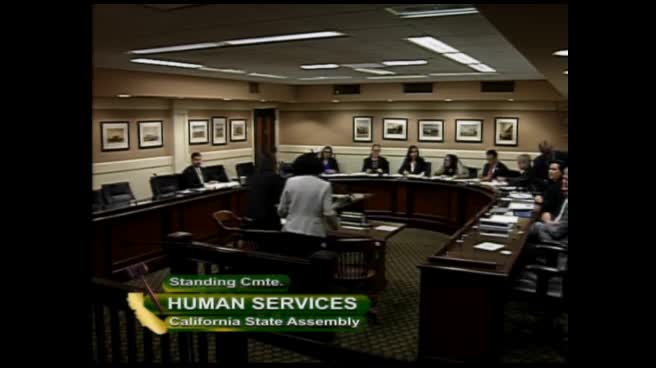 4MIN
Assembly Standing Committee on Human Services
Bill Author

Bill Co-Author(s):