AB 618: Local Agency Public Construction Act: job order contracting: school districts: community college districts.
- Session Year: 2017-2018
- House: Assembly
- Latest Version Date: 2017-09-26
The Local Agency Public Construction Act authorizes job order contracting for school districts until January 1, 2022. The act restricts job order contracting to school districts that have entered into a project labor agreement or agreements, as defined, that will apply to all public works in excess of $25,000 undertaken by the school district through at least December 31, 2021, regardless of what contracting procedure is used to award that work. The act excludes any architect, engineer, or consultant retained by the school district to assist in the development of the job order contract documents from participation in the preparation of a bid with any job order contractor. The act requires job order contractors to submit a questionnaire to the school district containing specified information verified under oath.
This bill would revise that restriction to restrict job order contracting under the act to school districts that have entered into a project labor agreement or agreements that will apply to all public works awarded through job order contracting and to all other public works that exceed a monetary threshold set by the school district. The bill would additionally exclude an architect, engineer, or consultant retained to assist the school district in the development of the job order contract documents from bidding. The bill would also exclude contractors retained to assist the school district from bidding or participating in the preparation of a bid with any job order contractor.
The bill would authorize job order contracting for community college districts in a manner similar to that authorized by existing law for school districts, with modifications that parallel those proposed above for school districts, until January 1, 2022. The bill would restrict job order contracting pursuant to the bill to community college districts that have entered into a project labor agreement or agreements, as defined, that will apply to all public works awarded through job order contracting and to all other public works of the community college district that exceed a monetary threshold set by the community college district through at least December 31, 2021, regardless of what contracting procedure is used to award that work. The bill would require job order contractors to submit a questionnaire to the community college districts containing specified information verified under oath. By expanding the crime of perjury, this bill would impose a state-mandated local program.
The California Constitution requires the state to reimburse local agencies and school districts for certain costs mandated by the state. Statutory provisions establish procedures for making that reimbursement.
This bill would provide that no reimbursement is required by this act for a specified reason.
The Local Agency Public Construction Act authorizes job order contracting for school districts until January 1, 2022. The act restricts job order contracting to school districts that have entered into a project labor agreement or agreements, as defined, that will apply to all public works in excess of $25,000 undertaken by the school district through at least December 31, 2021, regardless of what contracting procedure is used to award that work. The act excludes any architect, engineer, or consultant retained by the school district to assist in the development of the job order contract documents from participation in the preparation of a bid with any job order contractor. The act requires job order contractors to submit a questionnaire to the school district containing specified information verified under oath.
This bill would revise that restriction to restrict job order contracting under the act to school districts that have entered into a project labor agreement or agreements that will apply to all public works awarded through job order contracting and to all other public works that exceed a monetary threshold set by the school district. The bill would additionally exclude an architect, engineer, or consultant retained to assist the school district in the development of the job order contract documents from bidding. The bill would also exclude contractors retained to assist the school district from bidding or participation in the preparation of a bid with any job order contractor.
The bill would authorize job order contracting for community college districts in a manner similar to that authorized by existing law for school districts districts, with modifications that parallel those proposed above for school districts, until January 1, 2022. The bill would restrict job order contracting pursuant to the bill to community college districts that have entered into a project labor agreement or agreements, as defined, that will apply to all public works awarded through job order contracting and to all other public works of the community college district that exceed a monetary threshold set by the community college district through at least December 31, 2021, regardless of what contracting procedure is used to award that work. The bill would require job order contractors to submit a questionnaire to the community college districts containing specified information verified under oath. By expanding the crime of perjury, this bill would impose a state-mandated local program.
The California Constitution requires the state to reimburse local agencies and school districts for certain costs mandated by the state. Statutory provisions establish procedures for making that reimbursement.
This bill would provide that no reimbursement is required by this act for a specified reason.
The Local Agency Public Construction Act authorizes job order contracting for school districts until January 1, 2022. The act restricts job order contracting to school districts that have entered into a project labor agreement or agreements, as defined, that will apply to all public works in excess of $25,000 undertaken by the school district. district through at least December 31, 2021, regardless of what contracting procedure is used to award that work. The act requires job order contractors to submit a questionnaire to the school district containing specified information verified under oath.
This bill would revise that restriction to restrict job order contracting under the act to school districts that have entered into a project labor agreement or agreements that will apply to all public works awarded through job order contracting and to all other public works that exceed a monetary threshold set by the school district.
ThisThe bill would authorize job order contracting in a similar manner for community college districts in a manner similar to that authorized by existing law for school districts until January 1, 2022. The bill would restrict job order contracting pursuant to the bill to community college districts that have entered into a project labor agreement or agreements, as defined, that will apply to all public works in excess of $25,000 undertaken awarded through job order contracting and to all other public works of the community college district that exceed a monetary threshold set by the community college district through at least December 31, 2021, regardless of what contracting procedure is used to award that work. The bill would require job order contractors to submit a questionnaire to the community college districts containing specified information verified under oath. By expanding the crime of perjury, this bill would impose a state-mandated local program.
The California Constitution requires the state to reimburse local agencies and school districts for certain costs mandated by the state. Statutory provisions establish procedures for making that reimbursement.
This bill would provide that no reimbursement is required by this act for a specified reason.
The Local Agency Public Construction Act authorizes job order contracting for school districts until January 1, 2022. The act restricts job order contracting to school districts that have entered into a project labor agreement or agreements, as defined, that will apply to all public works in excess of $25,000 undertaken by the school district. The act requires job order contractors to submit a questionnaire to the school district containing specified information verified under oath.
This bill would authorize job order contracting in a similar manner for community college districts until January 1, 2022. The bill would restrict job order contracting pursuant to the bill to community college districts that have entered into a project labor agreement or agreements, as defined, that will apply to all public works in excess of $25,000 undertaken by the community college through at least December 31, 2021, regardless of what contracting procedure is used to award that work. The bill would require job order contractors to submit a questionnaire to the community college districts containing specified information verified under oath. By expanding the crime of perjury, this bill would impose a state-mandated local program.
The California Constitution requires the state to reimburse local agencies and school districts for certain costs mandated by the state. Statutory provisions establish procedures for making that reimbursement.
This bill would provide that no reimbursement is required by this act for a specified reason.
The Legislature finds and declares all of the following:
(a)It is the intent of the Legislature, in enacting this article, to demonstrate an alternative and optional procedure for bidding of public works projects that is applicable only to community college districts. The Legislature has previously authorized the use of this alternative and optional procedure only for school districts.
(b)Districts should be able to utilize cost-effective options for the delivery of public works projects, in accordance with the national trend, which include authorizations in California, to allow public entities to utilize job order contracts as a project delivery method.
(c)The benefits of a job order contract project delivery system include accelerated completion of the projects, cost savings, and reduction of construction contracting complexity for the district.
(d)The job order contracting approach should be used for the purposes of reducing project cost and expediting project completion.
(e)The availability of job order contracting as a project delivery method will not preclude the use of traditional methods of project delivery if a traditional method results in higher cost savings.
(f)It is the intent of the Legislature that job order contracts be competitively bid and awarded to the bidders providing the most qualified responsive bids. It is further the intent of the Legislature that districts use the job order contract process pursuant to this article only if the district has entered into a project labor agreement that meets the requirements of Section 2500 for all its public works projects.
20665.21.As used in this article:
(a)Adjustment factor means the job order contractors competitively bid adjustment to the community college districts prices as published in the unit price catalog.
(b)Indefinite quantity means one or more of the construction tasks listed in the unit price catalog.
(c)Job order means a firm, fixed priced, lump-sum order issued by the school district to a job order contractor for a definite project scope of work as compiled from the unit price catalog to be performed pursuant to a job order contract.
(d)Job order contract means a contract, awarded to a most qualified bidder as described in paragraph (1) of subdivision (b) of Section 20665.24, between the community college district and a licensed, bonded, and general liability insured contractor in which the contractor agrees to a fixed period, fixed-unit price, and indefinite quantity contract that provides for the use of job orders for public works or maintenance projects.
(e)Job order contract technical specifications means a book, published by the community college district, detailing the technical specifications with regard to quality of materials and workmanship to be used by the job order contractor in accomplishing the tasks listed in the unit price catalog.
(f)Job order contractor means a licensed, bonded, and general liability insured contractor awarded a job order contract.
(g)Offer to perform work means the job order contractors proposal for a specific job order.
(h)Plans and specifications means the unit price catalog and the job order contract technical specifications. The scope of work to be performed with a job order contract is potentially, but not necessarily, all the tasks published in the unit price catalog.
(i)Project means the specific requirements and work to be accomplished by the job order contractor in connection with an individual job order.
(j)Project labor agreement means an agreement that meets the requirements of Section 2500.
(k)Project scope of work means the document and related drawings, specifications, and writings referenced therein which together set forth the specific requirements and work to be accomplished by the job order contractor in connection with an individual job order.
(l)Proposal means the job order contractor prepared document quoting those construction tasks listed in the unit price catalog that the job order contractor requires to complete the project scope of work, together with the appropriate quantities of each task. The pricing of each task shall be accomplished by multiplying the construction task unit price by the proposed quantity and the contractors competitively bid adjustment factor. The proposal shall also contain a schedule for the completion of a specific project scope of work as requested by the community college district. The proposal may also contain approved drawings, work schedule, permits, or other documentation as the community college district may require for a specific job order. The proposal shall be certified as contract compliant by a reviewer independent of the contractor.
(m)Public works has the same meaning as in Chapter 1 (commencing with Section 1720) of Part 7 of Division 2 of the Labor Code.
(n)Public works project has the same meaning as public project, as defined in Section 22002.
(o)Subcontractor means any person, firm, or corporation, other than the employees of the job order contractor, who is bonded and general liability insured and who contracts to furnish labor, or labor and materials, at the worksite or in connection with a job order, whether directly or indirectly on behalf of the job order contractor.
(p)Community college district means any community college district.
(q)Unit price catalog means a book containing specific construction tasks and the unit prices to install or demolish that construction. The listed tasks shall be based on generally accepted industry standards and information, where available, for various items of work to be performed by the job order contractor. The prices shall include the cost of materials, labor, and equipment for performing the items of work. The prices shall not include overhead and profit. All unit prices shall be developed using local prevailing wages.
20665.22.Provisions in this article only apply to community college districts that choose to utilize job order contracting. A community college district may utilize job order contracting, when permitted by this article, as an alternative to any contracting procedures that the community college district is otherwise authorized or required by law to use.
20665.23.(a)A community college district may utilize job order contracting pursuant to this article only if the community college district has entered into a project labor agreement or agreements that will apply to all public works awarded through job order contracting and to all other public works of the community college district that exceed a monetary threshold set by the community college district through at least December 31, 2021, regardless of what contracting procedure is used to award that work.
(b)A community college district shall prepare an execution plan for all modernization projects that may be eligible for job order contracting pursuant to this article. The community college district shall select from that plan a sufficient number of projects to be initiated as job order contracts during each calendar year and shall determine for each selected project that job order contracting will reduce the total cost of that project. Job order contracting shall not be used if the community college district finds that it will increase the total cost of the project.
20665.24.Bidding for job order contracts shall progress as follows:
(a)(1)A community college district shall prepare a set of documents for job order contracts. The documents shall include a unit price catalog and preestablished unit prices, job order contract technical specifications, and any other information deemed necessary to describe adequately the community college districts needs.
(2)Any architect, engineer, consultant, or contractor retained by the community college district to assist in the development of the job order contract documents shall not be eligible to bid or to participate in the preparation of a bid with any job order contractor.
(b)Based on the documents prepared under subdivision (a), a community college district shall prepare a request for bid that invites prequalified job order contractors to submit competitive sealed bids in the manner prescribed by the community college district.
(1)(A)The prequalified job order contractors, as determined by a community college district, shall bid one or more adjustment factors to the unit prices listed in the unit price catalog based on the job order contract technical specifications. Awards shall be made to the prequalified bidders that the community college district determines to be the most qualified based upon preestablished criteria made by a community college district. The prequalified bidders shall be in compliance with a community college districts project labor agreement.
(B)Compliance shall constitute no more than three major violations on any community college district projects within the last three years. If a contractor has more than three violations within a three-year period of time, the community college district shall seek administrative review of the violations. Violations will include, but are not limited to, the following:
(i)Failure to register core workers with the appropriate building trade union.
(ii)Failure to assign apprentices in accordance with Section 1777.5 of the Labor Code.
(iii)Failure to comply with subdivision (c) of Section 20665.25.
(iv)Incorrect assignment of work in accordance with the community college districts project labor agreement.
(2)The community college district may award multiple job order contracts through a request for bid. Job order contracts shall be awarded to the most qualified prequalified bidders described in this subdivision.
(3)The request for bids may encourage the participation of local construction firms and the use of local subcontractors.
(c)(1)A community college district shall establish a procedure to prequalify job order contractors using a standard questionnaire that includes, at a minimum, the issues covered by the standardized questionnaire and model guidelines for rating bidders developed by the Department of Industrial Relations pursuant to subdivision (a) of Section 20101. This questionnaire shall require information including, but not limited to, all of the following:
(A)If the job order contractor is a partnership, limited partnership, or other association, a listing of all of the partners or association members known at the time of bid submission who will participate in the job order contract.
(B)Evidence that the members of the job order contractor have the capacity to complete projects of similar size, scope, or complexity, and that proposed key personnel have sufficient experience and training to competently manage the construction of the project, as well as a financial statement that assures the community college district that the job order contractor has the capacity to complete the project.
(C)The licenses, registration, and credentials required to perform construction, including, but not limited to, information on the revocation or suspension of any license, credential, or registration.
(D)Evidence that establishes that the job order contractor has the capacity to obtain all required payment and performance bonding and liability insurance.
(E)Information concerning workers compensation experience history, worker safety programs, and apprenticeship programs.
(F)A full disclosure regarding all of the following that are applicable:
(i)Any serious or willful violation of Part 1 (commencing with Section 6300) of Division 5 of the Labor Code or the federal Occupational Safety and Health Act of 1970 (Public Law 91-596), settled against any member of the job order contractor.
(ii)Any debarment, disqualification, or removal from a federal, state, or local government public works project.
(iii)Any instance where the job order contractor, or its owners, officers, or managing employees submitted a bid on a public works project and were found to be nonresponsive, or were found by an awarding body not to be a responsible bidder.
(iv)Any instance where the job order contractor, or its owners, officers, or managing employees defaulted on a construction contract.
(v)Any violations of the Contractors State License Law (Chapter 9 (commencing with Section 7000) of Division 3 of the Business and Professions Code), excluding alleged violations of federal or state law regarding the payment of wages, benefits, apprenticeship requirements, or personal income tax withholding, or of Federal Insurance Contribution Act (FICA) withholding requirements settled against any member of the job order contractor.
(vi)Any bankruptcy or receivership of any member of the job order contractor, including, but not limited to, information concerning any work completed by a surety.
(vii)Any settled adverse claims, disputes, or lawsuits between the owner of a public works project and any member of the job order contractor during the five years preceding submission of a bid under this article, in which the claim, settlement, or judgment exceeds fifty thousand dollars ($50,000). Information shall also be provided concerning any work completed by a surety during this period.
(G)In the case of a partnership or any association that is not a legal entity, a copy of the agreement creating the partnership or association and specifying that all partners or association members agree to be fully liable for the performance under the job order contract.
(2)The information required under this subdivision shall be verified under oath by the entity and its members in the manner in which civil pleadings in civil actions are verified. Information that is not a public record under the California Public Records Act (Chapter 3.5 (commencing with Section 6250) of Division 7 of Title 1 of the Government Code) shall not be open to public inspection.
20665.25.(a)The maximum total dollar amount that may be awarded under a single job order contract shall not exceed five million dollars ($5,000,000) in the first term of the job order contract and, if extended or renewed pursuant to subdivision (b), a maximum of ten million dollars ($10,000,000) over the subsequent two terms of the job order contract.
(b)Job order contracts may be executed for an initial contract term of no more than 12 months, with the option of extending or renewing the job order contract for two 12-month periods. The term of the job order contract shall be for the contract term or whenever the maximum value of the contract is achieved, whichever is less. All extensions or renewals shall be priced as provided in the request for bids. The extension or renewal shall be mutually agreed to by the community college district and the job order contractor.
(c)The community college district may issue job orders to the job order contractor that has been awarded the job order contract. The job order issued to the job order contractor shall not commence for seven days from the time the job order was issued and the job order contractor shall provide a minimum of seven days notice for the addition of any subcontractor or substitution of any subcontractor as described in subdivision (e) of Section 20665.26. The job order shall be based on a project scope of work prepared by the community college district as well as a proposal from the job order contractor who is awarded the job order contract. No single job order may exceed one million dollars ($1,000,000).
(d)The amounts specified in subdivisions (a) and (c) shall be adjusted on January 1, 2018, as if this section was operative beginning January 1, 2004, to reflect the percentage change in the California Consumer Price Index, and shall be adjusted each January 1 thereafter to reflect the percentage change in the California Consumer Price Index.
(e)It is unlawful to split or separate into smaller job orders any project for the purpose of evading the cost limitation provisions of this article.
(f)All work performed under the job order contract shall be covered by a project labor agreement.
(g)Any change or alteration to a job order shall be in compliance with Section 20118.4.
20665.26.(a)All work bid under the job order contract shall comply with Chapter 4 (commencing with Section 4100) of Part 1 and is subject to all of the penalties and provisions set forth in that chapter.
(b)For purposes of this article, if the primary job order contractor chooses to use subcontractors, the primary job order contractor is required to verify that the subcontractors possess the appropriate licenses and credentials required to perform construction.
(c)Notwithstanding subdivision (a), the primary job order contractor may use subcontractors that are not listed at the time the job order is issued if the work to be performed under that job order is less than ten thousand dollars ($10,000).
(d)If the primary job order contractor chooses to use a subcontractor that is not listed at the time of bid to perform work on a job order, all of the following apply:
(1)The primary job order contractor shall provide public notice of the availability of work to be subcontracted by trade. The public notice shall include the scope of work; the project location; the name, address, and the telephone number of the primary job order contractor; and the closing date, time, and location for sealed bids to be submitted.
(2)The primary job order contractor shall take sealed bids from the subcontractors solicited for the proposal. These bids shall be publicly opened at a prescribed time and place by the primary job order contractor. After the bids are opened, the job order contractor shall notify the community college district which subcontractor was selected.
(3)The notification shall include every subcontractor for all tiers and shall establish the authorized subcontractor list for the job order. Work shall not commence prior to seven days notice of the established subcontractor list and the subsequent addition of any subcontractor to the job order.
(4)The notification shall identify the scope of the work to be performed by each subcontractor to the job order, broken down by craft. If a subcontractor performs multiple crafts, the job order contractor shall identify the work of each craft to be performed.
(e)If the primary job order contractor chooses to make a substitution to the subcontractor list, the primary job order contractor shall provide a minimum of seven days notice to the community college district along with justification as to the need for the substitution. The community college district may request a hearing to evaluate the substitution request, which shall be in accordance with Chapter 4 (commencing with Section 4100) of Part 1.
(f)If the community college district determines that there has been a violation of Chapter 4 (commencing with Section 4100) of Part 1, including bid shopping by the primary job order contractor, the community college district may terminate the job order or the contractor may lose authorization to proceed with awarded work subject to the community college districts administrative due process review, if that review is established pursuant to the community college districts project labor agreement. If the community college district determines that a job order contractor has violated any provision set forth in Chapter 4 (commencing with Section 4100) of Part 1, the community college district may declare the contractor ineligible for future job orders and may result in a loss of prequalification status for a period of time to be determined by the community college district.
20665.27.(a)A job order contract shall set forth in the general conditions of the job order contract the party or parties responsible for seeing that the provisions of Article 2 (commencing with Section 1770) of Chapter 1 of Part 7 of Division 2 of the Labor Code are complied with.
(b)For purposes of job order contracting, prevailing wages when required to be paid shall apply to all work ordered under the job order contract regardless of thresholds set forth in Section 1771.5 of the Labor Code.
(c)The job order contractor shall pay the prevailing wage in effect at the time the job order is issued by the community college district and all increases as published by the Department of Industrial Relations for the term of the job order contract, including all overtime, holiday, and shift provisions published by the Department of Industrial Relations.
(d)The community college district shall designate one individual to act as a monitor to inspect job sites for labor compliance violations at the request of the designated labor representative in its project labor agreement.
20665.28.A willful violation of Section 20665.26 occurs when the job order contractor or subcontractor knew or reasonably should have known of his or her obligations under the public works law and deliberately fails or refuses to comply with its provisions. The community college district using job order contracting shall publish and distribute to the Labor Commissioner a list of all job order contractors or subcontractors who violate this provision and the community college district shall not award a job order contract or any future job orders under an existing job order contract to any contractor or subcontractor who violates this provision during the effective period of debarment of the contractor or subcontractor.
20665.29.For purposes of employment of apprentices on job order contracts, when the individual job order involves more than thirty thousand dollars ($30,000) or 20 working days, all general contractors or subcontractors shall at all times be in compliance with Section 1777.5 of the Labor Code and shall comply with the following:
(a)Prior to commencing work on an individual job order, every contractor shall submit job order award information to an applicable apprenticeship program that can supply apprentices to the site of the job order. The information submitted shall include an estimate of the journeyman hours to be performed under the contract, the number of apprenticeships proposed to be employed, and the approximate dates the apprentices would be employed. A copy of this information shall also be submitted to the awarding agency if requested by the awarding agency.
(b)The ratio of work performed by apprentices to journeymen employed in a particular craft or trade on the job order may be no higher than the ratio stipulated in the apprenticeship standard under which the apprenticeship program operates where the job order contractor agrees to be bound by those standards but, except as otherwise provided in Section 1777.5 of the Labor Code, in no case shall the ratio be less than one hour of apprenticeship work for every five hours of journeyman work.
(c)Every apprentice employed under the job order contract shall be paid the prevailing rate of per diem wages for apprentices in the trade to which he or she is registered and shall be employed only at the work of the craft or trade to which he or she is registered.
(d)Every apprentice employed under the job order contract shall be hired from the local joint labor management apprenticeship committee that has jurisdiction in the geographic area of the project.
20665.30.A job order contractor or subcontractor that knowingly violates the provisions involving employment of apprentices shall forfeit as a civil penalty an amount not exceeding one hundred dollars ($100) for each full calendar day of noncompliance. The amount of this penalty shall be based on consideration of whether the violation was a good faith mistake due to inadvertence. A contractor or subcontractor that knowingly commits a second or subsequent violation of the provisions involving employment of apprentices within a three-year period where the noncompliance results in apprenticeship training not being provided as required, shall forfeit as a civil penalty a sum of not more than three hundred dollars ($300) for each full calendar day of noncompliance and shall not be awarded any further job orders under the job order contract and shall be precluded for a period of one year from bidding on any future job order contracts.
20665.31.In order to prevent fraud, waste, and abuse, a community college district adopting job order contracting shall do all of the following:
(a)Prepare for each individual job order developed under a job order contract an independent community college district estimate. The estimate will be prepared prior to the receipt of the contractors offer to perform work and will be compared to the contractors proposed price to determine the reasonableness of that price before issuance of any job order. The basis for any adjustments to the community college district estimate is to be documented. If the contractors proposal for a given job order is found to be unreasonable, not cost effective, or undesirable, the community college district is under no obligation to issue the job order to the job order contractor, and may instead utilize any other available procurement procedures.
(b)The community college district shall not issue a job order until the job order has been reviewed and approved by the appropriate level of management.
(c)Once a job order has been issued, all documents pertaining to preparation and approval of the job order, including the independent community college district estimate, shall be available for public review.
20665.32.A community college district that adopts the job order contracting process shall also adopt a payment resolution process which may include, but not be limited to, the convening of a payment resolution committee.
20665.33.This article shall remain in effect only until January 1, 2022, and as of that date is repealed.
SEC. 2.Section 20919.21 of the Public Contract Code is amended to read:20919.21.As used in this chapter:
(a)Adjustment factor means the job order contractors competitively bid adjustment to the school districts prices as published in the unit price catalog.
(b)Indefinite quantity means one or more of the construction tasks listed in the unit price catalog.
(c)Job order means a firm, fixed priced, lump-sum order issued by the school district to a job order contractor for a definite project scope of work as compiled from the unit price catalog to be performed pursuant to a job order contract.
(d)Job order contract means a contract, awarded to a most qualified bidder as described in paragraph (1) of subdivision (b) of Section 20919.24, between the school district and a licensed, bonded, and general liability insured contractor in which the contractor agrees to a fixed period, fixed-unit price, and indefinite quantity contract that provides for the use of job orders for public works or maintenance projects.
(e)Job order contract technical specifications means a book, published by the school district, detailing the technical specifications with regard to quality of materials and workmanship to be used by the job order contractor in accomplishing the tasks listed in the unit price catalog.
(f)Job order contractor means a licensed, bonded, and general liability insured contractor awarded a job order contract.
(g)Offer to perform work means the job order contractors proposal for a specific job order.
(h)Plans and specifications means the unit price catalog and the job order contract technical specifications. The scope of work to be performed with a job order contract is potentially, but not necessarily, all the tasks published in the unit price catalog.
(i)Project means the specific requirements and work to be accomplished by the job order contractor in connection with an individual job order.
(j)Project labor agreement means an agreement that meets the requirements of Section 2500.
(k)Project scope of work means the document and related drawings, specifications, and writings referenced therein which together set forth the specific requirements and work to be accomplished by the job order contractor in connection with an individual job order.
(l)Proposal means the job order contractor prepared document quoting those construction tasks listed in the unit price catalog that the job order contractor requires to complete the project scope of work, together with the appropriate quantities of each task. The pricing of each task shall be accomplished by multiplying the construction task unit price by the proposed quantity and the contractors competitively bid adjustment factor. The proposal shall also contain a schedule for the completion of a specific project scope of work as requested by the school district. The proposal may also contain approved drawings, work schedule, permits, or other documentation as the school district may require for a specific job order. The proposal shall be certified as contract compliant by a reviewer independent of the contractor.
(m)Public works has the same meaning as in Chapter 1 (commencing with Section 1720) of Part 7 of Division 2 of the Labor Code.
(n)Public works project has the same meaning as public project, as defined in Section 22002.
(o)Subcontractor means any person, firm, or corporation, other than the employees of the job order contractor, who is bonded and general liability insured and who contracts to furnish labor, or labor and materials, at the worksite or in connection with a job order, whether directly or indirectly on behalf of the job order contractor.
(p)School district means any school district.
(q)Unit price catalog means a book containing specific construction tasks and the unit prices to install or demolish that construction. The listed tasks shall be based on generally accepted industry standards and information, where available, for various items of work to be performed by the job order contractor. The prices shall include the cost of materials, labor, and equipment for performing the items of work. The prices shall not include overhead and profit. All unit prices shall be developed using local prevailing wages.
SEC. 3.Section 20919.23 of the Public Contract Code is amended to read:20919.23.(a)The school district may utilize job order contracting pursuant to this article only if the school district has entered into a project labor agreement or agreements that will apply to all public works awarded through job order contracting and to all other public works of the school district that exceed a monetary threshold set by the school district through at least December 31, 2021, regardless of what contracting procedure is used to award that work.
(b)The school district shall prepare an execution plan for all modernization projects that may be eligible for job order contracting pursuant to this article. The school district shall select from that plan a sufficient number of projects to be initiated as job order contracts during each calendar year and shall determine for each selected project that job order contracting will reduce the total cost of that project. Job order contracting shall not be used if the school district finds that it will increase the total cost of the project.
SEC. 4.Section 20919.24 of the Public Contract Code is amended to read:20919.24.Bidding for job order contracts shall progress as follows:
(a)(1)The school district shall prepare a set of documents for job order contracts. The documents shall include a unit price catalog and preestablished unit prices, job order contract technical specifications, and any other information deemed necessary to describe adequately the school districts needs.
(2)Any architect, engineer, consultant, or contractor retained by the school district to assist in the development of the job order contract documents shall not be eligible to bid or to participate in the preparation of a bid with any job order contractor.
(b)Based on the documents prepared under subdivision (a), the school district shall prepare a request for bid that invites prequalified job order contractors to submit competitive sealed bids in the manner prescribed by the school district.
(1)(A)The prequalified job order contractors, as determined by the school district, shall bid one or more adjustment factors to the unit prices listed in the unit price catalog based on the job order contract technical specifications. Awards shall be made to the prequalified bidders that the school district determines to be the most qualified based upon preestablished criteria made by the school district. The prequalified bidders shall be in compliance with the school districts project labor agreement.
(B)Compliance shall constitute no more than three major violations on any school district projects within the last three years. If a contractor has more than three violations within a three-year period of time, the school district shall seek administrative review of the violations. Violations will include, but are not limited to, the following:
(i)Failure to register core workers with the appropriate building trade union.
(ii)Failure to assign apprentices in accordance with Section 1777.5 of the Labor Code.
(iii)Failure to comply with subdivision (c) of Section 20919.25.
(iv)Incorrect assignment of work in accordance with the school districts project labor agreement.
(2)The school district may award multiple job order contracts through a request for bid. Job order contracts shall be awarded to the most qualified prequalified bidders described in this subdivision.
(3)The request for bids may encourage the participation of local construction firms and the use of local subcontractors.
(c)(1)The school district shall establish a procedure to prequalify job order contractors using a standard questionnaire that includes, at a minimum, the issues covered by the standardized questionnaire and model guidelines for rating bidders developed by the Department of Industrial Relations pursuant to subdivision (a) of Section 20101. This questionnaire shall require information including, but not limited to, all of the following:
(A)If the job order contractor is a partnership, limited partnership, or other association, a listing of all of the partners or association members known at the time of bid submission who will participate in the job order contract.
(B)Evidence that the members of the job order contractor have the capacity to complete projects of similar size, scope, or complexity, and that proposed key personnel have sufficient experience and training to competently manage the construction of the project, as well as a financial statement that assures the school district that the job order contractor has the capacity to complete the project.
(C)The licenses, registration, and credentials required to perform construction, including, but not limited to, information on the revocation or suspension of any license, credential, or registration.
(D)Evidence that establishes that the job order contractor has the capacity to obtain all required payment and performance bonding and liability insurance.
(E)Information concerning workers compensation experience history, worker safety programs, and apprenticeship programs.
(F)A full disclosure regarding all of the following that are applicable:
(i)Any serious or willful violation of Part 1 (commencing with Section 6300) of Division 5 of the Labor Code or the federal Occupational Safety and Health Act of 1970 (Public Law 91-596), settled against any member of the job order contractor.
(ii)Any debarment, disqualification, or removal from a federal, state, or local government public works project.
(iii)Any instance where the job order contractor, or its owners, officers, or managing employees submitted a bid on a public works project and were found to be nonresponsive, or were found by an awarding body not to be a responsible bidder.
(iv)Any instance where the job order contractor, or its owners, officers, or managing employees defaulted on a construction contract.
(v)Any violations of the Contractors State License Law (Chapter 9 (commencing with Section 7000) of Division 3 of the Business and Professions Code), excluding alleged violations of federal or state law regarding the payment of wages, benefits, apprenticeship requirements, or personal income tax withholding, or of Federal Insurance Contribution Act (FICA) withholding requirements settled against any member of the job order contractor.
(vi)Any bankruptcy or receivership of any member of the job order contractor, including, but not limited to, information concerning any work completed by a surety.
(vii)Any settled adverse claims, disputes, or lawsuits between the owner of a public works project and any member of the job order contractor during the five years preceding submission of a bid under this article, in which the claim, settlement, or judgment exceeds fifty thousand dollars ($50,000). Information shall also be provided concerning any work completed by a surety during this period.
(G)In the case of a partnership or any association that is not a legal entity, a copy of the agreement creating the partnership or association and specifying that all partners or association members agree to be fully liable for the performance under the job order contract.
(2)The information required under this subdivision shall be verified under oath by the entity and its members in the manner in which civil pleadings in civil actions are verified. Information that is not a public record under the California Public Records Act (Chapter 3.5 (commencing with Section 6250) of Division 7 of Title 1 of the Government Code) shall not be open to public inspection.
SEC. 5.No reimbursement is required by this act pursuant to Section 6 of Article XIIIB of the California Constitution because the only costs that may be incurred by a local agency or school district will be incurred because this act creates a new crime or infraction, eliminates a crime or infraction, or changes the penalty for a crime or infraction, within the meaning of Section 17556 of the Government Code, or changes the definition of a crime within the meaning of Section 6 of Article XIIIB of the California Constitution.
The Legislature finds and declares all of the following:
(a)It is the intent of the Legislature, in enacting this article, to demonstrate an alternative and optional procedure for bidding of public works projects that is applicable only to community college districts. The Legislature has previously authorized the use of this alternative and optional procedure only for school districts.
(b)Districts should be able to utilize cost-effective options for the delivery of public works projects, in accordance with the national trend, which include authorizations in California, to allow public entities to utilize job order contracts as a project delivery method.
(c)The benefits of a job order contract project delivery system include accelerated completion of the projects, cost savings, and reduction of construction contracting complexity for the district.
(d)The job order contracting approach should be used for the purposes of reducing project cost and expediting project completion.
(e)The availability of job order contracting as a project delivery method will not preclude the use of traditional methods of project delivery if a traditional method results in higher cost savings.
(f)It is the intent of the Legislature that job order contracts be competitively bid and awarded to the bidders providing the most qualified responsive bids. It is further the intent of the Legislature that districts use the job order contract process pursuant to this article only if the district has entered into a project labor agreement that meets the requirements of Section 2500 for all its public works projects.
20665.21.As used in this article:
(a)Adjustment factor means the job order contractors competitively bid adjustment to the community college districts prices as published in the unit price catalog.
(b)Indefinite quantity means one or more of the construction tasks listed in the unit price catalog.
(c)Job order means a firm, fixed priced, lump-sum order issued by the school district to a job order contractor for a definite project scope of work as compiled from the unit price catalog to be performed pursuant to a job order contract.
(d)Job order contract means a contract, awarded to a most qualified bidder as described in paragraph (1) of subdivision (b) of Section 20665.24, between the community college district and a licensed, bonded, and general liability insured contractor in which the contractor agrees to a fixed period, fixed-unit price, and indefinite quantity contract that provides for the use of job orders for public works or maintenance projects.
(e)Job order contract technical specifications means a book, published by the community college district, detailing the technical specifications with regard to quality of materials and workmanship to be used by the job order contractor in accomplishing the tasks listed in the unit price catalog.
(f)Job order contractor means a licensed, bonded, and general liability insured contractor awarded a job order contract.
(g)Offer to perform work means the job order contractors proposal for a specific job order.
(h)Plans and specifications means the unit price catalog and the job order contract technical specifications. The scope of work to be performed with a job order contract is potentially, but not necessarily, all the tasks published in the unit price catalog.
(i)Project means the specific requirements and work to be accomplished by the job order contractor in connection with an individual job order.
(j)Project labor agreement means an agreement that meets the requirements of Section 2500.
(k)Project scope of work means the document and related drawings, specifications, and writings referenced therein which together set forth the specific requirements and work to be accomplished by the job order contractor in connection with an individual job order.
(l)Proposal means the job order contractor prepared document quoting those construction tasks listed in the unit price catalog that the job order contractor requires to complete the project scope of work, together with the appropriate quantities of each task. The pricing of each task shall be accomplished by multiplying the construction task unit price by the proposed quantity and the contractors competitively bid adjustment factor. The proposal shall also contain a schedule for the completion of a specific project scope of work as requested by the community college district. The proposal may also contain approved drawings, work schedule, permits, or other documentation as the community college district may require for a specific job order. The proposal shall be certified as contract compliant by a reviewer independent of the contractor.
(m)Public works has the same meaning as in Chapter 1 (commencing with Section 1720) of Part 7 of Division 2 of the Labor Code.
(n)Public works project has the same meaning as public project, as defined in Section 22002.
(o)Subcontractor means any person, firm, or corporation, other than the employees of the job order contractor, who is bonded and general liability insured and who contracts to furnish labor, or labor and materials, at the worksite or in connection with a job order, whether directly or indirectly on behalf of the job order contractor.
(p)Community college district means any community college district.
(q)Unit price catalog means a book containing specific construction tasks and the unit prices to install or demolish that construction. The listed tasks shall be based on generally accepted industry standards and information, where available, for various items of work to be performed by the job order contractor. The prices shall include the cost of materials, labor, and equipment for performing the items of work. The prices shall not include overhead and profit. All unit prices shall be developed using local prevailing wages.
20665.22.Provisions in this article only apply to community college districts that choose to utilize job order contracting. A community college district may utilize job order contracting, when permitted by this article, as an alternative to any contracting procedures that the community college district is otherwise authorized or required by law to use.
20665.23.(a)A community college district may utilize job order contracting pursuant to this article only if the community college district has entered into a project labor agreement or agreements that will apply to all public works awarded through job order contracting and to all other public works of the community college district that exceed a monetary threshold set by the community college district through at least December 31, 2021, regardless of what contracting procedure is used to award that work.
(b)A community college district shall prepare an execution plan for all modernization projects that may be eligible for job order contracting pursuant to this article. The community college district shall select from that plan a sufficient number of projects to be initiated as job order contracts during each calendar year and shall determine for each selected project that job order contracting will reduce the total cost of that project. Job order contracting shall not be used if the community college district finds that it will increase the total cost of the project.
20665.24.Bidding for job order contracts shall progress as follows:
(a)(1)A community college district shall prepare a set of documents for job order contracts. The documents shall include a unit price catalog and preestablished unit prices, job order contract technical specifications, and any other information deemed necessary to describe adequately the community college districts needs.
(2)Any architect, engineer, or consultant consultant, or contractor retained by the community college district to assist in the development of the job order contract documents shall not be eligible to bid or to participate in the preparation of a bid with any job order contractor.
(b)Based on the documents prepared under subdivision (a), a community college district shall prepare a request for bid that invites prequalified job order contractors to submit competitive sealed bids in the manner prescribed by the community college district.
(1)(A)The prequalified job order contractors, as determined by a community college district, shall bid one or more adjustment factors to the unit prices listed in the unit price catalog based on the job order contract technical specifications. Awards shall be made to the prequalified bidders that the community college district determines to be the most qualified based upon preestablished criteria made by a community college district. The prequalified bidders must shall be in compliance with a community college districts project labor agreement.
(B)Compliance shall constitute no more than three major violations on any community college district projects within the last three years. If a contractor has more than three violations within a three-year period of time, the community college district shall seek administrative review of the violations. Violations will include, but are not limited to, the following:
(i)Failure to register core workers with the appropriate building trade union.
(ii)Failure to assign apprentices in accordance with Section 1777.5 of the Labor Code.
(iii)Failure to comply with subdivision (c) of Section 20665.25.
(iv)Incorrect assignment of work in accordance with the community college districts project labor agreement.
(2)The community college district may award multiple job order contracts through a request for bid. Job order contracts shall be awarded to the most qualified prequalified bidders described in this subdivision.
(3)The request for bids may encourage the participation of local construction firms and the use of local subcontractors.
(c)(1)A community college district shall establish a procedure to prequalify job order contractors using a standard questionnaire that includes, at a minimum, the issues covered by the standardized questionnaire and model guidelines for rating bidders developed by the Department of Industrial Relations pursuant to subdivision (a) of Section 20101. This questionnaire shall require information including, but not limited to, all of the following:
(A)If the job order contractor is a partnership, limited partnership, or other association, a listing of all of the partners or association members known at the time of bid submission who will participate in the job order contract.
(B)Evidence that the members of the job order contractor have the capacity to complete projects of similar size, scope, or complexity, and that proposed key personnel have sufficient experience and training to competently manage the construction of the project, as well as a financial statement that assures the community college district that the job order contractor has the capacity to complete the project.
(C)The licenses, registration, and credentials required to perform construction, including, but not limited to, information on the revocation or suspension of any license, credential, or registration.
(D)Evidence that establishes that the job order contractor has the capacity to obtain all required payment and performance bonding and liability insurance.
(E)Information concerning workers compensation experience history, worker safety programs, and apprenticeship programs.
(F)A full disclosure regarding all of the following that are applicable:
(i)Any serious or willful violation of Part 1 (commencing with Section 6300) of Division 5 of the Labor Code or the federal Occupational Safety and Health Act of 1970 (Public Law 91-596), settled against any member of the job order contractor.
(ii)Any debarment, disqualification, or removal from a federal, state, or local government public works project.
(iii)Any instance where the job order contractor, or its owners, officers, or managing employees submitted a bid on a public works project and were found to be nonresponsive, or were found by an awarding body not to be a responsible bidder.
(iv)Any instance where the job order contractor, or its owners, officers, or managing employees defaulted on a construction contract.
(v)Any violations of the Contractors State License Law (Chapter 9 (commencing with Section 7000) of Division 3 of the Business and Professions Code), excluding alleged violations of federal or state law regarding the payment of wages, benefits, apprenticeship requirements, or personal income tax withholding, or of Federal Insurance Contribution Act (FICA) withholding requirements settled against any member of the job order contractor.
(vi)Any bankruptcy or receivership of any member of the job order contractor, including, but not limited to, information concerning any work completed by a surety.
(vii)Any settled adverse claims, disputes, or lawsuits between the owner of a public works project and any member of the job order contractor during the five years preceding submission of a bid under this article, in which the claim, settlement, or judgment exceeds fifty thousand dollars ($50,000). Information shall also be provided concerning any work completed by a surety during this period.
(G)In the case of a partnership or any association that is not a legal entity, a copy of the agreement creating the partnership or association and specifying that all partners or association members agree to be fully liable for the performance under the job order contract.
(2)The information required under this subdivision shall be verified under oath by the entity and its members in the manner in which civil pleadings in civil actions are verified. Information that is not a public record under the California Public Records Act (Chapter 3.5 (commencing with Section 6250) of Division 7 of Title 1 of the Government Code) shall not be open to public inspection.
20665.25.(a)The maximum total dollar amount that may be awarded under a single job order contract shall not exceed five million dollars ($5,000,000) in the first term of the job order contract and, if extended or renewed pursuant to subdivision (b), a maximum of ten million dollars ($10,000,000) over the subsequent two terms of the job order contract.
(b)Job order contracts may be executed for an initial contract term of no more than 12 months, with the option of extending or renewing the job order contract for two 12-month periods. The term of the job order contract shall be for the contract term or whenever the maximum value of the contract is achieved, whichever is less. All extensions or renewals shall be priced as provided in the request for bids. The extension or renewal shall be mutually agreed to by the community college district and the job order contractor.
(c)The community college district may issue job orders to the job order contractor that has been awarded the job order contract. The job order issued to the job order contractor shall not commence for seven days from the time the job order was issued and the job order contractor shall provide a minimum of seven days notice for the addition of any subcontractor or substitution of any subcontractor as described in subdivision (e) of Section 20665.26. The job order shall be based on a project scope of work prepared by the community college district as well as a proposal from the job order contractor who is awarded the job order contract. No single job order may exceed one million dollars ($1,000,000).
(d)The amounts specified in subdivisions (a) and (c) shall be adjusted on January 1, 2018, as if this section was operative beginning January 1, 2004, to reflect the percentage change in the California Consumer Price Index, and shall be adjusted each January 1 thereafter to reflect the percentage change in the California Consumer Price Index.
(e)It is unlawful to split or separate into smaller job orders any project for the purpose of evading the cost limitation provisions of this article.
(f)All work performed under the job order contract shall be covered by a project labor agreement.
(g)Any change or alteration to a job order shall be in compliance with Section 20118.4.
20665.26.(a)All work bid under the job order contract shall comply with Chapter 4 (commencing with Section 4100) of Part 1 and is subject to all of the penalties and provisions set forth in that chapter.
(b)For purposes of this article, if the primary job order contractor chooses to use subcontractors, the primary job order contractor is required to verify that the subcontractors possess the appropriate licenses and credentials required to perform construction.
(c)Notwithstanding subdivision (a), the primary job order contractor may use subcontractors that are not listed at the time the job order is issued if the work to be performed under that job order is less than ten thousand dollars ($10,000).
(d)If the primary job order contractor chooses to use a subcontractor that is not listed at the time of bid to perform work on a job order, all of the following apply:
(1)The primary job order contractor shall provide public notice of the availability of work to be subcontracted by trade. The public notice shall include the scope of work; the project location; the name, address, and the telephone number of the primary job order contractor; and the closing date, time, and location for sealed bids to be submitted.
(2)The primary job order contractor shall take sealed bids from the subcontractors solicited for the proposal. These bids shall be publicly opened at a prescribed time and place by the primary job order contractor. After the bids are opened, the job order contractor shall notify the community college district which subcontractor was selected.
(3)The notification shall include every subcontractor for all tiers and shall establish the authorized subcontractor list for the job order. Work shall not commence prior to seven days notice of the established subcontractor list and the subsequent addition of any subcontractor to the job order.
(4)The notification shall identify the scope of the work to be performed by each subcontractor to the job order, broken down by craft. If a subcontractor performs multiple crafts, the job order contractor shall identify the work of each craft to be performed.
(e)If the primary job order contractor chooses to make a substitution to the subcontractor list, the primary job order contractor shall provide a minimum of seven days notice to the community college district along with justification as to the need for the substitution. The community college district may request a hearing to evaluate the substitution request, which shall be in accordance with Chapter 4 (commencing with Section 4100) of Part 1.
(f)If the community college district determines that there has been a violation of Chapter 4 (commencing with Section 4100) of Part 1, including bid shopping by the primary job order contractor, the community college district may terminate the job order or the contractor may lose authorization to proceed with awarded work subject to the community college districts administrative due process review, if such that review is established pursuant to the community college districts project labor agreement. If the community college district determines that a job order contractor has violated any provision set forth in Chapter 4 (commencing with Section 4100) of Part 1, the community college district may declare the contractor ineligible for future job orders and may result in a loss of prequalification status for a period of time to be determined by the community college district.
20665.27.(a)A job order contract shall set forth in the general conditions of the job order contract the party or parties responsible for seeing that the provisions of Article 2 (commencing with Section 1770) of Chapter 1 of Part 7 of Division 2 of the Labor Code are complied with.
(b)For purposes of job order contracting, prevailing wages when required to be paid shall apply to all work ordered under the job order contract regardless of thresholds set forth in Section 1771.5 of the Labor Code.
(c)The job order contractor shall pay the prevailing wage in effect at the time the job order is issued by the community college district and all increases as published by the Department of Industrial Relations for the term of the job order contract, including all overtime, holiday, and shift provisions published by the Department of Industrial Relations.
(d)The community college district shall designate one individual to act as a monitor to inspect job sites for labor compliance violations at the request of the designated labor representative in its project labor agreement.
20665.28.A willful violation of Section 20665.26 occurs when the job order contractor or subcontractor knew or reasonably should have known of his or her obligations under the public works law and deliberately fails or refuses to comply with its provisions. The community college district using job order contracting shall publish and distribute to the Labor Commissioner a list of all job order contractors or subcontractors who violate this provision and the community college district shall not award a job order contract or any future job orders under an existing job order contract to any contractor or subcontractor who violates this provision during the effective period of debarment of the contractor or subcontractor.
20665.29.For purposes of employment of apprentices on job order contracts, when the individual job order involves more than thirty thousand dollars ($30,000) or 20 working days, all general contractors or subcontractors shall at all times be in compliance with Section 1777.5 of the Labor Code and shall comply with the following:
(a)Prior to commencing work on an individual job order, every contractor shall submit job order award information to an applicable apprenticeship program that can supply apprentices to the site of the job order. The information submitted shall include an estimate of the journeyman hours to be performed under the contract, the number of apprenticeships proposed to be employed, and the approximate dates the apprentices would be employed. A copy of this information shall also be submitted to the awarding agency if requested by the awarding agency.
(b)The ratio of work performed by apprentices to journeymen employed in a particular craft or trade on the job order may be no higher than the ratio stipulated in the apprenticeship standard under which the apprenticeship program operates where the job order contractor agrees to be bound by those standards but, except as otherwise provided in Section 1777.5 of the Labor Code, in no case shall the ratio be less than one hour of apprenticeship work for every five hours of journeyman work.
(c)Every apprentice employed under the job order contract shall be paid the prevailing rate of per diem wages for apprentices in the trade to which he or she is registered and shall be employed only at the work of the craft or trade to which he or she is registered.
(d)Every apprentice employed under the job order contract shall be hired from the local joint labor management apprenticeship committee that has jurisdiction in the geographic area of the project.
20665.30.A job order contractor or subcontractor that knowingly violates the provisions involving employment of apprentices shall forfeit as a civil penalty an amount not exceeding one hundred dollars ($100) for each full calendar day of noncompliance. The amount of this penalty shall be based on consideration of whether the violation was a good faith mistake due to inadvertence. A contractor or subcontractor that knowingly commits a second or subsequent violation of the provisions involving employment of apprentices within a three-year period where the noncompliance results in apprenticeship training not being provided as required, shall forfeit as a civil penalty a sum of not more than three hundred dollars ($300) for each full calendar day of noncompliance and shall not be awarded any further job orders under the job order contract and shall be precluded for a period of one year from bidding on any future job order contracts.
20665.31.In order to prevent fraud, waste, and abuse, a community college district adopting job order contracting shall do all of the following:
(a)Prepare for each individual job order developed under a job order contract an independent community college district estimate. The estimate will be prepared prior to the receipt of the contractors offer to perform work and will be compared to the contractors proposed price to determine the reasonableness of that price before issuance of any job order. The basis for any adjustments to the community college district estimate is to be documented. If the contractors proposal for a given job order is found to be unreasonable, not cost effective, or undesirable, the community college district is under no obligation to issue the job order to the job order contractor, and may instead utilize any other available procurement procedures.
(b)The community college district shall not issue a job order until the job order has been reviewed and approved by the appropriate level of management.
(c)Once a job order has been issued, all documents pertaining to preparation and approval of the job order, including the independent community college district estimate, shall be available for public review.
20665.32.A community college district that adopts the job order contracting process shall also adopt a payment resolution process which may include, but not be limited to, the convening of a payment resolution committee.
20665.33.This article shall remain in effect only until January 1, 2022, and as of that date is repealed.
SEC. 2.Section 20919.21 of the Public Contract Code is amended to read:20919.21.As used in this chapter:
(a)Adjustment factor means the job order contractors competitively bid adjustment to the school districts prices as published in the unit price catalog.
(b)Indefinite quantity means one or more of the construction tasks listed in the unit price catalog.
(c)Job order means a firm, fixed priced, lump-sum order issued by the school district to a job order contractor for a definite project scope of work as compiled from the unit price catalog to be performed pursuant to a job order contract.
(d)Job order contract means a contract, awarded to a most qualified bidder as described in paragraph (1) of subdivision (b) of Section 20919.24, between the school district and a licensed, bonded, and general liability insured contractor in which the contractor agrees to a fixed period, fixed-unit price, and indefinite quantity contract that provides for the use of job orders for public works or maintenance projects.
(e)Job order contract technical specifications means a book, published by the school district, detailing the technical specifications with regard to quality of materials and workmanship to be used by the job order contractor in accomplishing the tasks listed in the unit price catalog.
(f)Job order contractor means a licensed, bonded, and general liability insured contractor awarded a job order contract.
(g)Offer to perform work means the job order contractors proposal for a specific job order.
(h)Plans and specifications means the unit price catalog and the job order contract technical specifications. The scope of work to be performed with a job order contract is potentially, but not necessarily, all the tasks published in the unit price catalog.
(i)Project means the specific requirements and work to be accomplished by the job order contractor in connection with an individual job order.
(j)Project labor agreement means an agreement that meets the requirements of Section 2500.
(k)Project scope of work means the document and related drawings, specifications, and writings referenced therein which together set forth the specific requirements and work to be accomplished by the job order contractor in connection with an individual job order.
(l)Proposal means the job order contractor prepared document quoting those construction tasks listed in the unit price catalog that the job order contractor requires to complete the project scope of work, together with the appropriate quantities of each task. The pricing of each task shall be accomplished by multiplying the construction task unit price by the proposed quantity and the contractors competitively bid adjustment factor. The proposal shall also contain a schedule for the completion of a specific project scope of work as requested by the school district. The proposal may also contain approved drawings, work schedule, permits, or other documentation as the school district may require for a specific job order. The proposal shall be certified as contract compliant by a reviewer independent of the contractor.
(m)Public works has the same meaning as in Chapter 1 (commencing with Section 1720) of Part 7 of Division 2 of the Labor Code.
(n)Public works project has the same meaning as public project, as defined in Section 22002.
(o)Subcontractor means any person, firm, or corporation, other than the employees of the job order contractor, who is bonded and general liability insured and who contracts to furnish labor, or labor and materials, at the worksite or in connection with a job order, whether directly or indirectly on behalf of the job order contractor.
(p)School district means any school district.
(q)Unit price catalog means a book containing specific construction tasks and the unit prices to install or demolish that construction. The listed tasks shall be based on generally accepted industry standards and information, where available, for various items of work to be performed by the job order contractor. The prices shall include the cost of materials, labor, and equipment for performing the items of work. The prices shall not include overhead and profit. All unit prices shall be developed using local prevailing wages.
SEC. 2.SEC. 3.Section 20919.23 of the Public Contract Code is amended to read:20919.23.(a)The school district may utilize job order contracting pursuant to this article only if the school district has entered into a project labor agreement or agreements that will apply to all public works awarded through job order contracting and to all other public works of the school district that exceed a monetary threshold set by the school district through at least December 31, 2021, regardless of what contracting procedure is used to award that work.
(b)The school district shall prepare an execution plan for all modernization projects that may be eligible for job order contracting pursuant to this article. The school district shall select from that plan a sufficient number of projects to be initiated as job order contracts during each calendar year and shall determine for each selected project that job order contracting will reduce the total cost of that project. Job order contracting shall not be used if the school district finds that it will increase the total cost of the project.
SEC. 4.Section 20919.24 of the Public Contract Code is amended to read:20919.24.Bidding for job order contracts shall progress as follows:
(a)(1)The school district shall prepare a set of documents for job order contracts. The documents shall include a unit price catalog and preestablished unit prices, job order contract technical specifications, and any other information deemed necessary to describe adequately the school districts needs.
(2)Any architect, engineer, or consultant consultant, or contractor retained by the school district to assist in the development of the job order contract documents shall not be eligible to bid or to participate in the preparation of a bid with any job order contractor.
(b)Based on the documents prepared under subdivision (a), the school district shall prepare a request for bid that invites prequalified job order contractors to submit competitive sealed bids in the manner prescribed by the school district.
(1)(A)The prequalified job order contractors, as determined by the school district, shall bid one or more adjustment factors to the unit prices listed in the unit price catalog based on the job order contract technical specifications. Awards shall be made to the prequalified bidders that the school district determines to be the most qualified based upon preestablished criteria made by the school district. The prequalified bidders must shall be in compliance with the school districts project labor agreement.
(B)Compliance shall constitute no more than three major violations on any school district projects within the last three years. If a contractor has more than three violations within a three-year period of time, the school district shall seek administrative review of the violations. Violations will include, but are not limited to, the following:
(i)Failure to register core workers with the appropriate building trade union.
(ii)Failure to assign apprentices in accordance with Section 1777.5 of the Labor Code.
(iii)Failure to comply with subdivision (c) of Section 20919.25.
(iv)Incorrect assignment of work in accordance with the school districts project labor agreement.
(2)The school district may award multiple job order contracts through a request for bid. Job order contracts shall be awarded to the most qualified prequalified bidders described in this subdivision.
(3)The request for bids may encourage the participation of local construction firms and the use of local subcontractors.
(c)(1)The school district shall establish a procedure to prequalify job order contractors using a standard questionnaire that includes, at a minimum, the issues covered by the standardized questionnaire and model guidelines for rating bidders developed by the Department of Industrial Relations pursuant to subdivision (a) of Section 20101. This questionnaire shall require information including, but not limited to, all of the following:
(A)If the job order contractor is a partnership, limited partnership, or other association, a listing of all of the partners or association members known at the time of bid submission who will participate in the job order contract.
(B)Evidence that the members of the job order contractor have the capacity to complete projects of similar size, scope, or complexity, and that proposed key personnel have sufficient experience and training to competently manage the construction of the project, as well as a financial statement that assures the school district that the job order contractor has the capacity to complete the project.
(C)The licenses, registration, and credentials required to perform construction, including, but not limited to, information on the revocation or suspension of any license, credential, or registration.
(D)Evidence that establishes that the job order contractor has the capacity to obtain all required payment and performance bonding and liability insurance.
(E)Information concerning workers compensation experience history, worker safety programs, and apprenticeship programs.
(F)A full disclosure regarding all of the following that are applicable:
(i)Any serious or willful violation of Part 1 (commencing with Section 6300) of Division 5 of the Labor Code or the federal Occupational Safety and Health Act of 1970 (Public Law 91-596), settled against any member of the job order contractor.
(ii)Any debarment, disqualification, or removal from a federal, state, or local government public works project.
(iii)Any instance where the job order contractor, or its owners, officers, or managing employees submitted a bid on a public works project and were found to be nonresponsive, or were found by an awarding body not to be a responsible bidder.
(iv)Any instance where the job order contractor, or its owners, officers, or managing employees defaulted on a construction contract.
(v)Any violations of the Contractors State License Law (Chapter 9 (commencing with Section 7000) of Division 3 of the Business and Professions Code), excluding alleged violations of federal or state law regarding the payment of wages, benefits, apprenticeship requirements, or personal income tax withholding, or of Federal Insurance Contribution Act (FICA) withholding requirements settled against any member of the job order contractor.
(vi)Any bankruptcy or receivership of any member of the job order contractor, including, but not limited to, information concerning any work completed by a surety.
(vii)Any settled adverse claims, disputes, or lawsuits between the owner of a public works project and any member of the job order contractor during the five years preceding submission of a bid under this article, in which the claim, settlement, or judgment exceeds fifty thousand dollars ($50,000). Information shall also be provided concerning any work completed by a surety during this period.
(G)In the case of a partnership or any association that is not a legal entity, a copy of the agreement creating the partnership or association and specifying that all partners or association members agree to be fully liable for the performance under the job order contract.
(2)The information required under this subdivision shall be verified under oath by the entity and its members in the manner in which civil pleadings in civil actions are verified. Information that is not a public record under the California Public Records Act (Chapter 3.5 (commencing with Section 6250) of Division 7 of Title 1 of the Government Code) shall not be open to public inspection.
SEC. 3.SEC. 5.No reimbursement is required by this act pursuant to Section 6 of Article XIIIB of the California Constitution because the only costs that may be incurred by a local agency or school district will be incurred because this act creates a new crime or infraction, eliminates a crime or infraction, or changes the penalty for a crime or infraction, within the meaning of Section 17556 of the Government Code, or changes the definition of a crime within the meaning of Section 6 of Article XIIIB of the California Constitution.
The Legislature finds and declares all of the following:
(a)It is the intent of the Legislature, in enacting this article, to demonstrate an alternative and optional procedure for bidding of public works projects that is applicable only to community college districts. The Legislature has previously authorized the use of this alternative and optional procedure only for school districts.
(b)Districts should be able to utilize cost-effective options for the delivery of public works projects, in accordance with the national trend, which include authorizations in California, to allow public entities to utilize job order contracts as a project delivery method.
(c)The benefits of a job order contract project delivery system include accelerated completion of the projects, cost savings, and reduction of construction contracting complexity for the district.
(d)The job order contracting approach should be used for the purposes of reducing project cost and expediting project completion.
(e)The availability of job order contracting as a project delivery method will not preclude the use of traditional methods of project delivery if a traditional method results in higher cost savings.
(f)It is the intent of the Legislature that job order contracts be competitively bid and awarded to the bidders providing the most qualified responsive bids. It is further the intent of the Legislature that districts use the job order contract process pursuant to this article only if the district has entered into a project labor agreement that meets the requirements of Section 2500 for all its public works projects.
20665.21.As used in this article:
(a)Adjustment factor means the job order contractors competitively bid adjustment to the community college districts prices as published in the unit price catalog.
(b)Indefinite quantity means one or more of the construction tasks listed in the unit price catalog.
(c)Job order means a firm, fixed priced, lump-sum order issued by the school district to a job order contractor for a definite project scope of work as compiled from the unit price catalog to be performed pursuant to a job order contract.
(d)Job order contract means a contract, awarded to a most qualified bidder as described in paragraph (1) of subdivision (b) of Section 20665.24, between the community college district and a licensed, bonded, and general liability insured contractor in which the contractor agrees to a fixed period, fixed-unit price, and indefinite quantity contract that provides for the use of job orders for public works or maintenance projects.
(e)Job order contract technical specifications means a book, published by the community college district, detailing the technical specifications with regard to quality of materials and workmanship to be used by the job order contractor in accomplishing the tasks listed in the unit price catalog.
(f)Job order contractor means a licensed, bonded, and general liability insured contractor awarded a job order contract.
(g)Offer to perform work means the job order contractors proposal for a specific job order.
(h)Plans and specifications means the unit price catalog and the job order contract technical specifications. The scope of work to be performed with a job order contract is potentially, but not necessarily, all the tasks published in the unit price catalog.
(i)Project means the specific requirements and work to be accomplished by the job order contractor in connection with an individual job order.
(j)Project labor agreement means an agreement that meets the requirements of Section 2500.
(k)Project scope of work means the document and related drawings, specifications, and writings referenced therein which together set forth the specific requirements and work to be accomplished by the job order contractor in connection with an individual job order.
(l)Proposal means the job order contractor prepared document quoting those construction tasks listed in the unit price catalog that the job order contractor requires to complete the project scope of work, together with the appropriate quantities of each task. The pricing of each task shall be accomplished by multiplying the construction task unit price by the proposed quantity and the contractors competitively bid adjustment factor. The proposal shall also contain a schedule for the completion of a specific project scope of work as requested by the community college district. The proposal may also contain approved drawings, work schedule, permits, or other documentation as the community college district may require for a specific job order.
(m)Public works has the same meaning as in Chapter 1 (commencing with Section 1720) of Part 7 of Division 2 of the Labor Code.
(n)Public works project has the same meaning as public project, as defined in Section 22002.
(o)Subcontractor means any person, firm, or corporation, other than the employees of the job order contractor, who is bonded and general liability insured and who contracts to furnish labor, or labor and materials, at the worksite or in connection with a job order, whether directly or indirectly on behalf of the job order contractor.
(p)Community college district means any community college district.
(q)Unit price catalog means a book containing specific construction tasks and the unit prices to install or demolish that construction. The listed tasks shall be based on generally accepted industry standards and information, where available, for various items of work to be performed by the job order contractor. The prices shall include the cost of materials, labor, and equipment for performing the items of work. The prices shall not include overhead and profit. All unit prices shall be developed using local prevailing wages.
20665.22.Provisions in this article only apply to community college districts that choose to utilize job order contracting. A community college district may utilize job order contracting, when permitted by this article, as an alternative to any contracting procedures that the community college district is otherwise authorized or required by law to use.
20665.23.(a)A community college district may utilize job order contracting pursuant to this article only if the community college district has entered into a project labor agreement or agreements that will apply to all public works in excess of twenty-five thousand dollars ($25,000) undertaken awarded through job order contracting and to all other public works of the community college district that exceed a monetary threshold set by the community college district through at least December 31, 2021, regardless of what contracting procedure is used to award that work.
(b)A community college district shall prepare an execution plan for all modernization projects that may be eligible for job order contracting pursuant to this article. The community college district shall select from that plan a sufficient number of projects to be initiated as job order contracts during each calendar year and shall determine for each selected project that job order contracting will reduce the total cost of that project. Job order contracting shall not be used if the community college district finds that it will increase the total cost of the project.
20665.24.Bidding for job order contracts shall progress as follows:
(a)(1)A community college district shall prepare a set of documents for job order contracts. The documents shall include a unit price catalog and preestablished unit prices, job order contract technical specifications, and any other information deemed necessary to describe adequately the community college districts needs.
(2)Any architect, engineer, or consultant retained by the community college district to assist in the development of the job order contract documents shall not be eligible to participate in the preparation of a bid with any job order contractor.
(b)Based on the documents prepared under subdivision (a), a community college district shall prepare a request for bid that invites prequalified job order contractors to submit competitive sealed bids in the manner prescribed by the community college district.
(1)(A)The prequalified job order contractors, as determined by a community college district, shall bid one or more adjustment factors to the unit prices listed in the unit price catalog based on the job order contract technical specifications. Awards shall be made to the prequalified bidders that the community college district determines to be the most qualified based upon preestablished criteria made by a community college district. The prequalified bidders must be in compliance with a community college districts project labor agreement.
(B)Compliance shall constitute no more than three major violations on any community college district projects within the last three years. If a contractor has more than three violations within a three-year period of time, the community college district shall seek administrative review of the violations. Violations will include, but are not limited to, the following:
(i)Failure to register core workers with the appropriate building trade union.
(ii)Failure to assign apprentices in accordance with Section 1777.5 of the Labor Code.
(iii)Failure to comply with subdivision (c) of Section 20665.25.
(iv)Incorrect assignment of work in accordance with the community college districts project labor agreement.
(2)The community college district may award multiple job order contracts through a request for bid. Job order contracts shall be awarded to the most qualified prequalified bidders described in this subdivision.
(3)The request for bids may encourage the participation of local construction firms and the use of local subcontractors.
(c)(1)A community college district shall establish a procedure to prequalify job order contractors using a standard questionnaire that includes, at a minimum, the issues covered by the standardized questionnaire and model guidelines for rating bidders developed by the Department of Industrial Relations pursuant to subdivision (a) of Section 20101. This questionnaire shall require information including, but not limited to, all of the following:
(A)If the job order contractor is a partnership, limited partnership, or other association, a listing of all of the partners or association members known at the time of bid submission who will participate in the job order contract.
(B)Evidence that the members of the job order contractor have the capacity to complete projects of similar size, scope, or complexity, and that proposed key personnel have sufficient experience and training to competently manage the construction of the project, as well as a financial statement that assures the community college district that the job order contractor has the capacity to complete the project.
(C)The licenses, registration, and credentials required to perform construction, including, but not limited to, information on the revocation or suspension of any license, credential, or registration.
(D)Evidence that establishes that the job order contractor has the capacity to obtain all required payment and performance bonding and liability insurance.
(E)Information concerning workers compensation experience history, worker safety programs, and apprenticeship programs.
(F)A full disclosure regarding all of the following that are applicable:
(i)Any serious or willful violation of Part 1 (commencing with Section 6300) of Division 5 of the Labor Code or the federal Occupational Safety and Health Act of 1970 (Public Law 91-596), settled against any member of the job order contractor.
(ii)Any debarment, disqualification, or removal from a federal, state, or local government public works project.
(iii)Any instance where the job order contractor, or its owners, officers, or managing employees submitted a bid on a public works project and were found to be nonresponsive, or were found by an awarding body not to be a responsible bidder.
(iv)Any instance where the job order contractor, or its owners, officers, or managing employees defaulted on a construction contract.
(v)Any violations of the Contractors State License Law (Chapter 9 (commencing with Section 7000) of Division 3 of the Business and Professions Code), excluding alleged violations of federal or state law regarding the payment of wages, benefits, apprenticeship requirements, or personal income tax withholding, or of Federal Insurance Contribution Act (FICA) withholding requirements settled against any member of the job order contractor.
(vi)Any bankruptcy or receivership of any member of the job order contractor, including, but not limited to, information concerning any work completed by a surety.
(vii)Any settled adverse claims, disputes, or lawsuits between the owner of a public works project and any member of the job order contractor during the five years preceding submission of a bid under this article, in which the claim, settlement, or judgment exceeds fifty thousand dollars ($50,000). Information shall also be provided concerning any work completed by a surety during this period.
(G)In the case of a partnership or any association that is not a legal entity, a copy of the agreement creating the partnership or association and specifying that all partners or association members agree to be fully liable for the performance under the job order contract.
(2)The information required under this subdivision shall be verified under oath by the entity and its members in the manner in which civil pleadings in civil actions are verified. Information that is not a public record under the California Public Records Act (Chapter 3.5 (commencing with Section 6250) of Division 7 of Title 1 of the Government Code) shall not be open to public inspection.
20665.25.(a)The maximum total dollar amount that may be awarded under a single job order contract shall not exceed five million dollars ($5,000,000) in the first term of the job order contract and, if extended or renewed pursuant to subdivision (b), a maximum of ten million dollars ($10,000,000) over the subsequent two terms of the job order contract.
(b)Job order contracts may be executed for an initial contract term of no more than 12 months, with the option of extending or renewing the job order contract for two 12-month periods. The term of the job order contract shall be for the contract term or whenever the maximum value of the contract is achieved, whichever is less. All extensions or renewals shall be priced as provided in the request for bids. The extension or renewal shall be mutually agreed to by the community college district and the job order contractor.
(c)The community college district may issue job orders to the job order contractor that has been awarded the job order contract. The job order issued to the job order contractor shall not commence for seven days from the time the job order was issued and the job order contractor shall provide a minimum of seven days notice for the addition of any subcontractor or substitution of any subcontractor as described in subdivision (e) of Section 20665.26. The job order shall be based on a project scope of work prepared by the community college district as well as a proposal from the job order contractor who is awarded the job order contract. No single job order may exceed one million dollars ($1,000,000).
(d)The amounts specified in subdivisions (a) and (c) shall be adjusted on January 1, 2018, as if this section was operative beginning January 1, 2004, to reflect the percentage change in the California Consumer Price Index, and shall be adjusted each January 1 thereafter to reflect the percentage change in the California Consumer Price Index.
(e)It is unlawful to split or separate into smaller job orders any project for the purpose of evading the cost limitation provisions of this article.
(f)All work performed under the job order contract shall be covered by a project labor agreement.
(g)Any change or alteration to a job order shall be in compliance with Section 20118.4.
20665.26.(a)All work bid under the job order contract shall comply with Chapter 4 (commencing with Section 4100) of Part 1 and is subject to all of the penalties and provisions set forth in that chapter.
(b)For purposes of this article, if the primary job order contractor chooses to use subcontractors, the primary job order contractor is required to verify that the subcontractors possess the appropriate licenses and credentials required to perform construction.
(c)Notwithstanding subdivision (a), the primary job order contractor may use subcontractors that are not listed at the time the job order is issued if the work to be performed under that job order is less than ten thousand dollars ($10,000).
(d)If the primary job order contractor chooses to use a subcontractor that is not listed at the time of bid to perform work on a job order, all of the following apply:
(1)The primary job order contractor shall provide public notice of the availability of work to be subcontracted by trade. The public notice shall include the scope of work; the project location; the name, address, and the telephone number of the primary job order contractor; and the closing date, time, and location for sealed bids to be submitted.
(2)The primary job order contractor shall take sealed bids from the subcontractors solicited for the proposal. These bids shall be publicly opened at a prescribed time and place by the primary job order contractor. After the bids are opened, the job order contractor shall notify the community college district which subcontractor was selected.
(3)The notification shall include every subcontractor for all tiers and shall establish the authorized subcontractor list for the job order. Work shall not commence prior to seven days notice of the established subcontractor list and the subsequent addition of any subcontractor to the job order.
(4)The notification shall identify the scope of the work to be performed by each subcontractor to the job order, broken down by craft. If a subcontractor performs multiple crafts, the job order contractor shall identify the work of each craft to be performed.
(e)If the primary job order contractor chooses to make a substitution to the subcontractor list, the primary job order contractor shall provide a minimum of seven days notice to the community college district along with justification as to the need for the substitution. The community college district may request a hearing to evaluate the substitution request, which shall be in accordance with Chapter 4 (commencing with Section 4100) of Part 1.
(f)If the community college district determines that there has been a violation of Chapter 4 (commencing with Section 4100) of Part 1, including bid shopping by the primary job order contractor, the community college district may terminate the job order or the contractor may lose authorization to proceed with awarded work subject to the community college districts administrative due process review, if such review is established pursuant to the community college districts project labor agreement. If the community college district determines that a job order contractor has violated any provision set forth in Chapter 4 (commencing with Section 4100) of Part 1, the community college district may declare the contractor ineligible for future job orders and may result in a loss of prequalification status for a period of time to be determined by the community college district.
20665.27.(a)A job order contract shall set forth in the general conditions of the job order contract the party or parties responsible for seeing that the provisions of Article 2 (commencing with Section 1770) of Chapter 1 of Part 7 of Division 2 of the Labor Code are complied with.
(b)For purposes of job order contracting, prevailing wages when required to be paid shall apply to all work ordered under the job order contract regardless of thresholds set forth in Section 1771.5 of the Labor Code.
(c)The job order contractor shall pay the prevailing wage in effect at the time the job order is issued by the community college district and all increases as published by the Department of Industrial Relations for the term of the job order contract, including all overtime, holiday, and shift provisions published by the Department of Industrial Relations.
(d)The community college district shall designate one individual to act as a monitor to inspect job sites for labor compliance violations at the request of the designated labor representative in its project labor agreement.
20665.28.A willful violation of Section 20665.26 occurs when the job order contractor or subcontractor knew or reasonably should have known of his or her obligations under the public works law and deliberately fails or refuses to comply with its provisions. The community college district using job order contracting shall publish and distribute to the Labor Commissioner a list of all job order contractors or subcontractors who violate this provision and the community college district shall not award a job order contract or any future job orders under an existing job order contract to any contractor or subcontractor who violates this provision during the effective period of debarment of the contractor or subcontractor.
20665.29.For purposes of employment of apprentices on job order contracts, when the individual job order involves more than thirty thousand dollars ($30,000) or 20 working days, all general contractors or subcontractors shall at all times be in compliance with Section 1777.5 of the Labor Code and shall comply with the following:
(a)Prior to commencing work on an individual job order, every contractor shall submit job order award information to an applicable apprenticeship program that can supply apprentices to the site of the job order. The information submitted shall include an estimate of the journeyman hours to be performed under the contract, the number of apprenticeships proposed to be employed, and the approximate dates the apprentices would be employed. A copy of this information shall also be submitted to the awarding agency if requested by the awarding agency.
(b)The ratio of work performed by apprentices to journeymen employed in a particular craft or trade on the job order may be no higher than the ratio stipulated in the apprenticeship standard under which the apprenticeship program operates where the job order contractor agrees to be bound by those standards but, except as otherwise provided in Section 1777.5 of the Labor Code, in no case shall the ratio be less than one hour of apprenticeship work for every five hours of journeyman work.
(c)Every apprentice employed under the job order contract shall be paid the prevailing rate of per diem wages for apprentices in the trade to which he or she is registered and shall be employed only at the work of the craft or trade to which he or she is registered.
(d)Every apprentice employed under the job order contract shall be hired from the local joint labor management apprenticeship committee that has jurisdiction in the geographic area of the project.
20665.30.A job order contractor or subcontractor that knowingly violates the provisions involving employment of apprentices shall forfeit as a civil penalty an amount not exceeding one hundred dollars ($100) for each full calendar day of noncompliance. The amount of this penalty shall be based on consideration of whether the violation was a good faith mistake due to inadvertence. A contractor or subcontractor that knowingly commits a second or subsequent violation of the provisions involving employment of apprentices within a three-year period where the noncompliance results in apprenticeship training not being provided as required, shall forfeit as a civil penalty a sum of not more than three hundred dollars ($300) for each full calendar day of noncompliance and shall not be awarded any further job orders under the job order contract and shall be precluded for a period of one year from bidding on any future job order contracts.
20665.31.In order to prevent fraud, waste, and abuse, a community college district adopting job order contracting shall do all of the following:
(a)Prepare for each individual job order developed under a job order contract an independent community college district estimate. The estimate will be prepared prior to the receipt of the contractors offer to perform work and will be compared to the contractors proposed price to determine the reasonableness of that price before issuance of any job order. The basis for any adjustments to the community college district estimate is to be documented. If the contractors proposal for a given job order is found to be unreasonable, not cost effective, or undesirable, the community college district is under no obligation to issue the job order to the job order contractor, and may instead utilize any other available procurement procedures.
(b)The community college district shall not issue a job order until the job order has been reviewed and approved by the appropriate level of management.
(c)Once a job order has been issued, all documents pertaining to preparation and approval of the job order, including the independent community college district estimate, shall be available for public review.
20665.32.A community college district that adopts the job order contracting process shall also adopt a payment resolution process which may include, but not be limited to, the convening of a payment resolution committee.
20665.33.This article shall remain in effect only until January 1, 2022, and as of that date is repealed.
SEC. 2.Section 20919.23 of the Public Contract Code is amended to read:20919.23.(a)The school district may utilize job order contracting pursuant to this article only if the school district has entered into a project labor agreement or agreements that will apply to all public works in excess of twenty-five thousand dollars ($25,000) undertaken awarded through job order contracting and to all other public works of the school district that exceed a monetary threshold set by the school district through at least December 31, 2021, regardless of what contracting procedure is used to award that work.
(b)The school district shall prepare an execution plan for all modernization projects that may be eligible for job order contracting pursuant to this article. The school district shall select from that plan a sufficient number of projects to be initiated as job order contracts during each calendar year and shall determine for each selected project that job order contracting will reduce the total cost of that project. Job order contracting shall not be used if the school district finds that it will increase the total cost of the project.
SEC. 2.SEC. 3.No reimbursement is required by this act pursuant to Section 6 of Article XIIIB of the California Constitution because the only costs that may be incurred by a local agency or school district will be incurred because this act creates a new crime or infraction, eliminates a crime or infraction, or changes the penalty for a crime or infraction, within the meaning of Section 17556 of the Government Code, or changes the definition of a crime within the meaning of Section 6 of Article XIIIB of the California Constitution.
The Legislature finds and declares all of the following:
(a)It is the intent of the Legislature, in enacting this article, to demonstrate an alternative and optional procedure for bidding of public works projects that is applicable only to community college districts. The Legislature has previously authorized the use of this alternative and optional procedure only for school districts.
(b)Districts should be able to utilize cost-effective options for the delivery of public works projects, in accordance with the national trend, which include authorizations in California, to allow public entities to utilize job order contracts as a project delivery method.
(c)The benefits of a job order contract project delivery system include accelerated completion of the projects, cost savings, and reduction of construction contracting complexity for the district.
(d)The job order contracting approach should be used for the purposes of reducing project cost and expediting project completion.
(e)The availability of job order contracting as a project delivery method will not preclude the use of traditional methods of project delivery if a traditional method results in higher cost savings.
(f)It is the intent of the Legislature that job order contracts be competitively bid and awarded to the bidders providing the most qualified responsive bids. It is further the intent of the Legislature that districts use the job order contract process pursuant to this article only if the district has entered into a project labor agreement that meets the requirements of Section 2500 for all its public works projects.
20665.21.As used in this article:
(a)Adjustment factor means the job order contractors competitively bid adjustment to the community college districts prices as published in the unit price catalog.
(b)Indefinite quantity means one or more of the construction tasks listed in the unit price catalog.
(c)Job order means a firm, fixed priced, lump-sum order issued by the school district to a job order contractor for a definite project scope of work as compiled from the unit price catalog to be performed pursuant to a job order contract.
(d)Job order contract means a contract, awarded to a most qualified bidder as described in paragraph (1) of subdivision (b) of Section 20665.24, between the community college district and a licensed, bonded, and general liability insured contractor in which the contractor agrees to a fixed period, fixed-unit price, and indefinite quantity contract that provides for the use of job orders for public works or maintenance projects.
(e)Job order contract technical specifications means a book, published by the community college district, detailing the technical specifications with regard to quality of materials and workmanship to be used by the job order contractor in accomplishing the tasks listed in the unit price catalog.
(f)Job order contractor means a licensed, bonded, and general liability insured contractor awarded a job order contract.
(g)Offer to perform work means the job order contractors proposal for a specific job order.
(h)Plans and specifications means the unit price catalog and the job order contract technical specifications. The scope of work to be performed with a job order contract is potentially, but not necessarily, all the tasks published in the unit price catalog.
(i)Project means the specific requirements and work to be accomplished by the job order contractor in connection with an individual job order.
(j)Project labor agreement means an agreement that meets the requirements of Section 2500.
(k)Project scope of work means the document and related drawings, specifications, and writings referenced therein which together set forth the specific requirements and work to be accomplished by the job order contractor in connection with an individual job order.
(l)Proposal means the job order contractor prepared document quoting those construction tasks listed in the unit price catalog that the job order contractor requires to complete the project scope of work, together with the appropriate quantities of each task. The pricing of each task shall be accomplished by multiplying the construction task unit price by the proposed quantity and the contractors competitively bid adjustment factor. The proposal shall also contain a schedule for the completion of a specific project scope of work as requested by the community college district. The proposal may also contain approved drawings, work schedule, permits, or other documentation as the community college district may require for a specific job order.
(m)Public works has the same meaning as in Chapter 1 (commencing with Section 1720) of Part 7 of Division 2 of the Labor Code.
(n)Public works project has the same meaning as public project, as defined in Section 22002.
(o)Subcontractor means any person, firm, or corporation, other than the employees of the job order contractor, who is bonded and general liability insured and who contracts to furnish labor, or labor and materials, at the worksite or in connection with a job order, whether directly or indirectly on behalf of the job order contractor.
(p)Community college district means any community college district.
(q)Unit price catalog means a book containing specific construction tasks and the unit prices to install or demolish that construction. The listed tasks shall be based on generally accepted industry standards and information, where available, for various items of work to be performed by the job order contractor. The prices shall include the cost of materials, labor, and equipment for performing the items of work. The prices shall not include overhead and profit. All unit prices shall be developed using local prevailing wages.
20665.22.Provisions in this article only apply to community college districts that choose to utilize job order contracting. A community college district may utilize job order contracting, when permitted by this article, as an alternative to any contracting procedures that the community college district is otherwise authorized or required by law to use.
20665.23.(a)A community college district may utilize job order contracting pursuant to this article only if the community college district has entered into a project labor agreement or agreements that will apply to all public works in excess of twenty-five thousand dollars ($25,000) undertaken by the community college district through at least December 31, 2021, regardless of what contracting procedure is used to award that work.
(b)A community college district shall prepare an execution plan for all modernization projects that may be eligible for job order contracting pursuant to this article. The community college district shall select from that plan a sufficient number of projects to be initiated as job order contracts during each calendar year and shall determine for each selected project that job order contracting will reduce the total cost of that project. Job order contracting shall not be used if the community college district finds that it will increase the total cost of the project.
20665.24.Bidding for job order contracts shall progress as follows:
(a)(1)A community college district shall prepare a set of documents for job order contracts. The documents shall include a unit price catalog and preestablished unit prices, job order contract technical specifications, and any other information deemed necessary to describe adequately the community college districts needs.
(2)Any architect, engineer, or consultant retained by the community college district to assist in the development of the job order contract documents shall not be eligible to participate in the preparation of a bid with any job order contractor.
(b)Based on the documents prepared under subdivision (a), a community college district shall prepare a request for bid that invites prequalified job order contractors to submit competitive sealed bids in the manner prescribed by the community college district.
(1)(A)The prequalified job order contractors, as determined by a community college district, shall bid one or more adjustment factors to the unit prices listed in the unit price catalog based on the job order contract technical specifications. Awards shall be made to the prequalified bidders that the community college district determines to be the most qualified based upon preestablished criteria made by a community college district. The prequalified bidders must be in compliance with a community college districts project labor agreement.
(B)Compliance shall constitute no more than three major violations on any community college district projects within the last three years. If a contractor has more than three violations within a three-year period of time, the community college district shall seek administrative review of the violations. Violations will include, but are not limited to, the following:
(i)Failure to register core workers with the appropriate building trade union.
(ii)Failure to assign apprentices in accordance with Section 1777.5 of the Labor Code.
(iii)Failure to comply with subdivision (c) of Section 20665.25.
(iv)Incorrect assignment of work in accordance with the community college districts project labor agreement.
(2)The community college district may award multiple job order contracts through a request for bid. Job order contracts shall be awarded to the most qualified prequalified bidders described in this subdivision.
(3)The request for bids may encourage the participation of local construction firms and the use of local subcontractors.
(c)(1)A community college district shall establish a procedure to prequalify job order contractors using a standard questionnaire that includes, at a minimum, the issues covered by the standardized questionnaire and model guidelines for rating bidders developed by the Department of Industrial Relations pursuant to subdivision (a) of Section 20101. This questionnaire shall require information including, but not limited to, all of the following:
(A)If the job order contractor is a partnership, limited partnership, or other association, a listing of all of the partners or association members known at the time of bid submission who will participate in the job order contract.
(B)Evidence that the members of the job order contractor have the capacity to complete projects of similar size, scope, or complexity, and that proposed key personnel have sufficient experience and training to competently manage the construction of the project, as well as a financial statement that assures the community college district that the job order contractor has the capacity to complete the project.
(C)The licenses, registration, and credentials required to perform construction, including, but not limited to, information on the revocation or suspension of any license, credential, or registration.
(D)Evidence that establishes that the job order contractor has the capacity to obtain all required payment and performance bonding and liability insurance.
(E)Information concerning workers compensation experience history, worker safety programs, and apprenticeship programs.
(F)A full disclosure regarding all of the following that are applicable:
(i)Any serious or willful violation of Part 1 (commencing with Section 6300) of Division 5 of the Labor Code or the federal Occupational Safety and Health Act of 1970 (Public Law 91-596), settled against any member of the job order contractor.
(ii)Any debarment, disqualification, or removal from a federal, state, or local government public works project.
(iii)Any instance where the job order contractor, or its owners, officers, or managing employees submitted a bid on a public works project and were found to be nonresponsive, or were found by an awarding body not to be a responsible bidder.
(iv)Any instance where the job order contractor, or its owners, officers, or managing employees defaulted on a construction contract.
(v)Any violations of the Contractors State License Law (Chapter 9 (commencing with Section 7000) of Division 3 of the Business and Professions Code), excluding alleged violations of federal or state law regarding the payment of wages, benefits, apprenticeship requirements, or personal income tax withholding, or of Federal Insurance Contribution Act (FICA) withholding requirements settled against any member of the job order contractor.
(vi)Any bankruptcy or receivership of any member of the job order contractor, including, but not limited to, information concerning any work completed by a surety.
(vii)Any settled adverse claims, disputes, or lawsuits between the owner of a public works project and any member of the job order contractor during the five years preceding submission of a bid under this article, in which the claim, settlement, or judgment exceeds fifty thousand dollars ($50,000). Information shall also be provided concerning any work completed by a surety during this period.
(G)In the case of a partnership or any association that is not a legal entity, a copy of the agreement creating the partnership or association and specifying that all partners or association members agree to be fully liable for the performance under the job order contract.
(2)The information required under this subdivision shall be verified under oath by the entity and its members in the manner in which civil pleadings in civil actions are verified. Information that is not a public record under the California Public Records Act (Chapter 3.5 (commencing with Section 6250) of Division 7 of Title 1 of the Government Code) shall not be open to public inspection.
20665.25.(a)The maximum total dollar amount that may be awarded under a single job order contract shall not exceed five million dollars ($5,000,000) in the first term of the job order contract and, if extended or renewed pursuant to subdivision (b), a maximum of ten million dollars ($10,000,000) over the subsequent two terms of the job order contract.
(b)Job order contracts may be executed for an initial contract term of no more than 12 months, with the option of extending or renewing the job order contract for two 12-month periods. The term of the job order contract shall be for the contract term or whenever the maximum value of the contract is achieved, whichever is less. All extensions or renewals shall be priced as provided in the request for bids. The extension or renewal shall be mutually agreed to by the community college district and the job order contractor.
(c)The community college district may issue job orders to the job order contractor that has been awarded the job order contract. The job order issued to the job order contractor shall not commence for seven days from the time the job order was issued and the job order contractor shall provide a minimum of seven days notice for the addition of any subcontractor or substitution of any subcontractor as described in subdivision (e) of Section 20665.26. The job order shall be based on a project scope of work prepared by the community college district as well as a proposal from the job order contractor who is awarded the job order contract. No single job order may exceed one million dollars ($1,000,000).
(d)The amounts specified in subdivisions (a) and (c) shall be adjusted on January 1, 2018, as if this section was operative beginning January 1, 2004, to reflect the percentage change in the California Consumer Price Index, and shall be adjusted each January 1 thereafter to reflect the percentage change in the California Consumer Price Index.
(e)It is unlawful to split or separate into smaller job orders any project for the purpose of evading the cost limitation provisions of this article.
(f)All work performed under the job order contract shall be covered by a project labor agreement.
(g)Any change or alteration to a job order shall be in compliance with Section 20118.4.
20665.26.(a)All work bid under the job order contract shall comply with Chapter 4 (commencing with Section 4100) of Part 1 and is subject to all of the penalties and provisions set forth in that chapter.
(b)For purposes of this article, if the primary job order contractor chooses to use subcontractors, the primary job order contractor is required to verify that the subcontractors possess the appropriate licenses and credentials required to perform construction.
(c)Notwithstanding subdivision (a), the primary job order contractor may use subcontractors that are not listed at the time the job order is issued if the work to be performed under that job order is less than ten thousand dollars ($10,000).
(d)If the primary job order contractor chooses to use a subcontractor that is not listed at the time of bid to perform work on a job order, all of the following apply:
(1)The primary job order contractor shall provide public notice of the availability of work to be subcontracted by trade. The public notice shall include the scope of work; the project location; the name, address, and the telephone number of the primary job order contractor; and the closing date, time, and location for sealed bids to be submitted.
(2)The primary job order contractor shall take sealed bids from the subcontractors solicited for the proposal. These bids shall be publicly opened at a prescribed time and place by the primary job order contractor. After the bids are opened, the job order contractor shall notify the community college district which subcontractor was selected.
(3)The notification shall include every subcontractor for all tiers and shall establish the authorized subcontractor list for the job order. Work shall not commence prior to seven days notice of the established subcontractor list and the subsequent addition of any subcontractor to the job order.
(4)The notification shall identify the scope of the work to be performed by each subcontractor to the job order, broken down by craft. If a subcontractor performs multiple crafts, the job order contractor shall identify the work of each craft to be performed.
(e)If the primary job order contractor chooses to make a substitution to the subcontractor list, the primary job order contractor shall provide a minimum of seven days notice to the community college district along with justification as to the need for the substitution. The community college district may request a hearing to evaluate the substitution request, which shall be in accordance with Chapter 4 (commencing with Section 4100) of Part 1.
(f)If the community college district determines that there has been a violation of Chapter 4 (commencing with Section 4100) of Part 1, including bid shopping by the primary job order contractor, the community college district may terminate the job order or the contractor may lose authorization to proceed with awarded work subject to the community college districts administrative due process review, if such review is established pursuant to the community college districts project labor agreement. If the community college district determines that a job order contractor has violated any provision set forth in Chapter 4 (commencing with Section 4100) of Part 1, the community college district may declare the contractor ineligible for future job orders and may result in a loss of prequalification status for a period of time to be determined by the community college district.
20665.27.(a)A job order contract shall set forth in the general conditions of the job order contract the party or parties responsible for seeing that the provisions of Article 2 (commencing with Section 1770) of Chapter 1 of Part 7 of Division 2 of the Labor Code are complied with.
(b)For purposes of job order contracting, prevailing wages when required to be paid shall apply to all work ordered under the job order contract regardless of thresholds set forth in Section 1771.5 of the Labor Code.
(c)The job order contractor shall pay the prevailing wage in effect at the time the job order is issued by the community college district and all increases as published by the Department of Industrial Relations for the term of the job order contract, including all overtime, holiday, and shift provisions published by the Department of Industrial Relations.
(d)The community college district shall designate one individual to act as a monitor to inspect job sites for labor compliance violations at the request of the designated labor representative in its project labor agreement.
20665.28.A willful violation of Section 20665.26 occurs when the job order contractor or subcontractor knew or reasonably should have known of his or her obligations under the public works law and deliberately fails or refuses to comply with its provisions. The community college district using job order contracting shall publish and distribute to the Labor Commissioner a list of all job order contractors or subcontractors who violate this provision and the community college district shall not award a job order contract or any future job orders under an existing job order contract to any contractor or subcontractor who violates this provision during the effective period of debarment of the contractor or subcontractor.
20665.29.For purposes of employment of apprentices on job order contracts, when the individual job order involves more than thirty thousand dollars ($30,000) or 20 working days, all general contractors or subcontractors shall at all times be in compliance with Section 1777.5 of the Labor Code and shall comply with the following:
(a)Prior to commencing work on an individual job order, every contractor shall submit job order award information to an applicable apprenticeship program that can supply apprentices to the site of the job order. The information submitted shall include an estimate of the journeyman hours to be performed under the contract, the number of apprenticeships proposed to be employed, and the approximate dates the apprentices would be employed. A copy of this information shall also be submitted to the awarding agency if requested by the awarding agency.
(b)The ratio of work performed by apprentices to journeymen employed in a particular craft or trade on the job order may be no higher than the ratio stipulated in the apprenticeship standard under which the apprenticeship program operates where the job order contractor agrees to be bound by those standards but, except as otherwise provided in Section 1777.5 of the Labor Code, in no case shall the ratio be less than one hour of apprenticeship work for every five hours of journeyman work.
(c)Every apprentice employed under the job order contract shall be paid the prevailing rate of per diem wages for apprentices in the trade to which he or she is registered and shall be employed only at the work of the craft or trade to which he or she is registered.
(d)Every apprentice employed under the job order contract shall be hired from the local joint labor management apprenticeship committee that has jurisdiction in the geographic area of the project.
20665.30.A job order contractor or subcontractor that knowingly violates the provisions involving employment of apprentices shall forfeit as a civil penalty an amount not exceeding one hundred dollars ($100) for each full calendar day of noncompliance. The amount of this penalty shall be based on consideration of whether the violation was a good faith mistake due to inadvertence. A contractor or subcontractor that knowingly commits a second or subsequent violation of the provisions involving employment of apprentices within a three-year period where the noncompliance results in apprenticeship training not being provided as required, shall forfeit as a civil penalty a sum of not more than three hundred dollars ($300) for each full calendar day of noncompliance and shall not be awarded any further job orders under the job order contract and shall be precluded for a period of one year from bidding on any future job order contracts.
20665.31.In order to prevent fraud, waste, and abuse, a community college district adopting job order contracting shall do all of the following:
(a)Prepare for each individual job order developed under a job order contract an independent community college district estimate. The estimate will be prepared prior to the receipt of the contractors offer to perform work and will be compared to the contractors proposed price to determine the reasonableness of that price before issuance of any job order. The basis for any adjustments to the community college district estimate is to be documented. If the contractors proposal for a given job order is found to be unreasonable, not cost effective, or undesirable, the community college district is under no obligation to issue the job order to the job order contractor, and may instead utilize any other available procurement procedures.
(b)The community college district shall not issue a job order until the job order has been reviewed and approved by the appropriate level of management.
(c)Once a job order has been issued, all documents pertaining to preparation and approval of the job order, including the independent community college district estimate, shall be available for public review.
20665.32.A community college district that adopts the job order contracting process shall also adopt a payment resolution process which may include, but not be limited to, the convening of a payment resolution committee.
20665.33.This article shall remain in effect only until January 1, 2022, and as of that date is repealed.
SEC. 2.No reimbursement is required by this act pursuant to Section 6 of Article XIIIB of the California Constitution because the only costs that may be incurred by a local agency or school district will be incurred because this act creates a new crime or infraction, eliminates a crime or infraction, or changes the penalty for a crime or infraction, within the meaning of Section 17556 of the Government Code, or changes the definition of a crime within the meaning of Section 6 of Article XIIIB of the California Constitution.
|
Date
|
Status
|
|---|---|
| Sep 26, 2017 | Chaptered by Secretary of State - Chapter 296, Statutes of 2017. |
| Sep 26, 2017 | Approved by the Governor. |
| Sep 12, 2017 | Enrolled and presented to the Governor at 2:30 p.m. |
| Sep 5, 2017 | Senate amendments concurred in. To Engrossing and Enrolling. (Ayes 52. Noes 23.). |
| Aug 31, 2017 | In Assembly. Concurrence in Senate amendments pending. May be considered on or after September 2 pursuant to Assembly Rule 77. |
| Aug 31, 2017 | Read third time. Passed. Ordered to the Assembly. |
| Jul 11, 2017 | Read second time. Ordered to third reading. |
| Jul 10, 2017 | From committee: Be ordered to second reading pursuant to Senate Rule 28.8. |
| Jun 21, 2017 | From committee: Do pass and re-refer to Com. on APPR. (Ayes 5. Noes 1.) (June 20). Re-referred to Com. on APPR. |
| Jun 12, 2017 | From committee chair, with author's amendments: Amend, and re-refer to committee. Read second time, amended, and re-referred to Com. on JUD. |
| Jun 7, 2017 | From committee: Do pass and re-refer to Com. on JUD. (Ayes 5. Noes 2.) (June 7). Re-referred to Com. on JUD. |
| May 18, 2017 | Referred to Coms. on ED. and JUD. |
| May 8, 2017 | In Senate. Read first time. To Com. on RLS. for assignment. |
| May 8, 2017 | Read third time. Passed. Ordered to the Senate. (Ayes 54. Noes 21. Page 1424.) |
| May 4, 2017 | Read second time. Ordered to third reading. |
| May 3, 2017 | From committee: Do pass. (Ayes 11. Noes 5.) (May 3). |
| Apr 19, 2017 | From committee: Do pass and re-refer to Com. on APPR. (Ayes 8. Noes 3.) (April 18). Re-referred to Com. on APPR. |
| Mar 30, 2017 | Re-referred to Com. on HIGHER ED. |
| Mar 29, 2017 | From committee chair, with author's amendments: Amend, and re-refer to Com. on HIGHER ED. Read second time and amended. |
| Feb 27, 2017 | Referred to Com. on HIGHER ED. |
| Feb 15, 2017 | From printer. May be heard in committee March 17. |
| Feb 14, 2017 | Read first time. To print. |
|
Date
|
Description
|
Location
|
Votes
|
|
|---|---|---|---|---|
| Sep 5, 2017 | AB 618 LOW Concurrence in Senate Amendments | Assembly Floor |
Passed |
|
| Aug 31, 2017 | Assembly 3rd Reading AB618 Low et al. By Lara | Senate Floor |
Passed |
|
| Jun 20, 2017 | Do pass, but first be re-referred to the Committee on [Appropriations] | Senate Standing Committee on Judiciary |
Passed |
|
| Jun 7, 2017 | Do pass, but first be re-referred to the Committee on [Judiciary] | Senate Standing Committee on Education |
Passed |
|
| May 8, 2017 | AB 618 LOW Assembly Third Reading | Assembly Floor |
Passed |
|
| May 3, 2017 | Do pass. | Assembly Standing Committee on Appropriations |
Passed |
|
| Apr 18, 2017 | Do pass and be re-referred to the Committee on [Appropriations] | Assembly Standing Committee on Higher Education |
Passed |
This list shows positions taken on this bill by organizations on the date displayed, which is linked to the original source.
Positions by individuals are not included.
|
Organization
|
Position
|
Date
|
|---|---|---|
| American Fire Sprinkler Association | ** Against | Jul 12, 2017 |
| Associated Builders and Contractors-San Diego Chapter | ** Against | Jul 12, 2017 |
| Associated General Contractors-San Diego Chapter | * Against | Jun 7, 2017 |
| California Labor Federation | ** Support | Jul 12, 2017 |
| California State Association Of Electrical Workers | ** Support | Jul 12, 2017 |
| California State Pipe Trades Council | ** Support | Jul 12, 2017 |
| District Council 16 Painters and Allied Trades | ** Support | Jul 12, 2017 |
| Foothill-DeAnza Community College District | ** Support | Jul 12, 2017 |
| Gordian Group | ** Support | Jul 12, 2017 |
| Gordian Group Inc. The | * Support | Jun 7, 2017 |
| Independent Roofing Contractors of California, Inc. | ** Against | Jul 12, 2017 |
| International Union of Elevator Constructors | ** Support | Jul 12, 2017 |
| Los Angeles Community College District | ** Support | Jul 12, 2017 |
| Los Angeles Foothill De Anza Peralta | * Support | Apr 18, 2017 |
| McGowan Group | * Support | Jun 7, 2017 |
| Merit Contractors Association | ** Against | Jul 12, 2017 |
| Peralta Community College District | ** Support | Jul 12, 2017 |
| Plumbing-Heating-Cooling Contractors Association of California | ** Against | Jul 12, 2017 |
| San Francisco Community College District | ** Support | Jul 12, 2017 |
| State Building and Construction Trades Council of California | ** Support | Jul 12, 2017 |
| Western Electrical Contractors Association | ** Against | Jul 12, 2017 |
| Western States Council Of Sheet Metal Workers | ** Support | Jul 12, 2017 |
CONCURRENCE IN SENATE AMENDMENTS
CSA1 Bill Id:AB 618
Author:(Low and Gomez)
As Amended Ver:June 12, 2017
Majority vote
ASSEMBLY: | 54-21 | (May 8, 2017) | SENATE: | 28-12 | (August 31, 2017) |
Original Committee Reference: HIGHER ED.
SUMMARY: This bill authorizes community college districts to enter into job order contracts (JOC), an alternative construction contracting agreement currently available to school districts, until January 1, 2022.
The Senate amendments would exclude an architect, engineer, consultant, or contractor retained to assist a school district or community college district in the development of JOC documents from bidding, or participating in the preparation of a bid, with any job order contractor.
EXISTING LAW:
- Authorizes job order contracting for school districts until January 1, 2022. (Public Contract Code (PCC) Section 20919.20 et seq.)
- Restricts job order contracting to school districts that have entered into project labor agreement(s) (PLA) that will apply to all public works in excess of $25,000 undertaken by the school, or school district through at least December 31, 2021, regardless of what contracting procedure is used to award that work. (PCC Section 20919.23)
- Requires job order contractors to submit a questionnaire to the school district containing specified information verified under oath. (PCC Section 20919.24 et seq.)
FISCAL EFFECT: According to the Senate Appropriations Committee, pursuant to Senate Rules 28.8, negligible state costs.
COMMENTS: Need for the bill. According to the author, current construction options available to community college districts, such as "design-bid-build", may not be the most efficient or cost-effective for smaller projects procured by community colleges. This bill is intended to provide community college districts with PLAs JOC authorization identical to one that K-12 school districts were granted in 2015 as an alternative method to deliver smaller projects while protecting the integrity of the bidding process and adherence to labor law.
Job order contracting. JOC is a contracting procedure that allows for the awarding of contracts based on prices for specific construction tasks rather than bids for a specific project. A catalog or book identifies all work that could be performed (typically maintenance or modernization projects) and the unit prices for each of those tasks. The tasks are based on accepted industry standards and prices include the cost of materials, labor, and equipment for performing the work, but exclude overhead and profit. A contractor, who has been prequalified, rather than bid a total price for the project, will bid an adjustment factor, which reflects specified costs, to the pre-set unit prices.
Selection of the contractors is based on the lowest responsible bidder. JOC is intended to reduce costs and accelerate completion of smaller projects; it is not generally viewed as an appropriate method of contracting for large, complex construction projects that require extensive or innovative design or are likely to encounter changes and revisions during constructions.
LAUSD experience. In 2003, AB 14 (Horton), Chapter 889, authorized a JOC pilot program at Los Angeles Unified School District (LAUSD) from January 1, 2004 until December 1, 2007. In subsequent extensions of the pilot program, procedures were established to review and penalize violations of the program, required notifications of the scope of work to ensure the appropriate workers and apprentices were utilized, and required reports to the Legislature. This program has allowed for local workers and contractors to accomplish over 3,300 job orders totaling more than $300 million from 2005-2012.
In the LAUSD pilot program's report to the Legislature, project costs were approximately 9.3% lower than the estimates. The report also stated that JOC reduced the total procurement time by more than half. Due to the success of the LAUSD pilot, AB 1431 (Gomez), Chapter 753, Statutes of 2015 authorized all school districts that have entered into a PLA to utilize JOC.
Arguments in support. The State Building and Construction Trades Council of California, the sponsor of this bill, writes that "AB 618 will improve the cost effectiveness and efficiency of smaller construction tasks at community colleges without forgoing quality, the integrity of the bidding process, and compliance with labor laws. The bill also provides more flexibility to school and community college governing boards by removing the threshold amount for the PLA so that an amount that is more suitable to local needs can be applied upon agreement."
The sponsor adds that, "PLAs are carefully negotiated agreements used in the private and public sector that help provide career opportunities to residents of economically depressed areas, veterans, women, emancipated youth from the foster care system, and other targeted groups. These agreements are crafted to meet a community's particular needs, and remain an invaluable tool for creating local jobs, encouraging fair and open competition, and maximizing taxpayer dollar on public works projects."
Arguments in opposition. Opposition from Merit Shop contractor associations argue that, "[JOC] is intended to simplify the contracting process for simple, 'routine' construction and maintenance projects; conversely proponents of Project Labor Agreements (PLA) cite their value for complex and large construction projects with multiple construction trades. PLAs cost school districts to administer and reduce competition – meaning PLAs produce less construction for each tax dollar. AB 618 discriminates against many State-approved apprenticeship programs in conflict with PCC Section 2500 and CCR [California Code of Regulations] Section 230.1. AB 618 requires Community College districts that wish to execute even one JOC contract to negotiate and execute a PLA that lasts not less than five years which would apply to every construction project by the district 'regardless of what contracting procedure is used to award that work.'…The complexity and costs associated with the PLA mandate in AB 618 is the exact opposite of the goals of JOC."
Analysis Prepared by: Kevin J. Powers / HIGHER ED. / (916) 319-3960 FN: 0001177
Office of Senate Floor Analyses (916) 651-1520 Fax: (916) 327-4478 | AB |
THIRD READING
Bill No: AB 618
:
SENATE EDUCATION COMMITTEE: 5-2, 6/7/17
AYES: Allen, Galgiani, Leyva, Mendoza, Pan
NOES: Wilk, Vidak
SENATE JUDICIARY COMMITTEE: 5-1, 6/20/17
AYES: Jackson, Hertzberg, Monning, Stern, Wieckowski
NOES: Anderson
NO VOTE RECORDED: Moorlach
SENATE APPROPRIATIONS COMMITTEE: Senate Rule 28.8
ASSEMBLY FLOOR: 54-21, 5/8/17 - See last page for vote
SOURCE: State Building and Construction Trades Council of California
DIGEST:
This bill authorizes community college districts to enter into job order contracts, an alternative construction contracting agreement currently available to school districts, until January 1, 2022.
Existing law:
- Authorizes job order contracting for school districts until January 1, 2022.
- Restricts the use of job order contracting to school districts that have entered into a project labor agreement that will apply to all public works in excess of $25,000 undertaken by the school, regardless of what contracting procedure is used.
- Requires job order contractors to submit a questionnaire to the school district containing specified information verified under oath.
This bill authorizes job order contracting for community college districts, in a manner similar to that authorized by existing law for school districts, until January 1, 2022. Specifically, this bill:
- Requires the following process for job order contracting:
- The community college district prepares a set of documents for job order contracts, including a unit price catalog, technical specifications, and any other information to describe the district’s needs. Any architect, engineer, or consultant retained by the district to assist with developing the documents is prohibited from bidding as a job order contractor.
- The community college district prepares a request for bid, soliciting for prequalified job order contractors to submit bids as prescribed by the district.
- The prequalified job order contractors bid one or more adjustment factors to the unit prices listed in the unit price catalog based on the technical specifications. Awards are made to the bidder or bidders that the district determines to be most qualified, based upon pre-established criteria, and with the requirement that the bidder or bidders comply with the district’s project labor agreement.
- Establishes a process requiring the community college district to prequalify job order contractors using a standard questionnaire, requiring the following information: (a) a listing of all partners; (b) evidence of ability to complete the project of similar size, scope or complexity; (c) licenses, bonds and insurance; (d) information regarding workers; compensation history, safety and apprenticeship programs; and (e) full disclosure of past violations, disciplinary actions, and lawsuits.
- Requires the following related to contracts:
- Job order contracts shall not exceed $5 million per year. An initial contract shall be for no more than one year, with the option to extend the contract for up to two additional years.
- A job order may not commence sooner than seven days from the time the job order is issued, and a job order contractor must provide at least seven days’ notice for the addition or substitution of any subcontractor. No single job order may exceed to no more than $1 million.
- Requires the following related to subcontracting and subletting:
- All work must comply with existing law under the Subletting and Subcontracting Fair Practices Act.
- The primary job order contractor must verify that the subcontractors possess the appropriate licenses and credentials.
- The primary job order contractor may use subcontractors that are not listed at the time the job order is issued if the work to be performed is less than $10,000 and requires the job order contractor to comply with various requirements.
- A community college district may terminate the job order, declare the contractor ineligible for future job orders, and rescind prequalification status if the district determines that a violation of the Subletting and Subcontracting Fair Practices Act has occurred.
- Requires the following related to labor:
- The job order contractor must pay the prevailing wage in effect at the time the job order is issued by the community college district and all increases as published by the Department of Industrial Relations for the term of the contract, including all overtime, holiday, and shift provisions.
- The community college district must designate one individual to act as a monitor to inspect job sites for labor compliance violations.
- A willful violation of the Subletting and Subcontracting Fair Practices Act occurs when the job order contractor or subcontractor knew or reasonably should have known of his or her obligations under the public works law and deliberately fails or refuses to comply. Requires community college districts to publish and distribute to the Labor Commissioner a list of all job order contractors or subcontractors who committed violations and prohibits the district from awarding a job order contract.
- For a job order exceeding $30,000 or 20 working days, all general contractor or subcontractors must comply with the Labor Code relating to apprentices. Job order contractors are required to notify apprenticeship programs that can supply apprentices to the site of the job order. The ratios of apprentice to journeyman are specified, and payment of prevailing wage is required.
- Requires the following related to fraud, waste, and abuse prevention:
- Prepare an independent cost estimate for all job orders under a contract. If a contractor's proposal is found to be unreasonable, not cost effective, or undesirable, the district is not obligated to issue the job order to the job order contractor and may utilize other procurement procedures.
- Have the job order reviewed and approved by the appropriate level of management.
- Make all documents pertaining to the approval of the job order available for public review.
- Authorizes a school district to utilize job order contracting only if the district has entered into a project labor agreement that will apply to all public works that exceed a monetary threshold set by the school district through at least December 31, 2021, regardless of what contracting procedure is used to award that work.
Comments
- Need for the bill. According to the author, current construction options available to community college districts, such as “design-bid-build”, may not be the most efficient or cost-effective for smaller projects procured by community colleges. AB 618 is intended to provide community college districts with project labor agreements job order contracting authorization identical to one that K-12 school districts were granted in 2015 as an alternative method to deliver smaller projects while protecting the integrity of the bidding process and adherence to labor law.
- What is job order contracting? Job order contracting is a procedure that allows for the awarding of contracts based on prices for specific construction tasks rather than bids for a specific project. A catalog or book identifies all work that could be performed, typically maintenance or modernization, and the unit prices for each of those tasks. The tasks are based on accepted industry standards and prices include the cost of materials, labor, and equipment for performing the work, but exclude overhead and profit. A contractor, who has been prequalified, rather than bid a total price for the project, will bid an adjustment factor, which reflects specified costs, to the preset unit prices.
Selection of the contractors is based on the lowest responsible bidder. This process is intended to reduce costs and accelerate completion of smaller projects; it is not generally viewed as an appropriate method of contracting for large, complex construction projects that require extensive or innovative design or are likely to encounter changes and revisions during constructions.
- What are project labor agreements? The term “project labor agreement” describes a category of agreements between a construction project’s managers and its workers. Individual agreements within this class vary widely. They are pre-hire collective bargaining agreements, meaning they are signed before the project is actually started, and before workers are hired. They include an agreement by the union signatories to not conduct any strikes or work stoppages, while the contractors and their subcontractors agree to no lockouts during the length of the construction project.
Other provisions commonly found in a project labor agreement include:
- A requirement that new employees, within a certain period of time, pay dues to the union for representing their interests before the employer.
- A requirement that contractors use a local, centralized union job referral system.
- Management rights including hiring, promotion, transfer, discipline or discharge of employees, and the right to reject any job applicant referred by a union.
- A uniform workday, workweek, overtime, holiday and payday schedules.
- Standardized work rules and regulations posted on the job site.
- Standardized and often very quick dispute resolution procedures to resolve employee, contractor and/or inter-union disputes.
- First a pilot program at Los Angeles Unified School District. AB 14 (Horton, Chapter 889, Statutes of 2003) first authorized job order contracting on a pilot basis at Los Angeles Unified School District (LAUSD) from January 1, 2004, until December 1, 2007. In subsequent extensions of the pilot program, procedures were established to review and penalize violations of the program, require notifications of the scope of work, and require reports to the Legislature.
In its November 2011 report, the LAUSD reported that, since the inception of job order contracting in 2005, the district has executed 138 master contracts with 44 different contracting firms. As of November 1, 2011, the LAUSD had issued master contracts valued at up to $791 million, with total contract receipts ranging from $200,000 to $10 million per contractor. For job orders completed through November 1, 2011, the LAUSD reported that actual project costs were reduced by an average of 9.3 percent as compared to the estimates and the procurement time. The LAUSD reports that the procurement time savings varied among projects, but overall, job order contracting produced significant time savings and provided the LAUSD with a valuable procurement tool.
Due to the success of the LAUSD pilot, AB 1431 (Gomez, Chapter 753, Statutes of 2015) authorized all school districts that have entered into a project labor agreement to utilize job order contracting.
FISCAL EFFECT: Appropriation: Fiscal Com.: Local:
State Building and Construction Trades Council of California (source)
California Labor Federation
California State Association of Electrical Workers
California State Pipe Trades Council
District Council 16 Painters and Allied Trades
Foothill-DeAnza Community College District
Gordian Group
International Union of Elevator Constructors
Los Angeles Community College District
Peralta Community College District
San Francisco Community College District
Western States Council of Sheet Metal Workers
OPPOSITION: (Verified 7/11/17)
American Fire Sprinkler Association
Associated Builders and Contractors–San Diego Chapter
Independent Roofing Contractors of California, Inc.
Merit Contractors Association
Plumbing-Heating-Cooling Contractors Association of California
Western Electrical Contractors Association
ARGUMENTS IN SUPPORT: According to the sponsors of this bill, State Building and Construction Trades Council of California, “AB 618 will improve the cost effectiveness and efficiency of smaller construction tasks at community colleges without forgoing quality, the integrity of the bidding process, and compliance with labor laws. The bill also provides more flexibility to school and community college governing boards by removing the threshold amount for the Project Labor Agreements (PLA) so that an amount that is more suitable to local needs can be applied upon agreement.”
The sponsor adds that “PLAs are carefully negotiated agreements used in the private and public sector that help provide career opportunities to residents of economically depressed areas, veterans, women, emancipated youth from the foster care system, and other targeted groups. These agreements are crafted to meet a community’s particular needs, and remain an invaluable tool for creating local jobs, encouraging fair and open competition, and maximizing taxpayer dollar on public works projects.”
ARGUMENTS IN OPPOSITION: Opponents of this bill, Merit Contractors Association, argue that “Job Order Contracting (JOC) is intended to simplify the contracting process for simple, ‘routine’ construction and maintenance projects; conversely proponents of PLA cite their value for complex and large construction projects with multiple construction trades. PLAs cost school districts to administer and reduce competition – meaning PLAs produce less construction for each tax dollar. AB 618 discriminates against many State-approved apprenticeship programs in conflict with PCC§2500 and CCR§230.1. AB 618 requires Community College districts that wish to execute even one JOC contract to negotiate and execute a PLA that lasts not less than five years which would apply to every construction project by the district ‘regardless of what contracting procedure is used to award that work.’…The complexity and costs associated with the PLA mandate in AB 618 are the exact opposite of the goals of JOC.”
ASSEMBLY FLOOR: 54-21, 5/8/17
AYES: Aguiar-Curry, Arambula, Berman, Bloom, Bocanegra, Bonta, Burke, Caballero, Calderon, Cervantes, Chau, Chiu, Chu, Cooley, Cooper, Dababneh, Daly, Eggman, Flora, Frazier, Friedman, Cristina Garcia, Eduardo Garcia, Gipson, Gloria, Gomez, Gonzalez Fletcher, Gray, Grayson, Holden, Irwin, Jones-Sawyer, Kalra, Levine, Limón, Low, McCarty, Mullin, Muratsuchi, Nazarian, O'Donnell, Quirk, Quirk-Silva, Reyes, Ridley-Thomas, Rodriguez, Rubio, Salas, Santiago, Mark Stone, Thurmond, Weber, Wood, Rendon
NOES: Acosta, Travis Allen, Baker, Bigelow, Brough, Chen, Choi, Cunningham, Dahle, Fong, Gallagher, Harper, Kiley, Lackey, Maienschein, Mathis, Melendez, Obernolte, Steinorth, Voepel, Waldron
NO VOTE RECORDED: Chávez, Mayes, Medina, Patterson, Ting
7/12/17 11:56:53
**** END ****
Senator Hannah-Beth Jackson, Chair
2017-2018 Regular Session
Bill No: AB 618 (Author:Low)
Version: June 12, 2017
Hearing Date: June 20, 2017
Fiscal: Yes
Urgency: No
Consultant: TSG
SUBJECT
Local Agency Public Construction Act: job order contracting: school districts: community college districts
DESCRIPTION
This bill would authorize California community college districts that have entered in Project Labor Agreements to utilize “Job Order Contracting,” a simplified contracting system for public entities in which contractors competitively bid an adjustment factor to be applied to a catalog of routine construction, maintenance, and repair projects with pre-set unit prices based on generally accepted industry standards.
BACKGROUND
Job Order Contracting (JOC) is a way of procuring project work. Under JOC, the procuring entity (such as a business, government, or school district) develops a catalog of the projects that it often needs done, such as laying carpet, installing a door, or building a restroom, including technical specifications for how each project is to be completed. The procuring entity then assigns a per-unit price for each project based on industry standards. When the procuring entity needs a specific project done, it puts the project out for bid, indicating what item the project is from within the catalog and how many of that item are needed. Contractors then bid using their “adjustment factor,” which is the amount by which they would propose to adjust the catalog price. As a simple example, if a school district’s per unit catalog price for an HVAC installation is $1,000, and a contractor submits a bid to do that work with an adjustment factor of 1.13, the contractor is saying that the contractor will install the HVAC for $1,130.
There appears to be general agreement and some evidence to support the claim that JOC is a faster, more cost-efficient method for procuring project work, especially where the procuring entity is large and has regular, routine, and repetitive project demands. Independent analysis of a Los Angeles Unified School District pilot showed that JOC saved the District nearly 10 percent on project costs and cut the project procurement time by over half. (Los Angeles Unified School District Job Order Contracting Study Phase II Study Final Report (May 15, 2006) FMI, pgs. 5-7.)
A Project Labor Agreement (PLA) is “a prehire collective bargaining agreement that establishes terms and conditions of employment for a specific construction project or projects.” (Pub. Con. Code Sec. 2500(b)(1).) PLAs are sometimes also known as “community benefits agreements” or “work stabilization agreements.” There is no fixed content to a PLA, but typically the central bargain of a PLA is that the entity doing the project commits to doing much of its hiring out of local union hiring halls while the unions agree that there will be no work stoppage on the project or for the duration of the PLA. Beyond this core bargain, PLAs may also contain provisions about local participation in apprenticeship programs, scheduling, overtime rates, and project-specific safety protocols, among other things.
PLAs can cover a wide variety of circumstances. They can be applied to one-off public works projects such as the construction of a sports stadium, a power plant, or a dam. Alternatively, they can be applied to the completion of a group of projects, such as several buildings. Finally, they can be applied not to a fixed project through completion, but rather to any infrastructure construction, maintenance, or repair that a particular contracting entity needs over a certain time period.
This bill would allow California’s community college districts to use JOC for public works project procurement, provided that the community college district has a PLA in place through December 31, 2021, or later.
This bill passed out of the Senate Education Committee on a 5-2 vote.
CHANGES TO EXISTING LAW
Existing law provides that a public entity may use, enter into, or require contractors to enter into, a project labor agreement for a construction project only if the agreement includes all of the following taxpayer protection provisions:
- the agreement prohibits discrimination based on race, national origin, religion, sex, sexual orientation, political affiliation, or membership in a labor organization in hiring and dispatching workers for the project;
- the agreement permits all qualified contractors and subcontractors to bid for and be awarded work on the project without regard to whether they are otherwise parties to collective bargaining agreements;
- the agreement contains an agreed-upon protocol concerning drug testing for workers who will be employed on the project;
- the agreement contains guarantees against work stoppages, strikes, lockouts, and similar disruptions of the project; and
- the agreement provides that disputes arising from the agreement shall be resolved by a neutral arbitrator. (Pub. Contract Code Sec. 2500(a).)
Existing law defines “project labor agreement,” for purposes of this chapter, to mean a prehire collective bargaining agreement that establishes terms and conditions of employment for a specific construction project or projects, and is an agreement described in Section 158(f) of Title 29 of the United States Code. (Pub. Contract Code Sec. 2500(b)(1).)
Existing law defines “public entity,” for purposes of this chapter, to mean a public entity as defined in Section 1100. (Pub. Contract Code Sec. 2500(b)(2).)
This bill would find and declare that:
- the intent of the Legislature is to provide an alternative and optional contracting procedures for bidding of community college public works projects;
- community college districts should be able to use job order contracts as a project delivery method;
- the benefits of job order contracting include faster completion, cost-savings, and contracting simplification;
- the job order contracting approach should be used to reduce project costs and expedite project completion;
- the availability of job order contracting will not preclude the use of traditional methods of project delivery;
- the intent of the Legislature is that job order contracts are to be bid competitively and awarded to the most qualified responsive bids; and
- the intent of the Legislature is that community college districts may only use job order contracting if they have entered into a project labor agreement.
This bill would give community college districts the option to utilize JOC, when permitted by this bill, as an alternative to any contracting procedures that the community college district is otherwise authorized or required by law to use.
This bill would permit community college districts to use job order contracting only if they have entered into project labor agreements that apply to all public works projects awarded through job order contracting and to all other public works of the community college district that exceed a monetary threshold set by the district through at least the end of 2021.
This bill would require community college districts to prepare an execution plan for all modernization projects that may be eligible for job order contracting and to select a sufficient number of those projects to be initiated as job order contracts each year.
.
This bill would require any community college district opting to implement JOC to determine for each selected project that JOC will reduce the total cost of that project and prohibits the use of JOC if the community college district finds that JOC will increase the total cost of the project.
COMMENT
1. Stated need for the bill
According to the author:
California Community Colleges (CCC) are currently not authorized to utilize Job Order Contracting (JOC)…. . JOC is a project delivery method designed to accelerate the completion of smaller projects at lower costs by streamlining some of the requirements of the contracting process. The JOC process allows the public agency to award a competitively bid contract based on a standard set of published construction jobs and unit prices. These unit prices are based on generally-accepted industry standards that are inclusive of the cost of materials, labor, and equipment…. JOC utilizes a best value contractor selection process that rewards good contractor conduct and allows a district to penalize bad conduct.
AB 618 provides another useful tool for community college districts with workforce agreements to utilize, without forgoing quality, the integrity of the bidding process, and compliance with labor laws. This bill will improve the cost-effectiveness and efficiency of smaller construction tasks at our Community Colleges without forgoing quality, the integrity of the bidding process, and compliance with labor laws.
In support, the California Labor Federation writes:
AB 618 will improve cost-effectiveness and efficiency of small construction tasks at community colleges without forgoing quality, the integrity of the bidding process, and compliance with labor laws. The bill also provides more flexibility to school and community college governing boards by removing the threshold amount for the PLA so that an amount that is more suitable to local needs can be applied upon agreement.
2. The rising tide of job order contracting
Proponents of this bill characterize it as a natural extension of the growing and reportedly successful use of job order contracting. According to The Gordian Group, job order contracting has been in use for at least the past 25 years as an alternative contracting method for large public entities such as the North Atlantic Treaty Organization (NATO), the U.S. Postal Service, the City of Chicago, and the New Mexico State University, among other federal, state, and local agencies.
Among California public educational institutions, JOC was first approved as a pilot project in the Los Angeles Unified School District (LAUSD) between 2004 and 2007. Independent studies of the pilot showed positive results in the form cost-savings to LAUSD as well as faster procurement times. Based on that apparent success, the California Legislature extended the use of JOC in LAUSD until 2012 initially (AB 2362 (Horton, Chapter 570, Statutes of 2006) and then again through 2020. (AB 2580 (Furutani, Chapter 825, Statutes of 2012.) The LAUSD experience eventually led the California Legislature to expand the option of using JOC to all California school districts, so long as they have Project Labor Agreements in place. (AB 1431 (Gomez, Chapter 753, Statutes of 2015.)
3. The debate over project labor agreements
This bill would allow community college districts to utilize job order contracting, but only if the district has a project labor agreement in place. Both the proponents and opponents to this bill agree that job order contracting is a better way for public entities with routine construction, maintenance, or repair projects to procure the work. The principal dispute, therefore, is about the project labor agreement requirement.
This bill’s proponents believe such agreements are almost unequivocally good. As the State Building and Construction Trade Council describes them:
PLAs are carefully negotiated agreements used in the private and public sector that help provide career opportunities to residents of economically depressed areas, veterans, women, emancipated youth from the foster care system, and other targeted groups. These agreements are crafted to meet a community’s particular needs, and they remain an invaluable tool for creating local jobs, encouraging fair and open competition, and maximizing taxpayer dollars on public works projects.
By contrast, opponents of this bill describe PLAs very differently. According to Associated Builders and Contractors Northern California Chapter, for example:
PLAs create barriers for local, minority and women-owned construction employers and their employees from participating in building their community where their own child may attend and their tax dollars used to support school district operations because they contain provisions that do not allow for the utilization of their own workforces.
The two sides also dispute the financial impact of PLAs. A group of opponents to the bill points to studies and anecdotal evidence to argue that PLAs increase costs:
In July 2011, National University’s Institute for Policy Research concluded that costs are 13 to 15 percent higher when California school districts perform school construction under a Project Labor Agreement…. The Beacon Hill Institute at Suffolk University in Massachusetts has published studies comparing school construction costs in the Boston area, in Connecticut, and in New York State with and without PLAs. The studies conclude that Project Labor Agreements increased bid costs by 14 percent in the Boston area, by almost 18 percent in Connecticut, and by 20 percent in New York State.
Two recent examples of projects in California confirm the higher bid costs associated with PLAs. The Burckhalter Elementary School in Oakland Unified School District went from eight bidders to three bidders and the low bid increased 24 percent; the City of Pasadena’s Glendale Power Plant had a net loss of one bidder and the low bid increased more than 15 percent. The winning contractor declared that the higher bid was “100 percent due to the PLA.”
The bill’s proponents, meanwhile, tout a UC Berkeley Labor Center study on the impact of PLAs on community college construction projects. According to that study, PLAs neither raise construction costs nor do they reduce the number of bids received for any given contract. (Waitzman and Philips, Project Labor Agreements and Bidding Outcomes: The Case of Community College Construction in California (Jan. 9, 2017) University of California, Berkeley Labor Center, p. 2 <http://laborcenter.berkeley.edu/
project-labor-agreements-and-bidding-outcomes/> [as of June 9, 2017].)
In sum, while agreeing that JOC could be a boon for community college districts, opponents and proponents of this bill are split on whether the PLA requirement for implementation of JOC is a help or a hindrance.
4. Amendments to the bill since passage in the Assembly
The author has made two minor changes to this bill since it was passed in the Assembly. First, the author added “contractors” to the list of people who are prohibited from bidding on a project or participating in the preparation of a bid for a project, if that person assisted in the development of the job order contract documents. The provision is intended to ensure fair competition between the parties bidding for a particular job. Contractors, no less than architects, engineers and consultants, should be bound by these same rules and the author’s amendment achieves this parity.
Second, the author has added, through a change to the bill’s definition of “proposal,” a requirement that each proposal must be certified by an independent review as compliant with the contract. In other words, someone other than the bidder must review the proposal and verify that the bidder’s proposal meets the contracting entities specifications for the project. The intent behind this amendment is to prevent the submission of low-ball bids that achieve their cost-savings by cutting corners.
Support: California Labor Federation; California State Association of Electrical Workers; California State Pipe Trades Council; Foothill-DeAnza Community College District; The Gordian Group; International Union of Elevator Constructors; International Union of Painters and Allied Trades – District Council 16; Los Angeles Community College District; Peralta Community College District; San Francisco Community College District; State Building and Construction Trades Council of California; Western States Council of Sheet Metal Workers
Opposition: Associated Builders and Contractors – Northern California Chapter; Associated General Contractors – The California Chapters; American Fire Sprinkler Association; Independent Roofing Contractors of California, Inc.; Plumbing-Heating-Cooling Contractors Association of Northern California; Western Electrical Contractors Association
HISTORY
Source: State Building & Construction Trades Council of California
Related Pending Legislation: None known
Prior Legislation:
AB 1431 (Gomez, Chapter 753, Statutes of 2015) authorized school districts that have entered into a Project Labor Agreement to utilize Job Order Contracting.
AB 2580 (Furutani, Chapter 825, Statutes of 2012) extended the Los Angeles Unified School District pilot program for Job Order Contracting to December 31, 2020.
AB 2362 (Horton, Chapter 570, Statutes of 2006) extended the Los Angeles Unified School District pilot program for Job Order Contracting to December 1, 2012.
AB 14 (Horton, Chapter 889, Statutes of 2003) created the Job Order Contracting pilot program at Los Angeles Unified School District from January 1, 2004, until December 1, 2007. This bill protected the competitive bidding process and other procurement laws.
Prior Vote:
Senate Education Committee (Ayes 5, Noes 2)
Assembly Floor (Ayes 54, Noes 21)
Assembly Appropriations Committee (Ayes 11, Noes 5)
Assembly Higher Education Committee (Ayes 8, Noes 3)
**************
SENATE COMMITTEE ON EDUCATION
Senator Benjamin Allen, Chair
2017 - 2018 Regular
Bill No: AB 618 Hearing Date: June 7, 2017
Author: | |||
Version: | March 29, 2017 | ||
Urgency: | No | Fiscal: | Yes |
Consultant: | Ian Johnson | ||
Subject: Local Agency Public Construction Act: job order contracting: community college districts
NOTE: This bill has been referred to the Committees on Education and Judiciary. A "do pass" motion should include referral to the Committee on Judiciary.
SUMMARY
This bill authorizes community college districts to enter into job order contracts, an alternative construction contracting agreement currently available to school districts, until January 1, 2022.
BACKGROUND
Existing law:
- Authorizes job order contracting for school districts until January 1, 2022.
- Restricts the use of job order contracting to school districts that have entered into a project labor agreement that will apply to all public works in excess of $25,000 undertaken by the school, regardless of what contracting procedure is used.
- Requires job order contractors to submit a questionnaire to the school district containing specified information verified under oath.
ANALYSIS
This bill authorizes job order contracting for community college districts, in a manner similar to that authorized by existing law for school districts, until January 1, 2022. Specifically, this bill:
- Requires the following process for job order contracting:
- The community college district prepares a set of documents for job order contracts, including a unit price catalog, technical specifications, and any other information to describe the district’s needs. Any architect, engineer, or consultant retained by the district to assist with developing the documents is prohibited from bidding as a job order contractor.
- The community college district prepares a request for bid, soliciting for prequalified job order contractors to submit bids as prescribed by the district.
- The prequalified job order contractors bid one or more adjustment factors to the unit prices listed in the unit price catalog based on the technical specifications. Awards are made to the bidder or bidders that the district determines to be most qualified, based upon pre-established criteria, and with the requirement that the bidder or bidders comply with the district’s project labor agreement.
- Establishes a process requiring the community college district to prequalify job order contractors using a standard questionnaire, requiring the following information: (1) a listing of all partners; (2) evidence of ability to complete the project of similar size, scope or complexity; (3) licenses, bonds and insurance; (4) information regarding workers; compensation history, safety and apprenticeship programs; and (5) full disclosure of past violations, disciplinary actions, and lawsuits.
- Requires the following related to contracts:
- Job order contracts shall not exceed $5 million per year. An initial contract shall be for no more than one year, with the option to extend the contract for up to two additional years.
- A job order may not commence sooner than seven days from the time the job order is issued, and a job order contractor must provide at least seven days’ notice for the addition or substitution of any subcontractor. No single job order may exceed to no more than $1 million.
- Requires the following related to subcontracting and subletting:
- All work must comply with existing law under the Subletting and Subcontracting Fair Practices Act.
- The primary job order contractor must verify that the subcontractors possess the appropriate licenses and credentials.
- The primary job order contractor may use subcontractors that are not listed at the time the job order is issued if the work to be performed is less than $10,000 and requires the job order contractor to comply with various requirements.
- A community college district may terminate the job order, declare the contractor ineligible for future job orders, and rescind prequalification status if the district determines that a violation of the Subletting and Subcontracting Fair Practices Act has occurred.
- Requires the following related to labor:
- The job order contractor must pay the prevailing wage in effect at the time the job order is issued by the community college district and all increases as published by the Department of Industrial Relations for the term of the contract, including all overtime, holiday, and shift provisions.
- The community college district must designate one individual to act as a monitor to inspect job sites for labor compliance violations.
- A willful violation of the Subletting and Subcontracting Fair Practices Act occurs when the job order contractor or subcontractor knew or reasonably should have known of his or her obligations under the public works law and deliberately fails or refuses to comply. Requires community college districts to publish and distribute to the Labor Commissioner a list of all job order contractors or subcontractors who committed violations and prohibits the district from awarding a job order contract.
- For a job order exceeding $30,000 or 20 working days, all general contractor or subcontractors must comply with the Labor Code relating to apprentices. Job order contractors are required to notify apprenticeship programs that can supply apprentices to the site of the job order. The ratios of apprentice to journeyman are specified, and payment of prevailing wage is required.
- Requires the following related to fraud, waste, and abuse prevention:
- Prepare an independent cost estimate for all job orders under a contract. If a contractor's proposal is found to be unreasonable, not cost effective, or undesirable, the district is not obligated to issue the job order to the job order contractor and may utilize other procurement procedures.
- Have the job order reviewed and approved by the appropriate level of management.
- Make all documents pertaining to the approval of the job order available for public review.
- Authorizes a school district to utilize job order contracting only if the district has entered into a project labor agreement that will apply to all public works that exceed a monetary threshold set by the school district through at least December 31, 2021, regardless of what contracting procedure is used to award that work.
STAFF COMMENTS
- Need for the bill. According to the author, current construction options available to community college districts, such as “design-bid-build”, may not be the most efficient or cost-effective for smaller projects procured by community colleges. AB 618 is intended to provide community college districts with project labor agreements job order contracting authorization identical to one that K-12 school districts were granted in 2015 as an alternative method to deliver smaller projects while protecting the integrity of the bidding process and adherence to labor law.
- What is job order contracting? Job order contracting is a procedure that allows for the awarding of contracts based on prices for specific construction tasks rather than bids for a specific project. A catalog or book identifies all work that could be performed, typically maintenance or modernization, and the unit prices for each of those tasks. The tasks are based on accepted industry standards and prices include the cost of materials, labor, and equipment for performing the work, but exclude overhead and profit. A contractor, who has been prequalified, rather than bid a total price for the project, will bid an adjustment factor, which reflects specified costs, to the preset unit prices.
Selection of the contractors is based on the lowest responsible bidder. This process is intended to reduce costs and accelerate completion of smaller projects; it is not generally viewed as an appropriate method of contracting for large, complex construction projects that require extensive or innovative design or are likely to encounter changes and revisions during constructions.
- What are project labor agreements? The term “project labor agreement” describes a category of agreements between a construction project’s managers and its workers. Individual agreements within this class vary widely. They are pre-hire collective bargaining agreements, meaning they are signed before the project is actually started, and before workers are hired. They include an agreement by the union signatories to not conduct any strikes or work stoppages, while the contractors and their subcontractors agree to no lockouts during the length of the construction project.
Other provisions commonly found in a project labor agreement include:
- A requirement that new employees, within a certain period of time, pay dues to the union for representing their interests before the employer.
- A requirement that contractors use a local, centralized union job referral system.
- Management rights including hiring, promotion, transfer, discipline or discharge of employees, and the right to reject any job applicant referred by a union.
- A uniform workday, workweek, overtime, holiday and payday schedules.
- Standardized work rules and regulations posted on the job site.
- Standardized and often very quick dispute resolution procedures to resolve employee, contractor and/or inter-union disputes.
- First a pilot program at Los Angeles Unified School District. AB 14 (Horton, 2003) first authorized job order contracting on a pilot basis at Los Angeles Unified School District (LAUSD) from January 1, 2004, until December 1, 2007. In subsequent extensions of the pilot program, procedures were established to review and penalize violations of the program, require notifications of the scope of work, and require reports to the Legislature.
In its November 2011 report, the Los Angeles Unified School District (LAUSD) reported that, since the inception of job order contracting in 2005, the district has executed 138 master contracts with 44 different contracting firms. As of November 1, 2011, the district had issued master contracts valued at up to $791 million, with total contract receipts ranging from $200,000 to $10 million per contractor. For job orders completed through November 1, 2011, the district reported that actual project costs were reduced by an average of 9.3 percent as compared to the estimates and the procurement time. The district reports that the procurement time savings varied among projects, but overall, job order contracting produced significant time savings and provided the district with a valuable procurement tool.
Due to the success of the LAUSD pilot, AB 1431 (Gomez, 2015) authorized all school districts that have entered into a project labor agreement to utilize job order contracting.
- Arguments in support. According to the sponsors of this bill, State Building and Construction Trades Council of California, “AB 618 will improve the cost effectiveness and efficiency of smaller construction tasks at community colleges without forgoing quality, the integrity of the bidding process, and compliance with labor laws. The bill also provides more flexibility to school and community college governing boards by removing the threshold amount for the PLA so that an amount that is more suitable to local needs can be applied upon agreement.”
The sponsor adds that “PLAs are carefully negotiated agreements used in the private and public sector that help provide career opportunities to residents of economically depressed areas, veterans, women, emancipated youth from the foster care system, and other targeted groups. These agreements are crafted to meet a community’s particular needs, and remain an invaluable tool for creating local jobs, encouraging fair and open competition, and maximizing taxpayer dollar on public works projects.”
- Arguments in opposition. Opponents of this bill, Merit Contractors Association, argue that “Job Order Contracting (JOC) is intended to simplify the contracting process for simple, ‘routine’ construction and maintenance projects; conversely proponents of Project Labor Agreements (PLA) cite their value for complex and large construction projects with multiple construction trades. PLAs cost school districts to administer and reduce competition – meaning PLAs produce less construction for each tax dollar. AB 618 discriminates against many State-approved apprenticeship programs in conflict with PCC§2500 and CCR§230.1. AB 618 requires Community College districts that wish to execute even one JOC contract to negotiate and execute a PLA that lasts not less than five years which would apply to every construction project by the district ‘regardless of what contracting procedure is used to award that work.’…The complexity and costs associated with the PLA mandate in AB 618 are the exact opposite of the goals of JOC.”
SUPPORT
California Labor Federation
California State Association of Electrical Workers
California State Pipe Trades Council
District Council 16 Painters and Allied Trades
Foothill-DeAnza Community College District
Gordian Group
International Union of Elevator Constructors
Los Angeles Community College District
Peralta Community College District
San Francisco Community College District
State Building and Construction Trades Council of California (Sponsor)
Western States Council of Sheet Metal Workers
OPPOSITION
Associated Builders and Contractors–San Diego Chapter
American Fire Sprinkler Association
Independent Roofing Contractors of California, Inc.
Plumbing-Heating-Cooling Contractors Association of California
Western Electrical Contractors Association
-- END --
ASSEMBLY THIRD READING
ATR Bill Id:AB 618
Author:(Low and Gomez)
As Amended Ver:
Majority vote
Committee | Votes | Ayes | Noes |
Higher Education | 8-3 | Medina, Arambula, Bloom, Irwin, Low, Quirk-Silva, Santiago, Weber | Baker, Choi, Kiley |
Appropriations | 11-5 | Gonzalez Fletcher, Bloom, Bocanegra, Bonta, Calderon, Chau, Eggman, Friedman, Eduardo Garcia, Muratsuchi, Reyes | Bigelow, Brough, Fong, Gallagher, Obernolte |
SUMMARY: Authorizes job order contracting (JOC) for community college districts that have elected to enter into a project labor agreement (PLA). Requires the creation of an execution plan, and prohibits JOCs from being used if the community college district finds that JOC will increase the total cost of the project. Authorizes the use of JOC until January 1, 2022, and makes conforming changes to Section 20919.23 of the Public Contracting Code (PCC) by removing the $25,000 dollar minimum threshold for JOC projects and creating a parallel local approval process to that proposed for community college districts.
EXISTING LAW:
- Authorizes job order contracting for school districts until January 1, 2022. (PCC Section 20919.20 et seq.)
- The act restricts job order contracting to school districts that have entered into PLA or agreements that will apply to all public works in excess of $25,000 undertaken by the school, undertaken by the school district through at least December 31, 2021, regardless of what contracting procedure is used to award that work. (PCC Section 20919.23)
- The act requires job order contractors to submit a questionnaire to the school district containing specified information verified under oath. (PCC Section 20919.24 et seq.)
FISCAL EFFECT: Unknown
COMMENTS: Need for the bill. According to the author, current construction options available to community college districts, such as "design-bid-build", may not be the most efficient or cost-effective for smaller projects procured by community colleges. AB 618 is intended to provide community college districts with PLAs JOC authorization identical to one that K-12 school districts were granted in 2015 as an alternative method to deliver smaller projects while protecting the integrity of the bidding process and adherence to labor law.
Job order contracting. JOC is a contracting procedure that allows for the awarding of contracts based on prices for specific construction tasks rather than bids for a specific project. A catalog or book identifies all work that could be performed (typically maintenance or modernization projects) and the unit prices for each of those tasks. The tasks are based on accepted industry standards and prices include the cost of materials, labor, and equipment for performing the work, but exclude overhead and profit. A contractor, who has been prequalified, rather than bid a total price for the project, will bid an adjustment factor, which reflects specified costs, to the pre-set unit prices.
Selection of the contractors is based on the lowest responsible bidder. JOC is intended to reduce costs and accelerate completion of smaller projects; it is not generally viewed as an appropriate method of contracting for large, complex construction projects that require extensive or innovative design or are likely to encounter changes and revisions during constructions.
LAUSD experience. In 2003, AB 14 (Horton), Chapter 889, authorized a JOC pilot program at Los Angeles Unified School District (LAUSD) from January 1, 2004 until December 1, 2007. In subsequent extensions of the pilot program, procedures were established to review and penalize violations of the program, required notifications of the scope of work to ensure the appropriate workers and apprentices were utilized, and required reports to the Legislature. This program has allowed for local workers and contractors to accomplish over 3,300 job orders totaling more than $300 million from 2005-2012.
In the LAUSD pilot program's report to the Legislature, project costs were approximately 9.3% lower than the estimates. The report also stated that JOC reduced the total procurement time by more than half. Due to the success of the LAUSD pilot, AB 1431 (Gomez), Chapter 753, Statutes of 2015 authorized all school districts that have entered into a PLA to utilize JOC.
Arguments in support. The State Building and Construction Trades Council of California, the sponsor of this bill, writes that "AB 618 will improve the cost effectiveness and efficiency of smaller construction tasks at community colleges without forgoing quality, the integrity of the bidding process, and compliance with labor laws. The bill also provides more flexibility to school and community college governing boards by removing the threshold amount for the PLA so that an amount that is more suitable to local needs can be applied upon agreement."
The sponsor adds that, "PLAs are carefully negotiated agreements used in the private and public sector that help provide career opportunities to residents of economically depressed areas, veterans, women, emancipated youth from the foster care system, and other targeted groups. These agreements are crafted to meet a community's particular needs, and remain an invaluable tool for creating local jobs, encouraging fair and open competition, and maximizing taxpayer dollar on public works projects."
Arguments in opposition. Opposition from Merit Shop contractor associations argue that, "[JOC] is intended to simplify the contracting process for simple, 'routine' construction and maintenance projects; conversely proponents of Project Labor Agreements (PLA) cite their value for complex and large construction projects with multiple construction trades. PLAs cost school districts to administer and reduce competition – meaning PLAs produce less construction for each tax dollar. AB 618 discriminates against many State-approved apprenticeship programs in conflict with PCC Section 2500 and CCR [California Code of Regulations] Section 230.1. AB 618 requires Community College districts that wish to execute even one JOC contract to negotiate and execute a PLA that lasts not less than five years which would apply to every construction project by the district 'regardless of what contracting procedure is used to award that work.'…The complexity and costs associated with the PLA mandate in AB 618 is the exact opposite of the goals of JOC."
Analysis Prepared by: Kevin J. Powers / HIGHER ED. / (916) 319-3960 FN: 0000241
Date of Hearing: May 3, 2017
ASSEMBLY COMMITTEE ON APPROPRIATIONS
Lorena Gonzalez Fletcher, Chair
ABPCA Bill Id:AB 618
Author:(Low) – As Amended Ver:March 29, 2017
Policy Committee: | Higher Education | Vote: | 8 - 3 |
|
| ||
|
|
Urgency: No State Mandated Local Program: Yes Reimbursable: No
SUMMARY:
This bill authorizes job order contracting (JOC) for community college districts, in a manner similar to that authorized by existing law for school districts, until January 1, 2022. Specifically, this bill:
- Authorizes a community college to utilize JOC only if the community college district has entered into a project labor agreement (PLA) or agreements that will apply to all public works that exceed a monetary threshold set by the community college district through at least December 31, 2021, regardless of what contracting procedure is used to award that work.
- Requires the community college district to prepare an execution plan for all modernization projects that may be eligible for JOC. Requires the community college district to select from that plan a sufficient number of projects to be initiated as JOC during each calendar year and to determine for each selected project that JOC will reduce the total cost of that project. Prohibits JOC from being used if the community college district finds that it will increase the total cost of the project.
- Makes conforming changes to the Public Contract Code by removing the $25,000 dollar minimum threshold for JOC projects and creating a parallel local approval process to that proposed for community college districts
FISCAL EFFECT:
No additional cost associated with this bill. According to the California Community College Chancellor’s Office, using a JOC in combination with a PLA could result in savings to community colleges.
COMMENTS:
- Background. Job order contracting is a contracting procedure that allows for the awarding of contracts based on prices for specific construction tasks rather than bids for a specific project. A catalog or book identifies all work that could be performed (typically maintenance or modernization projects) and the unit prices for each of those tasks. The tasks are based on accepted industry standards and prices include the cost of materials, labor, and equipment for performing the work, but exclude overhead and profit. A contractor, who has been prequalified, rather than bid a total price for the project, will bid an adjustment factor, which reflects specified costs, to the pre-set unit prices.
Selection of the contractors is based on the lowest responsible bidder. JOC is intended to reduce costs and accelerate completion of smaller projects; it is not generally viewed as an appropriate method of contracting for large, complex construction projects that require extensive or innovative design or are likely to encounter changes and revisions during constructions.
Existing law authorizes JOC for school districts until January 1, 2022. State law restricts JOC to school districts that have entered into Project Labor Agreements (PLA) or agreements that will apply to all public works in excess of $25,000 undertaken by the school, undertaken by the school district through at least December 31, 2021, regardless of what contracting procedure is used to award that work.
- Purpose. According to the author, current construction options available to community college districts, such as “design-bid-build”, may not be the most efficient or cost-effective for smaller projects procured by community colleges. AB 618 is intended to provide community college districts with PLAs JOC authorization identical to one that K-12 school districts were granted in 2015 as an alternative method to deliver smaller projects while protecting the integrity of the bidding process and adherence to labor law.
Analysis Prepared by: Daisy Gonzales / APPR. / (916) 319-2081
Date of Hearing: April 18, 2017
ASSEMBLY COMMITTEE ON HIGHER EDUCATION
Jose Medina, Chair
ABPCA Bill Id:AB 618 (
Author:Low) – As Amended Ver:March 29, 2017
SUBJECT: Local Agency Public Construction Act: job order contracting: community college districts
SUMMARY: Authorizes job order contracting (JOC) for community college districts, in a manner similar to that authorized by existing law for school districts, until January 1, 2022. Specifically, this bill:
- Specifies that the provisions in this bill only apply to community college districts that choose to utilize JOC. Authorizes a community college district to utilize JOC, when permitted by this bill, as an alternative to any contracting procedures that the community college district is otherwise authorized or required by law to use.
- Authorizes a community college to utilize JOC only if the community college district has entered into a project labor agreement (PLA) or agreements that will apply to all public works that exceed a monetary threshold set by the community college district through at least December 31, 2021, regardless of what contracting procedure is used to award that work.
- Requires the community college district to prepare an execution plan for all modernization projects that may be eligible for JOC. Requires the community college district to select from that plan a sufficient number of projects to be initiated as JOC during each calendar year and to determine for each selected project that JOC will reduce the total cost of that project. Prohibits JOC from being used if the community college district finds that it will increase the total cost of the project.
- Makes conforming changes to Section 20919.23 of the Public Contract Code, removing the $25,000 dollar minimum threshold for JOC projects and creating a parallel local approval process to that proposed for community college districts
Findings and declarations:
- Makes the following findings and declarations:
- It is the intent of the Legislature to demonstrate an alternative and optional procedure for bidding of public works projects that is applicable only to community college districts. The Legislature has previously authorized the use of this alternative and optional procedure only for school districts.
- Districts should be able to utilize cost-effective options for the delivery of public works projects to allow public entities to utilize job order contracts as a project delivery method.
- The benefits of a job order contract project delivery system include accelerated completion of the projects, cost savings, and reduction of construction contracting complexity for the district.
- The job order contracting approach should be used for the purposes of reducing project cost and expediting project completion.
- The availability of job order contracting as a project delivery method will not preclude the use of traditional methods of project delivery if a traditional method results in higher cost savings.
- It is the intent of the Legislature that job order contracts be competitively bid and awarded to the bidders providing the most qualified responsive bids. It is further the intent of the Legislature that districts use the job order contract process pursuant to this article only if the district has entered into a project labor agreement that meets the requirements of Section 2500 for all its public works projects.
Definitions:
- Establishes the following definitions:
- "Adjustment factor" means the job order contractor's competitively bid adjustment to the community college district’s prices as published in the unit price catalog.
- "Indefinite quantity" means one or more of the construction tasks listed in the unit price catalog.
- "Job order" means a firm, fixed priced, lump-sum order issued by the community college district to a job order contractor for a definite project scope of work as compiled from the unit price catalog to be performed pursuant to a job order contract.
- "Job order contract" means a contract, awarded to the most qualified bidder, between the community college district and a licensed, bonded, and general liability insured contractor in which the contractor agrees to a fixed period, fixed-unit price, and indefinite quantity contract that provides for the use of job orders for public works or maintenance projects.
- “Job order contract technical specifications" means a book, published by the community college district, detailing the technical specifications with regard to quality of materials and workmanship to be used by the job order contractor in accomplishing the tasks listed in the unit price catalog.
- "Job order contractor" means a licensed, bonded, and general liability insured contractor awarded a job order contract.
- "Offer to perform work" means the job order contractor's proposal for a specific job order.
- "Plans and specifications" means the unit price catalog and the job order contract technical specifications. The scope of work to be performed with a job order contract is potentially, but not necessarily, all the tasks published in the unit price catalog.
- "Project" means the specific requirements and work to be accomplished by the job order contractor in connection with an individual job order.
- "Project labor agreement" (PLA) means an agreement that meets the requirements of Public Contract Code (PCC) Section 2500.
- "Project scope of work" means the document and related drawings, specifications, and writings referenced therein which together set forth the specific requirements and work to be accomplished by the job order contractor in connection with an individual job order.
- "Proposal" means the job order contractor prepared document quoting those construction tasks listed in the unit price catalog that the job order contractor requires to complete the project scope of work, together with the appropriate quantities of each task. The pricing of each task shall be accomplished by multiplying the construction task unit price by the proposed quantity and the contractor’s competitively bid adjustment factor. The proposal shall also contain a schedule for the completion of a specific project scope of work as requested by the community college district. The proposal may also contain approved drawings, work schedule, permits, or other documentation as the community college district may require for a specific job order.
- "Public works" has the same meaning as in Chapter 1 (commencing with Section 1720) of Part 7 of Division 2 of the Labor Code.
- "Public works project" has the same meaning as "public project," as defined in PCC Section 22002.
- "Subcontractor" means any person, firm, or corporation, other than the employees of the job order contractor, who is bonded and general liability insured and who contracts to furnish labor, or labor and materials, at the worksite or in connection with a job order, whether directly or indirectly on behalf of the job order contractor.
- "Community college district" means any school district.
- "Unit price catalog" means a book containing specific construction tasks and the unit prices to install or demolish that construction. The listed tasks shall be based on generally accepted industry standards and information, where available, for various items of work to be performed by the job order contractor. The prices shall include the cost of materials, labor, and equipment for performing the items of work. The prices shall not include overhead and profit. All unit prices shall be developed using local prevailing wages.
Process for bidding JOCs:
- Establishes a process for bidding JOCs as follows:
- The community college district shall prepare a set of documents for job order contracts. The documents shall include a unit price catalog and pre-established unit prices, job order contract technical specifications, and any other information deemed necessary to describe adequately the community college district’s needs. Any architect, engineer, or consultant retained by the community college district to assist in the development of the job order contract documents shall not be eligible to participate in the preparation of a bid with any job order contractor.
- Based on the documents prepared, the community college district shall prepare a request for bid that invites prequalified job order contractors to submit competitive sealed bids in the manner prescribed by the community college district.
- The prequalified job order contractors, as determined by the community college district, shall bid one or more adjustment factors to the unit prices listed in the unit price catalog based on the job order contract technical specifications. Awards shall be made to the prequalified bidders that the community college district determines to be the most qualified based upon pre-established criteria made by the community college district. The prequalified bidder must be in compliance with the community college district’s project labor agreement.
i) Compliance shall constitute no more than three major violations on any community college district projects within the last three years. If a contractor has more than three violations within a three-year period of time, the community college district shall seek administrative review of the violations. Violations will include, but are not limited to, failure to register core workers with the appropriate building trade union, failure to assign apprentices in accordance with the Labor Code, failure to comply with the requirement to provide a minimum of seven days of notice for the addition of any subcontractor or substation of subcontractor, and incorrect assignment of work in accordance with the community college district’s project labor agreement.
- The community college district may award multiple job order contracts through a request for bid. JOCs shall be awarded to the most qualified prequalified bidders.
- The request for bids may encourage the participation of local construction firms and the use of local subcontractors.
Prequalification:
- Requires the community college district to establish a procedure to prequalify job order contractors using a standard questionnaire that includes, at a minimum, the issues covered by the standardized questionnaire and model guidelines for rating bidders developed by the Department of Industrial Relations (DIR). This questionnaire shall require information including, but not limited to, the following: a) a listing of all partners; b) evidence of ability to complete the project of similar size, scope or complexity; c) licenses, bonds and insurance; d) information regarding workers; compensation history, safety and apprenticeship programs; and e) full disclosure of past violations, disciplinary actions, and lawsuits. Requires all information to be verified under oath.
Length and amount of contracts:
- Specifies that the maximum total dollar amount that may be awarded under a single job order contract shall not exceed $5 million in the first term of the contract or a maximum of $10 million if the contract is extended or renewed for the second and final term.
- Specifies that the initial JOC contract may be no more than 12 months, with the option of extending or renewing the JOC for two 12-month periods. The extension or renewal shall be mutually agreed to by the community college district and the job order contractor.
- Provides that the community college district may issue job orders to the job order contractor that has been awarded the JOC. Prohibits the job order from commencing for seven days from the time the job order was issued. Requires the job order contractor to provide a minimum of seven days' notice for the addition of any subcontractor or substitution of any subcontractor. Limits single job orders to no more than $1 million. Prohibits splitting or separating a project into smaller job orders to evade the cost limitations, and requires all work performed under the JOC to be covered by a project labor agreement.
- Requires the dollar limits to be adjusted on January 1, 2018, as if the limits were operative beginning January 1, 2004, to reflect the percentage change in the California Consumer Price Index (CPI), and requires the adjustment to be made each January 1 thereafter to reflect the percentage change in the CPI.
Subletting and subcontracting:
- Requires all work bid under the job order to comply with existing law under the Subletting and Subcontracting Fair Practices Act.
- Requires the primary job order contractor to verify that the subcontractors possess the appropriate licenses and credentials.
- Authorizes the primary job order contractor to use subcontractors that are not listed at the time the job order is issued if the work to be performed is less than $10,000 and requires the job order contractor to comply with the following:
- Provide public notice of the availability of work to be subcontracted by trade. The public notice shall provide information regarding the job, including the scope of work, the project location, information regarding the primary job order contractor, and the closing date, time and location for sealed bids to be submitted.
- Take sealed bids from the subcontractors and publicly open the bids at a prescribed time and place. Notify the community college district which subcontractor was selected.
- Requires the notification to include every subcontractor for all tiers and identify the scope of work to be performed by each subcontractor to the job order, broken down by craft.
- Requires the primary job order contractor to provide a minimum of seven days' notice to the community college district of any substitution along with the justification as to the need for the substitution. Authorizes the community college district to request a hearing to evaluate the substitution request.
- Authorizes a community college district to terminate the job order, declare the contractor ineligible for future job orders and rescind prequalification status if the district determines that a violation of the Subletting and Subcontracting Fair Practices Act has occurred, including bid shopping by the primary job contractor.
Labor provisions:
- Requires a JOC to set forth the party or parties responsible for labor compliance.
- Requires the job order contractor to pay the prevailing wage in effect at the time the job order is issued by the community college district and all increases as published by the DIR for the term of the JOC, including all overtime, holiday, and shift provisions.
- Requires the community college district to designate one individual to act as a monitor to inspect job sites for labor compliance violations.
- Specifies that a willful violation of the Subletting and Subcontracting Fair Practices Act occurs when the job order contractor or subcontractor knew or reasonably should have known of his or her obligations under the public works law and deliberately fails to refuses to comply. Requires community college districts to publish and distribute to the Labor Commissioner a list of all job order contractors or subcontractors who committed violations and prohibits the community college district from awarding a JOC or future job orders.
- Provides that when the job order is more than $30,000 or 20 working days, all general contractor or subcontractors must comply with the Labor Code relating to apprentices. Requires the job order contractor to notify apprenticeship programs that can supply apprentices to the site of the job order, specifies apprentice to journeyman ratios, payment of prevailing wage, and requires every apprentice to be hired from the local joint labor management apprenticeship committee that has jurisdiction in the geographic area of the project.
- Imposes a civil penalty of $100 for each full calendar day of noncompliance with specified apprentice employment provisions. A job order contractor or subcontractor shall be imposed a $300 per day penalty for a second or subsequent violation, and shall not be awarded any further job orders under the JOC or be allowed to bid on any future JOCs for one year.
Fraud, waste, and abuse prevention:
- Requires community college districts to do all of the following to prevent fraud, waste and abuse:
- Prepare an independent cost estimate for all job orders under a JOC. If a contractor's proposal is found to be unreasonable, not cost effective, or undesirable, the community college district is not obligated to issue the job order to the job order contractor and may utilize other procurement procedures.
- Have the job order reviewed and approved by the appropriate level of management.
- Make all documents pertaining to the approval of the job order available for public review.
K-12 conforming changes:
- Authorizes a school district to utilize JOC only if the district has entered into a PLA or agreements that will apply to all public works that exceed a monetary threshold set by the school district through at least December 31, 2021, regardless of what contracting procedure is used to award that work.
Miscellaneous:
- Authorizes a community college district that adopts the JOC process to adopt a payment resolution process which may include, but not be limited to, the convening of a payment resolution committee.
- Sunsets on January 1, 2022, unless a later enacted statute, that is enacted before January 1, 2022, deletes or extends that date.
EXISTING LAW:
- Authorizes job order contracting for school districts until January 1, 2022. (PCC § 20919.20 et seq.)
- The act restricts job order contracting to school districts that have entered into PLA or agreements that will apply to all public works in excess of $25,000 undertaken by the school, undertaken by the school district through at least December 31, 2021, regardless of what contracting procedure is used to award that work. (PCC § 20919.23)
- The act requires job order contractors to submit a questionnaire to the school district containing specified information verified under oath. (PCC § 20919.24 et seq.)
FISCAL EFFECT: Unknown
COMMENTS: Need for the bill. According to the author, current construction options available to community college districts, such as “design-bid-build”, may not be the most efficient or cost-effective for smaller projects procured by community colleges. AB 618 is intended to provide community college districts with PLAs JOC authorization identical to one that K-12 school districts were granted in 2015 as an alternative method to deliver smaller projects while protecting the integrity of the bidding process and adherence to labor law.
Job order contracting. JOC is a contracting procedure that allows for the awarding of contracts based on prices for specific construction tasks rather than bids for a specific project. A catalog or book identifies all work that could be performed (typically maintenance or modernization projects) and the unit prices for each of those tasks. The tasks are based on accepted industry standards and prices include the cost of materials, labor, and equipment for performing the work, but exclude overhead and profit. A contractor, who has been prequalified, rather than bid a total price for the project, will bid an adjustment factor, which reflects specified costs, to the pre-set unit prices.
Selection of the contractors is based on the lowest responsible bidder. JOC is intended to reduce costs and accelerate completion of smaller projects; it is not generally viewed as an appropriate method of contracting for large, complex construction projects that require extensive or innovative design or are likely to encounter changes and revisions during constructions.
LAUSD experience. In 2003, AB 14 (Horton) authorized a JOC pilot program at Los Angeles Unified School District (LAUSD) from January 1, 2004 until December 1, 2007. In subsequent extensions of the pilot program, procedures were established to review and penalize violations of the program, required notifications of the scope of work to ensure the appropriate workers and apprentices were utilized, and required reports to the Legislature. This program has allowed for local workers and contractors to accomplish over 3,300 job orders totaling more than $300 million from 2005-2012.
In the LAUSD pilot program’s report to the Legislature, project costs were approximately 9.3% lower than the estimates. The report also stated that JOC reduced the total procurement time by more than half. Due to the success of the LAUSD pilot, AB 1431 (Gomez, 2015) authorized all school districts that have entered into a PLA to utilize JOC.
Conforming changes to K-12 provisions. This measure makes conforming changes to the provisions for school districts that use JOC. To be noted, this analysis did not review what, if any, effects this would have for those districts, as it is out of the jurisdiction of this committee.
Arguments in support. The State Building and Construction Trades Council of California, the sponsor of AB 618, writes that “AB 618 will improve the cost effectiveness and efficiency of smaller construction tasks at community colleges without forgoing quality, the integrity of the bidding process, and compliance with labor laws. The bill also provides more flexibility to school and community college governing boards by removing the threshold amount for the PLA so that an amount that is more suitable to local needs can be applied upon agreement.”
The sponsor adds that, “PLAs are carefully negotiated agreements used in the private and public sector that help provide career opportunities to residents of economically depressed areas, veterans, women, emancipated youth from the foster care system, and other targeted groups. These agreements are crafted to meet a community’s particular needs, and remain an invaluable tool for creating local jobs, encouraging fair and open competition, and maximizing taxpayer dollar on public works projects.”
Arguments in opposition. Opposition from Merit Shop contractor associations argue that, “Job Order Contracting (JOC) is intended to simplify the contracting process for simple, ‘routine’ construction and maintenance projects; conversely proponents of Project Labor Agreements (PLA) cite their value for complex and large construction projects with multiple construction trades. PLAs cost school districts to administer and reduce competition – meaning
PLAs produce less construction for each tax dollar. AB 618 discriminates against many State-approved apprenticeship programs in conflict with PCC§2500 and CCR§230.1. AB 618 requires Community College districts that wish to execute even one JOC contract to negotiate and execute a PLA that lasts not less than five years which would apply to every construction project by the district ‘regardless of what contracting procedure is used to award that work.’…The complexity and costs associated with the PLA mandate in AB 618 is the exact opposite of the goals of JOC.”
REGISTERED SUPPORT / OPPOSITION:
Support
California Labor Federation
California State Association of of Electrical Workers
California State Pipe trades Council
District Council 16 Painters and Allied Trades
Foothill-DeAnza Community College District
Gordian Group
International Union of Elevator Constructors
Los Angeles Community College District
Peralta Community College District
San Francisco Community College District
State Building and Construction Trades Council of California (Sponsor)
Western States Council of Sheet Metal Workers
Opposition
Associated Builders and Contractors – San Diego Chapter
American Fire Sprinkler Association
Independent Roofing Contractors of California, Inc
Plumbing-Heating-Cooling Contractors Association of California
Western Electrical Contractors Association
Analysis Prepared by: Kevin J. Powers / HIGHER ED. / (916) 319-3960
Discussed in Hearing
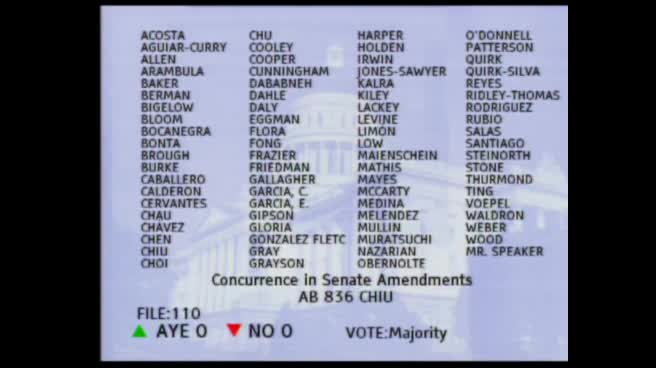 53SEC
Assembly Floor
 3MIN
Senate Floor
 8MIN
Senate Standing Committee on Education
 1MIN
Assembly Floor
 2MIN
Assembly Standing Committee on Appropriations
 11MIN
Assembly Standing Committee on Higher Education


Bill Co-Author(s):
