AB 778: Community development investment tax credits.
- Session Year: 2017-2018
- House: Assembly
- Latest Version Date: 2017-09-13
Existing law imposes an annual tax on the gross premiums of an insurer, as defined, doing business in this state at specified rates. Existing law, until January 1, 2017, allows a credit under the Personal Income Tax Law, the Corporation Tax Law, and a credit against the tax imposed on an insurer in an amount equal to 20% of a qualified investment, as defined, made in a community development financial institution, as defined, but not to exceed, in the aggregate amount under all those laws, $50,000,000 per year and authorizes the California Organized Investment Network to certify investments for the credit until January 1, 2017. Existing law provides that if a qualified investment is reduced before the end of the 60th month, but not below $50,000, an amount equal to 20% of the total reduction for the year shall be added to the tax imposed on the taxpayer. Existing law also provides that if a qualified investment is withdrawn before the end of the 60th month and not reinvested in another community development financial institution within 60 days, the entire amount of any credit previously allowed for that taxable year is required to be added to the tax imposed on the taxpayer. These provisions are repealed on December 1, 2017.
This bill would establish similar credits under the Personal Income Tax Law, the Corporation Tax Law, and the tax imposed on an insurer for taxable years or years, as specified, beginning on or after January 1, 2017, and before January 1, 2022. The bill would, as compared to the tax credit that expired on January 1, 2017, require priority for the tax credit to be given to insurance company investors over all other tax credit investors and would instead require that the provision regarding withdrawal, without reinvestment, of a qualified investment also applies when a qualified investment is reduced. This bill would repeal these provisions on December 1, 2022.
This bill would take effect immediately as a tax levy.
Existing law imposes an annual tax on the gross premiums of an insurer, as defined, doing business in this state at specified rates. Existing law, until January 1, 2017, allows a credit under the Personal Income Tax Law, the Corporation Tax Law, and a credit against the tax imposed on an insurer in an amount equal to 20% of a qualified investment, as defined, made in a community development financial institution, as defined, but not to exceed, in the aggregate amount under all those laws, $50,000,000 per year and authorizes the California Organized Investment Network to certify investments for the credit until January 1, 2017. Existing law provides that if a qualified investment is reduced before the end of the 60th month, but not below $50,000, an amount equal to 20% of the total reduction for the year shall be added to the tax imposed on the taxpayer. Existing law also provides that if a qualified investment is withdrawn before the end of the 60th month and not reinvested in another community development financial institution within 60 days, the entire amount of any credit previously allowed for that taxable year is required to be added to the tax imposed on the taxpayer. These provisions are repealed on December 1, 2017.
This bill would establish similar credits under the Personal Income Tax Law, the Corporation Tax Law, and the tax imposed on an insurer for taxable years or years, as specified, beginning on or after January 1, 2017, and before January 1, 2022. The bill would, as compared to the tax credit that expired on January 1, 2017, require priority for the tax credit to be given to insurance company investors over all other tax credit investors and would instead require that the provision regarding withdrawal, without reinvestment, of a qualified investment also apply applies when a qualified investment is reduced. This bill would repeal these provisions on December 1, 2022.
This bill would take effect immediately as a tax levy.
Existing law imposes an annual tax on the gross premiums of an insurer, as defined, doing business in this state at specified rates. Existing law, until January 1, 2017, allows a credit under the Personal Income Tax Law, the Corporation Tax Law, and a credit against the tax imposed on an insurer in an amount equal to 20% of a qualified investment, as defined, made in a community development financial institution, as defined, but not to exceed, in the aggregate amount under all those laws, $50,000,000 per year and authorizes the California Organized Investment Network to certify investments for the credit until January 1, 2017. Existing law provides that if a qualified investment is reduced before the end of the 60th month, but not below $50,000, an amount equal to 20% of the total reduction for the year shall be added to the tax imposed on the taxpayer. Existing law also provides that if a qualified investment is withdrawn before the end of the 60th month and not reinvested in another community development financial institution within 60 days, the entire amount of any credit previously allowed for that taxable year is required to be added to the tax imposed on the taxpayer. These provisions are repealed on December 1, 2017.
This bill would extend the provisions relating to the authorization of the credit and certification by the California Organized Investment Network until January 1, 2022. The bill would establish similar credits under the Personal Income Tax Law, the Corporation Tax Law, and the tax imposed on an insurer for taxable years or years, as specified, beginning on or after January 1, 2017, and before January 1, 2022. The bill would, as compared to the tax credit that expired on January 1, 2017, require priority for the tax credit to be given to insurance company investors. The bill would delete the provision described above relating to a reduction of a qualified investment investors over all other tax credit investors and would instead require that the provision regarding withdrawal, without reinvestment, of a qualified investment also apply when a qualified investment is reduced. This bill would extend the repeal of these provisions to repeal these provisions on December 1, 2022.
This bill would take effect immediately as a tax levy.
(1)Existing law requires each admitted insurer with annual premiums written in California equal to or in excess of $100,000,000 to provide information to the Insurance Commissioner by July 1, 2016, on all of its community development investments, community development infrastructure investments, and green investments, as defined, in California. Existing law defines a community development investment as certain projects, developments, or activities that, among other things, benefit low- or moderate-income individuals or families. Existing law defines community development infrastructure as California public debt where all or a portion of the debt has as its primary purpose community development for, or that directly benefits, low- or moderate-income communities consistent with the types of projects, developments, or activities specified as community development investments. Existing law defines a green investment, among other things, as specified projects offering energy efficiency improvements and renewable energy generation. Existing law requires the insurer to list investments that are high impact which is an investment that is innovative, responsive to community needs, not routinely provided by an insurer, or has a high degree of positive impact on the economic welfare of low- or moderate-income individuals, families, or communities in urban or rural areas of California.
This bill would instead define a community development investment as certain projects, developments, or activities that, among other things, benefit low- to moderate-income individuals or families. The bill would include investments in reservation-based communities and investments in rural areas, as defined, in community development investments. The bill would instead define community development infrastructure as all California debt where all or a portion of the debt has as its primary purpose community development for, or that directly benefits, low- to moderate-income communities. This bill would include water and waste management and sustainable agriculture projects in the definition of a green investment. The bill would instead define a high-impact investment as an investment that is innovative, responsive to community needs, not routinely provided by an insurer, and that provides at least 50% social or environmental benefit to low- to moderate-income individuals, families, or communities in the state. The bill would also define diverse investment managers as investment management organizations, including, but not limited to, corporations, groups and persons within corporations, partnerships, LLCs, and other special purpose vehicles that are either located in, or actively make and hold investments in, California and whose investment managers are comprised of at least 51% women, veterans, minorities, or lesbian, gay, bisexual, or transgender (LGBT) persons, or a combination of persons in those groups.
(2)Existing law provides that the above-described reporting requirement does not preclude an insurer from satisfying the requirement through a filing made by a community development financial institution, provided that the insurer and the community development financial institution meet specified conditions. Existing law requires the commissioner, by December 31, 2016, to provide specified information on the Department of Insurances Internet Web site, including information on aggregate insurer community development investments, community development infrastructure investments, the aggregate amount of public debt purchased by insurers, the aggregate amount of identified California investments, and the aggregate amount of identified California insurer investments in green investments. Under existing law, these provisions are to remain in effect only until January 1, 2020.
This bill, among other things, would instead require each admitted insurer described above to provide that information to the commissioner biannually by April 15, 2018, for the calendar years 2016 and 2017, and biannually by April 15, 2020, for the calendar years 2018 and 2019, as provided. The bill would require each insurer to additionally provide information to the commissioner on investments with diverse investment managers. The bill would delete the provisions described above relating to a filing made through a community development financial institution. The bill would require the commissioner to provide the information described above on the departments Internet Web site by December 31, 2018, and by December 31, 2020. The bill would extend these provisions until January 1, 2022.
(3)Existing law authorizes the commissioner, until January 1, 2020, to establish and appoint a California Organized Investment Network (COIN) Advisory Board, as specified.
This bill would extend the commissioners authorization to establish and appoint the advisory board until January 1, 2022.
(4)Existing law imposes an annual tax on the gross premiums of an insurer, as defined, doing business in this state at specified rates. Existing law, until January 1, 2017, allows a credit under the Personal Income Tax Law, the Corporation Tax Law, and a credit against the tax imposed on an insurer in an amount equal to 20% of a qualified investment, as defined, made in a community development financial institution, as defined, but not to exceed, in the aggregate amount under all those laws, $50,000,000 per year and authorizes the California Organized Investment Network to certify investments for the credit until January 1, 2017. Existing law provides that if a qualified investment is reduced before the end of the 60th month, but not below $50,000, an amount equal to 20% of the total reduction for the year shall be added to the tax imposed on the taxpayer. Existing law also provides that if a qualified investment is withdrawn before the end of the 60th month and not reinvested in another community development financial institution within 60 days, the entire amount of any credit previously allowed for that taxable year is required to be added to the tax imposed on the taxpayer. These provisions are repealed on December 1, 2017.
This bill would extend the provisions relating to the authorization of the credit and certification by the California Organized Investment Network until January 1, 2022. The bill would require priority for the tax credit to be given to insurance company investors. The bill would delete the provision described above relating to a reduction of a qualified investment and would instead require that the provision regarding withdrawal, without reinvestment, of a qualified investment also apply when a qualified investment is reduced. This bill would extend the repeal of these provisions to December 1, 2022.
(a)For each taxable year beginning on or after January 1, 2017, and before January 1, 2022, there shall be allowed as a credit against the amount of tax, as defined in Section 28 of Article XIII of the California Constitution, an amount equal to 20 percent of the amount of each qualified investment made by a taxpayer during the taxable year into a community development financial institution that is certified by the Department of Insurance, California Organized Investment Network, or any successor thereof.
(b)For purposes of determining any tax that may be imposed under Section 685 of the Insurance Code on a taxpayer not organized under the laws of this state, the amount of the credit allowed by subdivision (a) shall be treated as a tax paid under Section 12201 or Section 28 of Article XIII of the California Constitution.
(c)(1)Notwithstanding any other provision of this part, a credit shall not be allowed under this section unless the California Organized Investment Network, or its successor within the Department of Insurance, certifies that the investment described in subdivision (a) qualifies for the credit under this section and certifies the total amount of the credit allocated to the taxpayer pursuant to this section.
(2)A credit shall not be allowed by this section unless the applicant and the taxpayer provide satisfactory substantiation to, and in the form and manner requested by, the Department of Insurance, California Organized Investment Network, or any successor thereof, that the investment is a qualified investment as defined in paragraph (1) of subdivision (h).
(3)(A)The aggregate amount of qualified investments made by all taxpayers pursuant to this section, Section 17053.58, and Section 23658 shall not exceed fifty million dollars ($50,000,000) for each calendar year. However, if the aggregate amount of qualified investments made in any calendar year is less than fifty million dollars ($50,000,000), the difference may be carried over to the next year, and any succeeding year during which this section remains in effect, and added to the aggregate amount authorized for those years.
(B)The total amount of qualified investments certified by the California Organized Investment Network in any calendar year to any one community development financial institution together with its affiliates, as defined in Section 1215 of the Insurance Code, shall not exceed 30 percent of the annual aggregate amount of qualified investments certified by the California Organized Investment Network. If, after October 1, the California Organized Investment Network has determined that the availability of tax credits exceed their demand, then a community development financial institution that has been allocated 30 percent of the annual aggregate amount of qualified investments shall become eligible to apply to be certified for any remaining tax credits in that calendar year.
(C)Each year, 10 percent of the annual aggregate amount of qualified investments shall be reserved for investment amounts of less than or equal to two hundred thousand dollars ($200,000). If, after October 1, there remains an unallocated portion of the amount reserved for investments of less than or equal to two hundred thousand dollars ($200,000), then qualified investments in excess of two hundred thousand dollars ($200,000) may be eligible for that remaining unallocated portion.
(4)Priority among housing applications shall be given to applications that support affordable rental housing, housing for veterans, mortgages for community-based residential programs, and self-help housing ahead of single-family owned housing.
(5)Priority shall be given to insurance company investors over all other tax credit investors.
(d)The community development financial institution shall do all of the following:
(1)Apply to the Department of Insurance, California Organized Investment Network, or its successor, for certification of its status as a community development financial institution.
(2)(A)Apply to the Department of Insurance, California Organized Investment Network, or its successor, on behalf of the taxpayer for certification of the amount of the investment and the credit amount allocated to the taxpayer, obtain the certification, and retain a copy of the certification.
(B)Provide in the application a detailed description of the intended use of the investment funds, including, but not limited to, the following:
(i)All of the programs, projects, and services that would be funded.
(ii)The percentage of the intended use of the investment funds that would directly benefit low-to-moderate income households.
(iii)The percentage of the intended use of the investment funds that would directly benefit rural areas.
(iv)The percentage of the intended use of the investment funds that is a green investment as defined in Section 926.1 of the Insurance Code.
(3)(A)Provide in the application required in paragraph (2) the following information to the Department of Insurance, California Organized Investment Network, or its successor:
(i)Name of the taxpayer.
(ii)Postal address of the taxpayer, or residential address of the taxpayer if the taxpayer is an individual.
(iii)Telephone number of the taxpayer.
(iv)Email address of the taxpayer.
(v)The taxpayers California company identification number for tax administration purposes.
(B)The information provided in subparagraph (A) shall be used only for internal purposes by the Department of Insurance, California Organized Investment Network, or its successor, and any public disclosure of that information shall be limited to the name of the taxpayer only.
(4)Provide an annual listing to the State Board of Equalization, in the form and manner agreed upon by the State Board of Equalization and the Department of Insurance, California Organized Investment Network, or its successor, of the names and taxpayers California company identification numbers of any taxpayer who makes any withdrawal or partial withdrawal of a qualified investment before the expiration of 60 months from the date of the qualified investment.
(5)Submit reports to the department, California Organized Investment Network, or any successor thereof, as required pursuant to subdivision (a) of Section 12939.1 of the Insurance Code.
(e)The California Organized Investment Network may certify investments for the credit allowed by this section on or before January 1, 2022, but not after that date.
(f)(1)The Insurance Commissioner may develop instructions, procedures, and standards for applications, and for administering the criteria for the evaluation of applications under this section. The Insurance Commissioner may, from time to time, adopt, amend, or repeal regulations to implement the provisions of this section.
(2)The initial adoption of the regulations implementing this section shall be deemed to be an emergency and necessary in order to address a situation calling for immediate action to avoid serious harm to the public peace, health, safety, or general welfare.
(3)Notwithstanding Chapter 3.5 (commencing with Section 11340) of Part 1 of Division 3 of Title 2 of the Government Code, any emergency regulation adopted or amended by the Insurance Commissioner pursuant to this section shall remain in effect until amended or repealed by the department.
(g)The Department of Insurance, California Organized Investment Network, or any successor thereof, shall do all of the following:
(1)Accept and evaluate applications for certification from financial institutions and issue certificates that the applicant is a community development financial institution qualified to receive qualified investments. To receive a certificate, an applicant shall satisfy the Department of Insurance, California Organized Investment Network, or any successor thereof, that it meets the specific requirements to be a community development financial institution for this state program as defined in paragraph (2) of subdivision (h). The certificate may be issued for a specified period of time, and may include reasonable conditions to effectuate the intent of this section. The Insurance Commissioner may suspend or revoke a certification, after affording the institution notice and the opportunity to be heard, if the commissioner finds that an institution no longer meets the requirement for certification.
(2)Accept and evaluate applications for certification from any community development financial institution on behalf of the taxpayer and issue certificates to taxpayers in an aggregate amount that shall not exceed the limit specified in subdivision (c), with highest priority granted to those applications where the intended use of the investments has the greatest aggregate benefit for low-to-moderate income areas or households or rural areas or households. The certificate shall include the amount eligible to be made as an investment that qualifies for the credit and the total amount of the credit to which the taxpayer is entitled for the year. Applications for tax credits shall be accepted and evaluated throughout the year. The Insurance Commissioner shall establish tax credit issuance cycles throughout the year as necessary in order to issue tax credit certificates to those applications granted the highest priority.
(3)Provide an annual listing to the State Board of Equalization, in the form or manner agreed upon by the State Board of Equalization and the Department of Insurance, California Organized Investment Network, or its successor, of the taxpayers who were issued certificates, their respective National Association of Insurance Commissioners company number and employers tax identification number, the amount of the qualified investment made by each taxpayer, and the total amount of qualified investments.
(4)Include information specified pursuant to subdivision (b) of Section 12939.1 of the Insurance Code in the report required by Section 12922 of the Insurance Code.
(h)For purposes of this section:
(1)Qualified investment means an investment that is a deposit or loan that does not earn interest, or an equity investment, or an equity-like debt instrument that conforms to the specifications for these instruments as prescribed by the United States Department of the Treasury, Community Development Financial Institutions Fund, or its successor, or, in the absence of that prescription, as defined by the Insurance Commissioner. The investment must be equal to or greater than fifty thousand dollars ($50,000) and made for a minimum duration of 60 months. During that 60-month period, the community development financial institution shall have full use and control of the proceeds of the entire amount of the investment as well as any earnings on the investment for its community development purposes. The entire amount of the investment shall be received by the community development financial institution before the application for the tax credit is submitted. The community development financial institution shall use the proceeds of the investment for a purpose that is consistent with its community development mission and for the benefit of economically disadvantaged communities and low-income people in California.
(2)Community development financial institution means a private financial institution located in this state that is certified by the Department of Insurance, California Organized Investment Network, or its successor, that, consistent with the legislative findings, declarations, and intent set forth in Section 12939 of the Insurance Code, has community development as its primary mission, and that lends in urban, rural, or reservation-based communities in this state. A community development financial institution may include a community development bank, a community development loan fund, a community development credit union, a microenterprise fund, a community development corporation-based lender, or a community development venture fund.
(i)If a qualified investment is reduced or withdrawn before the end of the 60th month and not reinvested in another community development financial institution within 60 days, there shall be added to the tax, as defined in Section 28 of Article XIII of the California Constitution, for the year in which the withdrawal occurs, the entire amount of any credit previously allowed under this section.
(j)In the case where the credit allowed by this section exceeds the tax, the excess may be carried over to reduce the tax for the next four years, or until the credit has been exhausted, whichever occurs first.
(k)The State Board of Equalization shall, as requested by the Department of Insurance, California Organized Investment Network, or its successor, advise and assist in the administration of this section.
(l)This section shall remain in effect only until December 1, 2022, and as of that date is repealed.
SEC. 2.Section 17053.58 is added to the Revenue and Taxation Code, to read:17053.58.(a)For each taxable year beginning on or after January 1, 2017, and before January 1, 2022, there shall be allowed as a credit against the amount of net tax, as defined in Section 17039, an amount equal to 20 percent of the amount of each qualified investment made by a taxpayer during the taxable year into a community development financial institution that is certified by the Department of Insurance, California Organized Investment Network, or any successor thereof.
(b)(1)Notwithstanding any other provision of this part, a credit shall not be allowed under this section unless the California Organized Investment Network, or its successor within the Department of Insurance, certifies that the investment described in subdivision (a) qualifies for the credit under this section and certifies the total amount of the credit allocated to the taxpayer pursuant to this section.
(2)A credit shall not be allowed by this section unless the applicant and the taxpayer provide satisfactory substantiation to, and in the form and manner requested by, the Department of Insurance, California Organized Investment Network, or any successor thereof, that the investment is a qualified investment, as defined in paragraph (1) of subdivision (g).
(3)(A)The aggregate amount of qualified investments made by all taxpayers pursuant to this section, Section 12209.8, and Section 23658 shall not exceed fifty million dollars ($50,000,000) for each calendar year. However, if the aggregate amount of qualified investments made in any calendar year is less than fifty million dollars ($50,000,000), the difference may be carried over to the next year, and any succeeding year during which this section remains in effect, and added to the aggregate amount authorized for those years.
(B)The total amount of qualified investments certified by the California Organized Investment Network in any calendar year to any one community development financial institution together with its affiliates, as defined in Section 1215 of the Insurance Code, shall not exceed 30 percent of the annual aggregate amount of qualified investments certified by the California Organized Investment Network. If, after October 1, the California Organized Investment Network has determined that the availability of tax credits exceed their demand, then a community development financial institution that has been allocated 30 percent of the annual aggregate amount of qualified investments shall become eligible to apply to be certified for any remaining tax credits in that calendar year.
(C)Each year, 10 percent of the annual aggregate amount of qualified investments shall be reserved for investment amounts of less than or equal to two hundred thousand dollars ($200,000). If, after October 1, there remains an unallocated portion of the amount reserved for investments of less than or equal to two hundred thousand dollars ($200,000), then qualified investments in excess of two hundred thousand dollars ($200,000) may be eligible for that remaining unallocated portion.
(4)Priority among housing applications shall be given to applications that support affordable rental housing, housing for veterans, mortgages for community-based residential programs, and self-help housing ahead of single-family owned housing.
(5)Priority shall be given to insurance company investors over all other tax credit investors.
(c)The community development financial institution shall do all of the following:
(1)Apply to the Department of Insurance, California Organized Investment Network, or its successor, for certification of its status as a community development financial institution.
(2)(A)Apply to the Department of Insurance, California Organized Investment Network, or its successor, on behalf of the taxpayer, for certification of the amount of the investment and the credit amount allocated to the taxpayer, obtain the certification, and retain a copy of the certification.
(B)Provide in the application a detailed description of the intended use of the investment funds, including, but not limited to, the following:
(i)All of the programs, projects, and services that would be funded.
(ii)The percentage of the intended use of the investment funds that would directly benefit low-to-moderate income households.
(iii)The percentage of the intended use of the investment funds that would directly benefit rural areas.
(iv)The percentage of the intended use of the investment funds that is a green investment as defined in Section 926.1 of the Insurance Code.
(3)(A)Provide in the application required in paragraph (2) the following information to the Department of Insurance, California Organized Investment Network, or its successor:
(i)Name of the taxpayer.
(ii)Postal address of the taxpayer, or residential address of the taxpayer if the taxpayer is an individual.
(iii)Telephone number of the taxpayer.
(iv)Email address of the taxpayer.
(v)The taxpayers identification number, or in the case of a partnership, the taxpayer identification numbers of all the partners for tax administration purposes.
(B)The information provided in subparagraph (A) shall be used only for internal purposes by the Department of Insurance, California Organized Investment Network, or its successor, and any network or its successor shall limit all public disclosure of that information to the name of the taxpayer only.
(4)Provide an annual listing to the Franchise Tax Board, in the form and manner agreed upon by the Franchise Tax Board and the Department of Insurance, California Organized Investment Network, or its successor, of the names and taxpayer identification numbers of any taxpayer who makes any withdrawal or partial withdrawal of a qualified investment before the expiration of 60 months from the date of the qualified investment.
(5)Submit reports to the Department of Insurance, California Organized Investment Network, or any successor thereof, as required pursuant to subdivision (a) of Section 12939.1 of the Insurance Code.
(d)(1)The Insurance Commissioner may develop instructions, procedures, and standards for applications, and for administering the criteria for the evaluation of applications under this section. The Insurance Commissioner may, from time to time, adopt, amend, or repeal regulations to implement the provisions of this section.
(2)The initial adoption of the regulations implementing this section shall be deemed to be an emergency and necessary in order to address a situation calling for immediate action to avoid serious harm to the public peace, health, safety, or general welfare.
(3)Notwithstanding Chapter 3.5 (commencing with Section 11340) of Part 1 of Division 3 of Title 2 of the Government Code, any emergency regulation adopted or amended by the Insurance Commissioner pursuant to this section shall remain in effect until amended or repealed by the department.
(e)The California Organized Investment Network may certify investments for the credit allowed by this section on or before January 1, 2022, but not after that date.
(f)The Department of Insurance, California Organized Investment Network, or any successor thereof, shall do all of the following:
(1)Accept and evaluate applications for certification from financial institutions and issue certificates that the applicant is a community development financial institution qualified to receive qualified investments. To receive a certificate, an applicant shall satisfy the Department of Insurance, California Organized Investment Network, or any successor thereof, that it meets the specific requirements to be a community development financial institution for this state program as defined in paragraph (2) of subdivision (g). The certificate may be issued for a specified period of time, and may include reasonable conditions to effectuate the intent of this section. The Insurance Commissioner may suspend or revoke a certification, after affording the institution notice and the opportunity to be heard, if the commissioner finds that an institution no longer meets the requirement for certification.
(2)Accept and evaluate applications for certification from a community development financial institution on behalf of the taxpayer and issue certificates to taxpayers in an aggregate amount that shall not exceed the limit specified in subdivision (b), with highest priority granted to those applications where the intended use of the investments has the greatest aggregate benefit for low-to-moderate income areas or households or rural areas or households. The certificate shall include the amount eligible to be made as an investment that qualifies for the credit and the total amount of the credit to which the taxpayer is entitled for the taxable year. Applications for tax credits shall be accepted and evaluated throughout the year. The Insurance Commissioner shall establish tax credit issuance cycles throughout the year as necessary in order to issue tax credit certificates to those applications granted the highest priority.
(3)Provide an annual listing to the Franchise Tax Board, in the form or manner agreed upon by the Franchise Tax Board and the Department of Insurance, California Organized Investment Network, or its successor, of the taxpayers who were issued certificates, their respective tax identification numbers, the amount of the qualified investment made by each taxpayer, and the total amount of qualified investments.
(4)Include information specified pursuant to subdivision (b) of Section 12939.1 of the Insurance Code in the report required by Section 12922 of the Insurance Code.
(g)For purposes of this section:
(1)Qualified investment means an investment that is a deposit or loan that does not earn interest, or an equity investment, or an equity-like debt instrument that conforms to the specifications for these instruments as prescribed by the United States Department of the Treasury, Community Development Financial Institutions Fund, or its successor, or, in the absence of that prescription, as defined by the Insurance Commissioner. The investment must be equal to or greater than fifty thousand dollars ($50,000) and made for a minimum duration of 60 months. During that 60-month period, the community development financial institution shall have full use and control of the proceeds of the entire amount of the investment as well as any earnings on the investment for its community development purposes. The entire amount of the investment shall be received by the community development financial institution before the application for the tax credit is submitted. The community development financial institution shall use the proceeds of the investment for a purpose that is consistent with its community development mission and for the benefit of economically disadvantaged communities and low-income people in California.
(2)Community development financial institution means a private financial institution located in this state that is certified by the Department of Insurance, California Organized Investment Network, or its successor, that, consistent with the legislative findings, declarations, and intent set forth in Section 12939 of the Insurance Code, has community development as its primary mission, and that lends in urban, rural, or reservation-based communities in this state. A community development financial institution may include a community development bank, a community development loan fund, a community development credit union, a microenterprise fund, a community development corporation-based lender, or a community development venture fund.
(h)If a qualified investment is reduced or withdrawn before the end of the 60th month and not reinvested in another community development financial institution within 60 days, there shall be added to the net tax, as defined in Section 17039, for the taxable year in which the withdrawal occurs, the entire amount of any credit previously allowed under this section.
(i)In the case where the credit allowed by this section exceeds the net tax, the excess may be carried over to reduce the net tax for the next four taxable years, or until the credit has been exhausted, whichever occurs first.
(j)The Franchise Tax Board shall, as requested by the Department of Insurance, California Organized Investment Network, or its successor, advise and assist in the administration of this section.
(k)This section shall remain in effect only until December 1, 2022, and as of that date is repealed.
SEC. 3.Section 23658 is added to the Revenue and Taxation Code, to read:23658.(a)For each taxable year beginning on or after January 1, 2017, and before January 1, 2022, there shall be allowed as a credit against the amount of tax, as defined in Section 23036, an amount equal to 20 percent of the amount of each qualified investment made by a taxpayer during the taxable year into a community development financial institution that is certified by the Department of Insurance, California Organized Investment Network, or any successor thereof.
(b)(1)Notwithstanding any other provision of this part, a credit shall not be allowed under this section unless the California Organized Investment Network, or its successor within the Department of Insurance, certifies that the investment described in subdivision (a) qualifies for the credit under this section and certifies the total amount of the credit allocated to the taxpayer pursuant to this section.
(2)A credit shall not be allowed by this section unless the applicant and the taxpayer provide satisfactory substantiation to, and in the form and manner requested by, the Department of Insurance, California Organized Investment Network, or any successor thereof, that the investment is a qualified investment, as defined in paragraph (1) of subdivision (g).
(3)(A)The aggregate amount of qualified investments made by all taxpayers pursuant to this section, Section 12209.8, and Section 17053.58 shall not exceed fifty million dollars ($50,000,000) for each calendar year. However, if the aggregate amount of qualified investments made in any calendar year is less than fifty million dollars ($50,000,000), the difference may be carried over to the next year, and any succeeding year during which this section remains in effect, and added to the aggregate amount authorized for those years.
(B)The total amount of qualified investments certified by the California Organized Investment Network in any calendar year to any one community development financial institution together with its affiliates, as defined in Section 1215 of the Insurance Code, shall not exceed 30 percent of the annual aggregate amount of qualified investments certified by the California Organized Investment Network. If, after October 1, the California Organized Investment Network has determined that the availability of tax credits exceed their demand, then a community development financial institution that has been allocated 30 percent of the annual aggregate amount of qualified investments shall become eligible to apply to be certified for any remaining tax credits in that calendar year.
(C)Each year, 10 percent of the annual aggregate amount of qualified investments shall be reserved for investment amounts of less than or equal to two hundred thousand dollars ($200,000). If, after October 1, there remains an unallocated portion of the amount reserved for investments of less than or equal to two hundred thousand dollars ($200,000), then qualified investments in excess of two hundred thousand dollars ($200,000) may be eligible for that remaining unallocated portion.
(4)Priority among housing applications shall be given to applications that support affordable rental housing, housing for veterans, mortgages for community-based residential programs, and self-help housing ahead of single-family owned housing.
(5)Priority shall be given to insurance company investors over all other tax credit investors.
(c)The community development financial institution shall do all of the following:
(1)Apply to the Department of Insurance, California Organized Investment Network, or its successor, for certification of its status as a community development financial institution.
(2)(A)Apply to the Department of Insurance, California Organized Investment Network, or its successor, on behalf of the taxpayer, for certification of the amount of the investment and the credit amount allocated to the taxpayer, obtain the certification, and retain a copy of the certification.
(B)Provide in the application a detailed description of the intended use of the investment funds, including, but not limited to, the following:
(i)All of the programs, projects, and services that would be funded.
(ii)The percentage of the intended use of the investment funds that would directly benefit low-to-moderate income households.
(iii)The percentage of the intended use of the investment funds that would directly benefit rural areas.
(iv)The percentage of the intended use of the investment funds that is a green investment as defined in Section 926.1 of the Insurance Code.
(3)(A)Provide in the application required in paragraph (2) the following information to the Department of Insurance, California Organized Investment Network, or its successor:
(i)Name of the taxpayer.
(ii)Postal address of the taxpayer, or residential address of the taxpayer if the taxpayer is an individual.
(iii)Telephone number of the taxpayer.
(iv)Email address of the taxpayer.
(v)The taxpayers California company identification number for tax administration purposes, or in the case of an S corporation, the taxpayer identification numbers of all the shareholders for tax administration purposes.
(B)The information provided in subparagraph (A) shall be used only for internal purposes by the Department of Insurance, California Organized Investment Network, or its successor, and any public disclosure of that information shall be limited to the name of the taxpayer only.
(4)Provide an annual listing to the Franchise Tax Board, in the form and manner agreed upon by the Franchise Tax Board and the Department of Insurance, California Organized Investment Network, or its successor, of the names and taxpayer identification numbers of any taxpayer who makes any withdrawal or partial withdrawal of a qualified investment before the expiration of 60 months from the date of the qualified investment.
(5)Submit reports to the department, California Organized Investment Network, or any successor thereof, as required pursuant to subdivision (a) of Section 12939.1 of the Insurance Code.
(d)The California Organized Investment Network may certify investments for the credit allowed by this section on or before January 1, 2022, but not after that date.
(e)(1)The Insurance Commissioner may develop instructions, procedures, and standards for applications, and for administering the criteria for the evaluation of applications under this section. The Insurance Commissioner may, from time to time, adopt, amend, or repeal regulations to implement the provisions of this section.
(2)The initial adoption of the regulations implementing this section shall be deemed to be an emergency and necessary in order to address a situation calling for immediate action to avoid serious harm to the public peace, health, safety, or general welfare.
(3)Notwithstanding Chapter 3.5 (commencing with Section 11340) of Part 1 of Division 3 of Title 2 of the Government Code, any emergency regulation adopted or amended by the Insurance Commissioner pursuant to this section shall remain in effect until amended or repealed by the department.
(f)The Department of Insurance, California Organized Investment Network, or any successor thereof, shall do all of the following:
(1)Accept and evaluate applications for certification from financial institutions and issue certificates that the applicant is a community development financial institution qualified to receive qualified investments. To receive a certificate, an applicant shall satisfy the Department of Insurance, California Organized Investment Network, or any successor thereof, that it meets the specific requirements to be a community development financial institution for this state program as defined in paragraph (2) of subdivision (g). The certificate may be issued for a specified period of time, and may include reasonable conditions to effectuate the intent of this section. The Insurance Commissioner may suspend or revoke a certification, after affording the institution notice and the opportunity to be heard, if the commissioner finds that an institution no longer meets the requirement for certification.
(2)Accept and evaluate applications for certification from any community development financial institution on behalf of the taxpayer and issue certificates to taxpayers in an aggregate amount that shall not exceed the limit specified in subdivision (b), with highest priority granted to those applications where the intended use of the investments has the greatest aggregate benefit for low-to-moderate income areas or households or rural areas or households. The certificate shall include the amount eligible to be made as an investment that qualifies for the credit and the total amount of the credit to which the taxpayer is entitled for the taxable year. Applications for tax credits shall be accepted and evaluated throughout the year. The Insurance Commissioner shall establish tax credit issuance cycles throughout the year as necessary in order to issue tax credit certificates to those applications granted the highest priority.
(3)Provide an annual listing to the Franchise Tax Board, in the form or manner agreed upon by the Franchise Tax Board and the Department of Insurance, California Organized Investment Network, or its successor, of the taxpayers who were issued certificates, their respective tax identification numbers, the amount of the qualified investment made by each taxpayer, and the total amount of qualified investments.
(4)Include information specified pursuant to subdivision (b) of Section 12939.1 of the Insurance Code in the report required by Section 12922 of the Insurance Code.
(g)For purposes of this section:
(1)Qualified investment means an investment that is a deposit or loan that does not earn interest, or an equity investment, or an equity-like debt instrument that conforms to the specifications for these instruments as prescribed by the United States Department of the Treasury, Community Development Financial Institutions Fund, or its successor, or, in the absence of that prescription, as defined by the Insurance Commissioner. The investment must be equal to or greater than fifty thousand dollars ($50,000) and made for a minimum duration of 60 months. During that 60-month period, the community development financial institution shall have full use and control of the proceeds of the entire amount of the investment as well as any earnings on the investment for its community development purposes. The entire amount of the investment shall be received by the community development financial institution before the application for the tax credit is submitted. The community development financial institution shall use the proceeds of the investment for a purpose that is consistent with its community development mission and for the benefit of economically disadvantaged communities and low-income people in California.
(2)Community development financial institution means a private financial institution located in this state that is certified by the Department of Insurance, California Organized Investment Network, or its successor, that, consistent with the legislative findings, declarations, and intent set forth in Section 12939 of the Insurance Code, has community development as its primary mission, and that lends in urban, rural, or reservation-based communities in this state. A community development financial institution may include a community development bank, a community development loan fund, a community development credit union, a microenterprise fund, a community development corporation-based lender, or a community development venture fund.
(h)If a qualified investment is reduced or withdrawn before the end of the 60th month and not reinvested in another community development financial institution within 60 days, there shall be added to the tax, as defined in Section 23036, for the taxable year in which the withdrawal occurs, the entire amount of any credit previously allowed under this section.
(i)In the case where the credit allowed by this section exceeds the tax, the excess may be carried over to reduce the tax for the next four taxable years, or until the credit has been exhausted, whichever occurs first.
(j)The Franchise Tax Board shall, as requested by the Department of Insurance, California Organized Investment Network, or its successor, advise and assist in the administration of this section.
(k)This section shall remain in effect only until December 1, 2022, and as of that date is repealed.
SEC. 4.This act provides for a tax levy within the meaning of Article IV of the California Constitution and shall go into immediate effect.
(a)For each taxable year beginning on or after January 1, 2017, and before January 1, 2022, there shall be allowed as a credit against the amount of tax, as defined in Section 28 of Article XIII of the California Constitution, an amount equal to 20 percent of the amount of each qualified investment made by a taxpayer during the taxable year into a community development financial institution that is certified by the Department of Insurance, California Organized Investment Network, or any successor thereof.
(b)For purposes of determining any tax that may be imposed under Section 685 of the Insurance Code on a taxpayer not organized under the laws of this state, the amount of the credit allowed by subdivision (a) shall be treated as a tax paid under Section 12201 or Section 28 of Article XIII of the California Constitution.
(c)(1)Notwithstanding any other provision of this part, a credit shall not be allowed under this section unless the California Organized Investment Network, or its successor within the Department of Insurance, certifies that the investment described in subdivision (a) qualifies for the credit under this section and certifies the total amount of the credit allocated to the taxpayer pursuant to this section.
(2)A credit shall not be allowed by this section unless the applicant and the taxpayer provide satisfactory substantiation to, and in the form and manner requested by, the Department of Insurance, California Organized Investment Network, or any successor thereof, that the investment is a qualified investment as defined in paragraph (1) of subdivision (h).
(3)(A)The aggregate amount of qualified investments made by all taxpayers pursuant to this section, Section 17053.58, and Section 23658 shall not exceed fifty million dollars ($50,000,000) for each calendar year. However, if the aggregate amount of qualified investments made in any calendar year is less than fifty million dollars ($50,000,000), the difference may be carried over to the next year, and any succeeding year during which this section remains in effect, and added to the aggregate amount authorized for those years.
(B)The total amount of qualified investments certified by the California Organized Investment Network in any calendar year to any one community development financial institution together with its affiliates, as defined in Section 1215 of the Insurance Code, shall not exceed 30 percent of the annual aggregate amount of qualified investments certified by the California Organized Investment Network. If, after October 1, the California Organized Investment Network has determined that the availability of tax credits exceed their demand, then a community development financial institution that has been allocated 30 percent of the annual aggregate amount of qualified investments shall become eligible to apply to be certified for any remaining tax credits in that calendar year.
(C)Each year, 10 percent of the annual aggregate amount of qualified investments shall be reserved for investment amounts of less than or equal to two hundred thousand dollars ($200,000). If, after October 1, there remains an unallocated portion of the amount reserved for investments of less than or equal to two hundred thousand dollars ($200,000), then qualified investments in excess of two hundred thousand dollars ($200,000) may be eligible for that remaining unallocated portion.
(4)Priority among housing applications shall be given to applications that support affordable rental housing, housing for veterans, mortgages for community-based residential programs, and self-help housing ahead of single-family owned housing.
(5)Priority shall be given to insurance company investors over all other tax credit investors.
(d)The community development financial institution shall do all of the following:
(1)Apply to the Department of Insurance, California Organized Investment Network, or its successor, for certification of its status as a community development financial institution.
(2)(A)Apply to the Department of Insurance, California Organized Investment Network, or its successor, on behalf of the taxpayer for certification of the amount of the investment and the credit amount allocated to the taxpayer, obtain the certification, and retain a copy of the certification.
(B)Provide in the application a detailed description of the intended use of the investment funds funds, including, but not limited to, the following:
(i)All of the programs, projects, and services that would be funded.
(ii)The percentage of the intended use of the investment funds that would directly benefit low-to-moderate income households.
(iii)The percentage of the intended use of the investment funds that would directly benefit rural areas.
(iv)The percentage of the intended use of the investment funds that is a green investment as defined in Section 926.1 of the Insurance Code.
(3)(A)Provide in the application required in paragraph (2) the following information to the Department of Insurance, California Organized Investment Network, or its successor:
(i)Name of the taxpayer.
(ii)Postal address of the taxpayer, or residential address of the taxpayer if the taxpayer is an individual.
(iii)Phone Telephone number of the taxpayer.
(iv)Email address of the taxpayer.
(v)The taxpayers California company identification number for tax administration purposes.
(B)The information provided in subparagraph (A) shall be used only for internal purposes by the Department of Insurance, California Organized Investment Network, or its successor, and any public disclosure of that information shall be limited to the name of the taxpayer only.
(4)Provide an annual listing to the State Board of Equalization, in the form and manner agreed upon by the State Board of Equalization and the Department of Insurance, California Organized Investment Network, or its successor, of the names and taxpayers California company identification numbers of any taxpayer who makes any withdrawal or partial withdrawal of a qualified investment before the expiration of 60 months from the date of the qualified investment.
(5)Submit reports to the department, California Organized Investment Network, or any successor thereof, as required pursuant to subdivision (a) of Section 12939.1 of the Insurance Code.
(e)The California Organized Investment Network may certify investments for the credit allowed by this section on or before January 1, 2022, but not after that date.
(f)(1)The Insurance Commissioner may develop instructions, procedures, and standards for applications, and for administering the criteria for the evaluation of applications under this section. The Insurance Commissioner may, from time to time, adopt, amend, or repeal regulations to implement the provisions of this section.
(2)The initial adoption of the regulations implementing this section shall be deemed to be an emergency and necessary in order to address a situation calling for immediate action to avoid serious harm to the public peace, health, safety, or general welfare.
(3)Notwithstanding Chapter 3.5 (commencing with Section 11340) of Part 1 of Division 3 of Title 2 of the Government Code, any emergency regulation adopted or amended by the Insurance Commissioner pursuant to this section shall remain in effect until amended or repealed by the department.
(g)The Department of Insurance, California Organized Investment Network, or any successor thereof, shall do all of the following:
(1)Accept and evaluate applications for certification from financial institutions and issue certificates that the applicant is a community development financial institution qualified to receive qualified investments. To receive a certificate, an applicant shall satisfy the Department of Insurance, California Organized Investment Network, or any successor thereof, that it meets the specific requirements to be a community development financial institution for this state program as defined in paragraph (2) of subdivision (h). The certificate may be issued for a specified period of time, and may include reasonable conditions to effectuate the intent of this section. The Insurance Commissioner may suspend or revoke a certification, after affording the institution notice and the opportunity to be heard, if the commissioner finds that an institution no longer meets the requirement for certification.
(2)Accept and evaluate applications for certification from any community development financial institution on behalf of the taxpayer and issue certificates to taxpayers in an aggregate amount that shall not exceed the limit specified in subdivision (c), with highest priority granted to those applications where the intended use of the investments has the greatest aggregate benefit for low-to-moderate income areas or households or rural areas or households. The certificate shall include the amount eligible to be made as an investment that qualifies for the credit and the total amount of the credit to which the taxpayer is entitled for the year. Applications for tax credits shall be accepted and evaluated throughout the year. The Insurance Commissioner shall establish tax credit issuance cycles throughout the year as necessary in order to issue tax credit certificates to those applications granted the highest priority.
(3)Provide an annual listing to the State Board of Equalization, in the form or manner agreed upon by the State Board of Equalization and the Department of Insurance, California Organized Investment Network, or its successor, of the taxpayers who were issued certificates, their respective National Association of Insurance Commissioners Commissioners company number and employers tax identification number, the amount of the qualified investment made by each taxpayer, and the total amount of qualified investments.
(4)Include information specified pursuant to subdivision (b) of Section 12939.1 of the Insurance Code in the report required by Section 12922 of the Insurance Code.
(h)For purposes of this section:
(1)Qualified investment means an investment that is a deposit or loan that does not earn interest, or an equity investment, or an equity-like debt instrument that conforms to the specifications for these instruments as prescribed by the United States Department of the Treasury, Community Development Financial Institutions Fund, or its successor, or, in the absence of that prescription, as defined by the Insurance Commissioner. The investment must be equal to or greater than fifty thousand dollars ($50,000) and made for a minimum duration of 60 months. During that 60-month period, the community development financial institution shall have full use and control of the proceeds of the entire amount of the investment as well as any earnings on the investment for its community development purposes. The entire amount of the investment shall be received by the community development financial institution before the application for the tax credit is submitted. The community development financial institution shall use the proceeds of the investment for a purpose that is consistent with its community development mission and for the benefit of economically disadvantaged communities and low-income people in California.
(2)Community development financial institution means a private financial institution located in this state that is certified by the Department of Insurance, California Organized Investment Network, or its successor, that, consistent with the legislative findings, declarations, and intent set forth in Section 12939 of the Insurance Code, has community development as its primary mission, and that lends in urban, rural, or reservation-based communities in this state. A community development financial institution may include a community development bank, a community development loan fund, a community development credit union, a microenterprise fund, a community development corporation-based lender, or a community development venture fund.
(i)If a qualified investment is reduced or withdrawn before the end of the 60th month and not reinvested in another community development financial institution within 60 days, there shall be added to the tax, as defined in Section 28 of Article XIII of the California Constitution, for the year in which the withdrawal occurs, the entire amount of any credit previously allowed under this section.
(j)In the case where the credit allowed by this section exceeds the tax, the excess may be carried over to reduce the tax for the next four years, or until the credit has been exhausted, whichever occurs first.
(k)The State Board of Equalization shall, as requested by the Department of Insurance, California Organized Investment Network, or its successor, advise and assist in the administration of this section.
(l)This section shall remain in effect only until December 1, 2022, and as of that date is repealed.
SEC. 2.Section 17053.58 is added to the Revenue and Taxation Code, to read:17053.58.(a)For each taxable year beginning on or after January 1, 2017, and before January 1, 2022, there shall be allowed as a credit against the amount of net tax, as defined in Section 17039, an amount equal to 20 percent of the amount of each qualified investment made by a taxpayer during the taxable year into a community development financial institution that is certified by the Department of Insurance, California Organized Investment Network, or any successor thereof.
(b)(1)Notwithstanding any other provision of this part, a credit shall not be allowed under this section unless the California Organized Investment Network, or its successor within the Department of Insurance, certifies that the investment described in subdivision (a) qualifies for the credit under this section and certifies the total amount of the credit allocated to the taxpayer pursuant to this section.
(2)A credit shall not be allowed by this section unless the applicant and the taxpayer provide satisfactory substantiation to, and in the form and manner requested by, the Department of Insurance, California Organized Investment Network, or any successor thereof, that the investment is a qualified investment, as defined in paragraph (1) of subdivision (g).
(3)(A)The aggregate amount of qualified investments made by all taxpayers pursuant to this section, Section 12209.8, and Section 23658 shall not exceed fifty million dollars ($50,000,000) for each calendar year. However, if the aggregate amount of qualified investments made in any calendar year is less than fifty million dollars ($50,000,000), the difference may be carried over to the next year, and any succeeding year during which this section remains in effect, and added to the aggregate amount authorized for those years.
(B)The total amount of qualified investments certified by the California Organized Investment Network in any calendar year to any one community development financial institution together with its affiliates, as defined in Section 1215 of the Insurance Code, shall not exceed 30 percent of the annual aggregate amount of qualified investments certified by the California Organized Investment Network. If, after October 1, the California Organized Investment Network has determined that the availability of tax credits exceed their demand, then a community development financial institution that has been allocated 30 percent of the annual aggregate amount of qualified investments shall become eligible to apply to be certified for any remaining tax credits in that calendar year.
(C)Each year, 10 percent of the annual aggregate amount of qualified investments shall be reserved for investment amounts of less than or equal to two hundred thousand dollars ($200,000). If, after October 1, there remains an unallocated portion of the amount reserved for investments of less than or equal to two hundred thousand dollars ($200,000), then qualified investments in excess of two hundred thousand dollars ($200,000) may be eligible for that remaining unallocated portion.
(4)Priority among housing applications shall be given to applications that support affordable rental housing, housing for veterans, mortgages for community-based residential programs, and self-help housing ahead of single-family owned housing.
(5)Priority shall be given to insurance company investors over all other tax credit investors.
(c)The community development financial institution shall do all of the following:
(1)Apply to the Department of Insurance, California Organized Investment Network, or its successor, for certification of its status as a community development financial institution.
(2)(A)Apply to the Department of Insurance, California Organized Investment Network, or its successor, on behalf of the taxpayer, for certification of the amount of the investment and the credit amount allocated to the taxpayer, obtain the certification, and retain a copy of the certification.
(B)Provide in the application a detailed description of the intended use of the investment funds funds, including, but not limited to, the following:
(i)All of the programs, projects, and services that would be funded.
(ii)The percentage of the intended use of the investment funds that would directly benefit low-to-moderate income households.
(iii)The percentage of the intended use of the investment funds that would directly benefit rural areas.
(iv)The percentage of the intended use of the investment funds that is a green investment as defined in Section 926.1 of the Insurance Code.
(3)(A)Provide in the application required in paragraph (2) the following information to the Department of Insurance, California Organized Investment Network, or its successor:
(i)Name of the taxpayer.
(ii)Postal address of the taxpayer, or residential address of the taxpayer if the taxpayer is an individual.
(iii)Phone Telephone number of the taxpayer.
(iv)Email address of the taxpayer.
(v)The taxpayers identification number, or in the case of a partnership, the taxpayer identification numbers of all the partners for tax administration purposes.
(B)The information provided in subparagraph (A) shall be used only for internal purposes by the Department of Insurance, California Organized Investment Network, or its successor, and any network or its successor shall limit all public disclosure of that information to the name of the taxpayer only.
(4)Provide an annual listing to the Franchise Tax Board, in the form and manner agreed upon by the Franchise Tax Board and the Department of Insurance, California Organized Investment Network, or its successor, of the names and taxpayer identification numbers of any taxpayer who makes any withdrawal or partial withdrawal of a qualified investment before the expiration of 60 months from the date of the qualified investment.
(5)Submit reports to the Department of Insurance, California Organized Investment Network, or any successor thereof, as required pursuant to subdivision (a) of Section 12939.1 of the Insurance Code.
(d)(1)The Insurance Commissioner may develop instructions, procedures, and standards for applications, and for administering the criteria for the evaluation of applications under this section. The Insurance Commissioner may, from time to time, adopt, amend, or repeal regulations to implement the provisions of this section.
(2)The initial adoption of the regulations implementing this section shall be deemed to be an emergency and necessary in order to address a situation calling for immediate action to avoid serious harm to the public peace, health, safety, or general welfare.
(3)Notwithstanding Chapter 3.5 (commencing with Section 11340) of Part 1 of Division 3 of Title 2 of the Government Code, any emergency regulation adopted or amended by the Insurance Commissioner pursuant to this section shall remain in effect until amended or repealed by the department.
(e)The California Organized Investment Network may certify investments for the credit allowed by this section on or before January 1, 2022, but not after that date.
(f)The Department of Insurance, California Organized Investment Network, or any successor thereof, shall do all of the following:
(1)Accept and evaluate applications for certification from financial institutions and issue certificates that the applicant is a community development financial institution qualified to receive qualified investments. To receive a certificate, an applicant shall satisfy the Department of Insurance, California Organized Investment Network, or any successor thereof, that it meets the specific requirements to be a community development financial institution for this state program as defined in paragraph (2) of subdivision (g). The certificate may be issued for a specified period of time, and may include reasonable conditions to effectuate the intent of this section. The Insurance Commissioner may suspend or revoke a certification, after affording the institution notice and the opportunity to be heard, if the commissioner finds that an institution no longer meets the requirement for certification.
(2)Accept and evaluate applications for certification from a community development financial institution on behalf of the taxpayer and issue certificates to taxpayers in an aggregate amount that shall not exceed the limit specified in subdivision (b), with highest priority granted to those applications where the intended use of the investments has the greatest aggregate benefit for low-to-moderate income areas or households or rural areas or households. The certificate shall include the amount eligible to be made as an investment that qualifies for the credit and the total amount of the credit to which the taxpayer is entitled for the taxable year. Applications for tax credits shall be accepted and evaluated throughout the year. The Insurance Commissioner shall establish tax credit issuance cycles throughout the year as necessary in order to issue tax credit certificates to those applications granted the highest priority.
(3)Provide an annual listing to the Franchise Tax Board, in the form or manner agreed upon by the Franchise Tax Board and the Department of Insurance, California Organized Investment Network, or its successor, of the taxpayers who were issued certificates, their respective tax identification numbers, the amount of the qualified investment made by each taxpayer, and the total amount of qualified investments.
(4)Include information specified pursuant to subdivision (b) of Section 12939.1 of the Insurance Code in the report required by Section 12922 of the Insurance Code.
(g)For purposes of this section:
(1)Qualified investment means an investment that is a deposit or loan that does not earn interest, or an equity investment, or an equity-like debt instrument that conforms to the specifications for these instruments as prescribed by the United States Department of the Treasury, Community Development Financial Institutions Fund, or its successor, or, in the absence of that prescription, as defined by the Insurance Commissioner. The investment must be equal to or greater than fifty thousand dollars ($50,000) and made for a minimum duration of 60 months. During that 60-month period, the community development financial institution shall have full use and control of the proceeds of the entire amount of the investment as well as any earnings on the investment for its community development purposes. The entire amount of the investment shall be received by the community development financial institution before the application for the tax credit is submitted. The community development financial institution shall use the proceeds of the investment for a purpose that is consistent with its community development mission and for the benefit of economically disadvantaged communities and low-income people in California.
(2)Community development financial institution means a private financial institution located in this state that is certified by the Department of Insurance, California Organized Investment Network, or its successor, that, consistent with the legislative findings, declarations, and intent set forth in Section 12939 of the Insurance Code, has community development as its primary mission, and that lends in urban, rural, or reservation-based communities in this state. A community development financial institution may include a community development bank, a community development loan fund, a community development credit union, a microenterprise fund, a community development corporation-based lender, or a community development venture fund.
(h)If a qualified investment is reduced or withdrawn before the end of the 60th month and not reinvested in another community development financial institution within 60 days, there shall be added to the net tax, as defined in Section 17039, for the taxable year in which the withdrawal occurs, the entire amount of any credit previously allowed under this section.
(i)In the case where the credit allowed by this section exceeds the net tax, the excess may be carried over to reduce the net tax for the next four taxable years, or until the credit has been exhausted, whichever occurs first.
(j)The Franchise Tax Board shall, as requested by the Department of Insurance, California Organized Investment Network, or its successor, advise and assist in the administration of this section.
(k)This section shall remain in effect only until December 1, 2022, and as of that date is repealed.
SEC. 3.Section 23658 is added to the Revenue and Taxation Code, to read:23658.(a)For each taxable year beginning on or after January 1, 2017, and before January 1, 2022, there shall be allowed as a credit against the amount of tax, as defined in Section 23036, an amount equal to 20 percent of the amount of each qualified investment made by a taxpayer during the taxable year into a community development financial institution that is certified by the Department of Insurance, California Organized Investment Network, or any successor thereof.
(b)(1)Notwithstanding any other provision of this part, a credit shall not be allowed under this section unless the California Organized Investment Network, or its successor within the Department of Insurance, certifies that the investment described in subdivision (a) qualifies for the credit under this section and certifies the total amount of the credit allocated to the taxpayer pursuant to this section.
(2)A credit shall not be allowed by this section unless the applicant and the taxpayer provide satisfactory substantiation to, and in the form and manner requested by, the Department of Insurance, California Organized Investment Network, or any successor thereof, that the investment is a qualified investment, as defined in paragraph (1) of subdivision (g).
(3)(A)The aggregate amount of qualified investments made by all taxpayers pursuant to this section, Section 12209.8, and Section 17053.58 shall not exceed fifty million dollars ($50,000,000) for each calendar year. However, if the aggregate amount of qualified investments made in any calendar year is less than fifty million dollars ($50,000,000), the difference may be carried over to the next year, and any succeeding year during which this section remains in effect, and added to the aggregate amount authorized for those years.
(B)The total amount of qualified investments certified by the California Organized Investment Network in any calendar year to any one community development financial institution together with its affiliates, as defined in Section 1215 of the Insurance Code, shall not exceed 30 percent of the annual aggregate amount of qualified investments certified by the California Organized Investment Network. If, after October 1, the California Organized Investment Network has determined that the availability of tax credits exceed their demand, then a community development financial institution that has been allocated 30 percent of the annual aggregate amount of qualified investments shall become eligible to apply to be certified for any remaining tax credits in that calendar year.
(C)Each year, 10 percent of the annual aggregate amount of qualified investments shall be reserved for investment amounts of less than or equal to two hundred thousand dollars ($200,000). If, after October 1, there remains an unallocated portion of the amount reserved for investments of less than or equal to two hundred thousand dollars ($200,000), then qualified investments in excess of two hundred thousand dollars ($200,000) may be eligible for that remaining unallocated portion.
(4)Priority among housing applications shall be given to applications that support affordable rental housing, housing for veterans, mortgages for community-based residential programs, and self-help housing ahead of single-family owned housing.
(5)Priority shall be given to insurance company investors over all other tax credit investors.
(c)The community development financial institution shall do all of the following:
(1)Apply to the Department of Insurance, California Organized Investment Network, or its successor, for certification of its status as a community development financial institution.
(2)(A)Apply to the Department of Insurance, California Organized Investment Network, or its successor, on behalf of the taxpayer, for certification of the amount of the investment and the credit amount allocated to the taxpayer, obtain the certification, and retain a copy of the certification.
(B)Provide in the application a detailed description of the intended use of the investment funds funds, including, but not limited to, the following:
(i)All of the programs, projects, and services that would be funded.
(ii)The percentage of the intended use of the investment funds that would directly benefit low-to-moderate income households.
(iii)The percentage of the intended use of the investment funds that would directly benefit rural areas.
(iv)The percentage of the intended use of the investment funds that is a green investment as defined in Section 926.1 of the Insurance Code.
(3)(A)Provide in the application required in paragraph (2) the following information to the Department of Insurance, California Organized Investment Network, or its successor:
(i)Name of the taxpayer.
(ii)Postal address of the taxpayer, or residential address of the taxpayer if the taxpayer is an individual.
(iii)Phone Telephone number of the taxpayer.
(iv)Email address of the taxpayer.
(v)The taxpayers California company identification number for tax administration purposes, or in the case of an S corporation, the taxpayer identification numbers of all the shareholders for tax administration purposes.
(B)The information provided in subparagraph (A) shall be used only for internal purposes by the Department of Insurance, California Organized Investment Network, or its successor, and any public disclosure of that information shall be limited to the name of the taxpayer only.
(4)Provide an annual listing to the Franchise Tax Board, in the form and manner agreed upon by the Franchise Tax Board and the Department of Insurance, California Organized Investment Network, or its successor, of the names and taxpayer identification numbers of any taxpayer who makes any withdrawal or partial withdrawal of a qualified investment before the expiration of 60 months from the date of the qualified investment.
(5)Submit reports to the department, California Organized Investment Network, or any successor thereof, as required pursuant to subdivision (a) of Section 12939.1 of the Insurance Code.
(d)The California Organized Investment Network may certify investments for the credit allowed by this section on or before January 1, 2022, but not after that date.
(e)(1)The Insurance Commissioner may develop instructions, procedures, and standards for applications, and for administering the criteria for the evaluation of applications under this section. The Insurance Commissioner may, from time to time, adopt, amend, or repeal regulations to implement the provisions of this section.
(2)The initial adoption of the regulations implementing this section shall be deemed to be an emergency and necessary in order to address a situation calling for immediate action to avoid serious harm to the public peace, health, safety, or general welfare.
(3)Notwithstanding Chapter 3.5 (commencing with Section 11340) of Part 1 of Division 3 of Title 2 of the Government Code, any emergency regulation adopted or amended by the Insurance Commissioner pursuant to this section shall remain in effect until amended or repealed by the department.
(f)The Department of Insurance, California Organized Investment Network, or any successor thereof, shall do all of the following:
(1)Accept and evaluate applications for certification from financial institutions and issue certificates that the applicant is a community development financial institution qualified to receive qualified investments. To receive a certificate, an applicant shall satisfy the Department of Insurance, California Organized Investment Network, or any successor thereof, that it meets the specific requirements to be a community development financial institution for this state program as defined in paragraph (2) of subdivision (g). The certificate may be issued for a specified period of time, and may include reasonable conditions to effectuate the intent of this section. The Insurance Commissioner may suspend or revoke a certification, after affording the institution notice and the opportunity to be heard, if the commissioner finds that an institution no longer meets the requirement for certification.
(2)Accept and evaluate applications for certification from any community development financial institution on behalf of the taxpayer and issue certificates to taxpayers in an aggregate amount that shall not exceed the limit specified in subdivision (b), with highest priority granted to those applications where the intended use of the investments has the greatest aggregate benefit for low-to-moderate income areas or households or rural areas or households. The certificate shall include the amount eligible to be made as an investment that qualifies for the credit and the total amount of the credit to which the taxpayer is entitled for the taxable year. Applications for tax credits shall be accepted and evaluated throughout the year. The Insurance Commissioner shall establish tax credit issuance cycles throughout the year as necessary in order to issue tax credit certificates to those applications granted the highest priority.
(3)Provide an annual listing to the Franchise Tax Board, in the form or manner agreed upon by the Franchise Tax Board and the Department of Insurance, California Organized Investment Network, or its successor, of the taxpayers who were issued certificates, their respective tax identification numbers, the amount of the qualified investment made by each taxpayer, and the total amount of qualified investments.
(4)Include information specified pursuant to subdivision (b) of Section 12939.1 of the Insurance Code in the report required by Section 12922 of the Insurance Code.
(g)For purposes of this section:
(1)Qualified investment means an investment that is a deposit or loan that does not earn interest, or an equity investment, or an equity-like debt instrument that conforms to the specifications for these instruments as prescribed by the United States Department of the Treasury, Community Development Financial Institutions Fund, or its successor, or, in the absence of that prescription, as defined by the Insurance Commissioner. The investment must be equal to or greater than fifty thousand dollars ($50,000) and made for a minimum duration of 60 months. During that 60-month period, the community development financial institution shall have full use and control of the proceeds of the entire amount of the investment as well as any earnings on the investment for its community development purposes. The entire amount of the investment shall be received by the community development financial institution before the application for the tax credit is submitted. The community development financial institution shall use the proceeds of the investment for a purpose that is consistent with its community development mission and for the benefit of economically disadvantaged communities and low-income people in California.
(2)Community development financial institution means a private financial institution located in this state that is certified by the Department of Insurance, California Organized Investment Network, or its successor, that, consistent with the legislative findings, declarations, and intent set forth in Section 12939 of the Insurance Code, has community development as its primary mission, and that lends in urban, rural, or reservation-based communities in this state. A community development financial institution may include a community development bank, a community development loan fund, a community development credit union, a microenterprise fund, a community development corporation-based lender, or a community development venture fund.
(h)If a qualified investment is reduced or withdrawn before the end of the 60th month and not reinvested in another community development financial institution within 60 days, there shall be added to the tax, as defined in Section 23036, for the taxable year in which the withdrawal occurs, the entire amount of any credit previously allowed under this section.
(i)In the case where the credit allowed by this section exceeds the tax, the excess may be carried over to reduce the tax for the next four taxable years, or until the credit has been exhausted, whichever occurs first.
(j)The Franchise Tax Board shall, as requested by the Department of Insurance, California Organized Investment Network, or its successor, advise and assist in the administration of this section.
(k)This section shall remain in effect only until December 1, 2022, and as of that date is repealed.
SEC. 4.This act provides for a tax levy within the meaning of Article IV of the California Constitution and shall go into immediate effect.
(a)For each year beginning on or after January 1, 2017, and before January 1, 2022, there shall be allowed as a credit against the amount of tax, as defined in Section 28 of Article XIII of the California Constitution, an amount equal to 20 percent of the amount of each qualified investment made by a taxpayer during the taxable year into a community development financial institution that is certified by the Department of Insurance, California Organized Investment Network, or any successor thereof.
(b)For purposes of determining any tax that may be imposed under Section 685 of the Insurance Code on a taxpayer not organized under the laws of this state, the amount of the credit allowed by subdivision (a) shall be treated as a tax paid under Section 12201 or Section 28 of Article XIII of the California Constitution.
(c)(1) Notwithstanding any other provision of this part, a credit shall not be allowed under this section unless the California Organized Investment Network, or its successor within the Department of Insurance, certifies that the investment described in subdivision (a) qualifies for the credit under this section and certifies the total amount of the credit allocated to the taxpayer pursuant to this section.
(2)A credit shall not be allowed by this section unless the applicant and the taxpayer provide satisfactory substantiation to, and in the form and manner requested by, the Department of Insurance, California Organized Investment Network, or any successor thereof, that the investment is a qualified investment as defined in paragraph (1) of subdivision (h).
(3)(A) The aggregate amount of qualified investments made by all taxpayers pursuant to this section, Section 17053.58, and Section 23658 shall not exceed fifty million dollars ($50,000,000) for each calendar year. However, if the aggregate amount of qualified investments made in any calendar year is less than fifty million dollars ($50,000,000), the difference may be carried over to the next year, and any succeeding year during which this section remains in effect, and added to the aggregate amount authorized for those years.
(B)The total amount of qualified investments certified by the California Organized Investment Network in any calendar year to any one community development financial institution together with its affiliates, as defined in Section 1215 of the Insurance Code, shall not exceed 30 percent of the annual aggregate amount of qualified investments certified by the California Organized Investment Network. If, after October 1, the California Organized Investment Network has determined that the availability of tax credits exceed their demand, then a community development financial institution that has been allocated 30 percent of the annual aggregate amount of qualified investments shall become eligible to apply to be certified for any remaining tax credits in that calendar year.
(C)Each year, 10 percent of the annual aggregate amount of qualified investments shall be reserved for investment amounts of less than or equal to two hundred thousand dollars ($200,000). If, after October 1, there remains an unallocated portion of the amount reserved for investments of less than or equal to two hundred thousand dollars ($200,000), then qualified investments in excess of two hundred thousand dollars ($200,000) may be eligible for that remaining unallocated portion.
(4)Priority among housing applications shall be given to applications that support affordable rental housing, housing for veterans, mortgages for community-based residential programs, and self-help housing ahead of single-family owned housing.
(5)Priority shall be given to insurance company investors over all other tax credit investors.
(d)The community development financial institution shall do all of the following:
(1)Apply to the Department of Insurance, California Organized Investment Network, or its successor, for certification of its status as a community development financial institution.
(2)(A)Apply to the Department of Insurance, California Organized Investment Network, or its successor, on behalf of the taxpayer for certification of the amount of the investment and the credit amount allocated to the taxpayer, obtain the certification, and retain a copy of the certification.
(B)Provide in the application a detailed description of the intended use of the investment funds including, but not limited to, the following:
(i)All of the programs, projects, and services that would be funded.
(ii)The percentage of the intended use of the investment funds that would directly benefit low-to-moderate income households.
(iii)The percentage of the intended use of the investment funds that would directly benefit rural areas.
(iv)The percentage of the intended use of the investment funds that is a green investment as defined in Section 926.1 of the Insurance Code.
(3)(A)Provide in the application required in paragraph (2) the following information to the Department of Insurance, California Organized Investment Network, or its successor:
(i)Name of the taxpayer.
(ii)Postal address of the taxpayer, or residential address of the taxpayer if the taxpayer is an individual.
(iii)Phone number of the taxpayer.
(iv)Email address of the taxpayer.
(v)The taxpayers California company identification number for tax administration purposes.
(B)The information provided in subparagraph (A) shall be used only for internal purposes by the Department of Insurance, California Organized Investment Network, or its successor, and any public disclosure of that information shall be limited to the name of the taxpayer only.
(4)Provide an annual listing to the State Board of Equalization, in the form and manner agreed upon by the State Board of Equalization and the Department of Insurance, California Organized Investment Network, or its successor, of the names and taxpayers California company identification numbers of any taxpayer who makes any withdrawal or partial withdrawal of a qualified investment before the expiration of 60 months from the date of the qualified investment.
(5)Submit reports to the department, California Organized Investment Network, or any successor thereof, as required pursuant to subdivision (a) of Section 12939.1 of the Insurance Code.
(e)The California Organized Investment Network may certify investments for the credit allowed by this section on or before January 1, 2022, but not after that date.
(f)(1)The Insurance Commissioner may develop instructions, procedures, and standards for applications, and for administering the criteria for the evaluation of applications under this section. The Insurance Commissioner may, from time to time, adopt, amend, or repeal regulations to implement the provisions of this section.
(2)The initial adoption of the regulations implementing this section shall be deemed to be an emergency and necessary in order to address a situation calling for immediate action to avoid serious harm to the public peace, health, safety, or general welfare.
(3)Notwithstanding Chapter 3.5 (commencing with Section 11340) of Part 1 of Division 3 of Title 2 of the Government Code, any emergency regulation adopted or amended by the Insurance Commissioner pursuant to this section shall remain in effect until amended or repealed by the department.
(g)The Department of Insurance, California Organized Investment Network, or any successor thereof, shall do all of the following:
(1)Accept and evaluate applications for certification from financial institutions and issue certificates that the applicant is a community development financial institution qualified to receive qualified investments. To receive a certificate, an applicant shall satisfy the Department of Insurance, California Organized Investment Network, or any successor thereof, that it meets the specific requirements to be a community development financial institution for this state program as defined in paragraph (2) of subdivision (h). The certificate may be issued for a specified period of time, and may include reasonable conditions to effectuate the intent of this section. The Insurance Commissioner may suspend or revoke a certification, after affording the institution notice and the opportunity to be heard, if the commissioner finds that an institution no longer meets the requirement for certification.
(2)Accept and evaluate applications for certification from any community development financial institution on behalf of the taxpayer and issue certificates to taxpayers in an aggregate amount that shall not exceed the limit specified in subdivision (c), with highest priority granted to those applications where the intended use of the investments has the greatest aggregate benefit for low-to-moderate income areas or households or rural areas or households. The certificate shall include the amount eligible to be made as an investment that qualifies for the credit and the total amount of the credit to which the taxpayer is entitled for the year. Applications for tax credits shall be accepted and evaluated throughout the year. The Insurance Commissioner shall establish tax credit issuance cycles throughout the year as necessary in order to issue tax credit certificates to those applications granted the highest priority.
(3)Provide an annual listing to the State Board of Equalization, in the form or manner agreed upon by the State Board of Equalization and the Department of Insurance, California Organized Investment Network, or its successor, of the taxpayers who were issued certificates, their respective National Association of Insurance Commissioners company number and employers tax identification number, the amount of the qualified investment made by each taxpayer, and the total amount of qualified investments.
(4)Include information specified pursuant to subdivision (b) of Section 12939.1 of the Insurance Code in the report required by Section 12922 of the Insurance Code.
(h)For purposes of this section:
(1)Qualified investment means an investment that is a deposit or loan that does not earn interest, or an equity investment, or an equity-like debt instrument that conforms to the specifications for these instruments as prescribed by the United States Department of the Treasury, Community Development Financial Institutions Fund, or its successor, or, in the absence of that prescription, as defined by the Insurance Commissioner. The investment must be equal to or greater than fifty thousand dollars ($50,000) and made for a minimum duration of 60 months. During that 60-month period, the community development financial institution shall have full use and control of the proceeds of the entire amount of the investment as well as any earnings on the investment for its community development purposes. The entire amount of the investment shall be received by the community development financial institution before the application for the tax credit is submitted. The community development financial institution shall use the proceeds of the investment for a purpose that is consistent with its community development mission and for the benefit of economically disadvantaged communities and low-income people in California.
(2)Community development financial institution means a private financial institution located in this state that is certified by the Department of Insurance, California Organized Investment Network, or its successor, that, consistent with the legislative findings, declarations, and intent set forth in Section 12939 of the Insurance Code, has community development as its primary mission, and that lends in urban, rural, or reservation-based communities in this state. A community development financial institution may include a community development bank, a community development loan fund, a community development credit union, a microenterprise fund, a community development corporation-based lender, or a community development venture fund.
(i)If a qualified investment is reduced or withdrawn before the end of the 60th month and not reinvested in another community development financial institution within 60 days, there shall be added to the tax, as defined in Section 28 of Article XIII of the California Constitution, for the year in which the withdrawal occurs, the entire amount of any credit previously allowed under this section.
(j)In the case where the credit allowed by this section exceeds the tax, the excess may be carried over to reduce the tax for the next four years, or until the credit has been exhausted, whichever occurs first.
(k)The State Board of Equalization shall, as requested by the Department of Insurance, California Organized Investment Network, or its successor, advise and assist in the administration of this section.
(l)This section shall remain in effect only until December 1, 2022, and as of that date is repealed.
SEC. 2.Section 17053.58 is added to the Revenue and Taxation Code, to read:17053.58.(a)For each taxable year beginning on or after January 1, 2017, and before January 1, 2022, there shall be allowed as a credit against the amount of net tax, as defined in Section 17039, an amount equal to 20 percent of the amount of each qualified investment made by a taxpayer during the taxable year into a community development financial institution that is certified by the Department of Insurance, California Organized Investment Network, or any successor thereof.
(b)(1)Notwithstanding any other provision of this part, a credit shall not be allowed under this section unless the California Organized Investment Network, or its successor within the Department of Insurance, certifies that the investment described in subdivision (a) qualifies for the credit under this section and certifies the total amount of the credit allocated to the taxpayer pursuant to this section.
(2)A credit shall not be allowed by this section unless the applicant and the taxpayer provide satisfactory substantiation to, and in the form and manner requested by, the Department of Insurance, California Organized Investment Network, or any successor thereof, that the investment is a qualified investment, as defined in paragraph (1) of subdivision (g).
(3)(A)The aggregate amount of qualified investments made by all taxpayers pursuant to this section, Section 12209.8, and Section 23658 shall not exceed fifty million dollars ($50,000,000) for each calendar year. However, if the aggregate amount of qualified investments made in any calendar year is less than fifty million dollars ($50,000,000), the difference may be carried over to the next year, and any succeeding year during which this section remains in effect, and added to the aggregate amount authorized for those years.
(B)The total amount of qualified investments certified by the California Organized Investment Network in any calendar year to any one community development financial institution together with its affiliates, as defined in Section 1215 of the Insurance Code, shall not exceed 30 percent of the annual aggregate amount of qualified investments certified by the California Organized Investment Network. If, after October 1, the California Organized Investment Network has determined that the availability of tax credits exceed their demand, then a community development financial institution that has been allocated 30 percent of the annual aggregate amount of qualified investments shall become eligible to apply to be certified for any remaining tax credits in that calendar year.
(C)Each year, 10 percent of the annual aggregate amount of qualified investments shall be reserved for investment amounts of less than or equal to two hundred thousand dollars ($200,000). If, after October 1, there remains an unallocated portion of the amount reserved for investments of less than or equal to two hundred thousand dollars ($200,000), then qualified investments in excess of two hundred thousand dollars ($200,000) may be eligible for that remaining unallocated portion.
(4)Priority among housing applications shall be given to applications that support affordable rental housing, housing for veterans, mortgages for community-based residential programs, and self-help housing ahead of single-family owned housing.
(5)Priority shall be given to insurance company investors over all other tax credit investors.
(c)The community development financial institution shall do all of the following:
(1)Apply to the Department of Insurance, California Organized Investment Network, or its successor, for certification of its status as a community development financial institution.
(2)(A)Apply to the Department of Insurance, California Organized Investment Network, or its successor, on behalf of the taxpayer, for certification of the amount of the investment and the credit amount allocated to the taxpayer, obtain the certification, and retain a copy of the certification.
(B)Provide in the application a detailed description of the intended use of the investment funds including, but not limited to, the following:
(i)All of the programs, projects, and services that would be funded.
(ii)The percentage of the intended use of the investment funds that would directly benefit low-to-moderate income households.
(iii)The percentage of the intended use of the investment funds that would directly benefit rural areas.
(iv)The percentage of the intended use of the investment funds that is a green investment as defined in Section 926.1 of the Insurance Code.
(3)(A)Provide in the application required in paragraph (2) the following information to the Department of Insurance, California Organized Investment Network, or its successor:
(i)Name of the taxpayer.
(ii)Postal address of the taxpayer, or residential address of the taxpayer if the taxpayer is an individual.
(iii)Phone number of the taxpayer.
(iv)Email address of the taxpayer.
(v)The taxpayers identification number, or in the case of a partnership, the taxpayer identification numbers of all the partners for tax administration purposes.
(B)The information provided in subparagraph (A) shall be used only for internal purposes by the Department of Insurance, California Organized Investment Network, or its successor, and any network or its successor shall limit all public disclosure of that information to the name of the taxpayer only.
(4)Provide an annual listing to the Franchise Tax Board, in the form and manner agreed upon by the Franchise Tax Board and the Department of Insurance, California Organized Investment Network, or its successor, of the names and taxpayer identification numbers of any taxpayer who makes any withdrawal or partial withdrawal of a qualified investment before the expiration of 60 months from the date of the qualified investment.
(5)Submit reports to the Department of Insurance, California Organized Investment Network, or any successor thereof, as required pursuant to subdivision (a) of Section 12939.1 of the Insurance Code.
(d)(1)The Insurance Commissioner may develop instructions, procedures, and standards for applications, and for administering the criteria for the evaluation of applications under this section. The Insurance Commissioner may, from time to time, adopt, amend, or repeal regulations to implement the provisions of this section.
(2)The initial adoption of the regulations implementing this section shall be deemed to be an emergency and necessary in order to address a situation calling for immediate action to avoid serious harm to the public peace, health, safety, or general welfare.
(3)Notwithstanding Chapter 3.5 (commencing with Section 11340) of Part 1 of Division 3 of Title 2 of the Government Code, any emergency regulation adopted or amended by the Insurance Commissioner pursuant to this section shall remain in effect until amended or repealed by the department.
(e)The California Organized Investment Network may certify investments for the credit allowed by this section on or before January 1, 2022, but not after that date.
(f)The Department of Insurance, California Organized Investment Network, or any successor thereof, shall do all of the following:
(1)Accept and evaluate applications for certification from financial institutions and issue certificates that the applicant is a community development financial institution qualified to receive qualified investments. To receive a certificate, an applicant shall satisfy the Department of Insurance, California Organized Investment Network, or any successor thereof, that it meets the specific requirements to be a community development financial institution for this state program as defined in paragraph (2) of subdivision (g). The certificate may be issued for a specified period of time, and may include reasonable conditions to effectuate the intent of this section. The Insurance Commissioner may suspend or revoke a certification, after affording the institution notice and the opportunity to be heard, if the commissioner finds that an institution no longer meets the requirement for certification.
(2)Accept and evaluate applications for certification from a community development financial institution on behalf of the taxpayer and issue certificates to taxpayers in an aggregate amount that shall not exceed the limit specified in subdivision (b), with highest priority granted to those applications where the intended use of the investments has the greatest aggregate benefit for low-to-moderate income areas or households or rural areas or households. The certificate shall include the amount eligible to be made as an investment that qualifies for the credit and the total amount of the credit to which the taxpayer is entitled for the taxable year. Applications for tax credits shall be accepted and evaluated throughout the year. The Insurance Commissioner shall establish tax credit issuance cycles throughout the year as necessary in order to issue tax credit certificates to those applications granted the highest priority.
(3)Provide an annual listing to the Franchise Tax Board, in the form or manner agreed upon by the Franchise Tax Board and the Department of Insurance, California Organized Investment Network, or its successor, of the taxpayers who were issued certificates, their respective tax identification numbers, the amount of the qualified investment made by each taxpayer, and the total amount of qualified investments.
(4)Include information specified pursuant to subdivision (b) of Section 12939.1 of the Insurance Code in the report required by Section 12922 of the Insurance Code.
(g)For purposes of this section:
(1)Qualified investment means an investment that is a deposit or loan that does not earn interest, or an equity investment, or an equity-like debt instrument that conforms to the specifications for these instruments as prescribed by the United States Department of the Treasury, Community Development Financial Institutions Fund, or its successor, or, in the absence of that prescription, as defined by the Insurance Commissioner. The investment must be equal to or greater than fifty thousand dollars ($50,000) and made for a minimum duration of 60 months. During that 60-month period, the community development financial institution shall have full use and control of the proceeds of the entire amount of the investment as well as any earnings on the investment for its community development purposes. The entire amount of the investment shall be received by the community development financial institution before the application for the tax credit is submitted. The community development financial institution shall use the proceeds of the investment for a purpose that is consistent with its community development mission and for the benefit of economically disadvantaged communities and low-income people in California.
(2)Community development financial institution means a private financial institution located in this state that is certified by the Department of Insurance, California Organized Investment Network, or its successor, that, consistent with the legislative findings, declarations, and intent set forth in Section 12939 of the Insurance Code, has community development as its primary mission, and that lends in urban, rural, or reservation-based communities in this state. A community development financial institution may include a community development bank, a community development loan fund, a community development credit union, a microenterprise fund, a community development corporation-based lender, or a community development venture fund.
(h)If a qualified investment is reduced or withdrawn before the end of the 60th month and not reinvested in another community development financial institution within 60 days, there shall be added to the net tax, as defined in Section 17039, for the taxable year in which the withdrawal occurs, the entire amount of any credit previously allowed under this section.
(i)In the case where the credit allowed by this section exceeds the net tax, the excess may be carried over to reduce the net tax for the next four taxable years, or until the credit has been exhausted, whichever occurs first.
(j)The Franchise Tax Board shall, as requested by the Department of Insurance, California Organized Investment Network, or its successor, advise and assist in the administration of this section.
(k)This section shall remain in effect only until December 1, 2022, and as of that date is repealed.
SEC. 3.Section 23658 is added to the Revenue and Taxation Code, to read:23658.(a)For each taxable year beginning on or after January 1, 2017, and before January 1, 2022, there shall be allowed as a credit against the amount of tax, as defined in Section 23036, an amount equal to 20 percent of the amount of each qualified investment made by a taxpayer during the taxable year into a community development financial institution that is certified by the Department of Insurance, California Organized Investment Network, or any successor thereof.
(b)(1)Notwithstanding any other provision of this part, a credit shall not be allowed under this section unless the California Organized Investment Network, or its successor within the Department of Insurance, certifies that the investment described in subdivision (a) qualifies for the credit under this section and certifies the total amount of the credit allocated to the taxpayer pursuant to this section.
(2)A credit shall not be allowed by this section unless the applicant and the taxpayer provide satisfactory substantiation to, and in the form and manner requested by, the Department of Insurance, California Organized Investment Network, or any successor thereof, that the investment is a qualified investment, as defined in paragraph (1) of subdivision (g).
(3)(A)The aggregate amount of qualified investments made by all taxpayers pursuant to this section, Section 12209.8, and Section 17053.58 shall not exceed fifty million dollars ($50,000,000) for each calendar year. However, if the aggregate amount of qualified investments made in any calendar year is less than fifty million dollars ($50,000,000), the difference may be carried over to the next year, and any succeeding year during which this section remains in effect, and added to the aggregate amount authorized for those years.
(B)The total amount of qualified investments certified by the California Organized Investment Network in any calendar year to any one community development financial institution together with its affiliates, as defined in Section 1215 of the Insurance Code, shall not exceed 30 percent of the annual aggregate amount of qualified investments certified by the California Organized Investment Network. If, after October 1, the California Organized Investment Network has determined that the availability of tax credits exceed their demand, then a community development financial institution that has been allocated 30 percent of the annual aggregate amount of qualified investments shall become eligible to apply to be certified for any remaining tax credits in that calendar year.
(C)Each year, 10 percent of the annual aggregate amount of qualified investments shall be reserved for investment amounts of less than or equal to two hundred thousand dollars ($200,000). If, after October 1, there remains an unallocated portion of the amount reserved for investments of less than or equal to two hundred thousand dollars ($200,000), then qualified investments in excess of two hundred thousand dollars ($200,000) may be eligible for that remaining unallocated portion.
(4)Priority among housing applications shall be given to applications that support affordable rental housing, housing for veterans, mortgages for community-based residential programs, and self-help housing ahead of single-family owned housing.
(5)Priority shall be given to insurance company investors over all other tax credit investors.
(c)The community development financial institution shall do all of the following:
(1)Apply to the Department of Insurance, California Organized Investment Network, or its successor, for certification of its status as a community development financial institution.
(2)(A)Apply to the Department of Insurance, California Organized Investment Network, or its successor, on behalf of the taxpayer, for certification of the amount of the investment and the credit amount allocated to the taxpayer, obtain the certification, and retain a copy of the certification.
(B)Provide in the application a detailed description of the intended use of the investment funds including, but not limited to, the following:
(i)All of the programs, projects, and services that would be funded.
(ii)The percentage of the intended use of the investment funds that would directly benefit low-to-moderate income households.
(iii)The percentage of the intended use of the investment funds that would directly benefit rural areas.
(iv)The percentage of the intended use of the investment funds that is a green investment as defined in Section 926.1 of the Insurance Code.
(3)(A)Provide in the application required in paragraph (2) the following information to the Department of Insurance, California Organized Investment Network, or its successor:
(i)Name of the taxpayer.
(ii)Postal address of the taxpayer, or residential address of the taxpayer if the taxpayer is an individual.
(iii)Phone number of the taxpayer.
(iv)Email address of the taxpayer.
(v)The taxpayers California company identification number for tax administration purposes, or in the case of an S corporation, the taxpayer identification numbers of all the shareholders for tax administration purposes.
(B)The information provided in subparagraph (A) shall be used only for internal purposes by the Department of Insurance, California Organized Investment Network, or its successor, and any public disclosure of that information shall be limited to the name of the taxpayer only.
(4)Provide an annual listing to the Franchise Tax Board, in the form and manner agreed upon by the Franchise Tax Board and the Department of Insurance, California Organized Investment Network, or its successor, of the names and taxpayer identification numbers of any taxpayer who makes any withdrawal or partial withdrawal of a qualified investment before the expiration of 60 months from the date of the qualified investment.
(5)Submit reports to the department, California Organized Investment Network, or any successor thereof, as required pursuant to subdivision (a) of Section 12939.1 of the Insurance Code.
(d)The California Organized Investment Network may certify investments for the credit allowed by this section on or before January 1, 2022, but not after that date.
(e)(1)The Insurance Commissioner may develop instructions, procedures, and standards for applications, and for administering the criteria for the evaluation of applications under this section. The Insurance Commissioner may, from time to time, adopt, amend, or repeal regulations to implement the provisions of this section.
(2)The initial adoption of the regulations implementing this section shall be deemed to be an emergency and necessary in order to address a situation calling for immediate action to avoid serious harm to the public peace, health, safety, or general welfare.
(3)Notwithstanding Chapter 3.5 (commencing with Section 11340) of Part 1 of Division 3 of Title 2 of the Government Code, any emergency regulation adopted or amended by the Insurance Commissioner pursuant to this section shall remain in effect until amended or repealed by the department.
(f)The Department of Insurance, California Organized Investment Network, or any successor thereof, shall do all of the following:
(1)Accept and evaluate applications for certification from financial institutions and issue certificates that the applicant is a community development financial institution qualified to receive qualified investments. To receive a certificate, an applicant shall satisfy the Department of Insurance, California Organized Investment Network, or any successor thereof, that it meets the specific requirements to be a community development financial institution for this state program as defined in paragraph (2) of subdivision (g). The certificate may be issued for a specified period of time, and may include reasonable conditions to effectuate the intent of this section. The Insurance Commissioner may suspend or revoke a certification, after affording the institution notice and the opportunity to be heard, if the commissioner finds that an institution no longer meets the requirement for certification.
(2)Accept and evaluate applications for certification from any community development financial institution on behalf of the taxpayer and issue certificates to taxpayers in an aggregate amount that shall not exceed the limit specified in subdivision (b), with highest priority granted to those applications where the intended use of the investments has the greatest aggregate benefit for low-to-moderate income areas or households or rural areas or households. The certificate shall include the amount eligible to be made as an investment that qualifies for the credit and the total amount of the credit to which the taxpayer is entitled for the taxable year. Applications for tax credits shall be accepted and evaluated throughout the year. The Insurance Commissioner shall establish tax credit issuance cycles throughout the year as necessary in order to issue tax credit certificates to those applications granted the highest priority.
(3)Provide an annual listing to the Franchise Tax Board, in the form or manner agreed upon by the Franchise Tax Board and the Department of Insurance, California Organized Investment Network, or its successor, of the taxpayers who were issued certificates, their respective tax identification numbers, the amount of the qualified investment made by each taxpayer, and the total amount of qualified investments.
(4)Include information specified pursuant to subdivision (b) of Section 12939.1 of the Insurance Code in the report required by Section 12922 of the Insurance Code.
(g)For purposes of this section:
(1)Qualified investment means an investment that is a deposit or loan that does not earn interest, or an equity investment, or an equity-like debt instrument that conforms to the specifications for these instruments as prescribed by the United States Department of the Treasury, Community Development Financial Institutions Fund, or its successor, or, in the absence of that prescription, as defined by the Insurance Commissioner. The investment must be equal to or greater than fifty thousand dollars ($50,000) and made for a minimum duration of 60 months. During that 60-month period, the community development financial institution shall have full use and control of the proceeds of the entire amount of the investment as well as any earnings on the investment for its community development purposes. The entire amount of the investment shall be received by the community development financial institution before the application for the tax credit is submitted. The community development financial institution shall use the proceeds of the investment for a purpose that is consistent with its community development mission and for the benefit of economically disadvantaged communities and low-income people in California.
(2)Community development financial institution means a private financial institution located in this state that is certified by the Department of Insurance, California Organized Investment Network, or its successor, that, consistent with the legislative findings, declarations, and intent set forth in Section 12939 of the Insurance Code, has community development as its primary mission, and that lends in urban, rural, or reservation-based communities in this state. A community development financial institution may include a community development bank, a community development loan fund, a community development credit union, a microenterprise fund, a community development corporation-based lender, or a community development venture fund.
(h)If a qualified investment is reduced or withdrawn before the end of the 60th month and not reinvested in another community development financial institution within 60 days, there shall be added to the tax, as defined in Section 23036, for the taxable year in which the withdrawal occurs, the entire amount of any credit previously allowed under this section.
(i)In the case where the credit allowed by this section exceeds the tax, the excess may be carried over to reduce the tax for the next four taxable years, or until the credit has been exhausted, whichever occurs first.
(j)The Franchise Tax Board shall, as requested by the Department of Insurance, California Organized Investment Network, or its successor, advise and assist in the administration of this section.
(k)This section shall remain in effect only until December 1, 2022, and as of that date is repealed.
SEC. 4.This act provides for a tax levy within the meaning of Article IV of the California Constitution and shall go into immediate effect.
All matter omitted in this version of the bill appears in the bill as introduced in the Assembly, February 15, 2017. (JR11)As used in this article, the following terms shall have the following meanings:
(a)Area median income (AMI) means either of the following:
(1)The median family income for the Metropolitan Statistical Area (MSA), if a person or geography is located in an MSA, or for the metropolitan division, if a person or geography is located in an MSA that has been subdivided into metropolitan divisions.
(2)The statewide nonmetropolitan median family income, if a person or geography is located outside an MSA.
(b)Community development investment means an investment where all or a portion of the investment has as its primary purpose community development for, or that directly benefits, California low- or to moderate-income individuals, families, or communities. Community development investment includes, but is not limited to, investments in California in the following:
(1)Affordable housing, including multifamily rental and ownership housing, for low- or to moderate-income individuals or families.
(2)Community facilities or community services providers (including providers of education, health, or social services) directly benefiting low- or to moderate-income individuals, families, or communities.
(3)Economic development that demonstrates benefits, including, but not limited to, job creation, retention, or improvement, or provision of needed capital, to low- or to moderate-income individuals, families, or communities, including urban or rural communities, or businesses or nonprofit community service organizations that serve these communities.
(4)Activities that revitalize or stabilize low- or to moderate-income communities.
(5)Investments in or through California Organized Investment Network (COIN)-certified community development financial institutions (CDFIs) and investments made pursuant to the requirements of federal, state, or local community development investment programs or community development investment tax incentive programs, including green investments, if these investments directly benefit low- or to moderate-income individuals, families, and communities and are consistent with this article.
(6)Community development infrastructure investments.
(7)Investments in a commercial property or properties located in low- or to moderate-income geographical areas and that are consistent with this article.
(8)Investments in reservation-based communities. Reservation-based means an area of land managed by a Native American tribe under the jurisdiction of the federal Bureau of Indian Affairs, provided that the tribe is named on the most current list of Indian Entities Recognized and Eligible to Receive Services from the Bureau of Indian Affairs, or successor document, as published in the Federal Register by the Bureau of Indian Affairs.
(9)Investments in rural areas. Rural area means any open country or any place, town, village, or city which by itself and taken together with any other places, towns, villages, or cities that it is part of, or associated with, has either a population not exceeding 10,000 persons or has a population not exceeding 50,000 persons and is contained within a nonmetropolitan area. Rural area also means any open country, place, town, village, or city located within a Standard Metropolitan Statistical Area if the population of that area does not exceed 50,000 persons and that area is not part of, or associated with, an urban area and is rural in character.
(c)Community development infrastructure means California public debt (including all debt issued by the State of California or a California state or local government agency) where all or a portion of the debt has as its primary purpose community development for, or that directly benefits, low- or to moderate-income communities and is consistent with subdivision (b).
(d)Diverse investment managers means investment management organizations, including, but not limited to, corporations, groups and persons within corporations, partnerships, LLCs, and other special purpose vehicles that are either located in, or actively make and hold investments in, California and whose investment managers are comprised of at least 51 percent women, veterans, minorities, or lesbian, gay, bisexual, transgender (LGBT) persons, or a combination of persons in those groups.
(d)(e)Geography means a census tract delineated by the United States Bureau of the Census in the most recent decennial census.
(e)(f)Green investments means investments that emphasize renewable energy projects, economic development, and affordable housing focused on infill sites so as to reduce the degree of automobile dependency and promote the use and reuse of existing urbanized lands supplied with infrastructure for the purpose of accommodating new growth and jobs. Green investments also means investments that can help communities grow through new capital investment in the maintenance and rehabilitation of existing infrastructure so that the reuse and reinvention of city centers and existing transportation corridors and community space, including projects offering energy efficiency improvements and renewable energy generation, including, but not limited to, solar and wind power, water and waste management, sustainable agriculture, mixed-use development, affordable housing opportunities, multimodal transportation systems, and transit-oriented development, can advance economic development, jobs, and housing.
(f)(g)High-impact investments means investments that are innovative, responsive to community needs, not routinely provided by insurers, or have a high degree of positive impact on the economic welfare of low- or moderate-income individuals, families, or communities in urban or rural areas of California. and provide at least 50 percent social or environmental benefit to low- to moderate-income individuals, families, or communities in California.
(g)(h)Insurer means an admitted insurer as defined in Section 24, including the State Compensation Insurance Fund, or a domestic fraternal benefit society as defined in Section 10990.
(h)(i)Investment means a lawful equity or debt investment, or loan, or deposit obligation, or other investment or investment transaction allowed by the Insurance Code.
(i)(j)Low-income means an individual income that is less than 50 percent of the AMI, or a median family income that is less than 50 percent of the AMI in the case of a geographical area.
(j)(k)MSA means a metropolitan statistical area as defined by the Director of the Office of Management and Budget.
(k)(l)Moderate-income means an individual income that is at least 50 percent but less than 80 percent of the AMI, or a median family income that is at least 50 percent but less than 80 percent of the AMI in the case of a geographical area.
(l)(m)Nonmetropolitan area means any area that is not located in an MSA.
SEC. 2.Section 926.2 of the Insurance Code is amended to read:926.2.(a)(1)Each admitted insurer with annual premiums written in California equal to or in excess of one hundred million dollars ($100,000,000) for any reporting year shall provide information to the commissioner on all of its community development investments, community development infrastructure investments, and green investments investments, and investments with diverse investment managers in California. This information shall be reported by July 1, 2016, on investments made or held during the calendar years 2013, 2014, and 2015 and list, if applicable, investments that are high-impact, green, or rural. This information shall be reported biannually by April 15, 2018, on investments acquired or held during the calendar years 2016 and 2017 and list, if applicable, investments that are high impact, green, rural, or with diverse investment managers. This information shall also be reported biannually by April 15, 2020, on investments acquired or held during the calendar years 2018 and 2019 and list, if applicable, investments that are high impact, green, rural, or with diverse investment managers. The information reported by insurers may include investments both held and originated, the percentage of any investment that qualifies, and why an investment qualifies. This information shall be provided as part of the required filing pursuant to Section 900 or 11131, or through a data call, or by other means as determined by the commissioner. The California Organized Investment Network (COIN) shall provide insurers with information on why investments, if any, were found not to be qualified by the commissioner.
(2)This subdivision does not preclude an insurer that is a member of an insurance holding company system, as defined in Article 4.7 (commencing with Section 1215) of Chapter 2, from complying with paragraph (1) through a single filing on behalf of the entire group of affiliated companies, provided that the data so filed accurately reflects the investments made by each of the affiliates, and accurately attributes, by National Association of Insurance Commissioners (NAIC) number or other identifier required by the commissioner, which of the investments were made by each affiliated company.
(3)This subdivision does not preclude an insurer from satisfying the requirements of paragraph (1) through a filing made by a community development financial institution, provided all of the following conditions are met:(A)The insurer has no less than a 10 percent ownership interest in a COIN-certified community development financial institution.(B)The insurer makes community development investments and community development infrastructure investments in and through the community development financial institution.(C)The community development financial institution accurately files the information required by paragraph (1) with the commissioner on behalf of the insurer and accurately attributes, by NAIC number or other identifier required by the commissioner, which investments, including the dollar amounts of the investments, were made by each insurer on whose behalf the community development financial institution is reporting.(b)The commissioner shall, by December 31, 2016, 2018, and by December 31, 2020, provide all of the following:
(1)Information on the departments Internet Web site on the aggregate insurer community development investments and community development infrastructure investments. Insurers that make high-impact investments that are defined as innovative, responsive to community needs, not routinely provided by insurers, or have a high degree of positive impact on the economic welfare of low- or moderate-income individuals, families, or communities in urban or rural areas of California shall be identified. investments, community development infrastructure investments, green investments, and investments with diverse investment managers in California. Insurers that make high-impact investments shall be identified.
(2)Information on the departments Internet Web site on the actions taken by COIN to analyze the data by insurers for the purpose of creating and identifying potential investment opportunities, including the development of investment opportunity bulletins. This information shall state the efforts made by COIN to market and expand outreach to communities.
(c)The department shall also, by December 31, 2016, 2018, and by December 31, 2020, provide information on the departments Internet Web site regarding the aggregate amount of California public debt (including all debt issued by the State of California or a California state or local government agency) purchased by insurers as reported to the department in their NAIC annual statement filing pursuant to Section 900 or 11131.
(d)The department shall also, by December 31, 2016, 2018, and by December 31, 2020, provide on its Internet Web site the aggregate amount of identified California investments, as reported to the NAIC in the annual statement filed pursuant to Section 900 or 11131.
(e)The department shall also also, by December 31, 2016, 2018, and by December 31, 2020, provide information on its Internet Web site regarding the aggregate amount of identified California insurer investments in green investments.
(f)This article shall remain in effect only until January 1, 2020, 2022, and as of that date is repealed, unless a later enacted statute, that is enacted before January 1, 2020, 2022, deletes or extends that date.
SEC. 3.Section 12939.2 of the Insurance Code is amended to read:12939.2.(a)The commissioner may establish and appoint a California Organized Investment Network Advisory Board.
(b)For purposes of this section, all of the following shall apply:
(1)Commissioner means the Insurance Commissioner of this state.
(2)Board means the California Organized Investment Network Advisory Board.
(3)Licensed attorney means an attorney who resides in this state who has successfully passed the California bar examination and has been admitted to practice in this state or has otherwise been licensed to practice law in this state by the State Bar of California.
(c)The board shall include the commissioner, or his or her designee, three executives in the insurance investment industry, and one volunteer from each of the following categories:
(1)A licensed attorney practicing insurance law.
(2)A member of the public, appointed by the Speaker of the Assembly.
(3)A member of the public, appointed by the Senate Committee on Rules.
(4)A member of a consumer advocacy group.
(5)An affordable housing practitioner.
(6)A local economic development practitioner.
(7)A member of a financial institution or a community development financial institution.
(8)A representative with experience seeking investments for low- to moderate-income or rural communities.
(d)The board shall elect, from among its members, a chair.
(e)The term of each member shall be for two years.
(f)The board shall have all of the following powers and duties:
(1)To advise the California Organized Investment Network, or any successor thereof, on the best methods to increase the level of insurance industry capital in safe and sound investments while providing fair returns to investors and social benefits to underserved communities.
(2)To meet a minimum of three or more times per year, or as deemed necessary by the commissioner.
(3)To facilitate contacts among executives at insurance companies, community-based organizations, and community development financial institutions.
(4)To recommend programmatic guidelines, but not specific allocations of the tax credit amount, to the California Organized Investment Network program.
(g)The members of the board shall not receive compensation from the state for their services under this section but, when called to attend a meeting of the board, may be reimbursed for their actual and necessary expenses incurred in connection with the meeting.
(h)This section shall remain in effect only until January 1, 2020, 2022, and as of that date is repealed, unless a later enacted statute, that is enacted before January 1, 2020, 2022, deletes or extends that date.
SEC. 4.Section 12209 of the Revenue and Taxation Code is amended to read:12209.(a)For each year beginning on or after January 1, 1999, and before January 1, 2017, 2022, there shall be allowed as a credit against the amount of tax, as defined in Section 28 of Article XIII of the California Constitution, an amount equal to 20 percent of the amount of each qualified investment made by a taxpayer during the taxable year into a community development financial institution that is certified by the Department of Insurance, California Organized Investment Network, or any successor thereof.
(b)For purposes of determining any tax that may be imposed under Section 685 of the Insurance Code on a taxpayer not organized under the laws of this state, the amount of the credit allowed by subdivision (a) shall be treated as a tax paid under Section 12201 or Section 28 of Article XIII of the California Constitution.
(c)(1)Notwithstanding any other provision of this part, a credit shall not be allowed under this section unless the California Organized Investment Network, or its successor within the Department of Insurance, certifies that the investment described in subdivision (a) qualifies for the credit under this section and certifies the total amount of the credit allocated to the taxpayer pursuant to this section.
(2)A credit shall not be allowed by this section unless the applicant and the taxpayer provide satisfactory substantiation to, and in the form and manner requested by, the Department of Insurance, California Organized Investment Network, or any successor thereof, that the investment is a qualified investment as defined in paragraph (1) of subdivision (h).
(3)(A)The aggregate amount of qualified investments made by all taxpayers pursuant to this section, Section 17053.57, and Section 23657 shall not exceed fifty million dollars ($50,000,000) for each calendar year. However, if the aggregate amount of qualified investments made in any calendar year is less than fifty million dollars ($50,000,000), the difference may be carried over to the next year, and any succeeding year during which this section remains in effect, and added to the aggregate amount authorized for those years.
(B)The total amount of qualified investments certified by the California Organized Investment Network in any calendar year to any one community development financial institution together with its affiliates, as defined in Section 1215 of the Insurance Code, shall not exceed 30 percent of the annual aggregate amount of qualified investments certified by the California Organized Investment Network. If, after October 1, the California Organized Investment Network has determined that the availability of tax credits exceed their demand, then a community development financial institution that has been allocated 30 percent of the annual aggregate amount of qualified investments shall become eligible to apply to be certified for any remaining tax credits in that calendar year.
(C)Each year, 10 percent of the annual aggregate amount of qualified investments shall be reserved for investment amounts of less than or equal to two hundred thousand dollars ($200,000). If, after October 1, there remains an unallocated portion of the amount reserved for investments of less than or equal to two hundred thousand dollars ($200,000), then qualified investments in excess of two hundred thousand dollars ($200,000) may be eligible for that remaining unallocated portion.
(4)Priority among housing applications shall be given to applications that support affordable rental housing, housing for veterans, mortgages for community-based residential programs, and self-help housing ahead of single-family owned housing.
(5)Priority shall be given to insurance company investors over all other tax credit investors.
(d)The community development financial institution shall do all of the following:
(1)Apply to the Department of Insurance, California Organized Investment Network, or its successor, for certification of its status as a community development financial institution.
(2)(A)Apply to the Department of Insurance, California Organized Investment Network, or its successor, on behalf of the taxpayer for certification of the amount of the investment and the credit amount allocated to the taxpayer, obtain the certification, and retain a copy of the certification.
(B)Provide in the application a detailed description of the intended use of the investment funds including, but not limited to, the following:
(i)All of the programs, projects, and services that would be funded.
(ii)The percentage of the intended use of the investment funds that would directly benefit low-to-moderate income households.
(iii)The percentage of the intended use of the investment funds that would directly benefit rural areas.
(iv)The percentage of the intended use of the investment funds that is a green investment as defined in Section 926.1 of the Insurance Code.
(3)(A)Provide in the application required in paragraph (2) the following information to the Department of Insurance, California Organized Investment Network, or its successor:
(i)Name of the taxpayer.
(ii)Postal address of the taxpayer, or residential address of the taxpayer if the taxpayer is an individual.
(iii)Phone number of the taxpayer.
(iv)Email address of the taxpayer.
(v)The taxpayers California company identification number for tax administration purposes.
(B)The information provided in subparagraph (A) shall be used only for internal purposes by the Department of Insurance, California Organized Investment Network, or its successor, and any public disclosure of that information shall be limited to the name of the taxpayer only.
(4)Provide an annual listing to the State Board of Equalization, in the form and manner agreed upon by the State Board of Equalization and the Department of Insurance, California Organized Investment Network, or its successor, of the names and taxpayers California company identification numbers of any taxpayer who makes any withdrawal or partial withdrawal of a qualified investment before the expiration of 60 months from the date of the qualified investment.
(5)Submit reports to the department, California Organized Investment Network, or any successor thereof, as required pursuant to subdivision (a) of Section 12939.1 of the Insurance Code.
(e)The California Organized Investment Network may certify investments for the credit allowed by this section on or before January 1, 2017, 2022, but not after that date.
(f)(1)The Insurance Commissioner may develop instructions, procedures, and standards for applications, and for administering the criteria for the evaluation of applications under this section. The Insurance Commissioner may, from time to time, adopt, amend, or repeal regulations to implement the provisions of this section.
(2)The initial adoption of the regulations implementing this section shall be deemed to be an emergency and necessary in order to address a situation calling for immediate action to avoid serious harm to the public peace, health, safety, or general welfare.
(3)Notwithstanding Chapter 3.5 (commencing with Section 11340) of Part 1 of Division 3 of Title 2 of the Government Code, any emergency regulation adopted or amended by the Insurance Commissioner pursuant to this section shall remain in effect until amended or repealed by the department.
(g)The Department of Insurance, California Organized Investment Network, or any successor thereof, shall do all of the following:
(1)Accept and evaluate applications for certification from financial institutions and issue certificates that the applicant is a community development financial institution qualified to receive qualified investments. To receive a certificate, an applicant shall satisfy the Department of Insurance, California Organized Investment Network, or any successor thereof, that it meets the specific requirements to be a community development financial institution for this state program as defined in paragraph (2) of subdivision (h). The certificate may be issued for a specified period of time, and may include reasonable conditions to effectuate the intent of this section. The Insurance Commissioner may suspend or revoke a certification, after affording the institution notice and the opportunity to be heard, if the commissioner finds that an institution no longer meets the requirement for certification.
(2)Accept and evaluate applications for certification from any community development financial institution on behalf of the taxpayer and issue certificates to taxpayers in an aggregate amount that shall not exceed the limit specified in subdivision (c), with highest priority granted to those applications where the intended use of the investments has the greatest aggregate benefit for low-to-moderate income areas or households or rural areas or households. The certificate shall include the amount eligible to be made as an investment that qualifies for the credit and the total amount of the credit to which the taxpayer is entitled for the year. Applications for tax credits shall be accepted and evaluated throughout the year. The Insurance Commissioner shall establish tax credit issuance cycles throughout the year as necessary in order to issue tax credit certificates to those applications granted the highest priority.
(3)Provide an annual listing to the State Board of Equalization, in the form or manner agreed upon by the State Board of Equalization and the Department of Insurance, California Organized Investment Network, or its successor, of the taxpayers who were issued certificates, their respective National Association of Insurance Commissioners company number and employers tax identification number, the amount of the qualified investment made by each taxpayer, and the total amount of qualified investments.
(4)Include information specified pursuant to subdivision (b) of Section 12939.1 of the Insurance Code in the report required by Section 12922 of the Insurance Code.
(h)For purposes of this section:
(1)Qualified investment means an investment that is a deposit or loan that does not earn interest, or an equity investment, or an equity-like debt instrument that conforms to the specifications for these instruments as prescribed by the United States Department of the Treasury, Community Development Financial Institutions Fund, or its successor, or, in the absence of that prescription, as defined by the Insurance Commissioner. The investment must be equal to or greater than fifty thousand dollars ($50,000) and made for a minimum duration of 60 months. During that 60-month period, the community development financial institution shall have full use and control of the proceeds of the entire amount of the investment as well as any earnings on the investment for its community development purposes. The entire amount of the investment shall be received by the community development financial institution before the application for the tax credit is submitted. The community development financial institution shall use the proceeds of the investment for a purpose that is consistent with its community development mission and for the benefit of economically disadvantaged communities and low-income people in California.
(2)Community development financial institution means a private financial institution located in this state that is certified by the Department of Insurance, California Organized Investment Network, or its successor, that, consistent with the legislative findings, declarations, and intent set forth in Section 12939 of the Insurance Code, has community development as its primary mission, and that lends in urban, rural, or reservation-based communities in this state. A community development financial institution may include a community development bank, a community development loan fund, a community development credit union, a microenterprise fund, a community development corporation-based lender, or a community development venture fund.
(i)(1)If a qualified investment is reduced or withdrawn before the end of the 60th month and not reinvested in another community development financial institution within 60 days, there shall be added to the tax, as defined in Section 28 of Article XIII of the California Constitution, for the year in which the withdrawal occurs, the entire amount of any credit previously allowed under this section.
(2)If a qualified investment is reduced before the end of the 60th month, but not below fifty thousand dollars ($50,000), there shall be added to the tax, as defined in Section 28 of Article XIII of the California Constitution, for the taxable year in which the reduction occurs, an amount equal to 20 percent of the total reduction for the year.(j)In the case where the credit allowed by this section exceeds the tax, the excess may be carried over to reduce the tax for the next four years, or until the credit has been exhausted, whichever occurs first.
(k)The State Board of Equalization shall, as requested by the Department of Insurance, California Organized Investment Network, or its successor, advise and assist in the administration of this section.
(l)On or before June 30, 2016, the Legislative Analysts Office shall submit a report to the Legislature, in compliance with Section 9795 of the Government Code, on the effects of the tax credits allowed under this section, Section 17053.57, and Section 23657, with a focus on employment in low-to-moderate income and rural areas, and on the benefits of these tax credits to low-to-moderate income and rural persons.
(m)This section shall remain in effect only until December 1, 2017, 2022, and as of that date is repealed.
SEC. 5.Section 17053.57 of the Revenue and Taxation Code is amended to read:17053.57.(a)For each taxable year beginning on or after January 1, 1997, and before January 1, 2017, 2022, there shall be allowed as a credit against the amount of net tax, as defined in Section 17039, an amount equal to 20 percent of the amount of each qualified investment made by a taxpayer during the taxable year into a community development financial institution that is certified by the Department of Insurance, California Organized Investment Network, or any successor thereof.
(b)(1)Notwithstanding any other provision of this part, a credit shall not be allowed under this section unless the California Organized Investment Network, or its successor within the Department of Insurance, certifies that the investment described in subdivision (a) qualifies for the credit under this section and certifies the total amount of the credit allocated to the taxpayer pursuant to this section.
(2)A credit shall not be allowed by this section unless the applicant and the taxpayer provide satisfactory substantiation to, and in the form and manner requested by, the Department of Insurance, California Organized Investment Network, or any successor thereof, that the investment is a qualified investment, as defined in paragraph (1) of subdivision (g).
(3)(A)The aggregate amount of qualified investments made by all taxpayers pursuant to this section, Section 12209, and Section 23657 shall not exceed fifty million dollars ($50,000,000) for each calendar year. However, if the aggregate amount of qualified investments made in any calendar year is less than fifty million dollars ($50,000,000), the difference may be carried over to the next year, and any succeeding year during which this section remains in effect, and added to the aggregate amount authorized for those years.
(B)The total amount of qualified investments certified by the California Organized Investment Network in any calendar year to any one community development financial institution together with its affiliates, as defined in Section 1215 of the Insurance Code, shall not exceed 30 percent of the annual aggregate amount of qualified investments certified by the California Organized Investment Network. If, after October 1, the California Organized Investment Network has determined that the availability of tax credits exceed their demand, then a community development financial institution that has been allocated 30 percent of the annual aggregate amount of qualified investments shall become eligible to apply to be certified for any remaining tax credits in that calendar year.
(C)Each year, 10 percent of the annual aggregate amount of qualified investments shall be reserved for investment amounts of less than or equal to two hundred thousand dollars ($200,000). If, after October 1, there remains an unallocated portion of the amount reserved for investments of less than or equal to two hundred thousand dollars ($200,000), then qualified investments in excess of two hundred thousand dollars ($200,000) may be eligible for that remaining unallocated portion.
(4)Priority among housing applications shall be given to applications that support affordable rental housing, housing for veterans, mortgages for community-based residential programs, and self-help housing ahead of single-family owned housing.
(5)Priority shall be given to insurance company investors over all other tax credit investors.
(c)The community development financial institution shall do all of the following:
(1)Apply to the Department of Insurance, California Organized Investment Network, or its successor, for certification of its status as a community development financial institution.
(2)(A)Apply to the Department of Insurance, California Organized Investment Network, or its successor, on behalf of the taxpayer, for certification of the amount of the investment and the credit amount allocated to the taxpayer, obtain the certification, and retain a copy of the certification.
(B)Provide in the application a detailed description of the intended use of the investment funds including, but not limited to, the following:
(i)All of the programs, projects, and services that would be funded.
(ii)The percentage of the intended use of the investment funds that would directly benefit low-to-moderate income households.
(iii)The percentage of the intended use of the investment funds that would directly benefit rural areas.
(iv)The percentage of the intended use of the investment funds that is a green investment as defined in Section 926.1 of the Insurance Code.
(3)(A)Provide in the application required in paragraph (2) the following information to the Department of Insurance, California Organized Investment Network, or its successor:
(i)Name of the taxpayer.
(ii)Postal address of the taxpayer, or residential address of the taxpayer if the taxpayer is an individual.
(iii)Phone number of the taxpayer.
(iv)Email address of the taxpayer.
(v)The taxpayers identification number, or in the case of a partnership, the taxpayer identification numbers of all the partners for tax administration purposes.
(B)The information provided in subparagraph (A) shall be used only for internal purposes by the Department of Insurance, California Organized Investment Network, or its successor, and any network or its successor shall limit all public disclosure of that information to the name of the taxpayer only.
(4)Provide an annual listing to the Franchise Tax Board, in the form and manner agreed upon by the Franchise Tax Board and the Department of Insurance, California Organized Investment Network, or its successor, of the names and taxpayer identification numbers of any taxpayer who makes any withdrawal or partial withdrawal of a qualified investment before the expiration of 60 months from the date of the qualified investment.
(5)Submit reports to the Department of Insurance, California Organized Investment Network, or any successor thereof, as required pursuant to subdivision (a) of Section 12939.1 of the Insurance Code.
(d)(1)The Insurance Commissioner may develop instructions, procedures, and standards for applications, and for administering the criteria for the evaluation of applications under this section. The Insurance Commissioner may, from time to time, adopt, amend, or repeal regulations to implement the provisions of this section.
(2)The initial adoption of the regulations implementing this section shall be deemed to be an emergency and necessary in order to address a situation calling for immediate action to avoid serious harm to the public peace, health, safety, or general welfare.
(3)Notwithstanding Chapter 3.5 (commencing with Section 11340) of Part 1 of Division 3 of Title 2 of the Government Code, any emergency regulation adopted or amended by the Insurance Commissioner pursuant to this section shall remain in effect until amended or repealed by the department.
(e)The California Organized Investment Network may certify investments for the credit allowed by this section on or before January 1, 2017, 2022, but not after that date.
(f)The Department of Insurance, California Organized Investment Network, or any successor thereof, shall do all of the following:
(1)Accept and evaluate applications for certification from financial institutions and issue certificates that the applicant is a community development financial institution qualified to receive qualified investments. To receive a certificate, an applicant shall satisfy the Department of Insurance, California Organized Investment Network, or any successor thereof, that it meets the specific requirements to be a community development financial institution for this state program as defined in paragraph (2) of subdivision (g). The certificate may be issued for a specified period of time, and may include reasonable conditions to effectuate the intent of this section. The Insurance Commissioner may suspend or revoke a certification, after affording the institution notice and the opportunity to be heard, if the commissioner finds that an institution no longer meets the requirement for certification.
(2)Accept and evaluate applications for certification from a community development financial institution on behalf of the taxpayer and issue certificates to taxpayers in an aggregate amount that shall not exceed the limit specified in subdivision (b), with highest priority granted to those applications where the intended use of the investments has the greatest aggregate benefit for low-to-moderate income areas or households or rural areas or households. The certificate shall include the amount eligible to be made as an investment that qualifies for the credit and the total amount of the credit to which the taxpayer is entitled for the taxable year. Applications for tax credits shall be accepted and evaluated throughout the year. The Insurance Commissioner shall establish tax credit issuance cycles throughout the year as necessary in order to issue tax credit certificates to those applications granted the highest priority.
(3)Provide an annual listing to the Franchise Tax Board, in the form or manner agreed upon by the Franchise Tax Board and the Department of Insurance, California Organized Investment Network, or its successor, of the taxpayers who were issued certificates, their respective tax identification numbers, the amount of the qualified investment made by each taxpayer, and the total amount of qualified investments.
(4)Include information specified pursuant to subdivision (b) of Section 12939.1 of the Insurance Code in the report required by Section 12922 of the Insurance Code.
(g)For purposes of this section:
(1)Qualified investment means an investment that is a deposit or loan that does not earn interest, or an equity investment, or an equity-like debt instrument that conforms to the specifications for these instruments as prescribed by the United States Department of the Treasury, Community Development Financial Institutions Fund, or its successor, or, in the absence of that prescription, as defined by the Insurance Commissioner. The investment must be equal to or greater than fifty thousand dollars ($50,000) and made for a minimum duration of 60 months. During that 60-month period, the community development financial institution shall have full use and control of the proceeds of the entire amount of the investment as well as any earnings on the investment for its community development purposes. The entire amount of the investment shall be received by the community development financial institution before the application for the tax credit is submitted. The community development financial institution shall use the proceeds of the investment for a purpose that is consistent with its community development mission and for the benefit of economically disadvantaged communities and low-income people in California.
(2)Community development financial institution means a private financial institution located in this state that is certified by the Department of Insurance, California Organized Investment Network, or its successor, that, consistent with the legislative findings, declarations, and intent set forth in Section 12939 of the Insurance Code, has community development as its primary mission, and that lends in urban, rural, or reservation-based communities in this state. A community development financial institution may include a community development bank, a community development loan fund, a community development credit union, a microenterprise fund, a community development corporation-based lender, or a community development venture fund.
(h)(1)If a qualified investment is reduced or withdrawn before the end of the 60th month and not reinvested in another community development financial institution within 60 days, there shall be added to the net tax, as defined in Section 17039, for the taxable year in which the withdrawal occurs, the entire amount of any credit previously allowed under this section.
(2)If a qualified investment is reduced before the end of the 60th month, but not below fifty thousand dollars ($50,000), there shall be added to the net tax, as defined in Section 17039, for the taxable year in which the reduction occurs, an amount equal to 20 percent of the total reduction for the taxable year.(i)In the case where the credit allowed by this section exceeds the net tax, the excess may be carried over to reduce the net tax for the next four taxable years, or until the credit has been exhausted, whichever occurs first.
(j)The Franchise Tax Board shall, as requested by the Department of Insurance, California Organized Investment Network, or its successor, advise and assist in the administration of this section.
(k)On or before June 30, 2016, the Legislative Analysts Office shall submit a report to the Legislature, in compliance with Section 9795 of the Government Code, on the effects of the tax credits allowed under this section, Section 12209, and Section 23657, with a focus on employment in low-to-moderate income and rural areas, and on the benefits of these tax credits to low-to-moderate income and rural persons.
(l)This section shall remain in effect only until December 1, 2017, 2022, and as of that date is repealed.
SEC. 6.Section 23657 of the Revenue and Taxation Code is amended to read:23657.(a)For each taxable year beginning on or after January 1, 1997, and before January 1, 2017, 2022, there shall be allowed as a credit against the amount of tax, as defined in Section 23036, an amount equal to 20 percent of the amount of each qualified investment made by a taxpayer during the taxable year into a community development financial institution that is certified by the Department of Insurance, California Organized Investment Network, or any successor thereof.
(b)(1)Notwithstanding any other provision of this part, a credit shall not be allowed under this section unless the California Organized Investment Network, or its successor within the Department of Insurance, certifies that the investment described in subdivision (a) qualifies for the credit under this section and certifies the total amount of the credit allocated to the taxpayer pursuant to this section.
(2)A credit shall not be allowed by this section unless the applicant and the taxpayer provide satisfactory substantiation to, and in the form and manner requested by, the Department of Insurance, California Organized Investment Network, or any successor thereof, that the investment is a qualified investment, as defined in paragraph (1) of subdivision (g).
(3)(A)The aggregate amount of qualified investments made by all taxpayers pursuant to this section, Section 12209, and Section 17053.57 shall not exceed fifty million dollars ($50,000,000) for each calendar year. However, if the aggregate amount of qualified investments made in any calendar year is less than fifty million dollars ($50,000,000), the difference may be carried over to the next year, and any succeeding year during which this section remains in effect, and added to the aggregate amount authorized for those years.
(B)The total amount of qualified investments certified by the California Organized Investment Network in any calendar year to any one community development financial institution together with its affiliates, as defined in Section 1215 of the Insurance Code, shall not exceed 30 percent of the annual aggregate amount of qualified investments certified by the California Organized Investment Network. If, after October 1, the California Organized Investment Network has determined that the availability of tax credits exceed their demand, then a community development financial institution that has been allocated 30 percent of the annual aggregate amount of qualified investments shall become eligible to apply to be certified for any remaining tax credits in that calendar year.
(C)Each year, 10 percent of the annual aggregate amount of qualified investments shall be reserved for investment amounts of less than or equal to two hundred thousand dollars ($200,000). If, after October 1, there remains an unallocated portion of the amount reserved for investments of less than or equal to two hundred thousand dollars ($200,000), then qualified investments in excess of two hundred thousand dollars ($200,000) may be eligible for that remaining unallocated portion.
(4)Priority among housing applications shall be given to applications that support affordable rental housing, housing for veterans, mortgages for community-based residential programs, and self-help housing ahead of single-family owned housing.
(5)Priority shall be given to insurance company investors over all other tax credit investors.
(c)The community development financial institution shall do all of the following:
(1)Apply to the Department of Insurance, California Organized Investment Network, or its successor, for certification of its status as a community development financial institution.
(2)(A)Apply to the Department of Insurance, California Organized Investment Network, or its successor, on behalf of the taxpayer, for certification of the amount of the investment and the credit amount allocated to the taxpayer, obtain the certification, and retain a copy of the certification.
(B)Provide in the application a detailed description of the intended use of the investment funds including, but not limited to, the following:
(i)All of the programs, projects, and services that would be funded.
(ii)The percentage of the intended use of the investment funds that would directly benefit low-to-moderate income households.
(iii)The percentage of the intended use of the investment funds that would directly benefit rural areas.
(iv)The percentage of the intended use of the investment funds that is a green investment as defined in Section 926.1 of the Insurance Code.
(3)(A)Provide in the application required in paragraph (2) the following information to the Department of Insurance, California Organized Investment Network, or its successor:
(i)Name of the taxpayer.
(ii)Postal address of the taxpayer, or residential address of the taxpayer if the taxpayer is an individual.
(iii)Phone number of the taxpayer.
(iv)Email address of the taxpayer.
(v)The taxpayers California company identification number for tax administration purposes, or in the case of an S corporation, the taxpayer identification numbers of all the shareholders for tax administration purposes.
(B)The information provided in subparagraph (A) shall be used only for internal purposes by the Department of Insurance, California Organized Investment Network, or its successor, and any public disclosure of that information shall be limited to the name of the taxpayer only.
(4)Provide an annual listing to the Franchise Tax Board, in the form and manner agreed upon by the Franchise Tax Board and the Department of Insurance, California Organized Investment Network, or its successor, of the names and taxpayer identification numbers of any taxpayer who makes any withdrawal or partial withdrawal of a qualified investment before the expiration of 60 months from the date of the qualified investment.
(5)Submit reports to the department, California Organized Investment Network, or any successor thereof, as required pursuant to subdivision (a) of Section 12939.1 of the Insurance Code.
(d)The California Organized Investment Network may certify investments for the credit allowed by this section on or before January 1, 2017, 2022, but not after that date.
(e)(1)The Insurance Commissioner may develop instructions, procedures, and standards for applications, and for administering the criteria for the evaluation of applications under this section. The Insurance Commissioner may, from time to time, adopt, amend, or repeal regulations to implement the provisions of this section.
(2)The initial adoption of the regulations implementing this section shall be deemed to be an emergency and necessary in order to address a situation calling for immediate action to avoid serious harm to the public peace, health, safety, or general welfare.
(3)Notwithstanding Chapter 3.5 (commencing with Section 11340) of Part 1 of Division 3 of Title 2 of the Government Code, any emergency regulation adopted or amended by the Insurance Commissioner pursuant to this section shall remain in effect until amended or repealed by the department.
(f)The Department of Insurance, California Organized Investment Network, or any successor thereof, shall do all of the following:
(1)Accept and evaluate applications for certification from financial institutions and issue certificates that the applicant is a community development financial institution qualified to receive qualified investments. To receive a certificate, an applicant shall satisfy the Department of Insurance, California Organized Investment Network, or any successor thereof, that it meets the specific requirements to be a community development financial institution for this state program as defined in paragraph (2) of subdivision (g). The certificate may be issued for a specified period of time, and may include reasonable conditions to effectuate the intent of this section. The Insurance Commissioner may suspend or revoke a certification, after affording the institution notice and the opportunity to be heard, if the commissioner finds that an institution no longer meets the requirement for certification.
(2)Accept and evaluate applications for certification from any community development financial institution on behalf of the taxpayer and issue certificates to taxpayers in an aggregate amount that shall not exceed the limit specified in subdivision (b), with highest priority granted to those applications where the intended use of the investments has the greatest aggregate benefit for low-to-moderate income areas or households or rural areas or households. The certificate shall include the amount eligible to be made as an investment that qualifies for the credit and the total amount of the credit to which the taxpayer is entitled for the taxable year. Applications for tax credits shall be accepted and evaluated throughout the year. The Insurance Commissioner shall establish tax credit issuance cycles throughout the year as necessary in order to issue tax credit certificates to those applications granted the highest priority.
(3)Provide an annual listing to the Franchise Tax Board, in the form or manner agreed upon by the Franchise Tax Board and the Department of Insurance, California Organized Investment Network, or its successor, of the taxpayers who were issued certificates, their respective tax identification numbers, the amount of the qualified investment made by each taxpayer, and the total amount of qualified investments.
(4)Include information specified pursuant to subdivision (b) of Section 12939.1 of the Insurance Code in the report required by Section 12922 of the Insurance Code.
(g)For purposes of this section:
(1)Qualified investment means an investment that is a deposit or loan that does not earn interest, or an equity investment, or an equity-like debt instrument that conforms to the specifications for these instruments as prescribed by the United States Department of the Treasury, Community Development Financial Institutions Fund, or its successor, or, in the absence of that prescription, as defined by the Insurance Commissioner. The investment must be equal to or greater than fifty thousand dollars ($50,000) and made for a minimum duration of 60 months. During that 60-month period, the community development financial institution shall have full use and control of the proceeds of the entire amount of the investment as well as any earnings on the investment for its community development purposes. The entire amount of the investment shall be received by the community development financial institution before the application for the tax credit is submitted. The community development financial institution shall use the proceeds of the investment for a purpose that is consistent with its community development mission and for the benefit of economically disadvantaged communities and low-income people in California.
(2)Community development financial institution means a private financial institution located in this state that is certified by the Department of Insurance, California Organized Investment Network, or its successor, that, consistent with the legislative findings, declarations, and intent set forth in Section 12939 of the Insurance Code, has community development as its primary mission, and that lends in urban, rural, or reservation-based communities in this state. A community development financial institution may include a community development bank, a community development loan fund, a community development credit union, a microenterprise fund, a community development corporation-based lender, or a community development venture fund.
(h)(1)If a qualified investment is reduced or withdrawn before the end of the 60th month and not reinvested in another community development financial institution within 60 days, there shall be added to the tax, as defined in Section 23036, for the taxable year in which the withdrawal occurs, the entire amount of any credit previously allowed under this section.
(2)If a qualified investment is reduced before the end of the 60th month, but not below fifty thousand dollars ($50,000), there shall be added to the tax, as defined in Section 23036, for the taxable year in which the reduction occurs, an amount equal to 20 percent of the total reduction for the taxable year.(i)In the case where the credit allowed by this section exceeds the tax, the excess may be carried over to reduce the tax for the next four taxable years, or until the credit has been exhausted, whichever occurs first.
(j)The Franchise Tax Board shall, as requested by the Department of Insurance, California Organized Investment Network, or its successor, advise and assist in the administration of this section.
(k)On or before June 30, 2016, the Legislative Analysts Office shall submit a report to the Legislature, in compliance with Section 9795 of the Government Code, on the effects of the tax credits allowed under this section, Section 12209, and Section 17053.57, with a focus on employment in low-to-moderate income and rural areas, and on the benefits of these tax credits to low-to-moderate income and rural persons.
(l)This section shall remain in effect only until December 1, 2017, 2022, and as of that date is repealed.
|
Date
|
Status
|
|---|---|
| Jan 12, 2018 | Stricken from file. |
| Jan 3, 2018 | Consideration of Governor's veto pending. |
| Oct 6, 2017 | Vetoed by Governor. |
| Sep 19, 2017 | Enrolled and presented to the Governor at 3 p.m. |
| Sep 11, 2017 | Senate amendments concurred in. To Engrossing and Enrolling. |
| Sep 6, 2017 | In Assembly. Concurrence in Senate amendments pending. May be considered on or after September 8 pursuant to Assembly Rule 77. |
| Sep 6, 2017 | Read third time. Passed. Ordered to the Assembly. |
| Sep 5, 2017 | Read second time. Ordered to third reading. |
| Sep 1, 2017 | From committee: Do pass. (Ayes 7. Noes 0.) (September 1). |
| Jul 17, 2017 | In committee: Referred to APPR. suspense file. |
| Jul 5, 2017 | From committee: Do pass and re-refer to Com. on APPR. (Ayes 7. Noes 0.) (July 5). Re-referred to Com. on APPR. |
| Jun 29, 2017 | From committee chair, with author's amendments: Amend, and re-refer to committee. Read second time, amended, and re-referred to Com. on GOV. & F. |
| Jun 14, 2017 | Referred to Com. on GOV. & F. |
| Jun 1, 2017 | In Senate. Read first time. To Com. on RLS. for assignment. |
| May 31, 2017 | Read third time. Passed. Ordered to the Senate. (Ayes 76. Noes 0. Page 1896.) |
| May 26, 2017 | From committee: Do pass. (Ayes 17. Noes 0.) (May 26). |
| May 17, 2017 | In committee: Set, first hearing. Referred to APPR. suspense file. |
| May 3, 2017 | Re-referred to Com. on APPR. |
| May 2, 2017 | Read second time and amended. |
| May 1, 2017 | From committee: Amend, and do pass as amended and re-refer to Com. on APPR. (Ayes 9. Noes 1.) (April 24). |
| Apr 19, 2017 | From committee: Do pass and re-refer to Com. on REV. & TAX. (Ayes 13. Noes 0.) (April 19). Re-referred to Com. on REV. & TAX. |
| Mar 2, 2017 | Referred to Coms. on INS. and REV. & TAX. |
| Feb 16, 2017 | From printer. May be heard in committee March 18. |
| Feb 15, 2017 | Read first time. To print. |
|
Date
|
Description
|
Location
|
Votes
|
|
|---|---|---|---|---|
| Sep 11, 2017 | AB 778 CABALLERO Concurrence in Senate Amendments | Assembly Floor |
Passed |
|
| Sep 6, 2017 | Assembly 3rd Reading AB778 Caballero et al. By Mendoza | Senate Floor |
Passed |
|
| Sep 1, 2017 | Do pass | Senate Standing Committee on Appropriations |
Passed |
|
| Jul 17, 2017 | Placed on suspense file | Senate Standing Committee on Appropriations |
Passed |
|
| Jul 5, 2017 | Do pass, but first be re-referred to the Committee on [Appropriations] | Senate Standing Committee on Governance and Finance |
Passed |
|
| May 31, 2017 | AB 778 CABALLERO Assembly Third Reading | Assembly Floor |
Passed |
|
| May 26, 2017 | Do pass. | Assembly Standing Committee on Appropriations |
Passed |
|
| Apr 24, 2017 | Do pass as amended and be re-referred to the Committee on [Appropriations] | Assembly Standing Committee on Revenue and Taxation |
Passed |
|
| Apr 19, 2017 | Do pass and be re-referred to the Committee on [Revenue and Taxation] | Assembly Standing Committee on Insurance |
Passed |
This list shows positions taken on this bill by organizations on the date displayed, which is linked to the original source.
Positions by individuals are not included.
|
Organization
|
Position
|
Date
|
|---|---|---|
| American Insurance Association | ** Support | Sep 4, 2017 |
| Association Of California Life And Health Insurance Companies | ** Support | Sep 4, 2017 |
| BANC of California | ** Support | Apr 18, 2017 |
| Bankers Small Business CDC of California | ** Support | Sep 4, 2017 |
| Beneficial State Bank | ** Support | Sep 4, 2017 |
| California Apartment Association | ** Support | Sep 4, 2017 |
| California Bankers Association | ** Support | Sep 4, 2017 |
| California Capital Financial Development Corporation | ** Support | Apr 18, 2017 |
| California Capitol Financial Development Corporation | ** Support | Sep 4, 2017 |
| California Reinvestment Coalition | ** Support | Sep 4, 2017 |
| Capital for Healthy Families & Communities | ** Support | Apr 18, 2017 |
| Capital Impact Partners | ** Support | Sep 4, 2017 |
| Capitol For Healthy Families And Community | ** Support | Sep 4, 2017 |
| Capitol Impact Partners | ** Support | Apr 18, 2017 |
| Century Housing Corporation | ** Support | Apr 18, 2017 |
| Ceres | ** Support | Sep 4, 2017 |
| Clearinghouse Cdfi | ** Support | Sep 4, 2017 |
| Community Investment Survey | ** Support | Sep 4, 2017 |
| Community Loan Fund | ** Support | Sep 4, 2017 |
| Consortium Management Group | ** Support | Sep 4, 2017 |
| Department of Insurance | * Support | Jul 5, 2017 |
| Enterprise Community Loan Fund, Inc. | ** Support | Sep 4, 2017 |
| Fresno CDFI | ** Support | Apr 18, 2017 |
| Genesis LA | ** Support | Sep 4, 2017 |
| Hcap Partners | ** Support | Sep 4, 2017 |
| Mercy Loan Fund | ** Support | Sep 4, 2017 |
| National Association of Mutual Insurance Companies | ** Support | Sep 4, 2017 |
| Neighborhood Housing Services | ** Support | Sep 4, 2017 |
| NeighborWorks Home Ownership Center, Sacramento Region | ** Support | Apr 18, 2017 |
| Neighborworks Homeownership Center | ** Support | Sep 4, 2017 |
| Northeast Community Federal Credit Union | ** Support | Sep 4, 2017 |
| Northern California Community Loan Fund | ** Support | Sep 4, 2017 |
| Northern Community Federal Credit Union | ** Support | Sep 4, 2017 |
| Pacific Association Of Domestic Insurance Companies | ** Support | Sep 4, 2017 |
| Pacific Community Ventures | ** Support | Sep 4, 2017 |
| Personal Insurance Federation Of California | ** Support | Sep 4, 2017 |
| Pharos Capital Group | ** Support | Sep 4, 2017 |
| Rural Community Assistance Corporation | ** Support | Sep 4, 2017 |
| Small Business Development Corporation of Orange County | ** Support | Sep 4, 2017 |
| Sunwest Bank | ** Support | Sep 4, 2017 |
| The Corporation for Supportive Housing | ** Support | Apr 18, 2017 |
| Unknown. | ** Against | Jun 30, 2017 |
| Vermont Economic Development Corporation | ** Support | Sep 4, 2017 |
| western center on law and poverty | ** Support | Sep 4, 2017 |
GOVERNOR'S VETO
GV Bill Id:AB 778
Author:(Caballero and Ridley-Thomas)
As Enrolled Ver:September 13, 2017
2/3 vote
ASSEMBLY: | 76-0 | (May 31, 2017) | SENATE: | 40-0 | (September 6, 2017) |
ASSEMBLY: | 77-0 | (September 11, 2017) |
Original Committee Reference: INS.
SUMMARY: Re-establishes the California Organized Investment Network (COIN) tax credit.
FISCAL EFFECT: According to the Senate Appropriations Committee, the Franchise Tax Board (FTB) estimates that this bill would result in General Fund revenue losses of $1.8 million in 2017-18, $3.2 million in 2018-19, and $3.9 million in 2019-20. FTB's costs to implement the bill have yet to be identified.
The California Department of Insurance (CDI) indicates that it would incur costs of $632,000 in 2017-18 and 2018-19, and $426,000 in 2021-22, to implement the provisions of the bill (Insurance Fund).
COMMENTS:
- Purpose. According to the author, the COIN tax credit was a valuable tool for encouraging insurers to make investments in community development financial institutions (CDFI). CDFIs provide critical financing for a broad range of investments in California's low to moderate-income communities. Last year, the Governor vetoed AB 2728 (Atkins) of 2016 which would have extended the COIN tax credit and the associated data call. This bill would re-establish the COIN tax credit so that this important source of capital is not removed from our neediest communities.
- COIN. The COIN program was created in 1996 as a public-private partnership by the Department of Insurance, the insurance industry, state government leaders, and community development organizations with the goal of helping to address the unmet capital needs for economic development and affordable housing in low-income urban and rural communities throughout California. COIN was inspired by the federal Community Reinvestment Act that applies to the banking industry. CDFIs work as financial intermediaries providing access to credit, loans, and investments to small businesses and non-profits that serve economically disadvantaged communities. Generally, CDFIs focus on a particular community and lend to borrowers that do not satisfy the criteria for conventional lenders.
The COIN program provided a tax credit equal to 20% of the qualified amount invested in a state-certified CDFI. The total for all credits for all recipients was capped at $10 million per year. Accordingly, each year, up to $50 million in eligible investments in CDFIs would qualify for up to $10 million in tax credits. The veto of AB 2728 calls into question the future of the COIN program. A recent analysis of the COIN tax credit program by the Legislative Analyst Office (LAO) found that while the tax credit program was fully subscribed, it was experiencing declining insurer participation. The LAO was unable to draw any definitive (or even strongly suggestive) conclusion as to the net economic impact of the program. The LAO conclusions are consistent with the general sense of some stakeholders that while the program has provided CDFIs with a useful additional source of capital, COIN as currently constituted has fallen short of its goals to substantially increase the quantity of insurer investment in low to moderate income communities in California.
- Gross Premiums Tax. The gross premiums tax is an excise tax on insurers in lieu of all other taxes except property taxes and vehicle license fees. The rate of gross premiums tax is equal to 2.35% of all premiums written, and the proceeds are deposited in the General Fund. Insurers do not pay tax on other forms of income, such as investment income or income earned from other trades or businesses. The special tax treatment of insurance companies is primarily grounded in the economics of insurance. Most corporate taxpayers calculate their income by subtracting costs incurred in the production of goods or services from the revenues received from their sale. Insurance companies, by contrast, collect their revenues up front, then make payments to policyholders based on contingent events that occur many months or years later. Thus, it can be difficult to "match up" revenues to related expenses. In an income tax framework, insurers ideally would be allowed to deduct the current value of all future obligations (claims) covered by the insurance policies they have written when calculating their taxable income for a given year. Because the actual amount of these obligations is uncertain, as are the amount of investment earnings on accumulated premiums received during the intervening period, an accurate determination of the theoretically appropriate amount of taxable income proves very difficult to achieve in practice.
- Recent legislation. The current sunset dates for the COIN program were established by AB 624 (Pérez), Chapter 436, Statutes of 2011, (tax credit), and AB 2128 (Gordon), Chapter 384, Statutes of 2014, (data call). The Governor vetoed AB 2728 (Atkins) of 2016 which would have, among other things, extended the sunset date on the data call (January 1, 2020) and the tax credit (January 1, 2022). The bill was vetoed along with a number of other bills extending the sunset provisions on various tax credits. In the veto message, the Governor stated that tax credits present a cost to the General Fund and should be considered alongside other spending priorities during the annual budget process.
I am returning the following two bills without my signature:
Assembly Bill 778
Senate Bill 289
Both of these bills create a new tax break. These bills are an end run of the budget process, and would commit us to spending more than eight million dollars through 2018-19.
The budget process allows for all tax break proposals to be weighed equally through public hearings, negotiations and, finally, approval of a balanced budget. As I said last year, I believe this is the best way to evaluate and prioritize all new spending proposals, including those that create new tax breaks.
Analysis Prepared by: Paul Riches / INS. / (916) 319-2086 FN: 0002483
CONCURRENCE IN SENATE AMENDMENTS
CSA1 Bill Id:AB 778
Author:(Caballero and Ridley-Thomas)
As Amended Ver:June 29, 2017
Majority vote. Tax-levy
ASSEMBLY: | 76-0 | (May 31, 2017) | SENATE: | 40-0 | (September 6, 2017) |
Original Committee Reference: INS.
SUMMARY: Re-establishes the California Organized Investment Network (COIN) tax credit. Specifically, this bill:
- Re-establishes the COIN tax credit providing a 20% credit against the gross premiums tax to an insurer that makes a qualified community development investment.
- Sunsets the new tax credit effective January 1, 2022.
The Senate amendments make minor technical changes.
EXISTING LAW:
- Established the COIN program that offered a tax credit to an insurer making a qualified community development investment. This law expired due the veto of 2016 legislation extending the sunset date on the tax credit.
- Requires insurers to pay the gross premiums tax which is to be paid in lieu of the corporate income tax.
FISCAL EFFECT: The Senate Appropriations Committee reported that the Franchise Tax Board (FTB) estimates that this bill would result in General Fund revenue losses of $1.8 million in 2017-18, $3.2 million in 2018-19, and $3.9 million in 2019-20. FTB's costs to implement the bill have yet to be identified.
The California Department of Insurance (CDI) indicates that it would incur costs of $632,000 in 2017-18 and 2018-19, and $426,000 in 2021-22, to implement the provisions of the bill (Insurance Fund).
COMMENTS:
- Purpose. According to the author, the COIN tax credit was a valuable tool for encouraging insurers to make investments in community development financial institutions (CDFI). CDFIs provide critical financing for a broad range of investments in California's low to moderate-income communities. Last year, the Governor vetoed AB 2728 (Atkins) which would have extended the COIN tax credit and the associated data call. This bill would re-establish the COIN tax credit so that this important source of capital is not removed from our neediest communities.
- COIN. The COIN program was created in 1996 as a public-private partnership by the Department of Insurance, the insurance industry, state government leaders, and community development organizations with the goal of helping to address the unmet capital needs for economic development and affordable housing in low-income urban and rural communities throughout California. COIN was inspired by the federal Community Reinvestment Act that applies to the banking industry. CDFIs work as financial intermediaries providing access to credit, loans, and investments to small businesses and non-profits that serve economically disadvantaged communities. Generally, CDFIs focus on a particular community and lend to borrowers that do not satisfy the criteria for conventional lenders.
The COIN program provided a tax credit equal to 20% of the qualified amount invested in a state-certified CDFI. The total for all credits for all recipients was capped at $10 million per year. Accordingly, each year, up to $50 million in eligible investments in CDFIs would qualify for up to $10 million in tax credits. The veto of AB 2728 calls into question the future of the COIN program. A recent analysis of the COIN tax credit program by the Legislative Analyst Office (LAO) found that while the tax credit program was fully subscribed, it was experiencing declining insurer participation. The LAO was unable to draw any definitive (or even strongly suggestive) conclusion as to the net economic impact of the program. The LAO conclusions are consistent with the general sense of some stakeholders that while the program has provided CDFIs with a useful additional source of capital, COIN as currently constituted has fallen short of its goals to substantially increase the quantity of insurer investment in low to moderate income communities in California.
- Gross Premiums Tax. The gross premiums tax is an excise tax on insurers in lieu of all other taxes except property taxes and vehicle license fees. The rate of gross premiums tax is equal to 2.35% of all premiums written, and the proceeds are deposited in the General Fund. Insurers do not pay tax on other forms of income, such as investment income or income earned from other trades or businesses. The special tax treatment of insurance companies is primarily grounded in the economics of insurance. Most corporate taxpayers calculate their income by subtracting costs incurred in the production of goods or services from the revenues received from their sale. Insurance companies, by contrast, collect their revenues up front, then make payments to policyholders based on contingent events that occur many months or years later. Thus, it can be difficult to "match up" revenues to related expenses. In an income tax framework, insurers ideally would be allowed to deduct the current value of all future obligations (claims) covered by the insurance policies they have written when calculating their taxable income for a given year. Because the actual amount of these obligations is uncertain, as are the amount of investment earnings on accumulated premiums received during the intervening period, an accurate determination of the theoretically appropriate amount of taxable income proves very difficult to achieve in practice.
- Recent legislation. The current sunset dates for the COIN program were established by AB 624 (Pérez), Chapter 436, Statutes 2011, (tax credit), and AB 2128 (Gordon), Chapter 384, Statutes 2014, (data call). The Governor vetoed AB 2728 (Atkins) of 2016 which would have, among other things, extended the sunset date on the data call (January 1, 2020) and the tax credit (January 1, 2022). The bill was vetoed along with a number of other bills extending the sunset provisions on various tax credits. In the veto message, the Governor stated that tax credits present a cost to the General Fund and should be considered alongside other spending priorities during the annual budget process.
Analysis Prepared by: Paul Riches / INS. / (916) 319-2086 FN: 0001917
Office of Senate Floor Analyses (916) 651-1520 Fax: (916) 327-4478 | AB |
THIRD READING
Bill No: AB 778
:
SENATE GOVERNANCE & FIN. COMMITTEE: 7-0, 7/5/17
AYES: McGuire, Nguyen, Beall, Hernandez, Hertzberg, Lara, Moorlach
SENATE APPROPRIATIONS COMMITTEE: 7-0, 9/1/17
AYES: Lara, Bates, Beall, Bradford, Hill, Nielsen, Wiener
ASSEMBLY FLOOR: 76-0, 5/31/17 - See last page for vote
DIGEST:
This bill revives the Community Development Financial Institution (CDFI) tax credit until the 2021 taxable year.
Existing law:
- Allows various income tax credits, deductions, and sales and use tax exemptions for taxpayers that incur certain expenses, such as child adoption, or to influence behavior, including business practices and decisions.
- Enacted the CDFI credit against the Gross Premiums Tax, Personal Income Tax, or Corporation Tax equal to 20% of qualified investments in the form of non-interest bearing deposits, loans, or equity investments of at least $50,000 held for at least 60 months, however, the tax credit expired after the 2016 taxable year, and will be repealed on December 1, 2017.
This bill:
- Revives the CDFI credit for the 2017 to 2021 taxable years, under the same requirements that applies to the prior credit, including:
- The CDFI must be certified by the California Organized Investment Network (COIN), which requires demonstrating that it is a private financial institution located in California, its primary mission is community development, and that it lends in urban, rural or reservation-based communities in California.
- CDFIs must use the proceeds of the investment for a purpose that is consistent with its community development mission and for the benefit of economically disadvantaged communities and low-income people in California.
- CDFIs must apply to COIN on behalf of the taxpayer.
- If the investment is approved, COIN certifies the amount of the investment and the credit, which is capped at a total of $50 million each year, plus any unused amount from past years.
- Directs COIN to certify credits, with highest priority granted to those applications where the intended use of the investments has the greatest aggregate benefit for low-to-moderate income areas or households or rural areas or households.
- Requires recapture of the credit within the 60 month period if the taxpayer withdraws or reduces the amount of the investment below $50,000.
Background
The credit was initially used only to reduce Personal Income Tax, or Corporation Tax liabilities, but the Legislature added a credit against the Gross Premiums Tax in 1999, also administered by the California Department of Insurance (CDI). In 2002, the Legislature extended the credit until 2007, again until 2012, and finally until 2017, but only allowed CDI to certify new deposits for credits until January 1, 2015. The Legislature then allowed CDI to certify new deposits until January 1, 2017, while increasing from $10 million to $50 million each year the amount of investments that generate CDFI credits. COIN’s authority to certify investments for purposes of the credit expired on January 1, 2017.
Last year, the Legislature approved AB 2728 (Atkins), which would have extended the CDFI credit for the 2017 taxable year. However, the Governor vetoed the bill, stating that any new tax benefits should be included in the annual Budget Act.
FISCAL EFFECT: Appropriation: Fiscal Com.: Local:
According to the Senate Appropriations Committee, the Franchise Tax Board (FTB) estimates that this bill would result in General Fund revenue losses of $1.8 million in 2017-18, $3.2 million in 2018-19, and $3.9 million in 2019-20. FTB’s costs to implement this bill have yet to be identified. CDI indicates that it would incur costs of $632,000 in 2017-18 and 2018-19, and $426,000 in 2021-22, to implement the provisions of this bill (Insurance Fund).
American Insurance Association
Association of California Life and Health Insurance Companies
Bankers Small Business CDC of California
Beneficial State Bank
California Apartment Association
California Bankers Association
California Capitol Financial Development Corporation
California Reinvestment Coalition
Capital Impact Partners
Capitol for Healthy Families and Community
Ceres
Clearinghouse CDFI
Community Investment Survey
Community Loan Fund
Consortium Management Group
Enterprise Community Loan Fund, Inc.
Genesis LA
HCAP Partners
Mercy Loan Fund
National Association of Mutual Insurance Companies
Neighborhood Housing Services
NeighborWorks Homeownership Center
Northeast Community Federal Credit Union
Northern California Community Loan Fund
Northern Community Federal Credit Union
Pacific Association of Domestic Insurance Companies
Pacific Community Ventures
Personal Insurance Federation of California
Pharos Capital Group
Rural Community Assistance Corporation
Small Business Development Corporation of Orange County
Sunwest Bank
Vermont Economic Development Corporation
Western Center on Law and Poverty
None received
ARGUMENTS IN SUPPORT: According to the author, “AB 778 would extend the sunset date for the California Organized Investment Network (COIN) tax credit program. The COIN program is an essential tool to generate economic opportunity in California’s low-income urban and rural communities by providing a tax credit to insurance companies that make investments in Community Development Financial Institutions. The COIN program may award up to $10 million in tax credits per year to support $50 million in capital from insurance companies and other investors for community development through community development financial institutions. Over the past two decades, the COIN program has generated more than $335 million in community development investments that have supported small businesses, created jobs, improved access to quality health care, built affordable housing, and funded green projects – all in low-income communities. COIN-invested projects have resulted in capital being made available to small business in the form of loans, as well as investment in affordable housing projects, health clinics and other community development projects, particularly in rural communities. Reauthorizing this valuable investment tool would help to improve the quality of life for many more communities in California. AB 778 would ensure that low-income communities underserved by traditional financial markets in California continue to receive critical investments through the COIN program. By offering tax credits, underserved communities in California will continue to receive critical investments to help boost local or regional economies and improve the sustainability of communities across our state.”
ASSEMBLY FLOOR: 76-0, 5/31/17
AYES: Acosta, Aguiar-Curry, Travis Allen, Arambula, Baker, Berman, Bigelow, Bloom, Bocanegra, Bonta, Brough, Burke, Caballero, Calderon, Cervantes, Chau, Chávez, Chen, Chiu, Chu, Cooley, Cooper, Cunningham, Dababneh, Dahle, Daly, Flora, Fong, Frazier, Friedman, Gallagher, Cristina Garcia, Eduardo Garcia, Gipson, Gloria, Gomez, Gonzalez Fletcher, Gray, Grayson, Harper, Holden, Irwin, Jones-Sawyer, Kalra, Kiley, Lackey, Levine, Limón, Low, Maienschein, Mathis, Mayes, McCarty, Medina, Mullin, Muratsuchi, Nazarian, O'Donnell, Patterson, Quirk, Quirk-Silva, Reyes, Ridley-Thomas, Rodriguez, Rubio, Salas, Santiago, Steinorth, Mark Stone, Thurmond, Ting, Voepel, Waldron, Weber, Wood, Rendon
NO VOTE RECORDED: Choi, Eggman, Melendez, Obernolte
9/4/17 12:53:26
**** END ****
SENATE COMMITTEE ON
Senator Ricardo Lara, Chair
2017 - 2018 Regular Session
AB 778 (Caballero) - Community development investment tax credits
Version: | Policy Vote: |
Urgency: | Mandate: |
Hearing Date: | Consultant: |
This bill meets the criteria for referral to the Suspense File.
Bill Summary:
AB 778 would reenact the Community Development Financial Institution tax credit through taxable year 2021.
Fiscal Impact:
The Franchise Tax Board (FTB) estimates that this bill would result in General Fund revenue losses of $1.8 million in 2017-18, $3.2 million in 2018-19, and $3.9 million in 2019-20. FTB’s costs to implement the bill have yet to be identified.
The California Department of Insurance (CDI) indicates that it would incur costs of $632,000 in 2017-18 and 2018-19, and $426,000 in 2021-22, to implement the provisions of the bill (Insurance Fund).
Background:
Federal law allows a new markets tax credit for taxpayers’ qualified equity investments in community development entities, the primary mission of which must be serving or providing investment capital for low-income communities or low-income persons. The federal credit is (1) equal to 39 percent of the qualified equity investment, and (2) spread over seven years. State law does not conform to the federal new markets credit, but instead allows the Community Development Financial Institution (CDFI) credit, administered by the California Organized Investment Network (COIN), housed in CDI.
Taxpayers may claim a credit against the Gross Premiums Tax, Personal Income Tax, or Corporation Tax equal to 20 percent of qualified investments in the form of non-interest bearing deposits, loans, or equity investments of at least $50,000 held for at least 60 months. Taxpayers can carry over the credit for four years. The credit was initially used only to reduce Personal Income Tax, or Corporation Tax liabilities, but the Legislature added a credit against the Gross Premiums Tax in 1999. In 2002, the Legislature extended the credit until 2007, then until 2012, and again until 2017, but only allowed CDI to certify new deposits for credits until January 1, 2015. The Legislature then allowed CDI to certify new deposits until January 1, 2017, while increasing from $10 million to $50 million the amount of investments that COIN could annually certify to generate CDFI credits. Last year, the Governor vetoed a bill that would have extended COIN’s authority to certify credits until January 1, 2018.
For deposits to generate credits, the CDFI must be certified by COIN by demonstrating that it is a private financial institution located in California, its primary mission is community development, and that it lends in urban, rural or reservation-based communities in California. CDFIs may be banks, credit unions, or non-regulated non-profit institutions organized to provide private capital for community development or investing. There are currently 48 CDFIs in California. CDFIs must use the proceeds of the investment for a purpose that is consistent with its community development mission and for the benefit of economically disadvantaged communities and low-income people in California.
CDFIs must apply to COIN on behalf of the taxpayer. If the investment is approved, COIN certifies the amount of the investment and the credit, which again is capped at a total of $50 million each year, plus any unused amount from past years. COIN generally allocates the credits on a first-come, first-served basis; however, if COIN determines that the total amount of investment will exceed the cap, it can prioritize applications with investments that directly benefit low-income persons, or prioritize rental housing, mortgages for community-based residential housing, and self-help housing ahead of single-family housing. COIN or FTB may recapture the credit within the 60 month period if the taxpayer withdraws or reduces the amount of the investment below $50,000. COIN generally allocates credits twice per year. In recent years, requests for credits have exceeded the amount they are authorized to allocate.
The Gross Premiums Tax, Personal Income Tax, and Corporation Tax each have CDFI credit statutes; however, all three will be repealed on December 1, 2017.
Proposed Law:
This bill would reenact the CDFI credit for taxable years beginning January 1, 2017, and ending January 1, 2022.
Related Legislation:
AB 2728 (Atkins, 2016) which would have extended COIN’s authority to certify CDFI credits for one year, as opposed to this bill’s five-year extension. The bill was vetoed by the Governor.
Staff Comments:
Based on COIN investment data, FTB calculates that the average annual certified community development investment eligible for the CDFI Credit is estimated to be $50 million per year, resulting in a credit generated of $10 million per year. Due to the timing of the enactment, FTB assumes that 80 percent in qualified investments would be made in 2017. This estimate assumes the remaining $10 million would be carried over to the following year, resulting in $60 million in qualified investments in 2018, and $50 million per year in 2019 through 2021.
Based on the same investment data, FTB estimates that 45 percent, or $3.6 million, of the credit generated would be used to offset income and franchise tax and the remaining credit would be used by insurance taxpayers (not included in this estimate). Based on FTB credit usage data, it is estimated that 25 percent, or $1 million, of the credit would be used in the year generated and the remaining 75 percent would be used in the subsequent four years.
After applying a reduction of 5 percent beginning in 2018 for investments that are reduced or withdrawn before the 60th month period and not reinvested within 60 days, the estimated revenue loss would be approximately $1 million in 2017 and $2.5 million in 2018. In addition, the split between corporate taxpayers and personal income taxpayers used is 90 percent and 10 percent, respectively.
-- END --
SENATE COMMITTEE ON GOVERNANCE AND FINANCE
Senator Mike McGuire, Chair
2017 - 2018 Regular
Bill No: | AB 778 | Hearing Date: | 7/5/17 |
Author: | Caballero | Tax Levy: | Yes |
Version: | 6/29/17 Amended | Fiscal: | Yes |
Consultant: | Grinnell | ||
Community development investment tax credits
Revives the Community Development Financial Institution tax credit until the 2021 taxable year.
Background
California law allows various income tax credits, deductions, and sales and use tax exemptions for taxpayers that incur certain expenses, such as child adoption, or to influence behavior, including business practices and decisions. Some tax expenditures conform to similar federal provisions, such as charitable deduction and income exclusion for employer provided health care, while others do not have a federal counterpart. The Legislature typically enacts such tax incentives to encourage taxpayers to do something that but for the tax incentive, they would otherwise not do. The Department of Finance (DOF) must annually publish a list of tax expenditures, currently totaling around $57 billion in 2016-17.
Federal law allows a new markets tax credit for taxpayers’ qualified equity investments in community development entities, the primary mission of which must be serving or providing investment capital for low-income communities or low-income persons, as certified by the Secretary of the Treasury. The federal credit is equal to 39% of the qualified equity investment and is spread over seven years. State law does not conform to the federal new markets credit, but instead allows the Community Development Financial Institution credit (CDFI), administered by the California Organized Investment Network (COIN) within the Department of Insurance (CDI) (AB 1520, Vincent, 1997).
Taxpayers may claim a credit against the Gross Premiums Tax, Personal Income Tax, or Corporation Tax equal to 20% of qualified investments in the form of non-interest bearing deposits, loans, or equity investments of at least $50,000 held for at least 60 months. Taxpayers can carry over the credit for four years. The credit was initially used only to reduce Personal Income Tax, or Corporation Tax liabilities, but the Legislature added a credit against the Gross Premiums Tax in 1999, also administered by CDI (AB 157, Vincent). In 2002, the Legislature extended the credit until 2007 (SB 409, Vincent), again until 2012 (AB 2831, Ridley-Thomas, 2006), and finally until 2017, but only allowed CDI to certify new deposits for credits until January 1, 2015 (AB 624, J. Pérez, 2011). The Legislature then allowed CDI to certify new deposits until January 1, 2017, while increasing from $10 million to $50 million each year the amount of investments that generate CDFI credits (AB 32, J. Pérez, 2013). COIN’s authority to certify investments for purposes of the credit expired on January 1, 2017.
For deposits to generate credits, the CDFI must be certified by COIN, which requires demonstrating that it is a private financial institution located in California, its primary mission is community development, and that it lends in urban, rural or reservation-based communities in California. CDFIs may be banks, credit unions, or non-regulated non-profit institutions organized to provide private capital for community development or investing. CDFIs must use the proceeds of the investment for a purpose that is consistent with its community development mission and for the benefit of economically disadvantaged communities and low-income people in California.
CDFIs must apply to COIN on behalf of the taxpayer. If the investment is approved, COIN certifies the amount of the investment and the credit, which is capped at a total of $50 million each year, plus any unused amount from past years. COIN generally allocates the credits on a first-come, first-served basis; however, if COIN determines that the total amount of investment will exceed the cap, it can prioritize applications with investments that directly benefit low-income persons, or prioritize rental housing, mortgages for community-based residential housing, and self-help housing ahead of single-family housing. CDI or the Franchise Tax Board (FTB) may recapture the credit within the 60 month period if the taxpayer withdraws or reduces the amount of the investment below $50,000.
COIN generally allocates credits twice per year. In recent years, requests for credits exceeded the amount they are authorized to allocate. In December, 2016, COIN certified CDFI credits for:
- CSAA Insurance Group for a $2.5 million investment in the Northern California Community Loan Fund (NNCLF) and a $2.5 million investment in Clearinghouse CDFI. NCCLF partnered with Livingston Community Health to acquire land to build a consolidated one-step health and wellness center;
- Multiple insurer investors including: American Bankers Insurance Company, American Security Insurance Company, Mutual of Omaha Insurance Company, United of Omaha Life Insurance, CSAA Insurance Group and MetLife for a $2.8 million investment in Enterprise Community Investment, Inc. for multiple affordable housing developments across California;
- Nationwide Life Insurance and Nationwide Mutual Insurance Companies for a $2.7 million investment in WNC & Associates Inc. that will fund 101 affordable apartments in Garden Grove and Davis;
- Rabobank for its investment of $1.5 million in California FarmLink to provide loans to farmers who are first time borrowers or have limited access to capital; and
- Tri Counties Bank for its investment of $1 million to NeighborWorks HomeOwnership Center Sacramento Region to support affordable home ownership in 11 Northern California counties, produce 150 homes with Rural Self Help Housing through the USDA 502 program.
The Legislature approved AB 2728 (Atkins) last year, which would have allowed COIN to certify investments for CDFI credits until January 1, 2018; however, the Governor vetoed the measure. With the credit now expired, CDFIs want the Legislature to revive the credit.
Proposed Law
Assembly Bill 778 reenacts the CDFI credit for taxable years beginning January 1, 2017, and ending January 1, 2022.
State Revenue Impact
According to FTB, AB 778 results in revenue losses of $1.8 million in 2017-18, $3.2 million in 2018-19, and $3.9 million in 2019-20.
Comments
1. Purpose of the bill. According to the author, “AB 778 would extend the sunset date for the California Organized Investment Network (COIN) tax credit program. The COIN program is an essential tool to generate economic opportunity in California’s low-income urban and rural communities by providing a tax credit to insurance companies that make investments in Community Development Financial Institutions. The COIN program may award up to $10 million in tax credits per year to support $50 million in capital from insurance companies and other investors for community development through community development financial institutions. Over the past two decades, the COIN program has generated more than $335 million in community development investments that have supported small businesses, created jobs, improved access to quality health care, built affordable housing, and funded green projects – all in low-income communities. COIN-invested projects have resulted in capital being made available to small business in the form of loans, as well as investment in affordable housing projects, health clinics and other community development projects, particularly in rural communities. Reauthorizing this valuable investment tool would help to improve the quality of life for many more communities in California. AB 778 would ensure that low-income communities underserved by traditional financial markets in California continue to receive critical investments through the COIN program. By offering tax credits, underserved communities in California will continue to receive critical investments to help boost local or regional economies and improve the sustainability of communities across our state.”
2. Policy Questions. Taxpayers claiming the CDFI include some of the world’s largest financial institutions and insurance companies, including Charles Schwab, JP Morgan Chase, and MetLife. These firms are highly sophisticated investors, allocating billions of dollars to various asset classes. The credit AB 778 extends serves to subsidize these firms’ investment in CDFIs with the intent that capital will flow to productive uses in low-income communities in California, with the credit percentage intended to compensate them for the additional risk of depositing funds in a CDFI instead of safer investments with lower returns. As such, this credit poses significant policy questions: is it appropriate for state government to use tax credits to subsidize private investment? If so, are CDFIs the right thing to subsidize?
3. Assessing performance. The Legislature first enacted the CDFI credit in 1999, extended it three times, and increased the investment amounts that generate credits fivefold in 2013, for a total of $10 million in credits annually. However, it’s unclear whether the revenue foregone by allowing tax credits for firms to hold deposits in CDFIs performs better than direct public investments in low-income communities, such as affordable housing, transportation, and other public works. The CDFI credit may also overlap with other programs subject to significantly more oversight, such as the Low-Income Housing Tax Credit. However, proponents argue that the credit allows COIN-certified CDFIs to access otherwise inaccessible capital and fund investments that the CDFIs would not have been able to fund had they received a traditional loan. Proponents add that the credit is unique because, unlike traditional CDFI loans, it gives COIN-certified CDFIs access to insurer capital, zero-interest funds, and full use and control of the investment with the condition that loans are made in accordance with the CDFI’s mission. The Committee may wish to consider the return on the state’s current level of investment in the CDFI program, and whether superior alternatives exist to support investment in California communities with high levels of unemployment and poverty.
4. Alternatives. The CDFI credit serves as a carrot, not a stick, by subsidizing investments made by banks and insurance companies. Instead, the Legislature could instead enact requirements similar to federal law’s Community Reinvestment Act (CRA), which provides considerable regulatory encouragement for federally-regulated banks to invest in low-income areas. California could adopt its own CRA to require banks and insurance companies to invest in specified areas as a condition of doing business in the state
5. LAO’s take. The Legislative Analyst’s Office (LAO) issued its report on the CDFI credit in June, 2016. In the report, LAO stated that the credit had increased access to capital for CDFIs, which as a result, may increase employment in low-to-moderate income areas that may not have otherwise received those investments. The report also stated that rural areas are receiving more credits than in previous years. However, the report stated that insurers are participating less, and that COIN’s estimates of the credit’s economic and employment effects may overstate the case.
6. MCO. Last year, when enacting the new Managed Care Organization (MCO) Provider Tax, the Legislature reduced the gross premiums tax rate from 2.35% to 0% for specified premiums received on or after July 1, 2016, and on or before June 30, 2019 (SBx2 2, Hernández, 2016). The application of this temporary 0% rate is limited to premiums received by an insurer that provides health insurance and has a corporate affiliate, which is either a "health care service plan" or "health plan," contracted with the State Department of Health Care Services to provide Medi-Cal services. As such, health insurers may not have much demand for the CDFI tax credit in the next two years, as it cannot be applied to reduce its MCO tax obligation.
7. Veto. As mentioned above, the Legislature approved AB 2728 last year, which would’ve extended COIN’s authority to certify CDFI credits for one year, unlike this bill’s five year extension. However, Governor Brown vetoed the measure, using the same veto message issued for several other bills which either extended or authorized new tax expenditures. The Governor said:
To the Members of the California State Assembly:
I am returning the following seven bills without my signature:
Assembly Bill 717
Assembly Bill 724
Assembly Bill 1561
Assembly Bill 2127
Assembly Bill 2728
Senate Bill 898
Senate Bill 907
Each of these bills creates a new tax break or expands an existing tax break. In total, these bills would reduce revenues by about $300 million through 2017-18.
As I said last year, tax breaks are the same as new spending – they both cost the General Fund money.
As such, they must be considered during budget deliberations so that all spending proposals are weighed against each other at the same time. This is even more important when the state's budget remains precariously balanced.
Therefore, I cannot sign these measures.
Sincerely,
Edmund G. Brown Jr
8. Related legislation. Earlier this year, the Committee approved SB 325 (Mendoza), which would’ve extended the CDFI credits regulatory requirements, but not COIN’s authority to certify credits. The author has since amended that measure for a different purpose.
Assembly Actions
Assembly Revenue and Taxation 9-0
Assembly Insurance 13-0
Assembly Appropriations 20-0
Assembly Floor 80-0
Support and Opposition
(6/30/17)
Support: Bankers Small Business CDC of California; Beneficial State Bank; California Apartment Association; California Bankers Association; California Capitol Financial Development Corporation; California Reinvestment Coalition; Capitol for Healthy Families and Community; Capital Impact Partners; Clearinghouse CDFI; Enterprise Community Loan Fund, Inc; Genesis LA; HCAP Partners; Mercy Loan Fund; Neighborhood Housing Services; Neighbor Works Homeownership Center ; Northern California Community Loan Fund; Northern Community Federal Credit Union; Pacific Community Ventures; Pharos Capital Group; Rural Community Assistance Corporation; Small Business Development Corporation of Orange County; Sunwest Bank; Vermont Slauson Economics Development Corporation.
Opposition: Unknown.
-- END --
ASSEMBLY THIRD READING
ATR Bill Id:AB 778
Author:(Caballero and Ridley-Thomas)
As Amended Ver:May 2, 2017
Majority vote. Tax levy
Committee | Votes | Ayes | Noes |
Insurance | 13-0 | Daly, Melendez, Bigelow, Caballero, Calderon, Chu, Cooley, Cooper, Dababneh, Dahle, Frazier, Gipson, Voepel | |
Revenue & Taxation | 9-1 | Ridley-Thomas, Brough, Bocanegra, Burke, Chen, Dababneh, Gipson, Mullin, Quirk | Travis Allen |
Appropriations | 17-0 | Gonzalez Fletcher, Bigelow, Bloom, Bocanegra, Bonta, Brough, Calderon, McCarty, Quirk, Fong, Friedman, Gallagher, Eduardo Garcia, Gray, Muratsuchi, Obernolte, Reyes |
|
SUMMARY: Re-establishes the California Organized Investment Network (COIN) tax credit. Specifically, this bill:
- Re-establishes the COIN tax credit providing a 20% credit against the gross premiums tax to an insurer that makes a qualified community development investment.
- Sunsets the new tax credit effective January 1, 2022.
EXISTING LAW:
- Established the COIN program that offered a tax credit to an insurer making a qualified community development investment. This law expired due the veto of 2016 legislation extending the sunset date on the tax credit.
- Requires insurers to pay the gross premiums tax which is to be paid in lieu of the corporate income tax.
FISCAL EFFECT: According the Assembly Appropriations Committee: general Fund revenue loss of approximately $10 million annually for five years, from January 1, 2017 through the end of 2021. Administrative costs to California Department of Insurance of $630,000 in fiscal year 2017-18 through 2020-21, and $425,000 in 2021-22 to administer the tax credit program and certify community development financial institutions (Insurance Fund).
COMMENTS:
- Purpose. According to the author, the COIN tax credit was a valuable tool for encouraging insurers to make investments in community development financial institutions (CDFI). CDFIs provide critical financing for a broad range of investments in California's low to moderate-income communities. Last year, the Governor vetoed AB 2728 (Atkins) which would have extended the COIN tax credit and the associated data call. This bill would re-establish the COIN tax credit so that this important source of capital is not removed from our neediest communities.
- COIN. The COIN program was created in 1996 as a public-private partnership by the Department of Insurance, the insurance industry, state government leaders, and community development organizations with the goal of helping to address the unmet capital needs for economic development and affordable housing in low-income urban and rural communities throughout California. COIN was inspired by the federal Community Reinvestment Act that applies to the banking industry. CDFIs work as financial intermediaries providing access to credit, loans, and investments to small businesses and non-profits that serve economically disadvantaged communities. Generally, CDFIs focus on a particular community and lend to borrowers that do not satisfy the criteria for conventional lenders.
The COIN program provided a tax credit equal to 20% of the qualified amount invested in a state-certified CDFI. The total for all credits for all recipients was capped at $10 million per year. Accordingly, each year, up to $50 million in eligible investments in CDFIs would qualify for up to $10 million in tax credits. The veto of AB 2728 calls into question the future of the COIN program. A recent analysis of the COIN tax credit program by the Legislative Analyst Office (LAO) found that while the tax credit program was fully subscribed, it was experiencing declining insurer participation. The LAO was unable to draw any definitive (or even strongly suggestive) conclusion as to the net economic impact of the program. The LAO conclusions are consistent with the general sense of some stakeholders that while the program has provided CDFIs with a useful additional source of capital, COIN as currently constituted has fallen short of its goals to substantially increase the quantity of insurer investment in low to moderate income communities in California.
- Gross Premiums Tax. The gross premiums tax is an excise tax on insurers in lieu of all other taxes except property taxes and vehicle license fees. The rate of gross premiums tax is equal to 2.35% of all premiums written, and the proceeds are deposited in the General Fund. Insurers do not pay tax on other forms of income, such as investment income or income earned from other trades or businesses. The special tax treatment of insurance companies is primarily grounded in the economics of insurance. Most corporate taxpayers calculate their income by subtracting costs incurred in the production of goods or services from the revenues received from their sale. Insurance companies, by contrast, collect their revenues up front, then make payments to policyholders based on contingent events that occur many months or years later. Thus, it can be difficult to "match up" revenues to related expenses. In an income tax framework, insurers ideally would be allowed to deduct the current value of all future obligations (claims) covered by the insurance policies they have written when calculating their taxable income for a given year. Because the actual amount of these obligations is uncertain, as are the amount of investment earnings on accumulated premiums received during the intervening period, an accurate determination of the theoretically appropriate amount of taxable income proves very difficult to achieve in practice.
- Recent legislation. The current sunset dates for the COIN program were established by AB 624 (Pérez), Chapter 436, Statutes 2011, (tax credit), and AB 2128 (Gordon), Chapter 384, Statutes 2014, (data call). The Governor vetoed AB 2728 (Atkins) of 2016 which would have, among other things, extended the sunset date on the data call (January 1, 2020) and the tax credit (January 1, 2022). The bill was vetoed along with a number of other bills extending the sunset provisions on various tax credits. In the veto message, the Governor stated that tax credits present a cost to the General Fund and should be considered alongside other spending priorities during the annual budget process.
Analysis Prepared by: Paul Riches/ INS. / (916) 319-2086 FN: 0000803
Date of Hearing: May 17, 2017
ASSEMBLY COMMITTEE ON APPROPRIATIONS
Lorena Gonzalez Fletcher, Chair
ABPCA Bill Id:AB 778
Author:(Caballero) – As Amended Ver:May 2, 2017
Policy Committee: | Insurance | Vote: | 13 - 0 |
Revenue and Taxation | 9 - 1 | ||
|
|
Urgency: No State Mandated Local Program: No Reimbursable: No
SUMMARY:
This bill reestablishes and extends the California Organized Investment Network (COIN) tax credit program, and sunsets the tax credit effective January 1, 2022.
FISCAL EFFECT:
- GF revenue loss of approximately $10 million annually for five years, from January 1, 2017 through the end of 2021.
- Administrative costs to California Department of Insurance (CDI) of $630,000 in fiscal year 2017-18 through 2020-21, and $425,000 in 2021-22 to administer the tax credit program and certify community development financial institutions (Insurance Fund).
COMMENTS:
- Purpose. According to the author, the COIN tax credit was a valuable tool for encouraging insurers to make investments in community development financial institutions. This bill would re-establish the COIN tax credit so this important source of capital is not removed from low-income communities.
- Background. According to CDI, COIN was a collaborative effort between the department, the insurance industry, community affordable housing and economic development organizations, and community advocates. COIN was established in 1996 at the request of the insurance industry as an alternative to state legislation that would have required insurance companies to invest in underserved communities, similar to the federal Community Reinvestment Act that applies to the banking industry. This voluntary program facilitated insurance industry investments in state-certified community development financial institutions, which are financial intermediaries that provide credit to small businesses and non-profits that serve economically disadvantaged communities. The credit was capped at 20% of a maximum of $50 million in qualified investments, the same level established by this bill. It sunset on January 1, 2017.
- Related Legislation. Two other bills are currently pending that address the COIN program:
AB 566 (Ridley-Thomas) would re-establish the COIN tax credit subject to a January 1, 2022, sunset, requires reporting on community development and green investments, establishes a task force, and restricts the Insurance Commissioner's authority to request data from insurers. AB 566 will be heard today in this Comittee.
SB 325 (Mendoza) re-establishes the COIN tax credit subject to a January 1, 2020, sunset. SB 325 is pending in Senate Appropriations.
- Prior Legislation. The current sunset dates for the COIN program were established by AB 624 (Pérez), Chapter 436, Statutes 2011, (tax credit), and AB 2128 (Gordon), Chapter 384, Statutes 2014, (data collection).
The Governor vetoed AB 2728 (Atkins) last year which would have, among other things, extended the sunset date on the data call (January 1, 2020) and the tax credit (January 1, 2022). The bill was vetoed along with a number of other bills extending the sunset provisions on various tax credits. In the veto message, the Governor indicated tax credits present a cost to the General Fund and should be considered alongside other spending priorities during the annual budget process.
Analysis Prepared by: Lisa Murawski / APPR. / (916) 319-2081
Date of Hearing: April 24, 2017
ASSEMBLY COMMITTEE ON REVENUE AND TAXATION
Sebastian Ridley-Thomas, Chair
ABPCA Bill Id:AB 778 (
Author:Caballero) – As Introduced Ver:February 15, 2017
Majority vote. Fiscal committee.
SUBJECT: Insurance: community development investments
SUMMARY: Extends the Community Development Financial Institution (CDFI) tax credit program from January 1, 2017, until January 1, 2022, as provided. Specifically, the tax-related provisions of this bill:
- Extend the authorization of the CDFI tax credit in an amount equal to 20% of a qualified investment, as defined, made my a taxpayer into a CDFI for each taxable year before January 1, 2022, instead of January 1, 2017.
- Authorize the California Organized Investment Network (COIN) to certify investments for the CDFI tax credit on or before January 1, 2022, instead of January 1, 2017.
- Extend the authorization for the Insurance Commissioner to establish and appoint a COIN Advisory Board until January 1, 2022.
- Grant priority for allocations of the CDFI tax credit to insurance company investors over all other tax credit investors.
- Delete the current 20% recapture requirement where a qualified investment amount is reduced prior to the end of the 60th month, as provided.
EXISTING LAW:
- Authorizes a credit, under the Personal Income Tax (PIT) Law, the Corporation Tax (CT) Law, and against the gross premiums tax, in an amount equal to 20% of a qualified investment made by a taxpayer into a CDFI.
- Limits the annual certification of total qualified investments made by all taxpayers to all CDFIs to $50 million for each calendar year, but if the qualified investments are less than that amount in one calendar year, the difference may be carried over to future years and added to the aggregate amount authorized for those years.
- Defines a "qualified investment" as an investment that is a deposit or loan that does not earn interest, or an equity investment, or an equity-like debt instrument meeting federal or state standards. The duration of the investment must be for 60 months or more and the amount must equal $50,000 or more.
- Defines a "CDFI" as a private financial institution located in California that is certified by the COIN Office of the Department of Insurance, that has community development as its primary mission, and that lends in urban, rural, or reservation-based communities in this state. The term "CDFI" includes a community development bank, a community development loan fund, a community development credit union, a microenterprise fund, a community development corporation-based lender, and a community development venture fund.
- Prohibits the total amount of investments certified by COIN in a calendar year to any one CDFI, together with its affiliates, from exceeding 30% of the annual aggregate amount of qualified investment, except as provided.
- Requires that each year 10% of the annual aggregate amount of qualified investments be reserved for investment amounts of less than or equal to $200,000, except as specified.
- Requires that, in allocating the CDFI tax credit among housing applications, priority be given to applications that support affordable rental housing, housing for veterans, mortgages for community-based residential programs, and self-help housing ahead of single-family owned housing.
- Provides that the credit is subject to recapture if a qualified investment is withdrawn before the end of the 60th month and not reinvested in another CDFI within 60 days. For a qualified investment that is reduced up to $50,000, only an amount equal to 20% of the total investment reduction is subject to recapture.
- Requires COIN to certify investments for the CDFI tax credit and authorizes COIN to do so until January 1, 2017.
- Allows a carryforward of the unused CDFI credit up to four taxable years, or until the credit has been exhausted, whichever occurs first.
FISCAL EFFECT: Unknown. The Franchise Tax Board (FTB) is unable to provide a revenue estimate until the technical considerations identified in its staff analysis are addressed.
COMMENTS:
- Committee staff comments:
- Background on the COIN program: The COIN program was created in 1996 as a public-private partnership by the Department of Insurance, the insurance industry, state government leaders, and community development organizations with the goal of helping to address the unmet capital needs for economic development and affordable housing in low-income urban and rural communities throughout California. This voluntary program was established at the request of the insurance industry, "as an alternative to state legislation that would have required insurance companies to invest in low-income urban and rural communities, similar to the federal Community Reinvestment Act (CRA) that applies to the banking industry." (Insurance Commissioner Urges California Insurers to Invest in Low-Income Communities, Press Release, August 6, 2001.) The COIN program serves as a liaison between insurers that are seeking investment opportunities and the community organizations that are seeking investment capital for projects. CDFIs work with COIN – an office within the California Department of Insurance – as financial intermediaries providing access to credit, loans, and investments to small businesses and non-profits that serve economically disadvantaged communities. CDFIs also offer administrative and technical assistance in these low-income communities. Generally, CDFIs lend to borrowers that do not satisfy the criteria for conventional lenders and focus on a particular community or certain groups of individuals.
- The CDFI tax credit program: In 1997, the COIN CDFI tax credit program was created to attract and leverage private capital to fund investments into CDFIs that yield economic and social benefits for California's underserved markets, as well as investments that yield environmental benefits. The program was set to expire at the end of 2011, but was extended until January 1, 2017. The amount of the credit is equal to 20% of each qualified investment of $50,000 or more made in a specified private financial organization located in California – a CDFI – that has been certified by the COIN as eligible. The COIN must certify each CDFI and each qualified investment.
- Background on the COIN program: The COIN program was created in 1996 as a public-private partnership by the Department of Insurance, the insurance industry, state government leaders, and community development organizations with the goal of helping to address the unmet capital needs for economic development and affordable housing in low-income urban and rural communities throughout California. This voluntary program was established at the request of the insurance industry, "as an alternative to state legislation that would have required insurance companies to invest in low-income urban and rural communities, similar to the federal Community Reinvestment Act (CRA) that applies to the banking industry." (Insurance Commissioner Urges California Insurers to Invest in Low-Income Communities, Press Release, August 6, 2001.) The COIN program serves as a liaison between insurers that are seeking investment opportunities and the community organizations that are seeking investment capital for projects. CDFIs work with COIN – an office within the California Department of Insurance – as financial intermediaries providing access to credit, loans, and investments to small businesses and non-profits that serve economically disadvantaged communities. CDFIs also offer administrative and technical assistance in these low-income communities. Generally, CDFIs lend to borrowers that do not satisfy the criteria for conventional lenders and focus on a particular community or certain groups of individuals.
A CDFI, among other requirements, must apply to COIN for certification of its status and on behalf of a taxpayer for certification of the credit amount allocated to the taxpayer. The COIN office generally approves applications on a first-come, first-served basis, although it does have some discretion in certifying CDFIs. However, the COIN may not allocate in any calendar year to any one CDFI, together with its affiliates, more than 30% of the annual aggregate amount of the qualified investments certified by COIN, as specified. Additionally, each year 10% of the total aggregate amount of qualified investments must be reserved for investment amounts of $200,000 or less unless COIN determines after October 1 that the supply of credits exceeds demand. Furthermore, among housing applications, priority must be granted to applications that support affordable rental housing, housing for veterans, mortgages for community-based residential programs, and self-help housing ahead of single-family owned housing.
The goal of the CDFI tax credit program is to provide incentives to attract private capital investments that otherwise would not be available to CDFIs. This tax credit may be claimed by taxpayers against the insurance gross premiums tax, the state CT, or the state PIT. The statewide amount of the credit for all recipients is capped at $10 million per year for the three taxes combined. Every $1 of the tax credit yields $5 of private investment, with the total tax credit allocation of $10 million generating up to $50 million of private investments in COIN-certified CDFIs. However, if less than $50 million is invested in qualified CDFIs in any calendar year, the remaining amount may be carried over to the next year and any succeeding year during which the credit remains in effect. More than $71 million in qualified investments were approved by the COIN, and more than $14 million of the tax credits were certified for the 2015 calendar year. The investment amounts range from $50,000 to $7.5 million. The majority of the investors are banks and financial institutions, but a few insurance companies, such as United Healthcare, CSAA Insurance Group, and Metropolitan Life Insurance Company, were also among the investors.
Most investments that qualify for the CDFI tax credit may also qualify for the federal New Markets Tax Credit.[1] Furthermore, these investments may also qualify for the low-income housing tax credit and/or the hiring tax credit in targeted tax areas. The low-income housing tax credit and hiring credit programs are state tax programs that are also intended to generate new investment and economic activity in targeted communities.
- California's gross premiums tax: Unlike most other credits, the CDFI tax credit is also available to insurers that are subject to the gross premiums tax. Insurance companies in California are generally subject to a gross premiums tax equal to 2.35% of all premiums written.[2] The gross premiums tax is imposed by Article XIII, Section 28, of the California Constitution. Section 28(a), in turn, defines an insurer to include "insurance companies or associations and reciprocal or interinsurance exchanges together with their corporate or other attorneys in fact considered as a single unit, and the State Compensation Insurance Fund."
For most types of insurers, this tax is in lieu of all other taxes except property taxes and vehicle license fees. Thus, insurers do not pay tax on other forms of income, such as investment income, or income earned from other trades or businesses. Most other states also have a state-level gross premiums tax.
The special tax treatment of insurance companies is primarily grounded in the economics of the insurance industry. Most businesses calculate their income by subtracting costs incurred in the production of a good or service from the revenues received from sales. Insurance companies, by contrast, collect their revenues "up front", and subsequently make payments to policyholders based on contingent events that may occur months or years later. Thus, it can be challenging to match up revenues to related expenses. For this reason, a gross premiums tax was adopted. As the Legislative Analyst's Office (LAO) has noted:
In an income tax framework, insurers ideally would be allowed to deduct the current value of all future obligations (claims) covered by the insurance policies they have written when calculating their taxable income for a given year. Because the actual amount of these obligations is uncertain, as are the amount of investment earnings on accumulated premiums received during the intervening period, an accurate determination of the theoretically appropriate amount of taxable income proves very difficult to achieve in practice.
- Priority for insurance company investors: For purposes of allocating the CDFI credit, this bill proposes to give priority to insurance companies over all other tax credit investors, such as banks, financial institutions, or private individuals.
According to proponents, the intent of this credit program is to incentivize insurance companies to invest in California's most underserved communities and that, after the passage of AB 32 (Perez), Chapter 608, Statutes of 2013, the Department of Insurance issued specific regulations to prioritize insurers' applications over all other applications.
Prior to the enactment of AB 32, the law required that priority be granted to applications that, among other things, represented investments from insurance companies subject to gross premiums tax. However, this preference for insurance companies (repealed by AB 32) was available only when credit demand exceeded supply. In contrast, this bill proposes to prioritize insurers' applications regardless of whether the demand for the CDFI tax credit exceeds supply.
- The recapture requirement: As noted above, qualified investments must be at least $50,000 and made for a minimum duration of 60 months. If a qualified investment is withdrawn before the end of the 60th month and not reinvested in another CDFI within 60 days, the entire credit amount allowed to the taxpayer is recaptured. Existing law also provides, however, that if a qualified investment is reduced before the end of the 60th month, but not below $50,000, it triggers a partial credit recapture. This bill, in turn, eliminates the partial recapture provisions and instead would trigger a full credit recapture in cases where the qualified investment is either withdrawn or reduced before the end of the 60th month.
- LAO report: AB 32 (Perez), Chapter 608, Statutes of 2013, required the LAO to evaluate the effectiveness of the CDFI tax credit program with a focus on employment in low-to-moderate income and rural areas. This LAO report notes the following:
- According to data provided by the COIN program, roughly three-fourths of eligible CDFI tax credit investments in 2014 and 2015 (by dollar amount) have been invested in affordable housing projects.
- Until recently, the COIN program awarded state CDFI tax credits on a first-come, first-served basis. This did not allow the state to prioritize CDFI investments to fit desired policy objectives. Now that the demand for credits somewhat exceeds capacity, however, the COIN program has implemented an application scoring and weighting process to award credits competitively.
- While the tax credit program has likely increased the amount of capital available to some small- and medium-sized state CDFIs, the LAO believes it has had a much less significant impact on the largest CDFIs.
- The relative participation of insurance companies has been declining in recent years. In 2015, three insurance companies invested a total of $22.3 million in CDFIs – about a quarter of the eligible investments.
- Consistent with legislative intent, the tax credit appears to result in more resources to CDFIs, which invest that capital in low-to-moderate income areas of the state that may not have otherwise received those investments.
- According to data provided by the COIN program, roughly three-fourths of eligible CDFI tax credit investments in 2014 and 2015 (by dollar amount) have been invested in affordable housing projects.
- Double-referral: This bill was heard in the Assembly Committee on Insurance on April 19, 2017. For a discussion of this bill's non-tax provisions, please refer to the analysis prepared by the Committee on Insurance.
- Prior legislation:
- AB 2728 (Atkins), of the 2015-16 Legislative Session, would have, among other things, extended the CDFI tax credit program until January 1, 2018, as provided. AB 2728 was vetoed by the Governor.
- AB 32 (Perez), Chapter 608, Statutes of 2013, increased the annual aggregate amount of qualified investments eligible for the CDFI tax credit from $10 million to $50 million.
- AB 624 (Perez), Chapter 436, Statutes of 2011, extended the CDFI tax credit program from January 1, 2012 until January 1, 2017.
- AB 2728 (Atkins), of the 2015-16 Legislative Session, would have, among other things, extended the CDFI tax credit program until January 1, 2018, as provided. AB 2728 was vetoed by the Governor.
- Technical considerations: In its staff analysis of this bill, the FTB notes the following:
- The recapture requirement: As noted above, qualified investments must be at least $50,000 and made for a minimum duration of 60 months. If a qualified investment is withdrawn before the end of the 60th month and not reinvested in another CDFI within 60 days, the entire credit amount allowed to the taxpayer is recaptured. Existing law also provides, however, that if a qualified investment is reduced before the end of the 60th month, but not below $50,000, it triggers a partial credit recapture. This bill, in turn, eliminates the partial recapture provisions and instead would trigger a full credit recapture in cases where the qualified investment is either withdrawn or reduced before the end of the 60th month.
The Community Development Financial Institution Deposits Credit, under current state law, is repealed by its own terms on December 1, 2017, prior to the January 1, 2018, effective date of this bill. Thus, the current language "amending" the statute to extend the repeal date should be changed to "add" the repealed provision. If the author's intent is to reauthorize the credit, the bill should be amended.
REGISTERED SUPPORT / OPPOSITION:
Support
Bankers Small Business of CDC of California
Opposition
None on file
Analysis Prepared by: M. David Ruff / REV. & TAX. / (916) 319-2098
Existing federal law provides for a "new markets" tax credit that permits individuals and corporate taxpayers to receive a credit against their federal income taxes for making equity investments in investment vehicles known as Community Development Entities (CDEs). The primary mission of a CDE is to serve, or provide investment capital for, low-income communities or low-income persons, as specified. ↑
SBx2 2 (Hernandez), Chapter 2, Statutes of 2016, reduced the gross premiums tax rate from 2.35% to 0% for specified premiums received on or after July 1, 2016, and on or before June 30, 2019. The application of this temporary 0% rate is limited to premiums received by an insurer that provides health insurance and has a corporate affiliate, which is either a “health care service plan” or “health plan,” meeting specified requirements. ↑
Date of Hearing: April 19, 2017
ASSEMBLY COMMITTEE ON INSURANCE
Tom Daly, Chair
ABPCA Bill Id:AB 778 (
Author:Caballero) – As Introduced Ver:February 15, 2017
SUBJECT: Insurance: community development investments
SUMMARY: Re-establishes and extends the California Organized Investment Network (COIN) data call and tax credit. Specifically, this bill:
- Adds "reservation-based communities" to the definition of "community based developments" for the purposes of data reporting and tax credit eligibility in the COIN program.
- Modifies the existing definition of "rural" area for the purposes of the COIN program.
- Defines "diverse investment managers" as an investment manager where at least 51% of its investment managers are women, veterans, minorities, and lesbian, gay, bisexual, transgender (LGBT) persons.
- Modifies the existing definition of "high impact investment" to require at least 50% social or environmental benefit to low-moderate income individuals, families, or communities.
- Extends the COIN program to include 2018 and 2020 data calls.
- Extends the COIN advisory board sunset date to January 1, 2022.
- Re-establishes the COIN tax credit and sunsets the tax credit effective January 1, 2022.
EXISTING LAW:
- Established the COIN program that included a data call requiring insurers to report qualifying community development investments to the Department of Insurance (DOI) and offering a tax credit for an insurer making a qualified community development investment. This law expired due the veto of 2016 legislation extending the sunset date on the tax credit and authorizing additional data calls.
- Requires insurers to pay the gross premiums tax which is to be paid in lieu of the corporate income tax.
- Requires insurers to report data to the department regarding the diversity of the suppliers and vendors used by the insurer. This provision has a sunset date of January 1, 2019.
- Establishes a COIN Advisory Board to consult with and advise the DOI with respect to issues associated with the COIN program.
- Sunsets the COIN Advisory Board on January 1, 2020.
FISCAL EFFECT: Undetermined
COMMENTS:
- Purpose. According to the author, the COIN tax credit was a valuable tool for encouraging insurers to make investments in community development financial institutions (CDFI). CDFIs provide critical financing for a broad range of investments in California's low to moderate-income communities. Last year, the Governor vetoed AB 2728 (Atkins) which would have extended the COIN tax credit and the associated data call. This bill would re-establish the COIN tax credit and extend the associated data call so that this important source of capital is not removed from our neediest communities.
- Data Calls. Because of its importance in daily life and the potentially staggering impact of insurance failures, insurance is a highly regulated industry. Insurers are subject to strict financial and market oversight to ensure they can fulfill their obligations to policyholders and that they are treating consumers fairly. Part of the oversight system is regular reporting of data to the DOI, and the DOI has routinely requested insurers to make additional reports of data on particular aspects of their operations or the state of the insurance market. There is little controversy or objection to the need for, and appropriateness of, these routine data calls. They provide the DOI with useful information to inform the ongoing oversight and regulation of day-to-day insurance activity. However, the DOI has also issued a number of data calls in the recent past that have generated considerable controversy among industry participants (e.g., thermal coal investments, multi-state insurance diversity, climate change). In addition to the frequency of data calls on these broader policy subjects, controversy has attached to these data calls on a range issues including scope, authority, clarity, need, and duplication. This controversy clouds the consideration of other data call requirements (such as the COIN data call included in this bill).
As a general matter, the rulemaking provisions of the Administrative Procedures Act (APA) require that any rule of general application be adopted by the process specified in the APA.
"No state agency shall issue, utilize, enforce, or attempt to enforce any
guideline, criterion, bulletin, manual, instruction, order, standard of
general application, or other rule, which is a “regulation” under the
APA unless it has been adopted as a regulation and filed with the
Secretary of State pursuant to the APA." (Government Code Section 11340.5)
In addition to outlining a formal process of notice and public comment, the APA requires the Office of Administrative Law (OAL) to review proposed regulations and ensure that the proposed regulation was adopted by a process that complies with the procedural requirements in the APA, and that the proposed rule substantively complies with six standards of review. Those six standards are: 1) necessity, 2) non-duplication, 3) authority, 4) reference, 5) clarity, and 6) consistency. These standards ensure that an agency rule is reasonably necessary to fulfill a statutory/constitutional purpose within the agency's jurisdiction, and that the rule is written with sufficient clarity to allow compliance by those subject to the rule. The author should consider amending the bill to require data calls on subjects not directly related to day-to-day insurance business (e.g., claims, sales/marketing, underwriting, billing) be adopted as rules under the APA or specifically authorized by statute. The commissioner should be freely able to make data calls on core, day-to-day insurance issues as needed to fulfill his oversight and consumer protection duties. However, recent experience with data calls on broader policy issues indicates that such data calls would benefit from the notice, comment, and independent review offered by the APA rulemaking process.
- COIN Data Call. In addition to the general controversy regarding data calls, the data call renewed by this bill has also been controversial. After extensive negotiations, prior legislation (AB 2128 (Gordon), Statutes of 2014, Chapter 384) authorized a single additional data call for the COIN program. The bill was limited to a single additional data call because of concerns regarding the ongoing utility of the data call, and questions regarding whether the data collected was being put to sufficient productive use by DOI to justify the effort and expense of collecting and compiling the data. The most recent report of COIN data by the DOI has done little to alleviate those questions and concerns. The author should consider amending the bill to authorize a single additional data call for the years 2016 and 2017.
- COIN. The COIN program was created in 1996 as a public-private partnership by the Department of Insurance, the insurance industry, state government leaders, and community development organizations with the goal of helping to address the unmet capital needs for economic development and affordable housing in low-income urban and rural communities throughout California. COIN was inspired by the federal Community Reinvestment Act (CRA) that applies to the banking industry. CDFIs work as financial intermediaries providing access to credit, loans, and investments to small businesses and non-profits that serve economically disadvantaged communities. Generally, CDFIs focus on a particular community and lend to borrowers that do not satisfy the criteria for conventional lenders.
The COIN program provided a tax credit equal to 20 percent of the qualified amount invested in a state-certified CDFI. The total for all credits for all recipients was capped at $10 million per year. Accordingly, each year, up to $50 million in eligible investments in CDFIs would qualify for up to $10 million in tax credits. The veto of AB 2728 calls into question the future of the COIN program. A recent analysis of the COIN tax credit program by the Legislative Analyst Office (LAO) found that while the tax credit program was fully subscribed, it was experiencing declining insurer participation. The LAO was unable to draw any definitive (or even strongly suggestive) conclusion as to the net economic impact of the program. The LAO conclusions are consistent with the general sense of some stakeholders that while the program has provided CDFIs with a useful additional source of capital, COIN as currently constituted has fallen short of its goals to substantially increase the quantity of insurer investment in low to moderate income communities in California. Accordingly, the author should consider amending the bill to require the commissioner to convene a task force of industry experts to consider and make recommendations on the most effective strategies to increase insurer investment in low to moderate income communities. Those recommendations should be included when the results of the data call are reported.
- Gross Premiums Tax. The gross premiums tax is an excise tax on insurers in lieu of all other taxes except property taxes and vehicle license fees. The rate of gross premiums tax is equal to 2.35% of all premiums written, and the proceeds are deposited in the General Fund. Insurers do not pay tax on other forms of income, such as investment income or income earned from other trades or businesses. The special tax treatment of insurance companies is primarily grounded in the economics of insurance. Most corporate taxpayers calculate their income by subtracting costs incurred in the production of goods or services from the revenues received from their sale. Insurance companies, by contrast, collect their revenues up front, then make payments to policyholders based on contingent events that occur many months or years later. Thus, it can be difficult to "match up" revenues to related expenses. In an income tax framework, insurers ideally would be allowed to deduct the current value of all future obligations (claims) covered by the insurance policies they have written when calculating their taxable income for a given year. Because the actual amount of these obligations is uncertain, as are the amount of investment earnings on accumulated premiums received during the intervening period, an accurate determination of the theoretically appropriate amount of taxable income proves very difficult to achieve in practice.
- Recent legislation. The current sunset dates for the COIN program were established by AB 624 (Pérez), Chapter 436, Statutes 2011, (tax credit), and AB 2128 (Gordon), Chapter 384, Statutes 2014, (data call). The Governor vetoed AB 2728 (Atkins) last year which would have, among other things, extended the sunset date on the data call (January 1, 2020) and the tax credit (January 1, 2022). The bill was vetoed along with a number of other bills extending the sunset provisions on various tax credits. In the veto message, the Governor stated that tax credits present a cost to the General Fund and should be considered alongside other spending priorities during the annual budget process.
- Related Legislation. Two other bills are currently pending that address the COIN program. Assembly Bill 566 (Ridley-Thomas) would re-establish the COIN tax credit subject to a January 1, 2022 sunset. AB 566 is expected to be considered by the committee at the same hearing as this bill. Senate Bill 325 (Mendoza) would re-establish the COIN tax credit subject to a January 1, 2020 sunset. In addition, AB 601 (Ridley-Thomas) would establish an ongoing board diversity data call and is expected to be considered at the same hearing as this bill.
REGISTERED SUPPORT / OPPOSITION:
Support
Capitol Impact Partners (sponsor)
BANC of California
California Capital Financial Development Corporation
Capital for Healthy Families & Communities
Century Housing Corporation
Department of Insurance
Fresno CDFI
Genesis LA
NeighborWorks Home Ownership Center, Sacramento Region
Northern California Community Loan Fund
Pharos Capital Group
Rural Community Assistance Corporation
Sunwest Bank
The Corporation for Supportive Housing
Opposition
None received
Analysis Prepared by: Mark Rakich / INS. /
Discussed in Hearing
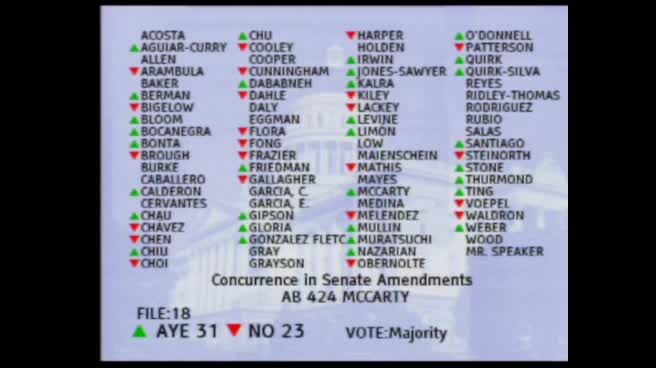 1MIN
Assembly Floor
 1MIN
Senate Floor
 1H
Senate Standing Committee on Appropriations
 2MIN
Senate Standing Committee on Governance and Finance
 1MIN
Assembly Floor
 1H
Assembly Standing Committee on Appropriations
 7MIN
Assembly Standing Committee on Revenue and Taxation
 9MIN