AB 797: Solar thermal systems.
- Session Year: 2017-2018
- House: Assembly
- Latest Version Date: 2017-10-04
The Solar Water Heating and Efficiency Act of 2007, until August 1, 2018, requires the Public Utilities Commission, if it determines that a solar water heating program is cost effective for ratepayers and in the public interest, to implement a program to promote the installation of 200,000 solar water heating systems in homes, businesses, and buildings or facilities of eligible customer classes receiving natural gas service throughout the state by 2017. The act establishes the maximum funding for the program, for the collective service territories of all gas corporations, at $250,000,000. The act requires the governing body of each publicly owned utility providing gas service to retail end-use customers to adopt, implement, and finance a solar water heating system incentive program to encourage the installation of 200,000 solar water heating systems by 2017.
This bill would revise the program to, among other things, promote the installation of solar thermal systems throughout the state, reserve 50% of the total program budget for the installation of solar thermal systems in low-income residential housing or in buildings in disadvantaged communities, expand the program to homeowners that lack access to natural gas and rely on propane or wood burning to fulfill their space heating, water heating, and cooking needs who are being considered to receive natural gas and who reside in the San Joaquin Valley communities identified by the commission, authorize the commission to limit program eligibility based on income levels, require an assessment of the entire program through July 31, 2019, to be completed by December 31, 2019, to determine both the cost-effectiveness of the program and the programs effectiveness in achieving program goals, and extend operation of the program through July 31, 2020. Because a violation of any order, decision, rule, direction, demand, or requirement of the commission implementing these revisions would be a crime, this bill would impose a state-mandated local program. The bill would also require the governing body of each local publicly owned utility providing gas service, until August 1, 2020, to adopt, implement, and finance a solar thermal system incentive program. Because the bill would extend the obligations of a local publicly owned utility to adopt, implement, and finance the program, this bill would impose a state-mandated local program.
The California Constitution requires the state to reimburse local agencies and school districts for certain costs mandated by the state. Statutory provisions establish procedures for making that reimbursement.
This bill would provide that no reimbursement is required by this act for specified reasons.
The Solar Water Heating and Efficiency Act of 2007, until August 1, 2018, requires the Public Utilities Commission, if it determines that a solar water heating program is cost effective for ratepayers and in the public interest, to implement a program to promote the installation of 200,000 solar water heating systems in homes, businesses, and buildings or facilities of eligible customer classes receiving natural gas service throughout the state by 2017. The act establishes the maximum funding for the program, for the collective service territories of all gas corporations, at $250,000,000. The act, until August 1, 2017, act requires the governing body of each publicly owned utility providing gas service to retail end-use customers to adopt, implement, and finance a solar water heating system incentive program to encourage the installation of 200,000 solar water heating systems by 2017.
This bill would revise the program to, among other things, promote the installation of solar thermal systems throughout the state, reserve 50% of the total program budget for the installation of solar thermal systems in low-income residential housing or in buildings in disadvantaged communities, authorize the commission to limit program eligibility based on income levels, require an assessment of the cost-effectiveness of the entire program through July 31, 2019, to be completed by December 31, 2019, to determine both the cost-effectiveness of the program and the programs effectiveness in achieving program goals, and extend operation of the program through July 31, 2020. Because a violation of any order, decision, rule, direction, demand, or requirement of the commission implementing these revisions would be a crime, this bill would impose a state-mandated local program. The bill would also require the governing body of each local publicly owned utility providing gas service, until August 1, 2020, to adopt, implement, and finance a solar thermal system incentive program. Because the bill would extend the obligations of a local publicly owned utility to adopt, implement, and finance the program, this bill would impose a state-mandated local program.
The California Constitution requires the state to reimburse local agencies and school districts for certain costs mandated by the state. Statutory provisions establish procedures for making that reimbursement.
This bill would provide that no reimbursement is required by this act for specified reasons.
The Solar Water Heating and Efficiency Act of 2007, until August 1, 2018, requires the Public Utilities Commission, if it determines that a solar water heating program is cost effective for ratepayers and in the public interest, to implement a program to promote the installation of 200,000 solar water heating systems in homes, businesses, and buildings or facilities of eligible customer classes receiving natural gas service throughout the state by 2017. The act establishes the maximum funding for the program, for the collective service territories of all gas corporations, at $250,000,000. The act, until August 1, 2017, requires the governing body of each publicly owned utility providing gas service to retail end-use customers to adopt, implement, and finance a solar water heating system incentive program to encourage the installation of 200,000 solar water heating systems by 2017.
This bill would revise the program to, among other things, promote the installation of solar thermal systems throughout the state, set the maximum funding for the program between January 1, 2018, and July 31, 2023, at $250,000,000, reserve 50% of the total program budget for the installation of solar thermal systems in low-income residential housing or in buildings in disadvantaged communities, require an assessment of the cost-effectiveness of the entire program through July 31, 2019, to be completed by December 31, 2019, and extend the operation of the program through July 31, 2023. 2020. Because a violation of any order, decision, rule, direction, demand, or requirement of the commission implementing these revisions would be a crime, this bill would impose a state-mandated local program. The bill would also require the governing body of each local publicly owned utility providing gas service, until August 1, 2023, 2020, to adopt, implement, and finance a solar thermal system incentive program. Because the bill would extend the obligations of a local publicly owned utility to adopt, implement, and finance the program, this bill would impose a state-mandated local program.
The California Constitution requires the state to reimburse local agencies and school districts for certain costs mandated by the state. Statutory provisions establish procedures for making that reimbursement.
This bill would provide that no reimbursement is required by this act for specified reasons.
The Solar Water Heating and Efficiency Act of 2007, until August 1, 2018, requires the Public Utilities Commission, if it determines that a solar water heating program is cost effective for ratepayers and in the public interest, to implement a program to promote the installation of 200,000 solar water heating systems in homes, businesses, and buildings or facilities of eligible customer classes receiving natural gas service throughout the state by 2017. The act establishes the maximum funding for the program, for the collective service territories of all gas corporations, at $250,000,000. The act, until August 1, 2017, requires the governing body of each publicly owned utility providing gas service to retail end-use customers to adopt, implement, and finance a solar water heating system incentive program to encourage the installation of 200,000 solar water heating systems by 2017.
This bill would revise the program to, among other things, promote the installation of solar thermal systems throughout the state, set the maximum funding for the program between January 1, 2018, and July 31, 2023, at $250,000,000, reserve 50% of the total program budget for the installation of solar thermal systems in low-income residential housing or in buildings in disadvantaged communities, and extend the operation of the program through July 31, 2023. Because a violation of any order, decision, rule, direction, demand, or requirement of the commission implementing these revisions would be a crime, this bill would impose a state-mandated local program. The bill would also require the governing body of each local publicly owned utility providing gas service, until August 1, 2023, to adopt, implement, and finance a solar thermal system incentive program. Because the bill would extend the obligations of a local publicly owned utility to adopt, implement, and finance the program, this bill would impose a state-mandated local program.
The California Constitution requires the state to reimburse local agencies and school districts for certain costs mandated by the state. Statutory provisions establish procedures for making that reimbursement.
This bill would provide that no reimbursement is required by this act for specified reasons.
As used in this article, the following terms have the following meanings:
(a)Disadvantaged community means a community identified by the California Environmental Protection Agency pursuant to Section 39711 of the Health and Safety Code.
(b)Gas customer includes both core and noncore customers, as those terms are used in Chapter 2.2 (commencing with Section 328) of Part 1, that receive retail end-use gas service within the service territory of a gas corporation.
(c)kWth or kilowatts thermal means the unit of measure of the equivalent thermal capacity of a solar thermal system that is calculated by multiplying the aperture area of the solar collector area of the system, expressed in square meters, by a conversion factor of 0.7.
(d)kWhth means kilowatthours thermal as measured by the number of kilowatts thermal generated, or displaced, in an hour.
(e)Low-income residential housing means either of the following:
(1)Residential housing financed with low-income housing tax credits, tax-exempt mortgage revenue bonds, general obligation bonds, or local, state, or federal loans or grants, and for which the rents of the occupants who are lower income households, as defined in Section 50079.5 of the Health and Safety Code, do not exceed those prescribed by deed restrictions or regulatory agreements pursuant to the terms of the financing or financial assistance.
(2)A residential complex in which at least 20 percent of the total units are rented to lower income households, as defined in Section 50079.5 of the Health and Safety Code, and the housing units targeted for lower income households are already, at the time of the funding commitment pursuant to this article, subject to a deed restriction or affordability covenant with a public entity that ensures that the units will be available at an affordable housing cost meeting the requirements of Section 50052.5 of the Health and Safety Code, or at an affordable rent meeting the requirements of Section 50053 of the Health and Safety Code.
(f)New Solar Homes Partnership means the 10-year program, administered by the Energy Commission, encouraging solar energy systems in new home construction.
(g)Solar heating collector means a device that is used to collect or capture heat from the sun and that is generally, but need not be, located on a roof.
(h)Solar thermal system means a solar energy device that reduces demand for natural gas through water heating, space heating or cooling, or other methods of capturing heat energy from the sun to reduce natural gas consumption in a home, business, or any building or facility receiving natural gas that is subject to the surcharge established pursuant to paragraph (2) of subdivision (b) of Section 2863, or exempt from the surcharge pursuant to paragraph (4) of subdivision (b) of Section 2863, and that meets or exceeds the eligibility criteria established pursuant to Section 2864. Solar thermal systems include multifamily residential, industrial, agricultural, governmental, educational, and nonprofit solar pool heating systems, but do not include single-family residential solar pool heating systems.
SEC. 4.Section 2862 of the Public Utilities Code is amended and renumbered to read:2860.(a)The Legislature finds and declares all of the following:
(1)California is heavily dependent on natural gas.
(2)Californias growing population and economy will put a strain on energy supplies and threaten the ability of the state to meet its global warming goals unless specific steps are taken to reduce demand and generate energy cleanly and efficiently.
(3)Water heating for domestic and industrial use relies almost entirely on natural gas and accounts for a significant percentage of the states natural gas consumption.
(4)Solar thermal systems represent the major untapped natural gas saving potential in California.
(5)In addition to financial and energy savings, solar water heating systems can help protect against future gas and electricity shortages and reduce our dependence on foreign sources of energy.
(6)Solar thermal systems can also help preserve the environment and protect public health by reducing air pollution, including carbon dioxide, a leading global warming gas, and nitrogen oxide, a precursor to smog.
(7)Growing demand for these technologies will create jobs in California as well as promote greater energy independence, protect consumers from rising energy costs, and result in cleaner air.
(8)Installing solar thermal systems in disadvantaged communities can provide local economic benefits while advancing the states clean energy goals and policies to reduce the emissions of greenhouse gases.
(9)It is in the interest of the State of California to promote solar thermal systems and other technologies that directly reduce demand for natural gas in homes and businesses.
(b)It is the intent of the Legislature to build a mainstream market for solar thermal systems that directly reduces demand for natural gas in homes, businesses, schools, industrial, agricultural, and government buildings, and buildings occupied by nonprofit organizations.
(c)It is the intent of the Legislature that the solar thermal system incentives created by this article should be a cost-effective investment by gas customers.
(d)It is the intent of the Legislature that this article will encourage the cost-effective deployment of solar thermal systems in residential, commercial, industrial, and agricultural markets and in each end-use application sector in a balanced manner. It is the intent of the Legislature that the commission monitor and adjust incentives made available pursuant to this article so that they are cost-effective investments sufficient to significantly increase markets and promote market transformation. It is the additional intent of the Legislature that the commission ensure that increased, uniform growth in each market sector is achieved through program incentives or structure adjustments that prevent overutilization of program resources by any single sector.
SEC. 5.Section 2863 of the Public Utilities Code is amended to read:2863.(a)(1)The commission shall implement changes to the program as authorized pursuant to this section as it read on December 31, 2017, applicable to the service territories of a gas corporation to promote the installation of solar thermal systems in homes, businesses, and buildings or facilities of eligible customer classes receiving natural gas service throughout the state. Eligible customer classes shall include single-family and multifamily residential, commercial, industrial, agricultural, governmental, nonprofit, and primary, secondary, and postsecondary educational customers.
(A)The commission shall expand the program to homeowners that lack access to natural gas and rely on propane or wood burning to fulfill their space heating, water heating, and cooking needs who are being considered to receive natural gas and who reside in the San Joaquin Valley communities identified by the commission pursuant to paragraph (1) of subdivision (a) of Section 783.5.
(B)The commission may limit program eligibility based on income levels for residential applicants in order to achieve program goals.
(C)The commission shall implement program changes in phases, if necessary, to enable seamless continuation of the availability of rebates, and the administration and promotion of the program, as of January 1, 2018.
(2)The program shall be administered by gas corporations or third-party administrators, as determined by the commission, and subject to the supervision of the commission.
(3)The commission shall coordinate the program with the Energy Commissions programs and initiatives, including, but not limited to, the New Solar Homes Partnership, to achieve the goal of building zero-energy homes.
(4)The commission shall perform an assessment of the entire program through July 31, 2019, to be completed by no later than December 31, 2019, to determine both the cost-effectiveness of the program and the programs effectiveness in achieving program goals.
(b)(1)The commission shall fund the program through the use of a surcharge applied to gas customers based upon the amount of natural gas consumed. The surcharge shall be in addition to any other charges for natural gas sold or transported for consumption in this state.
(2)Funding for the program established by this article shall not, for the collective service territories of all gas corporations, exceed two hundred fifty million dollars ($250,000,000) over the course of the program to July 31, 2020.
(3)Fifty percent of the total program budget shall be reserved for the installation of solar thermal systems in low-income residential housing or in buildings in disadvantaged communities. The commission may revise the percentage if the budget for other types of customers becomes depleted.
(4)Ten percent of the total program budget shall be reserved for the installation of solar thermal systems for industrial applications. The commission may revise the percentage if the budget for other types of customers becomes depleted.
(5)The commission shall annually establish a surcharge rate for each class of gas customers. Any gas customer participating in the California Alternate Rates for Energy (CARE) or Family Electric Rate Assistance (FERA) programs shall be exempt from paying any surcharge imposed to fund the program designed and implemented pursuant to this article.
(6)Any surcharge imposed to fund the program designed and implemented pursuant to this article shall not be imposed upon the portion of any gas customers procurement of natural gas that is used or employed for a purpose that Section 896 excludes from being categorized as the consumption of natural gas.
(7)The gas corporation or other person or entity providing revenue cycle services, as defined in Section 328.1, shall be responsible for collecting the surcharge.
(c)Funds shall be allocated in the form of customer rebates to promote utilization of solar thermal systems.
(d)In designing and implementing the program required by this article, no moneys shall be diverted from any existing programs for low-income ratepayers or cost-effective energy efficiency programs.
SEC. 6.Section 2864 of the Public Utilities Code is amended to read:2864.(a)The commission, in consultation with the Energy Commission and interested members of the public, shall establish eligibility criteria for solar thermal systems receiving gas customer funded incentives pursuant to this article. The criteria should specify and include all of the following:
(1)Design, installation, and energy output or displacement standards. To be eligible for rebate funding, a residential solar thermal system shall be certified by an accredited listing agency in accordance with standards adopted by the commission. Solar collectors used in systems for multifamily residential, commercial, government, nonprofit, educational, agricultural, or industrial applications shall be certified by an accredited listing agency in accordance with standards adopted by the commission. Energy output of collectors and systems shall be determined in accordance with procedures set forth by the listing agency, and shall be based on testing results from accredited testing laboratories.
(2)A requirement that solar thermal system components are new and unused, and have not previously been placed in service in any other location or for any other application.
(3)A requirement that solar thermal collectors have a warranty of not less than 10 years to protect against defects and undue degradation.
(4)A requirement that solar thermal systems are in buildings or facilities connected to a natural gas utilitys distribution system within the state.
(5)(A)A requirement that solar thermal systems have meters or other kWhth measuring devices in place to monitor and measure the systems performance and the quantity of energy generated or displaced by the system.
(B)The commission shall exempt from this requirement system types for which the cost of monitoring a system is likely to exceed 2 percent of the system cost. After a public stakeholder process, the commission may adjust this percentage to ensure reasonable balance between customer cost and value received, taking into account factors including, but not limited to, customer class, system type, system size, or changes in the market.
(6)A requirement that solar thermal systems are installed in conformity with the manufacturers specifications and all applicable codes and standards.
(7)A requirement that, when the property is not owner-occupied, the tenant shall not contract for the installation of a solar thermal system. The tenant may request that the owner participate in such a program.
(b)Gas customer funded incentives shall not be made for a solar thermal system that does not meet the eligibility criteria.
(c)The commission may adopt consensus solar standards applicable to products or systems as developed by accredited standards developers.
SEC. 7.Section 2865 of the Public Utilities Code is amended to read:2865.(a)The commission shall establish conditions on gas customer funded incentives pursuant to this article. The conditions shall require both of the following:
(1)Appropriate siting and high-quality installation of the solar thermal system based on installation guidelines that maximize the performance of the system and prevent qualified systems from being inefficiently or inappropriately installed. The conditions shall not impact housing designs or densities presently authorized by a city, county, or city and county. The goal of this paragraph is to achieve efficient installation of solar thermal systems and promote the greatest energy production or displacement per gas customer dollar.
(2)Appropriate energy efficiency improvements in the new or existing home or facility where the solar thermal system is installed.
(b)The commission shall set rating standards for equipment, components, and systems to ensure reasonable performance and shall develop procedures that provide for compliance with the minimum ratings.
SEC. 8.Section 2866 of the Public Utilities Code is amended to read:2866.(a)The commission may establish a grant program or a revolving loan or loan guarantee program for low-income residential housing consistent with the requirements of Chapter 5.3 (commencing with Section 25425) of Division 15 of the Public Resources Code. Notwithstanding Section 2867.4, all loans outstanding as of August 1, 2020, shall continue to be repaid in a manner that is consistent with the terms and conditions of the program adopted and implemented by the commission pursuant to this subdivision, until repaid in full.
(b)The commission may extend eligibility for funding pursuant to this section to include residential housing occupied by ratepayers participating in a commission approved and supervised gas corporation Low-Income Energy Efficiency (LIEE) program and who either:
(1)Occupy a single-family home.
(2)Occupy at least 50 percent of all units in a multifamily dwelling structure.
(c)The commission shall ensure that lower income households, as defined in Section 50079.5 of the Health and Safety Code, and, if the commission expands the program pursuant to subdivision (b), ratepayers participating in a LIEE program, that receive gas service at residential housing with a solar thermal system receiving incentives pursuant to subdivision (a) benefit from the installation of the solar thermal systems through reduced or lowered energy costs.
(d)The commission shall do all of the following to implement the requirements of this section:
(1)Maximize incentives to properties that are committed to continuously serving the needs of lower income households, as defined in Section 50079.5 of the Health and Safety Code, and, if the commission expands the program pursuant to subdivision (b), ratepayers participating in a LIEE program.
(2)Establish conditions on the installation of solar thermal systems that ensure properties on which solar thermal systems are installed under subdivision (a) remain low-income residential properties for at least 10 years from the time of installation, including property ownership restrictions and income rental protections, and appropriate enforcement of these conditions.
SEC. 9.Section 2867 of the Public Utilities Code is amended to read:2867.(a)Consistent with subdivision (c) of Section 2863, the commission shall consider reductions over time in rebates provided through the program. The rebates shall be structured so as to drive down the cost of the solar thermal technologies, and be paid out on a performance-based incentive basis so that incentives are earned based on the actual energy savings, or on predicted energy savings as established by the commission.
(b)The commission shall consider federal tax credits and other incentives available for this technology when determining the appropriate rebate amount.
(c)The commission shall consider the impact of rebates for solar thermal systems pursuant to this article on existing incentive programs for energy efficiency technology.
(d)In coordination with the commission, the Energy Commission shall consider, when appropriate, coupling rebates for solar thermal systems with complementary energy efficiency technologies, including, but not limited to, efficient hot water heating tanks and tankless or on demand hot water systems that can be installed in addition to the solar thermal system.
(e)The commission may consider adjustments to the rebate levels within the service territory of a gas corporation to address gas shortages or similar gas supply constraints, as determined by the commission.
SEC. 10.Section 2867.2 of the Public Utilities Code is repealed.SEC. 11.Section 2867.3 of the Public Utilities Code is amended to read:2867.3.The governing body of each local publicly owned utility providing gas service to retail end-use gas customers shall, after a public proceeding, adopt, implement, and finance a solar thermal system incentive program that does all the following:
(a)Ensures that any solar thermal system receiving monetary incentives complies with eligibility criteria adopted by the governing body. The eligibility criteria shall include those elements contained in paragraphs (1) to (7), inclusive, of subdivision (a) of Section 2864.
(b)Includes minimum ratings and standards for equipment, components, and systems to ensure reasonable performance and compliance with the minimum ratings and standards.
(c)Includes an element that addresses the installation of solar thermal systems on low-income residential housing. If deemed appropriate in consultation with the California Tax Credit Allocation Committee, the governing board may establish a grant program or a revolving loan or loan guarantee program for low-income residential housing consistent with the requirements of Chapter 5.3 (commencing with Section 25425) of Division 15 of the Public Resources Code.
SEC. 12.Section 2867.4 of the Public Utilities Code is repealed.SEC. 13.Section 2867.4 is added to the Public Utilities Code, to read:2867.4.This article shall become inoperative on August 1, 2020, and, as of January 1, 2021, is repealed, unless a later enacted statute, that becomes operative on or before January 1, 2021, deletes or extends the dates on which it becomes inoperative and is repealed.
SEC. 14.No reimbursement is required by this act pursuant to Section 6 of Article XIIIB of the California Constitution because a local agency or school district has the authority to levy service charges, fees, or assessments sufficient to pay for the program or level of service mandated by this act or because costs that may be incurred by a local agency or school district will be incurred because this act creates a new crime or infraction, eliminates a crime or infraction, or changes the penalty for a crime or infraction, within the meaning of Section 17556 of the Government Code, or changes the definition of a crime within the meaning of Section 6 of Article XIIIB of the California Constitution.
As used in this article, the following terms have the following meanings:
(a)Disadvantaged community means a community identified by the California Environmental Protection Agency pursuant to Section 39711 of the Health and Safety Code.
(b)Gas customer includes both core and noncore customers, as those terms are used in Chapter 2.2 (commencing with Section 328) of Part 1, that receive retail end-use gas service within the service territory of a gas corporation.
(c)kWth or kilowatts thermal means the unit of measure of the equivalent thermal capacity of a solar thermal system that is calculated by multiplying the aperture area of the solar collector area of the system, expressed in square meters, by a conversion factor of 0.7.
(d)kWhth means kilowatthours thermal as measured by the number of kilowatts thermal generated, or displaced, in an hour.
(e)Low-income residential housing means either of the following:
(1)Residential housing financed with low-income housing tax credits, tax-exempt mortgage revenue bonds, general obligation bonds, or local, state, or federal loans or grants, and for which the rents of the occupants who are lower income households, as defined in Section 50079.5 of the Health and Safety Code, do not exceed those prescribed by deed restrictions or regulatory agreements pursuant to the terms of the financing or financial assistance.
(2)A residential complex in which at least 20 percent of the total units are rented to lower income households, as defined in Section 50079.5 of the Health and Safety Code, and the housing units targeted for lower income households are already, at the time of the funding commitment pursuant to this article, subject to a deed restriction or affordability covenant with a public entity that ensures that the units will be available at an affordable housing cost meeting the requirements of Section 50052.5 of the Health and Safety Code, or at an affordable rent meeting the requirements of Section 50053 of the Health and Safety Code.
(f)New Solar Homes Partnership means the 10-year program, administered by the Energy Commission, encouraging solar energy systems in new home construction.
(g)Solar heating collector means a device that is used to collect or capture heat from the sun and that is generally, but need not be, located on a roof.
(h)Solar thermal system means a solar energy device that reduces demand for natural gas through water heating, space heating or cooling, or other methods of capturing heat energy from the sun to reduce natural gas consumption in a home, business, or any building or facility receiving natural gas that is subject to the surcharge established pursuant to paragraph (2) of subdivision (b) of Section 2863, or exempt from the surcharge pursuant to paragraph (4) of subdivision (b) of Section 2863, and that meets or exceeds the eligibility criteria established pursuant to Section 2864. Solar thermal systems include multifamily residential, industrial, agricultural, governmental, educational, and nonprofit solar pool heating systems, but do not include single-family residential solar pool heating systems.
SEC. 4.Section 2862 of the Public Utilities Code is amended and renumbered to read:2860.(a)The Legislature finds and declares all of the following:
(1)California is heavily dependent on natural gas.
(2)Californias growing population and economy will put a strain on energy supplies and threaten the ability of the state to meet its global warming goals unless specific steps are taken to reduce demand and generate energy cleanly and efficiently.
(3)Water heating for domestic and industrial use relies almost entirely on natural gas and accounts for a significant percentage of the states natural gas consumption.
(4)Solar thermal systems represent the major untapped natural gas saving potential in California.
(5)In addition to financial and energy savings, solar water heating systems can help protect against future gas and electricity shortages and reduce our dependence on foreign sources of energy.
(6)Solar thermal systems can also help preserve the environment and protect public health by reducing air pollution, including carbon dioxide, a leading global warming gas, and nitrogen oxide, a precursor to smog.
(7)Growing demand for these technologies will create jobs in California as well as promote greater energy independence, protect consumers from rising energy costs, and result in cleaner air.
(8)Installing solar thermal systems in disadvantaged communities can provide local economic benefits while advancing the states clean energy goals and policies to reduce the emissions of greenhouse gases.
(9)It is in the interest of the State of California to promote solar thermal systems and other technologies that directly reduce demand for natural gas in homes and businesses.
(b)It is the intent of the Legislature to build a mainstream market for solar thermal systems that directly reduces demand for natural gas in homes, businesses, schools, industrial, agricultural, and government buildings, and buildings occupied by nonprofit organizations.
(c)It is the intent of the Legislature that the solar thermal system incentives created by this article should be a cost-effective investment by gas customers.
(d)It is the intent of the Legislature that this article will encourage the cost-effective deployment of solar thermal systems in residential, commercial, industrial, and agricultural markets and in each end-use application sector in a balanced manner. It is the intent of the Legislature that the commission monitor and adjust incentives made available pursuant to this article so that they are cost-effective investments sufficient to significantly increase markets and promote market transformation. It is the additional intent of the Legislature that the commission ensure that increased, uniform growth in each market sector is achieved through program incentives or structure adjustments that prevent overutilization of program resources by any single sector.
SEC. 5.Section 2863 of the Public Utilities Code is amended to read:2863.(a)(1)The commission shall do all of the following: implement changes to the program as authorized pursuant to this section as it read on December 31, 2017, applicable to the service territories of a gas corporation to promote the installation of solar thermal systems in homes, businesses, and buildings or facilities of eligible customer classes receiving natural gas service throughout the state. Eligible customer classes shall include single-family and multifamily residential, commercial, industrial, agricultural, governmental, nonprofit, and primary, secondary, and postsecondary educational customers.
(1)Implement changes to the program as authorized pursuant to this section as it read on December 31, 2017, applicable to the service territories of a gas corporation to promote the installation of solar thermal systems in homes, businesses, and buildings or facilities of eligible customer classes receiving natural gas service throughout the state. Eligible customer classes shall include single-family and multifamily residential, commercial, industrial, agricultural, governmental, nonprofit, and primary, secondary, and postsecondary educational customers.(A)The commission shall expand the program to homeowners that lack access to natural gas and rely on propane or wood burning to fulfill their space heating, water heating, and cooking needs who are being considered to receive natural gas and who reside in the San Joaquin Valley communities identified by the commission pursuant to paragraph (1) of subdivision (a) of Section 783.5.
(A)(B)The commission may limit program eligibility based on income levels for residential applicants in order to achieve program goals.
(B)(C)The commission shall implement program changes in phases, if necessary, to enable seamless continuation of the availability of rebates, and the administration and promotion of the program, as of January 1, 2018.
(2)The program shall be administered by gas corporations or third-party administrators, as determined by the commission, and subject to the supervision of the commission.
(3)The commission shall coordinate the program with the Energy Commissions programs and initiatives, including, but not limited to, the New Solar Homes Partnership, to achieve the goal of building zero-energy homes.
(4)The commission shall perform an assessment of the entire program through July 31, 2019, to be completed by no later than December 31, 2019, to determine both the cost-effectiveness of the program and the programs effectiveness in achieving program goals.
(b)(1)The commission shall fund the program through the use of a surcharge applied to gas customers based upon the amount of natural gas consumed. The surcharge shall be in addition to any other charges for natural gas sold or transported for consumption in this state.
(2)Funding for the program established by this article shall not, for the collective service territories of all gas corporations, exceed two hundred fifty million dollars ($250,000,000) over the course of the program to July 31, 2020.
(3)Fifty percent of the total program budget shall be reserved for the installation of solar thermal systems in low-income residential housing or in buildings in disadvantaged communities. The commission may revise the percentage if the budget for other types of customers becomes depleted.
(4)Ten percent of the total program budget shall be reserved for the installation of solar thermal systems for industrial applications. The commission may revise the percentage if the budget for other types of customers becomes depleted.
(5)The commission shall annually establish a surcharge rate for each class of gas customers. Any gas customer participating in the California Alternate Rates for Energy (CARE) or Family Electric Rate Assistance (FERA) programs shall be exempt from paying any surcharge imposed to fund the program designed and implemented pursuant to this article.
(6)Any surcharge imposed to fund the program designed and implemented pursuant to this article shall not be imposed upon the portion of any gas customers procurement of natural gas that is used or employed for a purpose that Section 896 excludes from being categorized as the consumption of natural gas.
(7)The gas corporation or other person or entity providing revenue cycle services, as defined in Section 328.1, shall be responsible for collecting the surcharge.
(c)Funds shall be allocated in the form of customer rebates to promote utilization of solar thermal systems.
(d)In designing and implementing the program required by this article, no moneys shall be diverted from any existing programs for low-income ratepayers or cost-effective energy efficiency programs.
SEC. 6.Section 2864 of the Public Utilities Code is amended to read:2864.(a)The commission, in consultation with the Energy Commission and interested members of the public, shall establish eligibility criteria for solar thermal systems receiving gas customer funded incentives pursuant to this article. The criteria should specify and include all of the following:
(1)Design, installation, and energy output or displacement standards. To be eligible for rebate funding, a residential solar thermal system shall be certified by an accredited listing agency in accordance with standards adopted by the commission. Solar collectors used in systems for multifamily residential, commercial, government, nonprofit, educational, agricultural, or industrial applications shall be certified by an accredited listing agency in accordance with standards adopted by the commission. Energy output of collectors and systems shall be determined in accordance with procedures set forth by the listing agency, and shall be based on testing results from accredited testing laboratories.
(2)A requirement that solar thermal system components are new and unused, and have not previously been placed in service in any other location or for any other application.
(3)A requirement that solar thermal collectors have a warranty of not less than 10 years to protect against defects and undue degradation.
(4)A requirement that solar thermal systems are in buildings or facilities connected to a natural gas utilitys distribution system within the state.
(5)(A)A requirement that solar thermal systems have meters or other kWhth measuring devices in place to monitor and measure the systems performance and the quantity of energy generated or displaced by the system.
(B)The commission shall exempt from this requirement system types for which the cost of monitoring a system is likely to exceed 2 percent of the system cost. After a public stakeholder process, the commission may adjust this percentage to ensure reasonable balance between customer cost and value received, taking into account factors including, but not limited to, customer class, system type, system size, or changes in the market.
(6)A requirement that solar thermal systems are installed in conformity with the manufacturers specifications and all applicable codes and standards.
(7)A requirement that, when the property is not owner-occupied, the tenant shall not contract for the installation of a solar thermal system. The tenant may request that the owner participate in such a program.
(b)Gas customer funded incentives shall not be made for a solar thermal system that does not meet the eligibility criteria.
(c)The commission may adopt consensus solar standards applicable to products or systems as developed by accredited standards developers.
SEC. 7.Section 2865 of the Public Utilities Code is amended to read:2865.(a)The commission shall establish conditions on gas customer funded incentives pursuant to this article. The conditions shall require both of the following:
(1)Appropriate siting and high-quality installation of the solar thermal system based on installation guidelines that maximize the performance of the system and prevent qualified systems from being inefficiently or inappropriately installed. The conditions shall not impact housing designs or densities presently authorized by a city, county, or city and county. The goal of this paragraph is to achieve efficient installation of solar thermal systems and promote the greatest energy production or displacement per gas customer dollar.
(2)Appropriate energy efficiency improvements in the new or existing home or facility where the solar thermal system is installed.
(b)The commission shall set rating standards for equipment, components, and systems to ensure reasonable performance and shall develop procedures that provide for compliance with the minimum ratings.
SEC. 8.Section 2866 of the Public Utilities Code is amended to read:2866.(a)The commission may establish a grant program or a revolving loan or loan guarantee program for low-income residential housing consistent with the requirements of Chapter 5.3 (commencing with Section 25425) of Division 15 of the Public Resources Code. Notwithstanding Section 2867.4, all loans outstanding as of August 1, 2020, shall continue to be repaid in a manner that is consistent with the terms and conditions of the program adopted and implemented by the commission pursuant to this subdivision, until repaid in full.
(b)The commission may extend eligibility for funding pursuant to this section to include residential housing occupied by ratepayers participating in a commission approved and supervised gas corporation Low-Income Energy Efficiency (LIEE) program and who either:
(1)Occupy a single-family home.
(2)Occupy at least 50 percent of all units in a multifamily dwelling structure.
(c)The commission shall ensure that lower income households, as defined in Section 50079.5 of the Health and Safety Code, and, if the commission expands the program pursuant to subdivision (b), ratepayers participating in a LIEE program, that receive gas service at residential housing with a solar thermal system receiving incentives pursuant to subdivision (a) benefit from the installation of the solar thermal systems through reduced or lowered energy costs.
(d)The commission shall do all of the following to implement the requirements of this section:
(1)Maximize incentives to properties that are committed to continuously serving the needs of lower income households, as defined in Section 50079.5 of the Health and Safety Code, and, if the commission expands the program pursuant to subdivision (b), ratepayers participating in a LIEE program.
(2)Establish conditions on the installation of solar thermal systems that ensure properties on which solar thermal systems are installed under subdivision (a) remain low-income residential properties for at least 10 years from the time of installation, including property ownership restrictions and income rental protections, and appropriate enforcement of these conditions.
SEC. 9.Section 2867 of the Public Utilities Code is amended to read:2867.(a)Consistent with subdivision (c) of Section 2863, the commission shall consider reductions over time in rebates provided through the program. The rebates shall be structured so as to drive down the cost of the solar thermal technologies, and be paid out on a performance-based incentive basis so that incentives are earned based on the actual energy savings, or on predicted energy savings as established by the commission.
(b)The commission shall consider federal tax credits and other incentives available for this technology when determining the appropriate rebate amount.
(c)The commission shall consider the impact of rebates for solar thermal systems pursuant to this article on existing incentive programs for energy efficiency technology.
(d)In coordination with the commission, the Energy Commission shall consider, when appropriate, coupling rebates for solar thermal systems with complementary energy efficiency technologies, including, but not limited to, efficient hot water heating tanks and tankless or on demand hot water systems that can be installed in addition to the solar thermal system.
(e)The commission may consider adjustments to the rebate levels within the service territory of a gas corporation to address gas shortages or similar gas supply constraints, as determined by the commission.
SEC. 10.Section 2867.2 of the Public Utilities Code is repealed.SEC. 11.Section 2867.3 of the Public Utilities Code is amended to read:2867.3.The governing body of each local publicly owned utility providing gas service to retail end-use gas customers shall, after a public proceeding, adopt, implement, and finance a solar thermal system incentive program that does all the following:
(a)Ensures that any solar thermal system receiving monetary incentives complies with eligibility criteria adopted by the governing body. The eligibility criteria shall include those elements contained in paragraphs (1) to (7), inclusive, of subdivision (a) of Section 2864.
(b)Includes minimum ratings and standards for equipment, components, and systems to ensure reasonable performance and compliance with the minimum ratings and standards.
(c)Includes an element that addresses the installation of solar thermal systems on low-income residential housing. If deemed appropriate in consultation with the California Tax Credit Allocation Committee, the governing board may establish a grant program or a revolving loan or loan guarantee program for low-income residential housing consistent with the requirements of Chapter 5.3 (commencing with Section 25425) of Division 15 of the Public Resources Code.
SEC. 12.Section 2867.4 of the Public Utilities Code is repealed.SEC. 13.Section 2867.4 is added to the Public Utilities Code, to read:2867.4.This article shall become inoperative on August 1, 2020, and, as of January 1, 2021, is repealed, unless a later enacted statute, that becomes operative on or before January 1, 2021, deletes or extends the dates on which it becomes inoperative and is repealed.
SEC. 14.No reimbursement is required by this act pursuant to Section 6 of Article XIIIB of the California Constitution because a local agency or school district has the authority to levy service charges, fees, or assessments sufficient to pay for the program or level of service mandated by this act or because costs that may be incurred by a local agency or school district will be incurred because this act creates a new crime or infraction, eliminates a crime or infraction, or changes the penalty for a crime or infraction, within the meaning of Section 17556 of the Government Code, or changes the definition of a crime within the meaning of Section 6 of Article XIIIB of the California Constitution.
As used in this article, the following terms have the following meanings:
(a)Disadvantaged community means a community identified by the California Environmental Protection Agency pursuant to Section 39711 of the Health and Safety Code.
(b)Gas customer includes both core and noncore customers, as those terms are used in Chapter 2.2 (commencing with Section 328) of Part 1, that receive retail end-use gas service within the service territory of a gas corporation.
(c)kWth or kilowatts thermal means the unit of measure of the equivalent thermal capacity of a solar thermal system that is calculated by multiplying the aperture area of the solar collector area of the system, expressed in square meters, by a conversion factor of 0.7.
(d)kWhth means kilowatthours thermal as measured by the number of kilowatts thermal generated, or displaced, in an hour.
(e)Low-income residential housing means either of the following:
(1)Residential housing financed with low-income housing tax credits, tax-exempt mortgage revenue bonds, general obligation bonds, or local, state, or federal loans or grants, and for which the rents of the occupants who are lower income households, as defined in Section 50079.5 of the Health and Safety Code, do not exceed those prescribed by deed restrictions or regulatory agreements pursuant to the terms of the financing or financial assistance.
(2)A residential complex in which at least 20 percent of the total units are rented to lower income households, as defined in Section 50079.5 of the Health and Safety Code, and the housing units targeted for lower income households are already, at the time of the funding commitment pursuant to this article, subject to a deed restriction or affordability covenant with a public entity that ensures that the units will be available at an affordable housing cost meeting the requirements of Section 50052.5 of the Health and Safety Code, or at an affordable rent meeting the requirements of Section 50053 of the Health and Safety Code.
(f)New Solar Homes Partnership means the 10-year program, administered by the Energy Commission, encouraging solar energy systems in new home construction.
(g)Solar heating collector means a device that is used to collect or capture heat from the sun and that is generally, but need not be, located on a roof.
(h)Solar thermal system means a solar energy device that reduces demand for natural gas through water heating, space heating or cooling, or other methods of capturing heat energy from the sun to reduce natural gas consumption in a home, business, or any building or facility receiving natural gas that is subject to the surcharge established pursuant to paragraph (2) of subdivision (b) of Section 2863, or exempt from the surcharge pursuant to paragraph (4) of subdivision (b) of Section 2863, and that meets or exceeds the eligibility criteria established pursuant to Section 2864. Solar thermal systems include multifamily residential, industrial, agricultural, governmental, educational, and nonprofit solar pool heating systems, but do not include single-family residential solar pool heating systems.
SEC. 4.Section 2862 of the Public Utilities Code is amended and renumbered to read:2860.(a)The Legislature finds and declares all of the following:
(1)California is heavily dependent on natural gas.
(2)Californias growing population and economy will put a strain on energy supplies and threaten the ability of the state to meet its global warming goals unless specific steps are taken to reduce demand and generate energy cleanly and efficiently.
(3)Water heating for domestic and industrial use relies almost entirely on natural gas and accounts for a significant percentage of the states natural gas consumption.
(4)Solar thermal systems represent the major untapped natural gas saving potential in California.
(5)In addition to financial and energy savings, solar water heating systems can help protect against future gas and electricity shortages and reduce our dependence on foreign sources of energy.
(6)Solar thermal systems can also help preserve the environment and protect public health by reducing air pollution, including carbon dioxide, a leading global warming gas, and nitrogen oxide, a precursor to smog.
(7)Growing demand for these technologies will create jobs in California as well as promote greater energy independence, protect consumers from rising energy costs, and result in cleaner air.
(8)Installing solar thermal systems in disadvantaged communities can provide local economic benefits while advancing the states clean energy goals and policies to reduce the emissions of greenhouse gases.
(9)It is in the interest of the State of California to promote solar thermal systems and other technologies that directly reduce demand for natural gas in homes and businesses.
(b)It is the intent of the Legislature to build a mainstream market for solar thermal systems that directly reduces demand for natural gas in homes, businesses, schools, industrial, agricultural, and government buildings, and buildings occupied by nonprofit organizations.
(c)It is the intent of the Legislature that the solar thermal system incentives created by this article should be a cost-effective investment by gas customers.
(d)It is the intent of the Legislature that this article will encourage the cost-effective deployment of solar thermal systems in residential, commercial, industrial, and agricultural markets and in each end-use application sector in a balanced manner. It is the intent of the Legislature that the commission monitor and adjust incentives made available pursuant to this article so that they are cost-effective investments sufficient to significantly increase markets and promote market transformation. It is the additional intent of the Legislature that the commission ensure that increased, uniform growth in each market sector is achieved through program incentives or structure adjustments that prevent overutilization of program resources by any single sector.
SEC. 5.Section 2863 of the Public Utilities Code is amended to read:2863.(a)The commission shall do all of the following:
(1)Implement changes to the program as authorized pursuant to this section as it read on December 31, 2017, applicable to the service territories of a gas corporation to promote the installation of solar thermal systems in homes, businesses, and buildings or facilities of eligible customer classes receiving natural gas service throughout the state. Eligible customer classes shall include single-family and multifamily residential, commercial, industrial, agricultural, governmental, nonprofit, and primary, secondary, and postsecondary educational customers. The
(A)The commission may limit program eligibility based on income levels for residential applicants in order to achieve program goals.
(B)The commission shall implement program changes in phases, if necessary, to enable seamless continuation of the availability of rebates, and the administration and promotion of the program, as of January 1, 2018.
(2)The program shall be administered by gas corporations or third-party administrators, as determined by the commission, and subject to the supervision of the commission.
(3)The commission shall coordinate the program with the Energy Commissions programs and initiatives, including, but not limited to, the New Solar Homes Partnership, to achieve the goal of building zero-energy homes.
(4)The commission shall perform an assessment of the cost-effectiveness of the entire program through July 31, 2019, to be completed by no later than December 31, 2019. 2019, to determine both the cost-effectiveness of the program and the programs effectiveness in achieving program goals.
(b)(1)The commission shall fund the program through the use of a surcharge applied to gas customers based upon the amount of natural gas consumed. The surcharge shall be in addition to any other charges for natural gas sold or transported for consumption in this state.
(2)Funding for the program established by this article shall not, for the collective service territories of all gas corporations, exceed two hundred fifty million dollars ($250,000,000) over the course of the program to July 31, 2020.
(3)Fifty percent of the total program budget shall be reserved for the installation of solar thermal systems in low-income residential housing or in buildings in disadvantaged communities. The commission may revise the percentage if the budget for other types of customers becomes depleted.
(4)Ten percent of the total program budget shall be reserved for the installation of solar thermal systems for industrial applications. The commission may revise the percentage if the budget for other types of customers becomes depleted.
(5)The commission shall annually establish a surcharge rate for each class of gas customers. Any gas customer participating in the California Alternate Rates for Energy (CARE) or Family Electric Rate Assistance (FERA) programs shall be exempt from paying any surcharge imposed to fund the program designed and implemented pursuant to this article.
(6)Any surcharge imposed to fund the program designed and implemented pursuant to this article shall not be imposed upon the portion of any gas customers procurement of natural gas that is used or employed for a purpose that Section 896 excludes from being categorized as the consumption of natural gas.
(7)The gas corporation or other person or entity providing revenue cycle services, as defined in Section 328.1, shall be responsible for collecting the surcharge.
(c)Funds shall be allocated in the form of customer rebates to promote utilization of solar thermal systems.
(d)In designing and implementing the program required by this article, no moneys shall be diverted from any existing programs for low-income ratepayers or cost-effective energy efficiency programs.
SEC. 6.Section 2864 of the Public Utilities Code is amended to read:2864.(a)The commission, in consultation with the Energy Commission and interested members of the public, shall establish eligibility criteria for solar thermal systems receiving gas customer funded incentives pursuant to this article. The criteria should specify and include all of the following:
(1)Design, installation, and energy output or displacement standards. To be eligible for rebate funding, a residential solar thermal system shall be certified by an accredited listing agency in accordance with standards adopted by the commission. Solar collectors used in systems for multifamily residential, commercial, government, nonprofit, educational, agricultural, or industrial applications shall be certified by an accredited listing agency in accordance with standards adopted by the commission. Energy output of collectors and systems shall be determined in accordance with procedures set forth by the listing agency, and shall be based on testing results from accredited testing laboratories.
(2)A requirement that solar thermal system components are new and unused, and have not previously been placed in service in any other location or for any other application.
(3)A requirement that solar thermal collectors have a warranty of not less than 10 years to protect against defects and undue degradation.
(4)A requirement that solar thermal systems are in buildings or facilities connected to a natural gas utilitys distribution system within the state.
(5)(A)A requirement that solar thermal systems have meters or other kWhth measuring devices in place to monitor and measure the systems performance and the quantity of energy generated or displaced by the system.
(B)The commission shall exempt from this requirement system types for which the cost of monitoring a system is likely to exceed 2 percent of the system cost. After a public stakeholder process, the commission may adjust this percentage to ensure reasonable balance between customer cost and value received, taking into account factors including, but not limited to, customer class, system type, system size, or changes in the market.
(6)A requirement that solar thermal systems are installed in conformity with the manufacturers specifications and all applicable codes and standards.
(7)A requirement that, when the property is not owner-occupied, the tenant shall not contract for the installation of a solar thermal system. The tenant may request that the owner participate in such a program.
(b)Gas customer funded incentives shall not be made for a solar thermal system that does not meet the eligibility criteria.
(c)The commission may adopt consensus solar standards applicable to products or systems as developed by accredited standards developers.
SEC. 7.Section 2865 of the Public Utilities Code is amended to read:2865.(a)The commission shall establish conditions on gas customer funded incentives pursuant to this article. The conditions shall require both of the following:
(1)Appropriate siting and high-quality installation of the solar thermal system based on installation guidelines that maximize the performance of the system and prevent qualified systems from being inefficiently or inappropriately installed. The conditions shall not impact housing designs or densities presently authorized by a city, county, or city and county. The goal of this paragraph is to achieve efficient installation of solar thermal systems and promote the greatest energy production or displacement per gas customer dollar.
(2)Appropriate energy efficiency improvements in the new or existing home or facility where the solar thermal system is installed.
(b)The commission shall set rating standards for equipment, components, and systems to ensure reasonable performance and shall develop procedures that provide for compliance with the minimum ratings.
SEC. 8.Section 2866 of the Public Utilities Code is amended to read:2866.(a)The commission may establish a grant program or a revolving loan or loan guarantee program for low-income residential housing consistent with the requirements of Chapter 5.3 (commencing with Section 25425) of Division 15 of the Public Resources Code. Notwithstanding Section 2867.4, all loans outstanding as of August 1, 2020, shall continue to be repaid in a manner that is consistent with the terms and conditions of the program adopted and implemented by the commission pursuant to this subdivision, until repaid in full.
(b)The commission may extend eligibility for funding pursuant to this section to include residential housing occupied by ratepayers participating in a commission approved and supervised gas corporation Low-Income Energy Efficiency (LIEE) program and who either:
(1)Occupy a single-family home.
(2)Occupy at least 50 percent of all units in a multifamily dwelling structure.
(c)The commission shall ensure that lower income households, as defined in Section 50079.5 of the Health and Safety Code, and, if the commission expands the program pursuant to subdivision (b), ratepayers participating in a LIEE program, that receive gas service at residential housing with a solar thermal system receiving incentives pursuant to subdivision (a) benefit from the installation of the solar thermal systems through reduced or lowered energy costs.
(d)The commission shall do all of the following to implement the requirements of this section:
(1)Maximize incentives to properties that are committed to continuously serving the needs of lower income households, as defined in Section 50079.5 of the Health and Safety Code, and, if the commission expands the program pursuant to subdivision (b), ratepayers participating in a LIEE program.
(2)Establish conditions on the installation of solar thermal systems that ensure properties on which solar thermal systems are installed under subdivision (a) remain low-income residential properties for at least 10 years from the time of installation, including property ownership restrictions and income rental protections, and appropriate enforcement of these conditions.
SEC. 9.Section 2867 of the Public Utilities Code is amended to read:2867.(a)Consistent with subdivision (c) of Section 2863, the commission shall consider reductions over time in rebates provided through the program. The rebates shall be structured so as to drive down the cost of the solar thermal technologies, and be paid out on a performance-based incentive basis so that incentives are earned based on the actual energy savings, or on predicted energy savings as established by the commission.
(b)The commission shall consider federal tax credits and other incentives available for this technology when determining the appropriate rebate amount.
(c)The commission shall consider the impact of rebates for solar thermal systems pursuant to this article on existing incentive programs for energy efficiency technology.
(d)In coordination with the commission, the Energy Commission shall consider, when appropriate, coupling rebates for solar thermal systems with complementary energy efficiency technologies, including, but not limited to, efficient hot water heating tanks and tankless or on demand hot water systems that can be installed in addition to the solar thermal system.
(e)The commission may consider adjustments to the rebate levels within the service territory of a gas corporation to address gas shortages or similar gas supply constraints, as determined by the commission.
SEC. 10.Section 2867.2 of the Public Utilities Code is repealed.SEC. 11.Section 2867.3 of the Public Utilities Code is amended to read:2867.3.The governing body of each local publicly owned utility providing gas service to retail end-use gas customers shall, after a public proceeding, adopt, implement, and finance a solar thermal system incentive program that does all the following:
(a)Ensures that any solar thermal system receiving monetary incentives complies with eligibility criteria adopted by the governing body. The eligibility criteria shall include those elements contained in paragraphs (1) to (7), inclusive, of subdivision (a) of Section 2864.
(b)Includes minimum ratings and standards for equipment, components, and systems to ensure reasonable performance and compliance with the minimum ratings and standards.
(c)Includes an element that addresses the installation of solar thermal systems on low-income residential housing. If deemed appropriate in consultation with the California Tax Credit Allocation Committee, the governing board may establish a grant program or a revolving loan or loan guarantee program for low-income residential housing consistent with the requirements of Chapter 5.3 (commencing with Section 25425) of Division 15 of the Public Resources Code.
SEC. 12.Section 2867.4 of the Public Utilities Code is repealed.SEC. 13.Section 2867.4 is added to the Public Utilities Code, to read:2867.4.This article shall become inoperative on August 1, 2020, and, as of January 1, 2021, is repealed, unless a later enacted statute, that becomes operative on or before January 1, 2021, deletes or extends the dates on which it becomes inoperative and is repealed.
SEC. 14.No reimbursement is required by this act pursuant to Section 6 of Article XIIIB of the California Constitution because a local agency or school district has the authority to levy service charges, fees, or assessments sufficient to pay for the program or level of service mandated by this act or because costs that may be incurred by a local agency or school district will be incurred because this act creates a new crime or infraction, eliminates a crime or infraction, or changes the penalty for a crime or infraction, within the meaning of Section 17556 of the Government Code, or changes the definition of a crime within the meaning of Section 6 of Article XIIIB of the California Constitution.
As used in this article, the following terms have the following meanings:
(a)Disadvantaged community means a community identified by the California Environmental Protection Agency pursuant to Section 39711 of the Health and Safety Code.
(b)Gas customer includes both core and noncore customers, as those terms are used in Chapter 2.2 (commencing with Section 328) of Part 1, that receive retail end-use gas service within the service territory of a gas corporation.
(c)kWth or kilowatts thermal means the unit of measure of the equivalent thermal capacity of a solar thermal system that is calculated by multiplying the aperture area of the solar collector area of the system, expressed in square meters, by a conversion factor of 0.7.
(d)kWhth means kilowatthours thermal as measured by the number of kilowatts thermal generated, or displaced, in an hour.
(e)Low-income residential housing means either of the following:
(1)Residential housing financed with low-income housing tax credits, tax-exempt mortgage revenue bonds, general obligation bonds, or local, state, or federal loans or grants, and for which the rents of the occupants who are lower income households, as defined in Section 50079.5 of the Health and Safety Code, do not exceed those prescribed by deed restrictions or regulatory agreements pursuant to the terms of the financing or financial assistance.
(2)A residential complex in which at least 20 percent of the total units are rented to lower income households, as defined in Section 50079.5 of the Health and Safety Code, and the housing units targeted for lower income households are already, at the time of the funding commitment pursuant to this article, subject to a deed restriction or affordability covenant with a public entity that ensures that the units will be available at an affordable housing cost meeting the requirements of Section 50052.5 of the Health and Safety Code, or at an affordable rent meeting the requirements of Section 50053 of the Health and Safety Code.
(f)New Solar Homes Partnership means the 10-year program, administered by the Energy Commission, encouraging solar energy systems in new home construction.
(g)Solar heating collector means a device that is used to collect or capture heat from the sun and that is generally, but need not be, located on a roof.
(h)Solar thermal system means a solar energy device that has the primary purpose of reducing reduces demand for natural gas through water heating, space heating or cooling, or other methods of capturing heat energy from the sun to reduce natural gas consumption in a home, business, or any building or facility receiving natural gas that is subject to the surcharge established pursuant to paragraph (2) of subdivision (b) of Section 2863, or exempt from the surcharge pursuant to paragraph (4) of subdivision (b) of Section 2863, and that meets or exceeds the eligibility criteria established pursuant to Section 2864. Solar thermal systems include multifamily residential, industrial, agricultural, governmental, educational, and nonprofit solar pool heating systems, but do not include single-family residential solar pool heating systems.
SEC. 3.SEC. 4.Section 2862 of the Public Utilities Code is amended and renumbered to read:2860.(a)The Legislature finds and declares all of the following:
(1)California is heavily dependent on natural gas.
(2)Californias growing population and economy will put a strain on energy supplies and threaten the ability of the state to meet its global warming goals unless specific steps are taken to reduce demand and generate energy cleanly and efficiently.
(3)Water heating for domestic and industrial use relies almost entirely on natural gas and accounts for a significant percentage of the states natural gas consumption.
(4)Solar thermal systems represent the major untapped natural gas saving potential in California.
(5)In addition to financial and energy savings, solar water heating systems can help protect against future gas and electricity shortages and reduce our dependence on foreign sources of energy.
(6)Solar thermal systems can also help preserve the environment and protect public health by reducing air pollution, including carbon dioxide, a leading global warming gas, and nitrogen oxide, a precursor to smog.
(7)Growing demand for these technologies will create jobs in California as well as promote greater energy independence, protect consumers from rising energy costs, and result in cleaner air.
(8)Installing solar thermal systems in disadvantaged communities can provide local economic benefits while advancing the states clean energy goals and policies to reduce the emissions of greenhouse gases.
(9)It is in the interest of the State of California to promote solar thermal systems and other technologies that directly reduce demand for natural gas in homes and businesses.
(b)It is the intent of the Legislature to build a mainstream market for solar thermal systems that directly reduces demand for natural gas in homes, businesses, schools, industrial, agricultural, and government buildings, and buildings occupied by nonprofit organizations.
(c)It is the intent of the Legislature that the solar thermal system incentives created by this article should lead to be a cost-effective investments investment by gas customers. Gas customers will recoup the cost of these investments through lower energy bills as a result of avoiding purchases of natural gas.
(d)It is the intent of the Legislature that this article will encourage the cost-effective deployment of solar thermal systems in residential, commercial, industrial, and agricultural markets and in each end-use application sector in a balanced manner. It is the intent of the Legislature that the commission monitor and adjust incentives made available pursuant to this article so that they are cost-effective investments sufficient to significantly increase markets and promote market transformation. It is the additional intent of the Legislature that the commission ensure that increased, uniform growth in each market sector is achieved through program incentives or structure adjustments that prevent overutilization of program resources by any single sector.
SEC. 4.SEC. 5.Section 2863 of the Public Utilities Code is amended to read:2863.(a)By July 31, 2018, the The commission shall do all of the following:
(1)Implement changes to the program as authorized pursuant to this section as it read on December 31, 2017, applicable to the service territories of a gas corporation to promote the installation of solar thermal systems in homes, businesses, and buildings or facilities of eligible customer classes receiving natural gas service throughout the state. Eligible customer classes shall include single-family and multifamily residential, commercial, industrial, agricultural, governmental, nonprofit, and primary, secondary, and postsecondary educational customers. The commission shall implement program changes in phases, if necessary, to enable seamless continuation of the availability of rebates, and the administration and promotion of the program, as of January 1, 2018.
(2)The program shall be administered by gas corporations or third-party administrators, as determined by the commission, and subject to the supervision of the commission.
(3)The commission shall coordinate the program with the Energy Commissions programs and initiatives, including, but not limited to, the New Solar Homes Partnership, to achieve the goal of building zero-energy homes.
(4)The commission shall perform an assessment of the cost-effectiveness of the entire program through July 31, 2019, to be completed by no later than December 31, 2019.
(b)(1)The commission shall fund the program through the use of a surcharge applied to gas customers based upon the amount of natural gas consumed. The surcharge shall be in addition to any other charges for natural gas sold or transported for consumption in this state.
(2)Funding for the program established by this article shall not, for the collective service territories of all gas corporations, exceed two hundred fifty million dollars ($250,000,000) over the course of the period from January 1, 2018, to July 31, 2023, inclusive. program to July 31, 2020.
(3)Fifty percent of the total program budget shall be reserved for the installation of solar thermal systems in low-income residential housing or in buildings in disadvantaged communities. The commission may revise the percentage if the budget for other types of customers becomes depleted.
(4)Ten percent of the total program budget shall be reserved for the installation of solar thermal systems for industrial applications. The commission may revise the percentage if the budget for other types of customers becomes depleted.
(5)The commission shall annually establish a surcharge rate for each class of gas customers. Any gas customer participating in the California Alternate Rates for Energy (CARE) or Family Electric Rate Assistance (FERA) programs shall be exempt from paying any surcharge imposed to fund the program designed and implemented pursuant to this article.
(6)Any surcharge imposed to fund the program designed and implemented pursuant to this article shall not be imposed upon the portion of any gas customers procurement of natural gas that is used or employed for a purpose that Section 896 excludes from being categorized as the consumption of natural gas.
(7)The gas corporation or other person or entity providing revenue cycle services, as defined in Section 328.1, shall be responsible for collecting the surcharge.
(c)Funds shall be allocated in the form of customer rebates to promote utilization of solar thermal systems.
(1)To enable seamless continuation of the rebates, and the administration and promotion of the program, as of January 1, 2018, on and after January 1, 2018, the rebate amounts and the amounts for administration and promotion of the program shall be consistent with the amounts in effect on December 31, 2017, until revised by the commission pursuant to paragraph (2).(2)Beginning January 1, 2018, the commission may consider revisions to the rebate amount, taking into account the cost of installing solar thermal systems and the price of natural gas to end-use customers.(3)The commission shall ensure that a cap on the maximum rebate amount does not unreasonably impair the ability of industrial customers to participate in the program.(d)In designing and implementing the program required by this article, no moneys shall be diverted from any existing programs for low-income ratepayers or cost-effective energy efficiency programs.
SEC. 5.SEC. 6.Section 2864 of the Public Utilities Code is amended to read:2864.(a)The commission, in consultation with the Energy Commission and interested members of the public, shall establish eligibility criteria for solar thermal systems receiving gas customer funded incentives pursuant to this article. The criteria should specify and include all of the following:
(1)Design, installation, and energy output or displacement standards. To be eligible for rebate funding, a residential solar thermal system shall be certified by an accredited listing agency in accordance with standards adopted by the commission. Solar collectors used in systems for multifamily residential, commercial, government, nonprofit, educational, agricultural, or industrial applications shall be certified by an accredited listing agency in accordance with standards adopted by the commission. Energy output of collectors and systems shall be determined in accordance with procedures set forth by the listing agency, and shall be based on testing results from accredited testing laboratories.
(2)A requirement that solar thermal system components are new and unused, and have not previously been placed in service in any other location or for any other application.
(3)A requirement that solar thermal collectors have a warranty of not less than 10 years to protect against defects and undue degradation.
(4)A requirement that solar thermal systems are in buildings or facilities connected to a natural gas utilitys distribution system within the state.
(5)(A)A requirement that solar thermal systems have meters or other kWhth measuring devices in place to monitor and measure the systems performance and the quantity of energy generated or displaced by the system.
(B)The commission shall exempt from this requirement system types for which the cost of monitoring a system is likely to exceed 2 percent of the system cost. After a public stakeholder process, the commission may adjust this percentage to ensure reasonable balance between customer cost and value received, taking into account factors including, but not limited to, customer class, system type, system size, or changes in the market.
(6)A requirement that solar thermal systems are installed in conformity with the manufacturers specifications and all applicable codes and standards.
(7)A requirement that, when the property is not owner-occupied, the tenant shall not contract for the installation of a solar thermal system. The tenant may request that the owner participate in such a program.
(b)Gas customer funded incentives shall not be made for a solar thermal system that does not meet the eligibility criteria.
(c)The commission may adopt consensus solar standards applicable to products or systems as developed by accredited standards developers.
SEC. 6.SEC. 7.Section 2865 of the Public Utilities Code is amended to read:2865.(a)The commission shall establish conditions on gas customer funded incentives pursuant to this article. The conditions shall require both of the following:
(1)Appropriate siting and high-quality installation of the solar thermal system based on installation guidelines that maximize the performance of the system and prevent qualified systems from being inefficiently or inappropriately installed. The conditions shall not impact housing designs or densities presently authorized by a city, county, or city and county. The goal of this paragraph is to achieve efficient installation of solar thermal systems and promote the greatest energy production or displacement per gas customer dollar.
(2)Appropriate energy efficiency improvements in the new or existing home or facility where the solar thermal system is installed.
(b)The commission shall set rating standards for equipment, components, and systems to ensure reasonable performance and shall develop procedures that provide for compliance with the minimum ratings.
SEC. 7.SEC. 8.Section 2866 of the Public Utilities Code is amended to read:2866.(a)The commission may establish a grant program or a revolving loan or loan guarantee program for low-income residential housing consistent with the requirements of Chapter 5.3 (commencing with Section 25425) of Division 15 of the Public Resources Code. Notwithstanding Section 2867.4, all loans outstanding as of August 1, 2023, 2020, shall continue to be repaid in a manner that is consistent with the terms and conditions of the program adopted and implemented by the commission pursuant to this subdivision, until repaid in full.
(b)The commission may extend eligibility for funding pursuant to this section and paragraph (3) of subdivision (b) of Section 2863 to include residential housing occupied by ratepayers participating in a commission approved and supervised gas corporation Low-Income Energy Efficiency (LIEE) program and who either:
(1)Occupy a single-family home.
(2)Occupy at least 50 percent of all units in a multifamily dwelling structure.
(c)The commission shall ensure that lower income households, as defined in Section 50079.5 of the Health and Safety Code, and, if the commission expands the program pursuant to subdivision (b), ratepayers participating in a LIEE program, that receive gas service at residential housing with a solar thermal system receiving incentives pursuant to subdivision (a) benefit from the installation of the solar thermal systems through reduced or lowered energy costs.
(d)The commission shall do all of the following to implement the requirements of this section:
(1)Maximize incentives to properties that are committed to continuously serving the needs of lower income households, as defined in Section 50079.5 of the Health and Safety Code, and, if the commission expands the program pursuant to subdivision (b), ratepayers participating in a LIEE program.
(2)Establish conditions on the installation of solar thermal systems that ensure properties on which solar thermal systems are installed under subdivision (a) remain low-income residential properties for at least 10 years from the time of installation, including property ownership restrictions and income rental protections, and appropriate enforcement of these conditions.
SEC. 8.SEC. 9.Section 2867 of the Public Utilities Code is amended to read:2867.(a)Consistent with subdivision (c) of Section 2863, the commission shall consider reductions over time in rebates provided through the program. The rebates shall be structured so as to drive down the cost of the solar thermal technologies, and be paid out on a performance-based incentive basis so that incentives are earned based on the actual energy savings, or on predicted energy savings as established by the commission.
(b)The commission shall consider federal tax credits and other incentives available for this technology when determining the appropriate rebate amount.
(c)The commission shall consider the impact of rebates for solar thermal systems pursuant to this article on existing incentive programs for energy efficiency technology.
(d)In coordination with the commission, the Energy Commission shall consider, when appropriate, coupling rebates for solar thermal systems with complementary energy efficiency technologies, including, but not limited to, efficient hot water heating tanks and tankless or on demand hot water systems that can be installed in addition to the solar thermal system.
SEC. 9.SEC. 10.Section 2867.2 of the Public Utilities Code is repealed.SEC. 10.SEC. 11.Section 2867.3 of the Public Utilities Code is amended to read:2867.3.The governing body of each local publicly owned utility providing gas service to retail end-use gas customers shall, after a public proceeding, adopt, implement, and finance a solar thermal system incentive program that does all the following:
(a)Ensures that any solar thermal system receiving monetary incentives complies with eligibility criteria adopted by the governing body. The eligibility criteria shall include those elements contained in paragraphs (1) to (7), inclusive, of subdivision (a) of Section 2864.
(b)Includes minimum ratings and standards for equipment, components, and systems to ensure reasonable performance and compliance with the minimum ratings and standards.
(c)Includes an element that addresses the installation of solar thermal systems on low-income residential housing. If deemed appropriate in consultation with the California Tax Credit Allocation Committee, the governing board may establish a grant program or a revolving loan or loan guarantee program for low-income residential housing consistent with the requirements of Chapter 5.3 (commencing with Section 25425) of Division 15 of the Public Resources Code.
SEC. 11.SEC. 12.Section 2867.4 of the Public Utilities Code is repealed.SEC. 12.SEC. 13.Section 2867.4 is added to the Public Utilities Code, to read:2867.4.This article shall become inoperative on August 1, 2023, 2020, and, as of January 1, 2024, 2021, is repealed, unless a later enacted statute, that becomes operative on or before January 1, 2024, 2021, deletes or extends the dates on which it becomes inoperative and is repealed.
SEC. 13.SEC. 14.No reimbursement is required by this act pursuant to Section 6 of Article XIIIB of the California Constitution because a local agency or school district has the authority to levy service charges, fees, or assessments sufficient to pay for the program or level of service mandated by this act or because costs that may be incurred by a local agency or school district will be incurred because this act creates a new crime or infraction, eliminates a crime or infraction, or changes the penalty for a crime or infraction, within the meaning of Section 17556 of the Government Code, or changes the definition of a crime within the meaning of Section 6 of Article XIIIB of the California Constitution.
As used in this article, the following terms have the following meanings:
(a)Disadvantaged community means a community identified by the California Environmental Protection Agency pursuant to Section 39711 of the Health and Safety Code.
(b)Gas customer includes both core and noncore customers, as those terms are used in Chapter 2.2 (commencing with Section 328) of Part 1, that receive retail end-use gas service within the service territory of a gas corporation.
(c)kWth or kilowatts thermal means the unit of measure of the equivalent thermal capacity of a solar thermal system that is calculated by multiplying the aperture area of the solar collector area of the system, expressed in square meters, by a conversion factor of 0.7.
(d)kWhth means kilowatthours thermal as measured by the number of kilowatts thermal generated, or displaced, in an hour.
(e)Low-income residential housing means either of the following:
(1)Residential housing financed with low-income housing tax credits, tax-exempt mortgage revenue bonds, general obligation bonds, or local, state, or federal loans or grants, and for which the rents of the occupants who are lower income households, as defined in Section 50079.5 of the Health and Safety Code, do not exceed those prescribed by deed restrictions or regulatory agreements pursuant to the terms of the financing or financial assistance.
(2)A residential complex in which at least 20 percent of the total units are rented to lower income households, as defined in Section 50079.5 of the Health and Safety Code, and the housing units targeted for lower income households are already, at the time of the funding commitment pursuant to this article, subject to a deed restriction or affordability covenant with a public entity that ensures that the units will be available at an affordable housing cost meeting the requirements of Section 50052.5 of the Health and Safety Code, or at an affordable rent meeting the requirements of Section 50053 of the Health and Safety Code.
(f)New Solar Homes Partnership means the 10-year program, administered by the Energy Commission, encouraging solar energy systems in new home construction.
(g)Solar heating collector means a device that is used to collect or capture heat from the sun and that is generally, but need not be, located on a roof.
(h)Solar thermal system means a solar energy device that has the primary purpose of reducing demand for natural gas through water heating, space heating or cooling, or other methods of capturing heat energy from the sun to reduce natural gas consumption in a home, business, or any building or facility receiving natural gas that is subject to the surcharge established pursuant to paragraph (2) of subdivision (b) of Section 2863, or exempt from the surcharge pursuant to paragraph (4) of subdivision (b) of Section 2863, and that meets or exceeds the eligibility criteria established pursuant to Section 2864. Solar thermal systems include multifamily residential, industrial, agricultural, governmental, educational, and nonprofit solar pool heating systems, but do not include single-family residential solar pool heating systems.
SEC. 3.Section 2862 of the Public Utilities Code is amended and renumbered to read:2860.(a)The Legislature finds and declares all of the following:
(1)California is heavily dependent on natural gas.
(2)The storage and delivery of natural gas rely on aging infrastructure that is prone to leaks that can damage the environment and imperil public health.(3)Natural gas is a fossil fuel and a major source of global warming pollution and the pollutants that cause air pollution, including smog.(4)(2)Californias growing population and economy will put a strain on energy supplies and threaten the ability of the state to meet its global warming goals unless specific steps are taken to reduce demand and generate energy cleanly and efficiently.
(5)(3)Water heating for domestic and industrial use relies almost entirely on natural gas and accounts for a significant percentage of the states natural gas consumption.
(6)(4)Solar thermal systems represent the major untapped natural gas saving potential in California.
(7)(5)In addition to financial and energy savings, solar water heating systems can help protect against future gas and electricity shortages and reduce our dependence on foreign sources of energy.
(8)(6)Solar thermal systems can also help preserve the environment and protect public health by reducing air pollution, including carbon dioxide, a leading global warming gas, and nitrogen oxide, a precursor to smog.
(9)(7)Growing demand for these technologies will create jobs in California as well as promote greater energy independence, protect consumers from rising energy costs, and result in cleaner air.
(10)(8)Installing solar thermal systems in disadvantaged communities can provide local economic benefits while advancing the states clean energy goals and policies to reduce the emissions of greenhouse gases.
(11)(9)It is in the interest of the State of California to promote solar thermal systems and other technologies that directly reduce demand for natural gas in homes and businesses.
(b)It is the intent of the Legislature to build a mainstream market for solar thermal systems that directly reduces demand for natural gas in homes, businesses, schools, industrial, agricultural, and government buildings, and buildings occupied by nonprofit organizations.
(c)It is the intent of the Legislature that the solar thermal system incentives created by this article should lead to cost-effective investments by gas customers. Gas customers will recoup the cost of these investments through lower energy bills as a result of avoiding purchases of natural gas.
SEC. 4.Section 2863 of the Public Utilities Code is amended to read:2863.(a)By July 31, 2018, the commission shall do all of the following:
(1)Implement changes to the program as authorized pursuant to this section as it read on December 31, 2017, applicable to the service territories of a gas corporation to promote the installation of solar thermal systems in homes, businesses, and buildings or facilities of eligible customer classes receiving natural gas service throughout the state. Eligible customer classes shall include single-family and multifamily residential, commercial, industrial, agricultural, governmental, nonprofit, and primary, secondary, and postsecondary educational customers. The commission shall implement program changes in phases, if necessary, to enable seamless continuation of the availability of rebates, and the administration and promotion of the program, as of January 1, 2018.
(2)The program shall be administered by gas corporations or third-party administrators, as determined by the commission, and subject to the supervision of the commission.
(3)The commission shall coordinate the program with the Energy Commissions programs and initiatives, including, but not limited to, the New Solar Homes Partnership, to achieve the goal of building zero-energy homes.
(b)(1)The commission shall fund the program through the use of a surcharge applied to gas customers based upon the amount of natural gas consumed. The surcharge shall be in addition to any other charges for natural gas sold or transported for consumption in this state.
(2)Funding for the program established by this article shall not, for the collective service territories of all gas corporations, exceed two hundred fifty million dollars ($250,000,000) over the course of the period from January 1, 2018, to July 31, 2023, inclusive.
(3)Fifty percent of the total program budget shall be reserved for the installation of solar thermal systems in low-income residential housing or in buildings in disadvantaged communities. The commission may revise the percentage if the budget for other types of customers becomes depleted.
(4)Ten percent of the total program budget shall be reserved for the installation of solar thermal systems for industrial applications. The commission may revise the percentage if the budget for other types of customers becomes depleted.
(5)The commission shall annually establish a surcharge rate for each class of gas customers. Any gas customer participating in the California Alternate Rates for Energy (CARE) or Family Electric Rate Assistance (FERA) programs shall be exempt from paying any surcharge imposed to fund the program designed and implemented pursuant to this article.
(6)Any surcharge imposed to fund the program designed and implemented pursuant to this article shall not be imposed upon the portion of any gas customers procurement of natural gas that is used or employed for a purpose that Section 896 excludes from being categorized as the consumption of natural gas.
(7)The gas corporation or other person or entity providing revenue cycle services, as defined in Section 328.1, shall be responsible for collecting the surcharge.
(c)Funds shall be allocated in the form of customer rebates to promote utilization of solar thermal systems.
(1)To enable seamless continuation of the rebates, and the administration and promotion of the program, as of January 1, 2018, on and after January 1, 2018, the rebate amounts and the amounts for administration and promotion of the program shall be consistent with the amounts in effect on December 31, 2017, until revised by the commission pursuant to paragraph (2).
(2)Beginning January 1, 2018, the commission may consider revisions to the rebate amount, taking into account the cost of installing solar thermal systems and the price of natural gas to end-use customers.
(3)The commission shall ensure that a cap on the maximum rebate amount does not unreasonably impair the ability of industrial customers to participate in the program.
(d)In designing and implementing the program required by this article, no moneys shall be diverted from any existing programs for low-income ratepayers or cost-effective energy efficiency programs.
SEC. 5.Section 2864 of the Public Utilities Code is amended to read:2864.(a)The commission, in consultation with the Energy Commission and interested members of the public, shall establish eligibility criteria for solar thermal systems receiving gas customer funded incentives pursuant to this article. The criteria should specify and include all of the following:
(1)Design, installation, and energy output or displacement standards. To be eligible for rebate funding, a residential solar thermal system shall be certified by an accredited listing agency in accordance with standards adopted by the commission. Solar collectors used in systems for multifamily residential, commercial, government, nonprofit, educational, agricultural, or industrial applications shall be certified by an accredited listing agency in accordance with standards adopted by the commission. Energy output of collectors and systems shall be determined in accordance with procedures set forth by the listing agency, and shall be based on testing results from accredited testing laboratories.
(2)A requirement that solar thermal system components are new and unused, and have not previously been placed in service in any other location or for any other application.
(3)A requirement that solar thermal collectors have a warranty of not less than 10 years to protect against defects and undue degradation.
(4)A requirement that solar thermal systems are in buildings or facilities connected to a natural gas utilitys distribution system within the state.
(5)(A)A requirement that solar thermal systems have meters or other kWhth measuring devices in place to monitor and measure the systems performance and the quantity of energy generated or displaced by the system.
(B)The commission shall exempt from this requirement system types for which the cost of monitoring a system is likely to exceed 2 percent of the system cost. After a public stakeholder process, the commission may adjust this percentage to ensure reasonable balance between customer cost and value received, taking into account factors including, but not limited to, customer class, system type, system size, or changes in the market.
(6)A requirement that solar thermal systems are installed in conformity with the manufacturers specifications and all applicable codes and standards.
(7)A requirement that, when the property is not owner-occupied, the tenant shall not contract for the installation of a solar thermal system. The tenant may request that the owner participate in such a program.
(b)Gas customer funded incentives shall not be made for a solar thermal system that does not meet the eligibility criteria.
(c)The commission may adopt consensus solar standards applicable to products or systems as developed by accredited standards developers.
SEC. 6.Section 2865 of the Public Utilities Code is amended to read:2865.(a)The commission shall establish conditions on gas customer funded incentives pursuant to this article. The conditions shall require both of the following:
(1)Appropriate siting and high-quality installation of the solar thermal system based on installation guidelines that maximize the performance of the system and prevent qualified systems from being inefficiently or inappropriately installed. The conditions shall not impact housing designs or densities presently authorized by a city, county, or city and county. The goal of this paragraph is to achieve efficient installation of solar thermal systems and promote the greatest energy production or displacement per gas customer dollar.
(2)Appropriate energy efficiency improvements in the new or existing home or facility where the solar thermal system is installed.
(b)The commission shall set rating standards for equipment, components, and systems to ensure reasonable performance and shall develop procedures that provide for compliance with the minimum ratings.
SEC. 7.Section 2866 of the Public Utilities Code is amended to read:2866.(a)The commission may establish a grant program or a revolving loan or loan guarantee program for low-income residential housing consistent with the requirements of Chapter 5.3 (commencing with Section 25425) of Division 15 of the Public Resources Code. Notwithstanding Section 2867.4, all loans outstanding as of August 1, 2023, shall continue to be repaid in a manner that is consistent with the terms and conditions of the program adopted and implemented by the commission pursuant to this subdivision, until repaid in full.
(b)The commission may extend eligibility for funding pursuant to this section and paragraph (3) of subdivision (b) of Section 2863 to include residential housing occupied by ratepayers participating in a commission approved and supervised gas corporation Low-Income Energy Efficiency (LIEE) program and who either:
(1)Occupy a single-family home.
(2)Occupy at least 50 percent of all units in a multifamily dwelling structure.
(c)The commission shall ensure that lower income households, as defined in Section 50079.5 of the Health and Safety Code, and, if the commission expands the program pursuant to subdivision (b), ratepayers participating in a LIEE program, that receive gas service at residential housing with a solar thermal system receiving incentives pursuant to subdivision (a) benefit from the installation of the solar thermal systems through reduced or lowered energy costs.
(d)The commission shall do all of the following to implement the requirements of this section:
(1)Maximize incentives to properties that are committed to continuously serving the needs of lower income households, as defined in Section 50079.5 of the Health and Safety Code, and, if the commission expands the program pursuant to subdivision (b), ratepayers participating in a LIEE program.
(2)Establish conditions on the installation of solar thermal systems that ensure properties on which solar thermal systems are installed under subdivision (a) remain low-income residential properties for at least 10 years from the time of installation, including property ownership restrictions and income rental protections, and appropriate enforcement of these conditions.
SEC. 8.Section 2867 of the Public Utilities Code is amended to read:2867.(a)Consistent with subdivision (c) of Section 2863, the commission shall consider reductions over time in rebates provided through the program. The rebates shall be structured so as to drive down the cost of the solar thermal technologies, and be paid out on a performance-based incentive basis so that incentives are earned based on the actual energy savings, or on predicted energy savings as established by the commission.
(b)The commission shall consider federal tax credits and other incentives available for this technology when determining the appropriate rebate amount.
(c)The commission shall consider the impact of rebates for solar thermal systems pursuant to this article on existing incentive programs for energy efficiency technology.
(d)In coordination with the commission, the Energy Commission shall consider, when appropriate, coupling rebates for solar thermal systems with complementary energy efficiency technologies, including, but not limited to, efficient hot water heating tanks and tankless or on demand hot water systems that can be installed in addition to the solar thermal system.
SEC. 9.Section 2867.2 of the Public Utilities Code is repealed.SEC. 10.Section 2867.3 of the Public Utilities Code is amended to read:2867.3.The governing body of each local publicly owned utility providing gas service to retail end-use gas customers shall, after a public proceeding, adopt, implement, and finance a solar thermal system incentive program that does all the following:
(a)Ensures that any solar thermal system receiving monetary incentives complies with eligibility criteria adopted by the governing body. The eligibility criteria shall include those elements contained in paragraphs (1) to (7), inclusive, of subdivision (a) of Section 2864.
(b)Includes minimum ratings and standards for equipment, components, and systems to ensure reasonable performance and compliance with the minimum ratings and standards.
(c)Includes an element that addresses the installation of solar thermal systems on low-income residential housing. If deemed appropriate in consultation with the California Tax Credit Allocation Committee, the governing board may establish a grant program or a revolving loan or loan guarantee program for low-income residential housing consistent with the requirements of Chapter 5.3 (commencing with Section 25425) of Division 15 of the Public Resources Code.
SEC. 11.Section 2867.4 of the Public Utilities Code is repealed.SEC. 12.Section 2867.4 is added to the Public Utilities Code, to read:2867.4.This article shall become inoperative on August 1, 2023, and, as of January 1, 2024, is repealed, unless a later enacted statute, that becomes operative on or before January 1, 2024, deletes or extends the dates on which it becomes inoperative and is repealed.
SEC. 13.No reimbursement is required by this act pursuant to Section 6 of Article XIIIB of the California Constitution because a local agency or school district has the authority to levy service charges, fees, or assessments sufficient to pay for the program or level of service mandated by this act or because costs that may be incurred by a local agency or school district will be incurred because this act creates a new crime or infraction, eliminates a crime or infraction, or changes the penalty for a crime or infraction, within the meaning of Section 17556 of the Government Code, or changes the definition of a crime within the meaning of Section 6 of Article XIIIB of the California Constitution.
As used in this article, the following terms have the following meanings:
(a)Disadvantaged community means a community identified by the California Environmental Protection Agency pursuant to Section 39711 of the Health and Safety Code.
(a)(b)Gas customer includes both core and noncore customers, as those terms are used in Chapter 2.2 (commencing with Section 328) of Part 1, that receive retail end-use gas service within the service territory of a gas corporation.
(b)(c)kWth or kilowatts thermal means the kilowatt unit of measure of the equivalent thermal capacity of a solar water heating thermal system that is calculated by multiplying the aperture area of the solar collector area of the system, measured consistent with the standard established expressed in square meters, by the SRCC. a conversion factor of 0.7.
(c)(d)kWhth means kilowatthours thermal as measured by the number of kilowatts thermal generated, or displaced, in an hour.
(d)(e)Low-income residential housing means either of the following:
(1)Residential housing financed with low-income housing tax credits, tax-exempt mortgage revenue bonds, general obligation bonds, or local, state, or federal loans or grants, and for which the rents of the occupants who are lower income households, as defined in Section 50079.5 of the Health and Safety Code, do not exceed those prescribed by deed restrictions or regulatory agreements pursuant to the terms of the financing or financial assistance.
(2)A residential complex in which at least 20 percent of the total units are sold or rented to lower income households, as defined in Section 50079.5 of the Health and Safety Code, and the housing units targeted for lower income households are already, at the time of the funding commitment pursuant to this article, subject to a deed restriction or affordability covenant with a public entity that ensures that the units will be available at an affordable housing cost meeting the requirements of Section 50052.5 of the Health and Safety Code, or at an affordable rent meeting the requirements of Section 50053 of the Health and Safety Code, for a period of not less than 30 years. Code.
(e)(f)New Solar Homes Partnership means the 10-year program, administered by the Energy Commission, encouraging solar energy systems in new home construction.
(f)(g)Solar heating collector means a device that is used to collect or capture heat from the sun and that is generally, but need not be, located on a roof.
(g)(h)Solar water heating thermal system means a solar energy device that has the primary purpose of reducing demand for natural gas through water heating, space heating, heating or cooling, or other methods of capturing heat energy from the sun to reduce natural gas consumption in a home, business, or any building or facility receiving natural gas that is subject to the surcharge established pursuant to paragraph (2) of subdivision (b) of Section 2863, or exempt from the surcharge pursuant to paragraph (4) of subdivision (c) (b) of Section 2863, and that meets or exceeds the eligibility criteria established pursuant to Section 2864. Solar water heating thermal systems include multifamily residential, industrial, agricultural, governmental, educational, and nonprofit solar pool heating systems, but do not include single-family residential solar pool heating systems.
(h)SRCC means the Solar Rating and Certification Corporation. SEC. 3.Section 2862 of the Public Utilities Code is amended and renumbered to read:2862. 2860.(a) The Legislature finds and declares all of the following:
(a)(1)California is heavily dependent on natural gas, importing more than 80 percent of the natural gas it consumes. gas.
(b)Rising worldwide demand for(2)The storage and delivery of natural gas and a shrinking supply create rising and unstable prices rely on aging infrastructure that is prone to leaks that can harm California consumers damage the environment and the economy. imperil public health.
(c)(3)Natural gas is a fossil fuel and a major source of global warming pollution and the pollutants that cause air pollution, including smog.
(d)(4)Californias growing population and economy will put a strain on energy supplies and threaten the ability of the state to meet its global warming goals unless specific steps are taken to reduce demand and generate energy cleanly and efficiently.
(e)(5)Water heating for domestic and industrial use relies almost entirely on natural gas and accounts for a significant percentage of the states natural gas consumption.
(f)(6)Solar water heating thermal systems represent the largest major untapped natural gas saving potential remaining in California.
(g)(7)In addition to financial and energy savings, solar water heating systems can help protect against future gas and electricity shortages and reduce our dependence on foreign sources of energy.
(h)(8)Solar water heating thermal systems can also help preserve the environment and protect public health by reducing air pollution, including carbon dioxide, a leading global warming gas, and nitrogen oxide, a precursor to smog.
(i)(9)Growing demand for these technologies will create jobs in California as well as promote greater energy independence, protect consumers from rising energy costs, and result in cleaner air.
(10)Installing solar thermal systems in disadvantaged communities can provide local economic benefits while advancing the states clean energy goals and policies to reduce the emissions of greenhouse gases.
(j)(11)It is in the interest of the State of California to promote solar water heating thermal systems and other technologies that directly reduce demand for natural gas in homes and businesses.
(k)(b)It is the intent of the Legislature to build a mainstream market for solar water heating thermal systems that directly reduces demand for natural gas in homes, businesses, schools, nonprofit, industrial, agricultural, and government buildings. Toward that end, it is the goal of this article to install at least 200,000 solar water heating systems on homes, businesses, buildings, and other buildings or facilities of eligible customer classes throughout the state occupied by 2017, thereby lowering prices and creating a self-sufficient market that will sustain itself beyond the life of this program. nonprofit organizations.
(l)(c)It is the intent of the Legislature that the solar water heating thermal system incentives created by this article should be a lead to cost-effective investment investments by gas customers. Gas customers will recoup the cost of their investment these investments through lower prices energy bills as a result of avoiding purchases of natural gas.
(m)It is the intent of the Legislature that this article will encourage the cost-effective deployment of solar heating systems in both residential and commercial markets and in each end-use application sector in a balanced manner. It is the intent of the Legislature that the commission monitor and adjust incentives created by this article so that they are cost-effective investments sufficient to significantly increase markets and promote market transformation. It is the intent of the Legislature that the commission ensure that increased, uniform growth in each market sector is achieved through program incentives or structure adjustments that prevent overutilization of program resources by any single sector. SEC. 4.Section 2863 of the Public Utilities Code is amended to read:2863.(a)If, after a public hearing, By July 31, 2018, the commission determines that a solar water heating program is cost effective for ratepayers and in the public interest, the commission shall do all of the following:
(1)Design and implement a Implement changes to the program as authorized pursuant to this section as it read on December 31, 2017, applicable to the service territories of a gas corporation, corporation to achieve the goal of the Legislature to promote the installation of 200,000 solar water heating thermal systems in homes, businesses, and buildings or facilities of eligible customer classes receiving natural gas service throughout the state by 2017. state. Eligible customer classes shall include single-family and multifamily residential, commercial, industrial, agricultural, governmental, nonprofit, and primary, secondary, and postsecondary educational customers. The commission shall implement program changes in phases, if necessary, to enable seamless continuation of the availability of rebates, and the administration and promotion of the program, as of January 1, 2018.
(2)The program shall be administered by gas corporations or third-party administrators, as determined by the commission, and subject to the supervision of the commission.
(3)The commission shall coordinate the program with the Energy Commissions programs and initiatives, including, but not limited to, the New Solar Homes Partnership Partnership, to achieve the goal of building zero-energy homes.
(4)The commission shall determine an appropriate division of funds between solar water heating systems that are and are not solar pool heating systems.(b)(1)The commission shall fund the program through the use of a surcharge applied to gas customers based upon the amount of natural gas consumed. The surcharge shall be in addition to any other charges for natural gas sold or transported for consumption in this state.
(2)The commission shall impose the surcharge at a level that is necessary to meet the goal of installing 200,000 solar water heating systems, or the equivalent output of 200,000 solar water heating systems, on homes, businesses, and buildings or facilities of eligible customer classes receiving natural gas service in California by 2017. Funding for the program established by this article shall not, for the collective service territories of all gas corporations, exceed two hundred fifty million dollars ($250,000,000) over the course of the 10-year program. period from January 1, 2018, to July 31, 2023, inclusive.
(3)Fifty percent of the total program budget shall be reserved for the installation of solar thermal systems in low-income residential housing or in buildings in disadvantaged communities. The commission may revise the percentage if the budget for other types of customers becomes depleted.
(4)Ten percent of the total program budget shall be reserved for the installation of solar thermal systems for industrial applications. The commission may revise the percentage if the budget for other types of customers becomes depleted.
(3)(5)The commission shall annually establish a surcharge rate for each class of gas customers. Any gas customer participating in the California Alternate Rates for Energy (CARE) or Family Electric Rate Assistance (FERA) programs shall be exempt from paying any surcharge imposed to fund the program designed and implemented pursuant to this article.
(4)(6)Any surcharge imposed to fund the program designed and implemented pursuant to this article shall not be imposed upon the portion of any gas customers procurement of natural gas that is used or employed for a purpose that Section 896 excludes from being categorized as the consumption of natural gas.
(5)(7)The gas corporation or other person or entity providing revenue cycle services, as defined in Section 328.1, shall be responsible for collecting the surcharge.
(c)Funds shall be allocated for in the benefit form of gas customers customer rebates to promote utilization of solar water heating thermal systems.
(1)To enable seamless continuation of the rebates, and the administration and promotion of the program, as of January 1, 2018, on and after January 1, 2018, the rebate amounts and the amounts for administration and promotion of the program shall be consistent with the amounts in effect on December 31, 2017, until revised by the commission pursuant to paragraph (2).
(2)Beginning January 1, 2018, the commission may consider revisions to the rebate amount, taking into account the cost of installing solar thermal systems and the price of natural gas to end-use customers.
(3)The commission shall ensure that a cap on the maximum rebate amount does not unreasonably impair the ability of industrial customers to participate in the program.
(d)In designing and implementing the program required by this article, no moneys shall be diverted from any existing programs for low-income ratepayers or cost-effective energy efficiency programs.
SEC. 5.Section 2864 of the Public Utilities Code is amended to read:2864.(a)The commission, in consultation with the Energy Commission and interested members of the public, shall establish eligibility criteria for solar water heating thermal systems receiving gas customer funded incentives pursuant to this article. The criteria should specify and include all of the following:
(1)Design, installation, and energy output or displacement standards. To be eligible for rebate funding, a residential solar water heating thermal system shall be certified by an accredited listing agency in accordance with standards adopted by the commission. Solar collectors used in systems for multifamily residential, commercial, government, nonprofit, educational, agricultural, or industrial water heating applications shall be certified by an accredited listing agency in accordance with standards adopted by the commission. Energy output of collectors and systems shall be determined in accordance with procedures set forth by the listing agency, and shall be based on testing results from accredited testing laboratories.
(2)Require A requirement that solar water heating thermal system components are new and unused, and have not previously been placed in service in any other location or for any other application.
(3)Require A requirement that solar water heating thermal collectors have a warranty of not less than 10 years to protect against defects and undue degradation.
(4)Require A requirement that solar water heating thermal systems are in buildings or facilities connected to a natural gas utilitys distribution system within the state.
(5)Require (A)A requirement that solar water heating thermal systems have meters or other kWhth measuring devices in place to monitor and measure the systems performance and the quantity of energy generated or displaced by the system. The criteria shall require meters for systems with a capacity for displacing over 30 kW th. The criteria may require meters for systems with a capacity of 30 kW th or smaller.
(B)The commission shall exempt from this requirement system types for which the cost of monitoring a system is likely to exceed 2 percent of the system cost. After a public stakeholder process, the commission may adjust this percentage to ensure reasonable balance between customer cost and value received, taking into account factors including, but not limited to, customer class, system type, system size, or changes in the market.
(6)Require A requirement that solar water heating thermal systems are installed in conformity with the manufacturers specifications and all applicable codes and standards.
(7)A requirement that, when the property is not owner-occupied, the tenant shall not contract for the installation of a solar thermal system. The tenant may request that the owner participate in such a program.
(b)Gas customer funded incentives shall not be made for a solar water heating thermal system that does not meet the eligibility criteria.
(c)The commission may adopt consensus solar standards applicable to products or systems as developed by accredited standards developers.
SEC. 6.Section 2865 of the Public Utilities Code is amended to read:2865.(a)The commission shall establish conditions on gas customer funded incentives pursuant to this article. The conditions shall require both of the following:
(1)Appropriate siting and high-quality installation of the solar water heating thermal system based on installation guidelines that maximize the performance of the system and prevent qualified systems from being inefficiently or inappropriately installed. The conditions shall not impact housing designs or densities presently authorized by a city, county, or city and county. The goal of this paragraph is to achieve efficient installation of solar water heating thermal systems and promote the greatest energy production or displacement per gas customer dollar.
(2)Appropriate energy efficiency improvements in the new or existing home or facility where the solar water heating thermal system is installed.
(b)The commission shall set rating standards for equipment, components, and systems to ensure reasonable performance and shall develop standards procedures that provide for compliance with the minimum ratings.
SEC. 7.Section 2866 of the Public Utilities Code is amended to read:2866.(a)The commission shall provide not less than 10 percent of the overall funds for installation of solar water heating systems on low-income residential housing.(b)2866.(a)The commission may establish a grant program or a revolving loan or loan guarantee program for low-income residential housing consistent with the requirements of Chapter 5.3 (commencing with Section 25425) of Division 15 of the Public Resources Code. All Notwithstanding Section 2867.4, all loans outstanding as of August 1, 2018, 2023, shall continue to be repaid in a manner that is consistent with the terms and conditions of the program adopted and implemented by the commission pursuant to this subdivision, until repaid in full.
(c)(b)The commission may extend eligibility for funding pursuant to this section and paragraph (3) of subdivision (b) of Section 2863 to include residential housing occupied by ratepayers participating in a commission approved and supervised gas corporation Low-Income Energy Efficiency (LIEE) program and who either:
(1)Occupy a single-family home.
(2)Occupy at least 50 percent of all units in a multifamily dwelling structure.
(d)(c)The commission shall ensure that lower income households, as defined in Section 50079.5 of the Health and Safety Code, and, if the commission expands the program pursuant to subdivision (c), (b), ratepayers participating in a LIEE program, that receive gas service at residential housing with a solar water heating thermal system receiving incentives pursuant to subdivision (a), (a) benefit from the installation of the solar water heating thermal systems through reduced or lowered energy costs.
(e)No later than January 1, 2010, the(d)The commission shall do all of the following to implement the requirements of this section:
(1)Maximize incentives to properties that are committed to continuously serving the needs of lower income households, as defined in Section 50079.5 of the Health and Safety Code, and, if the commission expands the program pursuant to subdivision (c), (b), ratepayers participating in a LIEE program.
(2)Establish conditions on the installation of solar water heating thermal systems that ensure properties on which solar water heating thermal systems are installed under subdivision (a) remain low-income residential properties for at least 10 years from the time of installation, including property ownership restrictions and income rental protections, and appropriate enforcement of these conditions.
(f)All moneys set aside for the purpose of funding the installation of solar water heating systems on low-income residential housing that are unexpended and unencumbered on August 1, 2018, and all moneys thereafter repaid pursuant to subdivision (b), except to the extent that those moneys are encumbered pursuant to this section, shall be utilized to augment cost-effective energy efficiency measures in low-income residential housing that benefit ratepayers. SEC. 8.Section 2867 of the Public Utilities Code is amended to read:2867.(a)The Consistent with subdivision (c) of Section 2863, the commission shall consider reductions over time in rebates provided through this program shall decline over time. They shall the program. The rebates shall be structured so as to drive down the cost of the solar water heating thermal technologies, and be paid out on a performance-based incentive basis so that incentives are earned based on the actual energy savings, or on predicted energy savings as established by the commission.
(b)The commission shall consider federal tax credits and other incentives available for this technology when determining the appropriate rebate amount.
(c)The commission shall consider the impact of rebates for solar water heating thermal systems pursuant to this article on existing incentive programs for energy efficiency technology.
(d)In coordination with the commission, the Energy Commission shall consider, when appropriate, coupling rebates for solar water heating thermal systems with complementary energy efficiency technologies, including, but not limited to, efficient hot water heating tanks and tankless or on demand hot water systems that can be installed in addition to the solar water heating thermal system.
SEC. 9.Section 2867.2 of the Public Utilities Code is repealed.2867.2.Except for the Solar Water Heating Pilot Program in San Diego, solar water heating technologies shall not be eligible for California Solar Initiative (CSI) funds, pursuant to Section 2851, unless they also displace electricity, in which case only the electricity displacing portion of the technology may be eligible under the CSI program, as determined by the commission.SEC. 10.Section 2867.3 of the Public Utilities Code is amended to read:2867.3.In order to further the state goal of encouraging the installation of 200,000 solar water heaters by 2017, the The governing body of each local publicly owned utility providing gas service to retail end-use gas customers shall, after a public proceeding, adopt, implement, and finance a solar water heating thermal system incentive program that does all the following:
(a)Ensures that any solar water heating thermal system receiving monetary incentives complies with eligibility criteria adopted by the governing body. The eligibility criteria shall include those elements contained in paragraphs (1) to (6), (7), inclusive, of subdivision (a) of Section 2864.
(b)Includes minimum ratings and standards for equipment, components, and systems to ensure reasonable performance and compliance with the minimum ratings and standards.
(c)Includes an element that addresses the installation of solar water heating thermal systems on low-income residential housing. If deemed appropriate in consultation with the California Tax Credit Allocation Committee, the governing board may establish a grant program or a revolving loan or loan guarantee program for low-income residential housing consistent with the requirements of Chapter 5.3 (commencing with Section 25425) of Division 15 of the Public Resources Code.
SEC. 11.Section 2867.4 of the Public Utilities Code is repealed.2867.4.This article shall remain in effect only until August 1, 2018, and as of that date is repealed, unless a later enacted statute, that is enacted before August 1, 2018, deletes or extends that date.SEC. 12.Section 2867.4 is added to the Public Utilities Code, to read:2867.4.This article shall become inoperative on August 1, 2023, and, as of January 1, 2024, is repealed, unless a later enacted statute, that becomes operative on or before January 1, 2024, deletes or extends the dates on which it becomes inoperative and is repealed.
SEC. 13.No reimbursement is required by this act pursuant to Section 6 of Article XIIIB of the California Constitution because a local agency or school district has the authority to levy service charges, fees, or assessments sufficient to pay for the program or level of service mandated by this act or because costs that may be incurred by a local agency or school district will be incurred because this act creates a new crime or infraction, eliminates a crime or infraction, or changes the penalty for a crime or infraction, within the meaning of Section 17556 of the Government Code, or changes the definition of a crime within the meaning of Section 6 of Article XIIIB of the California Constitution.
|
Date
|
Status
|
|---|---|
| Oct 4, 2017 | Chaptered by Secretary of State - Chapter 473, Statutes of 2017. |
| Oct 4, 2017 | Approved by the Governor. |
| Sep 25, 2017 | Enrolled and presented to the Governor at 12 p.m. |
| Sep 14, 2017 | Senate amendments concurred in. To Engrossing and Enrolling. |
| Sep 14, 2017 | Senate amendments concurred in. To Engrossing and Enrolling. (Ayes 54. Noes 24. Page 3375.). |
| Sep 13, 2017 | Assembly Rule 77(a) suspended. |
| Sep 13, 2017 | In Assembly. Concurrence in Senate amendments pending. May be considered on or after September 15 pursuant to Assembly Rule 77. |
| Sep 12, 2017 | Read third time. Passed. Ordered to the Assembly. |
| Sep 11, 2017 | Read second time. Ordered to third reading. |
| Sep 8, 2017 | Read third time and amended. Ordered to second reading. |
| Sep 5, 2017 | Read second time. Ordered to third reading. |
| Sep 1, 2017 | From committee: Do pass. (Ayes 5. Noes 2.) (September 1). |
| Jun 26, 2017 | In committee: Referred to suspense file. |
| Jun 8, 2017 | Read second time and amended. Re-referred to Com. on APPR. |
| Jun 7, 2017 | From committee: Amend, and do pass as amended and re-refer to Com. on APPR. (Ayes 9. Noes 1.) (June 6). |
| May 24, 2017 | Referred to Com. on E., U. & C. |
| May 15, 2017 | In Senate. Read first time. To Com. on RLS. for assignment. |
| May 15, 2017 | Read third time. Passed. Ordered to the Senate. (Ayes 54. Noes 24. Page 1540.) |
| May 11, 2017 | Read second time. Ordered to third reading. |
| May 10, 2017 | From committee: Do pass. (Ayes 12. Noes 5.) (May 10). |
| Apr 27, 2017 | Re-referred to Com. on APPR. |
| Apr 26, 2017 | Read second time and amended. |
| Apr 25, 2017 | From committee: Amend, and do pass as amended and re-refer to Com. on APPR. (Ayes 9. Noes 5.) (April 19). |
| Mar 29, 2017 | In committee: Hearing postponed by committee. |
| Mar 23, 2017 | Re-referred to Com. on U. & E. |
| Mar 22, 2017 | From committee chair, with author's amendments: Amend, and re-refer to Com. on U. & E. Read second time and amended. |
| Mar 2, 2017 | Referred to Com. on U. & E. |
| Feb 16, 2017 | From printer. May be heard in committee March 18. |
| Feb 15, 2017 | Read first time. To print. |
|
Date
|
Description
|
Location
|
Votes
|
|
|---|---|---|---|---|
| Sep 14, 2017 | AB 797 IRWIN Concurrence in Senate Amendments | Assembly Floor |
Passed |
|
| Sep 12, 2017 | Assembly 3rd Reading AB797 Irwin By Stern | Senate Floor |
Passed |
|
| Sep 1, 2017 | Do pass | Senate Standing Committee on Appropriations |
Passed |
|
| Jun 26, 2017 | Placed on suspense file | Senate Standing Committee on Appropriations |
Passed |
|
| Jun 6, 2017 | Do pass as amended, but first amend, and re-refer to the Committee on [Appropriations] | Senate Standing Committee on Energy, Utilities and Communications |
Passed |
|
| May 15, 2017 | AB 797 IRWIN Assembly Third Reading | Assembly Floor |
Passed |
|
| May 10, 2017 | Do pass. | Assembly Standing Committee on Appropriations |
Passed |
|
| Apr 19, 2017 | Do pass as amended and be re-referred to the Committee on [Appropriations] | Assembly Standing Committee on Utilities and Energy |
Passed |
This list shows positions taken on this bill by organizations on the date displayed, which is linked to the original source.
Positions by individuals are not included.
|
Organization
|
Position
|
Date
|
|---|---|---|
| 350 Bay Area | ** Support | Sep 11, 2017 |
| ACR Solar International Corp. | ** Support | Sep 11, 2017 |
| adroit energy | ** Support | Sep 11, 2017 |
| Alive Industries | ** Support | Sep 11, 2017 |
| all valley solar, inc. | ** Support | Sep 11, 2017 |
| Alternative Energy Systems, Inc. | ** Support | Sep 11, 2017 |
| Ameco | ** Support | Apr 17, 2017 |
| ameco solar, inc. | ** Support | Sep 11, 2017 |
| American Lung Association in California | ** Support | Sep 11, 2017 |
| Apricus Inc. | ** Support | Apr 17, 2017 |
| apricus solar hot water | ** Support | Sep 11, 2017 |
| Aquatherm | ** Support | Apr 17, 2017 |
| aquatherm industries, inc. | ** Support | Sep 11, 2017 |
| Aztec Solar, Inc. | ** Support | Sep 11, 2017 |
| Brightline Defense Project | ** Support | Sep 11, 2017 |
| bsw roofing and solar | ** Support | Sep 11, 2017 |
| byers enterprises, inc. | ** Support | Sep 11, 2017 |
| Byers Solar | ** Support | Apr 17, 2017 |
| California Association Of Building Energy Consultants | ** Support | Apr 17, 2017 |
| California Solar Energy Industries Association | ** Support | Sep 11, 2017 |
| california solar thermal, inc. | ** Support | Sep 11, 2017 |
| CALSEIA | ** Support | Apr 17, 2017 |
| Center for Sustainable Energy | ** Support | Sep 11, 2017 |
| clean tech energy solutions, inc. | ** Support | Sep 11, 2017 |
| Clean Water Action | ** Support | Sep 11, 2017 |
| CleanTech | ** Support | Apr 17, 2017 |
| Coalition For Clean Air | ** Support | Sep 11, 2017 |
| diablo solar services, inc. | ** Support | Sep 11, 2017 |
| energx controls inc. | ** Support | Sep 11, 2017 |
| Enovative | ** Support | Apr 17, 2017 |
| enovative construction | ** Support | Sep 11, 2017 |
| Environment California | ** Support | Sep 11, 2017 |
| Environmental Defense Fund | ** Support | Sep 11, 2017 |
| environmental solar design | ** Support | Sep 11, 2017 |
| fafco, inc. | ** Support | Sep 11, 2017 |
| Food & Water Watch | ** Support | Sep 11, 2017 |
| Heliocol | ** Support | Apr 17, 2017 |
| heliodyne | ** Support | Sep 11, 2017 |
| Heliodyne Solar Hot Water | ** Support | Apr 17, 2017 |
| hyperlight energy | ** Support | Sep 11, 2017 |
| international assn. of plumbing & mechanical | ** Support | Jun 2, 2017 |
| International Association Of Plumbing & Mechanical Officials | ** Support | Sep 11, 2017 |
| Livingston Architects | ** Support | Apr 17, 2017 |
| McCalmont Engineering | ** Support | Sep 11, 2017 |
| Mercy Housing | ** Support | Apr 17, 2017 |
| mercy housing california operations | ** Support | Sep 11, 2017 |
| mmci | ** Support | Sep 11, 2017 |
| mohr power solar, inc. | ** Support | Sep 11, 2017 |
| morely manufacturing inc. | ** Support | Sep 11, 2017 |
| Morley Manufacturing Inc. | ** Support | Apr 17, 2017 |
| next generation energy | ** Support | Sep 11, 2017 |
| occidental power solar & cogen | ** Support | Sep 11, 2017 |
| officials | ** Support | Jun 2, 2017 |
| peltons solar service | ** Support | Sep 11, 2017 |
| Poco Energy Inc. | ** Support | Apr 17, 2017 |
| poco solar energy, inc. | ** Support | Sep 11, 2017 |
| Promise Energy | ** Support | Sep 11, 2017 |
| Quality Home Services | ** Support | Apr 17, 2017 |
| quigley hallahan, llc | ** Support | Sep 11, 2017 |
| rackam | ** Support | Sep 11, 2017 |
| regreen | ** Support | Sep 11, 2017 |
| Renvu | ** Support | Sep 11, 2017 |
| Rock The Bike | ** Support | Apr 17, 2017 |
| Salerno | ** Support | Apr 17, 2017 |
| Scurfield | ** Support | Apr 17, 2017 |
| scurfield solar & heating | ** Support | Sep 11, 2017 |
| Sierra Club California | ** Support | Sep 11, 2017 |
| sierra pacific | ** Support | Sep 11, 2017 |
| sol-teck industries inc. | ** Support | Sep 11, 2017 |
| solaqua | ** Support | Sep 11, 2017 |
| Solar Rating & Certification Corporation | ** Support | Apr 17, 2017 |
| solar unlimited, inc. | ** Support | Sep 11, 2017 |
| SolarCraft | ** Support | Sep 11, 2017 |
| solarnexus, inc. | ** Support | Sep 11, 2017 |
| solid california | ** Support | Sep 11, 2017 |
| solid design | ** Support | Sep 11, 2017 |
| Solid Installation +Design | ** Support | Apr 17, 2017 |
| solpal inc. | ** Support | Sep 11, 2017 |
| Soltek | ** Support | Apr 17, 2017 |
| Southern California Gas Company | ** Support | Sep 11, 2017 |
| Steca Elektronik | ** Support | Apr 17, 2017 |
| steca elektronik gmbh | ** Support | Sep 11, 2017 |
| Stiebel Eltron | ** Support | Apr 17, 2017 |
| stiebel eltron, usa | ** Support | Sep 11, 2017 |
| Sun Light & Power | ** Support | Sep 11, 2017 |
| sunchiller | ** Support | Sep 11, 2017 |
| sunearth | ** Support | Sep 11, 2017 |
| Sunlight Energy Systems | ** Support | Apr 17, 2017 |
| Suntrek | ** Support | Apr 17, 2017 |
| suntrek industries, inc. | ** Support | Sep 11, 2017 |
| sunvapor, inc. | ** Support | Sep 11, 2017 |
| synthesis construction corp. | ** Support | Sep 11, 2017 |
| Talbott | ** Support | Apr 17, 2017 |
| talbott solar & radiant homes inc. | ** Support | Sep 11, 2017 |
| The Greenlining Institute | ** Support | Sep 11, 2017 |
| the solar energy company | ** Support | Sep 11, 2017 |
| titanium power | ** Support | Sep 11, 2017 |
| UMA Solar | ** Support | Sep 11, 2017 |
| Union Of Concerned Scientists | ** Support | Sep 11, 2017 |
| Villara Building Systems | ** Support | Apr 17, 2017 |
| villara corp. - solar division | ** Support | Sep 11, 2017 |
| Voices for Progress | ** Support | Sep 11, 2017 |
| Yaskawa Solectria Solar | ** Support | Sep 11, 2017 |
CONCURRENCE IN SENATE AMENDMENTS
CSA1 Bill Id:AB 797
Author:(Irwin)
As Amended Ver:June 8, 2017
Majority vote
ASSEMBLY: | 54-24 | (May 15, 2017) | SENATE: | 30-10 | (September 12, 2017) |
Original Committee Reference: U. & E.
SUMMARY: Extends and modifies an existing incentive program for solar thermal systems administered by investor-owned utilities under the supervision of the California Public Utilities Commission (CPUC). Specifically, this bill:
- Extends by two years the incentive program from August 1, 2018 to August 1, 2020.
- Requires the CPUC to perform an assessment of the entire program to be completed no later than December 31, 2019, to determine both the cost-effectiveness and the program's effectiveness in achieving its goals.
- Expands the program from solar water and space heating systems to "solar thermal" systems which includes water and space heating as well as cooling systems, along with systems to replace natural gas to meet industrial needs like sterilizing, pasteurizing, or drying.
- Expands eligible customer classes to agricultural customers.
- Further expands eligibility to San Joaquin Valley homeowners that lack access to natural gas, currently rely on propane or wood burning, and are being considered to receive natural gas.
- Authorizes the CPUC to limit program eligibility based on income levels for residential applicants.
- Reserves 50% of the existing $250 million program budget for installation of solar thermal systems in low-income residential housing or in buildings in disadvantaged communities as defined by CalEnviroscreen. Also reserves 10% of the existing program budget for installation of solar thermal systems in industrial applications. Authorizes the CPUC to revise these percentages if the budget for other customers becomes depleted.
- Exempts from the program any solar thermal system where the cost of monitoring the system is likely to exceed 2% of the system cost. The CPUC may reconsider the percentage amount of this exemption after a stakeholder process is completed.
- Prohibits tenants from contracting for this program.
- Authorizes the CPUC to consider adjustments to the program rebate levels in areas to address gas shortages or gas supply constraints.
The Senate amendments authorized the CPUC to limit program eligibility based on income, to expand eligibility to some San Joaquin Valley homeowners, to adjust rebate levels in areas to address gas shortages or gas supply constraints, and to assess the program's effectiveness in achieving its goals prior to December 31, 2019.
FISCAL EFFECT: According to the Senate Appropriations Committee, this bill will result in up to $126 million in ratepayer funds collected within the existing program budget of $250 million.
COMMENTS:
- Purpose. According to the author, this bill extends the California Solar Initiative (CSI) Thermal program funding for two years, and targets significant resources for solar thermal to low-income housing and buildings in disadvantaged communities.
- Background. AB 1470 (Huffman), Chapter 536, Statutes of 2007, created the CSI Thermal rebate program to reduce the use of natural gas in buildings through solar heating technologies. CSI Thermal rebates were made available in 2010.
According to the CSI Thermal statistics web site, as of August 2017 the annual energy savings for this program is more than 4.9 million therms, almost 1 million kilowatt hours, and nearly 26 metric tons of greenhouse gas (GHG) emission reductions. The program was authorized in 2007 and capped at $250 million. However, demand has been limited and only about $89 million in water heating systems have been installed even as program eligibility has expanded.
- Effectiveness Considerations. In the establishment of the CSI Thermal program, the CPUC was required to determine if the program would be cost effective to customers. The CPUC assumed natural gas prices would increase and installation costs for solar water heaters would decrease, making the program cost effective. However in the near decade since the original study, the cost of natural gas in California has remained lower while the costs of system installations have remained high. This bill mandates the CPUC perform an updated assessment of both the cost and overall effectiveness of the program before the program sunsets in 2020.
Analysis Prepared by: Laura McWilliams / U. & E. / (916) 319-2083 FN: 0002298
Office of Senate Floor Analyses (916) 651-1520 Fax: (916) 327-4478 | AB |
THIRD READING
Bill No: AB 797
:
SENATE ENERGY, U. & C. COMMITTEE: 9-1, 6/6/17
AYES: Hueso, Bradford, Cannella, Hertzberg, Hill, McGuire, Skinner, Vidak, Wiener
NOES: Morrell
NO VOTE RECORDED: Stern
SENATE APPROPRIATIONS COMMITTEE: 5-2, 9/1/17
AYES: Lara, Beall, Bradford, Hill, Wiener
NOES: Bates, Nielsen
ASSEMBLY FLOOR: 54-24, 5/15/17 - See last page for vote
SOURCE: California Solar Energy Industries Association
Environment California
DIGEST:
- This bill extends by two years, from August 1, 2018, to August 1, 2020, the California Solar Initiative (CSI) Thermal Program of rebates to customers of investor-owned utilities (IOUs) and broadens the program by replacing all references to “solar water heating systems” with reference to “solar thermal systems.
Senate Floor Amendments of 9/8/17 expand the CSI Thermal Program of rebates to include certain homeowners in the San Joaquin Valley who lack access to natural gas service and rely on propane or wood burning.
ANALYSIS: Existing law requires the California Public Utilities Commission (CPUC), if it determines that it is cost effective for ratepayers and in the public interest, to implement a CSI Thermal rebate program funded by $250 million in IOU ratepayer surcharges to promote the installation of 200,000 solar water heating systems in IOU territories that displace the use of natural gas in California homes and businesses by 2017. (Public Utilities Code §2860 et seq.)
This bill:
- Extends by two years, from August 1, 2018, to August 1, 2020, the CSI Thermal Program of rebates to customers of IOUs.
- Expands eligible customer classes to agricultural customers.
- Expands the CSI Thermal Program of rebates to include certain homeowners in the San Joaquin Valley who lack access to natural gas service and rely on propane or wood burning.
- Reserves specified portions of the existing $250 million program budget, as follows:
- 50 percent for installation of solar thermal systems in low-income residential housing or buildings in disadvantaged communities.
- 10 percent for installation of solar thermal systems for industrial applications.
- Allows the CPUC to limit program eligibility based on income levels for residential applicants in order to achieve program goals.
Background
CSI Thermal Program lags statutory goals. California households and business consume about one-third of the natural gas used in the state, using it mainly for water and space heating. To reduce this use of natural gas, legislation directed the CPUC to create the CSI Thermal Program, as a subset of the overall CSI program of rebates for onsite solar installation.
The program adopted by the CPUC, administered by the IOUs under the supervision of the CPUC, provides rebates to utility customers who install solar thermal systems, which are used to collect solar energy to generate thermal energy. Among the program goals are installation of 200,000 thermal solar systems by 2017 to offset natural gas use, result in cost-effective investments by gas customers, and to create a “mainstream” market for onsite solar water-heating systems. To achieve this goal, the CPUC set a CSI Thermal Program budget of $250,000, with $155 million available for rebates in the “general market” program, and $50 million in rebates for a low-income program.
Following initial implementation in 2010, CSI Thermal Program activity was sporadic and sometimes anemic. In 2015, the CPUC revised rebate levels so that, currently, the program offer cash rebates of:
- Up to $4,366 on solar water heating systems for single-family residential customers.
- Up to $800,000 on solar water heating systems for multifamily and commercial properties.
- Up to $500,000 for eligible solar pool heating systems.
Program activity seems to have increased since the changes made by CPUC in 2015. The overall CSI Thermal budget and activity to date is shown in the following table:
CSI Thermal Program Budget—$250 million | ||
Program Component | Budgeted $ (in millions) | Expenditures to Date $ (in millions) |
Incentives: General Market | 155.0 | 89.5 |
Incentives: Low Income | 50.0 | |
Marketing and Outreach | 25.0 | 21.6 |
Administration | 15.0 | 11.5 |
Measurement and Evaluation | 5.0 | 1.6 |
Total | $250 | $124.2 |
According to the CPUC and program administrators, CSI Thermal to date has led to the installation of 5,858 solar thermal systems; resulted in annual energy savings of over 5.5 million therms and over 941 kilowatthours; and offset 30.3 million tons of carbon dioxide-equivalent emissions. Nonetheless, the program is falling well short of the goal of installation of 200,000 thermal solar systems by 2017.
Author still believes in promise of CSI Thermal Program. This bill makes several changes to the CSI Thermal Program. Most important among them, this bill extends the program by two years, from August 1, 2018, to August 1, 2020. The author justifies this extension by contending that solar thermal is a proven technology to significantly reduce natural gas use for heating water and air in homes and businesses and that the re-vamped CSI Thermal Program helps achieve the state’s goal to reduce natural gas use.
Related/Prior Legislation
AB 2460 (Irwin, 2016), similar to this bill, would have extended the CSI thermal rebate program by five years and established a program funding cap of $250 million. The bill passed the Senate Energy, Utilities and Communications Committee on a vote of 6 to 3 and was held in Senate Appropriations.
AB 2249 (Buchanan, Chapter 607, Statues of 2012) directed the CPUC to complete a review of whether the rebate levels established in the CSI Thermal rebate program will be sufficient to reach the goal of 200,000 solar water heating systems by 2017, and to report the results of the review to the Legislature.
AB 1470 (Huffman, Chapter 536, Statutes of 2007) created the CSI Thermal rebate program, a $250 million incentive program to promote the installation of 200,000 solar water heating systems that displace the use of natural gas in California homes and businesses by 2017.
FISCAL EFFECT: Appropriation: Fiscal Com.: Local:
According to the Senate Appropriations Committee, this bill will result in up to $126 million (ratepayer funds) to fund incentives and cover administrative costs. This includes:
- Approximately $1.5 million for contract fees to develop the cost-effectiveness study.
- Approximately $55,000 annually for two years for the CPUC to make necessary program modifications, oversee the natural gas IOU administration of the program, and oversee the cost-effectiveness study required in the bill.
- Unknown, likely in the low millions (General Fund and various special funds) in program costs incurred by the state as a ratepayer.
California Solar Energy Industries Association (co-source)
Environment California (co-source)
350 Bay Area
ACR Solar International Corp.
Adroit Energy
ALIVE Industries
All Valley Solar, Inc.
Alternative Energy Systems, Inc.
Ameco Solar, Inc.
American Lung Association in California
Apricus Solar Hot Water
Aquatherm Industries, Inc.
Aztec Solar, Inc.
Brightline Defense Project
BSW Roofing and Solar
Byers Enterprises, Inc.
California Solar Thermal, Inc.
Center for Sustainable Energy
Clean Tech Energy Solutions, Inc.
Clean Water Action
Coalition for Clean Air
Diablo Solar Services, Inc.
Energx Controls Inc.
Enovative Construction
Environmental Defense Fund
Environmental Solar Design
FAFCO, Inc.
Food & Water Watch
Heliodyne
Hyperlight Energy
International Association of Plumbing & Mechanical Officials
McCalmont Engineering
Mercy Housing California Operations
MMCI
Mohr Power Solar, Inc.
Morely Manufacturing Inc.
Next Generation Energy
Occidental Power Solar & Cogen
Peltons Solar Service
POCO Solar Energy, Inc.
Promise Energy
Quigley Hallahan, LLC
Rackam
ReGreen
Renvu
Scurfield Solar & Heating
Sierra Club California
Sierra Pacific
SolAqua
SolarCraft
SolarNexus, Inc.
Solar Unlimited, Inc.
SOLID California
SOLID Design
Solpal Inc.
Sol-Teck Industries Inc.
Southern California Gas Company
Steca Elektronik GmbH
Stiebel Eltron, USA
Sun Light & Power
SunChiller
SunEarth
Suntrek Industries, Inc.
Sunvapor, Inc.
Synthesis Construction Corp.
Talbott Solar & Radiant Homes Inc.
The Greenlining Institute
The Solar Energy Company
Titanium Power
UMA Solar
Union of Concerned Scientists
Villara Corp. – Solar Division
Voices for Progress
Yaskawa Solectria Solar
None received
ARGUMENTS IN SUPPORT: According to the author:
The CSI Thermal program has saved 5.3 million annual therms since 2010, equal to the annual amount of natural gas used to heat water for nearly 30,000 homes. The program has reduced over 28,000 metric tons of annual CO2 emissions—the equivalent of taking 6,000 cars off the road—helping our state meet its greenhouse gas emissions goals. Now that the program is finally working as originally intended, it is set to expire. AB 797 would extend the program to 2020.
ASSEMBLY FLOOR: 54-24, 5/15/17
AYES: Arambula, Berman, Bloom, Bocanegra, Bonta, Burke, Caballero, Calderon, Cervantes, Chau, Chiu, Chu, Cooley, Cooper, Dababneh, Daly, Eggman, Frazier, Friedman, Cristina Garcia, Eduardo Garcia, Gipson, Gloria, Gomez, Gonzalez Fletcher, Gray, Grayson, Irwin, Jones-Sawyer, Kalra, Levine, Limón, Low, Maienschein, McCarty, Medina, Mullin, Muratsuchi, Nazarian, O'Donnell, Quirk, Quirk-Silva, Reyes, Ridley-Thomas, Rodriguez, Rubio, Salas, Santiago, Mark Stone, Thurmond, Ting, Weber, Wood, Rendon
NOES: Acosta, Travis Allen, Baker, Bigelow, Brough, Chávez, Chen, Choi, Cunningham, Dahle, Flora, Fong, Gallagher, Harper, Kiley, Lackey, Mathis, Mayes, Melendez, Obernolte, Patterson, Steinorth, Voepel, Waldron
NO VOTE RECORDED: Aguiar-Curry, Holden
9/11/17 20:11:04
**** END ****
Office of Senate Floor Analyses (916) 651-1520 Fax: (916) 327-4478 | AB |
THIRD READING
Bill No: AB 797
:
SENATE ENERGY, U. & C. COMMITTEE: 9-1, 6/6/17
AYES: Hueso, Bradford, Cannella, Hertzberg, Hill, McGuire, Skinner, Vidak, Wiener
NOES: Morrell
NO VOTE RECORDED: Stern
SENATE APPROPRIATIONS COMMITTEE: 5-2, 9/1/17
AYES: Lara, Beall, Bradford, Hill, Wiener
NOES: Bates, Nielsen
ASSEMBLY FLOOR: 54-24, 5/15/17 - See last page for vote
SOURCE: California Solar Energy Industries Association
Environment California
DIGEST:
- This bill extends by two years, from August 1, 2018, to August 1, 2020, the California Solar Initiative (CSI) Thermal Program of rebates to customers of investor-owned utilities (IOUs) and broadens the program by replacing all references to “solar water heating systems” with reference to “solar thermal systems.
ANALYSIS: Existing law requires the California Public Utilities Commission (CPUC), if it determines that it is cost effective for ratepayers and in the public interest, to implement a CSI Thermal rebate program funded by $250 million in IOU ratepayer surcharges to promote the installation of 200,000 solar water heating systems in IOU territories that displace the use of natural gas in California homes and businesses by 2017. (Public Utilities Code §2860 et seq.)
This bill:
- Extends by two years, from August 1, 2018, to August 1, 2020, the CSI Thermal Program of rebates to customers of IOUs.
- Expands eligible customer classes to agricultural customers.
- Reserves specified portions of the existing $250 million program budget, as follows:
- 50 percent for installation of solar thermal systems in low-income residential housing or buildings in disadvantaged communities.
- 10 percent for installation of solar thermal systems for industrial applications.
- Allows the CPUC to limit program eligibility based on income levels for residential applicants in order to achieve program goals.
Background
CSI Thermal Program lags statutory goals. California households and business consume about one-third of the natural gas used in the state, using it mainly for water and space heating. To reduce this use of natural gas, legislation directed the CPUC to create the CSI Thermal Program, as a subset of the overall CSI program of rebates for onsite solar installation.
The program adopted by the CPUC, administered by the IOUs under the supervision of the CPUC, provides rebates to utility customers who install solar thermal systems, which are used to collect solar energy to generate thermal energy. Among the program goals are installation of 200,000 thermal solar systems by 2017 to offset natural gas use, result in cost-effective investments by gas customers, and to create a “mainstream” market for onsite solar water-heating systems. To achieve this goal, the CPUC set a CSI Thermal Program budget of $250,000, with $155 million available for rebates in the “general market” program, and $50 million in rebates for a low-income program.
Following initial implementation in 2010, CSI Thermal Program activity was sporadic and sometimes anemic. In 2015, the CPUC revised rebate levels so that, currently, the program offer cash rebates of:
- Up to $4,366 on solar water heating systems for single-family residential customers.
- Up to $800,000 on solar water heating systems for multifamily and commercial properties.
- Up to $500,000 for eligible solar pool heating systems.
Program activity seems to have increased since the changes made by CPUC in 2015. The overall CSI Thermal budget and activity to date is shown in the following table:
CSI Thermal Program Budget—$250 million | ||
Program Component | Budgeted $ (in millions) | Expenditures to Date $ (in millions) |
Incentives: General Market | 155.0 | 89.5 |
Incentives: Low Income | 50.0 | |
Marketing and Outreach | 25.0 | 21.6 |
Administration | 15.0 | 11.5 |
Measurement and Evaluation | 5.0 | 1.6 |
Total | $250 | $124.2 |
According to the CPUC and program administrators, CSI Thermal to date has led to the installation of 5,858 solar thermal systems; resulted in annual energy savings of over 5.5 million therms and over 941 kilowatthours; and offset 30.3 million tons of carbon dioxide-equivalent emissions. Nonetheless, the program is falling well short of the goal of installation of 200,000 thermal solar systems by 2017.
Author still believes in promise of CSI Thermal Program. This bill makes several changes to the CSI Thermal Program. Most important among them, this bill extends the program by two years, from August 1, 2018, to August 1, 2020. The author justifies this extension by contending that solar thermal is a proven technology to significantly reduce natural gas use for heating water and air in homes and businesses and that the re-vamped CSI Thermal Program helps achieve the state’s goal to reduce natural gas use.
Related/Prior Legislation
AB 2460 (Irwin, 2016), similar to this bill, would have extended the CSI thermal rebate program by five years and established a program funding cap of $250 million. The bill passed the Senate Energy, Utilities and Communications Committee on a vote of 6 to 3 and was held in Senate Appropriations.
AB 2249 (Buchanan, Chapter 607, Statues of 2012) directed the CPUC to complete a review of whether the rebate levels established in the CSI Thermal rebate program will be sufficient to reach the goal of 200,000 solar water heating systems by 2017, and to report the results of the review to the Legislature.
AB 1470 (Huffman, Chapter 536, Statutes of 2007) created the CSI Thermal rebate program, a $250 million incentive program to promote the installation of 200,000 solar water heating systems that displace the use of natural gas in California homes and businesses by 2017.
FISCAL EFFECT: Appropriation: Fiscal Com.: Local:
According to the Senate Appropriations Committee, this bill will result in up to $126 million (ratepayer funds) to fund incentives and cover administrative costs. This includes:
- Approximately $1.5 million for contract fees to develop the cost-effectiveness study.
- Approximately $55,000 annually for two years for the CPUC to make necessary program modifications, oversee the natural gas IOU administration of the program, and oversee the cost-effectiveness study required in the bill.
- Unknown, likely in the low millions (General Fund and various special funds) in program costs incurred by the state as a ratepayer.
California Solar Energy Industries Association (co-source)
Environment California (co-source)
350 Bay Area
ACR Solar International Corp.
Adroit Energy
ALIVE Industries
All Valley Solar, Inc.
Alternative Energy Systems, Inc.
Ameco Solar, Inc.
American Lung Association in California
Apricus Solar Hot Water
Aquatherm Industries, Inc.
Aztec Solar, Inc.
Brightline Defense Project
BSW Roofing and Solar
Byers Enterprises, Inc.
California Solar Thermal, Inc.
Center for Sustainable Energy
Clean Tech Energy Solutions, Inc.
Clean Water Action
Coalition for Clean Air
Diablo Solar Services, Inc.
Energx Controls Inc.
Enovative Construction
Environmental Defense Fund
Environmental Solar Design
FAFCO, Inc.
Food & Water Watch
Heliodyne
Hyperlight Energy
International Association of Plumbing & Mechanical Officials
McCalmont Engineering
Mercy Housing California Operations
MMCI
Mohr Power Solar, Inc.
Morely Manufacturing Inc.
Next Generation Energy
Occidental Power Solar & Cogen
Peltons Solar Service
POCO Solar Energy, Inc.
Promise Energy
Quigley Hallahan, LLC
Rackam
ReGreen
Renvu
Scurfield Solar & Heating
Sierra Club California
Sierra Pacific
SolAqua
SolarCraft
SolarNexus, Inc.
Solar Unlimited, Inc.
SOLID California
SOLID Design
Solpal Inc.
Sol-Teck Industries Inc.
Southern California Gas Company
Steca Elektronik GmbH
Stiebel Eltron, USA
Sun Light & Power
SunChiller
SunEarth
Suntrek Industries, Inc.
Sunvapor, Inc.
Synthesis Construction Corp.
Talbott Solar & Radiant Homes Inc.
The Greenlining Institute
The Solar Energy Company
Titanium Power
UMA Solar
Union of Concerned Scientists
Villara Corp. – Solar Division
Voices for Progress
Yaskawa Solectria Solar
None received
ARGUMENTS IN SUPPORT: According to the author:
The CSI Thermal program has saved 5.3 million annual therms since 2010, equal to the annual amount of natural gas used to heat water for nearly 30,000 homes. The program has reduced over 28,000 metric tons of annual CO2 emissions—the equivalent of taking 6,000 cars off the road—helping our state meet its greenhouse gas emissions goals. Now that the program is finally working as originally intended, it is set to expire. AB 797 would extend the program to 2020.
ASSEMBLY FLOOR: 54-24, 5/15/17
AYES: Arambula, Berman, Bloom, Bocanegra, Bonta, Burke, Caballero, Calderon, Cervantes, Chau, Chiu, Chu, Cooley, Cooper, Dababneh, Daly, Eggman, Frazier, Friedman, Cristina Garcia, Eduardo Garcia, Gipson, Gloria, Gomez, Gonzalez Fletcher, Gray, Grayson, Irwin, Jones-Sawyer, Kalra, Levine, Limón, Low, Maienschein, McCarty, Medina, Mullin, Muratsuchi, Nazarian, O'Donnell, Quirk, Quirk-Silva, Reyes, Ridley-Thomas, Rodriguez, Rubio, Salas, Santiago, Mark Stone, Thurmond, Ting, Weber, Wood, Rendon
NOES: Acosta, Travis Allen, Baker, Bigelow, Brough, Chávez, Chen, Choi, Cunningham, Dahle, Flora, Fong, Gallagher, Harper, Kiley, Lackey, Mathis, Mayes, Melendez, Obernolte, Patterson, Steinorth, Voepel, Waldron
NO VOTE RECORDED: Aguiar-Curry, Holden
9/4/17 12:19:19
**** END ****
SENATE COMMITTEE ON APPROPRIATIONS
Senator Ricardo Lara, Chair
2017 - 2018 Regular Session
AB 797 (Irwin) - Solar thermal systems
Version: June 8, 2017 | Policy Vote: E., U., & C. 9 - 1 |
Urgency: No | Mandate: Yes |
Hearing Date: June 26, 2017 | Consultant: Narisha Bonakdar |
This bill meets the criteria for referral to the Suspense File.
Bill Summary:
AB 797 extends and revises the existing California Solar Initiative Thermal Program of rebates.
Fiscal Impact:
This bill will result in up to $126 million (ratepayer funds) to fund incentives and cover administrative costs. This includes:
- Approximately $1.5 million for contract fees to develop the cost-effectiveness study.
- Approximately $55,000 annually for two years for the California Public Utilities Commission (CPUC) to make necessary program modifications, oversee the natural gas investor owned utilities’ (IOU) administration of the program, and oversee the cost-effectiveness study required in the bill.
- Unknown, likely in the low millions (General Fund and various special funds) in program costs incurred by the state as a ratepayer. (See staff comments)
Background:
The California Solar Initiative. The California Solar Initiative (CSI) provides incentives for the installation of solar photovoltaic and solar thermal systems. The IOUs administer the program under the supervision of the CPUC. The CSI Thermal Program was implemented in 2010 with a $250 million budget funded through a surcharge on natural gas IOU customers’ utility bills. The program sought to install 200,000 solar water heating systems in IOU territories that displace the use of natural gas and to create a “mainstream” market for onsite solar water-heating systems.
Solar thermal program forecast historically not so sunny. Following the initial implementation in 2010, program activity was sporadic and sometimes anemic. In 2015, the CPUC revised the program to provide cash rebates for the installation of solar water heating systems (up to $4,366 for single-family residential customers, up to $800,000 for multifamily and commercial properties, and up to $500,000 for eligible solar pool heating systems). While program activity seems to have increased since the changes, the program is falling well short of the goal of installing 200,000 systems by 2017.
The CPUC reports that, to date, $124 million has been expended ($89.5 million for program’s incentives and $34.5 million program administration activities), leading to the installation of 5,858 solar thermal systems.
Proposed Law:
This bill:
- Extends the program by two years, from August 1, 2018 to August 1, 2020.
- Broadens the program to include any solar thermal system (instead of just solar water heating systems).
- Removes the goal of installing 200,000 solar thermal systems by 2017.
- Expands the eligible customer classes to include agricultural customers.
- Reserves specified portions of the remaining program budget as follows: 50 percent for low-income residential housing or buildings in disadvantaged communities and 10 percent for industrial applications.
- Authorizes the CPUC to revise either of the reserve amounts if the budget for another type of customer becomes depleted.
- Requires the CPUC, by December 31, 2019, to perform an assessment of the cost-effectiveness of the program since its inception through July 31, 2019.
Related Legislation:
AB 2460 (Irwin) would have extended the program for five years and reauthorized the $250 million spending cap. The bill was held in Senate Appropriations.
Staff Comments:
Additional costs to the state as a ratepayer. Like most IOU programs, this bill will be funded through a surcharge on natural gas IOU customers’ utility bills. IOU’s recover costs for ratepayer-funded programs after the cost is incurred by assessing a surcharge on each customer’s utility bill roughly equal to the customer’s share of the program costs. Ratepayer funds are not held in a state-administered account and are not considered in the state’s budget process. Therefore, this committee does not consider the total cost of ratepayer-funded programs in determining whether a bill meets the Suspense threshold. However, the state’s utility costs (approximately 1-2 percent of the ratepayer base) are considered.
The funds authorized for this program, but not yet expended, have not been collected from ratepayers. Similarly, a surcharge for any costs not incurred by the sunset date (currently August 1, 2018) will not be assessed absent a sunset extension. As such, the sunset extension authorized in this bill will result in additional costs (up to $126 million) to ratepayers for the remaining funding authority.
The state’s share (approximately 1-2 percent assuming the surcharge applied to all customers) would be up to $2.52 million. However, this surcharge only applies to natural gas IOU customers and some customers are not subject to this surcharge. As such, the actual impact on the state will be slightly different, likely higher.
State mandate not reimbursable. This bill constitutes a state mandate. However, under the California Constitution, cost associated with the following are not reimbursable (1) legislation defining a new crime or changing an existing definition of a crime; (2) mandates on local agencies or school districts because have the authority to levy service charges, fees, or assessments sufficient to pay for the program or level of service mandated; or (3) legislative mandates requested by the local affected agency. The bill language indicates the activities required in this bill are not reimbursable.
-- END --
SENATE COMMITTEE ON ENERGY, UTILITIES AND COMMUNICATIONS
Senator Ben Hueso, Chair
2017 - 2018 Regular
Bill No: Hearing Date: 6/6/2017
Author: | |||
Version: | As Amended | ||
Urgency: | Fiscal: | ||
Consultant: | |||
SUBJECT:
DIGEST: This bill extends and revises the existing California Solar Initiative Thermal Program of rebates.
ANALYSIS:
Existing law:
- Establishes the California Solar Initiative (CSI) to incentivize the installation of solar photovoltaic and solar thermal systems for customers of the state’s investor-owned utilities (IOUs) and publicly owned utilities (POUs). (Public Utilities Code §2851 et seq.)
- Requires the California Public Utilities Commission (CPUC), if it determines that it is cost effective for ratepayers and in the public interest, to implement a CSI Thermal rebate program funded by $250 million in IOU ratepayer surcharges to promote the installation of 200,000 solar water heating systems in IOU territories that displace the use of natural gas in California homes and businesses by 2017. (Public Utilities Code §2860 et seq.)
- Requires the California Environmental Protection Agency to identify “disadvantaged communities” in order to help direct investments to disadvantaged communities. (Health and Safety Code §39711 et seq.)
- Defines “lower income households” as those persons and families whose income does not exceed Section 8 qualifying limits. (Health & Safety Code §50079.5)
- Defines “low-income residential housing” as either housing financed with low-income housing tax credits, tax-exempt mortgage revenue bonds, general obligation bonds, or local, state, or federal loans or grants, and for which the rents of the occupants who are lower income households do not exceed those prescribed by deed restrictions or regulatory agreements; or as a residential complex in which at least 20 percent of the total units are rented to lower income households and the housing units targeted for lower income households are subject to a deed restriction or affordability covenant with a public entity that ensures that the units will be available at an affordable housing price for a period not less than 30 years. (Public Utilities Code §2861)
- Defines “revenue cycle services” as “metering services, billing the customer, collection, and related customer services.” (Public Utilities Code §328.1)
This bill:
- Extends by two years—from August 1, 2018, to August 1, 2020—the CSI Thermal Program of rebates to customers of IOUs.
- Broadens the program by replacing all references to “solar water heating systems” with reference to “solar thermal systems.
- Deletes reference to the goal of installing 200,000 solar thermal systems by 2017.
- Expand eligible customer classes to agricultural customers.
- Reserves specified portions of the existing $250 million program budget, as follows:
- 50 percent for installation of solar thermal systems in low-income residential housing or buildings in disadvantaged communities.
- 10 percent for installation of solar thermal systems for industrial applications
- Authorizes the CPUC to revise either of the reserve amounts if the budget for another type of customer becomes depleted.
- Requires the CPUC to perform, by December 31, 2019, an assessment of the cost-effectiveness of the program since its inception through July 31, 2019.
Background
CSI Thermal Program Lags Statutory Goals. California households and business consume about one-third of the natural gas used in the state, using it mainly for water and space heating.[1] To reduce this use of natural gas, legislation directed the CPUC to create the CSI Thermal Program, as a subset of the overall CSI program of rebates for onsite solar installation.
The program adopted by the CPUC, administered by the IOUs under the supervision of the CPUC, provides rebates to utility customers who install solar thermal systems, which are used to collect solar energy to generate thermal energy. Among the program goals are installation of 200,000 thermal solar systems by 2017 to offset natural gas use, result in cost-effective investments by gas customers, and to create a “mainstream” market for onsite solar water-heating systems. To achieve this goal, the CPUC set a CSI Thermal Program budget of $250,000, with $155 million available for rebates in the “general market” program, and $50 million in rebates for a low-income program.
Following initial implementation in 2010, CSI Thermal Program activity was sporadic and sometimes anemic. In 2015, the CPUC revised rebate levels so that, currently, the program offer cash rebates of:
- Up to $4,366 on solar water heating systems for single-family residential customers.
- Up to $800,000 on solar water heating systems for multifamily and commercial properties.
- Up to $500,000 for eligible solar pool heating systems.
Program activity seems to have increased since the changes made by CPUC in 2015.[2] The CPUC reports that, to date, $89.5 million has been expended from the program’s incentives components, while another $34.5 million has been expended on program administration, marketing and outreach, and measurement and evaluation. The overall CSI Thermal budget and activity to date is shown in the following table:
CSI Thermal Program Budget—$250 million | ||
Program Component | Budgeted $ (in millions) | Expenditures to Date $ (in millions) |
Incentives: General Market | 155.0 | 89.5 |
Incentives: Low Income | 50.0 | |
Marketing and Outreach | 25.0 | 21.6 |
Administration | 15.0 | 11.5 |
Measurement and Evaluation | 5.0 | 1.6 |
Total | $250 | $124.2 |
According to the CPUC and program administrators, CSI Thermal to date has led to the installation of 5,858 solar thermal systems; resulted in annual energy savings of over 5.5 million therms and over 941 kilowatthours; and offset 30.3 million tons of carbon dioxide-equivalent emissions.[3] Nonetheless, the program is falling well short of the goal of installation of 200,000 thermal solar systems by 2017.
Author Still Believes in Promise of CSI Thermal Program. This bill makes several changes to the CSI Thermal Program. Most important among them, this bill extends the program by two years, from August 1, 2018, to August 1, 2020. The author justifies this extension by contending that solar thermal is a proven technology to significantly reduce natural gas use for heating water and air in homes and businesses and that the re-vamped CSI Thermal Program helps achieve the state’s goal to reduce natural gas use.
In addition, this bill dedicates 50 percent of program funds for installations in low-income housing or buildings in disadvantaged communities and 10 percent for industrial applications, and empowers the CPUC to adjust the dedication, should the budget for other types of customers become depleted. This dedication makes sense. As noted in a prior policy committee analysis of this bill, a 2014 CPUC program review found that (1) larger systems, such as those used in multifamily and commercial applications, deliver more energy savings per dollar spent, and (2) low-income participation is almost exclusively from multifamily dwellings.[4]
This bill also includes another important provision: that the CPUC perform, by December 31, 2019, an assessment of the cost-effectiveness of the program since its inception through July 31, 2019. When the Legislature directed the CPUC to consider establishment of the CSI Thermal Program, natural gas prices and solar thermal installation costs alike were high. Soon thereafter, natural gas prices dropped dramatically and have since remained relatively low. In contrast, solar thermal installation costs have remained relatively high. It will be important that the CPUC, program administrators, and the Legislature understand the cost-effectiveness of the program as it nears its end, as defined in this bill.
Similarly, it will be important for the CPUC, program administrators, and the Legislature to understand the effectiveness of the program in achieving the program’s goals of building a mainstream market for solar thermal systems that directly reduces demand for natural gas and achieving market transformation. Therefore, the committee should consider amending this bill to require the CPUC, by December 31, 2019, to perform an assessment of effectiveness of the CSI Thermal Program in achieving program goals.
In addition, solar thermal has the potential to provide greater benefits to the larger energy system, depending upon the location of its deployment. The CPUC and the state’s other energy agencies affirmed this potential recently when they expedited deployment of solar thermal systems in the area where energy reliability was affected by the unavailability of gas in the Aliso Canyon Natural Gas Storage Facility. According to the CPUC, while it can approve IOU requests modify the CSI Thermal program, it does not have existing statutory authority to, at its own initiative, provide locational preferences for CSI Thermal projects. Therefore, the committee should consider amending this bill to allow the CPUC to give preference to, and adjust financial incentive levels for, solar thermal installations that the CPUC determines to provide benefits to the local or regional energy system.
What’s more, solar thermal systems have to potential to displace more than just natural gas. For example, an onsite solar water heating system can reduce the need to use an electric water heater, thereby reducing demand for electricity. Such reductions can be particularly valuable, depending upon location and timing. With such value in mind, the CPUC set aside $100.8 million from the larger CSI program to use for solar thermal projects that displace electricity use. However, only $380,000 was used for this purpose; the remainder of the funds was never collected and CSI funds are now exhausted. But the potential for benefit remains. Therefore, the committee should consider amending this bill to authorize the CPUC to allow cost-effective CSI Thermal projects that displace electricity use. Should the CPUC choose to act on this authority, it would need to direct the IOUs to collect funds from electricity customers to pay for the incentives.
Finally, the Chairman and other members of this committee have expressed interest in placing a means test on eligibility for rebate programs. Such was the case when the committee heard SB 700 (Wiener, 2017), and the most recent version of that bill authorizes the CPUC to institute a means test for the rebate program created by that bill. The committee may wish to amend AB 797 to similarly provide CPUC the authority to include a means test.
Finally, regarding the preceding three recommendations, the first dealing with locational preference, the second regarding electricity use displacement, and the third concerning a means test, the committee should consider amending this bill to direct the CPUC to implement changes, if any, in phases, if necessary, to enable seamless continuation of the availability of rebates, and the administration and promotion of the program, as of January 1, 2018.
Prior/Related Legislation
AB 2249 (Buchanan, Chapter 607, Statues of 2012) directed the CPUC to complete a review of whether the rebate levels established in the CSI Thermal rebate program will be sufficient to reach the goal of 200,000 solar water heating systems by 2017, and to report the results of the review to the Legislature.
AB 1470 (Huffman, Chapter 536, Statutes of 2007) created the CSI Thermal rebate program, a $250 million incentive program to promote the installation of 200,000 solar water heating systems that displace the use of natural gas in California homes and businesses by 2017.
AB 2460 (Irwin, 2016), similar to this bill, would have extended the CSI thermal rebate program by five years and established a program funding cap of $250 million. The bill passed this committee on a vote of 6 to 3 and was held in Senate Appropriations.
FISCAL EFFECT: Appropriation: Fiscal Com.: Local:
SUPPORT:
CA Solar Energy Industries Assn. (Cosponsor) Environment California (Cosponsor) 350 Bay Area ACR Solar International Corp. Adroit Energy ALIVE Industries All Valley Solar, Inc. Alternative Energy Systems, Inc. Ameco Solar, Inc. American Lung Association in CA Apricus Solar Hot Water Aquatherm Industries, Inc. Aztec Solar, Inc. Brightline Defense Project BSW Roofing and Solar Byers Enterprises, Inc. California Solar Thermal, Inc. Center for Sustainable Energy Clean Tech Energy Solutions, Inc. Clean Water Action Coalition for Clean Air Diablo Solar Services, Inc. Energx Controls Inc. Enovative Construction Environmental Defense Fund Environmental Solar Design FAFCO, Inc. Food & Water Watch Heliodyne Hyperlight Energy International Assn. of Plumbing & Mechanical Officials McCalmont Engineering Mercy Housing California Operations MMCI Mohr Power Solar, Inc. Morely Manufacturing Inc. Next Generation Energy | Occidental Power Solar & Cogen Peltons Solar Service POCO Solar Energy, Inc. Promise Energy Quigley Hallahan, LLC Rackam ReGreen Renvu Scurfield Solar & Heating Sierra Club California Sierra Pacific SolAqua SolarCraft SolarNexus, Inc. Solar Unlimited, Inc. SOLID California SOLID Design Solpal Inc. Sol-Teck Industries Inc. Southern California Gas Company Steca Elektronik GmbH Stiebel Eltron, USA Sun Light & Power SunChiller SunEarth Suntrek Industries, Inc. Sunvapor, Inc. Synthesis Construction Corp. Talbott Solar & Radiant Homes Inc. The Greenlining Institute The Solar Energy Company Titanium Power UMA Solar Union of Concerned Scientists Villara Corp. – Solar Division Voices for Progress Yaskawa Solectria Solar |
OPPOSITION:
None received
ARGUMENTS IN SUPPORT: According to the author:
The CSI Thermal program has saved 5.3 million annual therms since 2010, equal to the annual amount of natural gas used to heat water for nearly 30,000 homes. The program has reduced over 28,000 metric tons of annual CO2 emissions—the equivalent of taking 6,000 cars off the road—helping our state meet its greenhouse gas emissions goals. Now that the program is finally working as originally intended, it is set to expire. AB 797 would extend the program to 2020.
-- END --
California Energy Commission. The Natural Gas Research, Development and Demonstration Program: Proposed Program Plan and Funding Request for Fiscal Year 2012‐13, CEC‐500‐2012‐084, March 2012, http://www.energy.ca.gov/2012publications/ CEC‐500‐2012‐084/CEC‐500‐2012‐084.pdf, p. 17. ↑
Review of the Incentive Levels and Progress of the California Solar Initiative-Thermal Program; CPUC Energy Division; Jan. 29, 2014 ↑
ASSEMBLY THIRD READING
ATR Bill Id:AB 797
Author:(Irwin)
As Amended Ver:April 26, 2017
Majority vote
Committee | Votes | Ayes | Noes |
Utilities | 9-5 | Holden, Burke, Cristina Garcia, Eduardo Garcia, Muratsuchi, Quirk, Reyes, Santiago, Ting | Patterson, Chávez, Chen, Dahle, Fong |
Appropriations | 12-5 | Gonzalez Fletcher, Bloom, Bocanegra, Bonta, Calderon, Chau, Eggman, Friedman, Eduardo Garcia, Gray, Muratsuchi, Reyes | Bigelow, Brough, Fong, Gallagher, Obernolte |
SUMMARY: Extends and modifies an existing incentive program for solar water heating systems administered by investor-owned utilities under the supervision of the California Public Utilities Commission (CPUC). Specifically, this bill:
- Extends the incentive program from August 1, 2018 to August 1, 2020.
- Requires the CPUC to perform a cost-effectiveness assessment of the entire program to be completed no later than December 31, 2019.
- Expands the program from solar water and space heating systems to "solar thermal" systems which includes water and space heating as well as cooling systems, along with systems to replace natural gas to meet industrial needs like sterilizing, pasteurizing, or drying.
- Reserves 50% of the total program budget for installation of solar thermal systems in low-income residential housing or in buildings in disadvantaged communities as defined by CalEnviroscreen. Also reserves 10% of the total program budget for installation of solar thermal systems in industrial applications. Authorizes the CPUC to revise these percentages if the budget for other customers becomes depleted.
- Exempts from the program any solar thermal system where the cost of monitoring the system is likely to exceed two percent of the system cost. The CPUC may reconsider the percentage amount of this exemption after a stakeholder process is completed.
- Prohibits tenants from contracting for this program.
FISCAL EFFECT: According to the Assembly Appropriations Committee, additional costs are minor and within the existing program budget of $250 million.
COMMENTS:
- Purpose. According to the author, this bill extends the California Solar Initiative (CSI) Thermal program funding for two years, and targets significant resources for solar thermal to low-income housing and buildings in disadvantaged communities.
- Background. AB 1470 (Huffman), Chapter 536, Statutes of 2007, created the CSI Thermal rebate program to reduce the use of natural gas in buildings through solar heating technologies. CSI Thermal rebates were made available in 2010.
According to the CSI Thermal statistics Web site, as of 2017 the annual energy savings for this program is more than 4.5 million therms, almost 1 million kilowatt hours, and nearly 25 metric tons of greenhouse gas (GHG) emission reductions. The program was authorized in 2007 and capped at $250 million. However, demand has been limited and only $72 million in water heating systems have been installed even as program eligibility has expanded.
- Cost Effectiveness Considerations. In the establishment of the CSI Thermal program, the CPUC was required to determine if the program would be cost effective to customers. The CPUC assumed natural gas prices would increase and installation costs for solar water heaters would decrease, making the program cost effective. However in the near decade since the original study, the cost of natural gas in California has remained lower while the costs of system installations have remained high. This bill mandates the CPUC perform an updated assessment of the cost effectiveness of the program before the program sunset in 2020.
Analysis Prepared by: Laura McWilliams / U. & E. / (916) 319-2083 FN: 0000316
Date of Hearing: May 10, 2017
ASSEMBLY COMMITTEE ON APPROPRIATIONS
Lorena Gonzalez Fletcher, Chair
ABPCA Bill Id:AB 797
Author:(Irwin) – As Amended Ver:April 26, 2017
Policy Committee: | Utilities and Energy | Vote: | 9 - 5 |
|
| ||
|
|
Urgency: No State Mandated Local Program: Yes Reimbursable: No
SUMMARY:
This bill extends and modifies an existing incentive program for solar water heating systems administered by investor-owned utilities under the supervision of the California Public Utilities Commission (PUC). Specifically, this bill:
- Extends the incentive program from August 1, 2018 to August 1, 2020.
- Requires PUC to perform a cost-effectiveness assessment of the entire program to be completed no later than December 31, 2019.
- Expands the program from solar water and space heating systems to “solar thermal” systems which includes water and space heating as well as cooling systems, along with systems to replace natural gas to meet industrial needs like sterilizing, pasteurizing, or drying.
- Reserves 50% of the total program budget for installation of solar thermal systems in low-income residential housing or in buildings in disadvantaged communities as defined by Cal Enviroscreen. Also reserves 10% of the total program budget for installation of solar thermal systems in industrial applications. Authorizes the California Public Utilities Commission (PUC) to revise these percentages if the budget for other customers becomes depleted.
FISCAL EFFECT:
Minor increased costs of less than $50,000 for the PUC to make modifications to the program and perform the cost-effectiveness study. However, any costs associated with this bill are all within the existing program budget of $250 million.
COMMENTS:
- Purpose. According to the author, this bill extends the CSI Thermal program funding for two years, and targets significant resources for solar thermal to low-income housing and buildings in disadvantaged communities.
- Background. AB 1470 (Huffman), Chapter 536, Statutes of 2007-08, created the CSI Thermal rebate program to reduce the use of natural gas in buildings through solar heating technologies. CSI Thermal rebates were made available in 2010.
According to the PUC, As of 2016, the annual energy savings for this program is more than 4.5 million therms, almost 1 million kilowatt hours, and nearly 25 thousand tons of greenhouse gas (GHG) emission reductions. The program paid out about $45 million in incentives between 2010 and 2016. The majority of these funds were used to fund commercial multifamily housing and low income multifamily housing projects ($35 million).
As part of the proposed action plan developed by the PUC, the California Energy Commission (CEC), and the Los Angeles Department of Water and Power (LADWP), reprioritizing the existing solar thermal program to fund projects installable by summer 2017 is recommended. The plan notes that funds from this program for low-income customers have been fully utilized.
Solar thermal can be used to meet the needs of food, beverage, textiles, paper and pulp industries. Processes like sterilizing, pasteurizing, drying, hydrolyzing, distillation and evaporation, and washing and cleaning do not require high temperatures and could benefit from the use of solar thermal technologies.
Analysis Prepared by: Jennifer Galehouse / APPR. / (916) 319-2081
Date of Hearing: April 19, 2017
ASSEMBLY COMMITTEE ON UTILITIES AND ENERGY
Chris Holden, Chair
ABPCA Bill Id:AB 797 (
Author:Irwin) – As Amended Ver:March 22, 2017
SUBJECT: Solar thermal systems
SUMMARY Extends the sunset of the 2007 program to subsidize solar water heating systems and expands the program to include space cooling technologies and systems for agricultural and industrial customers. Specifically, this bill:
- Extends the incentive program by five years, from August 1, 2018 to July 31, 2023.
- Authorizes an additional $250 million.
- Expands the program from solar water and space heating systems to “solar thermal” systems which includes water and space heating as well as cooling, along with meeting industrial needs like sterilizing, pasteurizing, or drying.
- Reserves 50 percent of the total program budget for installation of solar thermal systems in low-income residential housing or in buildings in disadvantaged communities. Also reserves 10 percent of the total program budget for installation of solar thermal systems in industrial applications. Authorizes the California Public Utilities Commission (CPUC) to revise these percentages if the budget for other customers becomes depleted.
- Establishes consistency in the continuation of rebates from the current program end date to the next program period, if adopted, until the CPUC revises the rebate amount after December 31, 2017, with consideration paid to fluctuations in installation costs and natural gas prices and ensures the maximum rebate amount does not inhibit industrial customer participation.
- Exempts from the program any solar thermal system where the cost of monitoring the system is likely to exceed two percent of the system cost. The CPUC may reconsider the percentage amount of this exemption after a stakeholder process is completed.
- Prohibits tenants from contracting for this program.
EXISTING LAW:
- Establishes a program to support installation of 200,000 solar water heaters by 2017 funded by up to $250 million in gas ratepayer surcharges. This program is administered by investor-owned utilities (IOUs) under the supervision of the CPUC, and paid by natural gas customers. Publicly-owned utilities (POUs) can also adopt and implement separate solar thermal incentive programs under this existing statute. (Public Utilities Code § 2860- § 2867.4)
- Defines “disadvantaged communities” as those environmentally or socioeconomically burdened. (Health & Safety Code § 39711)
- Defines “lower income households” as those persons and families whose income does not exceed Section 8 qualifying limits. (Health & Safety Code § 50079.5)
- Defines “low-income residential housing” as either housing financed with low-income housing tax credits, tax-exempt mortgage revenue bonds, general obligation bonds, or local, state, or federal loans or grants, and for which the rents of the occupants who are lower income households do not exceed those prescribed by deed restrictions or regulatory agreements; or as a residential complex in which at least 20 percent of the total units are rented to lower income households and the housing units targeted for lower income households are subject to a deed restriction or affordability covenant with a public entity that ensures that the units will be available at an affordable housing price for a period not less than 30 years. (Public Utilities Code § 2861)
FISCAL EFFECT: This bill is keyed fiscal and will be referred to the Appropriations Committee for its review of the fiscal effect of this bill. It is important to note however that the Appropriations Committee limits its analysis to the impact on overall state agency impacts and cannot assess the impacts of policy on the costs of electricity or gas service to ratepayers.
BACKGROUND:
In 2006 the CPUC authorized the California Solar Initiative (CSI), a $2.16 billion incentive program to promote solar development through 2016.[1] The solar program sought promotion of new solar generation, and is funded from the distribution rates of IOU electric customers.[2] Initially, the CPUC allowed CSI funds[3] to be used for incentives for solar thermal technologies that displaced electric water heaters, but deferred funding technologies that displaced natural gas.
In 2007, the Legislature, under AB 1470 (Huffman), required the CPUC to create a $250 million incentive program to promote the installation of solar water heaters that displace natural gas water heaters. The statute required the CPUC to evaluate data from a 2006 pilot project to determine whether such a solar thermal program is "cost effective for ratepayers and in the public interest" before designing and implementing one.[4]
Approximately three years later, after review of the pilot project, the CPUC established the CSI-Thermal Program,[5] which established incentives for both natural gas and electric displacing solar water heaters. The goals of the original program were two-fold: to help the state meet its ambitious environmental and energy goals,[6] by displacing 585 million therms of natural gas, and to create a market for solar water heaters. This bill seeks a revision of the CSI-Thermal Program, by allocating 50% of funds to low-income or disadvantaged communities and 10% to industrial projects. Additionally, this bill seeks a five year extension of the program, currently set to expire in August of 2018, and resets the program budget to $250 million.
COMMENTS:
- Author’s Statement. According to the author’s office, “In 2007, AB 1470 (Huffman) created the CSI Thermal rebate program, but rebates were not available until 2010. Shortly after, natural gas prices plummeted and the CPUC was reluctant to make the necessary adjustments to the program. Effective rebate levels were finally put in place in May 2015. Since then, program activity has increased, with some of the greatest growth seen within the multifamily housing sector. However, while the program is starting to see success the program is scheduled to end in August 2017.
AB 797 will extend CSI Thermal program funding for five years to 2023, and target significant resources for solar thermal on low-income housing and buildings in disadvantaged communities. The bill will also ensure that the maximum rebate cap works for industrial customers, enabling solar thermal systems for the largest users of natural gas. The bill will also improve the effectiveness of the incentives by providing the CPUC the flexibility to review and revise the incentive levels to adjust for natural gas price fluctuations.”
- CSI-Thermal Program Changes. AB 797 seeks an extension of the CPUC’s solar thermal program, as well as an expansion. The author notes that although the legislation establishing the program was passed in 2007, the thermal rebates were not made available until 2010, and that once adopted, those rebates were already insufficient. According to the author, it took the CPUC updating the rebates again in early 2015 for the program to fully see participation growth rates on par with the original program vision. Most of this growth, however, arises from the inclusion of commercial pools into the program,[7] in compliance with AB 2249 (Buchanan, 2012). The other program participant-categories – namely commercial applications or multifamily housing – have seen near-linear growth throughout the program’s lifetime. The linear growth in low-income multifamily housing, however, is due in part to the 10% allocation originally created for low-income customers. In December 2015, this allocation was exhausted and necessitated an additional 10% of program funds to be moved to low-income projects, suggestive of increased program uptake in low-income markets.
In reallocating program funds to broaden the impact to both industrial and low-income or disadvantaged community projects, the author aligns the focus of the CSI-Thermal program with the participants that see the greatest savings. In their 2014 program review, the CPUC notes that “even though rebates for the single-family sub-programs are higher than rebate levels for the multifamily/commercial, the participation rates for single-family sub-programs have been especially disappointing…Larger systems [those used in multifamily/commercial applications] deliver more energy savings for a given dollar invested. Low-income participation is almost exclusively from multifamily dwellings…”[8] The incentives made available through the CSI-Thermal program allow for the high upfront costs of installation of these systems to be less of a barrier for adoption for the low-income customers who see the greatest savings. This bill addresses these concerns by increasing the original program allocation for low-income customers from 10% to 50%.
- Lessons from the Cost Effectiveness Study. In the original 2007 legislation establishing the CSI-Thermal program, the CPUC was required to determine if the program would be cost effective to customers. In the decision that established the program,[9] the CPUC assumed natural gas prices would increase and installation costs for solar water heaters would decrease over the course of the program. Accepting these assumptions made the CSI-Thermal program cost effective. However in the near decade since the original study, the cost of natural gas in California has remained lower than the high reached in the summer of 2008,[10] while the costs of single-family system installations have remained high. These amplifying trends help explain why, as of early 2014, the CPUC acknowledged “the CSI-Thermal Program is not on pace to meet the Commission’s expectations.”[11] At that time the CPUC stated its plans to “undertake a full evaluation of the cost effectiveness of the program in 2014…Findings from that cost effectiveness study will inform subsequent policy decisions.”[12] However, no such study was ever conducted nor is planned.
- Program goals Unmet and Undefined. The original CSI-Thermal program sought the installation of 200,000 solar water heating systems with goals of reducing demand for natural gas and spurring a self-sufficient solar water heater market in California. The CPUC took latitude in interpreting the original statute, and adopted a program goal “based on the displacement of natural gas equivalent to 200,000 systems.”[13] Yet, this original program goal has not been met. Only 23% of the original goal has been met in the ten years of the program’s existence.[14] The program’s other goal to create a market for solar thermal system seems to have also fallen short. The program has been in rates since 2010, but has collected only $66 million of the original $250 million allocation, indicative of limited uptake.
Rather than refine the program goals to match the new expansion, the current bill strikes all previous mention of goals and creates no metric for evaluation of success for the program’s continuation. In discussions with the author’s staff, it was noted that this omission was intentional to allow the CPUC flexibility in administering the program.
- Impact on Ratepayers. This bill allocates an additional $250 million from ratepayers to fund the incentive program through 2023. If the program does not use the full amount of funds allocated, the full amount would not be collected. Thus, the impact on ratepayers will be determined by subscription. In the 2014 report on California’s Alternative Energy and Efficiency Initiatives,[15] the CSI-Thermal program was found to be unable to install enough solar water heating systems to meet the program goals by the 2018 end date. As a result, the State Auditor recommended the Legislature consider whether it wants to continue authorizing the collection of ratepayers' money to fund the program. Since a cost effectiveness study of the CSI-Thermal program has not been updated in a decade and is currently not planned, it is unclear if the program’s continuation is a prudent investment.
- GHG Reduction in the Natural Gas Sector. In contrast to electricity generation and use by customers, there are few options for reducing the GHG emissions associated with the use of natural gas as a heating source. Energy Efficiency is the go-to program choice to heat water efficiently but still relies on natural gas. Consequently, policy makers and stakeholders are increasingly looking to fuel-switching or fuel substitution – replacing gas-using equipment with electric-using equipment – to address and reduce GHG emissions in the natural gas sector. A typical residential solar water heating system does not fully replace the existing conventional water heating systems, since the water heater is needed to heat water when the sun isn’t shining and in cooler weather. It does however reduce the use of a conventional water heater. There is no requirement in this bill or the existing program that the solar thermal system eliminate the use of natural gas equipment (e.g. replace the necessary and associated gas water heater with an electric water heater). Additionally, this program has not required that solar thermal pool heating equipment actually replace a gas heater. The program is being used to add heating equipment to swimming pools where there was none.
- Proposed amendments. This program has struggled since its authorization ten years ago. This is not surprising since an early pilot of the program showed limited interest in the available services. Nevertheless the program has continued to be modified over the years in an attempt to expand program interest by customers and energy savings. Approximately $66 million of the original $250 million program authorization from 2007 has been spent.
An analysis of the cost-effectiveness of technologies in the program has not been accomplished by the CPUC since the program began. Program funds are being used to install solar thermal projects that displace no gas or and/or do not result in the savings of electricity but actually increase electricity use due to additional pumping requirements (solar thermal on swimming pools with no prior heating). Given these circumstances, it is hard to justify doubling the program funding and extending it until 2023.
The committee may wish to consider amendments which:
- extend the current program to 2020;
- eliminates the new funding authorization and instead continues use of the original $250 million authorized in 2007;
- limit funding to solar thermal technologies that directly displace gas as a result of installation of each solar thermal project; and
- require the CPUC to do a cost-effectiveness assessment of available solar thermal technologies.
- Prior Legislation.
In 2016, AB 2460 (Irwin) requested the same expansion and extension for this program. That bill was held in Senate Appropriations.
REGISTERED SUPPORT / OPPOSITION:
SUPPORT
California Solar Energy Industries Association/ CalSEIA (co-sponsor)
Environment California (co-sponsor)
350 Bay Area
Acr Solar International Corp.
Adroit Energy
All Valley Solar
Alternative Energy Systems Inc.
Alternative Energy Systems Inc.
Ameco
American Lung Association In California
Apricus Inc.
Aquatherm
Aztec Solar Inc.
Brightline Defense Project
Bsw Roofing & Solar
Byers Solar
California Association Of Building Energy Consultants
California Center For Sustainable Energy
California Solar Thermal, Inc.
Clean Water Action
Cleantech
Coalition For Clean Air
Diablo Solar Services
Energx Controls Inc.
Enovative
Environmental Defense Fund
Environmental Solar Design, Inc.
Fafco
Food & Water Watch
Heliocol
Heliodyne Solar Hot Water
Hyperlight Energy
International Association Of Plumbing & Mechanical Officials
Mercy Housing
Mmci
Mohr Power Solar, Inc.
Morley Manufacturing Inc.
Next Generation Energy
Occidental Power
Peltons Solar Service
Poco Energy Inc.
Promise Energy
Quality Home Services
Quigley Hallahan, Llc
Rackam
Regreen
Rock The Bike
Salerno/livingston Architects
Scurfield
Sierra Club California
Sierra Pacific
Solaqua
Solar Energy Industry Association
Solar Rating & Certification Corporation
Solar Unlimited
Solarcraft
Solarnexus
Solid California
Solid Installation +design
Solpal, Inc.
Soltek
Southern California Gas Company
Steca Elektronik
Stiebel Eltron
Sun Light & Power
Sunchiller
Sunearth
Sunlight Energy Systems
Suntrek
Sunvapor
Synthesis Construction Corp
Talbott
The Greenlining Institute
The Solar Energy Company
Titanium Power
Union Of Concerned Scientists
Villara Building Systems
Voices For Progress
Yaskawa Solectria Solar
Opposition
None on file.
Analysis Prepared by: Laura McWilliams / U. & E. /
PUC§ 2851; created by SB1 (Murray, 2006) ↑
CPUC D. 06-01-024 & D. 06-12-033 ↑
Approximately 5% ↑
PUC § 2860-2867 ↑
CPUC D. 10-01-022 ↑
Brought forth in AB 32 (Nunez, 2006) ↑
http://www.csithermalstats.org/ ↑
Review of the Incentive Levels and Progress of the California Solar Initiative-Thermal Program; CPUC Energy Divison; Jan. 29, 2014 ↑
CPUC D. 10-01-022 ↑
https://www.eia.gov/dnav/ng/hist/n3010ca3M.htm ↑
Review of the Incentive Levels and Progress of the California Solar Initiative-Thermal Program; CPUC Energy Divison; Jan. 29, 2014 ↑
Id. ↑
CPUC D. 10-01-022 states: “Assuming the average residential solar water heater system displaces 117 therms per year over a 25-year system life, total thermal displacement is calculated as follows: 117 therms/year x 25 year life x 200,000 systems = 585 million therms displaced.” ↑
~137 million therms of installed and pending systems ↑
https://www.bsa.ca.gov/pdfs/reports/2014-124.pdf ↑
Date of Hearing: March 29, 2017
ASSEMBLY COMMITTEE ON UTILITIES AND ENERGY
Chris Holden, Chair
ABPCA Bill Id:AB 797 (
Author:Irwin) – As Amended Ver:March 22, 2017
SUBJECT: Solar thermal systems
SUMMARY Extends and expands incentives for solar thermal systems. Specifically, this bill:
- Extends the incentive program by five years, from August 1, 2018 to July 31, 2023.
- Establishes maximum funding for the program period (Jan. 1, 2018—July 31, 2023) at $250 million.
- Expands the program from solar water heating systems to “solar thermal” systems which can provide space heating and cooling, along with meeting industrial needs like sterilizing, pasteurizing, or drying.
- Reserves 50 percent of the total program budget for installation of solar thermal systems in low-income residential housing or in buildings in disadvantaged communities. Also reserves 10 percent of the total program budget for installation of solar thermal systems in industrial applications. Authorizes the California Public Utilities Commission (CPUC) to revise these percentages if the budget for other customers becomes depleted.
- Establishes consistency in the continuation of rebates from the current program end date to the next program period, if adopted, until the CPUC revises the rebate amount after December 31, 2017, with consideration paid to fluctuations in installation costs and natural gas prices and ensures the maximum rebate amount does not inhibit industrial customer participation.
- Exempts from the program any solar thermal system where the cost of monitoring the system is likely to exceed two percent of the system cost. The CPUC may reconsider the percentage amount of this exemption after a stakeholder process is completed.
- Prohibits tenants from contracting for this program.
EXISTING LAW:
- Establishes a program to support installation of 200,000 solar water heaters by 2017 funded by up to $250 million in gas ratepayer surcharges. This program is administered by investor-owned utilities (IOUs) under the supervision of the CPUC, and paid by natural gas customers. Publicly-owned utilities (POUs) can also adopt and implement separate solar thermal incentive programs under this existing statute. (Public Utilities Code §2860-§2867.4)
- Defines “disadvantaged communities” as those environmentally or socioeconomically burdened. (Health & Safety Code §39711)
- Defines “lower income households” as those persons and families whose income does not exceed Section 8 qualifying limits. (Health & Safety Code §50079.5)
- Defines “low-income residential housing” as either housing financed with low-income housing tax credits, tax-exempt mortgage revenue bonds, general obligation bonds, or local, state, or federal loans or grants, and for which the rents of the occupants who are lower income households do not exceed those prescribed by deed restrictions or regulatory agreements; or as a residential complex in which at least 20 percent of the total units are rented to lower income households and the housing units targeted for lower income households are subject to a deed restriction or affordability covenant with a public entity that ensures that the units will be available at an affordable housing price for a period not less than 30 years. (Public Utilities Code §2861)
FISCAL EFFECT: This bill is keyed fiscal and will be referred to the Appropriations Committee for its review of the fiscal effect of this bill.
BACKGROUND:
In 2006 the CPUC authorized the California Solar Initiative (CSI), a $2.16 billion incentive program to promote solar development through 2016.[1] The solar program sought promotion of new solar generation, and is funded from the distribution rates of IOU electric customers.[2] Initially, the CPUC allowed CSI funds[3] to be used for incentives for solar thermal technologies that displaced electric water heaters, but deferred funding technologies that displaced natural gas.
In 2007, the Legislature, under AB 1470 (Huffman), required the CPUC to create a $250 million incentive program to promote the installation of solar water heaters that displace natural gas water heaters. The statute required the CPUC to evaluate data from a 2006 pilot project to determine whether such a solar thermal program is "cost effective for ratepayers and in the public interest" before designing and implementing one.[4]
Approximately three years later, after review of the pilot project, the CPUC established the CSI-Thermal Program,[5] which established incentives for both natural gas and electric displacing solar water heaters. The goals of the original program were two-fold: to help the state meet its ambitious environmental and energy goals,[6] by displacing 585 million therms of natural gas, and to create a market for solar water heaters. This bill seeks a revision of the CSI-Thermal Program, by allocating 50% of funds to low-income or disadvantaged communities and 10% to industrial projects. Additionally, this bill seeks a five year extension of the program, currently set to expire in August of 2018, and resets the program budget to $250 million.
COMMENTS:
- Author’s Statement. According to the author’s office, “In 2007, AB 1470 (Huffman) created the CSI Thermal rebate program, but rebates were not available until 2010. Shortly after, natural gas prices plummeted and the CPUC was reluctant to make the necessary adjustments to the program. Effective rebate levels were finally put in place in May 2015. Since then, program activity has increased, with some of the greatest growth seen within the multifamily housing sector. However, while the program is starting to see success the program is scheduled to end in August 2017.
AB 797 will extend CSI Thermal program funding for five years to 2023, and target significant resources for solar thermal on low-income housing and buildings in disadvantaged communities. The bill will also ensure that the maximum rebate cap works for industrial customers, enabling solar thermal systems for the largest users of natural gas. The bill will also improve the effectiveness of the incentives by providing the CPUC the flexibility to review and revise the incentive levels to adjust for natural gas price fluctuations.”
- CSI-Thermal Program Changes. AB 797 seeks an extension of the CPUC’s solar thermal program, as well as an expansion. The author notes that although the legislation establishing the program was passed in 2007, the thermal rebates were not made available until 2010, and that once adopted, those rebates were already insufficient. According to the author, it took the CPUC updating the rebates again in early 2015 for the program to fully see participation growth rates on par with the original program vision. Most of this growth, however, arises from the inclusion of commercial pools into the program,[7] in compliance with AB 2249 (Buchanan, 2012). The other program participant-categories—namely commercial applications or multifamily housing—have seen near-linear growth throughout the program’s lifetime. The linear growth in low-income multifamily housing, however, is due in part to the 10% allocation originally created for low-income customers. In December 2015, this allocation was exhausted and necessitated an additional 10% of program funds to be moved to low-income projects, suggestive of increased program uptake in low-income markets.
In reallocating program funds to broaden the impact to both industrial and low-income or disadvantaged community projects, the author aligns the focus of the CSI-Thermal program with the participants that see the greatest savings. In their 2014 program review, the CPUC notes that “even though rebates for the single-family sub-programs are higher than rebate levels for the multifamily/commercial, the participation rates for single-family sub-programs have been especially disappointing. …Larger systems [those used in multifamily/commercial applications] deliver more energy savings for a given dollar invested. Low-income participation is almost exclusively from multifamily dwellings…”[8] The incentives made available through the CSI-Thermal program allow for the high upfront costs of installation of these systems to be less of a barrier for adoption for the low-income customers who see the greatest savings. This bill addresses these concerns by increasing the original program allocation for low-income customers from 10% to 50%.
- Lessons from the Cost Effectiveness Study. In the original 2007 legislation establishing the CSI-Thermal program, the CPUC was required to determine if the program would be cost effective to customers. In the decision that established the program,[9] the CPUC assumed natural gas prices would increase and installation costs for solar water heaters would decrease over the course of the program. Accepting these assumptions made the CSI-Thermal program cost effective. However in the near decade since the original study, the cost of natural gas in California has remained lower than the high reached in the summer of 2008,[10] while the costs of single-family system installations have remained high. These amplifying trends help explain why, as of early 2014, the CPUC acknowledged “the CSI-Thermal Program is not on pace to meet the Commission’s expectations.”[11] At that time the CPUC stated its plans to “undertake a full evaluation of the cost effectiveness of the program in 2014. …Findings from that cost effectiveness study will inform subsequent policy decisions.”[12] However, no such study was ever conducted nor is planned.
- Program goals Unmet and Undefined. The original CSI-Thermal program sought the installation of 200,000 solar water heating systems with goals of reducing demand for natural gas and spurring a self-sufficient solar water heater market in California. The CPUC took latitude in interpreting the original statute, and adopted a program goal “based on the displacement of natural gas equivalent to 200,000 systems.”[13] Yet, this original program goal has not been met. Only 23% of the original goal has been met in the ten years of the program’s existence.[14] The program’s other goal to create a market for solar thermal system seems to have also fallen short. The program has been in rates since 2010, but has collected only $66 million of the original $250 million allocation, indicative of limited uptake.
Rather than refine the program goals to match the new expansion, the current bill strikes all previous mention of goals and creates no metric for evaluation of success for the program’s continuation. In discussions with the author’s staff, it was noted that this omission was intentional to allow the CPUC flexibility in administering the program.
- Impact on Ratepayers. This bill allocates an additional $250 million from ratepayers to fund the incentive program through 2023. If the program does not use the full amount of funds allocated, the full amount would not be collected. Thus, the impact on ratepayers is based on program subscription. In the 2014 report on California’s Alternative Energy and Efficiency Initiatives,[15] the CSI-Thermal program was found to be unable to install enough solar water heating systems to meet the program goals by the 2018 end date. As a result, the State Auditor recommended the Legislature consider whether it wants to continue authorizing the collection of ratepayers' money to fund the program. Since a cost effectiveness study of the CSI-Thermal program has not been updated in a decade and is currently not planned, it is unclear if the program’s continuation is a prudent investment.
- GHG Reduction in the Natural Gas Sector. In contrast to electricity generation and use by customers, there are few options for reducing the GHG emissions associated with the use of natural gas as a heating source. Energy Efficiency is the go-to program choice to heat water efficiently but still relies on natural gas. Consequently, policy makers and stakeholders are increasingly looking to fuel-switching or fuel substitution – replacing gas-using equipment with electric-using equipment – to address and reduce GHG emissions in the natural gas sector. A typical residential solar water heating system does not fully replace the existing conventional water heating systems, since the water heater is needed to heat water when the sun isn’t shining and in cooler weather. It does however reduce the use of a conventional water heater. There is no requirement in this bill or the existing program that the solar thermal system eliminate the use of natural gas equipment (e.g. replace the necessary and associated gas water heater with an electric water heater). Additionally, this program has not required that solar thermal pool heating equipment actually replace a gas heater. The program is being used to add heating equipment to swimming pools where there was none.
PREVIOUS LEGISLATION: Last year, AB 2460 (Irwin) requested the same expansion and extension for this program. That bill was held in Senate Appropriations.
REGISTERED SUPPORT / OPPOSITION:
SUPPORT
California Solar Energy Industries Association/ CalSEIA (co-sponsor)
Environment California (co-sponsor)
350 Bay Area
Acr Solar International Corp.
Adroit Energy
All Valley Solar
Alternative Energy Systems Inc.
Ameco
American Lung Association In California
Apricus Inc.
Aquatherm
Aztec Solar Inc.
Brightline Defense Project
Bsw Roofing & Solar
Byers Solar
California Center For Sustainable Energy
California Solar Thermal, Inc.
Clean Water Action
Cleantech
Coalition For Clean Air
Diablo Solar Services
Energx Controls Inc.
Enovative
Environmental Defense Fund
Environmental Solar Design, Inc.
Fafco
Food & Water Watch
Heliocol
Heliodyne Solar Hot Water
Hyperlight Energy
International Association Of Plumbing & Mechanical Officials
Mercy Housing
MMCI
Mohr Power Solar, Inc.
Morley Manufacturing Inc.
Next Generation Energy
Occidental Power
Peltons Solar Service
Poco Energy Inc.
Promise Energy
Quigley Hallahan, Llc
Rackam
Regreen
Rock The Bike
Salerno/Livingston Architects
Scurfield
Sierra Club California
Sierra Pacific
Solaqua
Solar Energy Industry Association
Solar Rating & Certification Corporation
Solar Unlimited
Solarcraft
Solarnexus
Solid California
Solid Installation +Design
Solpal, Inc.
Soltek
Steca Elektronik
Stiebel Eltron
Sun Light & Power
Sunchiller
Sunearth
Sunlight Energy Systems
Suntrek
Sunvapor
Synthesis Construction Corp
Talbott
The Greenlining Institute
The Solar Energy Company
Titanium Power
Union Of Concerned Scientists
Villara Building Systems
Voices For Progress
Yaskawa Solectria Solar
Opposition
None on file.
Analysis Prepared by: Laura McWilliams / U. & E. /
(Revised on March 28, 2017)
PUC§2851; created by SB1 (Murray, 2006) ↑
CPUC D. 06-01-024 & D. 06-12-033 ↑
Approximately 5% ↑
PUC §2860-2867 ↑
CPUC D. 10-01-022 ↑
Brought forth in AB 32 (Nunez, 2006) ↑
http://www.csithermalstats.org/ ↑
Review of the Incentive Levels and Progress of the California Solar Initiative-Thermal Program; CPUC Energy Divison; Jan. 29, 2014 ↑
CPUC D. 10-01-022 ↑
https://www.eia.gov/dnav/ng/hist/n3010ca3M.htm ↑
Review of the Incentive Levels and Progress of the California Solar Initiative-Thermal Program; CPUC Energy Divison; Jan. 29, 2014 ↑
Id. ↑
CPUC D. 10-01-022 states: “Assuming the average residential solar water heater system displaces 117 therms per year over a 25-year system life, total thermal displacement is calculated as follows: 117 therms/year x 25 year life x 200,000 systems = 585 million therms displaced.” ↑
~137 million therms ↑
https://www.bsa.ca.gov/pdfs/reports/2014-124.pdf ↑
Discussed in Hearing
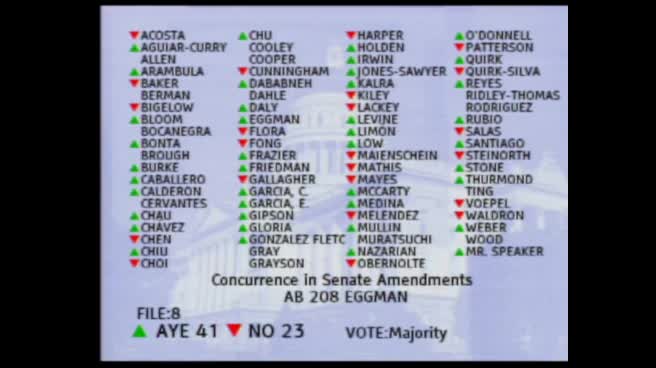 1MIN
Assembly Floor
 2MIN
Senate Floor
 1H
Senate Standing Committee on Appropriations
 2MIN
Senate Standing Committee on Appropriations
 13MIN
Senate Standing Committee on Energy, Utilities and Communications
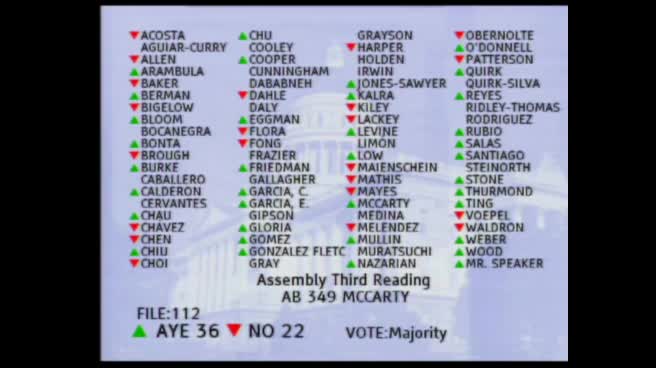 1MIN
Assembly Floor
 1MIN
Assembly Standing Committee on Appropriations
 12MIN
Assembly Standing Committee on Utilities and Energy
Bill Author

Bill Co-Author(s):