AB 801: County of San Diego Citizens Redistricting Commission.
- Session Year: 2017-2018
- House: Assembly
- Latest Version Date: 2017-10-12
Existing law establishes the Independent Redistricting Commission in the County of San Diego, which consists of 5 members and 2 alternate members who are selected randomly, as prescribed. Existing law requires the commission to adjust the boundaries of the countys supervisorial districts and to adopt a redistricting plan, as specified.
This bill would increase the membership of the commission to 14 members and no alternates, and it would revise the process for their selection, as specified. The bill would impose restrictions to eliminate conflicts-of-interest on the part of commissioners and would require increased public involvement in the redistricting process. By increasing the duties on local officials, the bill would impose a state-mandated local program.
This bill would make legislative findings and declarations as to the necessity of a special statute for the County of San Diego.
The California Constitution requires the state to reimburse local agencies and school districts for certain costs mandated by the state. Statutory provisions establish procedures for making that reimbursement.
This bill would provide that, if the Commission on State Mandates determines that the bill contains costs mandated by the state, reimbursement for those costs shall be made pursuant to the statutory provisions noted above.
Existing law establishes the Independent Redistricting Commission in the County of San Diego, which consists of 5 members and 2 alternate members who are selected randomly, as prescribed. Existing law requires the commission to adjust the boundaries of the countys supervisorial districts and to adopt a redistricting plan, as specified.
This bill would repeal the provision establishing the redistricting commission and would instead create a new 14-member commission, known as the County of San Diego Citizens Redistricting Commission, to be selected by a specified process. increase the membership of the commission to 14 members and no alternates, and would revise the process for their selection, as specified. The bill would impose restrictions to eliminate conflicts-of-interest on the part of commissioners and would require increased public involvement in the redistricting process. By increasing the duties on local officials, the bill would impose a state-mandated local program.
This bill would make legislative findings and declarations as to the necessity of a special statute for the County of San Diego.
The California Constitution requires the state to reimburse local agencies and school districts for certain costs mandated by the state. Statutory provisions establish procedures for making that reimbursement.
This bill would provide that, if the Commission on State Mandates determines that the bill contains costs mandated by the state, reimbursement for those costs shall be made pursuant to the statutory provisions noted above.
Existing law establishes the Independent Redistricting Commission in the County of San Diego, which consists of 5 members and 2 alternate members who are selected randomly, as prescribed. Existing law requires the commission to adjust the boundaries of the countys supervisorial districts and to adopt a redistricting plan, as specified.
This bill would repeal the provision establishing the redistricting commission and would instead create a new 14-member commission, known as the County of San Diego Citizens Redistricting Commission, to be selected by a specified process. The bill would impose restrictions to eliminate conflicts-of-interest on the part of commissioners and would require increased public involvement in the redistricting process. By increasing the duties on local officials, the bill would impose a state-mandated local program.
This bill would make legislative findings and declarations as to the necessity of a special statute for the County of San Diego.
The California Constitution requires the state to reimburse local agencies and school districts for certain costs mandated by the state. Statutory provisions establish procedures for making that reimbursement.
This bill would provide that, if the Commission on State Mandates determines that the bill contains costs mandated by the state, reimbursement for those costs shall be made pursuant to the statutory provisions noted above.
Existing law requires counties, cities, and districts to adjust their district boundaries following each decennial federal census to be as nearly equal in population as possible, subject to specified federal laws and consideration criteria. Existing law requires that the boundaries of supervisorial districts be adjusted by the board before the first day of November of the year following the year in which each decennial federal census is taken. If the board fails to timely adjust the boundaries, a supervisorial redistricting commission is required to do so before the 31st day of December of the same year.This bill would make technical, nonsubstantive changes to this provision of law.Existing law requires counties, cities, and districts to adjust their district boundaries following each decennial federal census to be as nearly equal in population as possible, subject to specified federal laws and consideration criteria. Existing law requires that the boundaries of supervisorial districts be adjusted by the board before the first day of November of the year following the year in which each decennial federal census is taken. If the board fails to timely adjust the boundaries, a supervisorial redistricting commission is required to do so before the 31st day of December of the same year.
This bill would make technical, nonsubstantive changes to this provision of law.
(a)As used in this chapter, the following terms have the following meanings:
(1)Board means the Board of Supervisors of the County of San Diego.
(2)County elections official means the San Diego County Registrar of Voters.
(3)Commission means the Independent Redistricting Commission established by subdivision (b).
(4)Immediate family member means a spouse, child, in-law, parent, or sibling.
(b)(1)There is, in the County of San Diego, an Independent Redistricting Commission. The commission shall be created no later than December 31, 2020, and in each year ending in the number zero thereafter. The selection process is designed to produce a commission that is independent from the influence of the board and reasonably representative of the countys diversity.
(2)In the year following the year in which the decennial federal census is taken, the commission shall adjust the boundary lines of the supervisorial districts of the board in accordance with this chapter.
(c)The commission shall be comprised of 14 members. The political party preferences of the commission members, as shown on the members most recent affidavits of registration, shall be as proportional as possible to the total number of voters who are registered with each political party in the County of San Diego or who decline to state or do not indicate a party preference, as determined by registration at the most recent statewide election. However, the political party preferences of the commission members are not required to be exactly the same as the proportion of political party preferences among the registered voters of the county. At least one commission member shall reside in each of the five existing supervisorial districts of the board. Commissioners shall each meet the following qualifications:
(1)Be a resident of the County of San Diego.
(2)Be a voter who has been continuously registered in the County of San Diego with the same political party preference or with no political party preference and who has not changed his or her political party preference for five or more years immediately preceding the date of his or her appointment to the commission.
(3)Have voted in at least one of the last three statewide elections immediately preceding his or her application to be a member of the commission.
(4)Within the 10 years immediately preceding the date of application to the commission, neither the applicant, nor an immediate family member of the applicant, has done any of the following:
(A)Been appointed to, elected to, or have been a candidate for office at the local, state, or federal level representing the County of San Diego, including as a member of the board.
(B)Served as an employee of, or paid consultant for, an elected representative at the local, state, or federal level representing the County of San Diego.
(C)Served as an employee of, or paid consultant for, a candidate for office at the local, state, or federal level representing the County of San Diego.
(D)Served as an officer, employee, or paid consultant of a political party or as an appointed member of a political party central committee.
(E)Been a registered federal, state, or local lobbyist.
(5)Possess experience that demonstrates analytical skills relevant to the redistricting process and voting rights, and possess an ability to comprehend and apply the applicable state and federal legal requirements.
(6)Possess experience that demonstrates an ability to be impartial.
(7)Possess experience that demonstrates an appreciation for the diverse demographics and geography of the County of San Diego.
(d)An interested person meeting the qualifications specified in subdivision (c) may submit an application to the county elections official to be considered for membership on the commission. The county elections official shall review the applications and eliminate applicants who do not meet the specified qualifications.
(e)(1)From the pool of qualified applicants, the county elections official shall select 60 of the most qualified applicants, taking into account the requirements described in subdivision (c). The county elections official shall make public the names of the 60 most qualified applicants for at least 30 days. The county elections official shall not communicate with a member of the board, or an agent for a member of the board, about any matter related to the nomination process or applicants before the publication of the list of the 60 most qualified applicants.
(2)During the period described in paragraph (1), the county elections official may eliminate any of the previously selected applicants if the official becomes aware that the applicant does not meet the qualifications specified in subdivision (c).
(f)(1)After complying with the requirements of subdivision (e), the county elections official shall create a subpool for each of the five existing supervisorial districts of the board.
(2)(A)At a regularly scheduled meeting of the board, the Clerk of the County of San Diego shall conduct a random drawing to select one commissioner from each of the five subpools established by the county elections official.
(B)After completing the random drawing pursuant to subparagraph (A), at the same meeting of the board, the clerk shall conduct a random drawing from all of the remaining applicants, without respect to subpools, to select three additional commissioners.
(g)(1)The eight selected commissioners shall review the remaining names in the subpools of applicants and shall appoint six additional applicants to the commission.
(2)The six appointees shall be chosen based on relevant experience, analytical skills, and ability to be impartial, and to ensure that the commission reflects the countys diversity, including racial, ethnic, geographic, and gender diversity. However, formulas or specific ratios shall not be applied for this purpose. The eight commissioners shall also consider political party preference, selecting applicants so that the political party preference of the members of the commission complies with subdivision (c).
SEC. 2.Section 21551 is added to the Elections Code, to read:21551.(a)A commission member shall apply this chapter in a manner that is impartial and that reinforces public confidence in the integrity of the redistricting process.
(b)The term of office of each member of the commission expires upon the appointment of the first member of the succeeding commission.
(c)Nine members of the commission shall constitute a quorum. Nine or more affirmative votes shall be required for any official action.
(d)(1) The commission shall not retain a consultant who would not be qualified as an applicant pursuant to paragraph (4) of subdivision (c) of Section 21550.
(2)For purposes of this subdivision, consultant means a person, whether or not compensated, retained to advise the commission or a commission member regarding any aspect of the redistricting process.
(e)Each commission member shall be a designated employee for purposes of the conflict of interest code adopted by the County of San Diego pursuant to Article 3 (commencing with Section 87300) of Chapter 7 of Title 9 of the Government Code.
SEC. 3.Section 21552 is added to the Elections Code, to read:21552.(a)The commission shall establish single-member supervisorial districts for the board pursuant to a mapping process using the following criteria as set forth in the following order of priority:
(1)Districts shall comply with the United States Constitution and each district shall have a reasonably equal population with other districts for the board, except where deviation is required to comply with the federal Voting Rights Act of 1965 (52 U.S.C. Sec. 10101 et seq.) or is allowable by law.
(2)Districts shall comply with the federal Voting Rights Act of 1965 (52 U.S.C. Sec. 10101 et seq.).
(3)Districts shall be geographically contiguous.
(4)The geographic integrity of any city, local neighborhood, or local community of interest shall be respected in a manner that minimizes its division to the extent possible without violating the requirements of paragraphs (1) to (3), inclusive. A community of interest is a contiguous population that shares common social and economic interests that should be included within a single district for purposes of its effective and fair representation. Communities of interest shall not include relationships with political parties, incumbents, or political candidates.
(5)To the extent practicable, and where it does not conflict with paragraphs (1) to (4), inclusive, districts shall be drawn to encourage geographical compactness such that nearby areas of population are not bypassed for more distant areas of population.
(b)The place of residence of any incumbent or political candidate shall not be considered in the creation of a map. Districts shall not be drawn for purposes of favoring or discriminating against an incumbent, political candidate, or political party.
(c)(1) The commission shall comply with the Ralph M. Brown Act (Chapter 9 (commencing with Section 54950) of Part 1 of Division 2 of Title 5 of the Government Code).
(2)Before the commission draws a map, the commission shall conduct at least seven public hearings, to take place over a period of no fewer than 30 days, with at least one public hearing held in each supervisorial district.
(3)After the commission draws a draft map, the commission shall do both of the following:
(A)Post the map for public comment on the Internet Web site of the County of San Diego.
(B)Conduct at least two public hearings to take place over a period of no fewer than 30 days.
(4)(A)The commission shall establish and make available to the public a calendar of all public hearings described in paragraphs (2) and (3). Hearings shall be scheduled at various times and days of the week to accommodate a variety of work schedules and to reach as large an audience as possible.
(B)Notwithstanding Section 54954.2 of the Government Code, the commission shall post the agenda for the public hearings described in paragraphs (2) and (3) at least seven days before the hearings. The agenda for a meeting required by paragraph (3) shall include a copy of the draft map.
(5)(A)The commission shall arrange for the live translation of a hearing held pursuant to this chapter in an applicable language if a request for translation is made at least 24 hours before the hearing.
(B)For purposes of this paragraph, an applicable language means a language for which the number of residents of the County of San Diego who are members of a language minority is greater than or equal to 3 percent of the total voting age residents of the county.
(6)The commission shall take steps to encourage county residents to participate in the redistricting public review process. These steps may include:
(A)Providing information through media, social media, and public service announcements.
(B)Coordinating with community organizations.
(C)Posting information on the Internet Web site of the County of San Diego that explains the redistricting process and includes a notice of each public hearing and the procedures for testifying during a hearing or submitting written testimony directly to the commission.
(7)The board shall take all steps necessary to ensure that a complete and accurate computerized database is available for redistricting, and that procedures are in place to provide to the public ready access to redistricting data and computer software equivalent to what is available to the commission members.
(8)The board shall provide for reasonable funding and staffing for the commission.
(9)All records of the commission relating to redistricting, and all data considered by the commission in drawing a draft map or the final map, are public records.
(d)(1)The commission shall adopt a redistricting plan adjusting the boundaries of the supervisorial districts and shall file the plan with the county elections official before August 15 of the year following the year in which each decennial federal census is taken.
(2)The plan shall be effective 30 days after it is filed with the county elections official.
(3)The plan shall be subject to referendum in the same manner as ordinances.
(4)The commission shall issue, with the final map, a report that explains the basis on which the commission made its decisions in achieving compliance with the criteria described in subdivisions (a) and (b).
SEC. 4.Section 21553 is added to the Elections Code, to read:21553.A commission member shall be ineligible for a period of five years beginning from the date of appointment to hold elective public office at the federal, state, county, or city level in this state. A commission member shall be ineligible for a period of three years beginning from the date of appointment to hold appointive federal, state, or local public office, to serve as paid staff for, or as a paid consultant to, the Board of Equalization, the Congress, the Legislature, or any individual legislator, or to register as a federal, state, or local lobbyist in this state.
SEC. 5.The Legislature finds and declares that a special statute is necessary and that a general statute cannot be made applicable within the meaning of Section 16 of Article IV of the California Constitution because of the unique circumstances facing the County of San Diego.
SEC. 6.If the Commission on State Mandates determines that this act contains costs mandated by the state, reimbursement to local agencies and school districts for those costs shall be made pursuant to Part 7 (commencing with Section 17500) of Division 4 of Title 2 of the Government Code.
(a)As used in this chapter, the following terms have the following meanings:
(1)Board means the Board of Supervisors of the County of San Diego.
(2)County elections official means the San Diego County Registrar of Voters.
(3)Commission means the Independent Redistricting Commission established by subdivision (b).
(4)Immediate family member means a spouse, child, in-law, parent, or sibling.
(b)(1)There is, in the County of San Diego, an Independent Redistricting Commission. The commission shall be created no later than December 31, 2020, and in each year ending in the number zero thereafter. The selection process is designed to produce a commission that is independent from the influence of the board and reasonably representative of the countys diversity.
(2)In the year following the year in which the decennial federal census is taken, the commission shall adjust the boundary lines of the supervisorial districts of the board in accordance with this chapter.
(c)The commission shall be comprised of 14 members. The political party preferences of the commission members, as shown on the members most recent affidavits of registration, shall be as proportional as possible to the total number of voters who are registered with each political party in the County of San Diego or who decline to state or do not indicate a party affiliation, preference, as determined by registration at the most recent statewide election. However, the political party preferences of the commission members are not required to be exactly the same as the proportion of political party preferences among the registered voters of the county. At least one commission member shall reside in each of the five existing supervisorial districts of the board. Commissioners shall each meet the following qualifications:
(1)Be a resident of the County of San Diego.
(2)Be a voter who has been continuously registered in the County of San Diego with the same political party preference or with no political party preference and who has not changed his or her political party preference for five or more years immediately preceding the date of his or her appointment to the commission.
(3)Have voted in at least one of the last three statewide elections immediately preceding his or her application to be a member of the commission.
(4)Within the 10 years immediately preceding the date of application to the commission, neither the applicant, nor an immediate family member of the applicant, has done any of the following:
(A)Been appointed to, elected to, or have been a candidate for office at the local, state, or federal level representing the County of San Diego, including as a member of the board.
(B)Served as an employee of, or paid consultant for, an elected representative at the local, state, or federal level representing the County of San Diego.
(C)Served as an employee of, or paid consultant for, a candidate for office at the local, state, or federal level representing the County of San Diego.
(D)Served as an officer, employee, or paid consultant of a political party or as an appointed member of a political party central committee.
(E)Been a registered federal, state, or local lobbyist.
(5)Possess experience that demonstrates analytical skills relevant to the redistricting process and voting rights, and possess an ability to comprehend and apply the applicable state and federal legal requirements.
(6)Possess experience that demonstrates an ability to be impartial.
(7)Possess experience that demonstrates an appreciation for the diverse demographics and geography of the County of San Diego.
(d)An interested person meeting the qualifications specified in subdivision (c) may submit an application to the county elections official to be considered for membership on the commission. The county elections official shall review the applications and eliminate applicants who do not meet the specified qualifications.
(e)(1)From the pool of qualified applicants, the county elections official shall select 60 of the most qualified applicants, taking into account the requirements described in subdivision (c). The county elections official shall make public the names of the 60 most qualified applicants for at least 30 days. The county elections official shall not communicate with a member of the board, or an agent for a member of the board, about any matter related to the nomination process or applicants before the publication of the list of the 60 most qualified applicants.
(2)During the period described in paragraph (1), the county elections official may eliminate any of the previously selected applicants if the official becomes aware that the applicant does not meet the qualifications specified in subdivision (c).
(f)(1)After complying with the requirements of subdivision (e), the county elections official shall create a subpool for each of the five existing supervisorial districts of the board.
(2)(A)At a regularly scheduled meeting of the board, the Clerk of the County of San Diego shall conduct a random drawing to select one commissioner from each of the five subpools established by the county elections official.
(B)After completing the random drawing pursuant to subparagraph (A), at the same meeting of the board, the clerk shall conduct a random drawing from all of the remaining applicants, without respect to subpools, to select three additional commissioners.
(g)(1)The eight selected commissioners shall review the remaining names in the subpools of applicants and shall appoint six additional applicants to the commission.
(2)The six appointees shall be chosen based on relevant experience, analytical skills, and ability to be impartial, and to ensure that the commission reflects the countys diversity, including racial, ethnic, geographic, and gender diversity. However, formulas or specific ratios shall not be applied for this purpose. The eight commissioners shall also consider political party preference, selecting applicants so that the political party preference of the members of the commission complies with subdivision (c).
SEC. 2.Section 21551 is added to the Elections Code, to read:21551.(a)A commission member shall apply this chapter in a manner that is impartial and that reinforces public confidence in the integrity of the redistricting process.
(b)The term of office of each member of the commission expires upon the appointment of the first member of the succeeding commission.
(c)Nine members of the commission shall constitute a quorum. Nine or more affirmative votes shall be required for any official action.
(d)(1) The commission shall not retain a consultant who would not be qualified as an applicant pursuant to paragraph (4) of subdivision (c) of Section 21550.
(2)For purposes of this subdivision, consultant means a person, whether or not compensated, retained to advise the commission or a commission member regarding any aspect of the redistricting process.
(e)Each commission member shall be a designated employee for purposes of the conflict of interest code adopted by the County of San Diego pursuant to Article 3 (commencing with Section 87300) of Chapter 7 of Title 9 of the Government Code.
SEC. 3.Section 21552 is added to the Elections Code, to read:21552.(a)The commission shall establish single-member supervisorial districts for the board pursuant to a mapping process using the following criteria as set forth in the following order of priority:
(1)Districts shall comply with the United States Constitution and each district shall have a reasonably equal population with other districts for the board, except where deviation is required to comply with the federal Voting Rights Act of 1965 (52 U.S.C. Sec. 10101 et seq.) or is allowable by law.
(2)Districts shall comply with the federal Voting Rights Act of 1965 (52 U.S.C. Sec. 10101 et seq.).
(3)Districts shall be geographically contiguous.
(4)The geographic integrity of any city, local neighborhood, or local community of interest shall be respected in a manner that minimizes its division to the extent possible without violating the requirements of paragraphs (1) to (3), inclusive. A community of interest is a contiguous population that shares common social and economic interests that should be included within a single district for purposes of its effective and fair representation. Communities of interest shall not include relationships with political parties, incumbents, or political candidates.
(5)To the extent practicable, and where it does not conflict with paragraphs (1) to (4), inclusive, districts shall be drawn to encourage geographical compactness such that nearby areas of population are not bypassed for more distant areas of population.
(b)The place of residence of any incumbent or political candidate shall not be considered in the creation of a map. Districts shall not be drawn for purposes of favoring or discriminating against an incumbent, political candidate, or political party.
(c)(1) The commission shall comply with the Ralph M. Brown Act (Chapter 9 (commencing with Section 54950) of Part 1 of Division 2 of Title 5 of the Government Code).
(2)Before the commission draws a map, the commission shall conduct at least seven public hearings, to take place over a period of no fewer than 30 days, with at least one public hearing held in each supervisorial district.
(3)After the commission draws a draft map, the commission shall do both of the following:
(A)Post the map for public comment on the Internet Web site of the County of San Diego.
(B)Conduct at least two public hearings to take place over a period of no fewer than 30 days.
(4)(A)The commission shall establish and make available to the public a calendar of all public hearings described in paragraphs (2) and (3). Hearings shall be scheduled at various times and days of the week to accommodate a variety of work schedules and to reach as large an audience as possible.
(B)Notwithstanding Section 54954.2 of the Government Code, the commission shall post the agenda for the public hearings described in paragraphs (2) and (3) at least seven days before the hearings. The agenda for a meeting required by paragraph (3) shall include a copy of the draft map.
(5)(A)The commission shall arrange for the live translation of a hearing held pursuant to this chapter in an applicable language if a request for translation is made at least 24 hours before the hearing.
(B)For purposes of this paragraph, an applicable language means a language for which the number of residents of the County of San Diego who are members of a language minority is greater than or equal to 3 percent of the total voting age residents of the county.
(6)The commission shall take steps to encourage county residents to participate in the redistricting public review process. These steps may include:
(A)Providing information through media, social media, and public service announcements.
(B)Coordinating with community organizations.
(C)Posting information on the Internet Web site of the County of San Diego that explains the redistricting process and includes a notice of each public hearing and the procedures for testifying during a hearing or submitting written testimony directly to the commission.
(7)The board shall take all steps necessary to ensure that a complete and accurate computerized database is available for redistricting, and that procedures are in place to provide to the public ready access to redistricting data and computer software equivalent to what is available to the commission members.
(8)The board shall provide for reasonable funding and staffing for the commission.
(9)All records of the commission relating to redistricting, and all data considered by the commission in drawing a draft map or the final map, are public records.
(d)(1)The commission shall adopt a redistricting plan adjusting the boundaries of the supervisorial districts and shall file the plan with the county elections official before August 15 of the year following the year in which each decennial federal census is taken.
(2)The plan shall be effective 30 days after it is filed with the county elections official.
(3)The plan shall be subject to referendum in the same manner as ordinances.
(4)The commission shall issue, with the final map, a report that explains the basis on which the commission made its decisions in achieving compliance with the criteria described in subdivisions (a) and (b).
SEC. 4.Section 21553 is added to the Elections Code, to read:21553.A commission member shall be ineligible for a period of five years beginning from the date of appointment to hold elective public office at the federal, state, county, or city level in this state. A commission member shall be ineligible for a period of three years beginning from the date of appointment to hold appointive federal, state, or local public office, to serve as paid staff for, or as a paid consultant to, the Board of Equalization, the Congress, the Legislature, or any individual legislator, or to register as a federal, state, or local lobbyist in this state.
SEC. 5.The Legislature finds and declares that a special statute is necessary and that a general statute cannot be made applicable within the meaning of Section 16 of Article IV of the California Constitution because of the unique circumstances facing the County of San Diego.
SEC. 6.If the Commission on State Mandates determines that this act contains costs mandated by the state, reimbursement to local agencies and school districts for those costs shall be made pursuant to Part 7 (commencing with Section 17500) of Division 4 of Title 2 of the Government Code.
(a)As used in this section, chapter, the following terms have the following meanings:
(1)Board means the Board of Supervisors of the County of San Diego.
(2)Clerk means the clerk of the Board of Supervisors of the County of San Diego.(2)County elections official means the San Diego County Registrar of Voters.
(3)Commission means the Independent Redistricting Commission established by subdivision (b).
(4)Immediate family member means a spouse, child, in-law, parent, or sibling.
(b)(1)There is, in the County of San Diego, an Independent Redistricting Commission. The commission shall be created no later than December 31, 2020, and in each year ending in the number zero thereafter. The selection process is designed to produce a commission that is independent from the influence of the board and reasonably representative of the countys diversity.
(2)In the year following the year in which the decennial federal census is taken, the commission shall adjust the boundary lines of the supervisorial districts of the board in accordance with this chapter.
(2)(c)The commission shall be comprised of five members and two alternates who 14 members. The political party preferences of the commission members, as shown on the members most recent affidavits of registration, shall be as proportional as possible to the total number of voters who are registered with each political party in the County of San Diego or who decline to state or do not indicate a party affiliation, as determined by registration at the most recent statewide election. However, the political party preferences of the commission members are not required to be exactly the same as the proportion of political party preferences among the registered voters of the county. At least one commission member shall reside in each of the five existing supervisorial districts of the board. Commissioners shall each meet the following qualifications:
(A)(1)Be a resident of the County of San Diego.
(B)Be a registered voter of the County of San Diego.(C)Be a former or retired state or federal judge.(D)Not be a current member of the board.(3)Any interested person meeting the qualifications specified in paragraph (2) may submit his or her name to the clerk to be included in a random drawing. The clerk shall conduct a random drawing at a regularly scheduled meeting of the board to select the members of the commission.(4)The presiding judge of the Superior Court of the County of San Diego may assist the clerk in identifying former or retired judges that may be qualified to be included in the drawing.(c)(1)The commission shall adjust the supervisorial district boundaries after each decennial federal census in accordance with this subdivision.(2)The commission shall adjust the boundaries of the supervisorial district of the county so that the districts are equal, or nearly equal in population. The commission may adjust some or all of the supervisorial district boundaries to accomplish this goal.(3)The resulting supervisorial districts shall comply with any applicable provisions of Section 10301 of Title 52 of the United States Code, as amended.(4)The commission may consider all of the following factors in establishing the boundaries of the supervisorial districts:(A)Topography.(B)Geography.(C)Cohesiveness, contiguity, integrity, and compactness of territory.(D)Community of interests in each district.(5)The commission shall use federal census tracts and blocks in establishing the boundaries of supervisorial districts.(d)The board shall provide for reasonable staffing and logistical support for the commission.(e)The commission shall be subject to the Ralph M. Brown Act (Chapter 9 (commencing with Section 54950) of Part 1 of Division 2 of Title 5 of the Government Code), and shall conduct at least seven public hearings with at least one public hearing held in each supervisorial district.(f)(1)The commission shall adopt a redistricting plan adjusting the boundaries of the supervisorial districts, as specified in subdivision (c), and shall file the plan with the clerk before the first day of October of the year following the year in which each decennial federal census is taken.(2)The plan shall be effective 30 days after it is filed with the clerk.(3)The plan shall be subject to referendum in the same manner as ordinances.(2)Be a voter who has been continuously registered in the County of San Diego with the same political party preference or with no political party preference and who has not changed his or her political party preference for five or more years immediately preceding the date of his or her appointment to the commission.
(3)Have voted in at least one of the last three statewide elections immediately preceding his or her application to be a member of the commission.
(4)Within the 10 years immediately preceding the date of application to the commission, neither the applicant, nor an immediate family member of the applicant, has done any of the following:
(A)Been appointed to, elected to, or have been a candidate for office at the local, state, or federal level representing the County of San Diego, including as a member of the board.
(B)Served as an employee of, or paid consultant for, an elected representative at the local, state, or federal level representing the County of San Diego.
(C)Served as an employee of, or paid consultant for, a candidate for office at the local, state, or federal level representing the County of San Diego.
(D)Served as an officer, employee, or paid consultant of a political party or as an appointed member of a political party central committee.
(E)Been a registered federal, state, or local lobbyist.
(5)Possess experience that demonstrates analytical skills relevant to the redistricting process and voting rights, and possess an ability to comprehend and apply the applicable state and federal legal requirements.
(6)Possess experience that demonstrates an ability to be impartial.
(7)Possess experience that demonstrates an appreciation for the diverse demographics and geography of the County of San Diego.
(d)An interested person meeting the qualifications specified in subdivision (c) may submit an application to the county elections official to be considered for membership on the commission. The county elections official shall review the applications and eliminate applicants who do not meet the specified qualifications.
(e)(1)From the pool of qualified applicants, the county elections official shall select 60 of the most qualified applicants, taking into account the requirements described in subdivision (c). The county elections official shall make public the names of the 60 most qualified applicants for at least 30 days. The county elections official shall not communicate with a member of the board, or an agent for a member of the board, about any matter related to the nomination process or applicants before the publication of the list of the 60 most qualified applicants.
(2)During the period described in paragraph (1), the county elections official may eliminate any of the previously selected applicants if the official becomes aware that the applicant does not meet the qualifications specified in subdivision (c).
(f)(1)After complying with the requirements of subdivision (e), the county elections official shall create a subpool for each of the five existing supervisorial districts of the board.
(2)(A)At a regularly scheduled meeting of the board, the Clerk of the County of San Diego shall conduct a random drawing to select one commissioner from each of the five subpools established by the county elections official.
(B)After completing the random drawing pursuant to subparagraph (A), at the same meeting of the board, the clerk shall conduct a random drawing from all of the remaining applicants, without respect to subpools, to select three additional commissioners.
(g)(1)The eight selected commissioners shall review the remaining names in the subpools of applicants and shall appoint six additional applicants to the commission.
(2)The six appointees shall be chosen based on relevant experience, analytical skills, and ability to be impartial, and to ensure that the commission reflects the countys diversity, including racial, ethnic, geographic, and gender diversity. However, formulas or specific ratios shall not be applied for this purpose. The eight commissioners shall also consider political party preference, selecting applicants so that the political party preference of the members of the commission complies with subdivision (c).
SEC. 2.Section 21551 is added to the Elections Code, to read:21551.(a)A commission member shall apply this chapter in a manner that is impartial and that reinforces public confidence in the integrity of the redistricting process.
(b)The term of office of each member of the commission expires upon the appointment of the first member of the succeeding commission.
(c)Nine members of the commission shall constitute a quorum. Nine or more affirmative votes shall be required for any official action.
(d)(1) The commission shall not retain a consultant who would not be qualified as an applicant pursuant to paragraph (4) of subdivision (c) of Section 21550.
(2)For purposes of this subdivision, consultant means a person, whether or not compensated, retained to advise the commission or a commission member regarding any aspect of the redistricting process.
(e)Each commission member shall be a designated employee for purposes of the conflict of interest code adopted by the County of San Diego pursuant to Article 3 (commencing with Section 87300) of Chapter 7 of Title 9 of the Government Code.
SEC. 3.Section 21552 is added to the Elections Code, to read:21552.(a)The commission shall establish single-member supervisorial districts for the board pursuant to a mapping process using the following criteria as set forth in the following order of priority:
(1)Districts shall comply with the United States Constitution and each district shall have a reasonably equal population with other districts for the board, except where deviation is required to comply with the federal Voting Rights Act of 1965 (52 U.S.C. Sec. 10101 et seq.) or is allowable by law.
(2)Districts shall comply with the federal Voting Rights Act of 1965 (52 U.S.C. Sec. 10101 et seq.).
(3)Districts shall be geographically contiguous.
(4)The geographic integrity of any city, local neighborhood, or local community of interest shall be respected in a manner that minimizes its division to the extent possible without violating the requirements of paragraphs (1) to (3), inclusive. A community of interest is a contiguous population that shares common social and economic interests that should be included within a single district for purposes of its effective and fair representation. Communities of interest shall not include relationships with political parties, incumbents, or political candidates.
(5)To the extent practicable, and where it does not conflict with paragraphs (1) to (4), inclusive, districts shall be drawn to encourage geographical compactness such that nearby areas of population are not bypassed for more distant areas of population.
(b)The place of residence of any incumbent or political candidate shall not be considered in the creation of a map. Districts shall not be drawn for purposes of favoring or discriminating against an incumbent, political candidate, or political party.
(c)(1) The commission shall comply with the Ralph M. Brown Act (Chapter 9 (commencing with Section 54950) of Part 1 of Division 2 of Title 5 of the Government Code).
(2)Before the commission draws a map, the commission shall conduct at least seven public hearings, to take place over a period of no fewer than 30 days, with at least one public hearing held in each supervisorial district.
(3)After the commission draws a draft map, the commission shall do both of the following:
(A)Post the map for public comment on the Internet Web site of the County of San Diego.
(B)Conduct at least two public hearings to take place over a period of no fewer than 30 days.
(4)(A)The commission shall establish and make available to the public a calendar of all public hearings described in paragraphs (2) and (3). Hearings shall be scheduled at various times and days of the week to accommodate a variety of work schedules and to reach as large an audience as possible.
(B)Notwithstanding Section 54954.2 of the Government Code, the commission shall post the agenda for the public hearings described in paragraphs (2) and (3) at least seven days before the hearings. The agenda for a meeting required by paragraph (3) shall include a copy of the draft map.
(5)(A)The commission shall arrange for the live translation of a hearing held pursuant to this chapter in an applicable language if a request for translation is made at least 24 hours before the hearing.
(B)For purposes of this paragraph, an applicable language means a language for which the number of residents of the County of San Diego who are members of a language minority is greater than or equal to 3 percent of the total voting age residents of the county.
(6)The commission shall take steps to encourage county residents to participate in the redistricting public review process. These steps may include:
(A)Providing information through media, social media, and public service announcements.
(B)Coordinating with community organizations.
(C)Posting information on the Internet Web site of the County of San Diego that explains the redistricting process and includes a notice of each public hearing and the procedures for testifying during a hearing or submitting written testimony directly to the commission.
(7)The board shall take all steps necessary to ensure that a complete and accurate computerized database is available for redistricting, and that procedures are in place to provide to the public ready access to redistricting data and computer software equivalent to what is available to the commission members.
(8)The board shall provide for reasonable funding and staffing for the commission.
(9)All records of the commission relating to redistricting, and all data considered by the commission in drawing a draft map or the final map, are public records.
(d)(1)The commission shall adopt a redistricting plan adjusting the boundaries of the supervisorial districts and shall file the plan with the county elections official before August 15 of the year following the year in which each decennial federal census is taken.
(2)The plan shall be effective 30 days after it is filed with the county elections official.
(3)The plan shall be subject to referendum in the same manner as ordinances.
(4)The commission shall issue, with the final map, a report that explains the basis on which the commission made its decisions in achieving compliance with the criteria described in subdivisions (a) and (b).
SEC. 4.Section 21553 is added to the Elections Code, to read:21553.A commission member shall be ineligible for a period of five years beginning from the date of appointment to hold elective public office at the federal, state, county, or city level in this state. A commission member shall be ineligible for a period of three years beginning from the date of appointment to hold appointive federal, state, or local public office, to serve as paid staff for, or as a paid consultant to, the Board of Equalization, the Congress, the Legislature, or any individual legislator, or to register as a federal, state, or local lobbyist in this state.
SECTION 1.Chapter 6.5 (commencing with Section 21550) of Division 21 of the Elections Code is repealed.SEC. 2.Chapter 6.5 (commencing with Section 21550) is added to Division 21 of the Elections Code, to read:6.5.County of San Diego Citizens Redistricting Commission21550.As used in this chapter, the following terms have the following meanings:(a)Board means the Board of Supervisors of the County of San Diego.(b)Commission means the Citizens Redistricting Commission in the County of San Diego established pursuant to Section 21551.(c)Immediate family member means a spouse, child, in-law, parent, or sibling.21551.There is, in the County of San Diego, a Citizens Redistricting Commission. In the year following the year in which the decennial federal census is taken, the commission shall adjust the boundary lines of the supervisorial districts of the board in accordance with this chapter.21552.(a)The commission shall be created no later than December 31, 2020, and in each year ending in the number zero thereafter.(b)The selection process is designed to produce a commission that is independent from the influence of the board and reasonably representative of the countys diversity.(c)The commission shall consist of 14 members. The political party preferences of the commission members, as shown on the members most recent affidavits of registration, shall be as proportional as possible to the total number of voters who are registered with each political party in the County of San Diego or who decline to state or do not indicate a party affiliation, as determined by registration at the most recent statewide election. However, the political party preferences of the commission members are not required to be exactly the same as the proportion of political party preferences among the registered voters of the county. At least one commission member shall reside in each of the five existing supervisorial districts of the board.(d)Each commission member shall meet all of the following qualifications:(1)Be a resident of the County of San Diego.(2)Be a voter who has been continuously registered in the County of San Diego with the same political party preference or with no political party preference and who has not changed his or her political party preference for five or more years immediately preceding the date of his or her appointment to the commission.(3)Have voted in at least one of the last three statewide elections immediately preceding his or her application to be a member of the commission.(4)Within the 10 years immediately preceding the date of application to the commission, neither the applicant, nor an immediate family member of the applicant, has done any of the following:(A)Been appointed to, elected to, or have been a candidate for office at the local, state, or federal level representing the County of San Diego, including as a member of the board.(B)Served as an employee of, or paid consultant for, an elected representative at the local, state, or federal level representing the County of San Diego.(C)Served as an employee of, or paid consultant for, a candidate for office at the local, state, or federal level representing the County of San Diego.(D)Served as an officer, employee, or paid consultant of a political party or as an appointed member of a political party central committee.(E)Been a registered federal, state, or local lobbyist.(5)Possess experience that demonstrates analytical skills relevant to the redistricting process and voting rights, and possess an ability to comprehend and apply the applicable state and federal legal requirements.(6)Possess experience that demonstrates an ability to be impartial.(7)Possess experience that demonstrates an appreciation for the diverse demographics and geography of the County of San Diego.(e)An interested person meeting the qualifications specified in subdivision (d) may submit an application to the county elections official to be considered for membership on the commission. The county elections official shall review the applications and eliminate applicants who do not meet the specified qualifications.(f)(1)From the pool of qualified applicants, the county elections official shall select 60 of the most qualified applicants, taking into account the requirements described in subdivision (c). The county elections official shall make public the names of the 60 most qualified applicants for at least 30 days. The county elections official shall not communicate with a member of the board, or an agent for a member of the board, about any matter related to the nomination process or applicants before the publication of the list of the 60 most qualified applicants.(2)During the period described in paragraph (1), the county elections official may eliminate any of the previously selected applicants if the official becomes aware that the applicant does not meet the qualifications specified in subdivision (d).(g)(1)After complying with the requirements of subdivision (f), the county elections official shall create a subpool for each of the five existing supervisorial districts of the board.(2)(A)At a regularly scheduled meeting of the board, the Clerk of the County of San Diego shall conduct a random drawing to select one commissioner from each of the five subpools established by the county elections official.(B)After completing the random drawing pursuant to subparagraph (A), at the same meeting of the board, the Clerk shall conduct a random drawing from all of the remaining applicants, without respect to subpools, to select three additional commissioners.(h)(1)The eight selected commissioners shall review the remaining names in the subpools of applicants and shall appoint six additional applicants to the commission.(2)The six appointees shall be chosen based on relevant experience, analytical skills, and ability to be impartial, and to ensure that the commission reflects the countys diversity, including racial, ethnic, geographic, and gender diversity. However, formulas or specific ratios shall not be applied for this purpose. The eight commissioners shall also consider political party preference, selecting applicants so that the political party preference of the members of the commission complies with subdivision (c).21553.(a)A commission member shall apply this chapter in a manner that is impartial and that reinforces public confidence in the integrity of the redistricting process.(b)The term of office of each member of the commission expires upon the appointment of the first member of the succeeding commission.(c)Nine members of the commission shall constitute a quorum. Nine or more affirmative votes shall be required for any official action.(d)(1)The commission shall not retain a consultant who would not be qualified as an applicant pursuant to paragraph (4) of subdivision (d) of Section 21552.(2)For purposes of this subdivision, consultant means a person, whether or not compensated, retained to advise the commission or a commission member regarding any aspect of the redistricting process.(e)Each commission member shall be a designated employee for purposes of the conflict of interest code adopted by the County of San Diego pursuant to Article 3 (commencing with Section 87300) of Chapter 7 of Title 9 of the Government Code.21554.(a)The commission shall establish single-member supervisorial districts for the board pursuant to a mapping process using the following criteria as set forth in the following order of priority:(1)Districts shall comply with the United States Constitution and each district shall have a reasonably equal population with other districts for the board, except where deviation is required to comply with the federal Voting Rights Act of 1965 (52 U.S.C. Sec. 10101 et seq.) or is allowable by law.(2)Districts shall comply with the federal Voting Rights Act of 1965 (52 U.S.C. Sec. 10101 et seq.).(3)Districts shall be geographically contiguous.(4)The geographic integrity of any city, local neighborhood, or local community of interest shall be respected in a manner that minimizes its division to the extent possible without violating the requirements of paragraphs (1) to (3), inclusive. A community of interest is a contiguous population that shares common social and economic interests that should be included within a single district for purposes of its effective and fair representation. Communities of interest shall not include relationships with political parties, incumbents, or political candidates.(5)To the extent practicable, and where it does not conflict with paragraphs (1) to (4), inclusive, districts shall be drawn to encourage geographical compactness such that nearby areas of population are not bypassed for more distant areas of population.(b)The place of residence of any incumbent or political candidate shall not be considered in the creation of a map. Districts shall not be drawn for purposes of favoring or discriminating against an incumbent, political candidate, or political party.(c)(1)The commission shall comply with the Ralph M. Brown Act (Chapter 9 (commencing with Section 54950) of Part 1 of Division 2 of Title 5 of the Government Code).(2)Before the commission draws a map, the commission shall conduct at least seven public hearings, to take place over a period of no fewer than 30 days, with at least one public hearing held in each supervisorial district.(3)After the commission draws a draft map, the commission shall do both of the following:(A)Post the map for public comment on the Internet Web site of the County of San Diego.(B)Conduct at least two public hearings to take place over a period of no fewer than 30 days.(4)(A)The commission shall establish and make available to the public a calendar of all public hearings described in paragraphs (2) and (3). Hearings shall be scheduled at various times and days of the week to accommodate a variety of work schedules and to reach as large an audience as possible.(B)Notwithstanding Section 54954.2 of the Government Code, the commission shall post the agenda for the public hearings described in paragraphs (2) and (3) at least seven days before the hearings. The agenda for a meeting required by paragraph (3) shall include a copy of the draft map.(5)(A)The commission shall arrange for the live translation of a hearing held pursuant to this chapter in an applicable language if a request for translation is made at least 24 hours before the hearing.(B)For purposes of this paragraph, an applicable language means a language for which the number of residents of the County of San Diego who are members of a language minority is greater than or equal to 3 percent of the total voting age residents of the county.(6)The commission shall take steps to encourage county residents to participate in the redistricting public review process. These steps may include:(A)Providing information through media, social media, and public service announcements.(B)Coordinating with community organizations.(C)Posting information on the Internet Web site of the County of San Diego that explains the redistricting process and includes a notice of each public hearing and the procedures for testifying during a hearing or submitting written testimony directly to the commission.(7)The board shall take all steps necessary to ensure that a complete and accurate computerized database is available for redistricting, and that procedures are in place to provide to the public ready access to redistricting data and computer software equivalent to what is available to the commission members.(8)The board shall provide for reasonable funding and staffing for the commission.(9)All records of the commission relating to redistricting, and all data considered by the commission in drawing a draft map or the final map, are public records.(d)(1)The commission shall adopt a redistricting plan adjusting the boundaries of the supervisorial districts and shall file the plan with the county elections official before August 15 of the year following the year in which each decennial federal census is taken.(2)The plan shall be effective 30 days after it is filed with the county elections official.(3)The plan shall be subject to referendum in the same manner as ordinances.(4)The commission shall issue, with the final map, a report that explains the basis on which the commission made its decisions in achieving compliance with the criteria described in subdivisions (a) and (b).21555.A commission member shall be ineligible for a period of five years beginning from the date of appointment to hold elective public office at the federal, state, county, or city level in this state. A commission member shall be ineligible for a period of three years beginning from the date of appointment to hold appointive federal, state, or local public office, to serve as paid staff for, or as a paid consultant to, the Board of Equalization, the Congress, the Legislature, or any individual legislator, or to register as a federal, state or local lobbyist in this state.SEC. 3.SEC. 5.The Legislature finds and declares that a special statute is necessary and that a general statute cannot be made applicable within the meaning of Section 16 of Article IV of the California Constitution because of the unique circumstances facing the County of San Diego.
SEC. 4.SEC. 6.If the Commission on State Mandates determines that this act contains costs mandated by the state, reimbursement to local agencies and school districts for those costs shall be made pursuant to Part 7 (commencing with Section 17500) of Division 4 of Title 2 of the Government Code.
As used in this chapter, the following terms have the following meanings:
(a)Board means the Board of Supervisors of the County of San Diego.
(b)Commission means the Citizens Redistricting Commission in the County of San Diego established pursuant to Section 21551.
(c)Immediate family member means a spouse, child, in-law, parent, or sibling.
21551.There is, in the County of San Diego, a Citizens Redistricting Commission. In the year following the year in which the decennial federal census is taken, the commission shall adjust the boundary lines of the supervisorial districts of the board in accordance with this chapter.
21552.(a)The commission shall be created no later than December 31, 2020, and in each year ending in the number zero thereafter.
(b)The selection process is designed to produce a commission that is independent from the influence of the board and reasonably representative of the countys diversity.
(c)The commission shall consist of 14 members. The political party preferences of the commission members, as shown on the members most recent affidavits of registration, shall be as proportional as possible to the total number of voters who are registered with each political party in the County of San Diego or who decline to state or do not indicate a party affiliation, as determined by registration at the most recent statewide election. However, the political party preferences of the commission members are not required to be exactly the same as the proportion of political party preferences among the registered voters of the county. At least one commission member shall reside in each of the five existing supervisorial districts of the board.
(d)Each commission member shall meet all of the following qualifications:
(1)Be a resident of the County of San Diego.
(2)Be a voter who has been continuously registered in the County of San Diego with the same political party preference or with no political party preference and who has not changed his or her political party preference for five or more years immediately preceding the date of his or her appointment to the commission.
(3)Have voted in at least one of the last three statewide elections immediately preceding his or her application to be a member of the commission.
(4)Within the 10 years immediately preceding the date of application to the commission, neither the applicant, nor an immediate family member of the applicant, has done any of the following:
(A)Been appointed to, elected to, or have been a candidate for office at the local, state, or federal level representing the County of San Diego, including as a member of the board.
(B)Served as an employee of, or paid consultant for, an elected representative at the local, state, or federal level representing the County of San Diego.
(C)Served as an employee of, or paid consultant for, a candidate for office at the local, state, or federal level representing the County of San Diego.
(D)Served as an officer, employee, or paid consultant of a political party or as an appointed member of a political party central committee.
(E)Been a registered federal, state, or local lobbyist.
(5)Possess experience that demonstrates analytical skills relevant to the redistricting process and voting rights, and possess an ability to comprehend and apply the applicable state and federal legal requirements.
(6)Possess experience that demonstrates an ability to be impartial.
(7)Possess experience that demonstrates an appreciation for the diverse demographics and geography of the County of San Diego.
(e)An interested person meeting the qualifications specified in subdivision (d) may submit an application to the county elections official to be considered for membership on the commission. The county elections official shall review the applications and eliminate applicants who do not meet the specified qualifications.
(f)(1)From the pool of qualified applicants, the county elections official shall select 60 of the most qualified applicants, taking into account the requirements described in subdivision (c). The county elections official shall make public the names of the 60 most qualified applicants for at least 30 days. The county elections official shall not communicate with a member of the board, or an agent for a member of the board, about any matter related to the nomination process or applicants before the publication of the list of the 60 most qualified applicants.
(2)During the period described in paragraph (1), the county elections official may eliminate any of the previously selected applicants if the official becomes aware that the applicant does not meet the qualifications specified in subdivision (d).
(g)(1)After complying with the requirements of subdivision (f), the county elections official shall create a subpool for each of the five existing supervisorial districts of the board.
(2)(A)At a regularly scheduled meeting of the board, the Clerk of the County of San Diego shall conduct a random drawing to select one commissioner from each of the five subpools established by the county elections official.
(B)After completing the random drawing pursuant to subparagraph (A), at the same meeting of the board, the Clerk shall conduct a random drawing from all of the remaining applicants, without respect to subpools, to select three additional commissioners.
(h)(1)The eight selected commissioners shall review the remaining names in the subpools of applicants and shall appoint six additional applicants to the commission.
(2)The six appointees shall be chosen based on relevant experience, analytical skills, and ability to be impartial, and to ensure that the commission reflects the countys diversity, including racial, ethnic, geographic, and gender diversity. However, formulas or specific ratios shall not be applied for this purpose. The eight commissioners shall also consider political party preference, selecting applicants so that the political party preference of the members of the commission complies with subdivision (c).
21553.(a)A commission member shall apply this chapter in a manner that is impartial and that reinforces public confidence in the integrity of the redistricting process.
(b)The term of office of each member of the commission expires upon the appointment of the first member of the succeeding commission.
(c)Nine members of the commission shall constitute a quorum. Nine or more affirmative votes shall be required for any official action.
(d)(1)The commission shall not retain a consultant who would not be qualified as an applicant pursuant to paragraph (4) of subdivision (d) of Section 21552.
(2)For purposes of this subdivision, consultant means a person, whether or not compensated, retained to advise the commission or a commission member regarding any aspect of the redistricting process.
(e)Each commission member shall be a designated employee for purposes of the conflict of interest code adopted by the County of San Diego pursuant to Article 3 (commencing with Section 87300) of Chapter 7 of Title 9 of the Government Code.
21554.(a)The commission shall establish single-member supervisorial districts for the board pursuant to a mapping process using the following criteria as set forth in the following order of priority:
(1)Districts shall comply with the United States Constitution and each district shall have a reasonably equal population with other districts for the board, except where deviation is required to comply with the federal Voting Rights Act of 1965 (52 U.S.C. Sec. 10101 et seq.) or is allowable by law.
(2)Districts shall comply with the federal Voting Rights Act of 1965 (52 U.S.C. Sec. 10101 et seq.).
(3)Districts shall be geographically contiguous.
(4)The geographic integrity of any city, local neighborhood, or local community of interest shall be respected in a manner that minimizes its division to the extent possible without violating the requirements of paragraphs (1) to (3), inclusive. A community of interest is a contiguous population that shares common social and economic interests that should be included within a single district for purposes of its effective and fair representation. Communities of interest shall not include relationships with political parties, incumbents, or political candidates.
(5)To the extent practicable, and where it does not conflict with paragraphs (1) to (4), inclusive, districts shall be drawn to encourage geographical compactness such that nearby areas of population are not bypassed for more distant areas of population.
(b)The place of residence of any incumbent or political candidate shall not be considered in the creation of a map. Districts shall not be drawn for purposes of favoring or discriminating against an incumbent, political candidate, or political party.
(c)(1)The commission shall comply with the Ralph M. Brown Act (Chapter 9 (commencing with Section 54950) of Part 1 of Division 2 of Title 5 of the Government Code).
(2)Before the commission draws a map, the commission shall conduct at least seven public hearings, to take place over a period of no fewer than 30 days, with at least one public hearing held in each supervisorial district.
(3)After the commission draws a draft map, the commission shall do both of the following:
(A)Post the map for public comment on the Internet Web site of the County of San Diego.
(B)Conduct at least two public hearings to take place over a period of no fewer than 30 days.
(4)(A)The commission shall establish and make available to the public a calendar of all public hearings described in paragraphs (2) and (3). Hearings shall be scheduled at various times and days of the week to accommodate a variety of work schedules and to reach as large an audience as possible.
(B)Notwithstanding Section 54954.2 of the Government Code, the commission shall post the agenda for the public hearings described in paragraphs (2) and (3) at least seven days before the hearings. The agenda for a meeting required by paragraph (3) shall include a copy of the draft map.
(5)(A)The commission shall arrange for the live translation of a hearing held pursuant to this chapter in an applicable language if a request for translation is made at least 24 hours before the hearing.
(B)For purposes of this paragraph, an applicable language means a language for which the number of residents of the County of San Diego who are members of a language minority is greater than or equal to 3 percent of the total voting age residents of the county.
(6)The commission shall take steps to encourage county residents to participate in the redistricting public review process. These steps may include:
(A)Providing information through media, social media, and public service announcements.
(B)Coordinating with community organizations.
(C)Posting information on the Internet Web site of the County of San Diego that explains the redistricting process and includes a notice of each public hearing and the procedures for testifying during a hearing or submitting written testimony directly to the commission.
(7)The board shall take all steps necessary to ensure that a complete and accurate computerized database is available for redistricting, and that procedures are in place to provide to the public ready access to redistricting data and computer software equivalent to what is available to the commission members.
(8)The board shall provide for reasonable funding and staffing for the commission.
(9)All records of the commission relating to redistricting, and all data considered by the commission in drawing a draft map or the final map, are public records.
(d)(1)The commission shall adopt a redistricting plan adjusting the boundaries of the supervisorial districts and shall file the plan with the county elections official before August 15 of the year following the year in which each decennial federal census is taken.
(2)The plan shall be effective 30 days after it is filed with the county elections official.
(3)The plan shall be subject to referendum in the same manner as ordinances.
(4)The commission shall issue, with the final map, a report that explains the basis on which the commission made its decisions in achieving compliance with the criteria described in subdivisions (a) and (b).
21555.A commission member shall be ineligible for a period of five years beginning from the date of appointment to hold elective public office at the federal, state, county, or city level in this state. A commission member shall be ineligible for a period of three years beginning from the date of appointment to hold appointive federal, state, or local public office, to serve as paid staff for, or as a paid consultant to, the Board of Equalization, the Congress, the Legislature, or any individual legislator, or to register as a federal, state or local lobbyist in this state.
SEC. 3.The Legislature finds and declares that a special statute is necessary and that a general statute cannot be made applicable within the meaning of Section 16 of Article IV of the California Constitution because of the unique circumstances facing the County of San Diego.
SEC. 4.If the Commission on State Mandates determines that this act contains costs mandated by the state, reimbursement to local agencies and school districts for those costs shall be made pursuant to Part 7 (commencing with Section 17500) of Division 4 of Title 2 of the Government Code.
SECTION 1.Section 21501 of the Elections Code is amended to read:21501.The boundaries of the supervisorial districts shall be adjusted by the board before the first day of November of the year following the year in which each decennial federal census is taken. If the board fails to adjust the boundaries by that time, a supervisorial redistricting commission shall do so before the 31st day of December of the same year. The adjustment of the district boundaries shall be immediately effective the same as if the act of the supervisorial redistricting commission were an ordinance of the board, subject, however, to the same provisions of referendum as apply to ordinances of the board.The boundaries of the supervisorial districts shall be adjusted by the board before the first day of November of the year following the year in which each decennial federal census is taken. If the board fails to adjust the boundaries before the first day of November following the year in which the federal census is taken, boundaries by that time, a supervisorial redistricting commission shall do so before the 31st day of December of the same year. The adjustment of the district boundaries shall be immediately effective the same as if the act of the supervisorial redistricting commission were an ordinance of the board, subject, however, to the same provisions of referendum as apply to ordinances of the board.
|
Date
|
Status
|
|---|---|
| Oct 12, 2017 | Chaptered by Secretary of State - Chapter 711, Statutes of 2017. |
| Oct 12, 2017 | Approved by the Governor. |
| Sep 25, 2017 | Enrolled and presented to the Governor at 12 p.m. |
| Sep 14, 2017 | Senate amendments concurred in. To Engrossing and Enrolling. |
| Sep 14, 2017 | Senate amendments concurred in. To Engrossing and Enrolling. (Ayes 53. Noes 25. Page 3376.). |
| Sep 13, 2017 | Assembly Rule 77(a) suspended. |
| Sep 13, 2017 | In Assembly. Concurrence in Senate amendments pending. May be considered on or after September 15 pursuant to Assembly Rule 77. |
| Sep 12, 2017 | Read third time. Passed. Ordered to the Assembly. |
| Sep 11, 2017 | Read second time. Ordered to third reading. |
| Sep 8, 2017 | Read third time and amended. Ordered to second reading. |
| Sep 5, 2017 | Read second time. Ordered to third reading. |
| Sep 1, 2017 | From committee: Do pass. (Ayes 5. Noes 2.) (September 1). |
| Aug 21, 2017 | In committee: Referred to APPR. suspense file. |
| Jul 13, 2017 | From committee: Do pass and re-refer to Com. on APPR. (Ayes 3. Noes 1.) (July 12). Re-referred to Com. on APPR. |
| Jun 28, 2017 | From committee: Do pass and re-refer to Com. on E. & C.A. (Ayes 5. Noes 2.) (June 28). Re-referred to Com. on E. & C.A. |
| Jun 14, 2017 | Referred to Coms. on GOV. & F. and E. & C.A. |
| Jun 1, 2017 | In Senate. Read first time. To Com. on RLS. for assignment. |
| May 31, 2017 | Read third time. Passed. Ordered to the Senate. (Ayes 53. Noes 23. Page 1879.) |
| May 30, 2017 | Read second time and amended. Ordered returned to second reading. |
| May 26, 2017 | From committee: Amend, and do pass as amended. (Ayes 12. Noes 5.) (May 26). |
| May 10, 2017 | In committee: Set, first hearing. Referred to APPR. suspense file. |
| Apr 27, 2017 | From committee: Do pass and re-refer to Com. on APPR. (Ayes 6. Noes 3.) (April 26). Re-referred to Com. on APPR. |
| Apr 5, 2017 | From committee: Do pass and re-refer to Com. on L. GOV. (Ayes 5. Noes 2.) (April 5). Re-referred to Com. on L. GOV. |
| Mar 27, 2017 | Re-referred to Com. on E. & R. |
| Mar 23, 2017 | From committee chair, with author's amendments: Amend, and re-refer to Com. on E. & R. Read second time and amended. |
| Mar 23, 2017 | Referred to Coms. on E. & R. and L. GOV. |
| Feb 16, 2017 | From printer. May be heard in committee March 18. |
| Feb 15, 2017 | Read first time. To print. |
|
Date
|
Description
|
Location
|
Votes
|
|
|---|---|---|---|---|
| Sep 14, 2017 | AB 801 WEBER Concurrence in Senate Amendments | Assembly Floor |
Passed |
|
| Sep 12, 2017 | Assembly 3rd Reading AB801 Weber et al. By Atkins | Senate Floor |
Passed |
|
| Sep 1, 2017 | Do pass | Senate Standing Committee on Appropriations |
Passed |
|
| Aug 21, 2017 | Placed on suspense file | Senate Standing Committee on Appropriations |
Passed |
|
| Jul 12, 2017 | Do pass, but first be re-referred to the Committee on [Appropriations] | Senate Standing Committee on Elections and Constitutional Amendments |
Passed |
|
| Jun 28, 2017 | Do pass, but first be re-referred to the Committee on [Elections and Constitutional Amendments] | Senate Standing Committee on Governance and Finance |
Passed |
|
| May 31, 2017 | AB 801 WEBER Assembly Third Reading | Assembly Floor |
Passed |
|
| May 26, 2017 | Do pass as amended. | Assembly Standing Committee on Appropriations |
Passed |
|
| Apr 26, 2017 | Do pass and be re-referred to the Committee on [Appropriations] | Assembly Standing Committee on Local Government |
Passed |
|
| Apr 5, 2017 | Do pass and be re-referred to the Committee on [Local Government] | Assembly Standing Committee on Elections and Redistricting |
Passed |
This list shows positions taken on this bill by organizations on the date displayed, which is linked to the original source.
Positions by individuals are not included.
|
Organization
|
Position
|
Date
|
|---|---|---|
| Alliance Of Californians For Community Empowerment | ** Support | Sep 11, 2017 |
| Alliance San Diego | ** Support | Sep 11, 2017 |
| Asian Pacific Islander Community Actions | ** Support | Sep 11, 2017 |
| Assembly Floor: 53-23, 5 | ** Against | Sep 11, 2017 |
| California Association Of Clerks & Elections Officials | ** Against | Sep 11, 2017 |
| California State Association Of Counties | ** Against | Sep 11, 2017 |
| Center for Policy Initiatives | ** Support | Sep 11, 2017 |
| Common Cause | ** Against | Sep 11, 2017 |
| Employee Rights Center | ** Support | Sep 11, 2017 |
| Environmental Health Coalition | ** Support | Sep 11, 2017 |
| Independent Voter Project | ** Support | Sep 11, 2017 |
| League Of Women Voters Of California | ** Support | Sep 11, 2017 |
| Metropolitan Area Advisory Committee | ** Support | Sep 11, 2017 |
| National Federation of Filipino American Associations | ** Support | Sep 11, 2017 |
| No Vote Recorded: Choi, Cooley, Eggman, Melendez | ** Against | Sep 11, 2017 |
| San Diego County Board of Supervisors | ** Against | Sep 11, 2017 |
| san diego organization project | ** Support | Jul 10, 2017 |
| San Diego Organizing Project | ** Support | Sep 11, 2017 |
| SEIU California | ** Support | Sep 11, 2017 |
| Urban Counties of California | ** Against | Sep 11, 2017 |
CONCURRENCE IN SENATE AMENDMENTS
CSA1 Bill Id:AB 801
Author:(Weber and Gloria)
As Amended Ver:September 8, 2017
Majority vote
ASSEMBLY: | 53-23 | (May 31, 2017) | SENATE: | 23-14 | (September 12, 2017) |
Original Committee Reference: E. & R.
SUMMARY: Repeals existing provisions of law requiring a redistricting commission made up of former or retired judges to adjust the boundary lines of supervisorial districts in San Diego County after each decennial federal census, and instead establishes a Citizens Redistricting Commission in the county and charges it with adjusting the boundaries of supervisorial districts. Changes the criteria to be used when the boundaries of supervisorial districts in San Diego County are adjusted. Specifically, this bill:
- Repeals provisions of existing law that provides for the creation of a redistricting commission in San Diego County, to be made up of five members and two alternates who are former or retired federal or state judges, which has the responsibility for adjusting the supervisorial district boundaries after each decennial federal census, as specified.
- Provides for the creation of a Citizens Redistricting Commission in San Diego County, and tasks the commission with adjusting the boundary lines of the County's supervisorial districts in the year following the year in which the decennial federal census is taken. Requires the San Diego County Board of Supervisors (board) to provide for reasonable funding and staffing for the commission.
- Requires the commission to consist of 14 members, and to be created no later than December 31, 2020, and in each year ending in the number zero thereafter.
- Requires the political party preferences of commission members to be as proportional as possible to the registered voter population in the County, as specified. Requires at least one commission member to reside in each of the five existing supervisorial districts.
- Requires each commission member to have various qualifications, including possessing experience that demonstrates relevant analytical skills and an ability to be impartial.
- Prohibits a person from being a member of the commission if, in the prior 10 years, that person or an immediate family member of the person was a candidate for, or an elected official of, an office representing San Diego County; an employee or consultant of such a candidate or official; an officer, employee, consultant, or appointed member of a political party; or a registered federal, state, or local lobbyist, as specified. Prohibits the commission from retaining a consultant who would not be qualified as a commission applicant due to any of these disqualifying criteria.
- Permits any interested person meeting the qualifications to apply for the commission. Requires the county elections official to review applications, eliminate applicants who do not meet the required qualifications, and select 60 of the most qualified applicants, as specified.
- Requires the Clerk of San Diego County to randomly select at least eight commissioners from the pool of applicants selected by the county elections official, including at least one commissioner from each of the five existing supervisorial districts. Requires the eight selected commissioners to appoint six additional members to the commission from the pool of applicants selected by the county elections official. Requires the appointees to be chosen based on relevant experience, analytical skills, and ability to be impartial, and to ensure that the commission reflects the county's diversity, as specified.
- Requires nine or more affirmative votes by commissioners for any official action.
- Requires the commission to establish single-member supervisorial districts for the board pursuant to a mapping process using specified criteria.
- Specifies minimum requirements for hearings conducted by the commission, and for the preparation and adoption of a district map by the commission.
- Prohibits commissioners from holding elective public office for five years after being appointed to the commission, as specified. Prohibits commissioners from holding appointive public office, serving as paid staff to a public official, or serving as a lobbyist for three years after being appointed to the commission, as specified.
The Senate amendments make a technical change, and add a co-author.
FISCAL EFFECT: According to the Senate Appropriations Committee, by revising the Commission's membership and responsibilities, this bill would create a state-mandated local program. To the extent the Commission on State Mandates determines that the provisions of this bill create a new program or impose a higher level of service on local agencies, those costs could be reimbursable (General Fund). The County of San Diego has provided information indicating that the bill would result in the following decennial costs: $1.6 million for staffing, $606,000 for legal counsel, and $286,000 in operating expenses and equipment.
COMMENTS: According to the author, "Over the past decade, there has been a greater desire to create independent redistricting commissions' to draw district lines at the local and state levels. In 2012, Senator Kehoe authored SB 1331. This bill established the Independent Redistricting Commission in San Diego County that would be comprised of eligible former or retired state or federal judges. The goal of this was to create a commission that would be immune to political influence.
"While a step in the right direction, this redistricting process does not sufficiently account for the changing demographics that have taken place over the past 20 years. Although San Diego's population is extremely diverse, the pool of eligible commissioners includes a disproportionate older group of individuals that do not reflect the socioeconomic demographics of San Diego County.
"AB 801 will also help maintain communities of interests to ensure groups with similar socioeconomic interests are not negatively impacted by the upcoming redistricting process. By doing this, districts drawn by citizens can increase the supervisors' responsiveness to constituents and would encourage greater participation in the electoral process and, ultimately, increase accountability to San Diego citizens."
SB 1331 (Kehoe), Chapter 508, Statutes of 2012, provides for the creation of a redistricting commission in San Diego County, made up of retired state and federal judges, and charges it with adjusting the boundaries of supervisorial districts after each decennial federal census. SB 1331 was requested by the San Diego County Board of Supervisors, and as a result, it was not identified as a reimbursable state-mandated local program.
At the time SB 1331 was considered, San Diego County was unable to provide for the creation of a redistricting commission without statutory authorization. Because SB 1331 imposed conditions on the formation and composition of the redistricting commission, any change to the structure of the redistricting commission requires changes to state law.
This bill repeals the provisions of SB 1331, and instead requires the creation of a redistricting commission similar to a commission that is required in Los Angeles County pursuant to legislation that was adopted last year. Unlike SB 1331, this bill is not being requested by the County of San Diego. As a result, because this bill is identified as imposing a state-mandated local program, the state could be required to reimburse San Diego County for certain costs incurred in implementing the provisions of this bill.
Last year, the Legislature approved and the Governor signed SB 958 (Lara), Chapter 781, Statutes of 2016, which established a Citizens Redistricting Commission in Los Angeles County and charged it with adjusting the boundaries of supervisorial districts after each decennial federal census, as specified. With the notable difference that this bill applies to San Diego County, rather than Los Angeles County, the provisions of this bill are similar to the provisions of SB 958.
In February, the Los Angeles County Board of Supervisors filed a lawsuit in the Los Angeles County Superior Court challenging the provisions of SB 958 (County of Los Angeles v. State of California et al. (2017), Case Number BS168212). That lawsuit alleges that SB 958 violates the California Constitution. The next court hearing in that case is scheduled for March 2018.
Please see the policy committee analysis for a full discussion of this bill.
Analysis Prepared by: Ethan Jones / E. & R. / (916) 319-2094 FN: 0002190
Office of Senate Floor Analyses (916) 651-1520 Fax: (916) 327-4478 | AB |
THIRD READING
Bill No: AB 801
:
SENATE GOVERNANCE & FIN. COMMITTEE: 5-2, 6/28/17
AYES: McGuire, Beall, Hernandez, Hertzberg, Lara
NOES: Nguyen, Moorlach
SENATE ELECTIONS & C.A. COMMITTEE: 3-1, 7/12/17
AYES: Stern, Hertzberg, Leyva
NOES: Anderson
NO VOTE RECORDED: Allen
SENATE APPROPRIATIONS COMMITTEE: 5-2, 9/1/17
AYES: Lara, Beall, Bradford, Hill, Wiener
NOES: Bates, Nielsen
ASSEMBLY FLOOR: 53-23, 5/31/17 - See last page for vote
DIGEST:
This bill revises the membership of and procedures used by the San Diego County Redistricting Commission.
Senate Floor Amendments of 9/8/17 add Assembly Member Gonzalez Fletcher as a coauthor and make a technical change to the required composition of the commission.
Existing law:
- Requires the board of supervisors of each county, following each decennial federal census, and using that census as a basis, to adjust the boundaries of any or all of the supervisorial districts of the county so that the districts are as nearly equal in populations as possible and comply with the applicable provisions of the federal Voting Rights Act (VRA).
- Allows the board, when adjusting the boundaries of supervisorial districts, may give consideration to: topography, geography, communities of interests, and cohesiveness, contiguity, integrity, and compactness of territory.
- Requires the board hold at least one public hearing on any proposal to adjust the boundaries of a supervisorial district before the public hearing at which the board votes to approve or defeat the proposal.
- Provides for the creation of a redistricting commission in San Diego County, which has the responsibility for adjusting the supervisorial district boundaries after each decennial federal census, as specified.
- Requires the commission to be comprised of five members and two alternates who meet the following qualifications:
- A resident of San Diego County;
- A registered voter in San Diego County;
- A former or retired state or federal judge; and,
- Not a current member of the board.
- Permits any person who meets the qualifications to serve on the commission to submit his or her name to the clerk of the board to be included in a random drawing to select the members and alternates to the commission.
- Requires the clerk to conduct a random drawing at a regularly scheduled meeting of the board to select the members and alternates of the commission.
- Permits the presiding judge of the San Diego County Superior Court to assist the clerk of the board in identifying former or retired judges that may be qualified to be included in the drawing.
- Requires the boundaries of supervisorial districts to be adjusted so that the districts are equal or nearly equal in population.
- Requires the resulting supervisorial districts to comply with any applicable provisions of Section 2 of the federal VRA, as amended.
- Allows the commission to consider all of the following factors when establishing the boundaries of supervisorial districts: topography; geography; cohesiveness, contiguity, integrity, and compactness of territory; and communities of interests in each district.
- Requires the commission to use federal census tracts and blocks in establishing the boundaries of supervisorial districts.
- Requires the board to provide for reasonable staffing and logistical support for the commission.
- Provides that the commission is subject to the Brown Act and requires the commission to conduct at least seven public hearings with at least one public hearing held in each supervisorial district.
- Requires the commission to adopt a redistricting plan adjusting the boundaries of supervisorial districts and to file the plan with the clerk of the board of supervisors prior to the first day of October of the year following the year in which each decennial federal census is taken.
- Provides that the plan is effective 30 days after it is filed with the clerk. Provides that the plan is subject to referendum in the same manner as ordinances.
- Establishes a procedure for a government of a county to adopt a charter by a majority vote of its electors voting on the question. Generally provides greater autonomy over county affairs to counties that have adopted charters.
- Provides that counties that have adopted charters are subject to statutes that relate to apportioning population of governing body districts.
- Permits a county to establish a commission charged with adjusting the boundaries of supervisorial districts after each decennial federal census, subject to certain conditions.
- Establishes a Citizens Redistricting Commission in Los Angeles County and charges it with adjusting the boundaries of supervisorial districts after each decennial federal census, as specified.
This bill:
- Repeals provisions of existing law that provides for the creation of a redistricting commission in San Diego County.
- Provides for the creation of a Citizens Redistricting Commission in San Diego County, and tasks the commission with adjusting the boundary lines of the County's supervisorial districts in the year following the year in which the decennial federal census is taken.
- Requires the San Diego County Board of Supervisors (board) to provide for reasonable funding and staffing for the commission.
- Requires the commission to consist of 14 members, and to be created no later than December 31, 2020, and in each year ending in the number zero thereafter.
- Requires the political party preferences of commission members to be as proportional as possible to the registered voter population in the County, as specified.
- Requires at least one commission member to reside in each of the five existing supervisorial districts.
- Requires each commission member to have various qualifications, including possessing experience that demonstrates relevant analytical skills and an ability to be impartial.
- Prohibits a person from being a member of the commission if, in the prior 10 years, that person or an immediate family member of the person was any of the following:
- A candidate for, or an elected official of, an office representing San Diego County;
- An employee or consultant of such a candidate or official;
- An officer, employee, consultant, or appointed member of a political party;
- A registered federal, state, or local lobbyist, as specified.
- Prohibits the commission from retaining a consultant who would not be qualified as a commission applicant due to any of these disqualifying criteria.
- Permits any interested person meeting the qualifications to apply for the commission.
- Requires the county elections official to review applications, eliminate applicants who do not meet the required qualifications, and select 60 of the most qualified applicants, as specified.
- Requires the Clerk of San Diego County to randomly select at least eight commissioners from the pool of applicants selected by the county elections official, including at least one commissioner from each of the five existing supervisorial districts.
- Requires the eight selected commissioners to appoint six additional members to the commission from the pool of applicants selected by the county elections official.
- Requires the appointees to be chosen based on relevant experience, analytical skills, and ability to be impartial, and to ensure that the commission reflects the county's diversity, as specified.
- Requires nine or more affirmative votes by commissioners for any official action.
- Requires the commission to establish single-member supervisorial districts for the board pursuant to a mapping process using specified criteria.
- Specifies minimum requirements for hearings conducted by the commission, and for the preparation and adoption of a district map by the commission.
- Prohibits commissioners from holding elective public office for five years after being appointed to the commission, as specified.
- Prohibits commissioners from holding appointive public office, serving as paid staff to a public official, or serving as a lobbyist for three years after being appointed to the commission, as specified.
Background
Redistricting commissions. In 2008, California voters approved Proposition 11, which amended the California Constitution to transfer the power to redraw electoral district boundaries for seats in the State Legislature to an independent 14-member citizen’s redistricting commission. The California Constitution provides that charter cities, without being bound by state general laws, may control their own municipal affairs, including matters related to the election of their city councils. Using their authority under the constitution’s municipal affairs doctrine, some charter cities have established independent citizen’s commissions to redraw city council district boundaries.
State law only recently authorized a county or general law city to establish a commission to either change the boundaries of the districts or recommend to the governing body changes to the boundaries of the districts (SB 1108, Allen, 2016). Because counties couldn’t independently establish redistricting commissions until the passage of SB 1108, the Legislature statutorily authorized redistricting commissions in two counties: San Diego and Los Angeles. In 2012, at the request of San Diego County officials, the Legislature established a redistricting commission in San Diego County and charged it with adjusting the boundaries of supervisorial districts after each decennial federal census (SB 1331, Kehoe, 2012).
In 2016, the Legislature established a redistricting commission for Los Angeles County (SB 958, Lara, 2016). The Los Angeles County redistricting commission comprises 14 members—one each, chosen at random, from the eight planning areas in Los Angeles County and six additional members chosen by the initial eight members. The final commission membership must reflect the political party membership in the county as a whole. To be eligible to sit on the commission, a person must meet a number of qualifications, such as having consistent voting registration across recent elections and possessing experience that demonstrates their analytical ability and impartiality.
Looking to SB 958 as a model, some advocates are concerned that San Diego’s current redistricting commission will result in districts that do not accurately represent the diversity of the county. They want the Legislature to modify the San Diego commission’s membership and responsibilities.
Comments
- Purpose of the bill. Traditionally, the ability to draw district boundaries has resided with legislative bodies, with the consequence that in many cases, voters don’t choose their representatives; representatives choose their voters. San Diego County took an important step towards removing the politics from redistricting by sponsoring SB 1331 to create a redistricting commission for supervisorial districts. But membership of a commission established under that act—a pool of retired judges—is unlikely to represent the full diversity of demographics, political views, and geography of San Diego County. Consistent with subsequent other recent redistricting commission models, AB 801 provides for broader participation from segments of the population that are underrepresented in the pool of retired judges created by SB 1331. It ensures that the commission members come from geographically diverse areas of the county and accurately reflect the political makeup in the county. It also includes stringent conflict of interest protections and strict limitations on direct political involvement for up to 10 years before or five years after participation in the redistricting process. AB 801 ensures that supervisorial districts are chosen fairly, resulting in greater responsiveness on the part of the San Diego’s elected representatives.
- Home rule. Unlike Los Angeles County, which did not have a redistricting commission at the time of SB 958’s passage, San Diego County has already established an independent redistricting commission at the request of local officials. Moreover, counties now have the ability to establish redistricting commissions by ordinance—and local voters may do so through their initiative power. AB 801 does not reflect any particular local public discussion or consensus about a redistricting commission and instead overturns the will of local residents, as exercised through their duly elected representatives.
- Too soon? San Diego’s redistricting commission has yet to be constituted; its job will start with the 2020 census. As such, there is no body of work by which the current commission may be judged. But AB 801 presumes that its efforts will be unfair, despite the requirements of the Constitution, the VRA, and the very statute that AB 801 revises. In addition, AB 801 replaces the current commission with one based on a model that is currently under legal challenge. In February, the Los Angeles County Board of Supervisors filed a lawsuit in the Los Angeles County Superior Court challenging the provisions of SB 958 [County of Los Angeles v. State of California et al. (2017)]. Given the pending litigation and that the current commission has not been selected, is now the right time to be modifying the makeup of the San Diego redistricting commission?
FISCAL EFFECT: Appropriation: Fiscal Com.: Local:
According to the Senate Appropriations Committee, by revising the commission’s membership and responsibilities, this bill creates a state-mandated local program. To the extent the commission on State Mandates determines that the provisions of this bill create a new program or impose a higher level of service on local agencies, those costs could be reimbursable (General Fund). The magnitude is unknown, but could be $2.5 million dollars decennially.
Alliance of Californians for Community Empowerment
Alliance San Diego
Asian Pacific Islander Community Actions
Center for Policy Initiatives
Council of Philippine American Organizations of San Diego County
Employee Rights Center
Environmental Health Coalition
Independent Voter Project
League of Women Voters of California
Metropolitan Area Advisory Committee
National Federation of Filipino American Associations
San Diego Organizing Project
SEIU California
California Association of Clerks & Elections Officials
California State Association of Counties
Common Cause
San Diego County Board of Supervisors
ASSEMBLY FLOOR: 53-23, 5/31/17
AYES: Aguiar-Curry, Arambula, Berman, Bloom, Bocanegra, Bonta, Burke, Caballero, Calderon, Cervantes, Chau, Chiu, Chu, Cooper, Dababneh, Daly, Frazier, Friedman, Cristina Garcia, Eduardo Garcia, Gipson, Gloria, Gomez, Gonzalez Fletcher, Gray, Grayson, Holden, Irwin, Jones-Sawyer, Kalra, Levine, Limón, Low, McCarty, Medina, Mullin, Muratsuchi, Nazarian, O'Donnell, Quirk, Quirk-Silva, Reyes, Ridley-Thomas, Rodriguez, Rubio, Salas, Santiago, Mark Stone, Thurmond, Ting, Weber, Wood, Rendon
NOES: Acosta, Travis Allen, Baker, Bigelow, Brough, Chávez, Chen, Cunningham, Dahle, Flora, Fong, Gallagher, Harper, Kiley, Lackey, Maienschein, Mathis, Mayes, Obernolte, Patterson, Steinorth, Voepel, Waldron
NO VOTE RECORDED: Choi, Cooley, Eggman, Melendez
9/11/17 9:09:24
**** END ****
Office of Senate Floor Analyses (916) 651-1520 Fax: (916) 327-4478 | AB |
THIRD READING
Bill No: AB 801
:
SENATE GOVERNANCE & FIN. COMMITTEE: 5-2, 6/28/17
AYES: McGuire, Beall, Hernandez, Hertzberg, Lara
NOES: Nguyen, Moorlach
SENATE ELECTIONS & C.A. COMMITTEE: 3-1, 7/12/17
AYES: Stern, Hertzberg, Leyva
NOES: Anderson
NO VOTE RECORDED: Allen
SENATE APPROPRIATIONS COMMITTEE: 5-2, 9/1/17
AYES: Lara, Beall, Bradford, Hill, Wiener
NOES: Bates, Nielsen
ASSEMBLY FLOOR: 53-23, 5/31/17 - See last page for vote
DIGEST:
This bill revises the membership of and procedures used by the San Diego County Redistricting Commission.
Existing law:
- Requires the board of supervisors of each county, following each decennial federal census, and using that census as a basis, to adjust the boundaries of any or all of the supervisorial districts of the county so that the districts are as nearly equal in populations as possible and comply with the applicable provisions of the federal Voting Rights Act (VRA).
- Allows the board, when adjusting the boundaries of supervisorial districts, may give consideration to: topography, geography, communities of interests, and cohesiveness, contiguity, integrity, and compactness of territory.
- Requires the board hold at least one public hearing on any proposal to adjust the boundaries of a supervisorial district before the public hearing at which the board votes to approve or defeat the proposal.
- Provides for the creation of a redistricting commission in San Diego County, which has the responsibility for adjusting the supervisorial district boundaries after each decennial federal census, as specified.
- Requires the commission to be comprised of five members and two alternates who meet the following qualifications:
- A resident of San Diego County;
- A registered voter in San Diego County;
- A former or retired state or federal judge; and,
- Not a current member of the board.
- Permits any person who meets the qualifications to serve on the commission to submit his or her name to the clerk of the board to be included in a random drawing to select the members and alternates to the commission.
- Requires the clerk to conduct a random drawing at a regularly scheduled meeting of the board to select the members and alternates of the commission.
- Permits the presiding judge of the San Diego County Superior Court to assist the clerk of the board in identifying former or retired judges that may be qualified to be included in the drawing.
- Requires the boundaries of supervisorial districts to be adjusted so that the districts are equal or nearly equal in population.
- Requires the resulting supervisorial districts to comply with any applicable provisions of Section 2 of the federal VRA, as amended.
- Allows the commission to consider all of the following factors when establishing the boundaries of supervisorial districts: topography; geography; cohesiveness, contiguity, integrity, and compactness of territory; and communities of interests in each district.
- Requires the commission to use federal census tracts and blocks in establishing the boundaries of supervisorial districts.
- Requires the board to provide for reasonable staffing and logistical support for the commission.
- Provides that the commission is subject to the Brown Act and requires the commission to conduct at least seven public hearings with at least one public hearing held in each supervisorial district.
- Requires the commission to adopt a redistricting plan adjusting the boundaries of supervisorial districts and to file the plan with the clerk of the board of supervisors prior to the first day of October of the year following the year in which each decennial federal census is taken.
- Provides that the plan is effective 30 days after it is filed with the clerk. Provides that the plan is subject to referendum in the same manner as ordinances.
- Establishes a procedure for a government of a county to adopt a charter by a majority vote of its electors voting on the question. Generally provides greater autonomy over county affairs to counties that have adopted charters.
- Provides that counties that have adopted charters are subject to statutes that relate to apportioning population of governing body districts.
- Permits a county to establish a commission charged with adjusting the boundaries of supervisorial districts after each decennial federal census, subject to certain conditions.
- Establishes a Citizens Redistricting Commission in Los Angeles County and charges it with adjusting the boundaries of supervisorial districts after each decennial federal census, as specified.
This bill:
- Repeals provisions of existing law that provides for the creation of a redistricting commission in San Diego County.
- Provides for the creation of a Citizens Redistricting Commission in San Diego County, and tasks the commission with adjusting the boundary lines of the County's supervisorial districts in the year following the year in which the decennial federal census is taken.
- Requires the San Diego County Board of Supervisors (board) to provide for reasonable funding and staffing for the commission.
- Requires the commission to consist of 14 members, and to be created no later than December 31, 2020, and in each year ending in the number zero thereafter.
- Requires the political party preferences of commission members to be as proportional as possible to the registered voter population in the County, as specified.
- Requires at least one commission member to reside in each of the five existing supervisorial districts.
- Requires each commission member to have various qualifications, including possessing experience that demonstrates relevant analytical skills and an ability to be impartial.
- Prohibits a person from being a member of the commission if, in the prior 10 years, that person or an immediate family member of the person was any of the following:
- A candidate for, or an elected official of, an office representing San Diego County;
- An employee or consultant of such a candidate or official;
- An officer, employee, consultant, or appointed member of a political party;
- A registered federal, state, or local lobbyist, as specified.
- Prohibits the commission from retaining a consultant who would not be qualified as a commission applicant due to any of these disqualifying criteria.
- Permits any interested person meeting the qualifications to apply for the commission.
- Requires the county elections official to review applications, eliminate applicants who do not meet the required qualifications, and select 60 of the most qualified applicants, as specified.
- Requires the Clerk of San Diego County to randomly select at least eight commissioners from the pool of applicants selected by the county elections official, including at least one commissioner from each of the five existing supervisorial districts.
- Requires the eight selected commissioners to appoint six additional members to the commission from the pool of applicants selected by the county elections official.
- Requires the appointees to be chosen based on relevant experience, analytical skills, and ability to be impartial, and to ensure that the commission reflects the county's diversity, as specified.
- Requires nine or more affirmative votes by commissioners for any official action.
- Requires the commission to establish single-member supervisorial districts for the board pursuant to a mapping process using specified criteria.
- Specifies minimum requirements for hearings conducted by the commission, and for the preparation and adoption of a district map by the commission.
- Prohibits commissioners from holding elective public office for five years after being appointed to the commission, as specified.
- Prohibits commissioners from holding appointive public office, serving as paid staff to a public official, or serving as a lobbyist for three years after being appointed to the commission, as specified.
Background
Redistricting commissions. In 2008, California voters approved Proposition 11, which amended the California Constitution to transfer the power to redraw electoral district boundaries for seats in the State Legislature to an independent 14-member citizen’s redistricting commission. The California Constitution provides that charter cities, without being bound by state general laws, may control their own municipal affairs, including matters related to the election of their city councils. Using their authority under the constitution’s municipal affairs doctrine, some charter cities have established independent citizen’s commissions to redraw city council district boundaries.
State law only recently authorized a county or general law city to establish a commission to either change the boundaries of the districts or recommend to the governing body changes to the boundaries of the districts (SB 1108, Allen, 2016). Because counties couldn’t independently establish redistricting commissions until the passage of SB 1108, the Legislature statutorily authorized redistricting commissions in two counties: San Diego and Los Angeles. In 2012, at the request of San Diego County officials, the Legislature established a redistricting commission in San Diego County and charged it with adjusting the boundaries of supervisorial districts after each decennial federal census (SB 1331, Kehoe, 2012).
In 2016, the Legislature established a redistricting commission for Los Angeles County (SB 958, Lara, 2016). The Los Angeles County redistricting commission comprises 14 members—one each, chosen at random, from the eight planning areas in Los Angeles County and six additional members chosen by the initial eight members. The final commission membership must reflect the political party membership in the county as a whole. To be eligible to sit on the commission, a person must meet a number of qualifications, such as having consistent voting registration across recent elections and possessing experience that demonstrates their analytical ability and impartiality.
Looking to SB 958 as a model, some advocates are concerned that San Diego’s current redistricting commission will result in districts that do not accurately represent the diversity of the county. They want the Legislature to modify the San Diego commission’s membership and responsibilities.
Comments
- Purpose of the bill. Traditionally, the ability to draw district boundaries has resided with legislative bodies, with the consequence that in many cases, voters don’t choose their representatives; representatives choose their voters. San Diego County took an important step towards removing the politics from redistricting by sponsoring SB 1331 to create a redistricting commission for supervisorial districts. But membership of a commission established under that act—a pool of retired judges—is unlikely to represent the full diversity of demographics, political views, and geography of San Diego County. Consistent with subsequent other recent redistricting commission models, AB 801 provides for broader participation from segments of the population that are underrepresented in the pool of retired judges created by SB 1331. It ensures that the commission members come from geographically diverse areas of the county and accurately reflect the political makeup in the county. It also includes stringent conflict of interest protections and strict limitations on direct political involvement for up to 10 years before or five years after participation in the redistricting process. AB 801 ensures that supervisorial districts are chosen fairly, resulting in greater responsiveness on the part of the San Diego’s elected representatives.
- Home rule. Unlike Los Angeles County, which did not have a redistricting commission at the time of SB 958’s passage, San Diego County has already established an independent redistricting commission at the request of local officials. Moreover, counties now have the ability to establish redistricting commissions by ordinance—and local voters may do so through their initiative power. AB 801 does not reflect any particular local public discussion or consensus about a redistricting commission and instead overturns the will of local residents, as exercised through their duly elected representatives.
- Too soon? San Diego’s redistricting commission has yet to be constituted; its job will start with the 2020 census. As such, there is no body of work by which the current commission may be judged. But AB 801 presumes that its efforts will be unfair, despite the requirements of the Constitution, the VRA, and the very statute that AB 801 revises. In addition, AB 801 replaces the current commission with one based on a model that is currently under legal challenge. In February, the Los Angeles County Board of Supervisors filed a lawsuit in the Los Angeles County Superior Court challenging the provisions of SB 958 [County of Los Angeles v. State of California et al. (2017)]. Given the pending litigation and that the current commission has not been selected, is now the right time to be modifying the makeup of the San Diego redistricting commission?
FISCAL EFFECT: Appropriation: Fiscal Com.: Local:
According to the Senate Appropriations Committee, by revising the commission’s membership and responsibilities, this bill creates a state-mandated local program. To the extent the commission on State Mandates determines that the provisions of this bill create a new program or impose a higher level of service on local agencies, those costs could be reimbursable (General Fund). The magnitude is unknown, but could be $2.5 million dollars decennially.
Alliance of Californians for Community Empowerment
Alliance San Diego
Asian Pacific Islander Community Actions
Center for Policy Initiatives
Council of Philippine American Organizations of San Diego County
Employee Rights Center
Environmental Health Coalition
Independent Voter Project
League of Women Voters of California
Metropolitan Area Advisory Committee
National Federation of Filipino American Associations
San Diego Organizing Project
SEIU California
California Association of Clerks & Elections Officials
California State Association of Counties
Common Cause
San Diego County Board of Supervisors
Urban Counties of California
ASSEMBLY FLOOR: 53-23, 5/31/17
AYES: Aguiar-Curry, Arambula, Berman, Bloom, Bocanegra, Bonta, Burke, Caballero, Calderon, Cervantes, Chau, Chiu, Chu, Cooper, Dababneh, Daly, Frazier, Friedman, Cristina Garcia, Eduardo Garcia, Gipson, Gloria, Gomez, Gonzalez Fletcher, Gray, Grayson, Holden, Irwin, Jones-Sawyer, Kalra, Levine, Limón, Low, McCarty, Medina, Mullin, Muratsuchi, Nazarian, O'Donnell, Quirk, Quirk-Silva, Reyes, Ridley-Thomas, Rodriguez, Rubio, Salas, Santiago, Mark Stone, Thurmond, Ting, Weber, Wood, Rendon
NOES: Acosta, Travis Allen, Baker, Bigelow, Brough, Chávez, Chen, Cunningham, Dahle, Flora, Fong, Gallagher, Harper, Kiley, Lackey, Maienschein, Mathis, Mayes, Obernolte, Patterson, Steinorth, Voepel, Waldron
NO VOTE RECORDED: Choi, Cooley, Eggman, Melendez
9/4/17 12:53:26
**** END ****
SENATE COMMITTEE ON
Senator Ricardo Lara, Chair
2017 - 2018 Regular Session
AB 801 (Weber) - County of San Diego Citizens Redistricting Commission
Version: | Policy Vote: |
Urgency: | Mandate: |
Hearing Date: | Consultant: |
This bill meets the criteria for referral to the Suspense File.
Bill Summary:
AB 801 would revise the membership and responsibilities of the San Diego County Redistricting Commission.
Fiscal Impact:
By revising the Commission’s membership and responsibilities, this bill would create a state-mandated local program. To the extent the Commission on State Mandates determines that the provisions of this bill create a new program or impose a higher level of service on local agencies, those costs could be reimbursable (General Fund). The magnitude is unknown, but could be $2.5 million dollars decennially (see Staff Comments).
Background:
Proposition 11 (2008) (1) created the Citizens Redistricting Commission (CRC), (2) gave it the responsibility for establishing district lines for Assembly, Senate, and Board of Equalization seats, and (3) modified the criteria to be used when drawing district lines. The CRC consists of 14 registered voters, including five Democrats, five Republicans, and four others, all of whom are chosen according to procedures specified in Proposition 11. Proposition 20 (2010), among other things, additionally gave CRC the responsibility for establishing lines for California's congressional districts.
SB 1331 (Kehoe, Chapter 508, Statutes of 2012) (1) created a redistricting commission in San Diego County comprised of retired state and federal judges, and (2) required it to adjust the boundaries of supervisorial districts after each decennial federal census. SB 1331 was requested by the San Diego County Board of Supervisors; consequently, it was not identified as a reimbursable state-mandated local program.
Counties generally are subject to state laws governing redistricting. At the time SB 1331 was considered, San Diego County was unable to provide for the creation of a redistricting commission without statutory authorization. Because SB 1331 imposed conditions on the formation and composition of the redistricting commission, any change to its structure requires changes to state law.
SB 1108 (Allen, Ch. 784, Statutes of 2016) generally permits counties to establish redistricting commissions to adjust the boundaries of supervisorial districts, subject to certain conditions. However, because SB 1331 explicitly provided for the structure of the redistricting commission that is tasked with redrawing the district lines for supervisorial districts in San Diego County, the option provided to counties under SB 1108 does not appear to be available for San Diego County in the absence of changes to state law.
Also last year, SB 958 (Lara, Chapter 781, Statutes of 2016) established a Citizens Redistricting Commission in Los Angeles County and charged it with adjusting the boundaries of supervisorial districts after each decennial federal census, as specified.
The provisions of this bill are similar to those of SB 958. Specifically, this bill would repeal the provisions of SB 1331, and instead require the creation of a redistricting commission similar to a commission that is required in Los Angeles County. Unlike SB 1331, this bill is not being requested by the County of San Diego.
Proposed Law:
This bill would, among other things, do the following:
- Revise the membership and responsibilities of the San Diego County Independent Redistricting Commission in a manner similar to the Los Angeles County Citizens Redistricting Commission to adjust the boundary lines of the supervisorial districts of the board following a decennial federal census.
- Require that commission must be created no later than December 31, 2020 and in each year ending in the number zero thereafter.
- Require that the political party preferences of the commission members, as shown on the members’ most recent affidavits of registration, to be as proportional as possible to the total number of voters who are registered with each political party, or who decline to state or do not indicate a party affiliation, in the County of San Diego as determined by registration at the most recent statewide election. The bill would require at least one commission member to reside in each of the current supervisor districts.
- Place specified requirements and prohibitions on each commission member, and the commission itself.
- Require the county elections official to do all of the following:
- Review the applications and eliminate applicants who do not meet the specified qualifications.
- Select 60 of the most qualified applicants from the pool of qualified applicants, taking into account the requirements specified in the bill.
- Make public the names of the 60 most qualified applicants for at least 30 days.
- Not communicate with a member of the board of supervisors, or an agent for a member of the board, about any matter related to the nomination process or applicants prior to the publication of the list of the 60 most qualified applicants.
- Permit the county elections official, during the minimum 30 day period during which the names are public, to eliminate any of the previously selected applicants if the official becomes aware that the applicant does not meet specified qualifications.
- Require the county elections official to create a subpool of applicants for each of the five supervisorial districts in the County of San Diego.
- Require that the Clerk of the County of San Diego, at a regularly scheduled meeting of the board of supervisors, to conduct a random drawing to select one commissioner from each of the five subpools established by the county elections official. The county elections official must then select an additional three members from the remaining pool without regard to district.
- Require the eight commissioners selected by the elections official to review the remaining names in the subpools of applicants and must appoint six additional applicants to the commission, who must be chosen based on relevant experience, analytical skills, and ability to be impartial, and to ensure that the commission reflects the county’s diversity, including racial, ethnic, geographic, and gender diversity. The eight commissioners must also consider political party preference, selecting applicants so that the political party preference of the members of the commission are as proportional as possible to that of the registered voters in the county. The bill prohibits formulas or specific ratios from being applied for this purpose.
- Require that before the commission draws a map, it must conduct at least seven public hearings, to take place over a period of no fewer than thirty days, with at least one public hearing held in each supervisorial district. The commission must establish and make available to the public a calendar of specified public hearings and requires all commission meetings to comply with the Ralph M. Brown Act’s open government requirements.
- After the commission draws a draft map, the commission must post the map for public comment on the Internet Web site of the County of San Diego and conduct at least two public hearings to take place over a period of at least 30 days.
- Require the commission to adopt a redistricting plan adjusting the boundaries of the supervisorial districts and to file the plan with the county elections official before August 15 of the year following the year in which each decennial federal census is taken. The bill requires that: (1) the plan must be effective 30 days after it is filed with the county elections official, (2) the plan must be subject to referendum in the same manner as ordinances, and (3) the commission must issue, with the final map, a report that explains the basis on which the commission made its decisions in achieving compliance with the specified criteria.
Related Legislation:
- SB 1331 (Kehoe, Chapter 508, Statutes of 2012), established the Independent Redistricting Commission in San Diego County. The bill required the clerk of the Board of Supervisors of the County of San Diego to select, at random, the members of the commission from persons interested in, and qualified to serve on, the commission. Retired state or federal judges are the only individuals eligible to serve on this commission.
- SB 958 (Lara, Chapter 781, Statutes of 2016), established an independent redistricting commission in Los Angeles County.
- SB 1108 (Allen, Ch. 784, Statutes of 2016), allows any city or county to establish a commission to change the boundaries of county supervisors’ or city council members’ electoral districts after a federal census.
Staff Comments:
As mentioned above, unlike prior legislation establishing the existing commission in San Diego County, this bill is not being requested by the county. Consequently, it likely creates a state mandate. The County of San Diego has provided information indicating that the bill would result in the following decennial costs: $1.6 million for staffing, $606,000 for legal counsel, and $286,000 in operating expenses and equipment.
-- END --
SENATE COMMITTEE ON
ELECTIONS AND CONSTITUTIONAL AMENDMENTS
Senator Henry Stern, Chair
2017 - 2018 Regular
Bill No: 801 Hearing Date: 7/12/17
Author: | Weber | ||
Version: |
| ||
Urgency: | Fiscal: | ||
Consultant: | |||
Subject:
DIGEST
This bill revises the membership of the San Diego County Redistricting Commission.
ANALYSIS
Existing law:
- Provides, pursuant to state law, for the creation of a redistricting commission in San Diego County, which has the responsibility for adjusting the supervisorial district boundaries after each decennial federal census, as specified.
- Requires the commission to be comprised of five members and two alternates who meet the following qualifications:
- A resident of San Diego County;
- A registered voter in San Diego County;
- A former or retired state or federal judge; and,
- Not a current member of the county board of supervisors.
- A resident of San Diego County;
- Permits any person who meets the qualifications to serve on the commission to submit his or her name to the clerk of the board of supervisors of San Diego County to be included in a random drawing to select the members and alternates to the commission. Requires the clerk to conduct a random drawing at a regularly scheduled meeting of the board of supervisors to select the members and alternates of the commission.
- Permits the presiding judge of the San Diego County Superior Court to assist the clerk of the board of supervisors in San Diego County in identifying former or retired judges that may be qualified to be included in the drawing.
- Requires the boundaries of supervisorial districts to be adjusted so that the districts are equal or nearly equal in population. Requires the resulting supervisorial districts to comply with any applicable provisions of Section 2 of the federal VRA, as amended.
- Permits the redistricting commission to consider all of the following factors when establishing the boundaries of supervisorial districts:
- Topography;
- Geography;
- Cohesiveness, contiguity, integrity, and compactness of territory; and,
- Communities of interests in each district.
- Topography;
- Requires the redistricting commission to use federal census tracts and blocks in establishing the boundaries of supervisorial districts.
- Requires the board of supervisors of San Diego County to provide for reasonable staffing and logistical support for the commission.
- Provides that the redistricting commission is subject to the Brown Act and requires the commission to conduct at least seven public hearings with at least one public hearing held in each supervisorial district.
- Requires the redistricting commission to adopt a redistricting plan adjusting the boundaries of supervisorial districts and to file the plan with the clerk of the board of supervisors prior to the first day of October of the year following the year in which each decennial federal census is taken. Provides that the plan is effective 30 days after it is filed with the clerk. Provides that the plan is subject to referendum in the same manner as ordinances.
- Establishes a procedure for a government of a county to adopt a charter by a majority vote of its electors voting on the question. Generally provides greater autonomy over county affairs to counties that have adopted charters.
- Provides that counties that have adopted charters are subject to statutes that relate to apportioning population of governing body districts.
- Permits a county to establish a commission charged with adjusting the boundaries of supervisorial districts after each decennial federal census, subject to certain conditions.
- Establishes a Citizens Redistricting Commission in Los Angeles County and charges it with adjusting the boundaries of supervisorial districts after each decennial federal census, as specified.
This bill:
- Revises the membership and responsibilities of the San Diego County Independent Redistricting Commission in a manner similar to the Los Angeles County Citizens Redistricting Commission to adjust the boundary lines of the supervisorial districts of the board following a decennial federal census.
- Requires that commission must be created no later than December 31, 2020 and in each year ending in the number zero thereafter.
- Requires that the political party preferences of the commission members, as shown on the members’ most recent affidavits of registration, to be as proportional as possible to the total number of voters who are registered with each political party, or who decline to state or do not indicate a party affiliation, in the County of San Diego as determined by registration at the most recent statewide election. The bill requires at least one commission member to reside in each of the current supervisor districts.
- Requires each commission member to:
- Be a San Diego County resident.
- Be a registered voter in San Diego County who has not changed political party affiliation for five or more years immediately preceding the date of being appointed to the commission.
- Have voted in at least one of the last three statewide elections immediately preceding applying to be a member of the commission.
- Possess experience that demonstrates analytical skills relevant to the redistricting process and voting rights, and possess an ability to comprehend and apply the applicable state and federal legal requirements.
- Possess experience that demonstrates an ability to be impartial.
- Possess experience that demonstrates an appreciation for the diverse demographics and geography of the County of San Diego.
- Prohibits each person who applies to serve on the commission, and any immediate family member of an applicant, from having done any of the following within 10 years before applying to serve on the commission:
- Been appointed to, elected to, or been a candidate for office at the local, state, or federal level representing the County of San Diego, including as a member of the board.
- Served as an employee of, or paid consultant for, an elected representative or candidate for office at the local, state, or federal level representing the County of San Diego.
- Served as an officer, employee, or paid consultant of a political party or as an appointed member of a political party central committee.
- Been a registered state or local lobbyist.
- Permits an interested person who meets the bill’s specified qualifications to submit an application to the county elections official to be considered for membership on the commission.
- Requires the county elections official to do all of the following:
- Review the applications and eliminate applicants who do not meet the specified qualifications.
- Select 60 of the most qualified applicants from the pool of qualified applicants, taking into account the requirements specified in the bill.
- Make public the names of the 60 most qualified applicants for at least 30 days.
- Not communicate with a member of the board of supervisors, or an agent for a member of the board, about any matter related to the nomination process or applicants prior to the publication of the list of the 60 most qualified applicants.
- Permits the county elections official, during the minimum 30 day period during which the names are public, to eliminate any of the previously selected applicants if the official becomes aware that the applicant does not meet specified qualifications.
- Requires the county elections official to create a subpool of applicants for each of the five supervisorial districts in the County of San Diego.
- Requires that the Clerk of the County of San Diego, at a regularly scheduled meeting of the board of supervisors, to conduct a random drawing to select one commissioner from each of the five subpools established by the county elections official. The county elections official must then select an additional three members from the remaining pool without regard to district.
- Requires the eight commissioners selected by the elections official to review the remaining names in the subpools of applicants and must appoint six additional applicants to the commission, who must be chosen based on relevant experience, analytical skills, and ability to be impartial, and to ensure that the commission reflects the county’s diversity, including racial, ethnic, geographic, and gender diversity. The eight commissioners must also consider political party preference, selecting applicants so that the political party preference of the members of the commission are as proportional as possible to that of the registered voters in the county. The bill prohibits formulas or specific ratios from being applied for this purpose.
- Declares that selection process is designed to produce a commission that is independent from the influence of the board and reasonably representative of the county’s diversity.
- Provides that each commission member is a designated employee subject to the County of San Diego’s conflict of interest code. A commission member is ineligible for elective public office at the federal, state, county, or city level in California for five years after appointment to the commission. For three years following appointment, a commission member cannot:
- Be appointed to federal, state, or local public office;
- Serve as staff or a consultant to the Board of Equalization, the Congress, the Legislature, or any individual legislator; or
- Register as a federal, state, or local lobbyist in this state.
- Requires commission members to apply the bill’s provisions in a manner that is impartial and that reinforces public confidence in the integrity of the redistricting process.
- Directs that each commission member’s term expires upon the appointment of the first member of a succeeding commission.
- Specifies that nine members of the commission constitutes a quorum and that nine or more affirmative votes are required for any official action.
- Prohibits the commission from retaining a consultant, as defined, who would not qualify as an applicant.
- Requires the commission to establish single-member supervisorial districts for the board that complies with the following criteria in the following order of priority:
- Districts must comply with the United States Constitution and each district must have reasonably equal population with other districts for the board, except where deviation is required to comply with the federal Voting Rights Act or allowable by law.
- Districts must comply with the federal Voting Rights Act.
- Districts must be geographically contiguous.
- The geographic integrity of any city, county, city and county, local neighborhood, or local community of interest, as defined in the bill, must be respected in a manner that minimizes their division to the extent possible without violating other specified criteria.
- To the extent practicable, and where it does not conflict with other specified criteria, districts must be drawn to encourage geographical compactness such that nearby areas of population are not bypassed for more distant population.
- Prohibits the commission from:
- Considering the place of residence of any incumbent or political candidate in the creation of a map.
- Drawing districts for the purpose of favoring or discriminating against an incumbent, political candidate, or political party.
- Requires that before the commission draws a map, it must conduct at least seven public hearings, to take place over a period of no fewer than thirty days, with at least one public hearing held in each supervisorial district. The commission must establish and make available to the public a calendar of specified public hearings and requires all commission meetings to comply with the Ralph M. Brown Act’s open government requirements.
- After the commission draws a draft map, the commission must post the map for public comment on the Internet Web site of the County of San Diego and conduct at least two public hearings to take place over a period of at least 30 days.
- Contains numerous additional provisions governing the manner in which the commission must fulfill its responsibilities, including provisions relating to:
- Agendas for commission meetings.
- Live translation of commission hearings in languages that are spoken by more than 3% of the county population, upon request.
- Encouraging county residents to participate in the redistricting public review process.
- Public access to a computerized database, redistricting data, and computer software.
- Preserving specified commission records and data as public records.
- Requires the commission to adopt a redistricting plan adjusting the boundaries of the supervisorial districts and to file the plan with the county elections official before August 15 of the year following the year in which each decennial federal census is taken. The bill requires that:
- The plan must be effective 30 days after it is filed with the county elections official.
- The plan must be subject to referendum in the same manner as ordinances.
- The commission must issue, with the final map, a report that explains the basis on which the commission made its decisions in achieving compliance with the specified criteria.
- Includes findings and declarations to support its purpose.
BACKGROUND
California Citizens Redistricting Commission. Proposition 11, which was approved by the voters at the 2008 statewide general election, created the Citizens Redistricting Commission (CRC), and gave it the responsibility for establishing district lines for Assembly, Senate, and Board of Equalization. Proposition 11 also modified the criteria to be used when drawing district lines. Proposition 20, which was approved by the voters at the 2010 statewide general election, additionally gave the CRC the responsibility for establishing lines for California's congressional districts, and made other changes to the procedures and criteria to be used by the CRC. The CRC consists of 14 registered voters, including five Democrats, five Republicans, and four others, all of whom are chosen according to procedures specified in Proposition 11.
San Diego County Redistricting Commission and Previous Legislation. SB 1331 (Kehoe, Ch. 508, Statutes of 2012), provides for the creation of a redistricting commission in San Diego County made up of retired state and federal judges, and charges it with adjusting the boundaries of supervisorial districts after each decennial federal census. SB 1331 was requested by the San Diego County Board of Supervisors, and as a result, it was not identified as a reimbursable state-mandated local program.
As stated above, counties generally are subject to state laws governing redistricting. At the time SB 1331 was considered, San Diego County was unable to provide for the creation of a redistricting commission without statutory authorization. Because SB 1331 imposed conditions on the formation and composition of the redistricting commission, any change to the structure of the redistricting commission requires changes to state law.
Last year, the Legislature approved and the Governor signed SB 1108 (Allen, Ch. 784, Statutes of 2016), which generally permits counties to establish redistricting commissions to adjust the boundaries of supervisorial districts, subject to certain conditions. However, because SB 1331 explicitly provided for the structure of the redistricting commission that is tasked with redrawing the district lines for supervisorial districts in San Diego County, the option provided to counties under SB 1108 does not appear to be available for San Diego County in the absence of changes to state law.
This bill repeals the provisions of SB 1331, and instead requires the creation of a redistricting commission similar to a commission that is required in Los Angeles County pursuant to legislation that was adopted last year, as detailed below. Unlike SB 1331, this bill is not being requested by the County of San Diego.
Los Angeles County Citizens Redistricting Commission, Previous Legislation, and Pending Litigation. Last year, the Legislature approved and the Governor signed SB 958 (Lara, Ch. 781, Statutes of 2016), which established a Citizens Redistricting Commission in Los Angeles County and charged it with adjusting the boundaries of supervisorial districts after each decennial federal census, as specified. With the notable difference that this bill applies to San Diego County, rather than Los Angeles County, the provisions of this bill are similar to the provisions of SB 958.
In February, the Los Angeles County Board of Supervisors filed a lawsuit in the Los Angeles County Superior Court challenging the provisions of SB 958 (County of Los Angeles v. State of California et al. (2017), Case Number BS168212). That lawsuit alleges that SB 958 violates the California Constitution for three reasons: (1) that because SB 958 applies only to Los Angeles County, it violates Article IV, Section 16 of the California Constitution, which provides that "[a]ll laws of a general nature have uniform operation" and that "[a] local or special statute is invalid in any case if a general statute can be made applicable."; (2) that because SB 958 requires political party preferences to be taken into account when creating the redistricting commission, if redistricting commissioners are considered to be county offices, then SB 958 violates Article II, Section 6 of the California Constitution, which provides in part that "[a]ll judicial, school, county, and city offices, including the Superintendent of Public Instruction, shall be nonpartisan."; and (3) that if redistricting commissioners are not considered to be county offices, then SB 958 improperly delegates a municipal function to be performed by a private person or body, in violation of Article XI, Section 11 of the California Constitution. A trial date for the lawsuit has not yet been set.
In addition to the allegations that SB 958 violates the California Constitution for the reasons described above, the lawsuit alleges that SB 958 excludes voters who are registered as having "No Party Preference" from serving as members of the redistricting commission. That reading of SB 958, however, appears to be inconsistent with Legislative intent and history. In fact, the committee analysis of SB 958 concluded that the 14-member redistricting commission created by SB 958 "might be expected to have…between 3-4 members registered as having No Party Preference." That conclusion was based on the same language that Los Angeles County relies upon to conclude that "No Party Preference" voters would be excluded from the redistricting commission entirely. Notwithstanding the fact that Los Angeles County's reading of SB 958 appears to be inconsistent with Legislative intent and history, in light of Los Angeles County's lawsuit, this language of this bill differs from that in SB 958 in order to expressly provide that "No Party Preference" voters would be included on the commission created by this bill.
COMMENTS
- According to the author: Over the past decade, there has been a greater desire to create “independent redistricting commissions” to draw district lines at the local and state levels. In 2012, Senator Kehoe authored SB 1331. This bill established the Independent Redistricting Commission in San Diego County that would be comprised of eligible former or retired state or federal judges. The goal of this bill was to create a commission that would be shielded to political influence.
While a step in the right direction, this redistricting process does not sufficiently account for the changing demographics that have taken place over the past 20 years. Although San Diego’s population is extremely diverse, the pool of eligible commissioners includes a disproportionate older group of individuals that do not reflect the geographic or socioeconomic demographics of San Diego County.
AB 801 will also help maintain communities of interests to ensure groups with similar socioeconomic interests are not negatively impacted by the upcoming redistricting process. By doing this, districts drawn by citizens can increase the supervisors’ responsiveness to constituents, encourage greater participation in the electoral process, and ultimately increase accountability to San Diego citizens. - Argument in Support. In a letter of support, the League of Women Voters of California stated the following:
The League of Women Voters of California is pleased to support AB 801, which would establish a Citizens Redistricting Commission in San Diego County, charged with redrawing the boundary lines of the districts of the Board of Supervisors. The bill creates criteria for redrawing districts and a process for adopting the redistricting plan.
The League supports a state redistricting process and standards that promote fair and effective representation with maximum opportunity for public scrutiny. We believe responsibility for redistricting preferably should be vested in an independent commission with diverse membership that is representative of the public at large and protective of minority group interests. The League strongly supported Proposition 11 (the Voters FIRST Act) creating the state Citizens Redistricting Commission, which is nationally praised as a model for redistricting reform, and we continue to monitor the redistricting process in jurisdictions throughout the state.
AB 801 follows Proposition 11 in many of its criteria and processes. The selection process excludes people from serving on the commission who are likely to have a conflict of interest, and it is independent of incumbents. Criteria for drawing district boundaries include compliance with the U.S. Constitution, equal population, and compliance with the federal Voting Rights Act; contiguity; maintaining the geographic integrity of cities, neighborhoods, and communities of interest; and, to the extent practicable, compactness.
This bill also contains several provision that we sought in a similar bill, SB 958 (Lara) of 2015-2016. Among them are post-service restrictions on commissioners’ eligibility to run for office, hold appointive office, serve as staff in elective governmental agencies, or register as a lobbyist, and provisions regarding public accessibility to hearings that ensure community participation in the redistricting process.
- Argument in Opposition. In a letter of opposition to AB 801, the County of San Diego stated the following:
AB 801 would repeal County sponsored legislation enacted in 2012 which created a redistricting commission comprised of retired judges residing in San Diego County. In its place, the bill creates a cumbersome process for selecting citizens to sit on a redistricting commission. Among other problems with the bill, this process is likely to result in a partisan body that inevitably will be subject to legal challenge and political wrangling over the "appropriate" district lines.
When San Diego County sponsored SB 1331 (Kehoe) in 20l2, the bill had no opposition. We believe SB 1331 incurred no opposition because the Board was taking the affirmative step of divesting itself of the role of drawing its own lines in favor of a completely nonpartisan process for creation of those lines. It was the Board of Supervisors that chose to remove politics from the process.
Unfortunately, the sponsors of AB 801 are injecting into the future process of drawing district lines a blatantly political element that will put the entire process at risk and cost both the State and the County significant dollars. The process set forth in the bill will place a great burden on the County Registrar of Voters while at the same time possibly depriving the Registrar of access to legal support from County Counsel. Litigation is inevitable under the proposed process and the Registrar will most likely be forced to obtain separate counsel to defend the actions forced upon that office by the bill.
The County of San Diego is also concerned with the fiscal impacts of the process created by AB 801. The County estimates that performing redistricting in compliance with the mandated procedures of AB 801 will likely cost the State approximately $2,492,000.00. AB 801's procedures and requirements, including the selection process for commissioners, satellite redistricting locations and restrictions on in-house legal representation drive much higher costs for the "reasonable funding and staffing" required by the proposed section 2t552(c)(8). Personnel/staffing costs will reach $1,600,000.00. Legal counsel costs will top $606,000.00, assuming in-house County Counsel can be used for most work. "Infrastructure" requirements, including computers, software, IT and other specialized services, peripherals, office space, supplies, equipment will likely exceed $286,000.00.
Why is AB 801 being put forward? The only answer is that the sponsors want to manipulate the process of redistricting to create lines favorable to their political alliances. That is commonly referred to as gerrymandering. The better option is to allow the process created by SB 1331 to be used subsequent to the 2020 census. While the sponsors of AB 801 may feel that retired judges do not fully reflect the demographic make-up of the county they have not been able to illustrate such a composition of the redistricting body would be biased or partisan. The same cannot be said for AB 801.
RELATED/PRIOR LEGISLATION
SB 1331 (Kehoe, Ch. 508, Statutes of 2012), established the Independent Redistricting Commission in San Diego County. The bill required the clerk of the Board of Supervisors of the County of San Diego to select, at random, the members of the commission from persons interested in, and qualified to serve on, the commission. Retired state or federal judges are the only individuals eligible to serve on this commission.
SB 958 (Lara, Ch. 781, Statutes of 2016), established an independent redistricting commission in Los Angeles County.
SB 1108 (Allen, Ch. 784, Statutes of 2016), allows any city or county to establish a commission to change the boundaries of county supervisors’ or city council members’ electoral districts after a federal census.
PRIOR ACTION
Senate Governance and Finance Committee: 5 - 2
Assembly Floor: | 53 - 23 |
Assembly Appropriations Committee: | 12 - 5 |
Assembly Local Government Committee: Assembly Committee: | 6 - 3 5 - 2 |
POSITIONS
Sponsor: Author
Support: Alliance of Californians for Community Empowerment
Alliance San Diego
Asian Pacific Islander Community Actions
Center on Policy Initiatives
Council of Philippine American Organization of San Diego County
Employee Rights Center
Environmental Health Coalition
Independent Voter Project
League of Women Voters of California
Metropolitan Area Advisory Committee
National Federation of Filipino American Association, Region 10
San Diego Organization Project
Service Employees International Union
Oppose: California Association of Clerks and Elections Officials
California Common Cause
California State Association of Counties
County of San Diego
Urban Counties of California
-- END --
SENATE COMMITTEE ON GOVERNANCE AND FINANCE
Senator Mike McGuire, Chair
2017 - 2018 Regular
Bill No: | AB 801 | Hearing Date: | 6/28/17 |
Author: | Weber | Tax Levy: | No |
Version: | 5/30/17 | Fiscal: | Yes |
Consultant: | Favorini-Csorba | ||
County of San Diego Citizens Redistricting Commission
Revises the membership of the San Diego County Redistricting Commission.
Background
State law requires the board of supervisors of each county, following each decennial federal census, and using that census as a basis, to adjust the boundaries of any or all of the supervisorial districts of the county so that the districts are as nearly equal in populations as possible and comply with the applicable provisions of the federal Voting Rights Act. A board of supervisors, when adjusting the boundaries of supervisorial districts, may give consideration to: topography, geography, communities of interests, and cohesiveness, contiguity, integrity, and compactness of territory.
A board of supervisors must hold at least one public hearing on any proposal to adjust the boundaries of a supervisorial district before the public hearing at which the board votes to approve or defeat the proposal.
Redistricting Commissions. In 2008, California voters approved Proposition 11, which amended the California Constitution to transfer the power to redraw electoral district boundaries for seats in the state legislature to an independent 14-member citizen’s redistricting commission. The California Constitution provides that charter cities, without being bound by state general laws, may control their own municipal affairs, including matters related to the election of their city councils. Using their authority under the constitution’s municipal affairs doctrine, some charter cities have established independent citizen’s commissions to redraw city council district boundaries.
Until this year, state law allowed a county board of supervisors to appoint an advisory committee to study and make recommendations on changes to supervisorial boundaries (SB 407, Bradley, 1970). However, because the California Constitution specifically says that “Charter counties are subject to statutes that relate to apportioning population of governing body districts,” charter counties couldn’t create citizens redistricting commissions to redraw supervisorial districts until state law was amended to specifically authorize them to do so. In 2016, the Legislature repealed the authorization to appoint advisory committees and instead allowed a county or general law city to establish a commission to either change the boundaries of the districts or recommend to the governing body changes to the boundaries of the districts (SB 1108, Allen, 2016).
Because counties couldn’t independently establish redistricting commissions until the passage of SB 1108, the Legislature statutorily authorized redistricting commissions in two counties: San Diego and Los Angeles. In 2012, at the request of San Diego County officials, the Legislature established a redistricting commission in San Diego County and charged it with adjusting the boundaries of supervisorial districts after each decennial federal census (SB 1331, Kehoe, 2012). The San Diego County redistricting commission comprises five former or retired state or federal judges who are residents and voters in the county, and who are not members of the board. The commission members are picked from among qualified applicants through a random drawing. Once selected, the commission must adjust the supervisorial district boundaries after each decennial federal census to ensure that the districts are nearly equal in population and comply with the federal Voting Rights Act. The commission may consider the same factors in establishing the boundaries of the supervisorial districts that a board of supervisors may consider under general law, specifically:
- Topography;
- Geography;
- Cohesiveness, contiguity, integrity, and compactness of territory, and;
- Community of interests in each district.
In 2016, the Legislature established a redistricting commission for Los Angeles County (SB 958, Lara, 2016). The Los Angeles County redistricting commission comprises 14 members—one each, chosen at random, from the eight planning areas in Los Angeles County and six additional members chosen by the initial eight members. The final commission membership must reflect the political party membership in the county as a whole. To be eligible to sit on the commission, a person must meet a number of qualifications, such as having consistent voting registration across recent elections and possessing experience that demonstrates their analytical ability and impartiality. SB 958 also imposed requirements on commissioners intended to mitigate conflicts of interest. The redistricting commission must be constituted after each census and adjust the boundaries in accordance with the following parameters in order of priority:
- Districts must comply with the United States Constitution and each district must have reasonably equal population with other districts for the board, except where deviation is required to comply with the federal Voting Rights Act or allowable by law.
- Districts must comply with the federal Voting Rights Act.
- Districts must be geographically contiguous.
- The geographic integrity of any city, county, city and county, local neighborhood, or local community of interest, as defined in the bill, must be respected in a manner that minimizes their division to the extent possible without violating other specified criteria.
- To the extent practicable, and where it does not conflict with other specified criteria, districts must be drawn to encourage geographical compactness such that nearby areas of population are not bypassed for more distant population.
Looking to SB 958 as a model, some advocates are concerned that San Diego’s current redistricting commission will result in districts that do not accurately represent the diversity of the county. They want the Legislature to modify the San Diego commission’s membership and responsibilities.
Proposed Law
Assembly Bill 801 revises the membership and responsibilities of the San Diego County Independent Redistricting Commission to mirror that of the Los Angeles County Citizens Redistricting Commission, as follows.
Redistricting Commission Formation. AB 801 establishes, in the County of San Diego, an Independent Redistricting Commission, which must adjust the boundary lines of the supervisorial districts of the board following a decennial federal census.
AB 801 requires that commission must be created no later than December 31st in 2020 and in each year ending in the number zero thereafter. AB 801 requires that the political party preferences of the commission members, as shown on the members’ most recent affidavits of registration, to be as proportional as possible to the total number of voters who are registered with each political party, or who decline to state or do not indicate a party affiliation, in the County of San Diego as determined by registration at the most recent statewide election. The bill requires at least one commission member to reside in each of the eight service planning areas in the County of San Diego.
Redistricting Commission Members. AB 801 requires each commission member to:
- Be a San Diego County resident.
- Be a registered voter in San Diego County who has not changed political party affiliation for five or more years immediately preceding the date of being appointed to the commission.
- Have voted in at least one of the last three statewide elections immediately preceding applying to be a member of the commission.
- Possess experience that demonstrates analytical skills relevant to the redistricting process and voting rights, and possess an ability to comprehend and apply the applicable state and federal legal requirements.
- Possess experience that demonstrates an ability to be impartial.
- Possess experience that demonstrates an appreciation for the diverse demographics and geography of the County of San Diego.
AB 801 prohibits each person who applies to serve on the commission, and any immediate family member of an applicant, from having done any of the following within 10 years before applying to serve on the commission:
- Been appointed to, elected to, or been a candidate for office at the local, state, or federal level representing the County of San Diego, including as a member of the board.
- Served as an employee of, or paid consultant for, an elected representative or candidate for office at the local, state, or federal level representing the County of San Diego.
- Served as an officer, employee, or paid consultant of a political party or as an appointed member of a political party central committee.
- Been a registered state or local lobbyist.
Commission Application and Selection Process. AB 801 allows an interested person who meets the bill’s specified qualifications to submit an application to the county elections official to be considered for membership on the commission. AB 801 requires that the county elections official must:
- Review the applications and eliminate applicants who do not meet the specified qualifications.
- Select 60 of the most qualified applicants from the pool of qualified applicants, taking into account the requirements specified in the bill.
- Make public the names of the 60 most qualified applicants for at least 30 days.
- Not communicate with a member of the board of supervisors, or an agent for a member of the board, about any matter related to the nomination process or applicants prior to the publication of the list of the 60 most qualified applicants.
The bill allows the county elections official, during the minimum 30 day period during which the names are public, to eliminate any of the previously selected applicants if the official becomes aware that the applicant does not meet specified qualifications.
AB 801 requires the county elections official to create a subpool of applicants for each of the five supervisorial districts in the County of San Diego.
AB 801 requires that the Clerk of the County of San Diego, at a regularly scheduled meeting of the board of supervisors, to conduct a random drawing to select one commissioner from each of the five subpools established by the county elections official. The county elections official must then select an additional three members from the remaining pool without regard to district.
The eight commissioners selected by the elections official must review the remaining names in the subpools of applicants and must appoint six additional applicants to the commission, who must be chosen based on relevant experience, analytical skills, and ability to be impartial, and to ensure that the commission reflects the county’s diversity, including racial, ethnic, geographic, and gender diversity. The bill requires the eight commissioners to also consider political party preference, selecting applicants so that the political party preference of the members of the commission are as proportional as possible to that of the registered voters in the county. The bill prohibits formulas or specific ratios from being applied for this purpose.
AB 801 declares that selection process is designed to produce a commission that is independent from the influence of the board and reasonably representative of the county’s diversity. The bill also provides that each commission member is a designated employee subject to the County of San Diego’s conflict of interest code. A commission member is ineligible for elective public office at the federal, state, county, or city level in California for five years after appointment to the commission. For three years following appointment, a commission member cannot: (1) be appointed to federal, state, or local public office; (2) serve as staff or a consultant to the Board of Equalization, the Congress, the Legislature, or any individual legislator; or (3) register as a federal, state, or local lobbyist in this state.
Commission Responsibilities. AB 801 requires a commission member to apply the bill’s provisions in a manner that is impartial and that reinforces public confidence in the integrity of the redistricting process. AB 801 directs that each commission member’s term expires upon the appointment of the first member of a succeeding commission. The bill specifies that nine members of the commission constitutes a quorum and that nine or more affirmative votes are required for any official action.
The bill prohibits the commission from retaining a consultant, as defined, who would not qualify as an applicant.
AB 801 requires the commission to establish single-member supervisorial districts for the board that complies with the following criteria in the following order of priority:
- Districts must comply with the United States Constitution and each district must have reasonably equal population with other districts for the board, except where deviation is required to comply with the federal Voting Rights Act or allowable by law.
- Districts must comply with the federal Voting Rights Act.
- Districts must be geographically contiguous.
- The geographic integrity of any city, county, city and county, local neighborhood, or local community of interest, as defined in the bill, must be respected in a manner that minimizes their division to the extent possible without violating other specified criteria.
- To the extent practicable, and where it does not conflict with other specified criteria, districts must be drawn to encourage geographical compactness such that nearby areas of population are not bypassed for more distant population.
AB 801 prohibits the commission from:
- Considering the place of residence of any incumbent or political candidate in the creation of a map.
- Drawing districts for the purpose of favoring or discriminating against an incumbent, political candidate, or political party.
AB 801 requires that before the commission draws a map, it must conduct at least seven public hearings, to take place over a period of no fewer than thirty days, with at least one public hearing held in each supervisorial district. The bill requires the commission to establish and make available to the public a calendar of specified public hearings and requires all commission meetings to comply with the Ralph M. Brown Act’s open government requirements.
After the commission draws a draft map, the commission must:
- Post the map for public comment on the Internet Web site of the County of San Diego.
- Conduct at least two public hearings to take place over a period of at least 30 days.
The bill contains numerous additional provisions governing the manner in which the commission must fulfill its responsibilities, including provisions relating to:
- Agendas for commission meetings.
- Live translation of commission hearings in languages that are spoken by more than 3% of the county population, upon request.
- Encouraging county residents to participate in the redistricting public review process.
- Public access to a computerized database, redistricting data, and computer software.
- Preserving specified commission records and data as public records.
Redistricting Plan. AB 801 requires the commission to adopt a redistricting plan adjusting the boundaries of the supervisorial districts and to file the plan with the county elections official before August 15 of the year following the year in which each decennial federal census is taken. The bill requires that:
- The plan must be effective 30 days after it is filed with the county elections official.
- The plan must be subject to referendum in the same manner as ordinances.
- The commission must issue, with the final map, a report that explains the basis on which the commission made its decisions in achieving compliance with the specified criteria.
The bill includes findings and declarations to support its purpose.
State Revenue Impact
No estimate.
Comments
1. Purpose of the bill. Traditionally, the ability to draw district boundaries has resided with legislative bodies, with the consequence that in many cases, voters don’t choose their representatives; representatives choose their voters. San Diego County took an important step towards removing the politics from redistricting by sponsoring SB 1331 to create a redistricting commission for supervisorial districts. But membership of a commission established under that act—a pool of retired judges—is unlikely to represent the full diversity of demographics, political views, and geography of San Diego County. Consistent with subsequent other recent redistricting commission models, AB 801 provides for broader participation from segments of the population that are underrepresented in the pool of retired judges created by SB 1331. It ensures that the commission members come from geographically diverse areas of the county and accurately reflect the political makeup in the county. It also includes stringent conflict of interest protections and strict limitations on direct political involvement for up to 10 years before or five years after participation in the redistricting process. AB 801 ensures that supervisorial districts are chosen fairly, resulting in greater responsiveness on the part of the San Diego’s elected representatives.
2. Home rule. Unlike Los Angeles County, which did not have a redistricting commission at the time of SB 958’s passage, San Diego County has already established an independent redistricting commission at the request of local officials. Moreover, counties now have the ability to establish redistricting commissions by ordinance—and local voters may do so through their initiative power. AB 801 does not reflect any particular local public discussion or consensus about a redistricting commission and instead overturns the will of local residents, as exercised through their duly elected representatives. The Committee may wish to consider amending AB 801 to provide a greater role for San Diego residents in determining the structure and functions of the county’s citizens redistricting commission. For example, while legislation would be required to modify the redistricting commission even if AB 801 was supported by the San Diego board or if grassroots activists wanted to seek an initiative statute, the bill could be amended to simply repeal the current redistricting commission. This would allow the board or San Diego County residents to exercise discretion over how the commission should be structured and operate to best reflect local priorities and values.
3. Too soon? San Diego’s redistricting commission has yet to be constituted; its job will start with the 2020 census. As such, there is no body of work by which the current commission may be judged. But AB 801 presumes that its efforts will be unfair, despite the requirements of the Constitution, the federal Voting Rights Act, and the very statute that AB 801 revises. In addition, AB 801 replaces the current commission with one based on a model that is currently under legal challenge. In February, the Los Angeles County Board of Supervisors filed a lawsuit in the Los Angeles County Superior Court challenging the provisions of SB 958 [County of Los Angeles v. State of California et al. (2017)]. This lawsuit alleges that SB 958 violates the California Constitution for three reasons: (1) by applying only to Los Angeles County, SB 958 violates Article IV, Section 16 of the California Constitution, which provides that “a special statute is invalid in any case if a general statute can be made applicable”; (2) by requiring political party preferences to be taken into account when creating the redistricting commission, SB 958 violates Article II, Section 6 of the California Constitution, which provides for nonpartisan county offices; and (3) if redistricting commissioners are not considered to be county offices, then SB 958 improperly delegates a municipal function to be performed by a private person or body, in violation of Article XI, Section 11 of the California Constitution. Given the pending litigation and that the current commission has not been selected, is now the right time to be modifying the makeup of the San Diego redistricting commission?
4. Another way. Each supervisor on San Diego’s board represents over 663,000 people. In order to adequately ensure representation of different demographics and communities, SCA 8 (Mendoza, 2015), which passed the Senate Governance and Finance Committee on a 4-2 vote but did not advance from the Senate Floor, took a differing approach to a similar problem. If it had been passed by the Legislature and approved by voters at a statewide election, the final version of SCA 8 would have required counties with more than three million residents—including San Diego County—to be governed by a body of seven or more members, beginning with the 2020 decennial United States Census. (SCA 12, which the Committee approved at its June 21st meeting on a vote of 5-1, also expands the board in populous counties, but would only apply to Los Angeles County in the near term.) SCA 8 was premised on the notion that a local elected official who represents more people than a California Assemblymember will not be sufficiently representative of the diversity of their constituents; redrawing lines as proposed in AB 801 do not solve this problem. Expanding San Diego’s Board of Supervisors may provide better representation for San Diego’s diverse communities.
5. Mandate. The California Constitution requires the state to reimburse local governments for the costs of new or expanded state mandated local programs. Because AB 801 imposes additional duties on local officials, Legislative Counsel says that it imposes a new state mandate. The state was able to disclaim responsibility for reimbursing local costs associated with the redistricting commission established by SB 1331 (Kehoe, 2012) because that legislation was requested by San Diego County officials. However, because those officials are not requesting AB 801’s enactment, the bill requires the state to reimburse local agencies if the Commission on State Mandates determines that the bill imposes a reimbursable mandate.
6. Special legislation. The California Constitution prohibits special legislation when a general law can apply (Article IV, §16). Senate Bill 801 finds and declares that legislation that applies only to San Diego County is needed due to the unique circumstances facing the County of San Diego. However, given the pending litigation, the Committee may wish to consider amending AB 801 to include additional supporting detail in order to build a stronger case for this special legislation.
7. Related legislation. SB 1108 (Allen, 2016), which the Senate Governance & Finance Committee approved on a 5-0 vote, allows any city or county to establish a commission to change the boundaries of county supervisors’ or city council members’ electoral districts after a federal census. SB 958 (Lara, 2016), which the Senate Governance & Finance Committee approved on a 5-2 vote, established an independent redistricting commission in Los Angeles County.
8. Double-referral. The Senate Rules Committee has ordered a double-referral of AB 801—first to the Senate Governance & Finance Committee which has policy jurisdiction over county governance, and then to the Senate Elections & Constitutional Amendments Committee, which has jurisdiction over election procedures.
Assembly Actions
Assembly Elections and Redistricting Committee: 5-2
Assembly Local Government Committee: 6-3
Assembly Appropriations Committee: 12-5
Assembly Floor: 53-23
Support and Opposition
(6/22/17)
Support: Alliance of Californians for Community Empowerment; Alliance San Diego; Asian Pacific Islander Community Actions; Center for Policy Initiatives; Council of Philippine American Organizations of San Diego County; Employee Rights Center; Environmental Health Coalition; Independent Voter Project; League of Women Voters of California; Metropolitan Area Advisory Committee; National Federation of Filipino American Associations; San Diego Organizing Project; SEIU California.
Opposition: California Association of Clerks and Election Officials; California State Association of Counties; County of San Diego; Urban Counties of California.
-- END --
ASSEMBLY THIRD READING
ATR Bill Id:AB 801
Author:(Weber and Gloria)
As Amended Ver:May 30, 2017
Majority vote
Committee | Votes | Ayes | Noes |
Elections | 5-2 | Low, Berman, Calderon, Medina, Weber | Harper, Cunningham |
Local Government | 6-3 | Aguiar-Curry, Bloom, Caballero, Gonzalez Fletcher, Grayson, Ridley-Thomas | Waldron, Lackey, Voepel |
Appropriations | 12-5 | Gonzalez Fletcher, Bloom, Bocanegra, Bonta, Calderon, McCarty, Quirk, Friedman, Eduardo Garcia, Gray, Muratsuchi, Reyes | Bigelow, Brough, Fong, Gallagher, Obernolte |
SUMMARY: Repeals existing provisions of law requiring a redistricting commission made up of former or retired judges to adjust the boundary lines of supervisorial districts in San Diego County after each decennial federal census, and instead establishes a Citizens Redistricting Commission in the county and charges it with adjusting the boundaries of supervisorial districts. Changes the criteria to be used when the boundaries of supervisorial districts in San Diego County are adjusted. Specifically, this bill:
- Repeals provisions of existing law that provides for the creation of a redistricting commission in San Diego County, to be made up of five members and two alternates who are former or retired federal or state judges, which has the responsibility for adjusting the supervisorial district boundaries after each decennial federal census, as specified.
- Provides for the creation of a Citizens Redistricting Commission in San Diego County, and tasks the commission with adjusting the boundary lines of the County's supervisorial districts in the year following the year in which the decennial federal census is taken. Requires the San Diego County Board of Supervisors (board) to provide for reasonable funding and staffing for the commission.
- Requires the commission to consist of 14 members, and to be created no later than December 31, 2020, and in each year ending in the number zero thereafter.
- Requires the political party preferences of commission members to be as proportional as possible to the registered voter population in the County, as specified. Requires at least one commission member to reside in each of the five existing supervisorial districts.
- Requires each commission member to have various qualifications, including possessing experience that demonstrates relevant analytical skills and an ability to be impartial.
- Prohibits a person from being a member of the commission if, in the prior 10 years, that person or an immediate family member of the person was a candidate for, or an elected official of, an office representing San Diego County; an employee or consultant of such a candidate or official; an officer, employee, consultant, or appointed member of a political party; or a registered federal, state, or local lobbyist, as specified. Prohibits the commission from retaining a consultant who would not be qualified as a commission applicant due to any of these disqualifying criteria.
- Permits any interested person meeting the qualifications to apply for the commission. Requires the county elections official to review applications, eliminate applicants who do not meet the required qualifications, and select 60 of the most qualified applicants, as specified.
- Requires the Clerk of San Diego County to randomly select at least eight commissioners from the pool of applicants selected by the county elections official, including at least one commissioner from each of the five existing supervisorial districts. Requires the eight selected commissioners to appoint six additional members to the commission from the pool of applicants selected by the county elections official. Requires the appointees to be chosen based on relevant experience, analytical skills, and ability to be impartial, and to ensure that the commission reflects the county's diversity, as specified.
- Requires nine or more affirmative votes by commissioners for any official action.
- Requires the commission to establish single-member supervisorial districts for the board pursuant to a mapping process using specified criteria.
- Specifies minimum requirements for hearings conducted by the commission, and for the preparation and adoption of a district map by the commission.
- Prohibits commissioners from holding elective public office for five years after being appointed to the commission, as specified. Prohibits commissioners from holding appointive public office, serving as paid staff to a public official, or serving as a lobbyist for three years after being appointed to the commission, as specified.
FISCAL EFFECT: According to the Assembly Appropriations Committee, state General Fund costs, likely in the several hundreds of thousands of dollars every ten years, for a potentially reimbursable state mandate. (Unlike prior legislation establishing the existing commission in San Diego County, this bill is not being requested by the county and thus likely creates a state mandate.)
COMMENTS: According to the author, "Over the past decade, there has been a greater desire to create independent redistricting commissions' to draw district lines at the local and state levels. In 2012, Senator Kehoe authored SB 1331. This bill established the Independent Redistricting Commission in San Diego County that would be comprised of eligible former or retired state or federal judges. The goal of this was to create a commission that would be immune to political influence.
"While a step in the right direction, this redistricting process does not sufficiently account for the changing demographics that have taken place over the past 20 years. Although San Diego's population is extremely diverse, the pool of eligible commissioners includes a disproportionate older group of individuals that do not reflect the socioeconomic demographics of San Diego County.
"AB 801 will also help maintain communities of interests to ensure groups with similar socioeconomic interests are not negatively impacted by the upcoming redistricting process. By doing this, districts drawn by citizens can increase the supervisors' responsiveness to constituents and would encourage greater participation in the electoral process and, ultimately, increase accountability to San Diego citizens."
SB 1331 (Kehoe), Chapter 508, Statutes of 2012, provides for the creation of a redistricting commission in San Diego County, made up of retired state and federal judges, and charges it with adjusting the boundaries of supervisorial districts after each decennial federal census. SB 1331 was requested by the San Diego County Board of Supervisors, and as a result, it was not identified as a reimbursable state-mandated local program.
At the time SB 1331 was considered, San Diego County was unable to provide for the creation of a redistricting commission without statutory authorization. Because SB 1331 imposed conditions on the formation and composition of the redistricting commission, any change to the structure of the redistricting commission requires changes to state law.
This bill repeals the provisions of SB 1331, and instead requires the creation of a redistricting commission similar to a commission that is required in Los Angeles County pursuant to legislation that was adopted last year. Unlike SB 1331, this bill is not being requested by the County of San Diego. As a result, because this bill is identified as imposing a state-mandated local program, the state could be required to reimburse San Diego County for certain costs incurred in implementing the provisions of this bill.
Last year, the Legislature approved and the Governor signed SB 958 (Lara), Chapter 781, Statutes of 2016, which established a Citizens Redistricting Commission in Los Angeles County and charged it with adjusting the boundaries of supervisorial districts after each decennial federal census, as specified. With the notable difference that this bill applies to San Diego County, rather than Los Angeles County, the provisions of this bill are similar to the provisions of SB 958.
In February, the Los Angeles County Board of Supervisors filed a lawsuit in the Los Angeles County Superior Court challenging the provisions of SB 958 (County of Los Angeles v. State of California et al. (2017), Case Number BS168212). That lawsuit alleges that SB 958 violates the California Constitution. A trial date for the lawsuit has not yet been set.
Please see the policy committee analysis for a full discussion of this bill.
Analysis Prepared by: Ethan Jones / E. & R. / (916) 319-2094 FN: 0000630
Date of Hearing: May 10, 2017
ASSEMBLY COMMITTEE ON APPROPRIATIONS
Lorena Gonzalez Fletcher, Chair
ABPCA Bill Id:AB 801
Author:(Weber) – As Amended Ver:March 23, 2017
Policy Committee: | Elections and Redistricting | Vote: | 5 - 2 |
Local Government | 6 - 3 | ||
|
|
Urgency: No State Mandated Local Program: Yes Reimbursable: Yes
SUMMARY:
This bill repeals existing provisions of law requiring a redistricting commission in San Diego County made up of former or retired judges, and instead establishes a Citizens Redistricting Commission in the county and charges it with adjusting the boundaries of supervisorial districts. Specifically, this bill:
- Creates a Citizens Redistricting Commission (commission) in San Diego County, and tasks the commission with adjusting the boundary lines of the County's supervisorial districts in the year following the year in which the decennial federal census is taken. Requires the San Diego County Board of Supervisors (board) to provide for reasonable funding and staffing for the commission.
- Requires the commission to consist of 14 members, and to be created no later than December 31, 2020, and in each year ending in the number zero thereafter. This bill also specifies that members be representative of the county in terms of several factors, such as diversity, political party affiliation, and the location where they reside within the county. In addition, members are required to meet specified criteria and establishes an application process for selecting members.
- Specifies various requirements for the functioning and operation of the commission.
- Makes the commission subject to the state's open meetings law. This bill requires the commission, prior to drawing a draft map, to conduct at least seven public hearings, to take place over a period of no fewer than 30 days, with at least one public hearing held in each supervisorial district. This bill also requires the commission to arrange for the live translation of their hearings in an applicable language if a request for translation is made at least 24 hours before the hearing. Provides that an "applicable language," for these purposes, means a language for which the number of residents of San Diego County who are members of a language minority is greater than or equal to three percent of the total voting age residents of the county.
- Requires the board to take all steps necessary to ensure that a complete and accurate computerized database is available for redistricting, and that procedures are in place to provide to the public ready access to redistricting data and computer software equivalent to what is available to the commission members.
FISCAL EFFECT:
State GF costs, likely in the several hundreds of thousands of dollars every ten years, for a potentially reimbursable state mandate. (Unlike prior legislation establishing the existing commission in San Diego County, AB 801 is not being requested by the county and thus likely creates a state mandate.)
COMMENTS:
- Background. Existing law provides for the creation of a redistricting commission in San Diego County, which has the responsibility for adjusting the supervisorial district boundaries after each decennial federal census, as specified. Existing law requires the commission to be comprised of five members and two alternates who meet specified qualifications and to meet specific requirements related to redistricting.
- Purpose. According to the author, “Over the past decade, there has been a greater desire to create "independent redistricting commissions" to draw district lines at the local and state levels. In 2012, Senator Kehoe authored SB 1331. This bill established the Independent Redistricting Commission in San Diego County that would be comprised of eligible former or retired state or federal judges. The goal of this was to create a commission that would be immune to political influence.”
Regarding the need for this bill, the author states, “While a step in the right direction, this redistricting process does not sufficiently account for the changing demographics that have taken place over the past 20 years. Although San Diego's population is extremely diverse, the pool of eligible commissioners includes a disproportionate older group of individuals that do not reflect the socioeconomic demographics of San Diego County.”
Commenting on the solution identified in this bill, the author states, “AB 801 will also help maintain communities of interests to ensure groups with similar socioeconomic interests are not negatively impacted by the upcoming redistricting process. By doing this, districts drawn by citizens can increase the supervisors' responsiveness to constituents and would encourage greater participation in the electoral process and, ultimately, increase accountability to San Diego citizens.”
Analysis Prepared by: Jessica Peters / APPR. / (916) 319-2081
Date of Hearing: April 26, 2017
ASSEMBLY COMMITTEE ON LOCAL GOVERNMENT
Cecilia Aguiar-Curry, Chair
ABPCA Bill Id:AB 801 (
Author:Weber and Gloria) – As Amended Ver:March 23, 2017
SUBJECT: County of San Diego Citizens Redistricting Commission.
SUMMARY: Repeals existing law that established a redistricting commission for San Diego County with specified members and processes for adjusting the boundaries of the county's supervisorial districts, and instead establishes a new commission with different members and procedures for adjusting the districts. Specifically, this bill:
- Repeals provisions of existing law that provide for the creation of an Independent Redistricting Commission in San Diego County, to be made up of five members and two alternates who are former or retired federal or state judges, which has the responsibility for adjusting the supervisorial district boundaries after each decennial federal census, as specified. Repeals the procedures and criteria that the commission would be required to use when adjusting those boundaries.
- Provides for the creation of a Citizens Redistricting Commission in San Diego County, and tasks the commission with adjusting the boundary lines of the County's supervisorial districts in the year following the year in which the decennial federal census is taken. Requires the San Diego County Board of Supervisors (board) to provide for reasonable funding and staffing for the commission.
- Requires the commission to consist of 14 members, and to be created no later than December 31, 2020, and in each year ending in the number zero thereafter.
- States that the selection process is designed to produce a commission that is independent from the influence of the board and reasonably representative of the county's diversity.
- Requires the political party preferences of commission members, as shown on the members' most recent voter registration affidavits, to be as proportional as possible to the total number of voters who are registered with each political party in San Diego County or who decline to state or do not indicate a party affiliation, as determined by registration at the most recent statewide election. Provides that the political party preferences of commission members are not required to be exactly the same as the proportion of political party preferences among the registered voters of the county. Requires at least one commission member to reside in each of the existing five supervisorial districts of the board.
- Requires each commission member to meet all of the following qualifications:
- Be a resident of, and a registered voter in, San Diego County, who has been continuously registered in the County with the same political party or with no party preference who has not changed political party preference for five or more years immediately preceding the date of his or her appointment to the commission;
- Has voted in at least one of the last three statewide elections immediately preceding his or her application to be a member of the commission;
- Possess experience that demonstrates analytical skills relevant to the redistricting process and voting rights, and possess an ability to comprehend and apply the applicable state and federal legal requirements;
- Possess experience that demonstrates an ability to be impartial; and,
- Possess experience that demonstrates an appreciation for the diverse demographics and geography of San Diego County.
- Be a resident of, and a registered voter in, San Diego County, who has been continuously registered in the County with the same political party or with no party preference who has not changed political party preference for five or more years immediately preceding the date of his or her appointment to the commission;
- Provides that, within the 10 years immediately preceding the date of application to the commission, neither the applicant, nor an immediate family member of the applicant, as defined, may have done any of the following:
- Been appointed to, elected to, or have been a candidate for office at the local, state, or federal level representing San Diego County, including as a member of the board;
- Served as an employee of, or paid consultant for, an elected representative at the local, state, or federal level representing San Diego County;
- Served as an employee of, or paid consultant for, a candidate for office at the local, state, or federal level representing San Diego County;
- Served as an officer, employee, or paid consultant of a political party or as an appointed member of a political party central committee; or,
- Been a registered federal, state, or local lobbyist.
- Been appointed to, elected to, or have been a candidate for office at the local, state, or federal level representing San Diego County, including as a member of the board;
- Permits an interested person meeting the qualifications detailed above to submit an application to the county elections official to be considered for membership on the commission. Requires the county elections official to review the applications and eliminate applicants who do not meet the qualifications detailed above.
- Requires the county elections official to select 60 of the most qualified applicants, taking into account the relevant requirements, and to make public their names for at least 30 days. Permits the elections official, during this period, to eliminate any of the previously selected applicants if the official becomes aware that the applicant does not meet the qualifications. Requires the county elections official to create a subpool for each of the five existing supervisorial districts in San Diego County. Prohibits the county elections official from communicating with a member of the board, or an agent for a member of the board, about any matter related to the nomination process or applicants before the publication of the list of the 60 most qualified applicants.
- Requires, at a regularly scheduled meeting of the board, the Clerk of San Diego County to conduct a random drawing to select one commissioner from each of the five subpools established by the county elections official, and to then conduct a random drawing from all the remaining applicants to select three additional commissioners.
- Requires the eight selected commissioners to review the remaining applicants and to appoint six additional members to the commission. Requires the six appointees to be chosen based on relevant experience, analytical skills, and ability to be impartial, and to ensure that the commission reflects the county's diversity, including racial, ethnic, geographic, and gender diversity, provided that formulas or specific ratios are not applied for this purpose. Requires the eight commissioners additionally to consider political party preference, and to select applicants so that the political party preferences of the members of the commission are as proportional as possible to the registered voters in the county, as detailed above.
- Requires commission members to apply the requirements of this bill in a manner that is impartial and that reinforces public confidence in the integrity of the redistricting process.
- Provides that the term of office of each member of the commission expires upon the appointment of the first member of the succeeding commission.
- Provides that nine members of the commission shall constitute a quorum and that nine or more affirmative votes are required for any official action.
- Prohibits the commission from retaining a consultant who would not be qualified as a commission applicant due to any of the disqualifying criteria described in 7), above. Provides, for this purpose, that the term "consultant" means a person, whether or not compensated, retained to advise the commission or a commission member regarding any aspect of the redistricting process.
- Requires each commission member to be a designated employee for the purposes of the conflict of interest code adopted by San Diego County, as specified, thereby requiring members to file statements of economic interests and to comply with specified state laws regarding conflicts of interests and limits on gifts and honoraria.
- Requires the commission to establish single-member supervisorial districts for the board pursuant to a mapping process using the following criteria as set forth in the following order of priority:
- Requires districts to comply with the United States Constitution and requires each district to have a reasonably equal population with other districts for the board, except where deviation is required to comply with the federal Voting Rights Act (VRA) or allowable by law;
- Requires districts to comply with the federal VRA;
- Requires districts to be geographically contiguous;
- Requires the geographic integrity of any city, local neighborhood, or local community of interest, as defined, to be respected in a manner that minimizes its division to the extent possible without violating the requirements in a) through c), above; and,
- Requires, to the extent practicable, and where this does not conflict with the higher-priority criteria detailed above, districts to be drawn to encourage geographical compactness such that nearby areas of population are not bypassed for more distant areas of population.
- Requires districts to comply with the United States Constitution and requires each district to have a reasonably equal population with other districts for the board, except where deviation is required to comply with the federal Voting Rights Act (VRA) or allowable by law;
- Prohibits the place of residence of any incumbent or political candidate from being considered in the creation of a map, and prohibits districts from being drawn for the purpose of favoring or discriminating against an incumbent, political candidate, or political party.
- Requires the commission to comply with the Ralph M. Brown Act (Brown Act).
- Requires the commission, prior to drawing a draft map, to conduct at least seven public hearings, to take place over a period of no fewer than 30 days, with at least one public hearing held in each supervisorial district.
- Requires the commission, after drawing a draft map, to do both of the following:
- Post the map for public comment on San Diego County's Internet Web site; and,
- Conduct at least two public hearings to take place over a period of no fewer than 30 days.
- Post the map for public comment on San Diego County's Internet Web site; and,
- Requires hearings to be scheduled at various times and days of the week to accommodate a variety of work schedules and to reach as large an audience as possible.
- Requires the commission to establish and make available to the public a calendar of all public hearings and to post the agenda for the public hearings at least seven days before the hearings. Requires the agenda for a meeting conducted after the commission has drawn a draft map to include a copy of that map.
- Requires the commission to arrange for the live translation of their hearings in an applicable language if a request for translation is made at least 24 hours before the hearing. Provides that an "applicable language," for these purposes, means a language for which the number of residents of San Diego County who are members of a language minority is greater than or equal to 3% of the total voting age residents of the county.
- Requires the commission to take steps to encourage county residents to participate in the redistricting public review process. Provides that these steps may include the following:
- Providing information through media, social media, and public service announcements;
- Coordinating with community organizations; and,
- Posting information on San Diego County's Internet Web site that explains the redistricting process and includes a notice of each public hearing and the procedures for testifying during a hearing or submitting written testimony directly to the commission.
- Providing information through media, social media, and public service announcements;
- Requires the board to take all steps necessary to ensure that a complete and accurate computerized database is available for redistricting, and that procedures are in place to
provide to the public ready access to redistricting data and computer software equivalent to what is available to the commission members.
- Requires the board to provide for reasonable funding and staffing for the commission.
- Provides that all records of the commission relating to redistricting, and all data considered by the commission in drawing a draft map or the final map, are public records.
- Requires the commission to adopt a redistricting plan and to file the plan with the county elections official before August 15 of the year following the year in which each decennial federal census is taken. Provides that the plan is effective 30 days after it is filed with the county elections official, and is subject to referendum in the same manner as ordinances.
- Requires the commission to issue, with the final map, a report that explains the basis on which the commission made its decisions in achieving compliance with the criteria described in 17) and 18), above.
- Prohibits a commission member from holding elective public office at the federal, state, county, or city level in the state for a period of five years beginning from the date of his or her appointment to the commission.
- Prohibits a commission member from doing any of the following for a period of three years beginning from the date of his or her appointment to the commission:
- Holding an appointive federal, state, or local public office;
- Serving as paid staff for or a paid consultant to, the Board of Equalization, Congress, the Legislature, or any individual legislator; or,
- Registering as a federal, state, or local lobbyist in the state.
- Holding an appointive federal, state, or local public office;
- Defines "immediate family member," for the purposes of this bill, as a spouse, child, in-law, parent, or sibling.
- Defines "community of interest," for the purposes of this bill, as a contiguous population that shares common social and economic interests that should be included within a single district for purposes of its effective and fair representation. Provides that communities of interest do not include relationships with political parties, incumbents, or political candidates.
- Makes findings and declarations that a special law is necessary because of the unique circumstances facing San Diego County.
- Provides that, if the Commission on State Mandates determines that this bill contains costs mandated by the state, reimbursement to local agencies and school districts for those costs shall be made pursuant to current law governing state mandated local costs.
EXISTING LAW:
- Provides for the creation of a redistricting commission in San Diego County, which has the responsibility for adjusting the supervisorial district boundaries after each decennial federal census, as specified. Requires the commission to be comprised of five members and two alternates who meet the following qualifications:
- A resident of San Diego County;
- A registered voter in San Diego County;
- A former or retired state or federal judge; and,
- Not a current member of the board.
- A resident of San Diego County;
- Permits any person who meets the qualifications to serve on the commission to submit his or her name to the clerk of the board to be included in a random drawing to select the members and alternates to the commission. Requires the clerk to conduct a random drawing at a regularly scheduled meeting of the board to select the members and alternates of the commission.
- Permits the presiding judge of the San Diego County Superior Court to assist the clerk of the board in identifying former or retired judges that may be qualified to be included in the drawing.
- Requires the boundaries of supervisorial districts to be adjusted so that the districts are equal or nearly equal in population. Requires the resulting supervisorial districts to comply with any applicable provisions of Section 2 of the federal VRA, as amended.
- Permits the commission to consider all of the following factors when establishing the boundaries of supervisorial districts:
- Topography;
- Geography;
- Cohesiveness, contiguity, integrity, and compactness of territory; and,
- Communities of interests in each district.
- Topography;
- Requires the commission to use federal census tracts and blocks in establishing the boundaries of supervisorial districts.
- Requires the board to provide for reasonable staffing and logistical support for the commission.
- Provides that the commission is subject to the Brown Act and requires the commission to
conduct at least seven public hearings with at least one public hearing held in each supervisorial district.
- Requires the commission to adopt a redistricting plan adjusting the boundaries of supervisorial districts and to file the plan with the clerk of the board of supervisors prior to the first day of October of the year following the year in which each decennial federal census is taken. Provides that the plan is effective 30 days after it is filed with the clerk. Provides that the plan is subject to referendum in the same manner as ordinances.
- Establishes a procedure for a government of a county to adopt a charter by a majority vote of its electors voting on the question. Generally provides greater autonomy over county affairs to counties that have adopted charters.
- Provides that counties that have adopted charters are subject to statutes that relate to apportioning population of governing body districts.
- Permits a county to establish a commission charged with adjusting the boundaries of supervisorial districts after each decennial federal census, subject to certain conditions.
- Establishes a Citizens Redistricting Commission in Los Angeles County and charges it with adjusting the boundaries of supervisorial districts after each decennial federal census, as specified.
FISCAL EFFECT: This bill is keyed fiscal and contains a state-mandated local program.
COMMENTS:
- San Diego County Redistricting Commission. SB 1331 (Kehoe), Chapter 508, Statutes of 2012, established an Independent Commission in San Diego County and charged it with adjusting the boundaries of supervisorial districts after each decennial federal census. The commission is comprised of five former or retired state or federal judges who are residents and voters in the county and are not current members of the board. Members are selected via a random drawing. The commission must adjust the district boundaries after each decennial census according to specified parameters. SB 1331 was requested by San Diego County because, at the time, the county needed legislative authorization to create an independent commission.
- Bill Summary. This bill repeals existing law that was enacted in 2012 to create a redistricting commission for San Diego County, and establishes a new commission with specified membership and procedures that differ substantially from the present commission. The stated goal of this bill is "to produce a commission that is independent from the influence of the board and reasonably representative of the county's diversity." This bill is sponsored by the authors.
- Author's Statement. According to the authors, "Over the past decade, there has been a greater desire to create 'independent redistricting commissions' to draw district lines at the local and state levels. In 2012, Senator Kehoe authored SB 1331. This bill established the Independent Redistricting Commission in San Diego County that would be comprised of eligible former or retired state or federal judges. The goal of this was to create a commission that would be immune to political influence.
"While a step in the right direction, this redistricting process does not sufficiently account for the changing demographics that have taken place over the past 20 years. Although San Diego’s population is extremely diverse, the pool of eligible commissioners includes a disproportionate older group of individuals that do not reflect the socioeconomic demographics of San Diego County.
"AB 801 will also help maintain communities of interests to ensure groups with similar socioeconomic interests are not negatively impacted by the upcoming redistricting process. By doing this, districts drawn by citizens can increase the supervisors’ responsiveness to constituents and would encourage greater participation in the electoral process and, ultimately, increase accountability to San Diego citizens."
- Background. In 2008, voters approved Proposition 11, which created the California Citizens Redistricting Commission (CRC) and granted it the authority to establish district lines for the State Assembly, Senate, and Board of Equalization. Proposition 11 also modified the criteria used when drawing district lines. In 2010, voters approved Proposition 20, which gave the CRC the responsibility for establishing lines for California's congressional districts and made other changes to the procedures and criteria to be used by the CRC. The CRC consists of 14 registered voters, including five Democrats, five Republicans, and four others, all of whom are chosen according to procedures specified in Proposition 11.
Prior to 2016, cities and counties were allowed to create advisory redistricting commissions (described in law as a "committee" of residents of the jurisdiction), but were not allowed to create redistricting commissions with the authority to establish or adjust district boundaries. Instead, the authority to establish district boundaries for a local jurisdiction was generally held by the governing body of that jurisdiction. Charter cities were, and still are, able to establish redistricting commissions with the authority to set or change district boundaries because the state Constitution gives charter cities broad authority over the conduct of city elections and over the manner in which, method by which, times at which, and terms for which municipal officers are elected. As a result, a number of California's charter cities established redistricting commissions to adjust city council districts following each decennial census. Counties and general law cities, on the other hand, did not possess the same level of authority over the conduct of their elections, unless they were granted such authority by the Legislature.
- Redistricting Legislation in 2016. Last year, two bills revisited the issue of redistricting commissions for cities and counties. SB 958 (Lara), Chapter 781, Statutes of 2016, established a redistricting commission in Los Angeles County and charged it with adjusting the boundaries of supervisorial districts after each decennial federal census. With the notable difference that this bill applies to San Diego County, rather than Los Angeles County, the provisions of this bill are similar to the provisions of SB 958.
SB 1108 (Allen), Chapter 784, Statutes of 2016, allowed any county or general law city to establish an independent redistricting commission with the power to adopt district boundaries for the county's or city's legislative body. Although SB 1108 now allows any county to create an independent commission, the provisions of SB 1331 apparently prevent San Diego County from altering its commission without legislative approval.
- Los Angeles County Lawsuit. In February, the Los Angeles County Board of Supervisors filed a lawsuit in the Los Angeles County Superior Court challenging the provisions of SB 958 [County of Los Angeles v. State of California et al. (2017)]. This lawsuit alleges that SB 958 violates the California Constitution for three reasons: (1) That because SB 958 applies only to Los Angeles County, it violates Article IV, Section 16 of the California Constitution, which provides that "[a]ll laws of a general nature have uniform operation" and that "[a] local or special statute is invalid in any case if a general statute can be made applicable."; (2) that because SB 958 requires political party preferences to be taken into account when creating the redistricting commission, if redistricting commissioners are considered to be county offices, then SB 958 violates Article II, Section 6 of the California Constitution, which provides in part that "[a]ll judicial, school, county, and city offices, including the Superintendent of Public Instruction, shall be nonpartisan"; and (3) that if redistricting commissioners are not considered to be county offices, then SB 958 improperly delegates a municipal function to be performed by a private person or body, in violation of Article XI, Section 11 of the California Constitution.
- Policy Considerations. The Committee may wish to consider the following:
- Local Control. SB 1331 was requested by San Diego County. This bill is opposed by San Diego County. A perennial theme discussed in this Committee is the principle of local control. Both SB 1331 and SB 1108 maintained local control for San Diego County and for all counties (as well as cities) statewide, respectively. This bill removes local control from San Diego County. The Committee may wish to consider the implications of these conflicting policy approaches to redistricting practices in the state.
- Pending Litigation. Given that litigation is pending regarding similar legislation approved last year (SB 958), the Committee may wish to consider whether this bill is premature.
- Arguments in Support. The Service Employees International Union, in support, writes, "AB 801 requires boundaries for supervisorial districts be drawn by a bipartisan group of individuals rather than being exclusively judges. San Diego is one of the most geographically, ethnically, and politically diverse counties in California. It is vital for the commission that draws the district lines be reflective of the region's diversity. This bill will also help ensure that groups with similar socioeconomic interests are not negatively impacted by the upcoming redistricting process. For the purposes of fair representation, the 14 commission members will also reflect the political party preferences (including no party affiliation), as shown on the applicant's most recent registration affidavits. By doing this, districts drawn by citizens can increase the supervisors' responsiveness to constituents."
- Arguments in Opposition. San Diego County, in opposition, states, "Unfortunately, the sponsors of AB 801 are injecting into the future process of drawing district lines a blatantly political element that will put the entire process at risk and cost both the state and the county significant dollars. The process set forth in the bill will place a great burden on the County Registrar of Voters while depriving the Registrar of access to legal support from County Counsel. Litigation is inevitable under the proposed process and the Registrar will be forced to obtain separate counsel to defend the actions forced upon that office by the bill…The better option is to allow the process created by SB 1331 to be used…While the sponsors of AB 801 may feel that retired judges do not fully reflect the demographic make-up of the county they have not been able to illustrate such a composition of the redistricting body would be biased or partisan."
- Double-Referral. This bill was heard in the Assembly Elections Committee on April 5, 2017, where it passed with a 5-2 vote.
REGISTERED SUPPORT / OPPOSITION:
Support
Service Employees International Union
Opposition
California State Association of Counties
San Diego County
Urban Counties of California
Analysis Prepared by: Angela Mapp / L. GOV. / (916) 319-3958
Date of Hearing: April 5, 2017
ASSEMBLY COMMITTEE ON ELECTIONS AND REDISTRICTING
Evan Low, Chair
ABPCA Bill Id:AB 801 (
Author:Weber) – As Amended Ver:March 23, 2017
SUBJECT: County of San Diego Citizens Redistricting Commission.
SUMMARY: Repeals existing provisions of law requiring a redistricting commission made up of former or retired judges to adjust the boundary lines of supervisorial districts in San Diego County after each decennial federal census, and instead establishes a Citizens Redistricting Commission in the county and charges it with adjusting the boundaries of supervisorial districts. Changes the criteria to be used when the boundaries of supervisorial districts in San Diego County are adjusted. Specifically, this bill:
- Repeals provisions of existing law that provides for the creation of a redistricting commission in San Diego County, to be made up of five members and two alternates who are former or retired federal or state judges, which has the responsibility for adjusting the supervisorial district boundaries after each decennial federal census, as specified. Repeals the procedures and criteria that the commission would be required to use when adjusting those boundaries.
- Provides for the creation of a Citizens Redistricting Commission in San Diego County, and tasks the commission with adjusting the boundary lines of the County's supervisorial districts in the year following the year in which the decennial federal census is taken. Requires the San Diego County Board of Supervisors (board) to provide for reasonable funding and staffing for the commission.
- Requires the commission to consist of 14 members, and to be created no later than December 31, 2020, and in each year ending in the number zero thereafter.
- States that the selection process is designed to produce a commission that is independent from the influence of the board and reasonably representative of the county's diversity.
- Requires the political party preferences of commission members, as shown on the members' most recent voter registration affidavits, to be as proportional as possible to the total number of voters who are registered with each political party in San Diego County or who decline to disclose or do not indicate a party preference, as determined by registration at the most recent statewide election. Provides that the political party preferences of commission members are not required to be exactly the same as the proportion of political party preferences among the registered voters of the county. Requires at least one commission member to reside in each of the existing five supervisorial districts in San Diego County.
- Requires each commission member to meet all of the following qualifications:
- Be a resident of, and a registered voter in, San Diego County, who has been continuously registered in the County with the same political party or with no party preference who has not changed political party preference for five or more years immediately preceding the date of his or her appointment to the commission;
- Has voted in at least one of the last three statewide elections immediately preceding his or her application to be a member of the commission;
- Possess experience that demonstrates analytical skills relevant to the redistricting process and voting rights, and possess an ability to comprehend and apply the applicable state and federal legal requirements;
- Possess experience that demonstrates an ability to be impartial; and,
- Possess experience that demonstrates an appreciation for the diverse demographics and geography of San Diego County.
- Be a resident of, and a registered voter in, San Diego County, who has been continuously registered in the County with the same political party or with no party preference who has not changed political party preference for five or more years immediately preceding the date of his or her appointment to the commission;
- Provides that, within the 10 years immediately preceding the date of application to the commission, neither the applicant, nor an immediate family member of the applicant, as defined, may have done any of the following:
- Been appointed to, elected to, or have been a candidate for office at the local, state, or federal level representing San Diego County, including as a member of the board of supervisors;
- Served as an employee of, or paid consultant for, an elected representative at the local, state, or federal level representing San Diego County;
- Served as an employee of, or paid consultant for, a candidate for office at the local, state, or federal level representing San Diego County;
- Served as an officer, employee, or paid consultant of a political party or as an appointed member of a political party central committee; or,
- Been a registered federal, state, or local lobbyist.
- Been appointed to, elected to, or have been a candidate for office at the local, state, or federal level representing San Diego County, including as a member of the board of supervisors;
- Permits an interested person meeting the qualifications detailed above to submit an application to the county elections official to be considered for membership on the commission. Requires the county elections official to review the applications and eliminate applicants who do not meet the qualifications detailed above.
- Requires the county elections official to select 60 of the most qualified applicants, taking into account the relevant requirements, and to make public their names for at least 30 days. Permits the elections official, during this period, to eliminate any of the previously selected applicants if the official becomes aware that the applicant does not meet the qualifications. Requires the county elections official to create a subpool for each of the five existing supervisorial districts in San Diego County. Prohibits the county elections official from communicating with a member of the board, or an agent for a member of the board, about any matter related to the nomination process or applicants before the publication of the list of the 60 most qualified applicants.
- Requires, at a regularly scheduled meeting of the board, the Clerk of San Diego County to conduct a random drawing to select one commissioner from each of the five subpools established by the county elections official, and to then conduct a random drawing from all the remaining applicants to select three additional commissioners.
- Requires the eight selected commissioners to review the remaining applicants and to appoint six additional members to the commission. Requires the six appointees to be chosen based on relevant experience, analytical skills, and ability to be impartial, and to ensure that the commission reflects the county's diversity, including racial, ethnic, geographic, and gender diversity, provided that formulas or specific ratios are not applied for this purpose. Requires the eight commissioners additionally to consider political party preference, and to select applicants so that the political party preferences of the members of the commission are as proportional as possible to the registered voters in the county, as detailed above.
- Requires commission members to apply the requirements of this bill in a manner that is impartial and that reinforces public confidence in the integrity of the redistricting process.
- Provides that the term of office of each member of the commission expires upon the appointment of the first member of the succeeding commission.
- Provides that nine members of the commission shall constitute a quorum and that nine or more affirmative votes are required for any official action.
- Prohibits the commission from retaining a consultant who would not be qualified as a commission applicant due to any of the disqualifying criteria described above in 7). Provides, for this purpose, that the term "consultant" means a person, whether or not compensated, retained to advise the commission or a commission member regarding any aspect of the redistricting process.
- Requires each commission member to be a designated employee for the purposes of the conflict of interest code adopted by San Diego County, as specified, thereby requiring members to file statements of economic interests and to comply with specified state laws regarding conflicts of interests and limits on gifts and honoraria.
- Requires the commission to establish single-member supervisorial districts for the board pursuant to a mapping process using the following criteria as set forth in the following order of priority:
- Requires districts to comply with the United States Constitution and requires each district to have a reasonably equal population with other districts for the board, except where deviation is required to comply with the federal Voting Rights Act (VRA) or allowable by law;
- Requires districts to comply with the federal VRA;
- Requires districts to be geographically contiguous;
- Requires the geographic integrity of any city, local neighborhood, or local community of interest, as defined, to be respected in a manner that minimizes its division to the extent possible without violating the above requirements; and,
- Requires, to the extent practicable, and where this does not conflict with the higher-priority criteria detailed above, districts to be drawn to encourage geographical compactness such that nearby areas of population are not bypassed for more distant areas of population.
- Requires districts to comply with the United States Constitution and requires each district to have a reasonably equal population with other districts for the board, except where deviation is required to comply with the federal Voting Rights Act (VRA) or allowable by law;
- Prohibits the place of residence of any incumbent or political candidate from being considered in the creation of a map, and prohibits districts from being drawn for the purpose of favoring or discriminating against an incumbent, political candidate, or political party.
- Makes the redistricting commission subject to the Ralph M. Brown Act (the state's open meetings law).
- Requires the commission, prior to drawing a draft map, to conduct at least seven public hearings, to take place over a period of no fewer than 30 days, with at least one public hearing held in each supervisorial district.
- Requires the commission, after drawing a draft map, to do both of the following:
- Post the map for public comment on San Diego County's Internet Web site; and,
- Conduct at least two public hearings to take place over a period of no fewer than thirty days.
- Post the map for public comment on San Diego County's Internet Web site; and,
- Requires hearings to be scheduled at various times and days of the week to accommodate a variety of work schedules and to reach as large an audience as possible.
- Requires the commission to establish and make available to the public a calendar of all public hearings and to post the agenda for the public hearings at least seven days before the hearings. Requires the agenda for a meeting conducted after the commission has drawn a draft map to include a copy of that map.
- Requires the commission to arrange for the live translation of their hearings in an applicable language if a request for translation is made at least 24 hours before the hearing. Provides that an "applicable language," for these purposes, means a language for which the number of residents of San Diego County who are members of a language minority is greater than or equal to three percent of the total voting age residents of the county.
- Requires the commission to take steps to encourage county residents to participate in the redistricting public review process. Provides that these steps may include the following:
- Providing information through media, social media, and public service announcements;
- Coordinating with community organizations; and,
- Posting information on San Diego County's Internet Web site that explains the redistricting process and includes a notice of each public hearing and the procedures for testifying during a hearing or submitting written testimony directly to the commission.
- Providing information through media, social media, and public service announcements;
- Requires the board to take all steps necessary to ensure that a complete and accurate computerized database is available for redistricting, and that procedures are in place to provide to the public ready access to redistricting data and computer software equivalent to what is available to the commission members.
- Provides that all records of the commission relating to redistricting, and all data considered by the commission in drawing a draft map or the final map, are public records.
- Requires the commission to adopt a redistricting plan and to file the plan with the county elections official before August 15 of the year following the year in which each decennial federal census is taken. Provides that the plan is effective 30 days after it is filed with the county elections official, and is subject to referendum in the same manner as ordinances.
- Requires the commission to issue, with the final map, a report that explains the basis on which the commission made its decisions in achieving compliance with the criteria described above.
- Prohibits a commission member from holding elective public office at the federal, state, county, or city level in the state for a period of five years beginning from the date of his or her appointment to the commission.
- Prohibits a commission member from doing any of the following for a period of three years beginning from the date of his or her appointment to the commission:
- Holding an appointive federal, state, or local public office;
- Serving as paid staff for or a paid consultant to, the Board of Equalization, Congress, the Legislature, or any individual legislator; or,
- Registering as a federal, state, or local lobbyist in the state.
- Holding an appointive federal, state, or local public office;
- Defines "immediate family member," for the purposes of this bill, as a spouse, child, in-law, parent, or sibling.
- Defines "community of interest," for the purposes of this bill, as a contiguous population that shares common social and economic interests that should be included within a single district for purposes of its effective and fair representation. Provides that communities of interest do not include relationships with political parties, incumbents, or political candidates.
- Makes findings and declarations that a special law is necessary because of the unique circumstances facing San Diego County.
EXISTING LAW:
- Provides for the creation of a redistricting commission in San Diego County, which has the responsibility for adjusting the supervisorial district boundaries after each decennial federal census, as specified. Requires the commission to be comprised of five members and two alternates who meet the following qualifications:
- A resident of San Diego County;
- A registered voter in San Diego County;
- A former or retired state or federal judge; and,
- Not a current member of the county board of supervisors.
- A resident of San Diego County;
- Permits any person who meets the qualifications to serve on the commission to submit his or her name to the clerk of the board of supervisors of San Diego County to be included in a random drawing to select the members and alternates to the commission. Requires the clerk to conduct a random drawing at a regularly scheduled meeting of the board of supervisors to select the members and alternates of the commission.
- Permits the presiding judge of the San Diego County Superior Court to assist the clerk of the board of supervisors in San Diego County in identifying former or retired judges that may be qualified to be included in the drawing.
- Requires the boundaries of supervisorial districts to be adjusted so that the districts are equal or nearly equal in population. Requires the resulting supervisorial districts to comply with any applicable provisions of Section 2 of the federal VRA, as amended.
- Permits the redistricting commission to consider all of the following factors when establishing the boundaries of supervisorial districts:
- Topography;
- Geography;
- Cohesiveness, contiguity, integrity, and compactness of territory; and,
- Communities of interests in each district.
- Topography;
- Requires the redistricting commission to use federal census tracts and blocks in establishing the boundaries of supervisorial districts.
- Requires the board of supervisors of San Diego County to provide for reasonable staffing and logistical support for the commission.
- Provides that the redistricting commission is subject to the Brown Act and requires the commission to conduct at least seven public hearings with at least one public hearing held in each supervisorial district.
- Requires the redistricting commission to adopt a redistricting plan adjusting the boundaries of supervisorial districts and to file the plan with the clerk of the board of supervisors prior to the first day of October of the year following the year in which each decennial federal census is taken. Provides that the plan is effective 30 days after it is filed with the clerk. Provides that the plan is subject to referendum in the same manner as ordinances.
- Establishes a procedure for a government of a county to adopt a charter by a majority vote of its electors voting on the question. Generally provides greater autonomy over county affairs to counties that have adopted charters.
- Provides that counties that have adopted charters are subject to statutes that relate to apportioning population of governing body districts.
- Permits a county to establish a commission charged with adjusting the boundaries of supervisorial districts after each decennial federal census, subject to certain conditions.
- Establishes a Citizens Redistricting Commission in Los Angeles County and charges it with adjusting the boundaries of supervisorial districts after each decennial federal census, as specified.
FISCAL EFFECT: Unknown. State-mandated local program; contains reimbursement direction.
COMMENTS:
- Purpose of the Bill: According to the author:
Over the past decade, there has been a greater desire to create "independent redistricting commissions" to draw district lines at the local and state levels. In 2012, Senator Kehoe authored SB 1331. This bill established the Independent Redistricting Commission in San Diego County that would be comprised of eligible former or retired state or federal judges. The goal of this was to create a commission that would be immune to political influence.
While a step in the right direction, this redistricting process does not sufficiently account for the changing demographics that have taken place over the past 20 years. Although San Diego's population is extremely diverse, the pool of eligible commissioners includes a disproportionate older group of individuals that do not reflect the socioeconomic demographics of San Diego County.
AB 801 will also help maintain communities of interests to ensure groups with similar socioeconomic interests are not negatively impacted by the upcoming redistricting process. By doing this, districts drawn by citizens can increase the supervisors' responsiveness to constituents and would encourage greater participation in the electoral process and, ultimately, increase accountability to San Diego citizens.
- California Citizens Redistricting Commission: Proposition 11, which was approved by the voters at the 2008 statewide general election, created the Citizens Redistricting Commission (CRC), and gave it the responsibility for establishing district lines for Assembly, Senate, and Board of Equalization. Proposition 11 also modified the criteria to be used when drawing district lines. Proposition 20, which was approved by the voters at the 2010 statewide general election, gave the CRC the responsibility for establishing lines for California's congressional districts, and made other changes to the procedures and criteria to be used by the CRC. The CRC consists of 14 registered voters, including five Democrats, five Republicans, and four others, all of whom are chosen according to procedures specified in Proposition 11.
- San Diego County Redistricting Commission and Previous Legislation: SB 1331 (Kehoe), Chapter 508, Statutes of 2012, provides for the creation of a redistricting commission in San Diego County, made up of retired state and federal judges, and charges it with adjusting the boundaries of supervisorial districts after each decennial federal census. SB 1331 was requested by the San Diego County Board of Supervisors, and as a result, it was not identified as a reimbursable state-mandated local program.
As detailed above, counties generally are subject to state laws governing redistricting. At the time SB 1331 was considered, San Diego County was unable to provide for the creation of a redistricting commission without statutory authorization. Because SB 1331 imposed conditions on the formation and composition of the redistricting commission, any change to the structure of the redistricting commission requires changes to state law.
Last year, the Legislature approved and the Governor signed SB 1108 (Allen), Chapter 784, Statutes of 2016, which generally permits counties to establish redistricting commissions to adjust the boundaries of supervisorial districts, subject to certain conditions. However, because SB 1331 explicitly provided for the structure of the redistricting commission that is tasked with redrawing the district lines for supervisorial districts in San Diego County, the option provided to counties under SB 1108 does not appear to be available for San Diego County in the absence of changes to state law.
This bill repeals the provisions of SB 1331, and instead requires the creation of a redistricting commission similar to a commission that is required in Los Angeles County pursuant to legislation that was adopted last year, as detailed below. Unlike SB 1331, this bill is not being requested by the County of San Diego. As a result, because this bill is identified as imposing a state-mandated local program, the state could be required to reimburse San Diego County for certain costs incurred in implementing the provisions of this bill. - Los Angeles County Citizens Redistricting Commission, Previous Legislation, and Pending Litigation: Last year, the Legislature approved and the Governor signed SB 958 (Lara), Chapter 781, Statutes of 2016, which established a Citizens Redistricting Commission in Los Angeles County and charged it with adjusting the boundaries of supervisorial districts after each decennial federal census, as specified. With the notable difference that this bill applies to San Diego County, rather than Los Angeles County, the provisions of this bill are similar to the provisions of SB 958.
In February, the Los Angeles County Board of Supervisors filed a lawsuit in the Los Angeles County Superior Court challenging the provisions of SB 958 (County of Los Angeles v. State of California et al. (2017), Case Number BS168212). That lawsuit alleges that SB 958 violates the California Constitution for three reasons: (1) That because SB 958 applies only to Los Angeles County, it violates Article IV, Section 16 of the California Constitution, which provides that "[a]ll laws of a general nature have uniform operation" and that "[a] local or special statute is invalid in any case if a general statute can be made applicable."; (2) that because SB 958 requires political party preferences to be taken into account when creating the redistricting commission, if redistricting commissioners are considered to be county offices, then SB 958 violates Article II, Section 6 of the California Constitution, which provides in part that "[a]ll judicial, school, county, and city offices, including the Superintendent of Public Instruction, shall be nonpartisan."; and (3) that if redistricting commissioners are not considered to be county offices, then SB 958 improperly delegates a municipal function to be performed by a private person or body, in violation of Article XI, Section 11 of the California Constitution. A trial date for the lawsuit has not yet been set.
In addition to the allegations that SB 958 violates the California Constitution for the reasons described above, the lawsuit alleges that SB 958 excludes voters who are registered as having "No Party Preference" from serving as members of the redistricting commission. That reading of SB 958, however, appears to be inconsistent with Legislative intent and history. In fact, this committee's analysis of SB 958 concluded that the 14-member redistricting commission created by SB 958 "might be expected to have…between 3-4 members registered as having No Party Preference." That conclusion was based on the same language that Los Angeles County relies upon to conclude that "No Party Preference" voters would be excluded from the redistricting commission entirely. Notwithstanding the fact that Los Angeles County's reading of SB 958 appears to be inconsistent with Legislative intent and history, in light of Los Angeles County's lawsuit, this language of this bill differs from that in SB 958 in order to expressly provide that "No Party Preference" voters would be included on the commission created by this bill. - Partisan Make Up: This bill requires the political party preferences of the San Diego County redistricting commission members to be as proportional as possible to the total number of voters who are registered with each political party in San Diego County or who decline to disclose or do not indicate a party preference, as determined by registration at the most recent statewide election. According to current voter registration figures from the Secretary of State, 36.75% of registered voters in San Diego County are registered as Democrats, 30.20% are registered as Republicans, 27.89% are registered as having No Party Preference, and the remaining 5.16% of voters are registered with another party or are registered with a political body that is attempting to qualify as a political party. While this bill provides that "the political party preferences of the commission members are not required to be exactly the same as the proportion of political party preferences among the registered voters of the county," in order to reflect these registration figures, a 14-member redistricting commission might be expected to have between 5-6 Democrats, between 4-5 Republicans, 3-4 members registered as having No Party Preference, and between 0-1 members registered with other political parties or bodies. The ability for the commission to reflect those registration figures could be limited, to some extent, based on the results of the random drawing to select the first eight commissioners.
- Arguments in Support: In support of this bill, Service Employees International Union writes:
AB 801 requires boundaries for supervisorial districts be drawn by a bipartisan group of individuals rather than being exclusively judges. San Diego is one of the most geographically, ethnically, and politically diverse counties in California. It is vital for the commission that draws the district lines be reflective of the region's diversity.
This bill will also help ensure that groups with similar socioeconomic interests are not negatively impacted by the upcoming redistricting process. For the purposes of fair representation, the 14 commission members will also reflect the political party preferences (including no party affiliation), as shown on the applicant's most recent registration affidavits.
By doing this, districts drawn by citizens can increase the supervisors' responsiveness to constituents.
- Arguments in Opposition: In opposition to this bill, the San Diego County Board of Supervisors writes:
In 2012 the San Diego County Board of Supervisors sought a change in state law seeking the authority to remove control of their own redistricting and place it in the hands of an independent panel of retired judges. This proposal was introduced by then…Senator Christine Kehoe in the form of [SB 1331] and was signed into law by Governor Jerry Brown in September of 2012.
Our County believes that the most objective, qualified officials to oversee a legal redistricting process would be a panel of judges, as they would be the least likely to have any political bias or represent any special interests. Impartial judges would also be the most knowledgeable regarding the legally binding requirements of federal voting rights laws…
AB 801 seeks to undo SB 1331 which was a measure that enjoyed bipartisan and community support even before the system had been given the opportunity to be implemented…SB 1331 should be given the chance to be used before it is changed. AB 801 offers a remedy to a problem that does not exist nor may not ever exist.
- Double-Referral: This bill has been double-referred to the Assembly Local Government Committee.
REGISTERED SUPPORT / OPPOSITION:
Support
ACCE Action
Alliance San Diego
Asian Pacific Islander Community Actions
Center on Policy Initiatives
Council of Philippine American Organizations of San Diego County
Employee Rights Center
Independent Voter Project
Metropolitan Area Advisory Committee
San Diego Organizing Project
Service Employees International Union
Opposition
California State Association of Counties
San Diego County Board of Supervisors
Urban Counties of California
Analysis Prepared by: Ethan Jones / E. & R. / (916) 319-2094
Discussed in Hearing
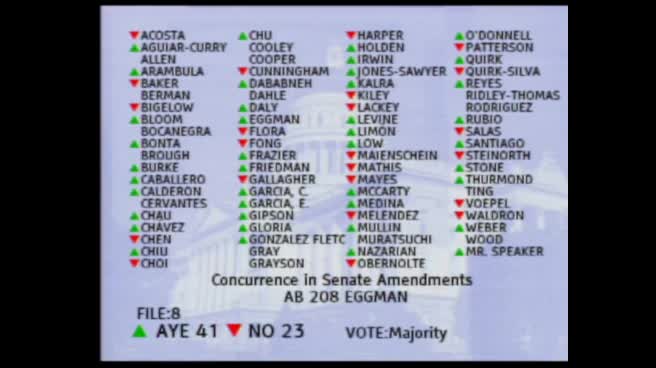 2MIN
Assembly Floor
 2MIN
Senate Floor
 1H
Senate Standing Committee on Appropriations
 25MIN
Senate Standing Committee on Elections and Constitutional Amendments
 3MIN
Assembly Floor
 1H
Assembly Standing Committee on Appropriations
 23MIN
Assembly Standing Committee on Local Government
 24MIN



