AB 954: Food labeling: quality and safety dates.
- Session Year: 2017-2018
- House: Assembly
- Latest Version Date: 2017-10-14
Existing law provides that all food labeling regulations and any amendments to those regulations adopted pursuant to the federal Food, Drug, and Cosmetic Act shall be the food labeling regulations of this state, and authorizes the State Department of Public Health to adopt additional food labeling regulations.
This bill would require the Department of Food and Agriculture, in consultation with the State Department of Public Health, on or before July 1, 2018, to publish information to encourage food manufacturers, processors, and retailers responsible for the labeling of food products to voluntarily use uniform terms on food product labels to communicate quality dates and safety dates, and would require the department to promote the consistent use of those terms. The bill would also require the department to encourage food distributors and retailers to develop alternatives to consumer-facing sell by dates. The bill would establish the Consumer Education Account in the Department of Food and Agriculture Fund for the deposit of nonstate funds from public and private sources. The bill would continuously appropriate the funds in the account to the department to educate consumers about the meaning of quality dates and safety dates.
Existing law provides that all food labeling regulations and any amendments to those regulations adopted pursuant to the federal Food, Drug, and Cosmetic Act shall be the food labeling regulations of this state, and authorizes the State Department of Public Health to adopt additional food labeling regulations.
This bill would require the Department of Food and Agriculture, in consultation with the State Department of Public Health, on or before July 1, 2018, to publish guidelines that information to encourage food manufacturers, processors, and retailers responsible for the labeling of food products to voluntarily use uniform terms on food product labels to communicate quality dates and safety dates on food product labels, including guidelines that encourage the adoption of certain quality and safety date terms. dates, and would require the department to promote the consistent use of those terms. The bill would also require the department to encourage food distributors and retailers to develop alternatives to consumer-facing sell by dates. The bill would establish the Consumer Education Account in the Department of Food and Agriculture Fund for the deposit of nonstate funds from public and private sources. The bill would continuously appropriate the funds in the account to the department to educate consumers about the meaning of quality dates and safety dates.
Existing law provides that all food labeling regulations and any amendments to those regulations adopted pursuant to the federal Food, Drug, and Cosmetic Act shall be the food labeling regulations of this state, and authorizes the State Department of Public Health to adopt additional food labeling regulations.
This bill would require the Department of Food and Agriculture, in consultation with the State Department of Public Health, on or before July 1, 2018, to publish guidelines that promote the voluntary implementation of uniform standards for the use of quality date and safety date labels on food products, encourage food manufacturers, processors, and retailers responsible for the labeling of food products to voluntarily use uniform quality dates and safety dates on food product labels, including guidelines that encourage food manufacturers to adopt the adoption of certain quality and safety date terms.
Existing law provides that all food labeling regulations and any amendments to those regulations adopted pursuant to the federal Food, Drug, and Cosmetic Act shall be the food labeling regulations of this state, and authorizes the State Department of Public Health to adopt additional food labeling regulations.
This bill would require the Department of Food and Agriculture, in consultation with the State Department of Public Health, on or before July 1, 2018, to publish guidelines that promote the voluntary implementation of uniform standards for the use of quality date and safety date labels on food products, including guidelines that encourage food manufacturers to adopt certain quality and safety date terms.
Existing law requires the State Air Resources Board, no later than January 1, 2018, to approve and begin implementing a comprehensive short-lived climate pollutant strategy to reduce statewide emissions of, among other pollutants, methane by 40% below 2013 levels by 2030. Existing law requires those methane emissions reduction goals to include specified targets for reducing organic waste in landfills. Existing law requires, no later than July 1, 2020, the Department of Resources Recycling and Recovery, in consultation with the state board, to analyze the progress that the waste sector, state government, and local governments have made in achieving the specified targets for reducing organic waste in landfills. Existing law authorizes the department, depending on the outcome of that analysis, to amend specified regulations to include incentives or additional requirements, as specified, and authorizes local jurisdictions to charge and collect fees to recover the local jurisdictions costs incurred in complying with those regulations.This bill would require the department to include in the analysis of the progress made on the organic waste reduction targets the status of industry efforts and federal legislation to reduce consumer food waste, including the adoption of uniform labels on food. By adding to the duties of local governments related to organic waste in landfills, this bill would impose a state-mandated local program. The bill would make findings and declarations related to organic food waste, including, among others, that misinterpretation of the date labels on foods is a key factor leading to food waste and that it is the public policy of this state that consumers benefit from uniform and accurate expiration date labeling.The California Constitution requires the state to reimburse local agencies and school districts for certain costs mandated by the state. Statutory provisions establish procedures for making that reimbursement.This bill would provide that no reimbursement is required by this act for a specified reason.Existing law requires the State Air Resources Board, no later than January 1, 2018, to approve and begin implementing a comprehensive short-lived climate pollutant strategy to reduce statewide emissions of, among other pollutants, methane by 40% below 2013 levels by 2030. Existing law requires those methane emissions reduction goals to include specified targets for reducing organic waste in landfills. Existing law requires, no later than July 1, 2020, the Department of Resources Recycling and Recovery, in consultation with the state board, to analyze the progress that the waste sector, state government, and local governments have made in achieving the specified targets for reducing organic waste in landfills. Existing law authorizes the department, depending on the outcome of that analysis, to amend specified regulations to include incentives or additional requirements, as specified, and authorizes local jurisdictions to charge and collect fees to recover the local jurisdictions costs incurred in complying with those regulations.
This bill would require the department to include in the analysis of the progress made on the organic waste reduction targets the status of industry efforts and federal legislation to reduce consumer food waste, including the adoption of uniform labels on food. By adding to the duties of local governments related to organic waste in landfills, this bill would impose a state-mandated local program. The bill would make findings and declarations related to organic food waste, including, among others, that misinterpretation of the date labels on foods is a key factor leading to food waste and that it is the public policy of this state that consumers benefit from uniform and accurate expiration date labeling.
The California Constitution requires the state to reimburse local agencies and school districts for certain costs mandated by the state. Statutory provisions establish procedures for making that reimbursement.
This bill would provide that no reimbursement is required by this act for a specified reason.
The Legislature finds and declares all of the following:
(a)Food is the single most prevalent item in Californias waste stream, with over 5.5 million tons of food dumped in landfills every year in the state.
(b)Four percent of the total energy budget, about 12 percent of the land, and 23 percent of all freshwater consumed in the United States is used to grow food that goes uneaten.
(c)Discarded food is a drain on our economy, costing consumers and industry $162 billion each year nationally.
(d)Reducing food losses by just 15 percent would save the equivalent of enough food to feed more than 25 million Americans every year. According to estimates, more than six million Californians, including one in four children, suffer from food insecurity.
(e)Sending uneaten food and other organic waste into landfills releases more than 8.3 million tons of greenhouse gases each year in California, contributing 20 percent of the states methane emissions.
(f)Misinterpretation of the date labels on foods is a key factor leading to food waste in American households, and surveys show that 56 to 90 percent of consumers discard some food prematurely as a result of misinterpreting food date labels.
(g)It is the public policy of this state that consumers benefit from uniform and accurate expiration date labeling.
SEC. 2.Division 25 (commencing with Section 82000) is added to the Food and Agricultural Code, to read:25.Food Labeling82000.For purposes of this division, the following definitions apply:
(a)Quality date means a date on a label affixed to the packaging or a container of food that communicates to consumers the date after which the food quality may begin to deteriorate but the food may still be acceptable for consumption.
(b)Safety date means a date on a label affixed to the packaging or container of food that communicates to consumers that the food should be consumed or frozen, if appropriate, by the date listed on the package that applies to perishable products with potential safety implications over time.
(c)Sell by date means a date on a label affixed to the packaging or container of food that is intended to communicate primarily to a distributor or retailer for purposes of stock rotation and that is not a quality date or a safety date.
82001.(a)The Department of Food and Agriculture, in consultation with the State Department of Public Health, shall, on or before July 1, 2018, publish information to encourage food manufacturers, processors, and retailers responsible for the labeling of food products to voluntarily use the following uniform terms on food product labels to communicate quality dates and safety dates:
(1)BEST if Used by or BEST if Used or Frozen by to indicate the quality date of a product.
(2)USE by or USE by or Freeze by to indicate the safety date of a product.
(b)The department shall promote the consistent use of the terms specified pursuant to subdivision (a) in the course of its existing interactions with food manufacturers, processors, and retailers.
(c)In the process of implementing subdivision (a), the department shall encourage food distributors and retailers to develop alternatives to consumer-facing sell by dates.
(d)(1)The department may accept nonstate funds from public and private sources to educate consumers about the meaning of the quality dates and safety dates specified in this section.
(2)Funds accepted by the department pursuant to paragraph (1) shall be deposited in the Consumer Education Account, which is hereby created in the Department of Food and Agriculture Fund.
(3)Notwithstanding Section 13340 of the Government Code, all funds in the Consumer Education Account are hereby continuously appropriated to the department without regard to fiscal years to carry out the purpose provided in paragraph (1).
The Legislature finds and declares all of the following:
(a)Food is the single most prevalent item in Californias waste stream, with over 5.5 million tons of food dumped in landfills every year in the state.
(b)Four percent of the total energy budget, about 12 percent of the land, and 23 percent of all freshwater consumed in the United States is used to grow food that goes uneaten.
(c)Discarded food is a drain on our economy, costing consumers and industry $162 billion each year nationally.
(d)Reducing food losses by just 15 percent would be save the equivalent to of enough food to feed more than 25 million Americans every year. According to estimates, more than 6 six million Californians, including one in four children, suffer from food insecurity.
(e)Sending uneaten food and other organic waste into landfills releases more than 8.3 million tons of greenhouse gases each year in California, contributing 20 percent of the states methane emissions.
(f)Misinterpretation of the date labels on foods is a key factor leading to food waste in American households, and surveys show that 56 to 90 percent of consumers discard some food prematurely as a result of misinterpreting food date labels.
(g)It is the public policy of this state that consumers benefit from uniform and accurate expiration date labeling.
SEC. 2.Division 25 (commencing with Section 82000) is added to the Food and Agricultural Code, to read:25.Food Labeling82000.For purposes of this division, the following definitions apply:
(a)Quality date means a date on a label affixed to the packaging or a container of food that communicates to consumers the date after which the food quality may begin to deteriorate but the food may still be acceptable for consumption.
(b)Safety date means a date on a label affixed to the packaging or container of food that communicates to consumers that the food should be consumed or frozen, if appropriate, by the date listed on the package that applies to perishable products with potential safety implications over time.
(c)Sell by date means a date on a label affixed to the packaging or container of food that is intended to communicate primarily to a distributor or retailer for purposes of stock rotation and that is not a quality date or a safety date.
82001.(a)The Department of Food and Agriculture, in consultation with the State Department of Public Health, shall, on or before July 1, 2018, publish guidelines that information to encourage food manufacturers, processors, and retailers responsible for the labeling of food products to voluntarily use uniform the following uniform terms on food product labels to communicate quality dates and safety dates on food product labels. dates:
(b)The guidelines adopted pursuant to subdivision (a) shall encourage food manufacturers, processors, and retailers responsible for the labeling of food products to adopt the following terms:(1)BEST if Used by or BEST if Used or Frozen by to indicate the quality date of a product.
(2)USE by or USE by or Freeze by to indicate the safety date of a product.
(c)The guidelines developed pursuant to subdivision (a) shall discourage the use of sell-by dates that are visible to the consumer or any date in the labeling of food that is intended to communicate primarily to a distributor or retailer for purposes of stock rotation that is not a quality date or a safety date.(d)(b)The department shall promote the guidelines developed pursuant to this section consistent use of the terms specified pursuant to subdivision (a) in the course of its existing interactions with food manufacturers, processors, and retailers.
(c)In the process of implementing subdivision (a), the department shall encourage food distributors and retailers to develop alternatives to consumer-facing sell by dates.
(d)(1)The department may accept nonstate funds from public and private sources to educate consumers about the meaning of the quality dates and safety dates specified in this section.
(2)Funds accepted by the department pursuant to paragraph (1) shall be deposited in the Consumer Education Account, which is hereby created in the Department of Food and Agriculture Fund.
(3)Notwithstanding Section 13340 of the Government Code, all funds in the Consumer Education Account are hereby continuously appropriated to the department without regard to fiscal years to carry out the purpose provided in paragraph (1).
The Legislature finds and declares all of the following:
(a)Food is the single most prevalent item in Californias waste stream, with over 5.5 million tons of food dumped in landfills every year in the state.
(b)Four percent of the total energy budget, about 12 percent of the land, and 23 percent of all freshwater consumed in the United States is used to grow food that goes uneaten.
(c)Discarded food is a drain on our economy, costing consumers and industry $162 billion each year nationally.
(d)Reducing food losses by just 15 percent would be equivalent to enough food to feed more than 25 million Americans every year. According to estimates, more than 6 million Californians, including one in four children, suffer from food insecurity.
(e)Sending uneaten food and other organic waste into landfills releases more than 8.3 million tons of greenhouse gases each year in California, contributing 20 percent of the states methane emissions.
(f)Misinterpretation of the date labels on foods is a key factor leading to food waste in American households, and surveys show that 56 to 90 percent of consumers discard some food prematurely as a result of misinterpreting food date labels.
(g)It is the public policy of this state that consumers benefit from uniform and accurate expiration date labeling.
SEC. 2.Division 25 (commencing with Section 82000) is added to the Food and Agricultural Code, to read:25.Food Labeling82000.For purposes of this division, the following definitions apply:
(a)Quality date means a date on a label affixed to the packaging or a container of food that communicates to consumers the date after which the food quality may begin to deteriorate but the food may still be acceptable for consumption.
(b)Safety date means a date on a label affixed to the packaging or container of food that communicates to consumers that the food should be consumed or frozen, if appropriate, by the date listed on the package that applies to perishable products with potential safety implications over time.
82001.(a)The Department of Food and Agriculture, in consultation with the State Department of Public Health, shall, on or before July 1, 2018, publish guidelines that promote the voluntary implementation of uniform standards for the use of encourage food manufacturers, processors, and retailers responsible for the labeling of food products to voluntarily use uniform quality date dates and safety date labels on food products. dates on food product labels.
(b)The guidelines adopted pursuant to subdivision (a) shall encourage food manufacturers manufacturers, processors, and retailers responsible for the labeling of food products to adopt the following terms:
(1)Best BEST if used Used by or best BEST if used Used or frozen Frozen by to indicate the quality date of a product.
(2)Use USE by or use USE by or freeze Freeze by to indicate the safety date of a product.
(c)The guidelines developed pursuant to subdivision (a) shall discourage the use of sell-by dates that are visible to the consumer or any date in the labeling of food that is intended to communicate primarily to a distributor or retailer for purposes of stock rotation that is not a quality date or a safety date.
(d)The department shall promote the guidelines developed pursuant to this section in the course of its existing interactions with food manufacturers. manufacturers, processors, and retailers.
The Legislature finds and declares all of the following:
(a)Food is the single most prevalent item in Californias waste stream, with over 5.5 million tons of food dumped in landfills every year in the state.
(b)Four percent of the total energy budget, about 12 percent of the land, and 23 percent of all freshwater consumed in the United States is used to grow food that goes uneaten.
(c)Discarded food is a drain on our economy, costing consumers and industry $162 billion each year nationally.
(d)Reducing food losses by just 15 percent would be equivalent to enough food to feed more than 25 million Americans every year. According to estimates, more than 6 million Californians, including one in four children, suffer from food insecurity.
(e)Dumping Sending uneaten food and other organic waste into landfills releases more than 8.3 million tons of greenhouse gases each year in California, contributing 20 percent of the states methane emissions.
(f)Misinterpretation of the date labels on foods is a key factor leading to food waste in American households, and surveys show that 56 to 90 percent of consumers discard some food prematurely as a result of misinterpreting food date labels.
(g)It is the public policy of this state that consumers benefit from uniform and accurate expiration date labeling.
SEC. 2.Section 42653 of the Public Resources Code is amended to read:42653.(a)No later than July 1, 2020, the department, in consultation with the State Air Resources Board, shall analyze the progress that the waste sector, state government, and local governments have made in achieving the organic waste reduction goals for 2020 and 2025 established in Section 39730.6 of the Health and Safety Code. The analysis shall include all of the following:(1)The status of new organics recycling infrastructure development, including the commitment of state funding and appropriate rate increases for solid waste and recycling services to support infrastructure expansion.(2)The progress in reducing regulatory barriers to the siting of organics recycling facilities and the timing and effectiveness of policies that will facilitate the permitting of organics recycling infrastructure.(3)The status of markets for the products generated by organics recycling facilities, including cost-effective electrical interconnection and common carrier pipeline injection of digester biomethane and the status of markets for compost, biomethane, and other products from the recycling of organic waste.(4)The status of industry efforts and federal legislation to reduce consumer food waste, including the adoption of uniform labels on food.(b)If the department determines that significant progress has not been made on the items analyzed pursuant to subdivision (a), the department may include incentives or additional requirements in the regulations described in Section 42652.5 to facilitate progress towards achieving the organic waste reduction goals for 2020 and 2025 established in Section 39730.6 of the Health and Safety Code. The department may, upon consultation with stakeholders, recommend to the Legislature revisions to those organic waste reduction goals.SEC. 3.No reimbursement is required by this act pursuant to Section 6 of Article XIIIB of the California Constitution because a local agency or school district has the authority to levy service charges, fees, or assessments sufficient to pay for the program or level of service mandated by this act, within the meaning of Section 17556 of the Government Code.SEC. 2.Division 25 (commencing with Section 82000) is added to the Food and Agricultural Code, to read:25.Food Labeling82000.For purposes of this division, the following definitions apply:
(a)Quality date means a date on a label affixed to the packaging or a container of food that communicates to consumers the date after which the food quality may begin to deteriorate but the food may still be acceptable for consumption.
(b)Safety date means a date on a label affixed to the packaging or container of food that communicates to consumers that the food should be consumed or frozen, if appropriate, by the date listed on the package that applies to perishable products with potential safety implications over time.
82001.(a)The Department of Food and Agriculture, in consultation with the State Department of Public Health, shall, on or before July 1, 2018, publish guidelines that promote the voluntary implementation of uniform standards for the use of quality date and safety date labels on food products.
(b)The guidelines adopted pursuant to subdivision (a) shall encourage food manufacturers to adopt the following terms:
(1)Best if used by or best if used or frozen by to indicate the quality date of a product.
(2)Use by or use by or freeze by to indicate the safety date of a product.
(c)The guidelines developed pursuant to subdivision (a) shall discourage the use of sell-by dates that are visible to the consumer or any date in the labeling of food that is intended to communicate primarily to a distributor or retailer for purposes of stock rotation that is not a quality date or a safety date.
(d)The department shall promote the guidelines developed pursuant to this section in the course of its existing interactions with food manufacturers.
The Legislature finds and declares all of the following:
(a)Food is the single most prevalent item in Californias waste stream, with over 5.5 million tons of food dumped in landfills every year in the state.
(b)Four percent of the total energy budget, about 12 percent of the land, and 23 percent of all freshwater consumed in the United States is used to grow food that goes uneaten.
(c)Discarded food is a drain on our economy, costing consumers and industry $162 billion each year nationally.
(d)Reducing food losses by just 15 percent would be equivalent to enough food to feed more than 25 million Americans every year. According to estimates, more than 6 million Californians, including one in four children, suffer from food insecurity.
(e)Dumping uneaten food and other organic waste into landfills releases more than 8.3 million tons of greenhouse gases each year in California, contributing 20 percent of the states methane emissions.
(f)Misinterpretation of the date labels on foods is a key factor leading to food waste in American households, and surveys show that 56 to 90 percent of consumers discard food prematurely as a result of misinterpreting food date labels.
(g)It is the public policy of this state that consumers benefit from uniform and accurate expiration date labeling.
SEC. 2.Section 42653 of the Public Resources Code is amended to read:42653.(a)No later than July 1, 2020, the department, in consultation with the State Air Resources Board, shall analyze the progress that the waste sector, state government, and local governments have made in achieving the organic waste reduction goals for 2020 and 2025 established in Section 39730.6 of the Health and Safety Code. The analysis shall include all of the following:
(1)The status of new organics recycling infrastructure development, including the commitment of state funding and appropriate rate increases for solid waste and recycling services to support infrastructure expansion.
(2)The progress in reducing regulatory barriers to the siting of organics recycling facilities and the timing and effectiveness of policies that will facilitate the permitting of organics recycling infrastructure.
(3)The status of markets for the products generated by organics recycling facilities, including cost-effective electrical interconnection and common carrier pipeline injection of digester biomethane and the status of markets for compost, biomethane, and other products from the recycling of organic waste.
(4)The status of industry efforts and federal legislation to reduce consumer food waste, including the adoption of uniform labels on food.
(b)If the department determines that significant progress has not been made on the items analyzed pursuant to subdivision (a), the department may include incentives or additional requirements in the regulations described in Section 42652 42652.5 to facilitate progress towards achieving the organic waste reduction goals for 2020 and 2025 established in Section 39730.6 of the Health and Safety Code. The department may, upon consultation with stakeholders, recommend to the Legislature revisions to those organic waste reduction goals.
SEC. 3.No reimbursement is required by this act pursuant to Section 6 of Article XIIIB of the California Constitution because a local agency or school district has the authority to levy service charges, fees, or assessments sufficient to pay for the program or level of service mandated by this act, within the meaning of Section 17556 of the Government Code.
|
Date
|
Status
|
|---|---|
| Oct 14, 2017 | Chaptered by Secretary of State - Chapter 787, Statutes of 2017. |
| Oct 14, 2017 | Approved by the Governor. |
| Sep 21, 2017 | Enrolled and presented to the Governor at 3:30 p.m. |
| Sep 13, 2017 | Assembly Rule 77(a) suspended. |
| Sep 12, 2017 | In Assembly. Concurrence in Senate amendments pending. May be considered on or after September 14 pursuant to Assembly Rule 77. |
| Sep 11, 2017 | Read third time. Passed. Ordered to the Assembly. |
| Sep 5, 2017 | Read second time. Ordered to third reading. |
| Sep 1, 2017 | From committee: Do pass. (Ayes 5. Noes 2.) (September 1). |
| Jul 17, 2017 | In committee: Referred to APPR. suspense file. |
| Jul 6, 2017 | From committee: Do pass and re-refer to Com. on APPR. (Ayes 9. Noes 0.) (July 5). Re-referred to Com. on APPR. |
| Jun 29, 2017 | From committee chair, with author's amendments: Amend, and re-refer to committee. Read second time, amended, and re-referred to Com. on HEALTH. |
| Jun 20, 2017 | From committee: Do pass and re-refer to Com. on HEALTH. (Ayes 3. Noes 1.) (June 20). Re-referred to Com. on HEALTH. |
| Jun 8, 2017 | Referred to Coms. on AGRI. and HEALTH. |
| May 30, 2017 | In Senate. Read first time. To Com. on RLS. for assignment. |
| May 30, 2017 | Read third time. Passed. Ordered to the Senate. (Ayes 76. Noes 0. Page 1831.) |
| May 26, 2017 | From committee: Do pass. (Ayes 17. Noes 0.) (May 26). |
| May 17, 2017 | In committee: Set, first hearing. Referred to APPR. suspense file. |
| May 8, 2017 | Re-referred to Com. on APPR. |
| May 4, 2017 | From committee chair, with author's amendments: Amend, and re-refer to Com. on APPR. Read second time and amended. |
| Apr 26, 2017 | From committee: Do pass and re-refer to Com. on APPR. (Ayes 14. Noes 0.) (April 25). Re-referred to Com. on APPR. |
| Apr 6, 2017 | From committee: Be re-referred to Com. on HEALTH. Re-referred. (Ayes 9. Noes 0.) (April 6). Re-referred to Com. on HEALTH. |
| Mar 30, 2017 | Re-referred to Com. on RLS. pursuant to Assembly Rule 96. |
| Mar 28, 2017 | Re-referred to Com. on NAT. RES. |
| Mar 27, 2017 | From committee chair, with author's amendments: Amend, and re-refer to Com. on NAT. RES. Read second time and amended. |
| Mar 2, 2017 | Referred to Com. on NAT. RES. |
| Feb 17, 2017 | From printer. May be heard in committee March 19. |
| Feb 16, 2017 | Read first time. To print. |
|
Date
|
Description
|
Location
|
Votes
|
|
|---|---|---|---|---|
| Sep 13, 2017 | AB 954 CHIU Concurrence in Senate Amendments | Assembly Floor |
Passed |
|
| Sep 11, 2017 | Assembly 3rd Reading AB954 Chiu By Dodd | Senate Floor |
Passed |
|
| Sep 1, 2017 | Do pass | Senate Standing Committee on Appropriations |
Passed |
|
| Jul 17, 2017 | Placed on suspense file | Senate Standing Committee on Appropriations |
Passed |
|
| Jul 5, 2017 | Do pass, but first be re-referred to the Committee on [Appropriations] | Senate Standing Committee on Health |
Passed |
|
| Jun 20, 2017 | Do pass, but first be re-referred to the Committee on [Health] | Senate Standing Committee on Agriculture |
Passed |
|
| May 30, 2017 | AB 954 CHIU Assembly Third Reading | Assembly Floor |
Passed |
|
| May 26, 2017 | Do pass. | Assembly Standing Committee on Appropriations |
Passed |
|
| Apr 25, 2017 | Do pass and be re-referred to the Committee on [Appropriations] | Assembly Standing Committee on Health |
Passed |
|
| Apr 6, 2017 | Be re-referred to the Committee on [Health] | Assembly Standing Committee on Rules |
Passed |
This list shows positions taken on this bill by organizations on the date displayed, which is linked to the original source.
Positions by individuals are not included.
|
Organization
|
Position
|
Date
|
|---|---|---|
| Azul | ** Support | Sep 4, 2017 |
| California Association Of Local Conservation Corps | ** Support | Sep 4, 2017 |
| California Compost Coalition | ** Support | Sep 4, 2017 |
| California Public Interest Research Group | ** Support | Sep 4, 2017 |
| Californians Against Waste | ** Support | Sep 4, 2017 |
| Castro Valley Sanitary District | ** Support | Sep 4, 2017 |
| Center For Food Safety | ** Support | Jun 16, 2017 |
| City and County of San Francisco | ** Support | Sep 4, 2017 |
| clean river alliance | ** Support | Sep 4, 2017 |
| Clean Water Action | ** Support | Sep 4, 2017 |
| Environmental Working Group | ** Support | Sep 4, 2017 |
| Food Finders | ** Support | Sep 4, 2017 |
| Food Forward | ** Support | Sep 4, 2017 |
| food law and policy clinic, harvard law school | ** Support | Jun 16, 2017 |
| Food Shift: A Project of Earth Island Institute | ** Support | Sep 4, 2017 |
| Friends Of The Earth | ** Support | Sep 4, 2017 |
| Green Long Beach | ** Support | Sep 4, 2017 |
| Grocery Manufacturers Association | * Support | Apr 25, 2017 |
| Integrated Waste Management Task Force | ** Support | Sep 4, 2017 |
| Kiss the Ground | ** Support | Sep 4, 2017 |
| la county solid waste management committee | ** Support | Sep 4, 2017 |
| Leanpath, Inc. | ** Support | Sep 4, 2017 |
| Los Angeles Food Policy Council | ** Support | Sep 4, 2017 |
| Marin Sanitary Service | ** Support | Sep 4, 2017 |
| Meet Each Need with Dignity | ** Support | Sep 4, 2017 |
| Napa Recycling & Waste Services | ** Support | Sep 4, 2017 |
| Natural Resources Defence Council | * Support | Apr 25, 2017 |
| Natural Resources Defense Council | ** Support | Sep 4, 2017 |
| Northern California Recycling Association | ** Support | Sep 4, 2017 |
| Pesticide Action Network | ** Support | Sep 4, 2017 |
| San Diego Food System Alliance | ** Support | Sep 4, 2017 |
| Sierra Harvest | ** Support | Jul 3, 2017 |
| Solid Waste Association Of North America, California Chapters | ** Support | Sep 4, 2017 |
| Sonoma County Waste Management Agency | ** Support | Sep 4, 2017 |
| St. Francis Center | ** Support | Sep 4, 2017 |
| StopWaste | ** Support | Sep 4, 2017 |
| Sustain LA | ** Support | Sep 4, 2017 |
| Tri-CED Community Recycling | ** Support | Sep 4, 2017 |
| Urban & Environmental Policy Institute, Occidental College | ** Support | Sep 4, 2017 |
| western center on law and poverty | ** Support | Jul 3, 2017 |
| zero waste marin | ** Support | Sep 4, 2017 |
CONCURRENCE IN SENATE AMENDMENTS
CSA1 Bill Id:AB 954
Author:(Chiu)
As Amended Ver:June 29, 2017
Majority vote
ASSEMBLY: | 76-0 | (May 30, 2017) | SENATE: | 33-6 | (September 11, 2017) |
Original Committee Reference: NAT. RES.
SUMMARY: Requires the Department of Food and Agriculture (DFA), in consultation with the Department of Public Health (DPH), to publish information that encourages food manufacturers, processors, and retailers responsible for the labeling of food products to voluntarily use specified "best by" and "use by" labels that communicate quality and safety dates, respectively. Specifically, this bill:
- Requires, by July 1, 2018, DFA, in consultation with DPH, to publish information that encourage food manufacturers, processors, and retailers responsible for the labeling of food products to voluntarily use uniform quality dates and safety dates on food product labels.
- Requires the guidelines to encourage food manufacturers, processors, and retailers to adopt the following terms:
- "BEST if Used by" or "BEST if Used or Frozen by" to indicate the quality date of a product; and,
- "USE by" or "USE by or Freeze by" to indicate the safety date of a product.
- Requires DFA to promote the consistent use of the terms in the course of its existing interactions with food manufacturers, processors, and retailers.
- Requires DFA to encourage alternatives to consumer-facing "sell-by" dates.
- Permits DFA to accept nonstate funds to educate consumers about the meaning of the quality dates and safety dates specified in this bill. Requires these funds to be deposited in the Consumer Education Account, which this bill establishes in the DFA Fund.
The Senate amendments make clarifying changes and establish the Consumer Education Account in the DFA fund which is permitted to accept nonstate funds.
FISCAL EFFECT: According to the Senate Appropriations Committee, this bill results in unknown initial costs to DFA, at a minimum in the hundreds of thousands of dollars, to publish voluntary guidelines. Ongoing costs would also be unknown. Costs to DPH to serve in a consultation role to CDFA would be minor and absorbable.
AS PASSED BY THE ASSEMBLY, this bill required the DFA, in consultation with the DPH, to publish guidelines that encourage the voluntary use of uniform quality and safety dates on food products.
COMMENTS: According to the author, there is no standardized date label on any of our food. In fact, there are no federal, state, or local regulations on the dates, who sets them and why they exist, with the exception of baby formula. Instead, labels come in a dizzying variety of forms including "use by," "best before," "sell by," and "enjoy by" dates, and these simple markers are both poorly understood and surprisingly under-regulated. The author states that confusing and misleading labels cause many consumers and stores to throw out perfectly healthy food, leading to 5.5 million tons of food dumped in landfills every year in California. Food has become the single most prevalent item in our state's waste stream and emits 8.3 million tons of greenhouse gases each year, contributing to 20% of the state's methane emissions. According to the author, national industry leaders, including the Grocery Manufacturers Association and the Food Marketing Institute, recently opted to create voluntary date label guidelines using the same model as is included in this bill to date their products. The author believes that standardizing the language on date labels with uniform phrases and definitions is the foundation for educating consumers on the meaning of labels, which will lead to reduced food waste.
Supporters of this bill argue that a shocking 40% of food produced in this country never gets eaten. According to supporters, wasted food costs consumers and industry $162 billion each year nationally, squanders important natural resources that are used to grow, process, distribute, and store America's food supply; and represents a missed opportunity to feed the six million Californians who live in food insecure households. Misinterpretation of the date labels on food is a key factor leading to this waste.
There is no known opposition to this bill.
Analysis Prepared by: John Gilman / HEALTH / (916) 319-2097 FN: 0001842
Office of Senate Floor Analyses (916) 651-1520 Fax: (916) 327-4478 | AB |
THIRD READING
Bill No: AB 954
:
SENATE AGRICULTURE COMMITTEE: 3-1, 6/20/17
AYES: Galgiani, Dodd, Pan
NOES: Berryhill
NO VOTE RECORDED: Wilk
SENATE HEALTH COMMITTEE: 9-0, 7/5/17
AYES: Hernandez, Nguyen, Atkins, Leyva, Mitchell, Monning, Newman, Nielsen, Roth
SENATE APPROPRIATIONS COMMITTEE: 5-2, 9/1/17
AYES: Lara, Beall, Bradford, Hill, Wiener
NOES: Bates, Nielsen
ASSEMBLY FLOOR: 76-0, 5/30/17 - See last page for vote
SOURCE: Californians Against Waste
DIGEST:
This bill requires the California Department of Food and Agriculture (CDFA), in consultation with the Department of Public Health (DPH), to publish information by July 1, 2018 that encourages food manufacturers, processors, and retailers responsible for the labeling of food products to voluntarily use specified “best by” and “use by” labels that communicate quality and safety dates, respectively. This bill also requires CDFA to promote consistent use of those terms. This bill also establishes the Consumer Education Account within the Department of Food and Agriculture Fund (DFA Fund).
Existing federal law establishes, through the U.S. Food and Drug Administration (FDA), various requirements for food labels under the Federal Food, Drug, and Cosmetic Act, which includes the Nutritional Labeling and Education Act and the Food Allergen Labeling and Consumer Protection Act. These include requiring specified nutrition information, a listing of all ingredients, and whether a produce contains any of eight major food allergens, such as milk, eggs, shellfish, tree nuts, etc.
Existing state law:
- Enacts the Sherman Food, Drug and Cosmetic Law, enforced by DPH, which provides broad authority for DPH to enforce food safety requirements, including that food is not adulterated, misbranded, or falsely advertised. Food labeling requirements generally adopt federal food labeling laws as the state requirement, including nutrition labeling and allergen labeling, but DPH is permitted, by regulation, to adopt additional food labeling regulations.
- Establishes the California Retail Food Code (CRFC), which governs all aspects of retail food safety and sanitation in California under the CRFC. Specifies that primary responsibility for enforcement of the CRFC is with local enforcement agencies.
- Requires raw shucked shellfish to bear a label that includes a “sell by” date or a “best if used by” date for packages with a capacity of less than one-half gallon, or the date shucked for packages with a capacity of one-half gallon or more.
- Requires eggs that are packed for human consumption to be labeled with the words “sell-by” immediately followed by the month and day in bold type, and prohibits the sell-by date from exceeding 30 days from the date on which the eggs were packed.
- Requires milk, cream, or milk products to have a date appear on the package or container that is the date upon which, in order insure quality, the product is normally removed from the shelf or similar location from which the product is offered for sale to the consumer.
This bill:
- Requires CDFA, in consultation with the DPH, to publish information by July 1, 2018, to encourage food manufacturers, processors, and retailers responsible for the labeling of food products to voluntarily use the following uniform terms on food product labels to communicate quality dates and safety dates:
- “BEST if Used by” or “BEST if Used or Frozen by” to indicate the quality date of a product; and,
- “USE by” or “USE by or Freeze by” to indicate the safety date of a product.
- Requires DFA to promote the consistent use of the terms specified in 1) above in the course of its existing interactions with food manufacturers, processors, and retailers.
- Requires DFA, in the process of implementing the provisions in 1) above, to encourage food distributors and retailers to develop alternatives to consumer-
- Permits DFA to accept nonstate funds from public and private sources to education consumers about the meaning of the quality dates and safety dates specified in this bill. Requires these funds to be deposited in the Consumer Education Account, which this bill establishes in the DFA Fund. Continuously appropriates all funds in the Consumer Education Account without regard to fiscal years.
- Defines “quality date,” for purposes of this bill, as a date on a label affixed to the packaging or a container of food that communicates to consumers the date after which the food quality may begin to deteriorate but the food may still be acceptable for consumption.
- Defines “safety date,” for purposes of this bill, as a date on a label affixed to the packaging or container of food that communicates to consumers that the food should be consumed or frozen, if appropriate, by the date listed on the package that applies to perishable products with potential safety implications over time.
- Defines “sell by date” as a date on a label affixed to the packaging or container of food that is intended to communicate primarily to a distributor or retailer for purposes of stock rotation and that is not a quality date or a safety date.
- Makes various legislative findings and declarations, including that food is the single most prevalent item in California’s waste stream, that sending uneaten food and other organic waste into landfills releases more than 8.3 million tons of greenhouse gases each year in California, and that misinterpretation of the date labels on foods is a key factor leading to food waste in American households.
FISCAL EFFECT: Appropriation: Fiscal Com.: Local:
According to the Senate Appropriations Committee, this bill results in unknown initial costs to CDFA, at a minimum in the hundreds of thousands of dollars, to publish voluntary guidelines. Ongoing costs would also be unknown. Costs to DPH to serve in a consultation role to CDFA would be minor and absorbable.
Californians Against Waste (source)
AZUL
California Association of Local Conservation Corps
California Compost Coalition
California Public Interest Research Group
Californians Against Waste
Castro Valley Sanitary District
City and County of San Francisco
Clean River Alliance
Clean Water Action
Environmental Working Group
Food Finders
Food Forward
Food Law and Policy Clinic of Harvard Law School
Food Shift: A Project of Earth Island Institute
Friends of the Earth
Green Long Beach
Kiss the Ground
LA County Solid Waste Management Committee/Integrated Waste Management Task Force
LeanPath, Inc.
Los Angeles Food Policy Council
Marin Sanitary Service
Meet Each Need with Dignity
Napa Recycling & Waste Services
Natural Resources Defense Council
Northern California Recycling Association
Pesticide Action Network
San Diego Food System Alliance
Solid Waste Association of North America, California Chapters
Sonoma County Waste Management Agency
St. Francis Center
StopWaste
Sustain LA
Tri-CED Community Recycling
Urban & Environmental Policy Institute, Occidental College
Zero Waste Marin
None received
ARGUMENTS IN SUPPORT: According to Californians Against Waste (CAW), this bill will promote the use of statewide standards for food date labels, which are voluntary for most food products, that are accurate and related to freshness and safety. According to CAW, promoting the use of standard phrases with definitions is the foundation for educating consumers on the meaning of labels, leading to less wasted food and resources. Numerous organizations support this bill. The California Association of Local Conservation Corps states at the heart of the corps’ mission and project delivery is waste reduction, diversion, and reuse, and that misinterpretation of the date labels on food is a key factor leading to waste. The City and County of San Francisco states that it supports policies and producer responsibility measures that promote waste prevention and protect the environment. The Natural Resources Defense Council states in support that because much of the wasted food is edible, people are missing an opportunity to use that food for its intended purpose of nourishing people. Sonoma County Waste Management Agency states that from its experience administering programs related to composting and solid waste education, it is very aware of the consequences of wasted food and the assistance this bill provides in reducing food waste. LeanPath, Inc., which states that it provides smart food waste solutions, asserts that this bill supports it score value to reduce food waste and negative impact that food waste has on the environment by diverting food to people instead of into landfills. The Northern California Recycling Association states that some food banks have policies to turn away food that has gone past its food date label out of fear that the food may be spoiled or a health hazard to their recipients. The Food Law and Policy Clinic of Harvard Law School states that this bill addresses the key challenges and goals it has advocated for over the past several years, and that while this bill is a good first step, over time they hope that these voluntary guidelines will become mandatory to ensure standardized date labeling across the industry.
ASSEMBLY FLOOR: 76-0, 5/30/17
AYES: Acosta, Aguiar-Curry, Travis Allen, Arambula, Baker, Berman, Bigelow, Bloom, Bocanegra, Bonta, Brough, Burke, Caballero, Calderon, Cervantes, Chávez, Chen, Chiu, Chu, Cooley, Cooper, Cunningham, Dababneh, Dahle, Daly, Flora, Fong, Frazier, Friedman, Gallagher, Cristina Garcia, Eduardo Garcia, Gipson, Gloria, Gomez, Gonzalez Fletcher, Gray, Grayson, Holden, Irwin, Jones-Sawyer, Kalra, Kiley, Lackey, Levine, Limón, Low, Maienschein, Mathis, Mayes, McCarty, Medina, Melendez, Mullin, Muratsuchi, Nazarian, Obernolte, O'Donnell, Patterson, Quirk, Quirk-Silva, Reyes, Ridley-Thomas, Rodriguez, Rubio, Salas, Santiago, Steinorth, Mark Stone, Thurmond, Ting, Voepel, Waldron, Weber, Wood, Rendon
NO VOTE RECORDED: Chau, Choi, Eggman, Harper
9/4/17 12:53:29
**** END ****
SENATE COMMITTEE ON
Senator Ricardo Lara, Chair
2017 - 2018 Regular Session
AB 954 (Chiu) - Food labeling: quality and safety dates
Version: | Policy Vote: |
Urgency: | Mandate: |
Hearing Date: | Consultant: |
This bill meets the criteria for referral to the Suspense File.
Bill Summary:
AB 954 would require the California Department of Food and Agriculture (CDFA), in consultation with the Department of Public Health (DPH), to publish information by July 1, 2018 that encourages food manufacturers, processors, and retailers to voluntarily use specified “best by” and “use by” labels that communicate quality and safety dates, respectively.
Fiscal Impact:
This bill would result in unknown initial costs to CDFA, at a minimum in the hundreds of thousands of dollars, to publish voluntary guidelines. Ongoing costs would also be unknown (see Staff Comments). Costs to DPH to serve in a consultation role to CDFA would be minor and absorbable.
Background:
In California, milk products, eggs, and shellfish are required by law to include a “Sell-By” date. CDFA regulates milk and eggs, and DPH regulates shellfish. Federal law only requires infant formula to provide a “Use-By” date to ensure the product’s safety. However, most food manufacturers choose to include dates on food products to indicate when a product should be consumed to ensure optimal quality.
Thus, meat, poultry, and eggs are common products that (nationwide) voluntarily include quality dates. These products are regulated by the Food Safety and Inspection Service (FSIS) of the United States Department of Food and Agriculture (USDA) to ensure that the label dates are truthful, not misleading, and are accompanied by a phrase such as “Best if Used By.” However, discretion is left to the manufacturer to decide the length of time and the temperature at which the food is held to determine the product’s best quality.
FSIS defines label date phrases as follows:
- "Best if Used By/Before" date: indicates when a product will be of best flavor or quality. It is not a purchase or safety date.
- "Sell-By" date: tells the store how long to display the product for sale for inventory management. It is not a safety date.
- “Use-By" date: recommends use of the product while at peak quality. It is not a safety date except when used on infant formula.
The Sherman Food, Drug, and Cosmetic Law requires DPH to regulate the manufacture, production, processing, packing, labeling, sale, and advertising of any food, drug, device, or cosmetic. The Sherman Act also specifies labeling requirements for individual food products and defines food as misbranded if its label is false or misleading. Although CDFA regulates label dates on milk and eggs, DPH and local environmental health officers ensure retail food safety through local inspection programs.
According to USDA, food waste in the U.S. is estimated to approach 40 percent of the food supply. In 2010, this equated to 133 billion pounds and $161 billion worth of food. To mitigate this loss, the USDA and the Environmental Protection Agency (EPA) announced a campaign to cut food waste in half by 2030. On the state level, the California Department of Resources Recycling and Recovery (CalRecycle) finds that food is projected to be the third-largest waste material disposed of in 2020 and that this waste would be better managed through source reduction, diversion of edible food products to feed people or animals, industrial uses, or composting.
Proposed Law:
This bill would, among other things, do the following:
- Require CDFA, in consultation with the DPH, to publish information by July 1, 2018, to encourage food manufacturers, processors, and retailers responsible for the labeling of food products to voluntarily use the following uniform terms on food product labels to communicate quality dates and safety dates: (1) “BEST if Used by” or “BEST if Used or Frozen by” to indicate the quality date of a product; and, (2) “USE by” or “USE by or Freeze by” to indicate the safety date of a product.
- Require CDFA to promote the consistent use of the terms specified above in the course of its existing interactions with food manufacturers, processors, and retailers.
- Require CDFA, in the process of implementing the provisions above, to encourage food distributors and retailers to develop alternatives to consumer-facing “sell by” dates.
- Permit CDFA to accept nonstate funds from public and private sources to educate consumers about the meaning of the quality dates and safety dates specified in this bill. These funds would be required to be deposited in the Consumer Education Account, which this bill establishes in the Food and Agriculture Fund. Funds would be continuously appropriated.
- Define “quality date,” for purposes of this bill, as a date on a label affixed to the packaging or a container of food that communicates to consumers the date after which the food quality may begin to deteriorate but the food may still be acceptable for consumption.
- Define “safety date,” for purposes of this bill, as a date on a label affixed to the packaging or container of food that communicates to consumers that the food should be consumed or frozen, if appropriate, by the date listed on the package that applies to perishable products with potential safety implications over time.
- Define “sell by date” as a date on a label affixed to the packaging or container of food that is intended to communicate primarily to a distributor or retailer for purposes of stock rotation and that is not a quality date or a safety date.
Related Legislation:
- AB 1219 (Eggman) would enact the California Good Samaritan Food Donation Act, which strengthens immunity protections for the donation of food, extends this immunity protection to any entity that donates food, rather than just food facilities, and requires local food facility enforcement officers to promote the recovery of food fit for human consumption during their routine inspections with handouts describing the immunity provisions association with the donation of food. The bill is currently pending in this Committee.
- AB 933 (Agriculture Committee, 2017), among other provisions, would require milk products to be labeled with a date that would ensure consumer quality. The bill is currently pending on the Senate Floor.
- AB 2725 (Chiu, 2016) would have required a food manufacturer using a quality or elevated risk date to use the phrases “best if used by” or “expires on,” as specified. The bill failed passage in the Assembly Health Committee.
Staff Comments:
As noted above, this bill would require CDFA, in consultation with DPH, to (1) publish information to encourage food manufacturers, processors and retailers to use uniform quality and safety dates when labeling food products, (2) encourage food distributors and retailers to develop alternatives to consumer facing dates, and (3) promote these terms in the normal course of interaction with food manufacturers, processors and retailers.
With the exception of dairy manufacturing facilities, CDFA generally does not interact with food manufacturers. Thus, under this bill, the department anticipates that it would likely need to establish a dissemination plan that would be beyond the scope of existing interactions, the costs of which are unknown. Likewise, costs to CDFA related to its interactions with food manufacturers, processors, and retailers is also unknown.
Though the bill does establish the Consumer Education Account within the Food and Agriculture Fund to collect monies to pursue these mandates and consumer education, the bill does not include funding for these purposes.
-- END --
SENATE COMMITTEE ON HEALTH
Senator Ed Hernandez, O.D., Chair
BILL NO: AB 954
AUTHOR: | Chiu | ||
VERSION: | June 29, 2017 | ||
HEARING DATE: | July 5, 2017 | ||
CONSULTANT: | Vincent D. Marchand | ||
SUBJECT: Food labeling: quality and safety dates
SUMMARY:
Requires the Department of Food and Agriculture, in consultation with the Department of Public Health, to publish information by July 1, 2018 that encourages food manufacturers, processors, and retailers to voluntarily use specified “best by” and “use by” labels that communicate quality and safety dates, respectively.
Existing state law:
- Enacts the Sherman Food, Drug and Cosmetic Law, enforced by the Department of Public Health (DPH), which provides broad authority for DPH to enforce food safety requirements, including that food is not adulterated, misbranded, or falsely advertised. Food labeling requirements generally adopt federal food labeling laws as the state requirement, including nutrition labeling and allergen labeling, but DPH is permitted, by regulation, to adopt additional food labeling regulations.
- Establishes the California Retail Food Code (CRFC), which governs all aspects of retail food safety and sanitation in California under the CRFC. Specifies that primary responsibility for enforcement of the CRFC is with local enforcement agencies.
- Requires raw shucked shellfish to bear a label that includes a “sell by” date or a “best if used by” date for packages with a capacity of less than one-half gallon, or the date shucked for packages with a capacity of one-half gallon or more.
- Requires eggs that are packed for human consumption to be labeled with the words “sell-by” immediately followed by the month and day in bold type, and prohibits the sell-by date from exceeding 30 days from the date on which the eggs were packed.
- Requires milk, cream, or milk products to have a date appear on the package or container that is the date upon which, in order insure quality, the product is normally removed from the shelf or similar location from which the product is offered for sale to the consumer.
Existing federal law: Establishes, through the U.S. Food and Drug Administration (FDA), various requirements for food labels under the Federal Food, Drug, and Cosmetic Act, which includes the Nutritional Labeling and Education Act and the Food Allergen Labeling and Consumer Protection Act. These include requiring specified nutrition information, a listing of all ingredients, and whether a produce contains any of eight major food allergens, such as milk, eggs, shellfish, tree nuts, etc.
This bill:
- Requires the Department of Food and Agriculture (DFA), in consultation with the DPH, to publish information by July 1, 2018, to encourage food manufacturers, processors, and retailers responsible for the labeling of food products to voluntarily use the following uniform terms on food product labels to communicate quality dates and safety dates:
- “BEST if Used by” or “BEST if Used or Frozen by” to indicate the quality date of a product; and,
- “USE by” or “USE by or Freeze by” to indicate the safety date of a product.
- Requires DFA to promote the consistent use of the terms specified in 1) above in the course of its existing interactions with food manufacturers, processors, and retailers.
- Requires DFA, in the process of implementing the provisions in 1) above, to encourage food distributors and retailers to develop alternatives to consumer-facing “sell by” dates.
- Permits DFA to accept nonstate funds from public and private sources to education consumers about the meaning of the quality dates and safety dates specified in this bill. Requires these funds to be deposited in the Consumer Education Account, which this bill establishes in the DFA Fund. Continuously appropriates all funds in the Consumer Education Account without regard to fiscal years.
- Defines “quality date,” for purposes of this bill, as a date on a label affixed to the packaging or a container of food that communicates to consumers the date after which the food quality may begin to deteriorate but the food may still be acceptable for consumption.
- Defines “safety date,” for purposes of this bill, as a date on a label affixed to the packaging or container of food that communicates to consumers that the food should be consumed or frozen, if appropriate, by the date listed on the package that applies to perishable products with potential safety implications over time.
- Defines “sell by date” as a date on a label affixed to the packaging or container of food that is intended to communicate primarily to a distributor or retailer for purposes of stock rotation and that is not a quality date or a safety date.
- Makes various legislative findings and declarations, including that food is the single most prevalent item in California’s waste stream, that sending uneaten food and other organic waste into landfills releases more than 8.3 million tons of greenhouse gases each year in California, and that misinterpretation of the date labels on foods is a key factor leading to food waste in American households.
FISCAL EFFECT: According to the Assembly Appropriations Committee:
- Significant General Fund costs to DFA, minimally in the low hundreds of thousands of dollars over the first two fiscal years to publish voluntary guidelines, and unknown costs ongoing.
- Costs to DPH to serve in a consultation role to DFA would be minor and absorbable costs (Food and Drug Safety Fund).
PRIOR VOTES:
Assembly Floor: | 76 - 0 |
Assembly Appropriations Committee: | 17 - 0 |
Assembly Health Committee: | 14 - 0 |
COMMENTS:
- Author’s statement. According to the author, there is no standardized date label on any of our food. In fact, there are no federal, state or local regulations on the dates, who sets them and why they exist - with the exception of baby formula. Instead, labels come in a dizzying variety of forms including “use by,” “best before,” “sell by,” and “enjoy by” dates, and these simple markers are both poorly understood and surprisingly under-regulated. Confusing and misleading labels cause many consumers and stores to throw out perfectly healthy food, leading to 5.5 million tons of food dumped in landfills every year in California. Food has become the single most prevalent item in our state’s waste stream and emits 8.3 million tons of greenhouse gases each year, contributing 20% of the state’s methane emissions. This is a real problem with a real solution. To help reduce the amount of food waste prematurely going to landfills, this bill – the Food Waste Reduction and Date Labeling Act – would create two standardized guidelines for food date labels that better describe food freshness and safety. This bill will implement voluntary statewide language for all labeled food by creating two phrases for date labels: “BEST if used by” to signify the date after which the food’s quality may begin to deteriorate, and “USE by” to signify the date after which there is a high level of risk associated with the consumption of the product. We as consumers want to know what our labels mean and whether or not our food is safe to eat. AB 954 will clean up these confusing dates and reduce unnecessary food waste.
- The problem of food waste. There have been numerous reports and studies looking at the abundance of food produced in the United States and the amount of safe food that ends up in landfills. The Natural Resources Defense Council issued a report in March of this year, entitled Don’t Waste, Donate: Enhancing Food Donations Through Federal Policy. According to this report, 40% of the U.S. food supply goes uneaten, resulting in at least 62.5 million tons of wasted food each year, and uneaten food is the single largest contributor of solid waste in our nation’s landfills. This report states that despite the large amount of discarded food, 12.7% of U.S. households were food insecure in 2015, meaning that at some point in the year they lacked access to a sufficient amount of food. The Food Waste Reduction Alliance, which is a joint project of the Food Marketing Institute, the Grocery Manufacturers Association, and the National Restaurant Association, conducts a survey every two years to collect data from food manufacturers, retailers, wholesalers and restaurants in order to understand the current state of food waste. Their most recent survey, published in the Fall of 2016, found that donated food made up only 3.3% of total unsaleable food, and that transportation constraints was the most often cited barrier to donating and recycling. The survey found, however, that 58% of respondents are investing in increasing food donation for those in need, making it the most often cited investment area. The Harvard Food Law and Policy Clinic issued a report in October of 2016, entitled “Keeping Food Out of the Landfill: Policy Ideas for States and Localities.” This report states that in recent years, state and local governments have sought to increase food recovery by providing state tax incentives to food donors, allocating funding to support food recovery infrastructure, re-evaluating how schools handle food waste, and passing laws that ban organic waste from landfills. With regard to liability protections, the report said states can improve liability protections by clarifying and expanding the federal Emerson Act, including extending protection to organization that sell or otherwise charge for food, when donors donate directly to end-users, and when donors donate past-date foods. Additionally, the report stated that for liability protections to lead to increased food recovery, potential food donors need to know that such protections exist, and states can increase food donation by making potential food donors aware of the federal and state liability protections available.
- Report on date labeling of food. The National Resources Defense Council and the Harvard Food Law and Policy Clinic published a report in September of 2013, entitled The Dating Game: How Confusing Food Date Labels Lead to Food Waste in America. According to this report, federal law generally does not require or regulate the use of date labels. The only exception is infant formula, which is subject to explicit FDA date labeling requirements. The report states that the United State Department of Agriculture does have technical requirements addressing how dates should be displayed on agriculture products if they are employed voluntarily or according to state law. According to this report, the lack of coordinated action at the federal level increases the complexity of the food labeling regime by causing a regulatory void that states and localities have attempt to fill in various ways, resulting in a tremendously varied set of state and local laws regarding the use of date labels. The report notes that industry has also attempted to provide direction, with some food trade associations creating voluntary guidance on date labeling practices for specific commodities that don’t necessarily help to improve public health. The report notes that the federal government has provided some voluntary guidance on this subject, with the National Institute of Standards and Technology with the U.S. Department of Commerce, creating the “Uniform Open Dating Regulation.” This voluntary model regulation sets the “sell by” as the date that jurisdictions should require for pre-packaged perishable foods, and “best if used by” as the date that should be required for semi-perishable or long-shelf-life foods. The model regulation allows foods to be sold after their label dates, provided they are of good quality and that perishable foods are clearly marked as being past-date. The report made several recommendations, including that “sell by” dates should be made invisible to the consumer as they are intended for stock control by retailers, and that the consumer-facing dating system be standardized to better inform consumers of the meaning of different dates and clearly delineate between safety-based and quality-based dates.
- Double referral. This bill was heard in the Senate Committee on Agriculture on June 20, 2017, and passed with a 3-1 vote.
Related legislation. AB 1219 (Eggman) enacts the California Good Samaritan Food Donation Act, which strengthens immunity protections for the donation of food, extends this immunity protection to any entity that donates food, rather than just food facilities, and requires local food facility enforcement officers to promote the recovery of food fit for human consumption during their routine inspections with handouts describing the immunity provisions association with the donation of food. AB 1219 passed the Senate Health Committee by a vote of 9-0 on June 21, 2017.
AB 933 (Committee on Agriculture), among other provisions, would require milk products to be labeled with a date that would ensure consumer quality. AB 933 passed the Senate Agriculture Committee by a vote of 5-0 on June 12, 2017.
SB 557 (Hernandez) permits a local educational agency to provide sharing tables where faculty, staff and students can place prepackaged, non-potentially hazardous food items, or unpeeled fruit, that can be donated to a food bank or other nonprofit charitable organization. SB 557 is pending in the Assembly.
- Prior legislation. AB 2725 (Chiu of 2016) would have required a food manufacturer using a quality or elevated risk date to use the phrases “best if used by” or “expires on,” as specified. AB 2725 failed passage in the Assembly Health Committee.
AB 234 (Gordon, Chapter 616, Statutes of 2015) revised provisions of law governing community food producers or gleaners by allowing them to sell whole uncut fruits or vegetables, or unrefrigerated shell eggs, directly to a permitted food facility, not just a restaurant, and limited the ability of a local environmental health officer to require community food producers or gleaners to register with the local enforcement entity only if the food producers or gleaners do not meet certain conditions.
- Support. This bill is sponsored by Californians Against Waste (CAW), which states this bill will promote the use of statewide standards for food date labels, which are voluntary for most food products, that are accurate and related to freshness and safety. According to CAW, promoting the use of standard phrases with definitions is the foundation for educating consumers on the meaning of labels, leading to less wasted food and resources. Numerous organizations support this bill. The California Association of Local Conservation Corps states at the heart of the corps’ mission and project delivery is waste reduction, diversion, and reuse, and that misinterpretation of the date labels on food is a key factor leading to waste. The City and County of San Francisco states that it supports policies and producer responsibility measures that promote waste prevention and protect the environment. The Natural Resources Defense Council states in support that because much of the wasted food is edible, we are missing an opportunity to use that food for its intended purpose of nourishing people. Sonoma County Waste Management Agency states that from its experience administering programs related to composting and solid waste education, it is very aware of the consequences of wasted food and the assistance this bill would provide in reducing food waste. LeanPath, Inc., which states that it provides smart food waste solutions, asserts that this bill supports it score value to reduce food waste and negative impact that food waste has on the environment by diverting food to people instead of into landfills. The Northern California Recycling Association states that some food banks have policies to turn away food that has gone past its food date label out of fear that the food may be spoiled or a health hazard to their recipients. The Food Law and Policy Clinic of Harvard Law School states that this bill would address the key challenges and goals it has advocated for over the past several years, and that while this bill is a good first step, over time they hope that these voluntary guidelines will become mandatory to ensure standardized date labeling across the industry.
SUPPORT AND OPPOSITION:
Support: Californians Against Waste (sponsor)
AZUL
California Association of Local Conservation Corps
California Compost Coalition
Californians Against Waste
CALPIRG
Castro Valley Sanitary District
City and County of San Francisco
Clean River Alliance
Clean Water Action
Environmental Working Group
Food Finders
Food Forward
Food Law and Policy Clinic of Harvard Law School
Food Shift: A Project of Earth Island Institute
Friends of the Earth
Green Long Beach
Kiss the Ground
Lean Path, Inc.
LA County Solid Waste Management Committee/Integrated Waste Management Task Force
Los Angeles Food Policy Council
Marin Sanitary Service
Meet Each Need with Dignity
Napa Recycling & Waste Services
National Resources Defense Council
Northern California Recycling Association
Pesticide Action Network
San Diego Food System Alliance
Sierra Harvest
Solid Waste Association of North America, California Chapters
Sonoma County Waste Management Agency
St. Francis Center
StopWaste
Sustain LA
Tri-CED Community Recycling
Urban & Environmental Policy Institute, Occidental College
Western Center on Law and Poverty
Zero Waste Marin
Oppose: None received
-- END --
SENATE COMMITTEE ON AGRICULTURE
Senator Cathleen Galgiani, Chair
2017 - 2018 Regular
Bill No: AB 954 Hearing Date: 6/20/17
Author: | Chiu | ||
Version: | 5/4/17 Amended | ||
Urgency: | No | Fiscal: | Yes |
Consultant: | Anne Megaro | ||
Subject: Food labeling: guidelines: quality and safety dates
SUMMARY
:
This bill would require, by July 1, 2018, the California Department of Food and Agriculture, in consultation with the State Department of Public Health, to publish guidelines that encourage food manufacturers, processors, and retailers to voluntarily use uniform quality and safety dates on food product labels.
BACKGROUND AND EXISTING LAW
:
Food label requirements. In California, milk products, eggs, and shellfish are required by law to include a “Sell-By” date. The California Department of Food and Agriculture (CDFA) regulates milk and eggs, and the California Department of Public Health (CDPH) regulates shellfish (Food and Agricultural Code § 27644 and 36004; Health and Safety Code 114039). On the federal level, only infant formula is required by law to provide a “Use-By” date to ensure a product’s safety. However, most food manufacturers choose to include dates on food products to indicate when a product should be consumed to ensure the best quality.
Meat, poultry, and eggs are common products that (nationwide) voluntarily include quality dates. These products are regulated by the Food Safety and Inspection Service (FSIS) of the United States Department of Food and Agriculture (USDA) to ensure that the label dates are truthful, not misleading, and are accompanied by a phrase such as “Best if Used By.” However, it is up to the manufacturer to decide the length of time and the temperature at which the food is held to determine the product’s best quality.
FSIS defines label date phrases as follows:
- "Best if Used By/Before" date: indicates when a product will be of best flavor or quality. It is not a purchase or safety date.
- "Sell-By" date: tells the store how long to display the product for sale for inventory management. It is not a safety date.
- “Use-By" date: recommends use of the product while at peak quality. It is not a safety date except when used on infant formula.
The Sherman Food, Drug, and Cosmetic Law requires CDPH to regulate the manufacture, production, processing, packing, labeling, sale, and advertising of any food, drug, device, or cosmetic. The Sherman Act also specifies labeling requirements for individual food products and defines food as misbranded if its label is false or misleading (Health and Safety Code §110660 et seq.). Although CDFA regulates label dates on milk and eggs, CDPH and local environmental health officers ensure retail food safety through local inspection programs.
Food waste. According to USDA, food waste in the U.S. is estimated to be between 30-40% of the food supply. In 2010, this equated to 133 billion pounds and $161 billion worth of food. To mitigate this loss, the USDA and the Environmental Protection Agency (EPA) announced a campaign to achieve a 50% reduction in food waste by 2030. On the state level, the California Department of Resources Recycling and Recovery (CalRecycle) finds that food is projected to be the third-largest waste material disposed of in 2020 and that this waste would be better managed through source reduction, diversion of edible food products to feed people or animals, industrial uses, or composting.
PROPOSED LAW
:
This bill:
- Makes findings and declarations in regards to food waste and misinterpretations of date labels on food packages.
- Defines “quality date” to mean a date on a food container that tells customers when the food will begin to deteriorate but may still be acceptable to eat.
- Defines “safety date” to mean a date on a food container that tells consumers when the food should be eaten or frozen due to potential food safety implications over time.
- Requires, by July 1, 2018, CDFA, in consultation with CDPH, to publish guidelines that encourage food manufacturers, processors, and retailers responsible for the labeling of food products to voluntarily use uniform quality and safety dates on food product labels.
- Requires the guidelines to encourage the use of the following terms:
- “BEST if Used by” or “BEST if Used or Frozen by” to indicate the quality date.
- “USE by” or “USE by or Freeze by” to indicate the safety date.
- Requires the guidelines to discourage the use of “sell-by” dates.
- Requires CDFA to promote the guidelines in the course of its existing interactions with food manufacturers, processors, and retailers.
ARGUMENTS IN SUPPORT:
According to the author, “AB 954 will implement voluntary statewide language for all labeled food by creating two phrases for date labels: ‘BEST if used by’ to signify the date after which the food’s quality may begin to deteriorate, and ‘USE by’ to signify the date after which there is a high level of risk associated with the consumption of the product. We as consumers want to know what our labels mean and whether or not our food is safe to eat. AB 954 will clean up these confusing dates and reduce unnecessary food waste.”
COMMENTS
:
“Use-By” and “Sell-By” dates. Food manufacturers print several different dates on their products to indicate when a food might be of the best quality or when the food may be expired and should be thrown away or repurposed (i.e. compost or other uses). The use of dates with varying indications may be confusing and lead consumers to think that food should be thrown away past the printed date, even if the date is not an expiration date. For example, “Best if Used By” or “Sell-By” does not indicate that the product poses a food safety concern after that date, but consumers who equate these dates with expiration dates are likely to throw food away prematurely, thus generating unnecessary food waste. To rectify this problem, there is an effort to align food producers’ use of product label dates to ensure consumer quality and reduce food waste.
Grocery industry initiative. According to the Grocery Manufacturers Association, there is an industry-wide effort to streamline the use of label dates on products to reduce confusion and prevent consumers from throwing away products that are still safe to eat. Similar to this bill, the initiative would use just two standard dates: “BEST if Used By,” which describes product quality, and “USE by,” which indicates when a product should be consumed. The initiative, led by the Food Marketing Institute and the Grocery Manufacturers Association, was announced in February 2017. Retailers and manufacturers are encouraged to phase in the standard dates immediately with hopes that their use will be widespread by next summer.
NRDC/FLPC report. The Natural Resources Defense Council (NRDC) and Harvard Law School’s Food Law and Policy Clinic (FLPC) released in September 2013 a report titled “The Dating Game: How Confusing Food Date Labels Lead to Food Waste in America.” This report states that “improving date labeling policies and practices can decrease consumer confusion, which will not only reduce food waste, but also improve food safety. Date tables on food come in a dizzying variety of forms including ‘use by,’ ‘best before,’ sell by,’ and ‘enjoy by’ dates, yet these simple markers are both poorly understood and surprisingly under-regulated, such that their meanings and timeframes are generally not defined in law.” The report makes the following recommendations: 1) make “sell by” dates invisible to consumers since they offer no useful guidance once the product has been sold, and 2) establish a reliable, coherent, and uniform consumer-facing dating system.
Amendments. The author has committed to taking the following amendments in the Senate Health Committee:
- Define “sell by” date to mean a date on a food product that is intended to communicate primarily to a distributor when a food product should be rotated out of stock.
- Require CDFA to encourage food manufacturers, processors, and retailers to voluntarily use specified terminology to communicate uniform quality and safety dates on food product labels.
- Delete the requirement that CDFA publish guidelines that promote the implementation of uniform standards of quality and safety dates.
- Require CDFA to encourage distributors and retailers to develop alternatives to consumer-facing “sell by” dates.
- Authorize CDFA to accept funds from public and private sources to educate consumers about the meaning of quality and safety dates, as specified.
- Make conforming changes.
RELATED LEGISLATION
:
AB 933 (Agriculture) of 2017. Among other provisions, would require milk products to be labeled with a date that would ensure consumer quality. Currently in the Senate Agriculture Committee.
AB 2725 (Chiu) of 2016. Would have required a food manufacturer using a quality or elevated risk date to use the phrases “best if used by” or “expires on,” as specified. Failed passage in the Assembly Health Committee.
PRIOR ACTIONS
:
Assembly Floor: | 76 - 0 |
Assembly Appropriations Committee: | 17 - 0 |
Assembly Rules Committee: | 9 - 0 |
SUPPORT
:
Californians Against Waste (sponsor)
Azul
California Association of Local Conservation Corps
California Compost Coalition
Castro Valley Sanitary District
Center for Food Safety
City and County of San Francisco
Clean River Alliance
Clean Water Action
Environmental Working Group
Food Finders
Food Forward
Food Law and Policy Clinic, Harvard Law School
Food Shift: A Project of Earth Island Institute
Friends of the Earth
Green Long Beach
Kiss the Ground
LeanPath
Los Angeles Food Policy Council
Marin Sanitary Service
Meet Each Need with Dignity (The Foodbank at MEND)
Napa Recycling & Waste Services
Natural Resources Defense Council
Northern California Recycling Association
Pesticide Action Network, North America
San Diego Food System Alliance
Solid Waste Association of North America
Sonoma County Waste Management Agency
St. Francis Center
StopWaste
Sustain LA
Tri-CED Community Recycling
Urban and Environmental Policy Institute, Occidental College
2 individuals
OPPOSITION
:
None received
-- END --
ASSEMBLY THIRD READING
ATR Bill Id:AB 954
Author:(Chiu)
As Amended Ver:April 4, 2017
Majority vote
Committee | Votes | Ayes | Noes |
Health | 14-0 | Wood, Maienschein, Bonta, Burke, Gallagher, Limón, McCarty, Nazarian, Quirk-Silva, Ridley-Thomas, Rodriguez, Santiago, Chiu, Waldron | |
Appropriations | 17-0 | Gonzalez Fletcher, Bigelow, Bloom, Bocanegra, Bonta, Brough, Calderon, McCarty, Quirk, Fong, Friedman, Gallagher, Eduardo Garcia, Gray, Muratsuchi, Obernolte, Reyes |
SUMMARY: Requires the Department of Food and Agriculture (DFA), in consultation with the Department of Public Health (DPH), to publish guidelines that encourage the voluntary use of uniform quality and safety dates on food products. Specifically, this bill:
- Requires, by July 1, 2018, DFA, in consultation with DPH, to publish guidelines that encourage food manufacturers, processors, and retailers responsible for the labeling of food products to voluntarily use uniform quality dates and safety dates on food product labels.
- Requires the guidelines to encourage food manufacturers, processors, and retailers to adopt the following terms:
- "BEST if Used by" or "BEST if Used or Frozen by" to indicate the quality date of a product; and,
- "USE by" or "USE by or Freeze by" to indicate the safety date of a product.
- Requires the guidelines to discourage the use of "sell-by" dates that are visible to the consumer or any date in the labeling of food that is intended to communicate primarily to a distributor or retailer for purposes of stock rotation that is not a quality date or a safety date.
- Requires DFA to promote the guidelines in the course of its existing interactions with food manufacturers, processors, and retailers.
FISCAL EFFECT: According to the Assembly Appropriations Committee:
- Significant General Fund costs to DFA, minimally in the low hundreds of thousands of dollars over the first two fiscal years to publish voluntary guidelines, and unknown costs ongoing.
- Costs to DPH to serve in a consultation role to DFA would be minor and absorbable costs (Food and Drug Safety Fund).
COMMENTS: According to the author, there is no standardized date label on any of our food. In fact, there are no federal, state, or local regulations on the dates, who sets them and why they exist, with the exception of baby formula. Instead, labels come in a dizzying variety of forms including "use by," "best before," "sell by," and "enjoy by" dates, and these simple markers are both poorly understood and surprisingly under-regulated. The author states that confusing and misleading labels cause many consumers and stores to throw out perfectly healthy food, leading to 5.5 million tons of food dumped in landfills every year in California. Food has become the single most prevalent item in our state's waste stream and emits 8.3 million tons of greenhouse gases each year, contributing to 20% of the state's methane emissions. This is a real problem with a real solution.
To help reduce the amount of food waste prematurely going to landfills, this bill will implement voluntary statewide language for all labeled food by creating two phrases for date labels: "BEST if used by" to signify the date after which the food's quality may begin to deteriorate, and "USE by" to signify the date after which there is a high level of risk associated with the consumption of the product. According to the author, national industry leaders, including the Grocery Manufacturers Association and the Food Marketing Institute, recently opted to create voluntary date label guidelines using the same model as is included in this bill to date their products. The author believes that standardizing the language on date labels with uniform phrases and definitions is the foundation for educating consumers on the meaning of labels, which will lead to reduced food waste. The author argues that we as consumers want to know what our labels mean and whether or not our food is safe to eat. This bill will help clean up these confusing dates and reduce unnecessary food waste.
Supporters of this bill argue that a shocking 40% of food produced in this country never gets eaten. According to supporters, wasted food costs consumers and industry $162 billion each year nationally, squanders important natural resources that are used to grow, process, distribute, and store America's food supply; and represents a missed opportunity to feed the millions of food insecure households. Misinterpretation of the date labels on food is a key factor leading to this waste. The lack of standardization around date labels makes it impossible to educate consumers on their meaning. Supporters argue that this bill will promote statewide voluntary standardized phrases for the language of date labels on food that have been adopted by two major food industry retail and manufacturer associations. These voluntary standards narrow the number of phrases used down to just two: one standard label for communicating product quality, and one for indicating if a product carries increased risk after that date. This will give consumers a better understanding of what these labels mean and increased confidence in the safety of their food. Finally, reducing California's food waste will help feed the 6 million Californians, including one in four children, who suffer from food insecurity, as well as reduce the amount of uneaten food being dumped in landfills. There is no known opposition to this bill.
Analysis Prepared by: John Gilman / HEALTH / (916) 319-2097 FN: 0000685
Date of Hearing: May 17, 2017
ASSEMBLY COMMITTEE ON APPROPRIATIONS
Lorena Gonzalez Fletcher, Chair
ABPCA Bill Id:AB 954
Author:(Chiu) – As Amended Ver:May 4, 2017
Policy Committee: | Rules | Vote: | 9 - 0 |
Health | 14 - 0 | ||
|
|
Urgency: No State Mandated Local Program: No Reimbursable: No
SUMMARY:
This bill requires the California Department of Food and Agriculture (CDFA), in consultation with the California Department of Public Health (CDPH), to publish guidelines that encourage the voluntarily use of uniform quality dates and safety dates on food product labels, specifically, a "BEST if used by" date to indicate quality, and a "USE by" date to indicate safety.
FISCAL EFFECT:
- Significant GF costs to CDFA, minimally in the low hundreds of thousands of dollars over the first two fiscal years to publish voluntary guidelines, and unknown costs ongoing.
- Costs to CDPH to serve in a consultation role to CDFA would be minor and absorbable costs (Food and Drug Safety Fund).
COMMENTS:
- Purpose and Background. This bill intends to prevent food waste by encouraging standardization in quality and safety date labeling. The author indicates labels come in a dizzying variety of forms including “use by,” “best before,” “sell by,” and “enjoy by” dates, which have no standard meaning and are poorly understood. The author states that confusing and misleading labels cause many consumers and stores to throw out perfectly healthy food. According to the Food Safety and Inspection Services (FSIS) of the United States Department of Agriculture, manufacturers provide dating to help consumers and retailers decide when food is of best quality. Except for infant formula, dates are not an indicator of the product’s safety and are not required by federal law.
- Prior Legislation. AB 2725 (Chiu), of the 2015-16 Legislative Session, would have required food for sale to include a quality date and authorized the use of an elevated risk date on specified food products. AB 2725 failed passage in the Assembly Health Committee.
- Staff Comment. CDFA would incur significant costs to develop guidelines on a commodity-specific basis, which the department indicates would be necessary to accommodate food safety issues specific to each commodity. It is unclear if it is possible to develop a more general set of guidelines, which is the author's stated intent. Also, CDPH may have more interaction with California food manufacturers, processors, and retailers than CDFA. The author may wish to explore whether CDPH should be the lead agency.
Analysis Prepared by: Lisa Murawski / APPR. / (916) 319-2081
Date of Hearing: April 25, 2017
ASSEMBLY COMMITTEE ON HEALTH
Jim Wood, Chair
ABPCA Bill Id:AB 954
Author:(Chiu) – As Amended Ver:March 27, 2017
SUBJECT: Food labeling: guidelines: quality and safety dates.
SUMMARY: Requires the Department of Food and Agriculture (DFA), in consultation with the Department of Public Health (DPH), to publish guidelines that promote the voluntary implementation of uniform date label standards on food products. Specifically, this bill:
- Requires, by July 1, 2018, DFA, in consultation with DPH, to publish guidelines that promote the voluntary implementation of uniform standards for the use of quality date and safety date labels on food products.
- Requires the guidelines to encourage food manufacturers to adopt the following terms:
- “Best if used by” or “best if used or frozen by” to indicate the quality date of a product; and,
- “Use by” or “use by or freeze by” to indicate the safety date of a product.
- “Best if used by” or “best if used or frozen by” to indicate the quality date of a product; and,
- Requires the guidelines to discourage the use of “sell-by” dates that are visible to the consumer or any date in the labeling of food that is intended to communicate primarily to a distributor or retailer for purposes of stock rotation that is not a quality date or a safety date.
- Requires DFA to promote the guidelines in the course of its existing interactions with food manufacturers.
EXISTING LAW:
- Establishes the Sherman Food, Drug and Cosmetic Law, administered by DPH to regulate food, drugs, and cosmetics in California.
- Establishes the California Retail Food Code, administered by DPH, to govern all aspects of retail food safety and sanitation in California and makes local environmental health departments primarily responsible for enforcement through local food safety inspection programs.
- Provides that all federal food labeling regulations adopted pursuant to the Food, Drug, and Cosmetic Act shall be the food labeling regulations of this state, and authorizes DPH to adopt additional food labeling regulations.
- Prohibits a retail food facility from selling after the “use by” date, infant formula or baby food that is required to have this date on its packaging pursuant to federal law.
FISCAL EFFECT: This bill has not yet been analyzed by a fiscal committee.
COMMENTS:
- PURPOSE OF THIS BILL. According to the author, there is no standardized date label on any of our food. In fact, there are no federal, state, or local regulations on the dates, who sets them and why they exist, with the exception of baby formula. Instead, labels come in a dizzying variety of forms including “use by,” “best before,” “sell by,” and “enjoy by” dates, and these simple markers are both poorly understood and surprisingly under-regulated. The author states that confusing and misleading labels cause many consumers and stores to throw out perfectly healthy food, leading to 5.5 million tons of food dumped in landfills every year in California. Food has become the single most prevalent item in our state’s waste stream and emits 8.3 million tons of greenhouse gases each year, contributing to 20% of the state’s methane emissions. This is a real problem with a real solution.
To help reduce the amount of food waste prematurely going to landfills, this bill will implement voluntary statewide language for all labeled food by creating two phrases for date labels: “BEST if used by” to signify the date after which the food’s quality may begin to deteriorate, and “USE by” to signify the date after which there is a high level of risk associated with the consumption of the product. According to the author, national industry leaders, including the Grocery Manufacturers Association and the Food Marketing Institute, recently opted to create voluntary date label guidelines using the same model as is included in this bill to date their products. The author believes that standardizing the language on date labels with uniform phrases and definitions is the foundation for educating consumers on the meaning of labels, which will lead to reduced food waste. The author argues that we as consumers want to know what our labels mean and whether or not our food is safe to eat. This bill will help clean up these confusing dates and reduce unnecessary food waste - BACKGROUND. According to the Food Safety and Inspection Services (FSIS) of the United States Department of Agriculture, with the exception of infant formula which requires a “use by” date on the label, there is no uniform or universally accepted system for food dating in United States. Open dating (use of a calendar date as opposed to a code) on a food product is a date stamped on a product’s package to help the store determine how long to display the product for sale, and assist the purchaser in determining the time limit to purchase or use the product at its best quality. If a calendar date is used, it must include both the month and day of the month (and year for shelf-stable and frozen products). If a calendar date is shown, immediately adjacent to the date must be a phrase explaining the meaning of that date such as “sell by” or “use before.” Additionally, canned food must have a packing code to enable tracking of the product in interstate commerce. This enables manufacturers to rotate their stock as well as to locate their products in the event of a recall. The codes, which appear as a series of letters and/or numbers, might refer to the date or time of manufacture, and are not ‘use by” dates. Canned foods are safe indefinitely as long as they are not exposed to freezing temperatures or temperatures above 90 ºF.
- Types of dates. The FSIS Website defines the following dating labels:
- Sell-By: date tells the store how long to display the product for sale. A consumer must buy the product before the date expires;
- Best if used by (or before): date is recommended for best flavor or quality. It is not a purchase or safety date;
- Use by: date is the last date recommended for the use of the product while at peak quality. The date has been determined by the manufacturer of the product; and
- Closed or coded dates: these are packing numbers for use by the manufacturer.
- Sell-By: date tells the store how long to display the product for sale. A consumer must buy the product before the date expires;
- Types of dates. The FSIS Website defines the following dating labels:
According to the FSIS, except for "use-by" dates, product dates don't always pertain to home storage and use after purchase. "Use-by" dates usually refer to best quality and are not safety dates. Even if the date expires during home storage, a product should be safe, wholesome and of good quality if handled properly.
- Food waste. Background information provided to the Committee by the author and sponsor of this bill, including an issue brief entitled “The Dating Game: How Confusing Labels Land Billions of Pounds of Food in the Trash,” points out that the current system of expiration dates misleads consumers to believe they must discard food in order to protect their own safety. About 40% of food is never eaten in the United States. Producing that uneaten food accounts for an estimated 25% of the water and 4% of oil consumed in the United States and putting it in the garbage makes food the number one product filling up landfills, where it produces the powerful greenhouse gas methane. A more standardized, less confusing date labeling system across the U.S. would help consumers maximize the value of their food budgets while eliminating waste of food and resources. In “A Roadmap to Reduce Food Waste by 20 Percent” nearly 80% of food waste come from perishable foods, which include prepared fresh deli items, meats, fruits, and vegetables, seafood, milk and dairy, and some grain products such as bread and bakery items. Non-perishable foods (pastas, canned goods, and highly-processed, shelf-stable products), are generally wasted less because they don’t spoil as easily.
- Food waste. Background information provided to the Committee by the author and sponsor of this bill, including an issue brief entitled “The Dating Game: How Confusing Labels Land Billions of Pounds of Food in the Trash,” points out that the current system of expiration dates misleads consumers to believe they must discard food in order to protect their own safety. About 40% of food is never eaten in the United States. Producing that uneaten food accounts for an estimated 25% of the water and 4% of oil consumed in the United States and putting it in the garbage makes food the number one product filling up landfills, where it produces the powerful greenhouse gas methane. A more standardized, less confusing date labeling system across the U.S. would help consumers maximize the value of their food budgets while eliminating waste of food and resources. In “A Roadmap to Reduce Food Waste by 20 Percent” nearly 80% of food waste come from perishable foods, which include prepared fresh deli items, meats, fruits, and vegetables, seafood, milk and dairy, and some grain products such as bread and bakery items. Non-perishable foods (pastas, canned goods, and highly-processed, shelf-stable products), are generally wasted less because they don’t spoil as easily.
- SUPPORT. Supporters of this bill argue that a shocking 40% of food produced in this country never gets eaten. According to supporters, wasted food costs consumers and industry $162 billion each year nationally, squanders important natural resources that are used to grow, process, distribute, and store America's food supply; and represents a missed opportunity to feed the millions of food insecure households. Misinterpretation of the date labels on food is a key factor leading to this waste. The lack of standardization around date labels makes it impossible to educate consumers on their meaning. Supporters argue that this bill will promote statewide voluntary standardized phrases for the language of date labels on food that have been adopted by two major food industry retail and manufacturer associations. These voluntary standards narrow the number of phrases used down to just two. One standard label for communicating product quality, and one for indicating if a product carries increased risk after that date. This will give consumers a better understanding of what these labels mean and increased confidence in the safety of their food. Finally, reducing California's food waste will help feed the 6 million Californians, including one in four children, who suffer from food insecurity, as well as reduce the amount of uneaten food being dumped in landfills.
- PREVIOUS LEGISLATION. AB 2725 (Chiu) of 2016 would have required food for sale to include a quality date and authorized the use of an elevated risk date on specified food products. AB 2725 failed passage in the Assembly Health Committee.
REGISTERED SUPPORT / OPPOSITION:
Support
Californians Against Waste (sponsor)
AZUL
California Association of Local Conservation Corps
California Compost Coalition
Castro Valley Sanitary District
Clean Water Action
Environmental Working Group
Food Finders
Food Forward
Food Law and Policy Clinic of Harvard Law School
Food Shift: A Project of Earth Island Institute
Friends of the Earth
Green Long Beach
Los Angeles Food Policy Council
Marin Sanitary Service
Meet Each Need with Dignity
Napa Recycling & Waste Services
National Resources Defense Council
Pesticide Action Network
Sierra Harvest
Solid Waste Association of North America, California Chapters
St. Francis Center
StopWaste
Sustain LA
Tri-CED Community Recycling
Urban & Environmental Policy Institute, Occidental College
Opposition
None on file.
Analysis Prepared by: John Gilman / HEALTH / (916) 319-2097
Discussed in Hearing
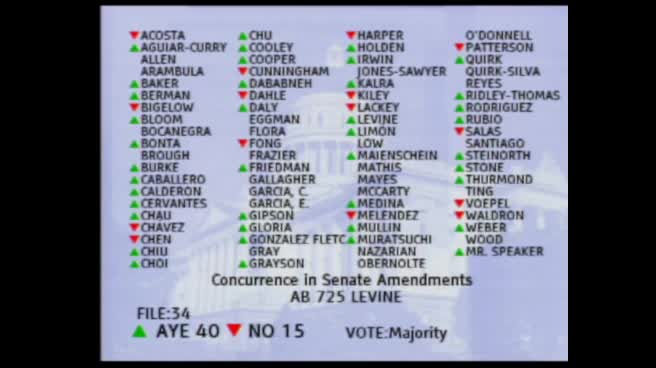 51SEC
Assembly Floor
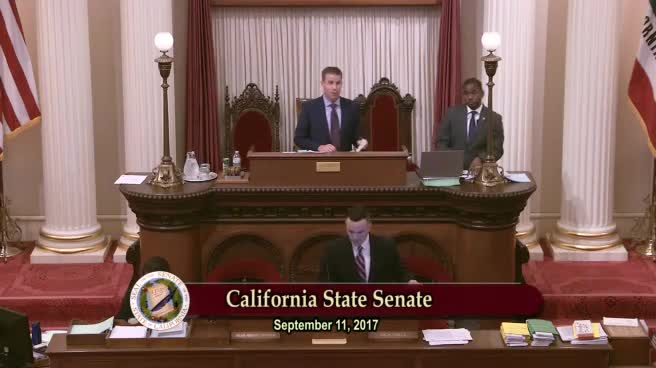 3MIN
Senate Floor
 1H
Senate Standing Committee on Appropriations
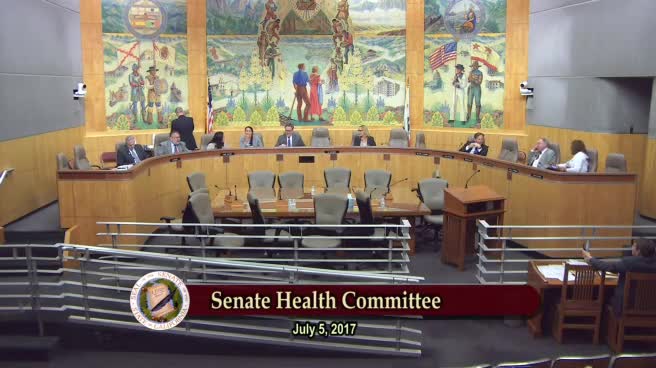 5MIN
Senate Standing Committee on Health
 1MIN
Assembly Floor
 1H
Assembly Standing Committee on Appropriations
 6MIN
Assembly Standing Committee on Health
Bill Author

Bill Co-Author(s):