SB 1021: Prescription drugs.
- Session Year: 2017-2018
- House: Senate
- Latest Version Date: 2018-09-26
Existing law, the Knox-Keene Health Care Service Plan Act of 1975, provides for the licensure and regulation of health care service plans by the Department of Managed Health Care and makes a willful violation of the act a crime. Existing law also provides for the regulation of health insurers by the Department of Insurance.
Existing law prohibits the formulary or formularies for outpatient prescription drugs maintained by a health care service plan or health insurer from discouraging the enrollment of individuals with health conditions and from reducing the generosity of the benefit for enrollees or insureds with a particular condition. Existing law, until January 1, 2020, provides that the copayment, coinsurance, or any other form of cost sharing for a covered outpatient prescription drug for an individual prescription shall not exceed $250 for a supply of up to 30 days, except as specified. Existing law, until January 1, 2020, requires a nongrandfathered individual or small group plan contract or policy to use specified definitions for each tier of a drug formulary.
This bill would extend those provisions until January 1, 2024. The bill would, until January 1, 2024, prohibit a drug formulary maintained by a health care service plan or health insurer from containing more than 4 tiers, as specified. The bill would require a prescription drug benefit to provide that an enrollee or an insured is not required to pay more than the retail price for a prescription drug if a pharmacys retail price is less than the applicable copayment or coinsurance amount, and the payment rendered by an enrollee or insured would constitute the applicable cost sharing, as specified.
Existing law requires a plan contract or policy to cover a single-tablet prescription drug regimen for combination antiretroviral drug treatments that are medically necessary for the treatment of AIDS/HIV, as specified.
This bill would, until January 1, 2023, extend that coverage requirement to combination antiretroviral drug treatments that are medically necessary for the prevention of AIDS/HIV, as specified. Because a willful violation of the bills requirements relative to health care service plans would be a crime, the bill would impose a state-mandated local program.
The California Constitution requires the state to reimburse local agencies and school districts for certain costs mandated by the state. Statutory provisions establish procedures for making that reimbursement.
This bill would provide that no reimbursement is required by this act for a specified reason.
Existing law, the Knox-Keene Health Care Service Plan Act of 1975, provides for the licensure and regulation of health care service plans by the Department of Managed Health Care and makes a willful violation of the act a crime. Existing law also provides for the regulation of health insurers by the Department of Insurance.
Existing law prohibits the formulary or formularies for outpatient prescription drugs maintained by a health care service plan or health insurer from discouraging the enrollment of individuals with health conditions and from reducing the generosity of the benefit for enrollees or insureds with a particular condition. Existing law, until January 1, 2020, provides that the copayment, coinsurance, or any other form of cost sharing for a covered outpatient prescription drug for an individual prescription shall not exceed $250 for a supply of up to 30 days, except as specified. Existing law, until January 1, 2020, requires a nongrandfathered individual or small group plan contract or policy to use specified definitions for each tier of a drug formulary.
This bill would extend those provisions until January 1, 2024. The bill would, until January 1, 2024, prohibit a drug formulary maintained by a health care service plan or health insurer from containing more than 4 tiers, as specified. The bill would require a prescription drug benefit to provide that an enrollee or an insured is not required to pay more than the retail price for a prescription drug if a pharmacys retail price is less than the applicable copayment or coinsurance amount, and the payment rendered by an enrollee or insured would constitute the applicable cost sharing, as specified.
Existing law requires a plan contract or policy to cover a single-tablet prescription drug regimen for combination antiretroviral drug treatments that are medically necessary for the treatment of AIDS/HIV, as specified.
This bill would, until January 1, 2023, extend that coverage requirement to combination antiretroviral drug treatments that are medically necessary for the prevention of AIDS/HIV, as specified. Because a willful violation of the bills requirements relative to health care service plans would be a crime, the bill would impose a state-mandated local program.
The California Constitution requires the state to reimburse local agencies and school districts for certain costs mandated by the state. Statutory provisions establish procedures for making that reimbursement.
This bill would provide that no reimbursement is required by this act for a specified reason.
Existing law, the Knox-Keene Health Care Service Plan Act of 1975, provides for the licensure and regulation of health care service plans by the Department of Managed Health Care and makes a willful violation of the act a crime. Existing law also provides for the regulation of health insurers by the Department of Insurance.
Existing law prohibits the formulary or formularies for outpatient prescription drugs maintained by a health care service plan or health insurer from discouraging the enrollment of individuals with health conditions and from reducing the generosity of the benefit for enrollees or insureds with a particular condition. Existing law, until January 1, 2020, provides that the copayment, coinsurance, or any other form of cost sharing for a covered outpatient prescription drug for an individual prescription shall not exceed $250 for a supply of up to 30 days, except as specified. Existing law, until January 1, 2020, requires a nongrandfathered individual or small group plan contract or policy to use specified definitions for each tier of a drug formulary.
This bill would extend those provisions until January 1, 2024. The bill would, until January 1, 2024, prohibit a drug formulary maintained by a health care service plan or health insurer from containing more than 4 tiers, as specified. The bill would require a prescription drug benefit to provide that an enrollee or an insured is not required to pay more than the retail price for a prescription drug if a pharmacys retail price is less than the applicable copayment or coinsurance amount, and the payment rendered by an enrollee or insured would constitute the applicable cost sharing, as specified.
Existing law requires a plan contract or policy to cover a single-tablet prescription drug regimen for combination antiretroviral drug treatments that are medically necessary for the treatment of AIDS/HIV, as specified.
This bill would, until January 1, 2023, extend that coverage requirement to combination antiretroviral drug treatments that are medically necessary for the prevention of AIDS/HIV, as specified. Because a willful violation of the bills requirements relative to health care service plans would be a crime, the bill would impose a state-mandated local program.
The California Constitution requires the state to reimburse local agencies and school districts for certain costs mandated by the state. Statutory provisions establish procedures for making that reimbursement.
This bill would provide that no reimbursement is required by this act for a specified reason.
Existing law, the Knox-Keene Health Care Service Plan Act of 1975, provides for the licensure and regulation of health care service plans by the Department of Managed Health Care and makes a willful violation of the act a crime. Existing law also provides for the regulation of health insurers by the Department of Insurance.
Existing law prohibits the formulary or formularies for outpatient prescription drugs maintained by a health care service plan or health insurer from discouraging the enrollment of individuals with health conditions and from reducing the generosity of the benefit for enrollees or insureds with a particular condition. Existing law, until January 1, 2020, provides that the copayment, coinsurance, or any other form of cost sharing for a covered outpatient prescription drug for an individual prescription shall not exceed $250 for a supply of up to 30 days, except as specified. Existing law, until January 1, 2020, requires a nongrandfathered individual or small group plan contract or policy to use specified definitions for each tier of a drug formulary.
This bill would extend those provisions until January 1, 2024. The bill would, until January 1, 2024, prohibit a drug formulary maintained by a health care service plan or health insurer from containing more than 4 tiers, as specified. The bill would require a prescription drug benefit to provide that an enrollee or an insured is not required to pay more than the retail price for a prescription drug if a pharmacys retail price is less than the applicable copayment or coinsurance amount, and the payment rendered by an enrollee or insured would constitute the applicable cost sharing, as specified.
Existing law requires a plan contract or policy to cover a single-tablet prescription drug regimen for combination antiretroviral drug treatments that are medically necessary for the treatment of AIDS/HIV, as specified.
This bill would, until January 1, 2023, extend that coverage requirement to combination antiretroviral drug treatments that are medically necessary for the prevention of AIDS/HIV, as specified. Because a willful violation of the bills requirements relative to health care service plans would be a crime, the bill would impose a state-mandated local program.
The California Constitution requires the state to reimburse local agencies and school districts for certain costs mandated by the state. Statutory provisions establish procedures for making that reimbursement.
This bill would provide that no reimbursement is required by this act for a specified reason.
Existing law, the Knox-Keene Health Care Service Plan Act of 1975, provides for the licensure and regulation of health care service plans by the Department of Managed Health Care and makes a willful violation of the act a crime. Existing law also provides for the regulation of health insurers by the Department of Insurance.
Existing law prohibits the formulary or formularies for outpatient prescription drugs maintained by a health care service plan or health insurer from discouraging the enrollment of individuals with health conditions and from reducing the generosity of the benefit for enrollees or insureds with a particular condition. Existing law, until January 1, 2020, provides that the copayment, coinsurance, or any other form of cost sharing for a covered outpatient prescription drug for an individual prescription shall not exceed $250 for a supply of up to 30 days, except as specified. Existing law, until January 1, 2020, requires a nongrandfathered individual or small group plan contract or policy to use specified definitions for each tier of a drug formulary.
This bill would extend those provisions until January 1, 2024. The bill would, until January 1, 2024, prohibit a drug formulary maintained by a health care service plan or health insurer from containing more than 4 tiers, and would permit a biologic that costs the plan or insurer more than $600 for a one-month supply that has a therapeutic equivalent or biosimilar to be placed on a tier other than tier 4, tiers, as specified. The bill would require a prescription drug benefit to provide that an enrollee or an insured is not required to pay more than the retail price for a prescription drug if a pharmacys retail price is less than the applicable copayment or coinsurance amount, and the payment rendered by an enrollee or insured would constitute the applicable cost sharing, as specified.
Existing law requires a plan contract or policy to cover a single-tablet prescription drug regimen for combination antiretroviral drug treatments that are medically necessary for the treatment of AIDS/HIV, as specified.
This bill would, until January 1, 2023, extend that coverage requirement to combination antiretroviral drug treatments that are medically necessary for the prevention of AIDS/HIV, as specified. Because a willful violation of the bills requirements relative to health care service plans would be a crime, the bill would impose a state-mandated local program.
The California Constitution requires the state to reimburse local agencies and school districts for certain costs mandated by the state. Statutory provisions establish procedures for making that reimbursement.
This bill would provide that no reimbursement is required by this act for a specified reason.
Existing law, the Knox-Keene Health Care Service Plan Act of 1975, provides for the licensure and regulation of health care service plans by the Department of Managed Health Care and makes a willful violation of the act a crime. Existing law also provides for the regulation of health insurers by the Department of Insurance.
Existing law prohibits the formulary or formularies for outpatient prescription drugs maintained by a health care service plan or health insurer from discouraging the enrollment of individuals with health conditions and from reducing the generosity of the benefit for enrollees or insureds with a particular condition. Existing law, until January 1, 2020, provides that the copayment, coinsurance, or any other form of cost sharing for a covered outpatient prescription drug for an individual prescription shall not exceed $250 for a supply of up to 30 days, except as specified. Existing law, until January 1, 2020, requires a nongrandfathered individual or small group plan contract or policy to use specified definitions for each tier of a drug formulary.
This bill would extend those provisions until January 1, 2024. The bill would, until January 1, 2024, prohibit a drug formulary maintained by a health care service plan or health insurer from containing more than 4 tiers, and would permit a biologic that costs the plan or insurer more than $600 for a one-month supply that has a therapeutic equivalent or biosimilar to be placed on a tier other than tier 4, as specified. The bill would require a prescription drug benefit to provide that an enrollee or an insured is not required to pay more than the retail price for a prescription drug if a pharmacys retail price is less than the applicable copayment or coinsurance amount, and the payment rendered by an enrollee or insured would constitute the applicable cost sharing, as specified.
Existing law requires a plan contract or policy to cover a single-tablet prescription drug regimen for combination antiretroviral drug treatments that are medically necessary for the treatment of AIDS/HIV, as specified.
This bill would, until January 1, 2023, extend that coverage requirement to combination antiretroviral drug treatments that are medically necessary for the prevention of AIDS/HIV, as specified. Because a willful violation of the bills requirements relative to health care service plans would be a crime, the bill would impose a state-mandated local program.
The California Constitution requires the state to reimburse local agencies and school districts for certain costs mandated by the state. Statutory provisions establish procedures for making that reimbursement.
This bill would provide that no reimbursement is required by this act for a specified reason.
Existing law, the Knox-Keene Health Care Service Plan Act of 1975, provides for the licensure and regulation of health care service plans by the Department of Managed Health Care and makes a willful violation of the act a crime. Existing law also provides for the regulation of health insurers by the Department of Insurance.
Existing law prohibits the formulary or formularies for outpatient prescription drugs maintained by a health care service plan or health insurer from discouraging the enrollment of individuals with health conditions and from reducing the generosity of the benefit for enrollees or insureds with a particular condition. Existing law, until January 1, 2020, provides that the copayment, coinsurance, or any other form of cost sharing for a covered outpatient prescription drug for an individual prescription shall not exceed $250 for a supply of up to 30 days, except as specified. Existing law, until January 1, 2020, requires a nongrandfathered individual or small group plan contract or policy to use specified definitions for each tier of a drug formulary.
This bill would extend those provisions indefinitely. until January 1, 2024. The bill would would, until January 1, 2024, prohibit a drug formulary maintained by a health care service plan or health insurer from containing more than 4 tiers, and would permit a biologic with a that costs the plan or insurer more than $600 for a one-month supply that has a therapeutic equivalent or biosimilar to be placed on a tier other than tier 4, as specified. The bill would require a prescription drug benefit to provide that an enrollee or an insured is not required to pay more than the retail price for a prescription drug if a pharmacys retail price is less than the applicable copayment or coinsurance amount, and the payment rendered by an enrollee or insured would constitute the applicable cost sharing, as specified.
Existing law requires a plan contract or policy to cover a single-tablet prescription drug regimen for combination antiretroviral drug treatments that are medically necessary for the treatment of AIDS/HIV, as specified.
This bill would would, until January 1, 2023, extend that coverage requirement to combination antiretroviral drug treatments that are medically necessary for the prevention of AIDS/HIV, as specified. Because a willful violation of the bills requirements relative to health care service plans would be a crime, the bill would impose a state-mandated local program.
The California Constitution requires the state to reimburse local agencies and school districts for certain costs mandated by the state. Statutory provisions establish procedures for making that reimbursement.
This bill would provide that no reimbursement is required by this act for a specified reason.
Existing law, the Knox-Keene Health Care Service Plan Act of 1975, provides for the licensure and regulation of health care service plans by the Department of Managed Health Care and makes a willful violation of the act a crime. Existing law also provides for the regulation of health insurers by the Department of Insurance.
Existing law prohibits the formulary or formularies for outpatient prescription drugs maintained by a health care service plan or health insurer from discouraging the enrollment of individuals with health conditions and from reducing the generosity of the benefit for enrollees or insureds with a particular condition. Existing law, until January 1, 2020, provides that the copayment, coinsurance, or any other form of cost sharing for a covered outpatient prescription drug for an individual prescription shall not exceed $250 for a supply of up to 30 days, except as specified. Existing law, until January 1, 2020, requires a nongrandfathered individual or small group plan contract or policy to use specified definitions for each tier of a drug formulary.
This bill would extend those provisions indefinitely. The bill would prohibit a drug formulary maintained by a health care service plan or health insurer from containing more than 4 tiers, and would permit a biologic with a therapeutic equivalent to be placed on a tier other than tier 4, as specified. The bill would require a prescription drug benefit to provide that an enrollee or an insured is not required to pay more than the retail price for a prescription drug if a pharmacys retail price is less than the applicable copayment or coinsurance amount. amount, and the payment rendered by an enrollee or insured would constitute the applicable cost sharing, as specified.
Existing law requires a plan contract or policy to cover a single-tablet prescription drug regimen for combination antiretroviral drug treatments that are medically necessary for the treatment of AIDS/HIV, as specified.
This bill would extend that coverage requirement to combination antiretroviral drug treatments that are medically necessary for the prevention of AIDS/HIV, as specified. Because a willful violation of the bills requirements relative to health care service plans would be a crime, the bill would impose a state-mandated local program.
The California Constitution requires the state to reimburse local agencies and school districts for certain costs mandated by the state. Statutory provisions establish procedures for making that reimbursement.
This bill would provide that no reimbursement is required by this act for a specified reason.
Existing law, the Knox-Keene Health Care Service Plan Act of 1975, provides for the licensure and regulation of health care service plans by the Department of Managed Health Care and makes a willful violation of the act a crime. Existing law also provides for the regulation of health insurers by the Department of Insurance.
Existing law prohibits the formulary or formularies for outpatient prescription drugs maintained by a health care service plan or health insurer from discouraging the enrollment of individuals with health conditions and from reducing the generosity of the benefit for enrollees or insureds with a particular condition. Existing law, until January 1, 2020, provides that the copayment, coinsurance, or any other form of cost sharing for a covered outpatient prescription drug for an individual prescription shall not exceed $250 for a supply of up to 30 days, except as specified. Existing law, until January 1, 2020, requires a nongrandfathered individual or small group plan contract or policy to use specified definitions for each tier of a drug formulary.
This bill would extend those provisions indefinitely. The bill would prohibit a drug formulary maintained by a health care service plan or health insurer from containing more than 4 tiers, and would permit a biologic with a therapeutic equivalent to be placed on a tier other than tier 4, as specified. The bill would require a prescription drug benefit to provide that an enrollee or an insured is not required to pay more than the retail price for a prescription drug if a pharmacys retail price is less than the applicable copayment or coinsurance amount.
Existing law requires a plan contract or policy to cover a single-tablet prescription drug regimen for combination antiretroviral drug treatments that are medically necessary for the treatment of AIDS/HIV, as specified.
This bill would extend that coverage requirement to combination antiretroviral drug treatments that are medically necessary for the prevention of AIDS/HIV, as specified. Because a willful violation of the bills requirements relative to health care service plans would be a crime, the bill would impose a state-mandated local program.
The California Constitution requires the state to reimburse local agencies and school districts for certain costs mandated by the state. Statutory provisions establish procedures for making that reimbursement.
This bill would provide that no reimbursement is required by this act for a specified reason.
(a)The Legislature hereby finds and declares all of the following:
(1)The federal Patient Protection and Affordable Care Act, its implementing regulations and guidance, and related state law prohibit discrimination based on a persons expected length of life, present or predicted disability, degree of medical dependency, quality of life, or other health conditions, including benefit designs that have the effect of discouraging the enrollment of individuals with significant health needs.
(2)The Legislature intends to build on the existing state and federal law to ensure that health coverage benefit designs do not have an unreasonable discriminatory impact on chronically ill individuals, and to ensure affordability of outpatient prescription drugs.
(3)Assignment of all or most prescription medications that treat a specific medical condition to the highest cost tiers of a formulary may effectively discourage enrollment by chronically ill individuals, and may result in lower adherence to a prescription drug treatment regimen.
(b)A nongrandfathered health care service plan contract that is offered, amended, or renewed on or after January 1, 2017, shall comply with this section. The cost-sharing limits established by this section apply only to outpatient prescription drugs covered by the contract that constitute essential health benefits, as defined in Section 1367.005.
(c)A health care service plan contract that provides coverage for outpatient prescription drugs shall cover medically necessary prescription drugs, including nonformulary drugs determined to be medically necessary consistent with this chapter.
(d)(1)Consistent with federal law and guidance, the formulary or formularies for outpatient prescription drugs maintained by the health care service plan shall not discourage the enrollment of individuals with health conditions and shall not reduce the generosity of the benefit for enrollees with a particular condition in a manner that is not based on a clinical indication or reasonable medical management practices. Section 1342.7 and any regulations adopted pursuant to that section shall be interpreted in a manner that is consistent with this section.
(2)For combination antiretroviral drug treatments that are medically necessary for the treatment of AIDS/HIV, a health care service plan contract shall cover a single-tablet drug regimen that is as effective as a multitablet regimen unless, consistent with clinical guidelines and peer-reviewed scientific and medical literature, the multitablet regimen is clinically equally or more effective and more likely to result in adherence to a drug regimen.
(e)A health care service plan contract shall ensure that the placement of prescription drugs on formulary tiers is based on clinically indicated, reasonable medical management practices.
(f)(1)This section shall not be construed to require a health care service plan to impose cost sharing.
(2)This section shall not be construed to require cost sharing for prescription drugs that state or federal law otherwise requires to be provided without cost sharing.
(3)A plans prescription drug benefit shall provide that if the pharmacys retail price for a prescription drug is less than the applicable copayment or coinsurance amount, the enrollee shall not be required to pay more than the retail price. The payment rendered shall constitute the applicable cost sharing and shall apply to the deductible, if any, and also to the maximum out-of-pocket limit in the same manner as if the enrollee had purchased the prescription medication by paying the cost-sharing amount.
(g)In the provision of outpatient prescription drug coverage, a health care service plan may utilize formulary, prior authorization, step therapy, or other reasonable medical management practices consistent with this chapter.
(h)This section does not apply to a health care service plan contract with the State Department of Health Care Services.
SEC. 2.Section 1342.71 of the Health and Safety Code, as added by Section 2 of Chapter 619 of the Statutes of 2015, is repealed.SEC. 3.Section 1342.72 is added to the Health and Safety Code, to read:1342.72.(a)For combination antiretroviral drug treatments that are medically necessary for the prevention of AIDS/HIV, a health care service plan shall not have utilization management policies or procedures, including a standard of care, which rely on a multitablet drug regimen instead of a single-tablet drug regimen unless, consistent with clinical guidelines and peer-reviewed scientific and medical literature, the multitablet regimen is clinically equally or more effective and equally or more likely to result in adherence to a drug regimen.
(b)This section does not apply to a health care service plan contract with the State Department of Health Care Services.
(c)This section shall remain in effect only until January 1, 2023, and as of that date is repealed, unless a later enacted statute that is enacted before January 1, 2023, deletes or extends that date.
SEC. 4.Section 1342.73 is added to the Health and Safety Code, to read:1342.73.(a)(1)With respect to an individual or group health care service plan contract subject to Section 1367.006, the copayment, coinsurance, or any other form of cost sharing for a covered outpatient prescription drug for an individual prescription for a supply of up to 30 days shall not exceed two hundred fifty dollars ($250), except as provided in paragraphs (2) and (3).
(2)With respect to products with actuarial value at, or equivalent to, the bronze level, cost sharing for a covered outpatient prescription drug for an individual prescription for a supply of up to 30 days shall not exceed five hundred dollars ($500), except as provided in paragraph (3).
(3)For a health care service plan contract that is a high deductible health plan under the definition set forth in Section 223(c)(2) of Title 26 of the United States Code, paragraphs (1) and (2) of this subdivision shall apply only once an enrollees deductible has been satisfied for the year.
(4)For a nongrandfathered individual or small group health care service plan contract, the annual deductible for outpatient drugs, if any, shall not exceed twice the amount specified in paragraph (1) or (2), respectively.
(5)For purposes of paragraphs (1) and (2), any other form of cost sharing shall not include a deductible.
(b)(1)If a health care service plan contract for a nongrandfathered individual or small group product maintains a drug formulary grouped into tiers that includes a fourth tier, a health care service plan contract shall use the following definitions for each tier of the drug formulary:
(A)Tier one shall consist of most generic drugs and low-cost preferred brand name drugs.
(B)Tier two shall consist of nonpreferred generic drugs, preferred brand name drugs, and any other drugs recommended by the health care service plans pharmacy and therapeutics committee based on safety, efficacy, and cost.
(C)Tier three shall consist of nonpreferred brand name drugs or drugs that are recommended by the health care service plans pharmacy and therapeutics committee based on safety, efficacy, and cost, or that generally have a preferred and often less costly therapeutic alternative at a lower tier.
(D)Tier four shall consist of drugs that are biologics, drugs that the Food and Drug Administration of the United States Department of Health and Human Services or the manufacturer requires to be distributed through a specialty pharmacy, drugs that require the enrollee to have special training or clinical monitoring for self-administration, or drugs that cost the health plan more than six hundred dollars ($600) net of rebates for a one-month supply.
(2)In placing specific drugs on specific tiers, or choosing to place a drug on the formulary, the health care service plan shall take into account the other provisions of this section and this chapter.
(3)A health care service plan contract may maintain a drug formulary with fewer than four tiers. A health care service plan contract shall not maintain a drug formulary with more than four tiers.
(4)This section shall not be construed to limit a health care service plan from placing any drug in a lower tier.
(c)This section does not apply to a health care service plan contract with the State Department of Health Care Services.
(d)This section shall remain in effect only until January 1, 2024, and as of that date is repealed, unless a later enacted statute that is enacted before January 1, 2024, deletes or extends that date.
SEC. 5.Section 10123.193 of the Insurance Code, as amended by Section 204 of Chapter 86 of the Statutes of 2016, is amended to read:10123.193.(a)The Legislature hereby finds and declares all of the following:
(1)The federal Patient Protection and Affordable Care Act, its implementing regulations and guidance, and related state law prohibit discrimination based on a persons expected length of life, present or predicted disability, degree of medical dependency, quality of life, or other health conditions, including benefit designs that have the effect of discouraging the enrollment of individuals with significant health needs.
(2)The Legislature intends to build on the existing state and federal law to ensure that health coverage benefit designs do not have an unreasonable discriminatory impact on chronically ill individuals, and to ensure affordability of outpatient prescription drugs.
(3)Assignment of all or most prescription medications that treat a specific medical condition to the highest cost tiers of a formulary may effectively discourage enrollment by chronically ill individuals, and may result in lower adherence to a prescription drug treatment regimen.
(b)A nongrandfathered policy of health insurance that is offered, amended, or renewed on or after January 1, 2017, shall comply with this section. The cost-sharing limits established by this section apply only to outpatient prescription drugs covered by the policy that constitute essential health benefits, as defined by Section 10112.27.
(c)A policy of health insurance that provides coverage for outpatient prescription drugs shall cover medically necessary prescription drugs, including nonformulary drugs determined to be medically necessary consistent with this part.
(d)Copayments, coinsurance, and other cost sharing for outpatient prescription drugs shall be reasonable so as to allow access to medically necessary outpatient prescription drugs.
(e)(1)Consistent with federal law and guidance, the formulary or formularies for outpatient prescription drugs maintained by the health insurer shall not discourage the enrollment of individuals with health conditions and shall not reduce the generosity of the benefit for insureds with a particular condition in a manner that is not based on a clinical indication or reasonable medical management practices. Section 1342.7 of the Health and Safety Code and any regulations adopted pursuant to that section shall be interpreted in a manner that is consistent with this section.
(2)For combination antiretroviral drug treatments that are medically necessary for the treatment of AIDS/HIV, a policy of health insurance shall cover a single-tablet drug regimen that is as effective as a multitablet regimen unless, consistent with clinical guidelines and peer-reviewed scientific and medical literature, the multitablet regimen is clinically equally or more effective and more likely to result in adherence to a drug regimen.
(3)Any limitation or utilization management shall be consistent with and based on clinical guidelines and peer-reviewed scientific and medical literature.
(f)(1)This section shall not be construed to require a health insurer to impose cost sharing.
(2)This section shall not be construed to require cost sharing for prescription drugs that state or federal law otherwise requires to be provided without cost sharing.
(3)A prescription drug benefit shall provide that if the pharmacys retail price for a prescription drug is less than the applicable copayment or coinsurance amount, the insured shall not be required to pay more than the retail price. The payment rendered shall constitute the applicable cost sharing and shall apply to the deductible, if any, and also to the maximum out-of-pocket limit in the same manner as if the enrollee had purchased the prescription medication by paying the cost-sharing amount.
(g)A policy of health insurance shall ensure that the placement of prescription drugs on formulary tiers is based on clinically indicated, reasonable medical management practices.
(h)In the provision of outpatient prescription drug coverage, a health insurer may utilize formulary, prior authorization, step therapy, or other reasonable medical management practices consistent with this part.
SEC. 6.Section 10123.193 of the Insurance Code, as added by Section 8 of Chapter 619 of the Statutes of 2015, is repealed.SEC. 7.Section 10123.1931 is added to the Insurance Code, immediately following Section 10123.193, to read:10123.1931.(a)For combination antiretroviral drug treatments that are medically necessary for the prevention of AIDS/HIV, a health insurer shall not have utilization management policies or procedures, including a standard of care, which rely on a multitablet drug regimen instead of a single-tablet drug regimen unless, consistent with clinical guidelines and peer-reviewed scientific and medical literature, the multitablet regimen is clinically equally or more effective and equally or more likely to result in adherence to a drug regimen.
(b)This section shall remain in effect only until January 1, 2023, and as of that date is repealed, unless a later enacted statute that is enacted before January 1, 2023, deletes or extends that date.
SEC. 8.Section 10123.1932 is added to the Insurance Code, immediately following Section 10123.1931, to read:10123.1932.(a)(1)With respect to an individual or group policy of health insurance subject to Section 10112.28, the copayment, coinsurance, or any other form of cost sharing for a covered outpatient prescription drug for an individual prescription for a supply of up to 30 days shall not exceed two hundred fifty dollars ($250), except as provided in paragraphs (2) and (3).
(2)With respect to products with actuarial value at or equivalent to the bronze level, cost sharing for a covered outpatient prescription drug for an individual prescription for a supply of up to 30 days shall not exceed five hundred dollars ($500), except as provided in paragraph (3).
(3)For a policy of health insurance that is a high deductible health plan under the definition set forth in Section 223(c)(2) of Title 26 of the United States Code, paragraphs (1) and (2) of this subdivision applies only once an insureds deductible has been satisfied for the year.
(4)For a nongrandfathered individual or small group policy of health insurance, the annual deductible for outpatient drugs, if any, shall not exceed twice the amount specified in paragraph (1) or (2), respectively.
(5)For purposes of paragraphs (1) and (2), any other form of cost sharing shall not include a deductible.
(b)(1)If a policy of health insurance offered, sold, or renewed in the nongrandfathered individual or small group market maintains a drug formulary grouped into tiers that includes a fourth tier, a policy of health insurance shall use the following definitions for each tier of the drug formulary:
(A)Tier one shall consist of most generic drugs and low-cost preferred brand name drugs.
(B)Tier two shall consist of nonpreferred generic drugs, preferred brand name drugs, and any other drugs recommended by the health insurers pharmacy and therapeutics committee based on safety, efficacy, and cost.
(C)Tier three shall consist of nonpreferred brand name drugs or drugs that are recommended by the health insurers pharmacy and therapeutics committee based on safety, efficacy, and cost, or that generally have a preferred and often less costly therapeutic alternative at a lower tier.
(D)Tier four shall consist of drugs that are biologics, drugs that the Food and Drug Administration of the United States Department of Health and Human Services or the manufacturer requires to be distributed through a specialty pharmacy, drugs that require the insured to have special training or clinical monitoring for self-administration, or drugs that cost the health insurer more than six hundred dollars ($600) net of rebates for a one-month supply.
(2)In placing specific drugs on specific tiers, or choosing to place a drug on the formulary, the insurer shall take into account the other provisions of this section and this part.
(3)A policy of health insurance may maintain a drug formulary with fewer than four tiers. A policy of health insurance shall not maintain a drug formulary with more than four tiers.
(4)This section shall not be construed to limit a health insurer from placing any drug in a lower tier.
(c)This section shall remain in effect only until January 1, 2024, and as of that date is repealed, unless a later enacted statute that is enacted before January 1, 2024, deletes or extends that date.
SEC. 9.No reimbursement is required by this act pursuant to Section 6 of Article XIIIB of the California Constitution because the only costs that may be incurred by a local agency or school district will be incurred because this act creates a new crime or infraction, eliminates a crime or infraction, or changes the penalty for a crime or infraction, within the meaning of Section 17556 of the Government Code, or changes the definition of a crime within the meaning of Section 6 of Article XIIIB of the California Constitution.
(a)The Legislature hereby finds and declares all of the following:
(1)The federal Patient Protection and Affordable Care Act, its implementing regulations and guidance, and related state law prohibit discrimination based on a persons expected length of life, present or predicted disability, degree of medical dependency, quality of life, or other health conditions, including benefit designs that have the effect of discouraging the enrollment of individuals with significant health needs.
(2)The Legislature intends to build on the existing state and federal law to ensure that health coverage benefit designs do not have an unreasonable discriminatory impact on chronically ill individuals, and to ensure affordability of outpatient prescription drugs.
(3)Assignment of all or most prescription medications that treat a specific medical condition to the highest cost tiers of a formulary may effectively discourage enrollment by chronically ill individuals, and may result in lower adherence to a prescription drug treatment regimen.
(b)A nongrandfathered health care service plan contract that is offered, amended, or renewed on or after January 1, 2017, shall comply with this section. The cost-sharing limits established by this section apply only to outpatient prescription drugs covered by the contract that constitute essential health benefits, as defined in Section 1367.005.
(c)A health care service plan contract that provides coverage for outpatient prescription drugs shall cover medically necessary prescription drugs, including nonformulary drugs determined to be medically necessary consistent with this chapter.
(d)(1)Consistent with federal law and guidance, the formulary or formularies for outpatient prescription drugs maintained by the health care service plan shall not discourage the enrollment of individuals with health conditions and shall not reduce the generosity of the benefit for enrollees with a particular condition in a manner that is not based on a clinical indication or reasonable medical management practices. Section 1342.7 and any regulations adopted pursuant to that section shall be interpreted in a manner that is consistent with this section.
(2)For combination antiretroviral drug treatments that are medically necessary for the treatment of AIDS/HIV, a health care service plan contract shall cover a single-tablet drug regimen that is as effective as a multitablet regimen unless, consistent with clinical guidelines and peer-reviewed scientific and medical literature, the multitablet regimen is clinically equally or more effective and more likely to result in adherence to a drug regimen.
(e)A health care service plan contract shall ensure that the placement of prescription drugs on formulary tiers is based on clinically indicated, reasonable medical management practices.
(f)(1)This section shall not be construed to require a health care service plan to impose cost sharing.
(2)This section shall not be construed to require cost sharing for prescription drugs that state or federal law otherwise requires to be provided without cost sharing.
(3)A plans prescription drug benefit shall provide that if the pharmacys retail price for a prescription drug is less than the applicable copayment or coinsurance amount, the enrollee shall not be required to pay more than the retail price. The payment rendered shall constitute the applicable cost sharing and shall apply to the deductible, if any, and also to the maximum out-of-pocket limit in the same manner as if the enrollee had purchased the prescription medication by paying the cost-sharing amount.
(g)In the provision of outpatient prescription drug coverage, a health care service plan may utilize formulary, prior authorization, step therapy, or other reasonable medical management practices consistent with this chapter.
(h)This section does not apply to a health care service plan contract with the State Department of Health Care Services.
SEC. 2.Section 1342.71 of the Health and Safety Code, as added by Section 2 of Chapter 619 of the Statutes of 2015, is repealed.SEC. 3.Section 1342.72 is added to the Health and Safety Code, to read:1342.72.(a)For combination antiretroviral drug treatments that are medically necessary for the prevention of AIDS/HIV, a health care service plan shall not have utilization management policies or procedures, including a standard of care, which rely on a multitablet drug regimen instead of a single-tablet drug regimen unless, consistent with clinical guidelines and peer-reviewed scientific and medical literature, the multitablet regimen is clinically equally or more effective and equally or more likely to result in adherence to a drug regimen.
(b)This section does not apply to a health care service plan contract with the State Department of Health Care Services.
(c)This section shall remain in effect only until January 1, 2023, and as of that date is repealed, unless a later enacted statute that is enacted before January 1, 2023, deletes or extends that date.
SEC. 4.Section 1342.73 is added to the Health and Safety Code, to read:1342.73.(a)(1)With respect to an individual or group health care service plan contract subject to Section 1367.006, the copayment, coinsurance, or any other form of cost sharing for a covered outpatient prescription drug for an individual prescription for a supply of up to 30 days shall not exceed two hundred fifty dollars ($250), except as provided in paragraphs (2) and (3).
(2)With respect to products with actuarial value at, or equivalent to, the bronze level, cost sharing for a covered outpatient prescription drug for an individual prescription for a supply of up to 30 days shall not exceed five hundred dollars ($500), except as provided in paragraph (3).
(3)For a health care service plan contract that is a high deductible health plan under the definition set forth in Section 223(c)(2) of Title 26 of the United States Code, paragraphs (1) and (2) of this subdivision shall apply only once an enrollees deductible has been satisfied for the year.
(4)For a nongrandfathered individual or small group health care service plan contract, the annual deductible for outpatient drugs, if any, shall not exceed twice the amount specified in paragraph (1) or (2), respectively.
(5)For purposes of paragraphs (1) and (2), any other form of cost sharing shall not include a deductible.
(b)(1)If a health care service plan contract for a nongrandfathered individual or small group product maintains a drug formulary grouped into tiers that includes a fourth tier, a health care service plan contract shall use the following definitions for each tier of the drug formulary:
(A)Tier one shall consist of most generic drugs and low-cost preferred brand name drugs.
(B)Tier two shall consist of nonpreferred generic drugs, preferred brand name drugs, and any other drugs recommended by the health care service plans pharmacy and therapeutics committee based on safety, efficacy, and cost.
(C)Tier three shall consist of nonpreferred brand name drugs or drugs that are recommended by the health care service plans pharmacy and therapeutics committee based on safety, efficacy, and cost, or that generally have a preferred and often less costly therapeutic alternative at a lower tier.
(D)Tier four shall consist of drugs that are biologics, drugs that the Food and Drug Administration of the United States Department of Health and Human Services or the manufacturer requires to be distributed through a specialty pharmacy, drugs that require the enrollee to have special training or clinical monitoring for self-administration, or drugs that cost the health plan more than six hundred dollars ($600) net of rebates for a one-month supply.
(2)In placing specific drugs on specific tiers, or choosing to place a drug on the formulary, the health care service plan shall take into account the other provisions of this section and this chapter.
(3)A health care service plan contract may maintain a drug formulary with fewer than four tiers. A health care service plan contract shall not maintain a drug formulary with more than four tiers.
(4)This section shall not be construed to limit a health care service plan from placing any drug in a lower tier.
(c)This section does not apply to a health care service plan contract with the State Department of Health Care Services.
(d)This section shall remain in effect only until January 1, 2024, and as of that date is repealed, unless a later enacted statute that is enacted before January 1, 2024, deletes or extends that date.
SEC. 5.Section 10123.193 of the Insurance Code, as amended by Section 204 of Chapter 86 of the Statutes of 2016, is amended to read:10123.193.(a)The Legislature hereby finds and declares all of the following:
(1)The federal Patient Protection and Affordable Care Act, its implementing regulations and guidance, and related state law prohibit discrimination based on a persons expected length of life, present or predicted disability, degree of medical dependency, quality of life, or other health conditions, including benefit designs that have the effect of discouraging the enrollment of individuals with significant health needs.
(2)The Legislature intends to build on the existing state and federal law to ensure that health coverage benefit designs do not have an unreasonable discriminatory impact on chronically ill individuals, and to ensure affordability of outpatient prescription drugs.
(3)Assignment of all or most prescription medications that treat a specific medical condition to the highest cost tiers of a formulary may effectively discourage enrollment by chronically ill individuals, and may result in lower adherence to a prescription drug treatment regimen.
(b)A nongrandfathered policy of health insurance that is offered, amended, or renewed on or after January 1, 2017, shall comply with this section. The cost-sharing limits established by this section apply only to outpatient prescription drugs covered by the policy that constitute essential health benefits, as defined by Section 10112.27.
(c)A policy of health insurance that provides coverage for outpatient prescription drugs shall cover medically necessary prescription drugs, including nonformulary drugs determined to be medically necessary consistent with this part.
(d)Copayments, coinsurance, and other cost sharing for outpatient prescription drugs shall be reasonable so as to allow access to medically necessary outpatient prescription drugs.
(e)(1)Consistent with federal law and guidance, the formulary or formularies for outpatient prescription drugs maintained by the health insurer shall not discourage the enrollment of individuals with health conditions and shall not reduce the generosity of the benefit for insureds with a particular condition in a manner that is not based on a clinical indication or reasonable medical management practices. Section 1342.7 of the Health and Safety Code and any regulations adopted pursuant to that section shall be interpreted in a manner that is consistent with this section.
(2)For combination antiretroviral drug treatments that are medically necessary for the treatment of AIDS/HIV, a policy of health insurance shall cover a single-tablet drug regimen that is as effective as a multitablet regimen unless, consistent with clinical guidelines and peer-reviewed scientific and medical literature, the multitablet regimen is clinically equally or more effective and more likely to result in adherence to a drug regimen.
(3)Any limitation or utilization management shall be consistent with and based on clinical guidelines and peer-reviewed scientific and medical literature.
(f)(1)This section shall not be construed to require a health insurer to impose cost sharing.
(2)This section shall not be construed to require cost sharing for prescription drugs that state or federal law otherwise requires to be provided without cost sharing.
(3)A prescription drug benefit shall provide that if the pharmacys retail price for a prescription drug is less than the applicable copayment or coinsurance amount, the insured shall not be required to pay more than the retail price. The payment rendered shall constitute the applicable cost sharing and shall apply to the deductible, if any, and also to the maximum out-of-pocket limit in the same manner as if the enrollee had purchased the prescription medication by paying the cost-sharing amount.
(g)A policy of health insurance shall ensure that the placement of prescription drugs on formulary tiers is based on clinically indicated, reasonable medical management practices.
(h)In the provision of outpatient prescription drug coverage, a health insurer may utilize formulary, prior authorization, step therapy, or other reasonable medical management practices consistent with this part.
SEC. 6.Section 10123.193 of the Insurance Code, as added by Section 8 of Chapter 619 of the Statutes of 2015, is repealed.SEC. 7.Section 10123.1931 is added to the Insurance Code, immediately following Section 10123.193, to read:10123.1931.(a)For combination antiretroviral drug treatments that are medically necessary for the prevention of AIDS/HIV, a health insurer shall not have utilization management policies or procedures, including a standard of care, which rely on a multitablet drug regimen instead of a single-tablet drug regimen unless, consistent with clinical guidelines and peer-reviewed scientific and medical literature, the multitablet regimen is clinically equally or more effective and equally or more likely to result in adherence to a drug regimen.
(b)This section shall remain in effect only until January 1, 2023, and as of that date is repealed, unless a later enacted statute that is enacted before January 1, 2023, deletes or extends that date.
SEC. 8.Section 10123.1932 is added to the Insurance Code, immediately following Section 10123.1931, to read:10123.1932.(a)(1)With respect to an individual or group policy of health insurance subject to Section 10112.28, the copayment, coinsurance, or any other form of cost sharing for a covered outpatient prescription drug for an individual prescription for a supply of up to 30 days shall not exceed two hundred fifty dollars ($250), except as provided in paragraphs (2) and (3).
(2)With respect to products with actuarial value at or equivalent to the bronze level, cost sharing for a covered outpatient prescription drug for an individual prescription for a supply of up to 30 days shall not exceed five hundred dollars ($500), except as provided in paragraph (3).
(3)For a policy of health insurance that is a high deductible health plan under the definition set forth in Section 223(c)(2) of Title 26 of the United States Code, paragraphs (1) and (2) of this subdivision applies only once an insureds deductible has been satisfied for the year.
(4)For a nongrandfathered individual or small group policy of health insurance, the annual deductible for outpatient drugs, if any, shall not exceed twice the amount specified in paragraph (1) or (2), respectively.
(5)For purposes of paragraphs (1) and (2), any other form of cost sharing shall not include a deductible.
(b)(1)If a policy of health insurance offered, sold, or renewed in the nongrandfathered individual or small group market maintains a drug formulary grouped into tiers that includes a fourth tier, a policy of health insurance shall use the following definitions for each tier of the drug formulary:
(A)Tier one shall consist of most generic drugs and low-cost preferred brand name drugs.
(B)Tier two shall consist of nonpreferred generic drugs, preferred brand name drugs, and any other drugs recommended by the health insurers pharmacy and therapeutics committee based on safety, efficacy, and cost.
(C)Tier three shall consist of nonpreferred brand name drugs or drugs that are recommended by the health insurers pharmacy and therapeutics committee based on safety, efficacy, and cost, or that generally have a preferred and often less costly therapeutic alternative at a lower tier.
(D)Tier four shall consist of drugs that are biologics, drugs that the Food and Drug Administration of the United States Department of Health and Human Services or the manufacturer requires to be distributed through a specialty pharmacy, drugs that require the insured to have special training or clinical monitoring for self-administration, or drugs that cost the health insurer more than six hundred dollars ($600) net of rebates for a one-month supply.
(2)In placing specific drugs on specific tiers, or choosing to place a drug on the formulary, the insurer shall take into account the other provisions of this section and this part.
(3)A policy of health insurance may maintain a drug formulary with fewer than four tiers. A policy of health insurance shall not maintain a drug formulary with more than four tiers.
(4)This section shall not be construed to limit a health insurer from placing any drug in a lower tier.
(c)This section shall remain in effect only until January 1, 2024, and as of that date is repealed, unless a later enacted statute that is enacted before January 1, 2024, deletes or extends that date.
SEC. 9.No reimbursement is required by this act pursuant to Section 6 of Article XIIIB of the California Constitution because the only costs that may be incurred by a local agency or school district will be incurred because this act creates a new crime or infraction, eliminates a crime or infraction, or changes the penalty for a crime or infraction, within the meaning of Section 17556 of the Government Code, or changes the definition of a crime within the meaning of Section 6 of Article XIIIB of the California Constitution.
(a)The Legislature hereby finds and declares all of the following:
(1)The federal Patient Protection and Affordable Care Act, its implementing regulations and guidance, and related state law prohibit discrimination based on a persons expected length of life, present or predicted disability, degree of medical dependency, quality of life, or other health conditions, including benefit designs that have the effect of discouraging the enrollment of individuals with significant health needs.
(2)The Legislature intends to build on the existing state and federal law to ensure that health coverage benefit designs do not have an unreasonable discriminatory impact on chronically ill individuals, and to ensure affordability of outpatient prescription drugs.
(3)Assignment of all or most prescription medications that treat a specific medical condition to the highest cost tiers of a formulary may effectively discourage enrollment by chronically ill individuals, and may result in lower adherence to a prescription drug treatment regimen.
(b)A nongrandfathered health care service plan contract that is offered, amended, or renewed on or after January 1, 2017, shall comply with this section. The cost-sharing limits established by this section apply only to outpatient prescription drugs covered by the contract that constitute essential health benefits, as defined in Section 1367.005.
(c)A health care service plan contract that provides coverage for outpatient prescription drugs shall cover medically necessary prescription drugs, including nonformulary drugs determined to be medically necessary consistent with this chapter.
(d)(1)Consistent with federal law and guidance, the formulary or formularies for outpatient prescription drugs maintained by the health care service plan shall not discourage the enrollment of individuals with health conditions and shall not reduce the generosity of the benefit for enrollees with a particular condition in a manner that is not based on a clinical indication or reasonable medical management practices. Section 1342.7 and any regulations adopted pursuant to that section shall be interpreted in a manner that is consistent with this section.
(2)For combination antiretroviral drug treatments that are medically necessary for the treatment of AIDS/HIV, a health care service plan contract shall cover a single-tablet drug regimen that is as effective as a multitablet regimen unless, consistent with clinical guidelines and peer-reviewed scientific and medical literature, the multitablet regimen is clinically equally or more effective and more likely to result in adherence to a drug regimen.
(e)A health care service plan contract shall ensure that the placement of prescription drugs on formulary tiers is based on clinically indicated, reasonable medical management practices.
(f)(1)This section shall not be construed to require a health care service plan to impose cost sharing.
(2)This section shall not be construed to require cost sharing for prescription drugs that state or federal law otherwise requires to be provided without cost sharing.
(3)A plans prescription drug benefit shall provide that if the pharmacys retail price for a prescription drug is less than the applicable copayment or coinsurance amount, the enrollee shall not be required to pay more than the retail price. The payment rendered shall constitute the applicable cost sharing and shall apply to the deductible, if any, and also to the maximum out-of-pocket limit in the same manner as if the enrollee had purchased the prescription medication by paying the cost-sharing amount.
(g)In the provision of outpatient prescription drug coverage, a health care service plan may utilize formulary, prior authorization, step therapy, or other reasonable medical management practices consistent with this chapter.
(h)This section does not apply to a health care service plan contract with the State Department of Health Care Services.
SEC. 2.Section 1342.71 of the Health and Safety Code, as added by Section 2 of Chapter 619 of the Statutes of 2015, is repealed.SEC. 3.Section 1342.72 is added to the Health and Safety Code, to read:1342.72.(a)For combination antiretroviral drug treatments that are medically necessary for the prevention of AIDS/HIV, a health care service plan shall not have utilization management policies or procedures, including a standard of care, which rely on a multitablet drug regimen instead of a single-tablet drug regimen unless, consistent with clinical guidelines and peer-reviewed scientific and medical literature, the multitablet regimen is clinically equally or more effective and equally or more likely to result in adherence to a drug regimen.
(b)This section does not apply to a health care service plan contract with the State Department of Health Care Services.
(c)This section shall remain in effect only until January 1, 2023, and as of that date is repealed, unless a later enacted statute that is enacted before January 1, 2023, deletes or extends that date.
SEC. 4.Section 1342.73 is added to the Health and Safety Code, to read:1342.73.(a)(1)With respect to an individual or group health care service plan contract subject to Section 1367.006, the copayment, coinsurance, or any other form of cost sharing for a covered outpatient prescription drug for an individual prescription for a supply of up to 30 days shall not exceed two hundred fifty dollars ($250), except as provided in paragraphs (2) and (3).
(2)With respect to products with actuarial value at, or equivalent to, the bronze level, cost sharing for a covered outpatient prescription drug for an individual prescription for a supply of up to 30 days shall not exceed five hundred dollars ($500), except as provided in paragraph (3).
(3)For a health care service plan contract that is a high deductible health plan under the definition set forth in Section 223(c)(2) of Title 26 of the United States Code, paragraphs (1) and (2) of this subdivision shall apply only once an enrollees deductible has been satisfied for the year.
(4)For a nongrandfathered individual or small group health care service plan contract, the annual deductible for outpatient drugs, if any, shall not exceed twice the amount specified in paragraph (1) or (2), respectively.
(5)For purposes of paragraphs (1) and (2), any other form of cost sharing shall not include a deductible.
(b)(1)If a health care service plan contract for a nongrandfathered individual or small group product maintains a drug formulary grouped into tiers that includes a fourth tier, a health care service plan contract shall use the following definitions for each tier of the drug formulary:
(A)Tier one shall consist of most generic drugs and low-cost preferred brand name drugs.
(B)Tier two shall consist of nonpreferred generic drugs, preferred brand name drugs, and any other drugs recommended by the health care service plans pharmacy and therapeutics committee based on safety, efficacy, and cost.
(C)Tier three shall consist of nonpreferred brand name drugs or drugs that are recommended by the health care service plans pharmacy and therapeutics committee based on safety, efficacy, and cost, or that generally have a preferred and often less costly therapeutic alternative at a lower tier.
(D)Tier four shall consist of drugs that are biologics, drugs that the Food and Drug Administration of the United States Department of Health and Human Services or the manufacturer requires to be distributed through a specialty pharmacy, drugs that require the enrollee to have special training or clinical monitoring for self-administration, or drugs that cost the health plan more than six hundred dollars ($600) net of rebates for a one-month supply.
(2)In placing specific drugs on specific tiers, or choosing to place a drug on the formulary, the health care service plan shall take into account the other provisions of this section and this chapter.
(3)A health care service plan contract may maintain a drug formulary with fewer than four tiers. A health care service plan contract shall not maintain a drug formulary with more than four tiers.
(4)This section shall not be construed to limit a health care service plan from placing any drug in a lower tier.
(c)This section does not apply to a health care service plan contract with the State Department of Health Care Services.
(d)This section shall remain in effect only until January 1, 2024, and as of that date is repealed, unless a later enacted statute that is enacted before January 1, 2024, deletes or extends that date.
SEC. 5.Section 10123.193 of the Insurance Code, as amended by Section 204 of Chapter 86 of the Statutes of 2016, is amended to read:10123.193.(a)The Legislature hereby finds and declares all of the following:
(1)The federal Patient Protection and Affordable Care Act, its implementing regulations and guidance, and related state law prohibit discrimination based on a persons expected length of life, present or predicted disability, degree of medical dependency, quality of life, or other health conditions, including benefit designs that have the effect of discouraging the enrollment of individuals with significant health needs.
(2)The Legislature intends to build on the existing state and federal law to ensure that health coverage benefit designs do not have an unreasonable discriminatory impact on chronically ill individuals, and to ensure affordability of outpatient prescription drugs.
(3)Assignment of all or most prescription medications that treat a specific medical condition to the highest cost tiers of a formulary may effectively discourage enrollment by chronically ill individuals, and may result in lower adherence to a prescription drug treatment regimen.
(b)A nongrandfathered policy of health insurance that is offered, amended, or renewed on or after January 1, 2017, shall comply with this section. The cost-sharing limits established by this section apply only to outpatient prescription drugs covered by the policy that constitute essential health benefits, as defined by Section 10112.27.
(c)A policy of health insurance that provides coverage for outpatient prescription drugs shall cover medically necessary prescription drugs, including nonformulary drugs determined to be medically necessary consistent with this part.
(d)Copayments, coinsurance, and other cost sharing for outpatient prescription drugs shall be reasonable so as to allow access to medically necessary outpatient prescription drugs.
(e)(1)Consistent with federal law and guidance, the formulary or formularies for outpatient prescription drugs maintained by the health insurer shall not discourage the enrollment of individuals with health conditions and shall not reduce the generosity of the benefit for insureds with a particular condition in a manner that is not based on a clinical indication or reasonable medical management practices. Section 1342.7 of the Health and Safety Code and any regulations adopted pursuant to that section shall be interpreted in a manner that is consistent with this section.
(2)For combination antiretroviral drug treatments that are medically necessary for the treatment of AIDS/HIV, a policy of health insurance shall cover a single-tablet drug regimen that is as effective as a multitablet regimen unless, consistent with clinical guidelines and peer-reviewed scientific and medical literature, the multitablet regimen is clinically equally or more effective and more likely to result in adherence to a drug regimen.
(3)Any limitation or utilization management shall be consistent with and based on clinical guidelines and peer-reviewed scientific and medical literature.
(f)(1)This section shall not be construed to require a health insurer to impose cost sharing.
(2)This section shall not be construed to require cost sharing for prescription drugs that state or federal law otherwise requires to be provided without cost sharing.
(3)A prescription drug benefit shall provide that if the pharmacys retail price for a prescription drug is less than the applicable copayment or coinsurance amount, the insured shall not be required to pay more than the retail price. The payment rendered shall constitute the applicable cost sharing and shall apply to the deductible, if any, and also to the maximum out-of-pocket limit in the same manner as if the enrollee had purchased the prescription medication by paying the cost-sharing amount.
(g)A policy of health insurance shall ensure that the placement of prescription drugs on formulary tiers is based on clinically indicated, reasonable medical management practices.
(h)In the provision of outpatient prescription drug coverage, a health insurer may utilize formulary, prior authorization, step therapy, or other reasonable medical management practices consistent with this part.
SEC. 6.Section 10123.193 of the Insurance Code, as added by Section 8 of Chapter 619 of the Statutes of 2015, is repealed.SEC. 7.Section 10123.1931 is added to the Insurance Code, immediately following Section 10123.193, to read:10123.1931.(a)For combination antiretroviral drug treatments that are medically necessary for the prevention of AIDS/HIV, a health insurer shall not have utilization management policies or procedures, including a standard of care, which rely on a multitablet drug regimen instead of a single-tablet drug regimen unless, consistent with clinical guidelines and peer-reviewed scientific and medical literature, the multitablet regimen is clinically equally or more effective and equally or more likely to result in adherence to a drug regimen.
(b)This section shall remain in effect only until January 1, 2023, and as of that date is repealed, unless a later enacted statute that is enacted before January 1, 2023, deletes or extends that date.
SEC. 8.Section 10123.1932 is added to the Insurance Code, immediately following Section 10123.1931, to read:10123.1932.(a)(1)With respect to an individual or group policy of health insurance subject to Section 10112.28, the copayment, coinsurance, or any other form of cost sharing for a covered outpatient prescription drug for an individual prescription for a supply of up to 30 days shall not exceed two hundred fifty dollars ($250), except as provided in paragraphs (2) and (3).
(2)With respect to products with actuarial value at or equivalent to the bronze level, cost sharing for a covered outpatient prescription drug for an individual prescription for a supply of up to 30 days shall not exceed five hundred dollars ($500), except as provided in paragraph (3).
(3)For a policy of health insurance that is a high deductible health plan under the definition set forth in Section 223(c)(2) of Title 26 of the United States Code, paragraphs (1) and (2) of this subdivision applies only once an insureds deductible has been satisfied for the year.
(4)For a nongrandfathered individual or small group policy of health insurance, the annual deductible for outpatient drugs, if any, shall not exceed twice the amount specified in paragraph (1) or (2), respectively.
(5)For purposes of paragraphs (1) and (2), any other form of cost sharing shall not include a deductible.
(b)(1)If a policy of health insurance offered, sold, or renewed in the nongrandfathered individual or small group market maintains a drug formulary grouped into tiers that includes a fourth tier, a policy of health insurance shall use the following definitions for each tier of the drug formulary:
(A)Tier one shall consist of most generic drugs and low-cost preferred brand name drugs.
(B)Tier two shall consist of nonpreferred generic drugs, preferred brand name drugs, and any other drugs recommended by the health insurers pharmacy and therapeutics committee based on safety, efficacy, and cost.
(C)Tier three shall consist of nonpreferred brand name drugs or drugs that are recommended by the health insurers pharmacy and therapeutics committee based on safety, efficacy, and cost, or that generally have a preferred and often less costly therapeutic alternative at a lower tier.
(D)Tier four shall consist of drugs that are biologics, drugs that the Food and Drug Administration of the United States Department of Health and Human Services or the manufacturer requires to be distributed through a specialty pharmacy, drugs that require the insured to have special training or clinical monitoring for self-administration, or drugs that cost the health insurer more than six hundred dollars ($600) net of rebates for a one-month supply.
(2)In placing specific drugs on specific tiers, or choosing to place a drug on the formulary, the insurer shall take into account the other provisions of this section and this part.
(3)A policy of health insurance may maintain a drug formulary with fewer than four tiers. A policy of health insurance shall not maintain a drug formulary with more than four tiers.
(4)This section shall not be construed to limit a health insurer from placing any drug in a lower tier.
(c)This section shall remain in effect only until January 1, 2024, and as of that date is repealed, unless a later enacted statute that is enacted before January 1, 2024, deletes or extends that date.
SEC. 9.No reimbursement is required by this act pursuant to Section 6 of Article XIIIB of the California Constitution because the only costs that may be incurred by a local agency or school district will be incurred because this act creates a new crime or infraction, eliminates a crime or infraction, or changes the penalty for a crime or infraction, within the meaning of Section 17556 of the Government Code, or changes the definition of a crime within the meaning of Section 6 of Article XIIIB of the California Constitution.
(a)The Legislature hereby finds and declares all of the following:
(1)The federal Patient Protection and Affordable Care Act, its implementing regulations and guidance, and related state law prohibit discrimination based on a persons expected length of life, present or predicted disability, degree of medical dependency, quality of life, or other health conditions, including benefit designs that have the effect of discouraging the enrollment of individuals with significant health needs.
(2)The Legislature intends to build on existing state and federal law to ensure that health coverage benefit designs do not have an unreasonable discriminatory impact on chronically ill individuals, and to ensure affordability of outpatient prescription drugs.
(3)Assignment of all or most prescription medications that treat a specific medical condition to the highest cost tiers of a formulary may effectively discourage enrollment by chronically ill individuals, and may result in lower adherence to a prescription drug treatment regimen.
(b)A nongrandfathered health care service plan contract that is offered, amended, or renewed on or after January 1, 2017, shall comply with this section. The cost-sharing limits established by this section apply only to outpatient prescription drugs covered by the contract that constitute essential health benefits, as defined in Section 1367.005.
(c)A health care service plan contract that provides coverage for outpatient prescription drugs shall cover medically necessary prescription drugs, including nonformulary drugs determined to be medically necessary consistent with this chapter.
(d)(1)Consistent with federal law and guidance, the formulary or formularies for outpatient prescription drugs maintained by the health care service plan shall not discourage the enrollment of individuals with health conditions and shall not reduce the generosity of the benefit for enrollees with a particular condition in a manner that is not based on a clinical indication or reasonable medical management practices. Section 1342.7 and any regulations adopted pursuant to that section shall be interpreted in a manner that is consistent with this section.
(2)For combination antiretroviral drug treatments that are medically necessary for the treatment of AIDS/HIV, a health care service plan contract shall cover a single-tablet drug regimen that is as effective as a multitablet regimen unless, consistent with clinical guidelines and peer-reviewed scientific and medical literature, the multitablet regimen is clinically equally or more effective and more likely to result in adherence to a drug regimen.
(e)A health care service plan contract shall ensure that the placement of prescription drugs on formulary tiers is based on clinically indicated, reasonable medical management practices.
(f)(1)This section shall not be construed to require a health care service plan to impose cost sharing.
(2)This section shall not be construed to require cost sharing for prescription drugs that state or federal law otherwise requires to be provided without cost sharing.
(3)A plans prescription drug benefit shall provide that if the pharmacys retail price for a prescription drug is less than the applicable copayment or coinsurance amount, the enrollee shall not be required to pay more than the retail price. The payment rendered shall constitute the applicable cost sharing and shall apply to the deductible, if any, and also to the maximum out-of-pocket limit in the same manner as if the enrollee had purchased the prescription medication by paying the cost-sharing amount.
(g)In the provision of outpatient prescription drug coverage, a health care service plan may utilize formulary, prior authorization, step therapy, or other reasonable medical management practices consistent with this chapter.
(h)This section does not apply to a health care service plan contract with the State Department of Health Care Services.
SEC. 2.Section 1342.71 of the Health and Safety Code, as added by Section 2 of Chapter 619 of the Statutes of 2015, is repealed.SEC. 3.Section 1342.72 is added to the Health and Safety Code, to read:1342.72.(a)For combination antiretroviral drug treatments that are medically necessary for the prevention of AIDS/HIV, a health care service plan shall not have utilization management policies or procedures, including a standard of care that relies care, which rely on a multitablet drug regimen instead of a single-tablet drug regimen unless, consistent with clinical guidelines and peer-reviewed scientific and medical literature, the multitablet regimen is clinically equally or more effective and equally or more likely to result in adherence to a drug regimen.
(b)This section does not apply to a health care service plan contract with the State Department of Health Care Services.
(c)This section shall remain in effect only until January 1, 2023, and as of that date is repealed, unless a later enacted statute that is enacted before January 1, 2023, deletes or extends that date.
SEC. 4.Section 1342.73 is added to the Health and Safety Code, to read:1342.73.(a)(1)With respect to an individual or group health care service plan contract subject to Section 1367.006, the copayment, coinsurance, or any other form of cost sharing for a covered outpatient prescription drug for an individual prescription for a supply of up to 30 days shall not exceed two hundred fifty dollars ($250), except as provided in paragraphs (2) and (3).
(2)With respect to products with actuarial value at, or equivalent to, the bronze level, cost sharing for a covered outpatient prescription drug for an individual prescription for a supply of up to 30 days shall not exceed five hundred dollars ($500), except as provided in paragraph (3).
(3)For a health care service plan contract that is a high deductible health plan under the definition set forth in Section 223(c)(2) of Title 26 of the United States Code, paragraphs (1) and (2) of this subdivision shall apply only once an enrollees deductible has been satisfied for the year.
(4)For a nongrandfathered individual or small group health care service plan contract, the annual deductible for outpatient drugs, if any, shall not exceed twice the amount specified in paragraph (1) or (2), respectively.
(5)For purposes of paragraphs (1) and (2), any other form of cost sharing shall not include a deductible.
(b)(1)If a health care service plan contract for a nongrandfathered individual or small group product maintains a drug formulary grouped into tiers that includes a fourth tier, a health care service plan contract shall use the following definitions for each tier of the drug formulary:
(A)Tier one shall consist of most generic drugs and low-cost preferred brand name drugs.
(B)Tier two shall consist of nonpreferred generic drugs, preferred brand name drugs, and any other drugs recommended by the health care service plans pharmacy and therapeutics committee based on safety, efficacy, and cost.
(C)Tier three shall consist of nonpreferred brand name drugs or drugs that are recommended by the health care service plans pharmacy and therapeutics committee based on safety, efficacy, and cost, or that generally have a preferred and often less costly therapeutic alternative at a lower tier.
(D)Tier four shall consist of drugs that are biologics, drugs that the Food and Drug Administration of the United States Department of Health and Human Services or the manufacturer requires to be distributed through a specialty pharmacy, drugs that require the enrollee to have special training or clinical monitoring for self-administration, or drugs that cost the health plan more than six hundred dollars ($600) net of rebates for a one-month supply.
(2)In placing specific drugs on specific tiers, or choosing to place a drug on the formulary, the health care service plan shall take into account the other provisions of this section and this chapter.
(3)A health care service plan contract may maintain a drug formulary with fewer than four tiers. A health care service plan contract shall not maintain a drug formulary with more than four tiers.
(4)This section shall not be construed to limit a health care service plan from placing any drug in a lower tier.
(c)This section does not apply to a health care service plan contract with the State Department of Health Care Services.
(d)This section shall remain in effect only until January 1, 2024, and as of that date is repealed, unless a later enacted statute that is enacted before January 1, 2024, deletes or extends that date.
SEC. 5.Section 10123.193 of the Insurance Code, as amended by Section 204 of Chapter 86 of the Statutes of 2016, is amended to read:10123.193.(a)The Legislature hereby finds and declares all of the following:
(1)The federal Patient Protection and Affordable Care Act, its implementing regulations and guidance, and related state law prohibit discrimination based on a persons expected length of life, present or predicted disability, degree of medical dependency, quality of life, or other health conditions, including benefit designs that have the effect of discouraging the enrollment of individuals with significant health needs.
(2)The Legislature intends to build on existing state and federal law to ensure that health coverage benefit designs do not have an unreasonable discriminatory impact on chronically ill individuals, and to ensure affordability of outpatient prescription drugs.
(3)Assignment of all or most prescription medications that treat a specific medical condition to the highest cost tiers of a formulary may effectively discourage enrollment by chronically ill individuals, and may result in lower adherence to a prescription drug treatment regimen.
(b)A nongrandfathered policy of health insurance that is offered, amended, or renewed on or after January 1, 2017, shall comply with this section. The cost-sharing limits established by this section apply only to outpatient prescription drugs covered by the policy that constitute essential health benefits, as defined by Section 10112.27.
(c)A policy of health insurance that provides coverage for outpatient prescription drugs shall cover medically necessary prescription drugs, including nonformulary drugs determined to be medically necessary consistent with this part.
(d)Copayments, coinsurance, and other cost sharing for outpatient prescription drugs shall be reasonable so as to allow access to medically necessary outpatient prescription drugs.
(e)(1)Consistent with federal law and guidance, the formulary or formularies for outpatient prescription drugs maintained by the health insurer shall not discourage the enrollment of individuals with health conditions and shall not reduce the generosity of the benefit for insureds with a particular condition in a manner that is not based on a clinical indication or reasonable medical management practices. Section 1342.7 of the Health and Safety Code and any regulations adopted pursuant to that section shall be interpreted in a manner that is consistent with this section.
(2)For combination antiretroviral drug treatments that are medically necessary for the treatment of AIDS/HIV, a policy of health insurance shall cover a single-tablet drug regimen that is as effective as a multitablet regimen unless, consistent with clinical guidelines and peer-reviewed scientific and medical literature, the multitablet regimen is clinically equally or more effective and more likely to result in adherence to a drug regimen.
(3)Any limitation or utilization management shall be consistent with and based on clinical guidelines and peer-reviewed scientific and medical literature.
(f)(1)This section shall not be construed to require a health insurer to impose cost sharing.
(2)This section shall not be construed to require cost sharing for prescription drugs that state or federal law otherwise requires to be provided without cost sharing.
(3)A prescription drug benefit shall provide that if the pharmacys retail price for a prescription drug is less than the applicable copayment or coinsurance amount, the insured shall not be required to pay more than the retail price. The payment rendered shall constitute the applicable cost sharing and shall apply to the deductible, if any, and also to the maximum out-of-pocket limit in the same manner as if the enrollee had purchased the prescription medication by paying the cost-sharing amount.
(g)A policy of health insurance shall ensure that the placement of prescription drugs on formulary tiers is based on clinically indicated, reasonable medical management practices.
(h)In the provision of outpatient prescription drug coverage, a health insurer may utilize formulary, prior authorization, step therapy, or other reasonable medical management practices consistent with this part.
SEC. 6.Section 10123.193 of the Insurance Code, as added by Section 8 of Chapter 619 of the Statutes of 2015, is repealed.SEC. 7.Section 10123.1931 is added to the Insurance Code, immediately following Section 10123.193, to read:10123.1931.(a)For combination antiretroviral drug treatments that are medically necessary for the prevention of AIDS/HIV, a health insurer shall not have utilization management policies or procedures, including a standard of care that relies care, which rely on a multitablet drug regimen instead of a single-tablet drug regimen unless, consistent with clinical guidelines and peer-reviewed scientific and medical literature, the multitablet regimen is clinically equally or more effective and equally or more likely to result in adherence to a drug regimen.
(b)This section shall remain in effect only until January 1, 2023, and as of that date is repealed, unless a later enacted statute that is enacted before January 1, 2023, deletes or extends that date.
SEC. 8.Section 10123.1932 is added to the Insurance Code, immediately following Section 10123.1931, to read:10123.1932.(a)(1)With respect to an individual or group policy of health insurance subject to Section 10112.28, the copayment, coinsurance, or any other form of cost sharing for a covered outpatient prescription drug for an individual prescription for a supply of up to 30 days shall not exceed two hundred fifty dollars ($250), except as provided in paragraphs (2) and (3).
(2)With respect to products with actuarial value at or equivalent to the bronze level, cost sharing for a covered outpatient prescription drug for an individual prescription for a supply of up to 30 days shall not exceed five hundred dollars ($500), except as provided in paragraph (3).
(3)For a policy of health insurance that is a high deductible health plan under the definition set forth in Section 223(c)(2) of Title 26 of the United States Code, paragraphs (1) and (2) of this subdivision applies only once an insureds deductible has been satisfied for the year.
(4)For a nongrandfathered individual or small group policy of health insurance, the annual deductible for outpatient drugs, if any, shall not exceed twice the amount specified in paragraph (1) or (2), respectively.
(5)For purposes of paragraphs (1) and (2), any other form of cost sharing shall not include a deductible.
(b)(1)If a policy of health insurance offered, sold, or renewed in the nongrandfathered individual or small group market maintains a drug formulary grouped into tiers that includes a fourth tier, a policy of health insurance shall use the following definitions for each tier of the drug formulary:
(A)Tier one shall consist of most generic drugs and low-cost preferred brand name drugs.
(B)Tier two shall consist of nonpreferred generic drugs, preferred brand name drugs, and any other drugs recommended by the health insurers pharmacy and therapeutics committee based on safety, efficacy, and cost.
(C)Tier three shall consist of nonpreferred brand name drugs or drugs that are recommended by the health insurers pharmacy and therapeutics committee based on safety, efficacy, and cost, or that generally have a preferred and often less costly therapeutic alternative at a lower tier.
(D)Tier four shall consist of drugs that are biologics, drugs that the Food and Drug Administration of the United States Department of Health and Human Services or the manufacturer requires to be distributed through a specialty pharmacy, drugs that require the insured to have special training or clinical monitoring for self-administration, or drugs that cost the health insurer more than six hundred dollars ($600) net of rebates for a one-month supply.
(2)In placing specific drugs on specific tiers, or choosing to place a drug on the formulary, the insurer shall take into account the other provisions of this section and this part.
(3)A policy of health insurance may maintain a drug formulary with fewer than four tiers. A policy of health insurance shall not maintain a drug formulary with more than four tiers.
(4)This section shall not be construed to limit a health insurer from placing any drug in a lower tier.
(c)This section shall remain in effect only until January 1, 2024, and as of that date is repealed, unless a later enacted statute that is enacted before January 1, 2024, deletes or extends that date.
SEC. 9.No reimbursement is required by this act pursuant to Section 6 of Article XIIIB of the California Constitution because the only costs that may be incurred by a local agency or school district will be incurred because this act creates a new crime or infraction, eliminates a crime or infraction, or changes the penalty for a crime or infraction, within the meaning of Section 17556 of the Government Code, or changes the definition of a crime within the meaning of Section 6 of Article XIIIB of the California Constitution.
(a)The Legislature hereby finds and declares all of the following:
(1)The federal Patient Protection and Affordable Care Act, its implementing regulations and guidance, and related state law prohibit discrimination based on a persons expected length of life, present or predicted disability, degree of medical dependency, quality of life, or other health conditions, including benefit designs that have the effect of discouraging the enrollment of individuals with significant health needs.
(2)The Legislature intends to build on existing state and federal law to ensure that health coverage benefit designs do not have an unreasonable discriminatory impact on chronically ill individuals, and to ensure affordability of outpatient prescription drugs.
(3)Assignment of all or most prescription medications that treat a specific medical condition to the highest cost tiers of a formulary may effectively discourage enrollment by chronically ill individuals, and may result in lower adherence to a prescription drug treatment regimen.
(b)A nongrandfathered health care service plan contract that is offered, amended, or renewed on or after January 1, 2017, shall comply with this section. The cost-sharing limits established by this section apply only to outpatient prescription drugs covered by the contract that constitute essential health benefits, as defined in Section 1367.005.
(c)A health care service plan contract that provides coverage for outpatient prescription drugs shall cover medically necessary prescription drugs, including nonformulary drugs determined to be medically necessary consistent with this chapter.
(d)(1)Consistent with federal law and guidance, the formulary or formularies for outpatient prescription drugs maintained by the health care service plan shall not discourage the enrollment of individuals with health conditions and shall not reduce the generosity of the benefit for enrollees with a particular condition in a manner that is not based on a clinical indication or reasonable medical management practices. Section 1342.7 and any regulations adopted pursuant to that section shall be interpreted in a manner that is consistent with this section.
(2)For combination antiretroviral drug treatments that are medically necessary for the treatment of AIDS/HIV, a health care service plan contract shall cover a single-tablet drug regimen that is as effective as a multitablet regimen unless, consistent with clinical guidelines and peer-reviewed scientific and medical literature, the multitablet regimen is clinically equally or more effective and more likely to result in adherence to a drug regimen.
(e)A health care service plan contract shall ensure that the placement of prescription drugs on formulary tiers is based on clinically indicated, reasonable medical management practices.
(f)(1)This section shall not be construed to require a health care service plan to impose cost sharing.
(2)This section shall not be construed to require cost sharing for prescription drugs that state or federal law otherwise requires to be provided without cost sharing.
(3)A plans prescription drug benefit shall provide that if the pharmacys retail price for a prescription drug is less than the applicable copayment or coinsurance amount, the enrollee shall not be required to pay more than the retail price. The payment rendered shall constitute the applicable cost sharing and shall apply to the deductible, if any, and also to the maximum out of pocket out-of-pocket limit in the same manner as if the enrollee had purchased the prescription medication by paying the cost-sharing amount.
(g)In the provision of outpatient prescription drug coverage, a health care service plan may utilize formulary, prior authorization, step therapy, or other reasonable medical management practices consistent with this chapter.
(h)This section does not apply to a health care service plan contract with the State Department of Health Care Services.
SEC. 2.Section 1342.71 of the Health and Safety Code, as added by Section 2 of Chapter 619 of the Statutes of 2015, is repealed.SEC. 3.Section 1342.72 is added to the Health and Safety Code, to read:1342.72.(a)For combination antiretroviral drug treatments that are medically necessary for the prevention of AIDS/HIV, a health care service plan contract shall cover shall not have a standard of care that relies on a multitablet drug regimen instead of a single-tablet drug regimen that is as effective as a multitablet regimen unless, consistent with clinical guidelines and peer-reviewed scientific and medical literature, the multitablet regimen is clinically equally or more effective and equally or more likely to result in adherence to a drug regimen.
(b)This section does not apply to a health care service plan contract with the State Department of Health Care Services.
(c)This section shall remain in effect only until January 1, 2023, and as of that date is repealed, unless a later enacted statute that is enacted before January 1, 2023, deletes or extends that date.
SEC. 4.Section 1342.73 is added to the Health and Safety Code, to read:1342.73.(a)(1)With respect to an individual or group health care service plan contract subject to Section 1367.006, the copayment, coinsurance, or any other form of cost sharing for a covered outpatient prescription drug for an individual prescription for a supply of up to 30 days shall not exceed two hundred fifty dollars ($250), except as provided in paragraphs (2) and (3).
(2)With respect to products with actuarial value at, or equivalent to, the bronze level, cost sharing for a covered outpatient prescription drug for an individual prescription for a supply of up to 30 days shall not exceed five hundred dollars ($500), except as provided in paragraph (3).
(3)For a health care service plan contract that is a high deductible health plan under the definition set forth in Section 223(c)(2) of Title 26 of the United States Code, paragraphs (1) and (2) of this subdivision shall apply only once an enrollees deductible has been satisfied for the year.
(4)For a nongrandfathered individual or small group health care service plan contract, the annual deductible for outpatient drugs, if any, shall not exceed twice the amount specified in paragraph (1) or (2), respectively.
(5)For purposes of paragraphs (1) and (2), any other form of cost sharing shall not include a deductible.
(b)(1)If a health care service plan contract for a nongrandfathered individual or small group product maintains a drug formulary grouped into tiers that includes a fourth tier, a health care service plan contract shall use the following definitions for each tier of the drug formulary:
(A)Tier one shall consist of most generic drugs and low-cost preferred brand name drugs.
(B)Tier two shall consist of nonpreferred generic drugs, preferred brand name drugs, and any other drugs recommended by the health care service plans pharmacy and therapeutics committee based on safety, efficacy, and cost.
(C)Tier three shall consist of nonpreferred brand name drugs or drugs that are recommended by the health care service plans pharmacy and therapeutics committee based on safety, efficacy, and cost, or that generally have a preferred and often less costly therapeutic alternative at a lower tier.
(D)Tier four shall consist of drugs that are biologics, drugs that the FDA Food and Drug Administration of the United States Department of Health and Human Services or the manufacturer requires to be distributed through a specialty pharmacy, drugs that require the enrollee to have special training or clinical monitoring for self-administration, or drugs that cost the health plan more than six hundred dollars ($600) net of rebates for a one-month supply.
(2)In placing specific drugs on specific tiers, or choosing to place a drug on the formulary, the health care service plan shall take into account the other provisions of this section and this chapter.
(3)A health care service plan contract may maintain a drug formulary with fewer than four tiers. A health care service plan contract shall not maintain a drug formulary with more than four tiers.
(4)This section shall not be construed to limit a health care service plan from placing any drug in a lower tier. If a biologic has a therapeutic equivalent or biosimilar, and costs the health care service plan more than six hundred dollars ($600) net of rebates for a one-month supply, the drug may be placed on a tier other than tier four.
(c)This section does not apply to a health care service plan contract with the State Department of Health Care Services.
(d)This section shall remain in effect only until January 1, 2024, and as of that date is repealed, unless a later enacted statute that is enacted before January 1, 2024, deletes or extends that date.
SEC. 5.Section 10123.193 of the Insurance Code, as amended by Section 204 of Chapter 86 of the Statutes of 2016, is amended to read:10123.193.(a)The Legislature hereby finds and declares all of the following:
(1)The federal Patient Protection and Affordable Care Act, its implementing regulations and guidance, and related state law prohibit discrimination based on a persons expected length of life, present or predicted disability, degree of medical dependency, quality of life, or other health conditions, including benefit designs that have the effect of discouraging the enrollment of individuals with significant health needs.
(2)The Legislature intends to build on existing state and federal law to ensure that health coverage benefit designs do not have an unreasonable discriminatory impact on chronically ill individuals, and to ensure affordability of outpatient prescription drugs.
(3)Assignment of all or most prescription medications that treat a specific medical condition to the highest cost tiers of a formulary may effectively discourage enrollment by chronically ill individuals, and may result in lower adherence to a prescription drug treatment regimen.
(b)A nongrandfathered policy of health insurance that is offered, amended, or renewed on or after January 1, 2017, shall comply with this section. The cost-sharing limits established by this section apply only to outpatient prescription drugs covered by the policy that constitute essential health benefits, as defined by Section 10112.27.
(c)A policy of health insurance that provides coverage for outpatient prescription drugs shall cover medically necessary prescription drugs, including nonformulary drugs determined to be medically necessary consistent with this part.
(d)Copayments, coinsurance, and other cost sharing for outpatient prescription drugs shall be reasonable so as to allow access to medically necessary outpatient prescription drugs.
(e)(1)Consistent with federal law and guidance, the formulary or formularies for outpatient prescription drugs maintained by the health insurer shall not discourage the enrollment of individuals with health conditions and shall not reduce the generosity of the benefit for insureds with a particular condition in a manner that is not based on a clinical indication or reasonable medical management practices. Section 1342.7 of the Health and Safety Code and any regulations adopted pursuant to that section shall be interpreted in a manner that is consistent with this section.
(2)For combination antiretroviral drug treatments that are medically necessary for the treatment of AIDS/HIV, a policy of health insurance shall cover a single-tablet drug regimen that is as effective as a multitablet regimen unless, consistent with clinical guidelines and peer-reviewed scientific and medical literature, the multitablet regimen is clinically equally or more effective and more likely to result in adherence to a drug regimen.
(3)Any limitation or utilization management shall be consistent with and based on clinical guidelines and peer-reviewed scientific and medical literature.
(f)(1)This section shall not be construed to require a health insurer to impose cost sharing.
(2)This section shall not be construed to require cost sharing for prescription drugs that state or federal law otherwise requires to be provided without cost sharing.
(3)A prescription drug benefit shall provide that if the pharmacys retail price for a prescription drug is less than the applicable copayment or coinsurance amount, the insured shall not be required to pay more than the retail price. The payment rendered shall constitute the applicable cost sharing and shall apply to the deductible, if any, and also to the maximum out of pocket out-of-pocket limit in the same manner as if the enrollee had purchased the prescription medication by paying the cost-sharing amount.
(g)A policy of health insurance shall ensure that the placement of prescription drugs on formulary tiers is based on clinically indicated, reasonable medical management practices.
(h)In the provision of outpatient prescription drug coverage, a health insurer may utilize formulary, prior authorization, step therapy, or other reasonable medical management practices consistent with this part.
SEC. 6.Section 10123.193 of the Insurance Code, as added by Section 8 of Chapter 619 of the Statutes of 2015, is repealed.SEC. 7.Section 10123.1931 is added to the Insurance Code, immediately following Section 10123.193, to read:10123.1931.(a)For combination antiretroviral drug treatments that are medically necessary for the prevention of AIDS/HIV, a policy of health insurance shall cover health insurer shall not have a standard of care that relies on a multitablet drug regimen instead of a single-tablet drug regimen that is as effective as a multitablet regimen unless, consistent with clinical guidelines and peer-reviewed scientific and medical literature, the multitablet regimen is clinically equally or more effective and equally or more likely to result in adherence to a drug regimen.
(b)This section shall remain in effect only until January 1, 2023, and as of that date is repealed, unless a later enacted statute that is enacted before January 1, 2023, deletes or extends that date.
SEC. 8.Section 10123.1932 is added to the Insurance Code, immediately following Section 10123.1931, to read:10123.1932.(a)(1)With respect to an individual or group policy of health insurance subject to Section 10112.28, the copayment, coinsurance, or any other form of cost sharing for a covered outpatient prescription drug for an individual prescription for a supply of up to 30 days shall not exceed two hundred fifty dollars ($250), except as provided in paragraphs (2) and (3).
(2)With respect to products with actuarial value at or equivalent to the bronze level, cost sharing for a covered outpatient prescription drug for an individual prescription for a supply of up to 30 days shall not exceed five hundred dollars ($500), except as provided in paragraph (3).
(3)For a policy of health insurance that is a high deductible health plan under the definition set forth in Section 223(c)(2) of Title 26 of the United States Code, paragraphs (1) and (2) of this subdivision applies only once an insureds deductible has been satisfied for the year.
(4)For a nongrandfathered individual or small group policy of health insurance, the annual deductible for outpatient drugs, if any, shall not exceed twice the amount specified in paragraph (1) or (2), respectively.
(5)For purposes of paragraphs (1) and (2), any other form of cost sharing shall not include a deductible.
(b)(1)If a policy of health insurance offered, sold, or renewed in the nongrandfathered individual or small group market maintains a drug formulary grouped into tiers that includes a fourth tier, a policy of health insurance shall use the following definitions for each tier of the drug formulary:
(A)Tier one shall consist of most generic drugs and low-cost preferred brand name drugs.
(B)Tier two shall consist of nonpreferred generic drugs, preferred brand name drugs, and any other drugs recommended by the health insurers pharmacy and therapeutics committee based on safety, efficacy, and cost.
(C)Tier three shall consist of nonpreferred brand name drugs or drugs that are recommended by the health insurers pharmacy and therapeutics committee based on safety, efficacy, and cost, or that generally have a preferred and often less costly therapeutic alternative at a lower tier.
(D)Tier four shall consist of drugs that are biologics, drugs that the FDA Food and Drug Administration of the United States Department of Health and Human Services or the manufacturer requires to be distributed through a specialty pharmacy, drugs that require the insured to have special training or clinical monitoring for self-administration, or drugs that cost the health insurer more than six hundred dollars ($600) net of rebates for a one-month supply.
(2)In placing specific drugs on specific tiers, or choosing to place a drug on the formulary, the insurer shall take into account the other provisions of this section and this part.
(3)A policy of health insurance may maintain a drug formulary with fewer than four tiers. A policy of health insurance shall not maintain a drug formulary with more than four tiers.
(4)This section shall not be construed to limit a health insurer from placing any drug in a lower tier. If a biologic has a therapeutic equivalent or biosimilar and costs the health insurer more than six hundred dollars ($600) net of rebates for a one-month supply, the drug may be placed on a tier other than tier four.
(c)This section shall remain in effect only until January 1, 2024, and as of that date is repealed, unless a later enacted statute that is enacted before January 1, 2024, deletes or extends that date.
SEC. 9.No reimbursement is required by this act pursuant to Section 6 of Article XIIIB of the California Constitution because the only costs that may be incurred by a local agency or school district will be incurred because this act creates a new crime or infraction, eliminates a crime or infraction, or changes the penalty for a crime or infraction, within the meaning of Section 17556 of the Government Code, or changes the definition of a crime within the meaning of Section 6 of Article XIIIB of the California Constitution.
(a)The Legislature hereby finds and declares all of the following:
(1)The federal Patient Protection and Affordable Care Act, its implementing regulations and guidance, and related state law prohibit discrimination based on a persons expected length of life, present or predicted disability, degree of medical dependency, quality of life, or other health conditions, including benefit designs that have the effect of discouraging the enrollment of individuals with significant health needs.
(2)The Legislature intends to build on existing state and federal law to ensure that health coverage benefit designs do not have an unreasonable discriminatory impact on chronically ill individuals, and to ensure affordability of outpatient prescription drugs.
(3)Assignment of all or most prescription medications that treat a specific medical condition to the highest cost tiers of a formulary may effectively discourage enrollment by chronically ill individuals, and may result in lower adherence to a prescription drug treatment regimen.
(b)A nongrandfathered health care service plan contract that is offered, amended, or renewed on or after January 1, 2017, shall comply with this section. The cost-sharing limits established by this section apply only to outpatient prescription drugs covered by the contract that constitute essential health benefits, as defined in Section 1367.005.
(c)A health care service plan contract that provides coverage for outpatient prescription drugs shall cover medically necessary prescription drugs, including nonformulary drugs determined to be medically necessary consistent with this chapter.
(d)(1)Consistent with federal law and guidance, the formulary or formularies for outpatient prescription drugs maintained by the health care service plan shall not discourage the enrollment of individuals with health conditions and shall not reduce the generosity of the benefit for enrollees with a particular condition in a manner that is not based on a clinical indication or reasonable medical management practices. Section 1342.7 and any regulations adopted pursuant to that section shall be interpreted in a manner that is consistent with this section.
(2)For combination antiretroviral drug treatments that are medically necessary for the treatment of AIDS/HIV, a health care service plan contract shall cover a single-tablet drug regimen that is as effective as a multitablet regimen unless, consistent with clinical guidelines and peer-reviewed scientific and medical literature, the multitablet regimen is clinically equally or more effective and more likely to result in adherence to a drug regimen.
(e)A health care service plan contract shall ensure that the placement of prescription drugs on formulary tiers is based on clinically indicated, reasonable medical management practices.
(f)(1)This section shall not be construed to require a health care service plan to impose cost sharing.
(2)This section shall not be construed to require cost sharing for prescription drugs that state or federal law otherwise requires to be provided without cost sharing.
(3)A plans prescription drug benefit shall provide that if the pharmacys retail price for a prescription drug is less than the applicable copayment or coinsurance amount, the enrollee shall not be required to pay more than the retail price. The payment rendered shall constitute the applicable cost sharing and shall apply to the deductible, if any, and also to maximum out of pocket limit in the same manner as if the enrollee had purchased the prescription medication by paying the cost-sharing amount.
(g)In the provision of outpatient prescription drug coverage, a health care service plan may utilize formulary, prior authorization, step therapy, or other reasonable medical management practices consistent with this chapter.
(h)This section does not apply to a health care service plan that contracts contract with the State Department of Health Care Services.
SEC. 2.Section 1342.71 of the Health and Safety Code, as added by Section 2 of Chapter 619 of the Statutes of 2015, is repealed.SEC. 3.Section 1342.72 is added to the Health and Safety Code, to read:1342.72.(a)For combination antiretroviral drug treatments that are medically necessary for the prevention of AIDS/HIV, a health care service plan contract shall cover a single-tablet drug regimen that is as effective as a multitablet regimen unless, consistent with clinical guidelines and peer-reviewed scientific and medical literature, the multitablet regimen is clinically equally or more effective and more likely to result in adherence to a drug regimen.
(b)This section does not apply to a health care service plan contract with the State Department of Health Care Services.
(b)(c)This section shall remain in effect only until January 1, 2023, and as of that date is repealed, unless a later enacted statute that is enacted before January 1, 2023, deletes or extends that date.
SEC. 4.Section 1342.73 is added to the Health and Safety Code, to read:1342.73.(a)(1)With respect to an individual or group health care service plan contract subject to Section 1367.006, the copayment, coinsurance, or any other form of cost sharing for a covered outpatient prescription drug for an individual prescription for a supply of up to 30 days shall not exceed two hundred fifty dollars ($250), except as provided in paragraphs (2) and (3).
(2)With respect to products with actuarial value at, or equivalent to, the bronze level, cost sharing for a covered outpatient prescription drug for an individual prescription for a supply of up to 30 days shall not exceed five hundred dollars ($500), except as provided in paragraph (3).
(3)For a health care service plan contract that is a high deductible health plan under the definition set forth in Section 223(c)(2) of Title 26 of the United States Code, paragraphs (1) and (2) of this subdivision shall apply only once an enrollees deductible has been satisfied for the year.
(4)For a nongrandfathered individual or small group health care service plan contract, the annual deductible for outpatient drugs, if any, shall not exceed twice the amount specified in paragraph (1) or (2), respectively.
(5)For purposes of paragraphs (1) and (2), any other form of cost sharing shall not include a deductible.
(b)(1)If a health care service plan contract for a nongrandfathered individual or small group product maintains a drug formulary grouped into tiers that includes a fourth tier, a health care service plan contract shall use the following definitions for each tier of the drug formulary:
(A)Tier one shall consist of most generic drugs and low-cost preferred brand name drugs.
(B)Tier two shall consist of nonpreferred generic drugs, preferred brand name drugs, and any other drugs recommended by the health care service plans pharmacy and therapeutics committee based on safety, efficacy, and cost.
(C)Tier three shall consist of nonpreferred brand name drugs or drugs that are recommended by the health care service plans pharmacy and therapeutics committee based on safety, efficacy, and cost, or that generally have a preferred and often less costly therapeutic alternative at a lower tier.
(D)Tier four shall consist of drugs that are biologics, drugs that the FDA or the manufacturer requires to be distributed through a specialty pharmacy, drugs that require the enrollee to have special training or clinical monitoring for self-administration, or drugs that cost the health plan more than six hundred dollars ($600) net of rebates for a one-month supply.
(2)In placing specific drugs on specific tiers, or choosing to place a drug on the formulary, the health care service plan shall take into account the other provisions of this section and this chapter.
(3)A health care service plan contract may maintain a drug formulary with fewer than four tiers. A health care service plan contract shall not maintain a drug formulary with more than four tiers.
(4)This section shall not be construed to limit a health care service plan from placing any drug in a lower tier. If a biologic has a therapeutic equivalent or biosimilar, and costs the health care service plan more than six hundred dollars ($600) net of rebates for a one-month supply, the drug may be placed on a tier other than tier four.
(c)This section does not apply to a health care service plan contract with the State Department of Health Care Services.
(c)(d)This section shall remain in effect only until January 1, 2024, and as of that date is repealed, unless a later enacted statute that is enacted before January 1, 2024, deletes or extends that date.
SEC. 5.Section 10123.193 of the Insurance Code, as amended by Section 204 of Chapter 86 of the Statutes of 2016, is amended to read:10123.193.(a)The Legislature hereby finds and declares all of the following:
(1)The federal Patient Protection and Affordable Care Act, its implementing regulations and guidance, and related state law prohibit discrimination based on a persons expected length of life, present or predicted disability, degree of medical dependency, quality of life, or other health conditions, including benefit designs that have the effect of discouraging the enrollment of individuals with significant health needs.
(2)The Legislature intends to build on existing state and federal law to ensure that health coverage benefit designs do not have an unreasonable discriminatory impact on chronically ill individuals, and to ensure affordability of outpatient prescription drugs.
(3)Assignment of all or most prescription medications that treat a specific medical condition to the highest cost tiers of a formulary may effectively discourage enrollment by chronically ill individuals, and may result in lower adherence to a prescription drug treatment regimen.
(b)A nongrandfathered policy of health insurance that is offered, amended, or renewed on or after January 1, 2017, shall comply with this section. The cost-sharing limits established by this section apply only to outpatient prescription drugs covered by the policy that constitute essential health benefits, as defined by Section 10112.27.
(c)A policy of health insurance that provides coverage for outpatient prescription drugs shall cover medically necessary prescription drugs, including nonformulary drugs determined to be medically necessary consistent with this part.
(d)Copayments, coinsurance, and other cost sharing for outpatient prescription drugs shall be reasonable so as to allow access to medically necessary outpatient prescription drugs.
(e)(1)Consistent with federal law and guidance, the formulary or formularies for outpatient prescription drugs maintained by the health insurer shall not discourage the enrollment of individuals with health conditions and shall not reduce the generosity of the benefit for insureds with a particular condition in a manner that is not based on a clinical indication or reasonable medical management practices. Section 1342.7 of the Health and Safety Code and any regulations adopted pursuant to that section shall be interpreted in a manner that is consistent with this section.
(2)For combination antiretroviral drug treatments that are medically necessary for the treatment of AIDS/HIV, a policy of health insurance shall cover a single-tablet drug regimen that is as effective as a multitablet regimen unless, consistent with clinical guidelines and peer-reviewed scientific and medical literature, the multitablet regimen is clinically equally or more effective and more likely to result in adherence to a drug regimen.
(3)Any limitation or utilization management shall be consistent with and based on clinical guidelines and peer-reviewed scientific and medical literature.
(f)(1)This section shall not be construed to require a health insurer to impose cost sharing.
(2)This section shall not be construed to require cost sharing for prescription drugs that state or federal law otherwise requires to be provided without cost sharing.
(3)A prescription drug benefit shall provide that if the pharmacys retail price for a prescription drug is less than the applicable copayment or coinsurance amount, the insured shall not be required to pay more than the retail price. The payment rendered shall constitute the applicable cost sharing and shall apply to the deductible, if any, and also to maximum out of pocket limit in the same manner as if the enrollee had purchased the prescription medication by paying the cost-sharing amount.
(g)A policy of health insurance shall ensure that the placement of prescription drugs on formulary tiers is based on clinically indicated, reasonable medical management practices.
(h)In the provision of outpatient prescription drug coverage, a health insurer may utilize formulary, prior authorization, step therapy, or other reasonable medical management practices consistent with this part.
SEC. 6.Section 10123.193 of the Insurance Code, as added by Section 8 of Chapter 619 of the Statutes of 2015, is repealed.SEC. 7.Section 10123.1931 is added to the Insurance Code, immediately following Section 10123.193, to read:10123.1931.(a)For combination antiretroviral drug treatments that are medically necessary for the prevention of AIDS/HIV, a policy of health insurance shall cover a single-tablet drug regimen that is as effective as a multitablet regimen unless, consistent with clinical guidelines and peer-reviewed scientific and medical literature, the multitablet regimen is clinically equally or more effective and more likely to result in adherence to a drug regimen.
(b)This section shall remain in effect only until January 1, 2023, and as of that date is repealed, unless a later enacted statute that is enacted before January 1, 2023, deletes or extends that date.
SEC. 8.Section 10123.1932 is added to the Insurance Code, immediately following Section 10123.1931, to read:10123.1932.(a)(1)With respect to an individual or group policy of health insurance subject to Section 10112.28, the copayment, coinsurance, or any other form of cost sharing for a covered outpatient prescription drug for an individual prescription for a supply of up to 30 days shall not exceed two hundred fifty dollars ($250), except as provided in paragraphs (2) and (3).
(2)With respect to products with actuarial value at or equivalent to the bronze level, cost sharing for a covered outpatient prescription drug for an individual prescription for a supply of up to 30 days shall not exceed five hundred dollars ($500), except as provided in paragraph (3).
(3)For a policy of health insurance that is a high deductible health plan under the definition set forth in Section 223(c)(2) of Title 26 of the United States Code, paragraphs (1) and (2) of this subdivision applies only once an insureds deductible has been satisfied for the year.
(4)For a nongrandfathered individual or small group policy of health insurance, the annual deductible for outpatient drugs, if any, shall not exceed twice the amount specified in paragraph (1) or (2), respectively.
(5)For purposes of paragraphs (1) and (2), any other form of cost sharing shall not include a deductible.
(b)(1)If a policy of health insurance offered, sold, or renewed in the nongrandfathered individual or small group market maintains a drug formulary grouped into tiers that includes a fourth tier, a policy of health insurance shall use the following definitions for each tier of the drug formulary:
(A)Tier one shall consist of most generic drugs and low-cost preferred brand name drugs.
(B)Tier two shall consist of nonpreferred generic drugs, preferred brand name drugs, and any other drugs recommended by the health insurers pharmacy and therapeutics committee based on safety, efficacy, and cost.
(C)Tier three shall consist of nonpreferred brand name drugs or drugs that are recommended by the health insurers pharmacy and therapeutics committee based on safety, efficacy, and cost, or that generally have a preferred and often less costly therapeutic alternative at a lower tier.
(D)Tier four shall consist of drugs that are biologics, drugs that the FDA or the manufacturer requires to be distributed through a specialty pharmacy, drugs that require the insured to have special training or clinical monitoring for self-administration, or drugs that cost the health insurer more than six hundred dollars ($600) net of rebates for a one-month supply.
(2)In placing specific drugs on specific tiers, or choosing to place a drug on the formulary, the insurer shall take into account the other provisions of this section and this part.
(3)A policy of health insurance may maintain a drug formulary with fewer than four tiers. A policy of health insurance shall not maintain a drug formulary with more than four tiers.
(4)This section shall not be construed to limit a health insurer from placing any drug in a lower tier. If a biologic has a therapeutic equivalent or biosimilar and costs the health insurer more than six hundred dollars ($600) net of rebates for a one-month supply, the drug may be placed on a tier other than tier four.
(c)This section shall remain in effect only until January 1, 2024, and as of that date is repealed, unless a later enacted statute that is enacted before January 1, 2024, deletes or extends that date.
SEC. 9.No reimbursement is required by this act pursuant to Section 6 of Article XIIIB of the California Constitution because the only costs that may be incurred by a local agency or school district will be incurred because this act creates a new crime or infraction, eliminates a crime or infraction, or changes the penalty for a crime or infraction, within the meaning of Section 17556 of the Government Code, or changes the definition of a crime within the meaning of Section 6 of Article XIIIB of the California Constitution.
(a)The Legislature hereby finds and declares all of the following:
(1)The federal Patient Protection and Affordable Care Act, its implementing regulations and guidance, and related state law prohibit discrimination based on a persons expected length of life, present or predicted disability, degree of medical dependency, quality of life, or other health conditions, including benefit designs that have the effect of discouraging the enrollment of individuals with significant health needs.
(2)The Legislature intends to build on existing state and federal law to ensure that health coverage benefit designs do not have an unreasonable discriminatory impact on chronically ill individuals, and to ensure affordability of outpatient prescription drugs.
(3)Assignment of all or most prescription medications that treat a specific medical condition to the highest cost tiers of a formulary may effectively discourage enrollment by chronically ill individuals, and may result in lower adherence to a prescription drug treatment regimen.
(b)A nongrandfathered health care service plan contract that is offered, amended, or renewed on or after January 1, 2017, shall comply with this section. The cost-sharing limits established by this section apply only to outpatient prescription drugs covered by the contract that constitute essential health benefits, as defined in Section 1367.005.
(c)A health care service plan contract that provides coverage for outpatient prescription drugs shall cover medically necessary prescription drugs, including nonformulary drugs determined to be medically necessary consistent with this chapter.
(d)(1)Consistent with federal law and guidance, the formulary or formularies for outpatient prescription drugs maintained by the health care service plan shall not discourage the enrollment of individuals with health conditions and shall not reduce the generosity of the benefit for enrollees with a particular condition in a manner that is not based on a clinical indication or reasonable medical management practices. Section 1342.7 and any regulations adopted pursuant to that section shall be interpreted in a manner that is consistent with this section.
(2)For combination antiretroviral drug treatments that are medically necessary for the treatment or prevention of AIDS/HIV, a health care service plan contract shall cover a single-tablet drug regimen that is as effective as a multitablet regimen unless, consistent with clinical guidelines and peer-reviewed scientific and medical literature, the multitablet regimen is clinically equally or more effective and more likely to result in adherence to a drug regimen.
(e)(1)With respect to an individual or group health care service plan contract subject to Section 1367.006, the copayment, coinsurance, or any other form of cost sharing for a covered outpatient prescription drug for an individual prescription for a supply of up to 30 days shall not exceed two hundred fifty dollars ($250), except as provided in paragraphs (2) and (3).(2)With respect to products with actuarial value at, or equivalent to, the bronze level, cost sharing for a covered outpatient prescription drug for an individual prescription for a supply of up to 30 days shall not exceed five hundred dollars ($500), except as provided in paragraph (3).(3)For a health care service plan contract that is a high deductible health plan under the definition set forth in Section 223(c)(2) of Title 26 of the United States Code, paragraphs (1) and (2) of this subdivision shall apply only once an enrollees deductible has been satisfied for the year.(4)For a nongrandfathered individual or small group health care service plan contract, the annual deductible for outpatient drugs, if any, shall not exceed twice the amount specified in paragraph (1) or (2), respectively.(5)For purposes of paragraphs (1) and (2), any other form of cost sharing shall not include a deductible.(f)(1)If a health care service plan contract for a nongrandfathered individual or small group product maintains a drug formulary grouped into tiers that includes a fourth tier, a health care service plan contract shall use the following definitions for each tier of the drug formulary:(A)Tier one shall consist of most generic drugs and low-cost preferred brand name drugs.(B)Tier two shall consist of nonpreferred generic drugs, preferred brand name drugs, and any other drugs recommended by the health care service plans pharmacy and therapeutics committee based on safety, efficacy, and cost.(C)Tier three shall consist of nonpreferred brand name drugs or drugs that are recommended by the health care service plans pharmacy and therapeutics committee based on safety, efficacy, and cost, or that generally have a preferred and often less costly therapeutic alternative at a lower tier.(D)Tier four shall consist of drugs that are biologics, drugs that the FDA or the manufacturer requires to be distributed through a specialty pharmacy, drugs that require the enrollee to have special training or clinical monitoring for self-administration, or drugs that cost the health plan more than six hundred dollars ($600) net of rebates for a one-month supply.(2)In placing specific drugs on specific tiers, or choosing to place a drug on the formulary, the health care service plan shall take into account the other provisions of this section and this chapter.(3)A health care service plan contract may maintain a drug formulary with fewer than four tiers. A health care service plan contract shall not maintain a drug formulary with more than four tiers.(4)This section shall not be construed to limit a health care service plan from placing any drug in a lower tier. If a biologic has a therapeutic equivalent, consistent with state law, it may be placed on a tier other than tier four. (g)(e)A health care service plan contract shall ensure that the placement of prescription drugs on formulary tiers is based on clinically indicated, reasonable medical management practices.
(h)(f)(1)This section shall not be construed to require a health care service plan to impose cost sharing.
(2)This section shall not be construed to require cost sharing for prescription drugs that state or federal law otherwise requires to be provided without cost sharing.
(3)A plans prescription drug benefit shall provide that if the pharmacys retail price for a prescription drug is less than the applicable copayment or coinsurance amount, the enrollee shall not be required to pay more than the retail price. The payment rendered shall constitute the applicable cost sharing and shall apply to the deductible, if any, and also to maximum out of pocket limit. limit in the same manner as if the enrollee had purchased the prescription medication by paying the cost-sharing amount.
(i)(g)In the provision of outpatient prescription drug coverage, a health care service plan may utilize formulary, prior authorization, step therapy, or other reasonable medical management practices consistent with this chapter.
(j)(h)This section does not apply to a health care service plan that contracts with the State Department of Health Care Services.
SEC. 2.Section 1342.71 of the Health and Safety Code, as added by Section 2 of Chapter 619 of the Statutes of 2015, is repealed.SEC. 3.Section 1342.72 is added to the Health and Safety Code, to read:1342.72.(a)For combination antiretroviral drug treatments that are medically necessary for the prevention of AIDS/HIV, a health care service plan contract shall cover a single-tablet drug regimen that is as effective as a multitablet regimen unless, consistent with clinical guidelines and peer-reviewed scientific and medical literature, the multitablet regimen is clinically equally or more effective and more likely to result in adherence to a drug regimen.
(b)This section shall remain in effect only until January 1, 2023, and as of that date is repealed, unless a later enacted statute that is enacted before January 1, 2023, deletes or extends that date.
SEC. 4.Section 1342.73 is added to the Health and Safety Code, to read:1342.73.(a)(1)With respect to an individual or group health care service plan contract subject to Section 1367.006, the copayment, coinsurance, or any other form of cost sharing for a covered outpatient prescription drug for an individual prescription for a supply of up to 30 days shall not exceed two hundred fifty dollars ($250), except as provided in paragraphs (2) and (3).
(2)With respect to products with actuarial value at, or equivalent to, the bronze level, cost sharing for a covered outpatient prescription drug for an individual prescription for a supply of up to 30 days shall not exceed five hundred dollars ($500), except as provided in paragraph (3).
(3)For a health care service plan contract that is a high deductible health plan under the definition set forth in Section 223(c)(2) of Title 26 of the United States Code, paragraphs (1) and (2) of this subdivision shall apply only once an enrollees deductible has been satisfied for the year.
(4)For a nongrandfathered individual or small group health care service plan contract, the annual deductible for outpatient drugs, if any, shall not exceed twice the amount specified in paragraph (1) or (2), respectively.
(5)For purposes of paragraphs (1) and (2), any other form of cost sharing shall not include a deductible.
(b)(1)If a health care service plan contract for a nongrandfathered individual or small group product maintains a drug formulary grouped into tiers that includes a fourth tier, a health care service plan contract shall use the following definitions for each tier of the drug formulary:
(A)Tier one shall consist of most generic drugs and low-cost preferred brand name drugs.
(B)Tier two shall consist of nonpreferred generic drugs, preferred brand name drugs, and any other drugs recommended by the health care service plans pharmacy and therapeutics committee based on safety, efficacy, and cost.
(C)Tier three shall consist of nonpreferred brand name drugs or drugs that are recommended by the health care service plans pharmacy and therapeutics committee based on safety, efficacy, and cost, or that generally have a preferred and often less costly therapeutic alternative at a lower tier.
(D)Tier four shall consist of drugs that are biologics, drugs that the FDA or the manufacturer requires to be distributed through a specialty pharmacy, drugs that require the enrollee to have special training or clinical monitoring for self-administration, or drugs that cost the health plan more than six hundred dollars ($600) net of rebates for a one-month supply.
(2)In placing specific drugs on specific tiers, or choosing to place a drug on the formulary, the health care service plan shall take into account the other provisions of this section and this chapter.
(3)A health care service plan contract may maintain a drug formulary with fewer than four tiers. A health care service plan contract shall not maintain a drug formulary with more than four tiers.
(4)This section shall not be construed to limit a health care service plan from placing any drug in a lower tier. If a biologic has a therapeutic equivalent or biosimilar, and costs the health care service plan more than six hundred dollars ($600) net of rebates for a one-month supply, the drug may be placed on a tier other than tier four.
(c)This section shall remain in effect only until January 1, 2024, and as of that date is repealed, unless a later enacted statute that is enacted before January 1, 2024, deletes or extends that date.
SEC. 3.SEC. 5.Section 10123.193 of the Insurance Code, as amended by Section 204 of Chapter 86 of the Statutes of 2016, is amended to read:10123.193.(a)The Legislature hereby finds and declares all of the following:
(1)The federal Patient Protection and Affordable Care Act, its implementing regulations and guidance, and related state law prohibit discrimination based on a persons expected length of life, present or predicted disability, degree of medical dependency, quality of life, or other health conditions, including benefit designs that have the effect of discouraging the enrollment of individuals with significant health needs.
(2)The Legislature intends to build on existing state and federal law to ensure that health coverage benefit designs do not have an unreasonable discriminatory impact on chronically ill individuals, and to ensure affordability of outpatient prescription drugs.
(3)Assignment of all or most prescription medications that treat a specific medical condition to the highest cost tiers of a formulary may effectively discourage enrollment by chronically ill individuals, and may result in lower adherence to a prescription drug treatment regimen.
(b)A nongrandfathered policy of health insurance that is offered, amended, or renewed on or after January 1, 2017, shall comply with this section. The cost-sharing limits established by this section apply only to outpatient prescription drugs covered by the policy that constitute essential health benefits, as defined by Section 10112.27.
(c)A policy of health insurance that provides coverage for outpatient prescription drugs shall cover medically necessary prescription drugs, including nonformulary drugs determined to be medically necessary consistent with this part.
(d)Copayments, coinsurance, and other cost sharing for outpatient prescription drugs shall be reasonable so as to allow access to medically necessary outpatient prescription drugs.
(e)(1)Consistent with federal law and guidance, the formulary or formularies for outpatient prescription drugs maintained by the health insurer shall not discourage the enrollment of individuals with health conditions and shall not reduce the generosity of the benefit for insureds with a particular condition in a manner that is not based on a clinical indication or reasonable medical management practices. Section 1342.7 of the Health and Safety Code and any regulations adopted pursuant to that section shall be interpreted in a manner that is consistent with this section.
(2)For combination antiretroviral drug treatments that are medically necessary for the treatment or prevention of AIDS/HIV, a policy of health insurance shall cover a single-tablet drug regimen that is as effective as a multitablet regimen unless, consistent with clinical guidelines and peer-reviewed scientific and medical literature, the multitablet regimen is clinically equally or more effective and more likely to result in adherence to a drug regimen.
(3)Any limitation or utilization management shall be consistent with and based on clinical guidelines and peer-reviewed scientific and medical literature.
(f)(1)With respect to an individual or group policy of health insurance subject to Section 10112.28, the copayment, coinsurance, or any other form of cost sharing for a covered outpatient prescription drug for an individual prescription for a supply of up to 30 days shall not exceed two hundred fifty dollars ($250), except as provided in paragraphs (2) and (3).(2)With respect to products with actuarial value at or equivalent to the bronze level, cost sharing for a covered outpatient prescription drug for an individual prescription for a supply of up to 30 days shall not exceed five hundred dollars ($500), except as provided in paragraph (3).(3)For a policy of health insurance that is a high deductible health plan under the definition set forth in Section 223(c)(2) of Title 26 of the United States Code, paragraphs (1) and (2) of this subdivision applies only once an insureds deductible has been satisfied for the year.(4)For a nongrandfathered individual or small group policy of health insurance, the annual deductible for outpatient drugs, if any, shall not exceed twice the amount specified in paragraph (1) or (2), respectively.(5)For purposes of paragraphs (1) and (2), any other form of cost sharing shall not include a deductible.(g)(1)If a policy of health insurance offered, sold, or renewed in the nongrandfathered individual or small group market maintains a drug formulary grouped into tiers that includes a fourth tier, a policy of health insurance shall use the following definitions for each tier of the drug formulary:(A)Tier one shall consist of most generic drugs and low-cost preferred brand name drugs.(B)Tier two shall consist of nonpreferred generic drugs, preferred brand name drugs, and any other drugs recommended by the health insurers pharmacy and therapeutics committee based on safety, efficacy, and cost.(C)Tier three shall consist of nonpreferred brand name drugs or drugs that are recommended by the health insurers pharmacy and therapeutics committee based on safety, efficacy, and cost, or that generally have a preferred and often less costly therapeutic alternative at a lower tier.(D)Tier four shall consist of drugs that are biologics, drugs that the FDA or the manufacturer requires to be distributed through a specialty pharmacy, drugs that require the insured to have special training or clinical monitoring for self-administration, or drugs that cost the health insurer more than six hundred dollars ($600) net of rebates for a one-month supply.(2)In placing specific drugs on specific tiers, or choosing to place a drug on the formulary, the insurer shall take into account the other provisions of this section and this part.(3)A policy of health insurance may maintain a drug formulary with fewer than four tiers. A policy of health insurance shall not maintain a drug formulary with more than four tiers.(4)This section shall not be construed to limit a health insurer from placing any drug in a lower tier. If a biologic has a therapeutic equivalent, consistent with state law, it may be placed on a tier other than tier four. (h)(f)(1)This section shall not be construed to require a health insurer to impose cost sharing.
(2)This section shall not be construed to require cost sharing for prescription drugs that state or federal law otherwise requires to be provided without cost sharing.
(3)A prescription drug benefit shall provide that if the pharmacys retail price for a prescription drug is less than the applicable copayment or coinsurance amount, the insured shall not be required to pay more than the retail price. The payment rendered shall constitute the applicable cost sharing and shall apply to the deductible, if any, and also to maximum out of pocket limit. limit in the same manner as if the enrollee had purchased the prescription medication by paying the cost-sharing amount.
(i)(g)A policy of health insurance shall ensure that the placement of prescription drugs on formulary tiers is based on clinically indicated, reasonable medical management practices.
(j)(h)In the provision of outpatient prescription drug coverage, a health insurer may utilize formulary, prior authorization, step therapy, or other reasonable medical management practices consistent with this part.
SEC. 4.SEC. 6.Section 10123.193 of the Insurance Code, as added by Section 8 of Chapter 619 of the Statutes of 2015, is repealed.SEC. 7.Section 10123.1931 is added to the Insurance Code, immediately following Section 10123.193, to read:10123.1931.(a)For combination antiretroviral drug treatments that are medically necessary for the prevention of AIDS/HIV, a policy of health insurance shall cover a single-tablet drug regimen that is as effective as a multitablet regimen unless, consistent with clinical guidelines and peer-reviewed scientific and medical literature, the multitablet regimen is clinically equally or more effective and more likely to result in adherence to a drug regimen.
(b)This section shall remain in effect only until January 1, 2023, and as of that date is repealed, unless a later enacted statute that is enacted before January 1, 2023, deletes or extends that date.
SEC. 8.Section 10123.1932 is added to the Insurance Code, immediately following Section 10123.1931, to read:10123.1932.(a)(1)With respect to an individual or group policy of health insurance subject to Section 10112.28, the copayment, coinsurance, or any other form of cost sharing for a covered outpatient prescription drug for an individual prescription for a supply of up to 30 days shall not exceed two hundred fifty dollars ($250), except as provided in paragraphs (2) and (3).
(2)With respect to products with actuarial value at or equivalent to the bronze level, cost sharing for a covered outpatient prescription drug for an individual prescription for a supply of up to 30 days shall not exceed five hundred dollars ($500), except as provided in paragraph (3).
(3)For a policy of health insurance that is a high deductible health plan under the definition set forth in Section 223(c)(2) of Title 26 of the United States Code, paragraphs (1) and (2) of this subdivision applies only once an insureds deductible has been satisfied for the year.
(4)For a nongrandfathered individual or small group policy of health insurance, the annual deductible for outpatient drugs, if any, shall not exceed twice the amount specified in paragraph (1) or (2), respectively.
(5)For purposes of paragraphs (1) and (2), any other form of cost sharing shall not include a deductible.
(b)(1)If a policy of health insurance offered, sold, or renewed in the nongrandfathered individual or small group market maintains a drug formulary grouped into tiers that includes a fourth tier, a policy of health insurance shall use the following definitions for each tier of the drug formulary:
(A)Tier one shall consist of most generic drugs and low-cost preferred brand name drugs.
(B)Tier two shall consist of nonpreferred generic drugs, preferred brand name drugs, and any other drugs recommended by the health insurers pharmacy and therapeutics committee based on safety, efficacy, and cost.
(C)Tier three shall consist of nonpreferred brand name drugs or drugs that are recommended by the health insurers pharmacy and therapeutics committee based on safety, efficacy, and cost, or that generally have a preferred and often less costly therapeutic alternative at a lower tier.
(D)Tier four shall consist of drugs that are biologics, drugs that the FDA or the manufacturer requires to be distributed through a specialty pharmacy, drugs that require the insured to have special training or clinical monitoring for self-administration, or drugs that cost the health insurer more than six hundred dollars ($600) net of rebates for a one-month supply.
(2)In placing specific drugs on specific tiers, or choosing to place a drug on the formulary, the insurer shall take into account the other provisions of this section and this part.
(3)A policy of health insurance may maintain a drug formulary with fewer than four tiers. A policy of health insurance shall not maintain a drug formulary with more than four tiers.
(4)This section shall not be construed to limit a health insurer from placing any drug in a lower tier. If a biologic has a therapeutic equivalent or biosimilar and costs the health insurer more than six hundred dollars ($600) net of rebates for a one-month supply, the drug may be placed on a tier other than tier four.
(c)This section shall remain in effect only until January 1, 2024, and as of that date is repealed, unless a later enacted statute that is enacted before January 1, 2024, deletes or extends that date.
SEC. 5.SEC. 9.No reimbursement is required by this act pursuant to Section 6 of Article XIIIB of the California Constitution because the only costs that may be incurred by a local agency or school district will be incurred because this act creates a new crime or infraction, eliminates a crime or infraction, or changes the penalty for a crime or infraction, within the meaning of Section 17556 of the Government Code, or changes the definition of a crime within the meaning of Section 6 of Article XIIIB of the California Constitution.
(a)The Legislature hereby finds and declares all of the following:
(1)The federal Patient Protection and Affordable Care Act, its implementing regulations and guidance, and related state law prohibit discrimination based on a persons expected length of life, present or predicted disability, degree of medical dependency, quality of life, or other health conditions, including benefit designs that have the effect of discouraging the enrollment of individuals with significant health needs.
(2)The Legislature intends to build on existing state and federal law to ensure that health coverage benefit designs do not have an unreasonable discriminatory impact on chronically ill individuals, and to ensure affordability of outpatient prescription drugs.
(3)Assignment of all or most prescription medications that treat a specific medical condition to the highest cost tiers of a formulary may effectively discourage enrollment by chronically ill individuals, and may result in lower adherence to a prescription drug treatment regimen.
(b)A nongrandfathered health care service plan contract that is offered, amended, or renewed on or after January 1, 2017, shall comply with this section. The cost-sharing limits established by this section apply only to outpatient prescription drugs covered by the contract that constitute essential health benefits, as defined in Section 1367.005.
(c)A health care service plan contract that provides coverage for outpatient prescription drugs shall cover medically necessary prescription drugs, including nonformulary drugs determined to be medically necessary consistent with this chapter.
(d)(1)Consistent with federal law and guidance, the formulary or formularies for outpatient prescription drugs maintained by the health care service plan shall not discourage the enrollment of individuals with health conditions and shall not reduce the generosity of the benefit for enrollees with a particular condition in a manner that is not based on a clinical indication or reasonable medical management practices. Section 1342.7 and any regulations adopted pursuant to that section shall be interpreted in a manner that is consistent with this section.
(2)For combination antiretroviral drug treatments that are medically necessary for the treatment or prevention of AIDS/HIV, a health care service plan contract shall cover a single-tablet drug regimen that is as effective as a multitablet regimen unless, consistent with clinical guidelines and peer-reviewed scientific and medical literature, the multitablet regimen is clinically equally or more effective and more likely to result in adherence to a drug regimen.
(e)(1)With respect to an individual or group health care service plan contract subject to Section 1367.006, the copayment, coinsurance, or any other form of cost sharing for a covered outpatient prescription drug for an individual prescription for a supply of up to 30 days shall not exceed two hundred fifty dollars ($250), except as provided in paragraphs (2) and (3).
(2)With respect to products with actuarial value at, or equivalent to, the bronze level, cost sharing for a covered outpatient prescription drug for an individual prescription for a supply of up to 30 days shall not exceed five hundred dollars ($500), except as provided in paragraph (3).
(3)For a health care service plan contract that is a high deductible health plan under the definition set forth in Section 223(c)(2) of Title 26 of the United States Code, paragraphs (1) and (2) of this subdivision shall apply only once an enrollees deductible has been satisfied for the year.
(4)For a nongrandfathered individual or small group health care service plan contract, the annual deductible for outpatient drugs, if any, shall not exceed twice the amount specified in paragraph (1) or (2), respectively.
(5)For purposes of paragraphs (1) and (2), any other form of cost sharing shall not include a deductible.
(f)(1)If a health care service plan contract for a nongrandfathered individual or small group product maintains a drug formulary grouped into tiers that includes a fourth tier, a health care service plan contract shall use the following definitions for each tier of the drug formulary:
(A)Tier one shall consist of most generic drugs and low-cost preferred brand name drugs.
(B)Tier two shall consist of nonpreferred generic drugs, preferred brand name drugs, and any other drugs recommended by the health care service plans pharmacy and therapeutics committee based on safety, efficacy, and cost.
(C)Tier three shall consist of nonpreferred brand name drugs or drugs that are recommended by the health care service plans pharmacy and therapeutics committee based on safety, efficacy, and cost, or that generally have a preferred and often less costly therapeutic alternative at a lower tier.
(D)Tier four shall consist of drugs that are biologics, drugs that the FDA or the manufacturer requires to be distributed through a specialty pharmacy, drugs that require the enrollee to have special training or clinical monitoring for self-administration, or drugs that cost the health plan more than six hundred dollars ($600) net of rebates for a one-month supply.
(2)In placing specific drugs on specific tiers, or choosing to place a drug on the formulary, the health care service plan shall take into account the other provisions of this section and this chapter.
(3)A health care service plan contract may maintain a drug formulary with fewer than four tiers. A health care service plan contract shall not maintain a drug formulary with more than four tiers.
(4)This section shall not be construed to limit a health care service plan from placing any drug in a lower tier. If a biologic has a therapeutic equivalent, consistent with state law, it may be placed on a tier other than tier four.
(g)A health care service plan contract shall ensure that the placement of prescription drugs on formulary tiers is based on clinically indicated, reasonable medical management practices.
(h)(1)This section shall not be construed to require a health care service plan to impose cost sharing.
(2)This section shall not be construed to require cost sharing for prescription drugs that state or federal law otherwise requires to be provided without cost sharing.
(3)A plans prescription drug benefit shall provide that if the pharmacys retail price for a prescription drug is less than the applicable copayment or coinsurance amount, the enrollee shall not be required to pay more than the retail price. The payment rendered shall constitute the applicable cost sharing and shall apply to the deductible, if any, and also to maximum out of pocket limit.
(i)In the provision of outpatient prescription drug coverage, a health care service plan may utilize formulary, prior authorization, step therapy, or other reasonable medical management practices consistent with this chapter.
(j)This section does not apply to a health care service plan that contracts with the State Department of Health Care Services.
SEC. 2.Section 1342.71 of the Health and Safety Code, as added by Section 2 of Chapter 619 of the Statutes of 2015, is repealed.SEC. 3.Section 10123.193 of the Insurance Code, as amended by Section 204 of Chapter 86 of the Statutes of 2016, is amended to read:10123.193.(a)The Legislature hereby finds and declares all of the following:
(1)The federal Patient Protection and Affordable Care Act, its implementing regulations and guidance, and related state law prohibit discrimination based on a persons expected length of life, present or predicted disability, degree of medical dependency, quality of life, or other health conditions, including benefit designs that have the effect of discouraging the enrollment of individuals with significant health needs.
(2)The Legislature intends to build on existing state and federal law to ensure that health coverage benefit designs do not have an unreasonable discriminatory impact on chronically ill individuals, and to ensure affordability of outpatient prescription drugs.
(3)Assignment of all or most prescription medications that treat a specific medical condition to the highest cost tiers of a formulary may effectively discourage enrollment by chronically ill individuals, and may result in lower adherence to a prescription drug treatment regimen.
(b)A nongrandfathered policy of health insurance that is offered, amended, or renewed on or after January 1, 2017, shall comply with this section. The cost-sharing limits established by this section apply only to outpatient prescription drugs covered by the policy that constitute essential health benefits, as defined by Section 10112.27.
(c)A policy of health insurance that provides coverage for outpatient prescription drugs shall cover medically necessary prescription drugs, including nonformulary drugs determined to be medically necessary consistent with this part.
(d)Copayments, coinsurance, and other cost sharing for outpatient prescription drugs shall be reasonable so as to allow access to medically necessary outpatient prescription drugs.
(e)(1)Consistent with federal law and guidance, the formulary or formularies for outpatient prescription drugs maintained by the health insurer shall not discourage the enrollment of individuals with health conditions and shall not reduce the generosity of the benefit for insureds with a particular condition in a manner that is not based on a clinical indication or reasonable medical management practices. Section 1342.7 of the Health and Safety Code and any regulations adopted pursuant to that section shall be interpreted in a manner that is consistent with this section.
(2)For combination antiretroviral drug treatments that are medically necessary for the treatment or prevention of AIDS/HIV, a policy of health insurance shall cover a single-tablet drug regimen that is as effective as a multitablet regimen unless, consistent with clinical guidelines and peer-reviewed scientific and medical literature, the multitablet regimen is clinically equally or more effective and more likely to result in adherence to a drug regimen.
(3)Any limitation or utilization management shall be consistent with and based on clinical guidelines and peer-reviewed scientific and medical literature.
(f)(1)With respect to an individual or group policy of health insurance subject to Section 10112.28, the copayment, coinsurance, or any other form of cost sharing for a covered outpatient prescription drug for an individual prescription for a supply of up to 30 days shall not exceed two hundred fifty dollars ($250), except as provided in paragraphs (2) and (3).
(2)With respect to products with actuarial value at or equivalent to the bronze level, cost sharing for a covered outpatient prescription drug for an individual prescription for a supply of up to 30 days shall not exceed five hundred dollars ($500), except as provided in paragraph (3).
(3)For a policy of health insurance that is a high deductible health plan under the definition set forth in Section 223(c)(2) of Title 26 of the United States Code, paragraphs (1) and (2) of this subdivision applies only once an insureds deductible has been satisfied for the year.
(4)For a nongrandfathered individual or small group policy of health insurance, the annual deductible for outpatient drugs, if any, shall not exceed twice the amount specified in paragraph (1) or (2), respectively.
(5)For purposes of paragraphs (1) and (2), any other form of cost sharing shall not include a deductible.
(g)(1)If a policy of health insurance offered, sold, or renewed in the nongrandfathered individual or small group market maintains a drug formulary grouped into tiers that includes a fourth tier, a policy of health insurance shall use the following definitions for each tier of the drug formulary:
(A)Tier one shall consist of most generic drugs and low-cost preferred brand name drugs.
(B)Tier two shall consist of nonpreferred generic drugs, preferred brand name drugs, and any other drugs recommended by the health insurers pharmacy and therapeutics committee based on safety, efficacy, and cost.
(C)Tier three shall consist of nonpreferred brand name drugs or drugs that are recommended by the health insurers pharmacy and therapeutics committee based on safety, efficacy, and cost, or that generally have a preferred and often less costly therapeutic alternative at a lower tier.
(D)Tier four shall consist of drugs that are biologics, drugs that the FDA or the manufacturer requires to be distributed through a specialty pharmacy, drugs that require the insured to have special training or clinical monitoring for self-administration, or drugs that cost the health insurer more than six hundred dollars ($600) net of rebates for a one-month supply.
(2)In placing specific drugs on specific tiers, or choosing to place a drug on the formulary, the insurer shall take into account the other provisions of this section and this part.
(3)A policy of health insurance may maintain a drug formulary with fewer than four tiers. A policy of health insurance shall not maintain a drug formulary with more than four tiers.
(4)This section shall not be construed to limit a health insurer from placing any drug in a lower tier. If a biologic has a therapeutic equivalent, consistent with state law, it may be placed on a tier other than tier four.
(h)(1)This section shall not be construed to require a health insurer to impose cost sharing.
(2)This section shall not be construed to require cost sharing for prescription drugs that state or federal law otherwise requires to be provided without cost sharing.
(3)A prescription drug benefit shall provide that if the pharmacys retail price for a prescription drug is less than the applicable copayment or coinsurance amount, the insured shall not be required to pay more than the retail price. The payment rendered shall constitute the applicable cost sharing and shall apply to the deductible, if any, and also to maximum out of pocket limit.
(i)A policy of health insurance shall ensure that the placement of prescription drugs on formulary tiers is based on clinically indicated, reasonable medical management practices.
(j)In the provision of outpatient prescription drug coverage, a health insurer may utilize formulary, prior authorization, step therapy, or other reasonable medical management practices consistent with this part.
SEC. 4.Section 10123.193 of the Insurance Code, as added by Section 8 of Chapter 619 of the Statutes of 2015, is repealed.SEC. 5.No reimbursement is required by this act pursuant to Section 6 of Article XIIIB of the California Constitution because the only costs that may be incurred by a local agency or school district will be incurred because this act creates a new crime or infraction, eliminates a crime or infraction, or changes the penalty for a crime or infraction, within the meaning of Section 17556 of the Government Code, or changes the definition of a crime within the meaning of Section 6 of Article XIIIB of the California Constitution.
(a)The Legislature hereby finds and declares all of the following:
(1)The federal Patient Protection and Affordable Care Act, its implementing regulations and guidance, and related state law prohibit discrimination based on a persons expected length of life, present or predicted disability, degree of medical dependency, quality of life, or other health conditions, including benefit designs that have the effect of discouraging the enrollment of individuals with significant health needs.
(2)The Legislature intends to build on existing state and federal law to ensure that health coverage benefit designs do not have an unreasonable discriminatory impact on chronically ill individuals, and to ensure affordability of outpatient prescription drugs.
(3)Assignment of all or most prescription medications that treat a specific medical condition to the highest cost tiers of a formulary may effectively discourage enrollment by chronically ill individuals, and may result in lower adherence to a prescription drug treatment regimen.
(b)A nongrandfathered health care service plan contract that is offered, amended, or renewed on or after January 1, 2017, shall comply with this section. The cost-sharing limits established by this section apply only to outpatient prescription drugs covered by the contract that constitute essential health benefits, as defined in Section 1367.005.
(c)A health care service plan contract that provides coverage for outpatient prescription drugs shall cover medically necessary prescription drugs, including nonformulary drugs determined to be medically necessary consistent with this chapter.
(d)(1)Consistent with federal law and guidance, the formulary or formularies for outpatient prescription drugs maintained by the health care service plan shall not discourage the enrollment of individuals with health conditions and shall not reduce the generosity of the benefit for enrollees with a particular condition in a manner that is not based on a clinical indication or reasonable medical management practices. Section 1342.7 and any regulations adopted pursuant to that section shall be interpreted in a manner that is consistent with this section.
(2)For combination antiretroviral drug treatments that are medically necessary for the treatment or prevention of AIDS/HIV, a health care service plan contract shall cover a single-tablet drug regimen that is as effective as a multitablet regimen unless, consistent with clinical guidelines and peer-reviewed scientific and medical literature, the multitablet regimen is clinically equally or more effective and more likely to result in adherence to a drug regimen.
(e)(1)With respect to an individual or group health care service plan contract subject to Section 1367.006, the copayment, coinsurance, or any other form of cost sharing for a covered outpatient prescription drug for an individual prescription for a supply of up to 30 days shall not exceed two hundred fifty dollars ($250), except as provided in paragraphs (2) and (3).
(2)With respect to products with actuarial value at, or equivalent to, the bronze level, cost sharing for a covered outpatient prescription drug for an individual prescription for a supply of up to 30 days shall not exceed five hundred dollars ($500), except as provided in paragraph (3).
(3)For a health care service plan contract that is a high deductible health plan under the definition set forth in Section 223(c)(2) of Title 26 of the United States Code, paragraphs (1) and (2) of this subdivision shall apply only once an enrollees deductible has been satisfied for the year.
(4)For a nongrandfathered individual or small group health care service plan contract, the annual deductible for outpatient drugs, if any, shall not exceed twice the amount specified in paragraph (1) or (2), respectively.
(5)For purposes of paragraphs (1) and (2), any other form of cost sharing shall not include a deductible.
(f)(1)If a health care service plan contract for a nongrandfathered individual or small group product maintains a drug formulary grouped into tiers that includes a fourth tier, a health care service plan contract shall use the following definitions for each tier of the drug formulary:
(A)Tier one shall consist of most generic drugs and low-cost preferred brand name drugs.
(B)Tier two shall consist of nonpreferred generic drugs, preferred brand name drugs, and any other drugs recommended by the health care service plans pharmacy and therapeutics committee based on safety, efficacy, and cost.
(C)Tier three shall consist of nonpreferred brand name drugs or drugs that are recommended by the health care service plans pharmacy and therapeutics committee based on safety, efficacy, and cost, or that generally have a preferred and often less costly therapeutic alternative at a lower tier.
(D)Tier four shall consist of drugs that are biologics, drugs that the FDA or the manufacturer requires to be distributed through a specialty pharmacy, drugs that require the enrollee to have special training or clinical monitoring for self-administration, or drugs that cost the health plan more than six hundred dollars ($600) net of rebates for a one-month supply.
(2)In placing specific drugs on specific tiers, or choosing to place a drug on the formulary, the health care service plan shall take into account the other provisions of this section and this chapter.
(3)A health care service plan contract may maintain a drug formulary with fewer than four tiers. A health care service plan contract shall not maintain a drug formulary with more than four tiers.
(4)This section shall not be construed to limit a health care service plan from placing any drug in a lower tier. If a biologic has a therapeutic equivalent, consistent with state law, it may be placed on a tier other than tier four.
(g)A health care service plan contract shall ensure that the placement of prescription drugs on formulary tiers is based on clinically indicated, reasonable medical management practices.
(h)(1)This section shall not be construed to require a health care service plan to impose cost sharing. This
(2)This section shall not be construed to require cost sharing for prescription drugs that state or federal law otherwise requires to be provided without cost sharing.
(3)A plans prescription drug benefit shall provide that if the pharmacys retail price for a prescription drug is less than the applicable copayment or coinsurance amount, the enrollee shall not be required to pay more than the retail price.
(i)This section does not require or authorize a health care service plan that contracts with the State Department of Health Care Services to provide services to Medi-Cal beneficiaries to provide coverage for prescription drugs that are not required pursuant to those programs or contracts, or to limit or exclude any prescription drugs that are required by those programs or contracts.(j)(i)In the provision of outpatient prescription drug coverage, a health care service plan may utilize formulary, prior authorization, step therapy, or other reasonable medical management practices consistent with this chapter.
(k)(j)This section does not apply to a health care service plan that contracts with the State Department of Health Care Services.
(l)This section shall remain in effect only until January 1, 2020, and as of that date is repealed, unless a later enacted statute, that is enacted before January 1, 2020, deletes or extends that date.SEC. 2.Section 1342.71 of the Health and Safety Code, as added by Section 2 of Chapter 619 of the Statutes of 2015, is repealed.1342.71.(a)The Legislature hereby finds and declares all of the following:(1)The federal Patient Protection and Affordable Care Act, its implementing regulations and guidance, and related state law prohibit discrimination based on a persons expected length of life, present or predicted disability, degree of medical dependency, quality of life, or other health conditions, including benefit designs that have the effect of discouraging the enrollment of individuals with significant health needs.(2)The Legislature intends to build on existing state and federal law to ensure that health coverage benefit designs do not have an unreasonable discriminatory impact on chronically ill individuals, and to ensure affordability of outpatient prescription drugs.(3)Assignment of all or most prescription medications that treat a specific medical condition to the highest cost tiers of a formulary may effectively discourage enrollment by chronically ill individuals, and may result in lower adherence to a prescription drug treatment regimen.(b)A nongrandfathered health care service plan contract that is offered, amended, or renewed on or after January 1, 2017, shall comply with this section.(c)A health care service plan contract that provides coverage for outpatient prescription drugs shall cover medically necessary prescription drugs, including nonformulary drugs determined to be medically necessary consistent with this chapter.(d)(1)Consistent with federal law and guidance, the formulary or formularies for outpatient prescription drugs maintained by the health care service plan shall not discourage the enrollment of individuals with health conditions and shall not reduce the generosity of the benefit for enrollees with a particular condition in a manner that is not based on a clinical indication or reasonable medical management practices. Section 1342.7 and any regulations adopted pursuant to that section shall be interpreted in a manner that is consistent with this section.(2)For combination antiretroviral drug treatments that are medically necessary for the treatment of AIDS/HIV, a health care service plan contract shall cover a single-tablet drug regimen that is as effective as a multitablet regimen unless, consistent with clinical guidelines and peer-reviewed scientific and medical literature, the multitablet regimen is clinically equally or more effective and more likely to result in adherence to a drug regimen.(e)A health care service plan contract shall ensure that the placement of prescription drugs on formulary tiers is based on clinically indicated, reasonable medical management practices.(f)This section shall not be construed to require a health care service plan to impose cost sharing. This section shall not be construed to require cost sharing for prescription drugs that state or federal law otherwise requires to be provided without cost sharing.(g)This section does not require or authorize a health care service plan that contracts with the State Department of Health Care Services to provide services to Medi-Cal beneficiaries to provide coverage for prescription drugs that are not required pursuant to those programs or contracts, or to limit or exclude any prescription drugs that are required by those programs or contracts.(h)In the provision of outpatient prescription drug coverage, a health care service plan may utilize formulary, prior authorization, step therapy, or other reasonable medical management practices consistent with this chapter.(i)This section shall not apply to a health care service plan that contracts with the State Department of Health Care Services.(j)This section shall become operative on January 1, 2020.SEC. 3.Section 10123.193 of the Insurance Code, as amended by Section 204 of Chapter 86 of the Statutes of 2016, is amended to read:10123.193.(a)The Legislature hereby finds and declares all of the following:
(1)The federal Patient Protection and Affordable Care Act, its implementing regulations and guidance, and related state law prohibit discrimination based on a persons expected length of life, present or predicted disability, degree of medical dependency, quality of life, or other health conditions, including benefit designs that have the effect of discouraging the enrollment of individuals with significant health needs.
(2)The Legislature intends to build on existing state and federal law to ensure that health coverage benefit designs do not have an unreasonable discriminatory impact on chronically ill individuals, and to ensure affordability of outpatient prescription drugs.
(3)Assignment of all or most prescription medications that treat a specific medical condition to the highest cost tiers of a formulary may effectively discourage enrollment by chronically ill individuals, and may result in lower adherence to a prescription drug treatment regimen.
(b)A nongrandfathered policy of health insurance that is offered, amended, or renewed on or after January 1, 2017, shall comply with this section. The cost-sharing limits established by this section apply only to outpatient prescription drugs covered by the policy that constitute essential health benefits, as defined by Section 10112.27.
(c)A policy of health insurance that provides coverage for outpatient prescription drugs shall cover medically necessary prescription drugs, including nonformulary drugs determined to be medically necessary consistent with this part.
(d)Copayments, coinsurance, and other cost sharing for outpatient prescription drugs shall be reasonable so as to allow access to medically necessary outpatient prescription drugs.
(e)(1)Consistent with federal law and guidance, the formulary or formularies for outpatient prescription drugs maintained by the health insurer shall not discourage the enrollment of individuals with health conditions and shall not reduce the generosity of the benefit for insureds with a particular condition in a manner that is not based on a clinical indication or reasonable medical management practices. Section 1342.7 of the Health and Safety Code and any regulations adopted pursuant to that section shall be interpreted in a manner that is consistent with this section.
(2)For combination antiretroviral drug treatments that are medically necessary for the treatment or prevention of AIDS/HIV, a policy of health insurance shall cover a single-tablet drug regimen that is as effective as a multitablet regimen unless, consistent with clinical guidelines and peer-reviewed scientific and medical literature, the multitablet regimen is clinically equally or more effective and more likely to result in adherence to a drug regimen.
(3)Any limitation or utilization management shall be consistent with and based on clinical guidelines and peer-reviewed scientific and medical literature.
(f)(1)With respect to an individual or group policy of health insurance subject to Section 10112.28, the copayment, coinsurance, or any other form of cost sharing for a covered outpatient prescription drug for an individual prescription for a supply of up to 30 days shall not exceed two hundred fifty dollars ($250), except as provided in paragraphs (2) and (3).
(2)With respect to products with actuarial value at or equivalent to the bronze level, cost sharing for a covered outpatient prescription drug for an individual prescription for a supply of up to 30 days shall not exceed five hundred dollars ($500), except as provided in paragraph (3).
(3)For a policy of health insurance that is a high deductible health plan under the definition set forth in Section 223(c)(2) of Title 26 of the United States Code, paragraphs (1) and (2) of this subdivision applies only once an insureds deductible has been satisfied for the year.
(4)For a nongrandfathered individual or small group policy of health insurance, the annual deductible for outpatient drugs, if any, shall not exceed twice the amount specified in paragraph (1) or (2), respectively.
(5)For purposes of paragraphs (1) and (2), any other form of cost sharing shall not include a deductible.
(g)(1)If a policy of health insurance offered, sold, or renewed in the nongrandfathered individual or small group market maintains a drug formulary grouped into tiers that includes a fourth tier, a policy of health insurance shall use the following definitions for each tier of the drug formulary:
(A)Tier one shall consist of most generic drugs and low-cost preferred brand name drugs.
(B)Tier two shall consist of nonpreferred generic drugs, preferred brand name drugs, and any other drugs recommended by the health insurers pharmacy and therapeutics committee based on safety, efficacy, and cost.
(C)Tier three shall consist of nonpreferred brand name drugs or drugs that are recommended by the health insurers pharmacy and therapeutics committee based on safety, efficacy, and cost, or that generally have a preferred and often less costly therapeutic alternative at a lower tier.
(D)Tier four shall consist of drugs that are biologics, drugs that the FDA or the manufacturer requires to be distributed through a specialty pharmacy, drugs that require the insured to have special training or clinical monitoring for self-administration, or drugs that cost the health insurer more than six hundred dollars ($600) net of rebates for a one-month supply.
(2)In placing specific drugs on specific tiers, or choosing to place a drug on the formulary, the insurer shall take into account the other provisions of this section and this part.
(3)A policy of health insurance may maintain a drug formulary with fewer than four tiers. A policy of health insurance shall not maintain a drug formulary with more than four tiers.
(4)This section shall not be construed to limit a health insurer from placing any drug in a lower tier. If a biologic has a therapeutic equivalent, consistent with state law, it may be placed on a tier other than tier four.
(h)(1)This section shall not be construed to require a health insurer to impose cost sharing. This
(2)This section shall not be construed to require cost sharing for prescription drugs that state or federal law otherwise requires to be provided without cost sharing.
(3)A prescription drug benefit shall provide that if the pharmacys retail price for a prescription drug is less than the applicable copayment or coinsurance amount, the insured shall not be required to pay more than the retail price.
(i)A policy of health insurance shall ensure that the placement of prescription drugs on formulary tiers is based on clinically indicated, reasonable medical management practices.
(j)In the provision of outpatient prescription drug coverage, a health insurer may utilize formulary, prior authorization, step therapy, or other reasonable medical management practices consistent with this part.
(k)This section shall remain in effect only until January 1, 2020, and as of that date is repealed, unless a later enacted statute, that is enacted before January 1, 2020, deletes or extends that date.SEC. 4.Section 10123.193 of the Insurance Code, as added by Section 8 of Chapter 619 of the Statutes of 2015, is repealed.10123.193.(a)The Legislature hereby finds and declares all of the following:(1)The federal Patient Protection and Affordable Care Act, its implementing regulations and guidance, and related state law prohibit discrimination based on a persons expected length of life, present or predicted disability, degree of medical dependency, quality of life, or other health conditions, including benefit designs that have the effect of discouraging the enrollment of individuals with significant health needs.(2)The Legislature intends to build on existing state and federal law to ensure that health coverage benefit designs do not have an unreasonable discriminatory impact on chronically ill individuals, and to ensure affordability of outpatient prescription drugs.(3)Assignment of all or most prescription medications that treat a specific medical condition to the highest cost tiers of a formulary may effectively discourage enrollment by chronically ill individuals, and may result in lower adherence to a prescription drug treatment regimen.(b)A nongrandfathered policy of health insurance that is offered, amended, or renewed on or after January 1, 2017, shall comply with this section.(c)A policy of health insurance that provides coverage for outpatient prescription drugs shall cover medically necessary prescription drugs, including nonformulary drugs determined to be medically necessary consistent with this part.(d)Copayments, coinsurance, and other cost sharing for outpatient prescription drugs shall be reasonable so as to allow access to medically necessary outpatient prescription drugs.(e)(1)Consistent with federal law and guidance, the formulary or formularies for outpatient prescription drugs maintained by the health insurer shall not discourage the enrollment of individuals with health conditions and shall not reduce the generosity of the benefit for insureds with a particular condition in a manner that is not based on a clinical indication or reasonable medical management practices. Section 1342.7 of the Health and Safety Code and any regulations adopted pursuant to that section shall be interpreted in a manner that is consistent with this section.(2)For combination antiretroviral drug treatments that are medically necessary for the treatment of AIDS/HIV, a policy of health insurance shall cover a single-tablet drug regimen that is as effective as a multitablet regimen unless, consistent with clinical guidelines and peer-reviewed scientific and medical literature, the multitablet regimen is clinically equally or more effective and more likely to result in adherence to a drug regimen.(3)Any limitation or utilization management shall be consistent with and based on clinical guidelines and peer-reviewed scientific and medical literature.(f)This section shall not be construed to require a health insurer to impose cost sharing. This section shall not be construed to require cost sharing for prescription drugs that state or federal law otherwise requires to be provided without cost sharing.(g)A policy of health insurance shall ensure that the placement of prescription drugs on formulary tiers is based on clinically indicated, reasonable medical management practices.(h)In the provision of outpatient prescription drug coverage, a health insurer may utilize formulary, prior authorization, step therapy, or other reasonable medical management practices consistent with this part.(i)This section shall become operative on January 1, 2020.SEC. 5.No reimbursement is required by this act pursuant to Section 6 of Article XIIIB of the California Constitution because the only costs that may be incurred by a local agency or school district will be incurred because this act creates a new crime or infraction, eliminates a crime or infraction, or changes the penalty for a crime or infraction, within the meaning of Section 17556 of the Government Code, or changes the definition of a crime within the meaning of Section 6 of Article XIIIB of the California Constitution.
|
Date
|
Status
|
|---|---|
| Sep 26, 2018 | Chaptered by Secretary of State. Chapter 787, Statutes of 2018. |
| Sep 26, 2018 | Approved by the Governor. |
| Sep 5, 2018 | Enrolled and presented to the Governor at 3:30 p.m. |
| Aug 28, 2018 | Assembly amendments concurred in. (Ayes 33. Noes 3.) Ordered to engrossing and enrolling. |
| Aug 28, 2018 | In Senate. Concurrence in Assembly amendments pending. |
| Aug 27, 2018 | Read third time. Passed. Ordered to the Senate. |
| Aug 23, 2018 | Read third time and amended. |
| Aug 20, 2018 | Read second time. Ordered to third reading. |
| Aug 16, 2018 | From committee: Do pass. (Ayes 16. Noes 0.) (August 16). |
| Aug 8, 2018 | August 8 set for first hearing. Placed on suspense file. |
| Aug 6, 2018 | From committee with author's amendments. Read second time and amended. Re-referred to Com. on APPR. |
| Jun 20, 2018 | From committee: Do pass and re-refer to Com. on APPR. (Ayes 15. Noes 0.) (June 19). Re-referred to Com. on APPR. |
| Jun 14, 2018 | From committee with author's amendments. Read second time and amended. Re-referred to Com. on HEALTH. |
| Jun 4, 2018 | Referred to Com. on HEALTH. |
| May 29, 2018 | In Assembly. Read first time. Held at Desk. |
| May 29, 2018 | Read third time. Passed. (Ayes 23. Noes 13.) Ordered to the Assembly. |
| May 23, 2018 | Read second time and amended. Ordered to third reading. |
| May 22, 2018 | From committee: Do pass as amended. (Ayes 5. Noes 2.) (May 22). |
| May 14, 2018 | Set for hearing May 22. |
| May 1, 2018 | Read second time and amended. Re-referred to Com. on APPR. |
| Apr 30, 2018 | From committee: Do pass as amended and re-refer to Com. on APPR. (Ayes 7. Noes 2.) (April 25). |
| Apr 16, 2018 | From committee with author's amendments. Read second time and amended. Re-referred to Com. on HEALTH. |
| Mar 12, 2018 | Set for hearing April 25. |
| Feb 14, 2018 | Referred to Com. on HEALTH. |
| Feb 8, 2018 | From printer. May be acted upon on or after March 10. |
| Feb 7, 2018 | Introduced. Read first time. To Com. on RLS. for assignment. To print. |
|
Date
|
Description
|
Location
|
Votes
|
|
|---|---|---|---|---|
| Aug 28, 2018 | Unfinished Business SB1021 Wiener et al. Concurrence | Senate Floor |
Passed |
|
| Aug 27, 2018 | SB 1021 Wiener Senate Third Reading By GABRIEL | Assembly Floor |
Passed |
|
| Aug 16, 2018 | Do pass. | Assembly Standing Committee on Appropriations |
Passed |
|
| Jun 19, 2018 | Do pass and be re-referred to the Committee on [Appropriations] | Assembly Standing Committee on Health |
Passed |
|
| May 29, 2018 | Senate 3rd Reading SB1021 Wiener et al. | Senate Floor |
Passed |
|
| May 22, 2018 | Do pass as amended | Senate Standing Committee on Appropriations |
Passed |
|
| Apr 25, 2018 | Do pass as amended, but first amend, and re-refer to the Committee on [Appropriations] | Senate Standing Committee on Health |
Passed |
This list shows positions taken on this bill by organizations on the date displayed, which is linked to the original source.
Positions by individuals are not included.
|
Organization
|
Position
|
Date
|
|---|---|---|
| AARP California | ** Support | Aug 28, 2018 |
| ACLU of California | * Support | Jun 19, 2018 |
| Advocacy Division of Consumer Reports | * Support | May 22, 2018 |
| AHIP - America's Health Insurance Plans | * Against | May 22, 2018 |
| Aids Healthcare Foundation | ** Support | Aug 28, 2018 |
| American Lung Association | ** Support | Aug 28, 2018 |
| APLA Health | ** Support | Aug 28, 2018 |
| Arthritis Foundation | ** Support | Aug 28, 2018 |
| Asian Law Alliance | ** Support | Aug 28, 2018 |
| Association Of California Life Health Insurance Companies | * Support | Jun 19, 2018 |
| California Academy Of Family Physicians | ** Support | Aug 28, 2018 |
| California Alliance of Retired Americans | * Support | Apr 25, 2018 |
| California Association for Health Plans | * Against | May 22, 2018 |
| California Association Of Health Plans | ** Against | May 24, 2018 |
| California Black Health Network | ** Support | Aug 28, 2018 |
| California Chronic Care Coalition | * Support | May 22, 2018 |
| California HIV Alliance | * Support | May 22, 2018 |
| California Immigrant Policy Center | ** Support | Aug 28, 2018 |
| California Life Science Association | * Support | May 22, 2018 |
| California Pan-Ethnic Health Network | ** Support | Aug 28, 2018 |
| California Pharmacist Association | * Neutral | Apr 25, 2018 |
| California Rheumatology Alliance | * Support | May 22, 2018 |
| California School Employees Association | ** Support | Aug 28, 2018 |
| California State Retirees | ** Support | Aug 20, 2018 |
| Californians for Disability Rights | ** Support | Apr 25, 2018 |
| Community Health Alliance Of Pasadena | ** Support | Aug 28, 2018 |
| Community Health Councils | ** Support | Aug 28, 2018 |
| Community Health Partnership | ** Support | Aug 28, 2018 |
| Congress of California Seniors | ** Support | Aug 28, 2018 |
| Consumers Union | ** Support | Aug 28, 2018 |
| Desert Aids Project'S | ** Support | Aug 28, 2018 |
| Disability Rights Legal Center | ** Support | Aug 28, 2018 |
| Equality California | ** Support | Aug 20, 2018 |
| Health Access California | ** Support | Aug 28, 2018 |
| Hemophilia Council Of California | ** Support | Aug 28, 2018 |
| Kaiser Permanente | * Support | Jun 19, 2018 |
| Los Angeles LGBT Center | ** Support | Aug 28, 2018 |
| Mental Health America of California | ** Support | Aug 28, 2018 |
| National Association for the Advancement of Colored People | ** Support | Aug 28, 2018 |
| National Association Of Social Workers, California Chapter | ** Support | Aug 28, 2018 |
| National Health Law Program | ** Support | Aug 28, 2018 |
| National Multiple Sclerosis Society | ** Support | Aug 28, 2018 |
| National Psoriasis Foundation | ** Support | Aug 28, 2018 |
| Project Inform | ** Support | Aug 28, 2018 |
| San Francisco Aids Foundation | ** Support | Aug 28, 2018 |
| Small Business Majority | ** Support | Aug 28, 2018 |
| St. John Well Child & Family Center | ** Support | Aug 28, 2018 |
| The Village Family Services | ** Support | Aug 28, 2018 |
| western center on law and poverty | ** Support | Aug 28, 2018 |
Office of Senate Floor Analyses (916) 651-1520 Fax: (916) 327-4478 | SB |
UNFINISHED BUSINESS
Bill No: SB 1021
:
SENATE HEALTH COMMITTEE: 7-2, 4/25/18
AYES: Hernandez, Leyva, Mitchell, Monning, Newman, Pan, Roth
NOES: Nguyen, Nielsen
SENATE APPROPRIATIONS COMMITTEE: 5-2, 5/22/18
AYES: Lara, Beall, Bradford, Hill, Wiener
NOES: Bates, Nielsen
SENATE FLOOR: 23-13, 5/29/18
AYES: Allen, Atkins, Beall, De León, Dodd, Galgiani, Hernandez, Hertzberg, Hill, Hueso, Jackson, Lara, Leyva, McGuire, Mitchell, Monning, Newman, Pan, Portantino, Roth, Skinner, Stern, Wiener
NOES: Anderson, Bates, Cannella, Fuller, Gaines, Glazer, Moorlach, Morrell, Nguyen, Nielsen, Stone, Vidak, Wilk
NO VOTE RECORDED: Berryhill, Bradford, Wieckowski
ASSEMBLY FLOOR: 78-0, 8/27/18 - See last page for vote
SOURCE: Health Access California
DIGEST:
This bill prohibits health plan contracts and health insurance policies from having utilization management policies or procedures which rely on a multitablet drug regimen over a single-table drug regimen for the prevention of HIV infection and AIDS; extends the January 1, 2020 sunset on law that caps cost sharing for a covered outpatient prescription drug at $250/$500 per 30-day supply, as specified, as well as other formulary requirements; and codifies a regulation that prohibits an enrollee or insured from being charged more than the retail price for a prescription drug when the applicable copayment or coinsurance is a higher amount.
Assembly Amendments
clarify that a health plan or insurer is prohibited from having utilization management policies or procedures, including a standard of care, which relies on a multitablet drug regimen instead of single- tablet drug regimen, as specified; and delete a provision that would have permitted a biologic that has a therapeutic equivalent or biosimilar, and cost the health plan or health insurer more than $600 net of rebates for a one-month supply, to be placed on a tier other than tier four.
Existing law:
- Establishes the Department of Managed Health Care (DMHC) to regulate health plans and the California Department of Insurance (CDI) to regulate health insurance (issuers). [HSC §1340 et seq. and INS §106 et seq.]
- Establishes as California's essential health benefits (EHBs) benchmark the Kaiser Small Group Health Maintenance Organization, existing California mandates, and ten Affordable Care Act (ACA) mandated benefits. [HSC §1367.005 and INS §10112.27]
- Requires a health plan contract or health insurance policy to cover, for combination antiretroviral drug treatments that are medically necessary for the treatment of AIDS/HIV, a single-tablet drug regimen that is as effective as a multitablet regimen unless, consistent with clinical guidelines and peer-reviewed scientific and medical literature, the multitablet regimen is clinically equal or more effective and more likely to result in adherence to a drug regimen. [HSC §1342.71 and INS §10123.193]
- Prohibits, with respect to an individual or group health plan contract or health insurance policy that covers EHBs, the copayment, coinsurance, or any other form of cost sharing for a covered outpatient prescription drug for an individual prescription for a supply of up to 30 days from exceeding $250; for a product with an actuarial value at or equivalent to a bronze level, limits cost sharing to not more than $500 for a supply of up to 30 days; and for a high deductible health plan the $250 or $500 limits apply only after an enrollee’s deductible is met. [HSC §1342.71 and INS §10123.193]
- Establishes definitions for each tier if a health plan contract or health insurance policy for a nongrandfathered individual or small group product maintains a drug formulary grouped into tiers that includes a fourth tier. Permits health plans and health insurers to maintain a drug formulary with fewer than four tiers. Prevents the law from being construed to require a health plan or health insurer to impose cost sharing, or to require cost sharing for prescription drugs that state or federal law otherwise requires to be provided without cost sharing. [HSC §1342.71 and INS §10123.193]
- States that 3) through 5) above do not require or authorize a Medi-Cal managed care plan to provide coverage for prescription drugs that are not required pursuant to Medi-Cal, or to limit or exclude any prescription drugs that are required by Medi-Cal. States that 3) through 5) above do not apply to a health plan that contracts with the Department of Health Care Services (DHCS). [HSC §1342.71 and INS §10123.193]
- Sunsets 3) through 5) above on January 1, 2020. [HSC §1342.71 and INS §10123.193]
- Prohibits, under existing DMHC regulation, a health plan enrollee from being required to pay any more than the retail price under the health plan’s prescription drug benefit if the pharmacy’s retail price for a prescription drug is less than the applicable copayment amount. [Title 28 CCR 1300.67.24]
This bill:
- Prohibits a health plan contract or insurance policy with regard to combination antiretroviral drug treatments that are medically necessary for the prevention of AIDS/HIV, from having utilization management policies or procedures, including a standard of care, which relies on a multitablet drug regimen instead of a single-tablet drug regimen unless, consistent with clinical guidelines and peer-reviewed scientific and medical literature, the multitablet regimen is clinically equal or more effective and more likely to result in adherence to a drug regimen. Sunsets this provision on January 1, 2023.
- Prohibits a health plan or health insurer from maintaining a drug formulary with more than four tiers.
- Deletes a provision in existing law that states that a health plan that contracts with DHCS is not authorized or required to provide coverage for prescription drugs that are not required under the Medi-Cal, as specified. Clarifies that this bill does not apply to contracts with DHCS.
- Requires a health plan’s and health insurer’s prescription drug benefit to prohibit an enrollee or insured from being required to pay more than the retail price if the pharmacy’s retail price for a prescription drug is less than the applicable copayment or coinsurance amount. Requires the payment rendered to constitute the applicable cost sharing and apply to the deductible, if any, and also to the maximum out of pocket limit in the same manner as if the enrollee or insured had purchased the prescription medication by paying the cost-sharing amount.
- Extends the January 1, 2020 sunset date in existing law to January 1, 2024 with the exception of the provision in 1) above.
Comments
- Author’s statement. According to the author, before AB 339 (Gordon, Chapter 619, Statutes of 2015) consumer protections were put in place, insurance companies would routinely shift drug costs onto consumers by placing high-cost specialty drugs on the upper tiers of their drug formularies, which meant higher cost-sharing for consumers. Californians with serious and chronic conditions like cancer, HIV/AIDS, multiple sclerosis, and lupus were particularly vulnerable to higher out-of-pocket costs. Consumers often reached their out-of-pocket limit of as much as $6,000 in the first month of the plan year when filling just one of their prescriptions. AB 339 capped co-pays for a 30-day supply of a prescription drug at $250. This bill will continue a copay cap for prescription drugs and extend the sunset on that provision and will ensure that all Californians, including those living with chronic conditions, are able to afford life-saving prescription drugs by keeping co-pays affordable for consumers and maintaining standards for formulary tiers, helping consumers have access to the prescriptions they need. This bill also prohibits health plans from having drug formularies with more than four tiers, and codifies a DMHC regulation which caps drug copays at the retail price.
- California Health Benefits Review Program (CHBRP) analysis. AB 1996 (Thomson, Chapter 795, Statutes of 2002) requested the University of California to assess legislation proposing a mandated benefit or service and prepare a written analysis with relevant data on the medical, economic, and public health impacts of proposed health plan and health insurance benefit mandate legislation. CHBRP was created in response to AB 1996, and reviewed this bill. According to CHBRP:
- Coverage impacts and enrollees covered. 100% of enrollees subject to SB 1021 currently have coverage for medications to prevent HIV/AIDS. At baseline, it is estimated there are 23,267 commercial market users of pre-exposure prophylaxis (PrEP), and 6,708 users of as post-exposure prophylaxis (PEP). CHBRP also indicates that the top 25 drugs with highest total spending in 2016 subject to SB 1021 represent .8% of the total prescriptions in California; however they represent about 25% of the total cost of drugs in the state. Specialty drugs (at least $625 per 30 days) represent two percent of the total number of prescriptions, but account for about 54% of total costs for drugs. CHBRP states that this underscores the notion that while high-cost drugs represent a somewhat small population of overall drugs used by consumers, they account for a fairly high proportion of costs.
- Essential health benefits. Appears not to exceed EHBs because California’s benchmark plan includes coverage for “anti-HIV Agents.”
- Medical effectiveness. Clear and convincing evidence that PrEP is effective at preventing HIV transmission. Limited evidence that PEP is effective at preventing HIV transmission. Preponderance of evidence that persons who face higher cost sharing for a prescription drug reduce use of both essential and nonessential health care services and are less likely to maintain meaningful levels of adherence than persons who face lower cost sharing.
- Utilization. Because benefit coverage is 100% there will be no change in utilization. According to CHBRP, Truvada is currently the only single-tablet drug on the market for PrEP. However, in 2017 the FDA approved a generic formulation of Truvada, and there are new compounds and formulations for PrEP in the pipeline. It is unclear when exactly these products will come to market and how it will affect the utilization and cost of Truvada for use of prevention of HIV/AIDS. CHBRP indicates it is reasonable to assume that if the appearance of generic formulation is widely used and offered at a lower price, utilization and cost of Truvada would decrease.
- Impact on expenditures. Because benefit coverage is 100%, CHBRP estimates there will be no change in expenditures. Baseline costs per enrollee ($2,220 per PrEP and $2,000 for PEP) were estimated using commercial claims for California in 2016.
- Public health. No short term impact on public health. Long-term impacts could see increase in utilization of PrEP and PEP if the bill increases awareness among providers and consumers. The $250 out-of-pocket cost-sharing limits are fixed so as drug costs increase more drugs and enrollees will get closer to the out-of-pocket cost-sharing limit. For 2019, CHBRP projects 834,500 or 5.24% of enrollees/insureds will hit cost sharing limit. This number will grow each year as drug prices trend upwards by 11% annual increases. CHBRP’s analysis of AB 399 estimated .8% of enrollees or 130,502 enrollees would exceed the cost-sharing limit which was $260 at the time of the AB 399 analysis. CHBRP states that the level of utilization change postmandate was low due to: low prevalence of conditions that required costly specialty prescription drugs; the relatively small number of enrollees with high cost-sharing requirements for prescription drugs; and, the low number of group plans and policies without a maximum dollar amount limit on cost sharing for prescription drugs given that in 2015 Covered California instituted cost-sharing limits in their plans and products, and plans outside of Covered California may have begun to include limits in response.
Related/Prior Legislation
AB 399 (Gordon, Chapter 619, Statutes of 2015) required health plans and health insurers that provide coverage for outpatient prescription drugs to have formularies that do not discourage the enrollment of individuals with health conditions, and required combination antiretrovirals drug treatment coverage of a single-tablet that is as effective as a multitablet regimen for treatment of HIV/AIDS, as specified. Placed in state law, federal requirements related to pharmacy and therapeutics committees, access to in-network retail pharmacies, standardized formulary requirements, formulary tier requirements similar to those required of health plans and insurers participating in Covered California and copayment caps of $250 and $500 for a supply of up to 30 days for an individual prescription, as specified.
FISCAL EFFECT: Appropriation: No Fiscal Com.: Yes Local: Yes
According to the Assembly Committee on Appropriations:
- Minor costs to CDI to review plan filings and to enforce compliance with this bill (Insurance Fund).
- Costs to DMHC of $130,000 in the first year and $70,000 annually to review health plan policies and amend a pending regulation package currently being promulgated under AB 339 (Managed Care Fund).
- CHBRP estimated the effect of the sunset of the current law on non-state costs. CHBRP notes allowing the current statute on cost-sharing caps to sunset, instead of extending the sunset as this bill does, would decrease annual expenditures by $71 million statewide. This includes a decrease of $118 million in health insurance premiums, offset by an increase in enrollee costs of $47 million.
Health Access California (source)
AARP California
AIDS Healthcare Foundation
American Civil Liberties Union of California Center for Advocacy & Policy
American Lung Association
APLA Health
Arthritis Foundation
Asian Law Alliance
California Academy of Family Physicians
California Black Health Network
California Immigrant Policy Center
California Pan-Ethnic Health Network
California School Employees Association
Community Health Alliance of Pasadena
Community Health Councils
Community Health Partnership
Congress of California Seniors
Consumers Union
Desert AIDS Project’s
Disability Rights Legal Center
Hemophilia Council of California
Los Angeles LGBT Center
Mental Health America of California
National Association for the Advancement of Colored People
National Association of Social Workers, California Chapter
National Health Law Program
National Multiple Sclerosis Society
National Psoriasis Foundation
Project Inform
San Francisco AIDS Foundation
Small Business Majority
St. John Well Child & Family Center
The Village Family Services
Western Center on Law and Poverty
OPPOSE: (Verified 8/27/18)
None received
ARGUMENTS IN SUPPORT: Health Access California writes that this bill will ensure that all Californians, including those living with chronic conditions, are able to afford life-saving prescription drugs, keep co-pays affordable for consumers, and maintain standards for formulary tiers, helping consumers have access to the prescriptions they need when they need them. APLA Health writes prescription drug costs continue to skyrocket and consumers are facing price increases on everything from longtime generics used to treat common conditions such as diabetes and high blood pressure to new treatments for chronic diseases such as HIV and hepatitis C. Before the AB 339 consumer protections were put in place, Californians with serious and chronic conditions were particularly vulnerable to higher out-of-pocket costs because high-cost specialty drugs were often placed on the highest tier of a drug formulary. Disability Rights Legal Center writes that this bill will maintain these protections, ensuring that all Californians, including those living with disabilities and other chronic conditions are able to afford the prescription drugs they need to manage their conditions, alleviate pain, and continue as contributing members of society. Consumers Union writes that this bill ensures continuation of California’s protection against health plans creating formulary designs aimed at discouraging enrollment of consumers with certain conditions, such as by placing all or most of the drugs for a particular condition in the highest cost tier – an egregious discrimination problem seen in other states. The National Multiple Sclerosis Society indicates that people living with MS make frequent health care visits and rely on expensive prescription medications to help manage their disease and prior to AB 339, these drugs were typically placed on specialty drug tiers, which made them subject to co-insurance, rather than a standard co-payment.
ASSEMBLY FLOOR: 78-0, 8/27/18
AYES: Acosta, Aguiar-Curry, Travis Allen, Arambula, Baker, Berman, Bigelow, Bloom, Bonta, Brough, Burke, Caballero, Calderon, Carrillo, Cervantes, Chau, Chávez, Chen, Chiu, Chu, Cooley, Cooper, Cunningham, Dahle, Daly, Eggman, Flora, Fong, Frazier, Friedman, Gabriel, Gallagher, Cristina Garcia, Eduardo Garcia, Gipson, Gloria, Gonzalez Fletcher, Gray, Grayson, Harper, Holden, Irwin, Jones-Sawyer, Kalra, Kamlager-Dove, Kiley, Lackey, Levine, Limón, Low, Maienschein, Mathis, Mayes, McCarty, Medina, Melendez, Mullin, Muratsuchi, Nazarian, Obernolte, O'Donnell, Patterson, Quirk, Quirk-Silva, Reyes, Rivas, Rodriguez, Rubio, Salas, Santiago, Steinorth, Mark Stone, Thurmond, Ting, Waldron, Weber, Wood, Rendon
NO VOTE RECORDED: Choi, Voepel
Prepared by: Teri Boughton / HEALTH / (916) 651-4111
8/28/18 13:22:42
**** END ****
SENATE THIRD READING
STR Bill Id:SB 1021
Author:(Wiener)
As Amended Ver:August 23, 2018
Majority vote
SENATE VOTE: 23-13
Committee | Votes | Ayes | Noes |
Health | 15-0 | Wood, Mayes, Aguiar-Curry, Bigelow, Bonta, Burke, Carrillo, Flora, Limón, McCarty, Nazarian, Rodriguez, Santiago, Thurmond, Waldron |
|
Appropriations | 16-0 | Gonzalez Fletcher, Bigelow, Bloom, Bonta, Calderon, Carrillo, Chau, Eggman, Fong, Friedman, Gallagher, Eduardo Garcia, Nazarian, Obernolte, Quirk, Reyes |
|
SUMMARY: Extends the sunset date, from January 1, 2020 to January 1, 2024, of a requirement that puts a cap on the cost sharing of a covered outpatient prescription drug (OPD) at $250 or $500 per 30-day supply, as specified, and that requires a nongrandfathered individual or small group plan contract or policy to use specified definitions for each tier of a prescription drug formulary. Requires health plan contracts or health insurance policies to cover medically necessary drug treatments for the prevention of Acquired immunodeficiency syndrome (AIDS)/Human immunodeficiency virus (HIV), as specified, until January 1, 2023. Specifically, this bill:
- Prohibits an enrollee or insured from paying more than the retail price of a prescription drug if the pharmacy's retail price for a prescription drug is less than the applicable copayment or coinsurance amount. Specifies that the payment rendered constitutes the applicable cost sharing that applies to the deductible, if any, and also to the maximum out of pocket (OOP) limit in the same manner as if the enrollee or insured had purchased the prescription drug medication by paying the cost sharing amount.
- Prohibits cost sharing for covered OPDs, with respect to individual or small group plan contracts, from exceeding $250 or $500, as specified. Specifies that the cost sharing cap for high deductible health plans apply after an enrollee or insured's deductible has been satisfied. Prohibits the annual deductible for outpatient drugs, if any, from exceeding twice the cost sharing cap amount, as specified.
- Requires a nongrandfathered individual or small group plan contract or policy to use specified definitions for each tier of a prescription drug formulary.
- Allows a health plan contract or policy to maintain a drug formulary with fewer than four tiers and prohibits a health plan contract or policy from maintaining a drug formulary with more than four tiers.
- Sunsets the provisions described in 2) to 4) above on January 1, 2024.
- Prohibits, for combination antiretroviral drug treatments that are medically necessary for the prevention of AIDS/HIV, a health plan and health insurer from requiring utilization management policies or procedures, including a standard of care, which rely on a multi-tablet drug regimen instead of a single tablet regimen unless, consistent with clinical guidelines and peer-reviewed scientific and medical literature, the multi-tablet regimen is clinically equally or more effective and equally or more likely to result in adherence to the drug regimen, until January 1, 2023.
- Exempts a health care service plan that contracts with Department of Health Care Services from the provisions described in 1) to 6) above.
FISCAL EFFECT: According to the Assembly Committee on Appropriations,
1) Minor costs to the California Department of Insurance to review plan filings and to enforce compliance with this bill (Insurance Fund).
2) Costs to the Department of Managed Health Care (DMHC) of $130,000 in the first year and $70,000 annually to review health plan policies and amend a pending regulation package currently being promulgated under AB 339 (Gordon), Chapter 619, Statutes of 2015 (Managed Care Fund).
3) The California Health Benefits Review Program (CHBRP) estimated the effect of the sunset of the current law on non-state costs. CHBRP notes allowing the current statute on cost-sharing caps to sunset, instead of extending the sunset as this bill does, would decrease annual expenditures by $71 million statewide. This includes a decrease of $118 million in health insurance premiums, offset by an increase in enrollee costs of $47 million.
COMMENTS: According to the author, health plans and drug companies' battle over high drug prices and consumers should not be caught in the middle. The author argues that this bill will ensure that all Californians, including those living with chronic conditions, are able to afford life-saving prescription drugs by keeping co-pays affordable for consumers and maintaining standards for formulary tiers, helping consumers have access to the prescriptions they need. The author notes that before AB 339 consumer protections were put in place, insurance companies would routinely shift drug costs onto consumers by placing high-cost specialty drugs on the upper tiers of their drug formularies, which meant higher cost-sharing for consumers.
Californians with serious and chronic conditions like cancer, HIV/AIDS, multiple sclerosis, and lupus were particularly vulnerable to higher OOP costs because high-cost specialty drugs were often placed on the highest tier of a drug formulary. Consumers often reached their OOP limit of as much as $6,000 in the first month of the plan year when filling just one of their prescriptions.
The author notes that AB 339 capped copays for a 30-day supply of a prescription drug at $250 and this bill will continue the copay cap of $250 for prescription drugs and maintain formulary standards established in AB 339 by extending the sunset on those provisions. The author concludes that this bill also prohibits health plans from having drug formularies with more than four tiers, ensures pricing protections apply to HIV prevention medication such as post-exposure prophylaxis (PEP) and PrEP, and codifies a DMHC regulation which caps drug copays at the retail price.
This bill revises existing law with respect to prescription drug coverage as set forth in AB 339, which was fully implemented on January 1, 2017, as follows:
Provision | AB 339 | SB 1021 |
HIV/AIDS Medication | Requires plans and policies to cover combination antiretroviral drug treatments that are medically necessary for the treatment of HIV/AIDS. | Adds provisions to require plans and policies to cover combination antiretroviral drug treatments that are medically necessary for the prevention of HIV/AIDS, sunsets on January 1, 2023. |
Enrollee OOP Cost Sharing Limitations for OPDs | Limits cost sharing of covered OPDs to $250/500 per individual prescription supply of up to 30 days. | Same as AB 339 and extends sunsets to January 1, 2024. |
Allowed Deductible for OPD Benefits | The annual deductible for OPDs, if any, will not exceed twice the amount specified above, respectively. | Same as AB 339 and extends sunset to January 1, 2024. |
Definition of Formulary Tiers | If a plan or policy offers an OPD benefit with a fourth tier, tiers must be defined per existing law. | Same as AB 339 and extends sunset to January 1, 2024. |
OPD Formulary Tiers |
| Extends these provisions and prohibits plans and policies from having more than four drug formulary tiers and extends the sunset to January 1, 2024. |
Retail Price of Prescriptions | None | Codifies existing DMHC regulation that states if a pharmacy's retails price for a prescription is less than the applicable copayment or coinsurance amount, the enrollee is not required to pay more than the retail price. |
There are two types of antiretroviral drug treatments, PrEP and PEP, that are used for the prevention of HIV/AIDS. PrEP is different from PEP; PrEP is taken before HIV exposure, while PEP is taken after possible HIV exposure. According to the Centers for Disease Control and Prevention (CDC), PrEP is for individuals without HIV, but who are at very high risk for contracting HIV. PEP was originally developed for occupational exposures, such as needle-sticks in hospitals, but is also effective for sexual exposures. There is only one PrEP regimen currently approved by the Food and Drug Administration (FDA) and recommended by clinical practices, known as Truvada. According to the CDC, daily PrEP use can lower the risk of getting HIV from sex by more than 90% and from injection drug use by more than 70%.
According to Health Access California (HAC), this bill will ensure consumers have access to medically necessary medication by continuing existing consumer protections on prescription drug co-pays and formulary standards. HAC states that prescription drug costs continue to skyrocket and consumers are facing price increases on everything from longtime generics used to treat common conditions such as diabetes, high blood pressure, and high cholesterol to new treatment for chronic diseases such as hepatitis C. HAC concludes, that this bill will ensure that all Californians, especially those living with chronic conditions, are able to afford life-saving prescription drugs by keeping co-pays more affordable for consumers and maintaining standards for formulary tiers, helping consumers have access to the prescriptions they need.
The California Association of Health Plans (CAHP) remove their opposition, however, CAHP still oppose the concept of a copay caps and appreciate the amendments taken and in that spirit are removing their opposition to this particular bill. CAHP wish to reserve their right to continue opposing these bills in the future. If these cost share limitations continue, CAHP contend that all drugs should fall under the same existing copay cap rules (CAHP continues to oppose AB 1860 (Limon)). CAHP state that future analyses of these copay sunset extension bills should analyze the premium relief of repealing the cap or modifying it.
Analysis Prepared by: Kristene Mapile / HEALTH / (916) 319-2097 FN: 0004649
Date of Hearing: June 19, 2018
ASSEMBLY COMMITTEE ON HEALTH
Jim Wood, Chair
SBPCA Bill Id:SB 1021
Author:(Wiener) – As Amended Ver:June 14, 2018
SENATE VOTE: 23-13
SUBJECT: Prescription drugs.
SUMMARY: Extends the sunset date, from January 1, 2020 to January 1, 2024, of a requirement that puts a cap on the cost sharing of a covered outpatient prescription drug (OPD) at $250 or $500 per 30-day supply, as specified, and that requires a nongrandfathered individual or small group plan contract or policy to use specified definitions for each tier of a prescription drug formulary. Requires health plan contracts or health insurance policies to cover medically necessary drug treatments for the prevention of Acquired immunodeficiency syndrome (AIDS)/Human immunodeficiency virus (HIV), as specified, until January 1, 2023. Specifically, this bill:
- Prohibits an enrollee or insured from paying more than the retail price of a prescription drug if the pharmacy’s retail price for a prescription drug is less than the applicable copayment or coinsurance amount. Specifies that the payment rendered constitutes the applicable cost sharing that applies to the deductible, if any, and also to the maximum out of pocket (OOP) limit in the same manner as if the enrollee or insured had purchased the prescription drug medication by paying the cost sharing amount.
- Prohibits cost sharing for covered OPDs, with respect to individual or small group plan contracts, from exceeding $250 or $500, as specified. Specifies that the cost sharing cap for high deductible health plans apply after an enrollee or insured’s deductible has been satisfied. Prohibits the annual deductible for outpatient drugs, if any, from exceeding twice the cost sharing cap amount, as specified.
- Requires a nongrandfathered individual or small group plan contract or policy to use specified definitions for each tier of a prescription drug formulary.
- Allows a health plan contract or policy to maintain a drug formulary with fewer than four tiers and prohibits a health plan contract or policy from maintaining a drug formulary with more than four tiers.
- Sunsets the provisions described in 2) to 4) above on January 1, 2024.
- Prohibits, for combination antiretroviral drug treatments that are medically necessary for the prevention of AIDS/HIV, a health plan and health insurer from requiring a standard of care that relies on a multi-tablet drug regimen instead of a single tablet regimen unless, consistent with clinical guidelines and peer-reviewed scientific and medical literature, the multi-tablet regimen is clinically equally or more effective and equally or more likely to result in adherence to the drug regimen, until January 1, 2023.
- Exempts a health care service plan that contracts with Department of Health Care Services from the provisions described in 1) to 6) above.
EXISTING LAW:
- Regulates health plans under the Knox-Keene Health Care Service Plan Act of 1975 through the Department of Managed Health Care (DMHC) and regulates health insurers under the Insurance Code through the California Department of Insurance (CDI).
- Establishes the federal Patient Protection and Affordable Care Act, which enacts various health care coverage market reforms including the availability of health insurance exchanges.
- Establishes Covered California as California's health benefit exchange where individuals and small employers can purchase standardized health insurance from selectively contracted qualified health plans based on bronze, silver, gold and platinum actuarial level categories.
- Mandates the 10 federally required essential health benefits (EHBs) in the individual and small group market and establishes the Kaiser Small Group health plan as California’s EHB benchmark plan, including prescription drug benefits, as specified.
- Requires a health plan contract or health insurance policy that provides coverage for OPDs to provide coverage for medically necessary prescription drugs, including non-formulary drugs determined to be medically necessary, and, for an insurer, requires copayments, coinsurance, and other cost sharing for OPDs to be reasonable.
- Prohibits, under existing DMHC regulation, a health plan enrollee from being required to pay any more than the retail price under the health plan’s prescription drug benefit if the pharmacy’s retail price for a prescription drug is less than the applicable copayment amount.
- Imposes various requirements on contracts and policies that cover prescription drug benefits, including that a copayment or percentage coinsurance, not to exceed 50% of the cost to the health plan. Defines “cost to the plan” as the actual cost incurred by the health plan or its contracting provider to acquire and dispense a covered OPD, without subtracting or otherwise considering any copayment or coinsurance amount to be paid by enrollees.
- Establishes, until January 1, 2020, definitions for each tier if a health plan contract or health insurance policy for a nongrandfathered individual or small group product maintains a drug formulary grouped into tiers that includes a fourth tier. Permits health plans and health insurers to maintain a drug formulary with fewer than four tiers. Prevents the law from being construed to require a health plan or health insurer to impose cost sharing, or to require cost sharing for prescription drugs that state or federal law otherwise requires to be provided without cost sharing.
- Sets forth copayment caps of $250 and $500 for a supply of up to 30 days for an individual prescription, as specified, until January 1, 2020.
- Requires a plan contract or policy to cover a single-tablet prescription drug regimen for combination antiretroviral drug treatments that are medically necessary for the treatment of AIDS/HIV, as specified.
- Prohibits an individual or group health plan contract or health policy issued, amended, or renewed on or after January 1, 2015, that provides coverage for prescribed, orally administered anticancer medications used to kill or slow the growth of cancerous cells from requiring an enrollee or insured to pay, notwithstanding any deductible, a total amount of copayments and coinsurance that exceeds $200 for an individual prescription of up to a 30-day supply of a prescribed orally administered anticancer medication, as specified, until January 1, 2019.
FISCAL EFFECT: According to the Senate Committee on Appropriations,
- CDI notes costs of $5,000 in fiscal year (FY) 2018-19, $5,000 in FY 2019-20, and $3,000 ongoing to review plan filings and to enforce compliance with this bill.
- DMHC also estimates they will incur around $129,000 (special fund) in 2018-19, and $67,000 (special fund) annually to review health plan policies and amend the one pending regulation package, which is currently in the process of being promulgated under AB 339 (Gordon), Chapter 619, Statutes of 2015.
- Unknown cost pressures, starting in 2024, as the Department of Public Health notes AIDS Drug Assistance Program and Pre-exposure prophylaxis (PrEP)-Assistance Program may see a negative fiscal impact in subsequent years due to the sunsetting of the cap on copays at $250 for a 30-day supply and the exclusion of PrEP as a required covered drug benefit. Assumes costs in the out-years are variable, based on caseload, infection rate, and medication pricing.
COMMENTS:
- PURPOSE OF THIS BILL. According to the author, health plans and drug companies’ battle over high drug prices and consumers should not be caught in the middle. The author argues that this bill will ensure that all Californians, including those living with chronic conditions, are able to afford life-saving prescription drugs by keeping co-pays affordable for consumers and maintaining standards for formulary tiers, helping consumers have access to the prescriptions they need. The author notes that before AB 339 consumer protections were put in place, insurance companies would routinely shift drug costs onto consumers by placing high-cost specialty drugs on the upper tiers of their drug formularies, which meant higher cost-sharing for consumers.
Californians with serious and chronic conditions like cancer, HIV/AIDS, multiple sclerosis, and lupus were particularly vulnerable to higher OOP costs because high-cost specialty drugs were often placed on the highest tier of a drug formulary. Consumers often reached their OOP limit of as much as $6,000 in the first month of the plan year when filling just one of their prescriptions.
The author notes that AB 339 capped copays for a 30-day supply of a prescription drug at $250 and this bill will continue the copay cap of $250 for prescription drugs and maintain formulary standards established in AB 339 by extending the sunset on those provisions. The author concludes that this bill also prohibits health plans from having drug formularies with more than four tiers, ensures pricing protections apply to HIV prevention medication such as post-exposure prophylaxis (PEP) and PrEP, and codifies a DMHC regulation which caps drug copays at the retail price. - BACKGROUND. This bill revises existing law with respect to prescription drug coverage as set forth in AB 339, which was fully implemented on January 1, 2017, as follows:
Provision | AB 339 | SB 1021 |
HIV/AIDS Medication | Requires plans and policies to cover combination antiretroviral drug treatments that are medically necessary for the treatment of HIV/AIDS. | Adds provisions to require plans and policies to cover combination antiretroviral drug treatments that are medically necessary for the prevention of HIV/AIDS, sunsets on January 1, 2023. |
Enrollee OOP Cost Sharing Limitations for OPDs | Limits cost sharing of covered OPDs to $250/500 per individual prescription supply of up to 30 days. | Same as AB 339 and extends sunsets to January 1, 2024. |
Allowed Deductible for OPD Benefits | The annual deductible for OPDs, if any, will not exceed twice the amount specified above, respectively. | Same as AB 339 and extends sunset to January 1, 2024. |
Definition of Formulary Tiers | If a plan or policy offers an OPD benefit with a fourth tier, tiers must be defined per existing law. | Same as AB 339 and extends sunset to January 1, 2024. |
OPD Formulary Tiers |
| Extends these provisions and prohibits plans and policies from having more than four drug formulary tiers and extends the sunset to January 1, 2024. |
Retail Price of Prescriptions | None | Codifies existing DMHC regulation that states if a pharmacy’s retails price for a prescription is less than the applicable copayment or coinsurance amount, the enrollee is not required to pay more than the retail price. |
- Prevention of HIV/AIDS. There are two types of antiretroviral drug treatments, PrEP and PEP, that are used for the prevention of HIV/AIDS. PrEP is different from PEP; PrEP is taken before HIV exposure, while PEP is taken after possible HIV exposure. According to the Centers for Disease Control and Prevention (CDC), PrEP is for individuals without HIV, but who are at very high risk for contracting HIV. PEP was originally developed for occupational exposures, such as needle-sticks in hospitals, but is also effective for sexual exposures. There is only one PrEP regimen currently approved by the Food and Drug Administration (FDA) and recommended by clinical practices, known as Truvada. According to the CDC, daily PrEP use can lower the risk of getting HIV from sex by more than 90% and from injection drug use by more than 70%.
- California Health Benefits Review Program (CHBRP) analysis. AB 1996 (Thomson), Chapter 795, Statutes of 2002, requests the University of California to assess legislation proposing a mandated benefit or service and prepare a written analysis with relevant data on the medical, economic, and public health impacts of proposed health plan and health insurance benefit mandate legislation. CHBRP was created in response to AB 1996. SB 125 (Hernandez), Chapter 9, Statutes of 2015, added an impact assessment on EHBs, and legislation that impacts health insurance benefit designs, cost sharing, premiums, and other health insurance topics. CHBRP states in its analysis of the introduced version of this bill the following:
- Coverage impacts and enrollees covered. According to CHBRP, 100% of enrollees subject to this bill currently have coverage for medications to prevent HIV/AIDS. At baseline, it is estimated there are 23,267 commercial market users of PrEP and 6,708 users of PEP. CHBRP also indicates that the top 25 drugs with highest total spending in 2016 subject to this bill represent 0.8% of the total prescriptions in California; however these top 25 drugs represent about 25% of the total cost of drugs in the state. Specialty drugs (at least $625 per 30 days) represent 2% of the total number of prescriptions, but account for about 54% of total costs for drugs. CHBRP states that this underscores the notion that while high-cost drugs represent a somewhat small population of overall drugs used by consumers, they account for a fairly high proportion of costs.
- EHBs. According to CHBRP, this bill does not appear to exceed EHBs because California’s benchmark plan includes coverage for “anti-HIV Agents.”
- Medical effectiveness. According to CHBRP, there is clear and convincing evidence that PrEP is effective at preventing HIV transmission. There is limited evidence that PEP is effective at preventing HIV transmission. There is a preponderance of evidence that persons who face higher cost sharing for a prescription drug reduce use of both essential and nonessential health care services and are less likely to maintain meaningful levels of adherence than persons who face lower cost sharing.
- Utilization. According to CHBRP, there will be no change in utilization because benefit coverage is 100%. In 2017, the FDA approved a generic formulation of Truvada, and there are new compounds and formulations for PrEP in the pipeline. It is unclear when exactly these products will come to market and how it will affect the utilization and cost of Truvada for use of prevention of HIV/AIDS. CHBRP indicates that the utilization and cost of Truvada would decrease if the appearance of generic formulation is widely used and offered at a lower price.
- Impact on expenditures. CHBRP estimates there will be no change in expenditures because benefit coverage is 100%. Baseline costs per enrollee ($2,220 per PrEP and $2,000 for PEP) were estimated using commercial claims for California in 2016.
- Public health. CHBRP reports no short term impact on public health. Long-term impacts could see increase in utilization of PrEP and PEP if this bill increases awareness among providers and consumers. The $250 OOP cost-sharing limits are fixed so as drug costs increase more drugs and enrollees will get closer to the OOP cost-sharing limit. For 2019, CHBRP projects 834,500 or 5.24% of enrollees/insureds will hit cost sharing limit. This number will grow each year as drug prices trend upwards by 11% annual increases. CHBRP’s analysis of AB 399 estimated .8% of enrollees or 130,502 enrollees would exceed the cost-sharing limit which was $260 at the time of the AB 399 analysis. CHBRP states that the level of utilization change postmandate was low due to: low prevalence of conditions that required costly specialty prescription drugs; the relatively small number of enrollees with high cost-sharing requirements for prescription drugs; and, the low number of group plans and policies without a maximum dollar amount limit on cost sharing for prescription drugs given that in 2015 Covered California instituted cost-sharing limits in their plans and products, and plans outside of Covered California may have begun to include limits in response.
- Tiers. Health insurance plans often structure their formularies into pricing groups or tiers. Several factors determine which tier a drug is placed in. These factors include: cost of the drug; cost of the drug in comparison to other drugs used for the same type of treatment; availability of over-the-counter options; and, other clinical and cost factors. Preferred drugs are usually the cheapest for the consumer and the insurance company. Non-preferred and specialty drugs are the most expensive, both for the consumer and the insurance company. Some drugs are in lower-priced tiers and cost consumers less money. Other drugs are in higher-priced tiers and cost consumers more money. The particular prescription drugs placed into tiers change frequently.
- SUPPORT. According to Health Access California (HAC), this bill will ensure consumers have access to medically necessary medication by continuing existing consumer protections on prescription drug co-pays and formulary standards. HAC states that prescription drug costs continue to skyrocket and consumers are facing price increases on everything from longtime generics used to treat common conditions such as diabetes, high blood pressure, and high cholesterol to new treatment for chronic diseases such as hepatitis C. HAC concludes, that this bill will ensure that all Californians, especially those living with chronic conditions, are able to afford life-saving prescription drugs by keeping co-pays more affordable for consumers and maintaining standards for formulary tiers, helping consumers have access to the prescriptions they need.
- RELATED LEGISLATION.
- AB 1860 (Limón) deletes the January 1, 2019 sunset date in existing law and makes permanent the prohibition on an individual or group health plan contract or insurance policy, that provides coverage for prescribed, orally administered anticancer medications used to kill or slow the growth of cancerous cells from requiring an enrollee or insured to pay, notwithstanding any deductible, a total amount of copayments and coinsurance that exceeds $250 for an individual prescription of up to a 30-day supply of a prescribed orally administered anticancer medication, as specified. AB 1860 is currently pending in the Senate Health Committee.
- AB 2863 (Nazarian), prohibits a health care service plan or health insurer from requiring an enrollee or insured to pay the applicable cost sharing amount for the prescription medication, if the retail price is less at the point of sale and requires the amount, if the enrollee or insured pays the retail price instead of the cost sharing amount for the prescription medication, to apply to the enrollee or insured's deductible and OOP maximum in the same manner as if the enrollee or insured had purchased the prescription medication by paying the cost sharing amount. AB 2863 is currently pending in the Senate Appropriations Committee.
- PREVIOUS LEGISLATION.
- AB 265 (Wood), Chapter 611, Statutes of 2017, prohibits prescription drug manufacturers from offering a discount, repayment, product voucher, or other reduction in an individual’s OOP expenses associated with insurance coverage, including, but not limited to, a copayment, coinsurance, or deductible, for a prescription drug if a lower cost generic or an over-the-counter drugs are available at a lower cost. AB 265 exempts a single-tablet drug regimen for treatment or prevention of HIV/AIDS that is as effective as a multitablet regimen, unless, consistent with clinical guidelines and peer-reviewed scientific and medical literature, the multitablet regimen is clinically equally effective or more effective and is more likely to result in adherence to the drug regimen.
- SB 17 (Hernandez), Chapter 603, Statutes of 2017, requires health plans and insurers that report rate information through the existing large and small group rate review process to also report specified information related to prescription drug pricing to DMHC and CDI. Requires DMHC and CDI to compile specified information into a consumer-friendly report that demonstrates the overall impact of drug costs on health care premiums. Requires drug manufacturers to notify specified purchasers, in writing at least 90 days prior to the planned effective date, if it is increasing the wholesale acquisition cost of a prescription drug by specified amounts. Requires drug manufacturers to notify Office of Statewide Health Planning and Development (OSHPD) three days after FDA approval when introducing a new drug to market, as specified. Requires drug manufacturers to provide specified information to OSHPD related to the drug’s price.
- AB 339, requires health plans and insurers that provide coverage for OPDs to have formularies that do not discourage the enrollment of individuals with health conditions, and requires combination antiretroviral drug treatment coverage of a single-tablet that is as effective as a multitablet regimen for treatment of HIV/AIDS, as specified. AB 339 places in state law, federal requirements related to pharmacy and therapeutics committees, access to in-network retail pharmacies, standardized formulary requirements, formulary tier requirements, and copayment caps of $250 and $500 for a supply of up to 30 days for an individual prescription, as specified.
- AB 219 (Perea), Chapter 661, Statutes of 2013, limits the total amount of copayments and coinsurance an enrollee or insured is required to pay for orally administered anticancer medications to $200 for an individual prescription of up to a 30-day supply. AB 219 also provided that the provisions would repeal on January 1, 2019. Governor Brown wrote in signing message approving AB 219 that this policy is not without the potential for unintended consequences and that placing a price cap on a specific class of drugs for a specific class of diseases might not be a policy for the ages. A sunset on the bill allows for examination of intended and unintended consequences before embracing the policy long term.
REGISTERED SUPPORT / OPPOSITION:
Support
Health Access California (sponsor)
Arthritis Foundation
American Federation of State, County and Municipal Employees, AFL-CIO
American Lung Association-California
California Academy of Family Physicians
California Immigrant Policy Center
California School Employees Association
California State Retirees
Congress of California Seniors
Equality California
National Psoriasis Foundation
National Multiple Sclerosis Society
Western Center on Law and Poverty
Opposition
None on file.
Analysis Prepared by: Monica Montano / HEALTH / (916) 319-2097
SENATE THIRD READING
STR Bill Id:SB 1021
Author:(Wiener)
As Amended Ver:August 6, 2018
Majority vote
SENATE VOTE: 23-13
Committee | Votes | Ayes | Noes |
Health | 15-0 | Wood, Mayes, Aguiar-Curry, Bigelow, Bonta, Burke, Carrillo, Flora, Limón, McCarty, Nazarian, Rodriguez, Santiago, Thurmond, Waldron | |
Appropriations | 16-0 | Gonzalez Fletcher, Bigelow, Bloom, Bonta, Calderon, Carrillo, Chau, Eggman, Fong, Friedman, Gallagher, Eduardo Garcia, Nazarian, Obernolte, Quirk, Reyes |
|
SUMMARY: Extends the sunset date, from January 1, 2020 to January 1, 2024, of a requirement that puts a cap on the cost sharing of a covered outpatient prescription drug (OPD) at $250 or $500 per 30-day supply, as specified, and that requires a nongrandfathered individual or small group plan contract or policy to use specified definitions for each tier of a prescription drug formulary. Requires health plan contracts or health insurance policies to cover medically necessary drug treatments for the prevention of Acquired immunodeficiency syndrome (AIDS)/Human immunodeficiency virus (HIV), as specified, until January 1, 2023. Specifically, this bill:
- Prohibits an enrollee or insured from paying more than the retail price of a prescription drug if the pharmacy’s retail price for a prescription drug is less than the applicable copayment or coinsurance amount. Specifies that the payment rendered constitutes the applicable cost sharing that applies to the deductible, if any, and also to the maximum out of pocket (OOP) limit in the same manner as if the enrollee or insured had purchased the prescription drug medication by paying the cost sharing amount.
- Prohibits cost sharing for covered OPDs, with respect to individual or small group plan contracts, from exceeding $250 or $500, as specified. Specifies that the cost sharing cap for high deductible health plans apply after an enrollee or insured’s deductible has been satisfied. Prohibits the annual deductible for outpatient drugs, if any, from exceeding twice the cost sharing cap amount, as specified.
- Requires a nongrandfathered individual or small group plan contract or policy to use specified definitions for each tier of a prescription drug formulary.
- Allows a health plan contract or policy to maintain a drug formulary with fewer than four tiers and prohibits a health plan contract or policy from maintaining a drug formulary with more than four tiers.
- Sunsets the provisions described in 2) to 4) above on January 1, 2024.
- Prohibits, for combination antiretroviral drug treatments that are medically necessary for the prevention of AIDS/HIV, a health plan and health insurer from requiring utilization management policies or procedures, including a standard of care, which rely on a multi-tablet drug regimen instead of a single tablet regimen unless, consistent with clinical guidelines and peer-reviewed scientific and medical literature, the multi-tablet regimen is clinically equally or more effective and equally or more likely to result in adherence to the drug regimen, until January 1, 2023.
- Exempts a health care service plan that contracts with Department of Health Care Services from the provisions described in 1) to 6) above.
FISCAL EFFECT: According to the Assembly Committee on Appropriations,
1) Minor costs to the California Department of Insurance to review plan filings and to enforce compliance with this bill (Insurance Fund).
2) Costs to the Department of Managed Health Care (DMHC) of $130,000 in the first year and $70,000 annually to review health plan policies and amend a pending regulation package currently being promulgated under AB 339 (Gordon), Chapter 619, Statutes of 2015 (Managed Care Fund).
3) The California Health Benefits Review Program (CHBRP) estimated the effect of the sunset of the current law on non-state costs. CHBRP notes allowing the current statute on cost-sharing caps to sunset, instead of extending the sunset as this bill does, would decrease annual expenditures by $71 million statewide. This includes a decrease of $118 million in health insurance premiums, offset by an increase in enrollee costs of $47 million.
COMMENTS: According to the author, health plans and drug companies’ battle over high drug prices and consumers should not be caught in the middle. The author argues that this bill will ensure that all Californians, including those living with chronic conditions, are able to afford life-saving prescription drugs by keeping co-pays affordable for consumers and maintaining standards for formulary tiers, helping consumers have access to the prescriptions they need. The author notes that before AB 339 consumer protections were put in place, insurance companies would routinely shift drug costs onto consumers by placing high-cost specialty drugs on the upper tiers of their drug formularies, which meant higher cost-sharing for consumers.
Californians with serious and chronic conditions like cancer, HIV/AIDS, multiple sclerosis, and lupus were particularly vulnerable to higher OOP costs because high-cost specialty drugs were often placed on the highest tier of a drug formulary. Consumers often reached their OOP limit of as much as $6,000 in the first month of the plan year when filling just one of their prescriptions.
The author notes that AB 339 capped copays for a 30-day supply of a prescription drug at $250 and this bill will continue the copay cap of $250 for prescription drugs and maintain formulary standards established in AB 339 by extending the sunset on those provisions. The author concludes that this bill also prohibits health plans from having drug formularies with more than four tiers, ensures pricing protections apply to HIV prevention medication such as post-exposure prophylaxis (PEP) and PrEP, and codifies a DMHC regulation which caps drug copays at the retail price.
This bill revises existing law with respect to prescription drug coverage as set forth in AB 339, which was fully implemented on January 1, 2017, as follows:
Provision | AB 339 | SB 1021 |
HIV/AIDS Medication | Requires plans and policies to cover combination antiretroviral drug treatments that are medically necessary for the treatment of HIV/AIDS. | Adds provisions to require plans and policies to cover combination antiretroviral drug treatments that are medically necessary for the prevention of HIV/AIDS, sunsets on January 1, 2023. |
Enrollee OOP Cost Sharing Limitations for OPDs | Limits cost sharing of covered OPDs to $250/500 per individual prescription supply of up to 30 days. | Same as AB 339 and extends sunsets to January 1, 2024. |
Allowed Deductible for OPD Benefits | The annual deductible for OPDs, if any, will not exceed twice the amount specified above, respectively. | Same as AB 339 and extends sunset to January 1, 2024. |
Definition of Formulary Tiers | If a plan or policy offers an OPD benefit with a fourth tier, tiers must be defined per existing law. | Same as AB 339 and extends sunset to January 1, 2024. |
OPD Formulary Tiers |
| Extends these provisions and prohibits plans and policies from having more than four drug formulary tiers and extends the sunset to January 1, 2024. |
Retail Price of Prescriptions | None | Codifies existing DMHC regulation that states if a pharmacy’s retails price for a prescription is less than the applicable copayment or coinsurance amount, the enrollee is not required to pay more than the retail price. |
There are two types of antiretroviral drug treatments, PrEP and PEP, that are used for the prevention of HIV/AIDS. PrEP is different from PEP; PrEP is taken before HIV exposure, while PEP is taken after possible HIV exposure. According to the Centers for Disease Control and Prevention (CDC), PrEP is for individuals without HIV, but who are at very high risk for contracting HIV. PEP was originally developed for occupational exposures, such as needle-sticks in hospitals, but is also effective for sexual exposures. There is only one PrEP regimen currently approved by the Food and Drug Administration (FDA) and recommended by clinical practices, known as Truvada. According to the CDC, daily PrEP use can lower the risk of getting HIV from sex by more than 90% and from injection drug use by more than 70%.
According to Health Access California (HAC), this bill will ensure consumers have access to medically necessary medication by continuing existing consumer protections on prescription drug co-pays and formulary standards. HAC states that prescription drug costs continue to skyrocket and consumers are facing price increases on everything from longtime generics used to treat common conditions such as diabetes, high blood pressure, and high cholesterol to new treatment for chronic diseases such as hepatitis C. HAC concludes, that this bill will ensure that all Californians, especially those living with chronic conditions, are able to afford life-saving prescription drugs by keeping co-pays more affordable for consumers and maintaining standards for formulary tiers, helping consumers have access to the prescriptions they need.
The California Association of Health Plans (CAHP) remove their opposition, however, CAHP still oppose the concept of a copay caps and appreciate the amendments taken and in that spirit are removing their opposition to this particular bill. CAHP wish to reserve their right to continue opposing these bills in the future. If these cost share limitations continue, CAHP contend that all drugs should fall under the same existing copay cap rules (CAHP continues to oppose AB 1860 (Limon)). CAHP state that future analyses of these copay sunset extension bills should analyze the premium relief of repealing the cap or modifying it.
Analysis Prepared by: Kristene Mapile / HEALTH / (916) 319-2097 FN: 0004184
Date of Hearing: August 8, 2018
ASSEMBLY COMMITTEE ON APPROPRIATIONS
Lorena Gonzalez Fletcher, Chair
SBPCA Bill Id:SB 1021
Author:(Wiener) – As Amended Ver:August 6, 2018
Policy Committee: | Health | Vote: | 15 - 0 |
Urgency: No State Mandated Local Program: Yes Reimbursable: No
SUMMARY:
This bill extends the sunset on a current-law limit on maximum patient cost-sharing for prescription drugs and contains other provisions to limit patient's financial exposure to drug costs. Specifically, this bill:
- Until January 1, 2024:
- Extends current law to prohibit cost-sharing for covered drugs, with respect to individual or small group plan or policy contracts, from exceeding $250 or $500, as specified.
- Extends and modifies current law governing the placement of drugs on "tiers" for purposes of drug formularies.
- Prohibits an enrollee or insured from paying more than the retail price of a prescription drug, if the retail price is less than the copayment or coinsurance amount.
- Until January 1, 2023, prohibits plans and insurers from covering only multi-tablet regimens for HIV/AIDS prevention, unless such a regiment is proven equally or more effective than a single-tablet regimen.
- Exempts Medi-Cal managed care plans from the bill's provisions.
FISCAL EFFECT:
- Minor costs to the California Department of Insurance (CDI) to review plan filings and to enforce compliance with this bill (Insurance Fund).
- Costs to the Department of Managed Health Care (DMHC) of $130,000 in the first year and $70,000 annually to review health plan policies and amend a pending regulation package currently being promulgated under AB 339 (Gordon), Chapter 619, Statutes of 2015 (Managed Care Fund).
- The California Health Benefits Review Program (CHBRP) estimated the effect of the sunset of the current law on non-state costs. CHBRP notes allowing the current statute on cost-sharing caps to sunset, instead of extending the sunset as this bill does, would decrease annual expenditures by $71 million statewide. This includes a decrease of $118 million in health insurance premiums, offset by an increase in enrollee costs of $47 million.
COMMENTS:
- Purpose. This bill is intended to help consumers access affordable prescription drugs. According to the author, consumers should not be caught in the middle between health plans and drug companies battling over high drug prices. The author asserts that this bill also prohibits health plans from having drug formularies with more than four tiers, ensures pricing protections apply to HIV prevention medication such as pre-exposure prophylaxis (PrEP), and codifies a DMHC regulation, which caps drug copays at the retail price.
- Background. In 2015, AB 339 instituted statutory provisions that were similar to those adopted by Covered California for formulary design in health plans sold through the state's health benefit exchange. The guidelines standardized formulary tiers, limit placement of certain types of drugs on certain tiers, and implement drug cost-sharing caps of $250 for most plans and $500 for lower-priced bronze plans. AB 339 included a January 1, 2020, sunset. This bill was introduced to extend the sunset well prior to the 2020 sunset date in order to promote certainty for health insurance plan pricing decisions, which must be made next year for 2020.
- What this bill does. This bill revises existing law with respect to prescription drug coverage as set forth in AB 339, as follows:
Provision | AB 339 | SB 1021 |
HIV/AIDS Medication | Requires plans and policies to cover combination antiretroviral drug treatments that are medically necessary for the treatment of HIV/AIDS. | Adds provisions to require plans and policies to cover combination treatments; sunsets on January 1, 2023. |
Drug Cost Sharing Limits | Limits cost sharing of covered drugs to $250/500 per individual prescription supply of up to 30 days. | Extends sunsets to January 1, 2024. |
Allowed Deductible for OPD Benefits | The annual deductible for OPDs, if any, will not exceed twice the amount specified above, respectively. | Extends sunsets to January 1, 2024. |
Definition of Formulary Tiers | If a plan or policy offers an OPD benefit with a fourth tier, tiers must be defined per existing law. | Extends sunsets to January 1, 2024. |
OPD Formulary Tiers |
| Extends sunsets to January 1, 2024, and prohibits plans and policies from having more than four drug formulary tiers. |
Retail Price of Prescriptions | None. | Limits prices an enrollee must pay for a prescription drug at a pharmacy if the retail price is less than the cost-sharing amount. |
- Related Legislation. AB 2863 (Nazarian), pending in the Senate Appropriations Committee, contains provisions, similar to those in this bill, related to the retail price of prescriptions.
AB 1860 (Limon), also pending in the Senate Appropriations Committee, limits patient cost-sharing for oral chemotherapy to $250 per thirty-day supply. AB 1860 and SB 1021 are similar, but AB 1860 is more protective for those cancer patients who have "bronze-level" plans, limiting co-pays to $250 instead of the $500 cap that would apply under AB 339 or SB 1021.
Analysis Prepared by: Lisa Murawski / APPR. / (916) 319-2081
Office of Senate Floor Analyses (916) 651-1520 Fax: (916) 327-4478 | SB 1021 |
THIRD READING
Bill No: SB 1021
Amended: 5/23/18
SENATE HEALTH COMMITTEE: 7-2, 4/25/18
AYES: Hernandez, Leyva, Mitchell, Monning, Newman, Pan, Roth
NOES: Nguyen, Nielsen
SENATE APPROPRIATIONS COMMITTEE: 5-2, 5/22/18
AYES: Lara, Beall, Bradford, Hill, Wiener
NOES: Bates, Nielsen
SOURCE: Health Access California
DIGEST:
This bill mandates health plan contracts and health insurance policies cover a single-table drug regimen for the prevention of HIV infection and AIDS; extends the January 1, 2020 sunset on law that caps cost sharing for a covered outpatient prescription drug at $250/$500 per 30-day supply, as specified, as well as other formulary requirements; and codifies a regulation that prohibits an enrollee or insured from being charged more than the retail price for a prescription drug when the applicable copayment or coinsurance is a higher amount.
Existing law:
- Establishes the Department of Managed Health Care (DMHC) to regulate health plans and the California Department of Insurance (CDI) to regulate health insurance (issuers). [HSC §1340 et seq. and INS §106 et seq.]
- Establishes as California's essential health benefits (EHBs) benchmark the Kaiser Small Group Health Maintenance Organization, existing California mandates, and ten Affordable Care Act (ACA) mandated benefits. [HSC §1367.005 and INS §10112.27]
- Requires a health plan contract or health insurance policy to cover, for combination antiretroviral drug treatments that are medically necessary for the treatment of AIDS/HIV, a single-tablet drug regimen that is as effective as a multitablet regimen unless, consistent with clinical guidelines and peer-reviewed scientific and medical literature, the multitablet regimen is clinically equal or more effective and more likely to result in adherence to a drug regimen. [HSC §1342.71 and INS §10123.193]
- Prohibits, with respect to an individual or group health plan contract or health insurance policy that covers EHBs, the copayment, coinsurance, or any other form of cost sharing for a covered outpatient prescription drug for an individual prescription for a supply of up to 30 days from exceeding $250; for a product with an actuarial value at or equivalent to a bronze level, limits cost sharing to not more than $500 for a supply of up to 30 days; and for a high deductible health plan the $250 or $500 limits apply only after an enrollee’s deductible is met. [HSC §1342.71 and INS §10123.193]
- Establishes definitions for each tier if a health plan contract or health insurance policy for a nongrandfathered individual or small group product maintains a drug formulary grouped into tiers that includes a fourth tier. Permits health plans and health insurers to maintain a drug formulary with fewer than four tiers. Prevents the law from being construed to require a health plan or health insurer to impose cost sharing, or to require cost sharing for prescription drugs that state or federal law otherwise requires to be provided without cost sharing. [HSC §1342.71 and INS §10123.193]
- States that 3) through 5) above do not require or authorize a Medi-Cal managed care plan to provide coverage for prescription drugs that are not required pursuant to Medi-Cal, or to limit or exclude any prescription drugs that are required by Medi-Cal. States that 3) through 5) above do not apply to a health plan that contracts with the Department of Health Care Services (DHCS). [HSC §1342.71 and INS §10123.193]
- Sunsets 3) through 5) above on January 1, 2020. [HSC §1342.71 and INS §10123.193]
- Prohibits, under existing DMHC regulation, a health plan enrollee from being required to pay any more than the retail price under the health plan’s prescription drug benefit if the pharmacy’s retail price for a prescription drug is less than the applicable copayment amount. [Title 28 CCR 1300.67.24]
This bill:
- Requires a health plan contract or insurance policy to cover combination antiretroviral drug treatments that are medically necessary for the prevention of AIDS/HIV in a single-tablet drug regimen that is as effective as a multitablet regimen unless, consistent with clinical guidelines and peer-reviewed scientific and medical literature, the multitablet regimen is clinically equal or more effective and more likely to result in adherence to a drug regimen. Sunsets this provision on January 1, 2023.
- Prohibits a health plan or health insurer from maintaining a drug formulary with more than four tiers.
- Permits a biologic that has a therapeutic equivalent or biosimilar, and costs the health plan or health insurer more than $600 net of rebates for a one-month supply, to be placed on a tier other than tier four.
- Deletes a provision in existing law that states that a health plan that contracts with DHCS is not authorized or required to provide coverage for prescription drugs that are not required under the Medi-Cal, as specified. Clarifies that this bill does not apply to contract with DHCS.
- Requires a health plan’s and health insurer’s prescription drug benefit to prohibit an enrollee or insured from being required to pay more than the retail price if the pharmacy’s retail price for a prescription drug is less than the applicable copayment or coinsurance amount. Requires the payment rendered to constitute the applicable cost sharing and apply to the deductible, if any, and also to the maximum out of pocket limit in the same manner as if the enrollee or insured had purchased the prescription medication by paying the cost-sharing amount.
- Extends the January 1, 2020 sunset date in existing law to January 1, 2024 with the exception of the provision in 1) above.
Comments
- Author’s statement. According to the author, before AB 339 (Gordon, Chapter 619, Statutes of 2015) consumer protections were put in place, insurance companies would routinely shift drug costs onto consumers by placing high-cost specialty drugs on the upper tiers of their drug formularies, which meant higher cost-sharing for consumers. Californians with serious and chronic conditions like cancer, HIV/AIDS, multiple sclerosis, and lupus were particularly vulnerable to higher out-of-pocket costs. Consumers often reached their out-of-pocket limit of as much as $6,000 in the first month of the plan year when filling just one of their prescriptions. AB 339 capped co-pays for a 30-day supply of a prescription drug at $250. This bill will continue the copay cap of $250 for prescription drugs by eliminating the sunset on that provision and will ensure that all Californians, including those living with chronic conditions, are able to afford life-saving prescription drugs by keeping co-pays affordable for consumers and maintaining standards for formulary tiers, helping consumers have access to the prescriptions they need. This bill also prohibits health plans from having drug formularies with more than four tiers, ensures pricing protections apply to HIV prevention medication such as post-exposure prophylaxis (PEP) and pre-exposure prophylaxis (PrEP), and codifies a DMHC regulation which caps drug copays at the retail price.
- California Health Benefits Review Program (CHBRP) analysis. AB 1996 (Thomson, Chapter 795, Statutes of 2002) requested the University of California to assess legislation proposing a mandated benefit or service and prepare a written analysis with relevant data on the medical, economic, and public health impacts of proposed health plan and health insurance benefit mandate legislation. CHBRP was created in response to AB 1996, and reviewed this bill. According to CHBRP:
- Coverage impacts and enrollees covered. 100% of enrollees subject to SB 1021 currently have coverage for medications to prevent HIV/AIDS. At baseline, it is estimated there are 23,267 commercial market users of PrEP and 6,708 users of PEP. CHBRP also indicates that the top 25 drugs with highest total spending in 2016 subject to SB 1021 represent .8% of the total prescriptions in California; however they represent about 25% of the total cost of drugs in the state. Specialty drugs (at least $625 per 30 days) represent two percent of the total number of prescriptions, but account for about 54% of total costs for drugs. CHBRP states that this underscores the notion that while high-cost drugs represent a somewhat small population of overall drugs used by consumers, they account for a fairly high proportion of costs.
- Essential health benefits. Appears not to exceed EHBs because California’s benchmark plan includes coverage for “anti-HIV Agents.”
- Medical effectiveness. Clear and convincing evidence that PrEP is effective at preventing HIV transmission. Limited evidence that PEP is effective at preventing HIV transmission. Preponderance of evidence that persons who face higher cost sharing for a prescription drug reduce use of both essential and nonessential health care services and are less likely to maintain meaningful levels of adherence than persons who face lower cost sharing.
- Utilization. Because benefit coverage is 100% there will be no change in utilization. According to CHBRP, Truvada is currently the only single-tablet drug on the market for PrEP. However, in 2017 the FDA approved a generic formulation of Truvada, and there are new compounds and formulations for PrEP in the pipeline. It is unclear when exactly these products will come to market and how it will affect the utilization and cost of Truvada for use of prevention of HIV/AIDS. CHBRP indicates it is reasonable to assume that if the appearance of generic formulation is widely used and offered at a lower price, utilization and cost of Truvada would decrease.
- Impact on expenditures. Because benefit coverage is 100%, CHBRP estimates there will be no change in expenditures. Baseline costs per enrollee ($2,220 per PrEP and $2,000 for PEP) were estimated using commercial claims for California in 2016.
- Public health. No short term impact on public health. Long-term impacts could see increase in utilization of PrEP and PEP if the bill increases awareness among providers and consumers. The $250 out-of-pocket cost-sharing limits are fixed so as drug costs increase more drugs and enrollees will get closer to the out-of-pocket cost-sharing limit. For 2019, CHBRP projects 834,500 or 5.24% of enrollees/insureds will hit cost sharing limit. This number will grow each year as drug prices trend upwards by 11% annual increases. CHBRP’s analysis of AB 399 estimated .8% of enrollees or 130,502 enrollees would exceed the cost-sharing limit which was $260 at the time of the AB 399 analysis. CHBRP states that the level of utilization change postmandate was low due to: low prevalence of conditions that required costly specialty prescription drugs; the relatively small number of enrollees with high cost-sharing requirements for prescription drugs; and, the low number of group plans and policies without a maximum dollar amount limit on cost sharing for prescription drugs given that in 2015 Covered California instituted cost-sharing limits in their plans and products, and plans outside of Covered California may have begun to include limits in response.
Related/Prior Legislation
AB 399 (Gordon, Chapter 619, Statutes of 2015) required health plans and health insurers that provide coverage for outpatient prescription drugs to have formularies that do not discourage the enrollment of individuals with health conditions, and required combination antiretrovirals drug treatment coverage of a single-tablet that is as effective as a multitablet regimen for treatment of HIV/AIDS, as specified. Placed in state law, federal requirements related to pharmacy and therapeutics committees, access to in-network retail pharmacies, standardized formulary requirements, formulary tier requirements similar to those required of health plans and insurers participating in Covered California and copayment caps of $250 and $500 for a supply of up to 30 days for an individual prescription, as specified.
FISCAL EFFECT: Appropriation: No Fiscal Com.: Yes Local: Yes
According to the Senate Committee on Appropriations:
- California Department of Insurance notes costs of $5,000 in FY 18-19, $5,000 in FY 19-20, and $3,000 ongoing to review plan filings and to enforce compliance with the bill.
- DMHC also estimates they will incur around $129,000 (special fund) in 18-19, and $67,000 (special fund) annually to review health plan policies and amend the one pending regulation package, which is currently in the process of being promulgated under AB 339.
- Unknown cost pressures, starting in 2024, as the Department of Public Health notes ADAP and PrEP-AP may see a negative fiscal impact in subsequent years due to the sunsetting of the cap on copays at $250 for a 30-day supply and the exclusion of PrEP as a required covered drug benefit. Staff notes the analysis assumes costs in the out-years are variable, based on caseload, infection rate, and medication pricing.
Health Access California (source)
AARP California
AIDS Healthcare Foundation
American Civil Liberties Union of California Center for Advocacy & Policy
American Lung Association
APLA Health
Arthritis Foundation
Asian Law Alliance
California Academy of Family Physicians
California Black Health Network
California Immigrant Policy Center
California Pan-Ethnic Health Network
California School Employees Association
Community Health Alliance of Pasadena
Community Health Councils
Community Health Partnership
Congress of California Seniors
Consumers Union
Desert AIDS Project’s
Disability Rights Legal Center
Hemophilia Council of California
Los Angeles LGBT Center
Mental Health America of California
National Association for the Advancement of Colored People
National Association of Social Workers, California Chapter
National Health Law Program
National Multiple Sclerosis Society
National Psoriasis Foundation
Project Inform
San Francisco AIDS Foundation
Small Business Majority
St. John Well Child & Family Center
The Village Family Services
Western Center on Law and Poverty
OPPOSITION: (Verified 5/22/18)
Association of California Life and Health Insurance Companies
California Association of Health Plans
Kaiser Permanente
ARGUMENTS IN SUPPORT: Health Access California writes that this bill will ensure that all Californians, including those living with chronic conditions, are able to afford life-saving prescription drugs, keep co-pays affordable for consumers, and maintain standards for formulary tiers, helping consumers have access to the prescriptions they need when they need them. APLA Health writes prescription drug costs continue to skyrocket and consumers are facing price increases on everything from longtime generics used to treat common conditions such as diabetes and high blood pressure to new treatments for chronic diseases such as HIV and hepatitis C. Before the AB 339 consumer protections were put in place, Californians with serious and chronic conditions were particularly vulnerable to higher out-of-pocket costs because high-cost specialty drugs were often placed on the highest tier of a drug formulary. Disability Rights Legal Center writes that this bill will maintain these protections, ensuring that all Californians, including those living with disabilities and other chronic conditions are able to afford the prescription drugs they need to manage their conditions, alleviate pain, and continue as contributing members of society. Consumers Union writes that this bill ensures continuation of California’s protection against health plans creating formulary designs aimed at discouraging enrollment of consumers with certain conditions, such as by placing all or most of the drugs for a particular condition in the highest cost tier – an egregious discrimination problem seen in other states. The National Multiple Sclerosis Society indicates that people living with MS make frequent health care visits and rely on expensive prescription medications to help manage their disease and prior to AB 339, these drugs were typically placed on specialty drug tiers, which made them subject to co-insurance, rather than a standard co-payment.
ARGUMENTS IN OPPOSITION: Kaiser Permanente has grave concerns that one provision in this bill may have the unintended consequence of driving up health care costs by using the law to provide preferential treatment for a brand name pharmaceutical drug. Kaiser writes that it is unclear what problem this addition is intended to address, since according to CHBRP, 100% of enrollees subject to this bill currently have coverage for medications to prevent HIV/AIDS. Kaiser believes the new language could be harmful in that it will thwart the use of a multi-tablet generic formulation of Glilead’s Truvada. Kaiser writes that this is a highly inappropriate use of the statute to provide preferential treatment of a costly brand name drug over much cheaper generic version that may be available soon. Kaiser Permanente’s HIV physicians indicate that a two-tablet generic equivalent to Truvada is imminent, and have expressed deep concerns that this bill will block its use in California, driving up health care costs unnecessarily. To avoid this, Kaiser suggests amendments to either delete “or prevention” from the relevant provision or delete “unless, consistent with clinical guidelines and peer reviewed scientific and medical literature, the multitablet regimen is clinically equally or more effective and more likely to result in adherence to a drug regimen.” The California Association of Health Plans believes this bill must include a sunset to allow for an adequate review of premium impacts and allow payers the flexibility to adjust the share-of-cost by an inflationary tool to ameliorate premium impacts resulting from growing prescription drug prices. CAHP also asks that the different cost-share caps be consolidated.
Prepared by: Teri Boughton / HEALTH / (916) 651-4111
5/24/18 11:10:11
SENATE COMMITTEE ON APPROPRIATIONS
Senator Ricardo Lara, Chair
2017 - 2018 Regular Session
SB 1021 (Wiener) - Prescription drugs
Version: May 1, 2018 | Policy Vote: HEALTH 7 - 2 |
Urgency: No | Mandate: Yes |
Hearing Date: May 22, 2018 | Consultant: Samantha Lui |
This bill meets the criteria for referral to the Suspense File.
Bill Summary:
Senate Bill 1021 extends, from January 1, 2020 to January 1, 2024, current law, which caps cost sharing for a covered outpatient prescription drug at $250/$500 per 30-day supply, as specified.
The bill also mandates health plan contracts and health insurance policies cover a single-table drug regimen for the prevention of HIV infection and AIDS that is as effective as a multitablet regiment, unless consistent with clinical guidelines and peer-reviewed scientific and medical literature, the multi-tablet regiment is clinically equally or more effective and more likely to result in adherence to a drug regimen.
The bill codifies a regulation that prohibits an enrollee or insured from being charged more than the retail price for a prescription drug when the applicable copayment or coinsurance is a higher amount.
Fiscal Impact:
- The Department of Insurance notes costs of $5,000 in FY 18-19, $5,000 in FY 19-20, and $3,000 ongoing to review plan filings and to enforce compliance with the bill.
- The Department of Managed Health Care also estimates they will incur around $129,000 (special fund) in 18-19, and $67,000 (special fund) annually to review health plan policies and amend the one pending regulation package, which is currently in the process of being promulgated under Assembly Bill 339 (Gordon, Chapter 619, Statutes of 2015).
- Unknown cost pressures, starting in 2024, as the Department of Public Health notes ADAP and PrEP-AP may see a negative fiscal impact in subsequent years due to the sunsetting of the cap on copays at $250 for a 30-day supply and the exclusion of PrEP as a required covered drug benefit. Staff notes the analysis assumes costs in the out-years are variable, based on caseload, infection rate, and medication pricing.
- Staff notes unknown costs for the Department of Health Care Services, as it relates to the HIV/AIDS medications carved-out of Medi-Cal. For more information, please see staff comments.
Background:
Existing law requires a health plan contract or health insurance policy to cover for combination antiretroviral drug treatments that are medically necessary for the treatment of AIDS/HIV, a single-tablet drug regimen that is as effective as a multitablet regimen unless, consistent with clinical guidelines and peer-reviewed scientific and medical literature, the multitablet regimen is clinically equal or more effective and more likely to result in adherence to a drug regimen.
Health insurers and health plans often use prescription drug formularies with tiers. Drug formularies typically have one to four tiers, with the first tier including generic and low cost drugs and the fourth tier including specialty and high-cost drugs. Typically, enrollee cost sharing increases for drugs in the upper tiers. Current law prohibits, with respect to an individual or group health plan contract or health insurance policy that covers EHBs, the copayment, coinsurance, or any other form of cost sharing for a covered outpatient prescription drug for an individual prescription for a supply of up to 30 days from exceeding $250; for a product with an actuarial value at or equivalent to a bronze level, limits cost sharing to not more than $500 for a supply of up to 30 days; and for a high deductible health plan the $250 or $500 limits apply only after an enrollee’s deductible is met. In addition, current law prevents statute from being construed to require a health plan or health insurer to impose cost sharing, or require cost sharing for prescription drugs that state or federal law otherwise requires to be provided without cost sharing.
The California Department of Public Health’s Office of AIDS administers the AIDS Drug Assistance Program (ADAP), which pays for prescription costs for medication on the ADAP formulary for eligible individuals. In addition, CDPH administers the PrEP (pre-exposure prophylaxis)-Assistance Program provides assistance with PrEP-related medical out-of-pocket costs and access to medications on the PrEP-AP formulary for the prevention of HIV and treatment of sexually transmitted infections. The PrEP-AP will provide assistance to both uninsured and insured individuals at risk for, but not infected with HIV. Uninsured individuals are currently able to enroll in the PrEP-AP; clients with insurance, including clients with Medicare, will be able to enroll around spring 2018.
Assembly Bill 339 (Gordon, Chapter 619, Statutes of 2015) requires health plans and health insurers that provide coverage for outpatient prescription drugs to have formularies that do not discourage the enrollment of individuals with health conditions, and requires combination antiretrovirals drug treatment coverage of a single-tablet that is as effective as a multitablet regimen for treatment of Human immunodeficiency virus infection and acquired immune deficiency syndrome (HIV/AIDS), as specified. The bill established in state law, federal requirements related to pharmacy and therapeutics committees, access to in-network retail pharmacies, standardized formulary requirements, formulary tier requirements similar to those required of health plans and insurers participating in Covered California and copayment caps of $250 and $500 for a supply of up to 30 days for an individual prescription.
Proposed Law:
- The bill includes the following provisions, among others:
- Extends, until January 1, 2023, existing law that requires a health plan contract or insurance policy to cover a single-tablet drug regimen that is as effective as a multitablet regimen unless, consistent with clinical guidelines and peer-reviewed scientific and medical literature, the multitablet regimen is clinically equal or more effective and more likely to result in adherence to a drug regimen.
- Prohibits, until January 1, 2024, a health plan or health insurer from maintaining a drug formulary with more than four tiers; and authorizes a biologic that has a therapeutic equivalent, consistent with state law, to be placed on a tier other than tier four.
- Deletes a provision in existing law that states that a health plan that contracts with DHCS is not authorized or required to provide coverage for prescription drugs that are not required under the Medi-Cal, as specified.
- Requires a health plan and health insurer’s prescription drug benefit to prohibit an enrollee or insured from being required to pay more than the retail price if the pharmacy’s retail price for a prescription drug is less than the applicable copayment or coinsurance amount.
- Requires the payment rendered to constitute the applicable cost sharing and apply to the deductible, if any, and also to the maximum out of pocket limit.
Related Legislation:
- AB 2863 (Nazarian) prohibits a health plan or health insurer or pharmacy benefit manager, as defined, from requiring an enrollee or insured to pay the applicable cost sharing amount for the prescription medication, if the retail price is less at the point of sale and requires the retail amount to be applied to the enrollee’s deductible and out-of-pocket maximum in the same manner as if the enrollee had purchased the prescription medication by paying the cost-sharing amount. AB 2863 is in the Assembly Appropriations Committee.
- AB 1860 (Limón) deletes the January 1, 2019 sunset on existing law that prohibits an individual or group health plan contract or health insurance policy that provides coverage for prescribed, orally administered anticancer medications used to kill or slow the growth of cancerous cells, from requiring an enrollee or insured to pay, notwithstanding any deductible, a total amount of copayments and coinsurance that exceeds $200 for an individual prescription of up to a 30-day supply of a prescribed orally administered anticancer medication, as specified; and permits the $200 to be adjusted annually by not more than the Consumer Price Index for that year. AB 1860 is pending on the Assembly Appropriations suspense file.
Previous legislation.
- AB 17 (Hernandez, Chapter 603, Statutes of 2017) requires health plans and insurers that report rate information through the existing large and small group rate review process to also report specified information related to prescription drug pricing to DMHC and CDI. Requires DMHC and CDI to compile specified information into a consumer-friendly report that demonstrates the overall impact of drug costs on health care premiums. Requires drug manufacturers to notify specified purchasers, in writing at least 90 days prior to the planned effective date, if it is increasing the wholesale acquisition cost of a prescription drug by specified amounts. Requires drug manufacturers to notify Office of Statewide Health Planning and Development (OSHPD) three days after federal Food and Drug Administration approval when introducing a new drug to market at a WAC that exceeds the Medicare Part D specialty drug threshold. Requires drug manufacturers to provide specified information to OSHPD related to the drug’s price.
AB 265 (Wood, Chapter 611, Statutes of 2017) prohibits prescription drug manufacturers from offering a discount, repayment, product voucher, or other reduction in an individual’s out-of-pocket expenses associated with insurance coverage, including, but not limited to, a copayment, coinsurance, or deductible, for a prescription drug if a lower cost generic or an over-the-counter drug are available at a lower cost. Exempts a single-tablet drug regimen for treatment or prevention of HIV/AIDS that is as effective as a multitablet regimen, unless, consistent with clinical guidelines and peer-reviewed scientific and medical literature, the multitablet regimen is clinically equally effective or more effective and is more likely to result in adherence to the drug regimen.
Staff Comments:
- DHCS refers to drugs as carved-out, capitated, and parent drugs. A carved-out drug is a drug that is not covered by the managed care plans (MCPs) and is not included in the MCPs’ capitation rates. A complete list of carved-out or non-capitated drugs is maintained by the DHCS Pharmacy Benefits Division and is distributed to the MCPs on a regular basis. HIV/AIDS medications are currently carved out of MCPs.
Pursuant to Assembly Bill 1996 (Thomson), Chapter 795, Statutes of 2002, the California Health Benefits Review Program (CHBRP) responds to requests from the State Legislature to provide independent analysis of the medical, financial, and public health impacts of proposed health insurance benefit mandates and repeals. The CHBRP found the following on SB 1021:
- Coverage impacts and enrollees covered. All enrollees subject to SB 1021 currently have coverage for medications to prevent HIV/AIDS. At baseline, it is estimated there are 23,267 commercial market users of PrEP and 6,708 users of PEP. CHBRP also indicates that the top 25 drugs with highest total spending in 2016 subject to SB 1021 represent 0.8 percent of the total prescriptions in California; however they represent about 25 percent of the total cost of drugs in the state. Specialty drugs (at least $625 per 30 days) represent two percent of the total number of prescriptions, but account for about 54 percent of total costs for drugs. CHBRP states that this underscores the notion that while high-cost drugs represent a somewhat small population of overall drugs used by consumers, they account for a fairly high proportion of costs.
- Utilization. Because benefit coverage is 100 percent, there will be no change in utilization. According to CHBRP, Truvada is currently the only single-tablet drug on the market for PrEP. However, in 2017 the FDA approved a generic formulation of Truvada, and there are new compounds and formulations for PrEP in the pipeline. It is unclear when exactly these products will come to market and how it will affect the utilization and cost of Truvada for use of prevention of HIV/AIDS. CHBRP indicates it is reasonable to assume that if the appearance of generic formulation is widely used and offered at a lower price, utilization and cost of Truvada would decrease.
- Impact on expenditures. Because benefit coverage is 100 percent, CHBRP estimates there will be no change in expenditures. Baseline costs per enrollee ($2,220 per PrEP and $2,000 for PEP) were estimated using commercial claims for California in 2016.
- Public health. No short term impact on public health. Long-term impacts could see increase in utilization of PrEP and PEP if the bill increases awareness among providers and consumers. The $250 out-of-pocket cost-sharing limits are fixed so as drug costs increase more drugs and enrollees will get closer to the out-of-pocket cost-sharing limit. For 2019, CHBRP projects 834,500 or 5.24% of enrollees/insureds will hit cost sharing limit. This number will grow each year as drug prices trend upwards by 11% annual increases.
Proposed Amendments: The author proposes the following amendment to exempt a health care service plan contract with the Department of Health Care Services and makes conforming changes throughout the bill. The author indicates the inclusion of DHCS was inadvertent and a drafting error. Staff notes the adoption of the amendment would reduce costs and would no longer make the bill a candidate for Suspense File.
-- END --
SENATE COMMITTEE ON HEALTH
Senator Ed Hernandez, O.D., Chair
BILL NO: SB 1021
AUTHOR: | Wiener | ||
VERSION: | April 16, 2018 | ||
HEARING DATE: | April 25, 2018 | ||
CONSULTANT: | Teri Boughton | ||
SUBJECT: Prescription drugs
SUMMARY:
Mandates health plan contracts and health insurance policies cover a single-table drug regimen for the prevention of HIV infection and AIDS. Deletes the January 1, 2020 sunset on law that caps cost sharing for a covered outpatient prescription drug at $250/$500 per 30-day supply, as specified, as well as other formulary requirements. Codifies a regulation that prohibits an enrollee or insured from being charged more than the retail price for a prescription drug when the applicable copayment or coinsurance is a higher amount.
Existing law:
- Establishes the Department of Managed Health Care (DMHC) to regulate health plans and the California Department of Insurance (CDI) to regulate health insurance (issuers). [HSC §1340 et seq. and IC §106 et seq.]
- Establishes as California's essential health benefits (EHBs) benchmark the Kaiser Small Group Health Maintenance Organization, existing California mandates, and ten Affordable Care Act (ACA) mandated benefits. [HSC §1367.005 and IC §10112.27]
- Requires a health plan contract or health insurance policy to cover, for combination antiretroviral drug treatments that are medically necessary for the treatment of AIDS/HIV, a single-tablet drug regimen that is as effective as a multitablet regimen unless, consistent with clinical guidelines and peer-reviewed scientific and medical literature, the multitablet regimen is clinically equal or more effective and more likely to result in adherence to a drug regimen. [HSC §1342.71 and IC §10123.193]
- Prohibits, with respect to an individual or group health plan contract or health insurance policy that covers EHBs, the copayment, coinsurance, or any other form of cost sharing for a covered outpatient prescription drug for an individual prescription for a supply of up to 30 days from exceeding $250; for a product with an actuarial value at or equivalent to a bronze level, limits cost sharing to not more than $500 for a supply of up to 30 days; and for a high deductible health plan the $250 or $500 limits apply only after an enrollee’s deductible is met. [HSC §1342.71 and IC §10123.193]
- Establishes definitions for each tier if a health plan contract or health insurance policy for a nongrandfathered individual or small group product maintains a drug formulary grouped into tiers that includes a fourth tier. Permits health plans and health insurers to maintain a drug formulary with fewer than four tiers. Prevents the law from being construed to require a health plan or health insurer to impose cost sharing, or to require cost sharing for prescription drugs that state or federal law otherwise requires to be provided without cost sharing. [HSC §1342.71 and IC §10123.193]
- States that 3) through 5) above do not require or authorize a Medi-Cal managed care plan to provide coverage for prescription drugs that are not required pursuant to Medi-Cal, or to limit or exclude any prescription drugs that are required by Medi-Cal. States that 3) through 5) above do not apply to a health plan that contracts with the Department of Health Care Services (DHCS). [HSC §1342.71 and IC §10123.193]
- Sunsets 2) through 6) above on January 1, 2020.
- Prohibits, under existing DMHC regulation, a health plan enrollee from being required to pay any more than the retail price under the health plan’s prescription drug benefit if the pharmacy’s retail price for a prescription drug is less than the applicable copayment amount. [Title 28 CCR 1300.67.24]
This bill:
- Requires a health plan contract or insurance policy to cover combination antiretroviral drug treatments that are medically necessary for the prevention of AIDS/HIV in a single-tablet drug regimen that is as effective as a multitablet regimen unless, consistent with clinical guidelines and peer-reviewed scientific and medical literature, the multitablet regimen is clinically equal or more effective and more likely to result in adherence to a drug regimen.
- Prohibits a health plan or health insurer from maintaining a drug formulary with more than four tiers.
- Permits a biologic that has a therapeutic equivalent, consistent with state law, to be placed on a tier other than tier four.
- Deletes a provision in existing law that states that a health plan that contracts with DHCS is not authorized or required to provide coverage for prescription drugs that are not required under the Medi-Cal, as specified.
- Requires a health plan’s and health insurer’s prescription drug benefit to prohibit an enrollee or insured from being required to pay more than the retail price if the pharmacy’s retail price for a prescription drug is less than the applicable copayment or coinsurance amount. Requires the payment rendered to constitute the applicable cost sharing and apply to the deductible, if any, and also to the maximum out of pocket limit.
- Deletes the January 1, 2020 sunset date in 7) of existing law above.
FISCAL EFFECT:
This bill has not been analyzed by a fiscal committee.
COMMENTS:
- Author’s statement. According to the author, before AB 339 (Gordon, Chapter 619, Statutes of 2015) consumer protections were put in place, insurance companies would routinely shift drug costs onto consumers by placing high-cost specialty drugs on the upper tiers of their drug formularies, which meant higher cost-sharing for consumers. Californians with serious and chronic conditions like cancer, HIV/AIDS, multiple sclerosis, and lupus were particularly vulnerable to higher out-of-pocket costs. Consumers often reached their out-of-pocket limit of as much as $6,000 in the first month of the plan year when filling just one of their prescriptions. AB 339 capped co-pays for a 30-day supply of a prescription drug at $250. This bill will continue the copay cap of $250 for prescription drugs by eliminating the sunset on that provision and will ensure that all Californians, including those living with chronic conditions, are able to afford life-saving prescription drugs by keeping co-pays affordable for consumers and maintaining standards for formulary tiers, helping consumers have access to the prescriptions they need. This bill also prohibits health plans from having drug formularies with more than four tiers, ensures pricing protections apply to HIV prevention medication such as post-exposure prophylaxis (PEP) and pre-exposure prophylaxis (PrEP), and codifies a DMHC regulation which caps drug copays at the retail price.
- California Health Benefits Review Program (CHBRP) analysis. AB 1996 (Thomson, Chapter 795, Statutes of 2002) requests the University of California to assess legislation proposing a mandated benefit or service and prepare a written analysis with relevant data on the medical, economic, and public health impacts of proposed health plan and health insurance benefit mandate legislation. CHBRP was created in response to AB 1996, and reviewed this bill. According to CHBRP:
- Coverage impacts and enrollees covered. 100% of enrollees subject to SB 1021 currently have coverage for medications to prevent HIV/AIDS. At baseline, it is estimated there are 23,267 commercial market users of PrEP and 6,708 users of PEP. CHBRP also indicates that the top 25 drugs with highest total spending in 2016 subject to SB 1021 represent .8% of the total prescriptions in California; however they represent about 25% of the total cost of drugs in the state. Specialty drugs (at least $625 per 30 days) represent two percent of the total number of prescriptions, but account for about 54% of total costs for drugs. CHBRP states that this underscores the notion that while high-cost drugs represent a somewhat small population of overall drugs used by consumers, they account for a fairly high proportion of costs.
- Essential health benefits. Appears not to exceed EHBs because California’s benchmark plan includes coverage for “anti-HIV Agents.”
- Medical effectiveness. Clear and convincing evidence that PrEP is effective at preventing HIV transmission. Limited evidence that PEP is effective at preventing HIV transmission. Preponderance of evidence that persons who face higher cost sharing for a prescription drug reduce use of both essential and nonessential health care services and are less likely to maintain meaningful levels of adherence than persons who face lower cost sharing.
- Utilization. Because benefit coverage is 100% there will be no change in utilization. According to CHBRP, Truvada is currently the only single-tablet drug on the market for PrEP. However, in 2017 the FDA approved a generic formulation of Truvada, and there are new compounds and formulations for PrEP in the pipeline. It is unclear when exactly these products will come to market and how it will affect the utilization and cost of Truvada for use of prevention of HIV/AIDS. CHBRP indicates it is reasonable to assume that if the appearance of generic formulation is widely used and offered at a lower price, utilization and cost of Truvada would decrease.
- Impact on expenditures. Because benefit coverage is 100%, CHBRP estimates there will be no change in expenditures. Baseline costs per enrollee ($2,220 per PrEP and $2,000 for PEP) were estimated using commercial claims for California in 2016.
- Public health. No short term impact on public health. Long-term impacts could see increase in utilization of PrEP and PEP if the bill increases awareness among providers and consumers. The $250 out-of-pocket cost-sharing limits are fixed so as drug costs increase more drugs and enrollees will get closer to the out-of-pocket cost-sharing limit. For 2019, CHBRP projects 834,500 or 5.24% of enrollees/insureds will hit cost sharing limit. This number will grow each year as drug prices trend upwards by 11% annual increases. CHBRP’s analysis of AB 399 estimated .8% of enrollees or 130,502 enrollees would exceed the cost-sharing limit which was $260 at the time of the AB 399 analysis. CHBRP states that the level of utilization change postmandate was low due to: low prevalence of conditions that required costly specialty prescription drugs; the relatively small number of enrollees with high cost-sharing requirements for prescription drugs; and, the low number of group plans and policies without a maximum dollar amount limit on cost sharing for prescription drugs given that in 2015 Covered California instituted cost-sharing limits in their plans and products, and plans outside of Covered California may have begun to include limits in response.
- Related legislation. AB 2863 (Nazarian) prohibits a health plan or health insurer or pharmacy benefit manager, as defined, from requiring an enrollee or insured to pay the applicable cost sharing amount for the prescription medication, if the retail price is less at the point of sale and requires the retail amount to be applied to the enrollee’s deductible and out-of-pocket maximum in the same manner as if the enrollee had purchased the prescription medication by paying the cost-sharing amount. AB 2863 passed out of the Assembly Health Committee with a vote of 15-0 on April 17, 2018.
AB 1860 (Limón) deletes the January 1, 2019 sunset on existing law that prohibits an individual or group health plan contract or health insurance policy that provides coverage for prescribed, orally administered anticancer medications used to kill or slow the growth of cancerous cells, from requiring an enrollee or insured to pay, notwithstanding any deductible, a total amount of copayments and coinsurance that exceeds $200 for an individual prescription of up to a 30-day supply of a prescribed orally administered anticancer medication, as specified; and permits the $200 to be adjusted annually by not more than the Consumer Price Index for that year. AB 1860 is scheduled for hearing in the Assembly Health Committee on April 24, 2018.
- Prior legislation. AB 17 (Hernandez, Chapter 603, Statutes of 2017) requires health plans and insurers that report rate information through the existing large and small group rate review process to also report specified information related to prescription drug pricing to DMHC and CDI. Requires DMHC and CDI to compile specified information into a consumer-friendly report that demonstrates the overall impact of drug costs on health care premiums. Requires drug manufacturers to notify specified purchasers, in writing at least 90 days prior to the planned effective date, if it is increasing the wholesale acquisition cost of a prescription drug by specified amounts. Requires drug manufacturers to notify Office of Statewide Health Planning and Development (OSHPD) three days after federal Food and Drug Administration approval when introducing a new drug to market at a WAC that exceeds the Medicare Part D specialty drug threshold. Requires drug manufacturers to provide specified information to OSHPD related to the drug’s price.
AB 265 (Wood, Chapter 611, Statutes of 2017) prohibits prescription drug manufacturers from offering a discount, repayment, product voucher, or other reduction in an individual’s out-of-pocket expenses associated with insurance coverage, including, but not limited to, a copayment, coinsurance, or deductible, for a prescription drug if a lower cost generic or an over-the-counter drug are available at a lower cost. Exempts a single-tablet drug regimen for treatment or prevention of HIV/AIDS that is as effective as a multitablet regimen, unless, consistent with clinical guidelines and peer-reviewed scientific and medical literature, the multitablet regimen is clinically equally effective or more effective and is more likely to result in adherence to the drug regimen.
AB 399 requires health plans and health insurers that provide coverage for outpatient prescription drugs to have formularies that do not discourage the enrollment of individuals with health conditions, and requires combination antiretrovirals drug treatment coverage of a single-tablet that is as effective as a multitablet regimen for treatment of HIV/AIDS, as specified. Places in state law, federal requirements related to pharmacy and therapeutics committees, access to in-network retail pharmacies, standardized formulary requirements, formulary tier requirements similar to those required of health plans and insurers participating in Covered California and copayment caps of $250 and $500 for a supply of up to 30 days for an individual prescription, as specified.
- Support. Health Access California writes that this bill will ensure that all Californians, including those living with chronic conditions, are able to afford life-saving prescription drugs, keep co-pays affordable for consumers, and maintain standards for formulary tiers, helping consumers have access to the prescriptions they need when they need them. APLA Health writes prescription drug costs continue to skyrocket and consumers are facing price increases on everything from longtime generics used to treat common conditions such as diabetes and high blood pressure to new treatments for chronic diseases such as HIV and hepatitis C. Before the AB 339 consumer protections were put in place, Californians with serious and chronic conditions were particularly vulnerable to higher out-of-pocket costs because high-cost specialty drugs were often placed on the highest tier of a drug formulary. Disability Rights Legal Center writes that this bill will maintain these protections, ensuring that all Californians, including those living with disabilities and other chronic conditions are able to afford the prescription drugs they need to manage their conditions, alleviate pain, and continue as contributing members of society. Consumers Union writes that this bill ensures continuation of California’s protection against health plans creating formulary designs aimed at discouraging enrollment of consumers with certain conditions, such as by placing all or most of the drugs for a particular condition in the highest cost tier – an egregious discrimination problem seen in other states. The National Multiple Sclerosis Society indicates that people living with MS make frequent health care visits and rely on expensive prescription medications to help manage their disease and prior to AB 339, these drugs were typically placed on specialty drug tiers, which made them subject to co-insurance, rather than a standard co-payment.
- Opposition. Kaiser Permanente has grave concerns that one provision in this bill may have the unintended consequence of driving up health care costs by using the law to provide preferential treatment for a brand name pharmaceutical drug. Kaiser writes that it is unclear what problem this addition is intended to address, since according to CHBRP, 100% of enrollees subject to this bill currently have coverage for medications to prevent HIV/AIDS. Kaiser believes the new language could be harmful in that it will thwart the use of a multi-tablet generic formulation of Glilead’s Truvada. Kaiser writes that this is a highly inappropriate use of the statute to provide preferential treatment of a costly brand name drug over much cheaper generic version that may be available soon. Kaiser Permanente’s HIV physicians indicate that a two-tablet generic equivalent to Truvada is imminent, and have expressed deep concerns that this bill will block its use in California, driving up health care costs unnecessarily. To avoid this, Kaiser suggests amendments to either delete “or prevention” from the relevant provision or delete “unless, consistent with clinical guidelines and peer reviewed scientific and medical literature, the multitablet regimen is clinically equally or more effective and more likely to result in adherence to a drug regimen.” The California Association of Health Plans believes this bill must include a sunset to allow for an adequate review of premium impacts and allow payers the flexibility to adjust the share-of-cost by an inflationary tool to ameliorate premium impacts resulting from growing prescription drug prices. CAHP also asks that the different cost-share caps be consolidated.
- Policy comment. Prices for prescription drugs in the U.S. are among the highest in the world. The high cost of prescription drugs is partially attributed to government-granted monopolies to manufactures, and adds billions of dollars in costs to consumers, employers, and government health programs. Drug manufacturers with market dominance have no limits on what they can charge. A generic two-tablet version of PrEP is coming to market but as this bill is drafted, the single tablet version will be mandated in perpetuity. Proponents of this bill make the point that adherence with this important prevention medication is low even under a single-tablet regimen and a two-tablet regimen will make uptake even more difficult. This is important to consider. Another important consideration is that the rising cost of health care impacts everyone. Patients with chronic conditions, businesses, government health care programs, tax payers, all who need and use health care services. Competition lowers prices. Lower prices allow for expanded access to health care for all.
- Amendments.
- Rather than delete the sunset, the committee may wish to extend the sunset date which will give policymakers an opportunity to revisit the policy impacts of this bill and transparency measures that have been enacted to help moderate the costs of high cost prescription medications and expand access to health care.
- The following amendments could help to clarify the provisions of this bill in Sections 1 and 3.
- Rather than delete the sunset, the committee may wish to extend the sunset date which will give policymakers an opportunity to revisit the policy impacts of this bill and transparency measures that have been enacted to help moderate the costs of high cost prescription medications and expand access to health care.
(f)(4) This section shall not be construed to limit a health care service plan/health insurer from placing any drug in a lower tier. If a biologic has a therapeutic equivalent or biosimilar consistent with state law and costs the health plan/health insurer more than six hundred dollars ($600) net of rebates for a one-month supply, itthe drug may be placed on a tier other than tier four.
(h)(3) A plan’s/insurer’s prescription drug benefit shall provide that if the pharmacy’s retail price for a prescription drug is less than the applicable copayment or coinsurance amount, the enrollee/insured shall not be required to pay more than the retail price. The payment rendered shall constitute the applicable cost sharing and shall apply to the deductible, if any, and also to maximum out of pocket limit in the same manner as if the enrollee/insured had purchased the prescription medication by paying the cost-sharing amount.
SUPPORT AND OPPOSITION:
Support: Health Access California (sponsor)
AARP California
AIDS Healthcare Foundation
American Civil Liberties Union of California Center for Advocacy & Policy
American Lung Association
APLA Health
Arthritis Foundation
Asian Law Alliance
California Academy of Family Physicians
California Black Health Network
California Immigrant Policy Center
California Pan-Ethnic Health Network
California School Employees Association
Community Health Alliance of Pasadena
Community Health Councils
Community Health Partnership
Congress of California Seniors
Consumers Union
Desert AIDS Project’s
Disability Rights Legal Center
Hemophilia Council of California
Los Angeles LGBT Center
Mental Health America of California
National Association for the Advancement of Colored People
National Association of Social Workers, California Chapter
National Health Law Program
National Multiple Sclerosis Society
Project Inform
San Francisco AIDS Foundation
Small Business Majority
St. John Well Child & Family Center
Western Center on Law and Poverty
Oppose: Association of California Life and Health Insurance Companies (Unless Amended)
California Association of Health Plans
Kaiser Permanente
-- END --
Discussed in Hearing
 2MIN
Senate Floor
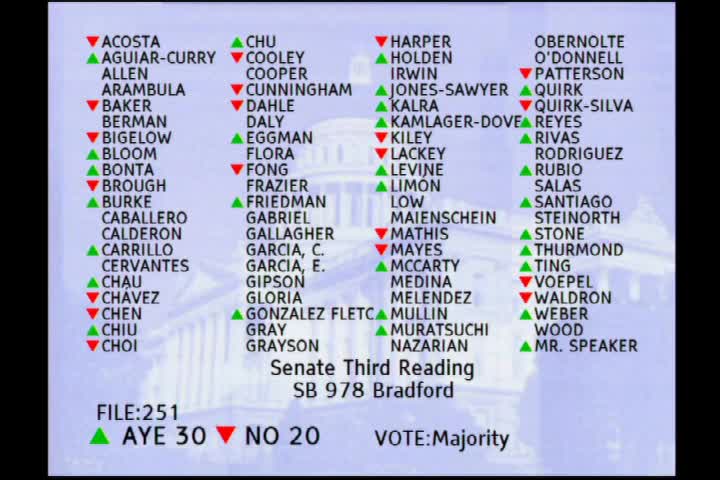 2MIN
Assembly Floor
 1H
Assembly Standing Committee on Appropriations
 12MIN
Assembly Standing Committee on Health
 4MIN
Senate Floor
 14MIN
Senate Standing Committee on Appropriations
 27MIN
Senate Standing Committee on Health
Bill Author