SB 1079: Forest resources: fire prevention grants: advance payments.
- Session Year: 2017-2018
- House: Senate
- Latest Version Date: 2018-09-21
Existing law authorizes the Director of Forestry and Fire Protection to provide grants to entities, including, but not limited to, private or nongovernmental entities, Native American tribes, or local, state, and federal public agencies, for the implementation and administration of projects and programs to improve forest health and reduce greenhouse gas emissions. The Budget Act of 2017 appropriated moneys to the Department of Forestry and Fire Protection for purposes of, among other things, providing local assistance grants, grants to fire safe councils, and grants to qualified nonprofit organizations with a demonstrated ability to satisfactorily plan, implement, and complete a fire prevention project for these same purposes, as provided.
This bill would, until January 1, 2024, authorize the director to authorize advance payments to a nonprofit organization, a local agency, a special district, a private forest landowner, or a Native American tribe from the grant awards specified above. The bill would prohibit a single advance payment from exceeding 25% of the total grant award. The bill would place specified requirements on the grantee of the advance payment, including that the grantee file an accountability report with the department, as provided. The bill would require the department to provide a report to the Legislature on or before January 1, 2023, on the outcome of the departments use of the advance payments.
This bill would declare that it is to take effect immediately as an urgency statute.
Existing law authorizes the Director of Forestry and Fire Protection to provide grants to entities, including, but not limited to, private or nongovernmental entities, Native American tribes, or local, state, and federal public agencies, for the implementation and administration of projects and programs to improve forest health and reduce greenhouse gas emissions. The Budget Act of 2017 appropriated moneys to the Department of Forestry and Fire Protection for purposes of, among other things, providing local assistance grants, grants to fire safe councils, and grants to qualified nonprofit organizations with a demonstrated ability to satisfactorily plan, implement, and complete a fire prevention project for these same purposes, as provided.
This bill would would, until January 1, 2024, authorize the director to authorize advance payments to a nonprofit organization, a local agency, a special district, a private forest landowner, or a Native American tribe from the grant awards specified above. The bill would prohibit a single advance payment from exceeding 25% of the total grant award. The bill would place specified requirements on the grantee of the advance payment, including that the grantee file an accountability report with the department, as provided. The bill would require the department to provide a report to the Legislature on or before January 1, 2023, on the outcome of the use of the advance payments.
This bill would declare that it is to take effect immediately as an urgency statute.
Existing law authorizes the Director of Forestry and Fire Protection to provide grants to entities, including, but not limited to, private or nongovernmental entities, Native American tribes, or local, state, and federal public agencies, for the implementation and administration of projects and programs to improve forest health and reduce greenhouse gas emissions. The Budget Act of 2017 appropriated moneys to the Department of Forestry and Fire Protection for purposes of, among other things, providing local assistance grants, grants to fire safe councils, and grants to qualified nonprofit organizations with a demonstrated ability to satisfactorily plan, implement, and complete a fire prevention project for these same purposes, as provided.
This bill would authorize the director to authorize advance payments to a nonprofit organization, a local agency, a special district, a private forest landowner, or a Native American tribe from the grant awards specified above. The bill would prohibit a single advance payment from exceeding 25% of the total grant award.
This bill would declare that it is to take effect immediately as an urgency statute.
Existing law authorizes the Director of Forestry and Fire Protection to provide grants to entities, including, but not limited to, private or nongovernmental entities, Native American tribes, or local, state, and federal public agencies, for the implementation and administration of projects and programs to improve forest health and reduce greenhouse gas emissions. The Budget Act of 2017 appropriated moneys to the Department of Forestry and Fire Protection for purposes of, among other things, providing local assistance grants, grants to fire safe councils, and grants to qualified nonprofit organizations with a demonstrated ability to satisfactorily plan, implement, and complete a fire prevention project for these same purposes, as provided.
This bill would authorize the director to authorize advance payments to a nonprofit organization, a local agency, a special district, or a Native American tribe from the grant awards specified above. The bill would prohibit a single advance payment from exceeding 25% of the total grant award.
This bill would declare that it is to take effect immediately as an urgency statute.
Existing law authorizes the Director of Forestry and Fire Protection to provide grants to entities, including, but not limited to, private or nongovernmental entities, Native American tribes, or local, state, and federal public agencies, for the implementation and administration of projects and programs to improve forest health and reduce greenhouse gas emissions. The Budget Act of 2017 appropriated moneys to the Department of Forestry and Fire Protection for purposes of, among other things, providing local assistance grants, grants to fire safe councils, and grants to qualified nonprofit organizations with a demonstrated ability to satisfactorily plan, implement, and complete a fire prevention project for these same purposes, as provided.
This bill would authorize the director to authorize advance payments to a nonprofit organization, a special district, or a Native American tribe from the grant awards specified above. The bill would prohibit a single advance payment from exceeding 25% of the total grant award.
This bill would declare that it is to take effect immediately as an urgency statute.
The Zberg-Nejedly Forest Practices Act of 1973 prohibits a person from conducting timber operations, as defined, unless a timber harvesting plan prepared by a registered professional forester has been submitted to the Department of Forestry and Fire Protection. The act authorizes the State Board of Forestry and Fire Protection to exempt from some or all of those provisions of the act a person engaging in specified forest management activities, as prescribed.This bill would a nonsubstantive changes in the provision governing exemptions for forest management activities.The Zberg-Nejedly Forest Practices Act of 1973 prohibits a person from conducting timber operations, as defined, unless a timber harvesting plan prepared by a registered professional forester has been submitted to the Department of Forestry and Fire Protection. The act authorizes the State Board of Forestry and Fire Protection to exempt from some or all of those provisions of the act a person engaging in specified forest management activities, as prescribed.
This bill would a nonsubstantive changes in the provision governing exemptions for forest management activities.
(a)The director may authorize advance payments to a nonprofit organization, a local agency, a special district, or a Native American tribe from a grant awarded pursuant to subdivision (a), (b), (c), (d), (f), or (g) of Provision 2 of Item 3540-001-3228 of Section 2.00 of the Budget Act of 2017, including subsequent amendments to that provision. The director may also authorize advance payments to a private forest landowner from a grant awarded pursuant to subdivision (a) of Provision 2 of Item 3540-001-3228 of Section 2.00 of the Budget Act of 2017, including subsequent amendments to that provision. No single advance payment shall exceed 25 percent of the total grant award.
(b)(1)The grantee shall expend the funds from the advance payment within six months of receipt, unless the department waives this requirement.
(2)The grantee shall file an accountability report with the department four months from the date of receiving the funds and every four months thereafter.
(c)(1)The department shall provide a report to the Legislature on or before January 1, 2023, on the outcome of the departments use of advance payments.
(2)A report submitted pursuant to this subdivision shall be submitted in compliance with Section 9795 of the Government Code.
(d)This section shall remain in effect only until January 1, 2024, and as of that date is repealed, unless a later enacted statute that is enacted before January 1, 2024, deletes or extends that date.
SEC. 2.Section 4799.05 of the Public Resources Code is amended to read:4799.05.(a)(1)The director may provide grants to, or enter into contracts or other cooperative agreements with, entities, including, but not limited to, private or nongovernmental entities, Native American tribes, or local, state, and federal public agencies, for the implementation and administration of projects and programs to improve forest health and reduce greenhouse gas emissions.
(2)(A)Until January 1, 2024, the director may authorize advance payments to a nonprofit organization, a local agency, a special district, a private forest landowner, or a Native American tribe from a grant awarded pursuant to this section. No single advance payment shall exceed 25 percent of the total grant award.
(B)(i)The grantee shall expend the funds from the advance payment within six months of receipt, unless the department waives this requirement.
(ii)The grantee shall file an accountability report with the department four months from the date of receiving the funds and every four months thereafter.
(C)(i)The department shall provide a report to the Legislature on or before January 1, 2023, on the outcome of the departments use of advance payments.
(ii)A report submitted pursuant to this subparagraph shall be submitted in compliance with Section 9795 of the Government Code.
(iii)The requirement for submitting a report imposed under clause (i) is inoperative on January 1, 2027, pursuant to Section 10231.5 of the Government Code.
(b)Any project or program described in this section that is funded with moneys from the Greenhouse Gas Reduction Fund, created pursuant to Section 16428.8 of the Government Code, shall comply with all statutory and program requirements applicable to the use of moneys from the fund.
(c)Moneys appropriated to the department for landscape-scale projects shall be allocated as follows:
(1)To subsidize the removal of small diameter material, especially surface fuels and ladder fuels, as well as dead trees, in order to help develop markets for beneficial uses of the material, including, but not limited to, animal bedding, biochar, cross-laminated timber, mulch, oriented strand board, pulp, post, shredding, and veneer products.
(2)For multiple benefit projects, such as tree thinning, carbon sequestration, forest resilience, and improved ecological outcome projects, including, but not limited to, restoring watershed health and function and supporting biodiversity and wildlife adaptation to climate change. The department shall give grant funding priority to landowners who practice uneven aged forest management with a resilient forest of diverse age, size, and species class within the boundaries of the project and whose activities are conducted pursuant to an approved timber harvest plan, nonindustrial timber harvest plan, or working forest management plan. An application for a grant for a project under this subparagraph shall include a description of how the proposed project will increase average stem diameter and provide other site-specific improvement to forest complexity, as demonstrated by the expansion of the variety of tree age classes and species persisting for a period of at least 50 years. The department shall also give funding priority to landowners who agree to long-term forest management goals prescribed by the department.
(3)For activities on national forest lands to increase tree stand heterogeneity, create forest openings of less than one acre, and increase average tree stand diameter of residual trees. Any grants provided under this subparagraph shall be approved by the department, in collaboration with appropriate state agencies, including the State Air Resources Board.
SEC. 3.This act is an urgency statute necessary for the immediate preservation of the public peace, health, or safety within the meaning of Article IV of the California Constitution and shall go into immediate effect. The facts constituting the necessity are:
In order to implement projects that restore forest health and reduce large, intense wildfires, it is necessary for this act to take effect immediately.
(a)The director may authorize advance payments to a nonprofit organization, a local agency, a special district, or a Native American tribe from a grant awarded pursuant to subdivision (a), (b), (c), (d), (f), or (g) of Provision 2 of Item 3540-001-3228 of Section 2.00 of the Budget Act of 2017, including subsequent amendments to that provision. The director may also authorize advance payments to a private forest landowner from a grant awarded pursuant to subdivision (a) of Provision 2 of Item 3540-001-3228 of Section 2.00 of the Budget Act of 2017, including subsequent amendments to that provision. No single advance payment shall exceed 25 percent of the total grant award.
(b)(1)Any advance payments made pursuant to subdivision (a) shall be deposited into a non-interest-bearing account.(2)(b)(1)The grantee shall expend the funds from the advance payment within six months of receipt, unless the department waives this requirement.
(3)(2)The grantee shall file an accountability report with the department four months from the date of receiving the funds and every four months thereafter.
(c)(1)The department shall provide a report to the Legislature on or before January 1, 2023, on the outcome of the departments use of advance payments pursuant to this section and Section 4799.05. payments.
(2)A report submitted pursuant to this subdivision shall be submitted in compliance with Section 9795 of the Government Code.
(d)This section shall remain in effect only until January 1, 2024, and as of that date is repealed, unless a later enacted statute that is enacted before January 1, 2024, deletes or extends that date.
SEC. 2.Section 4799.05 of the Public Resources Code is amended to read:4799.05.(a)(1)The director may provide grants to, or enter into contracts or other cooperative agreements with, entities, including, but not limited to, private or nongovernmental entities, Native American tribes, or local, state, and federal public agencies, for the implementation and administration of projects and programs to improve forest health and reduce greenhouse gas emissions.
(2)(A)Until January 1, 2024, the director may authorize advance payments to a nonprofit organization, a local agency, a special district, a private forest landowner, or a Native American tribe from a grant awarded pursuant to this section. No single advance payment shall exceed 25 percent of the total grant award.
(B)(i)Any advance payments made pursuant to this paragraph shall be deposited into a non-interest-bearing account.(ii)(B)(i)The grantee shall expend the funds from the advance payment within six months of receipt, unless the department waives this requirement.
(iii)(ii)The grantee shall file an accountability report with the department four months from the date of receiving the funds and every four months thereafter.
(C)(i)The department shall provide a report to the Legislature on or before January 1, 2023, on the outcome of the departments use of advance payments pursuant to this paragraph and Section 705.5. payments.
(ii)A report submitted pursuant to this subparagraph shall be submitted in compliance with Section 9795 of the Government Code.
(iii)The requirement for submitting a report imposed under clause (i) is inoperative on January 1, 2027, pursuant to Section 10231.5 of the Government Code.
(b)Any project or program described in this section that is funded with moneys from the Greenhouse Gas Reduction Fund, created pursuant to Section 16428.8 of the Government Code, shall comply with all statutory and program requirements applicable to the use of moneys from the fund.
(c)Moneys appropriated to the department for landscape-scale projects shall be allocated as follows:
(1)To subsidize the removal of small diameter material, especially surface fuels and ladder fuels, as well as dead trees, in order to help develop markets for beneficial uses of the material, including, but not limited to, animal bedding, biochar, cross-laminated timber, mulch, oriented strand board, pulp, post, shredding, and veneer products.
(2)For multiple benefit projects, such as tree thinning, carbon sequestration, forest resilience, and improved ecological outcome projects, including, but not limited to, restoring watershed health and function and supporting biodiversity and wildlife adaptation to climate change. The department shall give grant funding priority to landowners who practice uneven aged forest management with a resilient forest of diverse age, size, and species class within the boundaries of the project and whose activities are conducted pursuant to an approved timber harvest plan, nonindustrial timber harvest plan, or working forest management plan. An application for a grant for a project under this subparagraph shall include a description of how the proposed project will increase average stem diameter and provide other site-specific improvement to forest complexity, as demonstrated by the expansion of the variety of tree age classes and species persisting for a period of at least 50 years. The department shall also give funding priority to landowners who agree to long-term forest management goals prescribed by the department.
(3)For activities on national forest lands to increase tree stand heterogeneity, create forest openings of less than one acre, and increase average tree stand diameter of residual trees. Any grants provided under this subparagraph shall be approved by the department, in collaboration with appropriate state agencies, including the State Air Resources Board.
SEC. 3.This act is an urgency statute necessary for the immediate preservation of the public peace, health, or safety within the meaning of Article IV of the California Constitution and shall go into immediate effect. The facts constituting the necessity are:
In order to implement projects that restore forest health and reduce large, intense wildfires, it is necessary for this act to take effect immediately.
(a)The director may authorize advance payments to a nonprofit organization, a local agency, a special district, or a Native American tribe from a grant awarded pursuant to subdivision (a), (b), (c), (d), (f), or (g) of Provision 2 of Item 3540-001-3228 of Section 2.00 of the Budget Act of 2017, including subsequent amendments to that provision. The director may also authorize advance payments to a private forest landowner from a grant awarded pursuant to subdivision (a) of Provision 2 of Item 3540-001-3228 of Section 2.00 of the Budget Act of 2017, including subsequent amendments to that provision. No single advance payment shall exceed 25 percent of the total grant award.
(b)(1)Any advance payments made pursuant to subdivision (a) shall be deposited into a non-interest-bearing account.
(2)The grantee shall expend the funds from the advance payment within six months of receipt, unless the department waives this requirement.
(3)The grantee shall file an accountability report with the department four months from the date of receiving the funds and every four months thereafter.
(c)(1)The department shall provide a report to the Legislature on or before January 1, 2023, on the outcome of the use of advance payments pursuant to this section and Section 4799.05.
(2)A report submitted pursuant to this subdivision shall be submitted in compliance with Section 9795 of the Government Code.
(d)This section shall remain in effect only until January 1, 2024, and as of that date is repealed, unless a later enacted statute that is enacted before January 1, 2024, deletes or extends that date.
SEC. 2.Section 4799.05 of the Public Resources Code is amended to read:4799.05.(a)(1)The director may provide grants to, or enter into contracts or other cooperative agreements with, entities, including, but not limited to, private or nongovernmental entities, Native American tribes, or local, state, and federal public agencies, for the implementation and administration of projects and programs to improve forest health and reduce greenhouse gas emissions.
(2)The (A)Until January 1, 2024, the director may authorize advance payments to a nonprofit organization, a local agency, a special district, a private forest landowner, or a Native American tribe from a grant awarded pursuant to this section. No single advance payment shall exceed 25 percent of the total grant award.
(B)(i)Any advance payments made pursuant to this paragraph shall be deposited into a non-interest-bearing account.
(ii)The grantee shall expend the funds from the advance payment within six months of receipt, unless the department waives this requirement.
(iii)The grantee shall file an accountability report with the department four months from the date of receiving the funds and every four months thereafter.
(C)(i)The department shall provide a report to the Legislature on or before January 1, 2023, on the outcome of the use of advance payments pursuant to this paragraph and Section 705.5.
(ii)A report submitted pursuant to this subparagraph shall be submitted in compliance with Section 9795 of the Government Code.
(iii)The requirement for submitting a report imposed under clause (i) is inoperative on January 1, 2027, pursuant to Section 10231.5 of the Government Code.
(b)Any project or program described in this section that is funded with moneys from the Greenhouse Gas Reduction Fund, created pursuant to Section 16428.8 of the Government Code, shall comply with all statutory and program requirements applicable to the use of moneys from the fund.
(c)Moneys appropriated to the department for landscape-scale projects shall be allocated as follows:
(1)To subsidize the removal of small diameter material, especially surface fuels and ladder fuels, as well as dead trees, in order to help develop markets for beneficial uses of the material, including, but not limited to, animal bedding, biochar, cross-laminated timber, mulch, oriented strand board, pulp, post, shredding, and veneer products.
(2)For multiple benefit projects, such as tree thinning, carbon sequestration, forest resilience, and improved ecological outcome projects, including, but not limited to, restoring watershed health and function and supporting biodiversity and wildlife adaptation to climate change. The department shall give grant funding priority to landowners who practice uneven aged forest management with a resilient forest of diverse age, size, and species class within the boundaries of the project and whose activities are conducted pursuant to an approved timber harvest plan, nonindustrial timber harvest plan, or working forest management plan. An application for a grant for a project under this subparagraph shall include a description of how the proposed project will increase average stem diameter and provide other site-specific improvement to forest complexity, as demonstrated by the expansion of the variety of tree age classes and species persisting for a period of at least 50 years. The department shall also give funding priority to landowners who agree to long-term forest management goals prescribed by the department.
(3)For activities on national forest lands to increase tree stand heterogeneity, create forest openings of less than one acre, and increase average tree stand diameter of residual trees. Any grants provided under this subparagraph shall be approved by the department, in collaboration with appropriate state agencies, including the State Air Resources Board.
SEC. 3.This act is an urgency statute necessary for the immediate preservation of the public peace, health, or safety within the meaning of Article IV of the California Constitution and shall go into immediate effect. The facts constituting the necessity are:
In order to implement projects that restore forest health and reduce large, intense wildfires, it is necessary for this act to take effect immediately.
The director may authorize advance payments to a nonprofit organization, a local agency, a special district, or a Native American tribe from a grant awarded pursuant to subdivision (a), (b), (c), (d), (f), or (g) of Provision 2 of Item 3540-001-3228 of Section 2.00 of the Budget Act of 2017, including subsequent amendments to that provision. The director may also authorize advance payments to a private forest landowner from a grant awarded pursuant to subdivision (a) of Provision 2 of Item 3540-001-3228 of Section 2.00 of the Budget Act of 2017, including subsequent amendments to that provision. No single advance payment shall exceed 25 percent of the total grant award.
SEC. 2.Section 4799.05 of the Public Resources Code is amended to read:4799.05.(a)(1)The director may provide grants to, or enter into contracts or other cooperative agreements with, entities, including, but not limited to, private or nongovernmental entities, Native American tribes, or local, state, and federal public agencies, for the implementation and administration of projects and programs to improve forest health and reduce greenhouse gas emissions.
(2)The director may authorize advance payments to a nonprofit organization, a local agency, a special district, a private forest landowner, or a Native American tribe from a grant awarded pursuant to this section. No single advance payment shall exceed 25 percent of the total grant award.
(b)Any project or program described in this section that is funded with moneys from the Greenhouse Gas Reduction Fund, created pursuant to Section 16428.8 of the Government Code, shall comply with all statutory and program requirements applicable to the use of moneys from the fund.
(c)Moneys appropriated to the department for landscape-scale projects shall be allocated as follows:
(1)To subsidize the removal of small diameter material, especially surface fuels and ladder fuels, as well as dead trees, in order to help develop markets for beneficial uses of the material, including, but not limited to, animal bedding, biochar, cross-laminated timber, mulch, oriented strand board, pulp, post, shredding, and veneer products.
(2)For multiple benefit projects, such as tree thinning, carbon sequestration, forest resilience, and improved ecological outcome projects, including, but not limited to, restoring watershed health and function and supporting biodiversity and wildlife adaptation to climate change. The department shall give grant funding priority to landowners who practice uneven aged forest management with a resilient forest of diverse age, size, and species class within the boundaries of the project and whose activities are conducted pursuant to an approved timber harvest plan, nonindustrial timber harvest plan, or working forest management plan. An application for a grant for a project under this subparagraph shall include a description of how the proposed project will increase average stem diameter and provide other site-specific improvement to forest complexity, as demonstrated by the expansion of the variety of tree age classes and species persisting for a period of at least 50 years. The department shall also give funding priority to landowners who agree to long-term forest management goals prescribed by the department.
(3)For activities on national forest lands to increase tree stand heterogeneity, create forest openings of less than one acre, and increase average tree stand diameter of residual trees. Any grants provided under this subparagraph shall be approved by the department, in collaboration with appropriate state agencies, including the State Air Resources Board.
SEC. 3.This act is an urgency statute necessary for the immediate preservation of the public peace, health, or safety within the meaning of Article IV of the California Constitution and shall go into immediate effect. The facts constituting the necessity are:
In order to implement projects that restore forest health and reduce large, intense wildfires, it is necessary for this act to take effect immediately.
The director may authorize advance payments to a nonprofit organization, a local agency, a special district, or a Native American tribe from a grant awarded pursuant to subdivision (a), (b), (c), (d), (f), or (g) of Provision 2 of Item 3540-001-3228 of Section 2.00 of the Budget Act of 2017, including subsequent amendments to that provision. No single advance payment shall exceed 25 percent of the total grant award.
SEC. 2.Section 4799.05 of the Public Resources Code is amended to read:4799.05.(a)(1)The director may provide grants to, or enter into contracts or other cooperative agreements with, entities, including, but not limited to, private or nongovernmental entities, Native American tribes, or local, state, and federal public agencies, for the implementation and administration of projects and programs to improve forest health and reduce greenhouse gas emissions.
(2)The director may authorize advance payments to a nonprofit organization, a local agency, a special district, or a Native American tribe from a grant awarded pursuant to this section. No single advance payment shall exceed 25 percent of the total grant award.
(b)Any project or program described in this section that is funded with moneys from the Greenhouse Gas Reduction Fund, created pursuant to Section 16428.8 of the Government Code, shall comply with all statutory and program requirements applicable to the use of moneys from the fund.
(c)Moneys appropriated to the department for landscape-scale projects shall be allocated as follows:
(1)To subsidize the removal of small diameter material, especially surface fuels and ladder fuels, as well as dead trees, in order to help develop markets for beneficial uses of the material, including, but not limited to, animal bedding, biochar, cross-laminated timber, mulch, oriented strandboard strand board, pulp, post, shredding, and veneer products.
(2)For multiple benefit projects, such as tree thinning, carbon sequestration, forest resilience, and improved ecological outcome projects, including, but not limited to, restoring watershed health and function and supporting biodiversity and wildlife adaptation to climate change. The department shall give grant funding priority to landowners who practice uneven-age uneven aged forest management with a resilient forest of diverse age, size, and species class within the boundaries of the project and whose activities are conducted pursuant to an approved timber harvest plan, nonindustrial timber harvest plan, or working forest management plan. An application for a grant for a project under this subparagraph shall include a description of how the proposed project will increase average stem diameter and provide other site-specific improvement to forest complexity, as demonstrated by the expansion of the variety of tree age classes and species persisting for a period of at least 50 years. The department shall also give funding priority to landowners who agree to long-term forest management goals prescribed by the department.
(3)For activities on National Forest national forest lands to increase tree stand heterogeneity, create forest openings of less than one acre, and increase average tree stand diameter of residual trees. Any grants provided under this subparagraph shall be approved by the department, in collaboration with appropriate state agencies, including the State Air Resources Board.
SEC. 3.This act is an urgency statute necessary for the immediate preservation of the public peace, health, or safety within the meaning of Article IV of the California Constitution and shall go into immediate effect. The facts constituting the necessity are:
In order to implement projects that restore forest health and reduce large, intense wildfires, it is necessary for this act to take effect immediately.
The Director of Forestry and Fire Protection may authorize advance payments to a nonprofit organization, a special district, or a Native American tribe from a grant awarded pursuant to subdivision (a), (b), (c), (d), (f), or (g) of Provision 2 of Item 3540-001-3228 of Section 2.00 of the Budget Act of 2017. No single advance payment shall exceed 25 percent of the total grant award.
SEC. 2.Section 4799.05 of the Public Resources Code is amended to read:4799.05.(a)(1)The director may provide grants to, or enter into contracts or other cooperative agreements with, entities, including, but not limited to, private or nongovernmental entities, Native American tribes, or local, state, and federal public agencies, for the implementation and administration of projects and programs to improve forest health and reduce greenhouse gas emissions.
(2)The director may authorize advance payments to a nonprofit organization, a special district, or a Native American tribe from a grant awarded pursuant to this section. No single advance payment shall exceed 25 percent of the total grant award.
(b)Any project or program described in this section that is funded with moneys from the Greenhouse Gas Reduction Fund, created pursuant to Section 16428.8 of the Government Code, shall comply with all statutory and program requirements applicable to the use of moneys from the fund.
(c)Moneys appropriated to the department for landscape-scale projects shall be allocated as follows:
(1)To subsidize the removal of small diameter material, especially surface fuels and ladder fuels, as well as dead trees, in order to help develop markets for beneficial uses of the material, including, but not limited to, animal bedding, biochar, cross-laminated timber, mulch, oriented strandboard, pulp, post, shredding, and veneer products.
(2)For multiple benefit projects, such as tree thinning, carbon sequestration, forest resilience, and improved ecological outcome projects, including, but not limited to, restoring watershed health and function and supporting biodiversity and wildlife adaptation to climate change. The department shall give grant funding priority to landowners who practice uneven-age forest management with a resilient forest of diverse age, size, and species class within the boundaries of the project and whose activities are conducted pursuant to an approved timber harvest plan, nonindustrial timber harvest plan, or working forest management plan. An application for a grant for a project under this subparagraph shall include a description of how the proposed project will increase average stem diameter and provide other site-specific improvement to forest complexity, as demonstrated by the expansion of the variety of tree age classes and species persisting for a period of at least 50 years. The department shall also give funding priority to landowners who agree to long-term forest management goals prescribed by the department.
(3)For activities on National Forest lands to increase tree stand heterogeneity, create forest openings of less than one acre, and increase average tree stand diameter of residual trees. Any grants provided under this subparagraph shall be approved by the department, in collaboration with appropriate state agencies, including the State Air Resources Board.
SEC. 3.This act is an urgency statute necessary for the immediate preservation of the public peace, health, or safety within the meaning of Article IV of the California Constitution and shall go into immediate effect. The facts constituting the necessity are:
In order to implement projects that restore forest health and reduce large, intense wildfires, it is necessary for this act to take effect immediately.
All matter omitted in this version of the bill appears in the bill as introduced in the Senate, February 12, 2018. (JR11)Upon determining that this exemption is consistent with the purposes of this chapter, the board may exempt from this chapter, or portions of this chapter, a person engaged in forest management whose activities are limited to any of the following:
(a)The cutting or removal removal or cutting of trees for the purpose of constructing or maintaining a right-of-way for utility lines.
(b)The planting, growing, nurturing, shaping, shearing, removal, or harvest of immature trees for Christmas trees or other ornamental purposes or minor forest products, including fuelwood.
(c)The cutting or removal of dead, dying, or diseased trees of any size.
(d)Site preparation.
(e)Maintenance of drainage facilities and soil stabilization treatments.
(f)Timber operations on land managed by the Department of Parks and Recreation.
(g)(1)The one-time conversion of less than three acres to a nontimber use. A person, whether acting as an individual, as a member of a partnership, or as an officer or employee of a corporation or other legal entity, shall not obtain more than one exemption pursuant to this subdivision in a five-year period. If a partnership has as a member, or if a corporation or other legal entity has as an officer or employee, a person who has received this exemption within the past five years, whether as an individual, as a member of a partnership, or as an officer or employee of a corporation or other legal entity, then that partnership, corporation, or other legal entity is not eligible for this exemption. Person, for purposes of this subdivision, means an individual, partnership, corporation, or other legal entity.
(2)(A)Notwithstanding Section 4554.5, the board shall adopt regulations that do all of the following:
(i)Identify the required documentation of a bona fide intent to complete the conversion that an applicant will need to submit in order to be eligible for the exemption in paragraph (1).
(ii)Authorize the department to inspect the sites approved in conversion applications that have been approved on or after January 1, 2002, in order to determine that the conversion was completed within the two-year period described in subparagraph (B) of paragraph (2) of subdivision (a) of Section 1104.1 of Title 14 of the California Code of Regulations.
(iii)Require the exemption pursuant to this subdivision to expire if there is a change in timberland ownership. The person who originally submitted an application for an exemption pursuant to this subdivision shall notify the department of a change in timberland ownership on or before five calendar days after a change in ownership.
(iv)The board may adopt regulations allowing a waiver of the five-year limitation described in paragraph (1) upon finding that the imposition of the five-year limitation would impose an undue hardship on the applicant for the exemption. The board may adopt a process for an appeal of a denial of a waiver.
(B)The application form for the exemption pursuant to paragraph (1) shall prominently advise the public that a violation of the conversion exemption, including a conversion applied for in the name of someone other than the person or entity implementing the conversion in bona fide good faith, is a violation of this chapter and penalties may accrue up to ten thousand dollars ($10,000) for each violation pursuant to Article 8 (commencing with Section 4601).
(h)An easement granted by a right-of-way construction agreement administered by the federal government if timber sales and operations within or affecting the area are reviewed and conducted pursuant to the National Environmental Policy Act of 1969 (42 U.S.C. Sec. 4321 et seq.).
(i)(1)The cutting or removal of trees in compliance with Sections 4290 and 4291 that eliminates the vertical continuity of vegetative fuels and the horizontal continuity of tree crowns for the purpose of reducing flammable materials and maintaining a fuel break for a distance of not more than 150 feet on each side from an approved and legally permitted structure that complies with the California Building Standards Code, when that cutting or removal is conducted in compliance with this subdivision. For purposes of this subdivision, an approved and legally permitted structure includes only structures that are designed for human occupancy, garages, barns, stables, and structures used to enclose fuel tanks.
(2)(A)The cutting or removal of trees pursuant to this subdivision is limited to cutting or removal that will result in a reduction in the rate of fire spread, fire duration and intensity, fuel ignitability, or ignition of the tree crowns and shall be in accordance with any regulations adopted by the board pursuant to this section.
(B)Trees shall not be cut or removed pursuant to this subdivision by the clearcutting regeneration method, by the seed tree removal step of the seed tree regeneration method, or by the shelterwood removal step of the shelterwood regeneration method.
(3)(A)Surface fuels, including logging slash and debris, low brush, and deadwood, that could promote the spread of wildfire shall be chipped, burned, or otherwise removed from all areas of timber operations within 45 days from the date of commencement of timber operations pursuant to this subdivision.
(B)(i)All surface fuels that are not chipped, burned, or otherwise removed from all areas of timber operations within 45 days from the date of commencement of timber operations may be determined to be a nuisance and subject to abatement by the department or the city or county having jurisdiction.
(ii)The costs incurred by the department, city, or county, as the case may be, to abate the nuisance upon a parcel of land subject to the timber operations, including, but not limited to, investigation, boundary determination, measurement, and other related costs, may be recovered by special assessment and lien against the parcel of land by the department, city, or county. The assessment may be collected at the same time and in the same manner as ordinary ad valorem taxes, and shall be subject to the same penalties and the same procedure and sale in case of delinquency as is provided for ad valorem taxes.
(4)All timber operations conducted pursuant to this subdivision shall conform to applicable city or county general plans, city or county implementing ordinances, and city or county zoning ordinances. This paragraph does not authorize the cutting, removal, or sale of timber or other solid wood forest products within an area where timber harvesting is prohibited or otherwise restricted pursuant to the rules or regulations adopted by the board.
(5)(A)The board shall adopt regulations, initially as emergency regulations in accordance with subparagraph (B), that the board considers necessary to implement and to obtain compliance with this subdivision.
(B)The emergency regulations adopted pursuant to subparagraph (A) shall be adopted in accordance with the Administrative Procedure Act (Chapter 3.5 (commencing with Section 11340) of Part 1 of Division 3 of Title 2 of the Government Code). The adoption of emergency regulations shall be deemed to be an emergency and necessary for the immediate preservation of the public peace, health, and safety, or general welfare.
(6)(A) Notwithstanding paragraph (1), the board may exempt from this chapter, or portions of this chapter, a person engaged in forest management whose activities are limited to the cutting or removal of trees on the persons property in compliance with Sections 4290 and 4291 that eliminates the vertical continuity of vegetative fuels and the horizontal continuity of tree crowns for the purpose of reducing flammable materials and maintaining a fuel break for a distance of not more than 300 feet on each side from an approved and legally permitted habitable structure, when that cutting or removal is conducted in compliance with this subdivision and all of the following conditions are met:
(i)The notice of exemption is prepared, signed, and submitted by a registered professional forester to the department.
(ii)For the areas between 150 and 300 feet from the habitable structure, the operations meet all of the following provisions:
(I)The residual stocking standards are consistent with Sections 913.2, 933.2, and 953.2 of Title 14 of the California Code of Regulations, as appropriate.
(II)Activities within this area will increase the quadratic mean diameter of the stand.
(III)The residual stand consists primarily of healthy and vigorous dominant and codominant trees from the preharvest stand, well distributed through the harvested area.
(IV)Postharvest slash treatment and stand conditions will lead to more moderate fire behavior in the professional judgment of the registered professional forester who submits the notice of exemption.
(V)Any additional guidance for slash treatment and postharvest stand conditions and any other issues deemed necessary that are consistent with this section, as established by the board.
(B)For purposes of this paragraph, habitable structure means a building that contains one or more dwelling units or that can be occupied for residential use. Buildings occupied for residential use include single family homes, multidwelling structures, mobile and manufactured homes, and condominiums. For purposes of this paragraph habitable structure does not include commercial, industrial, or incidental buildings such as detached garages, barns, outdoor sanitation facilities, and sheds.
(C)The department shall evaluate the effects of this paragraph and shall report its recommendations, before the paragraph becomes inoperative, to the Legislature based on that evaluation. The report shall be submitted in compliance with Section 9795 of the Government Code.
(D)The board shall adopt regulations to implement this paragraph no later than January 1, 2016.
(E)This paragraph shall become inoperative three years after the effective date of regulations adopted by the board pursuant to subparagraph (D) but no later than January 1, 2019.
(j)(1)The harvesting of trees, limited to those trees that eliminate the vertical continuity of vegetative fuels and the horizontal continuity of tree crowns, for the purpose of reducing the rate of fire spread, duration and intensity, fuel ignitability, or ignition of tree crowns.
(2)The board may authorize an exemption pursuant to paragraph (1) only if the tree harvesting will decrease fuel continuity and increase the quadratic mean diameter of the stand, and the tree harvesting area will not exceed 300 acres.
(3)Except as provided in paragraph (11), the notice of exemption, which shall be known as the Forest Fire Prevention Exemption, may be authorized only if all of the conditions specified in paragraphs (4) to (10), inclusive, are met.
(4)A registered professional forester shall prepare the notice of exemption and submit it to the director, and include a map of the area of timber operations that complies with the requirements of paragraphs (1), (3), (4), and (7) to (12), inclusive, of subdivision (x) of Section 1034 of Title 14 of the California Code of Regulations.
(5)(A)The registered professional forester who submits the notice of exemption shall include a description of the preharvest stand structure and a statement of the postharvest stand stocking levels.
(B)The level of residual stocking shall be consistent with maximum sustained production of high-quality timber products. The residual stand shall consist primarily of healthy and vigorous dominant and codominant trees from the preharvest stand. Stocking shall not be reduced below the standards required by any of the following provisions that apply to the exemption at issue:
(i)Clauses 1 to 4, inclusive, of subparagraph (A) of paragraph (1) of subdivision (a) of Section 913.3 of Title 14 of the California Code of Regulations.
(ii)Clauses 1 to 4, inclusive, of subparagraph (A) of paragraph (1) of subdivision (a) of Section 933.3 of Title 14 of the California Code of Regulations.
(iii)Clauses 1 to 4, inclusive, of subparagraph (A) of paragraph (1) of subdivision (a) of Section 953.3 of Title 14 of the California Code of Regulations.
(C)If the preharvest dominant and codominant crown canopy is occupied by trees less than 14 inches in diameter at breast height, a minimum of 100 trees over four inches in diameter at breast height shall be retained per acre for Site I, II, and III lands, and a minimum of 75 trees over four inches in diameter at breast height shall be retained per acre for Site IV and V lands.
(6)(A)The registered professional forester who submits the notice shall include selection criteria for the trees to be harvested or the trees to be retained. In the development of fuel reduction prescriptions, the registered professional forester should consider retaining habitat elements, where feasible, including, but not limited to, ground level cover necessary for the long-term management of local wildlife populations.
(B)All trees that are harvested or all trees that are retained shall be marked or sample marked by, or under the supervision of, a registered professional forester before felling operations begin. The board shall adopt regulations for sample marking for this section in Title 14 of the California Code of Regulations. Sample marking shall be limited to homogenous forest stand conditions typical of plantations.
(7)(A)The registered professional forester submitting the notice, upon submission of the notice, shall provide a confidential archaeology letter that includes all the information required by any of the following provisions that apply to the exemption at issue:
(i)Paragraphs (2) and (7) to (11), inclusive, of subdivision (c) of Section 929.1 of Title 14 of the California Code of Regulations, and include site records if required pursuant to subdivision (g) of that section or pursuant to Section 929.5 of Title 14 of the California Code of Regulations.
(ii)Paragraphs (2) and (7) to (11), inclusive, of subdivision (c) of Section 949.1 of Title 14 of the California Code of Regulations, and include site records if required pursuant to subdivision (g) of that section or pursuant to Section 949.5 of Title 14 of the California Code of Regulations.
(iii)Paragraphs (2) and (7) to (11), inclusive, of subdivision (c) of Section 969.1 of Title 14 of the California Code of Regulations, and include site records if required pursuant to subdivision (g) of that section or pursuant to Section 969.5 of Title 14 of the California Code of Regulations.
(B)The director shall submit a complete copy of the confidential archaeological letter and two copies of all required archaeological or historical site records to the appropriate Information Center of the California Historical Resource Information System within 30 days from the date of notice submittal to the director. Before submitting the notice to the director, the registered professional forester shall send a copy of the notice to Native Americans, as defined in Section 895.1 of Title 14 of the California Code of Regulations.
(8)Only trees less than 18 inches in stump diameter, measured at eight inches above ground level, may be removed. However, within 500 feet of a legally permitted structure, or in an area prioritized as a shaded fuel break in a community wildfire protection plan approved by a public fire agency, if the goal of fuel reduction cannot be achieved by removing trees less than 18 inches in stump diameter, trees less than 24 inches in stump diameter may be removed if that removal complies with this section and is necessary to achieve the goal of fuel reduction. A fuel reduction effort shall not violate the canopy closure regulations adopted by the board on June 10, 2004, and as those regulations may be amended.
(9)(A)This subparagraph applies to areas within 500 feet of a legally permitted structure and in areas prioritized as a shaded fuel break in a community wildfire protection plan approved by a public fire agency. The board shall adopt regulations for the treatment of surface and ladder fuels in the harvest area, including logging slash and debris, low brush, small trees, and deadwood, that could promote the spread of wildfire. The regulations adopted by the board shall be consistent with the standards in the boards General Guidelines for Creating Defensible Space described in Section 1299.03 of Title 14 of the California Code of Regulations. Postharvest standards shall include vertical spacing between fuels, horizontal spacing between fuels, maximum depth of dead ground surface fuels, and treatment of standing dead fuels, as follows:
(i)Ladder and surface fuels shall be spaced to achieve a vertical clearance distance of eight feet or three times the height of the postharvest fuels, whichever is the greater distance, measured from the base of the live crown of the postharvest dominant and codominant trees to the top of the surface fuels.
(ii)Horizontal spacing shall achieve a minimum separation of two to six times the height of the postharvest fuels, increasing spacing with increasing slope, measured from the outside branch edges of the fuels.
(iii)Dead surface fuel depth shall be less than nine inches.
(iv)Standing dead or dying trees and brush generally shall be removed. That material, along with live vegetation associated with the dead vegetation, may be retained for wildlife habitat when isolated from other vegetation.
(B)This subparagraph applies to all areas not described in subparagraph (A).
(i)The postharvest stand shall not contain more than 200 trees over three inches in diameter per acre.
(ii)Vertical spacing shall be achieved by treating dead fuels to a minimum clearance distance of eight feet measured from the base of the live crown of the postharvest dominant and codominant trees to the top of the dead surface fuels.
(iii)All logging slash created by the timber operations shall be treated to achieve a maximum postharvest depth of nine inches above the ground.
(C)The standards required by subparagraphs (A) and (B) shall be achieved on approximately 80 percent of the treated area. The treatment shall include chipping, removing, or other methods necessary to achieve the standards. Ladder and surface fuel treatments, for any portion of the exemption area where timber operations have occurred, shall be done within 120 days from the start of timber operations on that portion of the exemption area or by April 1 of the year following surface fuel creation on that portion of the exemption area if the surface fuels are burned.
(10)Timber operations shall comply with the requirements of paragraphs (1) to (10), inclusive, of subdivision (b) of Section 1038 of Title 14 of the California Code of Regulations. Timber operations in the Lake Tahoe region shall comply instead with the requirements of paragraphs (1) to (16), inclusive, of subdivision (f) of Section 1038 of Title 14 of the California Code of Regulations.
(11)A notice of exemption, which shall be known as the Forest Fire Prevention Pilot Project Exemption, may be authorized if all of the following conditions are met:
(A)The conditions specified in paragraphs (2), (4), (6), (7), and (10) are met.
(B)Only trees less than 26 inches in stump diameter, measured at eight inches above ground level, may be removed. A fuel reduction effort shall not violate the canopy closure regulations adopted by the board on June 10, 2004, and as those regulations may be amended.
(C)(i)The registered professional forester who submits the notice of exemption shall include a description of the preharvest stand structure and a statement of the postharvest stand stocking levels.
(ii)The level of residual stocking shall be consistent with maximum sustained production of high-quality timber products. The residual stand shall consist primarily of healthy and vigorous dominant and codominant trees from the preharvest stand. Where present prior to operations, the overstory canopy closure for trees greater than 12 inches in diameter at breast height shall not be reduced below 50 percent. Stocking shall be met with the largest trees available prior to harvest and shall not be reduced below the standards required by any of the following provisions that apply to the exemption at issue:
(I)Clauses 1 to 4, inclusive, of subparagraph (A) of paragraph (1) of subdivision (a) of Section 913.3 of Title 14 of the California Code of Regulations.
(II)Clauses 1 to 4, inclusive, of subparagraph (A) of paragraph (1) of subdivision (a) of Section 933.3 of Title 14 of the California Code of Regulations.
(III)Clauses 1 to 4, inclusive, of subparagraph (A) of paragraph (1) of subdivision (a) of Section 953.3 of Title 14 of the California Code of Regulations.
(iii)If the preharvest dominant and codominant crown canopy is occupied by trees less than 14 inches in diameter at breast height, a minimum of 100 trees over four inches in diameter at breast height shall be retained per acre for Site I, II, and III lands, and a minimum of 75 trees over four inches in diameter at breast height shall be retained per acre for Site IV and V lands. The retained trees shall be the largest trees available prior to harvest.
(D)The activities conducted pursuant to this paragraph occur in Alpine, Amador, Butte, Calaveras, Del Norte, El Dorado, Fresno, Humboldt, Inyo, Kern, Lassen, Madera, Mariposa, Mendocino, Modoc, Mono, Nevada, Placer, Plumas, Shasta, Sierra, Siskiyou, Sonoma, Tehama, Trinity, Tulare, Tuolumne, or Yuba Counties, or in any combination of these areas.
(E)All activities conducted pursuant to this paragraph occur within the most recent version of the departments Fire Hazard Severity Zone Map in the moderate, high, and very high fire threat zones.
(F)The department shall maintain records regarding the use of the exemption granted in this paragraph in order to evaluate the impact of the exemption on fuel reduction and natural resources in areas where the exemption has been used.
(G)The amendments made to this paragraph by the act that added this subparagraph during the 201516 Regular Legislative Session shall become operative on January 1, 2018, or when the report described in Section 4589 is submitted to the Legislature, whichever occurs first.
(H)This paragraph shall become inoperative on January 1, 2021.
(12)After the timber operations are complete, the department shall conduct an onsite inspection to determine compliance with this subdivision and whether appropriate enforcement action should be initiated.
(k)The cutting or removal of trees to restore and conserve California black or Oregon white oak woodlands and associated grasslands, if all of the following requirements are met:
(1)A registered professional forester shall prepare the notice of exemption and submit it to the director. The notice shall include all of the following:
(A)A map of the area of timber operations that complies with the requirements of paragraphs (1), (3), (4), (7) to (11), inclusive, and (14) of subdivision (x) of Section 1034 of Title 14 of the California Code of Regulations.
(B)A certification signed by the registered professional forester that a minimum of 35 square feet of basal area per acre of California black or Oregon white oak, or both, occupy the proposed treatment area at the time the notice is prepared and the timber operation is designed to restore and conserve California black and Oregon white oak woodlands and associated grasslands.
(C)A description of the preharvest stand structure and a statement of the postharvest stand stocking levels.
(2)No tree larger than 26 inches in diameter at stump height shall be harvested for commercial purposes, which includes use for saw logs, posts and poles, fuel wood, biomass, or other forest products.
(3)Only conifers within 300 feet of a California black or Oregon white oak that are at minimum four inches in diameter at breast height may be harvested.
(4)The total area exempted pursuant to this subdivision shall not exceed 300 acres per property per five-year period.
(5)Conifer shall be reduced to less than 25 percent of the combined hardwood and conifer postharvest stand stocking levels.
(6)No more than 20 percent of the total basal area of preexisting oak stock shall be cut or removed during harvest and a minimum of 35 square feet of basal area per acre of California black or Oregon white oak, or both, shall be maintained postharvest.
(7)The registered professional forester submitting the notice, upon submission of the notice, shall provide a confidential archaeology letter that includes all the information required by paragraphs (2) and (7) to (11), inclusive, of subdivision (c) of Section 929.1 of Title 14 of the California Code of Regulations, and site records if required pursuant to subdivision (g) of that section or pursuant to Section 929.5 of Title 14 of the California Code of Regulations.
(8)All slash created by the timber operations shall be treated to achieve a maximum postharvest depth of 18 inches above the ground within 24 months of the date of the director receiving the notice. Slash shall be configured so as to minimize the risk of fire mortality to the remaining oak trees.
(9)Timber operations shall comply with the requirements of paragraphs (1) to (10), inclusive, of subdivision (b) of Section 1038 of Title 14 of the California Code of Regulations.
(10)On or before January 1, 2018, the board shall adopt regulations to implement this subdivision.
(11)This subdivision shall not apply to the Southern Subdistrict of the Coast Forest District, as defined in Section 895.1 of Title 14 of the California Code of Regulations, or the Southern Forest District, as defined in Section 909 of Title 14 of the California Code of Regulations.
(12)This subdivision shall become inoperative on January 1, 2024.
|
Date
|
Status
|
|---|---|
| Sep 21, 2018 | Chaptered by Secretary of State. Chapter 622, Statutes of 2018. |
| Sep 21, 2018 | Approved by the Governor. |
| Aug 28, 2018 | Enrolled and presented to the Governor at 3:30 p.m. |
| Aug 21, 2018 | Assembly amendments concurred in. (Ayes 37. Noes 0.) Ordered to engrossing and enrolling. |
| Aug 21, 2018 | In Senate. Concurrence in Assembly amendments pending. |
| Aug 20, 2018 | Read third time. Urgency clause adopted. Passed. Ordered to the Senate. |
| Aug 13, 2018 | Read third time and amended. |
| Jul 2, 2018 | Read second time. Ordered to third reading. |
| Jun 28, 2018 | Read second time and amended. Re-referred to Com. on APPR. |
| Jun 27, 2018 | From committee: Do pass as amended. (Ayes 16. Noes 0.) (June 27). |
| Jun 14, 2018 | Read second time and amended. Re-referred to Com. on APPR. |
| Jun 13, 2018 | From committee: Do pass as amended and re-refer to Com. on APPR. (Ayes 10. Noes 0.) (June 11). |
| May 17, 2018 | Referred to Com. on NAT. RES. |
| May 10, 2018 | In Assembly. Read first time. Held at Desk. |
| May 10, 2018 | Read third time. Urgency clause adopted. Passed. (Ayes 37. Noes 0.) Ordered to the Assembly. |
| May 8, 2018 | Read second time. Ordered to consent calendar. |
| May 7, 2018 | From committee: Be ordered to second reading pursuant to Senate Rule 28.8 and ordered to consent calendar. |
| Apr 27, 2018 | Set for hearing May 7. |
| Apr 25, 2018 | Read second time and amended. Re-referred to Com. on APPR. |
| Apr 24, 2018 | From committee: Do pass as amended and re-refer to Com. on APPR. with recommendation: To consent calendar. (Ayes 9. Noes 0. Page 4787.) (April 24). |
| Apr 23, 2018 | From committee: Do pass as amended and re-refer to Com. on APPR. with recommendation: To consent calendar. (Ayes 9. Noes 0.) (April 24). |
| Apr 10, 2018 | Set for hearing April 24. |
| Apr 4, 2018 | Re-referred to Com. on N.R. & W. |
| Mar 15, 2018 | From committee with author's amendments. Read second time and amended. Re-referred to Com. on RLS. |
| Feb 22, 2018 | Referred to Com. on RLS. |
| Feb 13, 2018 | From printer. May be acted upon on or after March 15. |
| Feb 12, 2018 | Introduced. Read first time. To Com. on RLS. for assignment. To print. |
|
Date
|
Description
|
Location
|
Votes
|
|
|---|---|---|---|---|
| Aug 21, 2018 | Unfinished Business SB1079 Monning et al. Urgency Clause Concurrence | Senate Floor |
Passed |
|
| Aug 20, 2018 | SB 1079 Monning Third Reading Urgency By STONE | Assembly Floor |
Passed |
|
| Jun 27, 2018 | Do pass as amended. | Assembly Standing Committee on Appropriations |
Passed |
|
| Jun 11, 2018 | Do pass as amended and be re-referred to the Committee on [Appropriations] | Assembly Standing Committee on Natural Resources |
Passed |
|
| May 10, 2018 | Consent Calendar SB1079 Monning et al. Urgency Clause | Senate Floor |
Passed |
|
| Apr 24, 2018 | Do pass as amended, but first amend, and re-refer to the Committee on [Appropriations] with the recommendation: To Consent Calendar | Senate Standing Committee on Natural Resources and Water |
Passed |
This list shows positions taken on this bill by organizations on the date displayed, which is linked to the original source.
Positions by individuals are not included.
|
Organization
|
Position
|
Date
|
|---|---|---|
| Alameda County Resource Conservation District | ** Support | Aug 21, 2018 |
| Amador-Calaveras Consensus Group | ** Support | Aug 21, 2018 |
| Atascadero Fire And Emergency Services | ** Support | Aug 21, 2018 |
| Big Sur Land Trust | ** Support | Aug 21, 2018 |
| Bioenergy Association of California | ** Support | Aug 21, 2018 |
| California Association Of Local Conservation Corps | ** Support | Aug 21, 2018 |
| California Association Of Resource Conservation Districts | * Support | Jun 27, 2018 |
| California Association Of Resources Conservation Districts | ** Support | Aug 21, 2018 |
| California Licensed Foresters Association | ** Support | Aug 21, 2018 |
| City Of Atascadero | ** Support | May 9, 2018 |
| City Of Atascadero Fire & Emergency Services | ** Support | Jun 8, 2018 |
| City of Pismo Beach | ** Support | Aug 21, 2018 |
| City Of Yreka | ** Support | Aug 21, 2018 |
| County of San Luis Obispo | ** Support | Aug 21, 2018 |
| East Bay Regional Park District | ** Support | Aug 21, 2018 |
| El Dorado County Fire Safe Council | ** Support | Aug 21, 2018 |
| Fire Safe Council For Monterey County | ** Support | Aug 21, 2018 |
| Fire Safe Council Of San Diego County | ** Support | Aug 21, 2018 |
| Forest Landowners Of California | ** Support | Aug 21, 2018 |
| League To Save Lake Tahoe | ** Support | Aug 21, 2018 |
| Mendocino County Fire Safe Council | ** Support | Aug 21, 2018 |
| Midpeninsula Regional Open Space District | ** Support | Aug 21, 2018 |
| Monterey County Board of Supervisors | ** Support | Aug 21, 2018 |
| Peninsula Open Space Trust | ** Support | Aug 21, 2018 |
| Placer Resource Conservation District | ** Support | Aug 21, 2018 |
| Rincon Band Of Luiseno Indians | ** Support | Aug 21, 2018 |
| Rural County Representatives of California | ** Support | Aug 21, 2018 |
| San Luis Obispo County Board of Supervisors | ** Support | Aug 21, 2018 |
| San Luis Obispo County Cattlemen'S Association | ** Support | Aug 21, 2018 |
| San Luis Obispo Fire Safe Council | ** Support | Jun 8, 2018 |
| San Luis Opisbo Fire Safe Council | ** Support | May 9, 2018 |
| San Luis Opispo County Fire Safe Council | ** Support | Aug 21, 2018 |
| Santa Clara Valley Open Space Authority | ** Support | Aug 21, 2018 |
| Save the Redwoods League | ** Support | Aug 21, 2018 |
| Sequoia Riverlands Trust | ** Support | Aug 21, 2018 |
| Sierra Business Council | ** Support | Aug 21, 2018 |
| Sierra Springs Regional Fire Safe Council | ** Support | Aug 21, 2018 |
| Sonoma Agriculture & Open Space | ** Support | Aug 21, 2018 |
| Sonoma Land Trust | ** Support | Aug 21, 2018 |
| The Wildlands Conservancy | ** Support | Aug 21, 2018 |
| Tri-Counties Club, Inc. | ** Support | Aug 21, 2018 |
| Two individuals | ** Support | Jun 8, 2018 |
| Vineyard Professional Services, Inc. | ** Support | Aug 21, 2018 |
Office of Senate Floor Analyses (916) 651-1520 Fax: (916) 327-4478 | SB |
UNFINISHED BUSINESS
Bill No: SB 1079
:
SENATE NATURAL RES. & WATER COMMITTEE: 9-0, 4/24/18
AYES: Hertzberg, Stone, Allen, Hueso, Jackson, McGuire, Monning, Stern, Vidak
SENATE APPROPRIATIONS COMMITTEE: Senate Rule 28.8
SENATE FLOOR: 38-0, 5/10/18 (Consent)
AYES: Allen, Anderson, Atkins, Bates, Beall, Berryhill, Bradford, Cannella, De León, Dodd, Fuller, Gaines, Galgiani, Glazer, Hernandez, Hill, Hueso, Jackson, Lara, Leyva, McGuire, Mitchell, Monning, Moorlach, Morrell, Newman, Nguyen, Nielsen, Pan, Portantino, Roth, Skinner, Stern, Stone, Vidak, Wieckowski, Wiener, Wilk
NO VOTE RECORDED: Hertzberg
ASSEMBLY FLOOR: 80-0, 8/20/18 - See last page for vote
DIGEST:
This bill authorizes the California Department of Forestry and Fire Protection (CalFIRE), until January 1, 2024, to make advance payments to grantees from specified grants it administers, limits these payments to 25% of the total grant award, and requires CalFIRE to report to the Legislature on the program by January 1, 2023.
Assembly Amendments
specify certain terms and conditions on the advance payments, extend eligibility to private landowners, as specified, and add the sunset date and legislative report.
Existing law:
- Replaces the suspended state responsibility area (SRA) fee with funding from the Greenhouse Gas Reduction Fund (GGRF) as set forth in the 2017 Budget Act. The SRA fee was paid by mainly rural homeowners to defray fire prevention costs of the CalFIRE. The fee was controversial in some circles and was the topic of litigation by anti-tax groups. GGRF funding for this purpose is identified in Section 12 of AB 109 (Committee on the Budget) which appropriated $195 million for healthy forest projects, local assistance grants, grants to fire safe councils and certified local conservation corps, inspections for defensible space, public education to reduce fire risk, and other fire prevention projects. CalFIRE has an ongoing grants program on these topics.
- Focuses a second grants program on improving forest health and reducing greenhouse gas emissions. That program authorizes landscape-scale projects such as the removal of small diameter materials to reduce fire risk and to help develop materials for innovative timber products. Additionally, grants may go to activities such as tree thinning, carbon sequestration, and other improved ecological outcomes. A priority for these grants goes to landowners who practice uneven-aged management and who commit to additive carbon benefits for at least 50 years. National forest lands are also eligible in this program.
This bill:
- Authorizes CalFIRE, until January 1, 2024, to make advance payments to grantees from specified grants it administers, limits these payments to 25% of the total grant award and requires CalFIRE to report to the Legislature on the program by January 1, 2023, as specified.
- Advanced payments may be made to a nonprofit organization, local agency, a special district, private landowners or a Native American tribe from the $195 million appropriated in the Budget Act of 2017 for healthy forest and local fire prevention grants. Advanced payments may also be made to a nonprofit organization, a local agency, a special district, a private forest landowner, or a Native American tribe for forest health grants.
- The grantee shall file an accountability report with the department, as provided, at specified intervals.
- The legislative report shall include the outcome of CalFIRE’s use of the advance payments.
- Makes additional technical and clarifying changes to statute.
FISCAL EFFECT: Appropriation: Fiscal Com.: Local:
According to the Assembly Appropriations Committee:
- Unknown potential losses, possibly in the tens-to-hundreds-of-thousands of dollars (bond/GF/special fund) for misspent advanced funds that are unrecoverable.
- According to CalFIRE, the costs of administering the advanced payment programs are absorbable.
Alameda County Resource Conservation District
Amador-Calaveras Consensus Group
Atascadero Fire and Emergency Services
Big Sur Land Trust
Bioenergy Association of California
California Association of Local Conservation Corps
California Association of Resources Conservation Districts
California Licensed Foresters Association
City of Pismo Beach
City of Yreka
County of San Luis Obispo
East Bay Regional Park District
El Dorado County Fire Safe Council
Fire Safe Council for Monterey County
Fire Safe Council of San Diego County
Forest Landowners of California
League to Save Lake Tahoe
Mendocino County Fire Safe Council
Midpeninsula Regional Open Space District
Monterey County Board of Supervisors
Peninsula Open Space Trust
Placer Resource Conservation District
Rincon Band of Luiseño Indians
Rural County Representatives of California
San Luis Obispo County Board of Supervisors
San Luis Obispo County Cattlemen’s Association
San Luis Opispo County Fire Safe Council
Santa Clara Valley Open space Authority
Save the Redwoods League
Sequoia Riverlands Trust
Sierra Business Council
Sierra Springs Regional Fire Safe Council
Sonoma Agriculture & Open Space
Sonoma Land Trust
The Wildlands Conservancy
Tri-Counties Club, Inc.
Vineyard Professional Services, Inc.
OPPOSITION: (Verified 8/20/18)
None received
ARGUMENTS IN SUPPORT: According to the author, this bill arose from a change in CalFIRE policies that now require grant recipients to be reimbursed for their costs rather than receiving some portion of the grant in advance which was prior practice. Reimbursements typically take 60-90 days after submittal of proper documentation to CalFIRE. This delay creates both a project performance and financial hardship for many local nonprofit Fire Safe Councils who generally apply for these forest health and fire prevention grants.
Because California is experiencing larger and more intense wildfires, the author believes it is reasonable to get up to 25% of grants advanced in order to start getting these projects done.
ASSEMBLY FLOOR: 80-0, 8/20/18
AYES: Acosta, Aguiar-Curry, Travis Allen, Arambula, Baker, Berman, Bigelow, Bloom, Bonta, Brough, Burke, Caballero, Calderon, Carrillo, Cervantes, Chau, Chávez, Chen, Chiu, Choi, Chu, Cooley, Cooper, Cunningham, Dahle, Daly, Eggman, Flora, Fong, Frazier, Friedman, Gabriel, Gallagher, Cristina Garcia, Eduardo Garcia, Gipson, Gloria, Gonzalez Fletcher, Gray, Grayson, Harper, Holden, Irwin, Jones-Sawyer, Kalra, Kamlager-Dove, Kiley, Lackey, Levine, Limón, Low, Maienschein, Mathis, Mayes, McCarty, Medina, Melendez, Mullin, Muratsuchi, Nazarian, Obernolte, O'Donnell, Patterson, Quirk, Quirk-Silva, Reyes, Rivas, Rodriguez, Rubio, Salas, Santiago, Steinorth, Mark Stone, Thurmond, Ting, Voepel, Waldron, Weber, Wood, Rendon
8/21/18 13:33:07
SENATE THIRD READING
STR Bill Id:SB 1079
Author:(Monning)
As Amended Ver:August 13, 2018
2/3 vote. Urgency
SENATE VOTE: 38-0
Committee | Votes | Ayes | Noes |
Natural Resources | 10-0 | Muratsuchi, Acosta, Chau, Eggman, Flora, Limón, McCarty, Melendez, Reyes, Mark Stone | |
Appropriations | 16-0 | Gonzalez Fletcher, Bigelow, Bloom, Bonta, Calderon, Carrillo, Chau, Eggman, Fong, Friedman, Gallagher, Eduardo Garcia, Nazarian, Obernolte, Quirk, Reyes |
SUMMARY: Authorizes, until January 1, 2024, advanced payments for specified grants administered by the Department of Forestry and Fire Protection (CAL FIRE). Specifically, this bill:
- Authorizes, until January 1, 2024, CAL FIRE to issue advanced payments to a nonprofit organization, local agency, a special district, or a Native American tribe from the $195 million appropriated in the Budget Act of 2017 for healthy forest and local fire prevention grants.
- Authorizes, until January 1, 2024, CAL FIRE to make advanced payments to nonprofit organizations, a local agency, a special district, a private forest landowner, or a Native American tribe for CAL FIRE's forest health grants.
- Prohibits advance payments from exceeding 25% of the total grant award.
- Requires, on or before January 1, 2023, CAL FIRE to provide a report to the Legislature on the outcome of the use of advanced payments.
EXISTING LAW:
- Authorizes CAL FIRE to enter into an agreement, including a grant agreement, for prescribed burning or other hazardous fuel reduction. Authorizes the state to assume a proportionate share of the costs of site preparation and prescribed burning or other hazardous fuel reduction on wild lands.
- Authorizes CAL FIRE to provide grants or enter into agreements with entities, including, but not limited to, private or nongovernmental entities to improve forest health and greenhouse gas emissions. Requires moneys appropriated to CAL FIRE for landscape-scale projects to be allocated as follows:
- To subsidize the removal of small diameter material, especially surface fuels and ladder fuels, as well as dead trees, in order to help develop markets for beneficial uses of the material, including, but not limited to, animal bedding, biochar, cross-laminated timber, mulch, oriented strandboard, pulp, post, shredding, and veneer products.
- For multiple benefit projects, such as tree thinning, carbon sequestration, forest resilience, and improved ecological outcome projects, including, but not limited to, restoring watershed health and function and supporting biodiversity and wildlife adaptation to climate change. Requires CAL FIRE to prioritize grant funding to landowners who practice uneven-age forest management with a resilient forest of diverse age, size, and species class within the boundaries of the project and whose activities are conducted pursuant to an approved timber harvest plan, nonindustrial timber harvest plan, or working forest management plan. Requires an application for a grant for a project to include a description of how the proposed project will increase average stem diameter and provide other site-specific improvement to forest complexity, as demonstrated by the expansion of the variety of tree age classes and species persisting for a period of at least 50 years.
- For activities on National Forest lands to increase tree stand heterogeneity, create forest openings of less than one acre, and increase average tree stand diameter of residual trees. Requires collaboration with the Air Resources Board (ARB) for grant approvals for projects on National Forest lands.
- Required from 2011 until July 2017 the Board of Forestry and Fire Protection (Board) to adopt regulations to establish the State Responsibility Area (SRA) Fire Prevention fee (fee) in an amount not to exceed $150, and allows the Board to adjust the fee every year for inflation. Required the fee to be charged on each "structure" on a parcel that is within the SRA. Defined "structure" as a building used or intended to be used for human habitation, including a mobile home or manufactured home. Reduced the fire prevention fee by $35 if the structure is also within the boundaries of a local agency that provides fire protection services. Defined "owner of a habitable structure" as the person that is the owner of record of a habitable structure in the county tax assessor rolls or as recorded by the Department of Housing and Community Development on July 1 of the state fiscal year for which the fee is due. Required the Board of Equalization to collect the fee.
- Required from 2011 until July 2017 the fee to be deposited in the SRA Fire Prevention Fund, which is available to the Board and CAL FIRE to expend for fire prevention activities that benefit the owners of structures within the SRA. Limited fire prevention activities to the following:
- Local assistance grants established by the Board;
- Grants to Fire Safe Councils, the California Conservation Corps, or certified local conservation corps for fire prevention projects and activities in the SRA;
- Grants to a qualified nonprofit organization with a demonstrated ability to satisfactorily plan, implement, and complete a fire prevention project applicable to the SRA;
- Inspections by CAL FIRE for compliance with defensible space requirements around structures in the SRA;
- Public education to reduce fire risk in the SRA;
- Fire severity and fire hazard mapping by CAL FIRE in the SRA; and,
g) Other fire prevention projects in the SRA that are authorized by the Board.
- Suspends the SRA fee effective July 1, 2017. Requires any moneys held in reserve in the SRA Fire Responsibility Fund to be appropriated by the Legislature in a manner consistent with fire prevention activities. Repeals the SRA fee effective January 1, 2031.
FISCAL EFFECT: According to the Assembly Appropriations Committee:
- Unknown potential losses, possibly in the tens-to-hundreds-of-thousands of dollars (bond/General Fund/special fund) for misspent advanced funds that are unrecoverable.
- According to CAL FIRE, the costs of administering the advanced payment programs are absorbable.
COMMENTS:
- SRA Fee. In early 2011, the state was facing a $26.6 billion budget deficit, and an annual structural deficit of up to $21.5 billion was projected into the future. In March 2011, the Legislature passed $13.4 billion in budget solutions (consisting mostly of spending cuts) to address the deficit; however, there was still a shortfall of $10.8 billion. To assist in addressing the budget shortfall, the Legislature passed ABX1 29 (Blumenfield), Chapter 8, Statutes of 2011-12 First Extraordinary Session, which required the Board to adopt emergency regulations to establish a "fire prevention fee" not to exceed $150 for each structure on a parcel that is within the SRA. The fee was intended to fill a hole created by a $50 million General Fund cut to CAL FIRE in the 2011 Budget Bill. The fee generated approximately $80 million a year in revenues, which has been used to enhance statewide fire prevention work, including local assistance grants. Recent local assistance grant awards have focused on responding to the tree mortality crisis in California where over 100 million trees have died. The local assistance grants helped locals reduce wildfire and tree fall risks near homes in high tree mortality areas. AB 398 (E. Garcia), Chapter 135, Statutes of 2017, suspended the SRA fee and stated that it was the intent of the Legislature that the SRA fee revenue be replaced with cap and trade auction revenues. AB 398 also declared forest health as a priority for cap and trade auction revenues expenditures. AB 109 (Ting) Chapter 249, Statutes of 2017, replaced the SRA revenue with cap and trade auction revenues and provided $200 million for forest health and fire prevention grants from the greenhouse gas reduction fund (GGRF). This bill authorizes advanced payments for all but $5 million of that appropriation.
- Advanced payments. AB 1530 (Gonzalez Fletcher), Chapter 720, Statutes of 2017, gave CAL FIRE the authority to issue advanced payments for its Urban Forestry grant program. CAL FIRE does not have advance payment authority for its other major grant programs such as the new local assistance fire prevention grant program, the forest health grant program, and the California Forest Improvement Program (CFIP). The April 2018 LAO report entitled "Improving California's Forest and Watershed Management" specifically calls out CFIP reimbursement-based structure as a barrier to the program. It states "many of these small landowners, however, do not have the necessary money, equipment, or personnel on hand to cover the full upfront costs of the work authorized by CFIP." This bill would provide advanced payment authorization for CAL-FIRE's already appropriated local assistance fire prevention grants and the forest health program. However, CFIP would remain without the authority to issue advanced payments. Advanced payments are important to help eligible entities without the financial resources to conduct fire prevention and forest health work upfront to participate in these programs. This bill would authorize these advanced payments, but would not require them. Therefore, this bill could result in no additional advance payment occurring.
Analysis Prepared by: Michael Jarred / NAT. RES. / (916) 319-2092 FN: 0003930
SENATE THIRD READING
STR Bill Id:SB 1079
Author:(Monning)
As Amended Ver:June 28, 2018
2/3 vote. Urgency
SENATE VOTE: 38-0
Committee | Votes | Ayes | Noes |
Natural Resources | 10-0 | Muratsuchi, Acosta, Chau, Eggman, Flora, Limón, McCarty, Melendez, Reyes, Mark Stone | |
Appropriations | 16-0 | Gonzalez Fletcher, Bigelow, Bloom, Bonta, Calderon, Carrillo, Chau, Eggman, Fong, Friedman, Gallagher, Eduardo Garcia, Nazarian, Obernolte, Quirk, Reyes |
SUMMARY: Authorizes, until January 1, 2024, advanced payments for specified grants administered by the Department of Forestry and Fire Protection (CAL FIRE). Specifically, this bill:
- Authorizes, until January 1, 2024, CAL FIRE to issue advanced payments to a nonprofit organization, local agency, a special district, or a Native American tribe from the $195 million appropriated in the Budget Act of 2017 for healthy forest and local fire prevention grants.
- Authorizes, until January 1, 2024, CAL FIRE to make advanced payments to nonprofit organizations, a local agency, a special district, a private forest landowner, or a Native American tribe for CAL FIRE's forest health grants.
- Prohibits advance payments from exceeding 25% of the total grant award. Requires any advanced payment to be deposited into a non-interest-bearing account.
- Requires, on or before January 1, 2023, CAL FIRE to provide a report to the Legislature on the outcome of the use of advanced payments.
EXISTING LAW:
- Authorizes CAL FIRE to enter into an agreement, including a grant agreement, for prescribed burning or other hazardous fuel reduction. Authorizes the state to assume a proportionate share of the costs of site preparation and prescribed burning or other hazardous fuel reduction on wild lands.
- Authorizes CAL FIRE to provide grants or enter into agreements with entities, including, but not limited to, private or nongovernmental entities to improve forest health and greenhouse gas emissions. Requires moneys appropriated to CAL FIRE for landscape-scale projects to be allocated as follows:
- To subsidize the removal of small diameter material, especially surface fuels and ladder fuels, as well as dead trees, in order to help develop markets for beneficial uses of the material, including, but not limited to, animal bedding, biochar, cross-laminated timber, mulch, oriented strandboard, pulp, post, shredding, and veneer products.
- For multiple benefit projects, such as tree thinning, carbon sequestration, forest resilience, and improved ecological outcome projects, including, but not limited to, restoring watershed health and function and supporting biodiversity and wildlife adaptation to climate change. Requires CAL FIRE to prioritize grant funding to landowners who practice uneven-age forest management with a resilient forest of diverse age, size, and species class within the boundaries of the project and whose activities are conducted pursuant to an approved timber harvest plan, nonindustrial timber harvest plan, or working forest management plan. Requires an application for a grant for a project to include a description of how the proposed project will increase average stem diameter and provide other site-specific improvement to forest complexity, as demonstrated by the expansion of the variety of tree age classes and species persisting for a period of at least 50 years.
- For activities on National Forest lands to increase tree stand heterogeneity, create forest openings of less than one acre, and increase average tree stand diameter of residual trees. Requires collaboration with the Air Resources Board (ARB) for grant approvals for projects on National Forest lands.
- Required from 2011 until July 2017 the Board of Forestry and Fire Protection (Board) to adopt regulations to establish the State Responsibility Area (SRA) Fire Prevention fee (fee) in an amount not to exceed $150, and allows the Board to adjust the fee every year for inflation. Required the fee to be charged on each "structure" on a parcel that is within the SRA. Defined "structure" as a building used or intended to be used for human habitation, including a mobile home or manufactured home. Reduced the fire prevention fee by $35 if the structure is also within the boundaries of a local agency that provides fire protection services. Defined "owner of a habitable structure" as the person that is the owner of record of a habitable structure in the county tax assessor rolls or as recorded by the Department of Housing and Community Development on July 1 of the state fiscal year for which the fee is due. Required the Board of Equalization to collect the fee.
- Required from 2011 until July 2017 the fee to be deposited in the SRA Fire Prevention Fund, which is available to the Board and CAL FIRE to expend for fire prevention activities that benefit the owners of structures within the SRA. Limited fire prevention activities to the following:
- Local assistance grants established by the Board;
- Grants to Fire Safe Councils, the California Conservation Corps, or certified local conservation corps for fire prevention projects and activities in the SRA;
- Grants to a qualified nonprofit organization with a demonstrated ability to satisfactorily plan, implement, and complete a fire prevention project applicable to the SRA;
- Inspections by CAL FIRE for compliance with defensible space requirements around structures in the SRA;
- Public education to reduce fire risk in the SRA;
- Fire severity and fire hazard mapping by CAL FIRE in the SRA; and,
g) Other fire prevention projects in the SRA that are authorized by the Board.
- Suspends the SRA fee effective July 1, 2017. Requires any moneys held in reserve in the SRA Fire Responsibility Fund to be appropriated by the Legislature in a manner consistent with fire prevention activities. Repeals the SRA fee effective January 1, 2031.
FISCAL EFFECT: According to the Assembly Appropriations Committee:
- Unknown potential losses, possibly in the tens-to-hundreds-of-thousands of dollars (bond/GF/special fund) for misspent advanced funds that are unrecoverable.
- According to CAL FIRE, the costs of administering the advanced payment programs are absorbable.
COMMENTS:
- SRA Fee. In early 2011, the state was facing a $26.6 billion budget deficit, and an annual structural deficit of up to $21.5 billion was projected into the future. In March 2011, the Legislature passed $13.4 billion in budget solutions (consisting mostly of spending cuts) to address the deficit; however, there was still a shortfall of $10.8 billion. To assist in addressing the budget shortfall, the Legislature passed ABX1 29 (Blumenfield), Chapter 8, Statutes of 2011-12 First Extraordinary Session, which required the Board to adopt emergency regulations to establish a "fire prevention fee" not to exceed $150 for each structure on a parcel that is within the SRA. The fee was intended to fill a hole created by a $50 million General Fund cut to CAL FIRE in the 2011 Budget Bill. The fee generated approximately $80 million a year in revenues, which has been used to enhance statewide fire prevention work, including local assistance grants. Recent local assistance grant awards have focused on responding to the tree mortality crisis in California where over 100 million trees have died. The local assistance grants helped locals reduce wildfire and tree fall risks near homes in high tree mortality areas. AB 398 (E. Garcia), Chapter 135, Statutes of 2017, suspended the SRA fee and stated that it was the intent of the Legislature that the SRA fee revenue be replaced with cap and trade auction revenues. AB 398 also declared forest health as a priority for cap and trade auction revenues expenditures. AB 109 (Ting) Chapter 249, Statutes of 2017, replaced the SRA revenue with cap and trade auction revenues and provided $200 million for forest health and fire prevention grants from the greenhouse gas reduction fund (GGRF). This bill authorizes advanced payments for all but $5 million of that appropriation.
- Advanced payments. AB 1530 (Gonzalez Fletcher), Chapter 720, Statutes of 2017, gave CAL FIRE the authority to issue advanced payments for its Urban Forestry grant program. CAL FIRE does not have advance payment authority for its other major grant programs such as the new local assistance fire prevention grant program, the forest health grant program, and the California Forest Improvement Program (CFIP). The April 2018 LAO report entitled "Improving California's Forest and Watershed Management" specifically calls out CFIP reimbursement-based structure as a barrier to the program. It states "many of these small landowners, however, do not have the necessary money, equipment, or personnel on hand to cover the full upfront costs of the work authorized by CFIP." This bill would provide advanced payment authorization for CAL-FIRE's already appropriated local assistance fire prevention grants and the forest health program. However, CFIP would remain without the authority to issue advanced payments. Advanced payments are important to help eligible entities without the financial resources to conduct fire prevention and forest health work upfront to participate in these programs. This bill would authorize these advanced payments, but would not require them. Therefore, this bill could result in no additional advance payment occurring.
Analysis Prepared by: Michael Jarred / NAT. RES. / (916) 319-2092 FN: 0003684
Date of Hearing: June 27, 2018
ASSEMBLY COMMITTEE ON APPROPRIATIONS
Lorena Gonzalez Fletcher, Chair
SBPCA Bill Id:SB 1079
Author:(Monning) – As Amended Ver:June 14, 2018
Policy Committee: | Natural Resources | Vote: | 10 - 0 |
|
| ||
|
|
Urgency: Yes State Mandated Local Program: No Reimbursable: No
SUMMARY:
This bill authorizes CAL FIRE to issue advanced payments of up to 25% of a total grant award for the following:
- Healthy forest and local fire prevention grants funded by $195 million in the 2017 Budget Act (and future acts) awarded to a nonprofit agency, local agency, special district, or Native American tribe. Allows a private forest landowner to receive an advanced payment for a fire prevention grant.
- Authorizes CAL FIRE to make advanced payments to nonprofit organizations, a local agency, a special district, local forest landowner, or a Native American tribe for CAL FIRE’s forest health grants.
- Prohibits advance payments from exceeding 25% of the total grant award.
FISCAL EFFECT:
- Unknown potential losses, possibly in the tens-to-hundreds-of-thousands of dollars (bond/GF/special fund) for misspent advanced funds that are unrecoverable.
- According to CAL FIRE, the costs of administering the advanced payment programs are absorbable.
COMMENTS:
- Purpose. According to the author, this bill arose from a change in CAL FIRE policies that now require grant recipients to be reimbursed for their costs rather than receiving some portion of the grant in advance, as was prior practice. The author contends the delay in reimbursement, which can take 60 to 90 days after the submittal of proper documentation, creates both a project performance and financial hardship for many local nonprofit sire safe councils who generally apply for these forest health and fire prevention grants.
- Advanced Payment Safeguards. Although this bill authorizes, rather than requires, CAL FIRE to offer advanced payments, unlike other grant programs with advanced payments, this bill does not contain safeguards to protect public funds from being misspent.
In order to protect public funds, the committee may wish to consider adding the following amendments:
- Require any funds made in advance to be placed in a non-interest-bearing account.
- Require advanced funds to be spent within six months of receipt, unless CAL FIRE waives the requirement.
- Require the grantee to file a quarterly accountability report.
- Sunset the provisions of the bill after five years and require CAL FIRE to report on the outcome of the use of advanced payments.
Analysis Prepared by: Jennifer Galehouse / APPR. / (916) 319-2081
Date of Hearing: June 11, 2018
ASSEMBLY COMMITTEE ON NATURAL RESOURCES
Al Muratsuchi, Acting Chair
SBPCA Bill Id:SB 1079
Author:(Monning) – As Amended Ver:April 25, 2018
SENATE VOTE: 38-0
SUBJECT: Forest resources: fire prevention grants: advance payments (Urgency)
SUMMARY: Authorizes advanced payments for specified grants administered by the Department of Forestry and Fire Protection (CAL FIRE).
EXISTING LAW:
- Authorizes CAL FIRE to enter into an agreement, including a grant agreement, for prescribed burning or other hazardous fuel reduction. Authorizes the state to assume a proportionate share of the costs of site preparation and prescribed burning or other hazardous fuel reduction on wild lands.
- Authorizes a person, firm, or corporation to apply to CAL FIRE to utilize prescribed burning for a public purpose. Authorizes CAL FIRE to issue a burn permit. Requires the permit to specify the site preparation requirements and precautions to be exercised prior to burning.
- Authorizes CAL FIRE to provide grants or enter into agreements with entities, including, but not limited to, private or nongovernmental entities to improve forest health and greenhouse gas emissions. Requires moneys appropriated to CAL FIRE for landscape-scale projects to be allocated as follows:
- To subsidize the removal of small diameter material, especially surface fuels and ladder fuels, as well as dead trees, in order to help develop markets for beneficial uses of the material, including, but not limited to, animal bedding, biochar, cross-laminated timber, mulch, oriented strandboard, pulp, post, shredding, and veneer products.
- For multiple benefit projects, such as tree thinning, carbon sequestration, forest resilience, and improved ecological outcome projects, including, but not limited to, restoring watershed health and function and supporting biodiversity and wildlife adaptation to climate change. Requires CAL FIRE to prioritize grant funding to landowners who practice uneven-age forest management with a resilient forest of diverse age, size, and species class within the boundaries of the project and whose activities are conducted pursuant to an approved timber harvest plan, nonindustrial timber harvest plan, or working forest management plan. Requires an application for a grant for a project to include a description of how the proposed project will increase average stem diameter and provide other site-specific improvement to forest complexity, as demonstrated by the expansion of the variety of tree age classes and species persisting for a period of at least 50 years.
- For activities on National Forest lands to increase tree stand heterogeneity, create forest openings of less than one acre, and increase average tree stand diameter of residual trees. Requires collaboration with the Air Resources Board (ARB) for grant approvals for projects on National Forest lands.
- Required from 2011 until July 2017 the Board of Forestry and Fire Protection (Board) to adopt regulations to establish the State Responsibility Area (SRA) Fire Prevention fee (fee) in an amount not to exceed $150, and allows the Board to adjust the fee every year for inflation. Required the fee to be charged on each “structure” on a parcel that is within the SRA. Defined “structure” as a building used or intended to be used for human habitation, including a mobile home or manufactured home. Reduced the fire prevention fee by $35 if the structure is also within the boundaries of a local agency that provides fire protection services. Defined “owner of a habitable structure” as the person that is the owner of record of a habitable structure in the county tax assessor rolls or as recorded by the Department of Housing and Community Development on July 1 of the state fiscal year for which the fee is due. Required the Board of Equalization to collect the fee.
- Required from 2011 until July 2017 the fee to be deposited in the SRA Fire Prevention Fund, which is available to the Board and CAL FIRE to expend for fire prevention activities that benefit the owners of structures within the SRA. Limited fire prevention activities to the following:
- Local assistance grants established by the Board;
- Grants to Fire Safe Councils, the California Conservation Corps, or certified local conservation corps for fire prevention projects and activities in the SRA;
- Grants to a qualified nonprofit organization with a demonstrated ability to satisfactorily plan, implement, and complete a fire prevention project applicable to the SRA;
- Inspections by CAL FIRE for compliance with defensible space requirements around structures in the SRA;
- Public education to reduce fire risk in the SRA;
- Fire severity and fire hazard mapping by CAL FIRE in the SRA; and,
- Local assistance grants established by the Board;
g) Other fire prevention projects in the SRA that are authorized by the Board.
- Suspends the SRA fee effective July 1, 2017. Requires any moneys held in reserve in the SRA Fire Responsibility Fund to be appropriated by the Legislature in a manner consistent with fire prevention activities. Repeals the SRA fee effective January 1, 2031.
THIS BILL:
- Authorizes CAL FIRE to issue advanced payments to a nonprofit organization, local agency, a special district, or a Native American tribe from the $195 million appropriated in the Budget Act of 2017 for healthy forest and local fire prevention grants.
- Authorizes CAL FIRE to make advanced payments to nonprofit organizations, a local agency, a special district, or a Native American tribe for CAL FIRE’s forest health grants.
- Prohibits advance payments from exceeding 25% of the total grant award.
FISCAL EFFECT: According to the Senate Appropriations Committee, pursuant to Senate Rule 28.8, negligible state costs.
COMMENTS:
- SRA Fee. In early 2011, the state was facing a $26.6 billion budget deficit, and an annual structural deficit of up to $21.5 billion was projected into the future. In March 2011, the Legislature passed $13.4 billion in budget solutions (consisting mostly of spending cuts) to address the deficit; however, there was still a shortfall of $10.8 billion. To assist in addressing the budget shortfall, the Legislature passed ABX1 29 (Blumenfield), Chapter 8, Statutes of 2011-12 First Extraordinary Session, which required the Board to adopt emergency regulations to establish a “fire prevention fee” not to exceed $150 for each structure on a parcel that is within the SRA. The fee was intended to fill a hole created by a $50 million General Fund cut to CAL FIRE in the 2011 Budget Bill. The fee generated approximately $80 million a year in revenues, which has been used to enhance statewide fire prevention work, including local assistance grants. Recent local assistance grant awards have focused on responding to the tree mortality crisis in California where over 100 million trees have died. The local assistance grants helped locals reduce wildfire and tree fall risks near homes in high tree mortality areas. AB 398 (E. Garcia), Chapter 135, Statutes of 2017, suspended the SRA fee and stated that it was the intent of the Legislature that the SRA fee revenue be replaced with cap and trade auction revenues. AB 398 also declared forest health as a priority for cap and trade auction revenues expenditures. AB 109 (Ting) Chapter 249, Statutes of 2017, replaced the SRA revenue with cap and trade auction revenues and provided $200 million for forest health and fire prevention grants from the greenhouse gas reduction fund (GGRF). This bill authorizes advanced payments for all but $5 million of that appropriation.
- Executive Order. The 2017 fire season was devastating and considered to be the worst wildfires season in California's history. Over 1.3 million acres burned in high-severity wildfires and over 10,000 structures were destroyed. Last winter's Thomas Fire in Ventura and Santa Barbara counties was the largest in recorded history. California has also experienced a tree mortality crisis. There are at least 129 million dead trees in the state. Since 2015, more than 1.2 million dead trees have been removed from the state's forests. Governor Brown issued Executive Order (EO) B-52-18 to combat dangerous tree mortality, increase the ability of our forests to capture carbon and systematically improve forest management.
Key elements of the EO include:
- Doubling the land actively managed through vegetation thinning, controlled fires and reforestation from 250,000 acres to 500,000 acres;
- Launching new training and certification programs to help promote forest health through prescribed burning;
- Boosting education and outreach to landowners on the most effective ways to reduce vegetation and other forest-fire fuel sources on private lands;
- Streamlining permitting for landowner-initiated projects that improve forest health and reduce forest-fire fuels on their properties;
- Supporting the innovative use of forest products by the building industry; and,
- Expanding grants, training and other incentives to improve watersheds.
The Governor's May budget revision also includes $96 million in new funding from the Greenhouse Gas Reduction Fund, Proposition 68, Environmental License Plate Fund, and the Timber Regulation and Forest Restoration Fund to support actions called for in the EO. This $96 million comes in addition to $160 million proposed in January's Cap and Trade expenditure plan to support forest improvements and fire prevention. The May revision proposal appropriates funding for forest health initiatives, prescribed fire, fuel reduction work, and development of markets for wood products. In addition to the funding, a Forest Management Task Force will be convened to help implement the EO. The Forest Carbon Plan (FCP) was also recently released by the Forest Climate Action Team. The FCP lays out recommended actions to achieve healthy and resilient forests based on what we know today about our forests and how climate change will evolve in California. Recommendations include a call for significantly increasing the number of acres of forestland receiving fuels treatments and restoration.
- Advanced payments. AB 1530 (Gonzalez Fletcher), Chapter 720, Statutes of 2017, gave CAL FIRE the authority to issue advanced payments for its Urban Forestry grant program. CAL FIRE does not have advance payment authority for its other major grant programs such as the new local assistance fire prevention grant program, the forest health grant program, and the California Forest Improvement Program (CFIP). The April 2018 LAO report entitled “Improving California’s Forest and Watershed Management” specifically calls out CFIP reimbursement-based structure as a barrier to the program. It states “many of these small landowners, however, do not have the necessary money, equipment, or personnel on hand to cover the full upfront costs of the work authorized by CFIP.” SB 1079 would provide advanced payment authorization for CAL-FIRE’s already appropriated local assistance fire prevention grants and the forest health program. However, CFIP would remain without the authority to issue advanced payments. Advanced payments are important to help eligible entities without the financial resources to conduct fire prevention and forest health work upfront to participate in these programs. This bill would authorize these advanced payments, but would not require them. Therefore, this bill could result in no additional advance payment occurring. This bill does not authorize advance payments for all eligible entities for CAL FIRE’s forest health program. Private forest landowners are eligible for CAL FIRE’s forest health grant program, but would not be eligible for advanced payments. This exclusion would mean only wealthier land owners would be able to access the forest health grant program. The author and committee may wish to consider amending the bill to allow private forest landowners to be eligible for advanced payment from the forest health grant program.
- Related legislation.
AB 1956 (Limón) establishes a fire prevention working group and a local assistance grant program to improve fire prevention in California and ensures that fire prevention activities happen year round. This bill is in Senate Rules Committee pending referral.
AB 2551 (Wood) requires CAL FIRE to establish, implement, and administer the Forest and Wildland Health Improvement and Fire Prevention Program. AB 2551 authorizes CAL FIRE to enter into the cooperative management of joint prescribed burning operations and requires specified priorities for CAL FIRE's investment in forest health projects. This bill is in Senate Rules Committee pending referral.
REGISTERED SUPPORT / OPPOSITION:
Support
Alameda County Resource Conservation District
Big Sur Land Trust
California Association of Resource Conservation Districts
City of Atascadero Fire & Emergency Services
City of Pismo Beach
City of Yreka
East Bay Regional Park District
El Dorado County Fire Safe Council
Fire Safe Council For Monterey County
Fire Safe Council of San Diego County
League to Save Lake Tahoe
Mendocino County Fire Safe Council
Midpeninsula Regional Open Space District
Monterey County Board of Supervisors
Peninsula Open Space Trust
Placer Resource Conservation District
Rincon Band of Luiseño Indians
Rural County Representatives of California
San Luis Obispo County Board of Supervisors
San Luis Obispo County Cattlemen’s Association
San Luis Obispo Fire Safe Council
Santa Clara Valley Open Space Authority
Save the Redwoods League
Sequoia Riverlands Trust
Sierra Business Council
Sierra Springs Regional Fire Safe Council
Sonoma Agriculture & Open Space
Sonoma Land Trust
The Wildlands Conservancy
Tri-Counties Club, Inc.
Vineyard Professional Services, Inc.
Two individuals
Opposition
None on file
Analysis Prepared by: Michael Jarred / NAT. RES. /
Office of Senate Floor Analyses (916) 651-1520 Fax: (916) 327-4478 | SB |
CONSENT
Bill No: SB 1079
:
SENATE NATURAL RES. & WATER COMMITTEE: 9-0, 4/24/18
AYES: Hertzberg, Stone, Allen, Hueso, Jackson, McGuire, Monning, Stern, Vidak
SENATE APPROPRIATIONS COMMITTEE: Senate Rule 28.8
DIGEST:
- This bill changes two grants programs at the California Department of Forestry and Fire Protection (CalFire) to allow CalFire to award advance payment to grant recipients in an amount not to exceed 25 percent of the total grant award.
Existing law:
- Replaces the suspended state responsibility area (SRA) fee with funding from the Greenhouse Gas Reduction Fund (GGRF) as set forth in the 2017 Budget Act. The SRA fee was paid by mainly rural homeowners to defray fire prevention costs of the CalFire. The fee was controversial in some circles and was the topic of litigation by anti-tax groups. GGRF funding for this purpose is identified in Section 12 of AB 109 (Committee on the Budget) which appropriated $195 million for healthy forest projects, local assistance grants, grants to fire safe councils and certified local conservation corps, inspections for defensible space, public education to reduce fire risk, and other fire prevention projects. CalFire has an ongoing grants program on these topics and the Governor has proposed $200 million in additional funding for these projects in the 2018-19 Budget.
- Focuses a second grants program on improving forest health and reducing greenhouse gas emissions. That program authorizes landscape-scale projects such as the removal of small diameter materials to reduce fire risk and to help develop materials for innovative timber products. Additionally, grants may go to activities such as tree thinning, carbon sequestration, and other improved ecological outcomes. A priority for these grants goes to landowners who practice uneven-aged management and who commit to additive carbon benefits for at least 50 years. National forest lands are also eligible in this program.
This bill changes two grants programs at CalFire to allow CalFire to award advance payment to grant recipients in an amount not to exceed 25 percent of the total grant award.
FISCAL EFFECT: Appropriation: Fiscal Com.: Local:
Alameda County Resource Conservation District
Big Sur Land Trust
California Association of Resources Conservation Districts
City of Atascadero
City of Pismo Beach
County of San Luis Obispo
El Dorado County Fire Safe Council
Fire Safe Council of San Diego County
League to Save Lake Tahoe
Mendocino County Fire Safe Council
Midpeninsula Regional Open Space District
Peninsula Open Space Trust
Placer Resource Conservation District
Rincon Band of Luiseno Indians
Rural County Representatives of California
San Luis Obispo County Board of Supervisors
San Luis Obispo County Cattlemen’s Association
San Luis Opisbo Fire Safe Council
Santa Clara Valley Open space Authority
Save the Redwoods League
Sequoia Riverlands Trust
Sierra Business Council
Sierra Springs Regional Fire Safe Council
Sonoma Agriculture & Open Space
The Wildlands Conservancy
Tri-Counties Club, Inc.
Vineyard Professional Services, Inc.
Two individuals
None received
ARGUMENTS IN SUPPORT: According to the author, this bill arose from a change in CalFire policies that now require grant recipients to be reimbursed for their costs rather than receiving some portion of the grant in advance which prior practice. Reimbursements typically take 60-90 days after submittal of proper documentation to CalFire. This delay creates both a project performance and financial hardship for many local nonprofit Fire Safe Councils who generally apply for these forest health and fire prevention grants.
Because California is experiencing larger and more intense wildfires, the author believes it is reasonable to get up to 25% of grants advanced in order to start getting these projects done.
5/9/18 13:51:04
**** END ****
SENATE COMMITTEE ON NATURAL RESOURCES AND WATER
Senator Robert Hertzberg, Chair
2017 - 2018 Regular
Bill No: SB Hearing Date: April 24, 2018
Author: | Monning | ||
Version: | March 15, 2018 | ||
Urgency: | Yes | Fiscal: | Yes |
Consultant: | William Craven | ||
Subject: Forest resources: fire prevention grants: advance payments
BACKGROUND AND EXISTING LAW
- The 2017 Budget Act suspended the state responsibility area fee (SRA). The SRA fee was paid by mainly rural homeowners to defray fire prevention costs of the California Department of Forestry and Fire Protection (CDF). The fee was controversial in some circles and was the topic of litigation by anti-tax groups. The 2017 budget, following a proposal of the governor, directed that CDF would instead use Greenhouse Gas Reduction Fund (GGRF) instead of the SRA fire fee funds for specified purposes. Those purposes are identified in Section 12 of AB 109 (Committee on the Budget) which appropriated $195 million for healthy forest projects, local assistance grants, grants to fire safe councils and certified local conservation corps, inspections for defensible space, public education to reduce fire risk, and other fire prevention projects. CDF has an ongoing grants program on these topics and the Governor has proposed $200 million in additional funding for these projects in the 2018-19 budget.
- In a separate program, CDF operates a grants program focused on improving forest health and reducing greenhouse gas emissions. That program authorizes landscape-scale projects such as the removal of small diameter materials to reduce fire risk and to help develop materials for innovative timber products. Additionally, grants may go to activities such as tree thinning, carbon sequestration, and other improved ecological outcomes. A priority for these grants go to landowners who practice uneven-aged management and who commit to additive carbon benefits for at least 50 years. National forest lands are also eligible in this program.
PROPOSED LAW
This bill:
- Changes both of these programs to provide that CDF may award advance payment to grant recipients in an amount not to exceed 25 percent of the total grant award.
ARGUMENTS IN SUPPORT
According to the author, this bill arose from a change in CDF policies that now require grant recipients to be reimbursed for their costs rather than receiving some portion of the grant in advance which prior practice. Reimbursements typically take 60-90 days after submittal of proper documentation to CDF. This delay creates both a project performance and financial hardship for many local nonprofit Fire Safe Councils who generally apply for these forest health and fire prevention grants.
Because California is experiencing larger and more intense wildfires, the author believes it is reasonable to get up to 25% of grants advanced in order to start getting these projects done.
ARGUMENTS IN OPPOSITION
None received.
COMMENTS
- In conversation with the author, staff recommends codifying Section 1 of the bill. (Amendment 1).
- Both Section 1 and Section 2 of the bill should be amended to include local governments. (Amendment 2).
SUGGESTED AMENDMENTS
AMENDMENT 1
Ask the author to work with Legislative Counsel to determine an appropriate way to codify Section 1.
AMENDMENT 2
On page 2, lines 2-3, and on page 2, lines 15-16, add “local governments.”
SUPPORT
Big Sur Land trust
California Association of Resources Conservation Districts
City of Atascadero
City of Pismo Beach
County of San Luis Obispo
El Dorado County Fire Safe Council
Fire Safe Council of San Diego County
League to Save Lake Tahoe
Mendocino County Fire Safe Council
Peninsula Open Space Trust
Placer Resource Conservation District
Rincon Band of Luiseno Indians
Rural County Representatives of California
San Luis Obispo County Board of Supervisors
San Luis Obispo County Cattlemen’s Association
San Luis Opisbo Fire Safe Council
Santa Clara Valley Open space Authority
Save the Redwoods League
Sequoia Riverlands Trust
Sierra Business Council
Sierra Springs Regional Fire Safe Council
Sonoma Agriculture & Open Space
The Wildlands Conservancy
Tri-Counties Club, Inc.
Vineyard Professional Services, Inc.
2 Individuals
OPPOSITION
None Received
-- END --
Discussed in Hearing
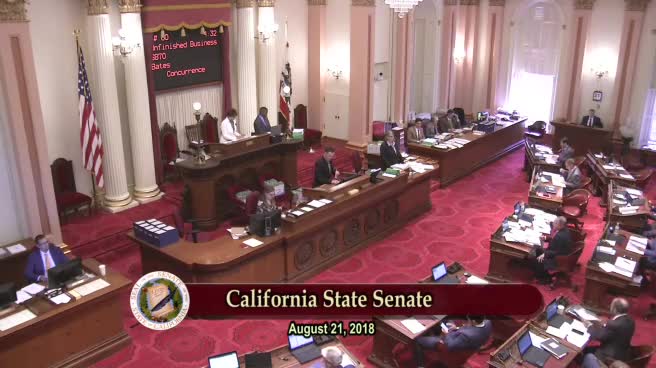 1MIN
Senate Floor
 1MIN
Assembly Floor
 3MIN
Assembly Standing Committee on Appropriations
 7MIN
Assembly Standing Committee on Natural Resources
Bill Author