SB 1127: Pupil health: administration of medicinal cannabis: schoolsites.
- Session Year: 2017-2018
- House: Senate
- Latest Version Date: 2018-08-31
Existing law authorizes a school nurse or other designated school personnel to assist any pupil who is required to take, during the regular schoolday, medication prescribed for him or her by a physician and surgeon or ordered for him or her by a physician assistant, if the school district receives specified written statements from the physician and surgeon or physician assistant and from the parent, foster parent, or guardian of the pupil.
Existing law, the Compassionate Use Act of 1996, provides that a patient or a patients primary caregiver who possesses or cultivates marijuana for personal medical purposes of the patient upon the written or oral recommendation or approval of a physician is not subject to conviction for offenses relating to possession and cultivation of marijuana. Existing law also requires the State Department of Public Health to establish a voluntary program for the issuance of identification cards to qualified patients who are entitled to the protections of the act.
This bill would enact Jojos Act, which would authorize the governing board of a school district, a county board of education, or the governing body of a charter school maintaining kindergarten or any of grades 1 to 12, inclusive, to adopt, at a regularly scheduled meeting of the governing board or body, a policy, as provided, that allows a parent or guardian of a pupil to possess and administer to the pupil who is a qualified patient entitled to the protections of the Compassionate Use Act of 1996 medicinal cannabis, excluding in a smokeable or vapeable form, at a schoolsite. The bill would authorize the policy to be rescinded for any reason, as provided. The bill would provide that pupil records collected for the purpose of administration of medicinal cannabis are confidential, shall be used only for the purpose of administration of medicinal cannabis, shall not be open to the public for inspection, and shall not be disclosed for any reason, except as required by a state or federal court order.
Existing constitutional provisions require that a statute that limits the right of access to the meetings of public bodies or the writings of public officials and agencies be adopted with findings demonstrating the interest protected by the limitation and the need for protecting that interest.
This bill would make legislative findings to that effect.
Existing law authorizes a school nurse or other designated school personnel to assist any pupil who is required to take, during the regular schoolday, medication prescribed for him or her by a physician and surgeon or ordered for him or her by a physician assistant, if the school district receives specified written statements from the physician and surgeon or physician assistant and from the parent, foster parent, or guardian of the pupil.
Existing law, the Compassionate Use Act of 1996, provides that a patient or a patients primary caregiver who possesses or cultivates marijuana for personal medical purposes of the patient upon the written or oral recommendation or approval of a physician is not subject to conviction for offenses relating to possession and cultivation of marijuana. Existing law also requires the State Department of Public Health to establish a voluntary program for the issuance of identification cards to qualified patients who are entitled to the protections of the act.
This bill would enact Jojos Act, which would authorize the governing board of a school district, a county board of education, or the governing body of a charter school maintaining kindergarten or any of grades 1 to 12, inclusive, to adopt, at a regularly scheduled meeting of the governing board or body, a policy, as provided, that allows a parent or guardian of a pupil to possess and administer to the pupil who is a qualified patient entitled to the protections of the act Compassionate Use Act medicinal cannabis, excluding in a smokeable or vapeable form, at a schoolsite. The bill would authorize the policy to be rescinded for any reason, as provided.
Existing law authorizes a school nurse or other designated school personnel to assist any pupil who is required to take, during the regular schoolday, medication prescribed for him or her by a physician and surgeon or ordered for him or her by a physician assistant, if the school district receives specified written statements from the physician and surgeon or physician assistant and from the parent, foster parent, or guardian of the pupil.
Existing law, the Compassionate Use Act of 1996, provides that a patient or a patients primary caregiver who possesses or cultivates marijuana for personal medical purposes of the patient upon the written or oral recommendation or approval of a physician is not subject to conviction for offenses relating to possession and cultivation of marijuana. Existing law also requires the State Department of Public Health to establish a voluntary program for the issuance of identification cards to qualified patients who are entitled to the protections of the act.
This bill would authorize the governing board of a school district, a county board of education, or the governing body of a charter school maintaining kindergarten or any of grades 1 to 12, inclusive, to adopt, at a regularly scheduled meeting of the governing board or body, a policy policy, as provided, that allows a parent or guardian of a pupil to possess and administer to a the pupil who is a qualified patient entitled to the protections of the act medicinal cannabis, excluding in a smokeable or vapeable form, at a schoolsite. The bill would authorize the policy to be rescinded for any reason, as provided.
Existing law authorizes a school nurse or other designated school personnel to assist any pupil who is required to take, during the regular schoolday, medication prescribed for him or her by a physician and surgeon or ordered for him or her by a physician assistant, if the school district receives specified written statements from the physician and surgeon or physician assistant and from the parent, foster parent, or guardian of the pupil.
Existing law, the Compassionate Use Act of 1996, provides that a patient or a patients primary caregiver who possesses or cultivates marijuana for personal medical purposes of the patient upon the written or oral recommendation or approval of a physician is not subject to conviction for offenses relating to possession and cultivation of marijuana. Existing law also requires the State Department of Public Health to establish a voluntary program for the issuance of identification cards to qualified patients who are entitled to the protections of the act.
This bill would authorize the governing board of a school district, a county board of education, or the governing body of a charter school maintaining kindergarten or any of grades 1 to 12, inclusive, to adopt, at a regularly scheduled meeting of the governing board or body, a policy that allows a parent or guardian to possess and administer to a pupil who is a qualified patient entitled to the protections of the act medicinal cannabis, excluding in a smokeable or vapeable form, at a schoolsite. The bill would authorize the policy to be rescinded for any reason, as provided.
This act shall be known, and may be cited, as Jojos Act.
SEC. 2.Section 49414.1 is added to the Education Code, to read:49414.1.(a)Notwithstanding Sections 11357 and 11361 of the Health and Safety Code, the governing board of a school district, a county board of education, or the governing body of a charter school maintaining kindergarten or any of grades 1 to 12, inclusive, may adopt, at a regularly scheduled meeting of the governing board or body, a policy that allows a parent or guardian of a pupil to possess and administer to the pupil who is a qualified patient pursuant to Article 2.5 (commencing with Section 11362.7) of Chapter 6 of Division 10 of the Health and Safety Code medicinal cannabis at a schoolsite.
(b)The policy shall include, at a minimum, all of the following elements:
(1)The parent or guardian shall not administer the medicinal cannabis in a manner that creates a disruption to the educational environment or causes exposure to other pupils.
(2)After the parent or guardian administers the medicinal cannabis, the parent or guardian shall remove any remaining medicinal cannabis from the schoolsite.
(3)The parent or guardian shall sign in at the schoolsite before administering the medicinal cannabis.
(4)Before administering the medicinal cannabis, the parent or guardian shall provide to an employee of the school a valid written medical recommendation for medicinal cannabis for the pupil to be kept on file at the school.
(c)(1)Pupil records collected in accordance with a policy adopted pursuant to subdivision (a) for the administration of medicinal cannabis to a pupil are confidential and shall be used only for the purpose of administration of medicinal cannabis to the pupil. These pupil records shall not be open to the public for inspection and shall not be disclosed for any reason, except as required by a state or federal court order.
(2)The right to access particular pupil records for legitimate education interests pursuant to Sections 49076 and 49076.5 shall not apply to pupil records collected for the purpose of administration of medicinal cannabis. Pupil records collected for the administration of medicinal cannabis shall be removed from the pupils records before any of the pupils records are released for any reason under existing law.
(d)The governing board of a school district, a county board of education, or the governing body of a charter school that adopts a policy pursuant to subdivision (a) may rescind the policy at a regularly scheduled meeting of the governing board or body for any reason, including, but not limited to, if the school district, county office of education, or charter school is at risk of, or has lost, federal funding as a result of the policy.
(e)Nothing in this section requires the staff of a school district, county office of education, or charter school to administer medicinal cannabis.
(f)For purposes of this section, medicinal cannabis excludes medicinal cannabis in a smokeable or vapeable form.
SEC. 3.The Legislature finds and declares that Section 2 of this act, which adds Section 49414.1 to the Education Code, imposes a limitation on the publics right of access to the meetings of public bodies or the writings of public officials and agencies within the meaning of Section 3 of Article I of the California Constitution. Pursuant to that constitutional provision, the Legislature makes the following findings to demonstrate the interest protected by this limitation and the need for protecting that interest:
In order to protect the privacy of pupils, and parents and guardians of pupils, who are administered medicinal cannabis, it is necessary that pupil records collected for the purpose of administration of medicinal cannabis be confidential.
This act shall be known, and may be cited, as Jojos Act.
SEC. 2.Section 49414.1 is added to the Education Code, to read:49414.1.(a)Notwithstanding Sections 11357 and 11361 of the Health and Safety Code, the governing board of a school district, a county board of education, or the governing body of a charter school maintaining kindergarten or any of grades 1 to 12, inclusive, may adopt, at a regularly scheduled meeting of the governing board or body, a policy that allows a parent or guardian of a pupil to possess and administer to the pupil who is a qualified patient pursuant to Article 2.5 (commencing with Section 11362.7) of Chapter 6 of Division 10 of the Health and Safety Code medicinal cannabis at a schoolsite.
(b)The policy shall include, at a minimum, all of the following elements:
(1)The parent or guardian shall not administer the medicinal cannabis in a manner that creates a disruption to the educational environment or causes exposure to other pupils.
(2)After the parent or guardian administers the medicinal cannabis, the parent or guardian shall remove any remaining medicinal cannabis from the schoolsite.
(3)The parent or guardian shall sign in at the schoolsite before administering the medicinal cannabis.
(4)Before administering the medicinal cannabis, the parent or guardian shall provide to an employee of the school a valid written medical recommendation for medicinal cannabis for the pupil to be kept on file at the school.
(c)(1)Pupil records collected in accordance with a policy adopted pursuant to subdivision (a) for the administration of medicinal cannabis to a pupil are confidential and shall be used only for the purpose of administration of medicinal cannabis to the pupil. These pupil records shall not be open to the public for inspection and shall not be disclosed for any reason, except as required by a state or federal court order.
(2)The right to access particular pupil records for legitimate education interests pursuant to Sections 49076 and 49076.5 shall not apply to pupil records collected for the purpose of administration of medicinal cannabis. Pupil records collected for the administration of medicinal cannabis shall be removed from the pupils records before any of the pupils records are released for any reason under existing law.
(c)(d)The governing board of a school district, a county board of education, or the governing body of a charter school that adopts a policy pursuant to subdivision (a) may rescind the policy at a regularly scheduled meeting of the governing board or body for any reason, including, but not limited to, if the school district, county office of education, or charter school is at risk of, or has lost, federal funding as a result of the policy.
(d)(e)Nothing in this section requires the staff of a school district, county office of education, or charter school to administer medicinal cannabis.
(e)(f)For purposes of this section, medicinal cannabis excludes medicinal cannabis in a smokeable or vapeable form.
SEC. 3.The Legislature finds and declares that Section 2 of this act, which adds Section 49414.1 to the Education Code, imposes a limitation on the publics right of access to the meetings of public bodies or the writings of public officials and agencies within the meaning of Section 3 of Article I of the California Constitution. Pursuant to that constitutional provision, the Legislature makes the following findings to demonstrate the interest protected by this limitation and the need for protecting that interest:
In order to protect the privacy of pupils, and parents and guardians of pupils, who are administered medicinal cannabis, it is necessary that pupil records collected for the purpose of administration of medicinal cannabis be confidential.
REVISIONS: HeadingLine 2.This act shall be known, and may be cited, as Jojos Act.
SECTION 1.SEC. 2.Section 49414.1 is added to the Education Code, to read:49414.1.(a)Notwithstanding Sections 11357 and 11361 of the Health and Safety Code, the governing board of a school district, a county board of education, or the governing body of a charter school maintaining kindergarten or any of grades 1 to 12, inclusive, may adopt, at a regularly scheduled meeting of the governing board or body, a policy that allows a parent or guardian of a pupil to possess and administer to the pupil who is a qualified patient pursuant to Article 2.5 (commencing with Section 11362.7) of Chapter 6 of Division 10 of the Health and Safety Code medicinal cannabis at a schoolsite.
(b)The policy shall include, at a minimum, all of the following elements:
(1)The parent or guardian shall not administer the medicinal cannabis in a manner that creates a disruption to the educational environment or causes exposure to other pupils.
(2)After the parent or guardian administers the medicinal cannabis, the parent or guardian shall remove any remaining medicinal cannabis from the schoolsite.
(3)The parent or guardian shall sign in at the schoolsite before administering the medicinal cannabis.
(4)Before administering the medicinal cannabis, the parent or guardian shall provide to an employee of the school a valid written medical recommendation for medicinal cannabis for the pupil to be kept on file at the school.
(c)The governing board of a school district, a county board of education, or the governing body of a charter school that adopts a policy pursuant to subdivision (a) may rescind the policy at a regularly scheduled meeting of the governing board or body for any reason, including, but not limited to, if the school district, county office of education, or charter school is at risk of, or has lost, federal funding as a result of the policy.
(d)Nothing in this section requires the staff of a school district, county office of education, or charter school to administer medicinal cannabis.
(e)For purposes of this section, medicinal cannabis excludes medicinal cannabis in a smokeable or vapeable form.
CORRECTIONS: HeadingLast amended date.(a)Notwithstanding Sections 11357 and 11361 of the Health and Safety Code, the governing board of a school district, a county board of education, or the governing body of a charter school maintaining kindergarten or any of grades 1 to 12, inclusive, may adopt, at a regularly scheduled meeting of the governing board or body, a policy that allows a parent or guardian of a pupil to possess and administer to a the pupil who is a qualified patient pursuant to Article 2.5 (commencing with Section 11362.7) of Chapter 6 of Division 10 of the Health and Safety Code medicinal cannabis at a schoolsite.
(b)The policy shall include, at a minimum, both all of the following elements:
(1)The parent or guardian shall not administer the medicinal cannabis in a manner that creates a disruption to the educational environment or causes exposure to other pupils.
(2)After the parent or guardian administers the medicinal cannabis, the parent or guardian shall remove any remaining medicinal cannabis from the schoolsite.
(3)The parent or guardian shall sign in at the schoolsite before administering the medicinal cannabis.
(4)Before administering the medicinal cannabis, the parent or guardian shall provide to an employee of the school a valid written medical recommendation for medicinal cannabis for the pupil to be kept on file at the school.
(c)The governing board of a school district, a county board of education, or the governing body of a charter school that adopts a policy pursuant to subdivision (a) may rescind the policy at a regularly scheduled meeting of the governing board or body for any reason, including, but not limited to, if the school district, county office of education, or charter school is at risk of, or has lost, federal funding as a result of the policy.
(d)Nothing in this section requires the staff of a school district, county office of education, or charter school to administer medicinal cannabis.
(e)For purposes of this section, medicinal cannabis excludes medicinal cannabis in a smokeable or vapeable form.
(a)Notwithstanding Sections 11357 and 11361 of the Health and Safety Code, the governing board of a school district, a county board of education, or the governing body of a charter school maintaining kindergarten or any of grades 1 to 12, inclusive, may adopt, at a regularly scheduled meeting of the governing board or body, a policy that allows a parent or guardian to possess and administer to a pupil who is a qualified patient pursuant to Article 2.5 (commencing with Section 11362.7) of Chapter 6 of Division 10 of the Health and Safety Code medicinal cannabis at a schoolsite.
(b)The policy shall include, at a minimum, both of the following elements:
(1)The parent or guardian shall not administer the medicinal cannabis in a manner that creates a disruption to the educational environment or causes exposure to other pupils.
(2)After the parent or guardian administers the medicinal cannabis, the parent or guardian shall remove any remaining medicinal cannabis from the schoolsite.
(c)The governing board of a school district, a county board of education, or the governing body of a charter school that adopts a policy pursuant to subdivision (a) may rescind the policy at a regularly scheduled meeting of the governing board or body for any reason, including, but not limited to, if the school district, county office of education, or charter school is at risk of, or has lost, federal funding as a result of the policy.
(d)Nothing in this section requires the staff of a school district, county office of education, or charter school to administer medicinal cannabis.
(e)For purposes of this section, medicinal cannabis excludes medicinal cannabis in a smokeable or vapeable form.
|
Date
|
Status
|
|---|---|
| Sep 28, 2018 | In Senate. Consideration of Governor's veto pending. |
| Sep 28, 2018 | Vetoed by the Governor. |
| Sep 5, 2018 | Enrolled and presented to the Governor at 3:30 p.m. |
| Aug 28, 2018 | In Senate. Ordered to engrossing and enrolling. |
| Aug 27, 2018 | Reconsideration granted. |
| Aug 23, 2018 | Read third time. Refused passage. |
| Jul 5, 2018 | Read second time. Ordered to third reading. |
| Jul 3, 2018 | Coauthors revised |
| Jun 14, 2018 | From committee: Do pass and re-refer to Com. on JUD. (Ayes 4. Noes 1.) (June 13). Re-referred to Com. on JUD. |
| Jun 7, 2018 | Referred to Coms. on ED. and JUD. |
| May 21, 2018 | In Assembly. Read first time. Held at Desk. |
| May 21, 2018 | Read third time. Passed. (Ayes 32. Noes 7.) Ordered to the Assembly. |
| May 15, 2018 | Read second time and amended. Ordered to third reading. |
| May 14, 2018 | From committee: Do pass as amended. (Ayes 6. Noes 1.) (May 8). |
| Apr 30, 2018 | From committee with author's amendments. Read second time and amended. Re-referred to Com. on JUD. |
| Apr 27, 2018 | Set for hearing May 8. |
| Apr 11, 2018 | Read second time and amended. Re-referred to Com. on JUD. |
| Apr 10, 2018 | From committee: Do pass as amended and re-refer to Com. on JUD. (Ayes 5. Noes 1.) (April 4). |
| Mar 6, 2018 | Set for hearing April 4. |
| Mar 5, 2018 | Set for hearing March 21. |
| Mar 5, 2018 | March 21 hearing postponed by committee. |
| Feb 22, 2018 | Referred to Coms. on ED. and JUD. |
| Feb 14, 2018 | From printer. May be acted upon on or after March 16. |
| Feb 13, 2018 | Introduced. Read first time. To Com. on RLS. for assignment. To print. |
|
Date
|
Description
|
Location
|
Votes
|
|
|---|---|---|---|---|
| Aug 27, 2018 | SB 1127 Hill Senate Third Reading By MULLIN | Assembly Floor |
Passed |
|
| Aug 23, 2018 | SB 1127 Hill Senate Third Reading By MULLIN | Assembly Floor |
Passed |
|
| Jul 3, 2018 | Do pass. | Assembly Standing Committee on Judiciary |
Passed |
|
| Jun 13, 2018 | Do pass and be re-referred to the Committee on [Judiciary] | Assembly Standing Committee on Education |
Passed |
|
| May 21, 2018 | Senate 3rd Reading SB1127 Hill et al. | Senate Floor |
Passed |
|
| May 8, 2018 | Do pass as amended | Senate Standing Committee on Judiciary |
Passed |
|
| Apr 4, 2018 | Do pass as amended, but first amend, and re-refer to the Committee on [Judiciary] | Senate Standing Committee on Education |
Passed |
This list shows positions taken on this bill by organizations on the date displayed, which is linked to the original source.
Positions by individuals are not included.
|
Organization
|
Position
|
Date
|
|---|---|---|
| A Therapeutic Alternative | * Support | Apr 4, 2018 |
| Association Of California School Administrators | ** Against | Jun 29, 2018 |
| California Cannabis Industry Association | ** Support | Oct 11, 2018 |
| California Police Chiefs Association | ** Against | Jun 29, 2018 |
| California School Boards Association | ** Support | Oct 11, 2018 |
| California School Employees Association | * Support | May 8, 2018 |
| Caliva | ** Support | Oct 11, 2018 |
| Cannakids | ** Support | Oct 11, 2018 |
| Herself | * Support | May 8, 2018 |
| Herself | * Support | May 8, 2018 |
| Letters From Multiple Individuals | ** Support | May 16, 2018 |
| Letters From Numerous Individuals | ** Support | Oct 11, 2018 |
| Numerous individuals | ** Support | Jun 11, 2018 |
| Rincon Valley Union School District | ** Support | Oct 11, 2018 |
| San Francisco Unified School District | ** Support | Oct 11, 2018 |
| San Mateo County Office Of Education | ** Support | Oct 11, 2018 |
| Santa Clara County Office Of Education | ** Support | Jun 29, 2018 |
| School Employers Association Of California | ** Support | Jun 29, 2018 |
| self | * Support | Apr 4, 2018 |
| southern california coalition | ** Support | Jun 29, 2018 |
| United Cannabis Business Association | ** Support | Jun 29, 2018 |
Office of Senate Floor Analyses (916) 651-1520 Fax: (916) 327-4478 | SB 1127 |
VETO
Bill No: SB 1127
Amended: 5/15/18
SENATE EDUCATION COMMITTEE: 5-1, 4/4/18
AYES: Allen, Wilk, Galgiani, Leyva, Pan
NOES: Vidak
SENATE JUDICIARY COMMITTEE: 6-1, 5/8/18
AYES: Jackson, Moorlach, Hertzberg, Monning, Stern, Wieckowski
NOES: Anderson
SENATE FLOOR: 32-7, 5/21/18
AYES: Allen, Atkins, Beall, Berryhill, Bradford, Cannella, De León, Dodd, Gaines, Galgiani, Glazer, Hernandez, Hertzberg, Hill, Hueso, Jackson, Lara, Leyva, McGuire, Mitchell, Monning, Moorlach, Newman, Pan, Portantino, Roth, Skinner, Stern, Stone, Wieckowski, Wiener, Wilk
NOES: Anderson, Bates, Fuller, Morrell, Nguyen, Nielsen, Vidak
ASSEMBLY FLOOR: 42-29, 8/27/18 - See last page for vote
SUBJECT: Pupil health: administration of medicinal cannabis: schoolsites
DIGEST:
This bill, known as Jojo’s Act, authorizes the governing board of a school district, a county board of education, or the governing body of a charter school maintaining kindergarten or any of grades 1 to 12, inclusive, to adopt a policy that allows a parent or guardian of a pupil to possess and administer non-smokeable and non-vapeable medicinal cannabis to the authorized pupil at a schoolsite.
Existing federal law:
- Classifies “marihuana” as a Schedule I drug. Under federal law, all Schedule I drugs have the following properties:
- “The drug or other substance has a high potential for abuse;”
- “The drug or other substance has no currently accepted medical use in treatment in the United States;” and
- “There is a lack of accepted safety for use of the drug or other substance under medical supervision.” (Title 21, United States Code, § 812(b)(1))
- Defines “marihuana” as “all parts of the plant Cannabis sativa L., whether growing or not; the seeds thereof; the resin extracted from any part of such plant; and every compound, manufacture, salt, derivative, mixture, or preparation of such plant, its seeds or resin. Such term does not include the mature stalks of such plant, fiber produced from such stalks, oil or cake made from the seeds of such plant, any other compound, manufacture, salt, derivative, mixture, or preparation of such mature stalks (except the resin extracted therefrom), fiber, oil, or cake, or the sterilized seed of such plant which is incapable of germination.” (21 USC § 802(16))
- Requires recipients of federal grants to comply with the Drug-Free Workplace Act, which requires institutions receiving any federal grant to prohibit the manufacture, use and distribution of controlled substances in the workplace. Failure to comply with the Drug-Free Workplace Act is grounds for suspension or termination of the federal grant (21 USC §§ 8103))
Existing state law:
- Provides, through Proposition 215 of 1996, the Compassionate Use Act, that individuals have the right to obtain and use marijuana for medical purposes where medical use has been deemed appropriate and recommended by a physician because the person’s health would benefit from the use of marijuana in treatment of cancer, anorexia, AIDS, chronic pain, spasticity, glaucoma, arthritis, migraine, or any other illness for which marijuana provides relief. (Health & Safety Code § 11362.5(b)(1)(A))
- Removes the criminal penalties for cultivation and possession of marijuana by qualified patients, who are persons with a physician’s written or oral recommendation or approval to use marijuana for medical use, or by their primary caregivers, and protects physicians from punishment for recommending marijuana to a patient for medical purposes. (HSC § 11362.5(d) and (e))
- Specifies that participation in the Medical Marijuana Program shall not authorize a qualified patient to engage in the smoking of medical marijuana under any of the following circumstances:
- In any place where smoking is prohibited by law;
- In or within 1,000 feet of the grounds of a school, recreation center, or youth center, unless the medical use occurs within a residence;
- On a school bus;
- While in a motor vehicle that is being operated; or
- While operating a boat. (HSC § 11362.79.)
- Specifies that, except as authorized by law, a person 18 years of age or older who possesses not more than 28.5 grams of cannabis, or not more than eight grams of concentrated cannabis, upon the grounds of, or within, any school providing instruction in kindergarten or any of grades 1 to 12, inclusive, during hours the school is open for classes or school-related programs is guilty of a misdemeanor and shall be punished as follows:
- A fine of not more than two hundred fifty dollars ($250), upon a finding that a first offense has been committed.
- A fine of not more than five hundred dollars ($500), or by imprisonment in a county jail for a period of not more than 10 days, or both, upon a finding that a second or subsequent offense has been committed. (HSC § 11357(c))
- Specifies that person 18 years of age or over who:
- Hires, employs, or uses a minor in unlawfully transporting, carrying, selling, giving away, preparing for sale, or peddling any cannabis, who unlawfully sells, or offers to sell, any cannabis to a minor, or who furnishes, administers, or gives, or offers to furnish, administer, or give any cannabis to a minor under 14 years of age, or who induces a minor to use cannabis in violation of law shall be punished by imprisonment in the state prison for a period of three, five, or seven years.
- Furnishes, administers, or gives, or offers to furnish, administer, or give, any cannabis to a minor 14 years of age or older in violation of law shall be punished by imprisonment in the state prison for a period of three, four, or five years.
This bill, known as Jojo’s Act, authorizes the governing board of a school district, a county board of education, or the governing body of a charter school maintaining kindergarten or any of grades 1 to 12, inclusive, to adopt a policy that allows a parent or guardian of a pupil to possess and administer non-smokeable and non-vapeable medicinal cannabis to the authorized pupil at a schoolsite. Specifically, this bill:
- Authorizes, notwithstanding state law identified in (4) and (5) above, the governing board of a school district, a county board of education, or the governing body of a charter school maintaining kindergarten or any of grades 1 to 12, inclusive, to adopt, at a regularly scheduled meeting of the governing board or body, a policy that allows a parent or guardian of a pupil to possess and administer to the pupil who is a qualified patient pursuant to Medicinal Marijuana Program.
- Requires the adopted policy to include at least all of the following elements:
- A prohibition against a parent or guardian from administering the medicinal cannabis in a manner that creates a disruption to the educational environment or causes exposure to other pupils.
- A requirement for the parent or guardian to remove any remaining cannabis from the schoolsite after the parent or guardian administers the medicinal cannabis.
- A requirement for the parent or guardian sign in at the schoolsite before administering the medicinal cannabis.
- A requirement that before administering the medicinal cannabis, the parent or guardian must provide to an employee of the school a valid written medical recommendation for medicinal cannabis for the pupil to be kept on file at the school.
- Provides the following with regards to the pupil records collected in accordance with the adopted policy for the administration of medicinal cannabis to a pupil:
- Specifies that the records are confidential.
- Requires the records be used only for the purpose of administration of medicinal cannabis to the pupil.
- Prohibits the records from being open to the public for inspection or disclosed for any reason, except as required by a state or federal court order.
- States Legislative findings and declarations that the provisions in (a) to (c) impose a limitation on the public’s right of access to the meetings of public bodies or the writings of public officials and agencies within the meaning of Section 3 of Article I of the California Constitution, and that pursuant to that constitutional provision, that the Legislature finds, to demonstrate the interest protected by this limitation and the need for protecting that interest, that in order to protect the privacy of pupils, and parents and guardians of pupils, who are administered medicinal cannabis, it is necessary that pupil records collected for the purpose of administration of medicinal cannabis be confidential.
- Authorizes the governing board of a school district, a county board of education, or the governing body of a charter school to rescind the policy at a regularly scheduled meeting of the governing board or body for any reason, including, but not limited to, if the school district, county office of education, or charter school is at risk of, or has lost, federal funding as a result of the policy.
- Specifies that none of the bill’s provisions require the staff of a school district, county office of education, or charter school to administer medicinal cannabis.
- Excludes specifically, for purposes of the bill, medicinal cannabis in a smokeable or vapeable form.
Comments
- Need for the bill? Accord to the author, “Some students need medical cannabis to be able to attend school and have normal childhood experiences. Currently, these students must be picked up by their parents and taken off campus in order to take their medicine. This is disruptive to their learning. Every child is entitled to an uninterrupted education. The Compassionate Use Act of 1996 (Proposition 215) allows minors to use medical cannabis with the consent of their parents and a recommendation from a doctor… Many of these minors need to take a dose of medical cannabis at regular intervals, which often includes during school hours. Current law does not allow any form of cannabis on school grounds. Existing law allows schools to legally administer any pharmaceutical drug, including opioids, that a child has been prescribed. But there are medical conditions pharmaceuticals can’t fix, and they often have debilitating side effects. Medical cannabis helps fill some of these gaps, and lessen these challenging side effects.”
- Potential for medical benefits from medicinal cannabis. The federal government classifies cannabis as a Schedule I drug, which indicates that the federal government does not recognize any currently accepted medical use in treatment in the United States. However, at least one study indicates medicinal cannabis may be particularly effective in treating Lennox-Gastaut syndrome, a rare, severe form of epileptic encephalopathy. A randomized, double-blind, placebo-controlled trial published in The Lancet found that “add-on cannabidiol is efficacious for the treatment of patients with drop seizures associated with Lennox-Gastaut syndrome and is generally well tolerated.” Moreover, the federal Food and Drug Administration (FDA) has accepted, with priority review, a new drug application (NDA) for Epidiolex® (cannabidiol or CBD), an investigational treatment for seizures associated with Lennox-Gastaut syndrome and Dravet syndrome, two rare and difficult to treat conditions of childhood-onset epilepsy. The goal date for completion of the FDA review of the Epidiolex NDA is June 27, 2018. Importantly, Epidiolex® was the drug used in the trial published in The Lancet.
- Other states have recently approved similar measures. In 1996, California became the first state to approve medical marijuana. According to the National Conference of State Legislators, since then, an additional 28 states, the District of Colombia, Guam, and Puerto Rico have followed suit and now allow for comprehensive public medical marijuana programs. An additional 17 states allow the use of “low THC, high cannabidiol (CBD)” for medical reasons or as a legal defense.
More recently, five of the 29 states with comprehensive medical marijuana programs: Washington, Colorado, Florida, Maine, and New Jersey have enacted laws authorizing students to use medical cannabis on school campuses. According to the Education Commission of the States, “While it is too soon to identify specific trends in policies, both New Jersey and Colorado require that:
a) Students using medicinal marijuana products have a valid medical recommendation.
b) Only non-smokable marijuana products may be administered on school grounds.
c) Only parents, legal guardians or primary caregivers administer the substance.
d) Students cannot be punished for marijuana use on school grounds.”
Maine’s differs from those states because policymakers worked from the state’s existing medical marijuana framework and simply expanded the locations in which medical marijuana use is permissible. Alternatively, Washington has taken a slightly different path and instead specifies that schools are not required to permit on-site use of medical marijuana, but are permitted to allow it if they choose. Conversely, Florida requires each district school board is required to adopt a policy and procedure.
Here, this bill strikes an appropriate balance between these different approaches, mimicking Washington’s opt-in approach but prescribing some uniform conditions like Colorado and New Jersey, such as only authorizing non-smokeable, non-vapeable products and only authorizing parents and legal guardians.
4) Federal funding risk? California receives federal funding for schools primarily in two ways: Title I funding for high poverty schools and funding for school meals, such as the National School Lunch Program (NSLP) and School Breakfast Program (SBP). Federal grants are subject to federal regulations implementing drug-free workplace requirements. Noncompliance with those requirements could result in the loss of federal funding, as grantees and sub-grantees must make a “good faith effort” to maintain a drug-free workplace as a condition of the grant award. A drug-free workplace includes any location where the performance of work is done in connection with a specific award, which could include school buildings in Title I schools and schools that participate in federal programs such as NSLP or SBP. Importantly, federal agencies have discretion in determining whether a grantee or sub-grantee is in violation of the drug-free workplace requirements, and have a range of options to compel compliance. When the Colorado Legislative Council Staff analyzed this issue for their state, it assumed “that withholding federal funds is the last and most extreme action the federal government can take, and that any conflict between state laws and federal rules can be addressed without forfeit of federal grants and other distributions.” Moreover, this bill specifically allows for any local educational agency that has adopted a policy to allow parents or guardians to administer appropriate medicinal cannabis to rescind that policy for any reason, including the risk of losing funding.
Related/Prior Legislation
SB 1266 (Huff, Chapter 321, Statutes of 2014) required school districts, county offices of education, and charter schools to provide emergency epinephrine auto-injectors to school nurses or trained personnel who have volunteered, as specified, and authorized school nurses or trained personnel to use the epinephrine auto-injectors to provide emergency medical aid to persons suffering, or reasonably believed to be suffering, from an anaphylactic reaction.
FISCAL EFFECT: Appropriation: No Fiscal Com.: No Local: No
California Cannabis Industry Association
California Chapter of the National Organization for the Reform of Marijuana Laws
California School Boards Association
CannaKids
CMG/Caliva
Rincon Valley Union School District
San Francisco Unified School District
San Mateo County Office of Education
Letters from numerous individuals
OPPOSITION: (Verified 10/3/18)
None received
GOVERNOR'S VETO MESSAGE:
I am returning Senate Bill 1127 without my signature.
This bill permits local schools to adopt policies regarding the use of medical marijuana by students on school grounds.
This bill is overly broad as it applies to all students instead of limited cases where a doctor recommends medical marijuana for a student in order to prevent or reduce the effects of a seizure. Generally, I remain concerned about the exposure of marijuana on youth and am dubious of its use for youth for all ailments. This bill goes too far -- further than some research has -- to allow use of medical marijuana for youth. I think we should pause before going much further down this path.
ASSEMBLY FLOOR: 42-29, 8/27/18
AYES: Acosta, Aguiar-Curry, Berman, Bloom, Bonta, Burke, Caballero, Carrillo, Chau, Chávez, Chiu, Chu, Cooley, Friedman, Gabriel, Cristina Garcia, Eduardo Garcia, Gipson, Gloria, Holden, Jones-Sawyer, Kalra, Kamlager-Dove, Lackey, Levine, Limón, Low, McCarty, Mullin, Nazarian, O'Donnell, Quirk, Reyes, Rivas, Rubio, Santiago, Mark Stone, Thurmond, Ting, Weber, Wood, Rendon
NOES: Travis Allen, Baker, Bigelow, Brough, Cervantes, Choi, Cunningham, Dahle, Daly, Flora, Fong, Frazier, Gallagher, Gonzalez Fletcher, Gray, Grayson, Harper, Irwin, Kiley, Maienschein, Mathis, Mayes, Melendez, Obernolte, Patterson, Quirk-Silva, Salas, Voepel, Waldron
NO VOTE RECORDED: Arambula, Calderon, Chen, Cooper, Eggman, Medina, Muratsuchi, Rodriguez, Steinorth
Prepared by: Brandon Darnell / ED. /
10/11/18 15:03:08
**** END ****
SENATE THIRD READING
STR Bill Id:SB 1127
Author:(Hill)
As Amended Ver:May 15, 2018
Majority vote
SENATE VOTE: 32-7
Committee | Votes | Ayes | Noes |
Education | 4-1 | O'Donnell, McCarty, Thurmond, Weber | Kiley |
Judiciary | 7-3 | Mark Stone, Chau, Chiu, Holden, Kalra, Reyes, Gonzalez Fletcher | Cunningham, Kiley, Maienschein |
SUMMARY: Authorizes the governing board of a school district, a county board of education, or the governing body of a charter school to adopt a policy that allows a parent or guardian to administer non-smokeable and non-vapeable medicinal cannabis to an authorized pupil at a schoolsite under specified conditions. Specifically, this bill:
- Authorizes, notwithstanding state law, the governing board of a school district, a county board of education, or the governing body of a charter school maintaining kindergarten or any of grades one to 12, inclusive, to adopt, at a regularly scheduled meeting of the governing board or body, a policy that allows a parent or guardian to possess and administer medicinal cannabis to a pupil at a schoolsite, if the pupil is a qualified patient pursuant to the Medical Marijuana Program.
- Requires the adopted policy to include, but not be limited to, all of the following elements:
- Prohibits a parent or guardian from administering the medicinal cannabis in a manner that creates a disruption to the educational environment or causes exposure to other pupils.
- Requires the parent or guardian to remove any remaining cannabis from the schoolsite after the parent or guardian administers the medicinal cannabis to the pupil.
- Requires the parent or guardian to sign in at the schoolsite before administering the medicinal cannabis.
- Requires the parent or guardian to provide, to an employee of the school, a valid written medical recommendation for medicinal cannabis for the pupil, and requires that the school keep the recommendation on file at the school.
- Specifies that pupil records collected in accordance with a policy adopted pursuant to (1) above, are confidential and to be used only for the purpose of administration of medicinal cannabis to the pupil, and prohibits the disclosure of these pupil records for any reason, except as required by a state or federal court order.
- Specifies that the right to access particular pupil records for legitimate education interests does not apply to pupil records collected for the purpose of administration of medicinal cannabis, and that such records must be removed from the pupil's records before any of the pupil's records are released for any reason under existing law.
- Authorizes the governing board of a school district, a county board of education, or the governing body of a charter school to rescind the policy at a regularly scheduled meeting of the governing board or body for any reason, including, but not limited to, if the school district, county office of education, or charter school is at risk of, or has lost, federal funding as a result of the policy.
- Specifies that none of the bill's provisions require the staff of a school district, county office of education, or charter school to administer medicinal cannabis.
- Excludes medicinal cannabis in a smokeable or vapeable form from the provisions of this bill.
- Expresses findings and declarations that, in order to protect the privacy of pupils, and parents and guardians of pupils who are administered medicinal cannabis, it is necessary that pupil records collected for the purpose of administration of medicinal cannabis be confidential.
FISCAL EFFECT: This bill has been keyed non-fiscal by the Legislative Counsel.
COMMENTS: Even though California has approved medical marijuana for adults and children, both state and federal law make it illegal for a parent to take marijuana onto school grounds to administer to their child, even if the child has a valid doctor's recommendation.
This bill seeks to make it easier for parents and guardians to administer medicinal cannabis to their school-age children. The bill does not give parents statewide the right to administer the medicine to a child at school; rather, the bill would only authorize, but not require, local schools to adopt a policy allowing the parent to administer medicinal cannabis under tightly prescribed restrictions: the marijuana could not be smoked or vaped or administered in a way that would disrupt the educational environment or cause exposure to other students; after administering the cannabis, the parent must remove any remaining cannabis from the school site; the parent must sign in at the school before administering the cannabis; and the parent must provide a valid written medical recommendation for the student that must be kept on file at the school. This bill would ensure the confidentiality of this information by restricting public access to these records, except as specified. Finally, the bill would allow a school that adopts a policy to rescind the policy, for any reason, at a regular public meeting.
Arguments in support. Supporters of the bill note that this bill takes a first step at recognizing, for children who suffer from severe seizure disorders such as Lennox-Gestaut, a daily regimen of cannabidiol (CBD), an oil form of cannabis containing only trace amounts of Tetrahydrocannabinol (THC), can significantly improve life quality and access to education. A CBD regimen requires evenly spaced doses, administered throughout the day, in order to control symptoms. Without the ability to administer CBD during the school day, the effects will wear off, resulting in the onset of seizures. Parents would be required to pick up their children from school and drive 1,000 feet away from the school to administer the dose, which is disruptive to the child's education.
Finally, supporters state that this bill would allow school districts, county offices of education, or charter schools to opt-in to allowing medicinal cannabis on campus and permits them to opt out at any time, including if federal funding is in jeopardy.
Arguments in opposition. The Association of California School Administrators expresses concern that this bill would allow a federally illegal substance to be administered on a school campus in violation of the drug free school zone requirements, which could expose the schools to liability. The California Police Chiefs Association notes that one of law enforcement's top priorities has been preventing youth access to cannabis products. They express concern that this bill will be taken advantage of and potentially expose other students to a plethora of marijuana products.
Analysis Prepared by: Debbie Look / ED. / (916) 319-2087 FN: 0003727
Date of Hearing: July 3, 2018
ASSEMBLY COMMITTEE ON JUDICIARY
Mark Stone, Chair
SBPCA Bill Id:SB 1127
Author:(Hill) – As Amended Ver:May 15, 2018
SENATE VOTE: 32-7
SUBJECT: Pupil health: administration of medicinal cannabis: schoolsites
KEY ISSUE: should local school districts be authorized to adopt a policy that allows parents to administer medicinal cannibis to their children at the school site, subject to certain limitations?
SYNOPSIS
SB 1127 will allow local school districts to adopt a policy allowing a parent or guardian (parent) to administer medical marijuana to their child while at school, so long as the marijuana is not smoked or "vaped" and so long as the child is eligible to use and possess medicinal marijuana under California's Compassionate Care Act of 1996. This Act, adopted by the voters, recognized that marijuana, or cannabis sativa, provided relief to adults and minors who suffered from certain diseases or conditions, including cancer, AIDS, chronic pain, glaucoma, and arthritis, among others. More recently, and especially germane to this bill, cannabis has proven effective in preventing epileptic seizures in children so long as it is taken regularly at least three times per day. This usually means that children must receive a dose while at school. Because school nurses, teachers, or other staff are not authorized to administer medical marijuana – and, indeed, because such medications are not allowed on school grounds under state or federal law – parents must come to the school, take the child out of school, administer the cannabis at least 1,000 feet from the school grounds, and then return the child to school. This can entail considerable disruption for the child, especially as is sometimes the case, when the child has a disability. Respectful of local autonomy, this bill would not give a parent the right to administer the medicine to a child; rather, the bill would only authorize, but not require, a school to adopt a policy allowing a parent to administer medicinal cannabis under tightly prescribed restrictions: the marijuana could not be smoked or vaped or administered in a way that would disrupt the educational environment or cause exposure to other students; after administering the cannabis, the parent must remove any remaining cannabis from the school site; the parent must sign in at the school before administering the cannabis; and the parent must provide a valid written medical recommendation for the student that must be kept on file at the school. The bill would ensure the confidentiality of this information by restricting public access to these records, except as specified. Finally, the bill would allow a school that adopts a policy to rescind the policy, for any reason, at a public meeting. The bill is supported by the California School Boards Association, several local school districts, and the cannabis industry. It is opposed by the Association of California School Administrators and the California Police Chiefs Association. The bill recently passed out of the Assembly Education Committee on a 4-1 vote, with two members not voting.
SUMMARY: Authorizes local education offices and local school district governing boards to adopt, at a scheduled meeting, a policy that would permit parents to administer medicinal cannabis to their children while at school. Specifically, this bill:
- Authorizes a county board of education or the governing board of a school district or charter school maintaining K-12 schools to adopt, at a regularly scheduled meeting of the governing board or body, a policy that allows a parent or guardian to possess and administer medicinal cannabis to a student at a school site, if the student is a qualified patient, as specified.
- Requires the adopted policy to do at least the following:
- Prohibit a parent or guardian from administering the medicinal cannabis in a manner that creates a disruption to the educational environment or causes exposure to other students.
- Require the parent or guardian to remove any remaining cannabis from the school site after the parent or guardian administers the medicinal cannabis to the student.
- Require the parent or guardian to sign in at the school site before administering the medicinal cannabis.
- Require the parent or guardian to provide, to an employee of the school, a valid written medical recommendation for medicinal cannabis for the student, and the school shall keep the recommendation on file at the school.
- Specify that student records collected in accordance with this bill are confidential and are used only for the purpose of administration of medicinal cannabis to the student and prohibits the disclosure of these records for any reason, except as required by a state or federal court order.
- Specify that the right of access to particular student records for legitimate educational interests do not apply to student records collected for the purpose of administration of medicinal cannabis, and that such records pertaining to medical cannabis must be removed before student records are released for any reason under existing law.
- Authorizes the governing board of a school district, a county board of education, or the governing body of a charter school to rescind the policy at a regularly scheduled meeting of the governing board or body for any reason, including, but not limited to, if the school district, county office of education, or charter school is at risk of, or has lost, federal funding as a result of the policy.
- Specifies that none of the bill’s provisions require the staff of a school district, county office of education, or charter school to administer medicinal cannabis.
- Excludes medicinal cannabis that is smoked or vaped from the provisions of this bill.
- Expresses findings and declarations that, in order to protect the privacy of students, parents, and guardians that it is necessary that records relating to the administration of medicinal cannabis be confidential.
EXISTING LAW:
- Provides, under federal law, that marijuana is a "Schedule 1" drug (with no safe use recognized by law), and thus a controlled substance subject to federal prohibitions. (21 U.S.C. Section 812.)
- Requires recipients of federal grants to comply with the Drug-Free Workplace Act, which requires institutions receiving any federal grant to prohibit the manufacture, use and distribution of controlled substances in the workplace. Failure to comply with the Drug-Free Workplace Act is grounds for suspension or termination of the federal grant. (21 U.S.C. Section 8103.)
- Permits individuals to obtain and use marijuana for medical purposes where medical use has been deemed appropriate and recommended by a physician for the treatment of cancer, anorexia, AIDS, chronic pain, spasticity, glaucoma, arthritis, migraine, or any other illness for which marijuana provides relief. (Health & Safety Code Section 11362.5.)
- Removes the criminal penalties for cultivation and possession of marijuana by qualified patients, who are persons with a physician’s written or oral recommendation or approval to use marijuana for medical use, or by their primary caregivers, and protects physicians from punishment for recommending marijuana to a patient for medical purposes. Specifies, however, that the qualified patients may not smoke marijuana in places where smoking is otherwise prohbited or use marijuana in certain contexts, including, for example, within 1,000 feet of school grounds or while operationg a vehicle. (Health & Safety Code Sections 11362.5 and 11362.79.)
- Specifies that, except as authorized by law, a person 18 years of age or older who possesses not more than 28.5 grams of cannabis, or not more than eight grams of concentrated cannabis, upon the grounds of, or within, any school providing instruction in kindergarten or any of grades 1 to 12, inclusive, during hours the school is open for classes or school-related programs is guilty of a misdemeanor. (Health & Safty Code Section 11357.)
FISCAL EFFECT: As currently in print this bill is keyed non-fiscal.
COMMENTS: This bill would authorize a county board of education, or the governing board of a local school district or charter school, to adopt a policy allowing parents or guardians to administer medical marijuana to their children while at school, so long as the marijuana is not smoked or "vaped" and so long as the child is eligible to use and possess medicinal marijuana as permitted by law. In adopting the Compassionate Care Act of 1996, California recognized that marijuana had important medicinal qualities that provided relief to persons suffering from certain diseases or conditions, including cancer, AIDS, chronic pain, glaucoma, and arthritis, among others. More recently, doctors and researchers have discovered that cannabis helps prevent epileptic seizures in children, as long as it is taken regularly at least three times per day. In practice, this means that children must receive a dose while at school. Because school nurses, teachers, or other staff are not authorized to administer this medication – and, indeed, because such medications are not allowed on school grounds under state or federal law – parents must come to the school, take the child out of school, move to at least 1,000 feet from the school grounds, administer the medicinal cannabis, and then return the child to school. This requires considerable disruption to the student's education, especially as is sometimes the case, when the child has a disability.
This bill seeks to make it easier for parents and guardians to administer medicinal cannabis to their school-age children. The bill does not give parents statewide the right to administer the medicine to a child at school; rather, the bill would only authorize, but not require, local schools to adopt a policy allowing the parent to administer medicinal cannabis under tightly prescribed restrictions: the marijuana could not be smoked or vaped or administered in a way that would disrupt the educational environment or cause exposure to other students; after administering the cannabis, the parent must remove any remaining cannabis from the school site; the parent must sign in at the school before administering the cannabis; and the parent must provide a valid written medical recommendation for the student that must be kept on file at the school. The bill would ensure the confidentiality of this information by restricting public access to these records, except as specified. Finally, the bill would allow a school that adopts a policy to rescind the policy, for any reason, at a regular public meeting.
According to the author, the reasons for allowing schools some flexibility in this regard is especially important now due to studies showing the effectiveness of cannabis in treating childhood disorders that do not respond to more conventional pharmaceuticals. According to background material provided by the author, studies of children with Lennox-Gastaut Syndrome, a type of epilepsy, show that medical cannabis has lessened epileptic seizures in children who had previously not responded well to other approved drugs, either because the drug did not stop the seizures or created unacceptable side effects. For example, a mother of a student in the author's district reported that her son went from having 50 seizures per day to having virtually none after starting a cannabis regimen. Prior to treatment with medical cannabis, the frequent seizures prevented her son from attending schools. Medical cannabis made it possible for her son to attend school and, indeed, he graduated last month. Clinical trials treating this form of epilepsy with cannabis suggest that this case is not unique. Indeed, as a result of these trials, earlier this year a committee of the U.S. Food and Drug Administration (FDA) recommended that the FDA approve a new cannabis-based drug, Epidiolex, for treatment of Lennox-Gastaut Syndrome and Dravet Syndrome in children. And only earlier this week, the FDA approved the drug. The drug does not contain THC, the chemical in marijuana that produces the psychological "high."
It is not entirely clear to the Committee how FDA-approval of cannabis-based drugs squares with federal laws that make cannabis an illegal controlled substance in all of its forms, even when used for medical purposes. According to the Washington Post, the federal government may still need to take another act: removing cannabis-based products from the Schedule 1 list of controlled substances. (See "The FDA just opened the door to transforming marijuana policy," Washington Post, June 27, 2018.) It may be that someday FDA-approved, cannabis-based drugs will be clearly removed from Schedule 1 status and become common enough and inexpensive enough to constitute an alternative to medical marijuana products obtained from a dispensary under the Compassionate Care Act. At any rate, the FDA-approved drug has only been approved for two types of epilepsy, and doctors in California recommend medicinal marijuana for other types of conditions for which there is still no FDA-approved drug that is effective. In short, recent FDA approval of these drugs does not in any way obviate the need for this bill.
Background on Marijuana Laws in California: In 1996, California voters adopted Proposition 215, the Compassionate Care Act, which effectively legalized the use of marijuana for medical purposes. Specifically, the measure declared that no physician who recommended marijuana to a patient for medical purposes would be punished by state law or subject to professional discipline. It also provided that no person who possessed a written recommendation for medical marijuana from a physician could be prosecuted under state law for the possession or cultivation of marijuana. Because marijuana remained a controlled substance under federal law, however, doctors could not legally "prescribe" medical marijuana; they could only make a "recommendation" that a patient use it for medical purposes. This bill would only apply where the minor student possessed a physician's recommendation as required under the Compassionate Care Act.
In addition to the Compassionate Care Act, in 2016 California voters approved Proposition 64. This measure legalized the possession of small amounts of marijuana for recreational use for adults 21 years of age or older. While Proposition 64 permits smoking marijuana in a private home or at a business licensed for on-site marijuana consumption, it remains unlawful under that law to smoke in a public place, and it is still unlawful to operate a vehicle under the influence of marijuana. Notwithstanding Proposition 64, possession of marijuana remains illegal under federal law. Especially significant for this bill, Proposition 64 did not legalize possession on the grounds of a school, day care center, or youth center while children are present. Thus, even though California has approved medical marijuana for adults and children, and legalized recreational use for adults, both state and federal law make it illegal for a parent to take marijuana onto school grounds, even if only to take it to a minor child who has a valid doctor's recommendation. This bill would address this seeming oddity in the law, while at the same time protecting other students from exposure to marijuana.
Bill Appropriately Anticipates Federal Funding Issue: As noted in the analysis of SB 1127 prepared by the Assembly Education Committee, which heard this bill two weeks ago, there has been some concern that allowing marijuana use – even as circumscribed by this bill – may jeopardize federal funds. The federal Drug-Free Workplace Act requires any institutions receiving federal funds or grants to prohibit the use or distribution of "controlled substances" in the workplace (which would include a school). Because marijuana is still a controlled substance under federal law, schools that expressly permit the use of marijuana on campus would violate federal law and thereby risk losing federal grants. Many California schools receive Title I funding for high poverty schools, as well as funding for school lunch and breakfast programs. The fear that permitting the administration of medical cannabis could jeopardize federal funding is not entirely unreasonable in light of an announcement by the U.S. Justice Department earlier this year promising more aggressive enforcement of federal laws criminalizing marijuana. Under President Obama, the Justice Department, while still insisting that marijuana remained a controlled substance under federal law, announced that the federal government would not interfere with states that had legalized medical or recreational use of marijuana, so long as certain precautions were in place, such as protecting minors and preventing transport across state lines. In January of this year, the U.S. Attorney General rescinded the Obama order and threatened more aggressive enforcement of federal law. (Sacramento Bee January 4, 2018.) Even if the federal government does not arrest medical or recreational users, it is possible that the federal government could withhold grants to schools that do not abide by federal law, most notably the Drug-Free Workplace Act. While an effort to withhold funds could possibly be challenged on Tenth Amendment or anti-commandeering grounds, the prospect that the current federal administration would attempt to use this power is by no means beyond the realm of possibility.
However, this bill anticipates and addresses the possibility that permitting marijuana use on school grounds could affect federal funding. As noted, this bill does not require schools to adopt a policy; it only authorizes them to do so. More important, subdivision (b) of proposed Education Code Section 49414.1 (page 3, lines 34-38 of the bill in print) expressly states that a school district that adopts such a policy may rescind it "for any reason, including, but not limited to, if the school district . . . is at risk of, or has lost, federal funding as a result of the policy."
Arguments in Support: The California School Boards Association (CSBA), and several local school districts, support this bill because, while existing law "allows schools to legally administer any pharmaceutical drug, including opioids . . . there are medical conditions that pharmaceuticals can't fix. . . Medical cannabis has been found to help fill some of these gaps . . . [and] parents across the nation have had success treating their children with medical cannabis when no pharmaceutical would work." Yet, existing law will not allow schools (or even parents) to administer medical cannabis on school grounds. SB 1127, CSBA concludes, will remedy this shortcoming in existing law while at the same time requiring adequate precautions to prevent abuse of the right, such as requiring that the child must be a qualified cannabis patient and that "a parent must not disrupt the educational environment and must take all cannabis from school grounds after administration." CSBA notes approvingly that nothing in the bill "requires the staff of a school district, county office of education, or charter school to administer medical cannabis." Administration of the medicine is left to the parent or guardian.
A number of individual school districts and county offices of education support this bill for the same reasons articulated by CSBA, and, significantly, they also note the disruptions caused by the limitations of existing law. For example, the San Mateo County Office of Education writes: "SB 1127 will reduce the amount of lost instruction time for students who need a CBD regimen, which requires evenly spaced doses, administered over the school day, to control their symptoms. Without the ability to administer CBD during the school day, the effects will wear off, resulting in seizures. Parents would be required to pick up their children from school and drive 1,000 feet away from school grounds to administer the next dose, which is disruptive to the child's education."
Arguments in Opposition: The Association of California School Administrators (ACSA) opposes this bill unless amended. ACSA apparently believes that allowing afederally illegal drug on a school campus could expose the schools to liability. ACSA, therefore, asks that the bill be amended to "remove all liability for the district and employees should an unanticipated incident associated with these drugs and their application occur on a school campus."
The California Police Chiefs Association (CPCA) opposes this bill because "one of law enforcement's top priorities has been preventing youth access to the cannabis products." CPCA writes that its members "are concerned that this bill will be taken advantage of and potentially expose students to other marijuana products."
REGISTERED SUPPORT / OPPOSITION:
Support
California Cannabis Industry Association
California Chapter of the National Organization for the Reform of Marijuana Laws
California School Boards Association
CannaKids
CMG/Caliva
Rincon Valley Union School District
San Francisco Unified School District
San Mateo County Office of Education
Santa Clara County Office of Education
School Employers Association of California
Southern California Coalition
United Cannabis Business Association
Opposition
Association of California School Administrators
California Police Chiefs Association
Analysis Prepared by: Thomas Clark / JUD. / (916) 319-2334
Date of Hearing: June 13, 2018
ASSEMBLY COMMITTEE ON EDUCATION
Patrick O'Donnell, Chair
SBPCA Bill Id:SB 1127
Author:(Hill) – As Amended Ver:May 15, 2018
[Note: This bill is doubled referred to the Assembly Judiciary Committee and will be heard by that Committee as it relates to issues under its jurisdiction.]
SENATE VOTE: 32-7
SUBJECT: Pupil health: administration of medicinal cannabis: schoolsites
SUMMARY: Authorizes the governing board of a school district, a county board of education, or the governing body of a charter school maintaining kindergarten or any of grades 1 to 12, inclusive, to adopt a policy that allows a parent or guardian to possess and administer non-smokeable and non-vapeable medicinal cannabis to an authorized pupil at a schoolsite. Specifically, this bill:
- Authorizes, notwithstanding state law, the governing board of a school district, a county board of education, or the governing body of a charter school maintaining kindergarten or any of grades 1 to 12, inclusive, to adopt, at a regularly scheduled meeting of the governing board or body, a policy that allows a parent or guardian to possess and administer medicinal cannabis to a pupil at a schoolsite, if the pupil is a qualified patient pursuant to the Medical Marijuana Program.
- Requires the adopted policy to include, but not be limited to, all of the following elements:
- Prohibits a parent or guardian from administering the medicinal cannabis in a manner that creates a disruption to the educational environment or causes exposure to other pupils.
- Requires the parent or guardian to remove any remaining cannabis from the schoolsite after the parent or guardian administers the medicinal cannabis to the pupil.
- Requires the parent or guardian to sign in at the schoolsite before administering the medicinal cannabis.
- Requires the parent or guardian to provide, to an employee of the school, a valid written medical recommendation for medicinal cannabis for the pupil, and requires that the school keep the recommendation on file at the school.
- Specifies that pupil records collected in accordance with a policy adopted pursuant to (1) above, are confidential and to be used only for the purpose of administration of medicinal cannabis to the pupil, and prohibits the disclosure of these pupil records for any reason, except as required by a state or federal court order.
- Specifies that the right to access particular pupil records for legitimate education interests do not apply to pupil records collected for the purpose of administration of medicinal cannabis, and that such records must be removed from the pupil’s records before any of the pupil’s records are released for any reason under existing law.
- Authorizes the governing board of a school district, a county board of education, or the governing body of a charter school to rescind the policy at a regularly scheduled meeting of the governing board or body for any reason, including, but not limited to, if the school district, county office of education, or charter school is at risk of, or has lost, federal funding as a result of the policy.
- Specifies that none of the bill’s provisions require the staff of a school district, county office of education, or charter school to administer medicinal cannabis.
- Excludes medicinal cannabis in a smokeable or vapeable form from the provisions of this bill.
- Expresses findings and declarations that, in order to protect the privacy of pupils, and parents and guardians of pupils who are administered medicinal cannabis, it is necessary that pupil records collected for the purpose of administration of medicinal cannabis be confidential.
EXISTING LAW:
Existing federal law:
- Classifies “marihuana” as a Schedule I drug. Under federal law, all Schedule I drugs have the following properties:
- The drug or other substance has a high potential for abuse.
- The drug or other substance has no currently accepted medical use in treatment in the United States.
- There is a lack of accepted safety for use of the drug or other substance under medical supervision. (Title 21, United States Code, § 812(b)(1))
- Defines “marihuana” as “all parts of the plant Cannabis sativa L., whether growing or not; the seeds thereof; the resin extracted from any part of such plant; and every compound, manufacture, salt, derivative, mixture, or preparation of such plant, its seeds or resin. Such term does not include the mature stalks of such plant, fiber produced from such stalks, oil or cake made from the seeds of such plant, any other compound, manufacture, salt, derivative, mixture, or preparation of such mature stalks (except the resin extracted therefrom), fiber, oil, or cake, or the sterilized seed of such plant which is incapable of germination.” (21 USC § 802(16))
- Requires recipients of federal grants to comply with the Drug-Free Workplace Act, which requires institutions receiving any federal grant to prohibit the manufacture, use and distribution of controlled substances in the workplace. Failure to comply with the Drug-Free Workplace Act is grounds for suspension or termination of the federal grant. (21 USC § 8103)
Existing state law:
- Provides, through Proposition 215 of 1996, the Compassionate Use Act, that individuals have the right to obtain and use marijuana for medical purposes where medical use has been deemed appropriate and recommended by a physician because the person’s health would benefit from the use of marijuana in treatment of cancer, anorexia, AIDS, chronic pain, spasticity, glaucoma, arthritis, migraine, or any other illness for which marijuana provides relief. (Health & Safety Code 11362.5)
- Removes the criminal penalties for cultivation and possession of marijuana by qualified patients, who are persons with a physician’s written or oral recommendation or approval to use marijuana for medical use, or by their primary caregivers, and protects physicians from punishment for recommending marijuana to a patient for medical purposes. (HSC 11362.5)
- Specifies that participation in the Medical Marijuana Program shall not authorize a qualified patient to engage in the smoking of medical marijuana under any of the following circumstances:
- In any place where smoking is prohibited by law.
- In or within 1,000 feet of the grounds of a school, recreation center, or youth center, unless the medical use occurs within a residence.
- On a school bus.
- While in a motor vehicle that is being operated.
- While operating a boat. (HSC 11362.79.)
- Specifies that, except as authorized by law, a person 18 years of age or older who possesses not more than 28.5 grams of cannabis, or not more than eight grams of concentrated cannabis, upon the grounds of, or within, any school providing instruction in kindergarten or any of grades 1 to 12, inclusive, during hours the school is open for classes or school-related programs is guilty of a misdemeanor and shall be punished as follows:
- A fine of not more than two hundred fifty dollars upon a finding that a first offense has been committed.
- A fine of not more than five hundred dollars or by imprisonment in a county jail for a period of not more than 10 days, or both, upon a finding that a second or subsequent offense has been committed. (HSC 11357)
- Specifies that person 18 years of age or over who:
- Hires, employs, or uses a minor in unlawfully transporting, carrying, selling, giving away, preparing for sale, or peddling any cannabis, who unlawfully sells, or offers to sell, any cannabis to a minor, or who furnishes, administers, or gives, or offers to furnish, administer, or give any cannabis to a minor under 14 years of age, or who induces a minor to use cannabis in violation of law shall be punished by imprisonment in the state prison for a period of three, five, or seven years.
- Furnishes, administers, or gives, or offers to furnish, administer, or give, any cannabis to a minor 14 years of age or older in violation of law shall be punished by imprisonment in the state prison for a period of three, four, or five years.
FISCAL EFFECT: The Office of Legislative Counsel has keyed this bill as non-fiscal.
COMMENTS: Need for the bill. According to the author:
“Some students need medical cannabis to be able to attend school and have normal childhood experiences. Currently, these students must be picked up by their parents and taken off campus in order to take their medicine. No form of cannabis is allowed on school campuses. This is disruptive to their learning. Every child is entitled to an uninterrupted education.
The Compassionate Use Act of 1996 (Proposition 215) allows minors to use medical cannabis with the consent of their parents and a recommendation from a doctor. Many of these minors need to take a dose of medical cannabis at regular intervals, which often includes during school hours. Current law does not allow any form of cannabis on school grounds.
Existing law allows schools to legally administer any pharmaceutical drug, including opioids, that a child has been prescribed. But there are medical conditions pharmaceuticals can’t fix, and they often have debilitating side effects. Medical cannabis helps fill some of these gaps, and lessen these challenging side effects. Parents across the nation have had success treating their children with medical cannabis when no pharmaceutical would work. A randomized, double-blind, placebo-controlled trial found medical cannabis to be effective for treating seizures associated with Lennox-Gastaut syndrome, a type of epilepsy.
The mother of a student in my district with Lennox-Gastaut syndrome says her teenage son went from having 50 seizures a day that made him unable to attend school, to seldom having a seizure thanks to medical cannabis. He is now able to attend high school with other teens in his hometown and plans to graduate in June.
The Individuals with Disabilities Education Act (IDEA) requires schools to provide accommodations for all children to attend school. Since it’s against the law for kids to take their medicine on campus at public schools, some school districts have to pay for these kids to go to private school, where the medicine can be administered on campus.”
Potential for medical benefits from medicinal cannabis. The federal government classifies cannabis as a Schedule I drug, as the federal government does not recognize any currently accepted medical use in treatment in the United States. However, at least one study indicates medicinal cannabis may be particularly effective in treating Lennox-Gastaut syndrome, a rare, severe form of epileptic encephalopathy.
On April 19, 2018, the Peripheral and Central Nervous System Drugs Advisory Committee of the U.S. Food and Drug Administration (FDA) unanimously recommended that the agency approve a new medicine derived from marijuana to treat seizures associated with two forms of epilepsy in children–Lennox-Gastaut syndrome and Dravet syndrome. The drug Epidiolex, manufactured by GW Pharmaceuticals, contains cannabidiol which is a component of marijuana. The recommendations of the advisory panel are not binding, and the final decision from the FDA is pending.
Other states have recently approved similar measures. In 1996, California became the first state to approve medical marijuana. According to the National Conference of State Legislators, since then, an additional 29 states, the District of Colombia, Guam, and Puerto Rico have followed suit and now allow for comprehensive public medical marijuana programs. An additional 17 states allow the use of “low THC, high cannabidiol (CBD)” for medical reasons or as a legal defense.
More recently, five of the 29 states with comprehensive medical marijuana programs: Washington, Colorado, Florida, Maine, and New Jersey have enacted laws authorizing students to use medical cannabis on school campuses. According to the Education Commission of the States, both New Jersey and Colorado require that:
- Students using medicinal marijuana products have a valid medical recommendation.
- Only non-smokable marijuana products may be administered on school grounds.
- Only parents, legal guardians or primary caregivers administer the substance.
- Students cannot be punished for marijuana use on school grounds.
Maine’s differs from those states because policymakers worked from the state’s existing medical marijuana framework and simply expanded the locations in which medical marijuana use is permissible. Alternatively, Washington has taken a slightly different path and instead specifies that schools are not required to permit on-site use of medical marijuana, but are permitted to allow it if they choose. Conversely, Florida requires each district school board is required to adopt a policy and procedure.
This bill follows Washington’s opt-in approach for schools, but prescribes some uniform conditions like Colorado and New Jersey, such as only authorizing non-smokeable, non-vapeable products, authorizing only parents and legal guardians to administer the medicinal cannabis to the pupil at school, requiring the parent to furnish a written medical recommendation to the school, and to sign in upon entering the school, and provides for the privacy of the pupil records.
Possible federal funding risk. In January 2018, Attorney General Sessions issued a Marijuana Enforcement Memorandum that allows federal prosecutors to decide how to prioritize enforcement of federal marijuana laws. Specifically, the Sessions memorandum directs U.S. Attorneys to “weigh all relevant considerations, including federal law enforcement priorities set by the Attorney General, the seriousness of the crime, the deterrent effect of criminal prosecution, and the cumulative impact of particular crimes on the community.”
California receives federal funding for schools primarily in two ways: Title I funding for high poverty schools and funding for the National School Lunch Program and School Breakfast Program. Federal grants are subject to federal regulations implementing drug-free workplace requirements. Noncompliance with those requirements could result in the loss of federal funding, as grantees and sub-grantees must make a “good faith effort” to maintain a drug-free workplace as a condition of the grant award. A drug-free workplace includes any location where the performance of work is done in connection with a specific award, which could include school buildings in Title I schools and schools that participate in federal school meal programs.
Federal agencies have discretion in determining whether a grantee or sub-grantee is in violation of the drug-free workplace requirements, and have a range of options to compel compliance. When the Colorado Legislative Council Staff analyzed this issue for their state, it assumed “that withholding federal funds is the last and most extreme action the federal government can take, and that any conflict between state laws and federal rules can be addressed without forfeit of federal grants and other distributions.” Moreover, this bill specifically allows for any local educational agency that has adopted a policy to allow parents or guardians to administer appropriate medicinal cannabis to rescind that policy for any reason, including the risk of losing funding.
Arguments in support. Supporters of the bill state that since it is against the law for schools to allow medical cannabis on a school campus, school districts are caught between offering a free and appropriate public education, as required by the Individuals with Disabilities Education Act (IDEA), or complying with tobacco-free/drug-free school requirements. Schools and districts could then be required to fund placement for students at private schools.
Supporters also note that this bill takes a first step at recognizing, for children who suffer from severe seizure disorders such as Lennox-Gestaut, a daily regimen of cannabidiol (CBD), an oil form of cannabis containing only trace amounts of THC, can significantly improve life quality and access to education. A CBD regimen requires evenly spaced doses, administered throughout the day, in order to control symptoms. Without the ability to administer CBD during the school day, the effects will wear off, resulting in the onset of seizures. Parents would be required to pick up their children from school and drive 1,000 feet away from the school to administer the dose, which is disruptive to the child’s education.
Finally, supporters state that this bill would allow school districts, county offices of education, or charter schools to opt-in to allowing medicinal cannabis on campus and permits them to opt out at any time, including if federal funding is in jeopardy.
Arguments in opposition. The Association of California School Administrators expresses concern that this bill would allow a federally illegal substance to be administered on a school campus in violation of the drug free school zone requirements. The California Police Chiefs Association notes that one of law enforcement’s top priorities has been preventing youth access to cannabis products. They express concern that this bill will be taken advantage of and potentially expose other students to a plethora of marijuana products.
Prior legislation. SB 1266 (Huff, Chapter 321, Statutes of 2014) requires school districts, county offices of education, and charter schools to provide emergency epinephrine auto-injectors to school nurses or trained personnel who have volunteered, as specified. Authorizes school nurses or trained personnel to use the epinephrine auto-injectors to provide emergency medical aid to persons suffering, or reasonably believed to be suffering, from an anaphylactic reaction.
Proposition 64, The Compassionate Use Act, November 5, 1996, legalized the use of medicinal marijuana.
SB 1051 (Huff) of the 2009-2010 Session, authorized a school district, until January 1, 2016, to provide non-licensed school employees with voluntary training for the provision of emergency medical assistance to a pupil suffering from an epileptic seizure, in the absence of licensed personnel. This bill was held in the Senate Appropriations Committee.
REGISTERED SUPPORT / OPPOSITION:
Support
California Cannabis Industry Association
California Chapter of the National Organization for the Reform of Marijuana Laws
California School Boards Association
CannaKids
CMG/Caliva
Rincon Valley Union School District
San Francisco Unified School District
San Mateo County Office of Education
Santa Clara County Office of Education
School Employers Association of California
Southern California Coalition
United Cannabis Business Association
Numerous individuals
Opposition
Association of California School Administrators
California Police Chiefs Association
Analysis Prepared by: Debbie Look / ED. / (916) 319-2087
SENATE COMMITTEE ON EDUCATION
Senator Benjamin Allen, Chair
2017 - 2018 Regular
Bill No: SB 1127 Hearing Date: April 4, 2018
Author: | |||
Version: | February 13, 2018 | ||
Urgency: | No | Fiscal: | No |
Consultant: | Brandon Darnell | ||
Subject: Pupil health: administration of medicinal cannabis: schoolsites
NOTE: This bill has been referred to the Committees on Education and Judiciary. A "do pass" motion should include referral to the Committee on Judiciary.
SUMMARY
This bill authorizes the governing board of a school district, a county board of education, or the governing body of a charter school maintaining kindergarten or any of grades 1 to 12, inclusive, to adopt a policy that allows a parent or guardian to possess and administer non-smokeable and non-vapeable medicinal cannabis to an authorized pupil at a schoolsite.
BACKGROUND
Existing federal law:
1) Classifies “marihuana” as a Schedule I drug. Under federal law, all Schedule I drugs have the following properties:
a) “The drug or other substance has a high potential for abuse;”
b) “The drug or other substance has no currently accepted medical use in treatment in the United States;” and
c) “There is a lack of accepted safety for use of the drug or other substance under medical supervision.” (Title 21, United States Code, § 812(b)(1))
2) Defines “marihuana” as “all parts of the plant Cannabis sativa L., whether growing or not; the seeds thereof; the resin extracted from any part of such plant; and every compound, manufacture, salt, derivative, mixture, or preparation of such plant, its seeds or resin. Such term does not include the mature stalks of such plant, fiber produced from such stalks, oil or cake made from the seeds of such plant, any other compound, manufacture, salt, derivative, mixture, or preparation of such mature stalks (except the resin extracted therefrom), fiber, oil, or cake, or the sterilized seed of such plant which is incapable of germination.” (21 USC § 802(16))
3) Requires recipients of federal grants to comply with the Drug-Free Workplace Act, which requires institutions receiving any federal grant to prohibit the manufacture, use and distribution of controlled substances in the workplace. Failure to comply with the Drug-Free Workplace Act is grounds for suspension or termination of the federal grant (21 USC §§ 8103))
Existing state law:
1) Provides, through Proposition 215 of 1996, the Compassionate Use Act, that individuals have the right to obtain and use marijuana for medical purposes where medical use has been deemed appropriate and recommended by a physician because the person’s health would benefit from the use of marijuana in treatment of cancer, anorexia, AIDS, chronic pain, spasticity, glaucoma, arthritis, migraine, or any other illness for which marijuana provides relief. (Health & Safety Code § 11362.5(b)(1)(A))
2) Removes the criminal penalties for cultivation and possession of marijuana by qualified patients, who are persons with a physician’s written or oral recommendation or approval to use marijuana for medical use, or by their primary caregivers, and protects physicians from punishment for recommending marijuana to a patient for medical purposes. (HSC § 11362.5(d) and (e))
3) Specifies that participation in the Medical Marijuana Program shall not authorize a qualified patient to engage in the smoking of medical marijuana under any of the following circumstances:
a) In any place where smoking is prohibited by law;
b) In or within 1,000 feet of the grounds of a school, recreation center, or youth center, unless the medical use occurs within a residence;
c) On a school bus;
d) While in a motor vehicle that is being operated; or
e) While operating a boat. (HSC § 11362.79.)
4) Specifies that, except as authorized by law, a person 18 years of age or older who possesses not more than 28.5 grams of cannabis, or not more than eight grams of concentrated cannabis, upon the grounds of, or within, any school providing instruction in kindergarten or any of grades 1 to 12, inclusive, during hours the school is open for classes or school-related programs is guilty of a misdemeanor and shall be punished as follows:
a) A fine of not more than two hundred fifty dollars ($250), upon a finding that a first offense has been committed.
b) A fine of not more than five hundred dollars ($500), or by imprisonment in a county jail for a period of not more than 10 days, or both, upon a finding that a second or subsequent offense has been committed. (HSC § 11357(c))
5) Specifies that person 18 years of age or over who:
a) Hires, employs, or uses a minor in unlawfully transporting, carrying, selling, giving away, preparing for sale, or peddling any cannabis, who unlawfully sells, or offers to sell, any cannabis to a minor, or who furnishes, administers, or gives, or offers to furnish, administer, or give any cannabis to a minor under 14 years of age, or who induces a minor to use cannabis in violation of law shall be punished by imprisonment in the state prison for a period of three, five, or seven years.
b) Furnishes, administers, or gives, or offers to furnish, administer, or give, any cannabis to a minor 14 years of age or older in violation of law shall be punished by imprisonment in the state prison for a period of three, four, or five years.
ANALYSIS
This bill authorizes the governing board of a school district, a county board of education, or the governing body of a charter school maintaining kindergarten or any of grades 1 to 12, inclusive, to adopt a policy that allows a parent or guardian to possess and administer non-smokeable, non-vapeable medicinal cannabis to an authorized pupil at a schoolsite. Specifically, this bill:
1) Notwithstanding state law identified in (4) and (5) above, authorizes the governing board of a school district, a county board of education, or the governing body of a charter school maintaining kindergarten or any of grades 1 to 12, inclusive, to adopt, at a regularly scheduled meeting of the governing board or body, a policy that allows a parent or guardian to possess and administer to a pupil who is a qualified patient pursuant to Medicinal Marijuana Program.
2) Requires the adopted policy to include at least both of the following elements:
a) A prohibition against a parent or guardian from administering the medicinal cannabis in a manner that creates a disruption to the educational environment or causes exposure to other pupils; and
b) Requires the parent or guardian to remove any remaining cannabis from the schoolsite after the parent or guardian administers the medicinal cannabis.
3) Authorizes the governing board of a school district, a county board of education, or the governing body of a charter school to rescind the policy at a regularly scheduled meeting of the governing board or body for any reason, including, but not limited to, if the school district, county office of education, or charter school is at risk of, or has lost, federal funding as a result of the policy.
4) Specifies that none of the bill’s provisions require the staff of a school district, county office of education, or charter school to administer medicinal cannabis.
5) For purposes of the bill, specifically excludes medicinal cannabis in a smokeable or vapeable form.
STAFF COMMENTS
- Need for the bill? Accord to the author, “Some students need medical cannabis to be able to attend school and have normal childhood experiences. Currently, these students must be picked up by their parents and taken off campus in order to take their medicine. This is disruptive to their learning. Every child is entitled to an uninterrupted education. The Compassionate Use Act of 1996 (Proposition 215) allows minors to use medical cannabis with the consent of their parents and a recommendation from a doctor… Many of these minors need to take a dose of medical cannabis at regular intervals, which often includes during school hours. Current law does not allow any form of cannabis on school grounds. Existing law allows schools to legally administer any pharmaceutical drug, including opioids, that a child has been prescribed. But there are medical conditions pharmaceuticals can’t fix, and they often have debilitating side effects. Medical cannabis helps fill some of these gaps, and lessen these challenging side effects.”
- Potential for medical benefits from medicinal cannabis. The federal government classifies cannabis as a Schedule I drug, which indicates that the federal government does not recognize any currently accepted medical use in treatment in the United States. However, at least one study indicates medicinal cannabis may be particularly effective in treating Lennox-Gastaut syndrome, a rare, severe form of epileptic encephalopathy. A randomized, double-blind, placebo-controlled trial published in The Lancet (https://www.sciencedirect.com/science/article/pii/S0140673618301363) found that “add-on cannabidiol is efficacious for the treatment of patients with drop seizures associated with Lennox-Gastaut syndrome and is generally well tolerated.” Moreover, the federal Food and Drug Administration (FDA) has accepted, with priority review, a new drug application (NDA) for Epidiolex® (cannabidiol or CBD), an investigational treatment for seizures associated with Lennox-Gastaut syndrome and Dravet syndrome, two rare and difficult to treat conditions of childhood-onset epilepsy. The goal date for completion of the FDA review of the Epidiolex NDA is June 27, 2018. Importantly, Epidiolex® was the drug used in the trial published in The Lancet.
- Other states have recently approved similar measures. In 1996, California became the first state to approve medical marijuana. According to the National Conference of State Legislators, since then, an additional 28 states, the District of Colombia, Guam, and Puerto Rico have followed suit and now allow for comprehensive public medical marijuana programs. An additional 17 states allow the use of “low THC, high cannabidiol (CBD)” for medical reasons or as a legal defense.
More recently, five of the 29 states with comprehensive medical marijuana programs: Washington, Colorado, Florida, Maine, and New Jersey have enacted laws authorizing students to use medical cannabis on school campuses. According to the Education Commission of the States, “While it is too soon to identify specific trends in policies, both New Jersey and Colorado require that:
a) Students using medicinal marijuana products have a valid medical recommendation.
b) Only non-smokable marijuana products may be administered on school grounds.
c) Only parents, legal guardians or primary caregivers administer the substance.
d) Students cannot be punished for marijuana use on school grounds.”
Maine’s differs from those states because policymakers worked from the state’s existing medical marijuana framework and simply expanded the locations in which medical marijuana use is permissible. Alternatively, Washington has taken a slightly different path and instead specifies that schools are not required to permit on-site use of medical marijuana, but are permitted to allow it if they choose. Conversely, Florida requires each district school board is required to adopt a policy and procedure.
Here, this bill strikes an appropriate balance between these different approaches, mimicking Washington’s opt-in approach but prescribing some uniform conditions like Colorado and New Jersey, such as only authorizing non-smokeable, non-vapeable products and only authorizing parents and legal guardians.
Furthering these similarities, the author would like to amend the bill to, and staff recommends that the bill be amended to, require a local education agency’s adopted policy to also do both of the following:
a) Require parents or guardians to sign in.
b) Require parents or guardians to provide a copy of a valid medical recommendation, to be kept on file at the school.
4) Federal funding risk? California receives federal funding for schools primarily in two ways: Title I funding for high poverty schools and funding for school meals, such as the National School Lunch Program (NSLP) and School Breakfast Program (SBP). Federal grants are subject to federal regulations implementing drug-free workplace requirements. Noncompliance with those requirements could result in the loss of federal funding, as grantees and sub-grantees must make a “good faith effort” to maintain a drug-free workplace as a condition of the grant award. A drug-free workplace includes any location where the performance of work is done in connection with a specific award, which could include school buildings in Title I schools and schools that participate in federal programs such as NSLP or SBP. Importantly, federal agencies have discretion in determining whether a grantee or sub-grantee is in violation of the drug-free workplace requirements, and have a range of options to compel compliance. When the Colorado Legislative Council Staff analyzed this issue for their state, it assumed “that withholding federal funds is the last and most extreme action the federal government can take, and that any conflict between state laws and federal rules can be addressed without forfeit of federal grants and other distributions.” Moreover, this bill specifically allows for any local educational agency that has adopted a policy to allow parents or guardians to administer appropriate medicinal cannabis to rescind that policy for any reason, including the risk of losing funding.
5) Previous legislation.
SB 1266 (Huff, Chapter 321, Statutes of 2014) requires school districts, county offices of education, and charter schools to provide emergency epinephrine auto-injectors to school nurses or trained personnel who have volunteered, as specified. Authorizes school nurses or trained personnel to use the epinephrine auto-injectors to provide emergency medical aid to persons suffering, or reasonably believed to be suffering, from an anaphylactic reaction.
SB 1051 (Huff, 2010) would have authorized a school district, until January 1, 2016, to provide nonlicensed school employees with voluntary training for the provision of emergency medical assistance to a pupil suffering from an epileptic seizure, in the absence of licensed personnel. SB 1051 died in the Senate Appropriations Committee.
AB 1430 (Swanson, 2009) would have provided that only a credentialed school nurse may administer medication to pupils, but did specifically allow non-medical school personnel to administer epinephrine via auto-injector and insulin in cases of an emergency. AB 1430 was never heard.
SUPPORT
California Chapter of the National Organization for the Reform of Marijuana Laws (Cal NORML)
California School Boards Association
CannaKids
Rincon Valley Union School District
San Francisco Unified School District
San Mateo County Office of Education
Letters from multiple individuals
OPPOSITION
None received
-- END --
SENATE COMMITTEE ON EDUCATION
Senator Benjamin Allen, Chair
2017 - 2018 Regular
Bill No: Hearing Date: April 4, 2018
Author: | Hill | ||
Version: | > | ||
Urgency: | Fiscal: | ||
Consultant: | |||
Subject:
SUMMARY
>
BACKGROUND
>
ANALYSIS
- >
- >
- >
- >
- >
- >
>
STAFF COMMENTS
- >
SUPPORT
>
OPPOSITION
>
-- END --
Office of Senate Floor Analyses (916) 651-1520 Fax: (916) 327-4478 | SB |
THIRD READING
Bill No: SB 1127
:
SENATE EDUCATION COMMITTEE: 5-1, 4/4/18
AYES: Allen, Wilk, Galgiani, Leyva, Pan
NOES: Vidak
SENATE JUDICIARY COMMITTEE: 6-1, 5/8/18
AYES: Jackson, Moorlach, Hertzberg, Monning, Stern, Wieckowski
NOES: Anderson
DIGEST:
This bill, known as Jojo’s Act, authorizes the governing board of a school district, a county board of education, or the governing body of a charter school maintaining kindergarten or any of grades 1 to 12, inclusive, to adopt a policy that allows a parent or guardian of a pupil to possess and administer non-smokeable and non-vapeable medicinal cannabis to the authorized pupil at a schoolsite.
Existing federal law:
- Classifies “marihuana” as a Schedule I drug. Under federal law, all Schedule I drugs have the following properties:
- “The drug or other substance has a high potential for abuse;”
- “The drug or other substance has no currently accepted medical use in treatment in the United States;” and
- “There is a lack of accepted safety for use of the drug or other substance under medical supervision.” (Title 21, United States Code, § 812(b)(1))
- Defines “marihuana” as “all parts of the plant Cannabis sativa L., whether growing or not; the seeds thereof; the resin extracted from any part of such plant; and every compound, manufacture, salt, derivative, mixture, or preparation of such plant, its seeds or resin. Such term does not include the mature stalks of such plant, fiber produced from such stalks, oil or cake made from the seeds of such plant, any other compound, manufacture, salt, derivative, mixture, or preparation of such mature stalks (except the resin extracted therefrom), fiber, oil, or cake, or the sterilized seed of such plant which is incapable of germination.” (21 USC § 802(16))
- Requires recipients of federal grants to comply with the Drug-Free Workplace Act, which requires institutions receiving any federal grant to prohibit the manufacture, use and distribution of controlled substances in the workplace. Failure to comply with the Drug-Free Workplace Act is grounds for suspension or termination of the federal grant (21 USC §§ 8103))
Existing state law:
- Provides, through Proposition 215 of 1996, the Compassionate Use Act, that individuals have the right to obtain and use marijuana for medical purposes where medical use has been deemed appropriate and recommended by a physician because the person’s health would benefit from the use of marijuana in treatment of cancer, anorexia, AIDS, chronic pain, spasticity, glaucoma, arthritis, migraine, or any other illness for which marijuana provides relief. (Health & Safety Code § 11362.5(b)(1)(A))
- Removes the criminal penalties for cultivation and possession of marijuana by qualified patients, who are persons with a physician’s written or oral recommendation or approval to use marijuana for medical use, or by their primary caregivers, and protects physicians from punishment for recommending marijuana to a patient for medical purposes. (HSC § 11362.5(d) and (e))
- Specifies that participation in the Medical Marijuana Program shall not authorize a qualified patient to engage in the smoking of medical marijuana under any of the following circumstances:
- In any place where smoking is prohibited by law;
- In or within 1,000 feet of the grounds of a school, recreation center, or youth center, unless the medical use occurs within a residence;
- On a school bus;
- While in a motor vehicle that is being operated; or
- While operating a boat. (HSC § 11362.79.)
- Specifies that, except as authorized by law, a person 18 years of age or older who possesses not more than 28.5 grams of cannabis, or not more than eight grams of concentrated cannabis, upon the grounds of, or within, any school providing instruction in kindergarten or any of grades 1 to 12, inclusive, during hours the school is open for classes or school-related programs is guilty of a misdemeanor and shall be punished as follows:
- A fine of not more than two hundred fifty dollars ($250), upon a finding that a first offense has been committed.
- A fine of not more than five hundred dollars ($500), or by imprisonment in a county jail for a period of not more than 10 days, or both, upon a finding that a second or subsequent offense has been committed. (HSC § 11357(c))
- Specifies that person 18 years of age or over who:
- Hires, employs, or uses a minor in unlawfully transporting, carrying, selling, giving away, preparing for sale, or peddling any cannabis, who unlawfully sells, or offers to sell, any cannabis to a minor, or who furnishes, administers, or gives, or offers to furnish, administer, or give any cannabis to a minor under 14 years of age, or who induces a minor to use cannabis in violation of law shall be punished by imprisonment in the state prison for a period of three, five, or seven years.
- Furnishes, administers, or gives, or offers to furnish, administer, or give, any cannabis to a minor 14 years of age or older in violation of law shall be punished by imprisonment in the state prison for a period of three, four, or five years.
This bill, known as Jojo’s Act, authorizes the governing board of a school district, a county board of education, or the governing body of a charter school maintaining kindergarten or any of grades 1 to 12, inclusive, to adopt a policy that allows a parent or guardian of a pupil to possess and administer non-smokeable and non-vapeable medicinal cannabis to the authorized pupil at a schoolsite. Specifically, this bill:
- Authorizes, notwithstanding state law identified in (4) and (5) above, the governing board of a school district, a county board of education, or the governing body of a charter school maintaining kindergarten or any of grades 1 to 12, inclusive, to adopt, at a regularly scheduled meeting of the governing board or body, a policy that allows a parent or guardian of a pupil to possess and administer to the pupil who is a qualified patient pursuant to Medicinal Marijuana Program.
- Requires the adopted policy to include at least all of the following elements:
- A prohibition against a parent or guardian from administering the medicinal cannabis in a manner that creates a disruption to the educational environment or causes exposure to other pupils.
- A requirement for the parent or guardian to remove any remaining cannabis from the schoolsite after the parent or guardian administers the medicinal cannabis.
- A requirement for the parent or guardian sign in at the schoolsite before administering the medicinal cannabis.
- A requirement that before administering the medicinal cannabis, the parent or guardian must provide to an employee of the school a valid written medical recommendation for medicinal cannabis for the pupil to be kept on file at the school.
- Provides the following with regards to the pupil records collected in accordance with the adopted policy for the administration of medicinal cannabis to a pupil:
- Specifies that the records are confidential.
- Requires the records be used only for the purpose of administration of medicinal cannabis to the pupil.
- Prohibits the records from being open to the public for inspection or disclosed for any reason, except as required by a state or federal court order.
- States Legislative findings and declarations that the provisions in (a) to (c) impose a limitation on the public’s right of access to the meetings of public bodies or the writings of public officials and agencies within the meaning of Section 3 of Article I of the California Constitution, and that pursuant to that constitutional provision, that the Legislature finds, to demonstrate the interest protected by this limitation and the need for protecting that interest, that in order to protect the privacy of pupils, and parents and guardians of pupils, who are administered medicinal cannabis, it is necessary that pupil records collected for the purpose of administration of medicinal cannabis be confidential.
- Authorizes the governing board of a school district, a county board of education, or the governing body of a charter school to rescind the policy at a regularly scheduled meeting of the governing board or body for any reason, including, but not limited to, if the school district, county office of education, or charter school is at risk of, or has lost, federal funding as a result of the policy.
- Specifies that none of the bill’s provisions require the staff of a school district, county office of education, or charter school to administer medicinal cannabis.
- Excludes specifically, for purposes of the bill, medicinal cannabis in a smokeable or vapeable form.
Comments
- Need for the bill? Accord to the author, “Some students need medical cannabis to be able to attend school and have normal childhood experiences. Currently, these students must be picked up by their parents and taken off campus in order to take their medicine. This is disruptive to their learning. Every child is entitled to an uninterrupted education. The Compassionate Use Act of 1996 (Proposition 215) allows minors to use medical cannabis with the consent of their parents and a recommendation from a doctor… Many of these minors need to take a dose of medical cannabis at regular intervals, which often includes during school hours. Current law does not allow any form of cannabis on school grounds. Existing law allows schools to legally administer any pharmaceutical drug, including opioids, that a child has been prescribed. But there are medical conditions pharmaceuticals can’t fix, and they often have debilitating side effects. Medical cannabis helps fill some of these gaps, and lessen these challenging side effects.”
- Potential for medical benefits from medicinal cannabis. The federal government classifies cannabis as a Schedule I drug, which indicates that the federal government does not recognize any currently accepted medical use in treatment in the United States. However, at least one study indicates medicinal cannabis may be particularly effective in treating Lennox-Gastaut syndrome, a rare, severe form of epileptic encephalopathy. A randomized, double-blind, placebo-controlled trial published in The Lancet found that “add-on cannabidiol is efficacious for the treatment of patients with drop seizures associated with Lennox-Gastaut syndrome and is generally well tolerated.” Moreover, the federal Food and Drug Administration (FDA) has accepted, with priority review, a new drug application (NDA) for Epidiolex® (cannabidiol or CBD), an investigational treatment for seizures associated with Lennox-Gastaut syndrome and Dravet syndrome, two rare and difficult to treat conditions of childhood-onset epilepsy. The goal date for completion of the FDA review of the Epidiolex NDA is June 27, 2018. Importantly, Epidiolex® was the drug used in the trial published in The Lancet.
- Other states have recently approved similar measures. In 1996, California became the first state to approve medical marijuana. According to the National Conference of State Legislators, since then, an additional 28 states, the District of Colombia, Guam, and Puerto Rico have followed suit and now allow for comprehensive public medical marijuana programs. An additional 17 states allow the use of “low THC, high cannabidiol (CBD)” for medical reasons or as a legal defense.
More recently, five of the 29 states with comprehensive medical marijuana programs: Washington, Colorado, Florida, Maine, and New Jersey have enacted laws authorizing students to use medical cannabis on school campuses. According to the Education Commission of the States, “While it is too soon to identify specific trends in policies, both New Jersey and Colorado require that:
a) Students using medicinal marijuana products have a valid medical recommendation.
b) Only non-smokable marijuana products may be administered on school grounds.
c) Only parents, legal guardians or primary caregivers administer the substance.
d) Students cannot be punished for marijuana use on school grounds.”
Maine’s differs from those states because policymakers worked from the state’s existing medical marijuana framework and simply expanded the locations in which medical marijuana use is permissible. Alternatively, Washington has taken a slightly different path and instead specifies that schools are not required to permit on-site use of medical marijuana, but are permitted to allow it if they choose. Conversely, Florida requires each district school board is required to adopt a policy and procedure.
Here, this bill strikes an appropriate balance between these different approaches, mimicking Washington’s opt-in approach but prescribing some uniform conditions like Colorado and New Jersey, such as only authorizing non-smokeable, non-vapeable products and only authorizing parents and legal guardians.
4) Federal funding risk? California receives federal funding for schools primarily in two ways: Title I funding for high poverty schools and funding for school meals, such as the National School Lunch Program (NSLP) and School Breakfast Program (SBP). Federal grants are subject to federal regulations implementing drug-free workplace requirements. Noncompliance with those requirements could result in the loss of federal funding, as grantees and sub-grantees must make a “good faith effort” to maintain a drug-free workplace as a condition of the grant award. A drug-free workplace includes any location where the performance of work is done in connection with a specific award, which could include school buildings in Title I schools and schools that participate in federal programs such as NSLP or SBP. Importantly, federal agencies have discretion in determining whether a grantee or sub-grantee is in violation of the drug-free workplace requirements, and have a range of options to compel compliance. When the Colorado Legislative Council Staff analyzed this issue for their state, it assumed “that withholding federal funds is the last and most extreme action the federal government can take, and that any conflict between state laws and federal rules can be addressed without forfeit of federal grants and other distributions.” Moreover, this bill specifically allows for any local educational agency that has adopted a policy to allow parents or guardians to administer appropriate medicinal cannabis to rescind that policy for any reason, including the risk of losing funding.
Related/Prior Legislation
SB 1266 (Huff, Chapter 321, Statutes of 2014) required school districts, county offices of education, and charter schools to provide emergency epinephrine auto-injectors to school nurses or trained personnel who have volunteered, as specified, and authorized school nurses or trained personnel to use the epinephrine auto-injectors to provide emergency medical aid to persons suffering, or reasonably believed to be suffering, from an anaphylactic reaction.
FISCAL EFFECT: Appropriation: Fiscal Com.: Local:
California Cannabis Industry Association
California Chapter of the National Organization for the Reform of Marijuana Laws
California School Boards Association
CannaKids
CMG/Caliva
Rincon Valley Union School District
San Francisco Unified School District
San Mateo County Office of Education
Letters from numerous individuals
OPPOSITION: (Verified 5/16/17)
None received
5/16/18 15:36:48
**** END ****
Senator Hannah-Beth Jackson, Chair
2017-2018 Regular Session
Bill No: SB 1127 (Author:Hill)
Version: April 30, 2018
Hearing Date: May 8, 2018
Fiscal: No
Urgency: No
Consultant: MEC
SUBJECT
Pupil health: administration of medicinal cannabis: schoolsites
DESCRIPTION
This bill would codify Jojo’s Act to allow the governing board of a school district, a county board of education, or the governing body of a charter school maintaining kindergarten or any of grades 1 to 12, to adopt a policy that would allow a parent or guardian to possess and administer medical cannabis to their child at a schoolsite, as specified.
BACKGROUND
Cannabis, also known as Marijuana, is a plant that has been used for medicinal purposes for thousands of years.[1] In 1996, California voters passed Proposition 215, the Compassionate Use Act, “to ensure that seriously ill Californians have the right to obtain and use marijuana for medical purposes.” Although California and other states approved the use of medicinal marijuana, and subsequently the recreational use of marijuana, the federal government continues to treat marijuana as a dangerous drug. Physicians in California can recommend the use of medicinal marijuana by an adult or child. However, children cannot be administered their medicinal marijuana at school because state law prohibits cannabis on school grounds. As a result, some children who would like to attend public schools are not able to because they cannot take their medicine while at school. Other parents retrieve their children from school grounds and take them off campus to administer their medicinal cannabis and subsequently return the children to school. This bill would allow parents or guardians to administer medicinal marijuana to their children on school grounds, as specified, if the governing board of a school district, a county board of education, or the governing body of a charter school maintaining kindergarten or any of grades 1 to 12, adopt a policy that allows it. This bill passed out of the Senate Committee on Education on a 5 to 1 vote.
CHANGES TO EXISTING LAW
Existing state law, Proposition 215 of 1996, the Compassionate Use Act, confers on a person the right to obtain and use marijuana for medical purposes where medical use is deemed appropriate and has been recommended by a physician who has determined that the person’s health would benefit from the use of marijuana in treatment of cancer, anorexia, AIDS, chronic pain, spasticity, glaucoma, arthritis, migraine, or any other illness for which marijuana provides relief. (Health & Saf. Code Sec. 11362.5(b)(1).)
Existing state law removes the criminal penalties for cultivation and possession of marijuana by qualified patients, who are persons with a physician’s written or oral recommendation or approval to use marijuana for medical use, or by their primary caregivers, and protects physicians from punishment for recommending marijuana to a patient for medical purposes. (Health & Saf. Code Sec. 11362.5(b), (c) and (d).)
Existing state law provides that the Medical Marijuana Program does not authorize a qualified patient or person with an identification card to engage in the smoking of medicinal cannabis under any of the following circumstances: in a place where smoking is prohibited by law; in or within 1,000 feet of the grounds of a school, recreation center, or youth center, unless the medicinal use occurs within a residence; on a school bus; while in a motor vehicle that is being operated; or while operating a boat. (Health & Saf. Code Sec. 11362.79)
Existing state law provides that, except as authorized by law, a person 18 years of age or older who possesses not more than 28.5 grams of cannabis, or not more than eight grams of concentrated cannabis, upon the grounds of, or within, any school providing instruction in kindergarten or any of grades 1 to 12, inclusive, during hours the school is open for classes or school-related programs is guilty of a misdemeanor and shall be punished as follows:
- a fine of not more than two hundred fifty dollars ($250), upon a finding that a first offense has been committed;
- a fine of not more than five hundred dollars ($500), or by imprisonment in a county jail for a period of not more than 10 days, or both, upon a finding that a second or subsequent offense has been committed. (Health & Saf. Code Sec. 11357(c).)
Existing state law provides that, except as authorized by law, a person under 18 years of age who possesses not more than 28.5 grams of cannabis, or not more than eight grams of concentrated cannabis, upon the grounds of, or within, any school providing instruction in kindergarten or any of grades 1 to 12, inclusive, during hours the school is open for classes or school-related programs, is guilty of an infraction and shall be required to:
- upon a finding that a first offense has been committed, complete eight hours of drug education or counseling and up to 40 hours of community service over a period not to exceed 90 days;
- upon a finding that a second or subsequent offense has been committed, complete 10 hours of drug education or counseling and up to 60 hours of community service over a period not to exceed 120 days. (Health & Saf. Code Sec. 11357(d).)
Existing state law provides that a person 18 years of age or over who furnishes, administers, or gives, or offers to furnish, administer, or give any cannabis to a minor under 14 years of age, or who induces a minor to use cannabis in violation of law shall be punished by imprisonment in the state prison for a period of three, five, or seven years. (Health & Saf. Code Sec. 11361(a).)
Existing state law provides that a person 18 years of age or over who furnishes, administers, or gives, or offers to furnish, administer, or give, any cannabis to a minor 14 years of age or older in violation of law shall be punished by imprisonment in the state prison for a period of three, four, or five years. (Health & Saf. Code Sec. 11361(b).)
Existing federal law classifies marijuana as a Schedule I drug. (Title 21 U.S.C. Sec. 812(b)(1).)
This bill would provide that notwithstanding Sections 11357 and 11361 of the Health and Safety Code, the governing board of a school district, a county board of education, or the governing body of a charter school maintaining kindergarten or any of grades 1 to 12, inclusive, may adopt, at a regularly scheduled meeting of the governing board or body, a policy that allows a parent or guardian of a pupil to possess and administer to the pupil who is a qualified patient pursuant to Article 2.5 (commencing with Section 11362.7) of Chapter 6 of Division 10 of the Health and Safety Code medicinal cannabis at a schoolsite.
This bill would provide that the policy shall include, at a minimum, all of the following elements:
- the parent or guardian shall not administer the medicinal cannabis in a manner that creates a disruption to the educational environment or causes exposure to other pupils;
- after the parent or guardian administers the medicinal cannabis, the parent or guardian shall remove any remaining medicinal cannabis from the schoolsite;
- the parent or guardian shall sign in at the schoolsite before administering the medicinal cannabis; and
- before administering the medicinal cannabis, the parent or guardian shall provide to an employee of the school a valid written medical recommendation for medicinal cannabis for the pupil to be kept on file at the school.
This bill would provide that the governing board of a school district, a county board of education, or the governing body of a charter school that adopts a policy may rescind the policy at a regularly scheduled meeting of the governing board or body for any reason, including, but not limited to, if the school district, county office of education, or charter school is at risk of, or has lost, federal funding as a result of the policy.
This bill would provide that nothing in this section requires the staff of a school district, county office of education, or charter school to administer medicinal cannabis.
This bill would provide that for purposes of this section, “medicinal cannabis” excludes medicinal cannabis in a smokeable or vapeable form.
COMMENT
1. Stated need for the bill
According to the author:
This legislation is about giving students access to the medicine they need so they have a better chance for success in the classroom and in the community. Some students need medical cannabis to be able to attend school and have normal childhood experiences. Parents across the nation have had success treating their children with medical cannabis when no pharmaceutical would work. Currently, these students must be picked up by their parents and taken off campus in order to take their medicine. This is disruptive to their learning. Every child is entitled to an uninterrupted education.
In support, the San Mateo County Office of Education explains:
Many of our students live with severe disabilities and are considered medically fragile, including students who suffer with severe seizure disorders such as Lennox-Gastaut syndrome, a form of severe epilepsy. Three years ago, our K-12 Special Education school leaders worked with a student diagnosed with Lennox-Gestaut. In a meeting with the family, the mother shared the story of how her son, in his early years, had been subject to more than 50 seizures a day and for years was treated with pharmaceutical medications to ease the symptoms. The mother noted that these medications resulted in various side effects and did little to mitigate the seizures.
After many years of working with traditional treatments, the family became aware of promising results from daily doses of cannabinoid, (CBD) an oil form of cannabis containing only trace amounts of THC. The family consulted with their doctor, read studies, spoke with others who had tried the protocol, and finally decided to try it with their son.
Several months into the CBD treatment, the child’s seizures noticeably reduced and after a year, had mostly subsided. With these positive outcomes, the child’s quality of life also significantly improved, including his increased and more consistent ability to attend school. One barrier that remained in place was how to administer the CBD treatment in its required incremental dose during the school day.
SB 1127 takes a first step at recognizing that for children with significant disabilities and particularly for those who suffer from severe seizure disorders such as Lennox-Gastaut, a CBD regimen can significantly improve life quality and access to education.
SB 1127 will reduce the amount of lost instruction time for students who need a CBD regimen, which requires evenly spaced doses, administered during the school day, to control their symptoms. Without the ability to administer CBD during the school day, the effects will wear off, resulting in the onset of seizures. Parents would be required to pick up their child from school and drive 1,000 feet away from school grounds to administer the next dose, which is disruptive to the child’s education.
San Francisco Unified School District, also in support, writes:
Californians have voted to legalize both medicinal and recreational marijuana, and in the aftermath of legalization, we are hearing more and more stories of the salutary impacts of marijuana for patients with illnesses including epilepsy, cancer and multiple sclerosis. SB 1127 would prevent parents from having to choose between their child’s health and their attendance at school. Under current law, with proper documentation, students may administer prescribed medication while on campus, and we see no reason that the same permissions should not be given for medicinal marijuana-derived medication.
California law already permits parents and guardians to administer medicinal marijuana to minors that have been deemed eligible by an attending physician. Illnesses and related symptoms do not timeout simply because a student is at school, and equal protection should be afforded to administer medication irrespective of the child’s geographic location.
The Rincon Valley Union School District, in support, notes the following:
Not allowing [medicinal cannabis] administration on school campuses, forces parents to choose between the health of their child and their child’s comprehensive public education.
The Individual with Disabilities Education Act (IDEA) requires that school districts offer a free and appropriate public education. Since it is against the law for schools to administer medical cannabis on a school campus, school districts are caught between offering the required free and appropriate public education or complying with tobacco free schools/cannabis free campus regulations. Schools and districts are then forced to contract with and fund placement for students at private schools.
2. Federal law is still in tension with California law regarding medicinal cannabis
California voters enacted the Compassionate Use Act in 1996 in order to permit the use of marijuana for medical purposes by persons deemed qualified by their physicians. In 1996, marijuana was an illegal drug under federal and state law, and its use, possession, distribution, cultivation, or sale carried significant penalties. Twenty years later, California voters approved the recreational use of marijuana for adults through Proposition 64, the Adult Use of Marijuana Act. However, under federal law, marijuana is classified as a Schedule I drug. Under federal law, Schedule I drugs: have a high potential for abuse; have no currently accepted medical use in treatment in the United States; and lack accepted safety for use of the drug or other substance under medical supervision. Possession of marijuana, even by medical users, continues to be a federal crime under the Controlled Substances Act. Under the Controlled Substances Act, it is unlawful for any person knowingly or intentionally…to manufacture, distribute, or dispense, or possess with intent to manufacture, distribute, or dispense a controlled substance. (21 U.S.C. §841(a).) The federal government may be moving towards approving the use of marijuana derived prescription drugs for the treatment of certain health issues, as specified in a recent bulletin put out by the National Center for Complementary and Integrative Health, one of the National Institutes of Health:
On April 19, 2018, the Peripheral and Central Nervous System Drugs Advisory Committee of the U.S. Food and Drug Administration (FDA) unanimously recommended that the agency approve a new medicine derived from marijuana to treat seizures associated with two forms of epilepsy in children–Lennox-Gastaut syndrome and Dravet syndrome. The drug Epidiolex, manufactured by GW Pharmaceuticals, contains cannabidiol (CBD), which is a component of marijuana and is structurally unrelated to other drugs approved for the treatment of seizures.
The advisory committee concluded that the results from three adequate and well-controlled trials in Lennox-Gastaut syndrome and Dravet syndrome provide substantial evidence of the effectiveness of CBD for the treatment of seizures associated with Lennox-Gastaut syndrome and Dravet syndrome. In general, the risks associated with CBD treatment appear acceptable, particularly given the findings of clinical efficacy in Lennox-Gastaut syndrome and Dravet syndrome, which are serious, debilitating, and life-threatening disorders. Although there is risk of liver injury with CBD, the committee concluded that the observed risk could be appropriately managed with inclusion of relevant language in labeling, education of prescribers regarding the risk of transaminase elevation and need for monitoring of liver enzyme levels, and further characterization of the risk in the post-market setting.
The recommendations of the advisory panel are not binding, and the FDA plans to make a decision in June.
(National Center for Complementary and Integrative Health, one of the National Institutes of Health: Component of Marijuana Reduces Seizures in Some Children With Epilepsy <http://nccih.nih.gov/news/cannabidiol> [as of May 2, 2018].)
This Committee has received over 90 letters from parents, health professionals, and others urging the committee to pass this legislation because they, their friends, or family members have benefitted from medicinal cannabis. One such letter detailed how a child, who needs CBD oil to ease seizures, “must be removed from class and walked at least 1000 ft. off campus, receive his medication, then taken back and be reintroduced into the class.”
3. Opponents’ Concerns
In opposition, the California Police Chiefs Association writes:
One of law enforcements top priorities has been preventing youth access to the cannabis products. While we understand that parents may choose to treat their children’s illnesses with marijuana, we are opposed to allowing parents or guardians to administer the drug to their student while on school grounds. Our members are concerned that this bill will be taken advantage of and potentially expose other students to a plethora of marijuana products.
Under the provisions of this bill, the parent or guardian must provide “a valid written medical recommendation for medicinal cannabis for the pupil” to be kept on file at the school. Additionally, the parent or guardian would be prohibited from administering the medicinal cannabis in a manner that creates a disruption to the educational environment or causes exposure to other pupils. The parent or guardian would have to sign in at the schoolsite before administering the medicinal cannabis and would have to remove the medicinal cannabis from the schoolsite after administering it. A parent or guardian who would want to expose other students to marijuana products on school grounds would arguably not follow the protocols established by this bill of signing in at the schoolsite and providing a written medicinal recommendation to the school.
The Association of California School Administrators, also in opposition, writes:
SB 1127 allows a school district to decide whether a parent or guardian may administer a cannabis product to their child while on a school campus. Under the Compassionate Care Act, a doctor provides a recommendation for medical cannabis and it is filled at a marijuana dispensary, not a licensed pharmacy. ACSA recognizes there has been significant progress in the usage of medical cannabis for specific health issues. Cannabis research is ongoing and hopefully soon, these products will be re-classified and allowed to be prescribed by a doctor and filled in a licensed pharmacy.
ACSA has deliberated SB 1127 thoroughly and administrators continue to express concern that a federally illegal substance will be administered on a school campus in violation of the Drug Free School Zone. In order to eliminate as many concerns as possible, ACSA recommends the bill be amended to remove all liability for the district and employees should an unanticipated incident associated with these drugs and their application occur on a school campus.
As a general rule, California law provides that persons are responsible, not only for the result of their willful acts, but also for an injury occasioned to another by their want of ordinary care or skill in the management of their property or person, except so far as the latter has, willfully or by want of ordinary care, brought the injury upon themselves. (Civ. Code Sec. 1714(a).) Although immunity provisions are rarely preferable, the Legislature has in limited scenarios approved measured immunity from liability (as opposed to blanket immunities) to promote other policy goals that could benefit the public.
As a matter of policy, the Legislature has generally been reluctant to further immunize the acts of public employees and public agencies except in narrow circumstances. Immunity from liability disincentivizes careful planning and acting on the part of governmental actors. When an agency enjoys immunity from civil liability, it is relieved of the responsibility to act with due regard and an appropriate level of care in the conduct of its activities. Immunity provisions are also disfavored because they, by their nature, preclude parties from recovering when they are injured, and force injured parties to absorb losses for which they are not responsible. Liability acts not only to allow a victim to be made whole, but to encourage appropriate compliance with legal requirements.
Immunities are generally afforded when needed to incentivize certain conduct, such as the provision of life-saving or other critical services. Examples include protections for use of CPR, Civil Code Section 1714.2; use of an automated external defibrillator, Civil Code Section 1714.21; use of opiate overdose treatment, Civil Code Section 1714.22; providing emergency care at the scene of an emergency, Health and Safety Code Sections 1799.102, 1799.106; and performing emergency rescue services, Health and Safety Code Section 1799.107. However, as indicated above, rarely is immunity absolute, and these immunities generally do not cover grossly negligent conduct or intentional misconduct.
Pursuant to provisions of this bill, the parent or guardian would be the only party allowed to administer the medicinal cannabis to their child. School staff would never be required to administer the medicinal cannabis to the child. The bill makes clear that nothing in this new law would require the staff of a school district, county office of education, or charter school to administer medicinal cannabis. Were the school employees required to, or allowed to, administer medicinal cannabis to the child at school, it arguably might justify a limited immunity with regard to the employee administering medicinal cannabis to the child. Limited immunity would arguably address any hesitance on the part of the school employee to provide the medicinal cannabis to a child, for example in a rescue situation. However, this bill does not allow a school employee to administer the medicinal cannabis to a student. Staff notes that the Rincon Valley Union School District provided a letter of support and indicated that they would “support additional language to allow medical cannabis to be retained on campus and administered by a school designee for students who require the medication as a rescue medication.” If such an amendment is taken in the future, the author may then wish to consider amending into the bill a very narrowly tailored limited immunity provision.
4. Pupil records regarding medicinal cannabis use should be protected
As noted above in Comment 3, in order to administer medicinal cannabis to a child on school grounds, a parent or guardian would have to first “provide to an employee of the school a valid written medical recommendation for medicinal cannabis for the pupil to be kept on file at the school.” The parent or guardian would also have to “sign in at the schoolsite before administering the medicinal cannabis.” Due to these two requirements, the school would possess records regarding pupils who are administered medicinal cannabis and parents who administer the medicinal cannabis. In order to ensure this very personal information remains confidential, the author has agreed to the following amendments:
Amendment 1
On page 3, between lines 4 and 5, insert:
(c)(1) Pupil records collected in accordance with a policy adopted pursuant to subdivision (a) for the administration of medicinal cannabis to a pupil are confidential and shall be used only for the purpose of administration of medicinal cannabis to the pupil. These pupil records shall not be open to the public for inspection and shall not be disclosed for any reason, except as required by a state or federal court order.
(2)The right to access particular pupil records for legitimate education interests pursuant to Sections 49076 and 49076.5 shall not apply to pupil records collected for the purpose of administration of medicinal cannabis. Pupil records collected for the administration of medicinal cannabis shall be removed from the pupil’s records before any of the pupil’s records are released for any reason under existing law.
Amendment 2
On page 3, in line 5, strike out “(c)” and insert:
(d)
Amendment 3
On page 3, in line 12, strike out “(d)” and insert:
(e)
Amendment 4
On page 3, in line 15, strike out “(e)” and insert:
(f)
Amendment 5
On page 3, below line 16, insert:
SEC. 3. The Legislature finds and declares that Section 2 of this act, which adds Section 49414.1 to the Education Code, imposes a limitation on the public’s right of access to the meetings of public bodies or the writings of public officials and agencies within the meaning of Section 3 of Article I of the California Constitution. Pursuant to that constitutional provision, the Legislature makes the following findings to demonstrate the interest protected by this limitation and the need for protecting that interest:
In order to protect the privacy of pupils, and parents and guardians of pupils, who are administered medicinal cannabis, it is necessary that pupil records collected for the purpose of administration of medicinal cannabis be confidential.
Support: CMG/Caliva; California Cannabis Industry Association; California Norml; California School Boards Association; CannaKids; San Francisco Unified School District; San Mateo County Office of Education; Santa Clara County Office of Education; School Employers Association of California; Southern California Coalition; WeDrop; 97 individuals
Opposition: Association of California School Administrators; California Police Chiefs Association
HISTORY
Source: Author
Related Pending Legislation: None Known
Prior Legislation:
Proposition 215 (The Adult Use of Marijuana Act, November 8, 2016), legalized the recreational use of marijuana.
Proposition 64 (The Compassionate Use Act, November 5, 1996), legalized the use of medicinal marijuana.
Prior Vote: Senate Education Committee 5-1
**************
“People have used marijuana, also called cannabis, for a variety of health conditions for at least 3,000 years.” National Center for Complementary and Integrative Health, one of the National Institutes of Health, Medical Marijuana <http://nccih.nih.gov/health/marijuana> [as of May 2, 2018] ↑
SENATE COMMITTEE ON EDUCATION
Senator Benjamin Allen, Chair
2017 - 2018 Regular
Bill No: SB 1127 Hearing Date: April 4, 2018
Author: | |||
Version: | February 13, 2018 | ||
Urgency: | No | Fiscal: | No |
Consultant: | Brandon Darnell | ||
Subject: Pupil health: administration of medicinal cannabis: schoolsites
NOTE: This bill has been referred to the Committees on Education and Judiciary. A "do pass" motion should include referral to the Committee on Judiciary.
SUMMARY
This bill authorizes the governing board of a school district, a county board of education, or the governing body of a charter school maintaining kindergarten or any of grades 1 to 12, inclusive, to adopt a policy that allows a parent or guardian to possess and administer non-smokeable and non-vapeable medicinal cannabis to an authorized pupil at a schoolsite.
BACKGROUND
Existing federal law:
1) Classifies “marihuana” as a Schedule I drug. Under federal law, all Schedule I drugs have the following properties:
a) “The drug or other substance has a high potential for abuse;”
b) “The drug or other substance has no currently accepted medical use in treatment in the United States;” and
c) “There is a lack of accepted safety for use of the drug or other substance under medical supervision.” (Title 21, United States Code, § 812(b)(1))
2) Defines “marihuana” as “all parts of the plant Cannabis sativa L., whether growing or not; the seeds thereof; the resin extracted from any part of such plant; and every compound, manufacture, salt, derivative, mixture, or preparation of such plant, its seeds or resin. Such term does not include the mature stalks of such plant, fiber produced from such stalks, oil or cake made from the seeds of such plant, any other compound, manufacture, salt, derivative, mixture, or preparation of such mature stalks (except the resin extracted therefrom), fiber, oil, or cake, or the sterilized seed of such plant which is incapable of germination.” (21 USC § 802(16))
3) Requires recipients of federal grants to comply with the Drug-Free Workplace Act, which requires institutions receiving any federal grant to prohibit the manufacture, use and distribution of controlled substances in the workplace. Failure to comply with the Drug-Free Workplace Act is grounds for suspension or termination of the federal grant (21 USC §§ 8103))
Existing state law:
1) Provides, through Proposition 215 of 1996, the Compassionate Use Act, that individuals have the right to obtain and use marijuana for medical purposes where medical use has been deemed appropriate and recommended by a physician because the person’s health would benefit from the use of marijuana in treatment of cancer, anorexia, AIDS, chronic pain, spasticity, glaucoma, arthritis, migraine, or any other illness for which marijuana provides relief. (Health & Safety Code § 11362.5(b)(1)(A))
2) Removes the criminal penalties for cultivation and possession of marijuana by qualified patients, who are persons with a physician’s written or oral recommendation or approval to use marijuana for medical use, or by their primary caregivers, and protects physicians from punishment for recommending marijuana to a patient for medical purposes. (HSC § 11362.5(d) and (e))
3) Specifies that participation in the Medical Marijuana Program shall not authorize a qualified patient to engage in the smoking of medical marijuana under any of the following circumstances:
a) In any place where smoking is prohibited by law;
b) In or within 1,000 feet of the grounds of a school, recreation center, or youth center, unless the medical use occurs within a residence;
c) On a school bus;
d) While in a motor vehicle that is being operated; or
e) While operating a boat. (HSC § 11362.79.)
4) Specifies that, except as authorized by law, a person 18 years of age or older who possesses not more than 28.5 grams of cannabis, or not more than eight grams of concentrated cannabis, upon the grounds of, or within, any school providing instruction in kindergarten or any of grades 1 to 12, inclusive, during hours the school is open for classes or school-related programs is guilty of a misdemeanor and shall be punished as follows:
a) A fine of not more than two hundred fifty dollars ($250), upon a finding that a first offense has been committed.
b) A fine of not more than five hundred dollars ($500), or by imprisonment in a county jail for a period of not more than 10 days, or both, upon a finding that a second or subsequent offense has been committed. (HSC § 11357(c))
5) Specifies that person 18 years of age or over who:
a) Hires, employs, or uses a minor in unlawfully transporting, carrying, selling, giving away, preparing for sale, or peddling any cannabis, who unlawfully sells, or offers to sell, any cannabis to a minor, or who furnishes, administers, or gives, or offers to furnish, administer, or give any cannabis to a minor under 14 years of age, or who induces a minor to use cannabis in violation of law shall be punished by imprisonment in the state prison for a period of three, five, or seven years.
b) Furnishes, administers, or gives, or offers to furnish, administer, or give, any cannabis to a minor 14 years of age or older in violation of law shall be punished by imprisonment in the state prison for a period of three, four, or five years.
ANALYSIS
This bill authorizes the governing board of a school district, a county board of education, or the governing body of a charter school maintaining kindergarten or any of grades 1 to 12, inclusive, to adopt a policy that allows a parent or guardian to possess and administer non-smokeable, non-vapeable medicinal cannabis to an authorized pupil at a schoolsite. Specifically, this bill:
1) Notwithstanding state law identified in (4) and (5) above, authorizes the governing board of a school district, a county board of education, or the governing body of a charter school maintaining kindergarten or any of grades 1 to 12, inclusive, to adopt, at a regularly scheduled meeting of the governing board or body, a policy that allows a parent or guardian to possess and administer to a pupil who is a qualified patient pursuant to Medicinal Marijuana Program.
2) Requires the adopted policy to include at least both of the following elements:
a) A prohibition against a parent or guardian from administering the medicinal cannabis in a manner that creates a disruption to the educational environment or causes exposure to other pupils; and
b) Requires the parent or guardian to remove any remaining cannabis from the schoolsite after the parent or guardian administers the medicinal cannabis.
3) Authorizes the governing board of a school district, a county board of education, or the governing body of a charter school to rescind the policy at a regularly scheduled meeting of the governing board or body for any reason, including, but not limited to, if the school district, county office of education, or charter school is at risk of, or has lost, federal funding as a result of the policy.
4) Specifies that none of the bill’s provisions require the staff of a school district, county office of education, or charter school to administer medicinal cannabis.
5) For purposes of the bill, specifically excludes medicinal cannabis in a smokeable or vapeable form.
STAFF COMMENTS
- Need for the bill? Accord to the author, “Some students need medical cannabis to be able to attend school and have normal childhood experiences. Currently, these students must be picked up by their parents and taken off campus in order to take their medicine. This is disruptive to their learning. Every child is entitled to an uninterrupted education. The Compassionate Use Act of 1996 (Proposition 215) allows minors to use medical cannabis with the consent of their parents and a recommendation from a doctor… Many of these minors need to take a dose of medical cannabis at regular intervals, which often includes during school hours. Current law does not allow any form of cannabis on school grounds. Existing law allows schools to legally administer any pharmaceutical drug, including opioids, that a child has been prescribed. But there are medical conditions pharmaceuticals can’t fix, and they often have debilitating side effects. Medical cannabis helps fill some of these gaps, and lessen these challenging side effects.”
- Potential for medical benefits from medicinal cannabis. The federal government classifies cannabis as a Schedule I drug, which indicates that the federal government does not recognize any currently accepted medical use in treatment in the United States. However, at least one study indicates medicinal cannabis may be particularly effective in treating Lennox-Gastaut syndrome, a rare, severe form of epileptic encephalopathy. A randomized, double-blind, placebo-controlled trial published in The Lancet (https://www.sciencedirect.com/science/article/pii/S0140673618301363) found that “add-on cannabidiol is efficacious for the treatment of patients with drop seizures associated with Lennox-Gastaut syndrome and is generally well tolerated.” Moreover, the federal Food and Drug Administration (FDA) has accepted, with priority review, a new drug application (NDA) for Epidiolex® (cannabidiol or CBD), an investigational treatment for seizures associated with Lennox-Gastaut syndrome and Dravet syndrome, two rare and difficult to treat conditions of childhood-onset epilepsy. The goal date for completion of the FDA review of the Epidiolex NDA is June 27, 2018. Importantly, Epidiolex® was the drug used in the trial published in The Lancet.
- Other states have recently approved similar measures. In 1996, California became the first state to approve medical marijuana. According to the National Conference of State Legislators, since then, an additional 28 states, the District of Colombia, Guam, and Puerto Rico have followed suit and now allow for comprehensive public medical marijuana programs. An additional 17 states allow the use of “low THC, high cannabidiol (CBD)” for medical reasons or as a legal defense.
More recently, five of the 29 states with comprehensive medical marijuana programs: Washington, Colorado, Florida, Maine, and New Jersey have enacted laws authorizing students to use medical cannabis on school campuses. According to the Education Commission of the States, “While it is too soon to identify specific trends in policies, both New Jersey and Colorado require that:
a) Students using medicinal marijuana products have a valid medical recommendation.
b) Only non-smokable marijuana products may be administered on school grounds.
c) Only parents, legal guardians or primary caregivers administer the substance.
d) Students cannot be punished for marijuana use on school grounds.”
Maine’s differs from those states because policymakers worked from the state’s existing medical marijuana framework and simply expanded the locations in which medical marijuana use is permissible. Alternatively, Washington has taken a slightly different path and instead specifies that schools are not required to permit on-site use of medical marijuana, but are permitted to allow it if they choose. Conversely, Florida requires each district school board is required to adopt a policy and procedure.
Here, this bill strikes an appropriate balance between these different approaches, mimicking Washington’s opt-in approach but prescribing some uniform conditions like Colorado and New Jersey, such as only authorizing non-smokeable, non-vapeable products and only authorizing parents and legal guardians.
Furthering these similarities, the author would like to amend the bill to, and staff recommends that the bill be amended to, require a local education agency’s adopted policy to also do both of the following:
a) Require parents or guardians to sign in.
b) Require parents or guardians to provide a copy of a valid medical recommendation, to be kept on file at the school.
4) Federal funding risk? California receives federal funding for schools primarily in two ways: Title I funding for high poverty schools and funding for school meals, such as the National School Lunch Program (NSLP) and School Breakfast Program (SBP). Federal grants are subject to federal regulations implementing drug-free workplace requirements. Noncompliance with those requirements could result in the loss of federal funding, as grantees and sub-grantees must make a “good faith effort” to maintain a drug-free workplace as a condition of the grant award. A drug-free workplace includes any location where the performance of work is done in connection with a specific award, which could include school buildings in Title I schools and schools that participate in federal programs such as NSLP or SBP. Importantly, federal agencies have discretion in determining whether a grantee or sub-grantee is in violation of the drug-free workplace requirements, and have a range of options to compel compliance. When the Colorado Legislative Council Staff analyzed this issue for their state, it assumed “that withholding federal funds is the last and most extreme action the federal government can take, and that any conflict between state laws and federal rules can be addressed without forfeit of federal grants and other distributions.” Moreover, this bill specifically allows for any local educational agency that has adopted a policy to allow parents or guardians to administer appropriate medicinal cannabis to rescind that policy for any reason, including the risk of losing funding.
5) Previous legislation.
SB 1266 (Huff, Chapter 321, Statutes of 2014) requires school districts, county offices of education, and charter schools to provide emergency epinephrine auto-injectors to school nurses or trained personnel who have volunteered, as specified. Authorizes school nurses or trained personnel to use the epinephrine auto-injectors to provide emergency medical aid to persons suffering, or reasonably believed to be suffering, from an anaphylactic reaction.
SB 1051 (Huff, 2010) would have authorized a school district, until January 1, 2016, to provide nonlicensed school employees with voluntary training for the provision of emergency medical assistance to a pupil suffering from an epileptic seizure, in the absence of licensed personnel. SB 1051 died in the Senate Appropriations Committee.
AB 1430 (Swanson, 2009) would have provided that only a credentialed school nurse may administer medication to pupils, but did specifically allow non-medical school personnel to administer epinephrine via auto-injector and insulin in cases of an emergency. AB 1430 was never heard.
SUPPORT
California Chapter of the National Organization for the Reform of Marijuana Laws (Cal NORML)
California School Boards Association
CannaKids
Rincon Valley Union School District
San Francisco Unified School District
San Mateo County Office of Education
Letters from multiple individuals
OPPOSITION
None received
-- END --
Discussed in Hearing
 4MIN
Assembly Floor
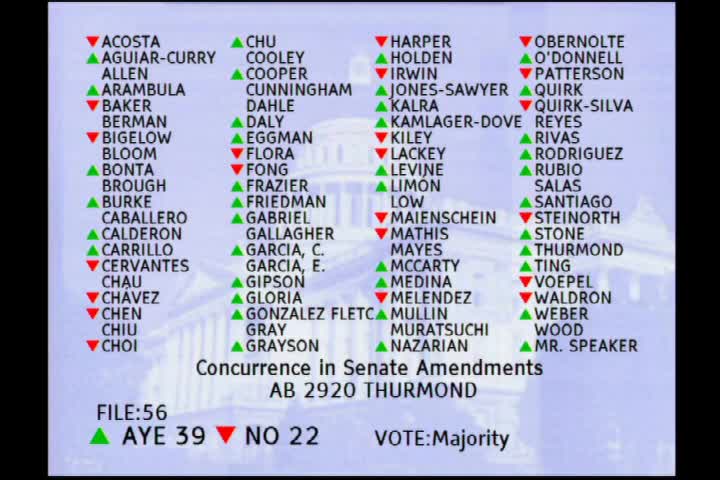 2MIN
Assembly Floor
 10MIN
Assembly Standing Committee on Education
 4MIN
Senate Floor
 24MIN
Senate Standing Committee on Judiciary
 21MIN
Senate Standing Committee on Education
Bill Author




