SB 1130: Property tax postponement: residential dwelling: manufactured homes.
- Session Year: 2017-2018
- House: Senate
- Latest Version Date: 2018-09-28
Existing law authorizes a claimant to file a claim with the Controller to postpone the payment of property taxes that are due on the residential dwelling of the claimant pursuant to the Senior Citizens and Disabled Citizens Property Tax Postponement Law, the Senior Citizens Tenant-Stockholder Property Tax Postponement Law, and the Senior Citizens Possessory Interest Holder Property Tax Postponement Law. Existing law, for purposes of these laws, defines a residential dwelling to mean a dwelling occupied as the principal place of residence of the claimant and owned by the claimant, the claimant and spouse, or by the claimant and another individual, as specified, including condominiums that are assessed as realty for local property tax purposes. Existing law continuously appropriates revenues in the Senior Citizens and Disabled Citizens Property Tax Postponement Fund for, among other things, disbursements relating to the postponement of property taxes pursuant to these laws. Existing law authorizes the postponement of the payment of property taxes of a claimant who is the owner of a mobilehome for loans established prior to February 20, 2009, pursuant to the Senior Citizens Mobilehome Property Tax Postponement Law.
This bill would expand the definition of a residential dwelling to include a manufactured home, thereby authorizing a claimant who is the owner of a manufactured home to postpone the payment of property taxes. The bill, on July 1, 2019, and on July 1 each year thereafter, would require up to 1% of the amount available in the Senior Citizens and Disabled Citizens Property Tax Postponement Fund for disbursements relating to postponement of property taxes to be available for residential dwellings that are manufactured homes. Because this bill would provide for an additional category of expenditures from the Senior Citizens and Disabled Citizens Property Tax Postponement Fund, a continuously appropriated fund, it would make an appropriation.
The bill would repeal the Senior Citizens Mobilehome Property Tax Postponement Law and would, instead, enact the Senior Citizens Manufactured Home Property Tax Postponement Law, which would, commencing July 1, 2019, establish a procedure for the postponement of the payment of property taxes of a claimant who is the owner of a manufactured home, as defined. The bill would require a claimant applying for postponement under this law to file a claim under penalty of perjury, as provided. The bill would also make related conforming changes. By requiring a claim for postponement to be filed under penalty of perjury, the bill would expand the crime of perjury, thereby imposing a state-mandated local program.
Existing law requires all sums paid by the Controller to be secured by a lien in favor of the state when funds are transferred to the county by the Controller upon the real property for which property taxes have been postponed. Existing law also requires the Controller to maintain a record of all properties against which a notice of lien for postponed property taxes has been recorded.
This bill would additionally require all sums paid by the Controller to be secured by a lien in favor of the state when funds are transferred to the county by the Controller upon a manufactured home situated on real property owned by the claimant for which property taxes have been postponed, as provided. The bill, in the case of a manufactured home situated on real property not owned by the claimant, would require the states interest to be secured by a security agreement in favor of the State of California, as provided. The bill would also require the Controller to maintain a record of all properties against which the Department of Housing and Community Development has been notified to withhold the transfer of title or permit for transport. The bill would require the Controller, or authorized delegate of the Controller, if at any time the amount of the obligation secured by the lien or security agreement for postponed property taxes is paid in full or otherwise discharged in the case of a manufactured home, to direct certain local tax officials to remove specified information from the secured roll or assessment records, as provided. By imposing new duties upon local tax officials with respect to the removal of information from the secured roll and assessment records, this bill would impose a state-mandated local program.
The California Constitution requires the state to reimburse local agencies and school districts for certain costs mandated by the state. Statutory provisions establish procedures for making that reimbursement.
This bill would provide that with regard to certain mandates no reimbursement is required by this act for a specified reason.
With regard to any other mandates, this bill would provide that, if the Commission on State Mandates determines that the bill contains costs so mandated by the state, reimbursement for those costs shall be made pursuant to the statutory provisions noted above.
Existing law authorizes a claimant to file a claim with the Controller to postpone the payment of property taxes that are due on the residential dwelling of the claimant pursuant to the Senior Citizens and Disabled Citizens Property Tax Postponement Law, the Senior Citizens Tenant-Stockholder Property Tax Postponement Law, and the Senior Citizens Possessory Interest Holder Property Tax Postponement Law. Existing law, for purposes of these laws, defines a residential dwelling to mean a dwelling occupied as the principal place of residence of the claimant and owned by the claimant, the claimant and spouse, or by the claimant and another individual, as specified, including condominiums that are assessed as realty for local property tax purposes. Existing law continuously appropriates revenues in the Senior Citizens and Disabled Citizens Property Tax Postponement Fund for, among other things, disbursements relating to the postponement of property taxes pursuant to these laws. Existing law authorizes the postponement of the payment of property taxes of a claimant who is the owner of a mobilehome for loans established prior to February 20, 2009, pursuant to the Senior Citizens Mobilehome Property Tax Postponement Law.
This bill would expand the definition of a residential dwelling to include a manufactured home, thereby authorizing a claimant who is the owner of a manufactured home to postpone the payment of property taxes. The bill, on July 1, 2019, and on July 1 each year thereafter, would require up to 1% of the amount available in the Senior Citizens and Disabled Citizens Property Tax Postponement Fund for disbursements relating to postponement of property taxes to be available for residential dwellings that are manufactured homes. Because this bill would provide for an additional category of expenditures from the Senior Citizens and Disabled Citizens Property Tax Postponement Fund, a continuously appropriated fund, it would make an appropriation.
The bill would repeal the Senior Citizens Mobilehome Property Tax Postponement Law and would, instead, enact the Senior Citizens Manufactured Home Property Tax Postponement Law, which would, commencing July 1, 2019, establish a procedure for the postponement of the payment of property taxes of a claimant who is the owner of a manufactured home, as defined. The bill would require a claimant applying for postponement under this law to file a claim under penalty of perjury, as provided. The bill would also make related conforming changes. By requiring a claim for postponement to be filed under penalty of perjury, the bill would expand the crime of perjury, thereby imposing a state-mandated local program.
Existing law requires all sums paid by the Controller to be secured by a lien in favor of the state when funds are transferred to the county by the Controller upon the real property for which property taxes have been postponed. Existing law also requires the Controller to maintain a record of all properties against which a notice of lien for postponed property taxes has been recorded.
This bill would additionally require all sums paid by the Controller to be secured by a lien in favor of the state when funds are transferred to the county by the Controller upon a manufactured home situated on real property owned by the claimant for which property taxes have been postponed, as provided. The bill, in the case of a manufactured home situated on real property not owned by the claimant, would require the states interest to be secured by a security agreement in favor of the State of California, as provided. The bill would also require the Controller to maintain a record of all properties against which the Department of Housing and Community Development has been notified to withhold the transfer of title or permit for transport. The bill would require the Controller, or authorized delegate of the Controller, if at any time the amount of the obligation secured by the lien or security agreement for postponed property taxes is paid in full or otherwise discharged in the case of a manufactured home, to direct certain local tax officials to remove specified information from the secured roll or assessment records, as provided. By imposing new duties upon local tax officials with respect to the removal of information from the secured roll and assessment records, this bill would impose a state-mandated local program.
The California Constitution requires the state to reimburse local agencies and school districts for certain costs mandated by the state. Statutory provisions establish procedures for making that reimbursement.
This bill would provide that with regard to certain mandates no reimbursement is required by this act for a specified reason.
With regard to any other mandates, this bill would provide that, if the Commission on State Mandates determines that the bill contains costs so mandated by the state, reimbursement for those costs shall be made pursuant to the statutory provisions noted above.
Existing law authorizes a claimant to file a claim with the Controller to postpone the payment of property taxes that are due on the residential dwelling of the claimant pursuant to the Senior Citizens and Disabled Citizens Property Tax Postponement Law, the Senior Citizens Tenant-Stockholder Property Tax Postponement Law, and the Senior Citizens Possessory Interest Holder Property Tax Postponement Law. Existing law, for purposes of these laws, defines a residential dwelling to mean a dwelling occupied as the principal place of residence of the claimant and owned by the claimant, the claimant and spouse, or by the claimant and another individual, as specified, including condominiums that are assessed as realty for local property tax purposes. Existing law continuously appropriates revenues in the Senior Citizens and Disabled Citizens Property Tax Postponement Fund for, among other things, disbursements relating to the postponement of property taxes pursuant to these laws. Existing law authorizes the postponement of the payment of property taxes of a claimant who is the owner of a mobilehome for loans established prior to February 20, 2009, pursuant to the Senior Citizens Mobilehome Property Tax Postponement Law.
This bill would expand the definition of a residential dwelling to include a manufactured home, thereby authorizing a claimant who is the owner of a manufactured home to postpone the payment of property taxes. The bill, on July 1, 2019, and on July 1 each year thereafter, would require up to 1% of the amount available in the Senior Citizens and Disabled Citizens Property Tax Postponement Fund for disbursements relating to postponement of property taxes to be available for residential dwellings that are manufactured homes. Because this bill would provide for an additional category of expenditures from the Senior Citizens and Disabled Citizens Property Tax Postponement Fund, a continuously appropriated fund, it would make an appropriation.
The bill would repeal the Senior Citizens Mobilehome Property Tax Postponement Law and would, instead, enact the Senior Citizens Manufactured Home Property Tax Postponement Law, which would, commencing July 1, 2019, establish a procedure for the postponement of the payment of property taxes of a claimant who is the owner of a manufactured home, as defined. The bill would require a claimant applying for postponement under this law to file a claim under penalty of perjury, as provided. The bill would also make related conforming changes. By requiring a claim for postponement to be filed under penalty of perjury, the bill would expand the crime of perjury, thereby imposing a state-mandated local program.
Existing law requires all sums paid by the Controller to be secured by a lien in favor of the state, state when funds are transferred to the county by the Controller, Controller upon the real property for which property taxes have been postponed. Existing law, in the event that the amount secured by the states lien is paid by reason of the sale or condemnation of the property on which the lien attaches, requires the funds received to be placed in the Senior Citizens and Disabled Citizens Property Tax Postponement Fund. law also requires the Controller to maintain a record of all properties against which a notice of lien for postponed property taxes has been recorded.
This bill would require funds received under the circumstances described above from the sale or condemnation of a residential dwelling that is a manufactured home to be placed in the Senior Citizens and Disabled Citizens Manufactured Homes Property Tax Postponement Fund.Existing law, in the event that the real property securing the states lien is the residential dwelling of a claimant, as specified, and is voluntarily sold, requires the funds derived from the voluntary sale of the residential dwelling to be placed in the Senior Citizens and Disabled Citizens Property Tax Postponement Fund, and prohibits the claimant from drawing upon the amount in the fund.This bill would require funds received under the circumstances described above from the voluntary sale of a residential dwelling that is a manufactured home to be placed in the Senior Citizens and Disabled Citizens Manufactured Homes Property Tax Postponement Fund, and would prohibit the claimant from drawing upon the amount in the fund.By increasing the circumstances in which claims for postponement are required to be filed under penalty of perjury, this bill would expand the crime of perjury, thereby imposing a state-mandated local program.The California Constitution requires the state to reimburse local agencies and school districts for certain costs mandated by the state. Statutory provisions establish procedures for making that reimbursement.This bill would provide that no reimbursement is required by this act for a specified reason.This bill would additionally require all sums paid by the Controller to be secured by a lien in favor of the state when funds are transferred to the county by the Controller upon a manufactured home situated on real property owned by the claimant for which property taxes have been postponed, as provided. The bill, in the case of a manufactured home situated on real property not owned by the claimant, would require the states interest to be secured by a security agreement in favor of the State of California, as provided. The bill would also require the Controller to maintain a record of all properties against which the Department of Housing and Community Development has been notified to withhold the transfer of title or permit for transport. The bill would also require the Controller, or authorized delegate of the Controller, if at any time the amount of the obligation secured by the lien or security agreement for postponed property taxes is paid in full or otherwise discharged in the case of a manufactured home, to direct certain local tax officials to remove specified information from the secured roll or assessment records, as provided. By imposing new duties upon local tax officials with respect to the removal of information from the secured roll and assessment records, this bill would impose a state-mandated local program.
The California Constitution requires the state to reimburse local agencies and school districts for certain costs mandated by the state. Statutory provisions establish procedures for making that reimbursement.
This bill would provide that with regard to certain mandates no reimbursement is required by this act for a specified reason.
With regard to any other mandates, this bill would provide that, if the Commission on State Mandates determines that the bill contains costs so mandated by the state, reimbursement for those costs shall be made pursuant to the statutory provisions noted above.
The Senior Citizens and Disabled Citizens Property Tax Postponement Law authorizes a claimant to file a claim with the Controller to postpone the payment of property taxes that are due on the residential dwelling of the claimant. Existing law, for purposes of that law, defines a residential dwelling to mean a dwelling occupied as the principal place of residence of the claimant and owned by the claimant, the claimant and spouse, or by the claimant and another individual, as specified, including condominiums that are assessed as realty for local property tax purposes. Existing law requires a claimant applying for postponement to file a claim under penalty of perjury with the Controller.
This bill would expand the definition of a residential dwelling to include manufactured homes, thereby authorizing a claimant who is the owner of a manufactured home to seek postponement of the payment of property taxes under the provisions described above. The bill would create the Senior Citizens and Disabled Citizens Manufactured Homes Property Tax Postponement Account in the Senior Citizens and Disabled Citizens Property Tax Postponement Fund, and would require, commencing July 1, 2019, the revenues in the account to be continuously appropriated to the Controller for, among other things, disbursements relating to the postponement of property taxes on residential dwellings that are manufactured homes.
Existing law continuously appropriates revenues in the Senior Citizens and Disabled Citizens Property Tax Postponement Fund for, among other things, disbursements relating to the postponement of property taxes. Existing law requires the Controller to, on June 30, 2018, and on June 30 each year thereafter, transfer any moneys in the fund in excess of $15,000,000 to the General Fund.
This bill would instead require the Controller, on June 30, 2019, and on June 30 each year thereafter, to transfer any moneys in the fund in excess of $15,000,000 to the Senior Citizens and Disabled Citizens Manufactured Homes Property Tax Postponement Account, as provided, and would require any remaining moneys, after making the transfers to the account, to be transferred to the General Fund.
Existing law requires all sums paid by the Controller to be secured by a lien in favor of the state, when funds are transferred to the county by the Controller, upon the real property for which property taxes have been postponed. Existing law, in the event that the amount secured by the states lien is paid by reason of the sale or condemnation of the property on which the lien attaches, requires the funds received to be placed in the Senior Citizens and Disabled Citizens Property Tax Postponement Fund.
This bill would require funds received under the circumstances described above from the sale or condemnation of a residential dwelling that is a manufactured home to be placed in the Senior Citizens and Disabled Citizens Manufactured Homes Property Tax Postponement Fund.
Existing law, in the event that the real property securing the states lien is the residential dwelling of a claimant, as specified, and is voluntarily sold, requires the funds derived from the voluntary sale of the residential dwelling to be placed in the Senior Citizens and Disabled Citizens Property Tax Postponement Fund, and prohibits the claimant from drawing upon the amount in the fund.
This bill would require funds received under the circumstances described above from the voluntary sale of a residential dwelling that is a manufactured home to be placed in the Senior Citizens and Disabled Citizens Manufactured Homes Property Tax Postponement Fund, and would prohibit the claimant from drawing upon the amount in the fund.
By increasing the circumstances in which claims for postponement are required to be filed under penalty of perjury, this bill would expand the crime of perjury, thereby imposing a state-mandated local program.
The California Constitution requires the state to reimburse local agencies and school districts for certain costs mandated by the state. Statutory provisions establish procedures for making that reimbursement.
This bill would provide that no reimbursement is required by this act for a specified reason.
The Senior Citizens and Disabled Citizens Property Tax Postponement Law authorizes a claimant to file a claim with the Controller to postpone the payment of property taxes that are due on the residential dwelling of the claimant. Existing law, for purposes of that law, defines a residential dwelling to mean a dwelling occupied as the principal place of residence of the claimant and owned by the claimant, the claimant and spouse, or by the claimant and another individual, as specified, including condominiums that are assessed as realty for local property tax purposes. Existing law requires a claimant applying for postponement to file a claim under penalty of perjury with the Controller.
This bill would expand the definition of a residential dwelling to include manufactured homes, thereby authorizing a claimant who is the owner of a manufactured home to seek postponement of the payment of property taxes under the provisions described above. The bill would create the Senior Citizens and Disabled Citizens Manufactured Homes Property Tax Postponement Account in the Senior Citizens and Disabled Citizens Property Tax Postponement Fund, and would require, commencing July 1, 2019, the revenues in the account to be continuously appropriated to the Controller for, among other things, disbursements relating to the postponement of property taxes on manufactured homes.
Existing law continuously appropriates revenues in the Senior Citizens and Disabled Citizens Property Tax Postponement Fund for, among other things, disbursements relating to the postponement of property taxes. Existing law requires the Controller to, on June 30, 2018, and on June 30 each year thereafter, transfer any moneys in the fund in excess of $15,000,000 to the General Fund.
This bill would instead require the Controller, on June 30, 2019, and on June 30 each year thereafter, to transfer any moneys in the fund in excess of $15,000,000 to the Senior Citizens and Disabled Citizens Manufactured Homes Property Tax Postponement Account, as provided, and would require any remaining moneys, after making the transfers to the account, to be transferred to the General Fund.
By increasing the circumstances in which claims for postponement are required to be filed under penalty of perjury, this bill would expand the crime of perjury, thereby imposing a state-mandated local program.
The California Constitution requires the state to reimburse local agencies and school districts for certain costs mandated by the state. Statutory provisions establish procedures for making that reimbursement.
This bill would provide that no reimbursement is required by this act for a specified reason.
The Manufactured Housing Act of 1980 requires the Department of Housing and Community Development to license and regulate dealers of manufactured homes, mobilehomes, and commercial coaches. This bill would state the intent of the Legislature to enact legislation that would facilitate the placement of additional manufactured homes in mobilehome parks and manufactured housing communities.The Manufactured Housing Act of 1980 requires the Department of Housing and Community Development to license and regulate dealers of manufactured homes, mobilehomes, and commercial coaches.
This bill would state the intent of the Legislature to enact legislation that would facilitate the placement of additional manufactured homes in mobilehome parks and manufactured housing communities.
(a)There is hereby created in the State Treasury a Senior Citizens and Disabled Citizens Property Tax Postponement Fund. The fund shall be an interest-bearing fund. Subject to subdivision (b) and notwithstanding Section 13340, the fund is continuously appropriated to the Controller, commencing January 1, 2015, for purposes of administering this chapter, including, but not limited to, necessary administrative costs and disbursements relating to the postponement of property taxes pursuant to Chapter 2 (commencing with Section 20581), Chapter 3 (commencing with Section 20625), Chapter 3.3 (commencing with Section 20639), and Chapter 3.5 (commencing with Section 20640) of Part 10.5 of Division 2 of the Revenue and Taxation Code.
(b)The Controller shall do all of the following:
(1)On June 30, 2017, transfer any moneys in the fund in excess of twenty million dollars ($20,000,000) to the General Fund.
(2)On June 30, 2018, and on June 30 each year thereafter, transfer any moneys in the fund in excess of fifteen million dollars ($15,000,000) to the General Fund.
(3)On July 1, 2019, and on July 1 each year thereafter, up to 1 percent of the amount available in the fund for disbursements relating to the postponement of property taxes shall be available for residential dwellings that are manufactured homes pursuant to Chapter 3.3 (commencing with Section 20639).
(c)On or after January 1, 2015, any loan repayments relating to the Senior Citizens and Disabled Citizens Property Tax Postponement Law shall be deposited into the Senior Citizens and Disabled Citizens Property Tax Postponement Fund.
SEC. 2.Section 16181 of the Government Code is amended to read:16181.(a)The Controller shall maintain a record of all properties against which a notice of lien for postponed property taxes has been recorded. The record shall include, but not be limited to, the names of each claimant, a description of the real property against which the lien is recorded, the identification number of the notice of lien assigned by the Controller, and the amount of the lien.
(b)The Controller shall maintain a record of all properties against which the Department of Housing and Community Development has been notified to withhold the transfer of title or permit for transport. The record shall include, but not be limited to, the name of each claimant, a description of the manufactured home against which a security agreement is charged, and the amount secured by the agreement.
(c)Upon written request of any person or entity, or the agent of either, having a legal or equitable interest in real property or a manufactured home that is subject to a lien or security agreement for postponed taxes, the Controller shall within 10 working days following receipt of the request issue a written statement showing the amount of the obligation secured by the lien as of the date of the statement and any other information as will reasonably enable the person or entity, or the agent of either, to determine the amount to be paid the Controller in order to obtain a certificate of release or discharge of the lien for postponed taxes.
(d)The Controller shall adopt regulations necessary to implement the provisions of this chapter and may establish a reasonable fee, not to exceed thirty dollars ($30), for the provision of the statement of lien status provided for herein.
SEC. 3.Section 16182 of the Government Code is amended to read:16182.(a)All sums paid by the Controller under the provisions of this chapter, together with interest thereon, shall be secured by a lien in favor of the State of California when funds are transferred to the county by the Controller upon the real property or a manufactured home situated on real property owned by the claimant for which property taxes have been postponed. In the case of a residential dwelling which is part of a larger parcel taxed as a unit, such as a duplex, farm, or multipurpose or multidwelling building, the lien shall be against the entire tax parcel. In the case of a manufactured home situated on real property not owned by the claimant, the states interests shall be secured by a security agreement in favor of the State of California.
(b)In the case of real property and a manufactured home situated on real property owned by the claimant:
(1)The lien shall be evidenced by a notice of lien for postponed property taxes executed by the Controller, or the authorized delegate of the Controller, and shall secure all sums paid or owing pursuant to this chapter, including amounts paid subsequent to the initial payment of postponed taxes on the real property described in the notice of lien.
(2)The notice of lien may bear the facsimile signature of the Controller. Each signature shall be that of the person who shall be in the office at the time of execution of the notice of lien; provided, however, that such notice of lien shall be valid and binding notwithstanding any such person having ceased to hold the office of Controller before the date of recordation.
(3)The form and contents of the notice of lien for postponed property taxes shall be prescribed by the Controller and shall include, but not be limited to, the following:
(A)The names of all record owners of the real property for which the Controller has advanced funds for the payment of real property taxes.
(B)A description of the real property for which real property taxes have been paid.
(C)The identification number of the notice of lien which has been assigned the lien by the Controller.
(4)Within 14 business days of the transfer of funds and the notice of lien to the county by the Controller, the notice of lien shall be recorded in the office of the county recorder for the county in which the real property subject to the lien is located.
(5)The recorded notice of lien shall be indexed in the Grantor Index to the names of all record owners of the real property and in the Grantee Index to the Controller of the State of California.
(6)After the notice of lien has been duly recorded and indexed, it shall be returned by the county recorder to the office of the Controller. The Controller shall provide the county tax collector and the county assessor with a copy of the notice of lien which has been executed.
(7)From the time of recordation of a notice of lien for postponed property taxes, a lien shall attach to the real property described therein and shall have the priority of a judgment lien for all amounts secured thereby, except that the lien shall remain in effect until either of the following occurs:
(A)It is released by the Controller in the manner prescribed by Section 16186.
(B)The foreclosure or sale of an obligation secured by a lien which is senior in recording priority to the lien of the State of California.
(c)In the case of a manufactured home situated on real property not owned by the claimant, all of the following shall apply:
(1)The states interest shall be evidenced by a security agreement for postponed property taxes executed by the Controller, or the authorized delegate of the Controller, and shall secure all sums paid owing pursuant to this chapter.
(2)The security agreement may bear the facsimile signature of the Controller. The signature shall be that of the person who is in the office at the time of execution of the security agreement. However, the security agreement shall be valid and binding notwithstanding any such person having ceased to hold the office of Controller before the date of filing.
(3)The form and contents of the security agreement for postponed property taxes shall be prescribed by the Controller and shall include, but not be limited to, the following:
(A)The names of all registered owners of the manufactured home for which the Controller has advanced funds for the payment of real property taxes.
(B)A description of the manufactured home for which real property taxes have been paid.
(C)The identification number of the security agreement which has been assigned by the Controller.
(4)The security agreement shall be transmitted to the Department of Housing and Community Development.
(5)Upon receipt of the security agreement for postponed property taxes from the Controller, the Department of Housing and Community Development shall amend the permanent title record of the manufactured home to reflect that the property taxes on the manufactured home are subject to postponement.
(6)The Department of Housing and Community Development shall provide the Controller with an acknowledgment of receipt and amendment of the permanent title record.
(7)From the time that the Department of Housing and Community Development receives the security agreement from the Controller, the department shall impose a moratorium on any other amendments to the permanent title record of the manufactured home unit until released by the Controller in the manner prescribed by Section 16186, or an authorization for the amendments is given by the Controller in writing.
(8)From the time of filing, a security agreement shall attach to the manufactured home for which eligibility for the postponement of property taxes has been granted.
SEC. 4.Section 16183 of the Government Code is amended to read:16183.(a)From the time a payment is made pursuant to Section 16180, the amount of that payment shall bear interest at a rate (not compounded), determined as follows:
(1)Beginning July 1, 2016, the rate of interest shall be 7 percent per annum.
(2)The Controller shall establish an adjusted rate of interest for the purpose of this subdivision not later than July 15th of any year if the effective annual yield of the Pooled Money Investment Account for the prior fiscal year is at least a full percentage point more or less than the interest rate which is then in effect. The adjusted rate of interest shall be equal per annum to the effective annual yield earned in the prior fiscal year by the Pooled Money Investment Account rounded to the nearest full percent, and shall become effective for new deferrals, beginning on July 1, 1984, and on July 1 of each immediately succeeding year, until June 30, 2016.
(3)For loans made prior to June 30, 2016, the rate of interest provided pursuant to this subdivision for the first fiscal year commencing after payment is made pursuant to Section 16180 shall apply for that fiscal year and each fiscal year thereafter until these postponed property taxes are repaid.
(b)The interest provided for in subdivision (a) shall be applied beginning the first day of the month following the month in which that payment is made and continuing on the first day of each month thereafter until that amount is paid. In the event that any payments are applied, in any month, to reduce the amount paid pursuant to Section 16180, the interest provided for herein shall be applied to the balance of that amount beginning on the first day of the following month.
(c)In computing interest in accordance with this section, fractions of a cent shall be disregarded.
(d)For the purpose of this section, the time a payment is made shall be deemed to be the time a payment is made by the Controller to the tax collector or the delinquency date of the respective tax installment, whichever is later.
(e)The Controller shall include on forms supplied to claimants pursuant to Sections 20621, 20630.5, 20639.9, 20640.9, and 20641 of the Revenue and Taxation Code, a statement of the interest rate which shall apply to amounts postponed for the fiscal year to which the form applies.
SEC. 5.Section 16184 of the Government Code is amended to read:16184.(a)The Controller shall reduce the amount of the obligation secured by the lien or security agreement against the real property or manufactured home by the amount of any payments received for that purpose and by notification of any amounts paid by the Franchise Tax Board pursuant to Section 20564 of the Revenue and Taxation Code or by any amounts authorized pursuant to subdivision (f) of Section 20621 of the Revenue and Taxation Code. Any payment received for that purpose shall be applied in the following order:
(1)To any interest due on the loan.
(2)To the principal property tax amount.
(3)The remaining balance, if any, to administrative fees.
(b)The Controller shall also increase the amount of the obligation secured by the lien or security agreement by the amount of any subsequent payments made pursuant to Section 16180 with respect to the real property or manufactured home and to reflect the accumulation of interest. All such increases and decreases shall be entered in the record described in Section 16181.
SEC. 6.Section 16186 of the Government Code is amended to read:16186.(a)If at any time the amount of the obligation secured by the lien for postponed property taxes is paid in full or otherwise discharged, the Controller, or the authorized delegate of the Controller, shall in the case of real property and a manufactured home situated on real property owned by the claimant:
(1)Execute and cause to be recorded in the office of the county recorder of the county wherein the real property described in the lien is located, a release of the lien conclusively evidencing the satisfaction of all amounts secured by the lien. The cost of recording the release of the lien shall be added to and become part of the obligation secured by the lien being released.
(2)Direct the tax collector to remove from the secured roll, the information required to be entered thereon by paragraph (1) of subdivision (a) of Section 2514 of the Revenue and Taxation Code with respect to the property described in the lien.
(3)Direct the assessor to remove from the assessment records applicable to the property described in the lien, the information required to be entered on such records by Section 2515 of the Revenue and Taxation Code.
(b)If at any time the amount of the obligation secured by the security agreement for postponed property taxes is paid in full or otherwise discharged, the Controller, or the authorized delegate of the Controller, shall, in the case of a manufactured home situated on real property not owned by the claimant:
(1)Direct the tax collector to remove from the secured roll the information required to be entered thereon by paragraph (1) of subdivision (a) of Section 2514 of the Revenue and Taxation Code.
(2)Transmit a Release of Lien to the owner of the manufactured home, or the owners heirs or assigns. The owner, or the owners heirs or assigns, shall transmit the Release of Lien, and a fee of six dollars ($6), to the Department of Housing and Community Development. Upon receipt of the Release of Lien and the fee, the department shall terminate the restriction on the permanent title record as provided in Section 16182.
SEC. 7.Section 16192 of the Government Code is amended to read:16192.If, at any time, a person meeting the requirements of subdivision (a) or (c) of Section 16191 elects, or any surviving spouse described in subdivision (b) of such section becomes eligible, or otherwise elects, to postpone property taxes pursuant to Chapter 2 (commencing with Section 20581), Chapter 3 (commencing with Section 20625), Chapter 3.3 (commencing with Section 20639), or Chapter 3.5 (commencing with Section 20640) of Part 10.5 of Division 2 of the Revenue and Taxation Code, payments made pursuant to Section 16180 shall be added to the amount of the lien existing against the residential dwelling.
SEC. 8.Article 4 (commencing with Section 16210) of Chapter 5 of Part 1 of Division 4 of Title 2 of the Government Code is repealed.SEC. 9.Section 2514 of the Revenue and Taxation Code is amended to read:2514.(a)Upon receipt of the payment by the Controller described in Section 20602, 20630, 20639.6, or 20640.6, the following shall occur:
(1)The tax collector shall maintain a record of the fact that taxes on the property have been postponed. In the case of the secured roll, this information may be entered in that portion of the roll which has been designated for tax default information as required by Section 3439.
(2)With respect to a claimant whose property taxes are paid by a lender from an impound, trust, or other type of account described in Section 2954 of the Civil Code, the tax collector shall notify the auditor of the claimants name and address, and the duplicate amount of money the Controller paid to the tax collector.
The county auditor, treasurer, or disbursing officer shall refund the amount of money, based on the payment by the Controller, to the claimant within 60 days of the replicated payment.
(b)The procedures established by this chapter shall not be construed to require a lender to alter the manner in which a lender makes payment of the property taxes of such a claimant.
SEC. 10.Section 20503 of the Revenue and Taxation Code is amended to read:20503.(a)Income means adjusted gross income as defined in Section 17072 plus all of the following cash items:
(1)Public assistance and relief.
(2)Nontaxable amount of pensions and annuities.
(3)Social security benefits (except Medicare).
(4)Railroad retirement benefits.
(5)Unemployment insurance payments.
(6)Veterans benefits.
(7)Exempt interest received from any source.
(8)Gifts and inheritances in excess of three hundred dollars ($300), other than transfers between members of the household. Gifts and inheritances include noncash items.
(9)Amounts contributed on behalf of the contributor to a tax-sheltered retirement plan or deferred compensation plan.
(10)Temporary workers compensation payments.
(11)Sick leave payments.
(12)Nontaxable military compensation as defined in Section 112 of the Internal Revenue Code.
(13)Nontaxable scholarship and fellowship grants as defined in Section 117 of the Internal Revenue Code.
(14)Nontaxable gain from the sale of a residence as defined in Section 121 of the Internal Revenue Code.
(15)Life insurance proceeds to the extent that the proceeds exceed the expenses incurred for the last illness and funeral of the deceased spouse of the claimant. Expenses incurred for the last illness includes unreimbursed expenses paid or incurred during the income calendar year and any expenses paid or incurred thereafter up until the date the claim is filed. For purposes of this paragraph, funeral expenses shall not exceed five thousand dollars ($5,000).
(16)If an alternative minimum tax is required to be paid pursuant to Chapter 2.1 (commencing with Section 17062) of Part 10, the amount of alternative minimum taxable income (whether or not cash) in excess of the regular taxable income.
(17)Annual winnings from the California Lottery in excess of six hundred dollars ($600) for the current year.
(b)For purposes of this chapter, total income shall be determined for the calendar year (or approved fiscal year ending within that calendar year) which ends within the fiscal year for which assistance is claimed.
(c)For purposes of Chapter 2 (commencing with Section 20581), Chapter 3 (commencing with Section 20625), Chapter 3.3 (commencing with Section 20639), and Chapter 3.5 (commencing with Section 20640), all losses and nonexpenses shall be converted to zero for the purpose of determining whether the homeowner meets the Property Tax Postponement requirement.
(d)For purposes of Chapter 2 (commencing with Section 20581), Chapter 3 (commencing with Section 20625), Chapter 3.3 (commencing with Section 20639), and Chapter 3.5 (commencing with Section 20640), total income shall be determined for the calendar year ending immediately prior to the commencement of the fiscal year for which postponement is claimed.
SEC. 11.Section 20505 of the Revenue and Taxation Code is amended to read:20505.Claimant means an individual who:
(a)For purposes of this chapter was either (1) 62 years of age or older on the last day of the calendar year or approved fiscal year designated in subdivision (b) or (c) of Section 20503, whichever is applicable, or (2) blind or disabled, as defined in Section 12050 of the Welfare and Institutions Code on the last day of the calendar year or approved fiscal year designated in subdivision (b) of Section 20503, who was a member of the household, and who was either: (1) the owner and occupier of a residential dwelling on the last day of the year designated in subdivision (b) or (c) of Section 20503, or (2) the renter of a rented residence on or before the last day of the year designated in subdivision (b) of Section 20503. An individual who qualifies as an owner-claimant may not qualify as a renter-claimant for the same year.
(b)For purposes of Chapter 2 (commencing with Section 20581), Chapter 3 (commencing with Section 20625), Chapter 3.3 (commencing with Section 20639), and Chapter 3.5 (commencing with Section 20640) was a member of the household and either an owner-occupant, or a tenant stockholder occupant, or a possessory interestholder occupant, or a manufactured home owner-occupant, as the case may be, of the residential dwelling as to which postponement is claimed on the last day of the year designated in subdivision (d) of Section 20503, and who was (1) 62 years of age or older by December 31 of the fiscal year for which postponement is claimed, or (2) blind or disabled, as defined in Section 12050 of the Welfare and Institutions Code, at the time of application or on February 10 of the fiscal year for which postponement is claimed.
SEC. 12.Section 20583 of the Revenue and Taxation Code is amended to read:20583.(a)Residential dwelling means a dwelling occupied as the principal place of residence of the claimant and so much of the land surrounding it as is reasonably necessary for use of the dwelling as a home, owned by the claimant, the claimant and spouse, or by the claimant and either another individual eligible for postponement under this chapter or an individual described in subdivision (a), (b), or (c) of Section 20511 and located in this state. It shall include condominiums and manufactured homes that are assessed as realty for local property tax purposes. It also includes part of a multidwelling or multipurpose building and a part of the land upon which it is built.
(b)As used in this chapter in reference to ownership interests in residential dwellings, owned includes (1) the interest of a vendee in possession under a land sale contract provided that the contract or memorandum thereof is recorded and only from the date of recordation of the contract or memorandum thereof in the office of the county recorder where the residential dwelling is located, (2) the interest of the holder of a life estate provided that the instrument creating the life estate is recorded and only from the date of recordation of the instrument creating the life estate in the office of the county recorder where the residential dwelling is located, but owned does not include the interest of the holder of any remainder interest or the holder of a reversionary interest in the residential dwelling, (3) the interest of a joint tenant or a tenant in common in the residential dwelling or the interest of a tenant where title is held in tenancy by the entirety or a community property interest where title is held as community property, and (4) the interest, including the interest of a beneficiary of a special needs trust, in the residential dwelling in which the title is held in trust, as described in subdivision (d) of Section 62, provided that the Controller determines that the states interest is adequately protected.
(c)For purposes of this chapter, the registered owner of a manufactured home shall be deemed to be the owner of the manufactured home.
(d)Except as provided in subdivision (c), and Chapter 3 (commencing with Section 20625), ownership must be evidenced by an instrument duly recorded in the office of the county where the residential dwelling is located.
(e)Residential dwelling does not include any of the following:
(1)Any residential dwelling in which the owners do not have an equity of at least 40 percent of the full value of the property as determined for purposes of property taxation or at least 40 percent of the fair market value as determined by the Controller and where the Controller determines that the states interest is adequately protected. The 40-percent equity requirement shall be met each time the claimant or authorized agent files a postponement claim.
(2)Any residential dwelling in which the claimants interest is held pursuant to a contract of sale or under a life estate, unless the claimant obtains the written consent of the vendor under the contract of sale, or the holder of the reversionary interest upon termination of the life estate, for the postponement of taxes and the creation of a lien on the real property in favor of the state for amounts postponed pursuant to this act.
(3)Any residential dwelling on which the claimant does not receive a secured tax bill.
(4)Any residential dwelling in which the claimants interest is held as a possessory interest, except as provided in Chapter 3.5 (commencing with Section 20640).
SEC. 13.Section 20585 of the Revenue and Taxation Code is amended to read:20585.Postponement shall not be allowed under this chapter, Chapter 3 (commencing with Section 20625), Chapter 3.3 (commencing with Section 20639), or Chapter 3.5 (commencing with Section 20640) if household income exceeds thirty-five thousand five hundred dollars ($35,500).
SEC. 14.Section 20586 of the Revenue and Taxation Code is amended to read:20586.For the purposes of Chapter 2 (commencing with Section 20581), Chapter 3 (commencing with Section 20625), Chapter 3.3 (commencing with Section 20639), and Chapter 3.5 (commencing with Section 20640), only one claimant per household each year shall be entitled to postponement. When two or more individuals in a household are qualified as claimants, they may determine who the claimant shall be. Such decision is irrevocable. If the individuals are unable to agree, the matter shall be determined by the Controller and his or her decision shall be final.
SEC. 15.Chapter 3.3 (commencing with Section 20639) is added to Part 10.5 of Division 2 of the Revenue and Taxation Code, to read:3.3.Senior Citizens Manufactured Home Property Tax Postponement Law20639.This chapter shall be known and may be cited as the Senior Citizens Manufactured Home Property Tax Postponement Law.
20639.1.(a)Unless the context otherwise requires or unless otherwise provided in this chapter, the definitions given in Chapter 1 (commencing with Section 20501) and Chapter 2 (commencing with Section 20581) shall govern the construction of this chapter.
(b)Unless the context otherwise dictates or unless otherwise provided in this chapter, Chapter 1 (commencing with Section 101) and Chapter 2 (commencing with Section 155) of Part 1 of Division 1, Section 2931c of the Civil Code, Division 9 (commencing with Section 9101) of the Commercial Code, Chapter 4.5 (commencing with Section 14735) of Part 5.5 of Division 3 of Title 2 of the Government Code, Chapter 5 (commencing with Section 16180) of Part 1 of Division 4 of Title 2 of the Government Code, and Division 13 (commencing with Section 17000) of the Health and Safety Code shall be applicable to property tax postponements made pursuant to this chapter.
20639.2.As used in this part, manufactured home means a manufactured home as defined in Section 18007 of the Health and Safety Code that was constructed on or after June 15, 1976. Manufactured home includes both of the following:
(a)A manufactured home which has become real property by being affixed to the land on a permanent foundation system or otherwise and is taxed as all other real property is taxed.
(b)A manufactured home which is situated on real property owned by the claimant.
20639.4.(a)Subject to the limitations provided in Chapter 1 (commencing with Section 20501) or Chapter 2 (commencing with 20581), a claimant may file with the Controller a claim for postponement of a sum equal to but not exceeding the amount of property taxes for the fiscal year for which the claim is made.
(b)Any manufactured home on which property taxes are delinquent at the time the application for postponement under this chapter is made or on which any other property tax or special assessment imposed by a special district or other tax code are delinquent at the time of application for postponement under this chapter is made shall not be eligible for postponement.
(c)The Controller shall mail to the claimant for due execution, the appropriate security instruments required by the Controller.
20639.5.The Controller may require security for the postponement of property taxes pursuant to this chapter of the following:
(a)A security interest in the manufactured home in the form and manner prescribed by the Controller.
(b)(1)Any other additional security interest created and perfected with respect to the rights of third persons in the manner provided by law for such type of security interest which the Controller deems necessary to protect the interest of the state with regard to the repayment of postponed amounts by the claimant or the deceased claimants estate.
(2)On the form supplied by the Controller, the claimant shall obtain the written consent of any legal owner if other than the claimant and the written consent of any junior lienholder. The consent shall be in the form and contain the provisions as prescribed by the Controller, and shall provide for written notice by the legal owner or junior lienholder, or both, to the Controller of the occurrence of a default by the claimant under the terms of an existing security agreement.
(c)The consent of all co-owners, if any, to the pledging of the manufactured home as security for repayment of postponed property taxes.
20639.6.(a)Upon receipt of the information described in Section 20639.9, the Controller shall determine whether the states interest would be adequately protected if postponement is granted, and, if so, the Controller shall make payments directly to the county tax collector for the property taxes owed on behalf of a qualified claimant. Payments may, upon appropriation by the Legislature, be made out of the amounts appropriated pursuant to Section 16180 of the Government Code.
(b)For manufactured homes situated on real property owned by the claimant, payments will be secured by a secured tax lien and obligation as specified by subdivision (b) of Section 16182 of the Government Code.
(c)For manufactured homes situated on real property not owned by the claimant, payments will be secured by a security agreement as specified by subdivision (c) of Section 16182 of the Government Code.
20639.7.The Controller shall prescribe the manner in which a claimant eligible under this chapter, who for any reason is incapacitated, may appoint his or her spouse or authorized agent, or have any such person appointed for the claimant, for all purposes of postponement of property taxes.
20639.8.The claim for postponement shall be filed after October 1 of the fiscal year in which the postponement is claimed and on or before February 10 of that fiscal year. If February 10 falls on Saturday, Sunday, or a legal holiday, the date is extended to the next business day.
20639.9.Each claimant applying for postponement under this chapter shall file a claim under penalty of perjury with the Controller on a form supplied by the Controller. The claim shall contain all of the following:
(a)All information required under Section 20621.
(b)A copy of the Certificate of Title issued by the Department of Housing and Community Development.
(c)A copy of the registration card issued by the Department of Housing and Community Development.
(d)Other information required by the Controller to establish eligibility.
20639.10.The Controller shall maintain a record of all persons who have received postponement amounts pursuant to this chapter. That record shall include the name and address of the claimant, the name and address of the legal owner of the manufactured home, the name and address of any other party whose consent is required by this chapter, and any other information deemed necessary by the Controller for administration purposes.
20639.11.All amounts postponed pursuant to this chapter shall be due if any of the following occurs:
(a)The claimant ceases to occupy the residential dwelling as the principal place of residence, sells, or otherwise disposes of his or her manufactured home.
(b)The claimant dies. However, if the surviving spouse previously approved pursuant to this chapter continues to occupy the manufactured home, then the postponed amounts shall not be due unless that person dies or ceases to occupy the residential dwelling.
(c)The failure of a claimant to perform those acts required by the legal owner or junior lienholder.
(d)The claimant allows any subsequent taxes to remain unpaid or to be transferred to the unsecured roll.
(e)Postponement was erroneously allowed because eligibility requirements were not met.
(f)The claimant is refinancing the residential dwelling.
(g)The claimant has elected to participate in a reverse mortgage program for the residential dwelling.
20639.12.If the Controller determines that amounts postponed under this chapter have become due and payable, the Controller may take any or all of the following actions:
(a)Demand payment of that amount from the claimant, the estate of any decedent claimant, or any person who was a cotenant with the claimant pursuant to the registration card.
(b)Direct the Department of General Services to seize and sell any property pledged by the claimant as security for postponement.
(c)Request the Attorney General to bring an action to recover amounts postponed under this chapter by the claimant.
(d)Utilize any or all of the other enforcement and foreclosure provisions set forth in Article 3 (commencing with Section 16200) of Chapter 5 of Part 1 of Division 4 of Title 2 of the Government Code, as may be applicable.
20639.13.This chapter shall become operative on July 1, 2019.
SEC. 16.Section 20639.13 is added to the Revenue and Taxation Code, to read:20639.13.This chapter is repealed on July 1, 2019.
SEC. 17.Section 20640.2 of the Revenue and Taxation Code is amended to read:20640.2.For the purposes of this chapter:
(a)Possessory interest means (1) possession of, or right to the possession of land located in this state whether or not coupled with ownership of the residential dwelling on the same, or (2) a possessory interest or right of occupancy on tax exempt land;
(b)Residential dwelling means a dwelling occupied as the principal place of residence of the claimant, and so much of the land surrounding it as is reasonably necessary for use of the dwelling as a home, located on possessory interest property. It shall include condominiums and affixed manufactured homes upon which property taxes, as defined in subdivision (c), are assessed. It also includes part of a multidwelling or multipurpose building and a part of the land upon which it is built.
(c)Property taxes means the amount of property tax for which the claimant is personally liable as assessee or is obligated to pay directly to the tax collector pursuant to the terms of the agreement establishing the possessory interest, including all ad valorem property taxes, special assessments, capitalization of leasehold interest, and other charges or user fees which are attributable to the residential dwelling on the county tax bill and the ad valorem property taxes, special assessments, capitalization of leasehold interest, or other charges or user fees appearing on the tax bill of any chartered city which levies and collects its own property taxes.
SEC. 18.Section 20641 of the Revenue and Taxation Code is amended to read:20641.Forms filed pursuant to this part shall not be under oath but shall contain, or be verified by, a written declaration that they are made under the penalty of perjury. All forms filed pursuant to Chapter 1 (commencing with Section 20501) shall require such information as the Franchise Tax Board may from time to time prescribe, and shall be filed with the Franchise Tax Board. The Franchise Tax Board shall prepare blank forms for the claimant and shall distribute them throughout the state and furnish them upon application. All forms filed pursuant to Chapter 2 (commencing with Section 20581), Chapter 3 (commencing with Section 20625), Chapter 3.3 (commencing with Section 20639), or Chapter 3.5 (commencing with Section 20640), shall require such information as the Controller may from time to time prescribe, shall be filed with the Controller, and the Controller shall prepare such blank forms for the claimant and shall distribute them throughout the state and furnish them upon application.
SEC. 19.No reimbursement is required by this act pursuant to Section 6 of Article XIIIB of the California Constitution for certain costs that may be incurred by a local agency or school district because, in that regard, this act creates a new crime or infraction, eliminates a crime or infraction, or changes the penalty for a crime or infraction, within the meaning of Section 17556 of the Government Code, or changes the definition of a crime within the meaning of Section 6 of Article XIIIB of the California Constitution.
However, if the Commission on State Mandates determines that this act contains other costs mandated by the state, reimbursement to local agencies and school districts for those costs shall be made pursuant to Part 7 (commencing with Section 17500) of Division 4 of Title 2 of the Government Code.
(a)There is hereby created in the State Treasury a Senior Citizens and Disabled Citizens Property Tax Postponement Fund. The fund shall be an interest-bearing fund. Subject to subdivision (b) and notwithstanding Section 13340, the fund is continuously appropriated to the Controller, commencing January 1, 2015, for purposes of administering this chapter, including, but not limited to, necessary administrative costs and disbursements relating to the postponement of property taxes pursuant to Chapter 2 (commencing with Section 20581), Chapter 3 (commencing with Section 20625), Chapter 3.3 (commencing with Section 20639), and Chapter 3.5 (commencing with Section 20640) of Part 10.5 of Division 2 of the Revenue and Taxation Code.
(b)The Controller shall do all of the following:
(1)On June 30, 2017, transfer any moneys in the fund in excess of twenty million dollars ($20,000,000) to the General Fund.
(2)On June 30, 2018, and on June 30 each year thereafter, transfer any moneys in the fund in excess of fifteen million dollars ($15,000,000) to the General Fund.
(3)On July 1, 2019, and on July 1 each year thereafter, up to 1 percent of the amount available in the fund for disbursements relating to the postponement of property taxes shall be available for residential dwellings that are manufactured homes pursuant to Chapter 3.3 (commencing with Section 20639).
(c)On or after January 1, 2015, any loan repayments relating to the Senior Citizens and Disabled Citizens Property Tax Postponement Law shall be deposited into the Senior Citizens and Disabled Citizens Property Tax Postponement Fund.
SEC. 2.Section 16181 of the Government Code is amended to read:16181.(a)The Controller shall maintain a record of all properties against which a notice of lien for postponed property taxes has been recorded. The record shall include, but not be limited to, the names of each claimant, a description of the real property against which the lien is recorded, the identification number of the notice of lien assigned by the Controller, and the amount of the lien.
(b)The Controller shall maintain a record of all properties against which the Department of Housing and Community Development has been notified to withhold the transfer of title or permit for transport. The record shall include, but not be limited to, the name of each claimant, a description of the manufactured home against which a security agreement is charged, and the amount secured by the agreement.
(c)Upon written request of any person or entity, or the agent of either, having a legal or equitable interest in real property or a manufactured home that is subject to a lien or security agreement for postponed taxes, the Controller shall within 10 working days following receipt of the request issue a written statement showing the amount of the obligation secured by the lien as of the date of the statement and any other information as will reasonably enable the person or entity, or the agent of either, to determine the amount to be paid the Controller in order to obtain a certificate of release or discharge of the lien for postponed taxes.
(d)The Controller shall adopt regulations necessary to implement the provisions of this chapter and may establish a reasonable fee, not to exceed thirty dollars ($30), for the provision of the statement of lien status provided for herein.
SEC. 3.Section 16182 of the Government Code is amended to read:16182.(a)All sums paid by the Controller under the provisions of this chapter, together with interest thereon, shall be secured by a lien in favor of the State of California when funds are transferred to the county by the Controller upon the real property or a manufactured home situated on real property owned by the claimant for which property taxes have been postponed. In the case of a residential dwelling which is part of a larger parcel taxed as a unit, such as a duplex, farm, or multipurpose or multidwelling building, the lien shall be against the entire tax parcel. In the case of a manufactured home situated on real property not owned by the claimant, the states interests shall be secured by a security agreement in favor of the State of California.
(b)In the case of real property and a manufactured home situated on real property owned by the claimant:
(1)The lien shall be evidenced by a notice of lien for postponed property taxes executed by the Controller, or the authorized delegate of the Controller, and shall secure all sums paid or owing pursuant to this chapter, including amounts paid subsequent to the initial payment of postponed taxes on the real property described in the notice of lien.
(2)The notice of lien may bear the facsimile signature of the Controller. Each signature shall be that of the person who shall be in the office at the time of execution of the notice of lien; provided, however, that such notice of lien shall be valid and binding notwithstanding any such person having ceased to hold the office of Controller before the date of recordation.
(3)The form and contents of the notice of lien for postponed property taxes shall be prescribed by the Controller and shall include, but not be limited to, the following:
(A)The names of all record owners of the real property for which the Controller has advanced funds for the payment of real property taxes.
(B)A description of the real property for which real property taxes have been paid.
(C)The identification number of the notice of lien which has been assigned the lien by the Controller.
(4)Within 14 business days of the transfer of funds and the notice of lien to the county by the Controller, the notice of lien shall be recorded in the office of the county recorder for the county in which the real property subject to the lien is located.
(5)The recorded notice of lien shall be indexed in the Grantor Index to the names of all record owners of the real property and in the Grantee Index to the Controller of the State of California.
(6)After the notice of lien has been duly recorded and indexed, it shall be returned by the county recorder to the office of the Controller. The Controller shall provide the county tax collector and the county assessor with a copy of the notice of lien which has been executed.
(7)From the time of recordation of a notice of lien for postponed property taxes, a lien shall attach to the real property described therein and shall have the priority of a judgment lien for all amounts secured thereby, except that the lien shall remain in effect until either of the following occurs:
(A)It is released by the Controller in the manner prescribed by Section 16186.
(B)The foreclosure or sale of an obligation secured by a lien which is senior in recording priority to the lien of the State of California.
(c)In the case of a manufactured home situated on real property not owned by the claimant, all of the following shall apply:
(1)The states interest shall be evidenced by a security agreement for postponed property taxes executed by the Controller, or the authorized delegate of the Controller, and shall secure all sums paid owing pursuant to this chapter.
(2)The security agreement may bear the facsimile signature of the Controller. The signature shall be that of the person who is in the office at the time of execution of the security agreement. However, the security agreement shall be valid and binding notwithstanding any such person having ceased to hold the office of Controller before the date of filing.
(3)The form and contents of the security agreement for postponed property taxes shall be prescribed by the Controller and shall include, but not be limited to, the following:
(A)The names of all registered owners of the manufactured home for which the Controller has advanced funds for the payment of real property taxes.
(B)A description of the manufactured home for which real property taxes have been paid.
(C)The identification number of the security agreement which has been assigned by the Controller.
(4)The security agreement shall be transmitted to the Department of Housing and Community Development.
(5)Upon receipt of the security agreement for postponed property taxes from the Controller, the Department of Housing and Community Development shall amend the permanent title record of the manufactured home to reflect that the property taxes on the manufactured home are subject to postponement.
(6)The Department of Housing and Community Development shall provide the Controller with an acknowledgment of receipt and amendment of the permanent title record.
(7)From the time that the Department of Housing and Community Development receives the security agreement from the Controller, the department shall impose a moratorium on any other amendments to the permanent title record of the manufactured home unit until released by the Controller in the manner prescribed by Section 16186, or an authorization for the amendments is given by the Controller in writing.
(8)From the time of filing, a security agreement shall attach to the manufactured home for which eligibility for the postponement of property taxes has been granted.
SEC. 4.Section 16183 of the Government Code is amended to read:16183.(a)From the time a payment is made pursuant to Section 16180, the amount of that payment shall bear interest at a rate (not compounded), determined as follows:
(1)Beginning July 1, 2016, the rate of interest shall be 7 percent per annum.
(2)The Controller shall establish an adjusted rate of interest for the purpose of this subdivision not later than July 15th of any year if the effective annual yield of the Pooled Money Investment Account for the prior fiscal year is at least a full percentage point more or less than the interest rate which is then in effect. The adjusted rate of interest shall be equal per annum to the effective annual yield earned in the prior fiscal year by the Pooled Money Investment Account rounded to the nearest full percent, and shall become effective for new deferrals, beginning on July 1, 1984, and on July 1 of each immediately succeeding year, until June 30, 2016.
(3)For loans made prior to June 30, 2016, the rate of interest provided pursuant to this subdivision for the first fiscal year commencing after payment is made pursuant to Section 16180 shall apply for that fiscal year and each fiscal year thereafter until these postponed property taxes are repaid.
(b)The interest provided for in subdivision (a) shall be applied beginning the first day of the month following the month in which that payment is made and continuing on the first day of each month thereafter until that amount is paid. In the event that any payments are applied, in any month, to reduce the amount paid pursuant to Section 16180, the interest provided for herein shall be applied to the balance of that amount beginning on the first day of the following month.
(c)In computing interest in accordance with this section, fractions of a cent shall be disregarded.
(d)For the purpose of this section, the time a payment is made shall be deemed to be the time a payment is made by the Controller to the tax collector or the delinquency date of the respective tax installment, whichever is later.
(e)The Controller shall include on forms supplied to claimants pursuant to Sections 20621, 20630.5, 20639.9, 20640.9, and 20641 of the Revenue and Taxation Code, a statement of the interest rate which shall apply to amounts postponed for the fiscal year to which the form applies.
SEC. 5.Section 16184 of the Government Code is amended to read:16184.(a)The Controller shall reduce the amount of the obligation secured by the lien or security agreement against the real property or manufactured home by the amount of any payments received for that purpose and by notification of any amounts paid by the Franchise Tax Board pursuant to Section 20564 of the Revenue and Taxation Code or by any amounts authorized pursuant to subdivision (f) of Section 20621 of the Revenue and Taxation Code. Any payment received for that purpose shall be applied in the following order:
(1)To any interest due on the loan.
(2)To the principal property tax amount.
(3)The remaining balance, if any, to administrative fees.
(b)The Controller shall also increase the amount of the obligation secured by the lien or security agreement by the amount of any subsequent payments made pursuant to Section 16180 with respect to the real property or manufactured home and to reflect the accumulation of interest. All such increases and decreases shall be entered in the record described in Section 16181.
SEC. 6.Section 16186 of the Government Code is amended to read:16186.(a)If at any time the amount of the obligation secured by the lien for postponed property taxes is paid in full or otherwise discharged, the Controller, or the authorized delegate of the Controller, shall in the case of real property and a manufactured home situated on real property owned by the claimant:
(1)Execute and cause to be recorded in the office of the county recorder of the county wherein the real property described in the lien is located, a release of the lien conclusively evidencing the satisfaction of all amounts secured by the lien. The cost of recording the release of the lien shall be added to and become part of the obligation secured by the lien being released.
(2)Direct the tax collector to remove from the secured roll, the information required to be entered thereon by paragraph (1) of subdivision (a) of Section 2514 of the Revenue and Taxation Code with respect to the property described in the lien.
(3)Direct the assessor to remove from the assessment records applicable to the property described in the lien, the information required to be entered on such records by Section 2515 of the Revenue and Taxation Code.
(b)If at any time the amount of the obligation secured by the security agreement for postponed property taxes is paid in full or otherwise discharged, the Controller, or the authorized delegate of the Controller, shall, in the case of a manufactured home situated on real property not owned by the claimant:
(1)Direct the tax collector to remove from the secured roll the information required to be entered thereon by paragraph (1) of subdivision (a) of Section 2514 of the Revenue and Taxation Code.
(2)Transmit a Release of Lien to the owner of the manufactured home, or the owners heirs or assigns. The owner, or the owners heirs or assigns, shall transmit the Release of Lien, and a fee of six dollars ($6), to the Department of Housing and Community Development. Upon receipt of the Release of Lien and the fee, the department shall terminate the restriction on the permanent title record as provided in Section 16182.
SEC. 7.Section 16192 of the Government Code is amended to read:16192.If, at any time, a person meeting the requirements of subdivision (a) or (c) of Section 16191 elects, or any surviving spouse described in subdivision (b) of such section becomes eligible, or otherwise elects, to postpone property taxes pursuant to Chapter 2 (commencing with Section 20581), Chapter 3 (commencing with Section 20625), Chapter 3.3 (commencing with Section 20639), or Chapter 3.5 (commencing with Section 20640) of Part 10.5 of Division 2 of the Revenue and Taxation Code, payments made pursuant to Section 16180 shall be added to the amount of the lien existing against the residential dwelling.
SEC. 8.Article 4 (commencing with Section 16210) of Chapter 5 of Part 1 of Division 4 of Title 2 of the Government Code is repealed.SEC. 9.Section 2514 of the Revenue and Taxation Code is amended to read:2514.(a)Upon receipt of the payment by the Controller described in Section 20602, 20630, 20639.6, or 20640.6, the following shall occur:
(1)The tax collector shall maintain a record of the fact that taxes on the property have been postponed. In the case of the secured roll, this information may be entered in that portion of the roll which has been designated for tax default information as required by Section 3439.
(2)With respect to a claimant whose property taxes are paid by a lender from an impound, trust, or other type of account described in Section 2954 of the Civil Code, the tax collector shall notify the auditor of the claimants name and address, and the duplicate amount of money the Controller paid to the tax collector.
The county auditor, treasurer, or disbursing officer shall refund the amount of money, based on the payment by the Controller, to the claimant within 60 days of the replicated payment.
(b)The procedures established by this chapter shall not be construed to require a lender to alter the manner in which a lender makes payment of the property taxes of such a claimant.
SEC. 10.Section 20503 of the Revenue and Taxation Code is amended to read:20503.(a)Income means adjusted gross income as defined in Section 17072 plus all of the following cash items:
(1)Public assistance and relief.
(2)Nontaxable amount of pensions and annuities.
(3)Social security benefits (except Medicare).
(4)Railroad retirement benefits.
(5)Unemployment insurance payments.
(6)Veterans benefits.
(7)Exempt interest received from any source.
(8)Gifts and inheritances in excess of three hundred dollars ($300), other than transfers between members of the household. Gifts and inheritances include noncash items.
(9)Amounts contributed on behalf of the contributor to a tax-sheltered retirement plan or deferred compensation plan.
(10)Temporary workers compensation payments.
(11)Sick leave payments.
(12)Nontaxable military compensation as defined in Section 112 of the Internal Revenue Code.
(13)Nontaxable scholarship and fellowship grants as defined in Section 117 of the Internal Revenue Code.
(14)Nontaxable gain from the sale of a residence as defined in Section 121 of the Internal Revenue Code.
(15)Life insurance proceeds to the extent that the proceeds exceed the expenses incurred for the last illness and funeral of the deceased spouse of the claimant. Expenses incurred for the last illness includes unreimbursed expenses paid or incurred during the income calendar year and any expenses paid or incurred thereafter up until the date the claim is filed. For purposes of this paragraph, funeral expenses shall not exceed five thousand dollars ($5,000).
(16)If an alternative minimum tax is required to be paid pursuant to Chapter 2.1 (commencing with Section 17062) of Part 10, the amount of alternative minimum taxable income (whether or not cash) in excess of the regular taxable income.
(17)Annual winnings from the California Lottery in excess of six hundred dollars ($600) for the current year.
(b)For purposes of this chapter, total income shall be determined for the calendar year (or approved fiscal year ending within that calendar year) which ends within the fiscal year for which assistance is claimed.
(c)For purposes of Chapter 2 (commencing with Section 20581), Chapter 3 (commencing with Section 20625), Chapter 3.3 (commencing with Section 20639), and Chapter 3.5 (commencing with Section 20640), all losses and nonexpenses shall be converted to zero for the purpose of determining whether the homeowner meets the Property Tax Postponement requirement.
(d)For purposes of Chapter 2 (commencing with Section 20581), Chapter 3 (commencing with Section 20625), Chapter 3.3 (commencing with Section 20639), and Chapter 3.5 (commencing with Section 20640), total income shall be determined for the calendar year ending immediately prior to the commencement of the fiscal year for which postponement is claimed.
SEC. 11.Section 20505 of the Revenue and Taxation Code is amended to read:20505.Claimant means an individual who:
(a)For purposes of this chapter was either (1) 62 years of age or older on the last day of the calendar year or approved fiscal year designated in subdivision (b) or (c) of Section 20503, whichever is applicable, or (2) blind or disabled, as defined in Section 12050 of the Welfare and Institutions Code on the last day of the calendar year or approved fiscal year designated in subdivision (b) of Section 20503, who was a member of the household, and who was either: (1) the owner and occupier of a residential dwelling on the last day of the year designated in subdivision (b) or (c) of Section 20503, or (2) the renter of a rented residence on or before the last day of the year designated in subdivision (b) of Section 20503. An individual who qualifies as an owner-claimant may not qualify as a renter-claimant for the same year.
(b)For purposes of Chapter 2 (commencing with Section 20581), Chapter 3 (commencing with Section 20625), Chapter 3.3 (commencing with Section 20639), and Chapter 3.5 (commencing with Section 20640) was a member of the household and either an owner-occupant, or a tenant stockholder occupant, or a possessory interestholder occupant, or a manufactured home owner-occupant, as the case may be, of the residential dwelling as to which postponement is claimed on the last day of the year designated in subdivision (d) of Section 20503, and who was (1) 62 years of age or older by December 31 of the fiscal year for which postponement is claimed, or (2) blind or disabled, as defined in Section 12050 of the Welfare and Institutions Code, at the time of application or on February 10 of the fiscal year for which postponement is claimed.
SEC. 12.Section 20583 of the Revenue and Taxation Code is amended to read:20583.(a)Residential dwelling means a dwelling occupied as the principal place of residence of the claimant and so much of the land surrounding it as is reasonably necessary for use of the dwelling as a home, owned by the claimant, the claimant and spouse, or by the claimant and either another individual eligible for postponement under this chapter or an individual described in subdivision (a), (b), or (c) of Section 20511 and located in this state. It shall include condominiums and manufactured homes that are assessed as realty for local property tax purposes. It also includes part of a multidwelling or multipurpose building and a part of the land upon which it is built.
(b)As used in this chapter in reference to ownership interests in residential dwellings, owned includes (1) the interest of a vendee in possession under a land sale contract provided that the contract or memorandum thereof is recorded and only from the date of recordation of the contract or memorandum thereof in the office of the county recorder where the residential dwelling is located, (2) the interest of the holder of a life estate provided that the instrument creating the life estate is recorded and only from the date of recordation of the instrument creating the life estate in the office of the county recorder where the residential dwelling is located, but owned does not include the interest of the holder of any remainder interest or the holder of a reversionary interest in the residential dwelling, (3) the interest of a joint tenant or a tenant in common in the residential dwelling or the interest of a tenant where title is held in tenancy by the entirety or a community property interest where title is held as community property, and (4) the interest, including the interest of a beneficiary of a special needs trust, in the residential dwelling in which the title is held in trust, as described in subdivision (d) of Section 62, provided that the Controller determines that the states interest is adequately protected.
(c)For purposes of this chapter, the registered owner of a manufactured home shall be deemed to be the owner of the manufactured home.
(d)Except as provided in subdivision (c), and Chapter 3 (commencing with Section 20625), ownership must be evidenced by an instrument duly recorded in the office of the county where the residential dwelling is located.
(e)Residential dwelling does not include any of the following:
(1)Any residential dwelling in which the owners do not have an equity of at least 40 percent of the full value of the property as determined for purposes of property taxation or at least 40 percent of the fair market value as determined by the Controller and where the Controller determines that the states interest is adequately protected. The 40-percent equity requirement shall be met each time the claimant or authorized agent files a postponement claim.
(2)Any residential dwelling in which the claimants interest is held pursuant to a contract of sale or under a life estate, unless the claimant obtains the written consent of the vendor under the contract of sale, or the holder of the reversionary interest upon termination of the life estate, for the postponement of taxes and the creation of a lien on the real property in favor of the state for amounts postponed pursuant to this act.
(3)Any residential dwelling on which the claimant does not receive a secured tax bill.
(4)Any residential dwelling in which the claimants interest is held as a possessory interest, except as provided in Chapter 3.5 (commencing with Section 20640).
SEC. 13.Section 20585 of the Revenue and Taxation Code is amended to read:20585.Postponement shall not be allowed under this chapter, Chapter 3 (commencing with Section 20625), Chapter 3.3 (commencing with Section 20639), or Chapter 3.5 (commencing with Section 20640) if household income exceeds thirty-five thousand five hundred dollars ($35,500).
SEC. 14.Section 20586 of the Revenue and Taxation Code is amended to read:20586.For the purposes of Chapter 2 (commencing with Section 20581), Chapter 3 (commencing with Section 20625), Chapter 3.3 (commencing with Section 20639), and Chapter 3.5 (commencing with Section 20640), only one claimant per household each year shall be entitled to postponement. When two or more individuals in a household are qualified as claimants, they may determine who the claimant shall be. Such decision is irrevocable. If the individuals are unable to agree, the matter shall be determined by the Controller and his or her decision shall be final.
SEC. 15.Chapter 3.3 (commencing with Section 20639) is added to Part 10.5 of Division 2 of the Revenue and Taxation Code, to read:3.3.Senior Citizens Manufactured Home Property Tax Postponement Law20639.This chapter shall be known and may be cited as the Senior Citizens Manufactured Home Property Tax Postponement Law.
20639.1.(a)Unless the context otherwise requires or unless otherwise provided in this chapter, the definitions given in Chapter 1 (commencing with Section 20501) and Chapter 2 (commencing with Section 20581) shall govern the construction of this chapter.
(b)Unless the context otherwise dictates or unless otherwise provided in this chapter, Chapter 1 (commencing with Section 101) and Chapter 2 (commencing with Section 155) of Part 1 of Division 1, Section 2931c of the Civil Code, Division 9 (commencing with Section 9101) of the Commercial Code, Chapter 4.5 (commencing with Section 14735) of Part 5.5 of Division 3 of Title 2 of the Government Code, Chapter 5 (commencing with Section 16180) of Part 1 of Division 4 of Title 2 of the Government Code, and Division 13 (commencing with Section 17000) of the Health and Safety Code shall be applicable to property tax postponements made pursuant to this chapter.
20639.2.As used in this part, manufactured home means a manufactured home as defined in Section 18007 of the Health and Safety Code that was constructed on or after June 15, 1976. Manufactured home includes both of the following:
(a)A manufactured home which has become real property by being affixed to the land on a permanent foundation system or otherwise and is taxed as all other real property is taxed.
(b)A manufactured home which is situated on real property owned by the claimant.
20639.4.(a)Subject to the limitations provided in Chapter 1 (commencing with Section 20501) or Chapter 2 (commencing with 20581), a claimant may file with the Controller a claim for postponement of a sum equal to but not exceeding the amount of property taxes for the fiscal year for which the claim is made.
(b)Any manufactured home on which property taxes are delinquent at the time the application for postponement under this chapter is made or on which any other property tax or special assessment imposed by a special district or other tax code are delinquent at the time of application for postponement under this chapter is made shall not be eligible for postponement.
(c)The Controller shall mail to the claimant for due execution, the appropriate security instruments required by the Controller.
20639.5.The Controller may require security for the postponement of property taxes pursuant to this chapter of the following:
(a)A security interest in the manufactured home in the form and manner prescribed by the Controller.
(b)(1)Any other additional security interest created and perfected with respect to the rights of third persons in the manner provided by law for such type of security interest which the Controller deems necessary to protect the interest of the state with regard to the repayment of postponed amounts by the claimant or the deceased claimants estate.
(2)On the form supplied by the Controller, the claimant shall obtain the written consent of any legal owner if other than the claimant and the written consent of any junior lienholder. The consent shall be in the form and contain the provisions as prescribed by the Controller, and shall provide for written notice by the legal owner or junior lienholder, or both, to the Controller of the occurrence of a default by the claimant under the terms of an existing security agreement.
(c)The consent of all co-owners, if any, to the pledging of the manufactured home as security for repayment of postponed property taxes.
20639.6.(a)Upon receipt of the information described in Section 20639.9, the Controller shall determine whether the states interest would be adequately protected if postponement is granted, and, if so, the Controller shall make payments directly to the county tax collector for the property taxes owed on behalf of a qualified claimant. Payments may, upon appropriation by the Legislature, be made out of the amounts appropriated pursuant to Section 16180 of the Government Code.
(b)For manufactured homes situated on real property owned by the claimant, payments will be secured by a secured tax lien and obligation as specified by subdivision (b) of Section 16182 of the Government Code.
(c)For manufactured homes situated on real property not owned by the claimant, payments will be secured by a security agreement as specified by subdivision (c) of Section 16182 of the Government Code.
20639.7.The Controller shall prescribe the manner in which a claimant eligible under this chapter, who for any reason is incapacitated, may appoint his or her spouse or authorized agent, or have any such person appointed for the claimant, for all purposes of postponement of property taxes.
20639.8.The claim for postponement shall be filed after October 1 of the fiscal year in which the postponement is claimed and on or before February 10 of that fiscal year. If February 10 falls on Saturday, Sunday, or a legal holiday, the date is extended to the next business day.
20639.9.Each claimant applying for postponement under this chapter shall file a claim under penalty of perjury with the Controller on a form supplied by the Controller. The claim shall contain all of the following:
(a)All information required under Section 20621.
(b)A copy of the Certificate of Title issued by the Department of Housing and Community Development.
(c)A copy of the registration card issued by the Department of Housing and Community Development.
(d)Other information required by the Controller to establish eligibility.
20639.10.The Controller shall maintain a record of all persons who have received postponement amounts pursuant to this chapter. That record shall include the name and address of the claimant, the name and address of the legal owner of the manufactured home, the name and address of any other party whose consent is required by this chapter, and any other information deemed necessary by the Controller for administration purposes.
20639.11.All amounts postponed pursuant to this chapter shall be due if any of the following occurs:
(a)The claimant ceases to occupy the residential dwelling as the principal place of residence, sells, or otherwise disposes of his or her manufactured home.
(b)The claimant dies. However, if the surviving spouse previously approved pursuant to this chapter continues to occupy the manufactured home, then the postponed amounts shall not be due unless that person dies or ceases to occupy the residential dwelling.
(c)The failure of a claimant to perform those acts required by the legal owner or junior lienholder.
(d)The claimant allows any subsequent taxes to remain unpaid or to be transferred to the unsecured roll.
(e)Postponement was erroneously allowed because eligibility requirements were not met.
(f)The claimant is refinancing the residential dwelling.
(g)The claimant has elected to participate in a reverse mortgage program for the residential dwelling.
20639.12.If the Controller determines that amounts postponed under this chapter have become due and payable, the Controller may take any or all of the following actions:
(a)Demand payment of that amount from the claimant, the estate of any decedent claimant, or any person who was a cotenant with the claimant pursuant to the registration card.
(b)Direct the Department of General Services to seize and sell any property pledged by the claimant as security for postponement.
(c)Request the Attorney General to bring an action to recover amounts postponed under this chapter by the claimant.
(d)Utilize any or all of the other enforcement and foreclosure provisions set forth in Article 3 (commencing with Section 16200) of Chapter 5 of Part 1 of Division 4 of Title 2 of the Government Code, as may be applicable.
20639.13.This chapter shall become operative on July 1, 2019.
SEC. 16.Section 20639.13 is added to the Revenue and Taxation Code, to read:20639.13.This chapter is repealed on July 1, 2019.
SEC. 17.Section 20640.2 of the Revenue and Taxation Code is amended to read:20640.2.For the purposes of this chapter:
(a)Possessory interest means (1) possession of, or right to the possession of land located in this state whether or not coupled with ownership of the residential dwelling on the same, or (2) a possessory interest or right of occupancy on tax exempt land;
(b)Residential dwelling means a dwelling occupied as the principal place of residence of the claimant, and so much of the land surrounding it as is reasonably necessary for use of the dwelling as a home, located on possessory interest property. It shall include condominiums and affixed manufactured homes upon which property taxes, as defined in subdivision (c), are assessed. It also includes part of a multidwelling or multipurpose building and a part of the land upon which it is built.
(c)Property taxes means the amount of property tax for which the claimant is personally liable as assessee or is obligated to pay directly to the tax collector pursuant to the terms of the agreement establishing the possessory interest, including all ad valorem property taxes, special assessments, capitalization of leasehold interest, and other charges or user fees which are attributable to the residential dwelling on the county tax bill and the ad valorem property taxes, special assessments, capitalization of leasehold interest, or other charges or user fees appearing on the tax bill of any chartered city which levies and collects its own property taxes.
SEC. 18.Section 20641 of the Revenue and Taxation Code is amended to read:20641.Forms filed pursuant to this part shall not be under oath but shall contain, or be verified by, a written declaration that they are made under the penalty of perjury. All forms filed pursuant to Chapter 1 (commencing with Section 20501) shall require such information as the Franchise Tax Board may from time to time prescribe, and shall be filed with the Franchise Tax Board. The Franchise Tax Board shall prepare blank forms for the claimant and shall distribute them throughout the state and furnish them upon application. All forms filed pursuant to Chapter 2 (commencing with Section 20581), Chapter 3 (commencing with Section 20625), Chapter 3.3 (commencing with Section 20639), or Chapter 3.5 (commencing with Section 20640), shall require such information as the Controller may from time to time prescribe, shall be filed with the Controller, and the Controller shall prepare such blank forms for the claimant and shall distribute them throughout the state and furnish them upon application.
SEC. 19.No reimbursement is required by this act pursuant to Section 6 of Article XIIIB of the California Constitution for certain costs that may be incurred by a local agency or school district because, in that regard, this act creates a new crime or infraction, eliminates a crime or infraction, or changes the penalty for a crime or infraction, within the meaning of Section 17556 of the Government Code, or changes the definition of a crime within the meaning of Section 6 of Article XIIIB of the California Constitution.
However, if the Commission on State Mandates determines that this act contains other costs mandated by the state, reimbursement to local agencies and school districts for those costs shall be made pursuant to Part 7 (commencing with Section 17500) of Division 4 of Title 2 of the Government Code.
(a)There is hereby created in the State Treasury a Senior Citizens and Disabled Citizens Property Tax Postponement Fund. The fund shall be an interest-bearing fund. Subject to subdivision (b) and notwithstanding Section 13340, the fund is continuously appropriated to the Controller, commencing January 1, 2015, for purposes of administering this chapter, including, but not limited to, necessary administrative costs and disbursements relating to the postponement of property taxes pursuant to the Property Tax Postponement Law (Chapter 2 Chapter 2 (commencing with Section 20581), Chapter 3 (commencing with Section 20625), Chapter 3.3 (commencing with Section 20639), and Chapter 3.5 (commencing with Section 20640) of Part 10.5 of Division 2 of the Revenue and Taxation Code). Code.
(b)The Controller shall do all of the following:
(1)On June 30, 2017, transfer any moneys in the fund in excess of twenty million dollars ($20,000,000) to the General Fund.
(2)On June 30, 2018, and on June 30 each year thereafter, transfer any moneys in the fund in excess of fifteen million dollars ($15,000,000) to the General Fund.
(3)On July 1, 2019, and on July 1 each year thereafter, up to 1 percent of the amount available in the fund for disbursements relating to the postponement of property taxes shall be available for residential dwellings that are manufactured homes pursuant to Chapter 3.3 (commencing with Section 20639).
(3)On June 30, 2019, and on June 30 each year thereafter, transfer any moneys in the fund in excess of fifteen million dollars ($15,000,000) as follows:(A)Transfer the following amounts to the Senior Citizens and Disabled Citizens Manufactured Homes Property Tax Postponement Account:(i)On June 30, 2019, an amount up to three hundred thousand dollars ($300,000).(ii)On June 30, 2020, and on June 30 each year thereafter, an amount up to one hundred thousand dollars ($100,000).(B)After making the transfers required pursuant to subparagraph (A), transfer any remaining moneys to the General Fund.(c)On or after January 1, 2015, any loan repayments relating to the Senior Citizens and Disabled Citizens Property Tax Postponement Law shall be deposited into the Senior Citizens and Disabled Citizens Property Tax Postponement Fund.
(d)Any funds remaining upon the effective date of this section in an impound account formerly provided for pursuant to this chapter, shall be transferred to the Senior Citizens and Disabled Citizens Property Tax Postponement Fund.SEC. 2.Section 16180.1 is added to the Government Code, to read:16180.1.There is hereby created in the Senior Citizens and Disabled Citizens Property Tax Postponement Fund the Senior Citizens and Disabled Citizens Manufactured Homes Property Tax Postponement Account. The account shall be an interest-bearing account. Notwithstanding Section 13340, the account is continuously appropriated to the Controller, commencing July 1, 2019, for purposes of administering this chapter with regard to residential dwellings that are manufactured homes, including, but not limited to, necessary administrative costs and disbursements relating to the postponement of property taxes pursuant to the Property Tax Postponement Law (Chapter 2 (commencing with Section 20581), Chapter 3 (commencing with Section 20625), and Chapter 3.5 (commencing with Section 20640) of Part 10.5 of Division 2 of the Revenue and Taxation Code).SEC. 3.Section 16210 of the Government Code is amended to read:16210.In the event that the amount secured by the states lien provided for in Article 1 (commencing with Section 16180) is paid by reason of the sale or condemnation of the property on which the lien attaches, the funds so received shall be placed in either of the following: (a)For a residential dwelling that is not a manufactured home, the Senior Citizens and Disabled Citizens Property Tax Postponement Fund.(b)For a residential dwelling that is a manufactured home, the Senior Citizens and Disabled Citizens Manufactured Homes Property Tax Postponement Fund.SEC. 4.Section 16211.5 of the Government Code is amended to read:16211.5.(a)(1)In the event that the real property securing the states lien provided for in Article 1 (commencing with Section 16180) is the residential dwelling of a claimant under Chapter 2 (commencing with Section 20581) of Part 10.5 of Division 2 of the Revenue and Taxation Code and is voluntarily sold, the funds derived from the voluntary sale of the residential dwelling shall be placed in either of the following: (A)For a residential dwelling that is not a manufactured home, the Senior Citizens and Disabled Citizens Property Tax Postponement Fund.(B)For a residential dwelling that is a manufactured home, the Senior Citizens and Disabled Citizens Manufactured Homes Property Tax Postponement Fund. (2)At the time specified in paragraph (1), the Controller shall release the states lien in the manner prescribed by Section 16186.(b)The claimant under Chapter 2 (commencing with Section 20581) of Part 10.5 of Division 2 of the Revenue and Taxation Code whose residential dwelling was voluntarily sold shall not draw upon either of the following: (1)For a residential dwelling that is not a manufactured home, the amount in the Senior Citizens and Disabled Citizens Property Tax Postponement Fund.(2)For a residential dwelling that is a manufactured home, the amount in the Senior Citizens and Disabled Citizens Manufactured Homes Property Tax Postponement Fund.SEC. 2.Section 16181 of the Government Code is amended to read:16181.(a)The Controller shall maintain a record of all properties against which a notice of lien for postponed property taxes has been recorded. The record shall include, but not be limited to, the names of each claimant, a description of the real property against which the lien is recorded, the identification number of the notice of lien assigned by the Controller, and the amount of the lien.
(b)The Controller shall maintain a record of all properties against which the Department of Housing and Community Development has been notified to withhold the transfer of title or permit for transport. The record shall include, but not be limited to, the name of each claimant, a description of the manufactured home against which a security agreement is charged, and the amount secured by the agreement.
(b)(c)Upon written request of any person or entity, or the agent of either, having a legal or equitable interest in real property or a manufactured home that is subject to a lien or security agreement for postponed taxes, the Controller shall within 10 working days following receipt of the request issue a written statement showing the amount of the obligation secured by the lien as of the date of the statement and any other information as will reasonably enable the person or entity, or the agent of either, to determine the amount to be paid the Controller in order to obtain a certificate of release or discharge of the lien for postponed taxes.
(c)(d)The Controller shall adopt regulations necessary to implement the provisions of this chapter and may establish a reasonable fee, not to exceed thirty dollars ($30), for the provision of the statement of lien status provided for herein.
SEC. 3.Section 16182 of the Government Code is amended to read:16182.(a)All sums paid by the Controller under the provisions of this chapter, together with interest thereon, shall be secured by a lien in favor of the State of California when funds are transferred to the county by the Controller upon the real property or a manufactured home situated on real property owned by the claimant for which property taxes have been postponed. In the case of a residential dwelling which is part of a larger parcel taxed as a unit, such as a duplex, farm, or multipurpose or multidwelling building, the lien shall be against the entire tax parcel. In the case of a manufactured home situated on real property not owned by the claimant, the states interests shall be secured by a security agreement in favor of the State of California.
(b)In the case of real property: property and a manufactured home situated on real property owned by the claimant:
(1)The lien shall be evidenced by a notice of lien for postponed property taxes executed by the Controller, or the authorized delegate of the Controller, and shall secure all sums paid or owing pursuant to this chapter, including amounts paid subsequent to the initial payment of postponed taxes on the real property described in the notice of lien.
(2)The notice of lien may bear the facsimile signature of the Controller. Each signature shall be that of the person who shall be in the office at the time of execution of the notice of lien; provided, however, that such notice of lien shall be valid and binding notwithstanding any such person having ceased to hold the office of Controller before the date of recordation.
(3)The form and contents of the notice of lien for postponed property taxes shall be prescribed by the Controller and shall include, but not be limited to, the following:
(A)The names of all record owners of the real property for which the Controller has advanced funds for the payment of real property taxes.
(B)A description of the real property for which real property taxes have been paid.
(C)The identification number of the notice of lien which has been assigned the lien by the Controller.
(4)Within 14 business days of the transfer of funds and the notice of lien to the county by the Controller, the notice of lien shall be recorded in the office of the county recorder for the county in which the real property subject to the lien is located.
(5)The recorded notice of lien shall be indexed in the Grantor Index to the names of all record owners of the real property and in the Grantee Index to the Controller of the State of California.
(6)After the notice of lien has been duly recorded and indexed, it shall be returned by the county recorder to the office of the Controller. The Controller shall provide the county tax collector and the county assessor with a copy of the notice of lien which has been executed.
(7)From the time of recordation of a notice of lien for postponed property taxes, a lien shall attach to the real property described therein and shall have the priority of a judgment lien for all amounts secured thereby, except that the lien shall remain in effect until either of the following occurs:
(A)It is released by the Controller in the manner prescribed by Section 16186.
(B)The foreclosure or sale of an obligation secured by a lien which is senior in recording priority to the lien of the State of California.
(c)In the case of mobilehome loans established prior to February 20, 2009, a manufactured home situated on real property not owned by the claimant, all of the following shall apply:
(1)The lien states interest shall be evidenced by a notice of lien security agreement for postponed property taxes executed by the Controller, or the authorized delegate of the Controller, and shall secure all sums paid owing pursuant to this chapter.
(2)The security agreement may bear the facsimile signature of the Controller. The signature shall be that of the person who is in the office at the time of execution of the security agreement. However, the security agreement shall be valid and binding notwithstanding any such person having ceased to hold the office of Controller before the date of filing.
(3)The form and contents of the security agreement for postponed property taxes shall be prescribed by the Controller and shall include, but not be limited to, the following:
(A)The names of all registered owners of the manufactured home for which the Controller has advanced funds for the payment of real property taxes.
(B)A description of the manufactured home for which real property taxes have been paid.
(C)The identification number of the security agreement which has been assigned by the Controller.
(4)The security agreement shall be transmitted to the Department of Housing and Community Development.
(5)Upon receipt of the security agreement for postponed property taxes from the Controller, the Department of Housing and Community Development shall amend the permanent title record of the manufactured home to reflect that the property taxes on the manufactured home are subject to postponement.
(6)The Department of Housing and Community Development shall provide the Controller with an acknowledgment of receipt and amendment of the permanent title record.
(2)(7)From the time that the Department of Housing and Community Development receives the notice of lien security agreement from the Controller, the department shall impose a moratorium on any other amendments to the permanent title record of the mobilehome manufactured home unit until released by the Controller in the manner prescribed by Section 16186, or an authorization for the amendments is given by the Controller in writing.
(3)(8)From the time of filing a notice of lien, a lien filing, a security agreement shall attach to the mobilehome manufactured home for which eligibility for the postponement of property taxes has been granted.
SEC. 4.Section 16183 of the Government Code is amended to read:16183.(a)From the time a payment is made pursuant to Section 16180, the amount of that payment shall bear interest at a rate (not compounded), determined as follows:
(1)Beginning July 1, 2016, the rate of interest shall be 7 percent per annum.
(2)The Controller shall establish an adjusted rate of interest for the purpose of this subdivision not later than July 15th of any year if the effective annual yield of the Pooled Money Investment Account for the prior fiscal year is at least a full percentage point more or less than the interest rate which is then in effect. The adjusted rate of interest shall be equal per annum to the effective annual yield earned in the prior fiscal year by the Pooled Money Investment Account rounded to the nearest full percent, and shall become effective for new deferrals, beginning on July 1, 1984, and on July 1 of each immediately succeeding year, until June 30, 2016.
(3)For loans made prior to June 30, 2016, the rate of interest provided pursuant to this subdivision for the first fiscal year commencing after payment is made pursuant to Section 16180 shall apply for that fiscal year and each fiscal year thereafter until these postponed property taxes are repaid.
(b)The interest provided for in subdivision (a) shall be applied beginning the first day of the month following the month in which that payment is made and continuing on the first day of each month thereafter until that amount is paid. In the event that any payments are applied, in any month, to reduce the amount paid pursuant to Section 16180, the interest provided for herein shall be applied to the balance of that amount beginning on the first day of the following month.
(c)In computing interest in accordance with this section, fractions of a cent shall be disregarded.
(d)For the purpose of this section, the time a payment is made shall be deemed to be the time a payment is made by the Controller to the tax collector or the delinquency date of the respective tax installment, whichever is later.
(e)The Controller shall include on forms supplied to claimants pursuant to Sections 20621, 20630.5, 20639.9, 20640.9, and 20641 of the Revenue and Taxation Code, a statement of the interest rate which shall apply to amounts postponed for the fiscal year to which the form applies.
SEC. 5.Section 16184 of the Government Code is amended to read:16184.(a)The Controller shall reduce the amount of the obligation secured by the lien or security agreement against the real property or manufactured home by the amount of any payments received for that purpose and by notification of any amounts paid by the Franchise Tax Board pursuant to Section 20564 of the Revenue and Taxation Code or by any amounts authorized pursuant to subdivision (f) of Section 20621 of the Revenue and Taxation Code. Any payment received for that purpose shall be applied in the following order:
(1)To any interest due on the loan.
(2)To the principal property tax amount.
(3)The remaining balance, if any, to administrative fees.
(b)The Controller shall also increase the amount of the obligation secured by the lien or security agreement by the amount of any subsequent payments made pursuant to Section 16180 with respect to the real property or manufactured home and to reflect the accumulation of interest. All such increases and decreases shall be entered in the record described in Section 16181.
SEC. 6.Section 16186 of the Government Code is amended to read:16186.(a)If at any time the amount of the obligation secured by the lien for postponed property taxes is paid in full or otherwise discharged, the Controller, or the authorized delegate of the Controller, shall in the case of real property: property and a manufactured home situated on real property owned by the claimant:
(1)Execute and cause to be recorded in the office of the county recorder of the county wherein the real property described in the lien is located, a release of the lien conclusively evidencing the satisfaction of all amounts secured by the lien. The cost of recording the release of the lien shall be added to and become part of the obligation secured by the lien being released.
(2)Direct the tax collector to remove from the secured roll, the information required to be entered thereon by paragraph (1) of subdivision (a) of Section 2514 of the Revenue and Taxation Code with respect to the property described in the lien.
(3)Direct the assessor to remove from the assessment records applicable to the property described in the lien, the information required to be entered on such records by Section 2515 of the Revenue and Taxation Code.
(b)If at any time the amount of the obligation secured by the lien security agreement for postponed property taxes is paid in full or otherwise discharged, the Controller, or the authorized delegate of the Controller, shall, in the case of mobilehome loans established prior to February 20, 2009: a manufactured home situated on real property not owned by the claimant:
(1)Direct the tax collector to remove from the secured roll the information required to be entered thereon by paragraph (1) of subdivision (a) of Section 2514 of the Revenue and Taxation Code.
(2)Transmit a Release of Lien to the owner of the mobilehome, manufactured home, or the owners heirs or assigns. The owner, or the owners heirs or assigns, shall transmit the Release of Lien, and a fee of six dollars ($6), to the Department of Housing and Community Development. Upon receipt of the Release of Lien and the fee, the department shall terminate the restriction on the permanent title record as provided in Section 16182.
SEC. 7.Section 16192 of the Government Code is amended to read:16192.If, at any time, a person meeting the requirements of subdivision (a) or (c) of Section 16191 elects, or any surviving spouse described in subdivision (b) of such section becomes eligible, or otherwise elects, to postpone property taxes pursuant to Chapter 2 (commencing with Section 20581), Chapter 3 (commencing with Section 20625), Chapter 3.3 (commencing with Section 20639), or Chapter 3.5 (commencing with Section 20640) of Part 10.5 of Division 2 of the Revenue and Taxation Code, payments made pursuant to Section 16180 shall be added to the amount of the lien existing against the residential dwelling.
SEC. 8.Article 4 (commencing with Section 16210) of Chapter 5 of Part 1 of Division 4 of Title 2 of the Government Code is repealed.SEC. 9.Section 2514 of the Revenue and Taxation Code is amended to read:2514.(a)Upon receipt of the payment by the Controller described in Section 20602, 20630, 20639.6, or 20640.6, the following shall occur:
(1)The tax collector shall maintain a record of the fact that taxes on the property have been postponed. In the case of the secured roll, this information may be entered in that portion of the roll which has been designated for tax default information as required by Section 3439.
(2)With respect to a claimant whose property taxes are paid by a lender from an impound, trust, or other type of account described in Section 2954 of the Civil Code, the tax collector shall notify the auditor of the claimants name and address, and the duplicate amount of money the Controller paid to the tax collector.
The county auditor, treasurer, or disbursing officer shall refund the amount of money, based on the payment by the Controller, to the claimant within 60 days of the replicated payment.
(b)The procedures established by this chapter shall not be construed to require a lender to alter the manner in which a lender makes payment of the property taxes of such a claimant.
SEC. 10.Section 20503 of the Revenue and Taxation Code is amended to read:20503.(a)Income means adjusted gross income as defined in Section 17072 plus all of the following cash items:
(1)Public assistance and relief.
(2)Nontaxable amount of pensions and annuities.
(3)Social security benefits (except Medicare).
(4)Railroad retirement benefits.
(5)Unemployment insurance payments.
(6)Veterans benefits.
(7)Exempt interest received from any source.
(8)Gifts and inheritances in excess of three hundred dollars ($300), other than transfers between members of the household. Gifts and inheritances include noncash items.
(9)Amounts contributed on behalf of the contributor to a tax-sheltered retirement plan or deferred compensation plan.
(10)Temporary workers compensation payments.
(11)Sick leave payments.
(12)Nontaxable military compensation as defined in Section 112 of the Internal Revenue Code.
(13)Nontaxable scholarship and fellowship grants as defined in Section 117 of the Internal Revenue Code.
(14)Nontaxable gain from the sale of a residence as defined in Section 121 of the Internal Revenue Code.
(15)Life insurance proceeds to the extent that the proceeds exceed the expenses incurred for the last illness and funeral of the deceased spouse of the claimant. Expenses incurred for the last illness includes unreimbursed expenses paid or incurred during the income calendar year and any expenses paid or incurred thereafter up until the date the claim is filed. For purposes of this paragraph, funeral expenses shall not exceed five thousand dollars ($5,000).
(16)If an alternative minimum tax is required to be paid pursuant to Chapter 2.1 (commencing with Section 17062) of Part 10, the amount of alternative minimum taxable income (whether or not cash) in excess of the regular taxable income.
(17)Annual winnings from the California Lottery in excess of six hundred dollars ($600) for the current year.
(b)For purposes of this chapter, total income shall be determined for the calendar year (or approved fiscal year ending within that calendar year) which ends within the fiscal year for which assistance is claimed.
(c)For purposes of Chapter 2 (commencing with Section 20581), Chapter 3 (commencing with Section 20625), Chapter 3.3 (commencing with Section 20639), and Chapter 3.5 (commencing with Section 20640), all losses and nonexpenses shall be converted to zero for the purpose of determining whether the homeowner meets the Property Tax Postponement requirement.
(d)For purposes of Chapter 2 (commencing with Section 20581), Chapter 3 (commencing with Section 20625), Chapter 3.3 (commencing with Section 20639), and Chapter 3.5 (commencing with Section 20640), total income shall be determined for the calendar year ending immediately prior to the commencement of the fiscal year for which postponement is claimed.
SEC. 11.Section 20505 of the Revenue and Taxation Code is amended to read:20505.Claimant means an individual who:
(a)For purposes of this chapter was either (1) 62 years of age or older on the last day of the calendar year or approved fiscal year designated in subdivision (b) or (c) of Section 20503, whichever is applicable, or (2) blind or disabled, as defined in Section 12050 of the Welfare and Institutions Code on the last day of the calendar year or approved fiscal year designated in subdivision (b) of Section 20503, who was a member of the household, and who was either: (1) the owner and occupier of a residential dwelling on the last day of the year designated in subdivision (b) or (c) of Section 20503, or (2) the renter of a rented residence on or before the last day of the year designated in subdivision (b) of Section 20503. An individual who qualifies as an owner-claimant may not qualify as a renter-claimant for the same year.
(b)For purposes of Chapter 2 (commencing with Section 20581), Chapter 3 (commencing with Section 20625), Chapter 3.3 (commencing with Section 20639), and Chapter 3.5 (commencing with Section 20640) was a member of the household and either an owner-occupant, or a tenant stockholder occupant, or a possessory interestholder occupant, or a mobilehome manufactured home owner-occupant, as the case may be, of the residential dwelling as to which postponement is claimed on the last day of the year designated in subdivision (d) of Section 20503, and who was (1) 62 years of age or older by December 31 of the fiscal year for which postponement is claimed, or (2) blind or disabled, as defined in Section 12050 of the Welfare and Institutions Code, at the time of application or on February 10 of the fiscal year for which postponement is claimed.
SEC. 5.SEC. 12.Section 20583 of the Revenue and Taxation Code is amended to read:20583.(a)Residential dwelling means a dwelling occupied as the principal place of residence of the claimant and so much of the land surrounding it as is reasonably necessary for use of the dwelling as a home, owned by the claimant, the claimant and spouse, or by the claimant and either another individual eligible for postponement under this chapter or an individual described in subdivision (a), (b), or (c) of Section 20511 and located in this state. It shall include condominiums and manufactured homes that are assessed as realty for local property tax purposes. It also includes part of a multidwelling or multipurpose building and a part of the land upon which it is built.
(b)As used in this chapter in reference to ownership interests in residential dwellings, owned includes (1) the interest of a vendee in possession under a land sale contract provided that the contract or memorandum thereof is recorded and only from the date of recordation of the contract or memorandum thereof in the office of the county recorder where the residential dwelling is located, (2) the interest of the holder of a life estate provided that the instrument creating the life estate is recorded and only from the date of recordation of the instrument creating the life estate in the office of the county recorder where the residential dwelling is located, but owned does not include the interest of the holder of any remainder interest or the holder of a reversionary interest in the residential dwelling, (3) the interest of a joint tenant or a tenant in common in the residential dwelling or the interest of a tenant where title is held in tenancy by the entirety or a community property interest where title is held as community property, and (4) the interest, including the interest of a beneficiary of a special needs trust, in the residential dwelling in which the title is held in trust, as described in subdivision (d) of Section 62, provided that the Controller determines that the states interest is adequately protected.
(c)For purposes of this chapter, the registered owner of a manufactured home shall be deemed to be the owner of the manufactured home.
(c)(d)Except as provided in subdivision (c), and Chapter 3 (commencing with Section 20625), ownership must be evidenced by an instrument duly recorded in the office of the county where the residential dwelling is located.
(d)(e)Residential dwelling does not include any of the following:
(1)Any residential dwelling in which the owners do not have an equity of at least 40 percent of the full value of the property as determined for purposes of property taxation or at least 40 percent of the fair market value as determined by the Controller and where the Controller determines that the states interest is adequately protected. The 40-percent equity requirement shall be met each time the claimant or authorized agent files a postponement claim.
(2)Any residential dwelling in which the claimants interest is held pursuant to a contract of sale or under a life estate, unless the claimant obtains the written consent of the vendor under the contract of sale, or the holder of the reversionary interest upon termination of the life estate, for the postponement of taxes and the creation of a lien on the real property in favor of the state for amounts postponed pursuant to this act.
(3)Any residential dwelling on which the claimant does not receive a secured tax bill.
(4)Any residential dwelling in which the claimants interest is held as a possessory interest, except as provided in Chapter 3.5 (commencing with Section 20640).
SEC. 6. No reimbursement is required by this act pursuant to Section 6 of Article XIIIB of the California Constitution because the only costs that may be incurred by a local agency or school district will be incurred because this act creates a new crime or infraction, eliminates a crime or infraction, or changes the penalty for a crime or infraction, within the meaning of Section 17556 of the Government Code, or changes the definition of a crime within the meaning of Section 6 of Article XIIIB of the California Constitution.SEC. 13.Section 20585 of the Revenue and Taxation Code is amended to read:20585.Postponement shall not be allowed under this chapter, Chapter 3 (commencing with Section 20625), Chapter 3.3 (commencing with Section 20639), or Chapter 3.5 (commencing with Section 20640) if household income exceeds thirty-five thousand five hundred dollars ($35,500).
SEC. 14.Section 20586 of the Revenue and Taxation Code is amended to read:20586.For the purposes of Chapter 2 (commencing with Section 20581), Chapter 3 (commencing with Section 20625), Chapter 3.3 (commencing with Section 20639), and Chapter 3.5 (commencing with Section 20640), only one claimant per household each year shall be entitled to postponement. When two or more individuals in a household are qualified as claimants, they may determine who the claimant shall be. Such decision is irrevocable. If the individuals are unable to agree, the matter shall be determined by the Controller and his or her decision shall be final.
SEC. 15.Chapter 3.3 (commencing with Section 20639) is added to Part 10.5 of Division 2 of the Revenue and Taxation Code, to read:3.3.Senior Citizens Manufactured Home Property Tax Postponement Law20639.This chapter shall be known and may be cited as the Senior Citizens Manufactured Home Property Tax Postponement Law.
20639.1.(a)Unless the context otherwise requires or unless otherwise provided in this chapter, the definitions given in Chapter 1 (commencing with Section 20501) and Chapter 2 (commencing with Section 20581) shall govern the construction of this chapter.
(b)Unless the context otherwise dictates or unless otherwise provided in this chapter, Chapter 1 (commencing with Section 101) and Chapter 2 (commencing with Section 155) of Part 1 of Division 1, Section 2931c of the Civil Code, Division 9 (commencing with Section 9101) of the Commercial Code, Chapter 4.5 (commencing with Section 14735) of Part 5.5 of Division 3 of Title 2 of the Government Code, Chapter 5 (commencing with Section 16180) of Part 1 of Division 4 of Title 2 of the Government Code, and Division 13 (commencing with Section 17000) of the Health and Safety Code shall be applicable to property tax postponements made pursuant to this chapter.
20639.2.As used in this part, manufactured home means a manufactured home as defined in Section 18007 of the Health and Safety Code that was constructed on or after June 15, 1976. Manufactured home includes both of the following:
(a)A manufactured home which has become real property by being affixed to the land on a permanent foundation system or otherwise and is taxed as all other real property is taxed.
(b)A manufactured home which is situated on real property owned by the claimant.
20639.4.(a)Subject to the limitations provided in Chapter 1 (commencing with Section 20501) or Chapter 2 (commencing with 20581), a claimant may file with the Controller a claim for postponement of a sum equal to but not exceeding the amount of property taxes for the fiscal year for which the claim is made.
(b)Any manufactured home on which property taxes are delinquent at the time the application for postponement under this chapter is made or on which any other property tax or special assessment imposed by a special district or other tax code are delinquent at the time of application for postponement under this chapter is made shall not be eligible for postponement.
(c)The Controller shall mail to the claimant for due execution, the appropriate security instruments required by the Controller.
20639.5.The Controller may require security for the postponement of property taxes pursuant to this chapter of the following:
(a)A security interest in the manufactured home in the form and manner prescribed by the Controller.
(b)(1)Any other additional security interest created and perfected with respect to the rights of third persons in the manner provided by law for such type of security interest which the Controller deems necessary to protect the interest of the state with regard to the repayment of postponed amounts by the claimant or the deceased claimants estate.
(2)On the form supplied by the Controller, the claimant shall obtain the written consent of any legal owner if other than the claimant and the written consent of any junior lienholder. The consent shall be in the form and contain the provisions as prescribed by the Controller, and shall provide for written notice by the legal owner or junior lienholder, or both, to the Controller of the occurrence of a default by the claimant under the terms of an existing security agreement.
(c)The consent of all coowners, if any, to the pledging of the manufactured home as security for repayment of postponed property taxes.
20639.6.(a)Upon receipt of the information described in Section 20639.9, the Controller shall determine whether the states interest would be adequately protected if postponement is granted, and, if so, the Controller shall make payments directly to the county tax collector for the property taxes owed on behalf of a qualified claimant. Payments may, upon appropriation by the Legislature, be made out of the amounts appropriated pursuant to Section 16180 of the Government Code.
(b)For manufactured homes situated on real property owned by the claimant, payments will be secured by a secured tax lien and obligation as specified by subdivision (b) of Section 16182 of the Government Code.
(c)For manufactured homes situated on real property not owned by the claimant, payments will be secured by a security agreement as specified by subdivision (c) of Section 16182 of the Government Code.
20639.7.The Controller shall prescribe the manner in which a claimant eligible under this chapter, who for any reason is incapacitated, may appoint his or her spouse or authorized agent, or have any such person appointed for the claimant, for all purposes of postponement of property taxes.
20639.8.The claim for postponement shall be filed after October 1 of the fiscal year in which the postponement is claimed and on or before February 10 of that fiscal year. If February 10 falls on Saturday, Sunday, or a legal holiday, the date is extended to the next business day.
20639.9.Each claimant applying for postponement under this chapter shall file a claim under penalty of perjury with the Controller on a form supplied by the Controller. The claim shall contain all of the following:
(a)All information required under Section 20621.
(b)A copy of the Certificate of Title issued by the Department of Housing and Community Development.
(c)A copy of the registration card issued by the Department of Housing and Community Development.
(d)Other information required by the Controller to establish eligibility.
20639.10.The Controller shall maintain a record of all persons who have received postponement amounts pursuant to this chapter. That record shall include the name and address of the claimant, the name and address of the legal owner of the manufactured home, the name and address of any other party whose consent is required by this chapter, and any other information deemed necessary by the Controller for administration purposes.
20639.11.All amounts postponed pursuant to this chapter shall be due if any of the following occurs:
(a)The claimant ceases to occupy the residential dwelling as the principal place of residence, sells, or otherwise disposes of his or her manufactured home.
(b)The claimant dies. However, if the surviving spouse previously approved pursuant to this chapter continues to occupy the manufactured home, then the postponed amounts shall not be due unless that person dies or ceases to occupy the residential dwelling.
(c)The failure of a claimant to perform those acts required by the legal owner or junior lienholder.
(d)The claimant allows any subsequent taxes to remain unpaid or to be transferred to the unsecured roll.
(e)Postponement was erroneously allowed because eligibility requirements were not met.
(f)The claimant is refinancing the residential dwelling.
(g)The claimant has elected to participate in a reverse mortgage program for the residential dwelling.
20639.12.If the Controller determines that amounts postponed under this chapter have become due and payable, the Controller may take any or all of the following actions:
(a)Demand payment of that amount from the claimant, the estate of any decedent claimant, or any person who was a cotenant with the claimant pursuant to the registration card.
(b)Direct the Department of General Services to seize and sell any property pledged by the claimant as security for postponement.
(c)Request the Attorney General to bring an action to recover amounts postponed under this chapter by the claimant.
(d)Utilize any or all of the other enforcement and foreclosure provisions set forth in Article 3 (commencing with Section 16200) of Chapter 5 of Part 1 of Division 4 of Title 2 of the Government Code, as may be applicable.
20639.13.This chapter shall become operative on July 1, 2019.
SEC. 16.Section 20639.13 is added to the Revenue and Taxation Code, to read:20639.13.This chapter is repealed on July 1, 2019.
SEC. 17.Section 20640.2 of the Revenue and Taxation Code is amended to read:20640.2.For the purposes of this chapter:
(a)Possessory interest means (1) possession of, or right to the possession of land located in this state whether or not coupled with ownership of the residential dwelling on the same, or (2) a possessory interest or right of occupancy on tax exempt land;
(b)Residential dwelling means a dwelling occupied as the principal place of residence of the claimant, and so much of the land surrounding it as is reasonably necessary for use of the dwelling as a home, located on possessory interest property. It shall include condominiums and affixed manufactured homes upon which property taxes, as defined in subdivision (c), are assessed. It also includes part of a multidwelling or multipurpose building and a part of the land upon which it is built.
(c)Property taxes means the amount of property tax for which the claimant is personally liable as assessee or is obligated to pay directly to the tax collector pursuant to the terms of the agreement establishing the possessory interest, including all ad valorem property taxes, special assessments, capitalization of leasehold interest, and other charges or user fees which are attributable to the residential dwelling on the county tax bill and the ad valorem property taxes, special assessments, capitalization of leasehold interest, or other charges or user fees appearing on the tax bill of any chartered city which levies and collects its own property taxes.
SEC. 18.Section 20641 of the Revenue and Taxation Code is amended to read:20641.Forms filed pursuant to this part shall not be under oath but shall contain, or be verified by, a written declaration that they are made under the penalty of perjury. All forms filed pursuant to Chapter 1 (commencing with Section 20501) shall require such information as the Franchise Tax Board may from time to time prescribe, and shall be filed with the Franchise Tax Board. The Franchise Tax Board shall prepare blank forms for the claimant and shall distribute them throughout the state and furnish them upon application. All forms filed pursuant to Chapter 2 (commencing with Section 20581), Chapter 3 (commencing with Section 20625), Chapter 3.3 (commencing with Section 20639), or Chapter 3.5 (commencing with Section 20640), shall require such information as the Controller may from time to time prescribe, shall be filed with the Controller, and the Controller shall prepare such blank forms for the claimant and shall distribute them throughout the state and furnish them upon application.
SEC. 19.No reimbursement is required by this act pursuant to Section 6 of Article XIIIB of the California Constitution for certain costs that may be incurred by a local agency or school district because, in that regard, this act creates a new crime or infraction, eliminates a crime or infraction, or changes the penalty for a crime or infraction, within the meaning of Section 17556 of the Government Code, or changes the definition of a crime within the meaning of Section 6 of Article XIIIB of the California Constitution.
However, if the Commission on State Mandates determines that this act contains other costs mandated by the state, reimbursement to local agencies and school districts for those costs shall be made pursuant to Part 7 (commencing with Section 17500) of Division 4 of Title 2 of the Government Code.
(a)There is hereby created in the State Treasury a Senior Citizens and Disabled Citizens Property Tax Postponement Fund. The fund shall be an interest-bearing fund. Subject to subdivision (b) and notwithstanding Section 13340, the fund is continuously appropriated to the Controller, commencing January 1, 2015, for purposes of administering this chapter, including, but not limited to, necessary administrative costs and disbursements relating to the postponement of property taxes pursuant to the Property Tax Postponement Law (Chapter 2 (commencing with Section 20581), Chapter 3 (commencing with Section 20625), and Chapter 3.5 (commencing with Section 20640) of Part 10.5 of Division 2 of the Revenue and Taxation Code).
(b)The Controller shall do all of the following:
(1)On June 30, 2017, transfer any moneys in the fund in excess of twenty million dollars ($20,000,000) to the General Fund.
(2)On June 30, 2018, transfer any moneys in the fund in excess of fifteen million dollars ($15,000,000) to the General Fund.
(3)On June 30, 2019, and on June 30 each year thereafter, transfer any moneys in the fund in excess of fifteen million dollars ($15,000,000) as follows:
(A)Transfer the following amounts to the Senior Citizens and Disabled Citizens Manufactured Homes Property Tax Postponement Account:
(i)On June 30, 2019, an amount up to three hundred thousand dollars ($300,000).
(ii)On June 30, 2020, and on June 30 each year thereafter, an amount up to one hundred thousand dollars ($100,000).
(B)After making the transfers required pursuant to subparagraph (A), transfer any remaining moneys to the General Fund.
(c)On or after January 1, 2015, any loan repayments relating to the Senior Citizens and Disabled Citizens Property Tax Postponement Law shall be deposited into the Senior Citizens and Disabled Citizens Property Tax Postponement Fund.
(d)Any funds remaining upon the effective date of this section in an impound account formerly provided for pursuant to this chapter, shall be transferred to the Senior Citizens and Disabled Citizens Property Tax Postponement Fund.
SEC. 2.Section 16180.1 is added to the Government Code, to read:16180.1.There is hereby created in the Senior Citizens and Disabled Citizens Property Tax Postponement Fund the Senior Citizens and Disabled Citizens Manufactured Homes Property Tax Postponement Account. The account shall be an interest-bearing account. Notwithstanding Section 13340, the account is continuously appropriated to the Controller, commencing July 1, 2019, for purposes of administering this chapter with regard to residential dwellings that are manufactured homes, including, but not limited to, necessary administrative costs and disbursements relating to the postponement of property taxes pursuant to the Property Tax Postponement Law (Chapter 2 (commencing with Section 20581), Chapter 3 (commencing with Section 20625), and Chapter 3.5 (commencing with Section 20640) of Part 10.5 of Division 2 of the Revenue and Taxation Code).
SEC. 3.Section 16210 of the Government Code is amended to read:16210.In the event that the amount secured by the states lien provided for in Article 1 (commencing with Section 16180) is paid by reason of the sale or condemnation of the property on which the lien attaches, the funds so received shall be placed in the either of the following:
(a)For a residential dwelling that is not a manufactured home, the Senior Citizens and Disabled Citizens Property Tax Postponement Fund.
(b)For a residential dwelling that is a manufactured home, the Senior Citizens and Disabled Citizens Manufactured Homes Property Tax Postponement Fund.
SEC. 4.Section 16211.5 of the Government Code is amended to read:16211.5.(a)(1)In the event that the real property securing the states lien provided for in Article 1 (commencing with Section 16180) is the residential dwelling of a claimant under Chapter 2 (commencing with Section 20581) of Part 10.5 of Division 2 of the Revenue and Taxation Code and is voluntarily sold, the funds derived from the voluntary sale of the residential dwelling shall be placed in the either of the following:
(A)For a residential dwelling that is not a manufactured home, the Senior Citizens and Disabled Citizens Property Tax Postponement Fund. At that time, the
(B)For a residential dwelling that is a manufactured home, the Senior Citizens and Disabled Citizens Manufactured Homes Property Tax Postponement Fund.
(2)At the time specified in paragraph (1), the Controller shall release the states lien in the manner prescribed by Section 16186.
(b)The claimant under Chapter 2 (commencing with Section 20581) of Part 10.5 of Division 2 of the Revenue and Taxation Code whose residential dwelling was voluntarily sold shall not draw upon the either of the following:
(1)For a residential dwelling that is not a manufactured home, the amount in the Senior Citizens and Disabled Citizens Property Tax Postponement Fund.
(2)For a residential dwelling that is a manufactured home, the amount in the Senior Citizens and Disabled Citizens Manufactured Homes Property Tax Postponement Fund.
SEC. 3.SEC. 5.Section 20583 of the Revenue and Taxation Code is amended to read:20583.(a)Residential dwelling means a dwelling occupied as the principal place of residence of the claimant and so much of the land surrounding it as is reasonably necessary for use of the dwelling as a home, owned by the claimant, the claimant and spouse, or by the claimant and either another individual eligible for postponement under this chapter or an individual described in subdivision (a), (b), or (c) of Section 20511 and located in this state. It shall include condominiums and manufactured homes that are assessed as realty for local property tax purposes. It also includes part of a multidwelling or multipurpose building and a part of the land upon which it is built.
(b)As used in this chapter in reference to ownership interests in residential dwellings, owned includes (1) the interest of a vendee in possession under a land sale contract provided that the contract or memorandum thereof is recorded and only from the date of recordation of the contract or memorandum thereof in the office of the county recorder where the residential dwelling is located, (2) the interest of the holder of a life estate provided that the instrument creating the life estate is recorded and only from the date of recordation of the instrument creating the life estate in the office of the county recorder where the residential dwelling is located, but owned does not include the interest of the holder of any remainder interest or the holder of a reversionary interest in the residential dwelling, (3) the interest of a joint tenant or a tenant in common in the residential dwelling or the interest of a tenant where title is held in tenancy by the entirety or a community property interest where title is held as community property, and (4) the interest, including the interest of a beneficiary of a special needs trust, in the residential dwelling in which the title is held in trust, as described in subdivision (d) of Section 62, provided that the Controller determines that the states interest is adequately protected.
(c)Except as provided in subdivision (c), and Chapter 3 (commencing with Section 20625), ownership must be evidenced by an instrument duly recorded in the office of the county where the residential dwelling is located.
(d)Residential dwelling does not include any of the following:
(1)Any residential dwelling in which the owners do not have an equity of at least 40 percent of the full value of the property as determined for purposes of property taxation or at least 40 percent of the fair market value as determined by the Controller and where the Controller determines that the states interest is adequately protected. The 40-percent equity requirement shall be met each time the claimant or authorized agent files a postponement claim.
(2)Any residential dwelling in which the claimants interest is held pursuant to a contract of sale or under a life estate, unless the claimant obtains the written consent of the vendor under the contract of sale, or the holder of the reversionary interest upon termination of the life estate, for the postponement of taxes and the creation of a lien on the real property in favor of the state for amounts postponed pursuant to this act.
(3)Any residential dwelling on which the claimant does not receive a secured tax bill.
(4)Any residential dwelling in which the claimants interest is held as a possessory interest, except as provided in Chapter 3.5 (commencing with Section 20640).
SEC. 4.SEC. 6.No reimbursement is required by this act pursuant to Section 6 of Article XIIIB of the California Constitution because the only costs that may be incurred by a local agency or school district will be incurred because this act creates a new crime or infraction, eliminates a crime or infraction, or changes the penalty for a crime or infraction, within the meaning of Section 17556 of the Government Code, or changes the definition of a crime within the meaning of Section 6 of Article XIIIB of the California Constitution.
(a)There is hereby created in the State Treasury a Senior Citizens and Disabled Citizens Property Tax Postponement Fund. The fund shall be an interest-bearing fund. Subject to subdivision (b) and notwithstanding Section 13340, the fund is continuously appropriated to the Controller, commencing January 1, 2015, for purposes of administering this chapter, including, but not limited to, necessary administrative costs and disbursements relating to the postponement of property taxes pursuant to the Property Tax Postponement Law (Chapter 2 (commencing with Section 20581), Chapter 3 (commencing with Section 20625), and Chapter 3.5 (commencing with Section 20640) of Part 10.5 of Division 2 of the Revenue and Taxation Code).
(b)The Controller shall do both all of the following:
(1)On June 30, 2017, transfer any moneys in the fund in excess of twenty million dollars ($20,000,000) to the General Fund.
(2)On June 30, 2018, and on June 30 each year thereafter, transfer any moneys in the fund in excess of fifteen million dollars ($15,000,000) to the General Fund.
(3)On June 30, 2019, and on June 30 each year thereafter, transfer any moneys in the fund in excess of fifteen million dollars ($15,000,000) as follows:
(A)Transfer the following amounts to the Senior Citizens and Disabled Citizens Manufactured Homes Property Tax Postponement Account:
(i)On June 30, 2019, an amount up to three hundred thousand dollars ($300,000).
(ii)On June 30, 2020, and on June 30 each year thereafter, an amount up to one hundred thousand dollars ($100,000).
(B)After making the transfers required pursuant to subparagraph (A), transfer any remaining moneys to the General Fund.
(c)On or after January 1, 2015, any loan repayments relating to the Senior Citizens and Disabled Citizens Property Tax Postponement Law shall be deposited into the Senior Citizens and Disabled Citizens Property Tax Postponement Fund.
(d)Any funds remaining upon the effective date of this section in an impound account formerly provided for pursuant to this chapter, shall be transferred to the Senior Citizens and Disabled Citizens Property Tax Postponement Fund.
SEC. 2.Section 16180.1 is added to the Government Code, to read:16180.1.There is hereby created in the Senior Citizens and Disabled Citizens Property Tax Postponement Fund the Senior Citizens and Disabled Citizens Manufactured Homes Property Tax Postponement Account. The account shall be an interest-bearing account. Notwithstanding Section 13340, the account is continuously appropriated to the Controller, commencing July 1, 2019, for purposes of administering this chapter with regard to manufactured homes, including, but not limited to, necessary administrative costs and disbursements relating to the postponement of property taxes pursuant to the Property Tax Postponement Law (Chapter 2 (commencing with Section 20581), Chapter 3 (commencing with Section 20625), and Chapter 3.5 (commencing with Section 20640) of Part 10.5 of Division 2 of the Revenue and Taxation Code).
SEC. 3.Section 20583 of the Revenue and Taxation Code is amended to read:20583.(a)Residential dwelling means a dwelling occupied as the principal place of residence of the claimant and so much of the land surrounding it as is reasonably necessary for use of the dwelling as a home, owned by the claimant, the claimant and spouse, or by the claimant and either another individual eligible for postponement under this chapter or an individual described in subdivision (a), (b), or (c) of Section 20511 and located in this state. It shall include condominiums and manufactured homes that are assessed as realty for local property tax purposes. It also includes part of a multidwelling or multipurpose building and a part of the land upon which it is built.
(b)As used in this chapter in reference to ownership interests in residential dwellings, owned includes (1) the interest of a vendee in possession under a land sale contract provided that the contract or memorandum thereof is recorded and only from the date of recordation of the contract or memorandum thereof in the office of the county recorder where the residential dwelling is located, (2) the interest of the holder of a life estate provided that the instrument creating the life estate is recorded and only from the date of recordation of the instrument creating the life estate in the office of the county recorder where the residential dwelling is located, but owned does not include the interest of the holder of any remainder interest or the holder of a reversionary interest in the residential dwelling, (3) the interest of a joint tenant or a tenant in common in the residential dwelling or the interest of a tenant where title is held in tenancy by the entirety or a community property interest where title is held as community property, and (4) the interest, including the interest of a beneficiary of a special needs trust, in the residential dwelling in which the title is held in trust, as described in subdivision (d) of Section 62, provided that the Controller determines that the states interest is adequately protected.
(c)Except as provided in subdivision (c), and Chapter 3 (commencing with Section 20625), ownership must be evidenced by an instrument duly recorded in the office of the county where the residential dwelling is located.
(d)Residential dwelling does not include any of the following:
(1)Any residential dwelling in which the owners do not have an equity of at least 40 percent of the full value of the property as determined for purposes of property taxation or at least 40 percent of the fair market value as determined by the Controller and where the Controller determines that the states interest is adequately protected. The 40-percent equity requirement shall be met each time the claimant or authorized agent files a postponement claim.
(2)Any residential dwelling in which the claimants interest is held pursuant to a contract of sale or under a life estate, unless the claimant obtains the written consent of the vendor under the contract of sale, or the holder of the reversionary interest upon termination of the life estate, for the postponement of taxes and the creation of a lien on the real property in favor of the state for amounts postponed pursuant to this act.
(3)Any residential dwelling on which the claimant does not receive a secured tax bill.
(4)Any residential dwelling in which the claimants interest is held as a possessory interest, except as provided in Chapter 3.5 (commencing with Section 20640).
SEC. 4.No reimbursement is required by this act pursuant to Section 6 of Article XIIIB of the California Constitution because the only costs that may be incurred by a local agency or school district will be incurred because this act creates a new crime or infraction, eliminates a crime or infraction, or changes the penalty for a crime or infraction, within the meaning of Section 17556 of the Government Code, or changes the definition of a crime within the meaning of Section 6 of Article XIIIB of the California Constitution.
SECTION 1.It is the intent of the Legislature to enact legislation that would facilitate the placement of additional manufactured homes in mobilehome parks and manufactured housing communities.It is the intent of the Legislature to enact legislation that would facilitate the placement of additional manufactured homes in mobilehome parks and manufactured housing communities.
|
Date
|
Status
|
|---|---|
| Sep 28, 2018 | Chaptered by Secretary of State. Chapter 896, Statutes of 2018. |
| Sep 28, 2018 | Approved by the Governor. |
| Sep 11, 2018 | Enrolled and presented to the Governor at 4 p.m. |
| Aug 31, 2018 | Assembly amendments concurred in. (Ayes 39. Noes 0.) Ordered to engrossing and enrolling. |
| Aug 31, 2018 | Ordered to special consent calendar. |
| Aug 30, 2018 | From committee: That the Assembly amendments be concurred in. (Ayes 7. Noes 0.) |
| Aug 30, 2018 | From committee: Be re-referred to Com. on GOV. & F. pursuant to Senate Rule 29.10(d). (Ayes 5. Noes 0.) Re-referred to Com. on GOV. & F. |
| Aug 30, 2018 | Re-referred to Com. on RLS. pursuant to Senate Rule 29.10(d). |
| Aug 29, 2018 | In Senate. Concurrence in Assembly amendments pending. |
| Aug 29, 2018 | Read third time. Passed. Ordered to the Senate. |
| Aug 21, 2018 | Read second time. Ordered to third reading. |
| Aug 20, 2018 | Read second time and amended. Ordered to second reading. |
| Aug 16, 2018 | From committee: Do pass as amended. (Ayes 12. Noes 0.) (August 16). |
| Aug 8, 2018 | August 8 set for first hearing. Placed on suspense file. |
| Jun 26, 2018 | From committee: Do pass and re-refer to Com. on APPR. (Ayes 9. Noes 0.) (June 25). Re-referred to Com. on APPR. |
| Jun 21, 2018 | From committee: Do pass and re-refer to Com. on REV. & TAX. (Ayes 8. Noes 0.) (June 20). Re-referred to Com. on REV. & TAX. |
| Jun 14, 2018 | Referred to Coms. on L. GOV. and REV. & TAX. |
| May 31, 2018 | In Assembly. Read first time. Held at Desk. |
| May 31, 2018 | Read third time. Passed. (Ayes 39. Noes 0.) Ordered to the Assembly. |
| May 29, 2018 | Ordered to special consent calendar. |
| May 25, 2018 | From committee: Do pass. (Ayes 7. Noes 0.) (May 25). |
| May 18, 2018 | Set for hearing May 25. |
| Apr 30, 2018 | April 30 hearing: Placed on APPR. suspense file. |
| Apr 20, 2018 | Set for hearing April 30. |
| Apr 18, 2018 | Read second time and amended. Re-referred to Com. on APPR. |
| Apr 17, 2018 | From committee: Do pass as amended and re-refer to Com. on APPR. (Ayes 6. Noes 0.) (April 11). |
| Apr 6, 2018 | Set for hearing April 11. |
| Apr 4, 2018 | Re-referred to Com. on GOV. & F. |
| Mar 21, 2018 | From committee with author's amendments. Read second time and amended. Re-referred to Com. on RLS. |
| Feb 22, 2018 | Referred to Com. on RLS. |
| Feb 14, 2018 | From printer. May be acted upon on or after March 16. |
| Feb 13, 2018 | Introduced. Read first time. To Com. on RLS. for assignment. To print. |
|
Date
|
Description
|
Location
|
Votes
|
|
|---|---|---|---|---|
| Aug 31, 2018 | Unfinished Business SB1130 Leyva et al. Concurrence | Senate Floor |
Passed |
|
| Aug 30, 2018 | That the Assembly amendments be concurred in | Senate Standing Committee on Governance and Finance |
Passed |
|
| Aug 29, 2018 | SB 1130 Leyva Senate Third Reading By AGUIAR-CURRY | Assembly Floor |
Passed |
|
| Aug 16, 2018 | Do pass as amended. | Assembly Standing Committee on Appropriations |
Passed |
|
| Jun 25, 2018 | Do pass and be re-referred to the Committee on [Appropriations] | Assembly Standing Committee on Revenue and Taxation |
Passed |
|
| Jun 20, 2018 | Do pass and be re-referred to the Committee on [Revenue and Taxation] | Assembly Standing Committee on Local Government |
Passed |
|
| May 31, 2018 | Special Consent SB1130 | Senate Floor |
Passed |
|
| May 25, 2018 | Do pass | Senate Standing Committee on Appropriations |
Passed |
|
| Apr 30, 2018 | Placed on suspense file | Senate Standing Committee on Appropriations |
Passed |
|
| Apr 11, 2018 | Do pass as amended, but first amend, and re-refer to the Committee on [Appropriations] | Senate Standing Committee on Governance and Finance |
Passed |
This list shows positions taken on this bill by organizations on the date displayed, which is linked to the original source.
Positions by individuals are not included.
|
Organization
|
Position
|
Date
|
|---|---|---|
| BOE Member Fiona Ma | ** Support | Aug 30, 2018 |
| California Manufactured Home Institute | ** Support | Aug 30, 2018 |
| California Manufactured Housing Institute | ** Support | Jun 22, 2018 |
| Golden State Mobile Home Owners League | ** Support | Aug 30, 2018 |
| Unknown. | ** Against | Apr 6, 2018 |
SENATE COMMITTEE ON GOVERNANCE AND FINANCE
Senator Mike McGuire, Chair
2017 - 2018 Regular
PURSUANT TO S.R. 29.10(d)
Bill No: | SB 1130 | Hearing Date: | 8/30/18 |
Author: | Leyva | Tax Levy: | No |
Version: | 8/20/18 | Fiscal: | Yes |
Consultant: | Grinnell | ||
Property tax postponement: residential dwelling: manufactured homes
Enacts the Senior Citizens Manufactured Home Property Tax Postponement Law, which creates a process for blind or disabled individuals and those over the age of 62 who own manufactured homes to file a claim with the Controller for property tax postponement.
Background
The Senior Citizens and Disabled Citizens Property Tax Postponement Law (PTP) allows the State Controller to pay property taxes to county tax collectors on behalf of individuals over the age of 62 or disabled persons making less than $39,000 in income per year. The claimant or the claimant’s spouse does not need to repay the Controller so long as they continue to occupy the home; instead, the Controller secures repayment by recording a lien against the claimant’s property, which is satisfied when the home is sold or refinanced. As liens are repaid out of sales proceeds, revenue flows back to the Controller, who in turn uses these funds to pay property taxes for new applicants.
In 2009, due to budgetary constraints, and fewer funds flowing back to the Controller as a result of diminishing home values, the Legislature prohibited persons from filing new claims for property tax postponement, and the Controller from accepting them (SBx3 8, Ducheny, 2009). Prior to suspension, the Controller granted about $12 million annually in claims, but repayments only ranged between $6 and $10 million.
The Legislature resuscitated the program in 2014 by removing SBx3 8’s prohibition (AB 2231, Gordon). Because of the reduced repayments that resulted in its suspension, AB 2231 tightened eligibility criteria, including increasing the percentage of equity an applicant must have to be eligible from 20% to 40%, among other measures. The bill also required the Controller to transfer to the General Fund repayments received above a $20 million total on June 30, 2017, and $15 million for each June 30 thereafter.
In September, 2016, the Controller began accepting applications, and paying property taxes out of approximately $7 million of previously collected funds on a first-come, first-served basis. Today, individuals can apply between October 1st and February 10th each year. If approved, the Controller pays the individual’s property taxes only for that year; he or she must meet the eligibility criteria and reapply each year. In 2016-17, the Controller approved 812 claims and paid $2.3 million in property taxes. In 2017-18, the Controller approved 891 claims, and paid $2.8 million in property taxes. The current fund balance is $20.3 million, which is expected to grow to $21.2 million by the end of the fiscal year.
Before 2009, PTP included manufactured homes in the program, as many eligible low-income persons and seniors live in these residences; however, AB 2231 didn’t include manufactured homes in the new program. The author wants the PTP program to again include them.
Proposed Law
Senate Bill 1130 enacts the Senior Citizens Manufactured Home Property Tax Postponement Law, which creates a process for blind or disabled individuals and those over the age of 62 who own manufactured homes to file a claim with specified contents with the Controller to postpone taxes due in the current fiscal year, but not delinquent ones. The measure also revises current PTP law to update definitions, add references to security agreements, and alter the definition of “residential dwelling” to include manufactured homes in PTP law necessary for owners of manufactured homes to apply for PTP using most of the current requirements in law that apply to claimants who own traditional homes.
After receiving the claim, the Controller can make payments to the county tax collector for property taxes owed on behalf of the claimant if she determines that the State’s repayment interest can be adequately protected. The measure provides that the state's interest can be secured by a security agreement in favor of the State of California, or with a lien if the claimant owns the land upon which the manufactured home sits. In either case, the claimant must obtain the consent of any junior lienholders, or other co-owners for the claim to be valid, as well as the property owners if they do not own the land under the manufactured home.
The measure creates a source of funds for PTP applications from manufactured home owners by directing the Controller to make available up to 1% of the amount available in the existing Senior Citizens and Disabled Citizens Property Tax Postponement Fund (PTP Fund) to fund manufactured home property tax postponement. The Controller must do so by July 1, 2019, and on each July 1 thereafter. However, the Legislature must appropriate funds from the PTP fund for the Controller to pay claims for owners of manufactured homes.
The bill contains several requirements to assist implementation, including to:
- Require the Controller to maintain a record of all properties who have been granted claims for postponement with specified information, and a record of properties against which the Department of Housing and Community Development (HCD) has been notified to withhold the transfer of title or permit for transport with specified information.
- Direct the Controller to transmit the security agreement to HCD. Upon receipt of the security agreement from the Controller, HCD must amend the permanent title record of the manufactured home to reflect the PTP loan. HCD must then provide the Controller with an acknowledgement of receipt and amendment of the permanent title record.
- Specify the events that make amounts postponed due and payable, including when the claimant ceases to occupy the property, dies (unless a surviving spouse continues to occupy the property), fails to perform acts required by the legal owner or junior lienholder, allows any subsequent taxes to remain unpaid or be transferred to the unsecured roll, refinances the dwelling, elects to participate in a reverse mortgage, or if the Controller erroneously granted postponement.
- Provide that the Controller must prescribe a manner in which a claimant that has become incapacitated can appoint their spouse or authorized agent for the purposes of property tax postponement.
- Allow the Controller to take specified actions to collect amounts due and payable.
The bill creates a definition for manufactured home, and imports definitions, procedures, and requirements in PTP law to assist the Controller to administer the program, adapted for manufactured homes. The measure also makes other technical and conforming changes.
State Revenue Impact
No estimate.
Comments
1. Purpose of the bill. According to the author, “SB 1130 would simply reinstate mobilehome owners as eligible participants in California’s Property Tax Postponement Program. This measure will help to keep low-income disabled persons and seniors in their homes at a time when they need that help most. For many years, the State Property Tax Postponement Program has helped to ensure that lower income residents and households who qualify for the program do not lose their homes to a tax sale. During the recession, the program was eliminated but was later re-established. However, the reauthorizing legislation did not include mobilehomes. SB 1130 would help seniors and disabled persons who live in mobilehomes and allow them to participate in this program when they have trouble paying their property taxes.”
2. Tradeoffs. When the Legislature reenacted PTP, it excluded manufactured homes to ensure that the program retained sufficient resources to self-fund. Unlike traditional, “stick-built” homes, manufactured homes generally decline in value over time, and sometimes have no recovery value, which results in lower repayment amounts. The Controller states that the discharge rates for PTP loans (when the state writes off the loan as a loss) is higher for manufactured homes (16%) than for traditional homes (6%). SB 1130 expands the PTP program to include manufactured homes, although only up to 1% of the amount available in the PTP fund. If manufactured home PTP repayment loans fall short of expectations, the Controller’s ability to grant applications for PTP loans to owners of traditional homes could be compromised, but only up to 1% of the total fund.
3. Mandate. The California Constitution requires the state to reimburse local governments for the costs of new or expanded state mandated local programs. Because SB 1130 requires forms to be filed under penalty of perjury, Legislative Counsel says that it creates a new crime, and therefor imposes a new state mandate. The measure states that should the Commission on State Mandates determine that the bill imposes a reimbursable mandate, reimbursement must be made pursuant to existing statutory provisions.
4. 29.10(d). As introduced and approved by the Senate, SB 1130 expanded the PTP program to include manufactured homes by creating a new fund paid for by redirecting funds currently required to flow back to the General Fund, and pledging only repayments from claimants owning manufactured homes to grant future applications. The author subsequently amended the bill in the Assembly to delete most of those provisions, replacing them with bill’s current contents which differ from the measure approved by the Senate. Because the bill was rewritten, the Senate Rules Committee referred the amended bill under Senate Rule 29.10(d) for a hearing on the Assembly’s amendments. Under this rule, the Committee can hold the bill, or return it to the Senate Floor.
Assembly Actions
Assembly Local Government Committee: 8-0
Assembly Revenue and Taxation Committee: 9-0
Assembly Appropriations Committee: 12-0
Assembly Floor: 72-0
Support and Opposition
(8/30/18)
Support: BOE Member Fiona Ma, California Manufactured Home Institute, Golden State Mobile Home Owners League.
Opposition: None received.
-- END --
Office of Senate Floor Analyses (916) 651-1520 Fax: (916) 327-4478 | SB |
UNFINISHED BUSINESS
Bill No: SB 1130
:
SENATE GOVERNANCE & FIN. COMMITTEE: 6-0, 4/11/18
AYES: McGuire, Nguyen, Beall, Hernandez, Hertzberg, Moorlach
NO VOTE RECORDED: Lara
SENATE APPROPRIATIONS COMMITTEE: 7-0, 5/25/18
AYES: Lara, Bates, Beall, Bradford, Hill, Nielsen, Wiener
SENATE FLOOR: 39-0, 5/31/18
AYES: Allen, Anderson, Atkins, Bates, Beall, Berryhill, Bradford, Cannella, De León, Dodd, Fuller, Gaines, Galgiani, Glazer, Hernandez, Hertzberg, Hill, Hueso, Jackson, Lara, Leyva, McGuire, Mitchell, Monning, Moorlach, Morrell, Newman, Nguyen, Nielsen, Pan, Portantino, Roth, Skinner, Stern, Stone, Vidak, Wieckowski, Wiener, Wilk
SENATE GOVERNANCE & FIN. COMMITTEE: 7-0, 8/30/18 (Pursuant to Senate Rule 29.10)
AYES: McGuire, Nguyen, Beall, Hernandez, Hertzberg, Lara, Moorlach
ASSEMBLY FLOOR: 80-0, 8/29/18 - See last page for vote
DIGEST:
This bill enacts the Senior Citizens Manufactured Home Property Tax Postponement Law, which creates a process for blind or disabled individuals and those over the age of 62 who own manufactured homes to file a claim with the State Controller for property tax postponement.
Assembly Amendments
(1) delete the creation a new fund to grant claims from owners of manufactured homes paid for by redirecting funds currently required to flow back to the General Fund, as well as a requirement that only repayments from claimants owning manufactured homes can be used to grant future claims, (2) add new provisions enacting the Senior Citizens Manufactured Home Property Tax Postponement Law, (3) require the Controller to make available 1% of the funds in the Property Tax Postponement Fund for manufactured home claimants, and (4) enact other provisions to help the Controller expand the property tax postponement program for manufactured homes.
Existing law:
- Enacts the Senior Citizens and Disabled Citizens Property Tax Postponement Law (PTP) allows the State Controller to pay property taxes to county tax collectors on behalf of individuals over the age of 62 or disabled persons making less than $39,000 in income per year.
- Requires as a condition to be eligible for PTP that the claimant must have more than 40% equity in the property.
- Directs the Controller to transfer to the General Fund repayments received above a $20 million total on June 30, 2017, and $15 million for each June 30 thereafter.
- Does not allow claimants living in manufactured homes to apply for PTP.
This bill:
- Enacts the Senior Citizens Manufactured Home Property Tax Postponement Law, which creates a process for blind or disabled individuals and those over the age of 62 who own manufactured homes to file a claim with specified contents with the Controller to postpone taxes due in the current fiscal year, but not delinquent ones.
- Revises current PTP law to update definitions, add references to security agreements, and alter the definition of “residential dwelling” to include manufactured homes in PTP law necessary for owners of manufactured homes to apply for PTP using most of the current requirements in law that apply to owners of traditional homes.
- States that after receiving the claim, the Controller can make payments to the county tax collector for property taxes owed on behalf of the claimant if she determines that the State’s repayment interest can be adequately protected.
- Provides that the state's interest can be secured by a security agreement in favor of the State of California, or with a lien if the claimant owns the land upon which the manufactured home sits.
- Requires the claimant to obtain the consent of any junior lienholders, or other co-owners for the claim to be valid, as well as the property owner’s if they do not own the land under the manufactured home.
- Creates a source of funds for PTP applications from manufactured home owners by directing the Controller to make available up to 1% of the amount available in the existing Senior Citizens and Disabled Citizens Property Tax Postponement Fund (PTP Fund) to fund manufactured home property tax postponement.
- Directs the Controller to make the 1% available by July 1, 2019, and on each July 1 thereafter.
- Provides that the Legislature must appropriate funds from the PTP fund for the Controller to pay claims for owners of manufactured homes.
- Contains several requirements to assist implementation, including to:
- Require the Controller to maintain a record of all properties who have been granted claims for postponement with specified information, and a record of properties against which the Department of Housing and Community Development (HCD) has been notified to withhold the transfer of title or permit for transport with specified information.
- Direct the Controller to transmit the security agreement to HCD. Upon receipt of the security agreement from the Controller, HCD must amend the permanent title record of the manufactured home to reflect the PTP loan. HCD must then provide the Controller with an acknowledgement of receipt and amendment of the permanent title record.
- Specify the events that make amounts postponed due and payable, including when the claimant ceases to occupy the property, dies (unless a surviving spouse continues to occupy the property), fails to perform acts required by the legal owner or junior lienholder, allows any subsequent taxes to remain unpaid or be transferred to the unsecured roll, refinances the dwelling, elects to participate in a reverse mortgage, or if the Controller erroneously granted postponement.
- Provide that the Controller must prescribe a manner in which a claimant that has become incapacitated can appoint their spouse or authorized agent for the purposes of property tax postponement.
- Allow the Controller to take specified actions to collect amounts due and payable.
- Defines “manufactured home,” and imports other definitions, procedures, and requirements in PTP law to assist the Controller to administer the program, adapted for manufactured homes.
- Makes other technical and conforming changes.
Background
PTP allows the State Controller to pay property taxes to county tax collectors on behalf of individuals over the age of 62 or disabled persons making less than $39,000 in income per year. The claimant or the claimant’s spouse does not need to repay the Controller so long as they continue to occupy the home; instead, the Controller secures repayment by recording a lien against the claimant’s property, which is satisfied when the home is sold or refinanced. As liens are repaid out of sales proceeds, revenue flows back to the Controller, who in turn uses these funds to pay property taxes for new applicants.
In 2009, due to budgetary constraints, and fewer funds flowing back to the Controller as a result of diminishing sales prices, the Legislature prohibited persons from filing new claims for property tax postponement, and the Controller from accepting applications (SBX3-8, Ducheny, Chapter 4, Statutes of 2009-10, Third Extraordinary Session). Prior to suspension, the Controller granted about $12 million annually in claims, but repayments only ranged between $6 and $10 million.
The Legislature resuscitated the program in 2014 by removing SBX3-8’s prohibition (AB 2231, Gordon, Chapter 703, Statutes of 2014). Because of the reduced repayments that resulted in its suspension, AB 2231 tightened eligibility criteria, including increasing the percentage of equity an applicant must have to be eligible from 20% to 40%, among other measures. The bill also required the Controller to transfer to the General Fund repayments received above a $20 million total on June 30, 2017, and $15 million for each June 30 thereafter.
In September, 2016, the Controller began accepting applications, and paying property taxes out of approximately $7 million of previously collected funds on a first-come, first-served basis. Today, individuals can apply between October 1st and February 10th each year. If approved, the Controller pays the individual’s property taxes only for that year; he or she must meet the eligibility criteria and reapply each year. In 2016-17, the Controller approved 812 claims and paid $2.3 million in property taxes. In 2017-18, the Controller approved 891 claims, and paid $2.8 million in property taxes. The current fund balance is $20.3 million, which is expected to grow to $21.2 million by the end of the fiscal year.
Before 2009, PTP included manufactured homes in the program, as many eligible low-income persons and seniors live in these residences; however, AB 2231 didn’t include manufactured homes in the new program. Unlike traditional, “stick-built” homes, manufactured homes generally decline in value over time, and sometimes have no recovery value, which results in lower repayment amounts. The Controller states that the discharge rates for PTP loans (when the state writes off the loan as a loss) is higher for manufactured homes (16%) than for traditional homes (6%). SB 1130 is distinct from the current program in two ways: first, the measure ensures the integrity of the PTP Fund by creating a separate account to fund PTP loans to individuals owning manufactured homes. If manufactured home PTP repayment loans fall short of expectations, the Controller’s ability to grant applications for PTP loans to owners of traditional homes won’t be compromised. Second, the measure creates a distinct funding source to fund PTP loans to owners of manufactured homes by directing money that flows to the General Fund under current law to the Account instead. However, in so doing, the General Fund will likely receive fewer funds that it would under current law, which potentially results in reduced resources for other purposes
FISCAL EFFECT: Appropriation: Fiscal Com.: Local:
According to the Assembly Appropriations Committee:
- Administrative costs to the SCO, likely less than $75,000 (General Fund (GF)), to process new loans for manufactured home owners.
- Minor costs (GF) to HCD to receive liens for postponed property taxes, amend manufactured home permanent title records to reflect the postponement, and coordinate with the State Controller’s Office.
BOE Member Fiona Ma
California Manufactured Home Institute
Golden State Mobile Home Owners League
OPPOSITION: (Verified 8/29/18)
None received
ARGUMENTS IN SUPPORT: According to the author, “SB 1130 would simply reinstate mobilehome owners as eligible participants in California’s Property Tax Postponement Program. This measure will help to keep low-income disabled persons and seniors in their homes at a time when they need that help most. For many years, the State Property Tax Postponement Program has helped to ensure that lower income residents and households who qualify for the program do not lose their homes to a tax sale. During the recession, the program was eliminated but was later re-established. However, the reauthorizing legislation did not include mobilehomes. SB 1130 would help seniors and disabled persons who live in mobilehomes and allow them to participate in this program when they have trouble paying their property taxes.”
ASSEMBLY FLOOR: 80-0, 8/29/18
AYES: Acosta, Aguiar-Curry, Travis Allen, Arambula, Baker, Berman, Bigelow, Bloom, Bonta, Brough, Burke, Caballero, Calderon, Carrillo, Cervantes, Chau, Chávez, Chen, Chiu, Choi, Chu, Cooley, Cooper, Cunningham, Dahle, Daly, Eggman, Flora, Fong, Frazier, Friedman, Gabriel, Gallagher, Cristina Garcia, Eduardo Garcia, Gipson, Gloria, Gonzalez Fletcher, Gray, Grayson, Harper, Holden, Irwin, Jones-Sawyer, Kalra, Kamlager-Dove, Kiley, Lackey, Levine, Limón, Low, Maienschein, Mathis, Mayes, McCarty, Medina, Melendez, Mullin, Muratsuchi, Nazarian, Obernolte, O'Donnell, Patterson, Quirk, Quirk-Silva, Reyes, Rivas, Rodriguez, Rubio, Salas, Santiago, Steinorth, Mark Stone, Thurmond, Ting, Voepel, Waldron, Weber, Wood, Rendon
8/30/18 18:34:40
**** END ****
SENATE THIRD READING
STR Bill Id:
Author:(Leyva)
As Amended Ver:
2/3 vote
SENATE VOTE: 39-0
Committee | Votes | Ayes | Noes |
Local Government | 8-0 | Aguiar-Curry, Waldron, Bloom, Caballero, Gabriel, Grayson, Rivas, Voepel | |
Revenue & Taxation | 9-0 | Burke, Mathis, Chu, Gray, Mullin, Quirk, Rivas, Ting, Voepel | |
Appropriations | 12-0 | Gonzalez Fletcher, Bloom, Bonta, Calderon, Carrillo, Chau, Eggman, Friedman, Eduardo Garcia, Nazarian, Quirk, Reyes |
SUMMARY: Adds manufactured homes to the Property Tax Postponement (PTP) Program. Specifically, this bill:
- Mandates the State Controller to, on July 1, 2019, and on July 1 each year thereafter, make up to 1% of the amount available in the existing Senior Citizens and Disabled Citizens Property Tax Postponement Fund (PTP Fund) available for residential dwellings that are manufactured homes.
- Requires the Controller to maintain a record of all properties against which the Department of Housing and Community Development (HCD) has been notified to withhold the transfer of title or permit for transport. The record shall include, but not be limited to, the name of each claimant, a description of the manufactured home against which a security agreement is charged, and the amount secured by the agreement.
- Provides that the state's interest shall be secured by a security agreement in favor of the State of California in the case the manufactured home is situated on property not owned by the claimant.
- Specifies that in the case of a manufactured home situated on real property not owned by the claimant, the following shall apply in addition to existing requirements:
- The state's interest shall be evidenced by a security agreement for postponed property taxes executed by the Controller, or the authorized delegate of the Controller, and shall secure all sums paid;
- The security agreement may bear the facsimile signature of the Controller. The signature shall be that of the person who is in the office at the time of execution of the security agreement. However, the security agreement shall be valid and binding notwithstanding any such person having ceased to hold office of Controller before the date of filing;
- The form and contents of the security agreement for postponed property taxes shall be prescribed by the Controller and shall include, but not be limited to, the following:
- The names of all registered owners of the manufactured home of which the Controller has advanced funds for the payment of real property taxes;
- A description of the manufactured home for which real property taxes have been paid; and,
- The identification number of the security agreement which has been assigned by the Controller.
- The security agreement shall be transmitted to HCD;
- Upon receipt of the security agreement from the Controller, HCD shall amend the permanent title record of the manufactured home to reflect that the property taxes on the manufactured home are subject to postponement; and,
- HCD shall provide the Controller with an acknowledgment of receipt and amendment
of the permanent title record.
- Specifies that the registered owner of a manufactured home shall be deemed to be the owner of the manufactured home for the purposes of the PTP program.
- Defines "manufactured home" for the purposes of the PTP program.
- Provides that a claimant may file with the Controller a claim for PTP in specified circumstances.
- Requires the Controller to mail to the claimant for due exception, the appropriate security instruments required by the Controller.
- Provides that the Controller may require security for the postponement of property taxes, as specified.
- Requires the Controller to determine whether the state's interest would be adequately protected if postponement is granted, and, if so, the Controller shall make payments directly to the county tax collector for the property taxes owed on behalf of a qualified claimant. Payments may, upon appropriation by the Legislature, be made out of the appropriated to the PTP program.
- Provides that for manufactured homes situated on real property owned by the claimant, payments will be secured by a secured tax lien and obligation.
- Specifies that for manufactured homes situated on real property not owned by the claimant, payments will be secured by a security agreement.
- Requires the Controller to prescribe the manner in which a claimant is eligible, who for any reason is incapacitated, may appoint his or her spouse or authorized agent, or have such a person appointed for the claimant, for all purposes of postponement of property taxes.
- Specifies that the claim for postponement shall be filed after October 1, of the fiscal year in which the postponement is claimed and on or before February 10 of that fiscal year. If February 10 falls on a Saturday, Sunday, or legal holiday, the date is extended to the next business day.
- Provides that each claimant applying for postponement shall file a claim under penalty of perjury with the Controller on a form supplied by the Controller. The claim shall contain specified information and documentation.
- Requires the Controller to maintain a record of all persons who have received postponement amounts. That record shall include the name and address of the claimant, the name and address of the legal owner of the manufactured home, the name and address of any other party whose consent is required, and any other information deemed necessary by the Controller for administration purposes.
- Specifies when all postponed amounts are required to be due.
- Authorizes the Controller, if all determined postponed amounts have become due and payable, to take any or all of the following actions:
- Demand payment of that amount from the claimant, the estate of any decedent claimant, or any person who was a cotenant with the claimant;
- Direct the Department of General Services to seize and sell any property pledged by the claimant as security for postponement;
- Request the Attorney General to bring an action to recover amounts postponed; and,
- Utilize any or all of the other enforcement and foreclosure provisions as may be applicable.
- Provides that no reimbursement is required by this act for certain costs that may be incurred by a local agency or school district because this act creates a new crime or infraction, eliminates a new crime or infraction, changes the penalty for a crime or infraction, or changes the definition of a crime. However, if the Commission on State Mandates determines that this act contains other costs mandated by the state, reimbursement to local agencies and schools districts for those costs shall be made.
- Makes other technical and conforming changes.
EXISTING LAW:
- Enacts the Senior Citizens and Disabled Citizens Property Tax Postponement Law, which allows the State Controller to pay property taxes to county tax collectors on behalf of individuals over the age of 62 or disabled persons making less than $39,000 in income per year.
- Requires as a condition to be eligible for PTP that the claimant must have more than 40% equity in the property.
- Directs the Controller to transfer to the General Fund repayments received above a
$20 million total on June 30, 2017, and $15 million for each June 30 thereafter. - Does not allow claimants living in manufactured homes to apply for PTP.
FISCAL EFFECT: According to the Assembly Appropriations Committee, there are:
- Administrative costs to the SCO, likely less than $75,000 (General Fund (GF)), to process new loans for manufactured home owners.
- Minor costs (GF) to HCD to receive liens for postponed property taxes, amend manufactured home permanent title records to reflect the postponement, and coordinate with SCO.
COMMENTS:
- Property Tax Postponement. PTP allows the State Controller to pay property taxes to county tax collectors on behalf of individuals over the age of 62 or disabled persons making less than $39,000 in income per year. The claimant or the claimant's spouse does not need to repay the Controller so long as they continue to occupy the home. Instead, the Controller secures repayment by recording a lien against the claimant's property, which is satisfied when the home is sold or refinanced. As liens are repaid out of sales proceeds, revenue flows back to the Controller, who in turn uses these funds to pay property taxes for new applicants.
In 2009, due to budgetary constraints, and fewer funds flowing back to the Controller as a result of diminishing sales prices, the Legislature prohibited persons from filing new claims for property tax postponement, and the Controller from accepting applications [SB 8 X3, (Ducheny), Chapter 4, Statutes of 2009-10 Third Extraordinary Session]. Prior to suspension, the Controller granted about $12 million annually in claims, but repayments only ranged between $6 and $10 million.
The Legislature resuscitated the program in 2014 by removing SB 8 X3's prohibition [AB 2231, (Gordon), Chapter 703, Statutes of 2014]. Because of the reduced repayments that resulted in its suspension, AB 2231 tightened eligibility criteria, including increasing the percentage of equity an applicant must have to be eligible from 20% to 40%, among other measures. The bill also required the Controller to transfer to the General Fund repayments received above a $20 million total on June 30, 2017, and $15 million for each June 30 thereafter.
In September 2016, the Controller began accepting applications, and paying property taxes out of approximately $7 million of previously collected funds on a first-come, first-served basis. Today, individuals can apply between October 1st and February 10th each year. If approved, the Controller pays the individual's property taxes only for that year; he or she must meet the eligibility criteria and reapply each year. In 2016-17, the Controller approved 812 claims and paid $2.3 million in property taxes. In 2017-18, the Controller approved 891 claims, and paid $2.8 million in property taxes. The current fund balance is $20.3 million, which is expected to grow to $21.2 million by the end of the fiscal year.
- Manufactured Homes. Before 2009, PTP included manufactured homes in the program, as many eligible low-income persons and seniors live in these residences; however, AB 2231 did not include manufactured homes in the new program. Unlike traditional, "stick-built" homes, manufactured homes generally decline in value over time, and sometimes have no recovery value, which results in lower repayment amounts. The Controller states that the discharge rates for PTP loans (when the state writes off the loan as a loss) is higher for manufactured homes (16%) than for traditional homes (6%).
SB 1130 is distinct from the current program in two ways: first, the measure ensures the integrity of the PTP Fund by creating a separate account to fund PTP loans to individuals owning manufactured homes. If manufactured home PTP repayment loans fall short of expectations, the Controller's ability to grant applications for PTP loans to owners of traditional homes will not be compromised. Second, the measure creates a distinct funding source to fund PTP loans to owners of manufactured homes by directing money that flows to the General Fund under current law to the Account instead. However, in so doing, the General Fund will likely receive fewer funds than it would under current law, which potentially results in reduced resources for other purposes.
- Bill Summary. This bill adds manufactured homes to the PTP Program and requires the State Controller to retain additional repayments to fund loans for manufactured homes. This bill directs repayments from property tax postponement loans for manufactured homes to pay property tax postponement claims for manufactured homes. Board of Equalization Member Fiona Ma is the sponsor of this bill.
- Author's Statement. According to the author, "SB 1130 would simply reinstate mobilehome owners as eligible participants in California's Property Tax Postponement Program. This measure will help to keep low-income disabled persons and seniors in their homes at a time when they need that help most. For many years, the State Property Tax Postponement Program has helped to ensure that lower income residents and households who qualify for the program do not lose their homes to a tax sale. During the recession, the program was eliminated but was later re-established. However, the reauthorizing legislation did not include mobilehomes. SB 1130 would help seniors and disabled persons who live in mobilehomes and allow them to participate in this program when they have trouble paying their property taxes."
- Prior Legislation. AB 1952 (Gordon) of 2016 would have allowed the Director of Finance to authorize expenditures to the Controller to fund approved PTP applications if the Controller determined funds in the PTP Fund were insufficient to do so. The bill was vetoed by the Governor.
SB 477 (Leyva) of 2016 would have also added manufactured homes into the definition of residential dwelling under PTP law. The measure did not contain a funding mechanism, and it was held under the Suspense File of the Assembly Appropriations Committee.
- Arguments in Support. The sponsor argues that, "The program was reinstated legislatively in 2014; however, manufactured homes were removed from eligibility, despite the fact that many manufactured home owners are disabled or elderly and need this tax help to sustain their home. SB 1130 is necessary in order to safeguard disabled persons and seniors from losing their homes due to tax payments that are more than they can financially handle. California cannot discriminate who this important program serves simply based on the type of home one chooses to live in."
- Arguments in Opposition. None on file.
Analysis Prepared by: Jimmy MacDonald / L. GOV. / (916) 319-3958 FN: 0004340
Date of Hearing: August 8, 2018
ASSEMBLY COMMITTEE ON APPROPRIATIONS
Lorena Gonzalez Fletcher, Chair
SBPCA Bill Id:SB 1130
Author:(Leyva) – As Amended Ver:April 18, 2018
Policy Committee: | Local Government | Vote: | 8 - 0 |
Revenue and Taxation | 9 - 0 |
Urgency: No State Mandated Local Program: Yes Reimbursable: No
SUMMARY:
This bill adds manufactured homes to the Property Tax Postponement (PTP) Program, and directs the State Controller’s Office (SCO) to retain specified repayments in order to fund loans to manufactured homes. Specifically, this bill:
- Alters the definition of “residential dwelling” in PTP Law to include manufactured homes, thereby allowing owners of manufactured homes to apply for the program.
- Creates a source of funds for PTP applications from manufactured home owners by:
- Creating the Senior Citizens and Disabled Citizens Manufactured Homes Property Tax Postponement Account (Account) as a subaccount in the existing PTP Fund.
- Changing the current requirement for the SCO to transfer all repayments from the PTP fund above $15 million to the General Fund (GF) to, on June 30, 2019, shifting the first $300,000 above this amount to the Account, and on each June 30 thereafter, shifting the first $100,000 to the Account, and then transferring any repayments that exceed the above to the GF.
FISCAL EFFECT:
- Redirects $300,000 in 2018-19, and $100,000 annually thereafter that would otherwise go to the GF.
- Administrative costs to the SCO, likely less than $100,000 (GF), to process new loans for manufactured home owners.
- Minor costs (GF) to the Department of Housing and Community Development (HCD) to receive liens for postponed property taxes, amend manufactured home permanent title records to reflect the postponement, and coordinate with SCO.
COMMENTS:
- Purpose. According to the author:
SB 1130 would simply reinstate mobilehome owners as eligible participants in California’s Property Tax Postponement Program. This measure will help to keep low-income disabled persons and seniors in their homes at a time when they need that help most.
- Background. Originally enacted in 1977, the Senior Citizens and Disabled Citizens Property Tax Postponement Law (PTP) allows the SCO to pay property taxes to county tax collectors, on behalf of individuals over the age of 62 or disabled persons with income less than $39,000 per year. The SCO secures repayment by recording a lien against the claimant’s property, which is satisfied when the home is sold or refinanced. As liens are repaid out of sales proceeds, revenue flows back to the SCO, who in turn uses these funds to pay property taxes for new applicants.
Loans do not become due and payable if the claimant or the claimant’s spouse continues to occupy the home. However, the SCO’s lien is only paid off when proceeds remain after previously filed liens have been satisfied. Not accounting for SCO administrative costs, the original PTP was generally self-supporting, and in most years loan repayments exceeded new loans disbursed. The exception was during periods of economic recession. For example, in FY 2008-09, the loan disbursements exceeded loan repayments by over $4 million.
In 2009, due to budgetary constraints, and fewer funds flowing back to the SCO as a result of diminishing sales prices, the Legislature suspended the program. In 2014, the Legislature revived the program with tightened eligibility criteria and a requirement for the SCO to transfer to the GF repayments received in excess of $20 million on June 30, 2017, and $15 million for each June 30 thereafter. The modifications were intended to improve the program’s solvency over the long-term and better protect the state’s interests.
In September, 2016, the SCO began accepting applications and paying property taxes out of approximately $7 million of previously collected funds. Applications are approved for one year; applicants must meet the eligibility criteria and reapply each year. In 2016-17, the SCO approved 812 claims and paid $2.3 million in property taxes. In 2017-18, the SCO approved 891 claims, and paid $2.8 million in property taxes. The current fund balance is $20.3 million, which is expected to grow to $21.2 million by the end of the fiscal year.
Before 2009, manufactured homes were included in the program, as many eligible low-income persons and seniors live in these residences. However, when the program was revived in 2014, manufactured homes were deliberately excluded. Unlike traditional, "stick-built" homes, manufactured homes generally decline in value over time, and sometimes have no recovery value, which resulted in lower repayment amounts. The SCO states that the discharge rates for PTP loans (when the state writes off the loan as a loss) was higher for manufactured homes (16%) than for traditional homes (6%).
This bill reinstates manufactured homes into the program, but modifies the program’s funding arrangement to address the previous concerns.
- Prior Legislation:
- .
SB 477 (Leyva), of the 2015-16 Legislative Session, was similar to this bill and would have added manufactured homes into the definition of residential dwelling under PTP law. That bill was held on the Suspense File in this committee.
AB 1952 (Gordon), of the 2015-16 Legislative Session, would have allowed the Director of Finance to authorize expenditures to the SCO to fund approved PTP applications if the SCO determined funds in the PTP Fund were insufficient to do so. AB 1952 was vetoed because the premise of reinstating the program was that it be entirely self-financing.
AB 2231 (Gordon), Chapter 703, Statutes of 2014, reauthorized a modified program but, among other things, excluded manufactured homes.
SBx3 8 (Ducheny) Chapter 4, Statutes of 2009, Third Extraordinary Session, suspended the program.
Analysis Prepared by: Jennifer Swenson / APPR. / (916) 319-2081
Date of Hearing: June 25, 2018
ASSEMBLY COMMITTEE ON REVENUE AND TAXATION
Autumn R. Burke, Chairwoman
SBPCA Bill Id:SB 1130
Author:(Leyva) – As Amended Ver:April 18, 2018
SENATE VOTE: 39-0
SUBJECT: Property tax postponement: residential dwelling: manufactured homes.
SUMMARY: Allows owners of manufactured homes to participate in the State Controller's Office (SCO) administered Property Tax Postponement (PTP) Program. Specifically, this bill:
- Alters the definition of "residential dwelling" to include manufactured homes in PTP law, thereby allowing owners of manufactured homes to apply for the program.
- Creates a fund source for PTP applications from manufactured home owners by:
- Forming the Senior Citizens and Disabled Citizens Manufactured Homes Property Tax Postponement Account (Account) as an interest bearing account in the existing Senior Citizens and Disabled Citizens Property Tax Postponement Fund (PTP Fund);
- Continuous appropriation from the Account to the State Controller (Controller) for purposes of administering PTP for manufactured homes, including administrative costs and paying claims; and,
- Changing the current requirement for the Controller to transfer repayments from the PTP Fund to instead provide that:
- On June 30, 2019, instead of transferring all repayments above $15 million to the General Fund, shifts the first $300,000 above this amount to the Account;
- Each June 30 thereafter, shifts the first $100,000 to the Account; and,
- Requires that any repayments that exceed the above amounts be transferred to the General Fund.
- Directs PTP manufactured home repayments from sales or condemnation to the Account.
- Makes other technical and conforming changes.
EXISTING LAW:
- Provides the Senior Citizens and Disabled Citizens Property Tax Postponement Law, which allows the SCO to pay property taxes to county tax collectors on behalf of eligible homeowners.
- Requires a homeowner to file an application to participate in PTP and meet all of the following criteria:
- Be at least 62 years of age, or blind, or disabled;
- Own and occupy the real property as his or her principal place of residence (manufactured homes, floating homes, and house boats are ineligible);
- Have a total household income of $35,500 or less;
- Have at least 40% equity in the property; and,
- Not have a reverse mortgage on the property.
- Sets the interest rate charged on the postponed taxes at 7%.
- Allows homeowners to repay all, or part, of the outstanding balance to SCO at any time.
- Makes postponed property taxes and interest immediately due and payable when the homeowner does any of the following:
- Moves from the property;
- Sells or conveys title to the property;
- Dies and does not have a spouse, registered domestic partner, or other qualified individual who continues to reside in the property;
- Allows future property taxes or other senior liens to become delinquent; or,
- Refinances or obtains a reverse mortgage for the property.
- Directs the Controller to transfer to the General Fund repayments received above a $20 million total on June 30, 2017, and $15 million for each June 30 thereafter.
FISCAL EFFECT: According to the Senate Appropriations Committee, this bill has the following fiscal implications:
- Redirects funds that otherwise would have gone to the General Fund. The specific amounts are $300,000 in 2018-19, and $100,000 annually thereafter.
- Unknown administrative costs to the SCO, potentially over $100,000 in staff time, to process new loans for manufactured home owners. In addition, SCO administrative and legal staff spend a disproportionate amount of time to recover debts owed for manufactured home accounts, and there is a higher default and discharge rate for these loans (General Fund).
- Minor costs to the Department of Housing and Community Development to receive liens for postponed property taxes, amend manufactured home permanent title records to reflect the postponement, and coordinate with SCO (General Fund).
- Likely reimbursable mandate costs for duties imposed on county tax administration officials. The previous PTP Program was deemed to have imposed reimbursable activities on local agencies, resulting in annual General Fund expenditures of up to $285,000 before the Program was suspended in 2009. The amount attributable to county officials' administration of manufactured home transactions is unknown, but likely minor.
COMMENTS:
- The author has provided the following statement in support of this bill:
SB 1130 would simply reinstate mobilehome owners as eligible participants in California's Property Tax Postponement Program. This measure will help to keep low-income disabled persons and seniors in their homes at a time when they need that help most. For many years, the State Property Tax Postponement Program has helped to ensure that lower income residents and households who qualify for the program do not lose their homes to a tax sale. During the recession, the program was eliminated but was later re-established. However, the reauthorizing legislation did not include mobilehomes. SB 1130 would help seniors and disabled persons who live in mobilehomes and allow them to participate in this program when they have trouble paying their property taxes.
- This bill is sponsored by Board of Equalization Member Fiona Ma, who states in support of this bill:
The Program was reinstated legislatively in 2014; however, manufactured homes were removed from eligibility, despite the fact that many manufactured home owners are disabled or elderly and need this tax help to sustain their home.
SB 1130 is necessary in order to safeguard disabled persons and seniors from losing their homes due to tax payments that are more than they can financially handle. California cannot discriminate who this important program serves simply based on the type of home one chooses to live in.
- Committee Staff Comments:
- Program overview: The SCO administers the PTP Program, which allows eligible homeowners to postpone payment of current year property taxes on their primary residence. PTP is a deferment of current year property taxes that must eventually be repaid. In other words, it is a loan from the State of California. To secure repayment, SCO records a lien against the property that remains in effect until the loan is paid in full. Program funding is limited and distributed on a first-come, first-served basis. Homeowners can apply between October 1st and February 10th of each year. If approved, the SCO pays the homeowner's property taxes only for that year; he or she must meet the eligibility criteria and reapply each year. As loans are repaid, the funds flow back to the SCO, who in turn uses these funds to pay property taxes for new applicants.
- Interest rate on postponed property taxes: The interest rate on postponed taxes is 7% per year computed monthly on a simple interest basis. Interest on the postponement account continues to accrue until all postponed property taxes plus interest are repaid to the SCO.
- Program suspension and revival: The Program was enacted in 1977 after the passage of a constitutional amendment authorizing the postponement of property taxes (California Constitution Article XIII, Section 8). This pre-Proposition 13 constitutional amendment was in response to concerns that senior homeowners on fixed incomes could lose their homes because of the inability to pay rising property tax bills. Originally designed for persons over 62 years of age, the Program is now also available to eligible blind and disabled persons, regardless of age.
On February 20, 2009, the Program was indefinitely suspended as part of the budget reductions to the state's General Fund programs [SBx3 8 (Ducheny), Chapter 4, Statutes of 2009]. Program funding was eliminated and the Controller was prohibited from accepting any new applications after February 20, 2009. However, in 2014, the Governor signed AB 2231 (Gordon), Chapter 703, Statutes of 2014, to reinstate a modified Program commencing with property taxes for the 2016-17 fiscal year that tightened eligibility criteria.
Prior to suspension, the SCO granted about $12 million annually in claims, but repayments only ranged between $6 and $10 million. In September 2016, the SCO began accepting applications, and paying property taxes out of approximately $7 million of previously collected funds on a first-come, first-served basis. The Program revival also required the SCO to transfer to the General Fund repayments received above a $20 million total on June 30, 2017, and $15 million for each June 30 thereafter. The current fund balance is $20.3 million, which is expected to grow to $21.2 million by fiscal year end.
- Post-revival statistics: In 2016-17, the SCO approved 812 claims and paid $2.3 million in property taxes. In 2017-18, the SCO approved 891 claims, and paid $2.8 million in property taxes.
- Post-revival changes: Program eligibility was restricted by increasing the amount of equity required in the home from 20% to 40%, and eliminating mobilehomes, manufactured homes, houseboats, and floating homes from the definition of "residential dwelling." Increasing the necessary equity in the home was thought to help ensure that California would be made whole in case of foreclosure or a forced sale. Both modifications were intended to address the reduced repayments that resulted in the Program's suspension due to its impact on the General Fund.
- Manufactured homes had higher default rates: Before 2009, manufactured homes were included in the Program, as many eligible low-income persons and seniors live in these residences. Unlike traditional, "stick-built" homes, manufactured homes generally decline in value over time, and sometimes have no recovery value, which resulted in lower repayment amounts. The SCO states that the discharge rates for PTP loans (when the state writes off the loan as a loss) was higher for manufactured homes (16%) than for traditional homes (6%).
- What does this bill do? This bill has two main parts. First, this bill allows manufactured home owners to participate in the Program, which will allow income-eligible and equity-eligible persons at least 62 years of age, blind, or disabled to postpone property tax payments on their manufactured home. To participate in the Program requires total household income of $35,500 or less and 40% home equity. Second, this bill addresses the funding source and loan repayments related to the manufactured home expansion.
- Protecting the PTP Fund: This bill ensures the integrity of the PTP Fund by creating a separate account to fund PTP loans to individuals who own and live in manufactured homes. If manufactured home PTP repayment loans fall short of expectations, the SCO's ability to grant applications for PTP loans to owners of traditional homes will not be compromised. This bill also creates a distinct funding source to fund PTP loans to owners of manufactured homes by redirecting dollars that currently flow to the General Fund to the Account instead. However, in so doing, the General Fund will likely receive fewer funds than it would under current law, which potentially results in reduced resources for other purposes.
- Double-referral: This bill was previously heard in the Assembly Local Government Committee on June 20, 2018, with a vote of 8-0.
- Prior legislation:
- SB 477 (Leyva), of the 2015-16 Legislative Session, would have also added manufactured homes into the definition of residential dwelling under the PTP law but lacked a funding mechanism such as this bill provides. SB 477 was held on the Assembly Committee on Appropriations' Suspense File.
- AB 1952 (Gordon), of the 2015-16 Legislative Session, would have allowed the Director of Finance to authorize expenditures to the SCO to fund approved PTP applications if the SCO determined funds in the PTP Fund were insufficient to do so. AB 1952 was vetoed because the premise of reinstating the Program was that it be entirely self-financing.
- AB 2231 (Gordon), Chapter 703, Statutes of 2014, reauthorized a modified Program but, among other things, excluded manufactured homes.
- SBx3 8 (Ducheny) Chapter 4, Statutes of 2009, Third Extraordinary Session, suspended the Program.
REGISTERED SUPPORT / OPPOSITION:
Support
Board of Equalization Member Fiona Ma (Sponsor)
California Manufactured Housing Institute
Golden State Manufactured-Home Owners League
Opposition
None on file
Analysis Prepared by: RoseMarie Kinnee / REV. & TAX. / (916) 319-2098
Date of Hearing: June 20, 2018
ASSEMBLY COMMITTEE ON LOCAL GOVERNMENT
Cecilia Aguiar-Curry, Chair
SBPCA Bill Id:SB 1130
Author:(Leyva) – As Amended Ver:April 18, 2018
SENATE VOTE: 39-0
SUBJECT: Property tax postponement: residential dwelling: manufactured homes.
SUMMARY: Adds manufactured homes to the Property Tax Postponement (PTP) Program. Specifically, this bill:
- Alters the definition of “residential dwelling” to include manufactured homes in PTP law, thereby allowing owners of manufactured homes to apply for the program.
- Creates a source of funds for PTP applications from manufactured home owners by:
- Forming the Senior Citizens and Disabled Citizens Manufactured Homes Property Tax Postponement Account (Account) as an interest bearing account in the existing Senior Citizens and Disabled Citizens Property Tax Postponement Fund (PTP Fund);
- Continuously appropriates the Account to the Controller for purposes of administering PTP for manufactured homes, including administrative costs and paying claims; and,
- Changes the current requirement for the Controller to transfer repayments from the PTP Fund to instead provide that:
- On June 30, 2019, instead of transferring all repayments above $15 million to the General Fund, shifts the first $300,000 above this amount to the Account;
- Each June 30 thereafter, shifts the first $100,000 to the Account; and,
- Requires that any repayments that exceed the above be transferred to the General Fund.
- Directs PTP manufactured home repayments from sales or condemnation to the Account.
- Makes other technical and conforming changes.
EXISTING LAW:
- Enacts the Senior Citizens and Disabled Citizens Property Tax Postponement Law,
which allows the State Controller to pay property taxes to county tax collectors on behalf
of individuals over the age of 62 or disabled persons making less than $39,000 in income
per year. - Requires as a condition to be eligible for PTP that the claimant must have more than 40% equity in the property.
- Directs the Controller to transfer to the General Fund repayments received above a
$20 million total on June 30, 2017, and $15 million for each June 30 thereafter. - Does not allow claimants living in manufactured homes to apply for PTP.
FISCAL EFFECT: According to the Senate Appropriations Committee, this bill contains the following:
- This bill would result in the redirection of funds that otherwise would have gone to the General Fund. The specific amounts are $300,000 in 2018-19, and 100,000 annually thereafter.
- Unknown administrative costs to the State Controller’s Office (SCO), potentially over $100,000 in staff time, to process new loans for mobilehome owners. In addition, SCO administrative and legal staff spend a disproportionate amount of time to recover debts owed for mobilehome accounts, and there is a higher default and discharge rate for these loans (General Fund).
- Minor costs to the Department of Housing and Community Development to receive liens
for postponed property taxes, amend mobilehome permanent title records to reflect the postponement, and coordinate with SCO (General Fund). - Likely reimbursable mandate costs for duties imposed on county tax administration officials. Staff notes that the previous PTP program was deemed to have imposed reimbursable activities on local agencies, resulting in annual General Fund expenditures of up to $285,000 before the program was suspended in 2009. The amount attributable to county officials’ administration of mobilehome transactions is unknown, but likely minor.
COMMENTS:
- Property Tax Postponement. PTP allows the State Controller to pay property taxes to county tax collectors on behalf of individuals over the age of 62 or disabled persons making less than $39,000 in income per year. The claimant or the claimant’s spouse does not need to repay the Controller so long as they continue to occupy the home. Instead, the Controller secures repayment by recording a lien against the claimant’s property, which is satisfied when the home is sold or refinanced. As liens are repaid out of sales proceeds, revenue flows back to the Controller, who in turn uses these funds to pay property taxes for new applicants.
In 2009, due to budgetary constraints, and fewer funds flowing back to the Controller as a result of diminishing sales prices, the Legislature prohibited persons from filing new claims for property tax postponement, and the Controller from accepting applications [SBX3-8, (Ducheny), Chapter 4, Statutes of 2009-10, Third Extraordinary Session]. Prior to suspension, the Controller granted about $12 million annually in claims, but repayments
only ranged between $6 and $10 million.
The Legislature resuscitated the program in 2014 by removing SBX3-8’s prohibition
[AB 2231, (Gordon), Chapter 703, Statutes of 2014]. Because of the reduced repayments
that resulted in its suspension, AB 2231 tightened eligibility criteria, including increasing
the percentage of equity an applicant must have to be eligible from 20% to 40%, among other measures. The bill also required the Controller to transfer to the General Fund repayments received above a $20 million total on June 30, 2017, and $15 million for each June 30 thereafter.
In September 2016, the Controller began accepting applications, and paying property taxes out of approximately $7 million of previously collected funds on a first-come, first-served basis. Today, individuals can apply between October 1st and February 10th each year. If approved, the Controller pays the individual’s property taxes only for that year; he or she must meet the eligibility criteria and reapply each year. In 2016-17, the Controller approved 812 claims and paid $2.3 million in property taxes. In 2017-18, the Controller approved 891 claims, and paid $2.8 million in property taxes. The current fund balance is $20.3 million, which is expected to grow to $21.2 million by the end of the fiscal year.
- Manufactured Homes. Before 2009, PTP included manufactured homes in the program, as many eligible low-income persons and seniors live in these residences; however, AB 2231 did not include manufactured homes in the new program. Unlike traditional, “stick-built” homes, manufactured homes generally decline in value over time, and sometimes have no recovery value, which results in lower repayment amounts. The Controller states that the discharge rates for PTP loans (when the state writes off the loan as a loss) is higher for manufactured homes (16%) than for traditional homes (6%).
SB 1130 is distinct from the current program in two ways: first, the measure ensures the integrity of the PTP Fund by creating a separate account to fund PTP loans to individuals owning manufactured homes. If manufactured home PTP repayment loans fall short of expectations, the Controller’s ability to grant applications for PTP loans to owners of traditional homes will not be compromised. Second, the measure creates a distinct funding source to fund PTP loans to owners of manufactured homes by directing money that flows
to the General Fund under current law to the Account instead. However, in so doing, the General Fund will likely receive fewer funds than it would under current law, which potentially results in reduced resources for other purposes.
- Bill Summary. This bill adds manufactured homes to the PTP Program and requires the State Controller to retain additional repayments to fund loans for manufactured homes. This bill directs repayments from property tax postponement loans for manufactured homes to pay property tax postponement claims for manufactured homes. Board of Equalization Member Fiona Ma is the sponsor of this bill.
- Author’s Statement. According to the author, “SB 1130 would simply reinstate mobilehome owners as eligible participants in California’s Property Tax Postponement Program. This measure will help to keep low-income disabled persons and seniors in their homes at a time when they need that help most. For many years, the State Property Tax Postponement Program has helped to ensure that lower income residents and households who qualify for the program do not lose their homes to a tax sale. During the recession, the program was eliminated but was later re-established. However, the reauthorizing legislation did not include mobilehomes. SB 1130 would help seniors and disabled persons who live in mobilehomes and allow them to participate in this program when they have trouble paying their property taxes.”
- Prior Legislation. AB 1952 (Gordon, 2016) would have allowed the Director of Finance to authorize expenditures to the Controller to fund approved PTP applications if the Controller determined funds in the PTP Fund were insufficient to do so. The bill was vetoed by the Governor.
SB 477 (Leyva, 2015) would have also added manufactured homes into the definition of residential dwelling under PTP law. The measure did not contain a funding mechanism, and it was held under the Suspense File of the Assembly Appropriations Committee.
- Arguments in Support. The sponsor argues that, “The program was reinstated legislatively in 2014; however, manufactured homes were removed from eligibility, despite the fact that many manufactured home owners are disabled or elderly and need this tax help to sustain their home. SB 1130 is necessary in order to safeguard disabled persons and seniors from losing their homes due to tax payments that are more than they can financially handle. California cannot discriminate who this important program serves simply based on the type of home one chooses to live in.”
- Arguments in Opposition. None on file.
- Double-Referral. This bill is double-referred to the Revenue and Taxation Committee.
REGISTERED SUPPORT / OPPOSITION:
Support
Board of Equalization Member Fiona Ma
California Manufactured Housing Institute
Golden State Manufactured-home Owners League
Opposition
None on file
Analysis Prepared by: Jimmy MacDonald / L. GOV. / (916) 319-3958
Office of Senate Floor Analyses (916) 651-1520 Fax: (916) 327-4478 | SB |
THIRD READING
Bill No: SB 1130
:
SENATE GOVERNANCE & FIN. COMMITTEE: 6-0, 4/11/18
AYES: McGuire, Nguyen, Beall, Hernandez, Hertzberg, Moorlach
NO VOTE RECORDED: Lara
SENATE APPROPRIATIONS COMMITTEE: 7-0, 5/25/18
AYES: Lara, Bates, Beall, Bradford, Hill, Nielsen, Wiener
DIGEST:
This bill adds manufactured homes to the Property Tax Postponement Program, requires the State Controller to retain additional repayments to fund loans for manufactured homes, and directs repayments from property tax postponement loans for manufactured homes to pay property tax postponement claims for manufactured homes.
Existing law:
- Enacts the Senior Citizens and Disabled Citizens Property Tax Postponement Law (PTP) allows the State Controller to pay property taxes to county tax collectors on behalf of individuals over the age of 62 or disabled persons making less than $39,000 in income per year.
- Requires as a condition to be eligible for PTP that the claimant must have more than 40% equity in the property.
- Directs the Controller to transfer to the General Fund repayments received above a $20 million total on June 30, 2017, and $15 million for each June 30 thereafter.
- Does not allow claimants living in manufactured homes to apply for PTP.
This bill:
- Alters the definition of “residential dwelling” to include manufactured homes in PTP law, thereby allowing owners of manufactured homes to apply for the program.
- Creates a source of funds for PTP applications from manufactured home owners by:
- Forming the Senior Citizens and Disabled Citizens Manufactured Homes Property Tax Postponement Account (Account) as an interest bearing account in the existing Senior Citizens and Disabled Citizens Property Tax Postponement Fund (PTP Fund).
- Continuously appropriates the Account to the Controller for purposes of administering PTP for manufactured homes, including administrative costs and paying claims.
- Changes the current requirement for the Controller to transfer repayments from the PTP fund to instead provide that:
- On June 30, 2019, instead of transferring all repayments above $15 million to the General Fund, shifts the first $300,000 above this amount to the Account.
- Each June 30 thereafter, shifts the first $100,000 to the Account.
- Requires that any repayments that exceed the above be transferred to the General Fund.
- Directs PTP manufactured home repayments from sales or condemnation to the Account.
- Clarifies that repayments from non-manufactured homes are allocated to the Fund.
- Makes technical and conforming changes.
Background
PTP allows the State Controller to pay property taxes to county tax collectors on behalf of individuals over the age of 62 or disabled persons making less than $39,000 in income per year. The claimant or the claimant’s spouse does not need to repay the Controller so long as they continue to occupy the home; instead, the Controller secures repayment by recording a lien against the claimant’s property, which is satisfied when the home is sold or refinanced. As liens are repaid out of sales proceeds, revenue flows back to the Controller, who in turn uses these funds to pay property taxes for new applicants.
In 2009, due to budgetary constraints, and fewer funds flowing back to the Controller as a result of diminishing sales prices, the Legislature prohibited persons from filing new claims for property tax postponement, and the Controller from accepting applications (SBX3-8, Ducheny, Chapter 4, Statutes of 2009-10, Third Extraordinary Session). Prior to suspension, the Controller granted about $12 million annually in claims, but repayments only ranged between $6 and $10 million.
The Legislature resuscitated the program in 2014 by removing SBX3-8’s prohibition (AB 2231, Gordon, Chapter 703, Statutes of 2014). Because of the reduced repayments that resulted in its suspension, AB 2231 tightened eligibility criteria, including increasing the percentage of equity an applicant must have to be eligible from 20% to 40%, among other measures. The bill also required the Controller to transfer to the General Fund repayments received above a $20 million total on June 30, 2017, and $15 million for each June 30 thereafter.
In September, 2016, the Controller began accepting applications, and paying property taxes out of approximately $7 million of previously collected funds on a first-come, first-served basis. Today, individuals can apply between October 1st and February 10th each year. If approved, the Controller pays the individual’s property taxes only for that year; he or she must meet the eligibility criteria and reapply each year. In 2016-17, the Controller approved 812 claims and paid $2.3 million in property taxes. In 2017-18, the Controller approved 891 claims, and paid $2.8 million in property taxes. The current fund balance is $20.3 million, which is expected to grow to $21.2 million by the end of the fiscal year.
Before 2009, PTP included manufactured homes in the program, as many eligible low-income persons and seniors live in these residences; however, AB 2231 didn’t include manufactured homes in the new program. Unlike traditional, “stick-built” homes, manufactured homes generally decline in value over time, and sometimes have no recovery value, which results in lower repayment amounts. The Controller states that the discharge rates for PTP loans (when the state writes off the loan as a loss) is higher for manufactured homes (16%) than for traditional homes (6%). SB 1130 is distinct from the current program in two ways: first, the measure ensures the integrity of the PTP Fund by creating a separate account to fund PTP loans to individuals owning manufactured homes. If manufactured home PTP repayment loans fall short of expectations, the Controller’s ability to grant applications for PTP loans to owners of traditional homes won’t be compromised. Second, the measure creates a distinct funding source to fund PTP loans to owners of manufactured homes by directing money that flows to the General Fund under current law to the Account instead. However, in so doing, the General Fund will likely receive fewer funds that it would under current law, which potentially results in reduced resources for other purposes.
FISCAL EFFECT: Appropriation: Fiscal Com.: Local:
According to the Senate Appropriations Committee, “This bill would result in the redirection of funds that otherwise would have gone to the General Fund. The specific amounts are $300,000 in 2018-19, and 100,000 annually thereafter. Unknown administrative costs to the State Controller’s Office (SCO), potentially over $100,000 in staff time, to process new loans for mobilehome owners. In addition, SCO administrative and legal staff spend a disproportionate amount of time to recover debts owed for mobilehome accounts, and there is a higher default and discharge rate for these loans (General Fund). Minor costs to the Department of Housing and Community Development (HCD) to receive liens for postponed property taxes, amend mobilehome permanent title records to reflect the postponement, and coordinate with SCO (General Fund). Likely reimbursable mandate costs for duties imposed on county tax administration officials. Staff notes that the previous PTP program was deemed to have imposed reimbursable activities on local agencies, resulting in annual General Fund expenditures of up to $285,000 before the program was suspended in 2009. The amount attributable to county officials’ administration of mobilehome transactions is unknown, but likely minor.”
Board of Equalization Member Fiona Ma
California Manufactured Housing Institute
Golden State Mobile Home Owners League
OPPOSITION: (Verified 5/26/18)
None received
ARGUMENTS IN SUPPORT: According to the author, “SB 1130 would simply reinstate mobilehome owners as eligible participants in California’s Property Tax Postponement Program. This measure will help to keep low-income disabled persons and seniors in their homes at a time when they need that help most. For many years, the State Property Tax Postponement Program has helped to ensure that lower income residents and households who qualify for the program do not lose their homes to a tax sale. During the recession, the program was eliminated but was later re-established. However, the reauthorizing legislation did not include mobilehomes. SB 1130 would help seniors and disabled persons who live in mobilehomes and allow them to participate in this program when they have trouble paying their property taxes.”
5/26/18 15:26:20
**** END ****
SENATE COMMITTEE ON
Senator Ricardo Lara, Chair
2017 - 2018 Regular Session
SB 1130 (Leyva) - Property tax postponement: residential dwelling: manufactured homes
Version: | Policy Vote: |
Urgency: | Mandate: |
Hearing Date: | Consultant: |
This bill meets the criteria for referral to the Suspense File.
Bill Summary:
SB 1130 would (1) add manufactured homes to the Property Tax Postponement Program, and (2) direct the State Controller to retain specified repayments in order to fund loans to manufactured homes.
Fiscal Impact:
- This bill would result in the redirection of funds that otherwise would have gone to the General Fund. The specific amounts are $300,000 in 2018-19, and 100,000 annually thereafter.
- Unknown administrative costs to the State Controller’s Office (SCO), potentially over $100,000 in staff time, to process new loans for mobilehome owners. In addition, SCO administrative and legal staff spend a disproportionate amount of time to recover debts owed for mobilehome accounts, and there is a higher default and discharge rate for these loans (General Fund).
- Minor costs to the Department of Housing and Community Development (HCD) to receive liens for postponed property taxes, amend mobilehome permanent title records to reflect the postponement, and coordinate with SCO (General Fund).
- Likely reimbursable mandate costs for duties imposed on county tax administration officials. Staff notes that the previous PTP program was deemed to have imposed reimbursable activities on local agencies, resulting in annual General Fund expenditures of up to $285,000 before the program was suspended in 2009. The amount attributable to county officials’ administration of mobilehome transactions is unknown, but likely minor.
Background:
Originally enacted in 1977, the Senior Citizens and Disabled Citizens Property Tax Postponement Law (PTP) allows the State Controller to pay property taxes to county tax collectors, on behalf of individuals over the age of 62 or disabled persons with income less than $39,000 per year. The Controller secures repayment by recording a lien against the claimant’s property, which is satisfied when the home is sold or refinanced. As liens are repaid out of sales proceeds, revenue flows back to the Controller, who in turn uses these funds to pay property taxes for new applicants.
Loans do not become due and payable if the claimant or the claimant’s spouse continues to occupy the home. However, the Controller’s lien is only paid off when proceeds remain after previously filed liens have been satisfied; liens filed by county tax collectors have “super priority” status, and therefore must be satisfied before all others regardless of when they’re filed. Not accounting for SCO administrative costs, the original PTP was generally self-supporting, and in most years loan repayments exceeded new loans disbursed. The exception to this pattern was during periods of economic recession. For example, in the 2008-09 fiscal year, just prior to suspension, the loan disbursements exceeded loan repayments by over $4 million.
In 2009, due to budgetary constraints, and fewer funds flowing back to the Controller as a result of diminishing sales prices, the Legislature prohibited persons from filing new claims for property tax postponement, and the Controller from accepting applications However, the Legislature revived the program in 2014, albeit with (1) tightened eligibility criteria, and (2) a requirement for the Controller to transfer to the General Fund repayments received above specified amounts. The modifications were intended to improve the program’s solvency over the long-term and better protect the State’s interests. The revived program required the Controller to transfer to the General Fund repayments received in excess of $20 million on June 30, 2017, and $15 million for each June 30 thereafter.
In September, 2016, the Controller began accepting applications, and paying property taxes out of approximately $7 million of previously collected funds. Applications are approved for one year; applicants must meet the eligibility criteria and reapply each year. In 2016-17, the Controller approved 812 claims and paid $2.3 million in property taxes. In 2017-18, the Controller approved 891 claims, and paid $2.8 million in property taxes. The current fund balance is $20.3 million, which is expected to grow to $21.2 million by the end of the fiscal year.
Proposed Law:
This bill would alter the definition of “residential dwelling” in PTP Law to include manufactured homes, thereby allowing owners of manufactured homes to apply for the program. The measure would create a source of funds for PTP applications from manufactured home owners by:
- Creating the Senior Citizens and Disabled Citizens Manufactured Homes Property Tax Postponement Account (Account) as a subaccount in the existing PTP Fund.
- Changing the current requirement for the Controller to transfer repayments from the PTP fund to instead provide that: (A) on June 30, 2019, instead of transferring all repayments above $15 million to the General Fund, shift the first $300,000 above this amount to the Account, (B) each June 30 thereafter, shift the first $100,000 to the Account, and (C) any repayments that exceed the above be transferred to the General Fund.
Related Legislation:
- AB 1952 (Gordon, 2016) would have allowed the Director of Finance to authorize expenditures to the Controller to fund approved PTP applications if the Controller determined funds in the PTP Fund were insufficient to do so. The bill was vetoed by the Governor.
- SB 477 (Leyva, 2015), which would have also added manufactured homes into the definition of residential dwelling under PTP law. The measure did not contain a funding mechanism, and it was held under submission on the Suspense File of the Assembly Appropriations Committee.
Staff Comments:
This bill would modify the current program in two ways. First, it would ensure the integrity of the PTP Fund by creating a separate account to fund PTP loans to individuals owning manufactured homes. If manufactured home PTP repayment loans fall short of expectations, the Controller’s ability to grant applications for PTP loans to owners of traditional homes would not be compromised. Second, it would create a distinct funding source to fund PTP loans to owners of manufactured homes by redirecting money that under current law flows to the General Fund. However, in so doing, the transfer amounts to the General Fund would be lower than what would have occurred on the natural.
The re-enacted program in 2014 deliberately excluded mobilehomes because they tend to depreciate in value over time (and sometimes have no recovery value), there is a widespread failure to record changes of ownership (which would trigger a loan repayment), and PTP loans for mobilehomes have historically had higher default and loan discharge rates. Only about one percent of outstanding PTP loan balances is attributable to detached/non-affixed mobilehomes (those not attached to a permanent foundation). Since 2008, 16 percent of the outstanding mobilehome loan accounts have been discharged, representing 35 percent of the outstanding mobilhome loan proceeds. By comparison, nine percent of the outstanding single-family home PTP loan accounts have been discharged in the same period, representing six percent of outstanding loan proceeds for this group
-- END --
SENATE COMMITTEE ON GOVERNANCE AND FINANCE
Senator Mike McGuire, Chair
2017 - 2018 Regular
Bill No: | SB 1130 | Hearing Date: | 4/11/18 |
Author: | Leyva | Tax Levy: | No |
Version: | 3/21/18 | Fiscal: | Yes |
Consultant: | Grinnell | ||
Property tax postponement: residential dwelling: manufactured homes
Adds manufactured homes to the Property Tax Postponement Program; Requires the Controller to retain additional repayments to fund loans for manufactured homes.
Background
The Senior Citizens and Disabled Citizens Property Tax Postponement Law (PTP) allows the State Controller to pay property taxes to county tax collectors on behalf of individuals over the age of 62 or disabled persons making less than $39,000 in income per year. The claimant or the claimant’s spouse does not need to repay the Controller so long as they continue to occupy the home; instead, the Controller secures repayment by recording a lien against the claimant’s property, which is satisfied when the home is sold or refinanced. As liens are repaid out of sales proceeds, revenue flows back to the Controller, who in turn uses these funds to pay property taxes for new applicants.
In 2009, due to budgetary constraints, and fewer funds flowing back to the Controller as a result of diminishing sales prices, the Legislature prohibited persons from filing new claims for property tax postponement, and the Controller from accepting applications (SBx3 8, Ducheny, 2009). Prior to suspension, the Controller granted about $12 million annually in claims, but repayments only ranged between $6 and $10 million.
The Legislature resuscitated the program in 2014 by removing SBx3 8’s prohibition (AB 2231, Gordon). Because of the reduced repayments that resulted in its suspension, AB 2231 tightened eligibility criteria, including increasing the percentage of equity an applicant must have to be eligible from 20% to 40%, among other measures. The bill also required the Controller to transfer to the General Fund repayments received above a $20 million total on June 30, 2017, and $15 million for each June 30 thereafter.
In September, 2016, the Controller began accepting applications, and paying property taxes out of approximately $7 million of previously collected funds on a first-come, first-served basis. Today, individuals can apply between October 1st and February 10th each year. If approved, the Controller pays the individual’s property taxes only for that year; he or she must meet the eligibility criteria and reapply each year. In 2016-17, the Controller approved 812 claims and paid $2.3 million in property taxes. In 2017-18, the Controller approved 891 claims, and paid $2.8 million in property taxes. The current fund balance is $20.3 million, which is expected to grow to $21.2 million by the end of the fiscal year.
Before 2009, PTP included manufactured homes in the program, as many eligible low-income persons and seniors live in these residences; however, AB 2231 didn’t include manufactured homes in the new program. The author wants to expand the PTP program to again include them.
Proposed Law
Senate Bill 1130 alters the definition of “residential dwelling” to include manufactured homes in PTP law, thereby allowing owners of manufactured homes to apply for the program. The measure creates a source of funds for PTP applications from manufactured home owners by:
- Creating the Senior Citizens and Disabled Citizens Manufactured Homes Property Tax Postponement Account (Account) as an interest bearing account in the existing Senior Citizens and Disabled Citizens Property Tax Postponement Fund (PTP Fund). The measure states that the account is continuously appropriated to the Controller for purposes of administering PTP for manufactured homes, including administrative costs and paying claims.
- Changing the current requirement for the Controller to transfer repayments from the PTP fund to instead provide that:
- On June 30, 2019, instead of transferring all repayments above $15 million to the General Fund, shifts the first $300,000 above this amount to the Account.
- Each June 30 thereafter, shifts the first $100,000 to the Account.
- Requires that any repayments that exceed the above be transferred to the General Fund.
State Revenue Impact
No estimate.
Comments
1. Purpose of the bill. “SB 1130 would simply reinstate mobilehome owners as eligible participants in California’s Property Tax Postponement Program. This measure will help to keep low-income disabled persons and seniors in their homes at a time when they need that help most. For many years, the State Property Tax Postponement Program has helped to ensure that lower income residents and households who qualify for the program do not lose their homes to a tax sale. During the recession, the program was eliminated but was later re-established. However, the reauthorizing legislation did not include mobilehomes. SB 1130 would help seniors and disabled persons who live in mobilehomes and allow them to participate in this program when they have trouble paying their property taxes.”
2. Tradeoffs. When the Legislature reenacted PTP, it excluded manufactured homes to ensure that the program retained sufficient resources to self-fund. Unlike traditional, “stick-built” homes, manufactured homes generally decline in value over time, and sometimes have no recovery value, which results in lower repayment amounts. The Controller states that the discharge rates for PTP loans (when the state writes off the loan as a loss) is higher for manufactured homes (16%) than for traditional homes (6%). SB 1130 is distinct from the current program in two ways: first, the measure ensures the integrity of the PTP Fund by creating a separate account to fund PTP loans to individuals owning manufactured homes. If manufactured home PTP repayment loans fall short of expectations, the Controller’s ability to grant applications for PTP loans to owners of traditional homes won’t be compromised. Second, the measure creates a distinct funding source to fund PTP loans to owners of manufactured homes by directing money that flows to the General Fund under current law to the Account instead. However, in so doing, the General Fund will likely receive fewer funds that it would under current law, which potentially results in reduced resources for other purposes. The Committee may wish to consider the tradeoffs posed by SB 1130.
3. Bringing it back. Manufactured homes are different from traditional homes in California, especially for tax purposes. For many years, manufactured homes paid the Vehicle License Fee to the Department of Motor Vehicles, but in 1980, the Legislature provided that any manufactured homes sold after July 1, 1980, pay the property tax instead. However, many manufactured homes are not yet on the local property tax rolls, and don’t go through escrow when transferred. As such, allowing PTP for manufactured homes may require additional work for the Controller and tax collectors to ensure applicants actually have title to the property, without which repayment of postponed property taxes could be jeopardized. In 2015, the Legislature enacted AB 587 (Chau) which enacted several changes to address this issue, including an abatement program for manufactured homeowners who cannot transfer title into their names due to delinquent taxes and fees that may have been incurred by prior owners, among others.
4. Recent history. In 2015, the Committee approved SB 477 (Leyva), which would have also added manufactured homes into the definition of residential dwelling under PTP law. The measure did not contain a funding mechanism like SB 1130’s, and was subsequently held on the Assembly Appropriations Committee’s suspense file. Additionally, the Legislature approved AB 1952 (Gordon, 2016) would have allowed the Director of Finance to authorize expenditures to the Controller to fund approved PTP applications if the Controller determined funds in the PTP Fund were insufficient to do so. However, the Governor vetoed the measure, stating:
To the Members of the California State Assembly:
I am returning Assembly Bill 1952 without my signature.
This bill allows the Director of Finance to authorize expenditures from the General Fund to pay all approved claims from the Senior and Disabled Citizens Property Tax Postponement Program if the State Controller determines there are insufficient funds.
The premise of the 2014 legislation reinstating this program was that it be entirely self-financing. This bill will reverse that, putting the General Fund back on the hook.
Sincerely,
Edmund G. Brown Jr
While SB 1130’s funding mechanism is completely different than AB 1952’s, and its $300,000 initial and $100,000 ongoing annual funding are modest, a similar argument could be made that SB 1130 affects the General Fund.
5. Technicals. Committee staff recommends the following technical amendments:
- Inserting “for residential dwellings that are” before “manufactured” on P.4, L.10.
- Add new subdivision (b)’s into GCs 16210 to add language parallel to subdivisions (a) in those sections to state “the funds derived from the sale or condemnation of a residential dwelling that is a manufactured home shall be deposited in the Senior Citizens and Disabled Citizens Manufactured Homes Property Tax Postponement Account.”
- Add new subdivision (b) to GC 16211.5 to provide the same for funds so received from a voluntary sale.
Support and Opposition
(4/5/18)
Support: BOE Member Fiona Ma; Golden State Mobile Home Owners League.
Opposition: Unknown.
-- END --
Discussed in Hearing
 2MIN
Senate Standing Committee on Governance and Finance
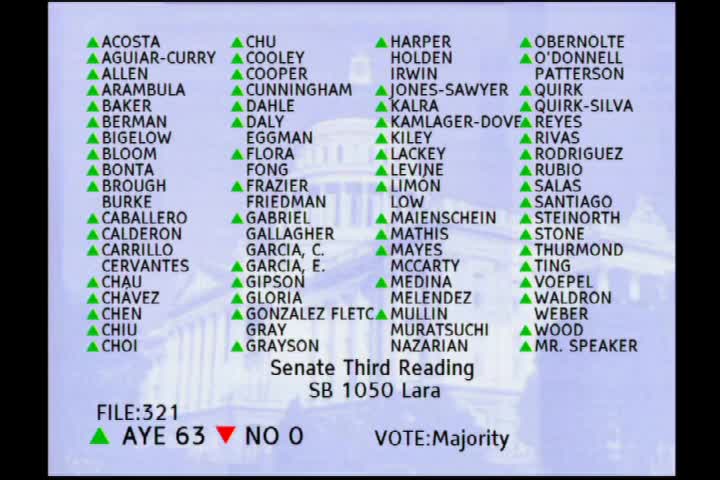 1MIN
Assembly Floor
 1H
Assembly Standing Committee on Appropriations
 7MIN
Assembly Standing Committee on Local Government
 4MIN
Senate Standing Committee on Governance and Finance
Bill Author